A Look Back at Spider-Man 2099 #3 (1993)

Disclaimer: This is my original work with details sourced from reading the comic book and doing personal research. Anyone who wants to use this article, in part or in whole, needs to secure first my permission and agree to cite me as the source and author. Let it be known that any unauthorized use of this article will constrain the author to pursue the remedies under R.A. No. 8293, the Revised Penal Code, and/or all applicable legal actions under the laws of the Philippines.

Welcome back, superhero enthusiasts, 1990s culture enthusiasts and comic book collectors! Today we revisit the world of 2099 within the universe of Marvel Comics back in the 1990s, specifically through the Spider-Man 2099 monthly series.

This time around, we take a look back at the early stage of the futuristic Spider-Man’s story and learn more about Miguel’s struggle in becoming something he was not ready for. On my part, the 3rd issue of Spider-Man 2099 was the first-ever hard copy of the monthly series I bought.

With those details laid down, here is a look back at Spider-Man 2099 #3, published in 1993 by Marvel Comics with a story written by Peter David and drawn by Rick Leonardi.
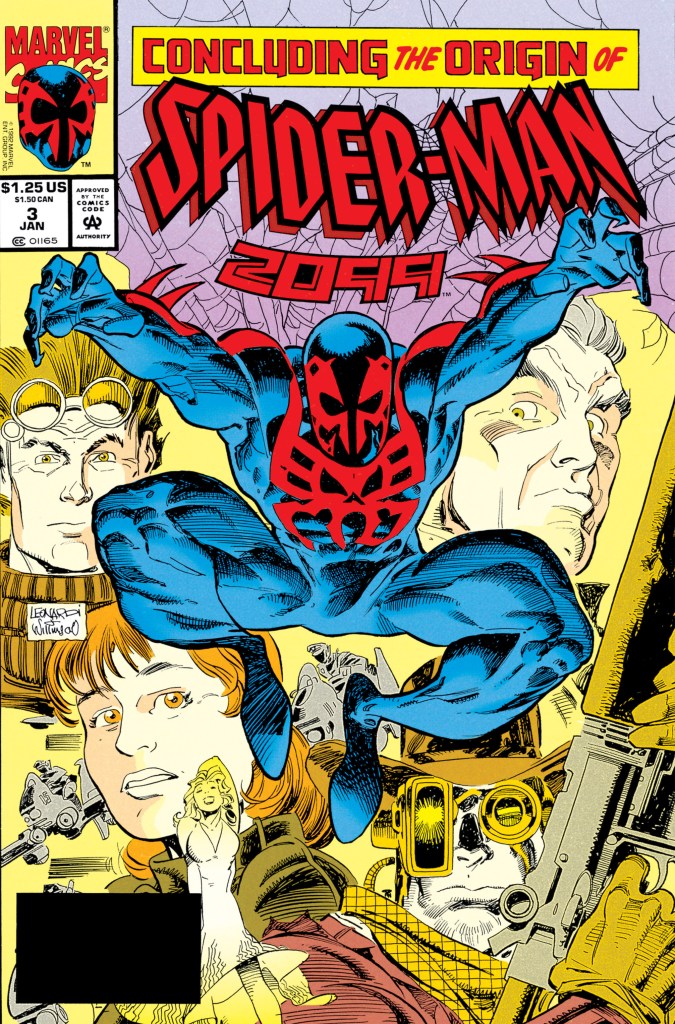
The cover.

Early story

The story begins immediately after the ending of issue #2 with Miguel O’Hara in disguise as Spider-Man facing off with Venture who has been working for Alchemax’s head to find precisely him. The presence of idolaters of Thor view Venture as an enemy and Spider-Man (who knows he is being hunted by the cybernetic guy) tells them to get back to stay out of danger.

Instead of listening to him, the idolaters did the foolish thing by physically attacking Venture who is just too proficient in combat and his high-tech weapon hurts them. With great risk, Spider-Man leaps to Venture to try to convince him to leave him alone. Unfortunately he loses his balance and gets touched by Venture’s weapon which leaves his right arm numb.

Venture tells Spider-Man that Alchemax wants him…

Quality
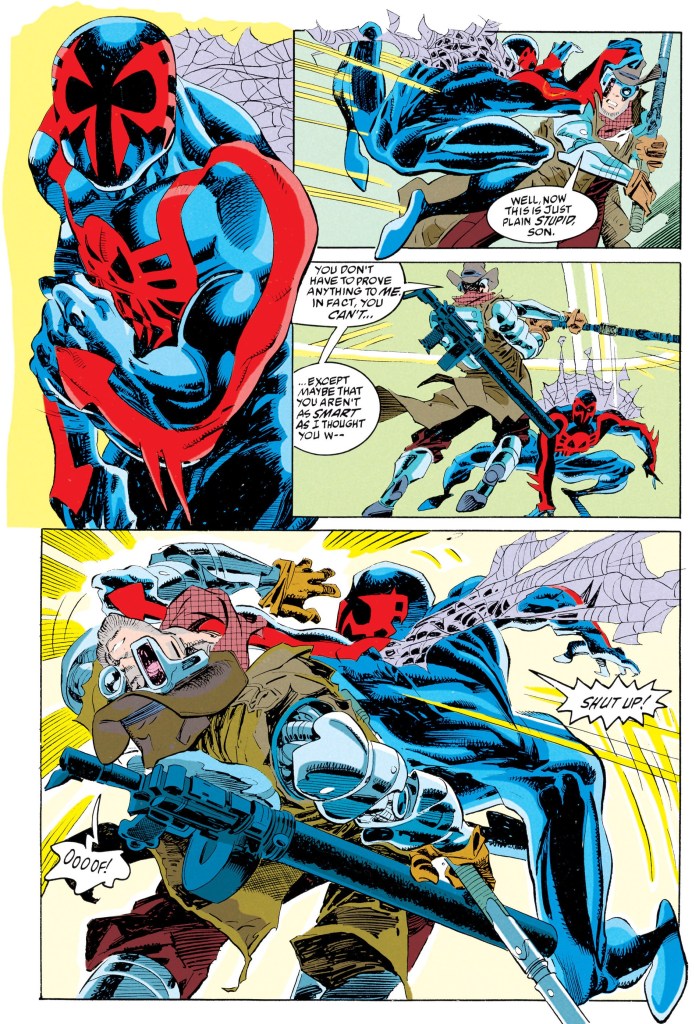
Even though he has a numb right arm, Spider-Man 2099 still got up-close and personal with Venture.

This comic book is one action-packed thrill ride laced with solid character development. While issues #1 and #2 showed how Miguel O’Hara became Spider-Man of 2099, this story shows him in his first-ever battle with someone who happens to be doing a mission for Alchemax (Miguel’s employer no less).

Peter David carefully structured the story and the result were lots of moments in which Spider-Man 2099 witnesses the unexpected happenings which readers can relate with. As Spider-Man learns more about the enhancements within him (better reflexes, ability to leap far, etc.), he gets to do the unbelievable which is a classic superhero trope done but within a futuristic, science fiction setting. What he does with his abilities, he does his best to adjust himself. I also like the fact that Spider-Man of 2099 does not have the Spider Sense of the classic Spider-Man (Peter Park) which in a creative way adds to the suspenseful moments in this comic book series.

As for Venture, he is not your typical villain nor is a one-dimension character designed to merely provide opposition to the protagonist. He is a cybernetic bounty hunter on a mission and does not harbor any personal grudge nor hatred against Spider-Man. On his own, Venture is deadly and is clearly one of the best villains to ever take on Spidey 2099.

Conclusion
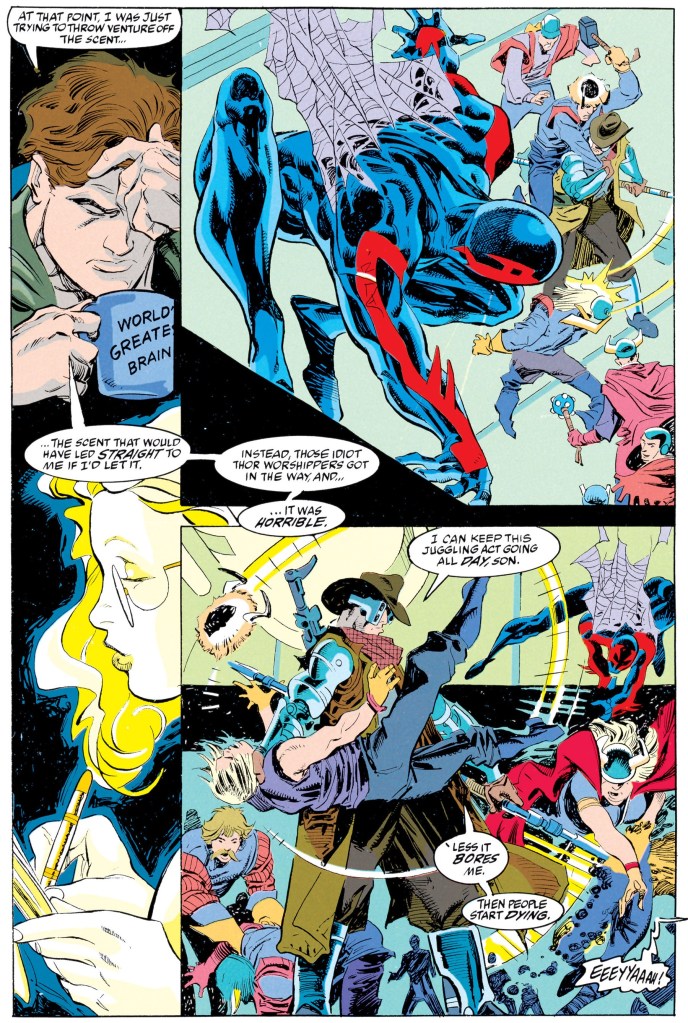
The idolaters and worshipers of Thor take on Venture which Spider-Man witnesses.

Spider-Man 2099 #3 (1993) is a very solid read and it succeeded in further defining the futuristic Spider-Man’s personality as well as his origin. The first time I read this comic book, I got very immersed in learning about the protagonist and how he does his best to save himself and overcome the opposition while finding out ways to ensure that bystanders and witnesses will not get hurt. This comic book also has an immersive sci-fi setting and shows more of the society of 2099. I can clearly say that this is one enjoyable and compelling comic book which aged nicely to this day.

If you are seriously planning to buy an existing hard copy of Spider-Man 2099 #3 (1993) be aware that as of this writing, MileHighComics.com shows that the near-mint copy of the regular edition costs $30 while the near-mint copy of the newsstand edition costs $90.

Overall, Spider-Man 2099 #3 (1993) is highly recommended.

+++++

Thank you for reading. If you find this article engaging, please click the like button below and also please consider sharing this article to others. If you are looking for a copywriter to create content for your special project or business, check out my services and my portfolio. Feel free to contact me with a private message. Also please feel free to visit my Facebook page Author Carlo Carrasco and follow me on Twitter at  @HavenorFantasy as well as on Tumblr at https://carlocarrasco.tumblr.com/

A Look Back at Spider-Man 2099 #39 (1996)

Disclaimer: This is my original work with details sourced from reading the comic book and doing personal research. Anyone who wants to use this article, in part or in whole, needs to secure first my permission and agree to cite me as the source and author. Let it be known that any unauthorized use of this article will constrain the author to pursue the remedies under R.A. No. 8293, the Revised Penal Code, and/or all applicable legal actions under the laws of the Philippines.

Welcome back, superhero enthusiasts, 1990s culture enthusiasts and comic book collectors! Today we revisit the world of 2099 within the universe of Marvel Comics back in the 1990s, specifically through the Spider-Man 2099 monthly series.

In this retro review, the Venom 2099 storyline continues (for my previous reviews, click here, here, here and here). Since my previous review, the futuristic Venom has been captured by Spider-Man and is now in the custody of Alchemax where Miguel O’Hara (Spider-Man of 2099) holds considerable power and authority. As seen in issue #38, Miguel’s rage was clearly affecting him and pushed him to the point of wanting revenge (by means of death, no less) over the death of Dana.

With those details laid down, here is a look back at Spider-Man 2099 #39, published in 1996 by Marvel Comics with a story written by Peter David and drawn by Andrew Wildman.

The cover.

Early story

The story begins with Miguel O’Hara, still impacted by Dana’s death and what he personally discovered about Venom, walking through the offices of an Alchemax building where several employees greet him formally which he does not seem to enjoy. He walks into a laboratory where he sees the two that compose Venom – Kron Stone and the symbiote (living costume) – contained separately with hard glass containers.

Kron Stone, who is related to the powerful Tyler Stone and was responsible for the death of the family of Jake Gallows/Punisher 2099, was declared dead which puzzles Miguel. As the two exchange words, it turns out Kron and Miguel knew each other from long ago. Upon the orders of Miguel, the scientists left the laboratory which gave their boss more privacy to exchange words with the trapped Kron who called him gutless.

Miguel then releases Kron from containment (but still separated from the symbiote), declares terms for their private fist fight (which Kron accepts), and begins to fight him…

Quality

Spider-Man, in his form as Miguel O’Hara, spends time with Xina.

Not surprisingly, the high level of quality and engagement of the writing here is successfully maintained by Peter David and it is very clear to me that he had planned to dramatically shift the direction of the Spider-Man 2099 series and impact the key characters as the story of Venom 2099 went on.

That being said, Peter David went on to not only show Miguel literally burning with rage but also dramatized his move towards the extreme. Not only do we get to see Miguel really abusing his Alchemax authority, he also gets violent with Kron Stone who was powerless without the symbiote. These scenes clearly show that the border that separates good and evil got blurred which showed a very dark side of Miguel O’Hara struggling with his rage, emotions and whatever sanity he still has left.

To be clear, the story here was not purely about Miguel and Kron. There is also the scene in which a cooled down Miguel spends time with Xina who made clear to him her reaction over Dana’s death. Peter David also took the opportunity to not only show more of the return Vulture 2099 but also brought in the 2099 version of Green Goblin simply called Goblin who clearly has an agenda against Spider-Man which adds to the suspense and the overall narrative of the series. The appearance of Goblin also sheds light on the nature of vigilantism and elements of chaos within the 2099 universe.

Conclusion

Miguel and his half-brother Kron Stone begin their fight.

I can say that Spider-Man 2099 #39 (1996) is a very solid read. Not only did the Venom 2099 storyline reflect the serious changes on the characters, it is also led to a bold new direction for the monthly series. Carrying on the dramatic stuff from the previous issues, this comic book also serves as a character examination on Miguel O’Hara which will compel not only the fans but also comic book readers to reflect about what they knew about Spider-Man of the far future and speculate as to how he will turn out and how he would impact the people around him.

If you are seriously planning to buy an existing hard copy of Spider-Man 2099 #39 (1996) be aware that as of this writing, MileHighComics.com shows that the near-mint copy of the regular edition costs $80 while the near-mint copy of the newsstand edition costs $240.

Overall, Spider-Man 2099 #39 (1996) is highly recommended.

+++++

Thank you for reading. If you find this article engaging, please click the like button below and also please consider sharing this article to others. If you are looking for a copywriter to create content for your special project or business, check out my services and my portfolio. Feel free to contact me with a private message. Also please feel free to visit my Facebook page Author Carlo Carrasco and follow me on Twitter at  @HavenorFantasy as well as on Tumblr at https://carlocarrasco.tumblr.com/

A Look Back at Spider-Man 2099 #38 (1995)

Disclaimer: This is my original work with details sourced from reading the comic book and doing personal research. Anyone who wants to use this article, in part or in whole, needs to secure first my permission and agree to cite me as the source and author. Let it be known that any unauthorized use of this article will constrain the author to pursue the remedies under R.A. No. 8293, the Revised Penal Code, and/or all applicable legal actions under the laws of the Philippines.

Welcome back, superhero enthusiasts, 1990s culture enthusiasts and comic book collectors! Today we revisit the world of 2099 within the universe of Marvel Comics as published back in the 1990s, specifically through the Spider-Man 2099 monthly series.

Back in 2020, I reviewed the three key issues of Spider-Man 2099 (click here, here and here) particularly with the entry of Venom 2099. While tragedy happened in issue #37 (a very powerful story), the futuristic Venom was still on the loose.

With those details laid down, here is a look back at Spider-Man 2099 #38, published in 1995 by Marvel Comics with a story written by Peter David and drawn by Andrew Wildman.

The cover.

Early story

The story begins with Spider-Man 2099 grieving over the death of Dana in the presence of Xina and two armed law enforcers. As one of the law enforcers approach him, Spider-Man hits and damages his helmet. The other law enforcer tells his companion to give Spider-Man some room. The grieving web-slinger asks where Venom 2099 is.

Meanwhile at another location, Miguel O’Hara’s mother saw the breaking news on TV about what the tragedy and Dana’s death. Her son Gabriel comes in and gets updated about what happened. As soon as he heard Dana’s name, he becomes concerned and focuses on the TV screen. As images of Spider-Man and Dana appeared, Gabriel begins to make a connection between them and punches the TV screen hard…

Quality

A very angry Miguel O’Hara using his corporate authority to find and get Venom 2099.

If you enjoyed the storytelling, tension and payoff that happened in issue #37, I can confirm to you that great stuff from that comic book continued smoothly in this comic book. As before, Peter David’s writing remains very engaging and gripping. So much so, issue #38 is a very believable and natural continuation of the events of the previous issue. In fact, the tension that started even as far as issue #35 continued in this comic book and at the same time David succeeded in developing the key characters further. Here, the death of Dana impacts not only Spider-Man/Miguel O’Hara, but also those connected with him.

Apart from the impact Venom 2099 left behind on those whom he victimized, the key selling point in this comic book was the portrayal of Miguel O’Hara wanting not only vengeance but also craves for the death of the vicious supervillain. I really find it very gripping to see Miguel using his authority as a high-ranking executive of his company to not only find Venom but also use company resources to get him. There was also the scene in which Miguel wants the captured living piece of Venom’s symbiote become dead which reflects the rage burning in him.

The way Peter David wrote Miguel’s rage is compelling not only because of the dramatics involved but also because it raises new questions about the personality and heart protagonist of the Spider-Man 2099 monthly series. I found myself wondering the following: Is Miguel O’Hara on the way to becoming a villain? Does he realize he is going off-track and could become a danger to others once he gets his way with Venom 2099?

When it comes to the visuals, Andrew Wildman did a really good job her. Not only was his art more detailed than what Rick Leonardi came up with, Wildman also brought to life the emotions of the characters through detailed facial expressions. Wildman also showed how skilled he is with pacing the story as well as being strategic on visualizing the spectacle.

Conclusion

Spider-Man 2099 in a very emotional state over the death of Dana.

I can clearly say that Spider-Man 2099 #38 (1995) is a great comic book to read. It is indeed a very worthwhile follow-up to the powerful and tragic story of issue #37 and the tension that started in issue #35 continued strongly in this comic book. Very clearly, Peter David carefully planned to shake up the Spider-Man 2099 series of the 1990s even as he built up Venom 2099 as the deadliest foe the futuristic Spider-Man faced. I should also state that the Spider-Man 2099 – Venom 2099 rivalry has a distinct style and flavor of its own, and there was simply nothing ripped off from the 20th century Spider-Man – Venom (Peter Parker and Eddie Brock) rivalry.

If you are seriously planning to buy an existing hard copy of Spider-Man 2099 #38 (1995) be aware that as of this writing, MileHighComics.com shows that the near-mint copy of the regular edition costs $80 while the near-mint copy of the newsstand edition costs $240. Spider-Man 2099 #38 (1995) also comes with a Venom 2099 cover edition which costs $200 for a near-mint copy.

Overall, Spider-Man 2099 #38 (1995) is highly recommended!

+++++

Thank you for reading. If you find this article engaging, please click the like button below and also please consider sharing this article to others. If you are looking for a copywriter to create content for your special project or business, check out my services and my portfolio. Feel free to contact me with a private message. Also please feel free to visit my Facebook page Author Carlo Carrasco and follow me on Twitter at  @HavenorFantasy as well as on Tumblr at https://carlocarrasco.tumblr.com/

A Look Back at Dazzler #2 (1981)

Disclaimer: This is my original work with details sourced from reading the comic book and doing personal research. Anyone who wants to use this article, in part or in whole, needs to secure first my permission and agree to cite me as the source and author. Let it be known that any unauthorized use of this article will constrain the author to pursue the remedies under R.A. No. 8293, the Revised Penal Code, and/or all applicable legal actions under the laws of the Philippines.

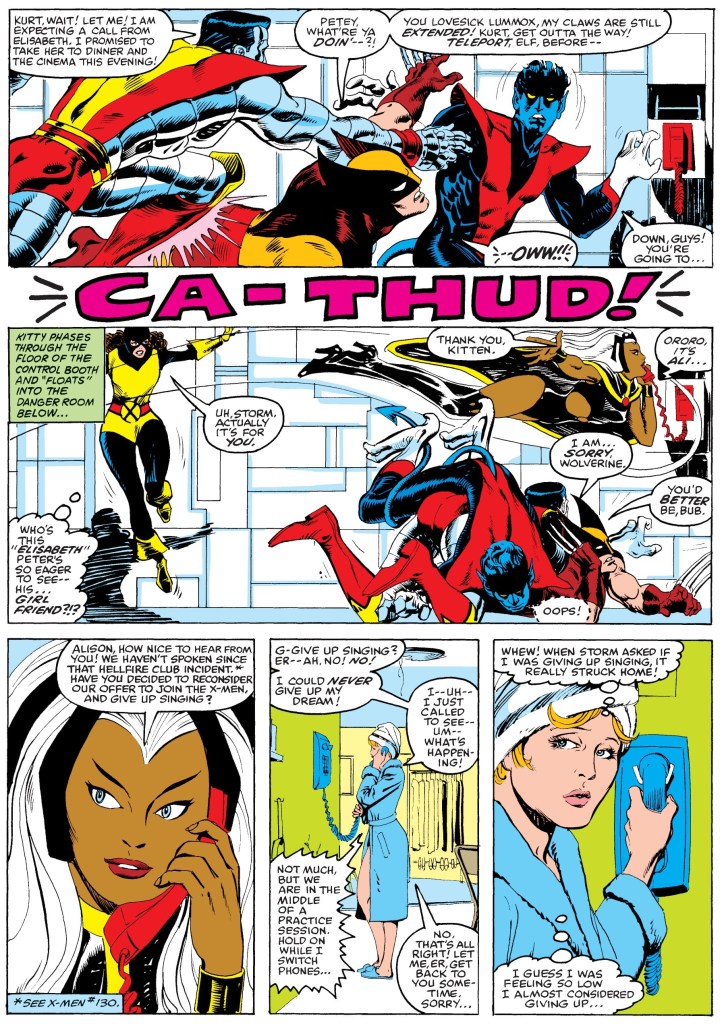
Welcome back, superhero enthusiasts, comic collectors, 1990s culture enthusiasts and fans of Marvel Comics! Way back in 1981, Marvel Comics had a successful comic book series launch with Dazzler #1 (read my retro review by clicking here) which sold over 400,000 copies and further sealed Dazzler as an advantageous addition for the company’s superhero comics franchise. Dazzler, a creation of a deal between Marvel and a certain record company, debuted in Uncanny X-Men #130 and got involved with the X-Men until Uncanny X-Men #131. Dazzler appeared with Marvel’s famous webslinger in Amazing Spider-Man #203.

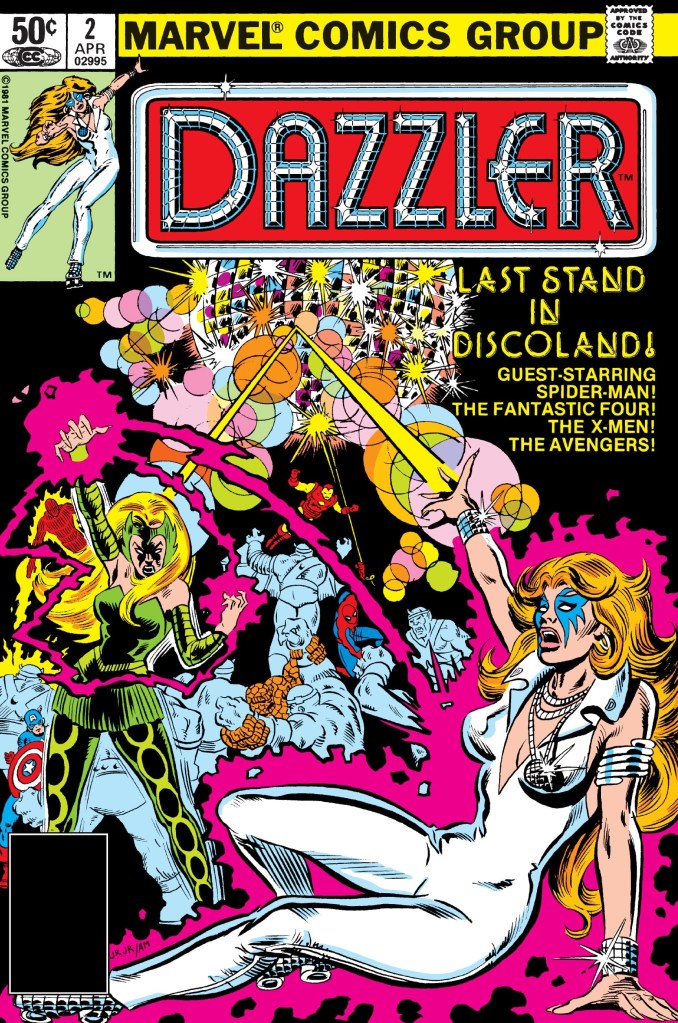
Dazzler #1 ended with a brewing rivalry between the title character and Enchantress. With those laid down, here is a look back at Dazzler #2, published in 1981 by Marvel Comics with a story written by Tom DeFalco and drawn by John Romita, Jr.

The cover.

Early story

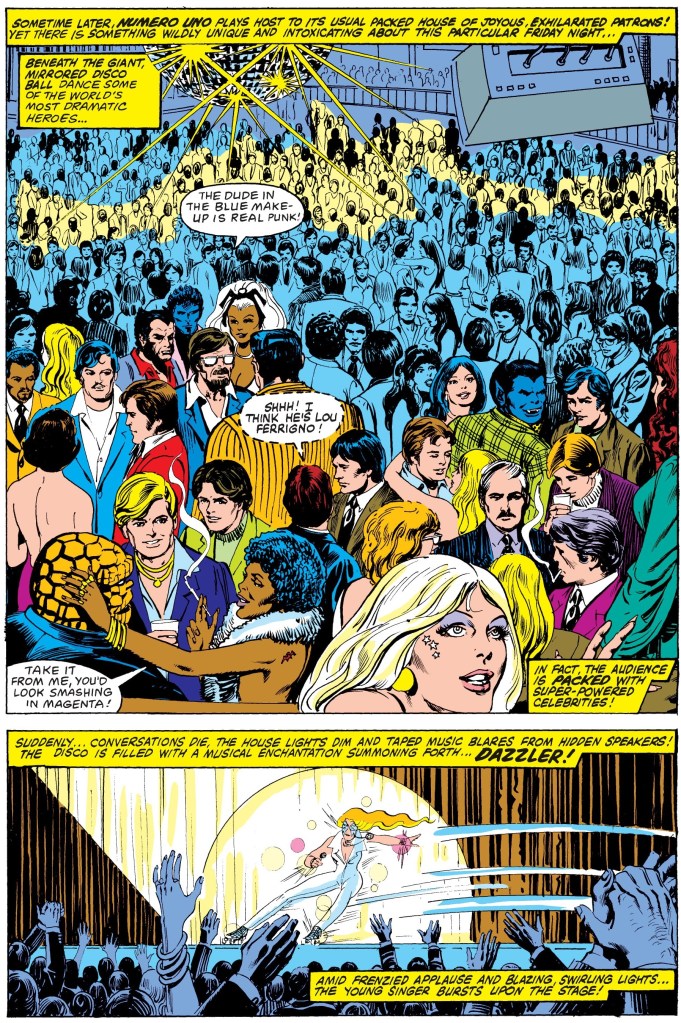
The story begins with Dazzler preparing for her big show at Numero Uno, a prestigious disco in the city of New York. Just before the show starts, a huge crowd of people are in attendance and among them are Wolverine, Peter Parker (Spider-Man), Captain America, Johnny Storm, Ben Grimm and Tony Stark (Iron Man) to name some.

Just as Dazzler appears on-stage and draws a frenzied applause from the audience, the revenger-hungry Enchantress slowly makes her moves to ruin the lady who outclassed her to be the main attraction of the club. Even with her desire for revenge, the Enchantress decides to use her magic sparingly on Dazzler. In the audience, Peter Parker/Spider-Man begins to sense something is about to happen…

Quality

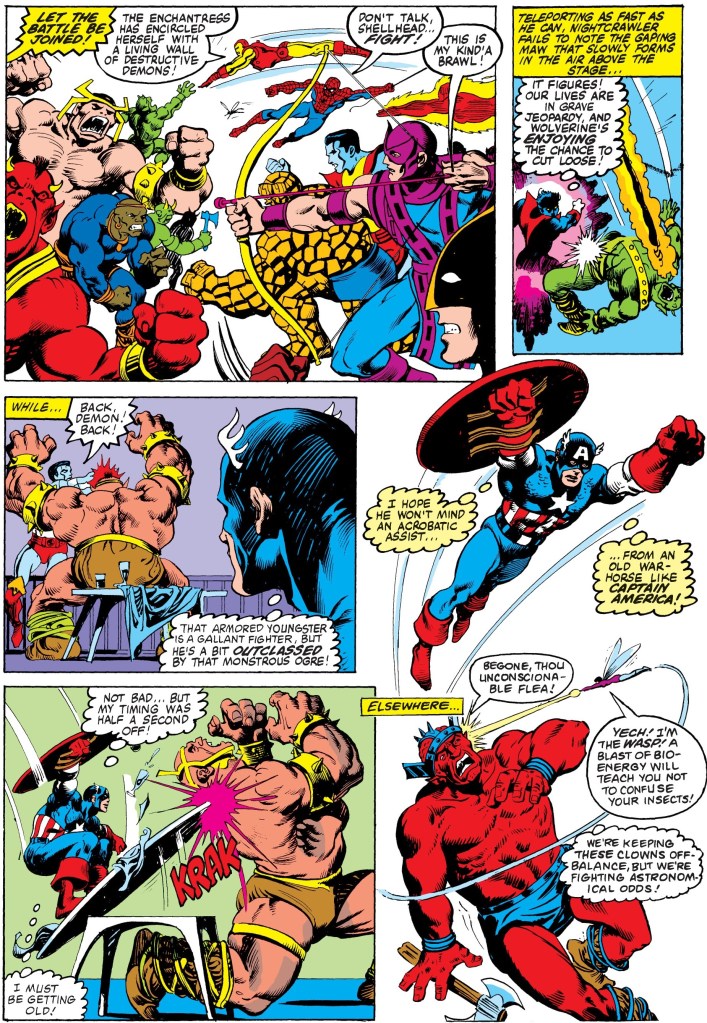
This shows what this comic book is really about.

The way the story was told is disappointing. This is because the spotlight on Dazzler and her anticipated conflict with the Enchantress got overwhelmed by the amount of superhero filler on the narrative. To be clear, it is fun and interesting to see a mix of the varied superheroes of Marvel together but this comic book ended up being an all-star showcase (X-Men, Avengers and Fantastic Four members included) than a real, standalone Dazzler story. In fairness, Tom DeFalco showed how skilled he is with plot structuring and capturing the personalities and tropes of the different superheroes (note: unsurprisingly, DeFalco accurately captured Spider-Man’s personality and he went on to be a major force behind Spider-Man comic books) but that does not change the fact that this comic book should have been more about Dazzler.

When it comes to the conflict between Dazzler and the Enchantress, it was executed with no depth at all. Literally speaking, there is not enough meat to consume here and it the conflict really ended up looking very rushed. As if that was not bad enough, there is not enough justification to show Dazzler defeating a monster summoned by the Enchantress.  Considering how shallow the Dazzler-Enchantress match-up turned out, it’s no wonder why there is so much Marvel all-star filler in the script.

As for the late-stage attempt to shift the narrative back to Dazzler, it is rather over-the-top and unsatisfying.

Conclusion

You recognize someone in the audience?

Dazzler #2 (1981) is an example about a creative team’s lack of confidence on crafting a decent story to develop a new superhero and ultimately resorting to fill it with a mix of other superheroes involved which itself symbolizes desperation. This comic book is not really a Dazzler story but an all-star showcase with Dazzler becoming a minor character in her own monthly series.

If you are seriously planning to buy an existing hard copy of Dazzler #2 (1981), be aware that as of this writing, MileHighComics.com shows that the near-mint copy of the regular edition costs $28 while the near-mint copy of the newsstand edition costs $60.

Overall, Dazzler #2 (1981) is unsatisfactory. Anyone who loves Dazzler or who wishes to discover more of her will be disappointed with this comic book.

+++++

Thank you for reading. If you find this article engaging, please click the like button below and also please consider sharing this article to others. If you are looking for a copywriter to create content for your special project or business, check out my services and my portfolio. Feel free to contact me as well. Also please feel free to visit my Facebook page Author Carlo Carrasco and follow me at HavenorFantasy@twitter.com

A Look Back at Dazzler #1 (1981)

Disclaimer: This is my original work with details sourced from reading the comic book and doing personal research. Anyone who wants to use this article, in part or in whole, needs to secure first my permission and agree to cite me as the source and author. Let it be known that any unauthorized use of this article will constrain the author to pursue the remedies under R.A. No. 8293, the Revised Penal Code, and/or all applicable legal actions under the laws of the Philippines.

Welcome back, superhero enthusiasts, comic collectors, 1990s culture enthusiasts and fans of Marvel Comics! Previously, I reviewed Uncanny X-Men #130 which was the first appearance of Dazzler who went on to become one of the most notable new characters of Marvel Comics in the 1980s. After appearing in Uncanny X-Men #131 and Amazing Spider-Man #203, Dazzler became more prominent among all of Marvel’s superheroes as the publisher launched an all-new monthly series featuring her. There is more to that than meets the eye, however.

In his article titled “Dazzler and Me”, Danny Fingeroth wrote: Marvel decided to tray an experiment with the relatively new “direct market” – comic book shops. It was decided that Dazzler #1 would only be available in comic book shops, not at traditional newsstands.

Dazzler #1 sold over 400,000 copies.

Even the top-selling comics of the era sold perhaps 250,000 copies. So, the first issue, anyway, was a major hit.

Apart from the confirmed commercial success of the comic book, it is a wonder if it is still good to read by today’s standards. To find out, here is a look back at Dazzler #1, published in 1981 by Marvel Comics with a story written by Tom DeFalco and drawn by John Romita, Jr.

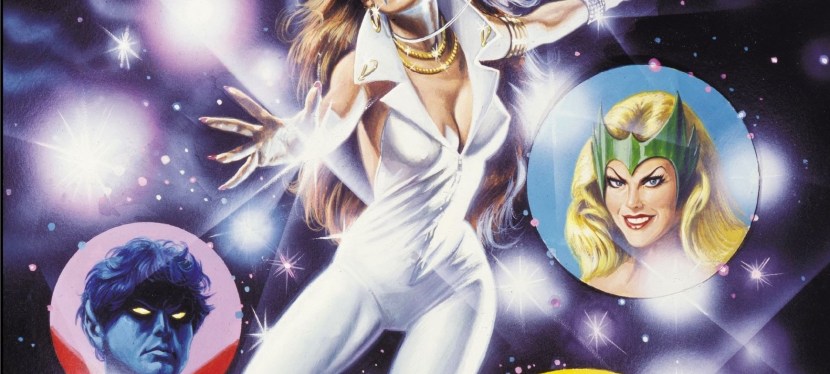
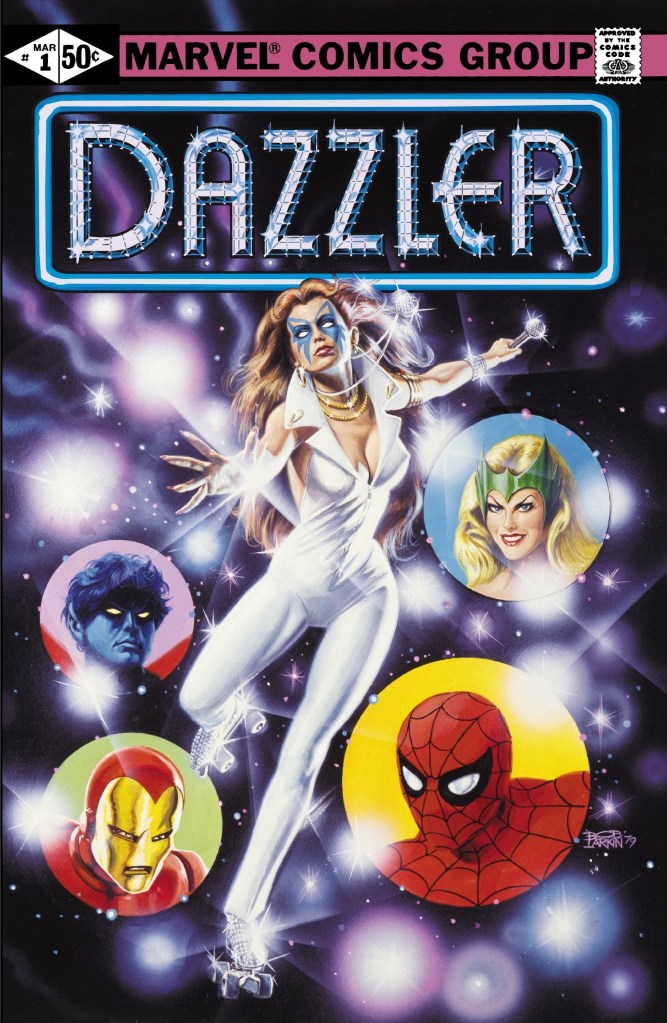
The cover.

Early story

The story begins with Dazzler running away from four armed men who had been following her since she left the disco. She finds herself corned at the dead end of an alley as the men approach her. While pretending to be reaching for her make-up in the bag, Dazzler grabs and activates her portable radio which plays music. With the music turned on, she uses her power to convert it all into a dazzling display of light and color which makes the men disoriented.

While swinging nearby, Spider-Man notices the display of light but before he begins his approach, Dazzler makes her move to knock two men out. Another man fires his gun and his bullet ricochets until it hits the portable radio stops the music and Dazzler’s lights altogether leaving her vulnerable once again…

Quality

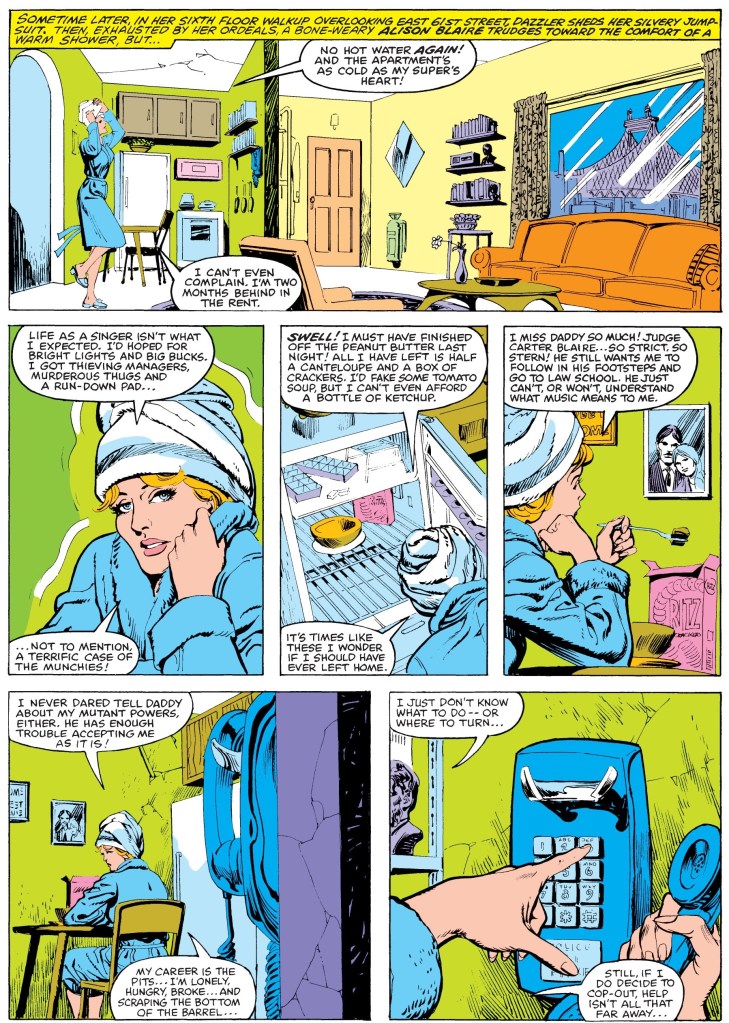
This page alone establishes Dazzler as a person struggling to make ends meet.

As far as telling a Dazzler story goes, this comic book is the complete package and it’s got very solid writing! Apart from showing what happened to her after her appearances in the Uncanny X-Men and Amazing Spider-Man series, this comic book formally introduces Dazzler in her civilian identity as Alison Blaire and thanks to efficient writing, it also reveals threads of her past and how her mutant powers manifested. Not only that, readers will get to see the title character as a typical person who is struggling to make ends meet even though she does her best with entertainment as a career.

Strangely, the focus on Dazzler is relatively light in content and the result is several pages of Marvel universe-related filler which shows several other characters like Captain America, Iron Man, Storm, Wolverine and others present with little to no connection with the title character. The X-Men scene is a nice touch as it will remind readers about Dazzler’s first interaction with them.

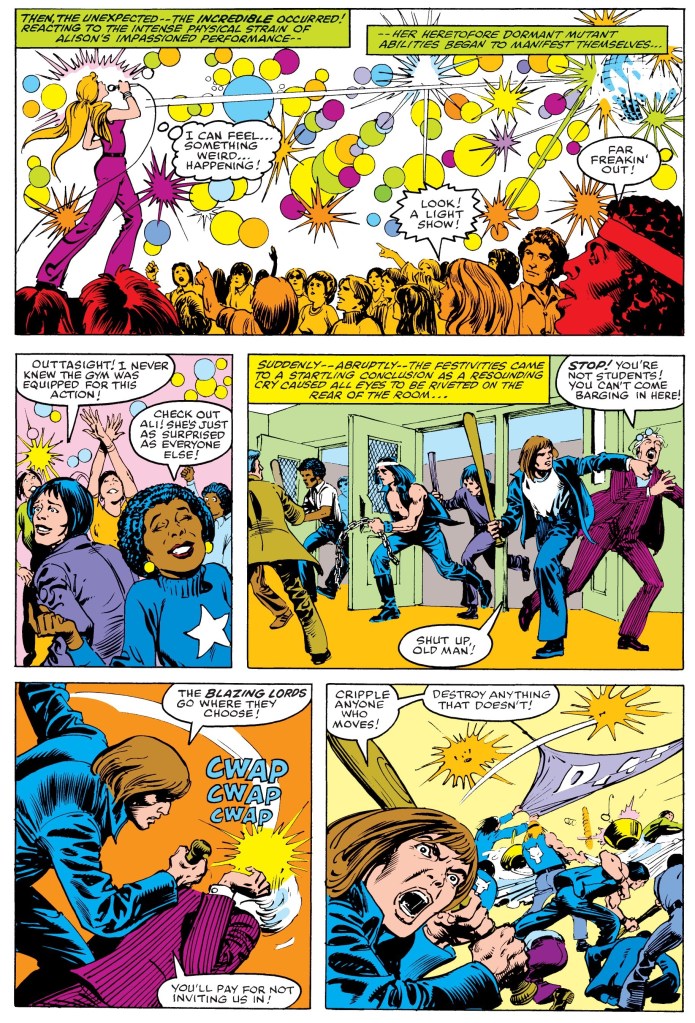
As a teenager, Alison Blaire’s power begins to manifest during this particular event in her life.

To build-up the first challenge for Dazzler, this comic book has the Enchantress as the villainess and ironically it also had some room of character development for her. Clearly this was done not only to build up anticipation for the next issue but to make readers root for Dazzler some more. In retrospect, the Enchantress would later emerge as an important figure in 1984’s crossover storyline Secret Wars.

Conclusion

The scene involving the X-Men is a nice touch as it connects with Dazzler’s previous interaction with them.

While it is indeed a product of the early 1980s carrying influences from the 1970s New York club scene, Dazzler #1 (1981) is still fun and engaging to read. Clearly this comic book is a must-have for anyone who loves Dazzler and it should be entertaining enough for geeks who love the 1980s and the Marvel-related crossovers of the time. Very clearly, this comic book succeeded in introducing and developing Dazzler as a person (as opposed to being a super hero) and the background story established fits in nicely with the character’s first appearance in Uncanny X-Men #130. Very clearly, there is a lot more to Dazzler than her unique super power and her disco look.

If you are seriously planning to buy an existing hard copy of Dazzler #1 (1981), be aware that as of this writing, MileHighComics.com shows that the near-mint copy of the comic book costs $70.

Overall, Dazzler #1 (1981) is highly recommended!

+++++

Thank you for reading. If you find this article engaging, please click the like button below and also please consider sharing this article to others. If you are looking for a copywriter to create content for your special project or business, check out my services and my portfolio. Feel free to contact me as well. Also please feel free to visit my Facebook page Author Carlo Carrasco and follow me at HavenorFantasy@twitter.com

A Look Back at Amazing Spider-Man #203 (1980)

Disclaimer: This is my original work with details sourced from reading the comic book and doing personal research. Anyone who wants to use this article, in part or in whole, needs to secure first my permission and agree to cite me as the source and author. Let it be known that any unauthorized use of this article will constrain the author to pursue the remedies under R.A. No. 8293, the Revised Penal Code, and/or all applicable legal actions under the laws of the Philippines.

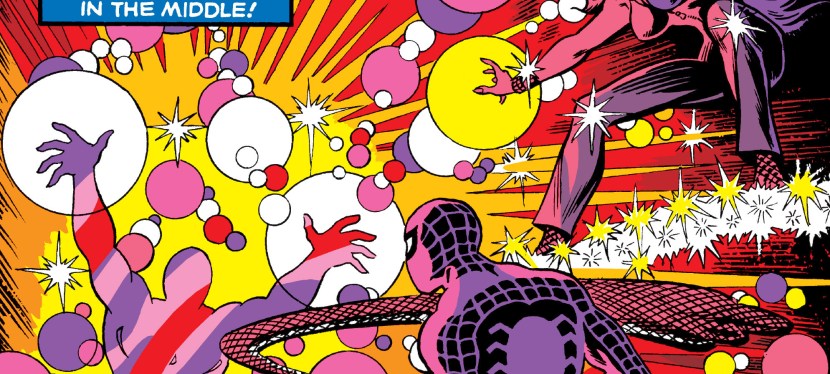
Welcome back, superhero enthusiasts, 1980s culture enthusiasts, comic book collectors and fans of Marvel Comics! Previously I reviewed Uncanny X-Men #130 (1980) which was the first appearance of Dazzler who eventually became a popular figure for Marvel Comics in the 1980s. Before the company published a monthly comic book series featuring her, Dazzler made another appearance in an issue of the Amazing Spider-Man which was released just a few months after her debut. This, of course, led to a crossover with the iconic webslinger himself.

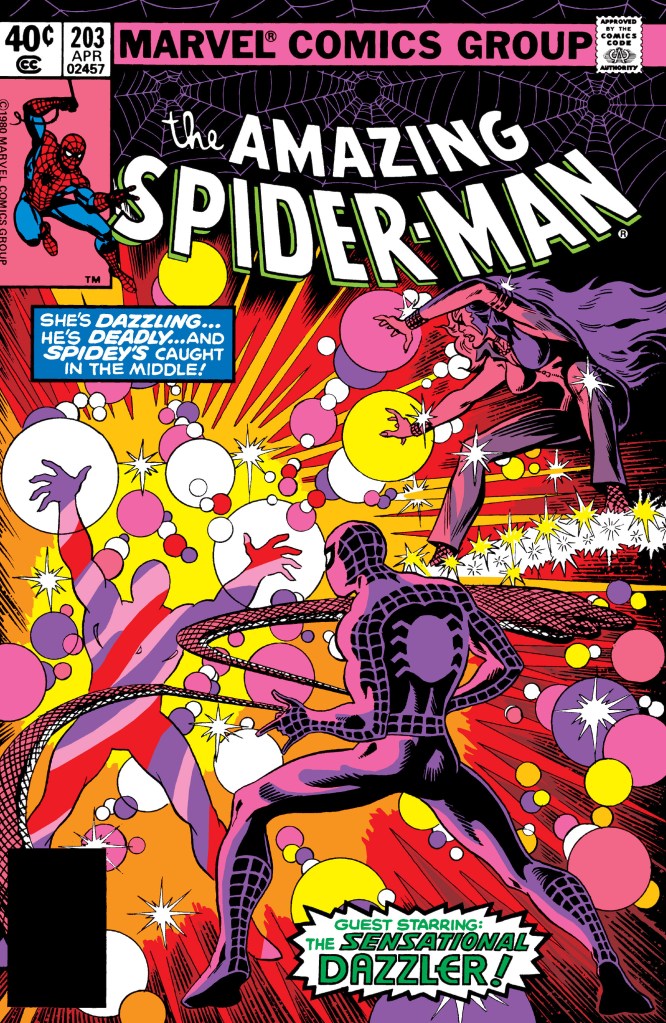
With those details laid down, here is a look back at Amazing Spider-Man #203, published in 1980 by Marvel Comics with a story written by Marv Wolfman and drawn by Keith Pollard.

The cover.

Early story

The story begins during a night in the city where a swinging Spider-Man gets distracted by fast skating Dazzler who is being followed closely by a streak of light. After Spider-Man speculates about the possible return of Will-o-the-Wisp, he decides to intervene and pulls Dazzler off the road and to himself above. Dazzler faints suddenly.

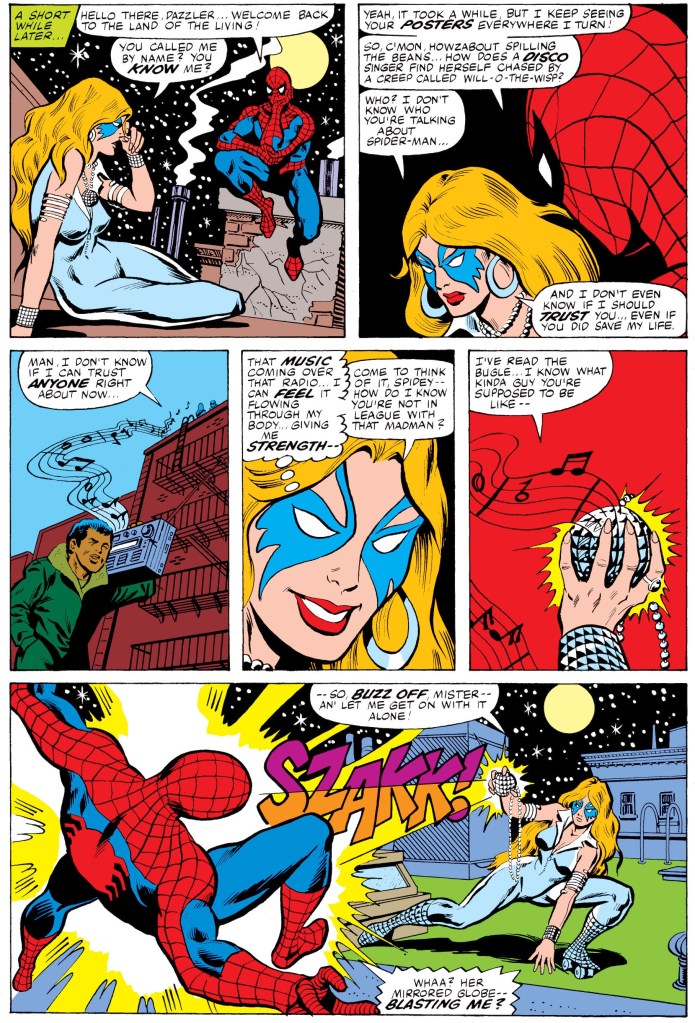
A short while afterward, Dazzler wakes up and starts talking with the webslinger. In response to the mention of Will-o-the-Wisp’s name, she claims to not knowing what he was talking about. As their talk goes on, Dazzler hears music from the street which strengthens her. Using the small mirror globe she is wearing, Dazzler hits Spider-Man with a blast of light pushing him off the building…

Quality

The crossover between Dazzler and Spider-Man is the main feature of this comic book.

This is one fun crossover between the iconic Spider-Man and the brand-new Dazzler. Marv Wolfman wrote a story that not only followed the further adventures of the webslinger, it also gave readers more to see and learn about Dazzler who just had her unexpected adventure with the X-Men months earlier (in Uncanny X-Men #130 and #131). By connecting this story with those two X-Men comic books, it really looked like just got back home in the city only to get chased by streaking light. The interactions between Dazzler and Spider-Man were entertaining. While Dazzler is a known entertainer among New Yorkers, it was the webslinger who remains the big, popular local figure which is clearly reflected in the singer’s verbal exchange with him.

The villain in this comic book, Lightmaster, is pretty cartoonish visually but his super power and high intelligence do make him look threatening. I like the way the story was crafted with concepts that link Lightmaster with Dazzler. Both of them are connected with light and while Dazzler is able to absorb sound like a form of energy and create light beams, Lightmaster has the means to tap on her power and use it for his advantage. There is also another capability of Lightmaster’s which I will just leave unrevealed and you who read this should find out about it.

Conclusion

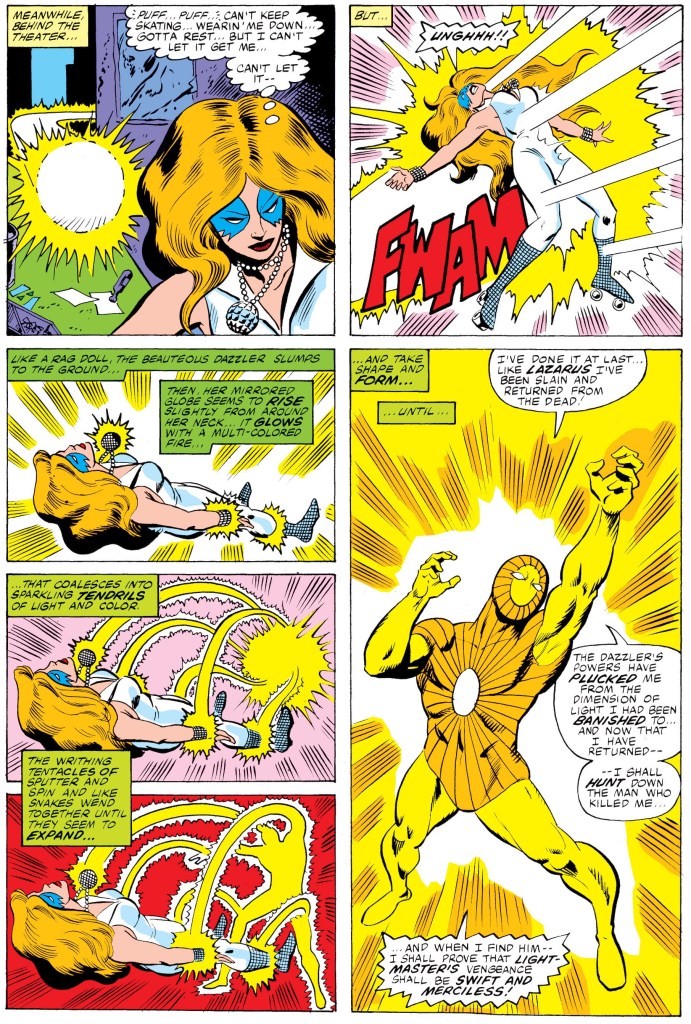
Lightmaster enters the scene.

Amazing Spider-Man #203 (1980) is a very old yet fun comic book that fans of Spider-Man and Dazzler will enjoy. Not only does it have a meaty encounter between the two, it also succeeds in chronicling Spider-Man’s life both in costume and as civilian Peter Parker. Going back to Dazzler, there is not much character development for her here but that is understandable as such emphasis was only waiting to happen in her own monthly comic book series.

If you are seriously planning to buy an existing hard copy of Amazing Spider-Man #203 (1980), be aware that as of this writing, MileHighComics.com shows that the near-mint copy of the regular edition costs $94 while the near-mint copy of the newsstand edition costs $150.

Overall, Amazing Spider-Man #203 (1980) is recommended.

+++++

Thank you for reading. If you find this article engaging, please click the like button below and also please consider sharing this article to others. If you are looking for a copywriter to create content for your special project or business, check out my services and my portfolio. Feel free to contact me as well. Also please feel free to visit my Facebook page Author Carlo Carrasco and follow me at HavenorFantasy@twitter.com

A Look Back at Punisher 2099 #13 (1994)

Disclaimer: This is my original work with details sourced from reading the comic book and doing personal research. Anyone who wants to use this article, in part or in whole, needs to secure first my permission and agree to cite me as the source and author. Let it be known that any unauthorized use of this article will constrain the author to pursue the remedies under R.A. No. 8293, the Revised Penal Code, and/or all applicable legal actions under the laws of the Philippines.

Welcome back, superhero enthusiasts, comic book collectors, 1990s pop culture enthusiasts and fans of Marvel Comics! We finally made it at last with the conclusion of The Fall of the Hammer crossover storyline that highlighted Marvel’s 2099 franchises.

Last time around, Doom 2099 #14 saw the raising of the stakes and tension of the storyline leading up to the sudden team-up of the 2099 universe’s pioneering heroes – Spider-Man 2099, Ravage 2099, Doom 2099 and Punisher 2099 – facing the so-called Thor (the flying idol of the people in 2099), the minions and the secret forces behind the conflict.

With those details laid down, here is a look back at Punisher 2099 #13, published in 1993 (cover dated 1994) by Marvel Comics with a story written by Pat Mills and Tony Skinner, and illustrated by Tom Morgan.

The cover.

Early story

The story begins with Spider-Man, Punisher, Doom and Ravage together facing a horde of Berzerkers approaching them. The four engaged with the horde using violent action. When things calmed down, Doom 2099 tells them that they need to split into duos so that they can prevent the city of Valhalla from harming the millions of people below (in New York).

Before they start their tasks, the schemer Avatarr appears to them through holographic imagery and tells them that Valhalla was created as a base for the heroes that would destroy them and lead mankind along more productive lines. Thanks to Ravage’s move, Doom detects Avatarr’s frequency…

Quality

As Punisher 2099 arms himself, look closely and you will see the conflict between him and Jake Gallows.

When it comes to the storytelling, this conclusion to The Fall of the Hammer storyline felt unsatisfying. There were clear signs of rush on the resolution to the plot that preceded the ending which itself had a sudden shift of focus on Punisher 2099.

The real meat of this comic book is the team-up of the Marvel 2099’s pioneering protagonists, including the duos that were spawned as the plot required it. For most of this crossover storyline, Spider-Man 2099 and Punisher 2099 were just riding together going to Valhalla. In this comic book, you will really see the two work together which was satisfying enough as pay-off (to the build-up the preceded this issue). The duo of Doom 2099 and Ravage 2099, however, was nowhere as satisfying and, more notably, there was no real chemistry between them.

This comic book continues the theme of false deities and a series of unfortunate events pulled off from a distance by some sinister force located in a secret place. While this storyline had touched on the faith of the Thorites (most notably in Doom 2099 #14), this one simply abandoned it to focus more on 2099’s original heroes doing something heroic.   

When it comes to Punisher 2099 himself, fans will have a lot of stuff to enjoy. There is a short but notable moment in the story implying that Punisher 2099 and Jake Gallows are separate entities presented in the character’s mind.

Conclusion

This opening image is easily the best image of the comic book. Things went downhill from after this image.

Punisher 2099 #13 (1994) is not the solid conclusion The Fall of the Hammer storyline deserved. There were clear signs of rush as well as compression of details that had to be done in order to fit the 22 story pages. The so-called final conflict felt hollow and 2099 fans who got invested with the era’s self-declared Thor (who was initially the main antagonist) in the previous chapters will be disappointed with the way he turned out here. That being said, Avatarr as the main villain is just not convincing and was unsatisfying. Having Punisher 2099, Spider-Man 2099, Doom 2099 and Ravage 2099 together to do some saving was pretty interesting and symbolic, as well as the main attraction of this comic book. Sadly, not even those pioneers could save this comic book and the storyline from ending with a whimper.

If you are seriously planning to buy an existing hard copy of Punisher 2099 #13 (1994), be aware that as of this writing, MileHighComics.com shows that the near-mint copy of the regular edition costs $6 while the near-mint copies of the signed-and-numbered and the newsstand editions cost $50 and $16 respectively.

Overall, Punisher 2099 #13 (1994) is worth getting below its cover price.

+++++

Thank you for reading. If you find this article engaging, please click the like button below and also please consider sharing this article to others. If you are looking for a copywriter to create content for your special project or business, check out my services and my portfolio. Feel free to contact me as well. Also please feel free to visit my Facebook page Author Carlo Carrasco and follow me at HavenorFantasy@twitter.com

A Look Back at Spider-Man 2099 #16 (1994)

Disclaimer: This is my original work with details sourced from reading the comic book and doing personal research. Anyone who wants to use this article, in part or in whole, needs to secure first my permission and agree to cite me as the source and author. Let it be known that any unauthorized use of this article will constrain the author to pursue the remedies under R.A. No. 8293, the Revised Penal Code, and/or all applicable legal actions under the laws of the Philippines.

By the year 1993, Marvel Comics’ new comic book line of the 2099 universe kept filling the shelves of retailers and made it into the hands of collectors and fans with the monthly series composed of Spider-Man 2099, Ravage 2099, Doom 2099, Punisher 2099 and the new addition of the year X-Men 2099. Back then, the Marvel 2099 line expanded a lot and saw the establishment of new fans. Even the quarterly series 2099 Unlimited caught the attention of some readers as it told the early stories of Hulk 2099 (who debuted in 2099 Unlimited #1).

Unsurprisingly, there were fans of the 2099 universe who wished for a crossover storyline that would bring together their respective favorite futuristic heroes. Remember the rivalry between classic Spider-Man (Peter Parker) and the Punisher (Frank Castle)? Some wanted Spider-Man 2099 and Punisher 2099 to encounter each other.

Eventually, the crossover dream of the fans came through in the form of The Fall of the Hammer storyline that took place in five parts. Specifically one issue each of Spider-Man 2099, Ravage 2099, Doom 2099, Punisher 2099 and X-Men 2099. It was also an opportunity for the 2099 creative teams (note: the legendary Stan Lee and Peter David were among the writers at the time) to get together and contribute to make something special under the watch of 2099 editor Joey Cavalieri.

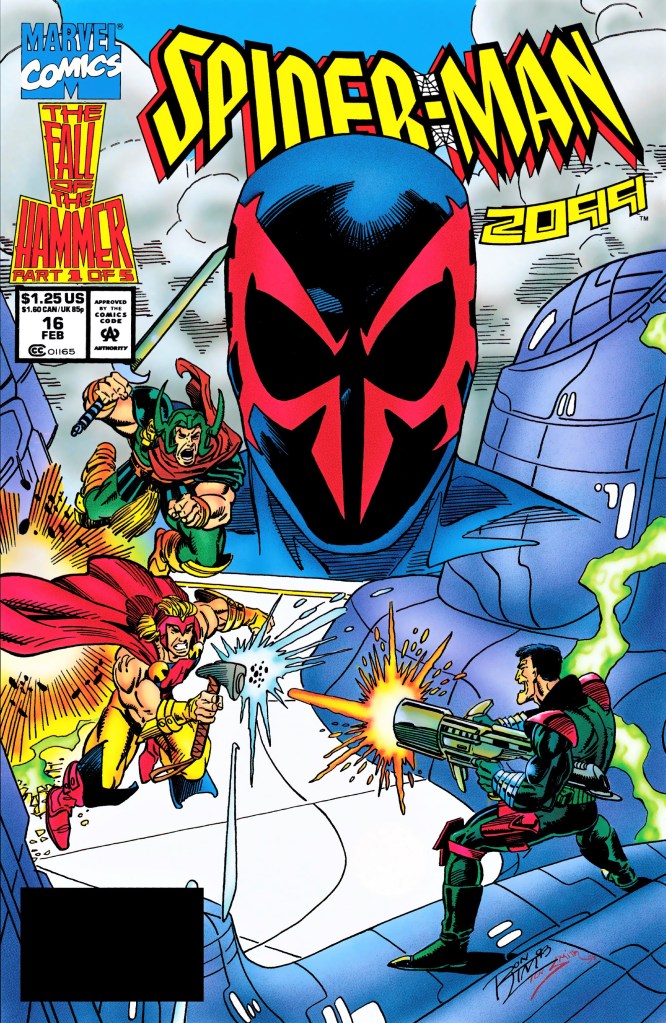
With those details laid down, we can finally start examining the beginning of The Fall of the Hammer storyline in this look back at Spider-Man 2099 #16, published in 1993 (cover dated 1994) by Marvel Comics with a story written by Peter David and drawn by Rick Leonardi.

The cover drawn by Ron Lim.

Early story

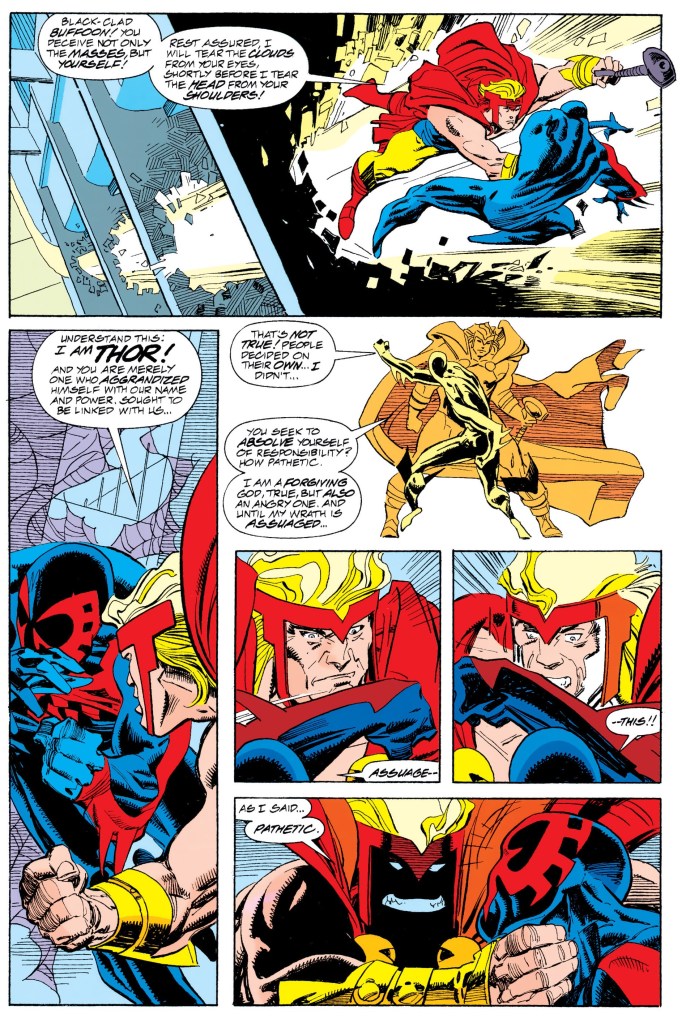
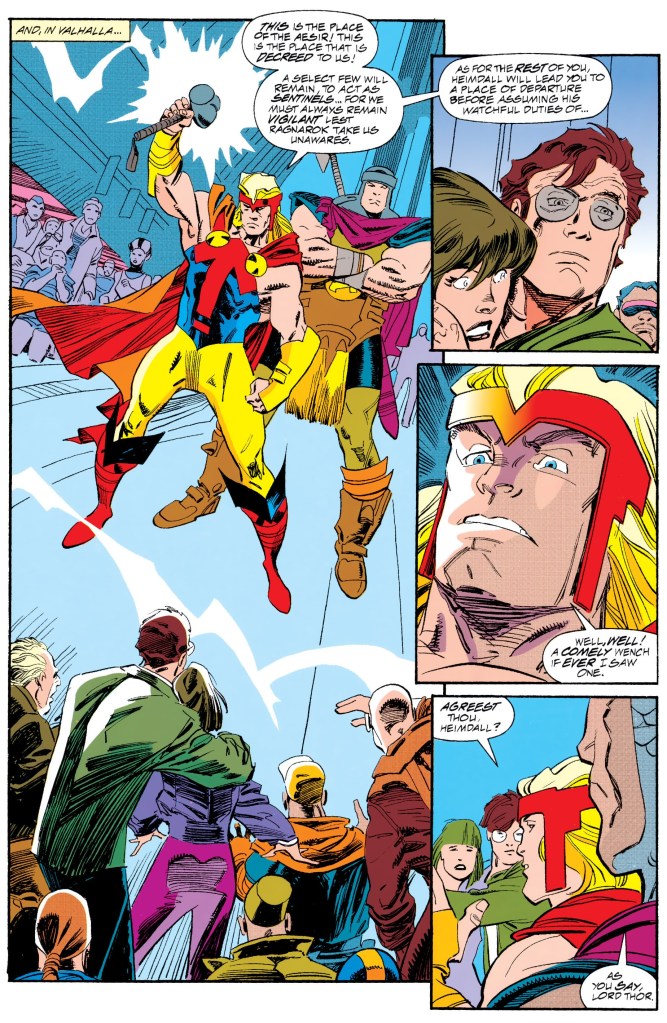
The story begins with the arrival of the floating city of Valhalla, disturbing the people of the town of Randall below. On the floating city itself, a crowd of people – with Miguel O’Hara and Dana among them – stare at a hammer-wielding, caped blonde man who claims to be Thor (their idol). Accompanied by Heimdall, Thor tells them that a select few among them will remain in the city to act as sentinels while the rest will come with Heimdall to a place of departure.

Thor turns his attention on Dana causing Miguel to intervene and challenge his so-called authority. As Thor reacts to Miguel’s defiance, he throws a punch which got deflected. This causes the so-called god of thunder to be surprised given Miguel looking ordinary to him. In reaction, Thor grabs him and throws his body several feet over many people’s heads. This leaves Dana helpless.

Miguel crashes through a glass window, falling outside until he shoots a web to control his movement. He takes off his civilian clothes, revealing his costume as Spider-Man of 2099. He sets off to get back at Thor…  

Quality

The highlight of the comic book is Spider-Man 2099’s conflict with Thor.

To make clear the obvious, the writing by Peter David is indeed solid although the sketch-like aesthetic of the art of Rick Leonardi badly needed more visual details.

As for the story itself, it is succeeded in creating tension with regards to the caped figure who believes himself to be Thor who is the central figure of religion in 2099 America and has the means to wield power by even involving technology (with Valhalla as the center piece). That being said, Spider-Man 2099’s encounter with him was inevitable, and so was the result (a bit predictable). The story also sheds light on the perceived omnipotence of Thor and how Spider-Man 2099 (who was previously referred to by some people as Thor’s harbinger) got associated with his legend.

To make things clear, this one is purely a Spider-Man 2099 story that justifies the concept of needing other 2099 heroes as the threat was simply too great for any one hero to handle. I should also state that the crossover between any heroes does not begin until the final page of this comic book.

Conclusion

Nothing like being in a crowd of people watching helplessly in front of two so-called omnipotent figures.

Spider-Man 2099 #16 (1994) is still a good read and as the first chapter of The Fall of the Hammer storyline, it served its purpose well. This is mainly due to the strong writing by Peter David who also succeeded in establishing 2099’s Thor not only as the villain but also as a figure who truly is a threat to the people. This comic book also shows that people in 2099 failed to realize who their true Creator is as they embraced religion (instead of faith) and committed idolatry (which is truly unholy) by believing in a false god like Thor.

If you are seriously planning to buy an existing hard copy of Spider-Man 2099 #16 (1994), be aware that as of this writing, MileHighComics.com shows that the near-mint copy of the regular edition costs $40 while the near-mint copies of the newsstand and the signed-and-numbered editions cost $120 and $300 respectively.

Overall, Spider-Man 2099 #16 (1994) is recommended.

+++++

Thank you for reading. If you find this article engaging, please click the like button below and also please consider sharing this article to others. If you are looking for a copywriter to create content for your special project or business, check out my services and my portfolio. Feel free to contact me as well. Also please feel free to visit my Facebook page Author Carlo Carrasco and follow me at HavenorFantasy@twitter.com

A Look Back at What If #20 (1990)

Disclaimer: This is my original work with details sourced from reading the comic book and doing personal research. Anyone who wants to use this article, in part or in whole, needs to secure first my permission and agree to cite me as the source and author. Let it be known that any unauthorized use of this article will constrain the author to pursue the remedies under R.A. No. 8293, the Revised Penal Code, and/or all applicable legal actions under the laws of the Philippines.

Welcome back superhero enthusiasts, comic book collectors, 1990s culture enthusiasts and fans of Marvel Comics! Before starting this newest retro comic book review, I should state that I really like Marvel’s way of exploring the unexplored scenarios related to the stories they published. Back in the 1980s, Marvel made its decision to have their icon Spider-Man – in his civilian form as Peter Parker – get married with Mary Jane Watson. Unsurprisingly, such an event added a whole lot of new elements into the life of the literary Spider-Man with regards to his struggle on balancing his life between superhero acts, domestic living and being attentive to his wife. If you really want to read about the wedding, I suggest searching for a copy of The Amazing Spider-Man Annual #21 (1987).

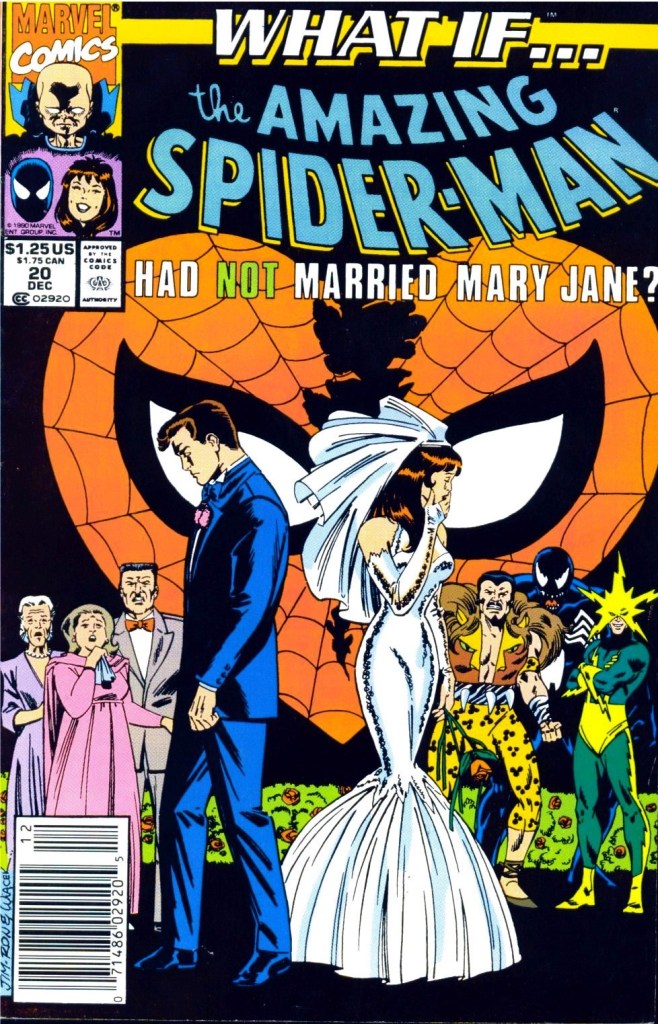
Imagine what would have happened had Spider-Man not married Mary Jane? That very scenario was explored in an issue of the What If monthly series (Volume 2) back in the early 1990s. We can find out more together in this look back at What If #20, published by Marvel Comics in 1990 with a story written by Danny Fingeroth and drawn by Jim Valentino.

The cover.

Early story

The story begins with the Watcher narrating key events in the life of Spider-Man. It is recalled how much pain Spider-Man endured when his beloved Gwen Stacy died during his conflict with the Green Goblin. Subsequently Peter Parker resumed his relationship with Mary Jane. When Mary Jane became absent, he got involved with Felicia Hardy/Black Cat who turned out to be too wild and reckless for him. Eventually, Peter married Mary Jane.

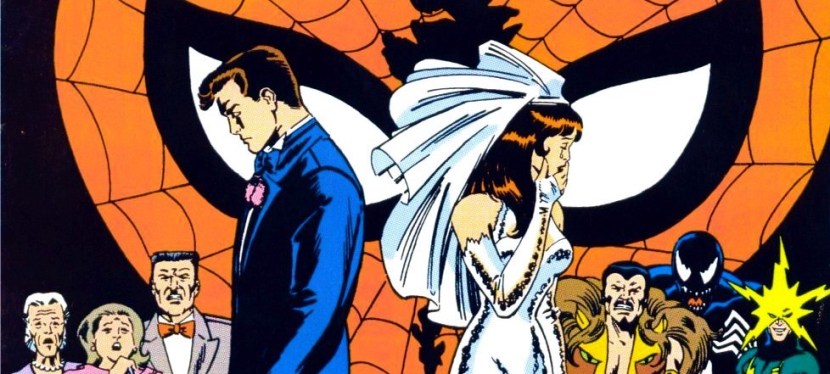
By pointing out that there are other realities, the Watcher then begins to explore another scenario in which Spider-Man realizes is far from being all right with him. During the wedding ceremony, Peter turns down Mary Jane which shocks the guests who were present. He tells her privately that even though he loves her, she will be in danger all the time as a wife. She walks away from him, still wearing her wedding dress.

Some hours later, Spider-Man swings around New York and strikes the criminals really hard…

Quality

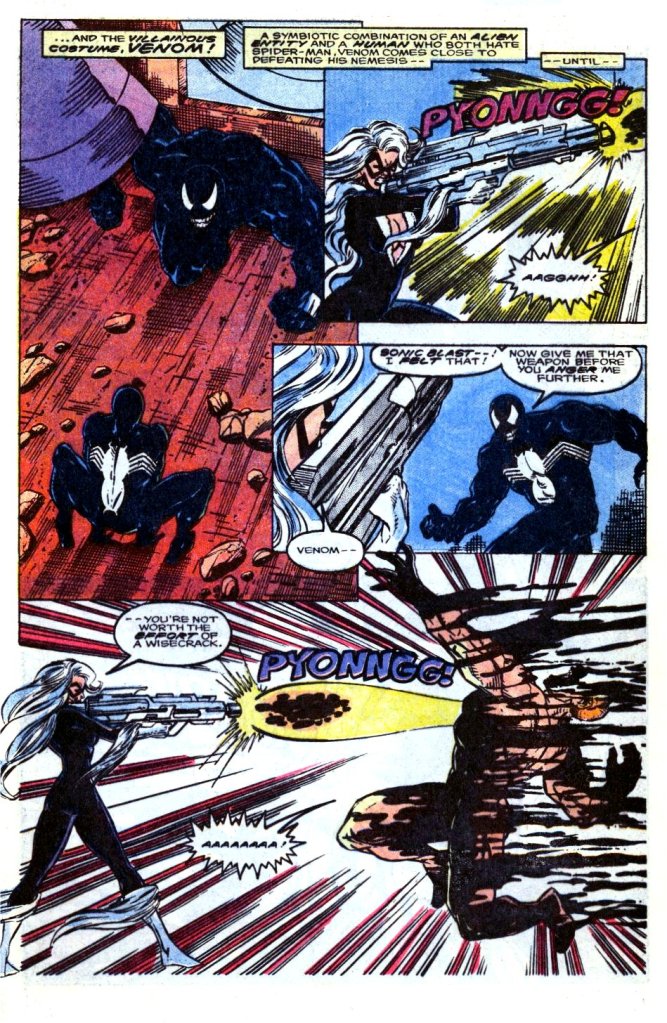
Spider-Man and Black Cat take on Venom!

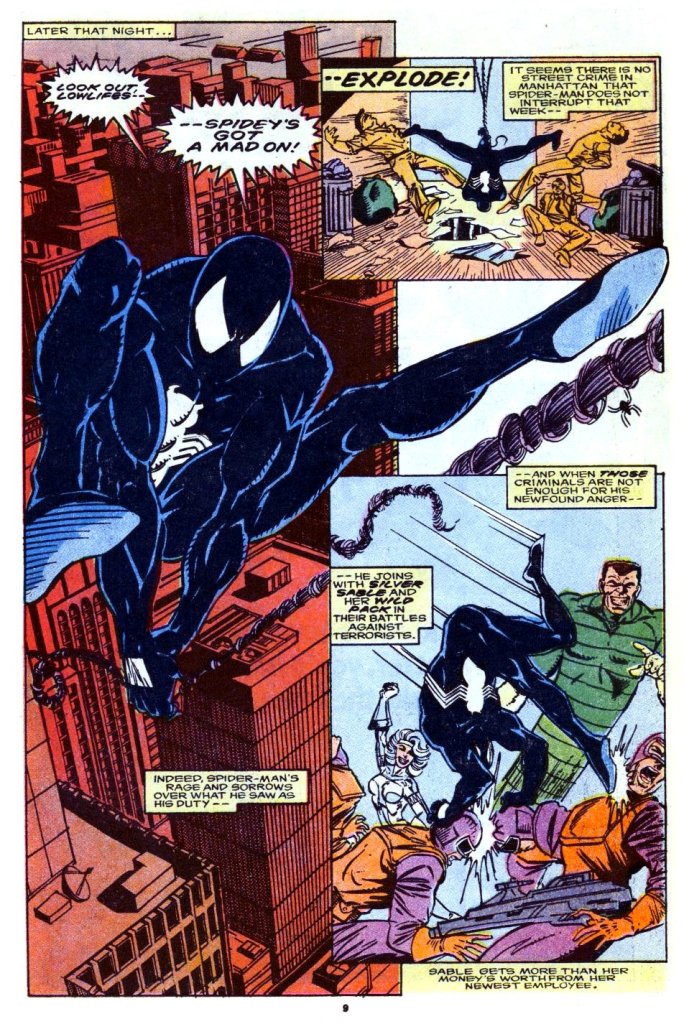
To be clear, this comic book shows a Spider-Man who not only rejected marriage, but is also a tortured soul whose inner pain started even before the failed wedding ceremony. Silver Sable, who is often focused on missions, notices Spider-Man being too angry and careless with his performance with them taking on the bad guys. The old and frail Aunt May is deeply worried over Peter and hopes he would not harden his heart to the possibility of loving someone.

The thing about this story is that the writing done by Danny Fingeroth is pretty good as he captured Spider-Man’s essence while successfully steering him pretty close to the edge, almost blurring the boundary the separates the good and evil in him. The story moved with a nice pace and there is a good amount of suspense that will keep you wondering if Spider-Man can climb out of the deep hole of darkness he’s in.

More on the plot, I also enjoyed this comic book’s connection with Kraven’s Last Hunt and the early encounter with Venom. If there is any weak point with this story, it is the fact that it served as build-up of something set to happen in the next issue.

When it comes to the art, Jim Valentino did a good job bringing the script to life and that includes framing the character development scenes and the spectacle scenes in interesting ways. I personally enjoyed his take on Venom and Kraven.

Conclusion

Without Mary Jane as a wife, Spider-Man went on to fight the bad guys more intensely.

What If #20 (1990) is indeed a solid, alternate story about Spider-Man. It was gripping right from the start but it lacked a solid conclusion as its last few pages started to build up anticipation for the following issue. In short, this is not a standalone story and to fully enjoy what it started, you have to read What If #21. Still, I love the way Spider-Man is portrayed here and there are some characters involved that long-time fans will enjoy.

If you are seriously planning to buy an existing hard copy of What If #20 (1990), be aware that as of this writing, MileHighComics.com shows that the near-mint copy of the regular edition costs $53 while the respective near-mint copies of the newsstand edition and the signed edition both cost $105.

Overall, What If #20 (1990) is recommended.

+++++

Thank you for reading. If you find this article engaging, please click the like button below and also please consider sharing this article to others. If you are looking for a copywriter to create content for your special project or business, check out my services and my portfolio. Feel free to contact me as well. Also please feel free to visit my Facebook page Author Carlo Carrasco and follow me at HavenorFantasy@twitter.com

A Look Back at 2099 Unlimited #1 (1993)

Disclaimer: This is my original work with details sourced from reading the comic book and doing personal research. Anyone who wants to use this article, in part or in whole, needs to secure first my permission and agree to cite me as the source and author. Let it be known that any unauthorized use of this article will constrain the author to pursue the remedies under R.A. No. 8293, the Revised Penal Code, and/or all applicable legal actions under the laws of the Philippines.

During the first half of 1993, Marvel Comics had published four monthly series of their 2099 franchise of comic books: Spider-Man 2099, Ravage 2099, Doom 2099 and Punisher 2099. X-Men 2099 debuted in the 2nd half of 1993 but months before that happened, Marvel went ahead with expanding their 2099 franchise by launching what was back then a new, quarterly comic book series simply titled 2099 Unlimited.

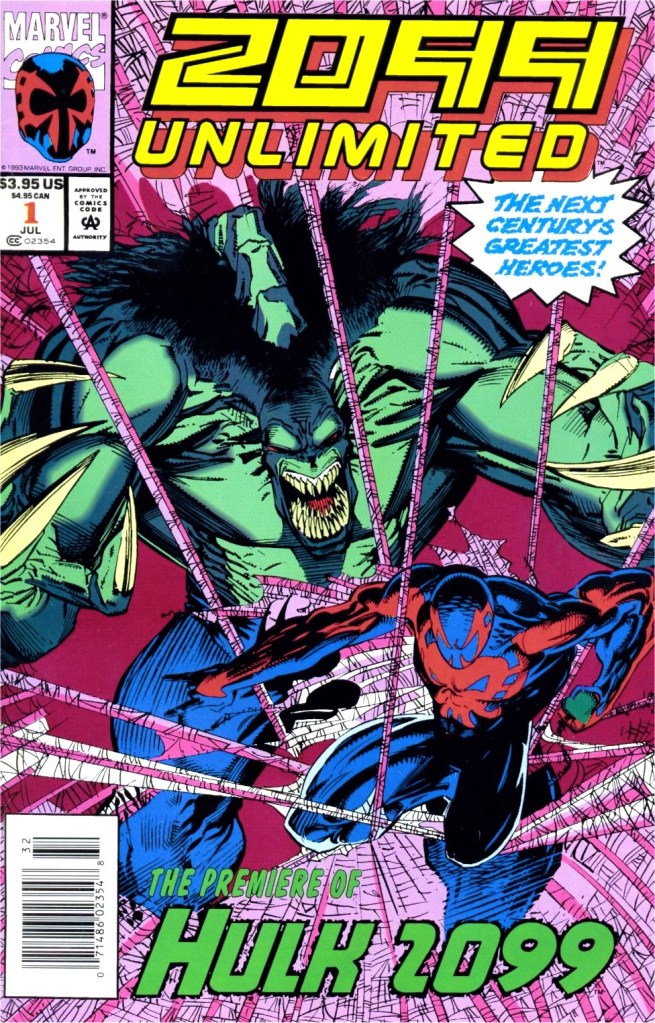
That being said, the mentioned quarterly series was officially launched with 2099 Unlimited #1 which, as its cover showed, featured Spider-Man 2099 as well as Hulk 2099. The comic book came with a high price of $3.95 on its cover and it had 64 pages of content (including ads and bulletins). I myself bought a copy of it as soon as it appeared on the shelves of the local comic book store here in the Philippines.

Was the debut comic book fun? Is it good by today’s standards? We can all find out in this look back at 2099 Unlimited #1, published in 1993 by Marvel Comics with stories written by Evan Skolnick and Gerard Jones, and drawn by Chris Wozniak and Dwayne Turner.

The cover.

Early stories

“Nothing ever changes!” – the story begins at New York City’s Koop Memorial Hospital where an investigation is happening. A married couple arrives and noticed the unusual activity happening there. As they arrive at another floor to visit their son Michael, they noticed the hallway is full of dead bodies. They panic and start running to find their son. Suddenly a muscular man appears and kills the husband, stating his action is justified by his belief about the natural order of things and his effort to ensure humanity’s survival. The killer escapes.

Weeks later, Spider-Man/Miguel O’Hara returns home from fighting crime just in time to rush and prepare himself for his date with Anna. During their date, Anna talks about her sister who has a rare genetic deformity. She intends to visit her sister at the hospital, and Miguel asked if she wants him to come along…

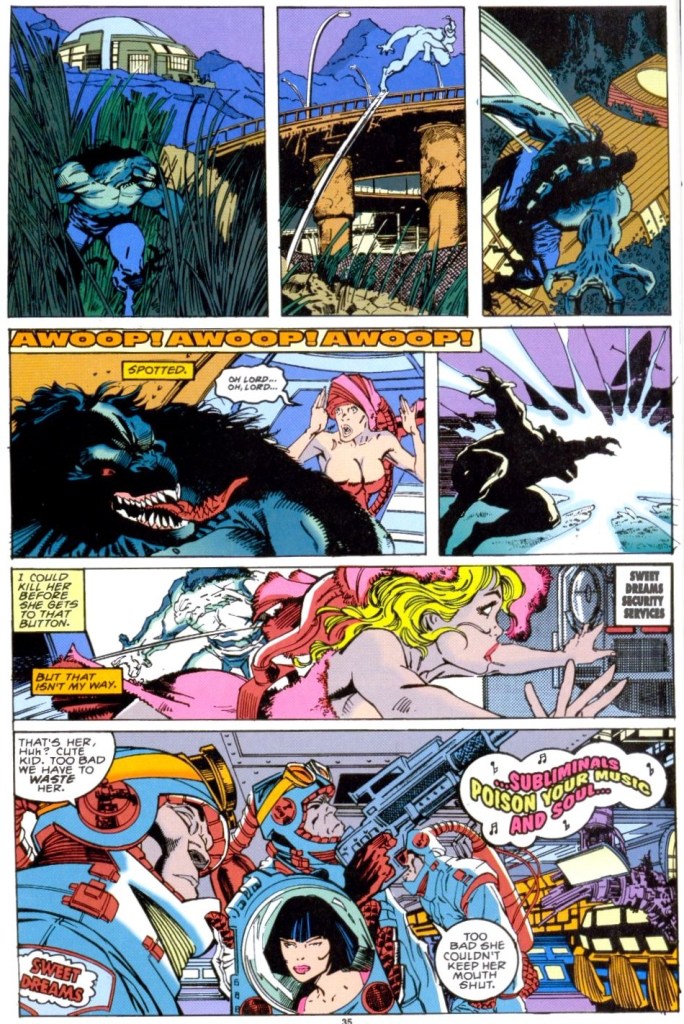
“Hulk 2099” – the story begins in the Mojave Desert with the Hulk traveling alone in the middle of the night. He has been traveling for over three hundred miles alone hunting something. The Hulk arrives at the private residence of a lady who spots him and alerts the armed personnel of Sweat Dreams Security Services. Soon enough, Sweet Dreams personnel arrive and its tank charges at the green monster…

Quality

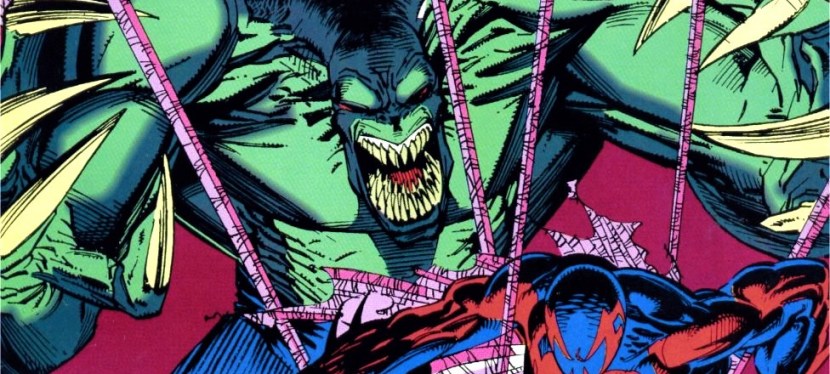
Imagine Hulk 2099 trespassing on your property.

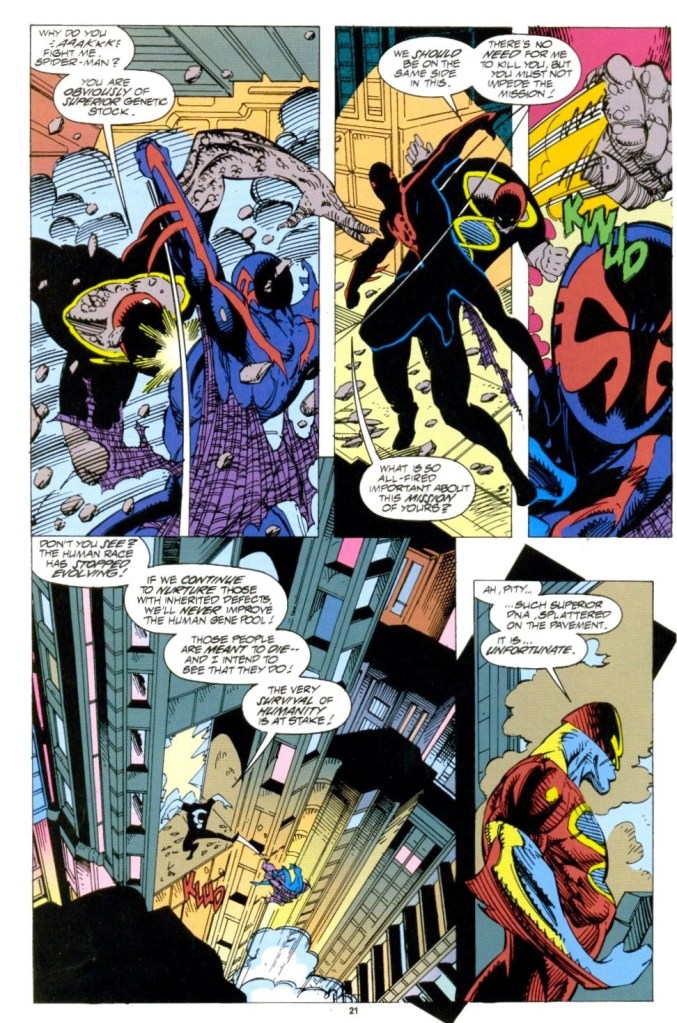
The first story featuring Spider-Man 2099 has a pretty interesting concept that was nicely executed and proved to be surprisingly satisfying. The creative team introduced the new villain Mutagen and they succeeded in building his personality (including his obsession with perfecting human genetics and altering the so-called gene pool) which resulted a justified conflict with Spider-Man. The character development, focused mainly on Mutagen, was well done and by the end of the story, he became a pretty interesting villain.

As for Spider-Man, his character development was pretty limited to his interactions with Anna laced with little references to his career with Alchemax, and there were no references to his personal life and the people who mattered most to him. Clearly, the first story was more about Mutagen than Spider-Man, and it has a very satisfying conflict between the two. I also enjoyed the way the creative team presented Mutagen being able to adapt to his environment and the attacks Spider-Man threw at him. While the story is strong, I should say that Chris Wozniak’s art is uneven. His drawings on Mutagen were pretty details but the same cannot be said about his art on Spider-Man.

The second story, featuring Hulk of 2099, is the actual gem in this comic book. Not only was it the first-ever appearance of the character, it unsurprisingly took inspiration from the origin of the classic Hulk (Bruce Banner) and made some twists with themes of the business of entertainment and the human desire of idolatry (always unholy). The new Hulk here is an entertainment executive named John Eisenhart who has been researching the Knights of Banner, a group of people who worship the classic Hulk. What he does in the real world and with people, he strives to make something out of them to boost his career and stand out in the business of amusement. Eisenhart sees Banner’s idolaters having the makings of a new cult of Thor complete with living in isolation

Eisenhart is not the typical good-natured protagonist. Quite the opposite in fact as he is obsessed with success and is a walking tool of Hollywood who exploits people and insists that being civilized is essential and that strength is knowing where the power is. That being said, this story has a lot of build-up on Hulk 2099 while still having sufficient space to tell his origin that arguably links him with the legacy of Banner Hulk. For the most part, the bouts of build-up resulted worthy pay-offs that readers can enjoy.

More on Hulk 2099 himself, this version of the classic character is more monstrous and freakish looking. While Hulk 2099 maintains the intelligence of Eisenhart, he still is deadly and unpredictable. Supporting characters like Gawain and Quirk both lacked scenes and dialogue but that is not surprising since the focus of the comic book is on Hulk 2099. For the art, Dwayne Turner’s work here is satisfying.

Conclusion

Spider-Man 2099 and Mutagen in battle!

When I first read this way back in 1993, I felt underwhelmed. By today’s standards, 2099 Unlimited #1 (1993) surprisingly aged well and it is actually deeper, more meaningful and engaging than I previously thought. Apart from Hulk 2099’s debut, the introduction of Mutagen was pretty engaging and he had a lot of potential to be a major 2099 universe villain. Too bad that Mutagen was not used to be a nemesis against Ravage 2099 or Punisher 2099 or even X-Men 2099. Hulk 2099 meanwhile went on to have a dedicated monthly series which came at a time when the 2099 imprint and the comic book industry in general went way down. This comic book, in my opinion, is more cerebral than it looks and that is thanks to the writers.

If you are seriously planning to buy an existing hard copy of 2099 Unlimited #1 (1993), be aware that as of this writing, MileHighComics.com shows that the near-mint copy of the regular edition costs $15 while the near-mint copy of the newsstand edition costs $32.

Overall, 2099 Unlimited #1 (1993) is recommended.

+++++

Thank you for reading. If you find this article engaging, please click the like button below and also please consider sharing this article to others. If you are looking for a copywriter to create content for your special project or business, check out my services and my portfolio. Feel free to contact me as well. Also please feel free to visit my Facebook page Author Carlo Carrasco and follow me at HavenorFantasy@twitter.com