What to watch on YouTube right now – Part 9

Have you been searching for something fun or interesting to watch on YouTube? Do you feel bored right now and you crave for something to see on the world’s most popular online video destination?

I recommend you check out the following topics and the related videos I found.

#1 Debunking the lies of the Palestinians and the Satanic Left – Israel has been all over the news for over a month now as the Palestinian terrorist group Hamas attacked them on October 7, 2023, and committed acts of murder, kidnapping and torture of many innocent people (including foreign nationals). Israel responded by going into war with Hamas and already they have several soldiers operating inside the Gaza strip searching for the terrorists while trying to rescue the hostages.

Around the world, anti-Semitism has intensified as a lot of public rallies or protests events supporting the Palestinians and condemning Israel continues to happen. Unsurprisingly, the Satanic Leftist elements in governments, mainstream news media outlets and social media all organized a major misinformation campaign highlighting the Palestinians as victims while portraying Israel as the antagonists. Collectively these Communists, socialists, Marxists, liberal, diversity advocates and other anti-Semitic elements have been spreading lies repeatedly to attack Israel while lifting up the Palestinians.

Fortunately, YouTuber Oren who handles the channel travelingisrael.com published in-depth videos that debunked the Arab-Palestine-Hamas-Leftist propaganda complete with details and facts that the liars did not even bother to check. I stand with Israel and the Holy Bible confirms that Israel is the land that God designated to the Jewish people (read Genesis 12:1-3 and Genesis 35:10-12), not the Arabs and certainly not the Palestinians. There really never was an ancient Palestine and the Palestinian identity as a people did not even exist before the 20th century (not even during the time when the Ottoman Empire had authority over the land of Israel). That being said, I strongly recommend you watch the videos below and pay close attention to the details…

#2 Trustworthy look at Israel – Still on Israel, I want to tell you all that you cannot trust the mainstream news media outlets as they have an anti-Israel and anti-Semitic agenda in connection with their Leftist worldviews. You cannot trust CNN, MSNBC, The New York Times, BBC, Vox and others as they are laser-focused on smearing Israel and putting the lives of Jewish people in danger. Those abusers of media and information are spreading lies and hate! If you want a clearer and more credible look at Israel and the developments that happened, I recommend you follow CBN News (the news program of the Christian Broadcasting Network) and TBN Israel. Posted below are some of their YouTube videos for you to see…

#3 Macross nostalgia videos – And new we shift into the world of entertainment. When it comes to the world of anime, Macross is my favorite franchise. To be more specific, the Super Dimension Fortress Macross TV series, Macross: Do You Remember Love? (read my retro movie review by clicking here), Macross Plus and Macross Zero are the ones I enjoyed replaying and there were some video game adaptations released along the way (read my retro game review by clicking here). If you share my Macross passion or if you are simply interested with anime and related video games, I recommend you watch the videos below…

#4 Cloak & Dagger (1984) nostalgia – A few months ago, I published my retro review of the 1984 movie Cloak & Dagger which remains a very unique film by today’s standards. For one thing, the film was the 4th cinematic adaptation of the short story “The Boy Cried Murder” written by Cornell Woolrich. It also had Henry Thomas (the same kid in Steven Spielberg’s E.T.: The Extra-Terrestrial) as the protagonist, a plot filled with strong elements of espionage, a video game as a key item in the story, and most notably, a very intense tone complete with shooting and killings. Cloak & Dagger, which is now available on 4K Blu-ray format, is the kind of movie that Hollywood does not make anymore. Of course, I do understand that Hollywood has so many Commies and SJWs (social justice warriors) among its screenwriters, actors and directors who could not understand Cloak & Dagger. To learn about the 1984 movie, watch the videos below…

#5 Friday The 13th Part 3 reaction and retro review videos – Some time ago I declared in my retro review that Friday The 13th Part 3 is the 2nd best film of its franchise (note: Friday The 13th: The Final Chapter is still #1). Sure, it was flawed and the filmmakers struggled to make the movie as they intended to film it with 3D cinema viewing in mind, but the way things turned out it marked a crucial turning point in Friday The 13th’s general formula on storytelling and the presentation with Jason Voorhees as the enduring antagonist. This is the very movie when Jason first got his hockey mask and the actor’s muscular build gave him a more intimidating look than in Part 2. That being said, it is no surprise that the 1982 movie became the subject of multiple movie reaction videos and retro reviews on YouTube and you can watch some of them (plus one trivia video by Minty Comedic Arts) below…

+++++

Thank you for reading. If you find this article engaging, please click the like button below, share this article to others and also please consider making a donation to support my publishing. If you are looking for a copywriter to create content for your special project or business, check out my services and my portfolio. Feel free to contact me with a private message. Also please feel free to visit my Facebook page Author Carlo Carrasco and follow me on Twitter at  @HavenorFantasy as well as on Tumblr at https://carlocarrasco.tumblr.com/and on Instagram athttps://www.instagram.com/authorcarlocarrasco

AFP says Communist insurgents have been greatly weakened

Let’s be clear here – the Left is inherently evil. That being said, we should focus on the current state of conflict between the Armed Forces of the Philippines (AFP) and the Left as the military announced recently that the Communists have been greatly weakened during the first eight months of this year, according to a Philippine News Agency (PNA) news article.

To put things in perspective, posted below is an excerpt from the PNA news article. Some parts in boldface…

Let me end this piece by asking you readers: What is your reaction to this recent development? Do you think the Satanic Left here in the Philippines are still a threat to your family and your local community? Are there many Leftists living in your local community right now? Are you aware that mainstream news outlets like CNN, The New York Times and MSNBC all emphasize Leftist concepts in their so-called news reports? Are you aware that Democrats in America are inspiring young Filipinos to become socialists, Marxists, Communists, SJWs, homosexuals and terrorist supporters?

You may answer in the comments below. If you prefer to answer privately, you may do so by sending me a direct message online.

+++++

Thank you for reading. If you find this article engaging, please click the like button below, share this article to others and also please consider making a donation to support my publishing. If you are looking for a copywriter to create content for your special project or business, check out my services and my portfolio. Feel free to contact me with a private message. Also please feel free to visit my Facebook page Author Carlo Carrasco and follow me on Twitter at  @HavenorFantasy as well as on Tumblr at https://carlocarrasco.tumblr.com/ and on Instagram athttps://www.instagram.com/authorcarlocarrasco
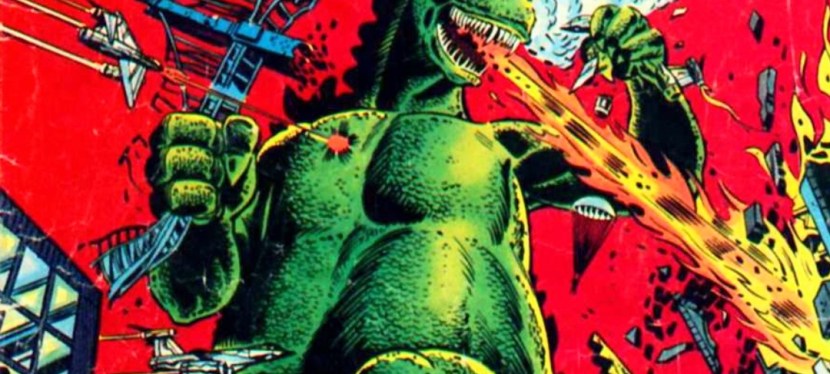
A Look Back at Godzilla: King of the Monsters #1 (1977)

Welcome back superhero enthusiasts, 1970s arts and culture enthusiasts, Marvel Comics fans and comic book collectors! Today we go back to the year 1977 when Marvel Comics had the license to publish comic books about Japan’s iconic monster Godzilla (Gojira in Japanese) and even integrated him into their shared comic books universe.

The mid-1970s saw a decline of Godzilla’s popularity in Japan as reflected in the commercial disappointment of the movie Terror of Mechagodzilla (1975). The company Toho decided to put on-hold the production of its monster movies without permanently ending the Godzilla film franchise. The next Godzilla movie released was The Return of Godzilla (1984) which proved to be a solid rebound of the Japanese film franchise.

Sometime between the mentioned movies, there was interaction between Toho officials and Marvel Comics – including the late Stan Lee – when the Japanese company screened the movie Godzilla vs. Gigan (titled in America as Monster Island) to the comic guys in relation to the film’s American theatrical release. It turns out Stan Lee enjoyed the movie a lot and seated next to him was writer Doug Moench (the eventual writer for the Godzilla comic book series).

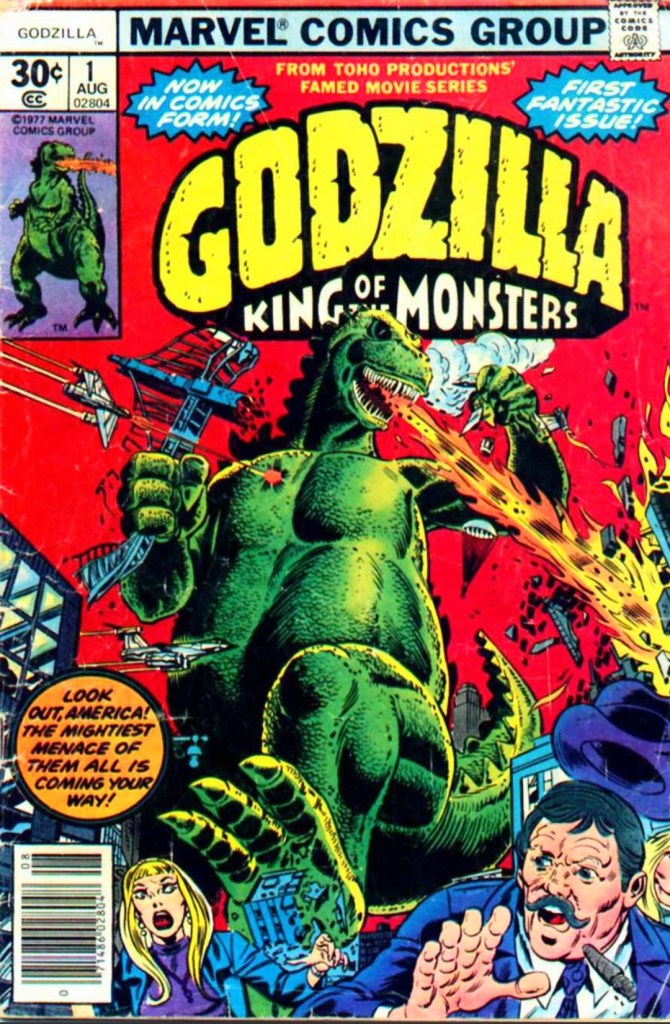
With those details laid down, here is a look back at Godzilla: King of the Monsters #1, published in 1977 by Marvel Comics with a story written by Doug Moench and drawn by Herb Trimpe.

The cover.

Early story

The story begins in Alaska when a huge iceberg suddenly deteriorates unleashing a gigantic monster with sharp teeth, dorsal fins and immense strength – Godzilla. After instantly crushing a supply ship, the monster moves onto the land destroying structures and disrupting the lives of every person nearby.

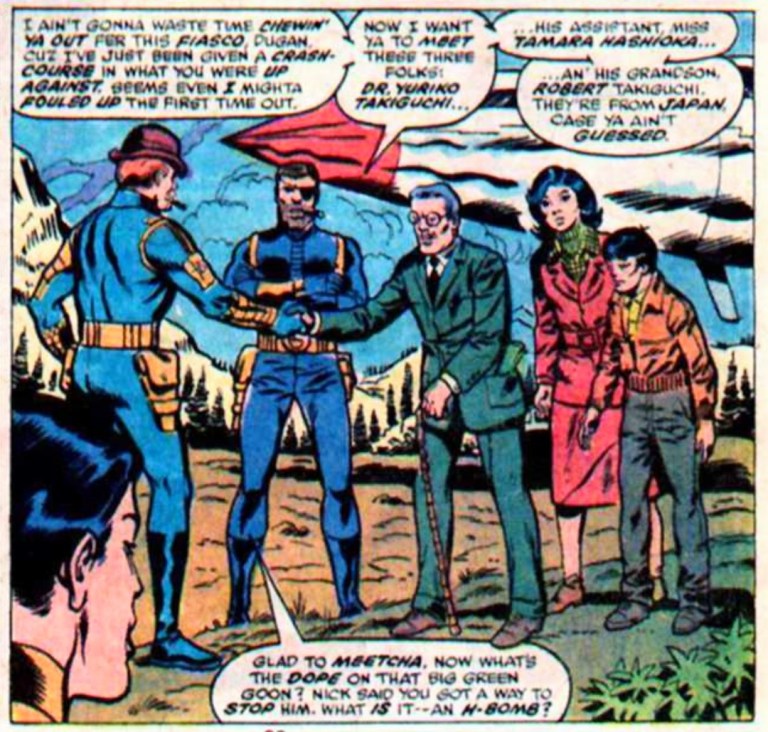
In response to Godzilla’s rampage in Alaska, S.H.I.E.L.D. dispatches its agents to the site of destruction to take on the monster. Meanwhile, S.H.I.E.L.D. director Col. Nick Fury is transporting with him three Japanese individuals deemed important (with clearances from the Pentagon and the White House)…

Quality

Dum Dum Dugan, Col. Nick Fury and the Japanese characters.

To get straight to the point, this comic book not only marked the literary debut of Japan’s iconic monster under Marvel Comics’ banner but also his integration into the shared universe of the time. That being said, the story written by Doug Mench was pretty much a functional build-up of Godzilla’s presence within the realm of Marvel which includes a strategic choice of having S.H.I.E.L.D. and its characters encountering the monster. In short, the creative team decided not to literally pull out Marvel’s biggest guns (the more popular superheroes and teams) as such a move would have lessened the impact of Godzilla’s debut.

For the most part, S.H.I.E.L.D.’s Nick Fury and Dum Dum Dugan had lively portrayals and the way they reacted to the rampage of Godzilla was believable. The introductions of the Japanese characters (who could provide breakthroughs on dealing with the giant monster) were clearly inspired by the Japanese scientists who were crucial in the plot of the original 1954 movie Gojira.

Going further, Doug Mench went on to efficiently establish Godzilla’s origin which creatively is a sensible reinterpretation of what was established in the 1954 movie. The giant monster’s rise as a result of humanity’s testing of powerful weapons on Earth is definitely here.

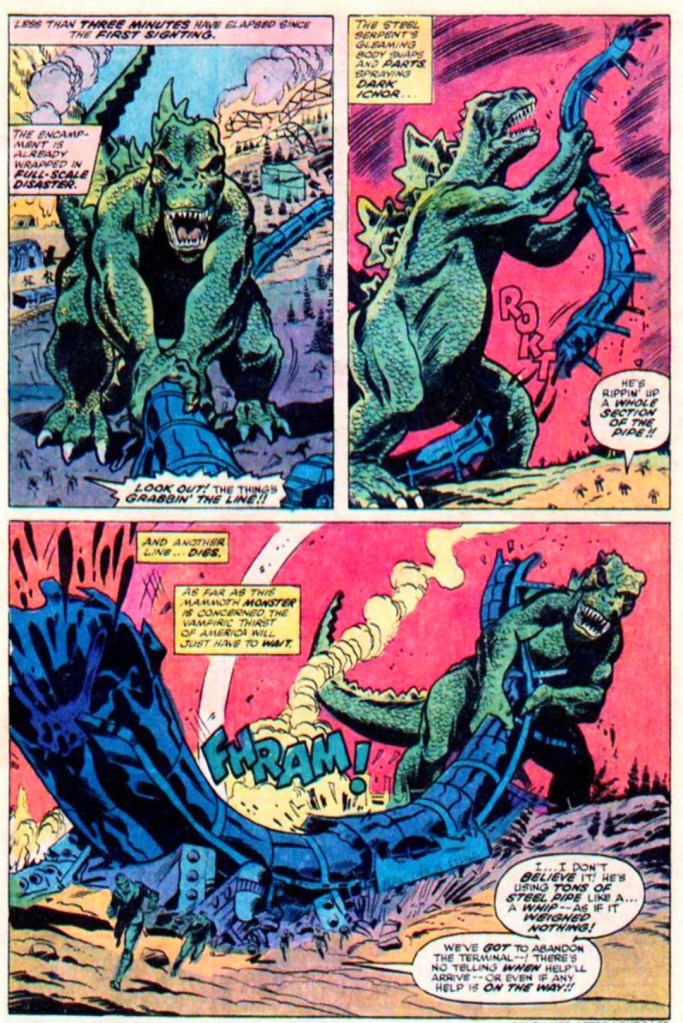
As expected, Godzilla is the unrestrained force of destruction but as this comic book was released in the 1970s, the destruction scenes lacked impact as they were creatively sanitized with deliberate moves of showing no casualties no matter what happened. This limitation on the part of Marvel Comics showed they were not willing to emulate the approach on destruction and death that was clearly emphasized in the first Godzilla movie of 1954.

As for Godzilla himself, Herb Trimpe’s visual approach is not really good. While Trimpe implemented the guy-in-a-suit shape on the giant monster’s form, he made Godzilla his own (took no inspiration from Godzilla’s cinematic designs) which resulted in making the icon look unrecognizable. There were inconsistencies on Godzilla’s head as well. In certain shots, Godzilla looked terrifying but in other shots, he looked weird or cartoony. The use of the color green did not make Godzilla look reptilian but rather comical.    

Conclusion

I can only imagine the SJWs and the climate change extremists enjoying these images of an unrecognizable Godzilla wreaking havoc to the oil supply. Are there lots of people in your local community who were brainwashed to hate oil and gas?

Godzilla: King of the Monsters #1 (1977) is a serviceable approach on debuting the iconic monster within the fantasy realm of Marvel Comics and sparking a new wave of crossovers. There were uneven levels of quality here and there, and Herb Trimpe’s visual approach on Godzilla was alienating to say the least. Honestly, I did not really see Godzilla in this comic book but rather a green-colored dinosaur-like creature that was mislabeled as Godzilla. What works here is the writing by Doug Mench which proved to be entertaining enough.

Overall, Godzilla: King of the Monsters #1 (1977) is satisfactory.

For my other Godzilla-related posts, click here, here, here, here and here.

+++++

Thank you for reading. If you find this article engaging, please click the like button below, share this article to others and also please consider making a donation to support my publishing. If you are looking for a copywriter to create content for your special project or business, check out my services and my portfolio. Feel free to contact me with a private message. Also please feel free to visit my Facebook page Author Carlo Carrasco and follow me on Twitter at  @HavenorFantasy as well as on Tumblr at https://carlocarrasco.tumblr.com/ and on Instagram at https://www.instagram.com/authorcarlocarrasco
Carlo Carrasco’s Movie Review: Sound of Freedom (2023)

Welcome back, readers and movie enthusiasts! Chances are you must have heard about the controversy and debates over Sound of Freedom, a movie about the child trafficking which was made years ago but only got released this year after overcoming many hurdles. The film starring Jim Caviezel as real-life hero Tim Ballard and directed by Alejandro Monteverde, was released at a time when wokeness in Hollywood got so feverish a lot of movies were no longer interesting for me.

In case you missed the news, the low budget Sound of Freedom performed beyond expectations in the American box office and has since been making waves gradually in cinemas around the world. The film opened officially here in the Philippines on September 20 and I finally saw it in the local theater.

With regards to the controversy about Sound of Freedom, I urge you to reject the Leftists’ constant ranting against it and make the effort to see it yourselves. If you take into account the conceptualization of the movie, it is almost a decade old now and efforts to write the script happened years before QAnon even started (for context, watch Midnight’s Edge video by clicking here). Blatant accusations of QAnon conspiracy theory against this film are simply false and officially denied by Tim Ballard. Communist-filled Hollywood (Commiewood) and the woke mob are simply lying to stop people from seeing the movie.

With those details laid down, here is my review of Sound of Freedom.

The official movie poster.

Early story

The story begins in Honduras when a pretty lady visits the home of a father who has one young daughter and one young son, and convinces him to have them audition into modeling. The audition happened in a different location (filled with the man’s two kids and many others) and as the father was not allowed to be present, he was asked to return in the evening. By the time he returned, the place was empty and the children were kidnapped. They secretly shipped to another country.

In America, Tim Ballard and his time successfully apprehended a man for possessing and distributing child pornography. Tim’s teammate points out to him that although they have arrested many child predators, they could not even save a single child from exploitation and abuse…

Quality

I will start first by saying that this movie was not made to entertain viewers but to emphasize the real-life problems of child trafficking, kidnapping, the abuse of minors, sex trafficking and why slavery today still has many millions of victims (including minors).

This movie closely examines the struggles that come with fighting the syndicates (that kidnapped children and sell them) and the customers (who paid to illegally acquire children for their wicked desires) as told through the eyes of Tim Ballard (Jim Caviezel) who is clearly feeling the heavy stress of his US Homeland Security job (which takes a lot of strength, sacrifice and sheer will to do). Ballard himself has many kids with his faithful and supportive wife (Mira Sorvino) and therefore he can easily relate with the parents whose children got kidnapped and sold in other countries.

Caviezel is mostly subtle with expressing Ballard’s emotions as well as his verbal expressions with the other people he interacted with. This is not to say that Caviezel’s act is wooden, rather he is straightforward with portraying a man who feels disturbed by the collective stress of his duty (but still far away from the breaking low-point). Even though he is getting worn down, Ballard’s sheer determination to save a specific kidnapped-and-abused daughter for a Honduras-based father is nicely captured by Caviezel.

The efforts of fighting the criminals who pounced on children involves a lot of hurdles to overcome. I’m not just talking about Homeland Security agents taking down people in America who engaged in child pornography but also going after the very criminals overseas who kidnapped children, shipped them from one nation to another and sell them as “models” to pedophiles. As such, Ballard’s efforts involves spending time overseas (away from his family), making local connections and secretly working his way into different locations where the risks of getting killed are high.

Again, this tale is not about entertaining viewers as it works on emphasizing to them how extremely difficult it is to bring down the criminals in real-life. The good news is that this film is nicely directed by Monteverde whose cinematic style is simplistic and yet engaging to watch. There is a clear subtle approach on showing what little violence the film has. As for scenes of child abuse, there is nothing graphic to see (left ambiguous) nor was there anything intense about them. While I am certain that some parts of the story involved liberties in order to establish a functional cinematic narrative, this movie strives hard with realism while also avoiding becoming preachy with its message (expressed in subtle fashion) about human trafficking, child slavery and the business involving pedophiles and kidnappers.

Conclusion

Sound of Freedom was clearly made to inform the world that children are still being kidnapped, used for illegal transactions, transported around the world and sold to the predators. This real-world problem continues to happen somewhere every single day and there are simply not enough law enforcers who could fight the criminals and rescue the kidnapped minors. Nor do the law enforcers have the resources to stage major rescue operations while facing off with armed criminals and their bodyguards.

While it is told through Tim Ballard, this movie is not about him and his profession. It is about the extreme difficulties that law enforcers – both domestic and overseas – have to go through to save the very young victims. The story was told with consistent realism and subtlety which make it very believable to watch. Jim Caviezel is indeed a solid performer and his portrayal of Tim Ballard will easily remind you that true heroes are the ones who bravely face tremendous odds to achieve their goals (for good) while still maintaining their sanity no matter how hopeless the situations appeared.

Sound of Freedom is a cinematic call to action to make others aware about the ongoing menaces of sex trafficking, kidnapping, abuse of minors and the cartels (demonic people) that profited from their evil trade. Like Steven Spielberg’s Schindler’s List, this film was made for reflective viewing and not for amusement. Indeed, God’s children are not for sale and this is the truth that the bashers of this movie do not want you to realize. There is also the biblical truth to the popular quote from the film. Read the holy scripture below…

To put things politically, you must be wondering why the Satanic Left – Democrats, Communists, socialists, Marxists, liberals, the SJWs and the woke extremists – keep on bashing and hating Sound of Freedom. Here is why…because the Leftists are themselves pro-crime (example: “Defund the police.”) and they have made efforts to weaken law enforcement which emboldened the criminals such as robbers, murderers, kidnappers, smugglers, rapists, terrorists, molesters, illegal immigrants and, of course, the pedophiles. The Leftists are clearly wicked and they are lots of them present not only in government but also in showbiz, the mainstream media and other sectors of societies. The Leftists care less about the children and nuclear family, and this is why they want more drag queens and homosexuals to go after the children without law enforcers blocking them. The Leftists are okay with children getting kidnapped, abused and raped. In short, those in the Left are okay with being evil and doing what Satan wants.

I saw Sound of Freedom at the local cinema.

The Leftists are very afraid of Sound of Freedom and remember that it is the one notable movie that almost never got released. That being said, you must watch the movie whenever you have chance to do so.

Overall, Sound of Freedom (2023) is recommended!

+++++

Thank you for reading. If you find this article engaging, please click the like button below, share this article to others and also please consider making a donation to support my publishing. If you are looking for a copywriter to create content for your special project or business, check out my services and my portfolio. Feel free to contact me with a private message. Also please feel free to visit my Facebook page Author Carlo Carrasco and follow me on Twitter at  @HavenorFantasy as well as on Tumblr at https://carlocarrasco.tumblr.com/ and on Instagram at https://www.instagram.com/authorcarlocarrasco
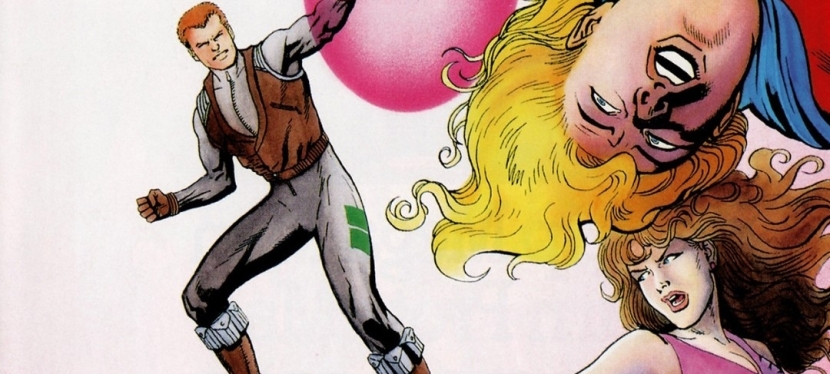
A Look Back at Harbinger #21 (1993)

Disclaimer: This is my original work with details sourced from reading the comic book and doing personal research. Anyone who wants to use this article, in part or in whole, needs to secure first my permission and agree to cite me as the source and author. Let it be known that any unauthorized use of this article will constrain the author to pursue the remedies under R.A. No. 8293, the Revised Penal Code, and/or all applicable legal actions under the laws of the Philippines.

Welcome back superhero enthusiasts, 1990s culture enthusiasts and comic book collectors! Today we go back to the early 1990s and explore a part of the Valiant Comics shared universe through the Harbinger monthly series.

In my previous review, Sting and new recruit Natalie (Stunner) were inside the stronghold of Kaliph deep within the terrorist state of Iran. Sting’s teammates went there on a high-risk mission to rescue the two even though they had no real resources to deal with Kaliph (first appearance in issue #19) and his private army, and they also had very little time to spare. Regardless, the dangerous mission proceeded and the rescue miraculously turned out successful. The success, however, came with a certain loss.

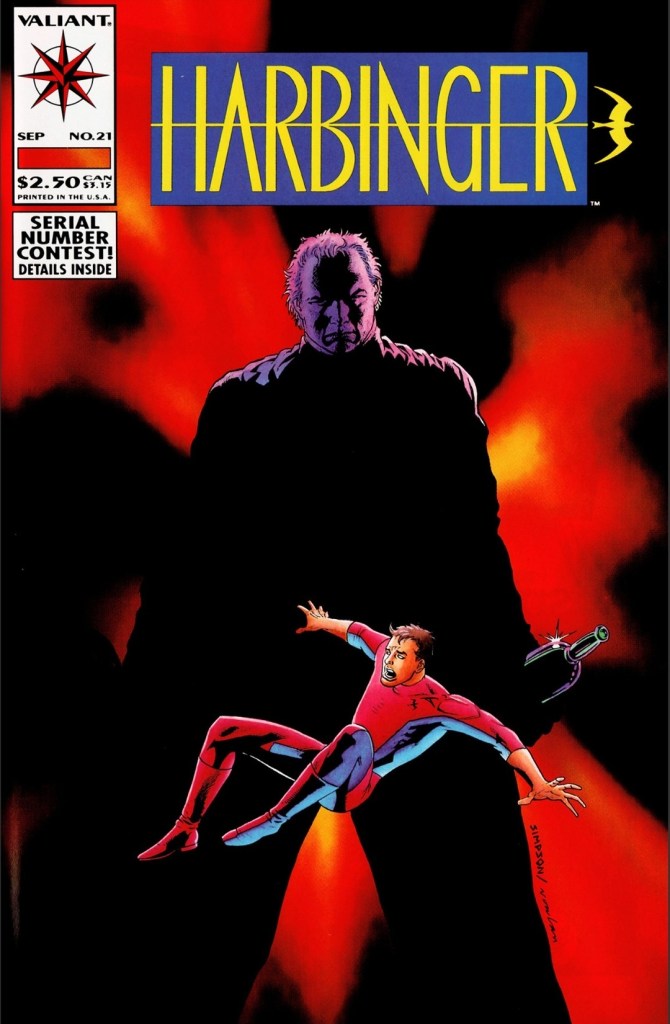
With those details laid down, here is a look back at Harbinger #21, published in 1993 by Valiant Comics with a story written by Maurice Fontenot and illustrated by Howard Simpson.

Cover.

Early story

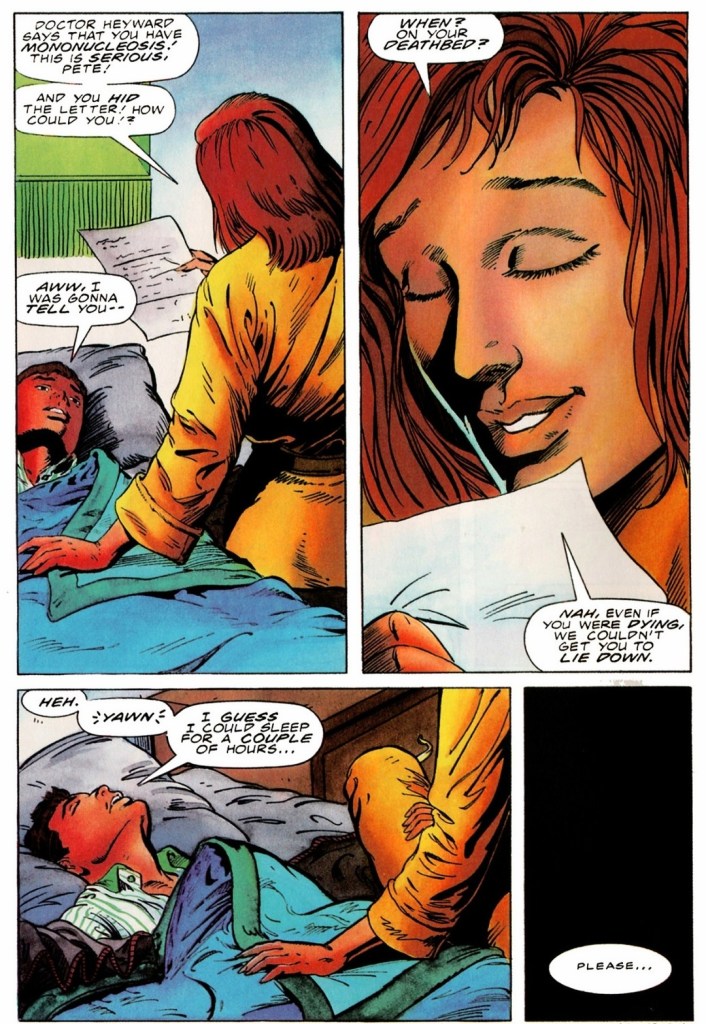
The story begins inside the New Jersey apartment occupied by Sting and his teammates. Although weeks had passed since the dangerous mission in Iran, Sting remains in weak physical condition and he had to be carried by Faith/Zepplin and Flamingo as his lover Kris checks out a letter that was hidden from her.

Even though he is obviously not feeling well, Sting lies to Kris that he is fine. Kris reads the letter which turned out to be medical results on Sting done by Doctor Heyward. Sting was diagnosed with Mononucleosis. The weak leader of the group then falls into sleep.

Sometime later, Sting endures a nightmare and wakes up sweating and feeling very troubled…

Quality

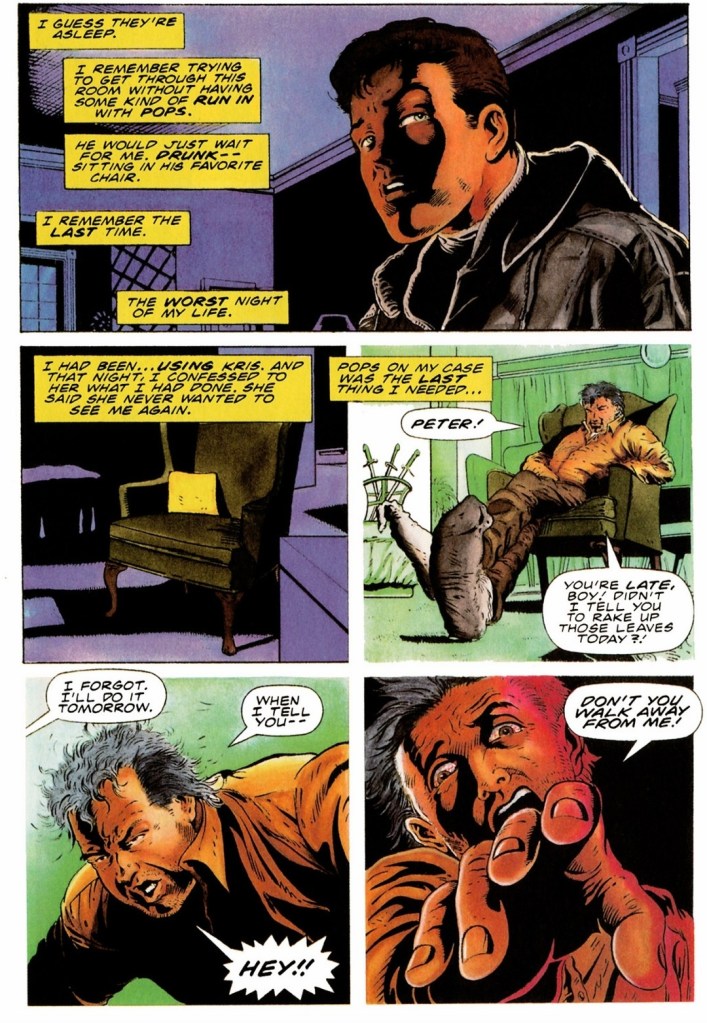
A look at Sting’s troubled relationship with his father in the past.

As a way of taking a change of direction following the previous two issues, this particular Harbinger story shifts the focus mainly on Sting and went ahead in explaining why he is such a flawed person, why he is reckless and even unworthy to be leading his teammates.

The core issue in this tale is Sting’s painful relationship with his father. Without spoiling the story details, I can say that the creative team succeed in not only dramatizing the strained father-son relationship, they also explored other elements from Sting’s past as Peter Stanchek – the young guy who had friends and lived a normal American life before his powers manifested and gradually changed everything.

More on Sting’s poor relationship with his father, the creative team came up with a pretty solid script and visuals that creatively emphasized the emotions, the pain and uncertainties on the part of the protagonist. More importantly, what they dramatized here clarified why Sting is immature, reckless and continues to live on with a distorted view of life that can be perceived as anti-family and even anti-social. Given the fact that he is unforgiving towards his father, the young team leader was revealed to be unworthy of not only of having super abilities but also unworthy of leading a group of friends who pretty much have faith in him. Sting is more than just a deeply flawed protagonist…he is also an unlikable superhero.   

Conclusion

Even though he is sick, Sting still remains dishonest with Kris.

Harbinger #21 (1993) is a very power character study of Sting and the creative team deserve admiration for what is clearly the most in-depth development of the character so far in this series. It should be noted that the story, whether intention or not, clearly dramatizes that a person who rejects his or her father is often destined for frustration, pain, suffering and other negative elements in life. Even with super powers, the negative elements won’t disappear and the personal problems will continue to last long. If there is one thing that Sting could do to save himself and his family, it would be coming to his father with forgiveness and having the strong will to make peace with him and be willing to love him unconditionally. Ultimately, this comic book sets up Sting for a potential series of events that could challenge him personally as he continues to lead his team.

Overall, Harbinger #21 (1993) is highly recommended!

+++++

Thank you for reading. If you find this article engaging, please click the like button below, share this article to others and also please consider making a donation to support my publishing. If you are looking for a copywriter to create content for your special project or business, check out my services and my portfolio. Feel free to contact me with a private message. Also please feel free to visit my Facebook page Author Carlo Carrasco and follow me on Twitter at  @HavenorFantasy as well as on Tumblr at https://carlocarrasco.tumblr.com/ and on Instagram at https://www.instagram.com/authorcarlocarrasco
A Look Back at Spider-Man 2099 #8 (1993)

Disclaimer: This is my original work with details sourced from reading the comic book and doing personal research. Anyone who wants to use this article, in part or in whole, needs to secure first my permission and agree to cite me as the source and author. Let it be known that any unauthorized use of this article will constrain the author to pursue the remedies under R.A. No. 8293, the Revised Penal Code, and/or all applicable legal actions under the laws of the Philippines.

Welcome back superhero enthusiasts, 1990s arts and culture enthusiasts, Marvel Comics fans and comic book collectors! Today we go back to the wild 1990s and explore the far future of 2099 within the Marvel Comics shared universe through one of the tales of Spider-Man 2099.

In my previous retro review, the futuristic Spider-Man got involved with his era’s version of Vulture (Vulture 2099 to us readers). It turns out, Vulture 2099 is not your typical evil supervillain but the leader of a group of violent radical people who are willing to dominate society with a destructive mindset even though there are other opposing groups around them. And then Spidey 2099 realized something very wrong about the Vulture which leads to a big battle between them.

With those details laid down, here is a look back at Spider-Man 2099 #8, published in 1993 by Marvel Comics with a story written by Peter David and drawn by Rick Leonardi.

The cover.

Early story

The story begins with Spider-Man 2099 and Vulture 2099 crashing into the interiors of the ancient St. Patrick’s Cathedral located in old New York City (underneath the modern city). Unsurprisingly, the people inside the cathedral got very surprised about the unexpected entry of the two fighters.

Elsewhere, Miguel O’Hara’s brother Gabriel helps Kasey with her head. She tells him that she saw Miguel but Gabriel does not believe her. Suddenly, members of a gang knock on the door and Kasey opens it.

Inside St. Patrick’s Cathedral, the fight between Spider-Man and Vulture continues. Spider-Man remembers that he has lapsed as a Catholic and he feels very uneasy about the trouble he and his enemy are causing inside the old church structure. Vulture suddenly throws a wooden bench at Spidey but breaks open a glass window and then goes outside. Upon looking outside, Spider-Man notices a group of Vulture’s gang…the Freakers.

Quality

The battle between Spider-Man 2099 and Vulture 2099 is intense and very compelling to read.

Here is the good news about this comic book…the story here is a fitting conclusion to what happened in issue #7. The conflict between Spider-Man and Vulture here was carefully crafted and there were several key moments or scenes the provided readers some breathing room to grasp and understand the society of 2099 New York as well as the conflict between the downtown social groups who are deprived of the higher standard of living many miles above them. In some ways, the social divisions portrayed in this comic book is a sad reminder about modern day America and the many radical groups or gangs of people who divide society on race, ethnicity, social class, gender and ideology.

As expected, there is a lot of action executed in the fight between Spider-Man and Vulture of 2099 but there were pauses in between. This is not surprising considering how Peter David crafted the action-packed battles Spidey 2099 had with other enemies in the comic books released before this one. Without spoiling what happened, I can say that the battle between the two was nicely built-up and the conclusion turned out very satisfying to see.

Still on the story, Peter David added some layers of complexity into the conflict that easily made things much more difficult for Spider-Man 2099 on a personal level. I’m talking about his brother Gabriel and Kasey getting involved in the gang war against the Freakers.

Vulture 2099 is once again a standout opposition figure here. Not only is his ability to fly and cause chaos above his obsessed Freakers below is symbolic, his distorted, hardcore beliefs are reflected with his unrelenting use of violence as he fights Spider-Man. Not only that, he turns out to be very philosophical thanks to the rich dialogue Peter David came up with. It is also here that the futuristic Vulture is opposed to God and being the socialist-indoctrinated person he is, he easily blames Alchemax for God’s absence. This should remind you that through Vulture 2099, evil comes with fatal attraction that people could not realize until it is too late. The futuristic Vulture has a lot of common with the evil leaders of Black Lives Matter, Antifa, the Democratic Socialists of America and the long-time regime of Iran. Lastly, I should state that radical socialists are always wrong about God and they often live with distorted perceptions about Him. Vulture 2099 qualifies as a woke figure of 2099 and ultimately wokeness is foolishness.

Speaking of sub-plots, this comic book emphasizes Tyler Stone on how he handles ambitious projects of Alchemax that he believes will benefit people. His interactions with Dana here also sheds light about his very own obsession about the future of humanity.

Conclusion

Spider-Man in trouble with the Vulture’s gang members.

With rich writing, notable in-story details and a very well designed conflict between the futuristic Spider-Man and Vulture, Spider-Man 2099 #8 (1993) is both very engaging and entertainting to read from start to finish. It is a great pay-off to what was built-up in issue #7. Very notably, the conflict between Vulture 2099 and the protagonist is great to see and it is clear that Vulture is not a disposable supervillain but one of the most definitive forces of opposition against Spider-Man 2099. Of course, as comic book history turned out, Vulture 2099 made it in the crossover comic book event between classic Spider-Man and Spidey of 2099. Along the way, the creative team succeeded with expanding the lore of 2099 and the social underclass of New York.

Overall, Spider-Man 2099 #8 (1993) is highly recommended.

+++++

Thank you for reading. If you find this article engaging, please click the like button below, share this article to others and also please consider making a donation to support my publishing. If you are looking for a copywriter to create content for your special project or business, check out my services and my portfolio. Feel free to contact me with a private message. Also please feel free to visit my Facebook page Author Carlo Carrasco and follow me on Twitter at  @HavenorFantasy as well as on Tumblr at https://carlocarrasco.tumblr.com/ and on Instagram at https://www.instagram.com/authorcarlocarrasco

A Look Back at Venom: Funeral Pyre #1 (1993)

Disclaimer: This is my original work with details sourced from reading the comic book and doing personal research. Anyone who wants to use this article, in part or in whole, needs to secure first my permission and agree to cite me as the source and author. Let it be known that any unauthorized use of this article will constrain the author to pursue the remedies under R.A. No. 8293, the Revised Penal Code, and/or all applicable legal actions under the laws of the Philippines.

Welcome back superhero enthusiasts, 1990s arts and culture enthusiasts, Marvel Comics fans and comic book collectors! Today we go back to the year 1993 and explore a part of Marvel Comics’ universe through the first-ever limited comic book series featuring one of Marvel’s most iconic supervillains – Venom.

Previously, I wrote about Venom with his appearances in What If comic books (click here and here) as well as in issues of Venom: Lethal Protector (click here and here). Venom also appeared in the disappointing crossover comic book Spider-Man Meets Spider-Man 2099.

Moving back to the year 1993, the Venom: Lethal Protector limited series ended and Marvel went on to release a 2nd limited series composed of three issues complete with an all-new creative team. That series was Venom: Funeral Pyre and the most notable thing is that Venom gets to be with the Punisher (read my other retro reviews that include the character here, here, here and here).

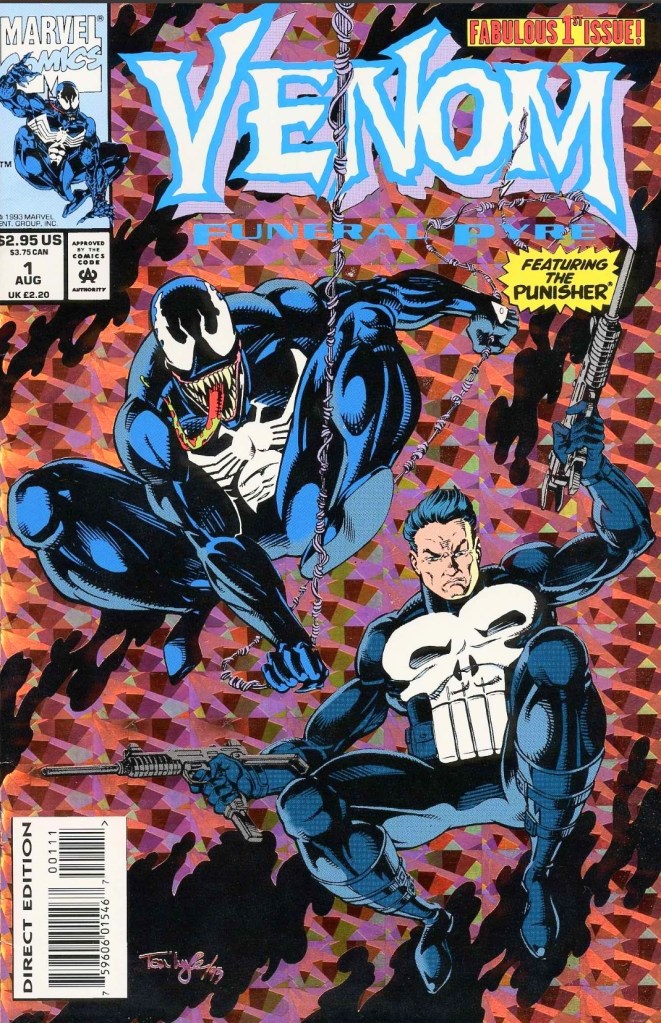
With those details laid down, here is a look back at Venom: Funeral Pyre #1 published in 1993 by Marvel Comics with a story written by Carl Potts and drawn by the late Tom Lyle.

The cover.

Early story

The story begins on the streets of Oakland, California. There, a young guy named Gray Russell watches gang members severely beat up another guy which disturbs him deeply. He is part of the gang. A short time later, he rides with the gang in a car which hits a man (who managed to have his young nephew move out of harm’s way).

Somehow the man survived and moves to another direction deliberately to lure the gang away from his nephew. As the gangsters move towards a local building, Gray separates from his harsh companions to find a phone booth. Gray finds Calvin (the nephew of the man who got hit) nearby and decides to comfort him. From a distance, they heard the gangsters beat Calvin’s uncle to death.

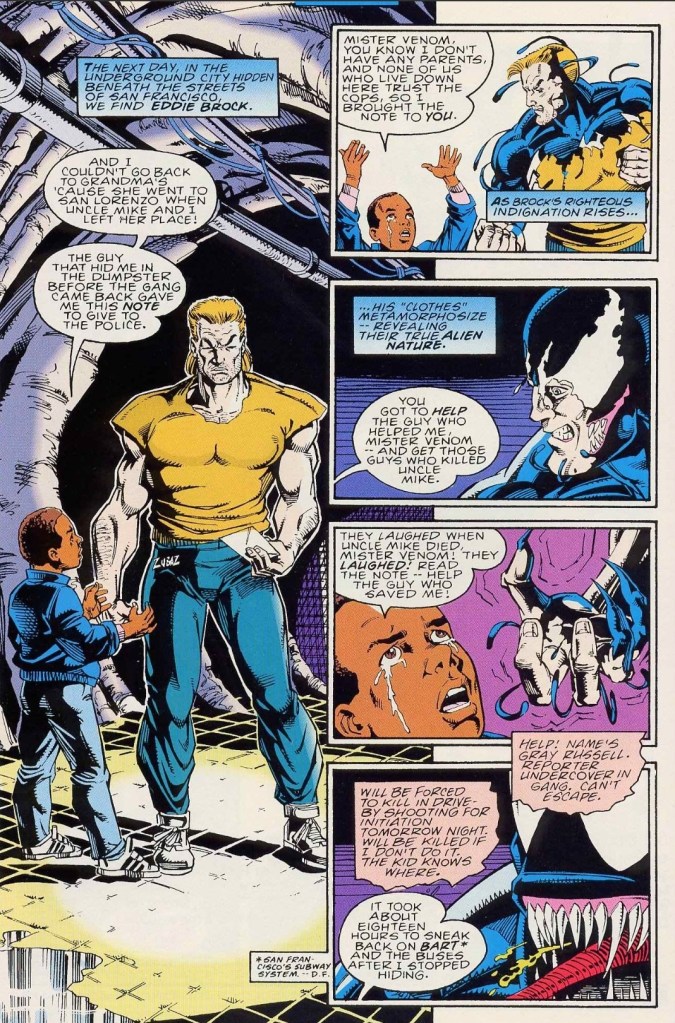
The next day in the underground city beneath San Francisco, Calvin meets Eddie Brock and hands him a note meant for the police. As Calvin reveals more details, Eddie gradually turns into Venom with his alien costume covering up his body. After learning of the death of Calvin’s uncle and hearing the young boy’s plea for help for Gray (an investigative reporter in secret within the gang), Venom agrees to help him as it is their mission to save the innocent and destroy the guilty…

Quality

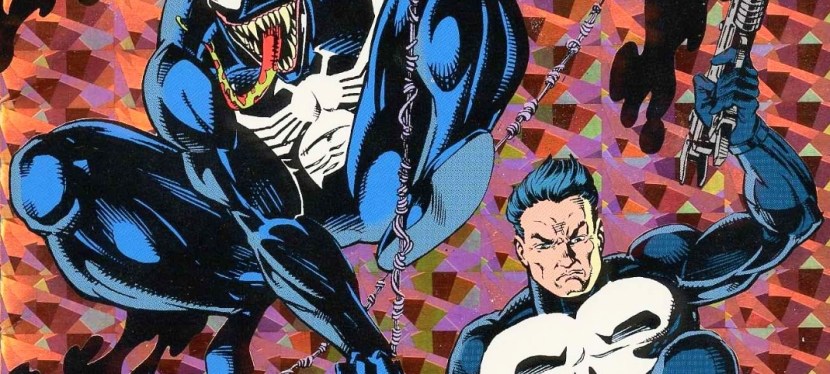
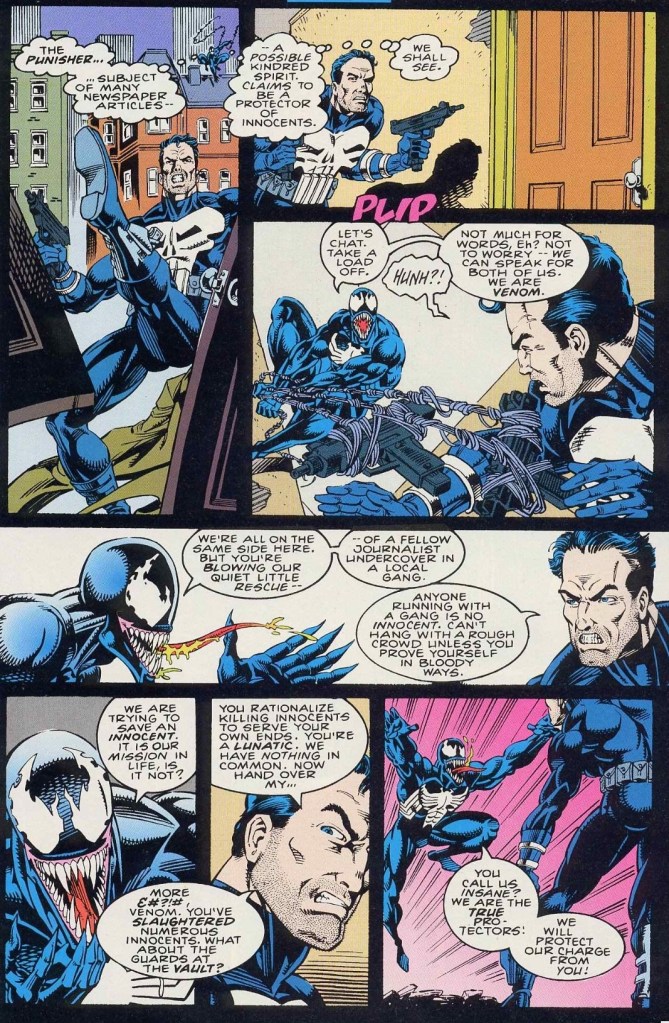
Punisher and Venom’s first-ever encounter with each other.

I want to start first the with the overall presentation crafted by the Potts-Lyle creative duo. In terms of story and setting, this comic book has a very strong urban crime vibe which is not a surprise given the fact that Carl Potts wrote lots of stories of the Punisher and his personal war against criminals. That being said, the tone is very different compared to what was shown in Venom: Lethal Protector and other Venom tales that got published before this comic book. Very clearly, this story is dark, gritty and even disturbing to read due to the subject matter of crime and senseless violence caused by people who are obsessed with violence. The fantasy elements of Venom: Lethal Protector are unsurprisingly absent here.

Carl Potts’ take on Venom’s personality is technically an extension of what was established previously. Venom, who is truly a murderer on the loose, continues to live with his very distorted code by helping the innocent by means of using violence and death on others he personally views as guilty. His getting involved in the turf of crime here is, however, a fresh approach on the super villain now acting “heroic” helping Calvin who lost his uncle. Being a former journalist himself, Eddie Brock “relates” with the investigative journalist involved with the gang.

The other major character – the Punisher – is his typical self in this story. He gets involved in the conflict in Oakland not purposely but accidentally as he was just passing by in his weapons-filled van as he heard the local police communication on local crime. The only thing notable about the way the Punisher is portrayed here is his first-ever interactions with Venom which is a crossover scene filled with a decent amount of hard action.  

Gray, the investigative journalist, is presented here as technically the third major character of the story. In some ways, he even overshadows Venom and the Punisher in key parts of this comic book. He is not really an interesting character himself but there are some interesting Marvel universe details shown from his personal memories. What is clear about this uninteresting character is that the creative team planned something with him in a key role within the core concept of this mini-series.

As for the plot itself, it clearly has a dark and gritty concept of street crime in 1990s Oakland which itself plays a big part of the build-up of the story and the eventual crossover between Venom and the Punisher. The problem is that the build-up has an uninteresting character with Gray involved and there is a lot of exposition to go through before the Venom-Punisher encounter.

The encounter between Venom and the Punisher here came with the superhero comics crossover trope of the players misunderstanding the situation and each other, and getting into a conflict very early on. Both characters have their respective obsessions and so-called codes of purposes, which predictably leads them into conflict as they stayed hard-headed towards each other. While it is flawed, the Venom-Punisher crossover here is the highlight as well as the relief from having to read all the exposition and build-up.

Conclusion

A scene like this could inspire Black Lives Matter terrorists, SJWs, woke activists and North American socialists to become violent and cause havoc around America.

Venom: Funeral Pyre #1 (1993) is a flawed comic book that happens to highlight the Punisher and Spider-Man’s greatest nemesis of the time. It delivered on its promise of showcasing the two characters – a cold-hearted anti-crime vigilante and an alien costume-equipped murderer – in a crossover but the pay-off was barely enough when you take into account the build-up, the exposition and the involvement of the uninteresting third player named Gray. Compared to what was shown in Venom: Lethal Protector, this comic book clearly has an urban crime flavor which Carl Potts strongly implemented. As for the art, Tom Lyle showed he is really good in visualizing Venom, the Punisher and street gang wars.

Overall, Venom: Funeral Pyre #1 (1993) is serviceable. Definitely this is not the fabulous 1st issue described on the foil cover.

+++++

Thank you for reading. If you find this article engaging, please click the like button below, share this article to others and also please consider making a donation to support my publishing. If you are looking for a copywriter to create content for your special project or business, check out my services and my portfolio. Feel free to contact me with a private message. Also please feel free to visit my Facebook page Author Carlo Carrasco and follow me on Twitter at  @HavenorFantasy as well as on Tumblr at https://carlocarrasco.tumblr.com/ and on Instagram at https://www.instagram.com/authorcarlocarrasco

A Look Back at What If #61 (1994)

Disclaimer: This is my original work with details sourced from reading the comic book and doing personal research. Anyone who wants to use this article, in part or in whole, needs to secure first my permission and agree to cite me as the source and author. Let it be known that any unauthorized use of this article will constrain the author to pursue the remedies under R.A. No. 8293, the Revised Penal Code, and/or all applicable legal actions under the laws of the Philippines.

Welcome back superhero enthusiasts, 1990s arts and culture enthusiasts, Marvel Comics fans and comic book collectors! Today we go back to the wild 1990s and examine an alternate universe portrayal of one of Spider-Man’s many events told through the What If monthly series!

If you are looking for a portrayal of Spider-Man going over the edge and into the extremes emotionally, you are about to experience something in this retro review of mine. Some time ago, I reviewed a What If comic book about Spider-Man becoming a murderer which was compelling but ended on a whimper.

With those details laid down, here is a look back at What If #61 published in 1994 by Marvel Comics with a story written by Kurt Busiek and drawn by Kirk Jarvinen, Andrew Wildman, Derek Yaniger and Jim Amash.

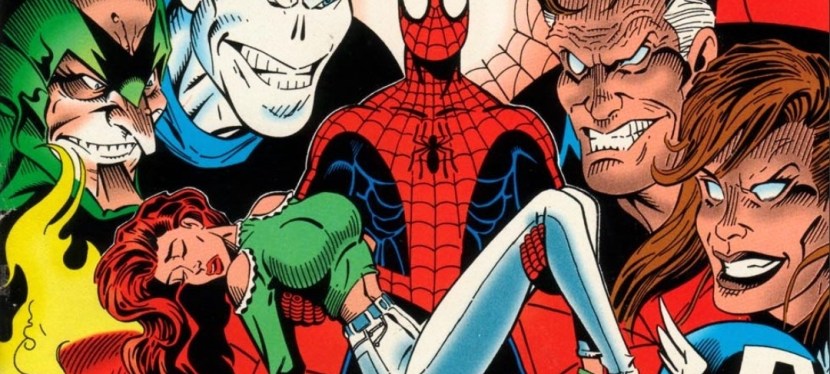
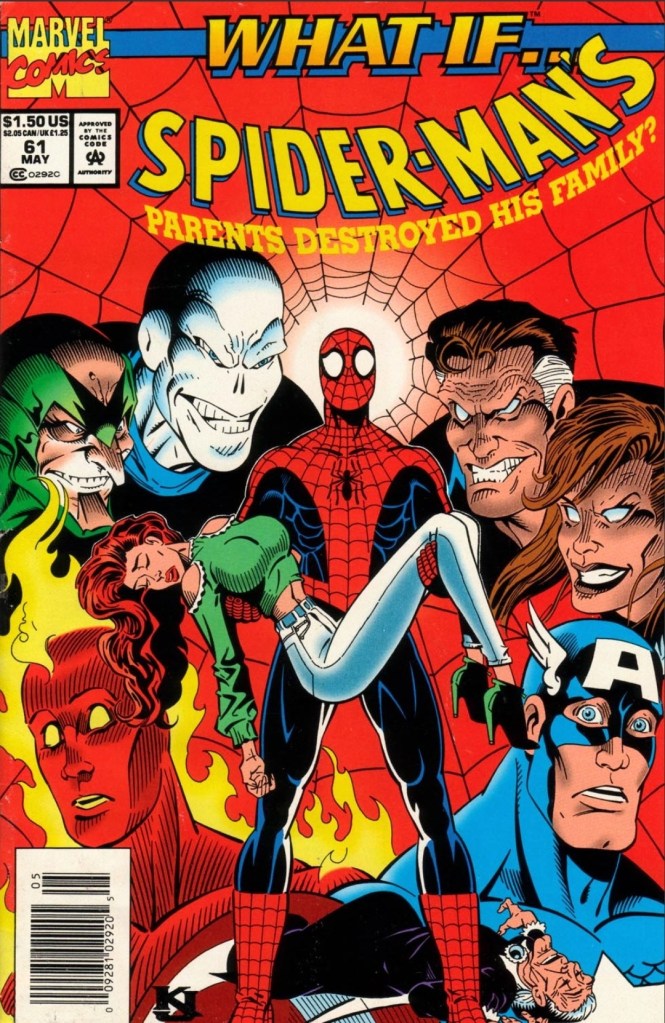
The cover.

Early story

The story begins with Richard and Mary Parker (Peter Parker’s parents) arriving in the presence of Aunt May who happens to be visited by their son Peter (Spider-Man). Having learned something from a while back, Aunt May tells Richard and Mary that they are not genuine persons. Suddenly, Peter Parker’s spider sense intensifies and in an attempt to defuse the situation, he leads his aunt to walk out of the house with him. Richard and Mary watch them walk away.

It turns out, Richard and Mary are impostors and they have been working all the time for a secretive boss. Richard calls his employer under an emergency and reports that they have completed phase one of their assignment, that Aunt May knows the truth about them and is about to inform Spider-Man. Richard is then told that under no circumstances is the plan to be jeopardized and anyone who suspects must die. He is also told to flush Mary’s programming and reset her as she showed signs of acting odd to the situation.

A short time later, Richard and Mary – now in morphed forms with vastly different bodies and half their heads resembling their human selves – suddenly break into an apartment surprising Peter, his wife Mary Jane and Aunt May. Violent action by one of them accidentally ripped open Peter’s shirt, revealing his Spider-Man suit to Aunt May. Just as Peter’s aunt figures out the secret, he tells Mary Jane to grab her and get out.

However, the sight of the morphed Mary Parker shocked Aunt May and Mary Jane so much, they failed to move. Mary Parker then morphs her two hands into large, makeshift hammers, and swiftly killed Aunt May and Mary Jane. Peter is instantly shocked by their sudden deaths but deep inside, rage begins to burn…

Quality

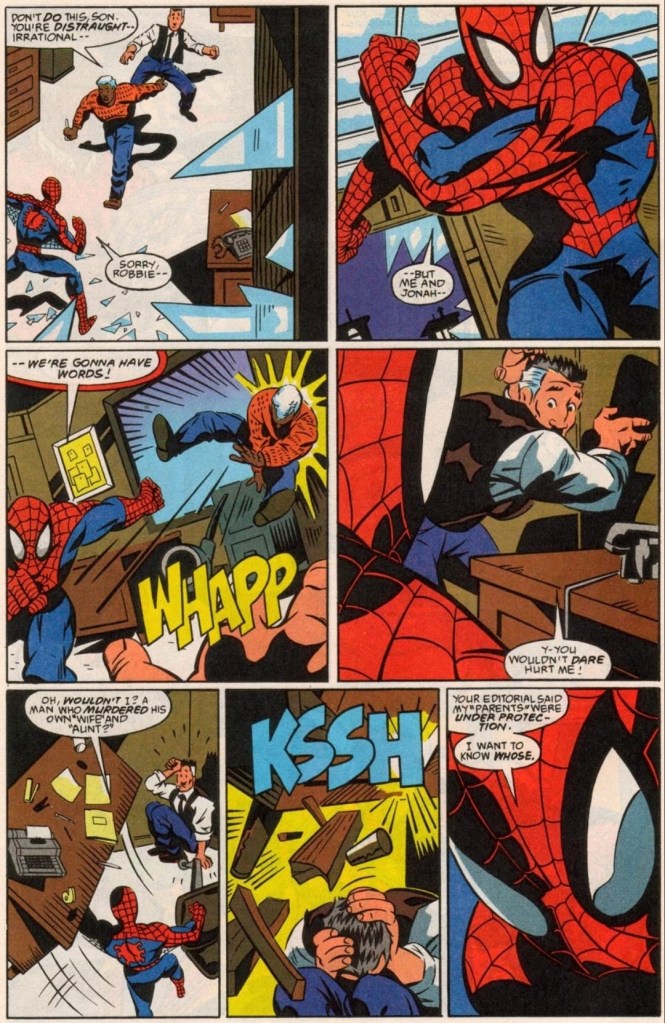
Spider-Man already over the edge and reacting violently to the abusive Daily Bugle.

I can start by confirming that Kurt Busiek’s writing is very strong and his alternate take on the events of Amazing Spider-Man #388 (1994) is indeed very solid. In one way, I find the emotional stakes for Spider-Man has been raised a lot higher than what was portrayed in the canon story. The concept of losing his beloved family members to enemies who were impostors that looked like his long lost parents is indeed disturbing as well as emotionally charged. In relation to this, Busiek and the illustrators brought to life a Spider-Man who really went over the edge by taking matters into his own hands as the loss of beloved ones led to the blurring of the boundary between good and evil. Even the boundary between innocence and guilt gets blurred which adds more depth to the emotions of the story. As I read the story, there were moments when I felt that Spider-Man became as bad as the evil ones even though he is clearly the victim and his family was targeted.

Apart from showing Spider-Man getting outraged and pushed to the limits, Busiek inserted elements about how people perceive incidents without knowing all the facts and how easily they get manipulated by a news outlet – the Daily Bugle where Peter Parker worked as a freelance photographer – whose leader does not care about ethical journalism nor the pursuit of the truth. In this age of widespread fake news and liberal news media outlets in America doing propaganda for American Communists (read: Democrats, abortionists, LGBTQ, Black Lives Matter, Antifa, the terrorists, the climate change extremists and the socialist hordes), this particular aspect of the story makes this comic book strongly relevant to read today.

The story also sheds light on Spider-Man’s connections with other Marvel superheroes who happen to be in New York City. You will see Captain America and Johnny Storm express their concern about Spider-Man’s state of mind as they themselves still tried to figure out what really happened. In short, the superheroes here showed restraint even as Spider-Man goes to the extreme being a victim as well as a fugitive.

If there are any weak points in this comic book, it would be the art which has this cartoon-like aesthetic for much of the story. Considering the serious subject matter, the visuals are quite contradicting as they make this look like it was made for much younger readers. In fairness, the quality of the art improved during the 2nd half of the story.

Conclusion

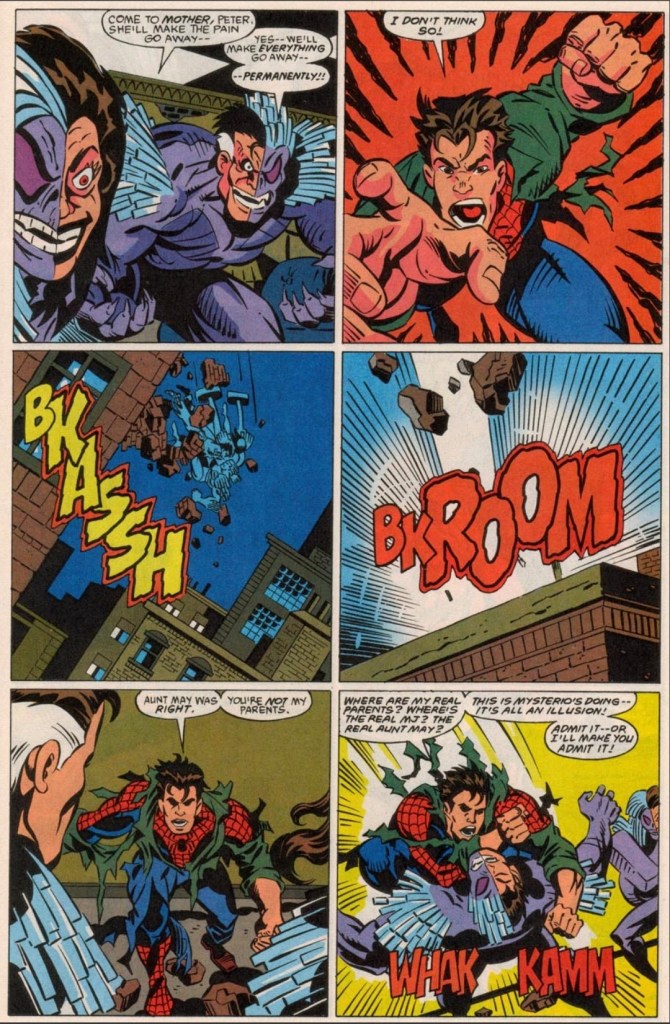
Spider-Man takes on the impostors who looked like his parents.

As far as storytelling and characterization goes, What If #61 (1994) succeeded a lot on portraying the iconic Spider-Man as the superhero who went over the limits of his emotions and his reasoning which is the result of the tragic deaths of two beloved family members caused by individuals who pretended to be his parents. This is a very solid story which also has a powerful ending. Where What If #72 failed, this comic book succeeded and even exceeded it with Spider-Man truly becoming unheroic. I should state that this comic book should convince readers to go to the Amazing Spider-Man series and follow the Lifetheft storyline in issues #386 to #388 (which were released months before this comic book). Kurt Busiek’s script is indeed great and it is easily the driving force of the comic book.

Overall, What If #61 (1994) is highly recommended.

+++++

Thank you for reading. If you find this article engaging, please click the like button below, share this article to others and also please consider making a donation to support my publishing. If you are looking for a copywriter to create content for your special project or business, check out my services and my portfolio. Feel free to contact me with a private message. Also please feel free to visit my Facebook page Author Carlo Carrasco and follow me on Twitter at  @HavenorFantasy as well as on Tumblr at https://carlocarrasco.tumblr.com/ and on Instagram at https://www.instagram.com/authorcarlocarrasco

COVID-19 Crisis: Muntinlupa City’s adult recipients of first booster shots inch closer to 200,000

In the progressive City of Muntinlupa, the number of adult patients who received their first booster shots for COVID-19 is slowly approaching 200,000. Specifically, the count is just a little less than 190,000 according to a Manila Bulletin news report.

To put things in perspective, posted below is an excerpt from the Manila Bulletin. Some parts in boldface…

The total number of adults who have received their first booster shot against Covid-19 has increased to more than 188,000.

Data from the Muntinlupa City Health Office (CHO) showed that as of Sept. 20, the first booster shot recipients among the adult population in the city rose to 188,256, an increase of 1,758 people from 186,498 as of Sept. 14.

The total coverage is equivalent to 42.54 percent of the target population of 442,517, or 80 percent of the total Muntinlupa population of 553,146.

In addition, there are 33,977 individuals who have received their second booster shot in Muntinlupa.

Muntinlupa’s total fully vaccinated population stood at 524,527, or 118.53 percent of the target population and 94.48 percent of the total population.

Among the 12 to 17 years old in the city, 43,850 are fully vaccinated, or 77.61 percent of the total population of 56,499 for the age group. First booster dose recipients among them totaled 6,212.

The fully vaccinated among five to 11 years old totaled 20,215, or 29.64 percent of the total population of 68,198.

The Muntinlupa City government has been continuing with the Department of Health’s “Sa Booster Pinaslakas” program.

This aims to increase the coverage of booster shots to 50 percent of the total target population and vaccinate 90 percent of senior citizens nationwide before Oct. 8, which marks the first 100 days of President Ferdinand Marcos Jr.

Let me end this by asking you readers: If you are a Muntinlupa City resident, what can you say about this newest development? Are there many members of your local community who are still hesitant about getting vaccinated for COVID-19? Did you notice if there were any anti-vaccine fanatics and liars who keep spreading fear and misinformation in your local community? Do you think that the anti-vaccine fanatics here in the Philippines are conspiring with the Communists, socialists, Marxists, SJWs and terrorists?

You may answer in the comments below. If you prefer to answer privately, you may do so by sending me a direct message online.

+++++

Thank you for reading. If you find this article engaging, please click the like button below and also please consider sharing this article to others. If you are looking for a copywriter to create content for your special project or business, check out my services and my portfolio. If you want to support my website, please consider making a donation. Feel free to contact me with a private message. Also please feel free to visit my Facebook page Author Carlo Carrasco and follow me on Twitter at  @HavenorFantasy as well as on Tumblr at https://carlocarrasco.tumblr.com/ and on Instagram athttps://www.instagram.com/authorcarlocarrasco/.

A Look Back at Harbinger #18 (1993)

Disclaimer: This is my original work with details sourced from reading the comic book and doing personal research. Anyone who wants to use this article, in part or in whole, needs to secure first my permission and agree to cite me as the source and author. Let it be known that any unauthorized use of this article will constrain the author to pursue the remedies under R.A. No. 8293, the Revised Penal Code, and/or all applicable legal actions under the laws of the Philippines.

Welcome back superhero enthusiasts, 1990s culture enthusiasts and comic book collectors! Today we go back to the early 1990s and explore a part of the Valiant Comics shared universe through the Harbinger monthly series.

In my previous retro review, some twists of events happened for Sting and his teammates during the Christmas season. The story was part of the continuing build-up and expansion of the Harbinger series’ own space within Valiant Comics’ shared universe under the direction of Maurice Fontenot. As of issue #17, another new character from outside of Sting’s group got introduced for them to interact with.     

With those details laid down, here is a look back at Harbinger #18, published in 1993 by Valiant Comics with a story written by Maurice Fontenot and illustrated by Howard Simpson.

The cover.

Early story

The story begins on January 1993. Within the city of New York, Faith, Shatiqua and Flamingo are being followed by a young man wearing a trench coat. They know they are being followed. They eventually found themselves just outside the same amusement joint where Shatiqua played a lot of arcade games and decide to enter.

Inside, many people recognized and greeted Shatiqua which reflects her outstanding reputation on arcade games. As Shatiqua, Faith and Kris approach a certain arcade game (that Shatiqua wants to play), they noticed the one playing it is the same little black boy (capable of disappearing) they encountered previously. Shatiqua then takes the first step to approach him and gain his attention.

The boy then disappears and reappears a short distance away from the three and right beside same trench coated man who earlier follow them. The boy then attempts to blow the place up with a hand grenade. The man in the trench coat reacts quickly revealing his power to Faith, Shatiqua and Flamingo.

Quality

Sting shows his ignorance and lack of maturity while getting checked by Dr. Hayward.

This is the latest build-up type of story Fontenot composed and like the previous issue, another new character unconnected to Sting’s team got introduced for them to interact with. The new character here is referred to as Screen and he clearly is a more interesting character than the one introduced in issue #17. Screen here is more impulsive and aggressive and he sure looks like he has what it takes to oppose Sting. I also liked the way the creative team showed the impulsiveness and lack of maturity of both Sting and Screen.

Within the script is the establishment of a new sub-plot which symbolizes the growing danger of the Harbinger foundation towards not only on Sting and teammates but also against the others that oppose Toyo Harada and his organization. In some ways, the sub-plot will make you speculate about the invisible yet sinister forces who wield tremendous power over the top government officials who are supposed to be serving their constituents within the republic.

With all of these details laid down, I can say they are all engaging to read as Fontenot’s writing continued to be really strong. For the art, I can say that Howard Simpson continued to pump out really solid visuals while successfully keeping the primary characters recognizable all the time.

Conclusion

This image is very symbolic as Bill Clinton and his wife Hillary made it normal for the United States to make deals with terrorists (notably Iran and Palestine) and betray the patriotic Americans. This makes this comic book socially relevant and what you see with the corrupt administration of Joe Biden reconnects strongly with the Clinton legacy.

Harbinger #18 (1993) is a very solid comic book to read. The build-up continues to happen and along the way, the titular characters got developed some more and this time around, the Harbinger foundation’s power continues to get stronger which convinced me to look forward to the next issue.   

Overall, Harbinger #18 (1993) is highly recommended!

+++++

Thank you for reading. If you find this article engaging, please click the like button below, share this article to others and also please consider making a donation to support my publishing. If you are looking for a copywriter to create content for your special project or business, check out my services and my portfolio. Feel free to contact me with a private message. Also please feel free to visit my Facebook page Author Carlo Carrasco and follow me on Twitter at  @HavenorFantasy as well as on Tumblr at https://carlocarrasco.tumblr.com/ and on Instagram at https://www.instagram.com/authorcarlocarrasco