A Look Back at X-Men Adventures #3 (1993)

Disclaimer: This is my original work with details sourced from reading the comic book and doing personal research. Anyone who wants to use this article, in part or in whole, needs to secure first my permission and agree to cite me as the source and author. Let it be known that any unauthorized use of this article will constrain the author to pursue the remedies under R.A. No. 8293, the Revised Penal Code, and/or all applicable legal actions under the laws of the Philippines.

Who is the most definitive X-Men villain ever? That is none other than Magneto! Co-created by Stan Lee and Jack Kirby, Magneto made his literary debut alongside Marvel’s heroic mutants in The X-Men #1 way back in 1963. Magneto is capable of generating and controlling magnetic fields which make him dangerous since he has the power to manipulate metal and even use them as weapons against others, plus he can even cause destruction to buildings by moving the metal in them to bring them down.

What even makes Magneto more dangerous is his very strong belief that his fellow mutants are genetically superior over humans and he does not believe in the concept of mutants and humans co-existing. Character-wise, Magneto is the complete opposite of Charles Xavier/Professor X of the X-Men.

When it comes to pop culture influence, GamesRadar+ declared Magneto as the #1 best X-Men villain of all time. Even more intriguing was the super villain topping IGN’s Top 100 Comic Book Villains List. Beyond comic books, Magneto also appeared in the X-Men arcade game of 1992 made by Konami. On November 27, 1992, Magneto made his debut in the Enter Magneto episode of the popular X-Men animated series on TV. The said episode was, unsurprisingly, adapted into comic book form in issue #3 of the X-Men Adventures monthly comic book series.

How was Magneto’s debut in the said monthly series? We can find out in this look back at X-Men Adventures #3, published in 1993 by Malibu Comics with a story written by Ralph Macchio and drawn by Andrew Wildman.  
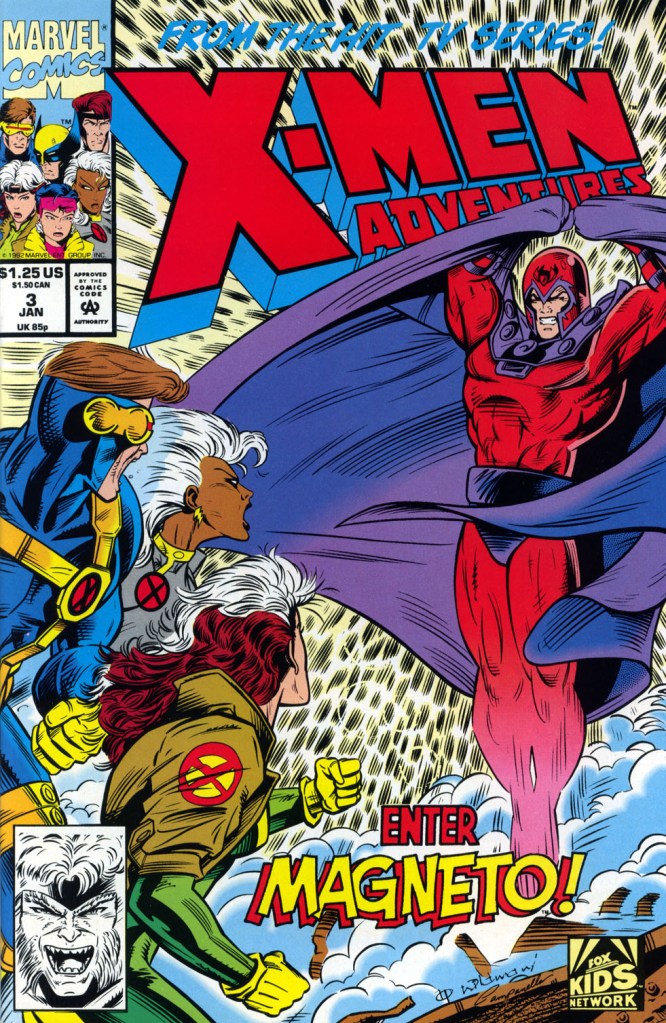
The cover.

Early story

The story begins in outer space where Asteroid M is orbiting above planet Earth completely undetected. As a meteor is on-course to collide with Asteroid M, the operator of the asteroid activates its guns and hits it. While Asteroid M got spared, a smaller meteor found itself falling into Earth’s atmosphere. As it burns through the atmosphere, Charles Xavier spots it from inside his mansion.

Xavier turns his attention to Jean Grey. As they travel together, the doors open and Sabretooth enters landing on the floor. The two have yet to know him.

Over at a prison, the captured Hank McCoy/Beast thinks deeply inside his prison cell only to suddenly witness one of the walls get smashed by some powerful force. Magneto arrives and tells him he came for him…

Quality
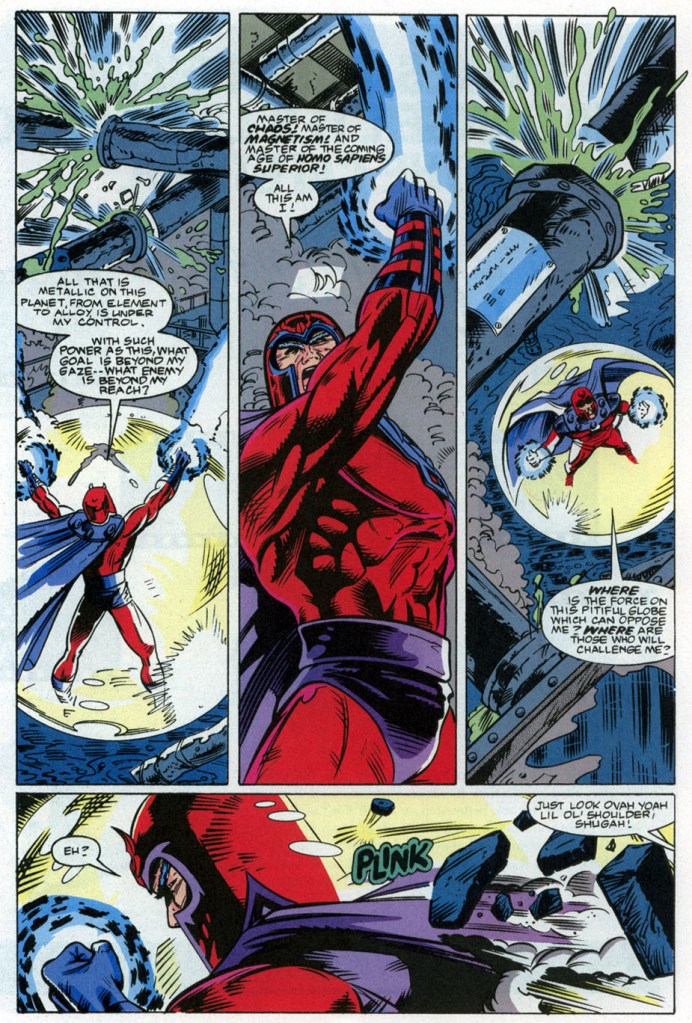
The power of Magneto.

The writing, with credit to the screenwriters behind the animated episode, is pretty solid and the essence of the said episode was very well adapted into this comic book. As this is Magneto’s debut in the X-Men Adventure series reflecting his debut in animated series, his character is portrayed very accurately and it only made perfect sense for him to approach Beast first to try to convince him join his pro-mutant movement. More on the writing, Beast’s restraint brought out more of Magneto’s hardcore beliefs and his complete opposition towards humans.

Of course, the creators did not let down their efforts to portray the struggle mutants have under the laws of human society which is strongly reflected in Beast’s court hearing with Wolverine and Cyclops (in civilian forms) observing powerlessly. The court room drama and arguments were intense.

I should also state that there really was a nice build-up leading to the first battle (first half, actually) between the X-Men and Magneto. Unlike the battles in issues #1 and #2, the conflict here showed the X-Men more in danger which is only fitting considering how great the villain is.

Conclusion

Magneto and Beast.

X-Men Adventures #3 is a strong adaptation of the Enter Magneto episode. There is no doubt about that and most notably, the comic book creators did another good job making the TV animated episode’s concept engaging and fun to read. This comic book should be part of the collection of anyone who is passionate about Magneto.

If you are seriously planning to buy an existing hard copy of X-Men Adventures #3 (1993), be aware that as of this writing, MileHighComics.com shows that the near-mint copy of the regular edition costs $8 while the near-mint copy of the newsstand edition costs $17.

Overall, X-Men Adventures #3 (1993) is highly recommended!

+++++

Thank you for reading. If you find this article engaging, please click the like button below and also please consider sharing this article to others. If you are looking for a copywriter to create content for your special project or business, check out my services and my portfolio. Feel free to contact me as well. Also please feel free to visit my Facebook page Author Carlo Carrasco and follow me at HavenorFantasy@twitter.com

A Look Back at Spider-Man #26 (1992)

Disclaimer: This is my original work with details sourced from reading the comic book and doing personal research. Anyone who wants to use this article, in part or in whole, needs to secure first my permission and agree to cite me as the source and author. Let it be known that any unauthorized use of this article will constrain the author to pursue the remedies under R.A. No. 8293, the Revised Penal Code, and/or all applicable legal actions under the laws of the Philippines.

In 1992, Marvel Comics organized a big celebration of what was back then the 30th anniversary celebration of Spider-Man. Behind the scenes, the Spider-Man editorial team organized their creators to make something special worthy of the anniversary. Back then there were four monthly series of Spider-Man – Amazing Spider-Man, Spectacular Spider-Man, Web of Spider-Man and Spider-Man – and in keeping with the 30th anniversary bonanza, each of the monthly series would see one special issue with a hologram on the cover.

What I read recently was one of those 30th anniversary celebration special comic books – Spider-Man #26. This comic book had a green cover and a hologram of Spider-Man upside-down. Its cover price is $3.50.

Was this old comic book’s content really worth the high cover price and the hologram? Did the creative team at Marvel do their job on making something special in line with the 30th anniversary celebration? We can find out in this look back at Spider-Man #26, published in 1992 by Marvel Comics with the main story written by Tom DeFalco and drawn by Mark Bagley and Ron Frenz.

The cover with a hologram.

Early story

The story begins on the street of New York when a man wearing a device runs down the sidewalk distracting and unintentionally pushing a few people out of the way. He is glowing as he moves. Someone from behind him calls him Stewart.

Soon enough, Peter Parker/Spider-Man and Mary Jane cross paths with him. Peter immediately leaves Mary Jane behind and starts pursuing the glowing Stewart. In the middle of the street, Stewart sees a speeding motorcycle heading towards him. He dives for cover which incidentally shapes his glowing field into a makeshift ramp causing the motorcyclist go over him. Spider-Man sees the flying motorcycle and its driver, and struggles to decide which one to save…

Quality

From the 2nd story.

Let me start with the main story. It sure is heavily worded almost all throughout but that is understandable because Tom DeFalco really pushed hard to emphasize the theme of responsibility as Spider-Man struggles to tackle criminals while trying to find quality time for his wife. There was even a scene in which Peter Parker recalls key events from his past (his becoming Spider-Man, letting a certain criminal get away, the death of his Uncle Ben, etc.) which, in terms of presentation, was a clear attempt by the creative team to bring readers back to the recorded history of Marvel’s icon. The main story is a genuine, heart-filled attempt to go beyond showing Spider-Man beating the bad guys to do local society good. There was also effort exerted to show that there are a few guys who do bad things not because they are inherently evil but rather they are desperate and/or misguided. The problem with the main story is that the other characters – Stewart, Bill, the gang leader Maxwell and others – are not so interesting at all. Of course, we cannot expect to see Spider-Man go head-to-head with another one of his major villains but this story was part of the 30th anniversary celebration.

The 2nd story, if you can all it that, is pretty much an exposition-filled exercise designed to give readers – both new and old – a review of Spider-Man’s powers and capabilities. To prevent it from becoming a total bore, some characters from the Marvel Comics universe were visually added.

When it comes to the quality of the artwork, Ron Frenz’s work here is serviceable at best. Mark Bagley’s art here improves the quality but that’s not saying much.

Conclusion

From the main story.

As a 30th anniversary celebration issue, Spider-Man #26 does not have much when it comes to being truly special. You love spectacle? You won’t find much in it. You wanted to see something groundbreaking in terms of character development? There’s none. Gripping storytelling? None! There was also no conflict with any prominent villain from the Marvel universe here. What you will get here is nostalgic stuff plus exposition about key elements that define Spider-Man. Truly the only thing special here is the hologram on the gimmick cover.

If you are seriously planning to buy an existing hard copy of Spider-Man #26 (1992), be aware that as of this writing, MileHighComics.com shows that the near-mint copy of the regular edition costs $27 while the near-mint copy of the newsstand edition costs $90.

Overall, Spider-Man #26 (1992) is serviceable. If you really want to buy this old comic book, I recommend waiting for its price to fall below $5 and I’m referring to the near-mint copy.

+++++

Thank you for reading. If you find this article engaging, please click the like button below and also please consider sharing this article to others. If you are looking for a copywriter to create content for your special project or business, check out my services and my portfolio. Feel free to contact me as well. Also please feel free to visit my Facebook page Author Carlo Carrasco and follow me at HavenorFantasy@twitter.com

A Look Back at UltraForce #6 (1995)

Disclaimer: This is my original work with details sourced from reading the comic book and doing personal research. Anyone who wants to use this article, in part or in whole, needs to secure first my permission and agree to cite me as the source and author. Let it be known that any unauthorized use of this article will constrain the author to pursue the remedies under R.A. No. 8293, the Revised Penal Code, and/or all applicable legal actions under the laws of the Philippines.

After reading issues #0 to #5 of the UltraForce series of the mid-1990s, I should say that I clearly enjoyed them all as creators Gerard Jones and legendary illustrator George Perez (plus their supporting crew) really delivered great stories, dynamic visuals and very engaging interactions between the UltraForce members.

So far, each and every UltraForce issue I reviewed here is fun and compelling to read. The high levels of artistic and literary quality in each issue is evident right from the start and, more importantly, it emphasizes the overall concept of the Ultraverse itself even deeper than what I discovered in its early stage (launch year 1993). Very clearly, UltraForce as a comic book series raised the stakes of the Ultraverse (much like Break-Thru did) when it comes to how the public perceived ultras (superheroes), who are the secretive sinister forces and how they impact the whole world, why being an ultra has lots of advantages and disadvantages, why ultras are hard to unite in the face of danger, and so on. These creative concepts were really great and it was in the year 1994 – the same year UltraForce launched – when the Ultraverse was at a stage to go further to a bolder direction with its creative evolution. Unfortunately all of that got screwed up after Marvel Comics acquired Malibu Comics.

More on UltraForce, the saga of king Atalon’s fire people rising from the depths of the Earth and possessing nuclear missiles to attack people on the surface has lasted quite long and its narrative remained consistently engaging. In issue #5, something terrible happened to UltraForce member Pixx during a big battle. What transpired next, we can find out in this look back at UltraForce #6, published in 1995 by Malibu Comics with a story written by Gerard Jones and drawn by George Perez and Steve Butler.

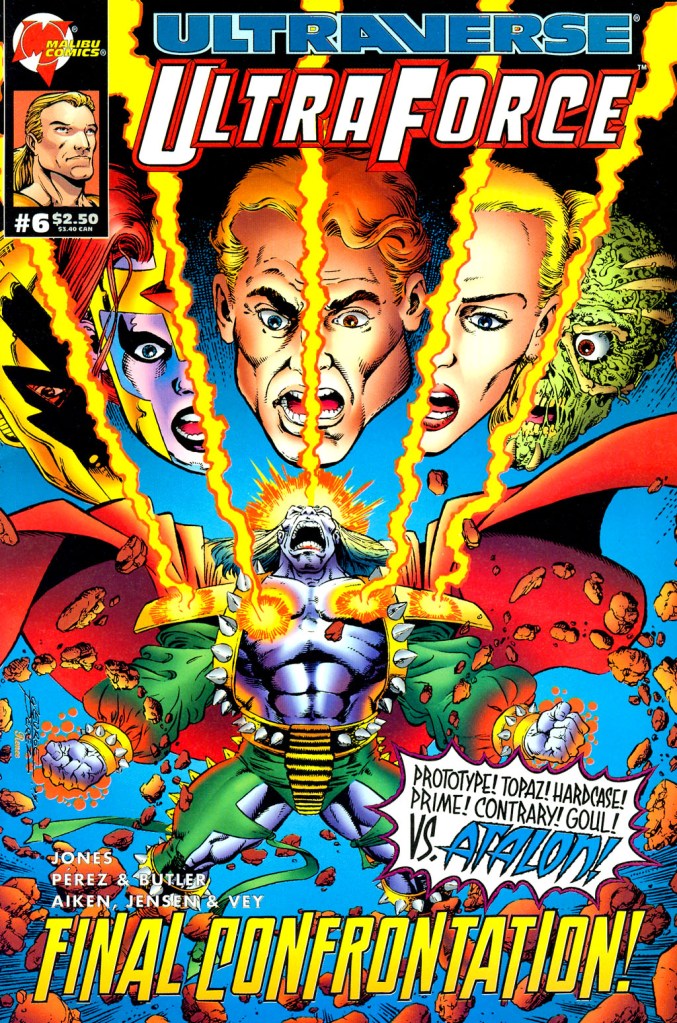
The cover! They even misspelled Ghoul!

Early story

The story begins as tensions rise between Atalon and UltraForce over their respective losses. For Atalon, his grand dream involving the use of humanity’s nuclear weapons has been destroyed. For Prime, Hardcase, Prototype, Ghoul and Topaz, the hanging lifeless body of Pixx shocked them deeply.

Suddenly, out of intense anger, UltraForce jointly attack the king of the fire people. Topaz states that Pixx will not die unavenged as Prototype blasts Atalon. Hardcase strikes the king followed by blows delivered by Prime and Topaz. Prime is about to strike Atalon but gets distracted when the downed king mentioned he wants to reform the whole world. Atalon strikes Prime’s head and gets back up to keep fighting the rest of UltraForce.  

Their battle is so intense, the entire island shakes and the ground crumbles bringing the nuclear weapons down along with Pixx’s body. Ghoul goes down after her…

Quality

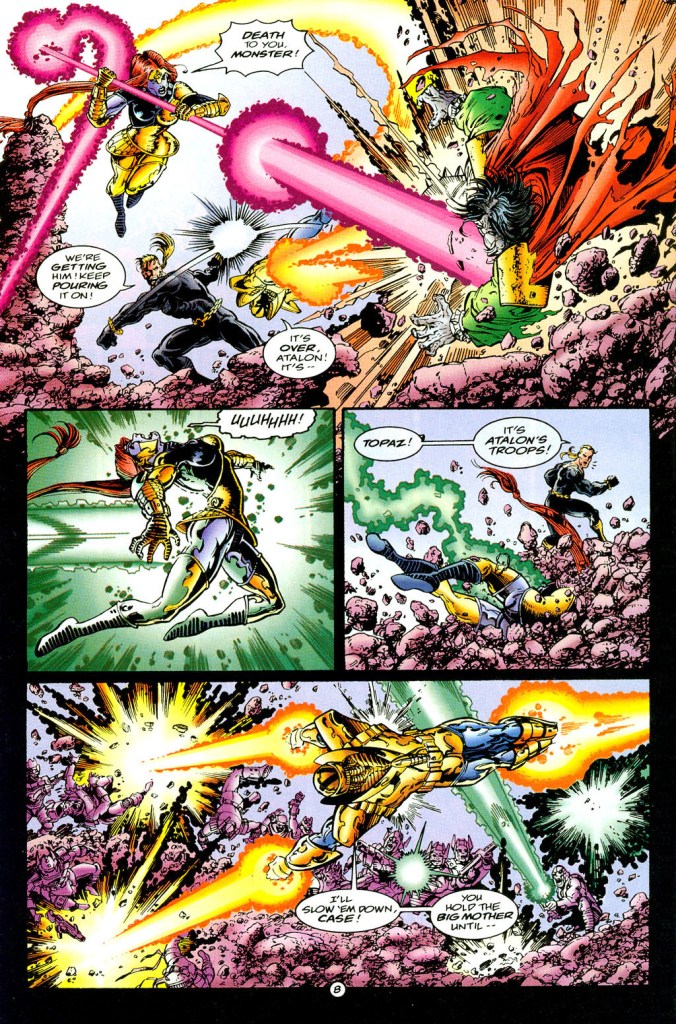
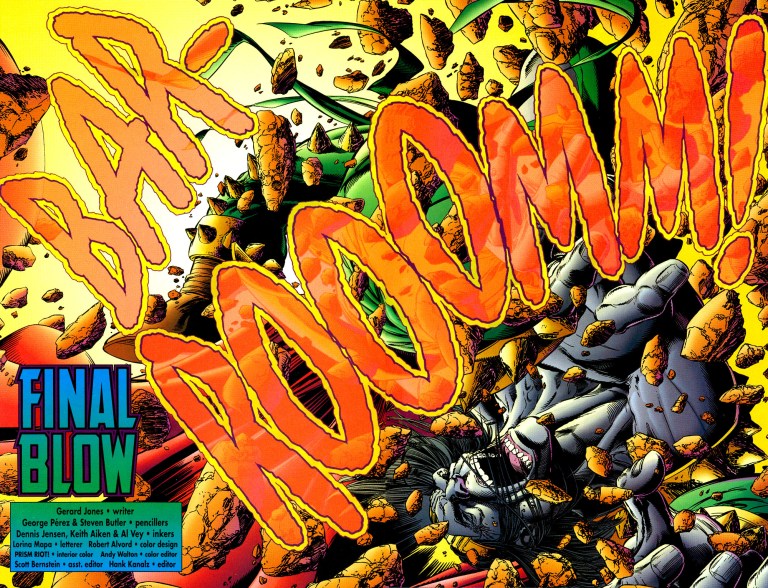
Dynamic action delivered with high detail!

Like all the previous issues released, this comic book has high-level qualities on its writing and artistry. This is not a surprise since the Jones-Perez creative team really pushed hard to keep telling what is clearly the epic event of the Ultraverse (post-Break-Thru). The consistency of quality up to this issue is very evident.

When it comes to the quality of this comic book’s story, which happens to be the conclusion of the Atalon saga, I can say that I’m very satisfied. As the events went on, a few but very significant twists happened which really shook the foundation of this particular saga backed with great visuals (although there are some pages that were clearly not drawn by George Perez), strong dialogue and a great presentation of the impact on the world and its people. What happened with king Atalon in the 2nd half of the story is very memorable and it definitely is one of the biggest twists in the entire Ultraverse. This one alone makes the comic book worth reading.

Conclusion

This is a great way to start the comic book along with the opening credits!

UltraForce #6 is indeed a great comic book and it is a strong conclusion to the saga (which started really in issue #0) that brought Prime, Hardcase, Prototype and others together as a team. This comic book is, in my honest view, also one of the finest UV stories Malibu Comics published in 1994. If there is anything to be regretful about, it is the fact that the Ultraverse got screwed up and ended in an undesirable state as a result of Marvel’s acquisition of Malibu. This is why there was no follow-up to the Atalon saga and UltraForce as a series turned for the worse shortly after (again, as a result of Marvel’s acquisition). Considering the events of the first major UltraForce saga, Atalon could have turned out as a more significant character of the Ultraverse and another epic follow-up (to the Atalon saga) could have happened.

More on the team itself, Prime, Prototype, Hardcase and their lesser known teammates were truly presented with a strong amount of balance. Ghoul and Contrary really had their nice share of the spotlight and how they worked in tandem with the others, as well as the very events of the comic book, was really fluid and believable. By the end of this comic book, you will realize the true values and the different personalities of the entire UltraForce!

If you are seriously planning to buy an existing hard copy of UltraForce #6 (1995), be aware that as of this writing, MileHighComics.com shows that the near-mint copy of the comic book costs $15.

Overall, UltraForce #6 (1995) is highly recommended!

+++++

Thank you for reading. If you find this article engaging, please click the like button below and also please consider sharing this article to others. If you are looking for a copywriter to create content for your special project or business, check out my services and my portfolio. Feel free to contact me as well. Also please feel free to visit my Facebook page Author Carlo Carrasco and follow me at HavenorFantasy@twitter.com

A Look Back at X-Men Adventures #2 (1992)

Disclaimer: This is my original work with details sourced from reading the comic book and doing personal research. Anyone who wants to use this article, in part or in whole, needs to secure first my permission and agree to cite me as the source and author. Let it be known that any unauthorized use of this article will constrain the author to pursue the remedies under R.A. No. 8293, the Revised Penal Code, and/or all applicable legal actions under the laws of the Philippines.

Having read lots of X-Men comic books, I should say that I always find the Sentinels (first appearance in The X-Men #14 in 1965) to be more memorable as enemies of Marvel’s mutants. On face value, they only look like oversized, human-like robots but I always find them to be formidable opponents of the X-Men. These machines are not only built with sophisticated technologies, they are able to push the X-Men to their limits during battle.

These anti-mutant robots, by the way, were ranked by IGN at #38 in their Greatest Comic Book Villains chart. Long before that, the Sentinels were the featured anti-heroes in the classic X-Men comic book storyline Days of Future Past and it was no surprise that they were also featured in the 2014 movie X-Men: Days of Future Past.

And then in the early 1990s, the Sentinels were shown in the first episode of the X-Men animated series on television. The said series was also adapted into an “as seen on TV” comic book series by Marvel called X-Men Adventures.

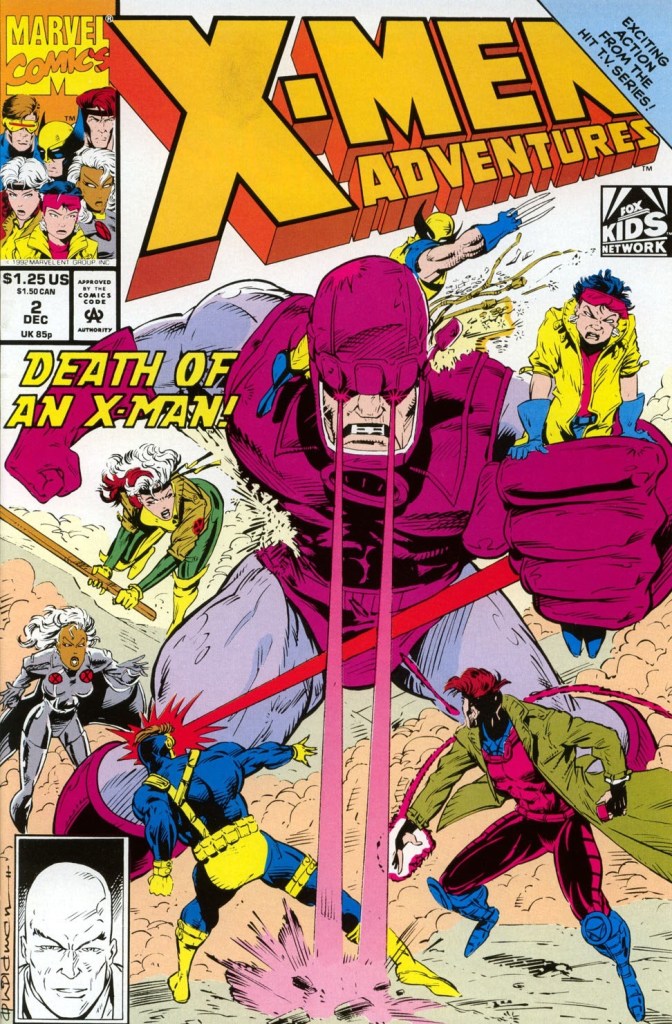
This brings me to this look back at X-Men Adventures #2, published in 1992 by Marvel Comics with a story by Ralph Macchio and drawn by Andrew Wildman.  

The cover.

Early story

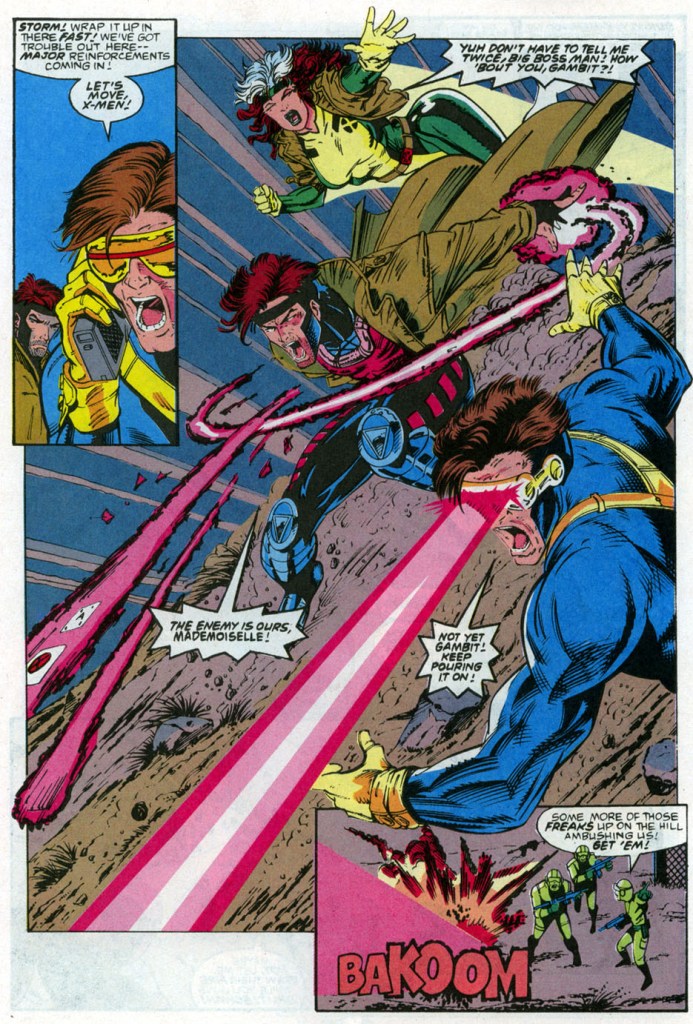
The story begins with Morph suffering from a nightmare. As he emerged from the vision, he finds himself with Storm, Beast and Wolverine. Together they work to infiltrate a federal government facility which houses the Mutant Affairs Department. Outside the walls of the facility, Rogue Gambit and Cyclops watch from a distance. Cyclops fires his optic blast at the vehicle that just dropped reinforcements that he believes were sent to stop their teammates.

Storm and her teammates break through a door instantly pushing off the security personnel followed by Beast knocking an additional guard. At the room containing the computer, Beast begins to access key information their team has been seeking…

Quality

The Sentinels and the X-Men!

Let me start with the storytelling. As an adaptation of one of the early episodes of the animated series, this comic book does a fine job of recapturing its essence complete with a nice balance between plot, exposition and spectacle. Considering the fact that the animated series was aimed for children, it’s quite intriguing to see the TV episode carrying really heavy themes – apart from the prejudice the mutants suffer from – like top federal government operations, expensive defense and weapons programs, government intrusion into people’s private lives, attempts to require minorities to get registered, etc. Those themes also made it in this comic book which made it feel like it was part of the mainstream X-Men comics of the time.

Compared to the first episode as well as its literary adaptation, this one emphasizes the Sentinels as tools of the government as part of their very expensive program to seek and monitor mutants among their citizens. Mutant Affairs director Peter Gyrich is clearly the villain who has no super powers but has the resources of the federal government and their authority to take action on mutants he perceived to be dangerous.

On the visuals, Andrew Wildman performed a solid job making each page look interesting and detailed enough. While his drawings made each character recognizable to me, it is in the spectacular scenes where he really shines. Wildman’s drawing of the Watcher on the final page of the comic book, however, looks laughable.

Conclusion

Andrew Wildman’s dynamic drawing of the X-Men in action.

While X-Men Adventures #2 is not exactly a literary classic, it is indeed a very solid adaptation of one of the earliest episodes of the animated series of the 1990s. It succeeded on telling a compelling and enjoyable story even though it emphasized the above-mentioned serious themes. As for the iconic Sentinels, this one succeeded in explaining what they are and their place in Marvel’s universe is.

If you are seriously planning to buy an existing hard copy of X-Men Adventures #2 (1992), be aware that as of this writing, MileHighComics.com shows that the near-mint copy of the regular edition costs $8 while the near-mint copy of the newsstand edition costs $26.

Overall, X-Men Adventures #2 (1992) is recommended.

+++++

Thank you for reading. If you find this article engaging, please click the like button below and also please consider sharing this article to others. If you are looking for a copywriter to create content for your special project or business, check out my services and my portfolio. Feel free to contact me as well. Also please feel free to visit my Facebook page Author Carlo Carrasco and follow me at HavenorFantasy@twitter.com

A Look Back at Prototype #9 (1994)

Disclaimer: This is my original work with details sourced from reading the comic book and doing personal research. Anyone who wants to use this article, in part or in whole, needs to secure first my permission and agree to cite me as the source and author. Let it be known that any unauthorized use of this article will constrain the author to pursue the remedies under R.A. No. 8293, the Revised Penal Code, and/or all applicable legal actions under the laws of the Philippines.

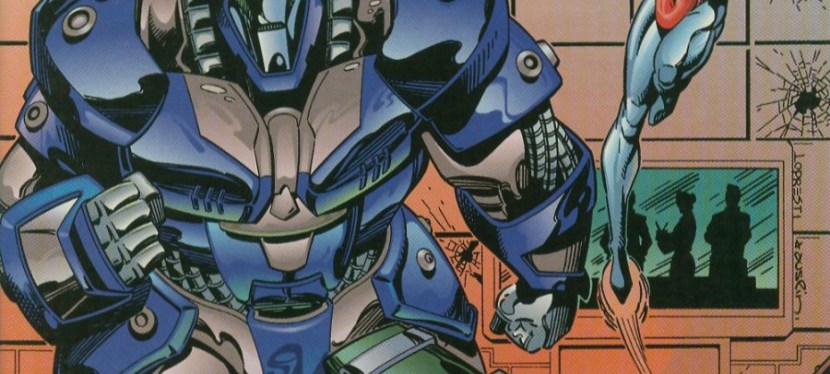
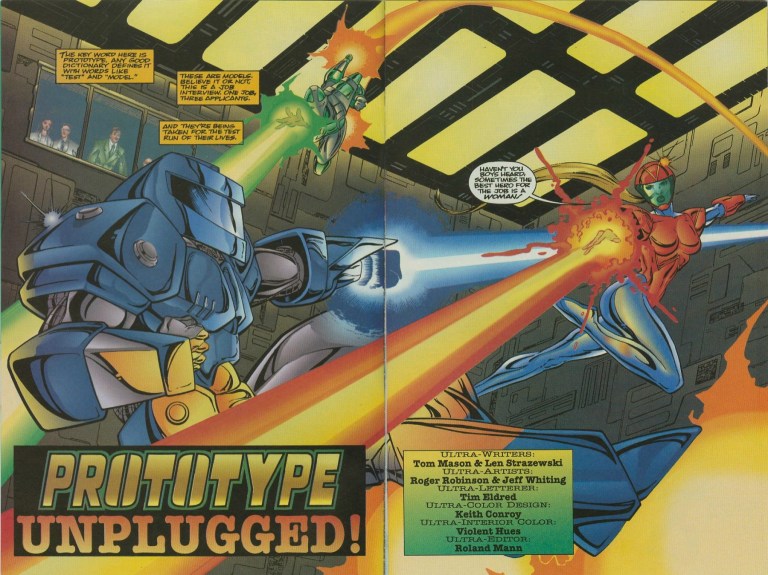
Hey comic book fans and geeks! Do you enjoy reading comic books about armored superheroes that are not connected with Marvel’s Iron Man? The Ultraverse has an armored figure in Prototype but the big difference is that the said character is owned by a large corporation called Ultratech which in turns hired a young man named Jimmy Ruiz to pilot it. Oh yes, Jimmy Ruiz is actually the second person hired to pilot Prototype as his predecessor Bob Campbell was let go with one arm less.

Let’s revisit the Ultraverse by taking a look back at Prototype #9, published in 1994 by Malibu Comics with a story by Len Strazewski and Tom Mason with art done by Roger Robinson and Jeff Whiting.

The cover.

Early story

Set a short time after the hard battle between Prototype and Arena, the story begins in a secret facility somewhere in New York City where three armored figures engage in an intense session of flight, attacks and performance. The session is closely monitored by people watching from the observation deck. As it turns out, the session is actually a test for the three persons – two men and one lady – who applied to become the new Prototype which is the result of what happened at the end of issue #8.  Among the three, Donovan Jones was accepted as the new Prototype which Ultratech’s Stanley Leland confirms.

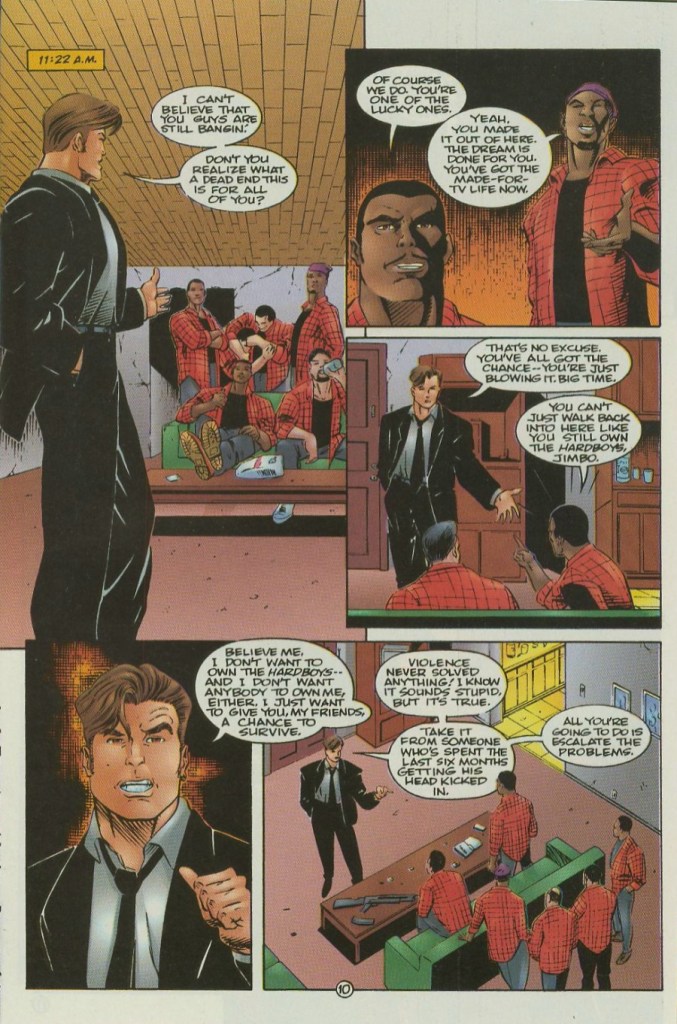
Over at Brooklyn, Jimmy Ruiz (Prototype) meets a lady from his past after paying respect to someone who was about to get buried. She tells him that since he left their old neighborhood, the local gangs have gotten worse. A short time later, the Prototype pilot meets an old gang he personally knows… 

Quality

Jimmy Ruiz and the gang from his past.

Let me start with the storytelling. This comic book is more about Jimmy Ruiz out on his own without the armor than it is about Ultratech and its high-tech interests. Bob Campbell’s not even in the story. That being said, this is pretty much a character-driven piece focused on Jimmy Ruiz as a person than as a hero and I should say that Tom Mason and Len Strazewski did a good job developing his character a lot. The writing is pretty lively and the writers pulled the right moves to define Jimmy Ruiz as a believable human being. There was that notable moment when after Jimmy returned to his old community and spends time with the old gang he personally knew, he realizes how much he has and how his perception changed. By the time you reach the end of the story, you’ll get to know Jimmy much better.

Conclusion

The money shot!

Prototype #9 is a character-driven comic book that succeeds in defining the personality and development of Jimmy Ruiz who is just one of two main characters in this series (which emphasized the struggles of two different persons involved with piloting Prototype). It lacks spectacle but that does not make this a boring comic book. Apart from Jimmy Ruiz, the corporate focus on Ultratech is short yet very intriguing.

If you are seriously planning to buy an existing hard copy of Prototype #9 (1994), be aware that as of this writing, MileHighComics.com shows that the near-mint copy of the regular edition costs $8.

Overall, Prototype #9 (1994) is recommended.

+++++

Thank you for reading. If you find this article engaging, please click the like button below and also please consider sharing this article to others. If you are looking for a copywriter to create content for your special project or business, check out my services and my portfolio. Feel free to contact me as well. Also please feel free to visit my Facebook page Author Carlo Carrasco and follow me at HavenorFantasy@twitter.com
A Look Back at X-Men 2099 #35 (1996)

Disclaimer: This is my original work with details sourced from reading the comic book and doing personal research. Anyone who wants to use this article, in part or in whole, needs to secure first my permission and agree to cite me as the source and author. Let it be known that any unauthorized use of this article will constrain the author to pursue the remedies under R.A. No. 8293, the Revised Penal Code, and/or all applicable legal actions under the laws of the Philippines.

This is it! The thirty-fifth and final issue of the X-Men 2099 monthly series from Marvel Comics is at hand. How times have changed in the American comic book industry back in the 1990s. When X-Men 2099 #1 was released in 1993, there was still good demand and room for expanding the 2099 imprint beyond the pioneering characters Spider-Man 2099, Punisher 2099, Ravage 2099 and Doom 2099. By the time the X-Men 2099 series came to an end, Marvel Comics was in turmoil internally and several 2099 series talents behind the scenes left as a result of the termination of 2099 line editor Joey Cavalieri.

With the short history lesson done, we can now take a look back at X-Men 2099 #35, published in 1996 by Marvel Comics with a story written by John Francis Moore (who wrote ALL the series’ issues) and drawn by Jan Duursema.

Cover
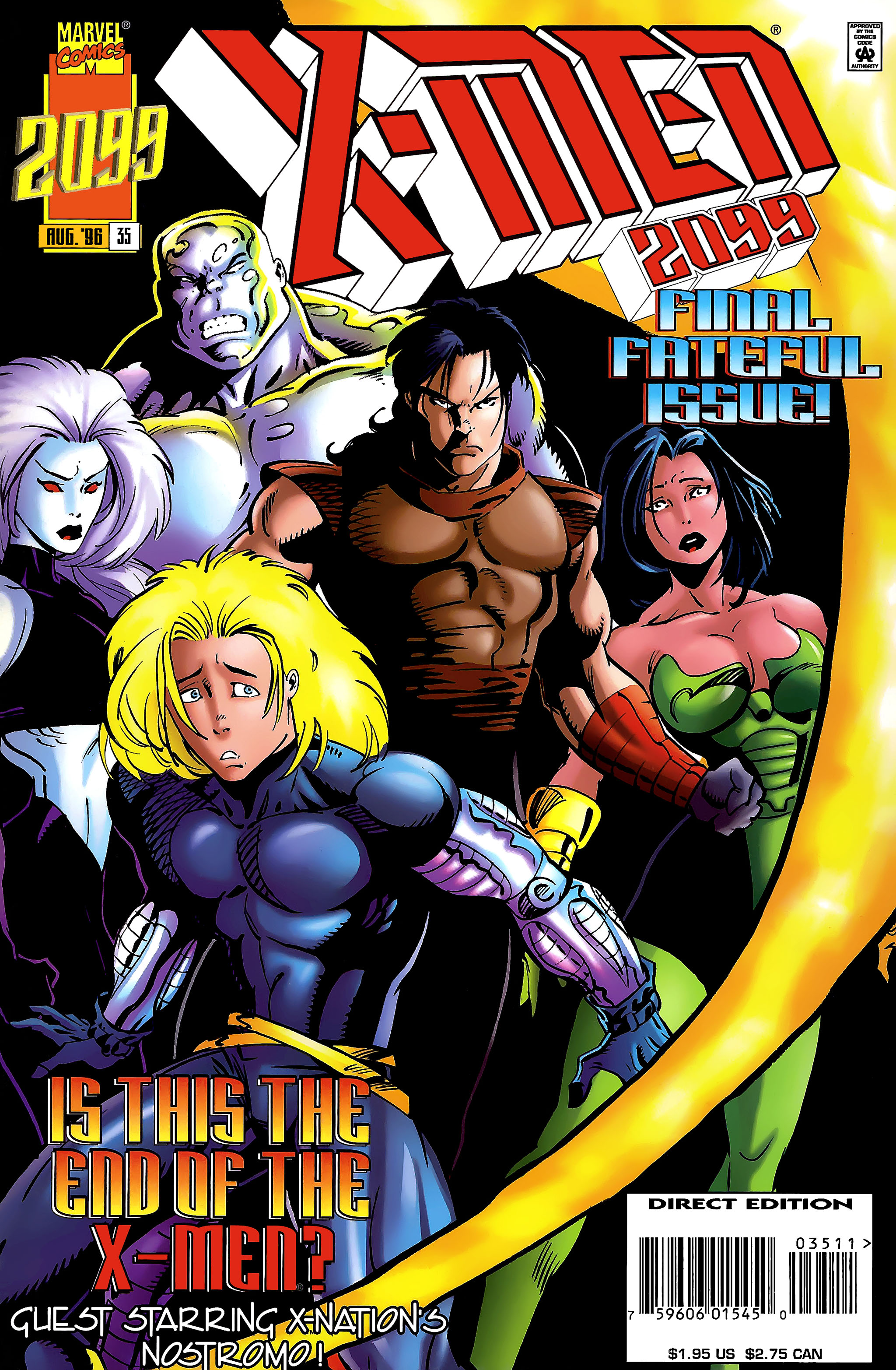
The cover.

Early story

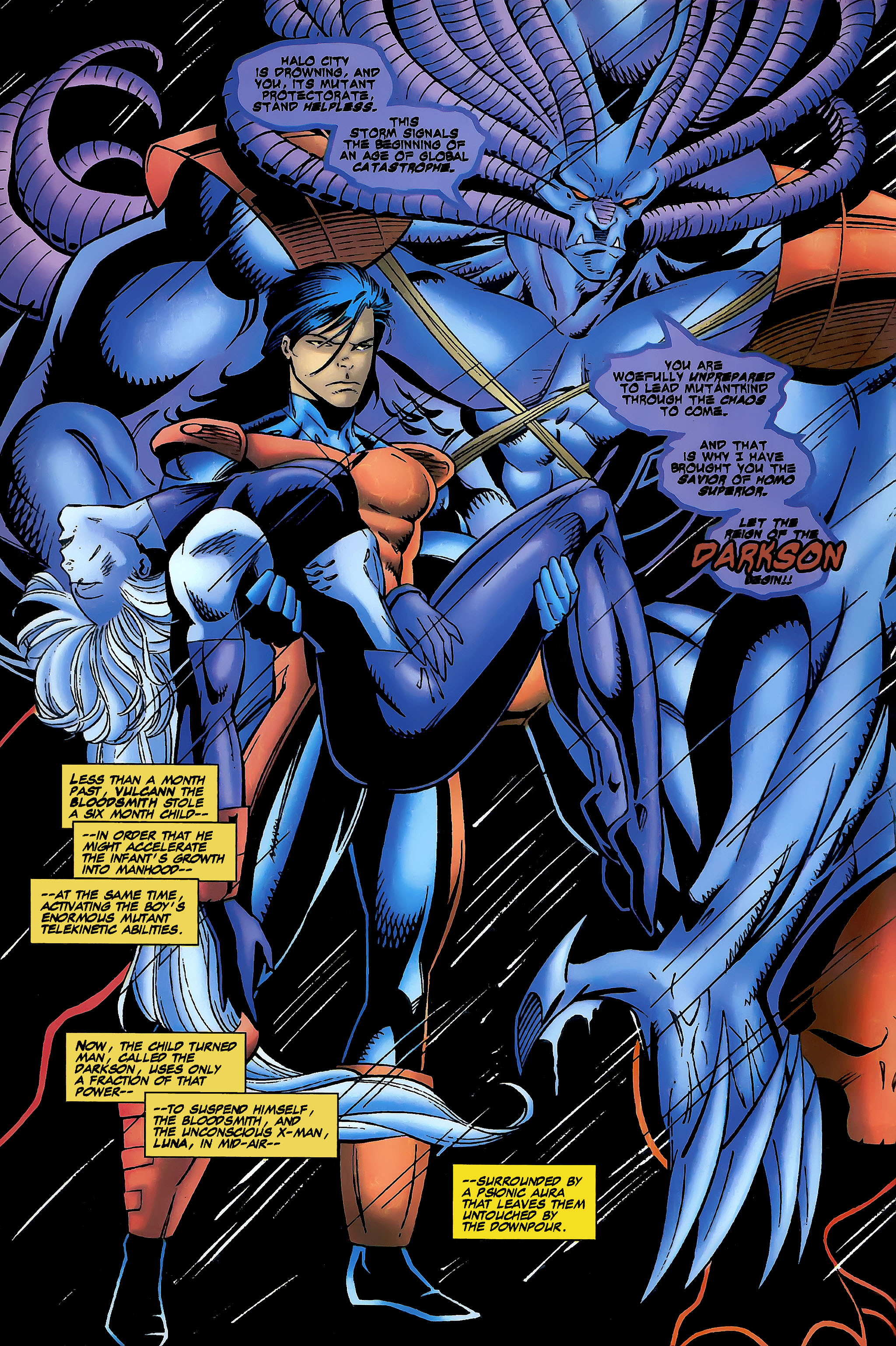
The story begins with some members of the X-Men facing off with Darkson (his name is Joaquim, the accelerated grown-up son of Metalhead and Rosa) and his evil mentor Vulcan. Following Vulcann’s command, Darkson lets go of Luna (who was carried earlier by him) who lands on the ground in a weakened state and was approached by Krystallin. In reaction, Krystallin launches some crystals to Vulcann and Darkson but got blocked by a protective aura.

The X-Men realize that Darkson is as potentially dangerous as Zhao. Darkson then strikes at Bloodhawk with a psionic blast and then attacks the other X-Men…

Quality

7
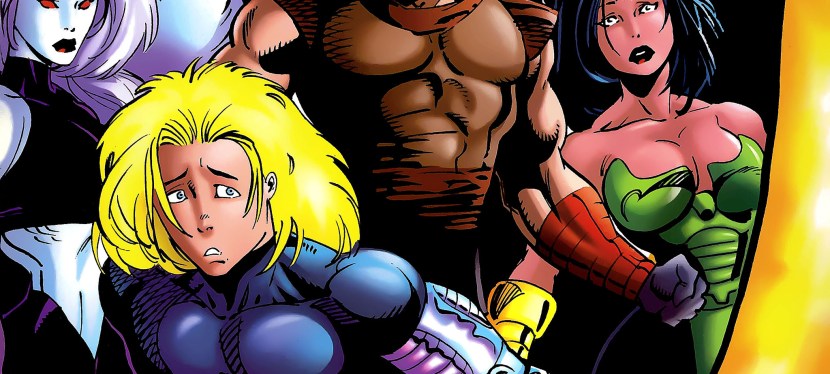
Two X-Men veterans and one X-Nation member in a scene.

In terms of storytelling, John Francis Moore did what he could with all the plot details and with what was built up during the previous issues leading to this issue’s final conflict. The problem, however, is that the pay-off was ultimately unsatisfactory.

Firstly, having Vulcann and Darkson parallel God and Jesus (complete with doing something about the destiny of people who need saving, which in this comic book referred to the futuristic mutants) in a twisted fashion was just hollow and never engaging. Secondly, the way the X-Men members got together was very rushed in execution. Thirdly and more importantly, the final conflict was pretty shallow and only led to a sequel-bait ending designed to lead into 2099: World of Tomorrow #1.

If you are looking for superhero spectacle, you will find some here but they all feel rushed and unsatisfying. If you care about key X-Men 2099 characters like Skullfire and Xi’an, the way they developed and appeared here will disappoint you. In fairness, Shakti remains the strong-willed mutant as before.

To say the least, there was an effort to emphasize what was at stake for the mutants of 2099 living in Halo City and there was also the idea that the world was coming to an end. The problem here was the execution as the comic book basically showed the X-Men in the presence of Vulcann and Darkson. There was no epic battle here at all and the climax at the end clearly showed rush and even a lack of creativity (note: most likely due to the internal turmoil at Marvel at the time).

Conclusion

2
Vulcan and Darkson (carrying the X-Men’s Luna).

I should say that X-Men 2099 #35 is indeed a disappointing conclusion not only to its series but also in the final conflict the X-Men had with Vulcann and Darkson. The pay-off was very unsatisfying and it did not help that this comic book served as just another build-up leading to another Marvel 2099 publication. By the time the conflict ended, I did not care much about the X-Men which, for the most part, became irrelevant. This is too bad because in issue #1 they were very interesting and (after some stories of misadventures showing the X-Men members separated) they became interesting again with the events in issue #25.

If you are seriously planning to buy an existing hard copy of X-Men 2099 #35 (1996), be aware that as of this writing, MileHighComics.com shows that the near-mint copy of the regular edition costs $17 while the near-mint copy of the newsstand edition costs $51.

Overall, X-Men 2099 #35 (1996) is unsatisfying. I don’t recommend spending a lot of money for it. Better save your money.


Thank you for reading. If you find this article engaging, please click the like button below and also please consider sharing this article to others. If you are looking for a copywriter to create content for your special project or business, check out my services and my portfolio. Feel free to contact me as well. Also please feel free to visit my Facebook page Author Carlo Carrasco and follow me at HavenorFantasy@twitter.com
A Look Back at Robin III #3

Disclaimer: This is my original work with details sourced from reading the comic book and doing personal research. Anyone who wants to use this article, in part or in whole, needs to secure first my permission and agree to cite me as the source and author. Let it be known that any unauthorized use of this article will constrain the author to pursue the remedies under R.A. No. 8293, the Revised Penal Code, and/or all applicable legal actions under the laws of the Philippines.

Before I start this retro comic book review of Robin III #3, let me explain that the illustrator of the comic book, Tom Lyle, passed away last November over health-related reasons. Before dying, he had a surgery in October 2019 to remove a blood clot in his brain and subsequently fell into a coma. Apart from drawing comics, Tom Lyle was a professor of art at Georgia’s Savannah College of Art and Design (SCAD). For a look at Lyle’s expertise, watch the video from 2017 below.

When it comes to the comic book industry, Lyle started his career with AC Comics and Eclipse Comics back in the 1980s. In 1988, he worked on the art of Starman for DC Comics and went on to work on the company’s other properties and played a major role with the publishing of the three mini-series featuring Batman’s sidekick Robin (Tim Drake specifically).

After leaving DC Comics, he joined Marvel Comics as one of their illustrators on the Spider-Man monthly series. He quickly got involved in the Maximum Carnage crossover and made bigger waves with Spider-Man readers with the Clone Saga. Lyle is widely credited for designing the Scarlet Spider. With regards to his death, Marvel Comics published online a tribute for him.

Now that the short history lesson is over, let’s take a look back at Robin III #3 published by DC Comics in 1993 with a story by Chuck Dixon and art by Tom Lyle.

Cover
The cover.

Early story

The story begins in school where Tim Drake/Robin gets confronted by his superior who noticed the bruises he got. As Tim tries to keep his secrets, the superior Ms. Hollingsworth knows that he was cared for by Bruce Wayne (Batman) while his father was in a coma. She also knows that he lives on a property bordering the estate of Wayne. She makes clear that he can speak openly to her and Tim simply denies that Bruce would never hit him. He states: “An upperclassman…a senior…I think…big kid.”

Eventually the meeting ended and Tim leaves struggling over thinking about the complications he is experiencing with his double life as a student and as a crime fighter. Since he cannot get involved with Batman and Alfred, he spends some time with Harold (who was so busy working on a machine) and eventually goes home. His father notices Tim’s bruises and states that he spends too much time at Wayne’s. This leaves Tim more conflicted within.

Elsewhere, a muscular man called Sir Edmund easily beats up his loyal followers in a bout of combat. His assistant Lynx arrives and informs him that their turf is in danger with the arrival of Russians with KGBeast involved.

In the evening, Robin meets the Huntress and start their next mission…

Quality

13
Hard action with a smooth flow of sequence by Tom Lyle.

For a story set within the realm of Batman and, at the same time, does not have Batman at all, this Robin-centered comic book is well written and engaging. To say the least, showing Tim Drake struggling with his civilian life and crime-fighting life made Robin a literary symbol about the false maturity that youth in real life often experience. That false maturity is nicely portrayed with the superhero aesthetics and fantasy elements.

Quite predictably, Robin performs detective work and analyzes crime situations like Batman only this time, he gets involved with the Huntress (note: this mini-series carries the storyline title of “Cry of the Huntress”) to find out more answers and solve the crime problem. Being a product of the early 1990s, it is no surprise that the story has fictional portrayals about the Russians (with KGBeast leading the so-called invasion of the city) and even mentioning Afghans.

14
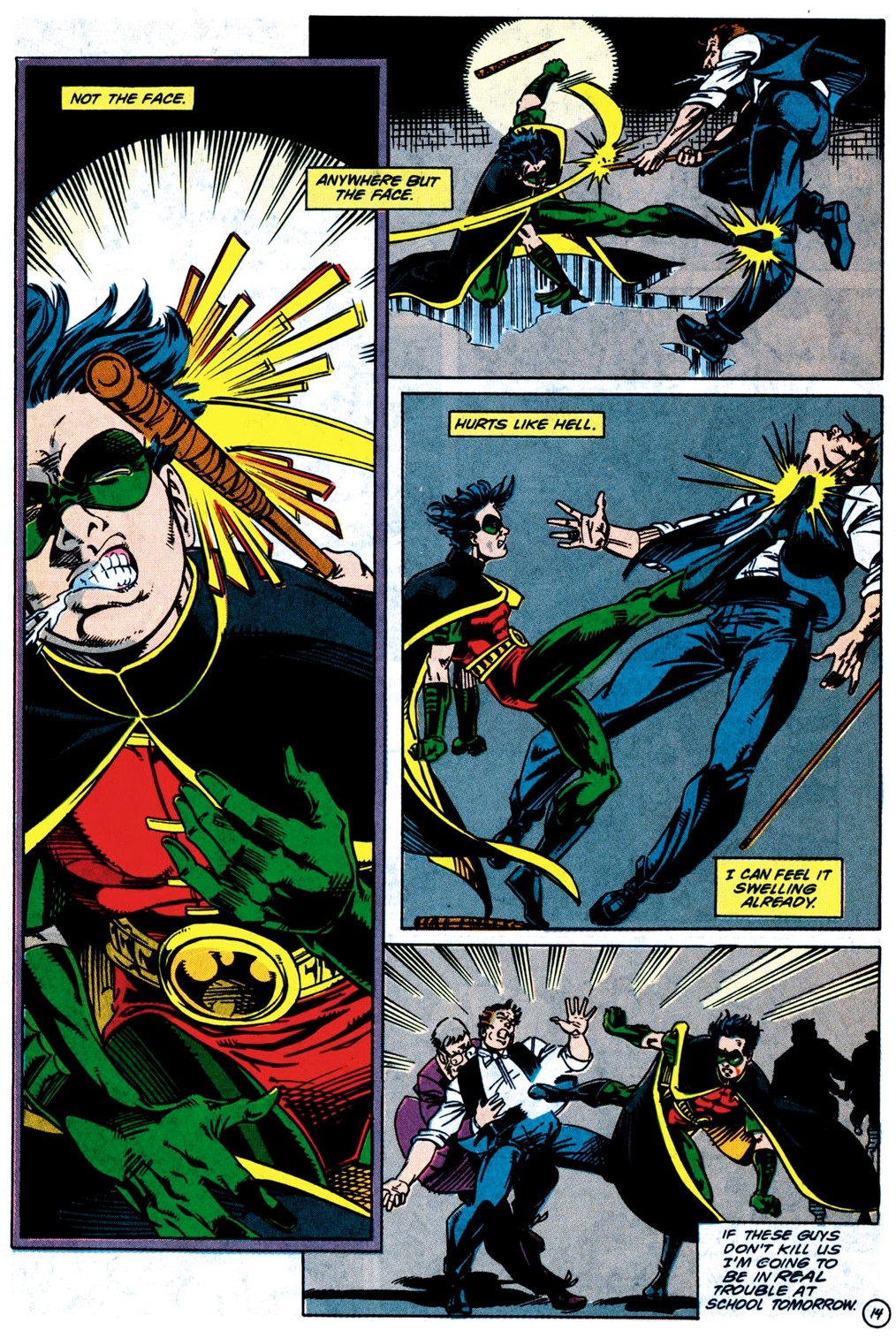
Hurting Robin on the head led to hard reactions.

Apart from the storytelling, the art by Tom Lyle here remains good to look at. Each scene, whether is it a talking scene or an action scene, looks good and Lyle has a nice touch on drawing facial expressions. When it comes to the spectacle, Lyle really shows how good he is with drawing hard-hitting physical action. I should also state how smooth the sequencing of action is drawn by him.

Conclusion

16
Robin and the Huntress make an odd crime-fighting duo.

To make things clear, Robin III #3 is the first-ever Tom Lyle-drawn comic book I ever bought and read. By today’s standards, the comic book is still fun to read and it is compelling enough to make readers interested to read more of the mini-series. However, if seeing more of Robin fighting crime by himself is your type of Robin story, then this may not be compelling for you.

If you are seriously planning to buy an existing hard copy of Robin III #3, be aware that as of this writing, MileHighComics.com shows that the near-mint copy of the regular edition and the newsstand edition of the direct version costs $4 and $6 respectively. Meanwhile, the near-mint copy of the bagged edition and the unbagged edition of the deluxe version costs $4. To be clear, the deluxe version of Robin III #3 in bagged form comes with a moving cover, a second reversible cover and additional artwork.

Overall, Robin III #3 is recommended.


Thank you for reading. If you find this article engaging, please click the like button below and also please consider sharing this article to others. If you are looking for a copywriter to create content for your special project or business, check out my services and my portfolio. Feel free to contact me as well. Also please feel free to visit my Facebook page Author Carlo Carrasco and follow me at HavenorFantasy@twitter.com
A Look Back at Spider-Man 2099 #37 (1995)

Disclaimer: This is my original work with details sourced from reading the comic book and doing personal research. Anyone who wants to use this article, in part or in whole, needs to secure first my permission and agree to cite me as the source and author. Let it be known that any unauthorized use of this article will constrain the author to pursue the remedies under R.A. No. 8293, the Revised Penal Code, and/or all applicable legal actions under the laws of the Philippines.

If you’re looking for a powerful, dramatic tale of Spider-Man 2099 from the 1990s, you will find it right here in this retro review.

Before getting to the review, it is important to remember that Spider-Man 2099 was mainly driven by Peter David, who is one of the best-ever writers in the history of superhero comics in America. Many geeks I know admired his work on other Marvel titles, most notably The Incredible Hulk.

So how did he get involved in Marvel’s 2099 universe that was first launch in 1992? Check out Peter David’s words from an online interview in Doom2099.com:

The Marvel editors approached me, as they did a number of free lancers, and said we’re going to be doing a 2099 line. And we would like you [meaning me and other writers] to submit a proposal on how you would do Spider-Man 2099. We knew he was Spider-Man 2099. We knew he worked for a company called Alchemax. Beyond that there was nothing about him established. So I sat down and I thought, the last thing I want to do is have him be a relative of Peter Parker. Because that’s the obvious thing. So I created someone completely from scratch. I made him of mixed ethnicity, because I felt that by the end of the 21st century mixed ethnicity is going to be more common than it is now. So I made him half-Irish and half-Mexican because I thought that was the most combustible combination I could come up with. And I decided I would zig wherever Stan and Steve zagged when they created Spider-Man. Peter Parker was a white bred WASP. So Miguel O’Hara was a combined ethnicity. Peter was an orphan. Miguel would have a living mother. Peter was alone. I gave Miguel a brother. Peter had no idea how to handle girls and was a teenager. Miguel was in his 20s and had a fiancée. I just made the contrary move all the way. And I submitted my proposal. A week later I get a call from the Marvel editors and they said ‘we love your take on Spider-Man 2099. For starters, it’s the only one that doesn’t start with a relative of Peter Parker.’ And I went ok, that’s interesting. They asked me if I would be interested in writing. I said, sure. And that’s how I became involved in it.

Right from the start of the Spider-Man 2099 series, Peter David and illustrator Rick Leonardi established 2099’s New York City society and went on to develop Miguel O’Hara/Spider-Man 2099 deeply as well as his relationships with his family and companions, complete with his struggle working for a sinister boss at Alchemax. Things escalated further personally for the futuristic Spider-Man during my last review and we will find out what happens next.

Here is my retro comic book review of Spider-Man 2099 #37, published in 1995 by Marvel Comics with a story by Peter David and art by Andrew Wildman.

Cover
The cover of the regular edition.

Early story

The comic book opens with a quick flashback in the past when Miguel O’Hara, his then girlfriend Xina and his brother Gabe spend time at a club talking about relationships. Eventually Gabe’s date Dana arrives late. Miguel could not help but react with his mouth open.

In the present day, Miguel faces Venom 2099 who has Xina and Dana wrapped with his symbiote. In reaction to Venom’s ploy, Miguel frees Dana which broke of Venom’s right arm. Miguel and Dana moved quickly to the next room and the door shut provided them temporary refuge from Venom. Before the two separated (Miguel to fight and Dana to leave for safety), they kissed.

Even without his costume, Miguel decides to go after Venom to free Xina…

Quality

14
Venom 2099 is truly dangerous.

Another well-crafted comic book carrying the same strong creative energy since Venom 2099’s debut in issue #35. While it is no surprise that Peter David’s writing remains top-notch and highly compelling in showing the continued conflicts between Spider-Man and Venom of the future, he inserted some flashbacks into the past showing how Miguel O’Hara got romantically involved with Dana and how it complicated matters in his family given the fact that Dana was the GF of his brother Gabe. Those flashbacks, which some might think served as padding, are actually helpful to not only inform readers about the Miguel-Xina-Dana triangle but also give readers a new look at Miguel’s personality. All of that added in the build-up leading to the very powerful ending. After being absent in issue #36, Andrew Wildman returned strongly in visualizing this comic book. His art on the ending is something I will keep remembering for a very long time.

Conclusion

11
A flashback…

The first time I read Spider-Man 2099 #37 when it was initially released, its story and ending proved to be powerful. In this review, I do confirm it still maintains that powerful impact by today’s standards. This comic book is not only great on its own, it also showed how much Venom 2099 made life for Spider-Man 2099 go upside-down. By the time this comic book got published, Miguel O’Hara transformed a whole lot since the first issue reaching the corporate leadership of Alchemax. Clearly, this means that Spider-Man 2099 carried tremendous power with him to go against his era’s Venom (who in turn really proved to be a very dangerous menace not only to the superhero but the public as well).

If you are seriously planning to buy an existing hard copy of Spider-Man 2099 #37, be aware that as of this writing, MileHighComics.com shows that the near-mint copy of the regular edition costs $34. The near-mint copies of the “Venom 2099” regular edition and the “Venom 2099” newsstand edition cost $85 and $255 respectively.

Overall, Spider-Man 2099 #37 (1995) is highly recommended!


Thank you for reading. If you find this article engaging, please click the like button below and also please consider sharing this article to others. If you are looking for a copywriter to create content for your special project or business, check out my services and my portfolio. Feel free to contact me as well. Also please feel free to visit my Facebook page Author Carlo Carrasco and follow me at HavenorFantasy@twitter.com
A Look Back at X-Men 2099: Oasis

Disclaimer: This is my original work with details sourced from reading the comic book and doing personal research. Anyone who wants to use this article, in part or in whole, needs to secure first my permission and agree to cite me as the source and author. Let it be known that any unauthorized use of this article will constrain the author to pursue the remedies under R.A. No. 8293, the Revised Penal Code, and/or all applicable legal actions under the laws of the Philippines.

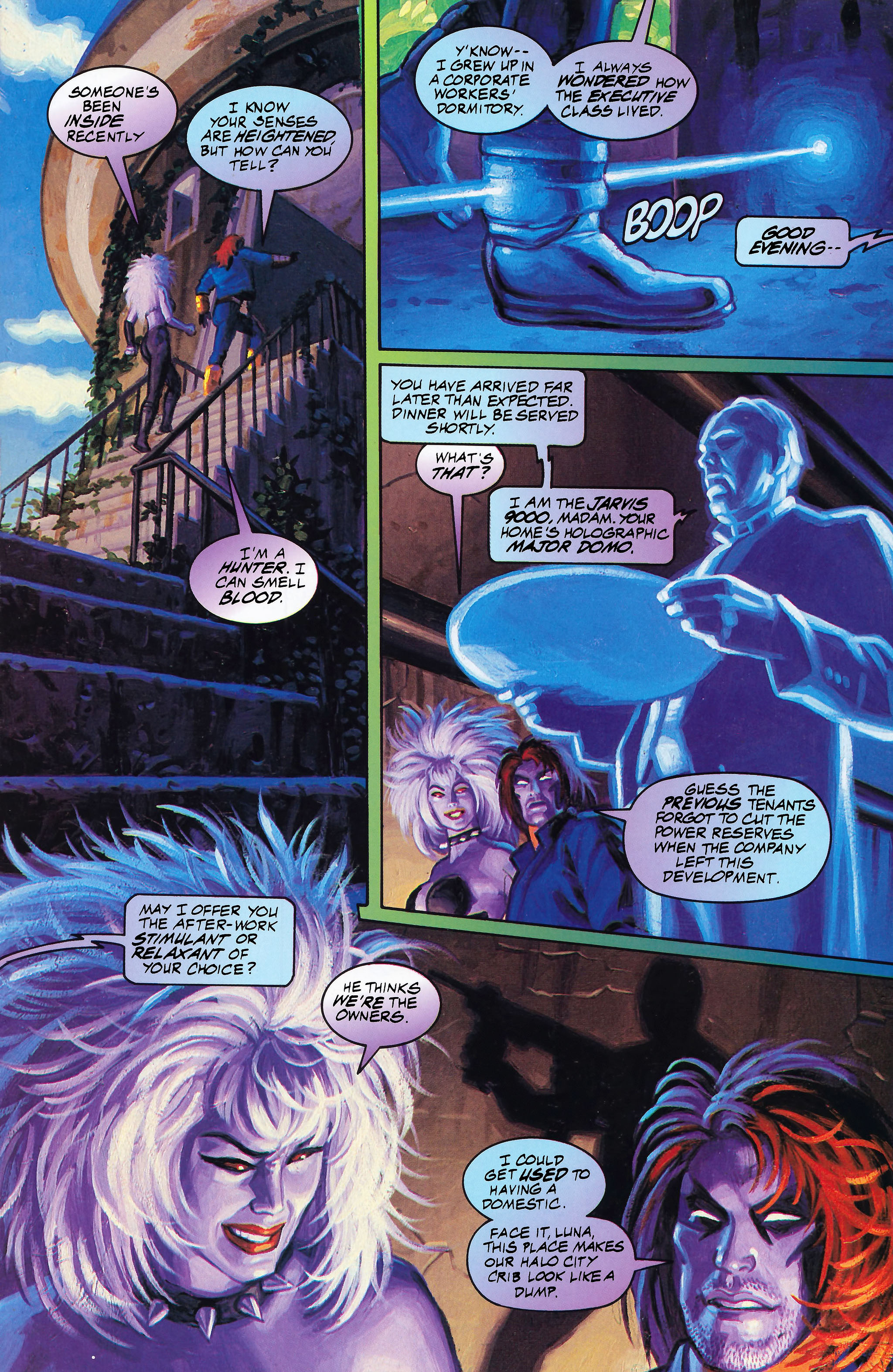
According to the online edition of Merriam-Webster Dictionary, an oasis is something that provides refuge, relief, or pleasant contrast. In the case of X-Men 2099, the open areas of the southwestern region of the United States is a dangerous place to be in even though they are free from oppressive systems of control that dominate cities. As such, it is the southwestern region in 2099 can be compared to the Old West in history where there are lots of desolate places as well as lots outcasts and outlaws. Unlike their mainstream counterparts, the X-Men of the far future are nomads and they don’t have a long-term place of residence they could call home. Considering how dangerous the region is for the mutants, a haven of peace, security and prosperity is always ideal to them but only if it is indeed real.

That is what we will explore in the one-shot comic book X-Men 2099: Oasis here.

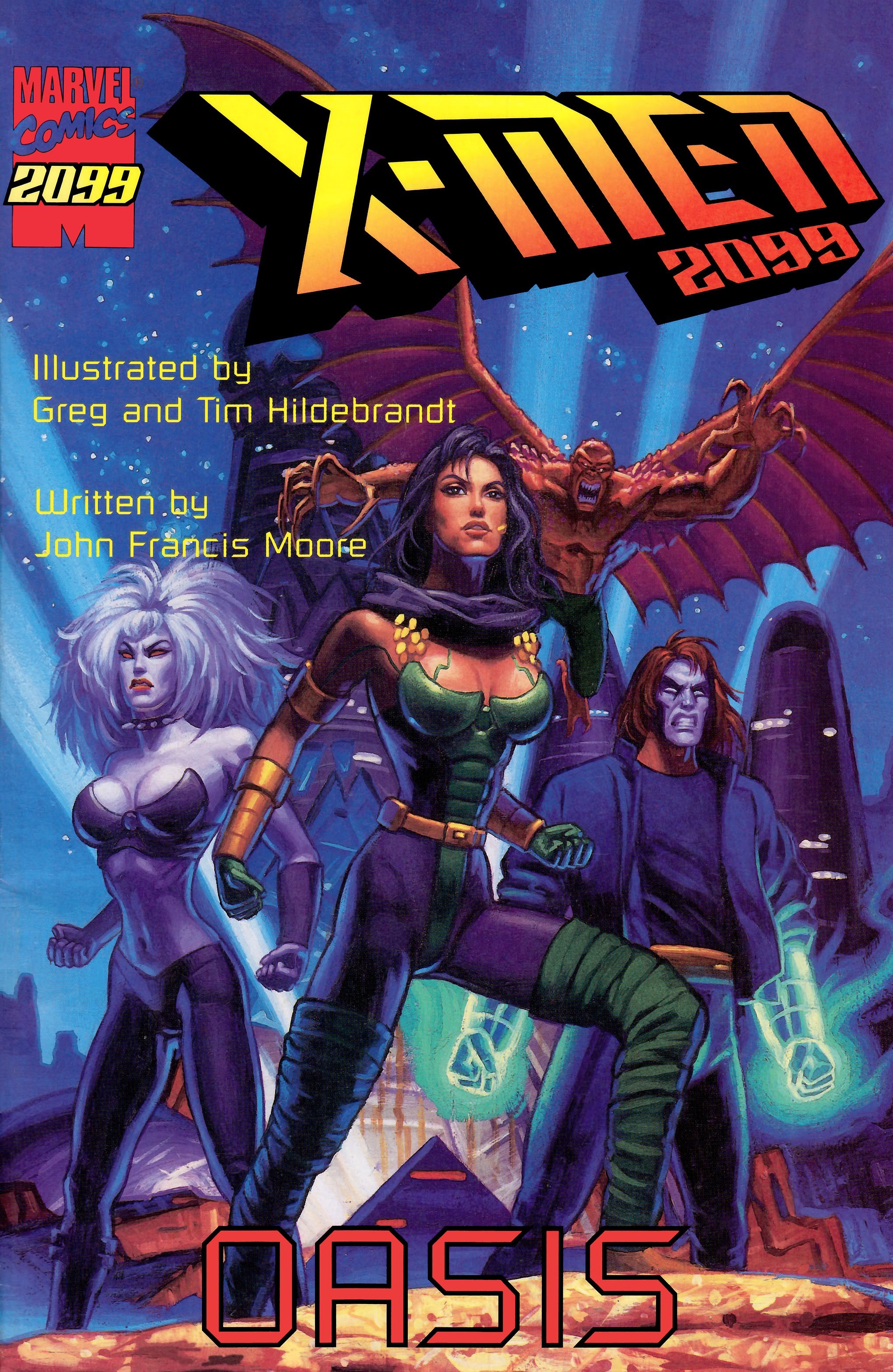
But before proceeding with the review, it has to be emphasized first that the one-shot comic book which was made special with the painted art of the Hilderbrandt brothers Greg and Tim. For long-time X-Men 2099 scribe John Francis Moore, Oasis was like a big dream come true. When asked during an online interview about his recollections on making X-Men 2099: Oasis and working with the Hildebrandt Brothers, Moore stated:

I was a fan of the Hildebrandt’s fantasy illustration, and I was blown away when Joey told me that they wanted to do an X-men 2099 project. I met with them in Joey’s office and they were both really great guys. I think they said they really liked Bloodhawk, so I knew he’d be a major player in whatever story we developed. They didn’t enter the project with a lot of conditions. They seemed genuinely happy to get to play in this corner of the Marvel universe.

I can’t remember ever writing a full script for any of my Marvel work. I gave them a plot and sometime later received Xeroxes of pencil art (Hildebrant art!) to dialogue. Then it went back for them to paint, and they did a phenomenal job. I only wish that it could’ve been published before the 2099 line was axed. It was a beautiful book that I think was sadly under promoted.

To find out if it is any good, here is a look back at X-Men 2099: Oasis published in 1996 by Marvel Comics with a story written by John Francis Moore and painted art done by Greg and Tim Hildebrandt.

Cover
The cover.

Early story

The comic book begins with a flashback set in Hong Kong in the year 2090. A much younger Shakti/Cerebra is on the loose trying to reach a ferry to Kowloon with a plan to hide in the back alleys of Tsimshatsui. Suddenly Lokjaw intercepts her and grabs her. They had a short history together and Lokjaw insists that Shakti should be grateful to her father who raised her to run his bio-shops. After a brief chase, something hits Lokjaw who fell into the water. It turns out Ryu Kobolt helped Shakti, and he has been instructed by his boss to offer her asylum.

11
Luna and Skullfire explore a place.

In the present day of 2099 in New Mexico, Bloodhawk flies to his desert home not knowing he is being monitored. Two people, an old man with white hair and a lady, work together to stun the X-Men member and take him with them. A short time later, inside a high-tech facility, Bloodhawk wakes up finding himself restrained and being watched over by the lady and the old man. They tell him he is in the Promised Land, a place where the sins of the old world will be washed away. Using her powers, she touches Bloodhawk’s head and slowly turns him into his normal human form.

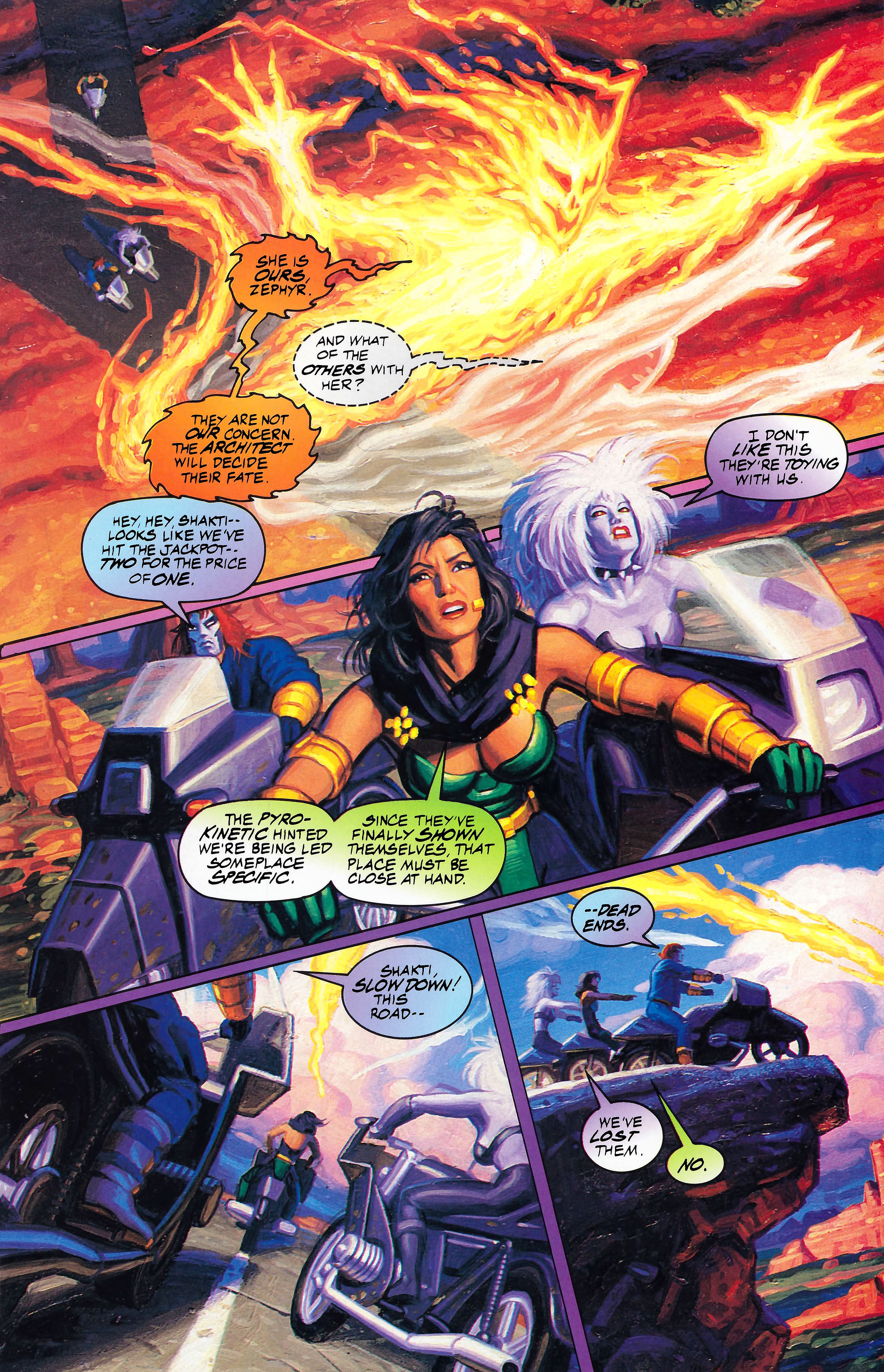
Meanwhile outside a deserted town near the border between Colorado and Kansas, Shakti, Tim/Skullfire and Luna arrive riding motorcycles. They are checking the potential presence of a mutant nearby…

Quality

15
Really great visuals by the Hildebrandt brothers!

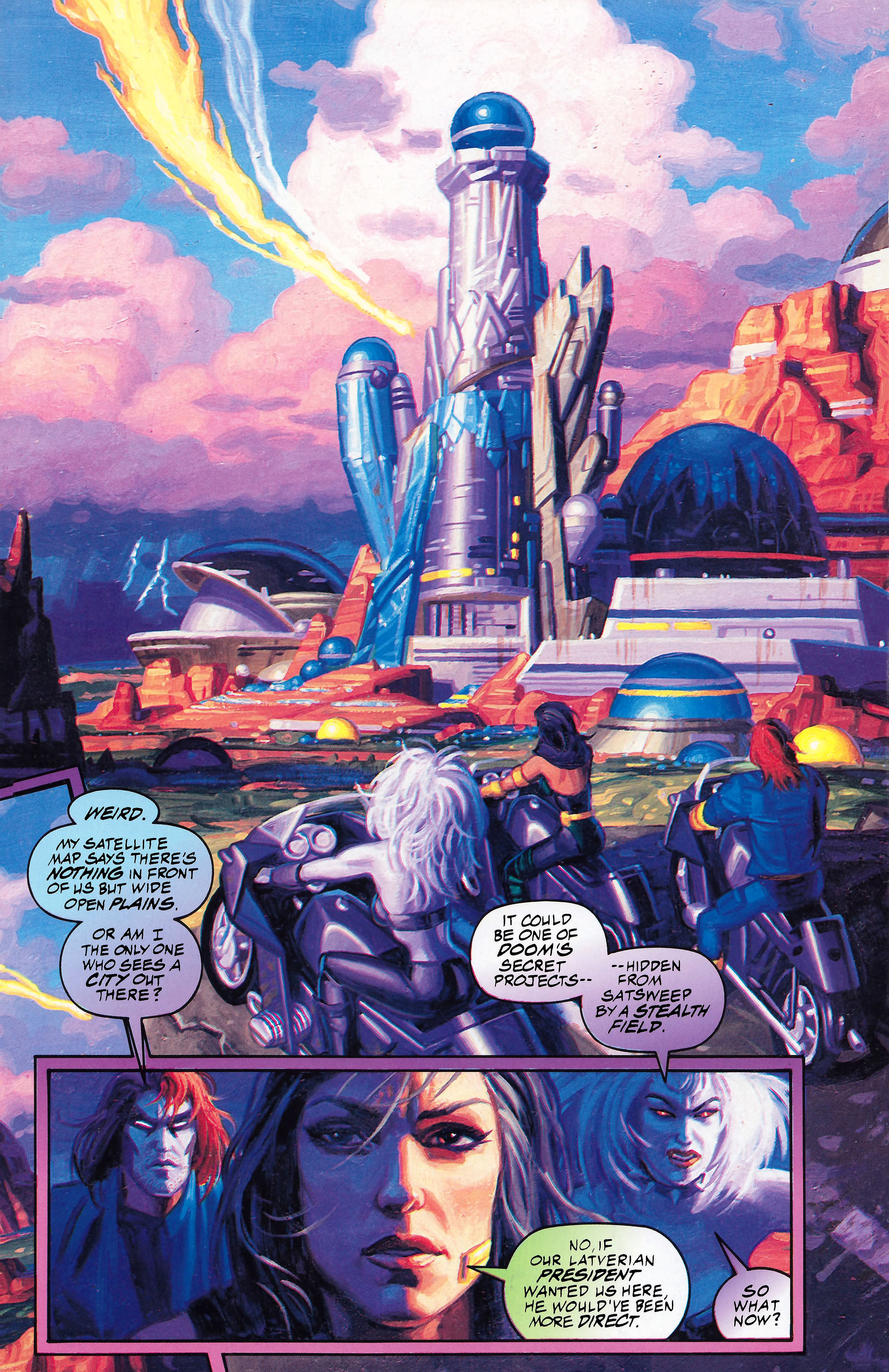
It is very safe to say that this is one very ambitious X-Men 2099 story ever told by John Francis Moore. It sure has an epic concept showing that Oasis in the open region not only exists, but also serves as the closest thing humanity in America has to imitating Heaven built on top of the land. Oasis is the indoor paradise where mutants and humans gather together, live in peace and work together in tremendous ways that the X-Men could only hope to achieve in Halo City (note: this story is set some time after X-Men 2099 #25).

The titular place is clearly the centerpiece of the story backed with characters and threads from the past that explain how it got established. Part of the creation of Oasis is connected with Ryu Kobolt whom Shakti got close with many years back. Of course, someone else got involved with Ryu which directly connects with the creation of Oasis.

While it is also clear that the story took some inspiration from Christianity, I should say that the approach was done by rehashing old storytelling concepts like emphasizing a charismatic person who looks godly or messianic, people getting converted with ways that are not holy, false prophets misleading those seeking salvation, etc. With the ages-old concept of the mad scientists added, then there is conflict here for the X-Men to engage with. The story touches on themes like destiny, conversion, having the power to judge people and committing genocide.

As for the characters, John Francis Moore made the right move to utilize Shakti, Bloodhawk, Skullfire and Luna of the X-Men, however the other new characters such as Memphis, Pandora and Ryu pale in comparison with regards to importance (even though Memphis and Ryu each had a good amount of the spotlight and even some character development).

When it comes to the artwork, this is one great looking superhero, sci-fi story in painted form thanks to the Hildebrandt brothers! Not only is their painted art beautiful to look at, there are also eye-catching shots of scenery, very detailed facial expressions and a very lively presentation of the action scenes and explosions! Each and every character painted – specifically Shakti, Skullfire, Bloodhawk, Luna, Memphis, Pandora and Ryu – has that touch of visual realism (note: not photo realism) that make them look more human to the eyes (especially the X-Men members when compared to how they were drawn by Ron Lim and Jan Duursema in the monthly series). This is one great looking comic book and easily one of the very best of the X-Men of 2099!

Conclusion

16
The Oasis!

X-Men 2099: Oasis is a one-shot comic book that did not match its high ambition. While it has some of the best painted superhero art of the 1990s ever, the storytelling just did not engage me that much. For one thing, its approach on taking inspiration from Christianity is very flawed not only due to rehashing storytelling concepts but also due to the fact that everything – including the titular Oasis – had to be concluded already. Even though there was a build-up leading to a final conflict, the payoff was not that great and ultimately there was a sense of rush in the 2nd half of the story.

What is also disappointing is the fact that the events told here did not really impact Shakti, Skullfire, Luna and Bloodhawk at all, nor was there anything added to the narrative of the X-Men 2099 monthly series. This is too bad because the existence of a haven where people can live in and be protected from the prejudice and violence in the region fits nicely with the concept of X-Men 2099 in the first place. Even though there was a reference to issue #25 during the first half, this comic book ended up looking like a dream story or a parallel universe tale with a $5.95 cover price! It seems to me like this was more like a cash-grab attempt to exploit comic collectors and the fans of X-Men 2099.

If you are seriously planning to buy an existing hard copy of X-Men 2099: Oasis, be aware that as of this writing, MileHighComics.com shows that the near-mint copy costs $14.

Overall, X-Men 2099: Oasis is a serviceable one-shot comic book. That being said, if you really intend to buy it, you should not pay more than $5 for it.


Thank you for reading. If you find this article engaging, please click the like button below and also please consider sharing this article to others. If you are looking for a copywriter to create content for your special project or business, check out my services and my portfolio. Feel free to contact me as well. Also please feel free to visit my Facebook page Author Carlo Carrasco and follow me at HavenorFantasy@twitter.com
A Look Back at X-Men 2099 #34

Disclaimer: This is my original work with details sourced from reading the comic book and doing personal research. Anyone who wants to use this article, in part or in whole, needs to secure first my permission and agree to cite me as the source and author. Let it be known that any unauthorized use of this article will constrain the author to pursue the remedies under R.A. No. 8293, the Revised Penal Code, and/or all applicable legal actions under the laws of the Philippines.

Even within the Marvel 2099 universe, the concept of the messiah figure arriving to change people’s destiny has been used. What is notable about this concept, apart from being a cliché, is that it was implemented so close to the end of the X-Men 2099 monthly series in the mid-1990s and the 2099 editor Joey Cavalieri was fired by Marvel Comics at a time of corporate turmoil. The firing led to the resignation of other writers who were sympathetic with Cavalieri. It should be noted that the last time Cavalieri’s name was listed on the credits was in issue #31.

As such, things went downhill for Marvel Comics and the 2099 line as a whole. In retrospect, did the messiah concept result any improvements for the quality of the X-Men 2099 franchise?

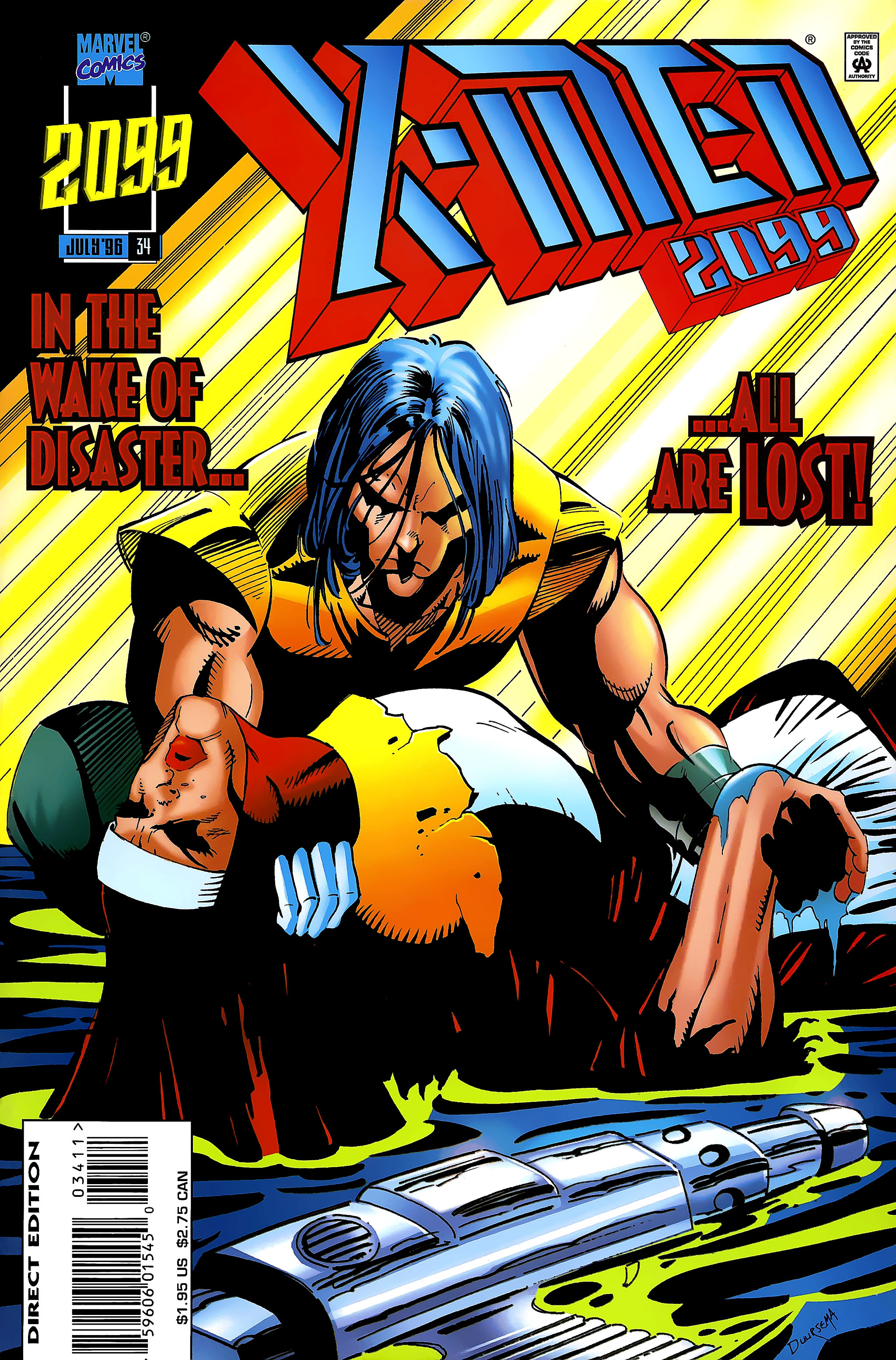
This is my retro comic book review of X-Men 2099 #34, published in 1996 by Marvel Comics with a story written by John Francis Moore and drawn by Jan Duursema.

Cover
The cover.

Early story

The story begins with the monstrous-looking Vulcann instantly transforming Joachim (the son of Eddie/Metalhead and Rosa) from infant form into an adult. When asked by the now-grown Joachim who he is, Vulcann lies to him saying: I am your lord and master. My word is absolute as is my love for you. Obey me and I will give you a world that will worship at your feet.

Meanwhile during a stormy day just outside of Halo City, Skullfire, Luna and Krystalin arrive in floating motorcycles. Their new task, which is very daunting, is to help as much as possible as the sea level has risen so much it has flooded the city they are responsible for (as the protectorate).

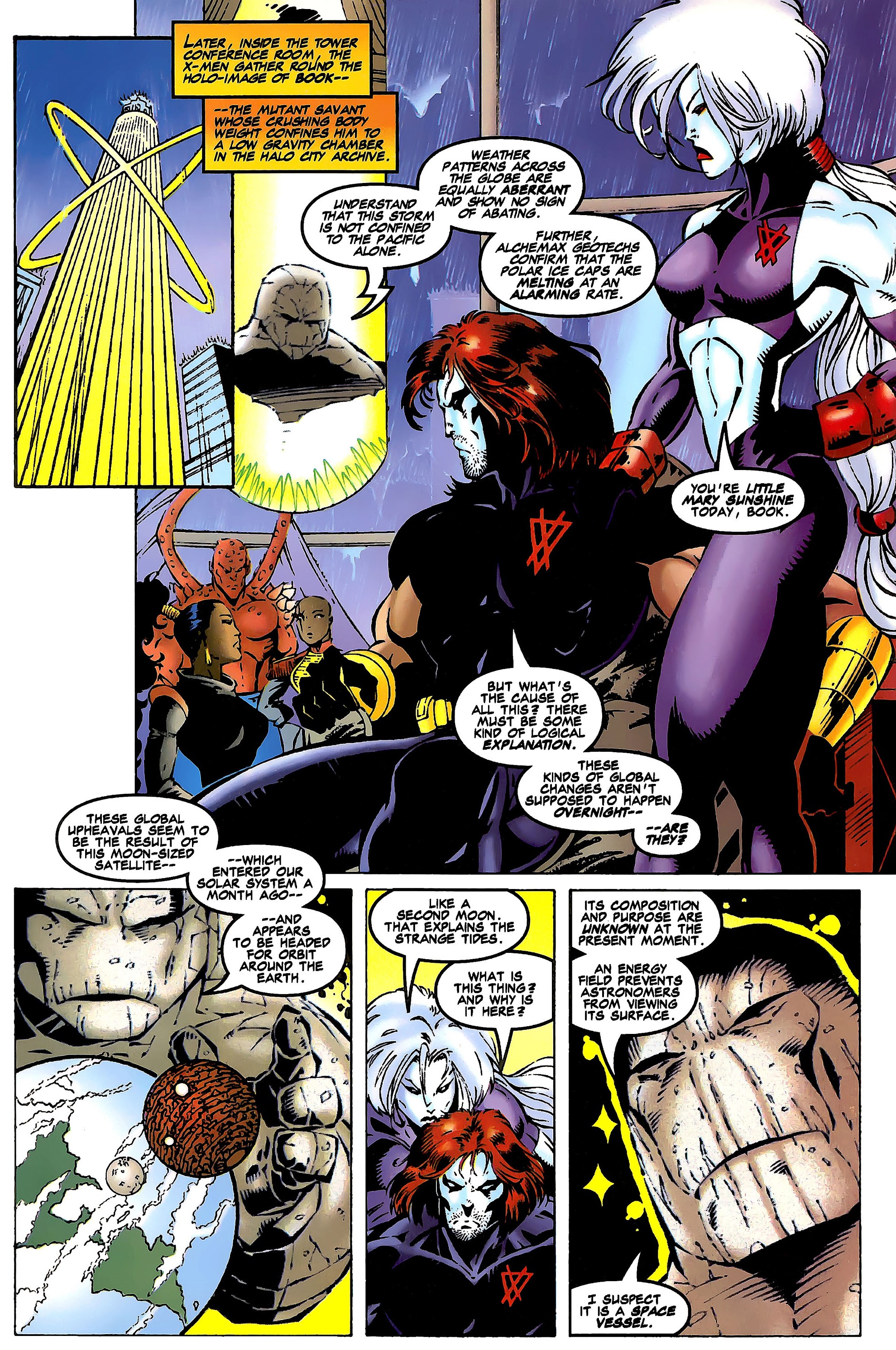
Shortly after, the X-Men and others meet in Halo City’s tower digitally communicating with Savant who explains that weather patterns around the world are equally aberrant as the storm affecting the city. He also mentions that based on the findings of Alchemax Geotechs, the polar ice caps were melting at an alarming rate…

Quality

16
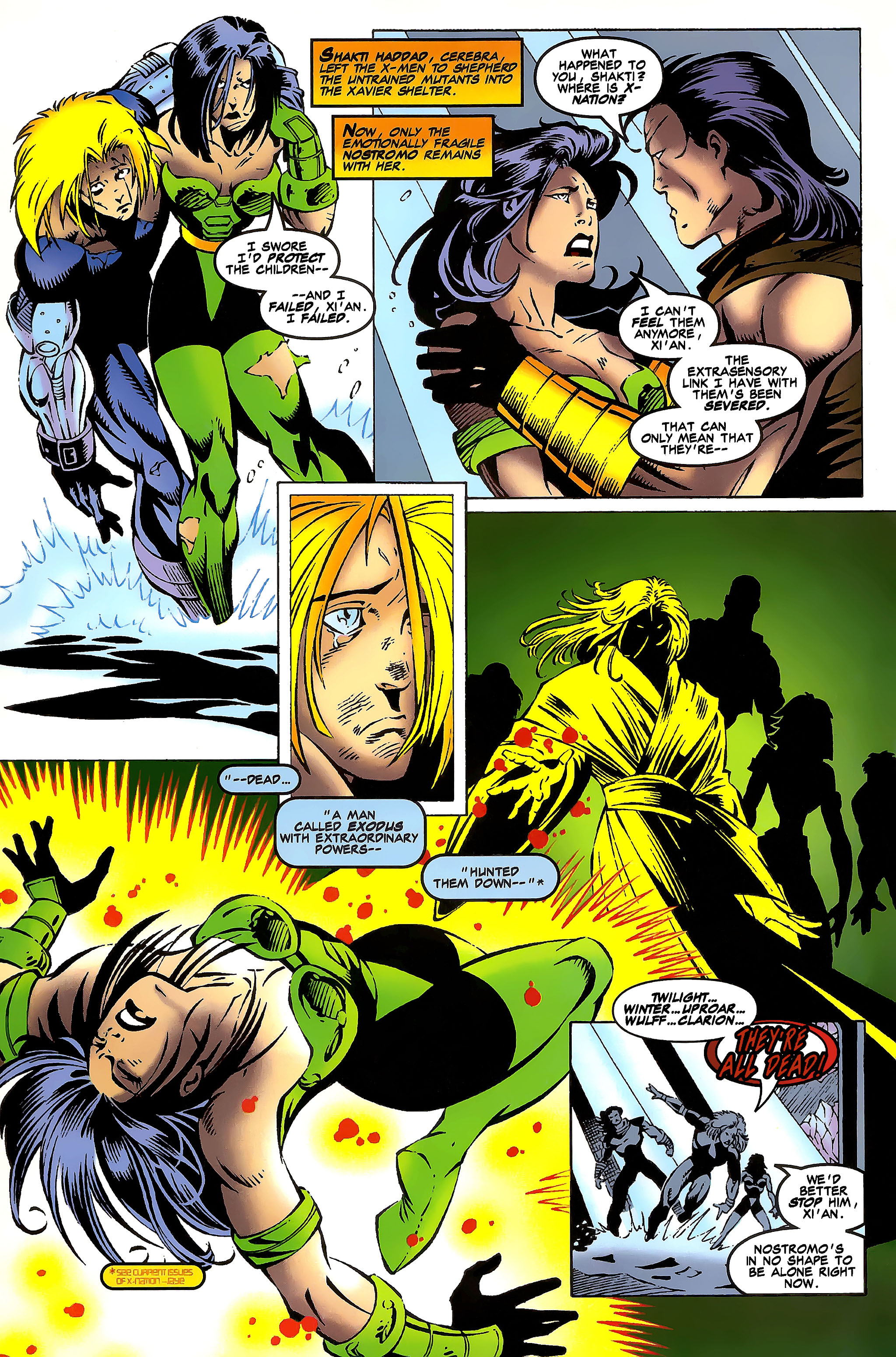
Shakti returns in this comic book.

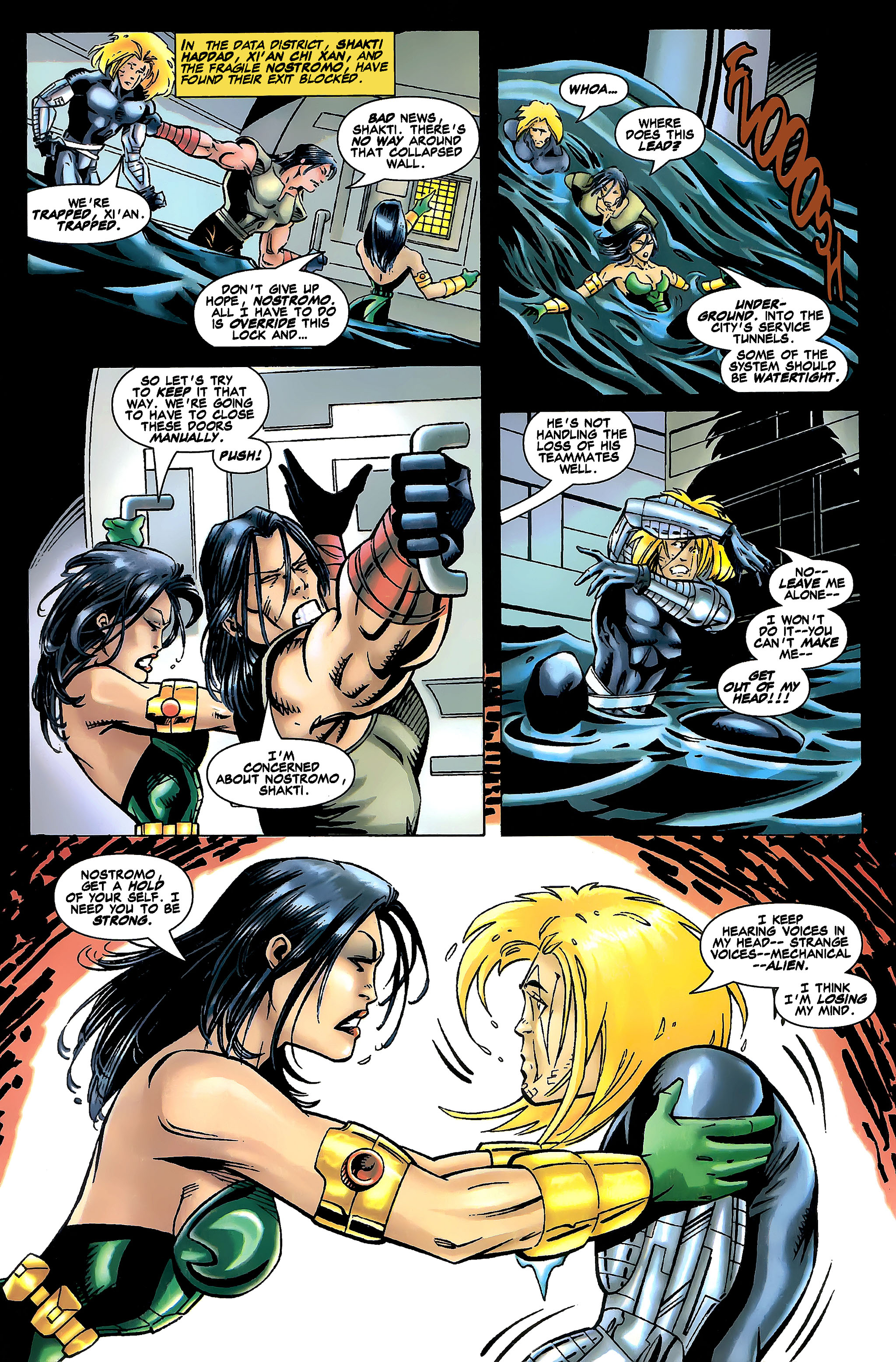
First of all, I should say that effort was made to raise the stakes within the story. The introduction of the adult Joachim guided by the evil, over-sized Vulcann was meant to show a twisted take of Christianity’s God and Jesus and turn it into a new anti-hero force against the X-Men.. Then there is the shock on Joachim’s parents, Xi’an’s return to the city and the global weather instability caused by the arrival of another moon orbiting Earth.

The problem here is that the story as a whole was not very compelling, even though the creative team brought heavy spotlight back on the X-Men after spending it on Xi’an and the Lawless. Speaking of X-Men relevance, the creators also brought Shakti back to this monthly series ending her absence (note: she was with the youth team X-Nation which had its own series). Granted, the stakes were raised but the payoff was not too strong specifically for this comic book.

Along the way, Jan Duuersema did what she could to make this story look good.

Conclusion

7
The analysis of a moon-sized satellite orbiting earth makes a good build-up for a mission.

To put it bluntly, X-Men 2099 #34 has the weakest story since before issue #25. In this comic book, I did not care much about the rushed return of Xi’an and Shakti in Halo City. I should also state that having Vulcann and Joachim parallel Christianity’s God and Jesus was done in a very bad taste even though the purpose (apart from giving the X-Men opposition) was to show that the X-Men themselves are no longer worthy to be mutantkind’s standard-bearers right in the city filled with many mutants and other outcasts. The portrayal of the X-Men, meanwhile, felt hollow and not worth caring for which makes the return of the spotlight on them a waste.

If you are seriously planning to buy an existing hard copy of X-Men 2099 #34, be aware that as of this writing, MileHighComics.com shows that the near-mint copy of the regular edition costs $6 while the near-mint copy of the newsstand edition costs $21.
Overall, I don’t recommend buying X-Men 2099 #34 above fifty cents. Better save your money.


Thank you for reading. If you find this article engaging, please click the like button below and also please consider sharing this article to others. If you are looking for a copywriter to create content for your special project or business, check out my services and my portfolio. Feel free to contact me as well. Also please feel free to visit my Facebook page Author Carlo Carrasco and follow me at HavenorFantasy@twitter.com