
A chance for recovery for more Philippine cinemas (and their employees)

Wow. That was quite a ride of information updates that happened the last few days. Last Friday, the Inter-Agency Task Force for the Management of Emerging Infectious Diseases (IATF-EID) announced that it has allowed a variety of businesses around the Philippines to resume operations so that they can recover from this ongoing COVID-19 pandemic.

Such businesses specified were driving schools, video arcades, theme parks, natural sites, historical landmarks, parks and, most notably of all, cinemas (or movie theaters).

However, the Metro Manila mayors reacted and expressed their opposition against the national government’s decision on allowing cinemas to reopen. Through the media, Metropolitan Manila Development Authority (MMDA) chairman Benhur Abalos stated that a “majority of Metro Manila mayors agreed not to open as far as cinema is concerned.”

Below is an excerpt from the Manila Times article on Abalos…

He noted that movie theaters are enclosed and air-conditioned spaces where people stay for more than 30 minutes, conditions that increase the risk of coronavirus transmission.

To put things in perspective, Metro Manila is composed of many major Philippine cities such as Makati, Quezon City, Manila and Muntinlupa to name a few. Until now, Metro Manila remains under GCQ (General Community Quarantine) status while certain other cities or provinces have been enduring the MGCQ (Modified General Community Quarantine) status. As of this writing, the only cinemas operating here in the Philippines are those located in MGCQ areas.

Here in Metro Manila, movie theaters have been closed since March 2020. Take note of that.

As a result of the Metro Manila mayors’ opposition, it has been announced that the reopening of cinemas has been moved to March 1, 2021, but that is not guaranteed. According to the news release published yesterday at Philippine News Agency, the reopening of cinemas in GCQ areas has been moved to the first of March to allow consultations with local officials, and this is the result of talks with MMDA’s Abalos, MMDA General Manager Jojo Garcia and Trade Secretary Lopez.

Malacañang stated in the release: The IATF respects the position of mayors, especially those in Metro Manila. That’s why the resolution stated that the reopening of cinemas will be effective after drafting guidelines with local governments particularly when it comes to seating capacity in cinemas.

As you can see, there is still some work needed to be done before Metro Manila movie theaters (or any theaters in GCQ areas in general) can be allowed to reopen. This is why, in my view, the March 1 target for reopening could be missed.

More on the cinemas, I wonder if the Metro Manila mayors and their advisers did enough research about the economics. I understand they want to avoid the risk of people getting infected with COVID-19 within their respective cities, but there is still the need for economic recovery even if cinemas are to operate at less than 100% capacity and efficiency

From an economic point of view, thanks to information released by Trade Secretary Ramon Lopez, the so-called traditional cinema industry of the nation employed 300,000 workers and had generated revenues of P13 billion BEFORE the pandemic started last year. Because of the pandemic, 2020 theater revenues shrunk down to only P1.3 billion.

Whatever happened to them as a result of the pandemic, 300,000 cinema employees is a figure that should not be ignored nor dismissed so quickly by the mayors and their advisers. Economic recovery is a must.

In an ABS-CBN news report, the cinema operators and movie producers have decided to adopt a so-called wait-and-see approach on the reopening of cinemas in GCQ areas.

Here’s an excerpt from the report:

Although they welcome the easing of quarantine restrictions, local producers and theater operators believe that ultimately, the reopening of cinemas will still be dependent on the clearance of local government units.

Roselle Monteverde and Vincent del Rosario, who helm Regal and Viva Entertainment, respectively, told ABS-CBN News that they have the capability to provide cinemas with movie material, some of which have long been canned. Nonetheless, along with other members of the local producers association, the movie magnates are still awaiting the IATF guidelines and, more important, the guidance of mayors.

And here’s another excerpt, this time about two major cinema chain operators.

Megaworld Cinemas and SM Cinemas, which both control a vast chain of theater chains, told ABS-CBN News that they will wait for the final guidelines of the IATF and local government units.

Bomboy Lim of Robinson Cinemas also told ABS-CBN News that the bottomline is securing the approval of local government units. “Priority din namin ang ligtas na panonood ng tao. Kailangan nating sundin ang lahat ng guidelines including the IATF. Right now, they are still making it.”

Robinson Cinemas, which has an estimated 200 theaters nationwide in its malls nationwide, have not reopened since March 2020.

Over at the City of Manila, the local authorities there announced it will offer free swab tests to movie theater workers within their jurisdiction. Mayor Isko Moreno said that the swab tests are required before the city government allows malls to open their movie houses. Cinema workers specified are janitors, security guards, tellers, ushers, porters, ticket sellers and snack bar attendants to name some. Managers of malls in the city were asked by the mayor to present to the city government their respective preparations for the reopening of their cinemas with public safety in mind.

As I personally observed in shopping malls with cinemas here in South Metro Manila, each of them has established rules and set up special equipment to monitor the health statuses of people entering their respective places. I can imagine local cinemas inside these malls having similar equipment, disinfectant machines, and temperature scanners. It would be helpful if the malls or cinema operators can afford to set up sanitation tunnels (like those in Israel) for moviegoers to pass thru when entering and exiting the movie theater. Watch the video below…

Even though things look unclear, the fact remains is that operators of movie theaters and their employees now have a chance to resume their business and do their part in the recovery economically and socially. How the IATF and the Metro Manila mayors will decide the fate of the cinemas remains to be seen.

If there are any major updates, you will be notified right here at www.CarloCarrasco.com

+++++

For more South Metro Manila community news and developments, come back here soon. Also say NO to fake news, NO to irresponsible journalism, NO to misinformation, NO to plagiarists, NO to reckless publishers and NO to sinister propaganda when it comes to news and developments. For South Metro Manila community developments, member engagements, commerce and other relevant updates, join the growing South Metro Manila Facebook group at https://www.facebook.com/groups/342183059992673
A Look Back at Superman Annual #10 (1984)

Disclaimer: This is my original work with details sourced from reading the comic book and doing personal research. Anyone who wants to use this article, in part or in whole, needs to secure first my permission and agree to cite me as the source and author. Let it be known that any unauthorized use of this article will constrain the author to pursue the remedies under R.A. No. 8293, the Revised Penal Code, and/or all applicable legal actions under the laws of the Philippines.

Before DC Comics ended their original superhero multiverse with Crisis on Infinite Earths (1985-1986) to restart all over again, there were a whole lot of stories about Superman ranging from the dramatic stuff, the epic tales and right down to the most outlandish tales.

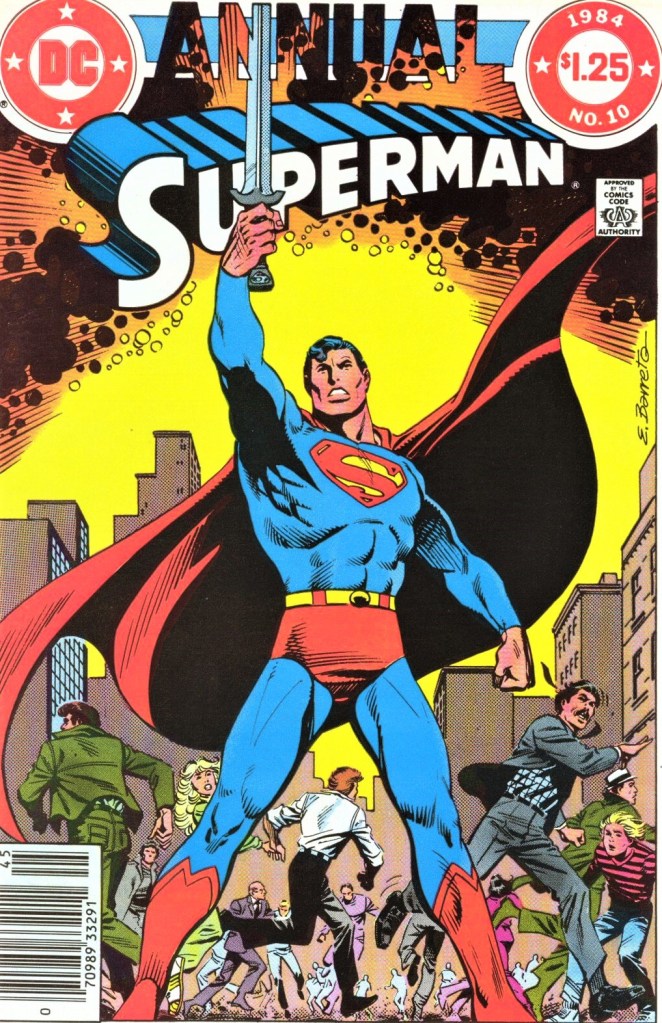
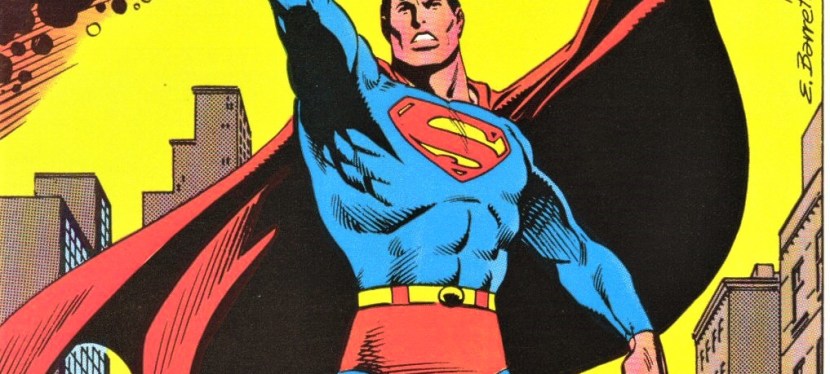
As a kid, I was fortunate enough to buy myself a copy of a 1984 Superman comic book, the cover of which really intrigued and caught my interest. It was a Superman annual comic book with a $1.25 cover price which was somewhat high at the time. Its cover showed the Man of Steel himself carrying a sword pointed up.

That image made me wonder: Why would Superman have to use a sword when he is so powerful and capable without weapons? Where did that sword come from? Who made it in the first place? Is the sword so special to Superman?

With those details laid down, here is a look back at Superman Annual #10, published by DC Comics in 1984 with a story written by Elliot Maggin and drawn by classic Superman artist Curt Swan.

The cover.

Early story

The story begins in a space where a group of diverse people composed of aliens and humans are gathered together watching a live video feed Superman on a large monitor above their heads. As it turns out, the Man of Steel is in space working to prevent meteoroids from entering the planet below him. He then speeds off into space heading back to Earth.

Along time ago deep in the galaxy, a big bang effect took place creating several new fragments in the vacuum of space and among them is a long, rough object that resembles a sword. As an unknown amount of time passed, the long object gradually turns into a smooth looking sword complete with a sharp blade and a letter “S” on one end that is the same as the one Superman carries. It is referred to as the sword of Superman!

In Metropolis, Clark Kent is passed by his officemate Jimmy Olsen who mentioned that he is rushing to interview the billionaire industrialist Oswald Mandias. Two days have passed and Jimmy Olsen remained missing. As his boss Perry White heads on to the office, Clark remains and changes into Superman when the coast got clear.

As the Man of Steel flies off into the city, a Galaxy Broadcasting live report on TV shows Lana Lang reporting from the Kennedy Space Center where the new space shuttle Magellan is about to make its first-ever commercial flight to launch a mysterious new communications satellite owned by Mandias Industries…

Quality

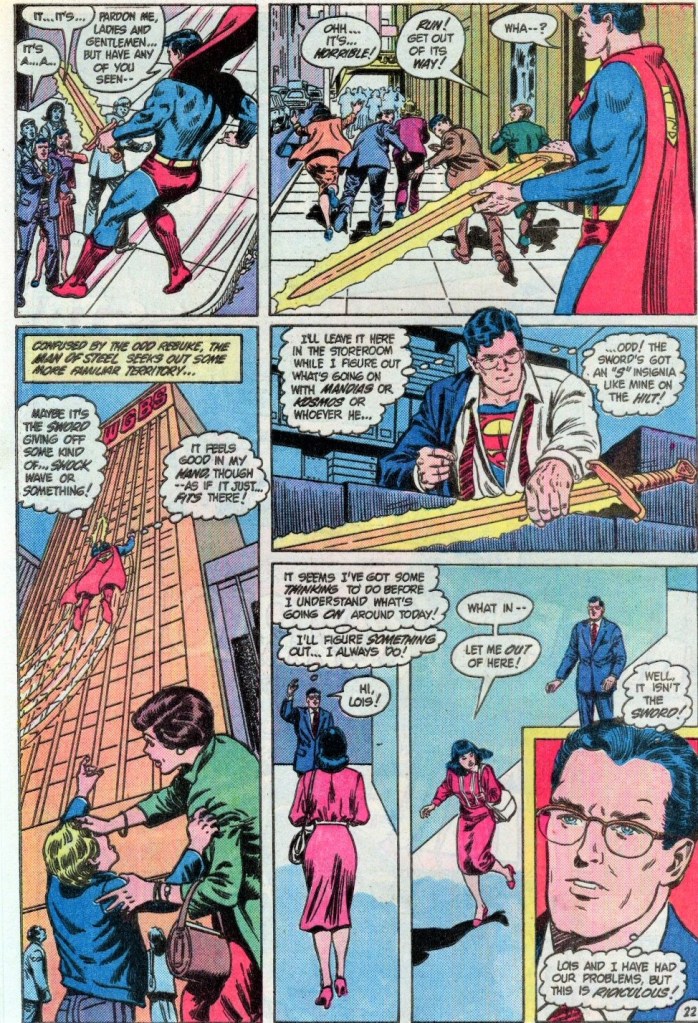
Clark Kent/Superman being a complete stranger to others added a lot to the story.
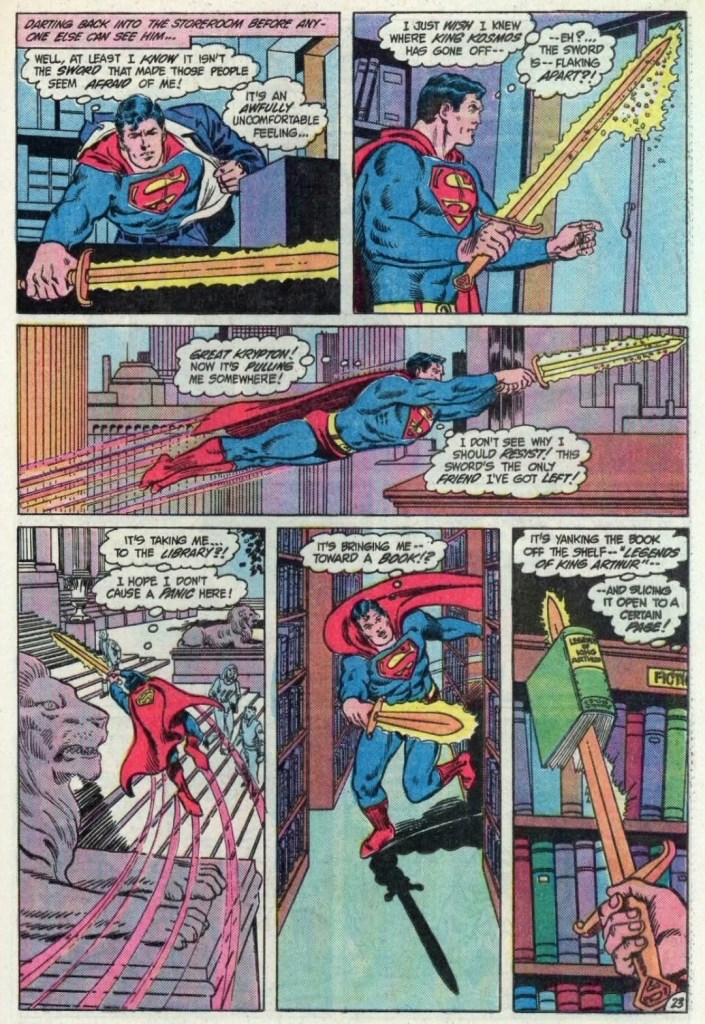
The sword led Superman to a book about the legend of King Arthur inside the city library.

Being an annual, I can say that the Sword of Superman story was well-written and nicely visualized by the creators which made it fun and engaging to read. It is a Superman story that further adds to his being an essential hero of the original DC Comics multiverse and a key factor here is the somewhat outlandish concept that the sword that he gained was an original material of the universe from the big bang and even had connections to the unseen omnipotent force.

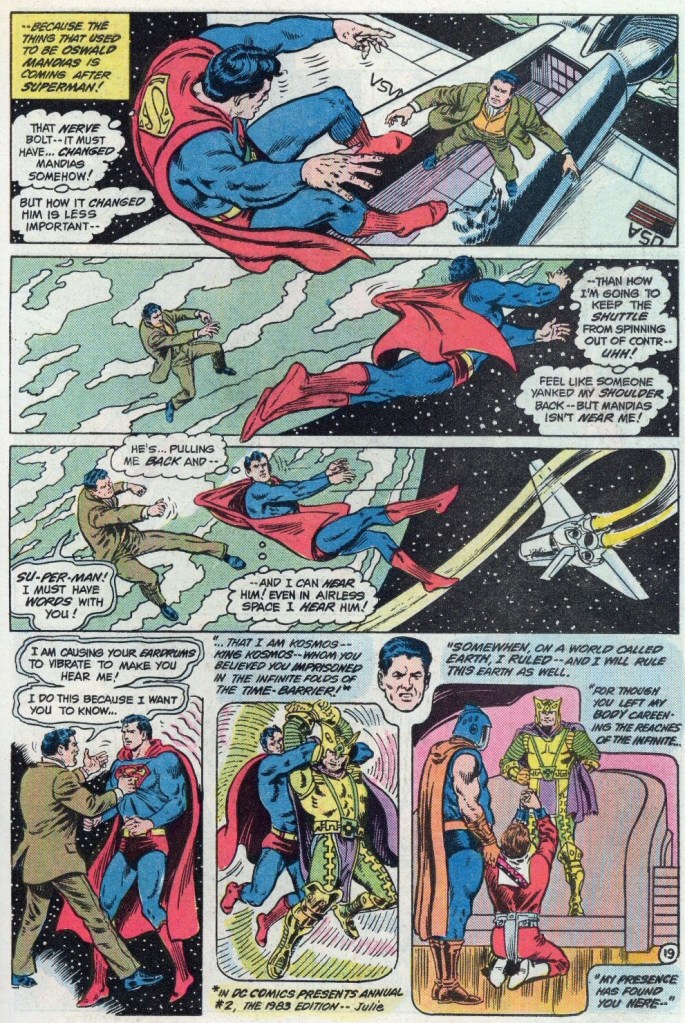
This story is not a simple, straightforward tale about Superman gaining a weapon required to defeat the supervillain King Kosmos. In fact, the sword opens up events that made the Man of Steel reevaluate himself, his situation and the people around him. King Kosmos, who is a time-travelling villain from the future (first appearance in DC Comics Presents Annual #2), served not just merely as the opposition but also adds a good amount of complexity within the reality of the story. For one thing, it is very intriguing and also refreshing to see people of Metropolis (even Clark’s friend Jimmy Olsen) failing to recognize Superman and perceive him with fear. This is a one-of-a-kind story of Superman that must be read, even though it is not really an epic tale.

All throughout, there is a fine balance between spectacle and intrigue. If you pay close attention to the dialogue and details, you will understand the story better and enjoy the comic book more eventually.

Conclusion

The return of King Kosmos!

I personally enjoyed reading Superman Annual #10 (1984) the first time back in 1984. The fact here is that after re-reading it recently, I do confirm that it is still an enjoyable comic book to read, and I am not even a Superman fan anymore. That is quite something! This is indeed a really good piece of Superman history from the pre-Crisis era. It also touches on themes about omnipotence, how ordinary people react to people who wield great power, and being whole with the entire universe.

If you are seriously planning to buy an existing hard copy of Superman Annual #10 (1984), be aware that as of this writing, MileHighComics.com shows that the near-mint copy of the regular edition costs $35 while the near-mint copy of the newsstand edition costs $70.

Overall, Superman Annual #10 (1984) is recommended.

+++++

Thank you for reading. If you find this article engaging, please click the like button below and also please consider sharing this article to others. If you are looking for a copywriter to create content for your special project or business, check out my services and my portfolio. Feel free to contact me as well. Also please feel free to visit my Facebook page Author Carlo Carrasco and follow me at HavenorFantasy@twitter.com

Wonder Woman 1984 4K Blu-ray combo set for March 30, 2021 release!

Calling all fans of Wonder Woman, fans of superhero movies and all other geeks! Some great news for you all and it’s related to what I observed and wrote before.

It has officially been announced that Wonder Woman 1984 (starring Gal Gadot, Chris Pine and Kristen Wiig) will be released in a 4K Blu-ray combo (4K Blu-ray with Blu-ray disc plus a digital copy) on March 30, 2021 and already orders for it are being accepted at Amazon.com Check out the image below.

Coming out on March 30, 2021! This early, orders for Wonder Woman 4K Blu-ray combo are being accepted at Amazon.com

Some relevant numbers about Wonder Woman 1984 4K Blu-ray combo below…

Video

Codec: HEVC / H.265

Resolution: Native 4K (2160p)

HDR: Dolby Vision, HDR10

Original aspect ratio: 2.39:1

Audio

English: Dolby Atmos

English: Dolby TrueHD 7.1 (48kHz, 24-bit)

Subtitles

English SDH, French, Spanish

Discs

4K Ultra HD

Blu-ray Disc

Two-disc set (1 BD-50)

Playback

4K Blu-ray: Region free

2K Blu-ray: Region A

If you are only planning to watch Wonder Woman 1984 in 1080p, there is also the Blu-ray disc version as well. You order it at Amazon now.

Going back to the 4K Blu-ray combo, I am very delighted over the confirmation that Wonder Woman 1984 will be presented in genuine, native 4K resolution. By comparison, the 4K Blu-ray of the 2017 Wonder Woman film was an upscaled 4K presentation (read: fake 4K).

Even though I still have not seen Wonder Woman 1984 and I deliberately avoided streaming and digital piracy of it, I went ahead ordering the 4K Blu-ray combo this early. Now the wait to watch it in the comfort of home truly begins!

Remember that 4K Blu-ray with native 4K visuals is much better than streaming!

For more Wonder Woman-related stuff, check out my recent retro comic book reviews as follows: post-Crisis Wonder Woman issues #10, #11, #12, #13, #14, #15 and #16.

Check out my retro movie review as well as my feature about the No Man’s Land scene of the 2017 movie.

+++++

Thank you for reading. If you find this article engaging, please click the like button below and also please consider sharing this article to others. If you are looking for a copywriter to create content for your special project or business, check out my services and my portfolio. Feel free to contact me as well. Also please feel free to visit my Facebook page Author Carlo Carrasco and follow me at HavenorFantasy@twitter.com

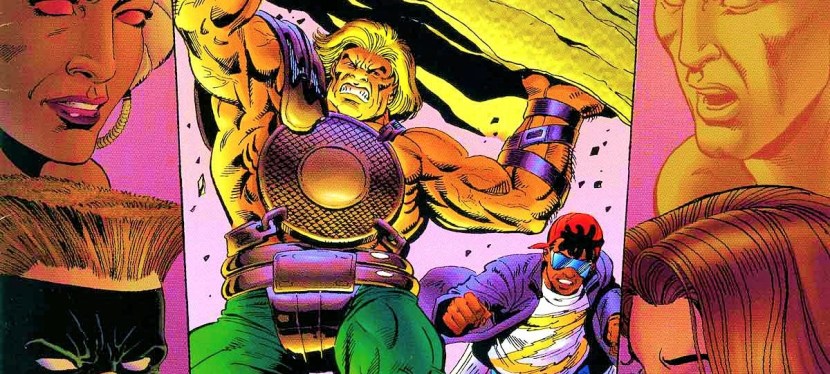
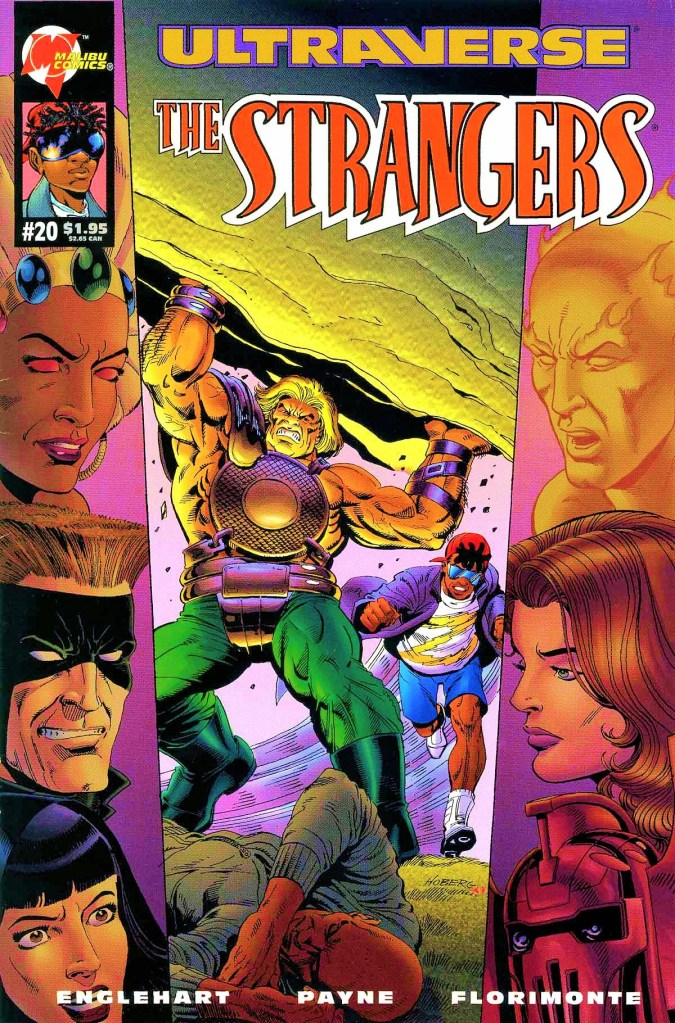
A Look Back at The Strangers #20 (1995)

Disclaimer: This is my original work with details sourced from reading the comic book and doing personal research. Anyone who wants to use this article, in part or in whole, needs to secure first my permission and agree to cite me as the source and author. Let it be known that any unauthorized use of this article will constrain the author to pursue the remedies under R.A. No. 8293, the Revised Penal Code, and/or all applicable legal actions under the laws of the Philippines.

Welcome back, superhero enthusiasts, comic book collectors and fans of the Ultraverse. We revisit the Ultraverse once again to follow the continuing stories of The Strangers. Last time around, the team found itself struggling with adjusting to life without Atom Bob. For Lady Killer, the loss is very painful not only for her leadership of the team but also on her heart as she had a relationship with him.

What will happen next? How will the team move forward without Atom Bob? We can all find out in this look back at The Strangers #20, published in 1995 by Malibu Comics with a story written by Steve Englehart and drawn by Sam Payne.

The cover.

Early story

The story begins inside the home of a mother and her son enjoying indoor basketball. Their happiness got disrupted when a large, muscular man with blonde hair crashes through their door. With him is another man named M.C. who tells the lady that he and his companion want to “borrow” her son. As the mother resisted, the slimmer man knocks her out while Beater (the large guy) grabs her son.

Elsewhere, The Strangers react to the official trading card featuring Candy/Electrocute. Leon/Zip-Zap is familiar with the value of trading cards and he shows them his card of a basketball player called Missile Monroe from his days as a rookie.

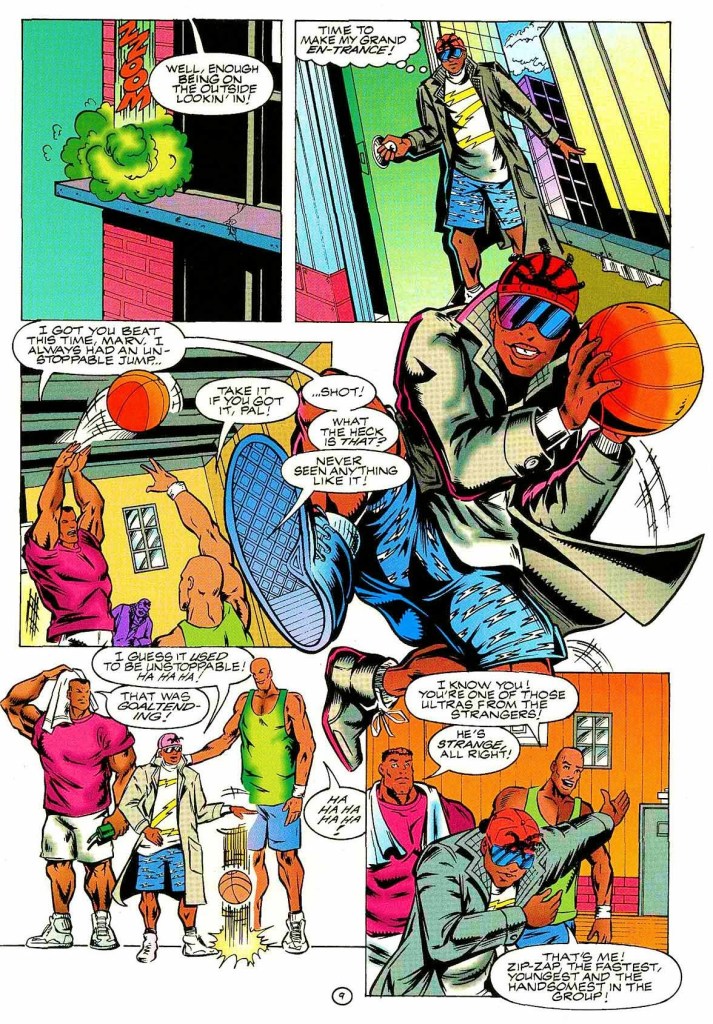
As he is eager to have the trading card signed by the basketball player, Zip-Zap heads on to the city. On his way, he notices people gathered outside Holt’s Gym which he heard is the place where Missile Monroe works out at. He then uses his super speed to go past a few more people, climb up the wall, step on the ledge and look through the window. Zip-Zap sees the basketball player shooting indoors in the presence of a friend.

Sensing opportunity, Zip-Zap decides to sneak in and make his grand entrance to meet Monroe..

Quality

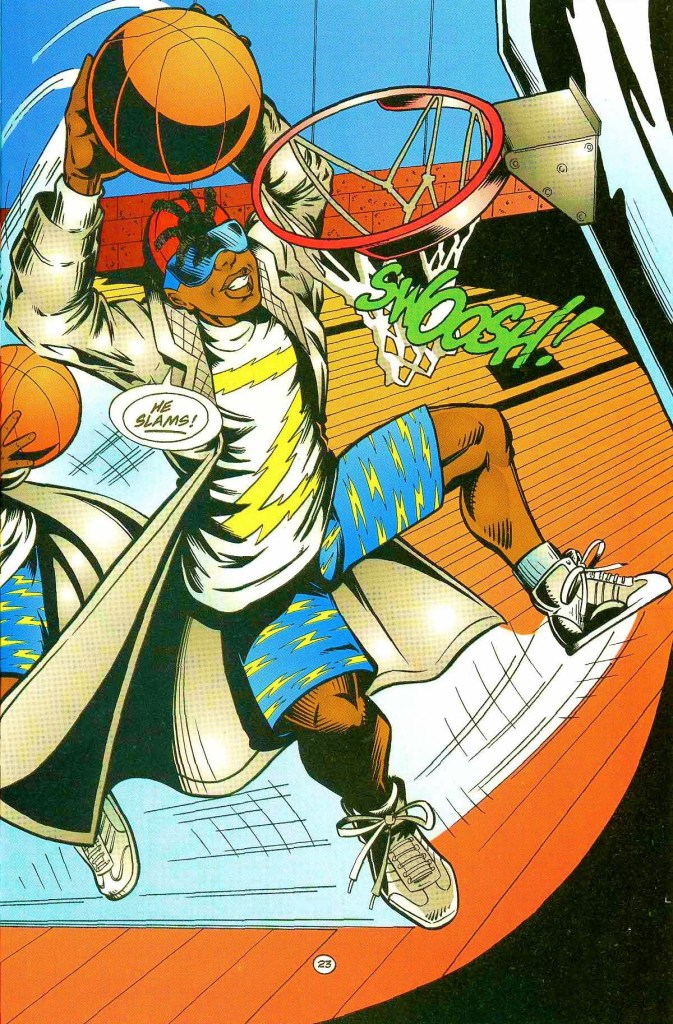
Zip-Zap slams!

I can start by saying that this comic book’s story is much less of The Strangers and more about their youngest and fastest member Zip-Zap. Rather than presenting a story about Zip-Zap going back to his old neighborhood, the story is about him meeting someone very important while taking advantage of his own celebrity status as a member of The Strangers (now known by the public) to get to him.

Other his personal obsession with a sports celebrity, this comic book also explores Zip-Zap’s determination to do something heroic without the presence of his teammates. As he is still a teenager, this part of the story alone is intriguing.

Also intriguing is the introduction of two new villains in this series, MC and Beater. How they became powerful and what their connection with Missile Monroe is something you readers should discover. I personally enjoyed what was revealed.

Other than heroic happenings, the story here explores the consequences that come with big money and lucrative deals. There is also the theme about social elevation with regards to the progress a person can make coming from the local communities to the big league. Also the events in this comic book will remind readers to respect the boundaries between them and the celebrities or important people they encounter in person.

Conclusion

Zip-Zap meets Missile Monroe and friend.

Even though it had much less of the team itself, The Strangers #20 (1995) is a worthy and fun read. The story about Zip-Zap going solo temporarily for his pursuit was nicely crafted and the new characters introduced had personalities that were interesting, most notably with Missile Monroe. Apart from characterization, there is sufficient superhero spectacle to enjoy as well. Going back to Zip-Zap, anyone who loves the character will be pleased with the spotlight on him. I should also state that this story shows additional depth to Zip-Zap’s character.

If you are seriously planning to buy an existing hard copy of The Strangers #20 (1995), be aware that as of this writing, MileHighComics.com shows that the near-mint copy of the comic book costs $14.

Overall, The Strangers #20 (1995) is recommended.

+++++

Thank you for reading. If you find this article engaging, please click the like button below and also please consider sharing this article to others. If you are looking for a copywriter to create content for your special project or business, check out my services and my portfolio. Feel free to contact me as well. Also please feel free to visit my Facebook page Author Carlo Carrasco and follow me at HavenorFantasy@twitter.com

A Look Back at Shin Godzilla (2016)

Disclaimer: This is my original work with details sourced from watching the movie and doing personal research. Anyone who wants to use this article, in part or in whole, needs to secure first my permission and agree to cite me as the source and author. Let it be known that any unauthorized use of this article will constrain the author to pursue the remedies under R.A. No. 8293, the Revised Penal Code, and/or all applicable legal actions under the laws of the Philippines.

There is no doubt that Japan’s fictional monster Godzilla (originally called as Gojira) made tremendous impact not only with the Japanese but also with other entertainment lovers around the world. Way back in 1954, the monster was portrayed as a destructive, walking symbol of nuclear weapons in the movie Gojira directed by the late Ishirô Honda.

As the years passed by, several more Godzilla movies were released by Toho Pictures. In 1998, an American-made movie about Godzilla was finally made in a disappointing form directed by Roland Emmerich. In 2014, Warner Bros. and Legendary Pictures made a more respectful film of the monster under the direction of Gareth Edwards. In 2019, the follow-up Godzilla: King of the Monsters was released and I enjoyed it a lot more than its 2014 predecessor.

Before the 2019 movie was released, Toho in Japan released Shin Godzilla (alternate titles: Shin Gojora and Godzilla: Resurgence) which was the result of the 2014 movie’s success as well as the fact that there were no restrictions in the contract with Legendary Pictures for the Japanese studio to make their own domestic versions.

Due to its lack very limited presence in cinemas here in the Philippines in 2016, I was unable to watch it on the big screen. Fortunately, it was released locally on original DVD some time after and I got to watch it in the comfort of home.

With those details laid down, here is a look back at Shin Godzilla co-directed by Hideaki Anno and Shinji Higuchi (both best known for Neon Genesis Evangelion).

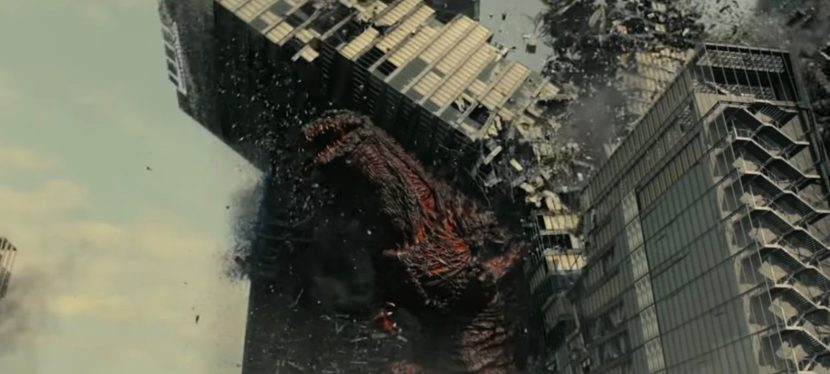
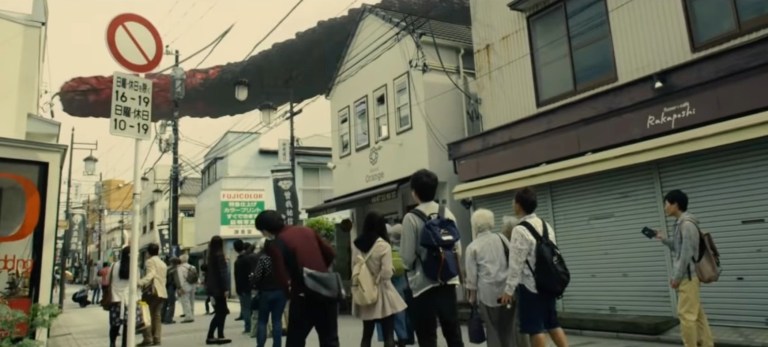
This is classic Godzilla.

Early story

The story begins at Tokyo Bay where the coast guard personnel found an abandoned yacht and searched inside. Suddenly a huge cloud of steam erupted from the ocean followed by blood-like water flooding the Tokyo Bay Aqua-Line. The tragedies compelled local authorities to take action starting with a committee meeting.

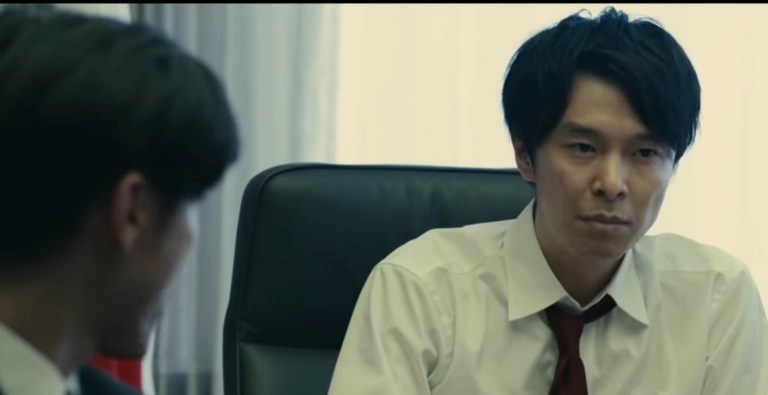
As emergency personnel save the victims in the damaged Tokyo Bay Aqua-Line, the tragedies reach the office of the Prime Minister who engages with many other government officials in an official meeting. They try to figure out what caused the incidents and, as such, theories and efforts to explain what happened were spoken until Deputy Chief Cabinet Secretary Rando Yaguchi (Hiroki Hasegawa) theorized that a living creature caused it (because he saw a viral video) which only resulted disbelief and dismissal.

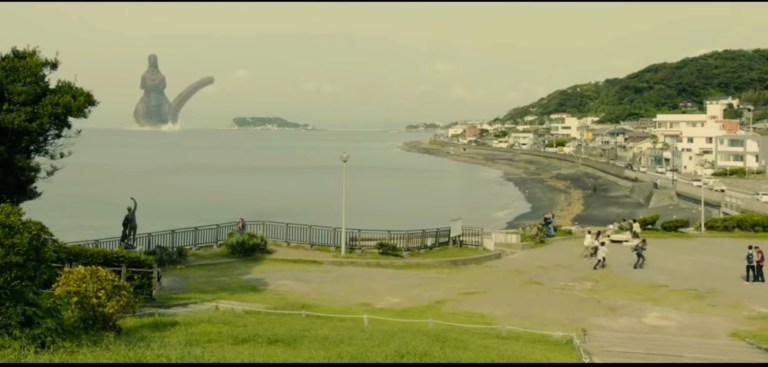
Suddenly a massive tail rises from the ocean which got captured in video and photographs by the news media which confirms Yaguchi’s hunch. As the Prime Minister and the team of officials spend more time discussing and searching for real experts (because the three scientists they just met did not produce any breakthroughs), a huge creature makes its way into one of Tokyo’s districts through a waterway causing massive damage and displacing many people as well as all boats that got in its way.  

In a press conference, the Prime Minister gave his assurance to the public that they need not worry about the creature coming to shore. Just after giving his assurance speech, an assistant approaches the Prime Minister with really bad news that the creature has been crawling inland and causing even more damage…

Quality

Japan’s iconic monster is not only terrifying here but also very deadly.

When it comes to presentation in comparison to all other Godzilla movies released, Shin Godzilla is very unique as it strongly brings to the viewers a very in-depth examination of the bureaucracy of the Japanese government complete with the many laws, requirements, rules and other elements of governance that made it so hard for the local authorities to respond to Godzilla’s invasion of the metropolis. There are key details that were raised such as the constitutionality of using local military force against the monster (which is not a foreign invader), which department should be in-charge of research about the same monster, etc.

Along the way, there is an overload of information – in terms of text, images and dialogue – that makes viewing quite a challenge. This makes watching Shin Godzilla a learning experience that viewers who are interested in governance and science will likely enjoy although it will alienate other moviegoers, especially those who only want to watch the spectacle of massive on-screen destruction that giant monster movies are known for. Going through all the exposition and explanations, and understanding most of it, however, will make the viewing experience worth it as these countless details do make sense in relation to Godzilla’s destructive impact on the people.

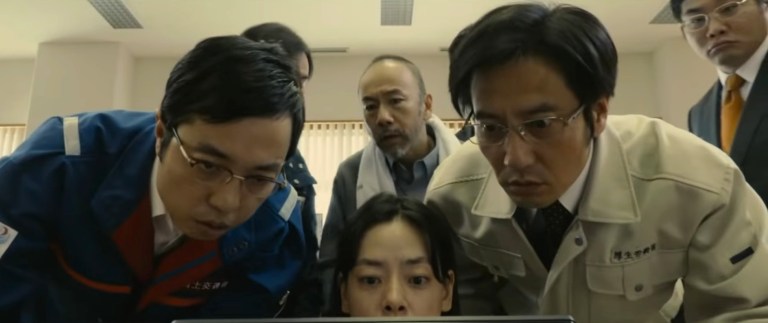
And then there is the huge cast of characters that needs to be followed. This is another big challenge for viewers because if one misses out on the key purpose a character has, then following the government’s efforts on dealing with Godzilla will make less sense. Not only will you have to follow the characters’ names, you will also have to remember their respective work titles. Apart from the government officials, there is also the huge batch of nerds and varied experts gathered by the government to do intense research. Again, those people need to be followed and remembered so you can understand what they do and how they contribute to their government’s efforts. When it comes to performances, they are collectively dramatic and you will be convinced of the pressure, the danger and uncertainty they face with Godzilla threatening Tokyo.

Better get used to seeing so many characters throughout the movie.
Hiroki Hasegawa as Rando Yaguchi.

As for the main spectacle of the movie, Godzilla, I can say that the monster here is very terrifying to watch. This is not your typical Godzilla as the Anno-Higuchi directorial duo really went all out with their creativity to remake Japan’s iconic monster into something new and deadly while still linking him creatively to the legacy of the classic Godzilla. There is even an element of evolution in this version of Godzilla and to see the Japanese military fire their expensive weapons at him really made a lot of spectacle to enjoy. I should also state that several scenes of disaster caused by the monster in this film were inspired by the tragedies of the Tōhoku earthquake and tsunami, and the Fukushima Daiichi nuclear disaster of 2011. Lastly, Godzilla here is really a super villain that is not only gigantic but also is made to be highly believable that it can destroy the nation, kill innocent civilians, demoralize the authorities and even bring Japan’s entire economy way down (note: one of the government officials explained the economic consequence of failing to defeat the monster).

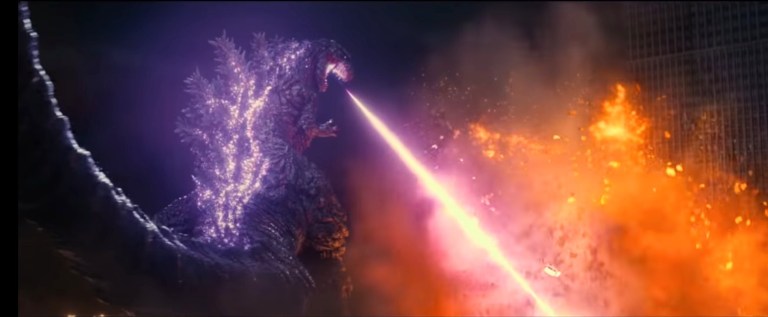
When it comes to visual effects, this one is the best-looking Godzilla made by the Japanese yet! While the traditional approach of having an actor wear a rubber suit has been disregarded in favor of using modern, digital means (with motion capture), what the production team did here is very impressive as they focused strongly on having computer-generated graphics that are photo-realistic. While it is true that there were some moments of fake-looking CGI, the heavy photo-realism on the graphics of Godzilla (combined with strategic camera angles that really captured the scope and size of the monster) easily outweighed the weak spots. The lighting effects used for the laser blasts were very impressive, even competitive with what Hollywood has been doing. As for the scenes of destruction, a mix of CGI and practical effects (specifically miniatures) was used. In fact, certain scenes showing Godzilla interacting with the environment was done with pushing a prop through miniatures which resulted a high level of detail with organic and solid stuff.

The spectacle would not have been that effective, however, without the solid musical work done by Shiro Sagisu. Not only did the music add a lot to the intense sequences of Godzilla, it also brought out the sense of dread and horror out of the monster especially in the night-time scene when he was towering over a large section of Tokyo that lost power. Sagisu was also involved in Neon Genesis Evangelion.

Conclusion

The emphasis on photo-realism on the computer-generated effects is something special.

I can say it out loud that Shin Godzilla (2016) is truly a spectacle to watch complete with tons of heavy drama, tons of information and the widest cast of characters to date. It is a new version of the Japanese icon that really impresses and when it comes to movie intelligence, it easily outshines many other Godzilla flicks. While it has a lot of spectacle to keep moviegoers entertained, its heaviness with the information and large cast of characters could turn off viewers who are not used to thinking and paying attention to lots of details while watching a giant monster movie. Personally, I welcomed the information overload and made efforts on paying close attention to the details and the characters. It really takes patience and focus to truly make the most out of the story and the overall presentation.

Ultimately, I enjoyed this movie for what it is and what its message was about with regards as to how governments should respond to immense disasters, what is Japan’s place in the world of the 21st century and, most notably, what Godzilla means to Japan and the international community. This is a very solid modernization of Godzilla and the Anno-Higuchi deserve admiration.

If you are seriously planning to buy an existing hard copy of Shin Godzilla (2016), visit Amazon for the Blu-ray disc release and see if it has the right price and special features to satisfy you.  

Overall, Shin Godzilla (2016) is recommended!

+++++

Thank you for reading. If you find this article engaging, please click the like button below and also please consider sharing this article to others. If you are looking for a copywriter to create content for your special project or business, check out my services and my portfolio. Feel free to contact me as well. Also please feel free to visit my Facebook page Author Carlo Carrasco and follow me at HavenorFantasy@twitter.com

A Look Back at Wonder Woman #15 (1988)

Disclaimer: This is my original work with details sourced from reading the comic book and doing personal research. Anyone who wants to use this article, in part or in whole, needs to secure first my permission and agree to cite me as the source and author. Let it be known that any unauthorized use of this article will constrain the author to pursue the remedies under R.A. No. 8293, the Revised Penal Code, and/or all applicable legal actions under the laws of the Philippines.

Welcome back, superhero enthusiasts, comic book collectors and Wonder Woman fans! Last time around, the Challenge of the Gods storyline concluded and it really had a lot of twists and profound surprises that really shook the foundation of the post-Crisis Wonder Woman monthly series that was spearheaded by George Perez and Len Win. The Challenge of the Gods started strongly in issue #10 and as each issue was released, the narrative got more intriguing and ultimately served its purpose on defining Wonder Woman as the ever-willing and pure Queen of Superheroes. Along the way, there was significant development of Queen Hippolyte who has been struggling between ruling her fellow Amazons and being a mother to Diana/Wonder Woman.

As the Challenge of the Gods was full of elements of fantasy and Greek mythology, it can be quite challenging for any comic book creator to start the next chapter of the Wonder Woman monthly series’ narrative without reusing the mentioned elements.

In the case of the next Wonder Woman comic book for review here, I can say that the creators literally brought Wonder Woman into the realm of realism and intrigue. With those details laid down, here is a look back at Wonder Woman #15, published by DC Comics in 1988 with a story written by George Perez and Len Wein. Perez illustrated the comic book.

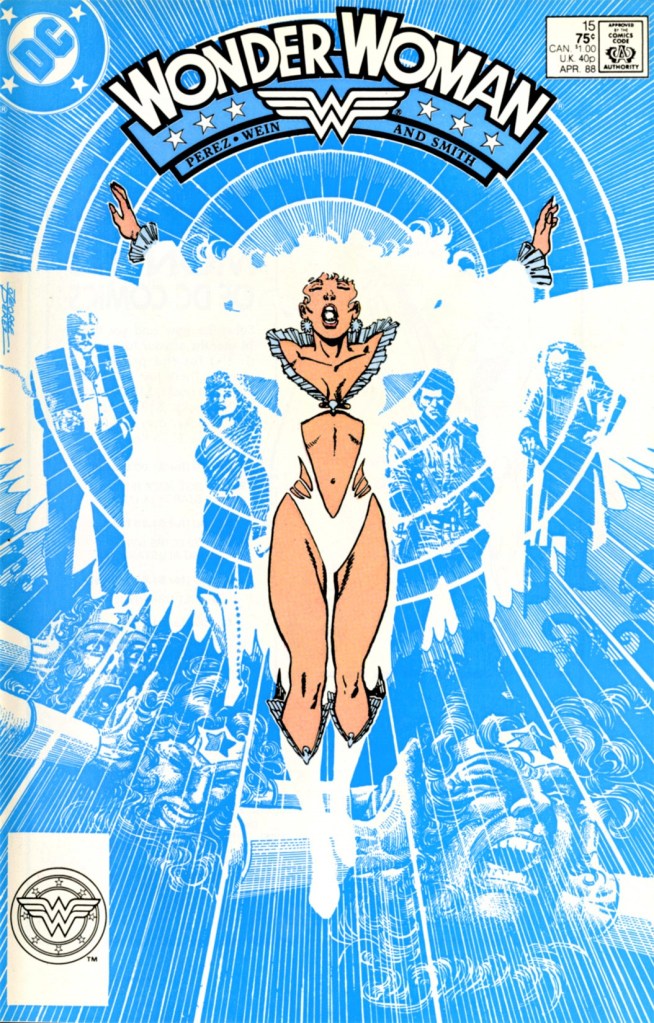
The cover.

Early story

The story begins with Wonder Woman having a very vivid dream about a certain great hero. After waking up from it, she feels that trying to keep up with all the events of the world must be taking its toll on her. She expressed that she is ill-prepared to deal with new sensations.

“In this world, man and woman long for these feelings. They cherish them. I’ve read how they have even died for them,” Diana said. “And that truly frightens me.”

While Diana is staying at the Kapatelis residence, it turns out Julia (mother of Vanessa) is overseas. She wishes that Julia is with her to discuss what she has been feeling.

Meanwhile at the Ogawa headquarters in Boston, an armed man is using one of the company’s computers to acquire classified information about a subject referred to as Valerie Beaudry. A security guard arrives and decides to investigate as he realizes that his fellow guard was missing (knocked unconscious already). The infiltrator makes short work of him and leaves the building with the acquired information…

Quality

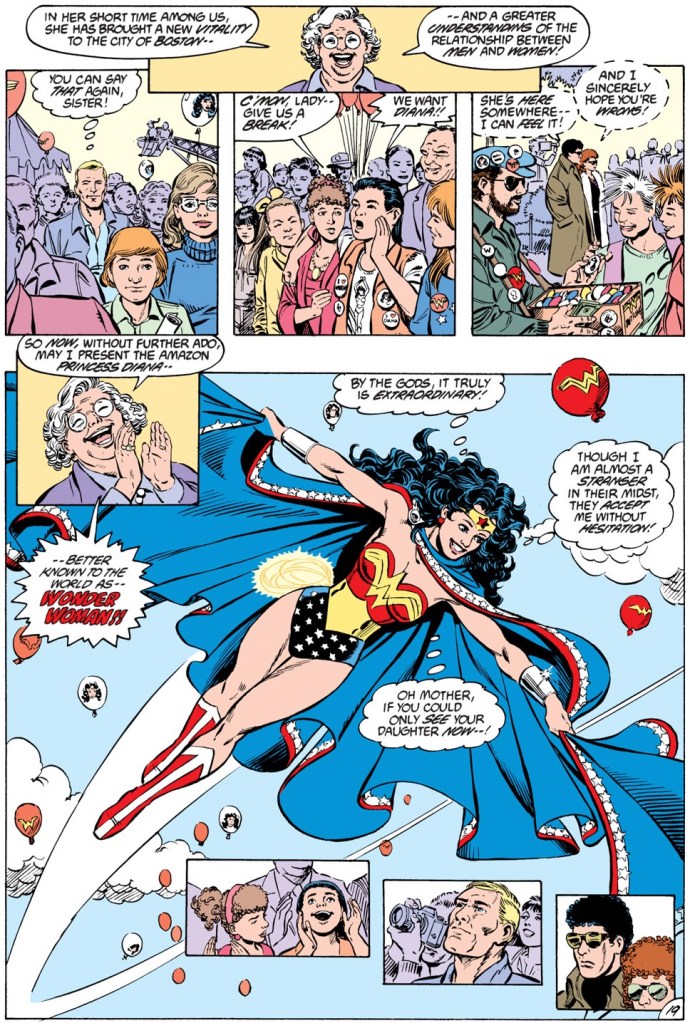
Wonder Woman appears at a major public event.

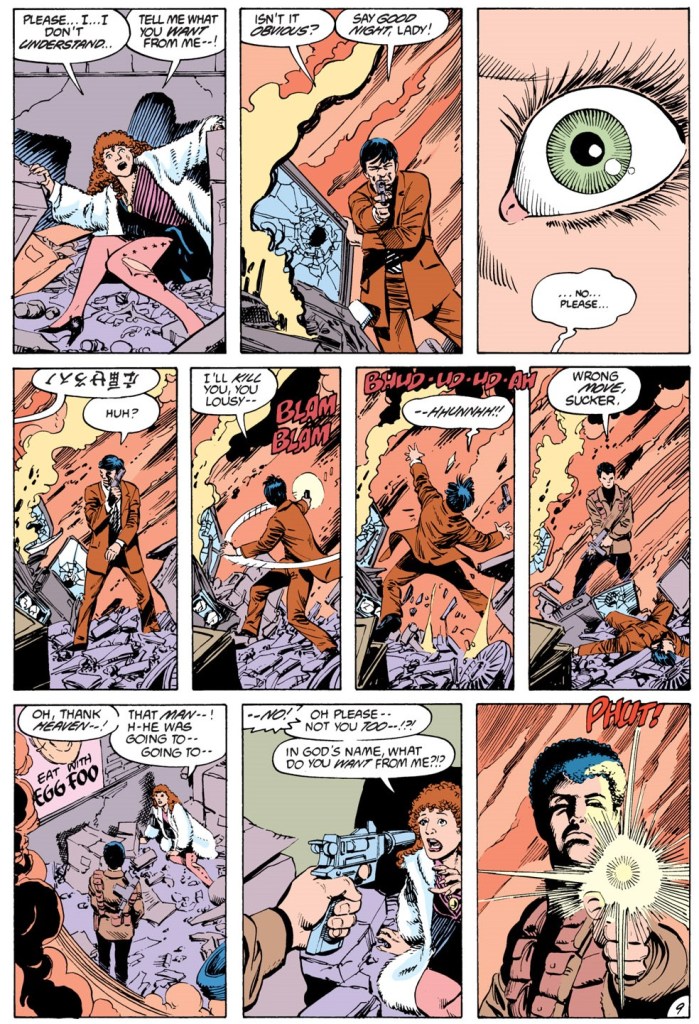
I can start with the sudden change of tone for the storytelling. Gone are the fantasy and mythology elements of the Challenges of the Gods storyline and fully implemented in this comic book are the elements of intrigue, suspense, assassination and even sci-fi. The story itself is more grounded with reality as far as the post-Crisis DC Comics universe goes and because it is well written, the sudden change of tone and style never felt jarring to me.

While the 9th issue of this monthly series introduced a modern Cheetah, this comic book introduced the modern Silver Swan in the form of Valerie Beaudry (who appears on the cover). The good news here is that the creators took their time in gradually building-up details about Valerie and how she became Silver Swan. By the time Silver Swan appears in the presence of Wonder Woman, her personal details and traits have been developed in a satisfying way. Unlike Wonder Woman #9, Silver Swan’s appearance in this comic book stretches on into the next issue.

Along the way, more new characters were introduced and the most notable ones are connected with Valerie Beaudry. Maxine Sterenbuch, who eerily resembles Wonder Woman’s teenage pal Vanessa but in adult form, has a close connection with Valerie over a period of many years. There was also Henry Cobb Armbruster, a tycoon who wield tremendous power and has been hiring assassins to do his bidding.

Going back to Wonder Woman herself, this issue explores more of her struggle with not only learning more about man’s world and its many divisions, but also the feelings she starts having as she connects more with other people – most notably with one of DC’s biggest icons. To have Julie Kapatelis absent left the creators room to have Diana not only bond more with daughter Vanessa but also strive more on analyzing what she learns in man’s world. The scene in which Wonder Woman notices a huge printed image of her is a vivid reminder about how negative and foolish idolatry is on people.

Conclusion

Intriguing action scene.

Even though it has no fantasy and mythology elements, Wonder Woman #15 (1988) is still a great comic book to read and it succeeds in progressing Diana’s discovery and learning of man’s world. Its introduction of the post-Crisis Silver Swan is memorable and her build-up (specifically her background story) is pretty engaging.

If you are seriously planning to buy an existing hard copy of Wonder Woman #15 (1988), be aware that as of this writing, MileHighComics.com shows that the near-mint copy of the regular edition costs $35 while the near-mint copy of the newsstand edition costs $70.

Overall, Wonder Woman #15 (1988) is highly recommended!

+++++

Thank you for reading. If you find this article engaging, please click the like button below and also please consider sharing this article to others. If you are looking for a copywriter to create content for your special project or business, check out my services and my portfolio. Feel free to contact me as well. Also please feel free to visit my Facebook page Author Carlo Carrasco and follow me at HavenorFantasy@twitter.com

A Look Back at Ravage 2099 #8 (1993)

Disclaimer: This is my original work with details sourced from reading the comic book and doing personal research. Anyone who wants to use this article, in part or in whole, needs to secure first my permission and agree to cite me as the source and author. Let it be known that any unauthorized use of this article will constrain the author to pursue the remedies under R.A. No. 8293, the Revised Penal Code, and/or all applicable legal actions under the laws of the Philippines.

Welcome back, superhero enthusiasts, comic book collectors and fans of Marvel. Today we revisit the original 2099 universe that Marvel Comics launched in the 1990s. We go back to the said universe through the eyes of Ravage 2099, the original 2099 character co-created by the late Stan Lee and artist Paul Ryan.

Before proceeding with my next retro comic book review of Ravage 2099, I want to stress that there was a time when the late Steve Ditko nearly launched Ravage 2099 with Stan Lee. For the newcomers reading this, Steve Ditko and Stan Lee are recognized for co-creating the iconic Spider-Man and to even imagine the two creators almost getting involved with the 2099 universe’s original hero is intriguing.

Marvel tried to get Ditko to work with Lee on Ravage 2099 early on. Then Marvel Comic editor-in-chief Tom DeFalco revealed that, on behalf of Lee, he called Steve Ditko who eventually attended a meeting which reunited them. After having a terrific discussion with Lee, Ditko cordially turned down the project. DeFalco stated that Ditko just did not agree with some of the philosophical underpinnings.

“Steve walked away, and I could tell he was really thrilled to have seen Stan,” DeFalco added.

With that short history over, here is a look back at Ravage 2099 #8, published in 1993 by Marvel Comics plotted by Stan Lee, scripted by Pat Mills and Tony Skinner and drawn by Gran Miehm. This was Stan Lee’s final work of writing a Marvel 2099 story.

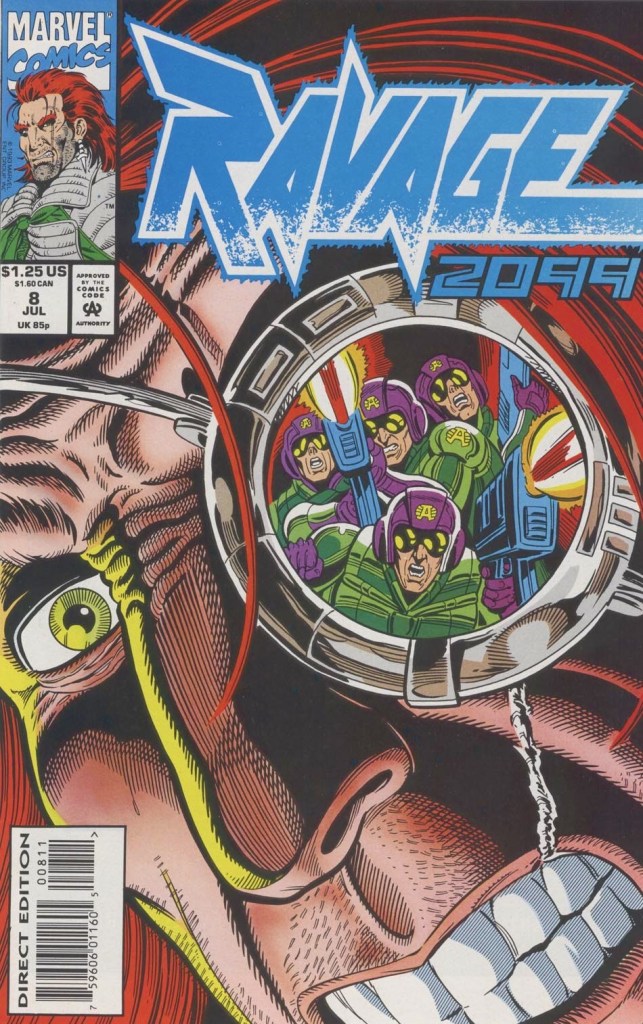
The cover.

Early story

The story begins with a weakened Ravage, Tiana and Dack already in trouble as a Public Eye battle copter approaches them. The three just escaped from an underwater city using an old vehicle from the Fantastic Four. While Tiana expressed that there is no way they could outfight or outfly Public Eye, Dack reminds her that Ravage is their only hope and because of him, they got away from the aquatic beings and survived.

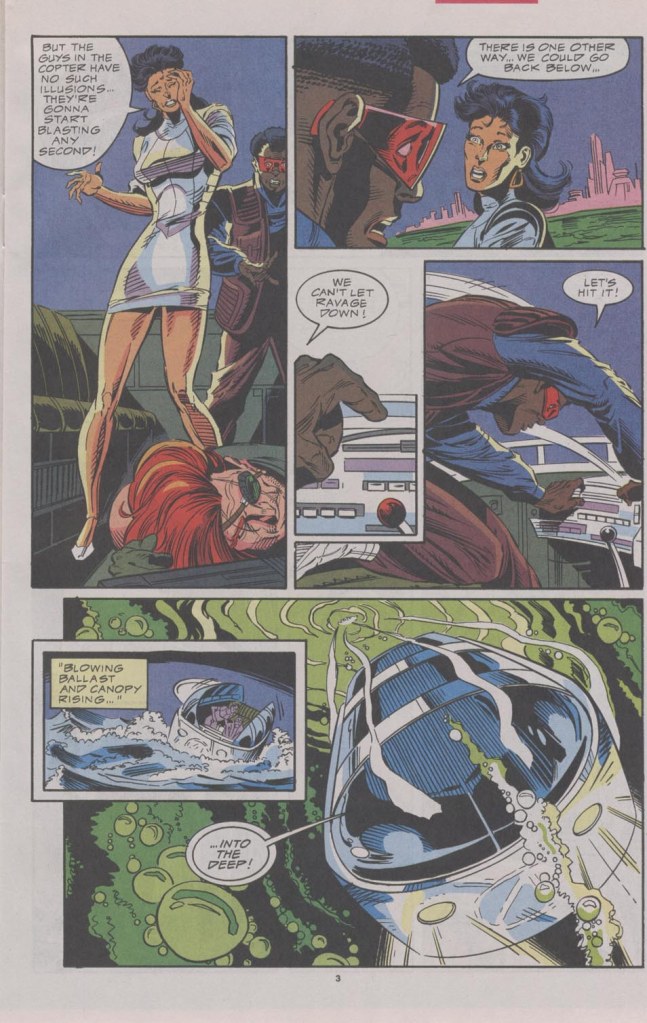
Dack then send their vehicle (which instantly blew ballast and raised a canopy) under water to escape from Public Eye. The effort was futile as the battle copter captures their vehicle and pulls it out of the water using a magnetic beam.

Knowing this development, Anderthorp Henton makes a confidential holo-call with Dethstryk and tells him that Ravage is in his possession. Henton also states that he intends to kill Ravage. Dethstryk demands Henton to deliver Ravage to him, insisting that it should be he who should kill him.

While captured in transit, Ravage struggles to write his instruction to his companions to take his gloves off…

Quality

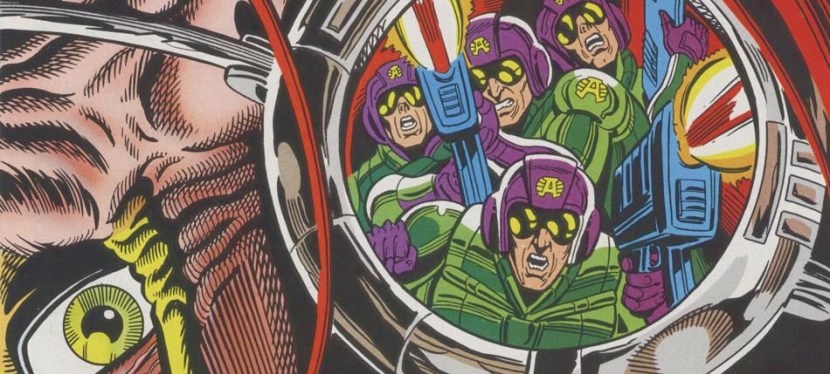
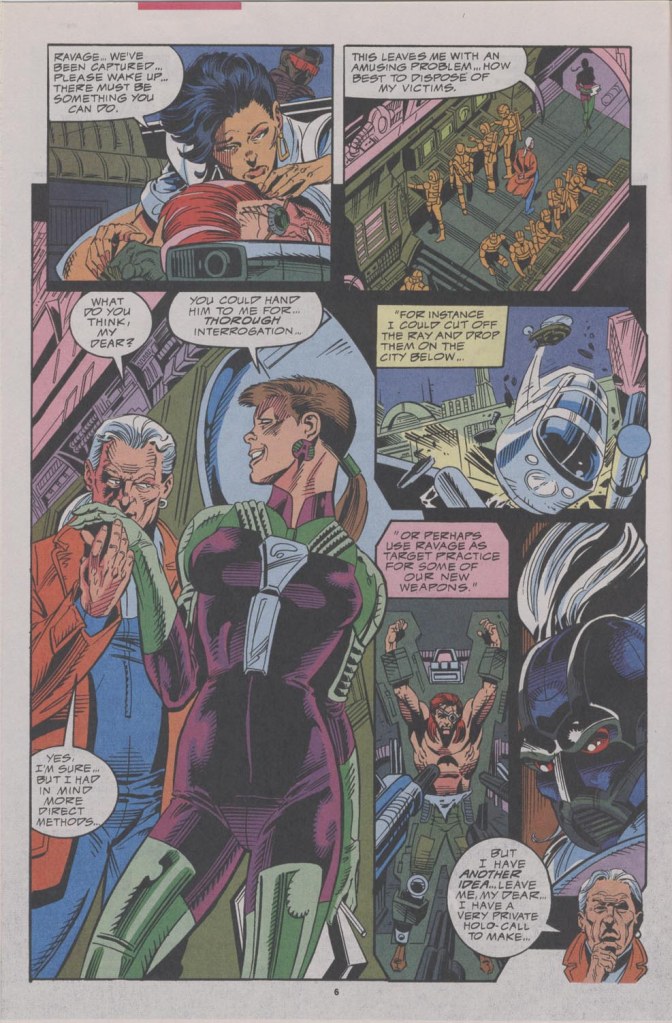
Henton and his team with Ravage and his companions captured.

Finally, after going through the first seven issues that resulted unsatisfying plots, recycling of character elements and forcibly stretching the narrative, this particular issue has a story that combines doubtful heroism with a believable objective. Of course, it should be noted that Stan Lee provided the plot while leaving the scripting and pacing to two other writers who eventually took over the writing duties of Ravage 2099.

There were some improvements to the quality of the dialogue and narration (by Ravage). This comic book’s story was paced decently and there was not a single moment of stretching the narrative unrealistically. By this stage of the series, Ravage’s status as a heroic figure improved once again as he was given a purpose to fulfill. While we have seen him help Tiana or Dack escape from the bad guys, this story has him being more strategic and more determined to really solve a mystery while overcoming opposition.

Henton in this story, fortunately, is not a repeat of his cruel, cold-hearted self from the previous issues. This story reveals his link with Dethstryk and new insight as to who or what really controls Alchemax and its top officials. As such, there were some unexpected elements that transpired in the story.

Visually, Gran Miehm provided decent art and for the most part, Ravage and the other characters remained recognizable although I notice Dack looking more like a young adult than the teenager he really is.

Conclusion

Dack makes a move to help them get away.

Ravage 2099 #8 (1993) was Stan Lee’s last work with this particular series of the 2099 universe and thanks to the new writers who took scripting duties, this one has a satisfying story, higher quality dialogue and a more focused narrative. In retrospect, it was already too little and too late to salvage the Ravage 2099 series due to the inconsistent and overall weak storytelling that dominated the first seven issues.

If you are seriously planning to buy an existing hard copy of Ravage 2099 #8 (1993), be aware that as of this writing, MileHighComics.com shows that the near-mint copy of the regular edition costs $14 while the near-mint copy of the newsstand edition costs $42.

Overall, Ravage 2099 #8 (1993) is satisfactory.

+++++

Thank you for reading. If you find this article engaging, please click the like button below and also please consider sharing this article to others. If you are looking for a copywriter to create content for your special project or business, check out my services and my portfolio. Feel free to contact me as well. Also please feel free to visit my Facebook page Author Carlo Carrasco and follow me at HavenorFantasy@twitter.com

A Look Back at Prime #19 (1995)

Disclaimer: This is my original work with details sourced from reading the comic book and doing personal research. Anyone who wants to use this article, in part or in whole, needs to secure first my permission and agree to cite me as the source and author. Let it be known that any unauthorized use of this article will constrain the author to pursue the remedies under R.A. No. 8293, the Revised Penal Code, and/or all applicable legal actions under the laws of the Philippines.

Welcome back, superhero enthusiasts, comic book collectors and fans of the Ultraverse! Today, we will revisit the Ultraverse through the exploits of Prime who has already established himself in the city of New York (the result of Kevin Green and his mom’s move into the city).

Not only have we seen Prime fight a gigantic monster (that reminds me a lot of Japan’s Godzilla) to save New York and its many people, we have seen Turbo Charge getting involved with him with a superhero-related passion.

What will happen next to Prime? Will Turbo Charge get even more involved in helping the people of New York? We can all find out in this look back at Prime #19, published in 1995 by Malibu Comics with a story written by Len Strazewski and Gerard Jones, and illustrated by Dave Cockrum (X-Men) and Tim Hamilton.

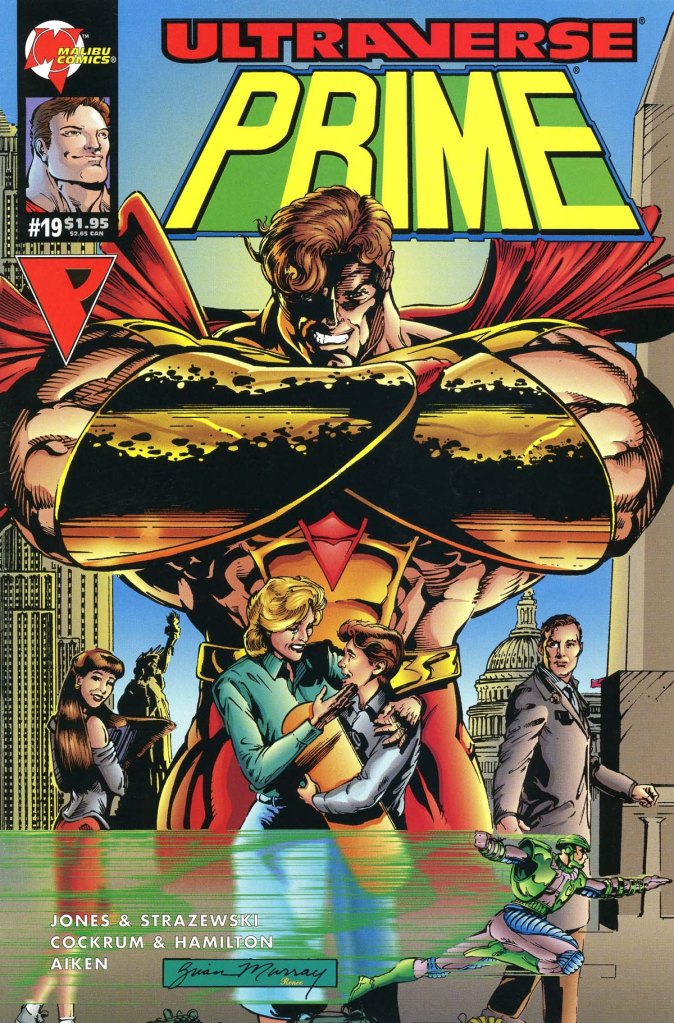
The cover.

Early story

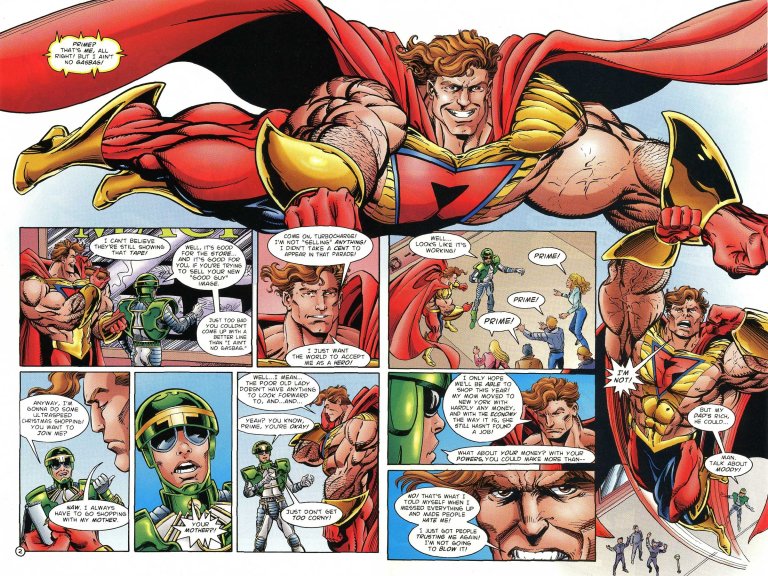
The story begins with Prime flying just above ground in the view of the many people attending the Macy’s Thanksgiving Day Parade in New York. Already he has been identified as the city’s newest Ultrahero.

Sometime later, within the city, Prime and Turbo Charge are watching television sets from outside a retailer’s window. As they talk about being in the spotlight, some fans approached Prime. The more Turbo Charge talks about taking advantage of the public trust and special abilities for financial gain, Prime rejects his suggestion as he remembers how he messed up previously.

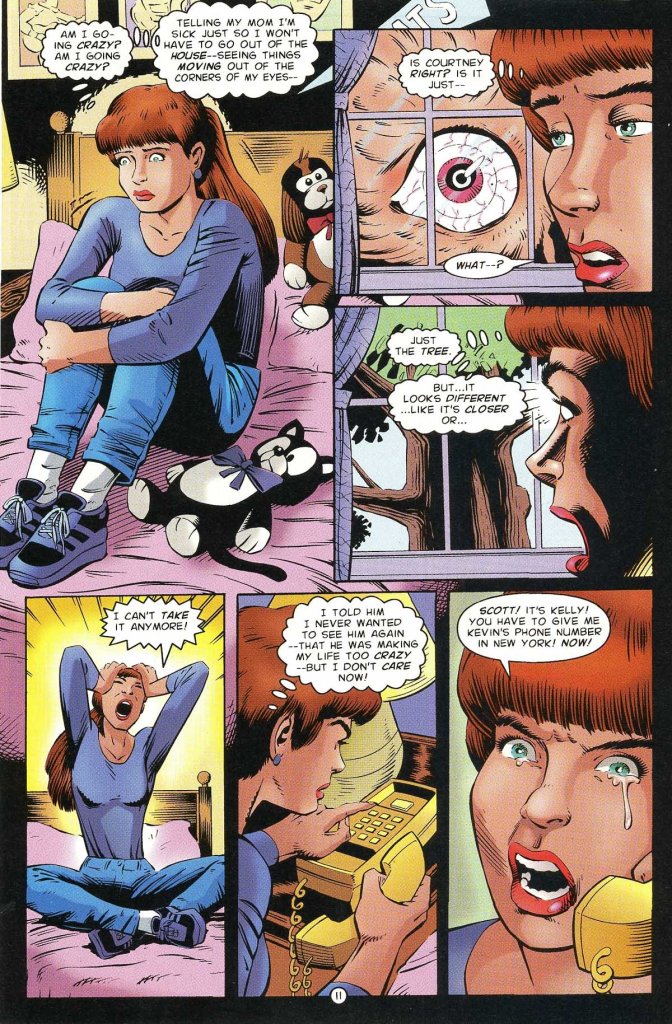
Meanwhile at Canoga Park, California, Kelly (Kevin’s romantic interest) is approached by Courtney (her best friend) who asked her what is she nervous about and what’s wrong with her lately. After their short talk, Kelly separates from her (who has a negative view of Kevin) and enters home at last. Suddenly a monster appears just outside the front door…

Quality

Kelly getting desperate.

I can confirm that the writing is rich and this story is much-more character-driven than the previous issue. The good news here is that there is a lot of engaging stuff and characterization to enjoy.

As before, Kevin’s struggle with balancing his personal life and his superhero ego together continues to be felt here. Not only has he been struggling with the media’s suspicion of Prime as a predator with teenagers, he also had difficulty talking with Turbo Charge (a teenager like Kevin) when it comes to sensitive bits of information that might expose his personal life. The way Strazewski and Jones wrote the script in dramatizing Kevin’s personal struggle came with really natural dialogue which made it all believable to read.

Within this story are three sub-plots about Kevin’s father, Kelly and Turbo Charge. Kevin’s father knows the whole truth about his son which makes him a valuable target by spies. Kelly’s struggle with monstrous visions are driving her nuts like never before. Turbo Charge meanwhile has a father who is well connected with the powerful in Washington, D.C. and the private sector. These sub-plots are well-written and add a good amount of depth and variety to the story.

As this issue was illustrated by Dave Cockrum and Tim Hamilton, there are noticeable changes in the aesthetics on Prime, Kevin and other related characters here and there. I just wish that the comic book pointed out which pages were drawn by whom. This is a fine-looking comic book.

Conclusion

Prime and Turbo Charge in New York.

Prime #19 (1995) is a very solid read mainly due to the strong characterization and the mentioned sub-plots (one of which finally got resolved in a satisfying manner). The more you follow Kevin’s story and his adjustment with life in New York, the more this comic book draws you in. There is also a short yet effective round of superhero spectacle that complete it. More importantly, this story keeps Prime’s story moving forward and even Kevin’s mother got a good amount of the spotlight.

If you are seriously planning to buy an existing hard copy of Prime #19 (1995), be aware that as of this writing, MileHighComics.com shows that the near-mint copy of the comic book costs $10.

Overall, Prime #19 (1995) is recommended.

+++++

Thank you for reading. If you find this article engaging, please click the like button below and also please consider sharing this article to others. If you are looking for a copywriter to create content for your special project or business, check out my services and my portfolio. Feel free to contact me as well. Also please feel free to visit my Facebook page Author Carlo Carrasco and follow me at HavenorFantasy@twitter.com

A Look Back at Freex #10 (1994)

Disclaimer: This is my original work with details sourced from reading the comic book and doing personal research. Anyone who wants to use this article, in part or in whole, needs to secure first my permission and agree to cite me as the source and author. Let it be known that any unauthorized use of this article will constrain the author to pursue the remedies under R.A. No. 8293, the Revised Penal Code, and/or all applicable legal actions under the laws of the Philippines.

Welcome back, superhero enthusiasts, comic book collectors and fans of the Ultraverse! Today we will revisit the Ultraverse following the team of misfits called Freex. In my past Freex review, we saw the first appearance of Contrary who went on to become one of the more intriguing members of the superhero team UltraForce. As seen in the UltraForce monthly series, Contrary proved to be very intelligent, very resourceful and has what it takes to manipulate the behaviors and direction of even the likes of Hardcase (the team leader), Prototype and Prime.  

Of course, before the events of UltraForce happened, many of Contrary’s traits and operations were first explored in the Freex monthly series. To learn more about her, here is a look back at Freex #10, published in 1994 by Malibu Comics with a story written by Gerard Jones and drawn by Ben Herrera.

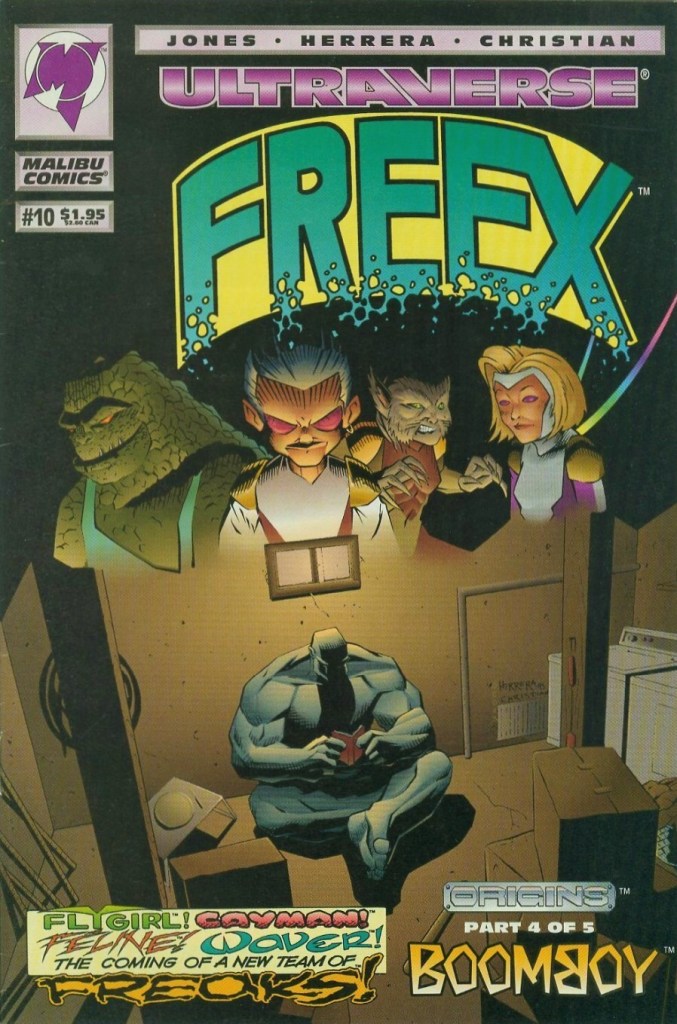
The cover.

Early story

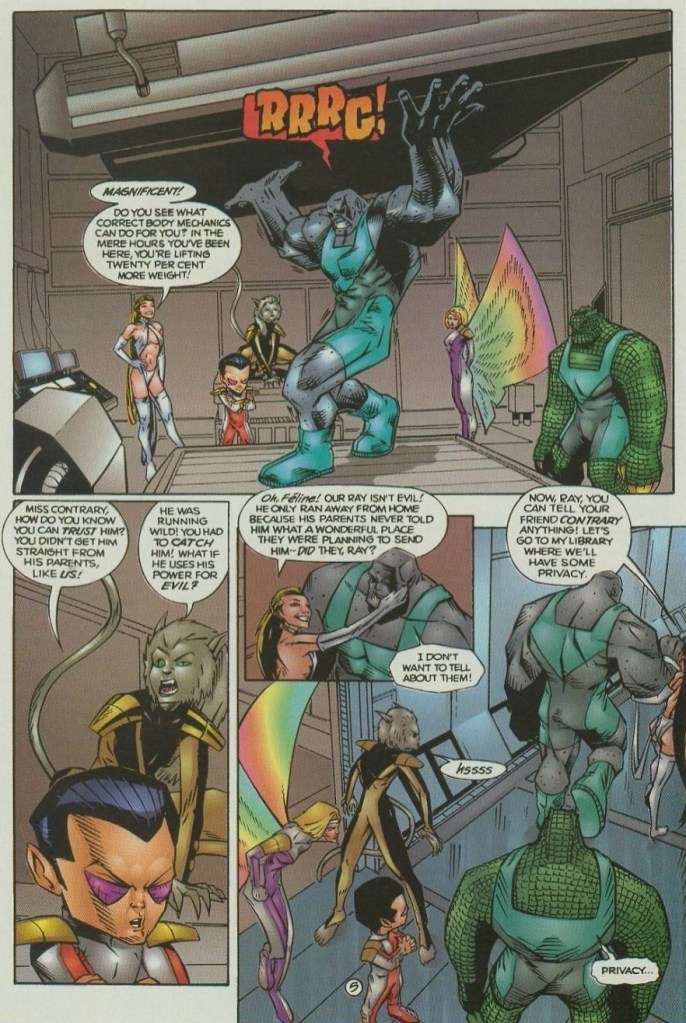
The story begins inside a secret facility. Ray/Boom Boy of Freex has just been abducted and is restrained in the presence of Contrary who is just seating near him looking sexy and comfortable. Knowing that Boom Boy has no chance to escape and fight back, she releases him and mentions that she has other students who will fight for her.

Slowly, Contrary leads him into another place of the facility telling him that he’s not locked up (like a prisoner) but rather he is home (implying there is a place for him at the facility). She introduces him to her Academy for the New Elite with her students engaging in a training session against drones and obstacles. Her students are Feline, Waver, Flygirl and Cayman.

Meanwhile, members of the Freex are still homeless and are trying to figure out how to find Boom Boy… 

Quality

The Freex, without Boom Boy, struggling.

I want to start with the writing. This issue was clearly less about Freex and more of Boom Boy (note: his personal origin emphasized) and Contrary and her academy of people with powers and special abilities. Creatively, this story has strong X-Men vibes in it which I personally enjoyed. I do confirm that the writing is strong on storytelling, characterization and dialogue.

While the previous issue introduced her briefly, Contrary is heavily emphasized in this issue. Apart from being resourceful and highly intelligent, she is also erotic with her appearance (so much of her skin exposed always) and at the same time she is well portrayed as a mentor to her students complete with traits of motherly care to them. In comparison with what I’ve seen in X-Men comic books, Contrary is like a combination of Charles Xavier and Emma Frost with some traces of Moira MacTaggert. I should also state that Contrary has a keen perception on finding outstanding or special individuals that she can help develop in more ways than one.

Going back to Boom Boy, this comic book really redefined him not only as a questionable member of Freex but also as an Ultraverse character in general. By reading this story, you will not only relate with Boom Boy but also experience the challenge he is having on whether to decide to be with his old pals or join Contrary’s academy (which itself is inspired by Xavier’s School of Gifted Children in X-Men comics) to really leave his past behind and move forward personally.

While this comic book is heavy with characterization and exposition, there is still a good amount of superhero to enjoy here. The good news is that artist Ben Herrera showed a lot of creative stuff with the spectacle.   

Conclusion

This scene has very strong X-Men vibes.

Freex #10 (1994) is a great Ultraverse comic book! I really found this particular issue to be very engaging from start to finish. As a story about the Freex themselves, this one saw their story as desperate nomads move forward a lot. Still the standouts of the story are Boom Boy and Contrary. If you have not read any issues of UltraForce yet, I highly recommend reading this so you can get to know Contrary better as she is one of the core UF members.

If you are seriously planning to buy an existing hard copy of Freex #10 (1994), be aware that as of this writing, MileHighComics.com shows that the near-mint copy of the comic book costs $11.

Overall, Freex #10 (1994) is highly recommended!

+++++

Thank you for reading. If you find this article engaging, please click the like button below and also please consider sharing this article to others. If you are looking for a copywriter to create content for your special project or business, check out my services and my portfolio. Feel free to contact me as well. Also please feel free to visit my Facebook page Author Carlo Carrasco and follow me at HavenorFantasy@twitter.com

A Look Back at The Strangers #19 (1995)

Disclaimer: This is my original work with details sourced from reading the comic book and doing personal research. Anyone who wants to use this article, in part or in whole, needs to secure first my permission and agree to cite me as the source and author. Let it be known that any unauthorized use of this article will constrain the author to pursue the remedies under R.A. No. 8293, the Revised Penal Code, and/or all applicable legal actions under the laws of the Philippines.

Welcome back, superhero enthusiasts, comic book collectors and fans of the Ultraverse! In this retro comic book review, we will revisit The Strangers in one of their later stories published in 1995. In issue #18, things got more complex as The Strangers not only had a genuine opposition to deal with but also another group of individuals with varied powers. For this new review, the story took place even way after issue #18 as there was a 100-page finale that took place in Night Man Annual #1 and The Strangers Annual #1.

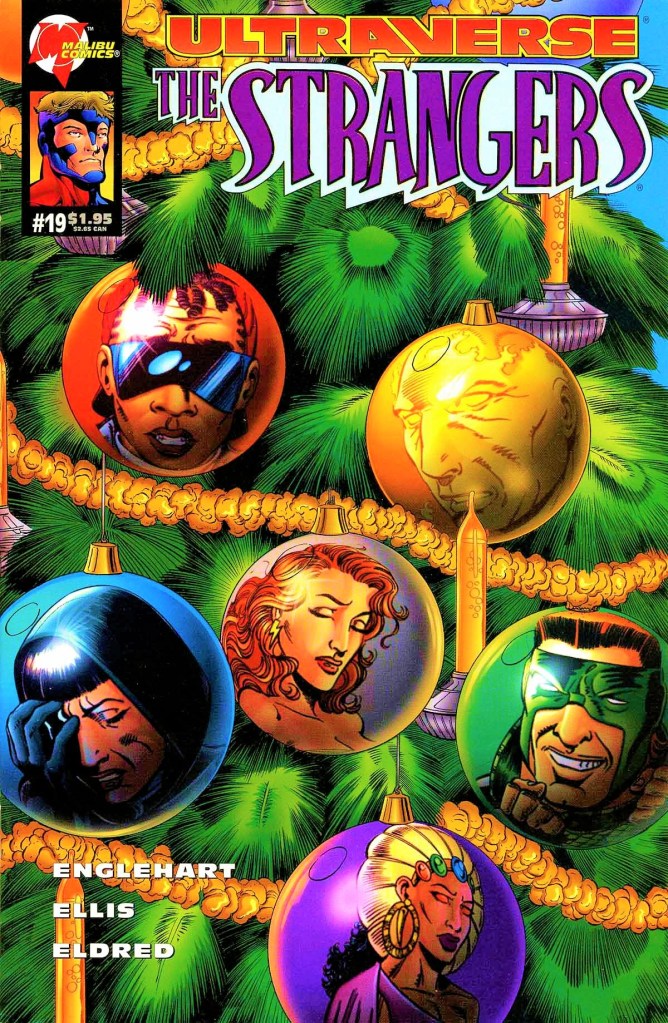
To find out what happened next to the superhero team and its members, here is a look back at The Strangers #19, published in 1995 by Malibu Comics with a story written by Steve Englehart and drawn by Steve Ellis.

The cover.

Early story

The story begins in a private place where members of The Strangers each take time of silence across the floors. Noticeably absent was Atom Bob. Lady Killer recalls Atom Bob as her lover, their team’s brightest star and, unfortunately, a betrayer towards them all. She remembers several moments from recent times such as realizing Atom Bob’s desire to do something heroic, realizing that power to equal another one’s power is the better power, and the time he asked her to marry him. Deeply hurt by the betrayal, Lady Killer cries.

For his part, Grenade is feeling the anguish over the betrayal given the fact that they have been really close friends since childhood. When Grenade had trouble entering college, Atom Bob encouraged him to join him in enrolling at art school. The betrayal was so painful, he releases his anger using a bit of his power. A teammate appears behind him to try to talk sense to him…  

Quality

A very touching scene between Yrial and Zip-Zap.

Firstly, I should say that the writing done by Steve Englehart here is very rich with a strong emphasis on dramatizing the Strangers deeply. The dialogue written for each character reflects not only their emotions but also what is living within their respective hearts and what is in their minds. The character development is also rich and I love the way Englehart further developed the sister-brother-like bond between Yrial and Zip-Zap. As for Lady Killer, her pain will most likely resonate with readers who experienced betrayal and the loss of a loved one.

Secondly, the betrayal by Atom Bob really shows its emotional impact on the team. This one is not only a heavy burden on the characters but also a wave of shock via reading which long-time Strangers fans (who dedicatedly followed Atom Bob’s thoughts and exploits) can strongly relate with. Atom Bob’s overall value as a Strangers member is easily reevaluated in this comic book and his personal connections with Grenade, Yrial, Spectral, Zip-Zap, Electrocute and, most notably, Lady Killer are strongly emphasized. This should compel readers to revisit the early issues of The Strangers.

Of course, I should state that this comic book is not a pure emotion ride. There are still some scenes of action and spectacle that still make sense with the narrative. A certain character from The Strangers #4 makes a return here and another intriguing character appears here. They are both worth discovering.

The art done by Steve Ellis is very good, and his style is eerily very similar to that of Rick Hoberg. There were several images that reminded me of Hoberg’s take on each character.  

Conclusion

Lady Killer painfully remembering what happened.

There is no doubt about it. The Strangers #19 (1995) is another very good Ultraverse comic book to read and collect! Not only does it succeed in serving as the aftermath to the stories in in Night Man Annual #1 and The Strangers Annual #1, it also fulfilled its purpose in raising the stakes for the Strangers who are struggling with the pain and shock of Atom Bob’s betrayal. If you love character development, you will love this one.

If you are seriously planning to buy an existing hard copy of The Strangers #19 (1995), be aware that as of this writing, MileHighComics.com shows that the near-mint copy of the comic book costs $11.

Overall, The Strangers #19 (1995) is highly recommended!

+++++

Thank you for reading. If you find this article engaging, please click the like button below and also please consider sharing this article to others. If you are looking for a copywriter to create content for your special project or business, check out my services and my portfolio. Feel free to contact me as well. Also please feel free to visit my Facebook page Author Carlo Carrasco and follow me at HavenorFantasy@twitter.com