Disclaimer: This is my original work with details sourced from reading the comic book and doing personal research. Anyone who wants to use this article, in part or in whole, needs to secure first my permission and agree to cite me as the source and author. Let it be known that any unauthorized use of this article will constrain the author to pursue the remedies under R.A. No. 8293, the Revised Penal Code, and/or all applicable legal actions under the laws of the Philippines.
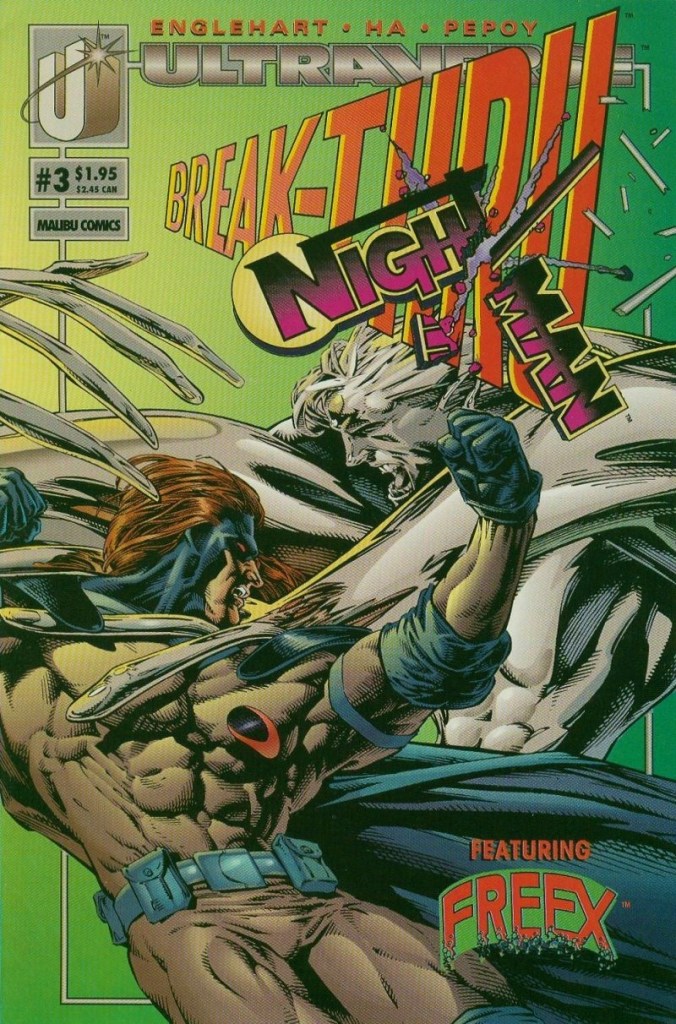
Welcome back, superhero enthusiasts, comic book collectors, 1990s pop culture enthusiasts and fans of Malibu Comics! Today we return to the Ultraverse through the 3rd issue of The Night Man series. While the Night Man continues his pursuit of a rather deformed rival, this comic book is a spin-off of the Ultraverse crossover Break-Thru and it also marks the protagonist’s continuing crossover with Freex (which officially started in Freex #6).
With those details laid down, here is a look back at The Night Man #3, published in 1993 by Malibu Comics with a story written by Steve Englehart and drawn by Gene Ha.
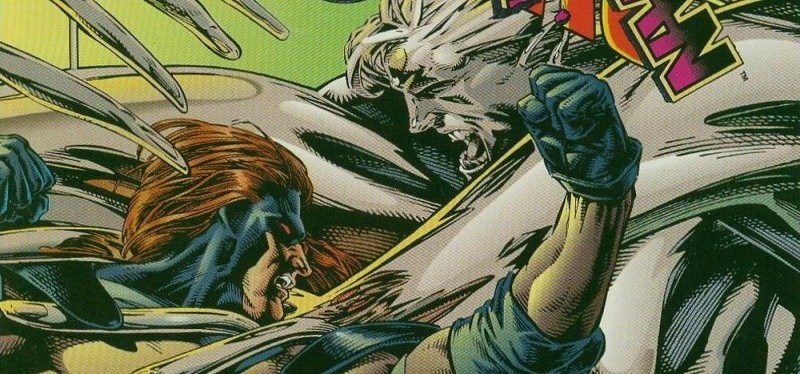
The cover.
Early story
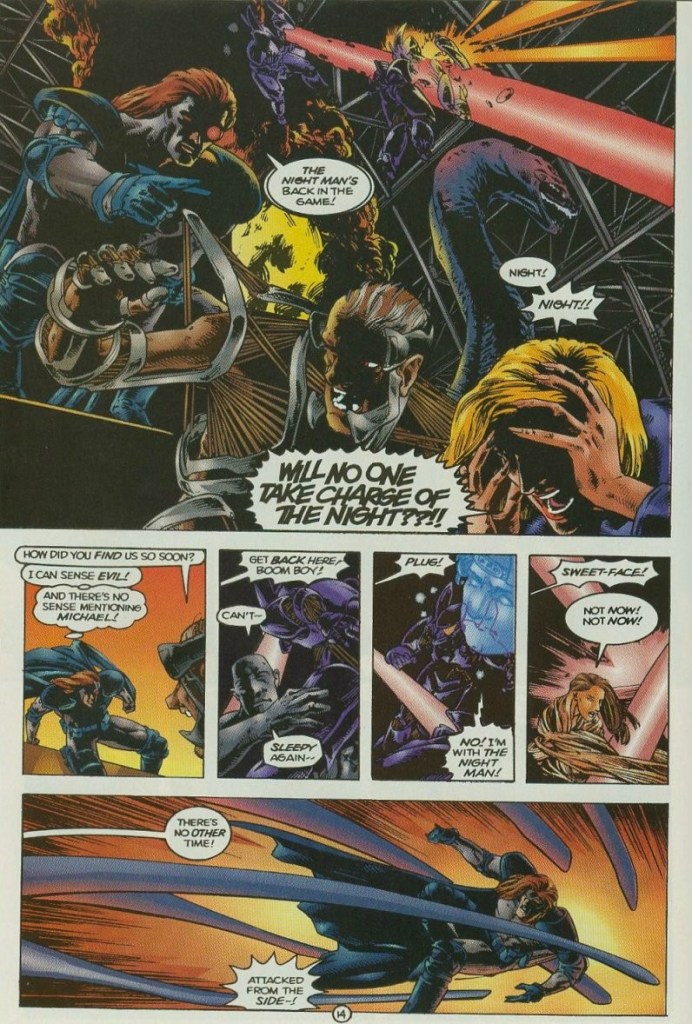
The story begins with Night Man overlooking a portion of a major city from a high tower. He wonders how he could find five kids, referring to Freex who have gotten involved with his rival Mangle. For Night Man, the team of teenagers think Mangle is a freak like them and he knows that his rival targets kids as victims.
After acquiring almost a thousand Dollars worth of new equipment, he goes on the air reaching out to Freex. Freex, meanwhile, are with Mangle hiding inside am unknown place. After a news report was aired revealing that the Strangers used a rocket to go to the moon and mentioned J.D. Hunt’s name, Mangle reacts loudly and states that the said business tycoon will be at Moffett Field.
Freex, believing that Hunt can cure them, leave with Mangle by car…
Quality
Night Man, Mangle and Freex!
With regards, Steve Englehart raised the stakes and added a lot of intrigue throughout the story. Without spoiling the plot, I can say that I enjoyed the pay-off executed here in relation to what was built up in Freex #6 and The Night Man #2.
The biggest selling point of the story is not the crossover between Night Man and Freex, but rather the presentation of JD Hunt and his young but wicked son Guy, as well as their involvement with Mangle. Themes explored in this comic book include manipulating a person to actually believe what evil acts he commits are not evil, and the manipulation of helpless youth to join a wrongful cause.
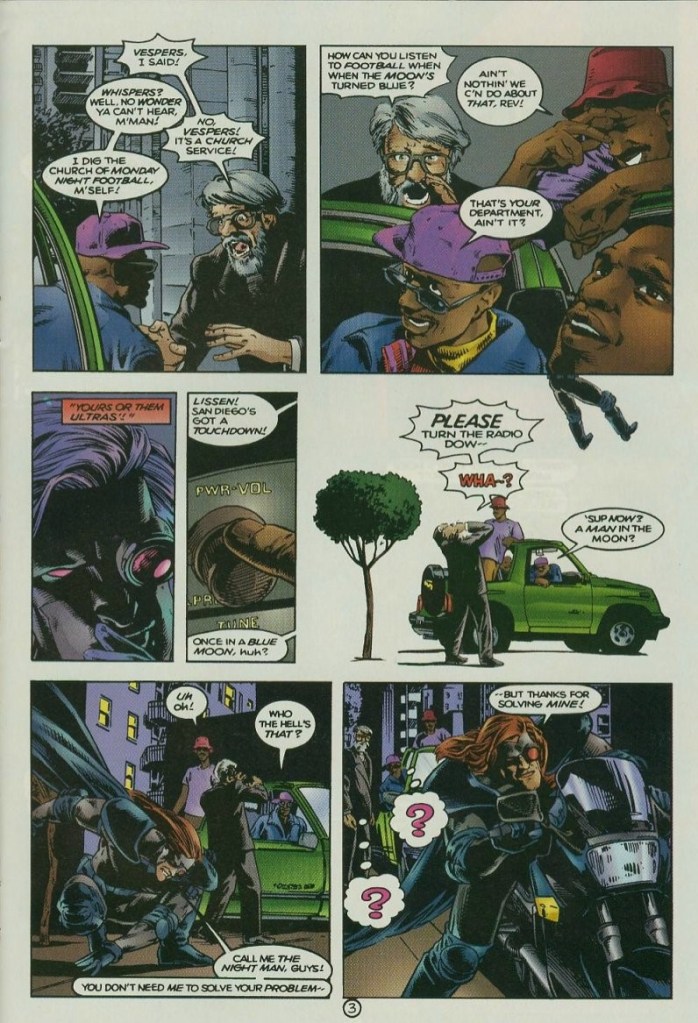
As for the title character himself, Night Man does more than just action and solving problems. You will see a more ethical side of his personality and his insistence on doing what is right without ever going overboard.
Conclusion
Night Man learning something from the people on the street.
The Night Man #3 (1993) is an enjoyable and compelling part of the Break-Thru crossover (with creative connections to what happened in Prototype #5 and The Strangers #7) that also succeeds in developing Night Man further while showing more personality from JD Hunt and his son. The crossover between Freex and the title hero, again, did not last long but this is understandable considering the focus on the Hunts and Mangle. Lastly, I should state that artist Gene Ha’s dark and gritty style worked nicely in this comic book.
If you are seriously planning to buy an existing hard copy of The Night Man #3 (1993), be aware that as of this writing, MileHighComics.com shows that the near-mint copy of the comic book costs $16.
Overall, The Night Man #3 (1993) is recommended.
+++++
Thank you for reading. If you find this article engaging, please click the like button below and also please consider sharing this article to others. If you are looking for a copywriter to create content for your special project or business, check out my services and my portfolio. Feel free to contact me as well. Also please feel free to visit my Facebook page Author Carlo Carrasco and follow me at HavenorFantasy@twitter.com
Rather it’s about a pretty notable game (plus its sequel) from the 1990s that I completely missed out on. The big surprise to me was that it will be released soon for Xbox One and Xbox Series S and X owners to enjoy.
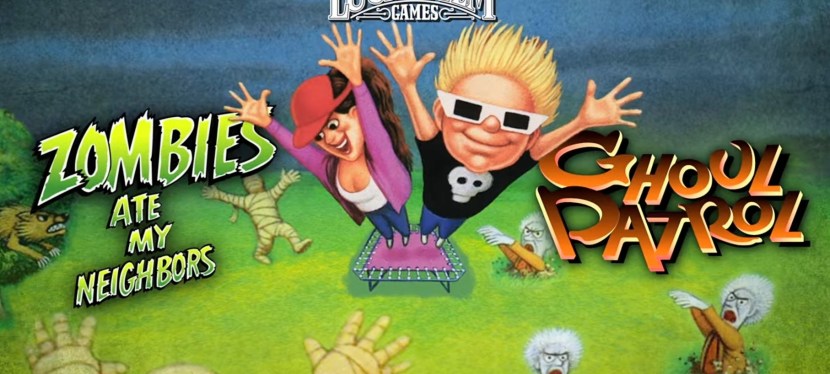
For those who are not familiar with either game, here is an excerpt from the Xbox.com article written by Ken Humphries (Senior Producer on the two games)…
Zombies Ate My Neighbors
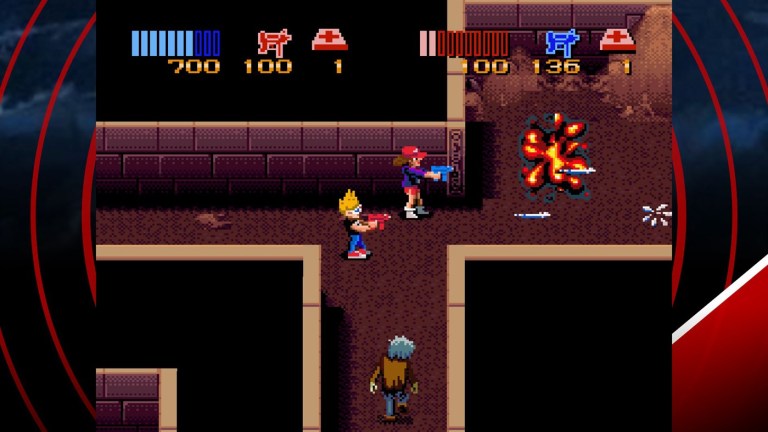
The 2-player function is a popular feature of the game.
Hey, where’s that scary music coming from? Yikes! It’s Zombies Ate My Neighbors, where you appear in every demented horror flick ever to make you hurl ju-jubes.
What are Zeke and Julie, our two wholesome teenage stars doing in a 16-bit game like this?! Trying to save the nice neighbors, cheerleaders, and babies from a fate worse than polyester!
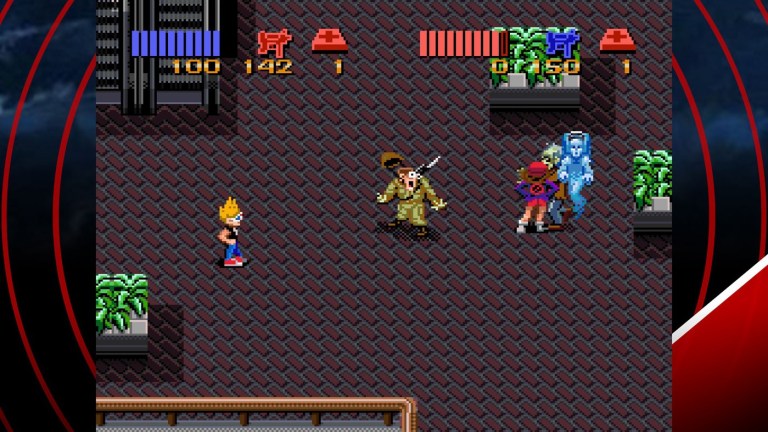
Who could put this slice of suburbia in such goose-pimply hysteria? Zombies, relentless chainsaw maniacs, mummies, evil dolls that just won’t die, lizard men, blobs, vampires, giant ants, martians, and more.
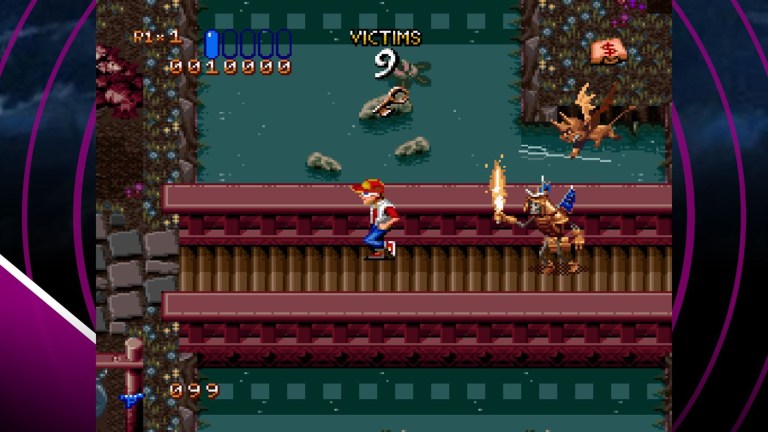
One of many levels in this game.
Will these crazy kids survive the night? Find your way through 55 horror-filled levels like a grocery store gone bad, a shopping mall awry, a mysterious island and your own back yard. Don’t miss “Weird Kids on the Block,” “Mars Needs Cheerleaders,” and “Dances w ith Werewolves.”
You can fend off the freaks with a virtual candy counter of weapons like uzi squirt guns, exploding soda pop, bazookas, weed wackers and ancient artifacts. Also grab power ups-o-rama like secret potions and bobo clown decoys. Does this game ever end?!
Ghoul Patrol
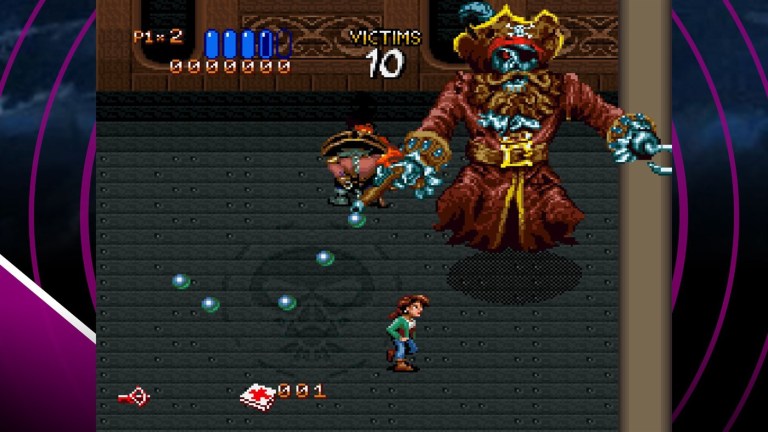
Nothing like facing an over-sized enemy in Ghoul Patrol.
Zeke and Julie, our intrepid teenagers, visit the Ghosts and Ghouls exhibit at the city library, where they find an old treasure chest containing an ancient spirit book. Naturally, they cannot resist reading it. Suddenly, a horrific snaggle-toothed spirit emerges.
Now, this snarling phantom and his dastardly minions are infesting Metropolis and slithering their way into the history books, where they plan to rewrite history with their spooky ways. Only you have the power to go back in time to de-spook an encyclopedia of zombified historic dudes.
Were you able to play this game back in the 1990s?
Terminate, with prejudice, using crossbows, ping-pong ball machine guns, Martian “Heatseeker” guns, and more.
Vaporize garbage can ghosts and ninja spirits, rescue bug-eyed librarians and wigged-out pirates, dodge flying books and adolescent-eating plants!
The features for Zombies Ate My Neighbors and Ghoul Patrol are as follows…
NEW FEATURES
• Save Feature: Quickly save your progress in either game and continue your adventure wherever and whenever you want
• Museum Features: Watch a video interview with one of the original Zombies’ developers or explore numerous galleries containing game art, previously unreleased concept images and marketing assets
• Soundtrack: Listen to the entire soundtracks for both games in the included music players
• 2 Player Mode: Play the game with two player local co-op
• Achievements: Track your game progress with a set of achievements covering both games
To put things in perspective, Zombies Ate My Neighbors was released in 1993 published by Konami (game developed by LucasArts) for the Super NES (SNES) and the Sega Genesis. It was not a big commercial success but it proved to be a hit with the critics of the time (plus the writers who published their reviews of it years later). Zombies Ate My Neighbors gained a cult following as it not only had enjoyable gameplay, its visual style was appealing, it had lots of visual elements related to pop culture (notably horror genre elements), a memorable soundtrack and more.
In a 2006 article published by IGN, Zombies Ate My Neighbors was described by Lucas M. Thomas as “a comical 16-bit template for the new Xbox 360 release, Dead Rising. And like that game, this one arms you with a pretty bizarre arsenal. Weed whackers, exploding soda cans and flying silverware all make an appearance to help you, or you and a friend, put a hurt on these living dead.”
Ghoul Patrol was released in 1994 for SNES, published back then by JVC (Japan Victor Company) with the development done by LucasArts. Like its predecessor, I never got to play it back decades ago. In addition, I never even saw a copy of the sequel at retail during those days.
As I never got to play Zombies Ate My Neighbors back decades ago, its upcoming release for Xbox is a very delightful surprise for me personally. I will order this (along with Ghoul Patrol) very soon.
If you are interested to order in advance Zombies Ate My Neighbors and Ghoul Patrol for your Xbox One or Xbox Series console, click here.
In ending this piece, posted below is a video retrospective on Zombies Ate My Neighbors published by GamerThumbTV plus a retro review by Cinemassacre. Be mindful of potential spoilers.
+++++
Thank you for reading. If you find this article engaging, please click the like button below and also please consider sharing this article to others. If you are looking for a copywriter to create content for your special project or business, check out my services and my portfolio. Feel free to contact me as well. Also please feel free to visit my Facebook page Author Carlo Carrasco and follow me at HavenorFantasy@twitter.com
Disclaimer: This is my original work with details sourced from watching V: The Original Miniseries and doing personal research. Anyone who wants to use this article, in part or in whole, needs to secure first my permission and agree to cite me as the source and author. Let it be known that any unauthorized use of this article will constrain the author to pursue the remedies under R.A. No. 8293, the Revised Penal Code, and/or all applicable legal actions under the laws of the Philippines.
Way back in 1983, I was fortunate to watch the 2-episode sci-fi mini-series on television titled V: The Original Miniseries. Because there was no Netflix, no YouTube, no Internet access and no DVD at the time, getting to replay the said mini-series as well as its sequel V: The Final Battle was really hard. Replays of them on local TV rarely happened.
Then in 2001, V: The Original Miniseries was released on DVD format and I got to watch it all over again with a good amount of enjoyment. In recent times, I purchased the Blu-ray release and replayed the original miniseries in high-definition at last!
You must be wondering if the original mini-series aged well through the decades, and is it still good to watch by today’s standards? While I will comment about its overall quality below, what I can say is that its theme about people fighting to be free from fascism, oppression, terrorism and dictatorship remains relevant to this day.
For his part, star Marc Singer stated: “I think themes of what holds society together and what tears society apart, those themes are universal themes and I think they’re always going to be relevant. I think there’s going to be a necessity for things like V to be revisited in order that society remember what it is that’s cohesive and coherent about it and why is it that we should all stand together and treat each other well.”
With those details laid down, here is a look back at V: The Original Miniseries, written and directed by Kenneth Johnson. The first episode was broadcast on television in the United States on May 1, 1983.
V: The Original Miniseries
Early story
The story begins in El Salvador where camera operator Mike Donovan (Marc Singer) and his companion Tony risk their lives capturing footage of an armed conflict. As the two tried their best to move away from the heat of battle, a helicopter of the enemy tracks them and corners them. Just as hope seems lost for Mike Donovan, the helicopter suddenly flies away. He turns to the other direction and witnesses the presence of a huge, floating saucer-like space ship coming his way. He begins to record footage of it.
Soon enough, several other space ships arrive and float above many other cities around the world. In America, medical student Julie Parrish (Faye Grant) and her colleagues carefully watch the TV news coverage. In a nice neighborhood, several residents – including Robin Maxwell (Blaire Tefkin), Eleanor Dupres (Neva Patterson), Daniel Bernstein (David Packer) and his grandfather Abraham (Leonardo Cimino) to name a few – marvel at the sight of a space ship above them. At another location, the research of scientist Robert Maxwell (Michael Durrell) and his colleague got interrupted with the arrival of a space ship.
The Visitors formally begin their new relationship with the people of Earth.
Diana of the Visitors played by Jane Badler.
Some time later, the Visitors make verbal contact with the people around the world using varied languages of Earth. In a special arrangement held at the top of the United Nations (UN) building in New York closely viewed on TV by the general public, the Visitors reveal themselves represented by John (Richard Herd) who expresses their message of reaching out peacefully to the people of Earth, seek their help and, in return, share with them their advanced technologies that could help humanity a whole lot for future generations. The Visitors are human in appearance but speak with very distinct sounds.
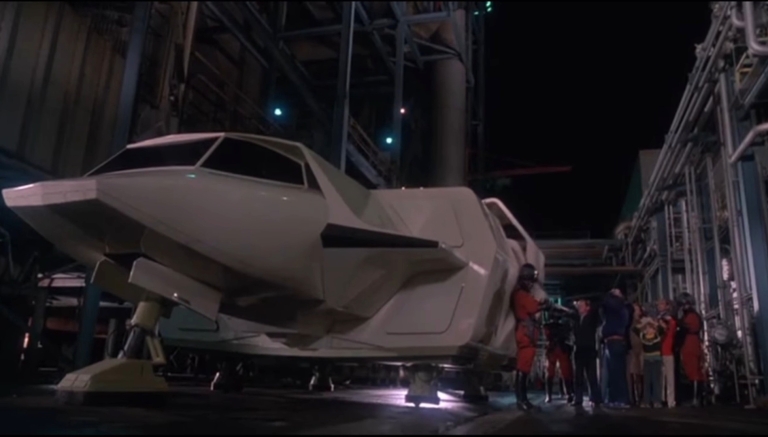
As a result, the governments of Earth agree to the offer of the Visitors and establish ties with them. Symbolically, a large group of Visitors’ engineers led by Diana (Jane Badler) and security chief Steven (Andrew Pine) arrive at a refinery to formally begin collecting chemicals and minerals.
Then things start to turn bad…
Quality
I can clearly declare that the writing and directing done by Kenneth Johnson remains great, and for many reasons why. On storytelling, Johnson (who was inspired by the anti-fascist novel It Can’t Happen Here and made an adaptation of it before finally coming up with V) clearly took his time on establishing the core concept stage-by-stage, and he also found efficient ways of explaining details to viewers by using in-story news reports and videos and retrospective as effective tools of exposition (these helped cut down the reliance on expository dialogue).
As the story goes on, Johnson carefully introduced the many characters on-screen (including the use of quick introductions of some characters who are located away from others they are connected/related with), established who they are and, most notably, showed how the events that took place affected them.
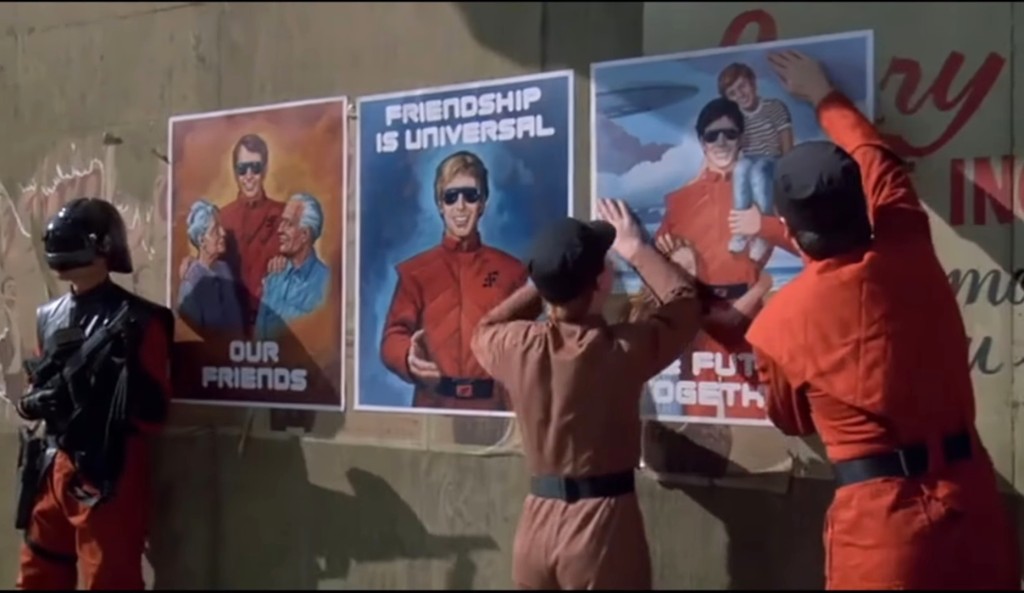
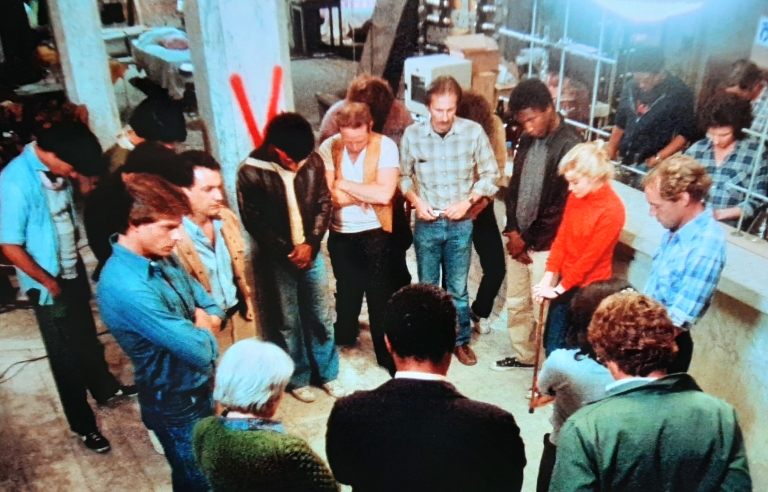
The Visitors (and one member of their youth auxiliary movement wearing brown) posting propaganda material to condition people’s minds they are friendly and trustworthy. These posters are familiar to many Nazi propaganda materials used in Europe decades earlier. Prior to the release of the Original Miniseries, a real-life marketing campaign of putting up such posters happened in real life.
Johnson also used symbolism which reflects what happened decades ago in Europe with the rise of the Third Reich. The Visitors’ symbol resembles the Nazi Swastika while the persecution of scientists (as well as their families and associates) resembles the Nazi persecution of Jewish people, and the scene of Daniel Bernstein joining the Visitors through their “Friends of Visitors” movement recalls memories of the Hitler Youth. I should state that Earth citizens who chose to collaborate with the aliens from space (strongly symbolized through Eleanor Dupres), images of the armed Visitors watching several helpless Earth people being taken away from their homes and the dominance of propaganda over the free press also reflect what happened back in World War II when the Nazis occupied many parts of Europe. The fact that Johnson used alien humanoids as the Visitors make them a more universal antagonistic force that viewers can relate with.
When it comes to the cast members and their respective performances, there is a whole lot to enjoy here and I can confirm that the quality of dramatic performances is pretty good and adds a whole lot of believability to the story. The most notable performer here is none other than Faye Grant who believably portrayed Julie Parrish on her in-depth transformation from a promising medical student to a reluctant organizer of a movement of freedom-loving people called the Resistance. Faye Grant excellently portrayed emotions and even showed the fragile side of Julie as she struggles to strengthen herself to lead her fellow people who seek freedom and survival. Julie also is the most charismatic and likable character in my view.
Marc Singer’s Mike Donovan is the closest thing this miniseries has to an action hero. Donovan is not a soldier, nor a policeman, nor a combat specialist. He is a hard-working media employee who has covered a lot of armed conflicts overseas and along the way he learned how to fight. As he is not a fighting machine, Donovan was portrayed to be vulnerable and really ends up struggling a lot. In a way, Donovan symbolizes people who take action once they realize what is wrong and what lies they have been fed with. It should be noted that before Bruce Willis wowed audiences as the vulnerable hero John McClane in Die Hard, Marc Singer’s Donovan was the vulnerable and struggling action performer realized ahead in time. On the dramatic side, Donovan’s talk with his mother Eleanor is a great scene to watch, and his contrast with Kristine Walsh (Jenny Sullivan) must be seen! If you ask me, Mike Donovan is Marc Singer at his best!
Faye Grant’s portrayal of Julie Parrish is highly believable complete with a good range of emotions. Her character development all throughout the Original Miniseries is very believable.
Marc Singer as Mike Donovan.
The other most notable role is none other than the Visitors’ commander Diana excellently played by Jane Badler. Diana was played to be charismatic, powerful, and sadistic at the same time. She is not a mere evil figure nor is she your typical pure evil antagonist. In fact, she is the powerful extension of an unseen high authority of the aliens and this alone makes her worth your attention. Also, through her interactions with her fellow aliens Steven and Brian (Peter Nelson), you will see very interesting traits of Diana’s personality. I should state that Jane Badler’s eyes and expressions really gave her character a very commanding presence on-screen. Even though her screen time is not dominant, Diana’s impact remains very strong.
As for the other cast members and their contributions in the film, I can state that Robert Maxwell was excellently portrayed by Michael Durrel to be the very caring father striving to protect his family even as society has been manipulated to demonize scientists like him. Daniel Bernstein is clearly the traitorous Earthling who has gotten so involved with the Visitors, and I am confident that David Packer will get on your nerves. Willie is the good-natured Visitor who tries to fit in with the people of Earth and his friendship with Harmony Moore (Diane Cary) is very symbolic. Given the reputation of Robert Englund as a horror icon, his performance as Willie is a must-see!
The most notable of all the supporting cast members here is none other than Leonardo Cimino’s Abraham Bernstein who is a Jewish man who went through the Holocaust and survived to establish the family in America only to see evil return in the form of the Visitors. His dramatic scene of protecting a certain family is a must-watch, and most likely it will stir your emotions.
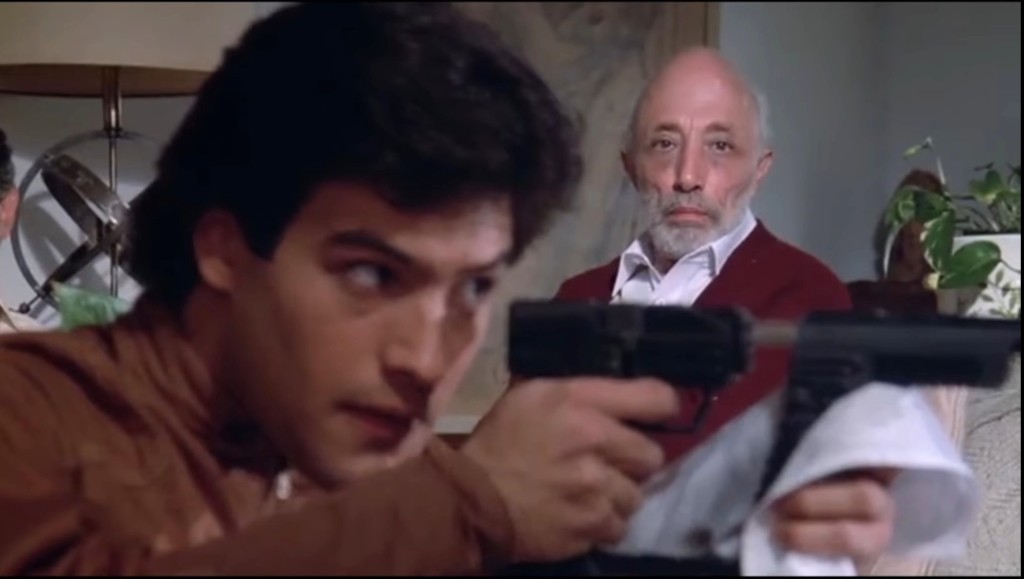
This scene shows the contrast between Abraham Bernstein (Leonardo Cimino) in the background and his grandson Daniel (David Packer) in the foreground. Abraham is an old Jewish man who went through the Holocaust and lived on. Daniel, who is 17-years-old, willingly joined the Visitor’s youth auxiliary movement which parallels that Hitler Youth.
In addition to being successful with telling the story, spreading the details and getting solid performances from the cast, Kenneth Johnson also proved to be really crafty with the way the camera captured images and how the very important moments were presented to captivate viewers. Johnson’s work here is clearly a labor of love. As for the music, Joseph Harnell did a good job overall. His style gives V a distinct aesthetic on tunes and I noticed his music becomes more lively late in the 2nd episode. Harnell also knew how to add musical excitement when the narrative needed a boost of energy or speed.
People of Earth, including children, are helpless under the Visitors.
Last but not least, I want to talk about the action and visual effects here. The action is, for the most part, raw and believable to watch. The action performers dressed as the Visitors never looked like they were trained but at least their ways of positioning themselves to fire their laser weapons made up for it. The hard action has that raw aesthetic which I actually liked because the action performers – including Marc Singer himself – were convincing with the way they exerted efforts. In this modern age of wire works and digital effects, seeing raw action and real human effort combined with risk taking is refreshing to watch.
More on the action scenes, I should state that the concept of showing the humans using conventional guns against the laser-armed Visitors was done in a satisfying and believable manner on-screen. Such concepts could have turned out bad had Kenneth Johnson and his team lacked talent and precision. As for the visual effects, they resulted a mixed bag as far as quality and artistry are concerned. While the laser blasts still look very good (and their impact was felt thanks to excellent timing with the on-set explosions and fireworks), the huge motherships really look dated as they were matte images (not miniatures), and in a few shots the matte lines were clearly exposed in high-definition which broke the immersion for me. The smaller space crafts that were shown flying also had that similar, out-of-place look (note: they did not match the lighting of the live-action footage). Still, the practical effects used are good to see and the matte paintings used for two key shots in the 2nd episode were photo-realistic.
Conclusion
The free and righteous praying to the Lord.
As it is clearly still great and engaging to watch, V: The Original Miniseries (1983) certainly aged well, it remains essential to watch even by today’s standards and most of all, its theme about the conflict of freedom and dictatorship makes it completely relevant to this day. It is a reminder about what your part in your society is, who you are, what your values are, and why you have freedom in your local society which can be destroyed by an alienating force once your fellow people refuse to resist it. As mentioned earlier, the cast is great and I am confident that you readers will find a character or two to relate with.
The focus of this miniseries on fascism invading the lives of the free people easily reminds me about how, in this modern age, sinister influences like Marxism, socialism, Communism, unrestrained political correctness and fascism poisoned the minds of millions of people through the academic system and turned them into social rebels, domestic terrorists, looters, rioters and new criminals who are so determined to go against their fellow people who do not share their beliefs. In modern-day America, the ongoing movements of Black Lives Matter, Antifa, SJWs, the anti-Semitic BDS movement, the rabid LGBTQ+ movement, the so-called democratic socialists and other agents of Satan have been harming patriotic Americans, attacking their values, taking the innocence of the youth and children away, destroying businesses and tearing down societies as we know it. The 1983 mini-series will remind you that from time to time, social order will be pushed hard by the invaders (be it people or be it influences so alien to the society) and the people who are righteous can choose to restore the said order as well as their respective lives.
Seriously, if you value your freedom, your culture, your values, your people and your faith in the Lord, you certainly would not want to submit yourselves to a foreign people who intend to destroy you.
No matter what happens, people should never lose faith in the Lord and they must look up to Him for deliverance. The Lord will punish the wicked and make ways happen to lift up the faithful. Clearly, V’s theme about the fight for freedom is truly universal.
Symbolism and socio-political relevance aside, V: The Original Miniseries (1983) also comes with a good amount of spectacle that make sense within the narrative. Do not expect to see extensive, over-the-top action scenes of modern-day cinema/television here but I assure you that the spectacle (note: even with the flawed matte imagery of the visual effects) in this production paid-off nicely in relation to the build-up of events throughout the story.
I strongly recommend you acquire V: The Original Miniseries on Blu-ray while it is still available. Watching it in high-definition is a great experience on my part.
Overall, V: The Original Miniseries (1983) is highly recommended! That being said, I strongly encourage you to buy it on Blu-ray disc format while it is still available and affordable. If you want more of Kenneth Johnson’s other work related to V, I suggest you to look for his book V: The Second Generation. Don’t forget to visit Johnson’s website at http://www.kennethjohnson.us/
+++++
Thank you for reading. If you find this article engaging, please click the like button below and also please consider sharing this article to others. If you are looking for a copywriter to create content for your special project or business, check out my services and my portfolio. Feel free to contact me as well. Also please feel free to visit my Facebook page Author Carlo Carrasco and follow me at HavenorFantasy@twitter.com
For more V-related writings of mine, check out my retro comic book reviews of the V comic books (published by DC Comics) issues #1, #2, #3 and #4.
Disclaimer: This is my original work with details sourced from reading the comic book, watching the V mini-series (Original Miniseries and The Final Battle) and the 1984 TV series, and doing personal research. Anyone who wants to use this article, in part or in whole, needs to secure first my permission and agree to cite me as the source and author. Let it be known that any unauthorized use of this article will constrain the author to pursue the remedies under R.A. No. 8293, the Revised Penal Code, and/or all applicable legal actions under the laws of the Philippines.
Welcome back, science fiction enthusiasts, comic book collectors and fans of the V entertainment franchise of the 1980s! Before I start this newest retro comic book review, I am happy to say that I recently received at last my copy of V: The Original Miniseries on Blu-ray disc format! It definitely is a major upgrade and it is the best yet! That being said, looking back into the past, I got to watch V: The Original Miniseries on television, video tape, DVD and now on Blu-ray disc format from 1983 to this year! If you are a fan and you are interested to buy yourself the original mini-series on Blu-ray disc format, head on to Amazon. Now we can return to the 1980s comic book series.
Last time, a small team of the Resistance encountered the Visitors who arrived at an isolated small town in California to collect something precious which is the result of the aliens’ special ties with the locals. That story ended nicely.
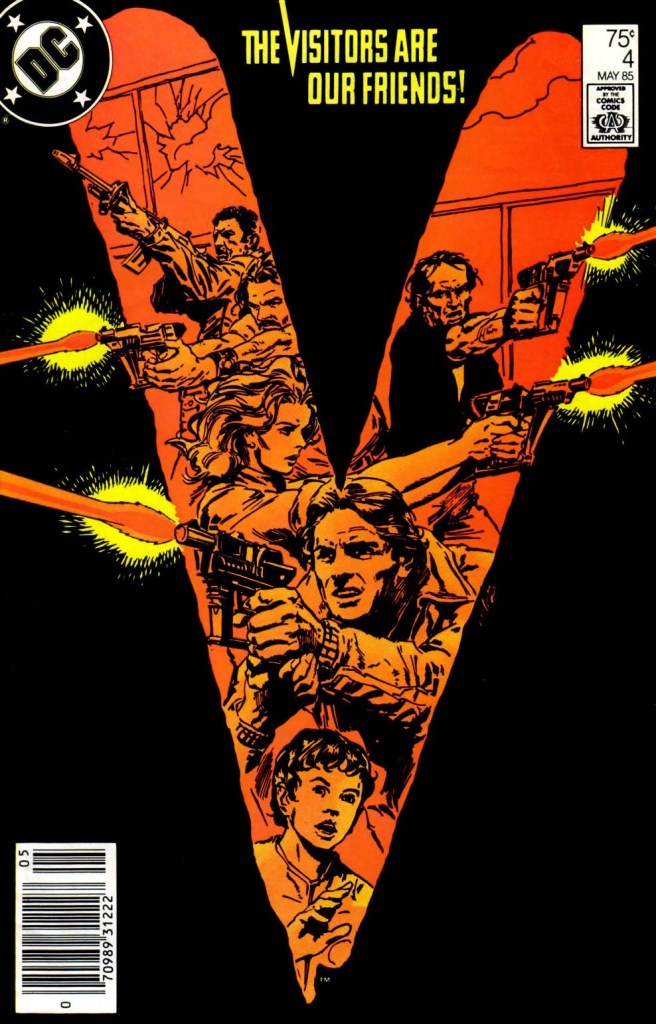
With those details laid down, here is a look back at V #4, published in 1985 by DC Comics with a story written by Cary Bates and drawn by Tod Smith.
The cover.
Early story
The story begins with Lorne, a Visitor whose fake human skin on his face got damaged a lot, his reptilian skin and eye have been exposed. He brought with him a transport (carrying what looked like human bodies) and tries to enter the Science Frontiers building to meet with a certain Mr. Bates.
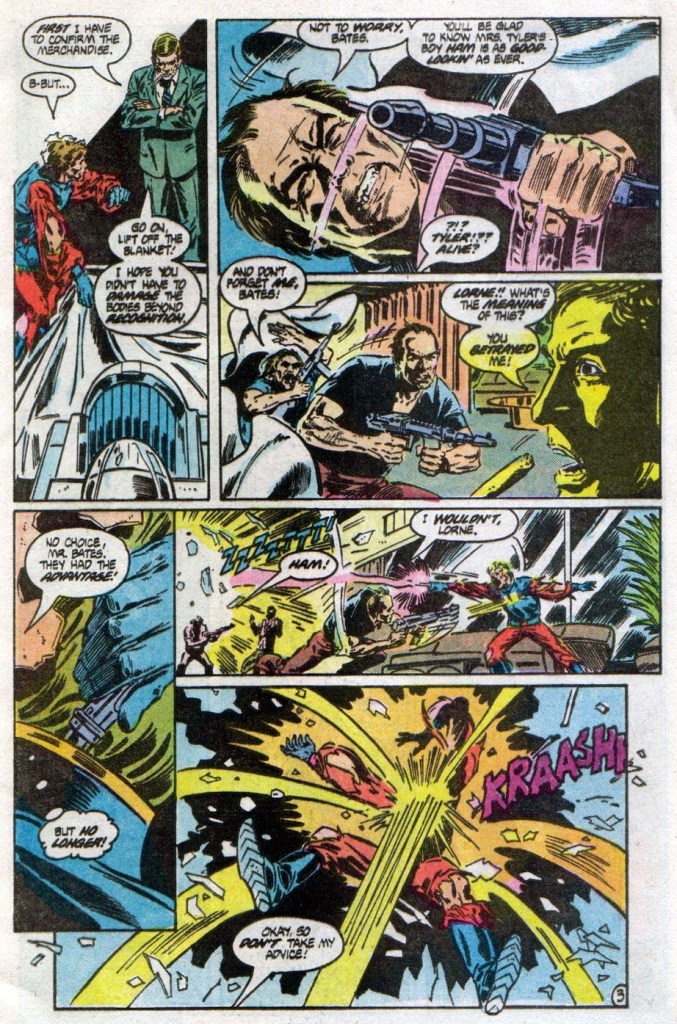
Inside, Lorne meets with Bates who turns out to be his client and eagerly wants to get paid. Bates wants to see first the bodies brought to him and when Lorne pulls the blankets, Ham Tyler and Chris Farber suddenly come out to take on them both. Lorne is pushed out of a nearby window falling several feet down. Ham and Chris cornered Bates who turns out to be dealing with Diana of the Visitors.
Meanwhile in Los Angeles, Mike Donovan and Julie Parrish are having quality time together cherishing their relationship. They are enjoying the relief and relaxation after successfully surviving in a dangerous encounter with the Visitors at an isolated California town.
As they dance, Julie recognizes a well-known astronomer whose image appears on TV. She suddenly stops dancing and moves closer to the TV, leaving Mike puzzled…
Quality
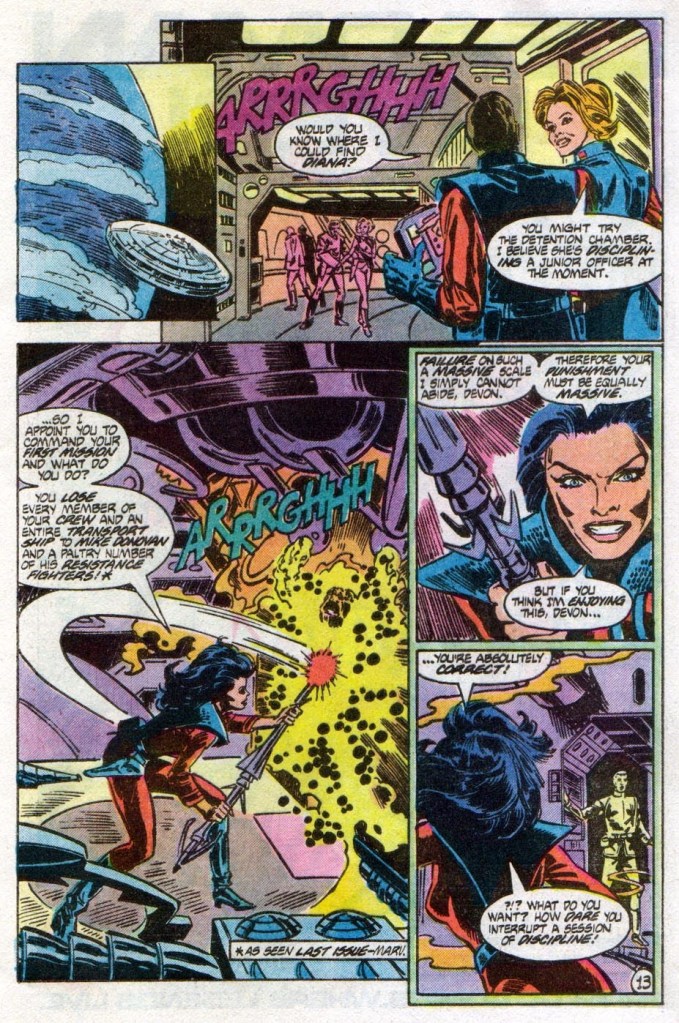
This shows how sadistic Diana is even towards her own people.
If there is anything that really stood out in this story, it is the entrance of astronomer Earl Meagan (modeled after Carl Sagan) whose presence not only attracts Julie but also rekindles the passion of science in her which she had during her days as a medical student (before the Visitors arrived). He was written to be highly intelligent and insightful which paves the way for the story to be laced with concepts about the so-called advancement of life forms that traveled through the galaxy and evolved. Meagan also symbolizes delusion resulting from scientific theories, as well as letting his own people down in favor of a foreign people.
More on the story, I should state that Cary Bates wrote this comic book to smoothly reconnect with V: The Final Battle by means of including the star child Elizabeth Maxwell who is now a young adult. The connections with the V TV productions solidified even further through more scenes of Diana whose evil nature and leadership tactics are dramatized here.
Conclusion
Ham and his pal take action!
The creative team delivered another solid and satisfying tale in V #4 (1985). This time around, the narrative got shaken with the introduction of Meagan, the sudden change of attitude of Julie, and the build up for more intriguing events to come in.
If you are seriously planning to buy an existing hard copy of V #4 (1985), be aware that as of this writing, MileHighComics.com shows that the near-mint copy of the regular edition costs $29 while the near-mint copy of the newsstand edition costs $38.
Overall, V #4 (1985) is recommended.
+++++
Thank you for reading. If you find this article engaging, please click the like button below and also please consider sharing this article to others. If you are looking for a copywriter to create content for your special project or business, check out my services and my portfolio. Feel free to contact me as well. Also please feel free to visit my Facebook page Author Carlo Carrasco and follow me at HavenorFantasy@twitter.com
Disclaimer: This is my original work with details sourced from reading the comic book and doing personal research. Anyone who wants to use this article, in part or in whole, needs to secure first my permission and agree to cite me as the source and author. Let it be known that any unauthorized use of this article will constrain the author to pursue the remedies under R.A. No. 8293, the Revised Penal Code, and/or all applicable legal actions under the laws of the Philippines.
Wow! What a journey it has been! Back in the 1990s, I could never forget the first time I read The Strangers #1 which was so captivating, I decided to follow its monthly series and it was easily my favorite superhero team of the Ultraverse. It was also my first time to see the collaboration of Steve Englehart and Rick Hoberg leading the creativity which, as the many months and issues went on, resulted a series that was never boring and often satisfying and fun to read. I should state that the literary team of strangers composed of Atom Bob, Grenade, Lady Killer, Yrial, Spectral, Zip-Zap and Electrocute was memorable. Truly Malibu Comics had very talented creators for the Ultraverse which eventually lasted just a few years (read: Marvel Comics acquired Malibu Comics).
This brings me to my next point…this retro comic book review is about the last issue of The Strangers monthly series ever published. As I love the Ultraverse, it is sorrowful to see the end of an enjoyable monthly series. In recent times, I reviewed the final issue of the Prototype monthly series (which itself was fun overall) which ended in a rather unsatisfying manner. Prototype’s final issue was not even written by the original creators of the series!
How will this final issue of The Strangers series turn out? We can all find out in this look back at The Strangers #24, published in 1995 by Malibu Comics with a story written by Steve Englehart and drawn by Rick Hoberg with inkwork done by Barbara Kaalberg.
The cover.
Early story
The story begins with Teknight, Spectral, Grenade, Lady Killer, Yrial, Zip-Zap and Electrocute back together (note: Lady Killer and Yrial went somewhere far in the previous issue). They talked about Electrocute’s codition, Atom Bob being in a comatose state at the Clinique de Parsival, and the dangerous encounter with Taboo.
Meanwhile inside a passenger jet flying above the North Atlantic, a man expresses his passion and fondness of the Strangers to the passenger sitting to his left. The said passenger wants to learn more about the team.
The following night at Union City in California, the same passenger knocks on the window of a van with a man and a lady kissing passionately inside. As the man comes out of the van feeling very annoyed, the passenger introduces himself to him as Taboo. A new team of TNTNT is being formed…
Quality
Pay close attention to the details on the words of Lady Killer.
To start with, I confirm that the usual high quality of writing and art by the Englehart-Hoberg duo is evident in this comic book. Not a single part of it looks rushed to me. The plot is very well structured and the visuals are great to see!
While the story is not as conclusive as I hoped it would be, it is still a lot of fun to read. For one thing, it’s nice to see the Strangers together again (note: Teknight has been with the team for some time already) and it was entertaining to see them face worthy opposition in the form of a new team of their rival TNTNT (with an obsessed Taboo as the new addition). The Strangers-TNTNT battle was not an all-out brawl but the match-ups were nicely done complete with really fun action scenes. I should state that not only did Rick Hoberg frame the action scenes greatly, he pushed his imagination up a few notches with regards to adding a lot of flair to the battle between Teknight and Taboo.
As mentioned earlier, this comic book was unfortunately the last of the series and clearly it was not written to be the end (note: the comic book ended with the anticipation of the celebration of the Jumpstart). There was a part in which Lady Killer told her teammates about using the funds they made from licensing to build for themselves their own headquarters and Grenade even mentioned having a room for Atom Bob in anticipation of a return. There was also a sub-plot about J.D. Hunt and his very rebellious son who clearly wants to do more while he exists. More on the battle between the Strangers and TNTNT, it’s clearly not decisive and in my own view, a rematch was needed.
Conclusion
The updated TNTNT.
As the final issue of its monthly series, The Strangers #24 (1995) is pretty entertaining on its own. It was definitely not a conclusive story and in fact, art was made for what could have been the 25th, the 26th and 27th issues of The Strangers (see the A Fond Farewell excerpt below). It’s too bad those conceptualized issues did not materialize because there was a lot of good and enjoyable stuff to read in this comic book. This only shows that Steve Englehart and Rick Hoberg still had more great and new stuff to tell through The Strangers.
If you are seriously planning to buy an existing hard copy of The Strangers #24 (1995), be aware that as of this writing, MileHighComics.com shows that the near-mint copy of the comic book costs $50.
Rick Hoberg’s farewell message plus art for what would have been The Strangers #25, #26 and #27.
Overall, The Strangers #24 (1995) is highly recommended!
+++++
Thank you for reading. If you find this article engaging, please click the like button below and also please consider sharing this article to others. If you are looking for a copywriter to create content for your special project or business, check out my services and my portfolio. Feel free to contact me as well. Also please feel free to visit my Facebook page Author Carlo Carrasco and follow me at HavenorFantasy@twitter.com
Disclaimer: This is my original work with details sourced from reading the comic book and doing personal research. Anyone who wants to use this article, in part or in whole, needs to secure first my permission and agree to cite me as the source and author. Let it be known that any unauthorized use of this article will constrain the author to pursue the remedies under R.A. No. 8293, the Revised Penal Code, and/or all applicable legal actions under the laws of the Philippines.
Way back in the mid-1990s, something special happened for Star Wars fans. A brand-new story involving Star Wars icons Luke Skywalker, Darth Vader and others would be told set between The Empire Strikes Back and Return of the Jedi. That story was called Shadows of the Empire and it was released as a special event in the form of a novel (written by Steve Perry), a video game on Nintendo 64 and PC, comic books, a soundtrack, posters, model kits, toys and action figures. What was missing here was a live-action movie.
To put things in perspective, the Shadows of the Empire multi-media event was done by Lucasfilm (note: when creator George Lucas was still in control) with its many business partners to reinvigorate the Star Wars franchise ahead of the planned special editions of the original Star Wars movie trilogy. From a business point-of-view, it made sense to release something new for fans to enjoy and more notably it was the chance for Lucasfilm and its creators to explore what happened between The Empire Strikes Back and Return of the Jedi.
A limited comic book series was released in 1996 and it involved the novel’s author as a story consultant. Back in those days, my comic book interest faded temporarily and even though I was still into Star Wars, I did not bother to buy and read the Shadows of the Empire comic books. The video game caught my attention a lot more back then. Fortunately, I found copies of the comic books and had the time to read them recently.
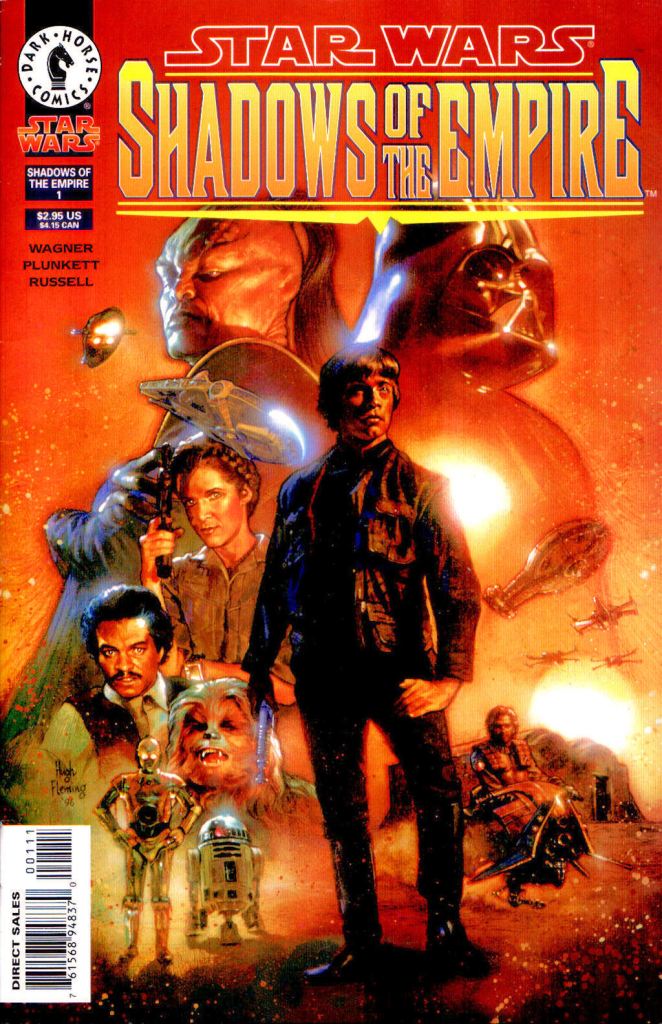
With those details laid down, here is a look back at Star Wars: Shadows of the Empire #1, published by Dark Horse Comics in 1996 with a story written by John Wagner and drawn by Kilian Plunkett.
The cover.
Early story
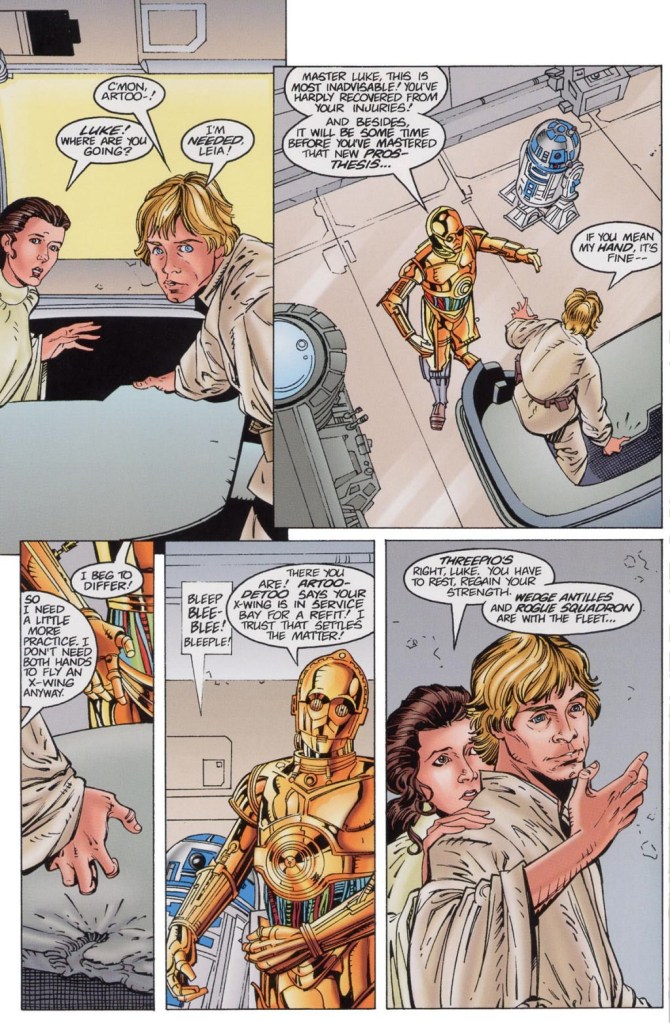
The story begins with a group of Rebel spaceships traveling together in the depth of space. Luke, who now has a mechanical hand and has been recovering from the terrible ordeal he went through at Cloud City, is with Princess Leia, C3PO and R2D2 in the medical frigate. The Rebels detect the presence of an approaching ship which they suspect to be hostile.
Luke suddenly decides to take action but is halted when he realizes that his X-wing fighter is still being refitted. In space, Wedge and the Rogue Squadron fly towards the Imperial Strike Cruiser which then releases some Tie Fighters. The personnel inside the Strike Cruiser tried to inform Darth Vader the location of the Rebel fleet…
Quality
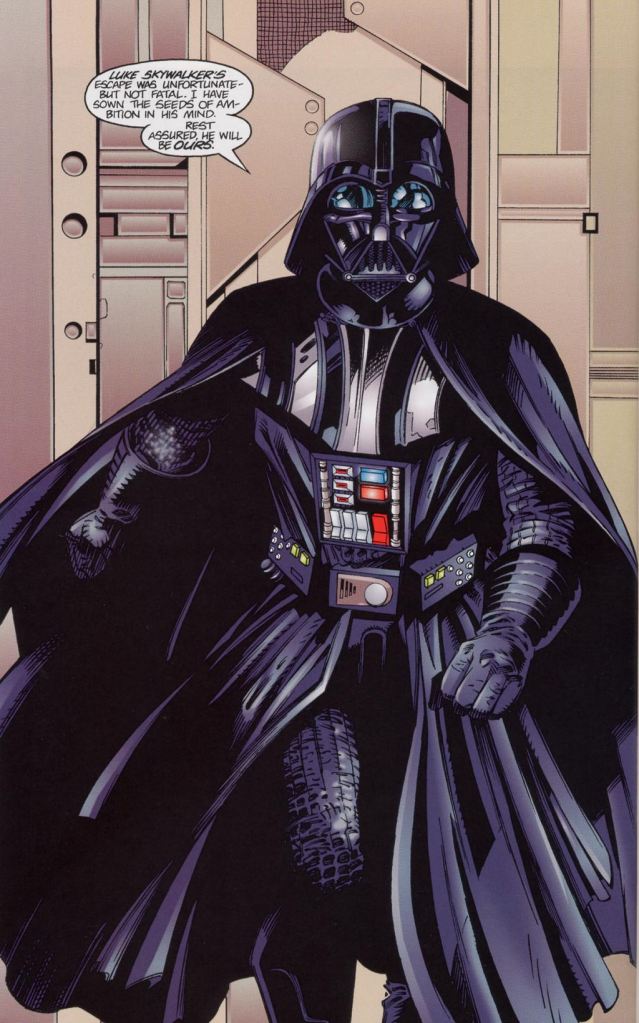
Darth Vader!
The first thing I want to mention is that the writing done by John Wagner is solid. That being said, the story itself felt like a natural continuation of The Empire Strikes Back especially when the comic book’s narrative is focused on Luke and the Rebels. The way the recovering Luke, Leia and the two droids were presented following the end of the 1980 movie was believable, and there was that nice touch of characterization when Luke has not yet adjusted with his mechanical hand.
The story then moves into new territory when the narrative shifts on the Imperial side, especially when Emperor Palpatine gives Darth Vader a new order that has nothing to do with pursuing Luke and the weakened Rebels, but more to do with the construction of the Empire’s new weapon. This is also where the new character Xizor comes in and his presence alone confirms something that the movies did not…the Empire is in business with crime syndicates with regards to major projects.
Space ship battles look great in this comic book.
When it comes to characterization, I like the way Darth Vader handled himself when communicating with Emperor Palpatine who viewed Luke’s escape from Bespin a failure on his part. Compared with his private communication with the Emperor in the 1980 movie, Vader bravely questions him about doing business with Xizor backed with his knowledge of the prince and the ties with Black Sun. Vader, who has been part of the Empire for a long time, knew well how risky it is for them to get involved with criminals especially when military cargo is involved.
As for the visuals, Kilian Plunkett does a decent job drawing the characters. While his take makes Luke recognizable and faltered a bit on capturing Leia’s look, his illustrations on Darth Vader, the Emperor and Xizor were really good. Where Plunkett exceled visually are the locations and surroundings, the machines and the space battles (some pages were drawn really dynamically).
Conclusion
This shows how Luke has not fully adjusted with his mechanical hand.
To put it clearly, Star Wars: Shadows of the Empire #1 (1996) has three narratives (the other is about Boba Fett carrying the frozen Han Solo) to build-up on and for a debut issue of a limited series, this one has strength in its execution complete with a good amount of creative stuff that will resonate with long-time Star Wars fans (and also those who love the original Star Wars movie trilogy). It succeeds in telling what happened shortly after the end of The Empire Strikes Back as well as establishing a new sub-plot with Xizor involved. By the time I finished this comic book, I was convinced to look forward to the next issue.
If you are seriously planning to buy an existing hard copy of Star Wars: Shadows of the Empire #1 (1996), be aware that as of this writing, MileHighComics.com shows that the near-mint copy of the regular edition costs $48 while the near-mint copy of the newsstand edition costs $144.
Overall, Star Wars: Shadows of the Empire #1 (1996) is recommended.
+++++
Thank you for reading. If you find this article engaging, please click the like button below and also please consider sharing this article to others. If you are looking for a copywriter to create content for your special project or business, check out my services and my portfolio. Feel free to contact me as well. Also please feel free to visit my Facebook page Author Carlo Carrasco and follow me at HavenorFantasy@twitter.com
Disclaimer: This is my original work with details sourced from reading the comic book, watching the V mini-series (Original Miniseries and The Final Battle) and the 1984 TV series, and doing personal research. Anyone who wants to use this article, in part or in whole, needs to secure first my permission and agree to cite me as the source and author. Let it be known that any unauthorized use of this article will constrain the author to pursue the remedies under R.A. No. 8293, the Revised Penal Code, and/or all applicable legal actions under the laws of the Philippines.
Welcome back, science fiction fans, comic book collectors and fans of the V entertainment series of the 1980s! Before I proceed with the newest retro review of the V comic book series, I must share to you – both V fans as well as those who plan to discover the 1980s mini-series and TV series – that V: The Original Miniseries, and V: The Final Battle are all available on Blu-ray disc format on Amazon while the V TV Series is available on DVD format. If you are eager to collect them for your home entertainment collection and with your passion for V of the 1980s still burning, I suggest checking them out now by clicking here, here and here.
Wow. It’s been several months since my review of V issue #1. Almost all the retro comic book reviews I published since then were about superheroes. After going through all the superhero stuff, going back to the V comic book series is refreshing on my part.
With those details laid down, here is a look back at V #2, published by DC Comics in 1985 with a story written by Cary Bates and drawn by Carmine Infantino.
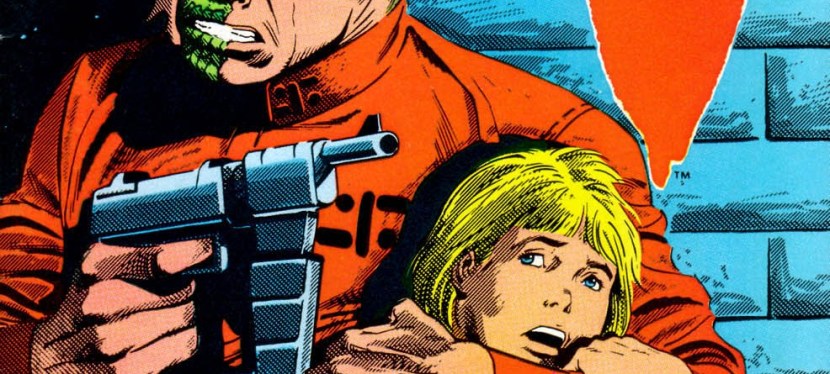
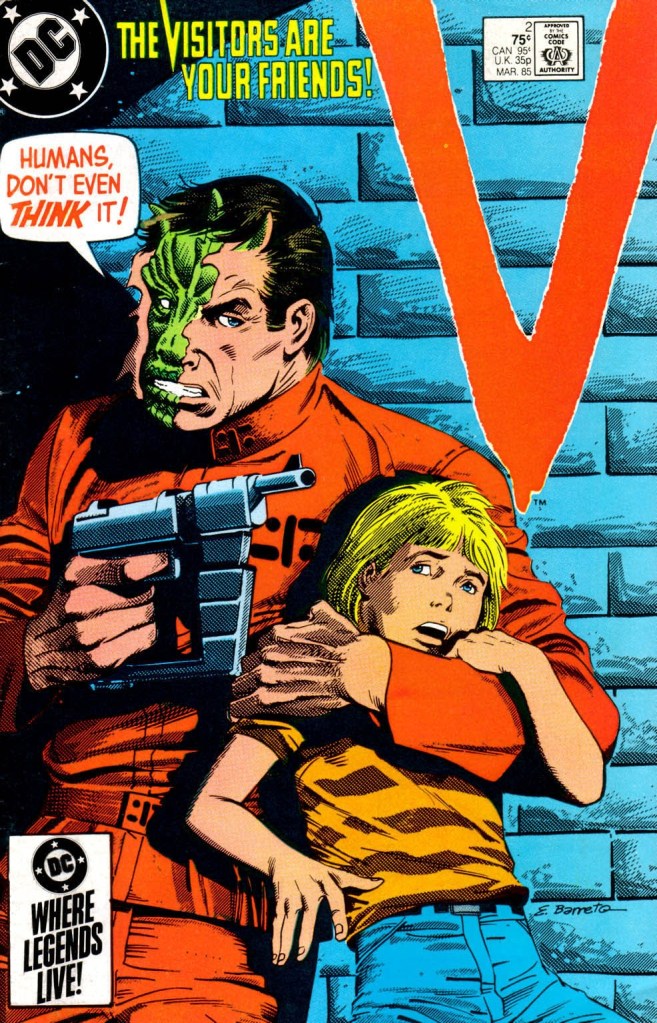
The cover.
Early story
The story begins in a desolate part of California where members of the Resistance get out of their downed skyfighter. They are actually a short walk away from a small town. Moments earlier, the local residents approached them with smiles and small crates containing something living. After Mike Donovan introduced himself to them, the locals were mystified and ran back to the town leaving the crates behind. It turns out, the town folks thought they were the Visitors and the way they reacted suggests that the race of Reptiloids from space were accepted by them.
Mike, Julie, Willie and Hart discover that the crates contained white mice (which are food for the Visitors) which they let go.
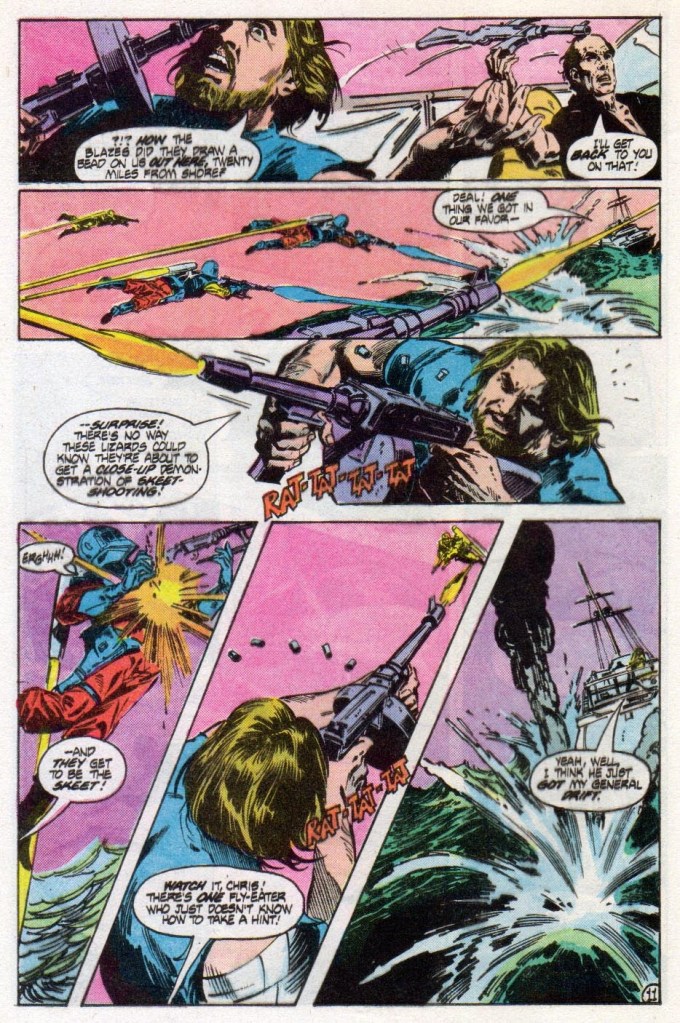
Elsewhere at the marina north of Redondo Beach, Ham Tyler and Chris Farber (still injured) are held at gun-point on boat which turned out to be a drug-runner model. The two Resistance members successfully fight back against the two armed men and quickly took the boat to head out to sea.
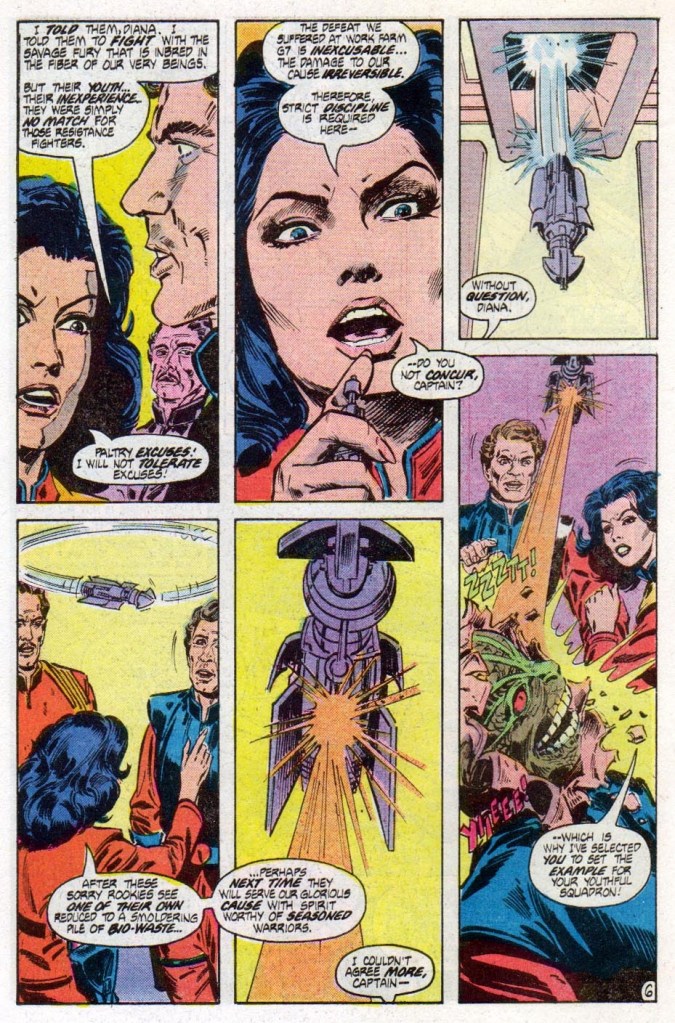
Inside the mothers ship orbiting Earth, the sadistic leader Diana rejects the claims of one of her soldiers over the failure related to work farm G7. Diana believes that because the soldiers have been among the humans for a long time, they learned to grovel like them. Finding the failure inexcusable, she releases a flying device that blasts one of them…
Quality
Ham and Chris take on the flying Visitors who approached them.
In terms of writing, this is indeed a solid follow-up to issue #1 and I can say that the creators succeeded in not only continuing to capture the essence of the established V characters, balancing exposition, spectacle and suspense carefully but also raised the tension in key moments of the story which added to the engagement.
What I liked most about this comic book is its concept about a small town whose people (average age is above 60-years-old) bonded with the Visitors, engaged with them with an incredible deal (this alone will make you revisit the first episode of V: The Original Miniseries) and trusted them a lot. This story will also encourage you to reflect upon the whole concept of V and even consider other factors such as how many humans died for their freedom, how Diana’s command impacted Earth, and more.
Conclusion
This scene display’s Diana’s ruthlessness and her own way of improving her squad by making examples that involve death.
To be very clear, V #2 (1985) is a very compelling comic book and it will surely resonate with fans who saw the Original Miniseries, The Final Battle and the TV series. The cerebral approach of this comic book made it a fun read.
If you are seriously planning to buy an existing hard copy of V# 2 (1985), be aware that as of this writing, MileHighComics.com shows that the near-mint copy of the regular edition costs $28 while the near-mint copy of the newsstand edition costs $35.
Overall, V #2 (1985) is highly recommended!
+++++
Thank you for reading. If you find this article engaging, please click the like button below and also please consider sharing this article to others. If you are looking for a copywriter to create content for your special project or business, check out my services and my portfolio. Feel free to contact me as well. Also please feel free to visit my Facebook page Author Carlo Carrasco and follow me at HavenorFantasy@twitter.com
Disclaimer: This is my original work with details sourced from reading the comic book and doing personal research. Anyone who wants to use this article, in part or in whole, needs to secure first my permission and agree to cite me as the source and author. Let it be known that any unauthorized use of this article will constrain the author to pursue the remedies under R.A. No. 8293, the Revised Penal Code, and/or all applicable legal actions under the laws of the Philippines.
Welcome back, superhero enthusiasts, comic book collectors, fans of 1990s culture and fans of Marvel Comics! Today we revisit the adjective-less X-Men monthly series (Volume 2) that started in 1991 with the combined talents of Chris Claremont and Jim Lee. For those who are unaware, Chris Claremont had his conflict behind the scenes with then X-Men comics editor Bob Harras which led to him departing the X-Men series with issue #3.
Previously I reviewed X-Men #4 which by today’s standards is highly significant and very expensive to acquire as it marked the literary debut of Omega Red who made quite an impact with X-Men fans. It should be noted that Wolverine and Omega Red had encountered each other far back in time and issue #4 marked the renewal of their rivalry.
With those details laid down, here is a look back at X-Men #5, published in 1992 by Marvel Comics with a story written by Jim Lee (plot) and John Byrne (script), The art was done by Lee with ink work done by Scott Williams, Art Thibert, Bob Wiacek and Joe Rubinstein.
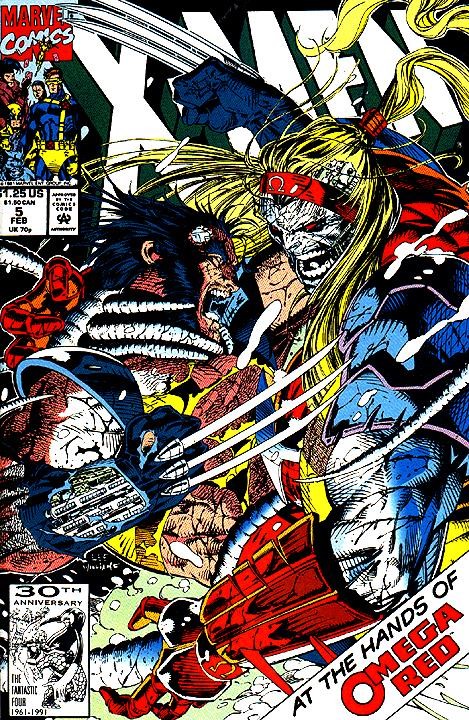
The cover.
Early story
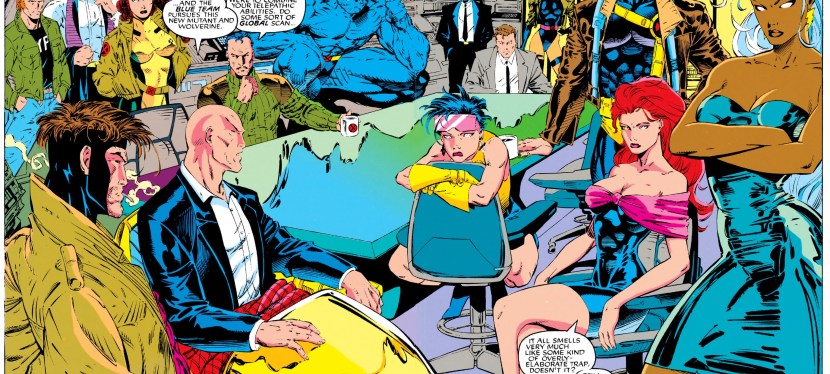
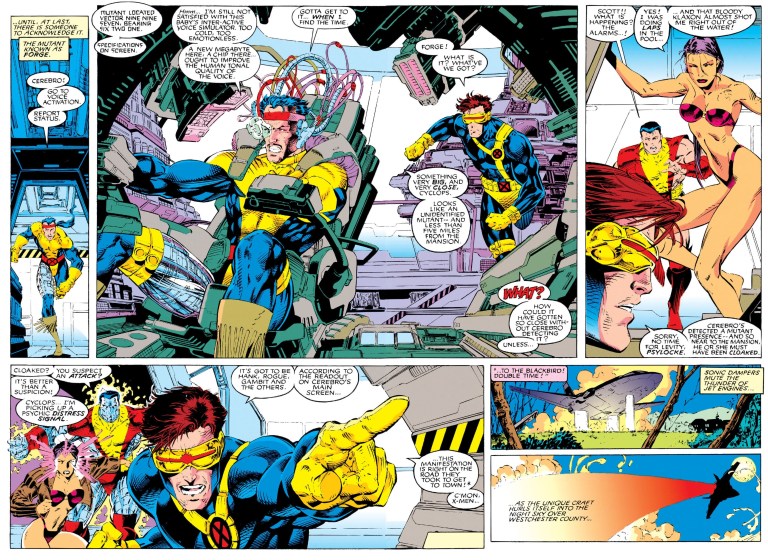
This for me is the money shot of the comic book. Although Wolverine is absent, you get to see the entire Blue and Gold teams with Charles Xavier as drawn by Jim Lee.
The story begins with Cerebro detecting an unidentified mutant signature in the presence of X-Men members who were out of the mansion. Forge tells Cyclops about the disturbance happening less than five miles away from their mansion. Colossus and Psylocke join in and quickly they leave the mansion with Cyclops using the Blackbird.
Not too far away, Gambit, Rogue, Jubilee and Beast are held captive inside a vehicle with an armed man in their presence. Gambit starts the effort to free his teammates using one of his charged cards.
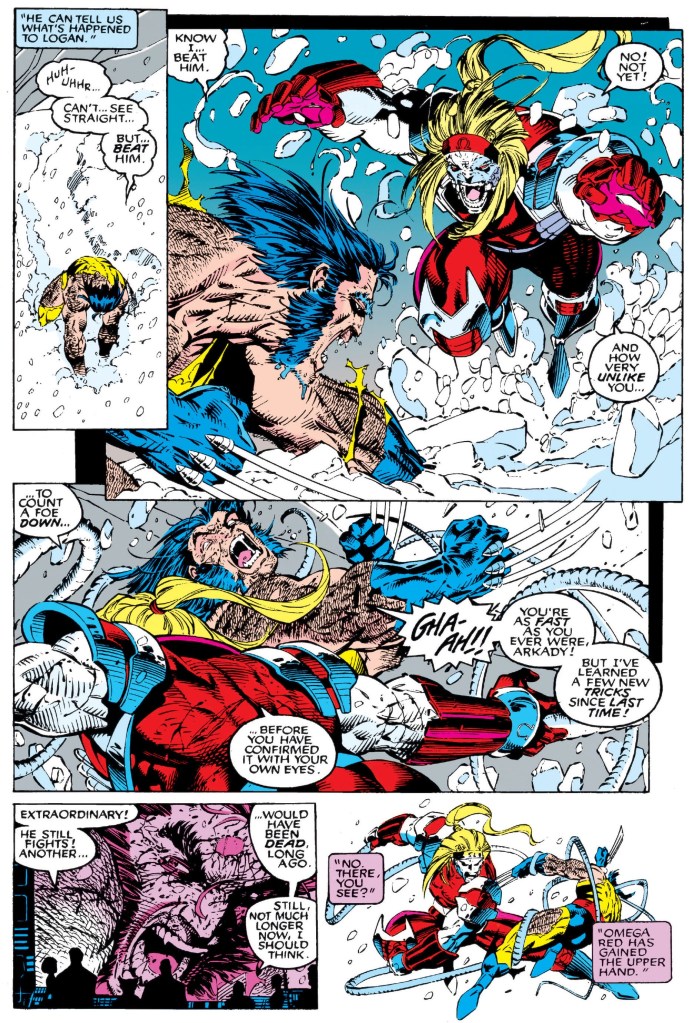
Elsewhere in a snowy place, Wolverine is seen struggling thinking he defeated his old rival Omega Red. Suddenly the Russian mutant jumped at him and the two resumed fighting. Their fight is being monitored from a distance…
Quality
The Wolverine-Omega Red rivalry is a must-see.
When it comes to storytelling, it is obvious that the writing duo of Jim Lee and John Byrne did their best to push the envelope and break new ground as far as telling an X-Men story goes. For one thing, there is the presence of paramilitary elements which are common with Jim Lee’s creations. There are even flashbacks into the past in which Wolverine (then called Logan) actually took part in a special forces operation with a few notable others. These flashbacks expands further the personal history of Wolverine in a really intriguing way. With the way the story was presented, it is clear that the new creative team pulled off serious moves in modernizing the way X-Men stories were told in comparison to the way Chris Claremont told all those many such stories during his long run.
When it comes to the visuals, Jim Lee did another great job as each page looks great and he proved to be clever with the way he visualized the script. As this comic book was inked by more than one inker, there were subtle differences with regards to contrast as well as ink intensity.
Conclusion
Cyclops and his teammates move out.
X-Men #5 (1992) is another great comic book that involved Jim Lee’s art. Apart from the modernizing of the storytelling, this comic book further expanded the past of Wolverine while successfully giving readers more of Omega Red who is now a major supervillain of Marvel’s.
If you are seriously planning to buy an existing hard copy of X-Men #5 (1992), be aware that as of this writing, MileHighComics.com shows that the near-mint copy of the regular edition costs $27 while the near-mint copy of the newsstand edition costs $79.
Overall, X-Men #5 (1992) is highly recommended!
+++++
Thank you for reading. If you find this article engaging, please click the like button below and also please consider sharing this article to others. If you are looking for a copywriter to create content for your special project or business, check out my services and my portfolio. Feel free to contact me as well. Also please feel free to visit my Facebook page Author Carlo Carrasco and follow me at HavenorFantasy@twitter.com
Disclaimer: This is my original work with details sourced from reading the comic book and doing personal research. Anyone who wants to use this article, in part or in whole, needs to secure first my permission and agree to cite me as the source and author. Let it be known that any unauthorized use of this article will constrain the author to pursue the remedies under R.A. No. 8293, the Revised Penal Code, and/or all applicable legal actions under the laws of the Philippines.
Welcome back, superhero enthusiasts, comic book collectors, 1990s culture enthusiasts and fans of Malibu Comics! Today we return to the Ultraverse through another tale of The Strangers which has been a pretty solid monthly series that I’ve been reviewing. As of this writing, I’m getting closer to finishing all 24 issues of this particular series and I can say that it has been a lot of fun doing retro comic book reviews of it. I’ve got a retro review about the 11th issue of The Strangers right here.
Before going to it, I should state a recap of the events in issue #10. That story had the Strangers (without Yrial who by then was held captive by her black tribe) doing a search by the sea in the Caribbean and they eventually discover a portal that sent them to another realm filled with monsters. After a big battle, the team attempted to get away only to fall over a cliff.
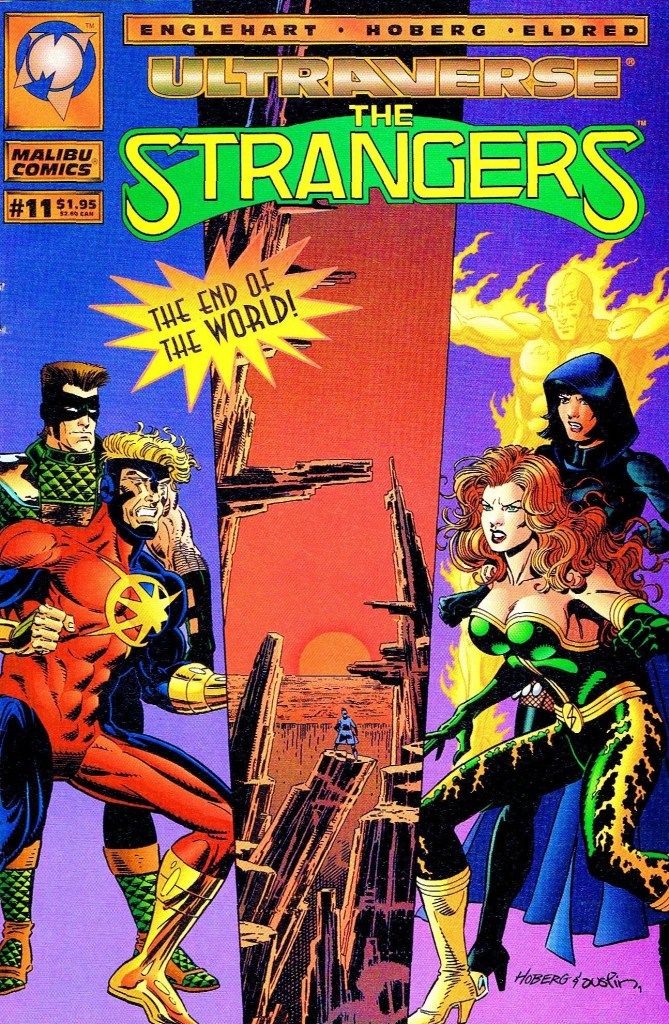
With those details laid down, here is a look back at The Strangers #11, published in 1994 by Malibu Comics with a story written by Steve Englehart and drawn by Rick Hoberg.
The cover.
Early story
The story begins with the Strangers falling down from what turned out to be a very great height. While his teammates could not do anything, Zip-Zap uses his power to make the air whirl around them and land safely on the ground below.
As they are in the middle of nowhere, searching for the way back seemed like an impossibility. Electrocute realizes there is an answer sensing the something is present in that lost world they are in and she points to some far-away direction. Zip-Zap then proceeds to run towards it leaving the team behind…
Quality
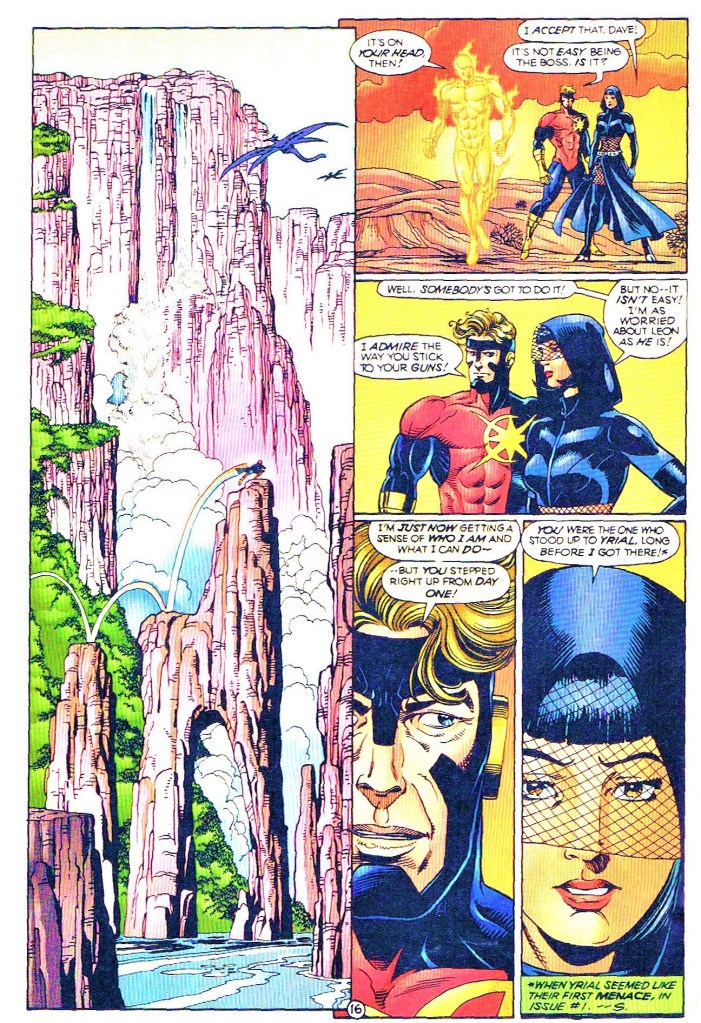
A nice display of fine art and character development.
Starting with the writing, I should say that this comic book’s plot is very simplistic with its concept and clearly lacks the richness of the story told in issue #10. Technically, this story is more like a filler serving as a build-up to issue #12 (which itself has a deeper story filled with spectacle and lots of intrigue). That’s not to say this is a disappointing issue of The Strangers in relation to the overall quality of the series as a whole. It’s just different with its plot structuring. Along the way, there were some short but sweet character development moments that took place most notably with regards to the romance between Atom Bob and Lady Killer.
What this comic book excels at is the really fine and varied artwork done by Rick Hoberg. Through the scenes in which Zip-Zap runs and explores the unknown realm they are lost in, you will really see Hoberg’s great talent with visual details as well as his creativity with regards to making varied locations filled with creatures that are truly out of this world. For the lack of superhero action, Hoberg’s visuals are the true spectacle here.
Conclusion
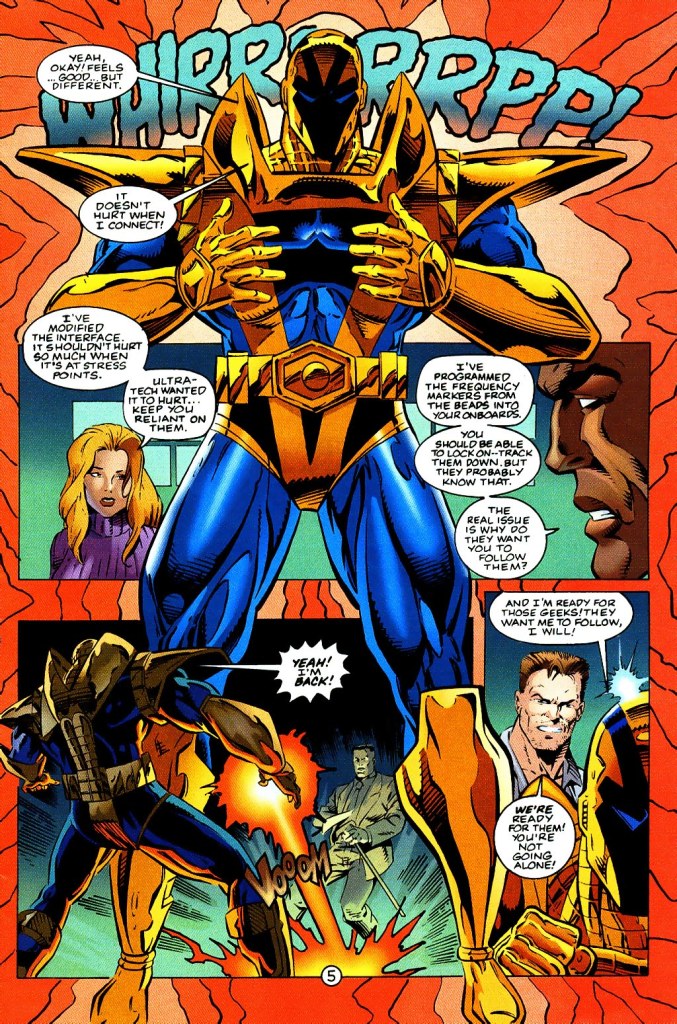
Really great art by Rick Hoberg.
Even though its plot lacked depth and its execution in storytelling is very different, The Strangers #11 (1994) succeeds in expanding the lost realm and zones within the Ultraverse. As for building up suspense or excitement for issue #12, this comic book achieved it as well. For a comic book that lacked superhero action, this one did not end up boring and that’s quite an achievement by the creators.
If you are seriously planning to buy an existing hard copy of The Strangers #11 (1994), be aware that as of this writing, MileHighComics.com shows that the near-mint copy of the comic book costs $14.
Overall, The Strangers #11 (1994) is recommended.
+++++
Thank you for reading. If you find this article engaging, please click the like button below and also please consider sharing this article to others. If you are looking for a copywriter to create content for your special project or business, check out my services and my portfolio. Feel free to contact me as well. Also please feel free to visit my Facebook page Author Carlo Carrasco and follow me at HavenorFantasy@twitter.com
Disclaimer: This is my original work with details sourced from reading the comic book and doing personal research. Anyone who wants to use this article, in part or in whole, needs to secure first my permission and agree to cite me as the source and author. Let it be known that any unauthorized use of this article will constrain the author to pursue the remedies under R.A. No. 8293, the Revised Penal Code, and/or all applicable legal actions under the laws of the Philippines.
Welcome back, superhero enthusiasts, comic book collectors, fans of 1990s culture and fans of Malibu Comics. Today we return to the Ultraverse and I should say that I am getting very close to closing my retro review run on the Prototype monthly series. So far, I found Prototype to be a really enjoyable and engaging series. It is too bad that the Ultraverse did not last too long because as far as armored superheroes go, Malibu Comics’ armored hero concept is very unique and fun to read. Had the Ultraverse lasted long, Prototype would have been explored a whole lot more and writers Tom Mason and Len Strazewski would have created more new stories of him.
Last time around, Jimmy Ruiz (who no longer has the high compensation and big-time perks of his original employer) got into trouble and had to use his armor as he was the target of another huge and powerful armored rival. The battle ended costly for Prototype.
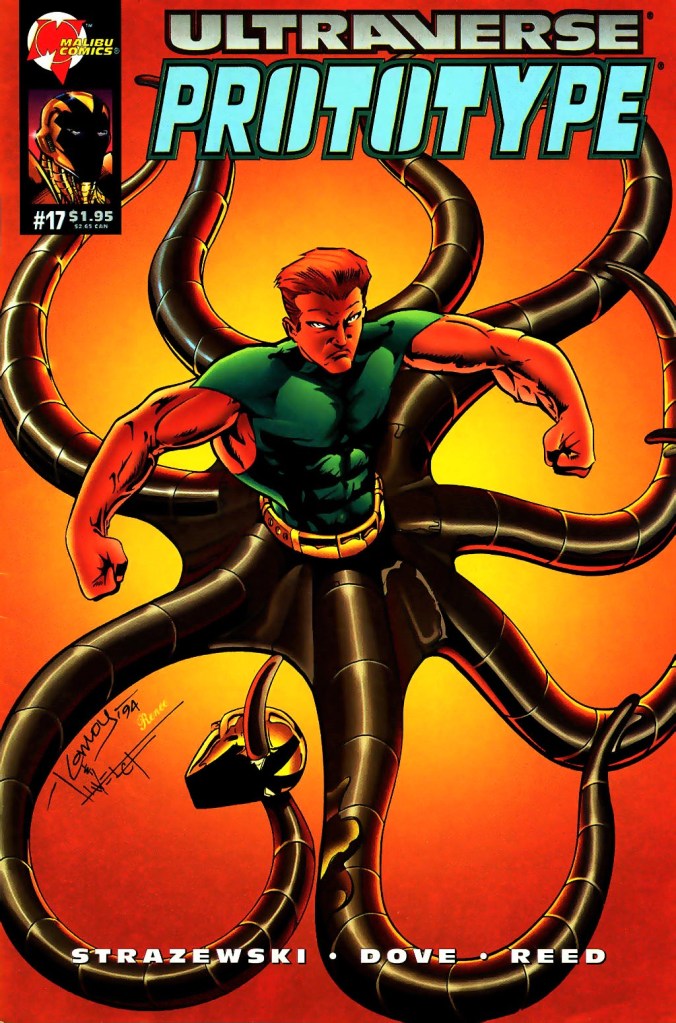
What will happen next to him? We can all find out in this look back at Prototype #17, published by Malibu Comics in 1995 with a story written by Len Strazewski and drawn by George Dove.
The cover.
Early story
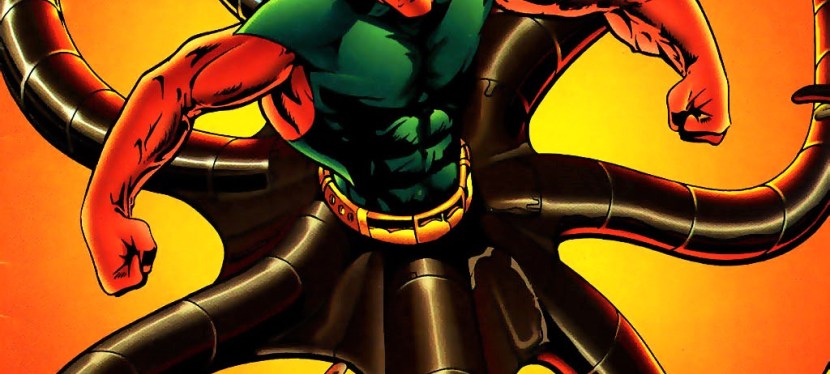
The story begins inside a top-secret facility. A man realizes that all the flesh below his waste are gone, completely replaced with metallic tentacles which make him look like a human octopus. The man in shock is none of other than Stanley Leland and his is welcomed to Terrordyne. Terrordyne makes clear they do not want to hurt him but have him as their new CEO and they know he desires revenge against Prototype.
Elsewhere, the Prototype armor is being repaired by Bob Campbell (Ranger). Jimmy, who is desperate to get Angella back, is eager to get back into action but the repair of his armor is not moving as fast as he wanted. Fortunately, Bob’s wife arrives with a man who believes he can help them. She tells Jimmy that the Prototype armor’s power coupling will be improved by forty percent.
Soon enough, the armor gets enhanced and Jimmy could sense the differences already. Soon enough, he goes on a mission with Ranger accompanying him…
Quality
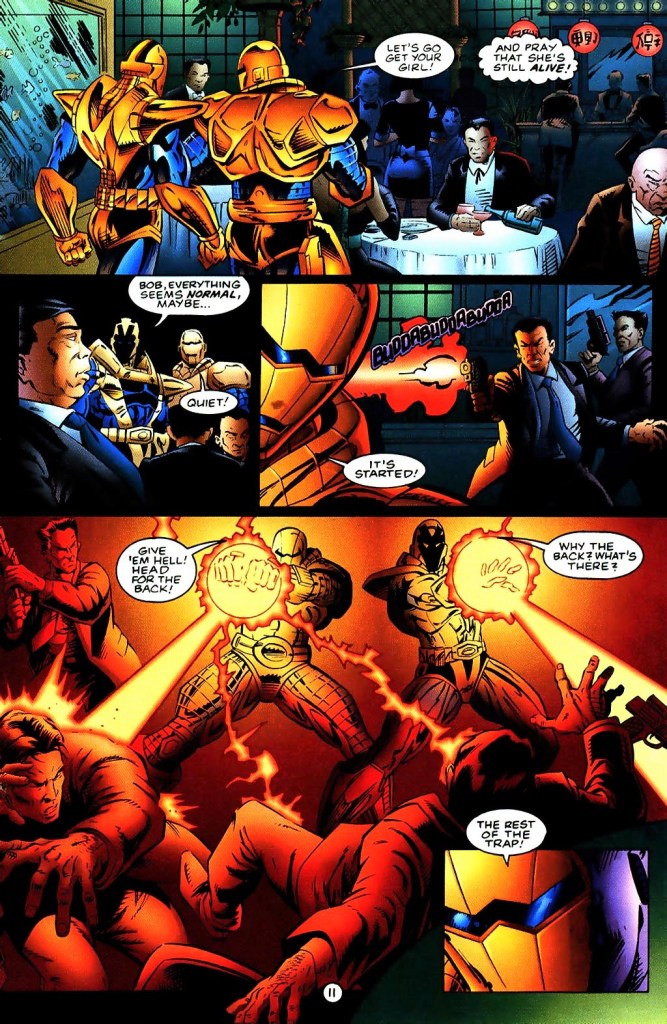
Prototype and Ranger inside a restaurant.
Starting with the story, I’m happy to say that the writing here is stronger, the dialogue has more depth and the plot is much more intriguing to read compared to the previous few issues. The concept of this comic book is about the effort to find and save Angella but with Ranger getting involved not only to add assist Prototype on the field but also provide him insight on dealing with a serious matter like the kidnapping done by very powerful opponents. In a way, having upgraded armor and weapons are not sufficient and even though he fought lots of enemies before, Jimmy Ruiz lacks the maturity, the self-control and strategy needed to do his mission. The scenes showing Ranger providing Prototype assistance in the form of strategies related to past experiences (that Bob Campbell went through) were done cleverly and never hampered the pace of the story.
As for the art, George Dove did a good job visualizing the armors of Prototype and Ranger. He also was good with drawing the action scenes.
Conclusion
Really nice art by George Dove.
To be clear, Prototype #17 (1995) is a two-heroes-in-one type of story that is character-led. For one thing, Jimmy is desperate, impatient and does things recklessly while Bob Campbell does his best to keep him stable and to prevent him from screwing up everything due to recklessness. It shows that the protagonist is not only humanly fragile, but also getting close to his breaking point. The emotional element makes the story worth reading.
If you are seriously planning to buy an existing hard copy of Prototype #17 (1995), be aware that as of this writing, MileHighComics.com shows that the near-mint copy of the comic book costs $27.
Overall, Prototype #17 (1995) is recommended.
+++++
Thank you for reading. If you find this article engaging, please click the like button below and also please consider sharing this article to others. If you are looking for a copywriter to create content for your special project or business, check out my services and my portfolio. Feel free to contact me as well. Also please feel free to visit my Facebook page Author Carlo Carrasco and follow me at HavenorFantasy@twitter.com