The Lord is blessing the Philippines again as Planetshakerswill return this coming July with new worship events featuring Planetboom.
In its official announcement via social media, Planetshakers Live In Manila Featuring Planetboom will be held at the SM Mall of Asia Arena on the evenings of July 17 to 19, 2026. Tickets for the worship events will become available on March 26 via SM Tickets. For the official layout and ticket prices, look closely at the image below.
The official seat layout and ticket prices ranging from P700 to P2,000.
The upcoming Planetshakers worship events featuring Planetboom here in the Philippines are opportunities for people to worship the Lord and deepen their faith in Him. You can also honor Him, thank Him and connect with Him as Planetshakers plays the music and lead the prayers. These events are blessings from God that you should strive for. That being said, you should get ready for the official March 26 release of the tickets of Planetshakers Live In Manila Featuring Planetboom via SMTickets.com
For the newcomers reading this, Planetshakers is a Christian church based in Melbourne, Australia and their music team is a very blessed group which produced a whole lot of worship songs that resonated with faithful Christians around the world. I myself attended a Planetshakers worship event here in the Philippines in September 2022.
Tickets will be released via SMTickets.com on March 26.
If you want to discover and learn more about Planetshakers, I encourage you to click here (Facebook page), here (Instagram), here (Twitter) and here (YouTube). To know more about Planetshakers itself, visit https://www.planetshakers.com/
In closing this, posted below are a few worship music videos from Planetshakers’ YouTube channel. Jesus is our Lord and Savior and He is also the hope of ALL nations! Move forward with unbreakable and uncompromising faith in Him! Seek Him first and always be the fearless and aggressive church of Lord Jesus!
Recently in the City of Parañaque, the local police successfully pulled off an entrapment operation that resulted in two suspects arrested and the seizure of illegal drugs worth P102,000, according to a Manila Bulletin news report.
To put things in perspective, posted below is an excerpt from the news report of the Manila Bulletin. Some parts in boldface…
Operatives of the Parañaque City Police arrested two drug suspects and seized P102,000 worth of shabu in an entrapment early Tuesday morning, March 17.
Parañaque City Police Chief Nicolas Pinon identified the suspects as Melchor, 41, a Joyride rider, and Lance, 24.
They were arrested at around 12:10 a.m. on F. Bernabe Street in Airport Village, Barangay Moonwalk.
Police said members of the Parañaque City Police Station Drug Enforcement Unit (SDEU) launched a buy-bust operation that led to the arrest of the suspects.
Authorities said that during a body search, Melchor was found in possession of 10 more plastic sachets of suspected shabu and the P500 marked buy-bust money. Meanwhile, Lance yielded about five grams of suspected shabu.
Let me end this post by asking you readers: What do you think about this recent development? If you are a resident of Parañaque, are you convinced that a lot of people in the city have been attracting smugglers or pushers of illegal drugs? Is your local community considered drug-free?
For more South Metro Manila community news and developments, come back here soon. Also say NO to fake news, NO to irresponsible journalism, NO to misinformation, NO to plagiarists, NO to reckless publishers and NO to sinister propaganda when it comes to news and developments. For South Metro Manila community developments, member engagement, commerce and other relevant updates, join the growing South Metro Manila Facebook group at https://www.facebook.com/groups/342183059992673
To put things in perspective, posted below is an excerpt from the news report of The Jerusalem Post. Some parts in boldface…
The United States will destroy Iran’s power plants if the Strait of Hormuz is not fully opened within 48 hours, US President Donald Trump threatened in a Truth Social post on Saturday night.
“If Iran doesn’t FULLY OPEN, WITHOUT THREAT, the Strait of Hormuz, within 48 HOURS from this exact point in time, the United States of America will hit and obliterate their various POWER PLANTS,” Trump wrote.
The US strikes will start with “the biggest one [power plant] first,” Trump stated.
Trump’s statement follows a report in Japanese media that Tehran is ready to let Japanese-related vessels pass through the Strait of Hormuz.
The report came from Kyodo News, citing Iranian Foreign Minister Abbas Araghchi.
Tehran has started talks with Tokyo about possibly opening the Strait, Araghchi told the Japanese news agency in a phone interview on Friday.
Meanwhile, the US and its allies have ramped up efforts to reopen the Strait of Hormuz, deploying low-flying warplanes to strike Iranian boats and Apache helicopters to intercept drones, US officials told the Wall Street Journal on Thursday.
If the Islamic terrorist regime of Iran refuses to give in to Trump, I would not be surprised. Iran’s wicked leaders prefer to die fighting and terrorizing the region instead of doing things diplomatically. Iran is guilty of not only attacking Israel but also Kuwait, Saudi Arabia, the United Arab Emirates, Islamist Qatar and others. It is likely the terrorist regime of Iran will remain defiant even though many of its senior leaders and officials have been eliminated. The regime itself is obsessed with death and destruction. Whatever happens, here is hoping that the US-Israel joint forces will bring down the Islamic terrorist regime for good and liberate the oppressed and freedom-hungry Iranians.
For additional insight, watch the YouTube news videos below.
Let me end this piece by asking you readers: What is your reaction to this development? Do you think the Islamic terrorist regime of Iran will defy Trump’s latest warning? Are you convinced that Iran is being led by its so-called supreme leader or by a group of their highest ranking commanders who think they can fool the world? Do you think NATO will eventually get involved in the Middle East conflict and help secure the Strait of Hormuz?
Around two thousand tricycle drivers (the first batch) have received their cash relief assistance at the Aguilar Sports Complex recently, according to the social media announcement of the City Government of Las Piñas. Each tricycle driver received P5,000 as relief from the much higher prices of fuel caused by the ongoing war against the Islamic terrorist regime of Iran which itself attacked multiple nations in the Middle East with missiles and drones.
To put things in perspective, posted below is an excerpt from the social media announcement of the City Government. Some parts in boldface…
The distribution of P5,000 cash payout of the AICS program for the first batch of tricycle drivers in Las Piñas City was held at Aguilar Sports Complex.
This is part of President Ferdinand “Bongbong” Marcos Jr.’s support to help drivers cope with the continuing rise of oil prices due to tensions in the Middle East.
The Department of Social Welfare and Development (DSWD), City Social Welfare and Development Office (CSWDO), and other offices of the city government are working together to ensure a smooth and peaceful distribution of aid to beneficiaries.
On the first day of payout, almost 2,000 drivers from TODA groups ACAPODA, APHDA, ATODA, BFLTSODA, BFRSSCV, BFRV-VG, CCTODA, CEBMTODA and BFATODA were given cash assistance. Payout will continue in the coming days to provide all registered members of TODA.
Let me end this piece by asking you readers: If you are a resident of Las Piñas City, what is your reaction to this development? Do you often ride the tricycle when moving around?
For more South Metro Manila community news and developments, come back here soon. Also say NO to fake news, NO to irresponsible journalism, NO to misinformation, NO to plagiarists, NO to reckless publishers and NO to sinister propaganda when it comes to news and developments. For South Metro Manila community developments, member engagement, commerce and other relevant updates, join the growing South Metro Manila Facebook group at https://www.facebook.com/groups/342183059992673
The North Atlantic Treaty Organization (NATO) – an intergovernmental military alliance between more than thirty member states – was slammed by US President Donald J. Trump and labeled a paper tiger due to its cowardice as it never supported the military operations against the Islamic terrorist regime of Iran, according to a news report by Newsmax.
To put things in perspective, posted below is an excerpt from the report of Newsmax. Some parts in boldface…
President Donald Trump on Friday blasted NATO and key European allies, calling the alliance “a paper tiger” and accusing its members of cowardice for refusing to back efforts to secure the Strait of Hormuz while the United States and Israel continue military strikes against Iran.
“Without the U.S.A., NATO IS A PAPER TIGER!” Trump wrote in a Truth Social post. “They didn’t want to join the fight to stop a Nuclear Powered Iran.
“Now that fight is Militarily WON, with very little danger for them, they complain about the high oil prices they are forced to pay, but don’t want to help open the Strait of Hormuz, a simple military maneuver that is the single reason for the high oil prices.“
Although Trump has argued the conflict is effectively over and that Iran’s military has been severely weakened, he has stopped short of formally declaring victory.
“So easy for them to do, with so little risk,”Trump wrote. “COWARDS, and we will REMEMBER!“
Trump’s criticism came after Japan, the United Kingdom, France, Germany, Italy, and the Netherlands signaled Thursday that they were prepared to assist in keeping the vital shipping lane open.
“We express our readiness to contribute to appropriate efforts to ensure safe passage through the Strait,” the countries’ leaders wrote in a letter. “We welcome the commitment of nations who are engaging in preparatory planning.”
The letter did not specify what role those countries would play in any Hormuz security effort. The strait carries about 20% of the world’s daily oil supply, and the joint statement also voiced “deep concern” over the effect of Iranian strikes on global energy markets.
The United Kingdom, France, Germany, Italy, and the Netherlands are NATO members.
Trump has repeatedly pressed NATO and European allies to help secure the Strait of Hormuz and has urged several countries to take part in the military campaign, though they have so far resisted direct involvement.
NATO Secretary General Mark Rutte said Thursday he believes the alliance and its members will ultimately reach a solution to restore passage through the strategic waterway.
“I’m confident that allies, as always, will do everything in support of our shared interest as we always do,” he said.
This development raises doubts about the credibility and relevance of NATO in the 21st century. Among NATO’s members are Spain and Turkey whose leaders openly support Islamic terrorists and hate Israel. I am surprised that Italy – led by its conservative Prime Minister Giorgia Meloni – did not get involved considering her nation’s healthy ties with Trump’s America and Israel. Let’s be clear here…a lot of European nations rely on oil tankers that pass through the Strait of Hormuz. Finally, I believe it is arrogant and wrong for NATO to ignore Iran’s attacks against other states in the Gulf such as Kuwait, Saudi Arabia, the United Arab Emirates (UAE) and even Islamist Qatar.
For additional insight, watch the YouTube news videos below.
Let me end this piece by asking you readers: What is your reaction to this development? Apart from the obvious cowardice, what do you think are the other factors as to why NATO and its members stayed away from the military operations against the Islamic terrorist regime of Iran? Do you think the wicked Iranian regime has deep connections with most of NATO’s members? Do you consider NATO relevant and needed in this current century?
Recently in the province of Pangasinan, Israeli Ambassador to the Philippines Dana Kursh visited the wake of Mary Ann De Vera to pay respect to her as well as to her family, the Embassy of Israel in the Philippines announced via social media.
Mary Ann De Vera died in Israel as a result of a missile attack committed by the Islamic terrorist regime of Iran. She worked there as a caregiver. De Vera’s family recently met with Israeli President Isaac Herzog in Jerusalem and later met with the ambassador here in the Philippines when the remains arrived.
To put things in perspective, posted below is the entire social media post of the Israeli Embassy. Some parts in boldface.
Amb Dana Kursh paid a visit to Pangasinan to pay her respects and extend condolences to the family of Mary Ann De Vera, the Overseas Filipino Worker (OFW) who passed away in Israel while serving as a caregiver, dedicating her life to caring for others far from her own home.
Ambassador Kursh joined Pangasinan Governor Ramon “Mon-Mon” Guico III, OWWA Overseas Workers Welfare Administration Administrator Patricia Yvonne Caunan, Department of Migrant Workers Usec. Felicidad Bay, and officials from the Department of Migrant Workers and the Overseas Workers Welfare Administration to pay their respects and stand with the bereaved family during this time of mourning.
Mary Ann De Vera was known for her kindness, dedication, and quiet strength. Like many Filipino caregivers in Israel, she left her family in the Philippines to work abroad and support her loved ones, while compassionately caring for those entrusted to her. Her passing is deeply felt both by the people she cared for in Israel and by the many who loved her here at home.
The Government of Israel mourns her loss and extends its heartfelt condolences to her family and loved ones.We share in the grief of the De Vera family and honor Mary Ann’s life, service, and the compassion she showed every day through her work. May her memory be a blessing.
To all my readers, I encourage you to pray to the Lord for the protection of all civilians in the Middle East while the joint military operation of Israel and the United States versus the Islamic terrorist regime of Iran continues. Pray to Him for the regime of Iran to surrender unconditionally so that the conflict will end and the economic disruptions will stop.
Also I encourage you to realize the truth that Israel is the land God designated specifically for the Jewish people (read Genesis 35:10-12) and His command must be followed without hesitation. If you want to be blessed further by the Lord, do so by loving and blessing the Jewish people (Genesis 12:1-3). I did my part when I was in Israel. Also, let me remind you all that the ties between the Jews and Christians are truly biblical!
I encourage you all to pray to the Lord God in support of Israel, to love and bless the Jewish people, and pray for the peace of Jerusalem.
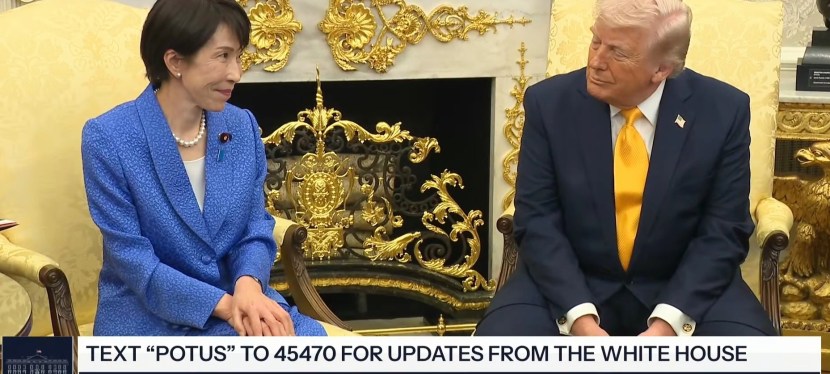
Japanese Prime Minister Takaichi Sanae visited Washington for the first time as the head of her nation and met with US President Donald Trump at the White House where they discussed very important matters in front of the media and officials, according to a news report by Kyodo News. Takaichi also praised the President for his peace efforts.
To put things in perspective, posted below is an excerpt from the news report of Kyodo News Some parts in boldface…
Prime Minister Sanae Takaichi told U.S. President Donald Trump on Thursday that Japan is ready to contribute to the safety of the Strait of Hormuz as the U.S.-Israeli war on Iran intensifies, while explaining Tokyo’s legal constraints on sending ships from its defense forces to the region.
Takaichi told reporters after her meeting at the White House with Trump that she told the U.S. leader “in detail what Japan can do and cannot do” from a legal perspective under the country’s war-renouncing Constitution.
Trump, for his part, reiterated his expectation that Japan would be engaged, while saying during the part of their talks open to media that he believes Japan has been “stepping up to the plate” in recent days over the Iran war, “unlike NATO.”
The U.S. leader has made public his dissatisfaction with Washington’s allies, including Tokyo and members of the trans-Atlantic alliance, over their reluctance to pitch in to help secure the Hormuz strait, a vital waterway for global oil transportation now largely blocked by Iran.
“I expect Japan to step up, because, you know, we have that kind of relationship,” he said. “We have 45,000 soldiers in Japan. We have, we spend a lot of money on Japan…so I expect, I’m not surprised that they would step up.“
Noting also that more than 90 percent of Japan’s crude oil imports normally pass through the strait, Trump said Japan has a “big reason” to do more.
In affirming Japan-U.S. collaboration on expanding U.S. energy production, Takaichi said she proposed to Trump a joint oil-reserve project to ease supply concerns driven by the Middle East conflict.
At the talks, Takaichi praised Trump’s “peace” efforts, expressing readiness to assist by reaching out to other countries. “Donald is the only person who can bring peace and prosperity across the world,” she said.
Takaichi emphasized that the prospect of Iran developing nuclear weapons is unacceptable. Trump alluded earlier to Iran’s nuclear program to explain the U.S. decision to launch its military campaign against the country.
Facing an increasingly assertive China, Takaichi also reminded Trump that the security environment remains severe in the Indo-Pacific, at a time when reports have emerged that some U.S. military assets are being moved from the region to the Middle East.
The two leaders “committed to peace and stability across the Taiwan Strait as an indispensable element of regional security and global prosperity” and “opposed any attempts to unilaterally change the status quo, including by force or coercion,” the White House said in a press release without naming China.
They confirmed that their nations oppose measures threatening critical mineral supplies such as export controls, senior Japanese government officials told reporters, apparently referring to Beijing’s tighter regulations on rare earths exports.
They agreed to advance broad defense cooperation, including joint missile development and production, and promote a free and open Indo-Pacific, according to Takaichi. The White House said the production of the interceptor Standard Missile-3 Block 2A in Japan will be quadrupled.
“We were able to affirm many concrete forms of cooperation that will further enhance the quality of our alliance in wide-ranging fields,” Takaichi said, adding that she and Trump are aiming to elevate bilateral ties to “a higher level” together.
Trump welcomed Japan buying “a lot of” U.S. military equipment. He further stressed that he has a “very fine relationship” with Takaichi, describing her as “a very special person” who is doing a “fantastic job.”
The U.S. side did not bring up fresh demands for Japan to spend more on its defense, the officials said.
Takaichi’s main goals in her first trip to the United States since taking office in October were to strengthen the personal trust in her ties with Trump and reaffirm the U.S. security commitment to the Indo-Pacific region as China’s influence grows.
The meeting came amid increasing concerns within Japan that the U.S. focus in terms of policy and military assets could shift from the Indo-Pacific to the Middle East if the U.S.-Israeli war with Iran drags on, a development that would work in China’s favor.
The U.S. military has reportedly begun relocating the amphibious assault ship Tripoli and over 2,000 Marines from their bases in southwestern and southern Japan to the Middle East.
Takaichi got off to a positive start in building personal ties with Trump when they met in person for the first time in October in Tokyo, shortly after she became Japan’s first female prime minister.
Since the outbreak of the Middle East conflict, Tokyo has sought to strike a delicate balance between maintaining its strong alliance with Washington and its friendly relations with Tehran.
For more insight about the Trump-Takaichi meeting, watch the videos below.
Let me end this piece by asking you readers: What is your reaction to this development? What is your impression about the many matters and announcements that happened during the Trump-Takaichi meeting at the White House? Were you surprised when it was announced that US allies Japan, Italy, England, Netherlands, Germany, and France jointly agreed to secure the Strait of Hormuz in response to Trump’s demand? With Japan having a close relationship with Trump’s America now, do you think Communist China and North Korea will feel intimidated at their side of the Pacific?
Disclaimer: This is my original work with details sourced from reading the comic book and doing personal research. Anyone who wants to use this article, in part or in whole, needs to secure first my permission and agree to cite me as the source and author. Let it be known that any unauthorized use of this article will constrain the author to pursue the remedies under R.A. No. 8293, the Revised Penal Code, and/or all applicable legal actions under the laws of the Philippines.
Welcome back, 1990s arts and culture enthusiasts, video game enthusiasts and comic book collectors! Today we go back to the late-1990s to examine another issue of the magazine-sized comic book series titled Resident Evil: The Official Comic Book Magazine.
By the time WildStorm Productions released the 3rd issue in 1998, many millions of gamers around the world played Resident Evil 2 on PlayStation. The Resident Evil fanbase expanded dramatically and many of them completed the game’s multiple scenarios. At the same time, Leon Kennedy and Claire Redfield became popular characters in gaming.
The 2nd issue I reviewed had a very bad adaptation of Resident Evil 2’s story. What prevented the comic book from ending up as a complete disaster were the two other short stories which were surprisingly entertaining to read. Still, I wonder if Shinji Mikami and the game developers ever saw the abysmal Resident Evil 2 adaptation in the 2nd issue.
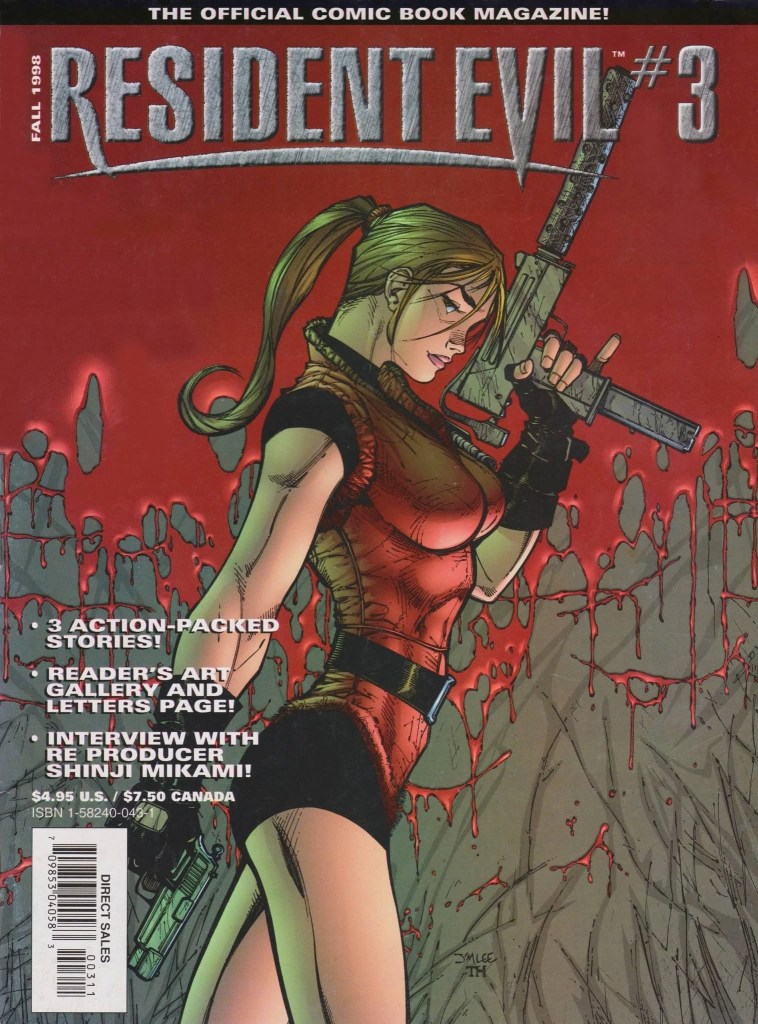
With those details laid down, here is a look back at Resident Evil: The Official Comic Book Magazine #3, published by WildStorm/Image Comics in 1998 with short stories written by Ted Adams and Kris Oprisko, and drawn by Ryan Odagawa, Carlos D’Anda and Lee Bermejo.
The cover with art by Jim Lee.
Early stories
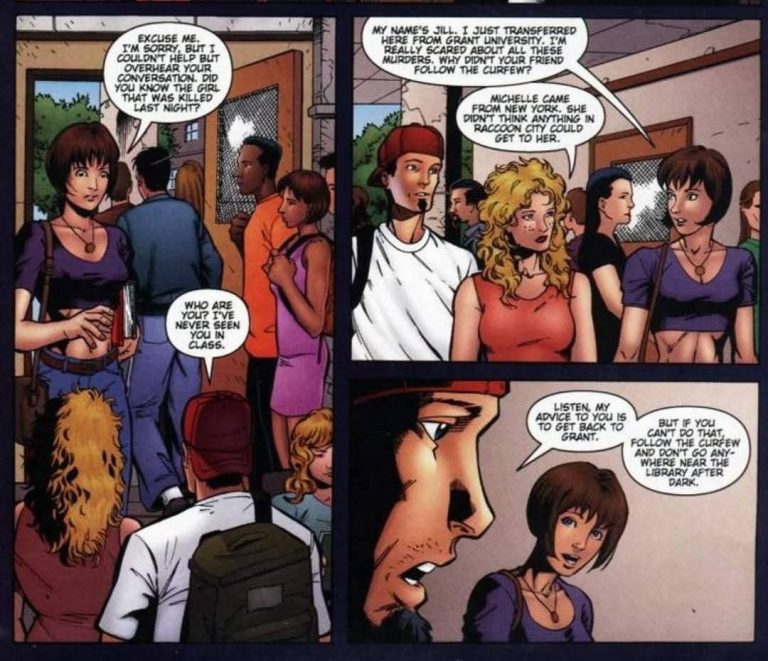
Wolf Hunt – At Raccoon City College, a few students talk about someone who got killed at school and her body was all torn up. They aware that the authorities are keeping the story out of the papers to avoid causing a panic. In the evening, of the students got harmed by a ferocious monster. The next day at S.T.A.R.S. headquarters, Albert Wesker, Jill Valentine and Barry Burton discuss the killings that happened at the city college. They were asked by the local police to investigate what happened. Jill takes the assignment of going undercover as a student.
Danger Island – A man and a woman arrive at Isla Bonale in Caribbean for a vacation. The island is so exclusive, they only let ten couples on it at a time. After having a romantic night of dinner and dancing, they decide to go snorkeling and rent a boat. Just as they start snorkeling, a plane crashes on the island.
Dead Air – Following the events of Resident Evil (1996) and Resident Evil 2, Chris Redfield, Jill Valentine and Barry Burton start traveling to Europe with the goal of ending Umbrella’s current progress on a new variation of the T-virus even though they have to go undercover. They have the support of a top-secret international agency which already has someone in place to help them. Meanwhile, Umbrella has a spy watching on the three.
Quality
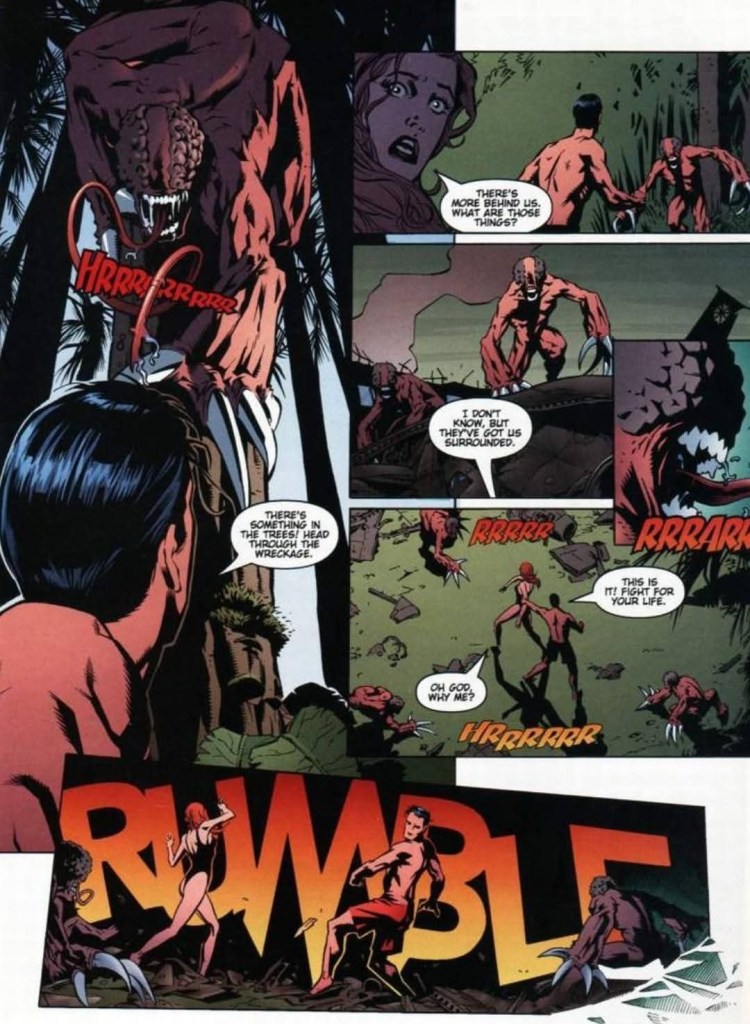
Imagine being surrounded by the deadly Lickers of Umbrella on an island wearing only swimwear and having no useful pieces of equipment to protect yourself with.
Similar to issue #2, this comic book has three short stories and some extras.
The short story Wolf Hunt, which took place before the events of the original Resident Evil game of 1996, has the odd concept of having werewolves existing within the RE universe. Werewolves are often super natural and such monsters don’t align with the sci-fi and biological aspects of the Resident Evil games. In fairness, the creative team had this interesting concept of having Jill Valentine going undercover as a student in the city college to find answers and solve the problem. I should state that the artwork by Ryan Odagawa is good overall although his take on Jill Valentine is cartoonish. This story is pretty short and lacked a solid conclusion. It’s really a glorified piece of fan fiction that should interest fans of the 1996 game.
Danger Island, the 2nd short story, is easily the gem of this comic book. This is a completely original tale that has brand-new lead characters – the couple Stan and Leslie – and an island as the setting. Without spoiling the plot, this is a suspense story with a moderate pace, some dynamic visuals and a good implementation of elements from the lore of Resident Evil. The creative team behind this tale emphasized that as long as Umbrella and is biological experiments exist, danger and death will creep up on people regardless of location. A notable monster species from Resident Evil 2 is included here and the effects the G-virus has on creatures on the island are cleverly presented complete with nice artwork by Lee Bermejo.
Through the couple, readers will feel the danger, desperation and anxiety as the story went on. How the story ended is a must-see and I am confident it will encourage you to revisit Resident Evil 2.
The final tale Dead Air is a daring attempt by WildStorm’s creators to make a sequel to the first two games. As mentioned above, Chris Redfield, Jill Valentine and Barry Burton are together on a high-risk mission to find and stop Umbrella in Europe. The main setting is inside a commercial flight where a zombie outbreak happens. Without their weapons, Chris, Jill and Barry are compelled to use alternative items and ways to overcome the zombies.
While this tale is packed with action and the violence is uncompromised, something is off with the way Jill Valentine is portrayed. She is more violent with action and even expressed sarcasm. This tale is pretty short as the comic book made it clear that the continuation will happen in the next issue. Considering what was told in Resident Evil: Code Veronica (released in 2000 with Chris and Claire Redfield included), Dead Air is clearly a non-canon Resident Evil tale and it is at best a polished piece of fan fiction by WildStorm.
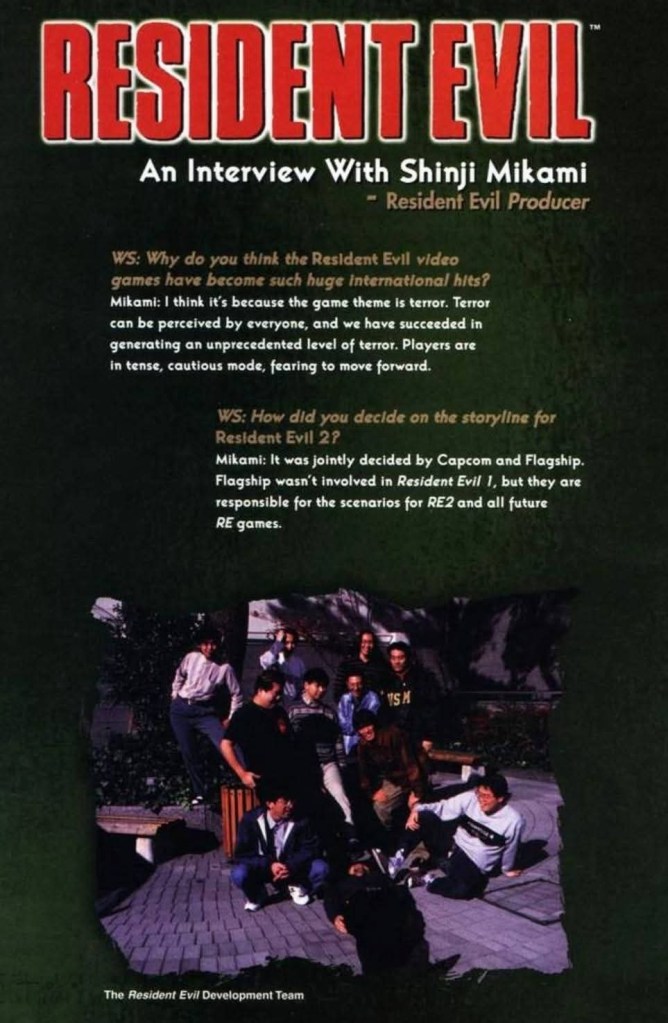
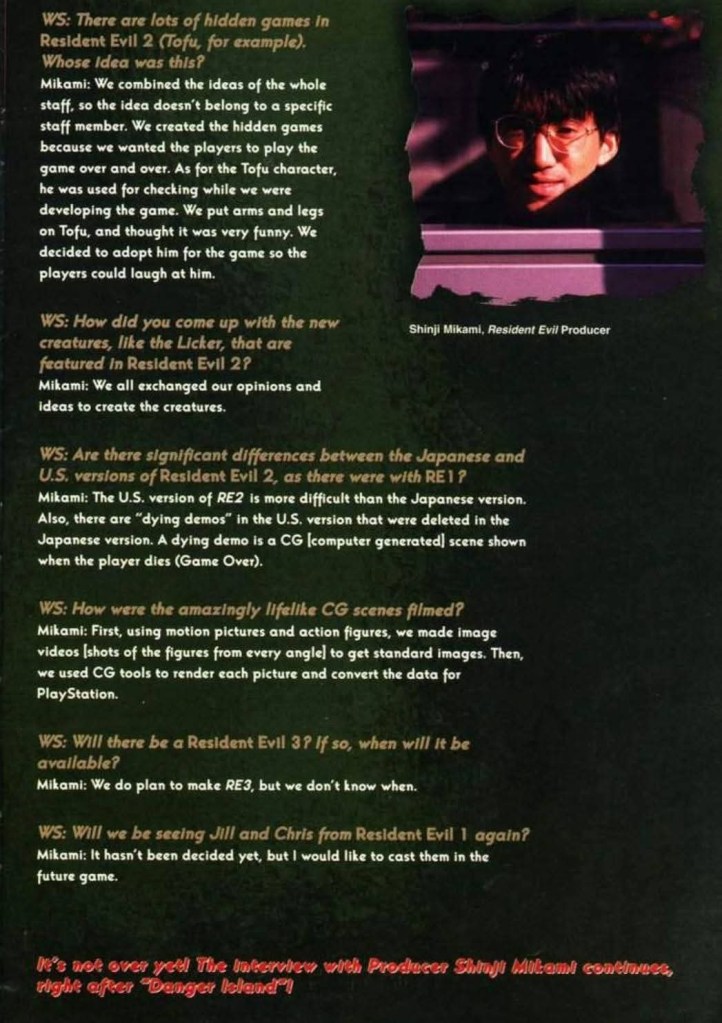
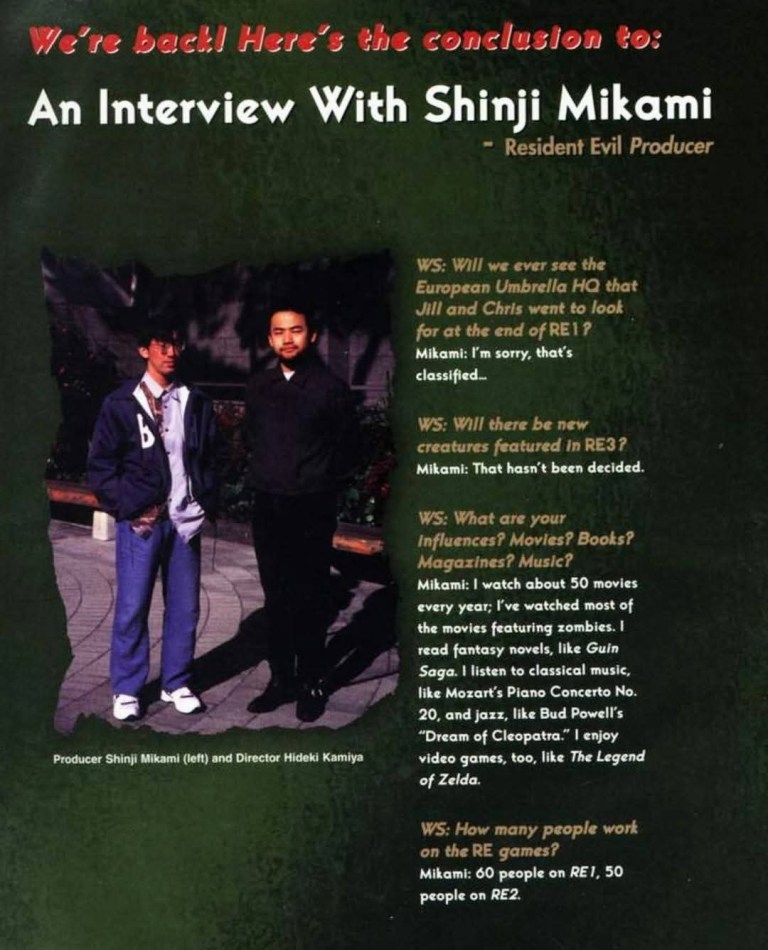
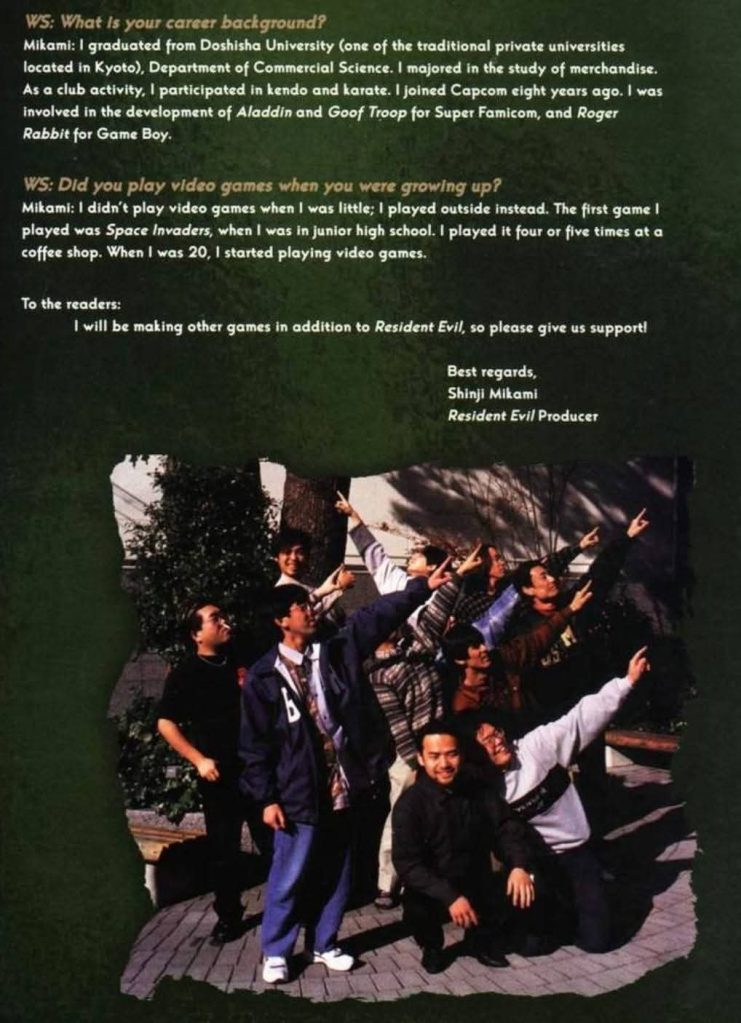
When it comes to the extras, you will find the Readers Art gallery and The Resident Evil Files (featuring Chris Redfield and his sister Claire). The most notable extra stuff here, however, is another interview with Resident Evil creator/producer Shinji Mikami and you will even see a few pictures of not just him but also Hideki Kamiya (the game director of Resident Evil 2 who went on to produce lots of highly entertaining games through the decades) and members of the team behind the RE games of the time. Enjoy the pages of the interview below.
The members of the development team of Resident Evil games of the time.
Very notable details shared by Shinji Mikami.
Shinji Mikami with Hideki Kamiya. Mikami directed the original Resident Evil game of 1996 while Kamiya directed Resident Evil 2. The two are still prolific makers of video games today.
Shinji Mikami played Space Invaders when he was young.
Conclusion
Remember Jill Valentine’s extra costume in the original game of 1996?
Considering the qualities of the three short stories and the extra stuff, Resident Evil: The Official Comic Book Magazine #3 (1998) is easily a huge improvement over issue #2. The quality and creativity of the short stories are better, the interview with Shinji Mikami was worth reading and the comic book itself is more entertaining. That said, I am convinced to move on to the next Resident Evil comic book.
Overall, Resident Evil: The Official Comic Book Magazine #3 (1998) is recommended.
Recently inside the Subic Bay Freeport Zone, Subic Bay Metropolitan Authority (SBMA) Chairman and Administrator Eduardo Jose L. Aliño formally led the opening of a new two-storey Starbucks Coffee shop with drive-thru, according to the official announcement of the authority. The newest branch of the coffee giant was made with an investment of over P36 million.
To put things in perspective, posted below is an excerpt from official announcement by the SBMA. Some parts in boldface…
Subic Bay Metropolitan Authority (SBMA) Chairman and Administrator Eduardo Jose L. Aliño led the opening of the first two-storey Starbucks Coffee Shop with drive-thru facility here on March 6, 2026.
According to Aliño, the opening of the two-storey Starbucks Coffee Shop indicates Subic Bay Freeport’s status as a popular tourist destination, anticipating a year-round influx of customers.
The Starbucks Coffee Shop invested ₱36.75 Million in a 1,700-square-meter area at the portion of Lot 75-A, Rizal Highway, Central Business District, Subic Bay Freeport Zone.
The inauguration was attended by Engr. and Mrs. Rhammeth Paras, Arch. and Mrs. Adonis Co, Mr. and Mrs. Timothy Tang, and Engr. Aries Tanglao, owners of Pandabest Realty and Trading, Inc.
The two-storey Starbucks locations usually offer enhanced, often scenic, spaces with increased seating, frequently housed in restored, architecturally unique, or heritage buildings.
Notable examples include the heritage shophouse in Singapore’s Chinatown, the sprawling Reserve Hiraya in Tagaytay, and a colonial-style bungalow in Rochester.
“Now we have one here, with the building designed to be ‘work and study-friendly,’ providing more intimate, quiet spaces on the upper level compared to the busy ground floor,” Aliño said.
Let me end this post by asking you readers: What is your reaction to this recent development? Have you visited other Starbucks branches inside the Subic Bay Freeport Zone during your recent visit there? Do you think there is still more room for further coffee shops or cafes inside the Subic Bay Freeport Zone? How often do you order coffee by drive-thru?
Recently in the progressive City of Muntinlupa, local police officers successfully arrested a 21-year-old man for committing the illegal sale of firearms, according to a Manila Bulletin news report.
To put things in perspective, posted below is an excerpt from the news report of the Manila Bulletin. Some parts in boldface…
The Southern Police District (SPD) arrested a 21-year-old man for illegally selling firearms in Muntinlupa on March 15.
The suspect, identified by his aliases Roniel and Yanyan, was arrested along the PNR Site in Barangay Poblacion, Muntinlupa at about 1:30 a.m. during a gun buy-bust operation led by the SPD’s District Special Operations Unit (DSOU).
The operation was launched after authorities received information from an informant about the suspect’s alleged involvement in the illegal sale of firearms in Muntinlupa and nearby areas.
Based on the report, DSOU operatives conducted the coordinated sting operation together with personnel from the District Intelligence Division, Intelligence Section of the District Mobile Force Battalion, and Muntinlupa police.
Seized during the operation were two .38-caliber revolvers, two pieces of .38-caliber live ammunition, a marked P500 bill used in the transaction along with boodle money, and bags used by the suspect to carry the firearms.
The arrested individual, a resident of the barangay, failed to present any legal documents authorizing him to possess or sell firearms.
He was brought to the DSOU office for documentation and to the Pasay City General Hospital for physical and medical examination.
The police will request firearms records verification from the Firearms and Explosives Office to determine whether the suspect is a licensed firearm holder.
Let me end this post by asking you readers: What is your reaction to this recent development? If you are a resident of Muntinlupa City, are you thankful to the local police for the successful arrest of the suspect?
For more South Metro Manila community news and developments, come back here soon. Also say NO to fake news, NO to irresponsible journalism, NO to misinformation, NO to plagiarists, NO to reckless publishers and NO to sinister propaganda when it comes to news and developments. For South Metro Manila community developments, member engagement, commerce and other relevant updates, join the growing South Metro Manila Facebook group at https://www.facebook.com/groups/342183059992673









 Author Carlo Carrasco