Recently in the City of Las Piñas, local athletes and performers of the arts who made achievements in varied competitions met with Mayor Imelda Aguilar and Vice Mayor April Aguilar at City Hall and had warm talk together, the City Government confirmed via social media (October 6, 2023 update).
To put things in perspective, posted below is an excerpt from the City Government’s social media post. Some parts in boldface…
Photo of the meeting released by the Las Piñas PIO.
Las Piñas-based athletes and performers who have garnered acclaim in recent prestigious competitions were warmly received in City Hall by City Mayor Imelda Aguilar and Vice Mayor April Aguilar on Thursday, October 5th.
Father and daughter duo, Daniela B. Silvestre and Dante Silvestre, clinched gold medals from the Gold Weight Division at the Marianas Pro Brazilian Jiu-Jitsu Championship Manila 2023, held on August 5-6, 2023 in, Muntinlupa.
In addition, performers from Las Piñas, namely Anahbea B. Detosil, Micaila B. Detosil, Szophia Brielle B. Aguilar, and Scarlette S. Yape, won accolades at the World Championships of Performing Arts 2023 held from July 28 to August 6 in Anaheim, California, USA.
Let me end this piece by asking you readers: If you are a resident of Las Piñas City, what is your reaction to this development? Are you delighted to find out that there are local athletes who won medals or honors in competitions?
For more South Metro Manila community news and developments, come back here soon. Also say NO to fake news, NO to irresponsible journalism, NO to misinformation, NO to plagiarists, NO to reckless publishers and NO to sinister propaganda when it comes to news and developments. For South Metro Manila community developments, member engagements, commerce and other relevant updates, join the growing South Metro Manila Facebook group at https://www.facebook.com/groups/342183059992673
Disclaimer: This is my original work with details sourced from reading the comic book and doing personal research. Anyone who wants to use this article, in part or in whole, needs to secure first my permission and agree to cite me as the source and author. Let it be known that any unauthorized use of this article will constrain the author to pursue the remedies under R.A. No. 8293, the Revised Penal Code, and/or all applicable legal actions under the laws of the Philippines.
Welcome back superhero enthusiasts, 1990s culture enthusiasts and comic book collectors! Today we go back to the year 1993 to take a close look at the second issue of the second Venom comic book mini-series Venom: Funeral Pyre.
In my previous review, the gang-driven violence intensifies as the Punisher makes his move armed with lots of resources (including a van loaded with weapons and computerized functions). Venom struggles to free himself from the temporary prison the Punisher placed him in. As the violence escalated, Gray Russell finds himself in much deeper trouble as the anticipated rescue does not happen.
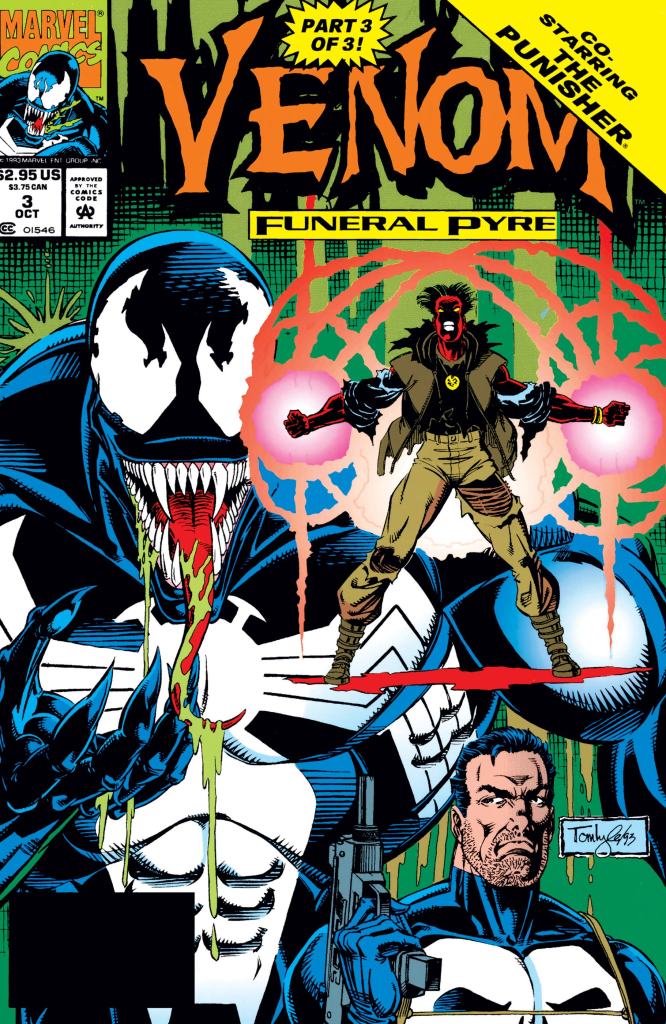
With those details laid down, here is a look back at Venom: Funeral Pyre #3, published in 1993 by Marvel Comics with a story written by Carl Potts and drawn by the late Tom Lyle. This if the final issue of the mini-series.
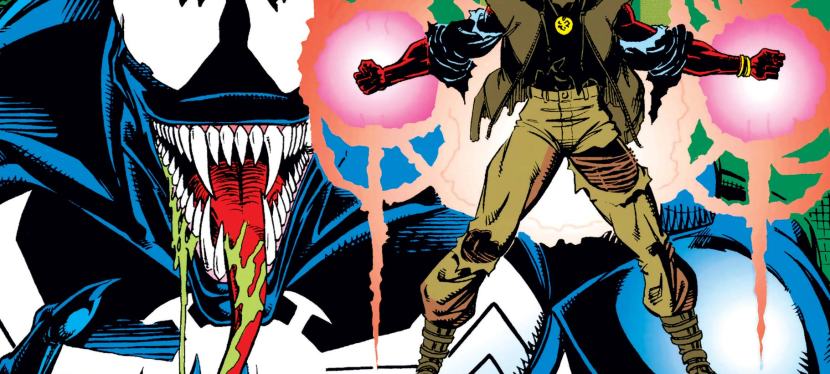
The cover.
Early story
The story begins inside a building with high-tech equipment from HYDRA. Gray Russel is no longer himself but as the red-skinned, highly radiated figure Pyre. He fires a microwave blast at Venom which hurts him so much. In response to Venom’s claim that he came to rescue him, Pyre reacts with rage telling the murderous man with the symbiote that he arrived too late which resulted in the forced killing of people during the gang violence on the streets of Oakland.
Being filled with pure rage, Pyre intends to burn Venom alive. Thinking that Pyre is distracted, the Punisher leaps to get a gun on the floor which causes the radiated person to fire a microwave blast at him. The Punisher takes cover behind a machine but notices the microwaves sparking off the metal.
Venom then takes advantage of situation…
Quality
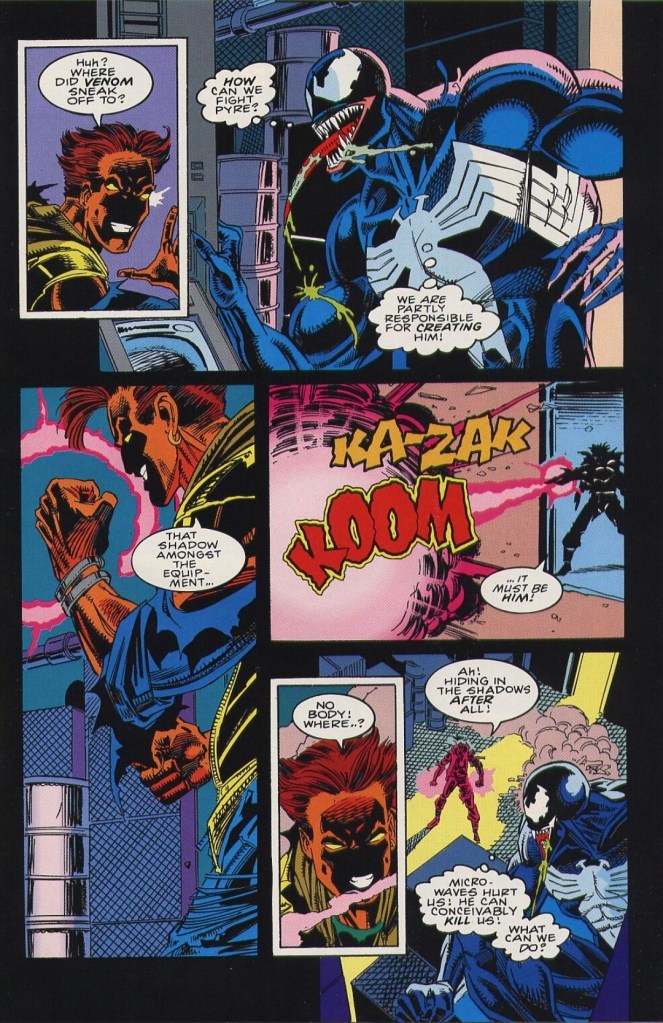
This page shows Venom at a disadvantageous state with Pyre whose microwave blasts are more than enough to kill him.
As the conclusion of the mini-series, this comic book went all-out portraying what turned out to be the final conflict involving the murderous Venom, the vigilante Punisher and the energy-filled Pyre. As a result, the narrative strongly focused on the final conflict (note: stretched out to last several pages) and never bothered to look back at the people and activities on the city street.
That being said, you will get to see more of the two established Marvel figures struggling hard against an unexpected force of opposition who was previously an undercover news reporter who infiltrated a certain gang and sent a message (delivered by a young boy) that caught Eddie Brock’s attention. At this point, it is clear that Venom’s effort to rescue Gray (who became Pyre after using a super soldier chamber left behind by HYDRA) ended in total failure and finds himself facing someone who could kill him and his alien costume together.
If there is anything notable about this issue, it is the portrayal of Venom being highly disadvantaged and even vulnerable. There are no armed men with sonic weapons and high-tech equipment to bring Venom down but Pyre whose microwave blasts are deadlier than flame and sonic. In connection to the situation, Venom is not his aggressive self but a struggling figure who strives to survive and somehow find solutions during the heat of danger.
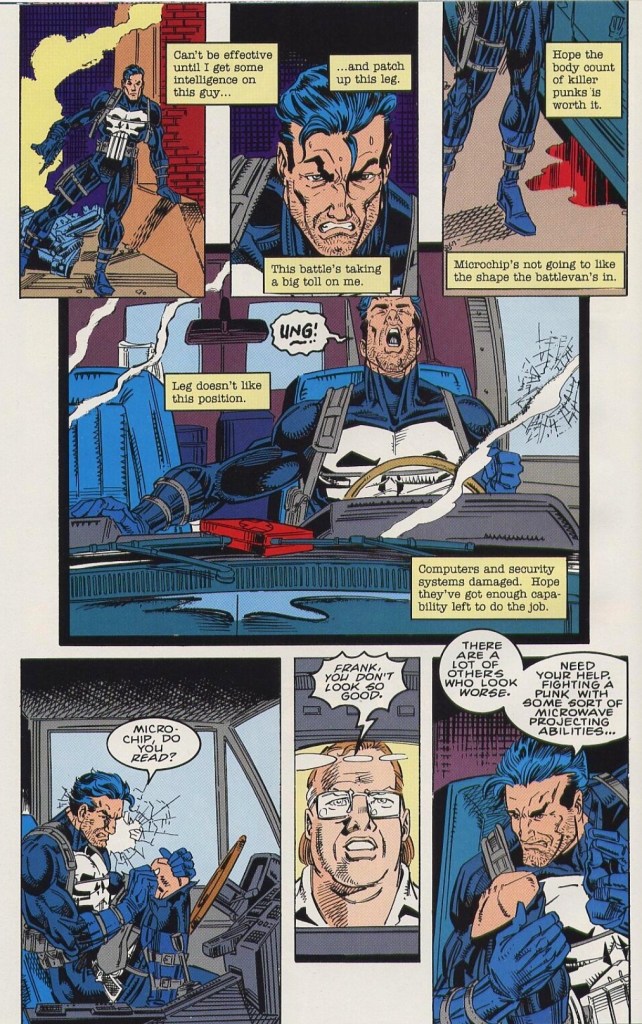
The Punisher, meanwhile, also struggled to survive but would simply not run away even though his chances of escape are much better. Instead, he focuses on actually eliminating Pyre without hesitation and Venom’s attempt to rescue Gray meant absolutely nothing to him.
More on Pyre, he is not really interesting nor was he ever engaging as the one powerful force of opposition that Venom and the Punisher must face. His being consumed by unrestrained rage and wielding so much power did not really raise the tension of the story. Had he eliminated the two Marvel figures who got in his way, what would Pyre do afterwards? Devastate the entire city of Oakland because he lost his identity as Gray and could not get over his involvement of taking other people’s lives while in the middle of gang activities? Would he proceed to San Francisco’s underground community and eliminate the people only because he blames Venom (note: Eddie Brock got involved with the underground people of San Francisco as seen in the Lethal Protector mini-series) for his failure of rescuing him? Pyre is nothing more than a throwaway comic book force of opposition.
From a visual standpoint, Tom Lyle once again pushed his creativity hard and showed some dynamic shots of spectacle here and there. At this stage, he proved to be very capable of visualizing Venom and the Punisher.
Conclusion
The Punisher refuses to give up and gets Microchip to assist him.
While issue #2 was a notable improvement over the first issue, Venom: Funeral Pyre #3 (1993) does not have much to offer in terms of engagement and entertainment. This is because it was crafted as a strict Venom-Punisher-Pyre conflict that provided spectacle and intrigue but ultimately ended up hollow. To see Venom at a huge disadvantage is interesting but did not add much weight to the plot. The Punisher was his usual self and in some ways overshadowed Venom for a while. Too bad there was not much space left for Venom and Punisher to fight each other again.
As the final issue of this mini-series, the story concluded with a whimper. Ultimately the Funeral Pyre storyline ended up as a diversion within the Marvel Comics shared universe that happened to attract Punisher, Venom and the gangsters of Oakland.
Overall, Venom: Funeral Pyre #3 (1993) is satisfactory.
Disclaimer: This is my original work with details sourced from reading the comic book and doing personal research. Anyone who wants to use this article, in part or in whole, needs to secure first my permission and agree to cite me as the source and author. Let it be known that any unauthorized use of this article will constrain the author to pursue the remedies under R.A. No. 8293, the Revised Penal Code, and/or all applicable legal actions under the laws of the Philippines.
Welcome back superhero enthusiasts, 1990s culture enthusiasts and comic book collectors! Today we go back to the year 1993 to take a close look at the second issue of the second Venom comic book mini-series Venom: Funeral Pyre.
In my previous review, the Punisher and Venom encountered each other for the first time ever and along the way Gray – who is secretly a journalist with a mission – struggles to maintain his composure and his sanity as he finds himself in the middle of a very violent gang war in Oakland, California. The more time Gray spends time with the crime gang he joined, the tougher the situation becomes for him.
With those details laid down, here is a look back at Venom: Funeral Pyre #2, published in 1993 by Marvel Comics with a story written by Carl Potts and drawn by the late Tom Lyle.
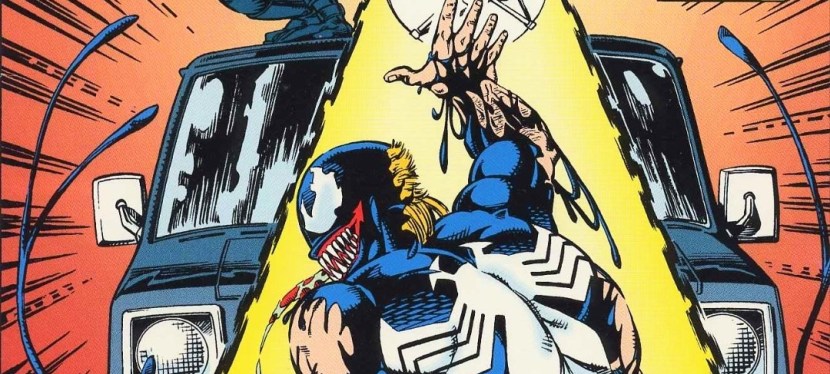
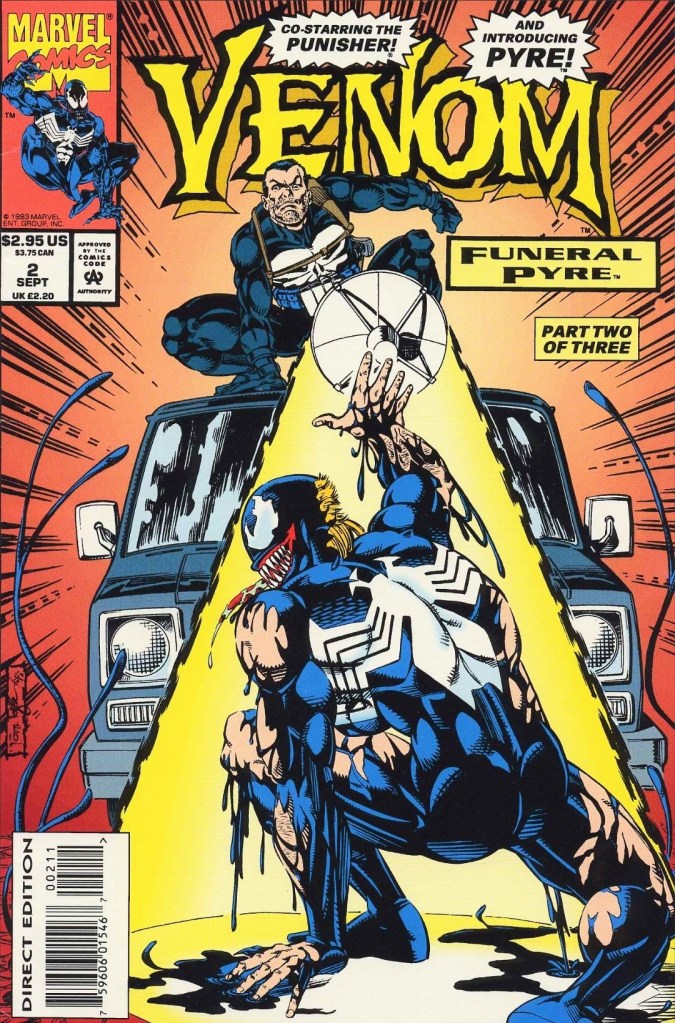
The cover.
Early story
The story begins with Gray and his gang companions riding a car approaching a group of people on the street. The gang leader pressures Gray to use his weapon to kill them. Gray is deeply worried not only because he has to prove his worth to the gang by killing other, but also because the rescue attempt he was waiting for had not yet happened.
Meanwhile, Venom finds himself trapped on the doorway of a building with the metal gate locked and with rays of microwave from the Punisher’s van radiating him painfully. As the Punisher leaves them behind, Venom manages to use the symbiote to reach into the van and smash the control panel inside which disabled the microwave rays.
Immediately, he recovers and breaks out to continue his mission: to rescue Gray…
Quality
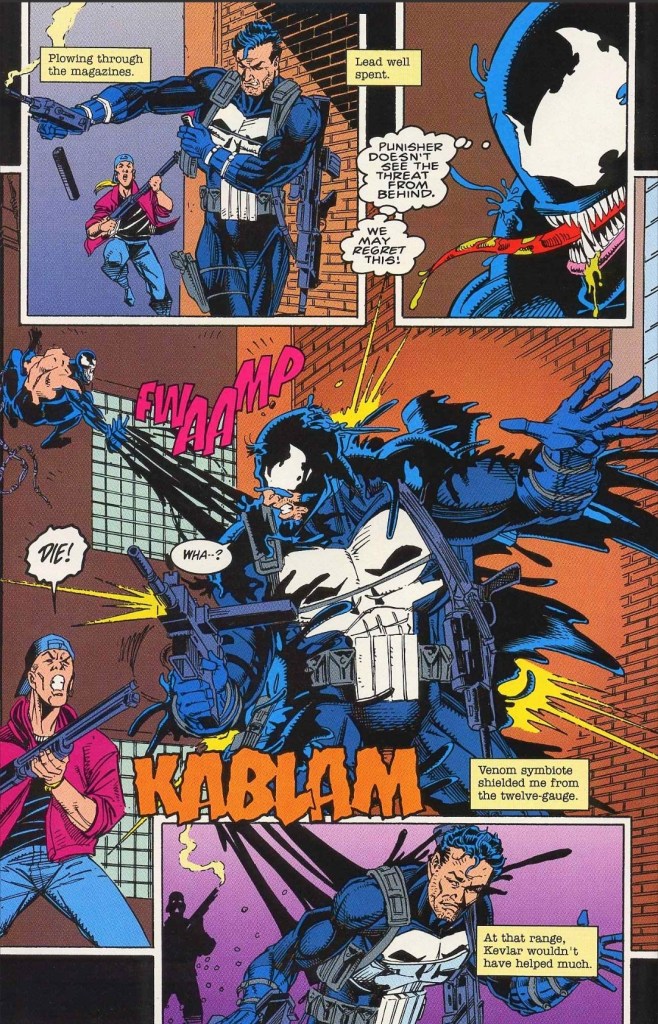
The murderous Venom actually helped the Punisher.
When it comes to the storytelling, there are some improvements that made this comic book more readable than issue #1. For one thing, the exposition has been reduced which allowed the pace of the story to move faster. Most of the exposition here has been limited to Gray who at this stage of the mini-series was clearly bound to become the central object of the Funeral Pyre concept. Another thing is that the story’s structure here is simpler and easier to follow as Venom and Punisher moved on their own struggles separately before predictably getting together again.
While the mini-series has clearly been a tale of a city gang war – with a pretentious and unwilling gang member who expected to be rescued before things become too chaotic – that happened to pull the Punisher and Venom in for different reasons, Carl Potts added some elements that would resonate with Marvel Comics fans who are familiar with HYDRA and the Super Soldier aspects of the Marvel Comics universe history. Not only that, there is a science fiction-inspired setting near the end of the story that added variety to the in-story environment.
Like the first issue, this one is packed with a good amount of action scenes and that means Punisher and Venom fans have a lot of stuff to enjoy. Tom Lyle really is good with showcasing the respective spectacle of the vigilante and the symbiote-wearing murderer, and when he has the two together, his visual creativity intensifies.
Conclusion
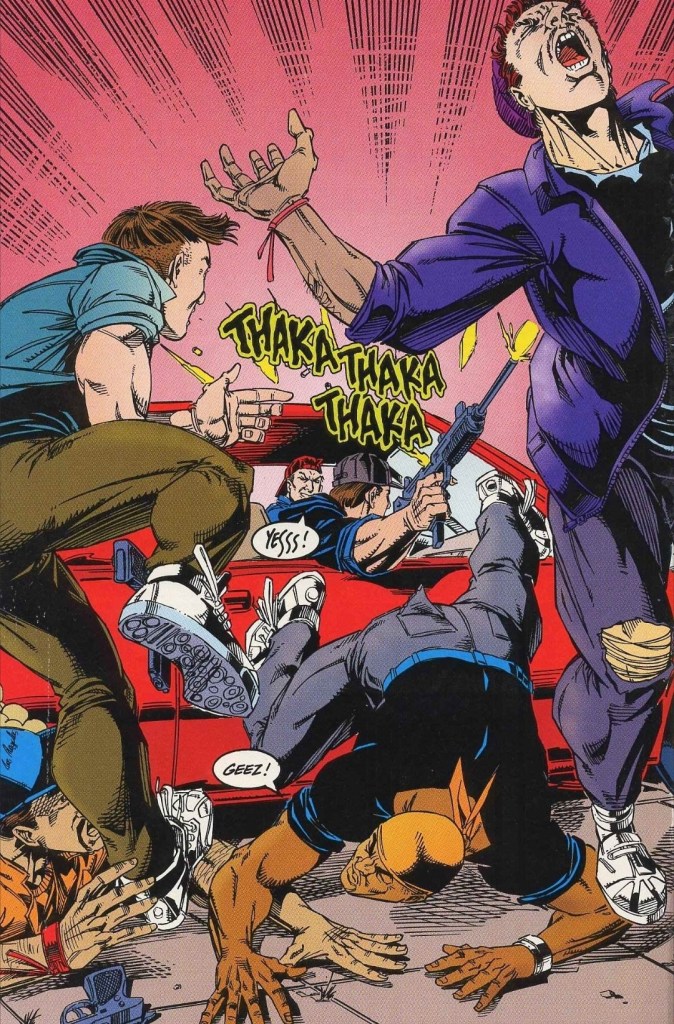
Grey shooting blindly at the targets while riding the car of the gangsters he joined.
Venom: Funeral Pyre #2 (1993) is clearly an improved reading experience over issue #1 mainly because of the reduced information dump, the simpler plot structure and the creative showcase of Venom and the Punisher. While Gray remains uninteresting, his late-stage transformation turned out to be somewhat surprising and it was only near the end of this comic book that the Funeral Pyre concept became clear.
Overall, Venom: Funeral Pyre #2 (1993) is satisfactory.
Welcome back, fellow geeks, Blu-ray collectors and movie buffs! As you may have noticed, I am a 4K Blu-ray movie collector and I can say that I really am enjoying watching movies in 4K at the comfort of home with my Xbox Series X console as the 4K Blu-ray player.
When it comes to watching my favorite movies with the best possible video and audio qualities, I always had a grand time replaying Total Recall (1990) on 4K Blu-ray, and I can say the same with replaying the greatest Hollywood action movie ever made – Die Hard (1988)!
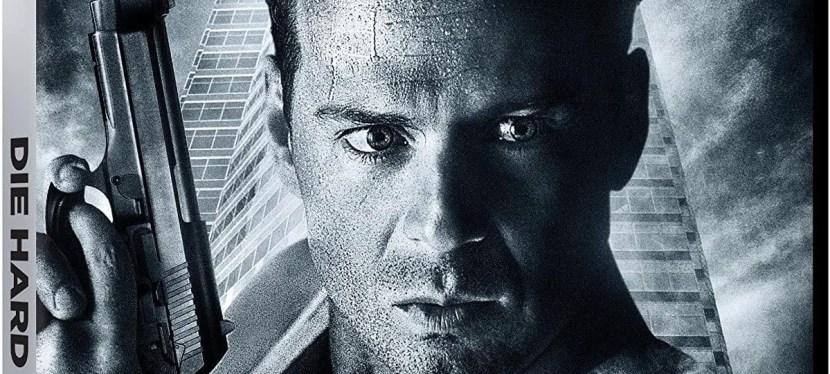
This is my copy of Die Hard 4K Blu-ray.
Back in 2021, I bought myself the 4K Blu-ray copy of Die Hard even though I already have the Blu-ray (1080p) copy. I simply wanted the best possible visuals and home entertainment experience of the classic movie that starred Bruce Willis and was directed by John McTiernan. In my life, I was fortunate to watch Die Hard in the local cinema here in the Philippines way back in 1988 and it was indeed the most thrilling in-theater experience I had as the film drew lots of reactions from all the moviegoers around me (note: this includes a standing ovation during the final conflict between John McClane and Hans Gruber) and its presentation turned out great. Simply put, Die Hard is one of my favorite movies all of time and the greatest Hollywood action movie of all.
As for Die Hard 4K Blu-ray itself, it came with the 4K Blu-ray disc, the Blu-ray disc and the digital code. I bought it online with a huge discount. Oh yes, the visuals were in native 4K resolution which I always preferred.
To put things in perspective, posted below are the technical details of Die Hard 4K Blu-ray as displayed on its Blu-ray.com page.
Video
Codec: HEVC / H.265 (49.50 Mbps)
Resolution: Native 4K (2160p)
HDR: HDR10
Aspect ratio: 2.39:1
Original aspect ratio: 2.39:1
Audio
English: DTS-HD Master Audio 5.1 (48kHz, 24-bit)
English: DTS-HD Master Audio 2.0 (48kHz, 24-bit)
Spanish: Dolby Digital 5.1
French: DTS 5.1
Spanish: DTS 5.1
German: DTS 5.1
Italian: DTS 5.1
Czech: Dolby Digital 2.0
Polish: Dolby Digital 5.1
Japanese: DTS 5.1
Subtitles – English SDH, French, German, Italian, Japanese, Spanish, Cantonese, Czech, Danish, Dutch, Finnish, Mandarin (Traditional), Norwegian, Polish, Swedish
Discs – 4K Ultra HD, Blu-ray Disc, Two-disc set (1 BD-66, 1 BD-50)
Digital – Digital copy expired, Movies Anywhere
Packaging – Slipcover in original pressing
Playback –4K Blu-ray: Region free, 2K Blu-ray: Region A
The Blu-ray disc, the 4K Blu-ray disc and the paper for the digital copy.
In my experience watching Die Hard on 4K Blu-ray disc, I noticed there were indeed visual improvements here and there. The film was remastered in 4K and it maintained the cinematic look precisely while it had assorted visual upgrades along the way. There was also a noticeable noise reduction on moments of intense brightness, particularly the explosions (note: they are longer overly bright and their precise colors and shapes became visible) and the fluorescent lights. I also enjoyed how the colors were improved and with the improvements on clarity, the tiny visuals details that were not visible on other formats became visible in 4K.
In connection to the improved visuals, watching Bruce Willis looking so much younger and with a full head of hair turned out to be unique part of the viewing experience. Oh yes, Alan Rickman as Gruber in a fancy looking suit looks better than ever in 4K!
Indeed, watching Die Hard 4K Blu-ray is the best and definitive way to enjoy the 1988 action classic at home. Don’t settle for streaming nor the 1080p Blu-ray nor DVD. Die Hard 4K Blu-ray is the best! If you don’t have it yet in your 4K Blu-ray collection, go for Die Hard 4K Blu-ray while it is still available and currently discounted!
Disclaimer: This is my original work with details sourced from reading the comic book and doing personal research. Anyone who wants to use this article, in part or in whole, needs to secure first my permission and agree to cite me as the source and author. Let it be known that any unauthorized use of this article will constrain the author to pursue the remedies under R.A. No. 8293, the Revised Penal Code, and/or all applicable legal actions under the laws of the Philippines.
Welcome back superhero enthusiasts, 1990s culture enthusiasts and comic book collectors! Today we go back to the year 1992 and explore a part of what was back then the 30th anniversary celebration of Spider-Man
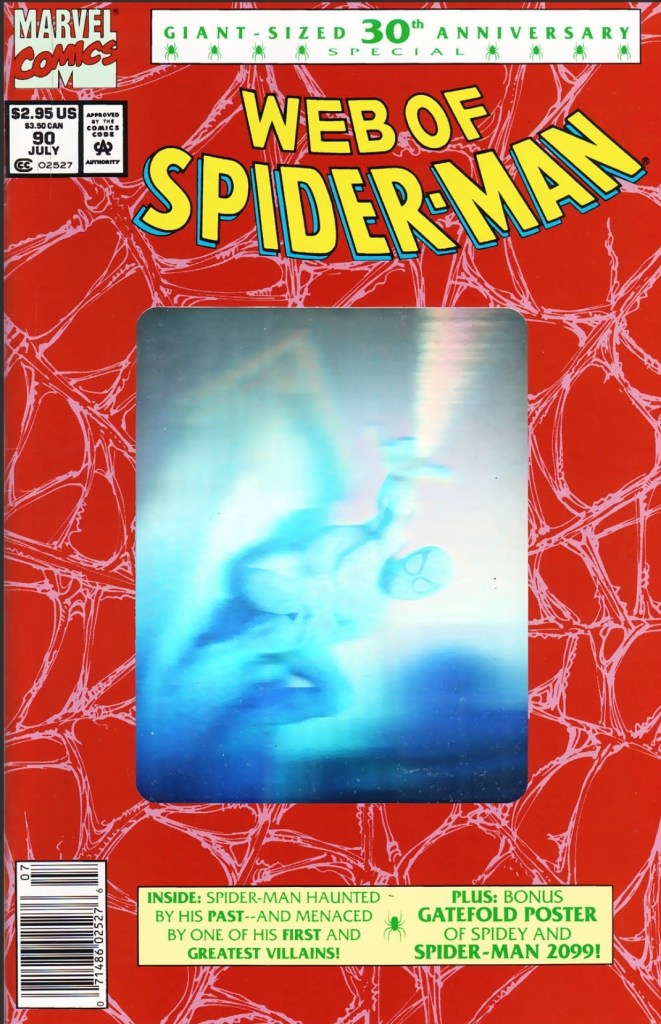
In what was back then a unique approaching to celebrating the anniversary of an American icon, Marvel Comics published not one but four specific Spider-Man comic books that had holographic covers and more pages than the usual. Each of those special comic books were from a different Spider-Man monthly series. Back in 2020, I published a retro review of one of those gimmick cover comic books from the Spider-Man monthly series.
With those details laid down, here is a look back at Web of Spider-Man #90, published in 1992 by Marvel Comics with a story by Howard Mackie and drawn by Alex Saviuk.
The cover.
Early story
The story begins inside an office in Los Angeles. A hat-wearing businessman has several varied figures of Spider-Man near him and recalls the time when the iconic hero participated in one of his events as the Masked Marvel. Moments later, the businessman’s wife arrives and together they departed in a limousine.
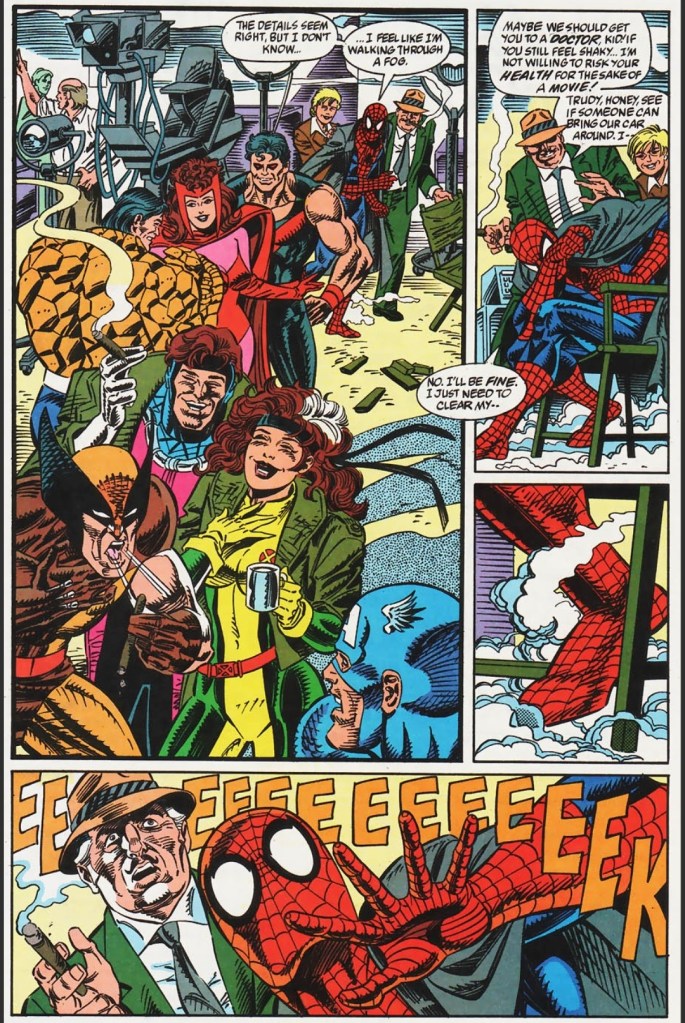
At the South Bronx in New York, Spider-Man chases a speeding car with one of its passengers firing a gun at him. Suddenly, his spider sense bothers him a lot and when he looks around, he suddenly sees Galactus standing with members of the Avengers, the X-Men and the Fantastic Four lying down helpless on the ground…
Quality
Spider-Man on the set of an entertainment project. It’s a lively reminder about how sickening Hollywood (AKA Commiewood) can get.
To make things clear and without spoiling the plot, this story deals with illusions and the distortion of reality. Quite ironically, the said distortion made it a challenge to follow the narrative and I can say that a good amount of the spotlight was on the businessman. Spider-Man is clearly the protagonist here but it made sense for the creative team to focus a bit on the businessman (who has been doing entertainment showcases for a long time) to justify the core concept about the conflicts between what is real and what is imaginary.
In relation to the illusion aspect of the story, you will get to see established Spider-Man arch-villains such as the Green Goblin, the Hobgoblin and Venom taking on the superhero himself. As the creative team focused more on providing a great amount of spectacle, there clearly was no room left for character development on Spider-Man. Don’t expect to see Peter Parker in dramatic moments nor see him interact with the established supporting characters.
If there is any moral lesson to learn from this comic book, it would be this – living with a powerful delusion (the result of personal obsession mixed with the personal failure to separate illusion from reality) can lead you to the wrong directions in life.
Conclusion
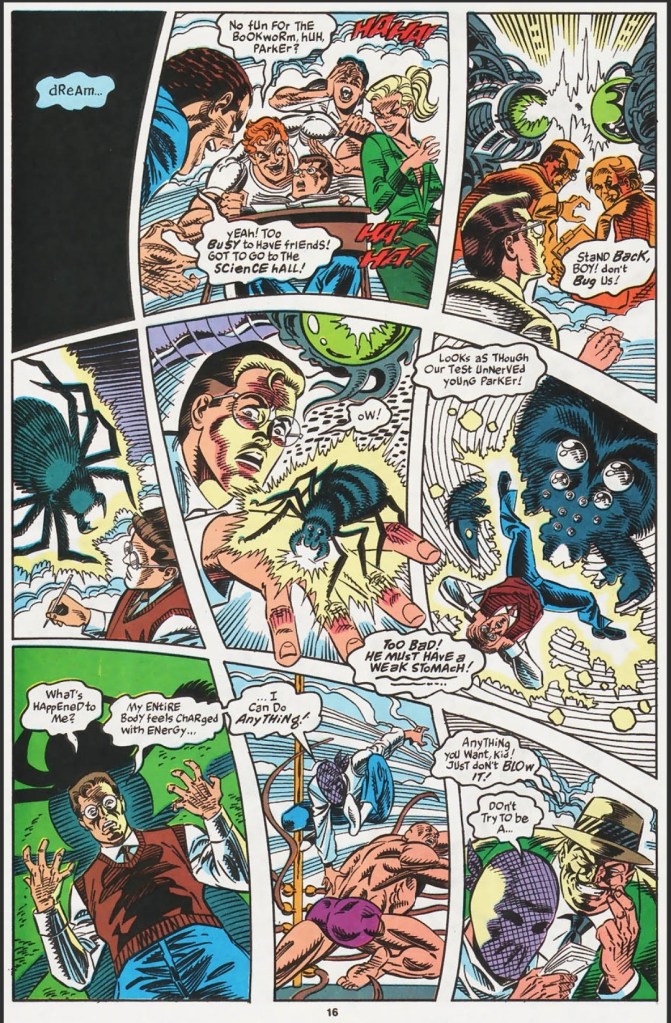
To justify the 30th anniversary celebration, distorted flashbacks into Peter Parker’s past were presented here.
Web of Spider-Man #90 (1992) does not have much depth for those who seek engaging storytelling. That being said, the story itself is not memorable nor would it leave a long lasting impact on you. This comic book was made to entertain readers with lots of action and wild fantasy images that eerily justify its concept about illusion and reality conflicting each other. In fairness to the creative team, the said conflict was consistently visualized and there were some dialogue that related to it in a somewhat philosophical manner. The comic book’s entertainment value is satisfying enough although it does not justify the holographic cover that was part of the gimmick with celebrating Spider-Man’s 30th anniversary. As for who was the main antagonist of the comic book, I simply encourage you all to read and find out for yourselves.
Overall, Web of Spider-Man #90 (1992) is satisfactory.
Welcome back my readers, fellow people of faith and those who love entertainment. Today, I want to emphasize something within the 1983 sci-fi epic TV miniseries V: The Original Miniseries.
Before I proceed, I want to address the newcomers reading this. V: The Original Miniseries was about alien humanoids from space who arrived on Earth “in peace” but gradually took control of the world and its people through varied means. Told through the viewpoints of affected Americans in California, V: The Original Miniseries was a cerebral and reflective form of science fiction entertainment that strongly parallels Nazi German’s occupation and takeover of countries in Europe in relation to World War II. As expected, a group of resisting people forms led by a reluctant young woman.
I personally love V: The Original Miniseries as well as its 1984 sequel V: The Final Battle. I own Blu-ray discs of the two mini-series (click here and here) and I encourage you to check out my retro reviews (click here and here). To this day, both mini-series remain solid to watch and are worth replaying all over again in my experience.
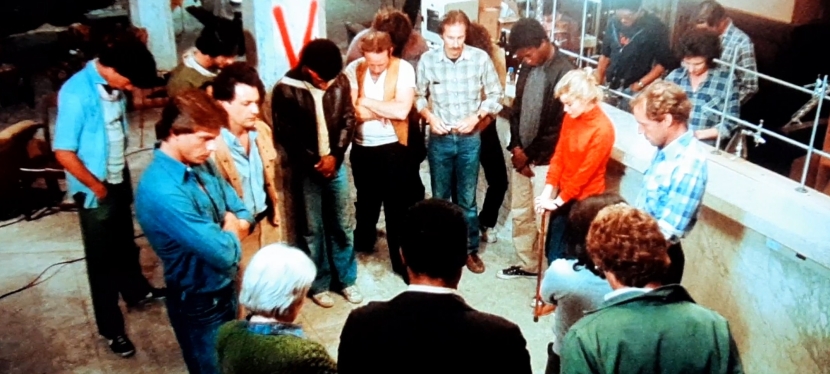
Going back to the subject matter of this post, the one significant scene of V: The Original Miniseries I want to emphasize is the prayer scene in the 2nd episode. The prayer scene took place just before the human resistance (led by Julie Parrish played by Faye Grant supported by Mike Donovan played by Marc Singer, Caleb Taylor played by Jason Bernard and others) execute their desperate moves to free their people from the Visitors (the aliens). Watch below the video clip I recorded off-screen while replaying V: The Original Miniseries on Blu-ray disc…
The prayer scene of V: The Original Miniseries.
As you can see in the above clip, the affected people were about to pull off a major push back against the Visitors from outer space. They no longer had the local police (who are already working with the aliens) nor the National Guard, nor the State Government of California nor any American authority to help them. Caleb, who lost a son, reminded Julie of having a prayer as he knew that without the Lord, everything they will do will fail. Caleb knew that as a rebelling force, they could not succeed against the Visitors by focusing on themselves, their resources and their abilities. Caleb knew they had to look up to God even though he does not know the state of each group member’s personal connection with Him. It was also symbolic to see Julie Parrish declare amen before finally giving the go-signal for their next operation which eventually served as the series of spectacle (action scenes) and suspense serving as the big pay-off for viewers.
Within the context of the what happened in the 2nd episode of the mini-series, Julie and her crew moved to secure essential equipment and military hardware at a local facility guarded by the Visitors which results in acts of violence as both sides fire at each other. These scenes happened after the prayer scene.
That being said, I want to make clear that I am not emphasizing the concept of praying to God to be able to win against the oppositionby means of violence. Violence and using the very methods of wicked people as a means of getting back at them are clearly not the ways under the watch of the Lord. God has a plan for each and every one of us and we have Lord Jesus to follow to save the lost and unsaved souls. The Lord has His ways of defeating Satan and his pawns, and we only need to follow the Lord instead of taking matters on our own hands.
If you are oppressed and you truly need the Lord’s help for favor and breakthroughs, let the Holy Spirit guide you instead of giving in to your fleshly desire of using force on those who attacked you. Do not even think about using the ways the evil ones used against you. Trust in Him, not the worldly and certainly not your flesh. Always remember that vengeance is the Lord’s. Read the bible verses below…
Beloved, do not avenge yourselves, but rather give place to wrath; for it is written, “Vengeance is Mine, I will repay,” says the Lord. Therefore
“If your enemy is hungry, feed him;
If he is thirsty, give him a drink;
For in so doing you will heap coals of fire on his head.”
Do not be overcome by evil, but overcome evil with good.
Romans 12:19-21 (NKJV)
Beloved, never avenge yourselves, but leave the way open for [God’s] wrath; for it is written, Vengeance is Mine, I will repay (requite), says the Lord.
But if your enemy is hungry, feed him; if he is thirsty, give him drink; for by so doing you will heap burning coals upon his head.
Do not let yourself be overcome by evil, but overcome (master) evil with good.
Romans 12:19-21 (AMPC)
Vengeance is Mine, and recompense, in the time when their foot shall slide; for the day of their disaster is at hand and their doom comes speedily.
Deuteronomy 32:35 (AMPC)
But God shows his anger from heaven against all sinful, wicked people who suppress the truth by their wickedness.
Romans 1:18 (NLT)
For I, the Lord your God, will hold your right hand, Saying to you, ‘Fear not, I will help you.’
Isaiah 41:13 (NKJV)
As seen among the bible scriptures above, Romans 12:19-21 should remind you all that vengeance is the Lord’s and we only need to follow Him because He knows best and has the means to help us overcome the forces of evil. In relation to that, this should remind you all that V: The Original Miniseries is not a faith-based story. Rather, it is a science fiction tale designed to entertain viewers while emphasizing the concept of what the world would be like if people welcomed foreign entities to come in peace pretentiously and take over societies by means of force, violence and fascism. Take note that the mini-series was released at a time when science fiction movies and TV shows were in high demand arguably due to George Lucas’ Star Wars.
The prayer sceneshould serve as a reminder that we the faithful in real life should keep trusting in the Lord and we need to support each other and strengthen our faith in Him no matter how twisted the world is around us. That is what makes it significant as part of the mini-series. Learn from the scriptures below…
For wherever two or three come together in honor of my name, I am right there with them!
Matthew 18:20 (TPT)
Now may the God of patience and comfort grant you to be like-minded toward one another, according to Christ Jesus, that you may with one mind and one mouth glorify the God and Father of our Lord Jesus Christ.
Romans 15:5-6 (NKJV)
In Whom, because of our faith in Him, we dare to have the boldness (courage and confidence) of free access (an unreserved approach to God with freedom and without fear).
Ephesians 3:12 (AMPC)
Then if my people who are called by my name will humble themselves and pray and seek my face and turn from their wicked ways, I will hear from heaven and will forgive their sins and restore their land.
2 Chronicles 7:14 (NKJV)
Rejoice always, pray without ceasing, in everything give thanks; for this is the will of God in Christ Jesus for you.
1 Thessalonians 5:16-18 (NKJV)
For God has not appointed us to [incur His] wrath [He did not select us to condemn us], but [that we might] obtain [His] salvation through our Lord Jesus Christ (the Messiah)
Who died for us so that whether we are still alive or are dead [at Christ’s appearing], we might live together with Him and share His life.
Therefore encourage (admonish, exhort) one another and edify (strengthen and build up) one another, just as you are doing.
1 Thessalonians 5:9-11 (AMPC)
Finally, while focusing on being with other people of faith and praying to the Lord together as a united body of His, learn from the scriptures below pertaining to Lord Jesus’ ascension to Heaven and His faithful followers (the early Christians) who stayed united together at the Upper Room in Jerusalem and prayed together knowing they are living on with His victory. May this encourage you to be with your fellow spiritual family (God’s family) members and pray to Him together.
Now when He had spoken these things, while they watched, He was taken up, and a cloud received Him out of their sight. And while they looked steadfastly toward heaven as He went up, behold, two men stood by them in white apparel, who also said, “Men of Galilee, why do you stand gazing up into heaven? This same Jesus, who was taken up from you into heaven, will so come in like manner as you saw Him go into heaven.”
Then they returned to Jerusalem from the mount called Olivet, which is near Jerusalem, a Sabbath day’s journey. And when they had entered, they went up into the upper room where they were staying: Peter, James, John, and Andrew; Philip and Thomas; Bartholomew and Matthew; James the son of Alphaeus and Simon the Zealot; and Judas the son of James. These all continued with one accord in prayer and supplication, with the women and Mary the mother of Jesus, and with His brothers.
Acts 1:9-14 (NKJV)
Now watch this video I recorded during my first-ever visit to the Upper Room in Jerusalem which was part of the pilgrimage tour I joined with my local church.
This was from my 2nd visit to the Upper Room in Jerusalem. I went to Israel on a pilgrimage tour with my local church because I desired to seek God’s kingdom there (read Matthew 6:33).
From this point on, I would like to reach out to all the lost and the unsaved people reading this. Did a religious and idolatrous extremist ruin your life? Have you been living in bondage for too long? Did the atheists, the humanists and the secularists fool you and abused you? Were you involved in the terrorist activities of Iran or the Palestinians? Have you been living as a homosexual or as a transgendered person? Are you still addicted to sex, drugs and other inappropriate elements? Did you spend an entire life worshiping statues, statuettes, images, people and relics? Are you a toxic person or one of those modern-day Leftist activists (Black Lives Matter, Democratic Socialists of America, Antifa, the abortionists and others) who got fed up fighting for worthless causes? Did you kill someone and have been living so long with the guilt?
All of the darkness related to what was mentioned above can finally end and you can decide to do it! How? You can save yourselves by submitting yourselves to the Lord Jesus willingly and realize He is the Light! There is no force and no coercion here. You have time and freedom to decide to receive Jesus as your Lord and Savior. For those who have decided to get born again now and gain salvation, please read the instructions and follow the prayer that I learned from a pastor.
Are you ready? Firstly, open your heart to the Lord and pray this simple prayer in sincerity from your heart:
Father God,
I thank You. I believe Jesus is Your Son. I believe that He died for me and redeemed me from all of my sins. He took my sins and, Father, thank You for loving me and You demonstrated Your love for me through Your Son Jesus Christ. Forgive me for all of my sins. Jesus, I open my heart to You. I welcome You to enter into my heart. I confess today that You are now my Lord and Savior. Thank You for forgiveness. I receive forgiveness. Thank You for Your blood that cleansed me from all of my sins. I will follow You, Jesus. Thank You for Your plan. I receive the Holy Spirit. And Holy Spirit, help me to follow the will of God in my life in Jesus’ name. Amen.
Congratulations! You are now a child of God! You have received Holy Spirit in your heart! This is easily your greatest decision ever made and also the greatest miracle of your life. Always praise, thank and honor the Lord. No more darkness in your life caused by politics, radicalism, toxicity, rebellion, religion, unbelief, evil, idolatry, traditions and rituals! Leave behind the darkness of your life and don’t look back to it. Remember that idolatry is evil, Purgatory is a lie, penance is a deception and Satan always used religion and unbelief to prevent people from being saved by the Lord. Also, do not ever hail Mary (the mother of Lord Jesus) because all the praise and honor belong to God, Lord Jesus and the Holy Spirit only.
With Lord Jesus, you are already moving forward and the best is yet to come! You also have a personal relationship with God, a relationship that is strictly off-limits to others (even to your household members or biological family members).
The Holy Bible is the ultimate authority and nothing else comes close to it for it is the Word of God. Remember always that Lord Jesus did not die on the cross to start religion. He died to redeem us all and showed that we must be led by faith in Him, faith in the Holy Spirit and faith in God the Heavenly Father. He rose from the dead and made His earthly presence felt once more to those who believed in Him. Lord Jesus ascended to Heaven and He promised to return in the future. His return is what we must always remember and keep living with holiness under the watch of God. We can do our part in building up God’s kingdom here on Earth by preaching His Word, blessing the Jewish people and saving the countless lost and unsaved souls around us by leading them to Lord Jesus. Living as a Christian is always about the personal relationship with the Lord, and it is certainly not about religion. Never let the idolaters, the idol makers, the ritual practitioners and other sinister forces fool you into becoming unholy.
Thank you for reading. If you find this article engaging, please click the like button below, share this article to others and also please consider making a donation to support my publishing. Sharing this Christian piece means spreading the good news of the Lord to others. It can help you save the unsaved and the lost souls out there.
Disclaimer: This is my original work with details sourced from reading the comic book and doing personal research. Anyone who wants to use this article, in part or in whole, needs to secure first my permission and agree to cite me as the source and author. Let it be known that any unauthorized use of this article will constrain the author to pursue the remedies under R.A. No. 8293, the Revised Penal Code, and/or all applicable legal actions under the laws of the Philippines.
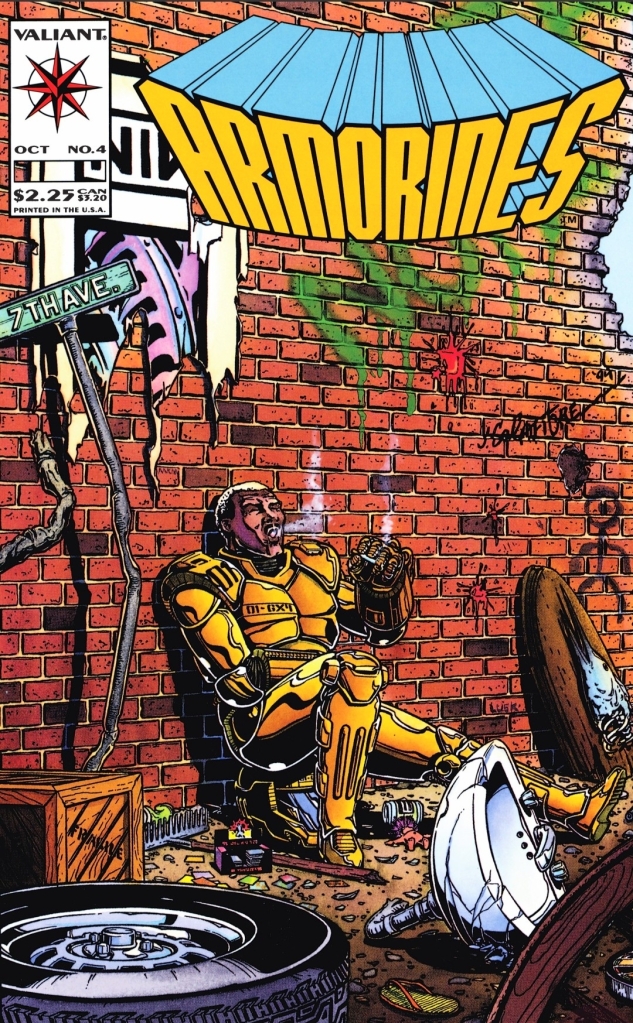
Welcome back superhero enthusiasts, 1990s culture enthusiasts and comic book collectors! Today we go back to the early 1990s and explore a part of the Valiant Comics shared universe through the Armorines monthly series.
In my previous retro review, the armored Marines and their US Navy SEALs managed to survive from the destruction of the submarine deep under the sea as they managed to complete their goal. One of the Armorines – Sirot – got separated from them and found himself in the presence of aliens who have been organizing secret operations on Earth, including the recent destruction of X-O Manowar’s armor. Knowing that their teammate is missing, the Armorines went back to the water on a search-and-rescue mission.
With those details laid down, here is a look back at Armorines #4, published in 1994 by Valiant Comics with a story written by Jorge Gonzalez and drawn by Jim Calafiore.
The cover.
Early story
The story begins inside one of the training domes located just outside Camp Pendleton in California (note: now a Commie-filled state). Teammates Gunny and Sirot engage in a close combat training session using the specialized technology provided to them by Dr. Zhan who carefully watches the statistics. As the session goes on, Sirot sarcastically tells the older Gunny that Senator Ackerman wants him off the Armorines as soon as their superior General Kendall feels the other recruits are properly trained. Sirot mocks him over his age (38-years-old).
Behind closed doors, Senator Ackerman tells General Kendall that even though the Armorines were successful with the mission in Australia and even managed to uncover a nest of aliens, the team were all more than capable without Gunny in their unit. Kendall defends Gunny and stressed that the man is their team’s most experienced member. Ackerman states that once the alien problem is over, he will force Gunny to retire…
Quality
Scenes like this will help readers get to know the Armorines members better.
To be clear, this story is more focused on the characters and is also a suitable build-up for the next turn of events ahead of the Armorines. As with issue #1, Gunny is the closest thing this series has to a lead character and he gets a good amount of character development scenes even though the story showed the other characters. Quite conveniently, the creative team used the military base setting to shift focus on the other Armorine team members similar to what was shown in Hollywood movies or TV shows about military personnel. There is the military club setting where the officers are relaxing and socializing with each other. There were also scenes showing specific soldiers at their respective residences where their true personalities (note: private life moments) are emphasized. All of these were done with solid writing and good artwork.
Without spoiling the details, I can say that the final page of this comic book was surprising and added to my anticipation of the next issue.
Conclusion
Alien vessels leaving Earth for space.
Armorines #4 (1994) is another solid entry in this particular monthly series which served as a good build-up for the next story that happens to be part of a big event that Valiant Comics published (read: The Chaos Effect). It is also within this comic book that you get to know the Armorines, their superiors and other characters better.
Disclaimer: This is my original work with details sourced from reading the comic book and doing personal research. Anyone who wants to use this article, in part or in whole, needs to secure first my permission and agree to cite me as the source and author. Let it be known that any unauthorized use of this article will constrain the author to pursue the remedies under R.A. No. 8293, the Revised Penal Code, and/or all applicable legal actions under the laws of the Philippines.
Welcome back superhero enthusiasts, 1990s arts and culture enthusiasts, Marvel Comics fans and comic book collectors! Today we go back to the wild 1990s by examining one of the many tales of Marvel Comics’ 2099 line of franchises, specifically through the Hulk 2099 monthly series.
For the newcomers reading this, Hulk 2099 first appeared in 2099 Unlimited #1 (1993)which also had his origin story told. Hulk 2099 was not a mere version of the classic Incredible Hulk with a futuristic touch. In fact, the futuristic green creature highlighted the protagonist John Eisenhart as a very selfish and obsessed Hollywood studio executive who happens to stumble upon the idolaters/worshipers of the classic Hulk Bruce Banner because he was searching for new properties and stories for his studio. Hulk 2099’s origin has notable similarities to that of the classic Hulk and gamma radiation exposure is one of them. As tales of the futuristic Hulk were told through the quarterly releases of 2099 Unlimited, Marvel decided it was time to give the green creature his own monthly series.
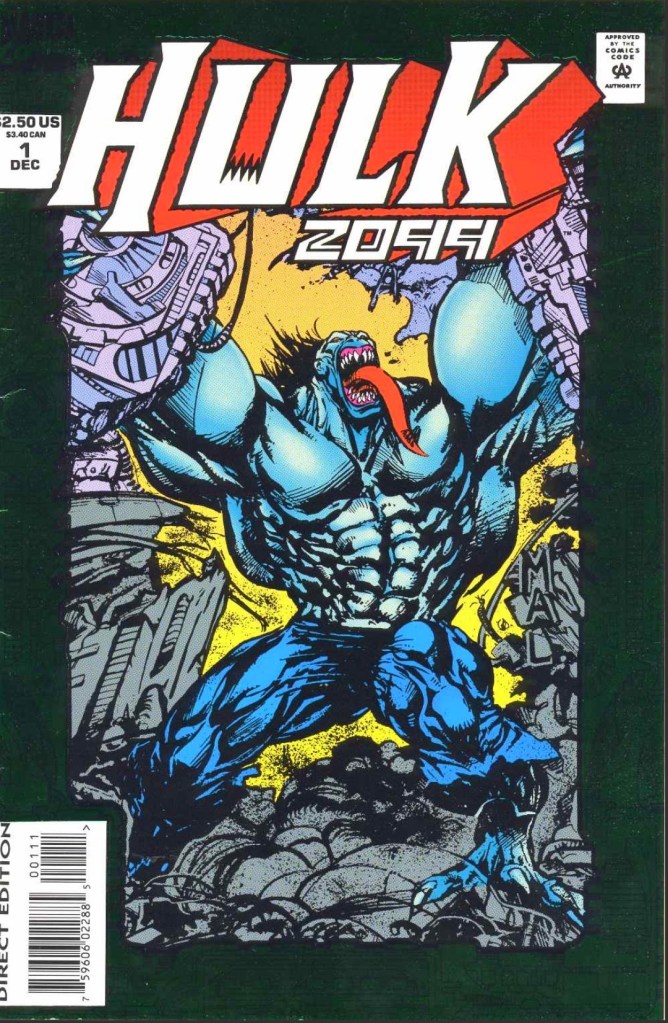
With those details laid down, here is a look back at Hulk 2099 #1 published in 1994 by Marvel Comics with a story written by Gerard Jones and drawn by Malcolm Davis.
The cover.
Early story
The story begins with the Hulk of 2099 destroying security droids and verbally attacking civilization. As he retains the intellect of John Eisenhart, he expresses his opposition against civilization for keeping people out of the water reclamation zone.
The story then shifts to California where Lotus Entertainment (Eisenhart’s employer) and its crew work on producing a film which is a dishonest telling of Eisenhart’s dealings with the Knights of Banner (already eliminated in 2099 Unlimited #1). During the production, one of the executives notices the absence of Eisenhart.
Elsewhere, John Eisenhart drives his flying car with Knights of Banner youth survivor Gawain as his passenger. Already struggling with the guilt over the deaths of all the adult Knights of Banner members, Eisenhart intends to end his employment and cash out of his contract. Gawain remains hostile towards Eisenhart.
Quality
The creative team used flashback images that look really similar to what was told in 2099 Unlimited #1.
If there is anything that is very obvious to talk about, it is the fact that this tale shows a radically different John Eisenhart who wants to get out of Hollywood’s multiple mazes of crookedness as he feels very guilty over what happened to the Knights of Banner. This happens just as a new entity took corporate control of Eisenhart’s employer before he could leave the company. In many ways, Eisenhart’s distress and struggle with being guilty reminds me a lot about Hardcase of the Ultraverse and the way the creative dramatized him was engaging.
For the story, there is a lot of corporate intrigue going on and Eisenhart’s failure to quit quickly was inevitable because the new enemy he faces here has a lot to do with the sudden takeover of Lotus Entertainment. At least on face value, this looks like an attempt by the creative team to change the status quo and move Hulk 2099 to a new creative direction away from what was established in 2099 Unlimited. Without spoiling the details, I can say that something very significant happened before the comic book’s ending and it will impact readers who followed the futuristic Hulk’s stories closely in the 2099 Unlimited series.
Along the way, there is a lot of action and unfortunate physical happenings which symbolize the chaos concept of the script. The notable thing here is that you won’t see very much of Hulk 2099’s monstrous form as the script was specifically written to tell a tale that went beyond one issue. Clearly, the creative team were sparing Hulk 2099 for a conflict in the next issue.
Malcolm Davis’ art has that visceral aesthetic that fits the established look of Marvel’s 2099 universe of the time but there were instances when he showed so much happening, the visuals looked chaotic and even disorienting. In fairness, his take on Eisenhart, Quirk, Gawain and others made them looked recognizable.
Conclusion
The future of Commiewood, wokeness, and dishonesty.
While its story has little of the green monster in it, Hulk 2099 #1 (1994) does a decent job building up the tension on top of the guilt-filled Eisenhart while setting up events that looked like a bold new creative direction was coming. By the time this comic book was published, several Hulk 2099 tales were already published in the quarterly 2099 series. On its own, this comic book lightly builds up the lore of the 2099 universe as it was clearly focused on Hulk 2099’s creative concept and characters.
While Eisenhart was indeed determined to change, it is a turnoff to see him lie and exaggerate details to protect himself from a certain corporate psychologist who is after the truth. There is also a lot of anti-corporate expressions here which seems to suggest that someone within the creative team had been thinking with socialist concepts and decided to use the script as an outlet of expression. The weird but true thing is that by today’s standards, Hollywood is filled with Commies/socialists/Marxists/liberals/woke nuts from the film crew up to the executives that run studios and produce films or shows that are dumb, lies about reality, self-centered and extensions of their ideologies. This showed that this comic book was prophetic in some ways.
Disclaimer: This is my original work with details sourced from reading the comic book and doing personal research. Anyone who wants to use this article, in part or in whole, needs to secure first my permission and agree to cite me as the source and author. Let it be known that any unauthorized use of this article will constrain the author to pursue the remedies under R.A. No. 8293, the Revised Penal Code, and/or all applicable legal actions under the laws of the Philippines.
Welcome back superhero enthusiasts, 1990s arts and culture enthusiasts and comic book collectors! Today we go back to the wild 1990s and explore a part of Malibu Comics’ Ultraverse through a tale of Freex.
Since after facing off with Contrary (who eventually became part of UltraForce) and her so-called school and students, Freex had been traveling far and long (refer to my previous Freex reviews here, here and here) and gained Old Man as a useful companion. Along the way, they encountered the unknown deep underground and even saw a powerful being. They even got to the city of Denver temporarily. As they went on, they found the path that led them back to civilization.
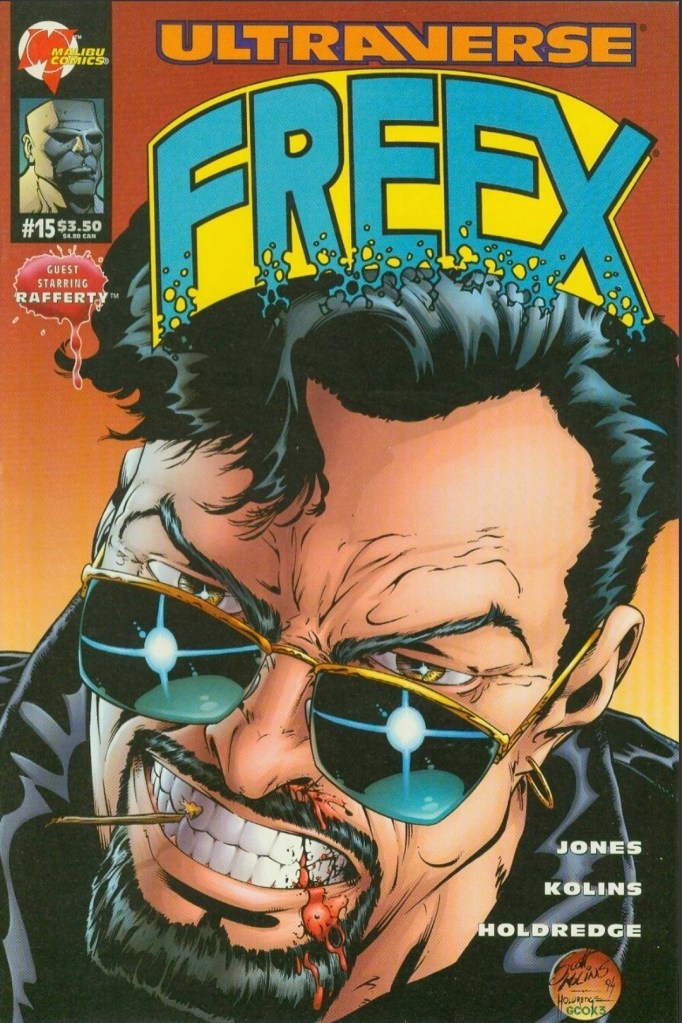
With those details laid down, here is a look back at Freex #15, published in 1994 by Malibu Comics with a story written by Gerard Jones and drawn by Scott Kolins. This is a flip-side comic book with Ultraverse Premiere #9 (1994) on the other side.
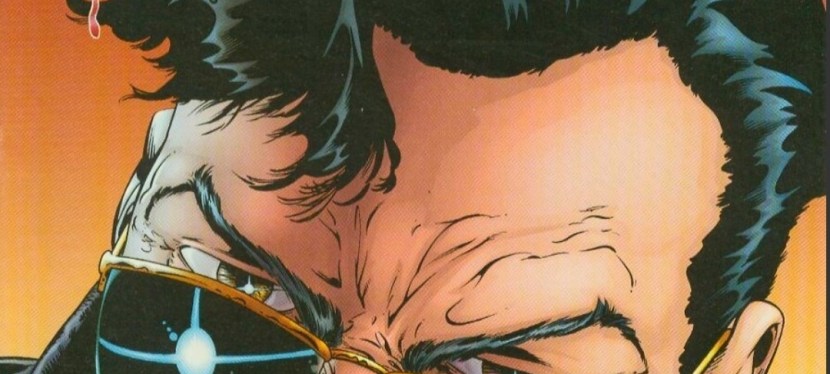
The cover.
Early story
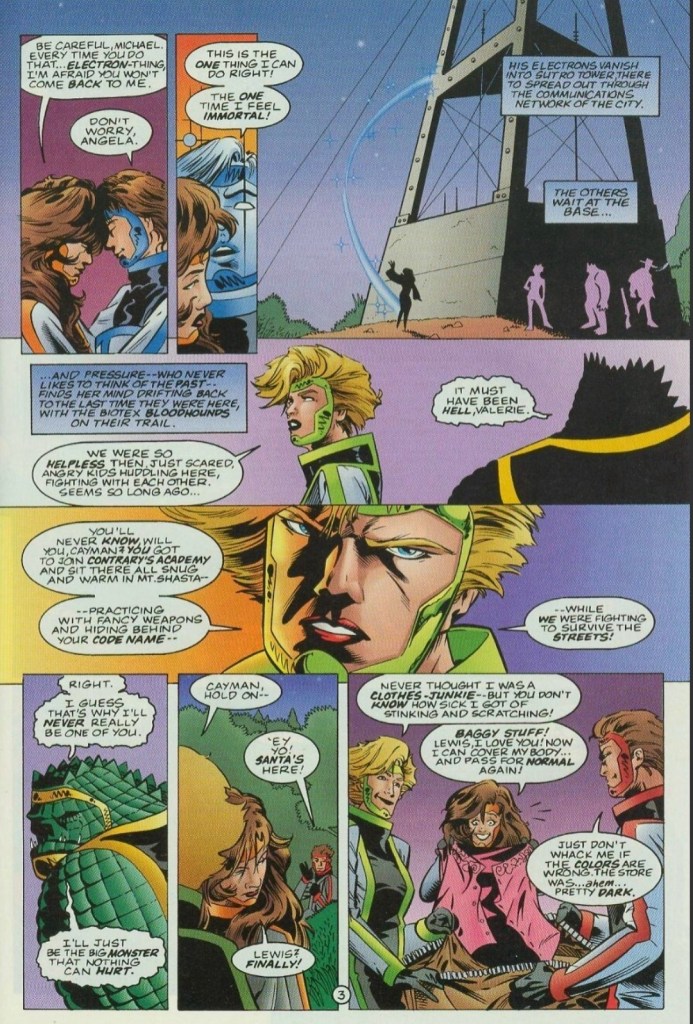
The story begins with Freex – composed of Plug, Sweet-Face, Pressure, Anything and new member Cayman – have been traveling for some time deep underground with Old Man. They find themselves back in San Francisco, the one city that brought them together. While still a long distance away from the city proper and there are no locals who could see them, the team cautiously move to a high communications tower. Michael/Plug uses his special ability to transform himself into electronic matter and makes his way through the communications network of the city to do something very important. Cayman meanwhile becomes the object of discussion between Pressure and Sweet-Face as he has yet to share with them details about himself.
As Cayman himself was part of Contrary’s academy and joined Freex recently, he has trouble gaining the trust of the others. After wearing new clothes that Lewis found, a guy suddenly appears to them. He introduces himself to them as Evan…
Quality
The very evil Rafferty monitoring Freex secretly and enjoying his advantage over them.
Considering what happened in the previous issues, this story feels like a breath of fresh air not only because of the new location the team got into but also because of strong twists that happened. Instead of going through fantastical encounters, Freex found themselves in situations that are more grounded with reality (within Ultraverse standards specifically) and more notably, the story emphasized crossover as Freex and Old Man encountered Firearm. The said crossover, quite cleverly, sets up Freex into a collision course with the serial killer Rafferty (who encountered The Strangers elsewhere within the Ultraverse). For the newcomers reading this, Rafferty is one of the most evil characters of the Ultraverse who has murdered a lot of people – including his own parents – and has developed tremendous hatred of Ultras.
The inclusion of Rafferty here also sheds light on the Freex’s past connection with the Night Man (click here and here). More notably, the said serial killer turned out to be so resourceful and totally obsessed with murdering people with special abilities, he became a formidable force towards Freex. This leads to a pretty powerful and twisting conclusion that must be seen.
Conclusion
The gang by the tower.
With a good amount of intrigue, characterization spectacle, strong dialogue and the element of crossover, Freex #15 (1994) is a pretty engaging comic book to read. The biggest feature here is having Freex in a conflict with a very obsessed killer who not only hates Ultras but also has an extensive record of murdering many people over a long period of time. In my view, the Freex-Rafferty conflict was nicely structured and it added depth to the plot. What happened in the end of this comic book should resonate with dedicated fans of Freex.
Disclaimer: This is my original work with details sourced from reading the comic book and doing personal research. Anyone who wants to use this article, in part or in whole, needs to secure first my permission and agree to cite me as the source and author. Let it be known that any unauthorized use of this article will constrain the author to pursue the remedies under R.A. No. 8293, the Revised Penal Code, and/or all applicable legal actions under the laws of the Philippines.
Welcome back superhero enthusiasts, 1990s arts and culture enthusiasts, Marvel Comics fans and comic book collectors! Today we go back to the year 1993 and explore a part of Marvel Comics’ universe through the first-ever limited comic book series featuring one of Marvel’s most iconic supervillains – Venom.
Previously, I wrote about Venom with his appearances in What If comic books (click here and here) as well as in issues of Venom: Lethal Protector (click here and here). Venom also appeared in the disappointing crossover comic book Spider-Man Meets Spider-Man 2099.
Moving back to the year 1993, the Venom: Lethal Protector limited series ended and Marvel went on to release a 2nd limited series composed of three issues complete with an all-new creative team. That series was Venom: Funeral Pyre and the most notable thing is that Venom gets to be with the Punisher (read my other retro reviews that include the character here, here, here and here).
With those details laid down, here is a look back at Venom: Funeral Pyre #1 published in 1993 by Marvel Comics with a story written by Carl Potts and drawn by the late Tom Lyle.
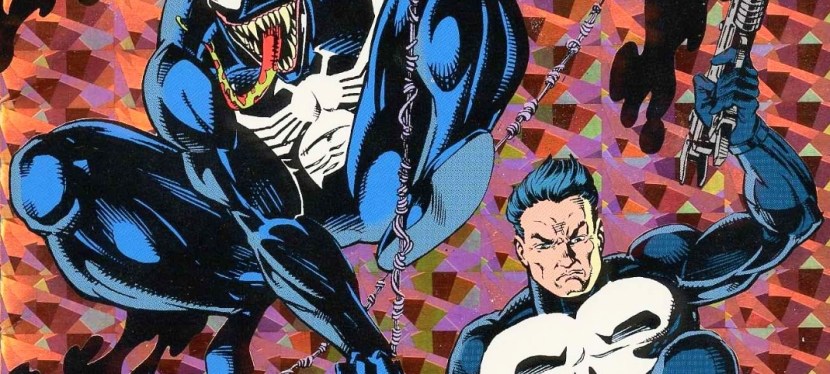
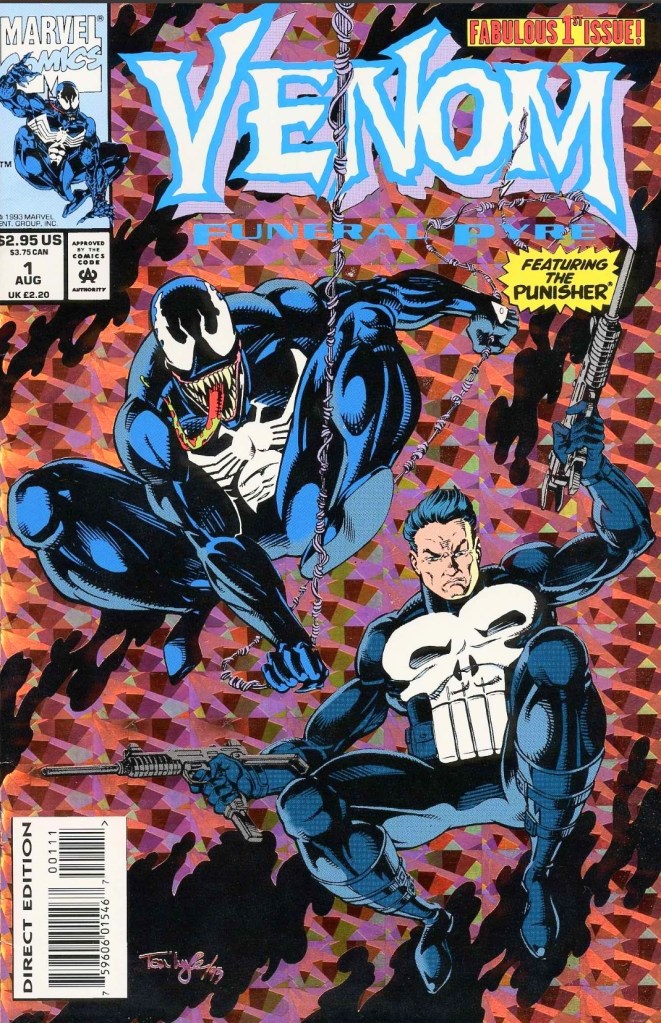
The cover.
Early story
The story begins on the streets of Oakland, California. There, a young guy named Gray Russell watches gang members severely beat up another guy which disturbs him deeply. He is part of the gang. A short time later, he rides with the gang in a car which hits a man (who managed to have his young nephew move out of harm’s way).
Somehow the man survived and moves to another direction deliberately to lure the gang away from his nephew. As the gangsters move towards a local building, Gray separates from his harsh companions to find a phone booth. Gray finds Calvin (the nephew of the man who got hit) nearby and decides to comfort him. From a distance, they heard the gangsters beat Calvin’s uncle to death.
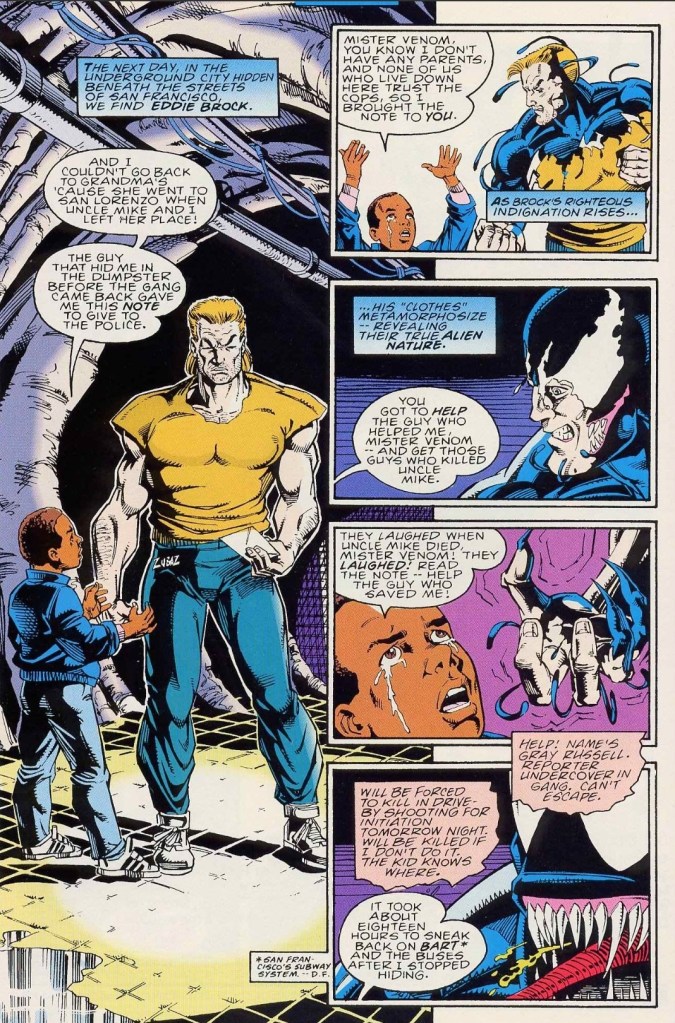
The next day in the underground city beneath San Francisco, Calvin meets Eddie Brock and hands him a note meant for the police. As Calvin reveals more details, Eddie gradually turns into Venom with his alien costume covering up his body. After learning of the death of Calvin’s uncle and hearing the young boy’s plea for help for Gray (an investigative reporter in secret within the gang), Venom agrees to help him as it is their mission to save the innocent and destroy the guilty…
Quality
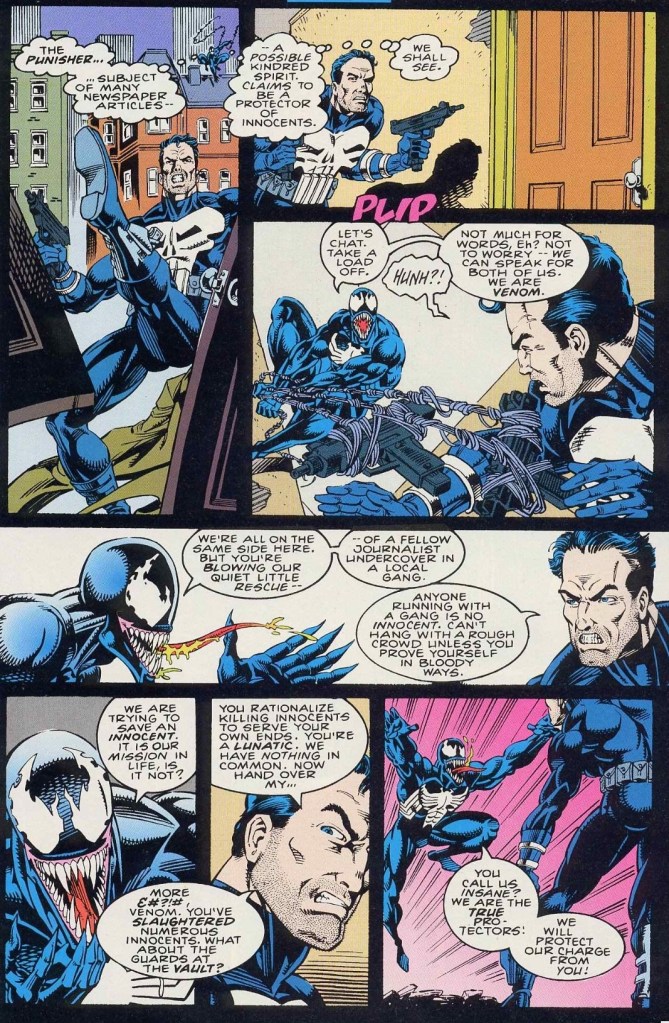
Punisher and Venom’s first-ever encounter with each other.
I want to start first the with the overall presentation crafted by the Potts-Lyle creative duo. In terms of story and setting, this comic book has a very strong urban crime vibe which is not a surprise given the fact that Carl Potts wrote lots of stories of the Punisher and his personal war against criminals. That being said, the tone is very different compared to what was shown in Venom: Lethal Protector and other Venom tales that got published before this comic book. Very clearly, this story is dark, gritty and even disturbing to read due to the subject matter of crime and senseless violence caused by people who are obsessed with violence. The fantasy elements of Venom: Lethal Protector are unsurprisingly absent here.
Carl Potts’ take on Venom’s personality is technically an extension of what was established previously. Venom, who is truly a murderer on the loose, continues to live with his very distorted code by helping the innocent by means of using violence and death on others he personally views as guilty. His getting involved in the turf of crime here is, however, a fresh approach on the super villain now acting “heroic” helping Calvin who lost his uncle. Being a former journalist himself, Eddie Brock “relates” with the investigative journalist involved with the gang.
The other major character – the Punisher – is his typical self in this story. He gets involved in the conflict in Oakland not purposely but accidentally as he was just passing by in his weapons-filled van as he heard the local police communication on local crime. The only thing notable about the way the Punisher is portrayed here is his first-ever interactions with Venom which is a crossover scene filled with a decent amount of hard action.
Gray, the investigative journalist, is presented here as technically the third major character of the story. In some ways, he even overshadows Venom and the Punisher in key parts of this comic book. He is not really an interesting character himself but there are some interesting Marvel universe details shown from his personal memories. What is clear about this uninteresting character is that the creative team planned something with him in a key role within the core concept of this mini-series.
As for the plot itself, it clearly has a dark and gritty concept of street crime in 1990s Oakland which itself plays a big part of the build-up of the story and the eventual crossover between Venom and the Punisher. The problem is that the build-up has an uninteresting character with Gray involved and there is a lot of exposition to go through before the Venom-Punisher encounter.
The encounter between Venom and the Punisher here came with the superhero comics crossover trope of the players misunderstanding the situation and each other, and getting into a conflict very early on. Both characters have their respective obsessions and so-called codes of purposes, which predictably leads them into conflict as they stayed hard-headed towards each other. While it is flawed, the Venom-Punisher crossover here is the highlight as well as the relief from having to read all the exposition and build-up.
Conclusion
A scene like this could inspire Black Lives Matter terrorists, SJWs, woke activists and North American socialists to become violent and cause havoc around America.
Venom: Funeral Pyre #1 (1993) is a flawed comic book that happens to highlight the Punisher and Spider-Man’s greatest nemesis of the time. It delivered on its promise of showcasing the two characters – a cold-hearted anti-crime vigilante and an alien costume-equipped murderer – in a crossover but the pay-off was barely enough when you take into account the build-up, the exposition and the involvement of the uninteresting third player named Gray. Compared to what was shown in Venom: Lethal Protector, this comic book clearly has an urban crime flavor which Carl Potts strongly implemented. As for the art, Tom Lyle showed he is really good in visualizing Venom, the Punisher and street gang wars.
Overall, Venom: Funeral Pyre #1 (1993) is serviceable. Definitely this is not the fabulous 1st issue described on the foil cover.














 Author Carlo Carrasco