Recently in the City of Parañaque, ten men were arrested by the police after they were caught cutting the underground cables of a telecommunications firm in Barangay Don Bosco, according to a Manila Bulletin news report. Recovered from the suspects were 600 pairs of cut underground copper cable (around 106 meters each), a claw bar, an improvised hook and a closed van to name some.
To put things in perspective, posted below is an excerpt from the news report of the Manila Bulletin. Some parts in boldface…
Authorities from the Paranaque City Police arrested 10 men who were caught in the act of cutting underground cables of a telecommunications provider in violation of Republic Act No. 10515 or the Anti-Cable Theft Law.
The suspects were identified as “Jayson,” 33; “Cris,” 32; “Roger,” 32; “John,” 29; “Calixto,” 26; “Mark,” 23; “John,” 22; “Marlo,” 21; “Jiric,” 21; and “Rogelio,” 19, all residents of Tondo, Manila. Two other suspects evaded arrest.
The police said the suspects were arrested at around 3:30 a.m. in front of the TCL Authorized Service Center located along France St., Barangay Don Bosco, Paranaque City, by members of the Paranaque City Police Don Bosco Substation.
Operatives from Paranaque City Police Don Bosco Substation were reportedly conducting routine patrol when they noticed a suspicious closed van and, upon their approach, the group of men cutting cable wires tried to flee but were prevented with the assistance of Barangay Don Bosco officials.
The police said coordination with the telecommunications providers showed that there was no authorized repair or maintenance work in the area, leading to the arrest of the suspects.
Let me end this post by asking you readers: What do you think about this recent development? If you are a resident of Parañaque, do you think crime will only get worse over the next three years? Do you think there will still be people out there who will organize illegal operations that look like maintenance work?
For more South Metro Manila community news and developments, come back here soon. Also say NO to fake news, NO to irresponsible journalism, NO to misinformation, NO to plagiarists, NO to reckless publishers and NO to sinister propaganda when it comes to news and developments. For South Metro Manila community developments, member engagement, commerce and other relevant updates, join the growing South Metro Manila Facebook group at https://www.facebook.com/groups/342183059992673
Disclaimer: This is my original work with details sourced from reading the comic book and doing personal research. Anyone who wants to use this article, in part or in whole, needs to secure first my permission and agree to cite me as the source and author. Let it be known that any unauthorized use of this article will constrain the author to pursue the remedies under R.A. No. 8293, the Revised Penal Code, and/or all applicable legal actions under the laws of the Philippines.
Welcome back superhero enthusiasts, 1990s arts and culture enthusiasts, Marvel Comics fans and comic book collectors! Today we go back to the mid-1990s to explore the adaptation of the second season of the famous X-Men: The Animated Series (X-Men TAS) in the form of the X-Men Adventures comic book series.
Before getting to the new retro comic book review, I should state that it is indeed very challenging to implement the concepts of time travel and timeline conflicts into the narrative of an established X-Men universe. As far as the X-Men TAS narrative goes, Bishop and Cable are mutants who each came from different points in the future and in different ways they each made impact with the present day X-Men as portrayed in the comics (the literary X-Men specifically).
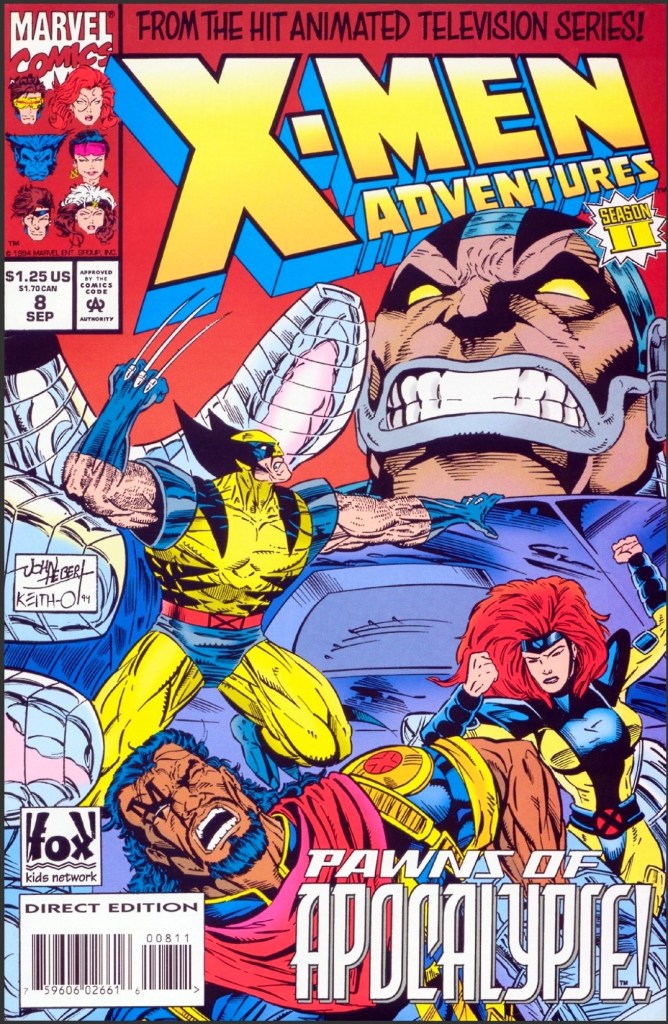
With those details laid down, here is a look back at X-Men Adventures Season II #8, published in 1994 by Marvel with a story written by Ralph Macchio and drawn by John Hebert. The is the 2nd chapter of the Time Fugitives storyline.
The cover.
Early story
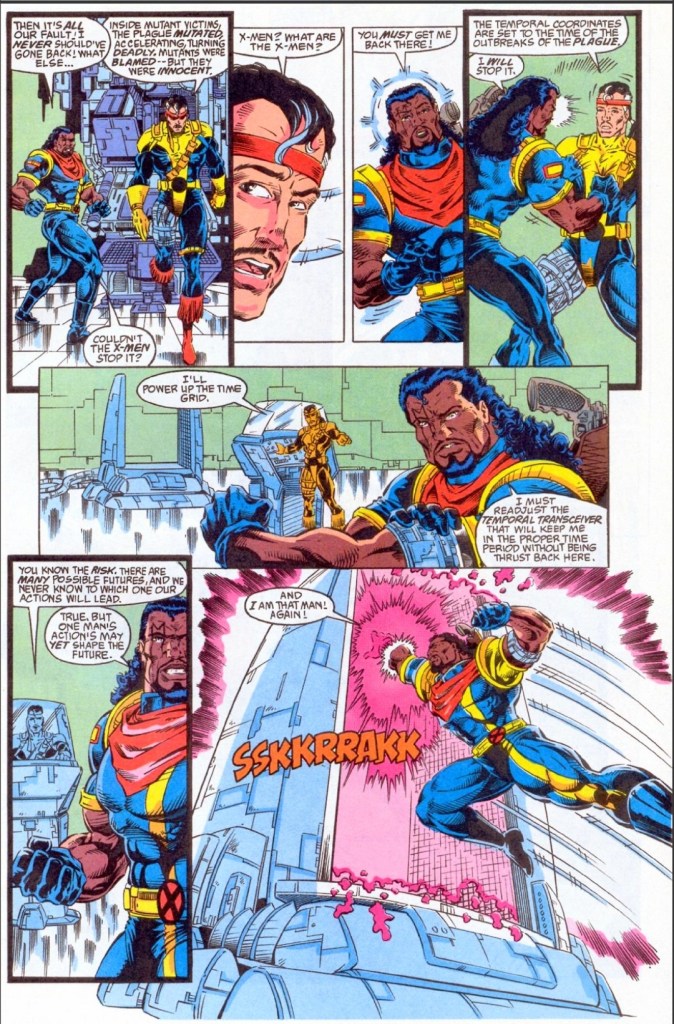
The story begins on Earth in the far future of 3999 AD. Cable, who has been leading the fight against Apocalypse, is receiving information from his cube-shaped computer which informs him that a temporal storm has wreaked havoc with the time stream and their present is reconfiguring in response to the existence of a new past. Once realignment gets completed, everyone in the current timeline will cease to exist. Cable then learns that Bishop (who returned to the X-Men in the previous issue) is the primary chronal component of the time readjustment.
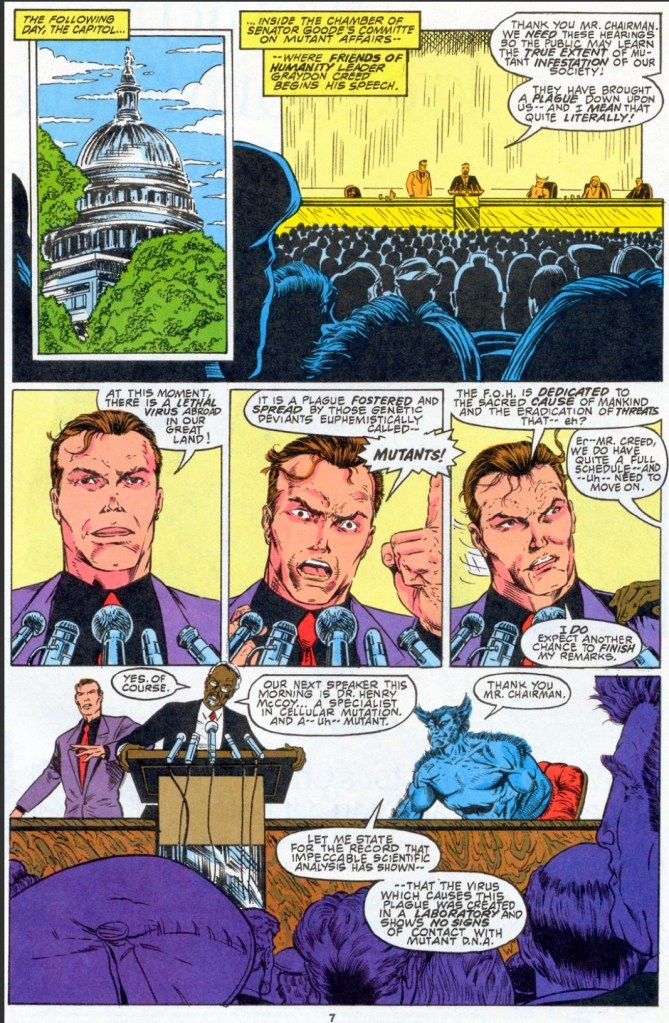
Meanwhile in the present day inside Xavier’s mansion, the X-Men listen to Bishop who explains that mutants will be blamed for the plague that a certain virus will precipitate and that the fear of the virus will make things much worse for many people. He states that the virus was not brought into being by mutants.
Beast then shares that his investigation of a viral-ridden cell sample was convincing and discovered that the virus was genetically engineered. He reveals that once the little germs spread to the mutant population and combine with mutant DNA, it could turn out incredibly deadly…
Quality
Conflict brewing in front of a huge audience.
To be straight to the point, what the creative team started in issue #7 got strongly concluded here. With the animated episode’s teleplay being the primary reference, writer Ralph Macchio successfully crafted a script that raised the stakes of the 2-part Time Fugitives story while tying closely the gaps with regards to the time travel and timeline conflicts concepts. Without spoiling the plot, I can say that one development that took place in the present day clearly set off the stage for another futuristic mutant to not only get involved but also make a huge impact on the narrative.
As with the previous issue, this story has elements of xenophobia as well as fear of viruses and potential massive infections which added a good layer of depth to the plot. Macchio’s writing is very strong and no matter how intense the tale got as more details got presented, it still remained very readable and efficient to follow. Also, I should say that Apocalypse’s presence turned out very powerful and it should inspire readers to search for comic books of the supervillain’s conflict with the X-Men and X-Factor for insight.
John Hebert returned on the visual department and his art style really works well with both the sci-fi concept of the story and the presentation of the X-Men plus Bishop and Cable. I really admire Hebert’s stylized take on Wolverine, Cable and Bishop as he made each them look even grittier than before. There is also this creepy vibe with the way Hebert drew some of the X-Men members’ faces. Herbert is also very good with visualizing sci-fi elements such as energy forms, futuristic machines, techno-virus forms on the skin, and more. His presentation of dynamic superhero action is great to look at. This is clearly one of the best looking issues of Season II of the X-Men Adventures series.
Conclusion
Bishop explains things to the X-Men and Beast confirms key details.
X-Men Adventures Season II #8 (1994) is a rock-solid comic book in terms of quality and impact. It concluded the 2-part story with a powerful resolution, it tied the loose ends in a very timely fashion and I really enjoyed the way how the X-Men were dramatized as Bishop and Cable got involved with them in their present day setting. So far, this is the most satisfying and more impactful issue of Season II I have read in this series.
Overall, X-Men Adventures Season II #8 (1994) is highly recommended.
Disclaimer: This is my original work with details sourced from reading the comic book and doing personal research. Anyone who wants to use this article, in part or in whole, needs to secure first my permission and agree to cite me as the source and author. Let it be known that any unauthorized use of this article will constrain the author to pursue the remedies under R.A. No. 8293, the Revised Penal Code, and/or all applicable legal actions under the laws of the Philippines.
Welcome back superhero enthusiasts, 1990s arts and culture enthusiasts, Marvel Comics fans and comic book collectors! Today we go back to the year 1991 to explore a chapter of the Uncanny X-Men series that took place between X-Tinction Agenda and Mutant Genesis (the modernization point of Marvel’s mutants for the 1990s).
For the newcomers reading this, X-Tinction Agenda was a very notable part of the history of the X-Men comic book franchise as it marked the first time that the X-Men, X-Factor and the New Mutants were combined and also reunited several X-Men members who were scattered around the world. That being said, the state of mutants within Marvel Comics’ shared universe created a sense of uncertainty towards Charles Xavier’s grand dream of establishing a peaceful co-existence between humans and mutants.
With those details laid down, here is a look back at Uncanny X-Men #273, published in 1991 by Marvel Comics with a story written by Chris Claremont and drawn by Whilce Portacio, Klaus Janson, Jim Lee, John Byrne, Rick Leonardi, Marc Silvestri, Michael Golden and Larry Stroman.
The cover.
Early story
The story begins in the control center within the complex located deep under the ruins of Charles Xavier’s mansion. Storm (X-Men), Jean Grey (X-Factor), Cyclops (X-Factor) and Cable (New Mutants) carefully examine the worldly forces that oppose them. After Storm asked about what they could do about the opposing forces located in different parts of the world, Cable says that they should hit them hard and fast as they have the power to do so.
Storm asked Cable if violence is his only solution. Even though violence got things done for Cable, Cyclops rejects it and states that his fellow mutants (pertaining to the X-Men and X-Factor) are not like him.
As the conversation intensifies, Jean Grey tells Cable that they are not warriors and the school was not founded by Professor X to have mutants to fight wars. Cable replied that war is what they got and reminded them of the two mutants they lost and another one who ended up as a genetically engineered slave. Cable asked them if they want to see more of their fellow mutants end up badly…
Quality
In the absence of Professor X, Jean Grey (then a member of X-Factor) revisits Cerebro and recalls what she learned long ago.
In relation to the mentioned fact that this particular story took place between X-Tinction Agenda and Mutant Genesis, this is a tale that reflects a period of transition leading to the latter. That being said, Chris Claremont took the opportunity to emphasize the current state of the X-Men and the other mutants, as well as the uncertainty ahead of them all. To be clear, this story does not have Marvel’s mutants going up against another super villain nor a group that opposes them.
The story opened very strongly with the leading figures of the X-Men (Storm), X-Factor (Cyclops and Jean Grey) and the New Mutants (Cable) being together analyzing the global situation and the forces that oppose them.
For Cable, violence is necessary for their survival and progress because he sees war against mutants already happening and there is simply no room left for error nor compromise. Very symbolically, Storm, Cyclops and Jean Grey – who all were nurtured by Professor X with his pacifist dream of bridging the gap between mutants and humans – reject Cable’s beliefs as they don’t see themselves as warriors and they do not dream of conquering their enemies at all. All the dialogue that took place in the argument are very richly written and there are layers of meanings which long-time X-Men fans will able to relate with.
Along the way, Claremont and the other creators made good use of available comic book space to develop the other characters which resulted in the gradual developments within each team of mutants. Gambit here is a brand new member of the X-Men and his talk with Storm is very sensible to read. There was also this notable Danger Room training session between Archangel and Cannonball in which the former (who is already very experienced as one of the original X-Men and a current member of X-Factor) shares wisdom to the very young mutant (who later went on to lead X-Force some time later). The creative team also inserted a few moments of humor on the other character development scenes.
Conclusion
Truly this is one of the most symbolic and most engaging arguments between the leading figures of the X-Men, X-Factor and New Mutants (which later became X-Force).
Even though it was mainly focused on character development and has no battle with any enemy, Uncanny X-Men #273 (1991) remained a very engaging read as it tackles not only the current state of the three mutant teams of the time but also realigned their direction creatively and the results were fully realized through the eventual Muir Island saga as well as Mutant Genesis and even in further tales (including Fatal Attractions). In many ways, this comic book served as a solid foundation of things to come and this partially explains the eventual reform of the X-Men into a much larger group that had to be composed of two teams shortly after the return of Professor X (as seen in X-Men #1 and Uncanny X-Men #281 in 1991).
Overall, Uncanny X-Men #273 (1991) is highly recommended.
Disclaimer: This is my original work with details sourced from reading the comic book and doing personal research. Anyone who wants to use this article, in part or in whole, needs to secure first my permission and agree to cite me as the source and author. Let it be known that any unauthorized use of this article will constrain the author to pursue the remedies under R.A. No. 8293, the Revised Penal Code, and/or all applicable legal actions under the laws of the Philippines.
Welcome back superhero enthusiasts, 1990s arts and culture enthusiasts, Marvel Comics fans and comic book collectors! Today we go back to the mid-1990s to explore the adaptation of the second season of the X-Men animated series in the form of the X-Men Adventures comic book series.
Before getting to the new retro comic book review, I should state that decades ago, the use of future timelines was implemented on the X-Men comics. I’m talking about the possible future where Cable and Stryfe came from, another possible future where Phoenix/Rachel Summers came from, and the more established future of the classic Days of Future Past storyline. Time travel and possible future timelines are the themes in the next X-Men Adventures comic book I reviewed recently.
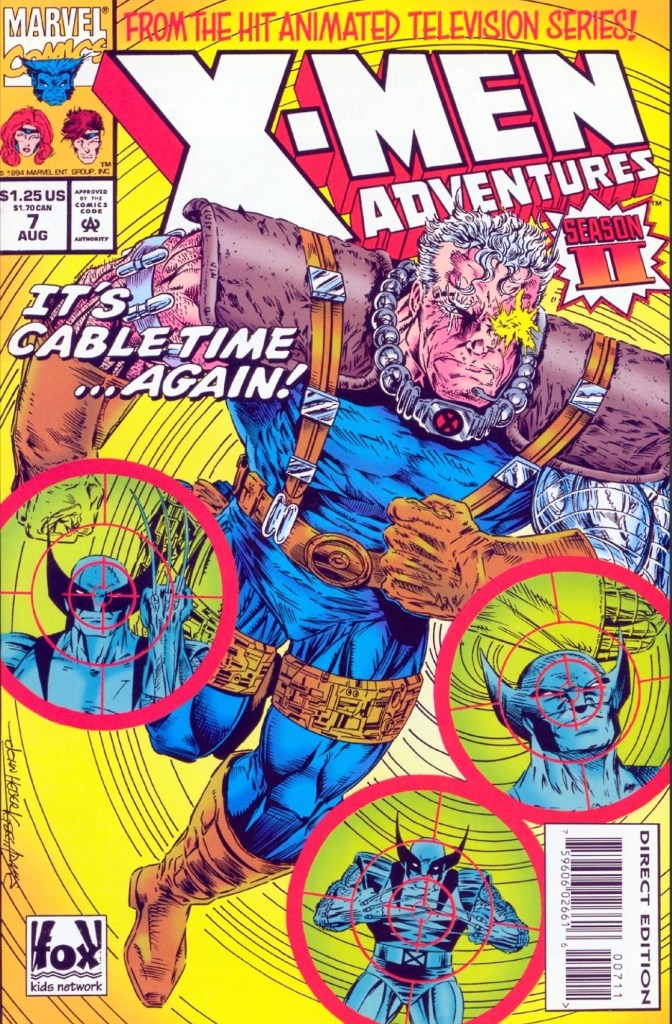
With those details laid down, here is a look back at X-Men Adventures Season II #7, published in 1994 by Marvel with a story written by Ralph Macchio and drawn by Scott Rosema.
The cover.
Early story
The story begins on Earth in the far future of 3999 AD. Cable, who is fighting for the rebels, battles the deadly forces of the powers that be. It turns out, he and his teammates have been struggling a lot and their team suffered several deaths already. Even though they are very tired and heavily outnumbered, Cable refuses to give up and bravely calls for a frontal assault against their enemies.
Suddenly, Apocalypse appears on the battlefield and commands his robotic troops to destroy Cable and his fellow rebels. To Apocalypse’s surprise, a temporal storm appears and Cable notices it appearing so close to them. One of his teammates got caught by the storm which pushes Cable away. After receiving computer updates, Cable decides to get away from the robotic troops.
Meanwhile in another time period and place, Bishop returns from his mission (his interactions with the X-Men of the 20th century – click here and here) only to discover from Forge that nothing has changed and the plague still rages on…
Quality
The X-Men have a new problem to deal with.
Having read X-Men Adventures #13 and #14 of season 1, I found this particular tale (clearly a sequel to Bishop’s interaction with the X-Men after traveling through time) relatable and enjoyable. There is a strong science fiction vibe here and the time travel aspect added a lot to the build-up of tension.
Bishop here is almost the protagonist as the story showed an altered future in which Forge has no memory of the X-Men and only made a reference to a plague that has lasted for a long time. This compels Bishop to go back to the 20th century again hoping to meet the X-Men and somehow prevent the plague from bringing down society.
The impact of the mysterious virus is tremendous as so many people got infected and authorities suspect mutants to be the carriers. At this stage, the social aspects inserted by the creators really started to grow stronger within the narrative and you will see the X-Men struggling with not only the increased scrutiny on mutants but also with the manipulative tactics of anti-mutant activists who can’t help but see golden opportunities to wipe out mutants in a more clever fashion.
The dialogue here is noticeably gripping to read and the dramatization worked accordingly. There is also a good amount of superhero spectacle to enjoy here even though the X-Men have no super villains to fight with.
Conclusion
Forge has no memory of the X-Men.
X-Men Adventures Season II #7 (1994) looks like a repeat or even a remake of what happened in X-Men Adventures #13 (Season I) but its concept turned out to be not only unique with strong social commentary and sci-fi elements, but also became really engaging thanks to the fine execution by the creative team. On the aspect of social relevance, this comic book will remind you about the internment of Japanese Americans in America (1942-1946) and the COVID-19 restrictions and the quarantine on communities imposed by governments that disrupted people’s lives. As this comic book marks the first part of the Time Fugitives, I can say that I enjoyed it and I’m looking forward to the next chapter.
Overall, X-Men Adventures Season II #7 (1994) is recommended.
Disclaimer: This is my original work with details sourced from reading the comic book and doing personal research. Anyone who wants to use this article, in part or in whole, needs to secure first my permission and agree to cite me as the source and author. Let it be known that any unauthorized use of this article will constrain the author to pursue the remedies under R.A. No. 8293, the Revised Penal Code, and/or all applicable legal actions under the laws of the Philippines.
Welcome back, superheo enthusiasts, 1990s culture enthusiasts, X-Men fans and comic book collectors! Today we revisit the X-Men Adventures monthly series which was the literary adaptation of the popular X-Men animated series of the 1990s.
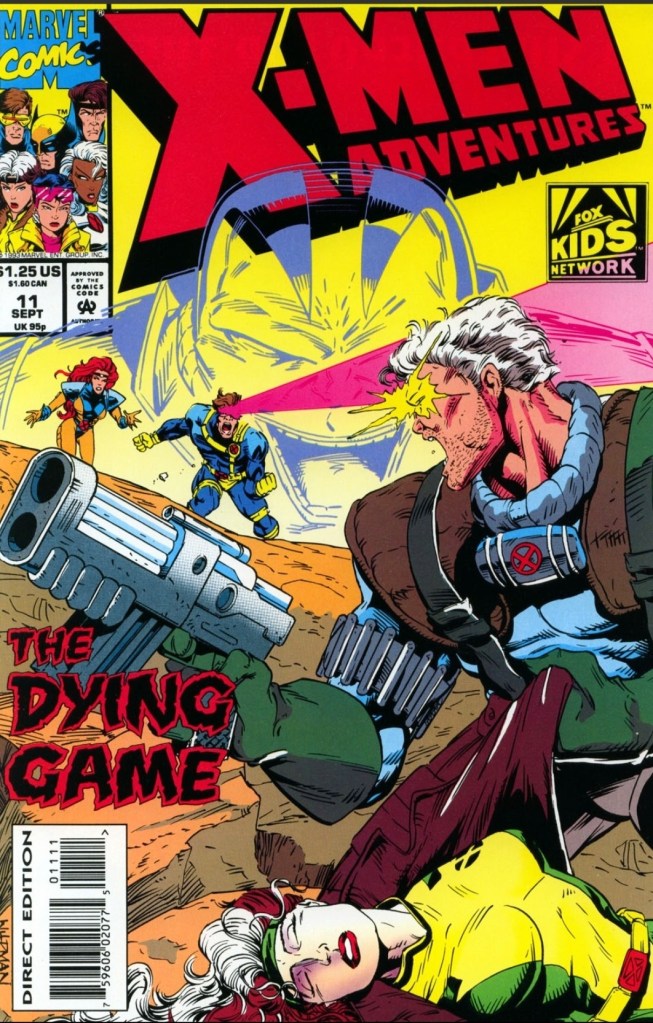
In this retro review, we take a look at the adaptation of the animated series’ own portrayal of the Muir Island saga from the comic books. Also there is Rogue who desired to have her genetic mutation cured, even though it means removing her super strength, flying ability and her dangerous touch.
With those details laid down, here is a look back at X-Men Adventures #11, published by Marvel Comics in 1993 with a story written by Ralph Macchio and drawn by Andrew Wildman.
The cover.
Early story
The story begins with Rogue emerging from the rubble of a facility on Muir Island. She remembers that just moments earlier, Pyro and Avalanche ruined the facility just as she was about to get cured by a man she knows as Dr. Adler. She leaves the place searching for those responsible for the ruined facility. She fails to noticed that she is being observed from a distance.
Elsewhere on the island, Pyro and Avalanche open a bag believing Dr. Adler is in it. To their shock, Mystique is the one who emerged and she reveals to them that she was just posing as Dr. Adler as part of her mission to lure mutants into taking the treatment not without realizing the truth that it will turn them into slaves of the one entity she serves…Apocalypse. Pyro explained that he and Avalanche hoped to hold Dr. Adler for ransom.
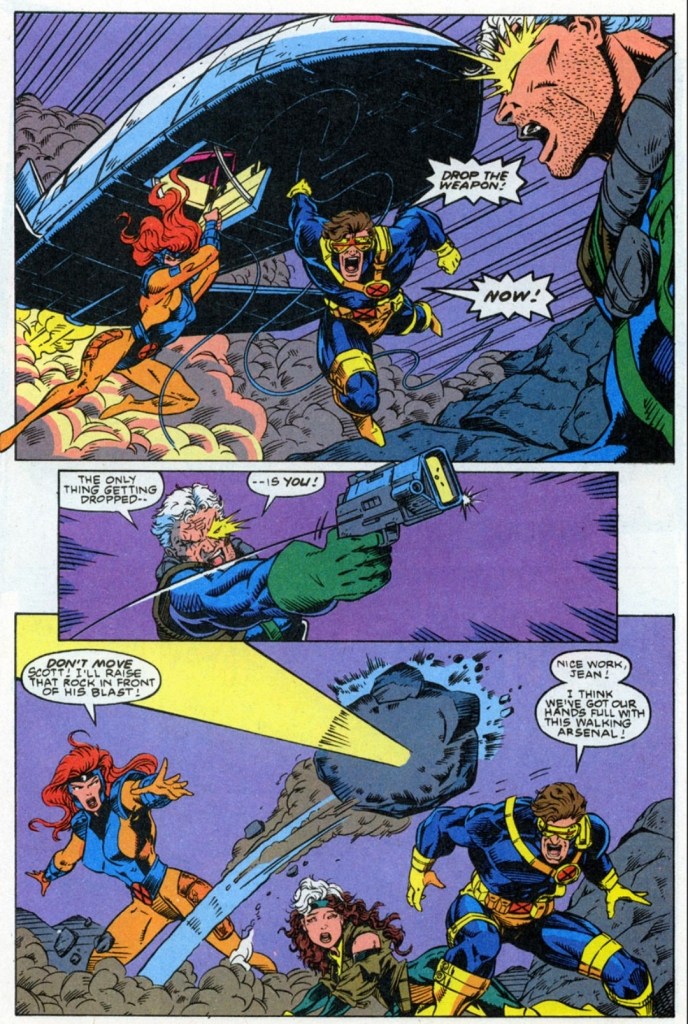
At a nearby cliff, Cable quietly watches using his rifle’s scope…
Quality
Cyclops and Jean Grey confront Cable!
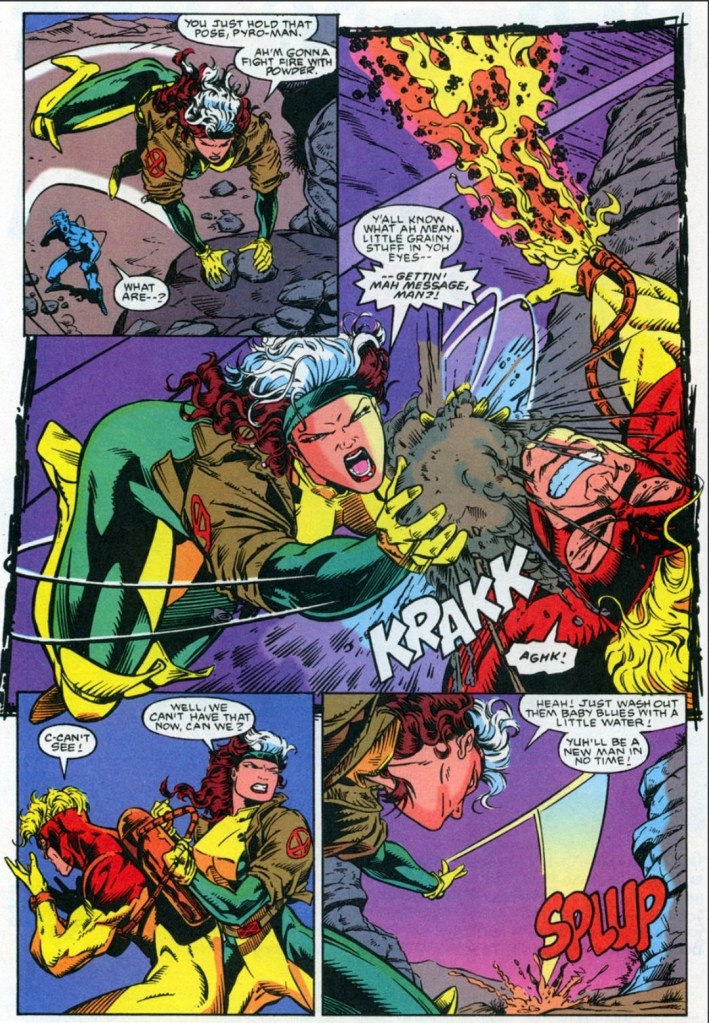
To put things clearly, this one is pay-off to what was built up in issue #10 while also serving as the continuation of a multi-part story regarding Muir Island. In the previous issue, Rogue desired to become a normal individual which is why she went to Dr. Adler on the said island. In this comic book, the direction for Rogue took a drastic change fighting Pyro and Avalanche not knowing that Mystique is involved and secretly working to help her master Apocalypse execute his ambitious plan of gaining capable and controllable slaves from the mutant population.
The good news here is that the script is very well written and the narrative is really strong. Very notably, the superhero spectacle got clearly ramped up by several notches resulting in lots of action scenes as well as opportunities for Andrew Wildman to flex his artistic muscles making some dynamic action-packed images for readers to enjoy. Along the way, there is some suspense built-up related to the sub-plot within (note: Cable’s limited appearance here as well as the Jean Grey and Cyclops reuniting with their mentor Charles Xavier) as well as the Muir Island saga itself.
Indeed, this comic book has lots of spectacle that superhero enthusiasts will enjoy but still the Macchio-Wildman team managed to maintain the core themes of the story for readers to absorb and think about.
Conclusion
Dynamic action of Rogue taking on Pyro.
X-Men Adventures #11 (1993) is a very solid read from start to finish. Even as the narrative has lots of action scenes presented, the story still managed to maintain focus on the themes of sacrificing mutation to be normal humans, the temptations brought in by advanced scientific wonders, and the exploitation of people seeking hope and reform a lot. There are indeed moral lessons within this comic book reflect about. This is strong creative work by Macchio-Wildman that X-Men fans and newcomers should read and I can say there is more to come storywise beyond this comic book.
Overall, X-Men Adventures #11 (1993) is recommended!
Disclaimer: This is my original work with details sourced from reading the comic book and doing personal research. Anyone who wants to use this article, in part or in whole, needs to secure first my permission and agree to cite me as the source and author. Let it be known that any unauthorized use of this article will constrain the author to pursue the remedies under R.A. No. 8293, the Revised Penal Code, and/or all applicable legal actions under the laws of the Philippines.
Welcome back superhero enthusiasts, 1990s arts and culture enthusiasts, Marvel Comics fans and comic book collectors! Today we go back to the year 1993 and explore a part of Marvel Comics’ universe through the reimagined tales emphasized in the What If monthly series.
Back in 2021, I reviewed What If #46 (1993) which told a compelling story about division between the mutants, the clash of beliefs between Professor X and Cable, and how terrorism affects everyone. The comic book was also a mesmerizing portrayal of how the X-Men would have organized themselves without Charles Xavier, Jean Grey and Cyclops.
Considering all the chaos that happened in What If #46 (1993), the time was just right for Magneto – the X-Men’s most dangerous enemy of all time – to come in and make an impact not only on mutants but on the world.
With those details laid down, here is a look back at What If #47, published in 1993 by Marvel Comics with a story written by Kurt Busiek and drawn by Tod Smith.
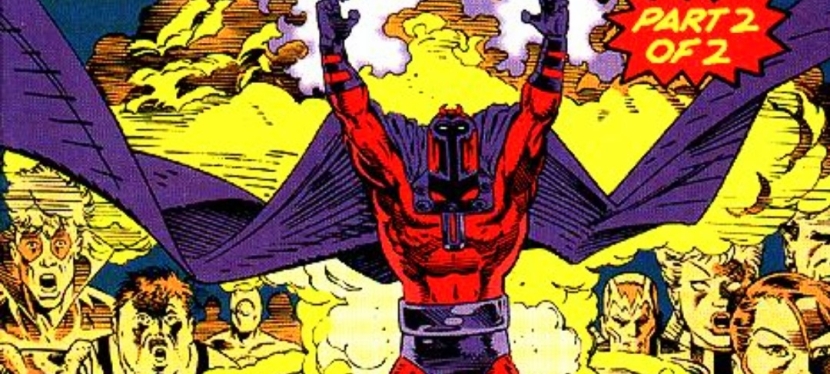
The cover.
Early story
The story begins with Magneto leading a huge legion of mutants to take overwhelm the remaining resistance – including Spider-Man, the Fantastic Four, Captain America, the Avengers and the dedicated American soldiers – in Washington, D.C.
A fierce battle then took place with both sides hitting each other hard. After noticing Magneto’s lack of presence during the battle, Captain America then realizes that the long-time enemy of the X-Men took advantage of the fighting to penetrate the U.S. Capitol’s bomb shelters and got the nation’s leaders hostage. After easing some of his fellow heroes, Captain America decides not to escalate the fight against Magneto in consideration of the lives of America’s top officials…
Quality
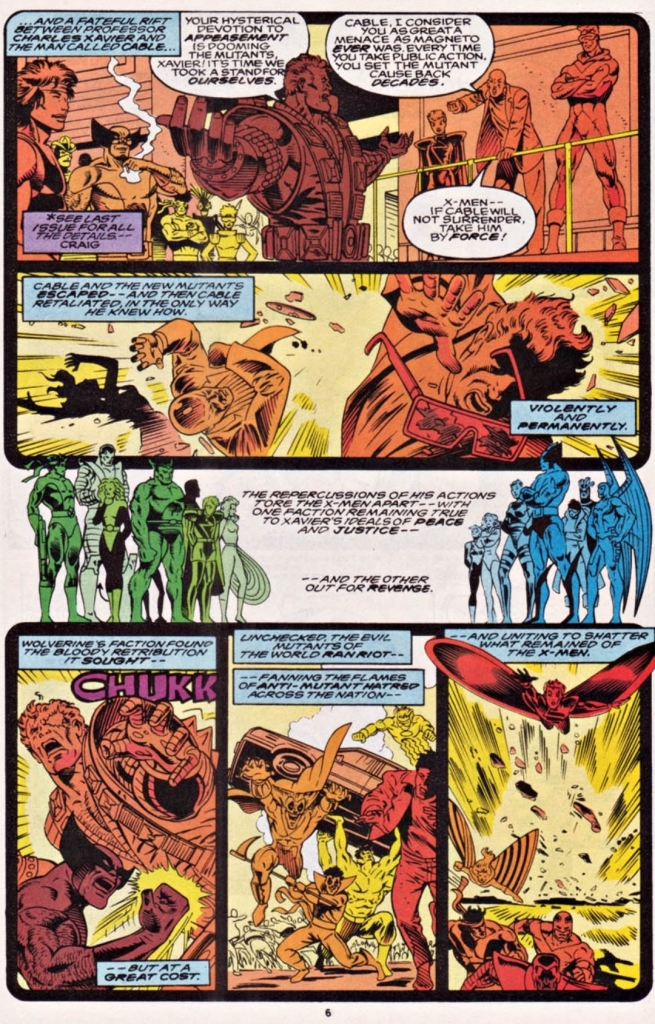
A recap of the events in issue #46.
To begin with, I can say that this story is a well-planned follow-up to the events of issue #46. While Magneto’s presence has been magnified a lot here, there are still strong story connections to the previous issue.
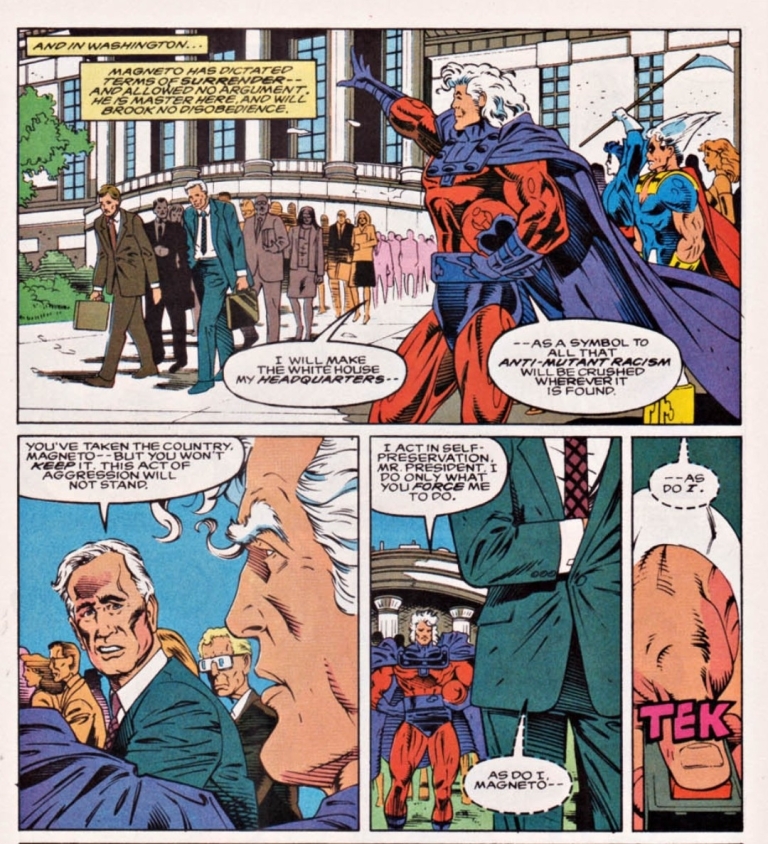
With regards to what was emphasized on the front cover of the comic book, this story explores what would happen if Magneto took power to control the entire United States while leading a group of mutants with a platform focused on crushing anti-mutant racism even though it includes pushing the non-mutant people (which is the great majority of America’s people) as well as the dissenting mutants out of the way.
For one thing, this superhero fantasy concept is actually socially relevant with today’s geopolitics and the way America has turned out under the fake leadership of Joe Biden (who is NOT leading as US President but only following the modern-day American Communists and reckless SJWs dictating him to do their evil bidding. Biden also arrogantly denies reality when it goes against the desires of his administration and his Satanic Democrats) It should be noted that the US President visualized in this comic book eerily looks like Joe Biden complete with that absent-minded facial expression.
Next, a clear theme in this What If story is absolute power and why groups who crave for it would sacrifice so much and hurt others just to acquire it. Magneto, who carries deep hatred towards people he perceives to be obstacles or opposition for his quest of uplifting mutants, takes advantage of mutants who have lost hope and are depending on someone to lead them. Indeed, the long-time X-Men nemesis gains power to control America but finds himself facing a new force of opposition which leads the nation into a drastic series of change that clearly do not alight with his vision of a better future for mutants.
Still on the theme of absolute power, the US government in this story was portrayed to have developed technologies designed to overwhelm its citizens, as well as the means to establish infrastructure and protocols to transform America into an automated dictatorial state that enslaves its citizens and violate their rights without restraint. Once again, this aspect of the story makes it socially relevant.
Considering the epic concept and the dark turn of events the creative team prepared, this comic book does not have a clear good-versus-evil approach but rather it emphasizes chaos that comes with the pursuit and abuse of absolute power over the nation. You will see key elements from the classic X-Men storyline Days of Future Past here in relation to America’s deformation.
Conclusion
Wow! The US President in this comic book eerily looks so much like Joe Biden whose leadership led America into a lot of problems and hardship. Sky high inflation is just one of the problems that happened under Biden.
What If #47 (1993) is truly a very captivating read mainly because of its core concept which goes way beyond the scenario of Magneto taking control of America. Considering its portrayal of America and the exploration of dark themes about people getting overwhelmed by power abusers, the story is a warning about the fall of America told in superhero fantasy form. Considering the intense social degradation that rocked America the past few years (note: riots by the Black Lives Matter terrorists, SJWs disturbing the peace, Democrats allowing more illegal immigrants into the country, socialists in colleges continuing to brainwash students and more), this story is very socially relevant. It will keep you thinking and reflecting deeply, even if you strongly desire whatever superhero entertainment you seek in this comic book.
Overall, What If #47 (1993) is highly recommended!
Disclaimer: This is my original work with details sourced from reading the comic book and doing personal research. Anyone who wants to use this article, in part or in whole, needs to secure first my permission and agree to cite me as the source and author. Let it be known that any unauthorized use of this article will constrain the author to pursue the remedies under R.A. No. 8293, the Revised Penal Code, and/or all applicable legal actions under the laws of the Philippines.
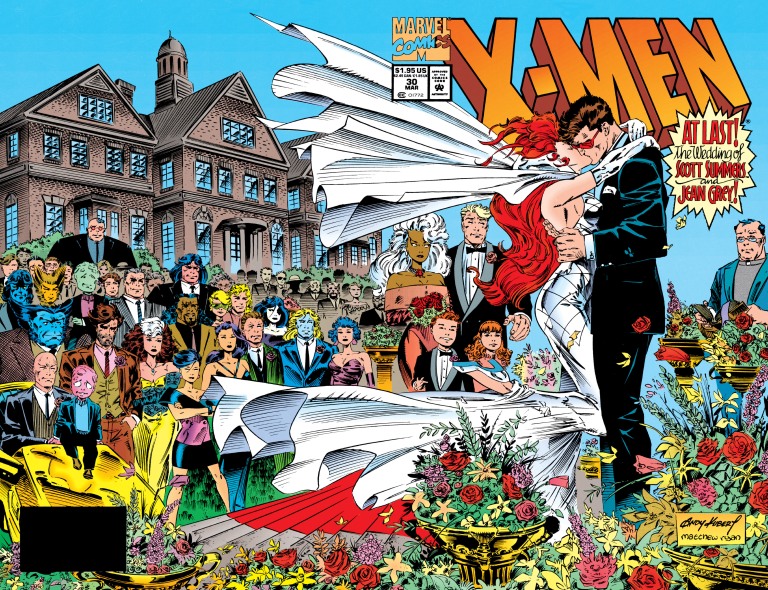
Welcome back, superheo enthusiasts, 1990s culture enthusiasts, X-Men fans and comic book collectors! Today we revisit the X-Men monthly series of the 1990s and look back at one of its most significant events it ever published – the wedding of Scott Summers/Cyclops and Jean Grey. By the time this particular comic book was published, the 30th anniversary celebration of the X-Men (note: Read my Fatal Attractions storyline retro reviews by clicking here and here) had just been concluded and that includes a major change of direction for the iconic X-Men member Wolverine. It is also notable that the X-Men had Sabretooth contained within Charles Xavier’s mansion (for retro reviews, click here, here and here).
With those details laid down, here is a look back at X-Men #30, published by Marvel Comics in 1994 with a story written by Fabian Nicieza and drawn by Andy Kubert.
The cover.
Early story
The story begins inside Xavier’s mansion. Jean Grey reads a handwritten letter from Logan/Wolverine, who left the household after getting traumatized from their last encounter with Magneto. Logan refers to her and Scott Summers as special. While reading, Jean is already in her fancy wedding dress being assisted by her mother and storm as Rachel Summers looks on. For Jean, the wedding is about her dedication on spending the rest of her life with Scott as well as possibly gaining Rachel (who comes from one possible future) as a daughter.
Professor X with four of his original team members plus Alex Summers.
Elsewhere in the mansion, the groom Scott spends quality time with his original teammates Bobbdy Drake/Ice Man, Warren Worthington/Archangel and Hank McCoy/Beast. With them also is his brother Alex Summers/Havok. Alex tells Scott that the day of his wedding is the first day of the rest of his life which causes Bobby to say something inappropriate.
Suddenly, Professor X comes in to join them…
Quality
Jean Grey in her wedding dress with her mother, Storm and Rachel Summers present.
To get straight to the point here, this comic book serves two purposes: highlighting Scott and Jean’s relationship to an all new level with the wedding as the main event, and offering long-time or die-hard X-Men fans a whole lot of stuff to chew on. Very clearly, Fabian Nicieza wrote the script with X-Men fans in mind while also making references to the past with some creative touches or shortcuts so that the comic book would not be bloated with excessive fan service.
The wedding itself was executed nicely by the Nicieza-Kubert team and was clearly conceptualized to not only be memorable for the fans but also creatively serve as a major pay-off to all those years of Scott and Jean Grey being together early as teammates, getting separated temporarily and getting together again (note: they were also the original X-Factor team). Right after the wedding was executed, the visuals and words elevated the emotions higher and any long-time X-Men fan will find the moment sentimental.
Opposite the wedding are several scenes showing the other X-Men characters plus those from X-Factor and X-Force (with a not-so-recognizable Cable present). The dialogue written ranged from sentimental to comedic. And then there were also a few lines that I felt were just thrown in as fillers.
As far as visuals go, Andy Kubert’s art here are pretty good to look at. While he did his best to really make the story visually appealing and memorable, there were a few panels of art that look rushed.
Conclusion
So many guests. Can you recognize many of them?
Since it highlights the wedding of Scott and Jean Grey with several other X-Men-related characters mixed in, X-Men #30 (1994) is clearly a commemorative story made with X-Men fans in mind. While a lot of work was done to make the story momentous on its own, readers who are unable to immerse themselves deeply into the X-Men mythos (plus X-Force, X-Factor and others) prior to reading this comic book won’t be able to relate to the wedding and the character moments very much. While it may not be significant to newcomers who find this comic book for the first time, it still marks a significant chapter in the history of X-Men within the Marvel Comics universe of the late 20th century. For the long-time fans who were able to read enough of Scott and Jean Grey’s times together from 1963 until the early 1990s, this is one X-Men tale that they can relate with deeply.
Disclaimer: This is my original work with details sourced from reading the comic book and doing personal research. Anyone who wants to use this article, in part or in whole, needs to secure first my permission and agree to cite me as the source and author. Let it be known that any unauthorized use of this article will constrain the author to pursue the remedies under R.A. No. 8293, the Revised Penal Code, and/or all applicable legal actions under the laws of the Philippines.
Welcome back, X-Men fans, superhero enthusiasts, 1990s culture enthusiasts and comic book collectors! It’s time to revisit the What If monthly series of comic books of Marvel Comics that lasted from 1989 until 1998. The old comic book I’m about to review involves the X-Men, Cable and more.
Before starting with this newest retro comic book review, I should state that I was never a fan of Cable even though I read lots of X-Men-related comic books that included him. When I think of Cable, I immediately think of the New Mutants and X-Force comic book series.
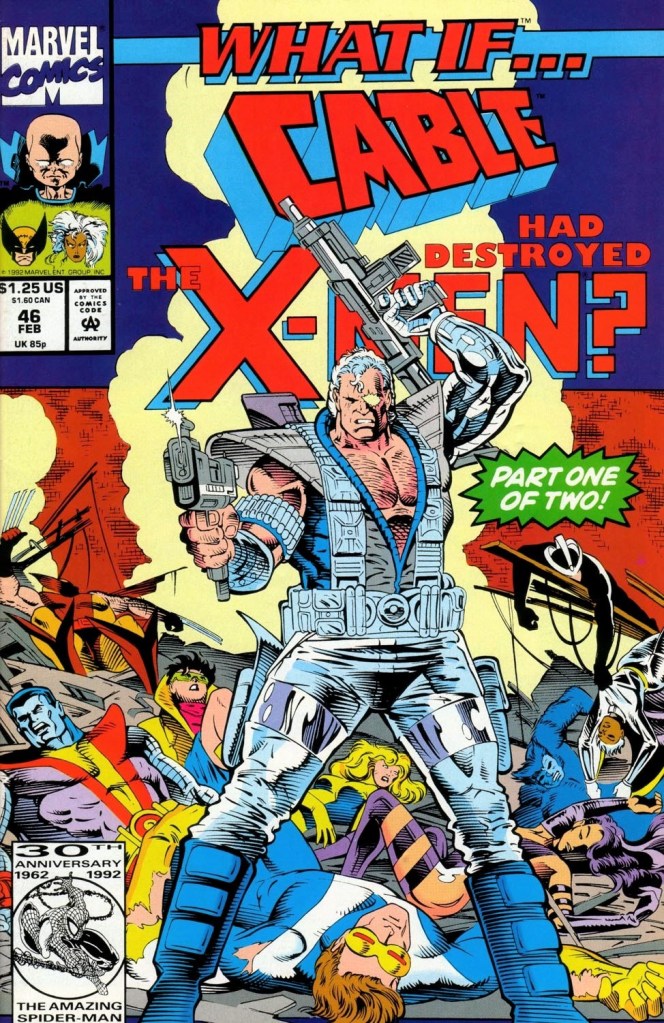
You must be wondering what has Cable and the X-Men have to do with the old What If issue I’m focusing on. We can all find out in this look back at What If #46, published by Marvel Comics in 1993 with a story written by Kurt Busiek and drawn by Tod Smith.
The cover.
Early story
The story begins inside a tavern in New York’s famous Central Park. Inside, Charles Xavier, Scott Summers (Cyclops) and Jean Grey have a discussion about mutant matters until a small saucer-shaped device flies inside and disrupts everything with its sonic frequency. Suddenly a second flying saucer comes in, touches Scott’s shoe and explodes powerfully killing him, Jean and Xavier. Others got injured by the explosion and the tavern ends up burning.
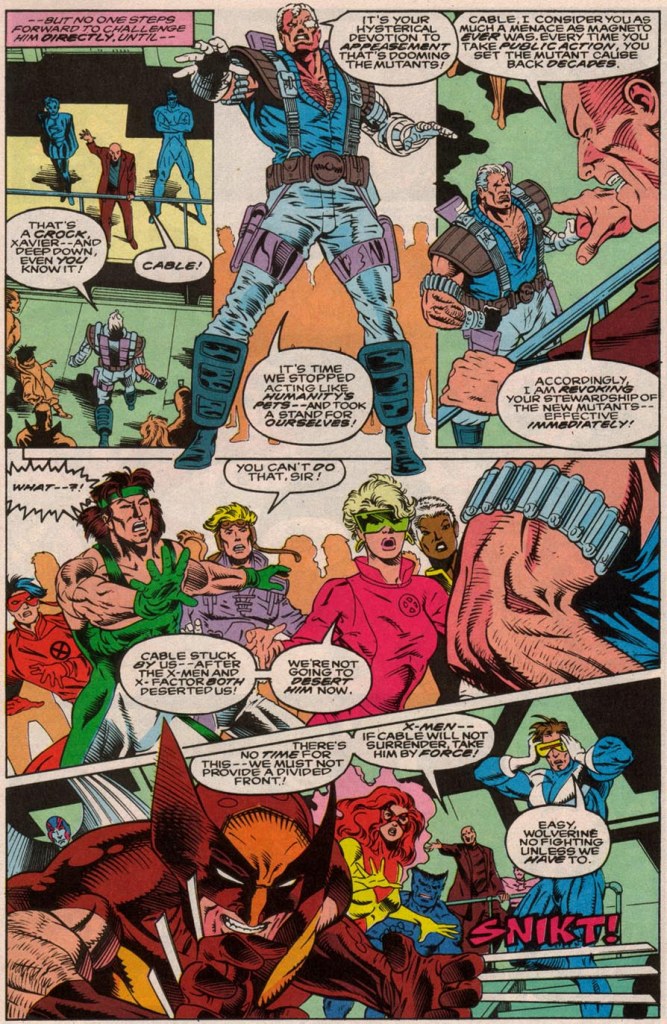
Outside the tavern, Cable is seen running away and someone points at him as someone who must be responsible for the bombing. As it turns out, the deliberate killing of Xavier, Cyclops and Jean Grey was the result of a division between Cable’s New Mutants and the X-Men in connection to the recent return of Xavier from deep space.
Quality
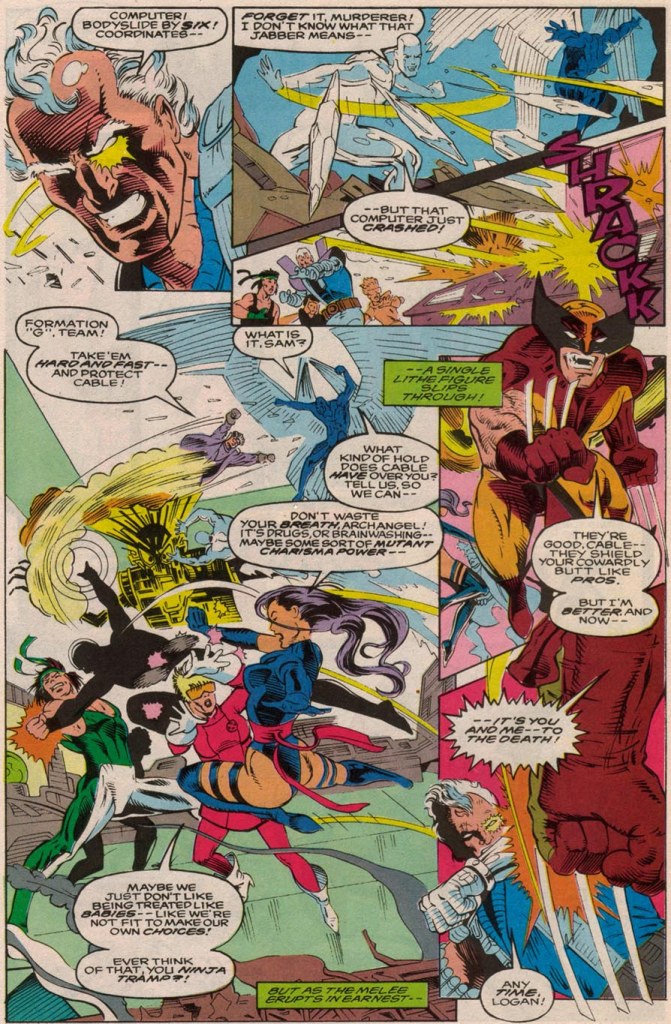
A brawl between the mutants.
I’ll start with the story Kurt Busiek came up with. This one explores an alternate time in which Charles Xavier returned to Earth (after escaping from the Skrulls in deep space) only to find the X-Men in disarray which compelled him to restore things the way they were. This is not to be confused with his return in the canon storyline of the Muir Island Saga.
That being said, Busiek explored what would it be like had Xavier tried to resolve mutant matters not only with the team of mutants he founded but also with other teams such as the New Mutants (already led by Cable), X-Factor (Cyclops, Jean Grey, Iceman, Beast and Archangel) plus several other mutants. I really liked the way the mutants reacted to Xavier given his long absence from Earth, how his dream matters and turned out irrelevant to them as individual mutants, and if he still has what it takes to lead them. In some ways, Xavier looked like a politician trying to convince his constituents that his vision is still the best for them and their interests.
What really made the story running was the start of the division between the mutants when Cable rejects Xavier and points out that the X-Men founder’s devotion to appeasement is dooming mutants. All of these led to the shock opening scene and in terms of writing quality, it was all justified.
The scenes that happened AFTER the burial of Xavier, Cyclops and Jean Grey literally raised the stakes for the rest of the comic book. I don’t want to spoil further plot details but I can assure you all that Kurt Busiek’s script is very sold and there is so much to enjoy here especially if you are knowledgeable enough about the X-Men and the other parts of the Marvel Comics universe (note: the Avengers, Stryfe, Freedom Force and Fantastic Four also appeared).
Visually, the work of Tod Smith looks a bit rushed. His art here is not bad but I felt it could have been better had there been more time to polish his work. In fairness to Smith, his drawings on most of the characters still made them recognizable and he showed pacing with regards to the panels and angles used. I should say he does a decent job showing multiple characters fighting each other simultaneously.
Conclusion
If you were a mutant, would you follow Charles Xavier or Cable?
If you ask me, What If #46 (1993) is pretty entertaining and engaging to read thanks to the strong writing as well as the daring exploration of how the comic’s main story impacts others within the Marvel Comics universe. It has drama, action, intrigue and most notably it explores a new concept about how the X-Men would turn out after the death of their founder. It also raises questions on whether or not the X-Men are doomed without Charles Xavier’s presence.
If you are seriously planning to buy an existing hard copy of What If #46 (1993), be aware that as of this writing, MileHighComics.com shows that the near-mint copy of the regular edition costs $40 while the near-mint newsstand edition costs $120.
Overall, What If #46 (1993) is recommended.
+++++
Thank you for reading. If you find this article engaging, please click the like button below and also please consider sharing this article to others. If you are looking for a copywriter to create content for your special project or business, check out my services and my portfolio. Feel free to contact me as well. Also please feel free to visit my Facebook page Author Carlo Carrasco and follow me at HavenorFantasy@twitter.com
Disclaimer: This is my original work with details sourced from reading the comic book and doing personal research. Anyone who wants to use this article, in part or in whole, needs to secure first my permission and agree to cite me as the source and author. Let it be known that any unauthorized use of this article will constrain the author to pursue the remedies under R.A. No. 8293, the Revised Penal Code, and/or all applicable legal actions under the laws of the Philippines.
Welcome back, X-Men fans, superhero enthusiasts, 1990s culture enthusiasts and comic book collectors! Today, we take a look at the topic of slavery and its connection with the mutants within the universe of Marvel. To be more specific, slavery was emphasized in one of the episodes of the popular X-Men animated series which itself had a monthly series of comic book adaptations – X-Men Adventures!
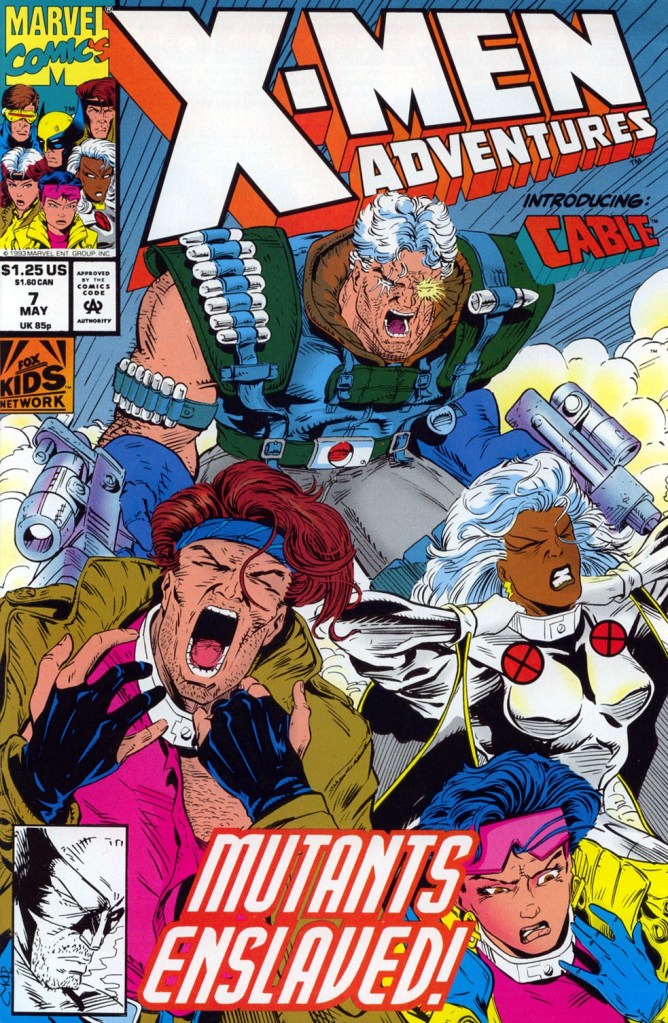
With those details laid down, here is a look back at X-Men Adventures #7, published by Marvel Comics in 1993 with a story written by Ralph Macchio and drawn by Chris Batista.
The cover.
Early story
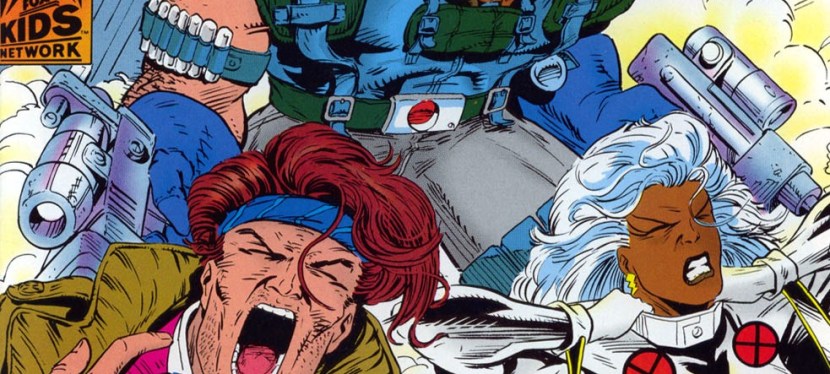
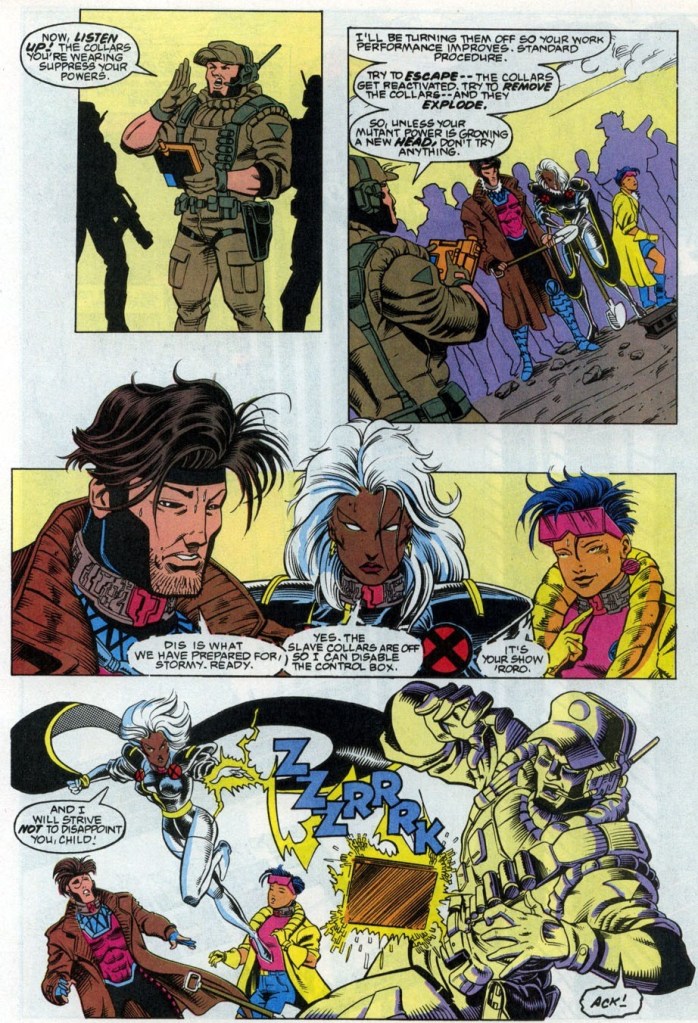
The story begins in Genosha, an island nation where mutants are designated as slaves constantly monitored by armed personnel of the state. X-Men team members Gambit, Storm and Jubilee are forced to do hard labor as they have been rendered powerless (with high-tech collars on their necks). Along with many other mutants, they are working on a key infrastructure project of the state.
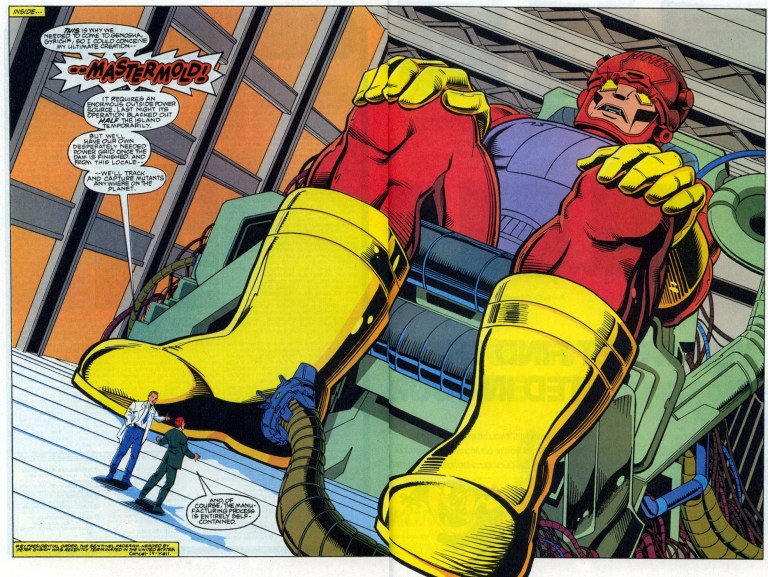
As soon as the local authorities deactivated the collars of the slaves, Storm immediately attempts to escape by flying. Immediately, the collar on her neck got reactivated which neutralized her powers and caused her to fall down to the water below. As soon as she climbs up on a rock to rest, a cable wraps itself on her right leg. Suddenly, a huge Sentinel rises above the water and pulls her…
Quality
The money shot!
Like the TV episode it was based on, this comic book does a decent job of portraying slavery and oppression with mutants in mind while avoiding the very sensitive topic of racism. To see Gambit, Storm and Jubilee portrayed as much more vulnerable characters is a nice change from their usual portrayals. While the story has a strong slavery theme, it also sheds light on the ongoing, secretive development of the Sentinels program which clearly emphasizes the growing danger that await not only the X-Men (the prime target of Trask and his team) but mutants in general.
When it comes to the art, Chris Batista did a nice job drawing not only the characters (all recognizable) but also their surroundings, the Sentinels and the framing of action scenes.
Conclusion
Gambit, Storm and Jubilee as slaves on Genosha.
I personally find X-Men Adventures #7 (1993) somewhat fun and slightly engaging to read. As this is an adaptation of the X-Men animated series episode about Genosha and mutant slavery, it clearly has a strong wholesome approach to its presentation. That being said, its depth is actually limited as it presented its themes with younger readers and new X-Men readers in mind. Unsurprisingly, the action is limited and was portrayed to avoid violence. If you want a more serious and grittier portrayal of Genosha and mutant slavery, you should read Uncanny X-Men #235 to #238, and the X-tinction Agenda storyline.
If you are seriously planning to buy an existing hard copy of X-Men Adventures #7 (1993) be aware that as of this writing, MileHighComics.com shows that the near-mint copy of the regular edition costs $30, while the near-mint copies of the newsstand edition and the Greek edition cost $90 and $200 respectively.
Overall, X-Men Adventures #7 (1993) is satisfactory.
+++++
Thank you for reading. If you find this article engaging, please click the like button below and also please consider sharing this article to others. If you are looking for a copywriter to create content for your special project or business, check out my services and my portfolio. Feel free to contact me as well. Also please feel free to visit my Facebook page Author Carlo Carrasco and follow me at HavenorFantasy@twitter.com
Disclaimer: This is my original work with details sourced from reading the comic book and doing personal research. Anyone who wants to use this article, in part or in whole, needs to secure first my permission and agree to cite me as the source and author. Let it be known that any unauthorized use of this article will constrain the author to pursue the remedies under R.A. No. 8293, the Revised Penal Code, and/or all applicable legal actions under the laws of the Philippines.
Welcome back, X-Men fans, superhero enthusiasts, 1990s culture enthusiasts and comic book collectors! Today we go back to the 30th anniversary celebration of the X-Men which took place in 1993. Back then, Marvel Comics went full blast with the anniversary celebration of their mutants by releasing related merchandise, posters and comic books with gimmick covers (note: read my retro review of 1993’s X-Men #25) that came with high prices.
To put things in perspective regarding 1993, Marvel’s X-Men line of comics had monthly series of Uncanny X-Men, X-Men (Volume 2), X-Force, X-Factor, Excalibur, Wolverine and Cable. X-Factor #92 marked the start of the Fatal Attractions storyline which was the basis for the X-Men 30th anniversary celebration. X-Force #25 was released and it not only brought Cable back but also Magneto.
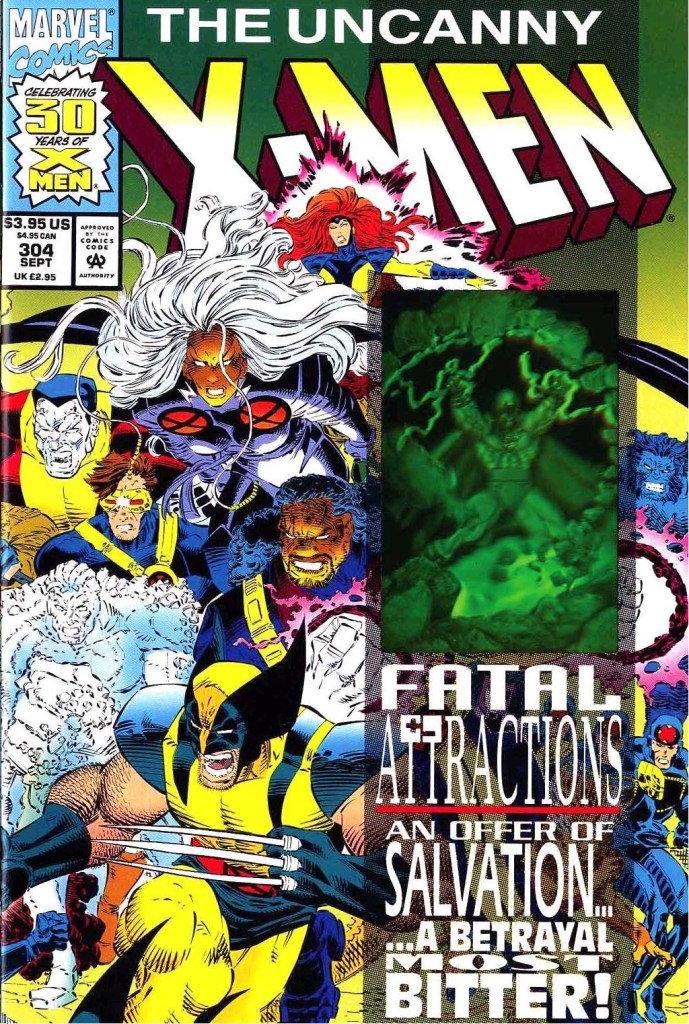
Then came the 3rd chapter of the Fatal Attractions storyline which was published in Uncanny X-Men #304. Not only did that particular comic book bring together many mutants and moved the storyline forward to a crucial stage (note: tension leading to it was built up in Uncanny X-Men #300, Uncanny X-Men #303 and also in X-Men Unlimited #1), it also served as the very celebration of the 30th anniversary of the X-Men (although it was not the storyline’s conclusion as the plot continued in X-Men #25, Wolverine #75 and Excalibur #71).
So did this particular, anniversary celebrating issue of the Uncanny X-Men succeed with its objectives? Has it aged well through the decades? We can all find out in this look back at Uncanny X-Men #304, published in 1993 by Marvel Comics with a story written by Scott Lobdell and drawn by John Romita, Jr., Jae Lee, Chris Sprouse, Brandon Peterson and Paul Smith.
The cover.
Early story
The story begins with division among the Acolytes who learned that their lord Magneto actually survived (note: refer to 1991’s X-Men #3 by Chris Claremont and Jim Lee). They ganged up against their leader Fabian Cortez for betraying Magneto. After pushing his now rebellious team members away, Cortez reminds them that for several months already, they have been continuing Magneto’s work on behalf of mutantkind. Suddenly Exodus appears to them and describes himself as the voice of Magneto and will guide mutants to rise and mentions paradise for the faithful mutants. After subduing Cortez and tempering the tension among the Acolytes, Exodus tells them to prepare themselves for ascension. This frustrates Cortez who realizes that he no longer holds leadership.
Over at the X-Men’s headquarters, Charlez Xavier is personally disturbed over the death of Illyana Rasputin, the sister of Colossus. He starts questioning himself as Illyana’s death under his watch makes his years-long mission (of convincing his fellow mutants to leave their old lives to take risks to fight for a world that fears and hates them) doubtful and tries to figure out how he could present himself in front of them. A holographic image of Lilandra appears to him.
In outer space, inside the space station called Avalon, Magneto stares at planet Earth. With nobody around him, he speaks apologizing to his followers for he cannot save them all. He also mentions that he was wrong in previously believing that he could rescue each and every one of them from humanity as he recently realized that Earth, for the moment, is doomed.
After walking an unspecified distance inside Avalon, Magneto picks up his old helmet and wears it…
Quality
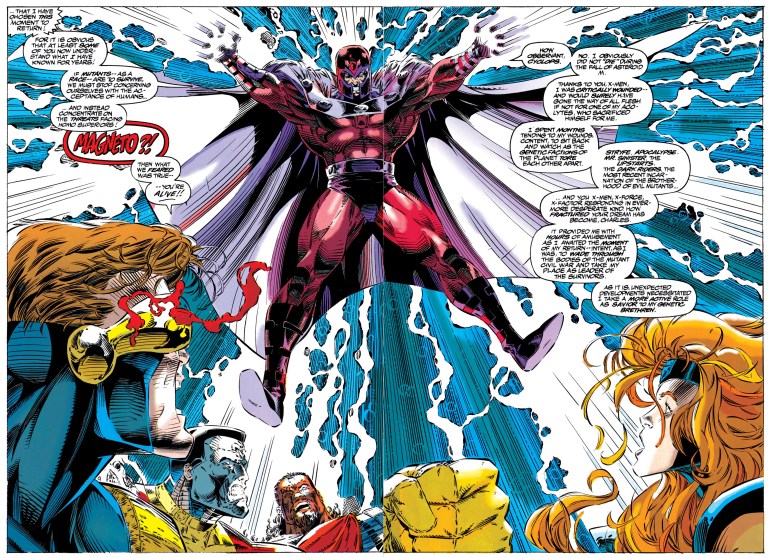
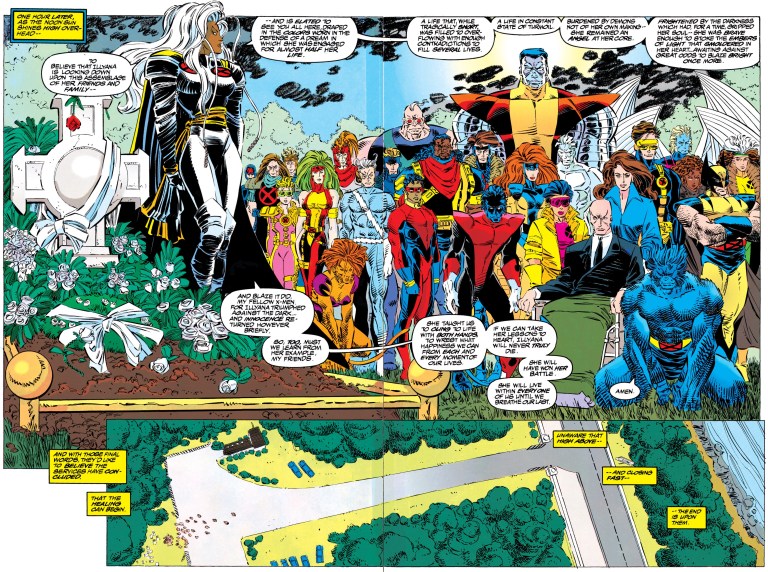
This 2-page art by Brandon Peterson is easily the best looking part of the comic book.
I will start with the visual aspect of this comic book. The artistic quality ranges from fine to weird which should not be surprising since this one involved five artists. The 4 pages drawn by Brandon Peterson (who was once a regular artist on Uncanny X-Men) made the X-Men, Magneto and the Acolytes look not only good but also intense. The Peterson art here is artistically similar to the respective styles of Marc Silvestri and Jim Lee of that particular time. Jae Lee’s art on the flashback of Magneto’s life (during the time of the Nazi occupation in Europe) is undoubtedly very stylized. While his art brings out the intensity of Magneto’s painful past, certain images can be a little challenging to understand especially to readers who focus strongly only following the plot and details. John Romita, Jr.’s art, for me personally, often looks rough and there were times I hardly recognized the characters. The other artworks by Paul Smith and Chris Sprouse have cartoonish aesthetics.
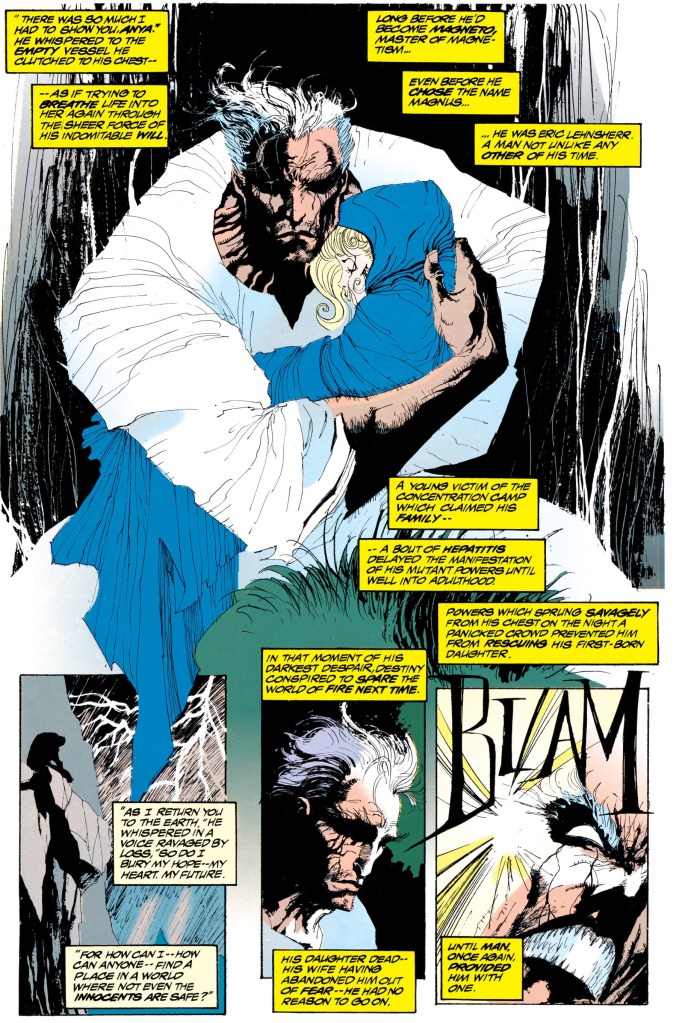
This is Jae Lee’s artistic contribution to the comic book. I found it weird that Magneto’s hair was shown as white during his past with the Nazis.
As for the plot, I can clearly see that a hard effort was made to compose a story that would push the Fatal Attractions storyline forward, establish a turning point and still become worthy of celebrating the 30th anniversary of the X-Men franchise. I can say that the storytelling is somewhat bloated. Early in the story, it was made clear that the respective sections showing Exodus with the Acolytes, Charles Xavier and Magneto pointed to an eventual confrontation that happened during the funeral of Illyana Rasputin.
As the build-up continued with the flashback of Magneto’s life, the fan service short scene of Kitty Pryde and the unfeeling Colossus (note: their romance was highlighted in Uncanny X-Men many years prior), and the talk scene between Bishop and Banshee, the pace of the story slowed down dramatically. By the time the attempt to move the narrative back to the core plot was made with the funeral scene (composed of the X-Men, X-Force and X-Factor), the pace was still really way down. By the time the conflict with Magneto, Exodus and the Acolytes stated, the pace recovery was incomplete and as such, seeing the scene unfold was very jarring (and not even the pages of Colossus’ frustration towards Professor X could solve the narrative pacing problem).
Unsurprisingly, the conflict was written to be overly dramatic complete with lengthy pieces of dialogue here and there. That being said, references to past comic books were established as Magneto once again emphasizes his beliefs about the human-mutant conflict using violence (while also side-stepping Jean Grey’s psionic powers to allow the Acolytes to come in undetected).
Human-mutant conflict aside, themes about faith, religion, idolatry salvation are clearly used. Magneto, who has a tremendous record of villainy and his previous leadership of the X-Men proved useless, was portrayed to be a walking wicked idol whose followers cannot do anything except idolize him and cause violence out of dedication to him. They really could not realize that idolatry is foolish and unholy which further adds to chaos on the world. As Magneto deceived himself to be the savior and lord of mutants, he further causes more pain and destruction to others around him. In short, Magneto will always be stuck with his wicked nature and clearly does not deserve heavenly authority no matter how hard he believes himself to be a savior.
The classic rivalry between Xavier and Magneto here was portrayed dramatically and yet I cannot help but think that their conflict was nothing more than a repeat of past encounters with the state and future of mutants at stake. To be fair, what happened here served as a logical build-up for the shocking encounter between Professor X and Magneto in X-Men #25.
Conclusion
Nobody among the X-Men (except Charles Xavier), X-Force, Excalibur and X-Factor cared to dress properly for the funeral.
To be clear, even though I am an avid X-Men fan, I find Uncanny X-Men #304 (1993) hard to be engaged with and hard to enjoy. Efforts to make it a worthy celebration of the X-Men are very clear but it’s just not entertaining nor compelling to read. As for the X-Men traitor scene, the revelation was not that shocking as the foreshadowing made it too obvious. At best, this comic book served as a warm-up for X-Men #25 which itself paid-off nicely. Being more than sixty pages long (including the advertisement and bulletins), this comic book has too much creative baggage which ultimately hampered its storytelling. It’s not terrible. It’s really not that great to read. What I experienced way back in 1993 with this comic book is just the same as I re-read it. It has not aged well.
If you are seriously planning to buy an existing hard copy of Uncanny X-Men #304 (1993), be aware that as of this writing, MileHighComics.com shows that the near-mint copy of the regular edition costs $20, while the near-mint copies of the signed-and-numbered edition and the newsstand edition cost $120 and $60 respectively.
Overall, Uncanny X-Men #304 (1993) is satisfactory.
+++++
Thank you for reading. If you find this article engaging, please click the like button below and also please consider sharing this article to others. If you are looking for a copywriter to create content for your special project or business, check out my services and my portfolio. Feel free to contact me as well. Also please feel free to visit my Facebook page Author Carlo Carrasco and follow me at HavenorFantasy@twitter.com













 Author Carlo Carrasco