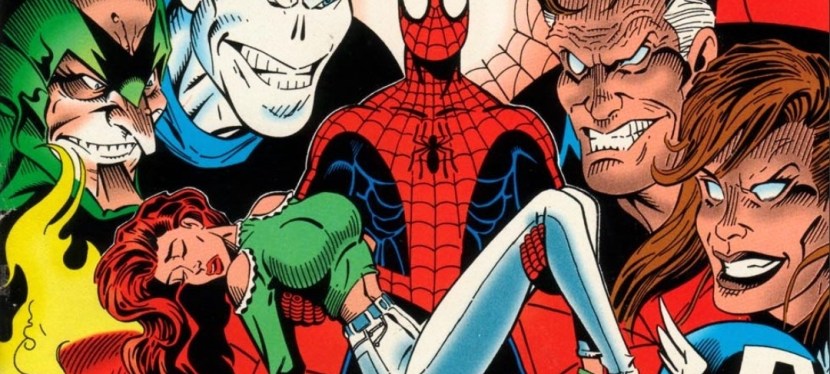
A Look Back at What If #61 (1994)

Disclaimer: This is my original work with details sourced from reading the comic book and doing personal research. Anyone who wants to use this article, in part or in whole, needs to secure first my permission and agree to cite me as the source and author. Let it be known that any unauthorized use of this article will constrain the author to pursue the remedies under R.A. No. 8293, the Revised Penal Code, and/or all applicable legal actions under the laws of the Philippines.

Welcome back superhero enthusiasts, 1990s arts and culture enthusiasts, Marvel Comics fans and comic book collectors! Today we go back to the wild 1990s and examine an alternate universe portrayal of one of Spider-Man’s many events told through the What If monthly series!

If you are looking for a portrayal of Spider-Man going over the edge and into the extremes emotionally, you are about to experience something in this retro review of mine. Some time ago, I reviewed a What If comic book about Spider-Man becoming a murderer which was compelling but ended on a whimper.

With those details laid down, here is a look back at What If #61 published in 1994 by Marvel Comics with a story written by Kurt Busiek and drawn by Kirk Jarvinen, Andrew Wildman, Derek Yaniger and Jim Amash.
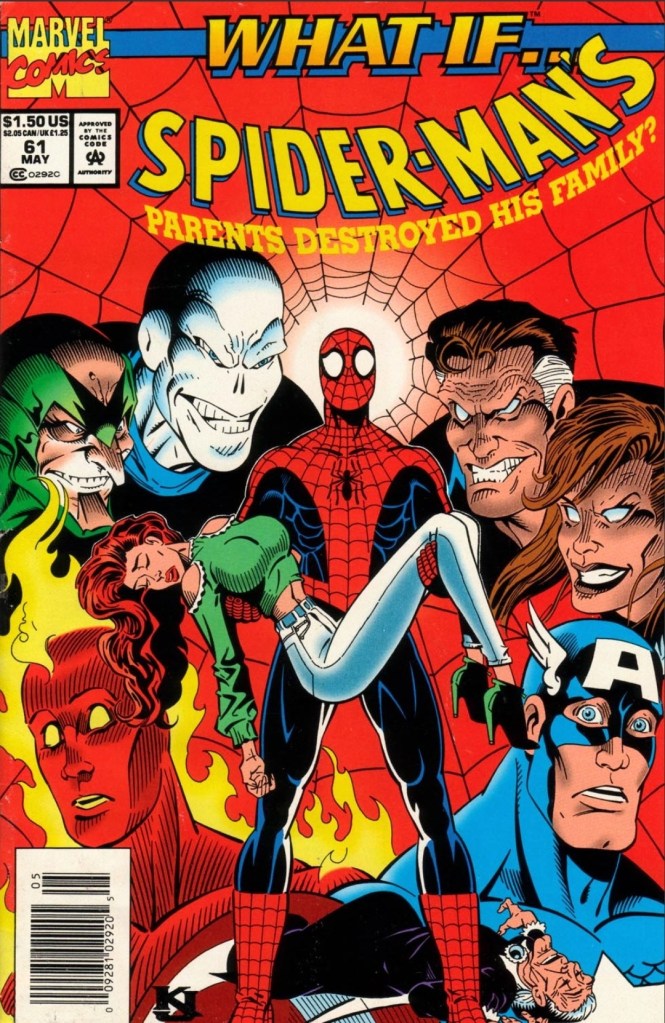
The cover.

Early story

The story begins with Richard and Mary Parker (Peter Parker’s parents) arriving in the presence of Aunt May who happens to be visited by their son Peter (Spider-Man). Having learned something from a while back, Aunt May tells Richard and Mary that they are not genuine persons. Suddenly, Peter Parker’s spider sense intensifies and in an attempt to defuse the situation, he leads his aunt to walk out of the house with him. Richard and Mary watch them walk away.

It turns out, Richard and Mary are impostors and they have been working all the time for a secretive boss. Richard calls his employer under an emergency and reports that they have completed phase one of their assignment, that Aunt May knows the truth about them and is about to inform Spider-Man. Richard is then told that under no circumstances is the plan to be jeopardized and anyone who suspects must die. He is also told to flush Mary’s programming and reset her as she showed signs of acting odd to the situation.

A short time later, Richard and Mary – now in morphed forms with vastly different bodies and half their heads resembling their human selves – suddenly break into an apartment surprising Peter, his wife Mary Jane and Aunt May. Violent action by one of them accidentally ripped open Peter’s shirt, revealing his Spider-Man suit to Aunt May. Just as Peter’s aunt figures out the secret, he tells Mary Jane to grab her and get out.

However, the sight of the morphed Mary Parker shocked Aunt May and Mary Jane so much, they failed to move. Mary Parker then morphs her two hands into large, makeshift hammers, and swiftly killed Aunt May and Mary Jane. Peter is instantly shocked by their sudden deaths but deep inside, rage begins to burn…

Quality
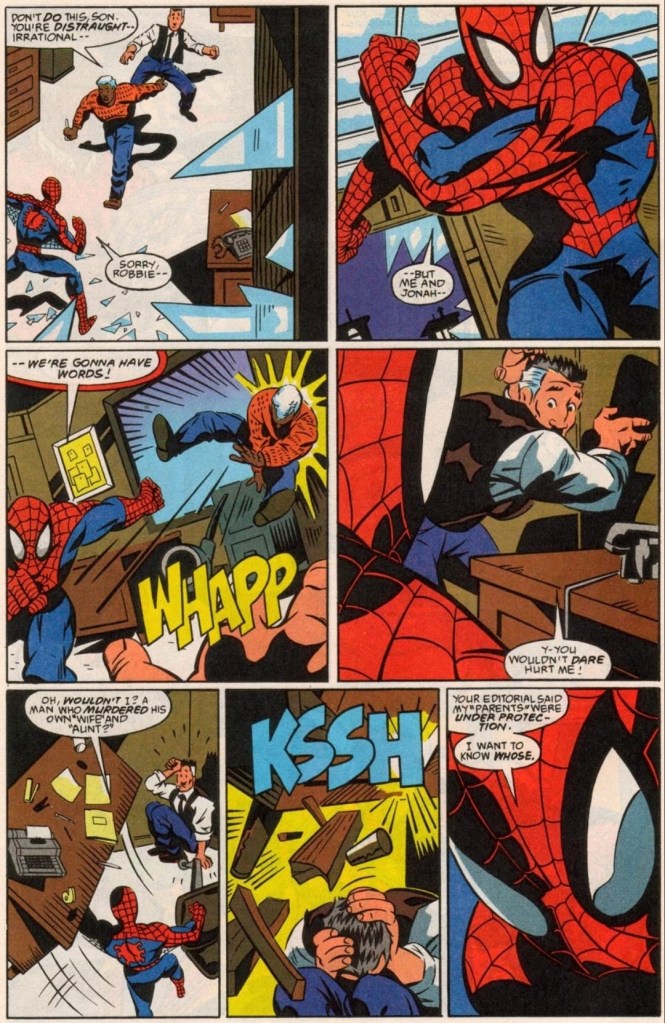
Spider-Man already over the edge and reacting violently to the abusive Daily Bugle.

I can start by confirming that Kurt Busiek’s writing is very strong and his alternate take on the events of Amazing Spider-Man #388 (1994) is indeed very solid. In one way, I find the emotional stakes for Spider-Man has been raised a lot higher than what was portrayed in the canon story. The concept of losing his beloved family members to enemies who were impostors that looked like his long lost parents is indeed disturbing as well as emotionally charged. In relation to this, Busiek and the illustrators brought to life a Spider-Man who really went over the edge by taking matters into his own hands as the loss of beloved ones led to the blurring of the boundary between good and evil. Even the boundary between innocence and guilt gets blurred which adds more depth to the emotions of the story. As I read the story, there were moments when I felt that Spider-Man became as bad as the evil ones even though he is clearly the victim and his family was targeted.

Apart from showing Spider-Man getting outraged and pushed to the limits, Busiek inserted elements about how people perceive incidents without knowing all the facts and how easily they get manipulated by a news outlet – the Daily Bugle where Peter Parker worked as a freelance photographer – whose leader does not care about ethical journalism nor the pursuit of the truth. In this age of widespread fake news and liberal news media outlets in America doing propaganda for American Communists (read: Democrats, abortionists, LGBTQ, Black Lives Matter, Antifa, the terrorists, the climate change extremists and the socialist hordes), this particular aspect of the story makes this comic book strongly relevant to read today.

The story also sheds light on Spider-Man’s connections with other Marvel superheroes who happen to be in New York City. You will see Captain America and Johnny Storm express their concern about Spider-Man’s state of mind as they themselves still tried to figure out what really happened. In short, the superheroes here showed restraint even as Spider-Man goes to the extreme being a victim as well as a fugitive.

If there are any weak points in this comic book, it would be the art which has this cartoon-like aesthetic for much of the story. Considering the serious subject matter, the visuals are quite contradicting as they make this look like it was made for much younger readers. In fairness, the quality of the art improved during the 2nd half of the story.

Conclusion
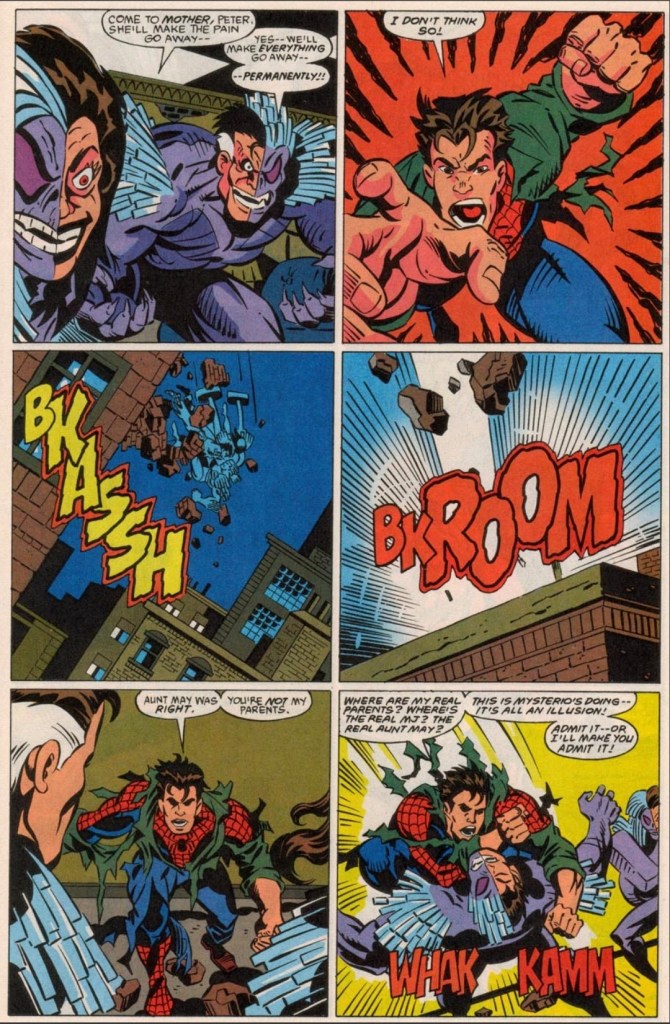
Spider-Man takes on the impostors who looked like his parents.

As far as storytelling and characterization goes, What If #61 (1994) succeeded a lot on portraying the iconic Spider-Man as the superhero who went over the limits of his emotions and his reasoning which is the result of the tragic deaths of two beloved family members caused by individuals who pretended to be his parents. This is a very solid story which also has a powerful ending. Where What If #72 failed, this comic book succeeded and even exceeded it with Spider-Man truly becoming unheroic. I should state that this comic book should convince readers to go to the Amazing Spider-Man series and follow the Lifetheft storyline in issues #386 to #388 (which were released months before this comic book). Kurt Busiek’s script is indeed great and it is easily the driving force of the comic book.

Overall, What If #61 (1994) is highly recommended.

+++++

Thank you for reading. If you find this article engaging, please click the like button below, share this article to others and also please consider making a donation to support my publishing. If you are looking for a copywriter to create content for your special project or business, check out my services and my portfolio. Feel free to contact me with a private message. Also please feel free to visit my Facebook page Author Carlo Carrasco and follow me on Twitter at  @HavenorFantasy as well as on Tumblr at https://carlocarrasco.tumblr.com/ and on Instagram at https://www.instagram.com/authorcarlocarrasco

A Look Back at Spider-Man 2099 #11 (1993)

Disclaimer: This is my original work with details sourced from reading the comic book and doing personal research. Anyone who wants to use this article, in part or in whole, needs to secure first my permission and agree to cite me as the source and author. Let it be known that any unauthorized use of this article will constrain the author to pursue the remedies under R.A. No. 8293, the Revised Penal Code, and/or all applicable legal actions under the laws of the Philippines.

Welcome back superhero enthusiasts, 1990s arts and culture enthusiasts, Marvel Comics fans and comic book collectors! Today we go back to the will 1990s and explore the far future of 2099 within the Marvel Comics shared universe through one of the tales of Spider-Man 2099.

Shortly after his return from the old lower city of New York, Miguel O’Hara’s personal life got more complicated and intense. Aside from that, his rift with his mother remains unresolved. Miguel then begins to assess his personal life as well as his secret life as the swinging hero Spider-Man.

With those details laid down, here is a look back at Spider-Man 2099 #11, published in 1993 by Marvel Comics with a story written by Peter David and drawn by Rick Leonardi.

The cover.

Early story

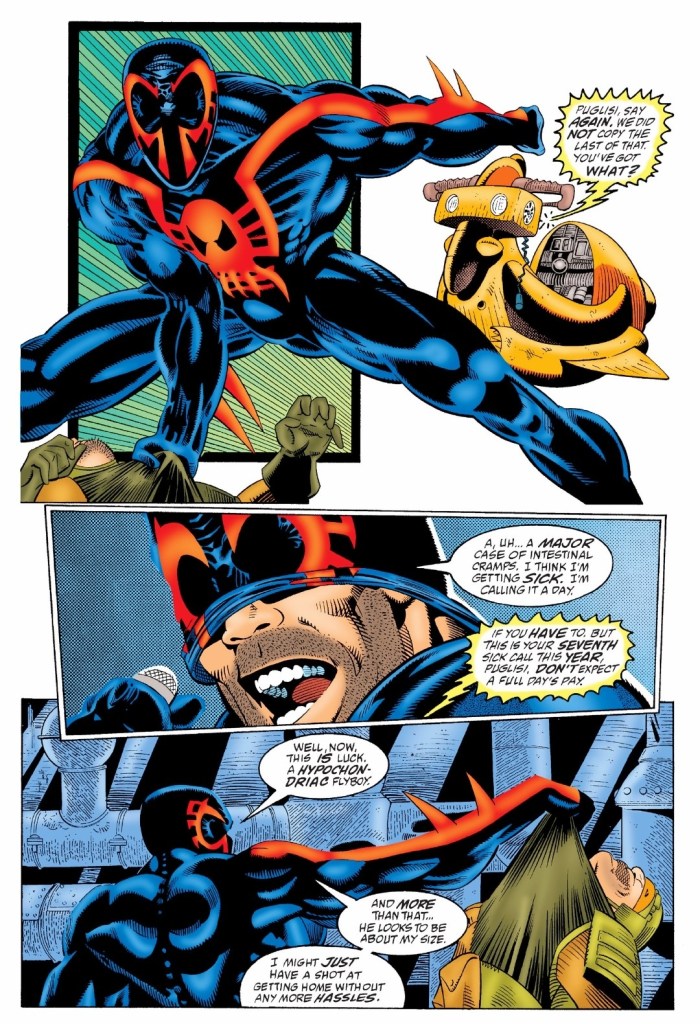
The story begins when armed security personnel apprehend a man for defacing Alchemax property with spray paint. As the suspect gets threatened with physical violence, Spider-Man suddenly appears and surprises the one holding the suspect down. It turns out, Spider-Man secretly knocked out one of the security personnel quietly.

The active security officer lets the suspect go and he activates his armor which turns out to be the Situation Emergency Gear (SIEGE for short) which is the result of a project between Alchemax and Stark-Fujikawa. The armored man then begins to strike at Spider-Man in response for the sudden intervention. Very notably, the security officer wearing SIEGE tells Spider-Man he apologizes for taking action and will do everything he could to harm him as little as possible…

Quality

The futuristic Spider-Man has serious opposition here.

Considering what happened in issue #10, this comic book ramped up the spectacle showing more of Spider-Man 2099 in action-packed conflict with one of the local authorities who happened to be armed with a powered suit of armor. The figure of opposition here is almost like a super villain but one who is not evil but rather doing what he was hired to do. Apart from being an action-filled conflict with strong sci-fi elements, this conflict symbolizes Miguel O’Hara’s willingness to put himself at risk by taking on the authorities as a deliberate violator of local law even though he himself works with Alchemax. This also shows Miguel’s recklessness as he struggled with the lack of a clear direction with his second life as Spider-Man. At this stage, Miguel’s inner rebellion against his corporation is very clear and this alone will put readers on the edge as they figure out what the deeply troubled hero plans to do next.

This comic book is not an all-out action fest. There was still enough room for Peter David to craft more of Miguel’s affairs at Alchemax, only this time he gets to meet someone who happened to be connected with one particular member of X-Men 2099 (note: this is related to the eventual 2099 crossover storyline). This only adds more intrigue into Miguel’s troubled personal life which is something you must read and find out here.

Conclusion

This comic book will make you wonder if Spider-Man 2099 himself is slowly becoming evil by getting into direct conflict with the law.

Spider-Man 2099 #11 (1993) is a fine example of plot really thickening while also making life not only harder but more intense on the part of Miguel O’Hara. At the same time, this comic book built up something new for Spider-Man to eventually face off with. Peter David’s writing and direction of the character are very engaging to follow from start to finish.

Overall, Spider-Man 2099 #11 (1993) is recommended.

+++++

Thank you for reading. If you find this article engaging, please click the like button below, share this article to others and also please consider making a donation to support my publishing. If you are looking for a copywriter to create content for your special project or business, check out my services and my portfolio. Feel free to contact me with a private message. Also please feel free to visit my Facebook page Author Carlo Carrasco and follow me on Twitter at  @HavenorFantasy as well as on Tumblr at https://carlocarrasco.tumblr.com/ and on Instagram at https://www.instagram.com/authorcarlocarrasco

A Look Back at Venom: Lethal Protector #3 (1993)

Disclaimer: This is my original work with details sourced from reading the comic book and doing personal research. Anyone who wants to use this article, in part or in whole, needs to secure first my permission and agree to cite me as the source and author. Let it be known that any unauthorized use of this article will constrain the author to pursue the remedies under R.A. No. 8293, the Revised Penal Code, and/or all applicable legal actions under the laws of the Philippines.

Welcome back superhero enthusiasts, 1990s arts and culture enthusiasts, Marvel Comics fans and comic book collectors! Today we go back to the year 1993 and explore a part of Marvel Comics’ universe through the first-ever limited comic book series featuring one of Marvel’s most iconic villains – Venom.

In my previous retro review, Venom discovers a long lost section of San Francisco that fell deep underground. Even though it is cut off from the resources and fresh air of modern San Francisco, the lost city section is filled with homeless people and social outcasts. Even though he helped the city dwellers by defeating the two armed mechs (employed by a powerful organization who oppose the city dwellers and are in pursuit of something related to San Francisco’s park), Venom still gets rejected by the so-called council. This only led him to returning to the surface not knowing that he is being targeted by a certain group.

With those details laid down, here is a look back at Venom: Lethal Protector #3, published in 1993 by Marvel Comics with a story written by David Michelinie and drawn by Mark Bagley.

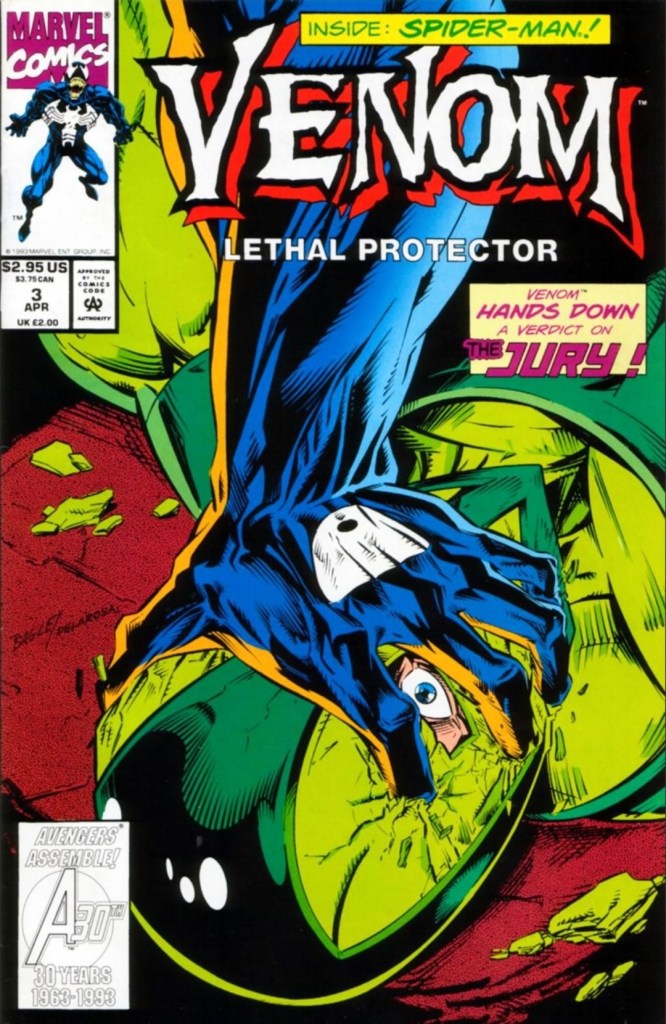
The cover.

Early story

The story begins with Venom suffering from a sonic blast while being restrained by one of the armed members of the group called The Jury. Their leader (who wears a suit and necktie) introduces himself as Orwell Taylor and he addressed Venom as Mr. Brock. It turns out Taylor spent lots of time and resources researching everything about Brock and the alien costume. More shockingly, The Jury’s leader reveals that he lost his son Hugh years ago due to Venom’s arranged killing of him as he escaped from his prison cell in the federal prison called The Vault. Hugh Taylor is the first man Venom killed when he escaped.

Venom responds by say that he and his symbiote did not want to hurt anyone. This provokes Orwell Taylor into anger and he orders The Jury to kill Venom. Due to the lengthy explanations of Orwell Taylor, Venom managed to recover and regain strength which he uses to free himself and throw one Jury member to another causing quick chaos.

After punching another Jury member, Venom then moves out of the alley and away from Taylor and his team…

Quality

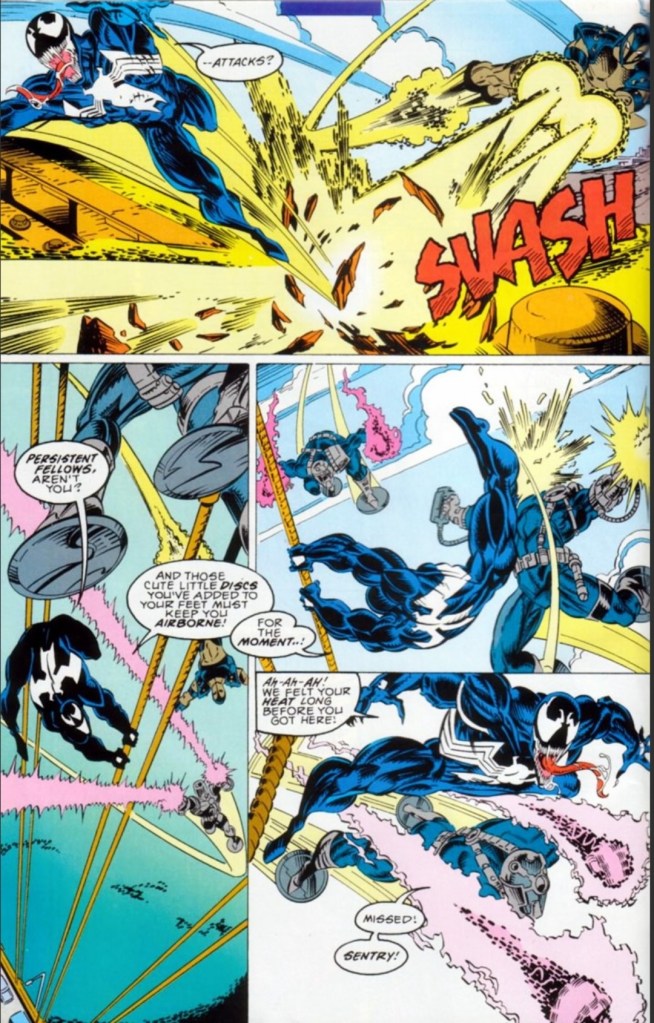
Very clearly, The Jury is a very formidable force of opposition. Their battle with Venom here comes with a lot of spectacle.

In terms of storytelling, this one is another improvement over issue #2 (which itself is an improvement over issue #1) as the plot got more interesting and even intriguing. For one thing, I like the fact that David Michelinie recalled Venom’s murderous escape from prison told way back in Amazing Spider-Man #315 (1989) and came up with the establishment of a very angry powerful father who formed the dangerous cybernetic team called The Jury. In a rather symbolic way, this comic book shows how Venom’s past comes back to haunt him and creatively, the battles between Venom and The Jury here are packed with a lot of action and visual dynamism delivered by Mark Bagley. The irony is that The Jury itself is not the main antagonist of this limited series as they are clearly presented to be a recurring force of opposition within Spider-Man’s realm in Marvel Comics’ shared universe of the time.

Still on the plot, the sinister organization hounding the dwellers of the lost city was revealed to be the Treece group whose leader is pursuing something very valuable to feed his greed. Still, even though this is already the third issue, the Treece organization’s presence is very subtle and as the force of opposition towards Venom, they are outclassed by The Jury.

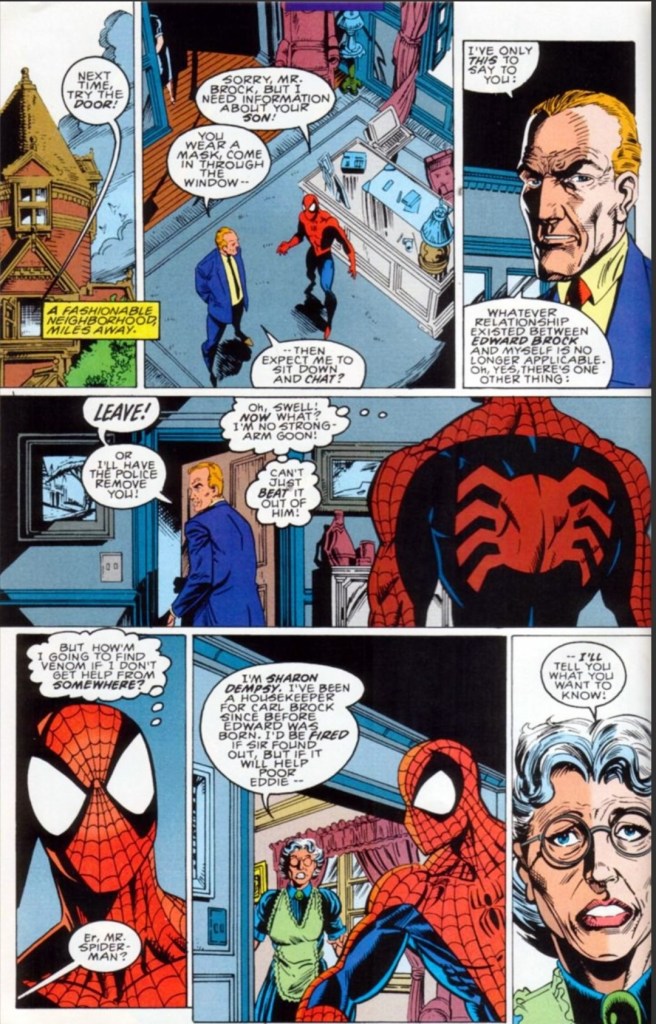
As in the previous issue, Spider-Man got a good share of the spotlight but this one is even more limiting which should delight Venom fanatics who complained about Marvel’s icon overshadowing their guy with the symbiote. Spider-Man serves mainly as a tool for exposition as the creative team showed images from the past of Eddie Brock with his father (whom Spider-Man approached for answers).

The problem here is that showing flashbacks from the past and explaining how Eddie Brock became bitter and sinister as a result of receiving almost no affection from his father ruins the mystery of Venom as a character. During the time of Todd McFarlane drawing Amazing Spider-Man comics and the early Venom tales, the mystery of Eddie Brock’s past added to the intrigue of Venom and his quick rise as the deadliest villain Spider-Man ever faced. I understand that this limited comic book series had Venom as the protagonist who was in high demand among readers of the time but for me the creative team went way too far emphasizing Eddie Brock’s past.

Nothing changes the fact that Eddie Brock aided by the alien costume is a murderer who happens to have previously been a prolific print media journalist whose career got ruined by Spider-Man which in turn led him to a downward spiral and eventually to bonding with the symbiote that once bonded with Peter Parker. The flashbacks were pointless and if there really was an attempt to humanize Eddie Brock and make him sympathetic to readers, the creative team clearly failed.

Conclusion

Spider-Man with Eddie Brock’s father in California.

Venom: Lethal Protector #3 (1993) is a mixed bag. Its plot is clearly more intriguing and more interesting to read while there was enough creative space to show The Jury as a powerful force of opposition which is the result of Venom’s murder of Hugh Taylor (read: Amazing Spider-Man #315) while making a prison escape. The spectacle of the battle between Venom and The Jury must be seen! However, the creative team’s move to dramatize Eddie Brock’s past using flashbacks back-fired in my opinion and ultimately they destroyed whatever mystery was left behind Venom. As a protagonist, Venom has no appeal whatsoever and his portrayal here only reminds me that he works best as an antagonist opposite Spider-Man. Venom as a hero for those he perceived to be innocent and helpless remains forced and unconvincing.

Overall, Venom: Lethal Protector #3 (1993) is satisfactory.

+++++

Thank you for reading. If you find this article engaging, please click the like button below, share this article to others and also please consider making a donation to support my publishing. If you are looking for a copywriter to create content for your special project or business, check out my services and my portfolio. Feel free to contact me with a private message. Also please feel free to visit my Facebook page Author Carlo Carrasco and follow me on Twitter at  @HavenorFantasy as well as on Tumblr at https://carlocarrasco.tumblr.com/ and on Instagram at https://www.instagram.com/authorcarlocarrasco

A Look Back at Spider-Man 2099 #9 (1993)

Disclaimer: This is my original work with details sourced from reading the comic book and doing personal research. Anyone who wants to use this article, in part or in whole, needs to secure first my permission and agree to cite me as the source and author. Let it be known that any unauthorized use of this article will constrain the author to pursue the remedies under R.A. No. 8293, the Revised Penal Code, and/or all applicable legal actions under the laws of the Philippines.

Welcome back, superhero enthusiasts, 1990s culture enthusiasts, Marvel 2099 fans and comic book collectors! Today we revisit the Marvel 2099 franchise within Marvel Comics’ shared universe during the 1990s. Specifically speaking, we take a look back at one of the early tales of Spider-Man 2099.

In this retro comic book review, the futuristic Spider-Man finally made his way back uptown after spending time in the old city of New York down below where he saw people living in poverty, violent gangs and Vulture 2099.

With those details laid down, here is a look back at Spider-Man 2099 #9, published by Marvel Comics in 1993 with a story written by Peter David and drawn by Kelley Jones.

The cover.

Early story

The story begins at the Wellvale where Conchata O’Hara (mother of Miguel and Gabriel) suddenly suffers an attack from inside her body. The medics were called for emergency.

Elsewhere, Spider-Man jumps with excitement and relief after finally making it back from deep down the modern city. He almost gets hit by a hover car and decides to stop for a while at an isolated spot to calm down and reflect about what happened recently. He just defeated Vulture in battle below prior to climbing back up.

Suddenly, an armed Public Eye flyboy tries to apprehend him. After making getting near the flyboy and making himself look like he was about to submit himself, the flyboy communicates with his team. During that short moment, Spider-Man fires his organic web at the flyboy’s mouth which causes him to fire his weapon and miss. Spider-Man then knocks the flyboy out cold, leaving the communication line hanging…

Quality

The idolaters of Spider-Man 2099 spotted.

Considering everything that happened to Spider-Man in the previous few issues set deep underneath the modern city, this tale was crafted to develop the webslinger’s personality some more while showing for the first time ever the group of Spider-Man 2099 idolaters who are so obsessed, they go around wearing their idol’s costume and even take risks imitating his physical abilities (example: crawling on the wall). There is no good-versus-evil conflict here but more exploration of the modern society Miguel O’Hara has long been part of.

For one thing, at this point of the monthly series, Spider-Man 2099’s misadventures and acts in uptown New York not only caused disturbance with the modern society watched over by Alchemax, he also sparked a new group of people who perceive him to be their holy savior. This kinda reminds me of DC Comics’ very own Sons of Batman which is a youth group inspired by Batman, and to see the Marvel 2099 have its own version of the concept is a pretty neat move by the creators.

Speaking of characterization, the complexities of the relationships between Miguel O’Hara with his brother Gabriel, his mother Conchata, his romantic interest Dana and the relationships the others have with each other begin to really grow in this issue. The good news is that Peter David not only provided solid dialogue for each character but also clearly defined their respective personality traits and thoughts about others. To see Gabriel personally reacting to Kasey’s reaction towards Spider-Man’s body was amusing and even a bit hilarious.

On the artistic side, Kelley Jones work here as guest illustrator was nice to see and certain visual elements of his work on Batman comic books also made it here. The result is a nice change of style and a new approach of showing visual details. I should state that even though his art style is radically different from that of Rick Leonardi, Jones managed to make the established characters look recognizable to me.

Conclusion

Kelley Jones’ visuals on Spider-Man 2099 is nice to see.

Spider-Man 2099 #9 (1993) is clearly a more characterization-oriented story which is a nice change of pace and approach considering the chaotic story developments of the previous few issues. This comic book also shows that Spider-Man 2099 continues to encounter challenges in both local society and personally. The revelation of idolatry and idolaters connected to Spider-Man added a new layer of foolishness and evil to the local society (for insight, click here and here). At this stage of the monthly series, something new was clearly brewing for the futuristic webslinger and this showed that Peter David laid out his plans for the direction of the series’ narrative. Lastly, Kelley Jones’ work here really stands out.

Overall, Spider-Man 2099 #9 (1993) is recommended!

+++++

Thank you for reading. If you find this article engaging, please click the like button below and also please consider sharing this article to others. If you are looking for a copywriter to create content for your special project or business, check out my services and my portfolio. If you want to support my website, please consider making a donation. Feel free to contact me with a private message. Also please feel free to visit my Facebook page Author Carlo Carrasco and follow me on Twitter at  @HavenorFantasy as well as on Tumblr at https://carlocarrasco.tumblr.com/ and on Instagram at https://www.instagram.com/authorcarlocarrasco/.

A Look Back at X-Men Adventures #11 (1993)

Disclaimer: This is my original work with details sourced from reading the comic book and doing personal research. Anyone who wants to use this article, in part or in whole, needs to secure first my permission and agree to cite me as the source and author. Let it be known that any unauthorized use of this article will constrain the author to pursue the remedies under R.A. No. 8293, the Revised Penal Code, and/or all applicable legal actions under the laws of the Philippines.

Welcome back, superheo enthusiasts, 1990s culture enthusiasts, X-Men fans and comic book collectors! Today we revisit the X-Men Adventures monthly series which was the literary adaptation of the popular X-Men animated series of the 1990s.  

In this retro review, we take a look at the adaptation of the animated series’ own portrayal of the Muir Island saga from the comic books. Also there is Rogue who desired to have her genetic mutation cured, even though it means removing her super strength, flying ability and her dangerous touch.

With those details laid down, here is a look back at X-Men Adventures #11, published by Marvel Comics in 1993 with a story written by Ralph Macchio and drawn by Andrew Wildman.

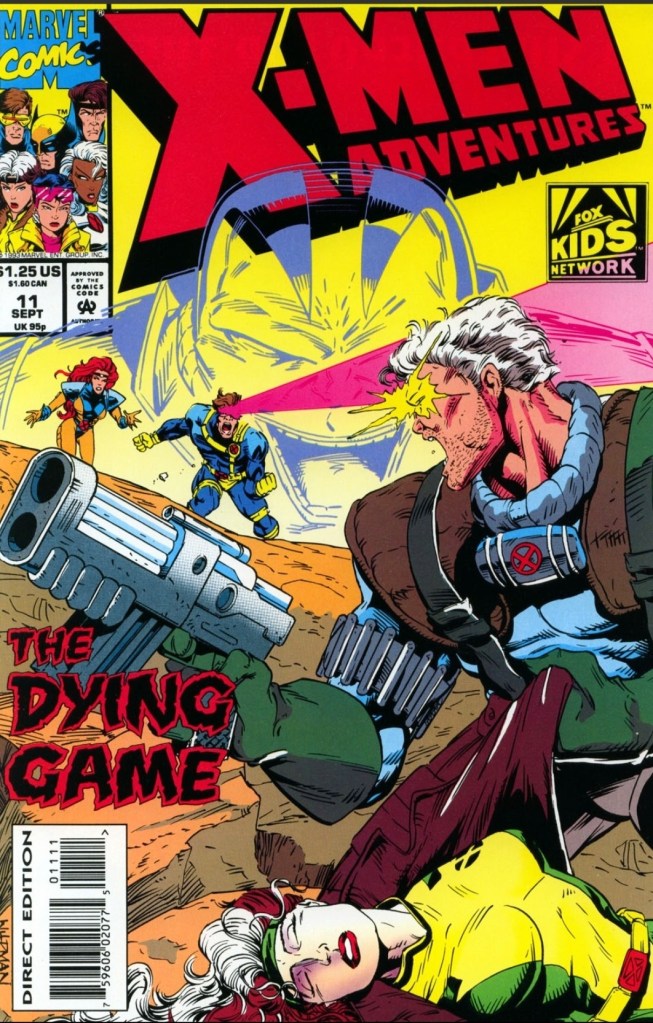
The cover.

Early story

The story begins with Rogue emerging from the rubble of a facility on Muir Island. She remembers that just moments earlier, Pyro and Avalanche ruined the facility just as she was about to get cured by a man she knows as Dr. Adler. She leaves the place searching for those responsible for the ruined facility. She fails to noticed that she is being observed from a distance.

Elsewhere on the island, Pyro and Avalanche open a bag believing Dr. Adler is in it. To their shock, Mystique is the one who emerged and she reveals to them that she was just posing as Dr. Adler as part of her mission to lure mutants into taking the treatment not without realizing the truth that it will turn them into slaves of the one entity she serves…Apocalypse. Pyro explained that he and Avalanche hoped to hold Dr. Adler for ransom.

At a nearby cliff, Cable quietly watches using his rifle’s scope…

Quality

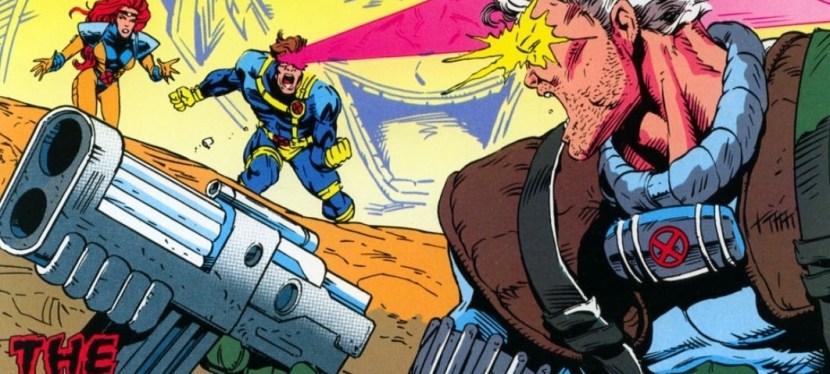
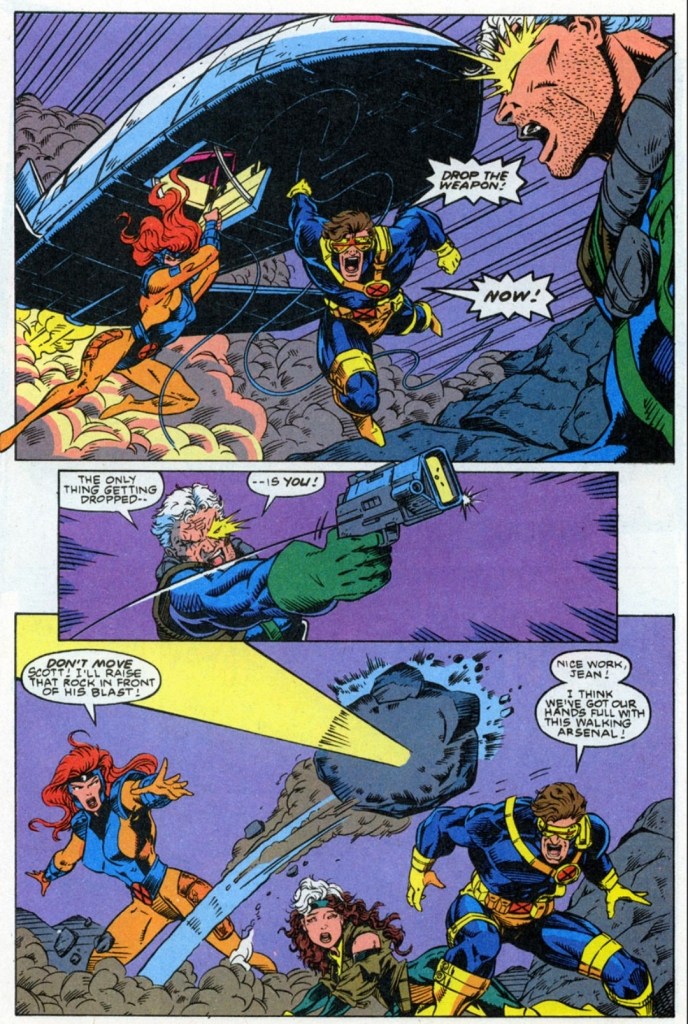
Cyclops and Jean Grey confront Cable!

To put things clearly, this one is pay-off to what was built up in issue #10 while also serving as the continuation of a multi-part story regarding Muir Island. In the previous issue, Rogue desired to become a normal individual which is why she went to Dr. Adler on the said island. In this comic book, the direction for Rogue took a drastic change fighting Pyro and Avalanche not knowing that Mystique is involved and secretly working to help her master Apocalypse execute his ambitious plan of gaining capable and controllable slaves from the mutant population.

The good news here is that the script is very well written and the narrative is really strong. Very notably, the superhero spectacle got clearly ramped up by several notches resulting in lots of action scenes as well as opportunities for Andrew Wildman to flex his artistic muscles making some dynamic action-packed images for readers to enjoy. Along the way, there is some suspense built-up related to the sub-plot within (note: Cable’s limited appearance here as well as the Jean Grey and Cyclops reuniting with their mentor Charles Xavier) as well as the Muir Island saga itself.

Indeed, this comic book has lots of spectacle that superhero enthusiasts will enjoy but still the Macchio-Wildman team managed to maintain the core themes of the story for readers to absorb and think about.

Conclusion

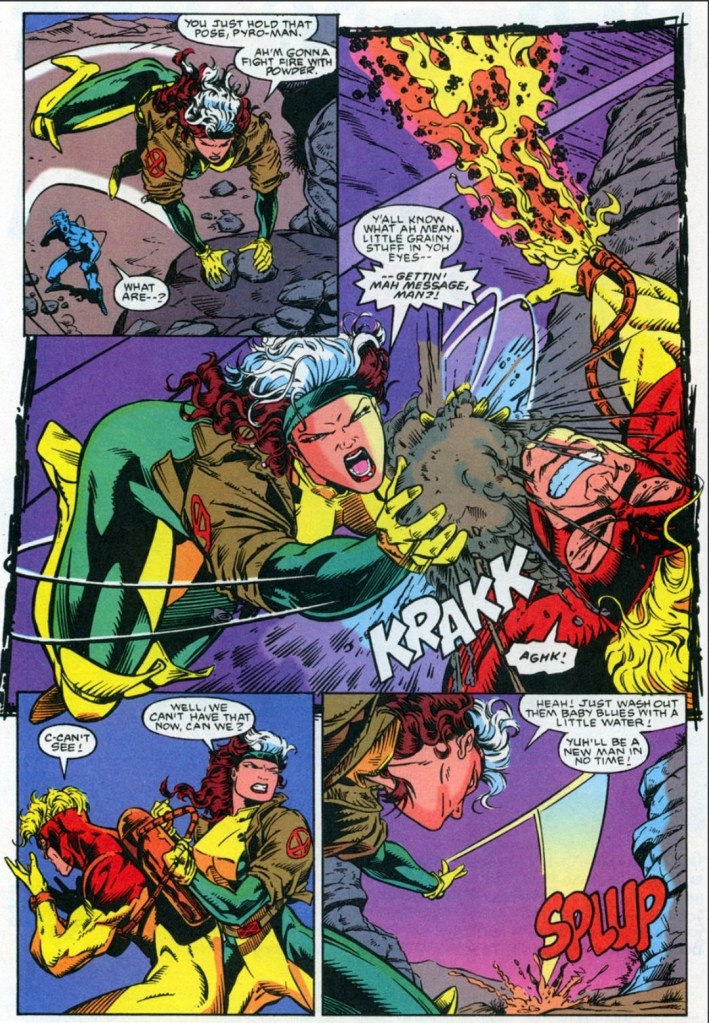
Dynamic action of Rogue taking on Pyro.

X-Men Adventures #11 (1993) is a very solid read from start to finish. Even as the narrative has lots of action scenes presented, the story still managed to maintain focus on the themes of sacrificing mutation to be normal humans, the temptations brought in by advanced scientific wonders, and the exploitation of people seeking hope and reform a lot. There are indeed moral lessons within this comic book reflect about. This is strong creative work by Macchio-Wildman that X-Men fans and newcomers should read and I can say there is more to come storywise beyond this comic book.

Overall, X-Men Adventures #11 (1993) is recommended!

+++++

Thank you for reading. If you find this article engaging, please click the like button below and also please consider sharing this article to others. If you are looking for a copywriter to create content for your special project or business, check out my services and my portfolio. If you want to support my website, please consider making a donation. Feel free to contact me with a private message. Also please feel free to visit my Facebook page Author Carlo Carrasco and follow me on Twitter at  @HavenorFantasy as well as on Tumblr at https://carlocarrasco.tumblr.com/ and on Instagram at https://www.instagram.com/authorcarlocarrasco/.

A Look Back at Venom: Lethal Protector #2 (1993)

Disclaimer: This is my original work with details sourced from reading the comic book and doing personal research. Anyone who wants to use this article, in part or in whole, needs to secure first my permission and agree to cite me as the source and author. Let it be known that any unauthorized use of this article will constrain the author to pursue the remedies under R.A. No. 8293, the Revised Penal Code, and/or all applicable legal actions under the laws of the Philippines.

Welcome back superhero enthusiasts, 1990s arts and culture enthusiasts, Marvel Comics fans and comic book collectors! Today we go back to the year 1993 and explore a part of Marvel Comics’ universe through the first-ever limited comic book series featuring one of Marvel’s most iconic villains – Venom.

In my previous retro review, Eddie Brock returned to his hometown of San Francisco following the events of Amazing Spider-Man #375 (1993). Living with his very distorted belief of protecting the innocent by doing unrelenting acts of violence on others, he begins to get involved with helpless people who happened to be hounded by agents of a certain private organization that wields power. Along the way, Spider-Man arrives in the city find Venom.

With those details laid down, here is a look back at Venom: Lethal Protector #2, published in 1993 by Marvel Comics with a story written by David Michelinie and drawn by Mark Bagley.

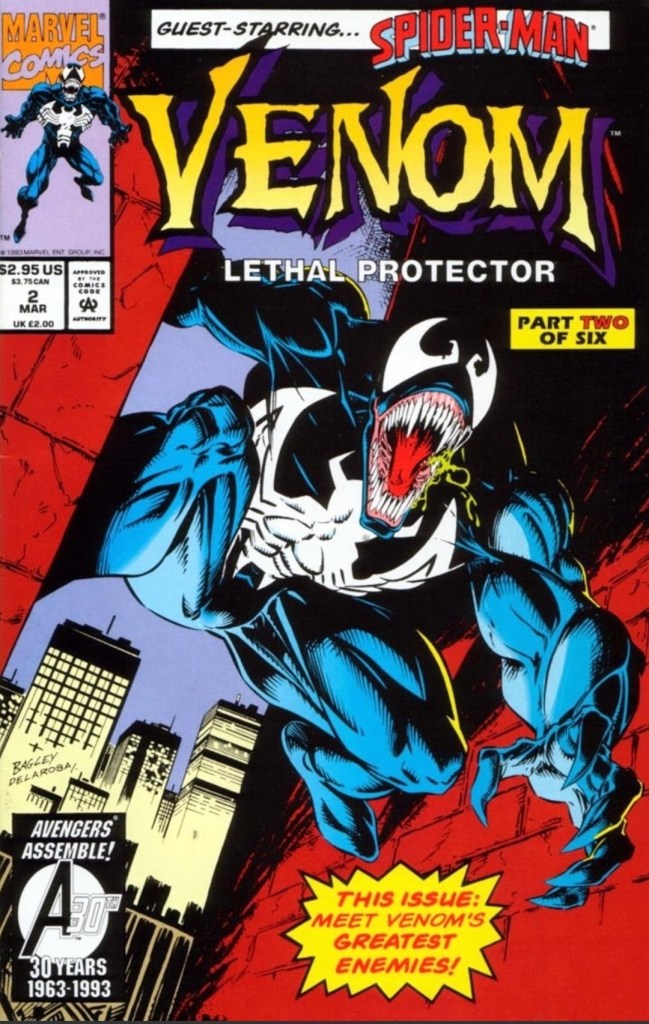
The cover.

Early story

The story begins deep underneath the city of San Francisco. Venom, who is caught by the large mechanical fist of a walking mech (piloted by a man working for Roland Treece’s organization), finds himself on the deeply buried section of the city and around them are vagrant people who settled and became residents of a local society that the rest of America does not even know exists.

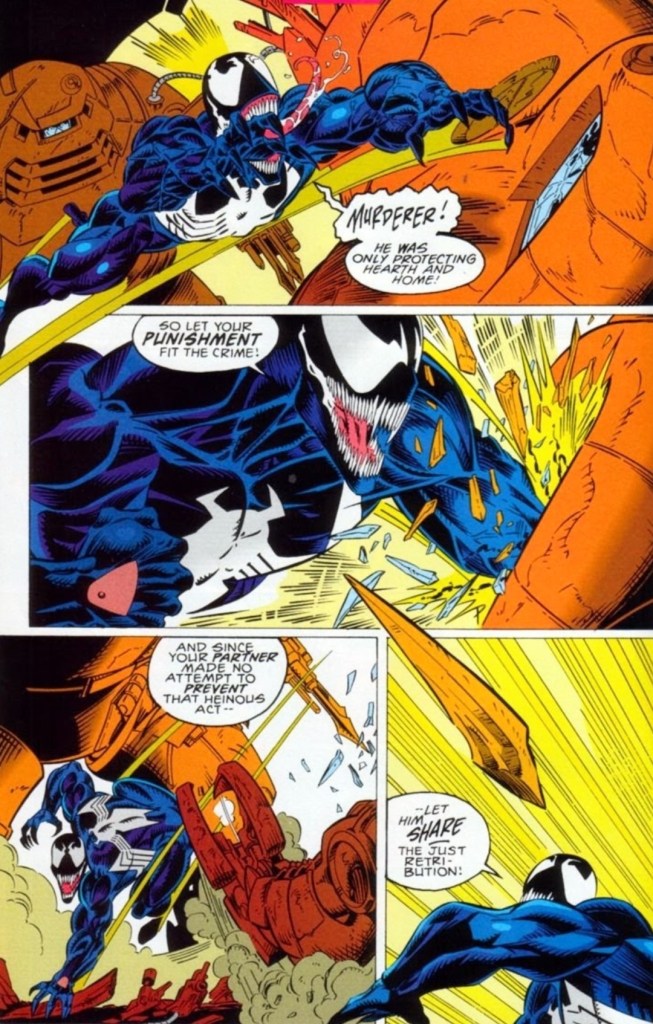
As the local residents caught the attention of the pilot, Venom breaks free by smashing the mechanical fist into pieces. Another mech suddenly jumps into place near the first one. In response to the first mech’s sudden killing of a local resident (who was armed with a shotgun), Venom jumps to it and kills the pilot inside by punching into the cockpit. Venom then grabs a long sharp object and kills the pilot of the other mech with it.

While the locals were hostile and afraid of Venom, the other people (who were assisted on the surface by Venom) come to support him and tell their fellow underground residents that he is not their enemy. One of the local council members stated that a meeting at the council hall will be held and Venom will attend it…

Quality

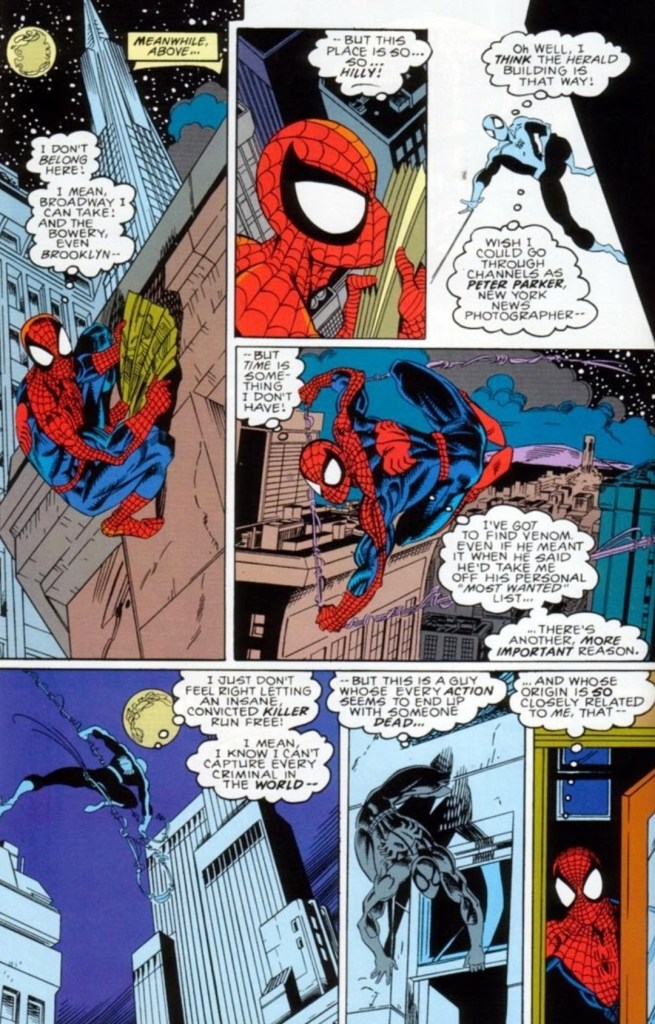
With exposition in mind, Spider-Man here does most of the detective work. Understandably, he is not involved with the superhero spectacle.

Compared to issue #1, this story has a more interesting setting which is the buried and forgotten section of San Francisco which was the result of the 1906 earthquake. Showing that the lost section has a local population composed of homeless people and those who reject the modern society above was a bright idea nicely executed by the Michelinie-Bagley team as it added some depth into Marvel Comics’ own version of San Francisco.

It was also in the underground city and with the residents where we get to see Venom do his own distorted acts of heroism backed by killing, and see how he fared when trying to win the trust of the locals whose members include those who read about him in the news and those who completely know nothing about him.

Through his interactions with the underground people, Eddie Brock is portrayed to be a bit more human compared to what happened in issue #1. For a man who has gotten very used to using extreme forms of violence and committing multiple acts of murder, it is surprising to see Brock looking and acting more civil in the presence of Americans (and perhaps illegal immigrants) who settled deep underground and established their own rules (note: Eddie Brock does not care about rules while having the alien costume). Still, you will see Venom engage in violent superhero action and even do a bit of detective work.

As with the previous issue, the iconic Spider-Man got a good share of the spotlight in the story as he searches for details about Venom which leads him to finding his rival’s estranged father. Spider-Man’s presence here is noticeably lessened compared to issue #1 and his own search for answers creatively served as exposition. Don’t expect to see any superhero spectacle from Spider-Man.

Without spoiling details and names, I should state that this comic book marks the debut of a ream of armed mercenaries led by a powerful man who lost a son because of what Venom did in Amazing Spider-Man #315 (1989).

Conclusion

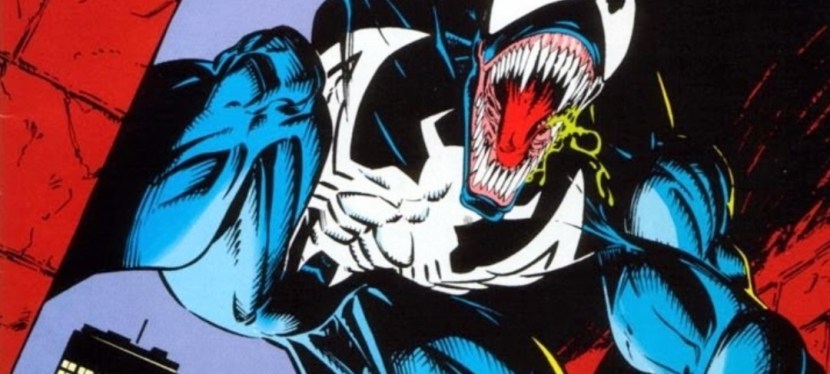
The violent nature of Venom displayed.

Venom: Lethal Protector #2 (1993) is a marginal improvement over the first issue in terms of storytelling and setting. Part of the big build-up that happened in issue #1 started to get paid-off in this comic book which allowed for the plot to move forward at a more satisfying pace. Venom and Spider-Man share the spotlight again, but this time the edge goes to the black-wearing murderer who also has the benefit of being part of the superhero spectacle here. At this point of the mini-series, Venom is not only facing elements of the Treece organization (which has been organizing something that could impact San Francisco and its people) but also a new force of opposition that is related to something he did a few years prior. That being said, Venom is first and foremost a murderer that Marvel wanted to make big money out of.

Overall, Venom: Lethal Protector #2 (1993) is satisfactory.

+++++

Thank you for reading. If you find this article engaging, please click the like button below, share this article to others and also please consider making a donation to support my publishing. If you are looking for a copywriter to create content for your special project or business, check out my services and my portfolio. Feel free to contact me with a private message. Also please feel free to visit my Facebook page Author Carlo Carrasco and follow me on Twitter at  @HavenorFantasy as well as on Tumblr at https://carlocarrasco.tumblr.com/ and on Instagram at https://www.instagram.com/authorcarlocarrasco
A Look Back at Spider-Man 2099 #7 (1993)

Disclaimer: This is my original work with details sourced from reading the comic book and doing personal research. Anyone who wants to use this article, in part or in whole, needs to secure first my permission and agree to cite me as the source and author. Let it be known that any unauthorized use of this article will constrain the author to pursue the remedies under R.A. No. 8293, the Revised Penal Code, and/or all applicable legal actions under the laws of the Philippines.

Welcome back, superheo enthusiasts, 1990s culture enthusiasts and comic book collectors! Today we revisit the Marvel 2099 franchise within Marvel Comics’ shared universe during the 1990s. Specifically speaking, we take a look back at one of the early tales of Spider-Man 2099.

In this retro comic book review, the Spider-Man 2099 comic has an eye-catching cover that shows the protagonist in conflict with the 2099 version of the classic Spider-Man the Vulture. At the end of the sixth issue of Spider-Man 2099, Vulture 2099 appeared for the first time ever. This particular issue, which I bought and read in the summer of 1993, marked the conflict between Spidey and Vulture of the future.

With those details laid down, here is a look back at Spider-Man 2099 #7, published by Marvel Comics in 1993 with a story written by Peter David and drawn by Rick Leonardi.

The cover.

Early story

The story begins with Spider-Man 2099 feeling very disoriented, wondering if he is falling as he feels the wind. It turns out, Vulture 2099 is flying while holding him. Close behind them is Spider-Man’s friend flying a hover vehicle. As the flying lady gets close to them, the Vulture quickly makes a move be behind her and starts using his 3-blade mechanical claw on her. As Vulture is about to strike her, Spider-Man disrupts him in defense of her but her vehicle still got damaged.

As the lady’s vehicle releases smoke as a result of the damage, Vulture berates Spider-Man and knocks him out cold. Spidey’s friend crashes down but miraculously survived.

Elsewhere, Miguel O’Hara’s mother visits his apartment and starts talking with the artificial intelligence Lyla…

Quality

Spider-Man 2099’s first strike against Vulture 2099.

I’ll start first with Vulture 2099 here. I can say this futuristic version of the classic Spider-Man supervillain was made by the creative team of be really intriguing as he is not only an intimidating flying force, but he is also the leader of a gang called the Freakers. Vulture 2099 also operates while strongly hanging on to his socialist-inspired views truly believing that his Freakers are meant to rise not only against New York’s corporate forces but also against the Thorites and other factions of New York’s underclass. Vulture 2099 also is intelligent and he is clearly aware about what has been going on around them, and no matter how large and powerful Alchemax really is, he is very obsessed about bring them down. Believing he is living with principles, Vulture 2099 goes as far as informing Spidey about their existence and tries to get him as a partner.

On the aspect of evil, Vulture of 2099 was defined by Peter David to be a human monster in the true sense of the words. To find out about that, you must read this comic book.

For his part, Spider-Man’s struggle to survive and get out of danger continues here and the lower-city environment turned out to be a rather intriguing setting for readers to follow him in. His encounters with Vulture 2099 are entertaining to see complete with really inspired dialogue.

Compared to the previous issues, this particular story highlights the lower parts of New York City which was prime real estate back in the 20th century but got left behind neglected as city development physically went upward. This shows the poor and neglected people living below the modern city in darkness and with lots of crime and negativity around them. The Vulture and his gang stand out in the local lower population due to their violence and so-called principles.

Conclusion

Early in the story.

Spider-Man 2099 #7 (1993) has a very engaging story and showcased what was back then the most captivating supervillain of the futuristic Spider-Man. Through David’s writing, it was clear that Vulture 2099 was meant to be a recurring supervillain in this series and he represents the violence and obsessions of the lower-city underclass who will stop at nothing to bring down the corporate giants as well as their rival factions among the impoverished. The portrayal of New York City’s criminal environment and poverty here was cleverly done by David. The new rivalry between the protagonist and 2099’s own Vulture must be seen! Lastly, I should say that Vulture 2099 would mix well with real-life violent forces like Black Lives Matter (BLM), Antifa and terror-oriented groups had he been real. Make no mistake, Vulture 2099 is evil and let this retro review remind you to never embrace evil and never let the said supervillain be your role model. The real world today has way too many radical forces who use violence and anarchy to change societies in accordance to their foolish, unholy worldly beliefs.

Overall, Spider-Man 2099 #7 (1993) is highly recommended!

+++++

Thank you for reading. If you find this article engaging, please click the like button below and also please consider sharing this article to others. If you are looking for a copywriter to create content for your special project or business, check out my services and my portfolio. If you want to support my website, please consider making a donation. Feel free to contact me with a private message. Also please feel free to visit my Facebook page Author Carlo Carrasco and follow me on Twitter at  @HavenorFantasy as well as on Tumblr at https://carlocarrasco.tumblr.com/ and on Instagram at https://www.instagram.com/authorcarlocarrasco/.

A Look Back at What If #10 (1990)

Disclaimer: This is my original work with details sourced from reading the comic book and doing personal research. Anyone who wants to use this article, in part or in whole, needs to secure first my permission and agree to cite me as the source and author. Let it be known that any unauthorized use of this article will constrain the author to pursue the remedies under R.A. No. 8293, the Revised Penal Code, and/or all applicable legal actions under the laws of the Philippines.

Welcome back superhero enthusiasts, 1990s arts and culture enthusiasts, Marvel Comics fans and comic book collectors! Today we go back to the year 1993 and explore a part of Marvel Comics’ universe through the reimagined tales emphasized in the What If monthly series.

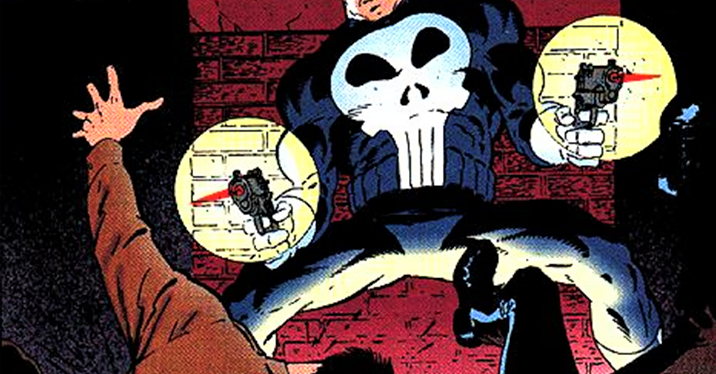
For those of you who have gotten very familiar with Marvel Comics’ vast lineup of superheroes, anti-heroes, super villains and supporting characters, the Punisher is one of the most notable characters as he is the most definitive vigilante the publisher ever has in its shared superhero universe. As a comic book protagonist, the Punisher does “good” in fighting crime but he sure is as bad as the bad guys as he commits torture, issued threats of violence, kidnapping, extortion, coercion and even murder towards them. A major factor in the Punisher’s origin (as Frank Castle) was the killing of his family (wife and two kids) committed by a mob as they witnessed acts of killing in Central Park in New York City. The tragic deaths led Castle to become the Punisher who not only relentlessly waged a personal war against criminals but also often wore dark clothes with a large white skull design on the front of his body. The skull symbolized punishment and death to his enemies.

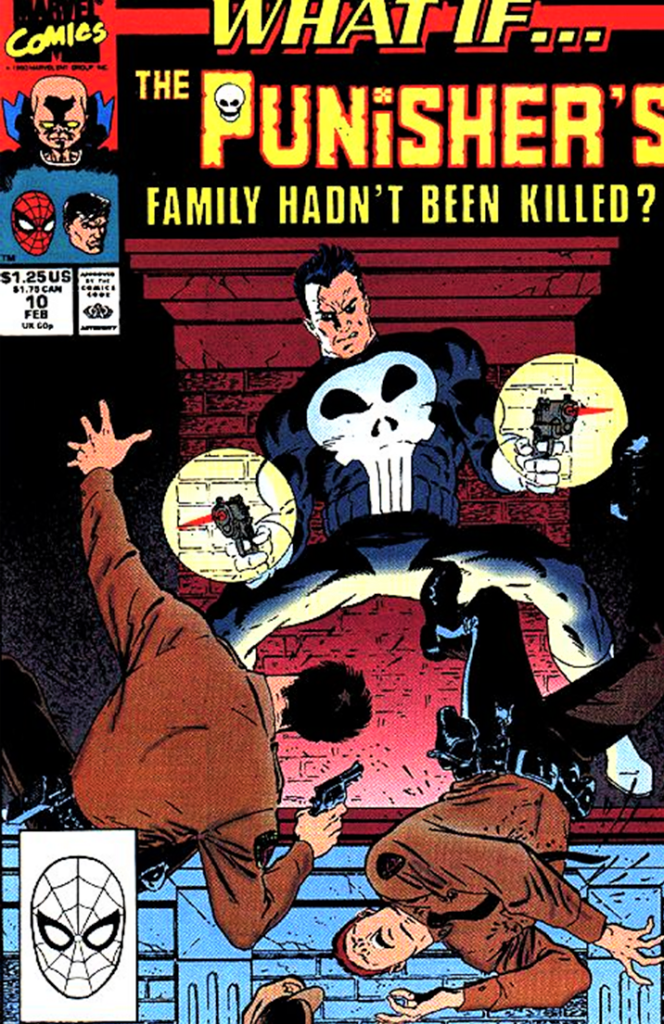
With those details laid down, here is a look back at What If #10, published in 1990 by Marvel Comics with a story written by Doug Murray and drawn by Rik Levins.

The cover.

Early story

The story begins with the Watcher recalling the time Frank Castle spent with his wife and the two kids at New York City’s Central Park. There, they have fun with their picnic. At this point in time, Frank Castle had previously served his country in the Vietnam War and he carries within him bravery, the experience of violence and vast skills to use weapons.

The weather suddenly worsens as rain starts to fall down causing some inconvenience on the Castle family. Frank’s son struggles as his kite got caught by the large plant nearby. On the other side of the said plant, four armed men and their captive (hanging upside down by the tree) are startled and prepare themselves to shoot anyone who appears.

Frank, who does not realize the mob on the other side of the plant, helps his son get the kite back. The Castle family then decide to go back home not realizing that they came close to discovering and witnessing the illegal activity of the armed men. As the family kept on moving, Frank hears gunfire from a distance…

Quality

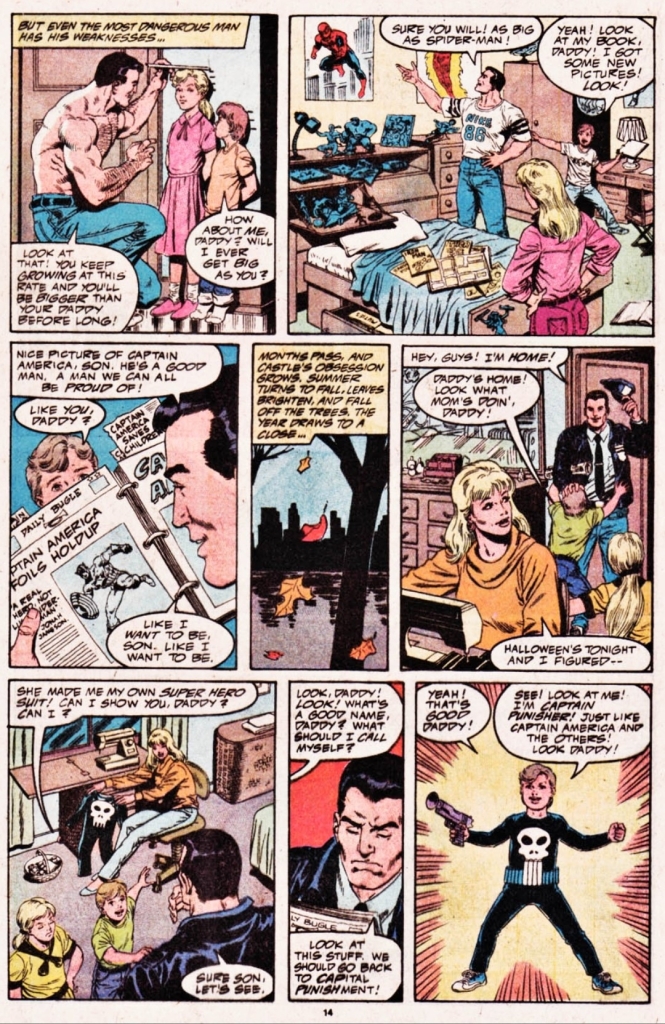
Frank Castle the family man.

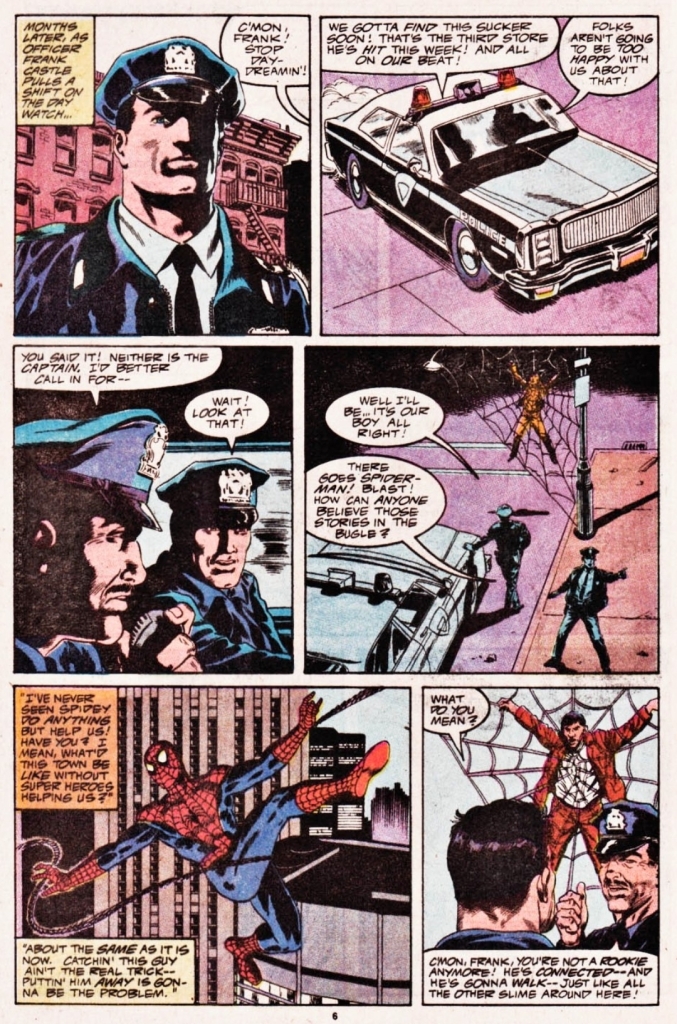
To get straight to the point about this comic book, it’s story is really engaging and it has noticeable amounts of darkness and grittiness without going overboard. While exploring what would happen had Frank Castle’s family not been killed, the comic book shows the Punisher getting involved in public safety as a New York patrolman which puts him in a unique position facing crime in radically different ways from what we comic book readers have been used to seeing. The story also explores corruption within the police and the justice system as well.

The way the events and action turned out showed the creative team focused on realism while also establishing the Punisher’s own place within the comic book’s alternate portrayal of the shared superhero universe. More on the subject matter of this comic book, there is a twist that surprised me a lot and it is something that you readers should see for yourselves.

Going back to Frank Castle, it is indeed very captivating to see him portrayed a lot more as a family man who really strives to support his wife and kids no matter how dangerous his occupation really is. The aspect of family in this comic book is very significant as it will make you realize that the definition of family in America in the 21st century has been distorted as a result of laws or court decisions that reflected wokeness, homosexuality and unrestrained feminism. In short, woke America’s believers reject the concept of the traditional family and the concept of a father leading the family is considered taboo because it goes against LGBT’s so-called values and principles.

Conclusion

Frank Castle as the police officer.

When you think about the legacy of the Punisher not only on comics but also in movies and other forms of entertainment media, you will often remember a one-man-army against criminals. What If #10 (1990) has is a really unique take on the Punisher and I can say it has a very captivating script brought to life with really good artwork. Not only does this alternate version of the Punisher shows how he affects criminals, but also how he impacts other parts of the fictional New York society within the shared universe of Marvel Comics (note: characters connected to Spider-Man and Daredevil are here). From start to finish, this Punisher tale by the Murray-Levins team turned out to be very engaging to read.

Overall, What If #10 (1990) is highly recommended!

+++++

Thank you for reading. If you find this article engaging, please click the like button below, share this article to others and also please consider making a donation to support my publishing. If you are looking for a copywriter to create content for your special project or business, check out my services and my portfolio. Feel free to contact me with a private message. Also please feel free to visit my Facebook page Author Carlo Carrasco and follow me on Twitter at  @HavenorFantasy as well as on Tumblr at https://carlocarrasco.tumblr.com/ and on Instagram at https://www.instagram.com/authorcarlocarrasco
A Look Back at X-Men Adventures #9 (1993)

Disclaimer: This is my original work with details sourced from reading the comic book and doing personal research. Anyone who wants to use this article, in part or in whole, needs to secure first my permission and agree to cite me as the source and author. Let it be known that any unauthorized use of this article will constrain the author to pursue the remedies under R.A. No. 8293, the Revised Penal Code, and/or all applicable legal actions under the laws of the Philippines.

Welcome back, superheo enthusiasts, 1990s culture enthusiasts, X-Men fans and comic book collectors! Today we revisit the X-Men Adventures monthly series which was the literary adaptation of the popular X-Men animated series of the 1990s.  

Within the lore of the X-Men, Juggernaut is a significant supervillain who not only gave the X-Men a lot of trouble but also did the same with other heroes within the Marvel Comics shared universe. In the 2006 movie X-Men: The Last Stand, Juggernaut made his first-ever cinematic appearance. In 2018’s Deadpool 2, a new cinematic version of Juggernaut appeared. In my retro comic book review of What If #13 (1990), a different version of Juggernaut was featured by the creators.

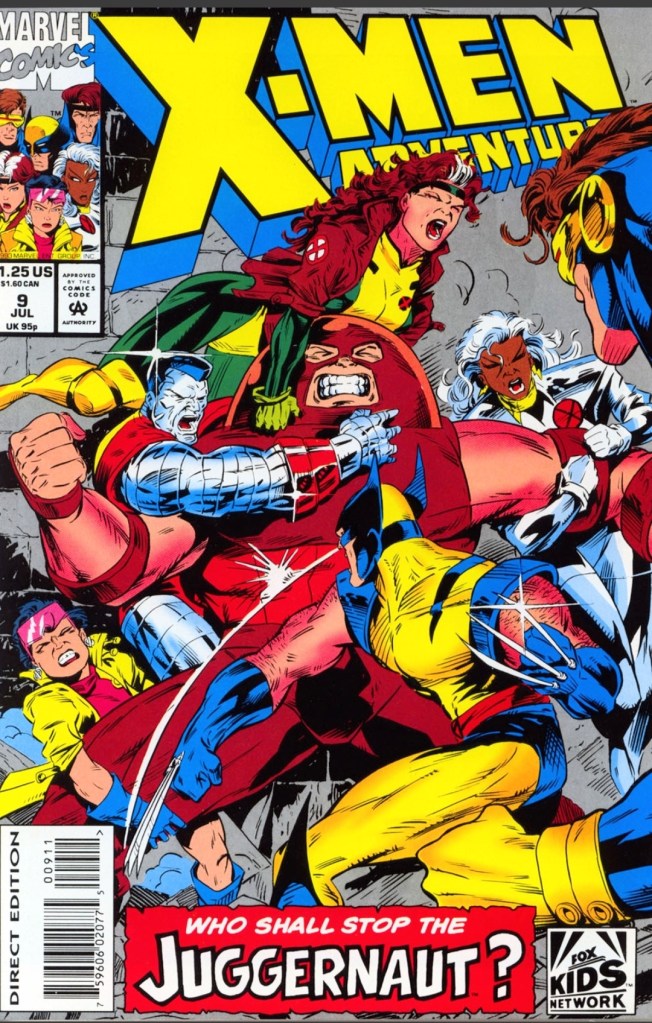
With those details laid down, here is a look back at X-Men Adventures #9, published by Marvel Comics in 1993 with a story written by Ralph Macchio and drawn by Andrew Wildman.

The cover.

Early story

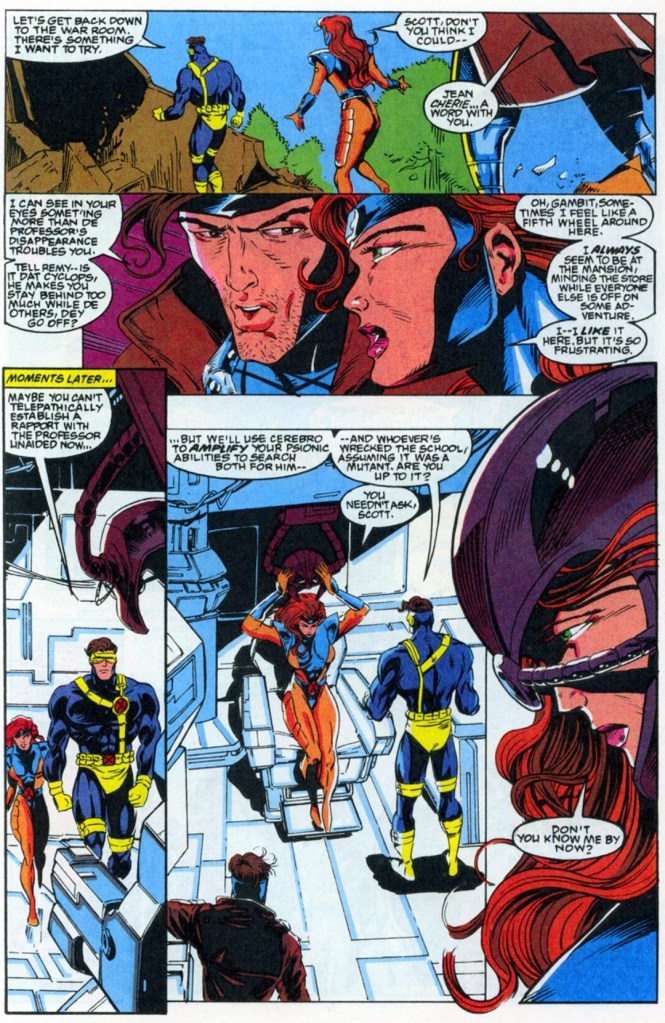
The story begins with the X-Men (riding their jet) arriving from Genosha only to see a part of Professor X’s mansion destroyed. After landing, Cyclops, Wolverine and Jean Grey immediately searched through the rubble and found a path into the War Room. Using Cerebro, they uncovered a prepared video message of Professor X who tells them that he is taking a journey whose results may change their lives forever. After apologizing for the cryptic nature of the message, Xavier tells them that he trusts they will continue with their training and look after the School of Gifted Children in his absence.

The X-Men could not determine if their mentor left the mansion before the destruction took place. In response to Gambit’s question related to detection, Wolverine senses big foot prints and there was a familiar smell left behind. Wolverine decides to go out to keep following the scent which causes Cyclops to insist that the situation at hand is not the time for the team members to separate from each other.

After telling Cyclops he has places to go to, Wolverine then leaves his teammates with a motorcycle. Cyclops tells Storm to take Rogue and Jubilee with her to track Wolverine and stay close to him…

Quality

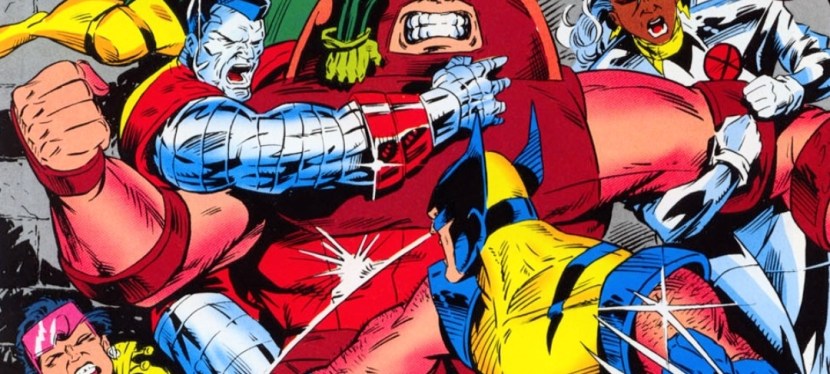
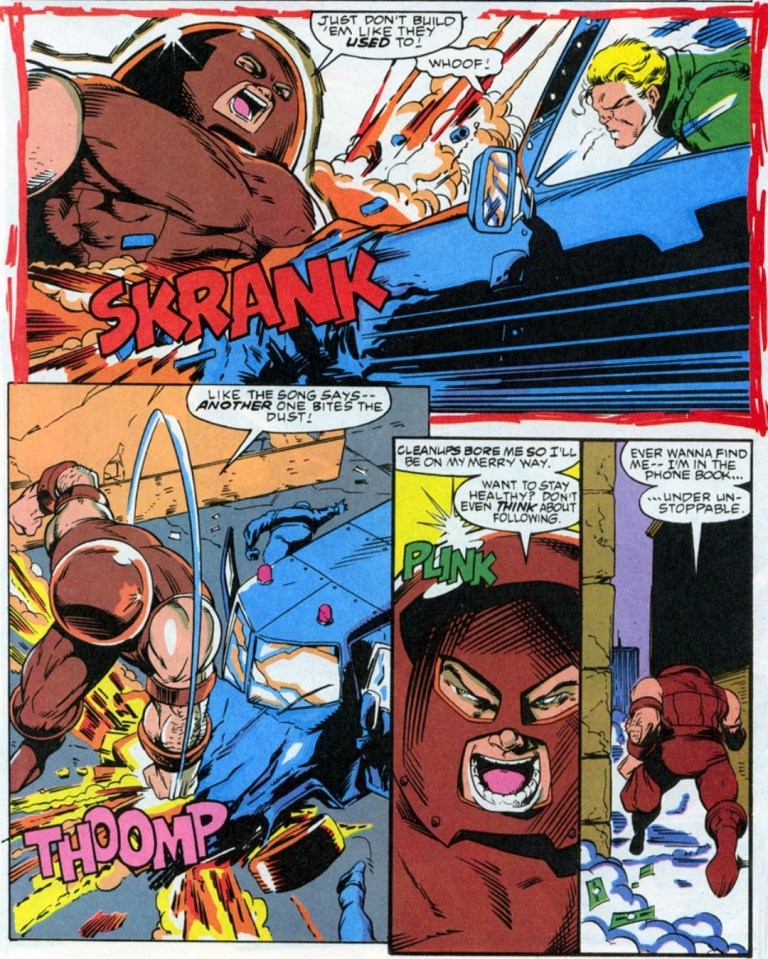
The sheer power of Juggernaut.

To describe this comic book’s story, I can say it was a fine mix of suspense, mystery and superhero spectacle. As the X-Men struggled to figure out how the damage on the mansion happened and where exactly did Charles Xavier go to, I felt this sense of dread backed with strong mystery. As the plot continued, there were these short-yet-notable character moments among the X-Men such as Gambit getting closer with Jean Grey who believes that she should be helping others on the field as her beloved Cyclops made a decision that kept her with him at the mansion.

The search for who is responsible for the mansion’s big damage creatively took notable paths in the story. One strong figure appeared and became a target of some X-Men members while another one became Wolverine’s target.

As expected, the highlight of this tale is Juggernaut himself and to say that he his huge and powerful is a big understatement. At this point of the X-Men Adventures monthly series, this is the one notable conflict that has multiple X-Men members struggling really hard fighting one single powerful enemy. In some ways, Juggernaut here looks like a much more dangerous foe than Magneto within this series. How the conflict in the story ended in a really intriguing yet sensible way which should resonate with X-Men fans. 

Conclusion

Only Cyclops, Gambit and Jean Grey (who wanted to do more) remained at the mansion.

X-Men Adventures #9 (1993) is fun and intriguing to read. At the stage of this monthly series, the X-Men are not only more developed but are also challenged deeply as their mentor is no longer around to lead them. This makes the path ahead look more enticing to anticipate.

Overall, X-Men Adventures #9 (1993) is recommended.

+++++

Thank you for reading. If you find this article engaging, please click the like button below and also please consider sharing this article to others. If you are looking for a copywriter to create content for your special project or business, check out my services and my portfolio. If you want to support my website, please consider making a donation. Feel free to contact me with a private message. Also please feel free to visit my Facebook page Author Carlo Carrasco and follow me on Twitter at  @HavenorFantasy as well as on Tumblr at https://carlocarrasco.tumblr.com/ and on Instagram at https://www.instagram.com/authorcarlocarrasco/.
A Look Back at What If #4 (1989)

Disclaimer: This is my original work with details sourced from reading the comic book and doing personal research. Anyone who wants to use this article, in part or in whole, needs to secure first my permission and agree to cite me as the source and author. Let it be known that any unauthorized use of this article will constrain the author to pursue the remedies under R.A. No. 8293, the Revised Penal Code, and/or all applicable legal actions under the laws of the Philippines.

Welcome back superhero fans, 20th century arts and culture enthusiasts, Marvel Comics fans and comic book collectors! Today we go back to the year 1989 and explore a part of Marvel Comics’ universe through the reimagined tales emphasized in the What If monthly series (Volume 2).

For the newcomers reading this, I previously reviewed a variety What If comic books which you can find by clicking here, here, here, here, here, here, here and here. The joy of reading a What If comic book was the exploration of alternate outcomes in relation to the stories that have been counted by Marvel Comics as canon or official fictional history within their shared comic book universe. In this retro review, we will explore a key event from Spider-Man’s time with the alien costume (symbiote) which is related with the events of Secret Wars and the eventual establishment of his deadliest nemesis Venom.

With those details laid down, here is a look back What If #4, published in 1989 by Marvel Comics with a story written by Danny Fingeroth and drawn by Mark Bagley.

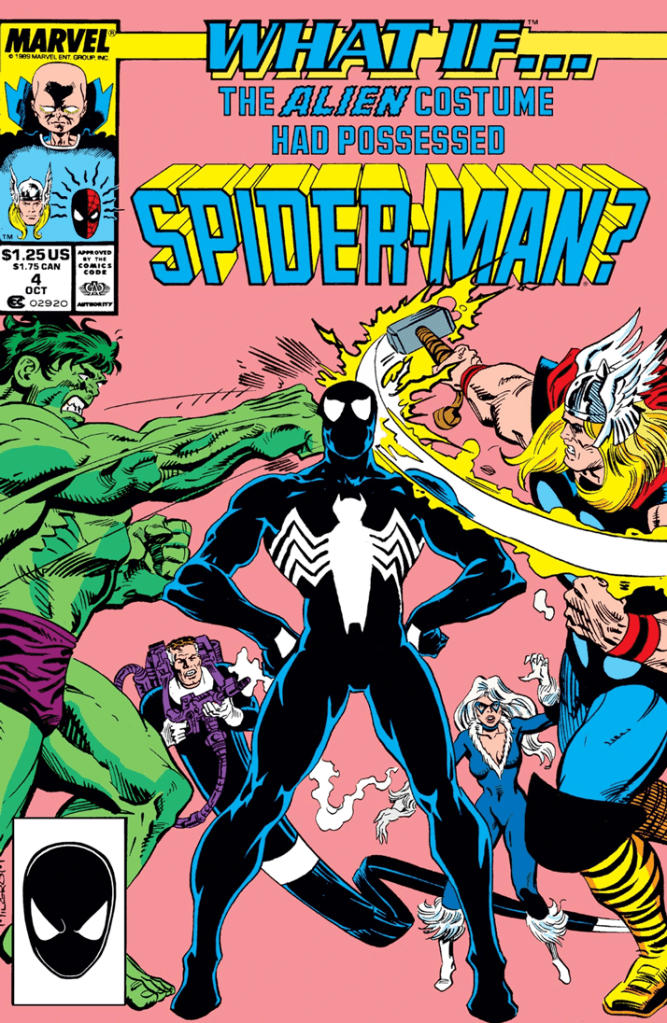
The cover.

Early story

The story begins with the Watcher examining Spider-Man’s involvement with the Secret Wars that took place on a faraway planet created by the Beyonder. There, his costume got damaged beyond  repair and he acquired a new one made of what he perceived to be an advanced form of material. After successfully returning home, Spider-Man goes through some mysterious developments and he could not understand why he remains fatigued even as he spent more time sleeping.

With the help of Mr. Fantastic at the Fantastic Four headquarters, Spider-Man learns that his new costume is a living entity that has attached itself to him mentally and physically. As Mr. Fantastic uses a sonic blaster, Spider-Man and the alien costume got separated at last. Some time later, the alien costume re-attached itself to Spider-Man who eventually used church bells loud sounds to separate it. The alien costume would go on to the find Eddie Brock to form Venom.

The alternate reality begins with Spider-Man having a joyful reunion with Black Cat shortly after coming back from Secret Wars. Learning from her advise to have himself checked properly, he visits Dr. Connors (the Lizard) for examination and testing…

Quality

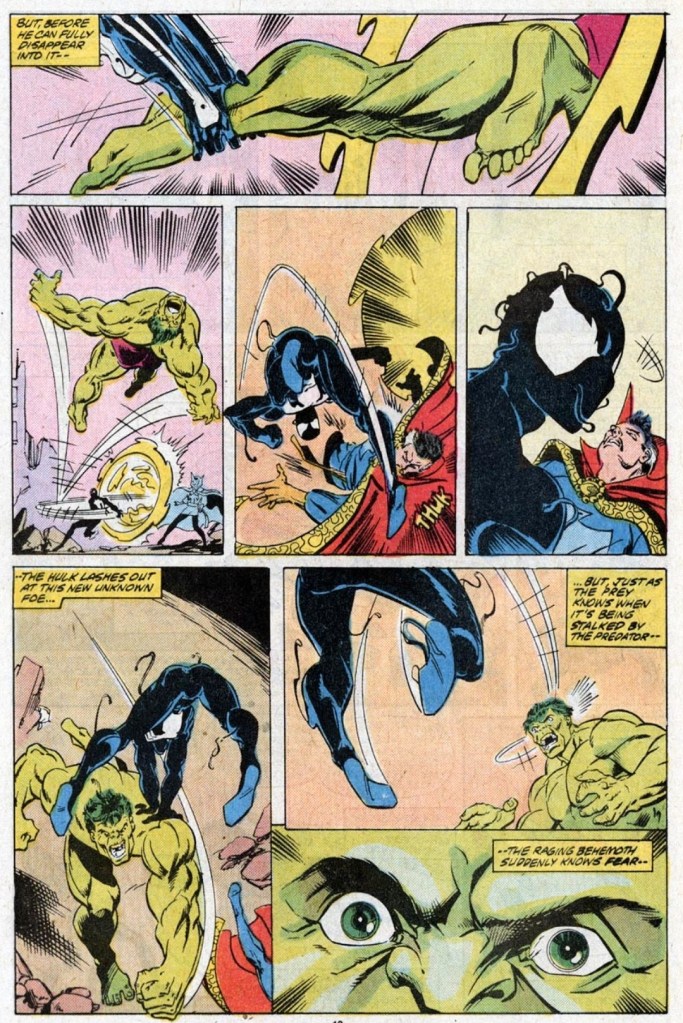
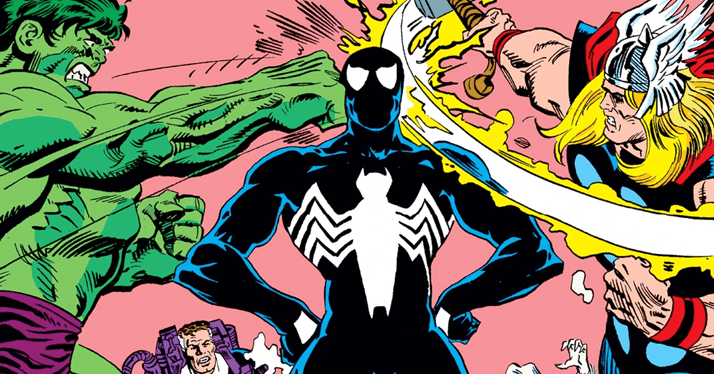
The possessed Spider-Man takes on Dr. Strange and the Hulk without hesitation.

To say that Danny Fingeroth’s script is very deep is an understatement. Specifically, this story is a great exploration of alternative events that not only affects the iconic Spider-Man/Peter Parker but also other elements of the Marvel Comics universe of the time. The concept of the alien costume fully bonding with Peter Parker with Mr. Fantastic and even Dr. Strange failing to help is indeed suspenseful and intriguing to read thanks to Fingeroth’s very solid writing. In fact, the story even shows Spider-Man as being possessed by the symbiote (complete with dialogue) and when you witness Peter Parker struggling to control himself consciously (while wrestling with the alien costume), you will really feel his pain. I should also state that there is a lot more about Spider-Man told here that goes beyond the possession which really turned out to be very compelling to read in my experience. This is easily the most engaging alternate portrayal of Spider-Man as we know him and it should be read by as many people as possible.

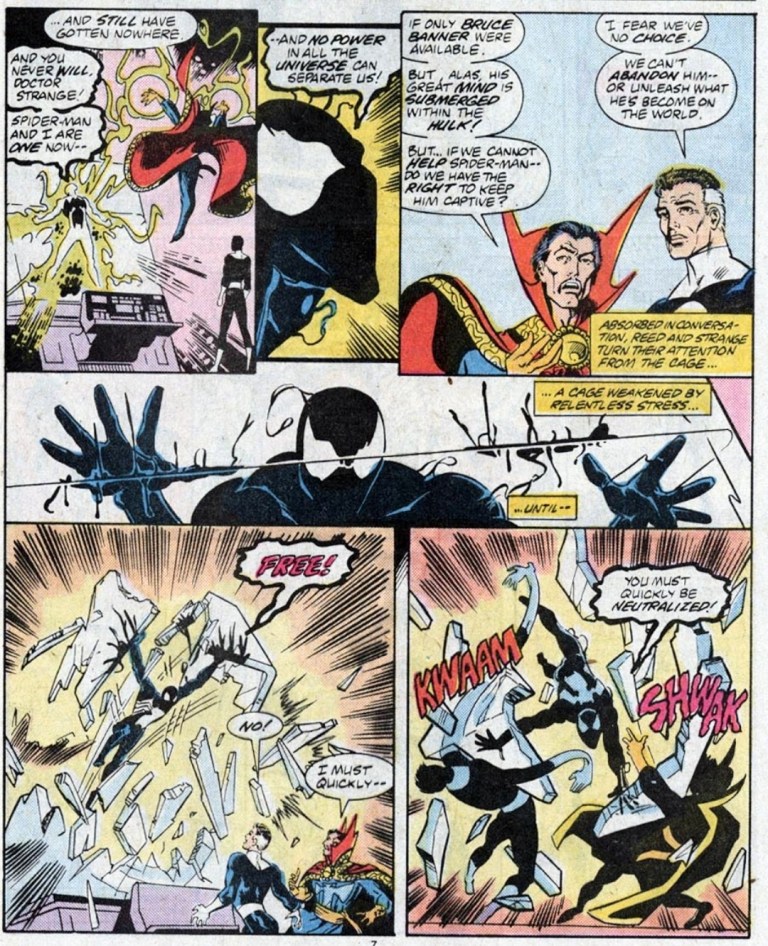
Along the way, this comic book portrays the alien costume as an insatiable being and the implementation of dialogue for it (structured in a way as using the vocal ability of the powered being it bonded with) gave it a very unique personality of its own. This is something that was not portrayed in the early appearances of Venom in which Eddie Brock does the talking and reacting to unseen messages from the symbiote. That being said, the alien costume here symbolizes possession within the Marvel Comics shared universe and its unknown state really challenges not only the intelligence of the superheroes but also their ability to decide on what final action to take with regards to sentient life.

As staged by the writer, the story’s narrative occasionally shifts away from Spider-Man to follow other characters such as Black Cat (Peter Parker’s love at the time), Mr. Fantastic (in a great portrayal of his proficiency in science and as a responsible superhero), Thor and others which made the reading experience really immersive in relation to emphasizing how this alternate reality affects others. You will get to see the Captain America, the Hulk, Iron Man, the Wasp, Captain Marvel, the Fantastic Four and the Avengers here.

Those who are fond of superhero spectacle will have a lot to enjoy here. Mark Bagley carefully paces the action scenes and he uses visual dynamism during the right moments.  

Conclusion

Through dialogue, the alien costume is portrayed as a sinister force.

I can say it out loud…What If #4 (1989) is one of the best Marvel Comics alternate reality stories I have ever read and the creative team of Fingeroth-Bagley crafted an epic tale that goes beyond the featured question of “What if the alien costumer had possessed Spider-Man?”. The comic book works excellently as both a Spider-Man story as well as a Marvel superheroes struggle. The story touches on relevant topics such as possession, killing and scientific exploitation. This is a must-have comic book!

Overall, What If #4 (1989) is highly recommended!

+++++

Thank you for reading. If you find this article engaging, please click the like button below and also please consider sharing this article to others. If you are looking for a copywriter to create content for your special project or business, check out my services and my portfolio. Feel free to contact me with a private message. Also please feel free to visit my Facebook page Author Carlo Carrasco and follow me on Twitter at  @HavenorFantasy as well as on Tumblr at https://carlocarrasco.tumblr.com/ and on Instagram at https://www.instagram.com/authorcarlocarrasco/