Better than Streaming: Piranha (1978) 4K Blu-ray all set for November 1, 2022 release

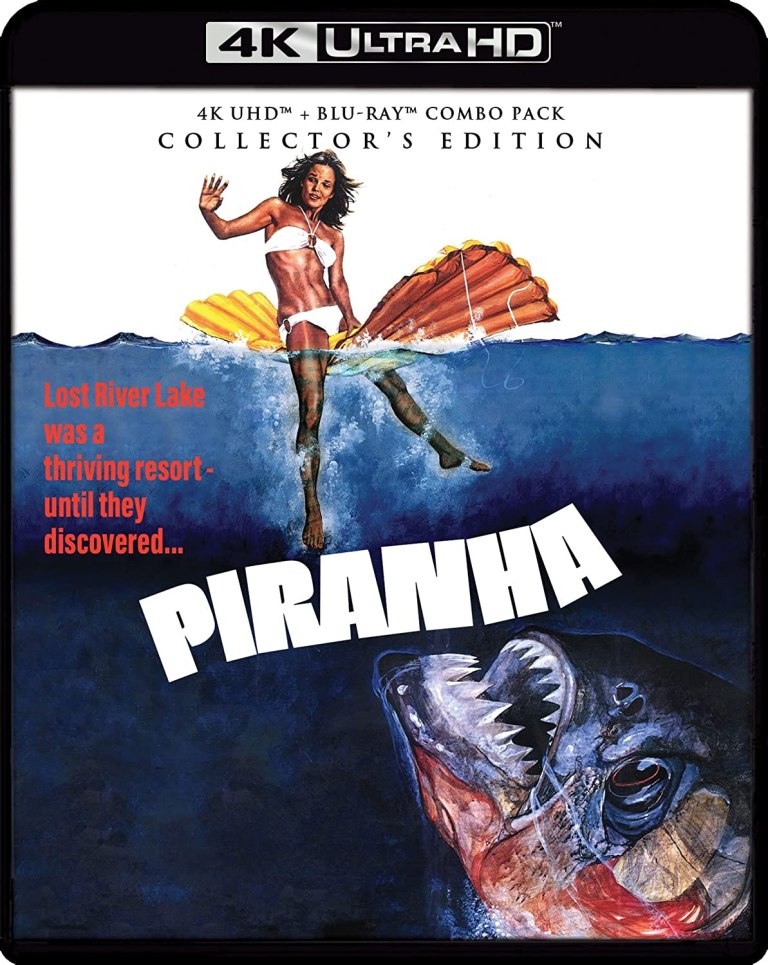
Welcome back, fellow geeks, Blu-ray collectors and movie buffs! If you are fond of low budget horror/comedy films or movies that were made to make money because their producers wanted to imitate the success of certain blockbusters back then, then you might be interested to know that Piranha (1978) will be released on 4K Blu-ray format on November 1, 2022. Already, pre-orders are being accepted online.

The 4K Blu-ray cover of Piranha (1978).

To put things in perspective, posted below is the excerpt and key details from the 4K Blu-ray announcement at Blu-ray.com. Some parts in boldface…

Piranha features a stellar group of talent in front of as well as behind the camera. The top-notch cast of cult stars includes Kevin McCarthy (Invasion Of The Body Snatchers), Barbara Steele (Black Sunday), Belinda Balaski (The Howling), Dick Miller (A Bucket Of Blood), Paul Bartel (Eating Raoul), and Richard Deacon (The Dick Van Dyke Show).


Special Features and Technical Specs:

DISC ONE – 4K BLU-RAY

  • NEW 4K RESTORATION OF OF THE FILM FROM THE ORIGINAL CAMERA NEGATIVE (2022)
  • DOLBY VISION/HDR PRESENTATION OF THE FILM
  • Audio Commentary With Executive Producer Roger Corman
  • Audio Commentary With Director Joe Dante And Producer Jon Davison
  • DTS-HD Master Audio Mono track
  • Optional English SDH subtitles for the main feature

DISC TWO – BLU-RAY

  • NEW 4K RESTORATION OF OF THE FILM FROM THE ORIGINAL CAMERA NEGATIVE (2022)
  • NEW Interview with director Joe Dante
  • Audio Commentary With Roger Corman
  • Audio Commentary With Joe Dante And Jon Davison
  • “The Making Of Piranha – Interviews With Roger Corman, Joe Dante And Actors Dick Miller, Belinda Balaski And More …
  • Behind-The-Scenes Footage
  • Bloopers And Outtakes
  • Still Galleries
  • Behind-The-Scenes Photo Gallery Featuring Photos From Creature Designer/Animator Phil Tippett’s Archives
  • Additional Scenes From The TV Version
  • Theatrical Trailers
  • TV Spot
  • Radio Spots
  • DTS-HD Master Audio Mono track
  • Optional English SDH subtitles for the main feature

Posted below are the specs of Piranha (1978) 4K Blu-ray

Video
Codec: HEVC / H.265
Resolution: Native 4K (2160p)
HDR: Dolby Vision, HDR10
Aspect ratio: 1.85:1
Original aspect ratio: 1.85:1

Audio – English: DTS-HD Master Audio 2.0 Mono (48kHz, 24-bit)


Subtitles – English SDH


Discs – 4K Ultra HD, Blu-ray Disc, Two-disc set (1 BD-66, 1 BD-50)

Packaging – Slipcover in original pressing

Playback – 4K Blu-ray: Region free, 2K Blu-ray: Region A (B, C untested)

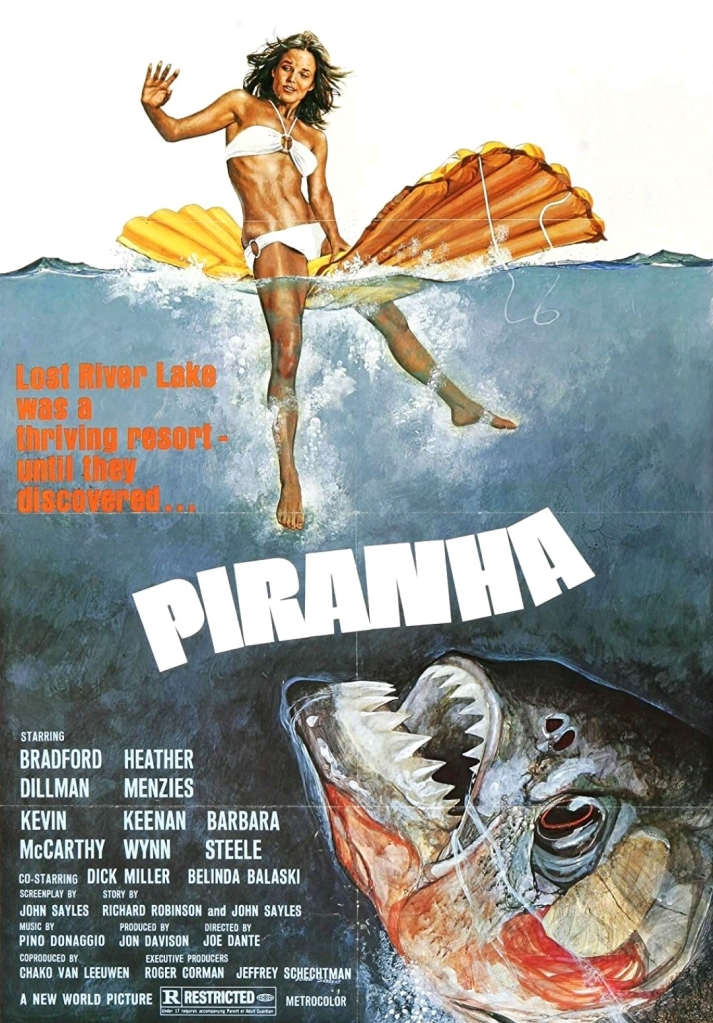
Movie poster of Piranha (1978)

In my experience, I saw Piranha (1978) a number of times since the 1980s. I never saw it in the cinema as I was too young back then but I first saw it on home video followed by showings on cable TV. Strangely enough, the 1978 movie not only spawned a sequel in 1982, it also had remakes in 1995 and 2010.

More on the 1978 movie itself, it was made just a few years after Steven Spielberg’s Jaws made tremendous impact commercially and socially. To its credit, Piranha (1978) was produced by low-budget movie king Roger Corman and it had Joe Dante as director and Kevin McCarthy as a supporting cast member. For the newcomers reading this, Dante is best known for directing Gremlins while McCarthy is best remembered for Invasion of the Body Snatchers (1956).

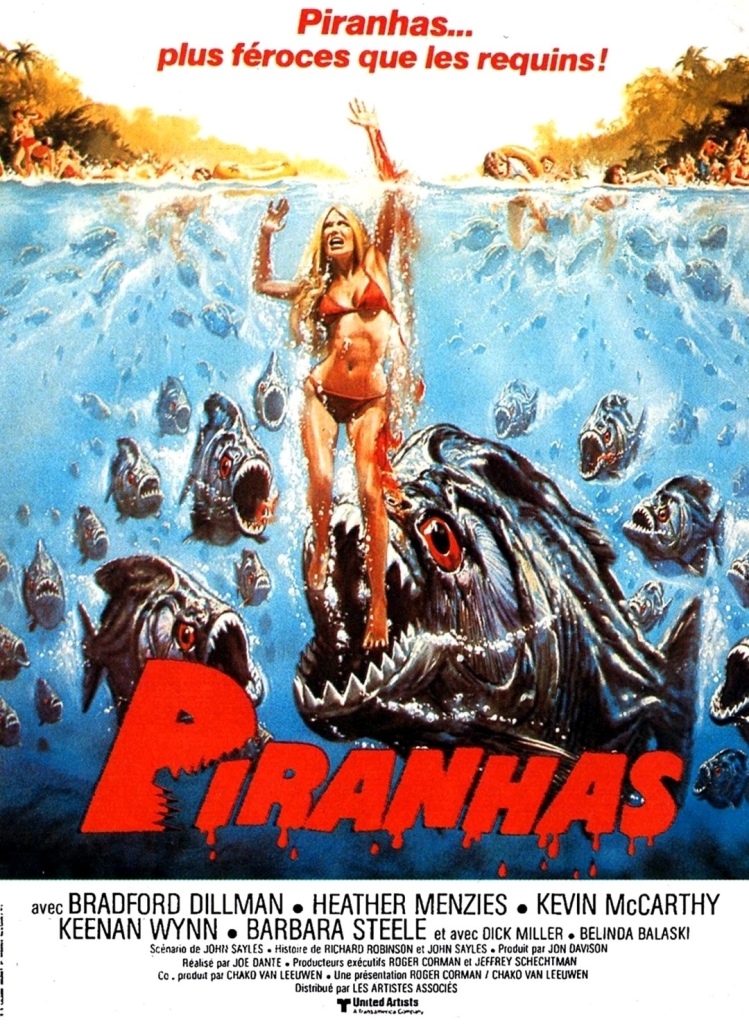
A foreign movie poster.

Ultimately, the main feature of Piranha (1978) is its emphasis on water-related fear, particularly the idea that a person in water can be eaten alive by multiple piranhas. It’s like an extension of Jaws’ influence which people afraid of the sea because they could be eaten by a shark.

Already it has been confirmed that Piranha (1978) 4K Blu-ray will come with native 4K visuals. To the best of my memory, the movie was not a very visually appealing movie. Still, the idea of it getting remastered into 4K is interesting.

Watch out for Piranha (1978) 4K Blu-ray on November 1, 2022.

In closing this Better than Streaming piece, posted below is the Piranha (1978) video.

If you wish to join a group of movie enthusiasts and talk about cinema, visit the Movie Fans Worldwide Facebook group at https://www.facebook.com/groups/322857711779576

+++++

Thank you for reading. If you find this article engaging, please click the like button below and also please consider sharing this article to others. If you are looking for a copywriter to create content for your special project or business, check out my services and my portfolio. If you want to support my website, please consider making a donation. Feel free to contact me with a private message. Also please feel free to visit my Facebook page Author Carlo Carrasco and follow me on Twitter at  @HavenorFantasy as well as on Tumblr at https://carlocarrasco.tumblr.com/ and on Instagram athttps://www.instagram.com/authorcarlocarrasco/.

A Look Back at V: The Final Battle (1984)

Disclaimer: This is my original work with details sourced from watching V: The Final Battle and doing personal research. Anyone who wants to use this article, in part or in whole, needs to secure first my permission and agree to cite me as the source and author. Let it be known that any unauthorized use of this article will constrain the author to pursue the remedies under R.A. No. 8293, the Revised Penal Code, and/or all applicable legal actions under the laws of the Philippines.

With a very engaging story, memorable characters, intriguing concepts and innovative marketing, the $13 million production V: The Original Miniseries (simply called V back then) became a major TV hit in America over two nights in May, 1983. I personally loved watching the said mini-series back in the 1980s and I still love replaying it in this age of high-definition and Blu-ray discs. For me, at least, it is a timeless classic and it carries several lessons about the fragility of society, the rise of fascism, the spread of evil in many forms and the human desire for freedom from oppression.

Given its success and the way creator Kenneth Johnson ended the 1983 sci-fi mini-series, a sequel was inevitable. In fact, two sequels to V: The Original Miniseries were approved in the form of another mini-series (note: I acquired the Blu-ray release in 2021) and a regular TV series. Beyond the small screen, the V franchise entered literature as DC Comics published a V comic book series (read my retro review of V #1 by clicking here) related to the TV series.

With those details laid down, here is a look back at V: The Final Battle, starring Faye Grant, Marc Singer, Jane Badler and Michael Ironside under the direction of Richard T. Heffron. This 3-episode mini-series, which involved a lot of screenwriters, was broadcast on TV in America in May 1984.

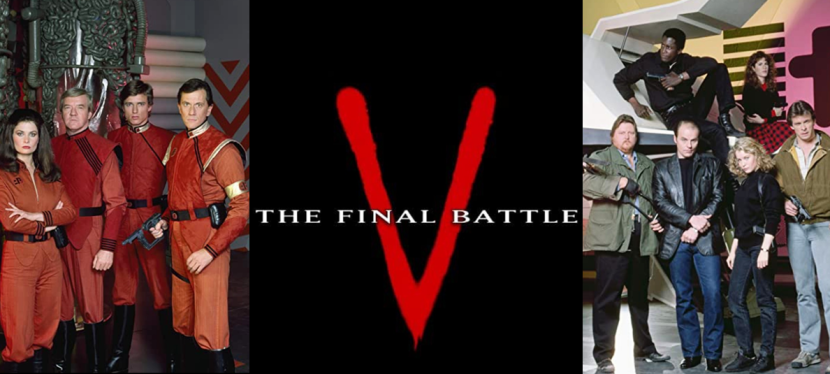
The cover and the title that did not live up to its purpose.

Early story

The story begins with Mike Donovan (Marc Singer) having a nightmare of him and his son Sean (who was abducted during the events of V: The Original Miniseries) in a desperate escape attempt while inside one of the motherships of the Visitors. He wakes up in the presence of Julie Parrish (Faye Grant) and realizes they have a dangerous mission to execute at a local facility used by the red-uniformed Visitors. It turns out, the Resistance movement led by Julie has been losing ground to the alien humanoids and Mike has been helping them out while prioritizing the state of his son who has been in captivity in one of the mother ships.

During the night, a truck carrying many local civilians inside its trailer arrives at a local factory controlled by the Visitors with officer Steven (Andrew Pine) watching over. After the civilians got directed to enter the factory, it turns out they got processed and came out in the form of food cocoons. The sight shocks Julie watching from a distance with her armed teammates waiting on stand-by.

Easily the most engaging shot in this sequel. A clear reminder about the fascist takeover by the aliens from outer space.

After causing damage on the nearest fence, the Resistance begins their attempt to raid the facility and free their fellow cocooned people but the tide turned against them. It turns out, the Visitors’ troops are wearing stronger armor and bright lights were installed on the top of the facility to forcing Julie, Marc and the rest of their team to retreat. They lost some members along the way. During a closed-door meeting with the Resistance stakeholders, Mike Donovan says a key event is needed to make a significant gain against the Visitors.

Over at the mothership hovering over Los Angeles and in the presence of Diana (Jane Badler), the leader John (Richard Herd) tells Kristine Walsh (Jenny Sullivan) that a major medical announcement will be held in the form of an organized special event very soon and that she will be part of the presentation for the global TV audience…

Quality

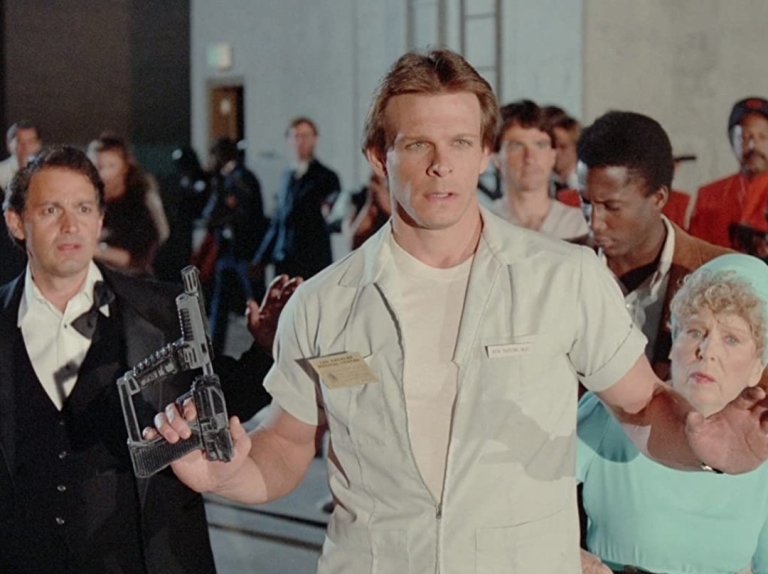
Marc Singer as Mike Donovan with Michael Durrel and Michael Wright as Robert Maxwell and Elias Taylor near him.

I’ll star first with the presentation here. This sequel mini-series was composed of three episodes totaling over 270 minutes. In what looks like to be attempts to ensure more spectacles for the viewers’ enjoyment, each episode of V: The Final Battle has a battle near the end and the creative team succeeded in not only providing on-screen action but also scored well in making the spectacle more varied while still making sense within the main narrative. For the most part, this sequel is indeed a natural progression of what was established in V: The Original Miniseries and that is something to admire given the fact that V creator Kenneth Johnson left this production early.

On the storytelling, V: The Final Battle expands a bit on the Visitors’ dictatorship of Los Angeles and its surrounding areas while the Resistance led by Julie Parrish and supported by close companions Robert Maxwell (Michael Durrell), Elias Taylor (Michael Wright) and Caleb Taylor (Jason Bernard) are shown to be struggling on taking down the alien humanoids even though they secured noticeably more weapons and equipment. The storytelling and the dramatization about the Resistance changes dramatically with the addition of Ham Tyler (Michael Ironside) and partner Chris Farber (Mickey Jones) in the 2nd episode and from that point on, you get to see a human opposition that becomes more flexible with their operations.

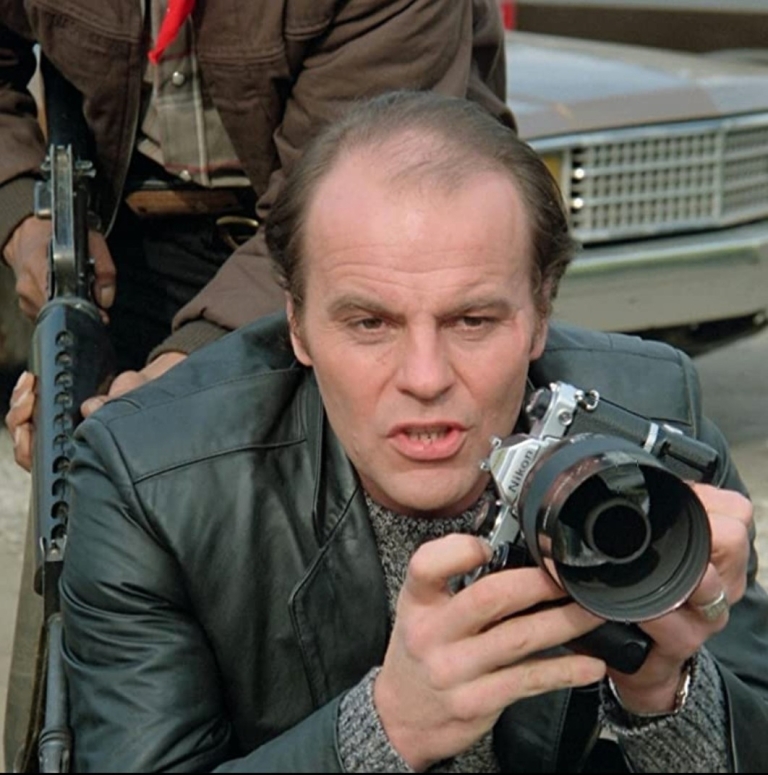
Michael Ironside as Ham Tyler is the most significant new addition to the cast.

As mentioned earlier, Kenneth Johnson’s involvement in this sequel was minimal and it is seen on the presentation. The symbolism Johnson implemented in the original mini-series that established parallels between 1980s America to the Nazi occupation of Europe did not continue here which results a more straightforward presentation of details, character moments and story progression. There was also a noticeable lack of suspense when it comes to executing big scenes with big reveals. The pacing, like in the 1983 mini-series, moves smoothly at a moderate pace throughout and there were no boring moments at all.

The quality of script is still good. For the most part, the writers managed to capture the essence of the established characters from the original mini-series as they told the further developments of this sequel. For example, Caleb and Elias’ father-and-son moments quickly remind me of what I saw in V: The Original Miniseries. Robert Maxwell’s struggle to help his troubled daughter Robin (Blair Tefkin) while assisting Julie and the Resistance is a very natural progression of what was shown in 1983. The friendship between good natured alien Willie (Robert Englund) and Harmony (Diane Cary) got developed a lot more than expected eventually adding to one particular side of the conflict. The local collaborators Daniel Bernstein (David Packer) and Eleanor Dupres (Neva Patterson) developed further with their treason towards their fellow humans as they enjoyed further the power they gained from the Visitors. These two characters will surely get on the nerves of viewers rooting for the Resistance.

Denise Galik as Maggie is a fine new addition to the cast.
David Packer returns as Daniel Bernstein.
Sarah Douglas as Pamela, a superior of Diana’s.

When it comes to new additions to the cast, Ham Tyler and Chris Farber are not the only new players to add depth to this sequel. There is also Maggie (Denise Galik) who is an attractive, brave and strategic Resistance member whose contribution makes an impact. On the downside, there is also Andrew Doyle (Thomas Hill) who is bad choice the creative team came up with as the on-screen representative of faith when he in fact represents religion, idolatry, rituals and distortion. On the side of the Visitors is Pamela (Sarah Douglas) who is a higher-ranking officer than Diana and even John. Pamela is the more militaristic type of leader who is more focused on achieving goals while keeping things in order.

If there is anything flawed about the characterization, it is the romantic relationship of Julie Parrish and Mike Donovan which starts in the first episode. Considering how dramatic the performances of Faye Grant and Marc Singer were in this sequel, Julie and Mike still don’t make a believable pair of lovers in my view. While this romantic relationship opens up new dimensions within Julie and Mike and offer viewers something new to focus, it brings down the former’s value as Resistance leader somewhat while also setting aside the hinted personal connection between her and Elias in the 2nd episode of the 1983 mini-series.

Faye Grant as Julie Parrish in the conversion process scene watched closely by Jane Badler’s Diana.

More on Faye Grant, her performance here is more varied. Not only does she play the brave and struggling leader who is talented in fighting, science and medical practice, she also portrayed Julie as an even more vulnerable character this time around. Her act as the traumatized Julie during the conversion process (read: mental and psychological torture using a more detailed form of virtual reality or nightmare generation) scenes under the watch of Diana is very dramatic and compelling to watch. Just seeing Julie in the conversion process will make grip you with despair and you will eventually feel sorry for her. I should state that the nightmare scenes of Julie were presented with a clear touch of horror.

Marc Singer as Mike Donovan is no longer the reluctant action hero but rather a driven man with a mission to get his missing son back while maintaining a secret connection with Martin (Frank Ashmore) of the Fifth Column (secret dissenters among the Visitors) hoping to achieve breakthroughs for the Resistance and their friends among the dissenting aliens. Singer did the best he could with the script provided to him and he remain likable all throughout. Other than the unbelievable romance with Julie as well as his past encounters with Ham Tyler, there is not much new to expect from the way Mike Donovan was written here. What I should point out, however, is that Mike Donovan’s support for the unholy act of abortion (along with the so-called right to abort) is very wrongful, highly immoral and makes the hero having a sinister presence within him even though he is a father searching for his son.

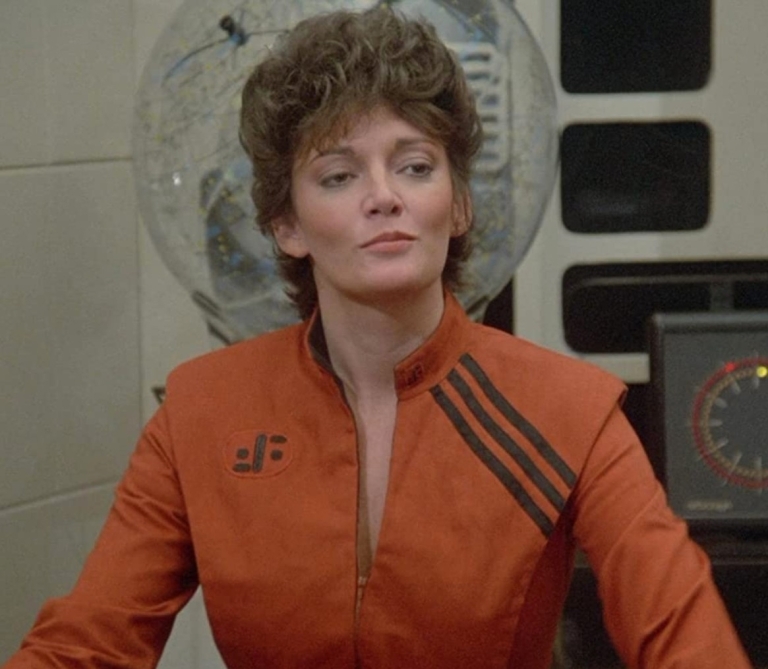
Jane Badler’s performance as Diana deserves admiration here. Not only did she successfully recapture the charismatic and sinister nature of her character in the 1983 mini-series, Badler was very convincing in showing the more desperate side of Diana, especially when it comes to power struggle within the ranks of the Visitors. You can clearly see the desperation and struggle as soon as Pamela appeared. This sequel also showed a lot more of Diana when it comes to personally supervising her conversion process which is much more elaborate here (note: the conversion process in the 1983 mini-series was limited to the showing of a chair with torture devices). Being the very symbol of charisma and evil in the V franchise, Diana’s place in pop culture is solid and her real-world comparative counterparts would be none other than Hillary Clinton and Kamala Harris.

Jane Badler as the ever charismatic yet very wicked Diana.

As mentioned earlier, Michael Ironside’s Ham Tyler is the most significant addition to the cast and the script. Ironside had that excellent mix of toughness, cruelty and sarcasm portrayed in here and at the same time Ham Tyler brought out very interesting and intriguing interactions with the more established Julie and Mike. As seen in entertainment history, Ironside went on to climb up the ranks in Hollywood with Total Recall (1990), Starship Troopers (1997) and in the Splinter Cell video game franchise. Ironside’s Ham is easily the fourth major character of the V franchise of the 1980s.

Going into the spectacle part of this sequel, the action is more varied as mentioned earlier and the 3-episode structure was a factor. You will see lots of shooting with the use of guns and laser blasters here and there, and with the in-story locations and props as key factors, there are action sequences that are uniquely done. There is a lot to enjoy for any V fan and casual viewers watching this sequel.

As for the special effects part of the spectacle, this one is a mixed bag similar to what was presented in the 1983 mini-series. To put things in perspective, the use of in-camera effects, practical effects and optical effects for TV back in the 1980s was ambitious. That being said, certain effect shots here did not age well such as the miniature shots looking fake (because the camera used did not have a special lens to capture visuals that would have made the miniatures look believable). I should also state that there were certain effects shots that were recycled and reused in key sequences in this sequel which remains embarrassing to see. What is even more embarrassing to see here is the very poor-quality monster effects used during the nightmare scenes (conversion process) of Julie and, more notably, the presentation of Robin’s other child. The monster effects are so fake, they are laughable to watch.  

On the bright side of the special effects, the quality of the laser blasts remains good to watch right down to the precise timing with the explosions that were simulated on-set and in-camera.

Conclusion

The Visitors and Resistance key characters in the sequel.

While it has its strengths and weaknesses, V: The Final Battle is still engaging and enjoyable to watch, and at the same time it is a worthy addition for your Blu-ray collection when it comes to HD viewing (note: this is the sequel with the best visuals yet albeit with black borders on the sides). Even though creator Kenneth Johnson was not too involved on the production side, the creative team managed to deliver a long story that proved to be a natural progression of the original mini-series while providing more spectacle (especially action), developing the established characters and resolving key plot threads that started in 1983.

The lack of Kenneth Johnson’s personal touch on the presentation was noticeable and somewhat brought this sequel down a bit in terms of style. What brought V: The Final Battle’s quality down were the overall cheaper looking visual effects, the Julie-Mike love relationship and the climax of the final episode which seemed executed with desperation on the part of the creative team (note: giving a little new character instant purpose). In fairness, this sequel still succeeded in showing what fascism in America (or California specifically which is now dominated by Commies) would look like and it built up on its predecessor’s themes such as the deception of power and the collaboration with foreign enemies. This mini-series even added themes of teenage pregnancy and abortion (note: someone from the creative team wanted to promote the wrongful Roe v. Wade Supreme Court decision of 1973) to its narrative.

Does V: The Final Battle live up to its title? Absolutely not because a regular TV series that deteriorated in quality followed. In retrospect, it’s clear that this sequel marked the beginning of the decline of the V franchise in pop culture. What more, V: The Final Battle was never counted as canon in Kenneth Johnson’s 2008 novel (and sequel to the 1983 mini-series) V: The Second Generation. On its own, V: The Final Battle still has more positive stuff than negative ones and in my experience, it remains enjoyable and compelling to watch from start to finish. Compared to V: The Original Miniseries, I can say this sequel falls short. It is good, not great.

Overall, V: The Final Battle (1984) is recommended. That being said, let this 1984 mini-series remind you that there is so much evil in the real world in the forms of Iran, the terrorists of Palestine, the social justice warriors (SJWs), the Black Lives Matter (BLM) movement and liberal media to name some. Always keep in mind to avoid becoming evil no matter how tempting power in this divided world becomes to you. You also do not want to let the evil ones take over your government and have authority over you, your family members and your community. Push back against evil and stand up strong by faithfully taking sides with the one true Savior whose name is Jesus!

+++++

Thank you for reading. If you find this article engaging, please click the like button below and also please consider sharing this article to others. If you are looking for a copywriter to create content for your special project or business, check out my services and my portfolio. Feel free to contact me with a private message. Also please feel free to visit my Facebook page Author Carlo Carrasco and follow me on Twitter at  @HavenorFantasy as well as on Tumblr at https://carlocarrasco.tumblr.com/

Better than Streaming: John Carpenter’s The Thing 4K Blu-ray combo coming out on September 7, 2021

Calling all fans of director John Carpenter and star Kurt Russell as well as Blu-ray collectors fond of science fiction and horror films!

Get ready because Carpenter’s classic sci-fi horror film The Thing (1982) will be released in 4K Blu-ray format (in a combo including the Blu-ray disc and digital code) on September 7, 2021. In addition, those who insist on having the best 4K visuals with the classic movie will be delighted over the early confirmation that The Thing has been rendered in native 4K.

The cover of The Thing 4K Blu-ray combo.

As of this writing, there is no suggested retail price yet. Still, here are the product descriptions and specs from Blu-ray.com’s articles about The Thing 4K Blu-ray. Some parts in boldface…

SPECS

Video

Codec: HEVC / H.265

Resolution: Native 4K (2160p)

HDR: HDR10

Aspect ratio: 2.35:1

Original aspect ratio: 2.39:1

Audio

English: DTS:X

English: DTS-HD Master Audio 7.1

Subtitles

English, English SDH, French, Spanish

Discs

4K Ultra HD

Blu-ray Disc

Two-disc set (1 BD-100, 1 BD-50)

Digital

Digital 4K

Digital copy included

Playback

4K Blu-ray: Region free

2K Blu-ray: Region A

PRODUCT DESCRIPTION

DISC ONE – 4K BLU-RAY

  • 4K RESTORATION OF THE FILM FROM THE ORIGINAL CAMERA NEGATIVE
  • HDR PRESENTATION OF THE FILM
  • DTS:X AUDIO TRACK
  • Audio Commentary with Director John Carpenter and Kurt Russell
  • John Carpenter’s The Thing: Terror Takes Shape
  • Outtakes
  • Theatrical Trailer
  • Optional English SDH, Spanish, and French subtitles for the main feature

DISC TWO – BLU-RAY

  • Main feature
  • Audio Commentary with Director John Carpenter and Kurt Russell
  • U-Control: Picture in Picture
  • Optional English SDH, Spanish, and French subtitles for the main feature

For those who are not too aware about this old sci-fi horror movie, The Thing tells the story of an American research team stationed in Antarctica whose lives turn upside-down after a sled dog comes to them after being hunted by a helicopter from the Norwegian research team.

Historically speaking, The Thing was released in cinemas in the United States just two weeks after Steven Spielberg’s E.T. the Extra-Terrestrial. The Carpenter-directed space alien monster film was trashed by movie critics of the time and in the American box office, Spielberg’s movie about a friendly alien creature from outer space was simply unbeatable. As time passed by, The Thing found its audience on TV and home video and its critical reception turned from negative to positive overall. In the awards circuit, The Thing was nominated for Best Horror Film and Best Special Effects (credit to Rob Bottin who went on to work on effects for RoboCop and Total Recall) in the 10th annual Saturn Awards given by the Academy of Science Fiction, Fantasy and Horror Films. Fans of actor Keith David will want to see his performance in this particular film. David also went on to work again with John Carpenter years later.

To get to know more about John Carpenter’s The Thing through trivia, watch the video posted below from Minty Comedic Arts. Be warned of potential spoilers…

For more entries of my Better than Streaming series of articles, check out my pieces on The Beastmaster 4K Blu-ray, The Transformers: The Movie 4K Blu-ray, Mortal Kombat 2021 4K Blu-ray, Space Jam 4K Blu-ray and V: The Original Miniseries Blu-ray disc of Warner Archive (read my retro review).  

+++++

Thank you for reading. If you find this article engaging, please click the like button below and also please consider sharing this article to others. If you are looking for a copywriter to create content for your special project or business, check out my services and my portfolio. Feel free to contact me as well. Also please feel free to visit my Facebook page Author Carlo Carrasco and follow me at HavenorFantasy@twitter.com

Classic game Zombies Ate My Neighbors plus sequel coming to Xbox on June 29, 2021!

Yesterday, I learned about the most surprising news related to my personal interest of Xbox gaming. It’s not about the reported new game of Bethesda (which has been fully acquired by Microsoft) and not about The Coalition’s latest developments.

Rather it’s about a pretty notable game (plus its sequel) from the 1990s that I completely missed out on. The big surprise to me was that it will be released soon for Xbox One and Xbox Series S and X owners to enjoy.

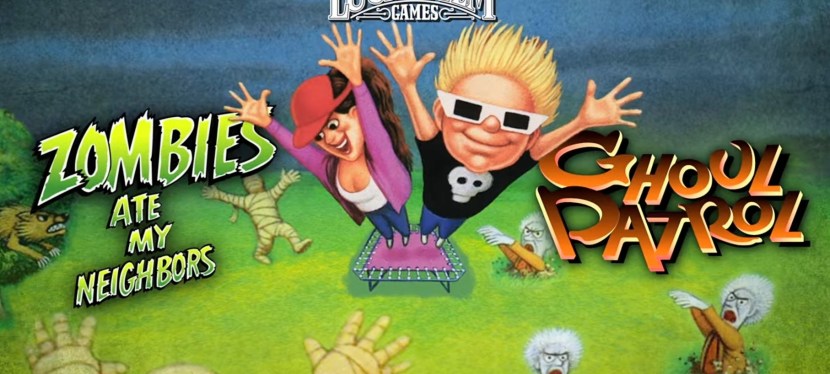
That game is none other than Zombies Ate My Neighbors and its sequel Ghoul Patrol. Both games from the 1990s will be released for Xbox on June 29, 2021 for $14.99!

For those who are not familiar with either game, here is an excerpt from the Xbox.com article written by Ken Humphries (Senior Producer on the two games)…

Zombies Ate My Neighbors

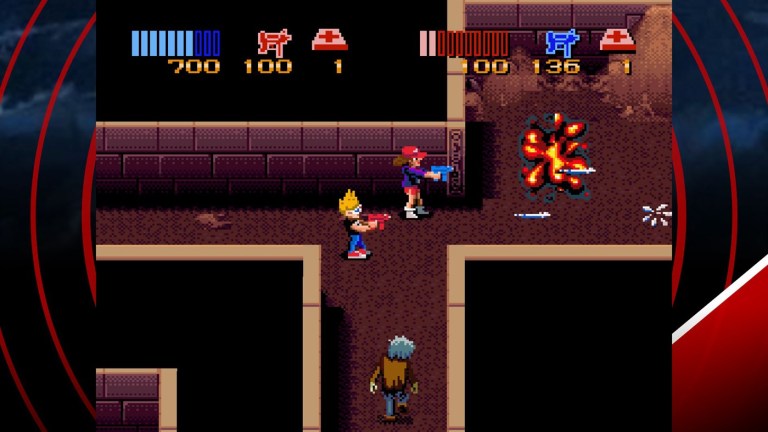
The 2-player function is a popular feature of the game.

Hey, where’s that scary music coming from? Yikes! It’s Zombies Ate My Neighbors, where you appear in every demented horror flick ever to make you hurl ju-jubes.

What are Zeke and Julie, our two wholesome teenage stars doing in a 16-bit game like this?! Trying to save the nice neighbors, cheerleaders, and babies from a fate worse than polyester!

Who could put this slice of suburbia in such goose-pimply hysteria? Zombies, relentless chainsaw maniacs, mummies, evil dolls that just won’t die, lizard men, blobs, vampires, giant ants, martians, and more.

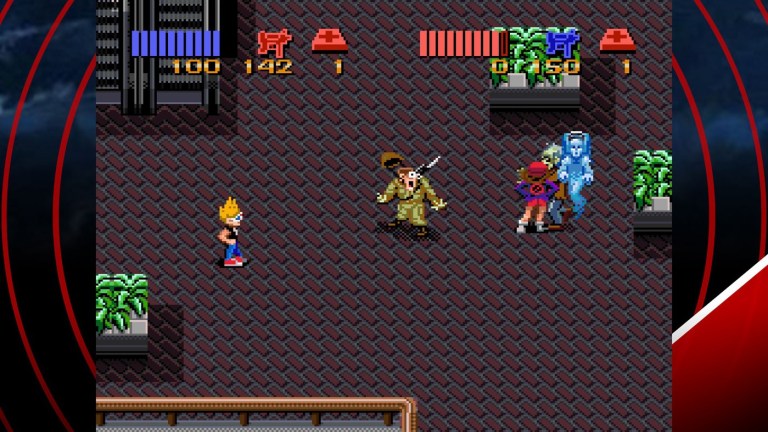
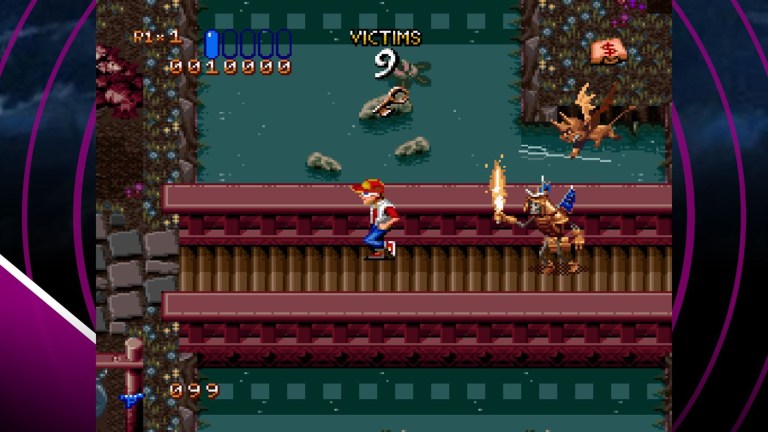
One of many levels in this game.

Will these crazy kids survive the night? Find your way through 55 horror-filled levels like a grocery store gone bad, a shopping mall awry, a mysterious island and your own back yard. Don’t miss “Weird Kids on the Block,” “Mars Needs Cheerleaders,” and “Dances w ith Werewolves.”

You can fend off the freaks with a virtual candy counter of weapons like uzi squirt guns, exploding soda pop, bazookas, weed wackers and ancient artifacts. Also grab power ups-o-rama like secret potions and bobo clown decoys. Does this game ever end?!

Ghoul Patrol

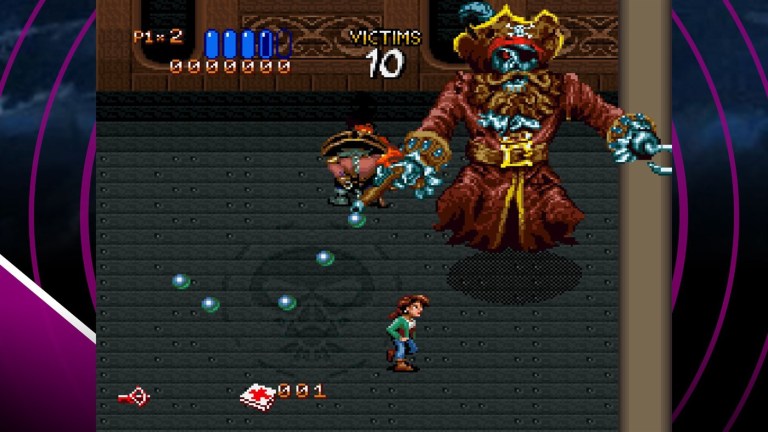
Nothing like facing an over-sized enemy in Ghoul Patrol.

Zeke and Julie, our intrepid teenagers, visit the Ghosts and Ghouls exhibit at the city library, where they find an old treasure chest containing an ancient spirit book. Naturally, they cannot resist reading it. Suddenly, a horrific snaggle-toothed spirit emerges.

Now, this snarling phantom and his dastardly minions are infesting Metropolis and slithering their way into the history books, where they plan to rewrite history with their spooky ways. Only you have the power to go back in time to de-spook an encyclopedia of zombified historic dudes.

Were you able to play this game back in the 1990s?

Terminate, with prejudice, using crossbows, ping-pong ball machine guns, Martian “Heatseeker” guns, and more.

Vaporize garbage can ghosts and ninja spirits, rescue bug-eyed librarians and wigged-out pirates, dodge flying books and adolescent-eating plants!

The features for Zombies Ate My Neighbors and Ghoul Patrol are as follows…

NEW FEATURES

Save Feature: Quickly save your progress in either game and continue your adventure wherever and whenever you want

Museum Features: Watch a video interview with one of the original Zombies’ developers or explore numerous galleries containing game art, previously unreleased concept images and marketing assets

Soundtrack: Listen to the entire soundtracks for both games in the included music players

2 Player Mode: Play the game with two player local co-op

• Achievements: Track your game progress with a set of achievements covering both games

To put things in perspective, Zombies Ate My Neighbors was released in 1993 published by Konami (game developed by LucasArts) for the Super NES (SNES) and the Sega Genesis. It was not a big commercial success but it proved to be a hit with the critics of the time (plus the writers who published their reviews of it years later). Zombies Ate My Neighbors gained a cult following as it not only had enjoyable gameplay, its visual style was appealing, it had lots of visual elements related to pop culture (notably horror genre elements), a memorable soundtrack and more.

In a 2006 article published by IGN, Zombies Ate My Neighbors was described by Lucas M. Thomas as “a comical 16-bit template for the new Xbox 360 release, Dead Rising. And like that game, this one arms you with a pretty bizarre arsenal. Weed whackers, exploding soda cans and flying silverware all make an appearance to help you, or you and a friend, put a hurt on these living dead.”

Ghoul Patrol was released in 1994 for SNES, published back then by JVC (Japan Victor Company) with the development done by LucasArts. Like its predecessor, I never got to play it back decades ago. In addition, I never even saw a copy of the sequel at retail during those days.

As I never got to play Zombies Ate My Neighbors back decades ago, its upcoming release for Xbox is a very delightful surprise for me personally. I will order this (along with Ghoul Patrol) very soon.

If you are interested to order in advance Zombies Ate My Neighbors and Ghoul Patrol for your Xbox One or Xbox Series console, click here.

In ending this piece, posted below is a video retrospective on Zombies Ate My Neighbors published by GamerThumbTV plus a retro review by Cinemassacre. Be mindful of potential spoilers.

+++++

Thank you for reading. If you find this article engaging, please click the like button below and also please consider sharing this article to others. If you are looking for a copywriter to create content for your special project or business, check out my services and my portfolio. Feel free to contact me as well. Also please feel free to visit my Facebook page Author Carlo Carrasco and follow me at HavenorFantasy@twitter.com

A Look Back at Wonder Woman #18 (1988)

Disclaimer: This is my original work with details sourced from reading the comic book and doing personal research. Anyone who wants to use this article, in part or in whole, needs to secure first my permission and agree to cite me as the source and author. Let it be known that any unauthorized use of this article will constrain the author to pursue the remedies under R.A. No. 8293, the Revised Penal Code, and/or all applicable legal actions under the laws of the Philippines.

Welcome back, superhero enthusiasts, comic book collectors, fellow geeks and fans of Wonder Woman! Last time, I found George Perez’s standalone writing of the story about Wonder Woman discovering Greece and its connections to her people’s heritage a really good story. For much of the post-crisis Wonder Woman monthly series’ early stage, the stories were done by Perez and the late Len Wein. In issue #17, Perez not only succeeded in developing Diana/Wonder Woman further, he also captured nicely the wonder of discovery of new places and astonishing aspects of life while traveling overseas.

Of course, issue #17 was not purely a tourism story through the eyes of the Queen of Superheroes. There was an obvious build-up of a new villain who is aware of Wonder Woman’s presence in Greece.

What will happen next? Who could the new force of evil be? We can find out in this look back at Wonder Woman #18, published by DC Comics in 1988 with a story written and drawn by George Perez with ink work done by Dick Giordano.

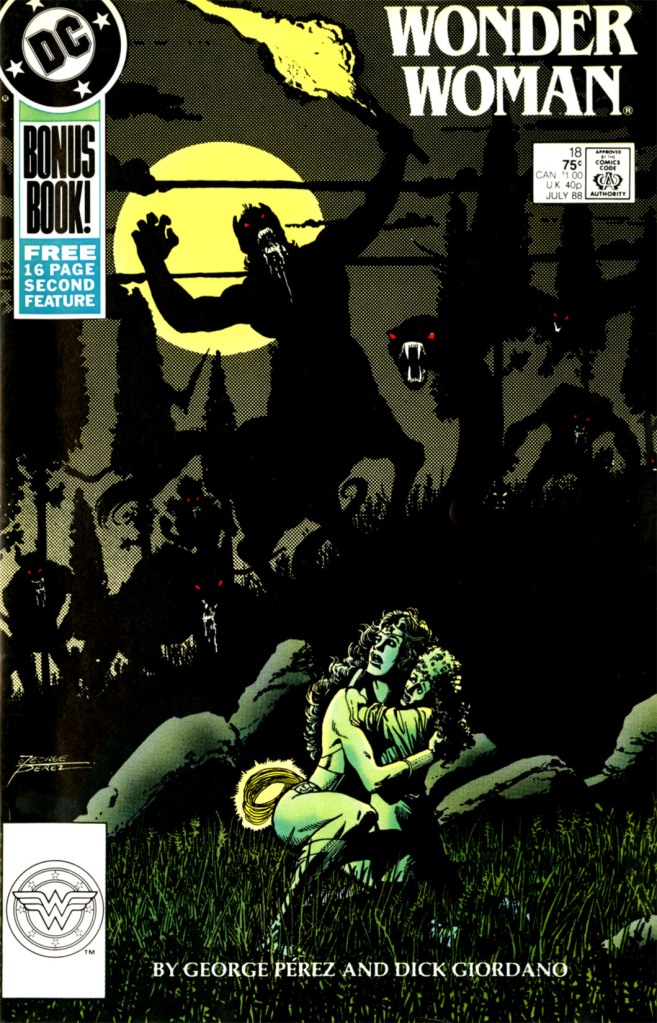
The cover.

Early story

The story begins deep in the darkness of limbo. Light sparks suddenly as Zeus, Hades and Poseidon arrive in the search of their father called Cronus. Zeus retrieves the Olympian pact. After further talking, they join forces in lighting a flame to burn the pact to make way for something new.

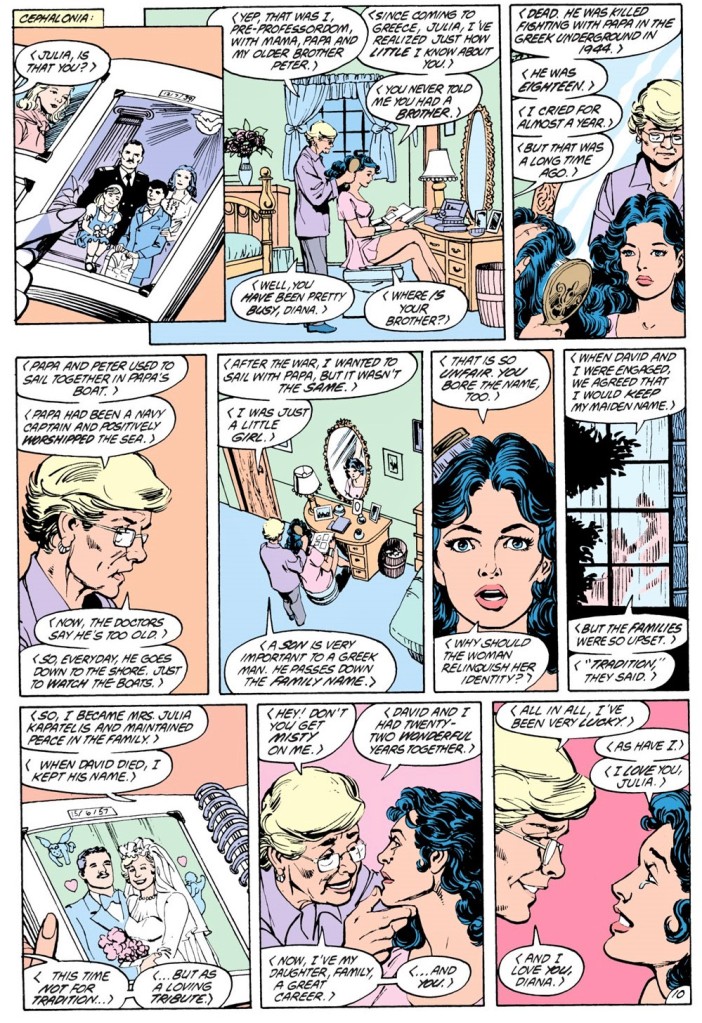
Meanwhile in a hospital in the Greek isle of Cephalonia, Diana wakes up surrounded by Julia Kapatelis, Vanessa, a doctor and other Greeks. Diana states that some kind of aura seemed to clutch her in a chilling grip which Julia dismisses and believes that her Amazon friend was simply tired from all the months-long pushing herself since returning from Themyscira.

Julia introduces Diana to Theophilus Ventouras and his nephew Demetrios. The older Ventouras is the owner of the wealthiest estate on the islands. He tells Diana that the governor asked him to meet her at the dock and reveals to her that a local boy was killed by a wolf which some car calling it as a “magia”.

As they continue talking, a nurse listens to them carefully just outside the door of the room they are in. She learns about Ventouras’ offer of assistance to Diana and quietly leaves. Some time later just outside the hospital, the nurse (named Angela) reveals to a man named Mikos that Diana and her group will be going to Ventourata the next day…

Quality

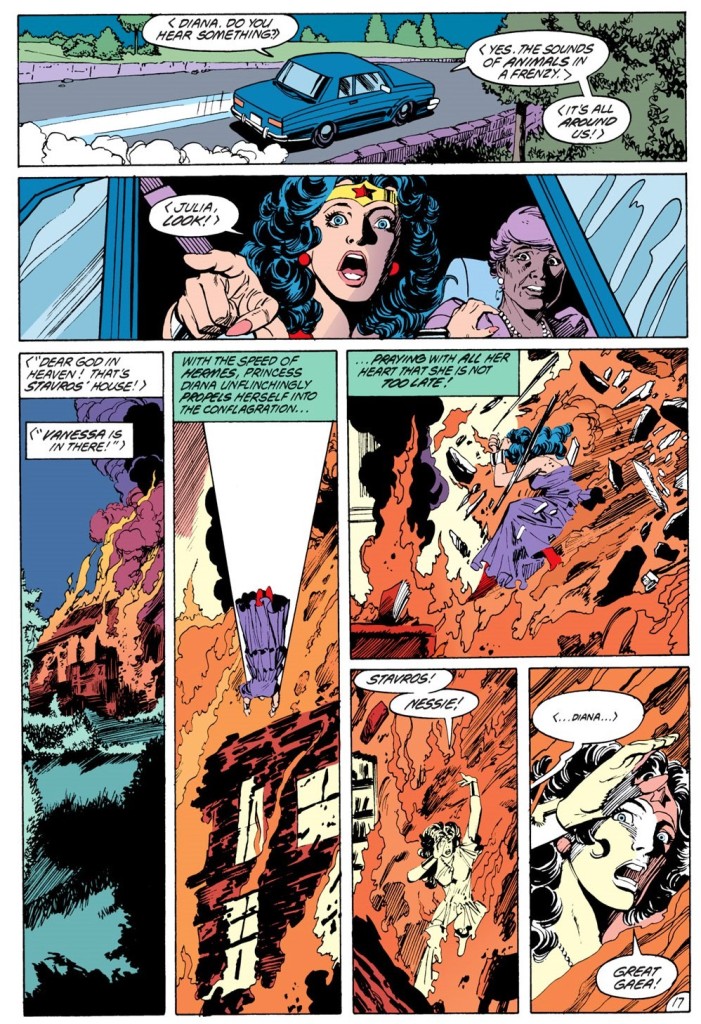
Without hesitation, Wonder Woman moves to save lives.

I can start by saying that this is another well-written tale by George Perez. Apart from the continuing focus on Wonder Woman’s discovery of Greece, the elements of fantasy, intrigue, suspense and even horror have been used more in this comic book compared to the previous issue.

When it comes to characterization, Diana’s close relationship with the Kapatelises is deepened further as the story explored the already established Greek background of Julia. I also found engaging Wonder Woman’s unflinching moves to search for Vanessa and get her out of trouble any way she could.

For those of you who are aware about the lack of superhero spectacle in issue #17, I can share to you that there definitely is more action in this comic book and it is all nicely presented by George Perez.

Continuing what began in the previous issue, Perez ramped up further the build-up of the new force evil awaiting Wonder Woman. I won’t reveal who it is but rest assured, this comic book’s ending is pretty strong and easily justifies the build-up.

Conclusion

Diana and Julia treat each other like family.

Wonder Woman #18 (1988) successfully continued the redefining of the Queen of Superheroes in the post-Crisis era and George Perez really delivered great stuff as well as a very solid story here. From start to finish, there is a lot to enjoy and examine in the story.

If you are seriously planning to buy an existing hard copy of Wonder Woman #18 (1988), be aware that as of this writing, MileHighComics.com shows that the near-mint copy of the regular edition costs $41 while the near-mint copy of the newsstand edition costs $84.

Overall, Wonder Woman #18 (1988) is highly recommended!

+++++

Thank you for reading. If you find this article engaging, please click the like button below and also please consider sharing this article to others. If you are looking for a copywriter to create content for your special project or business, check out my services and my portfolio. Feel free to contact me as well. Also please feel free to visit my Facebook page Author Carlo Carrasco and follow me at HavenorFantasy@twitter.com

For Wonder Woman fans, be aware that the movie Wonder Woman 1984 will be released in a 4K Blu-ray disc combo on March 30, 2021. Read my article for the details and, if you have decided to order, do it now at Amazon.

A Look Back at Prime #15 (1994)

Disclaimer: This is my original work with details sourced from reading the comic book and doing personal research. Anyone who wants to use this article, in part or in whole, needs to secure first my permission and agree to cite me as the source and author. Let it be known that any unauthorized use of this article will constrain the author to pursue the remedies under R.A. No. 8293, the Revised Penal Code, and/or all applicable legal actions under the laws of the Philippines.

Hey Ultraverse fans and superhero comic book geeks! For those of you who read several comic book of Prime, do you enjoy his struggles on setting things right? That is a theme that will be explored in this new Prime retro comic book review.

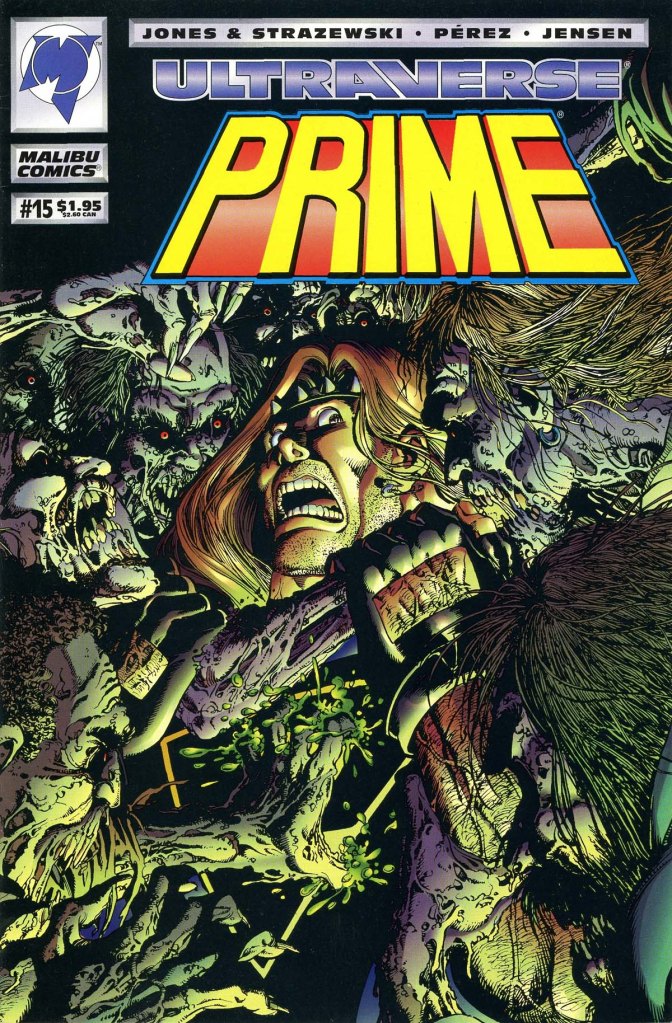
The good news here is that the legendary George Perez is involved. Now that the details have been set, here is a look back at Prime #15, published in 1994 by Malibu Comics with a story written by Len Strazewski and Gerard Jones, and art done by George Perez with ink work by Dennis Jensen.

The cover.

Early story

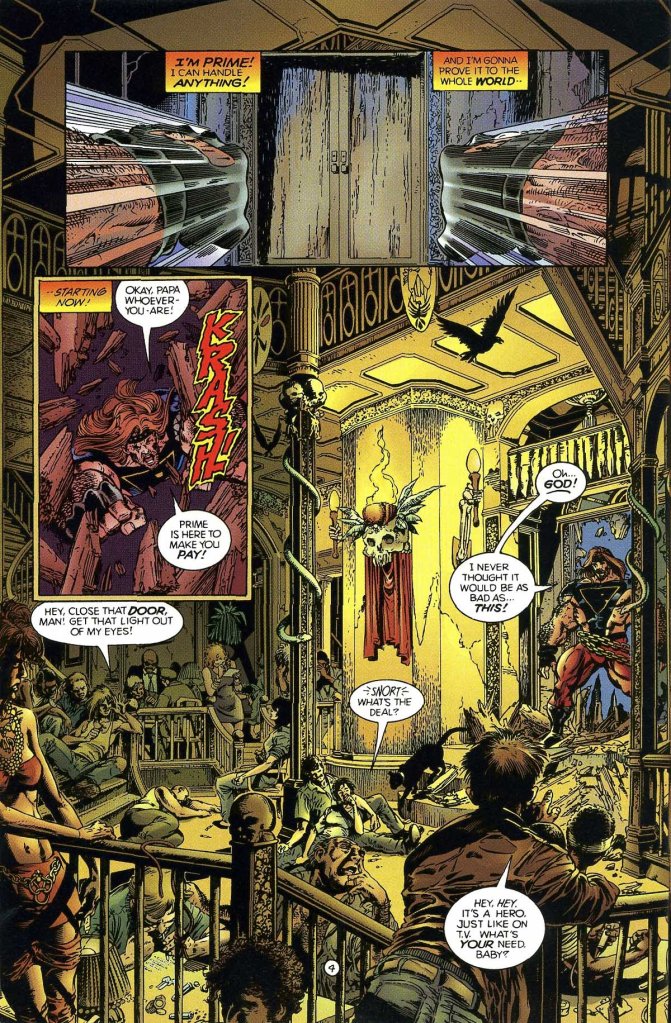
The story begins with Prime’s arrival at a creepy, old looking residence somewhere in Hollywood. He learned that inside the place is the secret headquarters of a drug trafficking operation that allegedly affected half of Los Angeles.

Previously, he beat up a man in front of several abandoned youth and left him bloody. Under intense pain, the man revealed to him where to find the drug trafficking operation leader as well as the parents of the youth. The boss was described as Papa Verite. The man told Prime he can find Papa Verite but cannot touch him.

As he walks towards the front door, Prime thought to himself: Maybe he thought I didn’t have the guts to hurt this “Papa.” Maybe he thinks Prime’s a nice boy, like he used to be! Maybe I should’ve hurt him worse to show him I’ve changed! I’m not just a freaked-out 13-year-old with an ultra-powered body anymore! I’m not just a helpless kid named Kevin whose dad ran out on him! I’m Prime! I can handle anything!

After breaking through the front door, what Prime discovers inside is very disturbing…

Quality

A rather disturbing scene since Prime is truly a teenage boy inside all that muscle.

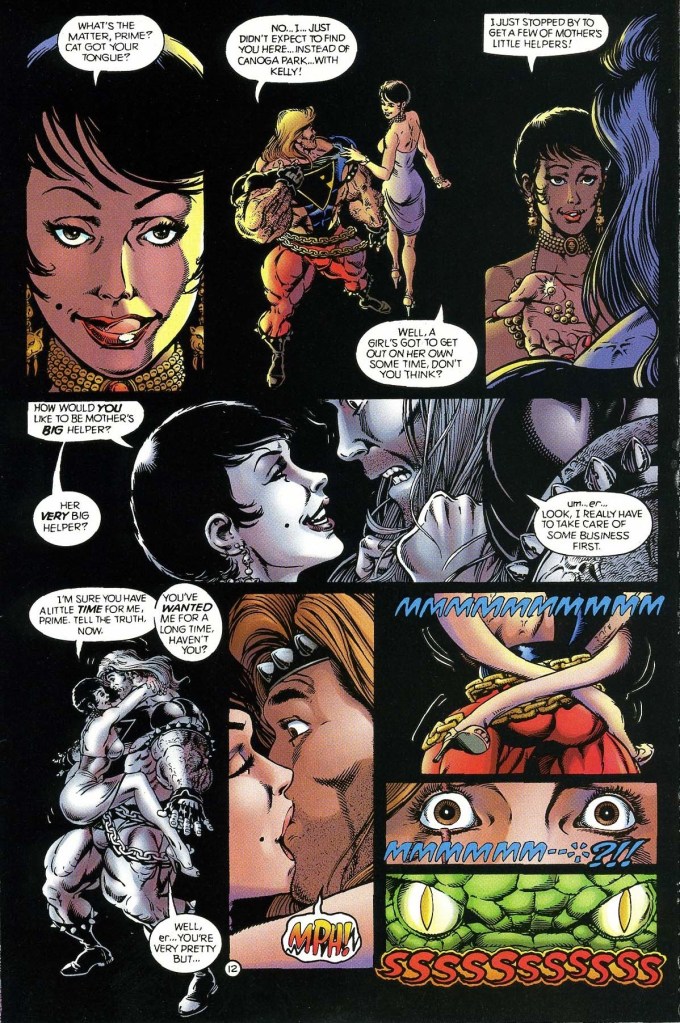
Let me be clear from the start that, once again, the writing by Strazewski and Jones is very strong. To start with, the story has a theme about doing the right things (including helping others by means of getting rid of someone who made victims out of them) without consulting or informing the local authorities. In a way, Prime moved and acted like a vigilante facing criminal elements related to illegal drugs. There were also elements of military conspiracy, molestation and indecent relationship.

When it comes to characterization, it comes to no surprise that Prime (who really is a teenager inside his body) is pushed to the limits of his emotions with his ability to withstand pressure really tested by the presence of certain people from his past who haunted him. Prime is convincing when he is shown with the impulse and arrogance of a teenager who would not stop when he wants to set things right.

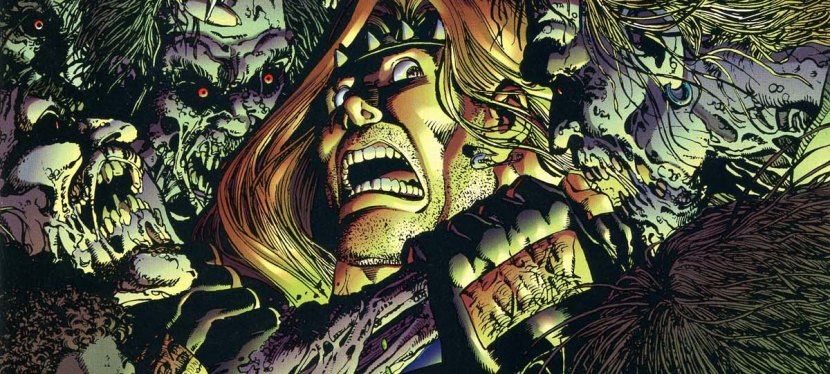
The art by George Perez, unsurprisingly, is great to look at. You won’t just see Prime and familiar characters drawn in high detail with the distinct art style of Perez here. What you will see is how creative the famous illustrator proved he is with the visual presentation complete with very expressive facial expressions. More on the characters, Perez also implemented horror elements to his drawings and he really succeeded in making some scary images here and there.

Conclusion

Striking art by George Perez.

This is a very solid read. Prime #15 (1994) is actually a horror themed tale laced with crime elements and drama all molded into a superhero story. There is an element of good-versus-evil here but in my view, it’s a dramatization of Prime being pushed to the limits of his emotions and his sanity. In a way, it is a stress test for the overly muscular major Ultraverse hero that happens to be quite engaging to read.

If you are seriously planning to buy an existing hard copy of Prime #15 (1994), be aware that as of this writing, MileHighComics.com shows that the near-mint copy of the comic book costs $8.

Overall, Prime #15 (1994) is recommended.

+++++

Thank you for reading. If you find this article engaging, please click the like button below and also please consider sharing this article to others. If you are looking for a copywriter to create content for your special project or business, check out my services and my portfolio. Feel free to contact me as well. Also please feel free to visit my Facebook page Author Carlo Carrasco and follow me at HavenorFantasy@twitter.com

A Look Back at Night of the Creeps

Disclaimer: This is my original work with details sourced from watching the movie and doing personal research. Anyone who wants to use this article, in part or in whole, needs to secure first my permission and agree to cite me as the source and author. Let it be known that any unauthorized use of this article will constrain the author to pursue the remedies under R.A. No. 8293, the Revised Penal Code, and/or all applicable legal actions under the laws of the Philippines.

When you craft a story meant to entertain people, it is already tough to mix genre elements and make them work together while still telling a cohesive story. Imagine how hard that could be when making a movie with the mentioned creative mix?

Back in the mid-1980s, a young film enthusiast named Fred Dekker not only pulled it off but actually made a feature-length film titled Night of the Creeps which was his cinematic directorial debut. Before making that science fiction/horror/comedy movie, Dekker grew up watching movies of horror, science fiction and fantasy and developed a passion for movies (and movie production eventually).

After much learning through UCLA, Dekker broke into Hollywood and started a professional career in film and eventually got his dream project in the form of Night of the Creeps.

“Night of the Creeps is very much a first feature with the attitude of many first features. The I-may-not-get-to-do-another-movie-so-I’m-going-to-do-everything-I-want-to-do-in-this-movie attitude. It’s an attitude that often backfires, but in this case, it’s exactly what makes Night of the Creeps so much fun,” Dekker stated.

With the short film history lesson done, it’s now time to take a look back at Night of the Creeps written and directed by Fred Dekker, and released in 1986 by TriStar Pictures.

Screenshot_20200620-215521_YouTube.jpg
If you were the police chief, how many police officers would send to corner one zombie?

Early story

The story begins inside a space ship where one alien creature (carrying a canister) is running away from two armed personnel. With the two chasers delayed, the creature manages to shoot the canister into the realm of space.

On Earth, the year is 1959. In a typical American suburb, a college student visits a sorority house to pick up his date. Together, along with a few other pairs in cars, they spend time at a parking spot with a nice night view. A young police officer, who is aware of the news about a potential killer on the loose, approaches the pair and recognizes the lady from the sorority house. He tells them to go home for their safety, and then leaves them.

Shortly after, the canister from space arrives and crashes nearby causing the college student to drive the car (with his date with him) and find the spot of the crash. He parks the car by the woods and moves into woods leaving the sorority girl alone, sitting and waiting. He finds the canister and decides to look at it closely. Through an opening, an alien slug suddenly jumps from the canister and into his mouth. Meanwhile, the lone lady in the car hears the news about the loose killer and realizes the details about their location (being the destination of the killer). Slowly creeping up on her is a man with an axe.

Screenshot_20200620-213549_YouTube.jpg
What teenagers in America used to do in the 1950s.

Screenshot_20200620-213751_YouTube.jpg
Someone closing in…

In 1986, at the same locality, college students party around and engage in lots of activities in relation to pledge week being organized at a local university. Among the students walking down the sidewalk are Chris Romero and his handicapped friend J.C. Chris spots a pretty girl from a distance and instantly falls for her at first sight. With the help of J.C., he decides to pursue her…

Quality

Even with a low budget, Night of the Creeps is very creatively done and comes with a good amount of fun for viewers who enjoy elements of horror or sci-fi, 1950s romance, 1980s teen comedy and even detective story. What made this movie a cinematic gem is that Fred Dekker and his creative team combined their strengths with the talents of their cast members specifically Jason Lively, James Marshall, Jill Whitlow and Tom Atkins.

At its core, Night of the Creeps is a zombie horror flick that had sci-fi elements of UFOs and the 1950s as a strong foundation (in addition to serving in the background of the plot). Those combined genre elements alone (backed with a plot that is cohesive enough thanks to Dekker) made this movie solid and yet, the implementation of detective/crime storytelling and 1980s teen comedy (specifically college culture) further added more punch and variety in making the film really engaging and fun.

That being said, the actors delivered the goods with their respective performances. Jason Lively and Steve Marshall have excellent chemistry together as the 1980s college boys Chris Romero and J.C. They started their acts as typical college guys trying to achieve something when it comes to campus achievements and winning the girl’s heart. They also delivered strong performances on the comedy and they pushed their dramatic limits further when the film’s tone shifted to horror. Jill Whitlow is interesting as sorority girl Cynthia who has that girl-next-door charm. She proved to be talented with acting as she had convincing romantic chemistry with a certain jerk and Chris.

Screenshot_20200620-212933_YouTube.jpg
Steve Marshal, Jason Lively and Jill Whitlow as J.C., Chris Romero and Cynthia.

Screenshot_20200620-221558_YouTube.jpg
The horror film genre legend himself, Tom Atkins!

The standout performer among them all, unsurprisingly, is Tom Atkins as detective Ray Cameron. Before making this movie, Atkins worked in horror movies and a few cult movies, and got involved with the legendary John Carpenter. As such, playing the veteran detective Cameron here was a natural fit for the actor. As the aging and troubled detective, Atkins portrayed him dramatically and because of his very rugged touch, the actor really looked like he actually lived through decades of police work in the fictional town. Atkins also proved to be very good with quotes, specifically with “Thrill me!” It should be noted that this is Atkins’ personal favorite role in the horror genre.

When it comes to telling a cohesive story to emphasize the mixed genre elements, I should say Fred Dekker and his team succeeded. The pacing ran at a medium pace for the most part and even during the slower scenes, there was never a boring moment. More on storytelling, Night of the Creeps’ concept made sense for the most part (about how a slug from outer space would gradually cause zombification on people and even animals, in the midst of college-related events happening) and still had room for suspense, spectacle (note: Jason Lively and Jill Whitlow themselves used dangerous weapons near the end of the film) and, yes, character development! All of that pulled of nicely in roughly ninety minutes and the viewing experience was ultimately fun and engaging.

Screenshot_20200620-214622_YouTube.jpg
I wonder if this image would be considered offensive by the SJWs…

Screenshot_20200620-213511_YouTube.jpg
Perhaps this will inspire you to research what American life was like back in the 1950s.

It should be noted that, in terms of presentation, key scenes were very well directed and strong performances from the actors were realized. The scene where detective Cameron and Chris had a private talk was intriguing to watch, and that one had the strongest act Tom Atkins made in the film. I should also mention that, apart from the dramatics and performances, I enjoyed the cinematography done by Robert C. New especially with the way the camera moved as the actors delivered their lines in key sequences. There were closeups that perfectly captured the moments when the actors delivered their strongest acts. Last but not least, the music by Barry De Vorzon fit the film’s tone and concept smoothly.

Conclusion

Screenshot_20200620-215940_YouTube.jpg
Here they come…

I really love Night of the Creeps and I want you – my readers and fellow film buffs and pop culture geeks – to watch it from start to finish. I never saw this movie in the cinemas in the 1980s but was fortunate enough to watch it on cable TV on a late night in 1998 (twelve years after its cinematic release). That was a night I’ll never forget because Night of the Creeps delivered the fun and exceeded my expectations. Then years ago, I finally acquired the Sony Pictures Blu-ray disc release which I replayed from time to time at the comfort of home with my Xbox One console as the disc player. The film looks even better in high-definition!

The best thing I love about Night of the Creeps is its big mix of genre elements which was supported by solid storytelling and performances. When it comes to spectacle or shock moments, it should be stated that the practical effects used (note: no CGI or computer-generated images here) in the movie still stand up strongly until now although I must say that the aliens creatures in the early part of the story were just not convincing enough.

Even by today’s standards, Night of the Creeps is enjoyable and gripping to watch, and the fact is nobody in Hollywood is making anything like it, nor are there any filmmakers willing to do a big mix of genre elements and tell a cohesive story with good performance from hired talents. This alone makes Fred Dekker’s directorial debut a cinematic gem that has been overlooked by too many people

In light of modern society and its norms, I declare that Night of the Creeps will give you a good dose of escapism not only from real life but also from the corrupted and highly politicized culture of Hollywood which points to the Political Left (whose central figure Barack Obama supports Iran, the terrorists and illegal immigrants) and its trouble makers (examples: social justice warriors or SJWS, the socialists, the radical feminists, the LGBTQ) who managed to infiltrate the American film industry and even the American media (note: you can tell if a movie review was written by an SJW who only writes something to fit his/her social justice agenda). This old movie was made to deliver fun without any political garbage whatsoever. That being said, it will make you wish that Hollywood would just focus on making their movies truly entertaining and be free from political poison at the same time. Movies that carry political overtones or emphasize identity politics are major turn-offs.

Overall, Night of the Creeps is highly recommended! That being said, I urge you to order a Blu-ray copy of Night of the Creeps now at Shout Factory and Amazon. Whichever Blu-ray version you acquire (note: the Shout Factory version has newer and more extra stuff), you can’t go wrong with Night of the Creeps in high-definition.


Thank you for reading. If you find this article engaging, please click the like button below and also please consider sharing this article to others. If you are looking for a copywriter to create content for your special project or business, check out my services and my portfolio. Feel free to contact me as well. Also please feel free to visit my Facebook page Author Carlo Carrasco and follow me at HavenorFantasy@twitter.com

A Look Back at Friday The 13th: The Final Chapter

Disclaimer: This is my original work with details sourced from watching the movie and doing personal research. Anyone who wants to use this article, in part or in whole, needs to secure first my permission and agree to cite me as the source and author. Let it be known that any unauthorized use of this article will constrain the author to pursue the remedies under R.A. No. 8293, the Revised Penal Code, and/or all applicable legal actions under the laws of the Philippines.

Considering how long the Friday The 13th franchise of horror movies lasted throughout entertainment history, there were indeed chapters that proved to be good, bad or simply satisfactory towards its fans and other moviegoers.

Having seen ALL the Friday The 13th movies myself, I can say without hesitation that the most defining films of the franchise were the first four films (released 1980 to 1984) which eerily reminds me of the early stage of James Bonds movies released in the 1960s (read: Sean Connery and Albert Broccoli struck cinematic gold with 1964’s Goldfinger).

As I mentioned before, Friday The 13th Part 3 was indeed a fun horror movie and marked the time when the film franchise and its featured villain Jason Voorhees really started to take shape. It was the film that saw Jason wearing his now iconic hockey mask, and improved the creative formula (examples: Jason’s stalking and eliminating people, his encounter with the surviving protagonist or the final girl). In other words, Part 3 ended on a very strong note and high fun factor, setting the stage for the inevitable sequel Friday The 13th: The Final Chapter (AKA Part 4).

2
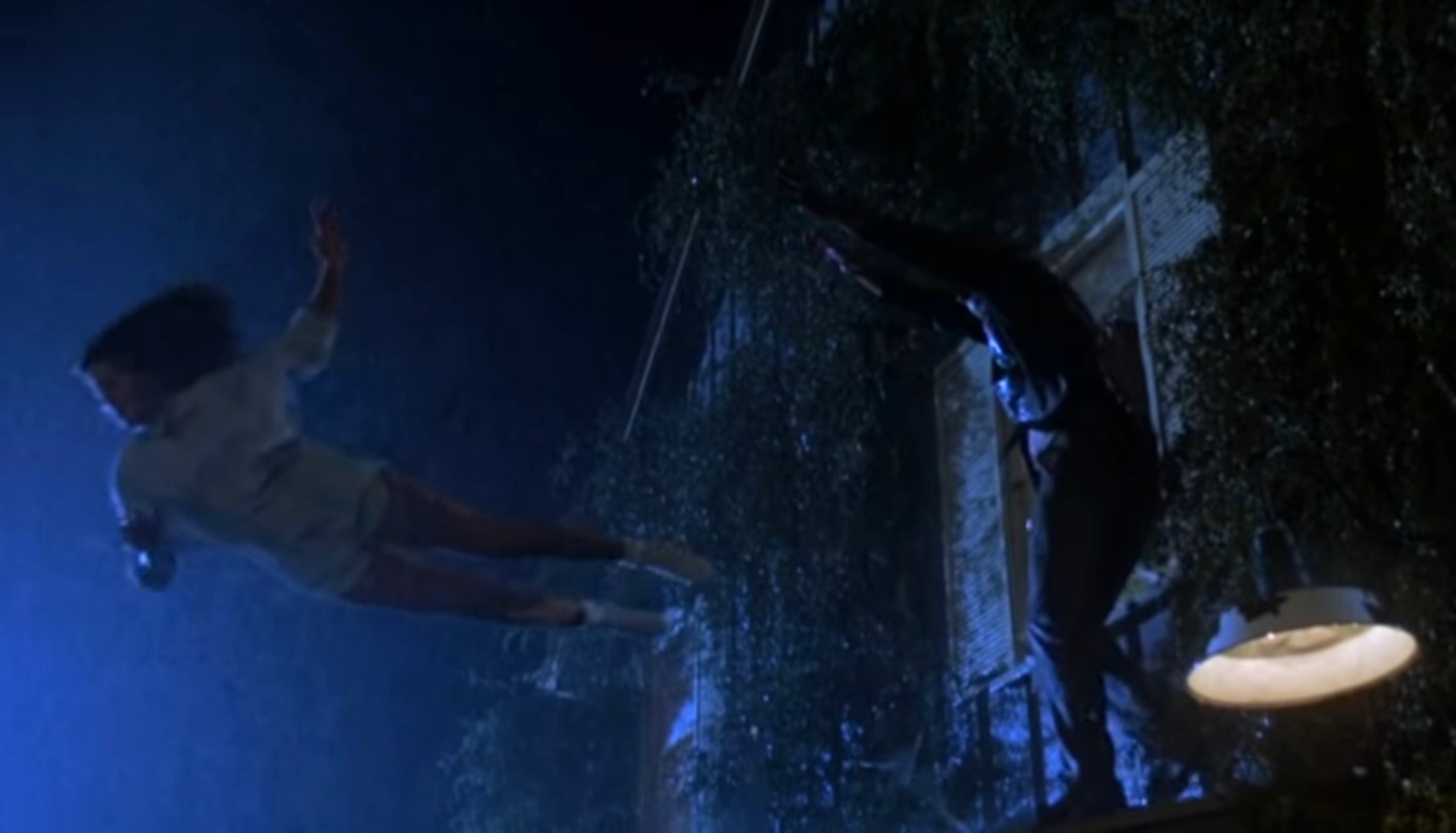
This dangerous stunt will always remain memorable.

Before starting this retro movie review, it’s important to take note of what happened in Hollywood that led to the creation of the 1984 movie.

Background

After Friday The 13th Part 3 rode the 3D movie trend and made a lot of money on ticket sales alone, Paramount Pictures perceived that the slasher horror genre was waning with moviegoers and decided that the Friday The 13th franchise should end. Eventually Joseph Zito was hired to write and direct The Final Chapter. The funny thing was that Zito secretly hired Barney Cohen to write the screenplay, going as far to take phone conferences with one of the producers, share details with Cohen to produce the pages (Zito and Cohen collaborated on the script in a New York apartment) which were sent to the producer (who would go back to the director).

Because it was clear that the film was supposed to end the franchise, Zita wanted the film the be about the death of the newly masked Jason and this explains why The Final Chapter opened where Part 3 ended…at the Higgins property which Jason’s body in the barn. The director told Cohen to focus on developing the characters (as opposed to emphasizing kills). Of course, this did not stop Zito from ramping up the kill count, the gore and nudity. With the cast hired, veteran stunt performer Ted White hired as Jason and movie makeup specialist Tom Savini rehired (note: he worked on the 1980 Friday movie and created Jason’s look as a youth), Zito really wanted to end the franchise with a bang!

With those details already recorded in history, here now is my retro movie review of Friday The 13th: The Final Chapter.

Early story

Friday The 13th: The Final Chapter opened with a recap of Jason, the killings and how things turned out in the first three movies, cleverly using Part 2’s camp fire scene in which Paul told the camp trainees the legend of Jason.

The story begins on the evening of Monday the 16th. For some weird reason, the local police and other emergency personnel arrived at the Higgins property (note: this was the very same California location where Part 3 was filmed at) at least twelve hours after Part 3’s lone survivor Chris Higgins was picked up by the police during the morning.

After picking up the dead bodies and examining the venue for evidence, the medical personnel brought Jason’s unmoving body to the local medical center with his mask and clothes still intact. Some time into the night, Jason (Ted White) discreetly gets up and kills two medical personnel before leaving for the great area of Crystal Lake.

The next morning, Tuesday the 17th, Mrs. Jarvis (Joan Freeman) and her daughter Trish (Kimberly Beck) jog together in the woods heading towards their country home which is located some distance away from Crystal Lake. Inside the house is the young son Tommy Jarvis (Corey Feldman) who is a geek and collector of special stuff. The family is already aware of the killings Jason caused over the past few days (refer to Part 2 and Part 3) and Mrs. Jarvis referred to him as the psycho.

4
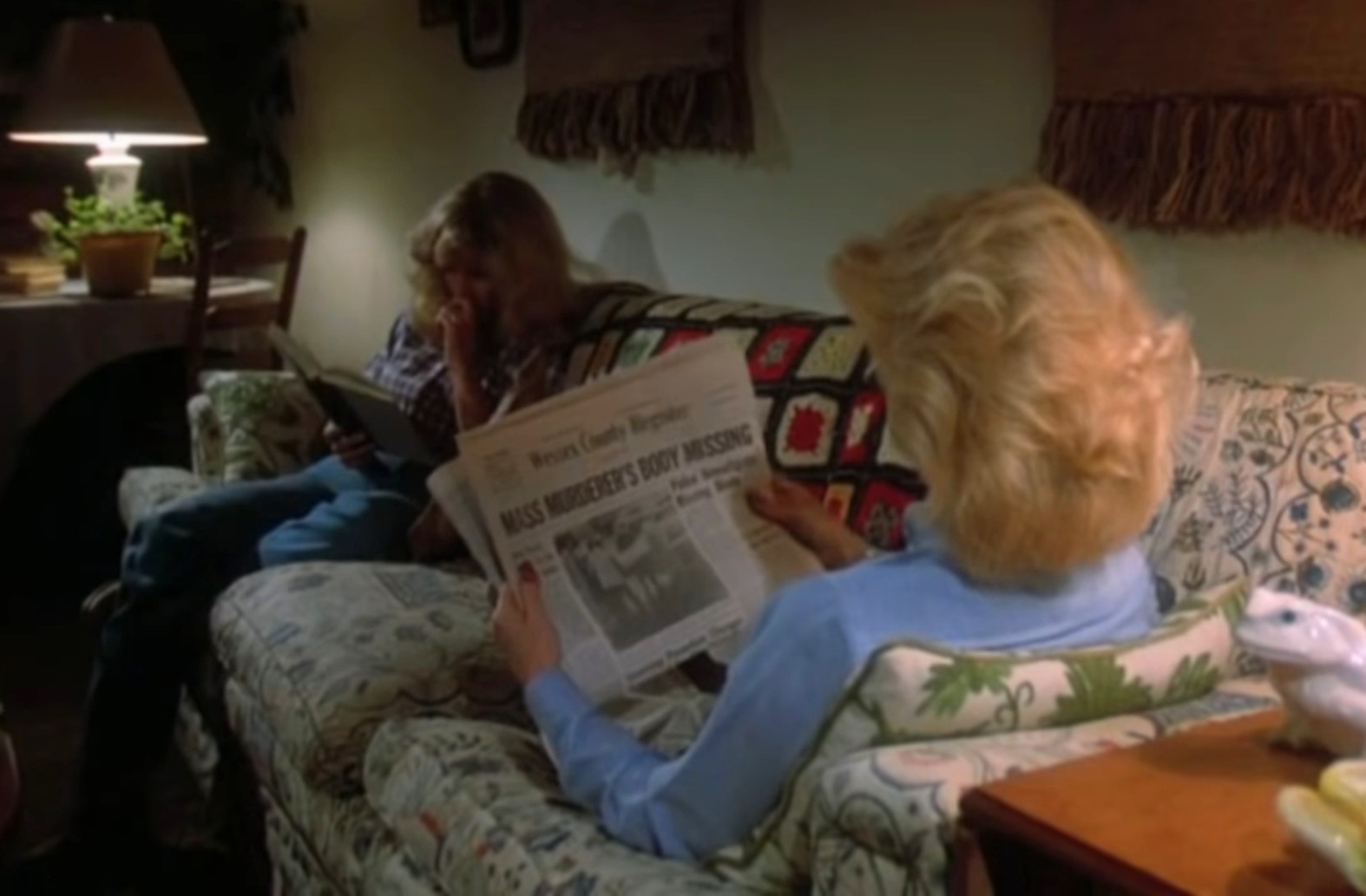
Remember the good old days when print media journalism was much more credible and not too politicized?

Meanwhile, a new group of teenagers riding a car are on their way to the Crystal Lake area for a group vacation completely unaware that Jason is on the loose. Their destination is a vacation house located very near the Jarvis home…

Quality

Even though the production team had a low budget, this film had improved production values which is literally only the tip of the iceberg. The real indicator of this movie’s quality is with the overall execution in terms of directing, storytelling, characterization (yes, there is character development here) and horror spectacle. The good news is that Friday The 13th: The Final Chapter’s overall quality is pretty good.

For starters, the creative team took the bold approach of having a family and a group of teenagers as targets for Jason’s killing spree. The presence of a likable family like the Jarvises made the Friday The 13th formula feel fresh since the old approach of having teenagers (and a few adults) getting killed off has gotten repetitive. Having good natured characters like Mrs. Jarvis, Trish and Tommy should remind you of the likable families living in your neighborhood. As such, the Jarvis family in the story will make you get concerned for them and despise Jason for the evil icon he truly is.

The new batch of teenagers in this film is an improvement over Part 3’s teenagers (which by the way are more likable than those in Part 2). Among them is Jimmy (Crispin Glover), a troubled young guy trying to achieve something important in his life. There is also Sara (Barbara Howard) who is sweet and appears reserved for Doug (Peter Barton). The pretty twins (Camilla More and Carey More), who just appeared into the film encountering the rest of the youth, added nice variety to the romance potential among them. On the other hand, Ted (Lawrence Monoson), is the stereotypical unlikable and pathetic guy meant for viewers to despise. Samantha (Judie Aronson) is the lady craving for sensual love with Paul (Clyde Hayes).

6
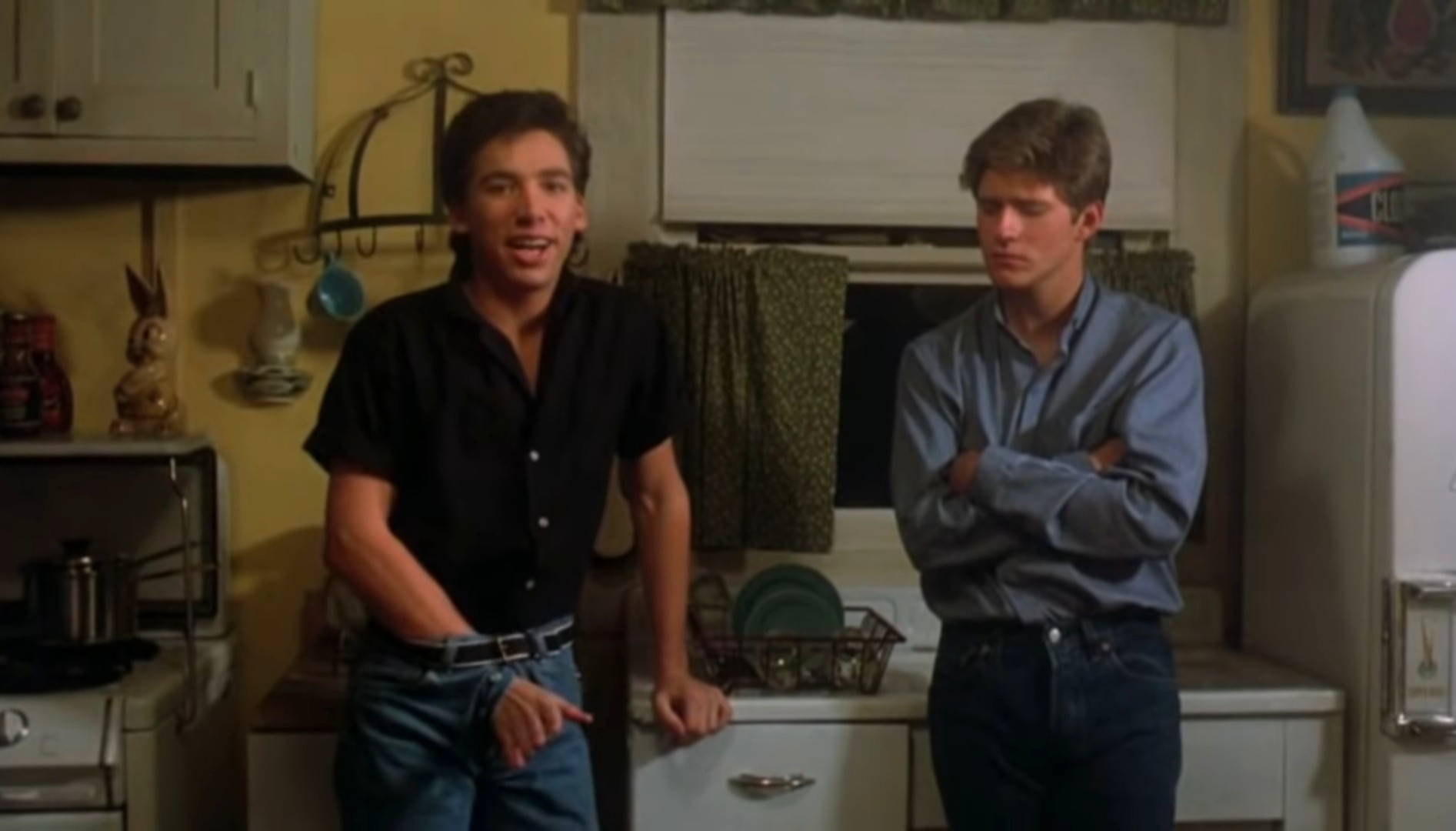
Ted: Hey, could you please pass to me a copy of that fake news-oriented local community print media publication? The tabloid, not the broadsheet.

What this movie clearly had in bringing some of the above-mentioned characters to life is character development. Director Zito and team succeeded in making the Jarvis family worth caring for. Jimmy is the teenager that moviegoers would relate with and also root for him to succeed. The other cast members, notably the teenagers wanting fun and satisfaction (skinny dipping and partying, anyone?), were made to be interesting and were clearly not merely disposable. Sara is likable and she looks like she could rival Trish in terms of who would be worthy to be the film’s final girl, not to mention who would be more worthy of the care from the viewers.

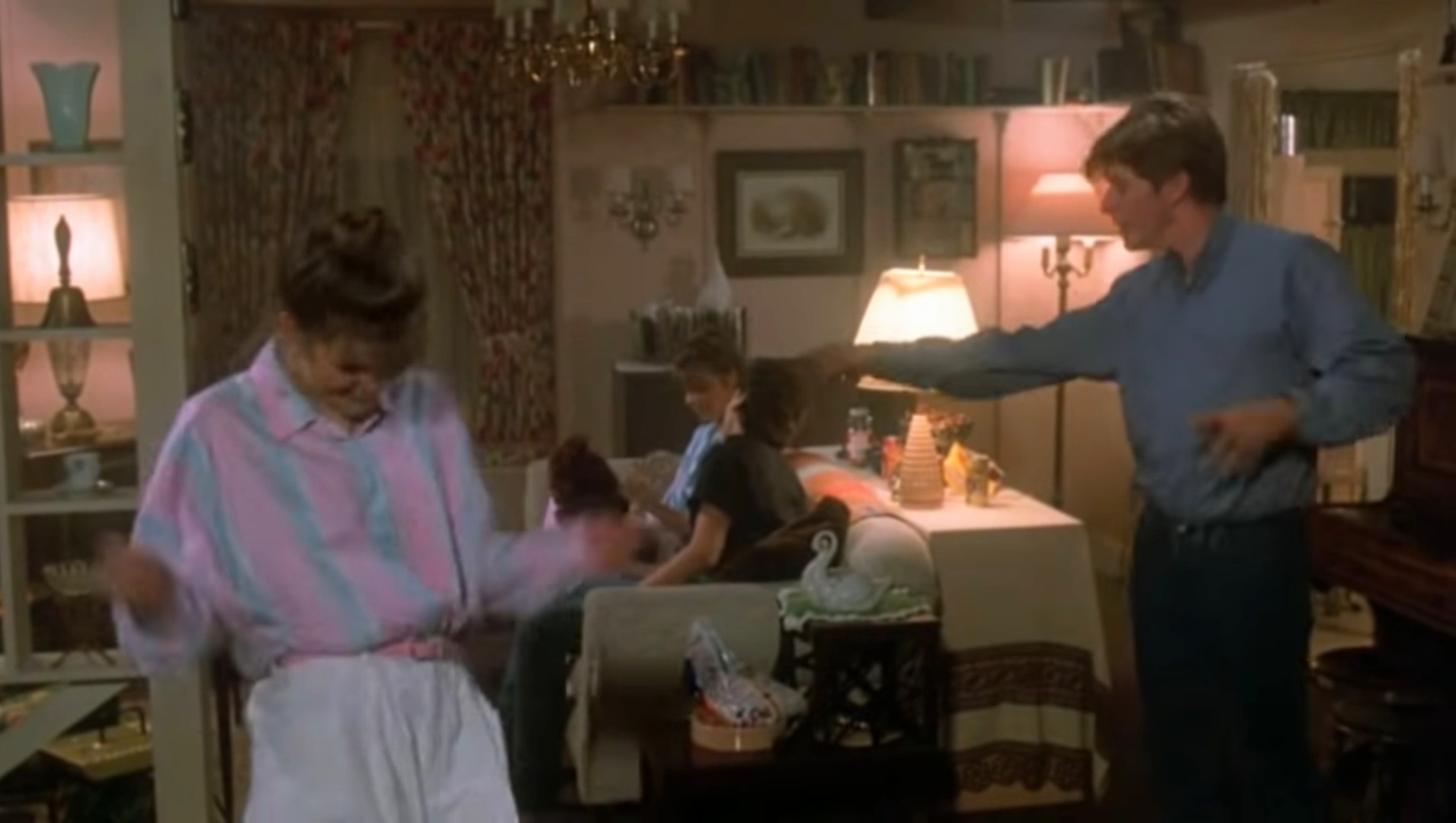
In terms of presentation, this film has a more serious tone. Other than Jimmy’s ever memorable dance, the approach to humor is noticeably weaker when compared to Part 3. At the same time, the killings of Jason are executed and made to really look visceral. When Jason kills a character who is likable or at least interesting, you will really feel bad or sorry, and then despise Jason. Speaking of Jason, the filmmakers made him look scarier with the visceral approach to killing on-screen and the fact that Ted White avoided speaking to the other cast members in between takes.

5
The memorable Crispin Glover dance!

3
One of many hard-hitting stunts in the movie.

When it comes to the stunts, the film crew really went all-out and it involved a lot of pain on the part of the actors because of the lack of safety and stunt performers as a result of the low budget. The stunts in this movie were executed with a lot of intensity and when each stunt ends, you will feel something. Take note that Ted White is a veteran of stunt performing and even doubled for Clark Gable long ago.

Remember the traditional stunts of having a human body thrown into the house through the ground-floor window? Such a stunt in this movie had a lot more impact than what was shown in the first three films. As for the stunt involving the very young Corey Feldman, that one was real and there was a huge risk of injury due to the lack of safety measures. Regardless, the stunt was performed and Feldman’s surprise and shouting were genuine. Here’s a video clip for you to enjoy.

The presentation of the on-screen kills and stunts here are the absolute best of the Friday The 13th franchise. The scare factor is also much stronger.

As for the music, Harry Manfredini returned. His musical score proved to be excellent in terms of bringing life into the scenes complete with precise timing.

Conclusion

I declare that Friday The 13th: The Final Chapter is the best and the most definitive movie of its franchise. It’s also one of the best and most defining horror movies ever released in the 1980s. It’s not worthy of awards for film excellence but it still is a major standout among all horror movies of the 1980s. It should be noted that this movie implemented a twist to the final-girl-versus-Jason formula of the first three movies by having a key character involved during the climax.

Believe it or not, Friday The 13th: The Final Chapter actually had a lot of tension between the director and actors during production (Note: Ted White stood up for the younger actors who had to endure physical pain due to lack of safety, and this put him into direct conflict with the director. And then White was very annoyed with Corey Feldman who in turn was allegedly badly treated on location by Zito).

Even so, the movie turned out to be its franchise’s biggest highlight, the best of it all! Apart from the final results made by director Zito and his crew, Friday The 13th: The Final Chapter owes part of its success to Friday The 13th Part 3 since that movie (a clear improvement over Part 2) helped set the stage for the fourth movie on a creative manner.

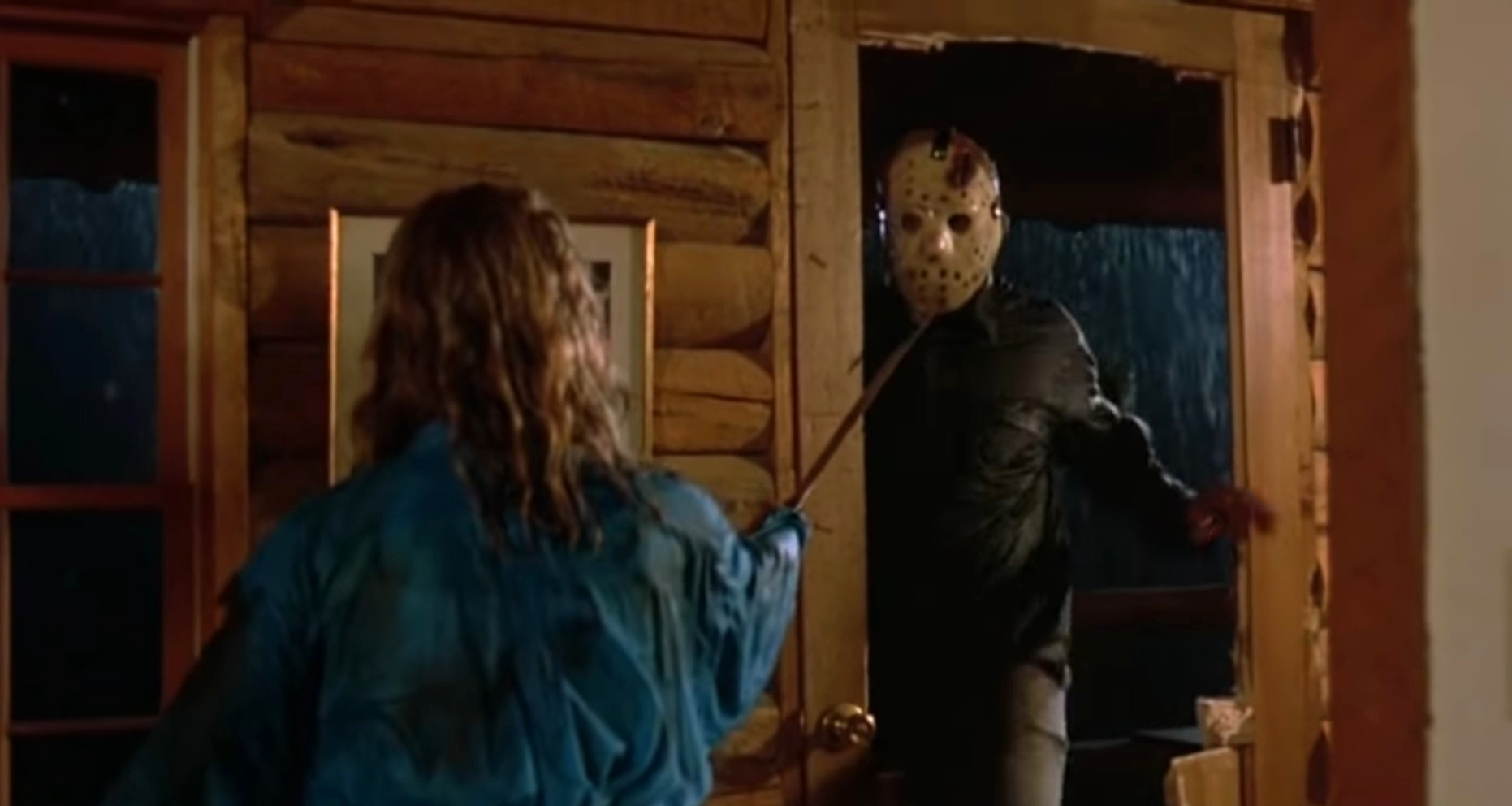
At the same time, it was in this fourth Friday The 13th movie where Jason truly became a horror icon as well as one of America’s pop culture icons. Director Zito, Tom Savini and Ted White combined their efforts on making this the most definitive story of Jason Voorhees who was not a zombie but a living human killer who simply won’t stop due to the evil in him. This movie’s Jason is clearly a dramatic improvement over Part 3’s Jason (which in turn was a dramatic improvement over Part 2’s Jason-with-a-potato-sack-for-a-mask) and each time the villain was on screen, you can sense his evil force. The mere fact that Trish got frightened by Jason at different stages of the chase between them proves how intimidating and scary the masked killer really is.

1
This is the best Friday The 13th movie ever!

Overall, Friday The 13th: The Final Chapter is highly recommended. For the best viewing experience and story immersion into Friday The 13th, I recommend watching Part 3 and this movie back-to-back.


Thank you for reading. If you find this article engaging, please click the like button below and also please consider sharing this article to others. If you are looking for a copywriter to create content for your special project or business, check out my services and my portfolio. Feel free to contact me as well. Also please feel free to visit my Facebook page Author Carlo Carrasco and follow me at HavenorFantasy@twitter.com

Carlo Carrasco’s Game Review: Resident Evil 3 Remake (single player)

Disclaimer: This is my original work with details sourced from playing the video game Resident Evil 3 Remake and doing research. Anyone who wants to use this article, in part or in whole, needs to secure first my permission and agree to cite me as the source and author. Let it be known that any unauthorized use of this article will constrain the author to pursue the remedies under R.A. No. 8293, the Revised Penal Code, and/or all applicable legal actions under the laws of the Philippines.

Even though 1999’s Resident Evil 3: Nemesis was a side-story and its concept was smaller in scale compared to the acclaimed Resident Evil 2 (1998), I still had a lot of fun with that game and its key features made it very worthy of replaying. Like last year’s Resident Evil 2 remake, RE3 was remade and shortly after it became available on April 3, I got to play it, finished it three times and I should say I also had fun with it.

You must be wondering…how much fun is the Resident Evil 3 Remake? Is it anywhere as deep as the remake of RE2? Does this new game honor the legacy of its original counterpart from 1999? Is it worth the full retail price? Let’s start with this game review focused mainly on the single-player story campaign.

Early Story

Screenshot_20200420-143216_YouTube.jpg
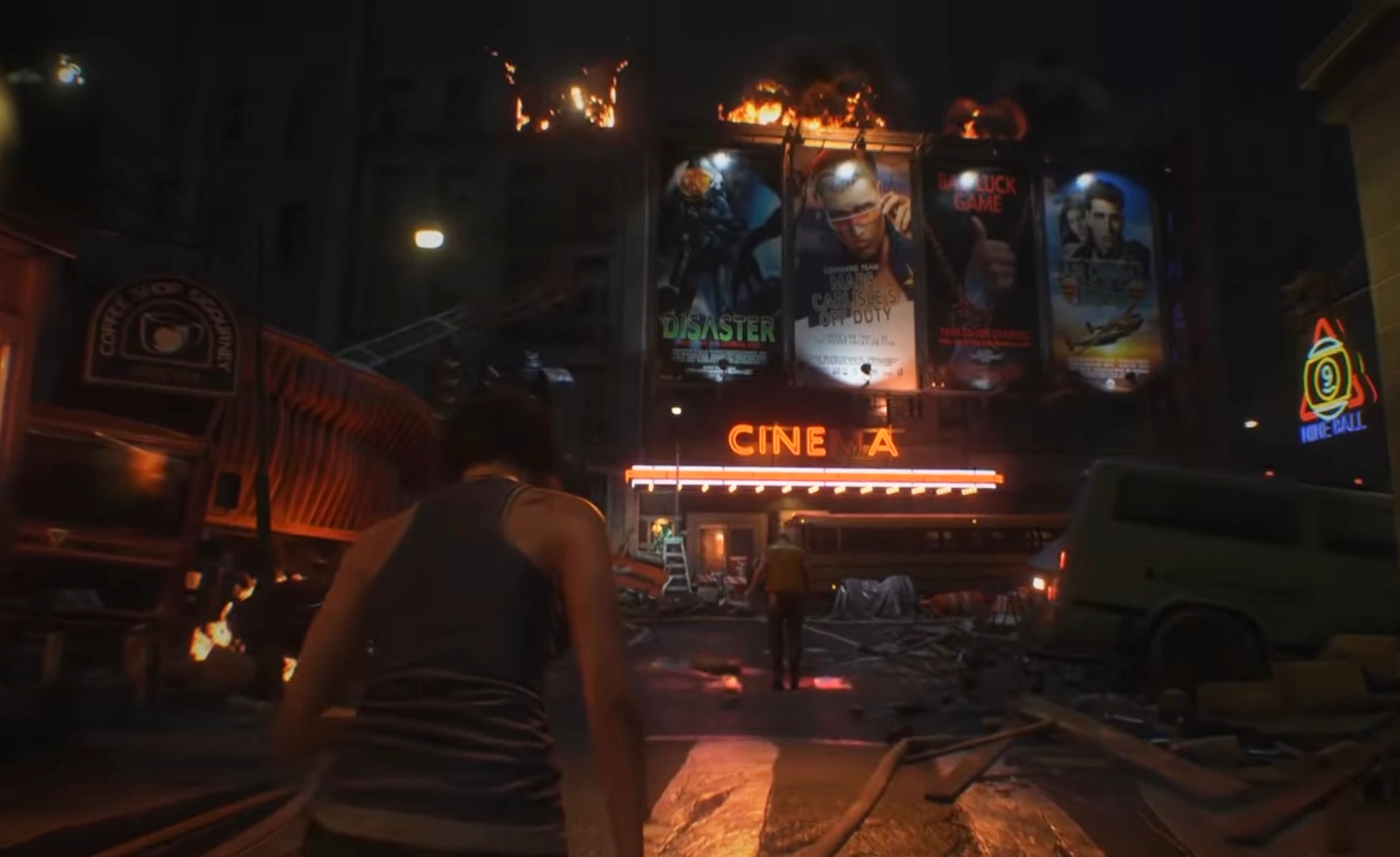
Raccoon City ruined.

The story begins on September 28, 1998 with Raccoon City getting infested with zombies as a result of an outbreak of T-Virus (directly connected with the events that led to Resident Evil 2). People have no choice but to run for their lives as the police struggle to save civilians. Meanwhile, Jill Valentine is inside her apartment making moves to leave the city since the city police force don’t believe her story about what happened at the Spencer Mansion (Resident Evil).

After answering a phone call from a very concerned Brad Vickers, a huge human figure (Nemesis) covered in dark material suddenly breaks through the wall and attempts to kill her. Jill fortunately fights back and after enduring a few close calls, she manages to get away from the monster and out of the building.

She makes her way to the street where she meets Brad Vickers and together, they face an onslaught of many zombies. After barely getting inside a joint, Brad (who got bitten by a zombie) struggles to keep the door closed and urges Jill to run away to survive. Now on her own, Jill has to find ways to survive and get out of the zombie-filled Raccoon City

Gameplay

Screenshot_20200401-185830_YouTube.jpg
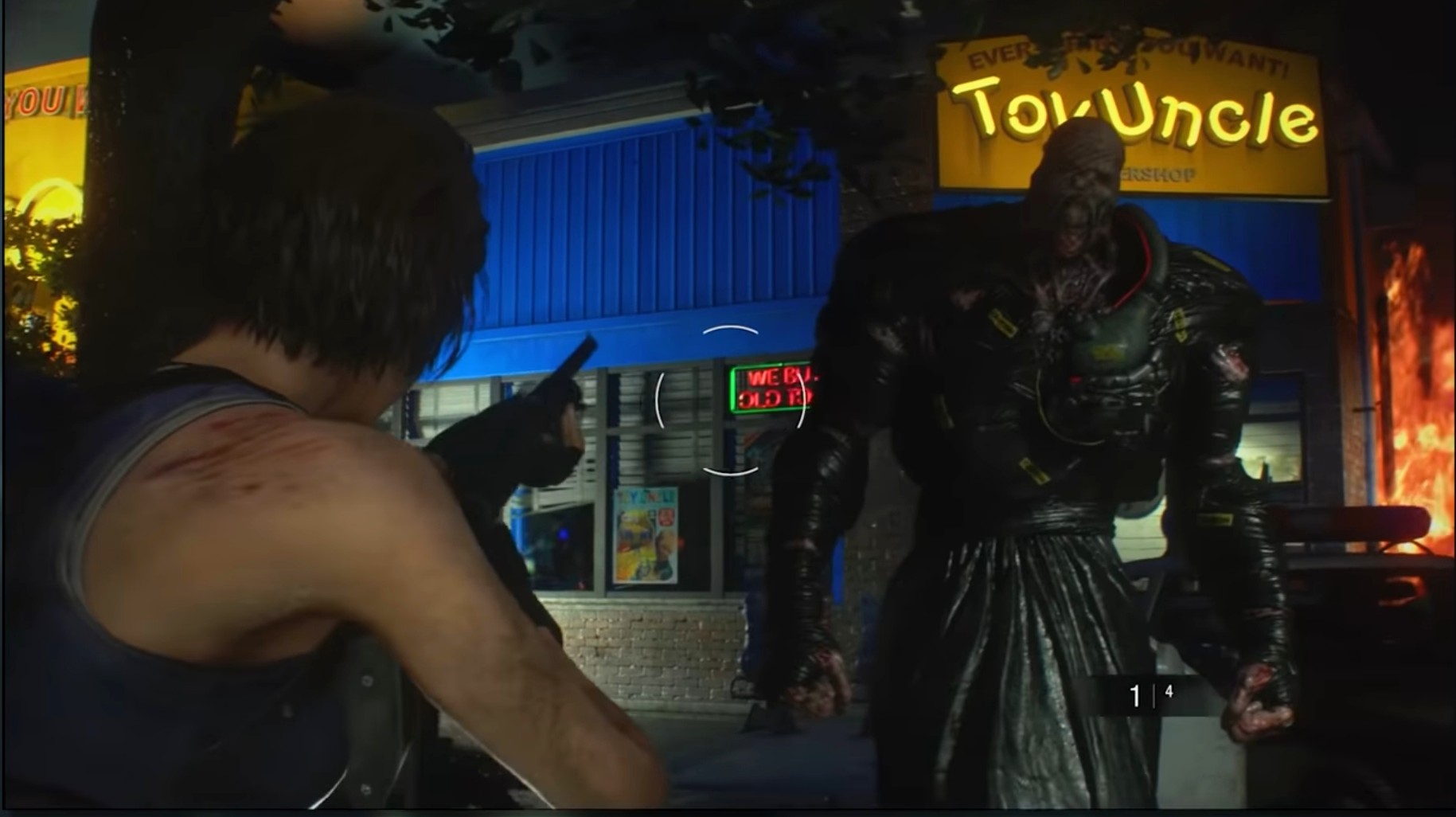
An encounter with Nemesis is often intense.

Like last year’s big budget remake of RE2, RE3 Remake is a 3rd person shooter mixed with exploration, item management, problem solving and the like. As required to move the story forward, you will control Jill to collect items, manage them carefully with the limited space for carrying, fulfill objectives and meet characters at key points of the story. Along the way, you will encounter zombies, grotesque monsters and, of course, Nemesis.

There are some notable differences from RE2, however. The most obvious difference is that RE3 remake was designed to be somewhat faster-paced (note: it’s not like the characters you control really run fast) and more action-oriented in terms of shooting as well as evading. In obvious tribute to the 1999 RE3, this game allows you to dodge attacks from zombies/monsters/Nemesis. If you succeed with perfectly timing your dodge, you will be granted a few seconds (with some slow motion) to immediately fire back at the enemy that you evaded.

Screenshot_20200401-185932_YouTube.jpg
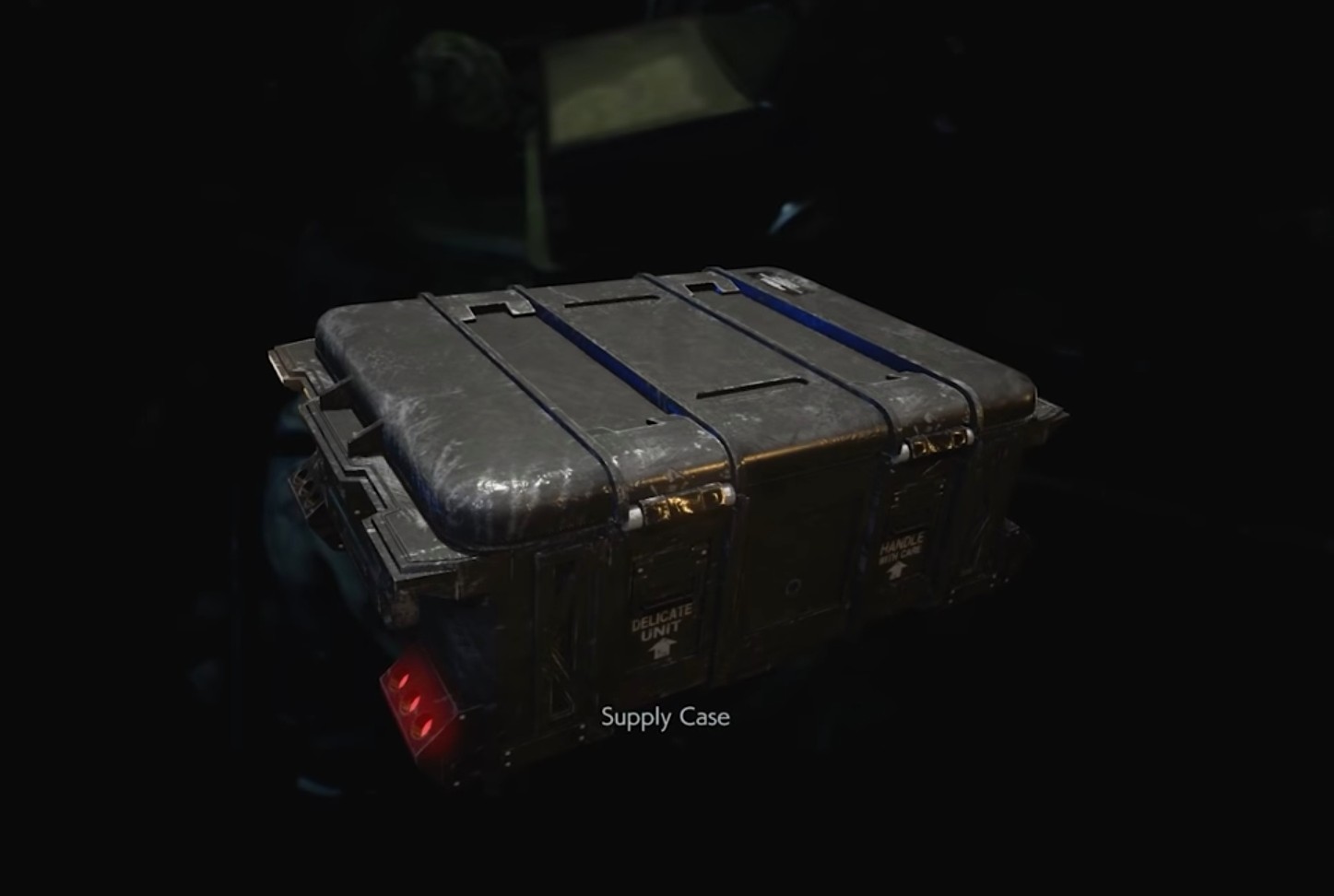
If you damage Nemesis enough, he will drop a supply case which often contains a very useful item. 

Unlike RE2 remake, the personal knife does not degrade and therefore it could be used as many times as you want. However, when a zombie grabs you to bite you, there is no prompt to use the knife to fight back and avoid getting bitten (this particular function was normal in RE2 remake). Another new thing in this video game is the presence of item boxes which you can “open” by shooting or using a knife to break it.

Because the in-game environment of RE3 remake includes the ruined streets and alleys of Raccoon City, you get more spacious places move around. Of course, this means more zombies occupying certain spaces for you to kill or strategically pass by. With the street-and-alleys set-up, there are a few red barrels that are explosive (you can destroy many zombies with one blast) and a few generators that electrocutes and stops monsters (even Nemesis) to shoot at.

Screenshot_20200401-185313_YouTube.jpg
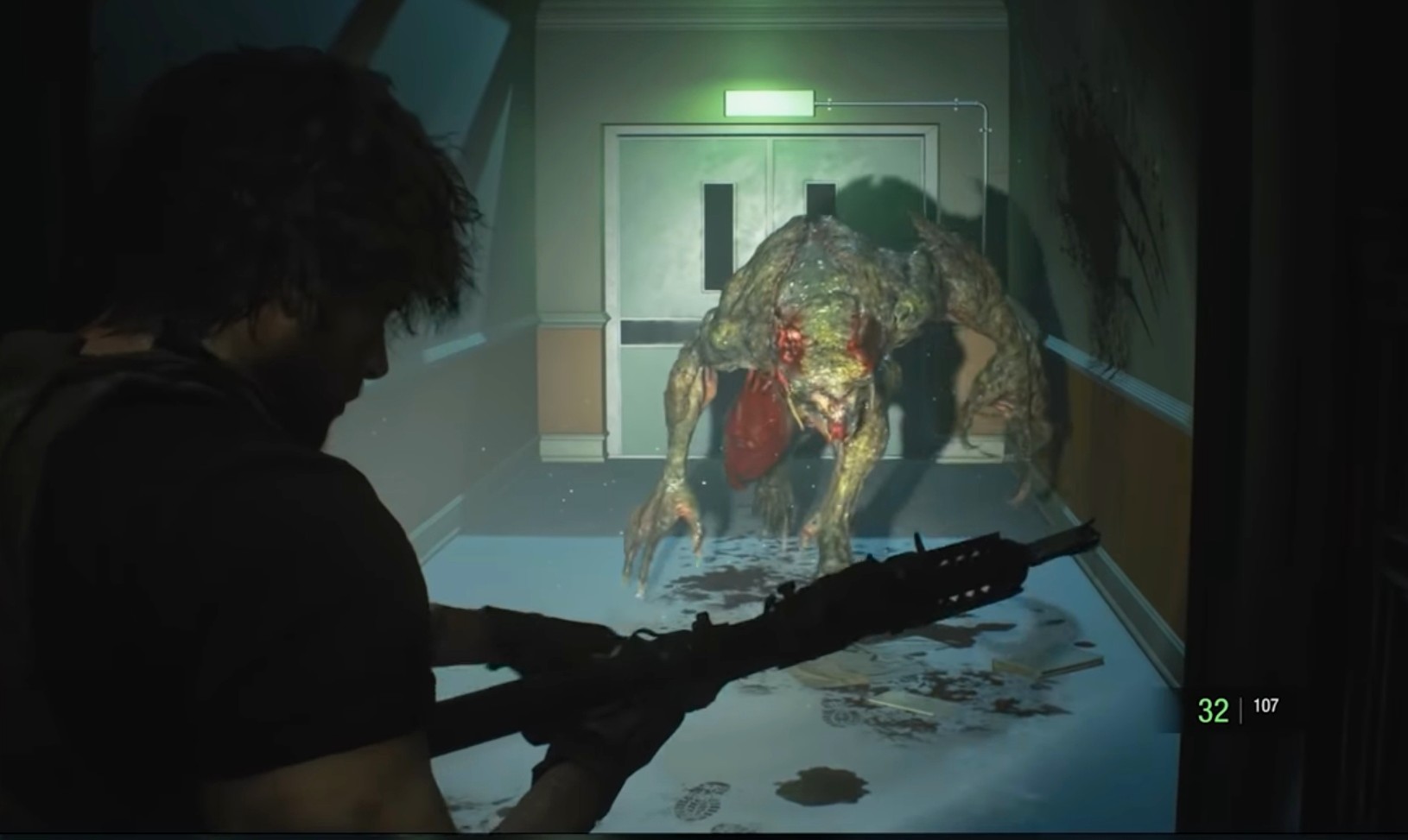
The return of the Hunter Beta is a welcome challenge!

When it comes acts and action, Jill gets to fight using the knife, grenade, flash grenade, handgun (including the burst gun), shotgun, magnum and the grenade launcher while Carlos uses the assault rifle (apart from the knife, grenade, flash grenade and handgun). Jill can evade, enter tight spots and use the lock pick while Carlos can do the defensive strike. For the most part, the controls are responsive which is good.

In terms of gameplay, RE3 remake is faster and more action-oriented counterpart to RE2 remake.

Presentation

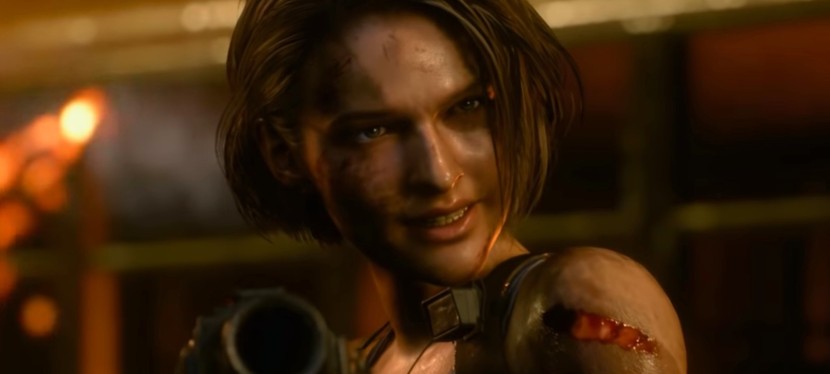
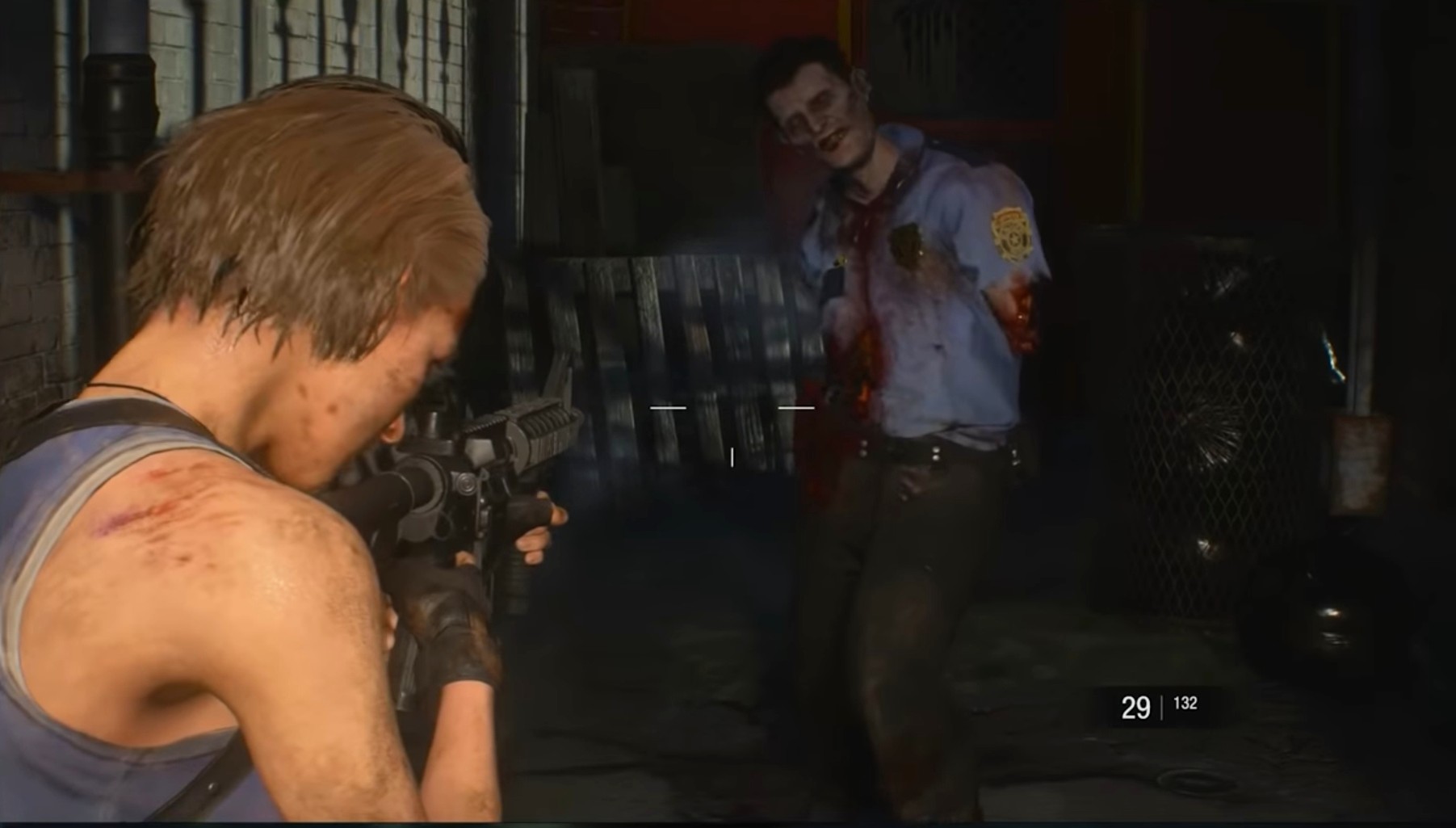
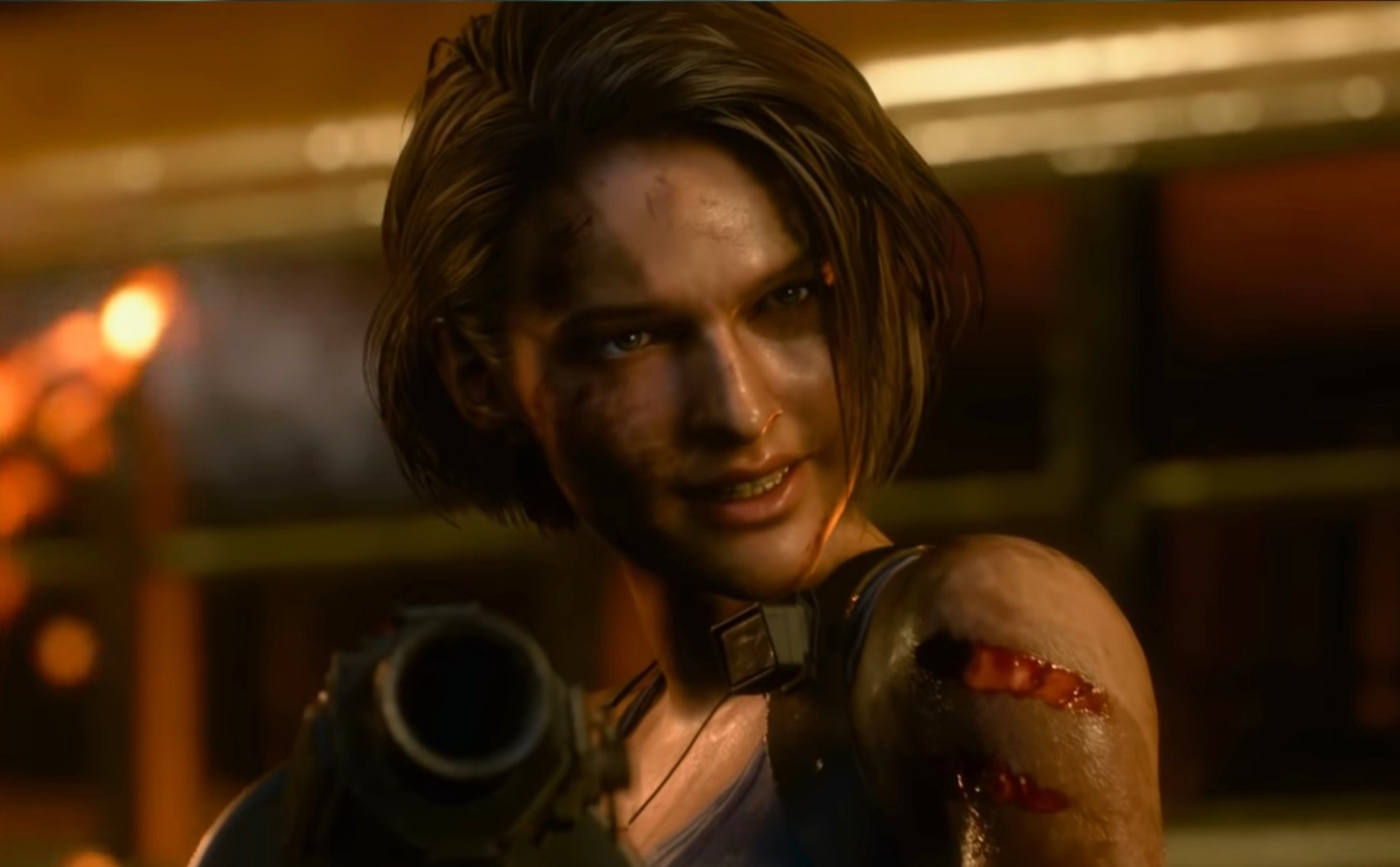
As far as production values are concerned, RE3 remake is more cinematic and has improved visuals technically and artistically. For the visuals, the photo-realism has been pushed forward more by the game developers on the characters, the monsters and their in-game environment. The protagonist Jill Valentine looks very lifelike and with model Sasha Zotova’s likeness used, she sure beats Gears 5’s heroine Kait when it comes to photo-realism and looking very human. The facial expressions are top-notch and I love the way how in-game lighting showed its effects on the environment on the characters.

The photo-realism and impressive facial animation are not limited to Jill, obviously, as other characters like Carlos, Mikhail (who was made to look older this time), Tyrell and the villainous Nicholai (who was made to look younger and slimmer than his previous version) really look great. On top of that, the voice acting is excellent across all the characters. That being said, Carlos now sounds more mature and believable as a person which is a tremendous improvement over the voice of his original version in 1999.

And there is Nemesis, the one over-sized bio weapon that targets members of S.T.A.R.S. Nemesis was redesigned with photo-realism in mind and he sure looks monstrous, especially in the later stages in the game. Compared to his original version in 1999, Nemesis is very strong, can use weapons of his own, uses a tendril to pull Jill to him, can actually leap ahead of Jill and even mutate zombies on the spot. Another noticeable difference that’s been dividing fans of the original RE3 and this game, is that Nemesis in this remake is limited to scripted events in key locations and as such, he is not the constant stalker that Mr. X was in the RE2 remake. In the RE3 game of 1999, Nemesis would randomly appear and run after Jill. That’s not the same experience in this remake which is disappointing.

Another disappointment I have state here in relation to encountering Nemesis (and other monsters) is the absence of live selection sequences which was a defining feature of the original RE3. Once you encounter Nemesis in this remake, it’s either you avoid and outrun him, or you can fight him and strike him hard enough to stop him temporarily (and make him suddenly drop a huge equipment case for you to pick up). You encounter the Hunter Beta or the Hunter Gamma or the Pale Head zombie, it’s either you kill them or they kill you. Without the live selection sequences, there is really no variety in the encounters.

When it comes to the in-game environments and the overall story structure, this game is noticeably shorter and locations are noticeable smaller and more linear. This is another disappointment because the ruined city environment failed to live up to expectations as it was designed to be limited in terms of places to visit and explore. Even the ruined city environment in 1999’s Resident Evil 3 has literally more locations to explore compared to this remake. Also don’t expect to see the city park, the city graveyard and city clock tower from the old game to appear as explorable levels here.

Screenshot_20200401-184601_YouTube.jpg
One of many in-game zombies players will encounter.

The game designers apparently knew fans would notice what places from the old game are lacking, and so they heavily expanded exploration in the medical center and they even included a secret passageway into a certain underground facility which made the game still feel fresh.

On the story structure, RE3 remake followed the concept of the original game but made a major twist which really caught me off-guard the first time I finished this game. It’s a nice twist and I never imagined that I get to use a specific character (note: as with the old game, only Jill and Carlos are playable in select sections) visiting a notable location.

When it comes to the presentation of the characters compared to the 1999 game, I can say that Jill is pretty much like her past version but says some lines with sarcasm and makes clear to Carlos that she’s tougher than she looks. Having played the past Resident Evil games, I can tell that this remade Jill Valentine is struggling with the frustration over the mission at the mansion since her superiors refused to believe her (note: lack of evidence and the destruction of the place). Ultimately, this remake succeeds in telling a very defining story about Jill which added more to her status as an icon of the Resident Evil franchise as a whole.

Carlos meanwhile is a more believable character thanks to not only the above-mentioned improved voice acting but also because of better writing. As for Nicholai, he’s more motivated by greed and mentions working for an unnamed client. He’s the type of character who annoys you and makes you wish he would be killed. Mikhail does not change much apart from looking older but Tyrell’s role here is heavily expanded.

Horror? Unsurprisingly this game has some elements of horror but nowhere does it come close to what was presented in the RE2 remake. It’s an action-oriented game after all but that’s not to say it’s the mindless, blazing guns festival like Resident Evil 5.. Also I should mention that there are very few puzzles here.

Conclusion

Screenshot_20200402-005503_YouTube.jpg
We gamers want more value for our money, Capcom!

Resident Evil 3 remake is action-packed, engaging and a fun video game to play even if you are not a fan of the long-running video game franchise. It has very high production values and the best cinematic cut-scenes in any RE game to date. What prevents this game from achieving excellence, apart from having a smaller concept compared to RE2 remake, is that the game is rather short and there is only ONE ending. This makes this game’s replay value much lower when compared to the original RE3 of 1999 which had more than one ending and references to other RE characters displayed (each time the 1999 game got finished). Sure the remake rewards players with points for fulfilling challenges and allows them to use the points to acquire post-game stuff in the in-game store, but this does not make up for the short length and single ending.

If there is anything Capcom should do to boost the replay value as well as the overall value of this remake, it’s for them to produce and release a story driven DLC (downloadable content) to expand the story campaign and add an additional ending. By now, the game makers should realize they missed several opportunities to deepen and make the remake great.

Overall, Resident Evil 3 is recommended only when its price is at least 50% off.


Thank you for reading. If you find this article engaging, please click the like button below and also please consider sharing this article to others. If you are looking for a copywriter to create content for your special project or business, check out my services and my portfolio. Feel free to contact me as well. Also please feel free to visit my Facebook page Author Carlo Carrasco and follow me at HavenorFantasy@twitter.com

A Look Back At Friday The 13th Part 3

Disclaimer: This is my original work with details sourced by means of watching the movie and doing research. Anyone who wants to use this article, in part or in whole, needs to secure first my permission and agree to cite me as the source and author. Let it be known that any unauthorized use of this article will constrain the author to pursue the remedies under R.A. No. 8293, the Revised Penal Code, and/or all applicable legal actions under the laws of the Philippines.

Long before movie franchising and shared cinematic universes became normal in modern day Hollywood, the very low-budget Friday The 13th movie of 1980 became a very profitable success and paved the way for sequels throughout the decade. Really, the first movie was just a standalone, self-contained story of horror set in the American summer camp. There really was no plan back then to turn that particular film into a series of movies that showcased people getting killed in slasher horror style.

Because Friday The 13th grossed almost $60 million worldwide, its first sequel Friday The 13th Part 2 was rushed into production (with more than double its predecessor’s budget) and eventually got released less than a year later. Part 2 made $21.7 million in America (note: overseas ticket sales remain unavailable) which was barely half that of its predecessor ($39.7 million) in the same market.

Creatively, Part 2 was made with Jason Voorhees as the antagonist because (SPOILER) his mother was the killer in the first movie. While Jason was indeed a victim in the 1980 movie, the Part 2 filmmakers had to make hard changes to establish him as the new killer and expand on the previous film’s concept. The result was that, within Friday The 13th’s version of history, Jason somehow witnessed his mother’s death from a distance and motivated him to become a territorial killer at Crystal Lake (note: the first movie established him as having drowned to death because the summer camp counselors did not watch him). This paved the way into introducing a grown-up Jason (wearing a potato sack as mask) as the new killer in the sequel.

Even though the box office reception for Part 2 was weaker, this did not stop the filmmakers and Paramount Pictures from pushing through with a sequel: Friday The 13th Part 3. To say the least, the business model on making Friday The 13th movies with very low budgets and raking big profits was too good for the filmmakers to stop doing. At the same time, the 1980s saw a huge demand for slasher horror. As if that was not enough, there was a short-lived revival of 3D cinematic viewing (moviegoers wore the old-style red-and-blue 3D visors to see the 3D effects on the screen) which the Part 3 filmmakers (led by director Steve Miner and producer Frank Mancuso, Jr.) decided to capitalize on. As such, they used special cameras and lenses to make Part 3.

Screenshot_20200313-225025_YouTube.jpg
This is what the film looked like in 3D and this is the 3D yoyo scene.

Enough with the history of the Friday The 13th film franchise for now. This is my retro movie review of 1982’s Friday The 13th Part 3.

Early Story

The movie opens (SPOILER for Part 2) with a recap of the final conflict in Part 2 showing Ginny (Amy Steel) in Jason’s shack in the forest. After some struggle near the makeshift shrine which had the decapitated head of Jason’s dead mother, Ginny’s boyfriend Paul arrived to save her from Jason. As Jason focused on fighting Paul, Ginny struck the killer with a blade on his left shoulder putting him down. After Ginny and Paul left the shack, it turns out that Jason (in brand new footage for the movie, a creative attempt to revise key story elements) was still alive and slowly moved.

The next day – Saturday the 14th – at a small town store (with a private residence), Jason (still wearing his clothes from Part 2) arrives and kills the couple (the owners) in the evening. Before getting killed, the wife saw TV news footage of Ginny being moved into an ambulance (using daytime footage from the ending of Part 2) establishing the current day as Saturday.

Screenshot_20200312-230358_YouTube.jpg
The bodies of the husband and wife being moved into the ambulance. Jason killed them on the evening of Saturday.

And yet the next day – Sunday the 15th – a group of teenagers travel together in a van heading towards the private property of Higgins Haven which is located by Crystal Lake. Due to the lack of security, Jason moved there in secret becoming a danger to them…

Quality

With a budget that was much bigger than that of Part 2, Friday The 13th Part 3 has better production values. Higgins Haven in the film was a nice physical set that was actually constructed from scratch in California. The vacation house, the barn and even Crystal Lake (which looked radically different from the first two films) were all made on location. Of course, money had to be spent on making tracks and setting up the cameras which had special lenses for filming in 3D. I also noticed that Part 3’s visuals are a lot more colorful to look at than in Part 2 which is the result of using the cameras with special lenses. The downside of this is the constant lack of sharpness on the visuals when compared to Part 1 and 2.

Screenshot_20200312-230434_YouTube.jpg
Larry Zerner’s Shelly (middle) is one of the most memorable characters of the entire Friday The 13th film franchise.

In terms of storytelling, this movie looked generic on face value when compared to not only the other Friday The 13th films but also with the many other slasher horror movies that were released. There is a group of people who don’t realize they were being stalked by a killer. The killings are done in secret. Some people either have sex or use illegal drugs. The film’s protagonist encounters the killer and somehow survives. The storytelling is shallow and the characters were designed to be mostly killed off by the antagonist. Of course, there was no real room for any character development.

The good news about this particular movie is that it was nicely paced, there were no boring moments, the on-screen kills were visceral enough, there was an amount of humor to balance the tone enough, and most of all, Part 3 is a lot more fun to watch than any of its predecessors.

Screenshot_20200312-231454_YouTube.jpg
Nothing like being stalked by Jason.

Adding more to the fun factor was that the cast of characters was pretty good. Dana Kimmell as Chris Higgins is charming, romantic, physically capable and also sympathetic. Larry Zerner meanwhile is funny to watch as Shelly who is an overweight guy trying hard to gain attention and friendship. Zerner has a certain appeal of being funny without ever becoming an on-screen annoyance. Like Chris, Shelly is also sympathetic.

Similar character traits are also found in Debbie played by Tracie Savage, and Vera played by Catherine Parks. Vera is the lady on a blind date willing to have fun as she goes on a journey of discovery with her friend. Debbie is pretty, sweet and loves to have fun with her boyfriend even though she is already pregnant. By the way, Tracie Savage acted early as a little girl and her performance her shows it. In real life, Savage went on to become a credible journalist and she was involved in covering the O.J. Simpson murder story of the mid-1990s. Check out Tracie Savage in these embedded videos below.

Screenshot_20200313-224951_YouTube.jpg
Tracie Savage in 3D as Debbie!

And then there are the arrogant, leather-wearing bikers who were written only to cause trouble. Kevin O’Brien as Loco is tough, Gloria Charles as Fox is rude and yet has a weakness for doing something fun, while Nick Savage as Ali is both savage and even funny.

As for Rick played by Paul Kratka is the least interesting character as the good-intentioned boyfriend of Chris. Rick is bland not because of Kratka’s performance but rather the way he was written for the film.

Richard Brooker, a circus performer, excelled in his portrayal as Jason Voorhees and he provided the template on how the icon should act on screen. Not only was he physically imposing, he had to endure the tough procedure of going through several hours of movie makeup (for Jason’s distorted face) before even wearing the hockey mask. Brooker’s Jason is a major improvement over than of Part 2 and it’s too bad we never got to see him reprise the villain.

Screenshot_20200312-231540_YouTube.jpg
Richard Brooker as Jason Voorhees. Believe it or not, the use of a hockey mask in the film was unplanned and it so happened than one of the film crew members was an ice hockey fan and he had a mask with him.

When it comes to on-screen spectacle, the killings by Jason were creative and visceral at the same time. Apart from a few on-screen kills that paid homage to key kills in the 1980 movie, Brooker and the filmmakers delivered a good job on showing how deadly Jason is as the killer. We also get to see that Jason is not only unstoppable but also is very strong (look at what happened to Rick) and even agile (look at his first encounter with Ali). It was also in this film where moviegoers got to see for the first time how visceral a hockey mask-wearing killer could be on the big screen.

Dana Kimmell proved to be capable with the stunts she was given and the action during the encounters between Chris and Jason. Her attempts to fight back at Jason with the knife was believable in terms of character desperation. She is comparable with Amy Steel (Part 2’s Ginny) but is ahead in terms of doing the stunts. Kimmell even had an accident during a chase in which she tripped and fell down face-first.

On storytelling, Part 3’s fimmakers made the right gamble by having the film set immediately after the events of Part 2. Originally there was a plan to make Part 3 feature Ginny in a new story setting her up with another encounter with Jason. Because Amy Steel turned the role down, this particular movie became the result. Part 3’s filmmakers scored a right move having the story set at a private vacation property by Crystal Lake which is a nice change from the summer camp settings of its predecessors.

When it comes to cinematic style, I just love the way director Steve Miner had Jason appear discreetly on screen long before he gets the hockey mask. To see Jason standing on the foreground (no head shown) looking at the characters in the background remains creepy and stylish, slowly adding to the build-up of suspense. To see Jason slowly creeping in the background was also creepy. These are cinematic moves that were not used that much anymore in the sequels that followed.

If there is anything lack here, it definitely is the 3D cinematography which involved a process that is crude and ineffective by today’s standards. The old-style 3D (with 3d visors of red and blue) visuals can be viewed on an HDTV when selected but such visuals have not aged well. I personally prefer to watch it in old-fashioned 2D even though the sharpness of the pictures is lacking and even though the key on-screen moments originally filmed for 3D (with objects captured close to the camera) look out of place. Back to storytelling, I felt that Chris Higgin’s recall of a past incident in the woods felt like an afterthought on the part of the screenwriters.

Conclusion

Overall, Friday The 13th Part 3 is a fun horror movie to watch again. It is not only one of the best ever Friday The 13th films released, but also one of the strongest among all slasher horror movies released in the 1980s. That being said, it made the original Friday The 13th look more of a bore and it made Friday The 13th Part 2 look half-baked. Truly, Part 3 was the film that had the standards of fun and engagement of its film franchise raised higher. Of all the Friday The 13th movies I saw in my life, I declare that Part 3 is the 2nd best film of the franchise.

In terms of cinematic artistry, Part 3 serves as the template on storytelling and structuring for the franchise similar to how Goldfinger became a standard for the James Bond film franchise. To make things clear, this film not only showed Jason wearing for the first time an ice hockey mask (now iconic in American pop culture) but also showed why he is so dangerous whether he stalks people or strikes them down. This film marked the true beginning of the now iconic Jason Voorhees and the filmmakers did a nice job in showcasing him as a horrifying antagonist, easily blowing away the Part 2 potato sack hermit Jason.

Screenshot_20200312-231703_YouTube.jpg
Dana Kimmell as Chris (right) in a scene that copied a similar scene in the first movie.

The film has, in my view, the most appealing cast of characters. There are key characters worth caring for and when you see the most likable characters killed off, you will feel very sorry for them.

What struck me most was what happened to Chris at the very, very end of the film. Granted, she is the final girl of this movie but what I saw when this film ended will always stick me. Without spoiling anything, I should say that Dana Kimmell’s Chris is creatively a standout among all the many slasher horror movie final girls that were presented. I really felt sorry for Chris and Dana Kimmell was very convincing with her performance.

Back to Friday The 13th Part 3’s quality and overall fun factor, I can boldly declare that without this film, the filmmakers of the sequel Friday The 13th: The Final Chapter (Part 4) would not even have the foundation and concepts to make their own film great. Really, Part 3 is really good and it’s even intriguing to learn that it was originally made to mark the end of its franchise.

Overall, Friday The 13th Part 3 is highly recommended. To those who are about to watch it for the first time, remember that this movie is a part of 1980s Hollywood history.


Thank you for reading. If you find this article engaging, please click the like button below and also please consider sharing this article to others. If you are looking for a copywriter to create content for your special project or business, check out my services and my portfolio. Feel free to contact me as well. Also please feel free to visit my Facebook page Author Carlo Carrasco and follow me at HavenorFantasy@twitter.com