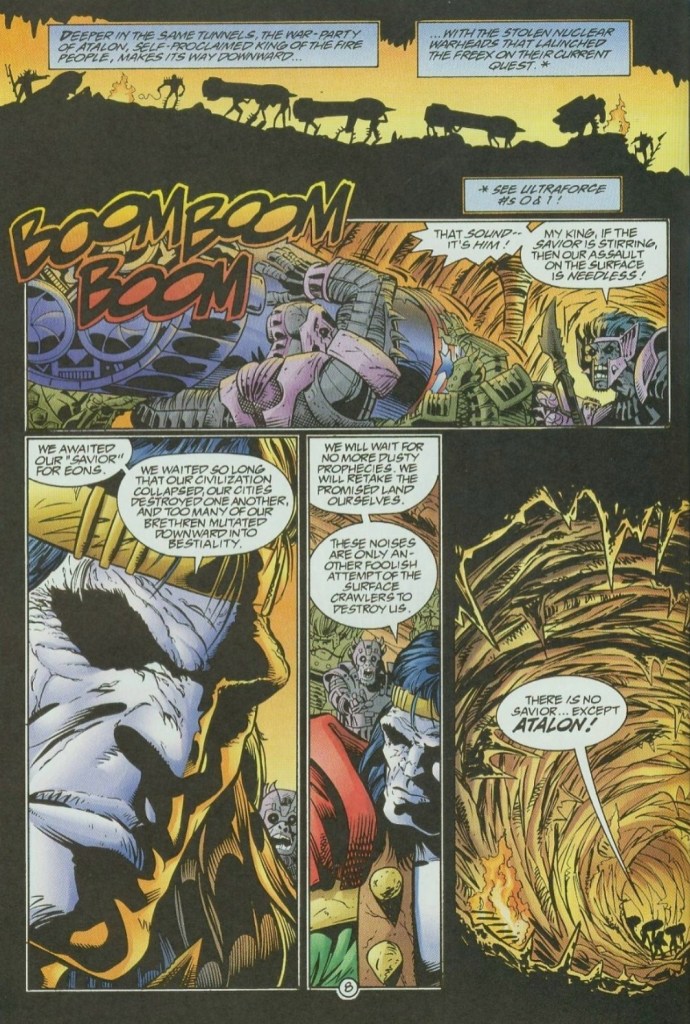
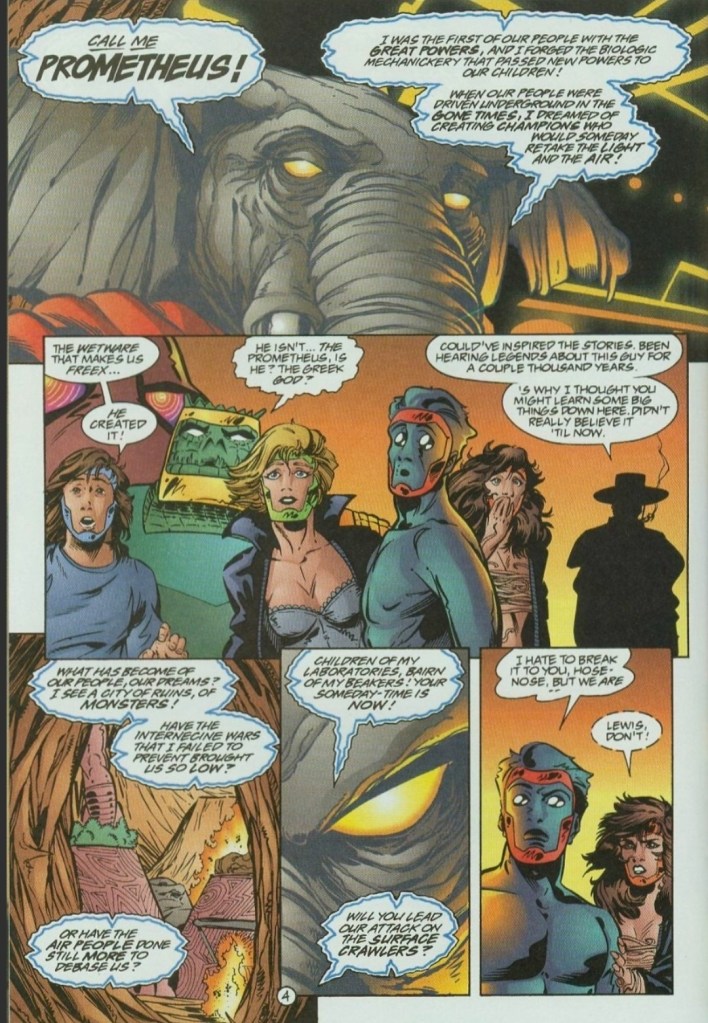
A Look Back at Prime #20 (1995)

Welcome back, superhero fans, 1990s arts and culture enthusiasts, Ultraverse fans and comic book collectors! Today we revisit the Ultraverse to take a look at one of the many tales of Prime from the monthly series that first launched in 1993.

In recent times, I’ve been reading and reviewing Prime comic books I missed out before. For my most recent Prime retro reviews, click here, here and here. For the newcomers reading this, Prime is one of the most definitive heroes of the entire Ultraverse and his true identity is the teenager Kevin Green. Prime is also one of three major Ultraverse figures in the team UltraForce.

With those details laid down, here is a look back at Prime , published by Malibu Comics in 1995 with a story written by Len Strazewski and Gerard Jones, and illustrated by Greg Luzniak.
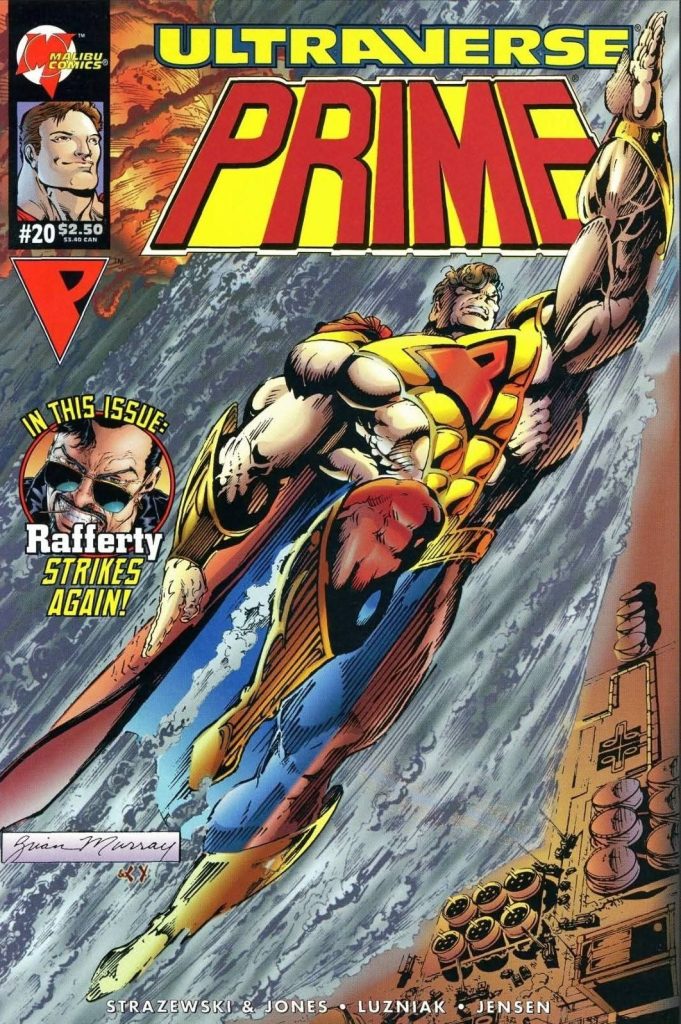
The cover.

Early story

The story begins with a man and a woman on bed. They just made love with each other. As the woman goes to the bathroom to fix herself, the man tells her she will be perfect in a new project and they will be together all the time even though he is already married. He tells her that will be a real ultra-heroine and already a lot of things are being prepared for her such. She will also have a new partner and already they found a way to get him to Washington.

Feeling terrible, the woman lowers herself on the bathroom floor, pulls a piece of hardware very hard, and an explosion suddenly happens.

In New York City, Kevin and his mother attend an opera. Kevin still has trouble adjusting to life in New York and misses his friends and the community of Canoga Park. He still has feelings for Kelly but remains confused as he still struggles with managing his personal life being himself and being Prime…

Quality
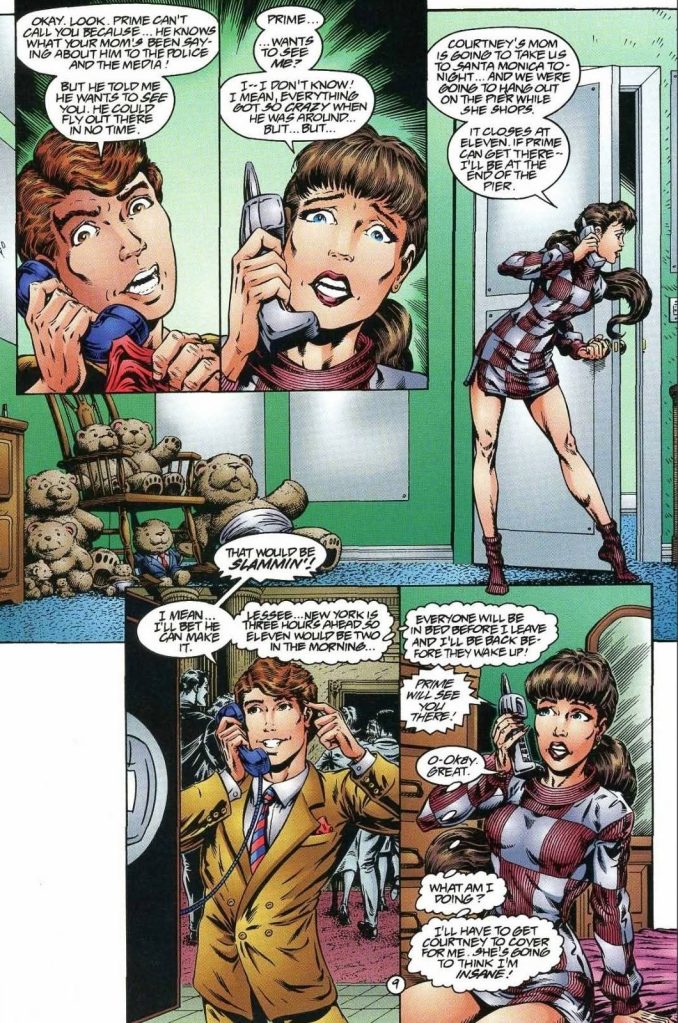
Kevin and Kelly talking to each other via a long distance call.

I really enjoyed this issue of Prime mainly because the writing done by Len Strazewski and Gerard Jones is really rich with depth. To make things clear, this is another Prime tale made to emphasize the title hero’s personality particularly with his personal life as Kevin Green who at this stage has turned into a really confused teenager. Not only is Kevin so far away from Kelly, he has not seen his father for a long time already, his mother has been working and is about to move to Washington for a new job, and public perception towards Prime has been tense.

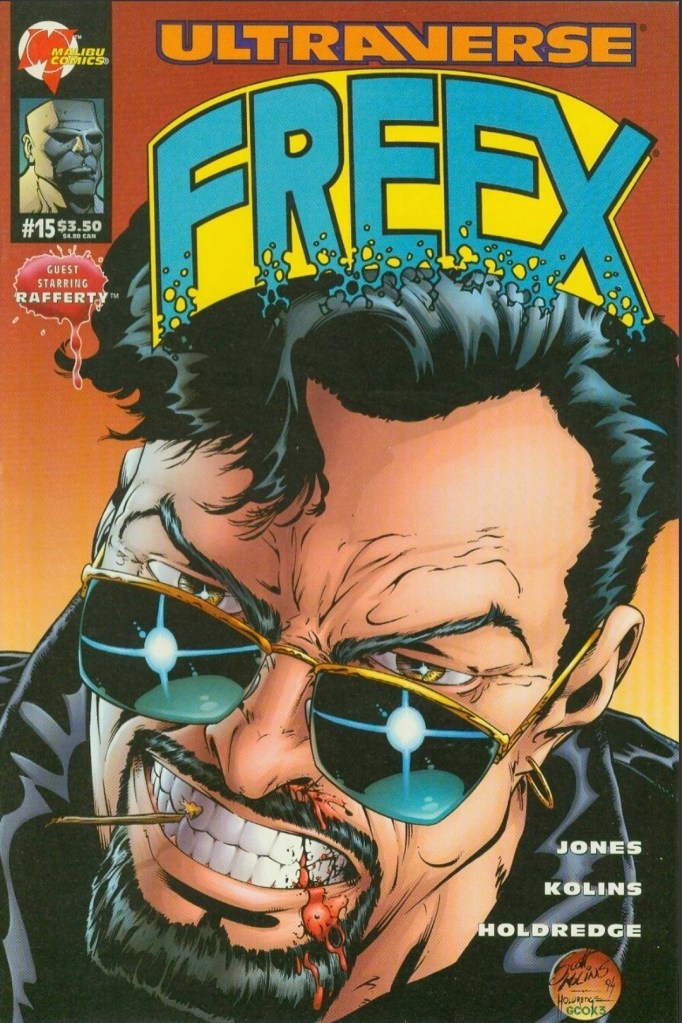
As the cover already confirmed, the deadly villain Rafferty is indeed here although the traditional good-versus-evil conflict is not a major part of the story. Rafferty previously encountered Freex and The Strangers (click here, here and here) and it was only right to set him up for conflict with Prime.

When it comes to the art, I enjoyed Greg Luzniak’s style on Prime and the other characters. Luzniak is really good with the dynamic approach on visualizing superhero spectacle and acts. The way he shows facial expressions resulted in a wide range of looks and emotions.

Conclusion

Kevin in New York with his mother. His father has been away for a long time at this point in the series.

The character-driven approach done by the Strazewski-Jones duo made Prime (1995) a very solid read. The story has a firm structure designed to open opportunities to emphasize Kevin Green’s development which in turn reflects his struggle with the changes of his life. This comic book also explores Kelly’s speculation that Prime and Kevin are one and the same, and the creators pulled off the right moves to add weight to that. By the time I reached the ending, I am convinced to go on to the next issue.

Overall, Prime (1994) is highly recommended.

+++++

Thank you for reading. If you find this article engaging, please click the like button below and also please consider sharing this article to others. If you are looking for a copywriter to create content for your special project or business, check out my services and my portfolio. If you want to support my website, please consider making a donation. Feel free to contact me with a private message. Also please feel free to visit my Facebook page Author Carlo Carrasco and follow me on Twitter at  @HavenorFantasy as well as on Tumblr at https://carlocarrasco.tumblr.com/ and on Instagram at https://www.instagram.com/authorcarlocarrasco/
A Look Back at Prime #14 (1994)

Welcome back, superhero fans, 1990s arts and culture enthusiasts, Ultraverse fans and comic book collectors! Today we revisit the Ultraverse to take a look at one of the many tales of Prime from the monthly series that first launched in 1993.

In recent times, I’ve been reading and reviewing Prime comic books I missed out before. For my most recent Prime retro reviews, click here and here. For the newcomers reading this, Prime is one of the most definitive heroes of the entire Ultraverse and his true identity is the teenager Kevin Green.

With those details laid down, here is a look back at Prime , published by Malibu Comics in 1994 with a story written by Len Strazewski and Gerard Jones, and illustrated by the Darick Robertson with ink work done by Barbara Kaalberg.

The cover.

Early story

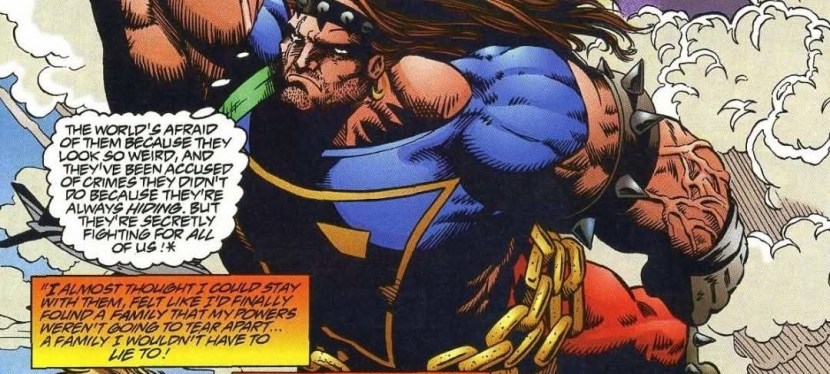
The story begins with Prime flying and deeply thinking about the group of powered social outcasts…Freex. Prime, who recently spent time with Freex and helped them fight monsters (click here and here). He wished to help them more but does not want to be like them. He wants to show the whole world that it cannot push him around only because of his youth.

Moments later, Prime arrives at Venice Beach in California to meet members and agents of the media…

Quality

This should remind you to always behave yourself in front of any family member of your friend. Prime ends up being disrespectful to Kelly’s mother due to Kevin’s lack of maturity.

As a long-time Ultraverse comic book reader, there is a lot to like in this tale of Prime. For one thing, it is a pure character-driven story with a strong emphasis on how Kevin Green’s personal views develop, why he keeps on struggling to understand society and why his way (in the form of Prime) of interacting with ordinary people remains awkward.

There is so much stuff here, it can be challenging to realize the main themes of the story written by Jones and Strazewski. To make things clear, at this point in the Ultraverse, worldly authorities are very aware of the Ultras who seem to want to help people with problems but they are compelled to use force to confront them as those super powered beings are capable of making their own rules, violate laws with impunity and cause trouble in societies.

Prime is already in the middle of a troubled American society and the government as well as secret societies have other Ultras to deal with. Being a teenager himself, Kevin Green is able to relate with members of Freex who have no families to return to and are always on the run being chased by the authorities and being hated by the world. Along the way, Prime is acting impulsively with the adults and members of the media since Kevin himself lacks maturity and has yet to fully understand society and its norms. Kevin also forgets how to behave properly as he fails to control his emotional impulse.  

When it comes to the art, Darick Robertson did a really fine job visualizing Prime and in most pages of the comic book, he uses dynamism to make the reading experience look very lively. He also did a good job with the facial expressions.

Conclusion

Prime recalls the time he spent with Freex.

It is very clear that the writing in Prime (1994) done by the Jones-Strazewski duo is rich and deeply layered. Being a self-declared fighter and supporter of young people in this issue puts Prime into deeper trouble as he does not realize yet the consequence of the moves he made. The creative team really excelled in dramatizing Kevin Green – in the physical form of Prime – being impulsive and immature to adults while acting as a helpful adult to teenagers he meets. This story also sheds light on broken families which will instantly remind readers about poverty, vices and long-lasting negativity in unchecked parts of American society. That being said, this Prime story is a great read and its social commentary remains very relevant. This is also a great development of Prime’s personality.

Overall, Prime (1994) is highly recommended.

+++++

Thank you for reading. If you find this article engaging, please click the like button below and also please consider sharing this article to others. If you are looking for a copywriter to create content for your special project or business, check out my services and my portfolio. If you want to support my website, please consider making a donation. Feel free to contact me with a private message. Also please feel free to visit my Facebook page Author Carlo Carrasco and follow me on Twitter at  @HavenorFantasy as well as on Tumblr at https://carlocarrasco.tumblr.com/ and on Instagram at https://www.instagram.com/authorcarlocarrasco/.

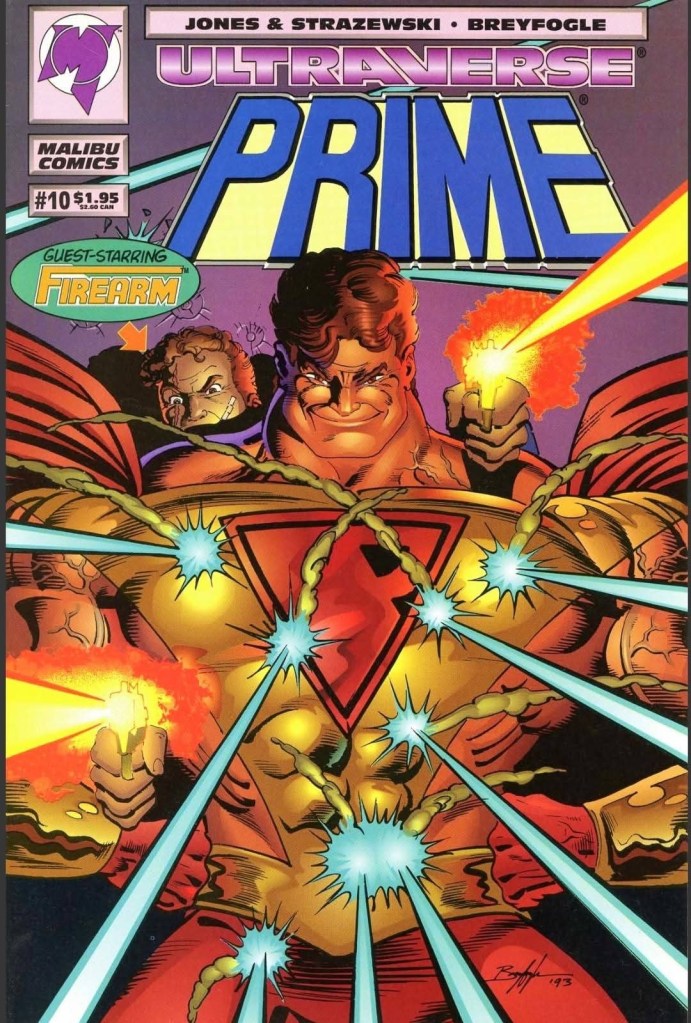
A Look Back at Prime #10 (1994)

Welcome back, superhero fans, 1990s arts and culture enthusiasts, Ultraverse fans and comic book collectors! Today we revisit the Ultraverse to take a look at one of the many tales of Prime from the monthly series that first launched in 1993.

Within the Ultraverse is a hero that was notably absent in the many UV comic books I reviewed, and Malibu Comics even published a regular series of the character. That character is Firearm who goes by the civilian identity as Alec Swan. Swan, who has no super powers, is a British private investigator who was formerly a member of an elite cover bureau in his home country. He has been working as a PI in California and he has encountered several super-powered people in the Ultraverse. In this comic book review, he gets involved with Prime.

With those details laid down, here is a look back at Prime , published by Malibu Comics in 1994 with a story written by Len Strazewski and Gerard Jones, and illustrated by the late Norm Breyfogle.

The cover.

Early story

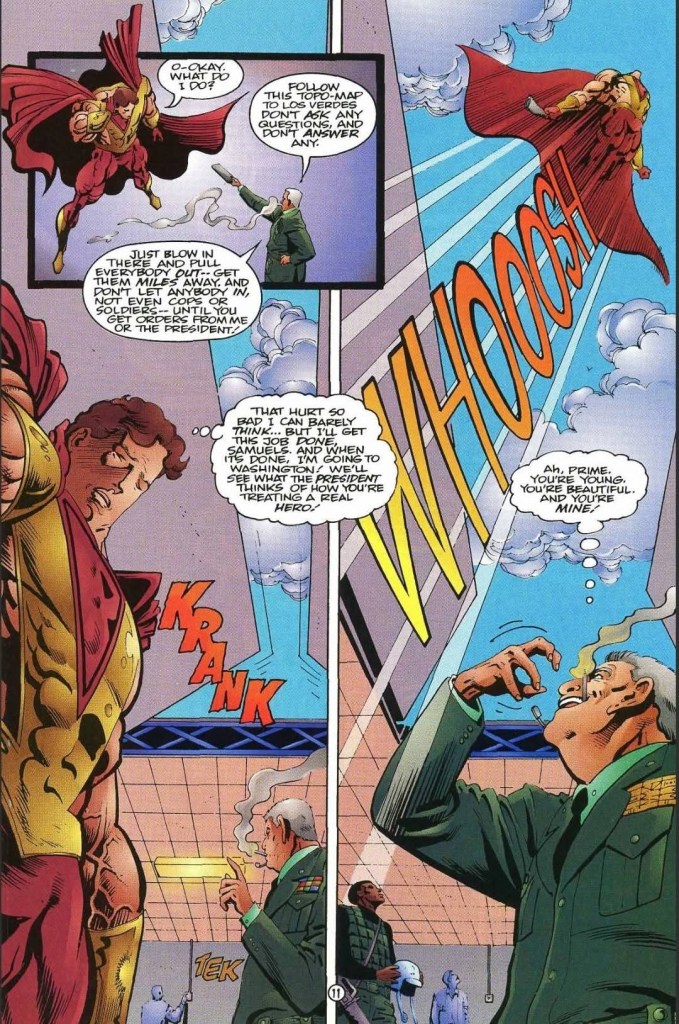
The story begins Prime crashing into a secret facility where Colonel Samuels and his crew have been working in. Prime angrily accuses the colonel for lying to him and pushing him close to killing the people in the nuclear plant and almost getting him killed in a nuclear blast.

Samuels immediately pulls a switch to electrocute Prime (note: through the collar Samuel placed on Kevin Green’s neck) with a massive amount of energy which knocks him out. A short time later, Prime finds himself restrained in front of the colonel, guards and scientists. Samuels reveals to him that the secret society Aladdin has been stepping up efforts to control ultras (super-powered beings) since the incident on the moon (Break-Thru) happened, and they want him out of business.

What Colonel Samuels and staff do not realize is that Firearm is discreetly watching them and listening in the shadows…

Quality

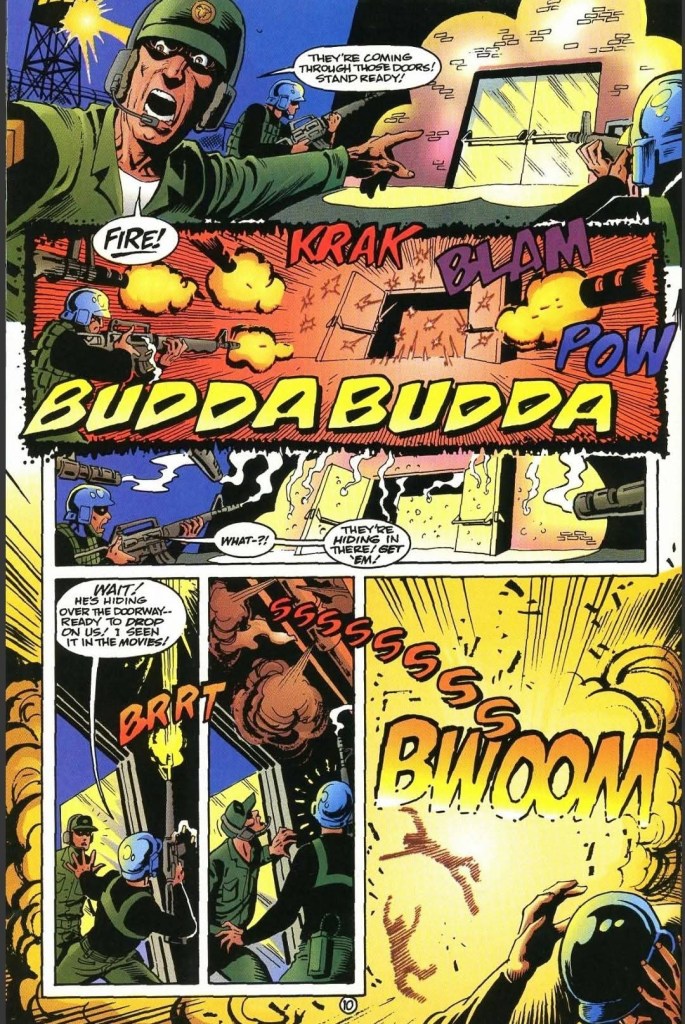
The guards got fooled.

To begin with, I can say that the Strazewski-Jones-Breyfogle team literally turned things upside-down to tell a Prime story while smoothly integrating Firearm into the narrative. This is the first-ever encounter between Prime and Firearm (who at this point of the story met Kevin Green’s father)

Without spoiling the plot, I can say that this tale is heavy with the action which is justified by the presence of Firearm. Prime himself is in a more vulnerable state as Colonel Samuels has clever advantages over him. The result is a story packed with action and has some suspense and intrigue mixed in. The reading experience flowed smoothly and there never was any boring moment in any scene.

Firearm’s presence here opened some opportunities for the creative team to develop Kevin Green’s personality and what they came up with was executed efficiently and with depth. As for Colonel Samuels, his wickedness reached a boiling point in this tale and the creative team came up with something that caught me off-guard. I promise you, what happened to Samuels here is worth discovering and it will compel you to examine or anticipate the consequences of the action he took.

Conclusion

Somehow, Colonel Samuels and his staff failed to notice Firearm’s presence.

While the previous issue was a return to form for the regular series, Prime (1994) was a pleasing crossover tale that successfully showcased action, suspense, intrigue and new dimensions of Kevin Green’s personal growth. This first-ever encounter between Prime and Firearm was executed solidly and the reading experience in general was engaging from start to finish. The way I see it, this old Ultraverse comic book will please fans of both Firearm and Prime.

Overall, Prime (1994) is highly recommended.

+++++

Thank you for reading. If you find this article engaging, please click the like button below and also please consider sharing this article to others. If you are looking for a copywriter to create content for your special project or business, check out my services and my portfolio. If you want to support my website, please consider making a donation. Feel free to contact me with a private message. Also please feel free to visit my Facebook page Author Carlo Carrasco and follow me on Twitter at  @HavenorFantasy as well as on Tumblr at https://carlocarrasco.tumblr.com/ and on Instagram at https://www.instagram.com/authorcarlocarrasco/.

A Look Back at Prime #9 (1994)

Welcome back, superhero fans, 1990s arts and culture enthusiasts, Ultraverse fans and comic book collectors! Today we revisit the Ultraverse to take a look at one of the many tales of Prime from the monthly series that first launched in 1993.

For the newcomers reading this, Prime is one of the definitive, major heroes of the entire Ultraverse along with Hardcase, Mantra and Prototype. Prime is also a major part of the team UltraForce. What makes the muscular and super strong Prime interesting is that his true identity is a teenager named Kevin Green who finds himself struggling between his superhero activities, his social life and his family. Having previously read and reviewed lots of Prime comic books, I can say that I had a lot of fun along the way. There are still some comic books about Prime that I have yet to review.

With those details laid down, here is a look back at Prime , published by Malibu Comics in 1994 with a story written by Len Strazewski and Gerard Jones, and illustrated by the late Norm Breyfogle.

The cover.

Early story

The story begins with Kevin’s mother helplessly tied to a chair with her mouth covered inside their home. By this time, Kevin (Prime) has been gone for more than a week already and her husband Russ won’t even call the police for help. For her, the people who informed her that Kevin has to be isolated because of some kind of a disease lied.

Suddenly a uniformed man armed with a rifle tells her that she will be in trouble if she makes so much noise. He tells her that Kevin is just outside the house and his team intends to collect him again.

Outside, Kevin just arrived following his unexpected adventure with Mantra (for crossover references, the comic books are Mantra #7 and Prime #8). Not knowing who Mantra really is, he remembers getting kissed by her and has an intention to see her whenever he wants. As soon as he opens the front door of their home, Kevin immediately gets dragged inside and restrained by two armed men. Colonel Samuels is inside…

Quality

Prime has no choice but to do the dirty work of the abusive Colonel Samuels (who has access to US President Bill Clinton).

Being set shortly after the events of Break-Thru (read my retro reviews by clicking here, here and here) and Prime’s encounters with Mantra, this tale is clearly a return to form for the Prime monthly series. Symbolically, Colonel Samuels returns as the chief antagonist and he clearly is not done yet with messing with Prime as well as with the Green family while abusing his power. Samuels is clearly evil and having served in the American military for decades, he has access to the government’s information regarding the ultras (which places the Green family in disadvantageous situations) and he has all resources needed to ruin Prime’s life.

Prime here gets involved in a mission being at a serious disadvantage as Colonel Samuels has the power and means to make him do dirty tasks. Samuels even has direct access to US President Bill Clinton (a real-life abuser of women, a leader who empowered Islamic terrorists and a profiteer with his family’s foundation) to do high-risk operations supposedly in service of America.

What is very clear in this story written by Strazewski and Jones is that intrigue (backed by twists) made the narrative powerful and engaging to follow. Even though there is a clear bias supporting the hippies, the political correctness minds, the anti-nuclear zealots and the solar power extremists, the tale is still entertaining to read. More notably, you will see how Prime develops as he tackles a very dangerous situation that involves annihilation in American land. I really like the way the writers showed Prime struggling to analyze what to do as the pressure mounts immensely on him.

Conclusion

Easily the most dynamic image of the comic book drawn by the late Norm Breyfogle.

Prime (1994) is another very solid Ultraverse tale made by the Strazewski-Jones-Breyfogle team. It is creative a return to form for the Prime monthly series (because Prime got busy with Break-Thru and spent time with Mantra) and seeing the evil Colonel Samuel raise the stakes added a lot of depth to the story. At this particular stage of the series, Kevin Green’s life is getting out of hand and his parents are already in the middle of a series of very unfortunate events. This old comic book is still fun to read.

Overall, Prime (1994) is recommended.

+++++

Thank you for reading. If you find this article engaging, please click the like button below and also please consider sharing this article to others. If you are looking for a copywriter to create content for your special project or business, check out my services and my portfolio. If you want to support my website, please consider making a donation. Feel free to contact me with a private message. Also please feel free to visit my Facebook page Author Carlo Carrasco and follow me on Twitter at  @HavenorFantasy as well as on Tumblr at https://carlocarrasco.tumblr.com/ and on Instagram at https://www.instagram.com/authorcarlocarrasco/

A Look Back at Freex #16 (1995)

Disclaimer: This is my original work with details sourced from reading the comic book and doing personal research. Anyone who wants to use this article, in part or in whole, needs to secure first my permission and agree to cite me as the source and author. Let it be known that any unauthorized use of this article will constrain the author to pursue the remedies under R.A. No. 8293, the Revised Penal Code, and/or all applicable legal actions under the laws of the Philippines.

Welcome back superhero enthusiasts, 1990s culture enthusiasts and comic book collectors! Today we go back to the year 1995 to revisit one of the many tales of Malibu Comics’ Ultraverse through the Freex monthly series.

In my previous review, the Freex encountered someone very deadly (note: Rafferty who also encountered The Strangers) and out of nowhere one of their members got killed as he made his move to protect someone’s life.

With those details laid down, here is a look back at Freex published in 1995 by Malibu Comics with a story written by Gerard Jones and drawn by Klebs de Moura e Silva.   

The cover.

Early story

The story begins at midnight when Ruby arrives at a sorrowful gathering composed of Contrary, her academic students, the Night Man, the Old Man and the remaining members of Freex. They are all mourning over the dead body of Michael. Just after Old Man declared that everyone should move on and let Michael (Plug) rest, Contrary (now an established member of UltraForce) stated that her academy will keep him in the company of others like him at their Mt. Shasta Citadel headquarters as the dead Freex member does not have any known surviving family members.

The loss of Michael then begins to take its toll on Angela/Sweetface as she cries and states that there is nothing left to live for. Suddenly, something appears to the Freex…an angel-like figure who tells Angela to end the pain and join the only one who still cares for her. Valerie and Lewis try to help Angela resist the one who spoke…

Quality

The Old Man becomes the target of Freex.

What is obvious to me here is that this comic book is all about the consequences of the death of original Freex team member Michael and how his death impacted specific teammates who had really grown close with him. The plot in this comic book is pretty light as this was clearly written to have strong character dramatization and development.

While there were indeed a whole lot of characters who appeared here, this comic book highlights Sweetface as the one most affected by the sudden death of Michael. That being said, any dedicated Freex fan who seriously followed the series right from the start will be able to relate with Sweetface’s emotions and even feel her deep feelings with Michael. Incidentally, this paves the way for her to interact more with Lewis who also got impacted by the death of their teammate. As the story went on, there were key developments here that strongly symbolized that Freex will take a serious change of direction focusing more on team survival and avenging Michael while severing ties with the Old Man. Clearly the creative team were building up something for the team who at this point have been on a very long and painful journey as nomads.

All throughout, the script really is detailed, richly layered and engaging. Apart from Freex, Night Man, Contrary and her students, and other characters had their fair share of the spotlight strongly symbolizing the current state of the Ultraverse at the time.

Conclusion

Even as she is mourning over the death of Michael, Angela suddenly sees a mesmerizing vision in front of the others.

Freex (1995) is indeed a solid comic book to read. The strong writing is its strongest feature and it really delivered the compelling stuff that will resonate most with the long-time Freex fans. The dramatization of the effects of Michael’s death really is strong and the new change of direction for the surviving Freex was implemented really smoothly. The lack of a good-versus-evil element was no problem at all here. By the end of the comic book, I became eager to find out what would happen next to Freex.

Overall, Freex (1995) is recommended.

+++++

Thank you for reading. If you find this article engaging, please click the like button below, share this article to others and also please consider making a donation to support my publishing. If you are looking for a copywriter to create content for your special project or business, check out my services and my portfolio. Feel free to contact me with a private message. Also please feel free to visit my Facebook page Author Carlo Carrasco and follow me on Twitter at  @HavenorFantasy as well as on Tumblr at https://carlocarrasco.tumblr.com/ and on Instagram at https://www.instagram.com/authorcarlocarrasco

A Look Back at Hulk 2099 #1 (1994)

Disclaimer: This is my original work with details sourced from reading the comic book and doing personal research. Anyone who wants to use this article, in part or in whole, needs to secure first my permission and agree to cite me as the source and author. Let it be known that any unauthorized use of this article will constrain the author to pursue the remedies under R.A. No. 8293, the Revised Penal Code, and/or all applicable legal actions under the laws of the Philippines.

Welcome back superhero enthusiasts, 1990s arts and culture enthusiasts, Marvel Comics fans and comic book collectors! Today we go back to the wild 1990s by examining one of the many tales of Marvel Comics’ 2099 line of franchises, specifically through the Hulk 2099 monthly series.

For the newcomers reading this, Hulk 2099 first appeared in 2099 Unlimited #1 (1993) which also had his origin story told. Hulk 2099 was not a mere version of the classic Incredible Hulk with a futuristic touch. In fact, the futuristic green creature highlighted the protagonist John Eisenhart as a very selfish and obsessed Hollywood studio executive who happens to stumble upon the idolaters/worshipers of the classic Hulk Bruce Banner because he was searching for new properties and stories for his studio. Hulk 2099’s origin has notable similarities to that of the classic Hulk and gamma radiation exposure is one of them. As tales of the futuristic Hulk were told through the quarterly releases of 2099 Unlimited, Marvel decided it was time to give the green creature his own monthly series.

With those details laid down, here is a look back at Hulk 2099 published in 1994 by Marvel Comics with a story written by Gerard Jones and drawn by Malcolm Davis.

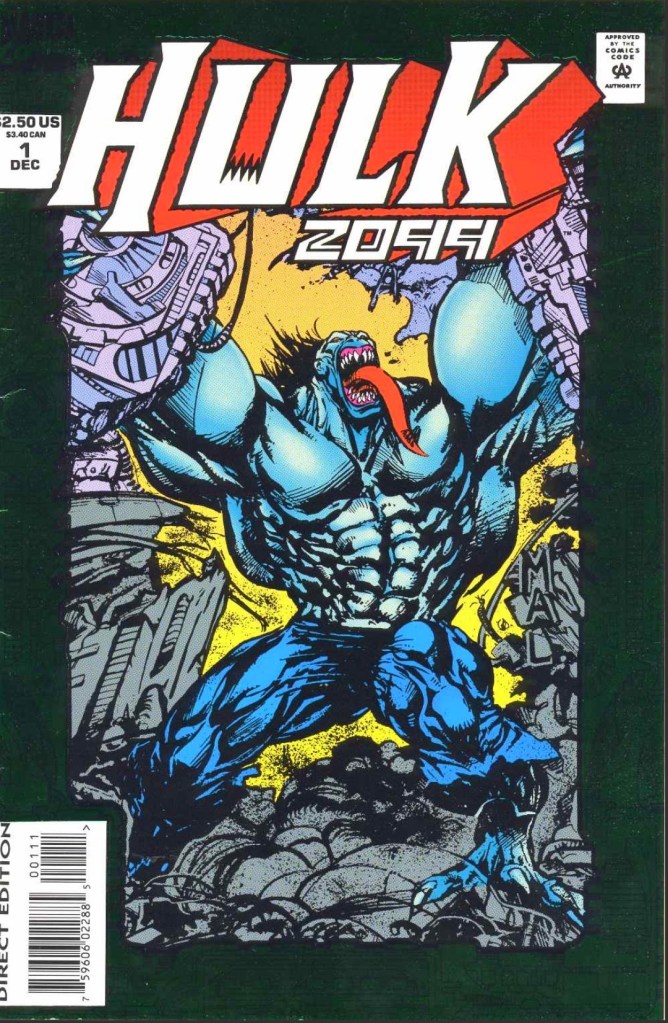
The cover.

Early story

The story begins with the Hulk of 2099 destroying security droids and verbally attacking civilization. As he retains the intellect of John Eisenhart, he expresses his opposition against civilization for keeping people out of the water reclamation zone.

The story then shifts to California where Lotus Entertainment (Eisenhart’s employer) and its crew work on producing a film which is a dishonest telling of Eisenhart’s dealings with the Knights of Banner (already eliminated in 2099 Unlimited ). During the production, one of the executives notices the absence of Eisenhart.

Elsewhere, John Eisenhart drives his flying car with Knights of Banner youth survivor Gawain as his passenger. Already struggling with the guilt over the deaths of all the adult Knights of Banner members, Eisenhart intends to end his employment and cash out of his contract. Gawain remains hostile towards Eisenhart.

Quality

The creative team used flashback images that look really similar to what was told in 2099 Unlimited .

If there is anything that is very obvious to talk about, it is the fact that this tale shows a radically different John Eisenhart who wants to get out of Hollywood’s multiple mazes of crookedness as he feels very guilty over what happened to the Knights of Banner. This happens just as a new entity took corporate control of Eisenhart’s employer before he could leave the company. In many ways, Eisenhart’s distress and struggle with being guilty reminds me a lot about Hardcase of the Ultraverse and the way the creative dramatized him was engaging.

For the story, there is a lot of corporate intrigue going on and Eisenhart’s failure to quit quickly was inevitable because the new enemy he faces here has a lot to do with the sudden takeover of Lotus Entertainment. At least on face value, this looks like an attempt by the creative team to change the status quo and move Hulk 2099 to a new creative direction away from what was established in 2099 Unlimited. Without spoiling the details, I can say that something very significant happened before the comic book’s ending and it will impact readers who followed the futuristic Hulk’s stories closely in the 2099 Unlimited series.

Along the way, there is a lot of action and unfortunate physical happenings which symbolize the chaos concept of the script. The notable thing here is that you won’t see very much of Hulk 2099’s monstrous form as the script was specifically written to tell a tale that went beyond one issue. Clearly, the creative team were sparing Hulk 2099 for a conflict in the next issue.

Malcolm Davis’ art has that visceral aesthetic that fits the established look of Marvel’s 2099 universe of the time but there were instances when he showed so much happening, the visuals looked chaotic and even disorienting. In fairness, his take on Eisenhart, Quirk, Gawain and others made them looked recognizable.

Conclusion

The future of Commiewood, wokeness, and dishonesty.

While its story has little of the green monster in it, Hulk 2099 (1994) does a decent job building up the tension on top of the guilt-filled Eisenhart while setting up events that looked like a bold new creative direction was coming. By the time this comic book was published, several Hulk 2099 tales were already published in the quarterly 2099 series. On its own, this comic book lightly builds up the lore of the 2099 universe as it was clearly focused on Hulk 2099’s creative concept and characters.

While Eisenhart was indeed determined to change, it is a turnoff to see him lie and exaggerate details to protect himself from a certain corporate psychologist who is after the truth. There is also a lot of anti-corporate expressions here which seems to suggest that someone within the creative team had been thinking with socialist concepts and decided to use the script as an outlet of expression. The weird but true thing is that by today’s standards, Hollywood is filled with Commies/socialists/Marxists/liberals/woke nuts from the film crew up to the executives that run studios and produce films or shows that are dumb, lies about reality, self-centered and extensions of their ideologies. This showed that this comic book was prophetic in some ways.

Overall, Hulk 2099 (1994) is satisfactory.

+++++

Thank you for reading. If you find this article engaging, please click the like button below, share this article to others and also please consider making a donation to support my publishing. If you are looking for a copywriter to create content for your special project or business, check out my services and my portfolio. Feel free to contact me with a private message. Also please feel free to visit my Facebook page Author Carlo Carrasco and follow me on Twitter at  @HavenorFantasy as well as on Tumblr at https://carlocarrasco.tumblr.com/ and on Instagram at https://www.instagram.com/authorcarlocarrasco

A Look Back at Freex #15 (1994)

Disclaimer: This is my original work with details sourced from reading the comic book and doing personal research. Anyone who wants to use this article, in part or in whole, needs to secure first my permission and agree to cite me as the source and author. Let it be known that any unauthorized use of this article will constrain the author to pursue the remedies under R.A. No. 8293, the Revised Penal Code, and/or all applicable legal actions under the laws of the Philippines.

Welcome back superhero enthusiasts, 1990s arts and culture enthusiasts and comic book collectors! Today we go back to the wild 1990s and explore a part of Malibu Comics’ Ultraverse through a tale of Freex.  

Since after facing off with Contrary (who eventually became part of UltraForce) and her so-called school and students, Freex had been traveling far and long (refer to my previous Freex reviews here, here and here) and gained Old Man as a useful companion. Along the way, they encountered the unknown deep underground and even saw a powerful being. They even got to the city of Denver temporarily. As they went on, they found the path that led them back to civilization.

With those details laid down, here is a look back at Freex , published in 1994 by Malibu Comics with a story written by Gerard Jones and drawn by Scott Kolins. This is a flip-side comic book with Ultraverse Premiere (1994) on the other side.  

The cover.

Early story

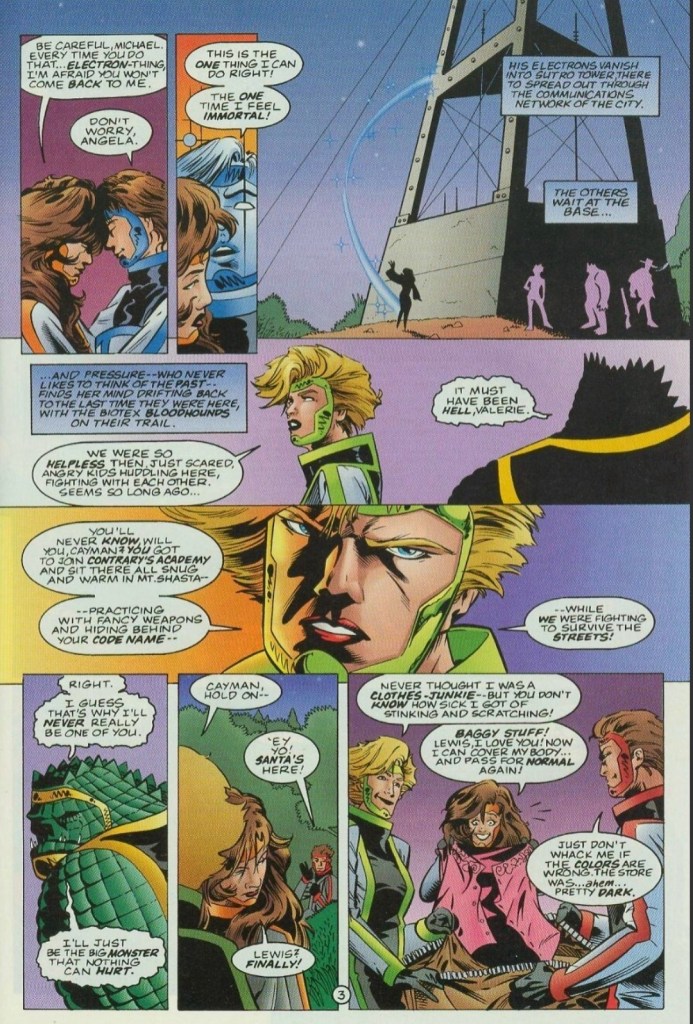
The story begins with Freex – composed of Plug, Sweet-Face, Pressure, Anything and new member Cayman – have been traveling for some time deep underground with Old Man. They find themselves back in San Francisco, the one city that brought them together. While still a long distance away from the city proper and there are no locals who could see them, the team cautiously move to a high communications tower. Michael/Plug uses his special ability to transform himself into electronic matter and makes his way through the communications network of the city to do something very important. Cayman meanwhile becomes the object of discussion between Pressure and Sweet-Face as he has yet to share with them details about himself.

As Cayman himself was part of Contrary’s academy and joined Freex recently, he has trouble gaining the trust of the others. After wearing new clothes that Lewis found, a guy suddenly appears to them. He introduces himself to them as Evan…  

Quality

The very evil Rafferty monitoring Freex secretly and enjoying his advantage over them.

Considering what happened in the previous issues, this story feels like a breath of fresh air not only because of the new location the team got into but also because of strong twists that happened. Instead of going through fantastical encounters, Freex found themselves in situations that are more grounded with reality (within Ultraverse standards specifically) and more notably, the story emphasized crossover as Freex and Old Man encountered Firearm. The said crossover, quite cleverly, sets up Freex into a collision course with the serial killer Rafferty (who encountered The Strangers elsewhere within the Ultraverse). For the newcomers reading this, Rafferty is one of the most evil characters of the Ultraverse who has murdered a lot of people – including his own parents – and has developed tremendous hatred of Ultras.

The inclusion of Rafferty here also sheds light on the Freex’s past connection with the Night Man (click here and here). More notably, the said serial killer turned out to be so resourceful and totally obsessed with murdering people with special abilities, he became a formidable force towards Freex. This leads to a pretty powerful and twisting conclusion that must be seen.  

Conclusion

The gang by the tower.

With a good amount of intrigue, characterization spectacle, strong dialogue and the element of crossover, Freex (1994) is a pretty engaging comic book to read. The biggest feature here is having Freex in a conflict with a very obsessed killer who not only hates Ultras but also has an extensive record of murdering many people over a long period of time. In my view, the Freex-Rafferty conflict was nicely structured and it added depth to the plot. What happened in the end of this comic book should resonate with dedicated fans of Freex.

Overall, Freex (1994) is highly recommended.

+++++

Thank you for reading. If you find this article engaging, please click the like button below, share this article to others and also please consider making a donation to support my publishing. If you are looking for a copywriter to create content for your special project or business, check out my services and my portfolio. Feel free to contact me with a private message. Also please feel free to visit my Facebook page Author Carlo Carrasco and follow me on Twitter at  @HavenorFantasy as well as on Tumblr at https://carlocarrasco.tumblr.com/ and on Instagram at https://www.instagram.com/authorcarlocarrasco

A Look Back at Freex #14 (1994)

Disclaimer: This is my original work with details sourced from reading the comic book and doing personal research. Anyone who wants to use this article, in part or in whole, needs to secure first my permission and agree to cite me as the source and author. Let it be known that any unauthorized use of this article will constrain the author to pursue the remedies under R.A. No. 8293, the Revised Penal Code, and/or all applicable legal actions under the laws of the Philippines.

Welcome back superhero enthusiasts, 1990s culture enthusiasts and comic book collectors! Today we go back to the mid-1990s which was a really wild time for comic collectors. To be more specific, this newest retro comic book review revisits Ultraverse through the exploits of Freex, the monthly series about a group of young adults with unusual capabilities (or abnormalities) who are constantly on the move as they are social outcasts.

In my previous retro review, the Freex (already without Ray but with Cayman from Contrary’s institution as his replacement) continued their search deep underground and encountered the ancient being called Prometheus. Elsewhere, Atalon and his group move nuclear weapons deep underground setting up a major conflict with the nations on the surface. After some struggle and more movement, the Freex find themselves in Denver.

With those details laid down, here is a look back Freex , published in 1994 by Malibu Comics with a story written by Gerard Jones and drawn by Scott Kolins.

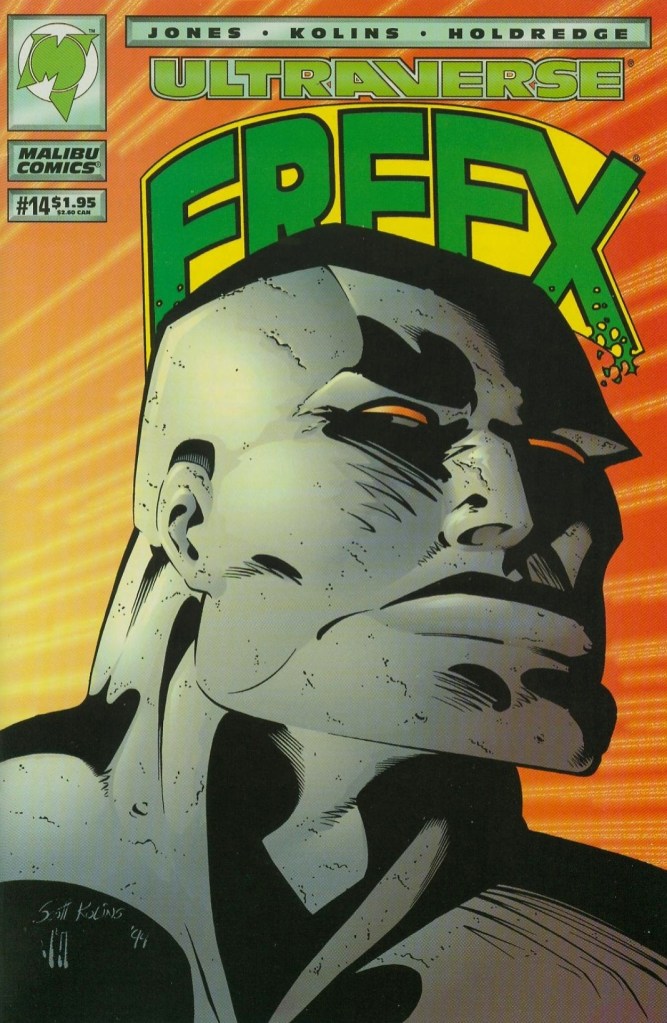
The cover.

Early story

The story begins in Denver, Colorado, where the Freex retreated into a cave dreading the assault by police officers who spotted them. It turns out, the group don’t have only the police to worry about but also the Night Patrol, a group of armed vigilante thugs who hate freaks.

As the Night Patrol start firing at him, Michael realized the protection he got was done by concentrating through the crowns and think about the suits, which he tells his teammates. As the conflict continues, one of the Night Patrol members hits Angela which in turn triggers Michael to take action by using his power to seize control of communications and motility systems and knock down the freak-hating thugs.

Suddenly, one of the Night Patrol members managed to subdue Michael. Valerie tells her teammates to strike back but it turned out unnecessary as the thug falls down. Suddenly, Contrary appears to them…

Quality

Now with Ray back with them, the Freex go back underground.

To get straight to the point, this Freex story is more about the continuing development of the team with the Old Man as their mentor but with one notable turn of events that is not really a spoiler (due to the cover art)…the return of Ray to the team.

While the plot is thinner this time around, the character development was bumped up several notches. As the Freex found themselves cornered with opposition, the reappearance of Contrary (note: she took time away from UltraForce in this particular point of time) resulted in a few notable revelations regarding how she operates, how manipulative she is and how obsessed she is with having young freaks (note: those with powers or those injected with wetware) under her own definition of care, education and nurturing. The way the script was written, this comic book made me wonder if Contrary is insane while still maintaining a good amount of control given her vast resources to organize missions. Just thinking about her organizing UltraForce operations and maintaining her institution for powered students is indeed intriguing.

More on the return of Ray – one of the pioneering members of Freex – his return is not a throwaway portrayal. Rather Ray showed clear signs of maturity apart from learning something from his time at Contrary’s institution. Morever, Ray shows he has a big heart from his teammates. This alone added some emotional impact to the end of the comic book.

Conclusion

A quick appearance of UltraForce within this Freex tale.

Freex (1994) does not have a deep story to tell, has little in terms of superhero spectacle and it recycled some misadventure elements from the previous issue to move the plot forward. The most defining things in this comic book are the respective returns of Ray and Contrary which added nicely to the character development. Any solid Freex fan will have something to enjoy, especially if they continue loving the main characters.

Overall, Freex (1994) is recommended.

+++++

Thank you for reading. If you find this article engaging, please click the like button below and also please consider sharing this article to others. If you are looking for a copywriter to create content for your special project or business, check out my services and my portfolio. Feel free to contact me with a private message. Also please feel free to visit my Facebook page Author Carlo Carrasco and follow me on Twitter at  @HavenorFantasy as well as on Tumblr at https://carlocarrasco.tumblr.com/ and on Instagram at https://www.instagram.com/authorcarlocarrasco/

A Look Back at Ultraverse Year One (1994)

Disclaimer: This is my original work with details sourced from reading the comic book and doing personal research. Anyone who wants to use this article, in part or in whole, needs to secure first my permission and agree to cite me as the source and author. Let it be known that any unauthorized use of this article will constrain the author to pursue the remedies under R.A. No. 8293, the Revised Penal Code, and/or all applicable legal actions under the laws of the Philippines.

Welcome back superhero enthusiasts, 1990s culture enthusiasts and comic book collectors! Today we go back to the mid-1990s which was a pretty wild time for comic collectors. To be more specific, this newest retro review revisits the Ultraverse through a comic-like publication in the form of a guide meant for UV fans and comic collectors.

The subject at hand is Ultraverse Year One which, as written on the edge of the front cover, was designed to be the “complete guide to the Ultraverse’s first year.” It is a reference guide for those who seriously want to discover each and every Ultraverse comic book that was published during its first year. In my experience as a comic collector, the Ultraverse launch in 1993 was very memorable even though my financial limitations prevented me from acquiring each and every launch comic book and subsequent releases of the time. How useful is this complete UV guide? We can go on and find out.

With those details laid down, here is a look back at Ultraverse Year One, published in 1994 by Malibu Comics.

The cover.

Quality

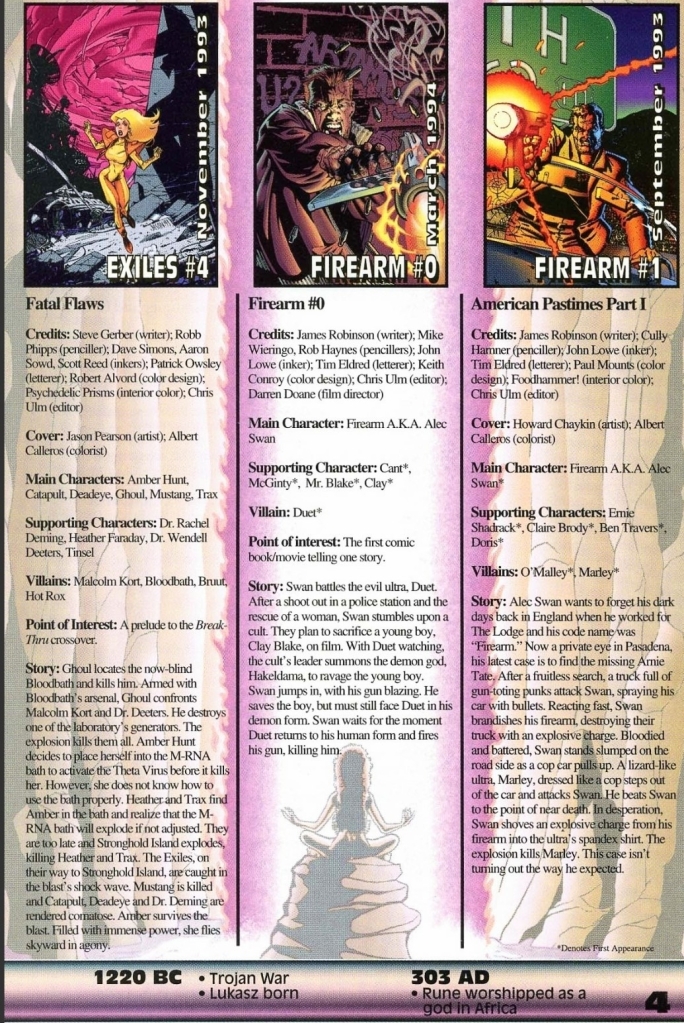
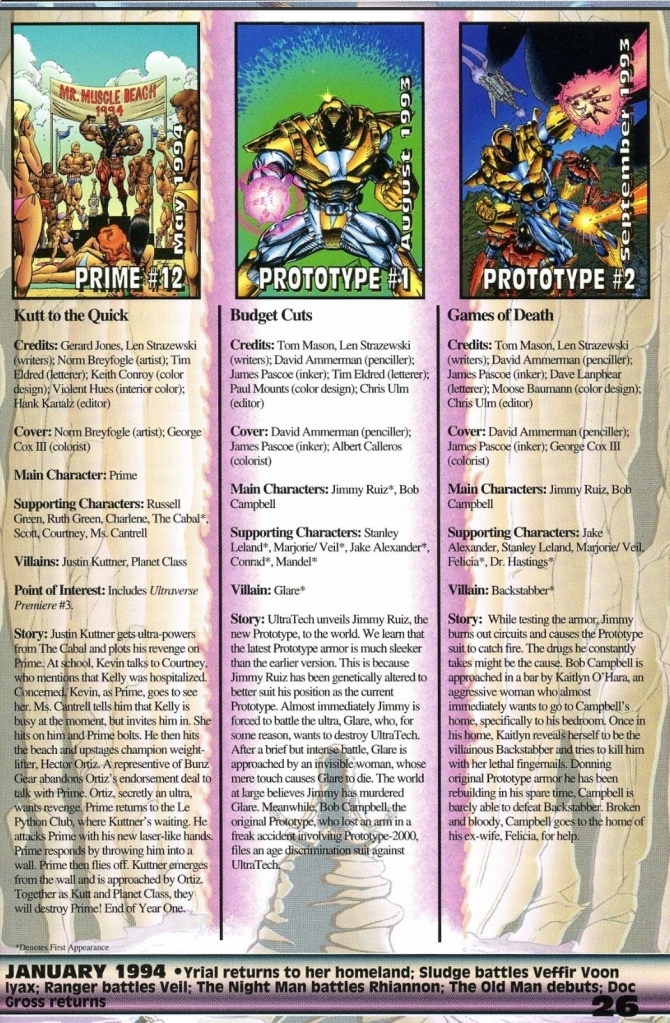
I can say without a doubt that this publication is indeed a complete guide to each and every Ultraverse comic book released during its first year from 1993 to 1994 specifically. You want to know exactly how many issues of Mantra, Prime, Hardcase, The Solution, Prototype, The Strangers and others were published in the first year? This one has it all listed! You want to know which UV comic book involved the talents of Steve Gerber, Norm Breyfogle, Rick Hoberg, Len Strazewski, Aaron Lopresti, George Perez, James Hudnall, Gerard Jones, Steve Englehart, Tom Mason, Terry Dodson, James Robinson, Howard Chaykin, Mike W. Barr and many others under the Malibu Comics banner? This guide has it all listed! What months were Exiles #1, Sludge #1, Firearm , Break-Thru #1 and Mantra #1 were published? The answers to each are included. The same can also be said when it comes to which characters appeared in each comic book.

This is what each page typically looks like with details of the Ultraverse timeline on the lower part.
The timeline reveals that the male warrior Lukasz, who would later end up in woman’s body as Mantra/Eden Blake, was born in 1220 BC.

Very clearly, the Malibu Comics people worked hard to collect the essential types of information, organized them and put them all into print media form for readers and collectors to use when it comes to searching just about everything about the Ultraverse’s first year. Things did not just stop there, however.

What I found amusing to look at in each page of this Ultraverse guide are details of the shared universe’s timeline posted on the lowest part. The said timeline – which is limited to text and numbers – reveal interesting details such as what year was Lukasz (AKA Mantra) born, when did Rune begin, when was the Choice corporation established, what year did the island of Yrial’s people move up to the clouds, what years were infants injected by Wetware Mary and more. These details are actually quite encouraging to make readers discover or re-read Ultraverse comic books to see how they are dramatized on paper.

Conclusion

As you can see in the details above, Len Strazewski was involved in both the Prime and Prototype comic book series.

Ultraverse Year One (1994) is a pretty detailed guide that will not only help readers track down each and every UV comic book of the mentioned time period, but also help them spot the precise comic books that has characters included as well as the published works of varied comic book creators. If you are really determined to track down and buy all the Year One UV comic books, this guide is a must-have. If there are any weaknesses to mention, it would be the fact that each comic book’s entire plot got summarized in full which are actually spoilers.

Overall, Ultraverse Year One (1994) is recommended.

+++++

Thank you for reading. If you find this article engaging, please click the like button below and also please consider sharing this article to others. If you are looking for a copywriter to create content for your special project or business, check out my services and my portfolio. Feel free to contact me with a private message. Also please feel free to visit my Facebook page Author Carlo Carrasco and follow me on Twitter at  @HavenorFantasy as well as on Tumblr at https://carlocarrasco.tumblr.com/ and on Instagram at https://www.instagram.com/authorcarlocarrasco/

A Look Back at Freex #13 (1994)

Disclaimer: This is my original work with details sourced from reading the comic book and doing personal research. Anyone who wants to use this article, in part or in whole, needs to secure first my permission and agree to cite me as the source and author. Let it be known that any unauthorized use of this article will constrain the author to pursue the remedies under R.A. No. 8293, the Revised Penal Code, and/or all applicable legal actions under the laws of the Philippines.

Welcome back superhero enthusiasts, 1990s culture enthusiasts and comic book collectors! Today we go back to the mid-1990s which was a really wild time for comic collectors. To be more specific, this newest retro comic book review revisits Ultraverse through the exploits of Freex, the monthly series about a group of young adults with unusual capabilities (or abnormalities) who are constantly on the move as they are social outcasts.

In my previous retro reviews of Freex, the team encountered Contrary (who later became a significant part of UltraForce) and her so-called school of gifted children. Subsequently, they left Contrary’s lair but without Ray who decided to stay behind. Freex, who gained a new member in replacing Ray, went underground encountering Prime and a lone individual called Old Man. After separating from Prime, the team move further underground with Old Man and discovered a lot of things they never expected.

With those details laid down, here is a look back Freex , published in 1994 by Malibu Comics with a story written by Gerard Jones and drawn by Scott Kolins.

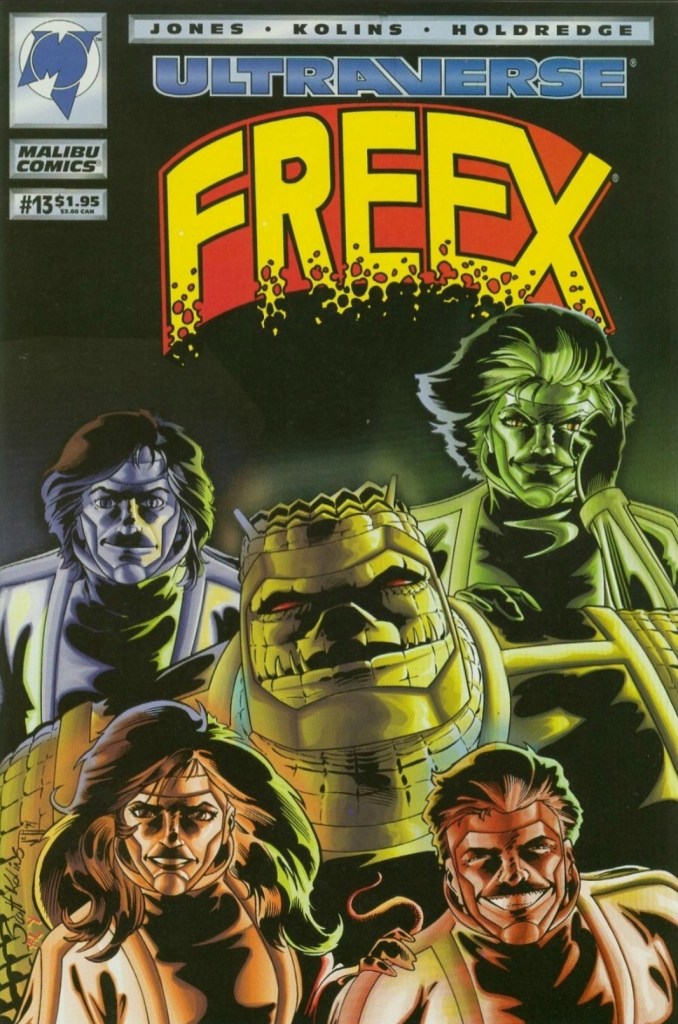
The cover.

Early story

The story begins deep under the Earth’s surface wherein the Freex – AJ, Angela, Michael, Valerie and new member – and Old Man encounter a huge and intimidating sentient being which has the head and tusks of an elephant. The being calls itself Prometheus and claims that he has lived underground for a very long time, created new beings and saw the development of settlements that the people on the surface are not even aware of.

Intriguingly, he reveals to the Freex that he created the substance that were injected by a certain nurse into the bodies of each team member when they were still infants which later manifested into the capabilities and abnormalities they now have…

Quality

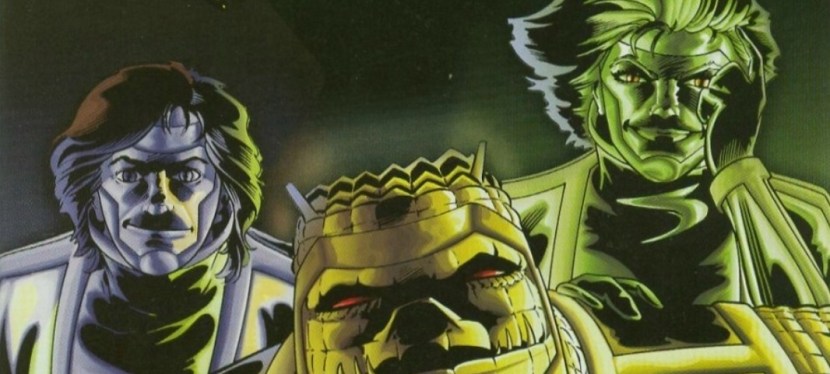
This short scene about Atalon and his army is a prelude to the Atalon storyline in the early issues of UltraForce.

The most significant aspect about this comic book’s story is the clever approach taken by the creators to not only show the further development of Freex but also emphasize and expand the lore of the Ultraverse while connecting this series to UltraForce (the early issues written by Gerard Jones and drawn by the late George Perez) which itself had a great conflict between Atalon’s forces and Earth’s governments. To put it short, this Freex tale is a prelude to the events seen in UltraForce #0, UltraForce and the rest of the Atalon saga. The good news is that the emphasis of in-universe connection (as opposed to crossovers) was done well and nicely structured.

More on the Freex themselves, the revelation that the members’ powers were the result of being injected (by Wetware Mary) into them with the substance created by Prometheus resulted in dramatic reactions from them which also adds to the tension of their current misadventure together so far away from society. The revelation also added tremendous weight into the series’ narrative raising questions such as the following: Wow will each Freex member reintegrate into society as they know the truth about what caused them to have powers/abnormalities? Where will they go once they made it back to the surface? Will they keep secret the existence of Prometheus?

In relation, the creative team took their time to develop each member’s personality and emotions. Most notable was the portrayal of the new friendship between Valerie and their new member (indoctrinated by Contrary) which hints that something significant could happen to not only themselves but to the team itself.

What also struck me in this comic book was the way the 2nd half of the story was presented…by becoming really wild and crazy. Eerily, the confusion felt by Freex during the 2nd half was something I as a reader felt. To find out what I’m talking about, I urge to get a copy of this comic book and read it yourselves.

Conclusion

This page revealed more about the origins of the Freex members.

While the 2nd half of the story had a crazy ride, I still found Freex (1994) to be really engaging and intriguing mainly on the big revelation and UltraForce connections told in the first half. At this stage in the series, it really looked like that the team was on its way into the unknown as their own place within the Ultraverse really widened (similar to what happened on the part of The Solution in issues #10, #11 and #12).

Overall, Freex (1994) is recommended.

+++++

Thank you for reading. If you find this article engaging, please click the like button below and also please consider sharing this article to others. If you are looking for a copywriter to create content for your special project or business, check out my services and my portfolio. Feel free to contact me with a private message. Also please feel free to visit my Facebook page Author Carlo Carrasco and follow me on Twitter at  @HavenorFantasy as well as on Tumblr at https://carlocarrasco.tumblr.com/ and on Instagram at https://www.instagram.com/authorcarlocarrasco/