Retro Gaming Ads Blast – Part 30 (Star Wars Special)

Welcome back readers, fellow geeks and electronic gaming fans!

In this edition of the Retro Gaming Ads Blast (RGAB) series, we will take a look at another batch of retro gaming print ads – including arcade flyers – from the 1980s and 1990s but with focus on Star Wars games that were released during the era of George Lucas. This is the Star Wars Special of RGAB.

For the newcomers reading this, Retro Gaming Ads Blast (RGAB) looks back at the many print ads of games (console, arcade, computer and handheld) that were published in comic books, magazines, flyers, posters and newspapers long before smartphones, social media, the worldwide web and streaming became popular. To put things in perspective, people back in the 1980s and 1990s were more trusting of print media for information and images about electronic games and related products.

With those details laid down, here is the newest batch of retro gaming print ads for you to see and enjoy…

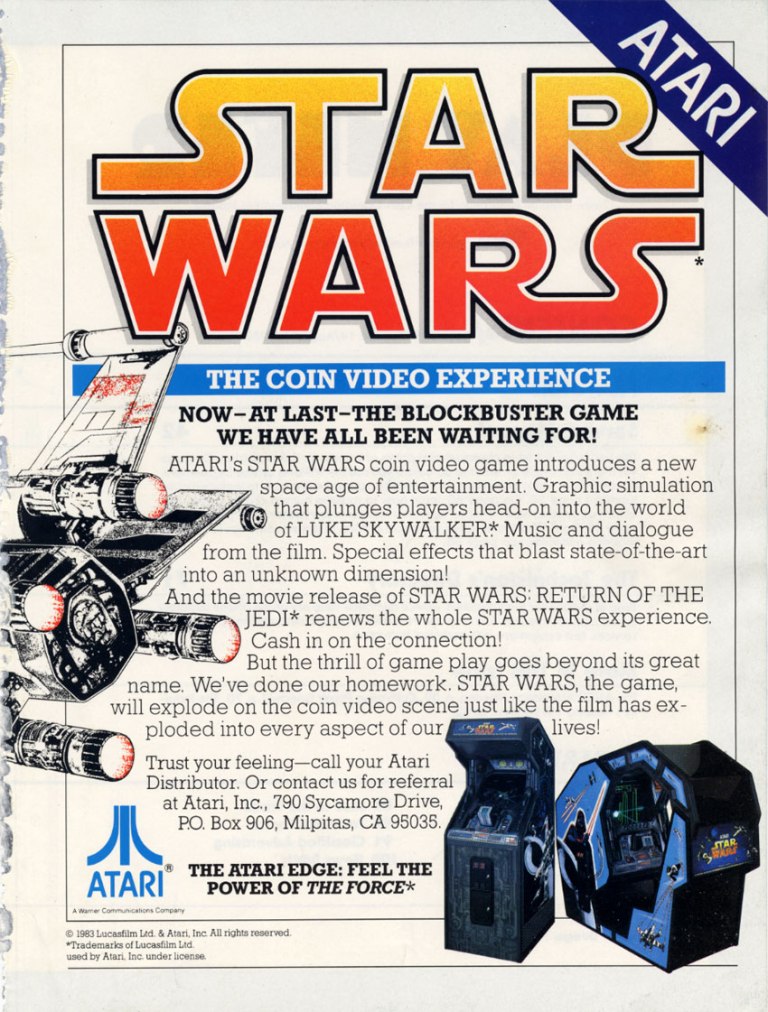
1. 1983 Star Wars arcade game flyer
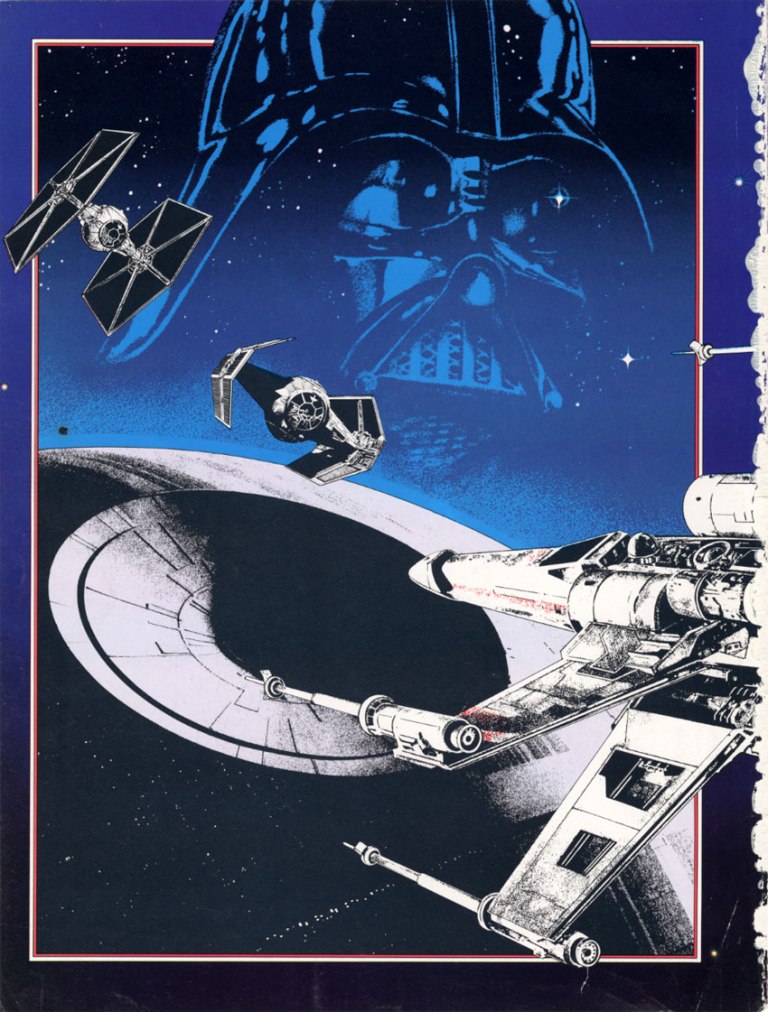
The front of the flyer.
The rear of the flyer.

Just weeks before the Star Wars movie Return of the Jedi was released in cinemas in 1983, Atari released the Star Wars arcade game which became a tremendous hit around the world. Both Star Wars fans and gamers of the time loved the game as it provided a very immersive and fun-filled arcade experience. The print ad Atari released has a nice artwork on the front (showing a portion of the Death Star, two TIE Fighters, a Rebel X-Wing Fighter and Darth Vader’s image) and the text description plus the pictures of two arcade machines on the back. While no screenshots were shown, the print ad still had strong visual impact to catch the attention of players and arcade operators. This arcade flyer still looks great!

2. Star Wars: Return of the Jedi – Death Star Battle Atari 2600 print ad
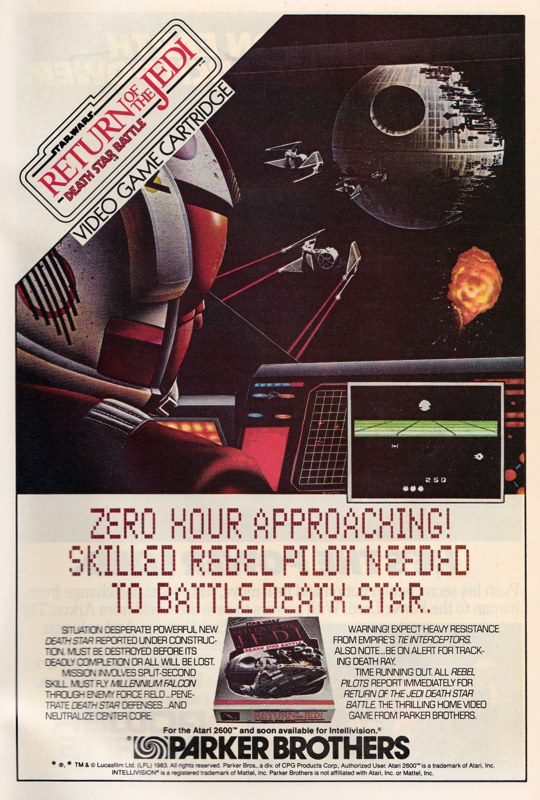
Parker Brothers really stood out among publishers of games on the Atari 2600 and they even had the Star Wars license.

Considering the massive success that Star Wars and The Empire Strikes Back had in cinemas, merchandising and other entertainment media, it was not surprising that games based on Return of the Jedi were produced. For the Atari 2600, Parker Brothers produced Star Wars: Return of the Jedi – Death Star Battle which my friends and I played a lot in 1983. The print ad Parker Brothers came up with has a very eye-catching design showing a Rebel pilot flying a space ship (supposedly the Millennium Falcon which is the only playable ship in the game) towards the Death Star. The visual design is a stroke of genius because it appeals strongly to Star Wars fans while highlighting a major battle in the film which influenced the core concept of the game. This is a classic Star Wars game ad.

3. Star Wars Arcade Japanese market flyer
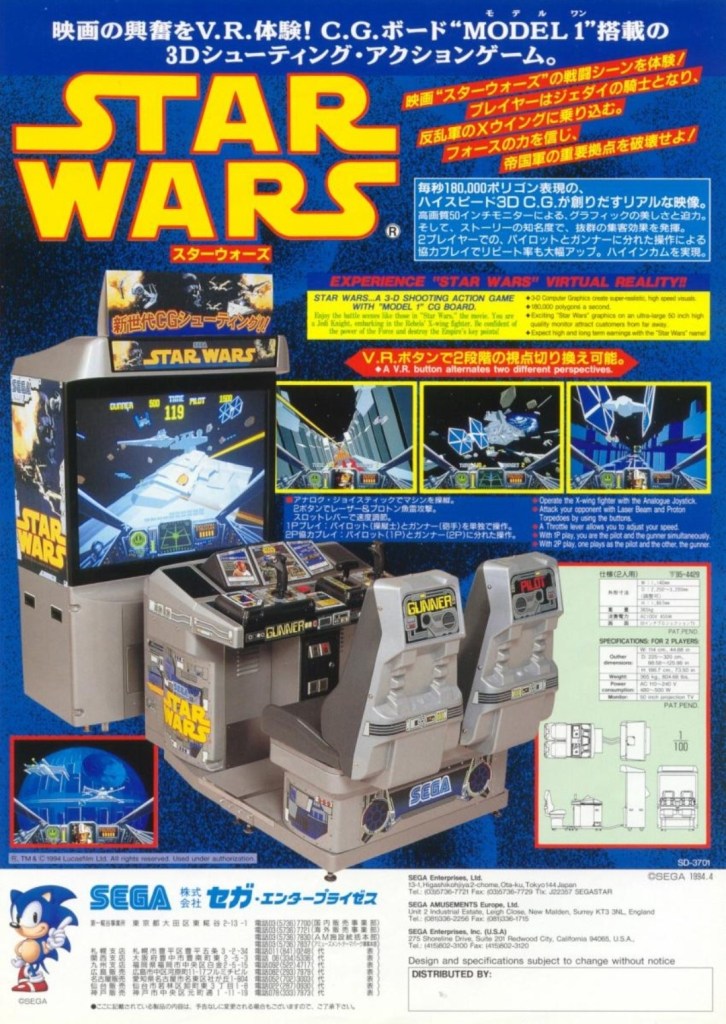
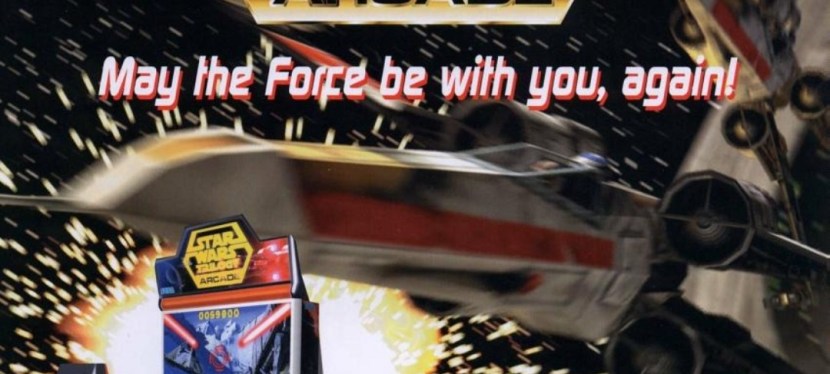
This arcade game was one of the first fully polygonal Star Wars games released.

In the 1990s, Sega acquired the license to produce Star Wars games for the arcades and they had the hardware for polygonal graphics. In 1993, the released Star Wars Arcade which is a space shooter that offered gamers the freedom to fly their Rebel space ship in 3D space with environments and huge space ships rendered in polygons. As you can see in the arcade flyer for the Japanese market, Sega went hard with their presentation showing 3 carefully selected screenshots (amazing for the time) and a picture of the arcade machine which had an elaborate control set-up, seats and decorations. As Star Wars Arcade was released more than a year before the polygonal game consoles Sega Saturn and Sony PlayStation hit the market, this arcade flyer was mind-blowing to gamers who were on the verge of playing video games with polygonal visuals.

4. Super Star Wars print ad
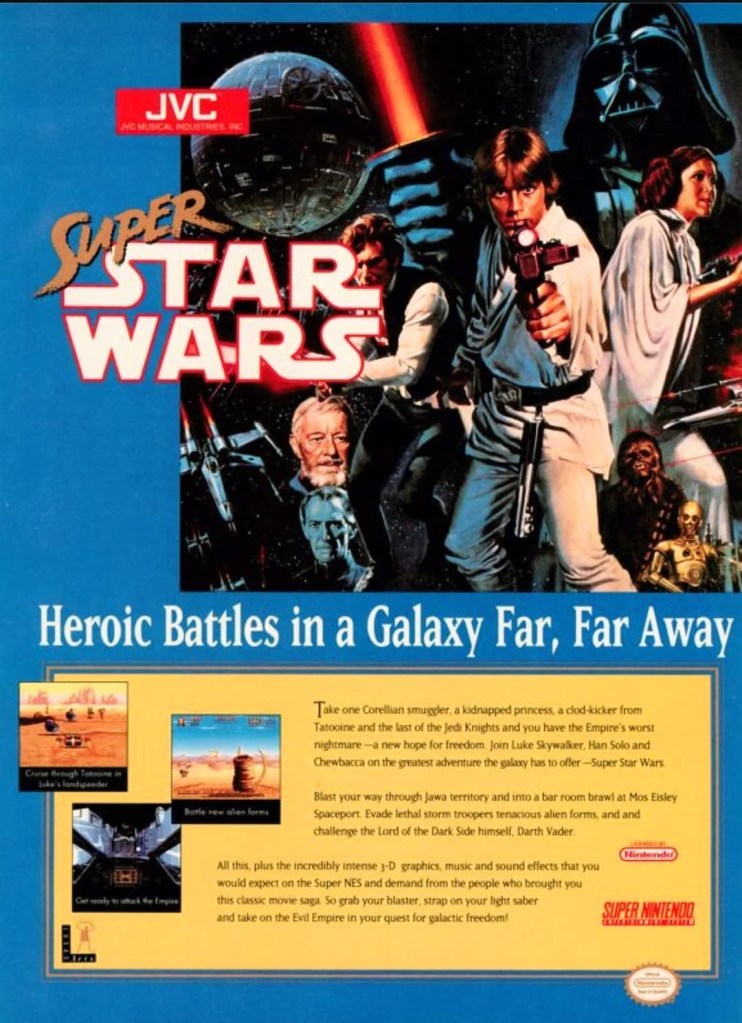
Yes, JVC was involved with the Super Star Wars trilogy starting with this one.

In 1992, Star Wars fans who enjoyed playing 2D side-scrolling games saw their dream of the next great Star Wars console experience come true when Super Star Wars was released on the Super Nintendo Entertainment System (SNES). With the SNES technology, more detailed visuals and improved audio brought the Star Wars universe to life and the addition of 3D-like playable sequences (made possible by Mode 7 effects) made Super Star Wars a very unique console experience. The print ad only showed three screenshots and three paragraphs of descriptive text but the use of images from the 1977 movie poster added a lot of punch to the visual presentation. This ad is both eye-catching to gamers and long-time Star Wars fans.

5. Star Wars: TIE Fighter print ad
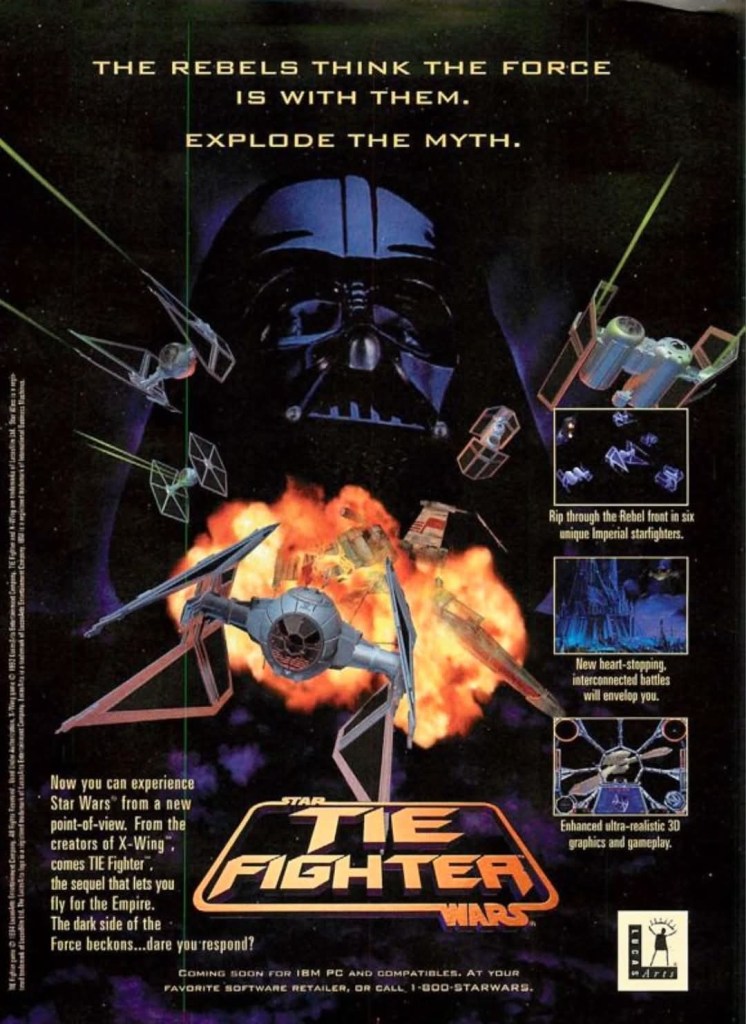
This game offered gamers the opportunities to be with the dark side.

In 1994, LucasArts released Star Wars: TIE Fighter which offered gamers the opportunity to play an Imperial pilot serving Darth Vader on missions set between The Empire Strikes Back and Return of the Jedi. This print ad has a sharp visual design enhanced by Darth Vader’s iconic look in the background. The selected screenshots shown were good to look at but the artwork used to present the TIE Fighters really stood out. This solid looking print ad does come with a bit of disturbance as the Galactic Empire in Star Wars lore are evil.

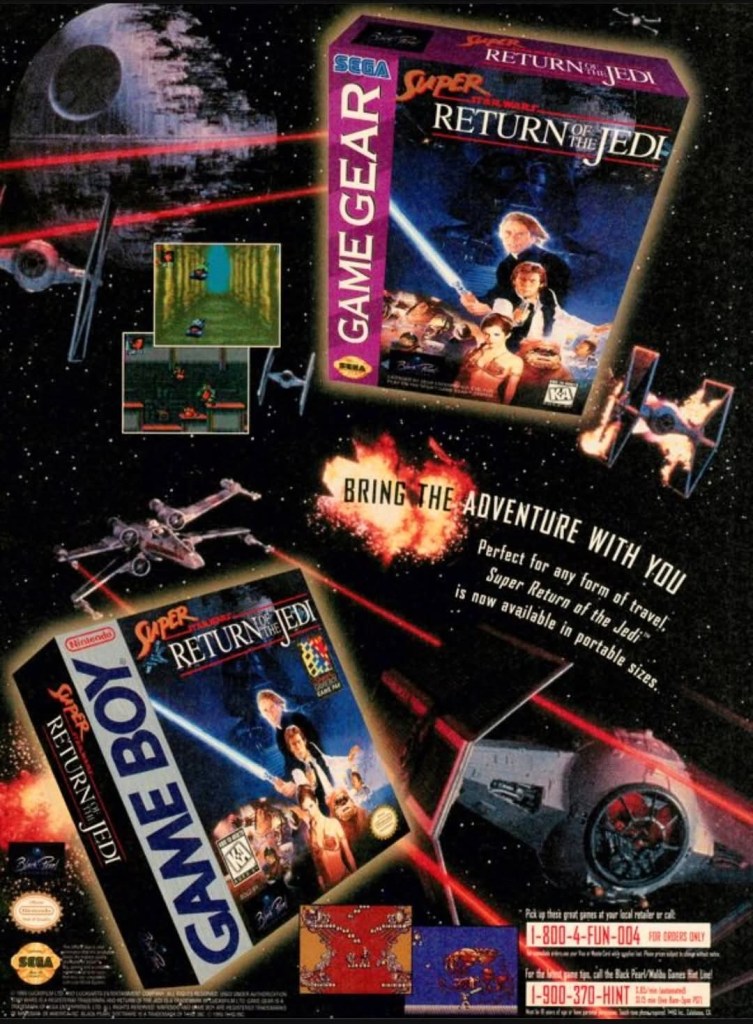
6. Super Star Wars: Return of the Jedi print ads
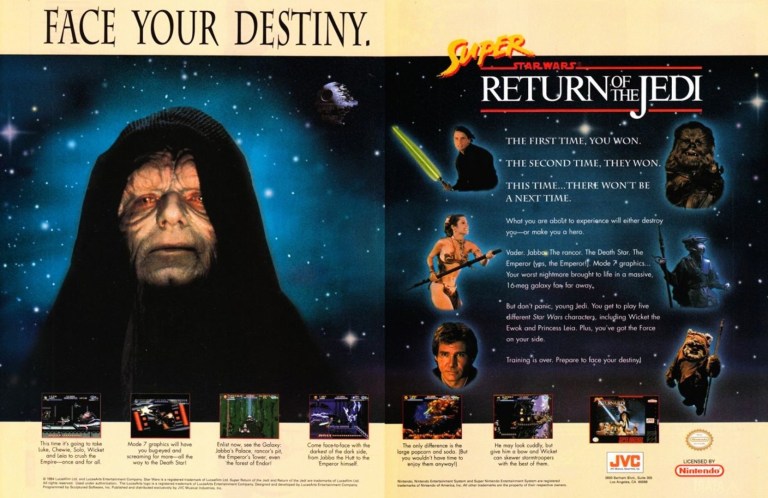
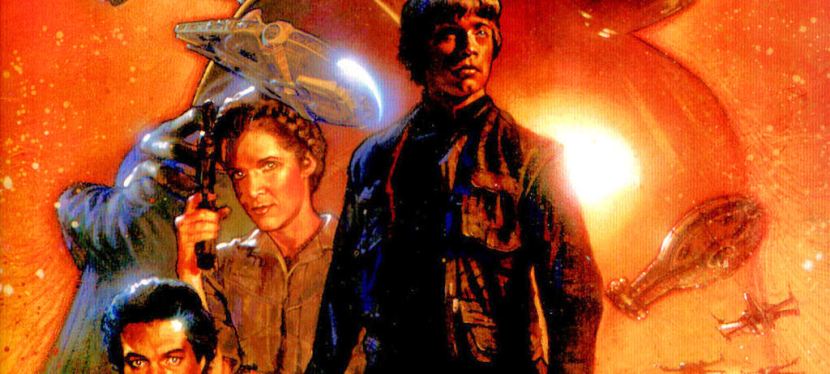
Nothing like seeing Harrison Ford, Carrie Fisher and Mark Hamill as the Star Wars icons on a video game ad.
I never played the portable editions of Super Star Wars: Return of the Jedi. Have you?

As far as gaming on the SNES was concerned, the Super Star Wars trilogy of games really kept fans and casual gamers busy. By the time Super Star Wars: Return of the Jedi was released in 1994 on the SNES, there was already immense speculation about the Star Wars prequel trilogy and George Lucas himself started writing them that same year. The 2-page print ad of the game on SNES had a creepy photo of Emperor Palpatine on one side, the other characters on the other side, and six selected screenshots displayed on the lower part. The way the print ad was design reflects that the game is the end of the trilogy like the 1983 film itself. Super Star Wars: Return of the Jedi was also released on Game Gear and Game Boy and the ad makers made the right decision to use the Death Star and space battle image as the background so that the portable games would stand out.

7. Star Wars: Masters of Teräs Käsi print ad
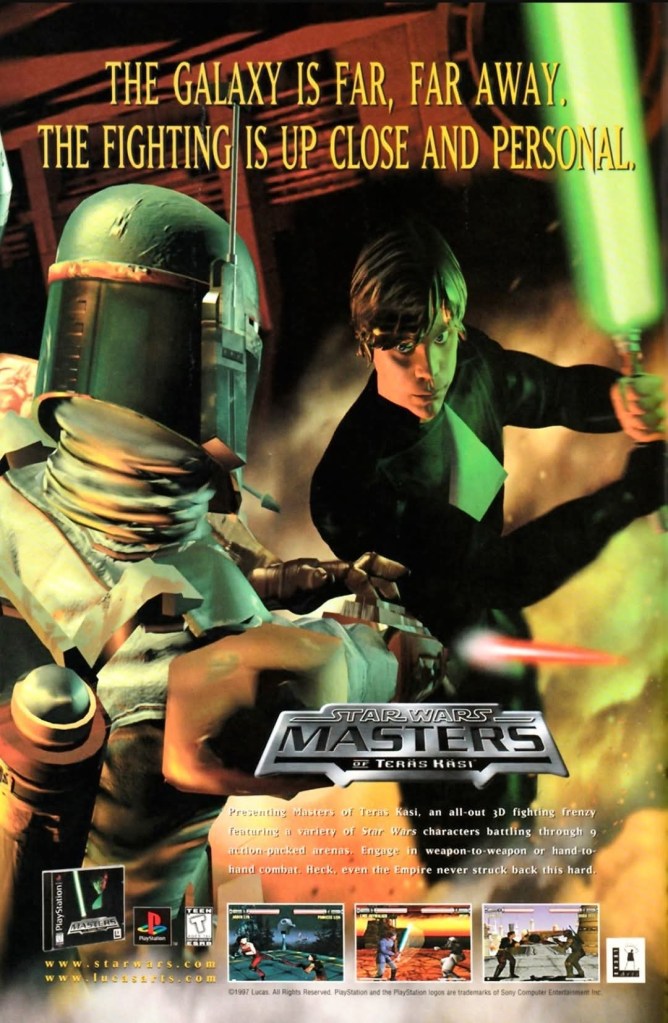
I wonder if George Lucas ever regretted approving this Star Wars fighting game. It was so rough and unpolished with its quality.

If there is any sub-par Star Wars game released in the 1990s, it is none other than Star Wars: Masters of Teräs Käsi on the PlayStation. The 1997 game was LucasArts’ attempt to cash in on the booming fighting games genre and they took a huge risk of making it entirely polygonal. Instead of using photographs or hand-drawn art, the ad makers used a fully rendered 3D polygonal models of Luke Skywalker and Boba Fett which was alienating to look at. In fact, those polygonal models looked very different from the in-game polygonal models of Skywalker and Boba Fett presented during gameplay. This print ad is a sad reminder about an ill-conceived concept for Star Wars that materialized into an actual product.

8. Star Wars: Shadows of the Empire print ad
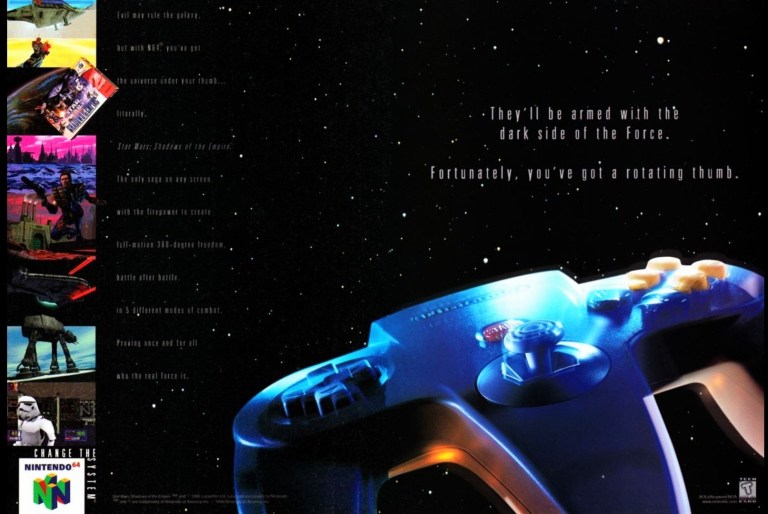
If you have read the novel, were you able to play this video game?

LucasArts and Nintendo teamed up with something ambitious – a video game adaptation of Star Wars: Shadows of the Empire that was released exclusively to the Nintendo 64 (N64). Released in late 1996, Star Wars: Shadows of the Empire was part of the multimedia entertainment project of the same name and it is the result of LucasArts’ decision to be an early adopter of the N64 for business-related reasons. The 2-page print ad shown here has a dark, star-filled background which captivating screenshots on the left and the N64 controller standing out. This print ad strongly expresses that gamers would need the N64 in order to play Star Wars: Shadows of the Empire in the comfort of home.

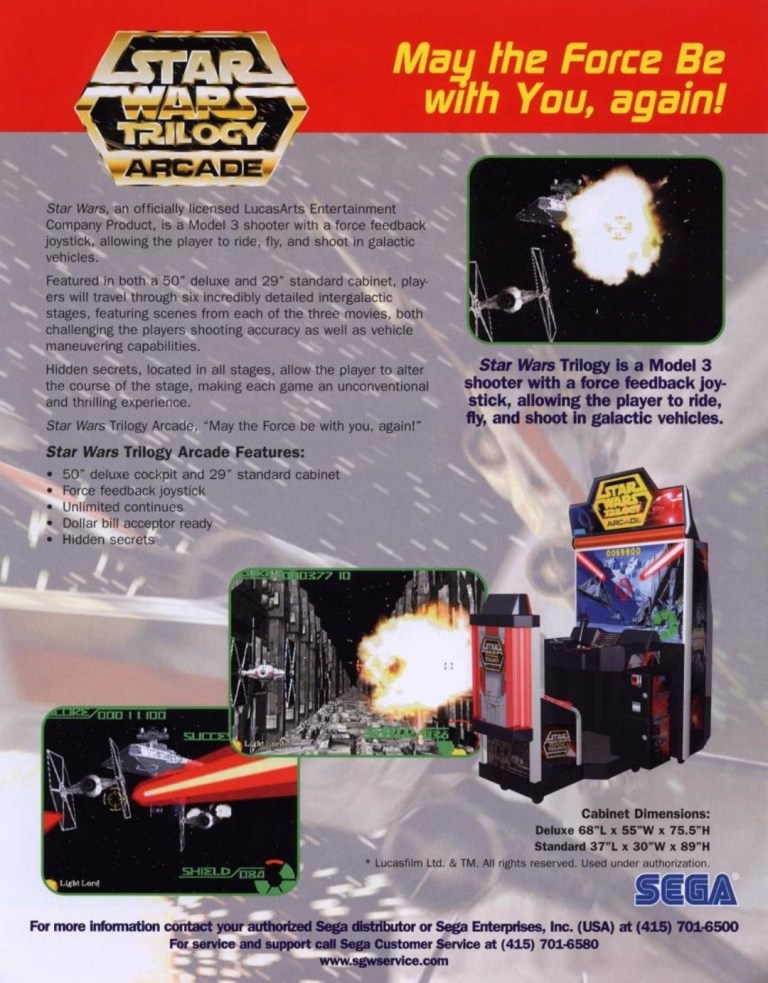
9. Star Wars Trilogy arcade flyer
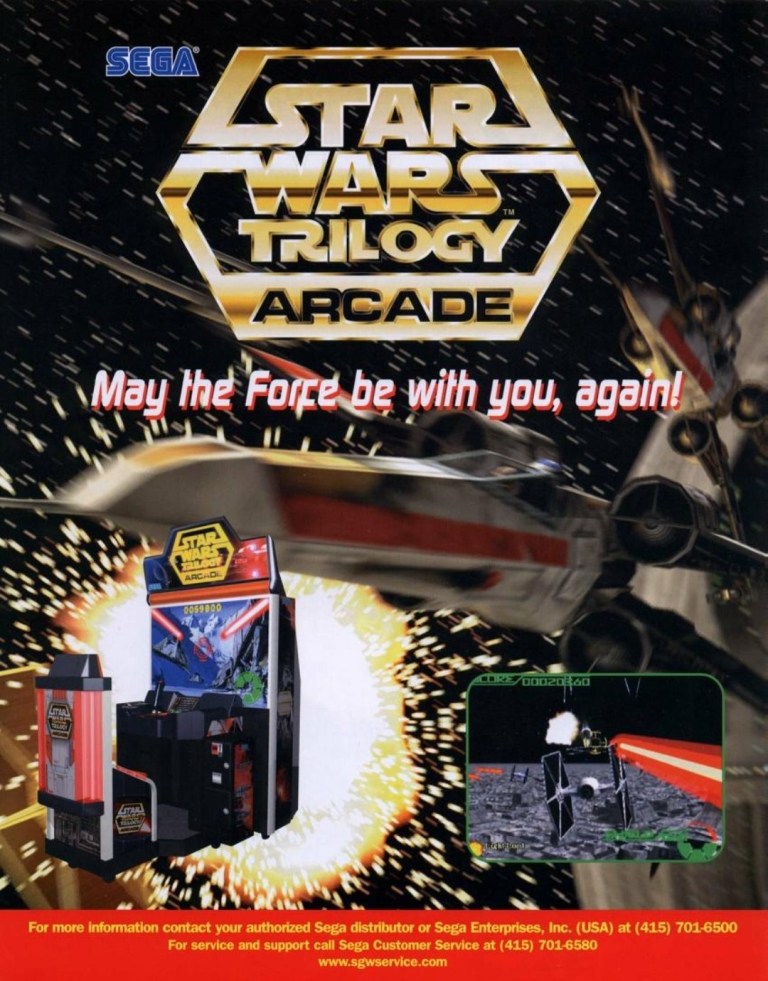
The front.
The other side.

Before the Star Wars Prequel trilogy started with The Phantom Menace, Sega came out strongly by releasing Star Wars Trilogy Arcade in arcades around the world. Released in 1998, the game was arguably Sega’s most ambitious Star Wars-licensed game ever as it was made with the powerful Model 3 hardware, it came with unique controls and the game was designed as a polygonal rail shooter focused on key segments from the original trilogy of films. Sega wisely used dynamic artwork for the front of the flyer giving viewers the impression that the X-Wing fighter was approaching them closely. At the rear, three screenshots only showed space battles which was a wise decision by Sega to keep the surprise intact for gamers until they play the game. Having played this in the arcade myself, I can assure you that Star Wars Trilogy Arcade has more varied types of gameplay and challenges. It’s a lot more than flying and shooting in space, and it has a lot of stuff that Star Wars fans will love.

+++++

Thank you for reading. If you find this article engaging, please click the like button below, share this article to others and also please consider making a donation to support my publishing. If you are looking for a copywriter to create content for your special project or business, check out my services and my portfolio. Feel free to contact me with a private message. Also please feel free to visit my Facebook page Author Carlo Carrasco and follow me on Twitter at  @HavenorFantasy as well as on Tumblr at https://carlocarrasco.tumblr.com/ and on Instagram at https://www.instagram.com/authorcarlocarrasco
Retro Gaming Ads Blast

Welcome back readers, fellow geeks and electronic gaming fans!

Today I am launching a brand-new series of articles titled Retro Gaming Ads Blast (RGAB) which will explore the many print ads and promotions of video games, computer games, arcade games and handheld games that were published through the decades.

For the newcomers reading this, print ads of games were widely popular and heavily relied on by gamers/players long before smartphones, social media, the worldwide web and online videos even started. Back in the old days, print media was the most common method for companies to market their games while also helping hardware (machines which played the games) reach potential buyers. Such ads appeared in magazines, comic books and newspapers. Not only that, there were several print ads of games that were made to look creative, compelling and even intriguing.

With those details laid down, here is the first batch of retro gaming print ads for you to see and enjoy…

1. Parker Brothers’ Spider-Man-led print ad

Does this ad look amusing?

Remember Parker Brothers? That was a company that started way back in 1883 founded with a strong focus on the enjoyment of games in the form of board games, cards and toys. In the late 1970s, Parker Brothers started making electronic versions of their popular board games and engaged in the video game development and publishing. They also went on to make home ports of popular arcade games in the early 1980 for several gaming platforms.

Parker Brothers was very active with making games for the Atari 2600 console which became the dominant machine for home gaming in North America in 1982. In the above print ad, their marketing heavily emphasize the Spider-Man video game for Atari 2600 and added two others games they also published – Tutankham and Amidar – which was a clever move to market multiple games. The ad’s focus on Spider-Man was amusing and even without showing a single screenshot of the game, it was enough to entice people to watch out for it. Be aware that the Spider-Man game’s development was done by Laura Nikolich who was hired by Parker Brothers at a job fair. Nikolich had full creative control on making the game and had no contact whatsoever with Marvel Comics.

2. Advanced Dungeons & Dragons: Cloudy Mountain print ad

An ad like this was strong enough to motivate gamers’ imagination and interest.

Back in 1982, Advanced Dungeons & Dragons: Cloudy Mountain was released on the Intellivision game console and I was fortunate enough to watch my next-door neighbor play it repeatedly. The above print ad – which simply referred to the game as Advanced Dungeons & Dragons – only had a few words which directly pointed to the main objective of the game…the golden crown. While only one screenshot of the game was displayed, the advertisers heavily relied on hand-drawn, comic book-style fantasy art work to sell the game.

For those who were born long after the 1980s, let me share with you that ads like these were really impressive for their time. It was common for advertisers to use art works (even though they may not accurately reflect the gameplay or game design) and post at least one screenshot to catch the viewer’s attention with the hope that it would even encourage him/her to anticipate the game. It should be noted that ads like these were strong enough to make gamers’ imagination or curiosity grow stronger.  

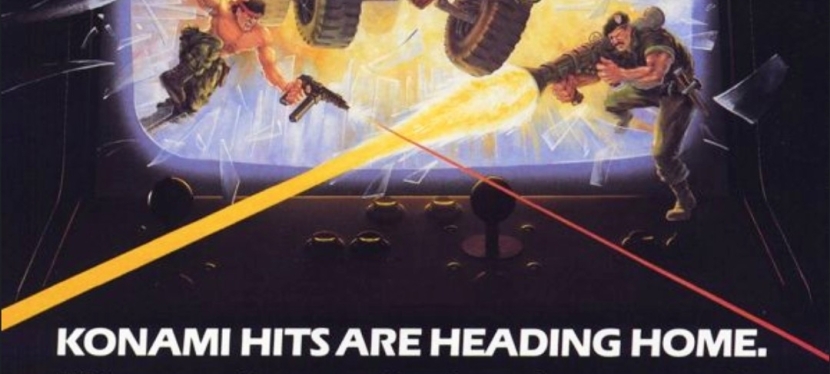
3. Konami’s collective military video games advertising

Print ad of four games for IBM, Amiga and Commodore.
Print ad of Jackal and Contra for the NES.

Konami, the Japanese company that has long been known for Metal Gear, Suikoden and the controversial sacking of famous game designer Hideo Kojima, was aggressive in the gaming business in the 1980s and arguably the aggressiveness was reflected in their publishing of several games that emphasized militarism during the late stages of the Cold War. In short, they made the military look cool and their activities fun to do in digital form.

While Konami has always been identified with console gaming, they actually released Rush’n Attack, Contra, Jackal and Boot Camp on IBM, Amiga and Commodore computers (as seen in the first print ad above) which were popular in the 1980s. The said ad also have a very amusing visual concept emphasizing the excitement and fun of military action games coming to gamers at home for their computers.

The 2nd print ad above – Jackal and Contra for the Nintendo Entertainment System (NES) – was very intriguing to see. It was very clear back in the 1980s that the NES always had a wholesome audience (note: a lot of buyers were parents who wanted to entertain their kids at home) and that includes a lot of very young players. To see the collective ad of Jackal and Contra (for the NES platform) having battle-hardened men in military gear holding guns was openly aggressive to perceive and instantly reminded people about the Cold War (and the menace of Communists, socialists, Marxists and terrorists) and the cultural impact of the mega blockbuster film Rambo: First Blood Part II. This is the kind of ad that would drive today’s woke-minded people crazy and even cause them to panic and pretend to be victims of militarism and patriotism. If you look at the ad closely, you will realize there is simply no room for the garbage of political correctness and wokeness.

Lastly, I myself had played Contra and Jackal with my friends on the Nintendo Family Computer (the Japanese counterpart of the NES) and both military games were a lot of fun to play from start to finish!

4. Batman Returns SNES game ad

This print ad appeared in some comic books I read in the early 1990s.

Way back in 1992, Batman Returns (the sequel to the mega blockbuster Batman movie of 1989) was released in cinemas with intense marketing and merchandising reflecting Warner Bros. intention to replicate the commercial success they had in 1989. Along the way, there were several video game adaptations of Batman Returns that were released on different platforms. Among those many video games was the Super Nintendo Entertainment System (SNES) game of Batman Returns which was developed and published by Konami in 1993 the form of a side-scrolling beat-them-up game.

The above ad was visually appealing with hand-drawn, comic book-style art dominating the spaces while leaving room for some screenshots and a written description of the game. Having seen this ad on multiple comic books I read back then, I can say that the ad was entertaining to see and was effective in making me interested in the game. I played Batman Returns on the SNES but never got to finish it. Oh yes, the game’s audio were really good and there were also digitized images from the movie for the in-game narrative.

5. Flashy Sonic the Hedgehog Japanese print ad

A dazzling approach by Sega on selling Sonic the Hedgehog.

1991 will always be remembered as the year of Sonic who eventually became not only Sega’s most defining mascot but also a video game industry icon. That same year, Sega released Sonic the Hedgehog on the Sega Genesis (referred to as Sega Megadrive in other parts of the world) console and it became a massive success with consumers and the game critics.

In the above Japanese print ad, a very captivating display of light and energy rays dominated the space leaving a minority share left for Sega’s console, screenshots and even a UFO Catcher arcade machine picture. While I could not understand the Japanese text, it seems to me that the flashy visual concept of the ad reflected Sega’s high ambitions with Sonic. How many gamers in Japan bought a copy of Sonic the Hedgehog because of this ad remains undetermined.

6. Japanese Super Star Wars print ad

A long time ago in a galaxy far, far away…

Before Nintendo released its 16-bit game console (referred to as Super Nintendo Entertainment System in America, and Super Famicom in Japan), there were lots of Star Wars video games released on varied platforms and the arcade.

With Nintendo’s 16-bit gaming platform realized, lots of game designers and business partners saw opportunities to make new games with gameplay concepts and designs using the technological advantages of the time. For LucasArts and its partners, taking Star Wars gaming into the next level was inevitable and they made it all come true in 1992’s Super Star Wars video game.

Published in Japan by JVC Musical Industries for the Super Famicom, Super Star Wars was a major leap forward in game design, visuals, sound and enjoyment. Apart from the 2D side-scrolling run-and-gun gameplay, gamers were deeply immersed into Star Wars’ universe with the Mode 7 landspeeder and X-Wing fighter sequences, as well as the first-person trench run sequence.

The Japanese print ad above cleverly presented screenshots from the game while using official imagery from the Star Wars movie poster of 1977 (look at how young Harrison Ford, Mark Hammill and the late Carrie Fisher were back then). The ad is a fine example of combining the greatness of the classic George Lucas-directed film with the highly enjoyable design of Super Star Wars. Lastly, these should remind you that there was a time when Star Wars was not yet tainted by wokeness and the garbage values of the Satanic Leftists (read: woke Disney).   

+++++

Thank you for reading. If you find this article engaging, please click the like button below, share this article to others and also please consider making a donation to support my publishing. If you are looking for a copywriter to create content for your special project or business, check out my services and my portfolio. Feel free to contact me with a private message. Also please feel free to visit my Facebook page Author Carlo Carrasco and follow me on Twitter at  @HavenorFantasy as well as on Tumblr at https://carlocarrasco.tumblr.com/ and on Instagram at https://www.instagram.com/authorcarlocarrasco

A Look Back at Star Wars: Shadows of the Empire #1 (1996)

Disclaimer: This is my original work with details sourced from reading the comic book and doing personal research. Anyone who wants to use this article, in part or in whole, needs to secure first my permission and agree to cite me as the source and author. Let it be known that any unauthorized use of this article will constrain the author to pursue the remedies under R.A. No. 8293, the Revised Penal Code, and/or all applicable legal actions under the laws of the Philippines.

Way back in the mid-1990s, something special happened for Star Wars fans. A brand-new story involving Star Wars icons Luke Skywalker, Darth Vader and others would be told set between The Empire Strikes Back and Return of the Jedi. That story was called Shadows of the Empire and it was released as a special event in the form of a novel (written by Steve Perry), a video game on Nintendo 64 and PC, comic books, a soundtrack, posters, model kits, toys and action figures. What was missing here was a live-action movie.   

To put things in perspective, the Shadows of the Empire multi-media event was done by Lucasfilm (note: when creator George Lucas was still in control) with its many business partners to reinvigorate the Star Wars franchise ahead of the planned special editions of the original Star Wars movie trilogy. From a business point-of-view, it made sense to release something new for fans to enjoy and more notably it was the chance for Lucasfilm and its creators to explore what happened between The Empire Strikes Back and Return of the Jedi.

A limited comic book series was released in 1996 and it involved the novel’s author as a story consultant. Back in those days, my comic book interest faded temporarily and even though I was still into Star Wars, I did not bother to buy and read the Shadows of the Empire comic books. The video game caught my attention a lot more back then. Fortunately, I found copies of the comic books and had the time to read them recently.

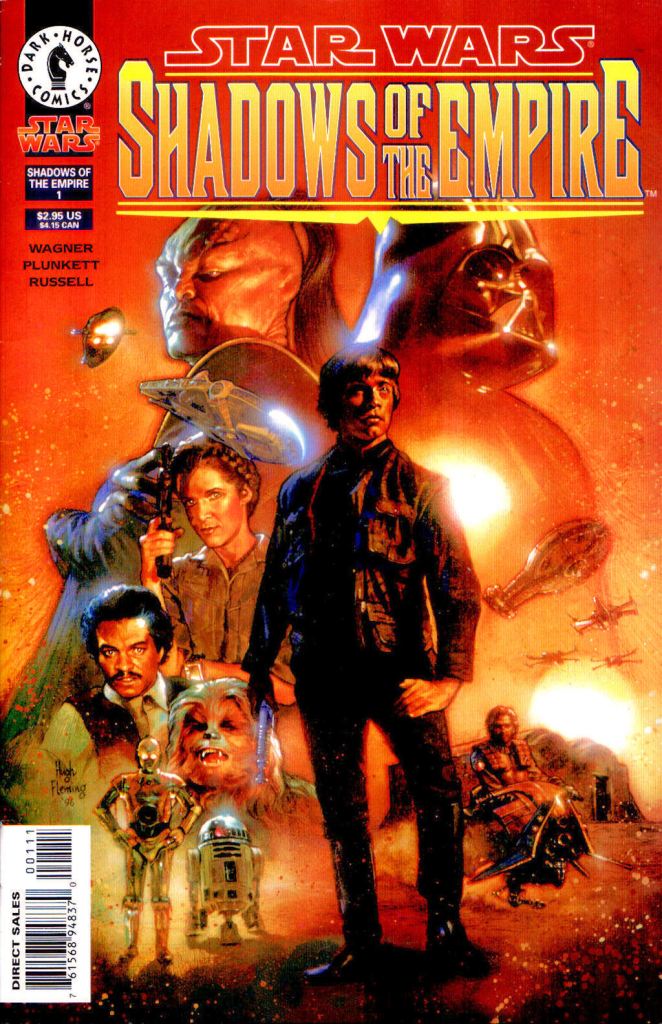
With those details laid down, here is a look back at Star Wars: Shadows of the Empire , published by Dark Horse Comics in 1996 with a story written by John Wagner and drawn by Kilian Plunkett.

The cover.

Early story

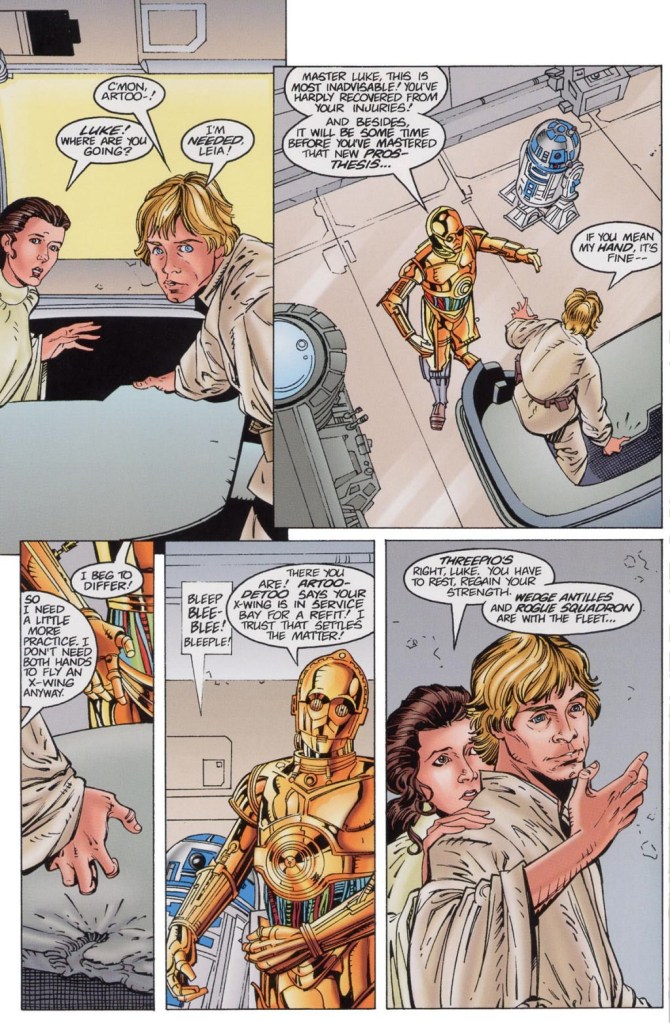
The story begins with a group of Rebel spaceships traveling together in the depth of space. Luke, who now has a mechanical hand and has been recovering from the terrible ordeal he went through at Cloud City, is with Princess Leia, C3PO and R2D2 in the medical frigate. The Rebels detect the presence of an approaching ship which they suspect to be hostile.

Luke suddenly decides to take action but is halted when he realizes that his X-wing fighter is still being refitted. In space, Wedge and the Rogue Squadron fly towards the Imperial Strike Cruiser which then releases some Tie Fighters. The personnel inside the Strike Cruiser tried to inform Darth Vader the location of the Rebel fleet…

Quality

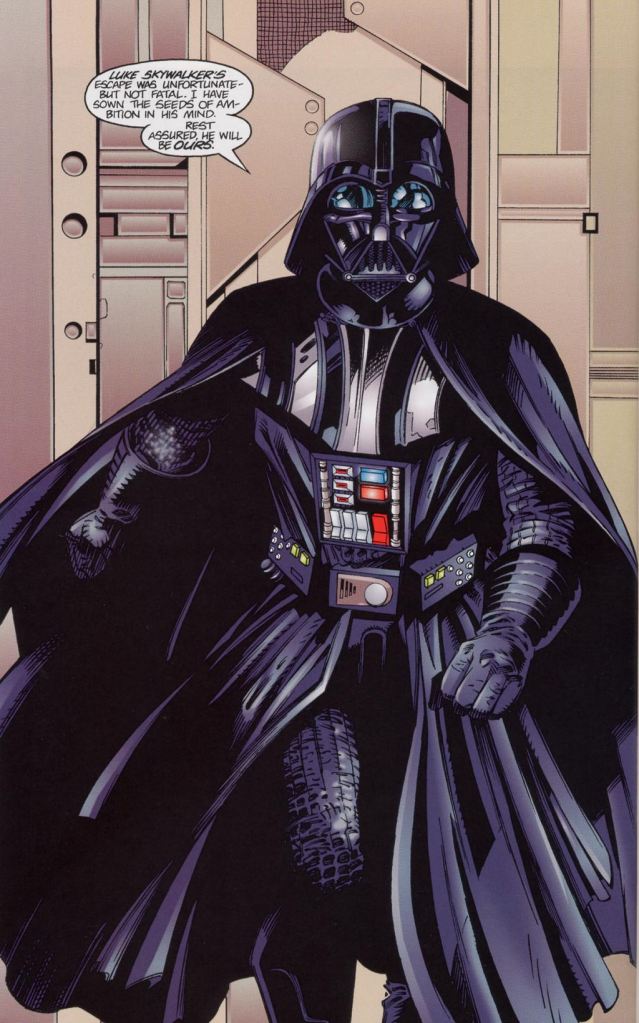
Darth Vader!

The first thing I want to mention is that the writing done by John Wagner is solid. That being said, the story itself felt like a natural continuation of The Empire Strikes Back especially when the comic book’s narrative is focused on Luke and the Rebels. The way the recovering Luke, Leia and the two droids were presented following the end of the 1980 movie was believable, and there was that nice touch of characterization when Luke has not yet adjusted with his mechanical hand.

The story then moves into new territory when the narrative shifts on the Imperial side, especially when Emperor Palpatine gives Darth Vader a new order that has nothing to do with pursuing Luke and the weakened Rebels, but more to do with the construction of the Empire’s new weapon. This is also where the new character Xizor comes in and his presence alone confirms something that the movies did not…the Empire is in business with crime syndicates with regards to major projects.

Space ship battles look great in this comic book.

When it comes to characterization, I like the way Darth Vader handled himself when communicating with Emperor Palpatine who viewed Luke’s escape from Bespin a failure on his part. Compared with his private communication with the Emperor in the 1980 movie, Vader bravely questions him about doing business with Xizor backed with his knowledge of the prince and the ties with Black Sun. Vader, who has been part of the Empire for a long time, knew well how risky it is for them to get involved with criminals especially when military cargo is involved.

As for the visuals, Kilian Plunkett does a decent job drawing the characters. While his take makes Luke recognizable and faltered a bit on capturing Leia’s look, his illustrations on Darth Vader, the Emperor and Xizor were really good. Where Plunkett exceled visually are the locations and surroundings, the machines and the space battles (some pages were drawn really dynamically).

Conclusion

This shows how Luke has not fully adjusted with his mechanical hand.

To put it clearly, Star Wars: Shadows of the Empire (1996) has three narratives (the other is about Boba Fett carrying the frozen Han Solo) to build-up on and for a debut issue of a limited series, this one has strength in its execution complete with a good amount of creative stuff that will resonate with long-time Star Wars fans (and also those who love the original Star Wars movie trilogy). It succeeds in telling what happened shortly after the end of The Empire Strikes Back as well as establishing a new sub-plot with Xizor involved. By the time I finished this comic book, I was convinced to look forward to the next issue.

If you are seriously planning to buy an existing hard copy of Star Wars: Shadows of the Empire (1996), be aware that as of this writing, MileHighComics.com shows that the near-mint copy of the regular edition costs $48 while the near-mint copy of the newsstand edition costs $144.

Overall, Star Wars: Shadows of the Empire (1996) is recommended.

+++++

Thank you for reading. If you find this article engaging, please click the like button below and also please consider sharing this article to others. If you are looking for a copywriter to create content for your special project or business, check out my services and my portfolio. Feel free to contact me as well. Also please feel free to visit my Facebook page Author Carlo Carrasco and follow me at HavenorFantasy@twitter.com