A Look Back at Batman versus Predator II #4 (1995)

Disclaimer: This is my original work with details sourced from reading the comic book and doing personal research. Anyone who wants to use this article, in part or in whole, needs to secure first my permission and agree to cite me as the source and author. Let it be known that any unauthorized use of this article will constrain the author to pursue the remedies under R.A. No. 8293, the Revised Penal Code, and/or all applicable legal actions under the laws of the Philippines.

Do you happen to have any comic books of the Batman versus Predator II crossover in your collection? According to MileHighComics.com, their near-mint copies are valuable and you can sell them to make some much-needed money in this time of pandemic, government overreach and economic hardship.

Right now, I am about to finally end my review of the Batman versus Predator II mini-series and so far, I have enjoyed it a lot. To find out if this mini-series will come to a satisfying end, here is my retro review of Batman versus Predator II #4, published in 1995 by DC Comics and Dark Horse Comics with a story written by Doug Moench and drawn by Paul Gulacy.

The cover.

Early story

The story begins in the bat cave with Batman and Alfred discussing what happened lately. As it turned out, there were two other Predators on the lose apparently sent to stop the first one (who killed one of the mentioned two). Batman also mentioned the deaths of Song Sung and Terraro. Now there are two hunters remaining who may not know that the man who issued their contracts is dead.

Just before leaving with the motorcycle, Batman receives a call from Commissioner Gordon through the special line. Afterwards, he leaves.

In the city, a thug on a motorcycle starts chasing Batman which catches the attention of the local police…

Quality

From the final encounter with the hunter from space.

This comic book is a satisfying conclusion to the mini-series. In terms of writing, issue #4 delivered the payoff for what was built-up in issue #3. This results the return of Batman’s trusted ally as well as some more involvement of the police force as the stakes were raised in issue #3 with the involvement of more than one Predator. The hunter Predator – the one Batman and Huntress encountered in the first two issues – was indeed present and it was very interesting to see it pursue its encounter with the two heroes even though he was being hunted by a fellow Predator.

Having more than one Predator was initially confusing but the confusion did not last too long which readers will find relieving. As expected, the Huntress joined Batman in the final encounter and served nicely as a fighting partner whose assistance proved to be valuable. If there is any weak spot in the presentation, it’s the element of the gang and human hunters who only served to add to the death toll.

As with the first three issues of this mini-series, the action here remains very intense and quite uncompromising with its violence. Expect gunshot wounds and decapitations here and there. The hard action presented, especially in the encounters with the Predator, was indeed satisfying. I should state that the final encounter inside the space ship is very thrilling.

Conclusion

The Bat signal is an attraction to the Predator.

Batman versus Predator II #4 (1995) is a pretty solid read. What was built-up previously, got paid off nicely here. With regards to raising the stakes and making this mini-series different from its predecessor, the creative team succeeded with the resolutions they came up with. In addition, Batman and the Huntress make a solid duo and their interactions together were compelling.

If you are seriously planning to buy an existing hard copy of Batman versus Predator II #4 (1995) be aware that as of this writing, MileHighComics.com shows that the near-mint copy of the comic book costs $50.

Overall, Batman versus Predator II #4 (1995) is highly recommended!

+++++

Thank you for reading. If you find this article engaging, please click the like button below and also please consider sharing this article to others. If you are looking for a copywriter to create content for your special project or business, check out my services and my portfolio. Feel free to contact me as well. Also please feel free to visit my Facebook page Author Carlo Carrasco and follow me at HavenorFantasy@twitter.com
A Look Back at Bloodshot #7 (1993)

Disclaimer: This is my original work with details sourced from reading the comic book and doing personal research. Anyone who wants to use this article, in part or in whole, needs to secure first my permission and agree to cite me as the source and author. Let it be known that any unauthorized use of this article will constrain the author to pursue the remedies under R.A. No. 8293, the Revised Penal Code, and/or all applicable legal actions under the laws of the Philippines.

It’s been quite some time since I last reviewed a Valiant comic book. Previously, I reviewed Bloodshot #6 (1993) which not only had the first appearance of Colin King (AKA Ninjak) but also had some of the spotlight on my native Philippines as a destination. To be specific, back in the 1990s, it was rare for the Philippines to get mentioned or visualized in American superhero comic books.

Anyway, we can return to the 1990s universe of Valiant Comics following the misadventure of Bloodshot in this look back at Bloodshot #7, published in 1993 by Valiant Comics with a story by Kevin VanHook and art by Don Perlin.

The cover.

Early story

The story begins 1,500 feet in the air above the Philippines with Leigh falling down followed by Bloodshot with the airplane leaving them. After some struggle, Bloodshot manages to grab her boot which turned out helpful as Leigh had been controlling her fall by gliding on the air currents. After breaking the fall, the boot of Leigh slips off separating the them. Bloodshot falls on the jungle’s foliage while the other landed safely.

Over at the Manila International Airport, the secret assassin Marco is weak and was assisted by a certain guy and placed on one of the toilets in the restroom. After being left there alone, Marco wakes up and leaves the restroom to make a telephone call. He does not realize that the same man who assisted him is trailing him.

Back in the jungle, Bloodshot gradually adjusts himself to get moving just as his nanites are healing his fractured right leg and broken rib. With no time to lose, he decides to continue his mission even though he is still injured….

Quality

Bloodshot and Ninjak in the jungle in the Philippines.

I can say that this comic book has a stronger story and better spectacle. It is indeed a solid payoff to the build-up in issue #6. Kevin VanHook took his time in pacing the story allowing readers to follow the details behind the events while giving ample spotlight to other characters. Bloodshot is still in the center of the story only this time he’s a lot more vulnerable and less capable as an action hero. As seen in the cover of this comic book, he truly is vulnerable and therefore he is presented more as a survivor striving hard to complete his detective work no matter the costs.

This is not a straightforward action tale. There is still a good amount of intrigue and espionage that happens in the Philippines (as Valiant’s creators imagined it). It should be noted that this comic book marks the first-ever appearance of Ninjak in his costumed form (note: Ninjak appeared in Bloodshot #6 in his civilian form as Colin King) as well as the first-ever personal encounter between Ninjak and Bloodshot (which was written to be believable). Artist Don Perlin cleverly crafted the way Ninjak performs action and evasive maneuvers setting the basic standards that other artists would do later in further comic book featuring the character (who eventually got his own monthly series in 1994).

Conclusion

At the Manila International Airport…

Bloodshot #7 (1993) is a great comic book to read and it also happens to be one of the more memorable character debuts Valiant Comics ever published in the 1990s. The debut of Ninjak in his costume alone makes this one a must-have and it so happens that the story and art were both of very good quality. The gritty realism applied to the tone of the presentation makes the story believable and there never was a moment when the events felt outlandish.

Going back to Ninjak, the character went on to become one of Valiant’s most original and major superheroes of all. In 1994, the Ninjak monthly series launched big time with an issue #1 that had a chromium cover and the great Joe Quesada drew the cover and interior art. In 2015, Valiant Entertainment launched another Ninjak series.

If you are seriously planning to buy an existing hard copy of Bloodshot #7 (1993), be aware that as of this writing, MileHighComics.com shows that the near-mint copy of the comic book costs $40.

Overall, Bloodshot #7 (1993) is highly recommended.

+++++

Thank you for reading. If you find this article engaging, please click the like button below and also please consider sharing this article to others. If you are looking for a copywriter to create content for your special project or business, check out my services and my portfolio. Feel free to contact me as well. Also please feel free to visit my Facebook page Author Carlo Carrasco and follow me at HavenorFantasy@twitter.com
A Look Back at Giant Size Freex #1 (1994)

Disclaimer: This is my original work with details sourced from reading the comic book and doing personal research. Anyone who wants to use this article, in part or in whole, needs to secure first my permission and agree to cite me as the source and author. Let it be known that any unauthorized use of this article will constrain the author to pursue the remedies under R.A. No. 8293, the Revised Penal Code, and/or all applicable legal actions under the laws of the Philippines.

Hey Ultraverse fans! Are you looking for another crossover between one team and one of the major heroes? Try this: Freex mixing up with Prime in his radical 1990s form. By this time in the publishing history of Malibu Comics, Prime was destined to be a major part of the superhero team UltraForce while Freex went through some dramatic changes along the way. As for making the Freex-Prime crossover materialize, Malibu Comics went on to publish a standalone comic book with a $2.50 cover price.

With that being said, here’s a look back at Giant Size Freex #1, published in 1994 by Malibu Comics with a story by Gerard Jones and drawn by Scott Kolins.

The cover.

Early story

The story begins Prime already in conflict with Lewis/Anything, Valerie/Pressure, Michael/Plug, Angela/Sweetface, Cayman and their recent companion referred to as the Old Man. As the Old Man restrains Valerie from using her steam-sourced power on the muscular hero (who is teenager Kevin Green inside), Prime gets hit by Cayman while being restrained by Sweetface. Prime strikes back at Cayman and grabs Sweetface by her tentacles putting the pressure again on Freex.

Eventually Prime gets electrocuted and things slowed down. This paves the way for Prime and members of Freex to talk reasonably. Lewis explains that sixteen years prior, several infants were injected with Wetware by a nurse referred to as Wetware Mary. This resulted them having different powers or abilities but this also caused them some pain as the said powers were not only hard to control but also deformed them. While they have powers, they became freaks of local society and had no choice but to keep moving to different locations and engage in stealing food and other items.

And then Contrary and her academy of the new elite gets mentioned…

Quality

Contrary and the past recalled.

In terms of storytelling, this comic book succeeds in two things: telling another creative crossover between one major Ultraverse hero and one major team with a memorable adventure together, and establishing literally the building blocks for UltraForce (note: Gerard Jones also wrote the said superhero team title).

What I enjoyed most here is that the very strong writing clearly defined the characters deeply. Here is Prime (teenager Kevin Green) relating to the plight of Freex (composed of teens and young adults) but decides to keep on pretending he is an adult capable of helping those who are struggling. There is also the Old Man who has lived long enough to see ultras exist through the centuries and by being with Freex, he is giving them something they terribly lacked: guidance and direction. In some ways, the nomadic Freex give Old Man renewed purpose while Prime sees new opportunities to do good by helping Freex. It’s also intriguing to see the overly muscular hero witness the team being hunted by armed groups.

I should also mention that, in addition to the literary feature, there is also a short feature about Contrary and how Pixx (the lone teenage girl of UltraForce) first got involved with her. It was indeed a short yet engaging read.

Conclusion

Prime and Freex plus the Old Man together.

Giant Size Freex #1 is a pretty good comic book that will appeal to fans of Prime, Freex and UltraForce. Very well written and nicely presented were the stories. There was nice balance between exposition and spectacle.

If you are seriously planning to buy an existing hard copy of Giant Size Freex #1 (1994), be aware that as of this writing, MileHighComics.com shows that the near-mint copy of the regular edition costs $8 while the near-mint copy of the newsstand edition costs $26.

Overall, Giant Size Freex #1 is recommended.

+++++

Thank you for reading. If you find this article engaging, please click the like button below and also please consider sharing this article to others. If you are looking for a copywriter to create content for your special project or business, check out my services and my portfolio. Feel free to contact me as well. Also please feel free to visit my Facebook page Author Carlo Carrasco and follow me at HavenorFantasy@twitter.com
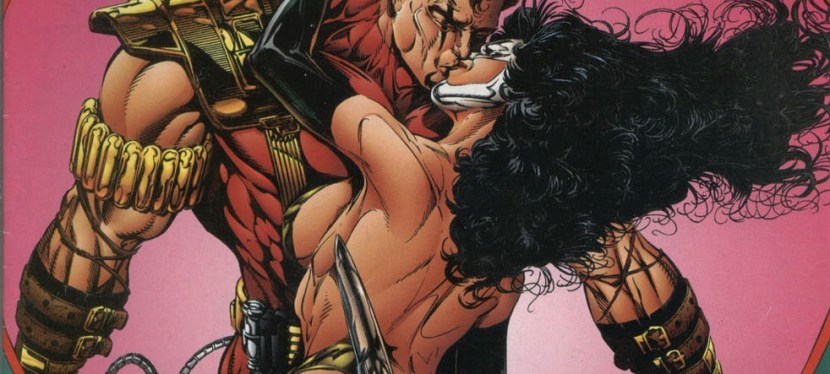
A Look Back at Mantra #2 (1993)

Disclaimer: This is my original work with details sourced from reading the comic book and doing personal research. Anyone who wants to use this article, in part or in whole, needs to secure first my permission and agree to cite me as the source and author. Let it be known that any unauthorized use of this article will constrain the author to pursue the remedies under R.A. No. 8293, the Revised Penal Code, and/or all applicable legal actions under the laws of the Philippines.

It’s been a long time since I reviewed the first issue of Mantra. For the newcomers reading this, Mantra is one of the major protagonists of the Ultraverse and as the series progressed, several stories containing elements of fantasy and even science fiction got published. With the way Mike W. Barr wrote the stories, the Mantra series really had its very own flavor and style among all Ultraverse comic books. What also made the character Mantra unique was that she was established with the use of the unholy element of reincarnation.

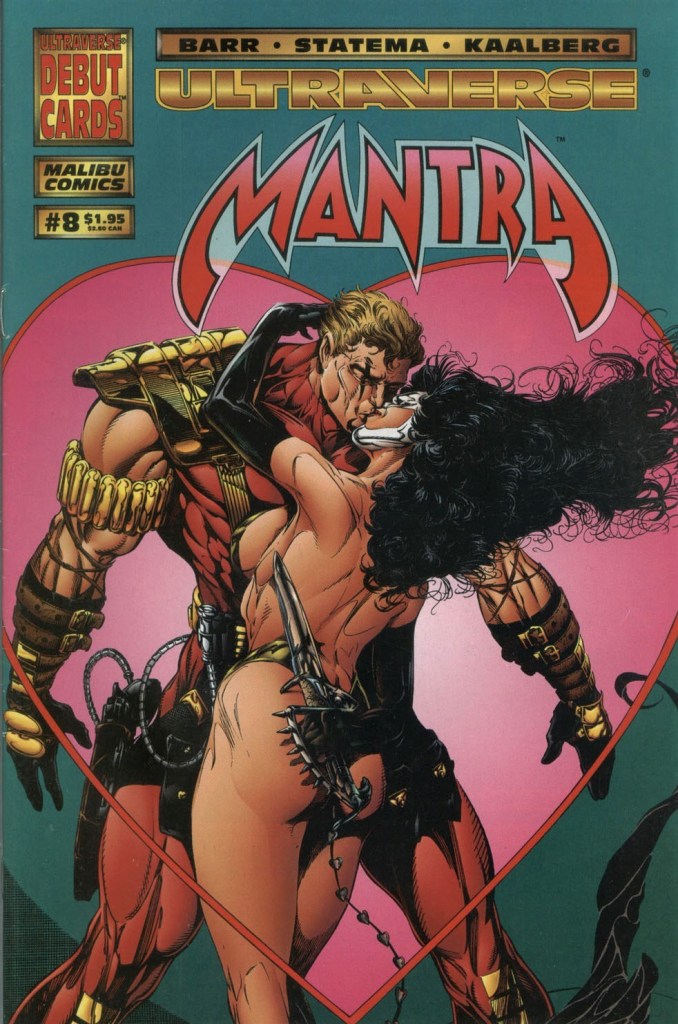
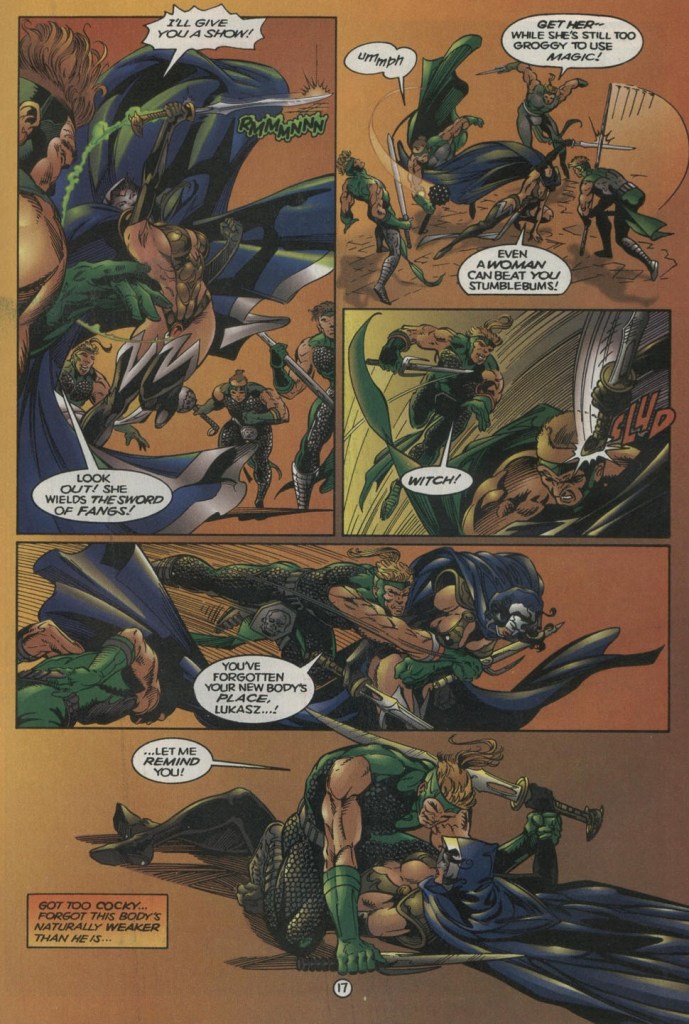
Before Mantra came to be, there was a male eternal warrior called Lukasz who was a part of a group that fought a rival group of warriors through the ages. Their leader Archimage used magic to ensure that whenever Lukasz or any of his teammates die, he would get reincarnated (his soul enters a new body belonging to an already living person whose soul gets displaced) and continue the fight. Then something happened in issue #1 which led to Lukasz occupying the body of a pretty woman named Eden.

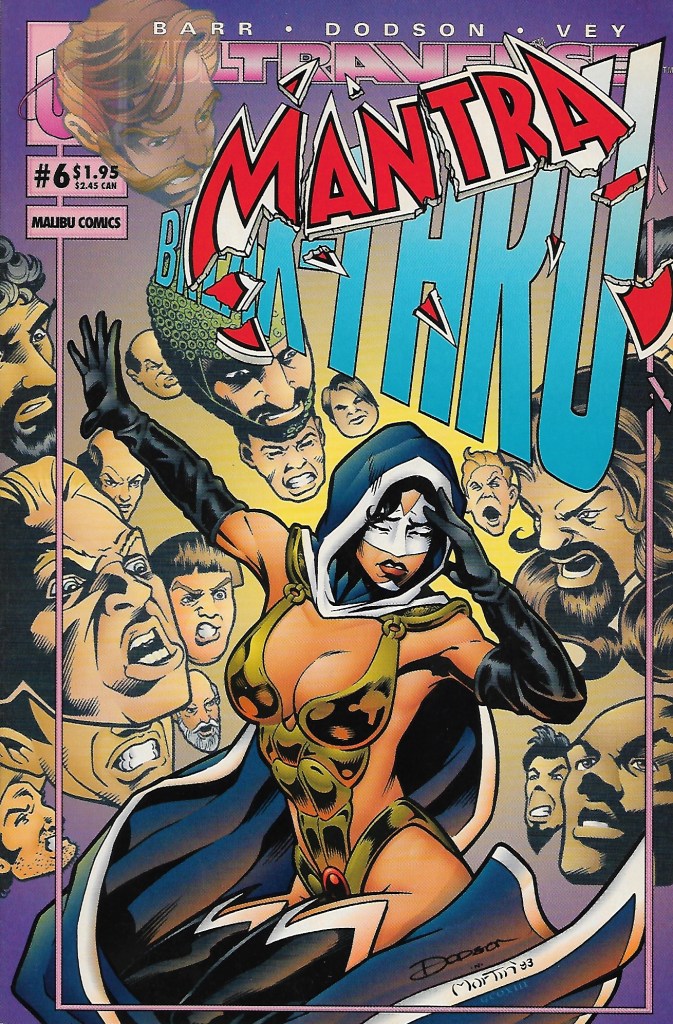
To find out more, join me in this look back at Mantra #1, published in 1993 by Malibu Comics with a story written by Mike W. Barr and drawn by Terry Dodson.

The cover.

Early story

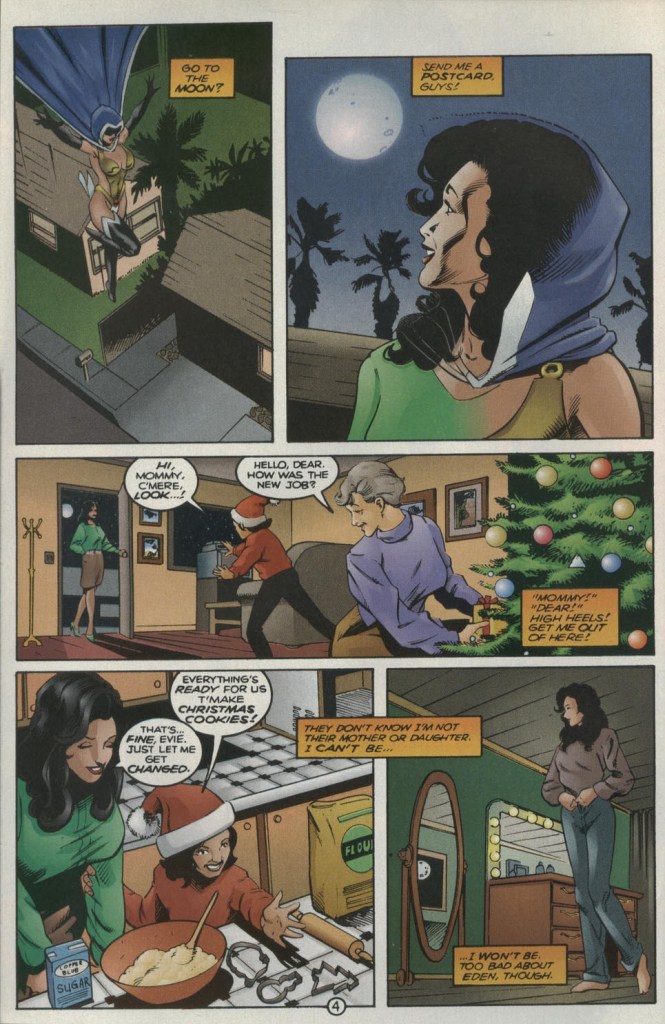
The story begins at the home of Eden Blake in the evening. An armed man named Warstrike knows that Lukasz is occupying Eden’s body. Lukasz/Eden/Mantra starts to resist him but notices that Eden’s son and daughter are both present and seeing them. Quickly and cleverly, Mantra tells the children to get back to bed and hope they did not notice something wrong.

Filled with emotions, Mantra asked Warstrike not to kill her. As it turns out, Warstrike did not come to take her life and reveals that he had been used by Notch (a rival warrior Lukasz often fought with) as a tool to kill him (Lukasz) the last time he was in a male body. Warstrike tells her he’s going to help her.

After the talk and another attempt by Warstrike to charm her, Mantra slams the door and goes to bed. She sleeps to prepare herself for the next day…

Quality

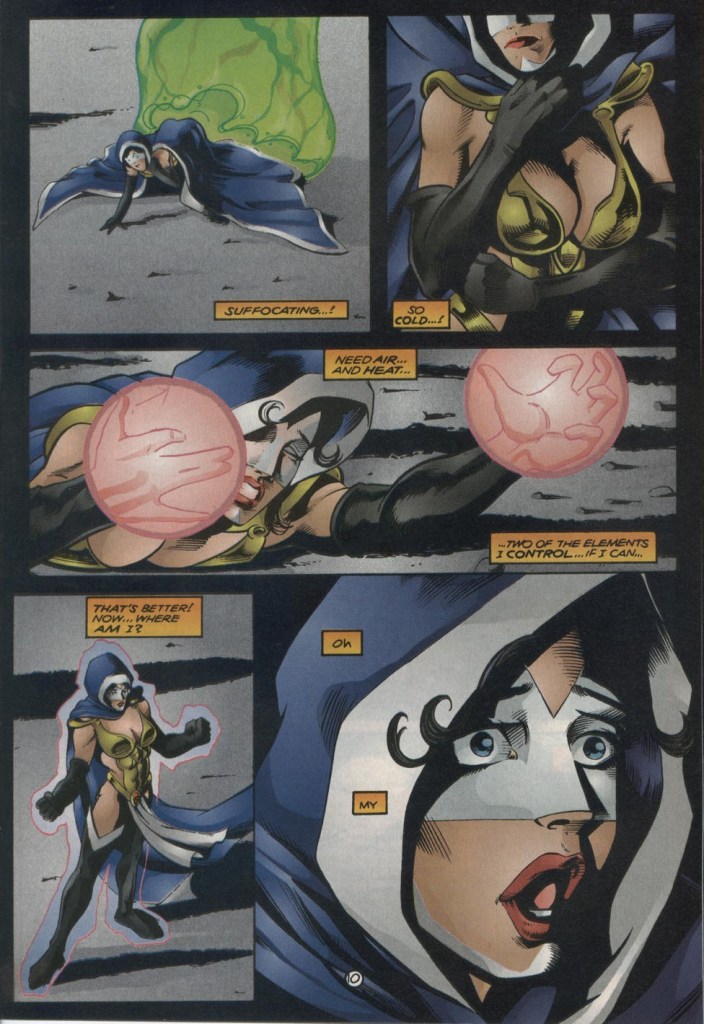
As Eden, Lukasz inherits the responsibility of taking care of her son and daughter.

I’ll star with the most obvious thing about this comic book…the writing done by Mike W. Barr is very strong and has a nice balance between plotting, spectacle and characterization all throughout. For his part, Terry Dodson nicely translated the writing into engaging visuals.

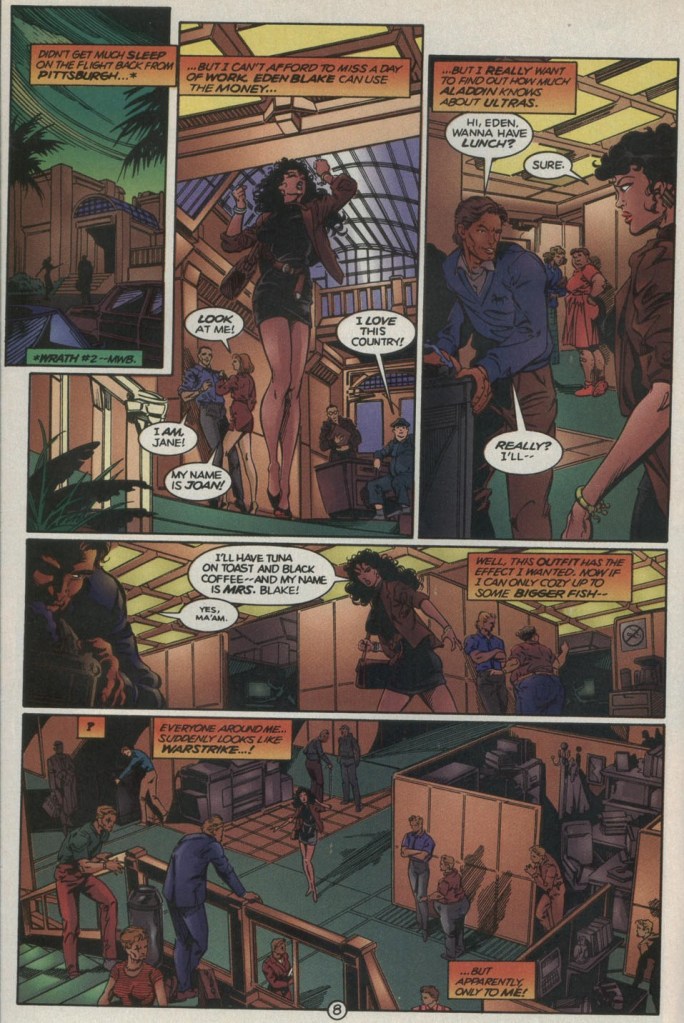
For the most part, this comic book is very character driven which is a nice pay-off considering the plot build-up in issue #1. We get to see Lukasz struggling more not only because he displaced Eden’s soul (again, reincarnation is unholy) as he occupied her body, but because he is living Eden’s life which involves being the single mother of two children, going to work at the office, wearing women’s clothes and shoes, and dealing with a certain someone from Eden’s past. All of these add to the tremendous challenge of Lukasz who already has his own mission to fulfill.

Conclusion

Living Eden’s domestic life alone is a big challenge already for Lukasz who has always been male.

Mantra #2 is a very strong read from start to finish. As it develops Mantra even further, it also adds to the build-up of another story element: Eden’s domestic life. As the armored Mantra, the protagonist has a mission to find and free Archimage. As Eden, spending time with the two little ones is not only challenging but also crucial to their development. These elements are nice twists to the old hero-civilian formula of superhero comics. Indeed, this one is worthy follow-up to issue #1.

If you are seriously planning to buy an existing hard copy of Mantra #2 (1993), be aware that as of this writing, MileHighComics.com shows that the near-mint copy of the regular edition costs $8, the near-mint copy of the bagged edition costs $16 and the near-mint copy of the newsstand edition costs $26.

Overall, Mantra #2 (1993) is recommended.

+++++

Thank you for reading. If you find this article engaging, please click the like button below and also please consider sharing this article to others. If you are looking for a copywriter to create content for your special project or business, check out my services and my portfolio. Feel free to contact me as well. Also please feel free to visit my Facebook page Author Carlo Carrasco and follow me at HavenorFantasy@twitter.com
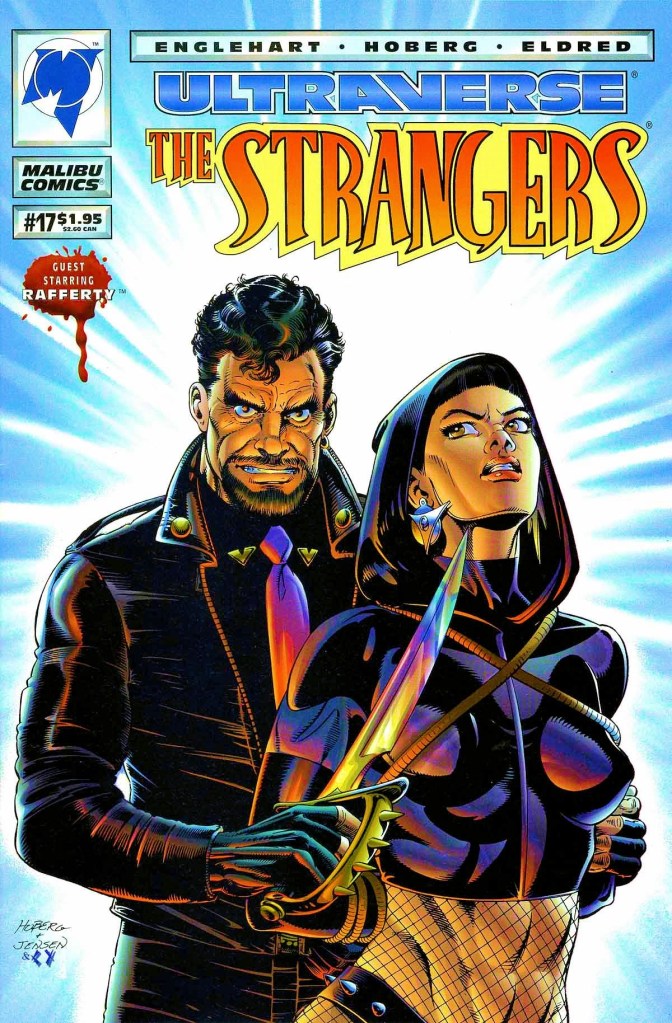
A Look Back at The Strangers #13 (1994)

Disclaimer: This is my original work with details sourced from reading the comic book and doing personal research. Anyone who wants to use this article, in part or in whole, needs to secure first my permission and agree to cite me as the source and author. Let it be known that any unauthorized use of this article will constrain the author to pursue the remedies under R.A. No. 8293, the Revised Penal Code, and/or all applicable legal actions under the laws of the Philippines.

Crossovers between major individual characters and major superhero teams within the Ultraverse are often fun to read mainly due to the high talents involved who made such fantasy concepts good. Before, The Strangers had a crossover with Hardcase followed by another crossover with Prototype. This time, the superhero team will have their first crossover adventurer together with another major Ultraverse characters…Mantra!

You must be wondering who are what will Mantra and the Strangers be facing. We will find out in this look back at The Strangers #13, published in 1993 by Malibu Comics with a story written by Steve Englehart and drawn by Mike Gustovich.

The cover.

Early story

The story begins inside a facility when the Strangers are surprised by the arrival of police cars outside. Upon meeting the police captain named Rome, the Strangers learn that the police need their help as an evil ultra is on its way to San Francisco.

As the Strangers scramble, Mantra’s foe Boneyard is inside a commercial airline and his presence easily disturbs the passengers. Boneyard punches a man for raising his voice and telling him to put down a child he carried. Boneyard is carrying a young boy using him to have leverage over the passengers and the flight crew.

Some time later, the airplane lands on the tarmac of the airport and Boneyard comes down as the Strangers and the police await him. It turns out, Mantra’s foe wanted a meeting which baffles the Strangers. Boneyard tells them that their actions let some demons free and have placed his life in grave dangers.

As Boneyard and the Strangers talk, Eden Blake watches intensely and changes into Mantra…

Quality

Mantra with Electrocute and Grenade.

This comic book’s story is very well written and it should not be surprising given Steve Englehart’s extensive experience as a writer. He really knows how to structure carefully a plot, get different superheroes get together and work for a common cause. That being said, Boneyard’s entry into the pages of The Strangers series was notably seamless (note: Mike W. Barr of the Mantra series was the one who developed Boneyard as the villain) and believable. When he met the Strangers, I sensed tension brewing which eventually turned into excitement once Mantra (who encountered The Strangers during the Break-Thru crossover) gets involved.

Character interactions, especially between Mantra and the Strangers members, is quite engaging to read. While the most sensible conversation Mantra had was with Electrocute, her talk with Spectral was the most awkward. There really is something worth reading.

When it comes to the artwork, Mike Gustovich’s work is serviceable at best. He worked on this comic book as a guest illustrator temporarily taking over the place of regular artist Rick Hoberg. His art is not bad, just satisfactory.

Conclusion

Mantra meets the Strangers again.

The Strangers #13 is entertaining on its own and the fact is it is only the first part of the Mantra-Strangers crossover. It is a solid start to say the least, and I should state that Steve Englehart captured nicely the respective personalities of Mantra and Boneyard, and he succeeded in mixing up the said ultra with the team. This comic book, by the way, is one of Malibu Comics’ flipside issues (a 2-in-1 comic book with each side being its own issue) and on the other side was Ultraverse Premiere #4. The Ultraverse Premiere side has a main story featuring Prime and a short story focused on Lady Killer of The Strangers.

If you are seriously planning to buy an existing hard copy of The Strangers #13 (1994), be aware that as of this writing, MileHighComics.com shows that the near-mint copy costs $8.

Overall, The Strangers #13 (1994) is recommended.

+++++

Thank you for reading. If you find this article engaging, please click the like button below and also please consider sharing this article to others. If you are looking for a copywriter to create content for your special project or business, check out my services and my portfolio. Feel free to contact me as well. Also please feel free to visit my Facebook page Author Carlo Carrasco and follow me at HavenorFantasy@twitter.com

A Look Back at Spider-Man #26 (1992)

Disclaimer: This is my original work with details sourced from reading the comic book and doing personal research. Anyone who wants to use this article, in part or in whole, needs to secure first my permission and agree to cite me as the source and author. Let it be known that any unauthorized use of this article will constrain the author to pursue the remedies under R.A. No. 8293, the Revised Penal Code, and/or all applicable legal actions under the laws of the Philippines.

In 1992, Marvel Comics organized a big celebration of what was back then the 30th anniversary celebration of Spider-Man. Behind the scenes, the Spider-Man editorial team organized their creators to make something special worthy of the anniversary. Back then there were four monthly series of Spider-Man – Amazing Spider-Man, Spectacular Spider-Man, Web of Spider-Man and Spider-Man – and in keeping with the 30th anniversary bonanza, each of the monthly series would see one special issue with a hologram on the cover.

What I read recently was one of those 30th anniversary celebration special comic books – Spider-Man #26. This comic book had a green cover and a hologram of Spider-Man upside-down. Its cover price is $3.50.

Was this old comic book’s content really worth the high cover price and the hologram? Did the creative team at Marvel do their job on making something special in line with the 30th anniversary celebration? We can find out in this look back at Spider-Man #26, published in 1992 by Marvel Comics with the main story written by Tom DeFalco and drawn by Mark Bagley and Ron Frenz.

The cover with a hologram.

Early story

The story begins on the street of New York when a man wearing a device runs down the sidewalk distracting and unintentionally pushing a few people out of the way. He is glowing as he moves. Someone from behind him calls him Stewart.

Soon enough, Peter Parker/Spider-Man and Mary Jane cross paths with him. Peter immediately leaves Mary Jane behind and starts pursuing the glowing Stewart. In the middle of the street, Stewart sees a speeding motorcycle heading towards him. He dives for cover which incidentally shapes his glowing field into a makeshift ramp causing the motorcyclist go over him. Spider-Man sees the flying motorcycle and its driver, and struggles to decide which one to save…

Quality

From the 2nd story.

Let me start with the main story. It sure is heavily worded almost all throughout but that is understandable because Tom DeFalco really pushed hard to emphasize the theme of responsibility as Spider-Man struggles to tackle criminals while trying to find quality time for his wife. There was even a scene in which Peter Parker recalls key events from his past (his becoming Spider-Man, letting a certain criminal get away, the death of his Uncle Ben, etc.) which, in terms of presentation, was a clear attempt by the creative team to bring readers back to the recorded history of Marvel’s icon. The main story is a genuine, heart-filled attempt to go beyond showing Spider-Man beating the bad guys to do local society good. There was also effort exerted to show that there are a few guys who do bad things not because they are inherently evil but rather they are desperate and/or misguided. The problem with the main story is that the other characters – Stewart, Bill, the gang leader Maxwell and others – are not so interesting at all. Of course, we cannot expect to see Spider-Man go head-to-head with another one of his major villains but this story was part of the 30th anniversary celebration.

The 2nd story, if you can all it that, is pretty much an exposition-filled exercise designed to give readers – both new and old – a review of Spider-Man’s powers and capabilities. To prevent it from becoming a total bore, some characters from the Marvel Comics universe were visually added.

When it comes to the quality of the artwork, Ron Frenz’s work here is serviceable at best. Mark Bagley’s art here improves the quality but that’s not saying much.

Conclusion

From the main story.

As a 30th anniversary celebration issue, Spider-Man #26 does not have much when it comes to being truly special. You love spectacle? You won’t find much in it. You wanted to see something groundbreaking in terms of character development? There’s none. Gripping storytelling? None! There was also no conflict with any prominent villain from the Marvel universe here. What you will get here is nostalgic stuff plus exposition about key elements that define Spider-Man. Truly the only thing special here is the hologram on the gimmick cover.

If you are seriously planning to buy an existing hard copy of Spider-Man #26 (1992), be aware that as of this writing, MileHighComics.com shows that the near-mint copy of the regular edition costs $27 while the near-mint copy of the newsstand edition costs $90.

Overall, Spider-Man #26 (1992) is serviceable. If you really want to buy this old comic book, I recommend waiting for its price to fall below $5 and I’m referring to the near-mint copy.

+++++

Thank you for reading. If you find this article engaging, please click the like button below and also please consider sharing this article to others. If you are looking for a copywriter to create content for your special project or business, check out my services and my portfolio. Feel free to contact me as well. Also please feel free to visit my Facebook page Author Carlo Carrasco and follow me at HavenorFantasy@twitter.com

A Look Back at UltraForce #6 (1995)

Disclaimer: This is my original work with details sourced from reading the comic book and doing personal research. Anyone who wants to use this article, in part or in whole, needs to secure first my permission and agree to cite me as the source and author. Let it be known that any unauthorized use of this article will constrain the author to pursue the remedies under R.A. No. 8293, the Revised Penal Code, and/or all applicable legal actions under the laws of the Philippines.

After reading issues #0 to #5 of the UltraForce series of the mid-1990s, I should say that I clearly enjoyed them all as creators Gerard Jones and legendary illustrator George Perez (plus their supporting crew) really delivered great stories, dynamic visuals and very engaging interactions between the UltraForce members.

So far, each and every UltraForce issue I reviewed here is fun and compelling to read. The high levels of artistic and literary quality in each issue is evident right from the start and, more importantly, it emphasizes the overall concept of the Ultraverse itself even deeper than what I discovered in its early stage (launch year 1993). Very clearly, UltraForce as a comic book series raised the stakes of the Ultraverse (much like Break-Thru did) when it comes to how the public perceived ultras (superheroes), who are the secretive sinister forces and how they impact the whole world, why being an ultra has lots of advantages and disadvantages, why ultras are hard to unite in the face of danger, and so on. These creative concepts were really great and it was in the year 1994 – the same year UltraForce launched – when the Ultraverse was at a stage to go further to a bolder direction with its creative evolution. Unfortunately all of that got screwed up after Marvel Comics acquired Malibu Comics.

More on UltraForce, the saga of king Atalon’s fire people rising from the depths of the Earth and possessing nuclear missiles to attack people on the surface has lasted quite long and its narrative remained consistently engaging. In issue #5, something terrible happened to UltraForce member Pixx during a big battle. What transpired next, we can find out in this look back at UltraForce #6, published in 1995 by Malibu Comics with a story written by Gerard Jones and drawn by George Perez and Steve Butler.

The cover! They even misspelled Ghoul!

Early story

The story begins as tensions rise between Atalon and UltraForce over their respective losses. For Atalon, his grand dream involving the use of humanity’s nuclear weapons has been destroyed. For Prime, Hardcase, Prototype, Ghoul and Topaz, the hanging lifeless body of Pixx shocked them deeply.

Suddenly, out of intense anger, UltraForce jointly attack the king of the fire people. Topaz states that Pixx will not die unavenged as Prototype blasts Atalon. Hardcase strikes the king followed by blows delivered by Prime and Topaz. Prime is about to strike Atalon but gets distracted when the downed king mentioned he wants to reform the whole world. Atalon strikes Prime’s head and gets back up to keep fighting the rest of UltraForce.  

Their battle is so intense, the entire island shakes and the ground crumbles bringing the nuclear weapons down along with Pixx’s body. Ghoul goes down after her…

Quality

Dynamic action delivered with high detail!

Like all the previous issues released, this comic book has high-level qualities on its writing and artistry. This is not a surprise since the Jones-Perez creative team really pushed hard to keep telling what is clearly the epic event of the Ultraverse (post-Break-Thru). The consistency of quality up to this issue is very evident.

When it comes to the quality of this comic book’s story, which happens to be the conclusion of the Atalon saga, I can say that I’m very satisfied. As the events went on, a few but very significant twists happened which really shook the foundation of this particular saga backed with great visuals (although there are some pages that were clearly not drawn by George Perez), strong dialogue and a great presentation of the impact on the world and its people. What happened with king Atalon in the 2nd half of the story is very memorable and it definitely is one of the biggest twists in the entire Ultraverse. This one alone makes the comic book worth reading.

Conclusion

This is a great way to start the comic book along with the opening credits!

UltraForce #6 is indeed a great comic book and it is a strong conclusion to the saga (which started really in issue #0) that brought Prime, Hardcase, Prototype and others together as a team. This comic book is, in my honest view, also one of the finest UV stories Malibu Comics published in 1994. If there is anything to be regretful about, it is the fact that the Ultraverse got screwed up and ended in an undesirable state as a result of Marvel’s acquisition of Malibu. This is why there was no follow-up to the Atalon saga and UltraForce as a series turned for the worse shortly after (again, as a result of Marvel’s acquisition). Considering the events of the first major UltraForce saga, Atalon could have turned out as a more significant character of the Ultraverse and another epic follow-up (to the Atalon saga) could have happened.

More on the team itself, Prime, Prototype, Hardcase and their lesser known teammates were truly presented with a strong amount of balance. Ghoul and Contrary really had their nice share of the spotlight and how they worked in tandem with the others, as well as the very events of the comic book, was really fluid and believable. By the end of this comic book, you will realize the true values and the different personalities of the entire UltraForce!

If you are seriously planning to buy an existing hard copy of UltraForce #6 (1995), be aware that as of this writing, MileHighComics.com shows that the near-mint copy of the comic book costs $15.

Overall, UltraForce #6 (1995) is highly recommended!

+++++

Thank you for reading. If you find this article engaging, please click the like button below and also please consider sharing this article to others. If you are looking for a copywriter to create content for your special project or business, check out my services and my portfolio. Feel free to contact me as well. Also please feel free to visit my Facebook page Author Carlo Carrasco and follow me at HavenorFantasy@twitter.com

A Look Back at Freex #9 (1994)

Disclaimer: This is my original work with details sourced from reading the comic book and doing personal research. Anyone who wants to use this article, in part or in whole, needs to secure first my permission and agree to cite me as the source and author. Let it be known that any unauthorized use of this article will constrain the author to pursue the remedies under R.A. No. 8293, the Revised Penal Code, and/or all applicable legal actions under the laws of the Philippines.

Having read comic books of UltraForce, one of the most notable team members is Contrary, the highly manipulative and resourceful lady who wears white and shows of a lot of her skin. She does not spend much time on the field and she does not have the powerful combat abilities of Prime, Hardcase and Prototype. Still she proves to be very intelligent, scheming and her true power is realized when she is inside her round ship which is full of high-tech equipment and links to varied sources of information for her use. As such, Contrary is indeed a very important part of UltraForce even though she gets into conflict with her more prominent teammates who each have their own monthly titles.

So you might be wondering…where in the entire Ultraverse did she come from? What makes her significant among all the characters of the Ultraverse? After doing some research, I learned that Contrary’s first appearance took place in the Freex monthly series. How her first appearance turned out, we can find out in this look back at Freex #9, published in 1994 by Malibu Comics with a story written by Gerard Jones and drawn by Martin Egeland.

The cover.

Early story

The story begins with the team with a guy wearing a hat and holding a gun who is on a tree branch above their heads. Angela/Sweetface instantly reacts by having one of her tendrils reach for the gun. The gunman reacts by going down and pulling Sweetface surprising her teammates. Tried as hard as they could, Freex members failed to get the gunman down and ended up with one of their teammates being held captive by him.

The tension slowly eases and the gunman tells them he has been doing things for other people with powers for a long time. Suddenly, they got spotted by a gang of armed men referred to as the night patrol. Freex and the gunman react to move away. Using her power, Val blasts a brush to make their way through…

Quality

Contrary’s first appearance. She went on to become a major part of UltraForce.

’ll start first with the storytelling. This one was an early attempt to add some variety and twists into Freex by having the team get involved with the gunman who would eventually spend more time with them beyond this issue. It was a sensible move for the creators to do this because seeing Freex just move like nomads was getting tiring. By this time, the team is feeling worn down and they still could not succeed in finding out who has been hunting them, and how they could cure themselves to become normal people.

This comic book pays additional attention to Sweetface and shows some flashbacks into her past. As a teenager, she wanted to fit in with her fellow youth at school until the first of her many tendrils started to come out. The dramatization of Sweetface here is very well done and if you pay close attention to the dialogue, you can feel her pain.

As for the first appearance of Contrary, it was very short and yet highly intriguing. She actually appeared in two different pages and each one was intriguing to see respectively.  

Conclusion

The team with someone.

Freex #9 is a carefully balanced comic book specifically when it comes to plotting, characterization and spectacle. The way it was presented, I could tell that a creative turning point for the team happened and Contrary’s first appearance turned out to be significant even though only two pages were made visualizing her.

If you are seriously planning to buy an existing hard copy of Freex #9 (1994), be aware that as of this writing, MileHighComics.com shows that the near-mint copy of the regular edition costs $8 while the near-mint copy of the newsstand edition costs $26.

Overall, Freex #9 (1994) is recommended.

+++++

Thank you for reading. If you find this article engaging, please click the like button below and also please consider sharing this article to others. If you are looking for a copywriter to create content for your special project or business, check out my services and my portfolio. Feel free to contact me as well. Also please feel free to visit my Facebook page Author Carlo Carrasco and follow me at HavenorFantasy@twitter.com

A Look Back at Prime #11 (1994)

Disclaimer: This is my original work with details sourced from reading the comic book and doing personal research. Anyone who wants to use this article, in part or in whole, needs to secure first my permission and agree to cite me as the source and author. Let it be known that any unauthorized use of this article will constrain the author to pursue the remedies under R.A. No. 8293, the Revised Penal Code, and/or all applicable legal actions under the laws of the Philippines.

“I’m Prime. The real Prime!”

Those were the words Prime said in conflict involving the American military and Firearm (another Ultraverse main hero) as told in the pages of Prime #10. It was also at that same moment Prime appeared in a totally new look, a look so radical a change! Instead of heaving a clean haircut, he has long hair with a spiked headband. Instead of a cape (the most traditional part of superhero costumes), he wore a V-shaped shirt and chains.

To put it short, this was Prime’s new look in the Ultraverse (note: he appeared already like this in the early issues of UltraForce in 1994) and we will find out how people will react to his appearance in this look back at Prime #11, published in 1994 by Malibu Comics with a story written by Len Strazewski and Gerard Jones, and drawn by the late Norm Breyfogle.

The cover.

Early story

The story begins with Prime flying over the Sunset Strip. There he visits a night club filled with a lot of people drinking, dancing and socializing while a live band performs for them. Prime easily catches people’s attention as he walks to the bar thinking how as his real self (teenager Kevin Green) could never go into a place like the club. As he is about to order an alcoholic drink, a pretty lady tells him to buy her a drink which compels him to say he left his wallet.

As they drink and socialize, Prime begins to enjoy the lady’s way of flirting with him. Suddenly a Hollywood celebrity (Justin Kuttner who appeared in Hardcase #1) interrupts them by confronting the lady. As the tension rises between the two, Prime intervenes a strikes Justin away from the lady. Justin gets up and prepares to fight Prime no matter the odds…

Quality

Prime in California.

There is a lot more in this comic book than simply showing Prime with his new look. To say the least, the story, dialogue and characterization are all very well-written. Even though there is a lack of a conflict between Prime and someone bad (note: Prime just got freed from the military’s grasp), the strong writing made this a character-driven piece that focuses more on Kevin and how his dual-life continues to impact himself and his family.

The biggest attraction in this comic book is the flashback showing the events that led to establishing the origin of Prime. This alone justifies acquiring this issue.

Conclusion

The money shot!

Prime #11 is a solid old comic book worthy of inclusion in anyone’s collection of Ultraverse and Malibu Comics-published issues. It does not have the expected good-versus-bad battle but it still managed to have some scenes of spectacle and its characterization makes it a must-read.

If you are seriously planning to buy an existing hard copy of Prime #11 (1994), be aware that as of this writing, MileHighComics.com shows that the near-mint copy of the regular edition costs $8 while the near-mint copy of the newsstand edition costs $26.

Overall, Prime #11 (1994) is recommended.

+++++

Thank you for reading. If you find this article engaging, please click the like button below and also please consider sharing this article to others. If you are looking for a copywriter to create content for your special project or business, check out my services and my portfolio. Feel free to contact me as well. Also please feel free to visit my Facebook page Author Carlo Carrasco and follow me at HavenorFantasy@twitter.com
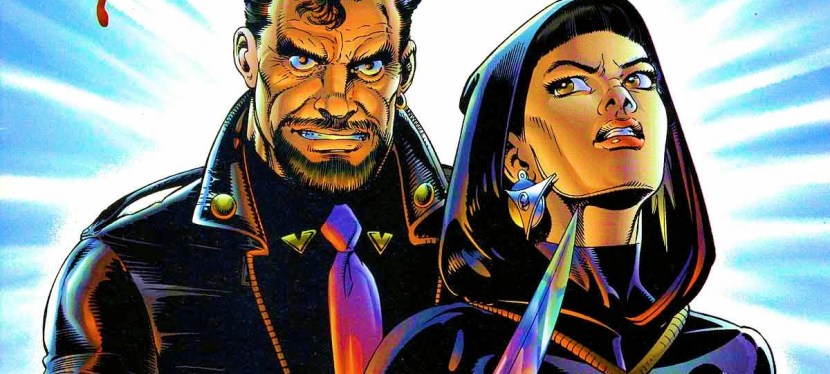
A Look Back at UltraForce #5 (1995)

Disclaimer: This is my original work with details sourced from reading the comic book and doing personal research. Anyone who wants to use this article, in part or in whole, needs to secure first my permission and agree to cite me as the source and author. Let it be known that any unauthorized use of this article will constrain the author to pursue the remedies under R.A. No. 8293, the Revised Penal Code, and/or all applicable legal actions under the laws of the Philippines.

One of the things I enjoyed best about the UltraForce done by the solid creative team of Gerard Jones and George Perez is the fact that the team’s lesser known characters such as Pixx (the lone minor), Contrary, Ghoul and Topaz are richly layered, highly interesting and engaging members who really stand on their own and don’t get overshadowed by their major teammates (the Ultraverse’s premier lead heroes Hardcase, Prime and Prototype). Of course, the presentation of Pixx, Contrary, Ghoul and Topaz would not have been great had Gerard Jones failed to deliver the solid writing and managing required.

That being said, it’s time to find out more on how balanced the presentation of UltraForce members will be as the conflict with Atalon escalates further in this look back at UltraForce #5, published in 1995 by Malibu Comics with a story written by Jones and Perez.

The spoileriffic cover.

Early story

The story begins with Ghoul (still in the presence of Atalon and far away from his teammates) having a nightmarish vision of death, chaos, rioting and disasters. He recognizes a certain teammate included in the vision. His personal concern for his teammate grows, and king Atalon notices his distress. Atalon states he has cleared the final obstacles and what he has planned will push through. He intends to use many nuclear missiles on the world.

“When my warheads strike the raw nerve centers of your world, the surface will blossom with the fires of chaos and war,” Atalon tells Ghoul. “And the launching begins now. You see, Ghoul? Your world is dead. There’s nothing you can do. There’s no point in worry at all.”

Over at Miami, Florida, Pixx talks to her mother via the telephone and assures her that she is in good hands with UltraForce with a role to give her teammates the youth point-of-view. After the phone talk, Pixx personally struggles with the stress of being with the team which itself has gotten involved not only with the global conflict with Atalon but also with the concerned world leaders and the ever demanding public.

Prime approaches her and, because she noticed her looking troubled, he asked her if she could handle the situation they are in. Pixx answers back and does some posturing that she is strong and capable. Prime, who is really teenager Kevin inside, feels he screwed-up and knows well that Pixx is older than him.

The UltraForce then meet on the top of the building…

Quality

Dynamic action drawn by the legendary George Perez supported by inkers and colorists!

Strong writing – check. Great visuals with high detail – check. The high quality and strong creative energy of the Jones-Perez team continued to shine brightly in this comic book. Definitely a very well-made comic book that also continued to deliver the great stuff like strong character engagement and development, dynamic action (hey, this is George Perez’s art!) and the like.

While issue #4 featured Atalon’s background story and some references about the history of his people, this comic book has its spotlight on the teenage member Pixx. Her dialogue and character development are very well crafted and as the story goes on, you will start to care about her.

The conflict with Atalon here shows the stakes raised high once more as the said leader of the creatures from deep below the surface acquired mankind’s nuclear weapons and really starts to control them. I should also state that this comic book is another spectator-filled pay-off story that succeeded issue #4 which was mainly a build-up type of story.

If there is anything wrong with the comic book, it is the cover as it truly is a major spoiler. Too bad that the art showed Pixx in the presence of a nuclear warhead because the imagery alone took out some of the power behind her story in the big conflict of the comic book.  

Conclusion

This art by Perez looks great and worthy of the cover!

UltraForce #5 is another solid read thanks again to its creators. I should also state that even though the cover art was a spoiler, at least the ending was intriguing and powerful to see.

If you are seriously planning to buy an existing hard copy of UltraForce #5 (1995), be aware that as of this writing, MileHighComics.com shows that the near-mint copy costs $16.
Overall, UltraForce #5 (1995) is highly recommended!

+++++

Thank you for reading. If you find this article engaging, please click the like button below and also please consider sharing this article to others. If you are looking for a copywriter to create content for your special project or business, check out my services and my portfolio. Feel free to contact me as well. Also please feel free to visit my Facebook page Author Carlo Carrasco and follow me at HavenorFantasy@twitter.com