A Look Back at Mantra #11 (1994)

Disclaimer: This is my original work with details sourced from reading the comic book and doing personal research. Anyone who wants to use this article, in part or in whole, needs to secure first my permission and agree to cite me as the source and author. Let it be known that any unauthorized use of this article will constrain the author to pursue the remedies under R.A. No. 8293, the Revised Penal Code, and/or all applicable legal actions under the laws of the Philippines.

Welcome back, superhero geeks, comic collectors and fans of the Ultraverse! We are about to return to the Ultraverse through the view of Mantra. Since the story of issue #9 and issue #10, the stakes have been raised as Mantra not only found herself in bigger danger as well as revelations from the past related to the long-time war between Archimage and Boneyard. Not only is Mantra still being targeted by Boneyard (who is so evil he wants to marry Mantra and make love to her body even though he knows the soul of the male warrior Lukasz is occupying it) but also by sorcerers from the Earth’s realm. In other words, Mantra/Lukasz really has trouble in different realms.

Will something unexpected turn out in the next story of Mantra? We can find out in this look back at Mantra #11, published in 1994 by Malibu Comics with a story written by Mike W. Barr and drawn by Robb Phipps.
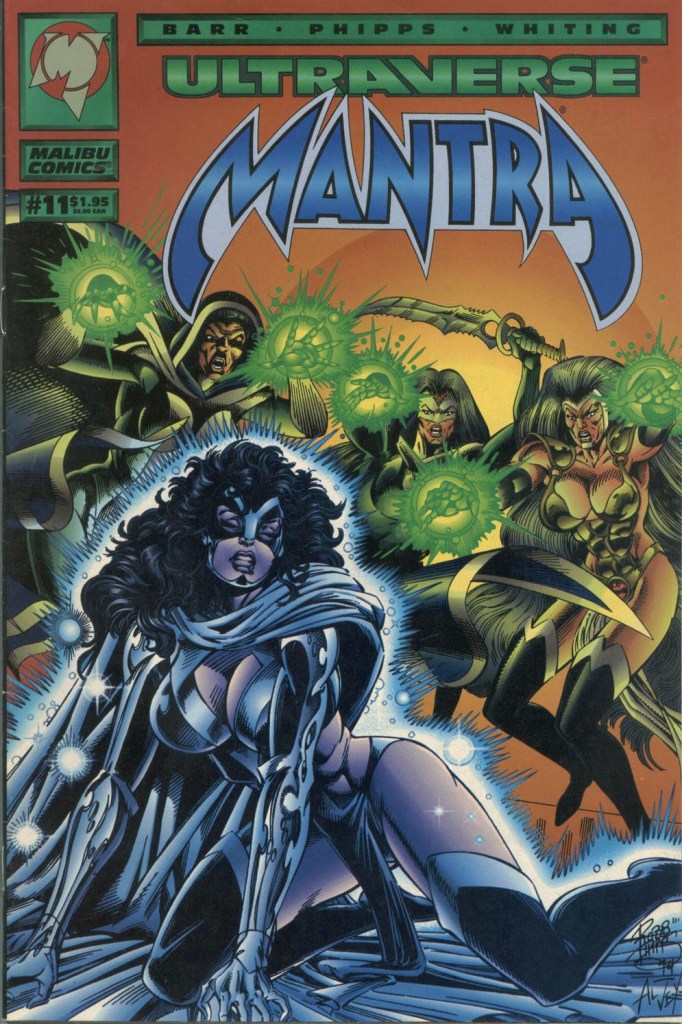
The cover.

Early story

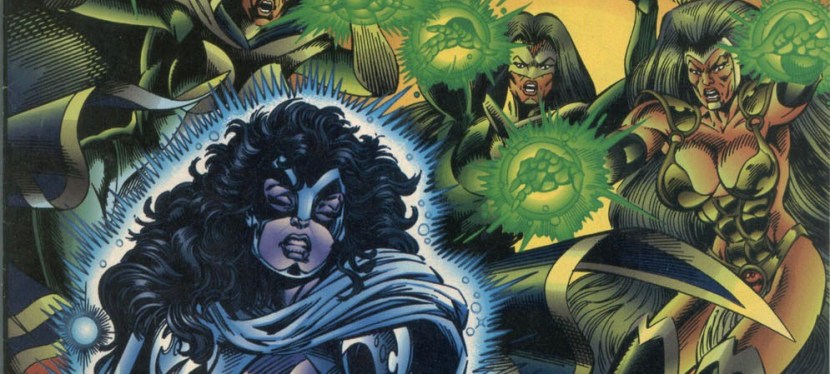
The story begins with Mantra standing completely naked in the full view of Boneyard, his three wives and the four other thugs (who hunted Mantra). Boneyard states, “Your choices are clear, Lukasz—surrender to me and become first among equals in my harem…or be destroyed by my wives—whose powers now equal yours!”

Suddenly the three wives fire beams of energy towards Mantra who successfully blocks them using magic to create a transparent shield. Very quickly, Mantra sees an opportunity to get the other thugs involved as targets of the three wives so she moves toward her previous attackers. The three wives’ attacks cause the thugs to retreat. Boneyard recognizes one of the thugs as the son of his rival Archimage.

Suddenly, the thugs attack Boneyard’s three wives with energy causing them to fall down on the floor. As the conflict shifted, Mantra begins to realize something.

“I knew the mask enhance the mystic power of this body, but I didn’t realize the mask and armor would have the same effect on Boneyard’s wives as well. Figures he didn’t choose them just for their looks. At any rate…I can’t walk around here like a Playboy centerfold all day! I’m getting cold,” Mantra thought.

Quality
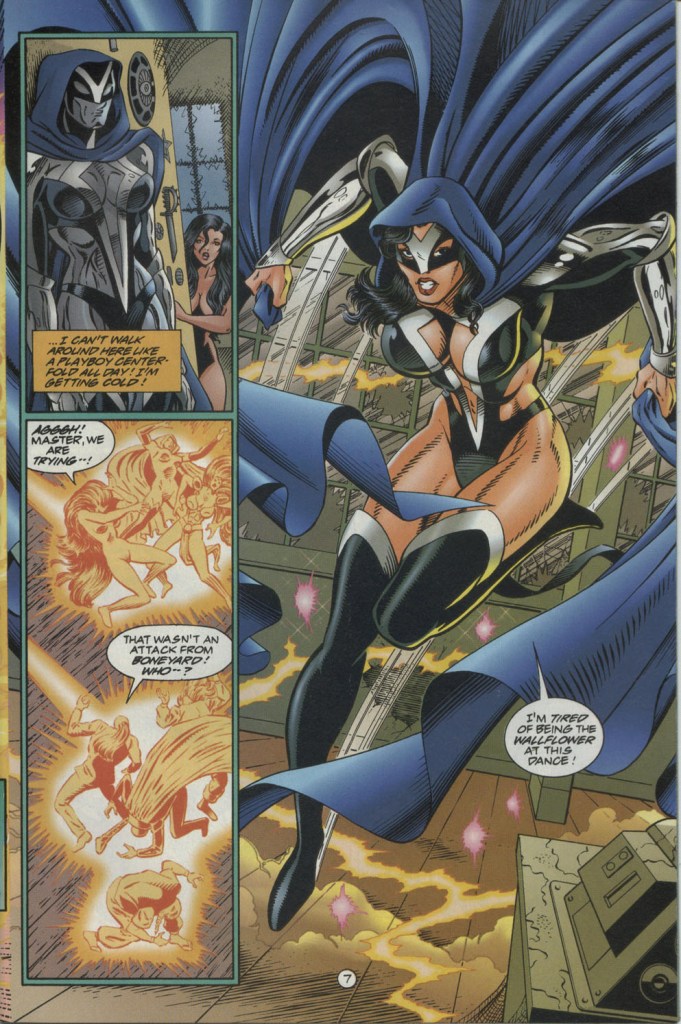
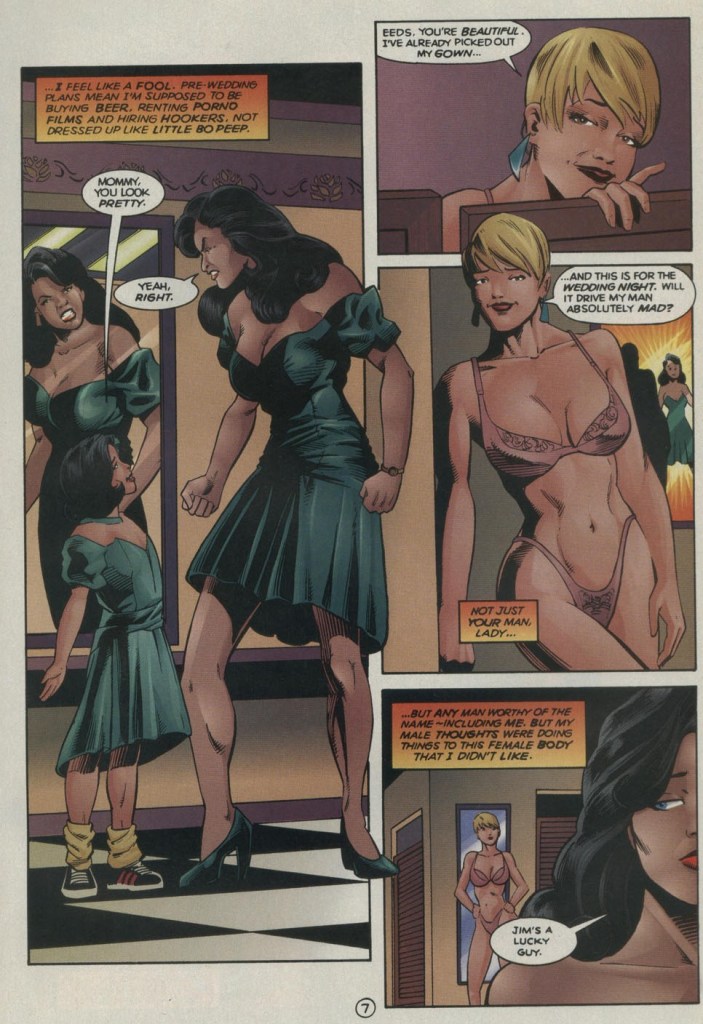
This is the first time Mantra wore a new costume which was carried over to issue #12.

No surprise, Mike W. Barr successfully kept the story engaging not only maintaining the engagement carried over from the few previous issues but by raising the stakes for Mantra personally while pulling off some pretty notable revelations that date back before the events of issue #1. Going beyond Boneyard and his three wives, there is a lot of fantasy related stuff waiting to be discovered which further adds depth to Mantra’s struggle (finding a male body to occupy and the ways to leave Eden Blake’s body). The plot really thickened with the revelations and how they turned out is something that you yourselves must pick up a copy of this comic book and read.

Of course, having reviewed issue #12 recently, it is no surprise that the build-up of engagement and suspense in this comic book contributed to its successor. More importantly, by the time you reach the end of this comic book, you will get a deeper understanding of what has been going and what preceded them. Clearly Mike W. Barr made solid preparations and took his time with the revelations just as he kept on telling the present-day story of Mantra.

Like the previous issue, I enjoyed Robb Phipps’ artwork here. If you were disappointed with the cartoony aesthetic of Terry Dodson’s work in issue #10, you will like the expressions as well as the overall style of Phipps.

Conclusion
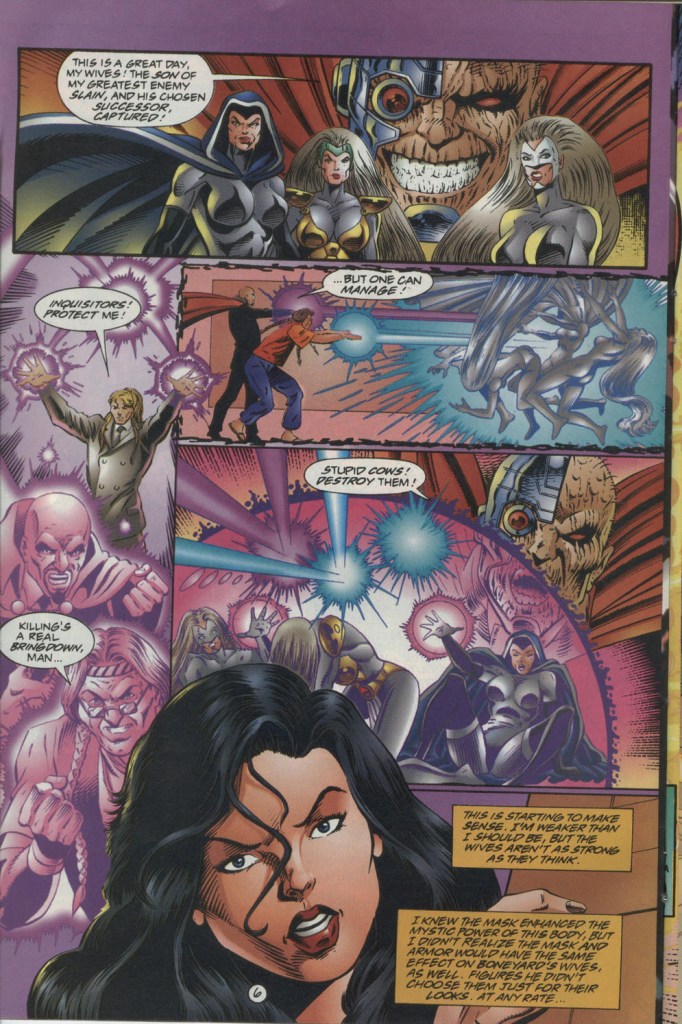
With a male soul inside the body of Eden Blake, Mantra quickly analyzes the messy situation to find an advantage.

Mantra #11 (1994) is indeed a pretty entertaining and compelling Ultraverse comic book. There is nothing like watching the spectacle happen in between moments of Mantra realizing answers to her questions, and learning new details (including stuff that emphasized how rotten, how wicked and twisted Boneyard truly is as the major villain of not only this particular series but also of the Ultraverse itself) that deepened the narrative for readers.

If you are seriously planning to buy an existing hard copy of Mantra #11 (1994), be aware that as of this writing, MileHighComics.com shows that the near-mint copy of the comic book costs $8.

Overall, Mantra #11 (1994) is recommended.

+++++

Thank you for reading. If you find this article engaging, please click the like button below and also please consider sharing this article to others. If you are looking for a copywriter to create content for your special project or business, check out my services and my portfolio. Feel free to contact me as well. Also please feel free to visit my Facebook page Author Carlo Carrasco and follow me at HavenorFantasy@twitter.com
A Look Back at Sludge #1 (1993)

Disclaimer: This is my original work with details sourced from reading the comic book and doing personal research. Anyone who wants to use this article, in part or in whole, needs to secure first my permission and agree to cite me as the source and author. Let it be known that any unauthorized use of this article will constrain the author to pursue the remedies under R.A. No. 8293, the Revised Penal Code, and/or all applicable legal actions under the laws of the Philippines.

Welcome back, superhero geeks, comic book collectors and fans of the Ultraverse! Before we revisit the Ultraverse, I should state that I am not a fan of monsters as comic book protagonists, especially when it comes to the superhero genre. In the world of pop culture, a lot of people get fascinated with monsters especially those that are dangerous to people. You got the likes of the Swamp Thing, Dracula, the monster of Frankenstein, the Werewolf, etc.

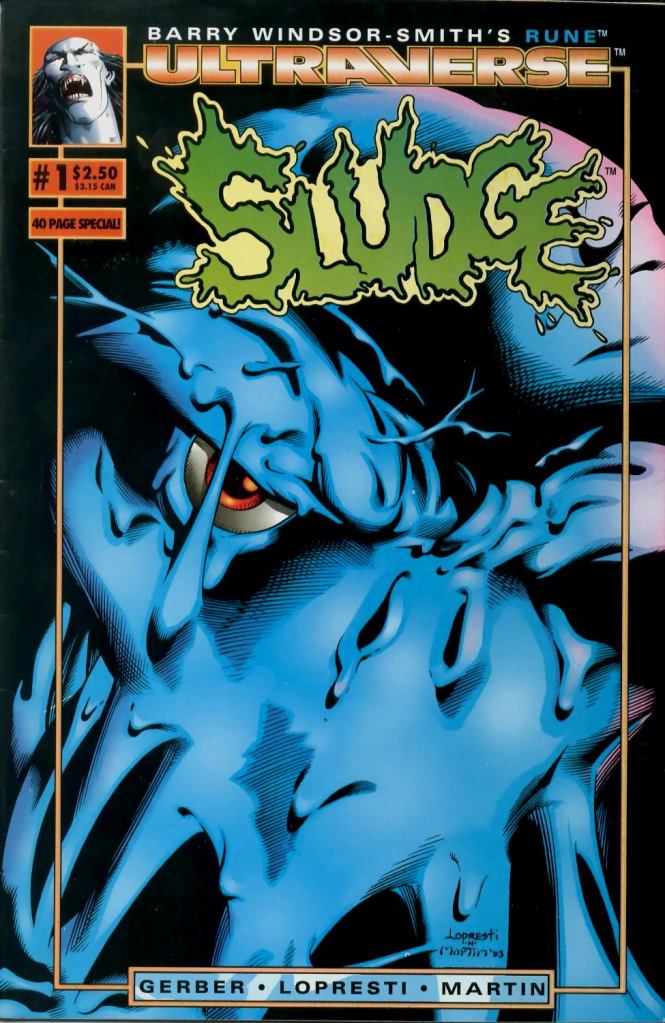
When it comes to the Ultraverse, they have a monster for a protagonist named Sludge. What I find really intriguing was that Sludge was introduced to readers not by making appearances in existing Ultraverse comic books but by actually being featured in full force in the launch of issue of his own series – Sludge #1.

With those details settled, we can find out if there is something special or unique about the Ultraverse monster in this look back at Sludge #1, published by Malibu Comics in 1993 with a story written by Steve Gerber (who previously worked on Marvel’s Man-Thing) and drawn by Aaron Lopresti.

The cover.

Early story

The story begins in a very low place of Manhattan where society’s substratum meets the crust of the earth. Sludge, a grotesque monster with a human perception and a body made out of slime, slowly walks towards a group of poor and homeless people.

Elsewhere somewhere in the city, a radio talk show host talks to his listeners about Frank Hoag, a detective sergeant who worked for twenty years for the New York Police Department or NYPD. It turns out, Hoag has been missing for the past few weeks and the last thing someone knew about him was that he responded to a call about a break-in at the headquarters of a pharmaceutical firm. The next morning at the said place, company employees spotted signs of violence including blood, bullet holes and shell casings. No sign of the detective.

As the radio talk show host engages his listeners by making an issue out of the disappearance of Hoag, police officers got offended while a gang of armed thugs paid close attention to what was said. As the said gang (riding their car) move down the street of homes, they opened fire at the people.

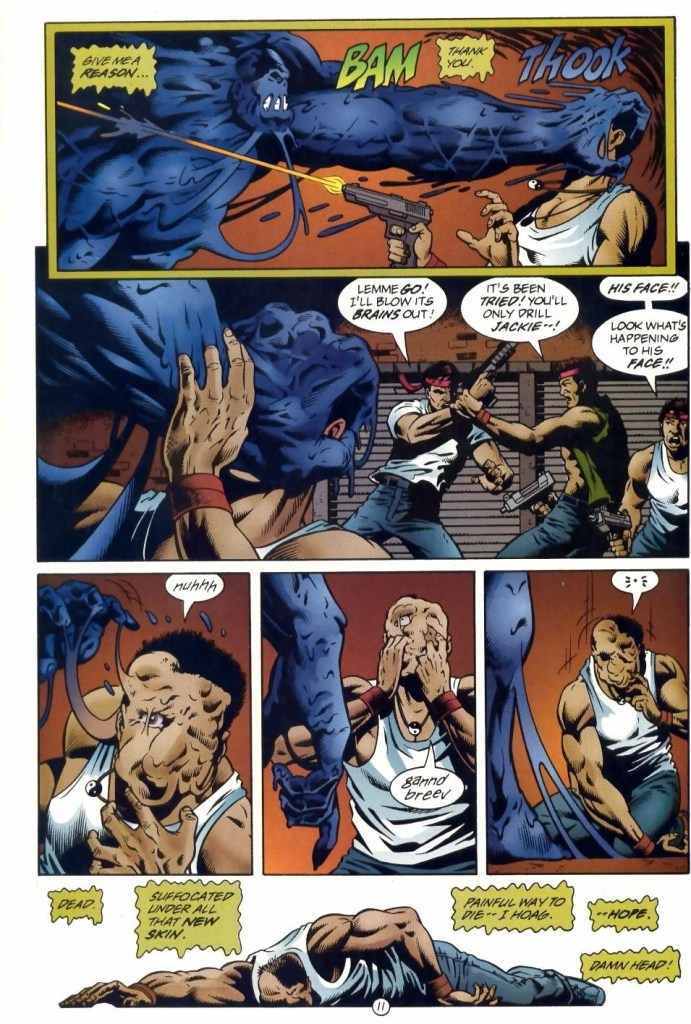
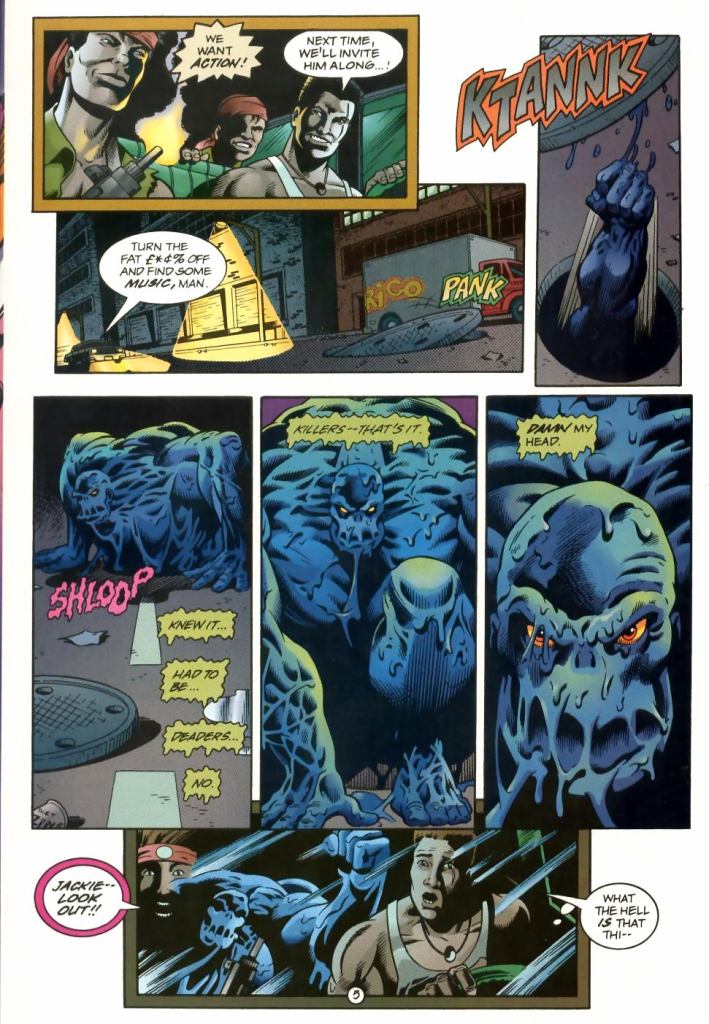
As the gang’s car moves on, the manhole ahead of them opens. Sludge comes out of it and finds himself right on the path of the moving car…

Quality

This is why you don’t mess with Sludge.

The writing is top-notch and this is no surprise not only because of Steve Gerber’s extensive writing experience but also because he knew how to write a story with a monster as a protagonist which was what he did with Marvel’s Man-Thing. Unlike that other monster, Sludge has intelligence and awareness, therefore he is a monster with humanity still existing within. Very cleverly, Gerber introduced Sludge and notable aspects of him in a very smooth and efficient manner. By the time I finished this reading this comic, I realized that I witnessed Sludge’s first appearance and origin story which were done very nicely. I should also state that Sludge here is not a mere monster but really a struggling character worth following.

For his part, Aaron Lopresti’s art is pretty good. His visualization of Sludge really stands out and he did not pull back his punches when it came to drawing the action and presenting the violence.

Conclusion

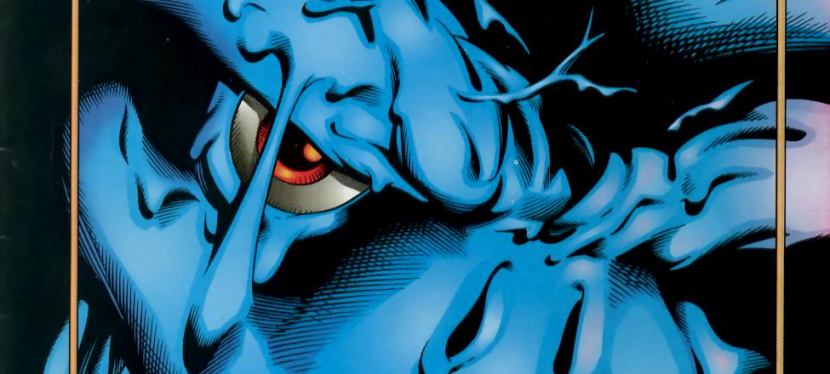
Considering his physical state, Sludge coming out of the manhole is justified.

I can say that I am very pleasantly surprised and entertained by what was presented in Sludge #1 (1993). It really is a great monster-protagonist story written by Steve Gerber and his work here really shines. By the time I reached the end of the story, I got eager to look forward to the next issue and find out what Sludge will do next. It is a very engaging read and one of the strongest debut issues of the Ultraverse.

If you are seriously planning to buy an existing hard copy of Sludge #1 (1993), be aware that as of this writing, MileHighComics.com shows that the near-mint copy of the regular edition costs $8 while the near-mint copy of the ultra-limited edition costs $32.

Overall, Sludge #1 is highly recommended!

+++++

Thank you for reading. If you find this article engaging, please click the like button below and also please consider sharing this article to others. If you are looking for a copywriter to create content for your special project or business, check out my services and my portfolio. Feel free to contact me as well. Also please feel free to visit my Facebook page Author Carlo Carrasco and follow me at HavenorFantasy@twitter.com
A Look Back at Mantra #10 (1994)

Disclaimer: This is my original work with details sourced from reading the comic book and doing personal research. Anyone who wants to use this article, in part or in whole, needs to secure first my permission and agree to cite me as the source and author. Let it be known that any unauthorized use of this article will constrain the author to pursue the remedies under R.A. No. 8293, the Revised Penal Code, and/or all applicable legal actions under the laws of the Philippines.

Welcome back superhero enthusiasts, comic book collectors and fans of the Ultraverse! We are about continue the retro review of comics from the Mantra monthly series. Previously, details and a close friend of Eden Blake from her past came back which obviously caught Lukasz (the male warrior occupying Eden’s body since issue #1) off-guard and added further pressure on him. And then something happened during the wedding of that close friend which compelled Mantra to fight someone in armor which eventually led to some revelations.

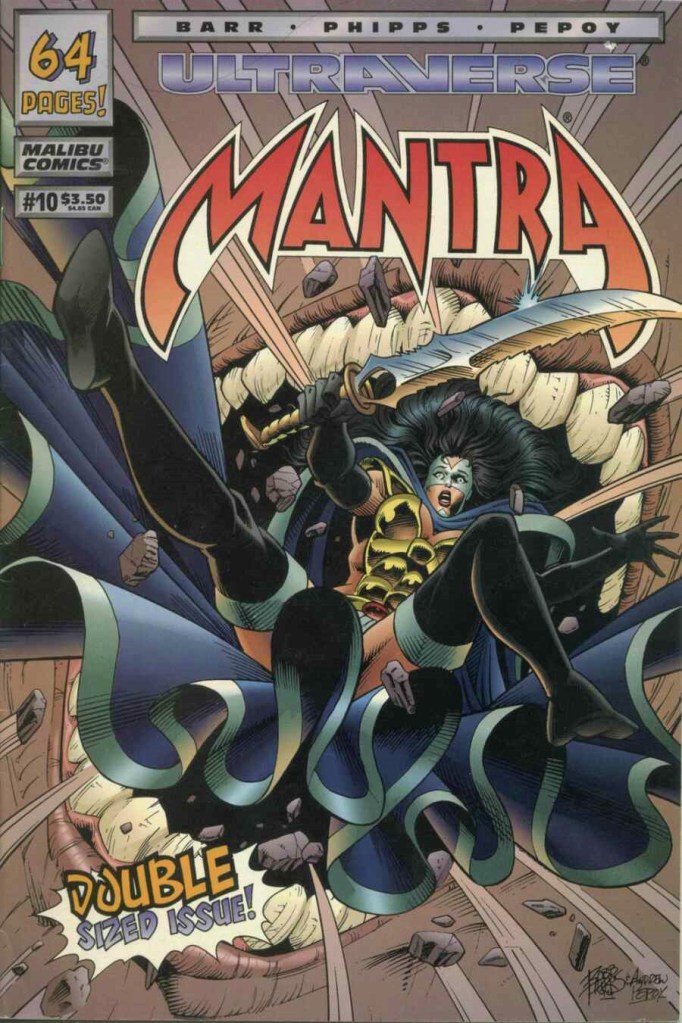
What will happen next to Mantra? We can all find out in this look back at Mantra #10, published in 1994 by Malibu Comics with a story written by Mike W. Barr and illustrated by Rob Phipps (who illustrated Mantra #4). This comic book is another one of those flip-side comics with the other side being Ultraverse Premiere #2 which contains short stories within the Ultraverse.

The cover.

Early story

The story begins in the middle of a city when a man arrives at his office at a place called the Conjurirs’ Club. Upon entering, he is surprised to see three sinister looking men and one of them identifies him by his name – Edgar Strauss. Refusing to give in to them, Strauss puts up a seraphic shield. One of the magic users hits Strauss with force pushing him into his office chair. A servant of Strauss comes into the office but is confronted by another man with a hideous looking chest. Strauss suddenly gets overwhelmed with visions. In response to his question, the three men wanted information about Mantra whom they describe to be a witch.

Over at the Blake residence, Lukasz/Eden wakes up after having a very disturbing dream. It turns out, the dream had been repeating. Looking at the mirror, he sees Eden’s face and thought to himself: Still, it’s not much worse than my life which is a nightmare. I’m a warrior. I should be fighting the foes of Archimage with broadswords and mace…instead I was reincarnated as a woman – Eden, a housewife…worse, a housewife with kids!

After going through the morning traditions of feeding Eden’s son and daughter, sending them to school and getting dressed for work, he reports to work at the office inside the highly secured facility of Aladdin in southern California. While working as Eden, Lukasz uses magic to access the digital files via the computer. Suddenly, someone touches his shoulder from behind…

Quality

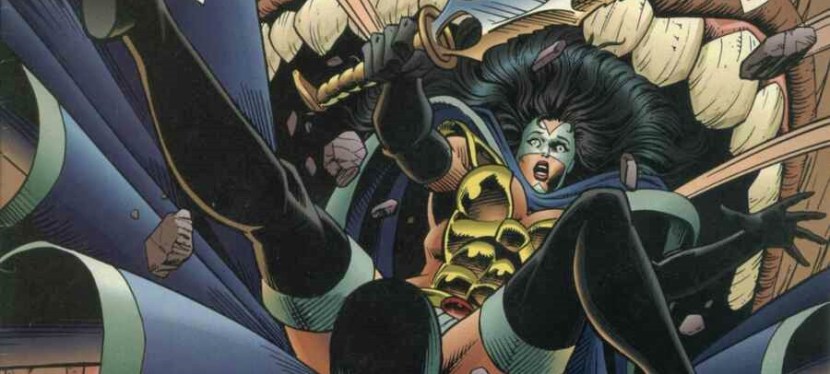
Mantra using a piece of the armor that the antagonist in issue #9 used.

I’ll start first with the art. Robb Phipps, like his previous Mantra work, delivered a fine job visualizing the script with a smooth pace, drawing spectacle nicely and making Mantra and the established characters look recognizable. I also like the way the artist drew facial expressions.

When it comes to the story, this one is even more intriguing and surprising than issue #9. The startling revelations from Lukasz’s past and his history with his tribe under Archimage expanded further here and this added more to the conflict with Boneyard. These revelations confirmed that not everything in the Archimage-Boneyard war is as simple as black and white. When it comes to characterization, Mike W. Barr really developed Lukasz in Eden’s body further and it was pretty notable to see Lukasz (who was oriented to fight with weapon instead of magic) become more adjusted using magic more proficiently while getting around the physical weakness of the lady’s body he is occupying.

As mentioned before, sorcery is an abomination in Christianity and this comic book further adds elements of the occult into the narrative. There was even a short scene of Boneyard (himself an abomination) in a location that looks like Hell.

Conclusion

Homosexuality hinted on the part of the man? Insanity perhaps?

If I were to describe Mantra #10 (1994), it’s an obvious shift to more fantasy and sorcery elements than the previous issues. It certainly is not a tale about good-versus-evil because Mantra is not exactly innocent (note: Lukasz is an established killer and has displaced so many people’s lives) even when compared to Boneyard. Technically, Boneyard is pretty much the Ultraverse version of Satan.

If you are seriously planning to buy an existing hard copy of Mantra #10 (1994), be aware that as of this writing, MileHighComics.com shows that the near-mint copy of the comic book costs $12.

Overall, Mantra #10 (1994) is satisfactory.

+++++

Thank you for reading. If you find this article engaging, please click the like button below and also please consider sharing this article to others. If you are looking for a copywriter to create content for your special project or business, check out my services and my portfolio. Feel free to contact me as well. Also please feel free to visit my Facebook page Author Carlo Carrasco and follow me at HavenorFantasy@twitter.com
A Look Back at What If #13 (1990)

Disclaimer: This is my original work with details sourced from reading the comic book and doing personal research. Anyone who wants to use this article, in part or in whole, needs to secure first my permission and agree to cite me as the source and author. Let it be known that any unauthorized use of this article will constrain the author to pursue the remedies under R.A. No. 8293, the Revised Penal Code, and/or all applicable legal actions under the laws of the Philippines.

Welcome back superhero enthusiasts, comic book collectors and X-Men fans. I’m about to review an issue of Marvel Comics’ What If monthly series which was published 1990 and was related to the X-Men as the central figure of the comic book is Charles Xavier (AKA Professor X).

To put things in perspective, Charles Xavier is forever known as the founder and leader of the X-Men. Within the Marvel Comics universe, he is one of the most powerful telepaths as well as a genius in science and genetics. He is a paraplegic who can do quite a lot and make an impact on the delicate relationship between his fellow mutants and the humans. In the movies, Xavier was portrayed by Patrick Stewart (first performance as Xavier in X-Men) and James McAvoy (first performance as Xavier in X-Men: First Class). Given his legacy of helping mutants gain rights through peaceful means, Charles Xavier has been compared with Martin Luther King, Jr. Going back to the comics, Xavier has a step brother named Cain Marko who became the X-Men villain Juggernaut.

With the background lesson done, we can now take a look back at What If #13, published by Marvel Comics in 1990 with a story written by Kurt Busiek and drawn by Vince Mielcarek.

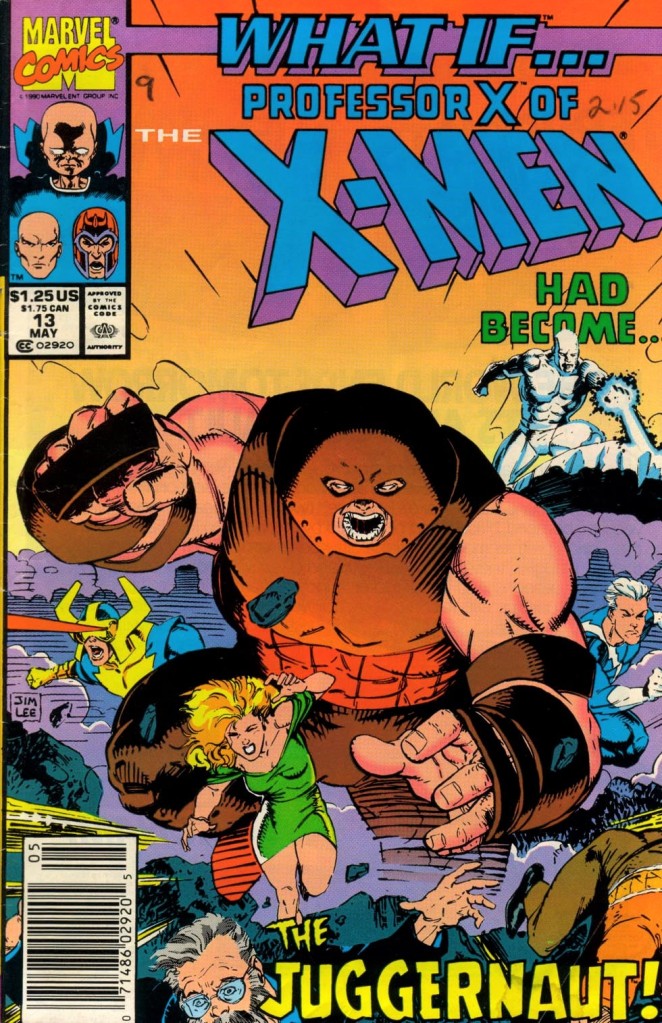
The cover drawn by Jim Lee.

Early story

The story begins in New York in the so-called near future. Graffiti artists attempt to run away from a team of mutants riding a floating vehicle. As Thunderbird is about to hit one of the humans, Cyclops stops him. Suddenly the mutants receive a telepathic message from their big boss who turns out to be Charles Xavier the Juggernaut.

Xavier is leading the effort against a group of humans who have been conspiring against them. Xavier declares, “They must be stopped—for the good of mutantkind!”

The X-Men in this particular story are fascist storm troopers policing a wretched, helpless humanity…

Quality

Xavier-Juggernaut with the X-Men and the invading Fantastic Four.

I can start by say that this comic book written by Kurt Busiek has one of the most compelling what-if scenarios that reflect not only its concept (of Charles Xavier becoming Juggernaut) but also the Marvel Comics universe as we know it. As dedicated X-Men fans know, Cain Marko was the one who touched the ruby in the cave which made him the mainstream Juggernaut. In here, the scenario was altered to make Charles Xavier become Juggernaut and the radical changes did not end there. Without spoiling the great stuff, I can say that this is one great exploration of an alternate version of events that affect not only the X-Men and their villains but also the many other superheroes of the Marvel universe as Xavier-Juggernaut went all-out with his dedication to mutantkind. I can say that in this story, symbolically speaking, Xavier easily outclasses the extreme Magneto on prioritizing mutants over humans.

Comic book concept aside, Kurt Busiek’s writing here is really excellent. Not only did he capture the traits of Xavier as he turned him into the alternate Juggernaut, Busiek also emphasized the many twisted events in the Marvel shared universe with sufficient details. The details implemented made the scenarios really believable. His script for this comic book was brought to life by Vince Mielcarek who did a good job making the characters recognizable (note: there were a lot of superheroes and villains here), showcasing the wide scope of changes made on people and places (in relation to Xavier-Juggernaut’s actions) and there was good pacing with the visuals.

Conclusion

Charles Xavier as you’ve never seen him before.

What If #13 (1990) is great to read and it is a must-have with its story alone. Apart from showing the concept’s deep impact on the Marvel Comics universe, I also enjoyed the way Kurt Busiek blurred the boundaries that separated good and evil. If you are an X-Men and you want to see something different with the mutants – especially Professor X – then you you will find a lot to enjoy here. This is a great alternate superhero story and definitely more people should be aware of this.

If you are seriously planning to buy an existing hard copy of What If #13 (1990), be aware that as of this writing, MileHighComics.com shows that the near-mint copy of the regular edition costs $30 while the near-mint copy of the newsstand edition costs $60.

Overall, What If #13 (1990) is highly recommended!

+++++

Thank you for reading. If you find this article engaging, please click the like button below and also please consider sharing this article to others. If you are looking for a copywriter to create content for your special project or business, check out my services and my portfolio. Feel free to contact me as well. Also please feel free to visit my Facebook page Author Carlo Carrasco and follow me at HavenorFantasy@twitter.com
A Look Back at X-Men Unlimited #1 (1993)

Disclaimer: This is my original work with details sourced from reading the comic book and doing personal research. Anyone who wants to use this article, in part or in whole, needs to secure first my permission and agree to cite me as the source and author. Let it be known that any unauthorized use of this article will constrain the author to pursue the remedies under R.A. No. 8293, the Revised Penal Code, and/or all applicable legal actions under the laws of the Philippines.

As mentioned before (refer to my reviews of X-Men 2099 #1 and X-Men #25), 1993 was the year when the 30th anniversary of the X-Men was celebrated. Back then, Internet connection was not very accessible to the public, social media had not been invented and streaming movies and TV shows was not yet the norm. How did Marvel Comic organize the celebration for X-Men fans? By publishing a lot of comic books and selling merchandise.

In the first quarter of 1993, Marvel Comics went on to feed the perceived high demand of X-Men fans by launching X-Men Unlimited which was an all-new comic book series with a schedule of quarterly releases per new comic book (initially with 64 pages of content using glossy paper). They released X-Men Unlimited #1 in March 1993 and I bought a copy for a hefty $3.95.

So what exactly did the said comic book feature? Was it good? We can all find out in this look back at X-Men Unlimited #1 published by Marvel Comics with a story written by Scott Lobdell and drawn by Chris Bachalo.

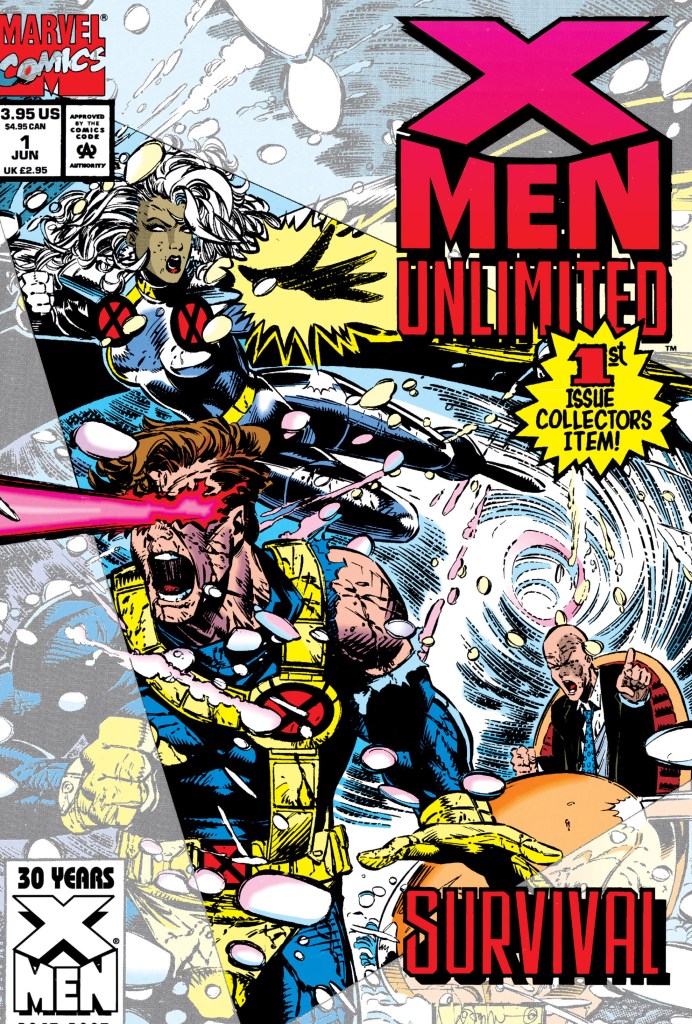
The cover.

Early story

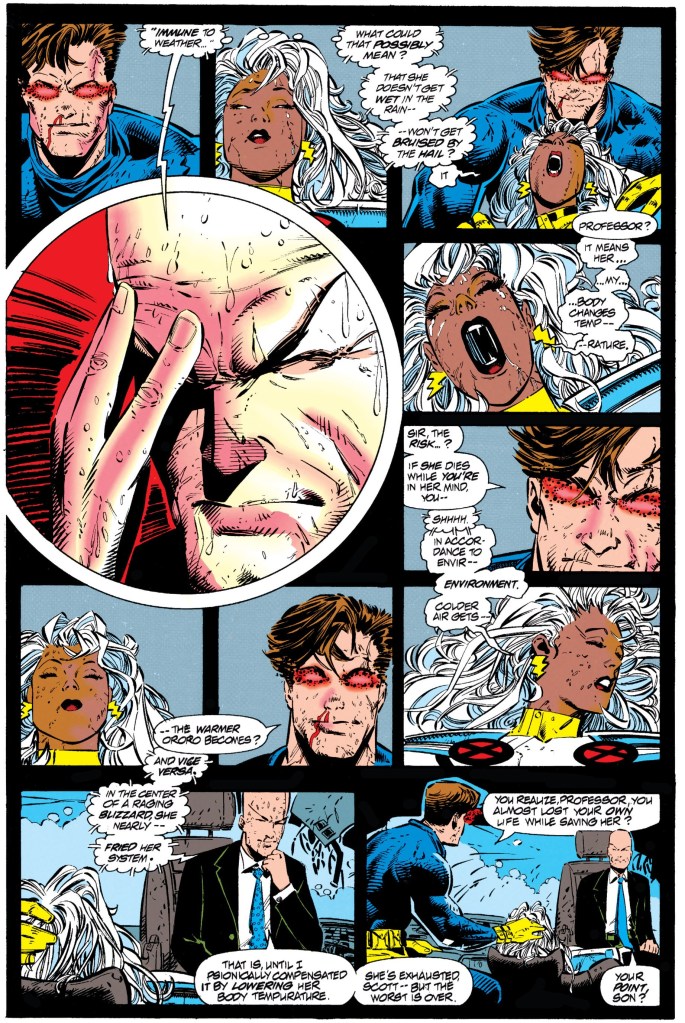
The story begins on the snowy surface of Antarctica where the Blackbird (the X-Men’s jet) has crashed. Cyclops is outside the crashed jet already suffering from internal bleeding and other injuries. As his ruby quartz visor has been lost, he desperately keeps his eyes shut to avoid firing any optic blast. Even with tremendous odds against him, Cyclops concentrates very hard to reach out to Charles Xavier and successfully makes contact. Xavier is surprised.

With telepathic assistance provided by Xavier, Cyclops successfully reaches him and carries him. After some searching, they spot Storm alone on the snow. Elsewhere, a lady gets up from the snow and walks towards a facility. Upon entering, there are scientists working with computers and they called her Ms. Blaze. She asked them if she succeeded in killing Cyclops, Storm and Xavier…

Quality

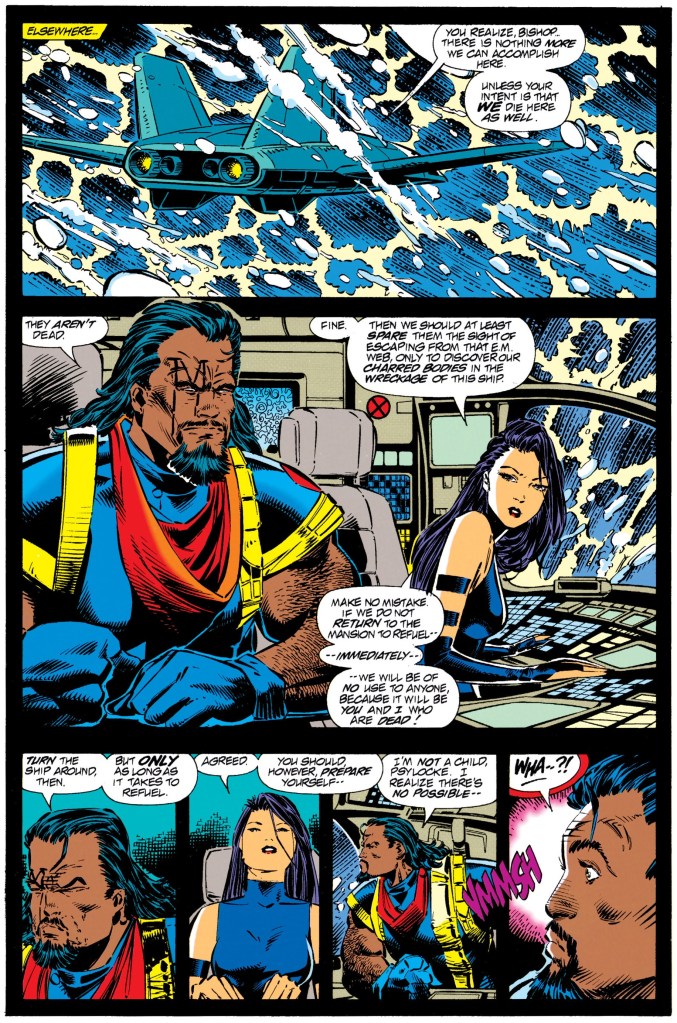
Artist Chris Bachalo failed to pace his art properly on this page.

To get to the point, I should state that the main lesson of this X-Men story written by Lobdell is about leadership mixed with responsibility and survival. Symbolically, the three leaders of the X-Men (Xavier the head with Blue Team leader Cyclops and Gold Team leader Storm) were placed in a situation of great odds and their respective powers cannot just help solve their problems nor help them get away easily. Here we get to see Cyclops, Storm and Xavier really struggling and having no choice but to use their wits as well as skills learned from the past in order to survive and progress. This is easily the comic book’s most unique feature and it is very rare to see Xavier and the two team leaders spend a lot of time together and work with each other. As far as emphasizing the leadership dynamics of the X-Men is concerned, Lobdell succeeded. I should also state that Lobdell really dramatized the respective personalities of the three.

Still there are some notable flaws. I should say the story had lots of dragging moments in between and the overall pace is between slow and medium. The dialogue is quite wordy and ultimately a lot of it felt like fillers than actual attempts to develop personalities and explain things. There were attempts to make the dialogue more philosophical but end up dragging the narrative. I should state that verbal descriptions or narrations in certain pages were quite excessive. If you are looking for superhero spectacle, there is actually little to enjoy here and by the time the final conflict is over, you will end up unsatisfied. Of course, there are also scenes of incidental moments (examples: explosions, the environment causing damage, etc.) that were emphasized as if to make up for the lack of superhero spectacle.  

The antagonist Sienna Blaze is not a compelling villainess. There is no justification as to why she tried to kill the X-Men. The way she is presented, Blaze is more like a reckless and impulsive teenager than a real opposing force against Xavier and his mutants.

Psylocke and Bishop were the other X-Men members who appeared.

Lastly, there is the art by Chris Bachalo which has always been sub-par and disappointing to look at. While Bachalo did a decent job drawing disaster-related moments, his art on drawing the X-Men really sucked. There were many times when Charles Xavier LOOKED LIKE A DUMMY (think mannequin) than a living person as drawn by Bachalo. The art of this comic book was disappointing in 1993, and it has aged badly by today’s standards.

Apart from the main story, this comic book has a gallery of artworks highlighting the X-Men (including members who did not appear in the said story) done by varied illustrators. The quality of the art, unsurprisingly, is a mixed bag. Ultimately the art gallery served as convenient filler made to satisfy the cravings of X-Men fans.

Conclusion

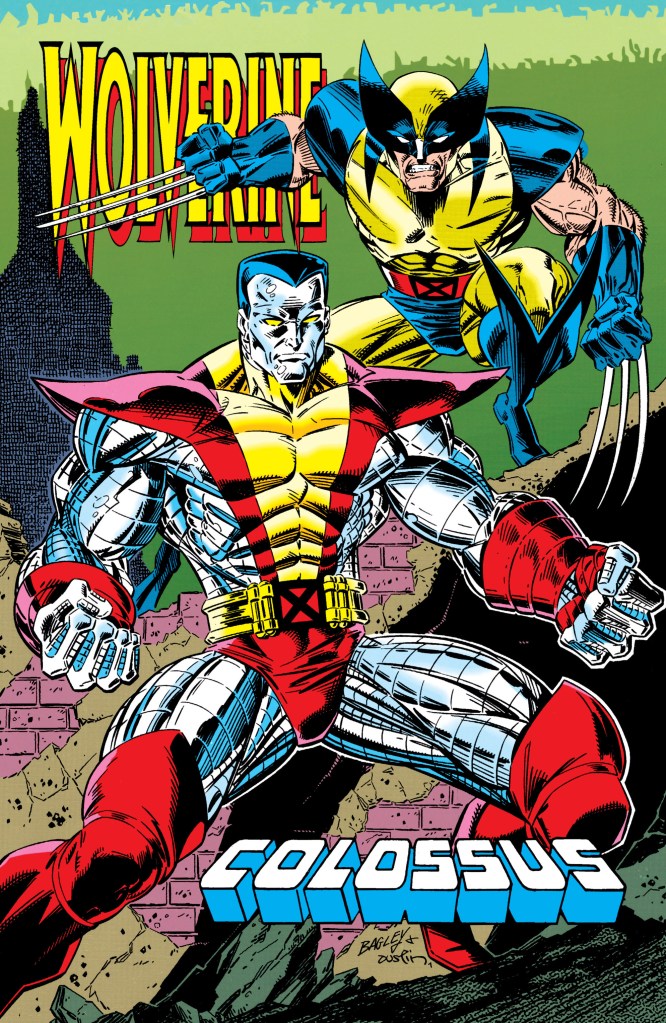
This is how Wolverine and Colossus look as drawn by Mark Bagley who was the Amazing Spider-Man artist of the time.

Apart from being made to sell a bunch of copies and take advantage of the comic book collector craze of the time, X-Men Unlimited #1 (1993) was an effort to keep defining the X-Men for fans and comic readers of the 1990s by adding depth to the bond between Xavier, Storm and Cyclops. The problem is with the execution as the story dragged a lot, and a whole lot of dialogue and text descriptions were made as if to ensure that enough content would fit the 64-pages of content of the comic book. As far as 1993 X-Men comic books go, this one has one of the worst looking artworks used in storytelling. When it comes to its connection with the 30th anniversary of the X-Men, what happened to Xavier in this comic book is connected to the events of Uncanny X-Men #304 and #310.

If you are seriously planning to buy an existing hard copy of X-Men Unlimited #1 (1993), be aware that as of this writing, MileHighComics.com shows that the near-mint copy of the regular edition costs $10 while the near-mint copies of the signed edition (without certificate), the newsstand edition and the signed edition (with certificate of authenticity) cost $105, $32 and $105 respectively.

Overall, X-Men Unlimited #1 (1993) is unsatisfying. If I were you, I would avoid spending any money above its cover price. Considering its quality, the near-mint copy of this comic book is really worth only $1.

+++++

Thank you for reading. If you find this article engaging, please click the like button below and also please consider sharing this article to others. If you are looking for a copywriter to create content for your special project or business, check out my services and my portfolio. Feel free to contact me as well. Also please feel free to visit my Facebook page Author Carlo Carrasco and follow me at HavenorFantasy@twitter.com
A Look Back at Prototype #13 (1994)

Disclaimer: This is my original work with details sourced from reading the comic book and doing personal research. Anyone who wants to use this article, in part or in whole, needs to secure first my permission and agree to cite me as the source and author. Let it be known that any unauthorized use of this article will constrain the author to pursue the remedies under R.A. No. 8293, the Revised Penal Code, and/or all applicable legal actions under the laws of the Philippines.

Welcome back superhero geeks, comic book collectors and fans of the Ultraverse. In this latest Ultraverse-related retro comic book review, we will check out what happened to Prototype and his companions after the events that took place in issue #12. I personally enjoyed that particular comic book and it has been almost three months since I last reviewed an issue of Prototype.

Now we can start this look back at Prototype #13, published in 1994 by Malibu Comics with a story written by Len Strazewski and drawn by Dean Zachary.

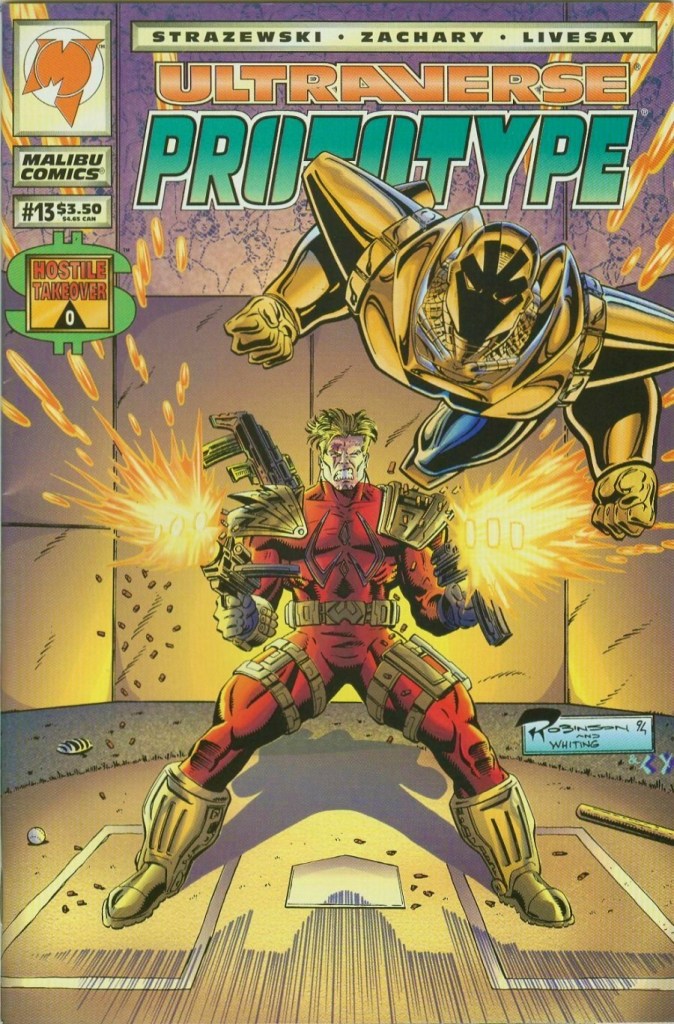
The cover.

Early story

The story begins with TV news coverage of an explosion that happened at one of the buildings along Wall Street. The TV newscaster reports that another battle between ultras rocked the headquarters of Ultratech in downtown Manhattan which sparks rumors of corporate infighting.

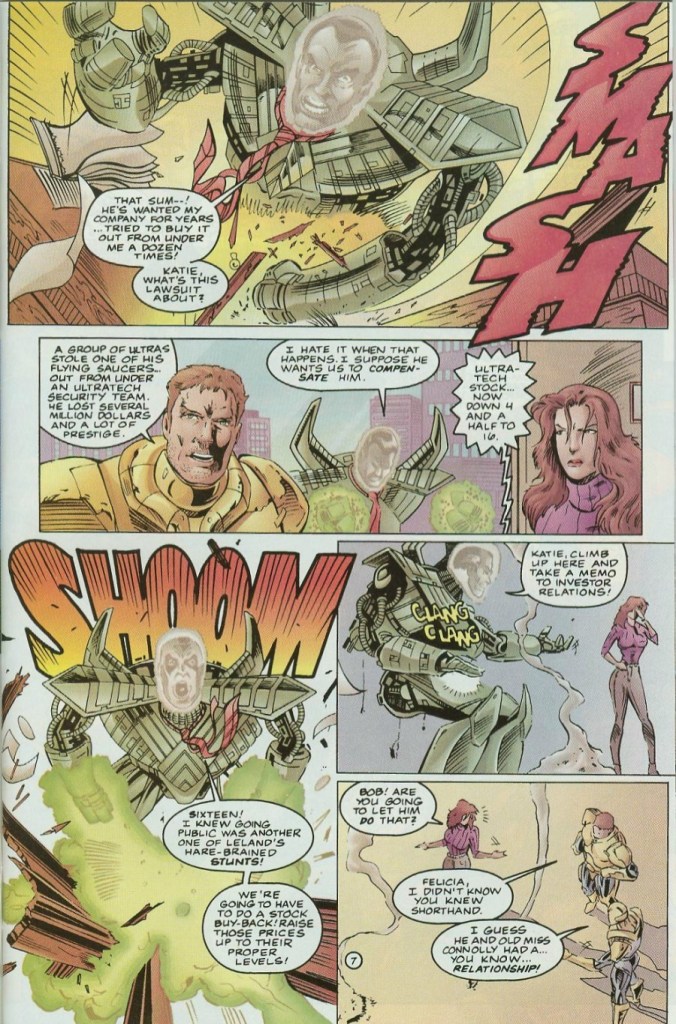
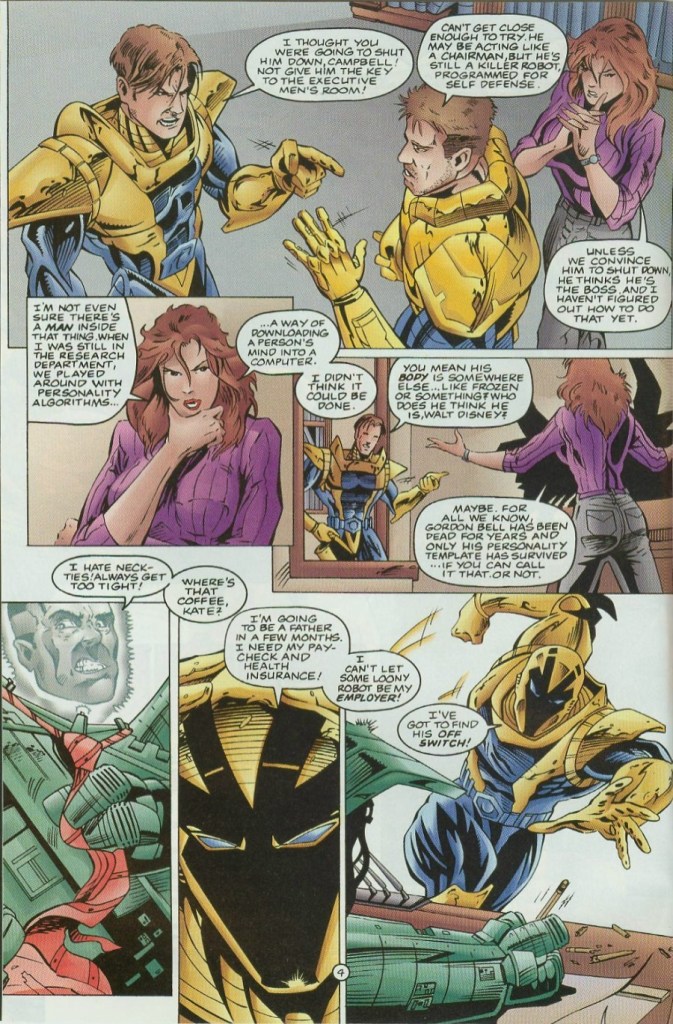
Behind the scenes at the corporate tower, Jimmy Ruiz/Prototype, Bob Campbell/Ranger and Felicia Campbell discuss matters in front of the robot Prototype 2000 (the same machine responsible for the loss of Bob’s arm) which projects an image of Ultratech chairman Gordon Bell as its head. They noticed that the robot thinks and acts like Gordon Campbell, even going as far as calling the name of a secretary who left the company some years back. Felicia believes the robot has some sort of body detachment syndrome. For Bob, it does not matter as Gordon Bell still owns a controlling interest in the corporation.

After some intense talk, Jimmy uses his Prototype armor switch off Prototype 2000 but got blasted by energy which pushed him back to Bob and Felicia. Prototype 2000 then shows the virtual Gordon Bell telling “Katie” to turn the TV on so he can see how the company stock is performing…

Quality

How do you you deal with a machine that actually thinks and acts like a human?

I can declare that Len Strazewski really ramped up the corporate intrigue several notches high in this particular issue. There is a lot of corporate world talk and the good news here was that nothing ended up being boring. The most notable aspect of the story was the presence of Prototype 2000 with the mind of Gordon Bell really reacting to the corporate developments. Of course, there was still sufficient focus on the protagonist Prototype piloted by Jimmy Ruiz. At this stage of the Prototype series, Jimmy has gone through not only many battles using the powered suit of armor but several setbacks in his personal life. Apart from the turmoil at Ultratech, Jimmy not only has to keep his job but also save his reputation. Not to be outdone is Bob Campbell (the original Prototype pilot) whose relationship with Felicia got developed a bit more and their exchange of dialogue was nicely written.

Within the story is a major twist that really added a whole lot of depth into the narrative. It’s a twist that I did not anticipate and I strongly recommend you discover it yourselves once you read this comic book. Oh, and there is a certain supporting character from the Mantra series who also appeared here.

As for the art, Dean Zachary did a descent job visualizing Len Strazewski’s script and capturing the typical smooth sequencing of Prototype in action scenes. There is enough scenes of spectacle here to keep you entertained.

Conclusion

Jimmy Ruiz, Bob Campbell and Felicia discuss matters in the presence of virtual Gordon Bell.

I can say that I had a blast reading Prototype #13 (1994). To put things in perspective, this one is just a part of the Hostile Takeover storyline that eventually connected with other characters of the Ultraverse such as the Night Man and The Solution (a heroes-for-hire team). The writing of Len Strazewski is so good, this one is worth reading all over again. It should be noted that topics like corporate intrigue or business world internal affairs got presented with a strong flavor of superhero stuff that prevented the story from turning into a bore. This is one intriguing and compelling read. Lastly, I should state that this comic book is one of those Ultraverse Premiere flipside issues, the other side of which contained short stories about Iron Clad, Pixx of UltraForce, Flood and Lady Killer of The Strangers.

If you are seriously planning to buy an existing hard copy of Prototype #13 (1994), be aware that as of this writing, MileHighComics.com shows that the near-mint copy of the comic book costs $8.

Overall, Prototype #13 (1994) is highly recommended!

+++++

Thank you for reading. If you find this article engaging, please click the like button below and also please consider sharing this article to others. If you are looking for a copywriter to create content for your special project or business, check out my services and my portfolio. Feel free to contact me as well. Also please feel free to visit my Facebook page Author Carlo Carrasco and follow me at HavenorFantasy@twitter.com
A Look Back at Mantra #9 (1994)

Disclaimer: This is my original work with details sourced from reading the comic book and doing personal research. Anyone who wants to use this article, in part or in whole, needs to secure first my permission and agree to cite me as the source and author. Let it be known that any unauthorized use of this article will constrain the author to pursue the remedies under R.A. No. 8293, the Revised Penal Code, and/or all applicable legal actions under the laws of the Philippines.

Welcome back superhero geeks, comic book collectors and fans of the Ultraverse! Can’t get enough of Mantra? There is a lot to look forward to in my latest review of the Mantra monthly series of the 1990s under the creative leadership of Mike W. Barr.

In Mantra #8, the male soul in the lady’s body had an encounter with Boneyard’s soldiers in a fantasy-themed amusement park which was a very intriguing setting considering the mysticism the series often used. Will there be another intriguing event that awaits Mantra? Find out in this look back at Mantra #9, published in 1994 by Malibu Comics with a story written by Mike W. Barr and drawn by Terry Dodson.

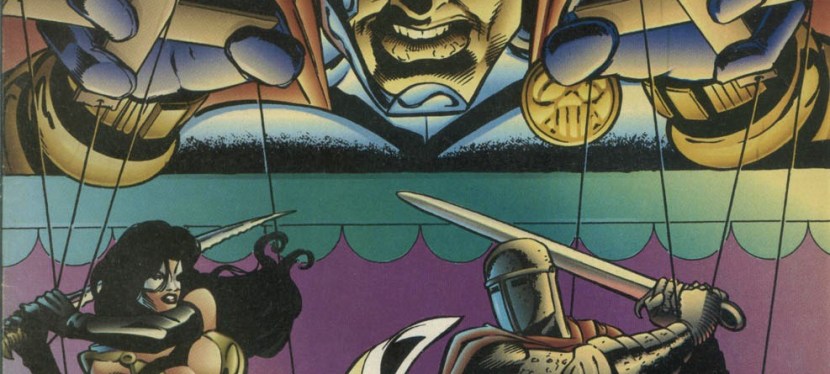
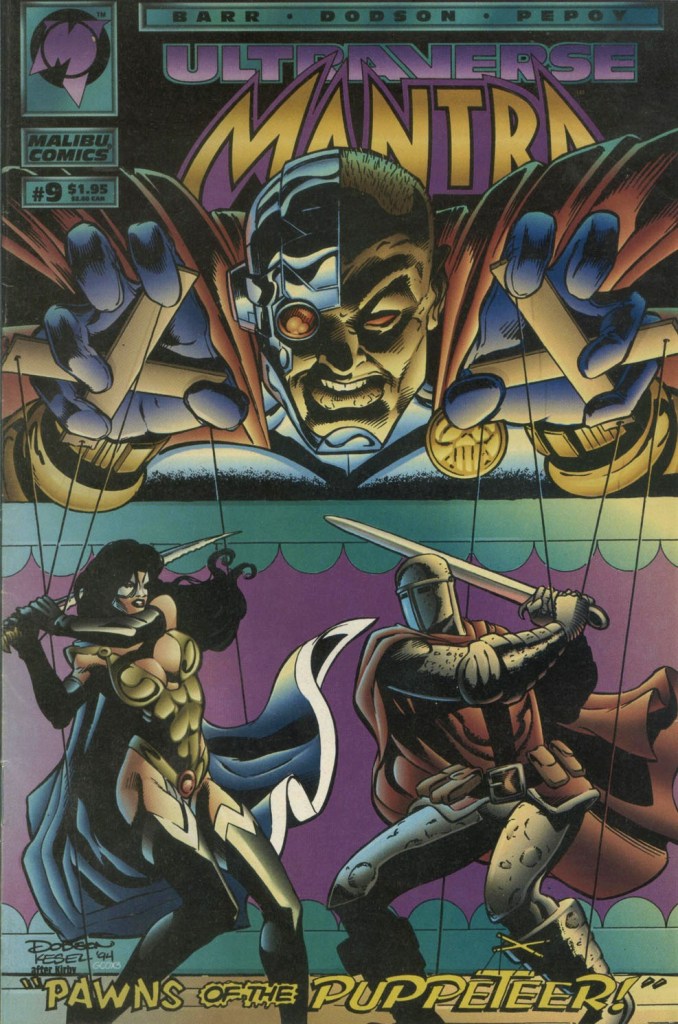
The cover.

Early story

The story begins with Mantra arriving home from battle during the evening. Using magical powers, she instantly changes her clothes to become Eden Blake. As she approaches the entrance, she thought to herself, “It’s hard to believe I’m really a man, wearing the body of Eden Blake. I hope I don’t have to live her life much longer.”

Suddenly a ball of light arrives and Mantra senses it to be an attack. After instantly changing into her armor, she strikes the ball with the sword of fangs, zaps it and watches it fly away. She instantly changes back to Eden Black and enters the home.

Upon entering, she gets a surprise hug by Eden Blake’s old roommate Lila and guy named Jim. Lila reveals that she and Jim are going to get married, and Eden will get to be their maid of honor.

Lukasz, who has been living in Eden’s body for some time now, finds the situation uncomfortable…

Quality

The male warrior Lukasz (occupying Eden Blake’s body) taking part in preparation for Lila’s wedding.

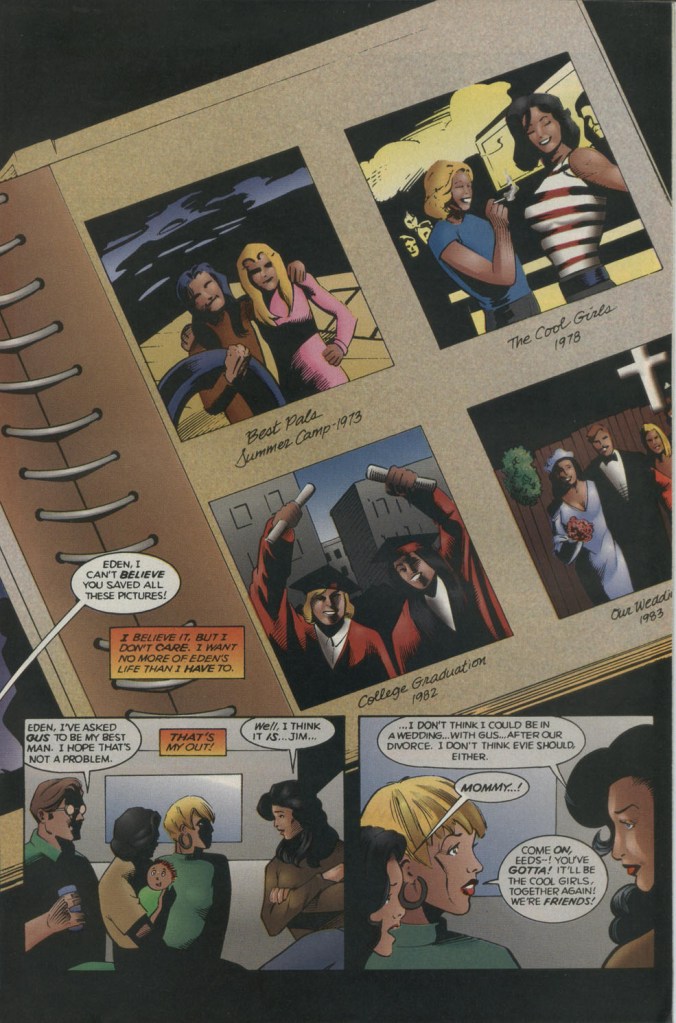
This one has a truly intriguing story about Lukasz struggling not only with being a mother in the body of Eden Blake, but also with dealing with one of Eden’s closest friends in life. It is very cleverly written by Mike W. Barr and the core concept of the story really developed Lukasz/Mantra in a rather refreshing way. In many ways, Lukasz does not find himself trapped by Boneyard’s armed soldiers nor by monsters, rather he finds himself trapped by remnants of Eden’s past (imagine him pretending to remember Eden’s old friends) while dealing with all the pre-wedding preparations. If you expect the usual spectacle of action and sorcery, you will find them here. Who exactly will Mantra fight, that you should find out yourself and there is something here that will convince you to go back reading issue #1.

When it comes to the art, I find it baffling that this one was credited to Terry Dodson. The art here is cartoony in style and Dodson’s art in the first few issues of the Mantra series were more realistic in style, especially with the way people were drawn.  

Conclusion

Some pictures from Eden Blake’s past.

For its story concept alone, Mantra #9 (1994) is an engaging read. I also enjoyed the way this issue connects itself to key details in issues #1, #3 and #5 which encourages re-reading that ultimately will help readers understand the series concept even more. There is also a nice mix of action and drama, and the way the battle concluded is pretty satisfying. Furthermore, the continued development of Mantra is a must-read.

If you are seriously planning to buy an existing hard copy of Mantra #9 (1994), be aware that as of this writing, MileHighComics.com shows that the near-mint copy of the regular edition costs $8 while the near-mint copy of the newsstand edition costs $26.

Overall, Mantra #9 (1994) is recommended.

+++++

Thank you for reading. If you find this article engaging, please click the like button below and also please consider sharing this article to others. If you are looking for a copywriter to create content for your special project or business, check out my services and my portfolio. Feel free to contact me as well. Also please feel free to visit my Facebook page Author Carlo Carrasco and follow me at HavenorFantasy@twitter.com
A Look Back at The Strangers #18 (1994)

Disclaimer: This is my original work with details sourced from reading the comic book and doing personal research. Anyone who wants to use this article, in part or in whole, needs to secure first my permission and agree to cite me as the source and author. Let it be known that any unauthorized use of this article will constrain the author to pursue the remedies under R.A. No. 8293, the Revised Penal Code, and/or all applicable legal actions under the laws of the Philippines.

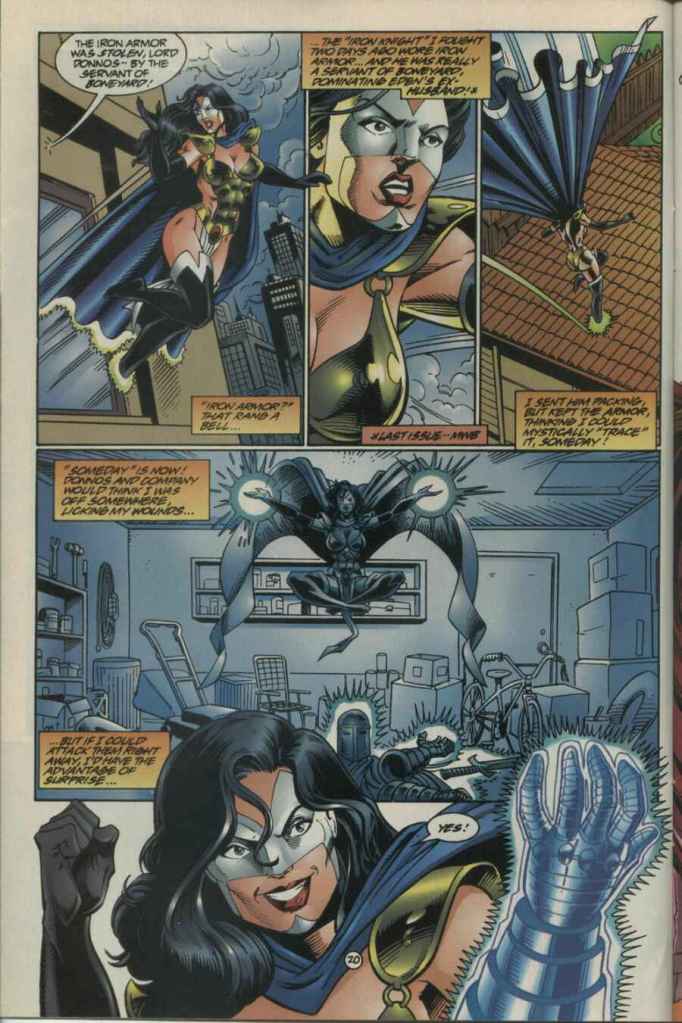
Welcome back Ultraverse fans, superhero enthusiasts and comic book collectors. In this newest return to the Ultraverse originally launched by Malibu Comics and its many talented creators, we will witness what is supposed to be the rise of genuine opposition against The Strangers which was seen building up in issues #16 and #17.

To start with, the character called Pilgrim is quite intriguing being the apparent central figure that wants to smash The Strangers. Along the way, other ultras that opposed the said team end up getting involved with Pilgrim.

Will all these developments lead to the establishment of a powerful force against The Strangers? What can team leader Lady Killer do about it? We can all find out in this retro comic book review of The Strangers #18, published in 1994 by Malibu Comics with a story by Steve Englehart and drawn by Rick Hoberg.

The cover.

Early story

The story begins on sky island. The Pilgrim and his companion appear right next to Zara (one of the members of Yrial’s tribe) telling him, “I am the Pilgrim, Zara! I want you to help me destroy the Strangers!”

Even though the Pilgrim continued to elaborate more on offering him revenge on Yrial, Zara thinks that the foreigner is insane. Zara uses his magic powers while the Pilgrim activates his own special abilities.

Meanwhile on Pier 25, Grenade tries to regain Candy’s trust who recently started distancing herself from him. Grenade decides to let her be but remembered clearly that the division started since the Pilgrim showed up.

Over at Berkeley, the old ultra called Powerhouse looks for a job. Suddenly the Pilgrim appears to him and attempts to recruit him in his quest to destroy the Strangers. Like Zara of sky island, he doubts the Pilgrim, finds him insane and attempts to strike him.

In another location, flying in the air, Yrial tells Spectral that she feels the power of the Pilgrim is closing in on them. Inside the Strangers’ hangout, Bob/Atom Bob and Elena/Lady Killer spend quality time together. Bob expresses worry about the one that wants to destroy them (note: he fought with the Pilgrim in issue #17) and, in response to the lady’s question, he states that his arm is pretty much back to normal thanks to Spectral’s healing green flame. After further talk, Bob asks her, “Will you marry me?”  

Quality

The battle begins!

As expected with the Englehart-Hoberg creative team, the story is fun and engaging to follow from start to finish. For one thing, apart from the rising opposition led by the Pilgrim, the character development for Bob and Elena as well as the rift between Electrocute and Grenade were executed nicely, even serving as a fine build-up before the story shifted into high gear with spectacle. Expect lots of action and banter between the characters fighting. This is one very wordy comic book to read and it sure is worth it!

Behind all the good stuff, there was even room for a nice surprise by the creative team and that is something you must read for yourselves. That alone made this one an intriguing read as well.

Conclusion

The rift between Grenade and Electrocute.

There is no doubt that The Strangers #18 (1994) is a very entertaining comic book to read. Apart from the solid character development and the big bonanza of action, this comic book highlights the effects of the Jumpstart not only the Strangers themselves but also on other people. At this stage, the Pilgrim has evolved into a more meaningful character and he simply cannot be dismissed as just another villain nor another anti-hero.

If you are seriously planning to buy an existing hard copy of The Strangers #18 (1994), be aware that as of this writing, MileHighComics.com shows that the near-mint copy of the comic book costs $8.

Overall, The Stranger #18 (1994) is highly recommended!

+++++

Thank you for reading. If you find this article engaging, please click the like button below and also please consider sharing this article to others. If you are looking for a copywriter to create content for your special project or business, check out my services and my portfolio. Feel free to contact me as well. Also please feel free to visit my Facebook page Author Carlo Carrasco and follow me at HavenorFantasy@twitter.com
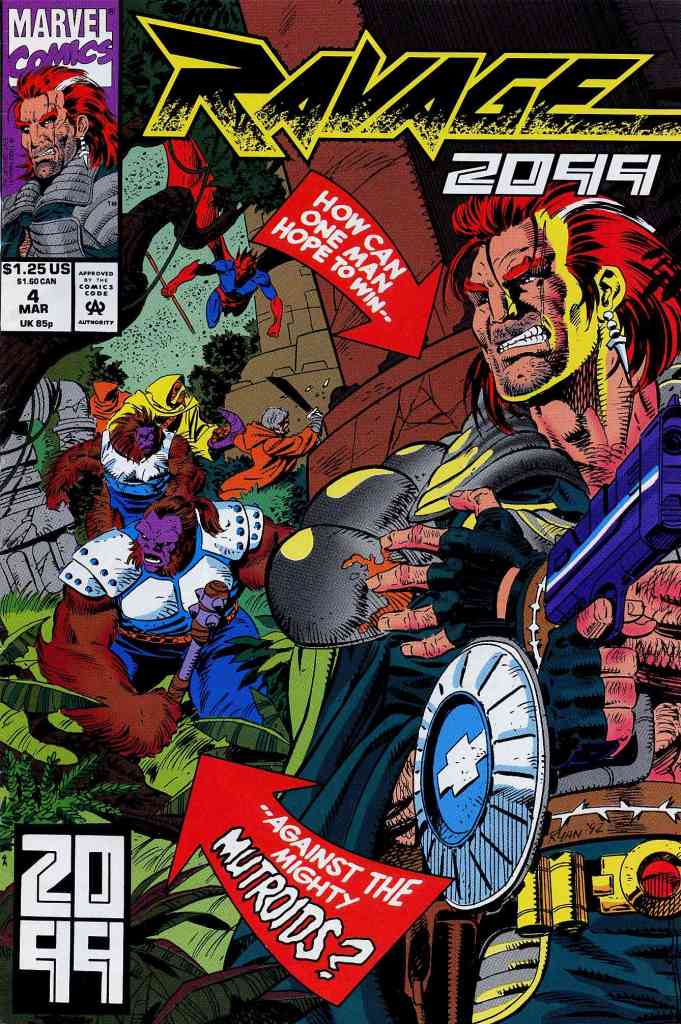
A Look Back at Ravage 2099 #4 (1993)

Disclaimer: This is my original work with details sourced from reading the comic book and doing personal research. Anyone who wants to use this article, in part or in whole, needs to secure first my permission and agree to cite me as the source and author. Let it be known that any unauthorized use of this article will constrain the author to pursue the remedies under R.A. No. 8293, the Revised Penal Code, and/or all applicable legal actions under the laws of the Philippines.

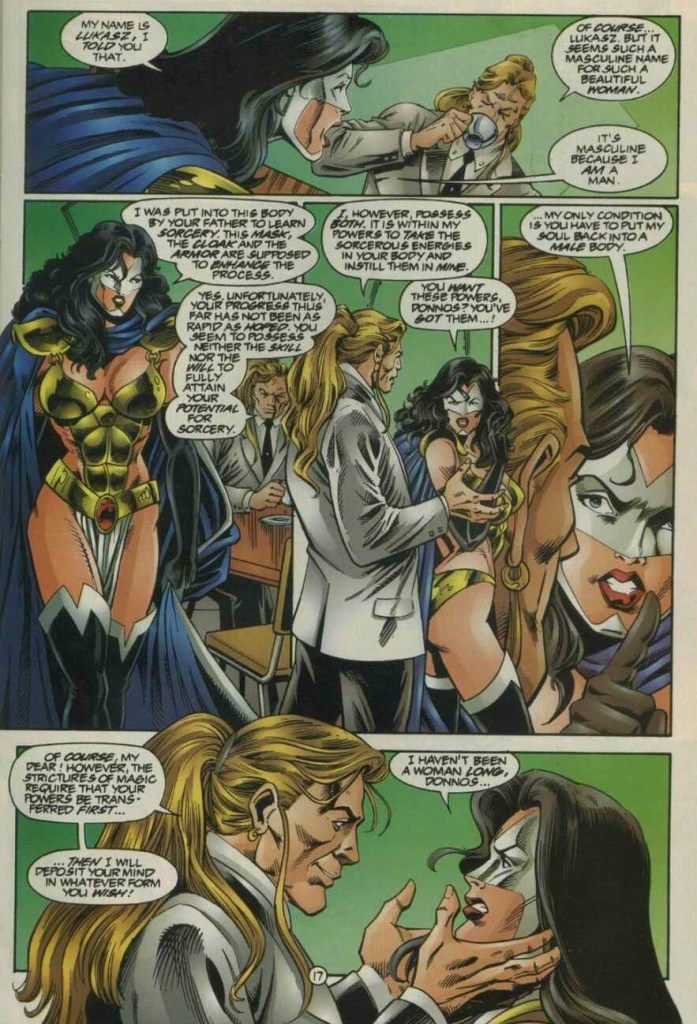
I’ve been reading more of the work of the late Stan Lee through his contributions for Marvel’s 2099 franchise of the early 1990s. Lee’s comeback into comic book writing with Ravage 2099 #1 turned out to be a big disappointment and his writing style just ended up being outdated by 1992’s standards. Ravage 2099 #2 was a marginal improvement over its predecessor buy was overall still a very weak comic book. Ravage 2099 #3 meanwhile was surprisingly a clear improvement over issue #2 and also happened to be more entertaining and interesting to read. Of the first three issues published, issue #3 proved to be satisfying.

Will there be another improvement on the artistic and entertainment values of the next Ravage 2099 issue in this review? Find out in this look back at Ravage 2099 #4, published in 1993 by Marvel Comics with a story written by Stan Lee and drawn by Paul Ryan.

The cover.

Early story

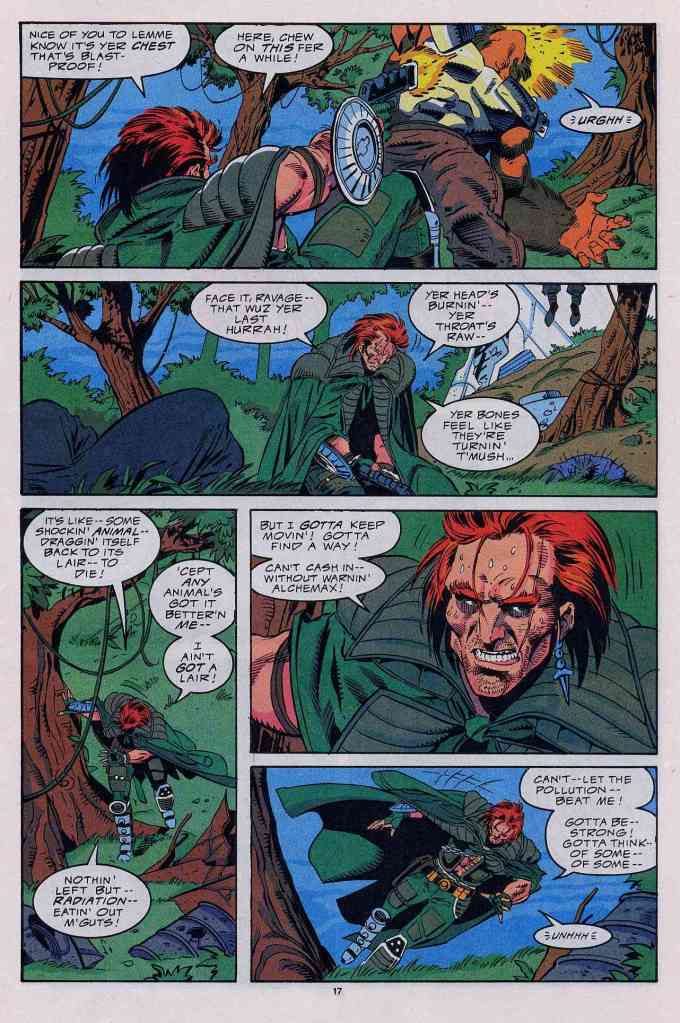
The story begins in the island of Hellrock where Ravage is on the run already suffering from the toxic air and only time will tell if ever-present radiation will kill him or turn into a mutroid. Dethstryk’s minions have been hunting him since he started running away from their main forces.

Even though he was able to avoid getting caught by the hunters, Ravage continues to suffer greatly with each passing moment. Despite the pain, he remains determined to fight back and keep moving but his chances of survival keep on fading…

Quality

This is pretty much what you will see of Ravage in this comic book.

To put it short, the story was pretty much about Ravage struggling to survive in a very dangerous location while being hunted. The heroism he had in issue #3 is completely missing and the way Stan Lee wrote this story, the concept is pretty shallow. In fact, even the very weak story of issue #1 has more variety and depth than this one! More on Ravage, even as he struggled and got targeted, there is not much justification to make readers like you feel sympathetic to him especially if you followed Ravage’s so-called development starting in issue #1.

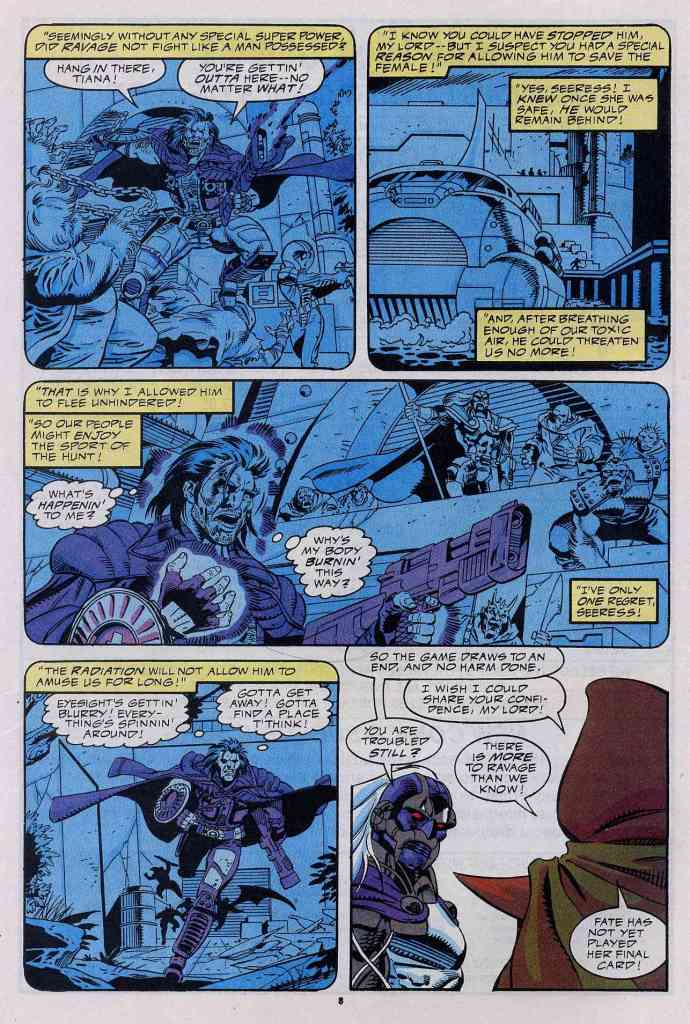
When it comes to plotting, this comic book would have worked better had it been released in the 1970s. It does not help that Stan Lee had to resort to adding fillers to the script by means of recapping lots of scenes from issue #3 (even though he tried to emphasize Dethstryk’s thoughts).

Character development? There is not much here except for Ravage. As for the supporting characters, don’t expect to see much of Tiana and Dack as they did not contribute anything to the shallow story. As for Ravage’s former boss Henton, Stan Lee went ahead to show just how obviously evil he is with nothing new to show (except his virtual reality escapade).

Conclusion

Stan Lee and his creative team lazily resorted to recapping key events that happened in issue #3.

Clearly, Ravage 2099 #4 (1993) falls short from becoming a satisfying read as it paled in comparison to issue #3. That’s too bad because the concept of showing Ravage as a fugitive in the middle of a very dangerous place could have turned into something more interesting and more intriguing. Instead, Ravage ended up being the target of hunters and it was clear that Stan Lee and Paul Ryan dragged the scenes of him struggling and fighting to survive.

If you are seriously planning to buy an existing hard copy of Ravage 2099 #4 (1993), be aware that as of this writing, MileHighComics.com shows that the near-mint copy of the regular edition costs $8 while the near-mint copy of the newsstand edition costs $24.

Overall, Ravage 2099 #4 (1993) is not recommended. If you really want to buy this comic book at all, better not pay more than fifty cents for it.

+++++

Thank you for reading. If you find this article engaging, please click the like button below and also please consider sharing this article to others. If you are looking for a copywriter to create content for your special project or business, check out my services and my portfolio. Feel free to contact me as well. Also please feel free to visit my Facebook page Author Carlo Carrasco and follow me at HavenorFantasy@twitter.com

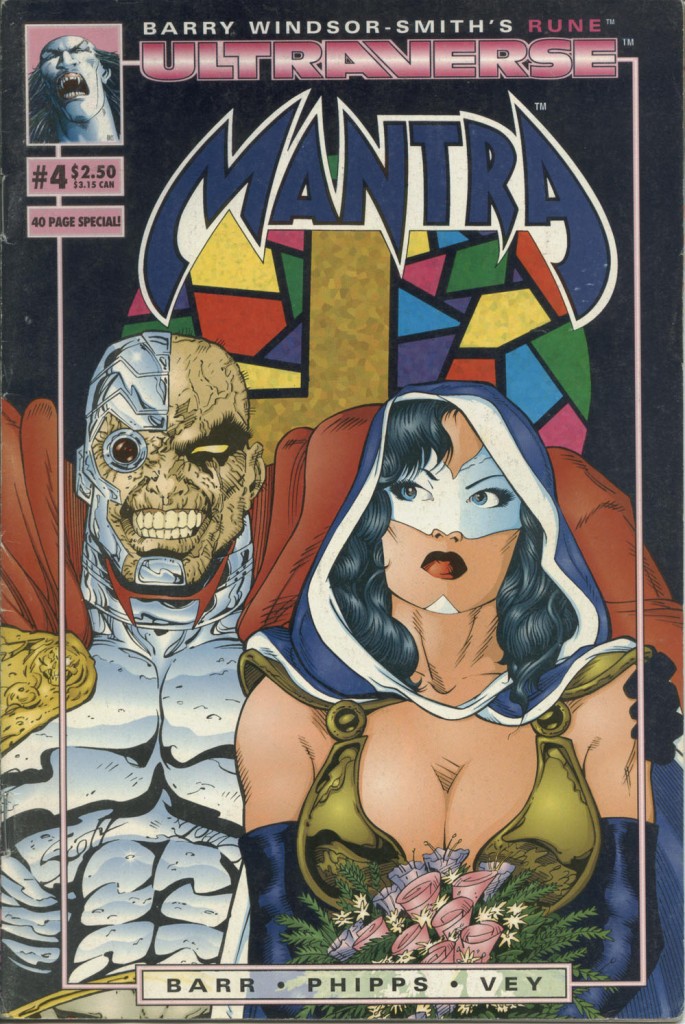
A Look Back at Mantra #4 (1993)

Disclaimer: This is my original work with details sourced from reading the comic book and doing personal research. Anyone who wants to use this article, in part or in whole, needs to secure first my permission and agree to cite me as the source and author. Let it be known that any unauthorized use of this article will constrain the author to pursue the remedies under R.A. No. 8293, the Revised Penal Code, and/or all applicable legal actions under the laws of the Philippines.

Welcome back Ultraverse fans, geeks and fellow comic book collectors! If you want to discover more of the fantasy elements within the Ultraverse through Mantra – the pretty sorceress whose body is occupied by the soul of a male warrior named Lukasz – then you are in for something rather different.

To put things in perspective, the fantasy-swords-magic concept was made clear in Mantra #1 and that Lukasz and his band of warriors (led by an elder sorcerer) as well as their enemies (led by Boneyard) were definitely from another world. That other world will be explored at last in this look back at Mantra #4, published in 1993 by Malibu Comics with a story written by Mike W. Barr and drawn by Robb Phipps.

The cover.

Early story

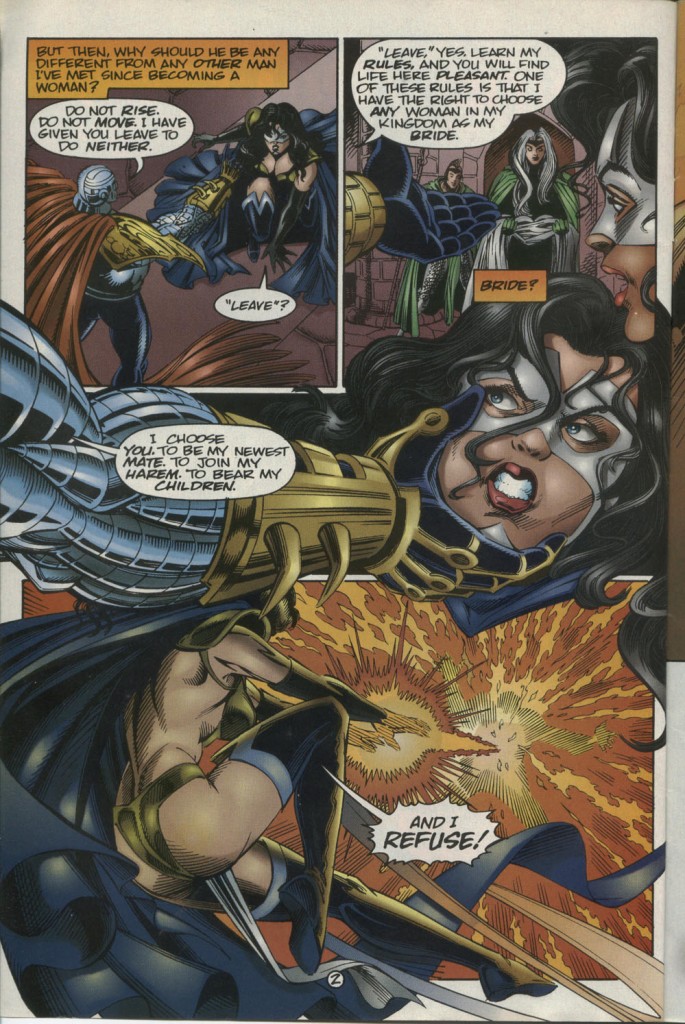
The story begins in the world of Boneyard, at his castle specifically. Down on her knees, Mantra is just in front of the villain Boneyard who says, “So this is Archimage’s last, best hope. Just a woman!!”

Boneyard tells Mantra not to rise nor move. As he does not yet know that Lukasz is inside Mantra’s body, Boneyard welcomes her and states that it is his right to choose any woman in his kingdom as his bride. In reaction to being selected as Boneyard’s newest mate with a purpose to potentially give birth to his children, Mantra strikes him with an energy blast symbolically rejecting him.

Boneyard then says, “Enough. I tolerate this dissent because your body carries much potential for magic, woman. It is only your body that saves you from death. Your bewildering loyalty to my defeated brother, Archimage, would ordinarily be enough to condemn you. Your genes, combined with mine will yield children to whom magic comes as easily as taking breath.”

As the villain talks, Mantra notices the sword pointed at her was the same one used to kill her when she was man (as Lukasz). She then makes moves to get Boneyard off-balanced and try to leave the castle…

Quality

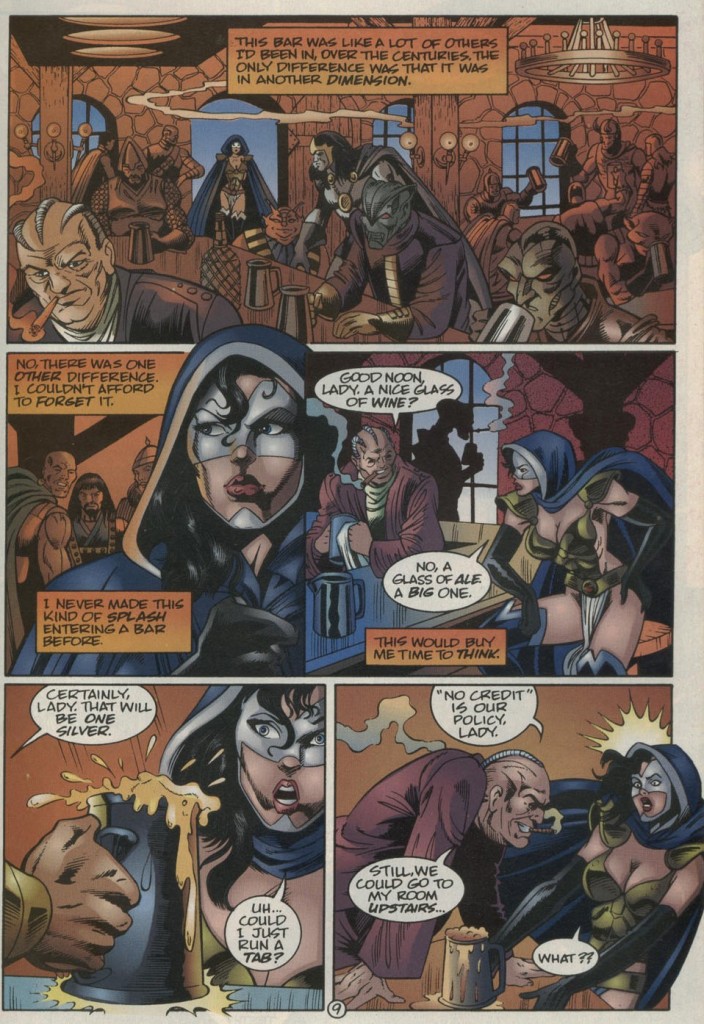
Mantra visits the tavern in the kingdom controlled by Boneyard.

I’ll start with the writing. What Mike W. Barr did here successfully was raising the stakes for Mantra which involves the drastic change of location and setting from the modern society of Earth into the fantasy realm where Boneyard and his army are based in. The mentioned change literally opened new opportunities to develop Mantra’s personality while at the same time offered readers a lot of new things and places for their exploration.

With the all-new setting, lots of fantasy genre tropes are present. There is the ever-present tavern filled with lots of people that include humans and non-human beings that go beyond dwarves and elves. There is also the slave auction of both men and women standing almost nakedly in front of the bidders. There also were people wearing capes, hoods, swords, spears and armor which Mantra smoothly blends in with.

Along the way, there is a lot spectacle here mainly acts of magic alternated with hard action moves. The way the spectacle is presented fits in excellently with the fantasy setting and I should state that Robb Phipps did a very solid job visualizing such elements while succeeding in making Mantra, Boneyard, Archimage and Warstrike look recognizable.

Back to the writing, Mike W. Barr prepared a lot of details in the story that explained Boneyard’s nature and even his status as the husband of multiple wives. This comic book also reveals that Boneyard is likely bisexual since, apart from being married to multiple women, he kissed Mantra and lusts for her even AFTER he learned that Lukasz is occupying the woman’s body. His intention to marry Mantra symbolizes homosexuality as well. To put things in perspective, this makes Boneyard very guilty of sexual immorality on top of his wickedness. Refer to 1 Corinthians 6:9-10 (sexual immorality and homosexuality), Galatians 5:19-21 (sorcery and sexual immorality) and Deuteronomy 17:17 (polygamy) in the Holy Bible.

Conclusion

Boneyard’s intention to marry Mantra (whose body is occupied by the soul of the male eternal warrior Lukasz) and impregnate her to produce his children is disgusting, even more so when the villain knows Lukasz is in Mantra.

To say the least, Mantra #4 (1993) is entertaining enough mainly due to its fantasy setting and exposing key elements about the rivalry between Archimage and Boneyard. This was a daring and refreshing change of pace for Mantra series since the first three issues already emphasized Lukasz’s struggles on living in the body of Eden Blake (note: reincarnation is false and goes against the Holy Bible, read Hebrews 9:27 and Psalm 78:39 for insight) and living with her family as Eden’s soul was pushed into limbo. More notably, this issue shows more of how evil and wicked Boneyard is not simply because of his leading his army of evildoers but also because of his evil-filled nature. By comparison, Lukasz/Mantra is the lesser evil to Boneyard under the pretense of good-versus-evil in the story (which itself concluded in a predictable and underwhelming fashion).

If you are seriously planning to buy an existing hard copy of Mantra #4 (1993), be aware that as of this writing, MileHighComics.com shows that the near-mint copy of comic book costs $8.
Overall, Mantra #4 (1993) is satisfactory.

+++++

Thank you for reading. If you find this article engaging, please click the like button below and also please consider sharing this article to others. If you are looking for a copywriter to create content for your special project or business, check out my services and my portfolio. Feel free to contact me as well. Also please feel free to visit my Facebook page Author Carlo Carrasco and follow me at HavenorFantasy@twitter.com