Have you seen Wonder Woman 1984 yet? I have not and I am waiting for local cinemas to reopen to screen it. The pandemic really brought down movie theaters which is really bad not only for their industry but also because a lot of employees of cinemas lost their jobs. I’m not just talking about the people handling the tickets but also those who work to cook food, prepare drinks and serve them to moviegoers.
More on Wonder Woman 1984, the film is available for viewing via HBO Max (mainly in the United States) without a premium fee required. This, in my opinion, is a terrible move by AT&T-controlled Warner Bros. because customers’ payments for HBO Max do NOT really go to the producers and financiers who made the Patty Jenkins-directed sequel.
As I mentioned before, I prefer to watch Wonder Woman 1984 in the movie theater instead of streaming it. Back in June 2017, I went to the local IMAX cinema to watch Wonder Woman by buying a premium movie ticket, buying popcorn and a drink, sat comfortably and watched the movie in its full greatness. Truly, VOD streaming will NEVER match the experience of the cinema. Right now, I’m waiting for the opportunity to watch Wonder Woman 1984 in the local movie theater.
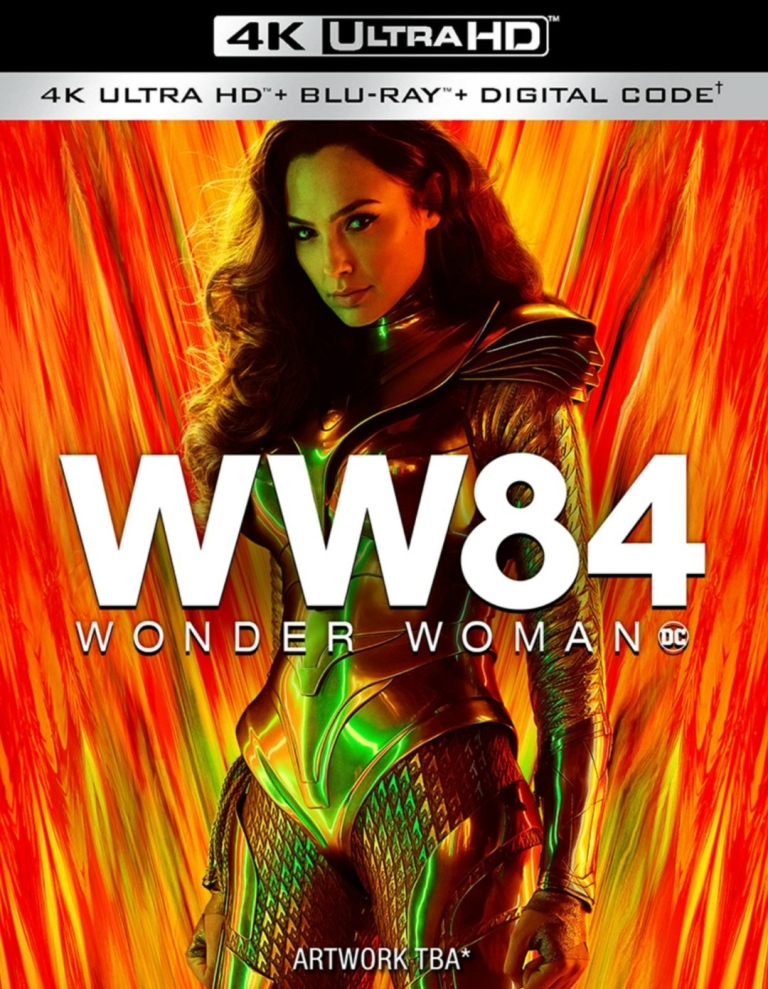
As for home viewing, I personally prefer watching movies via optic disc media over streaming. Blu-ray is notable for advantages over streaming. That being said, there is a much better option to view Wonder Woman 1984 in the comfort of home – the upcoming 4K Blu-ray combo release of Wonder Woman 1984!
When it comes to watching Wonder Woman 1984 in the comfort of home, this is the BETTER option than streaming! (source – Blu-ray.com)
Recently Wonder Woman 1984 has been listed at Blu-ray.com to be released in 4K Blu-ray disc format along with a Blu-ray disc (1080p) and a digital copy. While this is not in any way an official announcement (note: as of this writing, the listing does not have a release date yet), it is inevitable that Wonder Woman fans and consumers will have the option to buy the new movie in 4K Blu-ray and Blu-ray discs.
According to the listing at Blu-ray.com, Wonder Woman 1984 4K Blu-ray will have a native 4K (3840x2160p) resolution. This alone is a major improvement over the upscaled 4K resolution (read: fake 4K) that the Wonder Woman 4K Blu-ray had. Upscaled 4K means digitally stretching a lower resolution video until it reached 3840x2160p resolution. Native 4K means the footage truly got rendered in 3840x2160p resolution, and this means more detailed visuals! Take note that the new movie that starred Gal Gadot had scenes filmed with IMAX cameras and their high visual details should translate nicely in 4K Blu-ray.
More on Wonder Woman 1984 4K Blu-ray, its original aspect ratio is 2.39:1, its audio has Dolby Atmos and Dolby TrueHD 7.1 confirmed, its subtitles are in English, French and Spanish. For playback, the 4K Blu-ray will be region-free while the Blu-ray (1080p) will be coded for Region A.
How much will Wonder Woman 4K Blu-ray combo package cost and when will be released? We will find out soon enough. Personally, as soon as it becomes available for ordering at Amazon, I will order it. It should be noted that what you pay for Wonder Woman 4K Blu-ray (or the standalone Blu-ray 1080p release), part of your money will go to the movie producers and investors who are struggling to recover their investment. This is another solid reason why I will not stream this movie. Dump HBO Max!
If you are looking for more Wonder Woman-related content, just search here in my website’s search engine. For those who have not seen Wonder Woman 1984, I recommend reading my retro review of the 1987 comic book Wonder Woman #9 which itself is required reading to get yourselves oriented about the first full appearance of Cheetah (Barbara Minervia). Also check out my most recent Wonder Woman retro review as well as my 2017 Wonder Woman movie review and my No Man’s Land scene special feature.
+++++
Thank you for reading. If you find this article engaging, please click the like button below and also please consider sharing this article to others. If you are looking for a copywriter to create content for your special project or business, check out my services and my portfolio. Feel free to contact me as well. Also please feel free to visit my Facebook page Author Carlo Carrasco and follow me at HavenorFantasy@twitter.com
Disclaimer: This is my original work with details sourced from reading the comic book and doing personal research. Anyone who wants to use this article, in part or in whole, needs to secure first my permission and agree to cite me as the source and author. Let it be known that any unauthorized use of this article will constrain the author to pursue the remedies under R.A. No. 8293, the Revised Penal Code, and/or all applicable legal actions under the laws of the Philippines.
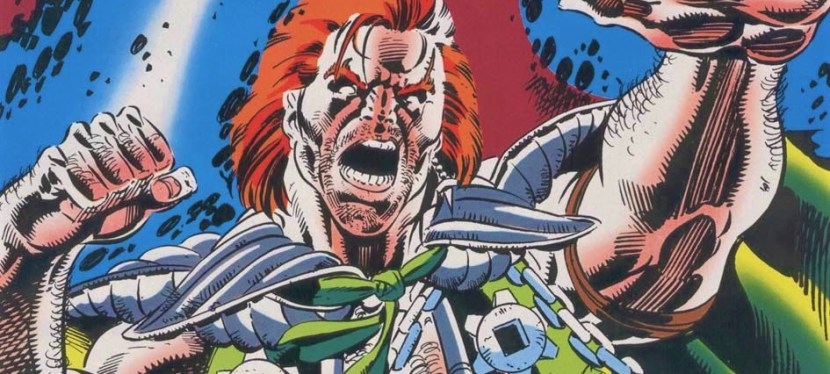
Welcome back, superhero enthusiasts, comic book collectors and fans of Marvel’s 2099 universe! Do you want to see more of 2099 stories written by the late Stan Lee? There is Ravage 2099, the one original character for the 2099 universe co-created by Lee and illustrator Paul Ryan. In my last review, the story had Ravage desperately trying to survive in an island which is toxic and filled with lots of bad guys hunting him down.
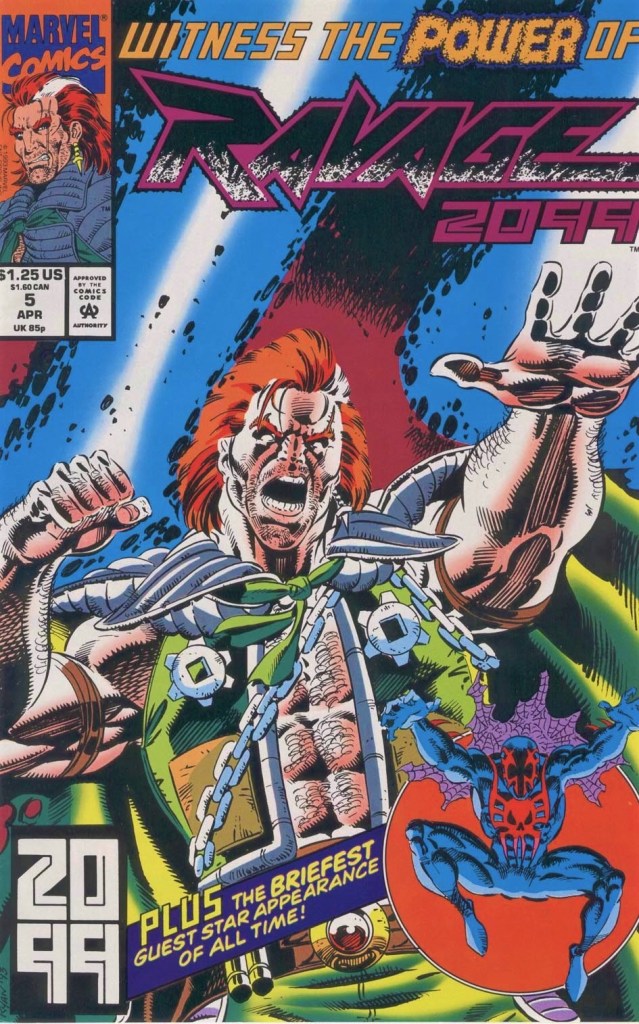
With those details laid down, here is a look back at Ravage 2099 #5, published in 1993 by Marvel Comics with a story written by Stan Lee and drawn by Paul Ryan.
The cover.
Early story
The story begins with Ravage, in the presence of Ursell (the one who saved his life), reacting to his hands burning with light-blue flame. Ursell states it is the radiation causing it. Ravage accuses him of turning him into a troid and that he is not better than Dethstryk, the ruler on the island. As he could not control his anger, Ravage attacks Ursell (who told him his hands are lethal as they destroy what they touch).
Outside, one Dethstryk’s troops spots light (the result of Ravage’s energetic hands) coming from the same cave Ravage and Ursell are in. Eventually Ravage calms down and the energy of his hands weaken. Ursell hands him gloves (composed of complex molecular formula) which help him contain the energy but only for one hour.
Suddenly, Dethstryk’s thugs spot the two in the cave. One of them identifies Ursell as the betrayer of their leader…
Quality
I wonder if SJWs, socialists, Communists and the radicalized feminists will find this image offensive…
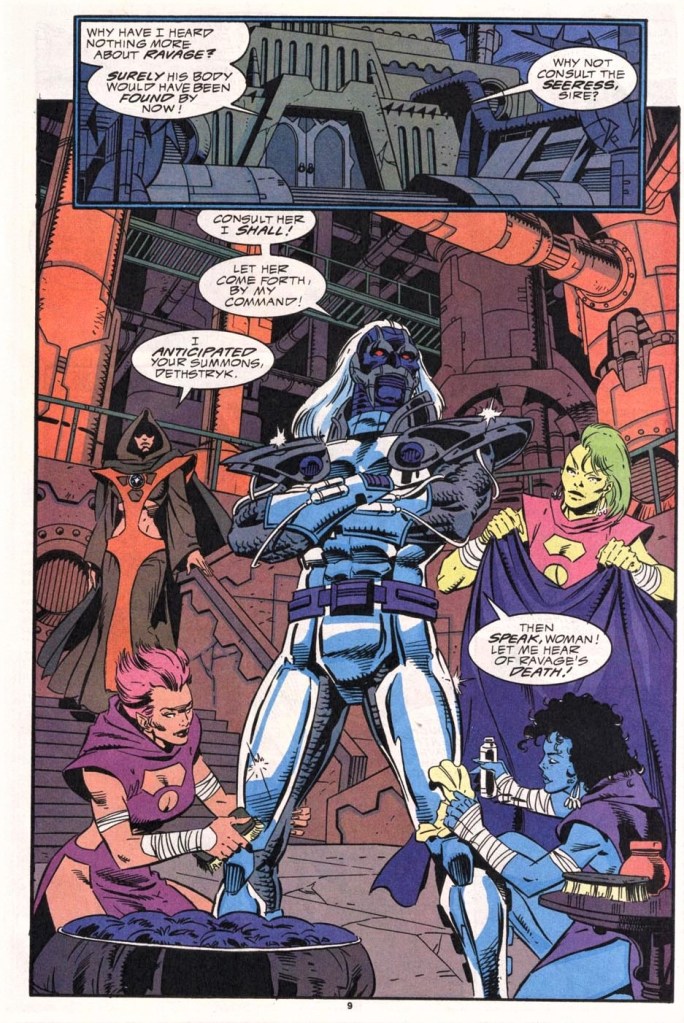
In terms of storytelling, this comic book is a big improvement over the last issue. While issue #4 was pretty much limited to Ravage just struggling to survive, this one had more elements of discovery and surprise which made it feel fresh. Ravage having his hands energetic and getting bothered deeply by it was a nice touch to spice up the character while building him up to be potentially more powerful. I also enjoyed the sub-plot in which Tiana, who has been portrayed as an erotic damsel-in-distress since issue #1, finally gets to do something important with trying to free the troubled youth Dack. Not only that, there is also another sub-plot involving a race of aquatic creatures that seek to invade the surface.
Conclusion
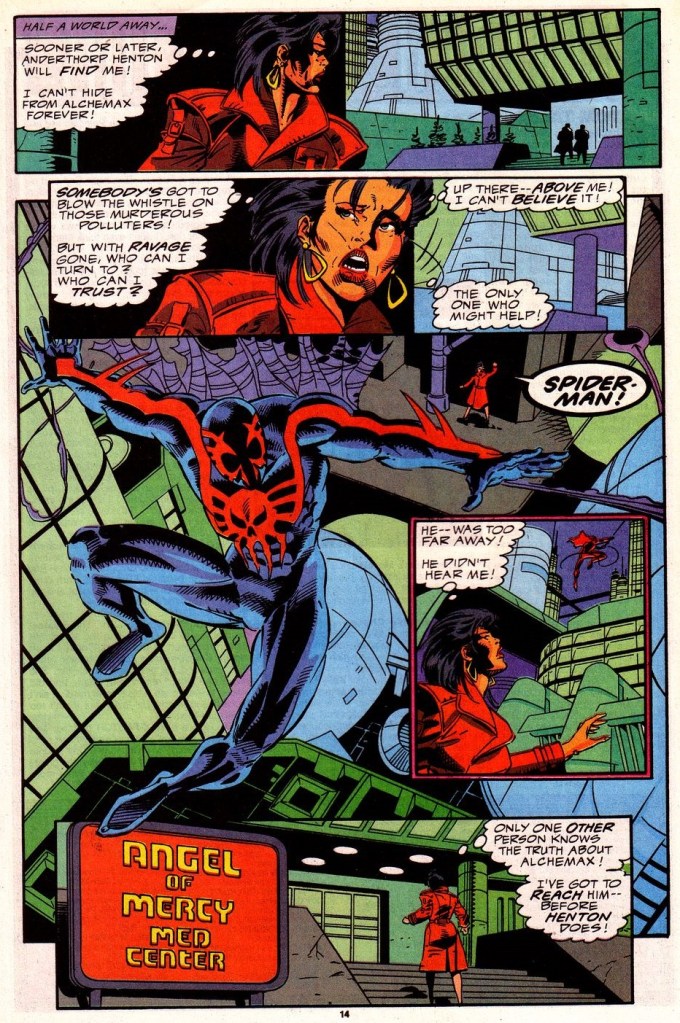
Spider-Man 2099’s very brief appearance!
Ravage 2099 #5 (1993) is fun to read and surprisingly engaging as it is a big improvement over issue #4. Considering the uneven quality of this particular series, it’s nice to see Stan Lee make storytelling improvements just as they are needed. Still the quality of dialogue is sub-par and there were corny lines like Ravage saying, “You’re cornier than breakfast cereal!”
If you are seriously planning to buy an existing hard copy of Ravage 2099 #5 (1993), be aware that as of this writing, MileHighComics.com shows that the near-mint copy of the regular edition costs $8 while the near-mint copy of the newsstand edition costs $24.
Overall, Ravage 2099 #5 (1993) is satisfactory.
+++++
Thank you for reading. If you find this article engaging, please click the like button below and also please consider sharing this article to others. If you are looking for a copywriter to create content for your special project or business, check out my services and my portfolio. Feel free to contact me as well. Also please feel free to visit my Facebook page Author Carlo Carrasco and follow me at HavenorFantasy@twitter.com
Disclaimer: This is my original work with details sourced from watching the movie and doing personal research. Anyone who wants to use this article, in part or in whole, needs to secure first my permission and agree to cite me as the source and author. Let it be known that any unauthorized use of this article will constrain the author to pursue the remedies under R.A. No. 8293, the Revised Penal Code, and/or all applicable legal actions under the laws of the Philippines.
We all know that the 20th Century Fox franchise of X-Men movies has ended and everything cinematic about Marvel’s famous mutants are now in the hands of Marvel Studios. From the year 2000 to 2020, the original X-Men cinematic universe produced a whole bunch of movies (including spinoffs) which ultimately led to uneven results with regards to commercial success, critical feedback, artistry, production values and cultural impact. Even so, 20th Century Fox-produced X-Men movies generated more than $6 billion in ticket sales worldwide.
When it comes to the spinoff movies, I like Logan the best (sorry, Deadpool).
For the main X-Men movies, the one film that really delivered the great stuff and tons of fun for me was none other than X-Men: Days of Future Past (2014). For one thing, the movie had two generations of X-Men cinematic performers (the original team led by Patrick Stewart and the newer ones from X-Men: First Class led by James McAvoy) and its story literally had them linked together with Hugh Jackman’s Wolverine as the living bridge between them. To put it short, it was a cinematic crossover story made with X-Men fans in mind. That film scored highly with critics and most moviegoers, and it grossed almost $750 million worldwide which makes it the highest-grossing X-Men movie ever until now.
It has been years since X-Men: Days of Future Past made waves in the cinemas and through post-theater businesses like Blu-ray, cable TV, pay-per-view, streaming and the like. Along the way, movies like Wonder Woman, Aquaman, Avengers: Infinity War and Avengers: Endgame collectively raised the standards of Hollywood superhero movies in varied ways. I should state that X-Men (2000), X2: X-Men United and X-Men: The Last Stand did not age well.
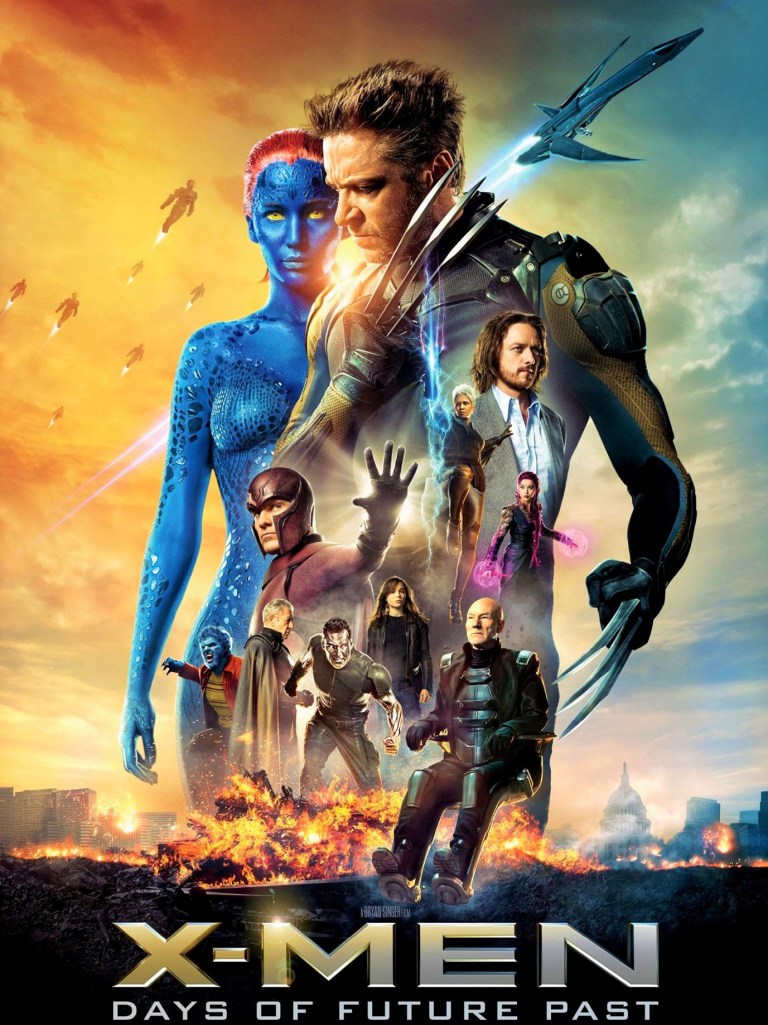
To find out if the 2014 X-Men film aged well or not, here is my retro review of X-Men: Days of Future Past directed by Bryan Singer with a screenplay written by Simon Kinberg with a story done by Kinberg, Jane Goldman and Matthew Vaughn.
A great image of the cinematic X-Men, both the old and newer cast.
Early story
The story begins in the dark future. Countless mutants and human allies have been caught and imprisoned by very sophisticated Sentinels (operating for an unnamed authority that also has armed human personnel as watchers) which continue to hunt more of them down along with any humans caught aiding them. In Russia, a small X-Men team composed of Colossus, Kitty Pryde, Iceman, Sunspot, Bishop, Warpath and Blink take action when they realized that the Sentinels found their hideout. Kitty Pryde, who by this time gained the new ability to send a person’s consciousness back through time, runs along with Bishop to hide in a vault to send his consciousness into the past. Fortunately for them, their teammates delayed the unstoppable Sentinels enough to succeed.
Some time later at another location, an aging Charles Xavier, Magneto, Wolverine and Storm arrive to meet with Kitty Pryde and her teammates. Xavier gives the team an in-depth history lesson about the Sentinels which were created decades earlier by the late Bolivar Trask who was assassinated by Mystique (who believed she could make a difference for her fellow mutants). After the assassination, Mystique got caught by the authorities and became a live experiment for scientists working for the government. Her DNA helped accelerate the development of the Sentinel program which made them able to adapt to most mutant attacks and powers.
A plan gets formed for Kitty Pryde to send Xavier back through time to his younger self in 1973 to prevent the assassination from happening. Kitty states it’s too risky for the old Xavier to go through time as it may kill him. Wolverine volunteers to take Xavier’s place as his healing factor (regeneration) will ensure his survival with the process. Xavier presses Wolverine to convince the 1973 Charles Xavier to help prevent the assassination given the fact that he was a broken man at the time.
Wolverine arrives in his younger self’s body in New York of 1973. He makes his way to the mansion of Charles Xavier. As it turns out, Xavier’s school has been closed for some time and has been decaying…
Quality
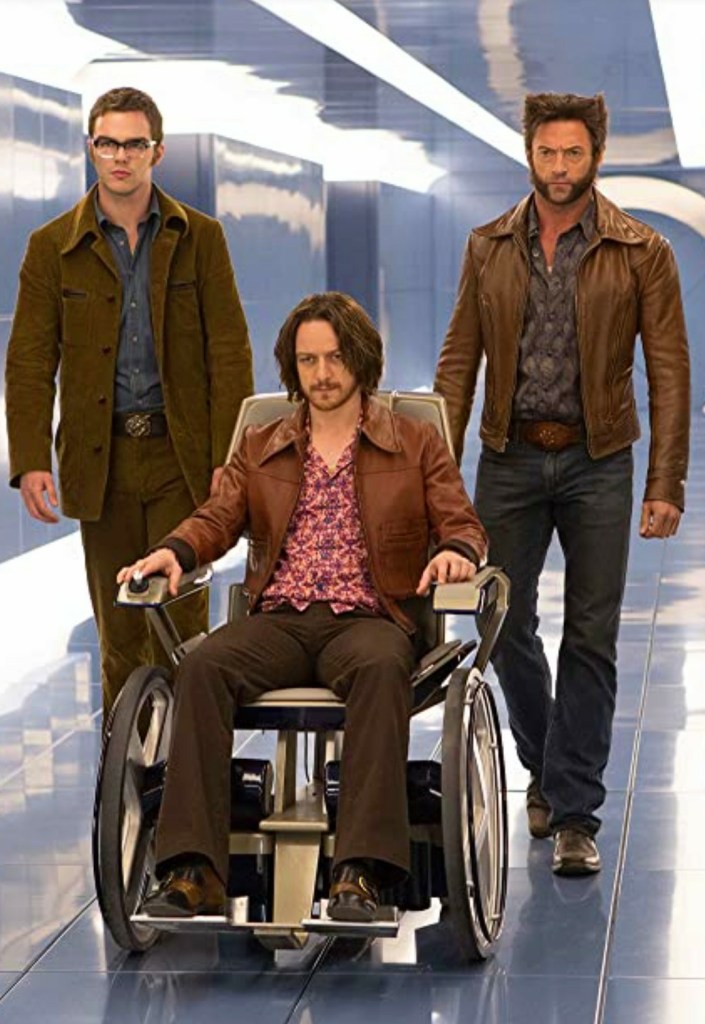
Nicholas Hoult, James McAvoy and Hugh Jackman as Beast, Charles Xavier and Wolverine respectively.
Considering what was made and what were presented through this movie, the creative team and the cast of X-Men: Days of Future Past literally scored a home run here resulting true greatness! Bryan Singer, whose previous X-Men directorial job was 2003’s X2, finally struck gold with regards to storytelling, directing and, finally, spectacle (previous his big weakness).
In terms of storytelling, this movie, first and foremost, is not a faithful adaptation of the classic Days of Future Past storyline at all. In fact, there was no need for it to be faithful. What the screenwriters came up with was a loose adaptation which allowed them to craft a more original story that involved the established X-Men characters (from the early movies) and the other X-Men characters (who started in 2011’s X-Men: First Class) and have them set apart in terms of time periods (similar to what was done in 1994’s Star Trek: Generations, but much better and more compelling in writing). The result is a crossover tale with Wolverine being the traveler through time.
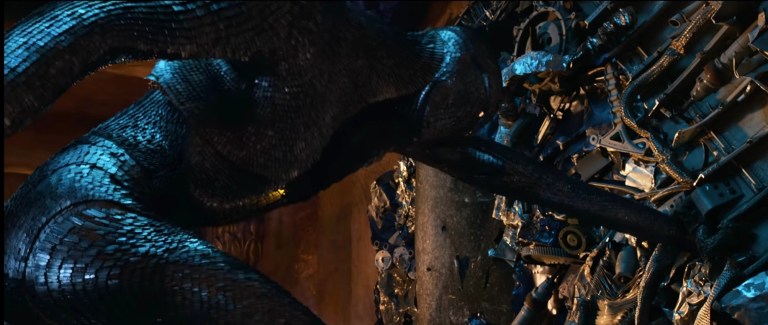
The Sentinels are clearly terrifying and unstoppable!
The great news here is that the script has very strong structuring done and even had enough space to briefly acknowledge events and characters from the first three X-Men films plus 2009’s X-Men Origins: Wolverine as canon. All of these add to the narrative very well and when the stakes were raised, the overall plot made sense. Let me add that it was a smart move for the writers to raise the stakes in the two time periods during the final act of the movie, which really made the story more engaging to viewers. I should state that having two conflicts happening simultaneously on screen in this X-Men movie was done efficiently and without ever becoming confusing nor messy.
Apart from the narrative, the portrayal of the X-Men was, indeed, spot-on. Noticeably, the major characters here were Charles Xavier (both old and young), Wolverine (both old and young), Mystique, Magneto (specifically the young version), Beast and Bolivar Trask. Strong writing was evident in the dialogue of the mentioned characters, as well as in those with minor roles. Through dialogue alone, I easily recognized these cinematic characters.
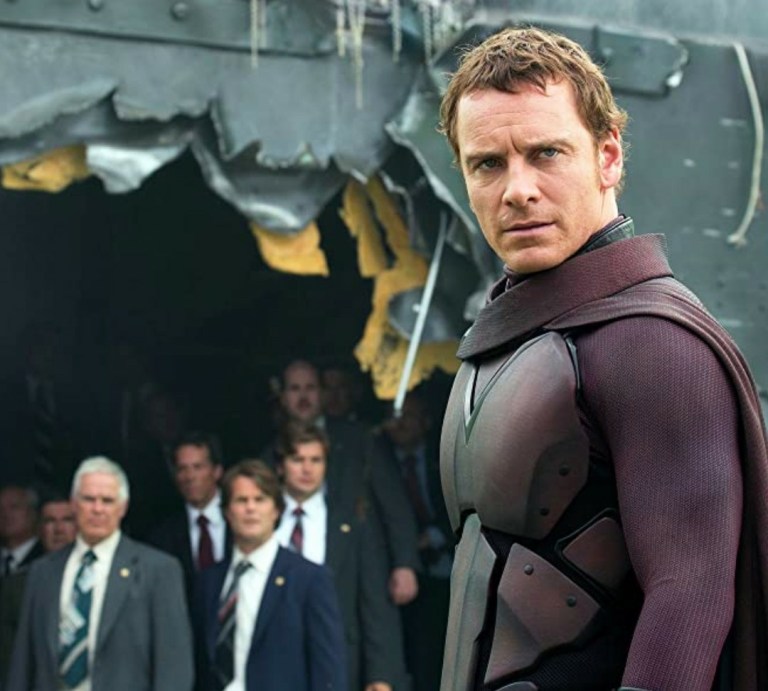
Michael Fassbender delivered his best performance as young Magneto.
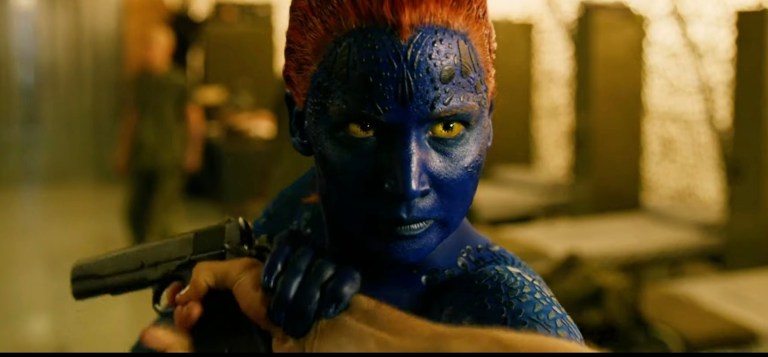
Given his strength in telling stories, I should say that Bryan Singer succeeded in executing the script into cinematic narrative. Not only that, he succeeded in getting really good performances from the cast. James McAvoy (young Xavier), Jennifer Lawrence (Mystique), Michael Fassbender (young Magneto) and Nicholas Hoult (Beast) were evidently more confident and more comfortable in reprising their characters (note: they debuted together in X-Men: First Class).
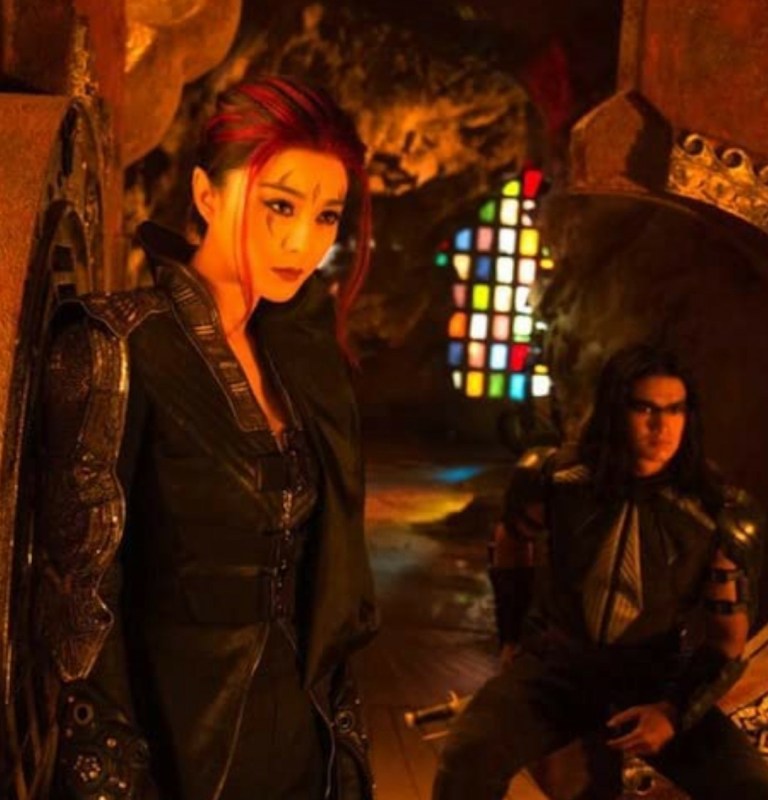
The old cast composed of Patrick Stewart (old Xavier), Ian McKellen (old Magneto), Ellen Page (Kitty Pryde), Halle Berry (Storm), Shawn Ashmore (Iceman) and Daniel Cudmore (Colossus) all made a very welcome return. To be specific, it was only Patrick Stewart among them who had the most engaging dialogue with Ian McKellen being a distant second to him. As most of the film was set in the past, it was understandable that the old cast’s dialogue would not be that rich which translates to limited performance. The filmmakers tried bouncing back with mutant variety by having Bingbing Fan as Blink, Adan Canto as Sunspot and Booboo Stewart as Warpath, who all provided nicely in the action scenes and special effects use.
Bingbing Fan and Booboo Stewart as Blink and Warpath.
Hugh Jackman’s performance as Wolverine in this movie is the most unique of them all. Not only does he have to play TWO versions of his character, he as the only member of the old X-Men cast spent a great deal of time interacting with the newer X-Men players. The great news here is that Jackman has great chemistry with James McAvoy, Nicholas Hoult and Michael Fassbender, which ultimately justified the crossover! Speaking of McAvoy, his scene with the older version of his character is very memorable and a highlight! Peter Dinklage as Bolivar Trask is excellent but to my surprise, he is not exactly villainous nor did he express cruelty. He’s more of an obsessed scientist and as such, Michael Fassbender’s Magneto easily overshadows him when it comes to being the main antagonist. This is surprising but not exactly a problem.
More on the anti-hero factor of the movie, I should say that the Sentinels in this movie are the most dangerous and the most intimidating non-sentient, scientific antagonists since the Terminator. Being programmed to deal with mutants, the Sentinels are unrelenting and often used violence to complete their objectives. The futuristic Sentinels, which are evolved versions thanks to Mystique’s DNA, are so formidable the mutants cannot simply defeat them. Even the 1970s Sentinels are quite formidable.
As mentioned earlier, I do confirm that Bryan Singer really outdid himself on delivering the spectacle back with support from the special effects team, the stunt team and the like. The action scenes involving the X-Men are top-notch, in fact they make the action in Singer’s previous X-Men films look minor in terms of creativity, quality and fun! The computer-generated effects in this movie still look great by today’s standard, although some CGI used in the floating stadium sequence looked rushed. Also it was quite a marvel to see Wolverine and Beast face-off with a 1970s Sentinel in the final act. I should mention that the slow-motion sequence involving Quicksilver (played by Evan Peters) is one great and funny spectacle to watch, well worth replaying!
Conclusion
Jennifer Lawrence in her best-ever performance as Mystique.
I declare that X-Men: Days of Future Past (2014) is the best-ever X-Men movie I have seen and it has aged very well! Its overall quality is very great and the combined talents of director Singer, the cast, the writers and all the technical teams justified it all. By today’s standards, this X-Men movie still stands very high among all superhero movies of Hollywood ever released! As an X-Men film, this one is truly epic and the true highlight of all X-Men movies under 20th Century Fox. As a time-travel film, this one has a very unique approach and it should be noted that director Bryan Singer approached James Cameron to talk about time travel, parallel universes and the like.
More on personal viewing, I can say that this film greatly entertained me in the cinema back in 2014, and it still succeeds in doing so whenever I replayed it on Blu-ray in the comfort of home. If there is anything I regret, it’s the fact that I never saw this movie in the IMAX cinema.
If you are seriously planning to buy an existing hard copy of X-Men: Days of Future Past (2014), visit Amazon for the Blu-ray release as well as the 4K Blu-ray combo release. There is also the Rogue Cut of the movie also on Blu-ray.
Overall, X-Men: Days of Future Past (2014) is highly recommended!
+++++
Thank you for reading. If you find this article engaging, please click the like button below and also please consider sharing this article to others. If you are looking for a copywriter to create content for your special project or business, check out my services and my portfolio. Feel free to contact me as well. Also please feel free to visit my Facebook page Author Carlo Carrasco and follow me at HavenorFantasy@twitter.com
Disclaimer: This is my original work with details sourced from reading the comic book and doing personal research. Anyone who wants to use this article, in part or in whole, needs to secure first my permission and agree to cite me as the source and author. Let it be known that any unauthorized use of this article will constrain the author to pursue the remedies under R.A. No. 8293, the Revised Penal Code, and/or all applicable legal actions under the laws of the Philippines.
Welcome back, superhero enthusiasts, comic book collectors and fans of the Ultraverse! It’s time yet again to examine the origin story of The Solution. Issue #6 was about the past of Lela Cho/Tech while issue #7 saw her getting involved with Troy Wilde/Dropkick for the first time.
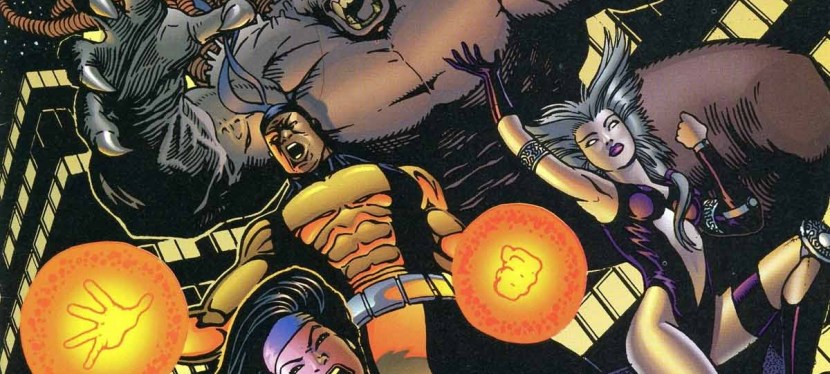
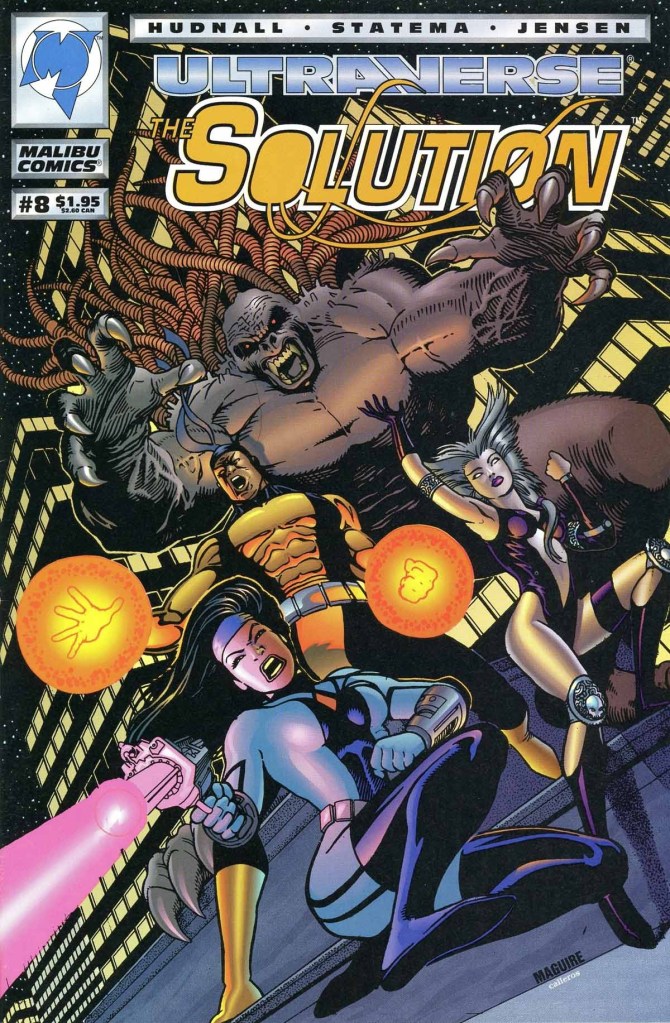
Now in Europe for their continuing mission, what could be next for Tech and Dropkick apart from danger? How will they get involved with the other Solution members, Shadowmage and Outrage? We can all find out in The Solution #8, published by Malibu Comics in 1994 with a story written by the late James Hudnall and drawn by John Statema.
The cover.
Early story
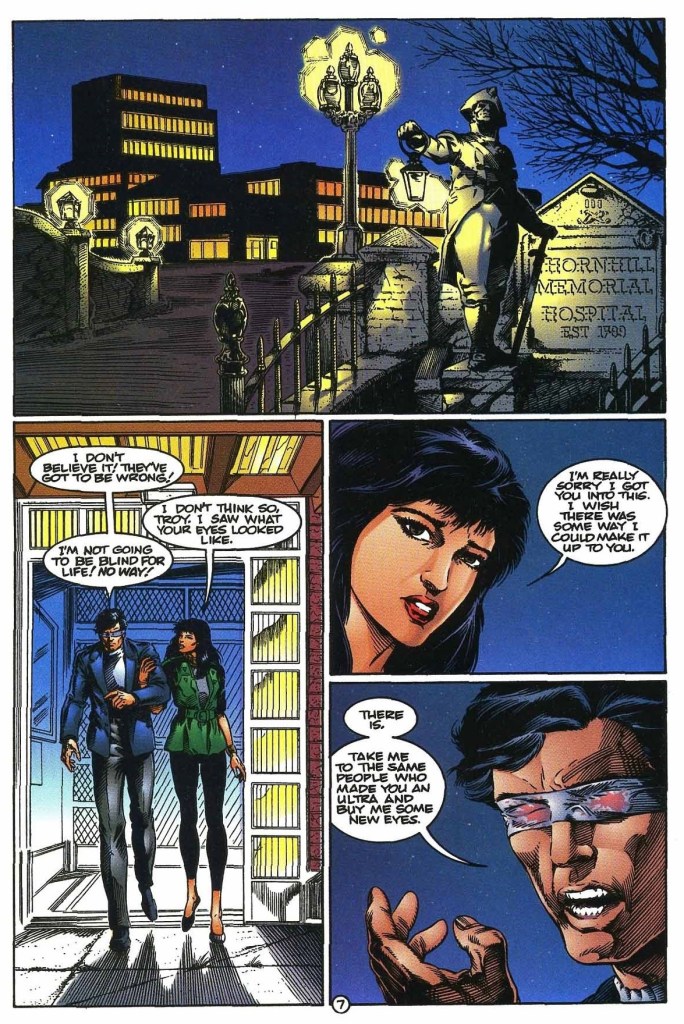
The story begins with Lela Cho accompanied by Troy Wilde standing in front of her father’s grave. From a distance are men currently spying on them and a sniper has his rifle aimed directly at Lela’s head.
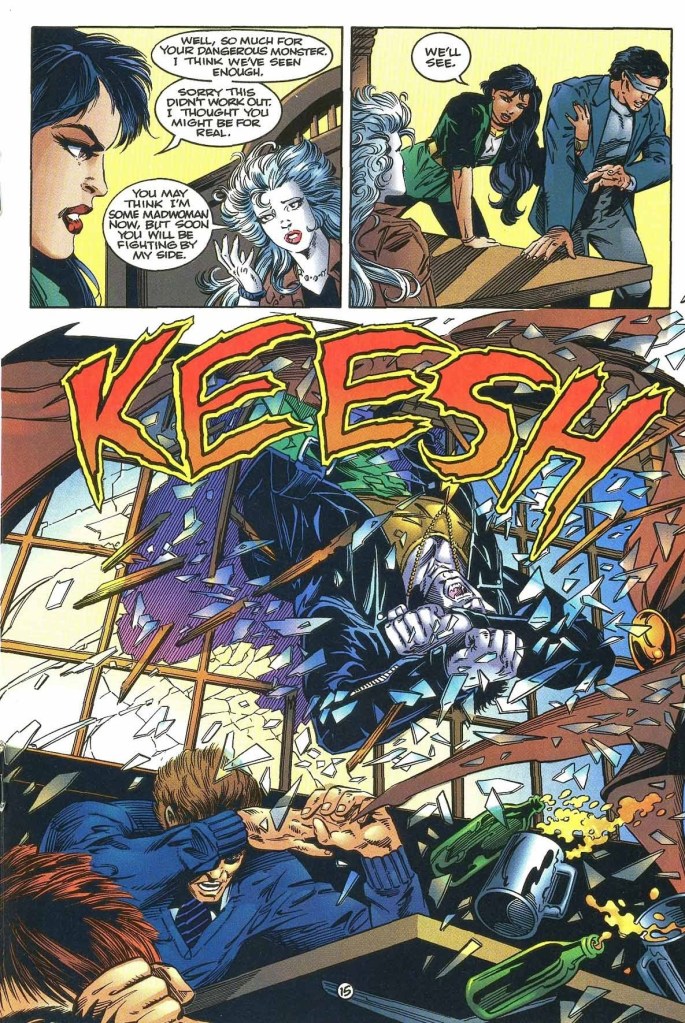
The narrative then shifts to England where Lela and Troy encountered Casino who trailed them and proved to be a very deadly opponent to fight with. During the heat of battle, Casino blinded Troy. A lady with pale-white skin appears and froze Casino in place using magic. The lady turns out to be an Aerwan (Aera/Shadowmage) and she formally introduces herself to Lela. Impressed already, Lela tells Aera she has a business proposition for her and states she needs help with a major problem…
Quality
Crashing through the window.
As expected, this is another very solidly written origin story crafted by James Hudnall. Judging from the high-quality writing, it is clear that Hudnall organized the concept of The Solution’s origin story before writing it all down. It should be stated that he successfully had each of The Solution’s members come into place in a timely and very believable fashion. Along the way, there is sufficient spectacle to enjoy left and right without descending into brainless territory. As the storytelling shifts into action and back, the whole story still makes sense.
It should be noted that Hudnall took time to have the comic book explore more of the hostile corporate rivals of Lela Cho. They are not just board of directors of the corporation Lela was supposed to inherit, they are also players in the questionable industries of pornography, illegal drugs and murdering. Behind closed doors, they talk about Casino, the one assassin they hired to eliminate Leland Cho.
As with the previous issue, the in-the-past introductions of Shadowmage and Outrage were carefully done, and I must state that the two being inhabitants from different worlds added well to the fantasy elements of The Solution as a franchise and made their place within the Ultraverse distinct.
Conclusion
Lela and Troy.
The Solution #8 (1994) is a very good read and it is another example of how good James Hudnall and John Statema make as a creative team. Combined with issues #6 and #7, this comic book makes a strong conclusion on the dramatization on how The Solution came to be. Along the way, mixing elements of fantasy with crime, espionage and superhero turned out to be good.
If you are seriously planning to buy an existing hard copy of The Solution #8 (1994), be aware that as of this writing, MileHighComics.com shows that the near-mint copy of the regular edition costs $8.
Overall, The Solution #8 (1994) is highly recommended.
+++++
Thank you for reading. If you find this article engaging, please click the like button below and also please consider sharing this article to others. If you are looking for a copywriter to create content for your special project or business, check out my services and my portfolio. Feel free to contact me as well. Also please feel free to visit my Facebook page Author Carlo Carrasco and follow me at HavenorFantasy@twitter.com
Disclaimer: This is my original work with details sourced from reading the comic book and doing personal research. Anyone who wants to use this article, in part or in whole, needs to secure first my permission and agree to cite me as the source and author. Let it be known that any unauthorized use of this article will constrain the author to pursue the remedies under R.A. No. 8293, the Revised Penal Code, and/or all applicable legal actions under the laws of the Philippines.
Welcome back, superhero enthusiasts, comic book collectors and fans of the Ultraverse! Did you guys and gals have a restful Christmas weekend? I sure did! Anyway, we are about to return to the Ultraverse through the eyes of Prime. The catch here is that Prime will face not one but two guys to battle with.
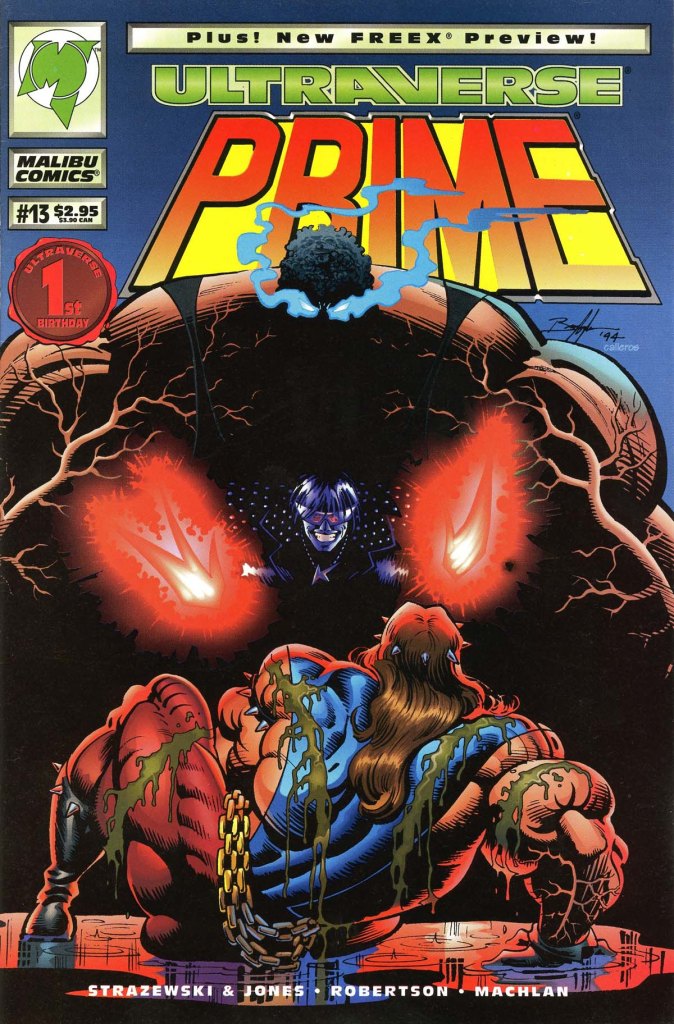
With those details laid down, here is a look back at Prime #13, published in 1994 by Malibu Comics with a story written by Len Strazewski and Gerard Jones, and illustrated by Darick Robertson. This is another one of those Ultraverse 1st anniversary comic books.
The cover.
Early story
The story begins with Kevin Green hitchhiking alone by the road. A man driving a car allows him to come in and ride. Just a few moments after, the man reaches for Kevin’s left thigh which convinces him that the one driving is a pervert. Kevin hits the man’s face and gets off the car. He struggles to find a ride going home in the evening.
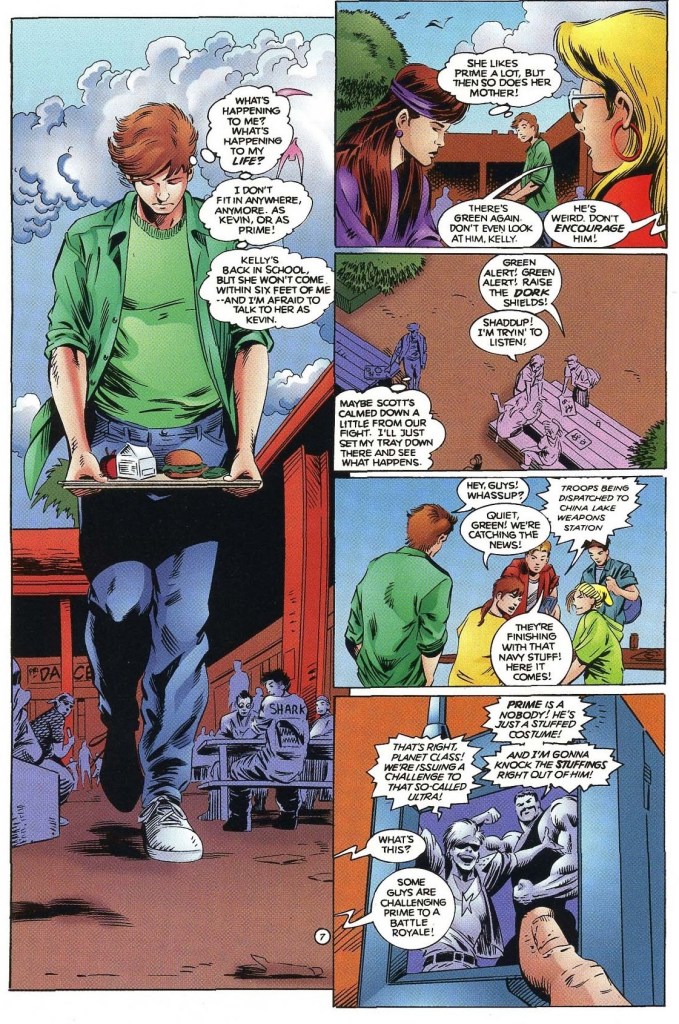
At home, Kevin wakes up from a nightmare as his mother tries to help him. His mom can easily tell that her son is troubled. During lunch break at school, realizes he is having trouble fitting in with the students and reminds himself that Kelly likes Prime a lot, and so does her mother. The students stare at him as he walks on. Eventually, Kevin meets some guys watching a portable TV showing news broadcast of two guys – the washed-up celebrity Kuttner and a certain bodybuilder – whom he previously encountered as Prime.
The said two guys are challenging Prime to a battle royale…
Quality
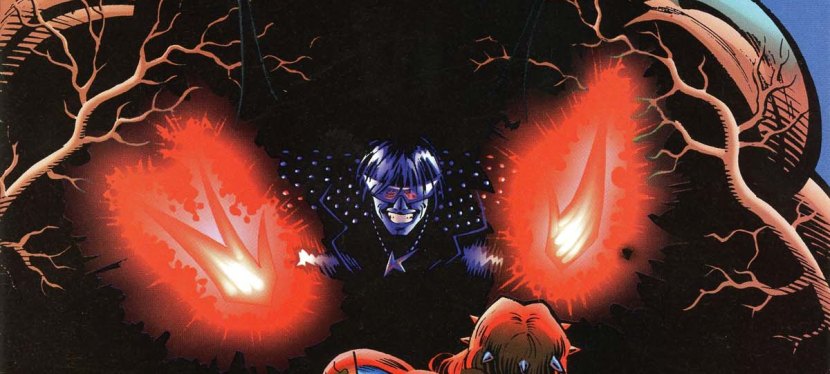
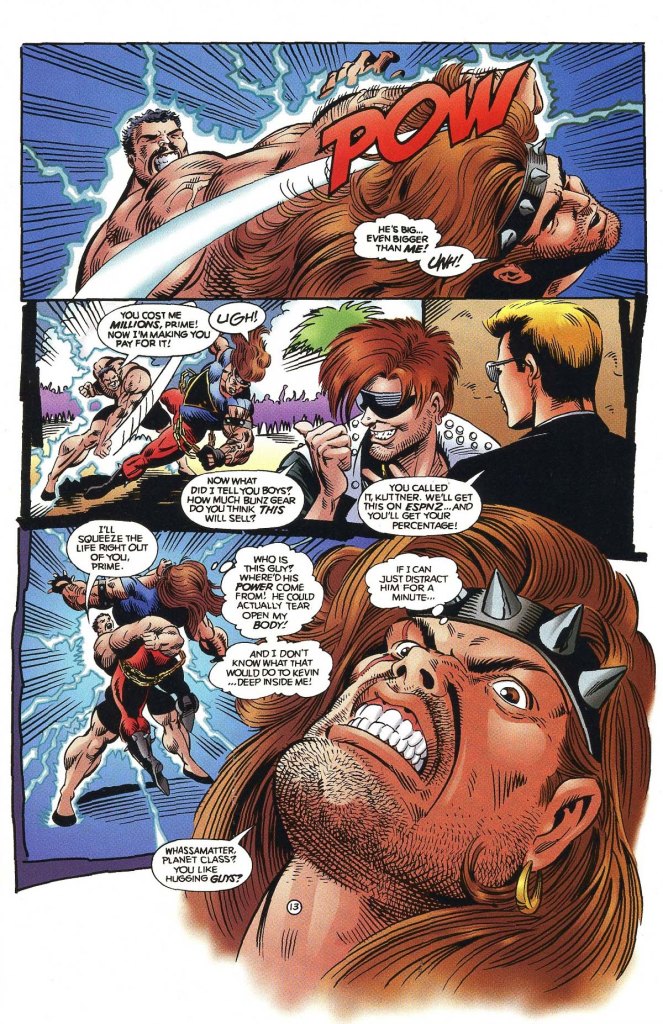
The battle royale itself is the highlight and alone makes this comic book worth buying.
As usual, the writing duo of Strazewski-Jones created another engaging story about Kevin and his superhero secret identity as Prime. Kevin shown struggling with his personal life? Check! Great superhero action with Prime? Check! In-depth characterization? Check!
What makes this comic book stand out is the battle royale between Prime and the two guys mention earlier, who each have very strong reasons and determination to defeat Prime. As it is indeed a very high-octane battle royale in the truest sense of the words, there was still sufficient room for readers to understand what Prime thought as he fights and dodges in the battle. Very clearly defined are the intentions of Kuttner and Planet Class, and the personalities of each plus Prime really gave their conflict a very unique flavor of its own. The battle royale is not a mindless event but rather very colorful and character-driven.
As for the art, I find Darick Robertson’s work here pretty good and many times he seemed to try to emulate the unique style and approach the late Norm Breyfogle defined the Prime series with. Although Kevin looks more like a college student, most characters were still recognizable. This one looks good!
Conclusion
It sure is hard for any teenager to be perceived as a social outcast.
Prime #13 (1994) is a very entertaining read. It does not use the typical good-versus-evil formula of superhero comic books but it sure is loaded with a lot of personality following Prime, Kuttner and Planet Class.
If you are seriously planning to buy an existing hard copy of Prime #13 (1994), be aware that as of this writing, MileHighComics.com shows that the near-mint copy of the regular edition costs $8 while the near-mint copies of the variant edition and the variant newsstand edition cost $8 and $26 respectively.
Overall, Prime #13 (1994) is highly recommended!
+++++
Thank you for reading. If you find this article engaging, please click the like button below and also please consider sharing this article to others. If you are looking for a copywriter to create content for your special project or business, check out my services and my portfolio. Feel free to contact me as well. Also please feel free to visit my Facebook page Author Carlo Carrasco and follow me at HavenorFantasy@twitter.com
Disclaimer: This is my original work with details sourced from reading the comic book and doing personal research. Anyone who wants to use this article, in part or in whole, needs to secure first my permission and agree to cite me as the source and author. Let it be known that any unauthorized use of this article will constrain the author to pursue the remedies under R.A. No. 8293, the Revised Penal Code, and/or all applicable legal actions under the laws of the Philippines.
Welcome back, superhero enthusiasts, comic book collectors and fans of Wonder Woman! Previously I reviewed a story in which the stakes were raised for Wonder Woman and her fellow Amazons as a result of egos among the deities of Olympus with Zeus being reckless to show himself to Diana. Eventually the deities issued their challenge which Diana accepted but the effects were not limited to her alone. Queen Hippolyte is very disturbed by the challenge issued to her daughter as she believes that as ruler of the Amazons, she should be the one to meet the challenge. The queen expressed her view the the goddesses who bore the Amazons surrender to every whim of Zeus. While Hippolyte remains very uneasy, the Amazons support Wonder Woman’s mission and escorted her to the demonic lair beneath their island.
That being said, the Challenge of the Gods storyline continues in this look back at Wonder Woman #11, published in 1987 by DC Comics with a story written by George Perez and the late Len Wein. Perez’s art was inked by Bruce D. Patterson.
The cover.
Early story
The story begins deep within the lair as Wonder Woman encounters the large 7-headed beast called Hydra. Zeus and the other deities of Olympus carefully watch the conflict happen. Zeus thinks Wonder Woman won’t survive the encounter and Pan (the Satan-like figure) states that the destruction of the Amazon will make her sisters more compliant to Zeus’ wishes. Queen Hera however believes Diana would not fail.
As the conflict underneath Themyscira goes on, the deities discuss what would happen should Wonder Woman fail or succeed. In the heat of battle, Diana analyzes carefully her situation and strives hard to defeat Hydra which is blocking the portal to her next destination…
Quality
Wonder Woman’s mother takes action!
I can start by saying that the story here is more spectacular in terms of presentation highlighted with a strong sense of discovery and wonder mixed with high-octane action here and there. To put it short, this comic book is yet another big pay-off executed following the intense build-up in the previous issue. The Challenge of the Gods storyline really started to move in high-gear with the spectacle while successfully defining the fantasy and mythology elements in Wonder Woman’s realm. This is not your typical superhero tale rather it is presented with a much strong element of fantasy laced with suspense and even a bit of horror. As the story unfolds, you will not only witness Wonder Woman struggle with the challenge of the deities, you will also relate with her on a personal level.
Along the way, the creators made one page that followed the experiences of Steve Trevor who in the post-Crisis universe is a much older character still serving in the military. The slow Steve Trevor scene provided a short break from the high-tension of Wonder Woman’s scenes. Not to be outdone in sharing the spotlight is Queen Hippolyte who takes action in connection to the challenge Wonder Woman is handling. Through the queen, her views and personality got developed even further by the Perez-Wein and her struggle on leading the Amazons while being a mother made more sense literally.
Conclusion
Now this is a really striking set of images.
As it was made with the usual high-quality from the Perez-Wein creative team, Wonder Woman #11 (1987) is a very dramatic, action-heavy and dynamic read that kept on defining the Queen of Superheroes (and even Queen Hippolyte) while keeping the narrative fresh with revealing fantasy elements. Wonder Woman’s bravery here is really tested a whole lot, and her uncompromising desire to accomplish the challenge of the deities. While this comic book is a great pay-off to the build-up done in issue #10, it also builds up to something very unexpected on the final page. I should also state that the story is very unpredictable and at times it played on my expectations.
If you are seriously planning to buy an existing hard copy of Wonder Woman #11 (1987), be aware that as of this writing, MileHighComics.com shows that the near-mint copy of the regular edition costs $30 while the near-mint copy of the newsstand edition costs $60.
Overall, Wonder Woman #11 (1987) is highly recommended!
+++++
Thank you for reading. If you find this article engaging, please click the like button below and also please consider sharing this article to others. If you are looking for a copywriter to create content for your special project or business, check out my services and my portfolio. Feel free to contact me as well. Also please feel free to visit my Facebook page Author Carlo Carrasco and follow me at HavenorFantasy@twitter.com
Disclaimer: This is my original work with details sourced from reading the comic book and doing personal research. Anyone who wants to use this article, in part or in whole, needs to secure first my permission and agree to cite me as the source and author. Let it be known that any unauthorized use of this article will constrain the author to pursue the remedies under R.A. No. 8293, the Revised Penal Code, and/or all applicable legal actions under the laws of the Philippines.
Welcome back superhero enthusiasts, comic book collectors and geeks! Today we will take another journey back into the Ultraverse touching on their first major crossover event Break-Thru but told through the exploits of Prime.
For the newcomers reading this, Break-Thru was a 2-part crossover that involved all the Ultraverse characters in multiple ways. There were Break-Thru crossover spinoff issues of Mantra, Hardcase, Prototype, The Strangers, Solitaire and The Solution to name some. This time, we will find out Break-Thru in an issue of Prime.
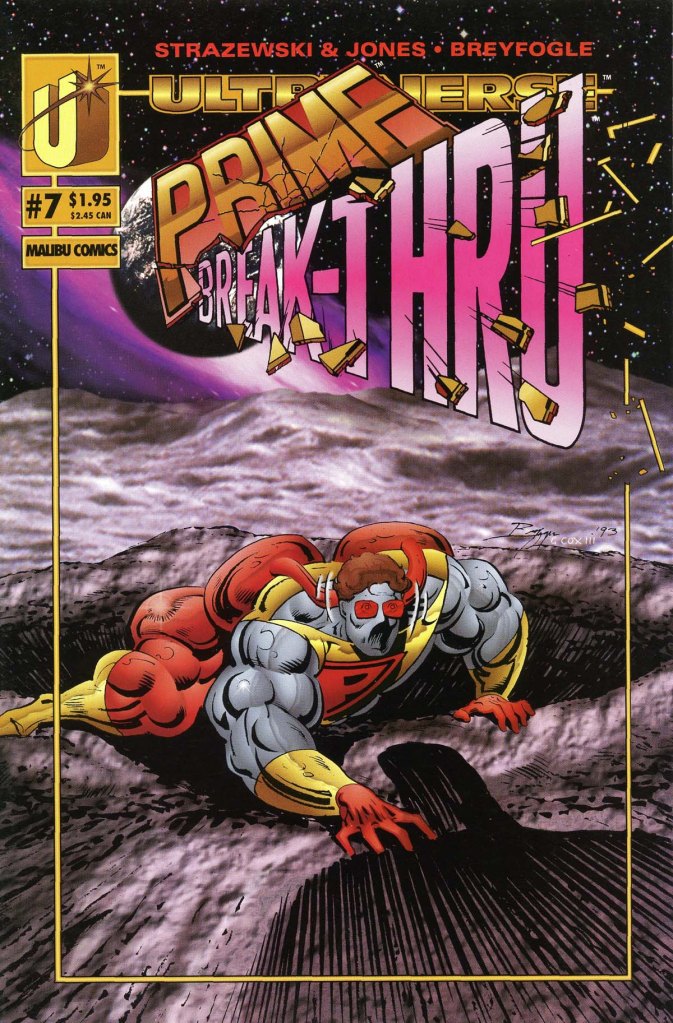
What exactly happened to Prime in relation to Break-Thru? We can find out together in this look back at Prime #7, published by Malibu Comics in 1993 with a story written by Gerard Jones and Len Strazewski, and drawn by the late Norm Breyfogle.
The cover.
Early story
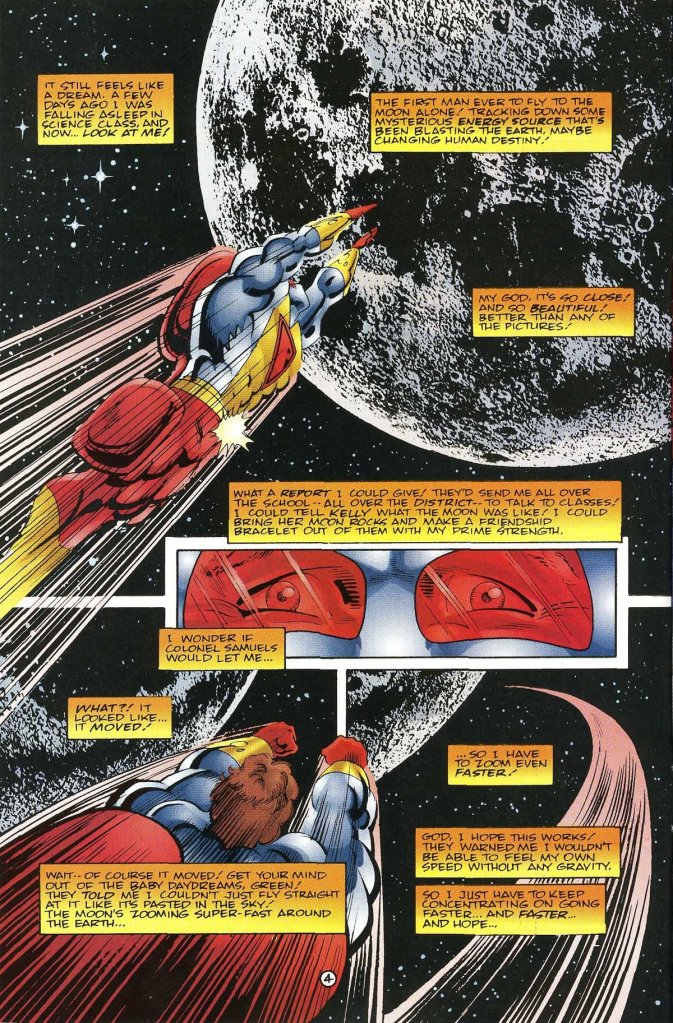
The story begins with Prime, wearing a special suit with air tanks, flying into space for a mission on the moon. Even as he is struggling with breaking through the atmosphere, he knows he cannot afford any setbacks knowing that US President Bill Clinton and military officials are counting on him. It has been some time since he was picked up by Colonel Samuels and his team after the big fight with Max-Man. As he approaches the moon, Prime expressed how much has changed over the past few days from attending science class to working secretly for the government.
After struggling long, Prime finally arrives on the moon’s surface albeit roughly. As he flies around searching for clues, a solid structure of rock suddenly rises from the surface leaving Prime no room to dodge it…
Quality
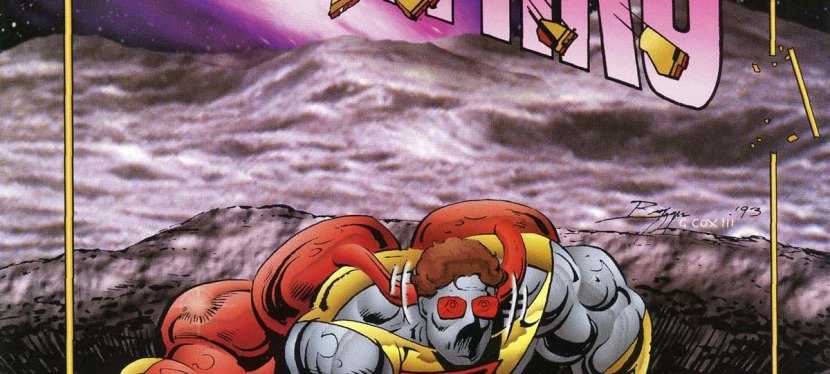
Prime on to something on the moon.
After going through lots of stories about superhero action, misadventures, intrigue and personal struggles as recorded in the first six issues of Prime, this particular story has a more unpredictable story which is refreshing to read. For one thing, this one has a whole lot of twists that actually test Prime’s sanity and keeps the narrative interesting throughout. Similar to what happened in Mantra #6, Prime encounters images of several people he knew while on the moon. This thing happens to be one of the capabilities of the entity on the moon.
As expected from the creative team of Jones and Strazewski, the writing is of high-quality. For his part, Norm Breyfogle continued to deliver striking visuals and in this issue he really showed off Prime’s modified look to the full extent.
Conclusion
Prime and his thoughts as he travels to the moon.
Prime #7 (1993) is a pretty good comic book to read. Ultimately it is a worthy build-up to the Break-Thru crossover and more importantly it continues to show why Prime is truly one of the major characters of the Ultraverse.
If you are seriously planning to buy an existing hard copy of Prime #7 (1993), be aware that as of this writing, MileHighComics.com shows that the near-mint copy of the regular edition costs $8 while the near-mint copy of the newsstand edition costs $26.
Overall, Prime #7 (1993) is recommended.
+++++
Thank you for reading. If you find this article engaging, please click the like button below and also please consider sharing this article to others. If you are looking for a copywriter to create content for your special project or business, check out my services and my portfolio. Feel free to contact me as well. Also please feel free to visit my Facebook page Author Carlo Carrasco and follow me at HavenorFantasy@twitter.com
Disclaimer: This is my original work with details sourced from reading the comic book and doing personal research. Anyone who wants to use this article, in part or in whole, needs to secure first my permission and agree to cite me as the source and author. Let it be known that any unauthorized use of this article will constrain the author to pursue the remedies under R.A. No. 8293, the Revised Penal Code, and/or all applicable legal actions under the laws of the Philippines.
Hey comic book fans. Are you looking for more science fantasy stories and concepts within the Ultraverse? There is more in the Archimage Quest storyline told within the Mantra monthly series spearheaded by Mike W. Barr.
To put things in perspective, as recalled in issue #1, Lukasz got killed the last time he was in a male body shortly after the evil Boneyard defeated Archimage (Lukasz’s superior) which led to him getting reincarnated into the body of Eden Blake (displacing her soul). Lukasz-occupied Eden later acquired from Katinya a relic which helped her gain a mystical armor. Before dying, Katinya revealed that it was Archimage’s plan all along to have Lukasz placed in a woman’s body because his long-term use of weapons in fighting Boneyard did not work.
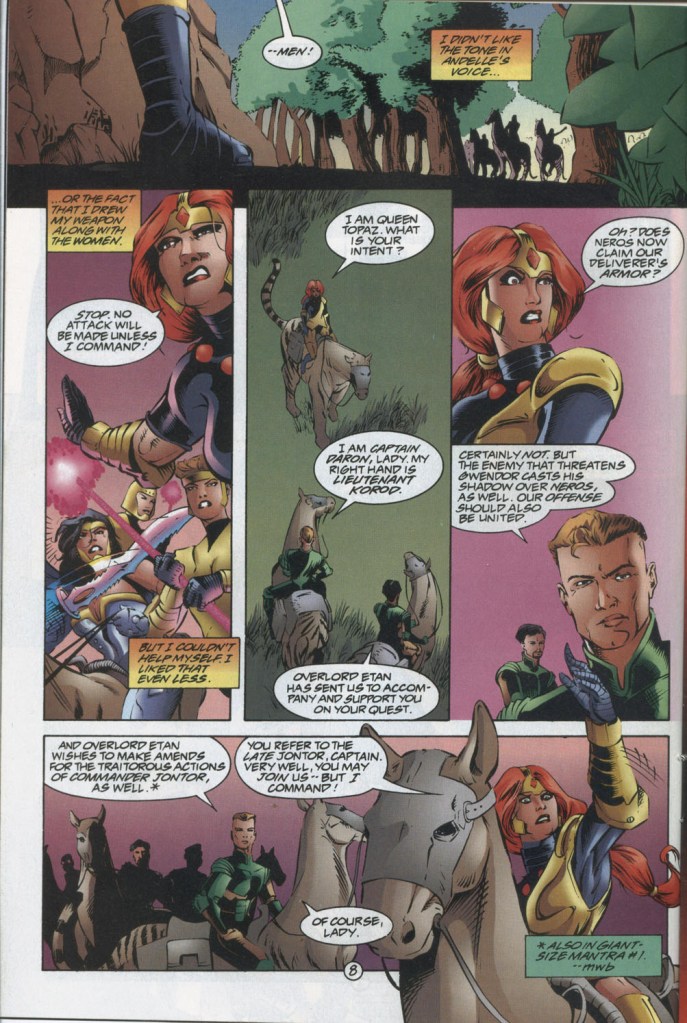
Since then, Lukasz has been struggling not only to stay alive, to keep on beating Boneyard’s forces and other forms of opposition, but also to live life as a woman with the family of Eden. After some time, Mantra temporarily joins The Strangers in confronting Boneyard (told in The Strangers #13 and Mantra #12). Afterwards, Mantra entered into a new dimension where two societies of separated men and women exist. The women are led by their queen Topaz. Together Topaz and Mantra led a group on a mission concerning Boneyard and Archimage.
With those details laid down, here is a look back at Mantra #14, published in 1994 by Malibu Comics with a story by Mike W. Barr and drawn by Mark Heike.
The cover.
Early story
The story begin with Mantra and Eden Blake together. Suddenly Mantra’s appearance changes into a man.
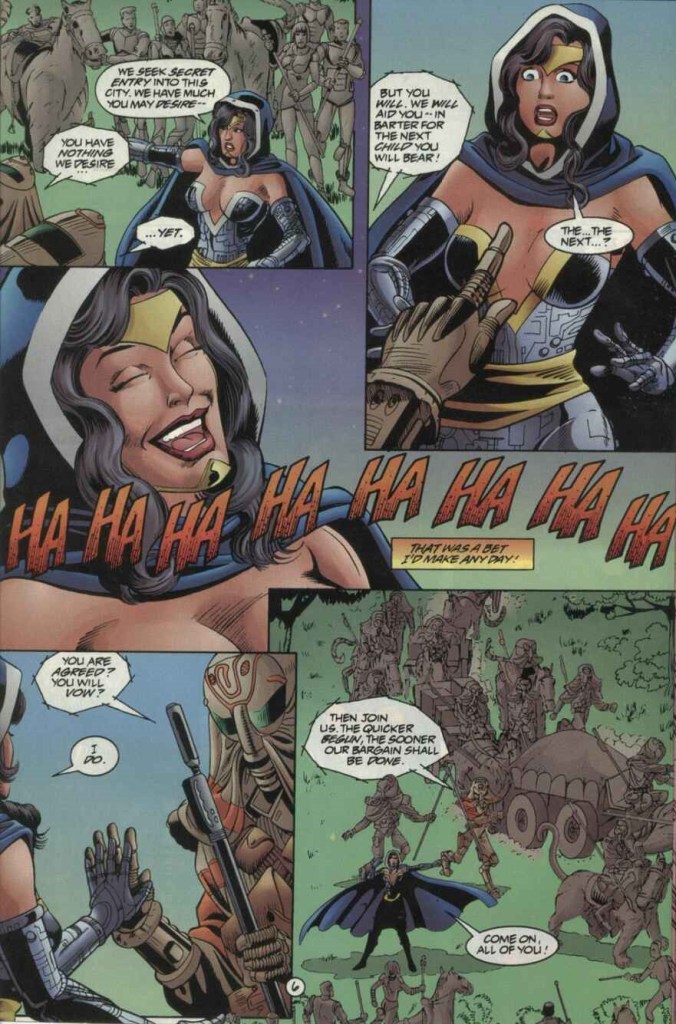
In the present, Mantra is leading the group of men and woman in the absence of Topaz. As they try to take Boneyard by surprise, they encounter a caravan of people called the Tradesmen. One of them recognizes her as Lukasz and they met in another place some time ago. Being trade-oriented and very focused on honor, they make a deal which provides Mantra’s group some much-needed assistance in their mission…
Quality
Mantra versus one of Boneyard’s wives.
At this stage of the Archimage Quest, Mike W. Barr really raised the stakes by adding more twists, more intrigue and more references to the past. All of that were achieved backed with very strong writing, resulting a story that was more engaging than the previous issue. Not to be outdone is the spotlight given on the family of Eden Blake on Earth during the absence of Lukasz/Mantra. When it comes to the art, Mark Heike did a good job drawing Mantra and other related characters all of which are recognizable.
Conclusion
A deal made with one of the Tradesmen.
Mantra #14 (1994) is a fun read. At this stage in the life of the protagonist, the stakes were not only raised higher but things also got more complex particularly with Mantra’s interactions with certain enemies she encountered as well as certain characters who support opposition against Boneyard. It should be noted that there are still some fresh new details about Archimage’s organized strategy about having Lukasz contained in the body of Eden Blake. There was a solid build-up for the tension and intrigue, and there was nice pay-off in the end.
If you are seriously planning to buy an existing hard copy of Mantra #14 (1994), be aware that as of this writing, MileHighComics.com shows that the near-mint copy of the comic book costs $8.
Overall, Mantra #14 (1994) is recommended.
+++++
Thank you for reading. If you find this article engaging, please click the like button below and also please consider sharing this article to others. If you are looking for a copywriter to create content for your special project or business, check out my services and my portfolio. Feel free to contact me as well. Also please feel free to visit my Facebook page Author Carlo Carrasco and follow me at HavenorFantasy@twitter.com
Disclaimer: This is my original work with details sourced from reading the comic book and doing personal research. Anyone who wants to use this article, in part or in whole, needs to secure first my permission and agree to cite me as the source and author. Let it be known that any unauthorized use of this article will constrain the author to pursue the remedies under R.A. No. 8293, the Revised Penal Code, and/or all applicable legal actions under the laws of the Philippines.
Welcome back, superhero enthusiasts, comic book collectors and fans of the Ultraverse! Join me on my journey to one of the early issues of the Prime monthly series. For the newcomers reading this, Prime is one of the major superheroes of the entire Ultraverse and went on to have an active part in the UV team called UltraForce.
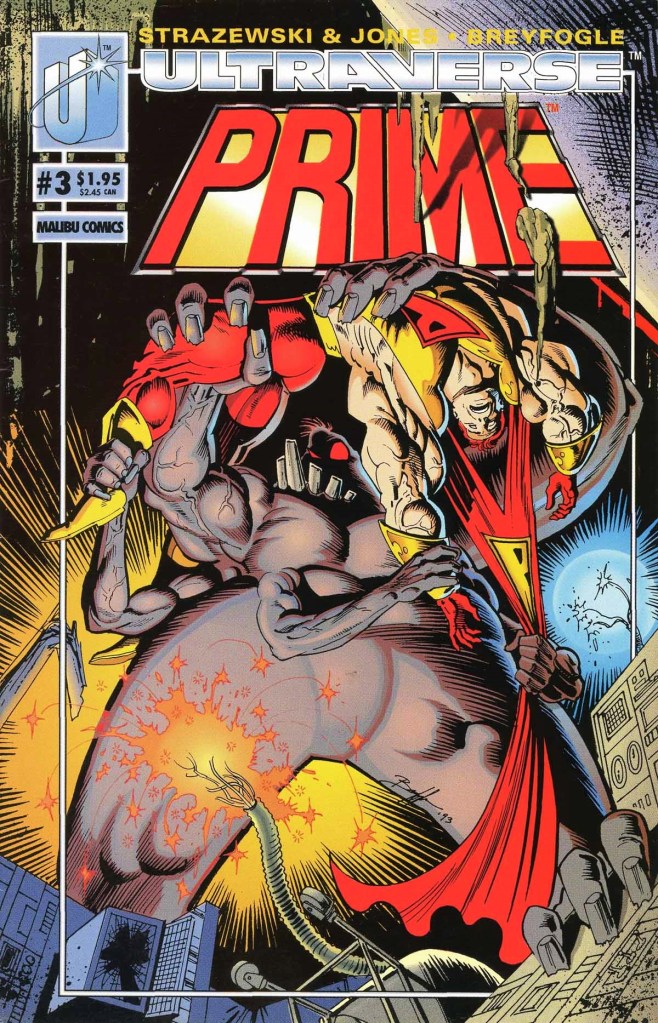
Here we go with this look back at Prime #3, published in 1993 by Malibu Comics with a story written by Len Strazewski and Gerard Jones, and illustrated by the late Norm Breyfogle.
The cover.
Early story
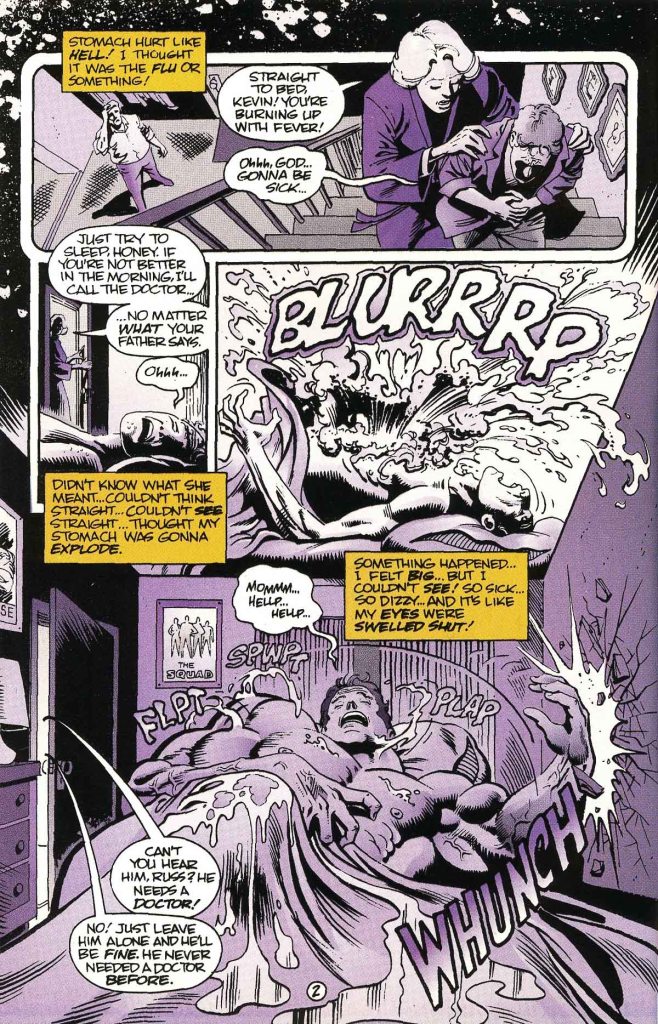
The story begins with Prime struggling as he could not breathe. He remembered the first time, as Kevin, when he woke up inside his own dead body. Back then, Kevin was in his bedroom suffering as he changed into his overly muscular body as Prime while his parents were just outside of his bedroom trying to figure out how to help him. Kevin remembered that the Prime body did not last too long and he broke out of it. The first time he saw the fake flesh of Prime, he got scared. Since that time, Kevin kept everything a secret and has been struggling personally.
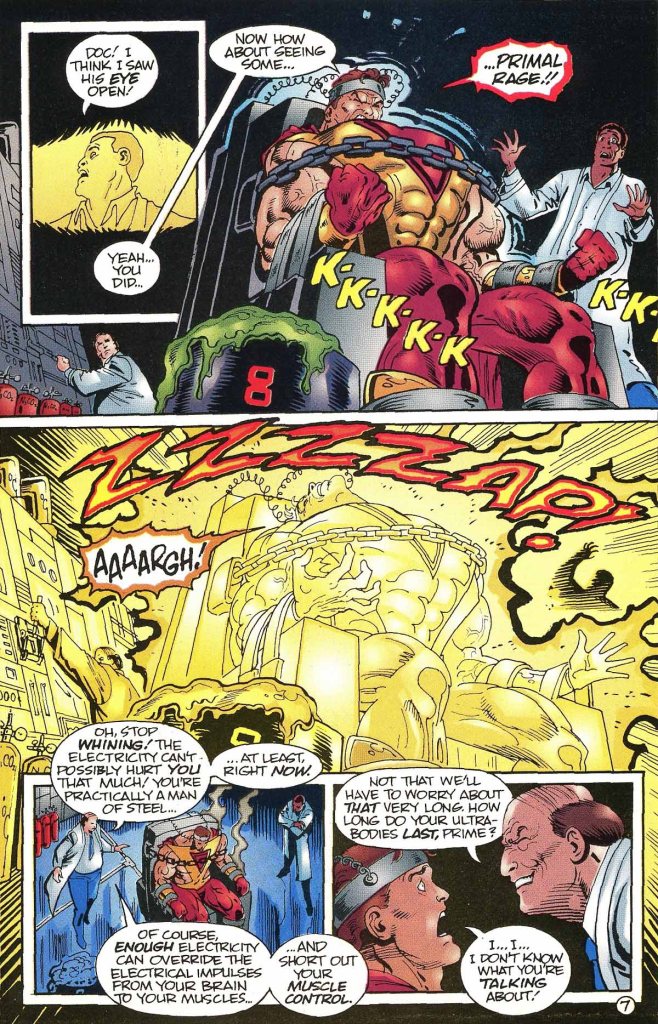
In the present, Prime finds himself strapped on a chair surrounded by scientists. He was just captured by them and their monster. One of the scientists asked Kevin how long does his ultra bodies last. The scientist is determined to find out more from Prime and educate him, teach him his nature, his destiny and function…
Quality
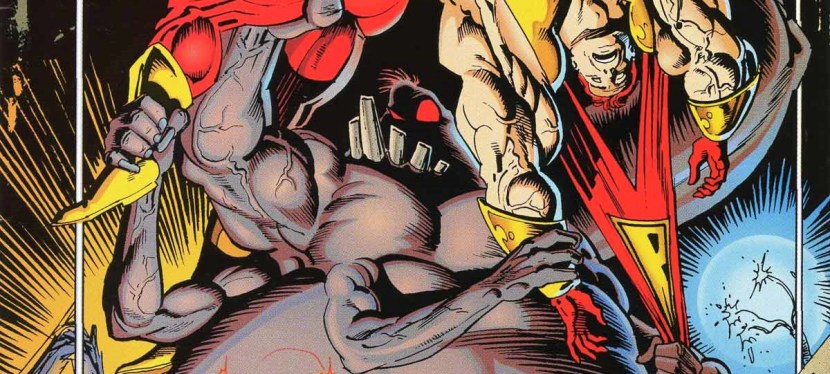
Prime restrained.
As expected, the story told by Strazewski and Jones is of very high quality and the engagement is very strong. What makes this one stand out over issues #1 and #2 is its element of powerful revelations (which establish not only Prime’s heritage but also the Ultraverse’s concept of military and scientific personnel tampering with nature). Reading through the well-explained in-universe history of mad science related to Prime’s origin was very gripping and thought-provoking. This also raises a question about Prime…is he a superhero or a monster?
As the tension and pressure rise, Prime is shown to act impulsively which itself is a convincing reflection of the teenager inside him. This is something that Strazewski and Jones captured perfectly!
As expected, Norm Breyfogle really brought the script to life with his compelling artwork.
Conclusion
The first time Kevin turned into Prime.
Prime #3 (1993) is a great comic book to read and a worthy addition to your collection.
If you are seriously planning to buy an existing hard copy of Prime #3 (1993), be aware that as of this writing, MileHighComics.com shows that the near-mint copy of the regular edition costs $8 while the near-mint copy of the newsstand edition costs $26.
Overall, Prime #3 (1993) is highly recommended!
+++++
Thank you for reading. If you find this article engaging, please click the like button below and also please consider sharing this article to others. If you are looking for a copywriter to create content for your special project or business, check out my services and my portfolio. Feel free to contact me as well. Also please feel free to visit my Facebook page Author Carlo Carrasco and follow me at HavenorFantasy@twitter.com
Disclaimer: This is my original work with details sourced from reading the comic book and doing personal research. Anyone who wants to use this article, in part or in whole, needs to secure first my permission and agree to cite me as the source and author. Let it be known that any unauthorized use of this article will constrain the author to pursue the remedies under R.A. No. 8293, the Revised Penal Code, and/or all applicable legal actions under the laws of the Philippines.
Welcome back, superhero enthusiasts, comic book collectors and fans of 1990s comics! This is another examination of the Ultraverse as told through the exploits of Mantra, the pretty armored lady whose body is occupied by the soul of the male warrior Lukasz.
Previously I reviewed Giant Size Mantra, which was a one-shot comic book that was part of the Archimage Quest storyline and it was indeed a well-made Mantra story that fit in nicely with the monthly series. That same comic book is notable for having the debut of Gwendor’s queen Topaz who went on to become a member of the memorable superhero team UltraForce.
With the details made clear, we can find out what happens next in the Archimage Quest in this look back at Mantra #13, published in 1994 by Malibu Comics with a story written by Mike W. Barr and drawn by Jason Armstrong.
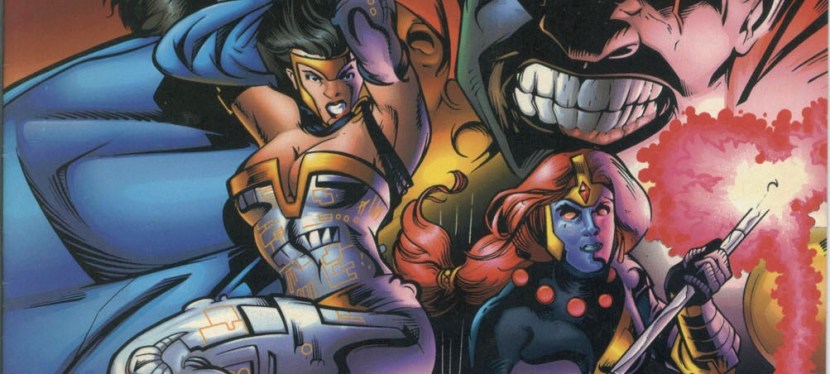
The cover.
Early story
The story begins in an unknown realm. Mantra (wearing her usual mask and armor) and Eden Blake are walking together and talking. After exchanging some words about the displacement of souls, Eden clings to Mantra and apologizes from now realizing what a shock the situation is to Mantra on top of everything else that happened. Eden tells Mantra there is something she wants from her and addresses Lukasz by name.
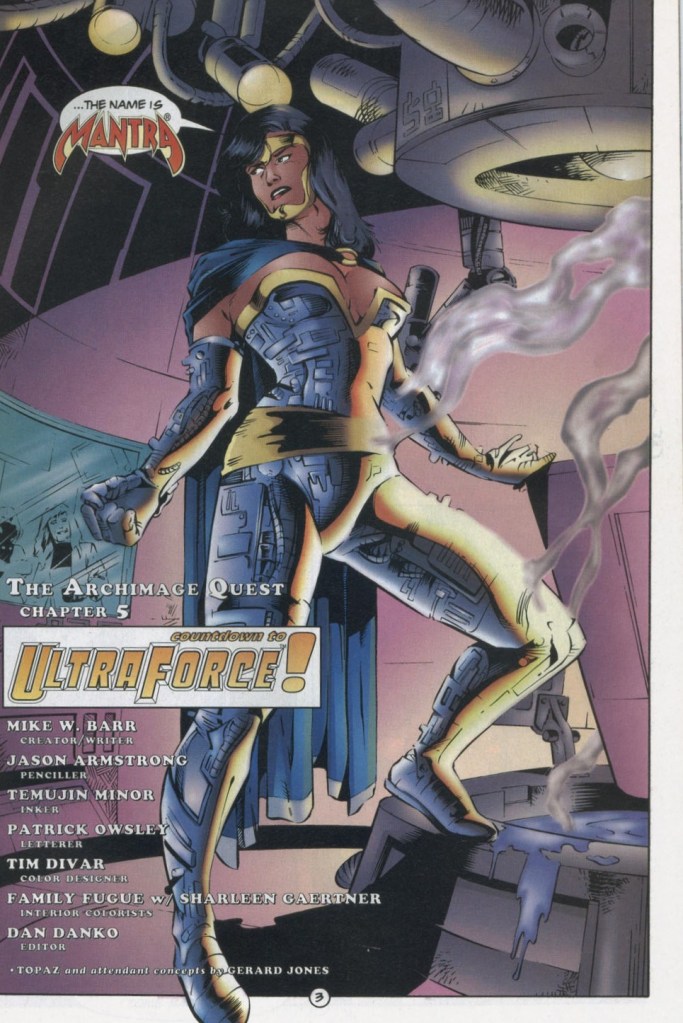
Suddenly Mantra/Eden Blake/Lukasz wakes up to the call of a technician. She is still in Gwendor and being completely naked, she goes through the process of armoring which is done with highly advanced technology. With her new armor on, Mantra is approached by queen Topaz who brings to her a notable sword to use. They discuss some matters as they walk together.
Meanwhile back in the United States, Eden’s daughter Evie visits a shop and talks to the old lady behind the counter. The young girl asks her about magic…
Quality
In the realm Mantra is in, it’s difficult for men and women to work together.
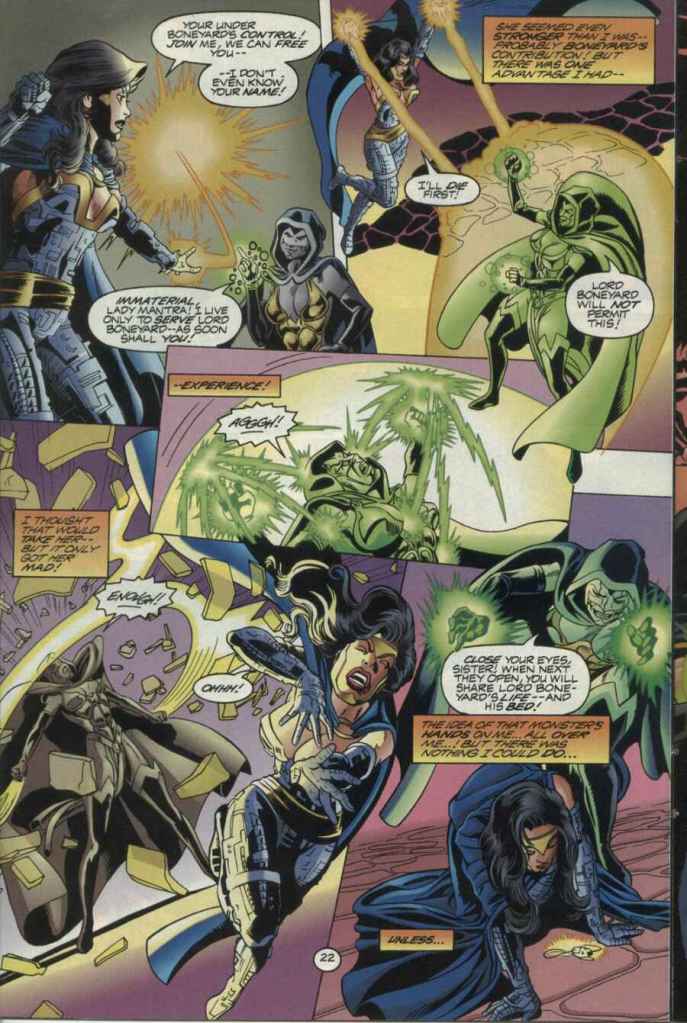
This is one very unique story of Mantra. Carrying over the elements from Giant Size Mantra, you will get to see the protagonist still spending time in the women-filled Gwendor (note: opposite it is another city filled with men) and starts her alliance with queen Topaz who is a very hands-on type of leader, willing to take risks going into battle. As Mantra does not have her mask and armor, she learns to use the magic power within her to make things happen. This is kinda like seeing Marvel’s Tony Stark adjusting and taking action without his Iron Man suit of armor.
Events aside, this story shows a significant development of Lukasz/Mantra’s personality as she adjusts to the ways of the men and women in their realm. The science fantasy elements of the story gave this comic book a unique style of visual presentation nicely pulled off by the illustrator. When it comes to the Archimage Quest, both Mantra and Boneyard are respectively struggling with disadvantages which is a nice storytelling touch. I should state that in this particular story, the complexities between males and females in the new realm is explored.
Conclusion
Yet another new thing worn by Mantra.
Mantra #13 (1994) is another solid story to read. As it continues the quest for Archimage, it explores more of the science fantasy world Mantra finds herself in as well as the differences between the two local societies separated by gender.
If you are seriously planning to buy an existing hard copy of Mantra #13 (1994), be aware that as of this writing, MileHighComics.com shows that the near-mint copy of the regular edition costs $8 while the near-mint copy of the variant edition costs $12.
Overall, Mantra #13 (1994) is recommended.
+++++
Thank you for reading. If you find this article engaging, please click the like button below and also please consider sharing this article to others. If you are looking for a copywriter to create content for your special project or business, check out my services and my portfolio. Feel free to contact me as well. Also please feel free to visit my Facebook page Author Carlo Carrasco and follow me at HavenorFantasy@twitter.com








 Author Carlo Carrasco