Disclaimer: This is my original work with details sourced from reading the comic book and doing personal research. Anyone who wants to use this article, in part or in whole, needs to secure first my permission and agree to cite me as the source and author. Let it be known that any unauthorized use of this article will constrain the author to pursue the remedies under R.A. No. 8293, the Revised Penal Code, and/or all applicable legal actions under the laws of the Philippines.
Welcome back superhero enthusiasts, 1990s arts and culture enthusiasts, Marvel Comics fans and comic book collectors! Today we go back to the year 1991 to explore one of the many tales of the Marvel shared universe through the Uncanny X-Men series.
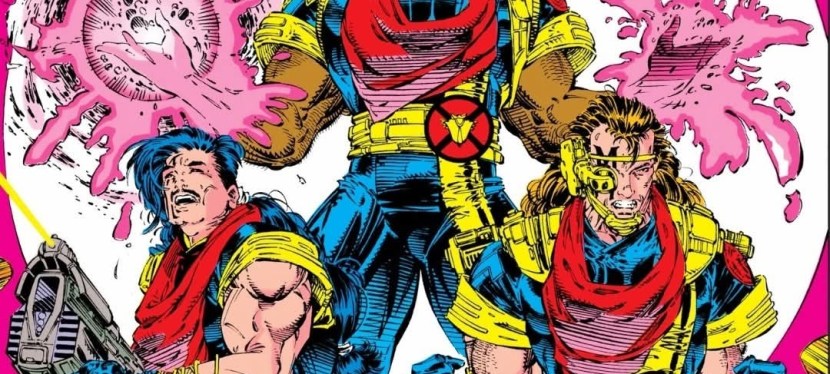
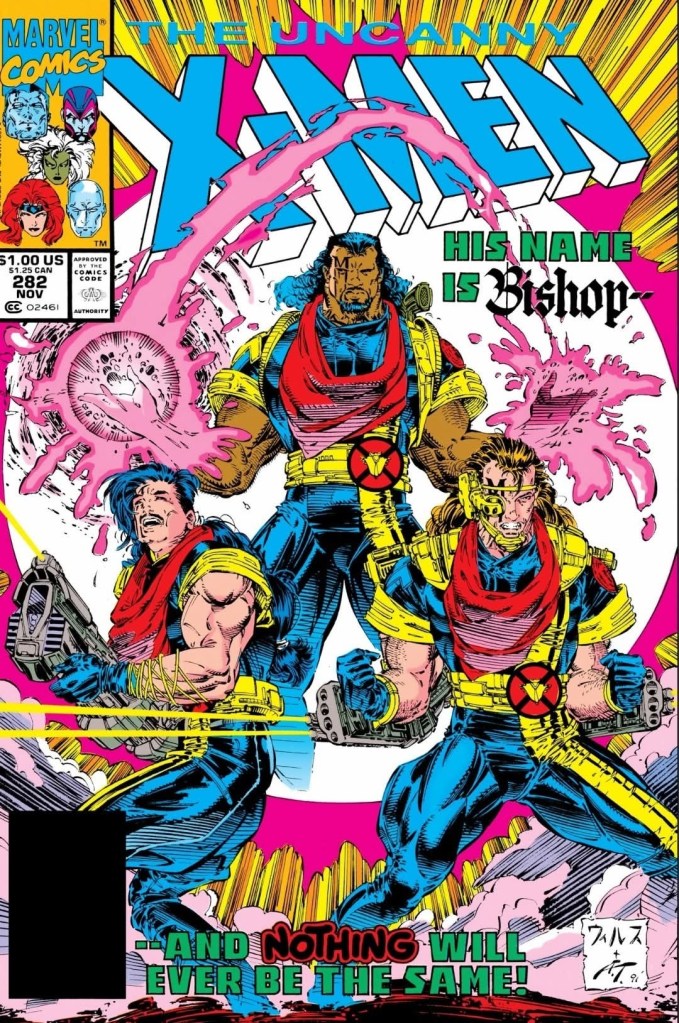
Uncanny X-Men #282 marked the continuing conflict between the X-Men and Trevor Fitzroy’s group, and the arrival of one of the most notable additions to Marvel’s Mutants…Bishop. To be clear, Bishop was not alone when arrived from the future through one of Fitzroy’s portals. In relation to everything that happened in the comic book, the arrival was a very powerful conclusion to read.
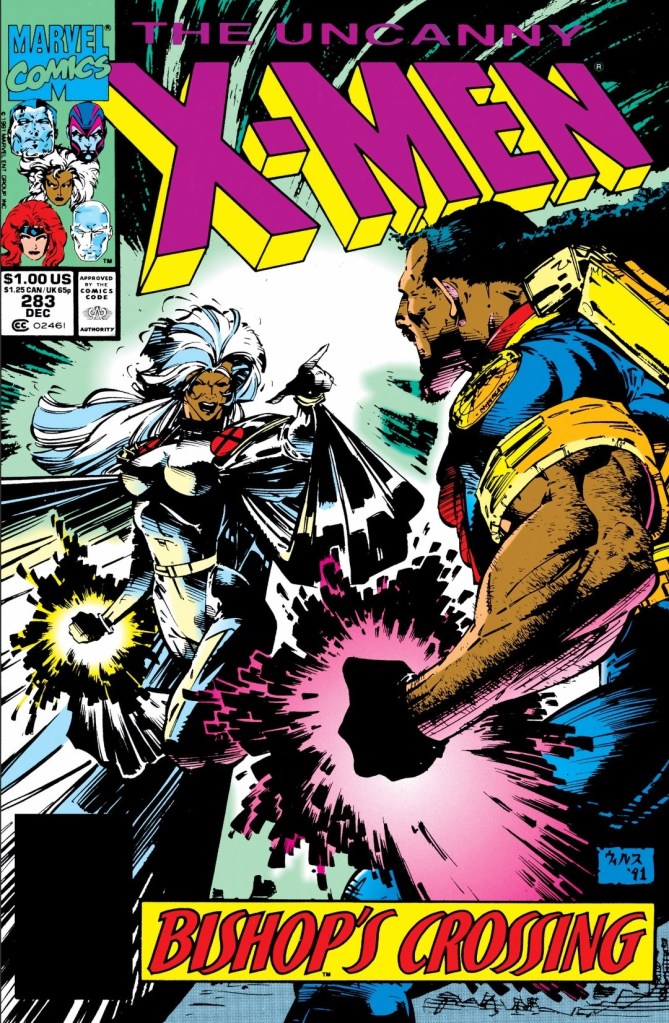
With those details laid down, here is a look back at Uncanny X-Men #283, published in 1991 by Marvel Comics with a story co-written by Whilce Portacio and by John Byrne (script). The art was done by Portacio with ink work by Art Thibert.
The cover.
Early story
The story begins in the arctic lair of Trevor Fitzroy. The arrival of Bishop and his two mutant companions – Malcolm and Randall – from the future caught everyone by surprise (including the X-Men). Bishop, who has Trevor Fitzroy subdued, tells his companions to throw their takes (members of Fitzroy’s force) into the portal.
Bishop intends to have Fitzroy go first which draws a loud reaction from the mutant madman. Fitzroy, who had been using the life force of captive mutants to open portals, knows exactly what would happen if he goes first. His exchange of words with Bishop shows they have a history together.
When Bishop’s companion moved a subdued person into the portal, it tore him apart. Fitzroy reveals to Bishop that the portals he created only function one-way and he tells him that he and his companions are stuck in the 20th century.
In response, Bishop assumes complete judicial authority and tells Malcolm and Randall to standby for termination sweep. The X-Men begin to react…
Quality
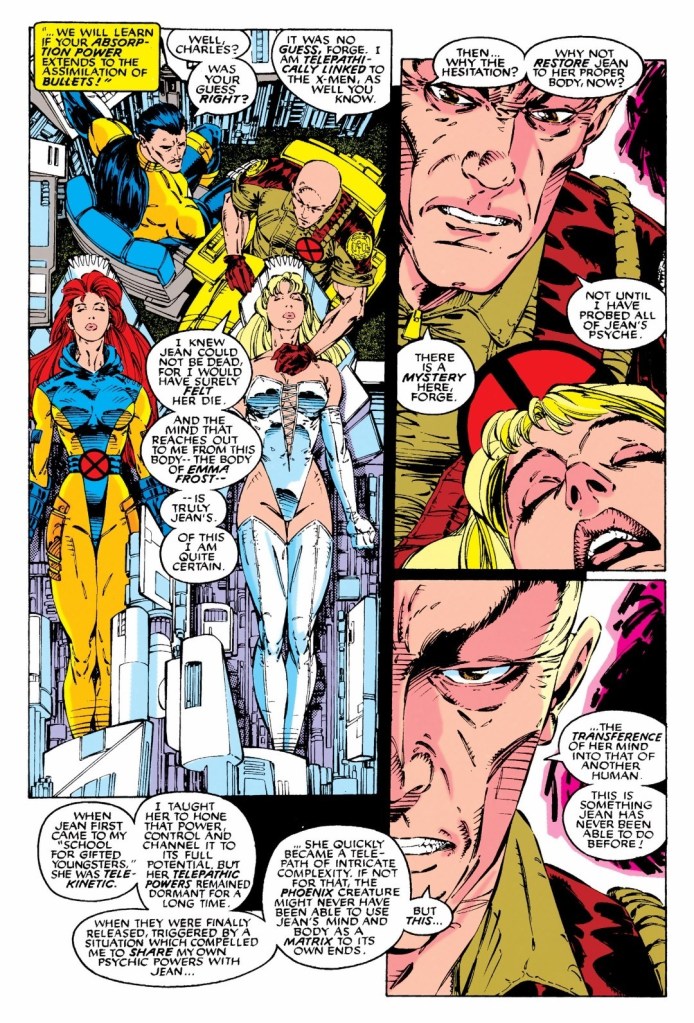
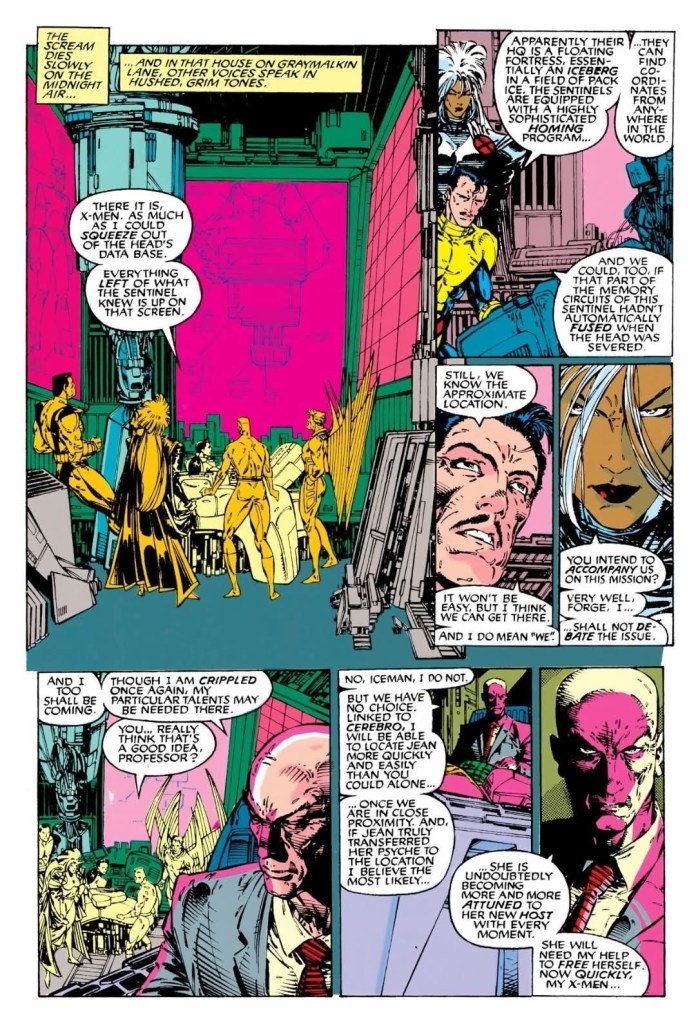
Professors takes a huge risk to help Jean Grey who recently occupied the body of Emma Frost.
When it comes to the creativity, this comic book is both a strong pay-off to the build-up of issues #281 and #282 while also serving as a new build-up focusing on Bishop’s arrival. At the heart of this tale is Bishop’s first-ever personal encounter with the X-Men which instantly expanded the lore of Marvel’s mutants a lot.
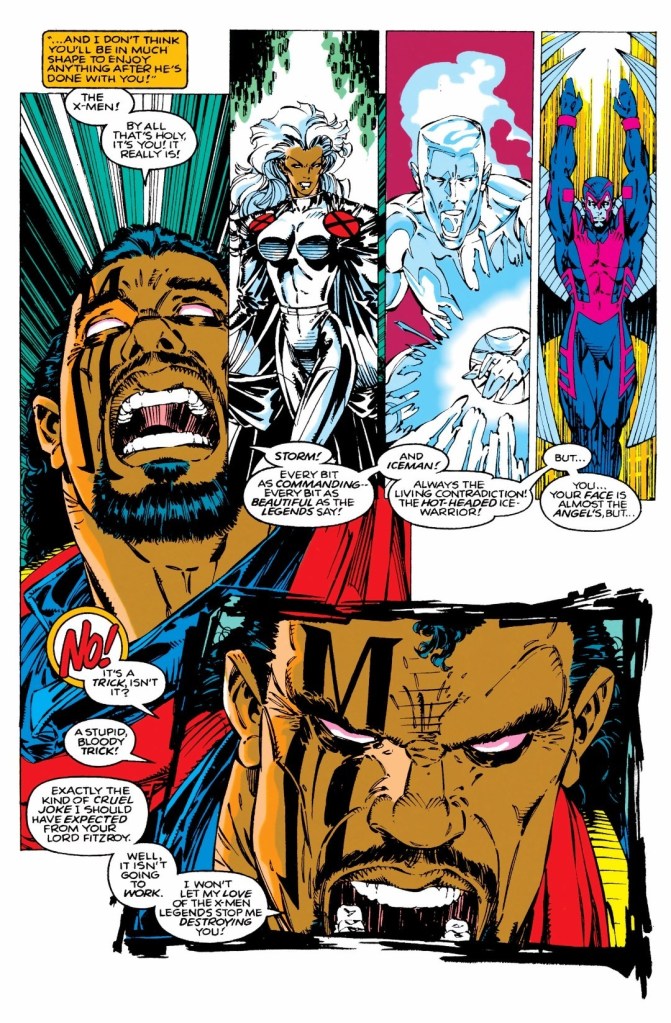
Bishop is a mutant from one possible future (of the Marvel Comics shared universe) in which Storm, Iceman, Archangel, Charles Xavier and others are remembered as legacy figures of the X-Men. In this comic book, you will see there is a good amount of depth with the way Bishop is dramatized and with many notable details on the dialogue prepared for him. Co-created by Whilce Portacio and John Byrne, Bishop is really an inspired work and clearly is not a mere addition. There is Filipino inspiration behind the creation of Bishop (click here and here) with some elements of John Ford and Prince mixed in (click here).
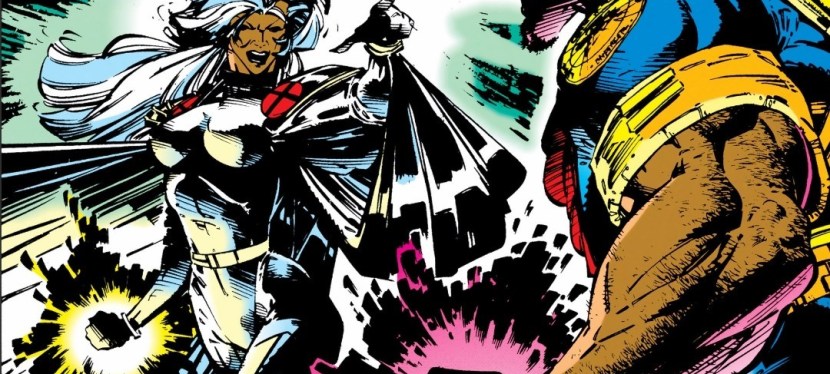
As far as the storytelling is concerned, there is notable shift of tone here as Bishop, Malcolm and Randall received much of the spotlight and yet there was still some room left for focus on the X-Men and Fitzroy’s group respectively. What makes this comic book an intriguing read is the first-ever personal encounters between Bishop and the X-Men which involved the temporary blurring of the boundary between good and evil. The interactions between Storm and Bishop are easily the most dramatic to see, and you will witness how their respective toughness (plus leadership) collide intensively.
Along the way, there is a lot superhero action to enjoy here. In fact, there are many forms action that served as extensions or pay-offs to the exchange of words between Bishop and a few specific X-Men members. Even a non-action scene like Professor X helping Jean Grey (who was in Emma Frost’s body temporarily) resulted in some visual spectacle.
Conclusion
Bishop’s first-ever encounter with the X-Men not only challenged his perception but also brought out traits of his attitude.
Uncanny X-Men #283 (1991) is another very compelling, intriguing and entertaining read from the Portacio-Byrne duo. The X-Men lore has been expanded more and Bishop’s first encounter with the X-Men is easily the most engaging aspect of the story. At the same time, the conflict between the X-Men’s Gold Team and Trevor Fitzroy took a twist that really turned the plot to an unexpected new direction which is not surprising as Bishop’s presence made a huge impact (even on Storm herself). This is one of the best superhero stories of 1991 I have read so far.
Overall, Uncanny X-Men #283 (1991) is highly recommended!
Disclaimer: This is my original work with details sourced from reading the comic book and doing personal research. Anyone who wants to use this article, in part or in whole, needs to secure first my permission and agree to cite me as the source and author. Let it be known that any unauthorized use of this article will constrain the author to pursue the remedies under R.A. No. 8293, the Revised Penal Code, and/or all applicable legal actions under the laws of the Philippines.
Welcome back superhero enthusiasts, 1990s arts and culture enthusiasts, Marvel Comics fans and comic book collectors! Today we go back to the year 1991 to explore one of the many tales of the Marvel shared universe through the Uncanny X-Men series.
Uncanny X-Men #281 was a great read. For most of the early 1990s, I read more X-Men stories about the Blue Team than the Gold Team. In Uncanny X-Men #281 – which took place after X-Men #5 – the spotlight was on the Gold Team which showed the strategic leadership of Storm, the X-Men revisiting the headquarters of the Hellfire Club, Jean Grey’s own recollections of past events and the new threat of Trevor Fitzroy and the Sentinels.
With those details laid down, here is a look back at Uncanny X-Men #282, published in 1991 by Marvel Comics with a story co-written by Whilce Portacio and by John Byrne (script). The art was done by Portacio with ink work by Art Thibert.
The cover.
Early story
The story begins inside the School For Gifted Youngsters when the Gold Team arrives (with Colossus carrying the inactive body of Jean Grey) and disrupts the chess game between Professor X and Forge. Charles Xavier mentally examines Jean and notices that her psyche survives and has been displaced. He realizes Jean is alive but not in her body.
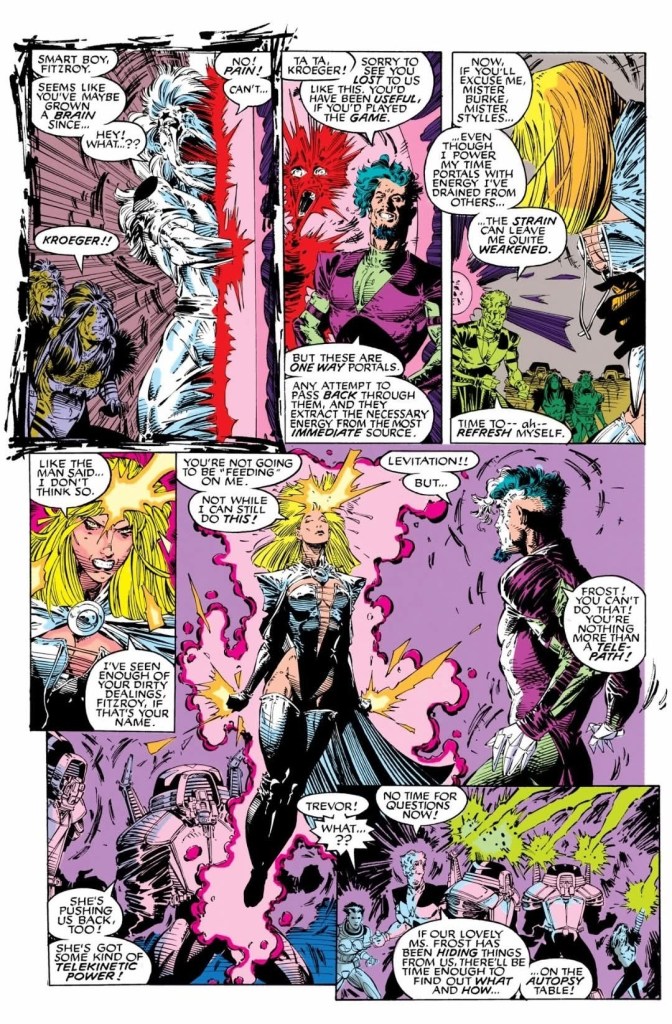
In New York City, Trevor Fitzroy (who is carrying the body of an inactive Emma Frost) and his Sentinels surprise Shinobi Shaw showing what is left of the cyborg of Pierce. Trevor boasted to Shinobi that he won claiming that he has terminated one of the founders of the inner circle, captured a small band of Hellions and has Emma Frost as a trophy. Very slowly, Jean Grey – now occupying Frost’s body – wakes up…
Quality
Trevor Fitzroy does not know who is inside Emma Frost’s body.
I can say out loud that this is a great follow-up to the previous issue (which itself is a great read) as it has a lot of hefty payoffs to the build-up from before. With the story concept already established in issue #281, the progression continued strongly, the narrative is clearer and the stakes were raised even higher.
In this issue, Trevor Fitzroy still has extreme tendencies and he might look insane or unhinged to you. Still, Fitzroy really has diabolical plans to execute and those plans involves his ability to open portals to bring in his reinforcements from far away, including the “denizens of the future.” Adding to Fitzroy’s merciless and arrogant personality is his use of the captives’ life force to energize himself to open portals. Really, he does not care much about the lives of captives as he treats them as nothing more than bodies of energy for his use. Whilce Portacio really excels in not only bringing the script to life but also showcasing the personality and expressions of Fitzroy who at this point in comic book history was a brand new villain for the X-Men.
As for the X-Men’s Gold Team, not having Jean Grey was really disadvantageous to them which compels Professor X to actually join them on their mission. This is a notable development as Xavier is very close with Jean (his original student and fellow telepath) and he knows that great odds await their team. Xavier’s involvement added a lot to the plot itself and I love the way John Byrne and Portacio portrayed him here.
When it comes to the storytelling, the pace noticeably moved faster as a lot of payoffs to the build-up were executed here. The X-Men themselves each got their respective share of the spotlight and all of them were portrayed consistently in character. The stakes were raised here this time and the handling of all the details and developments was very solid.
Conclusion
Knowing great odds await them, Charles Xavier joins the X-Men on their mission to save Jean Grey.
Even with the stakes raised higher, the creative team delivered the great stuff Uncanny X-Men #282 (1991) is a very worthy follow-up to the previous issue. In fact, I find this comic book more entertaining and more intriguing to read from start to finish. Fitzroy is indeed a very worthy new enemy for the X-Men’s Gold Team, and there is much that long-time X-Men fans can enjoy here.
Overall, Uncanny X-Men #282 (1991) is highly recommended!
Disclaimer: This is my original work with details sourced from reading the comic book and doing personal research. Anyone who wants to use this article, in part or in whole, needs to secure first my permission and agree to cite me as the source and author. Let it be known that any unauthorized use of this article will constrain the author to pursue the remedies under R.A. No. 8293, the Revised Penal Code, and/or all applicable legal actions under the laws of the Philippines.
Welcome back superhero enthusiasts, 1990s arts and culture enthusiasts, Marvel Comics fans and comic book collectors! Today we go back to the year 1991 to explore one of the many tales of the Marvel shared universe through the Uncanny X-Men series…Uncanny X-Men #281.
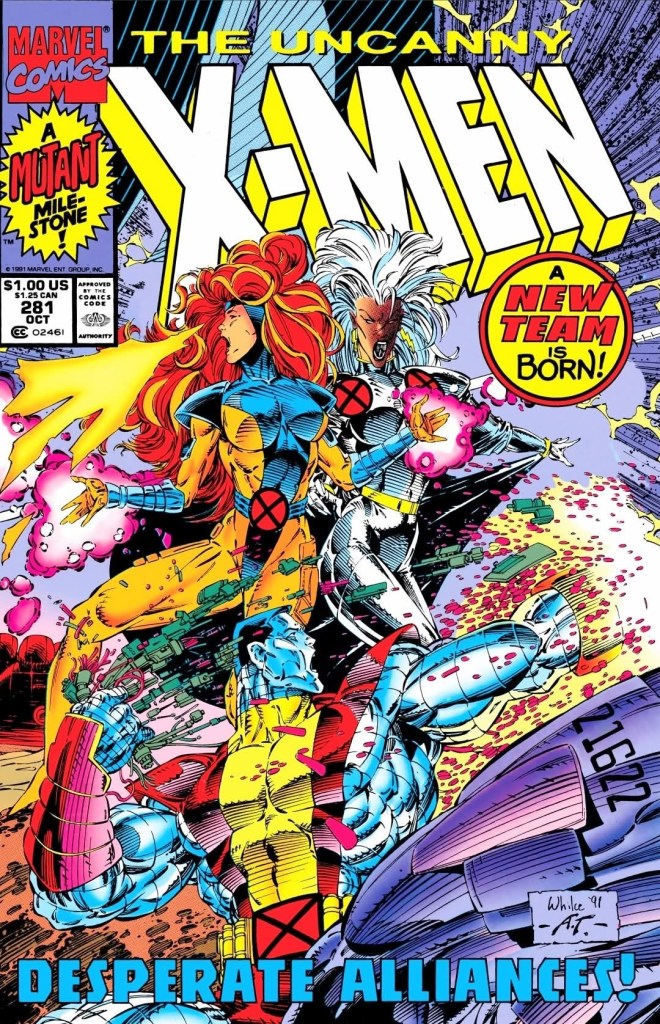
For the newcomers reading this, Marvel had a major reorganizing of their X-Men-related comic book series in the 2nd half of 1991. After the events of the Muir Island Saga, the X-Men grew into such a large group they had to be divided into two teams – Blue and Yellow – under Charles Xavier who returned as their leader. When X-Men #1 (by Chris Claremont and Jim Lee) launched in 1991, it showed the Blue Team dealing with Magneto. Uncanny X-Men #281 was released the same month as that comic book and it shows the first mission of the Gold Team composed of Storm, Jean Grey, Colossus, Iceman and Archangel. Very notably, its story took place immediately after X-Men #5 was released in 1992.
With those details laid down, here is a look back at Uncanny X-Men #281, published in 1991 by Marvel Comics with a story co-written by Jim Lee and Whilce Portacio and script by John Byrne. The art was done by Portacio with ink work by Art Thibert.
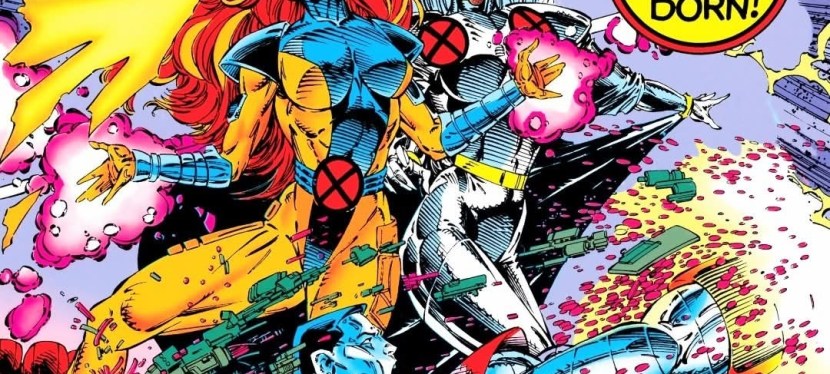
The cover.
Early story
The story begins in the Australian outback where the Reavers are relaxing while the sandstorm is happening and with them is Donald Pierce. Suddenly, a group of Sentinels attacked them resulting in deaths of some of their members.
Elsewhere in New York City, Storm, Jean Grey, Archangel, Colossus and Iceman – all in formal attire as civilians – attend a lavish party at the headquarters of the Hellfire Club. It turns out, they were invited by Emma Frost who leads the club. Even with several guests and a lot of enjoyable things around them, the X-Men remain prepared to react if something unfortunate happens.
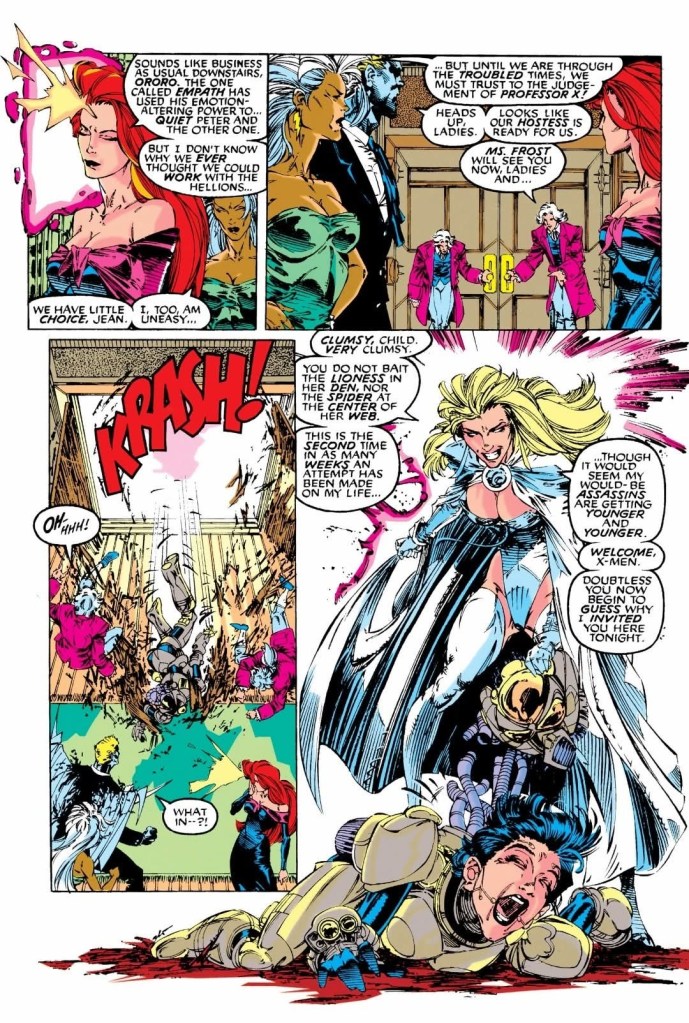
After a brief moment of tension between the X-Men and the Hellions, someone in a powered suit of armor crashed through a door near Jean, Storm and Archangel. Emma Frost emerges, takes the helmet off the armored person (a young woman) and even welcomed the X-Men. Frost claims that the armored lady was another assassin who tried to take her life and it is the 2nd assassination attempt she encountered over the past weeks….
Quality
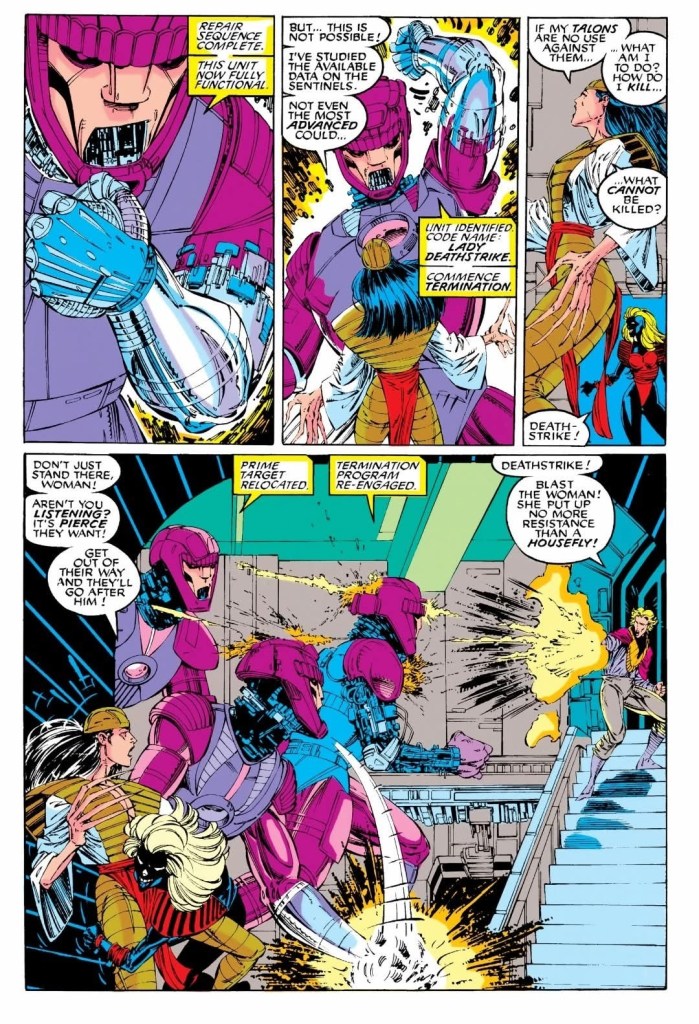
The Sentinels, Lady Deathstrike and Donald Pierce in an intense scene.
As this comic book was part of the new era of the X-Men, the creative team came up with tale that is loaded with sub-plots that had a mix of old (the X-Men fought with the Hellfire Club during the Dark Phoenix Saga, and had encounters with the Sentinels a number of times) and new (Trevor Fitzroy – the illegitimate son of Sebastian Shaw – and the Upstarts are the new antagonists of the X-Men) creative elements for the X-Men’s Gold Team to encounter. The fact that the Hellfire Club is present in the story requires readers to have some knowledge about them from previous X-Men comic books as well as other characters and past tales that formed the background of the newer characters.
The story was made to modernize the X-Men and their struggle with people they encounter, while creatively reconnecting with the past. This should not be a surprise because writer John Byrne (yes, the same creator behind The Man of Steel mini-series) himself was involved in the Dark Phoenix Saga. The result is a tale of intrigue, twists, action and a lot of tension here.
When it comes to encounters, I enjoyed the discussion the X-Men had with Emma Frost (first appeared in Uncanny X-Men #129) who was their fierce enemy (Frost previously tried to manipulate Kitty Pryde) before having a change of heart and partnered with Professor X. Their exchange of words was civil, smart and there were some nice pay-offs in the form of intriguing revelations. The script by John Byrne was really solid here.
The artwork by Whilce Portacio here is still great to look at and his contribution on modernizing the X-Men’s look for the 1990s is a must-see. The same can be said with his take on Emma Frost, and the other established characters here. Portacio’s visualization of Trevor Fitzroy has that strong science fiction vibe combined with that fluffy early 1990s look.
Conclusion
The X-Men witness an intense moment followed by the emergence of Emma Frost.
Even though there were a few bumps on the flow of the narrative, I can say that Uncanny X-Men #281 (1991) is a very enjoyable read filled with intrigue, twists, reconnections to the past, notable character moments and sufficient spectacle. Its story has a lot of details and attachments to the past which will resonate with long-time X-Men fans. At the same time, Whilce Portacio’s art works made this one of the finest looking Uncanny X-Men issues of the 1990s and that is saying a lot. Considering the details and the richness of the writing, this Uncanny X-Men comic book should be read at a moderate pace as paying close attention to what was presented is essential.
That being said, this first tale of the Gold Team of the X-Men is a great read.
Overall, Uncanny X-Men #281 (1991) is highly recommended!
Disclaimer: This is my original work with details sourced from reading the comic book and doing personal research. Anyone who wants to use this article, in part or in whole, needs to secure first my permission and agree to cite me as the source and author. Let it be known that any unauthorized use of this article will constrain the author to pursue the remedies under R.A. No. 8293, the Revised Penal Code, and/or all applicable legal actions under the laws of the Philippines.
Welcome back, superheo enthusiasts, 1990s culture enthusiasts, X-Men fans and comic book collectors! Today we revisit the X-Men Adventures monthly series which was the literary adaptation of the popular X-Men animated series of the 1990s.
Today is my review about the 15th and final issue of the X-Men Adventures adaptation of episodes of the 1st season of the popular animated series. The comic book at hand was the literary translation of the 13th episode and final episode of season one which was broadcast in March 1993.
With those details laid down, here is a look back at X-Men Adventures #15, published by Marvel Comics in 1993 with a story written by Ralph Macchio and drawn by Andrew Wildman.
The cover.
Early story
The story begins somewhere in Manhattan where a riot is happening. It turns out that multiple riots have occurred as a result of the of the recent kidnapping of United States Senator Robert Kelly who established himself as the nation’s most prominent anti-mutant public figure.
Deep inside their headquarters, the X-Men watch live news footage of the riot. Even though they were not involved in the kidnapping of Senator Kelly, Charles Xavier and his team are concerned that mutants like them will still be held responsible. The leader tells his team that they must find the missing senator quickly before the wave of intolerance affects all of them mutants. Xavier then starts using Cerebro which he programmed to search for any distortions in the magnetic field of planet Earth.
Elsewhere, inside a vessel that got shipwrecked along the Atlantic seaboard, Magneto has Senator Kelly as his captive. He tells the politician that he holds the key to the future and that they are in agreement that man and mutant cannot co-exist peacefully. For Magneto, the war for dominance must begin as humans remain weak and divided. Suddenly, a huge Sentinel breaks into the place…
Quality
The X-Men, Professor and Magneto.
Being the conclusion of the monthly series based on season one of the X-Men animated series, this comic book’s story packs a lot of stuff, intrigue and some memorable character moments. Thematically, the story emphasizes absolute power, intolerance and instability which got dramatized carefully as the narrative progressed.
For the X-Men, the pressure is tremendous as the stakes have gotten so high not just for them but for all mutants as a population. To fail to save the kidnapped Senator Kelly would cause society to become even more hostile to mutants which could compel the federal government to declare a state of emergency. Complicating matters here is Magneto’s obsession with power in connection with his biggest obsession that mutants are essentially superior over humans and that societies will be reformed – even with violence involved – accordingly. Adding even more the complexity of the situation are the presence of government, technology handlers backed by private financiers, and the one gigantic machine (that produces new Sentinels) that becomes self-aware.
The good news here is that the story is very well written, the narrative does not lose focus and the creative duo of Macchio-Wildman managed to craft a tale that consistently remained engaging complete with ensuring sufficient superhero spectacle for entertainment. As expected, the pay-offs executed for all the build-ups proved to be highly satisfying.
When it comes to characterization, everyone here acts and talks as expected. The team dynamics of the X-Men here make for a cerebral reading experience especially when they have these intense private meetings trying to solve their problems and anticipate what would happen next. The dialogue, filled with varied details, are richly written and yet easy to follow. I should state that having the Sentinels as a force of opposition under the control of a rogue AI added a lot to the stakes involved in the plot. The portrayal of machines acting superior over humans proved to be a unique parallel to the humans-mutants conflict.
Conclusion
The fictional US Senator Robert Kelly in trouble in the presence of Magneto and a Sentinel.
X-Men Adventures #15 (1993) is not only a worthy conclusion to the monthly series based on animated series’ season one episodes. It is indeed the best comic book of the said series that I have read thanks to the great adaptive works of the Macchio-Wildman team. The story had these very high stakes raised and ultimately the pay-off to all the build-up were great resulting in great satisfaction on my part as a reader. At the same time, there are certain key plot elements and character elements here that eventually made their way into the first X-Men live-action movie of 2000. The core story is the clear feature while the bonus pin-up section was the fun additive. This comic book is a must-have!
Overall, X-Men Adventures #15 (1993) is highly recommended!
Disclaimer: This is my original work with details sourced from reading the comic book and doing personal research. Anyone who wants to use this article, in part or in whole, needs to secure first my permission and agree to cite me as the source and author. Let it be known that any unauthorized use of this article will constrain the author to pursue the remedies under R.A. No. 8293, the Revised Penal Code, and/or all applicable legal actions under the laws of the Philippines.
Welcome back, X-Men fans, superhero enthusiasts, 1990s culture enthusiasts and comic book collectors! Today, we take a look at the topic of slavery and its connection with the mutants within the universe of Marvel. To be more specific, slavery was emphasized in one of the episodes of the popular X-Men animated series which itself had a monthly series of comic book adaptations – X-Men Adventures!
With those details laid down, here is a look back at X-Men Adventures #7, published by Marvel Comics in 1993 with a story written by Ralph Macchio and drawn by Chris Batista.
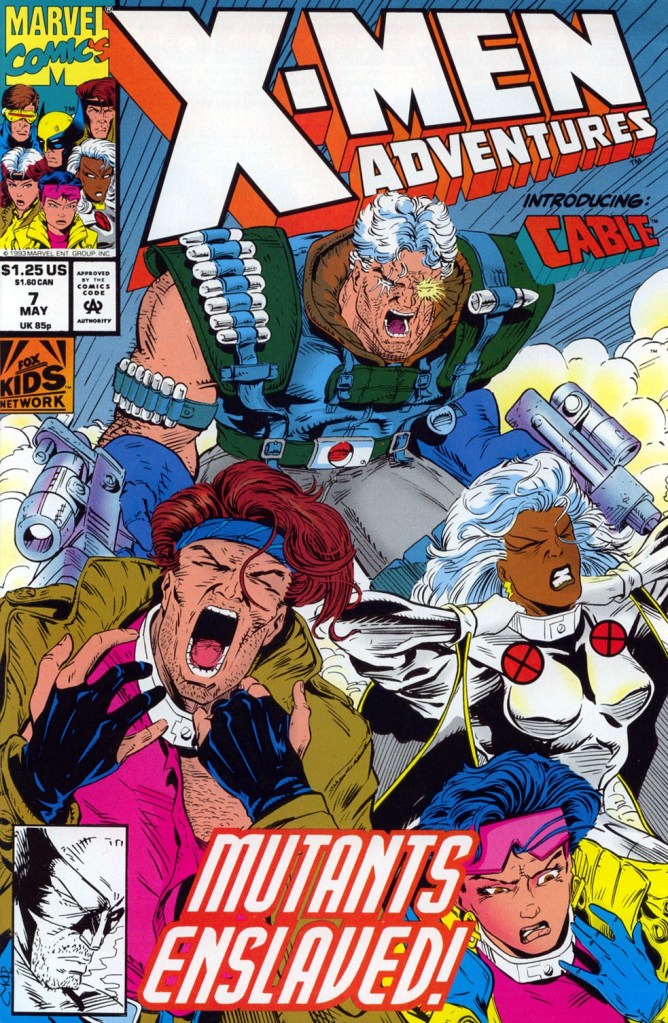
The cover.
Early story
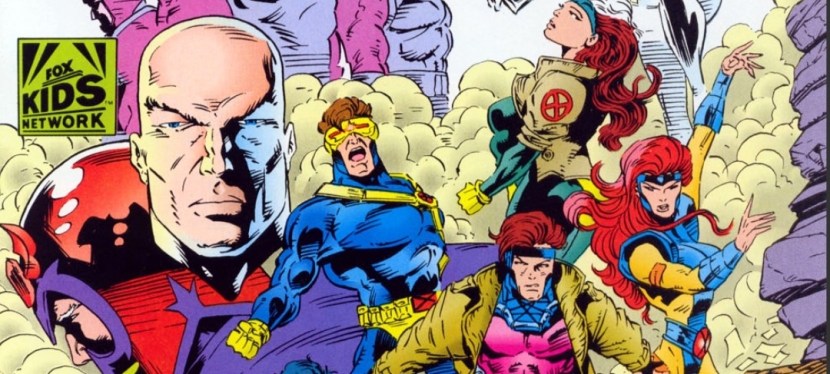
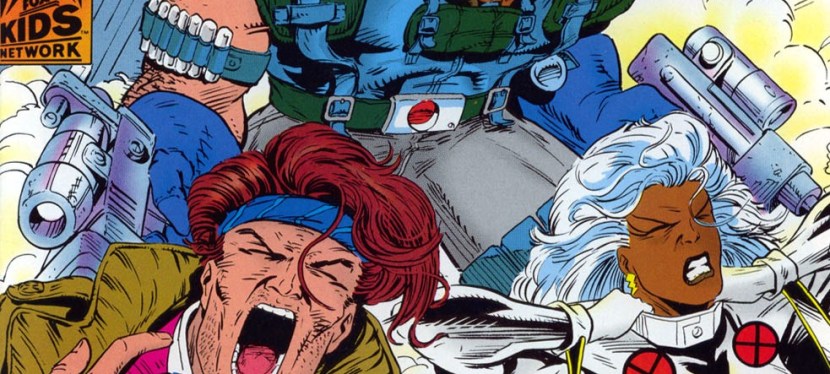
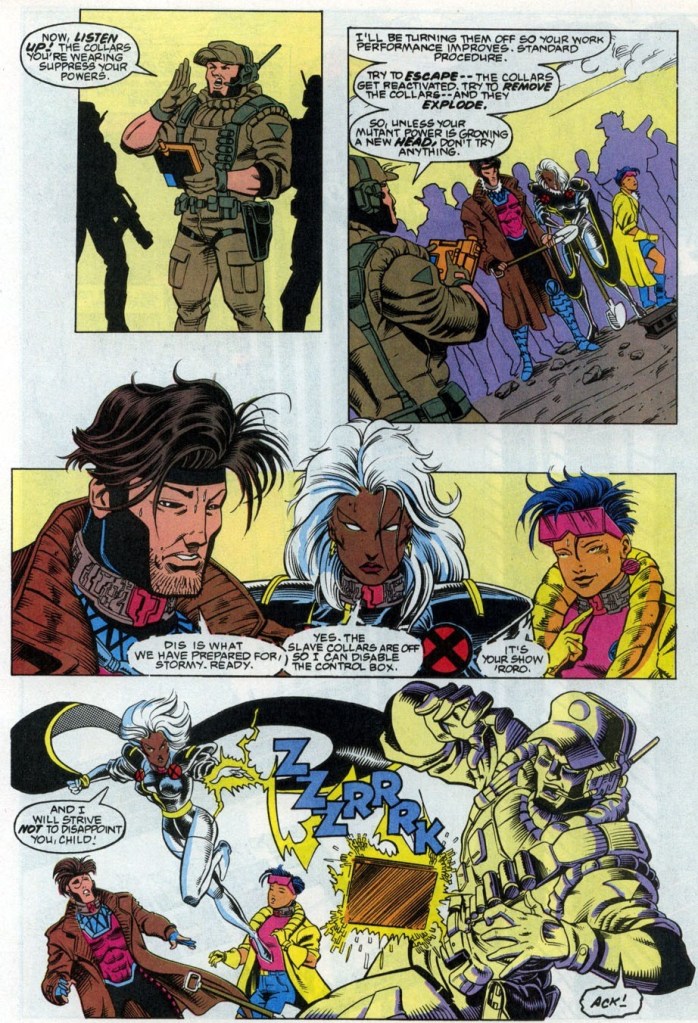
The story begins in Genosha, an island nation where mutants are designated as slaves constantly monitored by armed personnel of the state. X-Men team members Gambit, Storm and Jubilee are forced to do hard labor as they have been rendered powerless (with high-tech collars on their necks). Along with many other mutants, they are working on a key infrastructure project of the state.
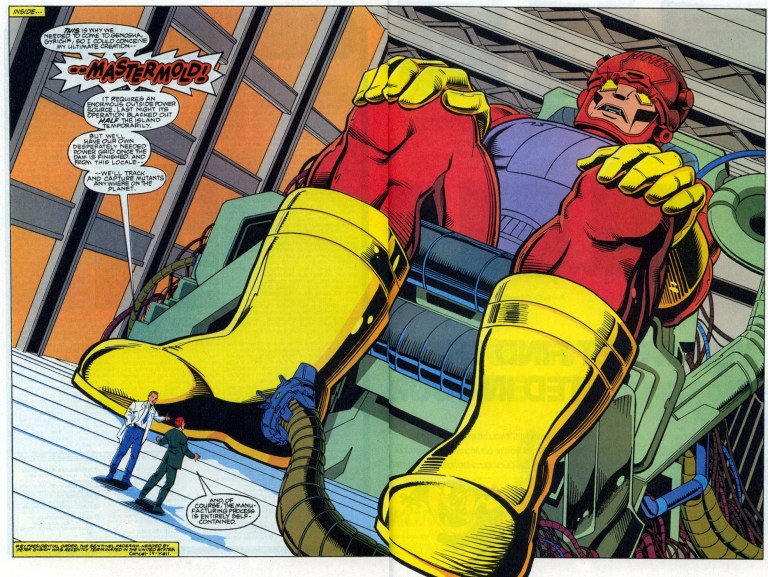
As soon as the local authorities deactivated the collars of the slaves, Storm immediately attempts to escape by flying. Immediately, the collar on her neck got reactivated which neutralized her powers and caused her to fall down to the water below. As soon as she climbs up on a rock to rest, a cable wraps itself on her right leg. Suddenly, a huge Sentinel rises above the water and pulls her…
Quality
The money shot!
Like the TV episode it was based on, this comic book does a decent job of portraying slavery and oppression with mutants in mind while avoiding the very sensitive topic of racism. To see Gambit, Storm and Jubilee portrayed as much more vulnerable characters is a nice change from their usual portrayals. While the story has a strong slavery theme, it also sheds light on the ongoing, secretive development of the Sentinels program which clearly emphasizes the growing danger that await not only the X-Men (the prime target of Trask and his team) but mutants in general.
When it comes to the art, Chris Batista did a nice job drawing not only the characters (all recognizable) but also their surroundings, the Sentinels and the framing of action scenes.
Conclusion
Gambit, Storm and Jubilee as slaves on Genosha.
I personally find X-Men Adventures #7 (1993) somewhat fun and slightly engaging to read. As this is an adaptation of the X-Men animated series episode about Genosha and mutant slavery, it clearly has a strong wholesome approach to its presentation. That being said, its depth is actually limited as it presented its themes with younger readers and new X-Men readers in mind. Unsurprisingly, the action is limited and was portrayed to avoid violence. If you want a more serious and grittier portrayal of Genosha and mutant slavery, you should read Uncanny X-Men #235 to #238, and the X-tinction Agenda storyline.
If you are seriously planning to buy an existing hard copy of X-Men Adventures #7 (1993) be aware that as of this writing, MileHighComics.com shows that the near-mint copy of the regular edition costs $30, while the near-mint copies of the newsstand edition and the Greek edition cost $90 and $200 respectively.
Overall, X-Men Adventures #7 (1993) is satisfactory.
+++++
Thank you for reading. If you find this article engaging, please click the like button below and also please consider sharing this article to others. If you are looking for a copywriter to create content for your special project or business, check out my services and my portfolio. Feel free to contact me as well. Also please feel free to visit my Facebook page Author Carlo Carrasco and follow me at HavenorFantasy@twitter.com
Disclaimer: This is my original work with details sourced from watching the movie and doing personal research. Anyone who wants to use this article, in part or in whole, needs to secure first my permission and agree to cite me as the source and author. Let it be known that any unauthorized use of this article will constrain the author to pursue the remedies under R.A. No. 8293, the Revised Penal Code, and/or all applicable legal actions under the laws of the Philippines.
We all know that the 20th Century Fox franchise of X-Men movies has ended and everything cinematic about Marvel’s famous mutants are now in the hands of Marvel Studios. From the year 2000 to 2020, the original X-Men cinematic universe produced a whole bunch of movies (including spinoffs) which ultimately led to uneven results with regards to commercial success, critical feedback, artistry, production values and cultural impact. Even so, 20th Century Fox-produced X-Men movies generated more than $6 billion in ticket sales worldwide.
When it comes to the spinoff movies, I like Logan the best (sorry, Deadpool).
For the main X-Men movies, the one film that really delivered the great stuff and tons of fun for me was none other than X-Men: Days of Future Past (2014). For one thing, the movie had two generations of X-Men cinematic performers (the original team led by Patrick Stewart and the newer ones from X-Men: First Class led by James McAvoy) and its story literally had them linked together with Hugh Jackman’s Wolverine as the living bridge between them. To put it short, it was a cinematic crossover story made with X-Men fans in mind. That film scored highly with critics and most moviegoers, and it grossed almost $750 million worldwide which makes it the highest-grossing X-Men movie ever until now.
It has been years since X-Men: Days of Future Past made waves in the cinemas and through post-theater businesses like Blu-ray, cable TV, pay-per-view, streaming and the like. Along the way, movies like Wonder Woman, Aquaman, Avengers: Infinity War and Avengers: Endgame collectively raised the standards of Hollywood superhero movies in varied ways. I should state that X-Men (2000), X2: X-Men United and X-Men: The Last Stand did not age well.
To find out if the 2014 X-Men film aged well or not, here is my retro review of X-Men: Days of Future Past directed by Bryan Singer with a screenplay written by Simon Kinberg with a story done by Kinberg, Jane Goldman and Matthew Vaughn.
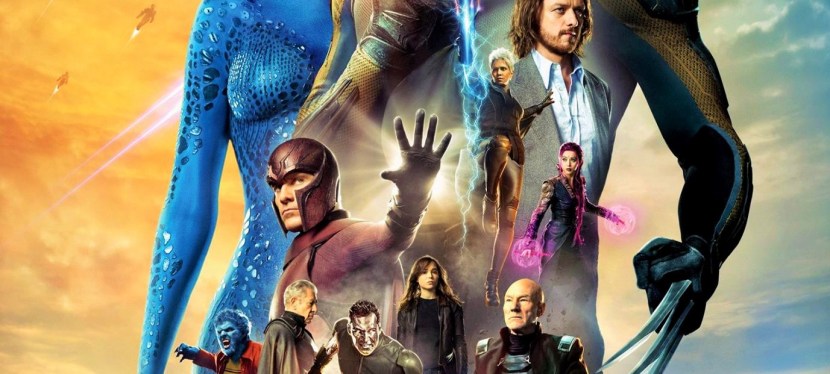
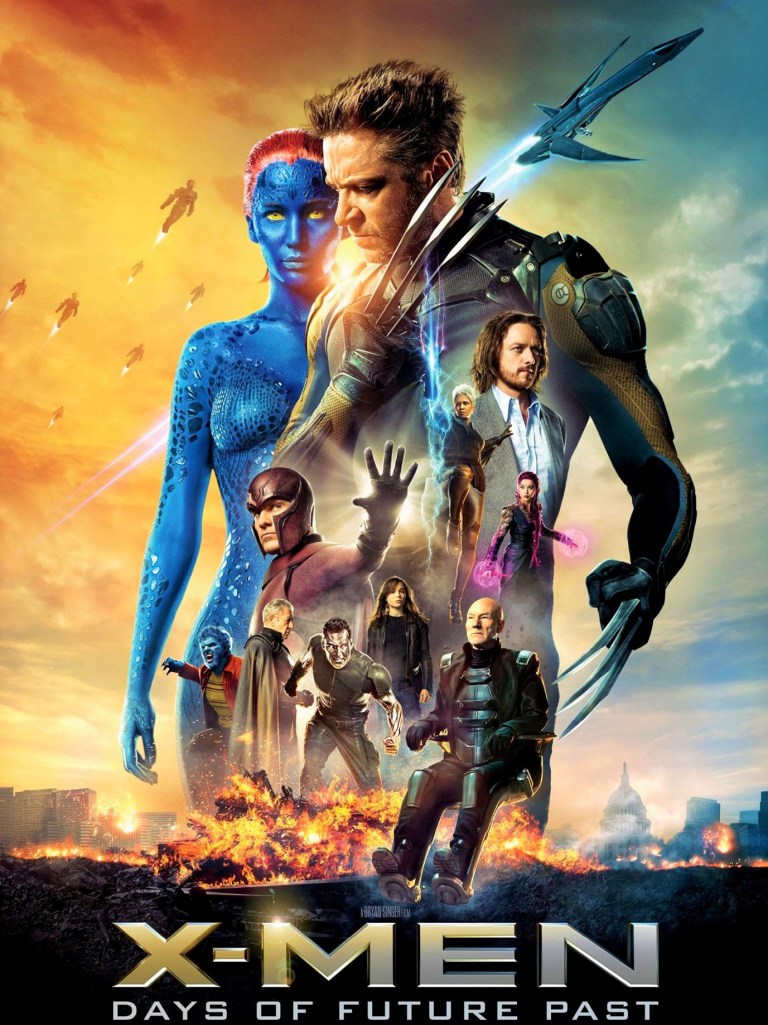
A great image of the cinematic X-Men, both the old and newer cast.
Early story
The story begins in the dark future. Countless mutants and human allies have been caught and imprisoned by very sophisticated Sentinels (operating for an unnamed authority that also has armed human personnel as watchers) which continue to hunt more of them down along with any humans caught aiding them. In Russia, a small X-Men team composed of Colossus, Kitty Pryde, Iceman, Sunspot, Bishop, Warpath and Blink take action when they realized that the Sentinels found their hideout. Kitty Pryde, who by this time gained the new ability to send a person’s consciousness back through time, runs along with Bishop to hide in a vault to send his consciousness into the past. Fortunately for them, their teammates delayed the unstoppable Sentinels enough to succeed.
Some time later at another location, an aging Charles Xavier, Magneto, Wolverine and Storm arrive to meet with Kitty Pryde and her teammates. Xavier gives the team an in-depth history lesson about the Sentinels which were created decades earlier by the late Bolivar Trask who was assassinated by Mystique (who believed she could make a difference for her fellow mutants). After the assassination, Mystique got caught by the authorities and became a live experiment for scientists working for the government. Her DNA helped accelerate the development of the Sentinel program which made them able to adapt to most mutant attacks and powers.
A plan gets formed for Kitty Pryde to send Xavier back through time to his younger self in 1973 to prevent the assassination from happening. Kitty states it’s too risky for the old Xavier to go through time as it may kill him. Wolverine volunteers to take Xavier’s place as his healing factor (regeneration) will ensure his survival with the process. Xavier presses Wolverine to convince the 1973 Charles Xavier to help prevent the assassination given the fact that he was a broken man at the time.
Wolverine arrives in his younger self’s body in New York of 1973. He makes his way to the mansion of Charles Xavier. As it turns out, Xavier’s school has been closed for some time and has been decaying…
Quality
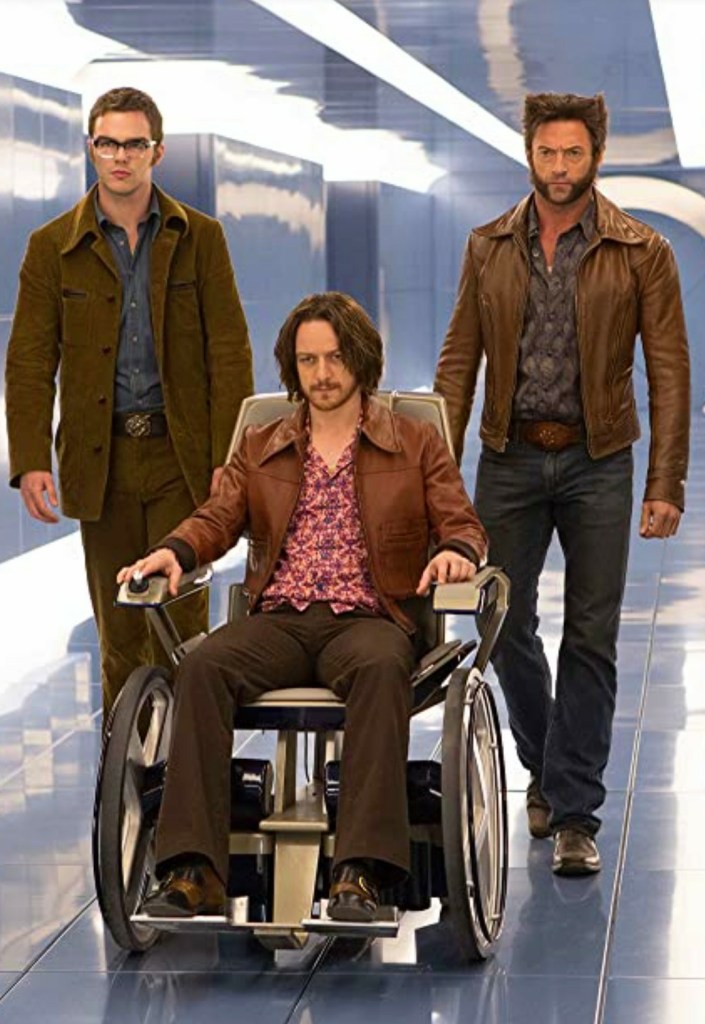
Nicholas Hoult, James McAvoy and Hugh Jackman as Beast, Charles Xavier and Wolverine respectively.
Considering what was made and what were presented through this movie, the creative team and the cast of X-Men: Days of Future Past literally scored a home run here resulting true greatness! Bryan Singer, whose previous X-Men directorial job was 2003’s X2, finally struck gold with regards to storytelling, directing and, finally, spectacle (previous his big weakness).
In terms of storytelling, this movie, first and foremost, is not a faithful adaptation of the classic Days of Future Past storyline at all. In fact, there was no need for it to be faithful. What the screenwriters came up with was a loose adaptation which allowed them to craft a more original story that involved the established X-Men characters (from the early movies) and the other X-Men characters (who started in 2011’s X-Men: First Class) and have them set apart in terms of time periods (similar to what was done in 1994’s Star Trek: Generations, but much better and more compelling in writing). The result is a crossover tale with Wolverine being the traveler through time.
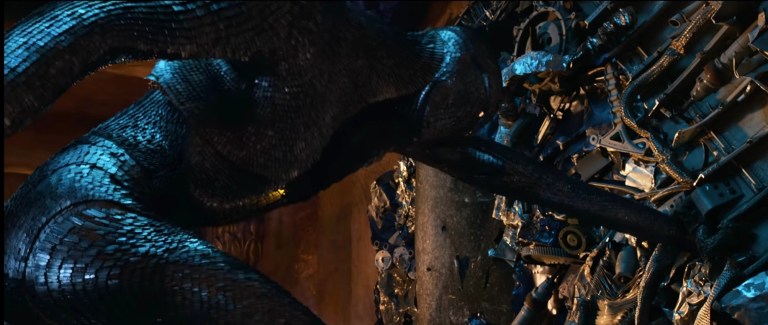
The Sentinels are clearly terrifying and unstoppable!
The great news here is that the script has very strong structuring done and even had enough space to briefly acknowledge events and characters from the first three X-Men films plus 2009’s X-Men Origins: Wolverine as canon. All of these add to the narrative very well and when the stakes were raised, the overall plot made sense. Let me add that it was a smart move for the writers to raise the stakes in the two time periods during the final act of the movie, which really made the story more engaging to viewers. I should state that having two conflicts happening simultaneously on screen in this X-Men movie was done efficiently and without ever becoming confusing nor messy.
Apart from the narrative, the portrayal of the X-Men was, indeed, spot-on. Noticeably, the major characters here were Charles Xavier (both old and young), Wolverine (both old and young), Mystique, Magneto (specifically the young version), Beast and Bolivar Trask. Strong writing was evident in the dialogue of the mentioned characters, as well as in those with minor roles. Through dialogue alone, I easily recognized these cinematic characters.
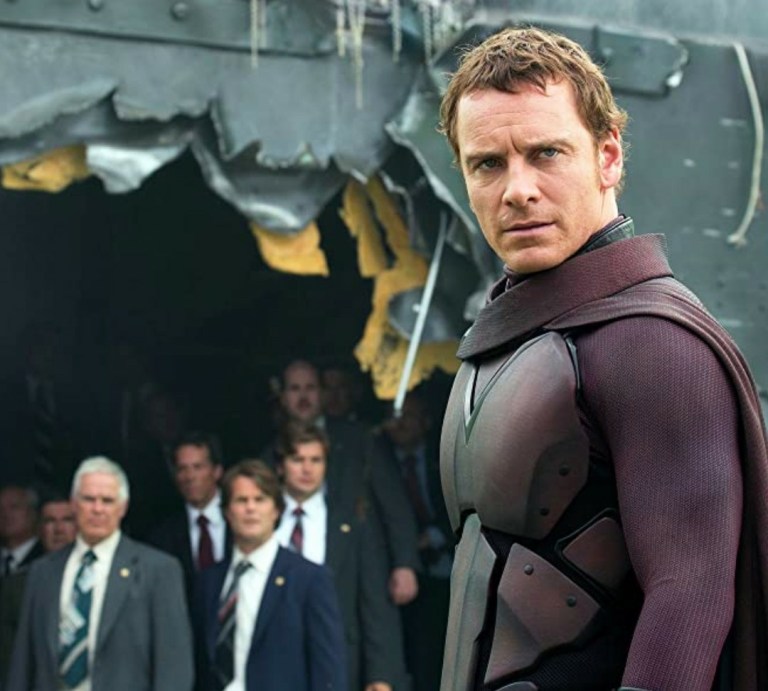
Michael Fassbender delivered his best performance as young Magneto.
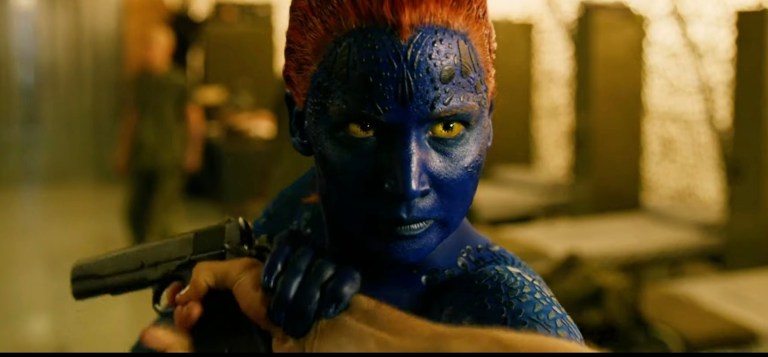
Given his strength in telling stories, I should say that Bryan Singer succeeded in executing the script into cinematic narrative. Not only that, he succeeded in getting really good performances from the cast. James McAvoy (young Xavier), Jennifer Lawrence (Mystique), Michael Fassbender (young Magneto) and Nicholas Hoult (Beast) were evidently more confident and more comfortable in reprising their characters (note: they debuted together in X-Men: First Class).
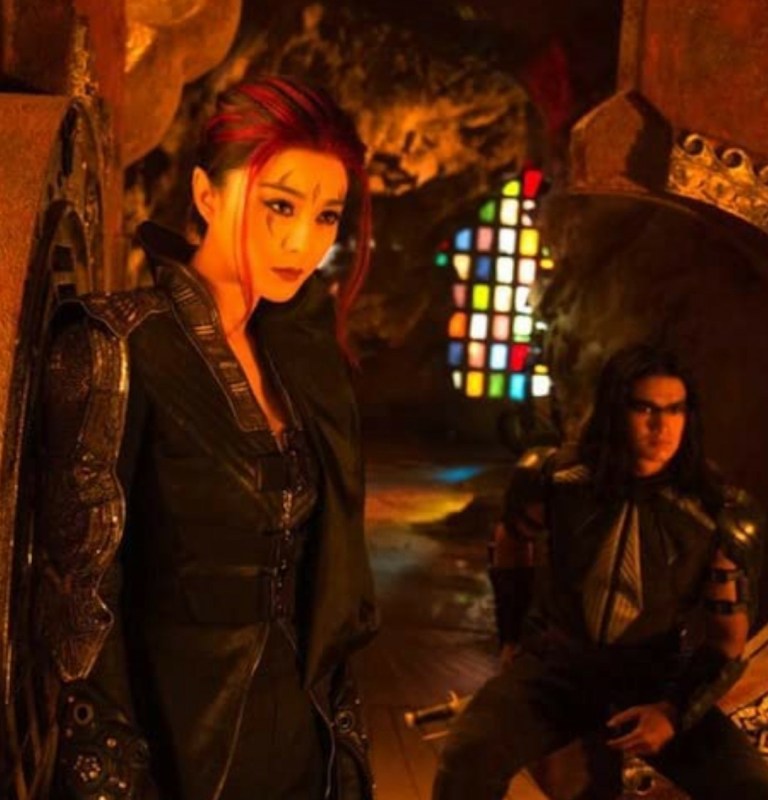
The old cast composed of Patrick Stewart (old Xavier), Ian McKellen (old Magneto), Ellen Page (Kitty Pryde), Halle Berry (Storm), Shawn Ashmore (Iceman) and Daniel Cudmore (Colossus) all made a very welcome return. To be specific, it was only Patrick Stewart among them who had the most engaging dialogue with Ian McKellen being a distant second to him. As most of the film was set in the past, it was understandable that the old cast’s dialogue would not be that rich which translates to limited performance. The filmmakers tried bouncing back with mutant variety by having Bingbing Fan as Blink, Adan Canto as Sunspot and Booboo Stewart as Warpath, who all provided nicely in the action scenes and special effects use.
Bingbing Fan and Booboo Stewart as Blink and Warpath.
Hugh Jackman’s performance as Wolverine in this movie is the most unique of them all. Not only does he have to play TWO versions of his character, he as the only member of the old X-Men cast spent a great deal of time interacting with the newer X-Men players. The great news here is that Jackman has great chemistry with James McAvoy, Nicholas Hoult and Michael Fassbender, which ultimately justified the crossover! Speaking of McAvoy, his scene with the older version of his character is very memorable and a highlight! Peter Dinklage as Bolivar Trask is excellent but to my surprise, he is not exactly villainous nor did he express cruelty. He’s more of an obsessed scientist and as such, Michael Fassbender’s Magneto easily overshadows him when it comes to being the main antagonist. This is surprising but not exactly a problem.
More on the anti-hero factor of the movie, I should say that the Sentinels in this movie are the most dangerous and the most intimidating non-sentient, scientific antagonists since the Terminator. Being programmed to deal with mutants, the Sentinels are unrelenting and often used violence to complete their objectives. The futuristic Sentinels, which are evolved versions thanks to Mystique’s DNA, are so formidable the mutants cannot simply defeat them. Even the 1970s Sentinels are quite formidable.
As mentioned earlier, I do confirm that Bryan Singer really outdid himself on delivering the spectacle back with support from the special effects team, the stunt team and the like. The action scenes involving the X-Men are top-notch, in fact they make the action in Singer’s previous X-Men films look minor in terms of creativity, quality and fun! The computer-generated effects in this movie still look great by today’s standard, although some CGI used in the floating stadium sequence looked rushed. Also it was quite a marvel to see Wolverine and Beast face-off with a 1970s Sentinel in the final act. I should mention that the slow-motion sequence involving Quicksilver (played by Evan Peters) is one great and funny spectacle to watch, well worth replaying!
Conclusion
Jennifer Lawrence in her best-ever performance as Mystique.
I declare that X-Men: Days of Future Past (2014) is the best-ever X-Men movie I have seen and it has aged very well! Its overall quality is very great and the combined talents of director Singer, the cast, the writers and all the technical teams justified it all. By today’s standards, this X-Men movie still stands very high among all superhero movies of Hollywood ever released! As an X-Men film, this one is truly epic and the true highlight of all X-Men movies under 20th Century Fox. As a time-travel film, this one has a very unique approach and it should be noted that director Bryan Singer approached James Cameron to talk about time travel, parallel universes and the like.
More on personal viewing, I can say that this film greatly entertained me in the cinema back in 2014, and it still succeeds in doing so whenever I replayed it on Blu-ray in the comfort of home. If there is anything I regret, it’s the fact that I never saw this movie in the IMAX cinema.
If you are seriously planning to buy an existing hard copy of X-Men: Days of Future Past (2014), visit Amazon for the Blu-ray release as well as the 4K Blu-ray combo release. There is also the Rogue Cut of the movie also on Blu-ray.
Overall, X-Men: Days of Future Past (2014) is highly recommended!
+++++
Thank you for reading. If you find this article engaging, please click the like button below and also please consider sharing this article to others. If you are looking for a copywriter to create content for your special project or business, check out my services and my portfolio. Feel free to contact me as well. Also please feel free to visit my Facebook page Author Carlo Carrasco and follow me at HavenorFantasy@twitter.com
Disclaimer: This is my original work with details sourced from reading the comic book and doing personal research. Anyone who wants to use this article, in part or in whole, needs to secure first my permission and agree to cite me as the source and author. Let it be known that any unauthorized use of this article will constrain the author to pursue the remedies under R.A. No. 8293, the Revised Penal Code, and/or all applicable legal actions under the laws of the Philippines.
Having read lots of X-Men comic books, I should say that I always find the Sentinels (first appearance in The X-Men #14 in 1965) to be more memorable as enemies of Marvel’s mutants. On face value, they only look like oversized, human-like robots but I always find them to be formidable opponents of the X-Men. These machines are not only built with sophisticated technologies, they are able to push the X-Men to their limits during battle.
These anti-mutant robots, by the way, were ranked by IGN at #38 in their Greatest Comic Book Villains chart. Long before that, the Sentinels were the featured anti-heroes in the classic X-Men comic book storyline Days of Future Past and it was no surprise that they were also featured in the 2014 movie X-Men: Days of Future Past.
And then in the early 1990s, the Sentinels were shown in the first episode of the X-Men animated series on television. The said series was also adapted into an “as seen on TV” comic book series by Marvel called X-Men Adventures.
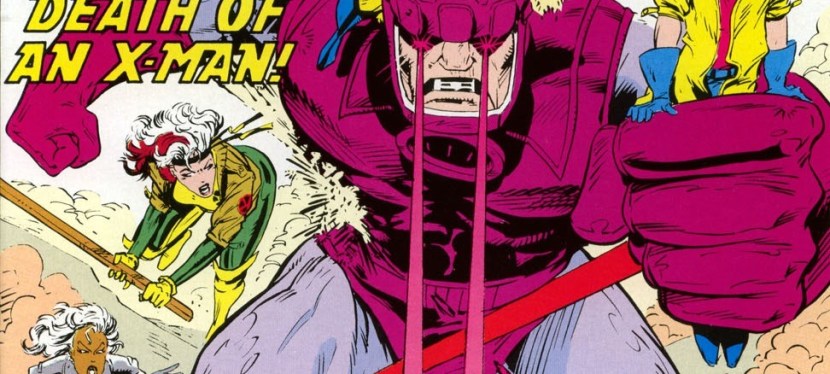
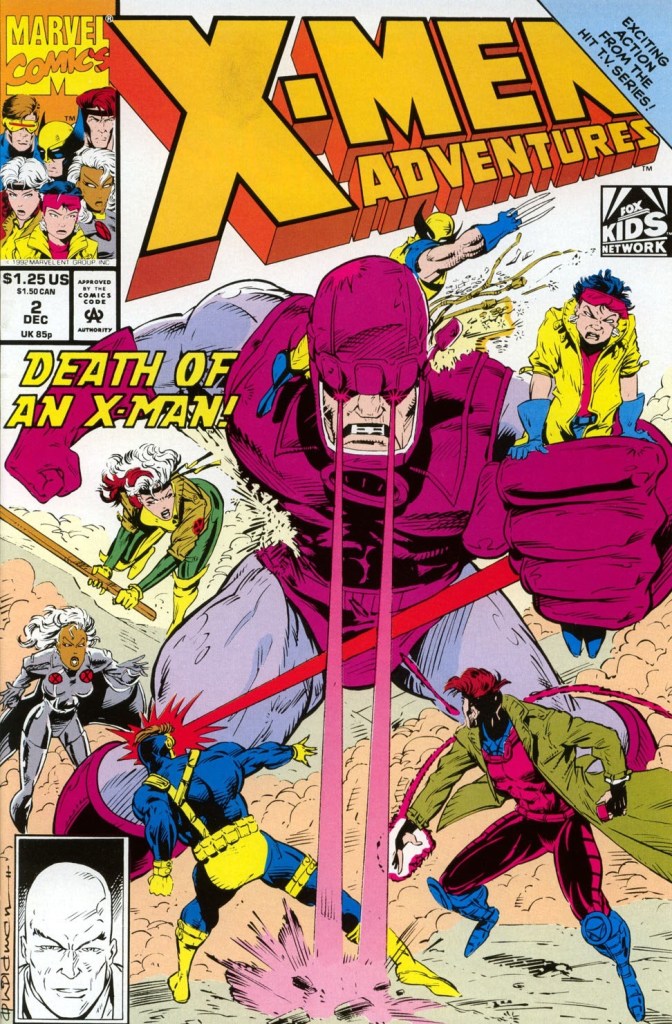
This brings me to this look back at X-Men Adventures #2, published in 1992 by Marvel Comics with a story by Ralph Macchio and drawn by Andrew Wildman.
The cover.
Early story
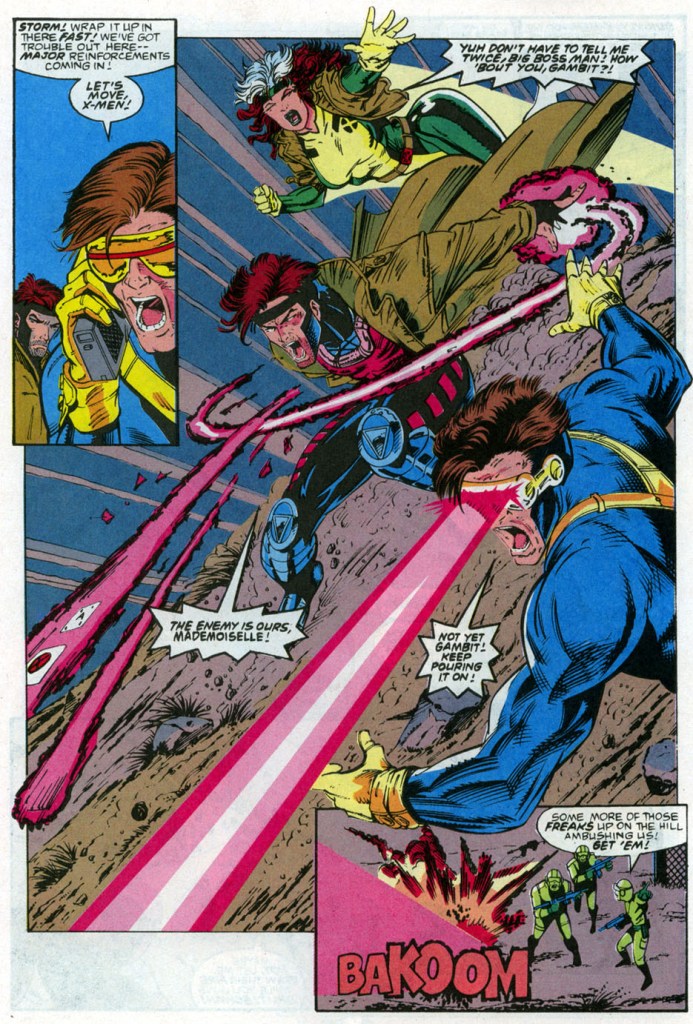
The story begins with Morph suffering from a nightmare. As he emerged from the vision, he finds himself with Storm, Beast and Wolverine. Together they work to infiltrate a federal government facility which houses the Mutant Affairs Department. Outside the walls of the facility, Rogue Gambit and Cyclops watch from a distance. Cyclops fires his optic blast at the vehicle that just dropped reinforcements that he believes were sent to stop their teammates.
Storm and her teammates break through a door instantly pushing off the security personnel followed by Beast knocking an additional guard. At the room containing the computer, Beast begins to access key information their team has been seeking…
Quality
The Sentinels and the X-Men!
Let me start with the storytelling. As an adaptation of one of the early episodes of the animated series, this comic book does a fine job of recapturing its essence complete with a nice balance between plot, exposition and spectacle. Considering the fact that the animated series was aimed for children, it’s quite intriguing to see the TV episode carrying really heavy themes – apart from the prejudice the mutants suffer from – like top federal government operations, expensive defense and weapons programs, government intrusion into people’s private lives, attempts to require minorities to get registered, etc. Those themes also made it in this comic book which made it feel like it was part of the mainstream X-Men comics of the time.
Compared to the first episode as well as its literary adaptation, this one emphasizes the Sentinels as tools of the government as part of their very expensive program to seek and monitor mutants among their citizens. Mutant Affairs director Peter Gyrich is clearly the villain who has no super powers but has the resources of the federal government and their authority to take action on mutants he perceived to be dangerous.
On the visuals, Andrew Wildman performed a solid job making each page look interesting and detailed enough. While his drawings made each character recognizable to me, it is in the spectacular scenes where he really shines. Wildman’s drawing of the Watcher on the final page of the comic book, however, looks laughable.
Conclusion
Andrew Wildman’s dynamic drawing of the X-Men in action.
While X-Men Adventures #2 is not exactly a literary classic, it is indeed a very solid adaptation of one of the earliest episodes of the animated series of the 1990s. It succeeded on telling a compelling and enjoyable story even though it emphasized the above-mentioned serious themes. As for the iconic Sentinels, this one succeeded in explaining what they are and their place in Marvel’s universe is.
If you are seriously planning to buy an existing hard copy of X-Men Adventures #2 (1992), be aware that as of this writing, MileHighComics.com shows that the near-mint copy of the regular edition costs $8 while the near-mint copy of the newsstand edition costs $26.
Overall, X-Men Adventures #2 (1992) is recommended.
+++++
Thank you for reading. If you find this article engaging, please click the like button below and also please consider sharing this article to others. If you are looking for a copywriter to create content for your special project or business, check out my services and my portfolio. Feel free to contact me as well. Also please feel free to visit my Facebook page Author Carlo Carrasco and follow me at HavenorFantasy@twitter.com
Disclaimer: This is my original work with details sourced from reading the comic book and doing personal research. Anyone who wants to use this article, in part or in whole, needs to secure first my permission and agree to cite me as the source and author. Let it be known that any unauthorized use of this article will constrain the author to pursue the remedies under R.A. No. 8293, the Revised Penal Code, and/or all applicable legal actions under the laws of the Philippines.
It’s funny how adaptations of adaptations turn out in real life. Long before the first live-action X-Men movie was released, an animated TV series (popularly referred to as X-Men: The Animated Series or X-Men TAS) was produced and arguably brought together the fans of both the X-Men comic books along with the animated X-Men followers.
Along the way, Marvel Comics went on to publish a monthly comic book series called X-Men Adventures which themselves were adaptations of the animated series (which itself adapted stories and concepts from the comic books).
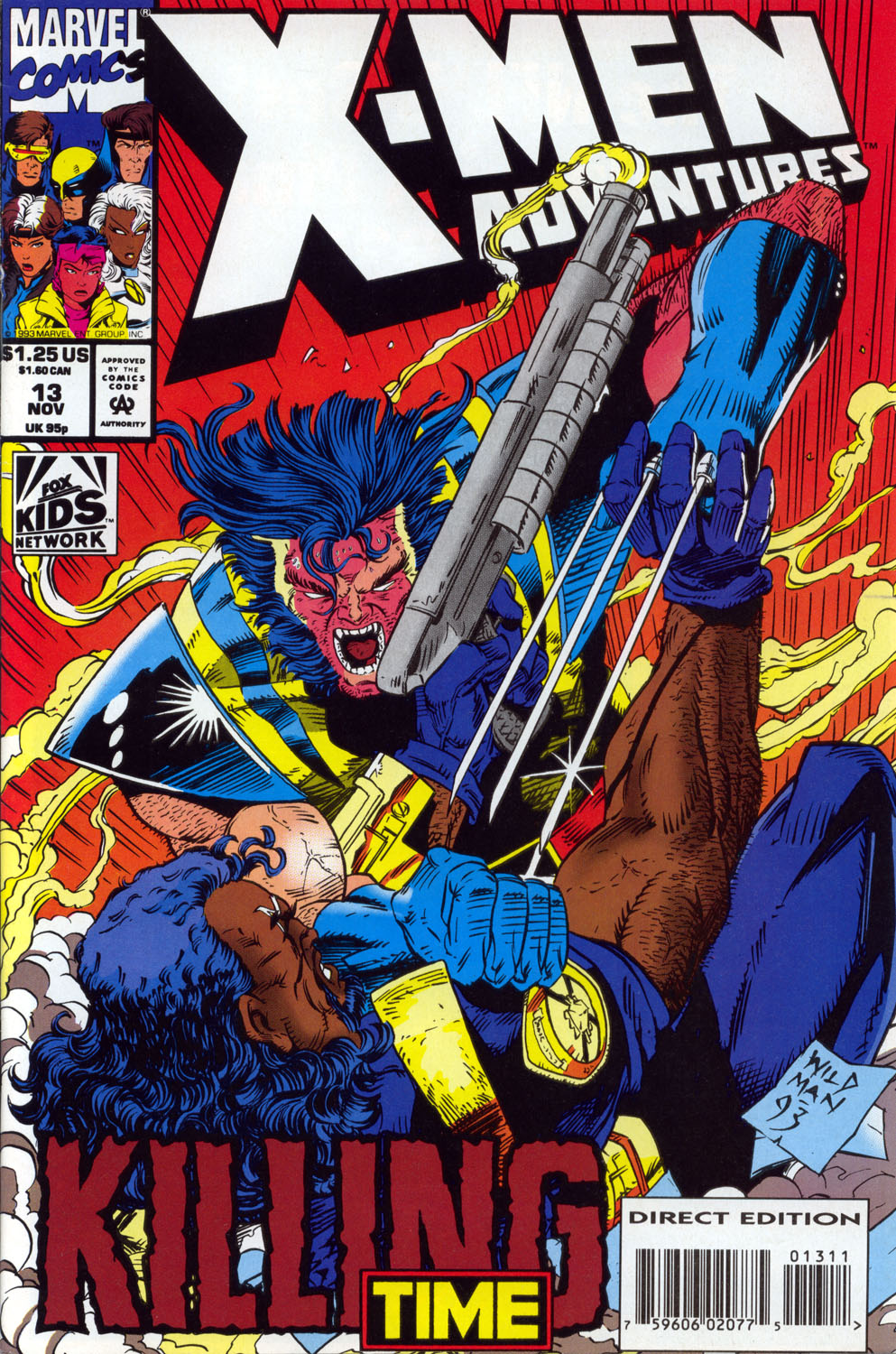
The adaptation-of-an-adaptation approach went deep further when the animated series adapted loosely the story of the classic X-Men comic book storyline Days of Future Past (by legends Chris Claremont and John Byrne) which resulted a story told in two episodes on TV. And then there was also a comic book adaptation that followed starting with X-Men Adventures #13 which is the subject of this retro comic book review.
The cover.
Early story
Written by Ralph Macchio and drawn by Andrew Wildman, the comic book begins in the dark future of 2055 in New York. The city is in ruins and mutants on the loose are being hunted by Sentinels. A very old Wolverine appears to help two loose mutants but ends up getting stunned with them by Bishop who turns out to be helping the automated authority of the Sentinels.
As he turns over the captured mutants, the Sentinels betray Bishop telling him that they no longer required him. Afterwards, Bishop and Wolverine (who woke up) each carry a person under the watch of a Sentinel. Suddenly, the two other mutants use their powers to attack the Sentinel and Wolverine followed to back up their efforts. The Sentinel however grabbed Wolverine.
Quality
A very old Wolverine in the dark future of 2055.
With the exception of some liberties, this comic book closely followed what was told in the first of the 2-episode Days of Future Past animated adaptation. As a comic book story, the story was heavily loaded with details and exposition designed to orient readers about the setting and why the future became a time of darkness in relation to the rise of machines having ultimate power over people.
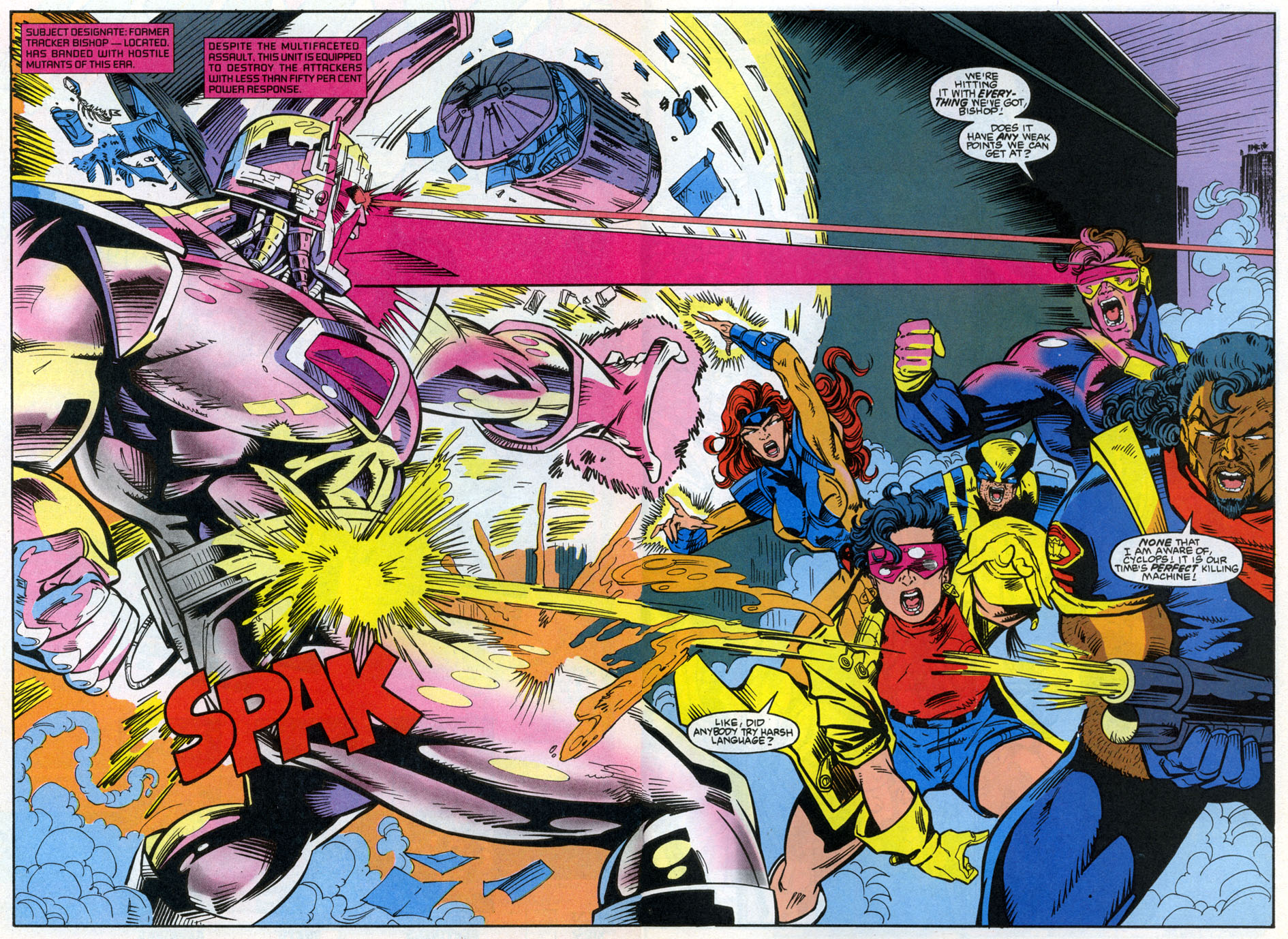
While the time travel concept of the literary classic involved the mind of Kitty Pryde going into the past, this comic book used the more common concept of having Bishop travel back through time physically which easily reminds me of Kyle Reese arriving from the future in 1984’s The Terminator.
The build-up leading to Bishop’s move to travel back through time was nicely done by the creative team. There was a lot of exposition followed by an incoming attack complete with explosions happening just as Bishop is about to leave. In short, the pay-off was worth it.
The engagement did not end there. In fact, it continued nicely as Bishop meets the X-Men in 1993 with the details of his mission carefully unveiled. Professor Charles Xavier’s reaction to future history (Sentinels taking control of the world) was dramatic and worth re-reading.
As with his other works in the X-Men Adventures comic book series, Andrew Wildman’s art is very good to look at and he knows how to make each scene look engaging whether it’s just an exchange of dialogue between characters or an action scene loaded with a lot of impact.
Conclusion
While it is only half of a 2-issue adaptation of a 2-episode animated adaptation of the Days of Future Past literary classic, X-Men Adventures #13 is still a fun-filled reading experience complete with a lot of engaging moments.
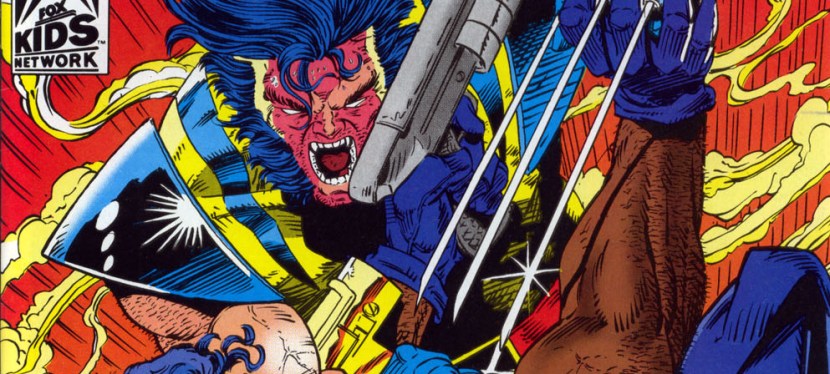
The money shot by Andrew Wildman!
If you are a serious collector of comic books, be aware that, as of this writing, a near-mint copy of X-Men Adventures #13 costs $6 while its newsstand edition copy is worth $21 in near-mint condition according to Mile High Comics.
Overall, X-Men Adventures #13 is highly recommended. Both dedicated X-Men fans as well as newcomers will have something a lot to enjoy with it.
Thank you for reading. If you find this article engaging, please click the like button below and also please consider sharing this article to others. If you are looking for a copywriter to create content for your special project or business, check out my services and my portfolio. Feel free to contact me as well. Also please feel free to visit my Facebook page Author Carlo Carrasco and follow me at HavenorFantasy@twitter.com






 Author Carlo Carrasco