Disclaimer: This is my original work with details sourced from reading the comic book and doing personal research. Anyone who wants to use this article, in part or in whole, needs to secure first my permission and agree to cite me as the source and author. Let it be known that any unauthorized use of this article will constrain the author to pursue the remedies under R.A. No. 8293, the Revised Penal Code, and/or all applicable legal actions under the laws of the Philippines.
Welcome back superhero enthusiasts, 1990s culture enthusiasts and comic book collectors! Today we go back to the year 1993 to take a close look at the second issue of the second Venom comic book mini-series Venom: Funeral Pyre.
In my previous review, the gang-driven violence intensifies as the Punisher makes his move armed with lots of resources (including a van loaded with weapons and computerized functions). Venom struggles to free himself from the temporary prison the Punisher placed him in. As the violence escalated, Gray Russell finds himself in much deeper trouble as the anticipated rescue does not happen.
With those details laid down, here is a look back at Venom: Funeral Pyre #3, published in 1993 by Marvel Comics with a story written by Carl Potts and drawn by the late Tom Lyle. This if the final issue of the mini-series.
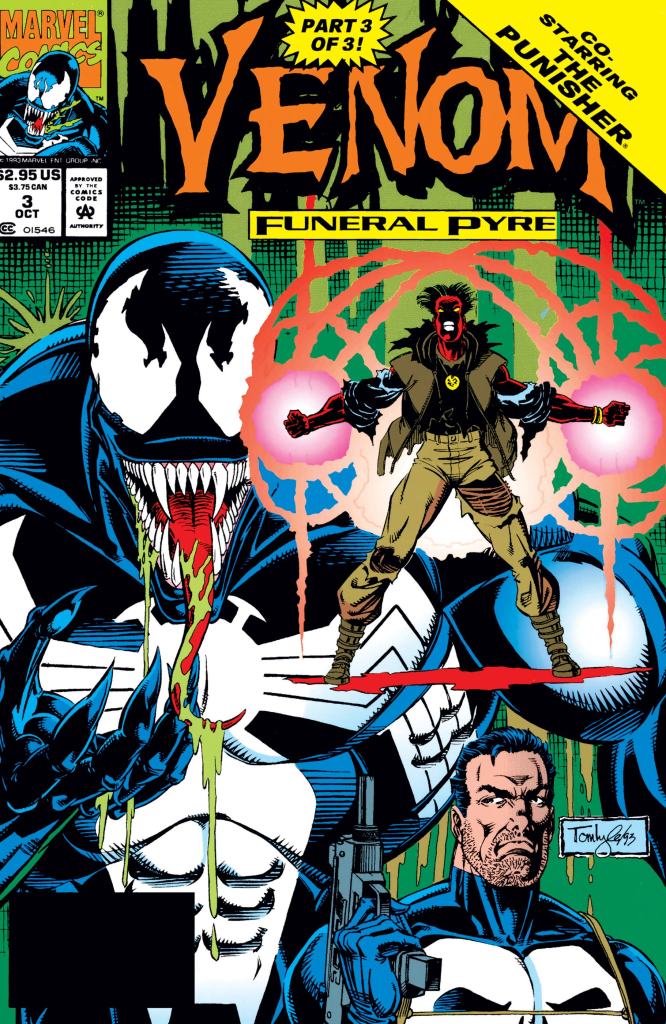
The cover.
Early story
The story begins inside a building with high-tech equipment from HYDRA. Gray Russel is no longer himself but as the red-skinned, highly radiated figure Pyre. He fires a microwave blast at Venom which hurts him so much. In response to Venom’s claim that he came to rescue him, Pyre reacts with rage telling the murderous man with the symbiote that he arrived too late which resulted in the forced killing of people during the gang violence on the streets of Oakland.
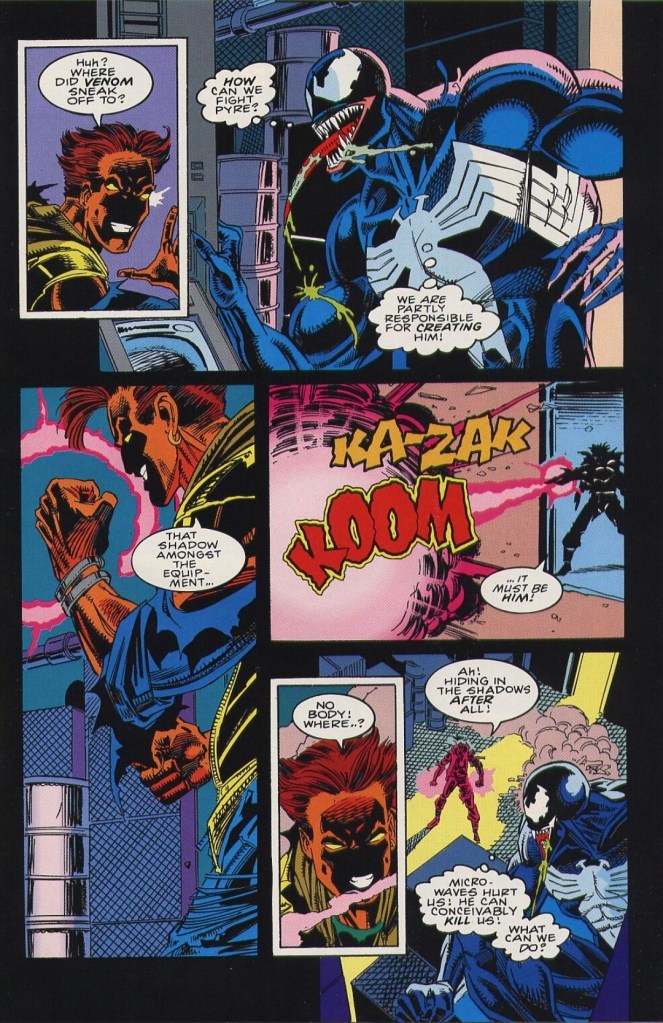
Being filled with pure rage, Pyre intends to burn Venom alive. Thinking that Pyre is distracted, the Punisher leaps to get a gun on the floor which causes the radiated person to fire a microwave blast at him. The Punisher takes cover behind a machine but notices the microwaves sparking off the metal.
Venom then takes advantage of situation…
Quality
This page shows Venom at a disadvantageous state with Pyre whose microwave blasts are more than enough to kill him.
As the conclusion of the mini-series, this comic book went all-out portraying what turned out to be the final conflict involving the murderous Venom, the vigilante Punisher and the energy-filled Pyre. As a result, the narrative strongly focused on the final conflict (note: stretched out to last several pages) and never bothered to look back at the people and activities on the city street.
That being said, you will get to see more of the two established Marvel figures struggling hard against an unexpected force of opposition who was previously an undercover news reporter who infiltrated a certain gang and sent a message (delivered by a young boy) that caught Eddie Brock’s attention. At this point, it is clear that Venom’s effort to rescue Gray (who became Pyre after using a super soldier chamber left behind by HYDRA) ended in total failure and finds himself facing someone who could kill him and his alien costume together.
If there is anything notable about this issue, it is the portrayal of Venom being highly disadvantaged and even vulnerable. There are no armed men with sonic weapons and high-tech equipment to bring Venom down but Pyre whose microwave blasts are deadlier than flame and sonic. In connection to the situation, Venom is not his aggressive self but a struggling figure who strives to survive and somehow find solutions during the heat of danger.
The Punisher, meanwhile, also struggled to survive but would simply not run away even though his chances of escape are much better. Instead, he focuses on actually eliminating Pyre without hesitation and Venom’s attempt to rescue Gray meant absolutely nothing to him.
More on Pyre, he is not really interesting nor was he ever engaging as the one powerful force of opposition that Venom and the Punisher must face. His being consumed by unrestrained rage and wielding so much power did not really raise the tension of the story. Had he eliminated the two Marvel figures who got in his way, what would Pyre do afterwards? Devastate the entire city of Oakland because he lost his identity as Gray and could not get over his involvement of taking other people’s lives while in the middle of gang activities? Would he proceed to San Francisco’s underground community and eliminate the people only because he blames Venom (note: Eddie Brock got involved with the underground people of San Francisco as seen in the Lethal Protector mini-series) for his failure of rescuing him? Pyre is nothing more than a throwaway comic book force of opposition.
From a visual standpoint, Tom Lyle once again pushed his creativity hard and showed some dynamic shots of spectacle here and there. At this stage, he proved to be very capable of visualizing Venom and the Punisher.
Conclusion
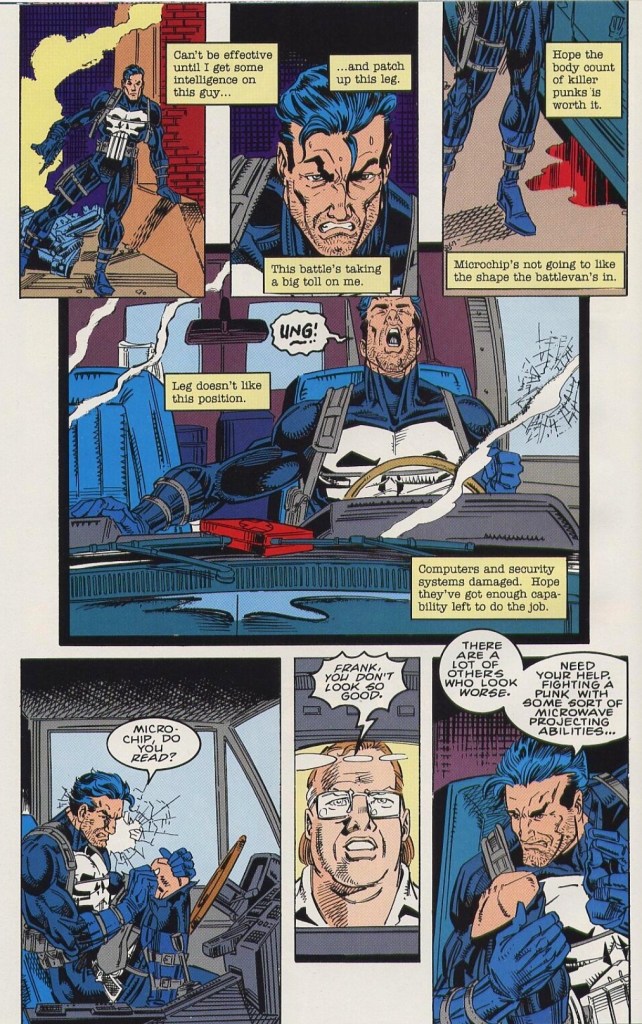
The Punisher refuses to give up and gets Microchip to assist him.
While issue #2 was a notable improvement over the first issue, Venom: Funeral Pyre #3 (1993) does not have much to offer in terms of engagement and entertainment. This is because it was crafted as a strict Venom-Punisher-Pyre conflict that provided spectacle and intrigue but ultimately ended up hollow. To see Venom at a huge disadvantage is interesting but did not add much weight to the plot. The Punisher was his usual self and in some ways overshadowed Venom for a while. Too bad there was not much space left for Venom and Punisher to fight each other again.
As the final issue of this mini-series, the story concluded with a whimper. Ultimately the Funeral Pyre storyline ended up as a diversion within the Marvel Comics shared universe that happened to attract Punisher, Venom and the gangsters of Oakland.
Overall, Venom: Funeral Pyre #3 (1993) is satisfactory.
Disclaimer: This is my original work with details sourced from watching the movie Cloak & Dagger (1984) and doing personal research. Anyone who wants to use this article, in part or in whole, needs to secure first my permission and agree to cite me as the source and author. Let it be known that any unauthorized use of this article will constrain the author to pursue the remedies under R.A. No. 8293, the Revised Penal Code, and/or all applicable legal actions under the laws of the Philippines.
Welcome back my readers, fellow movie buffs and 20th century pop culture enthusiasts! Decades ago, I got to watch the movie Cloak & Dagger when it was first released on home video. As time passed by, I got to replay it on cable TV and DVD. I have yet to see its 4K Blu-ray disc version (note: you can order it here) Starring Henry Thomas (the star of Steven Spielberg’s E.T.: The Extra-Terrestrial) and Dabney Coleman, Cloak & Dagger was one of those American movies that did not succeed in movie theaters but found its audience on home video, cable TV and free TV.
The 1984 movie was released at a time when video games gradually made its way into motion pictures in varied ways just before Nintendo started reshaping video gaming. Back then, I was very young and already got into playing games on console and at the arcade which helped me relate with the video game elements of Cloak & Dagger. In case you are wondering, the filmmakers and Atari, Inc. itself collaborated together. There may be some among you who never saw this 1980s flick and some of you may be wondering what is significant about Cloak & Dagger and why is it the topic of this retro movie review.
With those details laid down, here is a look back at Cloak & Dagger (1984) directed by Richard Franklin and written by Tom Holland and Nancy Dowd inspired by the short story “The Boy Cried Murder” written by Cornell Woolrich. This movie is the 4th cinematic adaptation of the said short story.
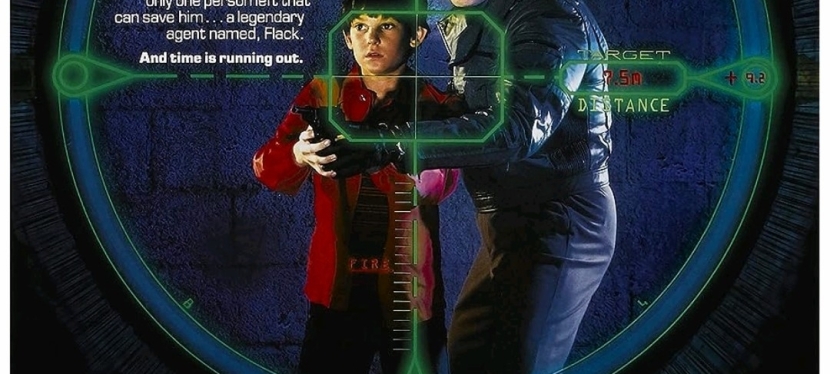
The movie poster of Cloak & Dagger (1984)
Early story
The story begins with Jack Flack (Dabney Coleman) overcoming Soviet guards to enter a place to retrieve top secret documents from incoming people. It turns out that Jack Flack is nothing more than a fictional character imagined by a young boy named Davey (Henry Thomas) who keeps on immersing himself with flights of fantasies, loves playing games and believes that real life is filled with enough opportunities and places to play. In the presence of game store owner Morris (William Forsythe) and his little blonde neighbor Kim (Christina Nigra), Davey boasts a lot about Jack Flack as if he was a real-life hero and even talks to him as his imaginary companion that no one else could see nor hear. Inspired by the said character and the world of espionage he always imagined, the boy carries with him a black water pistol for a “gun” and a softball for a “grenade”.
Morris then sends Davey and Kim out to do a real assignment – an errand to travel within the city going to a certain company and retrieve something for him. Afterwards, the two commuted and entered a building which Davey does with his fantasy of espionage and infiltration burning in his mind. Leaving Kim on the ground floor, he climbs up the stairs until he reaches a certain window and sees something sinister going on in the next level as reflected on one of the windows outside.
Suddenly a door opens near him and a wounded man slowly hands him an Atari 5200 cartridge titled Cloak & Dagger, tells him to bring it to the FBI, and mentions “one million three hundred twenty nine.”
The door near them suddenly opens with two armed men emerging. Right in the presence of Davey, they opened fire at the wounded man who fell down to his death. Davey just became the witness of an actual murder and becomes the target of the two gunmen…
Quality
Henry Thomas and Christina Nigra as Davey and Kim respectively.
To get to straight to the point, I can declare that this movie is very clearly a spy thriller designed to engage both children and adults. It took the key concept of the short story “The Boy Cried Murder” and implemented it into its very own tale that happens to be set during Ronald Reagan’s America (the 1980s) with elements of video games, espionage and even murder mixed together.
The story told through Davey was crafted to be entertaining while keeping viewers in suspense as to how the overly imaginative young boy would deal with real-life danger and consequences as he became the target of murderous men who would not stop at all. Davey is clearly in danger for much of the movie and you will get to sympathize with him and wish he should stop being obsessed with fantasy so he could overcome the trials that were happening. This is, indeed, a well structure and nicely directed work by Richard Franklin who seem to be inspired by past works of Alfred Hitchcock (note: Franklin directed the sequel to Hitchcock’s classic Psycho).
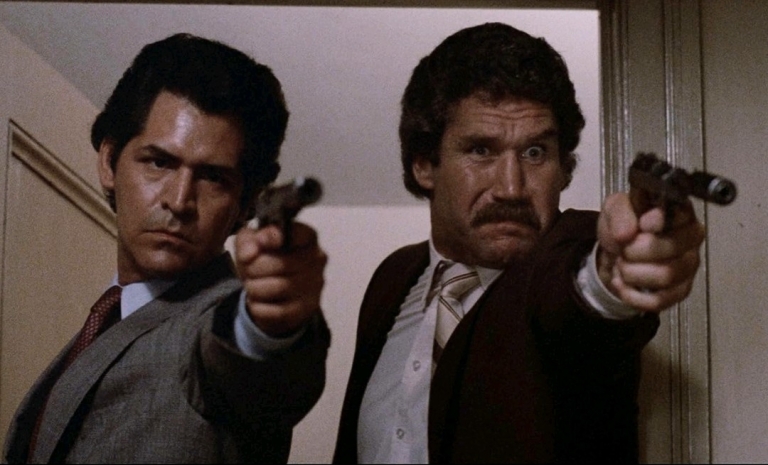
As mentioned earlier, this movie was made to engage both children and adults. Cloak & Dagger is not exactly a wholesome viewing experience as its presentation has always been quite intense because of on-screen violence that was executed carfully. There are guns, shooting and even killing in this flick which proved to be integral to the overall presentation and clearly added to the thrill factor. You will get to see getting Davey shot at by the armed henchmen (Eloy Casados and Tim Rossovich) who clearly do not give a damn of shooting a minor as they are so focused on their mission. Looking at the henchmen in this film, I can imagine them as traitorous Americans conspiring with their nation’s foreign enemies such as the Soviets, the Iranians and the Palestinians. Along the way, there is the clear villain named Rice (Michael Murphy) who has this subtle touch of evil as well as a good amount of sleaziness in him. While the violence is intense, it does not necessarily push this film into rated R territory.
Michael Murphy as the sleazy villain who is willing to kill Davey even though he is a minor.
The two henchmen about to commit murder in the presence of Davey. There is evil visible in their faces.
Henry Thomas really shines as the protagonist here. While Davey here shares a few elements with E.T.’s Elliot – struggling to move forward with the absence of one parent and adjusting his life with what he perceives to be the best ways possible – he truly dramatizes how weird and wild he could be living his life with a very loose grip on reality. For him, local society in San Antonio, Texas, provides him a huge playground for his spy game and he sure distracts people as he walks by them talking to his imaginary friend Jack Flack. Still, there are key parts of the story in which Henry Thomas convincingly dramatizes Davey who feels lonely inside as he misses his late mother and is unable to spend quality time with his father. Thomas also acted with intensity in the scene in which he makes a trade with the villain and also during his last face-off with him in the 2nd half of the film. Henry Thomas really was a good youth actor and his performance here is often overshadowed by his role in Spielberg’s E.T.
Dabney Coleman on the other hand plays both Jack Flack and Davey’s father Hal. Coleman is quite versatile playing different characters here. As Jack Flack, he fits in excellently into Davey’s uncontrolled belief of espionage as he gives him advise which were taken seriously leading into danger. Of course, advising Davey does not really mean the fictional spy cares for him on a personal level and you will eventually Flack’s true value before the film ends. Flack’s final moments could inspire you to re-examine the true meaning of heroism. As Hal, Coleman convincingly plays the father who has been so busy working in the Air Force as an air traffic controller, he has been unable to spend quality time with his son and the recent death of his wife really took its toll on their family. Compared to Jack Flack, Hal is indeed caring towards his son but his hectic work schedule prevents him from bonding closely with him. Coleman delivered a fine performance during the scene when Hal explains to Davey what real-world heroism is and that not all heroes just shoot bad guys. There definitely are helpful values on parenting within Hal.
Henry Thomas and Dabney Coleman are really convincing as son and father.
Thomas and Coleman artistically have really fine chemistry together as the father and son (Hal and Davey) and as the wannabe adventurer spending lots of time with his action hero (Davey and Jack Flack). Considering Davey’s obsession with fantasy and the attention he pays so much to Jack Flack, he was practically living with idolatry and foolishness. If you observe closely, Davey is very lively with Flack and not so lively with his father.
Even though this movie is fictional, it still dramatizes that parenting will never be easy. That being said, this should inspire parents and also incoming parents to prepare themselves on nurturing their children and ensure they help them understand the differences between reality and fantasy.
Video game elements
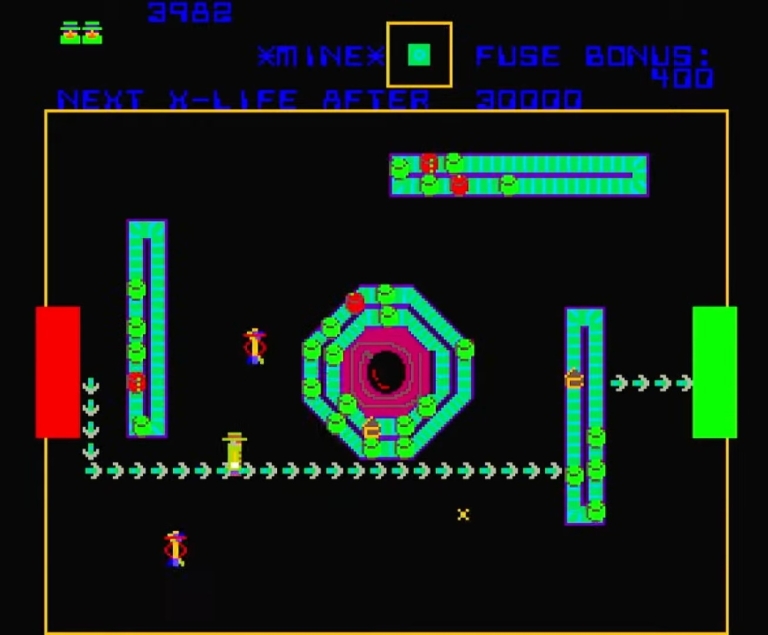
Screenshot from the Cloak & Dagger arcade game. This game can be played nowadays through Antstream Arcade on Xbox consoles.
To make things very clear, Cloak & Dagger (1984) is not an adaptation of the electronic game that was released the same year. Rather it has the Cloak & Dagger game as a key plot element in the form of an Atari 5200 game cartridge (referred to as a “tape”) which the movie dramatizes to be real.
As a kid, I got to play arcade and console games a lot. As such, seeing Davey play the Cloak & Dagger game on his Atari 5200 as well as gameplay footage was a very entertaining viewing experience for me the first time I ever saw this movie. It was a scene I personally related with.
In real life, however, the Cloak & Dagger game from Atari, Inc. was released only in the arcades as the efforts to create a port for the Atari 5200 never got fulfilled. That being said, it was through very clever film editing that video footage of the arcade version were inserted into the scene in which Davey played the Cloak & Dagger cartridge on his console in the presence of his father. To clarify things, the Atari 5200 was a commercial failure in real life and it seems that making a console version of the arcade game did not make business sense to Atari, Inc. at all.
If you want to play the Cloak & Dagger arcade game in your home right now, you will need an Xbox console and Antstream Arcade ($30 for 1-year subscription, $80 for lifetime pass). Cloak & Dagger is just one of over a thousand games available through Antstream Arcade and you can learn more by clicking here and here.
Conclusion
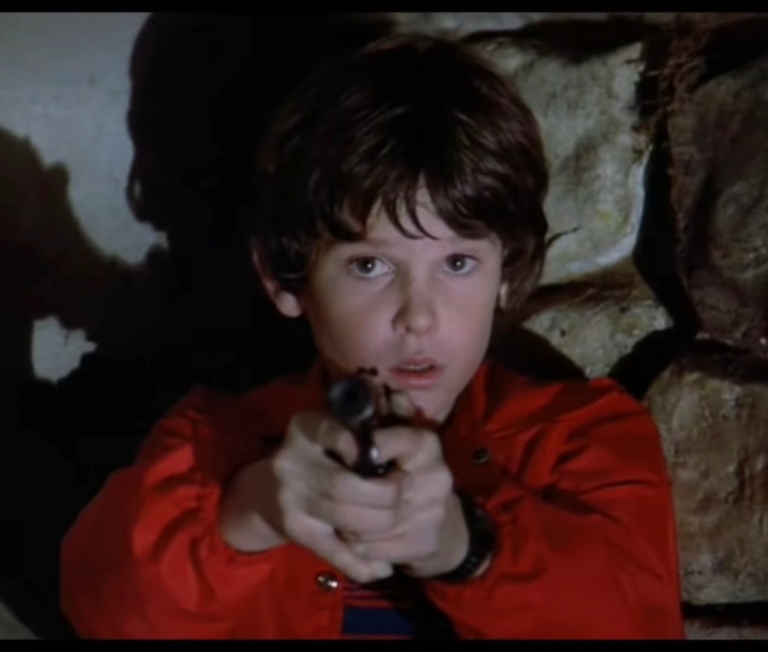
Henry Thomas as an armed Davey.
I have seen Cloak & Dagger (1984) many times throughout my life from childhood and to adulthood. I can clearly say that this 1980s movie is still really good to watch as its appeal to both children and adults remains strong and intact. It is a medium-paced spy thriller that not only follows a young boy who witnesses and murder and gets into danger (note: even his neighbor gets involved) but also dramatizes (in entertaining ways) how dangerous situations can get when you are living with uncontrolled personal fantasy and interacting with a heroic friend who does not really exist. Considering the time this movie was released, I am delighted to tell you cautious readers that there definitely is no wokeness nor were there any traces of political correctness that got in the way of its presentation. Going back to the parenting aspect of this film, it is made clear that children need their parents for moral support and there is absolutely no way that games, fictional heroes and geek culture could ever be good alternatives. Like the adults, children should never lose their grip on reality and should be taught that uncontrolled fantasy can lead to real-life danger. Very clearly, director Richard Franklin and the crew did a fine job telling a solid story and emphasizing the main characters while also providing suspense, action and thrills.
Considering all the mixed elements it has, Cloak & Dagger (1984) can be engaging towards parents, their children, fans of espionage and people who love video games. Finally, I should state that the City of San Antonio in the Lone Star State of Texas is indeed a great location for filmmaking and viewing.
Two house helpers tearfully admitted to the National of Bureau of Investigation (NBI) that they are responsible for the slaying of an elderly woman in Parañaque City and even used her ATM card to withdraw her funds, according to a Manila Standard news report.
To put things in perspective, posted below is the excerpt from the Manila Standard news report. Some parts in boldface…
Two domestic helpers have admitted to killing an 86-year-old woman in Paranaque City — the sister of a public relations practitioner — last May 4 and taking her ATM card to get her money, then framing another house helper for the crime.
Agents of the National Bureau of Investigation filed charges of robbery with homicide against the two suspects, named “Ken” and “Juliet”, after they owned up to the killing of Noemi Dacuycuy.
A month after leaving their employer bloodied and lifeless at her home, the two were caught on CCTV video withdrawing money from a bank using the victim’s ATM card. They later pointed to their fellow helper, a man, as the suspect to the Paranaque police.
But invited for questioning by the NBI after the video was discovered, the suspects admitted tearfully to the slaying, then agreed to reenact the crime for investigators.
Authorities also learned that the two suspects had stolen jewelry and other items from the suspect before, but had forgiven them for it.
The Dacuycuy family also asked the police to free the framed house helper, which the NBI said they would coordinate with the local authorities.
Meanwhile, GMA Network mentioned BF Homes Parañaque as the residence of the victim in their news video which you can watch below…
Let me end this piece by asking you readers: What do you think about this recent development? Does this tragedy and crime news make you worried about domestic helpers in your home turning against you?
For more South Metro Manila community news and developments, come back here soon. Also say NO to fake news, NO to irresponsible journalism, NO to misinformation, NO to plagiarists, NO to reckless publishers and NO to sinister propaganda when it comes to news and developments. For South Metro Manila community developments, member engagements, commerce and other relevant updates, join the growing South Metro Manila Facebook group at https://www.facebook.com/groups/342183059992673
Recently in the city of Las Piñas, Mayor Imelda Aguilar extended financial assistance using her personal funds to the grieving family of a minor who recently was found dead inside a washing machine, according to a city government Facebook page post dated June 1, 2023.
To put things in perspective, posted below is the excerpt from the social media post. Some parts in boldface…
Mayor Imelda Aguilar has taken swift action to provide financial assistance from her personal funds to the grieving family of a 4-year-old boy who was found dead inside a washing machine on Sunday, May 28th in Brgy. BF International CAA.
Through the City Social Welfare and Development Office (CSWDO), Mayor Mel Aguilar reached out to the victim’s family in Brgy. CAA, expressing her condolences and assuring them of the city’s support during this difficult time.
Recognizing the emotional and financial burden they now face, the CSWDO representatives personally visited the bereaved family to provide immediate financial aid and offer additional support services including the cremation of their beloved child at the Las Piñas public crematorium.
Let me end this piece by asking you readers: If you are a resident of Las Piñas City, what is your reaction to this development? Are you happy that Mayor Aguilar made a generous move by using her personal funds to assist the grieving family?
For more South Metro Manila community news and developments, come back here soon. Also say NO to fake news, NO to irresponsible journalism, NO to misinformation, NO to plagiarists, NO to reckless publishers and NO to sinister propaganda when it comes to news and developments. For South Metro Manila community developments, member engagements, commerce and other relevant updates, join the growing South Metro Manila Facebook group at https://www.facebook.com/groups/342183059992673
Disclaimer: This is my original work with details sourced from reading the comic book and doing personal research. Anyone who wants to use this article, in part or in whole, needs to secure first my permission and agree to cite me as the source and author. Let it be known that any unauthorized use of this article will constrain the author to pursue the remedies under R.A. No. 8293, the Revised Penal Code, and/or all applicable legal actions under the laws of the Philippines.
Welcome back superhero enthusiasts, 1990s culture enthusiasts and comic book collectors! Today we go back to the year 1993 and explore a part of the Marvel Comics universe through one of the many tales of the Amazing Spider-Man comic book series.
In my previous retro review, Spider-Man became the new target of The Jury, a team of armored mercenaries founded and led by the father (note: a prominent and powerful man) of one of Venom’s murder victims. Spider-Man was perceived to be responsible for bringing the living alien costume into the world which eventually resulted in the creation of Venom (note: Eddie Brock bonded with the same symbiote) who went on to cause havoc and killed a lot of people.
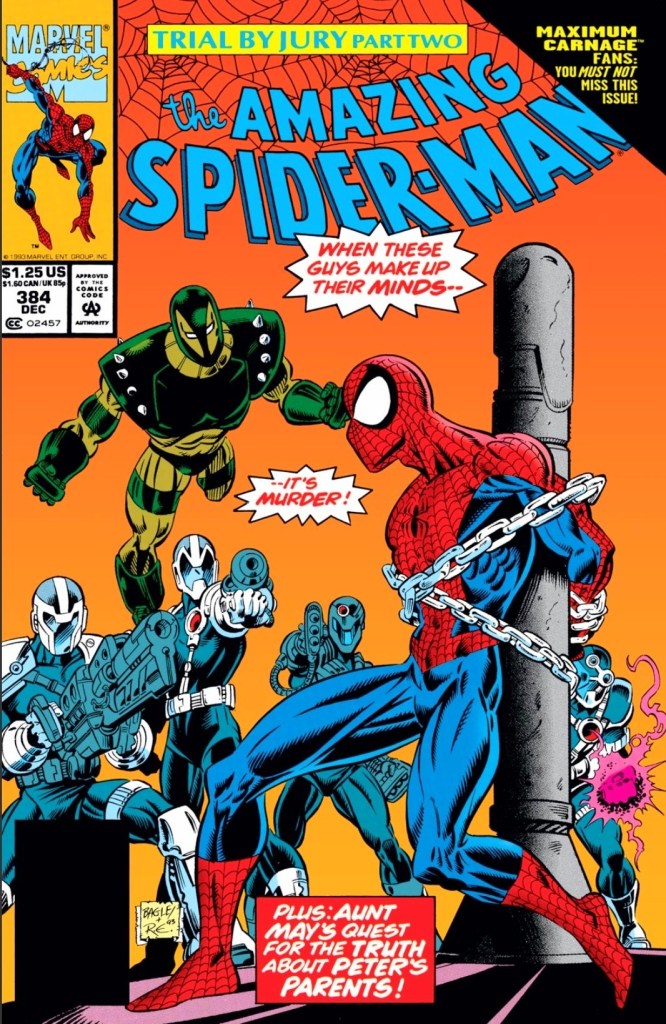
With those details laid down, here is a look back at Amazing Spider-Man #384, published in 1993 by Marvel Comics with a story by David Michelinie and drawn by Mark Bagley.
The cover.
Early story
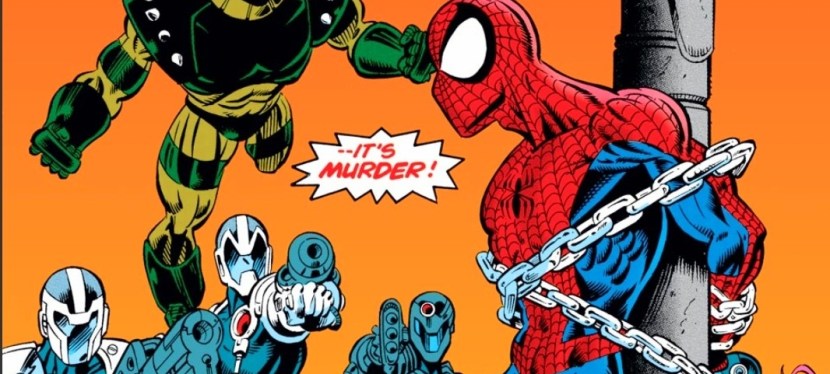
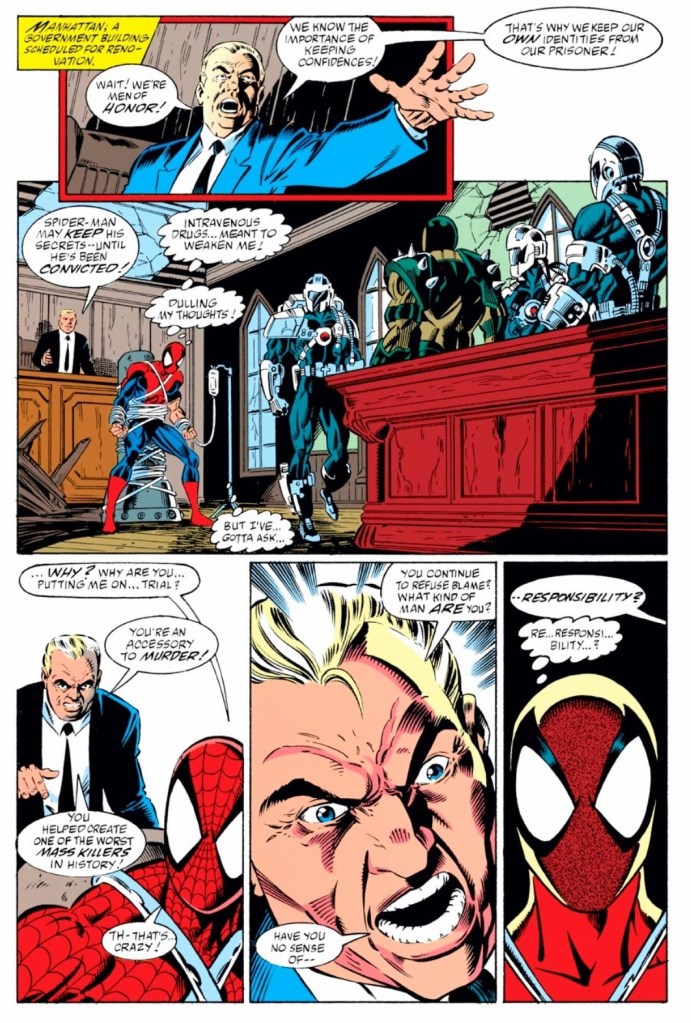
The story begins inside a certain government building in New York City scheduled for renovation. A heavily restrained and drugged Spider-Man was about to have mask taken off by one of The Jury members when their founder General Taylor intervened and insisted that they keep their honor. Spider-Man is up for questioning and scrutinization in a makeshift trial by The Jury. As the webslinger is not in the proper condition to stand trial, Taylor (in his capacity as the judge) declares a 30-minute recess.
Elsewhere, Peter Parker’s wife Mary Jane received bad news from her boss that her role in the TV show Secret Hospital will be reduced to a recurring role. This troubles her deeply as it means reduced income for her at a time when her marriage with Peter continues to go down. Spider-Man’s lack of quality time with her keeps taking its toll on her…
Quality
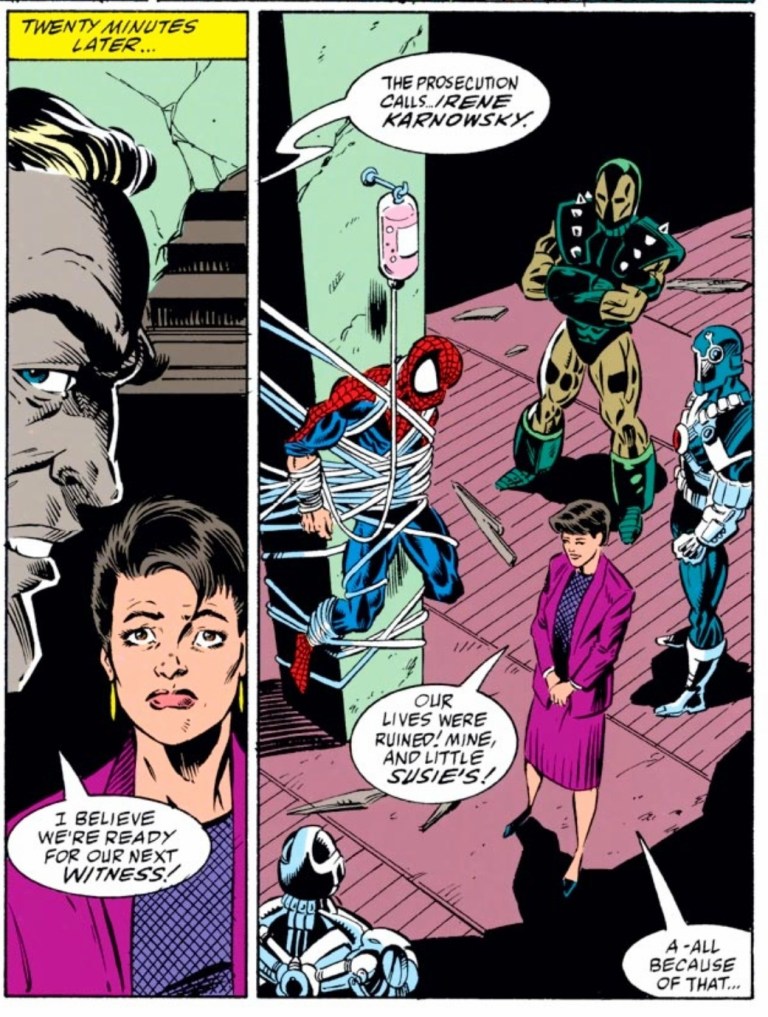
Spidey on trial!
Firstly, I should say that the Michelinie-Bagley team’s concept of having The Jury as the force of opposition against Spider-Man continues to do wonders creatively in this particular comic book series. In the previous issue, the webslinger was hunted and General Taylor really invested a lot of technologies to get to him in the middle of a very bustling city. In this particular issue, Spider-Man is completely vulnerable being weakened and disoriented as he is about to be tried in a makeshift court.
Along the way, Taylor and his team were portrayed to work within their own system of justice. As no court of law in New York would recognize Spider-Man’s trial, The Jury set up their own court in a very private and unusual manner.
While the planned trial is the major event of this comic book’s concept, Michelinie pulled off a rather unusual move with the narrative. Just as the first witness points to Spider-Man for being responsible for Venom, the iconic webslinger then starts to wonder what the trial is truly all about and then the creative team unleashed a slew of flashbacks that looked back a key events published in certain comic books of Secret Wars, The Amazing Spider-Man and Web of Spider-Man through the years. I’m talking about Spider-Man’s first-ever encounter with the symbiote, how he got rid of it, how the symbiote bonded with Eddie Brock to form Venom, how Venom’s costume left a living seed that Cletus Kassady touched and became Carnage, etc. These flashbacks, all nicely drawn by Mark Bagley, conveniently served as an instant reference for readers to catch up with the current events but this was done at the expense of this comic book’s narrative.
More on the trial, this comic book raises layered questions about the concept of responsibility on Spider-Man. Could the iconic webslinger really be held accountable for whatever murders Venom committed along with the trauma he caused on bystanders given the fact that he really brought the alien costume into their world? Should Spider-Man also be held responsible for any murders committed by Carnage? This is one really loaded script Michelinie came up with and he really had Spider-Man vulnerable not only to The Jury but also to the questions thrown at him during the makeshift trial. To put it short, this is one very unusual Spider-Man tale ever told that carries strong relevance from the past.
As with the previous issues, this comic book sheds a limited amount of the spotlight on Mary Jane and Spider-Man’s Aunt May who at this stage has gotten paranoid with her suspicions about Peter’s parents. The dramatization turned out pretty good.
Conclusion
Spider-Man in a vulnerable state with The Jury.
While the flashbacks were excessive and made the narrative feel bloated, Amazing Spider-Man #384 (1993) still has lots of good stuff fans can enjoy. It has a pretty bold concept of having Spider-Man really trapped and left vulnerable for the makeshift trial. More notably, the narrative pounded heavily on the concept of responsibility in relation to Spider-Man’s past actions that led to the creation of Venom and even Carnage.
Overall, Amazing Spider-Man #384 (1993) is recommended!
Recently in Parañaque City, police officers arrested an active member of the New People’s Army (NPA) who has been wanted for murder, according to a Philippine News Agency (PNA) news report. The arrest took place at Barangay San Dionisio.
To put things in perspective, posted below is an excerpt from the PNA news report. Some parts in boldface…
A member of the New People’s Army (NPA) facing murder charge was nabbed during a manhunt operation conducted by operatives of the Police Regional Office-Bicol (PRO5) in Parañaque City on Tuesday, a police report said.
In an interview on Wednesday, Lt. Col. Malu Calubaquib, PRO5 spokesperson, identified the suspect as Ferdinand Nolasco, 42, an active NPA member belonging to Platoon 3, Komite ng Probinsya 3 of the Albay Bicol Regional Party Committee (BRPC).
“He is being indicted with the crime of murder with no bail recommended issued by the court,” she said.
Calubaquib said Nolasco was tracked down after the conduct of surveillance and intelligence operations starting in April.
He was finally arrested around 5:20 p.m. in Barangay San Dionisio after the service of a warrant of arrest by joint personnel of the different units of the Philippine National Police (PNP) and the Philippine Army (PA).
Let me end this piece by asking you readers: What do you think about this recent development? If you are a Parañaque City resident, are you concerned that there could be more Communists/socialists/Marxists who previously committed murder and could be living within your local community? Did you notice if your family members seem to be under the influence of the Satanic Left?
For more South Metro Manila community news and developments, come back here soon. Also say NO to fake news, NO to irresponsible journalism, NO to misinformation, NO to plagiarists, NO to reckless publishers and NO to sinister propaganda when it comes to news and developments. For South Metro Manila community developments, member engagements, commerce and other relevant updates, join the growing South Metro Manila Facebook group at https://www.facebook.com/groups/342183059992673
Recently in Parañaque City, two wanted foreigners allegedly connected with the Japanese burglary gang leader Yuki “Luffy” Watanabe were arrested by law enforcers in BF Homes according to a news article published by the Philippine News Agency (PNA).
To put things in perspective, posted below is an excerpt from the PNA news report. Some parts in boldface…
Two more suspects connected with Japanese burglary ring leader Yuki “Luffy” Watanabe were arrested in Parañaque City, the Bureau of Immigration (BI) reported on Saturday.
Commissioner Norman Tansingco identified the Japanese nationals as Fujita Kairi, 24, and Kumai Hitomi, 25, who were apprehended in BF Homes by operatives of the BI’s Fugitive Search Unit on Friday afternoon.
The two have standing warrants of arrest for theft issued by the Tokyo Summary Court in September 2022. They are detained at the BI facility in Taguig City pending their deportation.
“This is a major breakthrough in the case, as we have finally arrested more suspects involved in this major case in Japan,” Tansingco said in a statement. “They will finally be facing their crimes in their homeland.”
Watanabe and accomplice Tomonobu Saito were deported on Feb. 8, the day after fellow fugitives Toshiya Fujita and Kiyoto Imamura, both 38, were sent home.
The above report ended stating that the gang was involved in at least twenty robberies that happened in Japan in the past twelve months, as well ass the murder and robbery of a 90-year-old person in the city of Komae.
Let me end this piece by asking you readers: What do you think about this recent development? If you are a Parañaque City resident, are you convinced that there could be more wanted criminals from abroad who could be hiding within your local community right now? If you have been following the developments about the Luffy case, do you know where exactly in BF Homes did the arrests happen?
For more South Metro Manila community news and developments, come back here soon. Also say NO to fake news, NO to irresponsible journalism, NO to misinformation, NO to plagiarists, NO to reckless publishers and NO to sinister propaganda when it comes to news and developments. For South Metro Manila community developments, member engagements, commerce and other relevant updates, join the growing South Metro Manila Facebook group at https://www.facebook.com/groups/342183059992673
Disclaimer: This is my original work with details sourced from reading the comic book and doing personal research. Anyone who wants to use this article, in part or in whole, needs to secure first my permission and agree to cite me as the source and author. Let it be known that any unauthorized use of this article will constrain the author to pursue the remedies under R.A. No. 8293, the Revised Penal Code, and/or all applicable legal actions under the laws of the Philippines.
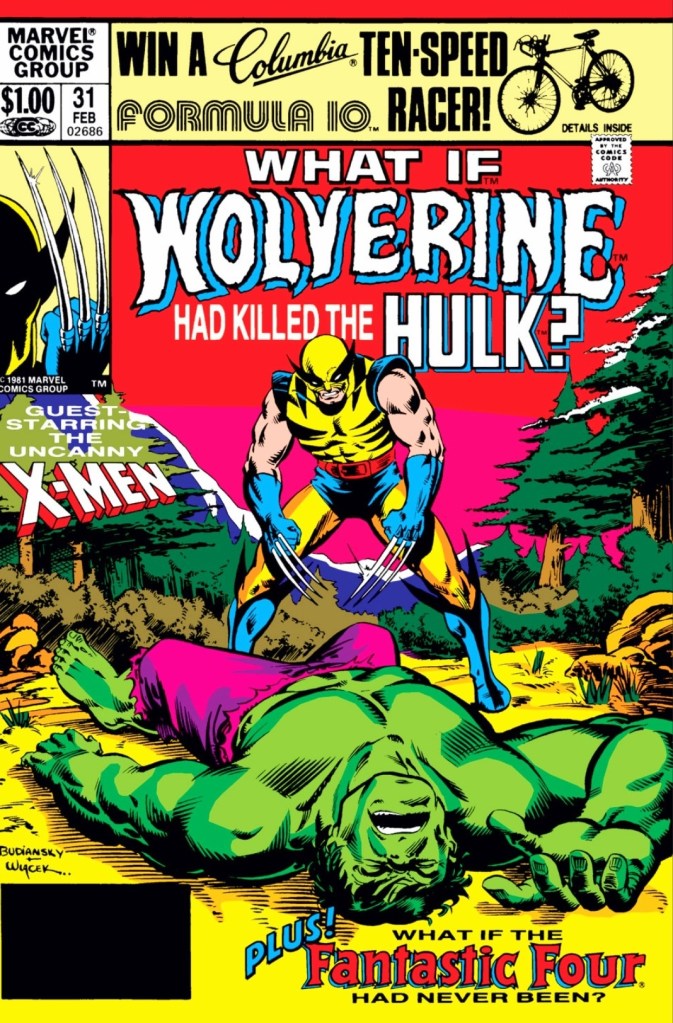
Welcome back superhero enthusiasts, 1980s arts and culture enthusiasts, Marvel Comics fans and comic book collectors! Today we go back to the early 1980s and examine an alternate universe portrayal of Wolverine and some other characters as told in one of the comic books of the first volume of the series What If.
Wolverine is one of the most iconic characters of Marvel Comics and he has been part of some of my retro reviews (click here, here, here, here, here, here and here). Wolverine made his first appearance in comics in Incredible Hulk #181 which was published way back in 1974 which marked the first conflict of the two Marvel icons. Years later, Marvel decided to revisit that event with a What If story.
With those details laid down, here is a look back at What If #31 published in 1982 by Marvel Comics with a story written by Rick Margopoulos and drawn by Bob Budiansky.
The cover.
Early story
The story begins with Wolverine and the Hulk in combat with each other in a forest within Canada. It turns out, Wolverine was sent by Canadian authorities to capture not just the Hulk but also the Wendigo.
With the Wendigo down on the ground, Wolverine and the Hulk struggle with each other. The Canadian’s speed helped him dodge the green giant’s powerful punches and as the fight goes on, so does the impulse and emotion from within. Suddenly, Wolverine decides to deliberately disobey his orders by deciding to kill the Hulk. In a few but strategic strikes with his Adamantium claws, Wolverine kills the Hulk. The Canadian authorities eventually got rid of the corpses of the Wendigo and the Hulk.
Soon enough, news about the Hulk’s death spread like wildfire all over America catching the attention of Spider-Man, the Avengers, the Fantastic Four and General Ross and his daughter Betty…
Quality
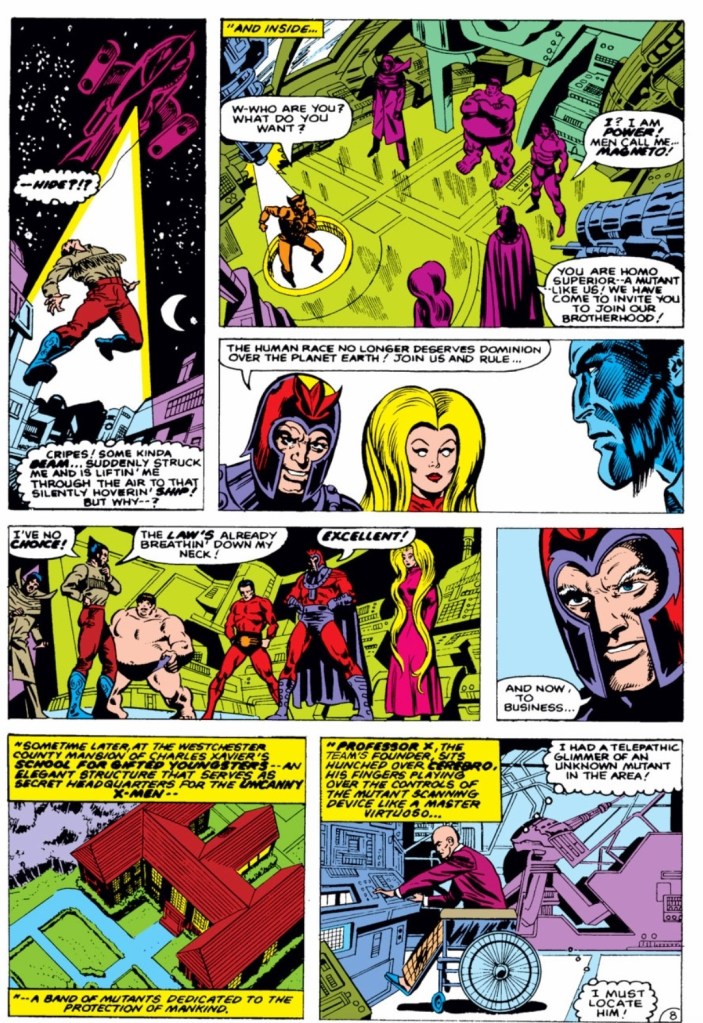
Wolverine gets abducted not by aliens from outer space but by Magneto and his Brotherhood of Evil Mutants.
To start with, I can say that I immensely enjoyed this alternate portrayal of the events that happened in relation to Wolverine’s first-ever appearance in comics. For one thing, the concept of Wolverine actually killing the Hulk is not only shocking on its own, it also set a chain reaction of events that involved or affect a whole lot of other characters within the Marvel Comics shared universe.
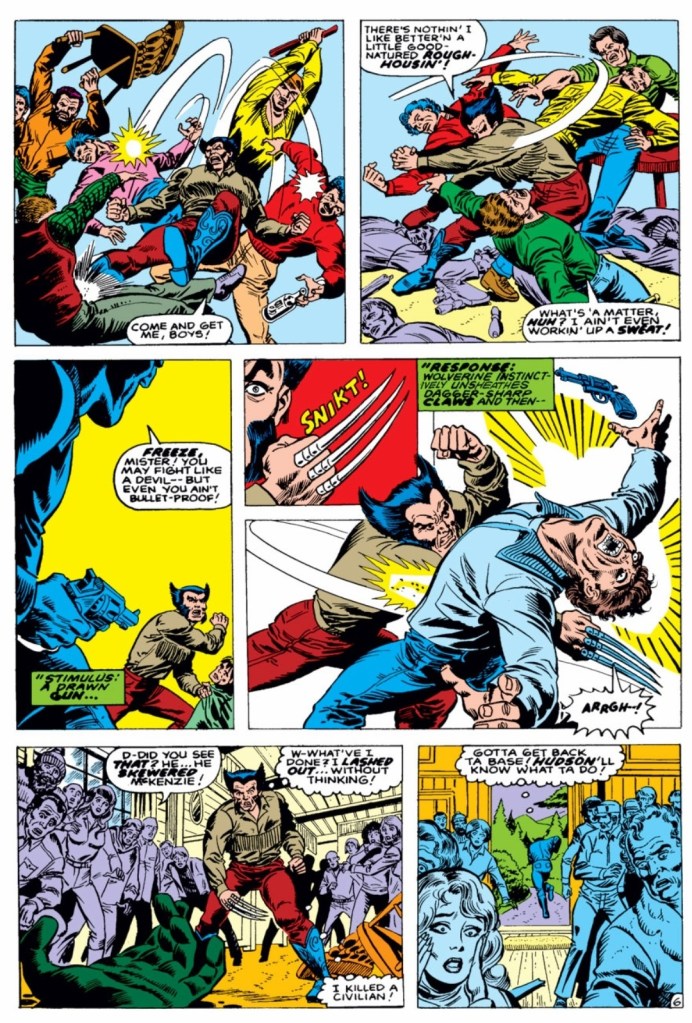
Let me start with Wolverine himself. As the story was set before he joined the X-Men, you will see Wolverine as a super-powered agent of Canada whose career really goes down as he failed to restrain his wild self from killing not once but twice. This results in a Wolverine who is deeply troubled with guilt and becomes desperate believing that running away and hiding will somehow solve his dilemma.
Wolverine’s entry into a gang of evil mutants led by Magneto (note: this comic book’s main villain) is itself worth getting this comic book. This shows Magneto – always obsessed with his belief that mutants are superior to humans – putting his diabolical plan into action with Wolverine as the key participant. This itself led to Wolverine’s encounter with the X-Men (the one team he was destined in reality to be with).
The creative team clearly exerted a lot of effort to not only ensure the plot made sense but also have a solid structure that can accommodate twists, intrigue and superhero spectacle altogether complete with enough room for character development. Lastly, I should say that this comic book’s climax is both compelling and shocking to read.
Conclusion
Wolverine’s 2nd kill in this comic book.
What If #31 (1982) is indeed a great Marvel comic book to read. It has a very engaging alternate universe portrayal of Wolverine and this paved the way for a new and fresh approach on showcasing how the X-Men and Magneto’s gang reacted with the clawed Canadian. While the scope of the consequence of Wolverine’s killing of the Hulk ultimately ending up narrowing on Marvel’s mutants could be disappointing for those who seek a bigger impact on other Marvel universe characters, what was shown here in this comic book still made sense and ultimately turned out believable. This comic book also has another tale exploring what if there was no Fantastic Four which ultimately ended up as a decent additive.
Overall, What If #31 (1982) is highly recommended.
Recently in Parañaque City, a 35-year-old woman was shot dead by an unidentified armed assailant, the Manila Bulletin reported. Already the local police trying to figure out who is responsible and what is the motive behind the killing which happened within Barangay Baclaran.
To put things in perspective, posted below is an excerpt from the Manila Bulletin news report. Some parts in boldface…
A 35-year-old woman was shot dead by unidentified assailant in Parañaque City, Sunday night, Jan. 21.
Col. Renato Ocampo, city police chief, identified the victim as Manilyn Acuesta Guinto, a resident of Bagong Ilog St., Barangay Baclaran, Parañaque City.
Ocampo said Guinto died on the spot from a gunshot wound in the head.
He said the incident happened around 8:10 p.m. at Dimasalang Extension, Barangay Baclaran, Parañaque City.
The city police chief said members of the Baclaran Police Sub-Station immediately responded after receiving a call from concerned citizens about the shooting incident.
Responding policemen recovered from the crime scene two fired cartridges of a .45-caliber gun and a deformed slug.
Let me end this piece by asking you readers: What do you think about this recent development? What could be the motive behind the killing?
For more South Metro Manila community news and developments, come back here soon. Also say NO to fake news, NO to irresponsible journalism, NO to misinformation, NO to plagiarists, NO to reckless publishers and NO to sinister propaganda when it comes to news and developments. For South Metro Manila community developments, member engagements, commerce and other relevant updates, join the growing South Metro Manila Facebook group at https://www.facebook.com/groups/342183059992673
Disclaimer: This is my original work with details sourced from reading the comic book and doing personal research. Anyone who wants to use this article, in part or in whole, needs to secure first my permission and agree to cite me as the source and author. Let it be known that any unauthorized use of this article will constrain the author to pursue the remedies under R.A. No. 8293, the Revised Penal Code, and/or all applicable legal actions under the laws of the Philippines.
Welcome back superhero enthusiasts, 1990s arts and culture enthusiasts, Marvel Comics fans and comic book collectors! Today we go back to the year 1993 and explore a part of Marvel Comics’ universe through the first-ever limited comic book series featuring one of Marvel’s most iconic villains – Venom.
In my previous retro review, Venom discovers a long lost section of San Francisco that fell deep underground. Even though it is cut off from the resources and fresh air of modern San Francisco, the lost city section is filled with homeless people and social outcasts. Even though he helped the city dwellers by defeating the two armed mechs (employed by a powerful organization who oppose the city dwellers and are in pursuit of something related to San Francisco’s park), Venom still gets rejected by the so-called council. This only led him to returning to the surface not knowing that he is being targeted by a certain group.
With those details laid down, here is a look back at Venom: Lethal Protector #3, published in 1993 by Marvel Comics with a story written by David Michelinie and drawn by Mark Bagley.
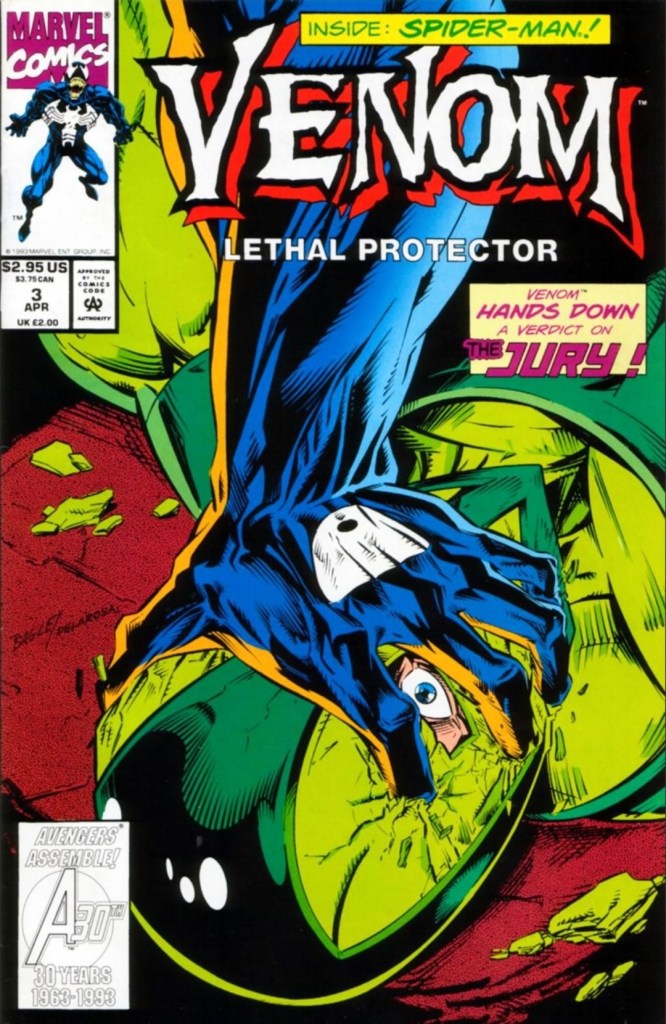
The cover.
Early story
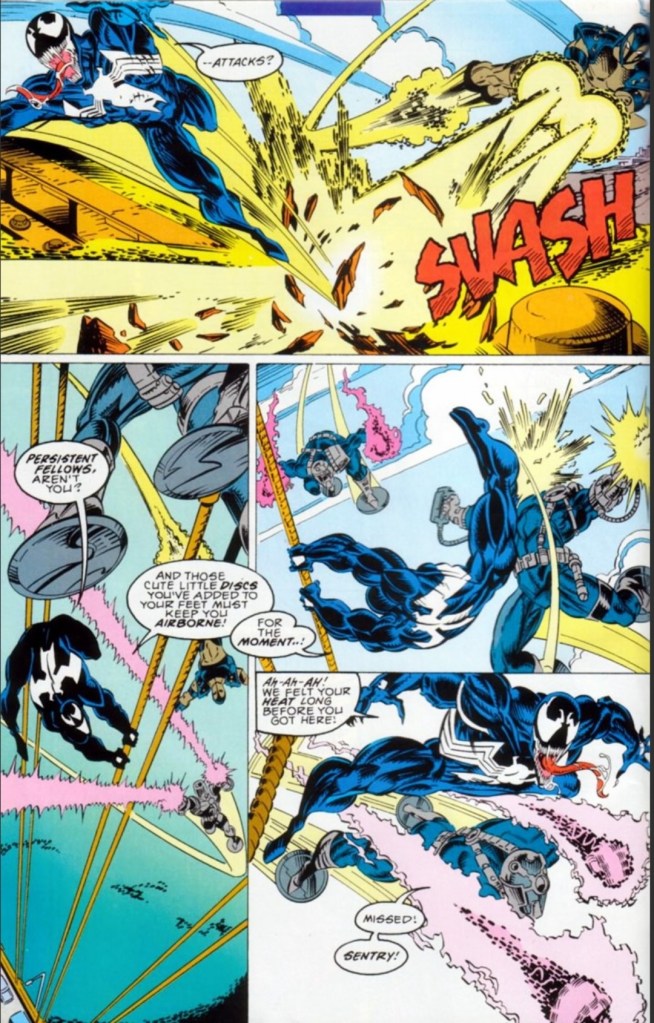
The story begins with Venom suffering from a sonic blast while being restrained by one of the armed members of the group called The Jury. Their leader (who wears a suit and necktie) introduces himself as Orwell Taylor and he addressed Venom as Mr. Brock. It turns out Taylor spent lots of time and resources researching everything about Brock and the alien costume. More shockingly, The Jury’s leader reveals that he lost his son Hugh years ago due to Venom’s arranged killing of him as he escaped from his prison cell in the federal prison called The Vault. Hugh Taylor is the first man Venom killed when he escaped.
Venom responds by say that he and his symbiote did not want to hurt anyone. This provokes Orwell Taylor into anger and he orders The Jury to kill Venom. Due to the lengthy explanations of Orwell Taylor, Venom managed to recover and regain strength which he uses to free himself and throw one Jury member to another causing quick chaos.
After punching another Jury member, Venom then moves out of the alley and away from Taylor and his team…
Quality
Very clearly, The Jury is a very formidable force of opposition. Their battle with Venom here comes with a lot of spectacle.
In terms of storytelling, this one is another improvement over issue #2 (which itself is an improvement over issue #1) as the plot got more interesting and even intriguing. For one thing, I like the fact that David Michelinie recalled Venom’s murderous escape from prison told way back in Amazing Spider-Man #315 (1989) and came up with the establishment of a very angry powerful father who formed the dangerous cybernetic team called The Jury. In a rather symbolic way, this comic book shows how Venom’s past comes back to haunt him and creatively, the battles between Venom and The Jury here are packed with a lot of action and visual dynamism delivered by Mark Bagley. The irony is that The Jury itself is not the main antagonist of this limited series as they are clearly presented to be a recurring force of opposition within Spider-Man’s realm in Marvel Comics’ shared universe of the time.
Still on the plot, the sinister organization hounding the dwellers of the lost city was revealed to be the Treece group whose leader is pursuing something very valuable to feed his greed. Still, even though this is already the third issue, the Treece organization’s presence is very subtle and as the force of opposition towards Venom, they are outclassed by The Jury.
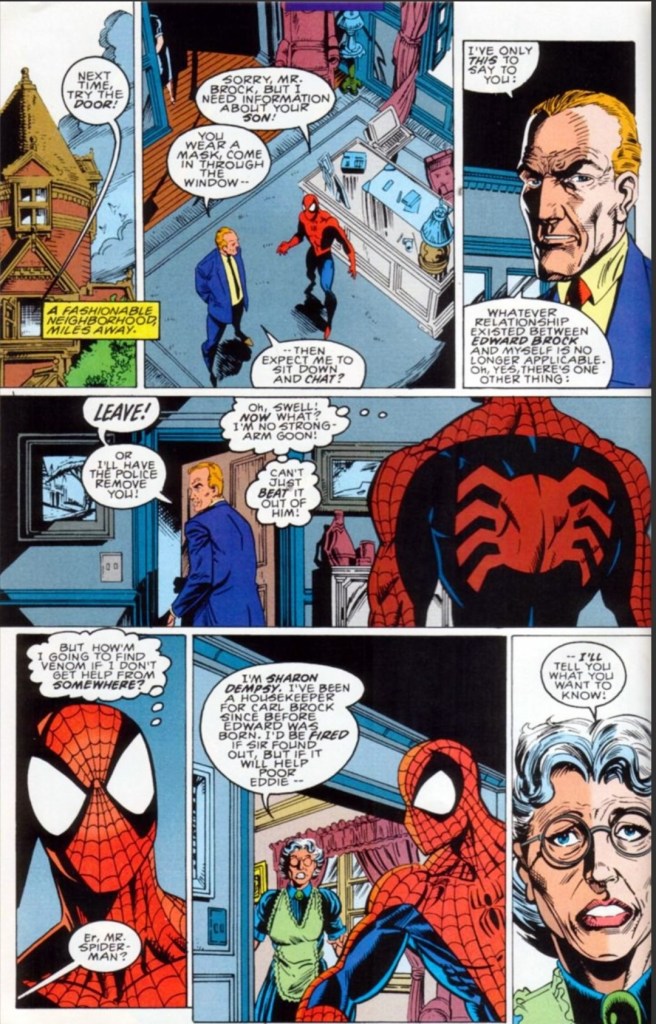
As in the previous issue, Spider-Man got a good share of the spotlight but this one is even more limiting which should delight Venom fanatics who complained about Marvel’s icon overshadowing their guy with the symbiote. Spider-Man serves mainly as a tool for exposition as the creative team showed images from the past of Eddie Brock with his father (whom Spider-Man approached for answers).
The problem here is that showing flashbacks from the past and explaining how Eddie Brock became bitter and sinister as a result of receiving almost no affection from his father ruins the mystery of Venom as a character. During the time of Todd McFarlane drawing Amazing Spider-Man comics and the early Venom tales, the mystery of Eddie Brock’s past added to the intrigue of Venom and his quick rise as the deadliest villain Spider-Man ever faced. I understand that this limited comic book series had Venom as the protagonist who was in high demand among readers of the time but for me the creative team went way too far emphasizing Eddie Brock’s past.
Nothing changes the fact that Eddie Brock aided by the alien costume is a murderer who happens to have previously been a prolific print media journalist whose career got ruined by Spider-Man which in turn led him to a downward spiral and eventually to bonding with the symbiote that once bonded with Peter Parker. The flashbacks were pointless and if there really was an attempt to humanize Eddie Brock and make him sympathetic to readers, the creative team clearly failed.
Conclusion
Spider-Man with Eddie Brock’s father in California.
Venom: Lethal Protector #3 (1993) is a mixed bag. Its plot is clearly more intriguing and more interesting to read while there was enough creative space to show The Jury as a powerful force of opposition which is the result of Venom’s murder of Hugh Taylor (read: Amazing Spider-Man #315) while making a prison escape. The spectacle of the battle between Venom and The Jury must be seen! However, the creative team’s move to dramatize Eddie Brock’s past using flashbacks back-fired in my opinion and ultimately they destroyed whatever mystery was left behind Venom. As a protagonist, Venom has no appeal whatsoever and his portrayal here only reminds me that he works best as an antagonist opposite Spider-Man. Venom as a hero for those he perceived to be innocent and helpless remains forced and unconvincing.
Overall, Venom: Lethal Protector #3 (1993) is satisfactory.











 Author Carlo Carrasco