Recently in the City of Muntinlupa, the City Government approved an ordinance establishing a moratorium on the collection of the amusement tax on Filipino films (note: movies produced by Philippine companies/organizations) within the city for the next three years, as reported by the Manila Bulletin. The ordinance was signed into law by Mayor Ruffy Biazon.
In short, local companies here in the Philippines whose films are shown in theaters within the jurisdiction of Muntinlupa City could earn more as the amusement tax won’t be imposed for most of the year for the next three years while the cinema operators themselves can benefit along the way.
I say most of the year because the moratorium does not cover the time period of December 25 to January 7 which is precisely the time when the annual Metro Manila Film Festival (MMFF) happens.
To put things in perspective, read the excerpt from the Manila Bulletin news report posted below. Some parts in boldface…
Muntinlupa Mayor Ruffy Biazon and the City Council approved an ordinance granting a three-year moratorium on the collection of amusement tax from Filipino films in the next three years.
The Muntinlupa City Council passed and Biazon signed Ordinance No. 2024-229 “Declaring Moratorium on the Collection of Amusement Tax for Filipino Films in the City of Muntinlupa from January 08 to December 24 of every year for the next three (3) years.“
Under the existing Local Government Code, “The province may levy an amusement tax to be collected from the proprietors, lessees, or operators of theaters, cinemas, concert halls, circuses, boxing stadia, and other places of amusement at a rate of not more than ten percent (10%) of the gross receipts from the admissions fees.”
In February, the Metro Manila Council adopted the Metropolitan Manila Development Authority (MMDA) Resolution No. 24-11 “Declaring a Moratorium on the Collection of Amusement Tax for Filipino Films in Metro Manila from January 08 to December 24 of Every Year for the Next Three Years.”
In the Muntinlupa ordinance, it was stated that the MMDA resolution “was adopted to recognize the importance of the local film industry in promoting cultural and economic development and in response to the appeal of the local filmmakers to boost the film industry after the impact of the COVID-i9 Pandemic on the production and exhibition of Filipino Films, and the dominance of foreign films.”
Under the ordinance, all cinemas in Muntinlupa can avail of the moratorium on the collection of amusement taxes for Filipino films from Jan. 8 to Dec. 24 of every year for the next three years.
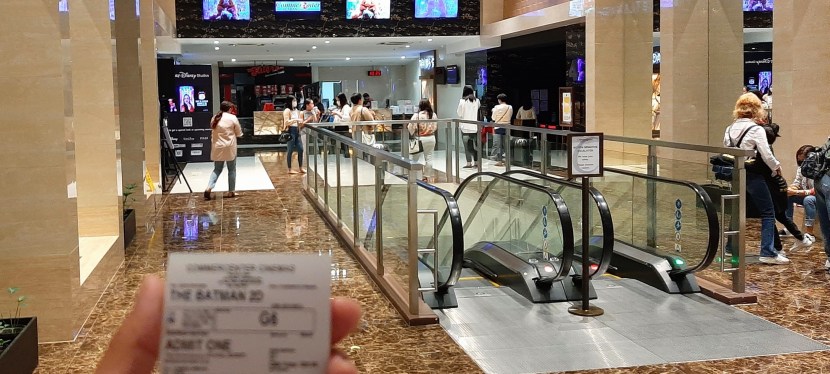
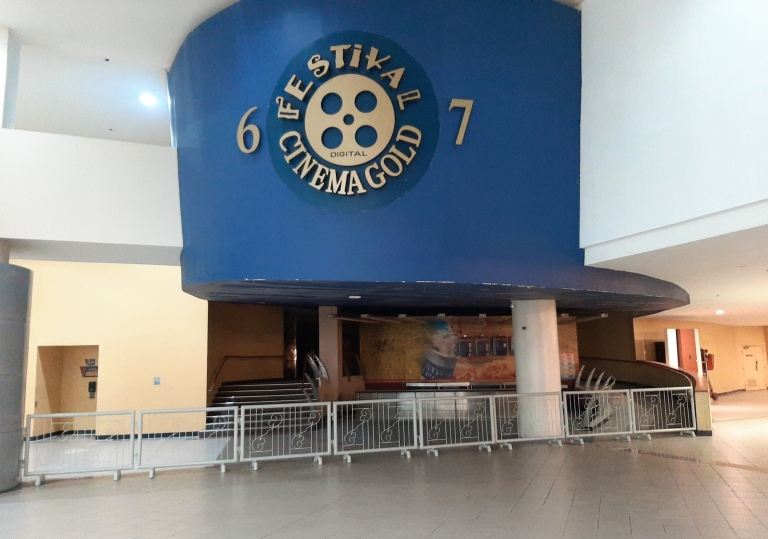
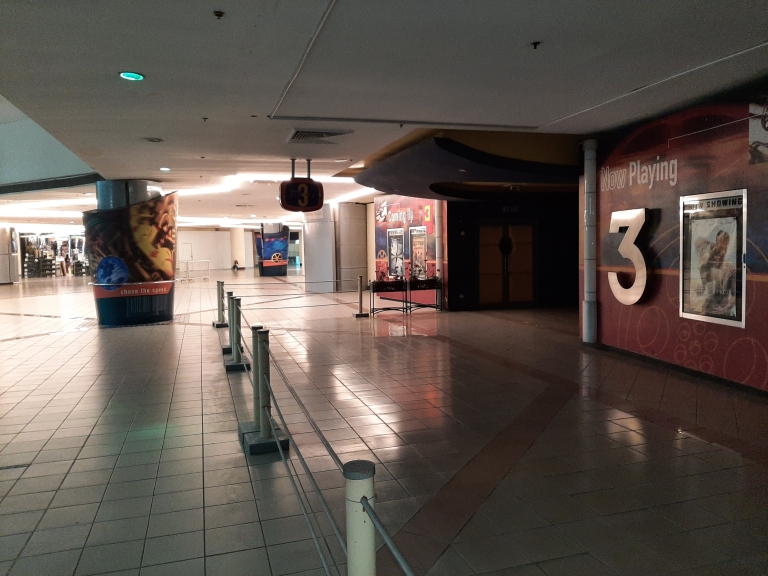
When it comes to the state of cinemas within Muntinlupa City, Commercenter has four screens and I noticed over the past two months that only 2 or 3 were operating during my visits there. Over at Festival Mall, their 4-screen modern cinemas are fully operating but their original cinemas (located several feet away by foot on the same floor) are still dark and depressing as only 2 or 3 screens (out of ten screens) were operating almost all the time.
As for the cinemas in Alabang Town Center, they seem to be operating normally and continue to attract a steady amount of moviegoers.
Going back to the approved moratorium, it remains to be seen if it could lead to a potential reduction of ticket prices in relation to Filipino movies within Muntinlupa. Even if ticket prices get reduced, would it be enough to convince people to come to the Muntinlupa cinemas and buy tickets for the cinematic experience. There is also the factor of the quality of Filipino movies showing in Muntinlupa movie theaters plus the factor of foreign movies.
As a resident of Alabang who saw lots of movies in the local cinemas, I noticed that Muntinlupa City is lacking when it comes to hosting film festivals (note: the annual MMFF does NOT count). Special events about movies focusing on variety, quality and artistry being held in Muntinlupa can help cinema operators attract moviegoers as well as the enthusiastic film buffs.
Perhaps the City Government or barangays could someday organize a special event of short films made by Muntinlupa-based filmmakers and have such films screened in local cinemas. Organizing another film festival showcasing films by independent filmmakers from around the country and having them screened in theaters within the city could help too.
Still on the topic of Filipino movies, when will the time come when the major local movie producers will have premieres of their new movies held in cinemas here in Muntinlupa and give locals the chance to see their favorite movie stars in person?
Let me end this post by asking you readers: What do you think about the 3-year moratorium approved by the City Government of Muntinlupa? Do you think that cinemas in Muntinlupa are losing money? Do you think the newly approved moratorium could be disadvantageous to the City Government in terms of revenue?
Disclaimer: This is my original work with details sourced from watching the film and doing personal research. Anyone who wants to use this article, in part or in whole, needs to secure first my permission and agree to cite me as the source and author. Let it be known that any unauthorized use of this article will constrain the author to pursue the remedies under R.A. No. 8293, the Revised Penal Code, and/or all applicable legal actions under the laws of the Philippines.
Welcome back, movie buffs, science fiction fans and geeks! When it comes to making remakes or reimagined versions of established movies from previous decades, the 1980s was indeed a special time to watch them. In 1986, The Fly (directed by David Cronenberg) was released and it made a tremendous impact on moviegoers in ways that the original 1958 movie did not.
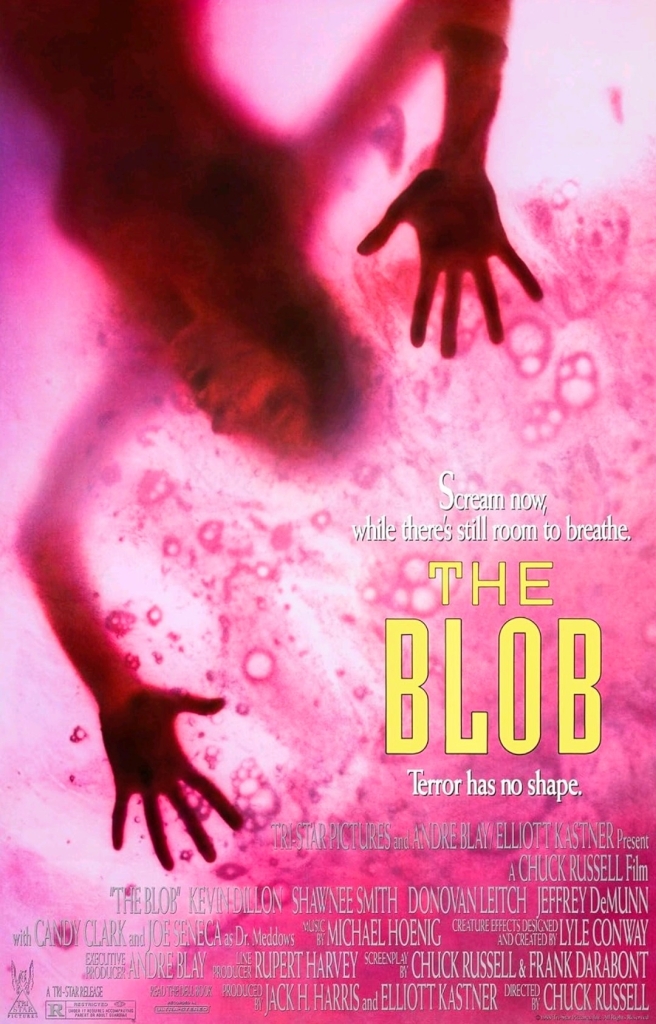
Remember when The Blob was first released in 1958? That classic film (read my retro review by clicking here) went on to have a forgettable sequel released in the 1970s but got remade big time with a new version in 1988 simply titled The Blob.
The story begins in the town of Arborville where many locals attend an exciting football game. High school player Paul (Donovan Leitch, Jr.) asks cheerleader Meg (Shawnee Smith) to a date. Elsewhere, the troubled guy Briann Flagg (Kevin Dillon) fails with his attempted stunt as a result of his flawed motorcycle which was witnessed by an elderly vagabond. Flagg goes back to town and encounters the local sheriff (Jeffrey DeMunn) who warns him about trouble.
That evening at the outskirts of town, a meteorite crashes within the forest which the elderly vagabond pursues. With strong curiosity in his mind, the old man uses a stick on a sizable body of slime mold substance (the blob itself) that came out of the crashed meteor. Suddenly, the substance moves and sticks to the elderly vagabond’s hand causing him great pain.
A short time later in the forest, Brian Flagg got surprised by the sudden appearance of the vagabond who desperately tries cutting off his own hand. The blob, which Brian saw for the first time ever, attaches itself even more on the old man causing him to run away until he gets hit by a car (with Meg and Paul inside)…
Quality
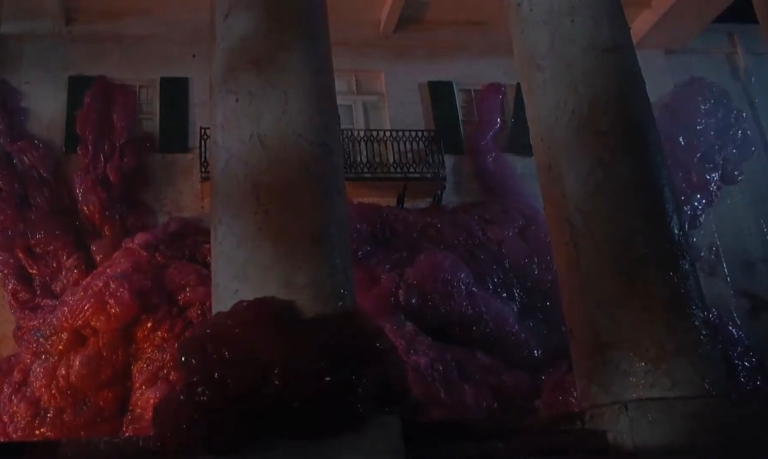
The blob in this movie looks more menacing as it has a tumor look and the special effect work remains excellent to look at. You should also see the blob move and what it sounds like.
This late-1980s remake of The Blob is not only more engaging and more entertaining than its 1958 predecessor…it is easily on of the best sci-fi horror movies of the 1980s thanks to a very talented creative team led by Chuck Russell.
To begin with, Russell and Darabont (this is the same great director behind The Shawshank Redemption), crafted a very solid screenplay that used key story elements from the 1958 classic while successfully updating everything else with 1980s America (or Ronald Reagan’s America) in mind. For this version, the three leading teenagers played by Shawnee Smith, Kevin Dillon and Donovan Leitch, Jr. were relatable and clearly worth following.
(From left to right) Shawnee Smith, Kevin Dillon and Candy Clark in an early encounter with the blob.
While the 1958 movie emphasized American teenagers being disadvantaged as local adults don’t take them seriously (even though the youth knew the problem and intend to solve it), this remake moved away from the generational gap as it strongly focused more on the crisis of a fast-growing blob that simply won’t stop killing people and destroying things. In other words, this is a crisis-focused monster story that is more violent, more horrific, more action-packed and more graphic than its predecessor.
I should also state that Russell and his team established a solid structure for storytelling and the narrative flowed on a medium-to-fast pace. As this movie has more spectacle in terms of action, monster moments and the like, the creative team carefully balanced the fun stuff with the dramatic and exposition scenes smoothly.
If you see people wearing protective suits arriving in your community and implementing a lockdown, you know a crisis is in effect.
The cast here is solid! Shawnee Smith’s Meg is the sweet, young good-natured high school girl who is willing to not only survive but also take part in solving the crisis situation not for herself but for her family and the entire Arborville community. Meg has some common elements with that of the character Sarah Connor from The Terminator and Terminator 2: Judgment Day. I also love the fact that there is NO WOKENESS and NO RABID FEMINIST VALUES in Meg. Kevin Dillon’s Brian – the troubled youth – is clearly the 2nd lead and he does a good job dramatizing how his character changes from a guy of uncertainty into an actual doer whose efforts proved to be valuable. There definitely is a non-romantic chemistry between Meg and Brian as the crisis situation really brought out solid transformations from them respectively.
The supporting cast is really good too. Candy Clark’s Fran is the relatable community diner owner/manager who contributed nicely to the plot as well as the early showdown of the blob. Jeffrey DeMunn’s sheriff is the local law enforcer who has to deal with the local situations while tackling the challenges of his leadership post. Paul McCrane here plays a local cop who is tough but not necessarily abusive, and this is the same guy who played a very vicious bad guy in 1987’s RoboCop! Joe Seneca is the government scientist who has charisma and deception carefully blended together which added to the plot. You will even see Erika Eleniak in a very small and yet notable appearance that happens to involve the blob. This film has a really interesting cast and I encourage you to research the names mentioned here.
This remake is loaded with action scenes, stunts and incredible visual effects!
On the technical side of things, I really like the cinematography done by Mark Irwin as the visuals captured looked really detailed and clear even during the dark or night-time scenes. The music by Michael Hoenig was pretty good too and his tunes ranged nicely from creepy to sentimental and energetic which reflected the scenes. As for the design of the blob, Lyle Conway deserves the credit for making it very monstrous. As for the physical environment of the movie, the state of Louisiana turned out to be a great location and the real-life Louisiana town Abbeville added strongly to the small town concept of the story.
As mentioned earlier, this version has a lot more spectacle to enjoy. For one thing, there is a good amount of hard action, gunfire and stunts which really added to the excitement (on top of the suspense and horror scenes already implemented). Rest assured, you will not get bored at all when watching this.
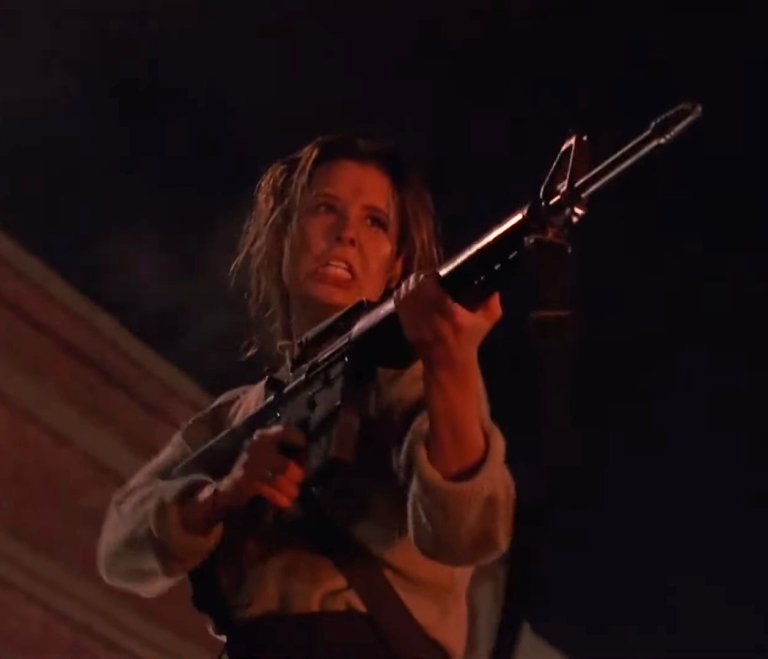
Shawnee Smith is the protagonist in this movie and her performance is very memorable.
The highlight of the spectacle is the very blob itself which looks so much like a tumor (instead of the jello form in the 1958 version) and the credit goes to the visual effects, sound effects and the animation team behind it all. Compared to its counterpart in the 1958 film, the blob here is very monstrous and horrifying to watch and the way it got animated is excellent. Apart from being unrelenting, this blob is deadlier and even intelligent. Not only does the blob devour the living which adds to its tremendous growth of size and mass, it also has the ability to extend tentacles which added more to the danger. Thanks to the sound effects, the blob is believably animalistic.
Through the blob’s on-screen presence, you can see the hard work implemented by the special effects crew when showing the monster entirely move and devour people, when showing its flexibility on adjusting its size (or its parts) when entering new places through tight spots, and most notably, how the blob alters the flesh of the victims it touches which resulted in very horrifying visuals. The special effects team really excelled with the use of practical effects (read: no computer-generated images) on presenting the titular monster. This is indeed a special effects extravaganza that a lot of people are missing out on.
Conclusion
The Blob (1988) looks and sounds better than ever in 4K Blu-ray format. I highly recommend this version as it is so much better than streaming.
There is no doubt in my mind that The Blob (1988) is a great sci-fi horror film that has a more menacing monster complete with sufficient action, great visual effects and a pretty solid cast! This is indeed a great example of a how a remake of an established film from the past should be done and this also includes raising the stakes within the story, modernizing past cinematic elements and ensuring high entertainment value. What director Russell, his team and the cast collectively achieved is indeed a creative success and this is the kind of film that Commie-filled Hollywood (Commiewood) today does not want to make.
As a companion piece to The Blob (1958), this remake has the good stuff that people who love horror, science fiction, action and monsters will enjoy.
Of all the many movies I have seen, The Blob (1988) stands out as one of the best remakes ever made as well as one of the best mixed-genre movies of its decade as well as of all time. That being said, today is a great time to watch this movie with better-than-ever visuals and sounds through its 4K Blu-ray release (pictured above) which is now available (you can order it online now). There is also a lot of features and extra stuff with the 4K Blu-ray. Make no mistake, The Blob (1988) is great to watch and its replay value is pretty high.
Welcome back, fellow geeks, Blu-ray collectors and movie buffs! Decades ago, animator and director Ralph Bakshi made significant contributions to the art of hand-drawn animation with features that made it to cinemas such as The Lord of the Rings (1978), Wizards (1977), and Fire and Ice (1983) to name a few.
Along the way, Bakshi became identified with rotoscoping which is a technique that involves drawing or painting over an element in live-action footage frame by frame (as to create a matte or a realistic animation).
Speaking of Bakshi’s past work as well as rotoscoped animation, Sony Pictures recently released the film American Pop (1981) on Blu-ray disc format and I am happy to say that I now have a copy of it for my Blu-ray collection. This is also my first-ever Blu-ray of a Bakshi-directed animated movie.
A close look at the cover of my Blu-ray copy of American Pop.
To begin with, posted below are the specs from the Blu-ray.com page…
Video
Codec: MPEG-4 AVC
Resolution: 1080p
Aspect ratio: 1.85:1
Original aspect ratio: 1.85:1
Audio
English: DTS-HD Master Audio 2.0 (48kHz, 24-bit)
Subtitles –English SDH
Discs -Blu-ray Disc, Single Disc (1 BD-25)
Playback – Blu-ray: Region A
In my personal experience, the first time I ever saw American Pop was not in the cinema but on TV here in the Philippines way back in 1993. Back then, I found the film’s combination of music with mostly rotoscoped animated scenes (there were also some live-action shots, archived footage and some very unique pieces of art shown). I was not able to replay Bakshi’s movie until recently.
So after more than thirty long years, I finally got to replay American Pop on Blu-ray and I can say I enjoyed it even more. To see the rotoscoped animation and varied music play in front of me in high-definition is an even more immersive viewing experience than the previous time I saw this film. Another advantage of high definition is being able to see tiny visual details that I was unable to spot long ago. Oh yes, the fine artworks used on the backgrounds in specific parts of the movie now look a lot more engaging to look at.
A look at the rear of American Pop Blu-ray.
What I regret to say here is that American Pop Blu-ray absolutely has no special features included. Not even a movie trailer! I can only guess that Sony Pictures did not bother to exert efforts to conduct new interviews with Ralph Bakshi and the cast members, nor did they even try to secure any media features or previews of the movie before its theatrical release. It’s not clear if Sony will someday come up with a collector’s edition Blu-ray of this 1981 Bakshi film.
For the dedicated Ralph Bakshi fans as well as enthusiastic film buffs and collectors of movies on physical media, American Pop Blu-ray is recommended as the film itself is more than enough to outweigh the lack of special features. American Pop is more lively than ever to watch and listen as it is now in high-definition.
Disclaimer: This is my original work with details sourced from watching the film and doing personal research. Anyone who wants to use this article, in part or in whole, needs to secure first my permission and agree to cite me as the source and author. Let it be known that any unauthorized use of this article will constrain the author to pursue the remedies under R.A. No. 8293, the Revised Penal Code, and/or all applicable legal actions under the laws of the Philippines.
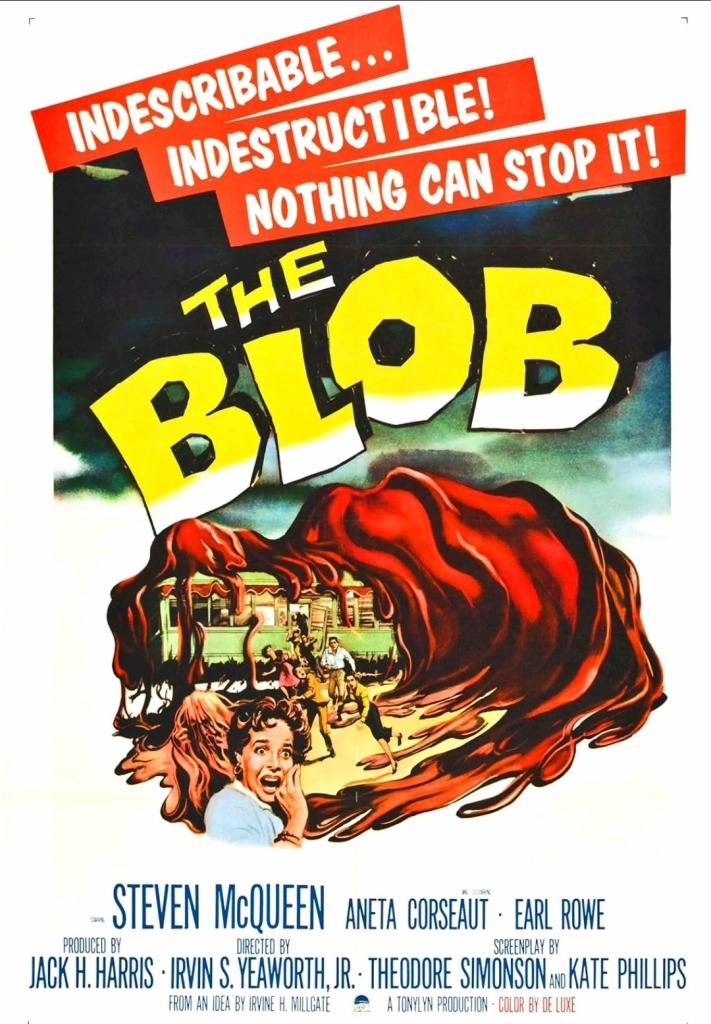
With those details laid down, here is a look back at The Blob, a sci-fi horror movie released in 1958 starring Steve McQueen and Aneta Corsaut, written by Kay Linaker and Theodore Simonson, and directed by Irvin S. Yeaworth, Jr. (Irvin Yeaworth for short). This was a low-budget local-level production by Valley Forge Films, Fairview Productions and Tonylyn Productions.
The Blob movie poster.
Early story
The story begins somewhere within a small town in Pennsylvania. During one evening, teenagers Steve Andrews and Jane Martin spend a romantic time together in a car only to be disturbed when a meteorite from outer space crashes nearby. This easily sparks Steve’s curiosity as he decides to drive to find the spot of the crash taking Jane with him.
Meanwhile, an old man who happened to be living near the spot of the crash went out of his home and finds the meteorite first. Out of curiosity, he pokes the meteorite with a stick which slowly causes it to break open revealing a gelatinous substance (the blob) inside. He uses the stick on the substance, lifts it up and examines it closely. Against gravity, the substance suddenly moves up the stick and wraps itself on the old man’s hand causing him to become desperate to remove it. He failed.
As Steve drives down the road, the old man with the blob suddenly crosses down their path. The old man tells Steve to take him to a doctor…
Quality
Steve McQueen (3rd from left) as teenager Steve Andrews with Earl Rowe (2nd from right) as Lt. Dave and other over-aged actors playing teenagers.
I can say that I really like this old movie which has always been an independent, low budget production that made a solid contribution to the sci-fi genre and pop culture in general.
To begin, this film has a simple plot about an alien creature in the form of a gelatinous blob from outer space which attached itself into an old man’s hand, grew a lot when the man made it to the doctor, and then started consuming people which made it grow so big, life in the town got disrupted and people found themselves in danger. Unsurprisingly, the blob itself does not dominate the narrative considering the limitations the filmmakers had on making special effects work plus they focused more on the characters to move the plot forward. Rest assured, however, that the production team went all out with their limited resources on making the monster look menacing in the final fifteen minutes. I should state that the special effects team did a convincing job with the way they made the blob move to specific directions.
Given the simple plot, it is not surprising to see the narrative focusing more on the characters particularly with teenagers Steve and Jane (both played by obviously over-aged actors Steve McQueen and Aneta Corseaut). The story clearly follows the two mentioned teenagers who have the best knowledge about the blob and what happened, and it just so happens that they are always at a disadvantage when asked by adults to prove things.
With a monster that large within the local community, you know that something must be done before it causes further damage and kills more people. The blob was portrayed to be unrelenting in consuming and killing people which causes it to grow even bigger and with no limits determined. The blob does not care at all about the pain and anguish of its victims which parallels the evil of Communism/Marxism/socialism/anti-Semitism in real life.
Jane (Aneta Corseaut) and Steve (Steve McQueen) with the local doctor (Stephen Chase) early in the film.
The interactions between teenagers (note: Steve McQueen and Aneta Corseaut are not the only over-aged looking actors playing youth) and the mature authorities (local police, parents, educator and house keeper to name some) dramatized a gap in which the youth lacked credibility while the adults remain difficult to convince. Very notably the backward car race early in the film symbolically reflects the Hollywood film trend of the 1950s in which American teenagers are portrayed to be troublesome and living without real purposes.
Going back to the protagonists Steve and Jane, the screenplay was designed to highlight what good teenagers can do when a crisis strikes the local community and why the adults should get over their doubts about the youth.
Given the structure of the script, there are a lot of talk scenes throughout and the progress of the blob growing as a menace within the plot helped break the monotony. While he is clearly too old to play a teenager, Steve McQueen here remains convincing as a youth who strives to achieve something worthy even as he lacks maturity. The same can be said about Aneta Corseaut whose character was designed to help Steve move forward apart from having romance with him. When her character feels troubled, Steve comes in to support her in return. If you ignore their mature looks and focus on the dialogue, you will find convincing lines of youth within Steve and Jane. The same can be said about the other teenagers.
Considering the low budget and the limitations of technology at the time, the man-made practical effects in this movie are still good.
I can say out loud that watching movies inside the cinema is always better than streaming. The best way to enjoy a movie at home, on the other hand, is with physical media like Blu-ray and 4K Blu-ray.
While McQueen and Corseaut performed well, there were some moments of stiff acting and lifeless delivery of lines of dialogue scattered throughout.
Those of you who are so used to fast-paced films with thrills and jump scares, you should temper your expectations as this movie moved at a slow-to-medium pace with very little horror elements and very little violence. As this was a low-budget local-level production, certain shots had to be made with very obvious creative shortcuts. Even though this movie was filmed on several locations in Pennsylvania, the filmmakers failed to establish a true sense of geography and this means no scenic shots.
Going back to the blob itself, its jello appearance may not look menacing at first and there were times when the lack of scale (note: they did not have equipment to achieved the depth-of-field visual effect) was noticeable. What I liked here is the way the blob was portrayed – unrelenting and totally immune to the emotions and concerns of people it encounters. The blob here somewhat reminds me of the T-800 in The Terminator (1984) in the sense that it simply would not stop to attack people, consume them and then keep on growing into one very large mass which causes a crisis on the small town community.
In case you are wondering, there were accidents that happened during the memorable scene of moviegoers running out of the cinema in the film. The tripping of some people were purely accidental.
When it grabs someone and starts to consume the victim physically, the blob does not care about the pain it causes on its prey. While it is clear that the movie’s script was written during the early stages of the Cold War, it is possible that the blob served as a symbol of Communism infiltrating America, endangering people and taking their lives (and liberties) away. That being said, the rampant Leftist influence and social violence in the minds of millions of Americans today makes this film socially relevant and the blob’s threat has gotten even more symbolic. Lastly, I should state that composer Ralph Carmichael managed to come up with music to emphasize the threat of the blob.
Conclusion
In my honest opinion The Blob (1958) is still a good movie to watch and it deserves its place in film history as well as in the sci-fi genre of movies in general. While it had its shortcomings, this low-budget local-level production managed to be a worthy viewing experience and set the foundation for its movie franchise (note: a sequel was made in 1972 and the memorable remake of 1988 followed). To say the least, this movie paved the way for Frank Darabont and Chuck Russell to produce the 1988 remake that was very intense and a lot of fun to watch.
The Blob (1958) in Blu-ray disc format from The Criterion Collection. This is the best way to enjoy the movie at home.
The blob itself went on to inspire creative imitations (referred to as blobs or ooze) and new monsters in other forms of entertainment (note: the blob appears as one of the monsters in the 1982 Intellivision game Advanced Dungeons & Dragons: Cloudy Mountain). Steve McQueen himself went on to become one of Hollywood’s elite stars in the decades that followed and this film should interest both die-hard fans and any film buff who wants to learn more about him.
For decades now, I have been living in Alabang and I witnessed how much Muntinlupa City modernized along the way. Bordering Barangay Ayala Alabang is Filinvest City (formerly called Filinvest Corporate City) which itself is home to several business or facilities such as the Filinvest Tent, Commercenter, Acacia Hotel Manila, Crimson Hotel, Westgate and, of course, the wildly popular place to be in – Festival Mall.
For the newcomers reading this, Festival Mall opened in May 1998 with its initial name Festival Supermall. Way back then, out of pure curiosity, I entered the mall for the first-time ever during its soft opening on May 1, 1998 (Labor Day here in the Philippines) as I was already looking for a new place and new discoveries at a time when I got tired of Alabang Town Center (ATC).
Being very new back then, Festival Mall’s presence of retailers or tenants was not yet dynamic as there were still businesses inside that could not open in time for the mall’s opening. I do remember walking down seeing lots of vacant retail spots covered with signs such as “opening soon”, “coming soon” and the like. Back in those days, the Philippine economy and society itself were dampened by the 1997 Asian Financial Crisis.
As the months passed by, more businesses opened and Festival Mall’s early attractions include the X-Site Amusement Center (which already had the indoor roller coaster) and, of course, the brand new cinemas which had several screens operating at a very spacious area on the top floor. I still remember seeing lots of people lining up for tickets and seats to watch Armageddon which ended up as the highest grossing movie of the world in 1998.
Indeed, for more than a decade, Festival Mall’s original cinemas became a favorite destination of mine to watch movies in Alabang and I definitely was not alone. I also remember the times when the said cinemas attracted a whole lot of moviegoers when the annual Metro Manila Film Festival’s (MMFF) opening day (every December 25) happened resulting in long lines. Watch the YouTube videos below…
As you can see in the above videos, Festival Mall’s original cinemas was a hot spot for moviegoers. It should be noted that the mall is strategically located in close proximity to the Alabang Viaduct and the South Luzon Expressway (SLEX) which ensures visibility to motorists and accessibility to commuters on a daily basis. The old cinemas were also a hot spot for a variety of small businesses selling different kinds of food and drinks to moviegoers and others who just passed by.
Festival Mall at 25
This past May, Festival Mall turned 25 and its anniversary was highlighted with special events as well and publicity through the media. There were these Festival Mall 25th anniversary feature articles that got published in different newspapers almost simultaneously. In the commemorative article that got published in the Manila Bulletin, President and CEO of Filinvest Development Corporation Josephine Gotianun Yap was quoted which goes as follows in the excerpt below. Some parts in boldface…
“We would not be where we are today without the unwavering support of our customers, merchants, suppliers, and employees who have journeyed with us through the years. It is humbling to think that when we first opened the mall, we only had 30 stores and no anchor supermarket. But thousands of visitors came on our first day, attracted by our amusement centers, cinemas, and food court. And now the mall has 800 tenants and eight leading anchor stores. We value our collaboration with major retailers, which has enabled us to bring together SaveMore, Ace Hardware, Robinson’s Department Store, Handyman, Shopwise, H&M, Decathlon, and Landmark all under one roof. As we build on its strong foundations for the future, we see Festival Mall continuing to serve as a place where time stops for making memories with family and friends,”
As seen above, the Filinvest Development Corporation executive clearly referred to the original cinemas which was one of the early attractions of Festival Mall way back in 1998. As mentioned earlier, Festival Mall today has more modern cinemas located at the expanded area on the same floor but several meters away from the original cinemas. So how does Festival Mall’s original cinemas look like nowadays? Watch the video below…
Yes, indeed the mall’s original cinemas have turned depressing. There are much less customers who pass by the area and many of the businesses that operated within have closed down! As I personally found out, Festival Mall is still using a few screens at the old cinemas for moviegoers while leaving the many others closed and left in the dark. If you think about it carefully, what does the mall management have in mind with regards to all of those cinema seats, sound systems, projectors, screens and other pieces of equipment inside each and every closed screen of the original cinemas?
A closed screen at one end of the original cinemas of Festival Mall. Just imagine what is left of all the hardware (examples: projectors and speakers) and seats inside.
This was a premium place to watch movies at. It had more comfortable seats and better equipment that made the cinematic experience more immersive. It was here where I saw 2001’s Final Fantasy: The Spirits Within.
This is where I used to buy movie tickets for many years. For some time now, the selling of movie tickets here has stopped. To buy tickets, you have to go to the modern cinemas of the mall several meters away by foot at the same floor.
Apart from seeing more of the screens of the original cinemas closed down, the number of small-time businesses that sold different kinds of food and drinks are also gone which is depressing. Those businesses offered moviegoers different choices of what to eat or drink apart from the usual popcorn and drinks sold by the cinema’s concessionaires. I do remember a certain business joint that sold really good coffee (both hot and cold) that is also affordable.
There used to be different kinds of small business joints that sold a variety of food and drinks located on the floor spots at the original cinemas area. Those businesses have since closed down and left.
I remember the times I bought popcorn and drinks at this place before watching a movie. Now there are no food, no drinks and no people selling to customers anymore.
With the way things are right now, walking through the original cinemas area of Festival Mall is lonely and depressing to do. The area is almost lifeless and it easily is the saddest place inside the mall which itself has become a major attraction for shoppers and families. I can only wonder if Festival Mall’s management has any plan to revive the original cinemas area. Will they someday renovate at least a few of the screens and install brand new seats and other equipment to accommodate more moviegoers? Do they plan to attract new businesses to occupy the vacant commercial spaces and floor spaces near the old cinemas?
It would be nice to know if Festival Mall’s management or Filinvest itself has any plan to revive commerce at the original cinemas area which is now the saddest and loneliest part of the mall.
To be very clear with you all reading this, I never worked for a shopping mall nor have I ever worked in the movie theater business. I am a long-time resident of Alabang who often visits Festival Mall for purchasing needed items, dining and availing of services. Watching movies at Festival Mall used to be a big reason for me to spend time at the mall. I know for a fact that operating movie theaters is difficult and attracting people to watch movies on the big screen is tougher because of streaming. It does not help that the COVID-19 pandemic convinced people that watching new movies at home via streaming is the new standard which also made them think that movie theaters are unnecessary.
As a movie enthusiast, I can say out loud that watching a movie inside the cinema is still the best and most definitive way to enjoy watching. The movie theater experience can never be matched by streaming nor could the biggest HDTV at home could ever come close to the size and visual impact of a cinema screen. That being said, I can only hope that Festival Mall could someday revive the movie experience and commerce at their original cinemas area. They already have the modern cinemas at the expanded area but those are only 4 screens.
If you are living here in South Metro Manila and you have been to Festival Mall several times before, what do you think the mall management should do about their old cinemas? Is Festival Mall your favorite place to watch movies in? Do you think that hosting multiple film festivals – both foreign and domestic – each year would justify renovating the old cinemas of the mall?
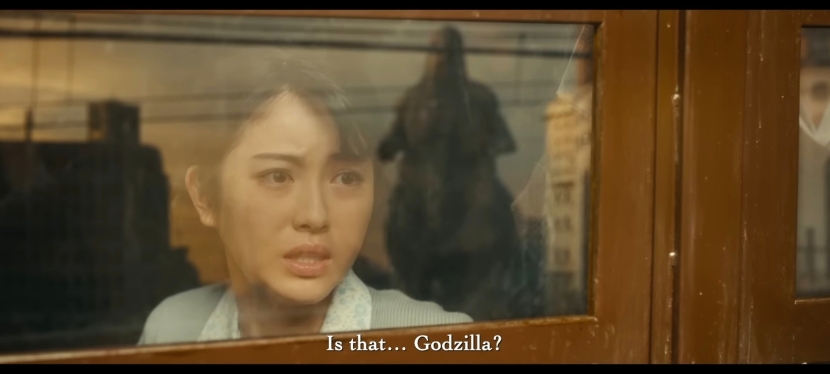
Welcome back, fellow geeks, Blu-ray collectors and movie buffs from around the world! If you are an enthusiast of giant monster movies and if you have gotten tired with what Hollywood has been releasing, there is a brand new Godzilla (Gojira in Japanese) movie from Japan’s Toho which will be released in cinemas before the year ends…Godzilla Minus One (Japanese title: Gojira Mainasu Wan).
The official movie poster for the Japanese market.
To get started about this new Japanese Godzilla movie, I encourage you to watch the official trailer (English subtitles included) below…
The way the details and visuals were presented in the movie trailer, the filmmakers showed Godzilla as a terrifying giant whose presence brings certain death and destruction to those near it. The trailer made Godzilla looking like it intends to kill people. What I find interesting about the core concept of this upcoming movie is that the iconic monster wreaks havoc in Japan a short time after the end of World War II. This emphasizes that Japan is economically weak and struggling to recover from the tremendous losses suffered from the said war. Also spotted were efforts by the filmmakers to replicate the look of post-WWII Japan.
If you know your world history, you should be aware of the facts that America dropped atomic bombs in Hiroshima and Nagasaki in August 1945 which compelled Japan (then a major military force with the Axis powers) to surrender unconditionally. Putting that historical context into the realm of fantasy by Toho, Godzilla Minus One shows what would happen had the giant monster invaded Japan while it was still in a very weakened state.
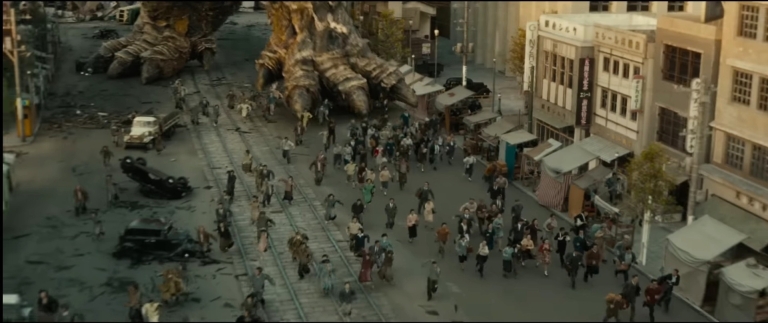
This is a terrifying image of people running away from Godzilla whose steps were causing destruction.
Considering the post-World War II background, it is not yet clear to me if this movie will serve as a prequel to the original Gojira movie of 1954. What is clear is that the filmmakers are daringly making something new with Japan’s icon and their creative approach looks radically different from Toho’s previous Godzilla release in 2016 (note: read my retro review of Shin Godzilla).
Considering the many Godzilla movies released – including those from Hollywood studios – being original with telling a story about the monster is indeed very hard to do. That being said, I am interested to see how the post-World War II setting, the new story and characters, and the giant monster itself will be executed on-screen. If the trailer indicates anything, it looks like Godzilla Minus One could turn out as a dramatic disaster movie (than a monster movie) and could come close to what the 1954 original movie presented.
As of this writing, there are not too many international markets for cinematic releases listed in Godzilla Minus One‘s IMDB page. Being based here in the Philippines, I can only hope that the Japan-made movie will be released in local cinemas which could be a bit tricky given the fact that Shin Godzilla had a limited release here in 2016. I really want to watch this upcoming movie in the local cinema, especially IMAX, but that would depend on how the distribution here in the Philippines will be executed. At the same time, watching a Japanese-made Godzilla movie would be a nice break from the MonsterVerse Godzilla that has been around for years now. Honestly, I’m getting tired of Hollywood’s current version of Japan’s icon.
A very menacing Gojira image from Toho promoting Godzilla Minus One. If you look very closely, you can see some of the giant monster’s teeth red with blood.
If Godzilla Minus One does not get screened locally for some reason, its potential Blu-ray (and possibly 4K Blu-ray) release in the future would be the next option to watch it. Regardless, watch out for this new movie in cinemas in a few months’ time.
Disclaimer: This is my original work with details sourced from watching the movie and doing personal research. Anyone who wants to use this article, in part or in whole, needs to secure first my permission and agree to cite me as the source and author. Let it be known that any unauthorized use of this article will constrain the author to pursue the remedies under R.A. No. 8293, the Revised Penal Code, and/or all applicable legal actions under the laws of the Philippines.
Welcome back fellow geeks, pop culture enthusiasts and comic book collectors! Way back in 1982, the horror comedy anthology film Creepshow was released in cinemas featuring the combined talents of author Stephen King and the late director George Romero who were clearly inspired by the 1950s horror comic books published by EC Comics. That being said, Creepshow was a comic book movie that was not even based on a comic book.
To make things clear, the movie was first shown on the big screen in France during the Cannes Film Festival in May 1982. The comic book adaptation of Creepshow (note: read my retro comic book review) was released in July 1982 and the art it contained is not the same as the in-movie comic book (also titled Creepshow) that appeared in transition scenes. The movie’s general release in America happened on November 10, 1982 and it was successful commercially and critically. In recent times, Creepshow was released on 4K Blu-ray with lots of extra stuff for fans and moviegoers to enjoy. The said 4K Blu-ray release can be ordered online now.
Some of you might be wondering if the Creepshow movie has aged well and what exactly does it offer for younger moviegoers and movie collectors to enjoy. Some of you might be wondering if King and Romero were ever a special creative duo for cinema.
Prologue – A father very angrily berates and hits his young son after discovering the horror comic book titled Creepshow was with him. The father called the comic book’s content crap.
Father’s Day – Sylvia Grantham, her nephew Richard, niece Cass and Hank (husband of Cass) enjoy time together at the Grantham estate anticipating the arrival of Bedelia for the annual family dinner. There is a dark secret regarding Bedelia and her late father…
The Lonesome Death of Jordy Verril – A lonely farmer named Jordy witnesses the unexpected arrival of a meteorite from out space which landed violently on his farm. After realizing what it is, he touches it without any protection and gets his fingers burned…
Something to Tide You Over – a prominent man named Richard visits Harry at his home. It turns out, Harry has been having an affair with Richard’s wife Becky. Even so, Richard maintains his cool and made clear his uncompromising determination of always keeping what is his. Richard plays an audio recording of Becky’s voice which even includes a call for Harry to help her….
The Crate – In the basement level of Amberson Hall (science building of Horlicks University), a janitor accidentally finds a very old wooden crate located right under the staircase. The writings “Ship to Horlicks University via Julia Carpenter – Arctic Expedition – June 19, 1834” were marked on the crate…
They’re Creeping Up on You – A cruel businessman named Upson Pratt is alone in his well-lighted apartment. He has been suffering from mysophobia and has been living in isolation and only communicates with others using the telephone and other electronic methods. Slowly but surely, cockroaches begin to multiply in his apartment…
Quality
Two couples from different short stories of the movie: At left were Hal Holbrook and Adrienne Barbeau. At right were Elizabeth Regan and Ed Harris.
To begin with, I’d like to focus on the combined creativity of Stephen King and director George Romero. While all five short stories, the prologue and epilogue each have varying levels of quality, engagement and entertainment value, it is safe to say that Creepshow as a whole remains entertaining and intriguing to watch. This is a cinematic horror-comedy anthology that is still fun to watch from start to finish.
Very clearly, the King-Romero team were heavily inspired by the EC Comics-published horror comics of the 1950s and along the way, they added their own creative touches to make each short story not only unique but also memorable. Given the fact that Romero remains remembered for his zombie movie works, two of the five short stories can be viewed as shorter zombie tales by the director but with notable differences – the comic book-inspired visuals used (note: moody lighting, stylish backgrounds and comic-inspired frames) and the fine performances from the actors involved. As for the three other short stories that have nothing to do with zombies, I felt they reflected more of Stephen King’s concepts (note: King himself acted as Jordy) which Romero apparently directed to be reflective of the author’s works while still injecting EC Comics-inspired visuals. Speaking of comic books, the filmmakers used traditional animation (note: hand-drawn) specifically in the transition scenes when the movie moved from one segment to the next. Within the context of the movie was the comic book Creepshow which made the father mad at his son.
With moody lighting combined with Leslie Nielsen’s convincing terrified expression, this image captures the look and feel of similar moments in the horror comic books of EC Comics.
As it is clear that each short story has different concepts and varying levels of quality, entertainment and engagement, I can describe them in short results as follows: Father’s Day really looks and feels like it was written for EC Comics in the 1950s; The Lonesome Death of Jordy Verril is a clever mix of dark humor, science fiction and horror; Something to Tide You Over is very intriguing to watch and Leslie Nielsen pulled off a very unique portrayal of a villain; The Crate is a fine combination of monster horror and struggling characters with a university setting; and They’re Creeping Up on You is symbolically a socialist mobbing against someone powerful in the most unusual fashion, and it definitely is the weakest of all the five short stories as it was made to disgust viewers who are afraid of bugs. Creepshow’s prologue and epilogue meanwhile carried an anti-family theme that supposedly reflects the moral outrage against EC Comics in the 1950s made to resonate with people who love comic books at the expense of morality and family. I personally dislike the anti-family theme because I truly believe that minors should never read adulterated comic books and they should never become rebellious.
As each short story, the prologue and epilogue were strongly presented to be entertaining and engaging in varying ways, there is one aspect of the creativity that made Creepshow stand the test of time – the respective performances of the actors.
Leslie Nielsen’s portrayal of the villain Richard is the performance highlight of the entire film. Here’s a powerful man dealing with pain as a result of being betrayed by his wife by being in full control of his emotions and he keep moving on with uncompromised determination to proceed with his diabolical plans patiently and orderly. He is a very angry man who happens to be very calm. He is definitely evil who happens to be very principled. You will even see little traits of comedy in Richard and this should remind you of Nielsen’s eventual move into comedy in his later years. In the same short story, Ted Danson is believable as the man who had the affair with Richard’s wife.
In another short story, Adrienne Barbeau really stands out as the obnoxious and unhinged Wilma (AKA Billie) who is the complete opposite of her mild-mannered husband Henry (played by Hal Holbrook). She is so wild, she easily embarrasses her husband and the others who were present in the faculty social gathering. Quite symbolically, Barbeau’s act as Wilma is easily the most lively thing to watch in the said gathering. Without spoiling the plot of The Crate short story, I can say that Hal Holbrook has a nice range of displaying emotions within Henry as the story progressed. Even the guy who played the professor Dexter Stanley (Fritz Weaver) had his own share of the spotlight and displayed a good acting range as well.
Even author Stephen King himself acted in a leading role in another short story as Jordy. King is surprisingly good in being comedic and he really knows his character in and out. In the first short story Father’s Day, you will see a very young Ed Harris as part of a family waiting for the arrival of Bedelia (Viveca Lindfors). The waiting family members were nicely played by Elizabeth Regan, Warner Shook and the late Carrie Nye. They were convincing as relatives. In the final short story, the late E.G. Marshall played Upson Pratt to be so ruthless, he will irritate you.
Conclusion
Comic book-style visuals implemented cleverly in the movie.
It is clear that Creepshow (1982) remains fun and engaging to watch thanks to the combined creative efforts of the King-Romero team as well as the fine performances of the actors involved. Although the final short story starring E.G. Marshall is the least interesting tale to watch, this horror-comedy anthology has lots of good stuff to entertain viewers. By today’s standards, Creepshow (1982) is very unique and also fun to watch. If you want to see this movie with the best visuals possible today, I urge you to buy the 4K Blu-ray release.
Disclaimer: This is my original work with details sourced from watching the movie Cloak & Dagger (1984) and doing personal research. Anyone who wants to use this article, in part or in whole, needs to secure first my permission and agree to cite me as the source and author. Let it be known that any unauthorized use of this article will constrain the author to pursue the remedies under R.A. No. 8293, the Revised Penal Code, and/or all applicable legal actions under the laws of the Philippines.
Welcome back my readers, fellow movie buffs and 20th century pop culture enthusiasts! Decades ago, I got to watch the movie Cloak & Dagger when it was first released on home video. As time passed by, I got to replay it on cable TV and DVD. I have yet to see its 4K Blu-ray disc version (note: you can order it here) Starring Henry Thomas (the star of Steven Spielberg’s E.T.: The Extra-Terrestrial) and Dabney Coleman, Cloak & Dagger was one of those American movies that did not succeed in movie theaters but found its audience on home video, cable TV and free TV.
The 1984 movie was released at a time when video games gradually made its way into motion pictures in varied ways just before Nintendo started reshaping video gaming. Back then, I was very young and already got into playing games on console and at the arcade which helped me relate with the video game elements of Cloak & Dagger. In case you are wondering, the filmmakers and Atari, Inc. itself collaborated together. There may be some among you who never saw this 1980s flick and some of you may be wondering what is significant about Cloak & Dagger and why is it the topic of this retro movie review.
With those details laid down, here is a look back at Cloak & Dagger (1984) directed by Richard Franklin and written by Tom Holland and Nancy Dowd inspired by the short story “The Boy Cried Murder” written by Cornell Woolrich. This movie is the 4th cinematic adaptation of the said short story.
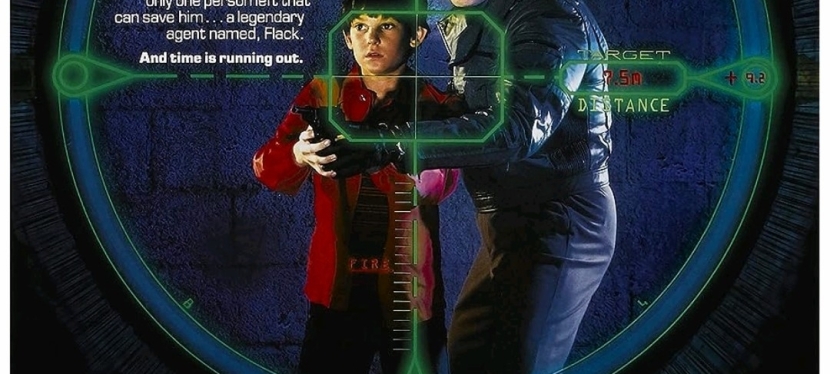
The movie poster of Cloak & Dagger (1984)
Early story
The story begins with Jack Flack (Dabney Coleman) overcoming Soviet guards to enter a place to retrieve top secret documents from incoming people. It turns out that Jack Flack is nothing more than a fictional character imagined by a young boy named Davey (Henry Thomas) who keeps on immersing himself with flights of fantasies, loves playing games and believes that real life is filled with enough opportunities and places to play. In the presence of game store owner Morris (William Forsythe) and his little blonde neighbor Kim (Christina Nigra), Davey boasts a lot about Jack Flack as if he was a real-life hero and even talks to him as his imaginary companion that no one else could see nor hear. Inspired by the said character and the world of espionage he always imagined, the boy carries with him a black water pistol for a “gun” and a softball for a “grenade”.
Morris then sends Davey and Kim out to do a real assignment – an errand to travel within the city going to a certain company and retrieve something for him. Afterwards, the two commuted and entered a building which Davey does with his fantasy of espionage and infiltration burning in his mind. Leaving Kim on the ground floor, he climbs up the stairs until he reaches a certain window and sees something sinister going on in the next level as reflected on one of the windows outside.
Suddenly a door opens near him and a wounded man slowly hands him an Atari 5200 cartridge titled Cloak & Dagger, tells him to bring it to the FBI, and mentions “one million three hundred twenty nine.”
The door near them suddenly opens with two armed men emerging. Right in the presence of Davey, they opened fire at the wounded man who fell down to his death. Davey just became the witness of an actual murder and becomes the target of the two gunmen…
Quality
Henry Thomas and Christina Nigra as Davey and Kim respectively.
To get to straight to the point, I can declare that this movie is very clearly a spy thriller designed to engage both children and adults. It took the key concept of the short story “The Boy Cried Murder” and implemented it into its very own tale that happens to be set during Ronald Reagan’s America (the 1980s) with elements of video games, espionage and even murder mixed together.
The story told through Davey was crafted to be entertaining while keeping viewers in suspense as to how the overly imaginative young boy would deal with real-life danger and consequences as he became the target of murderous men who would not stop at all. Davey is clearly in danger for much of the movie and you will get to sympathize with him and wish he should stop being obsessed with fantasy so he could overcome the trials that were happening. This is, indeed, a well structure and nicely directed work by Richard Franklin who seem to be inspired by past works of Alfred Hitchcock (note: Franklin directed the sequel to Hitchcock’s classic Psycho).
As mentioned earlier, this movie was made to engage both children and adults. Cloak & Dagger is not exactly a wholesome viewing experience as its presentation has always been quite intense because of on-screen violence that was executed carfully. There are guns, shooting and even killing in this flick which proved to be integral to the overall presentation and clearly added to the thrill factor. You will get to see getting Davey shot at by the armed henchmen (Eloy Casados and Tim Rossovich) who clearly do not give a damn of shooting a minor as they are so focused on their mission. Looking at the henchmen in this film, I can imagine them as traitorous Americans conspiring with their nation’s foreign enemies such as the Soviets, the Iranians and the Palestinians. Along the way, there is the clear villain named Rice (Michael Murphy) who has this subtle touch of evil as well as a good amount of sleaziness in him. While the violence is intense, it does not necessarily push this film into rated R territory.
Michael Murphy as the sleazy villain who is willing to kill Davey even though he is a minor.
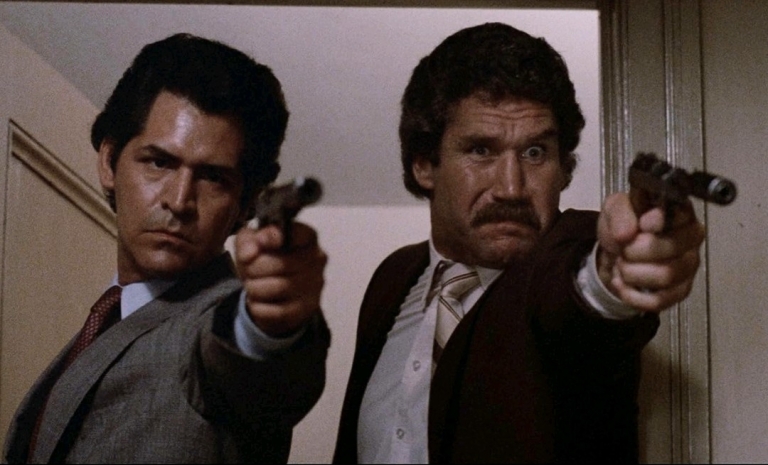
The two henchmen about to commit murder in the presence of Davey. There is evil visible in their faces.
Henry Thomas really shines as the protagonist here. While Davey here shares a few elements with E.T.’s Elliot – struggling to move forward with the absence of one parent and adjusting his life with what he perceives to be the best ways possible – he truly dramatizes how weird and wild he could be living his life with a very loose grip on reality. For him, local society in San Antonio, Texas, provides him a huge playground for his spy game and he sure distracts people as he walks by them talking to his imaginary friend Jack Flack. Still, there are key parts of the story in which Henry Thomas convincingly dramatizes Davey who feels lonely inside as he misses his late mother and is unable to spend quality time with his father. Thomas also acted with intensity in the scene in which he makes a trade with the villain and also during his last face-off with him in the 2nd half of the film. Henry Thomas really was a good youth actor and his performance here is often overshadowed by his role in Spielberg’s E.T.
Dabney Coleman on the other hand plays both Jack Flack and Davey’s father Hal. Coleman is quite versatile playing different characters here. As Jack Flack, he fits in excellently into Davey’s uncontrolled belief of espionage as he gives him advise which were taken seriously leading into danger. Of course, advising Davey does not really mean the fictional spy cares for him on a personal level and you will eventually Flack’s true value before the film ends. Flack’s final moments could inspire you to re-examine the true meaning of heroism. As Hal, Coleman convincingly plays the father who has been so busy working in the Air Force as an air traffic controller, he has been unable to spend quality time with his son and the recent death of his wife really took its toll on their family. Compared to Jack Flack, Hal is indeed caring towards his son but his hectic work schedule prevents him from bonding closely with him. Coleman delivered a fine performance during the scene when Hal explains to Davey what real-world heroism is and that not all heroes just shoot bad guys. There definitely are helpful values on parenting within Hal.
Henry Thomas and Dabney Coleman are really convincing as son and father.
Thomas and Coleman artistically have really fine chemistry together as the father and son (Hal and Davey) and as the wannabe adventurer spending lots of time with his action hero (Davey and Jack Flack). Considering Davey’s obsession with fantasy and the attention he pays so much to Jack Flack, he was practically living with idolatry and foolishness. If you observe closely, Davey is very lively with Flack and not so lively with his father.
Even though this movie is fictional, it still dramatizes that parenting will never be easy. That being said, this should inspire parents and also incoming parents to prepare themselves on nurturing their children and ensure they help them understand the differences between reality and fantasy.
Video game elements
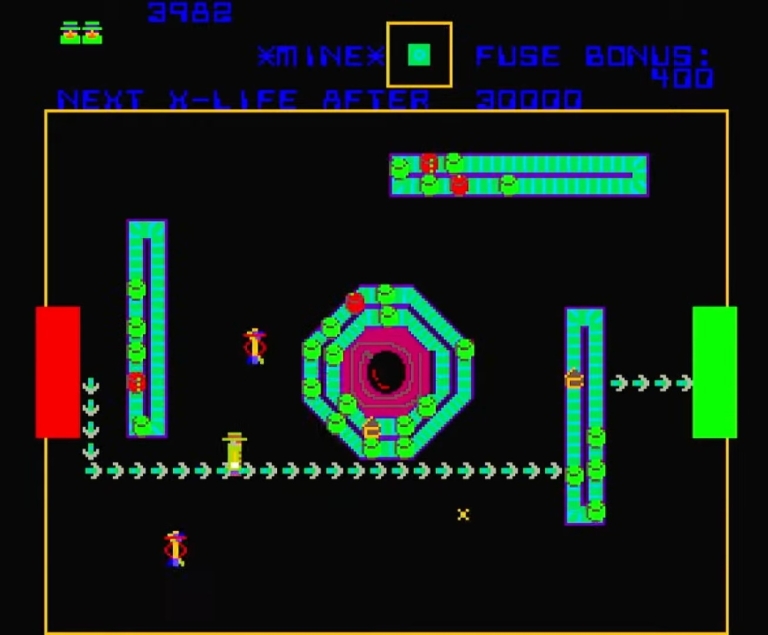
Screenshot from the Cloak & Dagger arcade game. This game can be played nowadays through Antstream Arcade on Xbox consoles.
To make things very clear, Cloak & Dagger (1984) is not an adaptation of the electronic game that was released the same year. Rather it has the Cloak & Dagger game as a key plot element in the form of an Atari 5200 game cartridge (referred to as a “tape”) which the movie dramatizes to be real.
As a kid, I got to play arcade and console games a lot. As such, seeing Davey play the Cloak & Dagger game on his Atari 5200 as well as gameplay footage was a very entertaining viewing experience for me the first time I ever saw this movie. It was a scene I personally related with.
In real life, however, the Cloak & Dagger game from Atari, Inc. was released only in the arcades as the efforts to create a port for the Atari 5200 never got fulfilled. That being said, it was through very clever film editing that video footage of the arcade version were inserted into the scene in which Davey played the Cloak & Dagger cartridge on his console in the presence of his father. To clarify things, the Atari 5200 was a commercial failure in real life and it seems that making a console version of the arcade game did not make business sense to Atari, Inc. at all.
If you want to play the Cloak & Dagger arcade game in your home right now, you will need an Xbox console and Antstream Arcade ($30 for 1-year subscription, $80 for lifetime pass). Cloak & Dagger is just one of over a thousand games available through Antstream Arcade and you can learn more by clicking here and here.
Conclusion
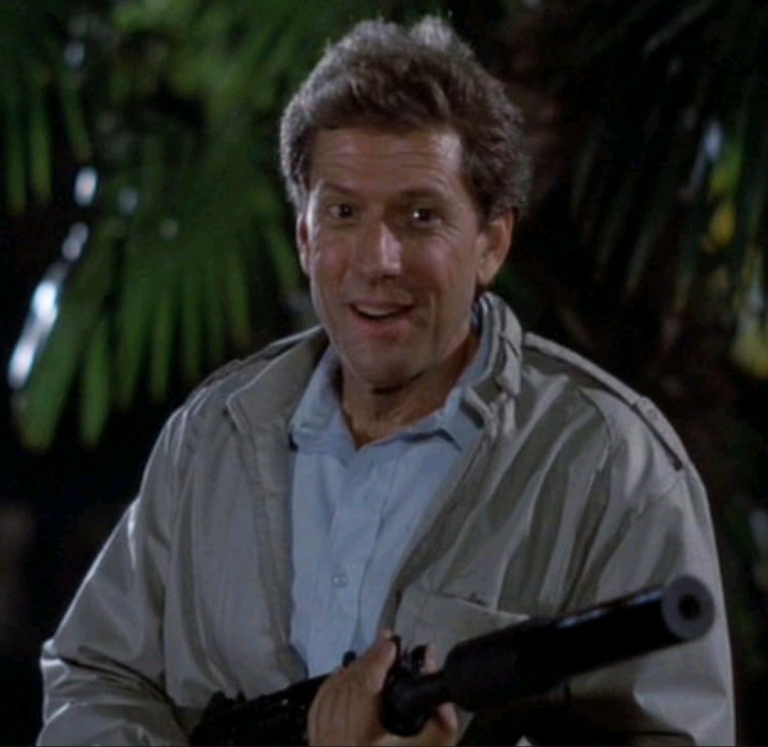
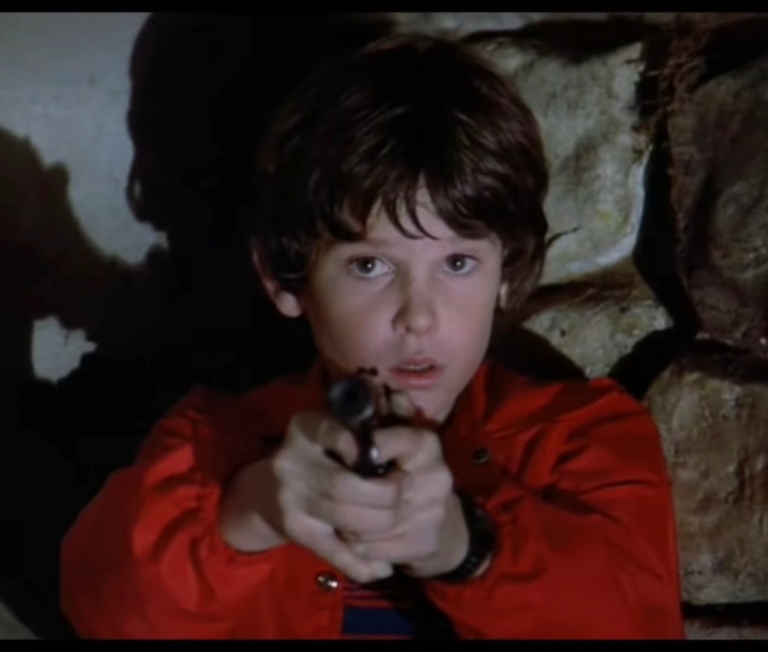
Henry Thomas as an armed Davey.
I have seen Cloak & Dagger (1984) many times throughout my life from childhood and to adulthood. I can clearly say that this 1980s movie is still really good to watch as its appeal to both children and adults remains strong and intact. It is a medium-paced spy thriller that not only follows a young boy who witnesses and murder and gets into danger (note: even his neighbor gets involved) but also dramatizes (in entertaining ways) how dangerous situations can get when you are living with uncontrolled personal fantasy and interacting with a heroic friend who does not really exist. Considering the time this movie was released, I am delighted to tell you cautious readers that there definitely is no wokeness nor were there any traces of political correctness that got in the way of its presentation. Going back to the parenting aspect of this film, it is made clear that children need their parents for moral support and there is absolutely no way that games, fictional heroes and geek culture could ever be good alternatives. Like the adults, children should never lose their grip on reality and should be taught that uncontrolled fantasy can lead to real-life danger. Very clearly, director Richard Franklin and the crew did a fine job telling a solid story and emphasizing the main characters while also providing suspense, action and thrills.
Considering all the mixed elements it has, Cloak & Dagger (1984) can be engaging towards parents, their children, fans of espionage and people who love video games. Finally, I should state that the City of San Antonio in the Lone Star State of Texas is indeed a great location for filmmaking and viewing.
Among those four movies, the only one I actually enjoyed was Star Trek: First Contact (directed by Jonathan Frakes). While that movie has flaws and some questionable creative moves, the 1996 movie was still entertaining and turned out to be a lot more engaging than its 1994 predecessor. First Contact was the highlight of the Star Trek: TNG movies before things really went downhill with the 1998 and 2002 films. For the movie collectors and Star Trek fans reading this, Star Trek: First Contact 4K Blu-ray has been available since April 4, 2023. Were you able to buy a copy for your movie collection? If you did, were the visuals on the 4K Blu-ray disc really great to watch?
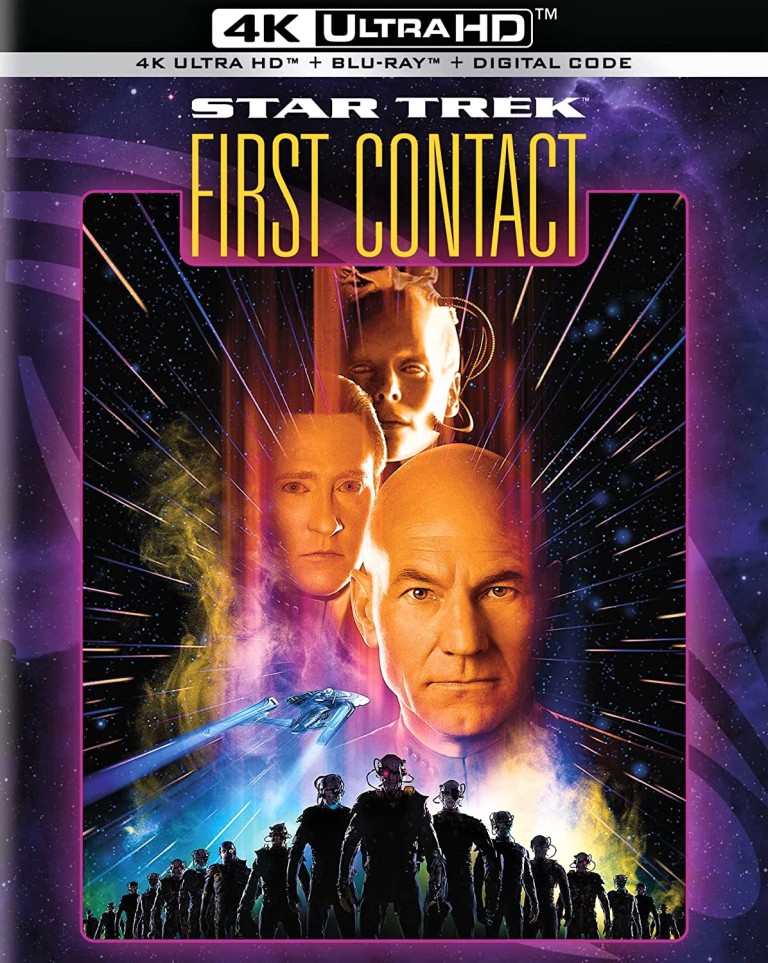
The 4K Blu-ray front cover of Star Trek: First Contact carries the popular image from the 1996 movie poster.
To put things in perspective, posted below are the technical details of Star Trek: First Contact 4K Blu-ray as displayed on its Blu-ray.com page…
Discs – 4K Ultra HD, Blu-ray Disc, Two-disc set (1 BD-66, 1 BD-50)
Digital – Digital 4K, iTunes, Vudu
Packaging – Slipcover in original pressing
Playback –4K Blu-ray: Region free, 2K Blu-ray: Region A
To be clear, I have not purchased a copy of Star Trek: First Contact 4K Blu-ray as of this writing. I am interested in it but I could not make a decision to do so due to financial and practical reasons. I recently purchased Casablanca 4K Blu-ray, Top Gun: Maverick 4K Blu-ray and a Blu-ray of the James Bond movie Licence to Kill and I really enjoyed watching those three. I am also replaying the 4K Blu-ray and Blu-ray movies I already have (note: V: The Original Miniseries and V: The Final Battle have very high replay value respectively, read about their respective Blu-ray releases here and here). As such, there’s no reason for me to rush to acquire Star Trek: First Contact’s 4K Blu-ray release.
I should also state that I was never a fan of the entire Star Trek entertainment franchise even though I enjoyed certain movies of it. While Star Trek II: The Wrath of Khan is my favorite among the movies of the classic Star Trek cast (led by Captain Kirk), Star Trek: First Contact is the only Star Trek TNG movie I ever enjoyed.
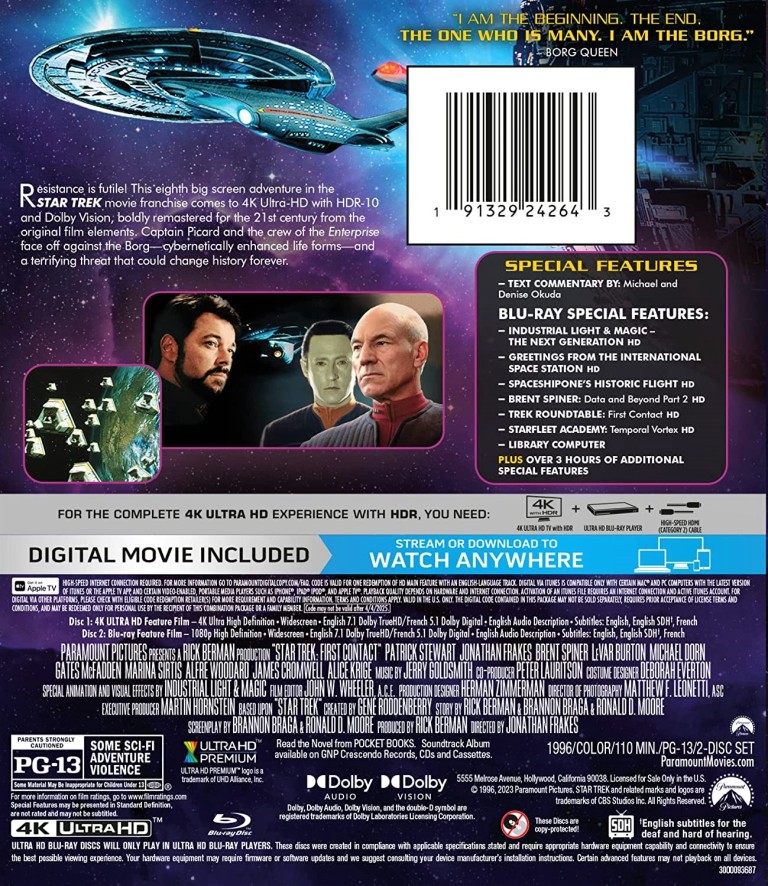
This is the rear of the Star Trek: First Contact 4K Blu-ray. Pay close attention to the technical details as well as the listed special features.
I first saw Star Trek: First Contact on a rented VHS tape in the summer of 1998 (note: I completely missed its 1996 theatrical release) and by the end of it, I felt this impact of fun, dramatics and visual effects. It was also in that movie where I saw Captain Picard really obsessed with saving his crew and saving the humanity’s future while struggling with his post-traumatic stress disorder (PTSD) with the Borg given his history being captured and assimilated by them. The Borg themselves were really terrifying although the inclusion of a queen brings down the concept of the unrelenting collective hive.
Just years ago, I bought a DVD copy of the 1996 movie. To be clear, I never bought the 2009 Blu-ray disc. At this stage, I have yet to replay Star Trek: First Contact in HD and Ultra HD. According to the Blu-ray.com review, Star Trek: First Contact 4K Blu-ray has a great 2160p/Dolby Vision UHD presentation and that the image is “nearly perfect”. For insight watch the comparison video below…
Perhaps someday, I could add the 4K Blu-ray release of Star Trek: First Contact into my collection. I am interested in it and the 4K visuals look attractive and they could look even better on our household’s 4K UHDTV. I should state that the Blu-ray disc of the 4K Blu-ray set contains a whole bunch of extras and special features. It’s a matter of timing, pricing (note: watch out for the occasional online sale) and entertainment-related priority on my part.
Welcome back, fellow geeks, Blu-ray collectors and movie buffs! If you are fond of old-school creature features, suspense and horror for your home viewing, then you might be interested to know that the 1980 film Alligatorwill be released in 4K Blu-ray format on February 22, 2022 according to a Blu-ray.com update. Alligator 4K Blu-ray is an upcoming release prepared by Scream Factory and interested costumers can order it right now online.
To put things in perspective, posted below are key details from the Blu-ray.com article about Alligator 4K Blu-ray combo. Some parts in boldface…
The 4K Blu-ray cover.
DISC ONE: 4K BLU-RAY – THEATRICAL VERSION
EXCLUSIVE NEW 4K RESTORATION FROM THE ORIGINAL CAMERA NEGATIVE
Audio Commentary With Director Lewis Teague And Actor Robert Forster
Optional English SDH subtitles for the main feature
DISC TWO: BLU-RAY – THEATRICAL VERSION
EXCLUSIVE NEW 4K RESTORATION FROM THE ORIGINAL CAMERA NEGATIVE
NEW Everybody In The Pool – An Interview With Actress Robin Riker
NEW Wild In The Streets – An Interview With Director Lewis Teague
NEW It Walks Among Us – An Interview With Screenwriter John Sayles
NEW Luck Of The Gator – An Interview With Special Makeup Effects Artist Robert Short
NEW Gator Guts, The Great River, And Bob – An Interview With Production Assistant, Now Famous Actor/Director/Producer, Bryan Cranston
NEW Newspaper Ad Still Gallery By Drive-In Asylum
Audio Commentary With Director Lewis Teague And Actor Robert Forster
Alligator Author – An Interview With Screenwriter John Sayles
Additional Scenes From The TV Version
Promotional Materials
NEW Teaser Trailer (New 2K Scan)
NEW Theatrical Trailer (NEW 2K Scan)
NEW TV Spots (NEW 2K Scan)
Trailers From Hell – Filmmaker Karyn Kusama (Jennifer’s Body) On ALLIGATOR
ALLIGATOR Game Television Commercial
Still Gallery (Movie Stills, Movie Posters, Lobby Cards, And Behind-The-Scenes Photos)
Optional English SDH subtitles for the main feature
DISC THREE: BLU-RAY – EXTENDED TELEVISION VERSION
NEW 4K RESTORATION FROM THE OCN WITH ADDITIONAL FOOTAGE FROM AN INTERPOSITIVE
The extended television version is presented in high-definition for the first time ever.
Posted below are the other details from Alligator’s own page at Blu-ray.com…
Discs – 4K Ultra HD, Blu-ray Disc, Three-disc set (1 BD-100, 2 BD-50)
Packaging – Slipbox, Reversible cover
Playback – 4K Blu-ray: Region free, 2K Blu-ray: Region A
The movie poster from 1980.
Personally, I saw Alligator on home video way back in the 1980s and sometimes on cable TV afterwards. In American pop culture, the Lewis Teague-directed movie was one of several creature feature movies that got released as part of a wave of imitators who were inspired by the massive success of Steven Spielberg’s Jaws. Alligator had a mixed-to-positive reception from the movie critics in 1980 and its ticket sales were almost four times its production budget.
How this old movie will look like in 4K interests me, and the 4K visuals have been confirmed to be native 4K. As typical with other Scream Factory releases, Alligator will come with lots of extra stuff that fans and movie buffs will eventually enjoy. Watch out for this 4K Blu-ray release on February 22, 2022.
In closing this Better than Streaming piece, posted below are Alligator-related videos for your viewing pleasure.
+++++
Thank you for reading. If you find this article engaging, please click the like button below and also please consider sharing this article to others. If you are looking for a copywriter to create content for your special project or business, check out my services and my portfolio. Feel free to contact me with a private message. Also please feel free to visit my Facebook page Author Carlo Carrasco and follow me on Twitter at @HavenorFantasy as well as on Tumblr at https://carlocarrasco.tumblr.com/