In light of the aggression of Communist China in the Pacific and security challenges coming from North Korea, the government of Japan set its draft defense budget for fiscal 2026 at a record figure of 9 trillion yen (estimated at $58 billion), according to a news article published by Kyodo News.
To put things in perspective, posted below is an excerpt from the news release of Kyodo News. Some parts in boldface…
Japan’s draft defense budget was set at a record 9.04 trillion yen ($58 billion) for fiscal 2026, the government said Friday, as the country faces increasing security challenges from China and North Korea.
The figure, including outlays linked to hosting U.S. military bases, eclipses the then record 8.7 trillion yen in the initial budget for the current fiscal year to March 2026. Fiscal 2026 marks the fourth year of Japan’s five-year 43-trillion-yen defense buildup plan.
The Cabinet of Prime Minister Sanae Takaichi approved the same day a draft initial state budget for the year starting next April worth 122.3 trillion yen, also a record high, including defense and other expenditures.
Under the defense budget, 100.1 billion yen has been earmarked for building the “Shield” layered coastal defense system, which requires numerous aerial, surface and underwater vehicles. The spending on Shield comes at a time when many countries have been rapidly developing drone technology since the Russia-Ukraine war changed the nature of warfare.
With China in mind, 1.1 billion yen has been set aside to assess the use of long-endurance drones as a measure against airspace violations.
Japan plans to rebrand the Air Self-Defense Force as the Air and Space Self-Defense Force to enhance the country’s space capabilities.
Another 1.1 billion yen has been earmarked for acquiring equipment to monitor satellite interference.
The country has secured 30.1 billion yen to procure hypersonic guided missiles, which travel at above five times the speed of sound and are considered hard to intercept, as a means of counterattack.
Let me end this piece by asking you readers: What is your reaction to this development? Do you think the record defense budget of 9 trillion yen is sufficient to keep Japan secured from the threats of China and North Korea?
Welcome back readers, fellow geeks and electronic gaming fans!
In this edition of the Retro Gaming Ads Blast (RGAB) series, we will take a look at another batch of retro gaming print ads – including arcade flyers – from the 1980s to the 1990s.
For the newcomers reading this, Retro Gaming Ads Blast (RGAB) looks back at the many print ads of games (console, arcade, computer and handheld) that were published in comic books, magazines, flyers, posters and newspapers long before smartphones, social media, the worldwide web and streaming became popular. To put things in perspective, people back in the 1980s to the 1990s were more trusting of print media for information and images about electronic games and related products.
With those details laid down, here is the newest batch of retro gaming print ads for you to see and enjoy…
1. Starflight Sega Genesis Print Ad
Sometimes the very detailed artwork made gamers imagine Starflight as a sci-fi movie waiting to happen.
By the time it was released on the Sega Genesis in 1991, Starflight was already popular as it was released on varied computer systems and entertained a lot of gamers several years prior. To promote the Sega Genesis version, a 2-page print ad of Starflight was made with a grand-looking artwork of space, spaceships and planets dominating the space. The ad makers managed to utilize the remaining space below the artwork to show selected images, the descriptive text and the game’s box cover to make it clear to gamers that Starflight on Genesis is real and made to be playable. The artwork itself remains a powerful grabber of attention even to this day.
2. Defender Japanese Arcade Flyer
The front.
The rear.
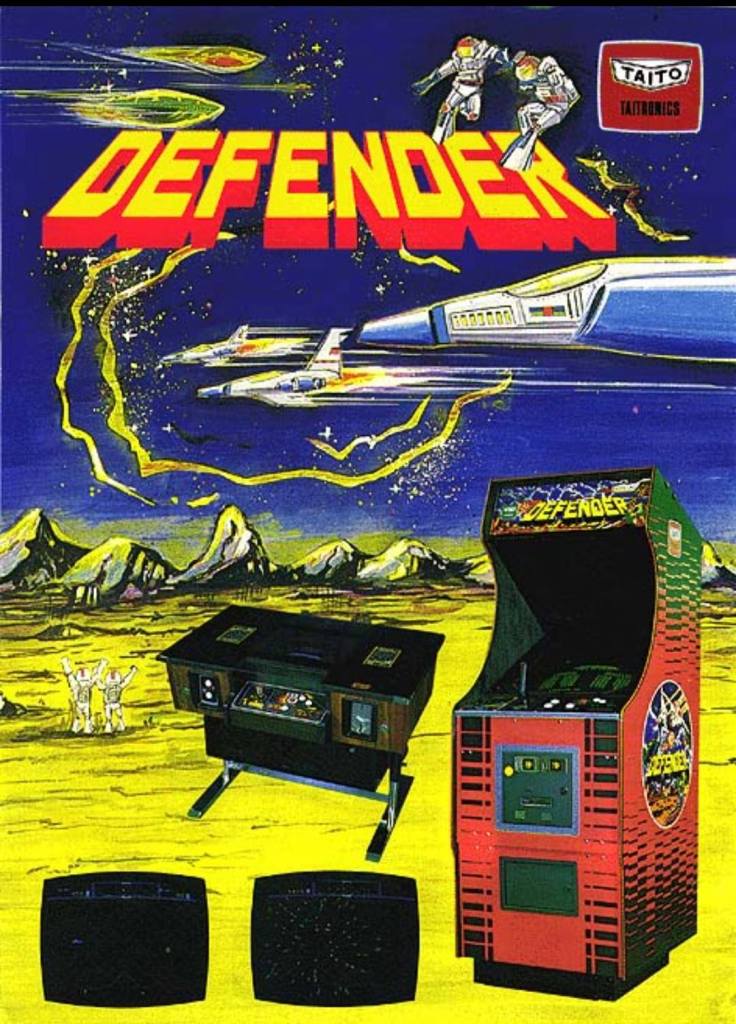
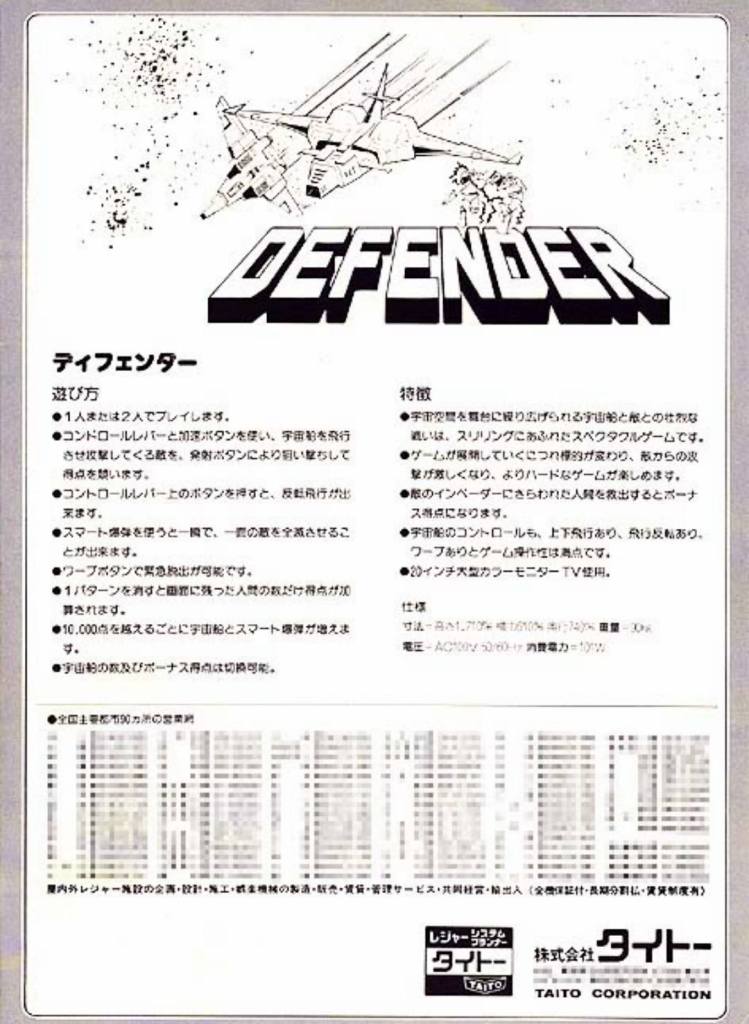
Defender is one of my favorites among the many games of Midway. In recent times, I’ve been playing the arcade version of Defender on my Xbox Series X using the Midway Arcade Origins digital copy I purchased online. As Defender became a massive hit in America, it was released in Japanese arcades with Taito handling the distribution. The arcade flyer Taito came up with used hand-drawn art for the background on the front along with pictures of the arcade cabinet and the arcade cocktail table versions of the game. While the rear of the flyer looks very simplistic, the front remains attractive to look at.
3. Castlevania III: Dracula’s Curse Print Ad
Some people found the artwork looking creepy or even terrifying.
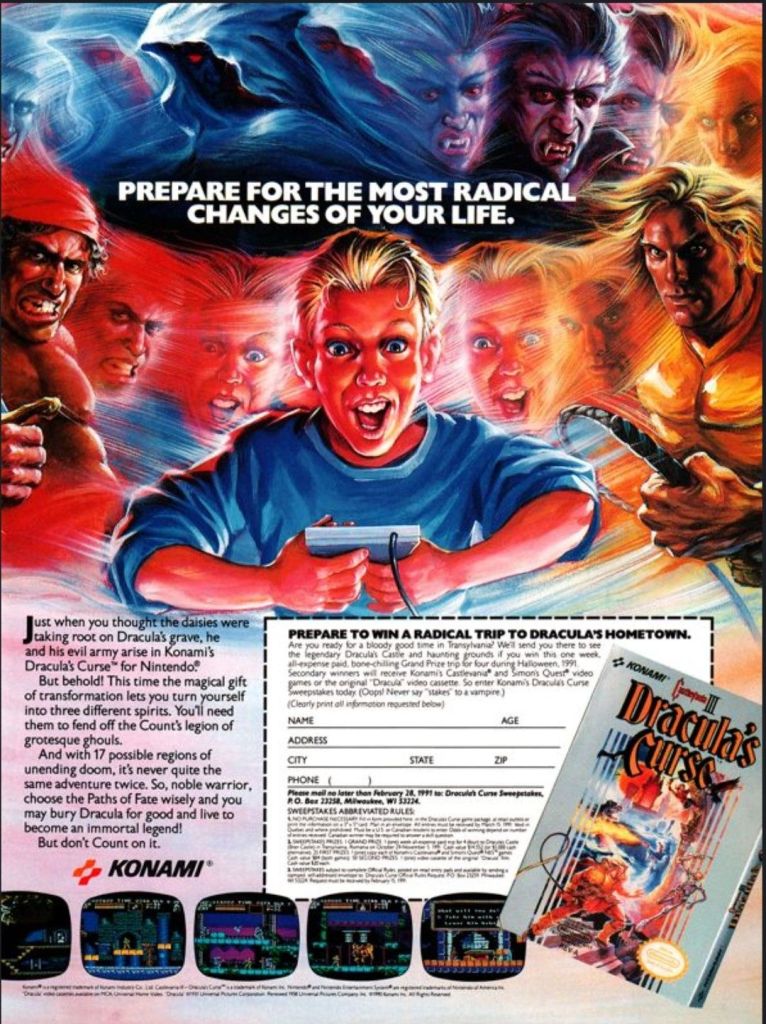
By the year 1990, the Nintendo Entertainment System (NES) was present in several millions of households all over America and there were lots of great games available. Among the NES gamers were fans of the Castlevania game series and Konami went on to release Castlevania III: Dracula’s Curse in America. As part of the company’s aggressive promotion, a single-page ad featuring a detailed looking artwork of a gamer getting immersed with the game’s fantasy elements (look at the creepy looking characters, monsters and the game’s hero present) was done. While the artwork was a strong attention grabber, what stood out was the sweepstakes form for gamers to cut out, fill it with their information and mail it for the chance to win a trip to the hometown of Dracula. Do you personally know anyone who won in the sweepstakes?
4. Double Dragon Games Print Ad
Print ad made with Double Dragon fans in mind.
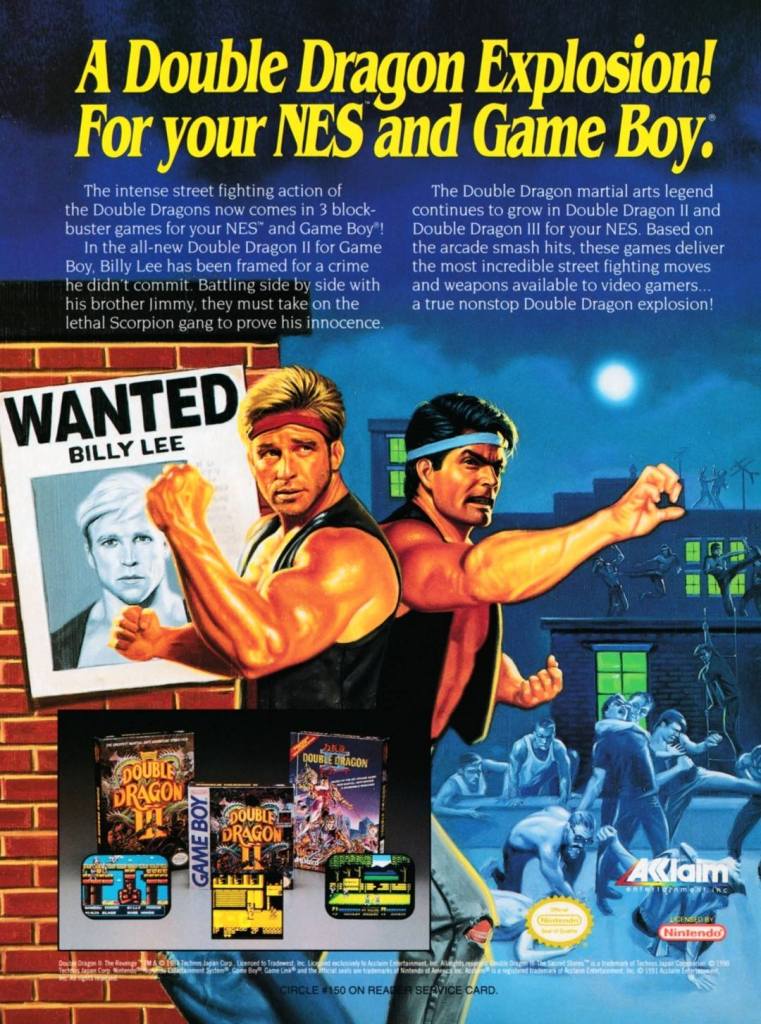
When it comes to the console and handheld presence of the Double Dragon games franchise, it was on Nintendo hardware – specifically the NES and the Game Boy – where gamers and the fans could find them. Acclaim Entertainment knew how popular Double Dragon games were with Nintendo gamers and they aggressively marketed Double Dragon III: The Sacred Stones and Double Dragon II with a single-page print ad that had great looking painted artwork. Very clearly, this early 1990s ad was made to connect strongly with Double Dragon fans and its presentation still looks very solid even with today’s standards.
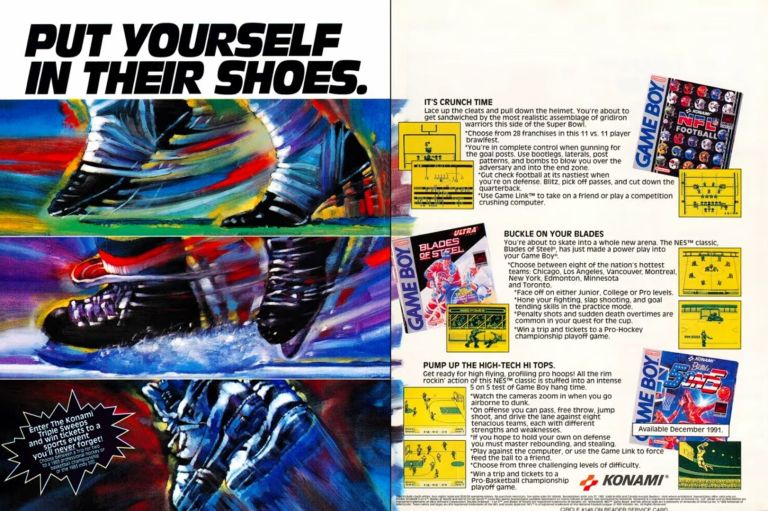
5. Konami 3-in-1 Game Boy Games Print Ad
The excitement of sports is clearly shown in this old ad.
From the mid-1980s to the early 1990s, Konami published a lot of games on Nintendo’s wildly popular platform the NES and among them were classics like Contra, Castlevania and Metal Gear. Konami’s support also made it to Nintendo’s Game Boy handheld device (first released in 1989) which itself sold strongly and became the leading platform for portable gaming. As such, Konami made a 2-page print ad promoting NFL Football, Blades of Steel and Double Dribble: 5 on 5 for Game Boy. Cleverly, the ad makers used fancy artworks on the left (reflecting the different sports) side while using the space on the right side for descriptive text, screenshots and game box covers. This fine looking ad has a strong appeal towards Game Boy users and sports enthusiasts.
6. Tengen 6-in-1 Print Ad
This old print ad is a delight for those who owned a Sega Genesis.
Back in the 1980s, Atari formed the company Tengen to not only develop games but also publish game for computers and game consoles. During that decade, Tengen published games on the NES but they had trouble working within the strict licensing terms of Nintendo. The two companies would later get into court battles over a series of events within the gaming business. Eventually, Tengen started doing business with Sega and published games on the Genesis console. As part of their aggressive publishing of games on Sega’s console, Tengen came up with this 2-page print ad promoting six different games emphasizing that the fun arcade experiences are coming to gamers’ homes.
7. Dig Dug Print Ad
Are you aware of the business relationship and trust between Atari and Namco?
When Atari opened its branch in Japan – called Atari Japan – in the 1970s, they established a partnership with Namco to distribute arcade games there. As they experienced trouble penetrating the Japanese market, Atari eventually sold Atari Japan to Namco which paved the way for their Japanese partner to get into video games. Just a few years later, Namco developed its own original arcade game Dig Dug which became a massive hit in Japan. As a licensing deal was already in effect, Atari distributed Dig Dug in American arcades which the above magazine print ad clearly shows.
8. Sega Genesis Over SNES Print Ad
Sega directly attacked Nintendo by emphasizing the larger quantity of games andvaried game experiences that can only be found on the Genesis back then.
By the time Nintendo released the Super Nintendo Entertainment System (SNES) in 1991, the Sega Genesis console has been in the video game market for a few years already. In America, Tom Kalinske led Sega and his approach to marketing and resonating with gamers was essentially aggressive. The aggressive approach includes naming their competition and showing why Sega is superior. Given the lead time they had on the North American market, Sega came up with this print ad showing their Genesis consoles having a lot more games than the SNES. Competitive console gaming was very different back then.
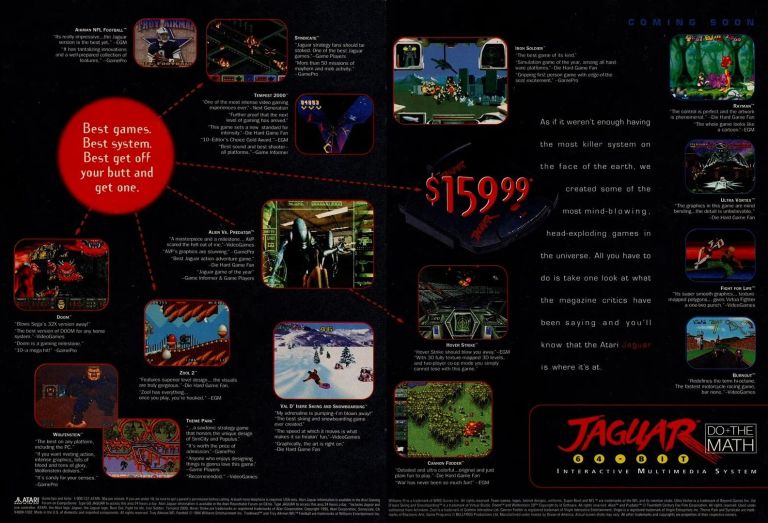
9. Atari Jaguar Print Ad
Did you spend $159.99 on an Atari Jaguar console back in the 1990s?
In the 1990s, Atari attempted a comeback in console gaming with the Atari Jaguar console. Early on, their marketing emphasized the so-called 64-bit capabilities of the Jaguar to convince gamers theirs is the most powerful console on the market. Sadly, the console failed to achieve strong sales and a huge price cut was executed. To attract customers, Atari came up with this 2-page print ad to inform them of the cheaper $159.99 price while reminding them of the “most mind-blowing, head-exploding games” they can have with the Jaguar. Obviously this ad campaign failed as the Atari Jaguar never achieved commercial success.
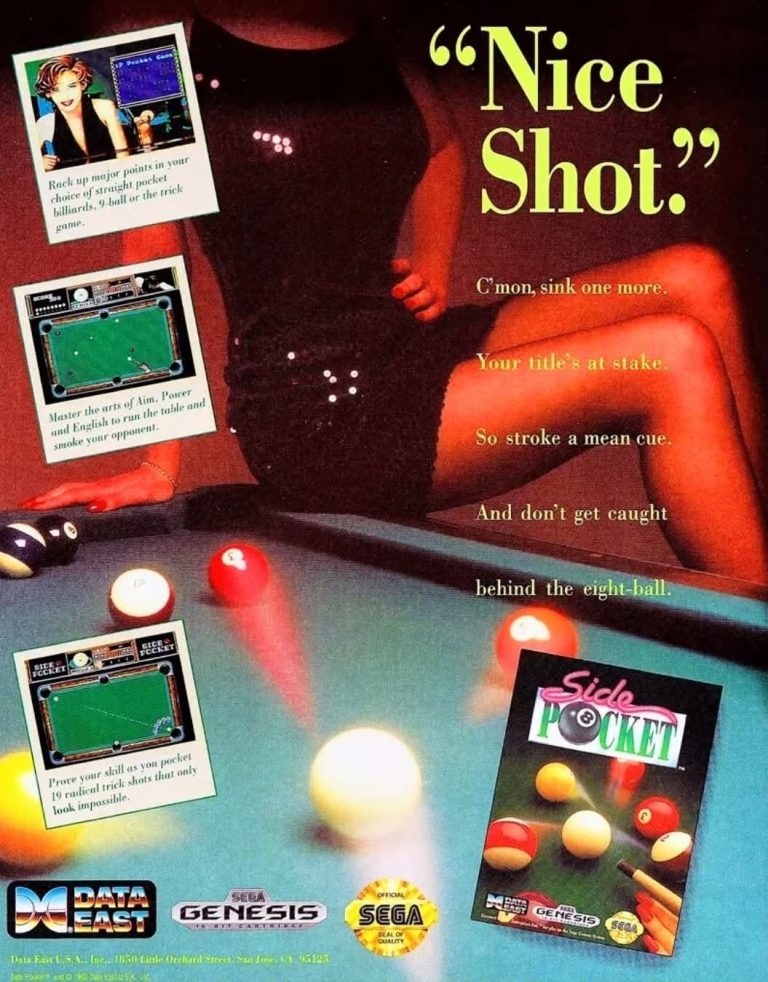
10. Side Pocket Print Ad
The Side Pocket print ad with a subtle touch of sexiness.
After its original release in the arcades in 1986, Side Pocket was ported by Data East to many consoles and handheld devices in the 1990s. When it comes to promoting the Sega Genesis version, Data East came up with this print ad showing a lady in a sexy dress in the background (head hidden) which instantly created a sexy aesthetic. The large text displayed emphasized the game of billiards supported by the screenshots shown. The screenshot at the upper-left corner shows artwork of a pretty lady smiling at the viewer which added to the sexy aesthetic of the ad.
With countless challenges – both internal and external – affecting Japan every day, Prime Minister Sanae Takaichi is determined to make the nation stronger and more prosperous by implementing reforms, according to a Kyodo News article. The Prime Minister delivered her New Year’s statement.
To put things in perspective, posted below is an excerpt from the news release of Kyodo News. Some parts in boldface…
Prime Minister Sanae Takaichi on Thursday pledged to make Japan “strong and prosperous” by carrying out “necessary reforms” to address various domestic and global challenges.
In her New Year’s statement, Takaichi, who became Japan’s first female prime minister on Oct. 21, said her government is committed to building a nation where younger generations can believe in the future and live in hope.
Takaichi emphasized that Japan faces a shrinking population, rising living costs after decades of deflation, and what she described as “the most severe and complex security environment” since the end of World War II.
Globally, political and economic uncertainties are growing as “the free and open international order is being shaken and hegemonic moves are increasing,” she said, in an apparent reference to China’s escalating military activities and Russia’s invasion of Ukraine.
Takaichi took office after winning the Liberal Democratic Party leadership race in early October, succeeding Shigeru Ishiba, who had announced the previous month that he would resign following the party’s heavy setback in the House of Councillors election in July.
With Takaichi’s Cabinet maintaining high approval ratings — well above those of her immediate predecessors — parliament is set to begin this year’s 150-day regular session on Jan. 23.
Let me end this piece by asking you readers: What is your reaction to this development? Apart from the pending new rules on foreigners, what kind of social and economic reforms do you think Prime Minister Takaichi and her administration will come up with over the next six months? Do you think the government will be able to come up with new policies to encourage married couples to have more children?
Recently in the city of Parañaque, local police officers successfully pulled of a buy-bust operation resulting in the arrest of a drug suspect and the seizure of illegal drugs worth more than P700,000, according to a new report by Manila Bulletin.
To put things in perspective, posted below is an excerpt from the Manila Bulletin report. Some parts in boldface…
Authorities from the Parañaque City Police Station Drug Enforcement Unit (SDEI) conducted a buy-bust operation that led to the arrest of a drug suspect and in the confiscation of P714,000 worth of shabu on Tuesday, Dec. 23.
The Southern Police District (SPD) identified the suspect as John, 23, a resident of Barangay BF Homes, Parañaque City. He was arrested at around 4:00 p.m. at Hontiveros Compound in Barangay San Antonio.
Police said the suspect was apprehended after selling five grams of shabu worth P34,000 to an undercover police officer during the operation.
Recovered from the suspect were a total of 105 grams of shabu valued at P714,000, the buy-bust money, a black pouch, and a black cellular phone allegedly being used in the drug transaction.
Let me end this post by asking you readers: What do you think about this recent development? If you are a resident of Parañaque, has your local community been affected negatively by people who are selling illegal substances? Do you think crime in Parañaque will get worse in this new year?
For more South Metro Manila community news and developments, come back here soon. Also say NO to fake news, NO to irresponsible journalism, NO to misinformation, NO to plagiarists, NO to reckless publishers and NO to sinister propaganda when it comes to news and developments. For South Metro Manila community developments, member engagement, commerce and other relevant updates, join the growing South Metro Manila Facebook group at https://www.facebook.com/groups/342183059992673
Here in the Philippines, the renewable energy sector suffered a tremendous setback at the Department of Energy (DOE) officially terminated eighty-four renewable energy service contracts over the failure of developers to meet their contractual obligations, according to a news release by the Philippine News Agency (PNA).
To put things in perspective, posted below is an excerpt from the news article of the PNA. Some parts in boldface…
The Department of Energy (DOE) has terminated 84 renewable energy service contracts this 2025 after developers failed to implement their contractual obligations.
These service contracts cover an “estimated 5,372.209 megawatts (MW) of potential capacity that had been factored into the country’s energy planning assumptions,” the DOE said in a press release Wednesday.
These were terminated “due to developers’ non-compliance with work program requirements, failure to satisfy the Green Energy Auction Program (GEAP) Terms of Reference, and non-adherence to established DOE standards.”
These actions, it said, “follow a comprehensive technical and legal evaluation of the affected projects’ compliance with the material terms and conditions of their respective service contracts.”
“The DOE will continue to uphold high standards for the succeeding GEAP rounds and may impose further sanctions, including blacklisting, forfeiture of performance bonds, and the imposition of applicable penalties,” it said.
The DOE said 43 other RE projects are under enforcement review and may be subject to termination.
With a big chunk of potential capacities unmet, the DOE said it is “actively revisiting supply-demand scenarios and undertaking further system planning to determine appropriate next steps toward meeting established generation targets.”
Let me end this post by asking you readers: What is your reaction to this recent development? Do you think the developers and stakeholders of the renewable energy sector of the Philippines are mostly incapable of fulfilling the requirements of the national government with regards to energy service contracts?
Let us be very clear here. Japan has all the authority to decide how to manage its internal affairs, national security and the presence of foreigners in their country. That being said, tighter control on immigration by Japan could become a reality as an advisory panel called for it, according to a Kyodo News release.
That’s not all. The same panel also called for more opportunities for foreign residents to learn Japan’s language and enhance their understanding of the nation’s culture and norms.
To put things in perspective, posted below is an excerpt from the news release of Kyodo News. Some parts in boldface…
Japan must strengthen its immigration control to prevent illegal employment while providing more opportunities for foreign residents to learn the Japanese language and deepen their understanding of its culture, an advisory panel said Monday.
The panel, mostly consisting of academics, submitted its recommendations to Justice Minister Hiroshi Hiraguchi as his ministry plans to update its basic plan on immigration to realize a more inclusive society in which both Japanese and non-Japanese residents coexist amid a recent sharp rise in foreign residents.
In the report, the panel cited cases of foreigners holding the specialist visa for engineers, interpreters and international service professionals being dispatched instead to illegally work as unskilled laborers.
It urges that the country’s immigration authorities get a grip on the situation and make revisions as needed to the current immigration control and residency management system.
The panel also called for more steps to help foreign residents integrate smoothly into society by holding seminars designed to improve their Japanese language skills and learn about Japanese culture and customs.
Let me end this piece by asking you readers: What is your reaction to this development? If you intend to enter Japan with work and residency in mind, are you willing to go through a tighter immigration process and attend Japanese language training? Do you have high respect for the authorities in Japan?
Have you ever thought about entering South Korea with employment and residency in mind? The economic giant of Asia saw its foreign resident population reach a new all-time high and it has something to do with the arrival of young migrants and foreign students, according to a news report by VnExpress. Not only that, Vietnam’s own people in South Korea got counted as a fast-growing demographic.
To put things in perspective, posted below is an excerpt from the news report VnExpress. Some parts in boldface…
South Korea has reached a new demographic milestone with its foreign resident population hitting an all-time high, a trend fueled largely by an influx of young migrants and international students, particularly from Vietnam.
As of May, the number of foreign residents aged 15 and older stood at approximately 1.69 million, representing an 8.4 % increase compared to the same period last year, according to a survey by the Ministry of Data and Statistics. This shift comes against the backdrop of a total national population of roughly 51.8 million.
While ethnic Koreans from China continue to comprise the largest foreign resident group at 506,000, Vietnamese nationals have emerged as the fastest-growing demographic. Vietnamese residents now rank second with a population of 270,000, expanding much more rapidly than any other major group.
A major portion of this growth is driven by the education sector, according to the Korea Times.
The overall number of student visa holders rose by 18.2%, or 36,000 people, in just one year. Data highlights the prominence of the Vietnamese community within this sphere, as Vietnam currently ranks first with approximately 100,000 students in South Korea, followed by China with 45,000 and Uzbekistan with 17,000.
The rise in international students, attributed to the global appeal of Korean culture and government initiatives, is reshaping the visa landscape.
While ethnic Korean visas (F-4) and low-skilled worker visas (E-9) still account for the largest raw numbers at 410,000 and 321,000 respectively, professional visa categories are seeing sharp increases. The number of professional workers jumped 25.7% to 82,000, while the population of workers holding permanent residence visas grew by 17.1% to 123,000.
The report also identifies a shifting mindset among these new arrivals, noting a growing preference for long-term settlement over short-term employment.
Among those without permanent residency status, more than 89 % expressed a desire to remain in South Korea. This sentiment is strong among the student population as well, with 65.5 % stating they plan to continue living in the country after graduation, citing high satisfaction with the quality of education and academic programs.
The surge in migration has had a tangible impact on the labor market. More than 1.1 million foreign residents were employed as of May, marking a 9.8% year-on-year rise, the highest employment level recorded since the ministry began collecting such data in 2017, Yonhap reported.
The employment rate among foreign residents reached 65.5%, up 0.8 percentage points from the previous year.
Let me end this piece by asking you readers: What is your reaction to this development? Do you think South Korea can benefit economically and socially from the growing foreign resident population? Do you think time will come when foreign residents will eventually displace South Korea’s citizens on employment, local communities and business? Do you know anyone who wants to study in South Korea or enter the country as a foreign investor? Do you think South Korea has secured itself from human trafficking?
Recently in the city of Parañaque, local police officers successfully pulled of a buy-bust operation resulting in the apprehension of seven suspects and the seizure of fake merchandise worth more than P5 million, according to a news report by the Daily Tribune.
To put things in perspective, posted below is an excerpt from the Daily Tribune report. Some parts in boldface…
The Philippine National Police (PNP) on Saturday reported the seizure of P5.2 million worth of counterfeit merchandise and the arrest of seven individuals during a buy-bust operation in Parañaque City.
Operatives from the Criminal Investigation and Detection Group–Specialized Mission and Monitoring Division Field Unit (CIDG-SMMDFU), in coordination with the Department of Trade and Industry (DTI), carried out the operation around 12:15 p.m. on December 18 at the third floor of a commercial establishment in Barangay San Dionisio.
Authorities confiscated 386 bales of counterfeit SHEIN products allegedly intended for local distribution. Buy-bust money and other pieces of evidence were also recovered from the premises.
The seven adult Filipino suspects were charged with violations of Republic Act No. 3883, which prohibits counterfeit and pirated goods; Republic Act No. 8293, the Intellectual Property Code of the Philippines; and Republic Act No. 10175, the Cybercrime Prevention Act of 2012. They are currently in custody of the CIDG-SMMDFU and will face inquest proceedings.
PNP Acting Chief Police Lieutenant General Jose Melencio Nartatez Jr. said the operation reflects the agency’s ongoing effort to curb illegal trade and intellectual property violations.
Let me end this post by asking you readers: What do you think about this recent development? If you are a resident of Parañaque, are you concerned that fake products have penetrated the local market? Do you think the local retailers will be able to figure out which products they have are fake?
For more South Metro Manila community news and developments, come back here soon. Also say NO to fake news, NO to irresponsible journalism, NO to misinformation, NO to plagiarists, NO to reckless publishers and NO to sinister propaganda when it comes to news and developments. For South Metro Manila community developments, member engagement, commerce and other relevant updates, join the growing South Metro Manila Facebook group at https://www.facebook.com/groups/342183059992673
When US President Donald Trump declared Islamic terrorists in Nigeria a target, his administration backed it up with real action as America struck the evil ones in the African nation in coordination with the government there, according to a news report by The Jerusalem Post. Specifically, the US Africa Command (AFRICOM) executed Trump’s order.
For the newcomers reading this, Islamic terrorists have been killing Christians there in Nigeria for a long time already. This newest development proves that Trump’s America really means business when it comes to fighting the terrorists.
To put things in perspective, posted below is an excerpt from the news report of The Jerusalem Post. Some parts in boldface…
The US Africa Command (AFRICOM) launched a strike against Islamic State terrorists in Nigeria, US President Donald Trump announced on social media early on Friday.
AFRICOM stated that the strike in Sokoto was carried out “in coordination with Nigerian authorities” and killed multiple terrorists.
The strike was ordered due to “the persistent threat of terrorism and violent extremism,” the Nigerian Foreign Ministry confirmed in a statement.
“The Department of War executed numerous perfect strikes, as only the United States is capable of doing,” Trump said, adding that he wishes a “MERRY CHRISTMAS to all, including the dead Terrorists, of which there will be many more if their slaughter of Christians continues.“
The Defense Department additionally published declassified footage of at least one projectile launched from a warship.
Following the strike, the Nigerian Foreign Ministry stated that they would continue to work with the US and international partners to “weaken terrorist networks, disrupt their financing and logistics, and prevent cross-border threats.”
Nigerian President Bola Tinubu, in a Christmas statement released on Wednesday, affirmed that he is “committed to doing everything within [his] power to enshrine religious freedom in Nigeria and to protect Christians, Muslims, and all Nigerians from violence.”
“No one, regardless of ethnicity or belief, should be made to suffer for professing or practicing his faith,” Tinubu added.
Islamic State terrorists carry out several mass kidnappings, church attacks in Nigeria –Islamic State attacks on Christian Nigerians, including mass kidnappings and attacks on churches, have risen in recent months.
On December 17, an attack on a church in Kogi, Nigeria, resulted in at least 13 worshippers being abducted by gunmen, according to state officials.
On November 21, over 300 schoolchildren were abducted from a Catholic school by terrorists, according to Tinubu’s spokesperson.
As of Monday, all of the children had been released, with 130 of them having been held in captivity for nearly a month.
In early November, Nigeria said it was open to US help in combating the rise of violent Islamic State terrorism.
Let me end this piece by asking you readers: What is your reaction to this development? Are you glad that the Trump administration struck the many Islamic terrorists in Nigeria quickly and decisively? Do you think this new development will enable the Nigerian government to effectively fight the Islamic terrorists in their country?
Recently in the city of Parañaque, local police officers successfully organized a buy-bust operation which resulted in the arrest of a man who carried P134,000 worth of marijuana kush, according to a Manila Bulletin news report.
To put things in perspective, posted below is an excerpt from the Manila Bulletin. Some parts in boldface…
A 21-year-old man was arrested by operatives of the Parañaque City Police Station Drug Enforcement Unit (SDEU) after yielding P134,000 worth of marijuana kush during a buy-bust operation on Dec. 18.
The Southern Police District (SPD) identified the suspect as Given, who was apprehended along Sta. Lucia Street, Barangay Moonwalk, Parañaque City, for his alleged involvement in the illegal sale of marijuana kush.
Police said the operation was conducted following intensified surveillance and intelligence validation in response to reports of ongoing drug transactions in the area.
During the operation, the suspect was caught selling marijuana to a police poseur-buyer. Authorities confiscated 96 grams of marijuana kush worth P134,000.
Also recovered from the suspect were a red pouch used to conceal the illegal drugs, a sachet containing dried marijuana leaves, and the buy-bust money.
Let me end this post by asking you readers: What do you think about this recent development? If you are a resident of Parañaque, has your local community been affected negatively by the illegal trade of marijuana?
For more South Metro Manila community news and developments, come back here soon. Also say NO to fake news, NO to irresponsible journalism, NO to misinformation, NO to plagiarists, NO to reckless publishers and NO to sinister propaganda when it comes to news and developments. For South Metro Manila community developments, member engagement, commerce and other relevant updates, join the growing South Metro Manila Facebook group at https://www.facebook.com/groups/342183059992673











 Author Carlo Carrasco