For the first time in eleven years, the number of children born in Japan grew at last with a 0.8 rise covering the first half of 2026, according to a news article by Kyodo News. 342,068 children were born in the January-June 2026 period and the figure includes births to foreign nationals.
To put things in perspective, posted below is an excerpt from the news article of Kyodo News. Some parts in boldface…
The number of children born in Japan in the first six months of 2026 rose 0.8 percent from a year earlier to 342,068, marking the first increase for the January-June period in 11 years, health ministry data showed Friday.
The figure, which includes births to foreign nationals, marks an increase of 2,788 from the same period in 2025, according to data released by the Ministry of Health, Labor and Welfare.
Japan has seen births declining since 1973, when 2.09 million babies were born in the middle of the country’s second baby boom.
The recent rise in births comes as the number of marriages recovered in 2024 and 2025, a key factor influencing births.
The number of marriages in 2025, including those involving foreign nationals, rose 1.1 percent from the previous year to about 505,000, marking the second straight annual increase. In the first half of 2026, the number of couples tying the knot rose 0.2 percent from a year earlier to 238,979.
Still, some projections suggest births will remain on a long-term downward trend due to Japan’s shrinking population of people of childbearing age and an increase in those delaying or choosing not to marry.
Births increased in 26 prefectures, with Tokyo posting the largest increase of 2,278, followed by Aichi at 517 and Fukuoka at 438. Among the remaining 21 prefectures that saw declines, Ishikawa Prefecture recorded the largest decrease, at 360.
In the six-month period from January, the number of deaths fell 6.9 percent to 778,982, resulting in a natural population decline of 436,914.
The number of births in 2025 fell to 705,000, marking a record low for the 10th consecutive year, prompting calls to expand support for those who wish to marry and have children.
Let me end this piece by asking you readers: What is your reaction to this development? Do you think there is still hope for another increase in the number of children born in Japan in the near future? Do you think the government and the private sector can work together on solving the population decline of Japan without depending on immigrants?
Thank you for reading. If you find this article engaging, please click the like button below, share this article to others and also please consider making a donation to support my publishing. If you are looking for a copywriter to create content for your special project or business, check out my services and my portfolio. Feel free to contact me with a private message. Also please feel free to visit my Facebook page Author Carlo Carrasco and follow me on Twitter at @CarloCarrascoPH as well as on Tumblr at https://carlocarrasco.tumblr.com/and on Instagram athttps://www.instagram.com/authorcarlocarrasco
To ensure better coordination and more efficient action on immigration matters, Japan’s Immigration Services Agency has formally started the process of sharing personal data on foreign nationals facing deportation with the local governments, according to a news article by Jiji Press. The agency plans to provide monthly updates on such foreigners’ relocations or returns to their home countries.
To put things in perspective, posted below is an excerpt from the news article of Jiji Press. Some parts in boldface…
Japan’s Immigration Services Agency has started sharing personal information on foreign nationals subject to deportation proceedings with local governments, as part of a review of policies concerning foreigners pursued by Prime Minister Sanae Takaichi.
Previously, such information was shared only when there was consent from affected individuals, sometimes leaving local governments unable to grasp the whereabouts of foreigners subject to deportation proceedings.
The latest move is aimed at promoting appropriate responses through cooperation between the central and local governments.
In July, the agency informed local governments of the number, names, addresses, nationalities and dates of birth of foreign nationals who were subject to deportation proceedings and living outside immigration facilities as of the end of June.
Let me end this piece by asking you readers: What is your reaction to this development? Do you think the immigration services agency of Japan is doing the right thing by sharing with local governments personal information of foreigners who are facing deportation? Do you think this new strategy will improve the search for and deportation of foreigners who are staying in Japan illegally? What do you think local governments can do when it comes to illegal aliens/immigrants living within their jurisdiction? Do you think other nations should follow Japan’s examples?
Thank you for reading. If you find this article engaging, please click the like button below, share this article to others and also please consider making a donation to support my publishing. If you are looking for a copywriter to create content for your special project or business, check out my services and my portfolio. Feel free to contact me with a private message. Also please feel free to visit my Facebook page Author Carlo Carrasco and follow me on Twitter at @CarloCarrascoPH as well as on Tumblr at https://carlocarrasco.tumblr.com/and on Instagram athttps://www.instagram.com/authorcarlocarrasco
In the latest development on reforming immigration in Japan, the nation’s immigration agency proposed tougher requirements and new pension rules for granting permanent residency to foreigners, according to a news report by Kyodo News.
To put things in perspective, posted below is an excerpt from the report of Kyodo News. Some parts in boldface…
Japan’s immigration agency on Tuesday proposed tougher requirements for granting permanent residency to foreigners, including requiring applicants to maintain income above the average for Japanese households and a certain level of projected pension benefits.
The proposed guidelines are part of Prime Minister Sanae Takaichi’s push to create an “orderly society” in which Japanese and foreign nationals coexist while cracking down on illegal activities.
The Immigration Services Agency will solicit public comments before implementing the new rules from April 2027.
Permanent residents can remain in Japan indefinitely without restrictions on their activities while retaining their original nationality. Applicants generally must have lived in Japan for at least 10 years to qualify.
It differs from naturalization, through which a person acquires Japanese citizenship.
Under the current guidelines, the three main requirements for obtaining permanent residency are good conduct, sufficient assets or skills to maintain an independent livelihood, and that granting permanent residency is in Japan’s best interests.
The revised rule would require applicants to maintain annual household income above the average for Japanese households, with the benchmark based on several government data sources.
According to a health ministry survey on living conditions released on July 15, for instance, average income per household in Japan stood at 5.75 million yen ($36,500) in 2024.
Applicants would also be required to have projected pension benefits equivalent to those payable after 30 years of enrollment in the employees’ pension program at their income level.
If the projected pension benefits fall short, they will be allowed to cover the difference with their financial assets.
The revised guidelines would also introduce a Japanese-language requirement, with applicants required to demonstrate proficiency at the level of an “independent user.”
While the population of Japanese nationals has been on a downtrend, the number of foreign residents has been increasing as Japan has been accepting more workers from abroad.
As of the end of last year, about 947,000 people held permanent residency status, with many from China and the Philippines.
Permanent residency is currently granted to a spouse of a Japanese national or a permanent residency holder when their marriage has lasted for at least three years, and the non-Japanese spouse has resided in Japan for at least one year.
The proposal would raise the thresholds to five years of marriage and three years of residence.
Let me end this piece by asking you readers: What is your reaction to this development? Do you think the proposed tougher requirements and new pension rules make a lot of sense when it comes to the granting of permanent residency to foreigners there in Japan? Do you think the proposals will discourage foreigners from Third World nations like Pakistan, Somalia and Bangladesh from seeking permanent residency in Japan? Do you think the current government of Japan is doing good enough to reform immigration? Do you think that foreigners in Japan who applied for permanent residency and committed a local crime or an act of violence should automatically be disqualified by the government?
Thank you for reading. If you find this article engaging, please click the like button below, share this article to others and also please consider making a donation to support my publishing. If you are looking for a copywriter to create content for your special project or business, check out my services and my portfolio. Feel free to contact me with a private message. Also please feel free to visit my Facebook page Author Carlo Carrasco and follow me on Twitter at @CarloCarrascoPH as well as on Tumblr at https://carlocarrasco.tumblr.com/and on Instagram athttps://www.instagram.com/authorcarlocarrasco
The population of Japanese nationals has officially declined to less than one hundred twenty million which is the lowest figure in more than forty years, according to a news report by Kyodo News. Meanwhile, the number of foreign residents has surpassed four million.
To put things in perspective, posted below is an excerpt from the report of Kyodo News. Some parts in boldface…
The number of Japanese nationals fell below 120 million for the first time in 42 years to 119,736,483 at the start of this year, the government said Wednesday, underscoring the challenges faced by a nation battling declining birth rates.
The figure as of Jan. 1 showed a drop of 917,000 people from a year earlier, the largest fall since comparable data became available in 1968, according to data from the Ministry of Internal Affairs and Communications.
The number of foreign residents, meanwhile, rose 354,000 to a record 4,031,159. The ministry began compiling relevant data in 2013.
Despite government efforts to reverse the declining birth trend, the country recorded around 670,000 births, a record low, compared with around 1.59 million deaths.
Of Japan’s 47 prefectures, Tokyo was the only one that reported an increase in the number of Japanese nationals, up 0.09 percent.
Faced with labor shortages, Japan has been gradually opening its doors to foreign workers. The number of foreign residents rose for the fourth consecutive year as more people came to Japan in search of job opportunities.
The share of working-age people among foreign residents rose to 86.17 percent.
The prefecture with the largest increase in the number of foreign residents was Hokkaido, at 14.89 percent, followed by Okinawa at 14.36 percent and Oita at 13.90 percent.
Let me end this piece by asking you readers: What is your reaction to this development? What do you think the Japanese government should do to stop the decline of the Japanese population while limiting the growth of foreign residents? Should Japan implement a ban on Islamic immigration as well as a travel ban on nations like Pakistan and Bangladesh?
Thank you for reading. If you find this article engaging, please click the like button below, share this article to others and also please consider making a donation to support my publishing. If you are looking for a copywriter to create content for your special project or business, check out my services and my portfolio. Feel free to contact me with a private message. Also please feel free to visit my Facebook page Author Carlo Carrasco and follow me on Twitter at @CarloCarrascoPH as well as on Tumblr at https://carlocarrasco.tumblr.com/and on Instagram athttps://www.instagram.com/authorcarlocarrasco
Remember a few years ago when the administration of failed US President Joe Biden came up with a foster care rule that sought to require children who identify as LGBTQ be placed with families willing to accept them through gender identity? That outrageous rule was never implemented but the Trump administration formally eliminated it which is good for the United States, according to a news report by Newsmax.
To put things in perspective, posted below is the excerpt of the Newsmax report. Some parts in boldface…
The Trump administration on Tuesday formally eliminated a Biden-era foster care rule that sought to require children who identify as LGBTQ be placed with families willing to affirm their stated gender identity or sexual orientation.
The Department of Health and Human Services’ Administration for Children and Families (ACF) removed the April 2024 regulation from the Code of Federal Regulations, saying the move will provide clarity and help recruit more foster families nationwide.
The rule never took effect after it was struck down by the U.S. District Court for the Eastern District of Texas, but the administration said removing it entirely closes the door on the policy.
Assistant HHS Secretary Alex Adams told The Daily Wire the decision reflects the administration’s belief that more families should feel welcome to foster children.
“The message that we think it sends is that all families are welcome,” Adams said. “We have too few foster families nationally. We must roll out the red carpet, and we must ensure that there’s homes waiting on kids, not kids waiting on homes.”
The Biden administration’s rule directed federally funded child welfare agencies to ensure that children who “self-identify with an alternative sexual orientation or self-identify as something other than their sex in foster care” were placed with families that would affirm those identities.
The Trump administration said rescinding the regulation supports first lady Melania Trump’s “Fostering the Future” initiative and a related executive order calling for a government-wide effort to strengthen the nation’s foster care system.
Adams said the administration has also launched its “Home for Every Child” campaign to increase the number of foster homes available for children entering the system.
“Nationally, we have a shortage,” Adams said. “We only have 57 homes for every 100 kids coming in, so we can and must do better to ensure that there’s enough homes for kids because when there’s not enough homes, kids end up in short-term rentals, hotels, government office spaces, etc.”
Adams said families with strong religious beliefs and moral convictions make up a large share of those willing to foster children, making it critical that the federal government not discourage them from participating.
Let me end this piece by asking you readers: What is your reaction to this development? Are you delighted that US President Donald Trump and his administration scrapped the Biden-era rule and made sure it would not be revived soon? Do you think the woke, the SJWs and LGBTQ mob will react violently to this development?
With countless challenges – both internal and external – affecting Japan every day, Prime Minister Sanae Takaichi is determined to make the nation stronger and more prosperous by implementing reforms, according to a Kyodo News article. The Prime Minister delivered her New Year’s statement.
To put things in perspective, posted below is an excerpt from the news release of Kyodo News. Some parts in boldface…
Prime Minister Sanae Takaichi on Thursday pledged to make Japan “strong and prosperous” by carrying out “necessary reforms” to address various domestic and global challenges.
In her New Year’s statement, Takaichi, who became Japan’s first female prime minister on Oct. 21, said her government is committed to building a nation where younger generations can believe in the future and live in hope.
Takaichi emphasized that Japan faces a shrinking population, rising living costs after decades of deflation, and what she described as “the most severe and complex security environment” since the end of World War II.
Globally, political and economic uncertainties are growing as “the free and open international order is being shaken and hegemonic moves are increasing,” she said, in an apparent reference to China’s escalating military activities and Russia’s invasion of Ukraine.
Takaichi took office after winning the Liberal Democratic Party leadership race in early October, succeeding Shigeru Ishiba, who had announced the previous month that he would resign following the party’s heavy setback in the House of Councillors election in July.
With Takaichi’s Cabinet maintaining high approval ratings — well above those of her immediate predecessors — parliament is set to begin this year’s 150-day regular session on Jan. 23.
Let me end this piece by asking you readers: What is your reaction to this development? Apart from the pending new rules on foreigners, what kind of social and economic reforms do you think Prime Minister Takaichi and her administration will come up with over the next six months? Do you think the government will be able to come up with new policies to encourage married couples to have more children?
To conclude their Health Awareness Month, which was primarily aimed to develop self-awareness in their students, Mindbuilders Preschool located in BF Homes organized a special event entitled “All my Feelings are All Me.”
Prior to this culmination, the teachers of Mindbuilders Preschool implemented activities throughout October that would encourage their pupils to identify and even discuss their feelings in class. One tool the students made and used during their daily Circle Time period was a “feelings scale”, which allowed each child to identify a specific emotion he or she was feeling at the time. The children were also taught to use a decorated paper cup nicknamed the “jellyfish”. By breathing in and out of the cup, they could use it to calm themselves down in situations that made them feel scared, nervous or anxious. Other activities promoting self-awareness, specifically in the Gross Motor domain, were also implemented.
Then, on the morning of November 15, the assembly of preschool pupils, teachers and volunteer parents witnessed two very special presentations: one by psychologist Patricia Pacheco-Beton and another by a living legend of Philippine cinema and television, Miss Gina Alajar.
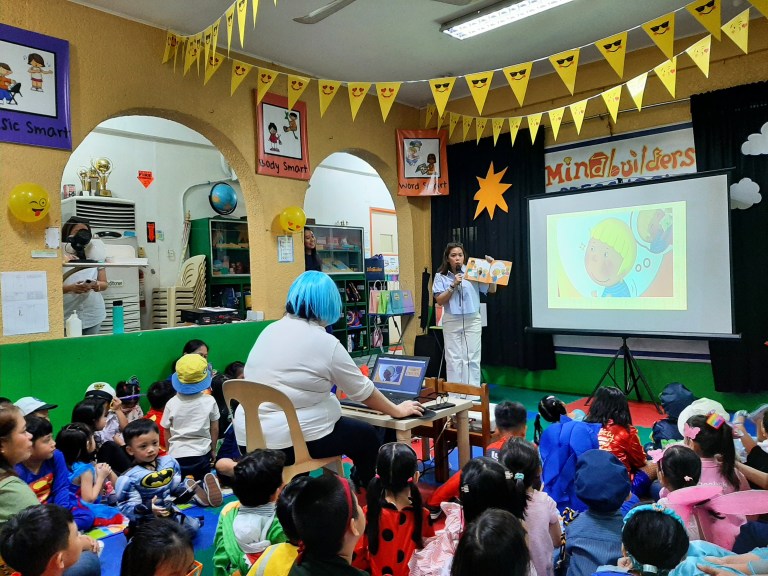
Teacher Pach efficiently taught the young audience about the kind of feelings they have and how to react when they feel something. In separate turns, a few students were called to the front to answer the guest psychologist’s key questions. The answers stated amused the other children as well as the parents and teachers who were present. More importantly, the little children themselves learned a lot from Teacher Pach’s presentation.
Using a children’s picture book, Teacher Pach engaged the students with a story and how it relates with feelings.
Teacher Pach also engaged the students in a read-aloud of an illustrated children’s book about the myriad of feelings a child can have in just one day! And as the narrative went on, students were able to identify the kind of emotions that the main character displayed.
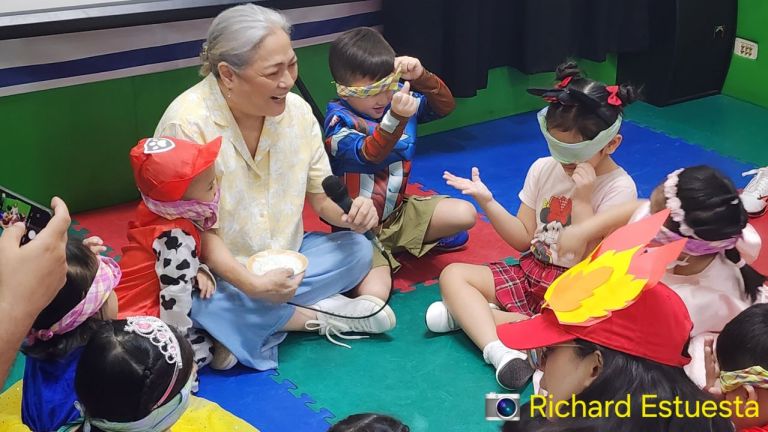
Veteran actress and director Gina Alajar facilitated an acting workshop with three alternating groups of kids in attendance. In relation to the topic of feelings, she first asked the students what kind of emotions were they able to spot in films they had watched before. Collectively, the children gave answers which proved that they had been paying attention to the cinematic emotions even while enjoying the movies.
Ms. Gina Alajar had a group sit-down with the students of Mindbuilders Preschool about their feelings in relation to the senses. (Photo credit: Richard Estuesta)
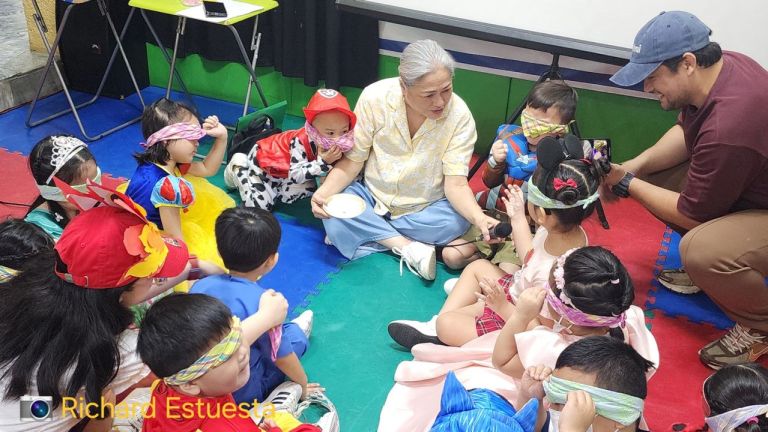
The veteran filmmaker getting feedback from one of the students. (Photo credit: Richard Estuesta)
To determine how far everyone could go with their emotions, Alajar focused on the five senses: touch, sight, hearing, smell and taste. For each sense explored, the actress used specific items to get reactions from the kids. As children would respond differently to each item, she processed valuing each one’s feelings and respecting the feelings of others as well. Having seen Gina Alajar act so dramatically in movies from long ago, I was very impressed to see how experienced and patient she was when it came to teaching the students of Mindbuilders Preschool. It was as if they were all her grandchildren!
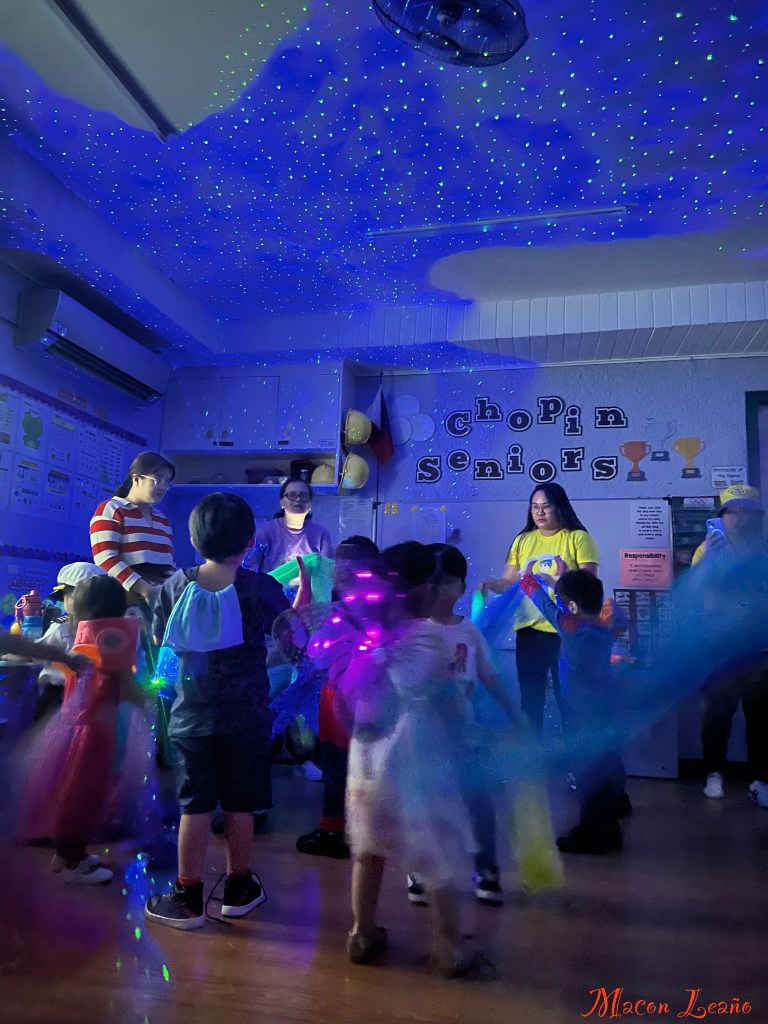
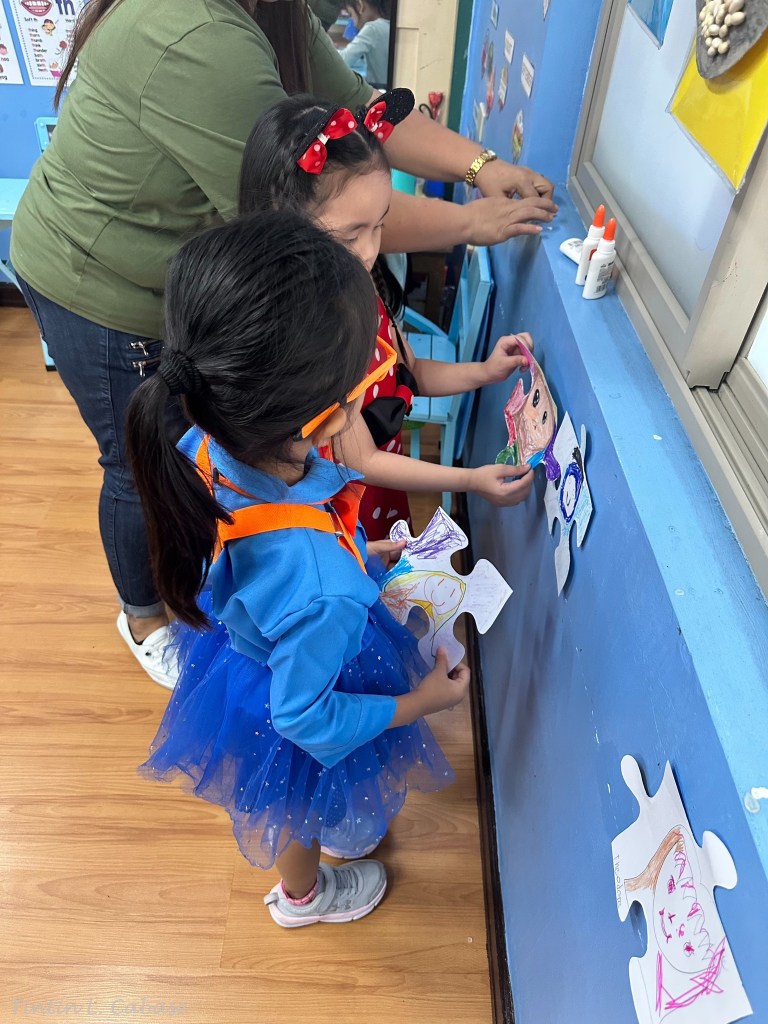
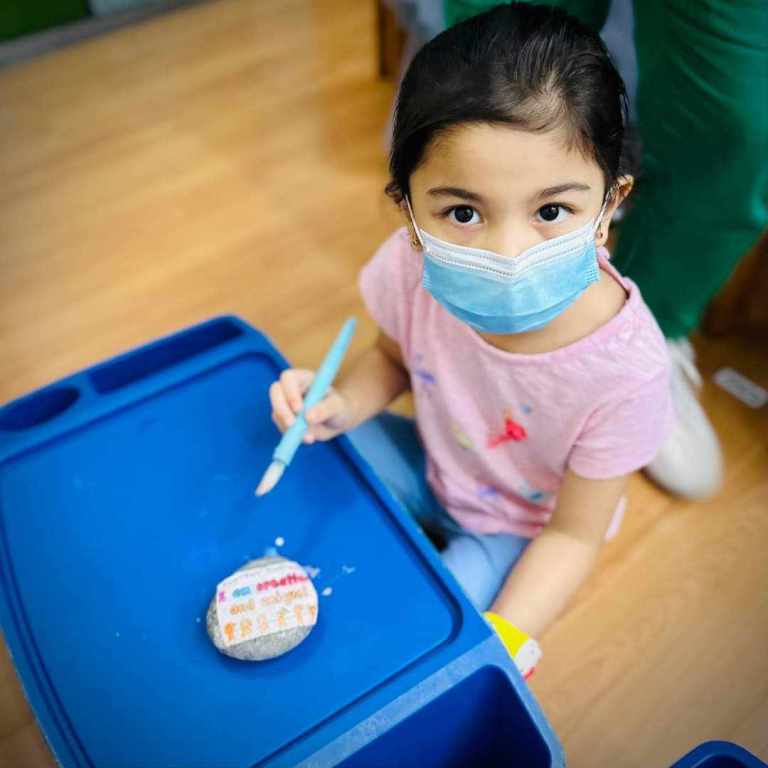
Elsewhere within Mindbuilders were other activities that tapped the students’ other intelligences. These took place inside different classrooms. One classroom had each child decorate a puzzle piece and then assemble the pieces together to form one big puzzle. In another classroom nearby, students were taught to express themselves with music and movement amidst multicolored lights. Finally, a coloring session of positive quotes on affirmation stones was held in another classroom.
In this particular workshop, the students learn to express themselves with music and movement. (Photo credit: Macon Leaño)
Students putting the puzzle pieces together in another classroom. (Photo credit: Tintin L. Cabase)
A student coloring positive quotes on an affirmation stone. (photo credit: Kristine Salustiano)
The session of coloring positive quotes on affirmation stones offers students a unique opportunity to practice their analysis and creativity. (photo credit: Kristine Salustiano)
After all the workshops and sessions were completed, the students were treated to a free film viewing at the play area.
A special activity fulfilled!
According to Mindbuilders Preschool Directress Marah Estuesta, the team worked hard in preparation for their Health Awareness Month Culmination. This included making schedule adjustments due to a major weather disturbance. What transpired on November 15, however, was a huge pay-off complete with a strong reception and the fulfillment of goals on educating the children about self-awareness.
Mindbuilders Preschool’s Health Awareness Month Culmination was supported by Chef Thess Uy Catering.
Philippines film and TV living legend Gina Alajar poses with the teachers and parents of Mindbuilders Preschool. At leftmost is directress Marah Estuesta. (Photo credit: Richard Estuesta)
Words from the Directress
“This activity was one for the books! In today’s world, where mental health is increasingly prioritized, I am happy to have an activity that fosters socio-emotional development in our preschoolers. It is very relevant that children begin developing self-awareness early, as it lays the foundation for understanding and managing their emotions, as well as expressing them effectively.
From understanding their own feelings to recognizing those of others, this activity is a significant step in helping young minds navigate the complexities of emotions. By engaging in activities that promote emotional intelligence, children learn valuable skills such as empathy, emotional regulation, and healthy communication.
Our month-long activities encouraged our preschoolers to explore and express their feelings in a safe and nurturing environment. Through fun, interactive exercises, tapping their Multiple Intelligences, they begin to articulate their emotions, understand their impact, and learn appropriate ways to respond to various emotional states. This kind of early intervention is vital, as it equips children with the tools they need to grow into emotionally resilient and socially adept individuals.“
Mindbuilders Preschool is an early learning environment committed to maximizing a child’s potential by creating exciting experiences that inspire enthusiasm for learning. Founded in 2002, it has grown as the leading Multiple Intelligences Preschool in the South (BF Homes, Las Piñas & Parañaque), following Howard Gardner’s Theory. Mindbuilders Preschool offers one of the best classes in the community for preschoolers.
For more South Metro Manila community news and developments, come back here soon. Also say NO to fake news, NO to irresponsible journalism, NO to misinformation, NO to plagiarists, NO to reckless publishers and NO to sinister propaganda when it comes to news and developments. For South Metro Manila community developments, member engagement, commerce and other relevant updates, join the growing South Metro Manila Facebook group at https://www.facebook.com/groups/342183059992673
In times of prosperity or hardship, Festival Mall (originally named Festival Supermall) in Filinvest City, Alabang, Muntinlupa City continues to attract families and shoppers. Since the mall’s early days in 1998, its amusement center X-Site kept on succeeding on attracting visitors and providing them bouts of varied fun in return to what the customers paid for. X-Site is a lively form of entertainment-focused capitalism that just keeps on moving forward and attracting visitors.
Located at the 3rd floor (note: officially referred to as the 2nd Level or 2L or 2nd Floor by the mall. The 1st floor and 2nd floor of the mall are referred to as Lower Ground Floor and Upper Ground Floor respectively), the X-Site Amusement Center has a wide floor space with a high ceiling.
The way it was designed, X-Site has several arcade games (lots of fun retro games included), merchandiser games, a virtual reality ride, KTV booths, motion-sensing dance spot, the ring toss, entertainment stores, indoor sports games, redemption games, bumper cars, and the indoor roller coaster (which explains the need of having a high ceiling). Watch below the YouTube video and the images I prepared below.
At the arcade games section inside X-Site.
Having a high ceiling made it possible to have an indoor roller coaster (tracks above the machines and people in this image). Other amusement centers in Alabang had lower ceilings which made their places feel small or tight when compared to X-Site.
Some newer machines plus indoor sports games added into the arcade games section.
This is the place for those who love dancing and music.
Back in 1998, I know a few friends whose had not even visited Festival Mall (at the time we talked) yet they already heard of the positive word-of-mouth feedback about the indoor roller coaster of X-Site.
The indoor roller coaster of X-Site remains a favorite ride for those who kept coming back.
On December 25, 2023, I visited Festival Mall to look around. I passed by X-Site and I saw an unusually large number of people there composed of young people, children and their parents/guardians.
For the newcomers reading this, December 25 here in the Philippines is a time of having fun during the Christmas season and also it is the day when the annual Metro Manila Film Festival (MMFF) opens in cinemas. This explains why a lot of people spend time at the shopping malls and it is a cultural thing here in the Philippines.
Considering the fact that the original cinemas of Festival Mall have deteriorated leaving only 2 or 3 screens operating (note: the mall also has modern cinemas at the expanded side), a lot of people still visited the mall to watch the MMFF movies that opened on December 25. As for the large number of people who flocked to X-Site that same day, I can only speculate that some of them might have been moviegoers passing the time as they wait for the next screening of movies to watch.
I took this shot of X-Site on December 25, 2023. Look at the high number of people on the floor.
If you plan to visit Festival Mall in Alabang and if you are craving for fun rides or games, then you might want to visit X-Site Amusement Center.
For more South Metro Manila community news and developments, come back here soon. Also say NO to fake news, NO to irresponsible journalism, NO to misinformation, NO to plagiarists, NO to reckless publishers and NO to sinister propaganda when it comes to news and developments. For South Metro Manila community developments, member engagements, commerce and other relevant updates, join the growing South Metro Manila Facebook group at https://www.facebook.com/groups/342183059992673
To put things in perspective, posted below is an excerpt from the Manila Bulletin news report. Some parts in boldface…
The Las Pinas City government started the registration of children and students aged five to 11 on Saturday (Jan. 29).
Las Pinas City Mayor Imelda Aguilar encouraged parents of minors belonging to the said age group to register them at the city’s “Bakunahan sa Kabataan” for them to get protection against the COVID-19.
Aguilar told parents or guardians of five to 11 years old to visit and register their children at https://bit.ly/e-covid19reg.
She said in visiting the link for registration of vaccination of minors, parents and guardians will be asked to answer questions properly.
The mayor added once they received the confirmation, the registrants will get a text message of their schedule of vaccination and the vaccination site.
For all the unvaccinated people reading this, any Las Piñas resident who has yet to get registered for the free COVID-19 vaccines can learn the ways (4 methods) by clicking here. Anyone who is ready and willing to register online can click bit.ly/LasPiñasVaccination
Let me end this piece by asking you readers: If you are a resident of Las Piñas City, what is your reaction to this recent development? If you are a parent of young children living within the city, what do you think of the idea of vaccination for those aged 5 to 11?
Thank you for reading. If you find this article engaging, please click the like button below and also please consider sharing this article to others. If you are looking for a copywriter to create content for your special project or business, check out my services and my portfolio. Feel free to contact me with a private message. Also please feel free to visit my Facebook page Author Carlo Carrasco and follow me on Twitter at @HavenorFantasy as well as on Tumblr at https://carlocarrasco.tumblr.com/
For more South Metro Manila community news and developments, come back here soon. Also say NO to fake news, NO to irresponsible journalism, NO to misinformation, NO to plagiarists, NO to reckless publishers and NO to sinister propaganda when it comes to news and developments. For South Metro Manila community developments, member engagements, commerce and other relevant updates, join the growing South Metro Manila Facebook group at https://www.facebook.com/groups/342183059992673
The City Government of Muntinlupa announced that over 5,600 minors (aged 12 to 17) have been vaccinated for COVID-19 as of November 8, 2021, according to a recent Manila Bulletin news report.
To put things in perspective, posted below is an excerpt from the Manila Bulletin report. Some parts in boldface…
The Muntinlupa City government said it has vaccinated more than 5,600 minors aged 12 to 17 years old.
As of Nov. 8, a total of 5,648 minors with and without comorbidities have received their first dose of the coronavirus disease (COVID-19) vaccine.
The total is 10.2 percent of the estimated 55,391 population of 12 to 17 years old in Muntinlupa.
By percentage by barangay to date, Putatan has the highest vaccination rate at 17 percent (1,765 vaccinated) followed by Tunasan, 15 percent (921), Bayanan, 14 percent (558); Alabang, 8 percent (560); Sucat and Cupang, 7 percent each (379 and 390, respectively); Poblacion, 6 percent (777); Ayala Alabang, 4 percent (115); and Buli, 2 percent (33).
The city government said as of Nov. 8, a total of 22,665 minors aged 12 to 17 years old have registered with the Muntinlupa City COVID-19 Vaccination Program, or 41 percent of the total population for the age group.
The vaccination sites for minors in Muntinlupa are the Ospital ng Muntinlupa for those with comorbidities and SM Center Muntinlupa, Ayala Malls South Park, New Cupang Health Center and Sucat covered court for “well children” or those without comorbidities.
Comorbidities eligible for the Pediatric A3 vaccination are medical complexity, genetic conditions, neurologic conditions, metabolic/endocrine diseases, cardiovascular diseases, obesity, HIV infection, tuberculosis, chronic respiratory diseases, renal disorders, hepatobiliary diseases and immunocompromised state due to disease or treatment.
The country’s Food and Drug Administration (FDA) earlier approved Pfizer-BioNTech and Moderna vaccines to be used in people 12 years old and above.
Residents of Muntinlupa City who remain unregistered and unvaccinated should make a move to get registered by learning the ways to do it. Those who are prepared (with personal information available) and willing to go through online registration for the free vaccines in Muntinlupa are encouraged to click https://vaccine.muntinlupacity.gov.ph/muncovac/
Muntinlupa minors may register online through the city’s COVID-19 vaccination registration system at www.vaccine.muntinlupacity.gov.ph/muncovac and choose category “C – Rest of Population.”
Let me end this piece by asking you readers: If you are a Muntinlupa City resident, what can you say about this latest local development?
Thank you for reading. If you find this article engaging, please click the like button below and also please consider sharing this article to others. If you are looking for a copywriter to create content for your special project or business, check out my services and my portfolio. Feel free to contact me as well. Also please feel free to visit my Facebook page Author Carlo Carrasco and follow me at HavenorFantasy@twitter.com
For more South Metro Manila community news and developments, come back here soon. Also say NO to fake news, NO to irresponsible journalism, NO to misinformation, NO to plagiarists, NO to reckless publishers and NO to sinister propaganda when it comes to news and developments. For South Metro Manila community developments, member engagements, commerce and other relevant updates, join the growing South Metro Manila Facebook group at https://www.facebook.com/groups/342183059992673