During the Xbox TGS2022 event, I was very surprised and delighted to find out that a remastered version of the acclaimed Japanese role-playing game (JRPG) Ni no Kuni: Wrath of the White Witch was not only released for Xbox Series X, Xbox Series S and Xbox One, but also it was immediately on Xbox Game Pass (XGP)!
Officially titled as Ni no Kuni: Wrath of the White Witch Remastered, I went online with my Xbox Series X to download the game via Xbox Game Pass. The entire experience was quiet jarring as the lightning launch of Ni no Kuni on Xbox consoles and XGP was something I never ever anticipated would happen. Regardless, this sudden release is a bonus for Xbox gamers who want to play more JRPGs as well as XGP subscribers who want new content to enjoy.
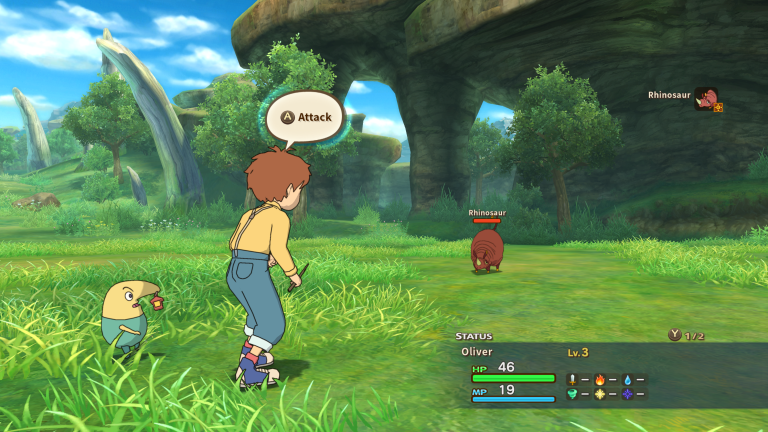
From one the many battles during my play time with the game on my Xbox Series X.
For the newcomers reading this, Ni no Kuni was a hit game released only on PlayStation 3 (PS3) in 2011-2013, followed by a remastered version in 2019 for PlayStation 4 (PS4), Nintendo Switch and PC. The game was developed by long-time JRPG developer Level-5 (which is often identified with PlayStation and Nintendo platforms) and published by Bandai Namco. Ni no Kuni is also notable for having lots of anime cutscenes produced by animation powerhouse Studio Ghibli as well as music by Joe Hisaishi.
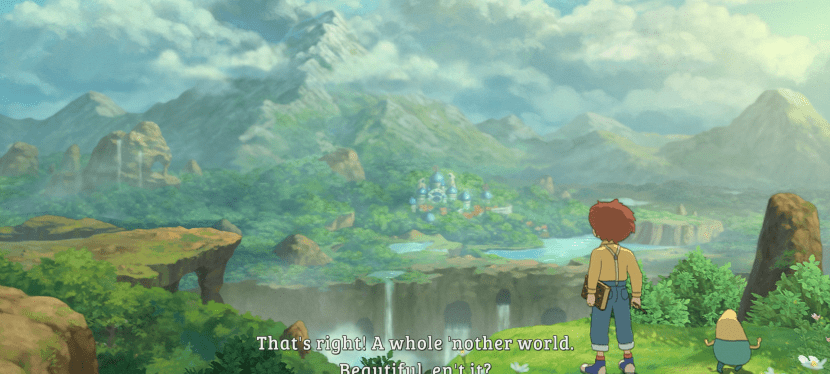
As I’m writing this, I got to play the game and I am having fun discovering its fantasy world, learning how the game functions and the Studio Ghibli-animated scenes really look nice! I’ve got a long way to go before completing the game.
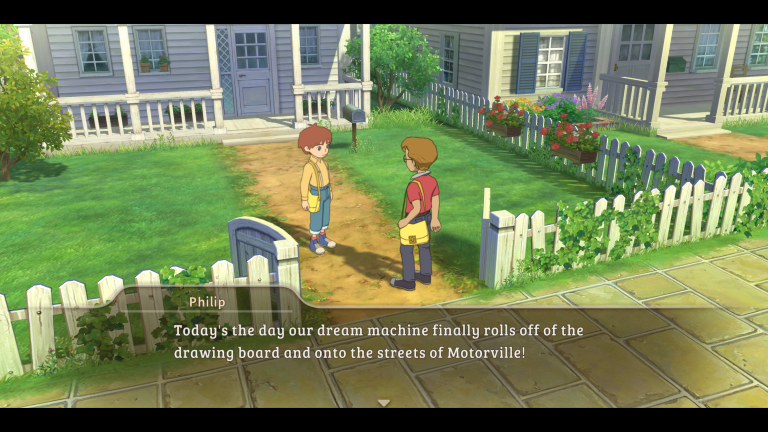
A talk scene during my play time.
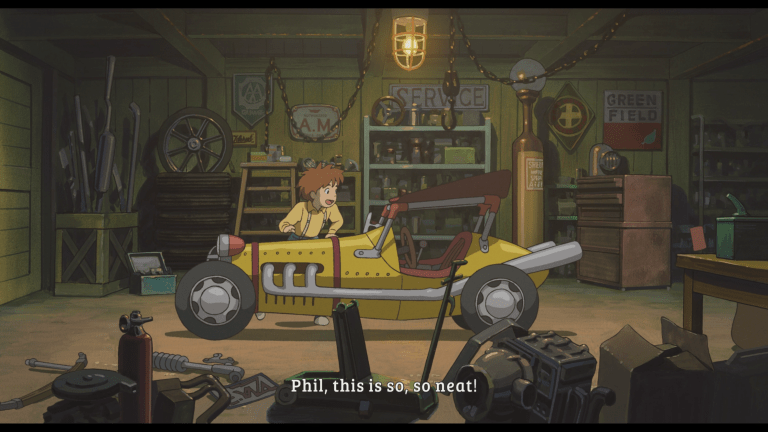
This is one of the scenes animated by Studio Ghibli.
As far as Xbox gaming for 2022 is concerned, the sudden addition of the remastered Ni no Kuni into the Xbox ecosystem and XGP is helpful in relation to the lack of big-budget Xbox-exclusive games in the 4th quarter. It should be noted that RPG heavy hitters Starfield and Eiyuden Chronicle: Hundred Heroes plus the remastered versions of two certain classic JRPGs (note: here’s a hint) are scheduled for release in 2023. When it comes RPG gaming on Xbox, the Level-5-developed game is a very welcome addition given the commercial and critical achievements, fun gameplay and the nice value of having Studio Ghibli-produced animation sequences that helped emphasize the game’s fantasy concepts.
For those of you Xbox and JRPG gamers who wish to buy Ni no Kuni: Wrath of the White Witch Remastered online, click right here. If you are already an Xbox Game Pass subscriber eager for new experiences or JRPG fun, go download the game now.
In closing this piece, posted below are Xbox-related videos plus a few ones related to Tokyo Game Show 2022 for your viewing pleasure.
To be clear, I find Square Enix’s business relationship with Team Xbox lacking. The HD remastered version of Legend of Mana was very noticeably released on multiple platforms but not on Xbox. Tactics Ogre: Reborn was announced for future release for multiple platforms except Xbox. Still on Square Enix, the Final Fantasy VII remake as well as the announced sequel are exclusive to Sony’s platforms. The exclusions are clear and disturbing. Why Square Enix excluded the Xbox Series X, Xbox Series S and the Xbox One (which still has many millions of console users until now) as platforms to sell the above mentioned games remains a mystery although there is speculation that Sony Corporation and its PlayStation executives made a secret deal with the JRPG giant to specifically hurt Xbox without affecting Nintendo and Steam. Realistically, Microsoft pointed out that Sony pays game companies for blocking rights to keep games off Xbox Game Pass. Read all about it here, here and here.
While these developments are disturbing and also annoying, I still wish that Square Enix would remaster one of its classic JRPGs and release it on Xbox platforms similar to what they did with the remastered Chrono Cross. That classic RPG I’m referring to is none other than Xenogears.
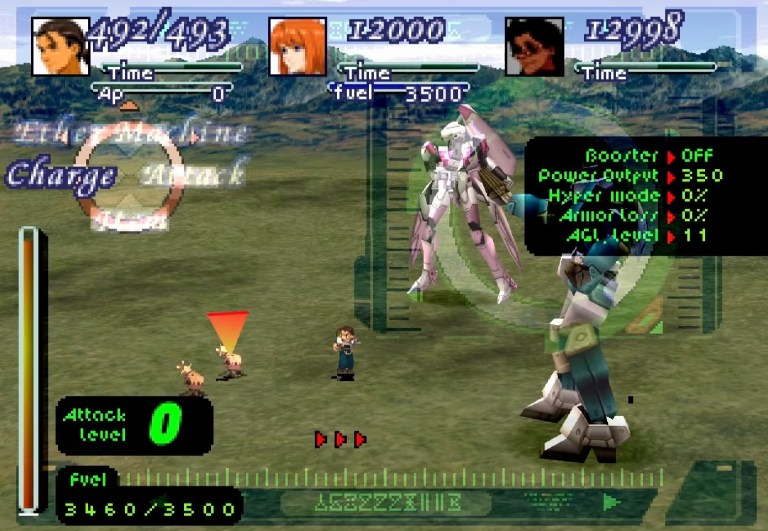
Xenogears’ battle system allowed individual persons and giant robots (called gears) to engage in battle simultaneously. Observe how the approach on in-game scale was done here.
I played Xenogears on the original PlayStation console way back in 1998 but I never got to finish it due to my academics and other external matters. It also did not help that the CD-ROM of the PlayStation deteriorated.
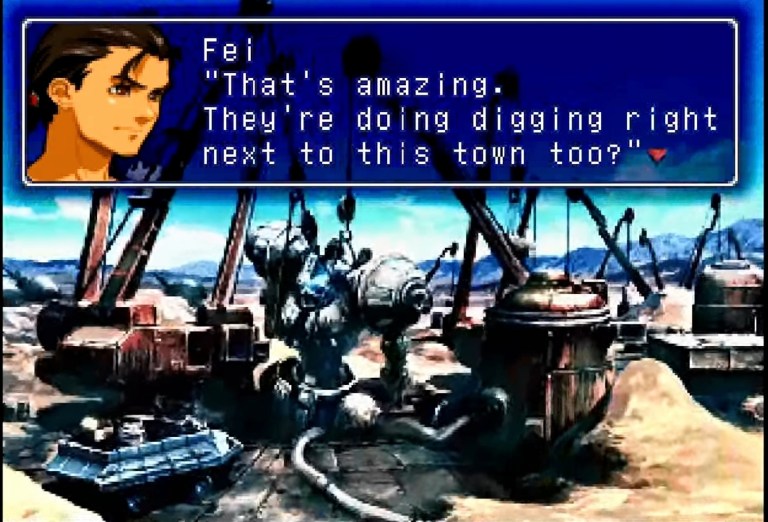
Regardless, I had a lot of enjoyment during my limited time with the said JRPG, the design of which was led by Tetsuya Takahashi. The fictional concept of Xenogears took a lot of inspiration from real-life forms of religion as well as concepts from certain intellectuals to establish the story themes, the fictional cultures and historical backgrounds within the game. At the same time, the game had this in-depth universe composed of different settings for gamers to explore. In my experience, I felt immersed into the game’s universe and I still remember the moments I got astonished discovering not only the many locations and landmarks but also the many non-playable characters (NPCs presented as 2D sprites) in the form of local communities and the in-game cultures.
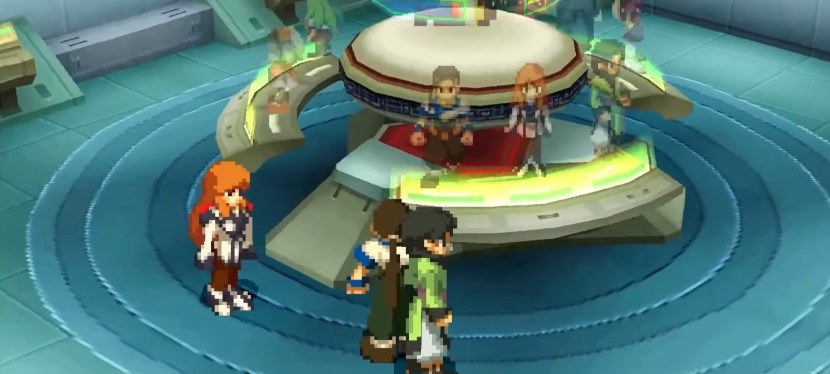
Xenogears had 3D polygonal environments and 2D sprites for the characters and creatures who move around.
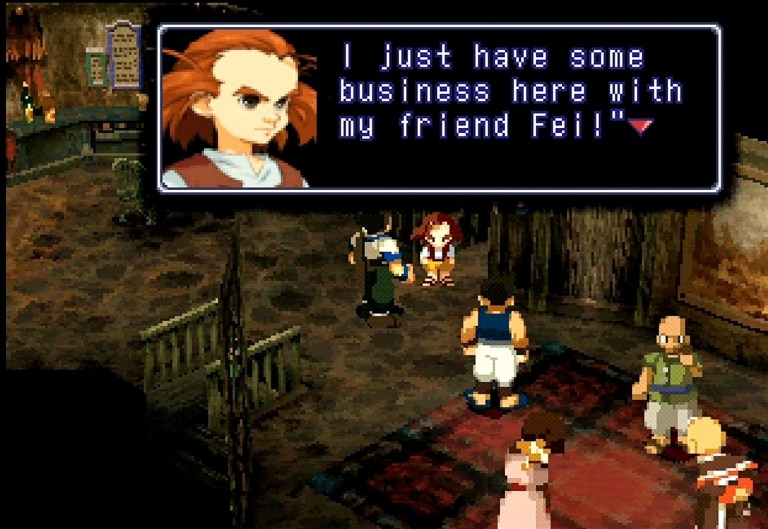
In this classic JRPG, you play as Fei and you will explore a lot, fight a lot and interact with lots of characters as you go along.
While Xenogears had a science fiction concept, it still had lots of settings and gameplay features that made it feel like a fantasy. I love the way how the creative team’s artists implemented their art styles on the environments, the characters, the machines, the interiors of places and more. Visually, this game saw the use of 2D sprites for the characters who move along a 3D polygonal environment which can be explored creatively by a camera that can be adjusted by the players. As such, this approach done in Xenogears made the game look and feel a lot like Grandia.
While Xenogears’ battle system had key elements that were common with other JRPGs, there was a clear emphasis on hand-to-hand combat that took a lot of inspiration from martial arts as well as 2D fighting games of the decade. There were these martial arts-inspired combos which required button combinations and timing which were fun to watch happen. There were also these death blows which were really rewarding when pulled off correctly. Of course, there were still some magic attacks that were nicely presented.
What made Xenogears stand out is the use of giant robots or gears in the game. Not only did the game allow me to travel with the gears, it also allowed me to engage with enemies (both the large and the small ones standing on the floor/ground) with a fully functional battle system that emphasized size, scale and impact altogether. Similar to the other battle system, the gears battle system fun and engaging in my experience. I can never forget the moment I first saw my gear crush a huge enemy with a lot of impact to seal the victory. Travel using gears, however, was hampered somewhat by the creative team who implemented platform gaming elements (note: this includes jumping from one platform to another without falling down to your death) and the controls were not really responsive enough. This is something Square Enix should consider improving if they ever remaster Xenogears.
The battle system with the individual characters is a lot of fun and also unique as the combat emphasizes combos and martial arts.
The artistic approach used in Xenogears remains captivating.
Right now, I would love to replay Xenogears and complete it but I prefer the game should be remastered and be released for Xbox consoles. I have no intention of buying a new console from Sony and Nintendo to play Square Enix JRPGs that are missing on Xbox consoles. JRPGs on Xbox are not exactly lacking (note: Eiyuden Chronicle: Hundred Heroes will be released via Xbox Game Pass in 2023 while Persona RPGs are coming to Xbox soon) but it would be great not only for Xbox gamers but also Square Enix itself to remaster Xenogears and release it on the Xbox ecosystem. That being said, I believe Xenogears itself would make a great addition into Xbox Game Pass (XGP) which already has many millions of subscribers worldwide!
Think about it carefully. Having a remastered Xenogears for sale on Xbox and also listed on Xbox Game Pass will not only be good for the Xbox ecosystem but also for Square Enix to not only sell games but also reach out to the XGP subscribers who could enjoy the said JRPG and add a lot of new players that the JRPG giant could not reach before. Not only are more Square Enix role-playing games are needed on XGP right now (note: adding Chrono Cross into it will be delightful), they can also benefit nicely as the Xbox ecosystem is gradually becoming the premier ecosystem for RPG enthusiasts in this console generation. Xbox-exclusive RPGs like Starfield, The Outer Worlds 2, Fable as well as future sequels of The Elder Scrolls and Fallout will collectively generate big game sales as well as increase the number of gamers in the Xbox ecosystem and Xbox Game Pass subscribers will grow big as well. The growth will be even bigger once Team Xbox’s acquisition of Activision Blizzard gets approved. For Square Enix to miss out on fast growing Xbox ecosystem in favor of Sony’s blocking rights will be a regrettable move.
Going back to Xenogears, I want to make it clear to Square Enix that now is the time to remaster it and release it on Xbox as well as other platforms. That being said, I also urge Team Xbox’s chief Phil Spencer, executive Aaron Greenberg and the Xbox Game Pass team to reinvigorate the business relationship with Square Enix and try to convince them to release Xenogears and other classic JRPGs into XGP and the Xbox game store. To the Xbox gamers and RPG enthusiasts reading this, I encourage you to contact Square Enix and Team Xbox to have Xenogears and other JRPGs (both classic and modern) released on the Xbox consoles and Windows PC.
In closing this piece, posted below are Xbox-related videos plus a few Xenogears-related videos for your enjoyment.
I am a subscriber of Xbox Game Pass (XGP) and I’ve been enjoying lots of games on my Xbox Series X. For the month of February 2022, there are new additions announced recently by Team Xbox and already three of them have just been officially released (February 3, 2022) through the service for subscribers to enjoy. There are also DLC updates as well as perks for Xbox Game Pass Ultimate (XGPU) subscribers.
Contrast (Cloud and Console) ID@Xbox – February 3 – Explore a dreamlike, vaudevillian world of the 1920s, in which you can shift freely in and out of shadow. Tasked with helping a young girl named Didi, you will unravel the mysteries behind her troubled family and the dark secrets that must be exposed to re-shape her future.
Dreamscaper (Cloud, Console, and PC) ID@Xbox – February 3 – An endlessly replayable action roguelike with a waking/dreaming gameplay cycle. By night, delve deep into your subconscious, facing nightmares in an ever-changing world filled with unique items, abilities, and challenges. By day, explore the city of Redhaven, build relationships and unlock permanent upgrades to take on the next dream stronger than ever.
Telling Lies (Cloud, Console, and PC) ID@Xbox – February 3 – An investigative thriller game with non-linear storytelling, Telling Lies revolves around a cache of secretly recorded video conversations. Starring Logan Marshall-Green, Alexandra Shipp, Kerry Bishé, Angela Sarafyan, and directed by Sam Barlow, creator of Her Story and writer/designer of Silent Hill: Shattered Memories.
Besiege (Game Preview)(Cloud, Console, and PC) ID@Xbox – February 10 – Besiege is a physics building game where you construct war machines to obliterate fortresses, annihilate legions of soldiers, navigate hazards, and solve physics puzzles. In the single-player campaign, you’ll conquer your way through four distinct islands, each with its own theme, packed with fully destructible levels and see you bring your enemies to their knees. Learn more about Besiege (Game Preview)here!
CrossfireX (Console) – February 10 – Available on day one with Xbox Game Pass: Play the first CrossfireX single-player campaign, Operation: Catalyst, developed in partnership with Remedy Entertainment. Take control of a Global Risk unit, as they traverse through enemy territory to save their captured teammate and uncover the dark secrets of the Black List Mercenary group.
Edge of Eternity (Cloud, Console, and PC) ID@Xbox – February 10 – Available on day one with Game Pass: Wage epic turn-based battles as you follow Daryon and Selene on their quest to find a cure to the all-consuming Corrosion in this grand tale of hope and sacrifice, created by a small team of passionate JRPG lovers.
Skul: The Hero Slayer (Cloud, Console, and PC) ID@Xbox – February 10 – Skul is a fast-paced action rogue-lite where losing your head is encouraged. Featuring 100 playable characters each with their own unique abilities and a ton of items that can create wild synergies, the battles are as electrifying as they are challenging.
The Last Kids on Earth and the Staff of Doom (Cloud, Console, and PC) – February 10 – Battle hordes of zombies and monsters in The Last Kids on Earth and the Staff of Doom, a semi-open world action RPG that tells a new story in the post-apocalyptic town of Wakefield. Playing as teen survivors Jack, Quint, June, or Dirk, you’ll explore zombie-infested streets on your quest to stop Malondre, a powerful adversary from obtaining the Staff of Doom.
Ark: Ultimate Survivor Edition (Cloud, Console, and PC) ID@Xbox – February 14 – Experience everything that the Ark franchise has to offer with Game Pass in this definitive collection! Tame and ride primeval creatures as you explore savage lands, team up with other players to compete in epic tribal battles, and travel together on the greatest dinosaur-filled adventure of all time.
Infernax (Cloud, Console, and PC) ID@Xbox – February 14 – Available on day one with Game Pass: Infernax is the adventures of a great knight who returns to his homeland only to find it plagued with unholy magic. While on your quest to find and destroy the source of this corruption by any means necessary, you will face ruthless creatures, dangerous beasts, and precarious terrains.
The Xbox.com article also confirmed that there will be games leaving the Xbox Game Pass service on February 15. Those games are Control, Code Vein, Final Fantasy XII: The Zodiac Age, The Medium, Project Winter and The Falconeer. If you are an XGP subscriber and you have not played those games on your Xbox console, now is the time to download what titles interest you the most.
Going back to the games for XGP this month, CrossfireX, Contrast and Edge of Eternity are the most interesting to me. Contrast is an old game made by Xbox game studio Compulsion Games which was released many years ago when the said developer was still independent. I completely missed out on Contrast back then and the opportunity to try the game without paying anything extra is a welcome move. Edge of Eternity is a fantasy role-playing game that was clearly influenced by Japanese role-playing games (JRPGs). It was released on Windows PC in 2021 and being added on XGP (apart from being scheduled for release on multiple platforms on February 10) will surely interest Xbox gamers who love JRPGs.
In closing this piece, posted below are Xbox-related videos plus for your viewing pleasure.
+++++
Thank you for reading. If you find this article engaging, please click the like button below and also please consider sharing this article to others. If you are looking for a copywriter to create content for your special project or business, check out my services and my portfolio. Feel free to contact me with a private message. Also please feel free to visit my Facebook page Author Carlo Carrasco and follow me on Twitter at @HavenorFantasy as well as on Tumblr at https://carlocarrasco.tumblr.com/
Welcome back to this latest edition of the Better than Streaming series! If you are fond of 1980s anime, especially with productions by Studio Nue (the same studio behind Super Dimension Fortress Macross), then you should be delighted to know that the entire Super Dimension Century Orguss series is coming out on Blu-ray format on September 28, 2021 and you can order it online right now!
The Blu-ray cover.
Handled by DiscoTek Media, all 35 episodes will be compiled and presented in high-definition complete with Japanese dialogue (with English subtitles). There will also be 17 episodes dubbed in English which I believe were produced at a time when U.S. Renditions still existed. As of this writing, the price is around $70.
To put things in perspective, posted below are details from the Blu-ray.com page of Super Dimension Century Orguss. Some parts in boldface…
Video
Codec: TBA
Resolution: 1080p
Aspect ratio: 1.33:1
Original aspect ratio: 1.33:1
Audio
Japanese: LPCM 2.0
English: LPCM 2.0
Subtitles
English
Discs
Blu-ray Disc
Three-disc set (3 BD-50)
Packaging
Slipcover in original pressing
Playback
2K Blu-ray: Region A
Description
Today, Kei Katsuragi‘s only concern is the love of his life. It doesn’t really matter to him that he has more than one love – after all, as a pilot for the Freedom Space Corps, he might be dead tomorrow! In the future, war has changed, and Kei is all too familiar with the horrors it can bring. Atomic, biological, and chemical weapons are all in use, but even worse than those are the dimensional weapons, ordnance capable of tearing apart even time and space!
As it happens, his next mission involves one of these terrifying weapons, the latest risky gambit in the war over the space elevator on Earth. Fleeing from the warmth of his lover (and her father’s gun) to the coldness of space, Kei fights to protect a team of engineers as they arm the dimensional weapon on-site. But when they get orders to pull out without detonating the bomb, Kei disobeys, unwilling to make the sacrifices of the day meaningless. His brash actions have dire consequences beyond just a big kaboom, as that explosion flings him into the future!
There, Kei finds himself caught in an entirely different struggle between the militaristic Chiram and the mercantile Emaan – with himself as the prize! Will this womanizing hot shot pilot make it back to his own time, or is there something more to Kei being the “singularity”?
Here is something for long-time Orguss fans as well as for those who are about to discover Super Dimension Century Orguss for the first time.
I personally am interested in this upcoming multiple-disc Blu-ray set of Orguss. For one thing, I actually saw its sequel Super Dimension Century Orguss 02 first way back in the mid-1990s and learned that there is a storyline gap of two hundred years between them. It was only a few years ago I got to watch some English-dubbed episodes (done by U.S. Renditions) of Super Dimension Century Orguss and found its sci-fi concept really intriguing. It was also a fresh change of pace as well as a different type of immersion after I indulged myself with Studio Nue’s most famous works related to the Super Dimension Fortress Macross franchise (read my retro review of Macross: Do You Remember Love?).
Anyone who saw Macross first will realize certain common visual elements between it and the Orguss TV series (1983-1984) which should be no surprise since they are both Studio Nue productions. Even notable Macross female characters had cameo appearances in the early Orguss episodes. It is also a fact that prolific anime director Noboru Ishiguro worked on the Super Dimension Fortress MacrossTV series, the Super Dimension Century Orguss TV seriesand the feature film Macross: Do You Remember Love?
Going back to the future Blu-ray release of Orguss, I am hoping that the image quality will be good apart from being presented in high-definition. As it is decades-old anime series, its original aspect ratio of 1.33:1 will still be retained and that means you will see thick, black borders on the left and right sides of the screen. As for the colors, I hope the technical crew will enhance the colors a bit to be presentable in HD.
The signature robot in the Orguss series.
Once Super Dimension Century Orguss comes out finally on Blu-ray disc format on September 28, 2021, only then we will find out how good the visuals and audio will be. Stay tuned for more right here!
Thank you for reading. If you find this article engaging, please click the like button below and also please consider sharing this article to others. If you are looking for a copywriter to create content for your special project or business, check out my services and my portfolio. Feel free to contact me as well. Also please feel free to visit my Facebook page Author Carlo Carrasco and follow me at HavenorFantasy@twitter.com
Disclaimer: This is my original work with details sourced from playing The Super Dimension Fortress Macross: Do You Remember Love? video game and doing personal research. Anyone who wants to use this article, in part or in whole, needs to secure first my permission and agree to cite me as the source and author. Let it be known that any unauthorized use of this article will constrain the author to pursue the remedies under R.A. No. 8293, the Revised Penal Code, and/or all applicable legal actions under the laws of the Philippines.
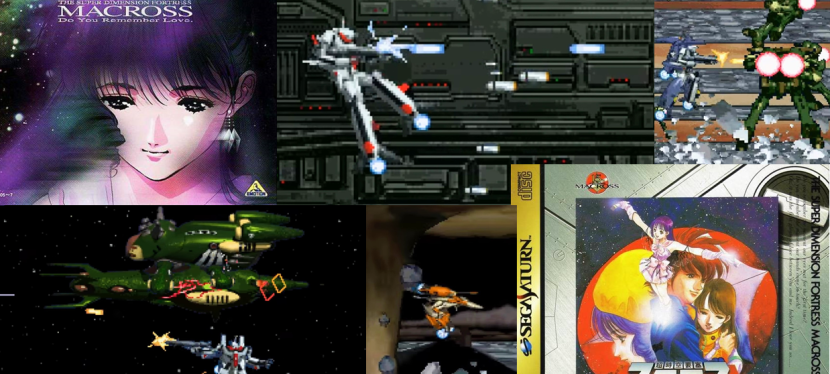
Like many other entertainment franchises in Japan, Macross also has video games based on its stories and concepts. During the fifth generation of video game consoles, Bandai released in Japan the video game adaptation of the 1984 anime movie on the Sega Saturn in 1997 and the Sony PlayStation in 1999. That game was titled The Super Dimension Fortress Macross: Do You Remember Love? and I played that 2D side-scrolling shoot-them-up game a lot during the time when 3D polygons was already the standard.
Considering its age, it is easy to wonder if the game is still fun to play by today’s standards and if the game is something that Macross fans can enjoy a lot. We can all find out in this look back at The Super Dimension Fortress Macross: Do You Remember Love?
Sega Saturn version in 1997.
Sony PlayStation version in 1999.
Early story
The story begins at sea. A Valkyrie piloted by Hikaru Ichijyo (the late Arihiro Hase) launches from the aircraft carrier Prometheus to join his teammates Max and Kakizaki led by Roy Fokker (Akira Kamiya). Suddenly a powerful beam of energy from above hits the aircraft carrier clearly showing that their world is under attack by the Zentradi.
They proceed to South Attaria Island where they immediately engaged the Zentradi forces that ravaged the city and causing trouble for the SDF-1 (Macross). After defeating several Zentradi elements, the remaining Skull Squadron forces flew to the Macross (which just launched into the air) which executes a space fold just moments before even more laser blasts from the Zentradi destroyed the entire island.
Sometime later deep in space, thousands of civilians managed to adjust to living inside the Macross. As Lynn Minmay’s (Mari Iijima) first concert happens inside the fortress, Hikaru, his teammates and many other fighters engage in a mission against the Zentradi…
Quality
Just like in the movie!
To comment on the quality of this old video game, I’ll focus on gameplay and presentation.
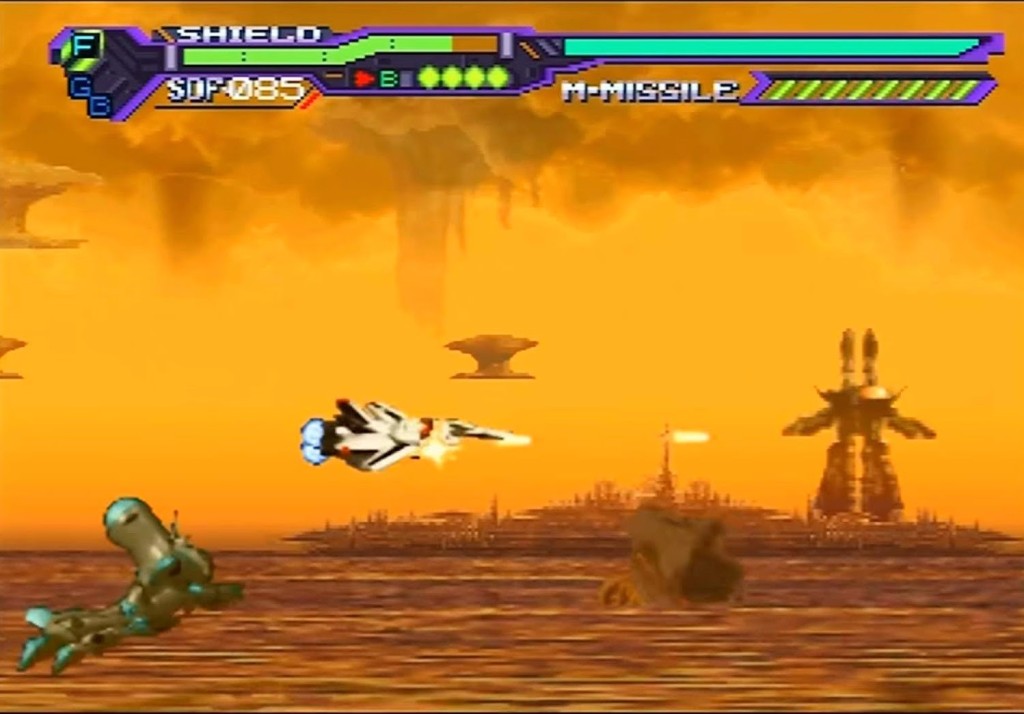
As far as gameplay goes, Macross: DYRL is essentially a 2D side-scrolling shooter literally designed to be grand not only for Macross fans but also for gamers who enjoy its design and its type of gameplay. You play as the hero Hikaru who pilots an advanced fighter plane that can also transform into an armed fighter with legs (GERWALK mode) and also into a full-sized, human-like robot (Battroid). In fighter mode, you move fast and are able to fire rockets or use your default gun. In GERWALK mode, your speed is slower but you have improved mobility that can be crucial for combat. In Battroid mode, your speed is reduced further but you are somewhat stronger and more precise when it comes to shooting enemies.
Still on gameplay, the game developers really pushed the envelope in terms if immersion as there are lots of moments in which the enemies will not only face you on your 2D plane but also move around you from the foreground to the background. Without having to do anything further, your character will be able to auto-aim and shoot at your enemy whether in the background or the foreground. Essentially, this makes the game a 2.5D shooter.
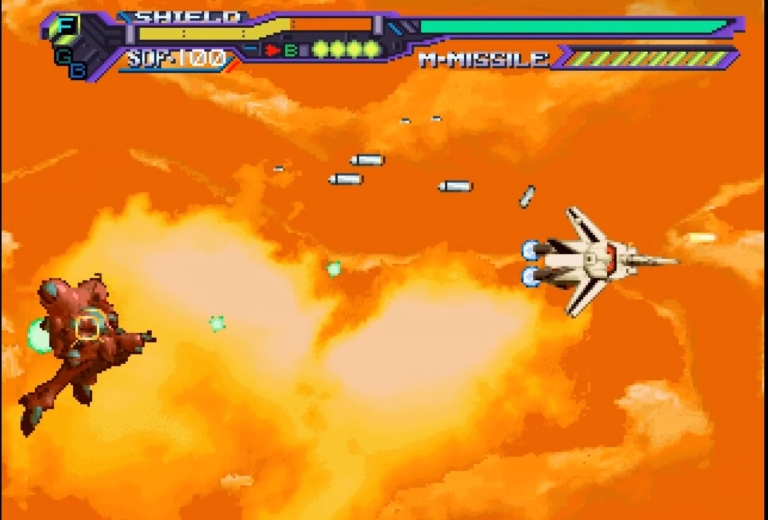
This is a fine example of you (in your 2D plane) firing at your enemy in the background.
In key parts of some levels in the game, the UN Spacy will send a shuttle to release supplies to help you replenish your shield meter.
The controls are relatively easy to learn and get adjusted to. More importantly, the controls are very responsive and they are ideal when it comes to precision on moving your character around as well as trying to shoot at specific targets.
This game was designed with several levels for you to complete essentially moving from left to right. As evidence of the game developers taking liberties during its adaptation of elements from the 1984 animated movie, several levels have boss fights for you to participate in and win in order to progress. These boss-type enemies are noticeably absent from the movie and yet they were designed to integrate into the film’s concept and also expand the concept about how elaborate the Zentradi are when it comes to their war machines against Earth. The boss-type enemies (note: they are clearly polygonal and yet they fit in well with the 2D sprite elements) are huge machines designed for space battles and there were boss fights in which some of them move into the background (which sparks moments for your character to fighter towards the background). When it comes to artificial intelligence (AI), the boss-type enemies are not really that sophisticated with their movements although a few of them have attack patterns that will push you to be more evasive and more strategic.
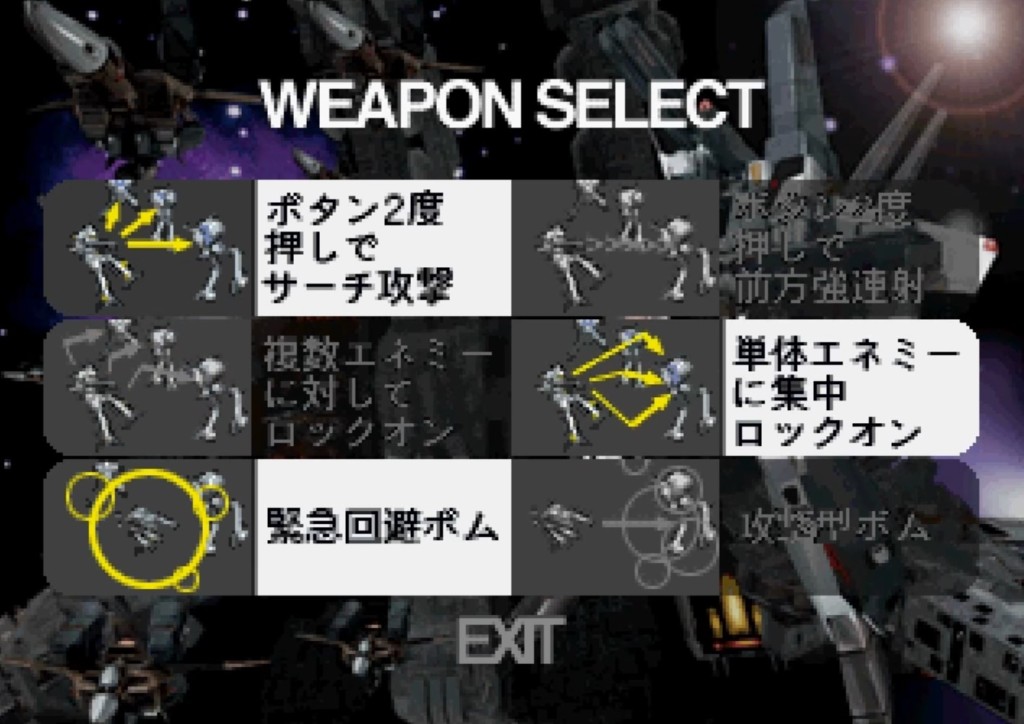
Before starting a level, you can select your weapons that can function depending on your personal preference on taking on the enemies.
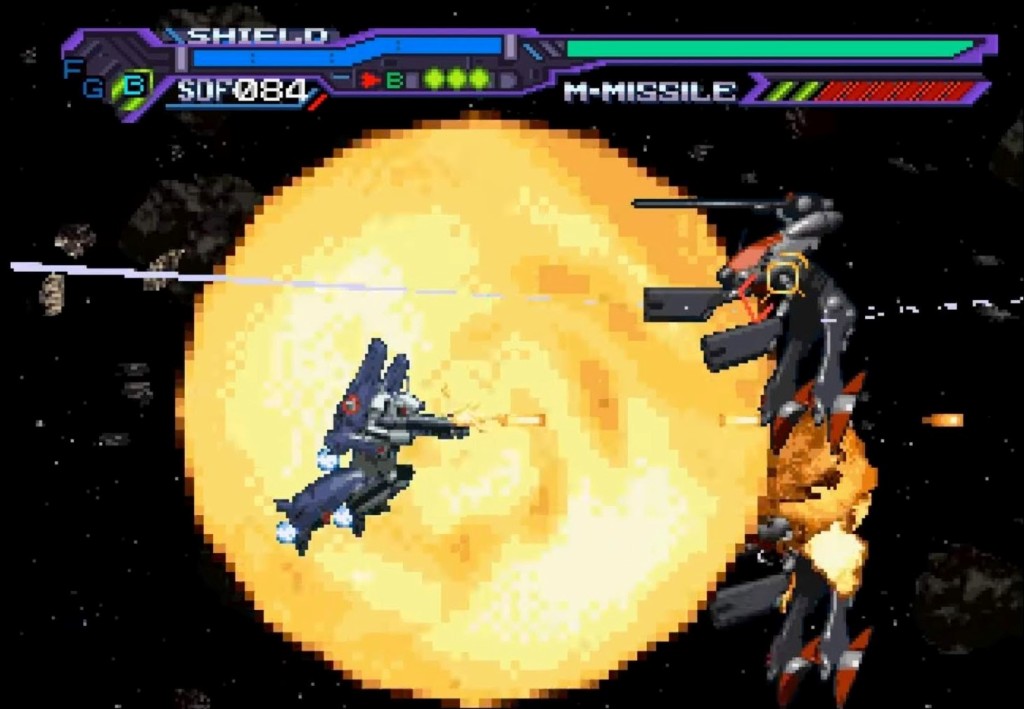
Lots of great visual effects and 3D movement add to the challenge.
With regards to challenge, some parts of this game took me a few repeats before finally improving myself enough to make it to the next levels. The visual elements of the game also added to the overall challenge as seeing 2D sprites move around you 3-dimensionally.
Speaking of 2D sprites, it is clear that this game was designed to be heavy with 2D visual elements while 3D polygons are used sparingly (note: the boss battles mentioned above). As this is a side-scrolling game, the game makers clearly made lots of sprites of machines, space ships, Zentradi battle pods and other figures that Macross fans would easily recognize. The good news is that each 2D sprite was made with multiple frames of animation (complete with frames meant for 3D movement) and were made to really resemble the cinematic artworks which ultimately results making them really look lively to watch on-screen!
As for the presentation, I can see that the game developers Scarab paid great attention to the details of the animated movie to make The Super Dimension Fortress Macross: Do You Remember Love? fun and engaging for gamers in general while also becoming strongly relevant and delightful with the people who love Macross. For example, the game starts with a cinematic prologue composed of brand-new animation cels mixed with elements of 3D polygons and in my view, it fits in nicely leading to the actual cinematic opening of the movie from 1984. The cinematic prologue was meant to expand the film’s overall concept and other story expansions happened in subsequent parts of the game (such as the all-new mission told in two levels).
Observe the Zentradi surrounding Roy Fokker on his 2D plane, the foreground and background. This is a 2D sprite-heavy showcase!
The game developers paid close attention to the details of the movie and presented the visuals using video game graphics, 2D sprites and really nice in-game background artworks!
Surprise! You as Hikaru get to fight Milia temporarily before her memorable fight with Max happens!
The Super Dimension Fortress Macross: Do You Remember Love? came with selected animated sequences and still images from the 1984 movie’s very own footage meant for in-game storytelling (note: you still have to watch the movie for the best immersion). As there were some original scenes made for the game with expanding the film’s concept in mind, there are a few computer-generated animation sequences and even brand-new animated cels (note: very clearly they were drawn by people different from the ones who drew the film’s footage) showing some character moments.
When it comes to the audio, this game is clearly a labor of love with Macross fans in mind. Much of the music, songs and sound effects from the movie (as well as from the 1982-1983 anime TV series) were integrated into the game which made it very immersive for Macross fans. As for the voice actors, fans will hear the voices of their favorite Macross characters performed by the late Hase, Iijima, Kamiya, Mika Doi (Misa Hayase), Michio Hazama (Captain Global) and more. While some of their recorded lines from the movie were reused (especially Hase who died in 1996), others recorded new lines for their respective characters for the new cinematic footage as well as key parts in the game.
The art of Lynn Minmay for the new anime footage was clearly not drawn by the people behind the 1984 anime movie.
What I love best about the presentation is that the game developers replicated selected scenes from the 1984 movie using in-game graphics and art along with music, sound effects and the lines of dialogue! As a Macross fan myself, the immersion was pretty deep as I played the game and witnessed those special moments from the movie played within the in-game presentation.
Conclusion
Enjoy looking at this.
I can declare out loud that The Super Dimension Fortress Macross: Do You Remember Love? is indeed the best Macross video game I have ever played as well as the best adaptation (note: other than film) of the classic movie from 1984. This game, which excellently used 2D sprites and 3D polygons all throughout, was very clearly made to delight Macross fans while giving gamers something very enjoyable and memorable to experience. For the best immersion, it is highly recommended to watch the movie before playing this video game. Truly this video game has aged well!
Thank you for reading. If you find this article engaging, please click the like button below and also please consider sharing this article to others. If you are looking for a copywriter to create content for your special project or business, check out my services and my portfolio. Feel free to contact me as well. Also please feel free to visit my Facebook page Author Carlo Carrasco and follow me at HavenorFantasy@twitter.com
Disclaimer: This is my original work with details sourced from reading the comic book and doing personal research. Anyone who wants to use this article, in part or in whole, needs to secure first my permission and agree to cite me as the source and author. Let it be known that any unauthorized use of this article will constrain the author to pursue the remedies under R.A. No. 8293, the Revised Penal Code, and/or all applicable legal actions under the laws of the Philippines.
When it comes to showcasing giant robots fighting other robots or monsters, there is no denying that Japan is the leader. In my lifetime, I have seen lots of episodes of varied anime TV series, some anime feature films as well as OVAs (original video animation) of such a genre of entertainment made by lots of Japanese creators. While I never saw any episodes of Brave Raideen nor any episodes of Chōdenji Robo Combattler V, I saw episodes of Dangard Ace on home video.
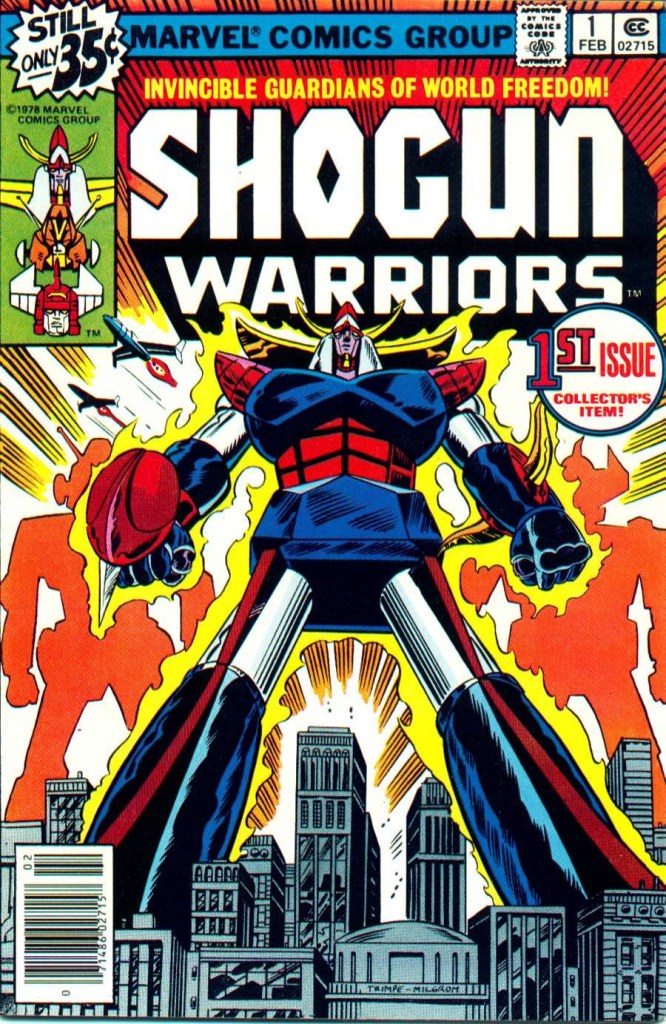
As seen already in issues #1 and #2 of the Shogun Warriors comic book series, the giant robots were adapted but not their respective original concepts and characters the Japanese established. As such, an all-new concept with Westerners in mind was implemented for the said series.
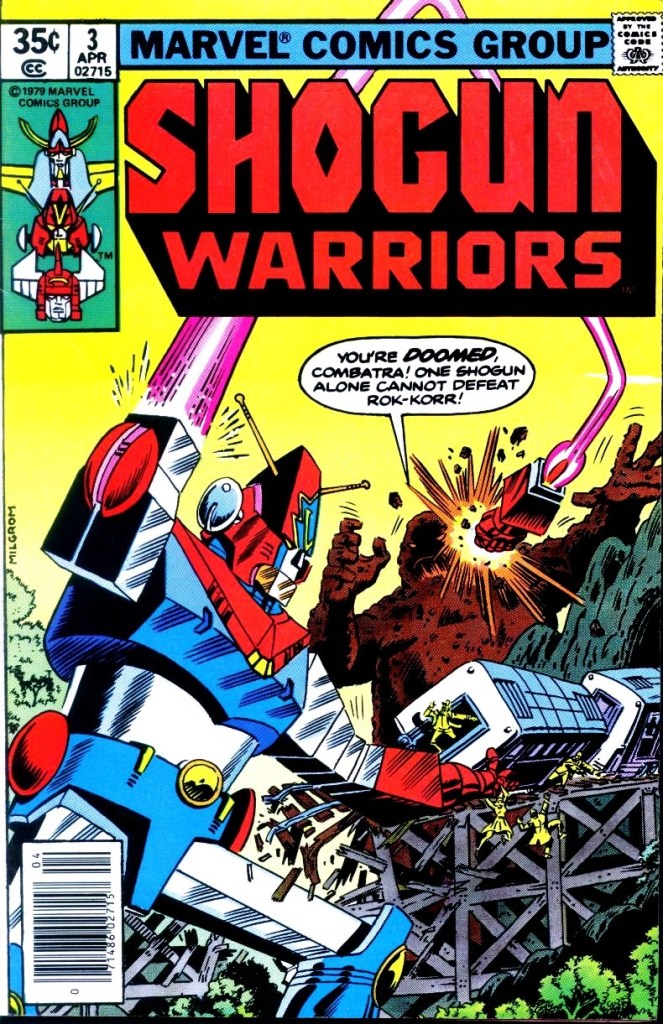
With those details laid down, here is a look back at Shogun Warriors #3, published by Marvel Comics in 1979 with a story written by Doug Moench and drawn by Herb Trimpe.
The cover.
Early story
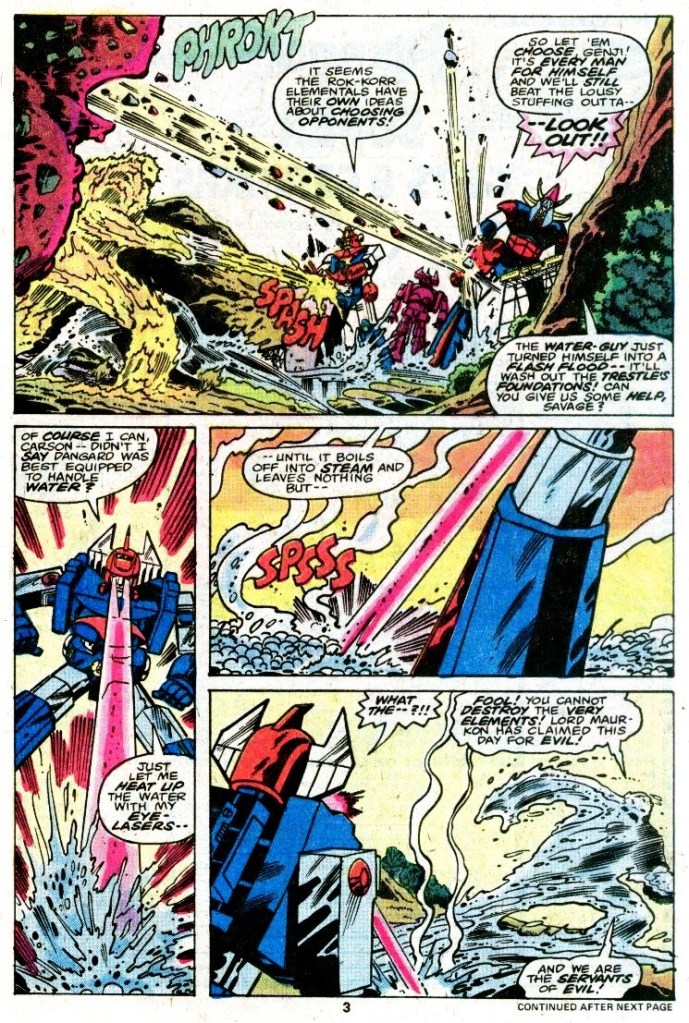
The story begins with Raydeen, Combatra and Dangard Ace on the field facing three giant enemies (each one representing a different element – fire, earth and water). Right near them is the train (on an elevated track) that they just saved which Combatra (piloted by Genji Odashu) notices.
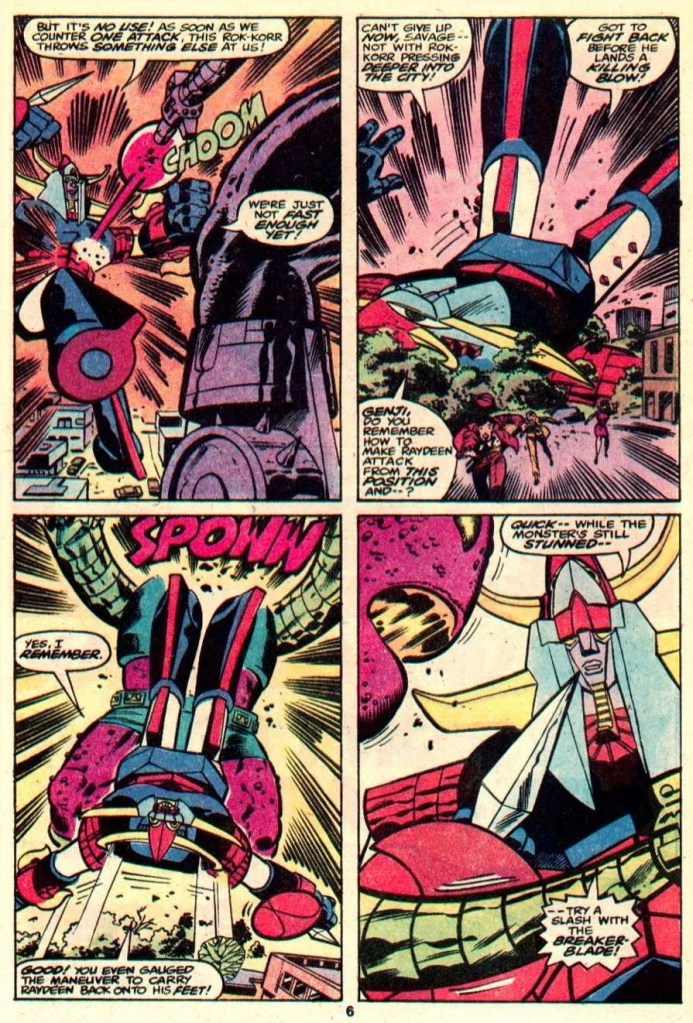
The battle begins with Dangard Ace taking on the water monster while Raydeen and Combatra take on the fire monster and earth monster respectively. During the heat of battle, the stalled train begins to fall as the elevated track gets damaged…
Quality
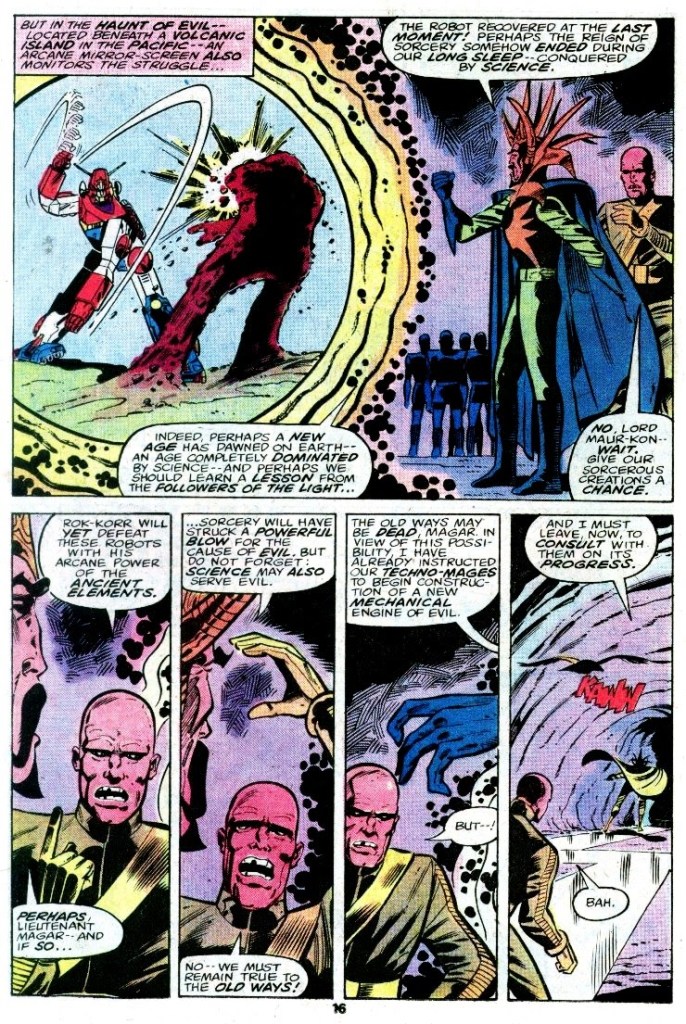
The bad guys watch behind the scenes during the battle.
To be clear and specific, this comic book creatively rebounded when it comes to spectacle. Compared to issue #2, this one has a lot of action scenes mixed with suspense and some talk scenes that were supposed to be intriguing. When it comes to exposition, this one is a refreshing change from what happened in issue #2. The exposition was clearly lessened but the creators still managed to insert some scenes to dramatize and explain to readers what the villains are up to and why sorcery is a core element of their power (which kinda explains how they were able to make giant monsters that are capable of talking). Interestingly, this comic book shows that there is division between members of the forces of evil.
Fans who love the three giant robots will have something fun to read. Take note, however, that the action scenes per robot are short and even predictable with the way the spectacle turned out. If you are looking for character development on their respective pilots, you won’t see any here.
Conclusion
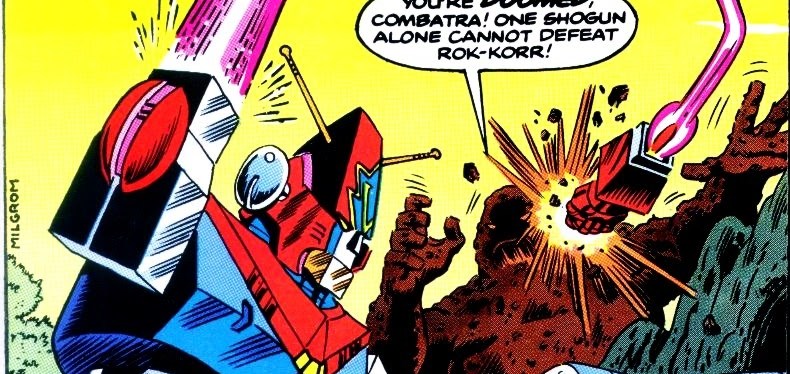
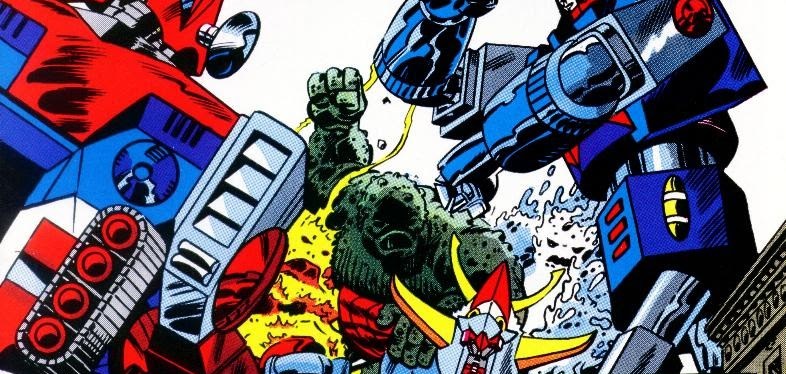
Dangard Ace, Raydeen and Combatra fighting their respective counterparts.
Shogun Warriors #3 (1979) does not have much depth but still managed to deliver the goods when it comes to showcasing giant robot spectacle. On the aspect of fun, this one is an improvement over the exposition-heavy issue #2 but that is not saying much. It should be noted that, like the first two issues, this comic book has less than twenty pages of art and story. More notably, there is not much new here other than the very lame and corny attempt by the creators for the big reveal they came up with at the end.
If you are seriously planning to buy an existing hard copy of Shogun Warriors #3 (1979), be aware that as of this writing, MileHighComics.com shows that the near-mint copy of the comic book costs $35.
Overall, Shogun Warriors #3 (1979) is satisfactory.
+++++
Thank you for reading. If you find this article engaging, please click the like button below and also please consider sharing this article to others. If you are looking for a copywriter to create content for your special project or business, check out my services and my portfolio. Feel free to contact me as well. Also please feel free to visit my Facebook page Author Carlo Carrasco and follow me at HavenorFantasy@twitter.com
Disclaimer: This is my original work with details sourced from reading the comic book and doing personal research. Anyone who wants to use this article, in part or in whole, needs to secure first my permission and agree to cite me as the source and author. Let it be known that any unauthorized use of this article will constrain the author to pursue the remedies under R.A. No. 8293, the Revised Penal Code, and/or all applicable legal actions under the laws of the Philippines.
Long before Pacific Rim (2013) presented giant robots and monsters slug it out on the big screen with a strong emphasis on action and scale, there were varied animated series of such giants shown in television sets in Japan way back in the 1970s. Then by the end of the decade, Marvel Comics published the Shogun Warriors comic book series in relation to a business deal with Mattel.
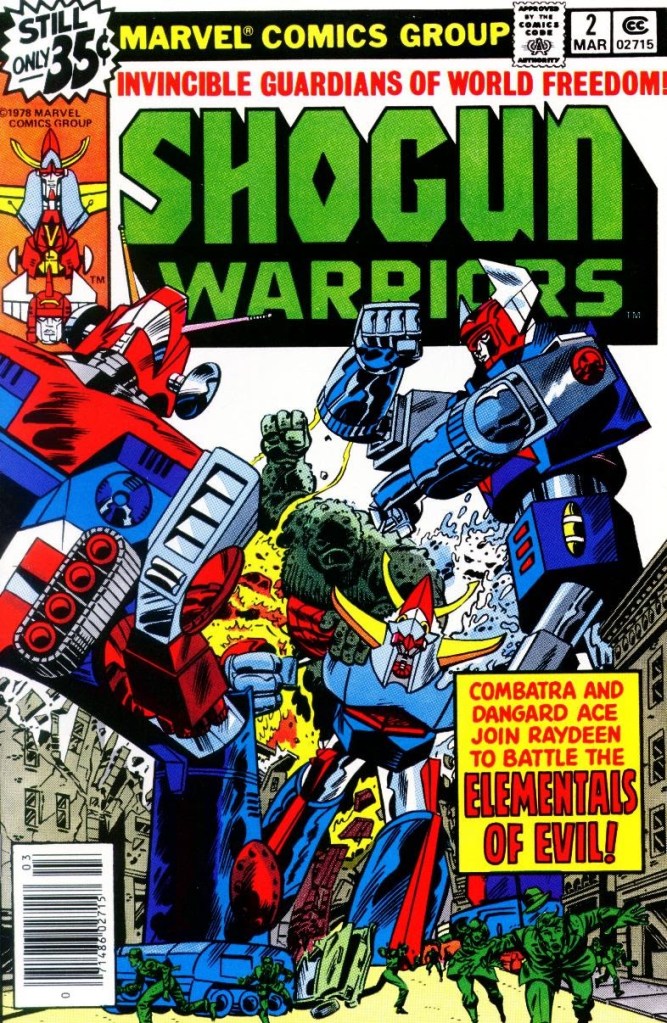
Last time, only one giant robot was heavily featured as a defender for human civilization as it became a target by a force of evil that unleashed a giant monster. That robot was Raydeen and as a result of what happened, something led to the unveiling of Combatra and Dangard Ace.
To find out more, here is a look back at Shogun Warriors #2, published by Marvel Comics in 1979 with a story written by Doug Moench and drawn by Herb Trimpe.
The cover.
Early story
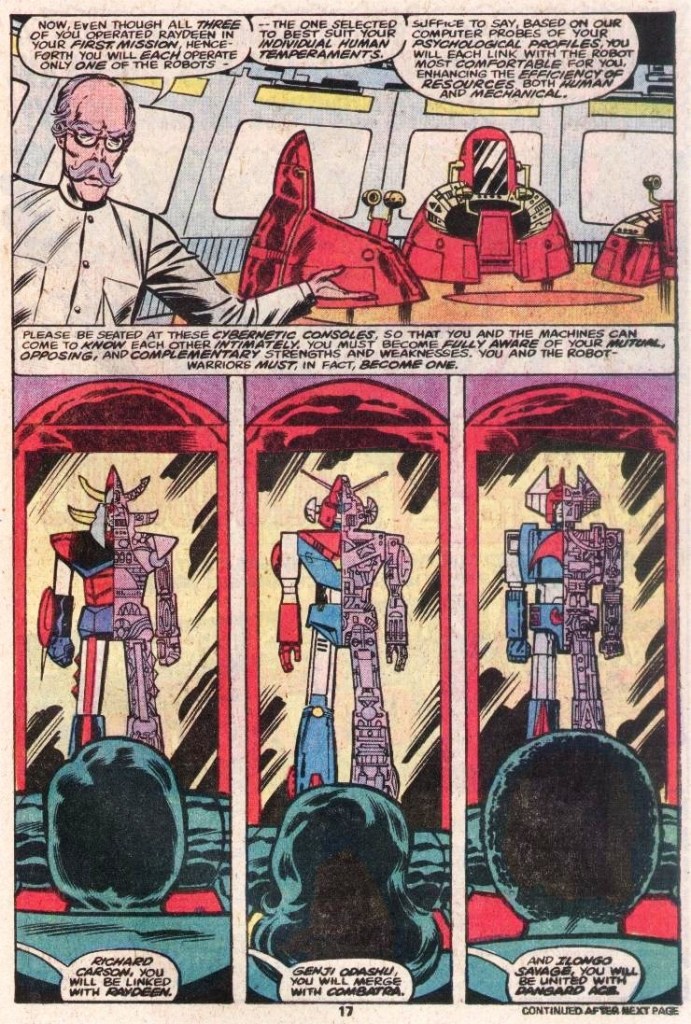
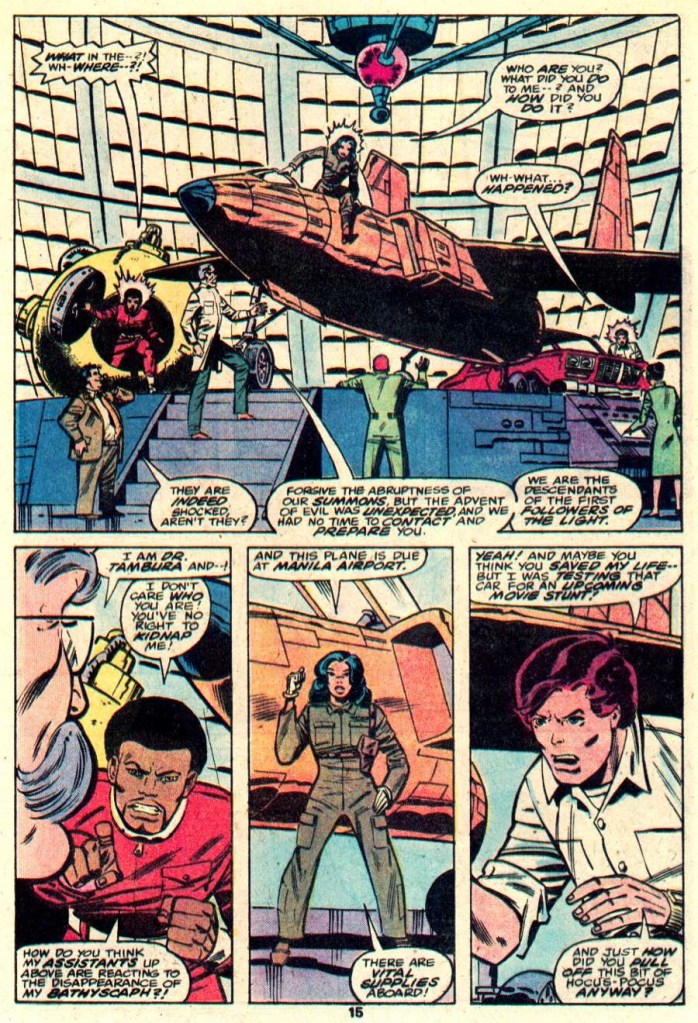
The story begins at the secret facility of Shogun. There the three pilots – Genji Odashu, Ilongo Savage and Richard Carson – are being briefed by Dr. Tambura explains to them that their first mission piloting Raydeen was not a failure at all. While acknowledging that the giant monster Rok-Korr is still a threat, he states to them that giant robots Combatra and Dangard Ace will be deployed and controlled by them.
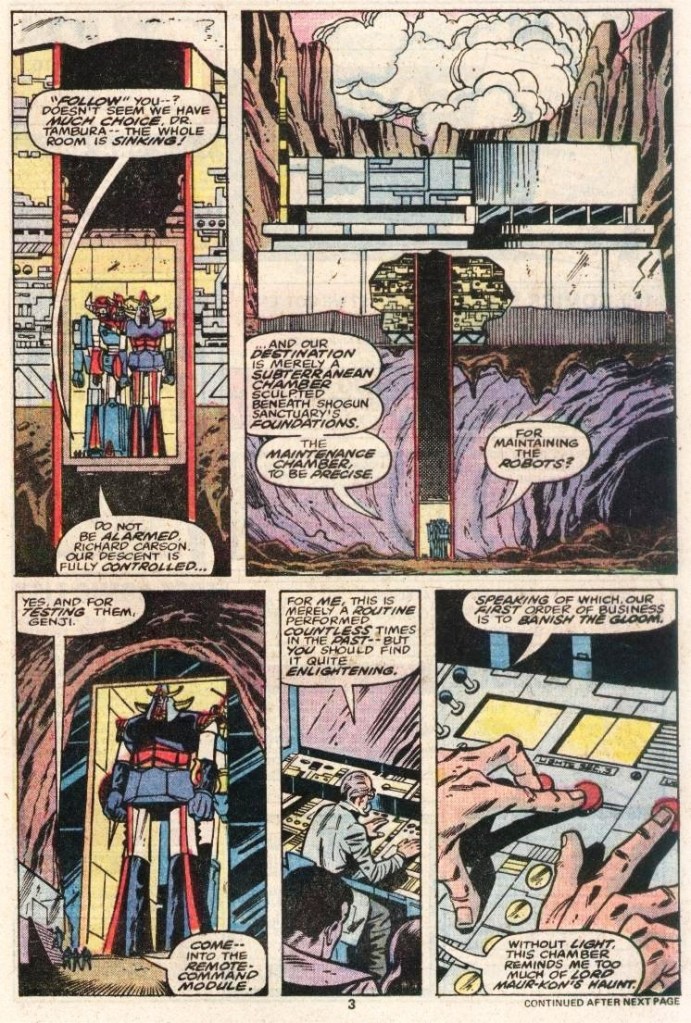
After giving them a quick tour of their subterranean chamber (where the robots receive maintenance and get tested), Dr. Tambura bring the three pilots into another place filled with high-tech controls. From there, they watch Dangard Ace, Raydeen and Combatra perform in field tests via remote control.
Meanwhile on a different island, the evil leader Maur-Kon rallies his so-called dark agents to rise and work together in seeking vengeance for their defeat in the great war chaos as they have found the forces of eternal good anticipating them. After much talk, Maur-Kon and his minions bow and kneel over bubbling magma murmuring evil phrases…
Quality
The three pilots get assigned with each robot.
Like the previous issue, this comic book has less than twenty pages of story and art. This results another heavy load of exposition or information dump on readers, and the narrative had a rushed pace. With regards to the battle between Raydeen and the giant monster, there is indeed a continuation of it. The giant monster was given some personality.
Again, there is no real character development here. The three pilots were not written to display any personality nor did the writer exert any effort to make readers relate with them. Instead, you will see them in training in speed beyond belief.
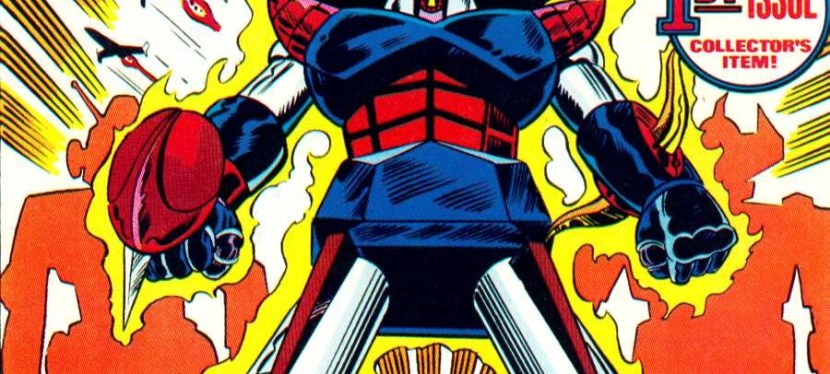
The highlight here is that Dangard Ace and Combatra finally got revealed and emphasized. Be warned, however, that there is lesser spectacle in this comic book and the story predictably served as a setup for what could be a more promising battle.
Conclusion
The pilots and the Shogun Warriors (the robots) go deep down.
Shogun Warriors #2 (1979) suffered from pretty much the same problems as issue #1. The noticeable difference here is that there is lesser action and lesser giant-sized spectacle shown here. That is not exactly surprising as the creators had to sacrifice something to make way for further explanation of the comic series’ grand concept.
If you are seriously planning to buy an existing hard copy of Shogun Warriors #2 (1979), be aware that as of this writing, MileHighComics.com shows that the near-mint copy of the regular edition costs $35 while the near-mint copies of the price-less and the Whitman editions cost $350 and $35 respectively.
Overall, Shogun Warriors #2 (1979) is less than satisfactory.
+++++
Thank you for reading. If you find this article engaging, please click the like button below and also please consider sharing this article to others. If you are looking for a copywriter to create content for your special project or business, check out my services and my portfolio. Feel free to contact me as well. Also please feel free to visit my Facebook page Author Carlo Carrasco and follow me at HavenorFantasy@twitter.com
Disclaimer: This is my original work with details sourced from reading the comic book and doing personal research. Anyone who wants to use this article, in part or in whole, needs to secure first my permission and agree to cite me as the source and author. Let it be known that any unauthorized use of this article will constrain the author to pursue the remedies under R.A. No. 8293, the Revised Penal Code, and/or all applicable legal actions under the laws of the Philippines.
If you are fond of giant robots from Japanese pop culture as well as giant monsters and scenes of city structures getting destroyed, then you might want to take a look at the Shogun Warriors comic book series that was published by Marvel Comics from 1979 to 1980. To put things in perspective, Shogun Warriors was made possible through licensing deals and back in the 1970s, Marvel Comics had the rights to publish comic book about Japan’s famous icon Godzilla.
Specifically, Shogun Warriors involved Marvel Comics and Mattel which in turn organized a line of imported toys from Japan based on varied Japanese shows about giant robots. Among the many giant robots of the toy line, the robots Raideen, Combattler V and Dangard Ace became the featured fighting-for-good robots of the Shogun Warriors comic book series. For the literary works, Raideen was renamed as Raydeen while Combattler V was renamed as Combatra. Dangard Ace’s name was left unchanged.
With those details laid down, here is a look back at Shogun Warriors #1, published in 1979 by Marvel Comics with a story written by Doug Moench and drawn by Herb Trimpe.
The cover.
Early story
The story begins in the outskirts of Tokyo in Japan where giant robot Raydeen fights a large, tentacled creature enhanced with cybernetics. As the people on the street below them run away from the ongoing destruction, the monster fires a shot at Raydeen who blocks it but subsequently gets tied with one of the tentacles. The giant robot, which is operated by three pilots inside, breaks free and continues to fight the monster.
As the battle rages on, the city continues to get damaged heavily affecting the people…
Quality
Technically the organization kidnapped three people to be the pilots of their robots for Earth’s defense.
Having seen a lot of anime TV series episodes about giant robots, I’m familiar already with the storytelling formula that often focuses first on the human characters and their struggles before shifting the narrative on the giant robots that often fight large monsters or opposition robots. This particular comic book has some of that but the way the story is structured, it is different and can be a bit jarring.
Doug Moench structured the story to have Raydeen and the monster fighting in the present time followed shortly by a flashback that took place just hours prior. The flashback, which occupies 9 of the comic book’s 18 pages, is heavily filled with exposition meant to introduce readers to the three pilots Genji Odashu/Ilongo Savage/Richard Carson, what Earth defense force The Followers of the Light is, and why there are giant monsters ravaging the world. The exposition’s writing felt crammed and rushed for reading although it still succeeds in establishing the comic book’s grand concept.
When it comes to spectacle, this comic book is loaded with giant robot action and it is quite varied in style and execution. The funny thing is that you will only get to see Raydeen in action as this is an introductory story with only 18 pages of story.
The dialogue is a bit of a mess here, particularly with the early Raydeen scenes. As the battle with the monster goes on, there are these lines of dialogue reflecting the conversations between the pilots inside Raydeen who are not shown talking until late in the comic book.
Conclusion
Raydeen and the giant monster in battle.
Shogun Warriors #1 (1979) has a nice concept and its Westernized take on portraying giant robots and human characters is clearly different from the way things were done in the varied giant robot anime TV series of Japan. There is clearly no Japanese style melodrama as this one has its characters portrayed straight with a touch of American science fiction. That being said, do not expect to see the Japan-made characters of Raideen, Combattler V and Dangard Ace appear here as new characters were made in their place. The comic book’s story structure is a bit jarring to follow and the heavy exposition dump makes reading a bit of a chore. It is fun to read but not great. Those of who are fans of Combatra and Dangard Ace will be disappointed about the near-total absence of those robots.
If you are seriously planning to buy an existing hard copy of Shogun Warriors #1 (1979), be aware that as of this writing, MileHighComics.com shows that the near-mint copy of the regular edition costs $63 while the near-mint copy of the Whitman edition costs $35.
Overall, Shogun Warriors #1 (1979) is satisfactory.
+++++
Thank you for reading. If you find this article engaging, please click the like button below and also please consider sharing this article to others. If you are looking for a copywriter to create content for your special project or business, check out my services and my portfolio. Feel free to contact me as well. Also please feel free to visit my Facebook page Author Carlo Carrasco and follow me at HavenorFantasy@twitter.com
Sorry for this late feature but I wish to share to you geeks and hobbyists that during the 2019 edition of the Toycon held this past June at the SMX Convention Center in Pasay City, I spotted the display of Macross.
I’m a Macross fan and I always make it a point to find stuff related to my favorite anime franchise whenever a convention happens. Here are some that I spotted during the Toycon.
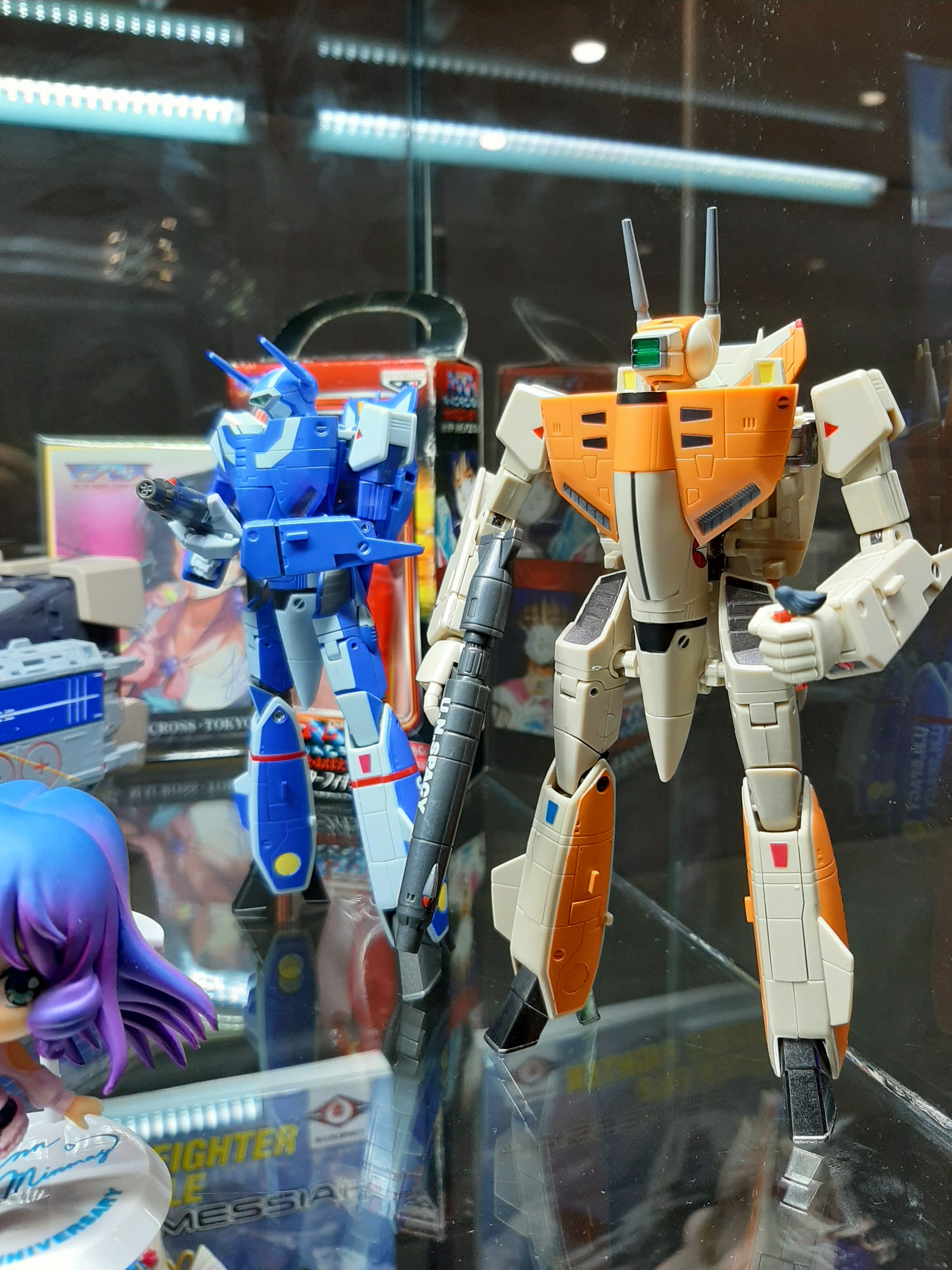
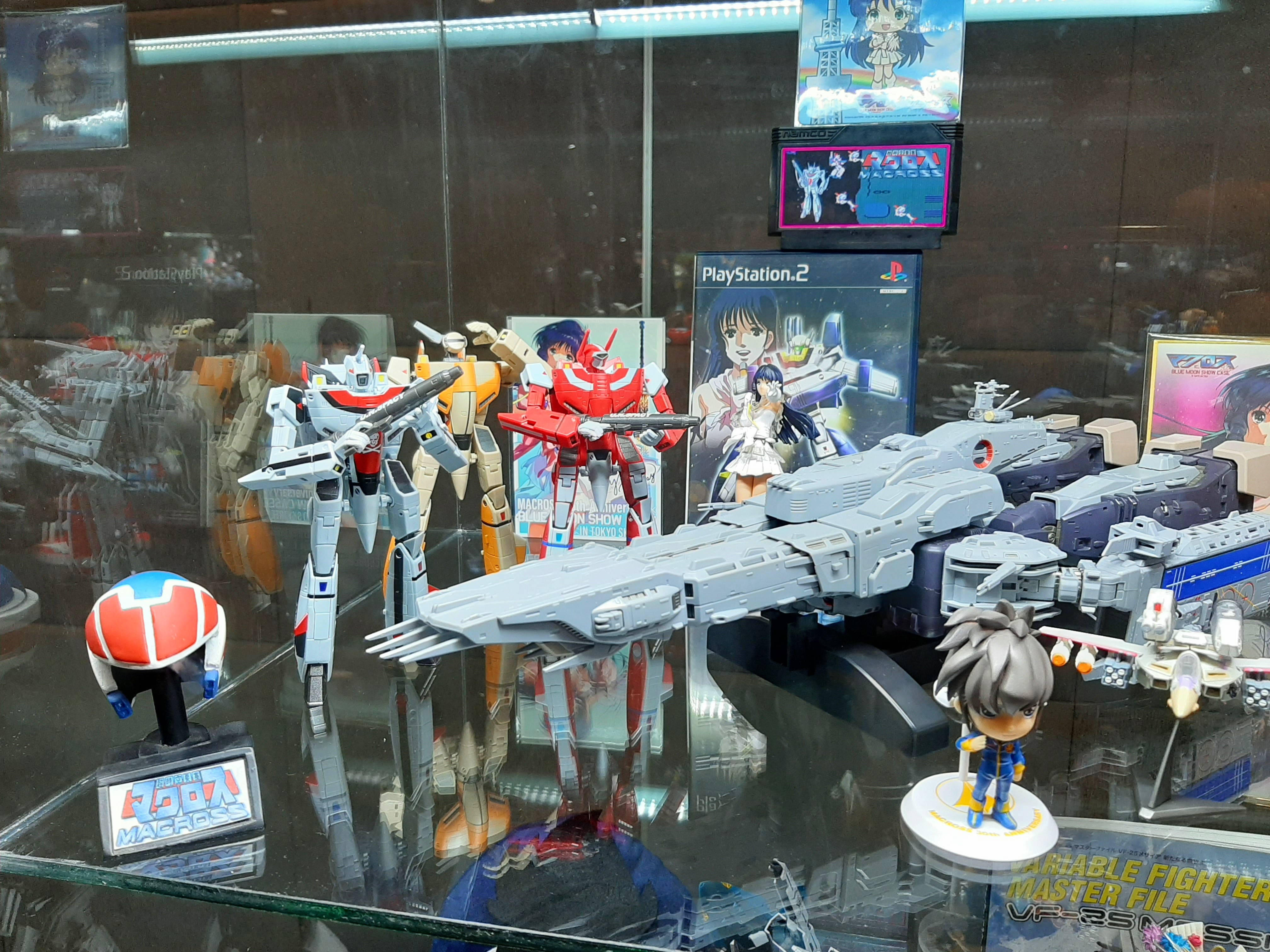
The YF-19 from Macross Plus and its weapons on display. Behind it are varied video games and manuals.
A close look at these mean machines. The one on the right reflects the model of used by Hikaru in the first few episodes of the 1980s Macross anime TV series complete with holding Lynn Minmay for safety.
At the 2nd level of the convention center was a function hall which has a large display of collected items of varied entertainment franchises. The one showcasing Macross had toys, action figures, plastic models, video games, music CDs and some printed materials.
What caught my attention was the display of the YF-19 from Macross Plus complete with its weapons in full view.
Memories of the 1980s anime TV series as well as the 1984 classic movie Macross: Do You Remember Love? entered my mind.
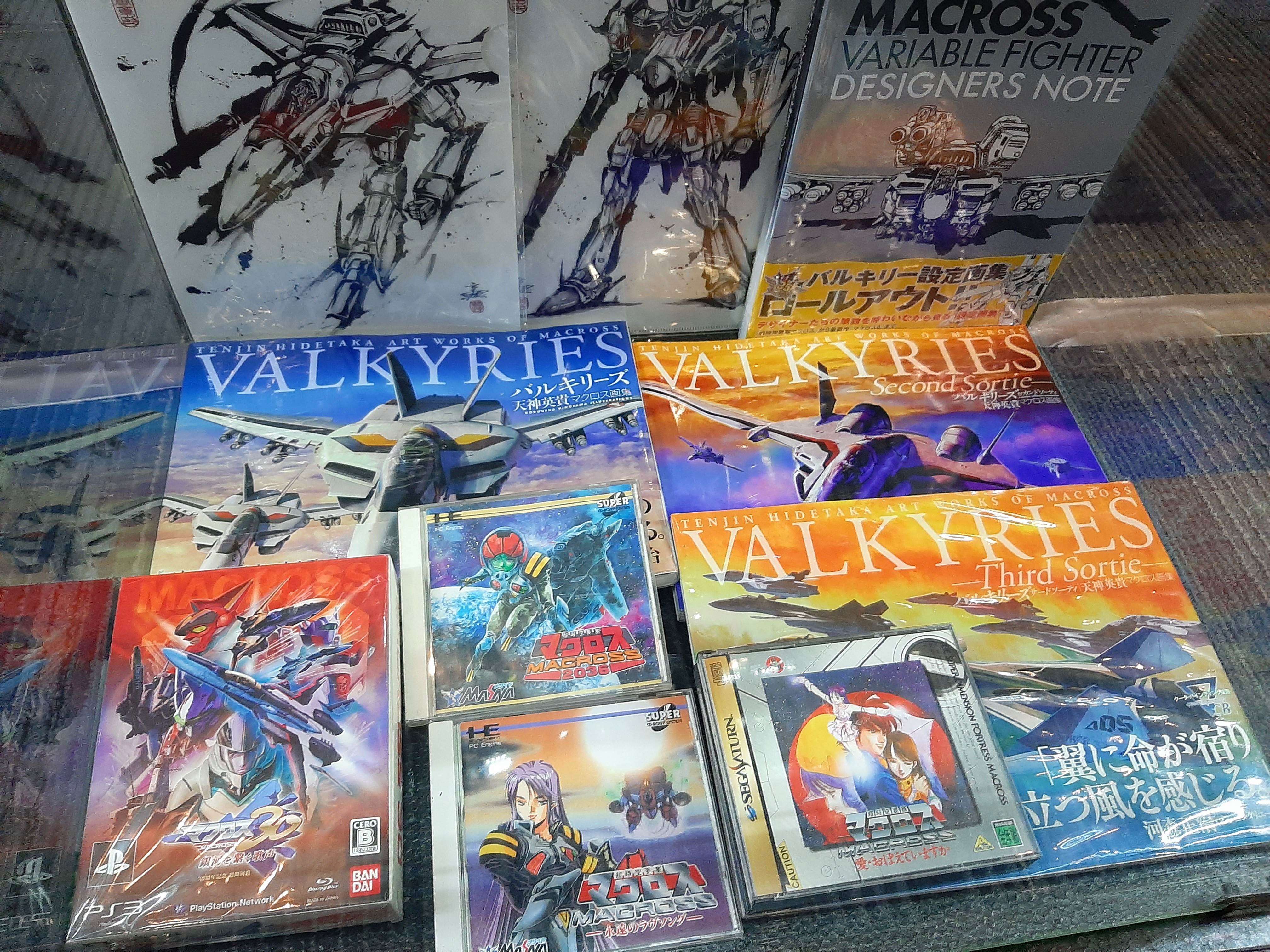
Also seeing an original copy of the 1990s Sega Saturn video game adaptation of Macross: Do You Remember Love? instantly made me remember playing and enjoying the PlayStation version of that game. The Sega Saturn game can be seen in the picture below.
Art, books, soundtracks and the Sega Saturn video game.
As much as I enjoyed the display of Macross memorabilia, I regret to say that I was unable to find any more related collectibles or products for sale among the many vendors at the lower level during the Toycon. I searched for whatever Macross stuff I could find (t-shirts, comic books, action figures, models, cards and others) but ended up with nothing.
Then again, it should NOT be surprising at all. Macross as an entertainment franchise is not exactly popular here in the Philippines and Macross Mania in the country has ended long ago. To say the least, the popularity of Macross here in the Philippines is limited to older fans and collectors. Anime is a lot more popular among Filipinos in this modern age but that does not mean Macross found a new nor large audience.
If ever the legendary Shoji Kawamori (whom I met at AsiaPOP Comicon Manila in 2017) or any notable Macross-related talent comes here in the Philippines, only then will the Macross brand gain attention.
Another close look.
If you love anime or Macross, then I invite you to read my retro movie review of Macross: Do You Remember Love? right here. I also wrote about the famous Lynn Minmay here.
Thank you for reading. If you find this article engaging, please click the like button below and also please consider sharing this article to others. Also my fantasy book The World of Havenoris still available in paperback and e-book format. If you are looking for a copywriter to create content for your special project or business, check out my services and my portfolio. Feel free to contact me as well. Also please feel free to visit my Facebook page Author Carlo Carrasco and follow me at HavenorFantasy@twitter.com
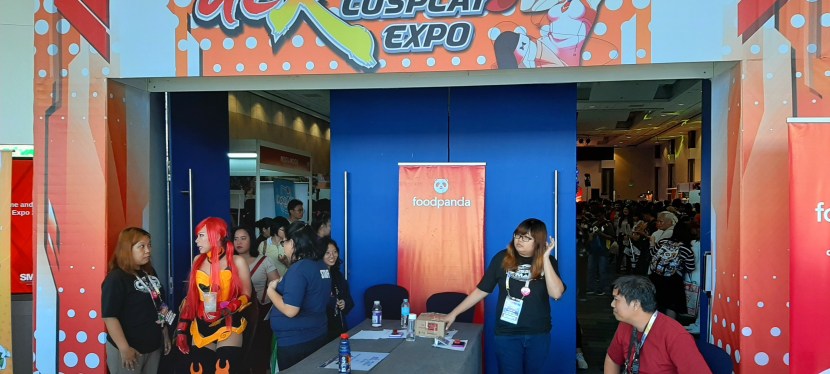
This morning, out of curiosity, I attended the Anime & Cosplay Expo 2019 held at one of the function rooms at the upper level of the SMX Convention Center, SM Mall of Asia (SM MOA) in Pasay City.
What I saw there was quite amusing. The large function room had just enough space for the exhibitors, the stage with sound system and lights and the food sellers. Of course, the available space in between was filled with many, many anime and cosplay enthusiasts! Some enthusiasts were seen seated some feet away from the stage waiting for the next event to happen like a cosplay contest, special guest appearances, etc.
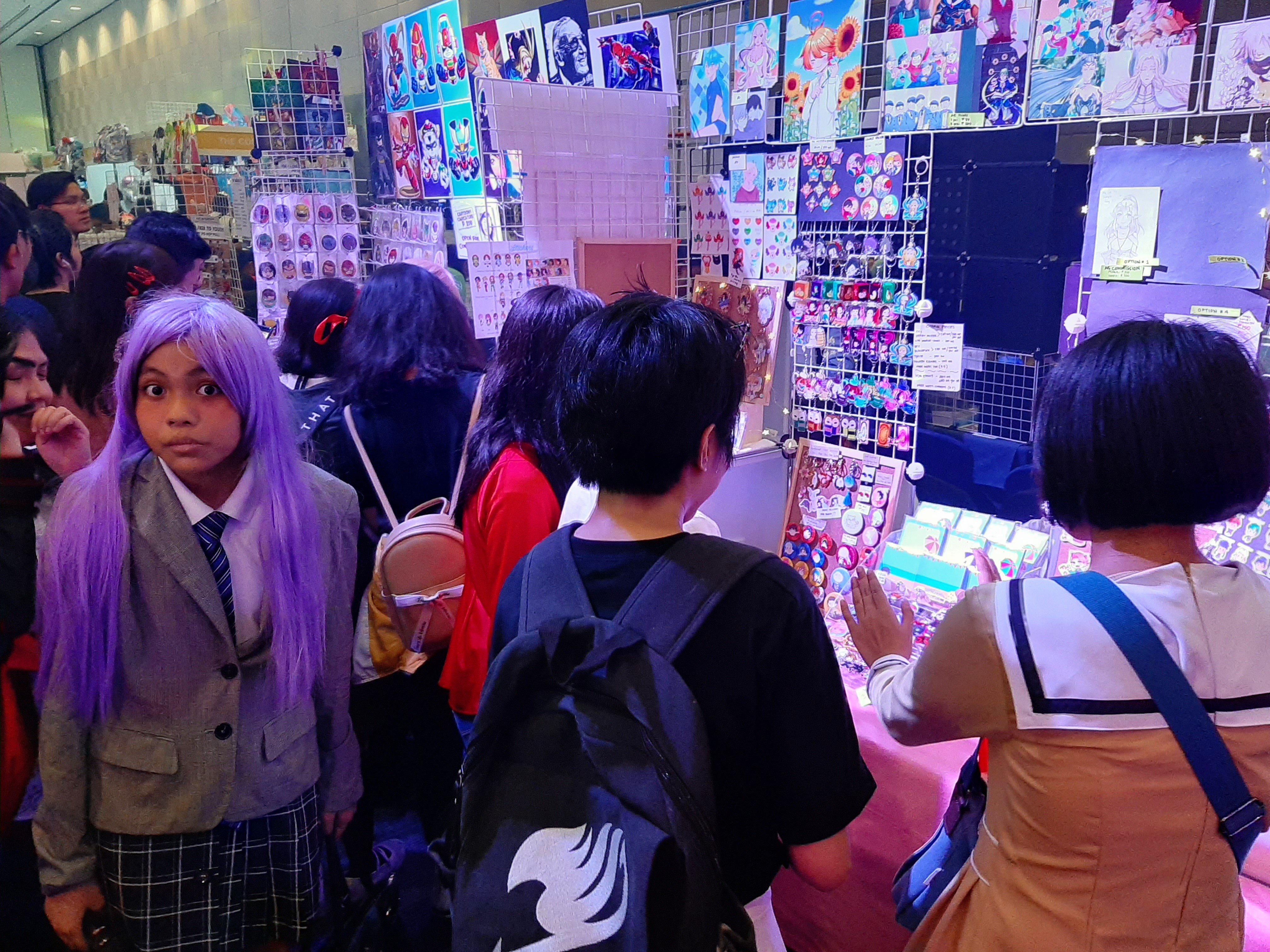
Buyers and enthusiasts searching for fun stuff.
Another look at what were being sold.
Moving around got tight from time to time which reminds me how popular anime and cosplay have really gotten among locals as well as how interested buyers are with the products being displayed for sale.
As I saw some stickers (of pop culture icons and anime figures drawn by local illustrators) for buying, I had to stand behind a buyer who was searching for stickers and asked questions to the seller. There were three other customers next to him also standing right in front of the booth examining the stuff. After patiently waiting, I finally got to the front of the booth, quickly picked stickers (for some friends) and bought them.
There was a lot of stuff that appealed to cosplay and anime enthusiasts. Cards, buttons, stickers, caps, shirts, costumes, cosmetics, dolls, action figures, posters and a few publications. Those who purchased what they searched for clearly were happy. I searched from some Macross-related items but found none.
And then I took time out to photograph some cosplayers for your viewing pleasure below. Just click to ENLARGE.
A lot of people went on cosplay emphasizing their favorite characters from anime while some appeared as characters from computer games. These cosplayers really paid close attention to their craft with regards to capturing the looks of the characters they portrayed from the hair color to the make-up, the costumes, the shoes, the accessories and the like.
And among the cosplayers, I spotted someone dressed as Spider-Man. Specifically, the cosplay at the event was geared towards anime and computer games (like those online JRPGs).
Even though my interest in anime has waned a long time ago, it was still a nice experience to attend the Anime & Cosplay Expo 2019. More than twenty years ago, I was a very avid anime enthusiast and video collector and back in those days, events focused on anime and some related interests were not that popular and were not well publicized.
Today there are these local organizations focused on special interests like anime and cosplay which can emphasize their interests and reach out to many people around the country via the Internet. When an upcoming event gets announced, the enthusiasts will respond and prepare themselves (and their money) for attendance. Not only that, there are now many local businesses willing to sponsor these anime and cosplay events. These developments show that there is now respect and trust for these kinds of events. If you ask me, an anime and cosplay event is more interesting than a city government-organized beauty pageant.
By the way, the Anime & Cosplay Expo 2019has one more day left tomorrow. There are some scheduled activities set to happen. If you intend to attend at all, click here.
Thank you for reading. If you find this article engaging, please click the like button below and also please consider sharing this article to others. Also my fantasy book The World of Havenoris still available in paperback and e-book format. If you are looking for a copywriter to create content for your special project or business, check out my services and my portfolio. Feel free to contact me as well. Also please feel free to visit my Facebook page Author Carlo Carrascoand follow me at HavenorFantasy@twitter.com
























 Author Carlo Carrasco