Retro Gaming Ads Blast – Part 18 (Fighting Games Special)

Welcome back readers, fellow geeks and electronic gaming fans!

In this edition of the Retro Gaming Ads Blast (RGAB) series, we will take a look at another batch of retro gaming print ads – including arcade flyers – specifically about fighting games that were released in the 1990s. The said decade marked the time when Street Fighter II became a massive hit in the video arcades (and on game consoles) which sparked a wave of new fighting games from business competitors. In that same decade, 3D polygonal fighting games were also released which added greater choices of fighting games at the arcades and on game consoles that players could choose from.

For the newcomers reading this, Retro Gaming Ads Blast (RGAB) looks back at the many print ads of games (console, arcade, computer and handheld) that were published in comic books, magazines, flyers, posters and newspapers long before smartphones, social media, the worldwide web and streaming became popular. To put things in perspective, people back in the 1980s and 1990s were more trusting of print media for information and images about electronic games and related products.

With those details laid down, here is the newest batch of retro gaming print ads for you to see and enjoy…

1. Dead or Alive Japanese arcade flyer
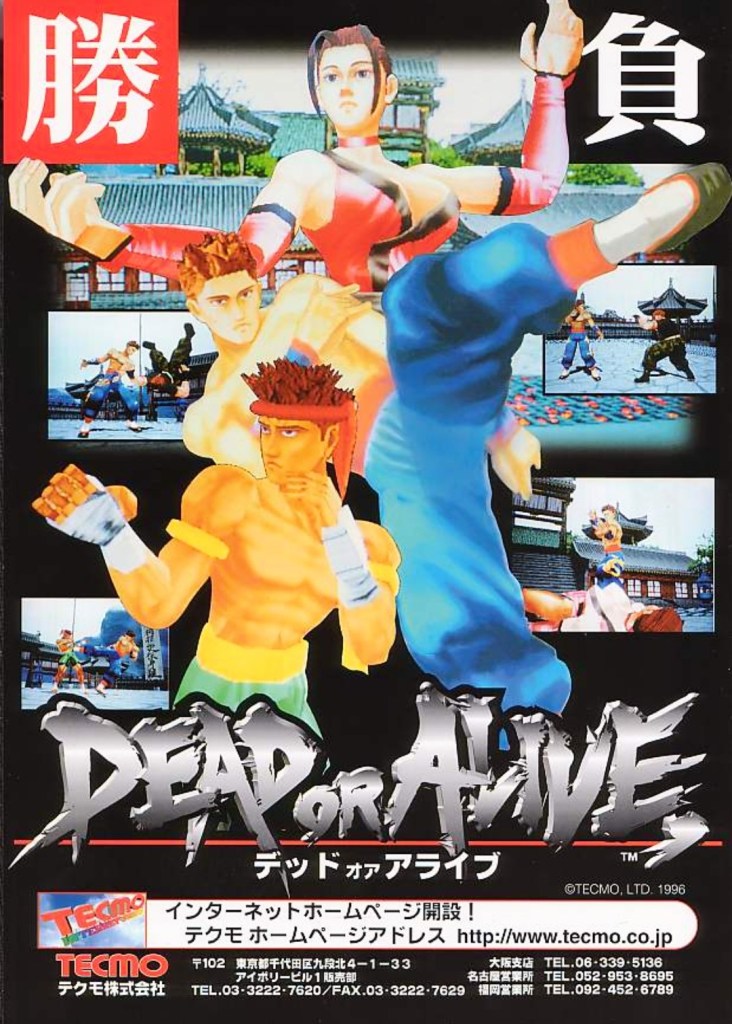
Dead or Alive was the start of new success that impacted the direction of Tecmo in the gaming industry.

The above arcade flyer of Dead or Alive gave Japanese arcade operators and gamers a taste of what to expect with the game. While the screenshots showed some resemblance with what gamers saw in Virtua Fighter 2, the character designs Tecmo and its developers came up with were unique.

Before Dead or Alive was released in Japanese arcades in 1996, company Tecmo was in financial trouble and they asked Tomonobu Itagaki to make a fighting game similar to Sega’s polygonal blockbuster Virtua Fighter. A breakthrough for Tecmo happened when Sega announced they were licensing their Model 2 arcade to third-party companies which paved the way for Itagaki’s team to make Dead or Alive with it. The game became a big hit and it paved the way for Tecmo to release it on Sega Saturn and PlayStation, and the sequels that followed years later.

2. North American Soulcalibur Dreamcast version print ad
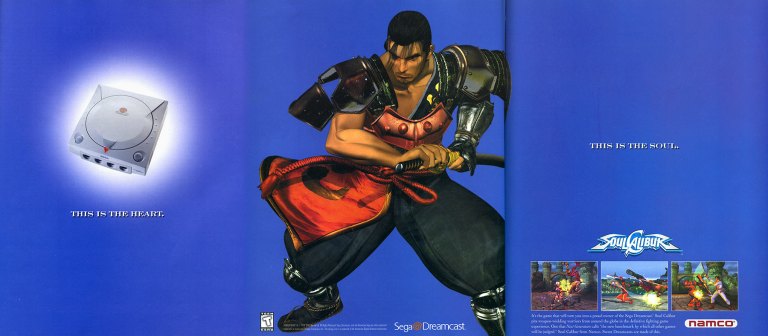
Namco came up with a creative approach to emphasize heart-and-soul promoting their game and the Dreamcast.

On September 9, 1999, Sega launched their Dreamcast console in America. With a gap of around ten months between the Japanese launch (November 1998) and the American launch, Sega had time to prepare Dreamcast’s release to American gamers with a huge lineup of games (both Sega’s games and from other publishers). Fortunately for Sega, they had Namco (their rival on arcade games) supporting their console.

Behind the scenes, Namco’s developers worked hard to not only port their arcade hit Soulcalibur to the Dreamcast, but to enhance the graphics using the console’s more advanced technology. The visual enhancements include rendering all of the games stages (and backgrounds) into full 3D polygonal environments. Namco also implemented different game modes and added even more content to ensure satisfaction to Dreamcast gamers.

The above 3-page print ad of Soulcalibur on Dreamcast was undeniably strategic and captivating to look at. The ad described the console as the heart, showed Soulcalibur character Mitsurugi (one of the game’s most popular characters) in the middle and then described the game (with 3 screenshots of game rendered with Dreamcast graphics) as the soul. It was a strong way to promote both the game and the console. In the years that followed, Soulcalibur grew into a popular fighting game franchise and the Dreamcast version will always be remembered as the crucial turning point.

3. X-Men: Children of the Atom arcade flyer
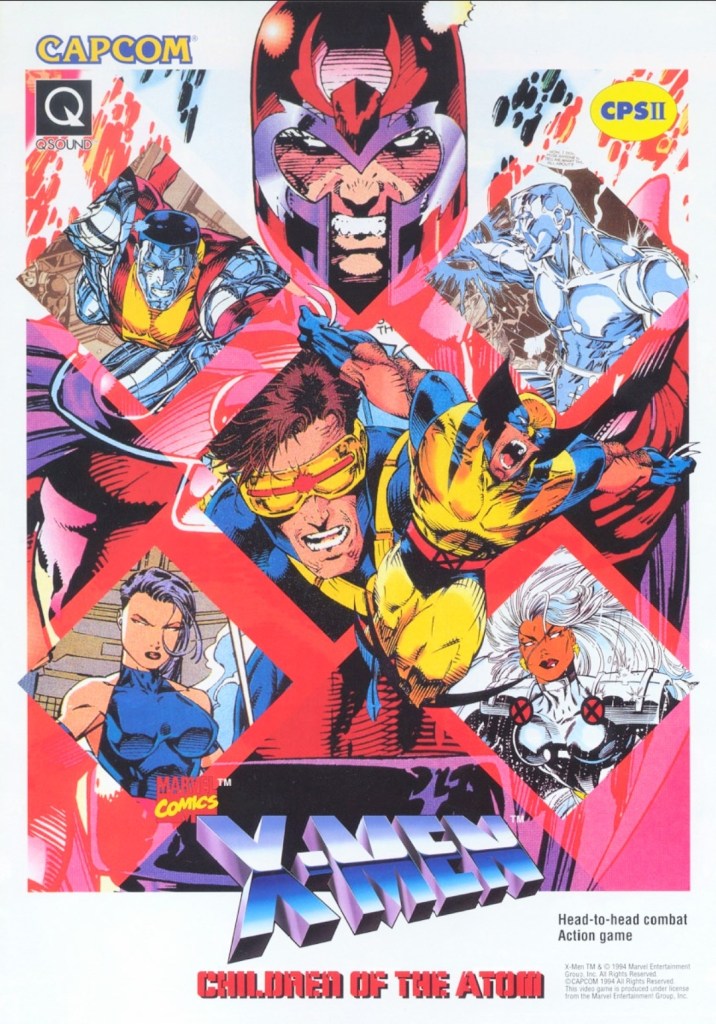
Anyone who read lots of X-Men comic books in the 1990s should be able to tell which character was drawn by which artist.

When Capcom first released X-Men: Children of the Atom in the arcades in the mid-1990s, I was surprised because I did not anticipate the day would come when the company behind Street Fighter II would actually make a 2D fighting game showcasing the Marvel’s mutants. Even more intriguing was the X-Men art Capcom used for the arcade flyer to promote the game. I recognize Jim Lee’s artworks of Magneto, Cyclops and Colossus. The art of Wolverine shown was drawn by Andy Kubert. It was a wise move for Capcom (with Marvel as a business partner) to use established X-Men comic book artworks instead of having their internal illustrator draw the characters. That being said, this arcade flyer still looks great and captivating to look at.

4. North American Ranma ½: Hard Battle print ad
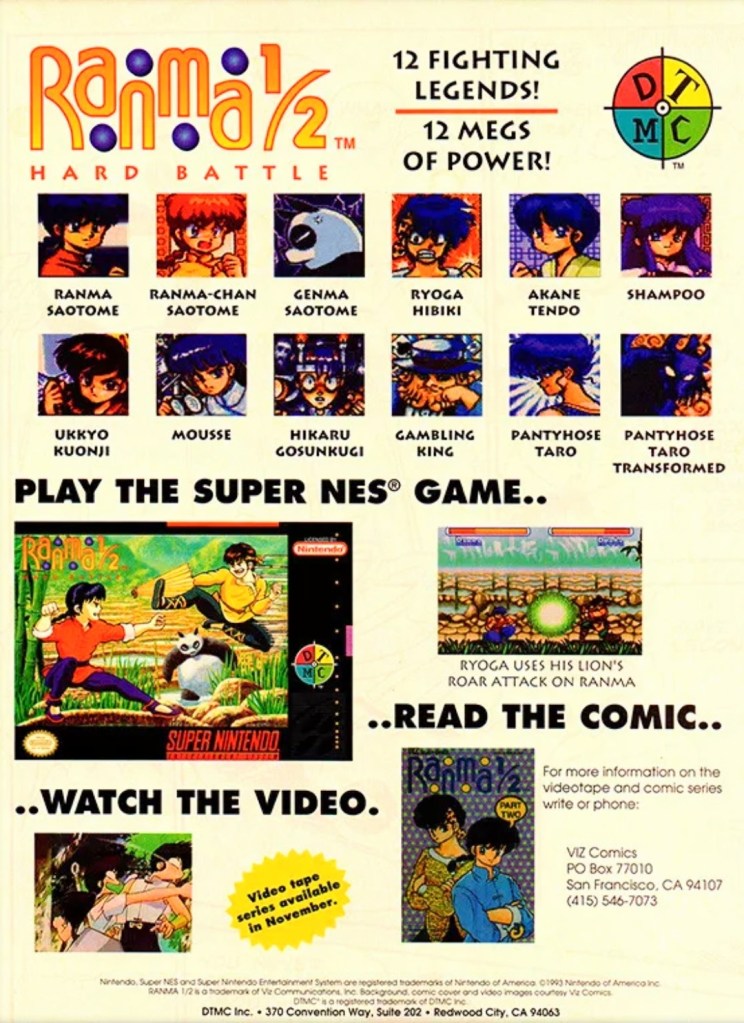
A print ad promoting the game while saving some space to promote the anime and comic books.

By 1993, Street Fighter II and its upgraded follow-ups were wildly popular both in the arcades and on game consoles around the world. At the same time, there were many other 2D fighting games released to compete with and cash-in on Street Fighter II’s success. Believe it or not, the established anime franchise Ranma ½ saw a video game adaptation in the form of a 2D fighting game – Ranma ½: Hard Battle.

The North American print ad above published by DTMC (in cooperation with Viz Communications) promoted the game (one screenshot, the SNES game box and images of the characters as they appeared in the game) as well as Ranma ½ on anime videos and comic books. The way it was presented, the print ad promoted Ranma ½: Hard Battle without much heart nor passion.

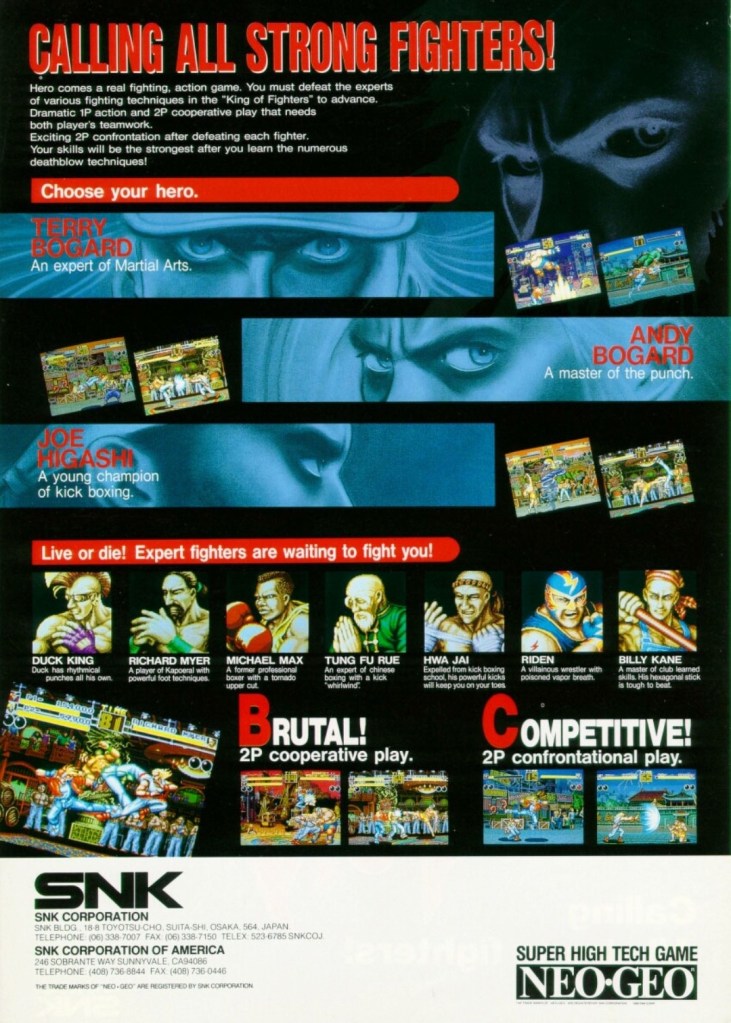
5. Fatal Fury: King of Fighters arcade flyer
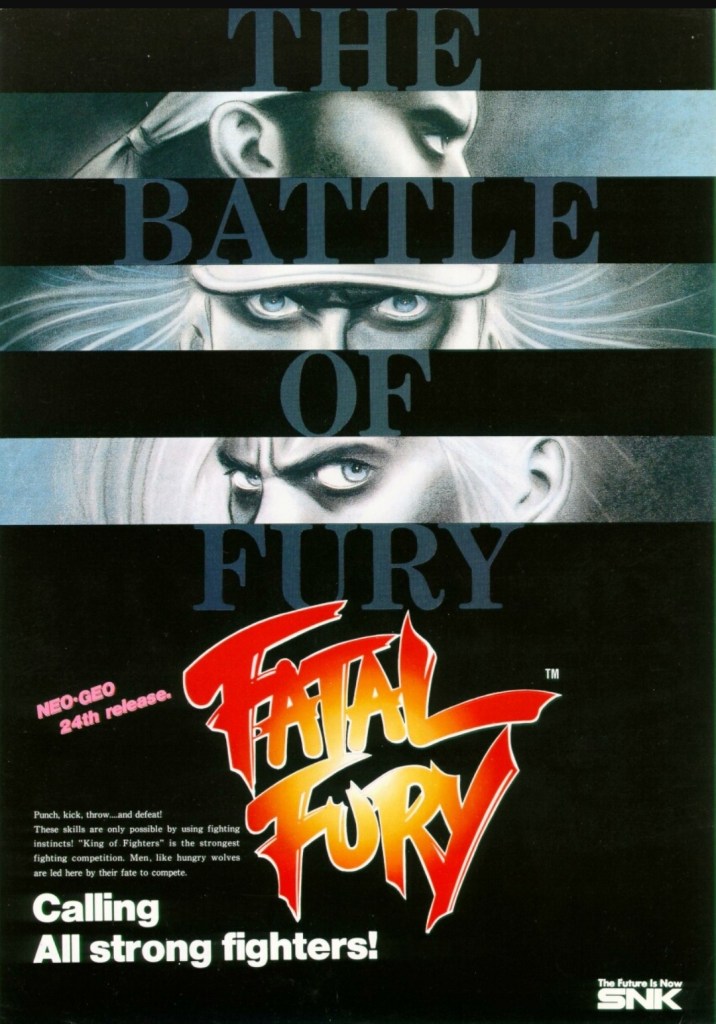
An intriguing visual presentation on the front.
You get to know the characters and what the game features are.

There is no doubt that Fatal Fury: King of Fighters is the most significant game that SNK made. Apart from being the company’s first fighting game for the Neo Geo system, it established the fictional “king of fighters” tournament that became the core concept for The King of Fighters series of games in the years that followed. Fatal Fury itself is notable for being designed by Takashi Nishiyama, a former Capcom employee who created the original Street Fighter game. What Nishiyama could not do with Street Fighter, he accomplished while making SNK’s fighting game. Compared with the combo-oriented approach of Street Fighter II, Fatal Fury was designed to emphasize the timing of special moves, confrontational play, cooperative play and the 3D-like spacing between characters (background row and foreground row in each stage) while telling a story in a solid way.  

The above arcade flyer of Fatal Fury has this unique looking artwork on the front showing stylized rectangular shots of the major characters Terry Bogard, Andy Bogard and Joe Higashi. On the other side of the flyer are the details that emphasized the creative concept of the game, who the characters are and what they could expect with regards to gameplay features. This flyer is still captivating to look at and it could entice you to try playing the original Fatal Fury game before trying out the sequels and spin-offs.

6. Marvel vs. Capcom: Clash of Super Heroes arcade flyer
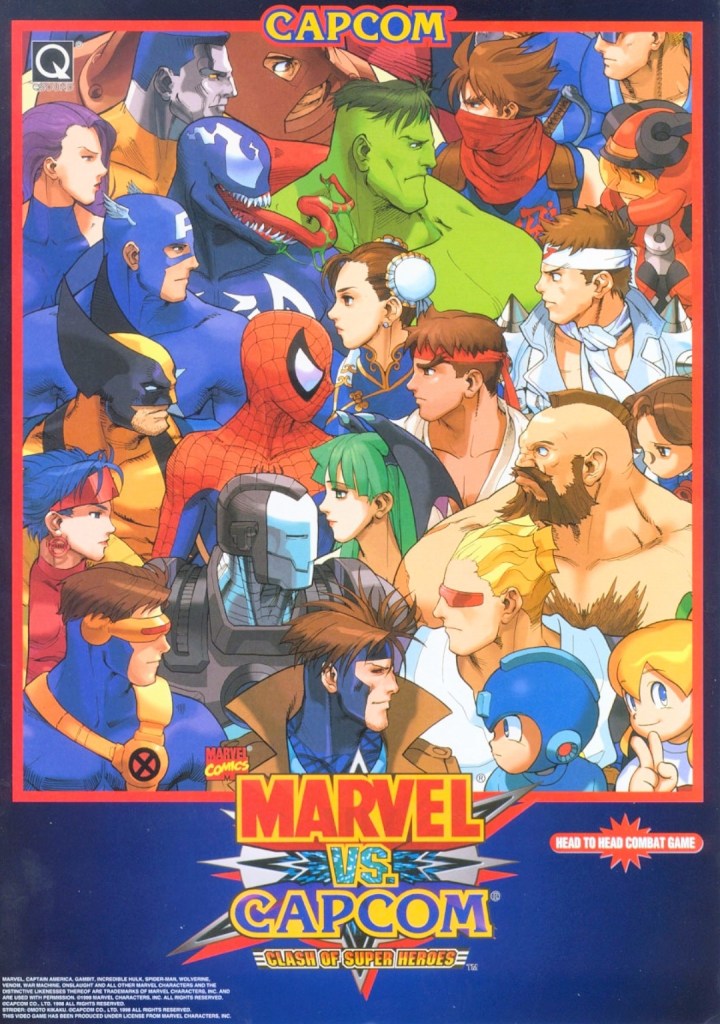
This is NOT a comic book crossover.

If there is anything that truly emphasizes the essence of a fictional crossover in terms of visuals, it’s the art that Capcom and Marvel agreed to for Marvel vs. Capcom: Clash of Superheroes which is evident on the front of the above arcade flyer. By looking at how the Marvel characters were drawn, it looks like someone at Capcom illustrated the artwork as the Capcom characters still maintained that particular art style seen in the artworks of the Japanese company’s other games like Street Fighter, Darkstalkers, Mega Man and Strider. Regardless, the artwork still is amusing to look at.

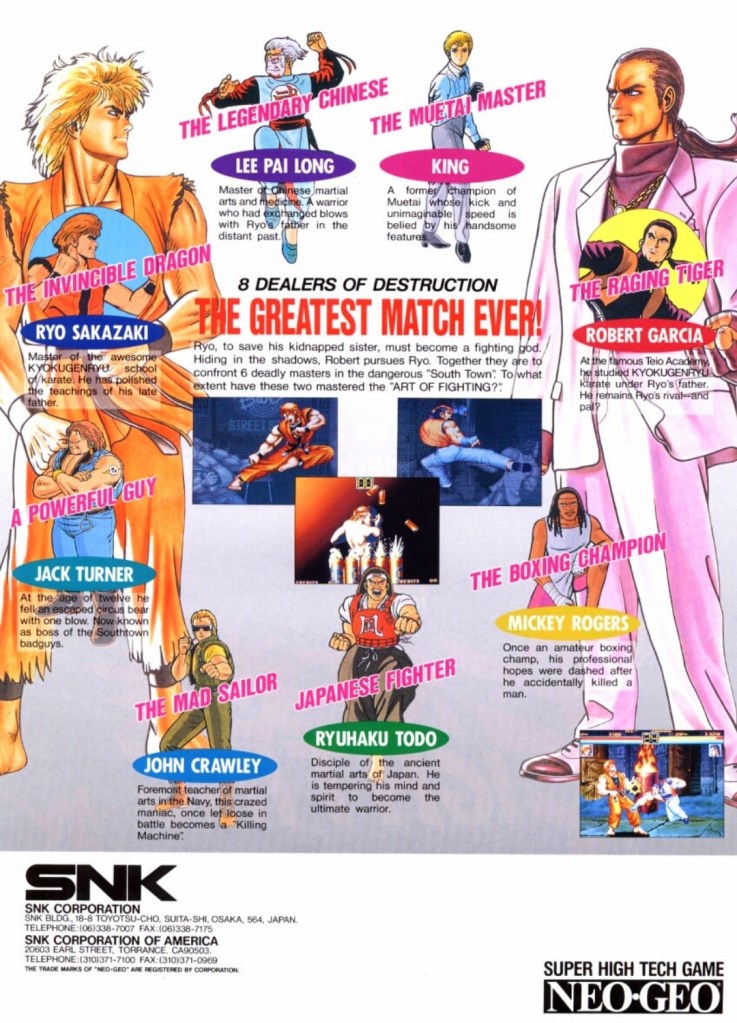
7. Art of Fighting arcade flyer
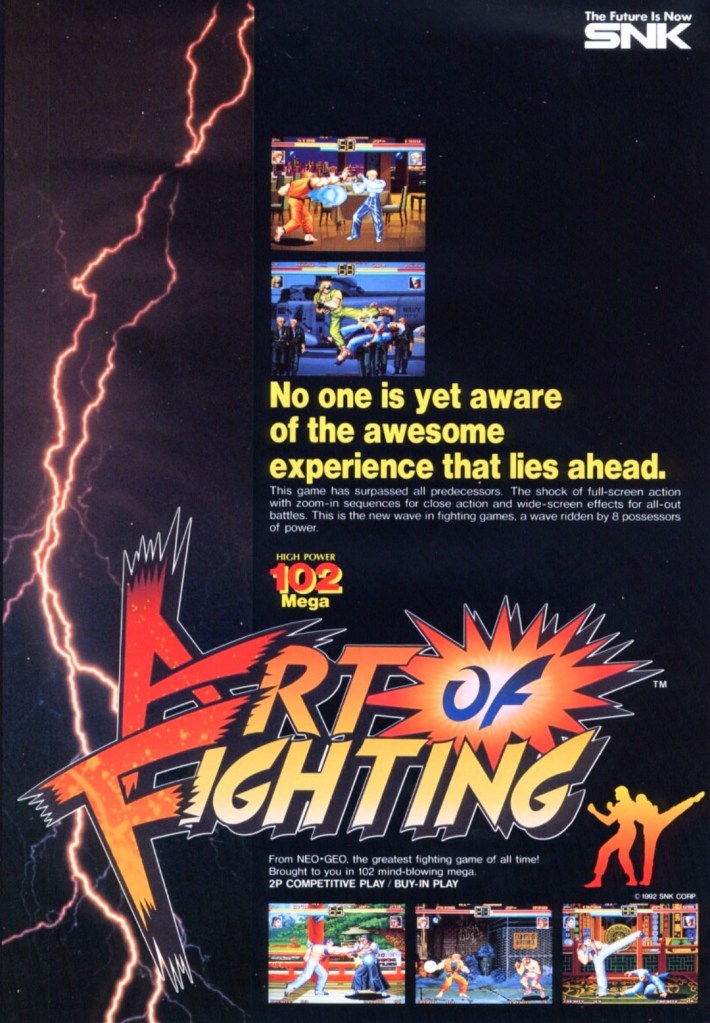
The front of the flyer.
The cast of characters showcased on the other side of the flyer.

Following the success of Fatal Fury, SNK went on to release Art of Fighting in arcades in 1992 and it became successful enough for the company to make sequels. With regards to the realm of fantasy, Art of Fighting was part of the same fictional universe as Fatal Fury and The King of Fighters, and there were times when its own characters appeared in other SNK games.

Art of Fighting’s arcade flyer had an energetic visual concept on the front with a rectangular lightning portion on the left balanced with five screenshots of the game itself. Once you get to the other side of the flyer, you will see really nice art of the characters with Ryo Sakazaki and Robert Garcia as the most dominating figures. Sakazaki and Garcia are the major characters of the Art of Fighting series. This flyer confidently introduced the characters and succeeded in making them look interesting.

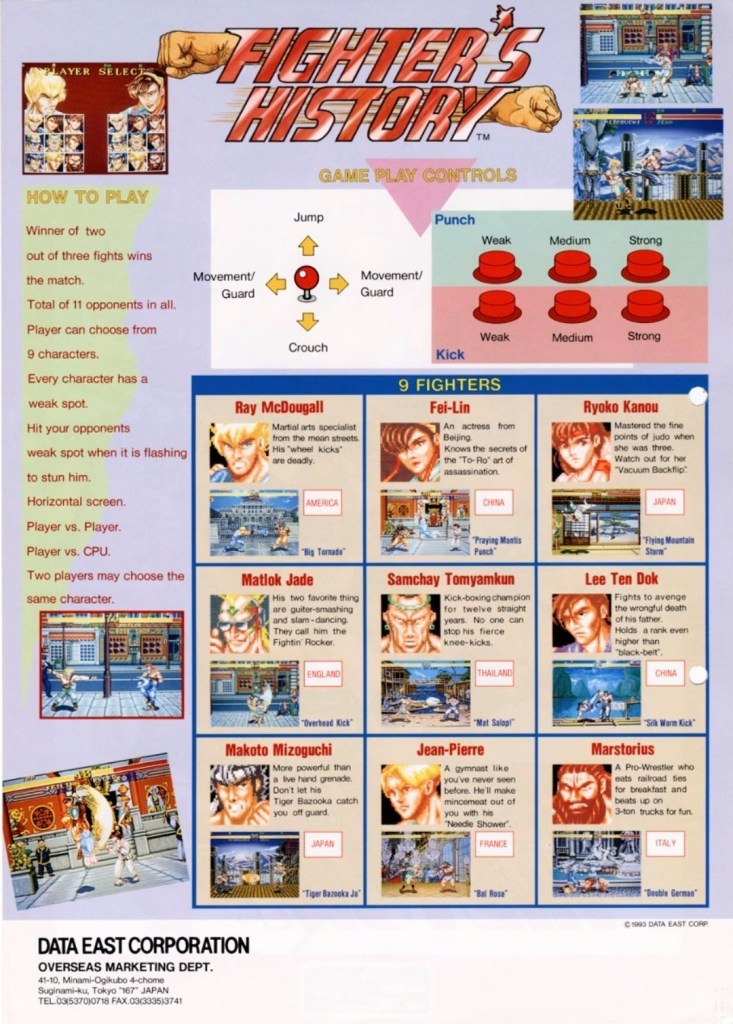
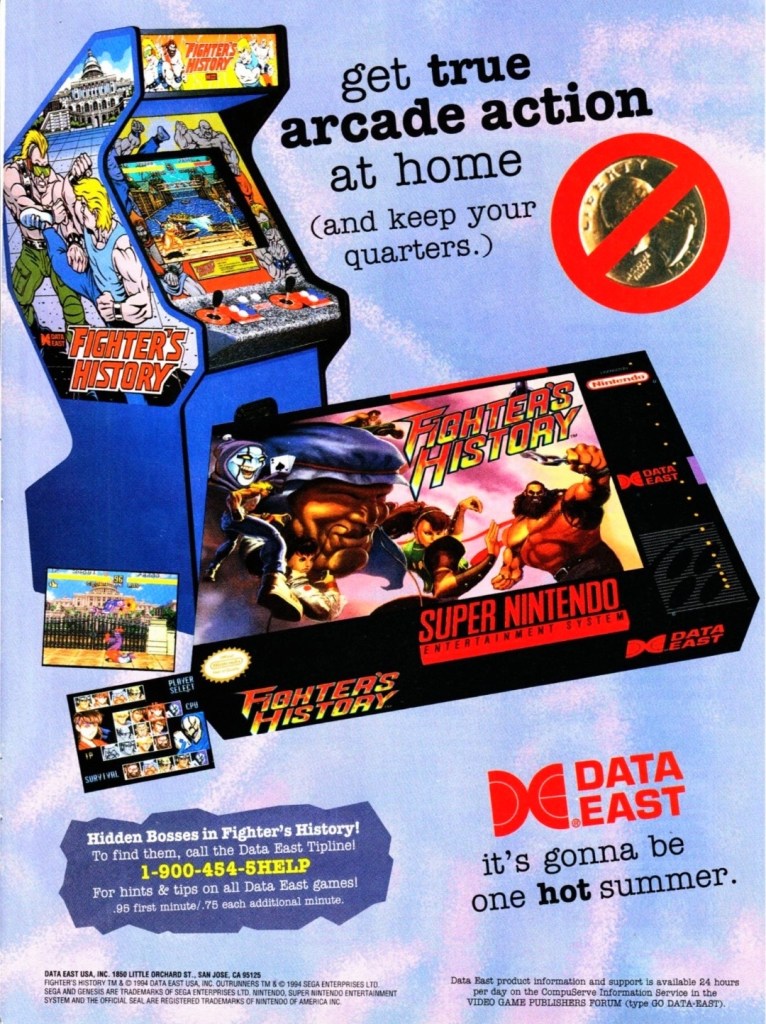
8. Fighter’s History arcade flyer and print ad
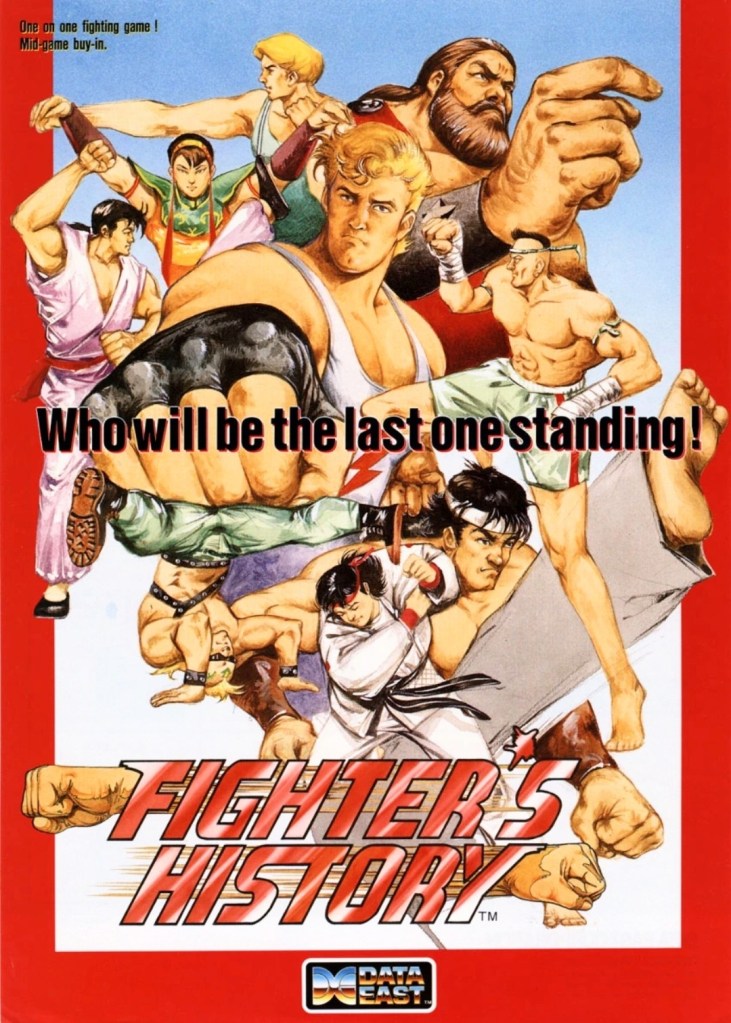
Great looking front artwork showing the game’s characters, posing and some action.
If you look closely at the controls, you will see the six-button layout and functions which are the same with those used in Street Fighter II.
Data East offered two ways for gamers to enjoy Fighter’s History – pay a high price for the SNES version or gamers can go play the game in the arcade by dropping a few coins.

In 1993, Data East released their fighting game Fighter’s History in the arcades around the world. Along the way, the company released their arcade flyer which had a very captivating art work on the front featuring their characters and some action. The other side of the flyer showed the technical details on how to play, how the control works and who the characters are. Fighter’s History was nicely received in the arcades and the success led Data East into porting the game for the Super Nintendo Entertainment System (SNES). If you look at the print ad above, you can see how clever Data East was promoting the SNES version of the game while keeping an image of the arcade machine which serves like a subtle reminder that the same game is still available in video arcades.

Shortly after the release of Fighter’s History in the arcades, there were gamers who noticed that it had certain visual and gameplay elements that made it so familiar with what Street Fighter II had. When Capcom became aware of the similarities, they sued Data East claiming that Fighter’s History was too similar to their game and that copyright infringement was committed. Capcom lost the case ultimately and Data East went on to release two more Fighter’s History games.

9. Virtua Fighter 3 arcade flyer
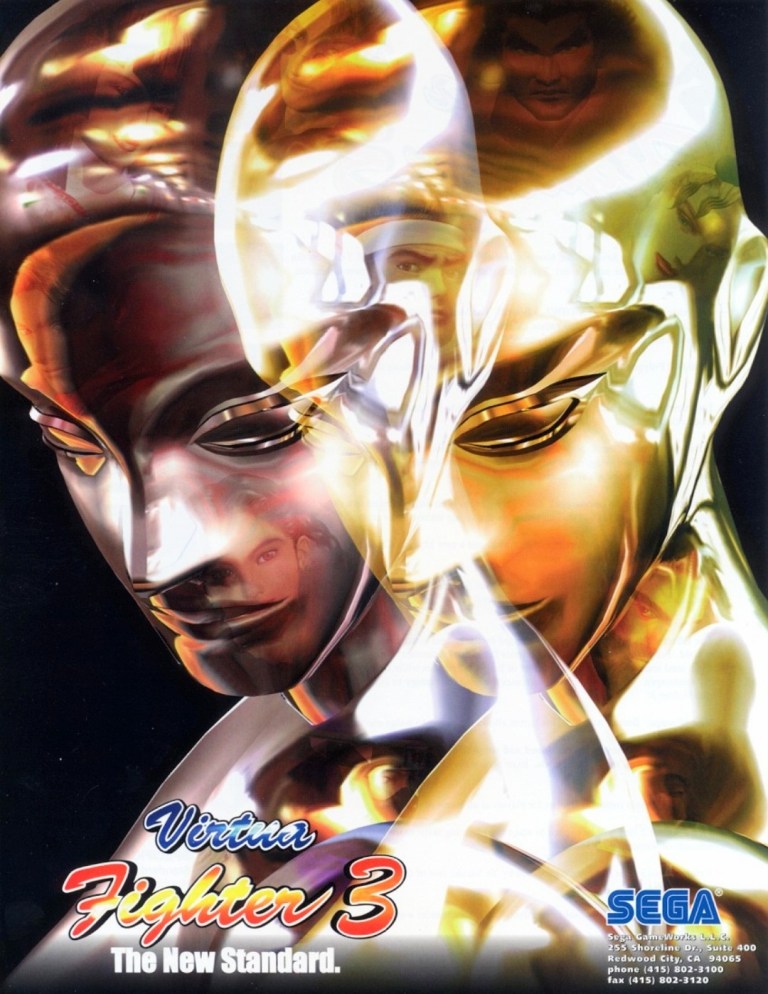
Virtua Fighter 3 truly raised the standards for arcade game graphics back in 1996.

When it comes to gaming innovation and standing out among the rest, Sega did exactly those when they released Virtua Fighter 3 in arcades in 1996 and it had the best-looking and really mind-blowing graphics at the time. Developed by AM2 (led by Yu Suzuki) on the very expensive Model 3 arcade hardware, Virtua Fighter 3 broke new ground on graphics as it moved over 1 million polygons per second, had highly detailed visuals on the characters and surroundings, realistic reflection effects, detailed shining, parallel lighting and high-specular Gouraud shading to name some. Even the characters’ eyes followed the opponent’s position.

The Virtua Fighter 3 arcade flyer showcased their reflective, metallic character Dural who in turn was part of the graphical showcase (emphasizing reflections, smooth animation and liquid metal effects) when the game was previewed in the 1996 AOU event in Japan. The words “The New Standard” written on the lower-left corner of the front of the flyer was justified and truthful.

10. Teenage Mutant Ninja Turtles: Tournament Fighters print ad
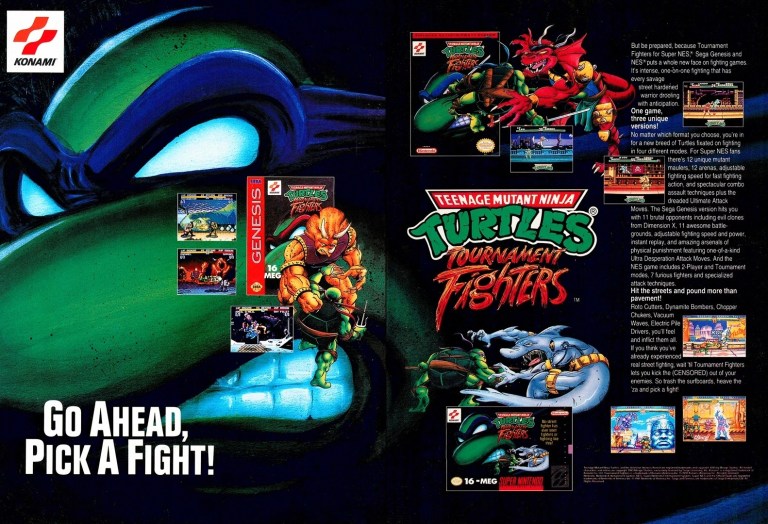
This print ad had a nice visual presentation and was easily recognizable to the many TMNT fans.

In 1989, the Teenage Mutant Ninja Turtles (TMNT) franchise made quite a splash on video games which is not surprising as the multimedia franchise was already a popular in the West. More video game adaptation of TMNT were released in the early 1990s providing fans and gamers a lot of fun gameplay at the arcades (click here) and on consoles. Konami had the video game rights of TMNT and in a clear response to the sudden popularity of fighting games, they released Teenage Mutant Ninja Turtles: Tournament Fighters on the most popular game consoles of the time achieving varying levels of success critically and commercially (note: the SNES version stood out as the best). This print ad of the fighting game was effective in visually promoting the three console versions and the displayed text contained enough information to lure the attention of both fans and gamers.

+++++

Thank you for reading. If you find this article engaging, please click the like button below, share this article to others and also please consider making a donation to support my publishing. If you are looking for a copywriter to create content for your special project or business, check out my services and my portfolio. Feel free to contact me with a private message. Also please feel free to visit my Facebook page Author Carlo Carrasco and follow me on Twitter at  @HavenorFantasy as well as on Tumblr at https://carlocarrasco.tumblr.com/ and on Instagram at https://www.instagram.com/authorcarlocarrasco
Retro Gaming Ads Blast – Part 15

Welcome back readers, fellow geeks and electronic gaming fans!

In this edition of the Retro Gaming Ads Blast (RGAB) series, we will take a look at another batch of retro gaming print ads – including arcade flyers – from the 1980s and 1990s.

For the newcomers reading this, Retro Gaming Ads Blast (RGAB) looks back at the many print ads of games (console, arcade, computer and handheld) that were published in comic books, magazines, flyers and newspapers long before smartphones, social media, the worldwide web and streaming became popular. To put things in perspective, people back in the 1980s and 1990s were more trusting of print media for information and images about electronic games and related products.

With those details laid down, here is the newest batch of retro gaming print ads for you to see and enjoy…

1. X-COM: UFO Defense print ad

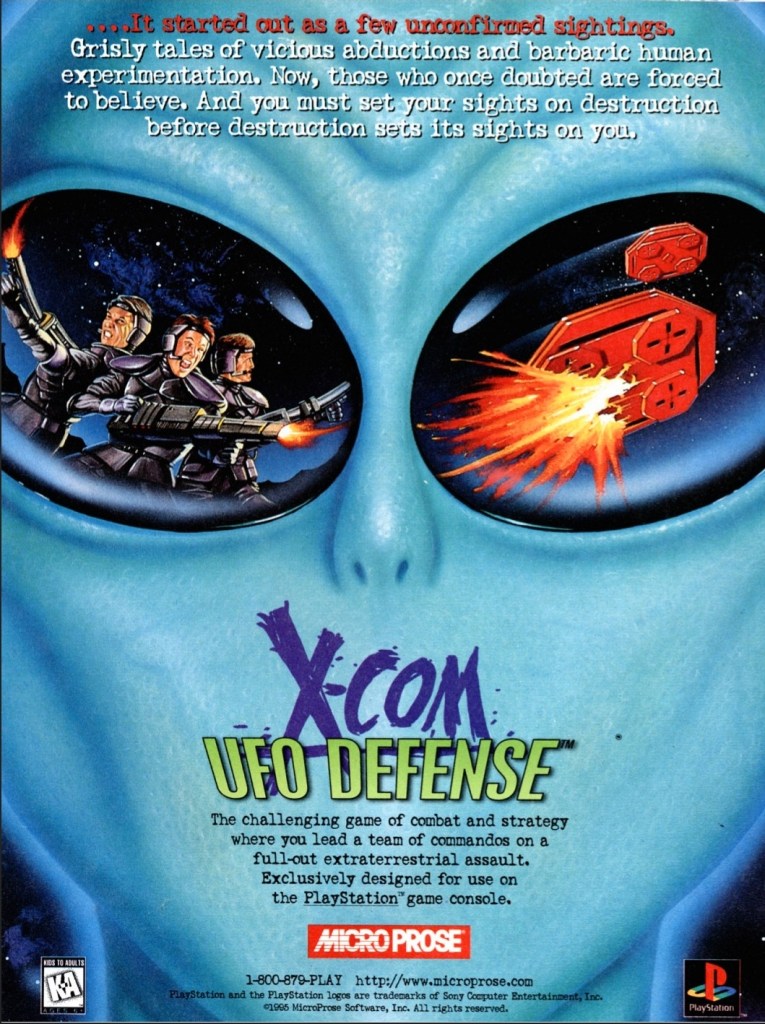
While there were no screenshots of the game for PlayStation, the art here was enough to catch your attention.

Back in 1994, X-COM: UFO Defense (original European title: UFO: Enemy Unknown) became an unexpected hit with PC gamers as it gathered lots of positive reviews from the critics and sold a lot on the PC DOS (disk operating system) format. In an obvious attempt to continue the commercial success, a port of the game was released for the PlayStation console in 1995. Publisher MicroProse and its marketing partners came up with this eye-catching print ad to promote the PlayStation version. While no screenshots were shown, the artwork used turned out to be effective in catching attention while emphasizing the sci-fi concept of the game.

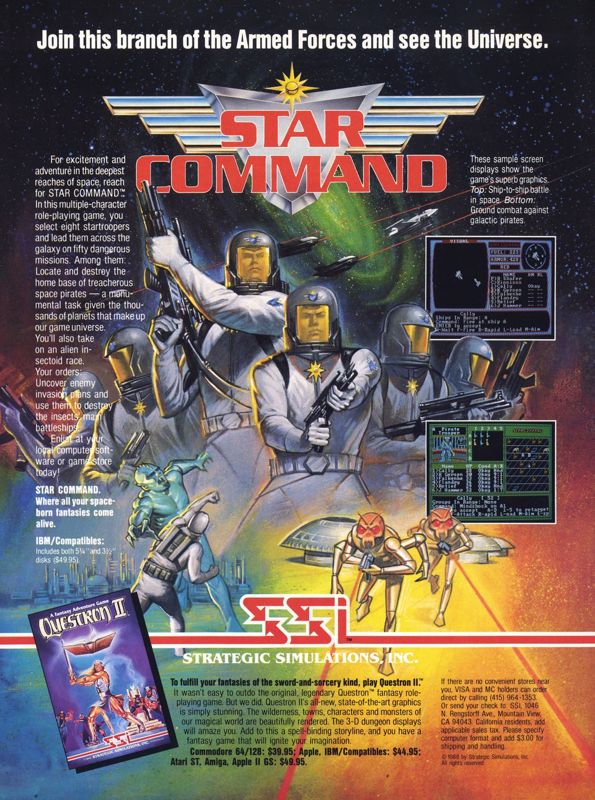
2. Star Command print ad

Long before Starfield, there was Star Command.

Way back in 1988, I first saw my friends play the sci-fi role-playing game (sci-fi RPG) Star Command on the PC DOS format. A short time later, I played the game on our home computer and finished the single-player campaign. This print ad, which has lots of descriptive text, has a strong visual presentation that entices players to play the game and discover the vast amount of content (space travel, missions, battles, encounters with aliens) that the game developers prepared. For its time, the Star Command print ad was captivating to look at.  

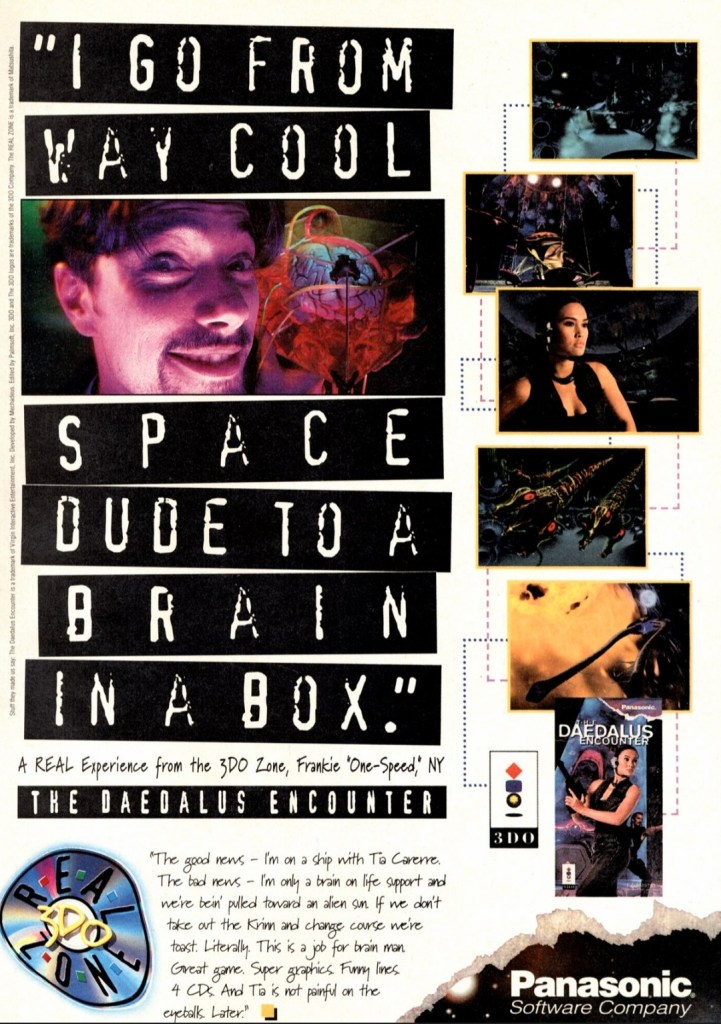
3. The Daedalus Encounter print ad

This print ad was an attempt to catch the attention of both gamers and people who want to watch live-action spectacle.

Released on PC, Macintosh and the 3DO game console in 1995, The Daedalus Encounter was a sci-fi video game that worked as an interactive movie (with puzzles) starring Tia Carrere. To promote the 3DO version, publisher Panasonic came up with an ad that emphasized the sci-fi concept and the cinematic experience (including a few stills of cutscenes) leaving little room about how the game plays. Take note that this game was released at a time when the CD-ROM format started gaining popularity as a reliable optic media format which opened opportunities for game companies to include full-motion videos.

4. Gradius Japanese arcade flyer

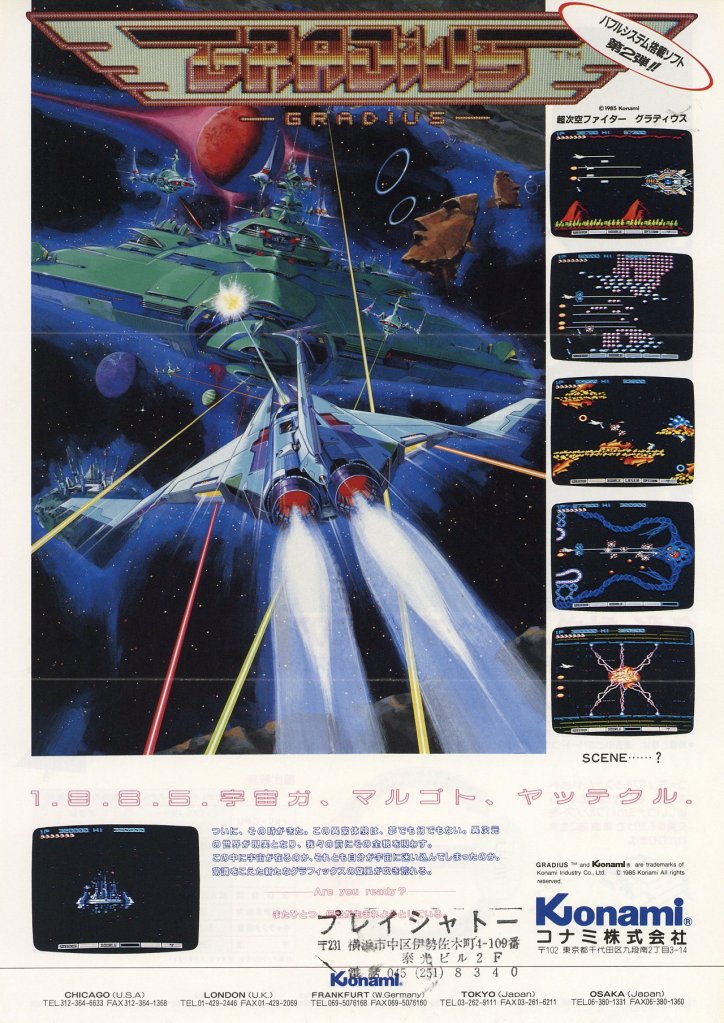
The original Gradius has always been fun to play and the enjoyment also made it on game consoles as more games were released.

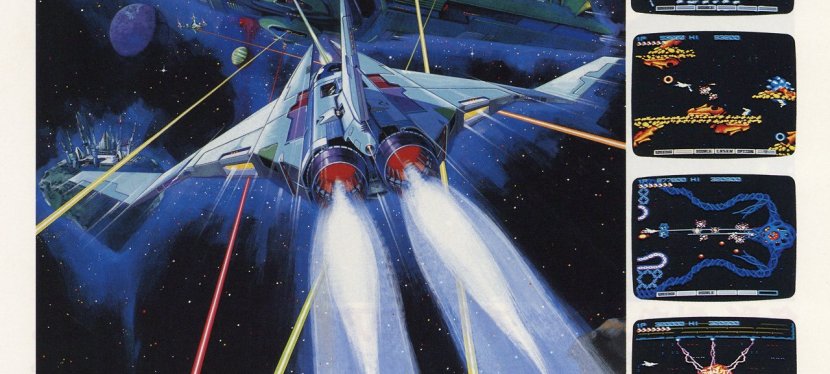
Still on the realm of sci-fi, Konami launched their 2D side-scrolling shooter Gradius in the arcades in Japan in 1985. The arcade flyer here used a huge amount of space for the game’s official artwork which is very captivating to look at as it clearly emphasized the sci-fi concept. On the side are five screenshots that tell gamers what to expect when playing. The promotions paid off nicely for Konami as Gradius became an instant hit in Japanese arcades and eventually found strong commercial success in the arcades in Europe and America. By today’s standards, this game is a classic and the Gradius game franchise has produced several sequels and spin-offs released on multiple platforms.

5. Super Cobra print ad

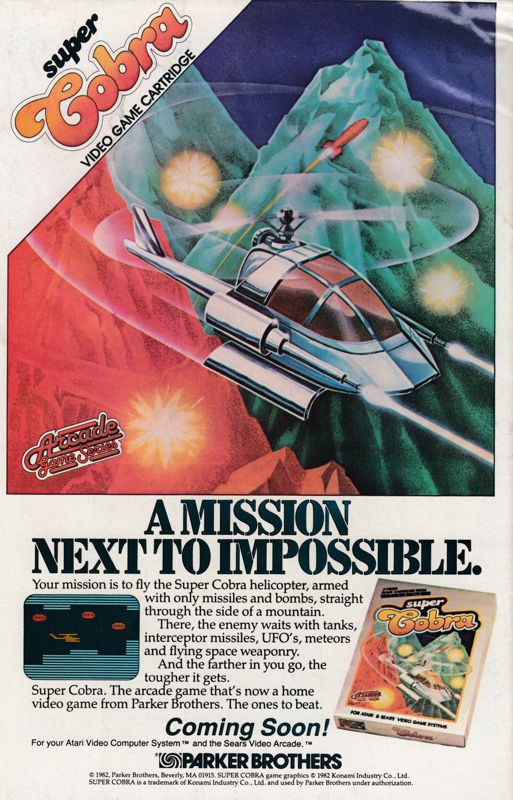
This ad I saw while reading comic books long ago. The game itself was fun.

Here is a game I played on the Atari 2600 over forty years ago. Super Cobra was a 2D side-scrolling game in which players control an armed helicopter that has to move from left to right, attacking enemies, and avoiding enemy projectiles while maintaining the fuel supply. This ad, which appeared on some comic books I read, utilized the game art that was used on the box cover although the single screenshot displayed looks exaggerated when compared to what I saw and played.

6. Destruction Derby print ad

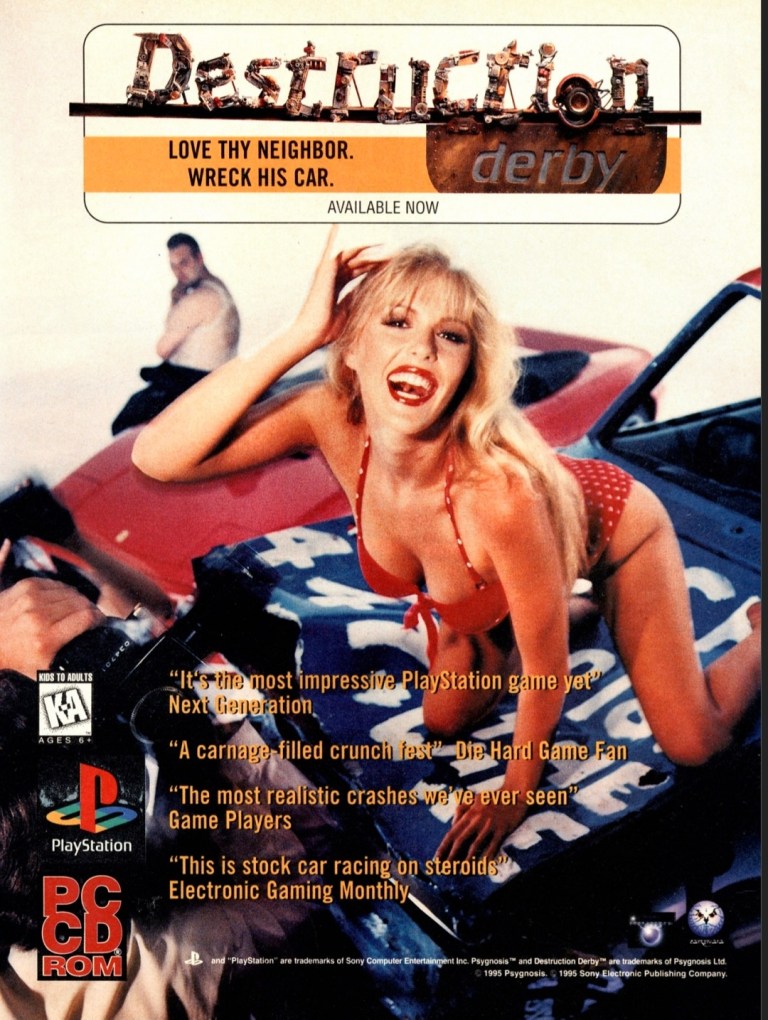
The Destruction Derby print ad that had no screenshots of the game.

In 1995, Sony launched the PlayStation console in America and in Europe. In Europe, publisher Psygnosis promoted their ambitious game Destruction Derby (a 3D polygonal racing game that emphasized vehicular damage) for both PlayStation and the PC that same year. As this Destruction Derby print ad did not show any screenshots, Psygnosis and their marketing team or partner decided to pounce on positive gaming media quotes and the sexy model to promote their game. Their marketing move paid off nicely as over a million copies of Destruction Derby were sold by August 1996.

7. Virtua Cop 2 print ad

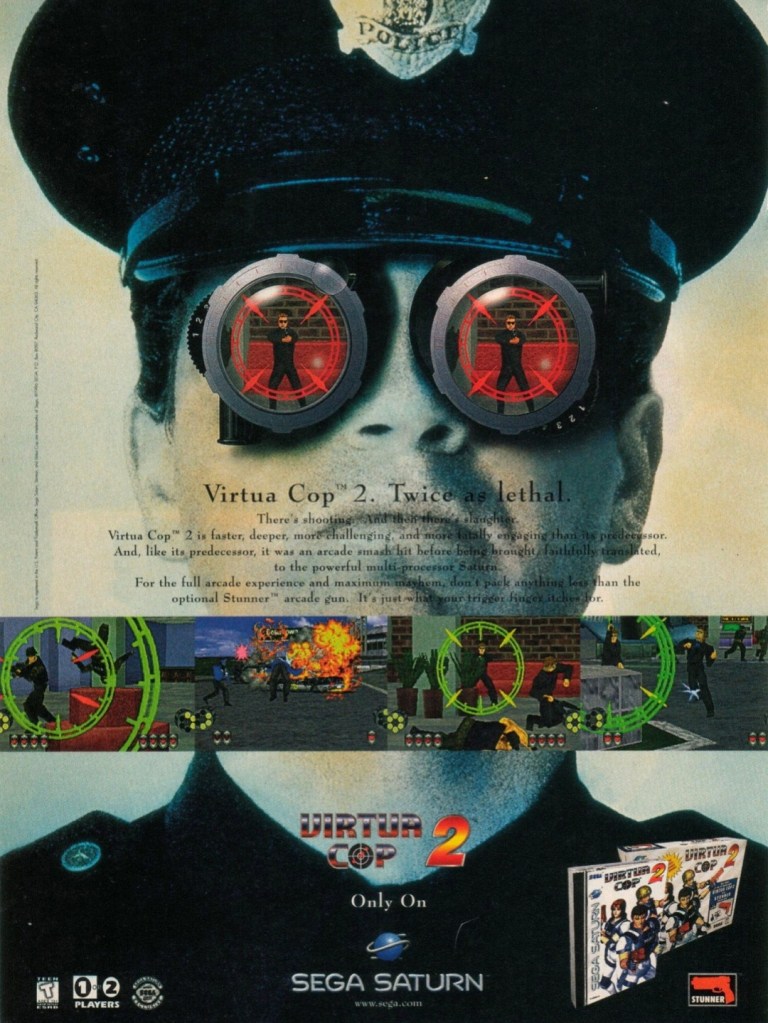
A lot of people found this Virtua Cop 2 print ad looking very weird.

When Sega of Japan forced its American division to launch the Sega Saturn console in the United States in 1995 without any pre-release marketing, it resulted in a series of disappointments that include low sales, too few games launched and strained ties with their business partners. In 1996, Sega started to become more aggressive to sell more Saturn units and more 1st party exclusive games such as Virtua Cop 2 (for the Saturn) which itself was a big hit arcade hit. As the company clearly aimed to make the console version of Virtua Cop 2 a hit, they approved this print ad which had a very intriguing visual concept showing video game images reflected on the glasses on the police man. As Virtua Cop 2 required a light-gun peripheral to be played accurately like in the arcade, this print ad utilized very little space for the Sega Saturn Stunner.

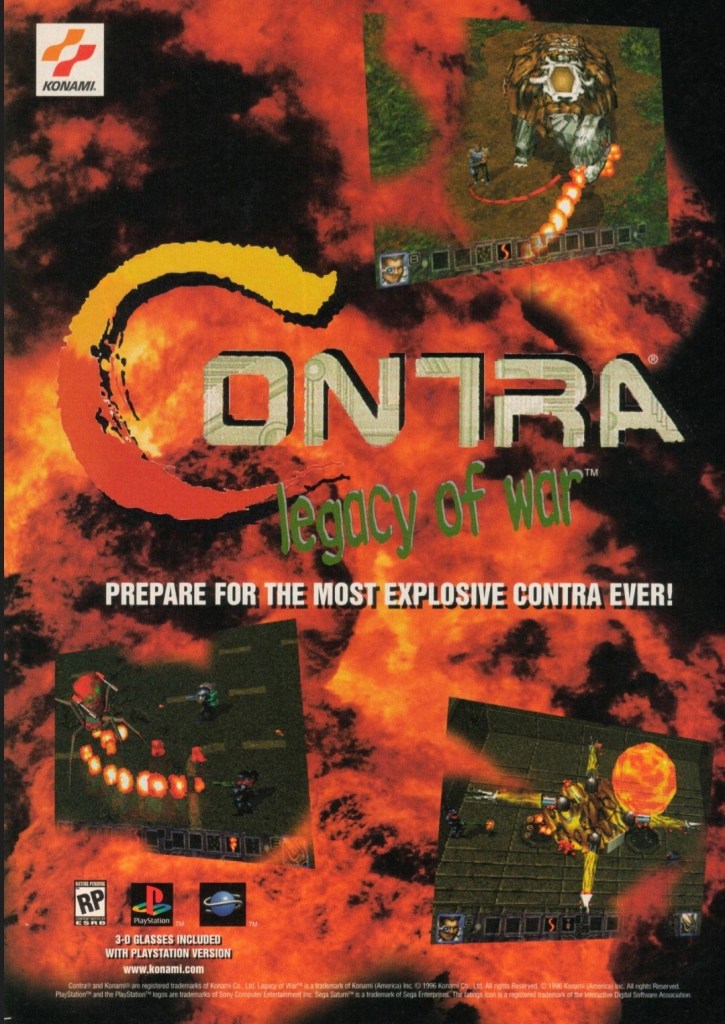
8. Contra: Legacy of War print ad

The print ad of Contra: Legacy of War.

When I first heard that a brand new game of Contra would be released on the still-new PlayStation and Sega Saturn in the mid-1990s, I was excited as I always enjoyed the original game I played on the Family Computer. This print ad of Contra: Legacy of War brought my excitement way down as it showed that the game no longer utilized the 2D side-scrolling design and came up with a design that emphasized 3-dimensional environments and polygons. The change in design was too alienating for me as all the previous Contra games had the 2D side-scrolling format as the main designs (leaving little room for the occasional sprite-scaling 3D sequences in some games). I finally played Contra: Legacy of War on PlayStation on November 1996 and it was a huge letdown!

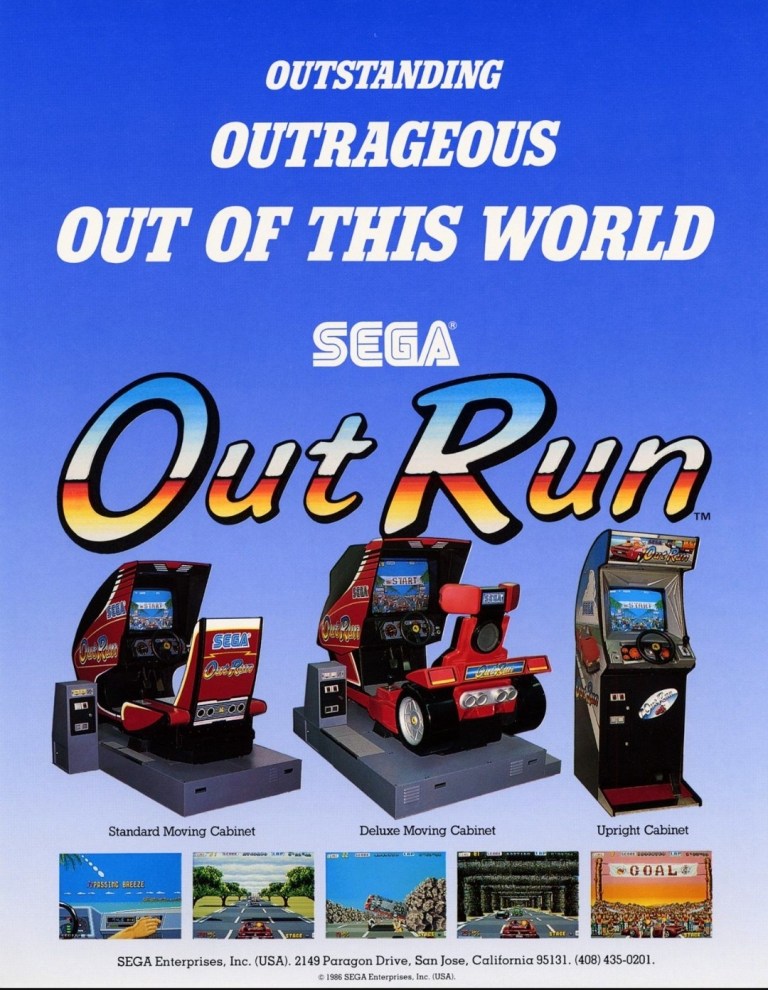
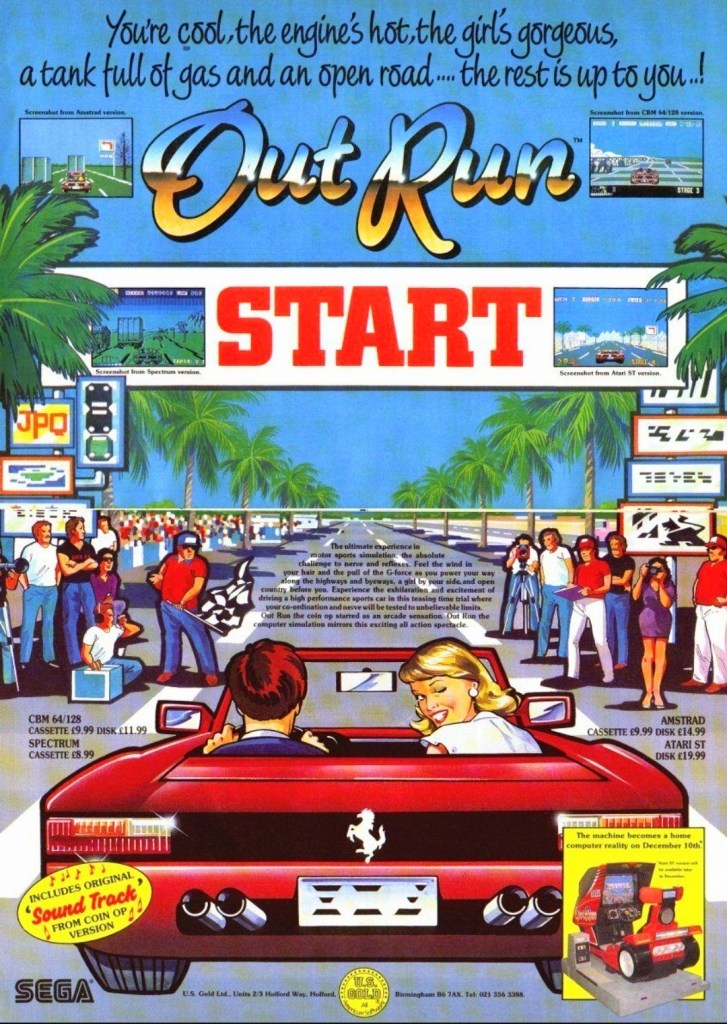
9. Out Run arcade flyers

Sega Out Run arcade machines in different forms.
This Out Run flyer really has nice art.

In the history of arcade games, Sega’s Out Run was a massive success not only in Japan but also in America and Europe. Designed by Yu Suzuki (Virtua Fighter, Shenmue), Out Run was a pseudo-3D driving game in which players get to drive a Ferrari Testarossa convertible (which is always visible to the player) from one scenic destination to the next avoiding traffic as much as possible. This was indeed a labor of love on the part of Yu Suzuki who himself spent time in Europe to gain inspiration on designing the game. As Out Run was a hit, Sega made different types of machines of the game that arcade operators can choose from depending on how much space their respective arcades have left and how the local players prefer to play it. It should be noted that in one of the flyers above, the original sound track was promoted as well.

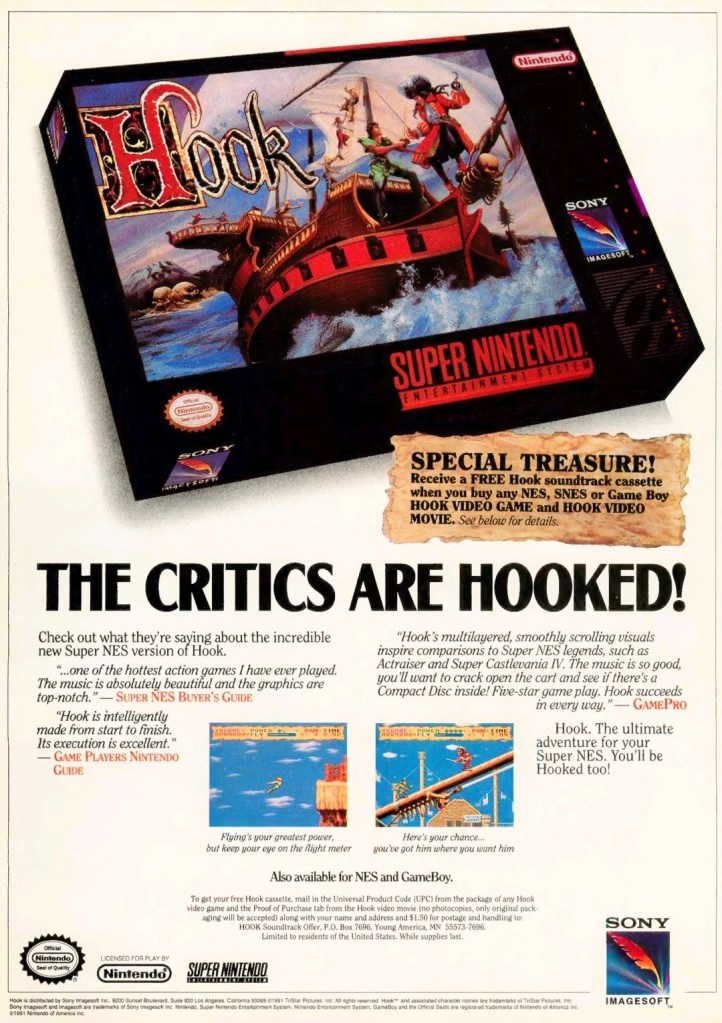
10. Hook SNES version print ad

If you look closely at the SNES box front cover art, you will notice that Peter Pan and Captain Hook looking nothing like the actors who portrayed them in Steven Spielberg’s movie.

In late-1991, Steven Spielberg’s movie Hook was released in cinemas and revived public interest in the fairy tale of Peter Pan. Typical of the entertainment business of the time, video games based on the movie were released on different platforms in 1992 and among them was a version on the Super Nintendo Entertainment System (SNES). Apart from showing the game’s box, the print ad of Hook on SNES cleverly included positive quotes from GamePro, Game Players Nintendo Guide and the Super NES Buyer’s Guide to convince readers that the game is worth their time.

+++++

Thank you for reading. If you find this article engaging, please click the like button below, share this article to others and also please consider making a donation to support my publishing. If you are looking for a copywriter to create content for your special project or business, check out my services and my portfolio. Feel free to contact me with a private message. Also please feel free to visit my Facebook page Author Carlo Carrasco and follow me on Twitter at  @HavenorFantasy as well as on Tumblr at https://carlocarrasco.tumblr.com/ and on Instagram at https://www.instagram.com/authorcarlocarrasco
What to watch on YouTube right now – Part 28

Welcome back, my readers, YouTube viewers and all others who followed this series of articles focused on YouTube videos worth watching. Have you been searching for something fun or interesting to watch on YouTube? Do you feel bored right now and you crave for something to see on the world’s most popular online video destination?

I recommend you check out the following topics and the related videos I found.

Mosab Hassan Yousef: My Father Founded Hamas video  – In America, there are lots of young people who are protesting in public supporting Palestinian terrorists while condemning Israel. These pro-Palestine have shown ignorance about the facts and none of them knows exactly what Palestinian culture is like when compared to Mosab Hassan Yousef (son of a founder of Palestinian terrorist group Hamas).

In an interview with PragerU, Yousef talks comprehensively about his past with the Palestinians (Arabs who adopted the Palestinian identity which only started in the 20th century), the time he was active as a Hamas member, his relationship with his father who founded Hamas, and why he left the terrorist group to cooperate with Israel and migrated overseas. Yousef confirms that Hamas is pure evil and the Palestinian culture has hatred and violence deeply rooted within. Watch this video now.

Jaws 3 4K Blu-ray has footage that involved the use of AI  – I am a collector movies on physical media. I don’t just buy any movies on Blu-ray and 4K Blu-ray format because I am selective with regards to quality, enjoyment and replay value. When it comes to new releases on 4K Blu-ray format, I cannot ignore the observations pointing out that the footage of Jaws 3 (AKA Jaws 3D) on 4K Blu-ray involved the use of AI (artificial intelligence) which resulted in bad visual results. It seems that more people in Hollywood are getting obsessed with remastering old movies using AI, removing the film grain and other digital methods that ruin the visuals. For insight, watch the videos below.

Michael Jordan’s “The Shot” of 1989 – When it comes to those game-winning basketball shots, Michael Jordan had lots of those during his years with the Chicago Bulls. Before he won his first NBA championship, Jordan successfully scored the winning jump shot over Craig Ehlo to beat the Cleveland Cavaliers 101-100 in the 5th game of the 1989 NBA playoffs’ first round. That shot became iconic and there is a lot more behind the scenes that preceded. Watch the selected video below.  

Virtua Fighter 3 retrospective video – When Sega released Virtua Arcade 3 in the arcades in 1996, it was the best-looking 3D polygonal fighting game at the time and it often drew players leaving them really satisfied. Virtua Fighter 3 was the product of the most cutting edge arcade technology of the time (with the Model 3 arcade hardware) as well as the hard-work and in-depth craftmanship by developer AM2 led by the legendary designer Yu Suzuki. To know more about Virtua Fighter 3, watch the video below.

Popcorn in Bed’s James Bond reaction videos – On August 2023, YouTuber Popcorn in Bed started posting reaction videos of James Bond movies. With the exception of the films of Daniel Craig and George Lazenby as Agent 007, Popcorn in Bed posted two selected movie reaction per James Bond actor (example: 2 Bond films of Sean Connery, 2 Bond films of Roger Moore). To give you a taste of what Popcorn in Bed did, watch the selected videos below. To watch more, click here.

+++++

Thank you for reading. If you find this article engaging, please click the like button below, share this article to others and also please consider making a donation to support my publishing. If you are looking for a copywriter to create content for your special project or business, check out my services and my portfolio. Feel free to contact me with a private message. Also please feel free to visit my Facebook page Author Carlo Carrasco and follow me on Twitter at  @HavenorFantasy as well as on Tumblr at https://carlocarrasco.tumblr.com/ and on Instagram athttps://www.instagram.com/authorcarlocarrasco
Retro Gaming Ads Blast – Part 7 (Sega Special)

Welcome back readers, fellow geeks and electronic gaming fans!

In this edition of the Retro Gaming Ads Blast (RGAB) series, we will examine print ads of Sega from the 1990s which was a notable period of time when they went from being a prominent video game company into a desperate, struggling entity by the end of the decade. All the Sega ads in this edition are promotions of their own video games that were exclusive to their consoles during the 1990s.

For the newcomers reading this, Retro Gaming Ads Blast (RGAB) looks back at the many print ads of games (console, arcade, computer and handheld) that were published in comic books, magazines, flyers and newspapers long before smartphones, social media, the worldwide web and streaming became popular. To put things in perspective, people back in the 1980s and 1990s were more trusting of print media for information and images about electronic games and related hardware.

With those details laid down, here is the newest batch of retro gaming print ads for you to see and enjoy…

1. Phantasy Star IV print ad

This was the last single-player Phantasy Star game released. There is no sign of Sega revisiting the franchise for another single-player experience.

Long before the emergence of online console gaming that involved a high number of players, Sega released Phantasy Star IV for the Genesis console in America in 1994 which was praised by gamers and critics. This one also turned out to be the last single-player role-playing game (RPG) of the Phantasy Star series as Sega eventually turned it into a series of online RPGs since the year 2000.

This print ad is significant because a lot of gamers today are not aware that Phantasy Star started as a series of single-player RPGs the same year Final Fantasy debuted in Japan. Anyone interested to play Phantasy Star IV on a modern console should buy the Sega Genesis Classics collection. 

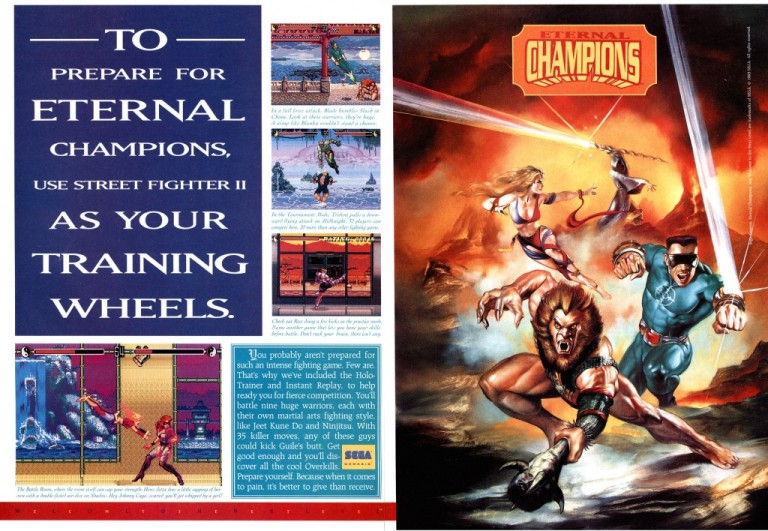
2.  Eternal Champions print ad

This 2-page print ad appeared in many comic books and some magazines that I read long ago.

Back in the 1990s, the fighting game genre became wildly popular with gamers at the arcades and on consoles at home. Capcom literally sparked a wild fire with the Street Fighter II game and its upgraded editions, and other companies went on to make their own 2D fighting games to cash in. Sega was one of them and they released their own 2D fighting game Eternal Champions for the Sega Genesis console.

Unsurprisingly, the game was marketed aggressively and this 2-page print ad really stood out as it had the great looking painted art on the right, screenshots and details of the game, and most notably made a sarcastic reference to Street Fighter II. Eternal Champions sold enough copies, it led to the release of the sequel Eternal Champions: Challenge from the Dark Side and two spin-off games. I can only guess that referencing Street Fighter II was helpful in achieving commercial success.

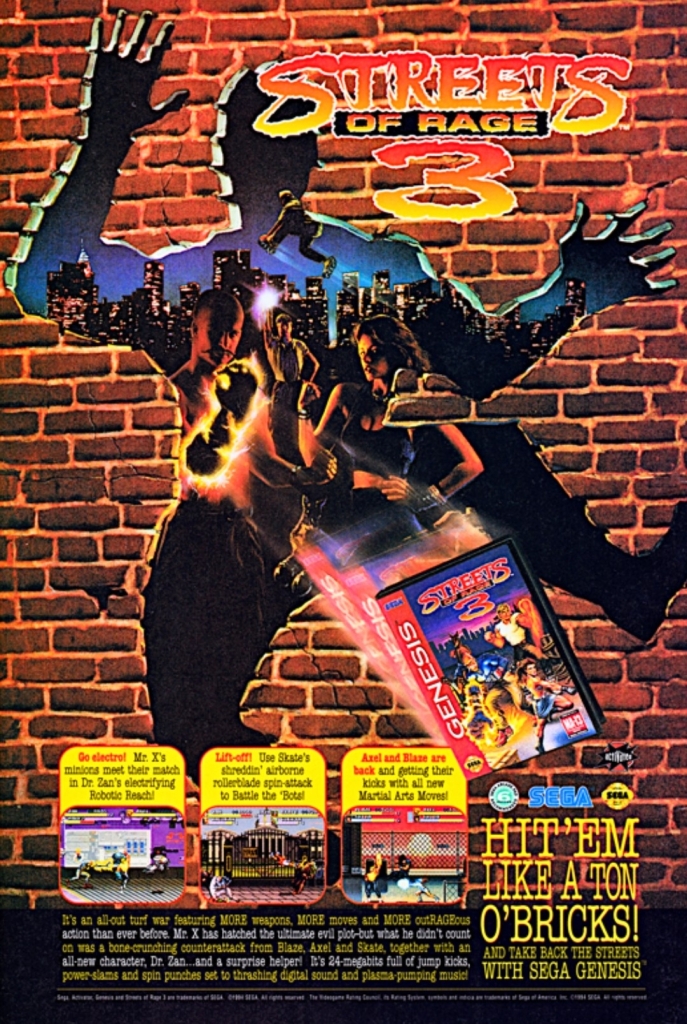
3. Streets of Rage 3 print ad

This ad caught my attention easily when I saw it in comic books I read.

Streets of Rage (Japanese title: Bare Knuckle) was one of the most defining game franchises Sega came up with and it started on the Sega Genesis console. It was a series of side-scrolling, 2D beat-them-up games that ensured action and excitement for gamers. As the first two games were critically and commercially successful, Sega was confident in aggressively marketing Streets of Rage 3 and the print ad seen had a very attention-grabbing artwork.

The artistic style emphasized power and intensity as it shows a damaged wall with the shape of a human body (symbolizing that someone was thrown through it) and then there were images of people on the other side. The game went on to attract mostly positive reviews although it paled in comparison to its predecessors in terms of sales.

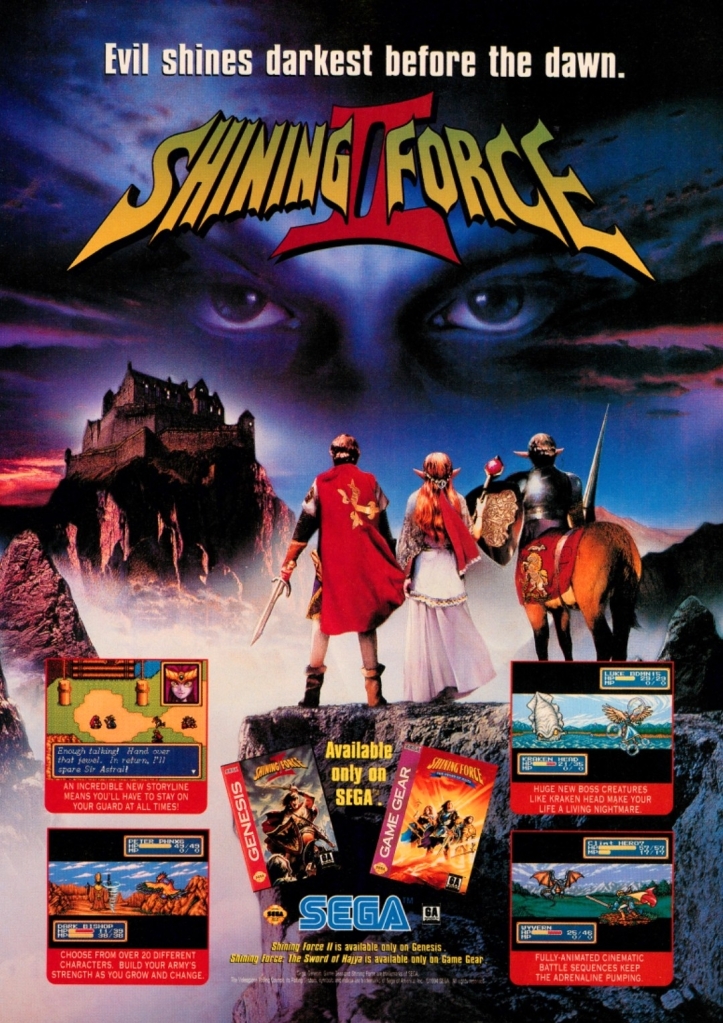
4. Shining Force II print ad

The first time I saw this ad, it made me interested to buy a Sega Genesis console to play it.

As Sega was so prolific with making and releasing games across different genres, they had their own tactical role-playing game series with Shining Force and the first game released on the Sega Genesis was a critical and commercial success. That being said, the company was confident with releasing Shining Force II on the same console more than a year later achieving critical and commercial success.

The North American print ad of the game had a visual presentation that closely captured the foreground-background style (characters facing the distance) used in-game, and the advertising team use photographic imagery to achieve a fantasy look. Very cleverly, Sega inserted the Sega Game Gear title Shining Force Shining Force: The Sword of Hajya into the ad. This print ad made me interested in acquiring a Sega Genesis for Shining Force II.

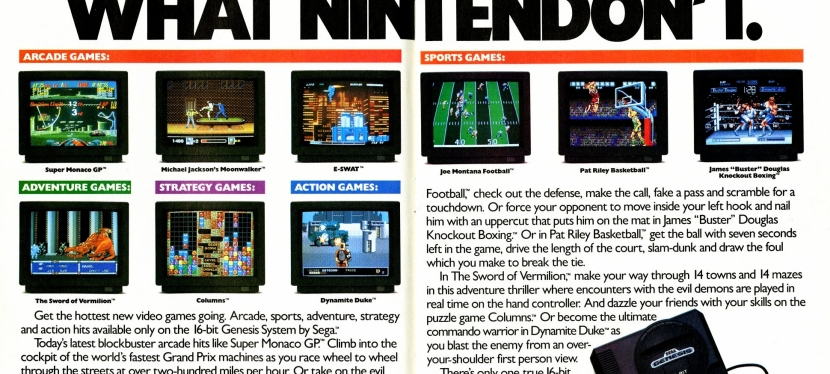
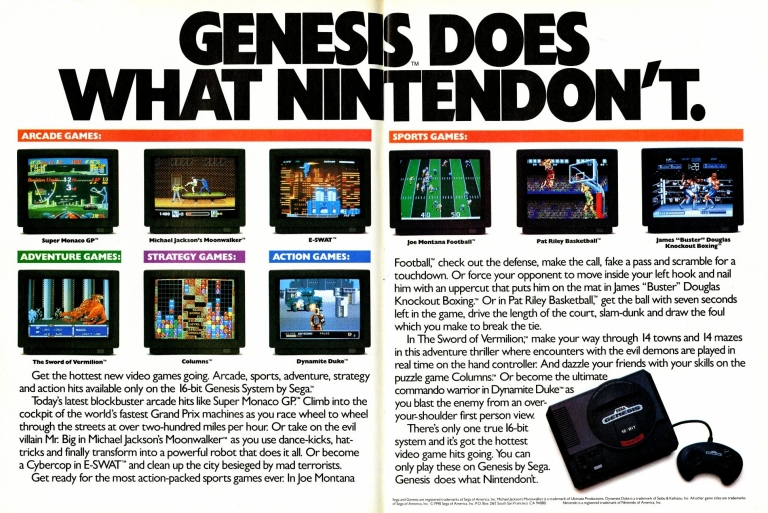
5. Genesis does what Nintendon’t print ad

With the famous line heavily emphasized, this print ad showed how bullish Sega really was in competing with Nintendo.

Now this print ad of Sega’s has the most definitive and best-known advertising line in the so-called 16-bit console generation: Genesis does what Nintendon’t. This was Sega’s aggressive marketing push to convince gamers to buy the Genesis console to play games and experience thrills of fun that they would not find on a Nintendo console at the time. Genesis was launched in America in 1989 with “16-bit” emphasized a lot, and the technological rival Super Nintendo Entertainment System (SNES) was released in the same market more than two years later.

The 2-year advantage helped Sega establish the Genesis as the next-gen machine for gaming at home and there were years in the 1990s when Sega’s console outsold Nintendo’s in America during the so-called 16-bit war. The Genesis also had lots of exclusive games plus strong software support from third-parties. While the SNES would eventually outsell the Genesis in other parts of the world, it was in America where Sega proved to be very competitive and successful. 

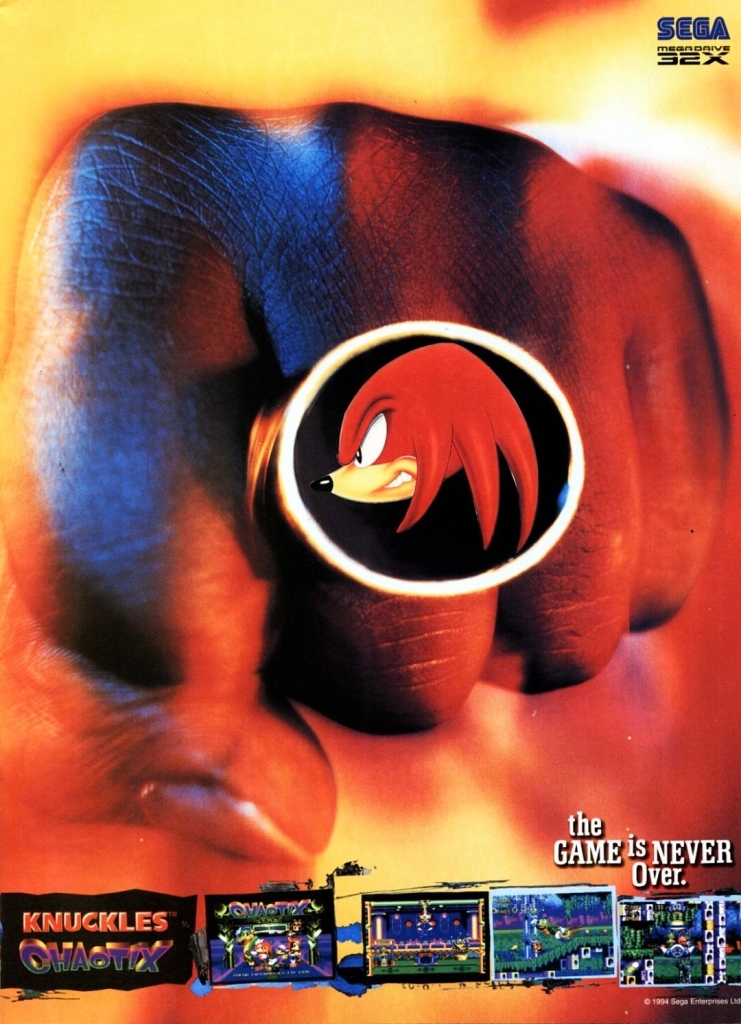
6. Knuckles’ Chaotix print ad

Sega was aggressive with marketing this game for the 32X.

In late 1994, Sega released in America and in Japan the 32X which was an add-on device for the Sega Genesis designed enhance its power while serving as a transition (a warm-up) into the so-called 32-bit era of console gaming. The 32X was the result of corporate decisions involving the American and Japanese executives of the company.

To keep 32X customers happy and boost hardware sales, Sega adjusted the development of Knuckles’ Chaotix (a Sonic spin-off) from being a Sonic project 32-bit console Sega Saturn into a standalone game for the add-on device. Even though Sega knew the game’s development was rushed, they went on to strongly promote the game and the print ad shown here was quite eye-catching.

The image of a fist with a ring showing the character Knuckles (a character from the Sonic games) emphasizes power and the colors used seem to express intensity. Then there were the selected screenshots shown without descriptive text. Although Sega tried hard, Knuckles’ Chaotix (launched in 1995) received mixed-to-positive reviews and sadly sold poorly. Unsurprisingly, the sales of the 32X dropped further and by then a lot of consumers knew that the Sega Saturn (the true successor to the Genesis) was all set to launch in America and Europe within 1995.

7. Sonic 3D Blast for Sega Saturn print ad

Too bad Sega and its teams failed to make the true Saturn Sonic game.

Back in the 1980s and 1990s, having a high-quality, console-exclusive game featuring a company mascot was crucial to sell game consoles while keeping dedicated fans happy. Like what Nintendo did with their icon Mario, Sega achieved great commercial success with the three Sonic the Hedgehog games they released exclusively on the Sega Genesis console and this naturally created expectations they would make new Sonic games on the Saturn console. Unfortunately, Sega and its teams failed to complete development of the Saturn-exclusive game Sonic X-treme and the company cancelled it which sent shockwaves through the games industry news.

With the 1996 holiday shopping season too crucial to ignore, Sega commissioned a Saturn version of the game Sonic 3D Blast which was originally made for the Genesis console. Sonic 3D Blast on the Saturn took seven weeks to make and there were some graphical enhancements implemented. While Sonic 3D Blast’s Genesis version attracted a positive reception from critics (and sold 700,000 copies), the reception for the Saturn version was mixed. This print ad of Sonic 3D Blast on Sega Saturn is a reminder of the company’s failed attempt to take their icon to the next-generation. They never replicated the big success they had with Sonic on the Genesis.

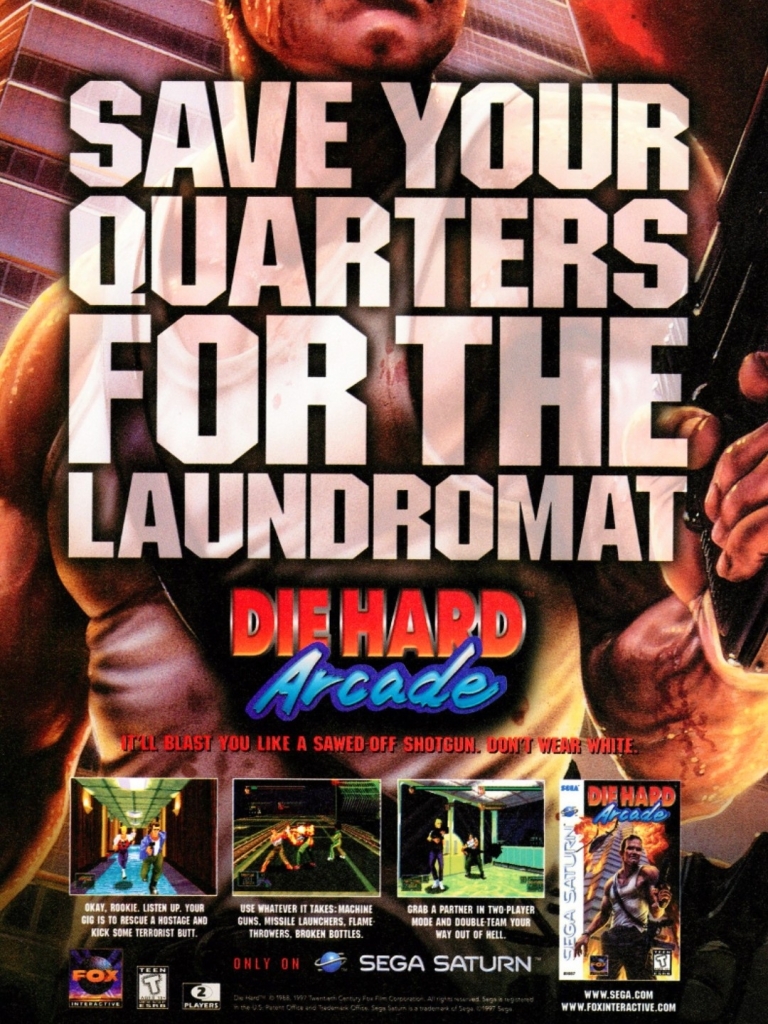
8. Die Hard Arcade print ad

Each time I saw this print ad, it easily reminded me of the classic action film of 1988.

Like many other movie franchises, Die Hard has many video game adaptations released through the decades. In 1997, Sega released Die Hard Arcade (Japanese title: Dynamite Deka) on the Sega Saturn and the game critics praised it for its fun gameplay as well as its flawless conversion of the arcade version (released in 1996). To say the least, the development history of Die Hard Arcade is not as straightforward as many would think. To get the details and explanations of the development of the game, click here.

As for the print ad itself, this one cleverly used official game art as the background with imagery which instantly reminded me of what I saw in the classic 1988 movie that starred Bruce Willis. This ad made me interested to buy a Sega Saturn or find a place to rent it to play the game.

9. Shenmue Japanese print ad

Simplistic with presentation and yet engaging to look at. The Dreamcast-exclusive Shenmue sold over a million copies in Japan alone.

When Shenmue was released exclusively on the Sega Dreamcast in Japan on December 29, 1999, it turned out to be a very mind-blowing experience for many gamers due to its ambitious game design, the intense attention to detail implemented, very high production values, in-depth exploration and very immersive gameplay.

It was the open-world game released at a time when “open-world” was not even a standard gaming term. Often called the masterpiece of the legendary game designer Yu Suzuki, Shenmue sold over 1.2 million copies in Japan and went on to be released worldwide in the months that followed. Sadly, the game failed to make a profit due to its very high budget of $70 million (which Suzuki himself said in English during an interview) and the fact that the number of Dreamcast units already sold to gamers was not massively high.

The Japanese print ad of Shenmue had a simplistic looking visual concept and yet it was engaging to look at because the way the characters appeared was how they appeared in the game during gameplay which was astounding. Take note that back in the 1990s, it was common for video game marketing materials to show human characters in high detail but in reality the polygonal models of those characters appeared looking blocky and much less detailed during gameplay.

+++++

Thank you for reading. If you find this article engaging, please click the like button below, share this article to others and also please consider making a donation to support my publishing. If you are looking for a copywriter to create content for your special project or business, check out my services and my portfolio. Feel free to contact me with a private message. Also please feel free to visit my Facebook page Author Carlo Carrasco and follow me on Twitter at  @HavenorFantasy as well as on Tumblr at https://carlocarrasco.tumblr.com/ and on Instagram at https://www.instagram.com/authorcarlocarrasco