A Look Back at WildC.A.T.S: Covert Action Teams #9 (1994)

Disclaimer: This is my original work with details sourced from reading the comic book and doing personal research. Anyone who wants to use this article, in part or in whole, needs to secure first my permission and agree to cite me as the source and author. Let it be known that any unauthorized use of this article will constrain the author to pursue the remedies under R.A. No. 8293, the Revised Penal Code, and/or all applicable legal actions under the laws of the Philippines.

Welcome back superhero fans, 1990s arts and culture enthusiasts and comic book collectors! Today we continue revisiting Jim Lee’s flagship title under the Image Comics label – WildC.A.T.S: Covert Action Teams!

Last time around, members of the WildC.A.T.S were split apart in terms of locations as they had their rest-and-relaxation period. While Grifter went away to do something urgent (read: the Kindred comic books), Zealot, Void and Jacob Marlowe’s executive assistant Jules picked up Warblade and Maul using their high-tech aircraft to head on to the Bahamas where an entire cruise ship disappeared with Marlowe, Voodoo and Spartan on it.

Unbeknownst to the WildC.A.T.S flying in their jet, Voodoo, Spartan and Marlowe found themselves as captives of an armored man (wearing a half-helmet) called Entropy inside his domain in an undetermined location. Entropy refers to Marlowe as lord Emp and states that he will suffer from his wrath. Marlowe does not recognize him.

With those details laid down, here is a look back WildC.A.T.S: Covert Action Teams #9, published by Image Comics in 1994 with a story written by Brandon Choi and Jim Lee. Lee did the art with Scott Williams in-charge with the ink work.

The cover.

Early story

The story begins with the partial WildC.A.T.S team arriving in the area of the Bermuda triangle with their aircraft. From their view, there was nothing to spot but Zealot insists that they keep on searching as they must be overlooking something.

Meanwhile, Spartan and Voodoo find themselves in deep trouble as a horde of Daemonites persistently attack them. Already heavily damaged, Spartan keeps on using his energy blasts to hold the monsters off. Voodoo on the other hand is too weak and could not concentrate to help her teammate.

Suddenly one of the Daemonites slashes Spartan’s left arm which neutralizes his energy blast. His body got pierced by one of the monsters which pinned him down, leaving Voodoo completely helpless…

Quality

The WildC.A.T.S on search-and-rescue.

On face value, this comic book looks like another generic or even disposable good-versus-evil story drawn by Jim Lee. In reality, its story has more significance to it and the creators themselves came up with something fresh for WildC.A.T.S fans. Firstly, this is a story about one group of WildC.A.T.S trying to rescue their boss and their two other teammates from Entropy in a location that could not be easily found. Secondly, this comic book puts strong focus back on the Kherubim-Daemonite war which creatively looks back at one of the many events that took place in Jacob Marlowe’s past (which he could not remember at first) complete with implementing a strong fantasy (read: swords and armors) element which gives the story a mixed-genre aesthetic.

The good news here is that the storytelling and visual presentation by the creators are really well done! While the dual approach of storytelling involving both the present and the far past was used in Jim Lee’s past X-Men works with Marvel, the said approach was well executed with WildC.A.T.S which not only expanded its lore further but also developed Jacob Marlowe’s personality even further.

To have Entropy (note: he eerily resembles’ Mantra arch-villain Boneyard in the Ultraverse) as an enraged opposition figure living with a lust for revenge against Marlowe is a smart move and at the same time this adds variety to the kind of opposition WildC.A.T.S have. More on what happened in the past involving both Marlowe and Entropy, the flashback raises new questions about the value and true nature of the WildC.A.T.S’ leader who at this point was a brash manager who wields lots of resources to operate with. The flashback also challenges readers on how to evaluate Jacob Marlowe when it comes to being accountable about his past actions, including the many things he did but could not remember. All of these lead to a really impactful ending that you readers must see.

Conclusion

Meet Entropy, a man with a shared past with Jacob Marlowe.

WildC.A.T.S: Covert Action Teams #9 (1994) is a Jim Lee-drawn tale that has solid depth and a very creative approach to its presentation, specifically its daring and well-executed method of mixing the superhero and fantasy elements. When it comes to the narrative, the creative team succeeded in telling both the present and the past tales followed by connecting them with each other while ultimately telling an overall cohesive tale. This is a Wild.C.A.T.S story that must be read from start to finish, and it is a powerful follow-up to issue #8.

If you are seriously planning to buy an existing hard copy of WildC.A.T.S: Covert Action Teams #9 (1994), be aware that as of this writing, MileHighComics.com shows that the near-mint copy of the regular edition costs $30.

Overall, WildC.A.T.S: Covert Action Teams #9 (1994) is highly recommended.

+++++

Thank you for reading. If you find this article engaging, please click the like button below and also please consider sharing this article to others. If you are looking for a copywriter to create content for your special project or business, check out my services and my portfolio. Feel free to contact me with a private message. Also please feel free to visit my Facebook page Author Carlo Carrasco and follow me on Twitter at  @HavenorFantasy as well as on Tumblr at https://carlocarrasco.tumblr.com/and on Instagram at https://www.instagram.com/authorcarlocarrasco/

A Look Back at Dazzler #25 (1983)

Disclaimer: This is my original work with details sourced from reading the comic book and doing personal research. Anyone who wants to use this article, in part or in whole, needs to secure first my permission and agree to cite me as the source and author. Let it be known that any unauthorized use of this article will constrain the author to pursue the remedies under R.A. No. 8293, the Revised Penal Code, and/or all applicable legal actions under the laws of the Philippines.

Welcome back superhero enthusiasts, 1980s culture enthusiasts and comic book collectors! Today we go back to the year 1983 to examine the Marvel Comics universe through the exploits of Dazzler!

Today I have a review about the 25th issue of the Dazzler monthly series and it sure has this really strange looking cover with the protagonist in the foreground and a man in the background complete with a torn-page look. By the time this comic book was released, Dazzler had been through lots of misadventures, crazy superhero stuff as well as countless bouts of drama that impacted her and her existing family members. Could the creators come up with something to keep the series fresh and still engaging?

With those details laid down, here is a look back Dazzler #25, published by Marvel Comics in 1983 with a story written by Steve Grant and drawn by Marc Bright.

The cover.

Early story

The story begins with Alison Blaire working in front of a photographer during a photo session in the office of her manager Harry. It turns out, the photo session is a disaster for both of them. Shortly after, Alison changes her clothes and the field manager Lance arrives outside the door carrying a package for her sent by someone.

The package contained roses which delight Alison. She then reads a message that included with the roses…a message from a certain admirer. As the stakes of her entertainment career are higher than before, Alison gets advised to be extra careful with the kind of people she gets involve with.

From a distance, someone is closely watching Alison interacting with Harry and Lance using binoculars…

Quality

Alison in her effort to save her father.

With a new creative team doing the works, this comic book’s story was indeed an effort to shake things up for the Dazzler monthly series. It’s a tale about Dazzler encountering a fan who is more dangerous and more capable than he seems. The way the story was presented, this one was pretty light on superhero elements as the team of Steve Grant and Marc Bright decided to take a more grounded approach on telling the newest happenings in Alison Blaire’s life. In some ways, this story really felt like it was isolated from the rest of the Marvel Comics universe of the time.

While the previous issues say Alison having breakthroughs with her mother and father, as well as spending quality time with her half-sister Lois, this comic book was more about the entertainer handling herself as she encounters a very determined man who is obsessed with her. The way things were presented here, the story is pretty much character-driven but light on superhero spectacle. Lastly, I want to say that this comic book tackled the themes of personal obsession, fan madness and inner rage which were all emphasized through the new character/antagonist here.

Conclusion

Alison in trouble.

Dazzler #25 (1983) does not have much to entertain readers who enjoy super heroics. If superhero fun is what you are after, you are better off reading issue #24. This comic book’s biggest selling point is its character-driven story which I am confident will engage strongly with die-hard Dazzler fans. The new character/antagonist introduced in this comic book is not really that strong enough to be a worthy counterpart with Dazzler, but his sheer determination and personal obsession with the entertainer are worth a look.

If you are seriously planning to buy an existing hard copy of Dazzler #25 (1983), be aware that as of this writing, MileHighComics.com shows that the near-mint copy of the regular edition costs $56 while the near-mint copy of the newsstand edition costs $113.

Overall, Dazzler #25 (1983) is satisfactory.

+++++

Thank you for reading. If you find this article engaging, please click the like button below and also please consider sharing this article to others. If you are looking for a copywriter to create content for your special project or business, check out my services and my portfolio. Feel free to contact me with a private message. Also please feel free to visit my Facebook page Author Carlo Carrasco and follow me on Twitter at  @HavenorFantasy as well as on Tumblr at https://carlocarrasco.tumblr.com/

A Look Back at WildC.A.T.S: Covert Action Teams #8 (1994)

Disclaimer: This is my original work with details sourced from reading the comic book and doing personal research. Anyone who wants to use this article, in part or in whole, needs to secure first my permission and agree to cite me as the source and author. Let it be known that any unauthorized use of this article will constrain the author to pursue the remedies under R.A. No. 8293, the Revised Penal Code, and/or all applicable legal actions under the laws of the Philippines.

Welcome back superhero enthusiasts, 1990s culture enthusiasts and comic book collectors! Today we continue revisiting Jim Lee’s flagship title under the Image Comics label – WildC.A.T.S: Covert Action Teams!

In my previous retro review of WildC.A.T.S #7, that story marked the 3rd chapter of the 4-part Killer Instinct crossover storyline which brought Jim Lee’s team together with Marc Silvestri’s Cyber Force. That storyline ended in a Cyber Force comic book which leads to the questions – what is next for WildC.A.T.S? Will there be a new and fresh storyline set up for them?

With those details laid down, here is a look back WildC.A.T.S: Covert Action Teams #8, published by Image Comics in 1994 with a story written by Brandon Choi and Jim Lee. Lee did the art along with Richard Bennett and Scott Williams.

The cover.

Early story

The story begins inside a large bar within New York City where Cole Cash/Grifter and Zealot (both of them in civilian clothes) spend time together playing pool. There are men nearby staring at them. While Grifter tries to unwind and have fun with the game, Zealot still sticks to her warrior mindset even though they are no longer in a battle field. Suddenly, one man arrogantly pours beer on Grifter’s head while another man touches Zealot’s hair.

The two WildC.A.T.S members struck the two violators and subsequently made short physical work of the other men who tried to hurt them. After that, Zealot and Grifter talk outside. The latter receives an urgent message which compels him to leave Zealot behind and do something important…

Quality

Spartan and Voodoo on holiday in their civilian forms.

I’ll be straight to the point here. If you enjoyed Jim Lee’s previous work on Marvel’s X-Men that include bombastic action, misadventures, team members appearing in swimwear and character moments, you will find that in this story which is really a transitional tale of the team taking a break from action only to find themselves facing new danger. That being said, the concept and structure of the plot in this comic book is pretty simple and it does succeed in setting up WildC.A.T.S for another misadventure while cleverly emphasizing the Kherubim-Daemonite concept of the WildStorm universe back then.

As expected, Jim Lee’s artwork here is really great to look at and he sure always finds ways to make the dialogue scenes look interesting. What stands out to me the most in this comic book are the character moments which more than made up for the lightness of the plot. While the romantic interactions between Spartan and Voodoo is interesting, the interactions between Zealot and Grifter (referred to as Brother Grifter) really gave me additional insight on their respective personalities and, more notably, their feelings for each other.

More on character moments, you will see Maul and Warblade in their respective civilian identities as Reno and Jeremy. If you only see those two as violent action performers based on the previous issues of WildC.A.T.S, you will be surprised with the way Brandon Choi and Jim Lee presented them in this story.  

Conclusion

Can you recognize Maul and Warblade?

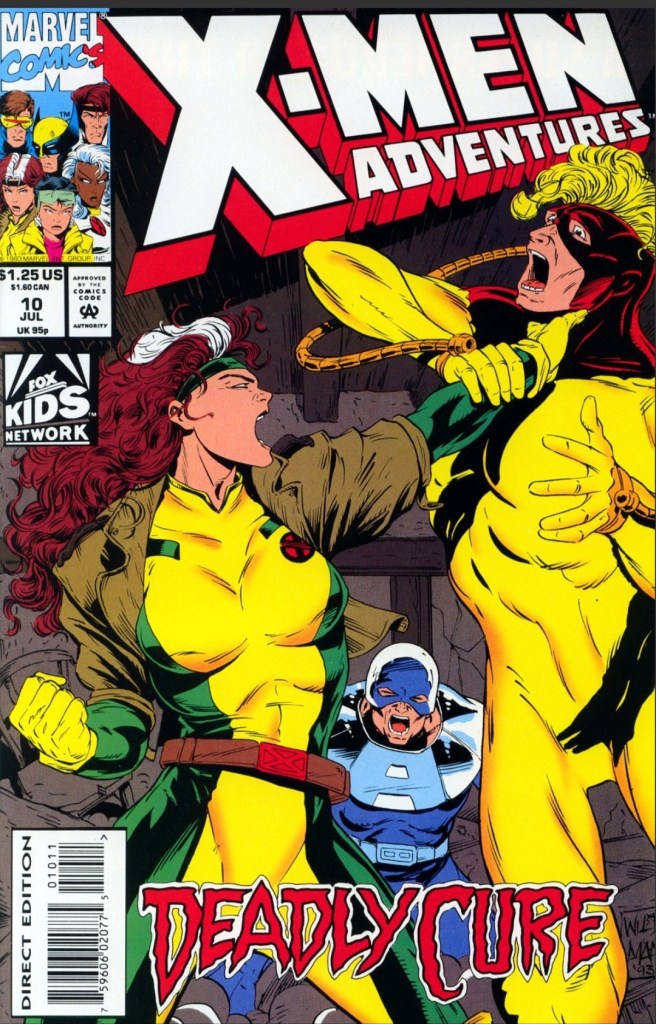
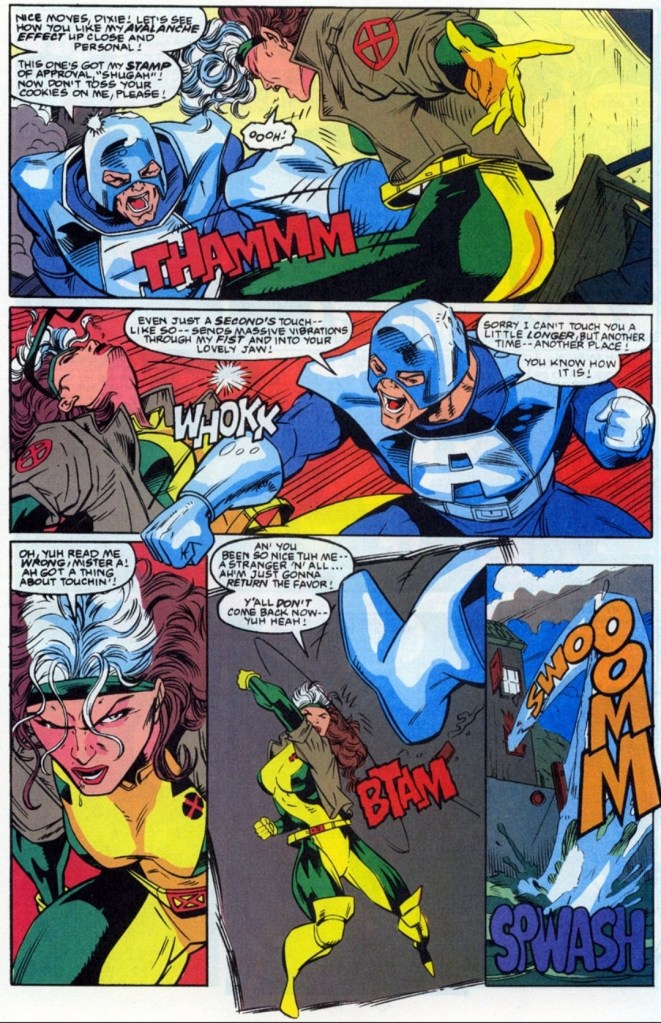
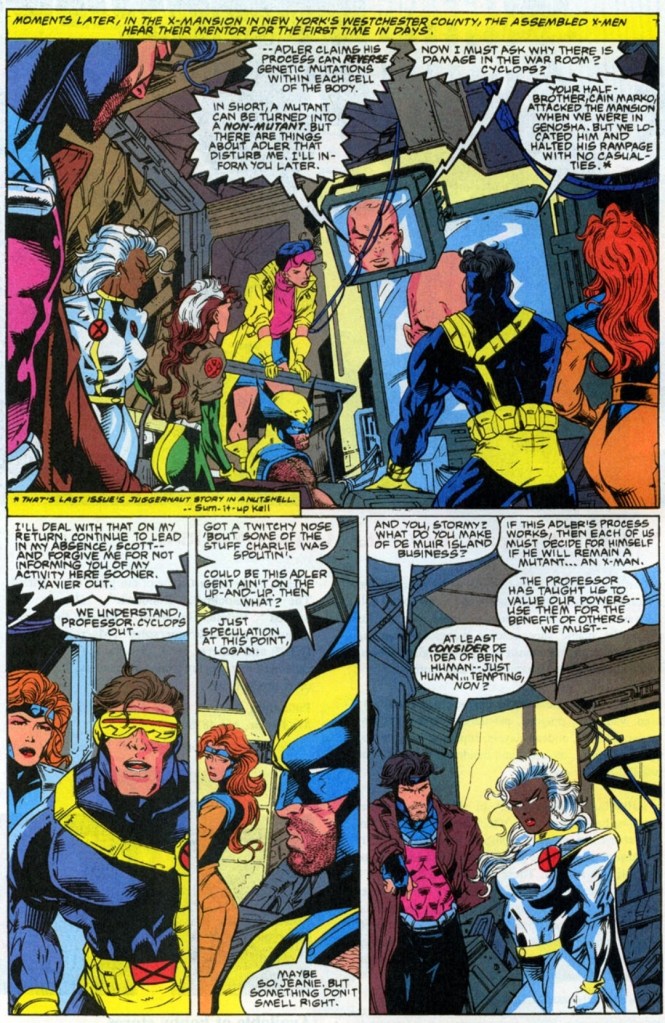
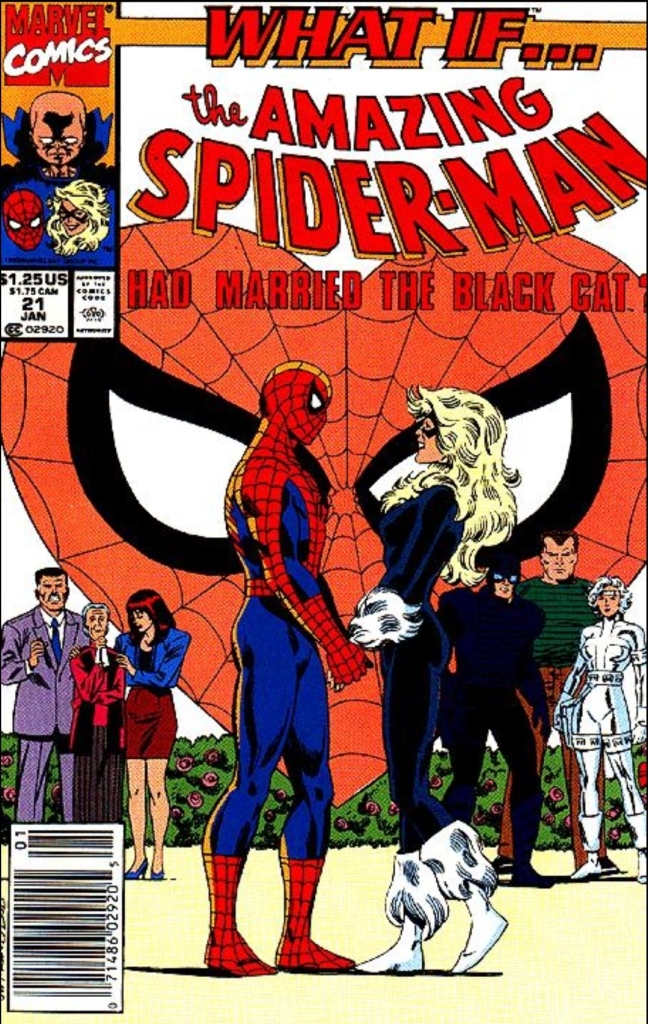
While its story was pretty light, WildC.A.T.S: Covert Action Teams #8 (1994) still manages to entertain me mainly due to the character moments that the creators came up with. In many ways, this comic book showed how human the team members are which is a nice change from all the action-focused stuff they were so busy with in the previous issues. Along the way, you will see a few creative gimmicks Jim Lee inserted visually, including the unofficial cameo appearance of two pretty notable members of X-Men (note: they just got married). Meanwhile, those who love Pris/Voodoo will find some extra entertainment here as this comic book has an additional short story about her past (set after WildC.A.T.S Trilogy #1) which was written by Peter Seagle and drawn by Travis Charest (who would later replace Jim Lee as illustrator of this comic book series).

If you are seriously planning to buy an existing hard copy of WildC.A.T.S: Covert Action Teams #8 (1994), be aware that as of this writing, MileHighComics.com shows that the near-mint copy of the regular edition costs $40 while the near-mint copy of the newsstand edition costs $120.

Overall, WildC.A.T.S: Covert Action Teams #8 (1994) is recommended.

+++++

Thank you for reading. If you find this article engaging, please click the like button below and also please consider sharing this article to others. If you are looking for a copywriter to create content for your special project or business, check out my services and my portfolio. Feel free to contact me with a private message. Also please feel free to visit my Facebook page Author Carlo Carrasco and follow me on Twitter at  @HavenorFantasy as well as on Tumblr at https://carlocarrasco.tumblr.com/

A Look Back at Dazzler #24 (1983)

Disclaimer: This is my original work with details sourced from reading the comic book and doing personal research. Anyone who wants to use this article, in part or in whole, needs to secure first my permission and agree to cite me as the source and author. Let it be known that any unauthorized use of this article will constrain the author to pursue the remedies under R.A. No. 8293, the Revised Penal Code, and/or all applicable legal actions under the laws of the Philippines.

Welcome back superhero enthusiasts, 1980s culture enthusiasts and comic book collectors! Today we go back to the year 1983 to examine the Marvel Comics universe through the exploits of Dazzler!

As seen in the cover of the next Dazzler comic book I reviewed, the lady has Power Man and Iron Fist with her. In short, there is a crossover within Marvel Comics’ universe just waiting to be unveiled. Who exactly will Dazzler, Power Man and Iron Fist be facing? What kind of situation are they entering into?

With those details laid down, here is a look back Dazzler #24, published by Marvel Comics in 1983 with a story written by Danny Fingeroth and drawn by the late Frank Springer.

The cover.

Early story

The story begins with Rogue (of the Brotherhood of Evil Mutants) breaking through the front door of the apartment of Alison Blaire who remains her target. She realizes that Dazzler is absent which is inconvenient as she believes that the singer is key in her quest to find Angel and the rest of the X-Men. Rogue makes a mess of Alison’s things in the apartment and decides to wait for her to return.

A short time later, Alison is approached by her friend Frank on her way home. He tells her that someone broke into her apartment and made a mess inside. Realizing that the trespasser is none other than Rogue (note: they encountered each other in Dazzler #22) and that she alone does not have much of a chance in fighting her, she calls Power Man and Iron Fist for their professional help…

Quality

Alison Blaire desperately getting away from Rogue.

To begin with, this is one action-packed tale of Dazzler that still manages to emphasize the development of the protagonist and her newly formed bond with her half-sister Lois (who appeared a short time before this comic book was released). As a crossover set within the Marvel Comics universe, Danny Fingeroth’s story makes mention of the X-Men as Rogue continues her quest on getting Dazzler to get to Angel in order to find Charles Xavier’s team which is all part of the Brotherhood of Evil Mutant’s lust for revenge. Along the way, readers will get to see Rogue take on Power Man and Iron Fist (note: these two met with Dazzler in Dazzler #23) which was fun to see.

More on Dazzler herself, the stakes are raised again as she not only has to survive encountering Rogue but also of the fact that the powerful Brotherhood of Evil Mutants member becomes aware of Lois. I should state that there are two encounters between Dazzler and Rogue here, and each one was entertaining to read.

Conclusion

Alison Blaire plus Power Man and Iron Fist.

Dazzler #24 (1983) is a Marvel crossover tale which the creators made to add some action-packed variety while telling the story of Dazzler. That being said, the dramatic character development that this comic book series was notable for was lightened a bit to make way for the superhero spectacle. Not only does this comic book provide readers additional insight into the duo of Power Man and Iron Fist, it also showed some development about the conflict between the X-Men and the Brotherhood of Evil Mutants. Ultimately, this is one old and fun comic book to have.

If you are seriously planning to buy an existing hard copy of Dazzler #24 (1983), be aware that as of this writing, MileHighComics.com shows that the near-mint copy of the regular edition costs $57 while the near-mint copy of the newsstand edition costs $113.

Overall, Dazzler #24 (1983) is recommended.

+++++

Thank you for reading. If you find this article engaging, please click the like button below and also please consider sharing this article to others. If you are looking for a copywriter to create content for your special project or business, check out my services and my portfolio. Feel free to contact me with a private message. Also please feel free to visit my Facebook page Author Carlo Carrasco and follow me on Twitter at  @HavenorFantasy as well as on Tumblr at https://carlocarrasco.tumblr.com/

A Look Back at Dazzler #21 (1982)

Disclaimer: This is my original work with details sourced from reading the comic book and doing personal research. Anyone who wants to use this article, in part or in whole, needs to secure first my permission and agree to cite me as the source and author. Let it be known that any unauthorized use of this article will constrain the author to pursue the remedies under R.A. No. 8293, the Revised Penal Code, and/or all applicable legal actions under the laws of the Philippines.

Welcome back superhero enthusiasts, 1980s culture enthusiasts and comic book collectors! Today we go back to the year 1982 to examine the Marvel Comics universe through the exploits of Dazzler!

While my most recent retro review of Dazzler was the 4th issue of its monthly series, I have decided to jump straight to issue #21 for this new retro review. By the time Dazzler #21 got published, the unusual superhero went through a lot and illustrator Frank Springer became fully established as the monthly series’ definitive artist.

With those details laid down, here is a look back Dazzler #21, published by Marvel Comics in 1982 with a story written by Danny Fingeroth and drawn by the late Frank Springer.

The cover.

Early story

The story begins with Alison Blaire/Dazzler being carried above the buildings of New York City by Angel (Warren Worthington) of the X-Men. At this point in time, Alison’s father judge Carter Blaire snapped under the weight of turmoil related to the death of his wife and his daughter’s rebelliousness. As Dazzler, Alison had gone through intense encounters with the likes of the Incredible Hulk, She-Hulk, a top-secret syndicate that made her a test subject and even Galactus.

Recently, Bella – Alison’s grandmother – could not cope with her son’s breakdown and reached out to Warren Worthington to help her reach Alison. Since after being found, Alison had been traveling with Angel by air.

Along the way, Spider-Man sees them and recognizes Alison as Dazzler. He swings to try to get their attention but was ignored as they were so focused on their objective. A short time later, Angel and Alison arrive at judge Blaire’s home. Her grandmother greets them and tells her she hopes that she can get through to judge Blaire.

The doctor, however, advised against that tactic and states that Alison’s intervention may worsen her father’s condition as much of it was centered on her…

Quality

Alison Blaire and her friend Vanessa try out new clothes.

I’ll go straight to the point about what the story of this double-sized comic book is about without spoiling it. It is a pretty dramatic look at the protagonist in her civilian form as Alison Blaire. You will get to see her as Dazzler in this comic book but if you are looking for a lot of superhero moments of her or if you are looking for Dazzler in a conflict with evil elements, you won’t find it here.

More on the plot, this comic book explores deeply the emotional and personal dimensions of Alison and along the way, stories about her own past as well as the respect past events of both her father and mother got dramatized. The story tackles themes like independence, maturity, marriage, personal development, family ties and personal conflicts of interest. The good thing here is that the script by Danny Fingeroth is very well-written and it seems he did his research on constructing a personal story about Alison Blaire that is very grounded in reality. That being said, the superhero elements have been pushed aside most of the time and the ironic thing is the fact that the other Marvel superheroes – Spider-Man, Fantastic Four, The Avengers and more – appeared here as if to remind readers this is still a superhero tale.

Very clearly, this story was written for the very dedicated or even the die-hard Dazzler fans in mind. When it comes to the fun factor, the results could be mixed depending on what readers want to see in this comic book. For me personally, it is a pretty engaging story to read and at the same time it is fun enough as well.

Conclusion

Alison tries to help her troubled father.

Dazzler #21 (1982) could be barely received or strongly received or even rejected even though it has a very rich and dramatic script. The clear lack of the superhero presentation of Dazzler in favor of heavy drama and in-depth characterization may not win the approval of readers/collectors who love superhero stuff but it will resonate with the readers who really love the character and had immersed themselves into her life. As far as characterization goes, this comic book marks a significant turning point of Dazzler herself and in its story, she really developed a lot since making her first-ever appearance in Uncanny X-Men #130. If you are a Dazzler purist who does not mind the lack of superhero spectacle, this one could engage you.

If you are seriously planning to buy an existing hard copy of Dazzler #21 (1982), be aware that as of this writing, MileHighComics.com shows that the near-mint copy of the regular edition costs $28 while the near-mint copy of the newsstand edition costs $60.

Overall, Dazzler #21 (1982) is recommended.

+++++

Thank you for reading. If you find this article engaging, please click the like button below and also please consider sharing this article to others. If you are looking for a copywriter to create content for your special project or business, check out my services and my portfolio. Feel free to contact me with a private message. Also please feel free to visit my Facebook page Author Carlo Carrasco and follow me on Twitter at  @HavenorFantasy as well as on Tumblr at https://carlocarrasco.tumblr.com/

A Look Back at Dazzler #4 (1981)

Disclaimer: This is my original work with details sourced from reading the comic book and doing personal research. Anyone who wants to use this article, in part or in whole, needs to secure first my permission and agree to cite me as the source and author. Let it be known that any unauthorized use of this article will constrain the author to pursue the remedies under R.A. No. 8293, the Revised Penal Code, and/or all applicable legal actions under the laws of the Philippines.

Welcome back superhero enthusiasts, 1980s culture enthusiasts and comic book collectors! Today we go back to the year 1981 to examine the Marvel Comics universe through the exploits of Dazzler!

Last time around, Alison Blaire was preparing herself for a big event as Dazzler. The event was something needed to help her boost her career as an entertainer and the stakes were high as there were many important guests. The weird thing was that she instead got involved with one of the most fearsome super villains of Marvel – Dr. Doom!

With those details laid down, here is a look back Dazzler #4, published by Marvel Comics in 1981 with a story written by Tom DeFalco and drawn by the late Frank Springer. This was Springer’s Dazzler debut.

The cover.

Early story

The story begins inside a secret facility. Dr. Doom tells Dazzler that the Merlin Stone he just acquired mirrors her reflections as well as his own. The said stone has unique, mystical properties that Doom believes will help him achieve his dream of domination over mankind.

Dazzler, who is trapped inside a tube and is guarded by two of Dr. Doom’s guards, tries to recover after losing consciousness a short time back. Dr. Doom expresses his observation of her special ability to convert sound into light.

Dr. Doom turns his computer on energizing the tube that contains Dazzler. She suddenly turns into energy and disappears…

Quality

Dazzler in a new dimension.

The best way to describe this comic’s story…it is one wild ride that emphasizes a different kind of fantasy for readers. This is, of course, related to Dr. Doom’s immediate quest of finding another Merlin Stone within a different dimension which directly involved Dazzler against her will.

Dazzler here was in a very wild misadventure that goes way beyond the limits of New York City. Being in a completely new dimension, she finds herself literally lost in the sea of space and encounters creatures here and there. This misadventure, however, was not written to be mindless at all. In fact, as the tale in the new dimension goes on, Dazzler was presented to be more tactical, more analytical and do things to solve problems she encountered. She also gets to use her superpower in more creative ways.

The misadventure also has key moments that test Dazzler’s resolve on a personal level. As such, these moments added to her development which also raises the stakes as to what she could potentially do once she returns back to her life. Clearly, this is a story that carefully mixes spectacle and character development without losing track of the story.

On the art of the comic book, Frank Springer’s Dazzler debut is pretty solid. Not only does he capture the look of Dazzler herself, his creative visuals really brought the dimension into life filled with images of out space, fantasy monsters and more. Apart from drawing Dazzler and Dr. Doom, Springer’s art of the Fantastic Four is pretty good to look at.

Conclusion

A helpless Dazzler in the presence of Dr. Doom.

Dazzler #4 (1981) is a fun comic book to read and as a Dazzler story, it is a worthy continuation of the events that took place in issue #3. The concept about having Dazzler under the power of Dr. Doom was nicely executed which is a very hard feat to achieve since the said super villain was known to be a major force of opposition not only against the Fantastic Four but also against Spider-Man, the X-Men and more. Dazzler’s misadventure into the other dimension was wild and yet nicely structured which led to some nice character development of hers. This comic book had a strong series start for Frank Springer who went on to draw a great majority of the issues of the Dazzler monthly series.

If you are seriously planning to buy an existing hard copy of Dazzler #4 (1981), be aware that as of this writing, MileHighComics.com shows that the near-mint copy of the regular edition costs $28 while the near-mint copy of the newsstand edition costs $60.

Overall, Dazzler #4 (1981) is recommended.

+++++

Thank you for reading. If you find this article engaging, please click the like button below and also please consider sharing this article to others. If you are looking for a copywriter to create content for your special project or business, check out my services and my portfolio. Feel free to contact me with a private message. Also please feel free to visit my Facebook page Author Carlo Carrasco and follow me on Twitter at  @HavenorFantasy as well as on Tumblr at https://carlocarrasco.tumblr.com/

A Look Back at WildC.A.T.S: Covert Action Teams #4 (1993)

Disclaimer: This is my original work with details sourced from reading the comic book and doing personal research. Anyone who wants to use this article, in part or in whole, needs to secure first my permission and agree to cite me as the source and author. Let it be known that any unauthorized use of this article will constrain the author to pursue the remedies under R.A. No. 8293, the Revised Penal Code, and/or all applicable legal actions under the laws of the Philippines.

Welcome back superhero enthusiasts, 1990s culture enthusiasts and comic book collectors! Today we revisit the early days of Image Comics through Jim Lee’s WildC.A.T.S: Covert Action Teams comic book franchise which was one of the launch titles of the said company.

Last time around, I reviewed the third issue of the WildC.A.T.S mini-series and its quality was good enough for me. Other than the visual candies delivered by Jim Lee, WildC.A.T.S: Covert Action Teams #3 featured a crossover with Rob Liefeld’s very own Youngblood which was really surprising and intriguing back in those times.

With those details laid down, here is a look back at the final issue of the mini-series…WildC.A.T.S: Covert Action Teams #4, published by Image Comics through Malibu Comics in 1993 with a story written by Brandon Choi and Jim Lee. Lee did the art.

Jim Lee drew this cover very similarly to his cover art work on X-Men #4 (1992).

Early story

The story begins with Helspont already declaring victory as well as the beginning of his operation called Reunification which involves the use of the orb to activate a stargate which would allow his brethren of Daemonites to come to Earth to not only overwhelm the Kherubim but also to conquer the whole world. In his presence are two of his deadly companies standing with him and certain members of WildC.A.T.S – including their leader Jacob Marlowe – who are down on the rough surface having been hit hard moments earlier.

Suddenly a group composed of the six Youngblood members, Vice President Dan Quayle and WildC.A.T.S’ members Voodoo and Maul approach Helspont and his companions in an attempt to make them surrender.

As Voodoo realizes her power does not affect Helspont, the vicious Daemonite strikes the group with an energy blast aided by the orb and the high technology of the place. As this happens, Grift, Void and Jacob slowly make their moves. Jacob uses his communicator to send a signal to the heavily damaged Spartan…

Quality

WildC.A.T.S face strong opposition from the Gnome and his dangerous companions.

As the final tale of the mini-series, I can say that the script made for this comic book is a pretty satisfying read from start to finish. Like in issue #3, the pace here moves fast and there is a lot of spectacle that got executed while never overwhelming its narrative. More on the narrative, the conflict between the Kherubim and Daemonites is strongly symbolized by the WildC.A.T.S and Helspont’s forces going head to head. There are some pretty notable character moments that added to the fun factor such as Jacob sarcastically telling Helspont he could not access the back-up systems for his dreaded operation to bring the Daemonites to Earth.

Of course, this is not simply a WildC.A.T.S versus Helspont story in the good-versus-evil type of way. Apart from the inclusion of Rob Liefeld’s Youngblood, there is also the other dangerous party led by the Gnome who also have a strong interest in the orb. While their participation in the story happens pretty late, they do provide serious opposition against Jacob Marlowe and his team.

As mentioned earlier, there is a lot of action that expresses the intensity of the conflicts. While there is almost no room left for any real character development, the creators managed to craft a story that never felt brainless or unintelligent. As such, there is a lot of entertaining stuff to enjoy here and I personally find the establishment of WildC.A.T.S’ core concept to be solid and worth following.

Conclusion

As Helspont emphasizes his evil plan, Jacob Marlowe makes his move.

WildC.A.T.S: Covert Action Teams #4 (1993) is a not just a fun comic book to read. It is also a worthy conclusion to its mini-series and also it succeeded in establishing the WildC.A.T.S as both Jim Lee’s passion project and as one of the most worthy early titles of Image Comics. By the time I reached the end of this comic book, it became clear to me back in 1993 that Jim Lee was moving forward to a new territory on superhero comic book creations leaving behind his legacy with Marvel and their X-Men franchise. While this comic book ended the 4-issue mini-series, the funny thing was that Jim Lee and his team went on to start a regular comic book series of WildC.A.T.S: Covert Action Teams by actually publishing issue #5 (in late 1993) instead of starting with a brand new issue #1.

If you are seriously planning to buy an existing hard copy of WildC.A.T.S: Covert Action Teams #4 (1993), be aware that as of this writing, MileHighComics.com shows that the near-mint copy of the regular edition costs $20 while the near-mint copies of newsstand edition (without card) and the numbered-and-signed edition cost $48 and $160 respectively.

Overall, WildC.A.T.S: Covert Action Teams #4 (1993) is recommended.

+++++

Thank you for reading. If you find this article engaging, please click the like button below and also please consider sharing this article to others. If you are looking for a copywriter to create content for your special project or business, check out my services and my portfolio. Feel free to contact me with a private message. Also please feel free to visit my Facebook page Author Carlo Carrasco and follow me on Twitter at  @HavenorFantasy as well as on Tumblr at https://carlocarrasco.tumblr.com/

A Look Back at WildC.A.T.S: Covert Action Teams #2 (1992)

Disclaimer: This is my original work with details sourced from reading the comic book and doing personal research. Anyone who wants to use this article, in part or in whole, needs to secure first my permission and agree to cite me as the source and author. Let it be known that any unauthorized use of this article will constrain the author to pursue the remedies under R.A. No. 8293, the Revised Penal Code, and/or all applicable legal actions under the laws of the Philippines.

Welcome back superhero enthusiasts, 1990s culture enthusiasts and comic book collectors! Today we revisit the early days of Image Comics through Jim Lee’s WildC.A.T.S: Covert Action Teams comic book franchise which was one of the launch titles of the said company.

For the newcomers reading this, Jim Lee is one of the co-founders of Image Comics and during his previous stint with Marvel Comics, he was instrumental in modernizing the X-Men both visually and creatively (note: look at all the paramilitary elements implemented during his X-Men days). WildC.A.T.S was his independent superhero team project which went on to not only grow as a comic book franchise in the 1990s, but also became an animated TV series. WildC.A.T.S dealt with conspiracy as well as aliens from outer space.

With those details laid down, here is a look back at WildC.A.T.S: Covert Action Teams #2, published by Image Comics in 1992 with a story written by Brandon Choi and Jim Lee. Lee did the art.

The cover.

Early story

The story begins in the headquarters of International Operations (I/O) whose officials have been monitoring a situation far away. Suddenly a portal appeared inside I/O which surprised director Lynch and his fellow officials. Seen through the portal – which appeared for only seconds in front I/O’s people – were Jacob Marlowe, Spartan, Grifter, Maul, Zealot, Voodoo, Void and Warblade who just escaped from certain death which is connected to the explosion monitored by I/O.

The WildC.A.T.S instantly arrived inside their highly advanced aircraft safe and sound. After some talk, they begin to move to a safehouse of Grifter’s near Quantico…

Quality

An efficient exposition about the science fiction concept of WildC.A.T.S.

As far as storytelling goes, this comic book has more depth to its plot. While the first issue was filled with introductions of characters and story concepts as well starting its narrative in cryptic fashion, there was more freedom in this issue for the writers to properly structure their story, gradually build-up tension, execute payoffs satisfactorily while still managing to insert spectacle to complete the work. The story moved with a moderate pace and things moved fast when it was needed. I find re-reading this WildC.A.T.S tale a more satisfying experience than before and it is also an improvement over the first issue.

More on the core concept about Daemonites infiltrating human societies on Earth with the involvement of the Cabal to enhance their efforts, there literally more meat to chew here as Jim Lee and Brandon Choi came up with clever and efficient ways on executing exposition. The I/O meanwhile literally jumped from being background decoration into the main story as a connection was made between one of the top officials of the organization and WildC.A.T.S leader Marlowe.

More on the WildC.A.T.S themselves, you will get to know more about each member and how their respective personalities differ from each other as they all struggle to keep up with the changes around them. Voodoo here is still the witness of a conflict she never anticipated would involve her and many times she is clueless and really struggling to figure out what has been happening. While Marlowe has the strong tycoon mentality all throughout, Spartan is the dedicated and focused operator while Grifter is the cocky gunslinger and Zealot is the battle-hardened warrior whose perception about life and survival could make readers wonder if she is truly brave or truly reckless. With the introductions of each character already done, in issue #1 it was no surprise that there was a bit more space for the creators to define each team member with limited space (pages) they had during comic book production.

Conclusion

In the heat of the action, something visceral happened with Voodoo who is not even a fighter.

The best way to describe WildC.A.T.S: Covert Action Teams #2 (1992) is that its core concept as well as its mini-series plot really started to take shape as Brandon Choi and Jim Lee got over all the creative hurdles in issue #1. The result was not only more focus on plotting but executing payoff for story build-up, characterization and putting enough action in a rather disciplined way. There was no sign of creative rush by Choi and Lee here. I should also state that it is in this same comic book where you will see more interesting traits of the WildC.A.T.S members which, in my experience, made me anticipate the next issue.

As one of the very early comic books of Image Comics, this one had one of the first, if not the first, gimmick covers of the said publisher and I can say that its content was good enough to justify the flashy cover and its rather high cover price of $2.50 (note: back in 1992 many of Marvel’s and DC’s comic books had cover prices of $1.25 while WildC.A.T.S: Covert Action Teams #1 had a $1.95 cover price). I could not forget the day in 1992 when I visited a local comic book specialty store in Makati that had WildC.A.T.S: Covert Action Teams #2 (1992) displayed with its cover really shining under a strong light source. I also remember there were others in the store staring at it.

If you are seriously planning to buy an existing hard copy of WildC.A.T.S: Covert Action Teams #2 (1992), be aware that as of this writing, MileHighComics.com shows that the near-mint copy of the gimmick cover edition costs $20 while the near-mint copies of the signed gimmick cover edition and the newsstand edition cost $60 each.

Overall, WildC.A.T.S: Covert Action Teams #2 (1992) is recommended.

+++++

Thank you for reading. If you find this article engaging, please click the like button below and also please consider sharing this article to others. If you are looking for a copywriter to create content for your special project or business, check out my services and my portfolio. Feel free to contact me with a private message. Also please feel free to visit my Facebook page Author Carlo Carrasco and follow me on Twitter at  @HavenorFantasy as well as on Tumblr at https://carlocarrasco.tumblr.com/

A Look Back at Spider-Man 2099 #6 (1993)

Disclaimer: This is my original work with details sourced from reading the comic book and doing personal research. Anyone who wants to use this article, in part or in whole, needs to secure first my permission and agree to cite me as the source and author. Let it be known that any unauthorized use of this article will constrain the author to pursue the remedies under R.A. No. 8293, the Revised Penal Code, and/or all applicable legal actions under the laws of the Philippines.

Welcome back, superhero enthusiasts, 1990s culture enthusiasts, and comic book collectors! Today we revisit the world of 2099 within the universe of Marvel Comics back in the 1990s, specifically through the Spider-Man 2099 monthly series.

Today we will look back at the sixth issue of Spider-Man 2099. Previously, Spider-Man struggled long and hard with the Japanese agent called the Specialist not knowing that they are being monitored by powerful forces behind the scenes. As Alchemax’s Tyler Stone wanted Spider-Man, something unexpected happened before issue #5 ended.

With those details laid down, here is a look back at Spider-Man 2099 #6, published in 1993 by Marvel Comics with a story written by Peter David and drawn by Ricky Leonardi.

The cover.

Early story

The story begins in downtown New York which is the historic and original section of the city located far below the modern-day society and its skyscrapers (referred to as Uptown). Lots of people are living in poverty in downtown New York and even so they are not spared by people who claim to have authority over them as public service personnel. A woman and her child got approached by two men who believe that the mother is two months behind her security payments.

As the physical struggle between them went on, they all found themselves close to a dead end with a pile of trash located on it. Suddenly, a human arm comes out pushing the trash out of the way which stuns them all. Spider-Man then emerges and asks for help…

Quality

Spider-Man of 2099 is so weak and vulnerable, he could not even swing his way around and has to take a ride in downtown New York City.

If there is anything clear about this comic book, it is the fact that Peter David portrayed the futuristic Spider-Man as not only struggling for survival but also as a fugitive complete with a brand-new physical environment which is a dark, far futuristic vision of 20th century New York City. The good news is that David succeeded with what he executed and to say the least, this story has a completely different feel compared to issues #2, #3, #4 and #5.

On Spider-Man, the protagonist was shown to be very vulnerable. His fall from uptown to downtown really wrecked his health and due to the genetic modifications that happened to Miguel O’Hara in issue #1, his above-normal (albeit slow) recovery and strength to even move out the medical facility while being injured are justified creatively. Spider-Man being hunted together by Private Eye and their downtown counterparts (note: there is a clash of cultures and attitudes between them which was nicely dramatized) adds a new layer of suspense mixed with tension which easily reminds me of the fact that the futuristic web-slinger is just a worm within the futuristic and oppressive society of New York in 2099 under Alchemax (note: clearly anti-corporatism is a key element of Marvel 2099 which can be deceiving and misleading to readers, especially those who are vulnerable to the lies and deception of socialists, Marxists, Communists, liberals and other elements of the Satanic Left).

As expected, Peter David further dramatized relationships or connections between the supporting characters. He further spiced up the script with the gradual first appearance of a key 2099 villain for Spider-Man to face off with. I won’t reveal which villain is that and I encourage you to find out by reading this comic book.

Conclusion

Early in the comic book.

Spider-Man 2099 #6 (1993) is fun and compelling to read. What makes it compelling is the creative way the author changed the mood of the story as it shifted into downtown New York of 2099 filled with poverty, darkness and hopeless living. Spider-Man as a fugitive here is similar yet different enough compared to how local authorities perceive the classic Spider-Man/Peter Parker. At this point of the monthly series, Spider-Man of 2099 is shown to be very vulnerable and Miguel O’Hara finally becomes desperate not just to survive but also get back home somehow.

If you are seriously planning to buy an existing hard copy of Spider-Man 2099 #6 (1993) be aware that as of this writing, MileHighComics.com shows that the near-mint copy of the regular edition costs $30 while the near-mint copy of the newsstand edition costs $90.

Overall, Spider-Man 2099 #6 (1993) is recommended.

+++++

Thank you for reading. If you find this article engaging, please click the like button below and also please consider sharing this article to others. If you are looking for a copywriter to create content for your special project or business, check out my services and my portfolio. Feel free to contact me with a private message. Also please feel free to visit my Facebook page Author Carlo Carrasco and follow me on Twitter at  @HavenorFantasy as well as on Tumblr at https://carlocarrasco.tumblr.com/

A Look Back at Punisher 2099 #2 (1993)

Disclaimer: This is my original work with details sourced from reading the comic book and doing personal research. Anyone who wants to use this article, in part or in whole, needs to secure first my permission and agree to cite me as the source and author. Let it be known that any unauthorized use of this article will constrain the author to pursue the remedies under R.A. No. 8293, the Revised Penal Code, and/or all applicable legal actions under the laws of the Philippines.

Welcome back superhero enthusiasts, 1990s culture enthusiasts and comic book collectors! Today we revisit the future of 2099 through the Punisher 2099 monthly series.

For the newcomers reading this, Punisher of 2099 is Jake Gallows who works during the day as a law enforcer which is a nice contrast to the concept of the classic Punisher identified as Frank Castle. In Punisher 2099 #1 (1993), Jake Gallows witnesses the demise of his family that got attacked by a gang of killers led by Kron Stone who is not only the son of Alchemax’s Tyler Stone but also became the deadliest nemesis of Spider-Man 2099.

With those details laid down, here is a look back at Punisher 2099 #2, published by Marvel Comics in 1993 with a story written by Pat Mills and Tony Skinner, with art by Tom Morgan.

The cover.

Early story

The story begins with a funeral of Jake Gallows’ lost family members held at the church of Thor. In accordance to the traditions of the Thor religion, the dead bodies were placed on a burning boat floating on the water just outside the church building. As he and his fellow law enforcers watch the ritual happen, Jake confirms that he and the church of Thor do not believe in forgiveness and he himself believes in revenge.

When he is not on duty, Jake goes out as the Punisher hunting and killing criminals in his own brutal ways. Even as he does not wear a mask nor a helmet, his face is digitally covered from detection of security cameras thanks to a special technology he uses to protect his identity.

Meanwhile at an amusement park, lots of children enjoy floating in the air within an anti-gravity chamber. Kron Stone and his fellow killers arrive as they attempt to murder the children. Punisher suddenly comes out and successfully kills Stone’s companions, leaving them together in a standoff…

Quality

The Punisher has someone assisting him.

While the sub-par issue #1 was composed mostly of the build-up and emphasis of the futuristic Punisher, this story is pretty much a big pay-off to it. Quite predictably, Jake gets to meet with the gang leader responsible for the death of his family in this issue not once but twice. Along the way, the comic book writers got to emphasize Kron Stone’s wickedness more as well as his continued disregard of human life. This time, Stone’s willingness to kill many children is very disturbing and Tom Morgan’s art style clearly emphasized the villain’s evil.

Within this comic book is a visual tour of the Gallows residence which has a large underground facility and pieces of technology that Jake uses for his campaign against crime (this makes Punisher 2099 becoming similar with Batman and his Bat Cave). He also has a technology oriented partner named Matt who helps him establish a working base of operations.

There is also a sub-plot about the side of crime with the introduction of the Fearmaster who, like Tyler Stone, is with Alchemax and has influence over Public Eye. Unsurprisingly, his introduction is short.

Conclusion

Jake Gallows and Kron Stone (AKA Venom 2099) meet again, only this time the former is now in his form as the Punisher.

The best way to describe Punisher 2099 #2 (1993) is that its plot really thickened and unlike issue #1, this one has a more interesting story and the presentation done by the creative team has some entertainment value. While this is unsurprisingly the natural progression of defining the futuristic Punisher to readers, it is also a successful way of expanding his own part of the 2099 universe complete with the introduction of a new villain and conspiracy that connects to both criminals and law enforcers. To be clear, this is far from being an excellent comic book but it is clear that this one is an improvement over issue #1. In retrospect, the one thing that adds weight to this comic book is not Punisher himself nor the creative concepts involved, but rather the presence of Kron Stone who later on became Venom 2099 (read my retro reviews involving him in Spider-Man 2099 issues #35, #36, #37, #38 and #39).

If you are seriously planning to buy an existing hard copy of Punisher 2099 #2 (1993) be aware that as of this writing, MileHighComics.com shows that the near-mint copy of the regular edition costs $90 while the near-mint copy of the newsstand edition costs $200.

Overall, Punisher 2099 #2 (1993) is satisfactory.

+++++

Thank you for reading. If you find this article engaging, please click the like button below and also please consider sharing this article to others. If you are looking for a copywriter to create content for your special project or business, check out my services and my portfolio. Feel free to contact me with a private message. Also please feel free to visit my Facebook page Author Carlo Carrasco and follow me on Twitter at  @HavenorFantasy as well as on Tumblr at https://carlocarrasco.tumblr.com/