Disclaimer: This is my original work with details sourced from reading the comic book and doing personal research. Anyone who wants to use this article, in part or in whole, needs to secure first my permission and agree to cite me as the source and author. Let it be known that any unauthorized use of this article will constrain the author to pursue the remedies under R.A. No. 8293, the Revised Penal Code, and/or all applicable legal actions under the laws of the Philippines.
It’s been quite some time since I last reviewed a Valiant comic book. Previously, I reviewed Bloodshot #6 (1993) which not only had the first appearance of Colin King (AKA Ninjak) but also had some of the spotlight on my native Philippines as a destination. To be specific, back in the 1990s, it was rare for the Philippines to get mentioned or visualized in American superhero comic books.
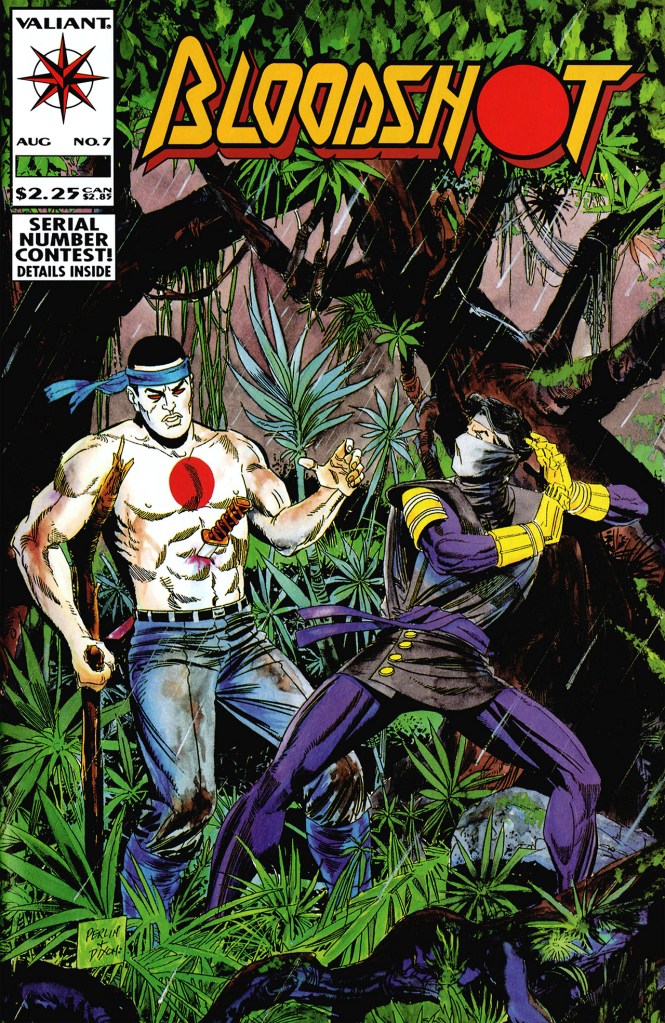
Anyway, we can return to the 1990s universe of Valiant Comics following the misadventure of Bloodshot in this look back at Bloodshot #7, published in 1993 by Valiant Comics with a story by Kevin VanHook and art by Don Perlin.
The cover.
Early story
The story begins 1,500 feet in the air above the Philippines with Leigh falling down followed by Bloodshot with the airplane leaving them. After some struggle, Bloodshot manages to grab her boot which turned out helpful as Leigh had been controlling her fall by gliding on the air currents. After breaking the fall, the boot of Leigh slips off separating the them. Bloodshot falls on the jungle’s foliage while the other landed safely.
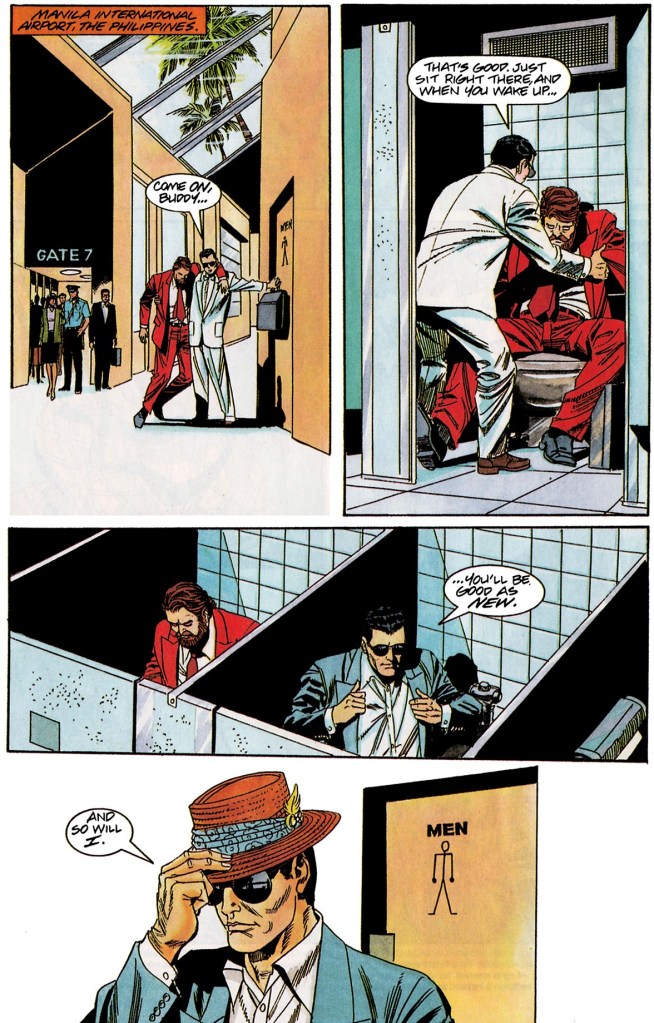
Over at the Manila International Airport, the secret assassin Marco is weak and was assisted by a certain guy and placed on one of the toilets in the restroom. After being left there alone, Marco wakes up and leaves the restroom to make a telephone call. He does not realize that the same man who assisted him is trailing him.
Back in the jungle, Bloodshot gradually adjusts himself to get moving just as his nanites are healing his fractured right leg and broken rib. With no time to lose, he decides to continue his mission even though he is still injured….
Quality
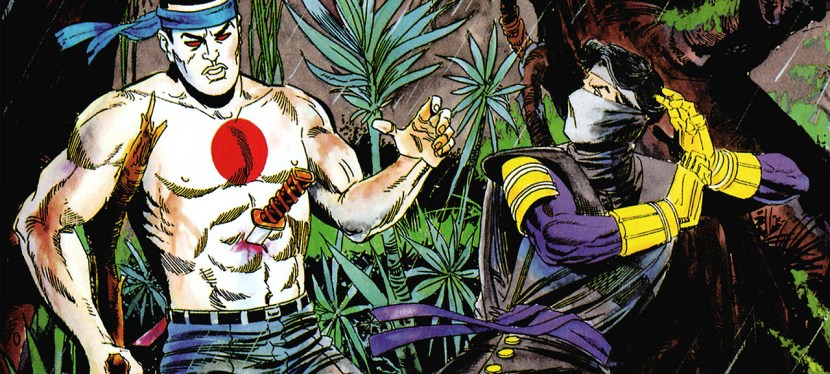
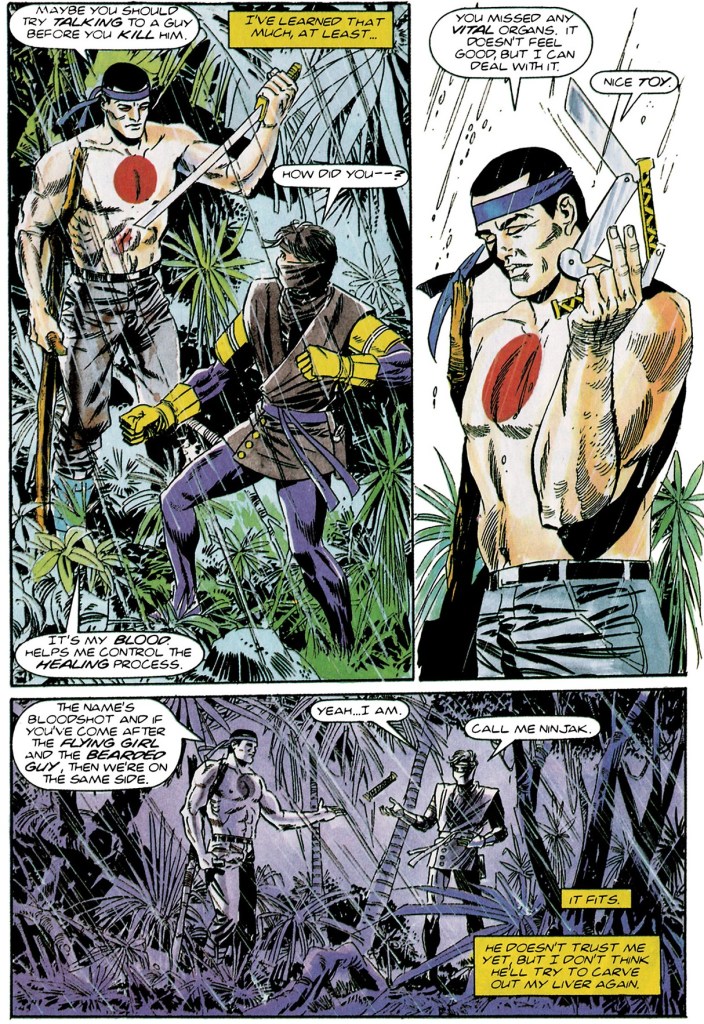
Bloodshot and Ninjak in the jungle in the Philippines.
I can say that this comic book has a stronger story and better spectacle. It is indeed a solid payoff to the build-up in issue #6. Kevin VanHook took his time in pacing the story allowing readers to follow the details behind the events while giving ample spotlight to other characters. Bloodshot is still in the center of the story only this time he’s a lot more vulnerable and less capable as an action hero. As seen in the cover of this comic book, he truly is vulnerable and therefore he is presented more as a survivor striving hard to complete his detective work no matter the costs.
This is not a straightforward action tale. There is still a good amount of intrigue and espionage that happens in the Philippines (as Valiant’s creators imagined it). It should be noted that this comic book marks the first-ever appearance of Ninjak in his costumed form (note: Ninjak appeared in Bloodshot #6 in his civilian form as Colin King) as well as the first-ever personal encounter between Ninjak and Bloodshot (which was written to be believable). Artist Don Perlin cleverly crafted the way Ninjak performs action and evasive maneuvers setting the basic standards that other artists would do later in further comic book featuring the character (who eventually got his own monthly series in 1994).
Conclusion
At the Manila International Airport…
Bloodshot #7 (1993) is a great comic book to read and it also happens to be one of the more memorable character debuts Valiant Comics ever published in the 1990s. The debut of Ninjak in his costume alone makes this one a must-have and it so happens that the story and art were both of very good quality. The gritty realism applied to the tone of the presentation makes the story believable and there never was a moment when the events felt outlandish.
Going back to Ninjak, the character went on to become one of Valiant’s most original and major superheroes of all. In 1994, the Ninjak monthly series launched big time with an issue #1 that had a chromium cover and the great Joe Quesada drew the cover and interior art. In 2015, Valiant Entertainment launched another Ninjak series.
If you are seriously planning to buy an existing hard copy of Bloodshot #7 (1993), be aware that as of this writing, MileHighComics.com shows that the near-mint copy of the comic book costs $40.
Overall, Bloodshot #7 (1993) is highly recommended.
+++++
Thank you for reading. If you find this article engaging, please click the like button below and also please consider sharing this article to others. If you are looking for a copywriter to create content for your special project or business, check out my services and my portfolio. Feel free to contact me as well. Also please feel free to visit my Facebook page Author Carlo Carrasco and follow me at HavenorFantasy@twitter.com
Disclaimer: This is my original work with details sourced from reading the comic book and doing personal research. Anyone who wants to use this article, in part or in whole, needs to secure first my permission and agree to cite me as the source and author. Let it be known that any unauthorized use of this article will constrain the author to pursue the remedies under R.A. No. 8293, the Revised Penal Code, and/or all applicable legal actions under the laws of the Philippines.
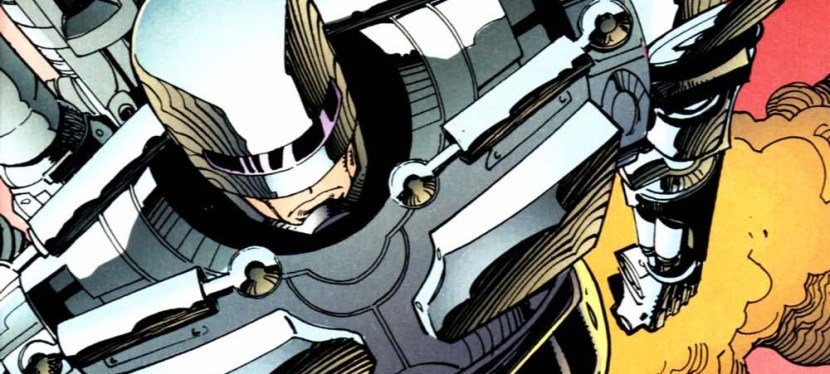
Hey fellow geeks and comic book collectors plus the fans of RoboCop and Terminator! This is it! I have finally reached the end of the 4-issue RoboCop versus The Terminator mini-series of comic books spearheaded by Frank Miller.
To give a recap without spoiling plot details, issue #1 was mainly a build-up issue which did not entertain on its own. In issue #2, there was a huge pay-off to the build-up and seeing RoboCop battle the Terminator was a grand spectacle! Issue #3 meanwhile saw some very daring creative twists taken that further mixed elements of the respective Terminator and RoboCop universes together which ultimately served as a build-up for what could be a potential epic in the comic book featured in this review.
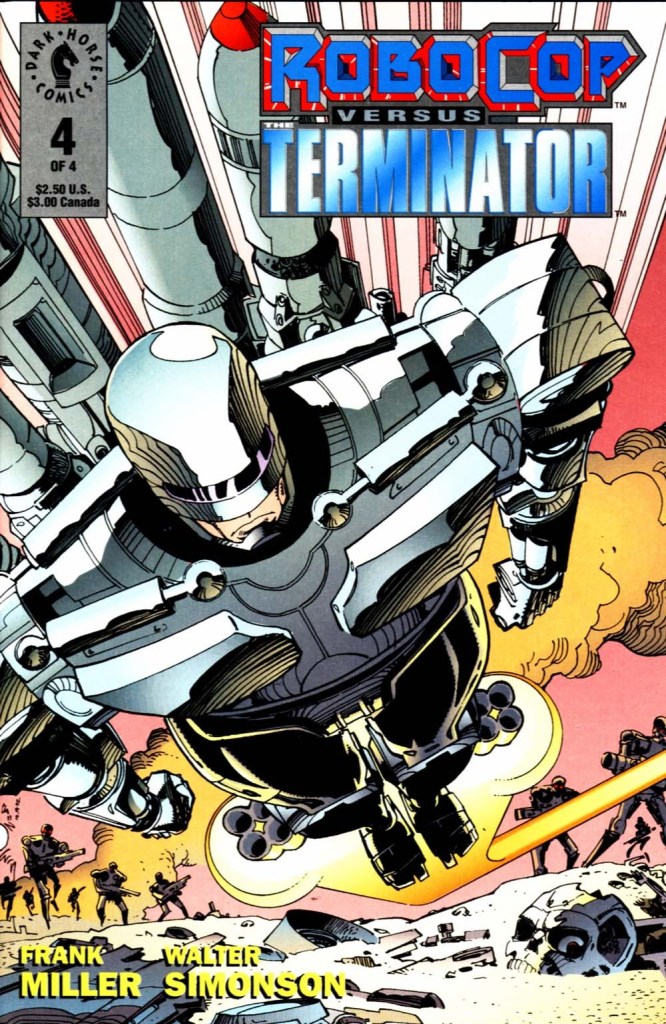
Is the build-up worth it? Did the issue #3 twists pave the way for something memorable? We will all find out in this look back at RoboCop versus The Terminator 4, published in 1992 by Dark Horse Comics with a story written by Frank Miller and drawn by Walt Simonson.
The cover.
Early story
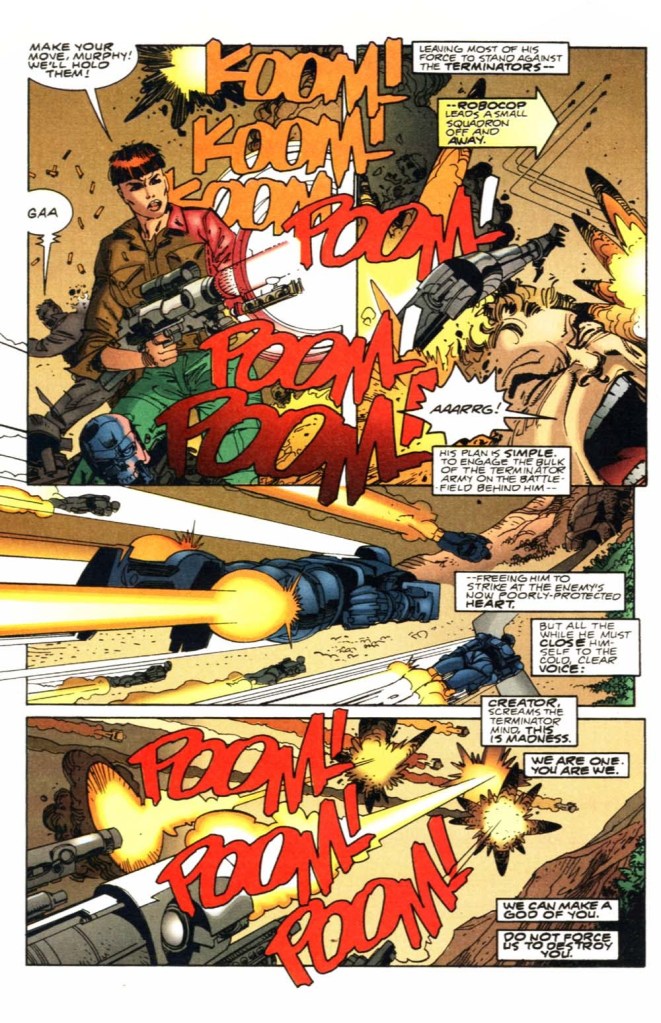
The story begins again in the dark future when the world is ravage by the war between man and machines. As the human resistance falters, the machines of Skynet march further toward their prey. Suddenly, RoboCop flies in and hits them with a very powerful rocket.
Inside a cybernetic hideout, a familiar short-haired lady gets shaken by the blast. As a result, she will not go back in time and will no longer try to kill RoboCop. On the monitors, she watches the armed cyborg cop destroy Skynet’s troops and saved the human resistance from certain death.
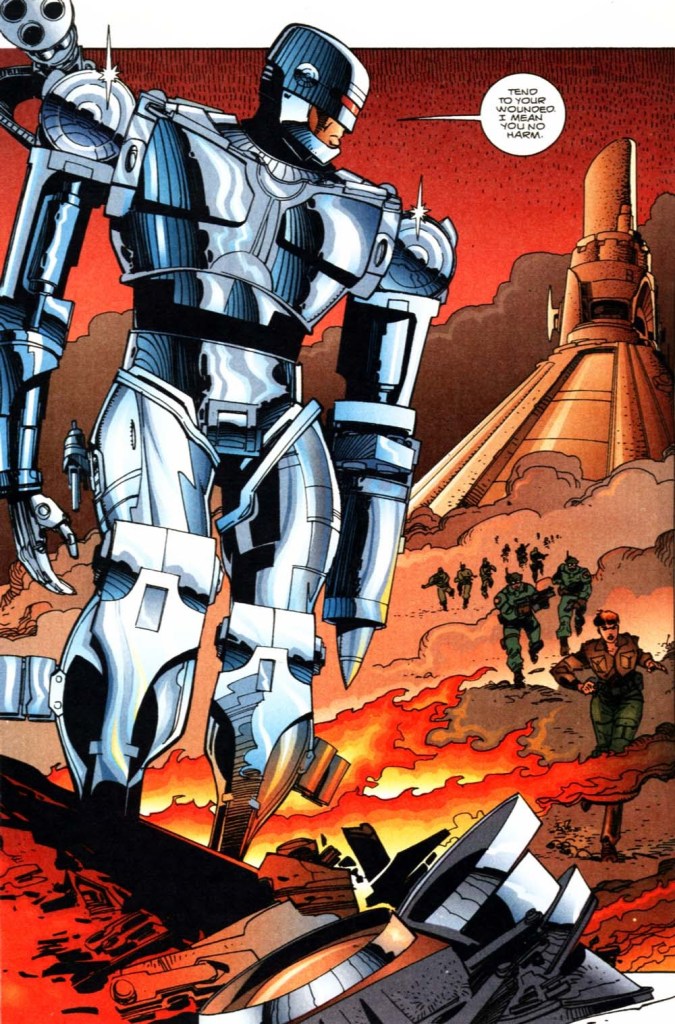
Shortly after, the human warriors take a much-needed rest. Feeling restless, the lady warrior approaches RoboCop privately and states that she figured he is not a Terminator. RoboCop, whose helmet was taken off showing his human face as officer Murphy, pets a dog as the lady approaches them.
It turns out the lady’s name is Flo (short for Florence) and she starts conversing with him peacefully. She then starts trusting RoboCop, even resting by his side. RoboCop, however, knows what has been going on that the humans don’t and he knows that Skynet and its army of Terminators acknowledge him as their creator. How his decision to help the human resistance in the war against the machines will turn out remains to be seen.
Quality
Another twist, another scenario for the war between man and machines.
When it comes to its story, Frank Miller really exerted efforts to give this comic book’s final conflict an epic presentation which is no surprise since the stakes were already raised as a result of the big twists in issue #3. Epic concept aside, the concept of RoboCop helping the humans fight Skynet is indeed awesome and daring to see. There is one additional idea Miller came up with which raise the stakes even further in the war, and what that idea was about is something you readers should find out on your own by getting a copy of this comic book.
If there are any weaknesses here, it’s the presentation of the concept of time travel and time distortion which, even in this concluding part of the mini-series, remains used to justify scenario twists. As a result, the ending of this comic book made the whole conflict look and feel like a twisted, wild dream. Another thing to point out was that Skynet, even in its cybernetic form, was portrayed with human-like patterns and even tried to reason with RoboCop. This one weakened the Terminator concept a bit. Still, the series ended with enough satisfaction for me.
Conclusion
RoboCop and the human resistance.
RoboCop versus The Terminator #4 is worthy conclusion to its mini-series. On its own, it had an epic concept and the creators really did what they could to raise the stakes of the conflict as well as raising the quality of their presentation. When it comes to combining the creative elements of the Terminator and RoboCop franchises, Miller did a solid job. It’s just that time travel and time distortion were used to create new scenarios once again in this particular comic book which I found unnecessary. On the bright side, this comic book is loaded with lots of action scenes and the quality of the dialogue was improved.
If you are seriously planning to buy an existing hard copy of RoboCop versus The Terminator #4 (1992), be aware that as of this writing, MileHighComics.com shows that the near-mint copy of this comic book costs $10.
Overall, RoboCop versus The Terminator #4 (1992) is recommended.
+++++
Thank you for reading. If you find this article engaging, please click the like button below and also please consider sharing this article to others. If you are looking for a copywriter to create content for your special project or business, check out my services and my portfolio. Feel free to contact me as well. Also please feel free to visit my Facebook page Author Carlo Carrasco and follow me at HavenorFantasy@twitter.com
Disclaimer: This is my original work with details sourced from reading the comic book and doing personal research. Anyone who wants to use this article, in part or in whole, needs to secure first my permission and agree to cite me as the source and author. Let it be known that any unauthorized use of this article will constrain the author to pursue the remedies under R.A. No. 8293, the Revised Penal Code, and/or all applicable legal actions under the laws of the Philippines.
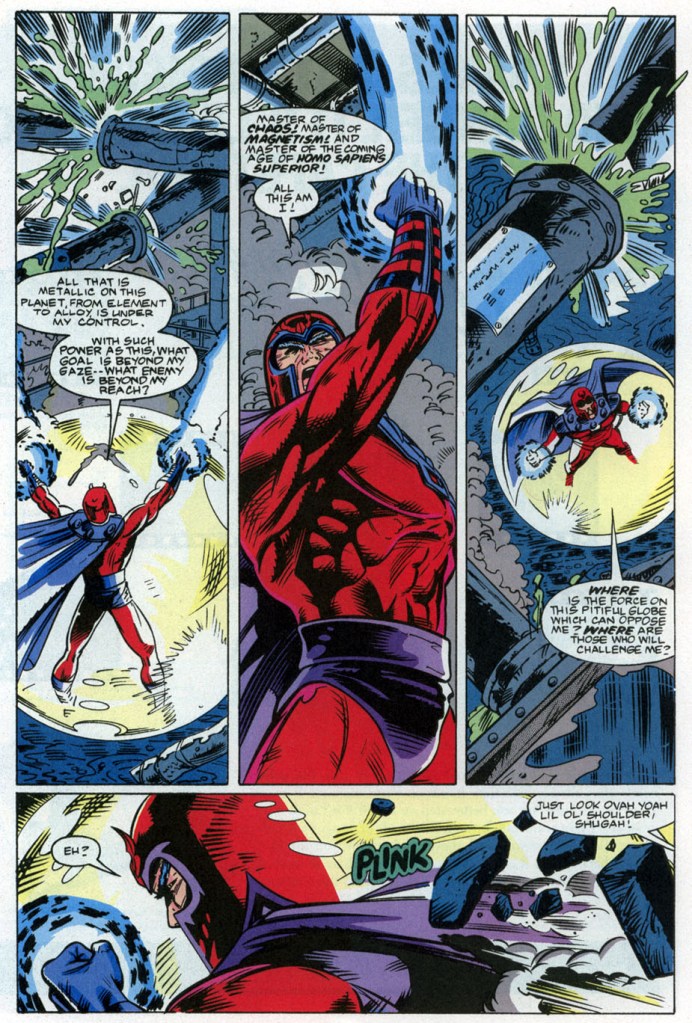
Who is the most definitive X-Men villain ever? That is none other than Magneto! Co-created by Stan Lee and Jack Kirby, Magneto made his literary debut alongside Marvel’s heroic mutants in The X-Men #1 way back in 1963. Magneto is capable of generating and controlling magnetic fields which make him dangerous since he has the power to manipulate metal and even use them as weapons against others, plus he can even cause destruction to buildings by moving the metal in them to bring them down.
What even makes Magneto more dangerous is his very strong belief that his fellow mutants are genetically superior over humans and he does not believe in the concept of mutants and humans co-existing. Character-wise, Magneto is the complete opposite of Charles Xavier/Professor X of the X-Men.
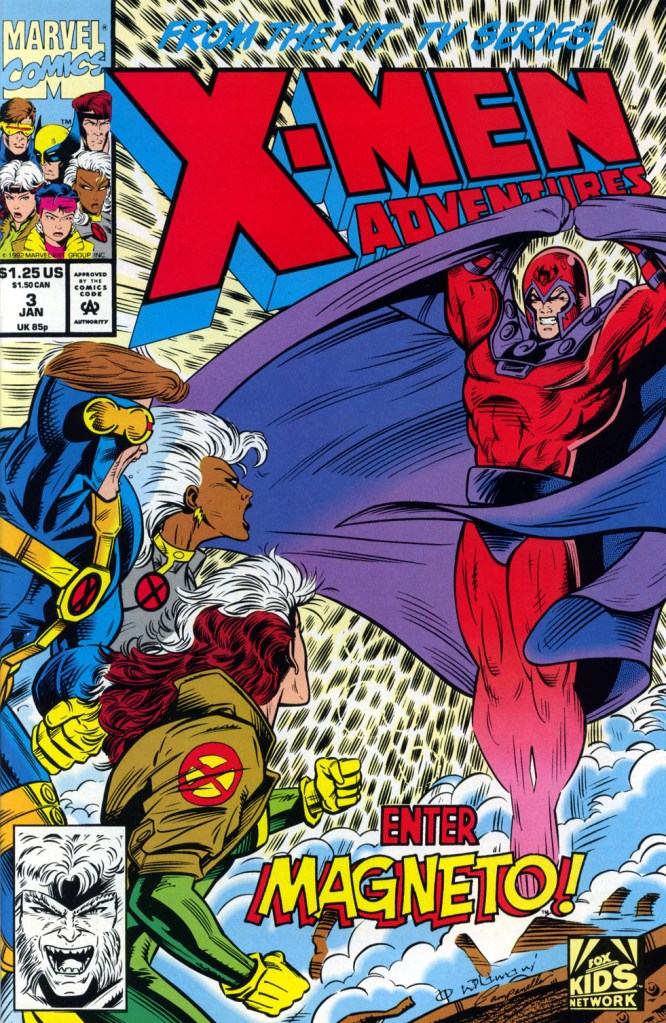
When it comes to pop culture influence, GamesRadar+ declared Magneto as the #1 best X-Men villain of all time. Even more intriguing was the super villain topping IGN’s Top 100 Comic Book Villains List. Beyond comic books, Magneto also appeared in the X-Men arcade game of 1992 made by Konami. On November 27, 1992, Magneto made his debut in the Enter Magneto episode of the popular X-Men animated series on TV. The said episode was, unsurprisingly, adapted into comic book form in issue #3 of the X-Men Adventures monthly comic book series.
How was Magneto’s debut in the said monthly series? We can find out in this look back at X-Men Adventures #3, published in 1993 by Malibu Comics with a story written by Ralph Macchio and drawn by Andrew Wildman.
The cover.
Early story
The story begins in outer space where Asteroid M is orbiting above planet Earth completely undetected. As a meteor is on-course to collide with Asteroid M, the operator of the asteroid activates its guns and hits it. While Asteroid M got spared, a smaller meteor found itself falling into Earth’s atmosphere. As it burns through the atmosphere, Charles Xavier spots it from inside his mansion.
Xavier turns his attention to Jean Grey. As they travel together, the doors open and Sabretooth enters landing on the floor. The two have yet to know him.
Over at a prison, the captured Hank McCoy/Beast thinks deeply inside his prison cell only to suddenly witness one of the walls get smashed by some powerful force. Magneto arrives and tells him he came for him…
Quality
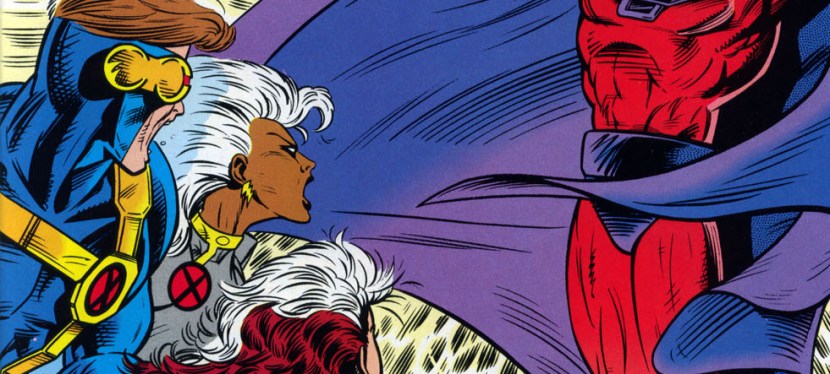
The power of Magneto.
The writing, with credit to the screenwriters behind the animated episode, is pretty solid and the essence of the said episode was very well adapted into this comic book. As this is Magneto’s debut in the X-Men Adventure series reflecting his debut in animated series, his character is portrayed very accurately and it only made perfect sense for him to approach Beast first to try to convince him join his pro-mutant movement. More on the writing, Beast’s restraint brought out more of Magneto’s hardcore beliefs and his complete opposition towards humans.
Of course, the creators did not let down their efforts to portray the struggle mutants have under the laws of human society which is strongly reflected in Beast’s court hearing with Wolverine and Cyclops (in civilian forms) observing powerlessly. The court room drama and arguments were intense.
I should also state that there really was a nice build-up leading to the first battle (first half, actually) between the X-Men and Magneto. Unlike the battles in issues #1 and #2, the conflict here showed the X-Men more in danger which is only fitting considering how great the villain is.
Conclusion
Magneto and Beast.
X-Men Adventures #3 is a strong adaptation of the Enter Magneto episode. There is no doubt about that and most notably, the comic book creators did another good job making the TV animated episode’s concept engaging and fun to read. This comic book should be part of the collection of anyone who is passionate about Magneto.
If you are seriously planning to buy an existing hard copy of X-Men Adventures #3 (1993), be aware that as of this writing, MileHighComics.com shows that the near-mint copy of the regular edition costs $8 while the near-mint copy of the newsstand edition costs $17.
Overall, X-Men Adventures #3 (1993) is highly recommended!
+++++
Thank you for reading. If you find this article engaging, please click the like button below and also please consider sharing this article to others. If you are looking for a copywriter to create content for your special project or business, check out my services and my portfolio. Feel free to contact me as well. Also please feel free to visit my Facebook page Author Carlo Carrasco and follow me at HavenorFantasy@twitter.com
Disclaimer: This is my original work with details sourced from reading the comic book and doing personal research. Anyone who wants to use this article, in part or in whole, needs to secure first my permission and agree to cite me as the source and author. Let it be known that any unauthorized use of this article will constrain the author to pursue the remedies under R.A. No. 8293, the Revised Penal Code, and/or all applicable legal actions under the laws of the Philippines.
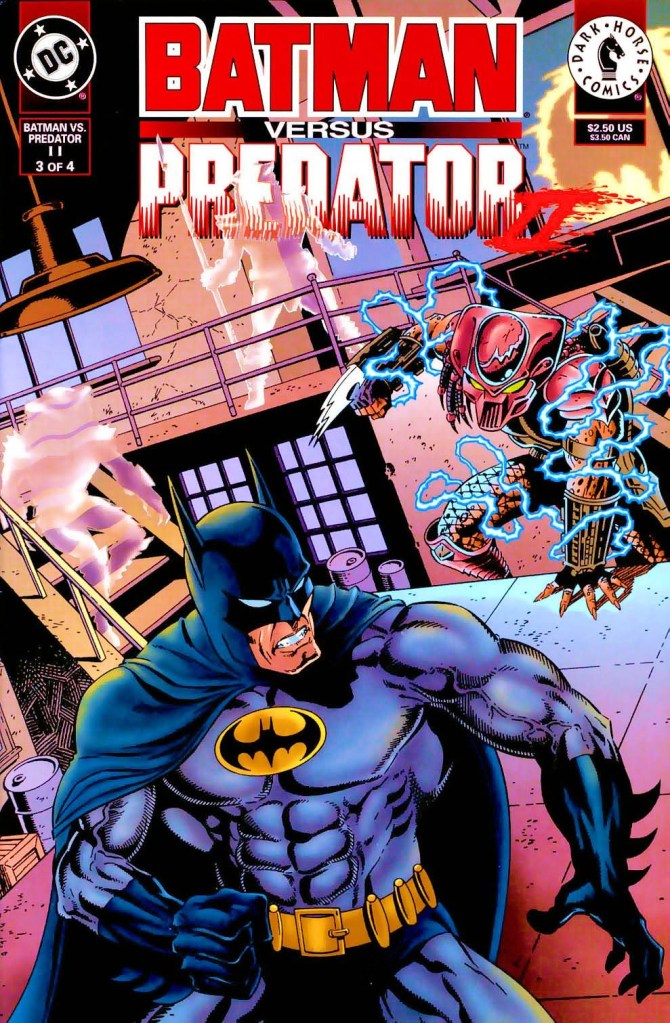
I am currently enjoying the Batman versus Predator II mini-series of the mid-1990s which was a joint effort between DC Comics and Dark Horse Comics. The first issue was great and nicely built up the energy for the first encounter between Batman and the Predator in issue #2. Along the way, I do enjoy the adulterated tone that came with the presentation. This made each issue look and feel like an R-rated cinematic segment.
Will the strong quality of this crossover continue in the third issue? Find out with me in this look back at Batman versus Predator II #3, published in 1995 by DC Comics and Dark Horse Comics with a story written by Doug Moench and drawn by Paul Gulacy.
The cover.
Early story
The story begins with Batman emerging from the sewer. He finds himself alone in the middle of a city street and senses danger is around him. Suddenly someone from one of the nearby buildings fires at Batman who dodges and takes cover by a car. He grabs a tool and throws it at the window which hits the rifle. And then, on the street, a man throws a grenade at the caped crusader who deflects it. The grenade enters a nearby establishment and explodes. Batman kicks the antagonist and then encounters a speeding vehicle heading towards him.
The detective fires his weapon which causes the car’s windshield to get smashed. He dodges the car and sees it crash. Suddenly the floor beneath him opens which compels him to use his grapnel to avoid falling down to spikes below.
Meanwhile at another location, the Predator dissolves the decapitated head of a man (killed in issue #2) with hot liquid and keeps the skull for his collection of trophies.
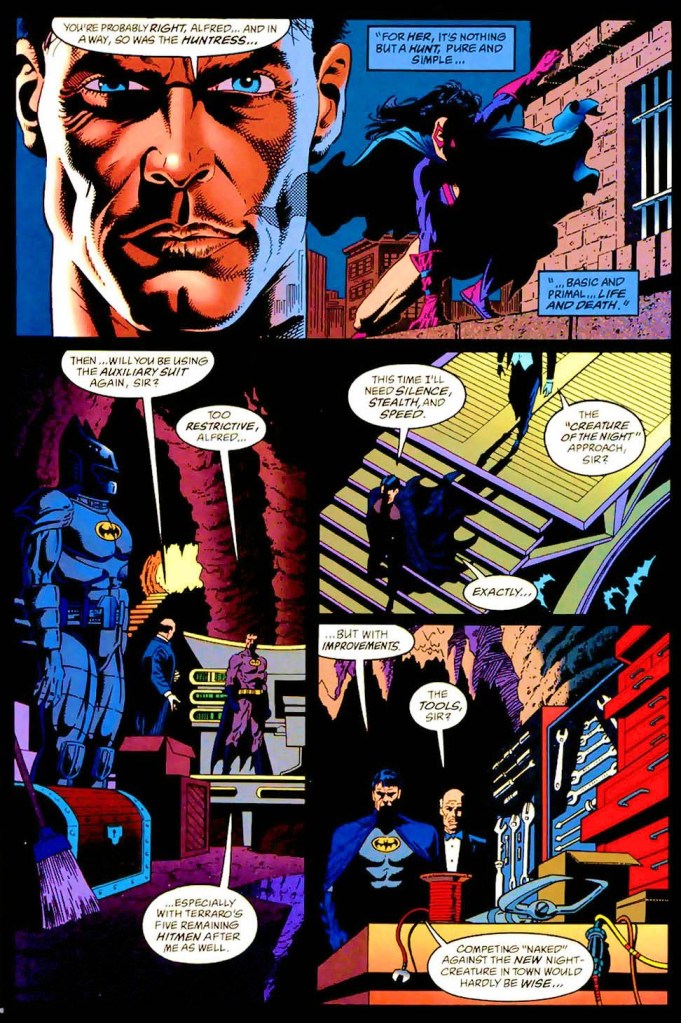
Back at the Bat Cave, Batman and Alfred analyze what happened recently. Alfred states that the Predator killed two of the seven assassins hired by Terraro to kill Batman. The great detective wonders why…
Quality
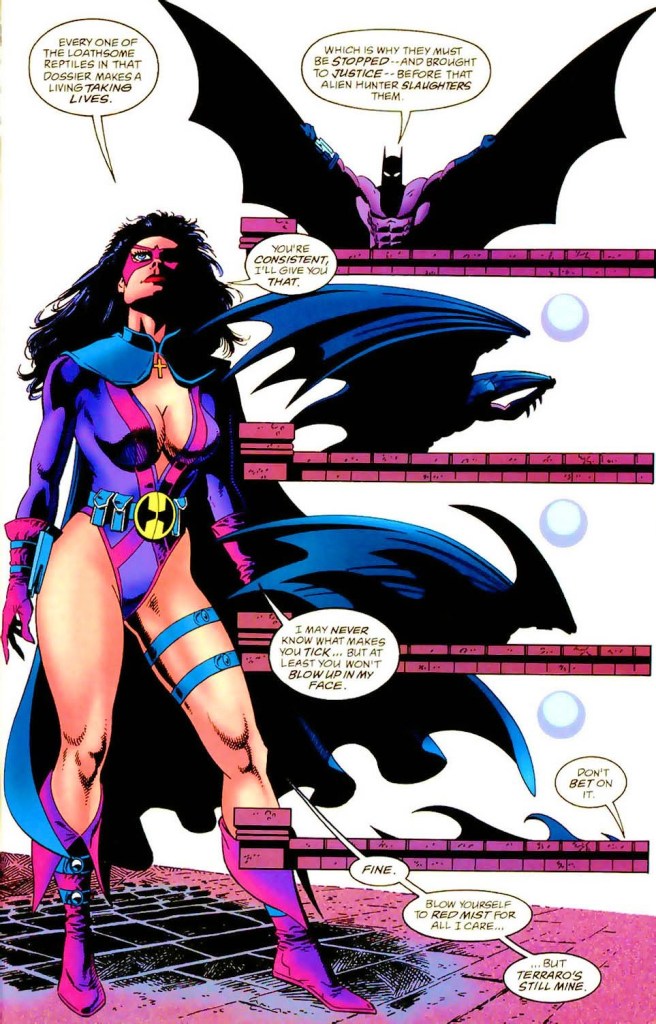
The Huntress and Batman.
Let me start with the storytelling. The writing by Doug Moench is solid and, more importantly, there is a nice payoff here in relation what was gradually built up in the first two issues – Terraro’s assassins and operations getting more lively within the plot. This alone adds some nice variety into the ongoing Batman-Predator rivalry, and symbolically the Huntress (who is after Terraro) is involved with the mafia plot and the said rivalry between Gotham’s detective and the hunter from space.
More on Batman and the Huntress, I like the way Moench wrote these two heroes as being divided even though they both face threats from the crime gang and from the Predator. Both characters are vigilantes but Batman has justice in mind while the Huntress is focused on hunting the powerful crime boss. Adding more depth to the story is the subplot about Commissioner Gordon being helpless and recovering in the hospital which complicates matters for the Gotham City police department.
Another thing that makes this issue more unique is the in-depth presentation of Batman doing detective work in the Bat Cave with Alfred providing insight. This alone makes this issue an improvement over issue #2.
When it comes to the visuals, artist Paul Gulacy continues to provide really nice artwork backed with strong support by the colorists. Gulacy took his time pacing the story by following the script closely and made key action scenes look dynamic visually when needed.
Conclusion
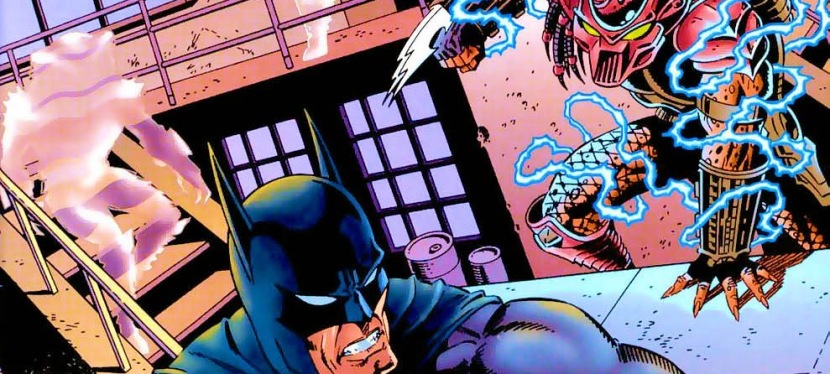
Remember the armor Batman wore in the previous crossover story against the Predator?
Considering all the good stuff I enjoyed in it, Batman versus Predator II #3 is a great read. It has a better balance on plotting, detective work, spectacle and intrigue. In fact, this comic book has a much more powerful ending than issues #1 and #2, and the ironic thing is that this only leads to the 4th and final issue which I’ll review soon.
If you are seriously planning to buy an existing hard copy of Batman versus Predator II #3 (1995), be aware that as of this writing, MileHighComics.com shows that the near-mint copy of the comic book costs $40.
Overall, Batman versus Predator II #3 (1995) is highly recommended!
+++++
Thank you for reading. If you find this article engaging, please click the like button below and also please consider sharing this article to others. If you are looking for a copywriter to create content for your special project or business, check out my services and my portfolio. Feel free to contact me as well. Also please feel free to visit my Facebook page Author Carlo Carrasco and follow me at HavenorFantasy@twitter.com
Things are looking really good for Microsoft’s Team Xbox as far as launching their next-generation machines Xbox Series S and Xbox Series X is concerned. The two upcoming consoles will launch officially on November 10, 2020 in America and some other parts of the world. Xbox Series S in America is priced at $299 and while the premium Xbox Series X (which has a 4K Blu-ray disc drive) is priced at $499.
At this stage, the last thing any company wants to go through is a pre-launch blunder or controversy that would discourage consumers from buying the new products. While the final lineup of launch games for Xbox Series S and Xbox Series X has yet to be declared, there are notable developments that are already delighting Xbox fans and casual gamers. No, it’s not about the megaton Xbox – Bethesda deal that gamers are still talking about. Something else, really.
Xbox Series S and Xbox Series X.
Firstly, there is really good news that the promised backward compatibility feature on Xbox Series X is not only working but also enhanced the games tested. Screen Rant wrote: Games that are locked at 30 frames per second on Xbox One are able to easily hold a locked 60 frames per second on the Xbox Series X, even with upgrades in resolution. They also added: The ability of the Xbox Series X to play older games may end up being a bigger deal now than Microsoft expected. The game industry has been hit with lots of delays this year, mostly as a result of the COVID-19 pandemic, meaning both next-gen consoles will have lighter than expected launch lineups.
Den of Geek meanwhile reported that Rise of the Tomb Raider, Sekiro, Hitman 2 and even the 12-year-old Grand Theft Auto IV all ran better on Xbox Series X than they ever did in their respective original consoles of release. More on GTA4 (first released on Xbox 360), Den of Geek wrote: Even some older titles are “rescued” by the power of the Xbox Series X. The report highlights Grand Theft Auto 4 as a game that not only infamously struggled on the Xbox 360 (where it was borderline unplayable at times) but even burdened the mighty Xbox One X. On Xbox Series X, though, Rockstar’s sometimes controversial classic hits that fabled 60 FPS benchmark and even does so while offering enhanced visuals and improved load times.
Take note that Den of Geek and Screen Rant took references from Digital Foundry’s video that highlighted their testing of backward compatibility on Xbox Series X which you can watch right below…
Secondly, the load times related to the backward compatibility all showed clear improvements on Xbox Series X. Remember how long it took your Xbox One console to load up Red Dead Redemption 2? Remember what you did during all the times your Xbox 360 or Xbox One console struggled to load up the game? Those times are history!
According to The Verge, massive changes to the load times were the most significant improvements. They wrote: Games like Sea of Thieves, Warframe, and Destiny 2 have their load times cut by up to a minute or more on the Series X. In Destiny 2, for example, I can now load into a planet in the game in around 30 seconds, compared to over a minute later on an Xbox One X and nearly two minutes in total on a standard Xbox One. These improved load times are identical to my custom-built PC that includes a fast NVMe SSD, and they genuinely transform how you play the game — you can get more quests and tasks done instead of sitting and looking at a planet loading.
Warframe and Sea of Thieves are equally impressive with their load times now. I can now open Warframe and the game is ready to play just 25 seconds later. That same load takes literally a minute longer on my Xbox One X. Sea of Thieves now loads to menu screens in around 20 seconds, with another 28 seconds to load into a session. On my Xbox One X, it takes a minute and 21 seconds to even load the game initially, and then another minute and 12 seconds to get into a game session.
None of these games have been fully optimized for the Xbox Series X either. This is simply Microsoft’s backward compatibility support in action.
Thirdly, there is also the issue of game performance. To be specific, it’s about frame rates and consistency related to Destiny 2, Warframe and Sea of Thieves. The Verge wrote: Destiny 2 is a great example of a game that was held back by the weaker CPU and slow HDD in the Xbox One X. It’s a title that hit native 4K previously, but the 6 teraflops of GPU performance in the One X was bottlenecked by a laptop-like CPU and an old spinning hard disk. This meant the game was stuck on 30fps.
While Bungie has committed to enhancing Destiny 2 for the Xbox Series X and PS5 with 60fps support, it already feels faster without the patch. I would regularly notice frame rate drops in Destiny 2 on the Xbox One X when things got a little hectic on screen during a public event or in a raid with mobs of enemies coming at you. I haven’t seen a single stutter running Destiny 2 on the Xbox Series X.
This console has also improved other parts of Destiny 2 that were slow on the Xbox One. Loading into the character menu sometimes takes a few seconds on the Xbox One X, but on the Series X it feels like I’m playing on my PC as it’s near instant.
On the other two games, they wrote: I’ve noticed similar improvements across Warframe and Sea of Thieves, where games just seem to automatically benefit from the CPU, SSD, and GPU improvements to run more smoothly.
When it comes to multiplayer performance and compatibility, The Verge wrote: The other benefit to the Xbox Series X and this next generation is that games aren’t separated out like they were in the shift from Xbox 360 to Xbox One. Back then, you could only match Xbox One players in a lot of games, leaving out friends who still played on the Xbox 360. In every multiplayer game I’ve tested on Series X, I was able to join friends who were using an Xbox One and match against other Xbox One players.
See? Things are really looking good in the run up to November 10 launch of Xbox Series S and Xbox Series X. Backward compatibility ensures that your huge collection of games played (as recorded in your Xbox LIVE account) in previous generations’ Xbox consoles will NOT go to waste and, at the same time, the said feature is a great way of preserving video games from the past. I personally am happy about this not simply because I am nostalgic but because there are some great games from the past that need playing such as Lost Odyssey (Xbox 360), Halo 3 (Xbox 360), Elder Scrolls IV: Oblivion (Xbox 360), Fallout New Vegas (Xbox 360) and Star Wars: Knights of the Old Republic (original Xbox).
In addition, the tests showed that previous generation games are not only playable on the next-generation Xbox but they also perform better, load much faster and will have varying visual enhancements. And then there is also cross-play for multiplayer. Just imagine how that would impact online multiplayer as we know it.
In ending this, posted below are Xbox-related videos for your learning and excitement for the next-generation! Be confident, fellow Xbox fans! This coming new generation of console gaming will be much more fun than the current one! Team Xbox truly cares about us gamers, much more so than Sony’s PlayStation team!
+++++
Thank you for reading. If you find this article engaging, please click the like button below and also please consider sharing this article to others. If you are looking for a copywriter to create content for your special project or business, check out my services and my portfolio. Feel free to contact me as well. Also please feel free to visit my Facebook page Author Carlo Carrasco and follow me at HavenorFantasy@twitter.com
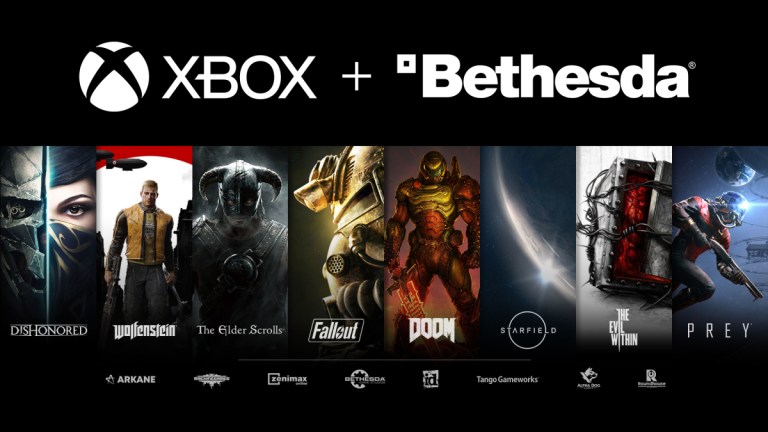
For so long have many people criticized Team Xbox of Microsoft for being too weak with their 1st party games and for having not enough exclusive games. Such criticism does not matter anymore because Microsoft made the heavy investments in expanding their Xbox Game Studios member developers through acquisitions and such developments further escalated with Microsoft acquired ZeniMax Media and have game publisher Bethesda integrated with Team Xbox.
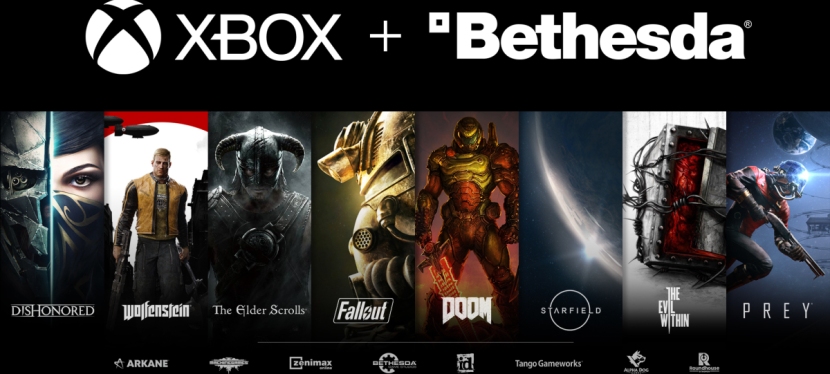
Think about it. Bethesda game developers moved Xbox Game Studios teams from 15 to a whopping 23! This also means that Microsoft effectively owns the established Bethesda intellectual properties and game franchises of Dishonored, Doom, Prey, Wolfenstein and the best-selling franchises Fallout and The Elder Scrolls! Very clearly Microsoft spent $7.5 billion very strategically and as a result, the Xbox 1st party lineup of developers and franchises easily overwhelmed those of PlayStation.
Future games of these established video game franchises – plus the upcoming game Starfield – will be available only through the Xbox ecosystem.What Microsoft owns, Sony and Nintendo cannout touch.
This bring me to my next point – the Xbox ecosystem exclusivity of Bethesda’s future games and franchises! This is the one topic that made PlayStation fanboys disappointed and very uneasy, and I spotted a lot of them on Twitter. Why? For starters, the Xbox ecosystem is composed of the Xbox consoles (Xbox One and its variants, plus the upcoming next-generation Xbox Series S and Xbox Series X), Windows 10 PC plus the many millions of smartphones that will be able to play games via streaming (with Project xCloud).
Spencer confirmed that ZeniMax games will appear on Microsoft’s xCloud the same day they are released in retail, making the service even more worthwhile for dedicated gamers.
But it also leaves the question as to whether Microsoft will bring ZeniMax games to competing consoles like the PlayStation 5 and Nintendo Switch. Making games exclusive to a single console can be incredibly lucrative, as it forces gamers to buy certain systems to access their favorite games.
Microsoft, however, has also shown that it’s willing to share such properties with rivals as evidenced by its decision to put “Minecraft” on the PlayStation 4 and Nintendo Switch, as well as Android and iOS.
“In terms of where games will show up, our commitment is that our games will show up in Game Pass, PC, and on console and be available on xCloud,” Spencer said. “In terms of other platforms, I think we’ll take it on a case-by-case basis.”
As seen at the end of the above excerpt, Phil Spencer’s “our games” quote refers clearly to what games Microsoft owns and that already includes Bethesda’s games. He went on to confirm his company’s games will be released for the Xbox console users and Windows 10 users through the fast-growing Xbox Game Pass subscription service and Project xCloud. There definitely is no PlayStation console included. Even though Spencer did not mention the word “exclusive”, he confirmed the exclusivity when he referred to their games and the Xbox ecosystem. If PlayStation gamers really want future games of Wolfenstein, Fallout and The Elder Scrolls on PlayStation 5 (PS5), they can shout all they want but Sony cannot make it happen for them because it is Microsoft who has the final word to make that happen. Hence the “case-by-case basis” words of Spencer.
Of course, Microsoft did not spend $7.5 billion only to make Bethesda games and franchises available on non-Xbox platforms. They already invested so much on Xbox Game Pass and Project xCloud, now is the time for them to fill it with exclusive content and gamers who want the Bethesda games will need a Windows 10 PC and/or an Xbox console (note: the next-generation Xbox Series consoles are recommended since Xbox One is on its way out). For Microsoft making Bethesda games available on PS5, Nintendo’s Switch (and its successor) is a self-defeating move.
As for Yahoo! Finance’s mentioning of Minecraft being a multiplatform release, they did not mention the fact that the said game was already available on other platforms BEFORE Microsoft acquired Mojang in 2014. Clearly this is not the same with the Xbox-Bethesda deal, and Microsoft will use Bethesda properties as leverage against Sony and Nintendo when it comes to exclusive content for the Xbox ecosystem.
The next-generation console competition is only heating up and Team Xbox has the advantages! Nintendo and Sony cannot do anything to compel Microsoft to have Bethesda release The Elder Scrolls VI, Starfield and Fallout 5 on their respective consoles. Those two do not own Bethesda and Sony’s exclusive games deals with Bethesda is only temporary at best. After that deal ends with no renewal, there will be no more new Bethesda games for PlayStation gamers and they will only have to settle with old ones like The Elder Scrolls Online, Skyrim, Fallout 4.
In the near future, this upcoming fantasy RPG will be available only on Xbox Series consoles and Windows 10 PC through Xbox Game Pass and Project xCloud.
For the role-playing game (RPG) genre, Team Xbox already has the very talented inXile Entertainment (Wasteland 3) and Obsidian Entertainment (The Outer Worlds) making even new exclusive RPGs for the Xbox ecosystem. Add Bethesda’s Starfield, The Elder Scroll VI and the unannounced Fallout sequel, then it is very clear that the Xbox ecosystem will be the best destination for gamers who love compelling, fun and enduring RPGs. Meanwhile, Sony itself does not have the talents nor the resources to make their own high-quality RPGs which is why they desperately signed a timed-exclusive deal with Square Enix to have Final Fantasy XVI first on PS5.
Again, all of these details and developments show that the $7.5 billion Xbox-Bethesda deal is for the long-term and Microsoft now has the means to build up the Xbox ecosystem in terms of content, features and the global userbase. It should be noted that the franchises of Doom, Fallout, Dishonored, Wolfenstein and Elder Scrolls have many millions of dedicated fans and to continue enjoying future games they will definitely be flocking into the Xbox ecosystem (goodbye Sony and Nintendo gamer communities). It truly is a megaton, video game industry shaking business deal that really caught Sony and Nintendo off-guard. I should state that the promise of future Bethesda releases alone will convince gamers (the Bethesda franchise fans, the casual gamers and hardcore gamers) to buy Xbox Series S or Xbox Series X even though the forming lineup of launch games does not look too hot. It will be in the 2nd year of the next-generation Xbox Series consoles that the real blockbuster exclusive games will come out and attract gamers who want the best gaming experiences that can only be found in the Xbox ecosystem. Lastly, the Xbox-Bethesda deal ensures that Team Xbox will not suffer from any lack of exclusive games in the years to come. We will see if Nintendo and Sony can keep up with Team Xbox’s pace, only this time without new games of Doom, Fallout, Elder Scrolls.
In ending this, watch these Xbox-Bethesda videos from Colteastwood and Rand al Thor 19. Watch and listen very closely.
+++++
Thank you for reading. If you find this article engaging, please click the like button below and also please consider sharing this article to others. If you are looking for a copywriter to create content for your special project or business, check out my services and my portfolio. Feel free to contact me as well. Also please feel free to visit my Facebook page Author Carlo Carrasco and follow me at HavenorFantasy@twitter.com
Disclaimer: This is my original work with details sourced from reading the comic book and doing personal research. Anyone who wants to use this article, in part or in whole, needs to secure first my permission and agree to cite me as the source and author. Let it be known that any unauthorized use of this article will constrain the author to pursue the remedies under R.A. No. 8293, the Revised Penal Code, and/or all applicable legal actions under the laws of the Philippines.
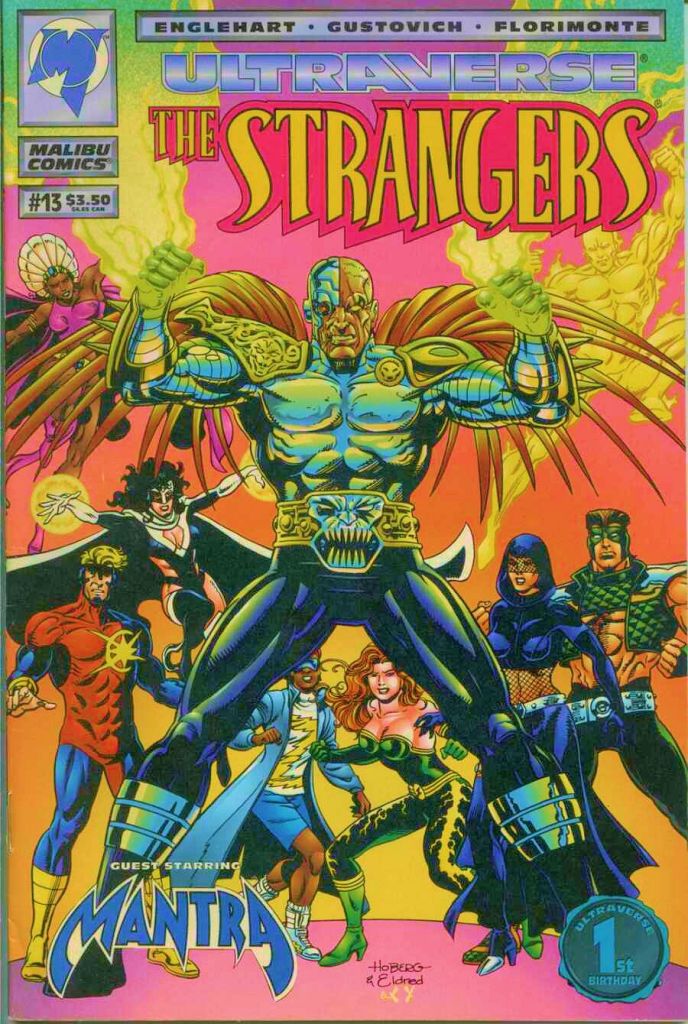
Crossovers between major individual characters and major superhero teams within the Ultraverse are often fun to read mainly due to the high talents involved who made such fantasy concepts good. Before, The Strangers had a crossover with Hardcase followed by another crossover with Prototype. This time, the superhero team will have their first crossover adventurer together with another major Ultraverse characters…Mantra!
You must be wondering who are what will Mantra and the Strangers be facing. We will find out in this look back at The Strangers #13, published in 1993 by Malibu Comics with a story written by Steve Englehart and drawn by Mike Gustovich.
The cover.
Early story
The story begins inside a facility when the Strangers are surprised by the arrival of police cars outside. Upon meeting the police captain named Rome, the Strangers learn that the police need their help as an evil ultra is on its way to San Francisco.
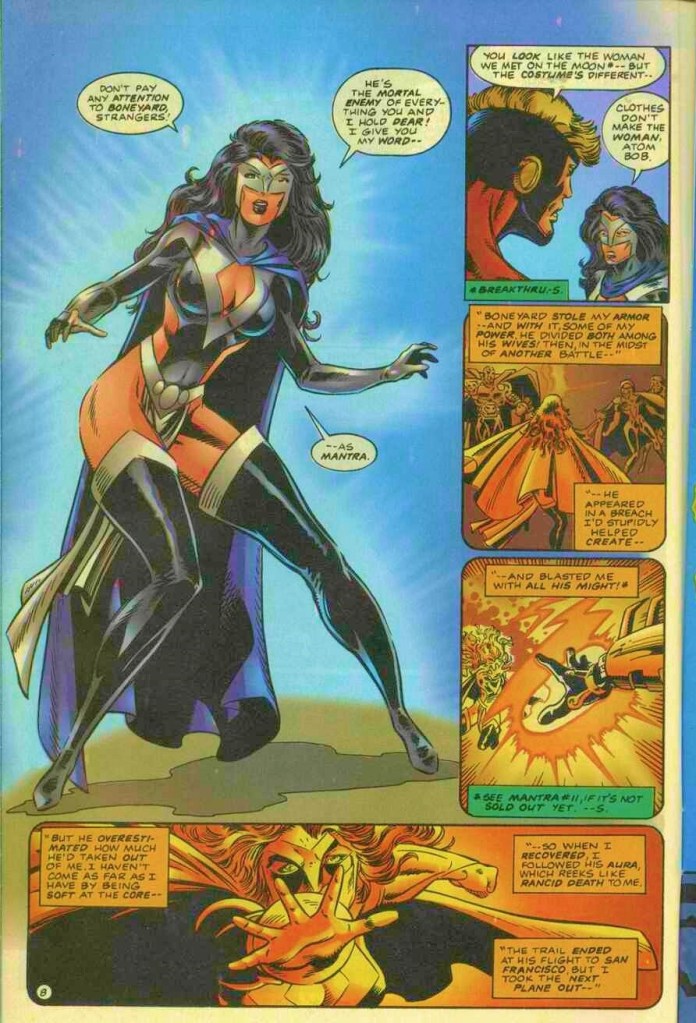
As the Strangers scramble, Mantra’s foe Boneyard is inside a commercial airline and his presence easily disturbs the passengers. Boneyard punches a man for raising his voice and telling him to put down a child he carried. Boneyard is carrying a young boy using him to have leverage over the passengers and the flight crew.
Some time later, the airplane lands on the tarmac of the airport and Boneyard comes down as the Strangers and the police await him. It turns out, Mantra’s foe wanted a meeting which baffles the Strangers. Boneyard tells them that their actions let some demons free and have placed his life in grave dangers.
As Boneyard and the Strangers talk, Eden Blake watches intensely and changes into Mantra…
Quality
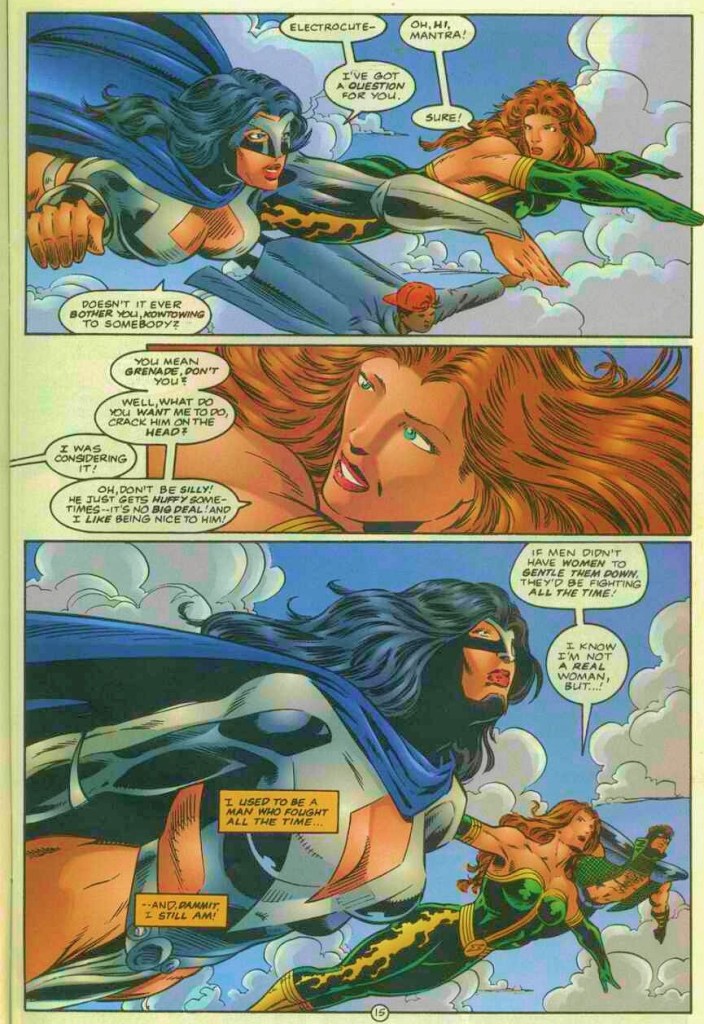
Mantra with Electrocute and Grenade.
This comic book’s story is very well written and it should not be surprising given Steve Englehart’s extensive experience as a writer. He really knows how to structure carefully a plot, get different superheroes get together and work for a common cause. That being said, Boneyard’s entry into the pages of The Strangers series was notably seamless (note: Mike W. Barr of the Mantra series was the one who developed Boneyard as the villain) and believable. When he met the Strangers, I sensed tension brewing which eventually turned into excitement once Mantra (who encountered The Strangers during the Break-Thru crossover) gets involved.
Character interactions, especially between Mantra and the Strangers members, is quite engaging to read. While the most sensible conversation Mantra had was with Electrocute, her talk with Spectral was the most awkward. There really is something worth reading.
When it comes to the artwork, Mike Gustovich’s work is serviceable at best. He worked on this comic book as a guest illustrator temporarily taking over the place of regular artist Rick Hoberg. His art is not bad, just satisfactory.
Conclusion
Mantra meets the Strangers again.
The Strangers #13 is entertaining on its own and the fact is it is only the first part of the Mantra-Strangers crossover. It is a solid start to say the least, and I should state that Steve Englehart captured nicely the respective personalities of Mantra and Boneyard, and he succeeded in mixing up the said ultra with the team. This comic book, by the way, is one of Malibu Comics’ flipside issues (a 2-in-1 comic book with each side being its own issue) and on the other side was Ultraverse Premiere #4. The Ultraverse Premiere side has a main story featuring Prime and a short story focused on Lady Killer of The Strangers.
If you are seriously planning to buy an existing hard copy of The Strangers #13 (1994), be aware that as of this writing, MileHighComics.com shows that the near-mint copy costs $8.
Overall, The Strangers #13 (1994) is recommended.
+++++
Thank you for reading. If you find this article engaging, please click the like button below and also please consider sharing this article to others. If you are looking for a copywriter to create content for your special project or business, check out my services and my portfolio. Feel free to contact me as well. Also please feel free to visit my Facebook page Author Carlo Carrasco and follow me at HavenorFantasy@twitter.com
Disclaimer: This is my original work with details sourced from reading the comic book and doing personal research. Anyone who wants to use this article, in part or in whole, needs to secure first my permission and agree to cite me as the source and author. Let it be known that any unauthorized use of this article will constrain the author to pursue the remedies under R.A. No. 8293, the Revised Penal Code, and/or all applicable legal actions under the laws of the Philippines.
In 1992, Marvel Comics organized a big celebration of what was back then the 30th anniversary celebration of Spider-Man. Behind the scenes, the Spider-Man editorial team organized their creators to make something special worthy of the anniversary. Back then there were four monthly series of Spider-Man – Amazing Spider-Man, Spectacular Spider-Man, Web of Spider-Man and Spider-Man – and in keeping with the 30th anniversary bonanza, each of the monthly series would see one special issue with a hologram on the cover.
What I read recently was one of those 30th anniversary celebration special comic books – Spider-Man #26. This comic book had a green cover and a hologram of Spider-Man upside-down. Its cover price is $3.50.
Was this old comic book’s content really worth the high cover price and the hologram? Did the creative team at Marvel do their job on making something special in line with the 30th anniversary celebration? We can find out in this look back at Spider-Man #26, published in 1992 by Marvel Comics with the main story written by Tom DeFalco and drawn by Mark Bagley and Ron Frenz.
The cover with a hologram.
Early story
The story begins on the street of New York when a man wearing a device runs down the sidewalk distracting and unintentionally pushing a few people out of the way. He is glowing as he moves. Someone from behind him calls him Stewart.
Soon enough, Peter Parker/Spider-Man and Mary Jane cross paths with him. Peter immediately leaves Mary Jane behind and starts pursuing the glowing Stewart. In the middle of the street, Stewart sees a speeding motorcycle heading towards him. He dives for cover which incidentally shapes his glowing field into a makeshift ramp causing the motorcyclist go over him. Spider-Man sees the flying motorcycle and its driver, and struggles to decide which one to save…
Quality
From the 2nd story.
Let me start with the main story. It sure is heavily worded almost all throughout but that is understandable because Tom DeFalco really pushed hard to emphasize the theme of responsibility as Spider-Man struggles to tackle criminals while trying to find quality time for his wife. There was even a scene in which Peter Parker recalls key events from his past (his becoming Spider-Man, letting a certain criminal get away, the death of his Uncle Ben, etc.) which, in terms of presentation, was a clear attempt by the creative team to bring readers back to the recorded history of Marvel’s icon. The main story is a genuine, heart-filled attempt to go beyond showing Spider-Man beating the bad guys to do local society good. There was also effort exerted to show that there are a few guys who do bad things not because they are inherently evil but rather they are desperate and/or misguided. The problem with the main story is that the other characters – Stewart, Bill, the gang leader Maxwell and others – are not so interesting at all. Of course, we cannot expect to see Spider-Man go head-to-head with another one of his major villains but this story was part of the 30th anniversary celebration.
The 2nd story, if you can all it that, is pretty much an exposition-filled exercise designed to give readers – both new and old – a review of Spider-Man’s powers and capabilities. To prevent it from becoming a total bore, some characters from the Marvel Comics universe were visually added.
When it comes to the quality of the artwork, Ron Frenz’s work here is serviceable at best. Mark Bagley’s art here improves the quality but that’s not saying much.
Conclusion
From the main story.
As a 30th anniversary celebration issue, Spider-Man #26 does not have much when it comes to being truly special. You love spectacle? You won’t find much in it. You wanted to see something groundbreaking in terms of character development? There’s none. Gripping storytelling? None! There was also no conflict with any prominent villain from the Marvel universe here. What you will get here is nostalgic stuff plus exposition about key elements that define Spider-Man. Truly the only thing special here is the hologram on the gimmick cover.
If you are seriously planning to buy an existing hard copy of Spider-Man #26 (1992), be aware that as of this writing, MileHighComics.com shows that the near-mint copy of the regular edition costs $27 while the near-mint copy of the newsstand edition costs $90.
Overall, Spider-Man #26 (1992) is serviceable. If you really want to buy this old comic book, I recommend waiting for its price to fall below $5 and I’m referring to the near-mint copy.
+++++
Thank you for reading. If you find this article engaging, please click the like button below and also please consider sharing this article to others. If you are looking for a copywriter to create content for your special project or business, check out my services and my portfolio. Feel free to contact me as well. Also please feel free to visit my Facebook page Author Carlo Carrasco and follow me at HavenorFantasy@twitter.com
To put things in perspective, below is an excerpt (with key parts in bold) from the Xbox.com blog post by Xbox head Phil Spencer:
Bethesda’s games have always had a special place on Xbox and in the hearts of millions of gamers around the world. Our teams have a close and storied history working together, from the amazing first DOOM, and its id Tech engine, innovating games on PCs to Bethesda bringing their first console game to the original Xbox, the groundbreaking The Elder Scrolls III: Morrowind. Over the years I’ve had many deep conversations with the creative leaders at Bethesda on the future of gaming and we’ve long shared similar visions for the opportunities for creators and their games to reach more players in more ways.
Just as they took the bold first steps to bring The Elder Scrolls franchise to the original Xbox, Bethesda were early supporters of Xbox Game Pass, bringing their games to new audiences across devices and have been actively investing in new gaming technology like cloud streaming of games. We will be adding Bethesda’s iconic franchises to Xbox Game Pass for console and PC. One of the things that has me most excited is seeing the roadmap with Bethesda’s future games, some announced and many unannounced, to Xbox console and PC including Starfield, the highly anticipated, new space epic currently in development by Bethesda Game Studios.
Like us, Bethesda are passionate believers in building a diverse array of creative experiences, in exploring new game franchises, and in telling stories in bold ways. All of their great work will of course continue and grow and we look forward to empowering them with the resources and support of Microsoft to scale their creative visions to more players in new ways for you.
All of our work, and the foundation of our relationship with you, starts with a commitment to deliver a breadth of amazing games to discover and play on Xbox. Over the last few weeks, we’ve been excited to share more detail on important elements of a plan we’ve been building towards for years. A plan that is the fulfilment of a promise, to you the Xbox player, to deliver the most performant, immersive and compatible next-generation gaming experiences, and the freedom to play blockbuster games with your friends, anytime, anywhere. Today is a landmark step in our journey together and I’m incredibly energized by what this step means for Xbox.
As confirmed by Spencer, the acquisition of Bethesda is more than just adding to Xbox Games Studios existing lineup of game makers and more than just adding games for Xbox and PC gamers to play. The acquisition also means adding even more games to the fast-growing and successful Xbox Game Pass subscription program which recently saw its subscribers reach 15,000,000+ (a jump of 50% in less than six months’ time!). The addition of Bethesda’s iconic franchises – Elder Scrolls, Fallout, Wolfenstein and Dishonored to name some – will surely add tremendous value to Xbox Game Pass and even more exciting is the confirmation that Bethesda’s upcoming sci-fi Starfield will also be added! These developments are already exciting gamers to order Xbox Series S or Xbox Series X as I write this.
Think about it. If you are already a paying Xbox Game Pass subscriber by the time Starfield gets released, you can simply visit Xbox LIVE and download the said game for free (because you already paid for the subscription). Those who are not XGP subscribers will have to pull out a lot of money to buy Starfield at the retail store or elsewhere online.
Already Team Xbox and its many Xbox Games Studios are already creating new and exclusive games for Xbox Series S and Xbox Series X plus PC. Microsoft no longer has a shortage of console exclusives and all the criticism thrown at them (“Xbox has no exclusives!”, “Xbox has no great games!”) are meaningless now. The addition of Bethesda studios into the many Xbox Game Studios further ensures more exclusive games in the years to come and this alone gives Microsoft a huge advantage over Sony and Nintendo!
This brings me to another sensitive topic: the Bethesda projects that are exclusive to others or are multi-platform in arrangement. Bethesda currently has two games that are exclusive to Sony’s PlayStation 5 (PS5) and Phil Spencer made clear that Microsoft will honor the exclusivity commitments of those games. In short, the Bethesda-Sony deal for those two games won’t be scrapped. Other Bethesda games coming to platforms that are not Xbox-related will happen on a case-by-case basis with Microsoft having the final decision. All of these are part of the complications that come with acquiring a huge game publisher with existing deals made with other platform makers.
But if you look into the far future, the Xbox-Bethesda megaton deal will eventually lead to sequels of Fallout, Elder Scrolls and other franchises that will be released exclusively on Xbox platforms and PC, and the Bethesda brand will remain. Bethesda’s famous role-playing game (RPG) franchises alone makes Xbox an even more attractive ecosystem for gamers who love RPGs. Think about it! Imagine playing Fallout and Elder Scrolls sequels (or remastered versions of Skyrim or Fallout 4) on Xbox Series X years from now enjoying all the massive content presented with 4K resolution, 60 FPS frame rate, great visuals and much shorter load times. With Microsoft having the more technologically superior console (Xbox Series X compared to PS5 with disc drive) and a much bigger and stronger 1st party game lineup, gamers will realize the benefits of the Xbox-Bethesda deal.
If Microsoft wants to make even more money and sell more, they can always decide to make Fallout and Elder Scrolls sequels available on PS5 and other platforms (even on Nintendo’s next-generation console). Microsoft acquired Mojang years ago and kept Minecraft available on multiple platforms (including those of Sony, Nintendo, iOS and more). When it comes to the next console generation with Bethesda’s many games being played, I expect their multi-platform games to look and play better on Xbox Series X than on PS5.
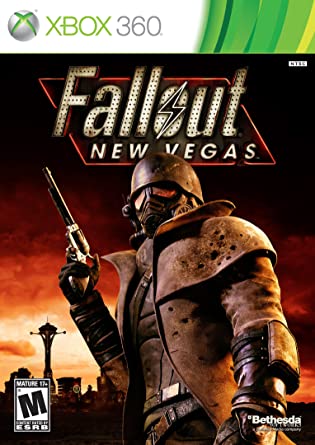
With Bethesda and Obsidian Entertainment together with Team Xbox, producing a sequel to Fallout New Vegas is no longer an impossible dream!
I should also state that Microsoft having Bethesda under its extensive corporate umbrella and ownership of the many intellectual properties (IP) of the company means that the dream of producing sequel to Fallout New Vegas is no longer impossible! Microsoft also owns Obsidian Entertainment, the very same team that worked with Bethesda for Fallout New Vegas, and they can decide to assign them to produce a sequel complete with a lot of human, technological and financial resources to back them! While I love the idea of Obsidian making Fallout New Vegas 2, I personally prefer they keep focusing on making their major fantasy RPG Avowed (ironically an ambitious game described as something to rival Bethesda’s Skyrim) and making a next-generation sequel to The Outer Worlds (which I love playing). A new Fallout New Vegas can be released on Xbox Series S and Xbox Series X AFTER the respective releases of Avowed, Starfield and Elder Scrolls VI many years from now.
Apart from the very promising benefits gamers will soon have from the Xbox-Bethesda deal, Microsoft also deserves praise for their transparency with gamers about their next-generation consoles, their expanding 1st party game studios lineup, Xbox All Access, Xbox Game Pass and the like. Transparency aside, Team Xbox also proved to stay honest and well organized with gamers unlike Sony’s PlayStation division. Watch the videos below regarding Sony…
The Xbox-Bethesda deal alone motivates me even more to acquire an Xbox Series X console and also sign up at last on Xbox Game Pass. I am certain that I am not the only geek experiencing the excitement about the very bright future of fun, engaging and high-value gaming with Xbox. With Bethesda’s RPG franchises alone, Xbox is already the best and definitive ecosystem for people who love playing role-playing games (note: Microsoft has Avowed coming and hopefully a The Outer Worlds sequel from Obsidian, plus established support from Square Enix with a Dragon Quest game coming out this December). This is something that Sony (even with Final Fantasy XVI a timed exclusive on their PS5) and Nintendo cannot match! Going back to Bethesda, they really had gone a long way and their decades-old history of doing business with Microsoft is undeniable. The very first time I played a Bethesda game on Microsoft hardware was none other than Elder Scrolls IV: Oblivion on Xbox 360 and that was way back in 2006. In the past decade, I played Skyrim on Xbox 360 and Fallout 4 on Xbox One. Personally, I am happy that Microsoft acquired Bethesda with not only the Xbox Series S and Xbox Series X in mind but for the long term…the far future!
In ending this, watch these videos from Dealer Gaming, Colteastwood, Rand al Thor 19 and Zalker 87 for additional insight about the Xbox-Bethesda deal!
+++++
Thank you for reading. If you find this article engaging, please click the like button below and also please consider sharing this article to others. If you are looking for a copywriter to create content for your special project or business, check out my services and my portfolio. Feel free to contact me as well. Also please feel free to visit my Facebook page Author Carlo Carrasco and follow me at HavenorFantasy@twitter.com
Disclaimer: This is my original work with details sourced from reading the comic book and doing personal research. Anyone who wants to use this article, in part or in whole, needs to secure first my permission and agree to cite me as the source and author. Let it be known that any unauthorized use of this article will constrain the author to pursue the remedies under R.A. No. 8293, the Revised Penal Code, and/or all applicable legal actions under the laws of the Philippines.
Having read comic books of UltraForce, one of the most notable team members is Contrary, the highly manipulative and resourceful lady who wears white and shows of a lot of her skin. She does not spend much time on the field and she does not have the powerful combat abilities of Prime, Hardcase and Prototype. Still she proves to be very intelligent, scheming and her true power is realized when she is inside her round ship which is full of high-tech equipment and links to varied sources of information for her use. As such, Contrary is indeed a very important part of UltraForce even though she gets into conflict with her more prominent teammates who each have their own monthly titles.
So you might be wondering…where in the entire Ultraverse did she come from? What makes her significant among all the characters of the Ultraverse? After doing some research, I learned that Contrary’s first appearance took place in the Freex monthly series. How her first appearance turned out, we can find out in this look back at Freex #9, published in 1994 by Malibu Comics with a story written by Gerard Jones and drawn by Martin Egeland.
The cover.
Early story
The story begins with the team with a guy wearing a hat and holding a gun who is on a tree branch above their heads. Angela/Sweetface instantly reacts by having one of her tendrils reach for the gun. The gunman reacts by going down and pulling Sweetface surprising her teammates. Tried as hard as they could, Freex members failed to get the gunman down and ended up with one of their teammates being held captive by him.
The tension slowly eases and the gunman tells them he has been doing things for other people with powers for a long time. Suddenly, they got spotted by a gang of armed men referred to as the night patrol. Freex and the gunman react to move away. Using her power, Val blasts a brush to make their way through…
Quality
Contrary’s first appearance. She went on to become a major part of UltraForce.
’ll start first with the storytelling. This one was an early attempt to add some variety and twists into Freex by having the team get involved with the gunman who would eventually spend more time with them beyond this issue. It was a sensible move for the creators to do this because seeing Freex just move like nomads was getting tiring. By this time, the team is feeling worn down and they still could not succeed in finding out who has been hunting them, and how they could cure themselves to become normal people.
This comic book pays additional attention to Sweetface and shows some flashbacks into her past. As a teenager, she wanted to fit in with her fellow youth at school until the first of her many tendrils started to come out. The dramatization of Sweetface here is very well done and if you pay close attention to the dialogue, you can feel her pain.
As for the first appearance of Contrary, it was very short and yet highly intriguing. She actually appeared in two different pages and each one was intriguing to see respectively.
Conclusion
The team with someone.
Freex #9 is a carefully balanced comic book specifically when it comes to plotting, characterization and spectacle. The way it was presented, I could tell that a creative turning point for the team happened and Contrary’s first appearance turned out to be significant even though only two pages were made visualizing her.
If you are seriously planning to buy an existing hard copy of Freex #9 (1994), be aware that as of this writing, MileHighComics.com shows that the near-mint copy of the regular edition costs $8 while the near-mint copy of the newsstand edition costs $26.
Overall, Freex #9 (1994) is recommended.
+++++
Thank you for reading. If you find this article engaging, please click the like button below and also please consider sharing this article to others. If you are looking for a copywriter to create content for your special project or business, check out my services and my portfolio. Feel free to contact me as well. Also please feel free to visit my Facebook page Author Carlo Carrasco and follow me at HavenorFantasy@twitter.com