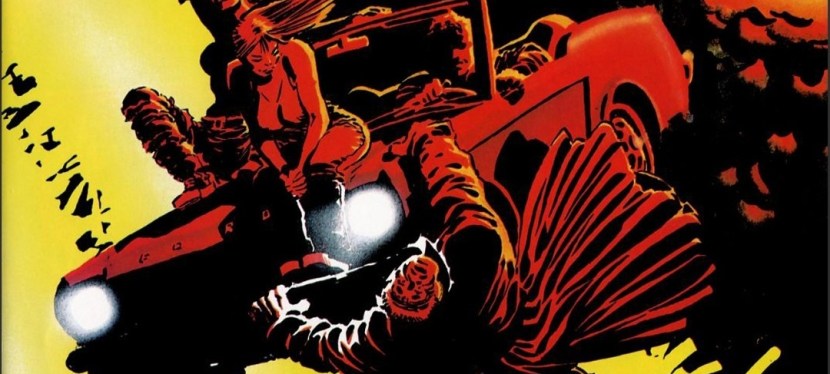
A Look Back at X-Men #30 (1994)

Disclaimer: This is my original work with details sourced from reading the comic book and doing personal research. Anyone who wants to use this article, in part or in whole, needs to secure first my permission and agree to cite me as the source and author. Let it be known that any unauthorized use of this article will constrain the author to pursue the remedies under R.A. No. 8293, the Revised Penal Code, and/or all applicable legal actions under the laws of the Philippines.

Welcome back, superheo enthusiasts, 1990s culture enthusiasts, X-Men fans and comic book collectors! Today we revisit the X-Men monthly series of the 1990s and look back at one of its most significant events it ever published – the wedding of Scott Summers/Cyclops and Jean Grey. By the time this particular comic book was published, the 30th anniversary celebration of the X-Men (note: Read my Fatal Attractions storyline retro reviews by clicking here and here) had just been concluded and that includes a major change of direction for the iconic X-Men member Wolverine. It is also notable that the X-Men had Sabretooth contained within Charles Xavier’s mansion (for retro reviews, click here, here and here).

With those details laid down, here is a look back at X-Men , published by Marvel Comics in 1994 with a story written by Fabian Nicieza and drawn by Andy Kubert.

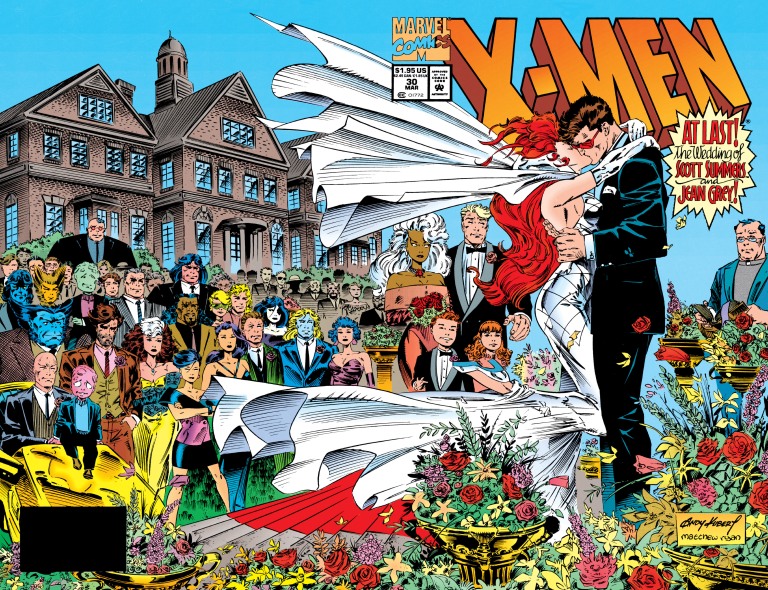
The cover.

Early story

The story begins inside Xavier’s mansion. Jean Grey reads a handwritten letter from Logan/Wolverine, who left the household after getting traumatized from their last encounter with Magneto. Logan refers to her and Scott Summers as special. While reading, Jean is already in her fancy wedding dress being assisted by her mother and storm as Rachel Summers looks on. For Jean, the wedding is about her dedication on spending the rest of her life with Scott as well as possibly gaining Rachel (who comes from one possible future) as a daughter.

Professor X with four of his original team members plus Alex Summers.

Elsewhere in the mansion, the groom Scott spends quality time with his original teammates Bobbdy Drake/Ice Man, Warren Worthington/Archangel and Hank McCoy/Beast. With them also is his brother Alex Summers/Havok. Alex tells Scott that the day of his wedding is the first day of the rest of his life which causes Bobby to say something inappropriate.

Suddenly, Professor X comes in to join them…

Quality

Jean Grey in her wedding dress with her mother, Storm and Rachel Summers present.

To get straight to the point here, this comic book serves two purposes: highlighting Scott and Jean’s relationship to an all new level with the wedding as the main event, and offering long-time or die-hard X-Men fans a whole lot of stuff to chew on. Very clearly, Fabian Nicieza wrote the script with X-Men fans in mind while also making references to the past with some creative touches or shortcuts so that the comic book would not be bloated with excessive fan service.

The wedding itself was executed nicely by the Nicieza-Kubert team and was clearly conceptualized to not only be memorable for the fans but also creatively serve as a major pay-off to all those years of Scott and Jean Grey being together early as teammates, getting separated temporarily and getting together again (note: they were also the original X-Factor team). Right after the wedding was executed, the visuals and words elevated the emotions higher and any long-time X-Men fan will find the moment sentimental.

Opposite the wedding are several scenes showing the other X-Men characters plus those from X-Factor and X-Force (with a not-so-recognizable Cable present). The dialogue written ranged from sentimental to comedic. And then there were also a few lines that I felt were just thrown in as fillers.

As far as visuals go, Andy Kubert’s art here are pretty good to look at. While he did his best to really make the story visually appealing and memorable, there were a few panels of art that look rushed.

Conclusion

So many guests. Can you recognize many of them?

Since it highlights the wedding of Scott and Jean Grey with several other X-Men-related characters mixed in, X-Men (1994) is clearly a commemorative story made with X-Men fans in mind. While a lot of work was done to make the story momentous on its own, readers who are unable to immerse themselves deeply into the X-Men mythos (plus X-Force, X-Factor and others) prior to reading this comic book won’t be able to relate to the wedding and the character moments very much. While it may not be significant to newcomers who find this comic book for the first time, it still marks a significant chapter in the history of X-Men within the Marvel Comics universe of the late 20th century. For the long-time fans who were able to read enough of Scott and Jean Grey’s times together from 1963 until the early 1990s, this is one X-Men tale that they can relate with deeply.

Overall, X-Men (1994) is recommended.

+++++

Thank you for reading. If you find this article engaging, please click the like button below and also please consider sharing this article to others as well as making a donation to support my publishing.. If you are looking for a copywriter to create content for your special project or business, check out my services and my portfolio. Feel free to contact me with a private message. Also please feel free to visit my Facebook page Author Carlo Carrasco and follow me on Twitter at  @HavenorFantasy as well as on Tumblr at https://carlocarrasco.tumblr.com/ and on Instagram at https://www.instagram.com/authorcarlocarrasco

A Look Back at Harbinger #4 (1992)

Disclaimer: This is my original work with details sourced from reading the comic book and doing personal research. Anyone who wants to use this article, in part or in whole, needs to secure first my permission and agree to cite me as the source and author. Let it be known that any unauthorized use of this article will constrain the author to pursue the remedies under R.A. No. 8293, the Revised Penal Code, and/or all applicable legal actions under the laws of the Philippines.

Welcome back superhero enthusiasts, 1990s culture enthusiasts and comic book collectors! Today we go back to the early 1990s and explore a part of the Valiant Comics shared universe through the Harbinger monthly series.

In my previous retro review, Peter/Sting, Kris, Faith/Zephyr, Charlene/Flamingo and John/Torque travel to another city where they meet Ax, a computer specialist with Harbinger potential. This gradually sparks a chain events that lead to one wild outcome to another. Indeed, issue was really fun and compelling to read.

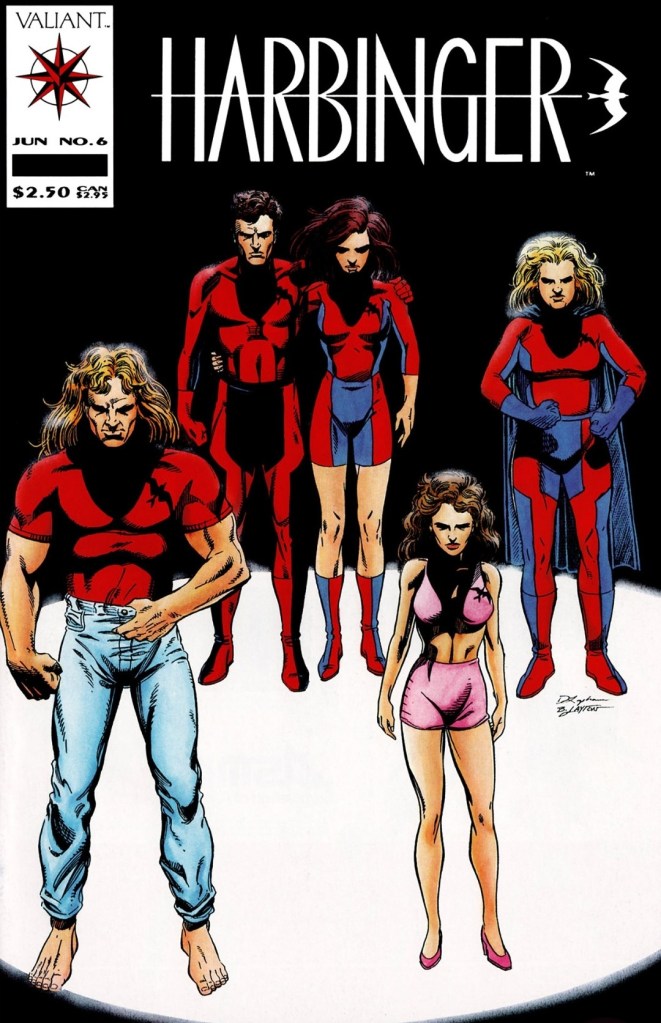
With those details laid down, here is a look back at Harbinger , published in 1992 by Valiant Comics with a story written by Jim Shooter and drawn by David Lapham.
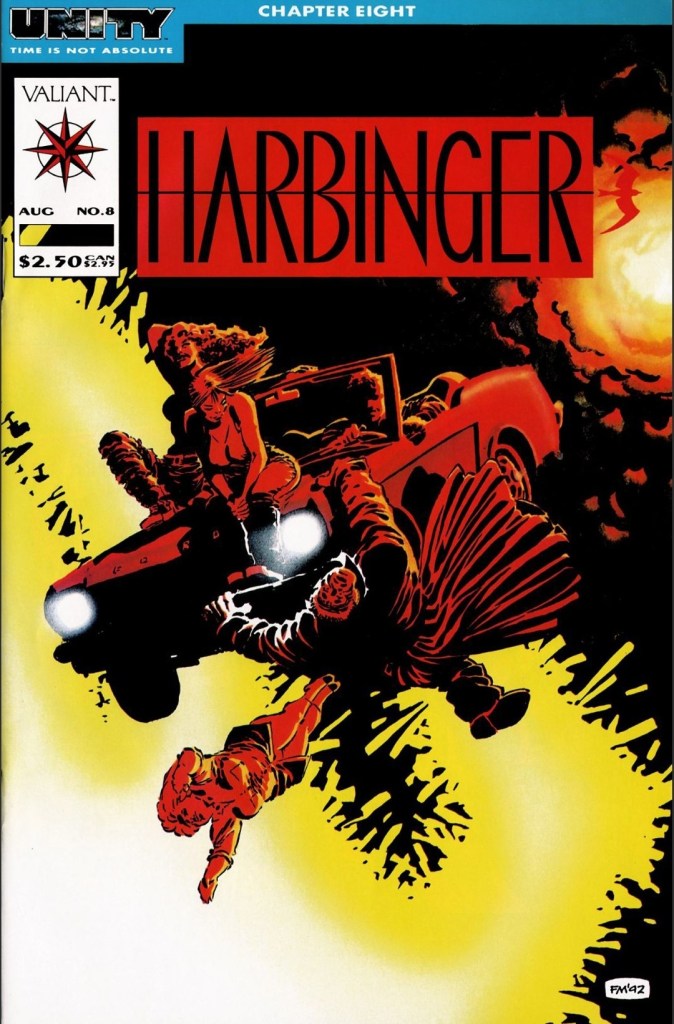
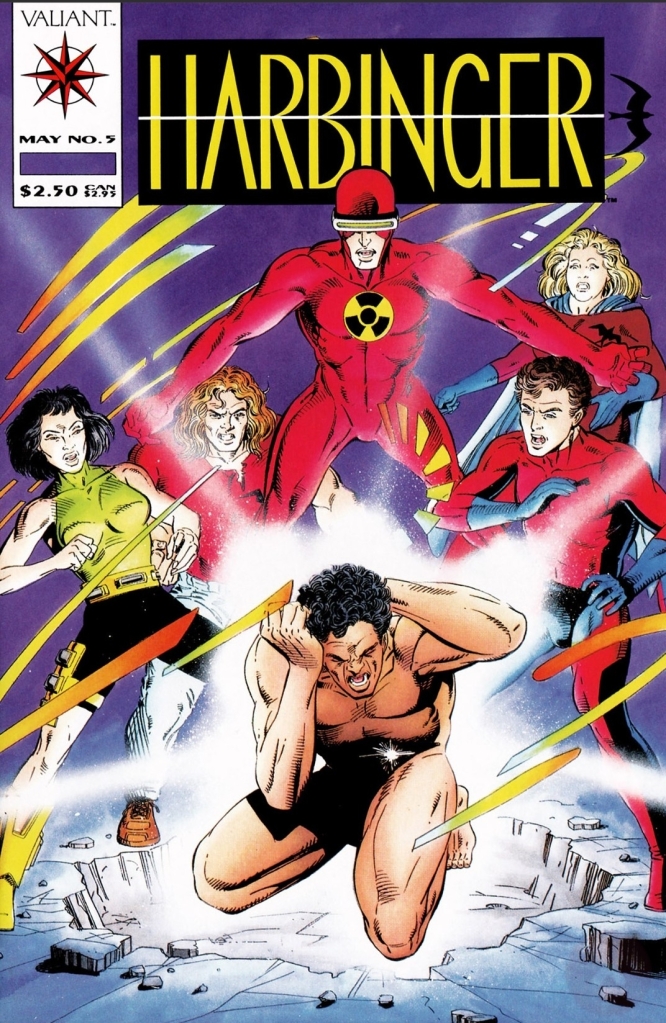
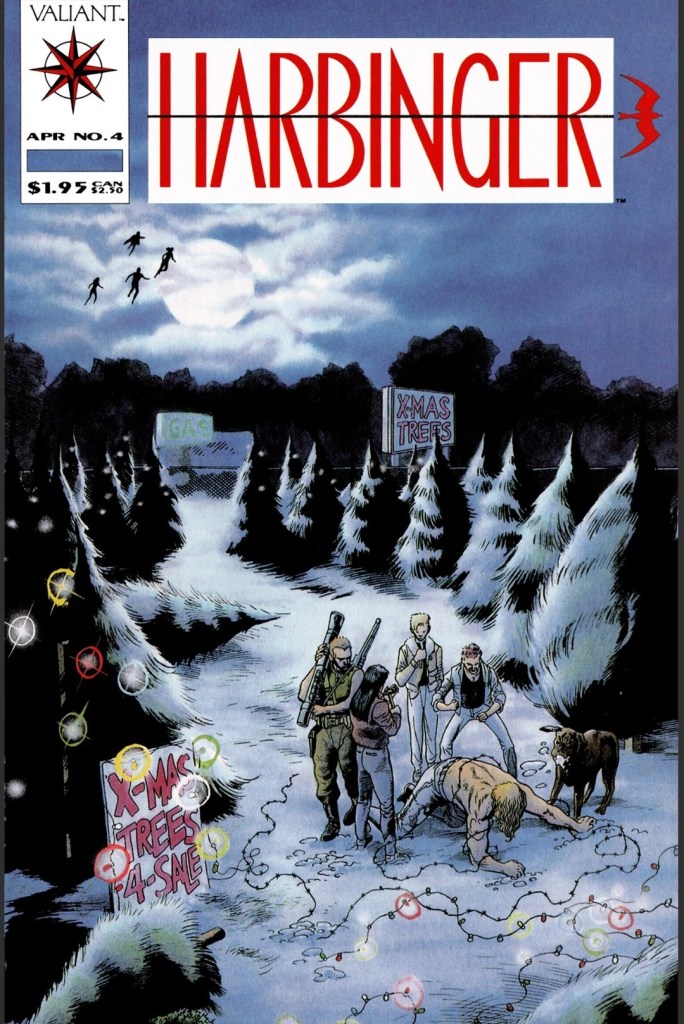
The cover.

Early story

The story begins inside an alien facility on the moon. With her teammates unconscious and Ax suffering from the intense pain on his genitals, Flamingo finds herself alone facing a freakish cyborg and alien pawns. She only has her power of heat as her weapon and defense. Even though she got hurt, Flamingo manages to heat up a part of the floor near her which causes the freakish cyborg to fall down into an unexpected deep pit.

With not much time left, Flamingo manages to free Sting, Kris, Torque and Faith. Just before leaving for Earth, Sting decides to bring the traitorous Ax with them into the space ship. After some computer work done by Ax, the ship then shifts into auto-pilot mode going to Earth…

Quality

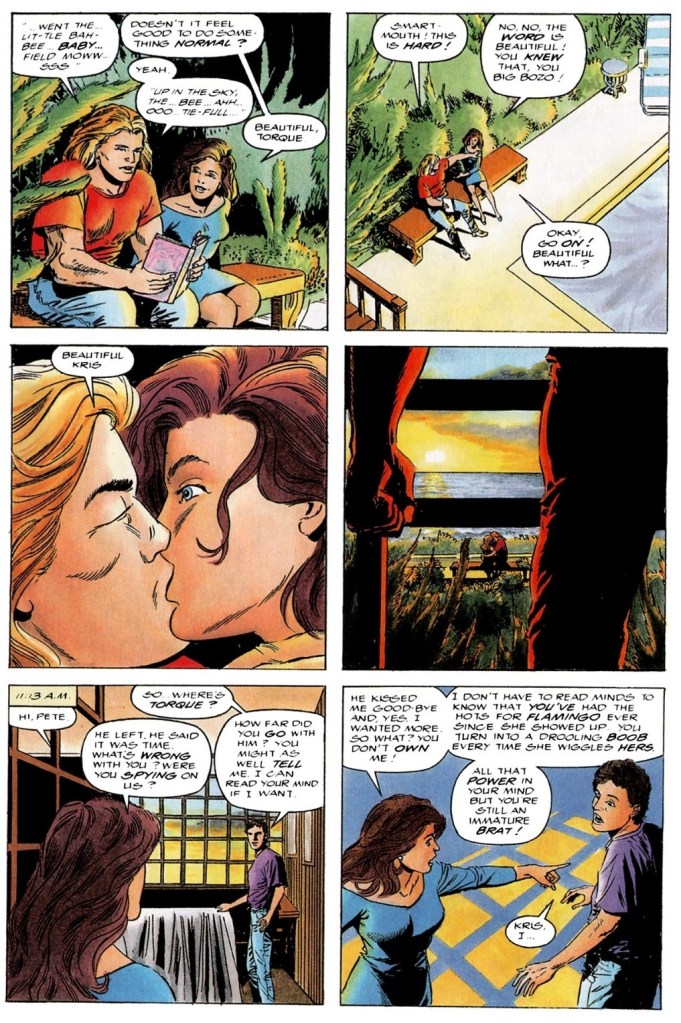
Kris got really close with Torque which causes tension between her and Sting.

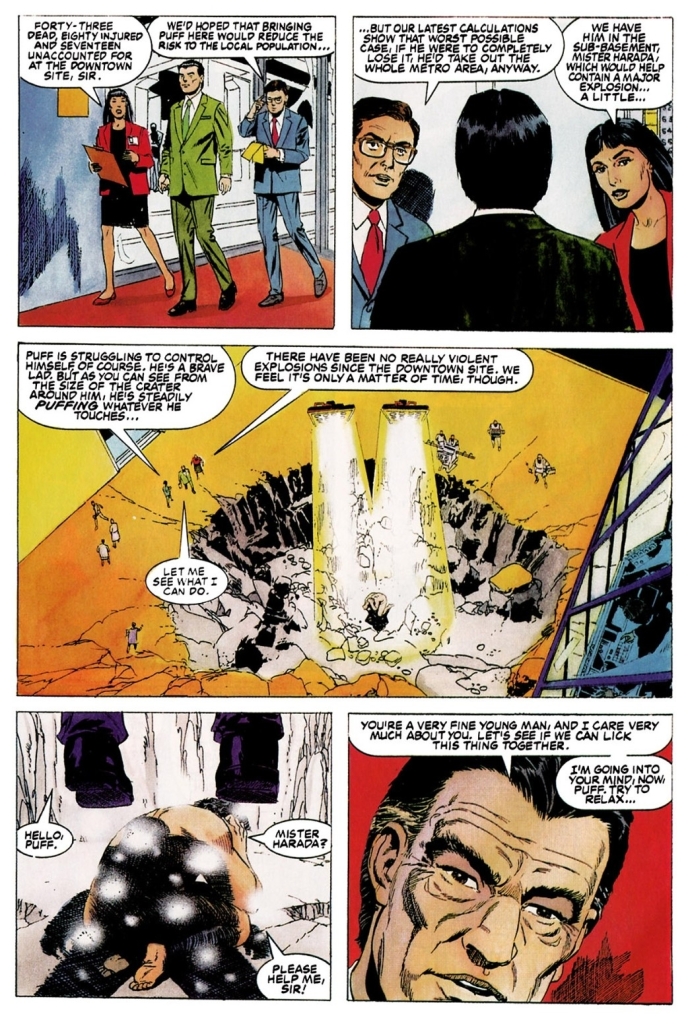
The story here is remarkably written, believable and engaging to read. While the events in issues #2 and had their respective wild turn of events, the story here literally grounded itself yet managed to deliver spectacle as well as a new conflict for the readers to focus on. Without spoiling the plot, I can say that Ax, the newcomer in issue , has a stronger presence in this comic book and you will get to see more of the impulsive and obsessive sides of his personality which leads to a new conflict (note: Sting and the team face-off with a worthy force of opposition).

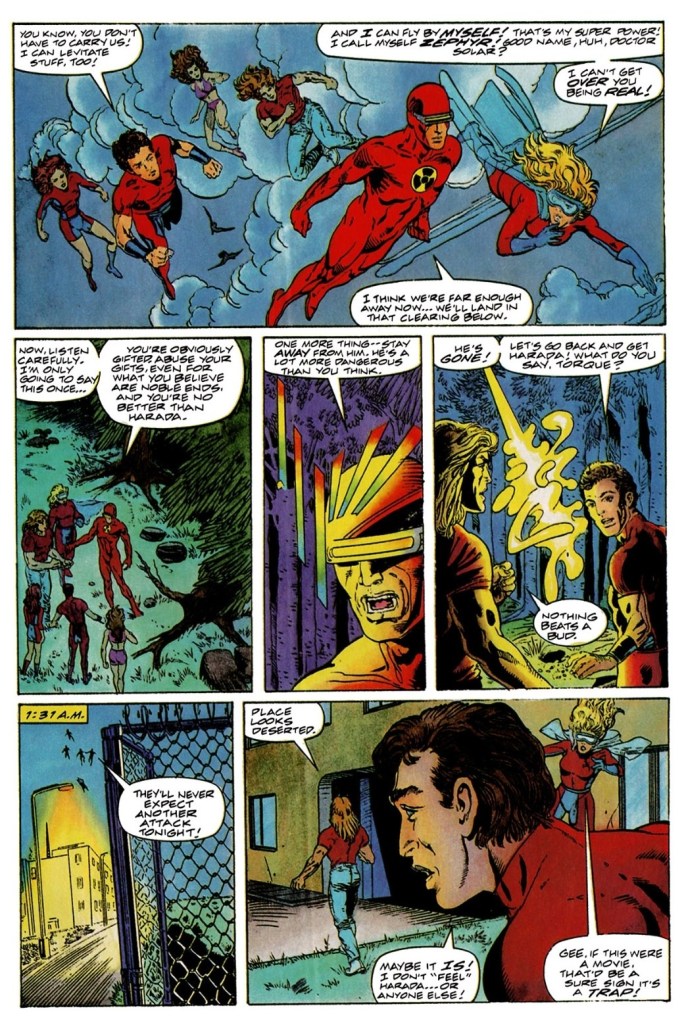
The most attractive feature of the writing done by Jim Shooter for this comic book is characterization. Remember how the main characters in The Empire Strikes Back got developed a lot as a result of getting separated? You will some of that here and you will be delighted to see Faith, Kris, Flamingo and Torque return into their private lives which is a creative pay-off in relation to how much time they spent together in the previous issues. Along the way, you will feel their emotions and even relate with the changes they went through. Like a 1980s Hollywood movie about American teenagers, the story sheds light on the aspect of young adults wanting to be with each other as a result of them living with a false sense of maturity or independence. Remember when I mentioned that Peter and his team got away with committing crime in issue ? Their complete disregard of guilt highlights their failure of taking responsibility of their actions.

If you are looking for superhero spectacle, you will find a good amount of that right here. You should read this comic book and find out why.

Conclusion

The traitorous Ax was even treated on the way home from the moon.

Harbinger (1992) is another very solid read from the Shooter-Lapham team. This comic book literally grounded itself into Earth but still delivered a careful mix of plotting, character development and superhero action. At this stage, the team of Sting, Torque, Kris, Flamingo and Faith just keeps on persevering with their shared co-existence even though they have an uncertain future with the Harada organization still hunting them.

Overall, Harbinger (1992) is highly recommended!

+++++

Thank you for reading. If you find this article engaging, please click the like button below and also please consider sharing this article to others. If you are looking for a copywriter to create content for your special project or business, check out my services and my portfolio. Feel free to contact me with a private message. Also please feel free to visit my Facebook page Author Carlo Carrasco and follow me on Twitter at  @HavenorFantasy as well as on Tumblr at https://carlocarrasco.tumblr.com/ and on Instagram at https://www.instagram.com/authorcarlocarrasco/

A Look Back at The Night Man #9 (1994)

Disclaimer: This is my original work with details sourced from reading the comic book and doing personal research. Anyone who wants to use this article, in part or in whole, needs to secure first my permission and agree to cite me as the source and author. Let it be known that any unauthorized use of this article will constrain the author to pursue the remedies under R.A. No. 8293, the Revised Penal Code, and/or all applicable legal actions under the laws of the Philippines.

Welcome back superhero enthusiasts, 1990s culture enthusiasts and comic book collectors! Today we go back to the mid-1990s which was a pretty wild time for comic collectors. To be more specific, this newest retro comic book review revisits the Ultraverse through The Night Man monthly series.

In my previous retro review, the titular character had another encounter with Nik Apocaloff away from civilization. Meanwhile, the obsessive tycoon J.D. Hunt approved a new high-tech project called Teknight which is capable of intense combat and other functions. I personally enjoyed the way the creative team presented the big rematch between Night Man and Apocaloff in his werewolf form.

With those details laid down, here is a look back The Night Man , published in 1994 by Malibu Comics with a story written by Steve Englehart and drawn by Kyle Hotz.  

The cover.

Early story

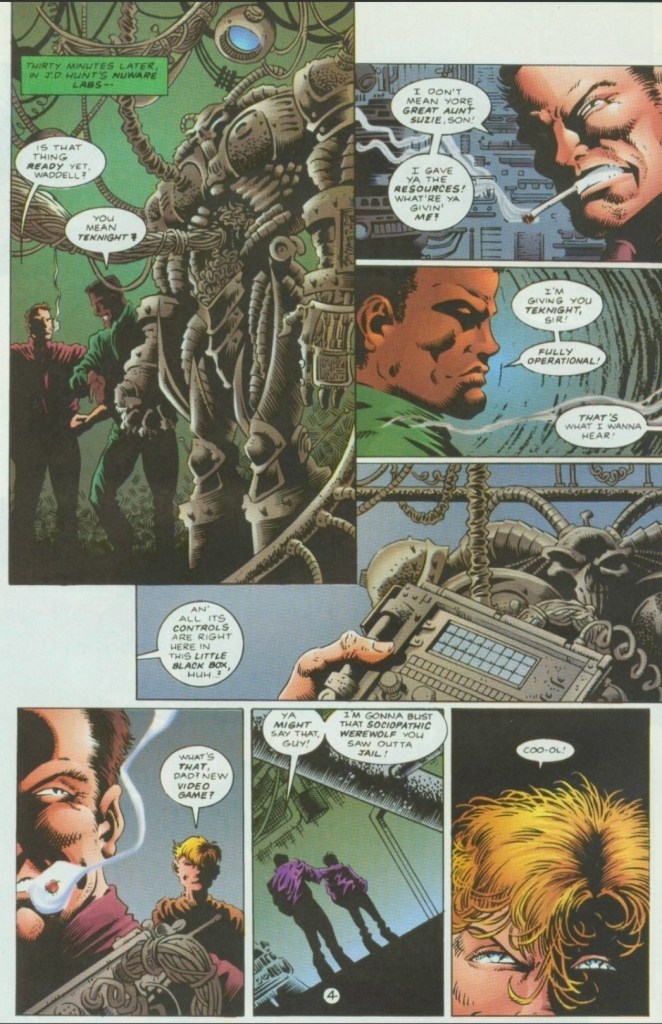
The story begins with the defeated Apocaloff standing behind bars in prison with other inmates and police officers present. The police officer tells him of his acts of murdering women and society was fortunate enough to have the Night Man responsible for his capture. Apocaloff then has a small chat with the inmate Martini whose wife just made bail for him again. Upon release from prison, Martini meets his wife and kids outside but excuses himself to help a certain someone. Martini then proceeds to a high-end and meets with a lady inside who pays him for his work and then makes an important call to J.D. Hunt. Knowing that Apocaloff knows sensitive information, Hunt then goes to Nuware Labs where the Teknight project is ready for operation.

Meanwhile, the Night Man searches for Rhiannon…  

Quality

Even though they share common goals, Night Man and the law enforcers have a conflict.

Once again, the creative team of Englehart and Hotz crafted another pretty engaging story that has surprises and moments of intrigue while keeping the narrative fresh. Without spoiling the plot, this comic book had a strong focus on J.D. Hunt and his young yet very aggressive son who use Teknight to do something very daring regarding the captured Apocaloff.  This, of course, lures the Night Man to take action but in a very different way as the conflict happened within the city and with elements of the police and the local government involved.

Apart from showing the conflict between good and evil, Englehart managed to include a few reflective scenes that will make you think about the differences the police have with Night Man with regards to law enforcement and vigilantism clashing with each other even though they all want the same achievement: defeating criminals and handing them over to the justice system. There is also this rather sinister portrayal of the father-and-son relationship between J.D. Hunt and his blonde son. More on the villain Apocaloff, it is very clear that by this point in the Night Man series, he is indeed a major character of opposition against the titular character in this series. I should state that Englehart really delivered a very compelling portrayal of evil with J.D. Hunt and Apocaloff involved. Lastly, this story ended with a twist that  really surprised me.

Conclusion

The Teknight project.

The Night Man (1994) is indeed another compelling story that has a nice mix of action, intrigue and characterization. This is a notable achievement by the Englehard-Hotz team as the Night Man himself was less prominent compared to the previous issue. This is understandable since there was the stronger focus and development of J.D. Hunt and his son as both of them got involved in the story’s main conflict. I should also state that off all the Ultraverse comic books I reviewed so far, this one has a strong father-and-son element that has to be read.  

Overall, The Night Man (1994) is recommended.

+++++

Thank you for reading. If you find this article engaging, please click the like button below and also please consider sharing this article to others. If you are looking for a copywriter to create content for your special project or business, check out my services and my portfolio. Feel free to contact me with a private message. Also please feel free to visit my Facebook page Author Carlo Carrasco and follow me on Twitter at  @HavenorFantasy as well as on Tumblr at https://carlocarrasco.tumblr.com/ and on Instagram at https://www.instagram.com/authorcarlocarrasco/
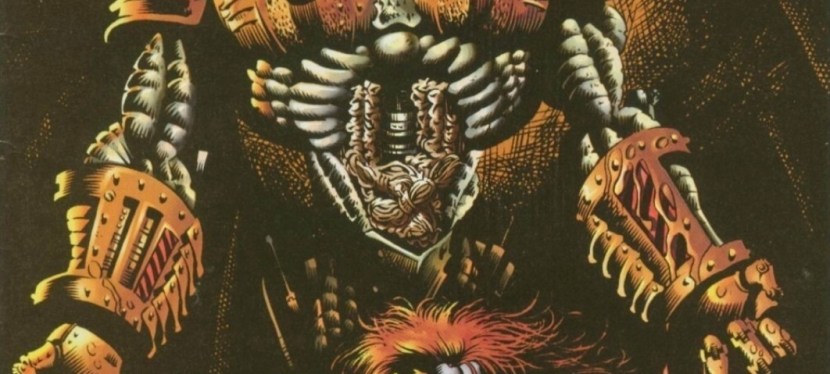
A Look Back at Jurassic Park #4 (1993)

Disclaimer: This is my original work with details sourced from reading the comic book and doing personal research. Anyone who wants to use this article, in part or in whole, needs to secure first my permission and agree to cite me as the source and author. Let it be known that any unauthorized use of this article will constrain the author to pursue the remedies under R.A. No. 8293, the Revised Penal Code, and/or all applicable legal actions under the laws of the Philippines.

Welcome back superhero enthusiasts, 1990s culture enthusiasts and comic book collectors! Today we go back to the year 1993 for another look at Steven Spielberg’s Jurassic Park in the form of licensed comic books published by Topps Comics.

In my previous retro review, I found issue to be much more entertaining than the two previous issues mainly due to the thrills and suspense that were the result of the comic book creators’ interpretation the encounter between Dr. Alan Grant’s group and the Tyrannosaurus Rex at its paddock (with the fence no longer electrified due to Dennis Nedry’s dirty act). While the said comic book still had lots of exposition and a wordy presentation, the pace of the storytelling notably moved a bit faster overall.

With those details laid down, here is a look back at Jurassic Park , published in 1993 by Topps Comics with a story written by Walter Simonson and drawn by Gil Kane with ink work done by the late George Perez. This comic book was the fourth of a 4-issue mini-series based on the Spielberg-directed movie.

The cover.

Early story

The story begins at the ruined side of the Tyrannosaurus Rex paddock. Lawyer Gennaro is dead while Dr. Ian Malcolm got serious injured as a result of being chased by the T. Rex. The same T. Rex is right in front of Dr. Alan Grant and teenager Lex with the flipped, ruined vehicle near them (with Tim still inside). Knowing that the huge dinosaur’s vision is based on movement, Grant tells Lex to stand perfectly still no matter what happens. As they try to make their slow move to safety, the T. Rex suddenly moves the ruined vehicle against them by the wall of the still deactivated fence. While holding Lex with his left arm, Grant grabs a loose cable to break their fall as the vehicle got pushed over the edge. Several feet down, Grant and Lex land safely as the vehicle hits the ground.

Over at Jurassic Park’s control center, John Hammond is outraged over what happened as Nedry left them (secretly carrying the stolen dinosaur embryos) and their safety systems are all down. Hammond dispatches Robert Muldoon to go out and rescue his grandchildren, and Ellie Sattler volunteers to help out. Struggling with the computer, Ray Arnold tells his boss that there is no way to get Jurassic Park back on-line without Nedry.

Elsewhere within the park, Dennis Nedry struggles to find his way to his destination. Suddenly, his vehicle slips and loses traction…

Quality

This is how the memorable scene of the Raptors and Hammond’s grandchildren was adapted.

Let me start by stating what is very obvious here….this comic book is easily the most enjoyable and fastest-moving adaptation of the key events of Spielberg’s movie (from the T. Rex encounter until the end of the film) albeit with some signs of rush and creative short-cuts. It is also here where the exposition has been lessened and the creators focused more on adapting the cinematic dialogue and the remaining scenes along with the spectacle. The narrative is clearly rushed and it is amusingly amazing to see how the creators managed to cover the remaining events of the movie (note: Dennis Nedry’s death, Robert Muldoon’s tragic encounter with the raptors, Ellie Sattler’s struggle to reactivate the park’s power system, and the varied encounters with the raptors were included) to fit within the pages of this very comic book. In my reading experience, it still worked.

While it is flawed in its execution, this comic book managed to click as a pay-off to the build-up that happened in the first three issues. There is a decent amount of action and sudden moments of incidents here and there, and still the creators managed to tell their own interpretation of the remaining events from the movie.

This is how Dennis Nedry’s death and the loss of the canister (containing the stolen dinosaur embros) were portrayed in this comic book.

Gil Kane’s art on the dinosaurs are somewhat good but in what seems to be a sign of behind-the-scenes production rush, his visual take on the T. Rex’s unexpected heroic moment and struggle with the two raptors was drawn with a lack of precision on size and scale. Such literary translation only made me want to return to the movie itself and replay the said scene (which was climactic cinematically speaking). Surprisingly, Gil Kane managed to visualize a few but noticeable bloody moments particularly with the respective deaths of Dennis Nedry (to the Dilophosaurus) and Robert Muldoon (to the raptors).

As the focus here has always been the adaptation of cinematic events, it is unsurprising that there really was no room for character development. Dr. Grant is the only one who showed any real change from being rough on children (as seen in issue ) to becoming more caring on them (specifically John Hammond’s grandchildren) due to incidents. All the development on Dr. Grant took four issues both literally and visually. John Hammond could have been developed a lot more if only the dialogue was not too limited with the focus on adapting movie dialogue. Speaking of adaptation, the cinematic error about the instant drop (from the perimeter fence of the T. Rex paddock opposite the road) also made it in this comic book.

Conclusion

This is a creative and clever way the comic book creators combined elements of two separate film scenes into a single sequence with readers in mind.

Even though it had a rushed narrative, Jurassic Park (1993) ironically managed to be the most enjoyable issue of the 4-issue mini-series adapting the blockbuster movie. It has the most amount of spectacle, more dinosaur visuals for dinosaur enthusiasts to enjoy, and the pace moved much faster. Compared to each of the previous issues, this one was a breeze to read and there were bouts of fun. As a companion piece to the blockbuster movie, the 4-part Jurassic Park movie adaptation mini-series served its purpose to translate its events within the limits of illustrated literature. While it does not obviously capture the magical moments nor the sentimental elements of Spielberg’s work, this mini-series managed to complete its own interpretation ultimately creating stuff that could satisfy the brainy comic book reader, the reader who loves thrills and the reader who is simply obsessed with dinosaurs. It is somewhat symbolic that this final issue had the most fun stuff.

Overall, Jurassic Park (1993) is recommended.

+++++

Thank you for reading. If you find this article engaging, please click the like button below and also please consider sharing this article to others. If you are looking for a copywriter to create content for your special project or business, check out my services and my portfolio. Feel free to contact me with a private message. Also please feel free to visit my Facebook page Author Carlo Carrasco and follow me on Twitter at  @HavenorFantasy as well as on Tumblr at https://carlocarrasco.tumblr.com/ and on Instagram at https://www.instagram.com/authorcarlocarrasco/

A Look Back at Harbinger #3 (1992)

Disclaimer: This is my original work with details sourced from reading the comic book and doing personal research. Anyone who wants to use this article, in part or in whole, needs to secure first my permission and agree to cite me as the source and author. Let it be known that any unauthorized use of this article will constrain the author to pursue the remedies under R.A. No. 8293, the Revised Penal Code, and/or all applicable legal actions under the laws of the Philippines.

Welcome back superhero enthusiasts, 1990s culture enthusiasts and comic book collectors! Today we go back to the early 1990s and explore a part of the Valiant Comics shared universe through the Harbinger monthly series.

In my previous retro review, Peter/Sting, Kris, Faith/Zephyr, Charlene/Flamingo and John/Torque not only found a place to stay in thanks to a really generous doctor, they went ahead infiltrating the top secret facility of the Harbinger foundation which also brought them face-to-face with the leader. At this stage, Sting and his team have established their purpose not just for survival but to achieve something they believe is right.

With those details laid down, here is a look back at Harbinger , published in 1992 by Valiant Comics with a story written by Jim Shooter and drawn by David Lapham.

The cover.

Early story

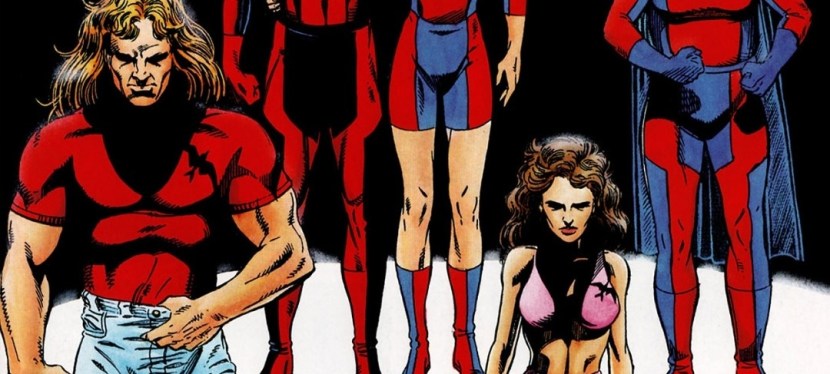
The story begins at 9:20 AM of July 6, 1991 inside the fine summer home of Dr. Heyward. As Sting tells his teammates that they have to move to catch a flight, Faith (wearing her superhero costume) flies through to find Kris and Torque. She finds the two of them seated next together with Kris having her two hands on Torque.

Meanwhile, Flamingo fixes her face as Sting talks to her. She rejects his declaration that she is a part of their team and reveals that Torque does not care about her. Flamingo considers herself as just another hosebag. Sting then tries to lift her up by telling her that she has to take care of herself and that she is part of their team.

Sting, Faith, Flamingo, Kris and Torque then leave for the airport in a brand new vehicle they just bought (having used the money they stole from Harbinger). Their vehicle flies off to the airport with Sting on the driver’s seat…

Quality

Sting, his teammates and newcomer Ax in the heat of action.

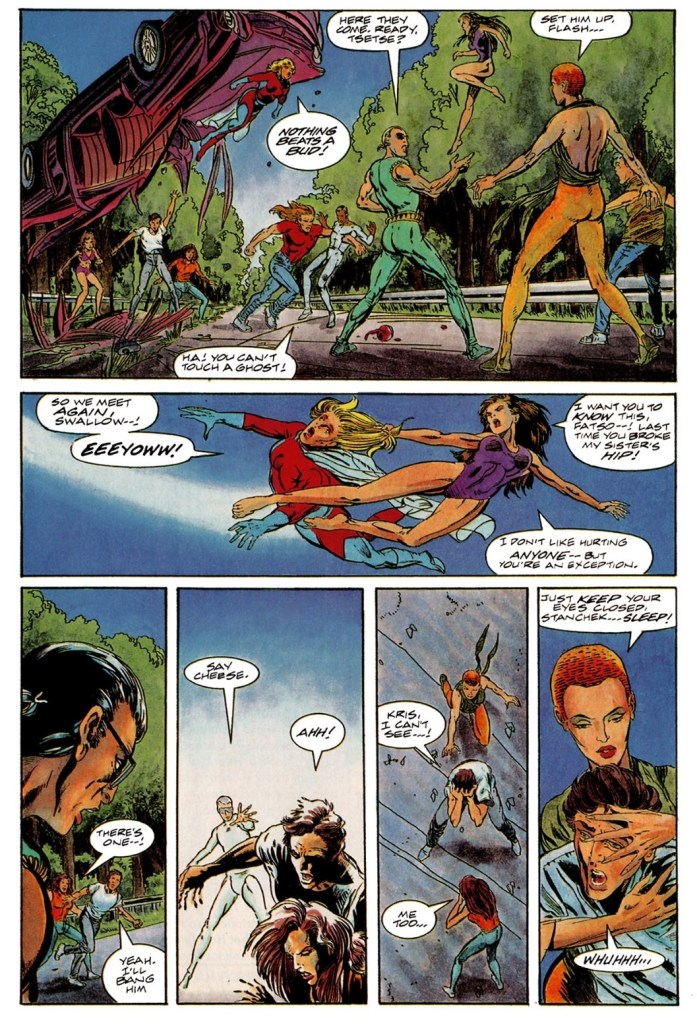
Without spoiling the plot, I can say that the story in this comic book got even wilder than I anticipated. The high intensity of wild turnout of events in issue do not even come close to what was told right here. At the same time, this particular story clearly showed this comic book series’ own place within the literary universe of Valiant Comics and anyone who read XO-Manowar comics of this particular era will instantly recognize the recurring creatures (opposition elements) from outer space.

As expected, the character development of the main characters progressed smoothly revealing some amusing character moments that I found interesting and other times amusing. As Sting continues to act with a sense of leadership as well as a false sense of maturity, you will get to see more of Kris providing him analytical and personal support.

The dialogue in this comic book was written to be more dynamic and this is highlighted in the scene in which Sting and his teammates discuss what to do with their new team objective, and what to do with the computer hacker Ax who has shown Harbinger potential. That being said, Jim Shooter carefully crafted the dialogue to reflect how American teenagers in the late 1980s and early 1990s expressed themselves.

When it comes to superhero spectacle, there is a lot to enjoy here. Action scenes and the use of special abilities or super powers were executed at a moderate pace yet they were intense to look at. Each of the main characters had his/her own share of the spotlight even as the spectacle moved.

Conclusion

Meet Ax, the guy who specializes on cracking and hacking.

Harbinger (1992) is a very engaging story to read which was balanced with a good amount of spectacle, nice character moments and the wildest turn of events so far in this particular comic book series. On face value, this comic book’s core concept (which involves a lot of science fiction elements) seemed over-the-top but Jim Shooter and David Lapham succeeded in telling a story that is believable and at the same time fun. It is also within this comic book that readers will get to see more of the Valiant Comics universe elements without the need of a crossover or a cameo appearance of an established Valiant hero. This is definitely the tale of Sting and his team that was simply taken into a much higher flight of fantasy. That being said, I am looking forward to the next issue.

Overall, Harbinger (1992) is highly recommended!

+++++

Thank you for reading. If you find this article engaging, please click the like button below and also please consider sharing this article to others. If you are looking for a copywriter to create content for your special project or business, check out my services and my portfolio. Feel free to contact me with a private message. Also please feel free to visit my Facebook page Author Carlo Carrasco and follow me on Twitter at  @HavenorFantasy as well as on Tumblr at https://carlocarrasco.tumblr.com/ and on Instagram at https://www.instagram.com/authorcarlocarrasco/
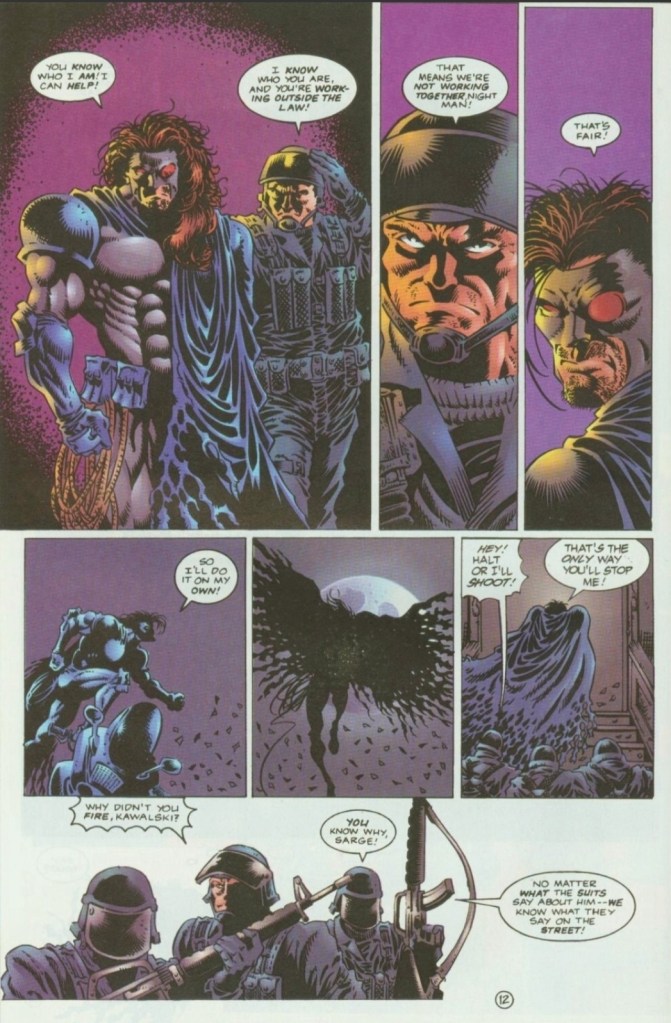
A Look Back at Jurassic Park #3 (1993)

Disclaimer: This is my original work with details sourced from reading the comic book and doing personal research. Anyone who wants to use this article, in part or in whole, needs to secure first my permission and agree to cite me as the source and author. Let it be known that any unauthorized use of this article will constrain the author to pursue the remedies under R.A. No. 8293, the Revised Penal Code, and/or all applicable legal actions under the laws of the Philippines.

Welcome back superhero enthusiasts, 1990s culture enthusiasts and comic book collectors! Today we go back to the year 1993 for another look at Steven Spielberg’s Jurassic Park in the form of licensed comic books published by Topps Comics.

In my previous retro review, the comic book still had the creative issues of heavy exposition and being very word-heavy to read as the creators focused on adapting the movie’s story closely (from the iconic brachiosaurus scene up to the encounter with the triceratops). Compared to issue , the comic book’s narrative improved temporarily as it closely adapted the lunch-and-talk scene between John Hammond, Donald Gennaro, Ellie Sattler, Alan Grant and Ian Malcolm whose dialogue was easily the most engaging in both film and in literary format.

With those details laid down, here is a look back at Jurassic Park , published in 1993 by Topps Comics with a story written by Walter Simonson and drawn by Gil Kane with ink work done by the late George Perez. This comic book was the third of a 4-issue mini-series based on the Spielberg-directed movie.

The cover.

Early story

The story begins with the group of Alan Grant, Ellie Sattler, Ian Malcolm, Donald Gennaro and the two kids Lex and Tim who are shocked to see a living triceratops. The large dinosaur, however, falls down on its side causing Ellie Sattler to go near and examine it. Gerry Harding, a Jurassic Park employee, suddenly appears and explains that the triceratops was tranquilized by Robert Muldoon and has been sick. After examining the dinosaur further, Ellie wants to have its droppings examined.

Back in the control room of Jurassic Park, Ray Arnold explains to John Hammond that the center of an approaching story has not changed course and states that he likes to cut the current tour and resume the next day. He emphasized to Hammond that the storm is risky to those on tour.

Just across the room, Dennis Nedry (who secretly cut a deal with a business rival of inGen’s and has been frustrated working for John Hammond) carefully communicates with the captain of the ship that will depart once all the workers have boarded. Knowing he is running out of time to steal the dinosaur embryos and send it to Biosyn, he starts his move with Jurassic Park’s main system…

Quality

While the sequences of the T.Rex going after Ian Malcolm are not the same as those in the movie, the dinosaur itself really looks creepy.

When it comes to entertainment value related to spectacle, I can say clearly that this issue really marked the beginning of fun in this 4-issue mini-series. This is because this comic book includes the appearance of the Tyrannosaurus Rex (T.Rex) which arrived just when Alan Grant, Ian Malcolm, Lex, Tim and Donald Gennaro are helpless sitting inside vehicles that stopped by the said dinosaur’s paddock with the fences no longer electrified.

Of course, the minutes-long T. Rex scene in the movie remains memorable as it had a well-blended mix of suspense, action and some horror directed by Steven Spielberg. This comic book’s creators did their best to replicate the experience in illustrated literature format. While it’s not surprising that the essence of the T.Rex paddock scenes in movie were not perfectly captured, this comic book’s adaptation still managed to be entertaining to read showing suspense, horror and some thrills plus Gil Kane managed to even make the infamous dinosaur look frightening. Very clearly, Kane went all-out in presenting the T.Rex as the main dinosaur not only in this comic book but for the whole mini-series.

While the T.Rex paddock scene is the highlight of this comic book, the scene with the triceratops proved to be another exposition-heavy presentation laced with pretentious science and technical explanations dealing with plants, animal health and the like. Meanwhile, the scenes about John Hammond, Robert Muldoon and Ray Arnold struggling with the failures of the park systems while Nedry betrays them secretly were pretty intense to read.

Conclusion

Lots of exposition and creative explanations in this scene about the sick triceratops.

So far, I find Jurassic Park (1993) to be the most entertaining issue so far thanks to the way the comic book creators adapted the Tyrannosaurus Rex paddock scene from the movie. While the narrative still had lots of exposition and creative explanations that started since issue #1, the consequential events of Dennis Nedry’s acts intensified the reading experience and the T.Rex scenes really ramped up the fun factor.

Overall, Jurassic Park (1993) is recommended.

+++++

Thank you for reading. If you find this article engaging, please click the like button below and also please consider sharing this article to others. If you are looking for a copywriter to create content for your special project or business, check out my services and my portfolio. Feel free to contact me with a private message. Also please feel free to visit my Facebook page Author Carlo Carrasco and follow me on Twitter at  @HavenorFantasy as well as on Tumblr at https://carlocarrasco.tumblr.com/ and on Instagram at https://www.instagram.com/authorcarlocarrasco/
A Look Back at Jurassic Park #2 (1993)

Disclaimer: This is my original work with details sourced from reading the comic book and doing personal research. Anyone who wants to use this article, in part or in whole, needs to secure first my permission and agree to cite me as the source and author. Let it be known that any unauthorized use of this article will constrain the author to pursue the remedies under R.A. No. 8293, the Revised Penal Code, and/or all applicable legal actions under the laws of the Philippines.

Welcome back superhero enthusiasts, 1990s culture enthusiasts and comic book collectors! Today we go back to the year 1993 for another look at Steven Spielberg’s Jurassic Park in the form of licensed comic books published by Topps Comics.

My previous retro review was the literary version of the film’s opening until the start of the iconic scene of the brachiosaur. The comic book was very exposition-heavy, had too few dinosaurs visualized and was ultimately a word-heavy experience with little entertainment value.

With those details laid down, here is a look back at Jurassic Park , published in 1993 by Topps Comics with a story written by Walter Simonson and drawn by Gil Kane with ink work done by the late George Perez. This comic book was the second of a 4-issue mini-series based on the Spielberg movie.

The cover.

Early story

The story begins on an island where John Hammond’s guests (Alan Grant, Ellie Sattler, Ian Malcolm and lawyer Gennaro) cannot help but stare and marvel at the brachiosaurus walking in front of them. Soon enough, they spot five more dinosaurs of the same species moving around. As they stare, Dr. Alan Grant and Ellie Sattler can’t help but be amazed as the sight of living dinosaurs literally broke the limits of what they previously learned about dinosaurs through books.

Grant asks Hammond how he was able to come up with dinosaurs. Hammond then takes his guests into the visitor’s center which has a 50-seat auditorium for the prepared pre-show he prepared for their orientation. With Hammond taking an active part in the program, a video presentation shows how Jurassic Park’s personnel extracted dinosaur DNA from fossilized mosquitoes (which drew blood from dinosaurs), used advanced technologies and amphibian DNA to complete DNA sequencing, and created dinosaurs…

Quality

The baby Velociraptor, John Hammond, Ian Malcolm, Dr. Grant, Ellie Sattler and Dr. Wu in a scene.

The most obvious thing about this comic book (which starts with the brachiosaurus reveal until the triceratops’ appearance) is that it is very wordy and has lots of expository dialogue and creative explanations which reflected the film it was based on. What makes this a slightly better reading experience over issue is that it closely captured the essence of the best talk scene of Spielberg’s movie – the lunch meeting hosted by Hammond. To see Gennaro, Dr. Grant and Ellie give their feedback to Hammond with Ian Malcolm’s extensive opinion about Jurassic Park’s use of genetics, their revival of extinct species and their lack of humility before nature was easily the most compelling part of the comic book to read. In a way, a lot of exposition dump and build-up that started in issue were paid off nicely in the said scene.

As mentioned earlier, this comic book’s story reaches the appearance of the triceratops and by then John Hammond’s grandchildren (Tim and Lex) joined Grant, Gennaro, Sattler and Malcolm on the basic tour in vehicles. That being said, the story moved at a moderate pace and the only comic book spectacle here are the images of dinosaurs which were decently drawn by Gil Kane. Don’t expect any action nor thrills here because those would not happen until the T. Rex’s first appearance.

Conclusion

Can you imagine how you would react if you ever see large dinosaurs walking in front of you?

I can say that Jurassic Park (1993) is a slightly better reading experience than issue mainly due to the way the comic book creators adapted the movie’s best talk scene. The same old issues of heavy exposition and excessive dialogue are here which reflect Simonson and Kane’s focus on adapting scenes from the movie closely. Other than that, there is still no excitement to enjoy here which can be disappointing if you are anticipating dinosaur-related thrills and action sequences. Readers who enjoy exposition and the Jurassic Park entertainment franchise’s approach on portraying science (distorted and fantasized to be more attractive than true science) will still find something to enjoy here.

Overall, Jurassic Park (1993) is satisfactory.

+++++

Thank you for reading. If you find this article engaging, please click the like button below and also please consider sharing this article to others. If you are looking for a copywriter to create content for your special project or business, check out my services and my portfolio. Feel free to contact me with a private message. Also please feel free to visit my Facebook page Author Carlo Carrasco and follow me on Twitter at  @HavenorFantasy as well as on Tumblr at https://carlocarrasco.tumblr.com/ and on Instagram at https://www.instagram.com/authorcarlocarrasco/

A Look Back at Harbinger #2 (1992)

Disclaimer: This is my original work with details sourced from reading the comic book and doing personal research. Anyone who wants to use this article, in part or in whole, needs to secure first my permission and agree to cite me as the source and author. Let it be known that any unauthorized use of this article will constrain the author to pursue the remedies under R.A. No. 8293, the Revised Penal Code, and/or all applicable legal actions under the laws of the Philippines.

Welcome back superhero enthusiasts, 1990s culture enthusiasts and comic book collectors! Today we go back to the early 1990s and explore a part of the Valiant Comics shared universe through the Harbinger monthly series.

In my previous retro review, the primary characters (Peter/Sting, Kris, Faith/Zephyr, Charlene/Flamingo and John/Torque) composed of mainly young adults with different abilities were gradually introduced and together they became targets of the mysterious private organization referred to as Harbinger (led by Japanese tycoon Toyo Harada). Harbinger has vested interests in people with paranormal abilities. In order to survive, Peter and his so-called team must set aside differences and work together while making the most out of their respective abilities.

With those details laid down, here is a look back at Harbinger , published in 1992 by Valiant Comics with a story written by Jim Shooter and drawn by David Lapham.

The cover.

Early story

The story begins at 12:03 AM of June 6, 1991. Peter, Faith, Flamingo and Torque bring their wounded teammate Kris into a hospital for immediate treatment. Upset with the hospital rules on admittance of patients, Peter uses some of his power to lift a few staffers off the floor while demanding that they treat Kris immediately. Their group was told that because they are all minors, parental consent is needed. Gunshot wounds, which Kris has, constitute reporting to the police.

Sting and his companions eventually brought Kris to a hospital bed. As he realized it is pointless to use his power on a doctor (Heyward) to force him to treat Kris, Sting uses his power to remove the two bullets out of her wounds which took a heavy toll on him. The doctor then decides to properly treat Kris.   

By 4:49 AM, Kris’ condition has stabilized and the group of Sting decide to leave with their recovering companion with them. As soon as they exited the hospital, the group suddenly gets attacked by snipers…

Quality

Sting and his teammates on a risky mission.

As the heavy build-up in the first issue has been established, this comic book’s story executed some pay-off while gradually doing some new build-up of the series’ concept with expository dialogue as creative tools. For one thing, the story of Sting and his companions turned wild as the stakes have been raised further as they have become wanted people and they don’t have much resources left for survival. Next, the story suddenly created an X-Men vibe to me when the young adults take refuge inside a large and nice home of a sympathetic medical doctor they encountered earlier in the hospital.

When it comes to character development, the reluctant leader Sting got the most amount of characterization and along the way, you will see how he shifts his attention and concern to Faith, Flamingo and Torque more as Kris spent some time out of action. At this stage, Sting gradually changed from the reluctant powerful teenager into someone cares for others as they share the same desire to survive and lift themselves up. A clear 2nd to Sting on characterization is Faith who is the geek and pop culture enthusiast who tries her best to live up to the harshness of the reality they group is facing.

While Sting and his team are sympathetic to look at being targets of the dangerous organization Harbinger (note: they and their leader make their first appearances here), you will realize that they also became criminals with their acts of break-ins, fraud and robbery. These criminals act made those in issue look like rehearsals. Since these powered young adults are on the run and struggling to survive, disregarding the law becomes natural for them. As such, the boundaries between right and wrong clearly got blurred not only with Sting’s team but also with Harbinger and its troops.

When it comes to the first appearances of Toyo Harada and his organization Harbinger in the pages of this comic book, I can say without spoilers that they are worth seeing and they further added depth into this comic book’s concept deep within the Valiant comic book universe.

Conclusion

The young adults presence inside a very large and nice home reminds me of the X-Men living inside Xavier’s home.

I can say out loud that Harbinger (1992) is indeed very compelling to read as the stakes have been raised, the lead characters were developed nicely and the first appearance of Harbinger as the antagonistic force all paid-off nicely to the build-up of the first issue. As far as entertainment is concerned, the reading experience is more intriguing mainly due to the strong writing by Jim Shooter and this means that the superhero spectacle was secondary but in a good way. As mentioned earlier, the border between right and wrong got blurred and I can say the same thing about Harbinger and Sting’s group. This eventually will compel you to question if Sting and his companions could still be morally acceptable or not at all as their criminal acts are undeniable. Would you be sympathizing with them? Would you think they are as bad as Harbinger? Could Sting and his team actually pose a greater danger to society than Harbinger itself? Don’t you think Sting and his companions are looking like Black Lives Matter (BLM) social terrorists? This comic book really has to be read.

Overall, Harbinger (1992) is highly recommended!

+++++

Thank you for reading. If you find this article engaging, please click the like button below and also please consider sharing this article to others. If you are looking for a copywriter to create content for your special project or business, check out my services and my portfolio. Feel free to contact me with a private message. Also please feel free to visit my Facebook page Author Carlo Carrasco and follow me on Twitter at  @HavenorFantasy as well as on Tumblr at https://carlocarrasco.tumblr.com/ and on Instagram at https://www.instagram.com/authorcarlocarrasco/

A Look Back at X-Men Adventures Season II #4 (1994)

Disclaimer: This is my original work with details sourced from reading the comic book and doing personal research. Anyone who wants to use this article, in part or in whole, needs to secure first my permission and agree to cite me as the source and author. Let it be known that any unauthorized use of this article will constrain the author to pursue the remedies under R.A. No. 8293, the Revised Penal Code, and/or all applicable legal actions under the laws of the Philippines.

Note: Since this retro review mentions both Russia and Ukraine, I encourage you all to help the people of Ukraine (whose lives have been disrupted by Russian forces) by donating to the Ukraine Appeal project of Hillsong Church. Donate now at https://hillsong.com/appeal/

Welcome back, superhero enthusiasts, 1990s culture enthusiasts, X-Men fans and comic book collectors! Today we revisit the X-Men Adventures monthly series which was a literary adaptation of the famous X-Men animated series of the 1990s.

To be more specific, we examine a tale of the major X-Men villain Omega Red within the monthly series adaptation of the 2nd season of the animated series. Take note that I previously reviewed X-Men #4 (1991), X-Men #5 (1992) and X-Men #6 (1992) which told the first tale of Omega Red who turned out to have a history of conflict with Wolverine decades prior.

With those details laid down, here is a look back at X-Men Adventures Season II , published by Marvel Comics in 1994 with a story by Ralph Macchio and drawn by John Herbert.

The cover.

Early story

The story begins in the Caucasus located between Ukraine and Georgia. Inside, a group of people work on a scientific operation resulting a power surge. The surge then causes a stasis chamber’s glass to crack. Moments later, Omega Red emerges and he has clear knowledge about who restrained him, who the government leaders and what happened to the Russian empire. He declares that the Russian empire shall live again. In Moscow, three high ranking military officers discuss their secret plan on restoring the Soviet Union. It turns out, the return of Omega Red is the first step for their ambitious plan.

In America, Jubilee encounters a group of activists who hate mutants inside a convenience store. Peter Rasputin/Colossus, the Russian mutant who encountered the X-Men sometime prior, comes into the store to help Jubilee. Afterwards, Jubilee and Colossus travel to Charles Xavier’s mansion – Xavier’s School for Gifted Children – and discuss important matters. He tells her that Omega Red has emerged in Russia and he need to speak to Professor X. It turns out, Xavier disappeared some weeks prior.

As the situation is so desperate for Colossus, he asks Jubilee if she would help him in his struggle to save his nation. Jubilee makes a hasty decision to do so and leaves a handwritten note telling her teammates that she is off to Russia…

Quality

Colossus and Jubilee in Russia.

While this comic book’s cover art easily reminds me of the Wolverine-Omega Red confrontation on the cover of X-Men (1992), the story here is more varied than that mentioned comic book drawn by Jim Lee. As this is an adaptation of the X-Men animated series episode titled “Red Dawn”, it is not surprising to see the spotlight being divided by many characters.

Omega Red, who has been declared as one of the greatest X-Men villains ever, has a somewhat strong presence serving as the main figure of opposition against Charles Xavier’s team as well as the surviving elite remnant of the Soviet Union. Quite amusingly, Omega Red is totally loyal to the Russian empire similar to how James Bond is very loyal to England and the queen. In comparison to issues to of the X-Men monthly series, the history of conflict between Omega Red and Wolverine was very lightly portrayed.  

Wolverine and Omega Red in battle!

As mentioned earlier, the spotlight is shared a lot by many characters which results a lack of a true protagonist among the X-Men. This is not necessarily a problem as Omega Red’s presence had enough strength. The other Russian Colossus, who at the start of the story has not yet joined the X-Men, got a good share of the spotlight among the good guys and that results some quick and efficient exposition to get readers oriented with him, his family and how he became an outcast in his nation because of his mutation.

The plot itself is light on details which is not surprising due to the high amount of exposition which includes a geopolitical look at the remaining loyalists of the Soviet Union living in Russia which saw some of its regions transformed into republics. With regards to superhero spectacle, this one has a good amount of action and I can easily say the biggest attraction is the fight between Wolverine and Omega Red. Just don’t expect it to be as extensive nor as detailed as the ones Jim Lee drew in the adjective-less X-Men series.  

Conclusion

John Herbert’s take on Omega Red was carefully crafted.

X-Men Adventures Season II (1994) is a fun superhero story to read and I find its portrayal of the Wolverine-Omega Red conflict to be interesting knowing it was not part of comic book canon of the time. Apart from the mentioned conflict, there is something for X-Men fans to enjoy here such as Colossus’ return and his new interactions with the X-Men, how Omega Red’s presence causes danger in Russia, and the current whereabouts of Charles Xavier. Lastly, I should state that John Herbert’s art style is engaging to look at and he made Omega Red look intimidating.

Overall, X-Men Adventures Season II (1994) is recommended!

+++++

Thank you for reading. If you find this article engaging, please click the like button below and also please consider sharing this article to others. If you are looking for a copywriter to create content for your special project or business, check out my services and my portfolio. Feel free to contact me with a private message. Also please feel free to visit my Facebook page Author Carlo Carrasco and follow me on Twitter at  @HavenorFantasy as well as on Tumblr at https://carlocarrasco.tumblr.com/ and on Instagram at https://www.instagram.com/authorcarlocarrasco/

A Look Back at Jurassic Park #1 (1993)

Disclaimer: This is my original work with details sourced from reading the comic book and doing personal research. Anyone who wants to use this article, in part or in whole, needs to secure first my permission and agree to cite me as the source and author. Let it be known that any unauthorized use of this article will constrain the author to pursue the remedies under R.A. No. 8293, the Revised Penal Code, and/or all applicable legal actions under the laws of the Philippines.

Welcome back superhero enthusiasts, 1990s culture enthusiasts and comic book collectors! Today we go back to the year 1993 which was a wild time for entertainment not only because of the comic book collection craze of the time but also because the whole world marveled at Steven Spielberg’s sci-fi film Jurassic Park which was simply unavoidable.  

Jurassic Park was released into cinemas worldwide at a time when computer-generated imagery (CGI) was advanced enough to show and animated dinosaurs in a photo-realistic way on the big screen. Unlike films of today, CGI in Spielberg’s movie was sparingly used and they cleverly used computer graphics to show dinosaurs in their entirety especially on really wide shots that literally made human actors look really small compared to them. What added also to the photorealism of the dinosaurs was the use of animatronics (read: physical models) when capturing close-ups of the dinosaurs. For millions of people, Jurassic Park was a dream come true for those who wanted to see very convincing and lively dinosaurs on the big screen in ways that stop motion animation could not do.

As mentioned earlier, Jurassic Park was unavoidable as it was everywhere from the cinemas to the TV and print ads, to the stores that had licensed toys and merchandise of the movie, to the book stores that sold copies of the novel written by Michael Crichton, and also in the comic book stores that had copies of the comic book adaptation published by Topps Comics.

With those details laid down, here is a look back at Jurassic Park , published in 1993 by Topps Comics with a story written by Walter Simonson and drawn by Gil Kane with ink work done by the late George Perez. This comic book was the first of a 4-issue mini-series based on the Spielberg movie.

The cover.

Early story

The story begins at Isla Nublar, an island located over a hundred miles west of the nation of Costa Rica. Uniformed men and heavy equipment operators carefully moved a heavy containment unit that has a dinosaur inside. They are trying to connect the unit into an unusual looking containment facility which has vegetation inside. Their objective was to move the dinosaur into the facility and that includes lifting up the containment unit’s door.

Suddenly, the containment unit shakes as its door opened causing one man (who was responsible for opening the door from the top) falls down. It turns out, the dinosaur inside played a trick on them and it grabbed and pulled the fallen man inside which leads to tragedy.

A short time later, lawyer Gennaro arrives at an amber mind in the Dominican Republic searching for John Hammond for an important matter about a $20 million lawsuit from the family of the injured worker and an insurance company that thinks the accident raises serious safety questions about Jurassic Park.

Over at Montana, Dr. Alan Grant and Ellie Sattler are conducting work at a dig site not knowing that an unexpected visit will happen to them…

Quality

Nothing like entering a large gate going into a theme park.

I will start with what is very obvious about this first issue of the mini-series adapting the events of Steven Spielberg’s movie. This is one very wordy comic book filled with lots of details spilled all over by lots of expository dialogue clearly sourced from the movie. To be clear, this comic book follows the movie’s opening scene until the start of the iconic scene in which Dr. Grant, Ellie and Dr. Ian Malcolm saw the large dinosaur for the first time ever (note: this scene stunned and amazed viewers back then).

As the comic creators really pushed themselves to fill in the key details straight out of the movie most of the time, this comic book lacks spectacle and it is unsurprising that it has very few images of dinosaurs.

Like most comic book adaptations of movies, there were certain cosmetic differences between scenes adapted from the movie such as the traitor Dennis Nedry meeting with Lewis Dodgson in a very urban city street setting (as opposed to the location with lots of trees and vegetation in the film). Also notably different looking was Dr. Grant’s place where he and Ellie first meet John Hammond (in the movie, Dr. Grant’s place looked more lived-in).

In what looked like the creators’ attempt to emphasize something more than what was shown in the movie, the scene in which Dr. Grant scares a kid by showing what a Velociraptor would do to him was visualized with two panels of a dream sequence.

Gil Kane’s art looks good here but don’t expect to see the characters resembling their cinematic counterparts at all. I can only guess that Topps Comics had no authority to capture the likeness of the actors for this adaptation. Dr. Grant does not look like Sam Neill. Ellie Sattler looks nothing like Laura Dern.  

Conclusion

This is easily the most entertaining and the most intriguing page from the comic book. The comic book creators succeeded in making Dr. Alan Grant scare the kid more convincingly than the movie.

Jurassic Park (1993) is not a fun read due to its heavy load of expository dialogue and explanations of key details. This issue, to say the least, was done mainly to get readers oriented with terms and details in order to help them understand Jurassic Park’s concepts. Due to the exposition and explanations, the storytelling here moved at a slow space which ironically provides readers opportunities to understand Jurassic Park. The way this comic book script was written, there was clearly too little space for entertainment. If you are the brainy type of reader or if you like junk science mixed with real science explained, then this one can still entertain you. When it comes to visuals, Gil Kane’s art made this one attractive and also established this comic book’s own look.

Overall, Jurassic Park (1993) is satisfactory.

+++++

Thank you for reading. If you find this article engaging, please click the like button below and also please consider sharing this article to others. If you are looking for a copywriter to create content for your special project or business, check out my services and my portfolio. Feel free to contact me with a private message. Also please feel free to visit my Facebook page Author Carlo Carrasco and follow me on Twitter at  @HavenorFantasy as well as on Tumblr at https://carlocarrasco.tumblr.com/ and on Instagram at https://www.instagram.com/authorcarlocarrasco/