A Look Back at X-Men Adventures Season II #8 (1994)

Welcome back superhero enthusiasts, 1990s arts and culture enthusiasts, Marvel Comics fans and comic book collectors! Today we go back to the mid-1990s to explore the adaptation of the second season of the famous X-Men: The Animated Series (X-Men TAS) in the form of the X-Men Adventures comic book series.

Before getting to the new retro comic book review, I should state that it is indeed very challenging to implement the concepts of time travel and timeline conflicts into the narrative of an established X-Men universe. As far as the X-Men TAS narrative goes, Bishop and Cable are mutants who each came from different points in the future and in different ways they each made impact with the present day X-Men as portrayed in the comics (the literary X-Men specifically).

With those details laid down, here is a look back at X-Men Adventures Season II , published in 1994 by Marvel with a story written by Ralph Macchio and drawn by John Hebert. The is the 2nd chapter of the Time Fugitives storyline.
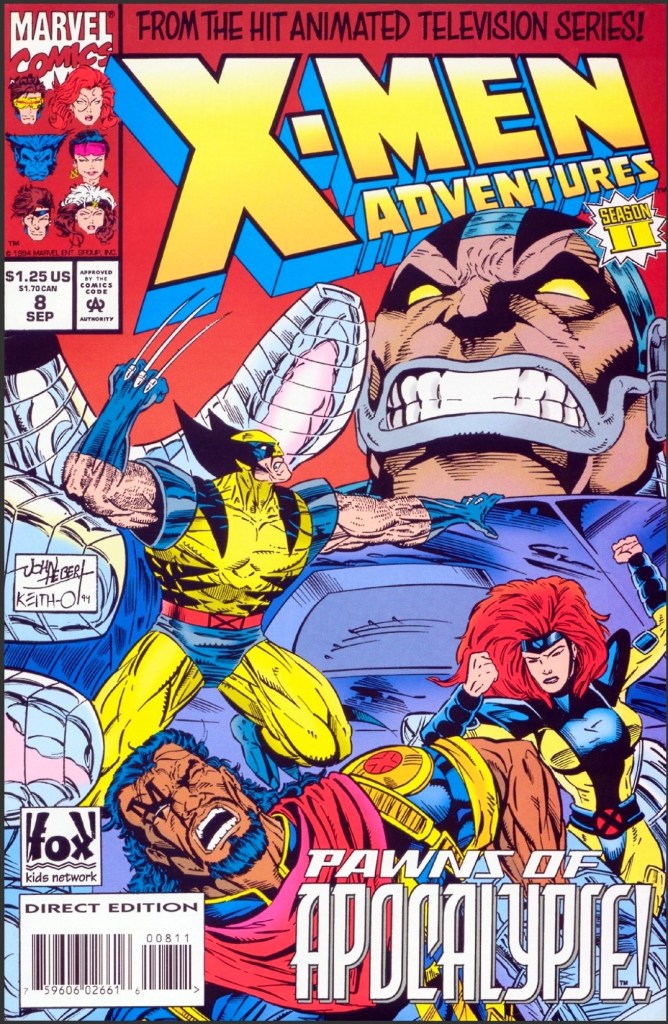
The cover.

Early story

The story begins on Earth in the far future of 3999 AD. Cable, who has been leading the fight against Apocalypse, is receiving information from his cube-shaped computer which informs him that a temporal storm has wreaked havoc with the time stream and their present is reconfiguring in response to the existence of a new past. Once realignment gets completed, everyone in the current timeline will cease to exist. Cable then learns that Bishop (who returned to the X-Men in the previous issue) is the primary chronal component of the time readjustment.

Meanwhile in the present day inside Xavier’s mansion, the X-Men listen to Bishop who explains that mutants will be blamed for the plague that a certain virus will precipitate and that the fear of the virus will make things much worse for many people. He states that the virus was not brought into being by mutants.

Beast then shares that his investigation of a viral-ridden cell sample was convincing and discovered that the virus was genetically engineered. He reveals that once the little germs spread to the mutant population and combine with mutant DNA, it could turn out incredibly deadly…

Quality
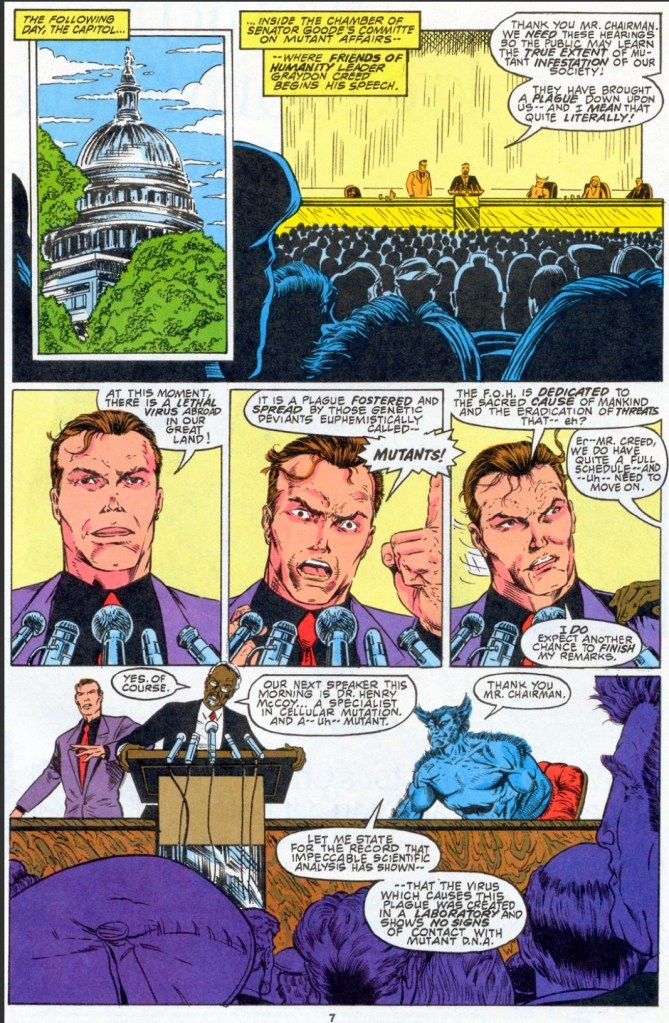
Conflict brewing in front of a huge audience.

To be straight to the point, what the creative team started in issue got strongly concluded here. With the animated episode’s teleplay being the primary reference, writer Ralph Macchio successfully crafted a script that raised the stakes of the 2-part Time Fugitives story while tying closely the gaps with regards to the time travel and timeline conflicts concepts. Without spoiling the plot, I can say that one development that took place in the present day clearly set off the stage for another futuristic mutant to not only get involved but also make a huge impact on the narrative.

As with the previous issue, this story has elements of xenophobia as well as fear of viruses and potential massive infections which added a good layer of depth to the plot. Macchio’s writing is very strong and no matter how intense the tale got as more details got presented, it still remained very readable and efficient to follow. Also, I should say that Apocalypse’s presence turned out very powerful and it should inspire readers to search for comic books of the supervillain’s conflict with the X-Men and X-Factor for insight.

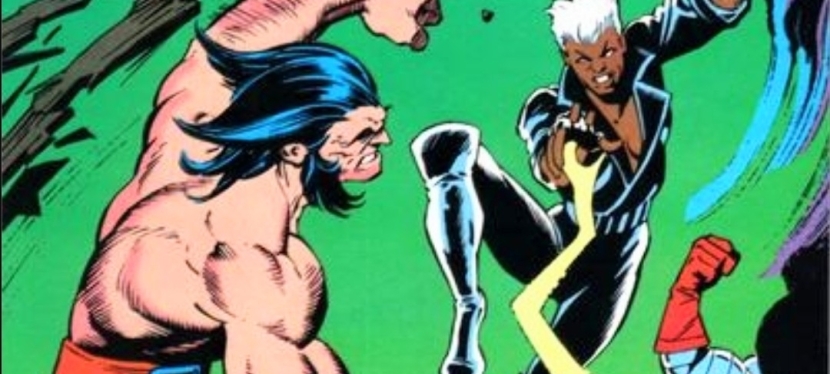
John Hebert returned on the visual department and his art style really works well with both the sci-fi concept of the story and the presentation of the X-Men plus Bishop and Cable. I really admire Hebert’s stylized take on Wolverine, Cable and Bishop as he made each them look even grittier than before. There is also this creepy vibe with the way Hebert drew some of the X-Men members’ faces. Herbert is also very good with visualizing sci-fi elements such as energy forms, futuristic machines, techno-virus forms on the skin, and more. His presentation of dynamic superhero action is great to look at. This is clearly one of the best looking issues of Season II of the X-Men Adventures series.

Conclusion

Bishop explains things to the X-Men and Beast confirms key details.

X-Men Adventures Season II (1994) is a rock-solid comic book in terms of quality and impact. It concluded the 2-part story with a powerful resolution, it tied the loose ends in a very timely fashion and I really enjoyed the way how the X-Men were dramatized as Bishop and Cable got involved with them in their present day setting. So far, this is the most satisfying and more impactful issue of Season II I have read in this series.  

Overall, X-Men Adventures Season II (1994) is highly recommended.

+++++

Thank you for reading. If you find this article engaging, please click the like button below, share this article to others and also please consider making a donation to support my publishing. If you are looking for a copywriter to create content for your special project or business, check out my services and my portfolio. Feel free to contact me with a private message. Also please feel free to visit my Facebook page Author Carlo Carrasco and follow me on Twitter at  @HavenorFantasy as well as on Tumblr at https://carlocarrasco.tumblr.com/ and on Instagram at https://www.instagram.com/authorcarlocarrasco

A Look Back at Uncanny X-Men #273 (1991)

Welcome back superhero enthusiasts, 1990s arts and culture enthusiasts, Marvel Comics fans and comic book collectors! Today we go back to the year 1991 to explore a chapter of the Uncanny X-Men series that took place between X-Tinction Agenda and Mutant Genesis (the modernization point of Marvel’s mutants for the 1990s).

For the newcomers reading this, X-Tinction Agenda was a very notable part of the history of the X-Men comic book franchise as it marked the first time that the X-Men, X-Factor and the New Mutants were combined and also reunited several X-Men members who were scattered around the world. That being said, the state of mutants within Marvel Comics’ shared universe created a sense of uncertainty towards Charles Xavier’s grand dream of establishing a peaceful co-existence between humans and mutants.

With those details laid down, here is a look back at Uncanny X-Men , published in 1991 by Marvel Comics with a story written by Chris Claremont and drawn by Whilce Portacio, Klaus Janson, Jim Lee, John Byrne, Rick Leonardi, Marc Silvestri, Michael Golden and Larry Stroman.

The cover.

Early story

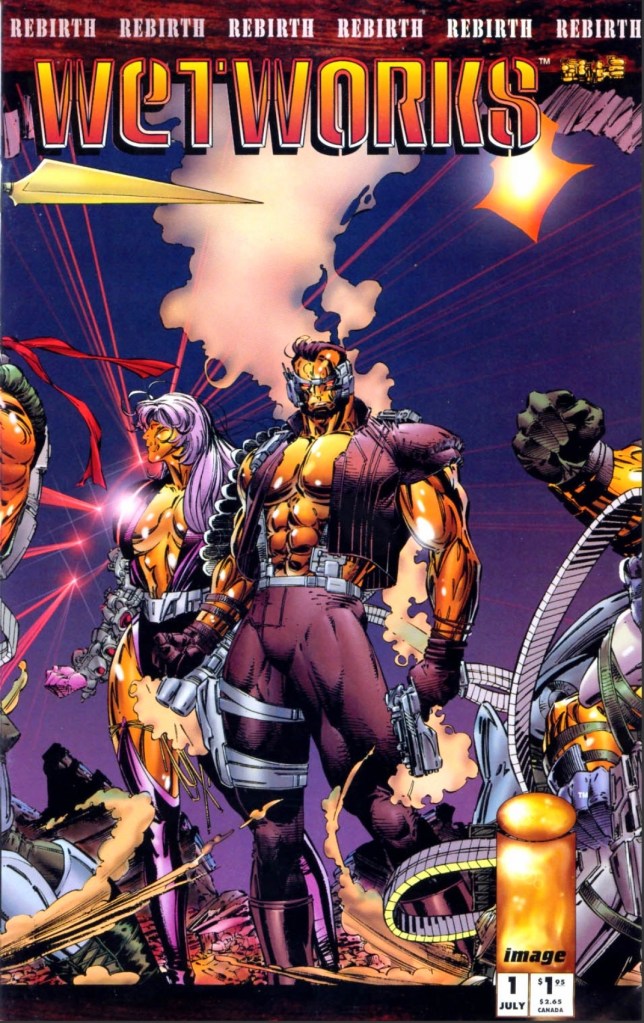
The story begins in the control center within the complex located deep under the ruins of Charles Xavier’s mansion. Storm (X-Men), Jean Grey (X-Factor), Cyclops (X-Factor) and Cable (New Mutants) carefully examine the worldly forces that oppose them. After Storm asked about what they could do about the opposing forces located in different parts of the world, Cable says that they should hit them hard and fast as they have the power to do so.

Storm asked Cable if violence is his only solution. Even though violence got things done for Cable, Cyclops rejects it and states that his fellow mutants (pertaining to the X-Men and X-Factor) are not like him.

As the conversation intensifies, Jean Grey tells Cable that they are not warriors and the school was not founded by Professor X to have mutants to fight wars. Cable replied that war is what they got and reminded them of the two mutants they lost and another one who ended up as a genetically engineered slave. Cable asked them if they want to see more of their fellow mutants end up badly…

Quality

In the absence of Professor X, Jean Grey (then a member of X-Factor) revisits Cerebro and recalls what she learned long ago.

In relation to the mentioned fact that this particular story took place between X-Tinction Agenda and Mutant Genesis, this is a tale that reflects a period of transition leading to the latter. That being said, Chris Claremont took the opportunity to emphasize the current state of the X-Men and the other mutants, as well as the uncertainty ahead of them all. To be clear, this story does not have Marvel’s mutants going up against another super villain nor a group that opposes them.

The story opened very strongly with the leading figures of the X-Men (Storm), X-Factor (Cyclops and Jean Grey) and the New Mutants (Cable) being together analyzing the global situation and the forces that oppose them.

For Cable, violence is necessary for their survival and progress because he sees war against mutants already happening and there is simply no room left for error nor compromise. Very symbolically, Storm, Cyclops and Jean Grey – who all were nurtured by Professor X with his pacifist dream of bridging the gap between mutants and humans – reject Cable’s beliefs as they don’t see themselves as warriors and they do not dream of conquering their enemies at all. All the dialogue that took place in the argument are very richly written and there are layers of meanings which long-time X-Men fans will able to relate with.

Along the way, Claremont and the other creators made good use of available comic book space to develop the other characters which resulted in the gradual developments within each team of mutants. Gambit here is a brand new member of the X-Men and his talk with Storm is very sensible to read. There was also this notable Danger Room training session between Archangel and Cannonball in which the former (who is already very experienced as one of the original X-Men and a current member of X-Factor) shares wisdom to the very young mutant (who later went on to lead X-Force some time later). The creative team also inserted a few moments of humor on the other character development scenes.

Conclusion

Truly this is one of the most symbolic and most engaging arguments between the leading figures of the X-Men, X-Factor and New Mutants (which later became X-Force).

Even though it was mainly focused on character development and has no battle with any enemy, Uncanny X-Men (1991) remained a very engaging read as it tackles not only the current state of the three mutant teams of the time but also realigned their direction creatively and the results were fully realized through the eventual Muir Island saga as well as Mutant Genesis and even in further tales (including Fatal Attractions). In many ways, this comic book served as a solid foundation of things to come and this partially explains the eventual reform of the X-Men into a much larger group that had to be composed of two teams shortly after the return of Professor X (as seen in X-Men #1 and Uncanny X-Men in 1991).

Overall, Uncanny X-Men (1991) is highly recommended.

+++++

Thank you for reading. If you find this article engaging, please click the like button below, share this article to others and also please consider making a donation to support my publishing. If you are looking for a copywriter to create content for your special project or business, check out my services and my portfolio. Feel free to contact me with a private message. Also please feel free to visit my Facebook page Author Carlo Carrasco and follow me on Twitter at  @HavenorFantasy as well as on Tumblr at https://carlocarrasco.tumblr.com/ and on Instagram at https://www.instagram.com/authorcarlocarrasco
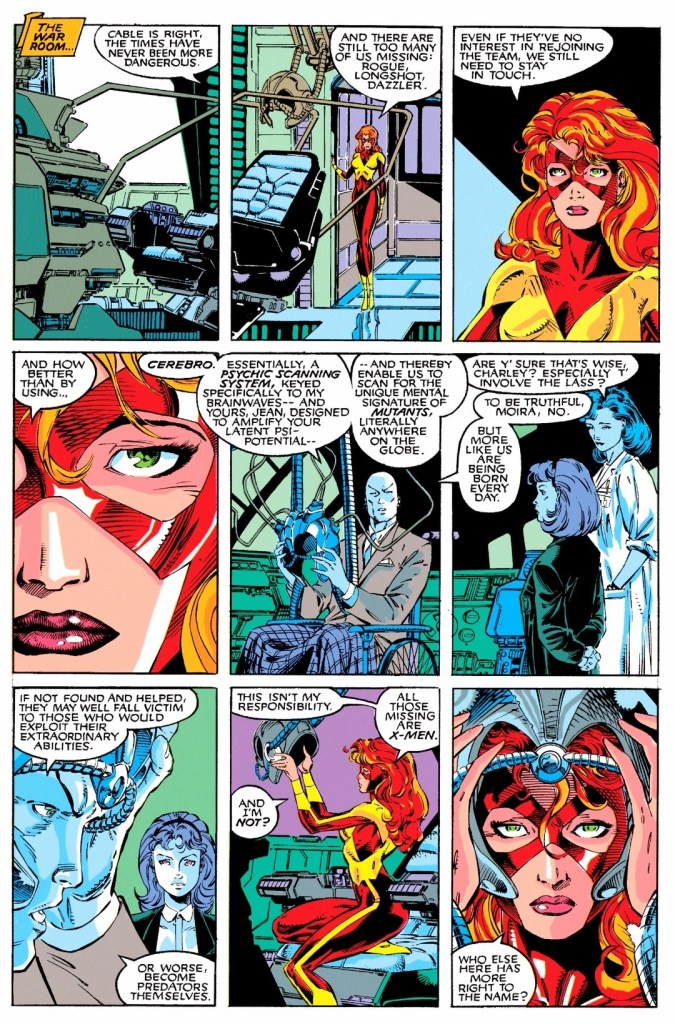
A Look Back at Wetworks #1 (1994)

Welcome back superhero enthusiasts, 1990s arts and culture enthusiasts, and comic book collectors! Today we go back to the mid-1990s to explore the comic book launch of a notable fictional team co-created by the Whilce Portacio and Brandon Choi…Wetworks.

For the newcomers reading this, Whilce Portacio was one of the highly talented illustrators who left Marvel Comics and co-founded Image Comics in the early 1990s. While his fellow co-founders Todd McFarlane, Jim Lee, Rob Liefeld, Marc Silvestri, Jim Valentino and Erik Larsen were able to launch their respective dream projects (creator-owned properties) during Image’s first year of publishing, the launch of Wetworks was delayed by two years due to a death in Portacio’s family.

As a very young comic book reader in those days, I remember hearing rumors about Wetworks inside comic book stores I visited. There were rumors of business negotiations, solicitations and scheduled launches (ranging from October 1993 to January 1994). I also noticed some comic book enthusiasts who bought old copies of X-Factor and Uncanny X-Men that Portacio illustrated while waiting for Wetworks to debut.

In the middle of 1994, Wetworks was finally launched under the Image Comics label and I still remember the day when I saw lots of copies of issue displayed on the shelves and windows of comic book stores.

With those details laid down, here is a look back at Wetworks , published in 1994 by Image Comics with a story written by Whilce Portacio and Brandon Choi. The art was done by Portacio with ink work by Scott Williams.

The cover.

Early story

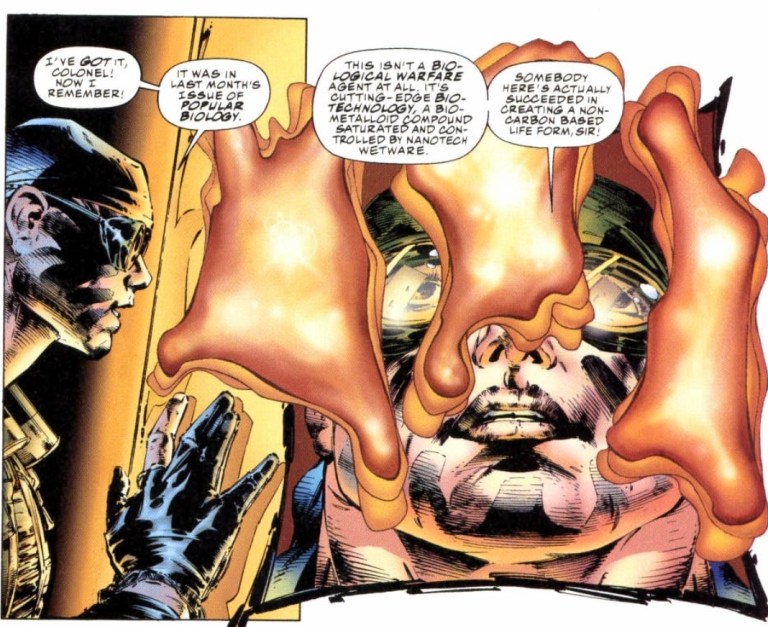
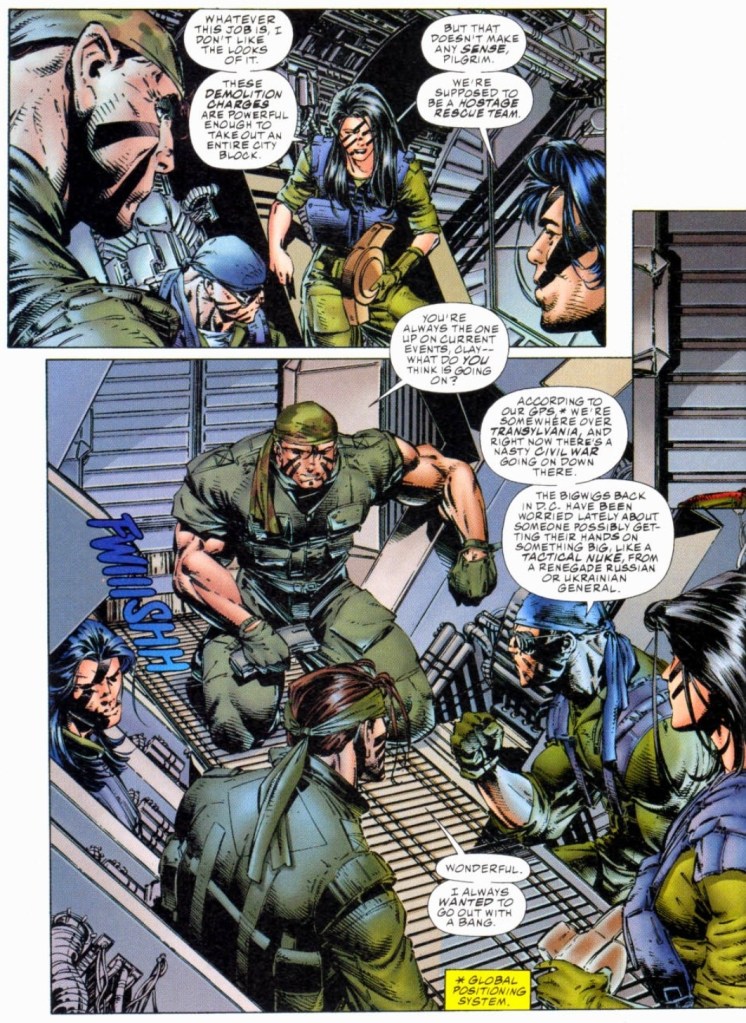
The story begins when a covert operations team working under International Operations (IO) travels to eastern Europe to infiltrate and destroy the base of operations of a certain warring faction and retrieve a biological agent (highly contagious) no matter what the cost. As it turns out, this new mission for the team (led by Colonel Jackson Dane, one of the pioneers of Team 7) started less than twenty four houses after their previous mission and their female member Pilgrim (reconnaissance specialist) pointed out that the demolition charges they are carrying are strong enough to wipe out an entire city block. Another teammate called Grail (the Filipino named Salvador Joel Alonday) stated that they are supposed to be a hostage rescue team.

Meanwhile deep inside the command center of IO in Washington, D.C., Admiral Halsey tells Miles Craven that Team 7 (the team led by Dane) are under his command and states that his sources tell him that there is more to the mission than just a group of ethnic nationalists obsessed on a biological terror campaign. It turns out, Craven sent the team to eastern Europe without fully informing them of what they are going up against. Craven insists that Team 7 are paid to put their lives on the line and to die if necessary just to get the job done. Craven then reveals to Halsey the true nature of the mission. The admiral then realizes Craven is right and certain sacrifices must be made for the greater good.

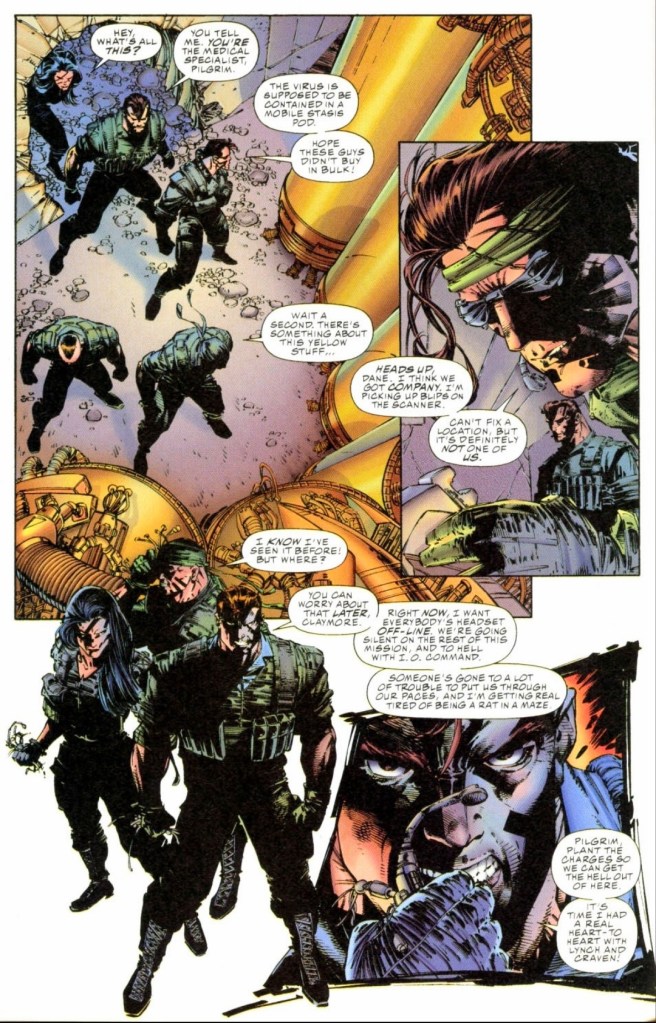
Craven and his team arrived at the location in Transylvania. They started seeing signs that someone else arrived ahead of them…

Quality

One of the team members looks at a symbiote.

I’ll start first with the fantasy concept and the storytelling. Whilce Portacio and Brandon Choi’s joint creation of Wetworks is indeed an inspired move with connections to real-life military influences the creators had. The Wetworks team – initially referred to as Team 7 – started looking and acting like typical military squad in the world of fiction but the major twist that happened drastically redefined and refined them into the most unique military team in the world of superhero comics. It’s the closest thing to seeing G.I. Joe fused with living symbiotes (another inspired move most likely influenced by a certain Marvel murderer with a symbiote whose origin is linked with one of the most iconic superheroes ever) there is and I can say Wetworks remains relevant and stands out nicely among superhero comic book teams to this day.

With regards to the plot, it looks cliched on face value. I’m talking about the trope in which a team is sent by their powerful superiors on a mission without knowing all the crucial details needed (because the superiors hid it from them) and they eventually encounter immense danger. As mentioned earlier, the major twist in the plot not only completed a major transformation of Dane and his teammates but also ramped up the fantasy aspect of the tale to much higher levels.

Still on the plot, Portacio and Choi came up with a solid structure for the narrative. The build-up of details and tension was very good and the pay-offs (lots of spectacle plus twists) were great. As the story moved on, the suspense grew stronger and the narrative succeeded in making me care about the team led by Dane.

Meet the team members who would later become Wetworks.

When it comes to the art, Portacio’s work here (with ink by Scott Williams) still looks great and, more notably, it is a fine departure from the superhero visuals he worked in years prior. As with his past works, you will see the artist’s stylized approach on visualizing the narrative related to how he implements the panels per page.

Portacio did a very good job with the military look of Wetworks and he drew their guns with a high amount of detail that should be seen (you should try using a magnifying glass on this comic book). Not only that, his art on military hardware such as the gunships, the interiors plus equipment all have that detailed appearance. When it comes to action, I believe that Portacio took a lot inspiration from Hollywood action flicks (most notably Predator) on portraying Wetworks members using their guns and positioning during battle.

Of course, the spectacle is not totally limited to military stuff. There is a touch of fantasy and horror visuals involved which is directly related to what was set-up for Wetworks to encounter in the near future. To realize what I am saying here, you must read this comic book until the intense end.

Conclusion

Wetworks from 1994 is still great to read!

I can say without a doubt that Wetworks (1994) remains as gripping and as entertaining as when I first read it decades ago. In short, it has aged well and reading it all over again today is compelling and a lot of fun to do. If you ask me, this is one of the finest works ever by Whilce Portacio in terms of art and storytelling. As one of the many comic books Image published during its first few years in the industry, Wetworks (1994) clearly stands out with its military theme and fantasy concept. Lastly, Wetworks is set within the WildStorm universe as dramatically symbolized with the presence of International Operations (the team’s superiors).

Overall, Wetworks (1994) is highly recommended!

+++++

Thank you for reading. If you find this article engaging, please click the like button below, share this article to others and also please consider making a donation to support my publishing. If you are looking for a copywriter to create content for your special project or business, check out my services and my portfolio. Feel free to contact me with a private message. Also please feel free to visit my Facebook page Author Carlo Carrasco and follow me on Twitter at  @HavenorFantasy as well as on Tumblr at https://carlocarrasco.tumblr.com/ and on Instagram at https://www.instagram.com/authorcarlocarrasco

A Look Back at Uncanny X-Men #157 (1982)

Welcome back superhero enthusiasts, 1980s culture enthusiasts and comic book collectors! Today we go back to the year 1982 to take a close look at one of the many tales of the Marvel Comics shared universe told through the monthly series of Uncanny X-Men.

In my previous retro review, Charles Xavier got reunited with his beloved Lilandra, the empress of the Shi’ar Empire, as they were trapped temporarily by the Brood. Elsewhere, Corsair reveals to his son Cyclops what happened before they got separated on Earth twenty years prior. The X-Men and the Starjammers got captured by the Brood’s massive transport which turned out to be a massive organic creature. The conflict that followed saw another battle between the X-Men and the Brood but with the stakes raised higher.

With those details laid down, here is a look back at Uncanny X-Men published in 1982 by Marvel Comics with a story written by Chris Claremont and drawn by Dave Cockrum.  

The cover.

Early story

The story begins in space where the X-Men and the Starjammers worked together to repair the external parts of the Starjammer ship. An incident happens in which Wolverine starts to float away from the ship while Colossus loses consciousness. One of the Starjammers saved Wolverine.

Just as the Starjammers used their advanced technology to help the unconscious Colossus, Empress Lilandra tells Professor X and a few others that she used her imperial commlink and private code to each Chanellor Araki to confirm to him that she is free and unharmed. Supposedly, Lilandra’s move should compel Araki to call off the punitive strike against Earth.

As Lilandra starts communicating with the flagship that carries Araki, Admiral Lord Samedar takes control of the ship and declares that they will execute Araki’s orders to obliterate Earth…

Quality

Kitty Pryde on the move against all odds.

Following the events of the two previous issues, this story is another engaging pay-off to the established build-up but with the stakes raised higher as Earth becomes a target of the defiant Shi’ar officials who themselves turned out to be defiant towards their empress Lilandra all along. Not only that, there is a good amount of intrigue with the way the Shi’ar people are portrayed here.

The X-Men here continue to struggle not only because of Colossus’ weakness but also because something bad happened to their leader Professor X (a must-read scene). Far away from the rest of their teammates, Nightcrawler and Kitty Pryde became major players in this particular story and what happened with them was nicely structured by Chris Claremont. This is clearly a big pay-off to what was staged in issue #155 and it sure is worth anticipating!

If you have great interest with the Brood, you will be delighted to see more of the way they communicate and how they treat foreigners like Deathbird as they live on with their uncompromising belief that their race backs winners only.

Conclusion

How the Brood treats Deathbird.

Uncanny X-Men (1982) is an action-packed sci-fi tale that continued Claremont’s direction of the X-Men while also emphasizing the Brood as well as the Starjammers and the Shi’ar as crucial players in this particular storyline. There is plenty of superhero spectacle to enjoy here, a few memorable character moments and if you are fond of Chris Claremont’s works, you will enjoy the twists and surprises he pulled off here.

Overall, Uncanny X-Men (1982) is recommended!

+++++

Thank you for reading. If you find this article engaging, please click the like button below, share this article to others and also please consider making a donation to support my publishing. If you are looking for a copywriter to create content for your special project or business, check out my services and my portfolio. Feel free to contact me with a private message. Also please feel free to visit my Facebook page Author Carlo Carrasco and follow me on Twitter at  @HavenorFantasy as well as on Tumblr at https://carlocarrasco.tumblr.com/ and on Instagram at https://www.instagram.com/authorcarlocarrasco

A Look Back at Uncanny X-Men #156 (1982)

Welcome back superhero enthusiasts, 1980s culture enthusiasts and comic book collectors! Today we go back to the year 1982 to take a close look at one of the many tales of the Marvel Comics shared universe told through the monthly series of Uncanny X-Men.

In my previous retro review, the X-Men got involved in a high-stakes mission to find and rescue the kidnapped Shi’ar empress Lilandra. Things are not easy on the X-Men’s side as Cyclops is still uneasy over the truth he learned about his father Corsair while the leader Charles Xavier had to deal with the Shi’ar officials who have their agenda that could cause trouble on Earth. What the X-Men faced was a few of the Brood and Deathbird.

With those details laid down, here is a look back at Uncanny X-Men published in 1982 by Marvel Comics with a story written by Chris Claremont and drawn by Dave Cockrum.  

The cover.

Early story

The story begins in New York City. The X-Men just fought with the Brood and Deathbird, and Charles Xavier has gone missing. Wolverine, Storm, Corsair, Cyclops and the Avengers member Tigra attend to a mortally wounded Colossus who was hit with acid.

Just as the local police arrived, Tigra tries her best to talk with them. Suddenly a gigantic space ship arrived floating above New York shocking everyone. The ship unleashes a beam of light down to pick up Wolverine, Cyclops, Storm, Corsair and the ailing Colossus. The giant ship then flies away leaving a lot of people stunned.

It turns out the ship belongs to the Starjammers, a group of space pirates that Corsair leads. Colossus then gets treated with alien technology…

Quality

The spectacle and the new encounter with the Brood were nicely done.

Similar to issue , the story here is very in-depth and has so much details and plot-related connections, it will require a great amount of attention from you in order to understand what is going and what is happening within. In this issue, you will get to see the Starjammers gang that Corsair spent a long time with, further development between Corsair and son Cyclops, the reunion between Charles Xavier and Empress Lilandra, and more of the Brood.

To put things clearly, Chris Claremont invested a lot of details when it comes to dramatizing the characters, insert revelations from the past, emphasized the many reactions of the X-Men members and carefully implemented stronger science fiction elements that really added depth to the plot. In many ways, this story is a huge pay-off to the build-up of the previous comic book and there is a lot more to the connection between Deathbird (a very capable villainess) and the Brood.

Having read lots of Claremont-authored X-Men stories, I found this 1982 story enjoyable and compelling to read. The big difference is that there is a stronger element of spectacle in this story which is related to the stronger sci-fi elements as well as Claremont’s strategic handling of the X-Men. At this point, it is clear that something new was being built up with the Brood, space travel and new frontiers. This is a strong sci-fi X-Men tale.

Conclusion

Professor X with his beloved Lilandra.

Uncanny X-Men (1982) is indeed an enjoyable read provided that you pay close attention to the details, the characters and you have read the previous issue. This is the X-Men literally going deeper with science fiction and the Brood here was just about to rise further as a major force of opposition that would impact Marvel’s mutants. I should also state that Professor X and Empress Lilandra being together is a pretty compelling scene to read. As of this writing, I am convinced to keep on exploring further tales from this era of the X-Men.  

Overall, Uncanny X-Men (1982) is highly recommended!

+++++

Thank you for reading. If you find this article engaging, please click the like button below, share this article to others and also please consider making a donation to support my publishing. If you are looking for a copywriter to create content for your special project or business, check out my services and my portfolio. Feel free to contact me with a private message. Also please feel free to visit my Facebook page Author Carlo Carrasco and follow me on Twitter at  @HavenorFantasy as well as on Tumblr at https://carlocarrasco.tumblr.com/ and on Instagram at https://www.instagram.com/authorcarlocarrasco
A Look Back at Uncanny X-Men #131 (1980)

Welcome back superhero enthusiasts, 1980s culture enthusiasts and comic book collectors! Today we go back to the year 1980 to take a close look at one of the many tales of the Marvel Comics shared universe told through the monthly series of Uncanny X-Men.

In my previous review, Dazzler was formally introduced as the X-Men encountered her. Along the way, the other newbie Kitty Pryde (Shadowcat) got involved with X-Men members Storm, Wolverine and Colossus and danger got to them. Brewing within the background were plot elements regarding the Hellfire Club and the Dark Phoenix.

With those details laid down, here is a look back at Uncanny X-Men published in 1980 by Marvel Comics with a story written by Chris Claremont and drawn by John Byrne.  

The cover.

Early story

The story begins on the streets of Chicago as the 13-year-old Kitty Pryde desperately runs away from a car that has been chasing her. Just as she trips, the Jean Grey (in her form as the Phoenix) suddenly appears right in front of the car (driven by two armed personnel of the Hellfire Club) and uses her immense power to stop and damage it. This spared Kitty Pryde’s life and made her more confused. Nightcrawler suddenly appears in front of Kitty, grabs her and leap off to a higher place to be safe.

Cyclops and Dazzler arrive to see Phoenix still observing the damaged car and the two Hellfire Club personnel knocked out cold. As Dazzler is amazed by what Phoenix did, Cyclops tells Jean that his instructions were to stop the car but not turning it into scrap. Jean responds by stating that he did not feel Kitty’s stark terror nor did he sense the thoughts of the men who were in the car.

After being called from above by Nightcrawler, Cyclops, Phoenix and Dazzler make their way up to the top of the building. Nightcrawler reveals that Kitty broke away from him and dove right through the roof…

Quality

Kitty Pryde took the risk to help the X-Men free Wolverine.

Upon close inspection, this is a richly layered tale that nicely paid off some of the build-up in the previous issue while consistently building up the plot elements for the events to follow (the eventual Hellfire Club encounter and the Dark Phoenix Saga). In this issue, you will get to see the X-Men in action with Dazzler (who just joined in to help them without fully committing to joining their team) on a series of events that involve encountering Miranda Frost and finding their captured teammates.

As this was written by Chris Claremont, you will see a lot of character development (aided a lot with the use of thought balloons) and key observations emphasized (clever exposition of details) as the plot moved forward. This tale has the classic elements of good-versus-evil backed with action and some twists that will definitely keep readers entertained. It is through the dramatization and observations of the characters that made the narrative deep and by the end of it, you will most likely get to know the characters a lot more.

Apart from witnessing Dazzler’s first unofficial mission (note: misadventure) with the X-Men, you will see Kitty Pryde shine as the fragile yet capable teenager do something heroic which symbolically justified her entry into the X-Men. This story also touches on the theme of immense power which was dramatized nicely through Jean Grey and Cyclops. Cyclops here was written to be very concerned about Jean Grey having god-like powers as the Phoenix which he sees as too risky and he hopes that she will maintain self-control. Even Storm expressed the same concern about the Phoenix. All of these dramatics combined with the superhero spectacle and steady way of presenting exposition were nicely pulled off by the Claremont-Byrne team.

Finally, I want to say that Emma Frost was portrayed as a ruthless, cold-hearted and elitist super villain who happens to be one of the central figures of the Hellfire Club (which itself was being built up by Claremont-Byrne as a dangerous force of opposition for the X-Men to face). Emma Frost is not just another evil figure…she is a telepath capable of overwhelming others and she has a very high ambition of accumulating power socially, economically and politically. Clearly she was created to be a recurring evil figure within Marvel’s shared comic book universe.

Conclusion

A scene showing a few X-Men members with Dazzler and Kitty Pryde as the clear newcomers.

Even if you see Uncanny X-Men (1980) as simply a build-up tale for the inevitable Dark Phoenix Saga, it is clear that the comic book still stands out on its own as it strongly paid-off what was built up in the previous issue and the high quality on storytelling was successfully maintained. This is an entertaining read and, quite notably, it develops specific characters in very believable ways. So much so, you will get to know the characters better by the time you reach the end. As for the fans of Dazzler, there are things to enjoy in this X-Men tale and it definitely is a must-read before reading Dazzler #1 (1981).

Overall, Uncanny X-Men (1980) is highly recommended!

+++++

Thank you for reading. If you find this article engaging, please click the like button below, share this article to others and also please consider making a donation to support my publishing. If you are looking for a copywriter to create content for your special project or business, check out my services and my portfolio. Feel free to contact me with a private message. Also please feel free to visit my Facebook page Author Carlo Carrasco and follow me on Twitter at  @HavenorFantasy as well as on Tumblr at https://carlocarrasco.tumblr.com/ and on Instagram at https://www.instagram.com/authorcarlocarrasco
A Look Back at What If #27 (1981)

Disclaimer: This is my original work with details sourced from reading the comic book and doing personal research. Anyone who wants to use this article, in part or in whole, needs to secure first my permission and agree to cite me as the source and author. Let it be known that any unauthorized use of this article will constrain the author to pursue the remedies under R.A. No. 8293, the Revised Penal Code, and/or all applicable legal actions under the laws of the Philippines.

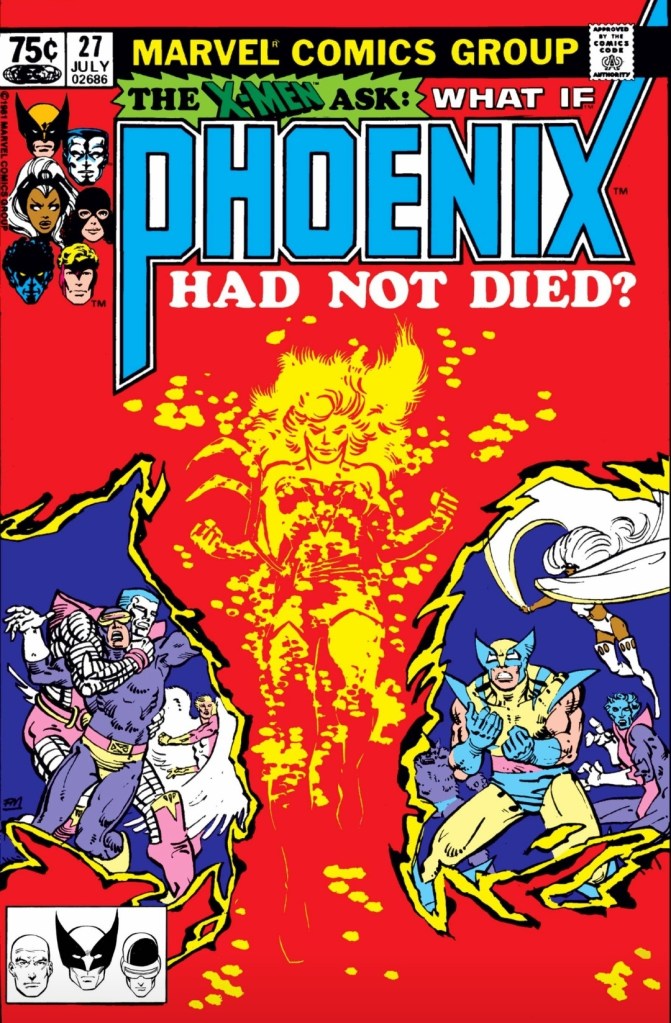
Welcome back superhero enthusiasts, 1980s arts and culture enthusiasts, Marvel Comics fans and comic book collectors! Today we go back to the early 1980s and examine an alternate universe portrayal of the X-Men and the Dark Phoenix saga itself as told in one of the comic books of the first volume of the series What If.

So much has been discussed about the Dark Phoenix saga of the Uncanny X-Men series through the decades. A lot point to it as the greatest X-Men ever told while some called it the true X-Men epic story that Chris Claremont and John Byrne came up with. Considering its deep impact and significance on the Marvel Comics shared universe, it was only a matter of time before the publisher decided to revisit the said storyline but explore other outcomes through the What If series.

With those details laid down, here is a look back at What If #27 published in 1981 by Marvel Comics with a story written by Mary Jo Duffy and drawn by Jerry Bingham.

The cover.

Early story

The story begins with the Watcher looking back at the events that led to the Dark Phoenix saga, who got impacted and how Jean Grey used a weapon of alien origin to end her own life and prevent the Dark Phoenix from raging.

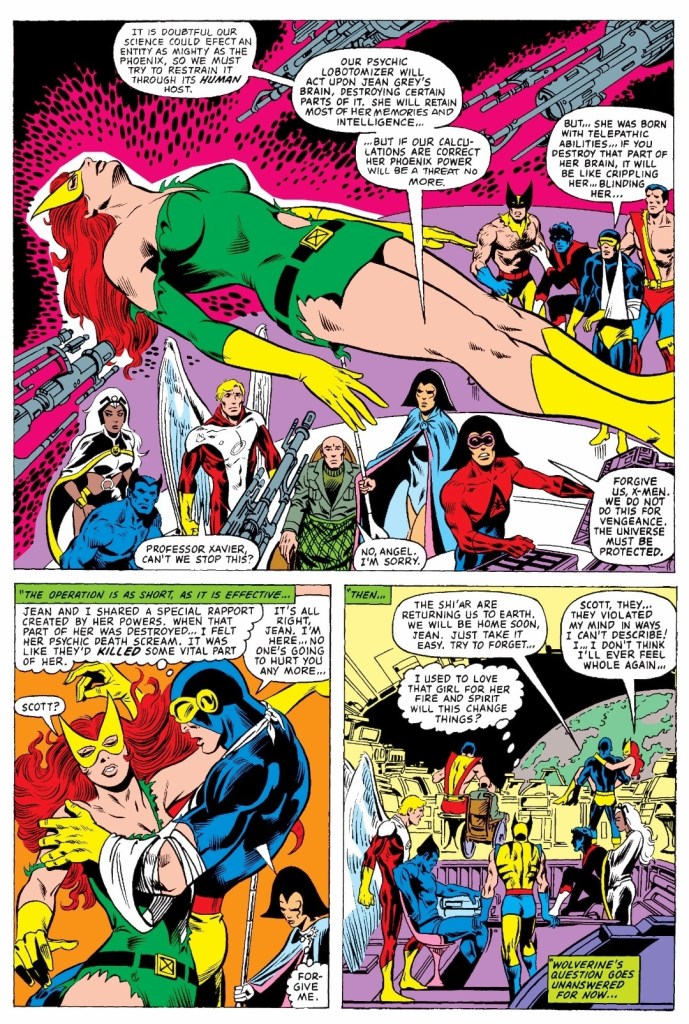
Suddenly, an alternate reality begins when Jean Grey survives and Cyclops reacts by using his optic blasts on incoming enemies until he got overwhelmed. The X-Men have been defeated and are brought to the imperial flagship of Lilandra’s grand fleet where the Shi’ar scientists prepare for the destruction of Phoenix.

Jeay Grey remains alive, floating above the X-Men and the others as Lilandra’s people prepare to start the process of the psychic lobotomizer on her. Their intention is to act upon Jean Grey’s brain and destroy certain parts of it in order to neutralize the Phoenix power within her. The operation turned out successful and Jean Grey survives once more. She and her fellow X-Men return to Earth…

Quality

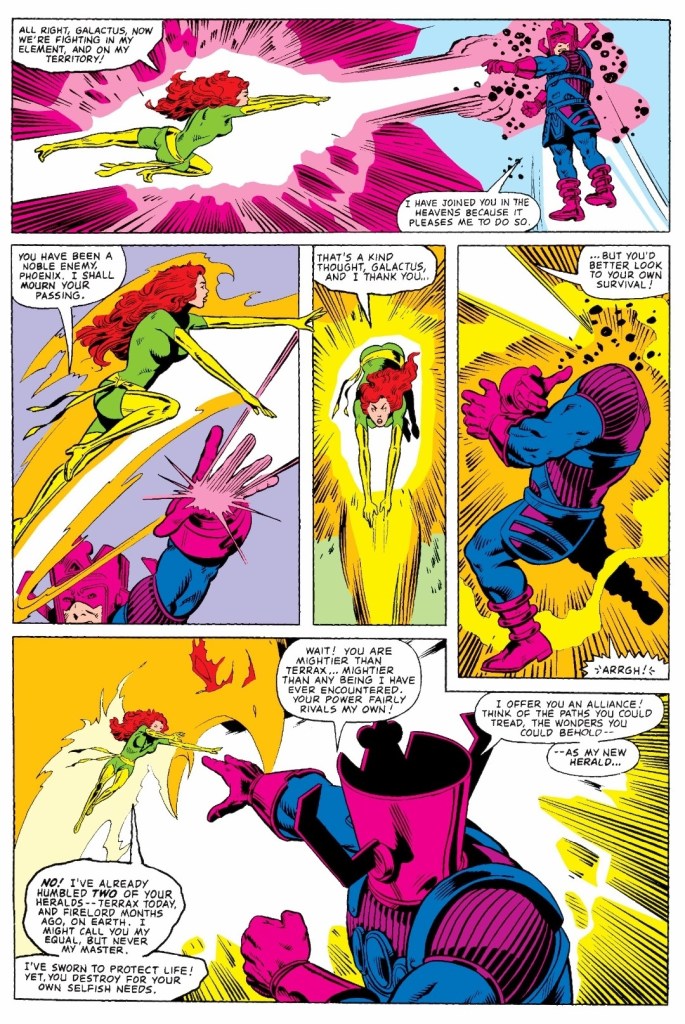
This conflict between Phoenix-powered Jean Grey and Galactus is a must-see.

This early, I can say that this is a very great exploration and portrayal of the concept about Phoenix (within Jean Grey) not dying during the Dark Phoenix saga. The script of this comic book is so great (note: solid plot structure, consistent portrayals of the characters, strong build-up with solid pay-off and more), it’s almost as if Mary Jo Duffy and Chris Claremont worked together behind the scenes.

The protagonist in this story is Jean Grey and this comic book examines her struggle with adjusting her personal life and her effort to fit in once again within the X-Men while remembering fully that as Dark Phoenix, she still remains guilty of destroying an entire solar system and committing the mass murder of five billion people.

Unsurprisingly, due to the emergence of a tremendous crisis deep in space, Jean Grey gets involved with her team going to the site on a mission. This easily puts her into a situation that makes her revive the power of the Phoenix deep within herself. While the use of the tremendous power of the Phoenix to help the X-Men looked sensible at first glance, it only signified the beginning of a chain of destruction and unfortunate developments. As expected, Jean Grey can only go so far with her good nature and her free will while having the magnificent powers of the Phoenix.

While the conflicts were portrayed well, Mary Jo Duffy’s script raises key questions about the red-head X-Men member: How can Jean Grey ever achieve a normal life and level with her X-Men teammates knowing that she carries powers that make her god-like? How can she ever forget the tragic fact that as Dark Phoenix, she murdered billions in deep space? What can Charles Xavier do to lead and guide the X-Men knowing that Jean is way too powerful? Could the love of Cyclops be helpful for Jean Grey’s personal efforts to control the Phoenix power within?

Another highlight of this story is the final seven pages. The ending is very impactful and definitely something you must see.

Conclusion

This happened after Jean Grey’s survival.

What If #27 (1981) is a classic alternate reality portrayal of the Marvel Comics universe and it surely works as a companion piece to what was established in the Dark Phoenix saga. Mary Jo Duffy’s script really captured the spirit of Claremont’s X-Men and the dramatic stuff and all the build-up led to a very tremendous ending that can disturb you or even satisfy you in the most unusual way. Most notably, this comic book really answered the question about what would happen had Phoenix did not die. The 2nd tale of this comic book – the Kree Encounter – is an interesting additive.

Overall, What If #27 (1981) is highly recommended.

+++++

Thank you for reading. If you find this article engaging, please click the like button below, share this article to others and also please consider making a donation to support my publishing. If you are looking for a copywriter to create content for your special project or business, check out my services and my portfolio. Feel free to contact me with a private message. Also please feel free to visit my Facebook page Author Carlo Carrasco and follow me on Twitter at  @HavenorFantasy as well as on Tumblr at https://carlocarrasco.tumblr.com/ and on Instagram at https://www.instagram.com/authorcarlocarrasco
A Look Back at What If #40 (1992)

Disclaimer: This is my original work with details sourced from reading the comic book and doing personal research. Anyone who wants to use this article, in part or in whole, needs to secure first my permission and agree to cite me as the source and author. Let it be known that any unauthorized use of this article will constrain the author to pursue the remedies under R.A. No. 8293, the Revised Penal Code, and/or all applicable legal actions under the laws of the Philippines.

Welcome back superhero enthusiasts, 1990s arts and culture enthusiasts, Marvel Comics fans and comic book collectors! Today we go back to the year 1992 and explore a part of Marvel Comics’ universe through the reimagined tales emphasized in the What If monthly series.

For this particular retro comic book review, we look at a What If tale that is related with the X-Men, specifically through one of their major characters – Storm. For the newcomers reading, Storm is the black X-Men member whose mutation allows her to manipulate the weather. As seen in X-Men comic books decades ago, Storm was portrayed to be tough and brave, and she became a highly valuable learner under Professor X (Charles Xavier). In the 1990s, Storm rose in prominence among the X-Men, she became leader of their Gold Team. Storm was portrayed in the live-action movies by Halle Berry and Alexandra Shipp. It’s just too bad Storm’s role in X-Men: Days of Future Past (note: for me, it is the best X-Men live-action movie ever) was minimal.

With those details laid down, here is a look back at What If , published in 1992 by Marvel Comics with a story written by Ann Nocenti and drawn by Steve Carr and Deryl Skeleton.

The cover.

Early story

The story begins with the Watcher recalling scenes from the life of Ororo who was born to a mother (a tribal princess in Kenya) and a photojournalist father. After moving from America to Egypt, Ororo loses her mother and became an orphan. Along the way, she experienced severe claustrophobia as a result of being buried under tons of rock. Having survived, she became a thief in Cairo and eventually traveled into Africa by chance. There she discovered her true nature as a walking idol. She eventually meets Charles Xavier.

The Watcher then explores another thread of scenarios of Ororo’s life in which she never stepped on the eventual boat, never sailed for Africa and never met the tribe that worshipped her.

In Cairo, Ororo is a very young thief who made herself look like a male. She uses deceptive tactics on a foreigner who walked by. A short time later, Ororo goes to New York City identified as Jack serving an old man who teaches her to work hard, to gain respect from his friends and immerse herself in a world of grifters and hobos. Ororo lives and works as a thief in the city targeting people who have more than enough…

Quality

A look at Storm as the super-powered thief. It’s also a portrayal of her as a super villain on the rise.

Among the many What If tales related to the X-Men that I have read so far, this is one of the most well-written and most intriguing alternate universe stories I have read thanks to Ann Nocenti. This was also released at a time when Storm was already established as a brave X-Men team leader and a potential successor to Professor X. In this comic book, there is this strong twist to the established legacy of Storm as a youth and the exploration of what would happen had she remained a thief (a super-powered thief no less) and never followed Charles Xavier turned out to be very compelling in my experience. For one thing, Storm definitely would have given police officers – who clearly are inferior to the powered heroes and villains – a hard time and even help the crime wave overwhelm society’s defenders. It is also quite striking to see Storm to follow and serve a principled yet theft-oriented superior. In fact, this story shows the popular X-Men team leader as a super villain on the rise.

More on storm, Ann Nocenti’s script literally dissected notable traits of Storm’s personality that are connected to the established comic book legacy which creatively created something new that fits in well in this alternate universe story. Through Storm, the story also sheds light on how thieves view life believing that theft is a necessity and their so-called principles justify it. No matter what the thieves and criminals in general think, nothing justifies theft and crime at all and those who commit such acts must be punished accordingly Without spoiling the details, I can say that there are some grey areas within Storm that were nicely emphasized.

Conclusion

Storm as a male-looking teenager behind bars with the ladies who got apprehended. Scenes like this should remind you NOT to vote for political candidates who are soft and sympathetic towards crime.

What If (1990) is indeed a great alternate universe portrayal of one of the X-Men’s most prominent characters of the time. The story is very well structured and the characterization of Storm was clearly organized by Ann Nocenti to be powerful and intriguing to read. This comic book also has a twist that you must see for yourselves as well as an ending that will either surprise or satisfy you depending on what you anticipated. Ultimately, this comic book should remind you all to avoid committing crime and the truth is that poverty is a curse and it NEVER justifies theft. Always remember that the Lord is watching you. For enlightenment, read Exodus 22:1-4, Exodus 22:10-15, Leviticus 6:2-7 and 1 Corinthians 6:9-10 in the Holy Bible.

Overall, What If (1990) is highly recommended!

+++++

Thank you for reading. If you find this article engaging, please click the like button below, share this article to others and also please consider making a donation to support my publishing. If you are looking for a copywriter to create content for your special project or business, check out my services and my portfolio. Feel free to contact me with a private message. Also please feel free to visit my Facebook page Author Carlo Carrasco and follow me on Twitter at  @HavenorFantasy as well as on Tumblr at https://carlocarrasco.tumblr.com/ and on Instagram at https://www.instagram.com/authorcarlocarrasco
A Look Back at X-Men Adventures #5 (1993)

Disclaimer: This is my original work with details sourced from reading the comic book and doing personal research. Anyone who wants to use this article, in part or in whole, needs to secure first my permission and agree to cite me as the source and author. Let it be known that any unauthorized use of this article will constrain the author to pursue the remedies under R.A. No. 8293, the Revised Penal Code, and/or all applicable legal actions under the laws of the Philippines.

Welcome back, superheo enthusiasts, 1990s culture enthusiasts, X-Men fans and comic book collectors! Today we revisit the X-Men Adventures monthly series which was the literary adaptation of the popular X-Men animated series of the 1990s.  

In my previous retro review, the encounter with Magneto ended without any resolution. Back at X-Men headquarters, Sabretooth freed himself and got into a fight with Wolverine which symbolically highlighted tensions from their past encounters.

With those details laid down, here is a look back at X-Men Adventures , published by Marvel Comics in 1993 with a story written by Ralph Macchio and drawn by Andrew Wildman.

The cover.

Early story

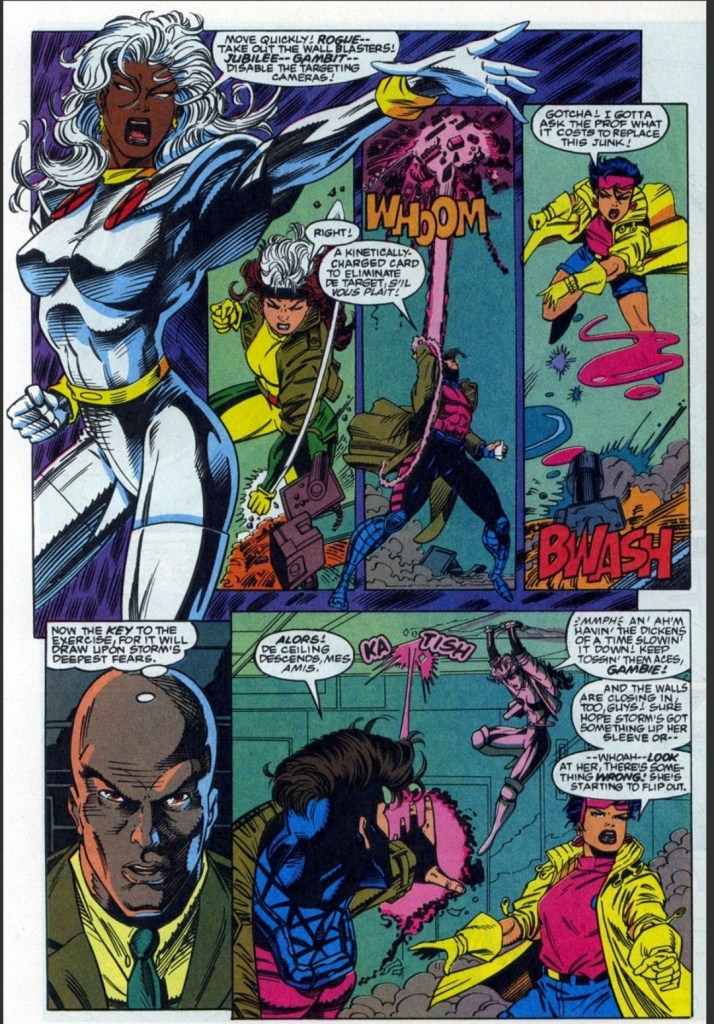
The story begins inside the Danger Room where X-Men members Storm, Rogue, Gambit and Jubilee are tested for combat and skills development under the tight watch of Professor X. While Xavier is aware that while a real-life threat would cause his team to perfect their reflexes and counterattack strategies, it is the leadership of Storm that concerns him the most.

Just as the amount of danger rises, Xavier decides to raise the stakes of the exercise by drawing upon the deepest fears within Storm. Suddenly the ceiling moves down and the walls start closing in on the X-Men. This causes Storm to lose focus as painful memories from her childhood pertaining to claustrophobia suddenly entered her head. The exercise ended on a negative note and Storm tells Professor X that she cannot lead the X-Men as she believes that her claustrophobia will only put others at risk.

Within Xavier’s mansion, the still recovering Wolverine practices martial arts moves. Standing nearby is Jean Grey who starts talking sense into him. Wolverine then notices something in the way Jean looks at him…  

Quality

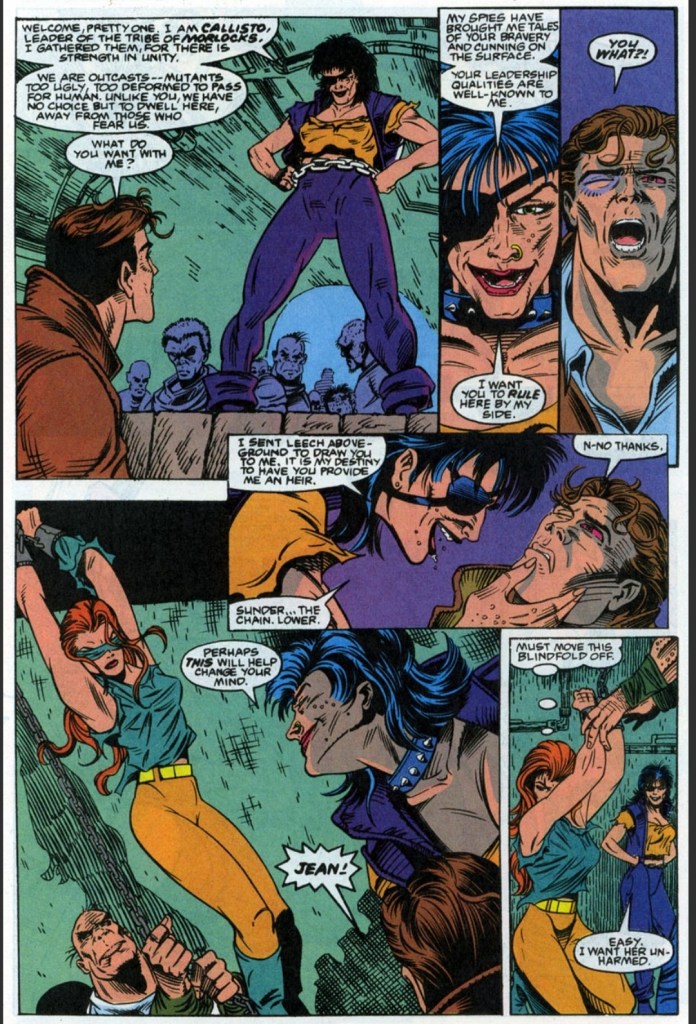
Cyclops and Jean Grey cornered by the Morlocks led by Callisto.

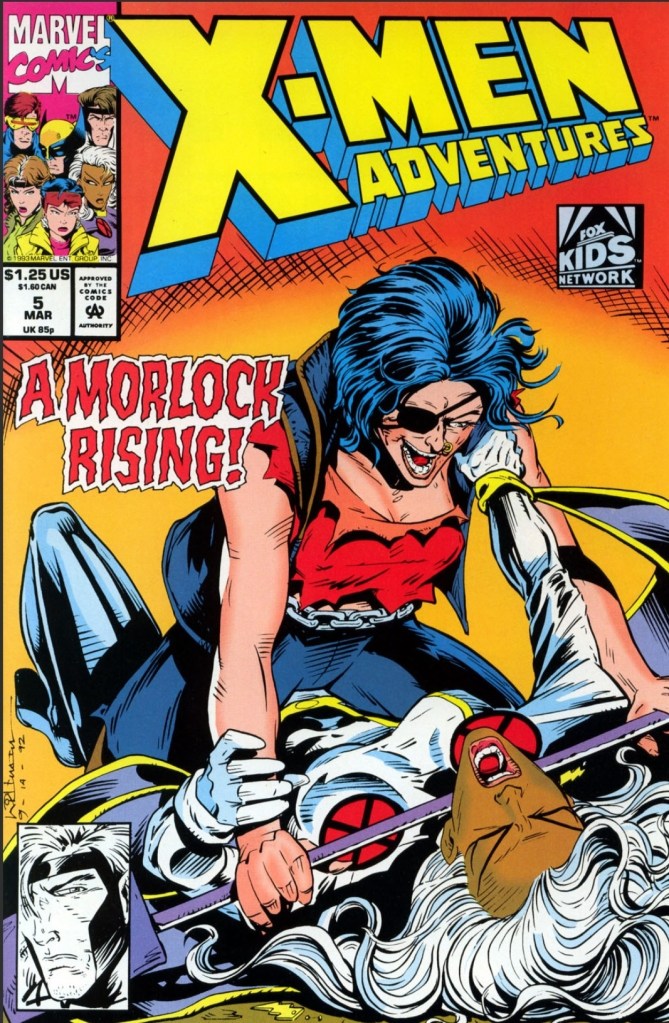
As the cover of this comic book shows, the main feature of the story is the X-Men’s encounter with the Morlocks (first appearance in Uncanny X-Men #169 published in 1983), a group of mutants living underneath the city of New York. Other than being a force of opposition, the Morlocks – led by Callisto – is itself a society composed of outcast mutants who could not really live among humans in normal society not only because of their mutations but also because of their collective look of deformity.

Picking up from the previous issue, the plot moved smoothly starting with a clear focus on Storm and her potential to lead the X-Men followed by the short but intriguing scene between Jean Grey and Wolverine. When the narrative shifted on New York City and the start of the conflict with the Morlocks, the story noticeably turned dark with its tone as the underground mutants become more prominent.

Other than the expected good-versus-evil emphasis of the plot, this comic book sheds light on the social ladder of America with the X-Men symbolizing the normal people and the Morlocks as the misfits. Symbolically speaking, the X-Men are bound to their code of no killing and their search for mutants that their leader Professor X could help, while the Morlocks prefer to be independent believing that isolation best serves their interests. Both the X-Men and the Morlocks have their respective approach on honor which is symbolized further when Storm and Callisto engage in close combat (note: this was the X-Men animated series’ adaptation of their fight as told in 1983’s Uncanny X-Men #170). I should also state that the portrayal of Cyclops and Jean Grey a very vulnerable figures in this story is pretty engaging.

To put things in perspective, the script of this comic book showed that the superhero spectacle is finely balanced with the strong dialogue and dramatization of the X-Men-Morlocks conflict.

Conclusion

The X-Men during the Danger Room session.

X-Men Adventures (1993) is not only a very engaging read on its own, it is also one fine adaptation of the X-Men animated series episode “Captive Hearts” which I first saw on local TV way back in 1993.

Overall, X-Men Adventures (1993) is recommended.

+++++

Thank you for reading. If you find this article engaging, please click the like button below and also please consider sharing this article to others. If you are looking for a copywriter to create content for your special project or business, check out my services and my portfolio. If you want to support my website, please consider making a donation. Feel free to contact me with a private message. Also please feel free to visit my Facebook page Author Carlo Carrasco and follow me on Twitter at  @HavenorFantasy as well as on Tumblr at https://carlocarrasco.tumblr.com/ and on Instagram athttps://www.instagram.com/authorcarlocarrasco/.
A Look Back at X-Men #30 (1994)

Disclaimer: This is my original work with details sourced from reading the comic book and doing personal research. Anyone who wants to use this article, in part or in whole, needs to secure first my permission and agree to cite me as the source and author. Let it be known that any unauthorized use of this article will constrain the author to pursue the remedies under R.A. No. 8293, the Revised Penal Code, and/or all applicable legal actions under the laws of the Philippines.

Welcome back, superheo enthusiasts, 1990s culture enthusiasts, X-Men fans and comic book collectors! Today we revisit the X-Men monthly series of the 1990s and look back at one of its most significant events it ever published – the wedding of Scott Summers/Cyclops and Jean Grey. By the time this particular comic book was published, the 30th anniversary celebration of the X-Men (note: Read my Fatal Attractions storyline retro reviews by clicking here and here) had just been concluded and that includes a major change of direction for the iconic X-Men member Wolverine. It is also notable that the X-Men had Sabretooth contained within Charles Xavier’s mansion (for retro reviews, click here, here and here).

With those details laid down, here is a look back at X-Men , published by Marvel Comics in 1994 with a story written by Fabian Nicieza and drawn by Andy Kubert.

The cover.

Early story

The story begins inside Xavier’s mansion. Jean Grey reads a handwritten letter from Logan/Wolverine, who left the household after getting traumatized from their last encounter with Magneto. Logan refers to her and Scott Summers as special. While reading, Jean is already in her fancy wedding dress being assisted by her mother and storm as Rachel Summers looks on. For Jean, the wedding is about her dedication on spending the rest of her life with Scott as well as possibly gaining Rachel (who comes from one possible future) as a daughter.

Professor X with four of his original team members plus Alex Summers.

Elsewhere in the mansion, the groom Scott spends quality time with his original teammates Bobbdy Drake/Ice Man, Warren Worthington/Archangel and Hank McCoy/Beast. With them also is his brother Alex Summers/Havok. Alex tells Scott that the day of his wedding is the first day of the rest of his life which causes Bobby to say something inappropriate.

Suddenly, Professor X comes in to join them…

Quality

Jean Grey in her wedding dress with her mother, Storm and Rachel Summers present.

To get straight to the point here, this comic book serves two purposes: highlighting Scott and Jean’s relationship to an all new level with the wedding as the main event, and offering long-time or die-hard X-Men fans a whole lot of stuff to chew on. Very clearly, Fabian Nicieza wrote the script with X-Men fans in mind while also making references to the past with some creative touches or shortcuts so that the comic book would not be bloated with excessive fan service.

The wedding itself was executed nicely by the Nicieza-Kubert team and was clearly conceptualized to not only be memorable for the fans but also creatively serve as a major pay-off to all those years of Scott and Jean Grey being together early as teammates, getting separated temporarily and getting together again (note: they were also the original X-Factor team). Right after the wedding was executed, the visuals and words elevated the emotions higher and any long-time X-Men fan will find the moment sentimental.

Opposite the wedding are several scenes showing the other X-Men characters plus those from X-Factor and X-Force (with a not-so-recognizable Cable present). The dialogue written ranged from sentimental to comedic. And then there were also a few lines that I felt were just thrown in as fillers.

As far as visuals go, Andy Kubert’s art here are pretty good to look at. While he did his best to really make the story visually appealing and memorable, there were a few panels of art that look rushed.

Conclusion

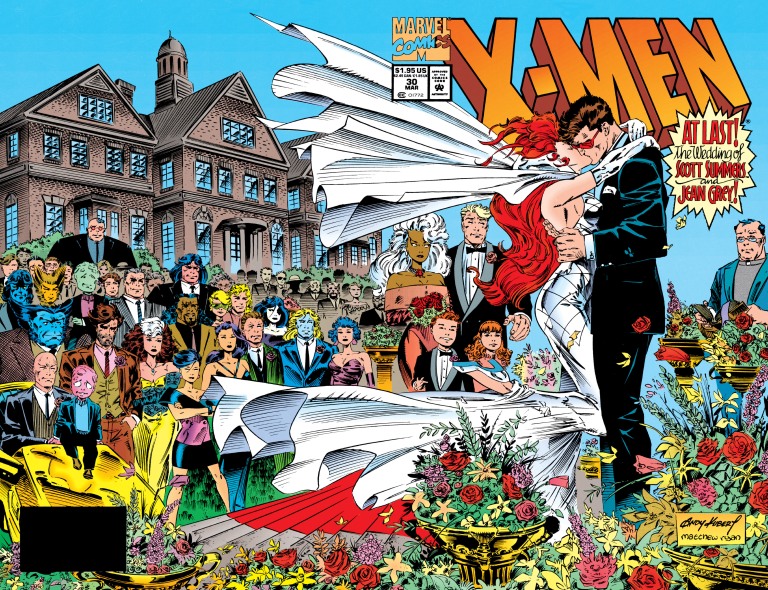
So many guests. Can you recognize many of them?

Since it highlights the wedding of Scott and Jean Grey with several other X-Men-related characters mixed in, X-Men (1994) is clearly a commemorative story made with X-Men fans in mind. While a lot of work was done to make the story momentous on its own, readers who are unable to immerse themselves deeply into the X-Men mythos (plus X-Force, X-Factor and others) prior to reading this comic book won’t be able to relate to the wedding and the character moments very much. While it may not be significant to newcomers who find this comic book for the first time, it still marks a significant chapter in the history of X-Men within the Marvel Comics universe of the late 20th century. For the long-time fans who were able to read enough of Scott and Jean Grey’s times together from 1963 until the early 1990s, this is one X-Men tale that they can relate with deeply.

Overall, X-Men (1994) is recommended.

+++++

Thank you for reading. If you find this article engaging, please click the like button below and also please consider sharing this article to others as well as making a donation to support my publishing.. If you are looking for a copywriter to create content for your special project or business, check out my services and my portfolio. Feel free to contact me with a private message. Also please feel free to visit my Facebook page Author Carlo Carrasco and follow me on Twitter at  @HavenorFantasy as well as on Tumblr at https://carlocarrasco.tumblr.com/ and on Instagram at https://www.instagram.com/authorcarlocarrasco