A Look Back at Spider-Man 2099 Special #1 (1995)

Disclaimer: This is my original work with details sourced from reading the comic book and doing personal research. Anyone who wants to use this article, in part or in whole, needs to secure first my permission and agree to cite me as the source and author. Let it be known that any unauthorized use of this article will constrain the author to pursue the remedies under R.A. No. 8293, the Revised Penal Code, and/or all applicable legal actions under the laws of the Philippines.

Welcome back superhero enthusiasts, 1990s culture enthusiasts and comic book collectors! Today we go back to the year 1995 and explore a part of the Marvel 2099 comics universe through a tale of the Spider-Man 2099 franchise.

Specifically speaking, we will examine a thick one-shot comic book about the futuristic Spider-Man simply referred to as a special. Back in those days, Marvel Comics hired the famous Brothers Hildebrandt and among the projects they worked on were varied pieces of captivating art about Marvel’s 2099 universe. In relation to this particular retro comic book review, the Hildebrandt brothers made the cover art for the special comic book which contained three standalone stories.

With those details laid down, here is a look back at Spider-Man 2099 Special #1, published in 1995 by Marvel Comics with the main story “The Menace of the Man-Spider” written by Jon Peterson and drawn by Joe St. Pierre.

The cover.

Early story

The story begins at 1:45 AM inside the high-tech laboratory of Synthia when the Man-Spider (a human in a monstrous form of a huge spider) causes havoc and tries to hurt the personnel inside in response to their interference of his work. One of the troubled personnel manages to call for help as the Man-Spider tries to get them.

Just as the two workers get hit by the Man-Spider’s organic green web, armored elements of the security force arrived in response to the call and one of them fires a hot at the beast’s right arm causing a serious wound. Suddenly, the Man-Spider violently jumps away smashing through a large window going into the city. The Man-Spider escapes leaving behind a mess at the laboratory including a high amount of organic web that disgusts the people back there.

Hours later at another part of the city, Spider-Man got spotted by a floating drone which declares him as under arrest under the authority of the Public Eye. Spider-Man simply kept on swinging away to another destination until he uses his organic web on the drone and hurls it to a wall and explodes into several tiny pieces. Once alone, he changes into civilian clothes as Miguel O’Hara and rushes to Synthia’s facility…

Quality

A huge monster breaks out.

Focusing on the main story (the first story), I find this particular tale of Spider-Man of 2099 rather worthy to read even though there were some flaws here and there. Jon Peterson crafted a story that took place sometime before the 34th issue of the original Spider-Man 2099 monthly series while reflecting what was declared in issue #8 and building up something new with it. The main story was about Spider-Man getting into eventual conflict with the Man-Spider (note: it looks like someone at Marvel decided to copy DC Comics’ Man-Bat and make something new for the Marvel 2099 franchise) who in turn is an antagonist who is deeply troubled and yet not really evil. The Man-Spider is actually a man who does not have super abilities but rather high scientific intelligence and the capabilities to alter genetics using advanced technologies. The Man-Spider is not obsessed with destroying the world or murdering people, but achieving a major breakthrough backed with good intentions.

One of the most notable weaknesses of the script written by Peterson is the emphasis that Miguel O’Hara/Spider-Man 2099, Dana and the so-called resident mad scientist Antoine have a history together since their youth. This one felt very forced and ended up being unbelievable.

Still on the world-building aspect of the story, this comic book showed a true link between the company Synthia and the gigantic Alchemax which reflects what was state in issue #8. This link between the two corporations opened up opportunities for the creators to emphasize Alchemax’s moves on securing valuable stuff for the future.

Ultimately, the main story turned out to be a good read even though there were flaws that somewhat took away credibility from its core concept. I should also state that Joe St. Pierre established a rather unique look for the Spider-Man 2099 franchise. His work here is a nice alternative opposite Rick Leonardi’s Spidey 2099 art.

While the 2nd story of this one-shot was not worth reading at all, the final story has a unique concept exploring voyeurism in 2099 which accidentally reminded me about how social media in real life could ruin the public’s perception and people themselves.

Conclusion

Spider-Man 2099, Dana and the Man-Spider in a dangerous situation.

With a good enough main story, one forgetful 2nd story and a satisfactory third story, Spider-Man 2099 Special #1 (1995) is ultimately a mixed bag. You will find variety here as well as unique takes on the futuristic Spider-Man and 2099’s society from the creators, but don’t expect great stuff. I think the most die-hard Spidey 2099 and Marvel 2099 fans will enjoy this the most.

Overall, Spider-Man 2099 Special #1 (1995) is serviceable.

+++++

Thank you for reading. If you find this article engaging, please click the like button below, share this article to others and also please consider making a donation to support my publishing. If you are looking for a copywriter to create content for your special project or business, check out my services and my portfolio. Feel free to contact me with a private message. Also please feel free to visit my Facebook page Author Carlo Carrasco and follow me on Twitter at  @HavenorFantasy as well as on Tumblr at https://carlocarrasco.tumblr.com/ and on Instagram at https://www.instagram.com/authorcarlocarrasco
A Look Back at Amazing Spider-Man #385 (1994)

Disclaimer: This is my original work with details sourced from reading the comic book and doing personal research. Anyone who wants to use this article, in part or in whole, needs to secure first my permission and agree to cite me as the source and author. Let it be known that any unauthorized use of this article will constrain the author to pursue the remedies under R.A. No. 8293, the Revised Penal Code, and/or all applicable legal actions under the laws of the Philippines.

Welcome back superhero enthusiasts, 1990s culture enthusiasts and comic book collectors! Today we go back to the year 1994 and explore a part of the Marvel Comics universe through one of the many tales of the Amazing Spider-Man comic book series.

In my previous retro review, Spider-Man has been caught by the Jury and gets tried in a makeshift court that is so secretive, getting help from outside is impossible. The trial explored how Spider-Man, who brought the alien costume into their world which later led to the beginning of his murderous mortal enemy, is responsible for the deaths and other tragedies connected to Venom.

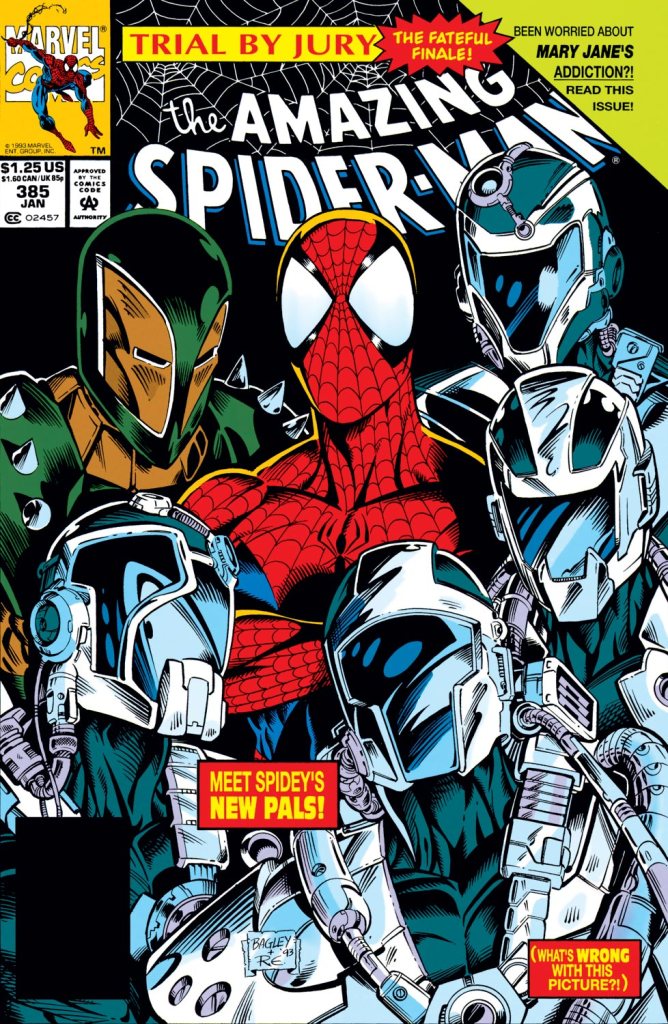
With those details laid down, here is a look back at Amazing Spider-Man #385, published in 1994 by Marvel Comics with a story by David Michelinie and drawn by Mark Bagley. This issue marks the final chapter of a 3-part storyline between the iconic webslinger and the Jury.

The cover.

Early story

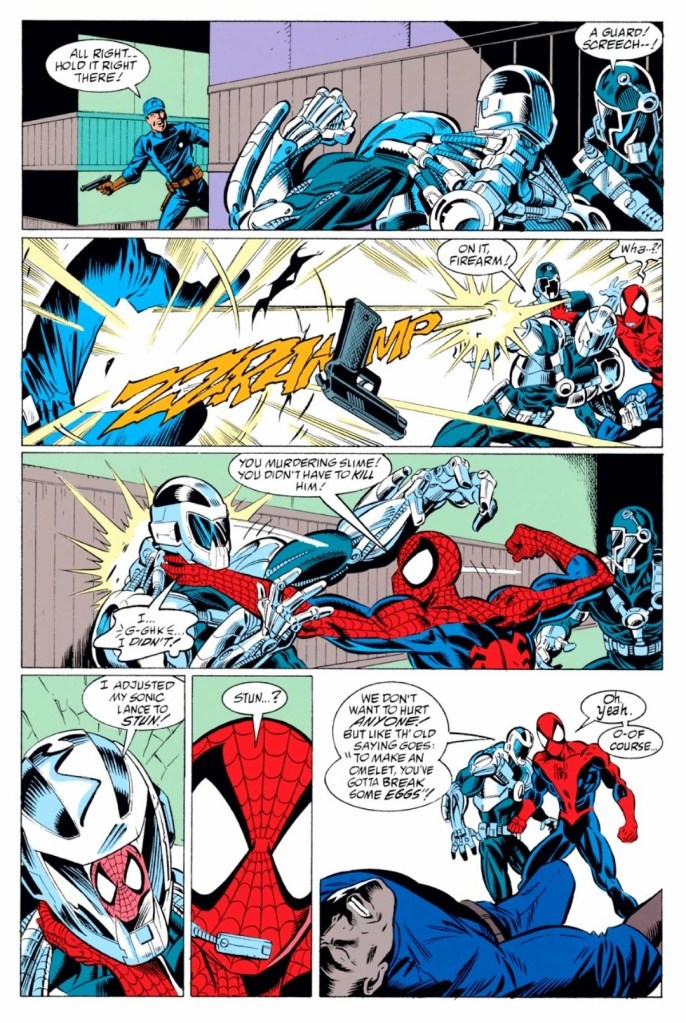
The story begins with a restrained Spider-Man declared guilty and sentenced to death by the so-called court of Orwell Taylor and the Jury. Just as the team members are about to execute the webslinger, their teammate Ramshot intervenes and says that Spider-Man saves lives which is a matter of public record. Disappointed by Ramshot’s behavior, Taylor mentions their secondary mission is to obtain a weapon that might allow them to eliminate their true enemy – Venom.

Taylor then says that if Spider-Man would help them destroy the greater evil, then the court would consider commuting his sentence…

Quality

Something unfortunate happens during the mission involving Spider-Man and the Jury.

Considering all the drama and tension that was built up in the previous two issues, the story here is a letdown. For one thing, all the discussions about Spider-Man being responsible for the killings and violence caused by Venom lead to nowhere as the story took a turn for the bizarre concept of the hero getting spared to work with the very team that went after him. Secondly, the mission that Spidey and the Jury worked on really did not have a justifiable goal. This resulted in a disappointing turn of events. Ironically, in this comic book you will see more of Taylor’s cunning on top of his own distorted view about justice.

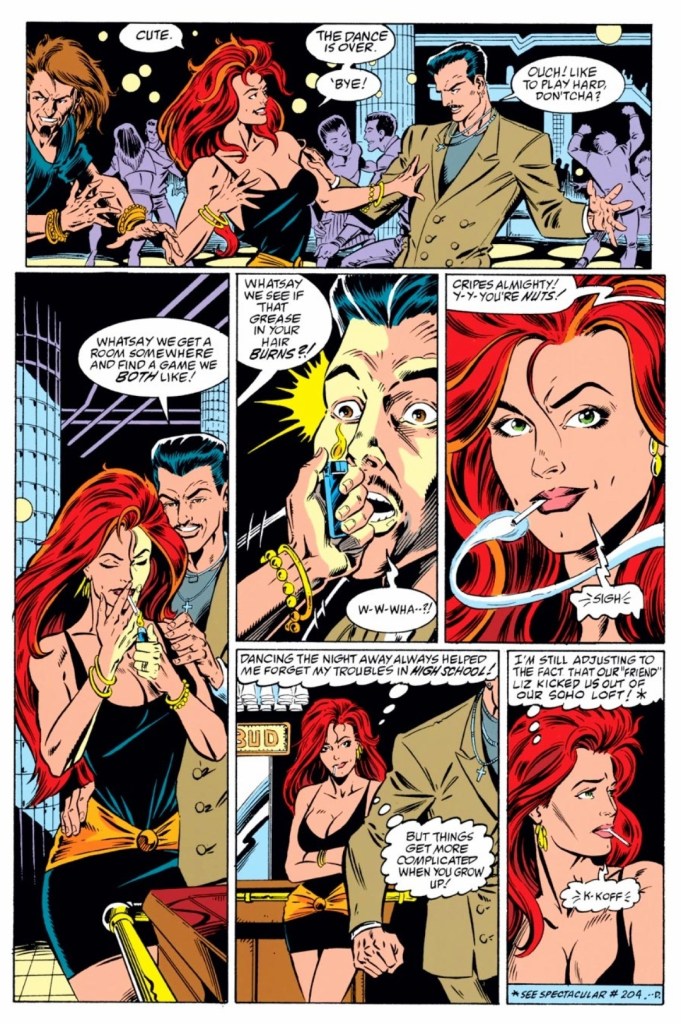
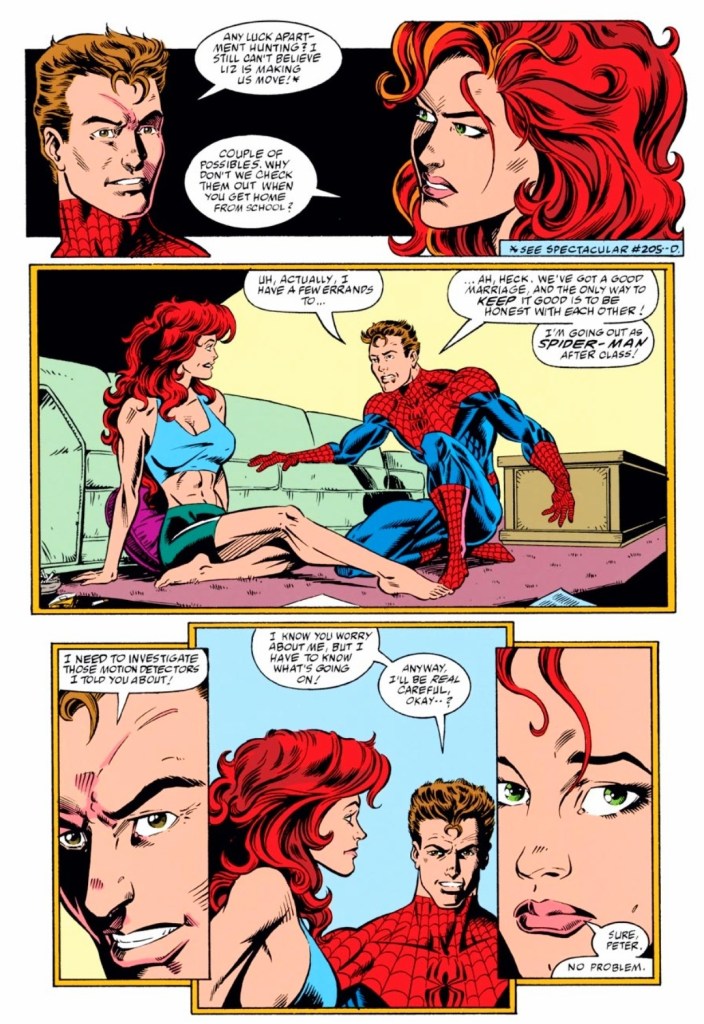
If there is anything notable here, it is the fact that Spider-Man’s wife Mary Jane gets a good share of the spotlight as she literally moves towards the edge in relation to the deteriorating marriage. This shows that as Spidey spends more time away to do what is good and push back against the forces of evil, his wife gets lonelier and desperate as life turns for the worse. At the very least, this comic book expresses that the marriage of Peter and Mary Jane could be doomed.

Conclusion

This is how Mary Jane deals with loneliness and the decline in her life.

Considering what was built up and heavily dramatized in issues #383 and #384, Amazing Spider-Man #385 (1994) is a rather weak conclusion. The way Spider-Man and the Jury parted ways felt more like sudden retreat than a real finish to what was started between them. Strangely enough, the focus on Mary Jane’s decline and desperation literally saved this comic book from becoming a creative disaster. The ending does not have much to do between Spider-Man and the Jury, but it was surprising in a crude way.

Overall, Amazing Spider-Man #385 (1994) is serviceable.

+++++

Thank you for reading. If you find this article engaging, please click the like button below, share this article to others and also please consider making a donation to support my publishing. If you are looking for a copywriter to create content for your special project or business, check out my services and my portfolio. Feel free to contact me with a private message. Also please feel free to visit my Facebook page Author Carlo Carrasco and follow me on Twitter at  @HavenorFantasy as well as on Tumblr at https://carlocarrasco.tumblr.com/ and on Instagram at https://www.instagram.com/authorcarlocarrasco
A Look Back at Superman vs. Aliens #1 (1995)

Disclaimer: This is my original work with details sourced from reading the comic book and doing personal research. Anyone who wants to use this article, in part or in whole, needs to secure first my permission and agree to cite me as the source and author. Let it be known that any unauthorized use of this article will constrain the author to pursue the remedies under R.A. No. 8293, the Revised Penal Code, and/or all applicable legal actions under the laws of the Philippines.

Welcome back superhero enthusiasts, 1990s culture enthusiasts and comic book collectors! Today we go back to the year 1995 to examine what was back then one of the most unthinkable comic book crossovers to ever happen – Superman vs. Aliens (also referred to as Superman/Aliens).

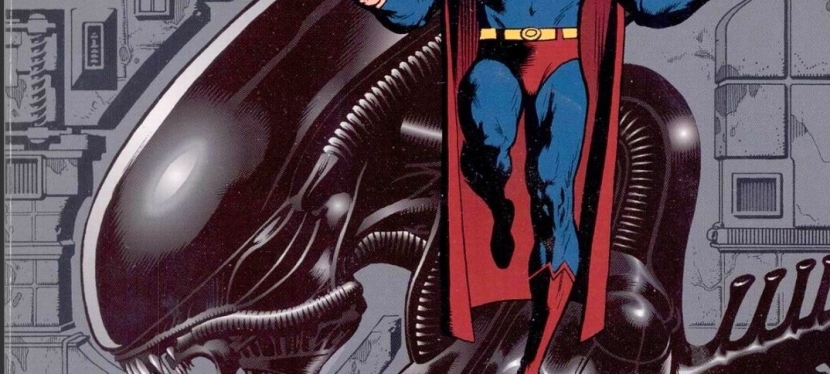
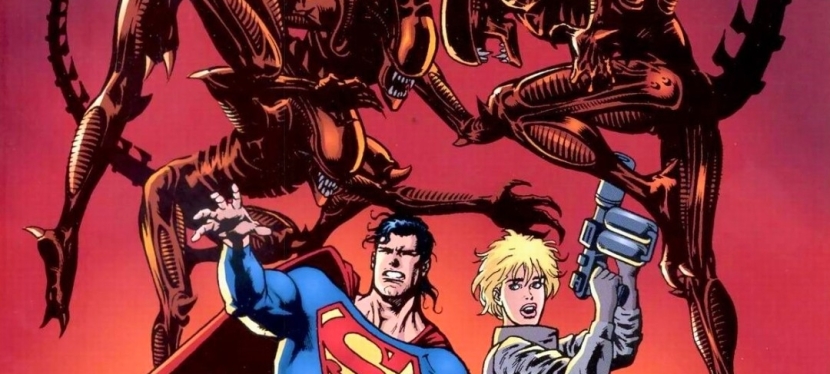
I remember sometime back in 1994, I bought a new superhero comic book from the local comic book retailer and what caught my attention was the print ad on the back – an Alien chestburster crashing through the iconic Superman S logo. A few of my friends who saw the same print ad chuckled at the concept of having the Man of Steel together with the monsters from the movie franchise that first started in 1979 with Ridley Scott’s Alien. Then came 1995 and eventually the first issue of the Superman vs. Aliens mini-series made it on the shelves of local comic book stores. Its cover easily attracted the attention of many and I saw the image of Superman being smaller to the Xenomorph alien in the background, the concept of the crossover started to intrigue me.

With those details laid down, here is a look back at Superman vs. Aliens #1, published in 1995 by Dark Horse Comics and DC Comics with a story written and drawn by Dan Jurgens with ink work done by Kevin Nowlan.

The cover.

Early story

The story begins in space when a fast moving object from nowhere heads towards Earth which was detected by a satellite of Lex Luthor’s corporation. Behind the scenes, personnel initiated an alert for a certain Dr. Kimble.

Clark Kent (Superman) and Lois Lane arrive at the headquarters of Lexcorp. It turns out they were suddenly called for by the corporation due to what happened in space. As they ride the elevator heading towards the rooftop, Clark and Lois talk about Lexcorp’s space program and Dr. Kimble who happens to lead the said program.

At the roof, they meet Dr. Cheryl Kimble and immediately ride with her in the helicopter going to a certain destination in anticipation of the probe’s estimated arrival. During the trip, Kimble reveals that they received radio signals from the incoming probe which were garbled almost unintelligible. She then plays an excerpt of the radio signals for Clark and Lois to listen to.

For Clark, he cannot help but feel shocked as he finds the audio sounding like Kryptonian…

Quality

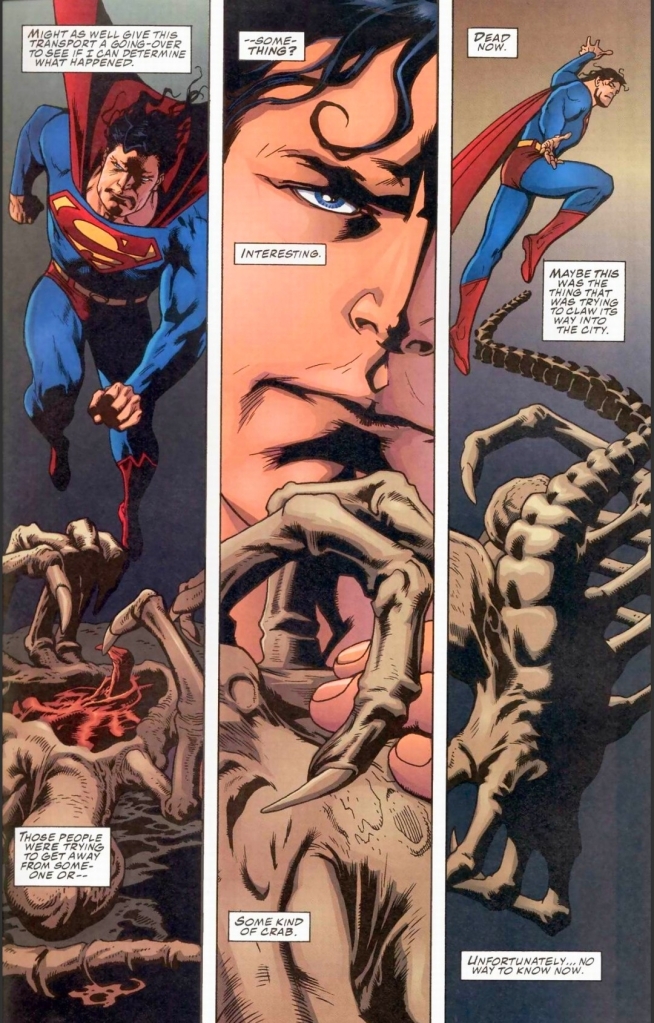
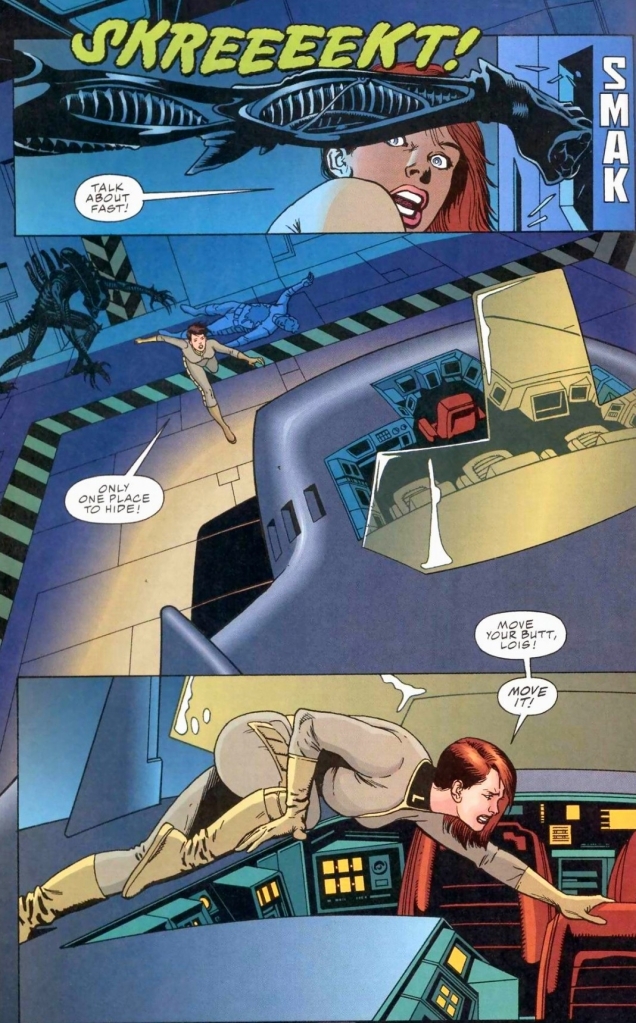
Superman finds a dead Facehugger alien.

Firstly, I can say without any hesitation that the creative team succeeded in making the crossover between Superman and the Aliens believable within this very comic book. For one thing, Dan Jurgens came up with a script and visual design that radically different from what was shown in Superman comic books of the time. The script had this somewhat adulterated tone that made the comic book move away from superhero fantasy and move into the realm of cinematic science fiction. For setting the tone and the look, the creative team scored a home run.

Secondly, the script was properly structured to immerse readers with the tale initially following Superman, Lois Lane and Dr. Kimble which ultimately served as a build-up. The good news here is that readers don’t have to wait too long for the pay-off to be executed. In fact, the pay-off itself (which happens when the Man of Steel finally encounters the Xenomorph for the first time) is huge and immediately the tension and depth of the plot really shifted into high-gear which I enjoyed. Along the way, the expository dialogue or the presentation of details (to help readers understand) was nicely balanced.

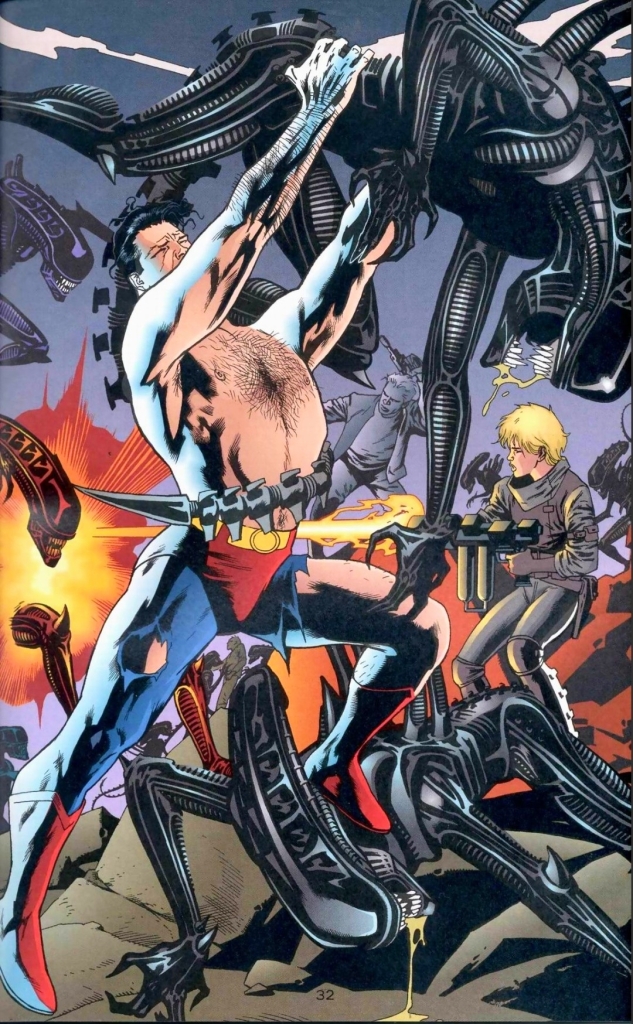
Thirdly, I love the way how Dan Jurgens presented Superman as being more troubled and more vulnerable than usual. To see the American icon go into personal obsession over the Kryptonian details was a really unique way to presenting his human side. Also having Superman deep in space far away from any sun or star (the essential source for his powers) really made him truly vulnerable as he actually got weaker even before facing off with a Xenomorph. Being in a vulnerable state, you will see the Man of Steel in real danger which truly goes against type (note: being super strong and invulnerable all the time). As such, the danger of the Aliens against him is believable and intense. What I do find weird, however, is how awkward it is for me to see Superman actually trying to reason with the first Xenomorph he encounters. Of course, he has no previous knowledge about the violent nature of the Aliens but we readers – and millions of people who saw any of the movies – know better than him.

As part of the build-up, Dan Jurgens inserted details and flashbacks that recalled previous tales that were published during the early stage of the post-Crisis era of DC Comics. This not only includes Superman’s arrival on Earth but also his strategic killing of General Zod, Zaora and  Quex-Ul using green Kryptonite (as published in Superman #22 of 1988). As such, Superman’s deep regret of taking life away from others serves as a build-up for his avoidance of killing in this crossover. This actually races the stakes for his upcoming encounters with the Aliens.

Even though the story is told through Superman, Dan Jurgens still had enough room to develop Lois Lane and Dr. Kimble. Kimble symbolizes the driven corporate executive who is in-charge of operations that could help her make claims on scientific discoveries and new technologies. Lois Lane here served as the intellectual opposite of Kimble without ever going into the extremes of gaining something for her journalistic career.

Conclusion

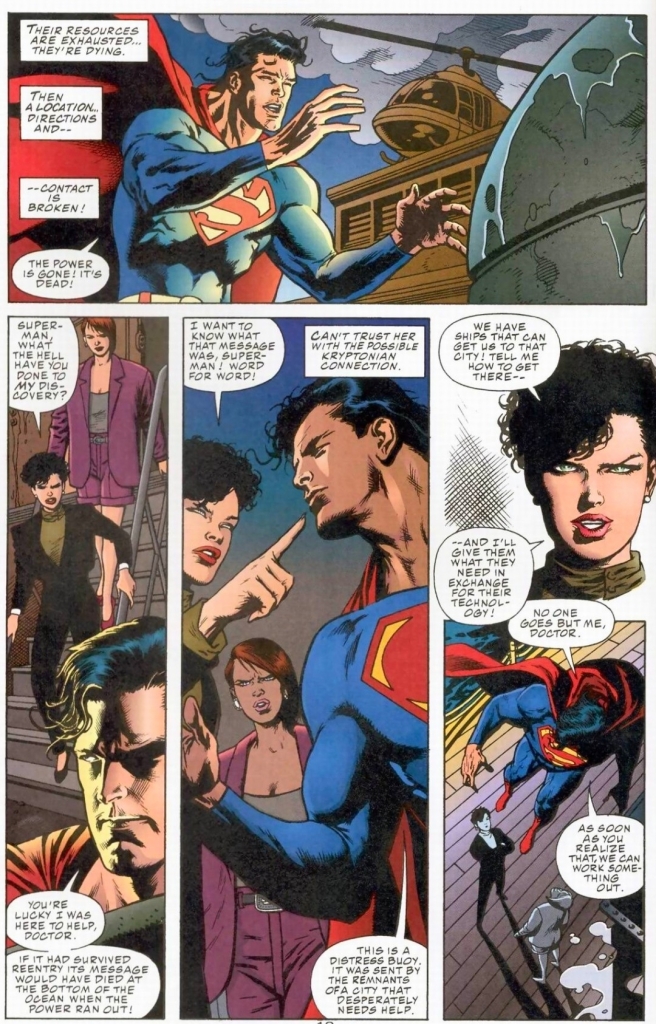
Superman with Lois Lane and Dr. Kimble.

Very clearly, Superman vs. Aliens #1 (1995) is indeed a great comic book as well as great opener for its mini-series. Dan Jurgens established a tale that had sufficient build-up and when the pay-off started, the crossover aspect really made the story more compelling to read. Ultimately, this one made the crossover between Superman and the Xenomorphs believable, engaging and intriguing. This comic book is a great start and I am eager to find out what happens next.

Overall, Superman vs. Aliens #1 (1995) is highly recommended!

+++++

Thank you for reading. If you find this article engaging, please click the like button below, share this article to others and also please consider making a donation to support my publishing. If you are looking for a copywriter to create content for your special project or business, check out my services and my portfolio. Feel free to contact me with a private message. Also please feel free to visit my Facebook page Author Carlo Carrasco and follow me on Twitter at  @HavenorFantasy as well as on Tumblr at https://carlocarrasco.tumblr.com/ and on Instagram at https://www.instagram.com/authorcarlocarrasco
A Look Back at Amazing Spider-Man #382 (1993)

Disclaimer: This is my original work with details sourced from reading the comic book and doing personal research. Anyone who wants to use this article, in part or in whole, needs to secure first my permission and agree to cite me as the source and author. Let it be known that any unauthorized use of this article will constrain the author to pursue the remedies under R.A. No. 8293, the Revised Penal Code, and/or all applicable legal actions under the laws of the Philippines.

Welcome back superhero enthusiasts, 1990s culture enthusiasts and comic book collectors! Today we go back to the year 1993 and explore a part of the Marvel Comics universe through one of the many tales of the Amazing Spider-Man comic book series.

In my previous retro review, Spider-Man gets involved not only with the Incredible Hulk but also with Doc Samson who has a history of treating the green giant and carries a strong sense of responsibility towards him. Something, however, infected Samson and eventually the Hulk which leads to a new wave of destruction in New York City which itself is still recovering from the chaos of Maximum Carnage.

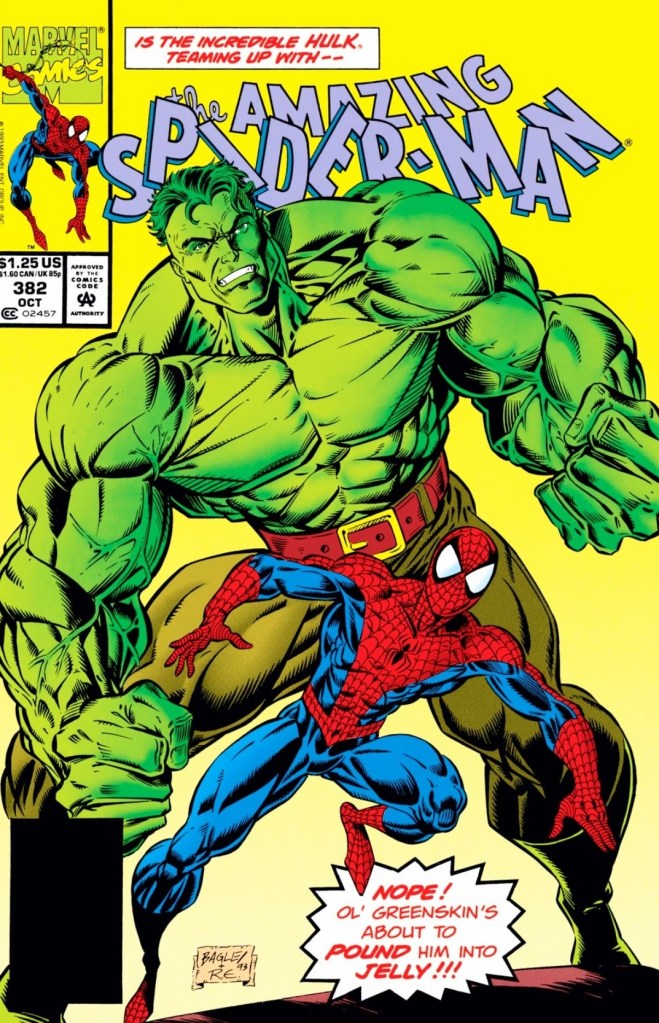
With those details laid down, here is a look back at Amazing Spider-Man #382, published in 1993 by Marvel Comics with a story written by David Michelinie and drawn by Mark Bagley.  

The cover.

Early story

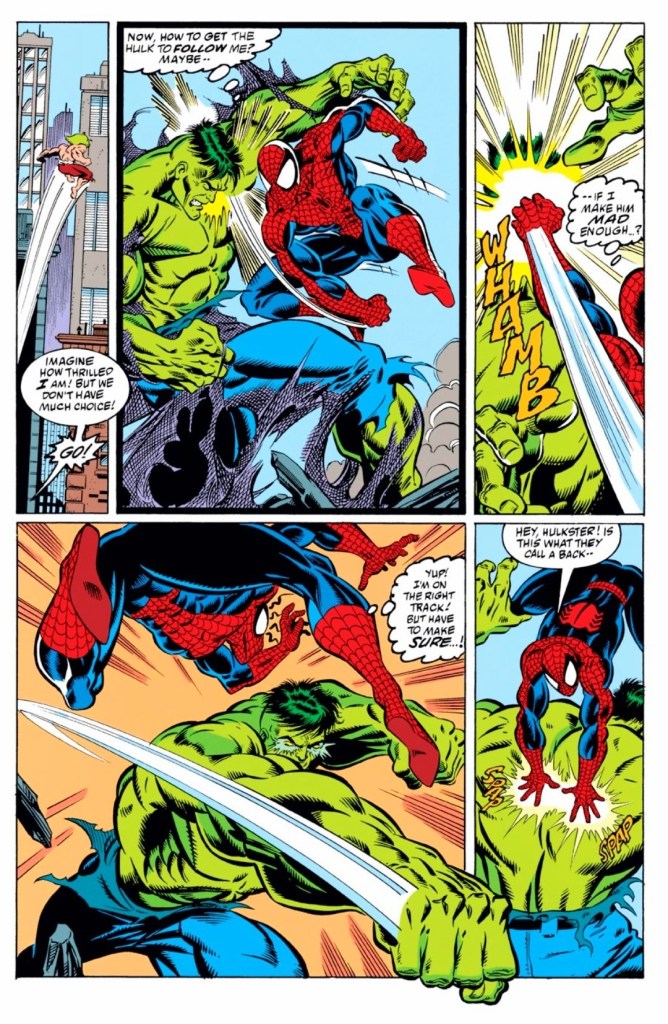
The story begins with the Hulk (note: infected with the gamma virus which is driving him to violence) striking the pavement hard causing Spider-Man and Doc Samson to move away. After a quick exchange of words with Samson regarding the virus, Spider-Man jumps towards the Hulk and hits his face in an attempt to stop him before he causes any more damage to the city.

Doc Samson desperately tries to contain the Hulk by choking him only to be grabbed and get thrown to a solid structure nearby. Now down on the pavement, Samson notices the Hulk jumping in towards him…

Quality

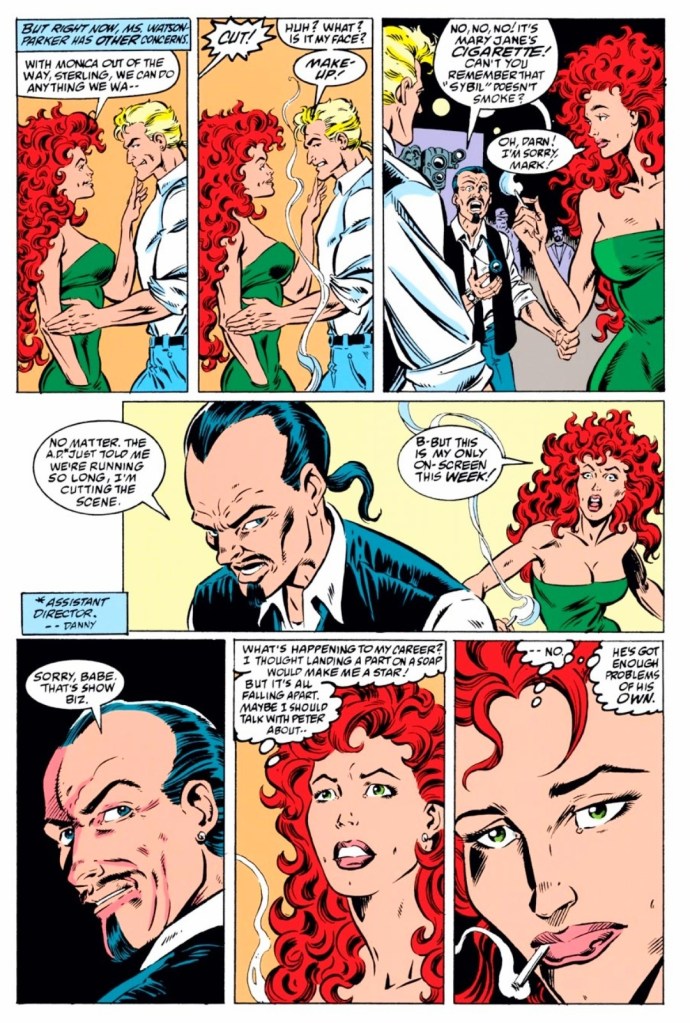
Mary Jane Parker in trouble with her acting career.

This story is indeed a solid and satisfying conclusion to what was started in issue #381. Not only does this comic book showcase a battle between Spider-Man and the manipulated Hulk, it also highlights Doc Samson’s importance not only as a supporting player but also as a scientist struggling with his responsibility over helping the Hulk. There is a strong sense of burden you will sense in Samson who himself caused a lot of damage when he was infected with the virus before the Hulk got infected by it.

The presentation of the virus/bacterium as the factor behind the chaos is a believable concept that highlights what would happen if people carrying gamma radiation in their bodies get infected by it.

If you are looking for fun, there is a lot of action here with lots of dynamic looking images crafted by Mark Bagley. Yes, you will see action and incidental moments between Spider-Man and the Hulk here and there, with Samson also getting a notable share of the spotlight. How the conflict concluded was cleverly done and ultimately surprising. This is something you readers will have to discover for yourselves.

Conclusion

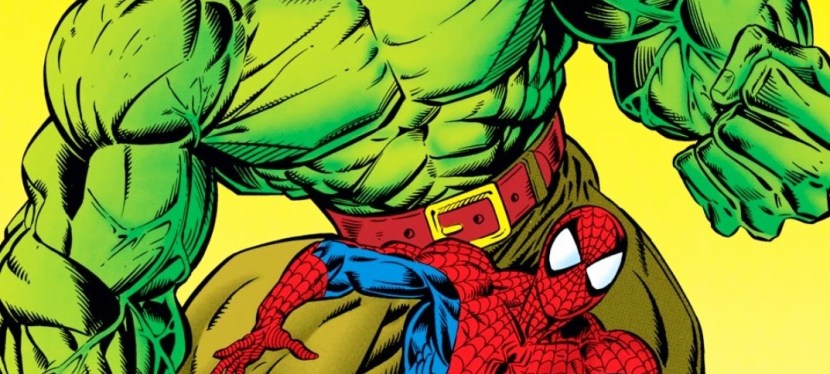
As Doc Samson goes away, Spider-Man takes on the Hulk.

Amazing Spider-Man #382 (1993) is a well-paced and satisfying conclusion to the events that started in the previous issue. At the time of its release, the comic book highlighted a modern crossover between the Hulk and Spider-Man with Doc Samson inserted as a functional third participant. The concept of the gamma virus/bacterium works well here and added a more science fictional layer to the plot. This comic book is pretty entertaining and the suspense really built-up nicely towards the climax.

Overall, Amazing Spider-Man #382 (1993) is recommended!

+++++

Thank you for reading. If you find this article engaging, please click the like button below, share this article to others and also please consider making a donation to support my publishing. If you are looking for a copywriter to create content for your special project or business, check out my services and my portfolio. Feel free to contact me with a private message. Also please feel free to visit my Facebook page Author Carlo Carrasco and follow me on Twitter at  @HavenorFantasy as well as on Tumblr at https://carlocarrasco.tumblr.com/ and on Instagram at https://www.instagram.com/authorcarlocarrasco
A Look Back at Amazing Spider-Man #384 (1993)

Disclaimer: This is my original work with details sourced from reading the comic book and doing personal research. Anyone who wants to use this article, in part or in whole, needs to secure first my permission and agree to cite me as the source and author. Let it be known that any unauthorized use of this article will constrain the author to pursue the remedies under R.A. No. 8293, the Revised Penal Code, and/or all applicable legal actions under the laws of the Philippines.

Welcome back superhero enthusiasts, 1990s culture enthusiasts and comic book collectors! Today we go back to the year 1993 and explore a part of the Marvel Comics universe through one of the many tales of the Amazing Spider-Man comic book series.

In my previous retro review, Spider-Man became the new target of The Jury, a team of armored mercenaries founded and led by the father (note: a prominent and powerful man) of one of Venom’s murder victims. Spider-Man was perceived to be responsible for bringing the living alien costume into the world which eventually resulted in the creation of Venom (note: Eddie Brock bonded with the same symbiote) who went on to cause havoc and killed a lot of people.

With those details laid down, here is a look back at Amazing Spider-Man #384, published in 1993 by Marvel Comics with a story by David Michelinie and drawn by Mark Bagley.  

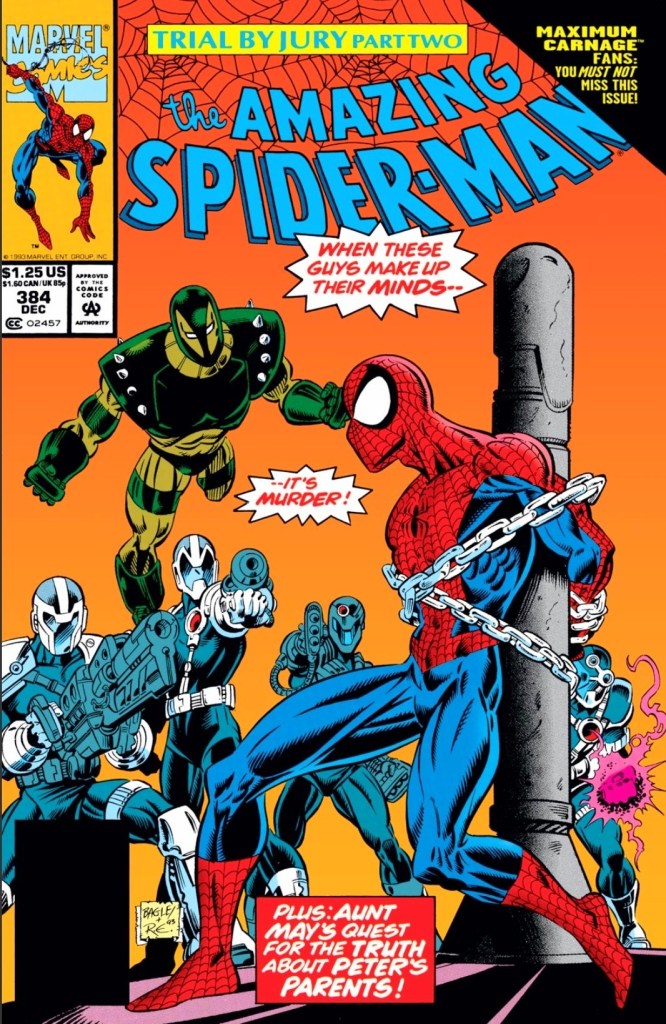
The cover.

Early story

The story begins inside a certain government building in New York City scheduled for renovation. A heavily restrained and drugged Spider-Man was about to have mask taken off by one of The Jury members when their founder General Taylor intervened and insisted that they keep their honor. Spider-Man is up for questioning and scrutinization in a makeshift trial by The Jury. As the webslinger is not in the proper condition to stand trial, Taylor (in his capacity as the judge) declares a 30-minute recess.

Elsewhere, Peter Parker’s wife Mary Jane received bad news from her boss that her role in the TV show Secret Hospital will be reduced to a recurring role. This troubles her deeply as it means reduced income for her at a time when her marriage with Peter continues to go down. Spider-Man’s lack of quality time with her keeps taking its toll on her…

Quality

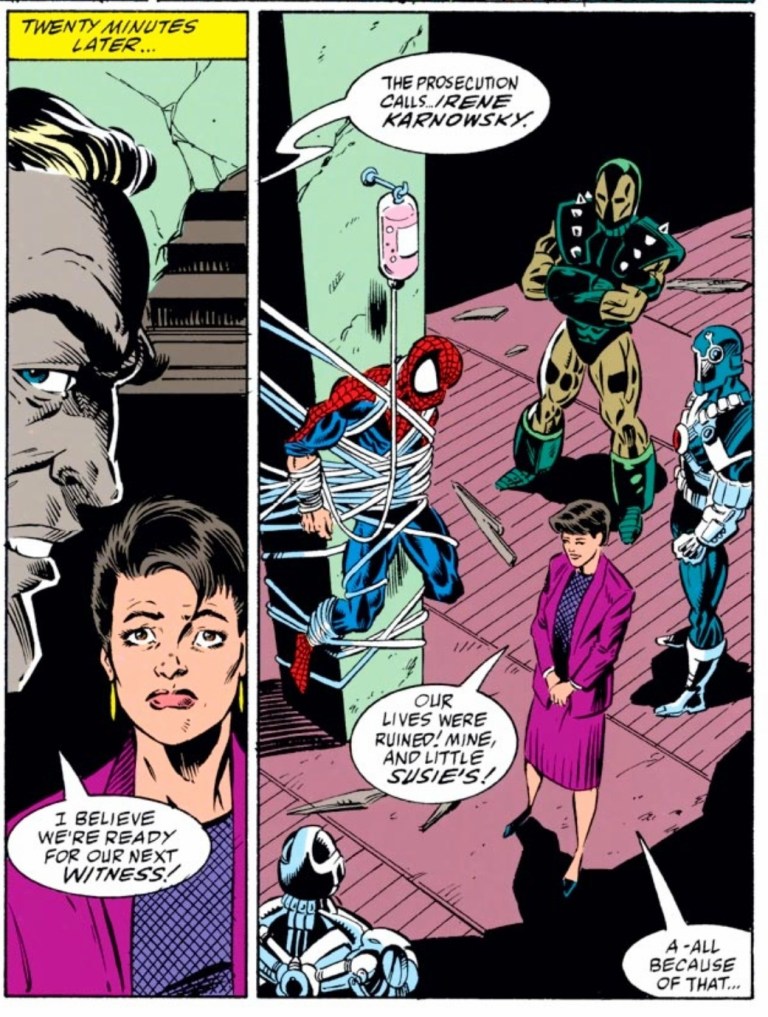
Spidey on trial!

Firstly, I should say that the Michelinie-Bagley team’s concept of having The Jury as the force of opposition against Spider-Man continues to do wonders creatively in this particular comic book series. In the previous issue, the webslinger was hunted and General Taylor really invested a lot of technologies to get to him in the middle of a very bustling city. In this particular issue, Spider-Man is completely vulnerable being weakened and disoriented as he is about to be tried in a makeshift court.

Along the way, Taylor and his team were portrayed to work within their own system of justice. As no court of law in New York would recognize Spider-Man’s trial, The Jury set up their own court in a very private and unusual manner.

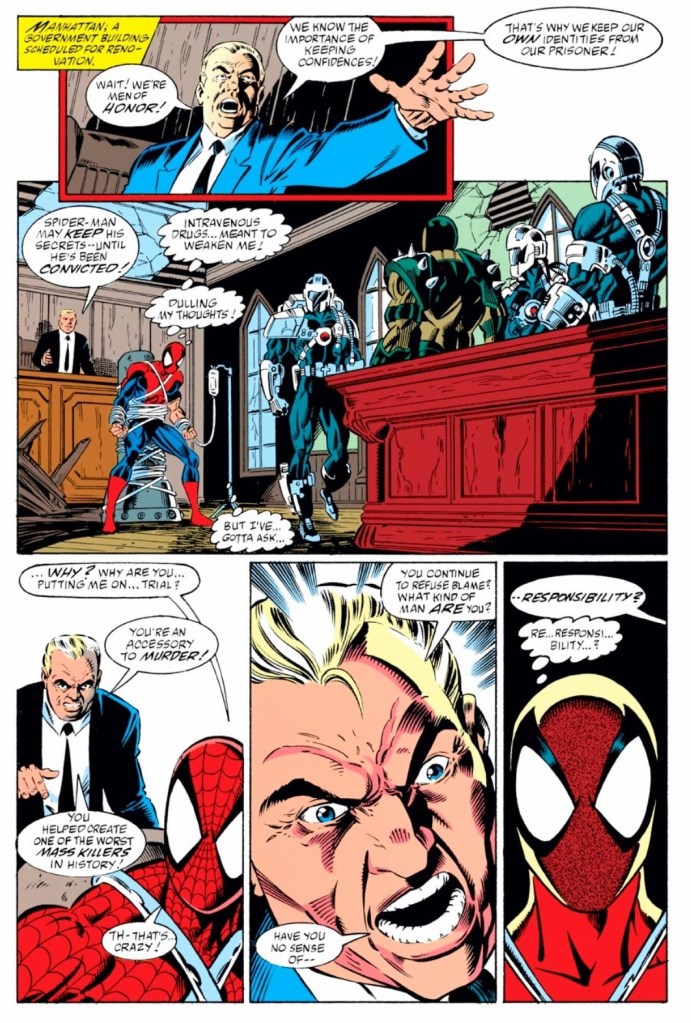
While the planned trial is the major event of this comic book’s concept, Michelinie pulled off a rather unusual move with the narrative. Just as the first witness points to Spider-Man for being responsible for Venom, the iconic webslinger then starts to wonder what the trial is truly all about and then the creative team unleashed a slew of flashbacks that looked back a key events published in certain comic books of Secret Wars, The Amazing Spider-Man and Web of Spider-Man through the years. I’m talking about Spider-Man’s first-ever encounter with the symbiote, how he got rid of it, how the symbiote bonded with Eddie Brock to form Venom, how Venom’s costume left a living seed that Cletus Kassady touched and became Carnage, etc. These flashbacks, all nicely drawn by Mark Bagley, conveniently served as an instant reference for readers to catch up with the current events but this was done at the expense of this comic book’s narrative.

More on the trial, this comic book raises layered questions about the concept of responsibility on Spider-Man. Could the iconic webslinger really be held accountable for whatever murders Venom committed along with the trauma he caused on bystanders given the fact that he really brought the alien costume into their world? Should Spider-Man also be held responsible for any murders committed by Carnage? This is one really loaded script Michelinie came up with and he really had Spider-Man vulnerable not only to The Jury but also to the questions thrown at him during the makeshift trial. To put it short, this is one very unusual Spider-Man tale ever told that carries strong relevance from the past.

As with the previous issues, this comic book sheds a limited amount of the spotlight on Mary Jane and Spider-Man’s Aunt May who at this stage has gotten paranoid with her suspicions about Peter’s parents. The dramatization turned out pretty good.

Conclusion

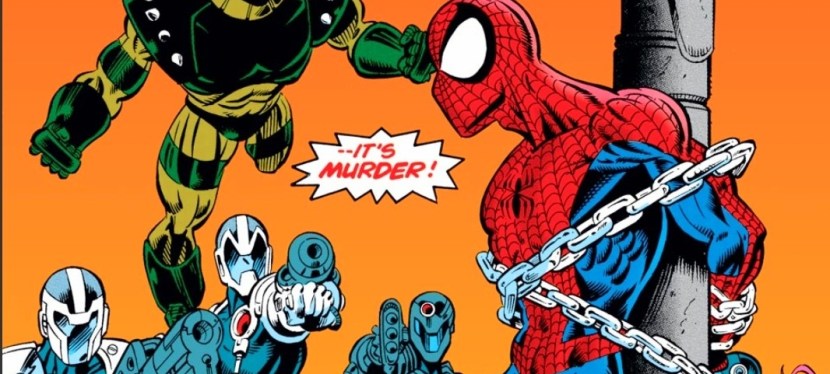
Spider-Man in a vulnerable state with The Jury.

While the flashbacks were excessive and made the narrative feel bloated, Amazing Spider-Man #384 (1993) still has lots of good stuff fans can enjoy. It has a pretty bold concept of having Spider-Man really trapped and left vulnerable for the makeshift trial. More notably, the narrative pounded heavily on the concept of responsibility in relation to Spider-Man’s past actions that led to the creation of Venom and even Carnage.

Overall, Amazing Spider-Man #384 (1993) is recommended!

+++++

Thank you for reading. If you find this article engaging, please click the like button below, share this article to others and also please consider making a donation to support my publishing. If you are looking for a copywriter to create content for your special project or business, check out my services and my portfolio. Feel free to contact me with a private message. Also please feel free to visit my Facebook page Author Carlo Carrasco and follow me on Twitter at  @HavenorFantasy as well as on Tumblr at https://carlocarrasco.tumblr.com/ and on Instagram at https://www.instagram.com/authorcarlocarrasco

A Look Back at Superman #5 (1987)

Disclaimer: This is my original work with details sourced from reading the comic book and doing personal research. Anyone who wants to use this article, in part or in whole, needs to secure first my permission and agree to cite me as the source and author. Let it be known that any unauthorized use of this article will constrain the author to pursue the remedies under R.A. No. 8293, the Revised Penal Code, and/or all applicable legal actions under the laws of the Philippines.

Welcome back superhero enthusiasts, 1980s culture enthusiasts and comic book collectors! Today we go back to the year 1987 and explore a chapter of the post-Crisis DC Comics universe through a Superman tale.

To put things in perspective, John Byrne became in charge of redefining the iconic Superman during the post-Crisis age and he sure had a lot of creative freedom to not only modernize the character but also make him relevant to the public while also pleasing long-time fans. To say the least, the post-Crisis era was a time of daring concepts with the established superheroes of DC Comics. For more insight on Byrne’s handling of the Man of Steel, read my other retro comic book review by clicking here.

With those details laid down, here is a look back at Superman #5, published in 1987 by DC Comics with a story written and drawn by John Byrne.

The cover.

Early story

The story begins with Clark Kent having an outrageous dream in which he and Wonder Woman fight powerful enemies together. Shortly after arriving at the Daily Planet for duty, Clark learns from his boss Perry White that his office rival Lois Lane is already in South America literally digging on a significant discovery there. After being sent there by his boss, Clark flies to the south as Superman.

Upon arrival, Superman does a super speed reconnoiter at the dig site in the middle of a forest before changing back into Clark Kent. He eventually finds Lois Lane who is very surprised to see him. Even though he explained things to her, Lois remains doubtful of Clark as she still sees him as a journalistic rival who could potentially ruin her hot scoop…

Quality

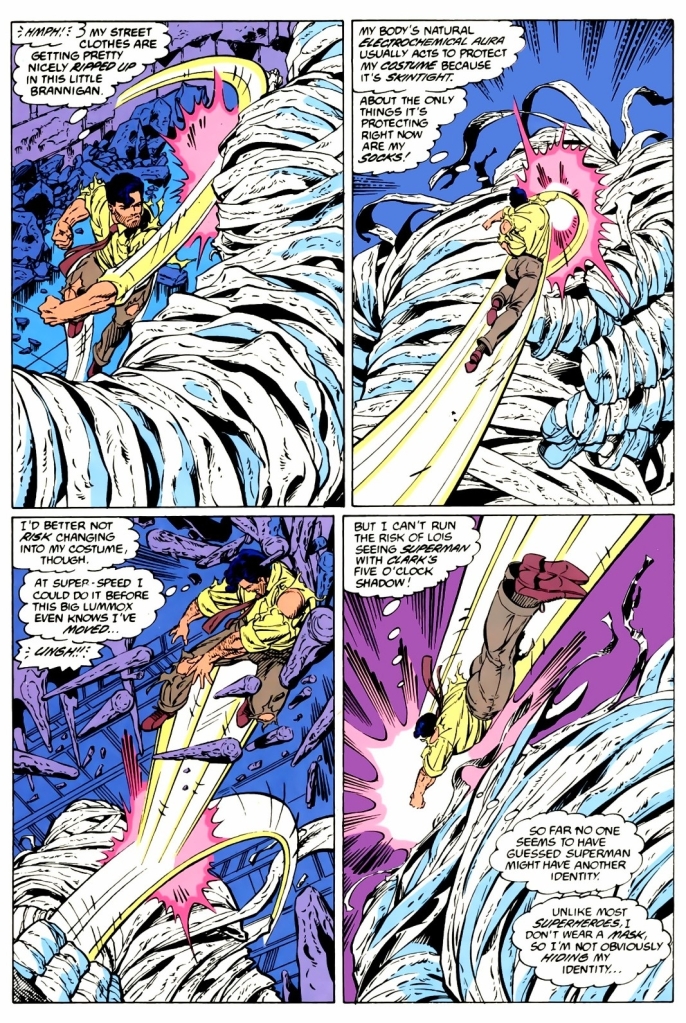
In his civilian form as Clark Kent, Superman fights the huge mummy figure.

I can say that John Byrne’s brilliance is very evident in this comic book. Firstly, this is a story that sheds light on the journalistic rivalry between Lois and Clark that brings back memories about what happened with the Superman hot scoop in The Man of Steel limited series. Here, Lois remains doubtful about Clark and even shows some bitterness as she is on the verge of a major discovery in South America.

Secondly, this story is also an accidental adventure that creatively has a mix of Indiana Jones, UFOs and ancient horror all throughout. The build-up here is pretty strong as the tale focused strongly on the discovery aspect of the dig site which eventually led to a series of action-packed unfortunate events that really pushed Clark Kent both as civilian and as a superhero. Here, Clark has the tough task to fight an over-sized enemy (note: Byrne’s own take on the mummy) to keep Lois and the others safe while also making certain that he keeps his identity secret.

Along the way, Byrne inserted lots of in-depth details backed with observations (by the characters) which made this action-packed tale a cerebral read. This is a fine example of being creative with handling Superman while catering to readers who love spectacle as well as satisfying those who enjoy a smart presentation of the icon. In other words, there is nothing brainless or dumb to find here.

Conclusion

The journalistic rivalry between Clark and Lois Lane is really engaging to read.

Superman #5 (1987) is a very good read and this is fine showcase of the brilliant handling of the Man of Steel done by John Byrne. Aesthetics aside, this comic book is a relic that highlights the time when Lois and Clark were rival writers and the idea of them getting romantically involved seemed very unlikely at the time of its publishing during the early stage of the post-Crisis era. It was in many ways a defiance of the status quo of the original DC multiverse that had Lois and Superman as lovers. As an adventure, this comic book is very entertaining and engaging and the thing here is that it is only the first part of its arc.   

Overall, Superman #5 (1993) is highly recommended.

+++++

Thank you for reading. If you find this article engaging, please click the like button below, share this article to others and also please consider making a donation to support my publishing. If you are looking for a copywriter to create content for your special project or business, check out my services and my portfolio. Feel free to contact me with a private message. Also please feel free to visit my Facebook page Author Carlo Carrasco and follow me on Twitter at  @HavenorFantasy as well as on Tumblr at https://carlocarrasco.tumblr.com/ and on Instagram at https://www.instagram.com/authorcarlocarrasco
A Look Back at Amazing Spider-Man #383 (1993)

Disclaimer: This is my original work with details sourced from reading the comic book and doing personal research. Anyone who wants to use this article, in part or in whole, needs to secure first my permission and agree to cite me as the source and author. Let it be known that any unauthorized use of this article will constrain the author to pursue the remedies under R.A. No. 8293, the Revised Penal Code, and/or all applicable legal actions under the laws of the Philippines.

Welcome back superhero enthusiasts, 1990s culture enthusiasts and comic book collectors! Today we go back to the year 1993 and explore a part of the Marvel Comics universe through one of the many tales of the Amazing Spider-Man comic book series.

To put things in perspective, the creative team behind the Amazing Spider-Man title decided to shake things up a bit by having the high-tech team called The Jury (the same team that went against Venom led by a powerful man whose son was murdered by Eddie Brock in Amazing Spider-Man #315) as the force of opposition for the webslinger.

With those details laid down, here is a look back at Amazing Spider-Man #383, published in 1993 by Marvel Comics with a story by David Michelinie and drawn by Mark Bagley.  

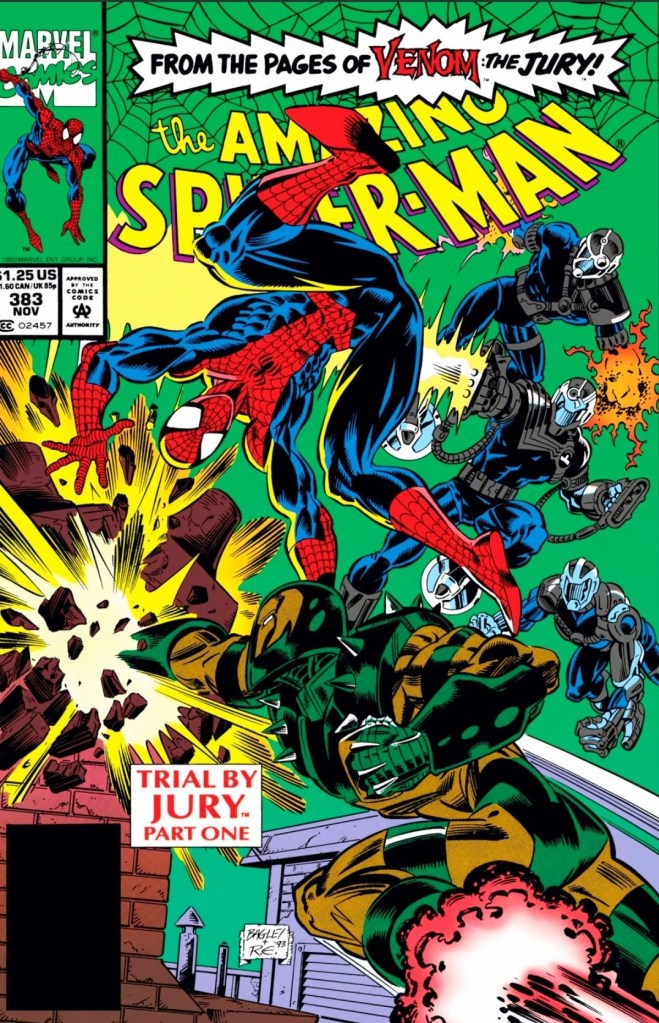
The cover.

Early story

The story begins in New York with the super-powered being Nova flying around which triggers an alert. It turns out, members of The Jury and their leader General Orwell Taylor have been monitoring and scanning areas of the city with several motion detectors to find Spider-Man. As far as Taylor is concerned, Spider-Man is highly responsible for the existence of Venom in their world and is therefore connected to the murder of his son (committed by Venom while escaping from prison in Amazing Spider-Man #315). Taylor is convinced that the if Spider-Man’s freedom is the price for stopping a monster like Venom, then that would be good.

Suddenly, the team notices that one of their motion detectors went offline. Moments later, a technician reaches the rooftop of the building and finds a motion detector severely damaged. Out of nowhere, Spider-Man grabs the technician and puts his life in danger by moving him off the edge using his fist and strength to carry him. Spider-Man pressures him for details…

Quality

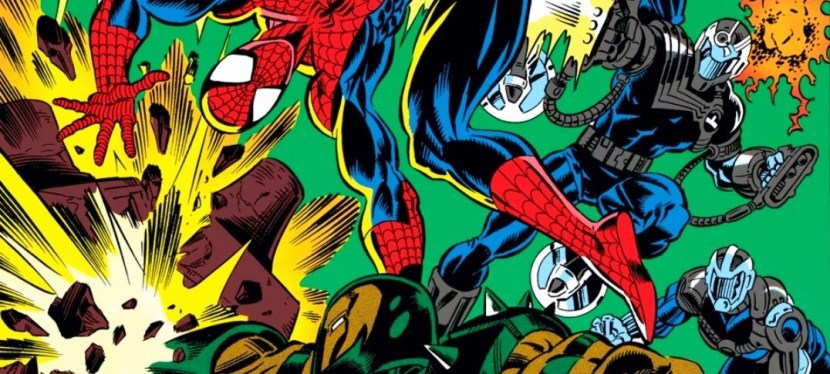
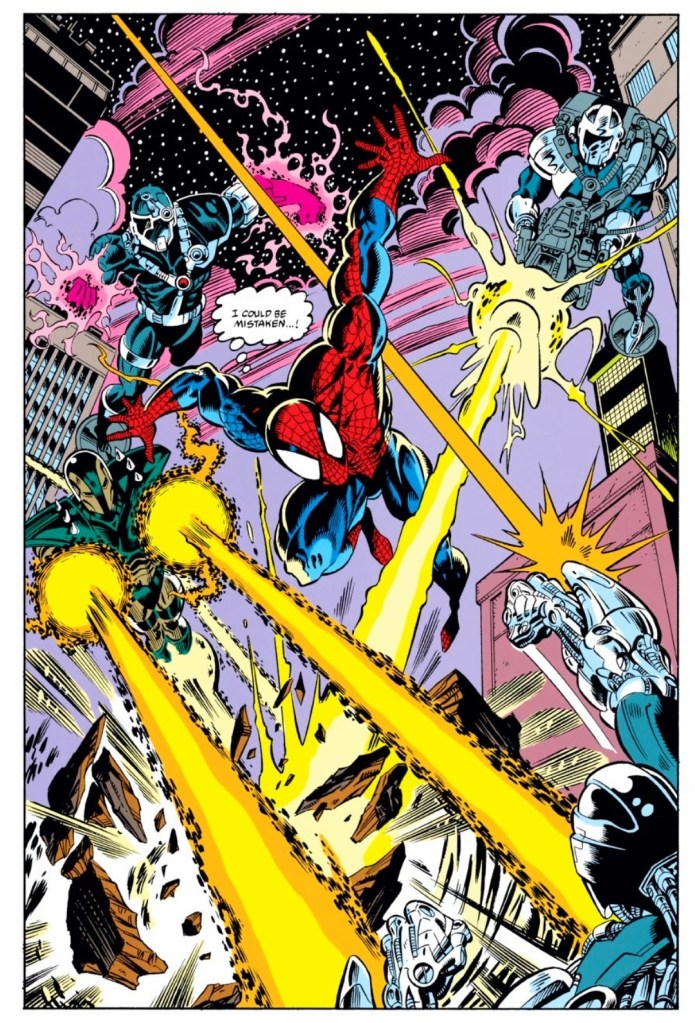
The Jury’s hunt for Spider-Man is really entertaining to read!

This is definitely one of the more engaging Amazing Spider-Man stories I read not only from 1993 but from the 1990s in general. In my view, putting Spider-Man up against The Jury is a stroke of genius on the part of the Michelinie-Bagley team and at the same time it was a sound relief after reading so much about the presence of Carnage and Venom on this particular monthly series (note: the Maximum Carnage crossover chapters and Amazing Spider-Man #375 being linked with the Venom: Lethal Protector limited series).

When it comes to The Jury, Michelinie crafted a script that justifies Taylor’s team to pursue Spider-Man after they failure on getting Venom. This shows that Taylor has acquired information about Venom’s origin being the result of Spider-Man bringing home with him the symbiote (alien costume) from his time on a far-away planet (as seen in the Secret Wars series). Creatively, this results in a very convincing portrayal of Taylor not only as a grieving father but also as a very tactical leader who uses vast intelligence and resources to achieve what he believes is justice and the means for achieving the greater good. As for The Jury’s armored members – Sentry, Ramshot, Screech, Firearm and Bomblast – Michelinie did not simply portray them as straight-forward, mission-focused people here. One of them shows hesitancy which added a nice layer of division and human weakness within the team which is felt in action-packed encounter with Spider-Man.

Being the target of The Jury, Spider-Man at this stage is deeply troubled even though the Maximum Carnage disasters are over. He is portrayed to be very disturbed by the alarm signals of his Spider Sense whenever he gets near one of the sensors of The Jury which is a unique display of his special ability.

Those of you who love superhero spectacle will find a lot to enjoy here! Mark Bagley’s art on emphasizing action and stunts is fantastic to look at as The Jury pursues Spider-Man within New York. There are lots of dynamic shots, flashy high-tech images and really intense superhero action complete with collateral damage!

To be clear, this comic book is not simply all about the webslinger and Taylor’s team. There are some scenes here building up on Aunt May’s suspicion about Peter Parker’s parents which added suspense to the narrative.

Conclusion

As usual, Peter Parker does not have enough quality time for his wife.

Amazing Spider-Man #383 (1993) remains a very solid and highly entertaining comic book to read from start to finish. The Michelinie-Bagley team really delivered the great stuff as they launched a new concept having The Jury hunting Spider-Man in successful fashion. The Jury is clearly a very formidable team that gave Venom and Spider-Man a lot of trouble. The notable thing here is that this is only the first chapter of a new storyline with focus on Spider-Man’s responsibility with the murderous Venom (and all the victims he made).

Overall, Amazing Spider-Man #383 (1993) is highly recommended!

+++++

Thank you for reading. If you find this article engaging, please click the like button below, share this article to others and also please consider making a donation to support my publishing. If you are looking for a copywriter to create content for your special project or business, check out my services and my portfolio. Feel free to contact me with a private message. Also please feel free to visit my Facebook page Author Carlo Carrasco and follow me on Twitter at  @HavenorFantasy as well as on Tumblr at https://carlocarrasco.tumblr.com/ and on Instagram at https://www.instagram.com/authorcarlocarrasco
A Look Back at Amazing Spider-Man #381 (1993)

Disclaimer: This is my original work with details sourced from reading the comic book and doing personal research. Anyone who wants to use this article, in part or in whole, needs to secure first my permission and agree to cite me as the source and author. Let it be known that any unauthorized use of this article will constrain the author to pursue the remedies under R.A. No. 8293, the Revised Penal Code, and/or all applicable legal actions under the laws of the Philippines.

Welcome back superhero enthusiasts, 1990s culture enthusiasts and comic book collectors! Today we go back to the year 1993 and explore a part of the Marvel Comics universe through one of the many tales of the Amazing Spider-Man comic book series.

To put things in perspective, 1993 was another busy year for the iconic Spider-Man who not only had four monthly series of his own but also appeared in the Venom: Lethal Protector mini-series, the 14-part Maximum Carnage crossover and in Marvel’s major crossover The Infinity Crusade. As expected, Spider-Man survived through those storylines.

With those details laid down, here is a look back at Amazing Spider-Man #381, published in 1993 by Marvel Comics with a story by David Michelinie and drawn by Mark Bagley.  

The cover.

Early story

The story begins inside the airport in New York where the incredible Hulk/Bruce Banner himself had just arrived from Scotland. Due to his tremendous size, his physical presence easily distract the people around him. Dr. Leonard Samson surprises Banner and informs him of an upcoming scientific demonstration and the scientists behind it have developed something that could have ramifications for people who got exposed to gamma radiation. Samson explains that there is a radiation virus that releases repressed emotions. The Hulk rejects Samson and leaps to the air above towards an unknow destination.

At a school yard in lower Manhattan, two kids bully another kid into giving them his lunch money. Spider-Man suddenly arrives to stop trouble and immediately the two bullies ran away…

Quality

Quality time between Peter Park and wife Mary Jane.

I can say that is one of the more interesting crossovers between Spider-Man and the Hulk who at this stage in Marvel’s comic book history retained his intelligence and personality while in his huge, green-skinned form. Adding variety to the crossover was the presence of Doc Samson who was already an established and notable supporting character in comic books featuring the Hulk.

Set after the events of Maximum Carnage, the Infinity Crusade and Hulk’s time in Scotland (as told in Incredible Hulk #407), this story shows life in New York gradually normalizing. The peace, as it turns out, was only temporary as the big-time scientific demonstration in this story leads to a series of unfortunate events that compels Peter Parker to take action as Spider-Man.

The tale was nicely structured and the creative team took its time to build-up the story concept, the character motivations and execute the superhero spectacle at an overall medium pace. There is simply no boring scene nor any wasted moments. The appearances of Samson and the Hulk in this Spider-Man tale were nicely integrated and they each had their own impact on the plot. There is a lot of stuff here that fans of both Spidey and the green giant can enjoy.

When it comes to the art, I found Mark Bagley’s take on the Hulk distinctive and intriguing to look at. The final shot of this comic book is a must-see.

Conclusion

Hulk and Doc Samson at the airport.

While there clearly is no villain, Amazing Spider-Man #381 (1993) still turned out to be a fun read complete with a fine crossover between Spider-Man, Doc Samson and the Hulk. Apart from the lack of space for character development, nothing here felt half-baked with the executions of the storytelling and the spectacle. This is a fun read and it was also a modern take on the personal encounter between Hulk and Spidey during the 1990s. This comic book has something enjoyable that fans of the two Marvel icons won’t find in any of the Marvel Cinematic Universe (MCU) movies and shows.

Overall, Amazing Spider-Man #381 (1993) is recommended.

+++++

Thank you for reading. If you find this article engaging, please click the like button below, share this article to others and also please consider making a donation to support my publishing. If you are looking for a copywriter to create content for your special project or business, check out my services and my portfolio. Feel free to contact me with a private message. Also please feel free to visit my Facebook page Author Carlo Carrasco and follow me on Twitter at  @HavenorFantasy as well as on Tumblr at https://carlocarrasco.tumblr.com/ and on Instagram at https://www.instagram.com/authorcarlocarrasco

A Look Back at Superman #78 (1993)

Disclaimer: This is my original work with details sourced from reading the comic book and doing personal research. Anyone who wants to use this article, in part or in whole, needs to secure first my permission and agree to cite me as the source and author. Let it be known that any unauthorized use of this article will constrain the author to pursue the remedies under R.A. No. 8293, the Revised Penal Code, and/or all applicable legal actions under the laws of the Philippines.

Welcome back superhero enthusiasts, 1990s culture enthusiasts and comic book collectors! Today we go back to the year 1993 and explore a chapter of the Reign of the Supermen storyline through one of the issues of the Superman monthly series.

To put things in perspective, DC Comics fulfilled its promise to kill the iconic Man of Steel in Superman #75 (1993) which sold a whole lot of copies and the daring death concept made Superman a hot news item. After a brief period showing what the world is like without Superman, DC resurrected him in Adventures of Superman #500 which spawned the different Supermen and a new storyline (the Reign of the Supermen) which took effect on the four Superman monthly series of the time.

With those details laid down, here is a look back at Superman #78, published in 1993 by DC Comics with a story written and drawn by Dan Jurgens.  

The cover.

Early story

The story begins with Lois Lane still thinking about Superman as she drives her car on a rainy night. At the moment, she still has not learned to live without him. As she is granted access into a facility of Lexcorp, she carefully thinks about the sudden number of many people around the country who claimed to have seen Superman.

Inside the facility, Dr. Meyer meets her and tells her that had met the Man of Steel sometime prior and he believes that the certain person who saved him and others was definitely the same person. Being skeptical, Lois Lane asked him if some other superhero saved them from certain death. In response, he shows to her an image of the heroic figure captured by security cameras. Lois recognizes the face and head even though some parts were shadowed…

Quality

Cyborg Superman in full appearance.

Starting with the storytelling, I can say that this is one solid tale that really pokes the curiosity regarding Cyborg Superman…is he the real Superman or some very clever and capable impostor? Dan Jurgens really knows his Superman stuff and he used a clever approach on arousing the readers’ curiosity while still managing to move the story forward. As one of the early chapters of the Reign of the Supermen storyline, it was very obvious that things were set in motion to set up future post-death Superman stories.

The most engaging parts of this tale were the scenes between Lois Lane and Cyborg Superman (note: he sure looks like a Terminator-inspired take on the Man of Steel which itself was a daring concept back in 1993). Lois Lane here is clearly intelligent and for personal and professional reasons, she would not settle for words as definitive answers but have evidence scientifically analyzed right in front of her. Once again, this is a lively reminder that in the post-Crisis universe of DC Comics, Lois Lane is persistent on verifying facts to realize the truth (which is something clearly missing in today’s world of social media and news media outlets serving as loudspeakers for political forces).

While the storytelling remains good all these decades, what really aged badly in this comic book was the bastardization of Superman’s iconic imagery with some robotic influences of the Terminator mixed in that made him look science fictional in appearance. Of course, Cyborg Superman was just one of the Supermen in this storyline and the Reign of the Supermen concept was clearly an extension of DC Comics’ dishonesty behind the death and return of the Man of Steel. This also shows DC’s irresponsible handling of one of America’s icons. Let’s be honest with ourselves here…how many of you really want to see Cyborg Superman in live-action form in a future DC superhero movie from Warner Bros. and James Gunn?

Conclusion

How many of you have this poster of a very bastardized image of Superman in your homes right now?

While Superman #78 (1993) has a good story told and added to the mystery about the resurrection of Superman, it ultimately served as a build-up platform to set up further stories not only about the Man of Steel but also that of Doomsday (note: a big rematch happened a few years later). The image of Cyborg Superman is clearly a defamation of the iconic look of the Man of Steel and that alone really brought the overall entertainment value of this comic book way down in my view. I find it baffling that there was no major backlash nor an outrage from Superman fans back in 1993 over this.

Overall, Superman #78 (1993) is serviceable.

+++++

Thank you for reading. If you find this article engaging, please click the like button below, share this article to others and also please consider making a donation to support my publishing. If you are looking for a copywriter to create content for your special project or business, check out my services and my portfolio. Feel free to contact me with a private message. Also please feel free to visit my Facebook page Author Carlo Carrasco and follow me on Twitter at  @HavenorFantasy as well as on Tumblr at https://carlocarrasco.tumblr.com/ and on Instagram at https://www.instagram.com/authorcarlocarrasco

A Look Back at Web of Spider-Man #90 (1992)

Disclaimer: This is my original work with details sourced from reading the comic book and doing personal research. Anyone who wants to use this article, in part or in whole, needs to secure first my permission and agree to cite me as the source and author. Let it be known that any unauthorized use of this article will constrain the author to pursue the remedies under R.A. No. 8293, the Revised Penal Code, and/or all applicable legal actions under the laws of the Philippines.

Welcome back superhero enthusiasts, 1990s culture enthusiasts and comic book collectors! Today we go back to the year 1992 and explore a part of what was back then the 30th anniversary celebration of Spider-Man

In what was back then a unique approaching to celebrating the anniversary of an American icon, Marvel Comics published not one but four specific Spider-Man comic books that had holographic covers and more pages than the usual. Each of those special comic books were from a different Spider-Man monthly series. Back in 2020, I published a retro review of one of those gimmick cover comic books from the Spider-Man monthly series.

With those details laid down, here is a look back at Web of Spider-Man #90, published in 1992 by Marvel Comics with a story by Howard Mackie and drawn by Alex Saviuk.  

The cover.

Early story

The story begins inside an office in Los Angeles. A hat-wearing businessman has several varied figures of Spider-Man near him and recalls the time when the iconic hero participated in one of his events as the Masked Marvel. Moments later, the businessman’s wife arrives and together they departed in a limousine.

At the South Bronx in New York, Spider-Man chases a speeding car with one of its passengers firing a gun at him. Suddenly, his spider sense bothers him a lot and when he looks around, he suddenly sees Galactus standing with members of the Avengers, the X-Men and the Fantastic Four lying down helpless on the ground…

Quality

Spider-Man on the set of an entertainment project. It’s a lively reminder about how sickening Hollywood (AKA Commiewood) can get.

To make things clear and without spoiling the plot, this story deals with illusions and the distortion of reality. Quite ironically, the said distortion made it a challenge to follow the narrative and I can say that a good amount of the spotlight was on the businessman. Spider-Man is clearly the protagonist here but it made sense for the creative team to focus a bit on the businessman (who has been doing entertainment showcases for a long time) to justify the core concept about the conflicts between what is real and what is imaginary.

In relation to the illusion aspect of the story, you will get to see established Spider-Man arch-villains such as the Green Goblin, the Hobgoblin and Venom taking on the superhero himself. As the creative team focused more on providing a great amount of spectacle, there clearly was no room left for character development on Spider-Man. Don’t expect to see Peter Parker in dramatic moments nor see him interact with the established supporting characters.

If there is any moral lesson to learn from this comic book, it would be this – living with a powerful delusion (the result of personal obsession mixed with the personal failure to separate illusion from reality) can lead you to the wrong directions in life.

Conclusion

To justify the 30th anniversary celebration, distorted flashbacks into Peter Parker’s past were presented here.

Web of Spider-Man #90 (1992) does not have much depth for those who seek engaging storytelling. That being said, the story itself is not memorable nor would it leave a long lasting impact on you. This comic book was made to entertain readers with lots of action and wild fantasy images that eerily justify its concept about illusion and reality conflicting each other. In fairness to the creative team, the said conflict was consistently visualized and there were some dialogue that related to it in a somewhat philosophical manner. The comic book’s entertainment value is satisfying enough although it does not justify the holographic cover that was part of the gimmick with celebrating Spider-Man’s 30th anniversary. As for who was the main antagonist of the comic book, I simply encourage you all to read and find out for yourselves.

Overall, Web of Spider-Man #90 (1992) is satisfactory.

+++++

Thank you for reading. If you find this article engaging, please click the like button below, share this article to others and also please consider making a donation to support my publishing. If you are looking for a copywriter to create content for your special project or business, check out my services and my portfolio. Feel free to contact me with a private message. Also please feel free to visit my Facebook page Author Carlo Carrasco and follow me on Twitter at  @HavenorFantasy as well as on Tumblr at https://carlocarrasco.tumblr.com/ and on Instagram at https://www.instagram.com/authorcarlocarrasco