Disclaimer: This is my original work with details sourced from reading the comic book and doing personal research. Anyone who wants to use this article, in part or in whole, needs to secure first my permission and agree to cite me as the source and author. Let it be known that any unauthorized use of this article will constrain the author to pursue the remedies under R.A. No. 8293, the Revised Penal Code, and/or all applicable legal actions under the laws of the Philippines.
Welcome back superhero enthusiasts, 1990s culture enthusiasts and comic book collectors! Today we go back to the early 1990s and explore a part of the Marvel Comics shared universe through a tale of the Spider-Man monthly series.
Having reviewed the first three issues of the Spider-Man monthly series written and drawn by Todd McFarlane (click here, here and here), I can say that the 5-part Torment storyline has a daring concept, adulterated imagery and clunky storytelling. Issues #2 and #3 saw Spider-Man in violent battles with the Lizard who is clearly not himself but under the control of the Haitian witch Calypso. It is inevitable Spider-Man, who has been in a long-lasting disadvantage so far, will somehow meet Calypso face to face.
With those details laid down, here is a look back at Spider-Man #4, published in 1990 by Marvel Comics with a story written and drawn by Todd McFarlane. This is the 4th chapter of the Torment storyline.
The cover.
Early story
The story begins in a dirty alley deep within New York City. An exhausted and disoriented Spider-Man is shocked to see a grotesque looking Kraven with the vicious Lizard beside him. The moment made him remember what happened as a result of his previous with Kraven (note: refer to the Kraven’s Last Hunt storyline) which includes him getting buried temporarily with a grave designated to him.
Eventually Spider-Man sees through the illusion and realizes that Kraven is not in front of him but Calypso with the Lizard still under her full control. With an unspoken command from Calypso, the Lizard moves towards the weakened Spidey and carries him bodily…
Quality
This portrayal of Mary Jane having a good time again in the city without her husband is clearly filler and it did not add anything to the plot.
As anticipated, the webslinger finally met the Haitian witch who had been controlling the Lizard all along. With a mostly slow pace, the story has Spider-Man being helpless in the presence of two powerful enemies and McFarlane stylishly dramatizes moments from Calypso’s past showing her acceptance of evil ways (witchcraft), her personal connection with Kraven and her desire to have a new sacrifice done.
With Spider-Man restrained a lot for most of the story, it was not surprising to see Calypso have a good share of the spotlight to herself and the Lizard is clearly portrayed as her enforcer and assistant contrasting what was presented in the first 3 issues.
Unsurprisingly, the storytelling feels choppy although the slow pace allows readers to grasp Calypso’s intentions and her main purpose in the entire storyline. The lack of spectacle allowed McFarlane to implement long segments of suspense mixed with horror. With Spider-Man doing not so much, he’s technically a supporting character symbolizing the reader’s curiosity.
Conclusion
There is nothing like waking up in the presence of two evil figures while being restrained.
Compared with the previous, Spider-Man #4 (1990) does not have much to show and has even less entertainment value. Unless you are a die-hard fan of Calypso (so twisted and demonic under McFarlane’s handling), this particular story won’t mean much to Spider-Man faithful. The webslinger is still helpless but this is all part of the build-up for the fifth and final chapter.
In fairness, what was shown here might inspire fans to revisit Kraven’s Last Hunt and read past Spider-Man comic books showing Calypso’s connection with Kraven (note: Spider-Man and Calypso were present in Amazing Spider-Man #209). In my view, this comic book is not terrible but it does not have much entertainment value nor does it have anything engaging to show. I don’t feel so motivated to proceed with issue #5.
Disclaimer: This is my original work with details sourced from reading the comic book and doing personal research. Anyone who wants to use this article, in part or in whole, needs to secure first my permission and agree to cite me as the source and author. Let it be known that any unauthorized use of this article will constrain the author to pursue the remedies under R.A. No. 8293, the Revised Penal Code, and/or all applicable legal actions under the laws of the Philippines.
Welcome back superhero enthusiasts, 1990s culture enthusiasts and comic book collectors! Today we go back to the early 1990s and explore a part of the Marvel Comics shared universe through a tale of the Spider-Man monthly series.
I previously reviewed issues #1 (click here) and #2 (click here) which were also the first two chapters of the Todd McFarlane-led Torment storyline. McFarlane had this grand vision of a dark and more violent concept of telling a Spider-Man story and it involved another rematch with the Lizard (Dr. Connors) and some connections with the Kraven’s Last Hunt saga of 1987 (read my retro reviews by clicking here and here). McFarlane’s vision was daring but his writing style and the sub-par quality of his storytelling really brought down the overall quality of Spider-Man #1 and #2.
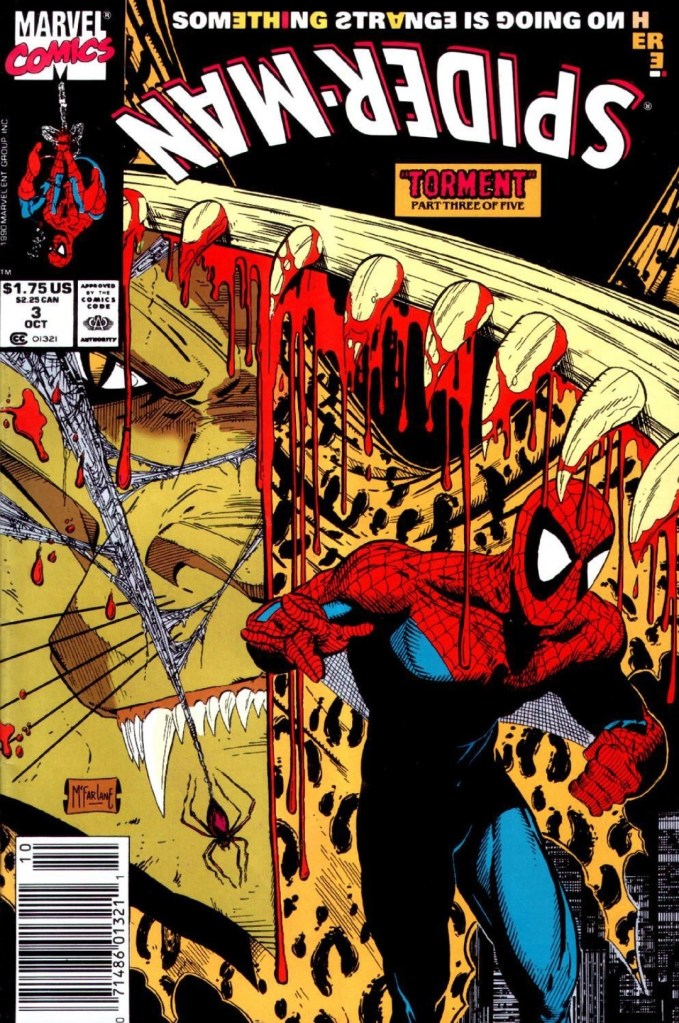
With those details laid down, here is a look back at Spider-Man #3, published in 1990 by Marvel Comics with a story written and drawn by Todd McFarlane. This is the 3rd chapter of the Torment storyline.
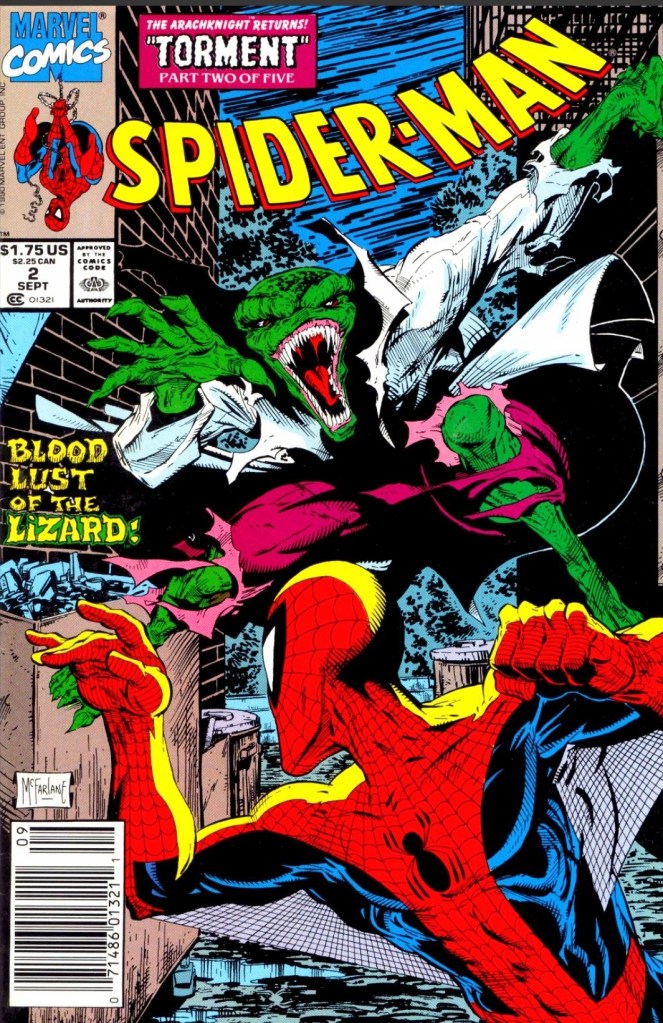
The cover.
Early story
The story begins at the rooftop of a building in New York City. Up there, the Lizard relentlessly attacks Spider-Man causing some damage on the building. Having recovered previously, Spider-Man manages to hold his ground and punches a solid structure that hit the Lizard hard.
Meanwhile at another part of the city, the evil Haitian Voodoo priestess Calypso communicates with the Lizard telling him to take the fight against Spider-Man easy, avoid killing him and make him suffer first. Calypso is obsessed with making the webslinger an example to the world.
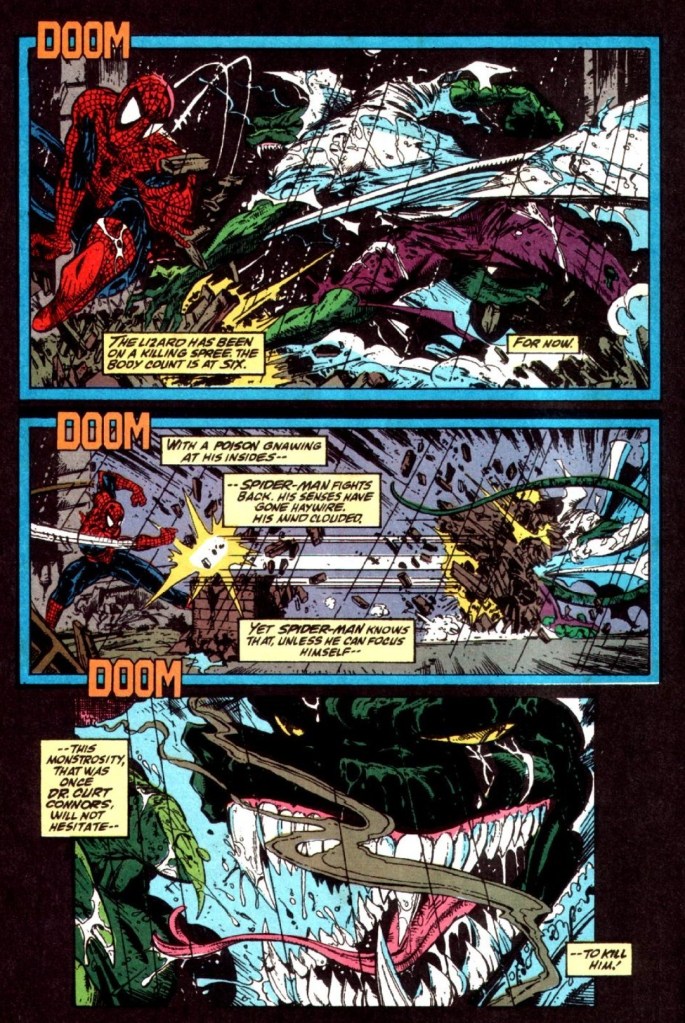
The fight between Spider-Man and the Lizard continues causing even more damage. Spider-Man, who has been poisoned, is having trouble concentrating as the Lizard keeps attacking him violently. Spider-Man wonders why the Dr. Connors’ (the Lizard) blood lust is so consuming…
Quality
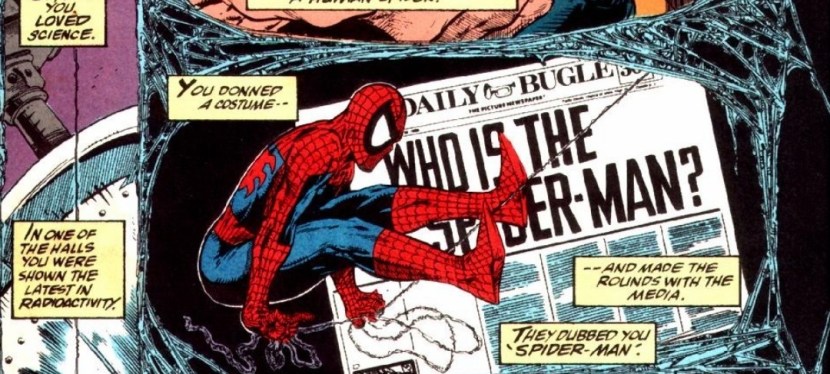
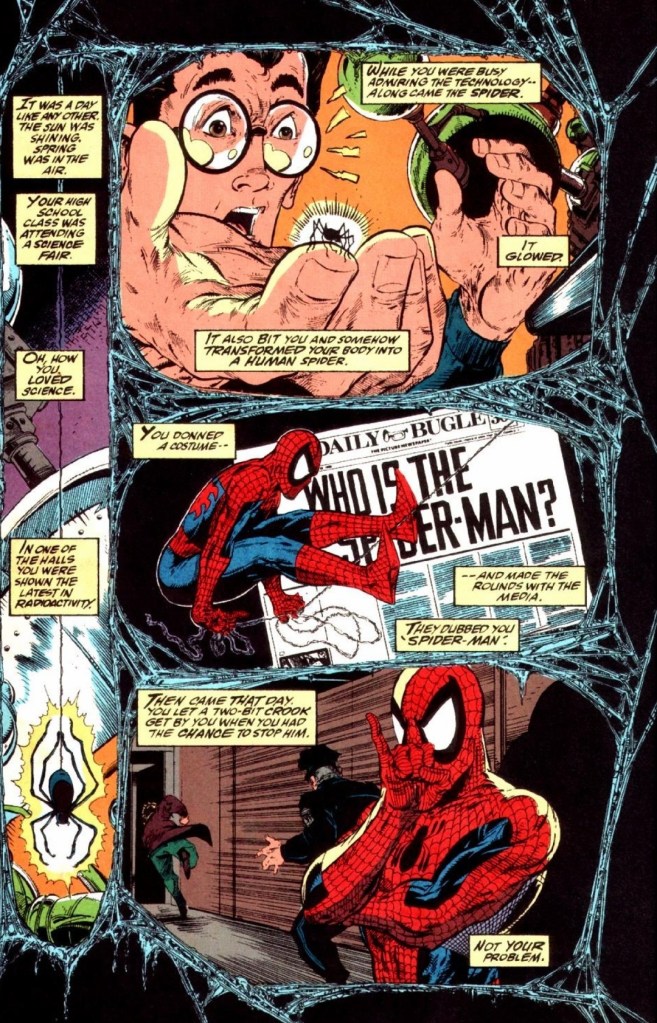
Todd McFarlane’s way of visualizing Spider-Man’s origin.
To get straight to the point, this comic book is simply a natural progression of the hard-hitting conflict between Spider-Man and the Lizard that started in the previous issue. In fact, this comic book shows the resumption of the battle (after a pause happened in the late stage of issue #2 showing the fight temporarily halting which gave Spider-Man some minutes to rest).
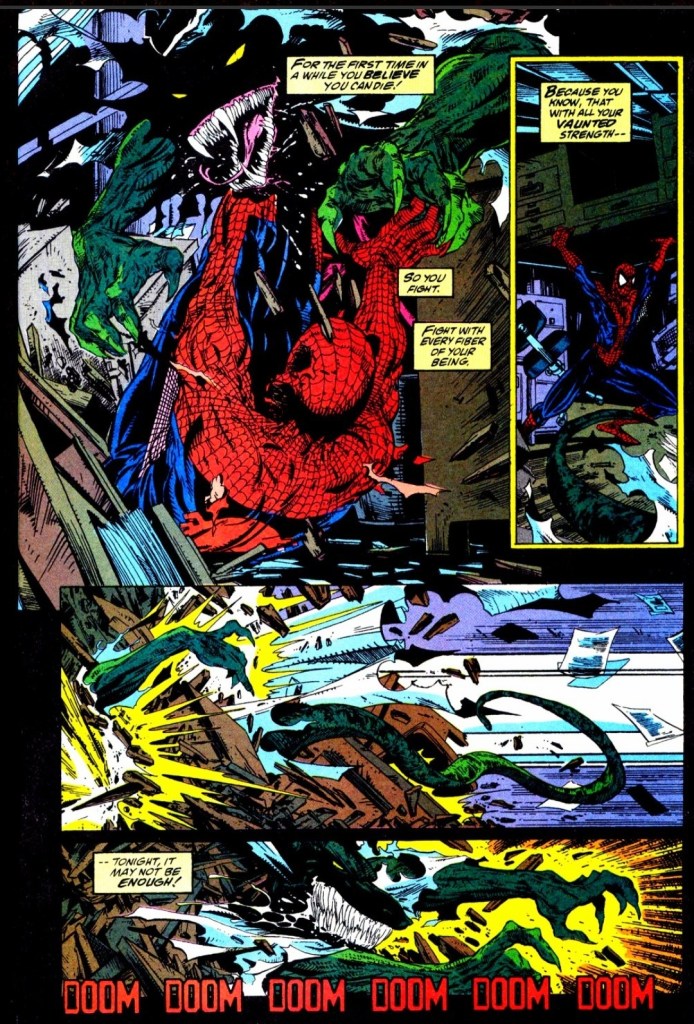
At this stage, Spider-Man has gotten even more vulnerable and damaged. Apart from struggling with the very violent attacks of the Lizard, his own spider sense becomes a major hindrance on his mind (he could not concentrate) as the sounds of “doom-doom-doom” caused by Calypso’s sorcery becomes very unbearable. Like the previous issue, Spider-Man gets close to death and if there is anything new here it is showing the iconic superhero messed up in the garbage.
Along the way, this comic book sheds some spotlight on Mary Jane Parker (Spider-Man’s wife) who has been spending time in the city dealing with the absence of her husband. The Mary Jane scenes felt more like filler to the script by McFarlane.
Conclusion
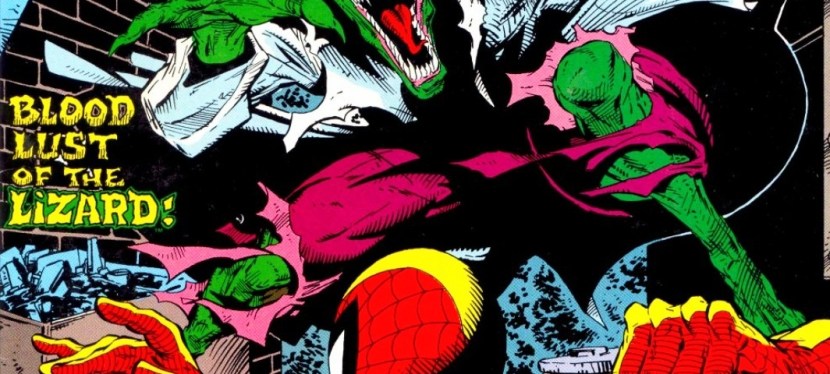
This comic book shows the resumption of the violent battle between the Lizard and Spidey.
Apart from continuing the story, Spider-Man #3 (1990) does not have much to show. Todd McFarlane’s visuals are great and consistently remained high (and even gory) on details, but his weak writing made this one a chore to read through. Being the 3rd chapter of the Torment storyline, this one is predictable and the pay-off is minimum. At this stage, it is clear that something huge is coming up on the last two chapters of the storyline.
Disclaimer: This is my original work with details sourced from reading the comic book and doing personal research. Anyone who wants to use this article, in part or in whole, needs to secure first my permission and agree to cite me as the source and author. Let it be known that any unauthorized use of this article will constrain the author to pursue the remedies under R.A. No. 8293, the Revised Penal Code, and/or all applicable legal actions under the laws of the Philippines.
Welcome back superhero enthusiasts, 1990s culture enthusiasts and comic book collectors! Today we go back to the early 1990s and explore a part of the Marvel Comics shared universe through a tale of the Spider-Man monthly series.
In my previous retro review, Todd McFarlane told a tale of the iconic web-slinger with intense build-up leading to another rematch with his old nemesis the Lizard (Dr. Connors). While the writing was pretty weak, McFarlane still managed to tell a tale with a strong element of horror and supernatural stuff. McFarlane’s approach with visual violence and graphic stuff was clearly adulterated. What was presented daringly tested the limits allowed under the Comics Code Authority (CCA).
With those details laid down, here is a look back at Spider-Man #2, published in 1990 by Marvel Comics with a story written and drawn by Todd McFarlane. This is also the 2nd chapter of the Torment storyline.
The cover.
Early story
The story begins in New York City where two men got suddenly murdered by the Lizard in an alley during the night. The next morning Peter Parker reads the newspaper (showing the photograph and the news story of the Lizard’s murder of the two men) while having a breakfast moment with his wife Mary Jane. As soon as his wife mentions the word “monster”, Peter takes a 2nd look at the newspaper’s photograph and finally notices the bloody writing “CNNR” on the alley wall which makes him realize that the Lizard is back again.
Feeling very troubled, Peter leaves Mary Jane quietly and dresses up as Spider-Man to go out once again.
Elsewhere in the city, a sorceress uses her evil method of crafting a potion which creates an unrelenting sound of disturbance which Spider-Man hears. As the sound goes on, his focus and Spider Sense get overwhelmed…
Quality
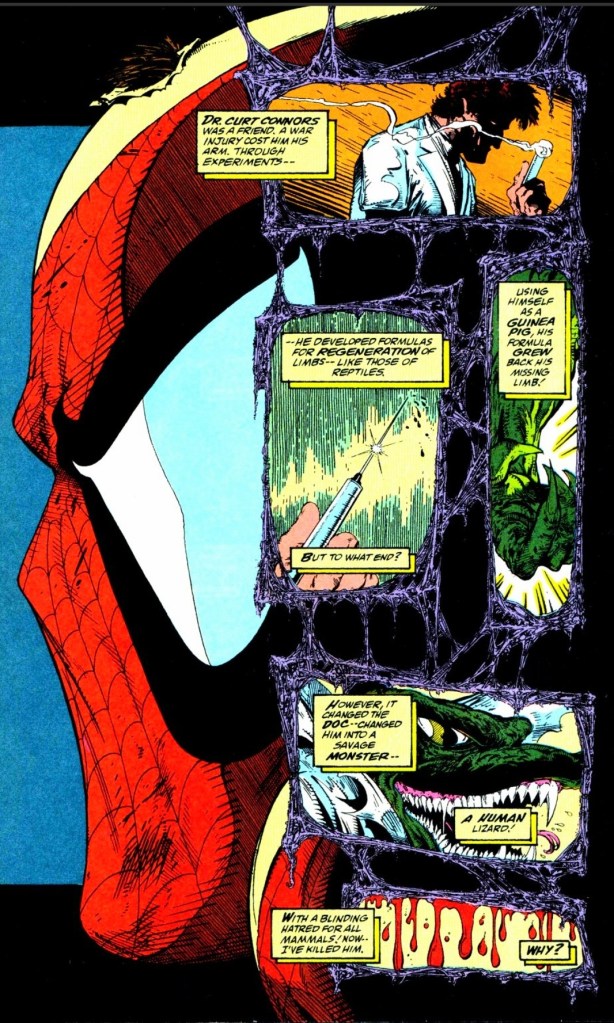
A quick look at the origin of the Lizard by McFarlane.
While the writing by McFarlane remains weak, he still succeeded in making this story a marginal improvement over the previous issue in terms of moving the plot forward, paying off a good chunk of the build-up in issue #1, and establishing his own visual corner (inspired by horror and adulterated stuff) within the Spider-Man franchise of comics of the time.
The biggest feature here is the physical conflict between Spider-Man and the Lizard. As expected, McFarlane drew the big fight with a lot of intense action, powerful violence (note: it was clear the editorial team recommended moves to tone down the graphic violence), suspense and a good amount of horror. Not only does the big fight move the story forward, it allowed McFarlane to dramatize Spider-Man as a vulnerable hero who not only has to cope with the disturbance from the sorceress far away, but also deal with the poison he got from the Lizard. That being said, Spidey also struggles with his sanity and the new fact that the Lizard has turned into a murder machine which disturbs him a lot as he personally knew Dr. Connors.
Considering what happened here and in the previous issue, there is still a greater force of evil that awaits Spider-Man and the Lizard happens to be an ultra-violent tool.
Conclusion
Many times Spider-Man finds himself in a disadvantage while fighting the Lizard.
Being the 2nd chapter of the Torment storyline, Spider-Man #2 (1990) is a slight improvement over the previous issue in terms of moving the story forward, spectacle and dramatization. While the big fight between Spider-Man and the murderous Lizard is clearly the big feature of the story, McFarlane does a good job portraying Spider-Man as vulnerable and on the edge towards defeat. McFarlane’s writing here is still weak but the other positive elements achieved outweighed the weakness.
Disclaimer: This is my original work with details sourced from reading the comic book and doing personal research. Anyone who wants to use this article, in part or in whole, needs to secure first my permission and agree to cite me as the source and author. Let it be known that any unauthorized use of this article will constrain the author to pursue the remedies under R.A. No. 8293, the Revised Penal Code, and/or all applicable legal actions under the laws of the Philippines.
Welcome back superhero enthusiasts, 1990s culture enthusiasts and comic book collectors! Today we go back to the early 1990s and explore a part of the Marvel Comics shared universe through a tale of the Spider-Man monthly series.
Back in the late 1980s, Todd McFarlane proved to be a highly talented artist who helped Marvel sell a lot of issues of the Amazing Spider-Man series. McFarlane was also highly involved with the creation of Venom which not only became Spider-Man’s deadliest foe but also an icon of Marvel’s. In the year 1990, a brand new monthly series of Spider-Man was launched and it had Todd McFarlane writing and illustrating the tales.
With those details laid down, here is a look back at Spider-Man #1, published in 1990 by Marvel Comics with a story written and drawn by Todd McFarlane. This marks the beginning of the Torment storyline.
The cover.
Early story
The story begins in New York City where countless people walk to their respective destinations not realizing that the local hero Spider-Man was swinging above them. In a dirty alley, Spider-Man prevents an armed thug from harming a woman and leaves him hanging covered with a lot of web.
Elsewhere in the city, a sinister figure conducts a ritual, prays to evil forces and begins using magic.
In yet another location, a hideous creature emerges from the water. It’s the Lizard…
Quality
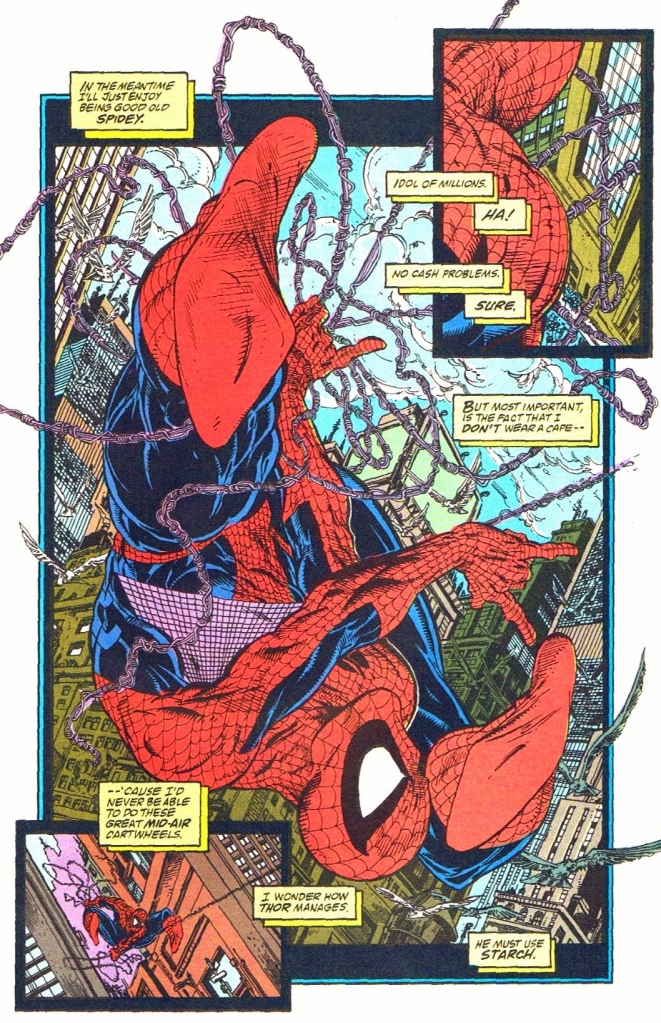
This page is an example of Todd McFarlane creating a travel sequence that allowed him to draw something great. It’s a classic example of moving back into the comfort zone.
To make things very clear here, this comic book is pretty shallow and hollow mainly due to its storytelling as this was the writing of a very young Todd McFarlane. There is no denying that his art here is great to look at from start to finish. In fact, this was one of McFarlane’s finest visual works ever with Marvel.
But if you look beyond the great visuals, the writing is very weak all throughout the issue. At best, this comic book is a grand-looking yet shallow set-up for the conflict of the Torment storyline complete with shared emphasis on the iconic web-slinger, the Lizard (looking more menacing than before) and Calypso (the one behind the magic and rituals).
In fairness to McFarlane, he added his own touch on emphasizing the personalities of Peter Parker and wife Mary Jane simultaneously as a couple. If you were used to seeing in-depth character development and witty dialogue about the two major characters as portrayed in the Amazing Spider-Man, Web of Spider-Man and Spectacular Spider-Man series of 1990, you won’t find them in this comic book. Under McFarlane’s writing, Spider-Man in this issue showed signs of sarcasm and cockiness in the first scene, and with Mary Jane he (as Peter Parker) expressed himself philosophically. To say the least, the portrayal of Spider-Man here is noticeably different under McFarlane.
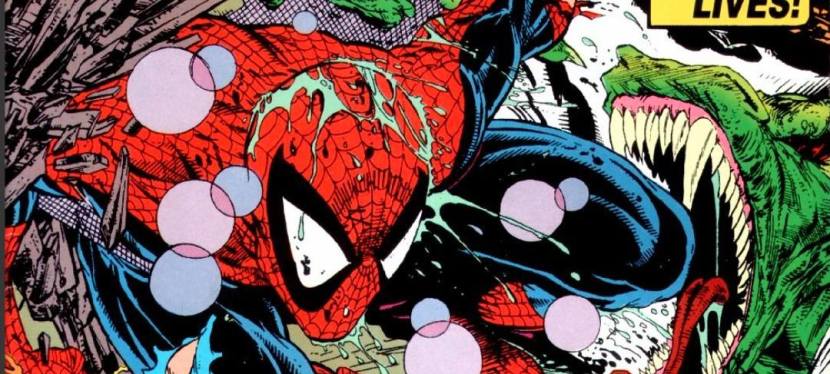
The Lizard, a long-time rival of Spider-Man’s, was presented to be very violent and murderous in this issue. This was clearly McFarlane’s approach on emphasizing the force of opposition that awaits the iconic web-slinger and he obviously went for a more adulterated approach with the visuals. That being said, the violent content in this comic book is very unique and clearly stood out from the rest of the Spider-Man-related comics published by Marvel in 1990. Lastly, I should say that McFarlane’s visual take on the Lizard is the best I have seen.
Going back to the visuals, McFarlane implemented strong elements of horror, darkness and grittiness which went along well with the adulterated approach to violence. These mixed elements, as they turned out in reality, became part of McFarlane’s future works past Spider-Man.
Conclusion
McFarlane’s vicious and horrifying approach on visualizing the Lizard can’t be ignored. This Lizard makes the cinematic Lizard of the 2012 movie The Amazing Spider-Man look cartoony.
Spider-Man #1 (1990) is a very mixed bag when it comes to literary enjoyment. It clearly has great artwork by McFarlane whose adulterated approach on expression and spectacle made it very unique. The writing by McFarlane (who was very young at the time of production) is clearly the big letdown although his own approach on portraying Spider-Man, MJ and the Lizard are very notable. Take note that this was Todd McFarlane starting with writing while doing the art (his true strength), and at this point in comic book history his talent on telling compelling stories would not be realized until a few years later (particularly with Spawn and Image Comics). Notably, his use of visual horror and darkness predates his work in Spawn which makes his Spider-Man take very distinct. Ultimately, this comic book served as a build-up for things to come in the Torment storyline. Don’t expect too much when acquiring this comic book.
Disclaimer: This is my original work with details sourced from reading the comic book and doing personal research. Anyone who wants to use this article, in part or in whole, needs to secure first my permission and agree to cite me as the source and author. Let it be known that any unauthorized use of this article will constrain the author to pursue the remedies under R.A. No. 8293, the Revised Penal Code, and/or all applicable legal actions under the laws of the Philippines.
Welcome back superhero enthusiasts, 1990s culture enthusiasts and comic book collectors! Today we go back to the year 1995 and explore a part of the Marvel 2099 comics universe through a tale of the Spider-Man 2099 franchise.
In my previous retro review, Miguel O’Hara arrives in Mexico with Xina and they shared a room together. It turns out his brother Gabriel was also there even occupying the next room. Elsewhere, a lady practicing sorcery (Strange 2099) is told that Spider-Man will be her ally and they will work together to fulfill a mission. Elsewhere, a grave digger performs rituals over the skeletal remains of his beloved sister. Issue #32 had a dark and totally different tone as the sci-fi element of the monthly series got pushed aside.
With those details laid down, here is a look back at Spider-Man 2099 #33, published in 1995 by Marvel Comics with a story written by Peter David and drawn by Andrew Wildman.
The cover.
Early story
The story begins when Spider-Man 2099 and his new ally Strange 2099 crash into a room on a mission they must complete. They see the grave digger clinging to a magical item that he believes should resurrect his dead sister.
In an attempt to find a solution, Strange touches the item and suddenly becomes a hideous looking monster.
Meanwhile, the streets of Mexico City suddenly gets filled with several undead people walking. On the street, Xina (walking with Kasey and Gabriel) begins to worry about Miiguel. Soon enough, some of the undead move towards them…
Quality
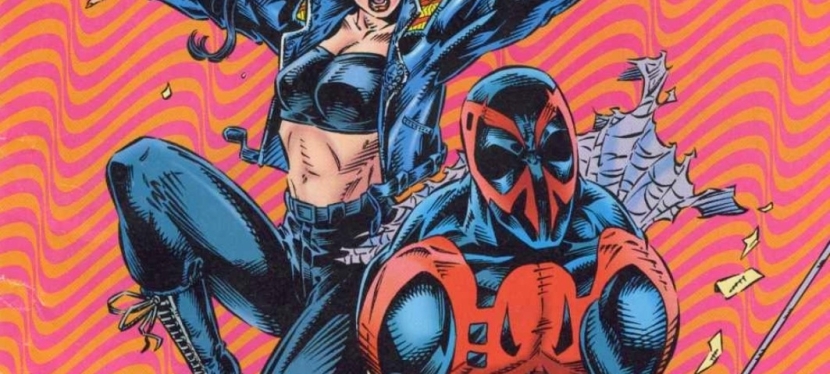
Spider-Man helps to ensure safety.
As this story is the continuation to the events of issue #32, this one keeps on building up on sorcery and evil forms of the supernatural as the key elements of the narrative as well as the setting. That being said, the usual science fiction element remains completely absent and this opened the opportunity for the creative team to show Spider-Man in action within a supernatural atmosphere complete with the unfortunate event of a demonic possession.
Spider-Man’s team-up with Strange (obviously the futuristic take of Dr. Strange) inevitably led to a conflict with evil and the ironic thing is that the grave digger himself is not even the villain but someone obsessed with bringing his sister back to life by means of resorting to magic and tapping the demonic force he could not even see. The Spidey-Strange team-up clearly dominated the narrative but I should say that the sorceress is not too interesting as a character and she barely has any chemistry with the futuristic web-slinger. It seems to me that Strange 2099 was created to emphasize racial diversity and rabid feminism than to really add any depth to the 2099 universe and its lineup of supporting characters.
As for the concept of the undead walking along many people who happen to be commemorating the day of the dead on the city streets, it really heightened the horror and supernatural aspects of the story while escalating the sense of danger.
Conclusion
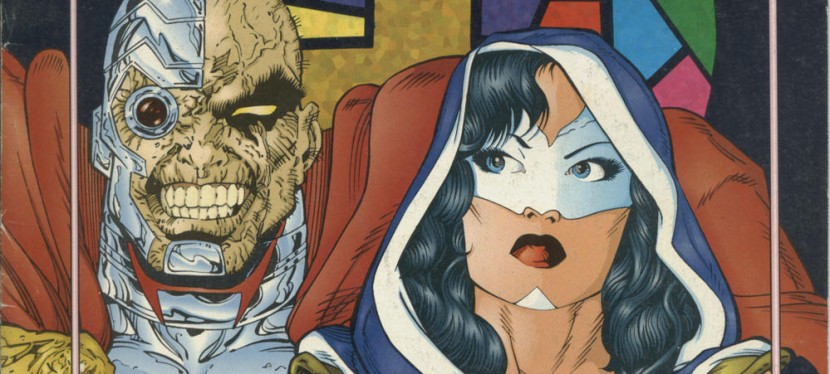
Spidey, Strange 2099 and the grave digger.
In line with the concept of the previous issue, Spider-Man 2099 #33 (1995) is a supernatural tale of Spider-Man on a misadventure teamed up with a futuristic take on Dr. Strange. Its pay-off to the build-up in issue #32 was barely felt and I could not help but feel the presentation was rushed. Strange 2099 was simply not interesting and the grave digger’s personal pursuit over his dead sister did not have much of an impact. That being said, the concept of this 2-part story felt more like a diversion than a meaningful story. If there is anything worth focusing on in this comic book, it is Spidey himself struggling in the very nation where he previously got his costume.
Overall, Spider-Man 2099 #33 (1995) is satisfactory.
Disclaimer: This is my original work with details sourced from reading the comic book and doing personal research. Anyone who wants to use this article, in part or in whole, needs to secure first my permission and agree to cite me as the source and author. Let it be known that any unauthorized use of this article will constrain the author to pursue the remedies under R.A. No. 8293, the Revised Penal Code, and/or all applicable legal actions under the laws of the Philippines.
Welcome back Ultraverse fans, geeks and fellow comic book collectors! If you want to discover more of the fantasy elements within the Ultraverse through Mantra – the pretty sorceress whose body is occupied by the soul of a male warrior named Lukasz – then you are in for something rather different.
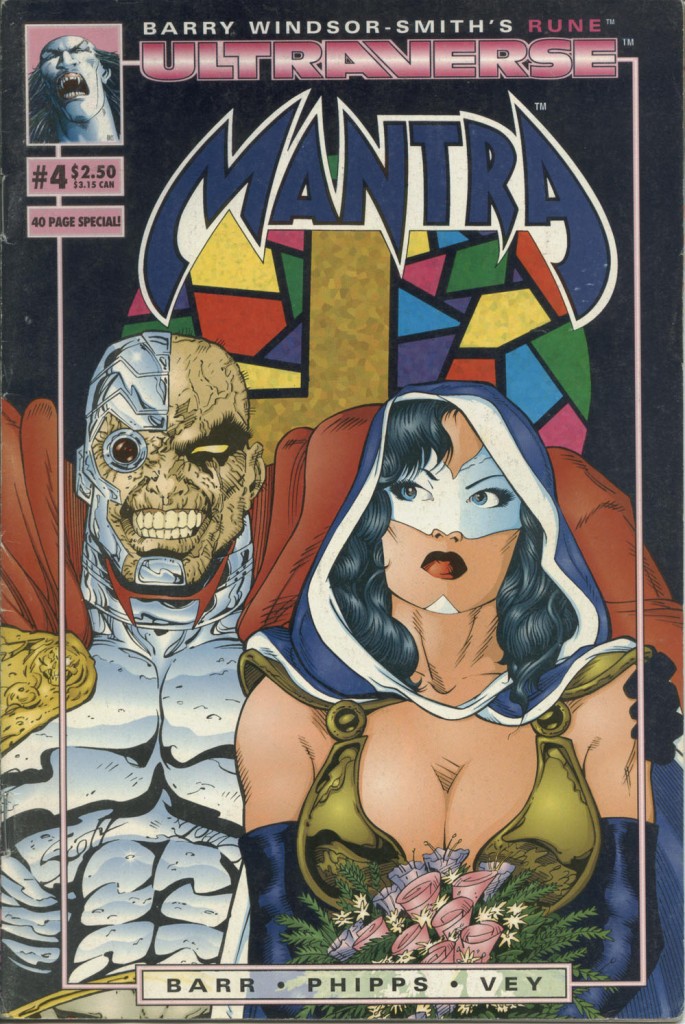
To put things in perspective, the fantasy-swords-magic concept was made clear in Mantra #1 and that Lukasz and his band of warriors (led by an elder sorcerer) as well as their enemies (led by Boneyard) were definitely from another world. That other world will be explored at last in this look back at Mantra #4, published in 1993 by Malibu Comics with a story written by Mike W. Barr and drawn by Robb Phipps.
The cover.
Early story
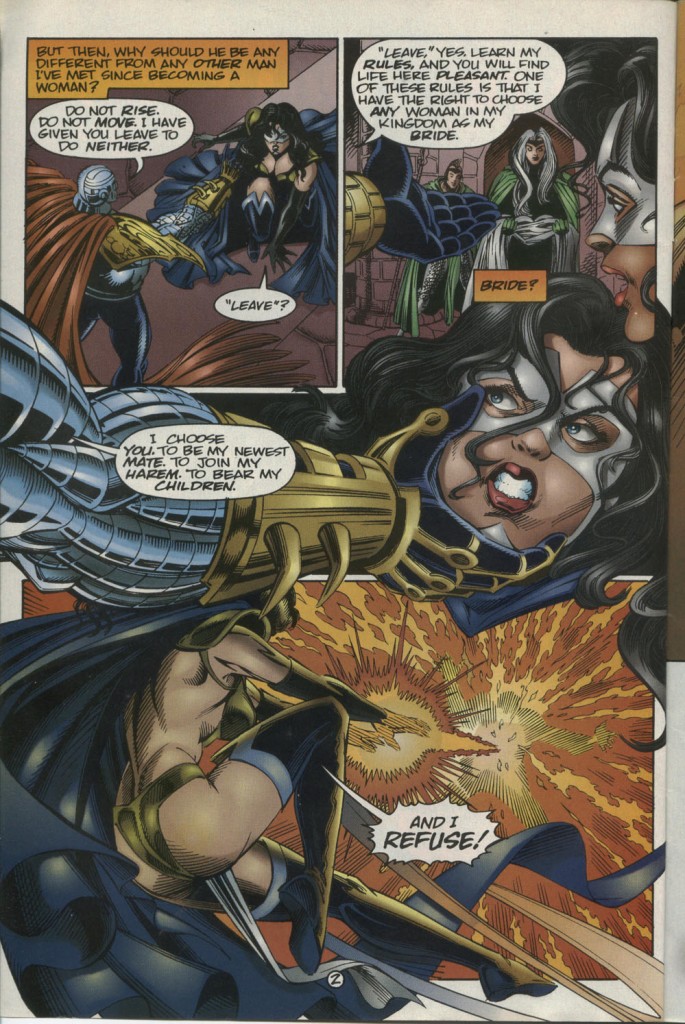
The story begins in the world of Boneyard, at his castle specifically. Down on her knees, Mantra is just in front of the villain Boneyard who says, “So this is Archimage’s last, best hope. Just a woman!!”
Boneyard tells Mantra not to rise nor move. As he does not yet know that Lukasz is inside Mantra’s body, Boneyard welcomes her and states that it is his right to choose any woman in his kingdom as his bride. In reaction to being selected as Boneyard’s newest mate with a purpose to potentially give birth to his children, Mantra strikes him with an energy blast symbolically rejecting him.
Boneyard then says, “Enough. I tolerate this dissent because your body carries much potential for magic, woman. It is only your body that saves you from death. Your bewildering loyalty to my defeated brother, Archimage, would ordinarily be enough to condemn you. Your genes, combined with mine will yield children to whom magic comes as easily as taking breath.”
As the villain talks, Mantra notices the sword pointed at her was the same one used to kill her when she was man (as Lukasz). She then makes moves to get Boneyard off-balanced and try to leave the castle…
Quality
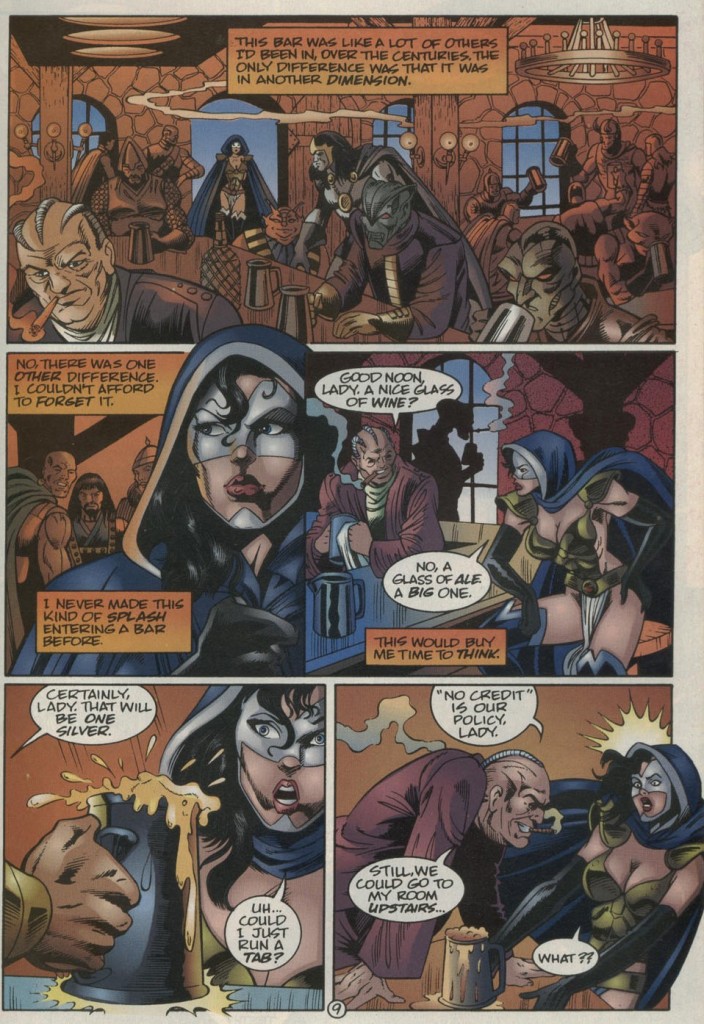
Mantra visits the tavern in the kingdom controlled by Boneyard.
I’ll start with the writing. What Mike W. Barr did here successfully was raising the stakes for Mantra which involves the drastic change of location and setting from the modern society of Earth into the fantasy realm where Boneyard and his army are based in. The mentioned change literally opened new opportunities to develop Mantra’s personality while at the same time offered readers a lot of new things and places for their exploration.
With the all-new setting, lots of fantasy genre tropes are present. There is the ever-present tavern filled with lots of people that include humans and non-human beings that go beyond dwarves and elves. There is also the slave auction of both men and women standing almost nakedly in front of the bidders. There also were people wearing capes, hoods, swords, spears and armor which Mantra smoothly blends in with.
Along the way, there is a lot spectacle here mainly acts of magic alternated with hard action moves. The way the spectacle is presented fits in excellently with the fantasy setting and I should state that Robb Phipps did a very solid job visualizing such elements while succeeding in making Mantra, Boneyard, Archimage and Warstrike look recognizable.
Back to the writing, Mike W. Barr prepared a lot of details in the story that explained Boneyard’s nature and even his status as the husband of multiple wives. This comic book also reveals that Boneyard is likely bisexual since, apart from being married to multiple women, he kissed Mantra and lusts for her even AFTER he learned that Lukasz is occupying the woman’s body. His intention to marry Mantra symbolizes homosexuality as well. To put things in perspective, this makes Boneyard very guilty of sexual immorality on top of his wickedness. Refer to 1 Corinthians 6:9-10 (sexual immorality and homosexuality), Galatians 5:19-21 (sorcery and sexual immorality) and Deuteronomy 17:17 (polygamy) in the Holy Bible.
Conclusion
Boneyard’s intention to marry Mantra (whose body is occupied by the soul of the male eternal warrior Lukasz) and impregnate her to produce his children is disgusting, even more so when the villain knows Lukasz is in Mantra.
To say the least, Mantra #4 (1993) is entertaining enough mainly due to its fantasy setting and exposing key elements about the rivalry between Archimage and Boneyard. This was a daring and refreshing change of pace for Mantra series since the first three issues already emphasized Lukasz’s struggles on living in the body of Eden Blake (note: reincarnation is false and goes against the Holy Bible, read Hebrews 9:27 and Psalm 78:39 for insight) and living with her family as Eden’s soul was pushed into limbo. More notably, this issue shows more of how evil and wicked Boneyard is not simply because of his leading his army of evildoers but also because of his evil-filled nature. By comparison, Lukasz/Mantra is the lesser evil to Boneyard under the pretense of good-versus-evil in the story (which itself concluded in a predictable and underwhelming fashion).
If you are seriously planning to buy an existing hard copy of Mantra #4 (1993), be aware that as of this writing, MileHighComics.com shows that the near-mint copy of comic book costs $8.
Overall, Mantra #4 (1993) is satisfactory.
+++++
Thank you for reading. If you find this article engaging, please click the like button below and also please consider sharing this article to others. If you are looking for a copywriter to create content for your special project or business, check out my services and my portfolio. Feel free to contact me as well. Also please feel free to visit my Facebook page Author Carlo Carrasco and follow me at HavenorFantasy@twitter.com
Disclaimer: This is my original work with details sourced from reading the comic book and doing personal research. Anyone who wants to use this article, in part or in whole, needs to secure first my permission and agree to cite me as the source and author. Let it be known that any unauthorized use of this article will constrain the author to pursue the remedies under R.A. No. 8293, the Revised Penal Code, and/or all applicable legal actions under the laws of the Philippines.
Welcome back, Ultraverse fans and superhero comic book geeks and collectors! Today I will be reviewing another one of the Ultraverse anniversary celebration comic books. Apart from the usual superhero stuff, there is a touch of historical fiction in the UV anniversary comic book I reviewed and I can say that, if ever more people out there will discover it, it can spark more discussions and even debates about a certain figure of world history as well as the relevance of indigenous people.
Now we can proceed with this look back at The Strangers #12, published in 1994 by Malibu Comics with a story written by Steve Englehart and drawn by Rick Hoberg.
The cover.
Early story
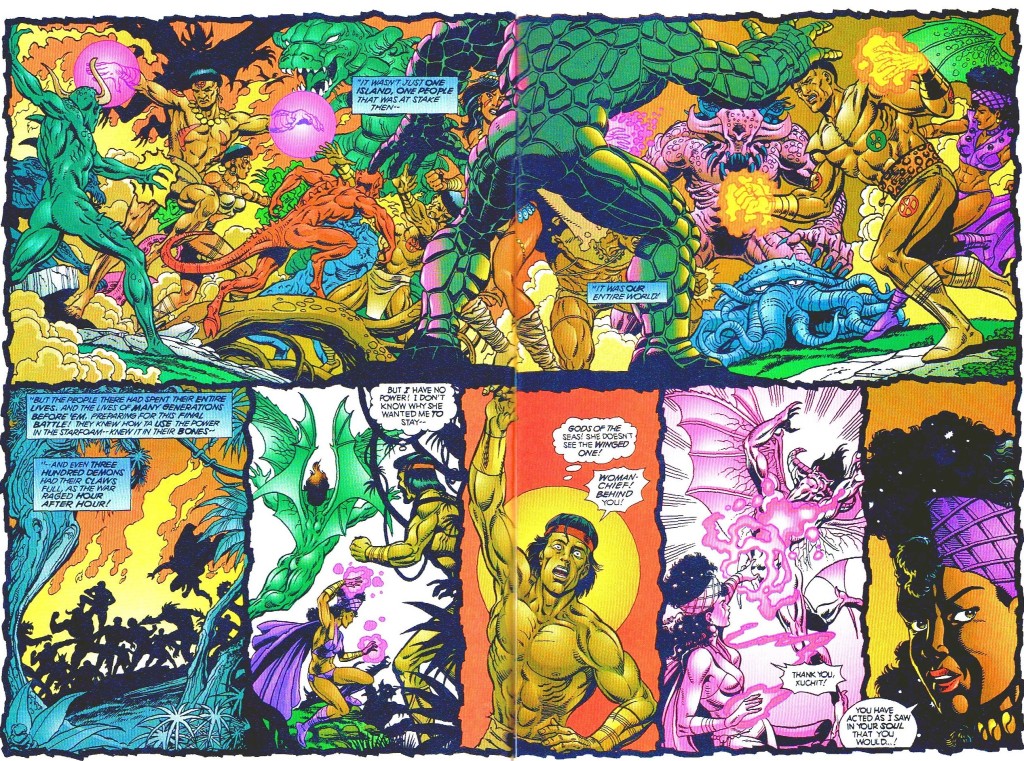
The story begins in the middle of the thick jungle of a floating island. Yrial, who has spent significant time with The Strangers representing her tribe, is held captive by her own people inside a crystal. She is being accused of betrayal of her tribe as a consequence of her involvement with her teammates from the civilized world. Yrial denies the charges and insisted that the rise of The Strangers signifies that their solitude is over.
Eventually Grenade, Zip-Zap, Lady Killer, Electrocute, Spectral and Atom Bob arrive to fight in an attempt help their trapped teammate. The action halts as soon as Lady Killer tells Chief Aula that they know the great secret as they have been to the other side (refer to the previous past issues leading to this)…
Quality
The fictional tribe is definitely cursed for they lived with sorcery, idolatry and rituals sourced from ancient evil.
I will start first with the storytelling. Steve Englehart’s writing is excellent and he clearly did his research about a key part of world history and made an intriguing and compelling fictional story out of it. This is, in fact, one of the most intriguing superhero stories of the 1990s that I have ever read and it is a very lively reminder that storytelling alone can impact readers deeply when it is greatly made.
With regards to the historical fiction aspect of this comic book, I should state that doing a fantasized version of the European explorer Christopher Columbus and connecting him and his crew with the history of the in-comic tribe was a stroke of genius. This was indeed the main selling point of this comic book!
Rick Hoberg, who worked a lot with Englehart and set the definitive look of The Strangers, made great visuals and the images are also much more diverse given the historical fiction aspect of this comic book. Hoberg really brought Englehart’s script to life and his visuals look finely paced with the narrative.
With regards to the emphasis on magic, it should be noted that it is an abomination and in the context of the story, it is a cursed thing and not really a strength of the in-comic tribe. As for the other world (and the demons it is filled with) that the tribe is aware of, it symbolizes the realm of evil. By the end of the story, you will realize that the tribe living on the floating island are indeed a cursed people and not merely isolated using magic. They are also idolaters and practice rituals sourced from evil long ago. For meaning, learn from the holy scriptures below and you will realize that you would NOT want to be like the story’s tribe. You are better off following Lord Jesus and believe in His salvation.
“But the cowardly, unbelieving, abominable, murderers, sexually immoral, sorcerers, idolaters, and all liars shall have their part in the lake which burns with fire and brimstone, which is the second death.”
Revelation 21:8 (NKJV)
Wonderfully blessed are those who wash their robes white so they can access the Tree of Life and enter the city of bliss by its open gates. Those not permitted to enter are outside: the malicious hypocrites, the sexually immoral, sorcerers, murderers, idolaters, and every lover of lies.
Revelation 22:14-15 (TPT)
Conclusion
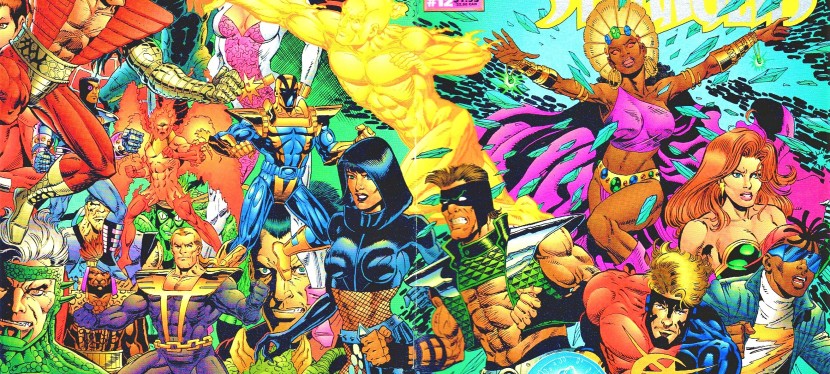
The team nicely drawn by Rick Hoberg.
Among the anniversary issues of the Ultraverse I have reviewed as of this writing, I should state that The Strangers #12 (1994) is the best one yet! Entertainment value aside, the focus on Christopher Columbus and indigenous people should interest people who have varying views about them. Christopher Columbus remains a divisive historical figure as some people admired his achievements on world exploration while others condemned him as an evil, bloodthirsty man who negatively impacted indigenous people he encountered. Whatever your views of Columbus and indigenous people are right now, I recommend you read this comic book. For those who love superhero stuff, you will find a lot to enjoy here.
If you are seriously planning to buy an existing hard copy of The Strangers #12 (1994), be aware that as of this writing, MileHighComics.com shows that the near-mint copy of the comic book costs $8.
Overall, The Strangers #12 (1994) is highly recommended.
+++++
Thank you for reading. If you find this article engaging, please click the like button below and also please consider sharing this article to others. If you are looking for a copywriter to create content for your special project or business, check out my services and my portfolio. Feel free to contact me as well. Also please feel free to visit my Facebook page Author Carlo Carrasco and follow me at HavenorFantasy@twitter.com
In my old life, I used to be fond of celebrating Halloween. Having been Born Again, I realized my true purpose in life under God the Father and His Son Jesus. That being said, I realized how wrong it is to celebrate Halloween which is essentially evil and unholy for any Christian (including those who practice idolatry which itself is sinful). Halloween will take Christians away from the Lord and that alone is reason enough to reject it.
Halloween’s origin is Celtic by nature and it is connected with observing the sacrifices to gods under the Druidic culture. There is also Samhain, a dark lord who sends out evil souls to attack humans who try to save themselves by wearing disguises with the images of those very evil souls.
Sounds familiar? It is because there are these modern day Halloween practices that are linked to the evil rites and superstitions of Halloween. In the modern world where Halloween gets celebrated, people (including many children) go out and around their local communities wearing costumes of horror figures like zombies, demons, monsters and pop culture-related villains (examples: Jason Voorhees, Freddy Krueger, Michael Myers). These costumed Halloween participants, looking horrific, would visit any household that offers candy for trick-or-treat. Wearing “non-horror” costumes like superhero attire or fantasy attire (example: dressed like a princess) does NOT reduce the evil that comes with Halloween. There is no such thing as an innocent way of celebrating Halloween.
And then there are those multimedia-related ways of celebrating Halloween like watching horror movies back to back or playing video games that carry strong horror themes. There is also the business aspect of Halloween as food retailers promote the season by linking it with selling candy and chocolate (clearly to take advantage of families or groups that intend to give away the sweets during trick-or-treat Halloween celebrations in the local communities).
Halloween trick-or-treat here in the Philippines even made its way to local government units. In October of 2016 and 2017, the City Government of Parañaque organized trick-or-treat at City Hall which attracted kids wearing costumes (including horror and superhero attire) who visited varied offices that give away candy. During those times, the City Government even organized special events at the nearby city sports complex celebrating Halloween which I find rather disturbing.
In my old life, I enjoyed celebrating Halloween and I used to ignore the claims that it was unholy and evil. While I never went out for trick-or-treat as a kid, I helped out in giving candy to costumed visitors. I also hiked around the local area photographing the Halloween activities flocked by participants, and then uploading those pics online for social media users to view. I also took time celebrating Halloween by watching horror movies.
Looking back, I honestly admit that celebrating Halloween was indeed wrong. Now that I’m a saved soul and a dedicated Christian with a living relationship with the Lord, I declare that Halloween is wrong, unholy and evil. Halloween is a popular tool used by Satan to take people away from God and Jesus. Halloween definitely should be rejected always and we Christians must always be with God. Let me discuss the following points.
“Is it okay for a Christian to celebrate Halloween?”
The answer is a definite NO. Let’s take a look at the Holy Scripture below.
You cannot drink the cup of the Lord and the cup of demons; you cannot partake of the Lord’s table and of the table of demons.
1 Corinthians 10:21 (NKJV)
And now the Amplified version.
You cannot drink [both] the Lord’s cup and the cup of demons. You cannot share in both the Lord’s table and the table of demons [thereby becoming partners with them].
1 Corinthians 10:21 (AMP)
Very clearly, there is no room to worship both the Lord and evil. If you want to be with the side of God and Jesus, you really need to purify yourself and free yourself from whatever form of evil thrown at you by Satan. Satan is a loser indeed, however he still exists because Adam gave him dominion (read about Adam’s Rebellion) and as long as he exists, he will do anything to take you away from God, to prevent you from worshiping the Lord and will use anything (including religion and idolatry) to prevent you from making progress with the Lord. Halloween is one of Satan’s weapons against Christianity. Halloween is also a long-time tool of the enemy to embrace evil.
If you sinned by celebrating Halloween and committing other sinful acts in your past, you can still be saved (note: you need to be born again to be saved. Heed the words of Jesus in John 3:3) because God is merciful and you need to be willing to repent, submit to Him and dedicate yourself to Him with an established personal relationship with Him.
Be aware that goodness comes from God and evil comes from Satan. It’s as clear as night and day. If you are a saved soul, then it is clear you should stand with God and His Son Jesus. Being dedicated to the Lord will spare you from evil, and that takes willingness and decisiveness from your end.
Learn from this Holy Scripture.
And you He made alive, who were dead in trespasses and sins, in which you once walked according to the course of this world, according to the prince of the power of the air, the spirit who now works in the sons of disobedience, among whom also we all once conducted ourselves in the lusts of our flesh, fulfilling the desires of the flesh and of the mind, and were by nature children of wrath, just as the others.
But God, who is rich in mercy, because of His great love with which He loved us, even when we were dead in trespasses, made us alive together with Christ (by grace you have been saved), and raised us up together, and made us sit together in the heavenly places in Christ Jesus, that in the ages to come He might show the exceeding riches of His grace in His kindness toward us in Christ Jesus. For by grace you have been saved through faith, and that not of yourselves; it is the gift of God, not of works, lest anyone should boast. For we are His workmanship, created in Christ Jesus for good works, which God prepared beforehand that we should walk in them.
Ephesians 2:1-10 (NKJV)
Each and every one of us was created to be loyal, faithful, loving and dedicated towards our Heavenly Father God and His Son Lord Jesus even as we were granted the freedom to think, act and decide. Even before we were even made, God established a plan for each and every one of us. Worshiping Satan, embracing evil, celebrating Halloween and living a life full sin and wickedness are obviously NOT part of God’s plan for us all.
By realizing the true purpose of your existence under God, you will realize that it is your destiny to be saved and to be faithful (not religious) to the Lord. Satan used a whole lot of tools to prevent God’s creations from being with Him. Satan used not only Halloween but also religion, idolatry, money, power, destruction, secularism, atheism, agnosticism, Marxism, socialism, Communism, Leftism, entertainment and a whole batch of other tools to bring Christians down and make evil stronger.
Going back to Halloween, that celebration of evil includes witchcraft which is an abomination! In our world, it is too easy for people to go out wearing costumes to look like witches and this alone spreads the influence of evil around. There are also filmmakers and other creative people out there who made witchcraft look cool or even a good custom to practice. The 1996 Hollywood movie The Craft is one such example of spreading Satan’s influence to the public and I personally recommend to you readers to avoid watching that movie (note: destroy whatever physical or digital copies you have of it) at all. In addition, I urge you to avoid spending your hard-earned money on such evil, and that means boycotting promotional products of Halloween and anything related to evil. Witchcraft and related stuff like sorcery, necromancy and magic are abominations as written in the Holy Bible. Read the Holy Scripture below.
“When you come into the land which the LORD your God is giving you, you shall not learn to follow the abominations of those nations. There shall not be found among you anyone who makes his son or his daughter pass through the fire, or one who practices witchcraft, or a soothsayer, or one who interprets omens, or a sorcerer, or one who conjures spells, or a medium, or a spiritist, or one who calls up the dead. For all who do these things are an abomination to the LORD, and because of these abominations the LORD your God drives them out from before you.”
Deuteronomy 18:9-12
Those abominations that look good in entertainment media are all made to deceive you and prevent you from achieving progress and purity with the Lord. From time to time, there are media reports about real life people who practice witchcraft, sorcery and other unholy customs that make this world a terrible place under the eyes of God. That is, obviously, very unfortunate because it proves how screwed up our physical world really is.
Even appearances can add to the influence of evil. You think going out in local community Halloween celebrations dressed as a witch, or as a magician or as a sorcerer (or even cosplaying as Marvel’s Doctor Strange) is okay with the Lord for as long as you don’t practice witchcraft and the like? Wrong! Imagery or appearances of evil spread evil and deceives others. Such imagery also will influence people to embrace idolatry which itself is a sin. Already there are many people who not only celebrate Halloween (Satan’s festival) but also idolized evil figures like the Jack-O-lantern, Dracula, Jason Voorhees, Freddy Krueger and more. Idolaters will not inherit the kingdom of God! Very clearly, idolatry is unholy! Learn from the scripture below.
Surely you must know that people who practice evil cannot possess God’s kingdom realm. Stop being deceived! People who continue to engage in sexual immorality, idolatry, adultery, sexual perversion, homosexuality, fraud, greed, drunkenness, verbal abuse, or extortion—these will not inherit God’s kingdom realm.
1 Corinthians 6:9-10 (TPT)
Rejecting Halloween Effectively
You might be wondering: how are we Christians supposed to reject Halloween and its evil effectively?
First, we must realize our purpose as Christians from the following Holy Scripture.
You are of God, little children, and have overcome them, because He who is in you is greater than he who is in this world.
1 John 4:4 (NKJV)
And the Amplified version…
Little children (believers, dear ones), you are of God and you belong to Him and have [already] overcome them [the agents of the antichrist]; because He who is in you is greater than he (Satan) who is in the world [of sinful mankind].
1 John 4:4 (AMP)
With that Holy Scripture in two versions, it is clear that as children of God, we are victorious for we believe in the victory of Jesus over Satan. With God on our side, nothing is impossible and we have the power to reject fear, reject evil and reject Satan ultimately. It is by faith in the Lord, not religion and not idolatry, that Christians are special and holy. Stronger than Satan too.
With God on our side, Halloween’s global popularity can be wiped away and its influence of evil on others can be removed and be replaced with the goodness and the biblical truth emphasizing the holiness and victory of Jesus.
If you are looking for practical ways to reject Halloween (and Satan), I would suggest the following:
Instead of watching horror movies or anything that carries the influence of evil, go watch YouTube videos of Christian praise-and-worship songs like the following below.
Instead of going out on Halloween trick-or-treat, pray to the Lord in your room with the door shut (refer to Matthew 6:6 in the Holy Bible) and be aware that in this way, the Lord is in a secret place and when He sees in secret, you will be rewarded openly. If your church is open or has a holy activity at the same time as Halloween is being held on October 31, make an effort to go to church with the Lord in mind.
Instead of looking at evil images or reading materials that are related to Halloween, better read the Holy Bible or a Christian book.
Christian books that you must read.
By now, it is clear that as Christians we must always maintain strong faith, trust and dedication to God and His Son Jesus. It also means we must be pure in holiness and there definitely is no room for us to accommodate evil in all its forms. As such, Halloween must be rejected always and its evil presence only means we must persevere more to meet God’s high call. We are all God’s creations and He made plans for each and every one of us even before we were even created. Obviously we were NOT created to worship nor magnify evil at all! We are destined to be saved (be born again) and live in holiness following Jesus. We pray to Him, serve Him, thank Him and dedicate ourselves to Him for the rest of our time.
Let me end this with one more Holy Scripture.
He has delivered us from the power of darkness and conveyed us into the kingdom of the Son of His love.
Colossians 1:13 (NKJV)
Thank you for reading. If you find this Christianity article engaging, please click the like button below and also please consider sharing this article to others. Also my fantasy book The World of Havenor is still available in paperback and e-book format. If you are looking for a copywriter to create content for your special project or business, check out my services and my portfolio. Feel free to contact me as well. Also please feel free to visit my Facebook page Author Carlo Carrasco and follow me at HavenorFantasy@twitter.com












 Author Carlo Carrasco