Disclaimer: This is my original work with details sourced from reading the comic book and doing personal research. Anyone who wants to use this article, in part or in whole, needs to secure first my permission and agree to cite me as the source and author. Let it be known that any unauthorized use of this article will constrain the author to pursue the remedies under R.A. No. 8293, the Revised Penal Code, and/or all applicable legal actions under the laws of the Philippines.
Welcome back, superhero enthusiasts, comic book collectors and fans of Wonder Woman! In case you missed the updates, the new movie Wonder Woman 1984 will eventually be released in 4K Blu-ray format although there is no release date announced yet nor a price. As the nearest cinemas remain closed, it looks like buying the movie in 4K Blu-ray is the best alternative for me and at the same time I am not a fan of streaming movies. Let me point out that what customers pay to stream Wonder Woman 1984 does NOT pay that movie’s producers, investors and creditors! You want to make a difference for the people behind Wonder Woman 1984? Buy movie tickets to watch it in the movie theaters (you will also help the theater operators and their employees) and for home viewing, buy the movie on Blu-ray and 4K Blu-ray in the near future.
Anyway, we are here to look back at the comic books of Wonder Woman as rebooted by the creative duo of George Perez and the late Len Wein. We are going to examine the Challenge of the Gods storyline (started in issue #10) which I personally find really intriguing and engaging to read. It is the struggle of Wonder Woman with a really strong fantasy and mythology flavor that made it stand out among superhero comic book stories in the late 1980s. Last time around, there were these great revelations about an untold chapter of the past of the Amazons as well as greater focus on Diana’s mother Queen Hippolyte who joined in the dangerous trek.
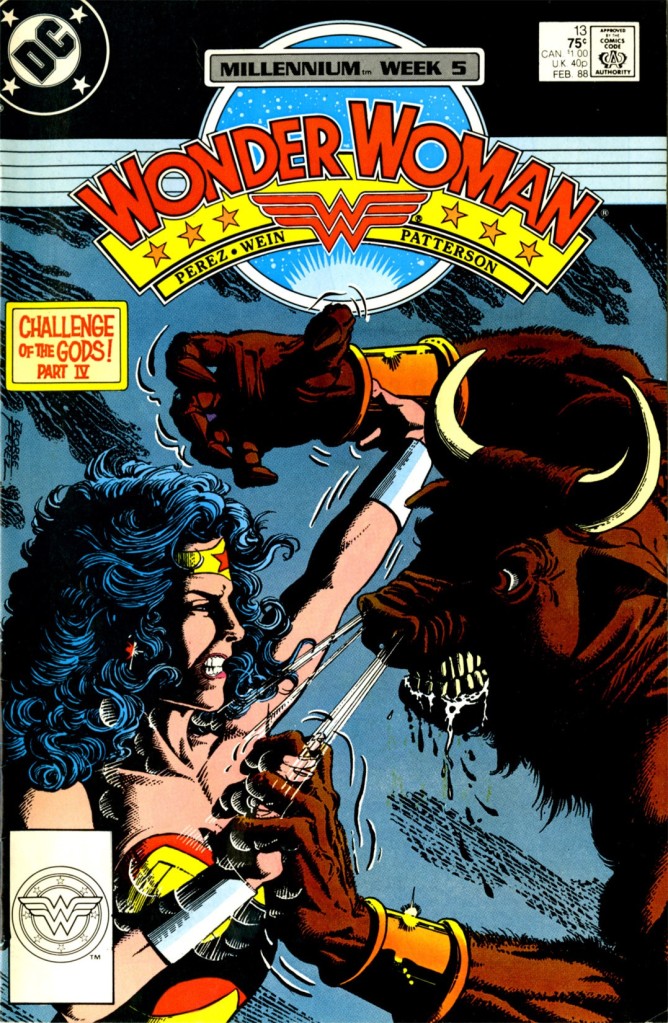
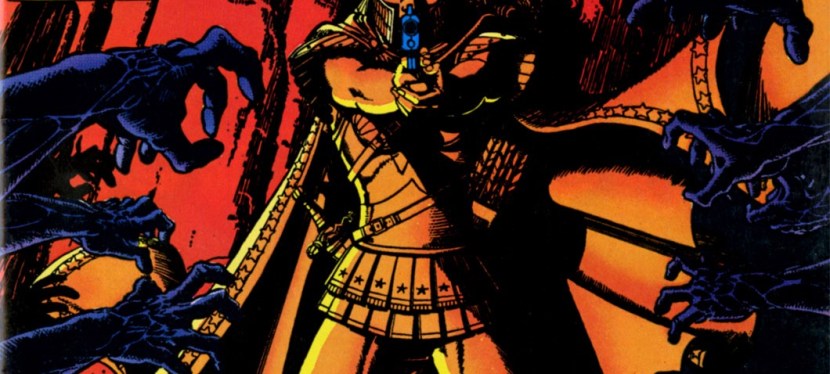
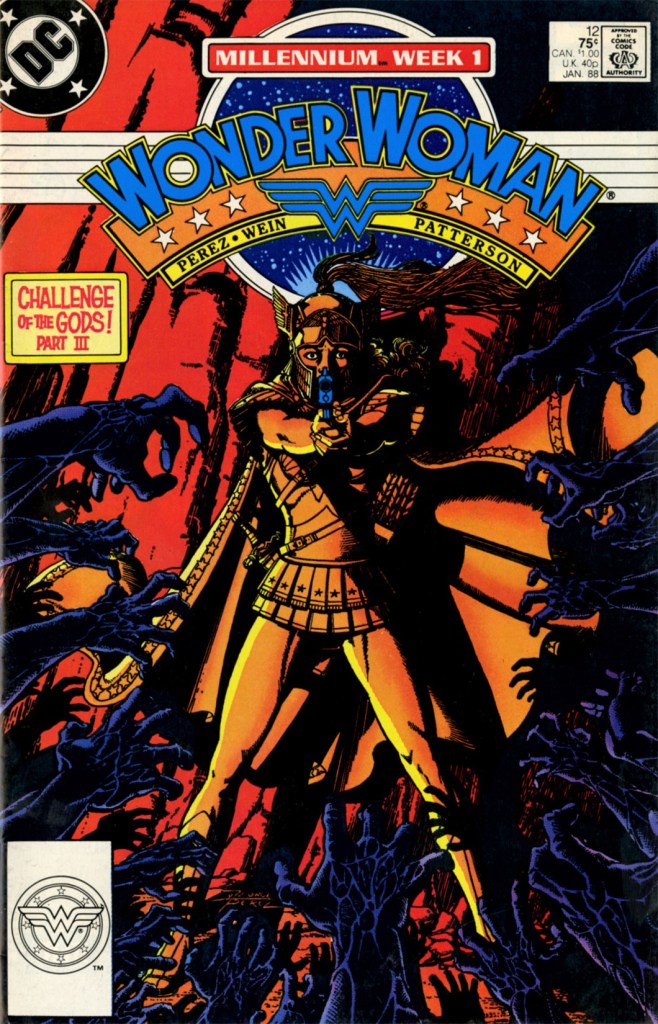
With those details laid down, here is a look back at Wonder Woman #13, published in 1988 by DC Comics with a story written George Perez and Len Wein. Perez drew the comic book with ink work done by Bruce D. Patterson. This is the 4th chapter of the Challenge of the Gods storyline!
The cover.
Early story
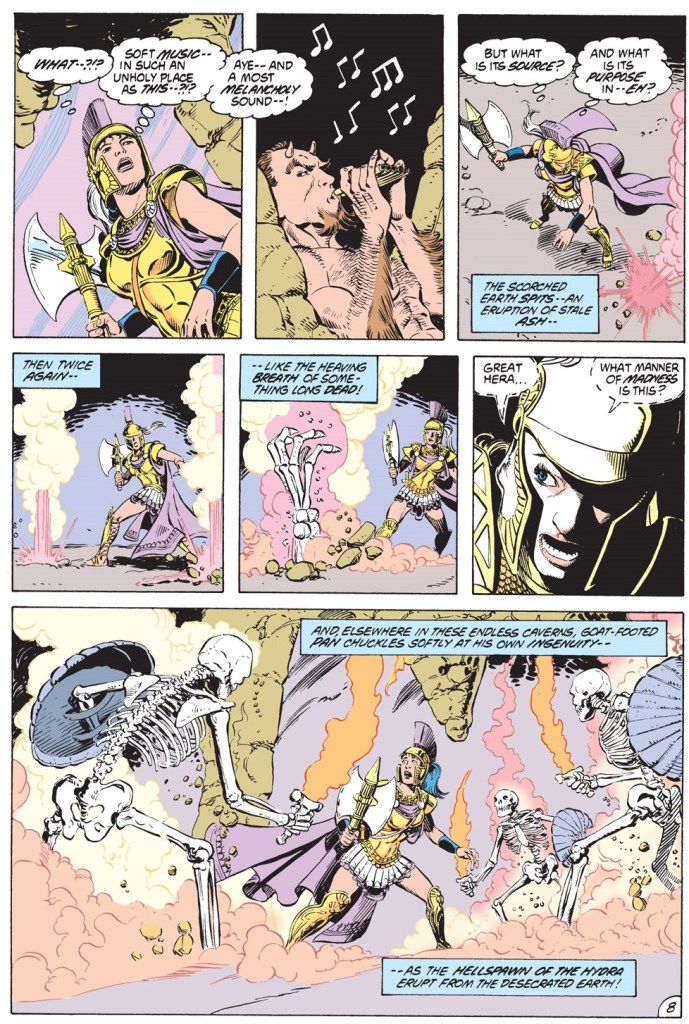
The story begins with the armored Queen Hippolyte staring at a huge, deformed man-like figure made of rock which she realizes is none other than Heracles, the same man who deceived and abused her long before the birth of Diana. She reflects on her personal hatred of him that lasted for centuries and remembers that her years in Themyscira taught her the folly of anger. She wonders what Heracles had committed to be condemned the way he is. Noticeably, anything that pierces the stony surface causes great pain and tears from Heracles.
Hippolyte moves on toe find a sleeping cyclops in a lair filled with skeletons. Behind him is a tunnel that she believes her daughter took. As she quietly sneaks, she looks back at Heracles and actually hears him mournfully moaning louder as if he was calling to her.
Among the skeletons in the cyclops’ lair is a horned human skull which Zeus and his fellow deities in Olympus believe belongs to Pan. They realize that the Pan who had spent a lot of time with them is an impostor and this causes division among them. Hera speaks out again Zeus pointing out his enormous pride and arrogance as sources of trouble. Hera believes that Gaea’s destiny will be fulfilled through the Amazons and she will not allow Zeus to abuse them.
Hera then sends Hermes to reach Wonder Woman who just joined the company of several superheroes in the California citadel of the Green Lantern Corps…
Quality
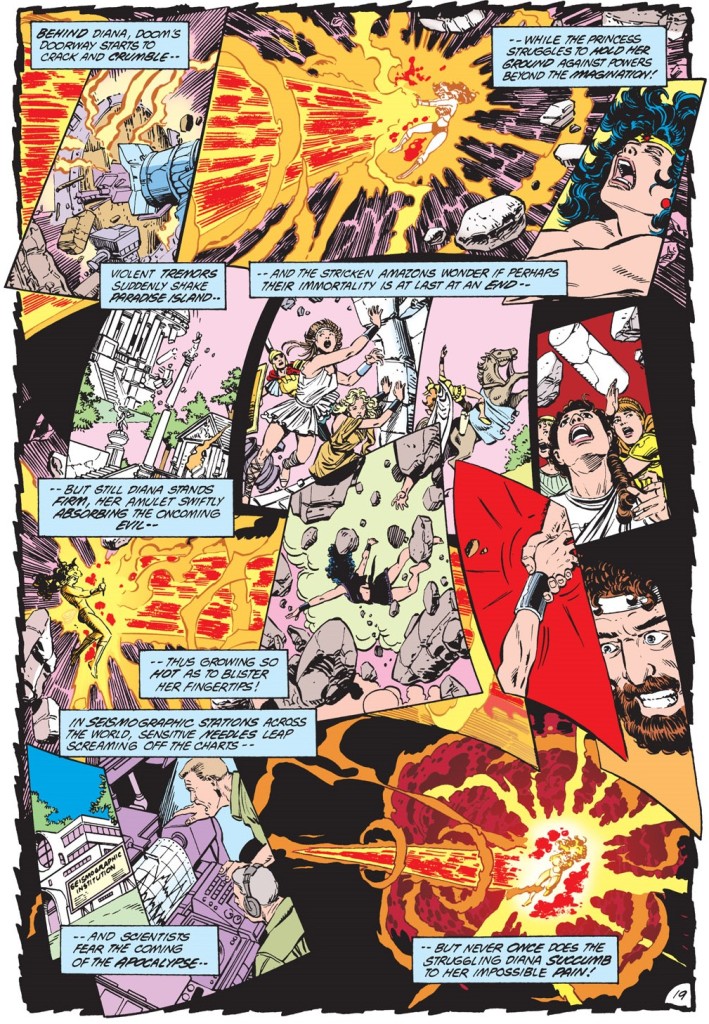
The tremendous impact of the challenge felt.
This is another high-quality creation by Perez-Wein and the stakes for not only Wonder Woman but also her mother has been raised even further. As if that was not enough, there are also some solid revelations (pertaining to the Amazons, their heritage and their destiny under the Olympus deities) and in-story surprises that made the story very engaging. As the challenge for Wonder Woman continued on, Queen Hippolyte’s involvement grew even bigger and this added and connected smoothly with her daughter’s struggles. In terms of characterization, the bond between Diana and her queen mother is dramatically deepened and their respective purpose in life got emphasized a lot more.
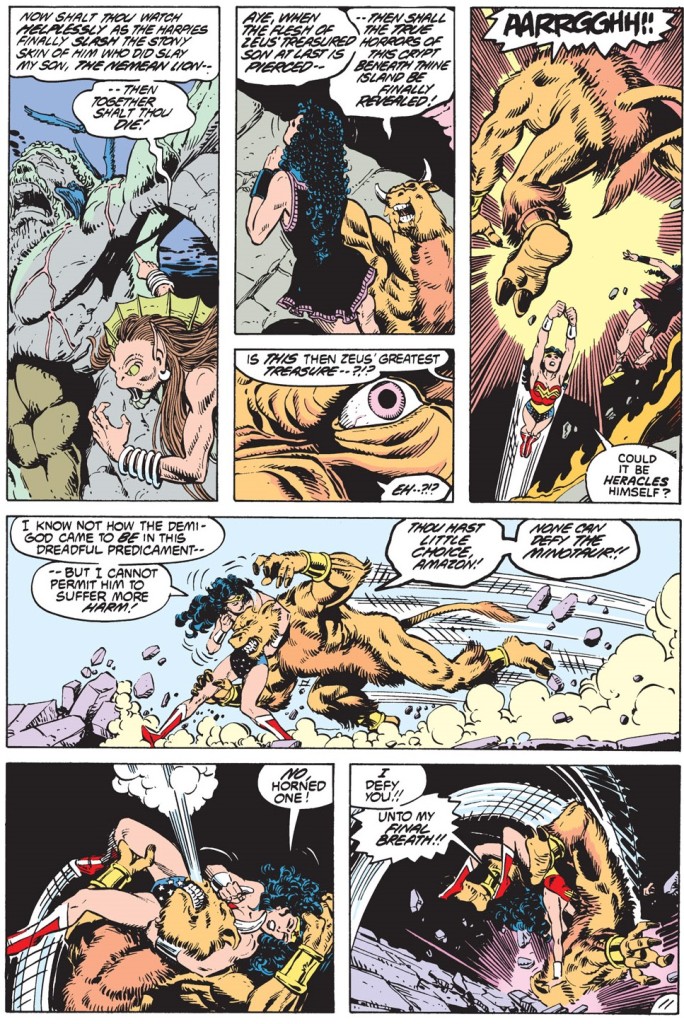
In terms of spectacle, this one is very loaded with action while still having a very strong fantasy element behind it all. Seeing Wonder Woman and her mother engage the minotaur and mythological creatures are sights to behold. George Perez expectedly visualized everything with high details and well-constructed panels that moved the action.
Conclusion
Wonder Woman and her mother in the heat of battle with the evil creatures.
No doubt about it! Wonder Woman #13 (1988) successfully kept the Challenge of the Gods storyline compelling and at the same time stay fresh by pulling off strong revelations that will make you think deeper about the Amazons, their heritage and their future. The portrayal of Wonder Woman here shows how pure she is as a purposeful protagonist who simply won’t give up in fulfilling the challenges, proving her true worth and making a major impact to all around her. Her role as a daughter is also very well defined.
If you are seriously planning to buy an existing hard copy of Wonder Woman #13 (1988), be aware that as of this writing, MileHighComics.com shows that the near-mint copy of the regular edition costs $30 while the near-mint copy of the newsstand edition costs $60.
Overall, Wonder Woman #13 (1988) is highly recommended!
+++++
Thank you for reading. If you find this article engaging, please click the like button below and also please consider sharing this article to others. If you are looking for a copywriter to create content for your special project or business, check out my services and my portfolio. Feel free to contact me as well. Also please feel free to visit my Facebook page Author Carlo Carrasco and follow me at HavenorFantasy@twitter.com
Disclaimer: This is my original work with details sourced from reading the comic book and doing personal research. Anyone who wants to use this article, in part or in whole, needs to secure first my permission and agree to cite me as the source and author. Let it be known that any unauthorized use of this article will constrain the author to pursue the remedies under R.A. No. 8293, the Revised Penal Code, and/or all applicable legal actions under the laws of the Philippines.
During the first half of 1993, Marvel Comics had published four monthly series of their 2099 franchise of comic books: Spider-Man 2099, Ravage 2099, Doom 2099 and Punisher 2099. X-Men 2099 debuted in the 2nd half of 1993 but months before that happened, Marvel went ahead with expanding their 2099 franchise by launching what was back then a new, quarterly comic book series simply titled 2099 Unlimited.
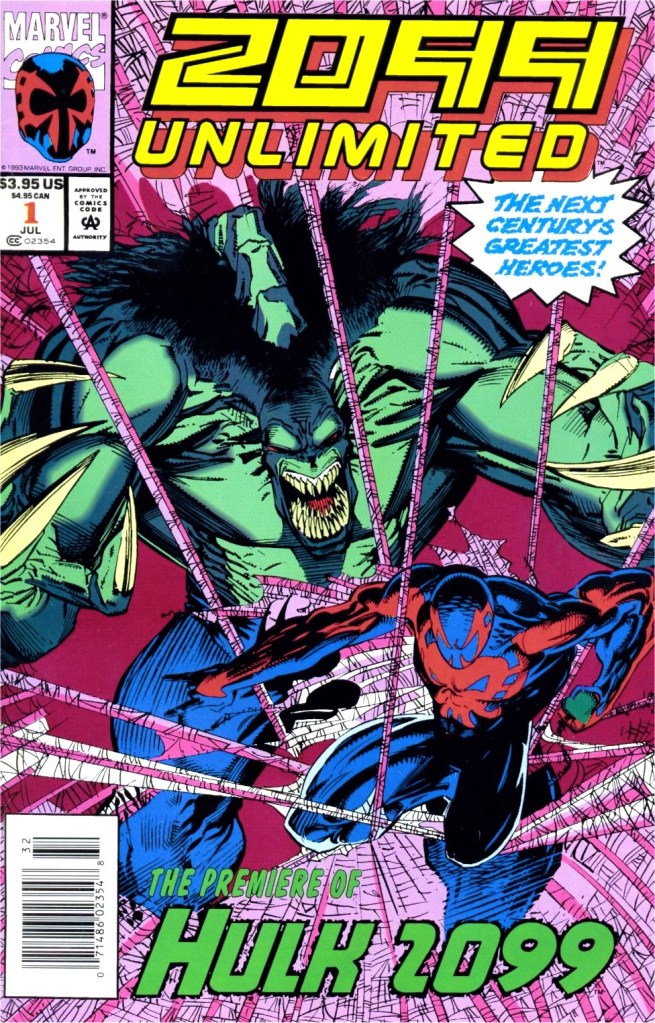
That being said, the mentioned quarterly series was officially launched with 2099 Unlimited #1 which, as its cover showed, featured Spider-Man 2099 as well as Hulk 2099. The comic book came with a high price of $3.95 on its cover and it had 64 pages of content (including ads and bulletins). I myself bought a copy of it as soon as it appeared on the shelves of the local comic book store here in the Philippines.
Was the debut comic book fun? Is it good by today’s standards? We can all find out in this look back at 2099 Unlimited #1, published in 1993 by Marvel Comics with stories written by Evan Skolnick and Gerard Jones, and drawn by Chris Wozniak and Dwayne Turner.
The cover.
Early stories
“Nothing ever changes!” – the story begins at New York City’s Koop Memorial Hospital where an investigation is happening. A married couple arrives and noticed the unusual activity happening there. As they arrive at another floor to visit their son Michael, they noticed the hallway is full of dead bodies. They panic and start running to find their son. Suddenly a muscular man appears and kills the husband, stating his action is justified by his belief about the natural order of things and his effort to ensure humanity’s survival. The killer escapes.
Weeks later, Spider-Man/Miguel O’Hara returns home from fighting crime just in time to rush and prepare himself for his date with Anna. During their date, Anna talks about her sister who has a rare genetic deformity. She intends to visit her sister at the hospital, and Miguel asked if she wants him to come along…
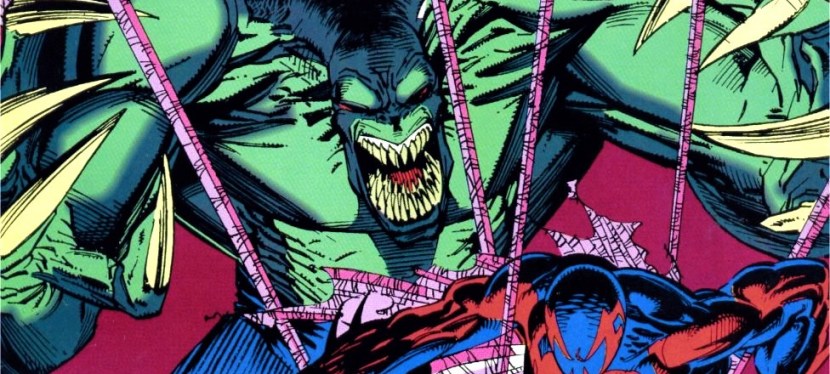
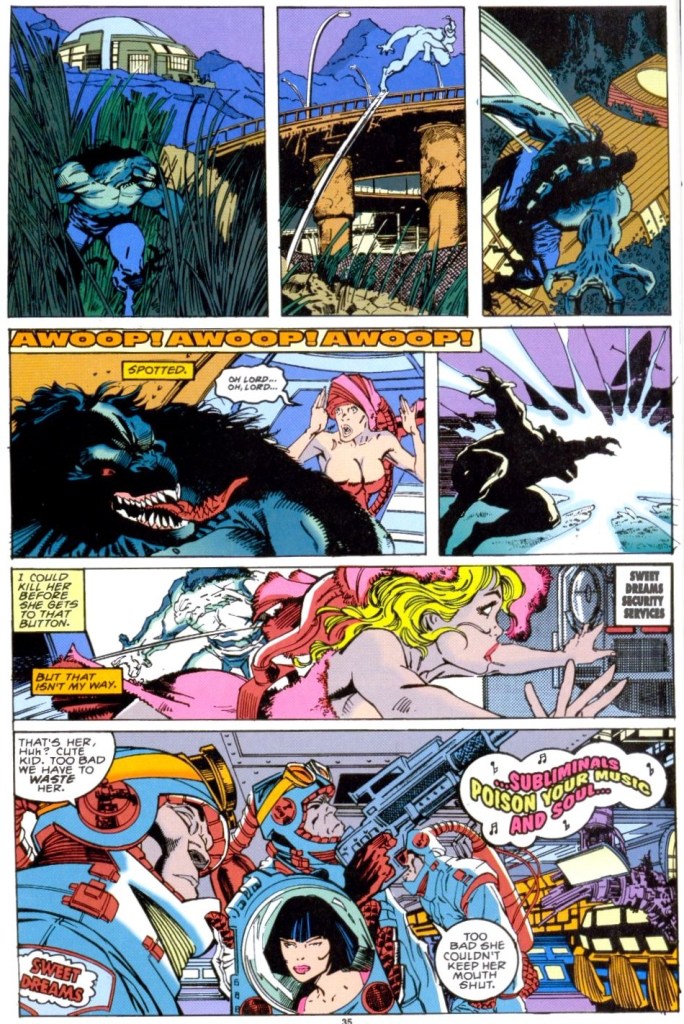
“Hulk 2099” – the story begins in the Mojave Desert with the Hulk traveling alone in the middle of the night. He has been traveling for over three hundred miles alone hunting something. The Hulk arrives at the private residence of a lady who spots him and alerts the armed personnel of Sweat Dreams Security Services. Soon enough, Sweet Dreams personnel arrive and its tank charges at the green monster…
Quality
Imagine Hulk 2099 trespassing on your property.
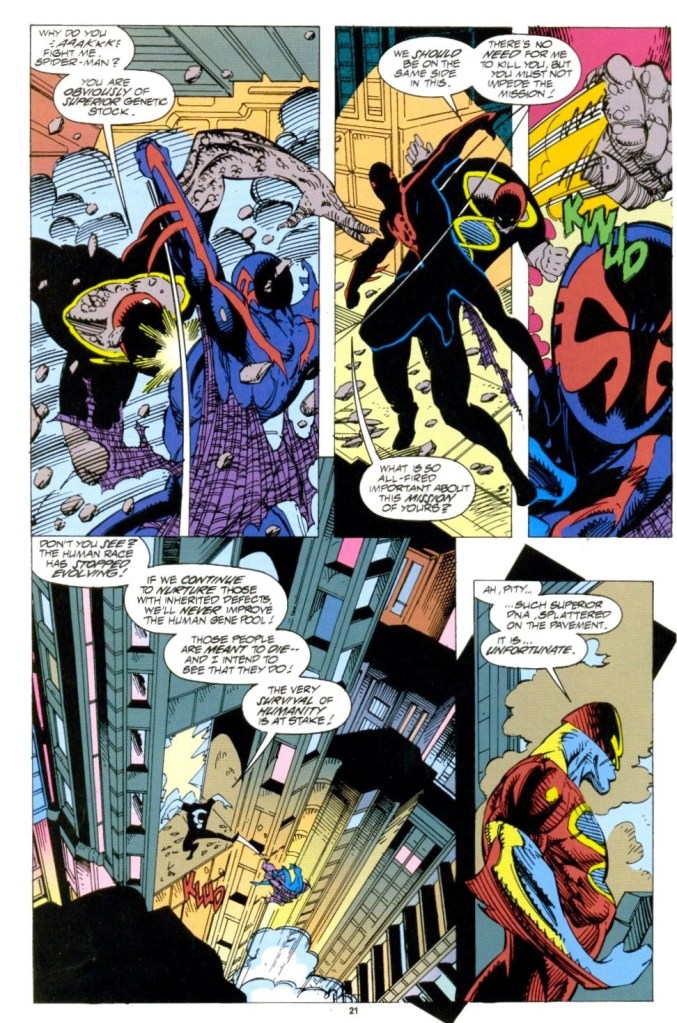
The first story featuring Spider-Man 2099 has a pretty interesting concept that was nicely executed and proved to be surprisingly satisfying. The creative team introduced the new villain Mutagen and they succeeded in building his personality (including his obsession with perfecting human genetics and altering the so-called gene pool) which resulted a justified conflict with Spider-Man. The character development, focused mainly on Mutagen, was well done and by the end of the story, he became a pretty interesting villain.
As for Spider-Man, his character development was pretty limited to his interactions with Anna laced with little references to his career with Alchemax, and there were no references to his personal life and the people who mattered most to him. Clearly, the first story was more about Mutagen than Spider-Man, and it has a very satisfying conflict between the two. I also enjoyed the way the creative team presented Mutagen being able to adapt to his environment and the attacks Spider-Man threw at him. While the story is strong, I should say that Chris Wozniak’s art is uneven. His drawings on Mutagen were pretty details but the same cannot be said about his art on Spider-Man.
The second story, featuring Hulk of 2099, is the actual gem in this comic book. Not only was it the first-ever appearance of the character, it unsurprisingly took inspiration from the origin of the classic Hulk (Bruce Banner) and made some twists with themes of the business of entertainment and the human desire of idolatry (always unholy). The new Hulk here is an entertainment executive named John Eisenhart who has been researching the Knights of Banner, a group of people who worship the classic Hulk. What he does in the real world and with people, he strives to make something out of them to boost his career and stand out in the business of amusement. Eisenhart sees Banner’s idolaters having the makings of a new cult of Thor complete with living in isolation
Eisenhart is not the typical good-natured protagonist. Quite the opposite in fact as he is obsessed with success and is a walking tool of Hollywood who exploits people and insists that being civilized is essential and that strength is knowing where the power is. That being said, this story has a lot of build-up on Hulk 2099 while still having sufficient space to tell his origin that arguably links him with the legacy of Banner Hulk. For the most part, the bouts of build-up resulted worthy pay-offs that readers can enjoy.
More on Hulk 2099 himself, this version of the classic character is more monstrous and freakish looking. While Hulk 2099 maintains the intelligence of Eisenhart, he still is deadly and unpredictable. Supporting characters like Gawain and Quirk both lacked scenes and dialogue but that is not surprising since the focus of the comic book is on Hulk 2099. For the art, Dwayne Turner’s work here is satisfying.
Conclusion
Spider-Man 2099 and Mutagen in battle!
When I first read this way back in 1993, I felt underwhelmed. By today’s standards, 2099 Unlimited #1 (1993) surprisingly aged well and it is actually deeper, more meaningful and engaging than I previously thought. Apart from Hulk 2099’s debut, the introduction of Mutagen was pretty engaging and he had a lot of potential to be a major 2099 universe villain. Too bad that Mutagen was not used to be a nemesis against Ravage 2099 or Punisher 2099 or even X-Men 2099. Hulk 2099 meanwhile went on to have a dedicated monthly series which came at a time when the 2099 imprint and the comic book industry in general went way down. This comic book, in my opinion, is more cerebral than it looks and that is thanks to the writers.
If you are seriously planning to buy an existing hard copy of 2099 Unlimited #1 (1993), be aware that as of this writing, MileHighComics.com shows that the near-mint copy of the regular edition costs $15 while the near-mint copy of the newsstand edition costs $32.
Overall, 2099 Unlimited #1 (1993) is recommended.
+++++
Thank you for reading. If you find this article engaging, please click the like button below and also please consider sharing this article to others. If you are looking for a copywriter to create content for your special project or business, check out my services and my portfolio. Feel free to contact me as well. Also please feel free to visit my Facebook page Author Carlo Carrasco and follow me at HavenorFantasy@twitter.com
Disclaimer: This is my original work with details sourced from reading the comic book and doing personal research. Anyone who wants to use this article, in part or in whole, needs to secure first my permission and agree to cite me as the source and author. Let it be known that any unauthorized use of this article will constrain the author to pursue the remedies under R.A. No. 8293, the Revised Penal Code, and/or all applicable legal actions under the laws of the Philippines.
Welcome back, superhero enthusiasts, comic book collectors and fans of the Ultraverse! We return to the Ultraverse and this time we will join The Strangers in one of their misadventures. In recent times, I reviewed issues number 16, 17 and 18. This time, I want to go back to one of their comic books that were published within the first year of the Ultraverse.
With that being said, here is a look back at The Strangers #9, published in 1994 by Malibu Comics with a story by Steve Englehart and drawn by Rick Hoberg.
The cover.
Early story
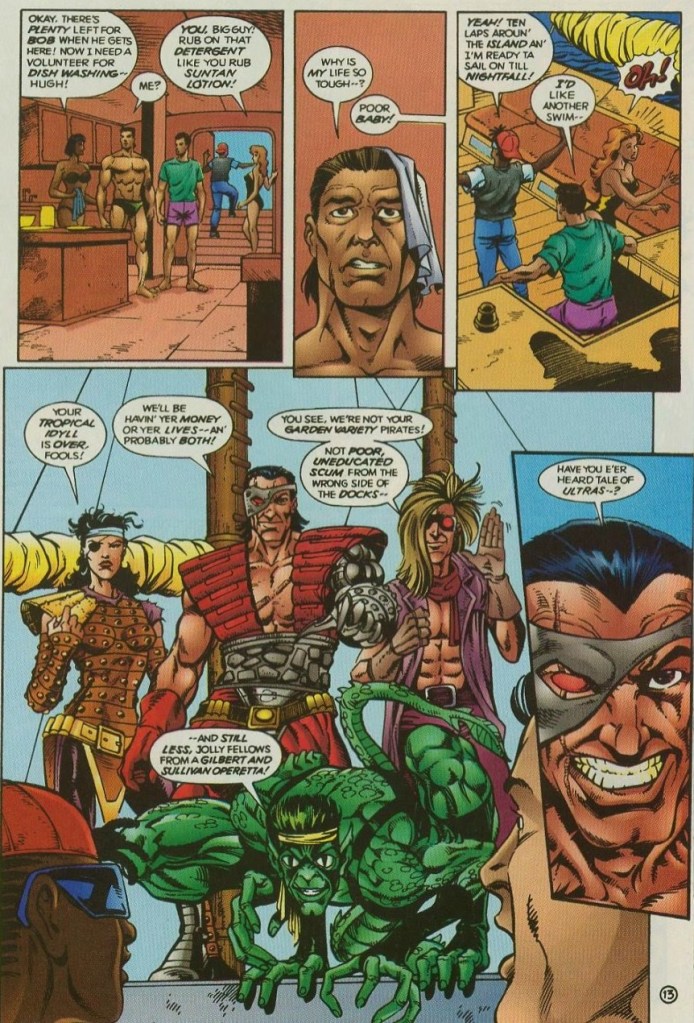
The story begins in the Caribbean where the US Coast Guard is patrolling. They receive a distress call and the captain commands the ship to move full speed ahead. He is searching for pirates they encountered previously. They come close to another ship and start communicating with them. Suddenly something caught the crew off guard and an explosion happens.
The next day, at a local port within the Caribbean, the Strangers rent a large boat to explore the see. Although they have been warned about pirates, they still set sail with Lady Killer doing the navigating (using the coordinates Yrial handed to them). As Lady Killer works, the rest of the team relax (as instructed).
From a distance, a band of creepy looking pirates watch the Strangers from a distance and prepare to board them…
Quality
The Strangers meet the pirates in the Caribbean.
This is another fun-filled, compelling story done by the Englehart-Hoberg creative team. It is one unique misadventure of the Strangers set in a tropical environment in which their relaxing exploration suddenly turns into a series of unfortunate events. The pirates introduced here really gave the Strangers their biggest challenge yet (as far as team battles go). I should state that very clever creativity was implemented on how the action was presented and how the pirates’ respective abilities were introduced. More on the powers of ultra beings, there are references to a certain entity on the moon as well as the bolt of energy that hit the San Francisco cable car in issue #1.
When it comes to character development, there is additional attention paid towards Atom Bob who is bothered somewhat about not have the ideal lady in his life. Also emphasized was Elena (Lady Killer) who turns out to be over 30-years-old and tries her best to avoid getting personally involved with any of her teammates as she is their leader and organizer. Of course, Atom Bob and Lady Killer would eventually get romantically involved in subsequent issues.
Conclusion
Nothing like enjoying the natural wonders of the Caribbean.
The Strangers #9 (1994) is one thrill ride which I believe will satisfy not only Ultraverse fans but also any reader who like action-packed team superhero stories in general. Steve Englehart and Rick Hoberg succeeded in telling another fun-filled story that had a nice mix of spectacle, surprise and some character development.
If you are seriously planning to buy an existing hard copy of The Strangers #9 (1994), be aware that as of this writing, MileHighComics.com shows that the near-mint copy of the comic book costs $8.
Overall, The Strangers #9 (1994) is recommended.
+++++
Thank you for reading. If you find this article engaging, please click the like button below and also please consider sharing this article to others. If you are looking for a copywriter to create content for your special project or business, check out my services and my portfolio. Feel free to contact me as well. Also please feel free to visit my Facebook page Author Carlo Carrasco and follow me at HavenorFantasy@twitter.com
Disclaimer: This is my original work with details sourced from reading the comic book and doing personal research. Anyone who wants to use this article, in part or in whole, needs to secure first my permission and agree to cite me as the source and author. Let it be known that any unauthorized use of this article will constrain the author to pursue the remedies under R.A. No. 8293, the Revised Penal Code, and/or all applicable legal actions under the laws of the Philippines.
Welcome back, superhero enthusiasts, comic book collectors and fans of Marvel’s 2099 universe! Do you want to see more of 2099 stories written by the late Stan Lee? There is Ravage 2099, the one original character for the 2099 universe co-created by Lee and illustrator Paul Ryan. In my last review, the story had Ravage desperately trying to survive in an island which is toxic and filled with lots of bad guys hunting him down.
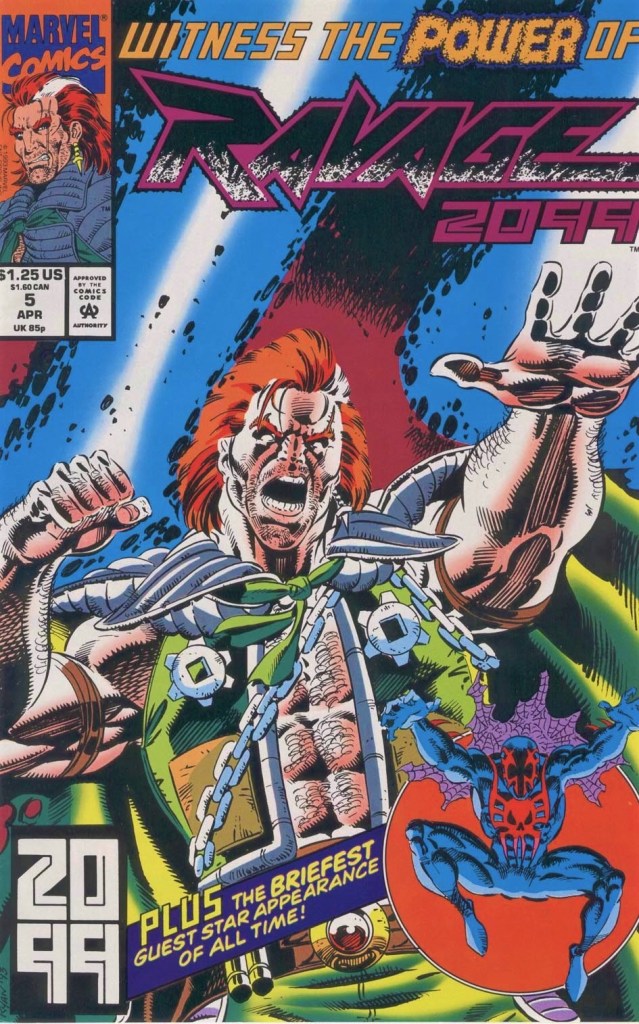
With those details laid down, here is a look back at Ravage 2099 #5, published in 1993 by Marvel Comics with a story written by Stan Lee and drawn by Paul Ryan.
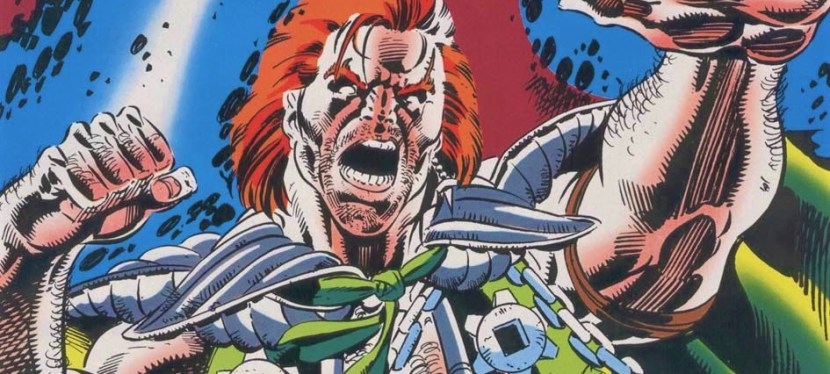
The cover.
Early story
The story begins with Ravage, in the presence of Ursell (the one who saved his life), reacting to his hands burning with light-blue flame. Ursell states it is the radiation causing it. Ravage accuses him of turning him into a troid and that he is not better than Dethstryk, the ruler on the island. As he could not control his anger, Ravage attacks Ursell (who told him his hands are lethal as they destroy what they touch).
Outside, one Dethstryk’s troops spots light (the result of Ravage’s energetic hands) coming from the same cave Ravage and Ursell are in. Eventually Ravage calms down and the energy of his hands weaken. Ursell hands him gloves (composed of complex molecular formula) which help him contain the energy but only for one hour.
Suddenly, Dethstryk’s thugs spot the two in the cave. One of them identifies Ursell as the betrayer of their leader…
Quality
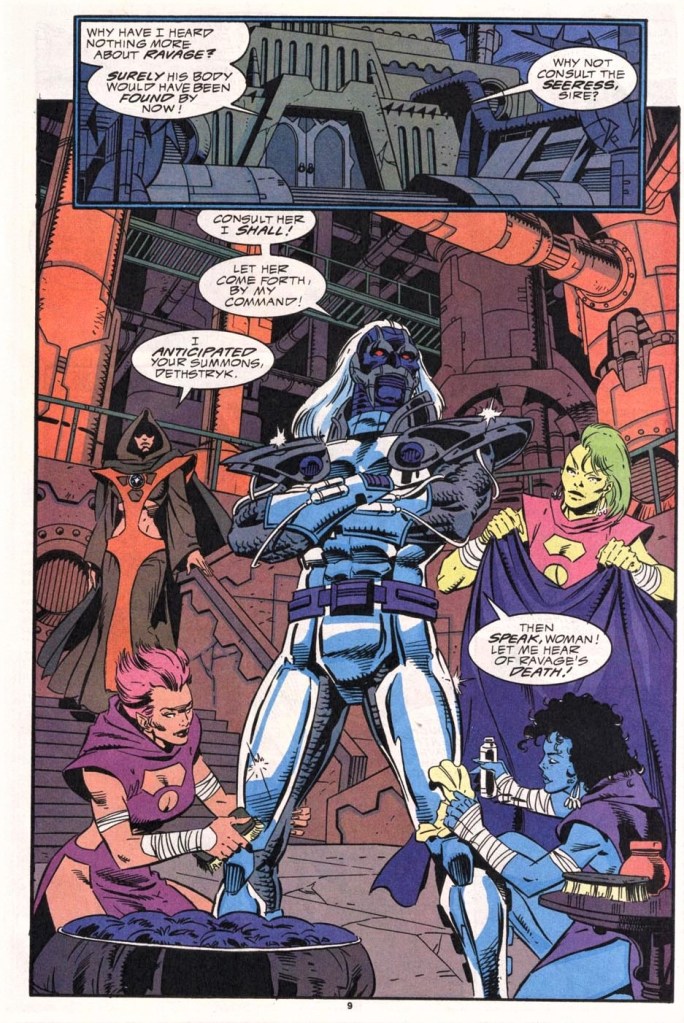
I wonder if SJWs, socialists, Communists and the radicalized feminists will find this image offensive…
In terms of storytelling, this comic book is a big improvement over the last issue. While issue #4 was pretty much limited to Ravage just struggling to survive, this one had more elements of discovery and surprise which made it feel fresh. Ravage having his hands energetic and getting bothered deeply by it was a nice touch to spice up the character while building him up to be potentially more powerful. I also enjoyed the sub-plot in which Tiana, who has been portrayed as an erotic damsel-in-distress since issue #1, finally gets to do something important with trying to free the troubled youth Dack. Not only that, there is also another sub-plot involving a race of aquatic creatures that seek to invade the surface.
Conclusion
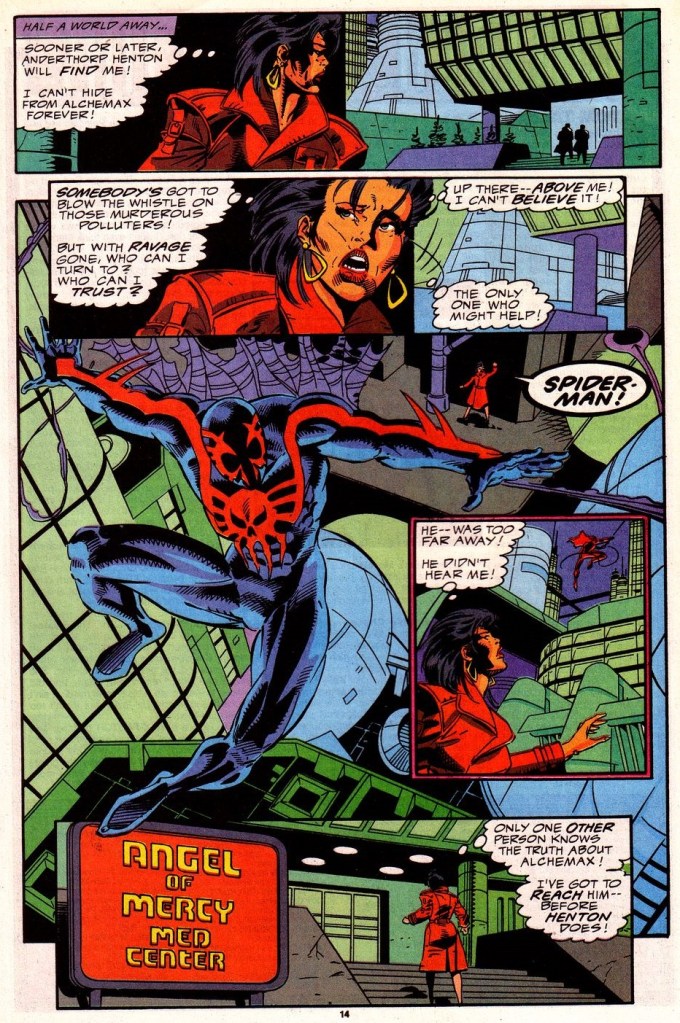
Spider-Man 2099’s very brief appearance!
Ravage 2099 #5 (1993) is fun to read and surprisingly engaging as it is a big improvement over issue #4. Considering the uneven quality of this particular series, it’s nice to see Stan Lee make storytelling improvements just as they are needed. Still the quality of dialogue is sub-par and there were corny lines like Ravage saying, “You’re cornier than breakfast cereal!”
If you are seriously planning to buy an existing hard copy of Ravage 2099 #5 (1993), be aware that as of this writing, MileHighComics.com shows that the near-mint copy of the regular edition costs $8 while the near-mint copy of the newsstand edition costs $24.
Overall, Ravage 2099 #5 (1993) is satisfactory.
+++++
Thank you for reading. If you find this article engaging, please click the like button below and also please consider sharing this article to others. If you are looking for a copywriter to create content for your special project or business, check out my services and my portfolio. Feel free to contact me as well. Also please feel free to visit my Facebook page Author Carlo Carrasco and follow me at HavenorFantasy@twitter.com
You guys and gals enjoy the taste and coolness of gelato? For the newcomers reading this, gelato is a frozen dessert of Italian origin and what makes it different from ice cream is that it is composed with more milk and less cream than ice cream, and is also usually made without egg yolks.
For us living in Metro Manila here in the Philippines, there is a certain gelato that consumers can avail of locally thanks to the Ice Cream House company and it is called Pastillas de Langka.
The Pastillas de Langka from Gold Delight.
Called a coconut gelato, Pastillas de Langka is pastillas ice cream with bits of jack fruit. It is composed of coconut milk, jackfruit, milk powder and extract, sugar, water, stabilizer and emulsifier. Served in 1-liter plastic containers, the Pastillas de Langka I bought in nearby Las Piñas City (note: vendor of Gold Delight ice cream there can be contacted for orders and inquiries 09154606505) cost me P135.
For the newcomers and foreigners reading this, pastillas (AKA Pastillas de Leche) is a popular Philippine delicacy made with milk as its core ingredient with refined sugar and calamansi juice as additional ingredients. I remember way back in my high school days when we were taught at school to make pastillas with powdered milk, refined sugar and condensed milk (liquid).
Going back to the Pastillas de Langka, I noticed how smooth, creamy and yet firm it is even when exposed to room temperature minutes after being brought out of the freezer. In short, it takes longer to melt compared to ice cream. If you want to know specific differences between gelato and ice cream, check this out.
How does it taste? Really good! Each serving of Pastillas de Langka I had was mildly sweet (with light flavors of pastillas and coconut milk). The bits of jackfruit (langka) added variety to the flavor.
A close look at Pastilla de Langka after a few servings scooped up. See the jackfruit bits?
If you are fond of cold dessert and want something tasty and mild with the sweetness, not to mention having lower fat content, then Ice Cream House’s Pastilla de Langka is recommended.
The details regarding ordering such as how to pay, what form to fill up and how long it will take for orders to be delivered are available for viewing at the FB page.
+++++
Thank you for reading. If you find this article engaging, please click the like button below and also please consider sharing this article to others. If you are looking for a copywriter to create content for your special project or business, check out my services and my portfolio. Feel free to contact me as well. Also please feel free to visit my Facebook page Author Carlo Carrasco and follow me at HavenorFantasy@twitter.com
Disclaimer: This is my original work with details sourced from watching the movie and doing personal research. Anyone who wants to use this article, in part or in whole, needs to secure first my permission and agree to cite me as the source and author. Let it be known that any unauthorized use of this article will constrain the author to pursue the remedies under R.A. No. 8293, the Revised Penal Code, and/or all applicable legal actions under the laws of the Philippines.
We all know that the 20th Century Fox franchise of X-Men movies has ended and everything cinematic about Marvel’s famous mutants are now in the hands of Marvel Studios. From the year 2000 to 2020, the original X-Men cinematic universe produced a whole bunch of movies (including spinoffs) which ultimately led to uneven results with regards to commercial success, critical feedback, artistry, production values and cultural impact. Even so, 20th Century Fox-produced X-Men movies generated more than $6 billion in ticket sales worldwide.
When it comes to the spinoff movies, I like Logan the best (sorry, Deadpool).
For the main X-Men movies, the one film that really delivered the great stuff and tons of fun for me was none other than X-Men: Days of Future Past (2014). For one thing, the movie had two generations of X-Men cinematic performers (the original team led by Patrick Stewart and the newer ones from X-Men: First Class led by James McAvoy) and its story literally had them linked together with Hugh Jackman’s Wolverine as the living bridge between them. To put it short, it was a cinematic crossover story made with X-Men fans in mind. That film scored highly with critics and most moviegoers, and it grossed almost $750 million worldwide which makes it the highest-grossing X-Men movie ever until now.
It has been years since X-Men: Days of Future Past made waves in the cinemas and through post-theater businesses like Blu-ray, cable TV, pay-per-view, streaming and the like. Along the way, movies like Wonder Woman, Aquaman, Avengers: Infinity War and Avengers: Endgame collectively raised the standards of Hollywood superhero movies in varied ways. I should state that X-Men (2000), X2: X-Men United and X-Men: The Last Stand did not age well.
To find out if the 2014 X-Men film aged well or not, here is my retro review of X-Men: Days of Future Past directed by Bryan Singer with a screenplay written by Simon Kinberg with a story done by Kinberg, Jane Goldman and Matthew Vaughn.
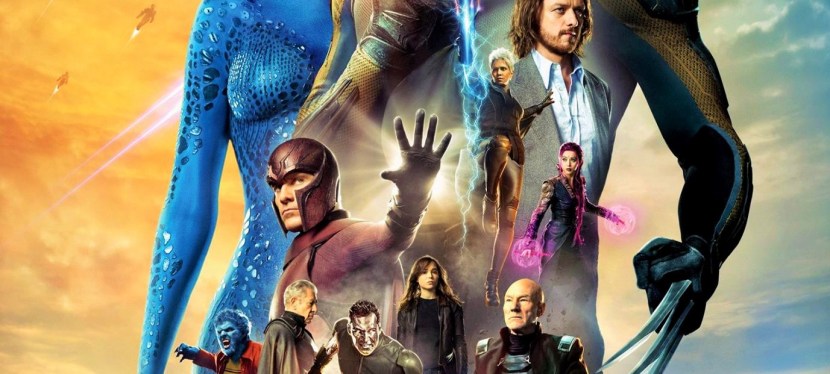
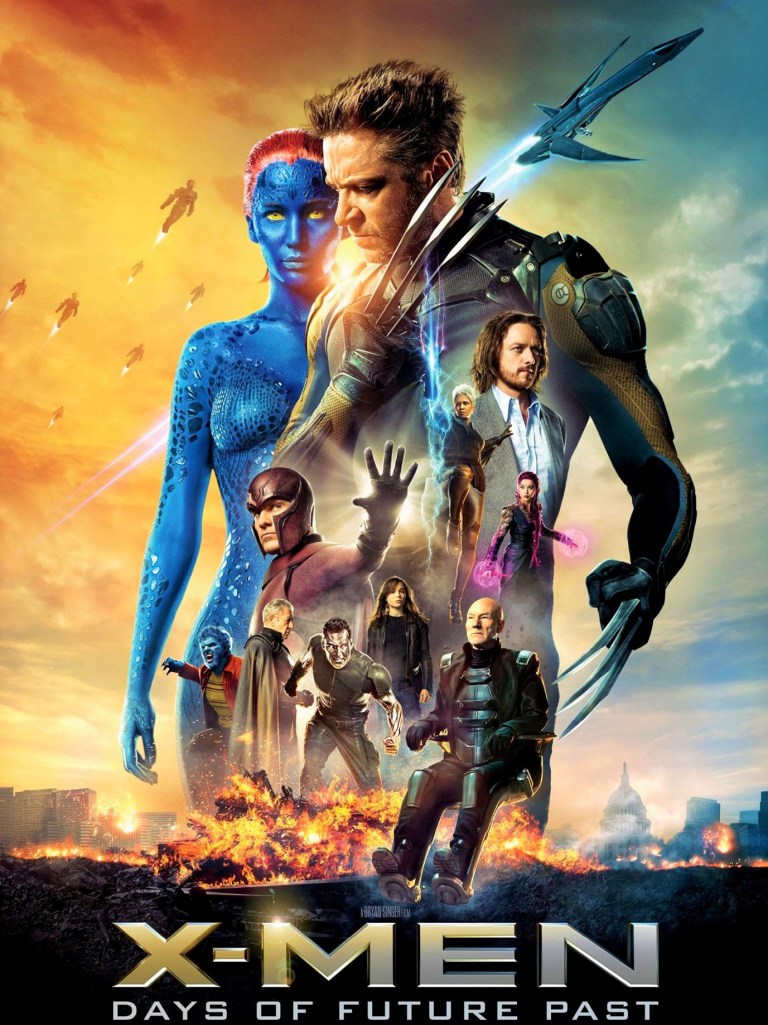
A great image of the cinematic X-Men, both the old and newer cast.
Early story
The story begins in the dark future. Countless mutants and human allies have been caught and imprisoned by very sophisticated Sentinels (operating for an unnamed authority that also has armed human personnel as watchers) which continue to hunt more of them down along with any humans caught aiding them. In Russia, a small X-Men team composed of Colossus, Kitty Pryde, Iceman, Sunspot, Bishop, Warpath and Blink take action when they realized that the Sentinels found their hideout. Kitty Pryde, who by this time gained the new ability to send a person’s consciousness back through time, runs along with Bishop to hide in a vault to send his consciousness into the past. Fortunately for them, their teammates delayed the unstoppable Sentinels enough to succeed.
Some time later at another location, an aging Charles Xavier, Magneto, Wolverine and Storm arrive to meet with Kitty Pryde and her teammates. Xavier gives the team an in-depth history lesson about the Sentinels which were created decades earlier by the late Bolivar Trask who was assassinated by Mystique (who believed she could make a difference for her fellow mutants). After the assassination, Mystique got caught by the authorities and became a live experiment for scientists working for the government. Her DNA helped accelerate the development of the Sentinel program which made them able to adapt to most mutant attacks and powers.
A plan gets formed for Kitty Pryde to send Xavier back through time to his younger self in 1973 to prevent the assassination from happening. Kitty states it’s too risky for the old Xavier to go through time as it may kill him. Wolverine volunteers to take Xavier’s place as his healing factor (regeneration) will ensure his survival with the process. Xavier presses Wolverine to convince the 1973 Charles Xavier to help prevent the assassination given the fact that he was a broken man at the time.
Wolverine arrives in his younger self’s body in New York of 1973. He makes his way to the mansion of Charles Xavier. As it turns out, Xavier’s school has been closed for some time and has been decaying…
Quality
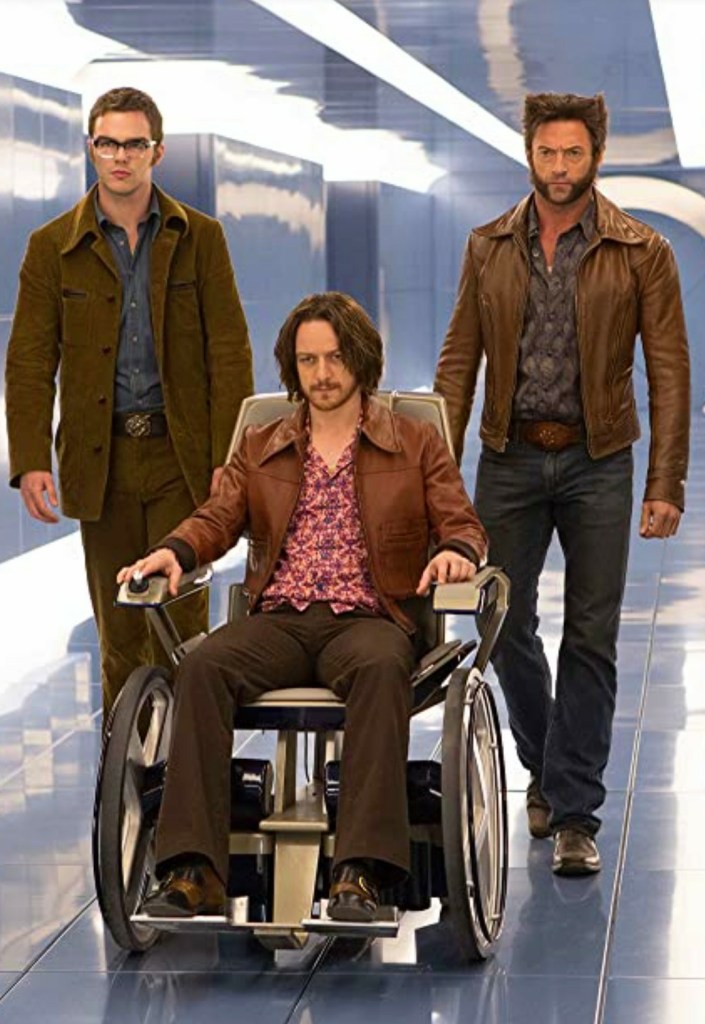
Nicholas Hoult, James McAvoy and Hugh Jackman as Beast, Charles Xavier and Wolverine respectively.
Considering what was made and what were presented through this movie, the creative team and the cast of X-Men: Days of Future Past literally scored a home run here resulting true greatness! Bryan Singer, whose previous X-Men directorial job was 2003’s X2, finally struck gold with regards to storytelling, directing and, finally, spectacle (previous his big weakness).
In terms of storytelling, this movie, first and foremost, is not a faithful adaptation of the classic Days of Future Past storyline at all. In fact, there was no need for it to be faithful. What the screenwriters came up with was a loose adaptation which allowed them to craft a more original story that involved the established X-Men characters (from the early movies) and the other X-Men characters (who started in 2011’s X-Men: First Class) and have them set apart in terms of time periods (similar to what was done in 1994’s Star Trek: Generations, but much better and more compelling in writing). The result is a crossover tale with Wolverine being the traveler through time.
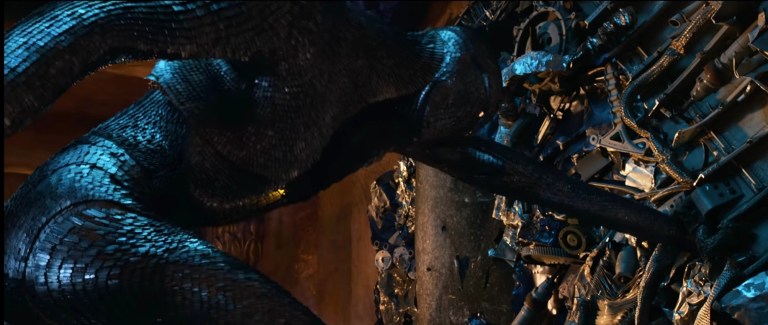
The Sentinels are clearly terrifying and unstoppable!
The great news here is that the script has very strong structuring done and even had enough space to briefly acknowledge events and characters from the first three X-Men films plus 2009’s X-Men Origins: Wolverine as canon. All of these add to the narrative very well and when the stakes were raised, the overall plot made sense. Let me add that it was a smart move for the writers to raise the stakes in the two time periods during the final act of the movie, which really made the story more engaging to viewers. I should state that having two conflicts happening simultaneously on screen in this X-Men movie was done efficiently and without ever becoming confusing nor messy.
Apart from the narrative, the portrayal of the X-Men was, indeed, spot-on. Noticeably, the major characters here were Charles Xavier (both old and young), Wolverine (both old and young), Mystique, Magneto (specifically the young version), Beast and Bolivar Trask. Strong writing was evident in the dialogue of the mentioned characters, as well as in those with minor roles. Through dialogue alone, I easily recognized these cinematic characters.
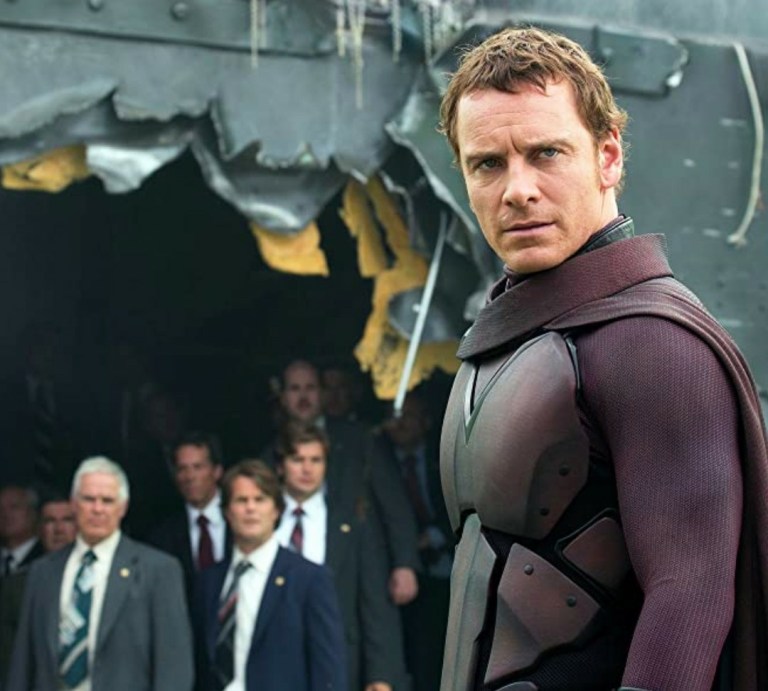
Michael Fassbender delivered his best performance as young Magneto.
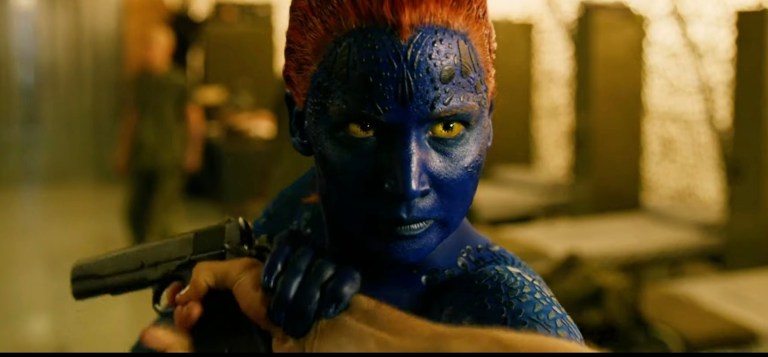
Given his strength in telling stories, I should say that Bryan Singer succeeded in executing the script into cinematic narrative. Not only that, he succeeded in getting really good performances from the cast. James McAvoy (young Xavier), Jennifer Lawrence (Mystique), Michael Fassbender (young Magneto) and Nicholas Hoult (Beast) were evidently more confident and more comfortable in reprising their characters (note: they debuted together in X-Men: First Class).
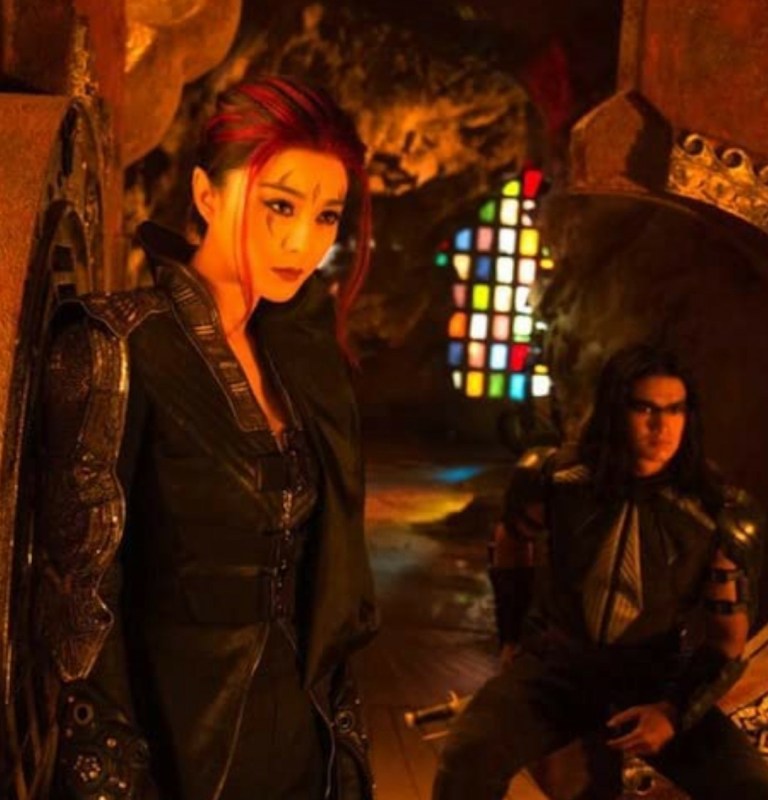
The old cast composed of Patrick Stewart (old Xavier), Ian McKellen (old Magneto), Ellen Page (Kitty Pryde), Halle Berry (Storm), Shawn Ashmore (Iceman) and Daniel Cudmore (Colossus) all made a very welcome return. To be specific, it was only Patrick Stewart among them who had the most engaging dialogue with Ian McKellen being a distant second to him. As most of the film was set in the past, it was understandable that the old cast’s dialogue would not be that rich which translates to limited performance. The filmmakers tried bouncing back with mutant variety by having Bingbing Fan as Blink, Adan Canto as Sunspot and Booboo Stewart as Warpath, who all provided nicely in the action scenes and special effects use.
Bingbing Fan and Booboo Stewart as Blink and Warpath.
Hugh Jackman’s performance as Wolverine in this movie is the most unique of them all. Not only does he have to play TWO versions of his character, he as the only member of the old X-Men cast spent a great deal of time interacting with the newer X-Men players. The great news here is that Jackman has great chemistry with James McAvoy, Nicholas Hoult and Michael Fassbender, which ultimately justified the crossover! Speaking of McAvoy, his scene with the older version of his character is very memorable and a highlight! Peter Dinklage as Bolivar Trask is excellent but to my surprise, he is not exactly villainous nor did he express cruelty. He’s more of an obsessed scientist and as such, Michael Fassbender’s Magneto easily overshadows him when it comes to being the main antagonist. This is surprising but not exactly a problem.
More on the anti-hero factor of the movie, I should say that the Sentinels in this movie are the most dangerous and the most intimidating non-sentient, scientific antagonists since the Terminator. Being programmed to deal with mutants, the Sentinels are unrelenting and often used violence to complete their objectives. The futuristic Sentinels, which are evolved versions thanks to Mystique’s DNA, are so formidable the mutants cannot simply defeat them. Even the 1970s Sentinels are quite formidable.
As mentioned earlier, I do confirm that Bryan Singer really outdid himself on delivering the spectacle back with support from the special effects team, the stunt team and the like. The action scenes involving the X-Men are top-notch, in fact they make the action in Singer’s previous X-Men films look minor in terms of creativity, quality and fun! The computer-generated effects in this movie still look great by today’s standard, although some CGI used in the floating stadium sequence looked rushed. Also it was quite a marvel to see Wolverine and Beast face-off with a 1970s Sentinel in the final act. I should mention that the slow-motion sequence involving Quicksilver (played by Evan Peters) is one great and funny spectacle to watch, well worth replaying!
Conclusion
Jennifer Lawrence in her best-ever performance as Mystique.
I declare that X-Men: Days of Future Past (2014) is the best-ever X-Men movie I have seen and it has aged very well! Its overall quality is very great and the combined talents of director Singer, the cast, the writers and all the technical teams justified it all. By today’s standards, this X-Men movie still stands very high among all superhero movies of Hollywood ever released! As an X-Men film, this one is truly epic and the true highlight of all X-Men movies under 20th Century Fox. As a time-travel film, this one has a very unique approach and it should be noted that director Bryan Singer approached James Cameron to talk about time travel, parallel universes and the like.
More on personal viewing, I can say that this film greatly entertained me in the cinema back in 2014, and it still succeeds in doing so whenever I replayed it on Blu-ray in the comfort of home. If there is anything I regret, it’s the fact that I never saw this movie in the IMAX cinema.
If you are seriously planning to buy an existing hard copy of X-Men: Days of Future Past (2014), visit Amazon for the Blu-ray release as well as the 4K Blu-ray combo release. There is also the Rogue Cut of the movie also on Blu-ray.
Overall, X-Men: Days of Future Past (2014) is highly recommended!
+++++
Thank you for reading. If you find this article engaging, please click the like button below and also please consider sharing this article to others. If you are looking for a copywriter to create content for your special project or business, check out my services and my portfolio. Feel free to contact me as well. Also please feel free to visit my Facebook page Author Carlo Carrasco and follow me at HavenorFantasy@twitter.com
Disclaimer: This is my original work with details sourced from reading the comic book and doing personal research. Anyone who wants to use this article, in part or in whole, needs to secure first my permission and agree to cite me as the source and author. Let it be known that any unauthorized use of this article will constrain the author to pursue the remedies under R.A. No. 8293, the Revised Penal Code, and/or all applicable legal actions under the laws of the Philippines.
Welcome back, superhero enthusiasts, comic book collectors and fans of the Ultraverse! This is my first Ultraverse retro comic book review of this new year and it will be about Mantra once again. To put things in order, the Archimage Quest is over and its aftermath has been done. Mantra is back in the contemporary world and, along the way, has communicated spiritually with the soul of Eden Blake (whose body has since been occupied by Lukasz). Quite intriguingly, Lukasz expresses romantic feelings for Eden in the spiritual realm. At the household of the Blakes, a certain Eden Blake returned to the lives of the children and has made moves to remarry ex-husband Gus.
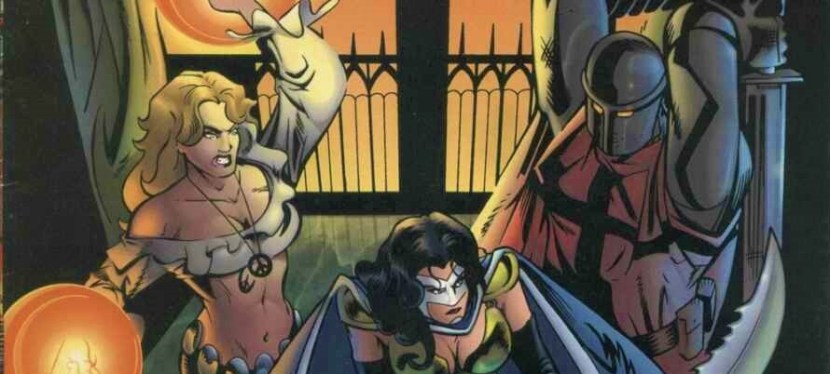
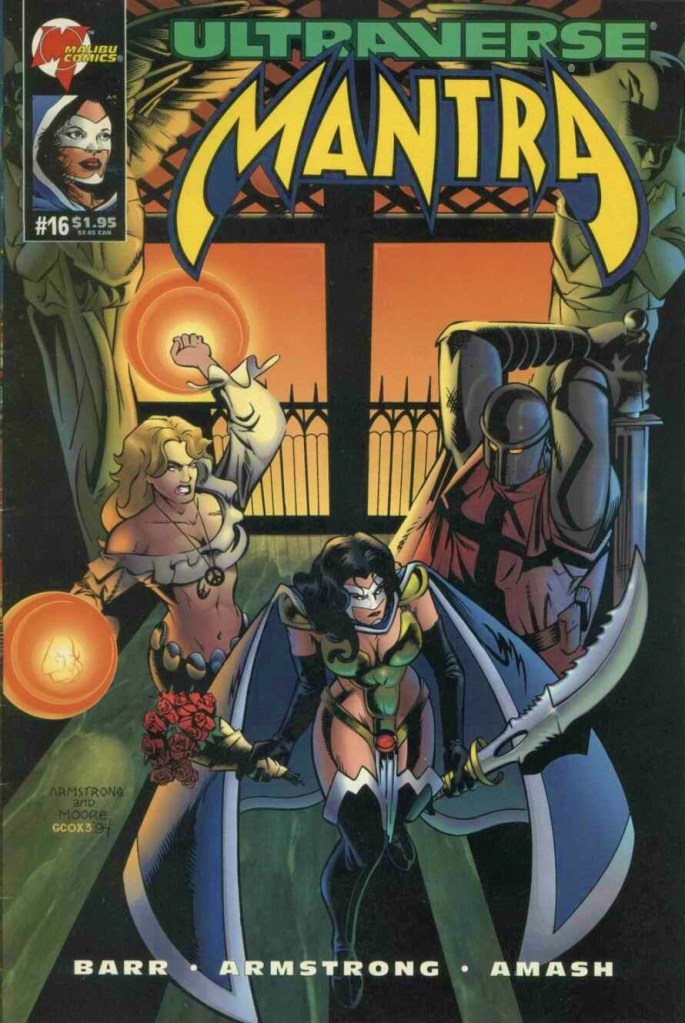
You want to find out more about Lukasz and Eden? Who exactly is that woman in the Blake household? We can find out in this look back at Mantra #16, published in 1994 by Malibu Comics with a story written by Mike W. Barr and drawn by Jason Armstrong.
The cover.
Early story
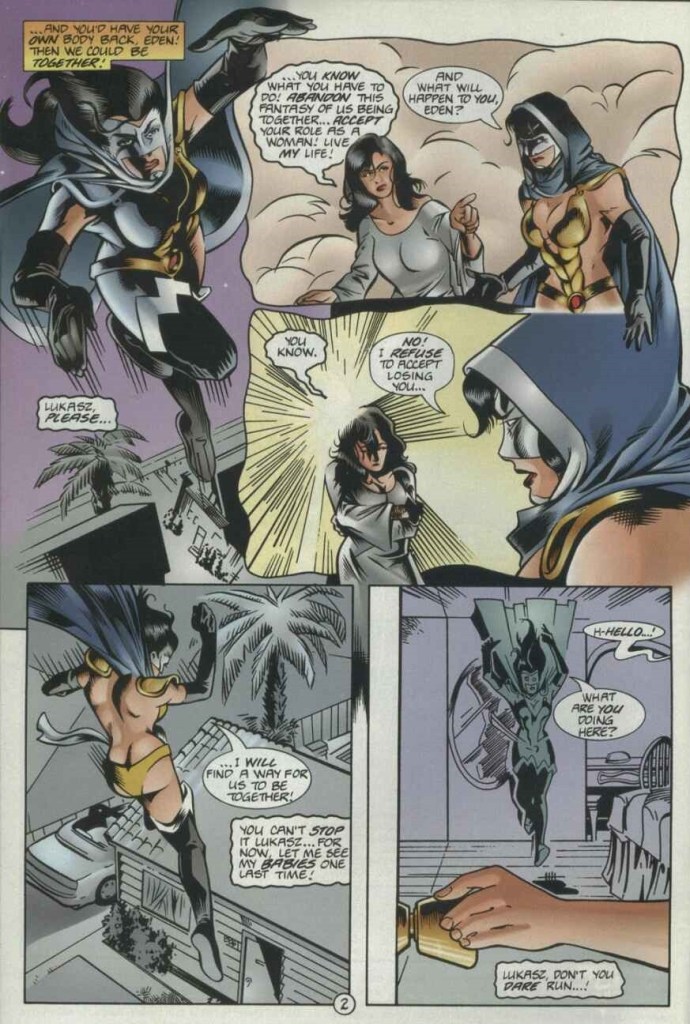
The story begins in California. Mantra started flying into the air leaving Kevin Green/Prime at the front of his home. While flying, Lukasz communicates with the soul of Eden Blake who continues to insist that he should abandon the fantasy of them loving each and other, and simply accept his role living as a woman and living her life. Still clinging on to feelings, Mantra/Lukasz refuses to accept losing Eden.
Mantra quietly enters the Blake household and quickly encounters Evie (Eden’s daughter), whom she has not seen since the Archimage Quest started. Evie does not realize that Mantra is actually her mother’s body in disguise and thus she treats her like a heroic celebrity. Evie reveals to Mantra that her parents are getting remarried.
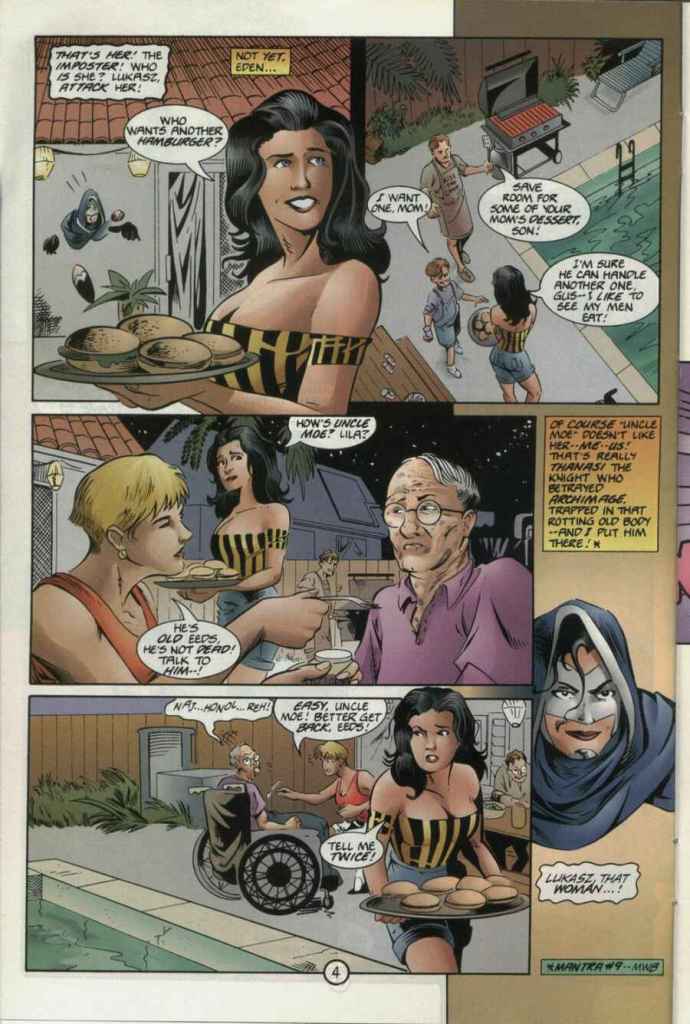
Just after leaving Evie and the room, Mantra spots the other Eden Blake by the poolside socializing with Gus and a few guests (including a certain old man on a wheel chair). Eden tells Mantra/Lukasz that the said lady is the impostor…
Quality
Pay close attention to the details.
I can say that the story and script were well-written by Mike W. Barr which is not surprising since he really set the overall direction of the Mantra monthly series and he took his time on doing twists and surprises. The theme of this particular issue is identity crisis which reflects Lukasz being in Eden’s body, Eden being in the spiritual realm as a displaced soul and the impostor living with Eden’s family.
When it comes to characterization, Lukasz is still focused on becoming a man again but already he adjusted a lot already filling Eden’s role as a mother as well as an employee of Aladdin. His newfound closeness with Eden’s soul added a lot of new freshness in this series and this is highlighted further now that the Archimage Quest has finally concluded. By this time, Lukasz and Eden are a romantic pair and the male warrior expressed that he has gotten tired of fifteen centuries of fighting and hopping from one body to another, displacing so many souls and ruining their respective personal lives.
As for the plot, this one will remind you about what happened in issue #9. It has a lot to do preparations for a wedding and a conflict between people who wield magic. The plot has a nice surprise which I urge you to find out yourselves.
Conclusion
More interactions between Mantra and Eden.
Mantra #16 (1994) is an entertaining Ultraverse comic book to read. As usual, it has a strong story as well as strong characterization which makes it compelling. Finding out who exactly is the impostor was well worth it
If you are seriously planning to buy an existing hard copy of Mantra #16 (1994), be aware that as of this writing, MileHighComics.com shows that the near-mint copy of the comic book costs $8.
Overall, Mantra #16 (1994) is recommended.
+++++
Thank you for reading. If you find this article engaging, please click the like button below and also please consider sharing this article to others. If you are looking for a copywriter to create content for your special project or business, check out my services and my portfolio. Feel free to contact me as well. Also please feel free to visit my Facebook page Author Carlo Carrasco and follow me at HavenorFantasy@twitter.com
Disclaimer: This is my original work with details sourced from reading the comic book and doing personal research. Anyone who wants to use this article, in part or in whole, needs to secure first my permission and agree to cite me as the source and author. Let it be known that any unauthorized use of this article will constrain the author to pursue the remedies under R.A. No. 8293, the Revised Penal Code, and/or all applicable legal actions under the laws of the Philippines.
Welcome back, superhero enthusiasts, comic book collectors and fans of Wonder Woman and DC Comics! Happy New Year to you all as well! To start 2021, I have another Wonder Woman retro comic book review here.
Before getting to the review, I want to ask if you were able to watch Wonder Woman 1984? I have not seen it yet as the local cinemas in our part of Metro Manila still have not reopened. I have no intention to stream the new movie at all. Big movie productions like the one starring Gal Gadot and Chris Pine were clearly made for the big screens in the cinemas and I am patiently waiting for the golden opportunity to watch Wonder Woman 1984 in a theater. If the nearest local cinemas won’t reopen due to this ongoing pandemic, the next best option for me is to get the movie in its future 4K Blu-ray release.
Going back to the Wonder Woman comic series of the post-Crisis DC Comics era, I reviewed issue #11 recently which saw Princess Diana enter the forbidden zone of Themyscira as she struggles to fulfil the challenge of Olympus’ deities. Meanwhile, Queen Hippolyte decides to take action by following and search for her daughter. This naturally troubles the Amazons who themselves are uncertain about what the deities have in plan for them.
With those details laid down, here is a look back at Wonder Woman #12, published in 1988 by DC Comics with a story written George Perez and Len Wein. Perez illustrated the comic book with ink work done by Bruce D. Patterson.
The cover.
Early story
The story begins with the armored Queen Hippolyte making her way down into the forbidden zone, with a feathered companion flying just near her. Suddenly a horde of bats surround her compelling her to defend herself. She notices that the vulture made no effort to help her which convinces her that it is there to guide.
Over at Oklahoma, Steve Trevor sits by his very old father and apologizes to him for failing to be there sooner. Tearfully he remembers the demise of his mother and the times he spent with his father growing up. Downstairs, Etta Candy examines a framed photo of Steve’s mother.
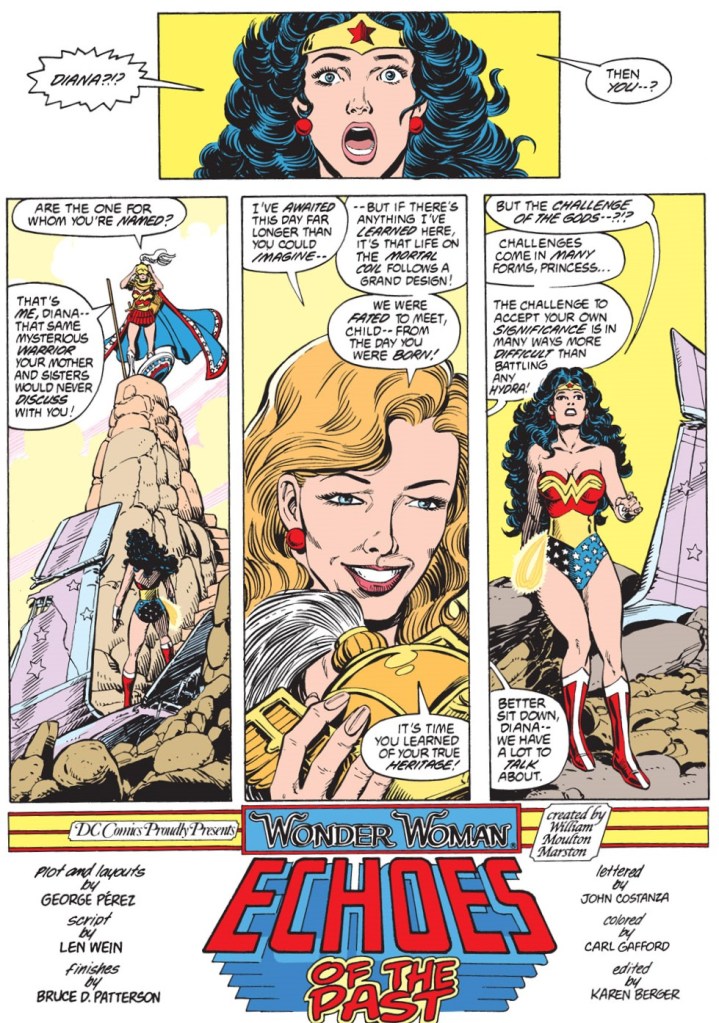
Deep within the forbidden zone, Wonder Woman is struck with disbelief as she just encountered in the flesh the one mysterious warrior whom she was named after which Queen Hippolyte and the Amazons did not discuss with her…
The mysterious warrior tells Princess Diana: I’ve waited this day far longer than you could imagine—-but if there’s anything I’ve learned here, it’s that life on the mortal coil follows a grand design! We were faither to meet, child—from the day you were born!
Quality
This comic book showed more of Queen Hippolyte’s side of the story than the previous issue.
Once again, this is another high-quality work of art and literature done by the creative team led by the Perez-Wein duo and considering the way things were structured, this proves that they really planned this storyline early and this very comic book happens to be full of revelations relating to a notable event in the past of the Amazons.
In this particular chapter of the Challenge of the God’s storyline, Wonder Woman’s significance (in connection with events that took place before her birth) and her special bond with Steve Trevor (in relation to issues #2, #3, #4, #5 and #6) were deeply emphasized through the story of the mysterious warrior whose name is also Diana and also a native from man’s world. The mysterious warrior’s personal story and discovery of Themyscira were excellently dramatized by Perez-Wein, which is not surprising, and the narrative was carefully paced giving readers breathing space to learn the details.
Picking up from the previous issue, this comic book’s focus on Queen Hippolyte has grown larger effectively creating what is technically a solo adventure for her within the forbidden zone. Compared to her daughter, Queen Hippolyte has deeper knowledge of the history of the place and is naturally cautious with her search for Diana. I should state that the dialogue style written for the queen was very cleverly crafted. Meanwhile, the Olympus deity Pan was clearly portrayed to be the evil manipulator and clearly the Satan figure of the story.
Conclusion
Princess Diana meets the other Diana whose past is linked with the Amazons.
Wonder Woman #12 (1988) is another excellent work by the Perez-Wein creative team. It is more than just a Wonder Woman story and more than just a well-told fantasy of the DC Comics universe, it is filled with very profound revelations that further deepen the legacy of the Amazons and Wonder Woman’s significance. As for the influences behind the design and symbols on Wonder Woman’s costume, those have been revealed in this comic book as well.
If you are seriously planning to buy an existing hard copy of Wonder Woman #12 (1988), be aware that as of this writing, MileHighComics.com shows that the near-mint copy of the regular edition costs $30 while the near-mint copy of the newsstand edition costs $60.
Overall, Wonder Woman #12 (1988) is highly recommended!
+++++
Thank you for reading. If you find this article engaging, please click the like button below and also please consider sharing this article to others. If you are looking for a copywriter to create content for your special project or business, check out my services and my portfolio. Feel free to contact me as well. Also please feel free to visit my Facebook page Author Carlo Carrasco and follow me at HavenorFantasy@twitter.com
Disclaimer: This is my original work with details sourced from reading the comic book and doing personal research. Anyone who wants to use this article, in part or in whole, needs to secure first my permission and agree to cite me as the source and author. Let it be known that any unauthorized use of this article will constrain the author to pursue the remedies under R.A. No. 8293, the Revised Penal Code, and/or all applicable legal actions under the laws of the Philippines.
Welcome back, superhero enthusiasts, comic book collectors and fans of the Ultraverse! Did you guys and gals have a restful Christmas weekend? I sure did! Anyway, we are about to return to the Ultraverse through the eyes of Prime. The catch here is that Prime will face not one but two guys to battle with.
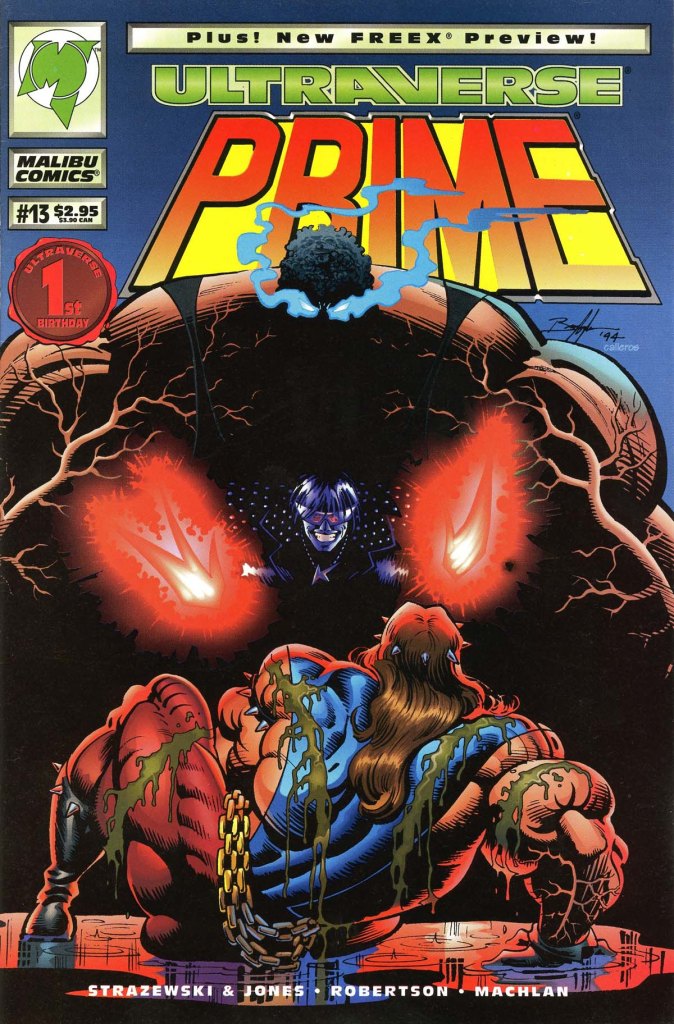
With those details laid down, here is a look back at Prime #13, published in 1994 by Malibu Comics with a story written by Len Strazewski and Gerard Jones, and illustrated by Darick Robertson. This is another one of those Ultraverse 1st anniversary comic books.
The cover.
Early story
The story begins with Kevin Green hitchhiking alone by the road. A man driving a car allows him to come in and ride. Just a few moments after, the man reaches for Kevin’s left thigh which convinces him that the one driving is a pervert. Kevin hits the man’s face and gets off the car. He struggles to find a ride going home in the evening.
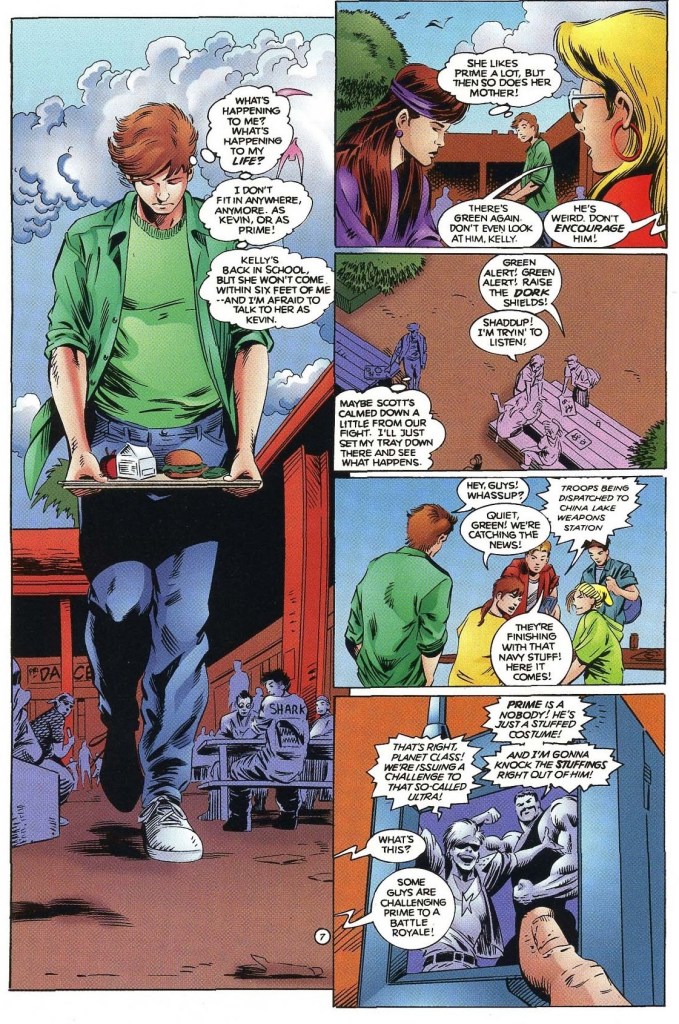
At home, Kevin wakes up from a nightmare as his mother tries to help him. His mom can easily tell that her son is troubled. During lunch break at school, realizes he is having trouble fitting in with the students and reminds himself that Kelly likes Prime a lot, and so does her mother. The students stare at him as he walks on. Eventually, Kevin meets some guys watching a portable TV showing news broadcast of two guys – the washed-up celebrity Kuttner and a certain bodybuilder – whom he previously encountered as Prime.
The said two guys are challenging Prime to a battle royale…
Quality
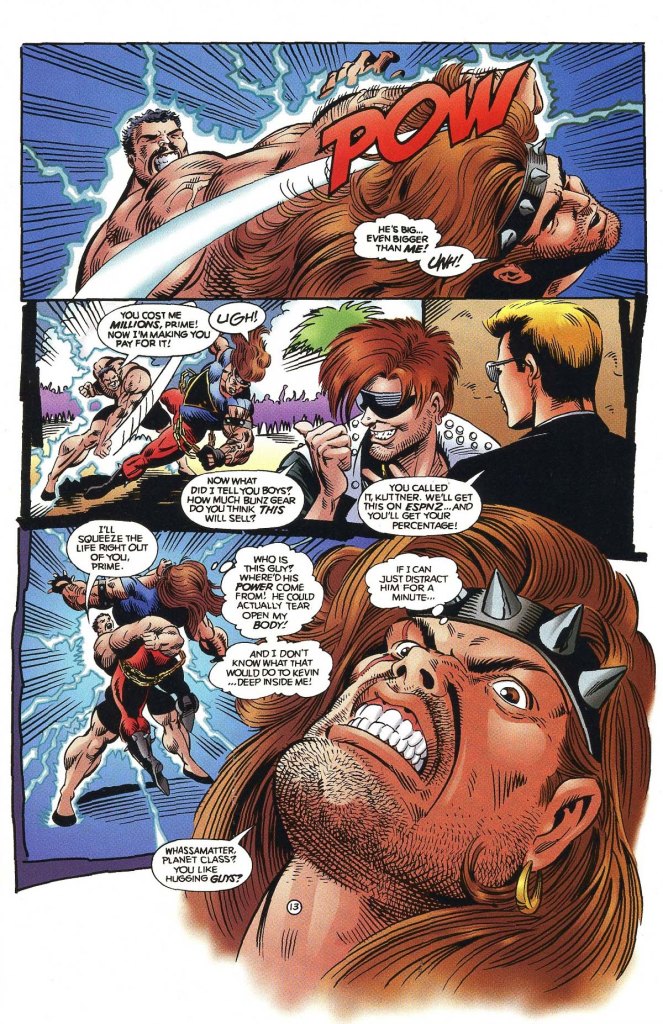
The battle royale itself is the highlight and alone makes this comic book worth buying.
As usual, the writing duo of Strazewski-Jones created another engaging story about Kevin and his superhero secret identity as Prime. Kevin shown struggling with his personal life? Check! Great superhero action with Prime? Check! In-depth characterization? Check!
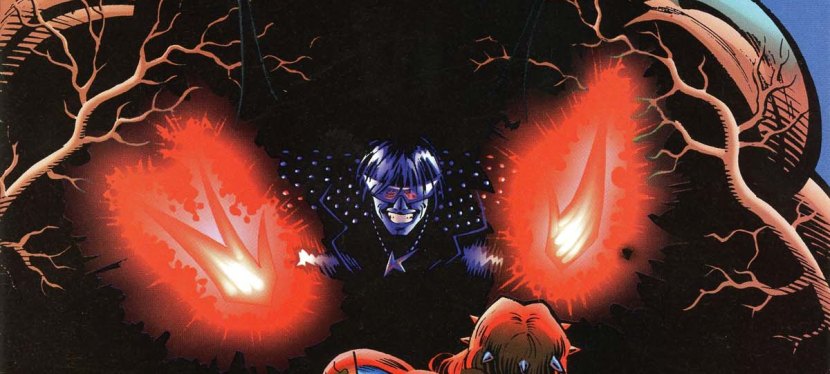
What makes this comic book stand out is the battle royale between Prime and the two guys mention earlier, who each have very strong reasons and determination to defeat Prime. As it is indeed a very high-octane battle royale in the truest sense of the words, there was still sufficient room for readers to understand what Prime thought as he fights and dodges in the battle. Very clearly defined are the intentions of Kuttner and Planet Class, and the personalities of each plus Prime really gave their conflict a very unique flavor of its own. The battle royale is not a mindless event but rather very colorful and character-driven.
As for the art, I find Darick Robertson’s work here pretty good and many times he seemed to try to emulate the unique style and approach the late Norm Breyfogle defined the Prime series with. Although Kevin looks more like a college student, most characters were still recognizable. This one looks good!
Conclusion
It sure is hard for any teenager to be perceived as a social outcast.
Prime #13 (1994) is a very entertaining read. It does not use the typical good-versus-evil formula of superhero comic books but it sure is loaded with a lot of personality following Prime, Kuttner and Planet Class.
If you are seriously planning to buy an existing hard copy of Prime #13 (1994), be aware that as of this writing, MileHighComics.com shows that the near-mint copy of the regular edition costs $8 while the near-mint copies of the variant edition and the variant newsstand edition cost $8 and $26 respectively.
Overall, Prime #13 (1994) is highly recommended!
+++++
Thank you for reading. If you find this article engaging, please click the like button below and also please consider sharing this article to others. If you are looking for a copywriter to create content for your special project or business, check out my services and my portfolio. Feel free to contact me as well. Also please feel free to visit my Facebook page Author Carlo Carrasco and follow me at HavenorFantasy@twitter.com
What I want to share to you here are my observations about another interesting thing from the Ice Cream House company that has been released to customers in light of the Christmas season. It is something meant to delight families, bring the parents/guardians and the children together in connection to their enjoyment of ice cream. That thing is the DIY Sundae Box which, as of this writing, is offered for P395 to customers (P295 if three Gold Delight half-gallon tubs were purchased).
The DIY Sundae Box has a nice exterior with a top label that says “Just add ice cream” and has the Gold Delight logo on a corner.
What does the DIY Sundae Box look like and what does it have? Check the pictures below.
This is what it looks like upon opening. Nice cards included.
Six party cups and six sugar cones.
Clockwise from the upper-left: roasted nuts, caramel syrup, choco fudge, chocolate chips, rainbow sprinkles and mini-marshmallows. Partially seen above is the ice cream scooper.
One nice pack of Fornaio de Fran Brownie Brittle! This one alone makes a nice snack.
With all the nice stuff in place, I decided to do some experimenting with the Gold Delight ice cream available (specifically Triple Chocolate, Avocado Frost and Mango Overload) using two party cups and one sugar cone. Check out the pics below…
I had Triple Choco ice cream scoops with mini-marshmallows and rainbow sprinkles. A great tasting delight!
My first experiment was a party cup filled with portions of Triple Chocolate ice cream with rainbow sprinkles and mini marshmallows on top. The result is a great taste! The Triple Choco ice cream has the expected strong chocolate flavor and the taste is enhanced with the rainbow sprinkles. The mini marshmallows made each bite delightful. I highly recommend this combination.
Scoops of Mango Overload plus Avocado Frost plus mini marshmallows plus rainbow sprinkles equal a nice fruity taste!
The next experiment was another party cup with portions of Avocado Frost and Mango Overload. I used mini marshmallows and rainbow sprinkles. The result is a really delightful taste that is fruity and has a candy taste. I personally recommend this combination.
I used one sugar cone with Mango Overload ice cream.
Out of curiosity, I used a cone with a rough scoop of Mango Overload. Good enough.
Conclusion
The DIY Sundae Kit is a nice package designed to delight families, provide consumers (especially children) the opportunities to customize their ice cream, and even serve something nice to guests at parties. At its current price, it is worth getting and it spares the consumer from having to go all the way out to the stores to buy the ingredients to customize ice cream at home.
If you are curious for more or if you want to order a DIY Sundae Kit from Ice Cream House, contact them directly at mobile phone number 09190091543 or visit them on their Facebook at https://www.facebook.com/icecreamhouseph
The details regarding ordering such as how to pay, what form to fill up and how long it will take for orders to be delivered are available for viewing at the FB page.
If there is anyone among you who already availed of the DIY Sundae Kit of Ice Cream House, please tell me what you think of it. Did your kids enjoy it? Let me know in the comments below.
+++++
Thank you for reading. If you find this article engaging, please click the like button below and also please consider sharing this article to others. If you are looking for a copywriter to create content for your special project or business, check out my services and my portfolio. Feel free to contact me as well. Also please feel free to visit my Facebook page Author Carlo Carrasco and follow me at HavenorFantasy@twitter.com