A Look Back at Amazing Spider-Man #255 (1984)

Welcome back superhero enthusiasts, 1980s arts and culture enthusiasts, Marvel Comics fans and comic book collectors! Today we go back to the year 1984 to examine a small part of the Marvel Comics universe through a tale of the Amazing Spider-Man monthly series.

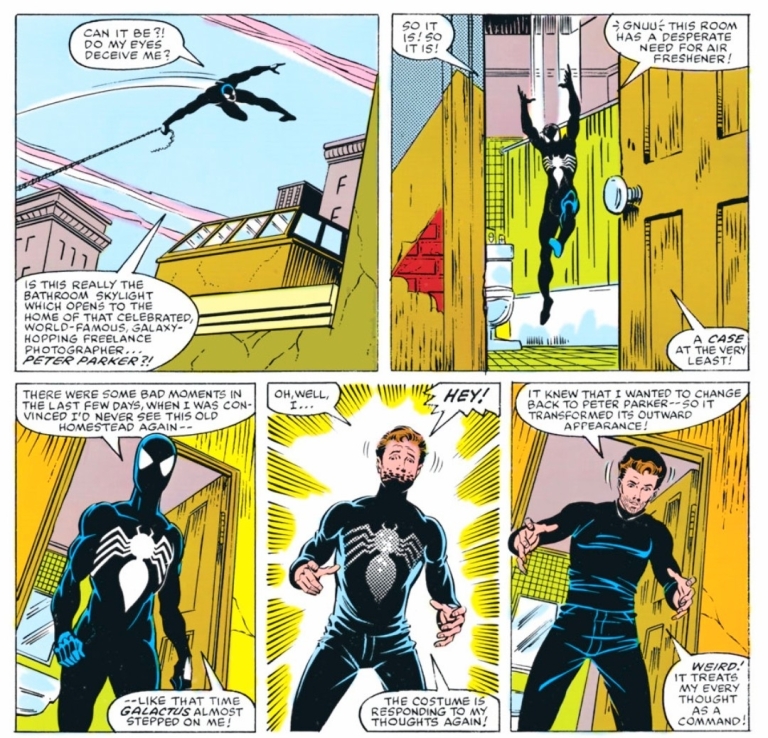
Between the developments of 1980s Secret Wars limited series and the debut of Venom was the time when Peter Parker wore a black new costume as Spider-Man which happens to be the alien costume he gained while spending time with other superheroes in deep space (refer to Secret Wars #8). There was this gradual approach done by the creators to tell new tales of Spider-Man who has the symbiote attached to him most of the time.  

With those details laid down, here is a look back at Amazing Spider-Man #255, published in 1984 by Marvel Comics with a story written by Tom DeFalco and drawn by Ron Frenz.

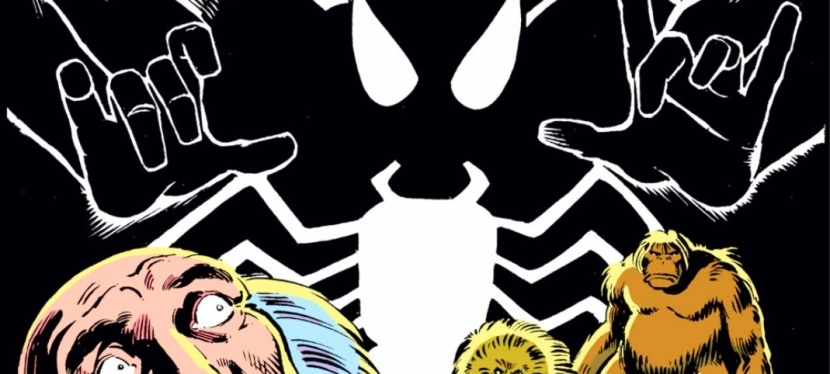
The cover.

Early story

The story begins when a black costumed figure arrives at the balcony of a tall building during night time in New York City. He carefully makes an unlawful entry into the place to steal something. The figure was the Black Fox who intends to take valuables not to feed his greed but to properly subsidize his retirement. When he touches an exquisite-looking vase, it disappears and suddenly a monstrous ape appears from nowhere surprising him. Soon enough, he finds himself surrounded by more apes and faces their human leader (one who referred to the apes as pets).

Meanwhile at his apartment, a very tired Peter Parker washes his black costume (the symbiote), reflects on recent events he went through and then goes to bed. During the night, the black costume comes to life and slowly slithers its way into the bedroom wrapping itself on the sleeping Peter…

Quality

The sneaky Black Fox has no chance of escaping Spider-Man (wearing the alien costume that would later lead to the start of Venom).

I want to start with the force of opposition the creative team came up with. This is about the powerful villain the Red Ghost who has super-apes under his control and vast wealth and resources to organize criminal activities. Red Ghost here is not your typical villain as he is actually strategic, smart and even philosophical clearly knowing what he is doing and what he needs to keep on doing crime. The retiring old thief Black Fox happens to be the very criminal that Red Ghost needs for a special task involving the machine called the Cosmicizer which is essential to his need of vastly increasing his cosmic-ray induced powers.

The Red Ghost is struggling with certain limits which are related to his need of the Black Fox to accomplish something for him with the assistance of the super apes. That being said, the presentation of evil awaiting Spider-Man in this tale is a clever move by DeFalco and Frenz.

As for the iconic webslinger, you will see more of Peter Parker’s personal struggles balancing his life between real-world living and performing as Spider-Man to help people and solve problems. In this tale, his personal life is at a low point and it does not help that his has a strained link with his Aunt May. Even though he has the alien costume that is capable of aiding him a lot, there are still problems that the superhero simply cannot solve. The dramatization here is pretty good and the way the final conflict with the main villain turned out was a pretty nice pay-off.

Conclusion

Peter Parker’s sleep has been disorderly since he brought home with him the symbiote.

Amazing Spider-Man #255 (1984) is an entertaining and intriguing read. The creative team’s decision to have the established Fantastic Four foe Red Ghost as the definitive villain for Spider-Man turned out to be a smart move and what they did was fun to read. The presence of Black Fox (note: this comic book is his debut) added a layer of depth to the plot and his declared desire to retire from the life of crime made him an intriguing addition to the Spider-Man list of villains.

Overall, Amazing Spider-Man #255 (1984) is recommended.

+++++

Thank you for reading. If you find this article engaging, please click the like button below, share this article to others and also please consider making a donation to support my publishing. If you are looking for a copywriter to create content for your special project or business, check out my services and my portfolio. Feel free to contact me with a private message. Also please feel free to visit my Facebook page Author Carlo Carrasco and follow me on Twitter at  @HavenorFantasy as well as on Tumblr at https://carlocarrasco.tumblr.com/ and on Instagram at https://www.instagram.com/authorcarlocarrasco
A Look Back at Amazing Spider-Man #252 (1984)

Welcome back superhero enthusiasts, 1980s arts and culture enthusiasts, Marvel Comics fans and comic book collectors! Today we go back to the year 1984 to examine a small part of the Marvel Comics universe through a tale of the Amazing Spider-Man monthly series.

By now, you readers should be aware that I reviewed a lot of comic books about Spider-Man and his deadliest enemy Venom. It is already established through comic book history that the iconic webslinger is responsible for the establishment of Venom as he brought into the world the alien costume (the symbiote) coming from deep space (as told in the Secret Wars limited series), and he also became responsible for the destruction of Eddie Brock’s career in journalism. Of course, Venom did not debut immediately after Spider-Man’s return from Secret Wars and there was a lot more about the symbiote when it was with Peter Parker.

With those details laid down, here is a look back at Amazing Spider-Man #252, published in 1984 by Marvel Comics with a story written by Roger Stern and Tom DeFalco, and drawn by Ron Frenz. This comic book marked the first appearance of the alien costume.

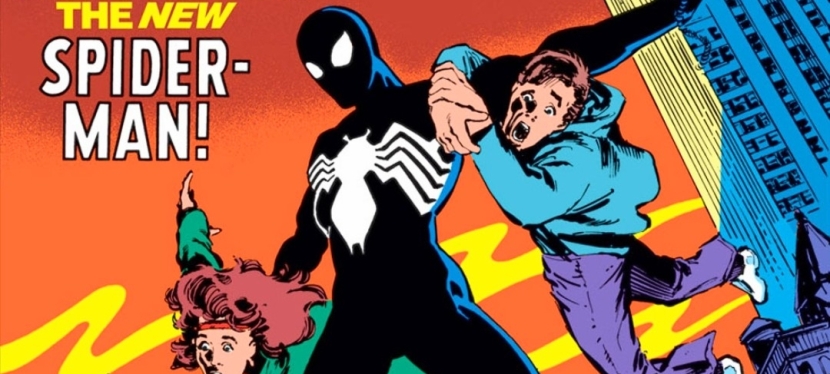
The cover.

Early story

The story begins inside the New York headquarters of the Daily Bugle. It has been observed that several superheroes such as Captain America, Thor, Spider-Man, Iron Man, the X-Men and the Avengers have been missing this resulted in a rise of crime. Publisher J. Jonah Jameson and editor-in-chief Joe Robertson discuss the newest edition of their newspaper.

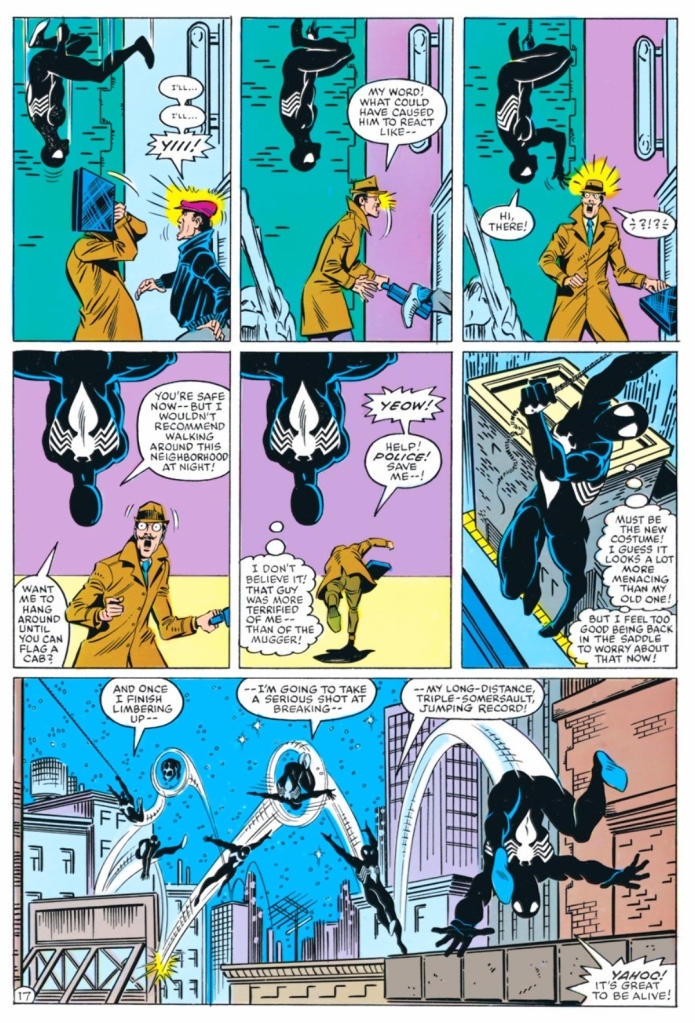
Meanwhile over at Central Park where police officers and others stand by an area that was closed off, a physical structure suddenly appears spreading bright light to onlookers. Suddenly Spider-Man (wearing a new dominant black costume) leaps out of the structure carrying Dr. Connor (the Lizard) surprising the people.

After realizing they have returned home at last after spending lots of time and struggle in deep space (Secret Wars), Spider-Man could not help but feel jubilant to be home. As the police officers don’t realize that they are talking with the same webslinger due to the new costume, one of them was about to draw his gun which prompted the superhero to use his web on him.

Suddenly, the Avengers, Captain America, Thor and Iron Man emerge from the physical structure which provided Spider-Man relief as he thought that only he and Dr. Connors made it home. With the people focusing on the other superheroes, Spider-Man and Dr. Connors slowly exited. Connors asked him what are they going to tell the world about all they have seen and experienced in deep space…

Quality

Spider-Man’s first night in New York wearing the alien costume .

I really like this story. I first read this a long time ago and I re-read it all over again for this retro review, and still this story engaged me a lot. There is a lot of richness in the script and you will get to see Peter Parker transitioning into a series of major changes that await him. Without spoiling the plot, there is no hero-versus-villain element here at all. It is all about Spider-Man who just arrived home from a major conflict (and also one of the most significant comic events ever published by Marvel Comics) and the alien costume saga truly began right here. The Venom debut did not happen until a few years later in reality.

In accordance to what was established in Secret Wars (not to be confused with the 2015 series of the same name) and the standards of then editor-in-chief Jim Shooter, the creative came up with a tale that not only showed a different Spider-Man but also portrayed him in ways that defied the tropes and creative ideas the preceded this comic book.

For one thing, Peter Parker is literally like a fish out of water here. As far as the whole world is concerned, only days passed when the superheroes went to deep space. But for the webslinger, a lot more time passed as so many battles, discoveries and intriguing events took place for him along with the others. That being said, Peter Parker’s perception of reality and track of time really got messed up and the weight of Secret War’s events really turned out overwhelming on him. This was well dramatized in the scene wherein Peter – who realized that so much time had passed – he had to call his aunt May fearing that she must be worried sick over him. There was also the moment when by walking down the street, he realized how much he missed not only his home but also the local surroundings.

It was also in this comic book when Peter started getting more oriented with the alien costume he first got in Secret Wars #8 (which was actually published after this comic book) and started to enjoy the benefits with the way it responds to his thinking. Of course, at this stage, he has yet to realize the unfortunate truth about the living costume he brought home and this story really kicked off a new and profound stage in the comic book history of Spider-Man

Conclusion

When Spider-Man finally arrived home after spending so much time during Secret Wars.

Amazing Spider-Man #252 (1984) is still a great comic book to read all over again. This was released during the time when Secret Wars (1984) was still being published and years before Venom’s big debut in the series’ 300th issue. In my view, the alien costume saga was a big turning point in the literary history of Spider-Man and the creators who got involved in this comic book really sowed the seeds of compelling and intriguing events that followed. What is intriguing is that all of these significant developments started when a Marvel Comics reader from Illinois came up with the idea of a new costume for Spider-Man, wrote to them and the publisher responded to acquire his idea for over $200 (click here).

This comic book is also a reminder of how significant Jim Shooter’s rule at Marvel Comics really was and I can say that the Marvel’s literary universe of the 1980s should not be ignored.

Overall, Amazing Spider-Man #252 (1984) is highly recommended!

+++++

Thank you for reading. If you find this article engaging, please click the like button below, share this article to others and also please consider making a donation to support my publishing. If you are looking for a copywriter to create content for your special project or business, check out my services and my portfolio. Feel free to contact me with a private message. Also please feel free to visit my Facebook page Author Carlo Carrasco and follow me on Twitter at  @HavenorFantasy as well as on Tumblr at https://carlocarrasco.tumblr.com/ and on Instagram at https://www.instagram.com/authorcarlocarrasco
A Look Back at Amazing Spider-Man #375 (1993)

Welcome back superhero enthusiasts, 1990s arts and culture enthusiasts, Marvel Comics fans and comic book collectors! Today we go back to the year 1993 and examine a small part of the Marvel Comics universe through a tale of the Amazing Spider-Man monthly series.

In my previous retro comic book review, the insane murderer Venom returned to antagonize Spider-Man by targeting his parents. While it was a fact that Venom – who knew Spider-Man’s true identity – got into close contact with Aunt May (symbolizing the danger he poses on the Peter Parker’s family) a few years prior, going after the mother and father of Peter really raised the stakes.

With those details laid down, here is a look back at Amazing Spider-Man #375, published in 1993 by Marvel Comics with a story written by David Michelinie and drawn by Mark Bagley. This comic book marked the 30th anniversary of Amazing Spider-Man #1 (1963).

The cover.

Early story

The story begins inside one of the facilities of the closed amusement park in Brooklyn. In his vicious form, Venom tells Richard and Mary Parker (both restrained) that they belong to him and declares that he would protect them from Spider-Man.

When Richard Parker asked why would he think that they would have anything to do with Spider-Man, Venom realizes that the couple does not even know their son is the webslinger. Venom tells the couple that their innocence is what he is sworn to preserve.

Over at Manhattan, Spider-Man swings back to the Daily Bugle building and discreetly changes his clothes before moving in as photographer Peter Parker. Inside one of the offices, J. Jonah Jameson reaches out to Silver Sable by telephone…

Quality

Peter Parker had to commit a crime by trespassing into Anne Weying’s residence. His disguise as Spider-Man does not protect him from the law.

I have mixed feelings about this follow-up to the great story of the previous issue. For one thing, David Michelinie’s script had a completely different tone and direction even though he intended this comic book to conclude what issue #374 started. Another thing is that this story has even more characters added in which clearly diluted the intensity of the Venom-Spider-Man rivalry that was so intense in the previous issue.

There are two sub-plots – one of which deals with someone from Eddie Brock’s past – that were emphasized with sufficient details and the creative team integrated them into the main story. It seems that the creators intended to make the main story look grander in scope while sacrificing the very elements that made issue #374 a great and intense reading experience.

Remember the suspense and danger that came with Venom targeting the older Parker couple? Those elements are almost totally absent in this comic book even though this story concluded the previous issue’s conflict build-up. Richard and Mary Parker are both present as captives of Venom but there really is no tension nor any sense of danger here due to the drastic change of tone and direction in the script.

I should also stress that the introduction of Anne Weying (previously Anne Brock) as Eddie Brock’s ex-wife looked and felt like an afterthought inserted into the story. While Anne’s presence brought out some traces of humanity and sanity from Venom during the 2nd half of the story, it did not add much impact on the conflict between the webslinger and the symbiote-wearer murderer. Ultimately, the creative team had to do something to explain the story build-up on Venom’s part leading into the Lethal Protector limited series which is set in the city of San Francisco.

And then there was the presence of Silver Sable’s team called the Wild Pack. The Wild Pack is the result of J. Jonah Jameson’s agreement with Silver Sable with the objective of achieving a journalistic exclusive for the Daily Bugle. This particular sub-plot is really lousy and not even the dynamic looking action sequences involving the Wild Pack could hide lousiness.

If there is anything symbolic about the script, it is the emphasis on family as well as the impact that comes with elements of the past emerging unexpectedly. In this very comic book, you will get to see Eddie Brock/Venom react like a sane person in response to the sudden re-appearance of his former wife. No matter what the creative team did here, I can say that the Spidey/Venom conflict did not really intensify (note: the dynamic action scenes did not solve the shortcomings) and there was no reason to worry about the captive Parker couple.

Conclusion

The insane murderer Venom with the parents of Peter Parker.

Considering the great stuff and raised stakes that made issue #374 a very compelling read, Amazing Spider-Man #375 (1993) is clearly a disappointing conclusion. This is not a terrible comic book as it has some good stuff for fans to enjoy but the overall presentation of the creators here is not too great due to their approach with the storytelling (with two sub-plots that did not add much). Overall, I am glad I never bought this comic book (with flashy cover and more pages) at full price in 1993.

Overall, Amazing Spider-Man #375 (1993) is satisfactory.

+++++

Thank you for reading. If you find this article engaging, please click the like button below, share this article to others and also please consider making a donation to support my publishing. If you are looking for a copywriter to create content for your special project or business, check out my services and my portfolio. Feel free to contact me with a private message. Also please feel free to visit my Facebook page Author Carlo Carrasco and follow me on Twitter at  @HavenorFantasy as well as on Tumblr at https://carlocarrasco.tumblr.com/ and on Instagram at https://www.instagram.com/authorcarlocarrasco
A Look Back at Amazing Spider-Man #374 (1993)

Welcome back superhero enthusiasts, 1990s arts and culture enthusiasts, Marvel Comics fans and comic book collectors! Today we go back to the year 1993 and examine a small part of the Marvel Comics universe through a tale of the Amazing Spider-Man monthly series.

In early 1993, the supervillain and murderer Venom was in very high demand among Marvel readers and comic collectors. The Venom: Lethal Protector mini-series launched with issue #1 selling a lot of copies and it portrayed Spider-Man’s greatest enemy as a very twisted and violent makeshift hero who dedicated himself to protecting what he (Eddie Brock specifically) to innocent people. As Venom was one of the few supervillains who knew Spider-Man’s true identity, the creative team behind the Amazing Spider-Man series decided to raise the stakes temporarily by having him encounter Peter Parker’s parents (the ones that appeared in Amazing Spider-Man #365).

With those details laid down, here is a look back at Amazing Spider-Man #374, published in 1993 by Marvel Comics with a story written by David Michelinie and drawn by Mark Bagley.

The cover.

Early story

The story begins inside the bunker beneath the grounds of the deserted Brooklyn amusement park. As Eddie Brock struggles to lift a very heavy piece of equipment, the symbiote forms over his body helping him lift it up above the head. Venom is obsessed with killing Spider-Man and Eddie Brock remains totally bitter over the webslinger’s responsibility on destroying his career. Eddie sees a page of the Daily Bugle on the wall and it contains a news photo of Peter Parker with his mother and father.

At New York’s famous Central Park, Peter, wife Mary Jane and his parents enjoy quality time skating on ice. Aunt May is standing on a wooden platform watching them…

Quality

Lots of intense action scenes in this comic book for fans and readers to be entertained with. The action scenes are not mindless as they serve as reflections of Venom’s powerful quest for revenge.

To begin with, I can say that this tale by David Michelinie is a very intense and dramatic read and it added a new layer of depth into the enduring rivalry between Spider-Man and Venom. At this point in Marvel Comics’ shared universe history, the two icons have encountered each other so many times, the time was right for Michelinie to raise the stakes and have the elderly Parkers (note: Aunt May excluded) as the new targets of Venom (already made obvious on the cover which in turn added tremendous stress on the part of Spider-Man and his wife.

For the newcomers reading this, Eddie Brock’s journalistic career was destroyed over the Sin-Eater story as a result of Spider-Man’s public revelation of Stanley Carter as the said figure (note: Brock’s Sin-Eater article series was based on interviews with Emil Gregg who actually turned out to be a delusional neighbor of Carter’s).

As Brock’s life went way downhill with his reputation destroyed, his hatred of Spider-Man grew and so did his quest for revenge. That being said, what happened in this particular comic book was a very reflective extension of what happened years prior. Anyone who has basic knowledge of the origin of Venom and early appearances of Brock in comics will be able to understand the intensified rivalry in this tale.  

Apart from the great story, this comic book has lots of superhero spectacle for readers to enjoy. That being said, the smashing action of the fight between Spider-Man and Venom was clearly made to be more violent which suitably reflected the supervillain’s lust for revenge. Spidey, meanwhile, had no choice but to avoid causing any more damage or harm as Venom goes after him in public surrounded with lots of bystanders. Along the way, you will see a key moment of the insanity of Venom which served as a useful pause of the fight. Finally, when it comes to the art, this comic book has some of the finest artworks I have seen from Mark Bagley.

Conclusion

At the time of this comic book’s publication, Venom was one of the few supervillains who knew Spider-Man and Peter Parker are one and the same person. The inclusion of Peter’s parents only added to the raising of the stakes.

Amazing Spider-Man #374 (1993) is undeniably a great read complete with intense action scenes, lots of intrigue and, most notably, a rock solid development of the Spider-Man-Venom rivalry. This is the kind of story that will compel long-time Spider-Man fans to revisit Venom’s origin as well as Spider-Man’s involvement with the Sin-Eater. At the same time, this tale will help readers understand the insanity and murderous mind of Venom that took place not only in the Venom: Lethal Protector mini-series in also other mini-series about the symbiotic killer that Marvel published throughout the 1990s.

Overall, Amazing Spider-Man #374 (1993) is highly recommended!

+++++

Thank you for reading. If you find this article engaging, please click the like button below, share this article to others and also please consider making a donation to support my publishing. If you are looking for a copywriter to create content for your special project or business, check out my services and my portfolio. Feel free to contact me with a private message. Also please feel free to visit my Facebook page Author Carlo Carrasco and follow me on Twitter at  @HavenorFantasy as well as on Tumblr at https://carlocarrasco.tumblr.com/ and on Instagram at https://www.instagram.com/authorcarlocarrasco

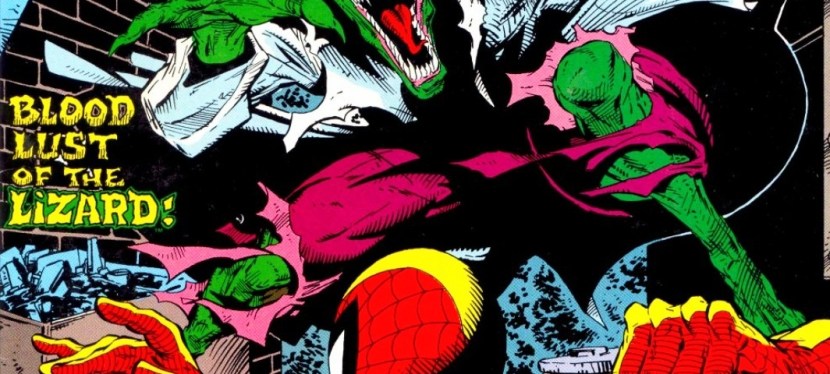
A Look Back at Spider-Man #2 (1990)

Welcome back superhero enthusiasts, 1990s culture enthusiasts and comic book collectors! Today we go back to the early 1990s and explore a part of the Marvel Comics shared universe through a tale of the Spider-Man monthly series.

In my previous retro review, Todd McFarlane told a tale of the iconic web-slinger with intense build-up leading to another rematch with his old nemesis the Lizard (Dr. Connors). While the writing was pretty weak, McFarlane still managed to tell a tale with a strong element of horror and supernatural stuff. McFarlane’s approach with visual violence and graphic stuff was clearly adulterated. What was presented daringly tested the limits allowed under the Comics Code Authority (CCA).

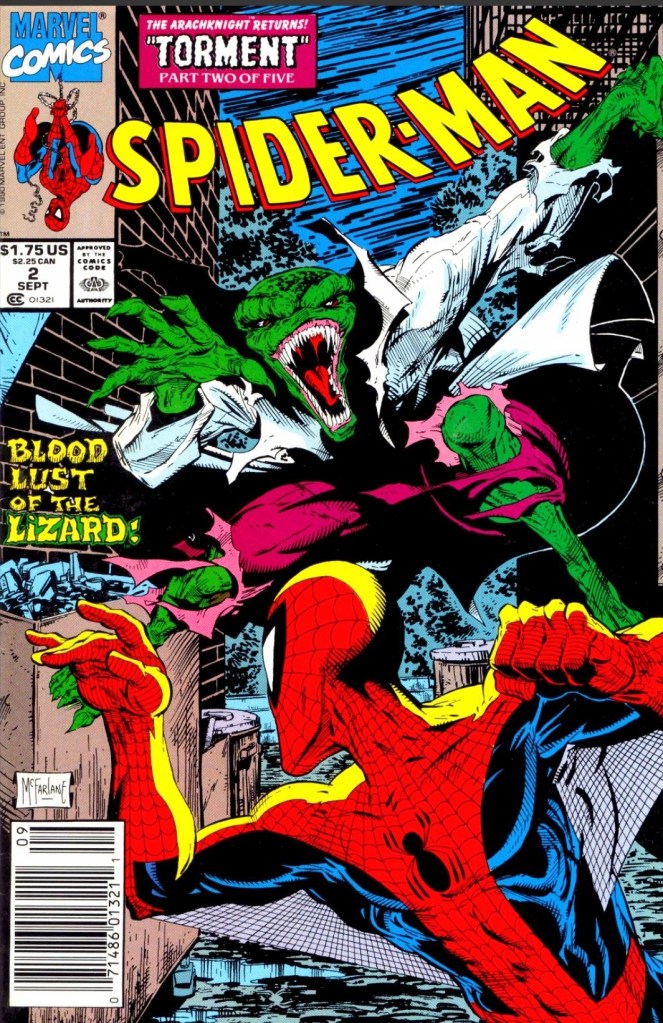
With those details laid down, here is a look back at Spider-Man #2, published in 1990 by Marvel Comics with a story written and drawn by Todd McFarlane. This is also the 2nd chapter of the Torment storyline.

The cover.

Early story

The story begins in New York City where two men got suddenly murdered by the Lizard in an alley during the night. The next morning Peter Parker reads the newspaper (showing the photograph and the news story of the Lizard’s murder of the two men) while having a breakfast moment with his wife Mary Jane. As soon as his wife mentions the word “monster”, Peter takes a 2nd look at the newspaper’s photograph and finally notices the bloody writing “CNNR” on the alley wall which makes him realize that the Lizard is back again.

Feeling very troubled, Peter leaves Mary Jane quietly and dresses up as Spider-Man to go out once again.

Elsewhere in the city, a sorceress uses her evil method of crafting a potion which creates an unrelenting sound of disturbance which Spider-Man hears. As the sound goes on, his focus and Spider Sense get overwhelmed…

Quality

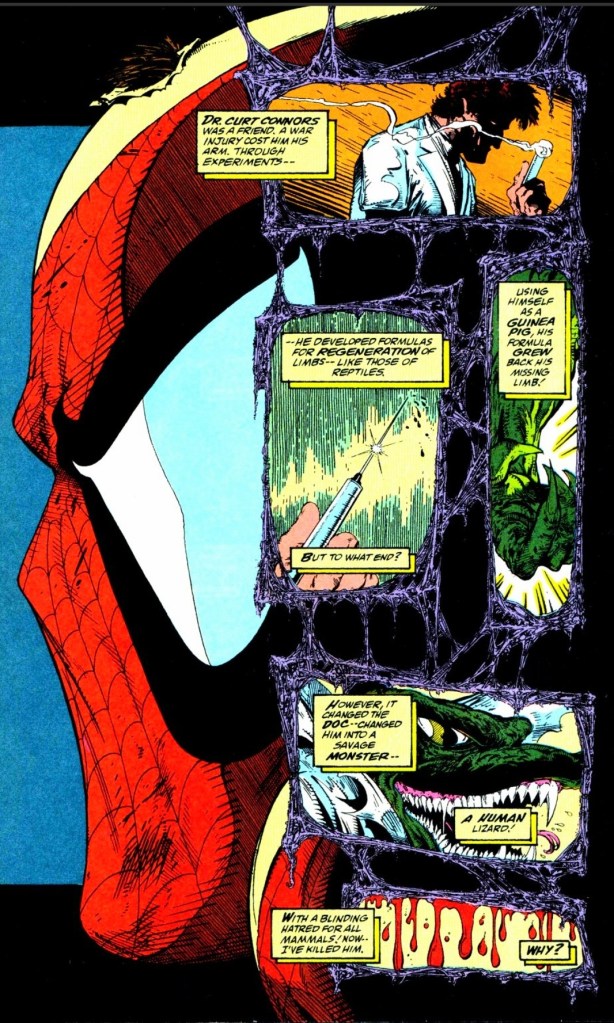
A quick look at the origin of the Lizard by McFarlane.

While the writing by McFarlane remains weak, he still succeeded in making this story a marginal improvement over the previous issue in terms of moving the plot forward, paying off a good chunk of the build-up in issue #1, and establishing his own visual corner (inspired by horror and adulterated stuff) within the Spider-Man franchise of comics of the time.

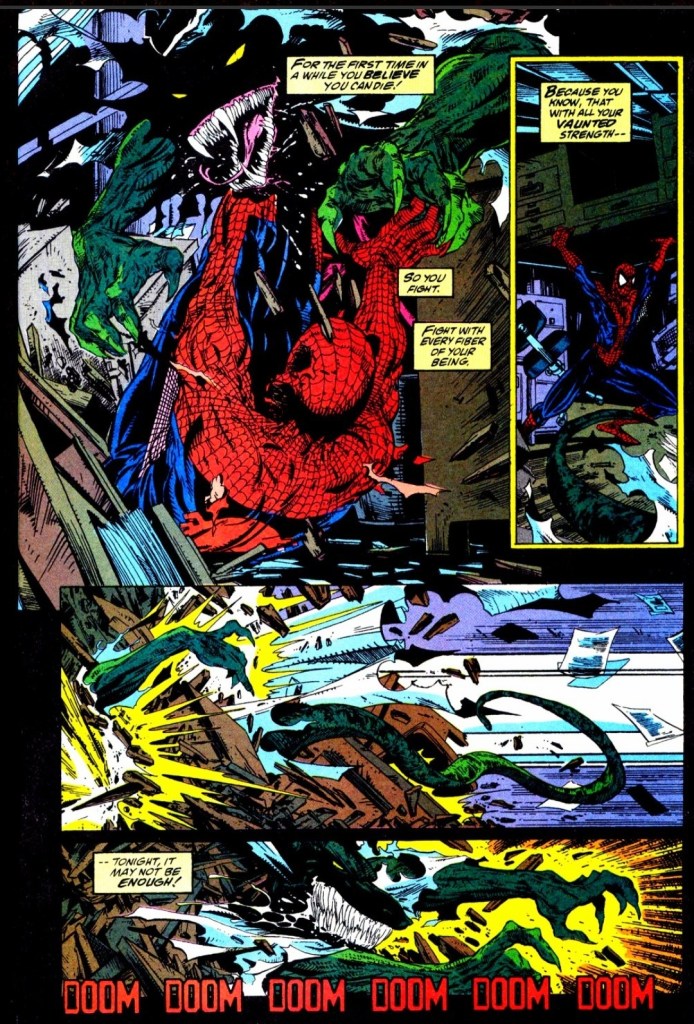
The biggest feature here is the physical conflict between Spider-Man and the Lizard. As expected, McFarlane drew the big fight with a lot of intense action, powerful violence (note: it was clear the editorial team recommended moves to tone down the graphic violence), suspense and a good amount of horror. Not only does the big fight move the story forward, it allowed McFarlane to dramatize Spider-Man as a vulnerable hero who not only has to cope with the disturbance from the sorceress far away, but also deal with the poison he got from the Lizard. That being said, Spidey also struggles with his sanity and the new fact that the Lizard has turned into a murder machine which disturbs him a lot as he personally knew Dr. Connors.

Considering what happened here and in the previous issue, there is still a greater force of evil that awaits Spider-Man and the Lizard happens to be an ultra-violent tool.

Conclusion

Many times Spider-Man finds himself in a disadvantage while fighting the Lizard.

Being the 2nd chapter of the Torment storyline, Spider-Man #2 (1990) is a slight improvement over the previous issue in terms of moving the story forward, spectacle and dramatization. While the big fight between Spider-Man and the murderous Lizard is clearly the big feature of the story, McFarlane does a good job portraying Spider-Man as vulnerable and on the edge towards defeat. McFarlane’s writing here is still weak but the other positive elements achieved outweighed the weakness.

Overall, Spider-Man #2 (1990) is satisfactory.

+++++

Thank you for reading. If you find this article engaging, please click the like button below, share this article to others and also please consider making a donation to support my publishing. If you are looking for a copywriter to create content for your special project or business, check out my services and my portfolio. Feel free to contact me with a private message. Also please feel free to visit my Facebook page Author Carlo Carrasco and follow me on Twitter at  @HavenorFantasy as well as on Tumblr at https://carlocarrasco.tumblr.com/ and on Instagram at https://www.instagram.com/authorcarlocarrasco

A Look Back at Spider-Man #1 (1990)

Welcome back superhero enthusiasts, 1990s culture enthusiasts and comic book collectors! Today we go back to the early 1990s and explore a part of the Marvel Comics shared universe through a tale of the Spider-Man monthly series.

Back in the late 1980s, Todd McFarlane proved to be a highly talented artist who helped Marvel sell a lot of issues of the Amazing Spider-Man series. McFarlane was also highly involved with the creation of Venom which not only became Spider-Man’s deadliest foe but also an icon of Marvel’s. In the year 1990, a brand new monthly series of Spider-Man was launched and it had Todd McFarlane writing and illustrating the tales.

With those details laid down, here is a look back at Spider-Man #1, published in 1990 by Marvel Comics with a story written and drawn by Todd McFarlane. This marks the beginning of the Torment storyline.

The cover.

Early story

The story begins in New York City where countless people walk to their respective destinations not realizing that the local hero Spider-Man was swinging above them. In a dirty alley, Spider-Man prevents an armed thug from harming a woman and leaves him hanging covered with a lot of web.

Elsewhere in the city, a sinister figure conducts a ritual, prays to evil forces and begins using magic.

In yet another location, a hideous creature emerges from the water. It’s the Lizard…

Quality

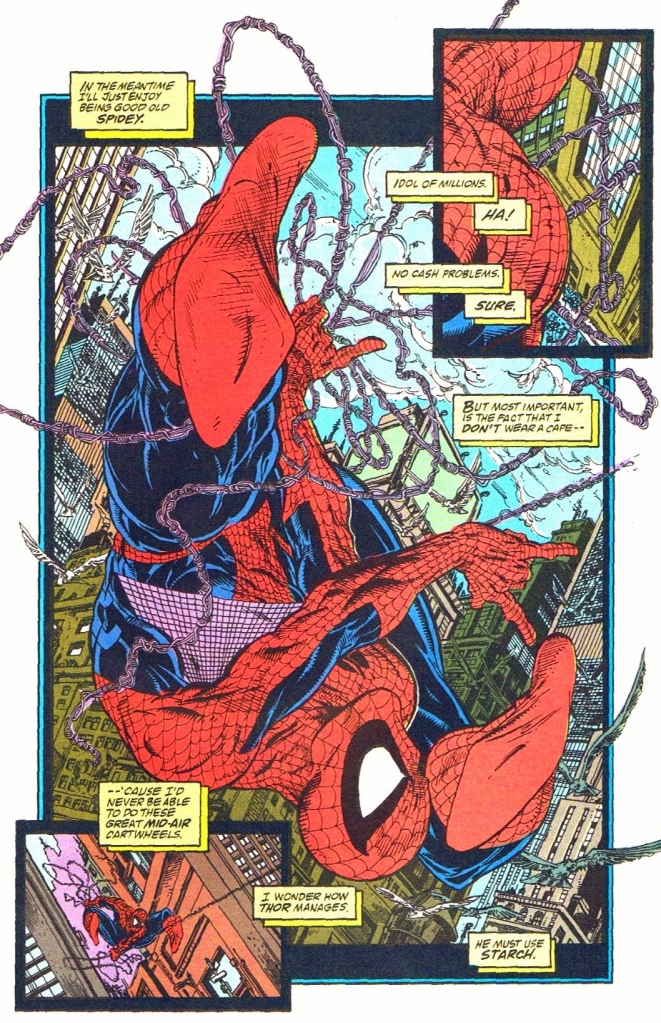
This page is an example of Todd McFarlane creating a travel sequence that allowed him to draw something great. It’s a classic example of moving back into the comfort zone.

To make things very clear here, this comic book is pretty shallow and hollow mainly due to its storytelling as this was the writing of a very young Todd McFarlane. There is no denying that his art here is great to look at from start to finish. In fact, this was one of McFarlane’s finest visual works ever with Marvel.

But if you look beyond the great visuals, the writing is very weak all throughout the issue. At best, this comic book is a grand-looking yet shallow set-up for the conflict of the Torment storyline complete with shared emphasis on the iconic web-slinger, the Lizard (looking more menacing than before) and Calypso (the one behind the magic and rituals).

In fairness to McFarlane, he added his own touch on emphasizing the personalities of Peter Parker and wife Mary Jane simultaneously as a couple. If you were used to seeing in-depth character development and witty dialogue about the two major characters as portrayed in the Amazing Spider-Man, Web of Spider-Man and Spectacular Spider-Man series of 1990, you won’t find them in this comic book. Under McFarlane’s writing, Spider-Man in this issue showed signs of sarcasm and cockiness in the first scene, and with Mary Jane he (as Peter Parker) expressed himself philosophically. To say the least, the portrayal of Spider-Man here is noticeably different under McFarlane.

The Lizard, a long-time rival of Spider-Man’s, was presented to be very violent and murderous in this issue. This was clearly McFarlane’s approach on emphasizing the force of opposition that awaits the iconic web-slinger and he obviously went for a more adulterated approach with the visuals. That being said, the violent content in this comic book is very unique and clearly stood out from the rest of the Spider-Man-related comics published by Marvel in 1990. Lastly, I should say that McFarlane’s visual take on the Lizard is the best I have seen.  

Going back to the visuals, McFarlane implemented strong elements of horror, darkness and grittiness which went along well with the adulterated approach to violence.  These mixed elements, as they turned out in reality, became part of McFarlane’s future works past Spider-Man.

Conclusion

McFarlane’s vicious and horrifying approach on visualizing the Lizard can’t be ignored. This Lizard makes the cinematic Lizard of the 2012 movie The Amazing Spider-Man look cartoony.

Spider-Man #1 (1990) is a very mixed bag when it comes to literary enjoyment. It clearly has great artwork by McFarlane whose adulterated approach on expression and spectacle made it very unique. The writing by McFarlane (who was very young at the time of production) is clearly the big letdown although his own approach on portraying Spider-Man, MJ and the Lizard are very notable. Take note that this was Todd McFarlane starting with writing while doing the art (his true strength), and at this point in comic book history his talent on telling compelling stories would not be realized until a few years later (particularly with Spawn and Image Comics). Notably, his use of visual horror and darkness predates his work in Spawn which makes his Spider-Man take very distinct. Ultimately, this comic book served as a build-up for things to come in the Torment storyline. Don’t expect too much when acquiring this comic book.

Overall, Spider-Man #1 (1990) is satisfactory.

+++++

Thank you for reading. If you find this article engaging, please click the like button below, share this article to others and also please consider making a donation to support my publishing. If you are looking for a copywriter to create content for your special project or business, check out my services and my portfolio. Feel free to contact me with a private message. Also please feel free to visit my Facebook page Author Carlo Carrasco and follow me on Twitter at  @HavenorFantasy as well as on Tumblr at https://carlocarrasco.tumblr.com/ and on Instagram at https://www.instagram.com/authorcarlocarrasco

A Look Back at Amazing Spider-Man #129 (1974)

Welcome back superhero enthusiasts, 1970s arts and culture enthusiasts, Marvel Comics fans and comic book collectors! Today we go back to the year 1974 to examine a highly significant tale from Marvel Comics’ shared universe – the first appearance of the Punisher and his first-ever encounter with Spider-Man.

To put things in perspective, Punisher’s literary debut was told within the Amazing Spider-Man comic book series and it happened not too long after the legendary tragedy of Gwen Stacey. During the 1970s, Hollywood made and released several action movies and crime thrillers that were violent, gritty and highlighted vigilantes and assassins. Some of that influence somehow made it into Marvel’s shared universe which was symbolized creatively through the Punisher who debuted as an assassin.

With those details laid down, here is a look back at Amazing Spider-Man #129, published in 1974 by Marvel Comics with a story written by Gerry Conway and drawn by Ross Andru (the same creative duo behind Superman vs. The Amazing Spider-Man crossover).

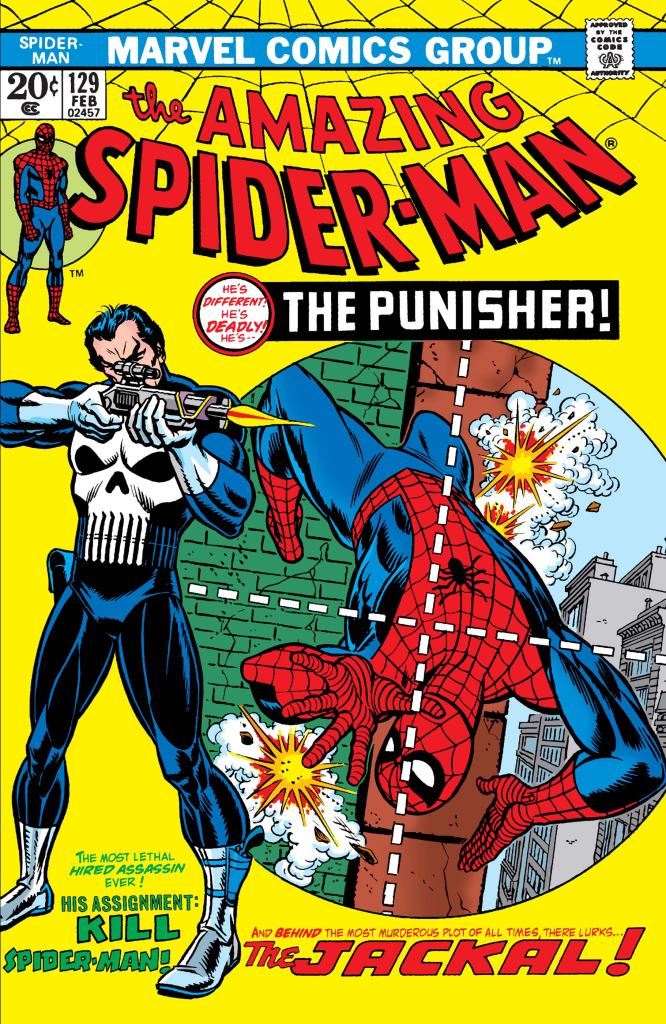
The cover.

Early story

The story begins inside a private facility an assassin wearing black with a huge skull on his upper body heavily damages a solid statue of Spider-Man using a powerful rifle. This impresses the hideous villain called the Jackal who tells him that if he does well with the real Spider-Man, he would have performed a great service for the world. Knowing he impressed the Jackal, the Punisher states that he will only kill those who deserve killing and he expresses his belief that the webslinger deserves to die.

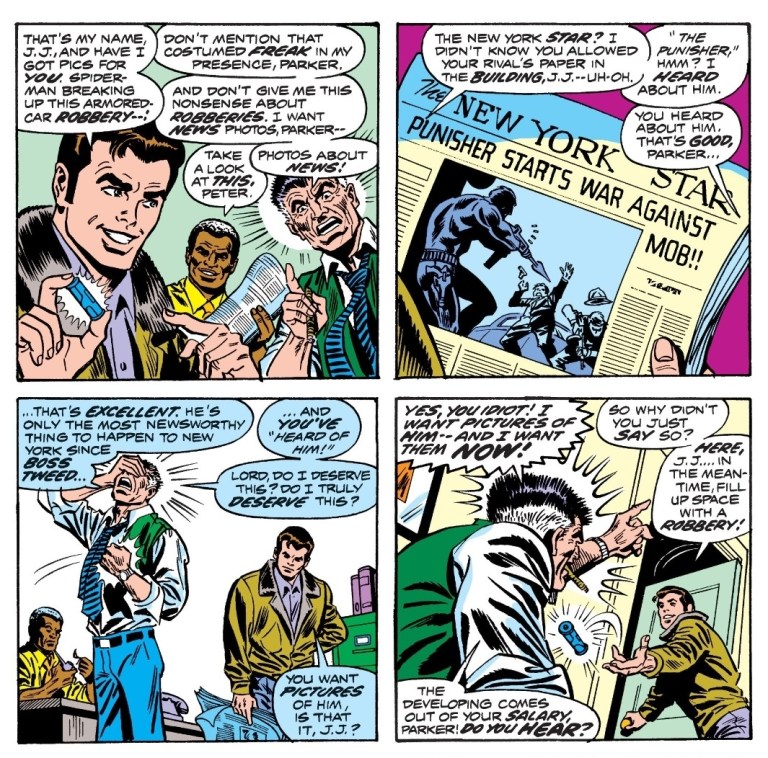
Elsewhere, Spider-Man swings into action and successfully stops an armed robbery from happening. Along the way he managed to capture photographs, changes into his civilian clothes and enters the Daily Bugle’s office ready to submit the roll of film as Peter Parker. Unfortunately, his superior J. Jonah Jameson disregards Parker’s submission and points out that the Punisher made waves with New York’s readers via the Bugle’s competitor The New York Star. For Jameson, the Punisher is only the most newsworthy thing to happen to New York and tells Parker he wants photos of the assassin…

Quality

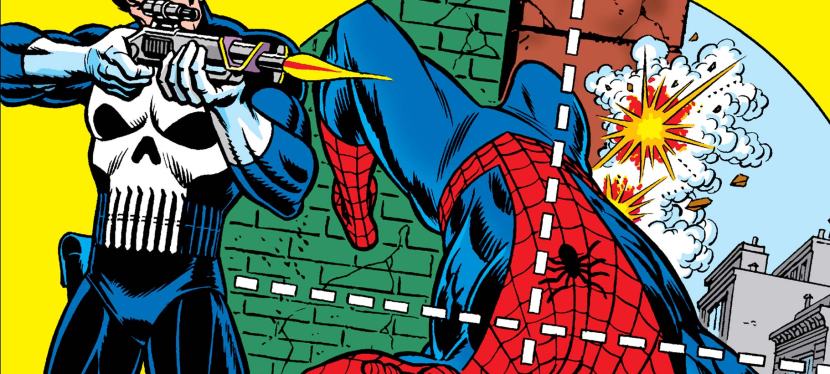
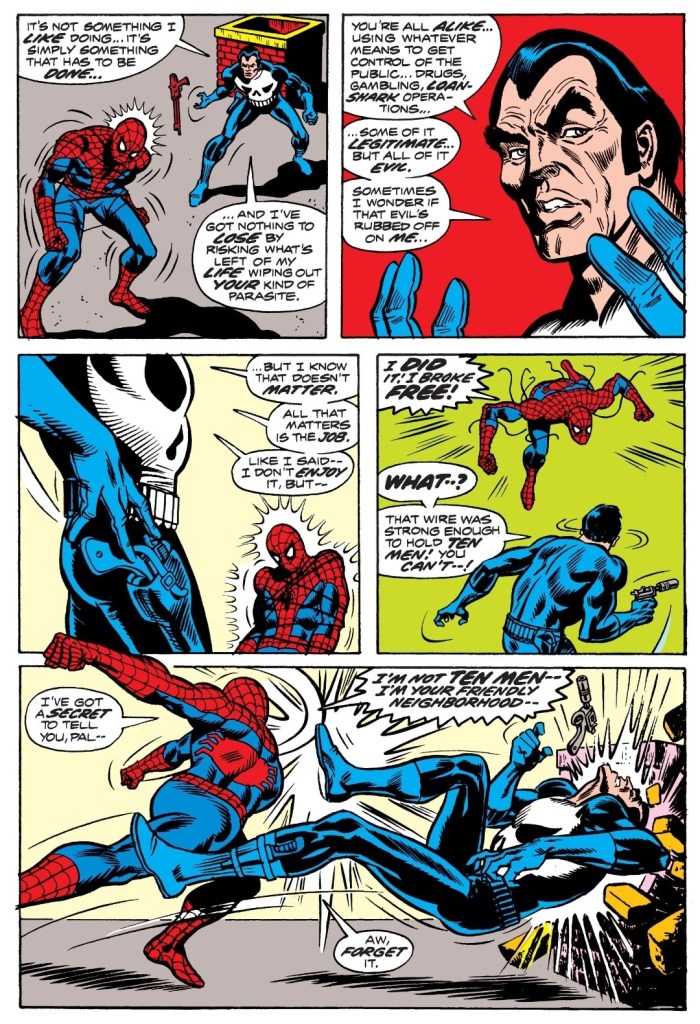
This is a scene from the first of two encounters between Spider-Man and the Punisher who was introduced as an assassin.

To make things very clear about storytelling without spoiling plot details, this is a tale about intrigue and the darker side of society that involves vigilantes and murdering. The Punisher here did not debut as a crime-busting vigilante but rather an assassin who accepts assignments from clients as long as the jobs fall in line with his personal philosophy that focuses on taking the lives of those who deserved to be killed. That being said, it is clear that Hollywood’s vigilante flicks of the 1970s influenced the presentation and I can say that whenever the story focuses on the Punisher, there definitely is a grim tone which contradicts the tone of Spider-Man’s scenes.

Spider-Man here continues to struggle somewhat with his personal life having recently lost Gwen Stacey while remaining disturbed about the identity of the Green Goblin. The webslinger also has to live with the heavy situation in which a lot of people in New York were convinced that he killed Norman Osborne which was the result of his own boss’ handling of the Daily Bugle. These elements along with his civilian involvement with his newspaper creatively added to the build-up of Spider-Man’s eventual encounters with the Punisher. The build-up was structured nicely and the pay-off was worth it.

There was also the introduction of Jackal. While he has a hideous appearance, his participation was more about scheming than action which contrasted him with the Punisher. For the newcomers reading this, Jackal is actually Miles Warren in a more monstrous form. From this comic book, it was clear that Jackal was created to be a recurring super villain for Spider-Man and this was strongly executed in the first Clone Saga of 1975 and the controversial Clone Saga of the 1990s.

Going back to the Punisher, he symbolically uses guns with designs that were more grounded in reality (inspired by real-life guns in looks) instead of taking influence from science fiction. As an assassin living with a strong code, the Punisher is truly determined to eliminate Spider-Man whom he even referred to as a murderer. The perception of Spider-Man as a criminal on the part of the Punisher clearly reflected the defamation caused by the Daily Bugle on the webslinger. Gerry Conway established the assassin to be a strong believer in fighting evil by using violence and killing.

The build-up of the Punisher is very solid and the pay-off in the form of battles with Spider-Man is tremendous and very satisfying to read. There is a lot of action to enjoy here and most notably Gerry Conway maintained a strong narrative throughout.

Conclusion

Have you ever worked in a newspaper before?

I can say out loud that Amazing Spider-Man #129 (1974) is truly a great read and a true illustrated literary classic of Marvel Comics. This tale alone added a touch of darkness and grit (in the form of vigilante and assassins cultures) into the Spider-Man legacy. Apart from its status as a comic book classic, this one paved the way for the rise of the Punisher in terms of more comic book appearances and the publishing of new comic book series featuring him. While the Punisher’s legacy as a killer is obviously not something worth believing in, Marvel Comics took the risk of having him as one of their primary characters in the decades that followed. This particular story is so significant, Marvel Comics revisited it with What If #58 (1994). Check out my other Punisher-related retro reviews by clicking here, here, here, here and here.

Overall, Amazing Spider-Man #129 (1974) is highly recommended!

+++++

Thank you for reading. If you find this article engaging, please click the like button below, share this article to others and also please consider making a donation to support my publishing. If you are looking for a copywriter to create content for your special project or business, check out my services and my portfolio. Feel free to contact me with a private message. Also please feel free to visit my Facebook page Author Carlo Carrasco and follow me on Twitter at  @HavenorFantasy as well as on Tumblr at https://carlocarrasco.tumblr.com/ and on Instagram at https://www.instagram.com/authorcarlocarrasco

A Look Back at Amazing Spider-Man #385 (1994)

Disclaimer: This is my original work with details sourced from reading the comic book and doing personal research. Anyone who wants to use this article, in part or in whole, needs to secure first my permission and agree to cite me as the source and author. Let it be known that any unauthorized use of this article will constrain the author to pursue the remedies under R.A. No. 8293, the Revised Penal Code, and/or all applicable legal actions under the laws of the Philippines.

Welcome back superhero enthusiasts, 1990s culture enthusiasts and comic book collectors! Today we go back to the year 1994 and explore a part of the Marvel Comics universe through one of the many tales of the Amazing Spider-Man comic book series.

In my previous retro review, Spider-Man has been caught by the Jury and gets tried in a makeshift court that is so secretive, getting help from outside is impossible. The trial explored how Spider-Man, who brought the alien costume into their world which later led to the beginning of his murderous mortal enemy, is responsible for the deaths and other tragedies connected to Venom.

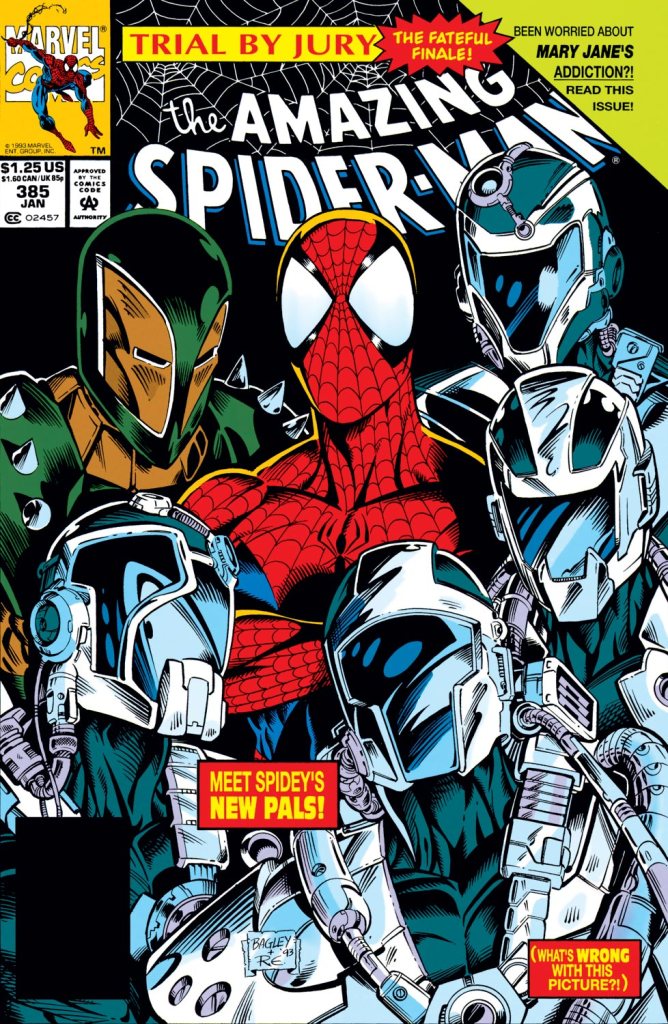
With those details laid down, here is a look back at Amazing Spider-Man #385, published in 1994 by Marvel Comics with a story by David Michelinie and drawn by Mark Bagley. This issue marks the final chapter of a 3-part storyline between the iconic webslinger and the Jury.

The cover.

Early story

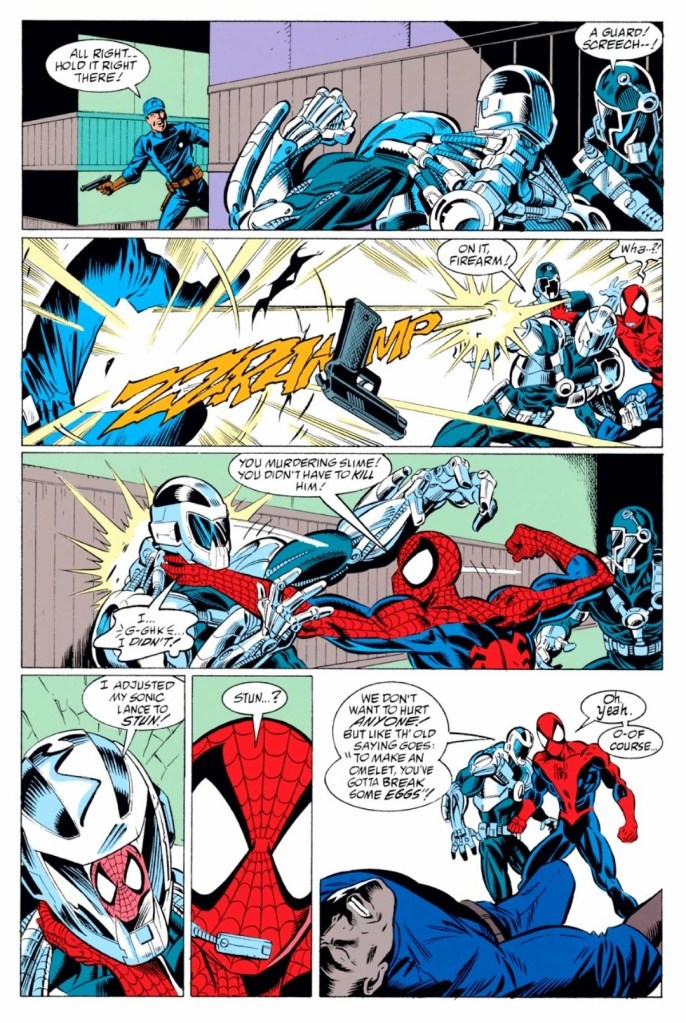
The story begins with a restrained Spider-Man declared guilty and sentenced to death by the so-called court of Orwell Taylor and the Jury. Just as the team members are about to execute the webslinger, their teammate Ramshot intervenes and says that Spider-Man saves lives which is a matter of public record. Disappointed by Ramshot’s behavior, Taylor mentions their secondary mission is to obtain a weapon that might allow them to eliminate their true enemy – Venom.

Taylor then says that if Spider-Man would help them destroy the greater evil, then the court would consider commuting his sentence…

Quality

Something unfortunate happens during the mission involving Spider-Man and the Jury.

Considering all the drama and tension that was built up in the previous two issues, the story here is a letdown. For one thing, all the discussions about Spider-Man being responsible for the killings and violence caused by Venom lead to nowhere as the story took a turn for the bizarre concept of the hero getting spared to work with the very team that went after him. Secondly, the mission that Spidey and the Jury worked on really did not have a justifiable goal. This resulted in a disappointing turn of events. Ironically, in this comic book you will see more of Taylor’s cunning on top of his own distorted view about justice.

If there is anything notable here, it is the fact that Spider-Man’s wife Mary Jane gets a good share of the spotlight as she literally moves towards the edge in relation to the deteriorating marriage. This shows that as Spidey spends more time away to do what is good and push back against the forces of evil, his wife gets lonelier and desperate as life turns for the worse. At the very least, this comic book expresses that the marriage of Peter and Mary Jane could be doomed.

Conclusion

This is how Mary Jane deals with loneliness and the decline in her life.

Considering what was built up and heavily dramatized in issues #383 and #384, Amazing Spider-Man #385 (1994) is a rather weak conclusion. The way Spider-Man and the Jury parted ways felt more like sudden retreat than a real finish to what was started between them. Strangely enough, the focus on Mary Jane’s decline and desperation literally saved this comic book from becoming a creative disaster. The ending does not have much to do between Spider-Man and the Jury, but it was surprising in a crude way.

Overall, Amazing Spider-Man #385 (1994) is serviceable.

+++++

Thank you for reading. If you find this article engaging, please click the like button below, share this article to others and also please consider making a donation to support my publishing. If you are looking for a copywriter to create content for your special project or business, check out my services and my portfolio. Feel free to contact me with a private message. Also please feel free to visit my Facebook page Author Carlo Carrasco and follow me on Twitter at  @HavenorFantasy as well as on Tumblr at https://carlocarrasco.tumblr.com/ and on Instagram at https://www.instagram.com/authorcarlocarrasco

A Look Back at Amazing Spider-Man #382 (1993)

Disclaimer: This is my original work with details sourced from reading the comic book and doing personal research. Anyone who wants to use this article, in part or in whole, needs to secure first my permission and agree to cite me as the source and author. Let it be known that any unauthorized use of this article will constrain the author to pursue the remedies under R.A. No. 8293, the Revised Penal Code, and/or all applicable legal actions under the laws of the Philippines.

Welcome back superhero enthusiasts, 1990s culture enthusiasts and comic book collectors! Today we go back to the year 1993 and explore a part of the Marvel Comics universe through one of the many tales of the Amazing Spider-Man comic book series.

In my previous retro review, Spider-Man gets involved not only with the Incredible Hulk but also with Doc Samson who has a history of treating the green giant and carries a strong sense of responsibility towards him. Something, however, infected Samson and eventually the Hulk which leads to a new wave of destruction in New York City which itself is still recovering from the chaos of Maximum Carnage.

With those details laid down, here is a look back at Amazing Spider-Man #382, published in 1993 by Marvel Comics with a story written by David Michelinie and drawn by Mark Bagley.  

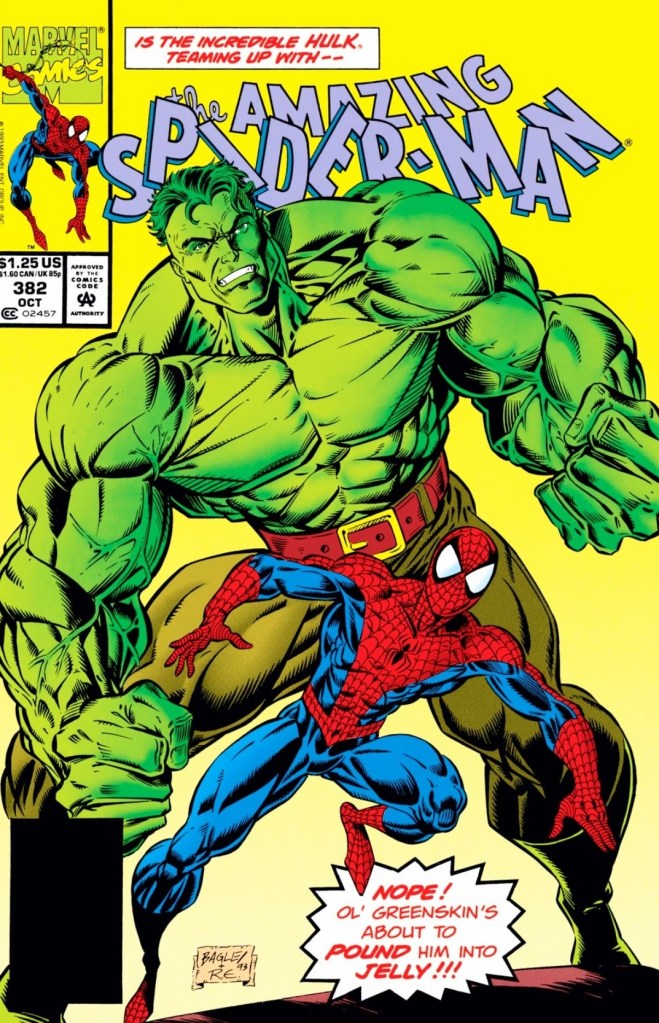
The cover.

Early story

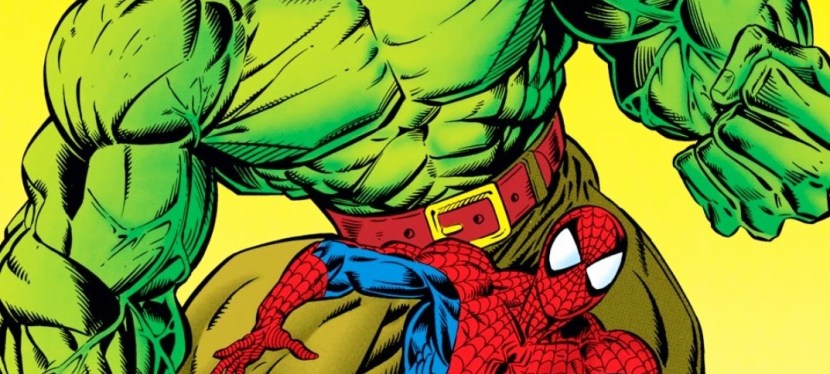
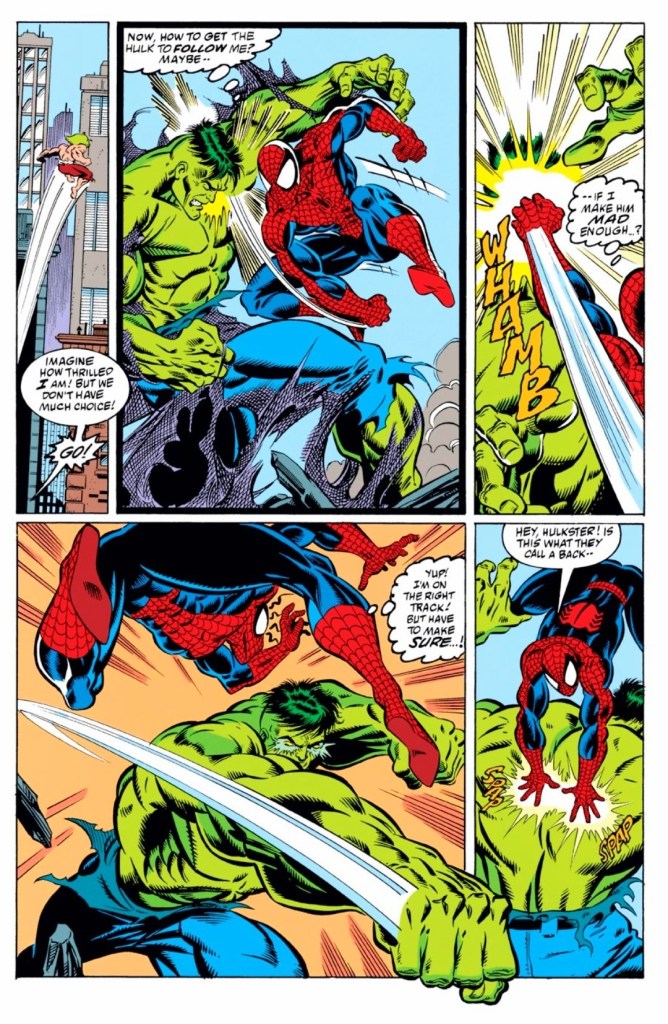
The story begins with the Hulk (note: infected with the gamma virus which is driving him to violence) striking the pavement hard causing Spider-Man and Doc Samson to move away. After a quick exchange of words with Samson regarding the virus, Spider-Man jumps towards the Hulk and hits his face in an attempt to stop him before he causes any more damage to the city.

Doc Samson desperately tries to contain the Hulk by choking him only to be grabbed and get thrown to a solid structure nearby. Now down on the pavement, Samson notices the Hulk jumping in towards him…

Quality

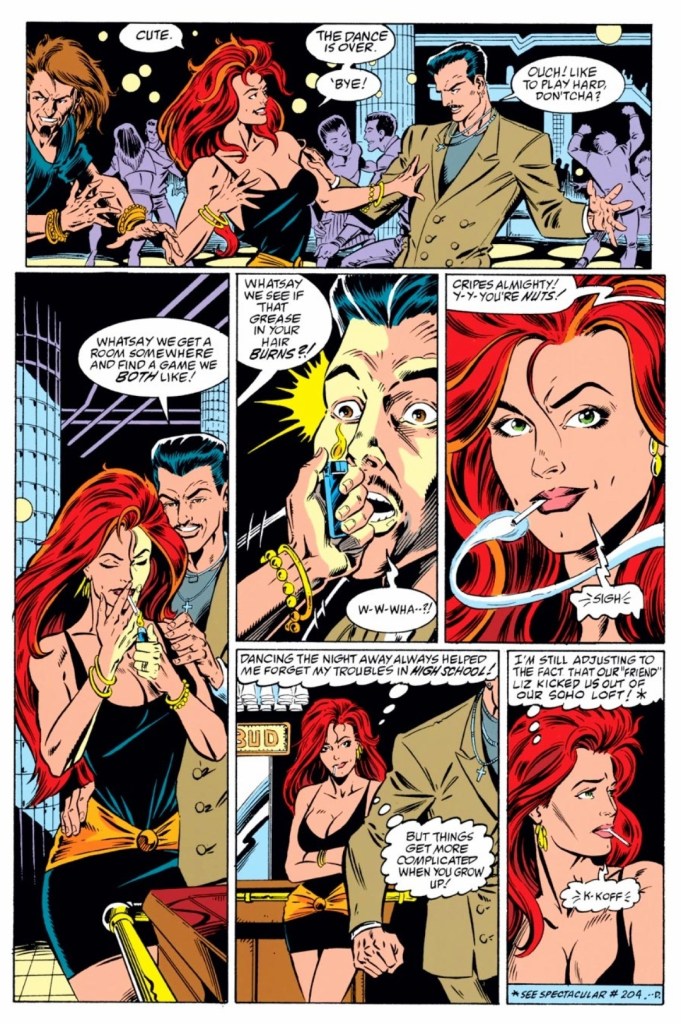
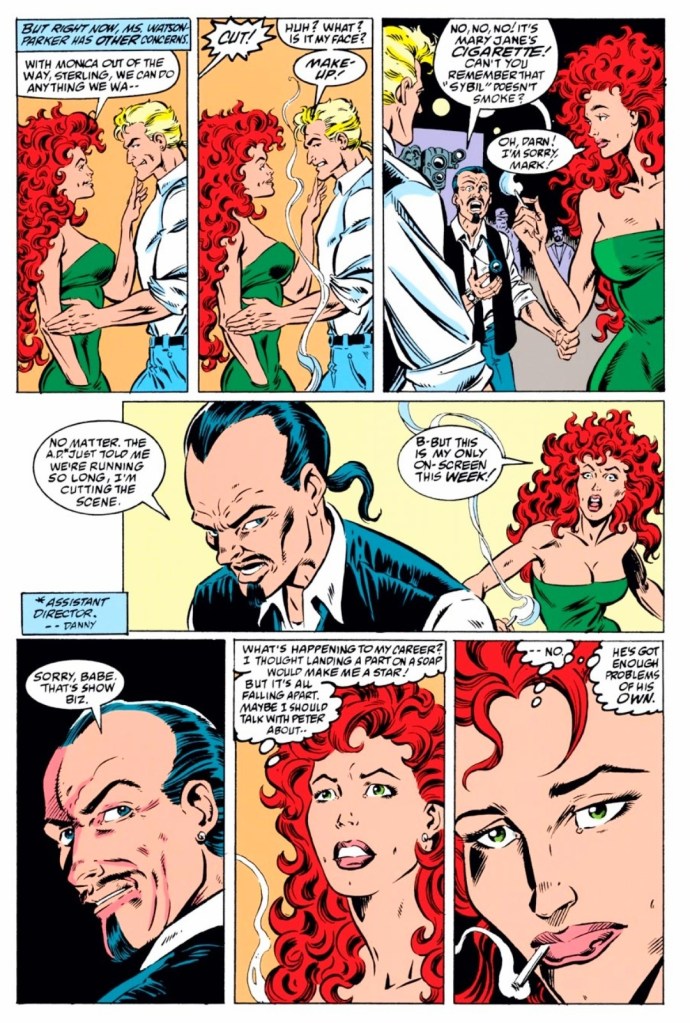
Mary Jane Parker in trouble with her acting career.

This story is indeed a solid and satisfying conclusion to what was started in issue #381. Not only does this comic book showcase a battle between Spider-Man and the manipulated Hulk, it also highlights Doc Samson’s importance not only as a supporting player but also as a scientist struggling with his responsibility over helping the Hulk. There is a strong sense of burden you will sense in Samson who himself caused a lot of damage when he was infected with the virus before the Hulk got infected by it.

The presentation of the virus/bacterium as the factor behind the chaos is a believable concept that highlights what would happen if people carrying gamma radiation in their bodies get infected by it.

If you are looking for fun, there is a lot of action here with lots of dynamic looking images crafted by Mark Bagley. Yes, you will see action and incidental moments between Spider-Man and the Hulk here and there, with Samson also getting a notable share of the spotlight. How the conflict concluded was cleverly done and ultimately surprising. This is something you readers will have to discover for yourselves.

Conclusion

As Doc Samson goes away, Spider-Man takes on the Hulk.

Amazing Spider-Man #382 (1993) is a well-paced and satisfying conclusion to the events that started in the previous issue. At the time of its release, the comic book highlighted a modern crossover between the Hulk and Spider-Man with Doc Samson inserted as a functional third participant. The concept of the gamma virus/bacterium works well here and added a more science fictional layer to the plot. This comic book is pretty entertaining and the suspense really built-up nicely towards the climax.

Overall, Amazing Spider-Man #382 (1993) is recommended!

+++++

Thank you for reading. If you find this article engaging, please click the like button below, share this article to others and also please consider making a donation to support my publishing. If you are looking for a copywriter to create content for your special project or business, check out my services and my portfolio. Feel free to contact me with a private message. Also please feel free to visit my Facebook page Author Carlo Carrasco and follow me on Twitter at  @HavenorFantasy as well as on Tumblr at https://carlocarrasco.tumblr.com/ and on Instagram at https://www.instagram.com/authorcarlocarrasco

A Look Back at Amazing Spider-Man #384 (1993)

Disclaimer: This is my original work with details sourced from reading the comic book and doing personal research. Anyone who wants to use this article, in part or in whole, needs to secure first my permission and agree to cite me as the source and author. Let it be known that any unauthorized use of this article will constrain the author to pursue the remedies under R.A. No. 8293, the Revised Penal Code, and/or all applicable legal actions under the laws of the Philippines.

Welcome back superhero enthusiasts, 1990s culture enthusiasts and comic book collectors! Today we go back to the year 1993 and explore a part of the Marvel Comics universe through one of the many tales of the Amazing Spider-Man comic book series.

In my previous retro review, Spider-Man became the new target of The Jury, a team of armored mercenaries founded and led by the father (note: a prominent and powerful man) of one of Venom’s murder victims. Spider-Man was perceived to be responsible for bringing the living alien costume into the world which eventually resulted in the creation of Venom (note: Eddie Brock bonded with the same symbiote) who went on to cause havoc and killed a lot of people.

With those details laid down, here is a look back at Amazing Spider-Man #384, published in 1993 by Marvel Comics with a story by David Michelinie and drawn by Mark Bagley.  

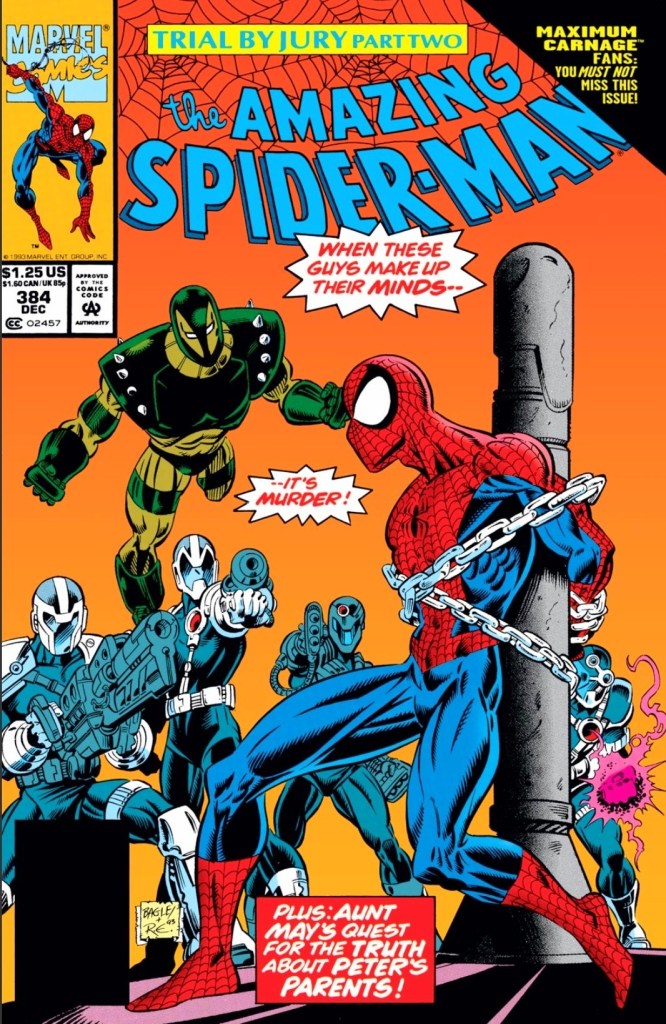
The cover.

Early story

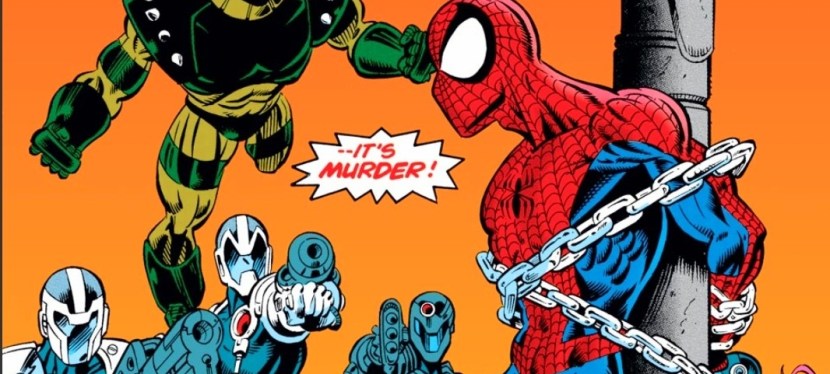
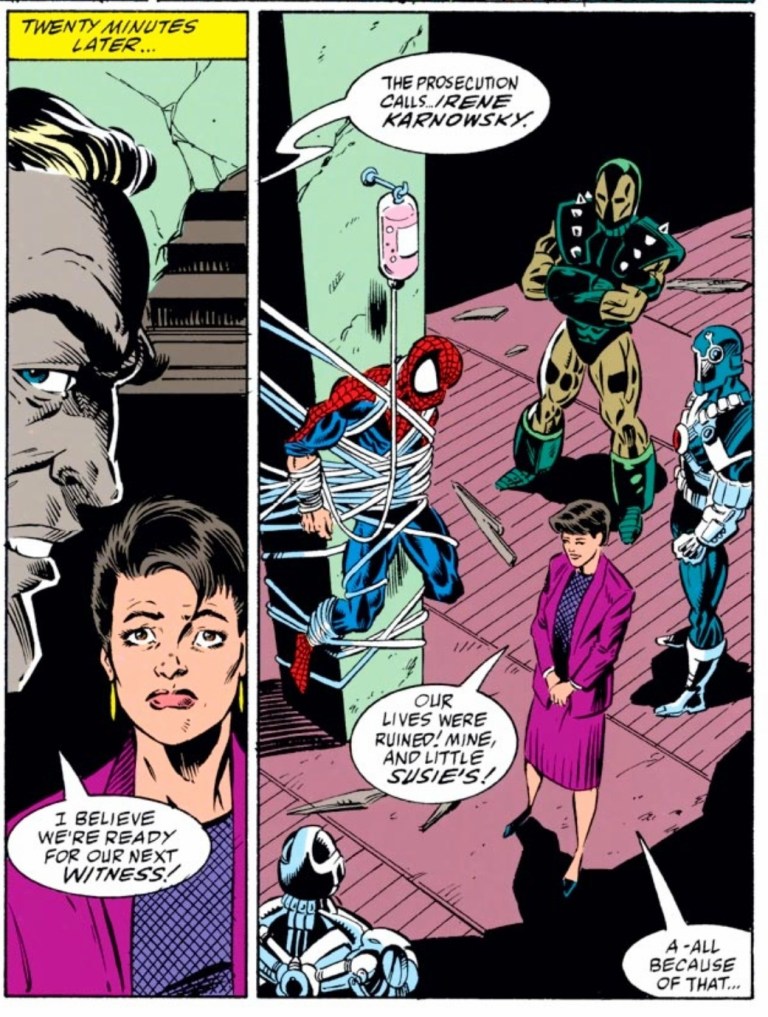
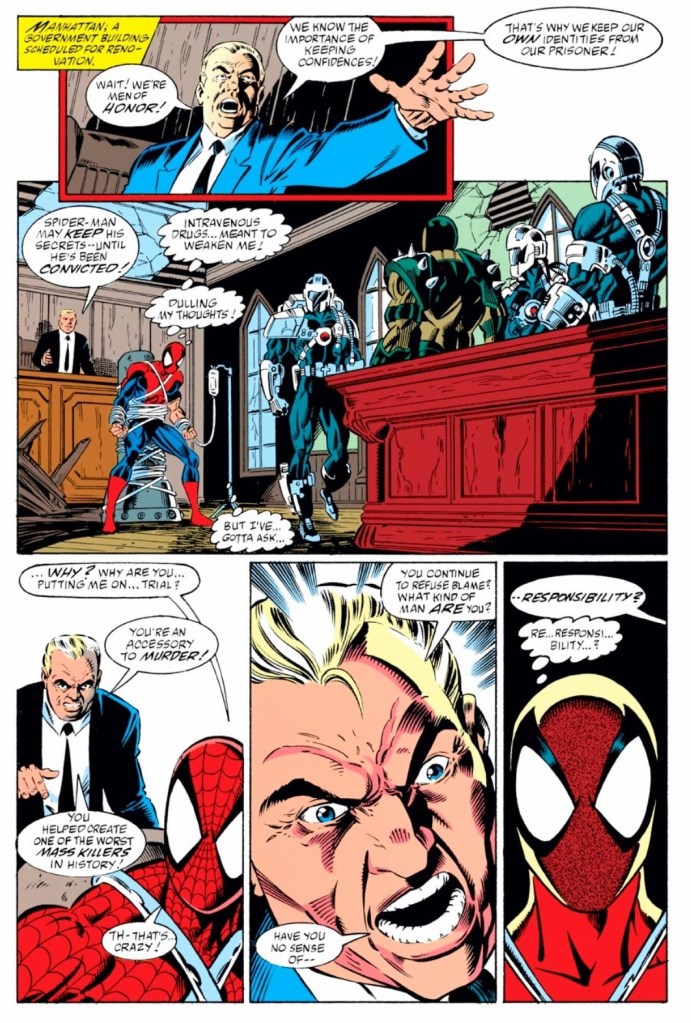
The story begins inside a certain government building in New York City scheduled for renovation. A heavily restrained and drugged Spider-Man was about to have mask taken off by one of The Jury members when their founder General Taylor intervened and insisted that they keep their honor. Spider-Man is up for questioning and scrutinization in a makeshift trial by The Jury. As the webslinger is not in the proper condition to stand trial, Taylor (in his capacity as the judge) declares a 30-minute recess.

Elsewhere, Peter Parker’s wife Mary Jane received bad news from her boss that her role in the TV show Secret Hospital will be reduced to a recurring role. This troubles her deeply as it means reduced income for her at a time when her marriage with Peter continues to go down. Spider-Man’s lack of quality time with her keeps taking its toll on her…

Quality

Spidey on trial!

Firstly, I should say that the Michelinie-Bagley team’s concept of having The Jury as the force of opposition against Spider-Man continues to do wonders creatively in this particular comic book series. In the previous issue, the webslinger was hunted and General Taylor really invested a lot of technologies to get to him in the middle of a very bustling city. In this particular issue, Spider-Man is completely vulnerable being weakened and disoriented as he is about to be tried in a makeshift court.

Along the way, Taylor and his team were portrayed to work within their own system of justice. As no court of law in New York would recognize Spider-Man’s trial, The Jury set up their own court in a very private and unusual manner.

While the planned trial is the major event of this comic book’s concept, Michelinie pulled off a rather unusual move with the narrative. Just as the first witness points to Spider-Man for being responsible for Venom, the iconic webslinger then starts to wonder what the trial is truly all about and then the creative team unleashed a slew of flashbacks that looked back a key events published in certain comic books of Secret Wars, The Amazing Spider-Man and Web of Spider-Man through the years. I’m talking about Spider-Man’s first-ever encounter with the symbiote, how he got rid of it, how the symbiote bonded with Eddie Brock to form Venom, how Venom’s costume left a living seed that Cletus Kassady touched and became Carnage, etc. These flashbacks, all nicely drawn by Mark Bagley, conveniently served as an instant reference for readers to catch up with the current events but this was done at the expense of this comic book’s narrative.

More on the trial, this comic book raises layered questions about the concept of responsibility on Spider-Man. Could the iconic webslinger really be held accountable for whatever murders Venom committed along with the trauma he caused on bystanders given the fact that he really brought the alien costume into their world? Should Spider-Man also be held responsible for any murders committed by Carnage? This is one really loaded script Michelinie came up with and he really had Spider-Man vulnerable not only to The Jury but also to the questions thrown at him during the makeshift trial. To put it short, this is one very unusual Spider-Man tale ever told that carries strong relevance from the past.

As with the previous issues, this comic book sheds a limited amount of the spotlight on Mary Jane and Spider-Man’s Aunt May who at this stage has gotten paranoid with her suspicions about Peter’s parents. The dramatization turned out pretty good.

Conclusion

Spider-Man in a vulnerable state with The Jury.

While the flashbacks were excessive and made the narrative feel bloated, Amazing Spider-Man #384 (1993) still has lots of good stuff fans can enjoy. It has a pretty bold concept of having Spider-Man really trapped and left vulnerable for the makeshift trial. More notably, the narrative pounded heavily on the concept of responsibility in relation to Spider-Man’s past actions that led to the creation of Venom and even Carnage.

Overall, Amazing Spider-Man #384 (1993) is recommended!

+++++

Thank you for reading. If you find this article engaging, please click the like button below, share this article to others and also please consider making a donation to support my publishing. If you are looking for a copywriter to create content for your special project or business, check out my services and my portfolio. Feel free to contact me with a private message. Also please feel free to visit my Facebook page Author Carlo Carrasco and follow me on Twitter at  @HavenorFantasy as well as on Tumblr at https://carlocarrasco.tumblr.com/ and on Instagram at https://www.instagram.com/authorcarlocarrasco