A Look Back at Amazing Spider-Man #149 (1975)

Welcome back superhero enthusiasts, 20th century arts and culture enthusiasts, Marvel Comics fans and comic book collectors! Today we go back to the mid-1970s to examine a small part of the Marvel Comics shared universe through a tale of the Amazing Spider-Man monthly series.

You heard about the notorious Clone Saga of the 1990s that dominated Spider-Man comic books for a few years? That was actually the 2nd saga about Spider-Man and cloning. The first one started in the mid-1970s and it was the result of a move by Marvel’s creative team to let Gwen Stacy return from the dead somehow. A new villain called the Jackal was eventually introduced and in his civilian form as Miles Warren (a character introduced much earlier), he had a personal obsession with Gwen Stacy whose death in Amazing Spider-Man #121 was too overwhelming for him to handle. Warren turned out to be an expert on cloning.

With those details laid down, here is a look back at Amazing Spider-Man #149, published in 1975 by Marvel Comics with a story written by the late Gerry Conway and drawn by the late Ross Andru.
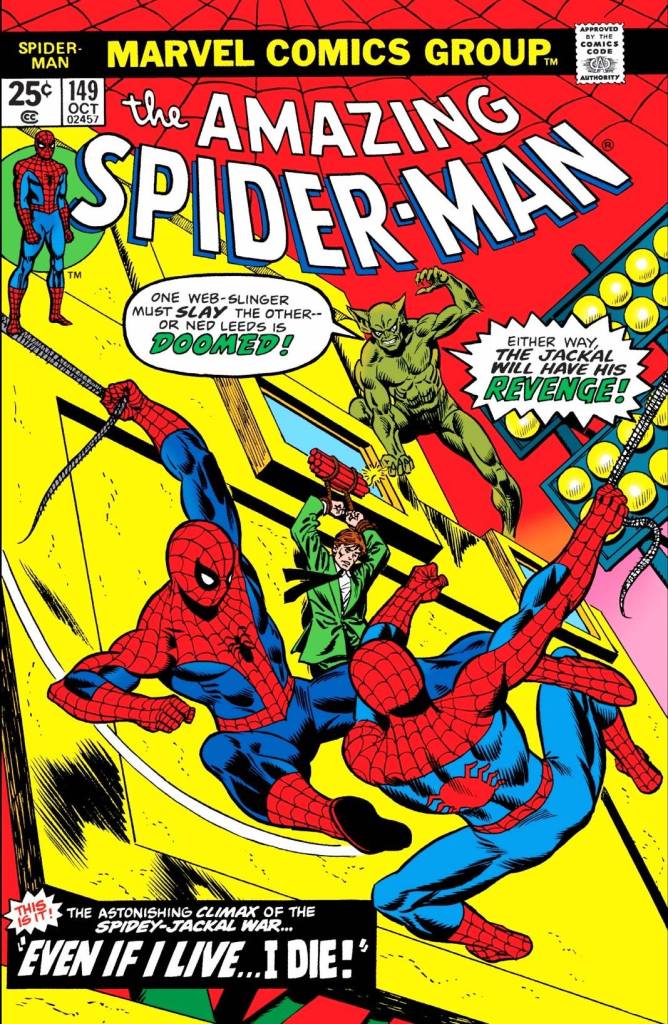
The cover.

Early story

The story begins on top of a building just moments after the Jackal revealed his secret identity to a weakened Spider-Man in the presence of the Gwen Stacy clone and Ned Leeds. For Spider-Man, the revelation is shocking because in his private life as Peter Parker, Warren has been his biology and biochemistry professor at Empire State University (ESU) where he and Gwen Stacy studied. Recently, Parker and Leeds visited Warren to check on certain cell samples from which Gwen Stacy’s clone had been created. Warren claimed those samples had been stolen by a man named Anthony Serba. Spider-Man eventually loses consciousness.

Some time later, Spider-Man awakens inside an abandoned tenement in lower Manhattan. He finds himself restrained on a wooden table and the Jackal starts talking to him. For the Jackal, what is going on is his moment of triumph.

As the Jackal keeps talking, Spider-Man suddenly frees himself from the table to get back on his feet to fight him…

Quality
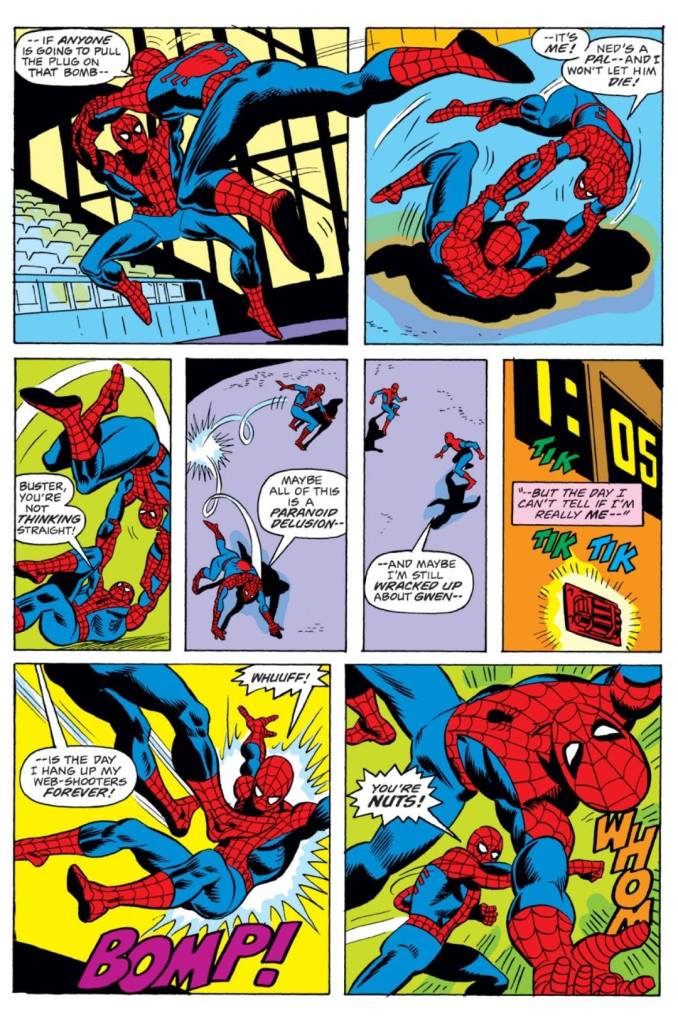
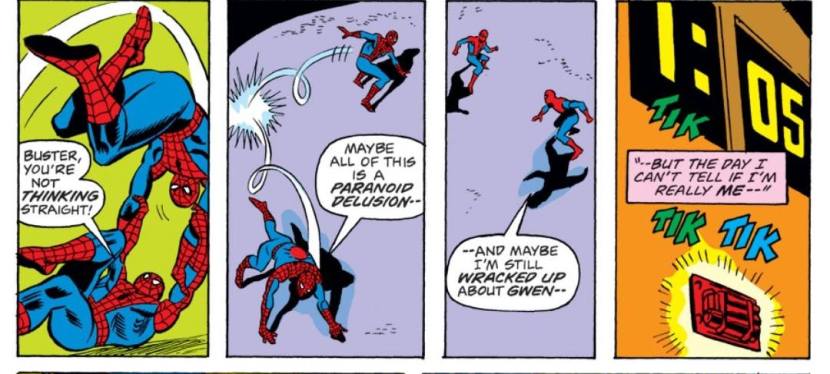
Can you tell who is the real Spider-Man here?

Apart from historical significance of this original clone saga and the other one from the 1990s, this particular tale is finely written by Conway and the stakes were really raised high from the start (preceded by build-up of key events in prior issues). Clearly, what was presented here was a huge pay-off to the build-up of recent issues and the dialogue has lots of details that are thought-provoking.

At the center of the story is Miles Warren who has gone to the extremes as the Jackal and he already knows that Spider-Man and Peter Parker are one and the same person. He has a burning hatred towards Parker because he is young, he was loved by Gwen Stacy, and was responsible for her death (which happened in Amazing Spider-Man #121). There is a lot of drama Conway wrote into Miles Warren’s transformation into the Jackal (first appearance was in Amazing Spider-Man #129 along with the Punisher) as a result of Gwen’s death and there are established connections with his ability to perform cloning. Conway’s presentation of the origin of the Jackal here is indeed a must-see!

When it comes to the known feature of this comic book – Spider-Man’s physical encounter with his clone – this one was presented as a spectacle laced with suspense and intrigue for the readers. It was done to test the readers’ ability to determine who is truly Spider-Man as the fight with the clone (Ben Reilly without the name) went on. The fight itself is an extension of the madness, hatred and the lust for revenge of the Jackal. That being said, there is clearly a lack of impact behind the clone’s introduction as Conway created him only to bring closure to the cloning concept mandated by Stan Lee. The clone was never meant to return and replace Peter Parker as Spider-Man.

Conclusion
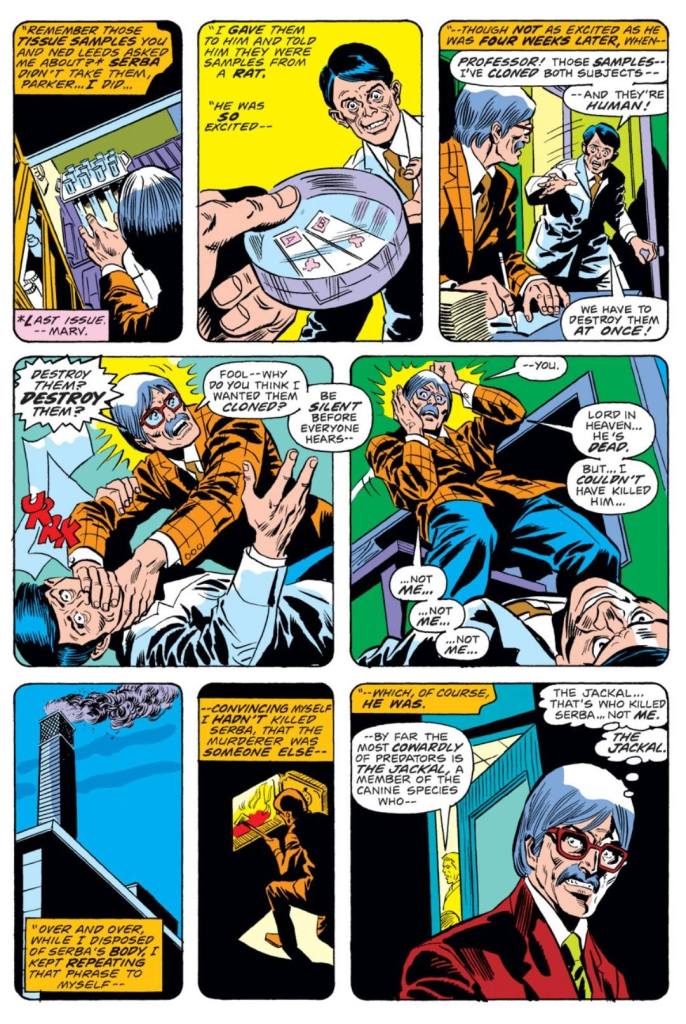
Some of the events that dramatized Miles Warren’s transformation into the Jackal.

Amazing Spider-Man #149 (1975) is a very intense tale that has the engaging origin story of the Jackal who went on to become a very dangerous foe of Spider-Man. That said, Miles Warren here transformed into a freak sparked by the sudden death of the real Gwen Stacy, and the actions he committed really brought danger to Spider-Man.

There is a lot of intrigue and compelling stuff in this comic book, especially when you ignore the Clone Saga of the 1990s (which itself should be treated as a convoluted follow-up reflecting the chaos behind closed doors at Marvel Comics during the time). In my opinion, this original Clone Saga stood the test of time and the creative stuff that Gerry Conway and Ross Andru came up with is pretty believable and dramatic to read again.

Overall, Amazing Spider-Man #149 (1975) is highly recommended!

+++++

Thank you for reading. If you find this article engaging, please click the like button below, share this article to others and also please consider making a donation to support my publishing. If you are looking for a copywriter to create content for your special project or business, check out my services and my portfolio. Feel free to contact me with a private message. Also please feel free to visit my Facebook page Author Carlo Carrasco and follow me on Twitter at  @CarloCarrascoPH as well as on Tumblr at https://carlocarrasco.tumblr.com/ and on Instagram at https://www.instagram.com/authorcarlocarrasco
A Look Back at Amazing Spider-Man #129 (1974)

Welcome back superhero enthusiasts, 1970s arts and culture enthusiasts, Marvel Comics fans and comic book collectors! Today we go back to the year 1974 to examine a highly significant tale from Marvel Comics’ shared universe – the first appearance of the Punisher and his first-ever encounter with Spider-Man.

To put things in perspective, Punisher’s literary debut was told within the Amazing Spider-Man comic book series and it happened not too long after the legendary tragedy of Gwen Stacey. During the 1970s, Hollywood made and released several action movies and crime thrillers that were violent, gritty and highlighted vigilantes and assassins. Some of that influence somehow made it into Marvel’s shared universe which was symbolized creatively through the Punisher who debuted as an assassin.

With those details laid down, here is a look back at Amazing Spider-Man #129, published in 1974 by Marvel Comics with a story written by Gerry Conway and drawn by Ross Andru (the same creative duo behind Superman vs. The Amazing Spider-Man crossover).

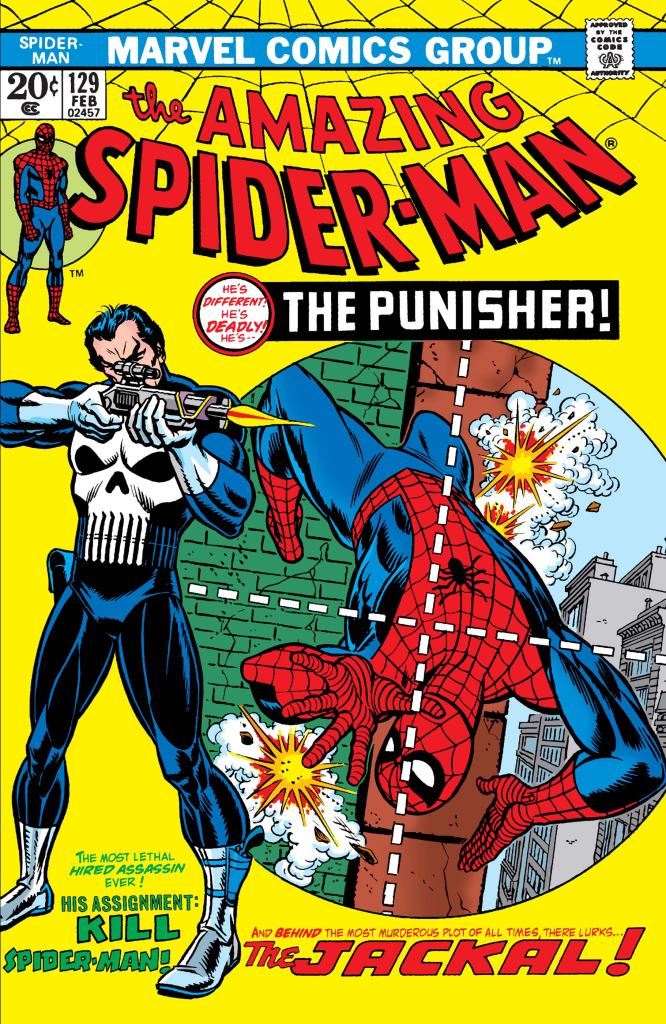
The cover.

Early story

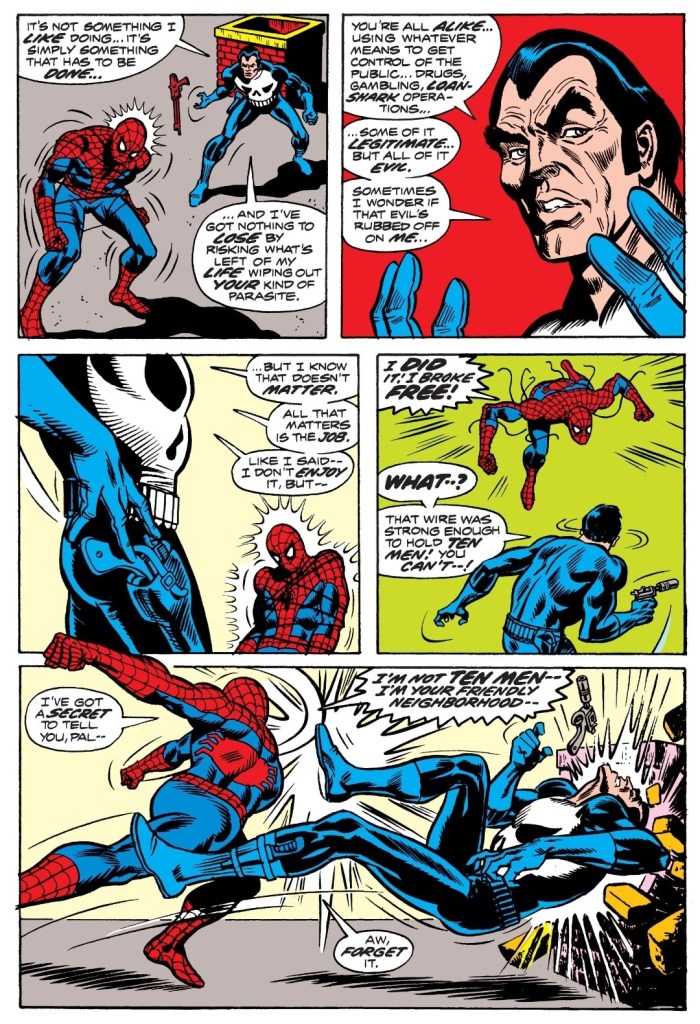
The story begins inside a private facility an assassin wearing black with a huge skull on his upper body heavily damages a solid statue of Spider-Man using a powerful rifle. This impresses the hideous villain called the Jackal who tells him that if he does well with the real Spider-Man, he would have performed a great service for the world. Knowing he impressed the Jackal, the Punisher states that he will only kill those who deserve killing and he expresses his belief that the webslinger deserves to die.

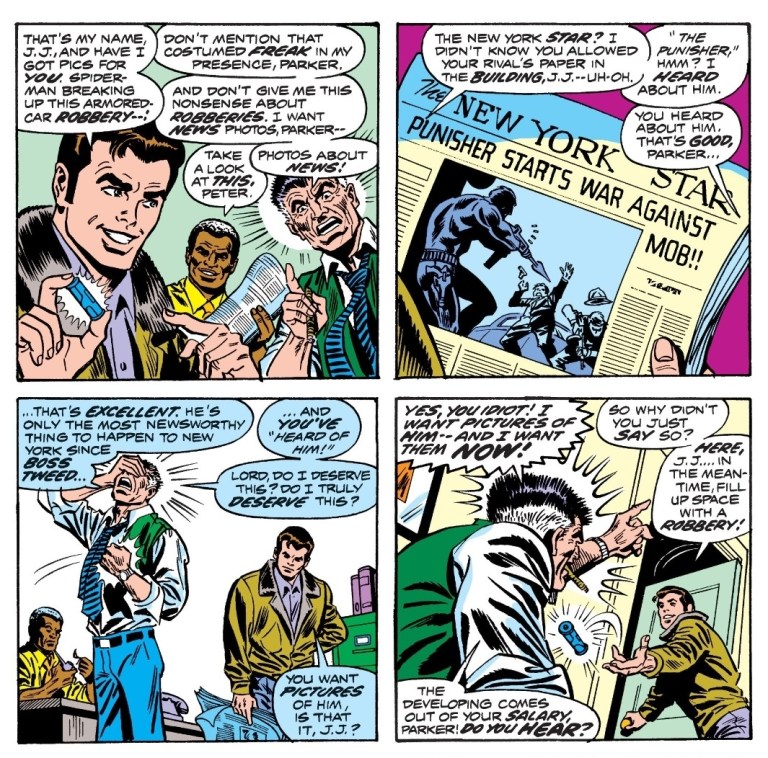
Elsewhere, Spider-Man swings into action and successfully stops an armed robbery from happening. Along the way he managed to capture photographs, changes into his civilian clothes and enters the Daily Bugle’s office ready to submit the roll of film as Peter Parker. Unfortunately, his superior J. Jonah Jameson disregards Parker’s submission and points out that the Punisher made waves with New York’s readers via the Bugle’s competitor The New York Star. For Jameson, the Punisher is only the most newsworthy thing to happen to New York and tells Parker he wants photos of the assassin…

Quality

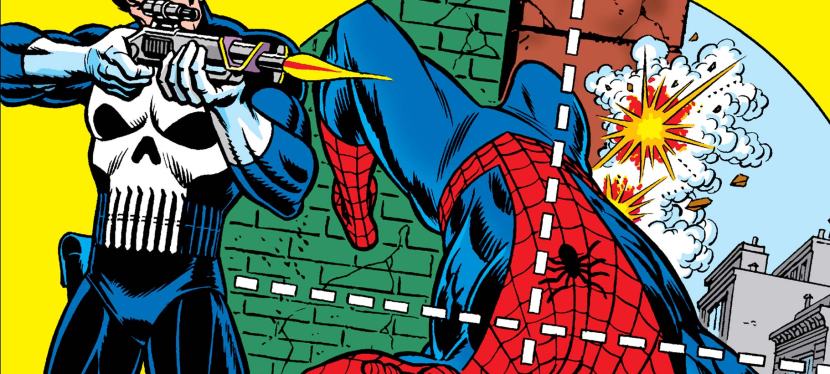
This is a scene from the first of two encounters between Spider-Man and the Punisher who was introduced as an assassin.

To make things very clear about storytelling without spoiling plot details, this is a tale about intrigue and the darker side of society that involves vigilantes and murdering. The Punisher here did not debut as a crime-busting vigilante but rather an assassin who accepts assignments from clients as long as the jobs fall in line with his personal philosophy that focuses on taking the lives of those who deserved to be killed. That being said, it is clear that Hollywood’s vigilante flicks of the 1970s influenced the presentation and I can say that whenever the story focuses on the Punisher, there definitely is a grim tone which contradicts the tone of Spider-Man’s scenes.

Spider-Man here continues to struggle somewhat with his personal life having recently lost Gwen Stacey while remaining disturbed about the identity of the Green Goblin. The webslinger also has to live with the heavy situation in which a lot of people in New York were convinced that he killed Norman Osborne which was the result of his own boss’ handling of the Daily Bugle. These elements along with his civilian involvement with his newspaper creatively added to the build-up of Spider-Man’s eventual encounters with the Punisher. The build-up was structured nicely and the pay-off was worth it.

There was also the introduction of Jackal. While he has a hideous appearance, his participation was more about scheming than action which contrasted him with the Punisher. For the newcomers reading this, Jackal is actually Miles Warren in a more monstrous form. From this comic book, it was clear that Jackal was created to be a recurring super villain for Spider-Man and this was strongly executed in the first Clone Saga of 1975 and the controversial Clone Saga of the 1990s.

Going back to the Punisher, he symbolically uses guns with designs that were more grounded in reality (inspired by real-life guns in looks) instead of taking influence from science fiction. As an assassin living with a strong code, the Punisher is truly determined to eliminate Spider-Man whom he even referred to as a murderer. The perception of Spider-Man as a criminal on the part of the Punisher clearly reflected the defamation caused by the Daily Bugle on the webslinger. Gerry Conway established the assassin to be a strong believer in fighting evil by using violence and killing.

The build-up of the Punisher is very solid and the pay-off in the form of battles with Spider-Man is tremendous and very satisfying to read. There is a lot of action to enjoy here and most notably Gerry Conway maintained a strong narrative throughout.

Conclusion

Have you ever worked in a newspaper before?

I can say out loud that Amazing Spider-Man #129 (1974) is truly a great read and a true illustrated literary classic of Marvel Comics. This tale alone added a touch of darkness and grit (in the form of vigilante and assassins cultures) into the Spider-Man legacy. Apart from its status as a comic book classic, this one paved the way for the rise of the Punisher in terms of more comic book appearances and the publishing of new comic book series featuring him. While the Punisher’s legacy as a killer is obviously not something worth believing in, Marvel Comics took the risk of having him as one of their primary characters in the decades that followed. This particular story is so significant, Marvel Comics revisited it with What If #58 (1994). Check out my other Punisher-related retro reviews by clicking here, here, here, here and here.

Overall, Amazing Spider-Man #129 (1974) is highly recommended!

+++++

Thank you for reading. If you find this article engaging, please click the like button below, share this article to others and also please consider making a donation to support my publishing. If you are looking for a copywriter to create content for your special project or business, check out my services and my portfolio. Feel free to contact me with a private message. Also please feel free to visit my Facebook page Author Carlo Carrasco and follow me on Twitter at  @HavenorFantasy as well as on Tumblr at https://carlocarrasco.tumblr.com/ and on Instagram at https://www.instagram.com/authorcarlocarrasco