A Look Back at Wolverine #75 (1993)

Disclaimer: This is my original work with details sourced from reading the comic book and doing personal research. Anyone who wants to use this article, in part or in whole, needs to secure first my permission and agree to cite me as the source and author. Let it be known that any unauthorized use of this article will constrain the author to pursue the remedies under R.A. No. 8293, the Revised Penal Code, and/or all applicable legal actions under the laws of the Philippines.

Welcome back, superhero enthusiasts, comic collectors, 1990s culture enthusiasts and fans of the X-Men! We go back to the year 1993 when the 30th anniversary of the X-Men was celebrated with the 6-part Fatal Attractions storyline. Already I reviewed Uncanny X-Men #304 (Part 3) which was not worthy of the X-Men’s 30th anniversary celebration. X-Men #25 (Part 4) meanwhile was not only great but also shocking and had a years-long impact on X-Men comics.

So now the focus is on the 5th chapter of the Fatal Attractions storyline handled by the Larry Hama-Adam Kubert team on the Wolverine monthly series of the time. With those details laid down, here is a look back at Wolverine #75, published by Marvel Comics in 1993 with a story written by Larry Hama and drawn by Adam Kubert.
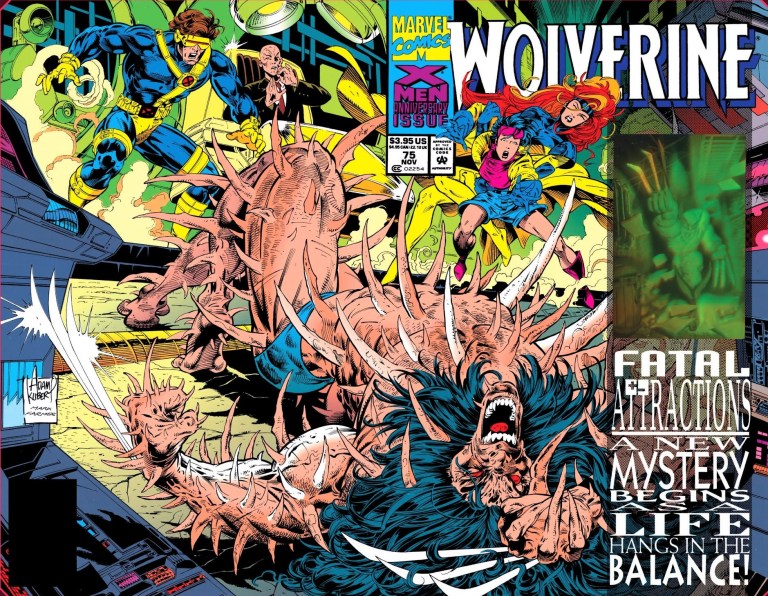
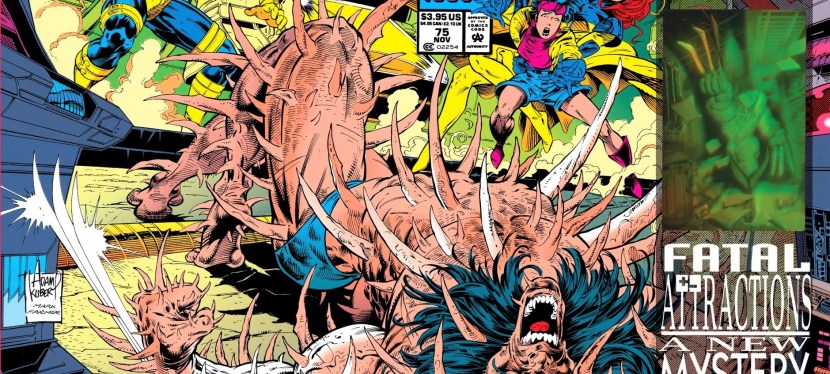
The cover.

Early story

The story begins in outer space. Carrying Charles Xavier, Wolverine, Gambit, Jean Grey, Rogue and Quicksilver (who participated in the dangerous mission in X-Men #25), the X-Men’s jet (piloted by Bishop) struggles mechanically as it was not designed for space travel. Worse, Wolverine is under very serious condition and the medical unit has been operating in full capacity dealing with his intense trauma.

In an attempt to alleviate Wolverine’s psychic trauma, Charles Xavier and Jean Grey enter his mind and discover that there is a world full of pain and horror. They see visions of a restrained Wolverine (from his Weapon X days) being attacked by Sabretooth and Lady Deathstrike. Xavier explains that they are at the epicenter of Logan’s most suppressed cataclysmic memories which were clearly triggered by the physical damage Magneto inflicted on him (see X-Men #25).

As the X-Men’s jet attempts to enter Earth’s atmosphere, its exteriors heat up dramatically shaking everyone inside. This complicates the situation on stabilizing Wolverine…

Quality
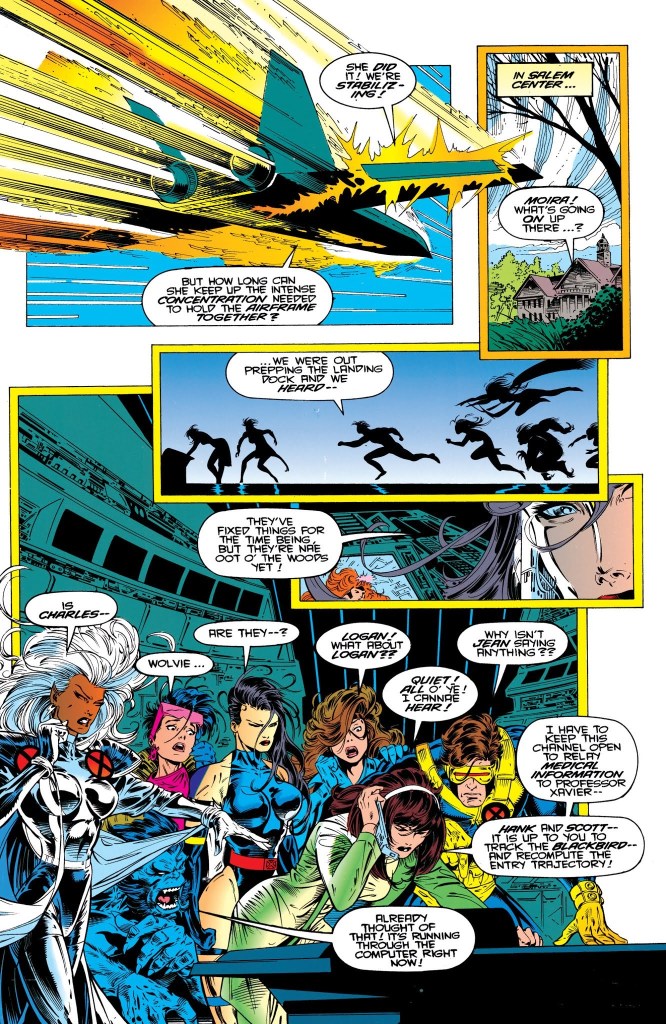
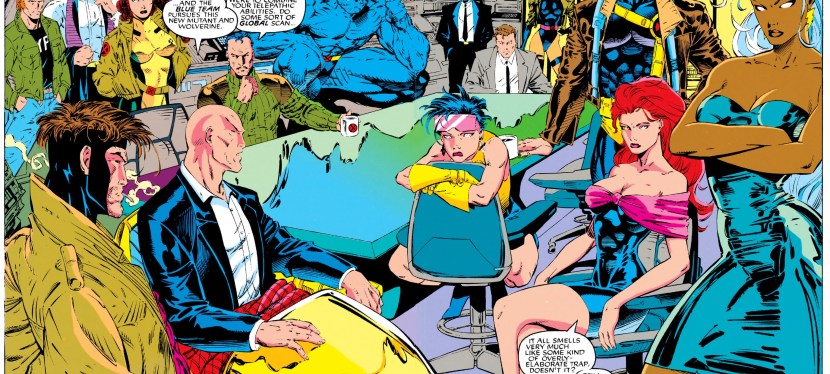
The other X-Men team members at their headquarters expressing worry and concern about the situation of their teammates struggling to come back home from space.

To be clear, this story continues the events of Fatal Attractions but with a bit more focus on Wolverine (compared to the earlier chapters of the storyline that is). There is no real battle between good and evil at all. It’s really all about Wolverine struggling to survive just as his teammates struggle to arrive home.

Before the stories of this comic book and X-Men #25 happened, Wolverine has often been portrayed to be very tough, brave and a walking machine of violence which has been reflected in other X-Men stories told in video games and movies. In this very comic book, Wolverine has been presented to coming close to death. This means Logan, at this particular stage of the history of the literary X-Men, was at his most vulnerable state. In my experience, this was both alienating and shocking to see.

With regards to the writing, Larry Hama did an excellent job with pacing the story from start to finish. Right from the beginning, the story pulls you into the X-Men’s tough situation and as each page gets turned, the tension as well as the suspense builds up until the execution of the climax. Along the way, the comic book not only portrays Wolverine struggling on the edge, it also works to make you care more or be more concerned towards him. Oh yes, the shocking moment near the end of this comic book remains very powerful and you who read this retro review should read Wolverine #75 and see it for yourselves.

Conclusion
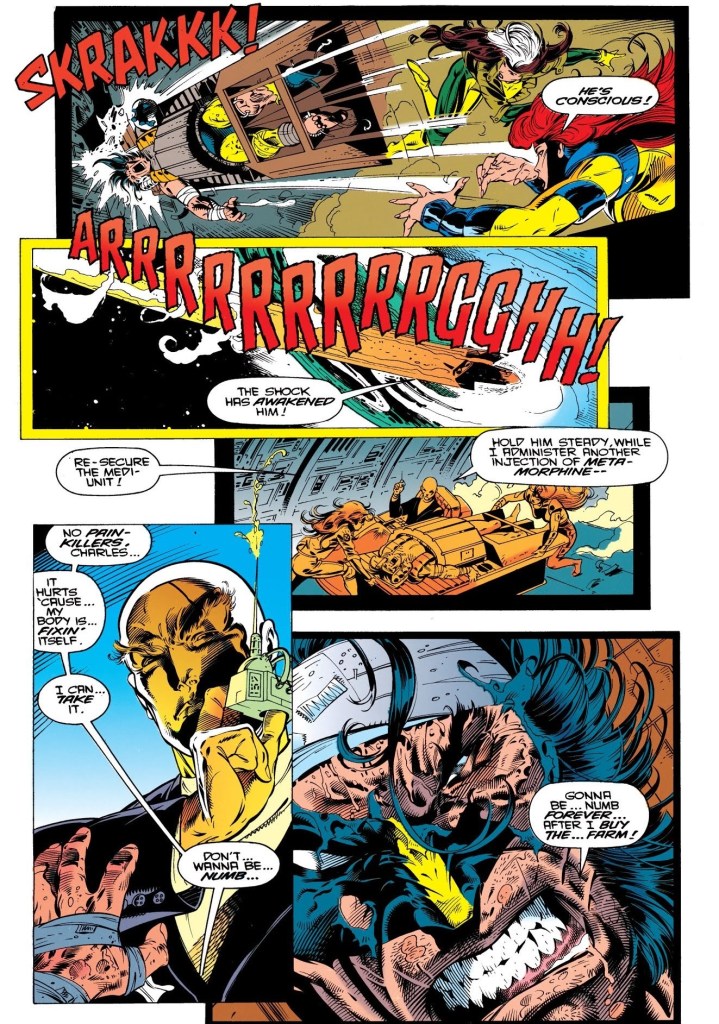
Wolverine at his most vulnerable state.

By today’s standards, Wolverine #75 (1993) is still a very great comic book to read. In fact, I can say it is not only one of most defining chapters of the Fatal Attractions storyline as well as one of the most significant X-Men comic books of the 1990s, it is indeed a true illustrated literature classic ever published by Marvel Comics. In retrospect, this comic book marks a major turning point in the life of Wolverine who is still one of the most iconic characters in all of superhero literature. All of these were achieved thanks to the creative team of Larry Hama and Adam Kubert (whose are here was great and stylized at the same time). Hama succeeded in writing the continuation of the Fatal Attractions storyline while balancing all of the exposition and still putting Wolverine in the center. That itself is a very great work of writing.

If you are seriously planning to buy an existing hard copy of Wolverine #75 (1993), be aware that as of this writing, MileHighComics.com shows that the near-mint copy of the regular edition costs $60 while the near-mint copies of the signed-and-numbered edition and the newsstand edition cost $300 and $180 respectively.

Overall, Wolverine #75 (1993) is highly recommended!

+++++

Thank you for reading. If you find this article engaging, please click the like button below and also please consider sharing this article to others. If you are looking for a copywriter to create content for your special project or business, check out my services and my portfolio. Feel free to contact me as well. Also please feel free to visit my Facebook page Author Carlo Carrasco and follow me at HavenorFantasy@twitter.com
A Look Back at Uncanny X-Men #130 (1980)

Disclaimer: This is my original work with details sourced from reading the comic book and doing personal research. Anyone who wants to use this article, in part or in whole, needs to secure first my permission and agree to cite me as the source and author. Let it be known that any unauthorized use of this article will constrain the author to pursue the remedies under R.A. No. 8293, the Revised Penal Code, and/or all applicable legal actions under the laws of the Philippines.

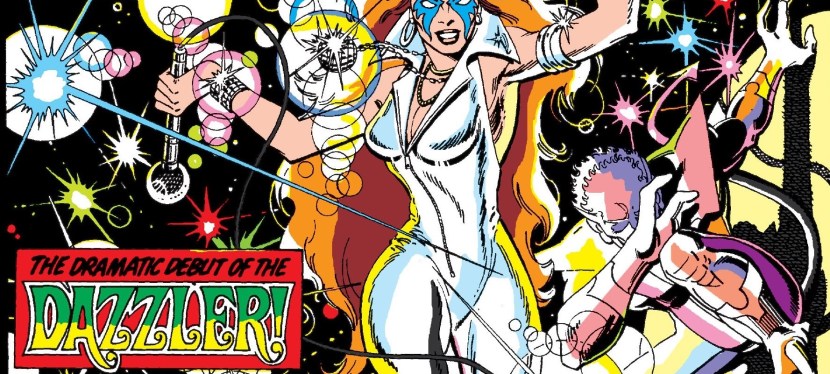
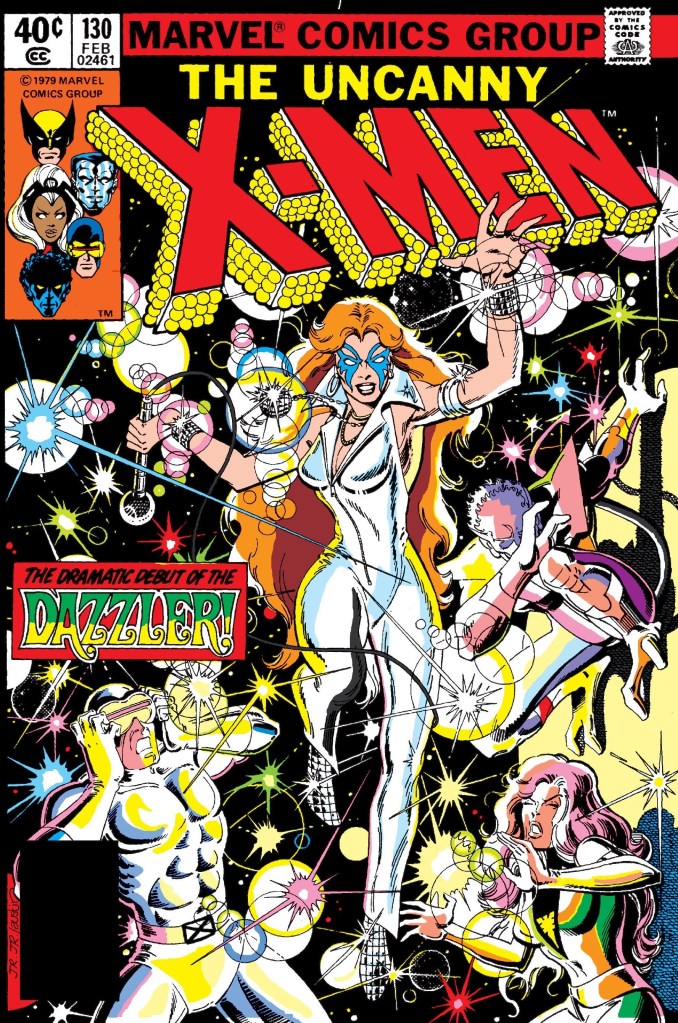
Welcome back, X-Men fans, superhero enthusiasts, 1980s culture enthusiasts and comic book collectors! Today, we look back at the year 1980 specifically the time when the Uncanny X-Men monthly series was spearheaded by legendary creators Chris Claremont and John Byrne. In fact, we will examine here the comic book debut of Dazzler, a mutant with the ability to convert the vibrations of sound into light and energy beams. Dazzler is quite unique among all superheroes as she has been portrayed as a singer, an actress, a model and got associated with other Marvel superheroes. Marvel Comics went on to actually publish a regular comic book series about Dazzler which lasted over forty issues.

To say the least, the creation of Dazzler is quite intriguing as it involved a commission by an American record label for a special project with a disco queen character as the core concept and that Marvel Comics itself would develop the superhero (in the form of a singer) and that an actual singer will be produced by the said record label. Then Marvel editor-in-chief Jim Shooter wrote a treatment for the project which turned from an animated special into a live-action film. As creative process for Dazzler went on at Marvel, Tom DeFalco (who later succeeded Shooter as editor-in-chief) wrote her creation while John Romita, Jr. did the character design. The name Dazzler was the result of a suggestion by Roger Stern. There also was some Bo Derek influence on the creation of Dazzler.

While the special project did not happen due to the financial problems of the record label, Marvel went on to formally introduce Dazzler in the pages of an Uncanny X-Men comic book handled by Claremont-Byrne team.

With those details laid down, here is a look back at Uncanny X-Men #130, published by Marvel Comics in 1980 with a story co-written by Chris Claremont and John Byrne. Byrne drew the art.

The cover.

Early story

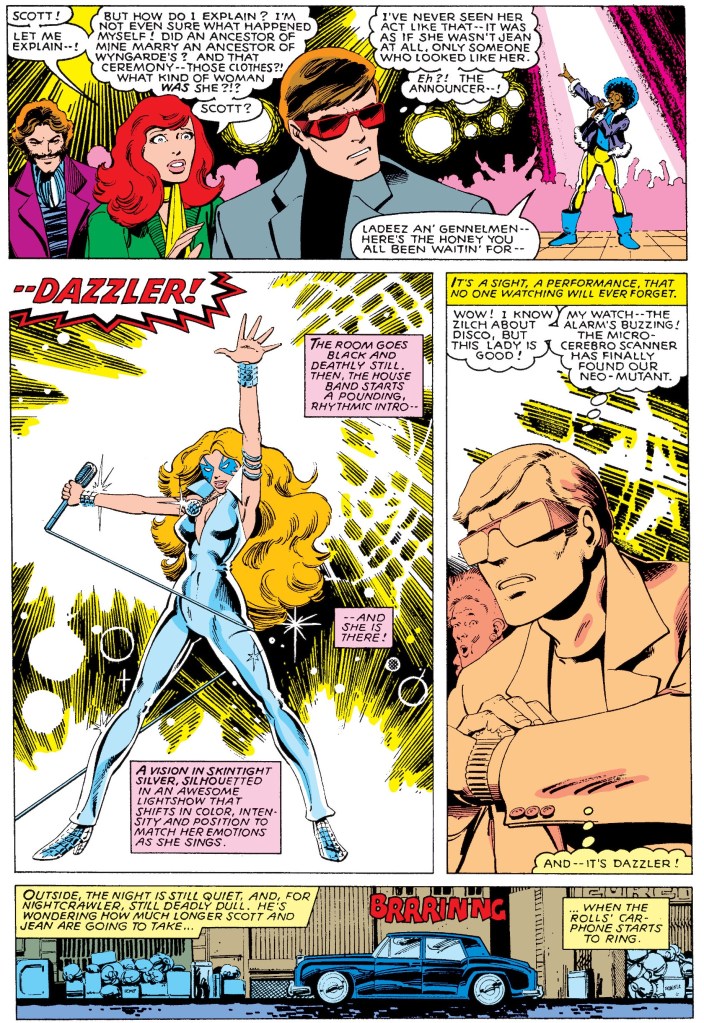
The story begins on Delano Street in Lower Manhattan. Scott Summers/Cyclops, Jean Grey and Nightcrawler had just arrived on a mission to locate a mutant (detected by Cerebro) not knowing that they themselves are bring monitored by a hidden sinister force. With Nightcrawler left in-charge of guarding their Rolls Royce, Scott and Jean enter a deteriorating building only to find a club on an upper level full of lights, loud music, dancing and a lot of people. They begin to start searching for the detected mutant.

Outside, a truck parks on the other side of the same street where the X-Men’s Rolls Royce was parked at. Inside the truck one of the operators communicates to a certain Mr. Shaw who states that the Hellfire Club is proud. Over at the Hellfire Club’s headquarters, Sebastian Shaw and Jason Wyngarde talk about the X-Men members searching the disco. Wyngarde moves on with his plan to subvert Jean Grey and gather her into their fold…

Quality

Dazzler’s very debut on this page.

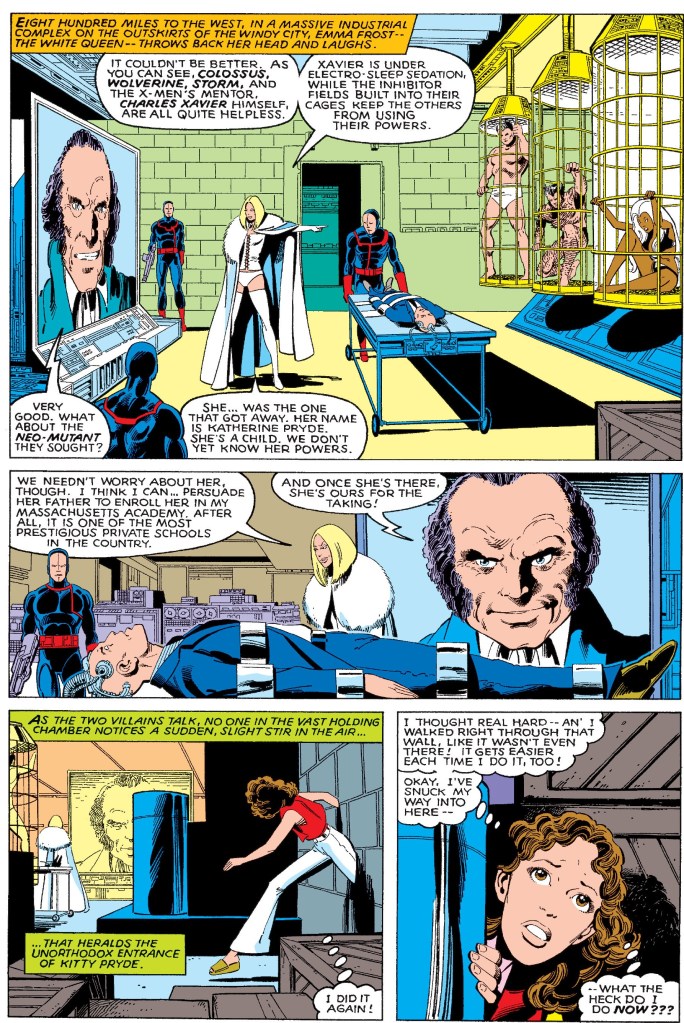
The storytelling is great which is not surprising as this was done by Claremont and Byrne. It is clear that there was a good amount of preparation done which explains this comic book’s excellent ways on emphasizing the following story points: the build-up of the Hellfire Club as a potent force of evil that await the X-Men, Kitty Pryde/Shadowcat’s growing involvement, the vulnerability of Jean Grey, the build-up of the Phoenix, and the debut of Dazzler. Along the way, the creative team also ensure that the dialogue was rich (the same thing also with the thought balloons Claremont came up with), the emphasis of super powers made sense, the action scenes were satisfying and there was a good amount of suspense here.

I love the way Dazzler’s first-ever appearance was handled as it happened just after an intriguing scene about Jean Grey’s vulnerability took place. Her debut also occurred at a point when Jean and Scott seemed to be failing to find her. Of course, the 1970s disco vibe was very strong with Dazzler.

Conclusion

The plot thickens…

Without a doubt, Uncanny X-Men #130 (1980) is a classic X-Men tale by the Claremont-Byrne team who succeeded in not only introducing Dazzler into Marvel’s comic book universe but also with strongly emphasizing the Hellfire Club as a powerful opposition which went on to have a key part in the legendary Dark Phoenix storyline that followed. Dazzler meanwhile became a very popular superhero of Marvel’s going into the 1980s. For the modern-day comic book reader, this comic book can be quite challenging to read as it is very wordy (typical of Claremont).

If you are seriously planning to buy an existing hard copy of Uncanny X-Men #130 (1980), be aware that as of this writing, MileHighComics.com shows that the very fine copy of the regular edition costs $1,407 while the fine copy of the newsstand edition costs $1,013.

Overall, Uncanny X-Men #130 (1980) is highly recommended!

+++++

Thank you for reading. If you find this article engaging, please click the like button below and also please consider sharing this article to others. If you are looking for a copywriter to create content for your special project or business, check out my services and my portfolio. Feel free to contact me as well. Also please feel free to visit my Facebook page Author Carlo Carrasco and follow me at HavenorFantasy@twitter.com
A Look Back at X-Men 2099 #4 (1993)

Disclaimer: This is my original work with details sourced from reading the comic book and doing personal research. Anyone who wants to use this article, in part or in whole, needs to secure first my permission and agree to cite me as the source and author. Let it be known that any unauthorized use of this article will constrain the author to pursue the remedies under R.A. No. 8293, the Revised Penal Code, and/or all applicable legal actions under the laws of the Philippines.

Welcome back, superhero enthusiasts, fans of the 2099 universe of Marvel Comics, 1990s culture enthusiasts and comic book collectors! Today we revisit the X-Men 2099 comic book series by focusing on the 4th issue. Following the single storyline told in the first three issues (including the unexpected death of a certain member in issue #3) which ultimately made clear why the X-Men of 2099 exist and what their place is within an America that is totally different from what it used to be during the time of Charles Xavier and his X-Men. As such, the stage was set for more exploration and new creative directions with Xi’an and his band of nomadic mutants.

With those details laid down, here is a look back at X-Men 2099 #4, published by Marvel Comics in 1993 with a story written by John Francis Moore and drawn by Ron Lim.

The cover.

Early story

The story begins with Bloodhawk exploring a deserted, radioactive facility in the middle of New Mexico. Having a reptilian skin protects him from radiation which only adds to his personal obsession of waging a war against developers and corporate entities that he accuses of defiling the natural environment.

Suddenly, a tough female with white hair and white skin grabs Bloodhawk by the neck and by touching his head with her left hand, she triggers a bolt of agony on him. Bloodhawk then loses consciousness.

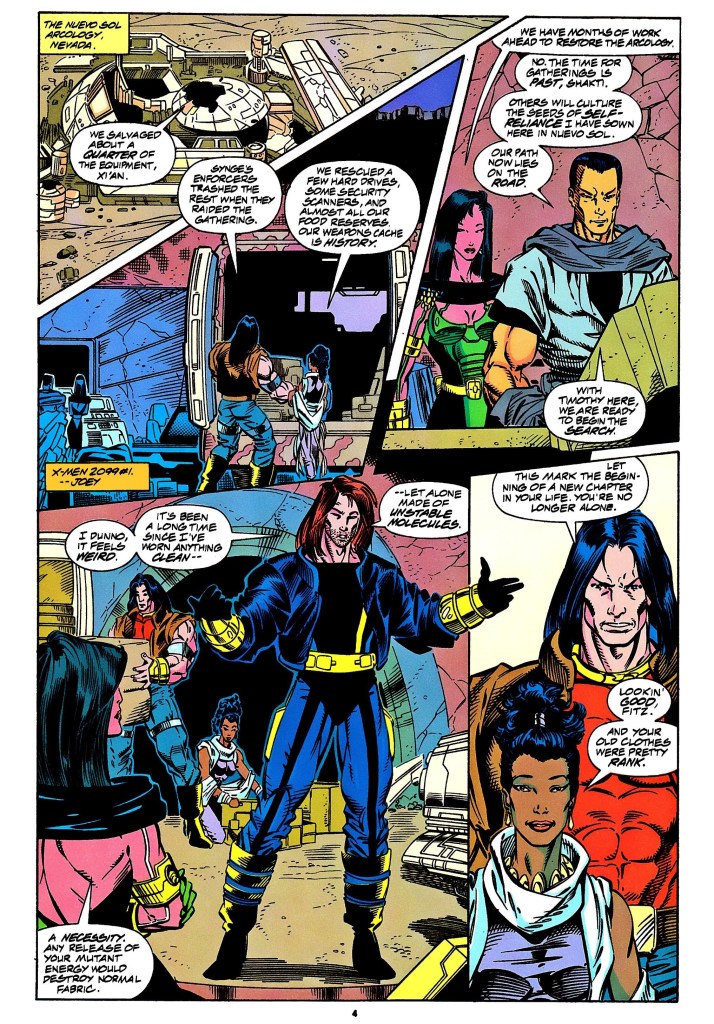
Meanwhile in Nevada, Xi’an and his X-Men salvaged whatever equipment they found at the Nueva Sol Arcology which was their haven before Synge’s enforcers invaded and ruined it. In response to Shakti’s comment that it would take months to restore the facility, Xi’an says that the time for gatherings has passed as he believes that their path lies on the road emphasizing travel to new places.

While his teammates are outside, Henri uses a computer inside the facility retrieving messages. He receives a video message from his old friend Jordan Boone who informs him about a major project called Valhalla and he was going to do something outrageous…

Quality

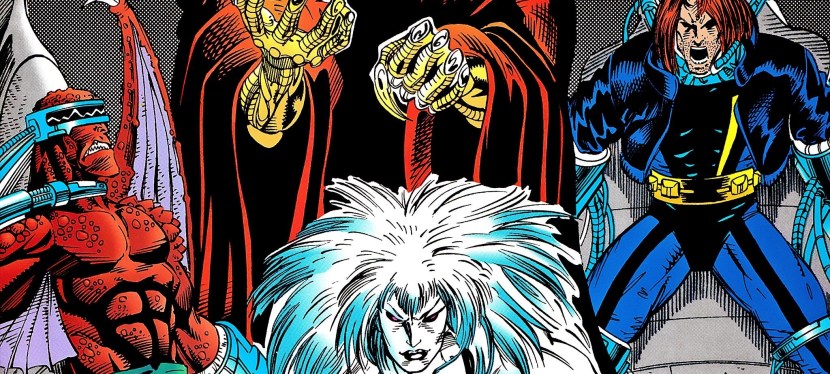
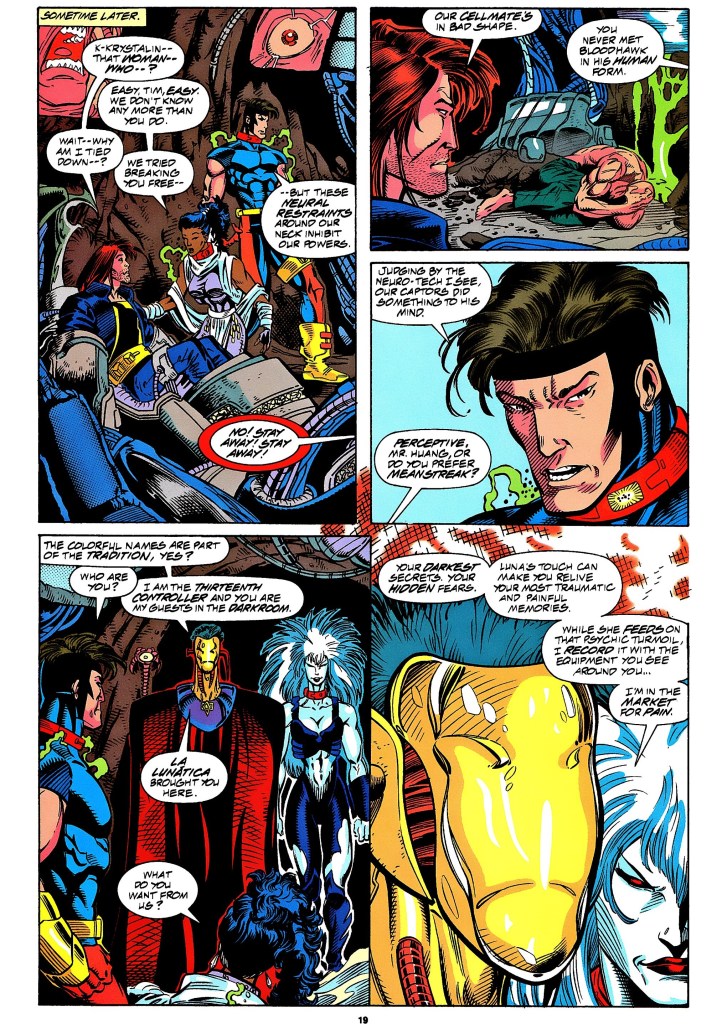
Neuro-tech, the captured X-Men, Luna and the Theater of Pain.

When it comes to narrative, I should point out that this comic book serves as a prelude to The Fall of the Hammer 2099 crossover storyline and it does a good job setting key members of the X-Men to get involved.

As an X-Men 2099 story, John Francis Moore further developed the personalities of most of the members (with Timothy Fitzgerald being the center as he slowly becomes Skullfire) and showed more of the culture within the team under Xi’an’s leadership and strict points.

Other than the focus on the mutants, a notable feature of the story is the introduction of the Theater of Pain which includes a radically intriguing masked villain who runs an operation that involves abducting people, using machines to feed on their minds and access the most painful personal memories which in turn is digitally channeled to an existing linked live audience feeding their minds. In essence, mental torture and intrusion of the mind are introduced. I should also state that the Theater of Pain here plays a major part in the story of X-Men 2099 #25. This issue also introduces Luna who eventually gets linked with Skullfire and becomes part of the X-Men.

More on the Theater of Pain concept, I found the painful flashback sequences a clever method used by the writer to emphasize selected moments from the past of Bloodhawk and Skullfire which added to the character development of this comic book.

Conclusion

One step showing Timothy slowly becoming Skullfire.

X-Men 2099 #4 (1993) is well-written and it is a significant part of the 35-issue monthly series. For one thing, it shows the start of the transformation of Skullfire’s personality, the direction Xi’an and his mutants are taking, and the start of a build-up that led to the significant events of X-Men 2099 #25. There is a lot here for X-Men 2099 fans to enjoy from start to finish.

If you are seriously planning to buy an existing hard copy of X-Men 2099 #4 (1993), be aware that as of this writing, MileHighComics.com shows that the near-mint copy of the regular edition costs $30 while the near-mint copy of the newsstand edition costs $90.

Overall, X-Men 2099 #4 (1993) is highly recommended!

+++++

Thank you for reading. If you find this article engaging, please click the like button below and also please consider sharing this article to others. If you are looking for a copywriter to create content for your special project or business, check out my services and my portfolio. Feel free to contact me as well. Also please feel free to visit my Facebook page Author Carlo Carrasco and follow me at HavenorFantasy@twitter.com
A Look Back at What If #46 (1993)

Disclaimer: This is my original work with details sourced from reading the comic book and doing personal research. Anyone who wants to use this article, in part or in whole, needs to secure first my permission and agree to cite me as the source and author. Let it be known that any unauthorized use of this article will constrain the author to pursue the remedies under R.A. No. 8293, the Revised Penal Code, and/or all applicable legal actions under the laws of the Philippines.

Welcome back, X-Men fans, superhero enthusiasts, 1990s culture enthusiasts and comic book collectors! It’s time to revisit the What If monthly series of comic books of Marvel Comics that lasted from 1989 until 1998. The old comic book I’m about to review involves the X-Men, Cable and more.

Before starting with this newest retro comic book review, I should state that I was never a fan of Cable even though I read lots of X-Men-related comic books that included him. When I think of Cable, I immediately think of the New Mutants and X-Force comic book series.

You must be wondering what has Cable and the X-Men have to do with the old What If issue I’m focusing on. We can all find out in this look back at What If #46, published by Marvel Comics in 1993 with a story written by Kurt Busiek and drawn by Tod Smith.

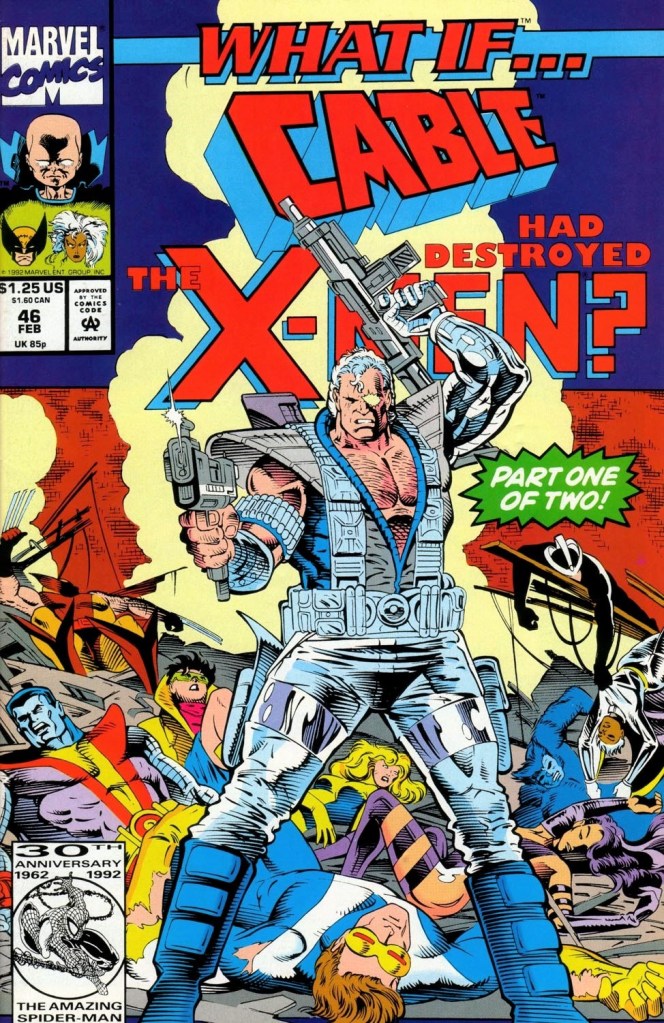
The cover.

Early story

The story begins inside a tavern in New York’s famous Central Park. Inside, Charles Xavier, Scott Summers (Cyclops) and Jean Grey have a discussion about mutant matters until a small saucer-shaped device flies inside and disrupts everything with its sonic frequency. Suddenly a second flying saucer comes in, touches Scott’s shoe and explodes powerfully killing him, Jean and Xavier. Others got injured by the explosion and the tavern ends up burning.

Outside the tavern, Cable is seen running away and someone points at him as someone who must be responsible for the bombing. As it turns out, the deliberate killing of Xavier, Cyclops and Jean Grey was the result of a division between Cable’s New Mutants and the X-Men in connection to the recent return of Xavier from deep space.

Quality

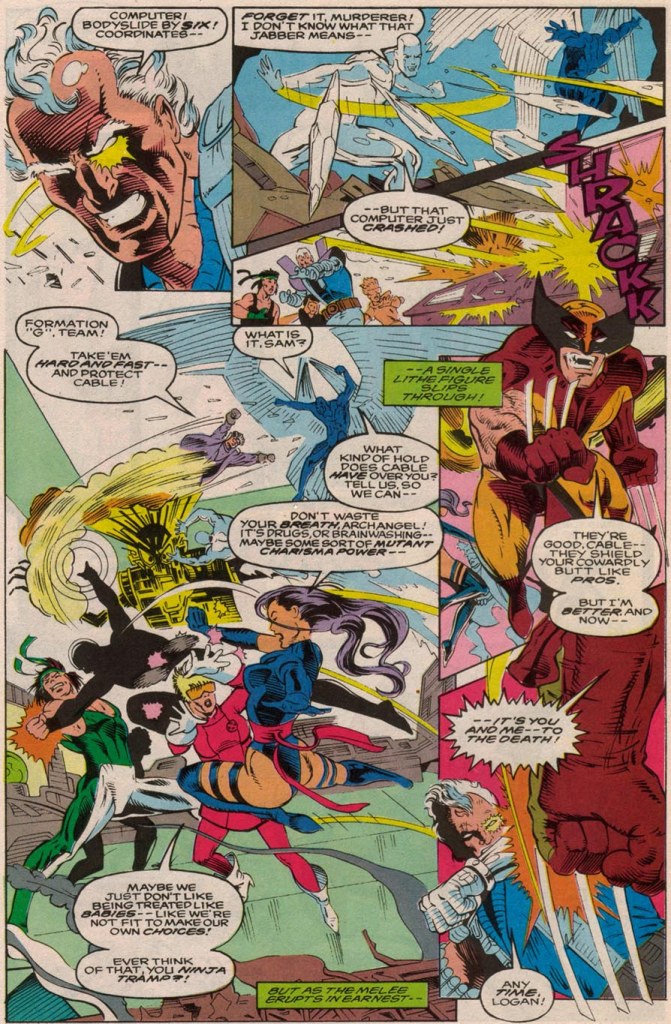
A brawl between the mutants.

I’ll start with the story Kurt Busiek came up with. This one explores an alternate time in which Charles Xavier returned to Earth (after escaping from the Skrulls in deep space) only to find the X-Men in disarray which compelled him to restore things the way they were. This is not to be confused with his return in the canon storyline of the Muir Island Saga.  

That being said, Busiek explored what would it be like had Xavier tried to resolve mutant matters not only with the team of mutants he founded but also with other teams such as the New Mutants (already led by Cable), X-Factor (Cyclops, Jean Grey, Iceman, Beast and Archangel) plus several other mutants. I really liked the way the mutants reacted to Xavier given his long absence from Earth, how his dream matters and turned out irrelevant to them as individual mutants, and if he still has what it takes to lead them. In some ways, Xavier looked like a politician trying to convince his constituents that his vision is still the best for them and their interests.

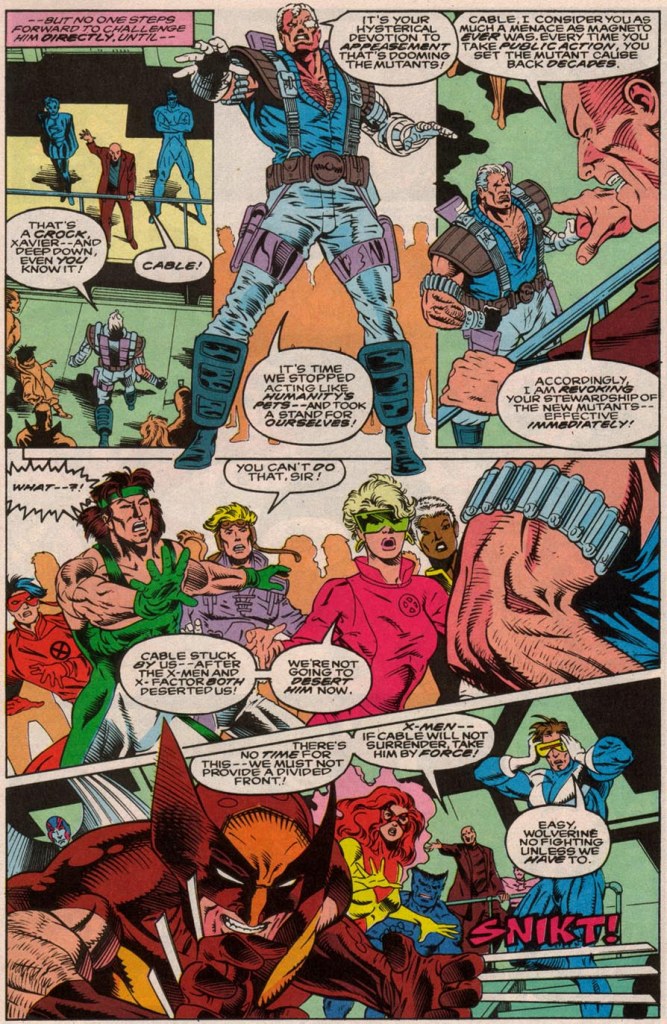
What really made the story running was the start of the division between the mutants when Cable rejects Xavier and points out that the X-Men founder’s devotion to appeasement is dooming mutants. All of these led to the shock opening scene and in terms of writing quality, it was all justified.

The scenes that happened AFTER the burial of Xavier, Cyclops and Jean Grey literally raised the stakes for the rest of the comic book. I don’t want to spoil further plot details but I can assure you all that Kurt Busiek’s script is very sold and there is so much to enjoy here especially if you are knowledgeable enough about the X-Men and the other parts of the Marvel Comics universe (note: the Avengers, Stryfe, Freedom Force and Fantastic Four also appeared).

Visually, the work of Tod Smith looks a bit rushed. His art here is not bad but I felt it could have been better had there been more time to polish his work. In fairness to Smith, his drawings on most of the characters still made them recognizable and he showed pacing with regards to the panels and angles used. I should say he does a decent job showing multiple characters fighting each other simultaneously.

Conclusion

If you were a mutant, would you follow Charles Xavier or Cable?

If you ask me, What If #46 (1993) is pretty entertaining and engaging to read thanks to the strong writing as well as the daring exploration of how the comic’s main story impacts others within the Marvel Comics universe. It has drama, action, intrigue and most notably it explores a new concept about how the X-Men would turn out after the death of their founder. It also raises questions on whether or not the X-Men are doomed without Charles Xavier’s presence.

If you are seriously planning to buy an existing hard copy of What If #46 (1993), be aware that as of this writing, MileHighComics.com shows that the near-mint copy of the regular edition costs $40 while the near-mint newsstand edition costs $120.

Overall, What If #46 (1993) is recommended.

+++++

Thank you for reading. If you find this article engaging, please click the like button below and also please consider sharing this article to others. If you are looking for a copywriter to create content for your special project or business, check out my services and my portfolio. Feel free to contact me as well. Also please feel free to visit my Facebook page Author Carlo Carrasco and follow me at HavenorFantasy@twitter.com
A Look Back at Uncanny X-Men #304 (1993)

Disclaimer: This is my original work with details sourced from reading the comic book and doing personal research. Anyone who wants to use this article, in part or in whole, needs to secure first my permission and agree to cite me as the source and author. Let it be known that any unauthorized use of this article will constrain the author to pursue the remedies under R.A. No. 8293, the Revised Penal Code, and/or all applicable legal actions under the laws of the Philippines.

Welcome back, X-Men fans, superhero enthusiasts, 1990s culture enthusiasts and comic book collectors! Today we go back to the 30th anniversary celebration of the X-Men which took place in 1993. Back then, Marvel Comics went full blast with the anniversary celebration of their mutants by releasing related merchandise, posters and comic books with gimmick covers (note: read my retro review of 1993’s X-Men #25) that came with high prices.

To put things in perspective regarding 1993, Marvel’s X-Men line of comics had monthly series of Uncanny X-Men, X-Men (Volume 2), X-Force, X-Factor, Excalibur, Wolverine and Cable. X-Factor #92 marked the start of the Fatal Attractions storyline which was the basis for the X-Men 30th anniversary celebration. X-Force #25 was released and it not only brought Cable back but also Magneto.  

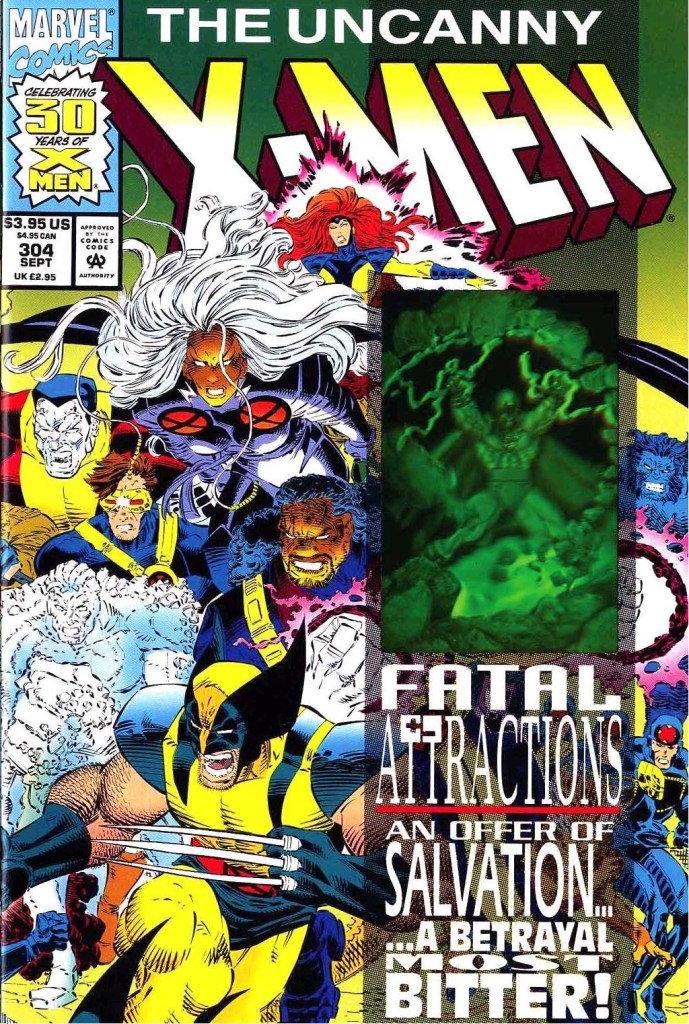
Then came the 3rd chapter of the Fatal Attractions storyline which was published in Uncanny X-Men #304. Not only did that particular comic book bring together many mutants and moved the storyline forward to a crucial stage (note: tension leading to it was built up in Uncanny X-Men #300, Uncanny X-Men #303 and also in X-Men Unlimited #1), it also served as the very celebration of the 30th anniversary of the X-Men (although it was not the storyline’s conclusion as the plot continued in X-Men #25, Wolverine #75 and Excalibur #71).

So did this particular, anniversary celebrating issue of the Uncanny X-Men succeed with its objectives? Has it aged well through the decades? We can all find out in this look back at Uncanny X-Men #304, published in 1993 by Marvel Comics with a story written by Scott Lobdell and drawn by John Romita, Jr., Jae Lee, Chris Sprouse, Brandon Peterson and Paul Smith.

The cover.

Early story

The story begins with division among the Acolytes who learned that their lord Magneto actually survived (note: refer to 1991’s X-Men #3 by Chris Claremont and Jim Lee). They ganged up against their leader Fabian Cortez for betraying Magneto. After pushing his now rebellious team members away, Cortez reminds them that for several months already, they have been continuing Magneto’s work on behalf of mutantkind. Suddenly Exodus appears to them and describes himself as the voice of Magneto and will guide mutants to rise and mentions paradise for the faithful mutants. After subduing Cortez and tempering the tension among the Acolytes, Exodus tells them to prepare themselves for ascension. This frustrates Cortez who realizes that he no longer holds leadership.

Over at the X-Men’s headquarters, Charlez Xavier is personally disturbed over the death of Illyana Rasputin, the sister of Colossus. He starts questioning himself as Illyana’s death under his watch makes his years-long mission (of convincing his fellow mutants to leave their old lives to take risks to fight for a world that fears and hates them) doubtful and tries to figure out how he could present himself in front of them. A holographic image of Lilandra appears to him.

In outer space, inside the space station called Avalon, Magneto stares at planet Earth. With nobody around him, he speaks apologizing to his followers for he cannot save them all. He also mentions that he was wrong in previously believing that he could rescue each and every one of them from humanity as he recently realized that Earth, for the moment, is doomed.

After walking an unspecified distance inside Avalon, Magneto picks up his old helmet and wears it…

Quality

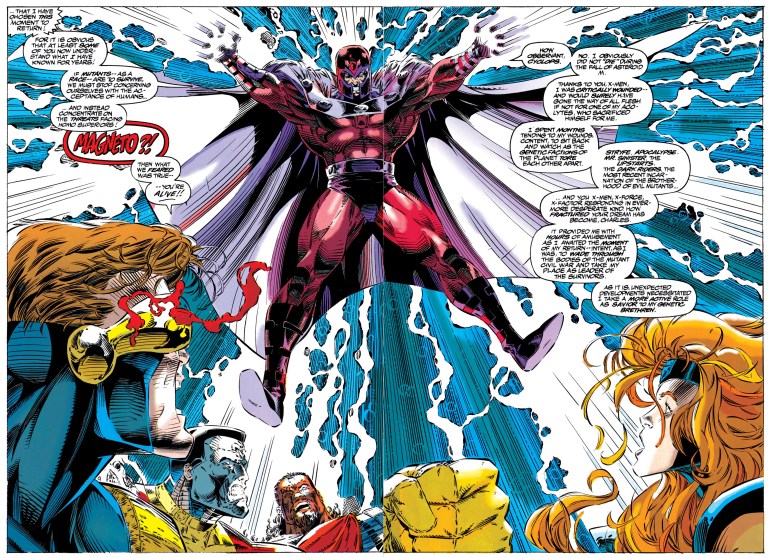
This 2-page art by Brandon Peterson is easily the best looking part of the comic book.

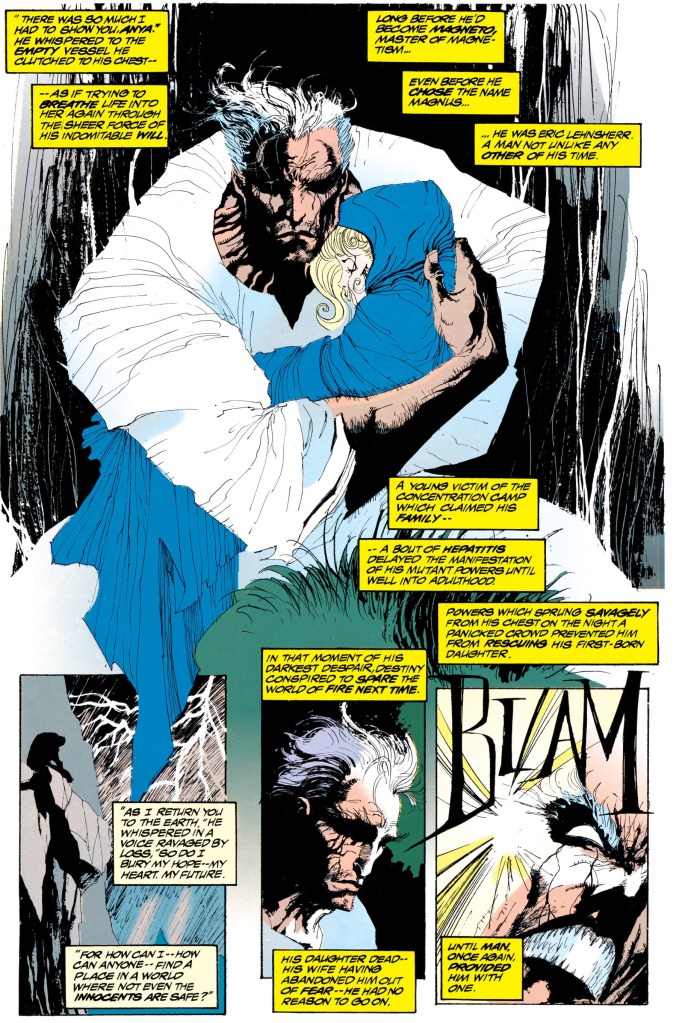
I will start with the visual aspect of this comic book. The artistic quality ranges from fine to weird which should not be surprising since this one involved five artists. The 4 pages drawn by Brandon Peterson (who was once a regular artist on Uncanny X-Men) made the X-Men, Magneto and the Acolytes look not only good but also intense. The Peterson art here is artistically similar to the respective styles of Marc Silvestri and Jim Lee of that particular time. Jae Lee’s art on the flashback of Magneto’s life (during the time of the Nazi occupation in Europe) is undoubtedly very stylized. While his art brings out the intensity of Magneto’s painful past, certain images can be a little challenging to understand especially to readers who focus strongly only following the plot and details. John Romita, Jr.’s art, for me personally, often looks rough and there were times I hardly recognized the characters. The other artworks by Paul Smith and Chris Sprouse have cartoonish aesthetics.

This is Jae Lee’s artistic contribution to the comic book. I found it weird that Magneto’s hair was shown as white during his past with the Nazis.

As for the plot, I can clearly see that a hard effort was made to compose a story that would push the Fatal Attractions storyline forward, establish a turning point and still become worthy of celebrating the 30th anniversary of the X-Men franchise. I can say that the storytelling is somewhat bloated. Early in the story, it was made clear that the respective sections showing Exodus with the Acolytes, Charles Xavier and Magneto pointed to an eventual confrontation that happened during the funeral of Illyana Rasputin.

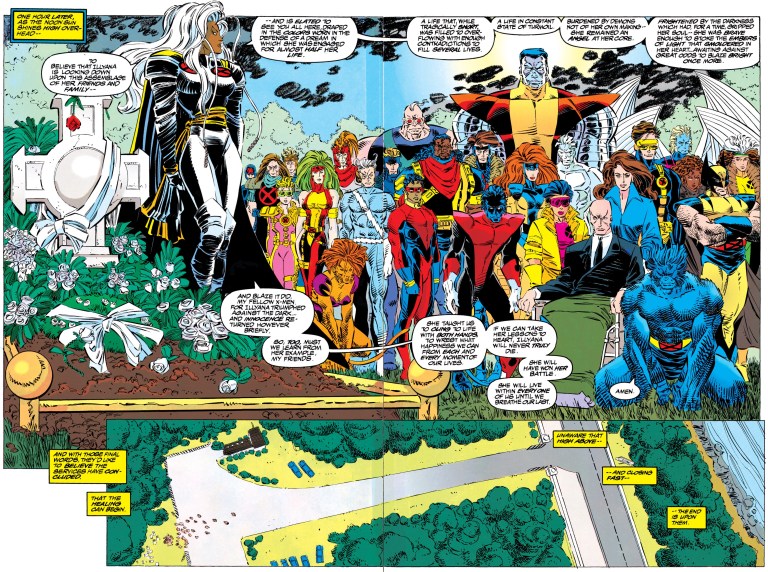
As the build-up continued with the flashback of Magneto’s life, the fan service short scene of Kitty Pryde and the unfeeling Colossus (note: their romance was highlighted in Uncanny X-Men many years prior), and the talk scene between Bishop and Banshee, the pace of the story slowed down dramatically. By the time the attempt to move the narrative back to the core plot was made with the funeral scene (composed of the X-Men, X-Force and X-Factor), the pace was still really way down. By the time the conflict with Magneto, Exodus and the Acolytes stated, the pace recovery was incomplete and as such, seeing the scene unfold was very jarring (and not even the pages of Colossus’ frustration towards Professor X could solve the narrative pacing problem).

Unsurprisingly, the conflict was written to be overly dramatic complete with lengthy pieces of dialogue here and there. That being said, references to past comic books were established as Magneto once again emphasizes his beliefs about the human-mutant conflict using violence (while also side-stepping Jean Grey’s psionic powers to allow the Acolytes to come in undetected).

Human-mutant conflict aside, themes about faith, religion, idolatry salvation are clearly used. Magneto, who has a tremendous record of villainy and his previous leadership of the X-Men proved useless, was portrayed to be a walking wicked idol whose followers cannot do anything except idolize him and cause violence out of dedication to him. They really could not realize that idolatry is foolish and unholy which further adds to chaos on the world. As Magneto deceived himself to be the savior and lord of mutants, he further causes more pain and destruction to others around him. In short, Magneto will always be stuck with his wicked nature and clearly does not deserve heavenly authority no matter how hard he believes himself to be a savior.

The classic rivalry between Xavier and Magneto here was portrayed dramatically and yet I cannot help but think that their conflict was nothing more than a repeat of past encounters with the state and future of mutants at stake. To be fair, what happened here served as a logical build-up for the shocking encounter between Professor X and Magneto in X-Men #25.

Conclusion

Nobody among the X-Men (except Charles Xavier), X-Force, Excalibur and X-Factor cared to dress properly for the funeral.

To be clear, even though I am an avid X-Men fan, I find Uncanny X-Men #304 (1993) hard to be engaged with and hard to enjoy. Efforts to make it a worthy celebration of the X-Men are very clear but it’s just not entertaining nor compelling to read. As for the X-Men traitor scene, the revelation was not that shocking as the foreshadowing made it too obvious. At best, this comic book served as a warm-up for X-Men #25 which itself paid-off nicely. Being more than sixty pages long (including the advertisement and bulletins), this comic book has too much creative baggage which ultimately hampered its storytelling. It’s not terrible. It’s really not that great to read. What I experienced way back in 1993 with this comic book is just the same as I re-read it. It has not aged well.

If you are seriously planning to buy an existing hard copy of Uncanny X-Men #304 (1993), be aware that as of this writing, MileHighComics.com shows that the near-mint copy of the regular edition costs $20, while the near-mint copies of the signed-and-numbered edition and the newsstand edition cost $120 and $60 respectively.

Overall, Uncanny X-Men #304 (1993) is satisfactory.

+++++

Thank you for reading. If you find this article engaging, please click the like button below and also please consider sharing this article to others. If you are looking for a copywriter to create content for your special project or business, check out my services and my portfolio. Feel free to contact me as well. Also please feel free to visit my Facebook page Author Carlo Carrasco and follow me at HavenorFantasy@twitter.com
A Look Back at Punisher 2099 #13 (1994)

Disclaimer: This is my original work with details sourced from reading the comic book and doing personal research. Anyone who wants to use this article, in part or in whole, needs to secure first my permission and agree to cite me as the source and author. Let it be known that any unauthorized use of this article will constrain the author to pursue the remedies under R.A. No. 8293, the Revised Penal Code, and/or all applicable legal actions under the laws of the Philippines.

Welcome back, superhero enthusiasts, comic book collectors, 1990s pop culture enthusiasts and fans of Marvel Comics! We finally made it at last with the conclusion of The Fall of the Hammer crossover storyline that highlighted Marvel’s 2099 franchises.

Last time around, Doom 2099 #14 saw the raising of the stakes and tension of the storyline leading up to the sudden team-up of the 2099 universe’s pioneering heroes – Spider-Man 2099, Ravage 2099, Doom 2099 and Punisher 2099 – facing the so-called Thor (the flying idol of the people in 2099), the minions and the secret forces behind the conflict.

With those details laid down, here is a look back at Punisher 2099 #13, published in 1993 (cover dated 1994) by Marvel Comics with a story written by Pat Mills and Tony Skinner, and illustrated by Tom Morgan.

The cover.

Early story

The story begins with Spider-Man, Punisher, Doom and Ravage together facing a horde of Berzerkers approaching them. The four engaged with the horde using violent action. When things calmed down, Doom 2099 tells them that they need to split into duos so that they can prevent the city of Valhalla from harming the millions of people below (in New York).

Before they start their tasks, the schemer Avatarr appears to them through holographic imagery and tells them that Valhalla was created as a base for the heroes that would destroy them and lead mankind along more productive lines. Thanks to Ravage’s move, Doom detects Avatarr’s frequency…

Quality

As Punisher 2099 arms himself, look closely and you will see the conflict between him and Jake Gallows.

When it comes to the storytelling, this conclusion to The Fall of the Hammer storyline felt unsatisfying. There were clear signs of rush on the resolution to the plot that preceded the ending which itself had a sudden shift of focus on Punisher 2099.

The real meat of this comic book is the team-up of the Marvel 2099’s pioneering protagonists, including the duos that were spawned as the plot required it. For most of this crossover storyline, Spider-Man 2099 and Punisher 2099 were just riding together going to Valhalla. In this comic book, you will really see the two work together which was satisfying enough as pay-off (to the build-up the preceded this issue). The duo of Doom 2099 and Ravage 2099, however, was nowhere as satisfying and, more notably, there was no real chemistry between them.

This comic book continues the theme of false deities and a series of unfortunate events pulled off from a distance by some sinister force located in a secret place. While this storyline had touched on the faith of the Thorites (most notably in Doom 2099 #14), this one simply abandoned it to focus more on 2099’s original heroes doing something heroic.   

When it comes to Punisher 2099 himself, fans will have a lot of stuff to enjoy. There is a short but notable moment in the story implying that Punisher 2099 and Jake Gallows are separate entities presented in the character’s mind.

Conclusion

This opening image is easily the best image of the comic book. Things went downhill from after this image.

Punisher 2099 #13 (1994) is not the solid conclusion The Fall of the Hammer storyline deserved. There were clear signs of rush as well as compression of details that had to be done in order to fit the 22 story pages. The so-called final conflict felt hollow and 2099 fans who got invested with the era’s self-declared Thor (who was initially the main antagonist) in the previous chapters will be disappointed with the way he turned out here. That being said, Avatarr as the main villain is just not convincing and was unsatisfying. Having Punisher 2099, Spider-Man 2099, Doom 2099 and Ravage 2099 together to do some saving was pretty interesting and symbolic, as well as the main attraction of this comic book. Sadly, not even those pioneers could save this comic book and the storyline from ending with a whimper.

If you are seriously planning to buy an existing hard copy of Punisher 2099 #13 (1994), be aware that as of this writing, MileHighComics.com shows that the near-mint copy of the regular edition costs $6 while the near-mint copies of the signed-and-numbered and the newsstand editions cost $50 and $16 respectively.

Overall, Punisher 2099 #13 (1994) is worth getting below its cover price.

+++++

Thank you for reading. If you find this article engaging, please click the like button below and also please consider sharing this article to others. If you are looking for a copywriter to create content for your special project or business, check out my services and my portfolio. Feel free to contact me as well. Also please feel free to visit my Facebook page Author Carlo Carrasco and follow me at HavenorFantasy@twitter.com

A Look Back at X-Men 2099 #5 (1994)

Disclaimer: This is my original work with details sourced from reading the comic book and doing personal research. Anyone who wants to use this article, in part or in whole, needs to secure first my permission and agree to cite me as the source and author. Let it be known that any unauthorized use of this article will constrain the author to pursue the remedies under R.A. No. 8293, the Revised Penal Code, and/or all applicable legal actions under the laws of the Philippines.

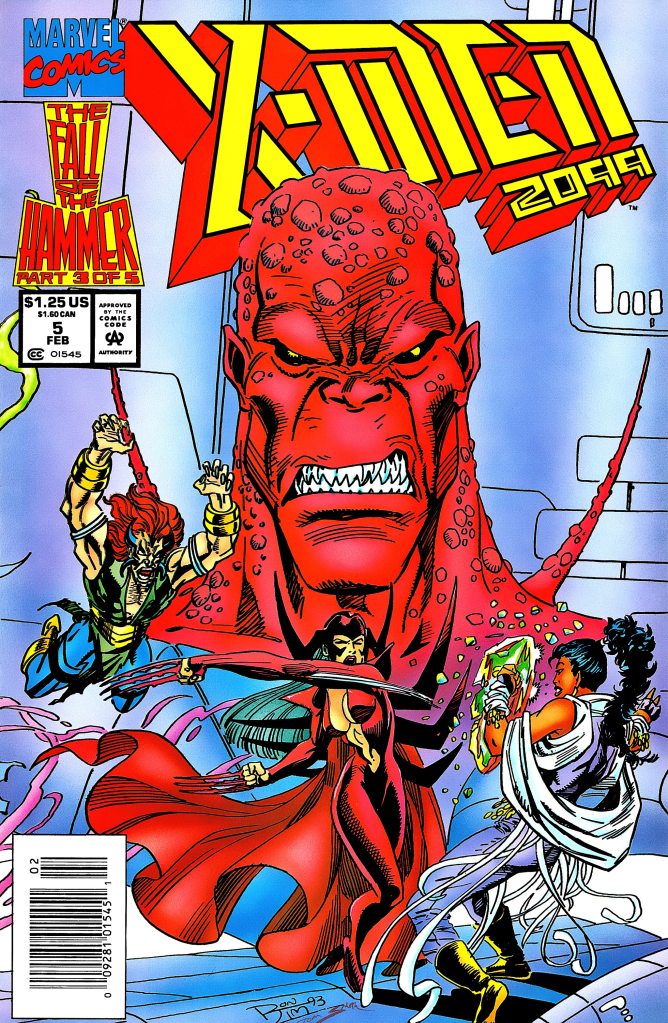
Welcome back, superhero enthusiasts, comic book collectors, 1990s culture enthusiasts and fans of Marvel Comics! This is the continuation of a look back at the Marvel 2099 crossover storyline The Fall of The Hammer which started in Spider-Man 2099 #16 followed next in Ravage 2099 #15. The 3rd chapter of the said crossover filled the fifth issue of the X-Men 2099 monthly series.

For the newcomers reading this, a few of the X-Men of the far future were officially involved in this 5-part crossover storyline that was meant to celebrate the Marvel 2099 franchise back in the 1990s. This was the reason why Skullfire, Meanstreak, Krystalin and Bloodhawk were separated from their team leader Xi’an and the remaining teammates. Last time around, three of the mentioned X-Men got involved with Ravage and eventually reached the floating city of Valhalla together only to get separated.

With those details laid down, here is a look back at X-Men 2099 #5, published in 1993 (cover dated 1994) by Marvel Comics with a story written by John Francis Moore and drawn by Ron Lim.

The cover.

Early story

The story begins in New York City where a vehicle moves at high speed until it hits a wall and stops. Out comes Tim Fitzgerald/Skullfire who moves away and spots Valhalla above him. In the floating city, Krystalin, Meanstreak and Bloodhawk are in confrontation with a powerful enemy called Heimdall who tells them to bow to him and swear allegiance.

Bloodhawk attacks Heimdall only to get pushed back. Krystalin fires crystal bits at him but to no success. Thinking that he’s too fast for Heimdall, Meanstreak tries a sneak attack from the side only to be hit hard, lose control and crashes to a wall. As the X-Men’s fastest member is down, a shadowy figure approaches him nearby…

Quality

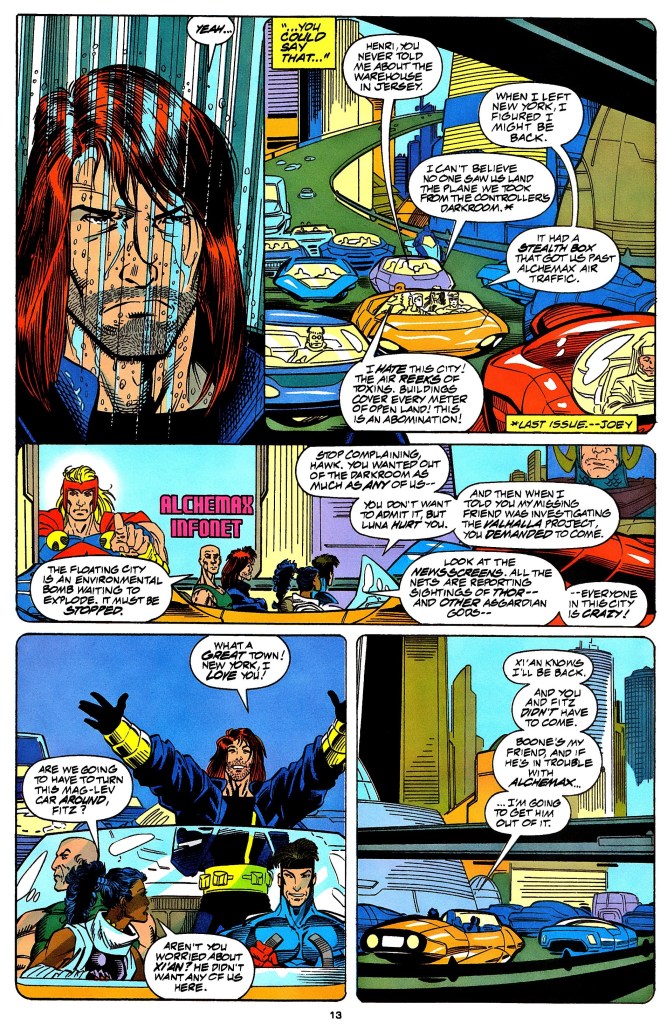
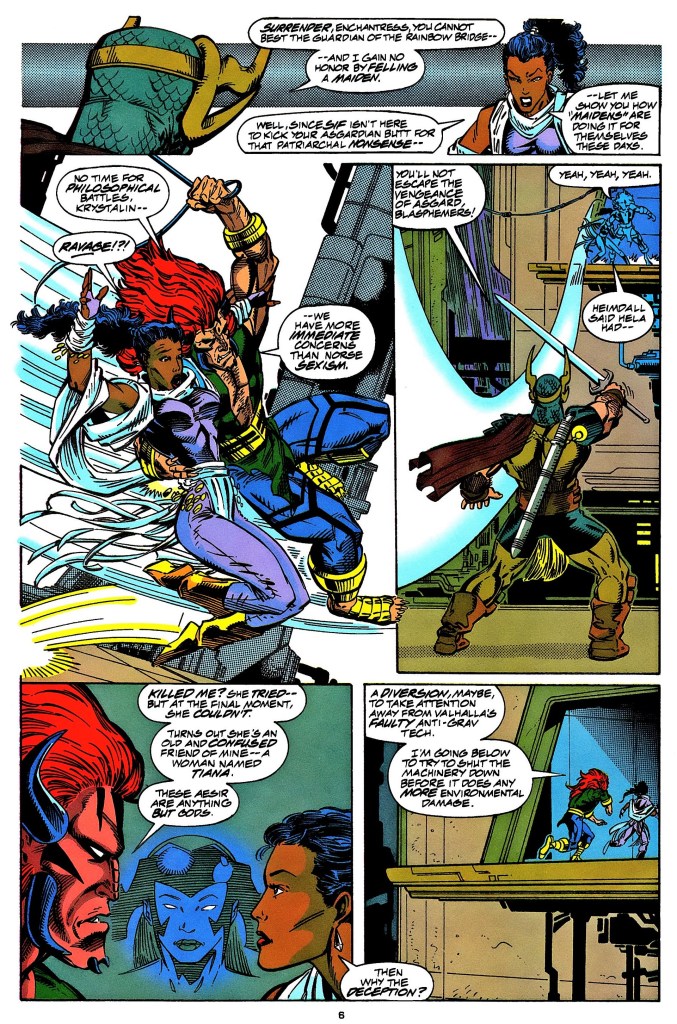
This quick flashback explains how the four X-Men 2099 members went to New York.

As an X-Men 2099 tale, this one felt like a catch-up for Skullfire who was absent in the first two parts of The Fall of the Hammer storyline even though it was confirmed in X-Men 2099 #4 that he joined his teammates and help Meanstreak find his friend Jordan. That being said, there is a good amount of scenes focused on Skullfire as he makes his way up to Valhalla. There is also a quick flashback showing that indeed he was with his teammates as they arrived in New York only to get separated (which explains why only Krystalin, Bloodhawk and Meanstreak approached Ravage). More importantly, the flashback also contains additional details that explain what the X-Men discovered before arriving at Valhalla and why they decided to approach Ravage.

As the 3rd chapter of The Fall of The Hammer storyline, this comic book barely moved the present-day narrative forward mainly due to having to use a few but precious pages to tell the short flashback to explain the X-Men’s involvement. Still, key revelations related to what happened behind-the-scenes added a lot of depth to the narrative and this properly sets the stage of for the remaining chapters. The 2099 major figures like Spider-Man, Punisher, Doom and Ravage all appeared here but very sparsely.    

Conclusion

Ravage 2099 helps Krystalin.

X-Men 2099 #5 (1994) pushed the narrative of the crossover a few notches forward but the revelations written saved it from being a throw-away story. For fans of X-Men 2099, there is a lot to like here and Skullfire’s late entry into the crossover will delight them. The writing was good enough and by the end of the story, the explanations were satisfying and the ending suggested that the stakes would be raised for the final two chapters of the crossover. Those who missed the presence of Thor 2099 should be happy to see him here, even though it was clear that he was being conserved for the last two chapters.

If you are seriously planning to buy an existing hard copy of X-Men 2099 #5 (1994), be aware that as of this writing, MileHighComics.com shows that the near-mint copy of the regular edition costs $6 while the near-mint copy of the newsstand edition costs $18.

Overall, X-Men 2099 #5 (1994) is recommended.

+++++

Thank you for reading. If you find this article engaging, please click the like button below and also please consider sharing this article to others. If you are looking for a copywriter to create content for your special project or business, check out my services and my portfolio. Feel free to contact me as well. Also please feel free to visit my Facebook page Author Carlo Carrasco and follow me at HavenorFantasy@twitter.com
A Look Back at Ravage 2099 #15 (1994)

Disclaimer: This is my original work with details sourced from reading the comic book and doing personal research. Anyone who wants to use this article, in part or in whole, needs to secure first my permission and agree to cite me as the source and author. Let it be known that any unauthorized use of this article will constrain the author to pursue the remedies under R.A. No. 8293, the Revised Penal Code, and/or all applicable legal actions under the laws of the Philippines.

Welcome back, superhero enthusiasts, comic book collectors, 1990s culture enthusiasts and fans of Marvel Comics! To those who read my previous retro comic book reviews related to the 2099 universe of Marvel Comics, you know fully well that I found the first eight issues of the Ravage 2099 monthly series to be lackluster even though they all involved the writing of the late legend Stan Lee. After Lee stopped working, the Ravage 2099 series was taken over by Pat Mills and Tony Skinner for the writing duties and those two were in-charge of the Punisher 2099 series.

Eventually, a crossover storyline of the 2099 universe was published titled The Fall of the Hammer. It was told in five parts and each of the existing 2099 monthly series at the time – Spider-Man 2099, Ravage 2099, Doom 2099, Punisher 2099 and X-Men 2099 – had one issue forming it. The Fall of the Hammer kicked off with Spider-Man 2099 #16 which had solid writing by Peter David.

Part 2 was told in a Ravage 2099 issue. To find out the story and its quality, here is a look back at Ravage 2099 #15, published in 1993 (cover dated 1994) by Marvel Comics with a story written by Pat Mills and Tony Skinner, and drawn by Grant Miehm.

Early story

The story begins at the place of Paul-Phillip Ravage who is now in human form. In his presence are X-Men 2099 members Meanstreak, Krystalin and Bloodhawk. Suddenly Bloodhawk comes after Ravage and tries to make him give out information in relation to the disappearance of Jordan Boone, a friend of Meanstreak. Boone disappeared after compiling data related to Alchemax’s problem with Valhalla.

Ravage then transforms into his monstrous form which surprises Bloodhawk. After the winged X-Men member mentioned Valhalla, Ravage calms down and decides to talk with the team. Soon enough, they fly above the city streets in a vehicle heading towards Valhalla. As they approach the floating city, armed flying personnel move in to attack Ravage 2099 and the three X-Men.

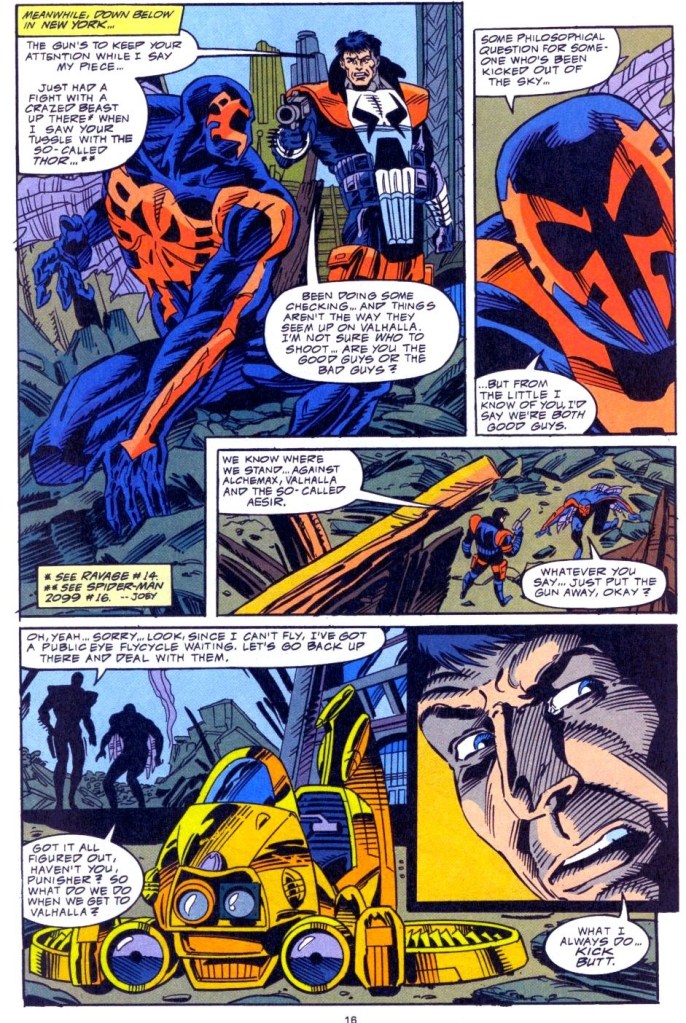
Elsewhere in New York, Spider-Man 2099 finds himself at a disadvantage as Punisher 2099 has a gun pointed at him…

Quality

2099’s Spider-Man and Punisher together.

To put it clearly, this 2nd part of The Fall of the Hammer storyline is where the 2099 heroes begin to actually cross over with each other and the first panel showing Ravage with the three X-Men members is symbolic of that. The plot here is actually simple…Ravage and the X-Men make it to Valhalla which is their common destination. The mutants want information about Jordan Boone while Ravage tries to meet Doom 2099 (whom he met in Ravage 2099 #14). Apart from those objectives, there is a lot of action scenes laced with dialogue designed to move the narrative forward little by little. If you are looking for character development of Ravage, you won’t find much here. What you will find, however, are some scenes of intrigue that show Ravage getting disturbed temporarily as a result of realizing the presence of a certain someone he got close with.

As for Valhalla, the city here is more of a technical playground than an actual threat to the people and societies it flew over. What weakens the story here is the absence of 2099’s Thor.

Conclusion

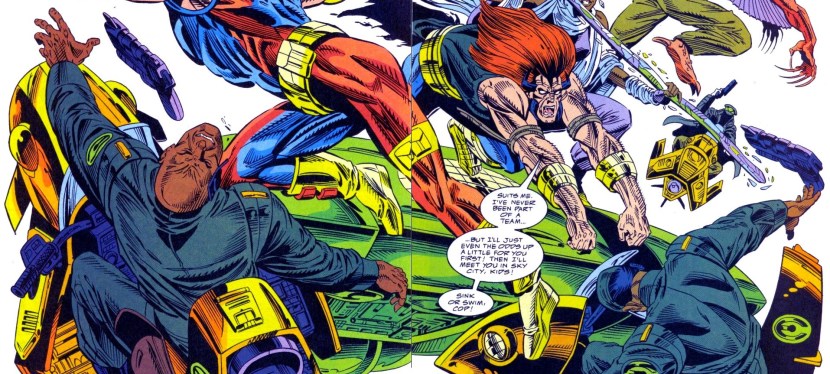
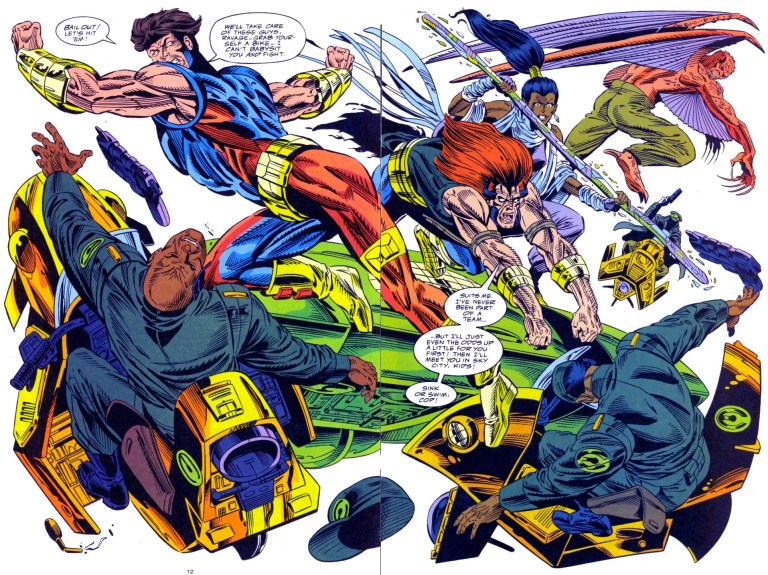
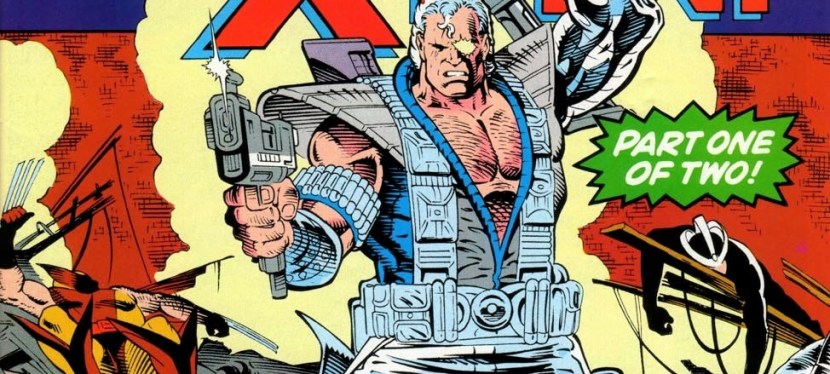
The money shot of this comic book!

To a certain extent, Ravage 2099 #15 (1994) is a somewhat entertaining read mainly due to the mix up of 2099 characters together here. The story is pretty light but at the very least fans of Ravage 2099 will find their monstrous hero in a somewhat interesting misadventure here. The concept that started in Spider-Man 2099 #16 showing Valhalla as a floating danger is weaker here but at least this comic book sets the stage for the next chapter of the storyline decently.

If you are seriously planning to buy an existing hard copy of Ravage 2099 #15 (1994), be aware that as of this writing, MileHighComics.com shows that the near-mint copy of the regular edition costs $16 while the near-mint copy of the newsstand edition costs $48.

Overall, Ravage 2099 #15 (1994) is satisfactory.

+++++

Thank you for reading. If you find this article engaging, please click the like button below and also please consider sharing this article to others. If you are looking for a copywriter to create content for your special project or business, check out my services and my portfolio. Feel free to contact me as well. Also please feel free to visit my Facebook page Author Carlo Carrasco and follow me at HavenorFantasy@twitter.com
A Look Back at What If #20 (1990)

Disclaimer: This is my original work with details sourced from reading the comic book and doing personal research. Anyone who wants to use this article, in part or in whole, needs to secure first my permission and agree to cite me as the source and author. Let it be known that any unauthorized use of this article will constrain the author to pursue the remedies under R.A. No. 8293, the Revised Penal Code, and/or all applicable legal actions under the laws of the Philippines.

Welcome back superhero enthusiasts, comic book collectors, 1990s culture enthusiasts and fans of Marvel Comics! Before starting this newest retro comic book review, I should state that I really like Marvel’s way of exploring the unexplored scenarios related to the stories they published. Back in the 1980s, Marvel made its decision to have their icon Spider-Man – in his civilian form as Peter Parker – get married with Mary Jane Watson. Unsurprisingly, such an event added a whole lot of new elements into the life of the literary Spider-Man with regards to his struggle on balancing his life between superhero acts, domestic living and being attentive to his wife. If you really want to read about the wedding, I suggest searching for a copy of The Amazing Spider-Man Annual #21 (1987).

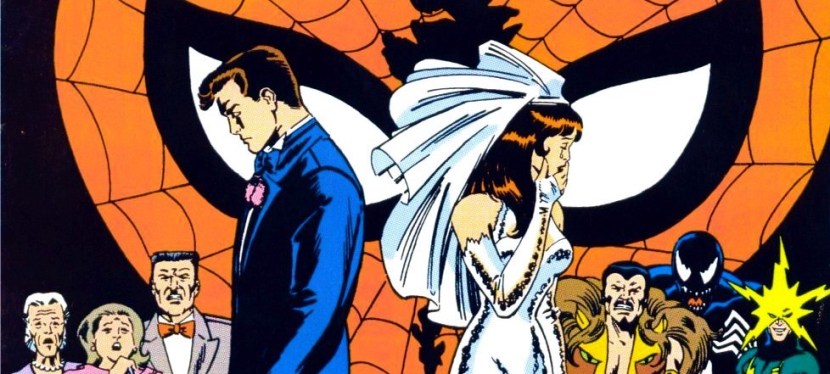
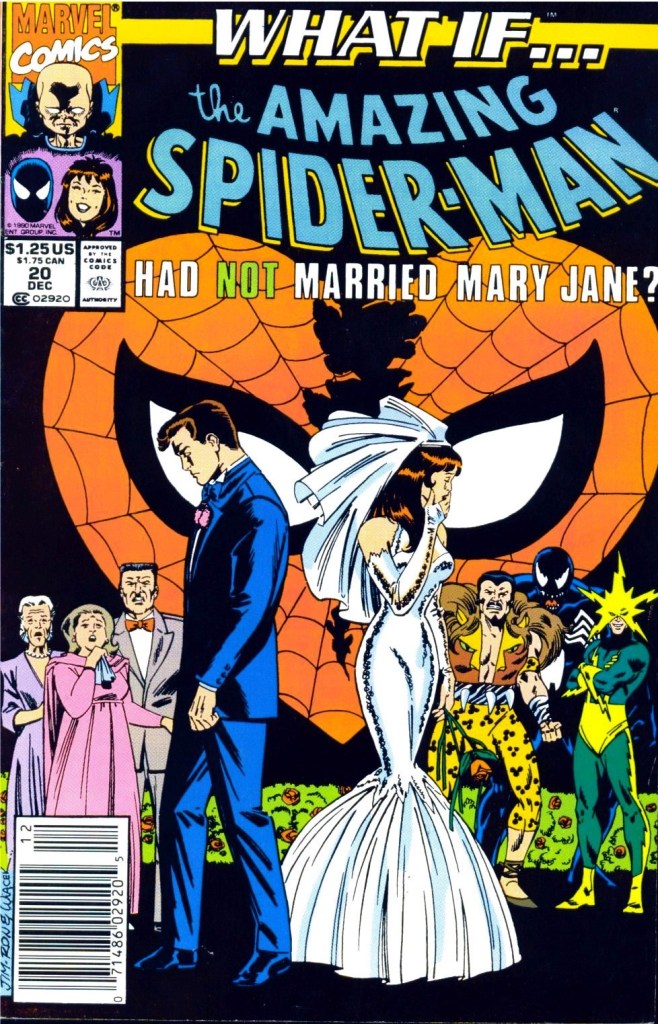
Imagine what would have happened had Spider-Man not married Mary Jane? That very scenario was explored in an issue of the What If monthly series (Volume 2) back in the early 1990s. We can find out more together in this look back at What If #20, published by Marvel Comics in 1990 with a story written by Danny Fingeroth and drawn by Jim Valentino.

The cover.

Early story

The story begins with the Watcher narrating key events in the life of Spider-Man. It is recalled how much pain Spider-Man endured when his beloved Gwen Stacy died during his conflict with the Green Goblin. Subsequently Peter Parker resumed his relationship with Mary Jane. When Mary Jane became absent, he got involved with Felicia Hardy/Black Cat who turned out to be too wild and reckless for him. Eventually, Peter married Mary Jane.

By pointing out that there are other realities, the Watcher then begins to explore another scenario in which Spider-Man realizes is far from being all right with him. During the wedding ceremony, Peter turns down Mary Jane which shocks the guests who were present. He tells her privately that even though he loves her, she will be in danger all the time as a wife. She walks away from him, still wearing her wedding dress.

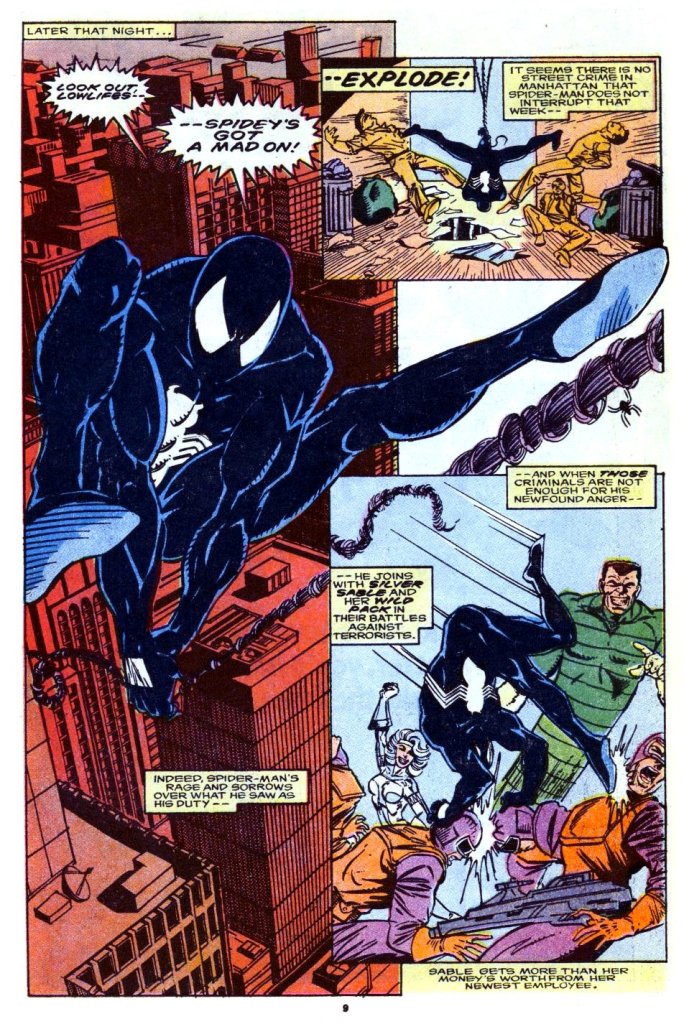
Some hours later, Spider-Man swings around New York and strikes the criminals really hard…

Quality

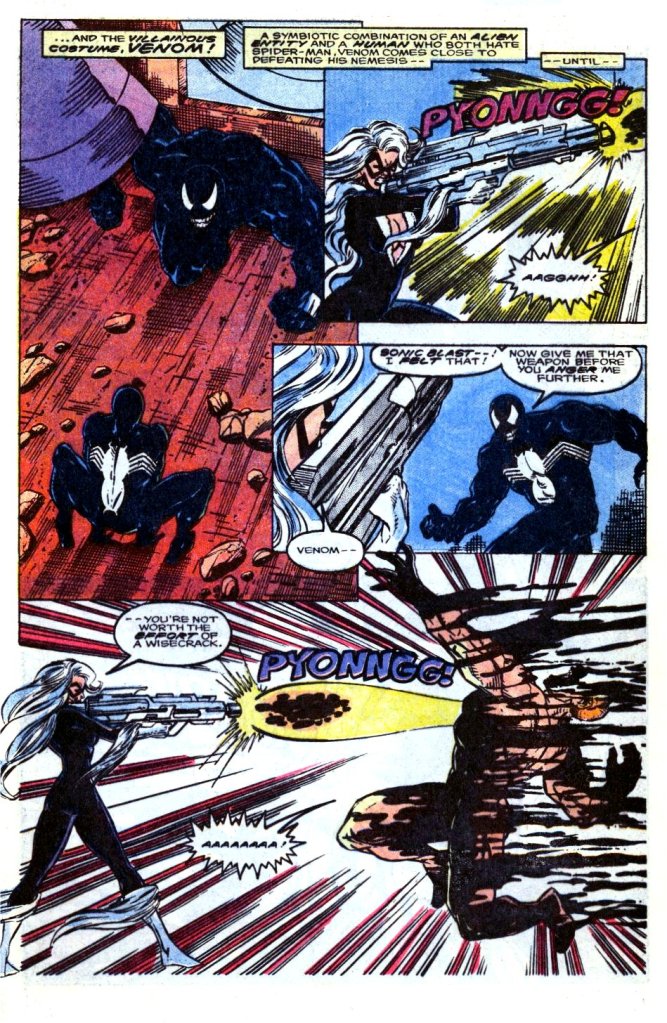
Spider-Man and Black Cat take on Venom!

To be clear, this comic book shows a Spider-Man who not only rejected marriage, but is also a tortured soul whose inner pain started even before the failed wedding ceremony. Silver Sable, who is often focused on missions, notices Spider-Man being too angry and careless with his performance with them taking on the bad guys. The old and frail Aunt May is deeply worried over Peter and hopes he would not harden his heart to the possibility of loving someone.

The thing about this story is that the writing done by Danny Fingeroth is pretty good as he captured Spider-Man’s essence while successfully steering him pretty close to the edge, almost blurring the boundary the separates the good and evil in him. The story moved with a nice pace and there is a good amount of suspense that will keep you wondering if Spider-Man can climb out of the deep hole of darkness he’s in.

More on the plot, I also enjoyed this comic book’s connection with Kraven’s Last Hunt and the early encounter with Venom. If there is any weak point with this story, it is the fact that it served as build-up of something set to happen in the next issue.

When it comes to the art, Jim Valentino did a good job bringing the script to life and that includes framing the character development scenes and the spectacle scenes in interesting ways. I personally enjoyed his take on Venom and Kraven.

Conclusion

Without Mary Jane as a wife, Spider-Man went on to fight the bad guys more intensely.

What If #20 (1990) is indeed a solid, alternate story about Spider-Man. It was gripping right from the start but it lacked a solid conclusion as its last few pages started to build up anticipation for the following issue. In short, this is not a standalone story and to fully enjoy what it started, you have to read What If #21. Still, I love the way Spider-Man is portrayed here and there are some characters involved that long-time fans will enjoy.

If you are seriously planning to buy an existing hard copy of What If #20 (1990), be aware that as of this writing, MileHighComics.com shows that the near-mint copy of the regular edition costs $53 while the respective near-mint copies of the newsstand edition and the signed edition both cost $105.

Overall, What If #20 (1990) is recommended.

+++++

Thank you for reading. If you find this article engaging, please click the like button below and also please consider sharing this article to others. If you are looking for a copywriter to create content for your special project or business, check out my services and my portfolio. Feel free to contact me as well. Also please feel free to visit my Facebook page Author Carlo Carrasco and follow me at HavenorFantasy@twitter.com
A Look Back at X-Men #5 (1992)

Disclaimer: This is my original work with details sourced from reading the comic book and doing personal research. Anyone who wants to use this article, in part or in whole, needs to secure first my permission and agree to cite me as the source and author. Let it be known that any unauthorized use of this article will constrain the author to pursue the remedies under R.A. No. 8293, the Revised Penal Code, and/or all applicable legal actions under the laws of the Philippines.

Welcome back, superhero enthusiasts, comic book collectors, fans of 1990s culture and fans of Marvel Comics! Today we revisit the adjective-less X-Men monthly series (Volume 2) that started in 1991 with the combined talents of Chris Claremont and Jim Lee. For those who are unaware, Chris Claremont had his conflict behind the scenes with then X-Men comics editor Bob Harras which led to him departing the X-Men series with issue #3.

Previously I reviewed X-Men #4 which by today’s standards is highly significant and very expensive to acquire as it marked the literary debut of Omega Red who made quite an impact with X-Men fans. It should be noted that Wolverine and Omega Red had encountered each other far back in time and issue #4 marked the renewal of their rivalry.

With those details laid down, here is a look back at X-Men #5, published in 1992 by Marvel Comics with a story written by Jim Lee (plot) and John Byrne (script), The art was done by Lee with ink work done by Scott Williams, Art Thibert, Bob Wiacek and Joe Rubinstein.

The cover.

Early story

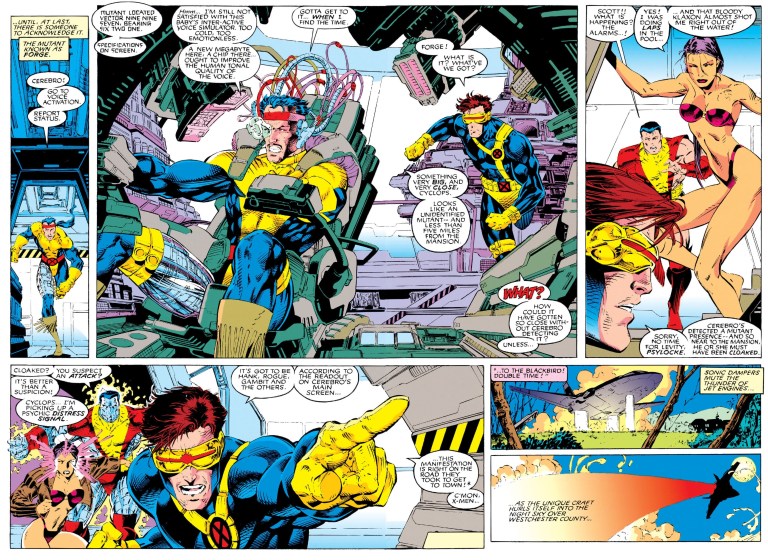
This for me is the money shot of the comic book. Although Wolverine is absent, you get to see the entire Blue and Gold teams with Charles Xavier as drawn by Jim Lee.

The story begins with Cerebro detecting an unidentified mutant signature in the presence of X-Men members who were out of the mansion. Forge tells Cyclops about the disturbance happening less than five miles away from their mansion. Colossus and Psylocke join in and quickly they leave the mansion with Cyclops using the Blackbird.

Not too far away, Gambit, Rogue, Jubilee and Beast are held captive inside a vehicle with an armed man in their presence. Gambit starts the effort to free his teammates using one of his charged cards.

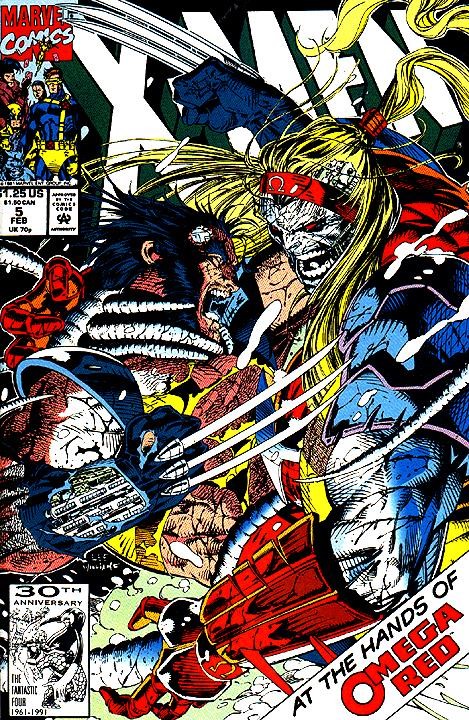
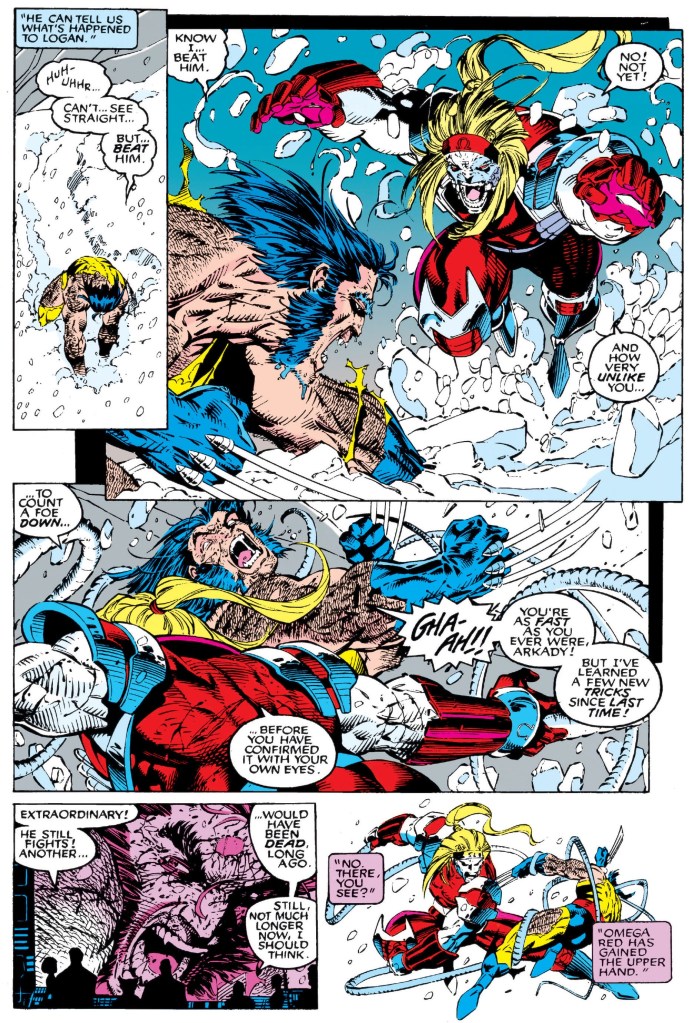
Elsewhere in a snowy place, Wolverine is seen struggling thinking he defeated his old rival Omega Red. Suddenly the Russian mutant jumped at him and the two resumed fighting. Their fight is being monitored from a distance…

Quality

The Wolverine-Omega Red rivalry is a must-see.

When it comes to storytelling, it is obvious that the writing duo of Jim Lee and John Byrne did their best to push the envelope and break new ground as far as telling an X-Men story goes. For one thing, there is the presence of paramilitary elements which are common with Jim Lee’s creations. There are even flashbacks into the past in which Wolverine (then called Logan) actually took part in a special forces operation with a few notable others. These flashbacks expands further the personal history of Wolverine in a really intriguing way. With the way the story was presented, it is clear that the new creative team pulled off serious moves in modernizing the way X-Men stories were told in comparison to the way Chris Claremont told all those many such stories during his long run.

When it comes to the visuals, Jim Lee did another great job as each page looks great and he proved to be clever with the way he visualized the script. As this comic book was inked by more than one inker, there were subtle differences with regards to contrast as well as ink intensity.

Conclusion

Cyclops and his teammates move out.

X-Men #5 (1992) is another great comic book that involved Jim Lee’s art. Apart from the modernizing of the storytelling, this comic book further expanded the past of Wolverine while successfully giving readers more of Omega Red who is now a major supervillain of Marvel’s.

If you are seriously planning to buy an existing hard copy of X-Men #5 (1992), be aware that as of this writing, MileHighComics.com shows that the near-mint copy of the regular edition costs $27 while the near-mint copy of the newsstand edition costs $79.
Overall, X-Men #5 (1992) is highly recommended!

+++++

Thank you for reading. If you find this article engaging, please click the like button below and also please consider sharing this article to others. If you are looking for a copywriter to create content for your special project or business, check out my services and my portfolio. Feel free to contact me as well. Also please feel free to visit my Facebook page Author Carlo Carrasco and follow me at HavenorFantasy@twitter.com