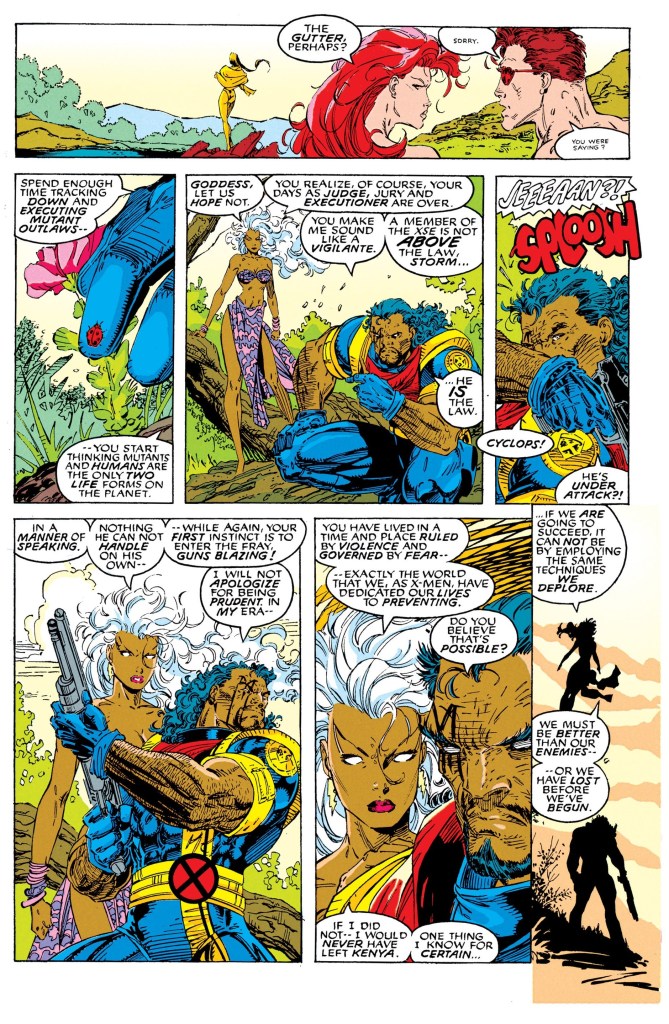
A Look Back at X-Men #2 (1991)

Disclaimer: This is my original work with details sourced from reading the comic book and doing personal research. Anyone who wants to use this article, in part or in whole, needs to secure first my permission and agree to cite me as the source and author. Let it be known that any unauthorized use of this article will constrain the author to pursue the remedies under R.A. No. 8293, the Revised Penal Code, and/or all applicable legal actions under the laws of the Philippines.

There is so much said about X-Men #1 of 1991 which was launched to major success by Marvel Comics selling at least eight million copies worldwide. That launch issue, written by Chris Claremont and drawn by Jim Lee, had multiple covers and a version with gatefold covers and high-quality paper which made it an instant hit with collectors chasing profit. In 2011, Marvel even released the so-called 20th anniversary edition of X-Men which was digitally recolored.

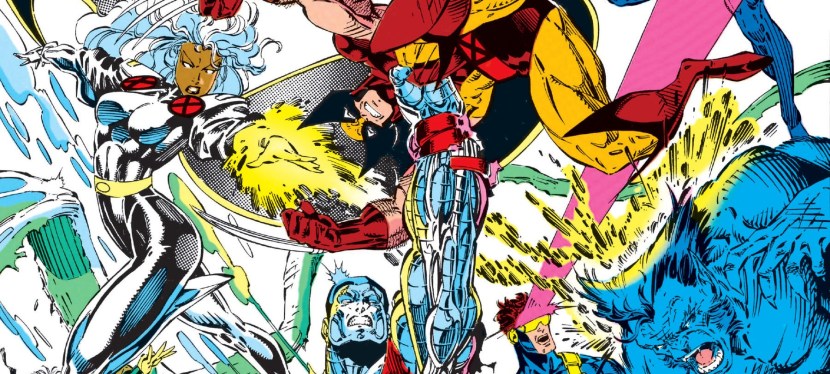
In terms of substance, X-Men marked the new era of the X-Men. Charles Xavier returned to his mansion to lead the X-Men which was so large as a group, it had to be divided into two team with Cyclops leading the Blue Team and Storm heading the Gold Team. In terms of publishing, Marvel published tales of the Gold Team in the Uncanny X-Men monthly series while the Blue Team’s stories were published in the adjective-less X-Men monthly series.

With all the attention paid to X-Men , I noticed that not too many people cared to talk about what happened after the end of that comic book. Without spoiling plot details, the massive seller of 1991 had its story end in a cliffhanger. To find out what followed and determine the quality of the creative team’s work, here is a look back at X-Men published in 1991 by Marvel Comics with a story co-written by Chris Claremont and Jim Lee (who illustrated).

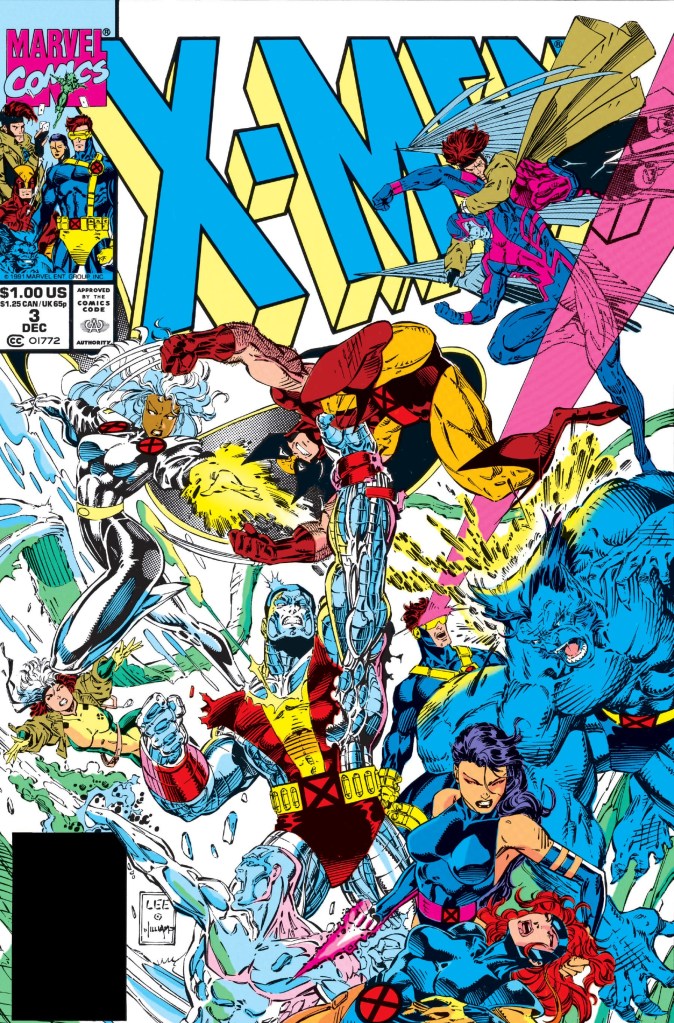
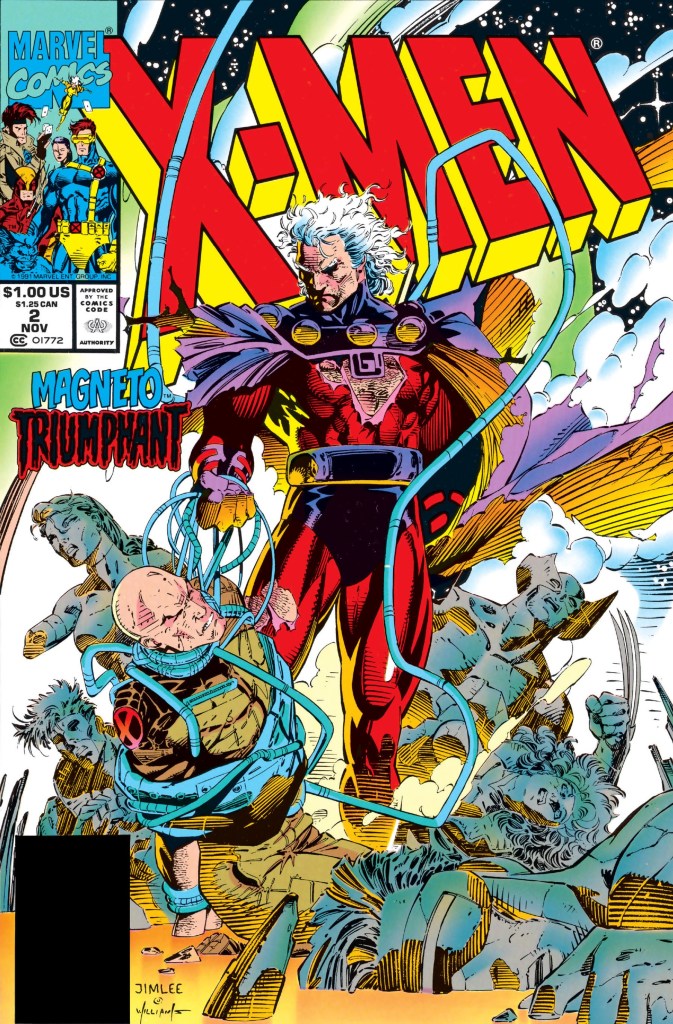
The cover.

Early story

The story begins in the fictional island nation of Genosha which has a legacy of mutant slavery. Having fought with the Acolytes (led by Fabian Cortez), the X-Men now face Magneto who arrived and tells them that he will not abandon the Acolytes.

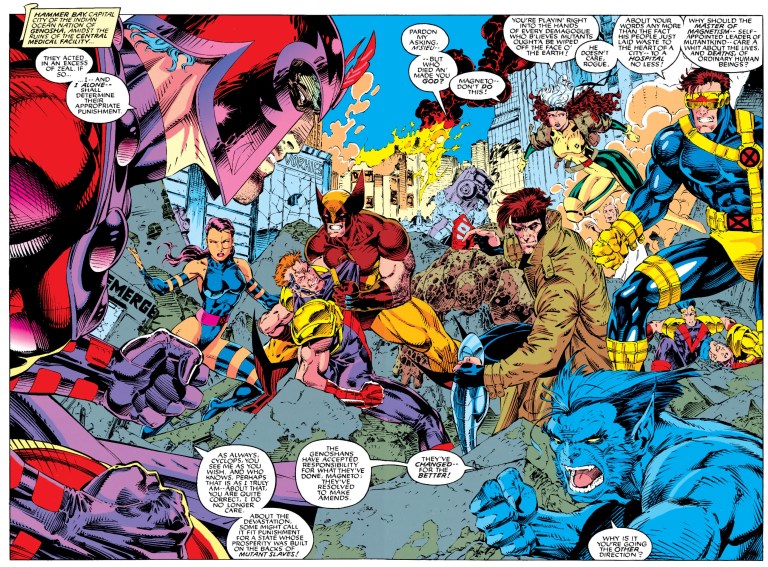
“They acted in an excess of zeal. If so…I..and I alone..shall determine their appropriate punishment,” Magneto tells the team of Cyclops, Gambit, Beast, Wolverine, Psylocke and Rogue. Near them are other Acolytes members down on the ground.

After words spoken by Gambit, Rogue and Cyclops, Magneto referred to the devastation of the city hospital as fitting for punishing a state (Genosha) whose prosperity was built on the backs of mutant slaves. Beast answered back saying that the Genoshans have accepted responsibility for what they have done and resolved to make amends.

While Magneto replies to Beast, a military Genoshan helicopter gunship fires missiles at them from above which the X-Men’s archvillain intercepts. Using his magnetic power, Magneto lifts steal beams and destroys the helicopter with them. He then turns against the X-Men restarting the chaos in the city…

Quality

Magneto, Psylocke and Rogue in the middle of the chaos.

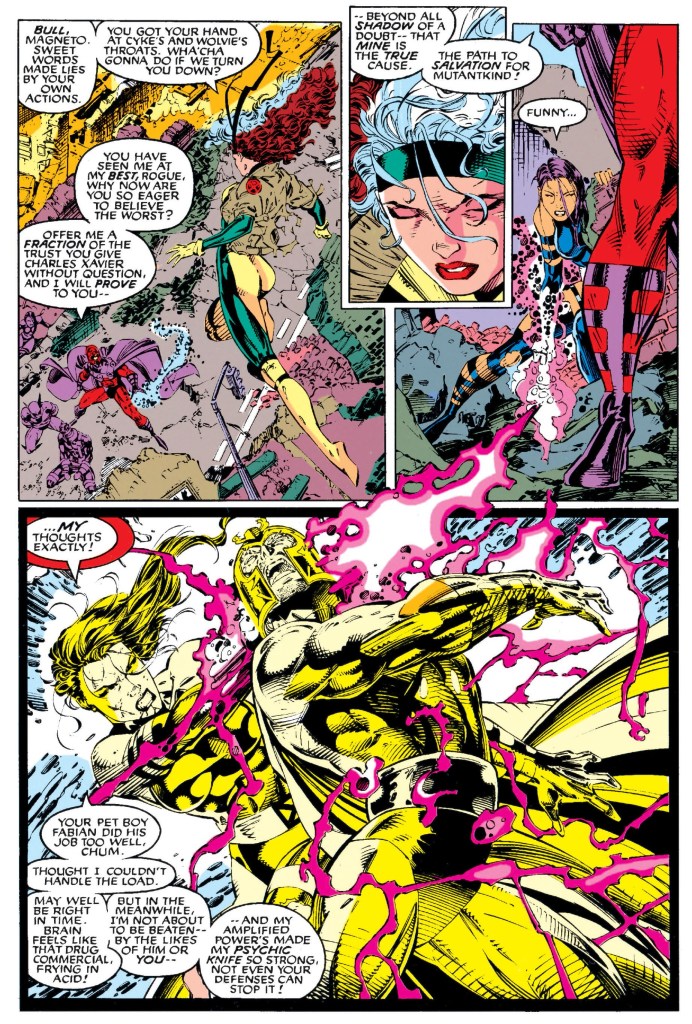
Being the middle of a 3-part story, this comic book pushes the entire X-Men group to the edge thanks to strong writing by Chris Claremont. I’m not simply referring to the traditional good-versus-evil formula of superhero storytelling as the story here emphasized themes about sanity, loyalty, legacy, idolatry and even diplomacy. It just so happens that there is a lot of superhero spectacle to enjoy here and there.

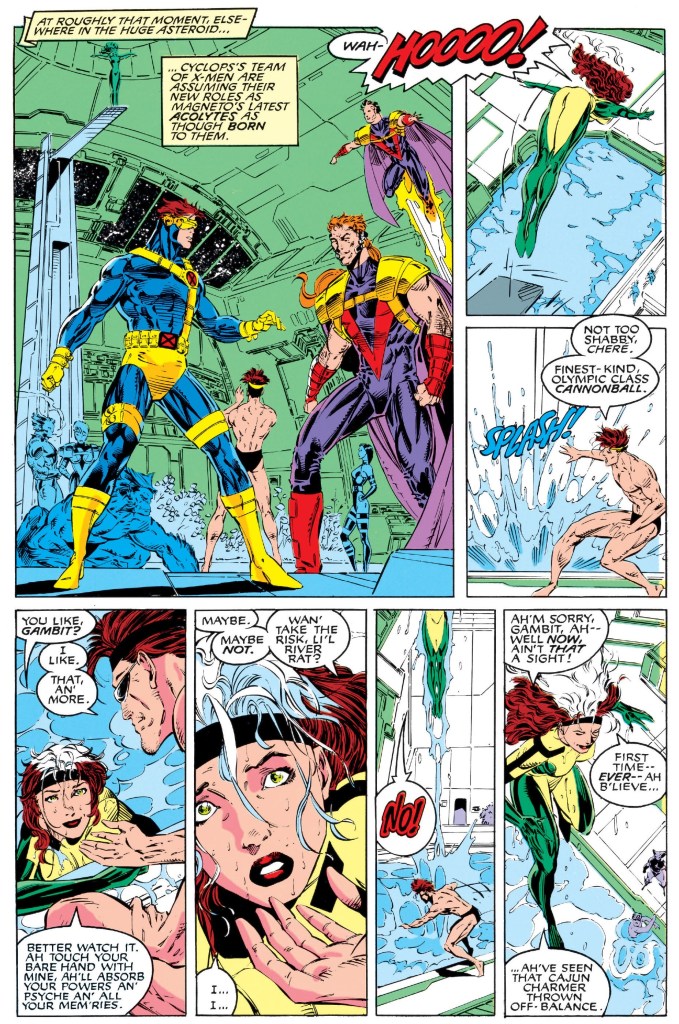
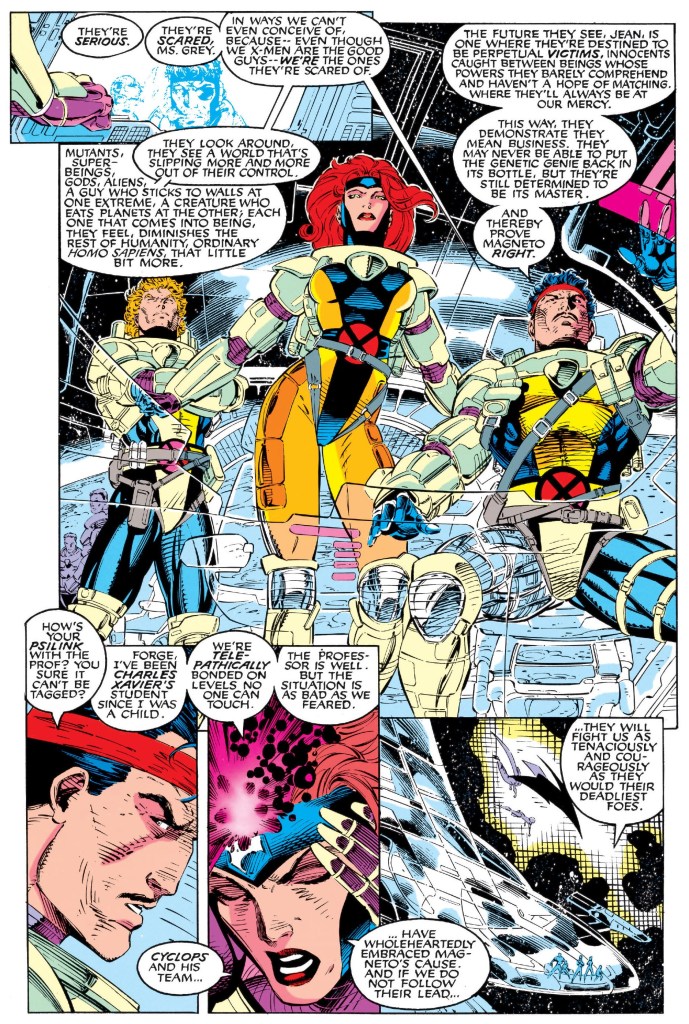
The stakes have been raised significantly in this story as Magneto is shown leading the Acolytes who in turn went ahead with their first mission which explains the chaos in Genosha. Magneto’s condition also deteriorates and gets himself healed by Fabian Cortez who is more sinister than what he seems. For his part, Charles Xavier of the X-Men gets to interact with his long-time friend Dr. Moira MacTaggert who is struggling with guilt from something she committed in the past. Through Magneto, Xavier and MacTaggert, there is this solid build-up of tension that led to a very powerful revelation in the 2nd half of the story which, ironically, put the X-Men on the sideline temporarily. There is high drama, deep tension and high intensity involving Magneto and MacTaggert, and their scene together is the highlight of the story.  

Conclusion

The face-off!

To put it straight, as much as I loved X-Men (1991), I find X-Men (1991) more compelling to read. For one thing, it rewards X-Men fans who dedicatedly followed the events of not only the X-Men but also of that of the life of Magneto. It’s really great that Chris Claremont literally dug up the past for details that proved to be useful in this comic book. It also nicely sets up anticipation of the next issue by involving the X-Men’s Gold Team. Unsurprisingly, with the combined talents of Claremont and Jim Lee, this is an excellent read that really looks great.

If you are seriously planning to buy an existing hard copy of X-Men (1991), be aware that as of this writing, MileHighComics.com shows that the near-mint copy of the regular edition costs $4 while the near-mint copies of the Chris Claremont-signed regular edition, the Chris Claremont-signed newsstand edition and the newsstand edition cost $9, $19 and $13 respectively.

Overall, X-Men (1991) is highly recommended!

+++++

Thank you for reading. If you find this article engaging, please click the like button below and also please consider sharing this article to others. If you are looking for a copywriter to create content for your special project or business, check out my services and my portfolio. Feel free to contact me as well. Also please feel free to visit my Facebook page Author Carlo Carrasco and follow me at HavenorFantasy@twitter.com
A Look Back at The Strangers #16 (1994)

Disclaimer: This is my original work with details sourced from reading the comic book and doing personal research. Anyone who wants to use this article, in part or in whole, needs to secure first my permission and agree to cite me as the source and author. Let it be known that any unauthorized use of this article will constrain the author to pursue the remedies under R.A. No. 8293, the Revised Penal Code, and/or all applicable legal actions under the laws of the Philippines.

Welcome back Ultraverse fans, geeks and comic book collectors! Here is another trip back into the Ultraverse, which for me is the most defining line of superhero comics that was realized in the 1990s. The UV lasted for only a few years and along the way publisher Malibu Comics got acquired by Marvel Comics.

History aside, we are about to explore The Strangers again in the sixteenth issue of the monthly series that was spearheaded mainly by the creative duo of Steve Englehart and Rick Hoberg. Here is a look back at The Strangers , published in 1994 by Malibu Comics with a story written by Englehart and drawn by Hoberg.

The cover.

Early story

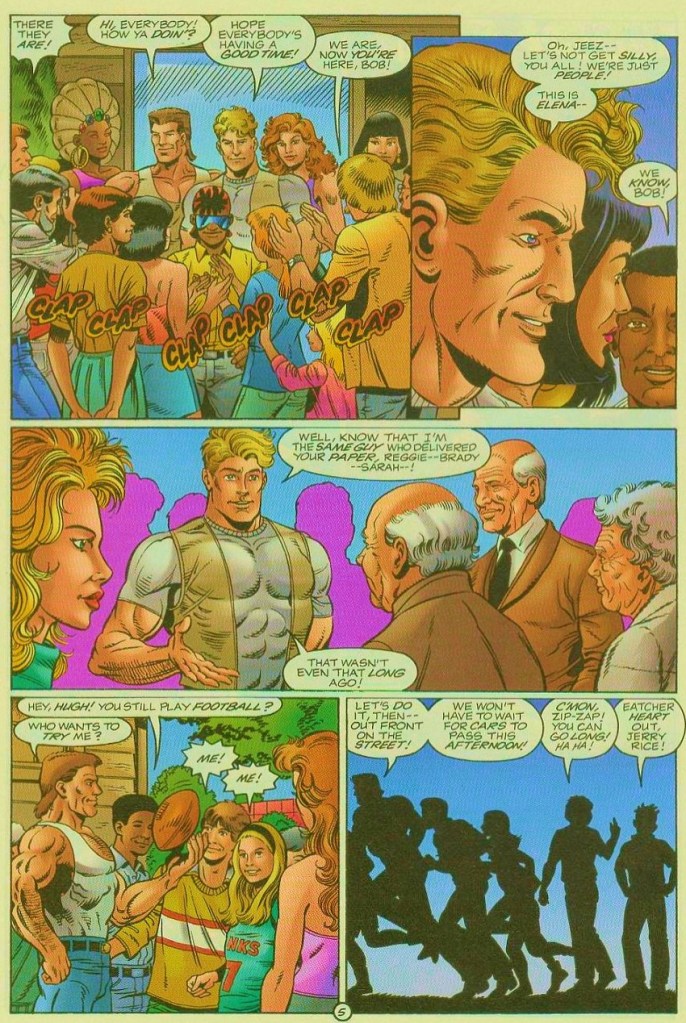
The story begins in a local community in California wherein one of the houses is hosting a block party. Already a disturbance to the neighbors (note: police officers had to temporarily close down a short stretch of the public road and restricted others from getting near), the said party offers people a chance to meet in person Atom Bob who has his teammates with him.

During a private meeting, The Strangers discuss what they encountered lately (note: this refers to their encounters with Gangsta and Brazen. Also involved was someone called the Pilgrim. As they keep talking, Lady Killer stressed that they all need to be ready for further encounters.

Meanwhile in the downtown area of the city, three costumed characters (who previously road a cable car just like The Strangers) are plotting something…

Quality

Meet the opposition.

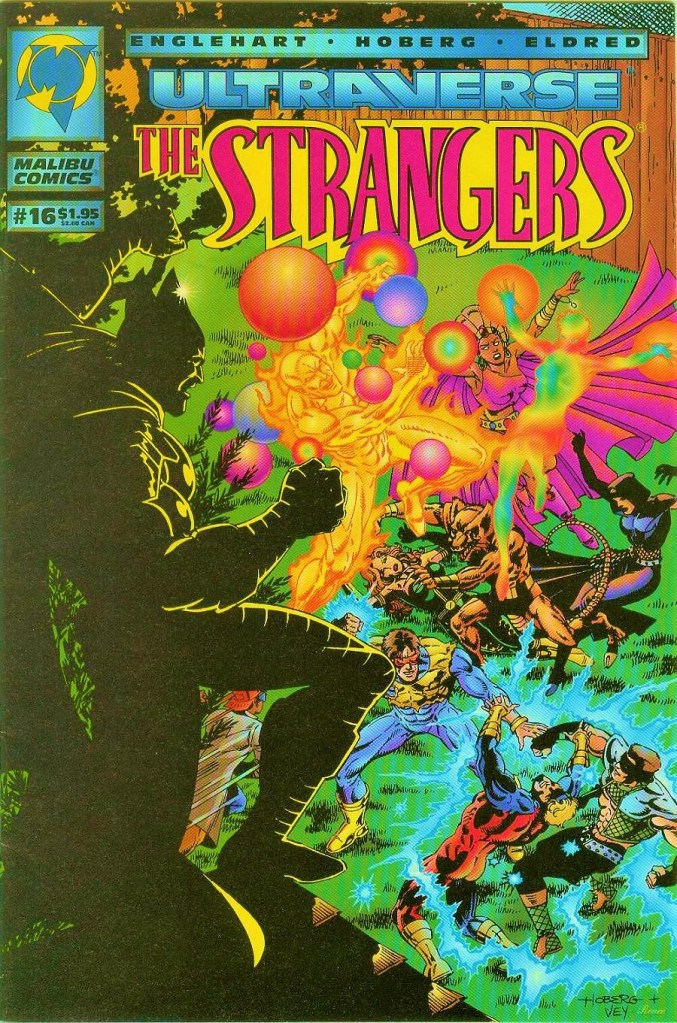
Let me start first with the art done by Rick Hoberg with ink work by Tim Eldred. I should state that since issue , Hoberg not only drew characters, places, creatures and backgrounds with his captivating style, he also maintained a high level of quality and proved he can bring any comic book script into life with images. His art is so good, this comic book is fun reading again and again. I should also state that the coloring for this story is very lively and more dream-like in style thanks to the color design by Moose Baumann and interior color by Prisms.

When it comes to the story, this comic book’s concept is pretty unique and Steve Englehart deserves credit for coming up with something fresh while still leaving room for spectacle and characterization. The idea of a block party held in the middle of a community of family homes celebrating the presence of superheroes is cool and it opened up new ways to define the characters not to mention emphasizing how their presence affects people not on the city level but on the local community! Having worked as a local community newspaper journalist myself, I know what’s it like when local communities have special activities or events that bring together (or captivate) the neighbors. Along the way, the dialogue is varied (note: lots of characters other than The Strangers had lines), the portrayal of The Strangers is consistent and the story’s pace flowed smoothly.

Speaking of characterization, there is notable focus on Atom Bob and Lady Killer who already have feelings for each other. As the home of Atom Bob’s family serves as the venue of the party, you will get to see the character interact with the local neighbors and others he personally knew for a long time which is a very refreshing way of developing him. Lady Killer meanwhile tries to maintain balance between being the team’s professional leader and having feelings for Atom Bob while trying to respect his parents.

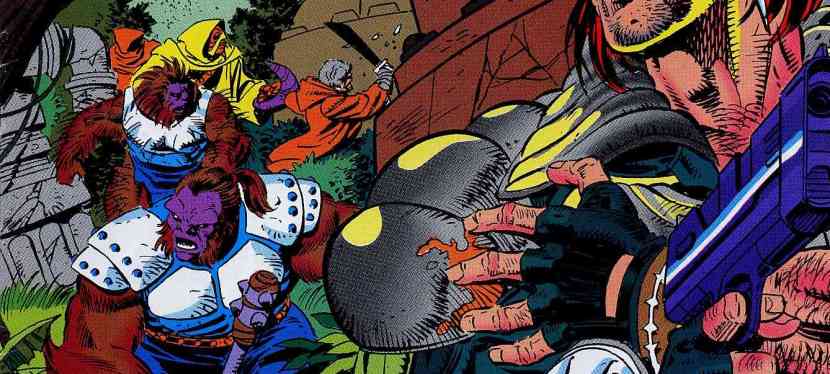
And then there is a growing group of ultras who intend to destroy The Strangers. It was at this stage in The Strangers monthly series in which a genuine opposition against the title team really started to take shape. The good news is that the Pilgrim and the other opposing ultras were not portrayed as generic bad guys but people who are struggling and have a cause.

Conclusion

The Strangers and the guests at the party.

There is no doubt that The Strangers (1994) is a whole lot of fun, very compelling and intriguing to read from start to finish. Anyone who loves the title team will find something to enjoy and follow, while those who keep on enjoying the conflict between good-and-evil will find something new and entertaining here. Steve Englehart and Rick Hoberg not only continued to deliver high-quality superhero stories with The Strangers, they really were one of the best creative duos of the 1990s.

If you are seriously planning to buy an existing hard copy of The Strangers (1994), be aware that as of this writing, MileHighComics.com shows that the near-mint copy of the comic book costs $8.

Overall, The Strangers (1994) is highly recommended!

+++++

Thank you for reading. If you find this article engaging, please click the like button below and also please consider sharing this article to others. If you are looking for a copywriter to create content for your special project or business, check out my services and my portfolio. Feel free to contact me as well. Also please feel free to visit my Facebook page Author Carlo Carrasco and follow me at HavenorFantasy@twitter.com
A Look Back at Ravage 2099 #2 (1993)

Disclaimer: This is my original work with details sourced from reading the comic book and doing personal research. Anyone who wants to use this article, in part or in whole, needs to secure first my permission and agree to cite me as the source and author. Let it be known that any unauthorized use of this article will constrain the author to pursue the remedies under R.A. No. 8293, the Revised Penal Code, and/or all applicable legal actions under the laws of the Philippines.

Over a year ago, I reviewed Ravage 2099 #1 (1992) which marked the return of the late Stan Lee on writing stories for a monthly series. Unlike the main heroes of the 2099 universe of the time, Ravage was created by Stan Lee and illustrator Paul Ryan as an original character although he ended up being generic. In my review of the 1st issue of the Ravage 2099 series, I declared that the comic book itself was worth buying way below its original cover price.

Of course, it is understood that, apart from Stan Lee’s outdated style of writing, the debut issue is difficult to make because a lot of explaining (via expository dialogue most of the time) the concept had to be done which causes an imbalance between storytelling, character development and spectacle. That being said, it is time to find out if the Stan Lee-Paul Ryan creative team managed to improve their work together in this look back at Ravage 2099 published in 1993 by Marvel Comics.

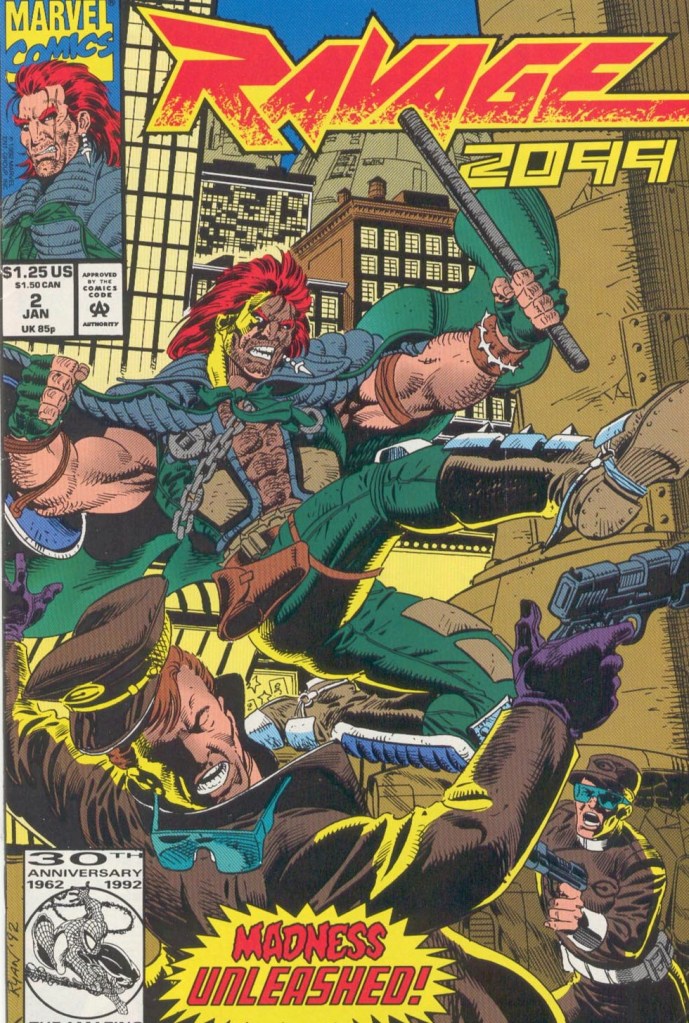
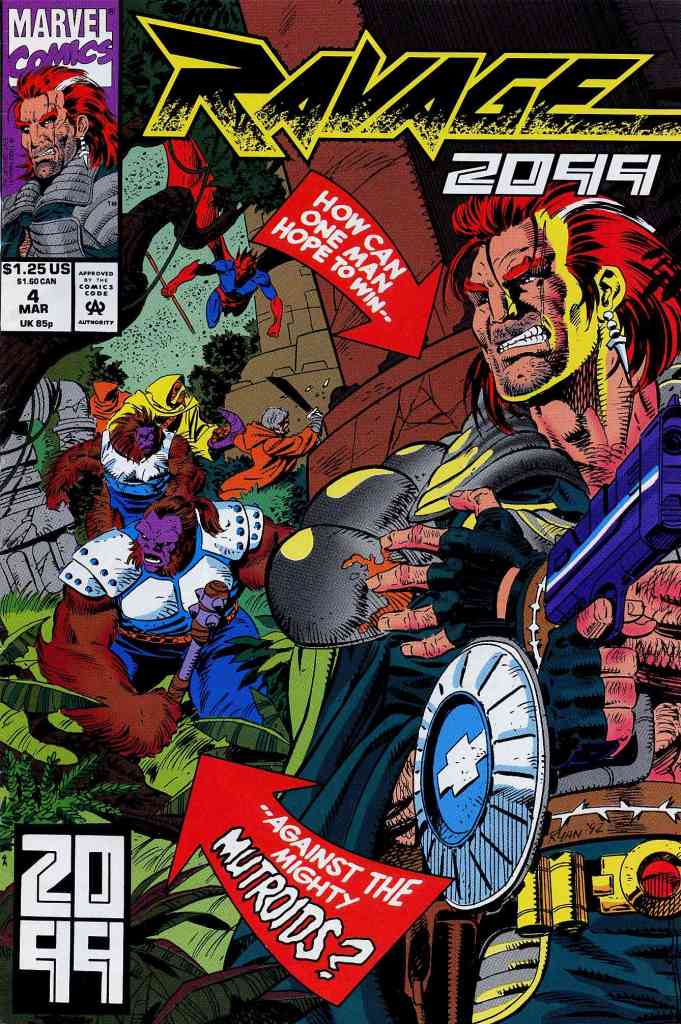
The cover.

Early story

The story begins in the dreaded place called Hellrock. A deformed being named Stormer tries to convince his fellow mutroids to make him their new leader as he believes that current leader Deathstryk is weak and afraid. Soon enough, Dethstryk personally arrives surprising everyone, including Stormer.

After hearing Dethstryk make statements about his temper tantrum and slaying of a fellow mutroid, Stormer attacks him suddenly. In front of many mutroids, Dethstryk easily overpowers Stormer as he lectures him about leadership and strategy. After being offered mercy, Stormer then submits to Dethstryke who in turn declares that their goal is to make the extinction of the human race happen.

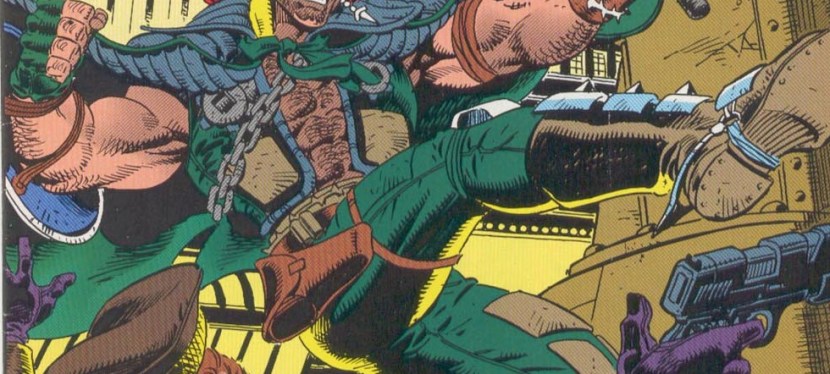
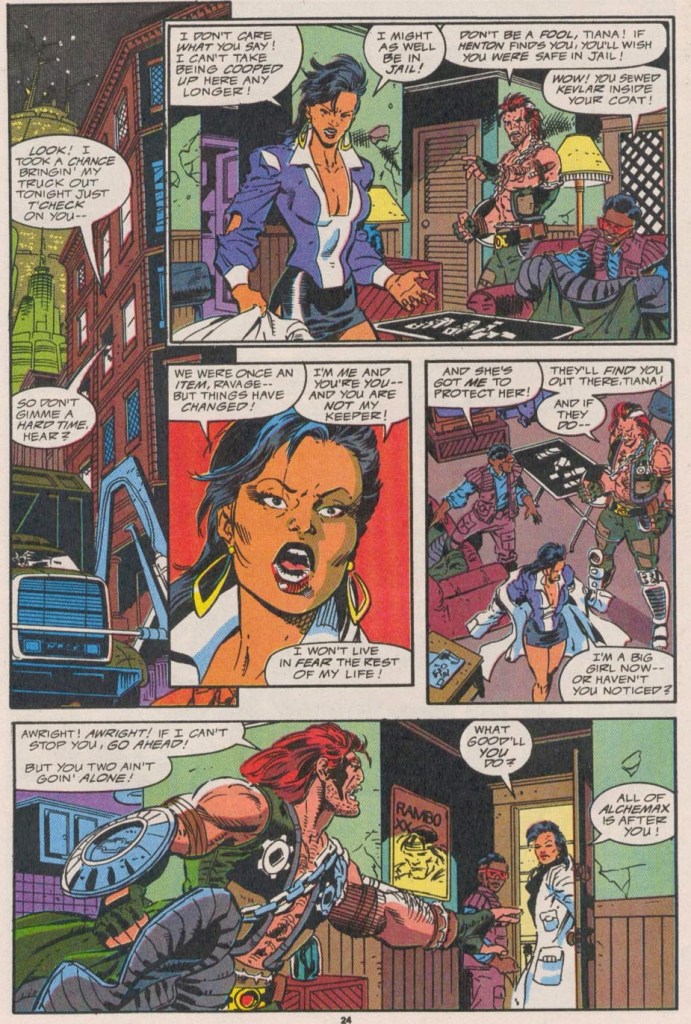
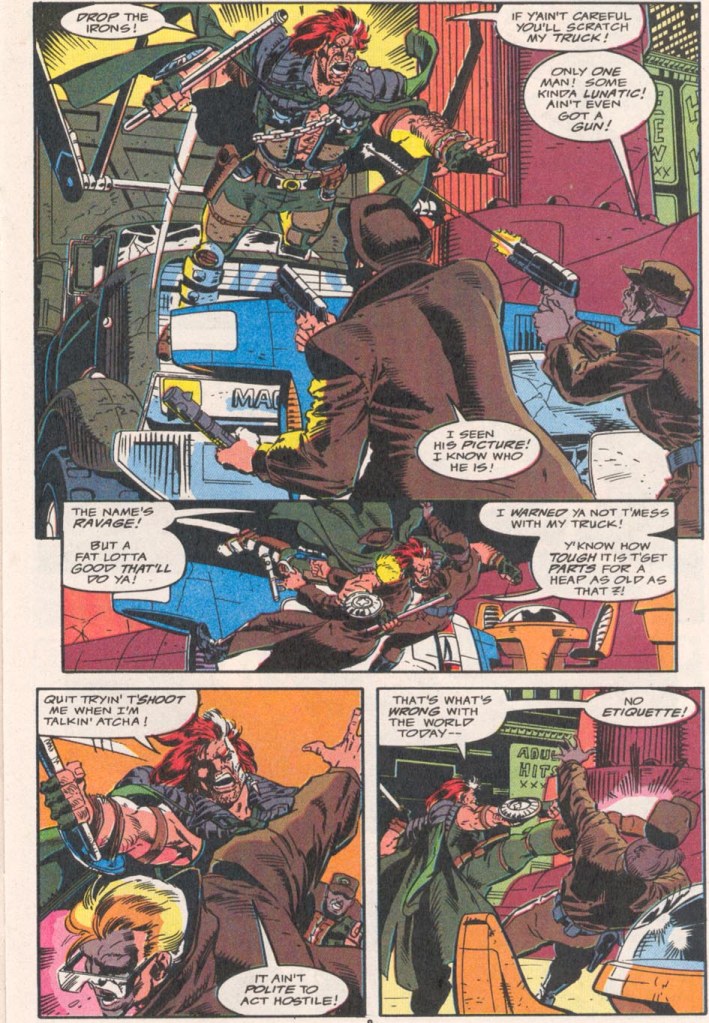
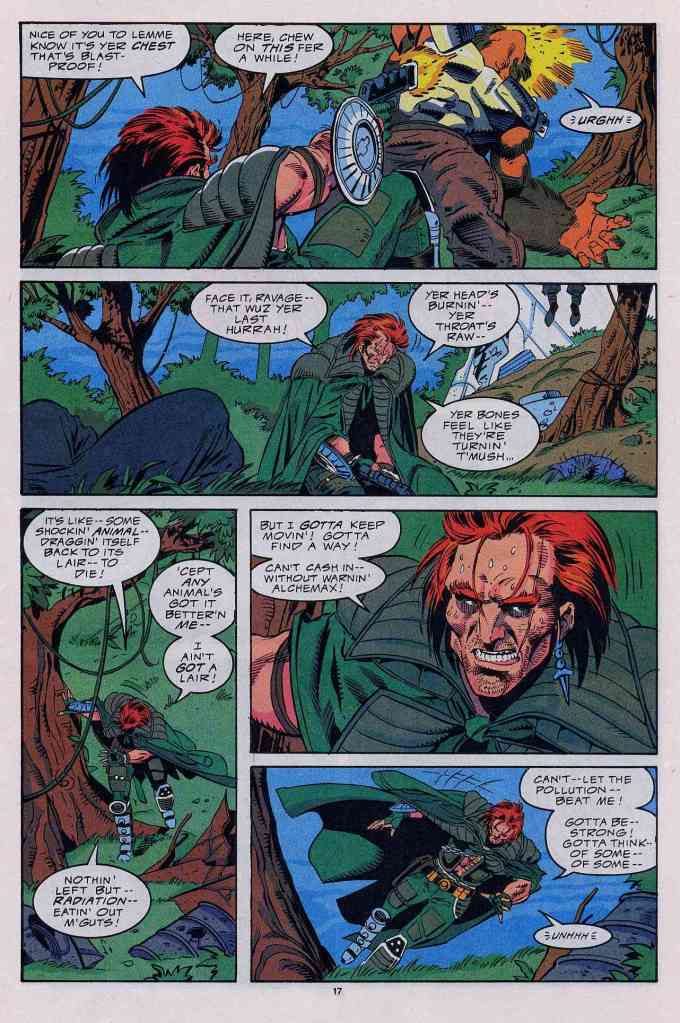
Deep in the middle of the metropolis, Ravage drives a very old, fossil fuel truck and rams a law enforcement car with it causing two officers to react and draw their guns. Ravage leaps into action and beats the two officers in brutal fashion. Afterwards, he goes on to raid the car of its equipment…

Quality

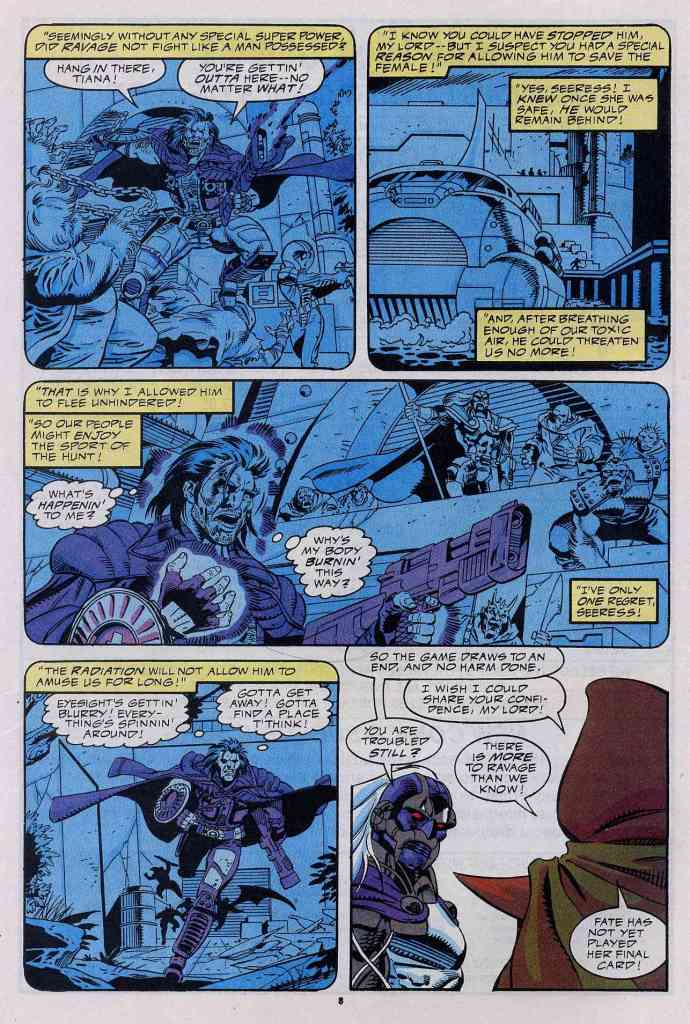
Ravage only acts human with his friends.

I’ll start with the storytelling here. With the fact that there is much less creative baggage remaining since the exposition has been done in the first issue, this comic book’s pacing and overall structure showed some improvements. Not only will you see more of Ravage doing action and really starting out as a vigilante, you will also discover more of the core concept through the exposition focused more on the side of Dethstryk as the villain’s seeress informs him that Ravage is destined to be his nemesis.

What bogs this comic book down is the style of writing by Stan Lee which clearly lacks engagement and the presentation here has a lot in common with comic book storytelling of the 1960s and 1970s. That being said, the corporate intrigue Lee tried to sow here also suffered and the other villain Anderthorpe Henton just looks and acts cartoony.

If there is anything notable that Stan Lee did with writing, it’s the consistency he showed on presenting Ravage as being more antagonistic than a heroic lead figure. If you look closely at what he did to the law enforcers, the armed city security personnel and the punks who encountered him, you will realize that Ravage is actually a menace to society and his humanity is deteriorating. He only acts human when he is with his sexualized former assistant Tiana and Dack.

With regards to the visuals, Paul Ryan’s work here is decent. His style is not that great but I like the effort he exerted on presenting future technology and clearly he took some inspiration from other sci-fi works to give this comic book a distinctive look.

Conclusion

Anyone who despises law enforcers will most likely find this enjoyable. The spirit of rebellion really stinks!

Ravage 2099 (1993), to say it bluntly, is a marginal improvement over its predecessor mainly due to the reduced amount of creative baggage. Exposition in this particular comic book is much lesser in terms of content and it is done efficiently which paved the way for more spectacle to happen. The problems here is that, apart from Stan Lee’s weak writing, there was no real effort to develop the lead character Ravage. I suppose this was intentionally done by the creators to let Ravage be more of an action figure and let the action do the talking about what defines him as a person. Even if that was the case, nothing changes the fact that Ravage here is not heroic and is in fact more antagonistic towards society. Is it any wonder why Ravage ended up as Stan Lee’s failure?

If you are seriously planning to buy an existing hard copy of Ravage 2099 (1993), be aware that as of this writing, MileHighComics.com shows that the near-mint copy of the regular edition costs $8 while the near-mint copy of the newsstand edition costs $26.

Overall, Ravage 2099 (1993) is not recommended. If you really want to buy this comic book at all, better not pay more than fifty cents for it.

+++++

Thank you for reading. If you find this article engaging, please click the like button below and also please consider sharing this article to others. If you are looking for a copywriter to create content for your special project or business, check out my services and my portfolio. Feel free to contact me as well. Also please feel free to visit my Facebook page Author Carlo Carrasco and follow me at HavenorFantasy@twitter.com
A Look Back at X-Men #25 (1993)

Disclaimer: This is my original work with details sourced from reading the comic book and doing personal research. Anyone who wants to use this article, in part or in whole, needs to secure first my permission and agree to cite me as the source and author. Let it be known that any unauthorized use of this article will constrain the author to pursue the remedies under R.A. No. 8293, the Revised Penal Code, and/or all applicable legal actions under the laws of the Philippines.

As an X-Men fan, 1993 was a memorable year for me during my time of collecting comic books and enjoying what was believed to be the modernization of superhero comics in America. Gimmick covers of comic books, the post-event effects of the Death of Superman, the launch of the Ultraverse and then there was the 30th anniversary celebration of the X-Men which was wild.

To put things in perspective, Marvel Comics organized the celebration of the 30th anniversary of Spider-Man releasing lots of merchandise and, most notably, special issues of comic books that came with covers with holograms, more pages for content and a cover price that was more than double than what was normal (note: read my review of one of them). Such comic books were hot stuff for not only Spider-Man fans but also comic collectors who were often hunting for the next great collector’s item that would ensure them great wealth.

Marvel had the same business approach with the 30th anniversary of the X-Men, and there were multiple X-Men-related monthly series of comic book back then. X-Factor , X-Force , Uncanny X-Men , Wolverine and Excalibur all were released with covers with hologram cards on the front, more pages of content and inflated cover prices.

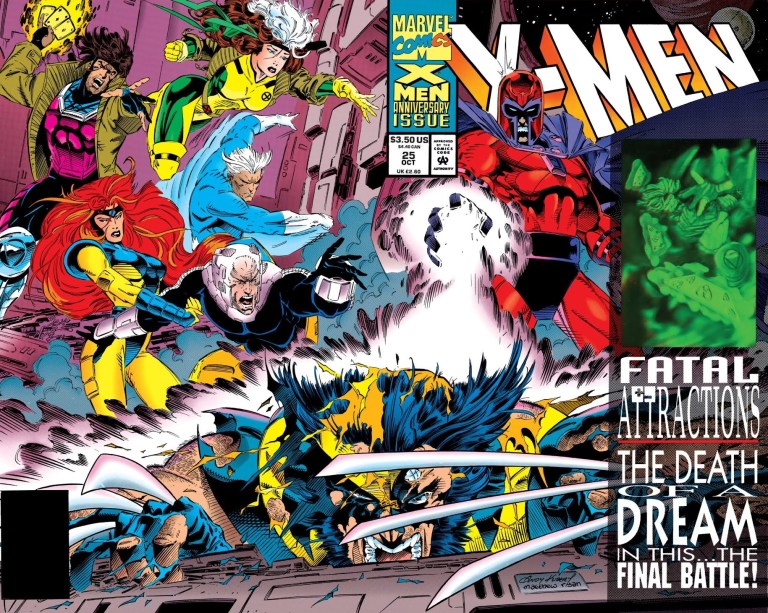
The one 30th anniversary celebration comic book of the X-Men that was most memorable to me was X-Men (Volume 2) and to this day, its plot remains very memorable for its shock value. I bought my copy of this comic book at a store in BF Homes. With the history lesson over, he is my retro review of X-Men , published in 1993 by Marvel Comics with a story written by Fabian Nicieza and drawn by Andy Kubert.

The cover.

Early story

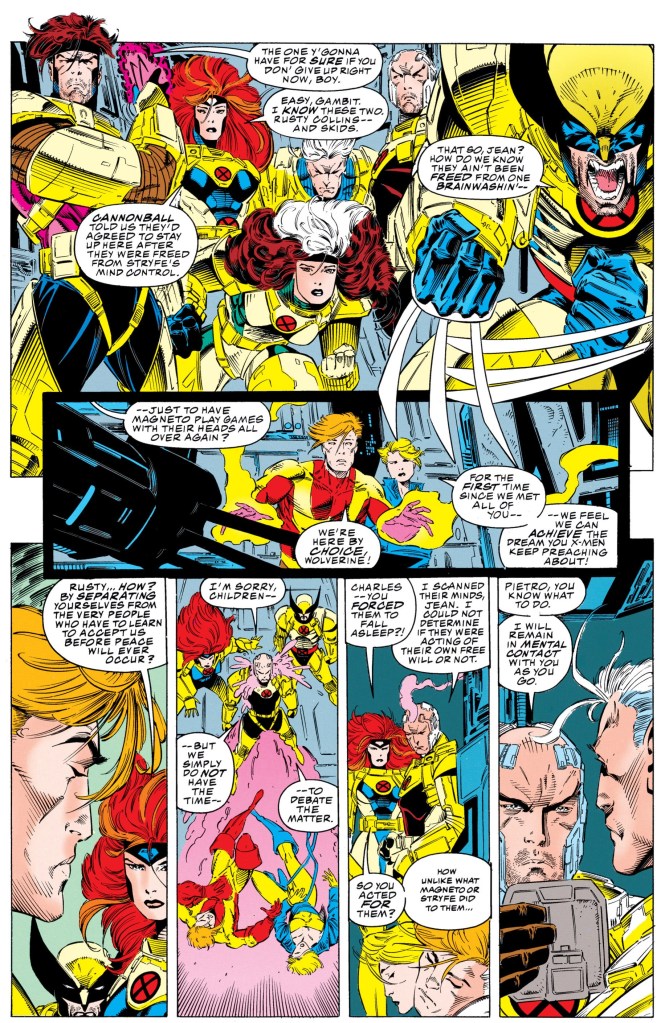
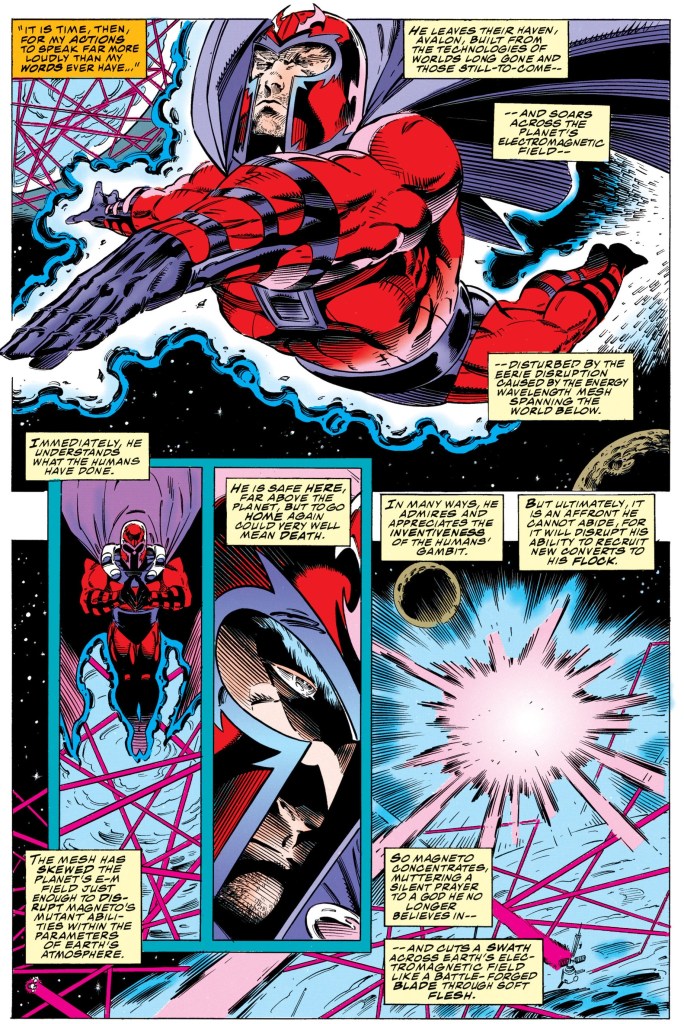
The story begins with the United Nations Security Council’s approval to initiate the alpha and beta parameters of the Magneto Protocols which literally sent waves from the White House to the Kremlin. A short time later, several satellites orbiting the Earth activate and linked with each other to form a protective mesh of electro-magnetic fire. This provokes Magneto (accompanied by Acolytes and Exodus at Avalon) to react by generating a massive pulse wave that affects the entire world. Even the Fantastic Four and Excalibur were not spared.

At the School of Gifted Children, Charles Xavier organizes an urgent meeting with the X-Men. Together they discussed the impact of Magneto’s pulse wave which not only rendered world’s mechanical and technological resources useless but also caused trouble (plane crashes, medical equipment failure, etc.) and deaths. For Xavier, the mere fact their team survived (aided by Shi’ar technology) is a mistake on the part of Magneto considering his capability to wipe out life around the world.

In response to Wolverine’s question, Xavier stated, “We do not have the luxury of time, nor the occasion for nobility…at this point, we are not fighting for the philosophy of a cause, a hope, or a dream, we are fighting for our very survival and if we do not win this fight, this planet will be irrevocably lost to us!”

Quality

The X-Men during their daring mission.

I can clearly declare that when it comes to the combined works done by Fabian Nicieza and Andy Kubert with the X-Men, this particularly story was not only the most ambitious collaboration of theirs but also their most compelling and finest work at the time of publishing. Very strong writing (top-notch characterization, plotting and pacing) and great art really defined this comic book!

Characterization is spot-on! Wolverine is arrogant and gritty as usual, Gambit is still the smooth-talker, Cyclops is the focused leader serving under Xavier, etc.

Without spoiling the major details, I can say that the shocking moments executed were greatly done not for the mere intention of shocking but to break new ground with regards to the characters of Wolverine and Charles Xavier. The first time I read this comic book back in 1993, I was really stunned with those particular scenes and I started to question Wolverine’s durability as well as Xavier’s sanity. And then there was the state of Magneto at the end of the story. The thing about the shocking moments was that there was an adequate amount of build-up leading to them and the pay-off was excellently done.

Conclusion

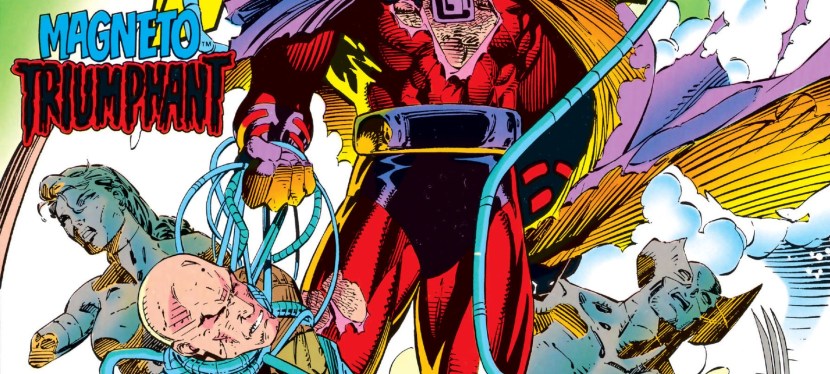
The immense power of Magneto.

There is no doubt in my mind that X-Men (1993) is the true gem of the entire X-Men 30th anniversary celebration. The creative team led by Nicieza and Kubert really outdid themselves and what happened in this comic book had consequences that lasted for a good number of years. The creative team took big risks and pulled them off nicely as the impact of the story was eventually felt in the years that followed. Lastly, unlike Uncanny X-Men (supposed to be the highlight of X-Men’s 30th anniversary celebration), this comic book is more focused and really had no creative baggage nor filler that got in the way of the storytelling.

If you are seriously planning to buy an existing hard copy of X-Men (1993), be aware that as of this writing, MileHighComics.com shows that the near-mint copy of the regular edition costs $50 while the near-mint copy of the newsstand edition is priced at $150. The near-mint copies of the signed-and-numbered edition and the gold edition cost $210 and $368 respectively.

Overall, X-Men (1993) is highly recommended!

+++++

Thank you for reading. If you find this article engaging, please click the like button below and also please consider sharing this article to others. If you are looking for a copywriter to create content for your special project or business, check out my services and my portfolio. Feel free to contact me as well. Also please feel free to visit my Facebook page Author Carlo Carrasco and follow me at HavenorFantasy@twitter.com
A Look Back at X-Men #8 (1992)

Disclaimer: This is my original work with details sourced from reading the comic book and doing personal research. Anyone who wants to use this article, in part or in whole, needs to secure first my permission and agree to cite me as the source and author. Let it be known that any unauthorized use of this article will constrain the author to pursue the remedies under R.A. No. 8293, the Revised Penal Code, and/or all applicable legal actions under the laws of the Philippines.

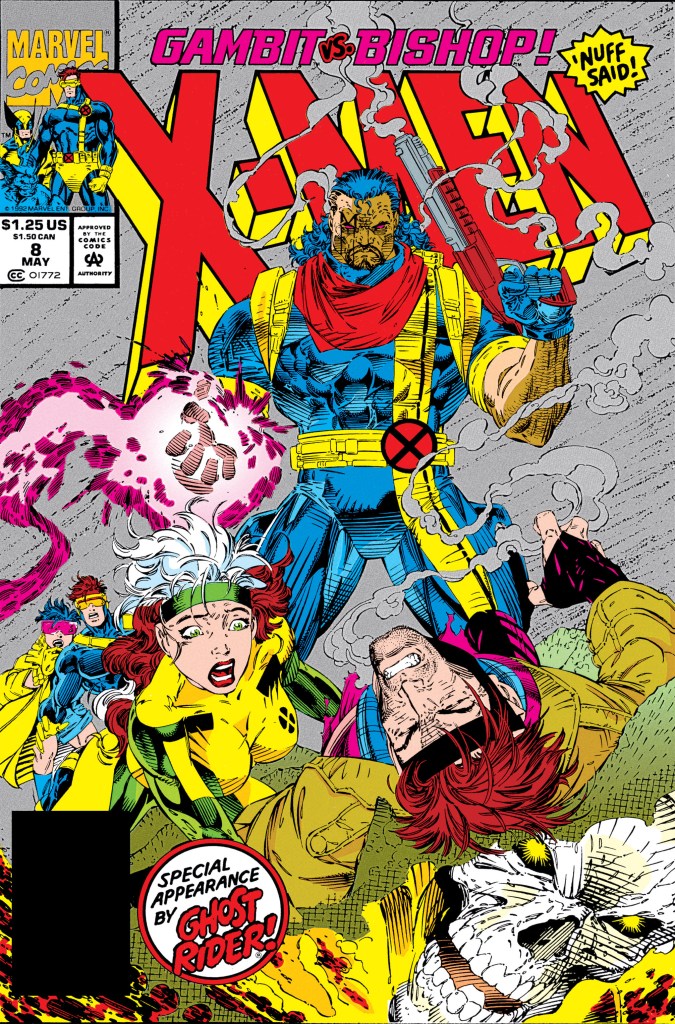
Do you remember the X-Men animated TV series episode – an adaptation of Days of Future Past – wherein Bishop (who came from the dark future) claimed that Gambit would betray the X-Men and lead them all to darkness? You will see Bishop and Gambit in conflict in this retro review of a Jim Lee-drawn X-Men comic book from the 1990s.

To put things in perspective, back in 1991 Bishop was formally introduced in the Uncanny X-Men monthly series. By that time, Gambit was already wildly popular with X-Men fans. It made sense back then to have the two conflict each other in comic book format as it would add variety and some freshness with the X-Men franchise of the time.

With the short history lesson over, here is a look back at X-Men , published in 1992 by Marvel Comics with a story done by Jim Lee and Scott Lobdell. The art was handled by Lee and Art Thibert.

The cover.

Early story

The story begins at the X-Men’s headquarters with Wolverine using the computer to gain access into something until he got interrupted by Jubilee who is accompanied by Cyclops. She tells him that Charles Xavier is about to introduce Bishop to their teammates. Wolverine tells them to go away.

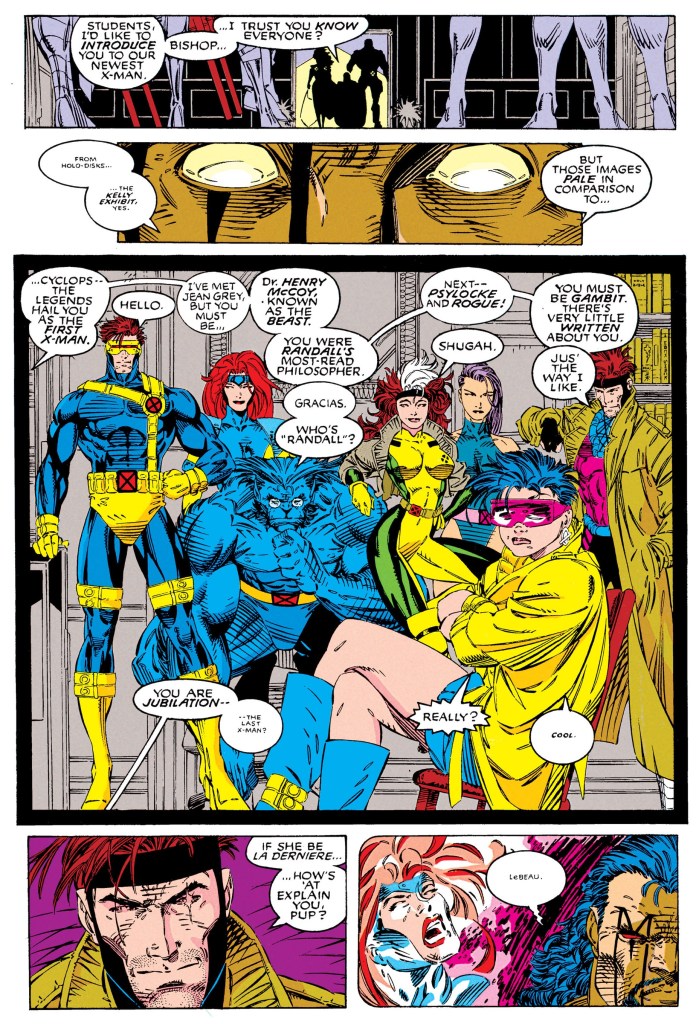
At the mansion, Storm welcomes Bishop in the presence of Xavier who explains to her that the newcomer is from the far future. Slowly Xavier and Storm guide Bishop around the mansion and introduce him to their members. Bishop, who still remembers the legends of the X-Men from his time in the far future, referred to Forge as Genesis. Moments later, Bishop meets Cyclops, Jean Grey, Beast, Rogue, Psylocke, Jubilee and Gambit.

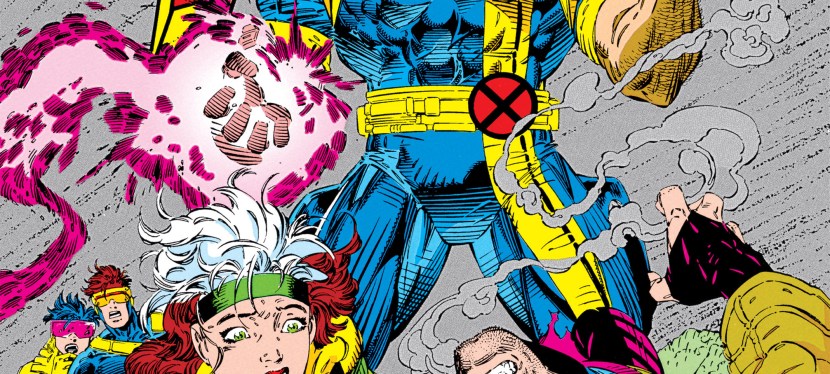
After expressing that there was little know about Gambit, Bishop then claims that a certain someone was the last person to see the X-Men alive before they got betrayed by one of their own. Bishop then tells Xavier to scan Gambit’s thoughts…

Quality

The interaction between Storm and Bishop is great!

What really defines this comic book apart from having art by Jim Lee and the lack of villains are the storytelling and characterization. The good news is that the respective qualities of the plotting (by Lee) and scripting (by Lobdell) were very solid. While there is a lack of a good-versus-evil plot element, characterization alone made this an engaging comic book to read. Without spoiling the plot, the story has a lot more than the promised Bishop-Gambit conflict (I’ll describe it as a short yet sweet part of the story). I also love the big twist that happened in the 2nd half of the story.

More on characterization, I love the fact that Gambit got more developed here complete with a few threads from his past that got visualized efficiently. I also enjoyed the interactions between Gold Team leader Storm and Bishop. Bishop comes from a future filled with violence and desperation which explains why he is always on the edge often thinking of action whenever something happens. Storm meanwhile tried hard to explain to Bishop that their present day society is more peaceful and that he could take things a bit easier, be more reasonable and try to level with others as he became a new part of the X-Men.

As for Jim Lee’s art, his work here is really beautiful to look at which is not surprising at all. As expected, he made the action scenes look dynamic and managed to draw some emotions from certain characters in key scenes.

Conclusion

Bishop meeting the X-Men.

X-Men (1992) is a pretty good comic book to read. At the time of its publication, the integration of Bishop into the X-Men was done months after Chris Claremont’s departure and was clearly an effort by the X-Men creators to modernize the superhero team and keep it fresh. This comic book is not exactly a landmark read but it is pretty entertaining and engaging.

If you are seriously planning to buy an existing hard copy of X-Men (1992), be aware that as of this writing, MileHighComics.com shows that the near-mint copy of the regular edition costs $50 while the near-mint copy of the newsstand edition costs $150.

Overall, X-Men (1992) is recommended.

+++++

Thank you for reading. If you find this article engaging, please click the like button below and also please consider sharing this article to others. If you are looking for a copywriter to create content for your special project or business, check out my services and my portfolio. Feel free to contact me as well. Also please feel free to visit my Facebook page Author Carlo Carrasco and follow me at HavenorFantasy@twitter.com

A Look Back at Prime #12 (1994)

Disclaimer: This is my original work with details sourced from reading the comic book and doing personal research. Anyone who wants to use this article, in part or in whole, needs to secure first my permission and agree to cite me as the source and author. Let it be known that any unauthorized use of this article will constrain the author to pursue the remedies under R.A. No. 8293, the Revised Penal Code, and/or all applicable legal actions under the laws of the Philippines.

Hey Ultraverse fans and superhero comic book enthusiasts! Are you ready for another tale of Prime? What I am about to review is one of the anniversary Ultraverse issues published by Malibu Comics.

What could be new or special to justify the anniversary of the Prime monthly series? We can all find out in this look back at Prime , published by Malibu Comics with a story written by Len Strazweski and Gerard Jones, and drawn by the late Norm Breyfogle.

The cover.

Early story

The story begins with a young guy named Kuttner who tests his deadly ability to easily cut through solid objects with his powered blades on his hands. He is driven to get revenge against Prime who broke his hand previously. Kuttner, whose career in entertainment had declined, thinks he can establish a new career for himself as a powered being and Prime is his first target.

Meanwhile at school, Kevin Green (Prime) is struggling with the stress over his parents’ separation which he is guilty of. He finds it very weird to be back in school after everything he went through such as his struggles with Colonel Samuels, the Federal Government, Break-Thru and more. After slamming his locker shut, students begin to move away from him…

Quality

Symbolically, Prime meets Norm Breyfogle.

To begin with, the writing by Len Strazewski and Gerard Jones is very solid as expected. That being said, the real heart of the story in this comic book is Kevin Green’s personal struggle with life not just with the difficulty of balancing himself between his personal life and being a superhero, but also his place in local society being tainted as a result of his acts as Prime. The way that the events of the previous issues affected (in negative ways) the local community’s perception of Kevin was very compelling and straight to the point.

The strong writing, unsurprisingly, worked very well with the character development. Kevin was presented to be struggling with making the right decisions and he struggles to analyze what would happen if he presents himself to others as Prime or as simply himself. As for the scene between Prime and Kelly’s mother, there was that touch of awkwardness (through Prime) that was present as the scene raised the disturbing idea of the two possibly getting involved sexually.

When it comes to the spectacle of action, there is little to be seen here but the good news is that Norm Breyfogle illustrated them to be energetic and eye-catching. The late illustrator really knew hot to ramp up the energy for the readers making the most out of what it is limited.

Conclusion

The tremendous strength of Prime!

Prime is a pretty engaging read. Was it worth the anniversary promotion? It is indeed! If you look back at Prime and read all the succeeding issues leading to this one, you will notice how much Kevin Green changed as well as how his personal growth moved. In a way, Prime symbolizes the growing-up pains Kevin keeps on having.

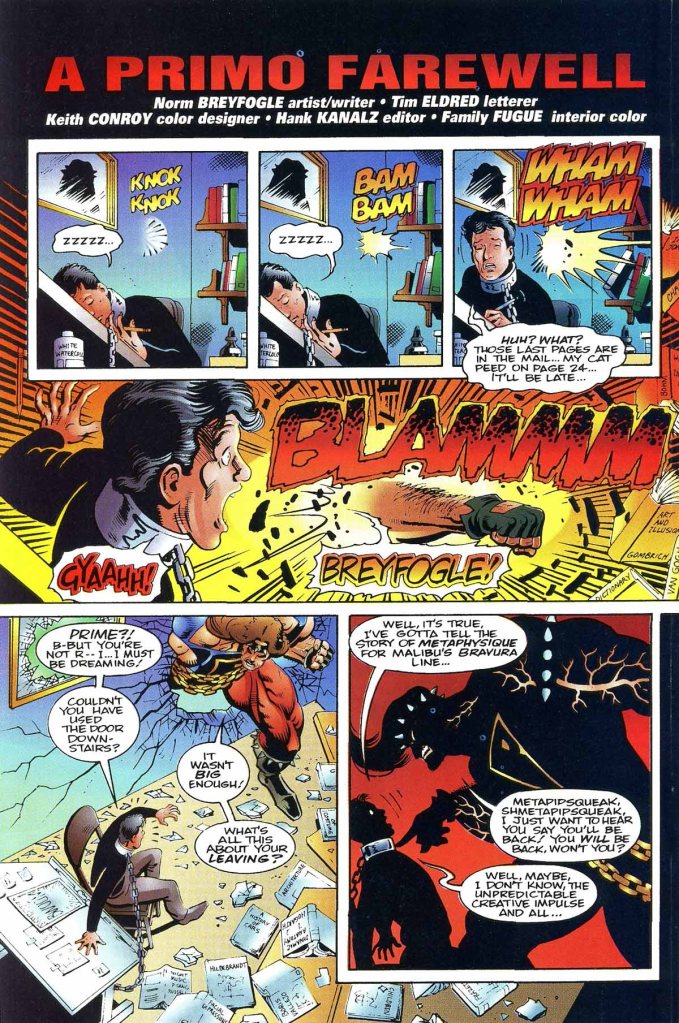
It should be stated that being 64-pages, Prime is actually one of Malibu’s flip issues. The other side of this comic book is Ultraverse Premiere which contains standalone short stories of Prime, War Strike and a certain villain. This comic book also has “A Primo Farewell” which is a nice tribute (by today’s standards) to Norm Breyfogle. For the newcomers reading this, Breyfogle was one of outstanding comic book artists in America and before joining Malibu Comics, he worked for other publishers like Marvel Comics, DC Comics, Eclipse Comics and First Comics. At DC Comics, his work on their icon Batman is widely remembered. Breyfogle passed away in 2018.

If you are seriously planning to buy an existing hard copy of Prime (1994), be aware that as of this writing, MileHighComics.com shows that the near-mint copy of the comic book costs $8.

Overall, Prime (1994) is highly recommended!

+++++

Thank you for reading. If you find this article engaging, please click the like button below and also please consider sharing this article to others. If you are looking for a copywriter to create content for your special project or business, check out my services and my portfolio. Feel free to contact me as well. Also please feel free to visit my Facebook page Author Carlo Carrasco and follow me at HavenorFantasy@twitter.com

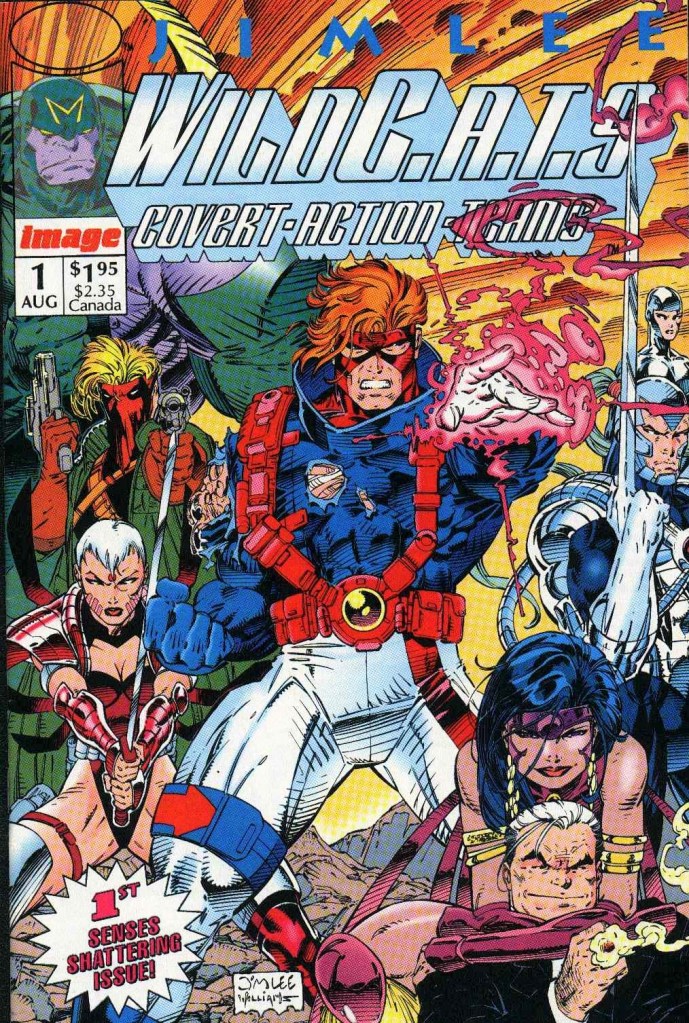
A Look Back at WildC.A.T.s: Covert Action Teams #1 (1992)

Disclaimer: This is my original work with details sourced from reading the comic book and doing personal research. Anyone who wants to use this article, in part or in whole, needs to secure first my permission and agree to cite me as the source and author. Let it be known that any unauthorized use of this article will constrain the author to pursue the remedies under R.A. No. 8293, the Revised Penal Code, and/or all applicable legal actions under the laws of the Philippines.

Before he became the co-publisher of DC Comics, the great Jim Lee made his debut in the comic book industry as an illustrator for Marvel Comics. Just a few short years after that, he became a fan-favorite of X-Men fans and was a major factor in the massive sales success of 1991’s X-Men #1 (Volume 2). Not only did that particular comic book established a long-lasting sales record for all comic books, Lee’s designs and visual concepts for the X-Men were adapted by the producers and creators of the fan-favorite X-Men: The Animated Series (1992-1997).

For the newcomers reading this, Jim Lee’s tenure with Marvel Comics ended in December 1991 when he, Rob Liefeld and Todd McFarlane met with the publisher and expressed that Marvel’s policies toward them were unfair and they were not rewarded well for their work. To put things in perspective, Jim Lee’s X-Men , Rob Liefeld’s X-Force and Todd McFarlane’s Spider-Man were respectively million-sellers. As such, Lee, Liefeld, McFarlane plus some more creators left Marvel and went on to establish Image Comics (which involved a production and distribution deal with Malibu Comics).

In 1992, Jim Lee’s dream project – with concepts first created in 1986 – came through free from the constraints he endured from Marvel’s editorial team and strict policies. That’s dream project was WildC.A.T.s: Covert Action Teams , which is the feature of this retro comic book review.

But before we start the review, here’s a quick look back at the conceptual history of WildC.A.T.s as written by Jim Lee himself.

“I created my first ‘professional’ comic book submission in the summer of 1986 entitled The Wild Boys involving an espionage agency called International Operations. The co-writer of that sublime piece of work was coincidentally enough – Brandon Choi – who at the time was still in college getting a double major in history and politics,” Lee wrote in the comic book’s intro.

Now that we’re done with the history, here is a look back at WildC.A.T.s: Covert Action Teams , published in 1992 through Image Comics with a story co-written by Jim Lee and Brandon Choi. Lee illustrated the comic book with ink work done by Scott Williams.

The cover.

Early story

The story begins in Antarctica in 1986. There, two men braved the cold weather searching for something with information they learned from IO (International Operations). Suddenly an orb rises from the snow and then an image of a lady wearing silver tights and wielding energy appears in front of them. After demanding them to let her have the orb, she and the energy field fade away.

In 1992, at the crisis control facility of IO in Virginia, IO’s executives carefully view video footage of Georgetown which was hit by an explosion. They suspect rogue C.A.T.s (covert action teams) could have been involved. Suddenly, the same energy field from six years earlier forms in their presence with the same lady appearing for a few moments. The energy field fades away.

In the present day, a dwarf named Jacob Marlowe wakes up in the middle of garbage in an alley. After getting hurt by two troublemakers, the same silver lady from the past appears and uses her energetic power to save Jacob. She introduces her to him as Void, claiming he came for him and she knows he was once a lord named Emp. She tells him the Cabal is a threat to humans on Earth…

Quality

Clearly Jim Lee took inspiration from John Woo’s action movies.

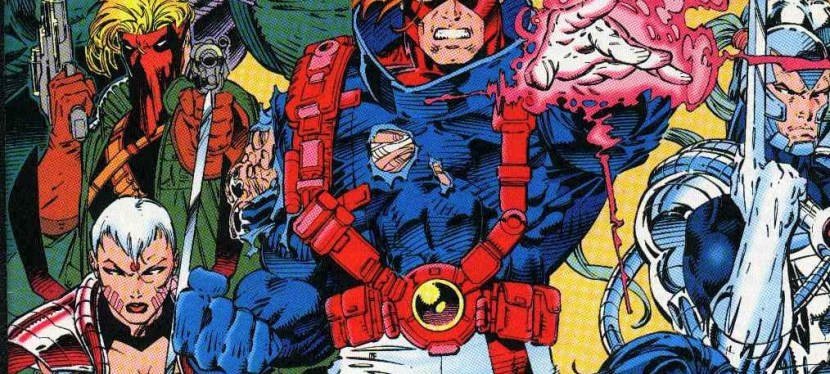
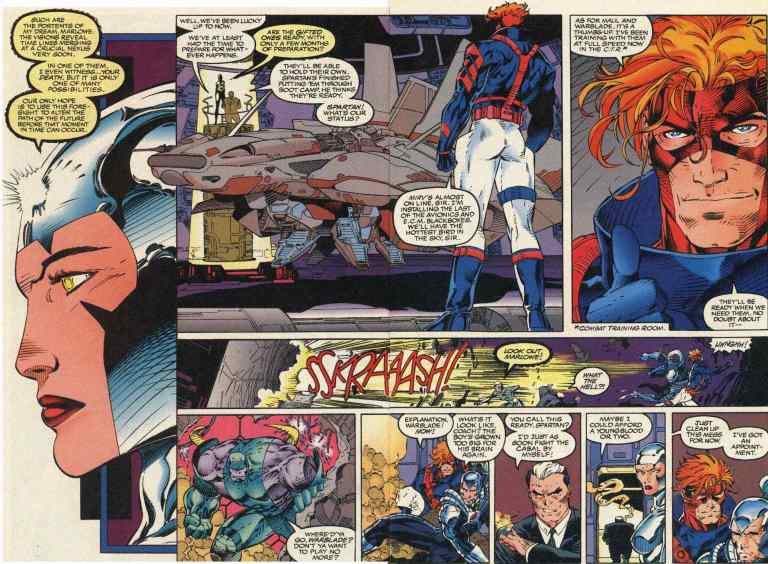
When it comes to the presentation of the story, the comic book starts in a deliberately cryptic way. It’s like having very short prologues back to back and, fortunately, it works well to capture attention while building up slowly its concept. The story really begins when Jacob Marlowe arrives at his headquarters with Void as his enduring advisor and executor. The introductions of each of the team’s members – Spartan, Warblade, Maul, Grifter, Zealot and Voodoo – were decently done and never felt rushed as Jim Lee and Brandon Choi carefully paced the storytelling and really tried to balance exposition and spectacle. That being said, similar results happened with regards to the comic book’s spotlight on the Cabal and its evil leader.

With regards to the presentation of the classic conflict between good and evil, Lee and Choi came up with the concept of planet Earth being slowly infiltrated by Daemonites (who originated in outer space) with the Cabal serving like an anchor with an organized set-up for domination. Over at the WildC.A.T.s, Marlowe formed a team to fight and stop the Cabal since the lives of the people of Earth are at stake. This is a really nice concept serving as the foundation, and the irony is that, in this comic book specifically, IO was on the sideline.

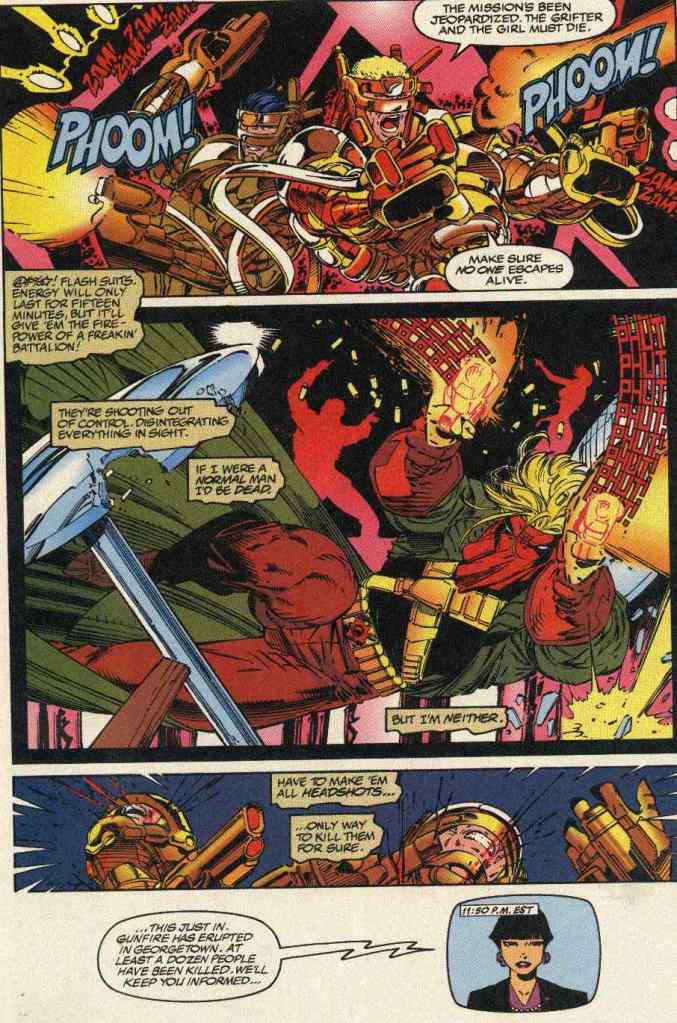
When it comes to the visuals, Jim Lee must have enjoyed the liberty he had in illustrating this comic book…free from the editorial interference from Marvel and free too from the restrictions of the Comics Code Authority (CCA). The result here is a visual presentation showing more Lee’s creativity and a style different somewhat from his final works on X-Men. He clearly took more inspiration from action movies and the violence is somewhat more mature to look at. It should be noted that Scott Williams helped Lee’s art shine.

Conclusion

These two pages remind me somewhat of the X-Men, their jet and the Danger Room.

By today’s standards, WildC.A.T.s: Covert Action Teams is surprisingly still a good superhero team comic book to read. It’s not a literary classic but it proved to be compelling and fun enough to read from start to finish. It has a decent amount of action here and there which is understandable since Choi and Lee had to build up the concepts and the plot. If there were any weak spots, this comic book is almost devoid of character development and the clear lack of a lead character (which is still needed even for a superhero team comic book).

If you are seriously planning to buy an existing hard copy of WildC.A.T.s: Covert Action Teams (1992), be aware that as of this writing, MileHighComics.com shows that the near-mint copy of the regular edition costs $5 while the near-mint copy of the newsstand edition is priced at $16. The near-mint copy of the 3D edition costs $9 while the near-mint copy of the gold cover edition is priced at $42.

Overall, WildC.A.T.s: Covert Action Teams (1992) is recommended.

+++++

Thank you for reading. If you find this article engaging, please click the like button below and also please consider sharing this article to others. If you are looking for a copywriter to create content for your special project or business, check out my services and my portfolio. Feel free to contact me as well. Also please feel free to visit my Facebook page Author Carlo Carrasco and follow me at HavenorFantasy@twitter.com

A Look Back at X-Men Adventures #3 (1993)

Disclaimer: This is my original work with details sourced from reading the comic book and doing personal research. Anyone who wants to use this article, in part or in whole, needs to secure first my permission and agree to cite me as the source and author. Let it be known that any unauthorized use of this article will constrain the author to pursue the remedies under R.A. No. 8293, the Revised Penal Code, and/or all applicable legal actions under the laws of the Philippines.

Who is the most definitive X-Men villain ever? That is none other than Magneto! Co-created by Stan Lee and Jack Kirby, Magneto made his literary debut alongside Marvel’s heroic mutants in The X-Men way back in 1963. Magneto is capable of generating and controlling magnetic fields which make him dangerous since he has the power to manipulate metal and even use them as weapons against others, plus he can even cause destruction to buildings by moving the metal in them to bring them down.

What even makes Magneto more dangerous is his very strong belief that his fellow mutants are genetically superior over humans and he does not believe in the concept of mutants and humans co-existing. Character-wise, Magneto is the complete opposite of Charles Xavier/Professor X of the X-Men.

When it comes to pop culture influence, GamesRadar+ declared Magneto as the #1 best X-Men villain of all time. Even more intriguing was the super villain topping IGN’s Top 100 Comic Book Villains List. Beyond comic books, Magneto also appeared in the X-Men arcade game of 1992 made by Konami. On November 27, 1992, Magneto made his debut in the Enter Magneto episode of the popular X-Men animated series on TV. The said episode was, unsurprisingly, adapted into comic book form in issue of the X-Men Adventures monthly comic book series.

How was Magneto’s debut in the said monthly series? We can find out in this look back at X-Men Adventures , published in 1993 by Malibu Comics with a story written by Ralph Macchio and drawn by Andrew Wildman.  

The cover.

Early story

The story begins in outer space where Asteroid M is orbiting above planet Earth completely undetected. As a meteor is on-course to collide with Asteroid M, the operator of the asteroid activates its guns and hits it. While Asteroid M got spared, a smaller meteor found itself falling into Earth’s atmosphere. As it burns through the atmosphere, Charles Xavier spots it from inside his mansion.

Xavier turns his attention to Jean Grey. As they travel together, the doors open and Sabretooth enters landing on the floor. The two have yet to know him.

Over at a prison, the captured Hank McCoy/Beast thinks deeply inside his prison cell only to suddenly witness one of the walls get smashed by some powerful force. Magneto arrives and tells him he came for him…

Quality

The power of Magneto.

The writing, with credit to the screenwriters behind the animated episode, is pretty solid and the essence of the said episode was very well adapted into this comic book. As this is Magneto’s debut in the X-Men Adventure series reflecting his debut in animated series, his character is portrayed very accurately and it only made perfect sense for him to approach Beast first to try to convince him join his pro-mutant movement. More on the writing, Beast’s restraint brought out more of Magneto’s hardcore beliefs and his complete opposition towards humans.

Of course, the creators did not let down their efforts to portray the struggle mutants have under the laws of human society which is strongly reflected in Beast’s court hearing with Wolverine and Cyclops (in civilian forms) observing powerlessly. The court room drama and arguments were intense.

I should also state that there really was a nice build-up leading to the first battle (first half, actually) between the X-Men and Magneto. Unlike the battles in issues #1 and #2, the conflict here showed the X-Men more in danger which is only fitting considering how great the villain is.

Conclusion

Magneto and Beast.

X-Men Adventures is a strong adaptation of the Enter Magneto episode. There is no doubt about that and most notably, the comic book creators did another good job making the TV animated episode’s concept engaging and fun to read. This comic book should be part of the collection of anyone who is passionate about Magneto.

If you are seriously planning to buy an existing hard copy of X-Men Adventures (1993), be aware that as of this writing, MileHighComics.com shows that the near-mint copy of the regular edition costs $8 while the near-mint copy of the newsstand edition costs $17.

Overall, X-Men Adventures (1993) is highly recommended!

+++++

Thank you for reading. If you find this article engaging, please click the like button below and also please consider sharing this article to others. If you are looking for a copywriter to create content for your special project or business, check out my services and my portfolio. Feel free to contact me as well. Also please feel free to visit my Facebook page Author Carlo Carrasco and follow me at HavenorFantasy@twitter.com

A Look Back at Spider-Man #26 (1992)

Disclaimer: This is my original work with details sourced from reading the comic book and doing personal research. Anyone who wants to use this article, in part or in whole, needs to secure first my permission and agree to cite me as the source and author. Let it be known that any unauthorized use of this article will constrain the author to pursue the remedies under R.A. No. 8293, the Revised Penal Code, and/or all applicable legal actions under the laws of the Philippines.

In 1992, Marvel Comics organized a big celebration of what was back then the 30th anniversary celebration of Spider-Man. Behind the scenes, the Spider-Man editorial team organized their creators to make something special worthy of the anniversary. Back then there were four monthly series of Spider-Man – Amazing Spider-Man, Spectacular Spider-Man, Web of Spider-Man and Spider-Man – and in keeping with the 30th anniversary bonanza, each of the monthly series would see one special issue with a hologram on the cover.

What I read recently was one of those 30th anniversary celebration special comic books – Spider-Man . This comic book had a green cover and a hologram of Spider-Man upside-down. Its cover price is $3.50.

Was this old comic book’s content really worth the high cover price and the hologram? Did the creative team at Marvel do their job on making something special in line with the 30th anniversary celebration? We can find out in this look back at Spider-Man , published in 1992 by Marvel Comics with the main story written by Tom DeFalco and drawn by Mark Bagley and Ron Frenz.

The cover with a hologram.

Early story

The story begins on the street of New York when a man wearing a device runs down the sidewalk distracting and unintentionally pushing a few people out of the way. He is glowing as he moves. Someone from behind him calls him Stewart.

Soon enough, Peter Parker/Spider-Man and Mary Jane cross paths with him. Peter immediately leaves Mary Jane behind and starts pursuing the glowing Stewart. In the middle of the street, Stewart sees a speeding motorcycle heading towards him. He dives for cover which incidentally shapes his glowing field into a makeshift ramp causing the motorcyclist go over him. Spider-Man sees the flying motorcycle and its driver, and struggles to decide which one to save…

Quality

From the 2nd story.

Let me start with the main story. It sure is heavily worded almost all throughout but that is understandable because Tom DeFalco really pushed hard to emphasize the theme of responsibility as Spider-Man struggles to tackle criminals while trying to find quality time for his wife. There was even a scene in which Peter Parker recalls key events from his past (his becoming Spider-Man, letting a certain criminal get away, the death of his Uncle Ben, etc.) which, in terms of presentation, was a clear attempt by the creative team to bring readers back to the recorded history of Marvel’s icon. The main story is a genuine, heart-filled attempt to go beyond showing Spider-Man beating the bad guys to do local society good. There was also effort exerted to show that there are a few guys who do bad things not because they are inherently evil but rather they are desperate and/or misguided. The problem with the main story is that the other characters – Stewart, Bill, the gang leader Maxwell and others – are not so interesting at all. Of course, we cannot expect to see Spider-Man go head-to-head with another one of his major villains but this story was part of the 30th anniversary celebration.

The 2nd story, if you can all it that, is pretty much an exposition-filled exercise designed to give readers – both new and old – a review of Spider-Man’s powers and capabilities. To prevent it from becoming a total bore, some characters from the Marvel Comics universe were visually added.

When it comes to the quality of the artwork, Ron Frenz’s work here is serviceable at best. Mark Bagley’s art here improves the quality but that’s not saying much.

Conclusion

From the main story.

As a 30th anniversary celebration issue, Spider-Man does not have much when it comes to being truly special. You love spectacle? You won’t find much in it. You wanted to see something groundbreaking in terms of character development? There’s none. Gripping storytelling? None! There was also no conflict with any prominent villain from the Marvel universe here. What you will get here is nostalgic stuff plus exposition about key elements that define Spider-Man. Truly the only thing special here is the hologram on the gimmick cover.

If you are seriously planning to buy an existing hard copy of Spider-Man (1992), be aware that as of this writing, MileHighComics.com shows that the near-mint copy of the regular edition costs $27 while the near-mint copy of the newsstand edition costs $90.

Overall, Spider-Man (1992) is serviceable. If you really want to buy this old comic book, I recommend waiting for its price to fall below $5 and I’m referring to the near-mint copy.

+++++

Thank you for reading. If you find this article engaging, please click the like button below and also please consider sharing this article to others. If you are looking for a copywriter to create content for your special project or business, check out my services and my portfolio. Feel free to contact me as well. Also please feel free to visit my Facebook page Author Carlo Carrasco and follow me at HavenorFantasy@twitter.com
A Look Back at UltraForce #6 (1995)

Disclaimer: This is my original work with details sourced from reading the comic book and doing personal research. Anyone who wants to use this article, in part or in whole, needs to secure first my permission and agree to cite me as the source and author. Let it be known that any unauthorized use of this article will constrain the author to pursue the remedies under R.A. No. 8293, the Revised Penal Code, and/or all applicable legal actions under the laws of the Philippines.

After reading issues #0 to #5 of the UltraForce series of the mid-1990s, I should say that I clearly enjoyed them all as creators Gerard Jones and legendary illustrator George Perez (plus their supporting crew) really delivered great stories, dynamic visuals and very engaging interactions between the UltraForce members.

So far, each and every UltraForce issue I reviewed here is fun and compelling to read. The high levels of artistic and literary quality in each issue is evident right from the start and, more importantly, it emphasizes the overall concept of the Ultraverse itself even deeper than what I discovered in its early stage (launch year 1993). Very clearly, UltraForce as a comic book series raised the stakes of the Ultraverse (much like Break-Thru did) when it comes to how the public perceived ultras (superheroes), who are the secretive sinister forces and how they impact the whole world, why being an ultra has lots of advantages and disadvantages, why ultras are hard to unite in the face of danger, and so on. These creative concepts were really great and it was in the year 1994 – the same year UltraForce launched – when the Ultraverse was at a stage to go further to a bolder direction with its creative evolution. Unfortunately all of that got screwed up after Marvel Comics acquired Malibu Comics.

More on UltraForce, the saga of king Atalon’s fire people rising from the depths of the Earth and possessing nuclear missiles to attack people on the surface has lasted quite long and its narrative remained consistently engaging. In issue , something terrible happened to UltraForce member Pixx during a big battle. What transpired next, we can find out in this look back at UltraForce , published in 1995 by Malibu Comics with a story written by Gerard Jones and drawn by George Perez and Steve Butler.

The cover! They even misspelled Ghoul!

Early story

The story begins as tensions rise between Atalon and UltraForce over their respective losses. For Atalon, his grand dream involving the use of humanity’s nuclear weapons has been destroyed. For Prime, Hardcase, Prototype, Ghoul and Topaz, the hanging lifeless body of Pixx shocked them deeply.

Suddenly, out of intense anger, UltraForce jointly attack the king of the fire people. Topaz states that Pixx will not die unavenged as Prototype blasts Atalon. Hardcase strikes the king followed by blows delivered by Prime and Topaz. Prime is about to strike Atalon but gets distracted when the downed king mentioned he wants to reform the whole world. Atalon strikes Prime’s head and gets back up to keep fighting the rest of UltraForce.  

Their battle is so intense, the entire island shakes and the ground crumbles bringing the nuclear weapons down along with Pixx’s body. Ghoul goes down after her…

Quality

Dynamic action delivered with high detail!

Like all the previous issues released, this comic book has high-level qualities on its writing and artistry. This is not a surprise since the Jones-Perez creative team really pushed hard to keep telling what is clearly the epic event of the Ultraverse (post-Break-Thru). The consistency of quality up to this issue is very evident.

When it comes to the quality of this comic book’s story, which happens to be the conclusion of the Atalon saga, I can say that I’m very satisfied. As the events went on, a few but very significant twists happened which really shook the foundation of this particular saga backed with great visuals (although there are some pages that were clearly not drawn by George Perez), strong dialogue and a great presentation of the impact on the world and its people. What happened with king Atalon in the 2nd half of the story is very memorable and it definitely is one of the biggest twists in the entire Ultraverse. This one alone makes the comic book worth reading.

Conclusion

This is a great way to start the comic book along with the opening credits!

UltraForce is indeed a great comic book and it is a strong conclusion to the saga (which started really in issue #0) that brought Prime, Hardcase, Prototype and others together as a team. This comic book is, in my honest view, also one of the finest UV stories Malibu Comics published in 1994. If there is anything to be regretful about, it is the fact that the Ultraverse got screwed up and ended in an undesirable state as a result of Marvel’s acquisition of Malibu. This is why there was no follow-up to the Atalon saga and UltraForce as a series turned for the worse shortly after (again, as a result of Marvel’s acquisition). Considering the events of the first major UltraForce saga, Atalon could have turned out as a more significant character of the Ultraverse and another epic follow-up (to the Atalon saga) could have happened.

More on the team itself, Prime, Prototype, Hardcase and their lesser known teammates were truly presented with a strong amount of balance. Ghoul and Contrary really had their nice share of the spotlight and how they worked in tandem with the others, as well as the very events of the comic book, was really fluid and believable. By the end of this comic book, you will realize the true values and the different personalities of the entire UltraForce!

If you are seriously planning to buy an existing hard copy of UltraForce (1995), be aware that as of this writing, MileHighComics.com shows that the near-mint copy of the comic book costs $15.
Overall, UltraForce (1995) is highly recommended!

+++++

Thank you for reading. If you find this article engaging, please click the like button below and also please consider sharing this article to others. If you are looking for a copywriter to create content for your special project or business, check out my services and my portfolio. Feel free to contact me as well. Also please feel free to visit my Facebook page Author Carlo Carrasco and follow me at HavenorFantasy@twitter.com