A Look Back at Elven #1 (1995)

Welcome back, superhero fans, 1990s arts and culture enthusiasts, Ultraverse fans and comic book collectors! Today we go back to the mid-1990s to examine one of the many tales of the Ultraverse.

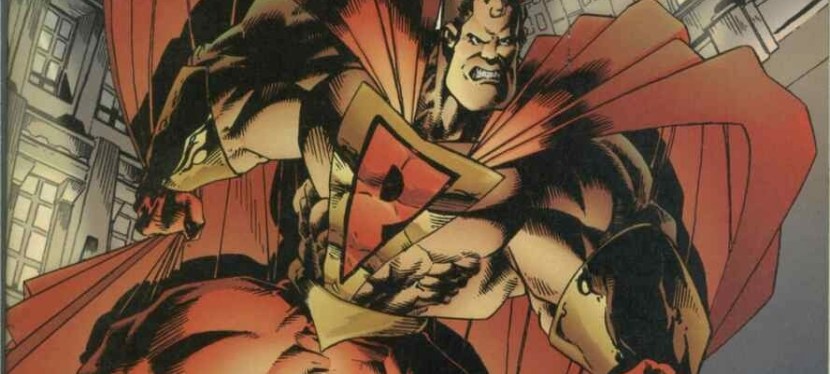
For the newcomers to the Ultraverse, Prime is one of its most definitive heroes and his true identity is the teenager Kevin Green who can transform into an overly muscular caped adult superhero. The Prime monthly series of comic books ran for two years and the title character appeared in many other Ultraverse comic books.

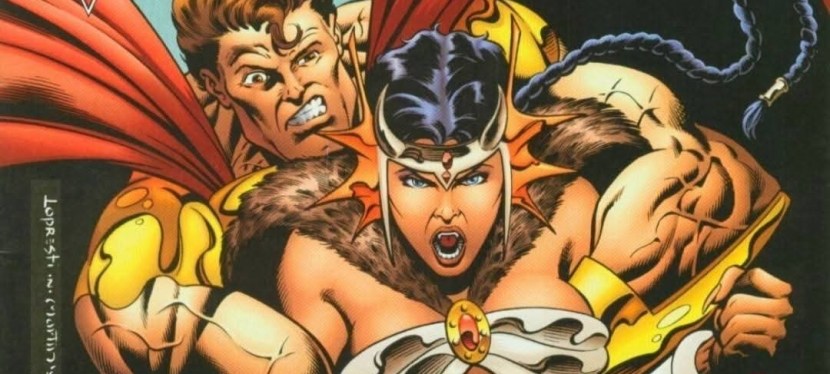
Considering the prominence of Prime, it is not surprising that Malibu Comics proceeded to create comic books featuring a female counterpart to Prime. That counterpart is called Elven who appeared in a few early issues of the Ultraverse Premiere series and eventually Prime interacted with her.

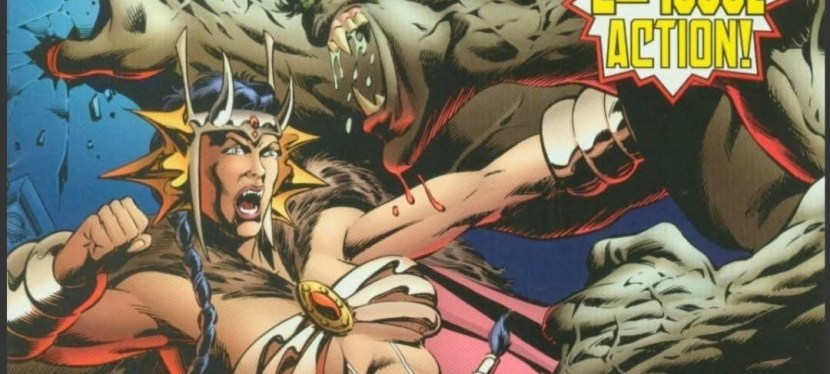
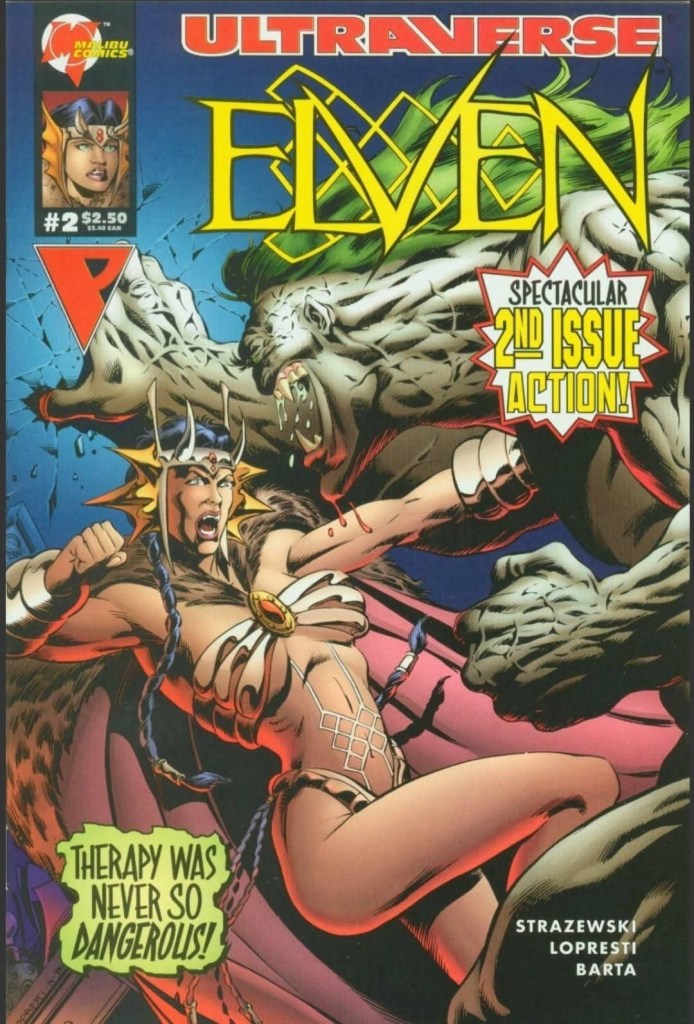
With those details laid down, here is a look back at Elven , published by Malibu Comics in 1995 with a story written by Len Strazewski and illustrated by Aaron Lopresti (Sludge).
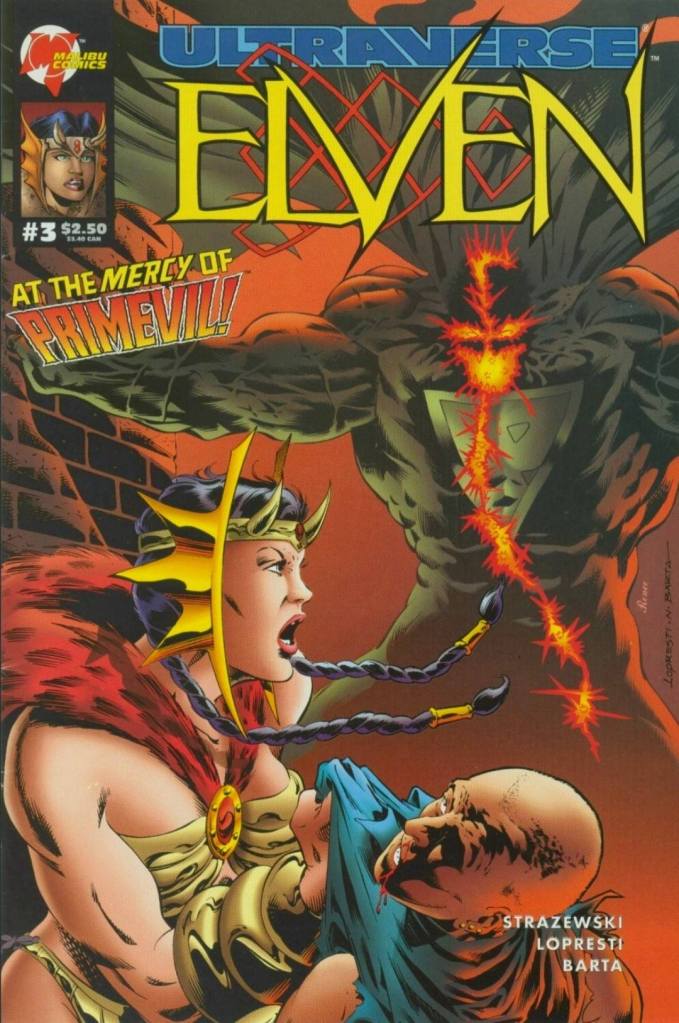
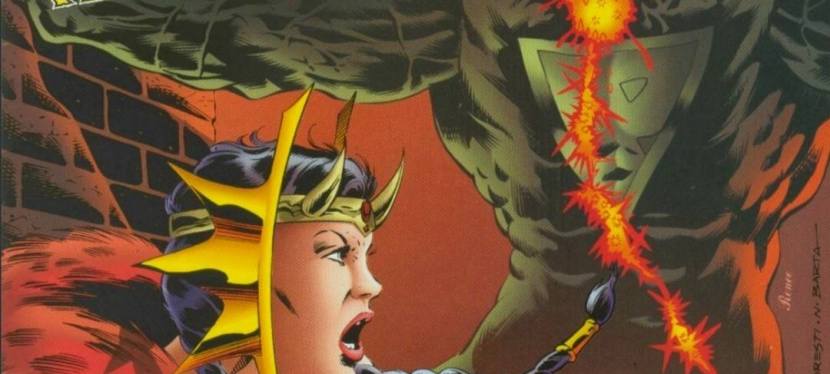
The cover.

Early story

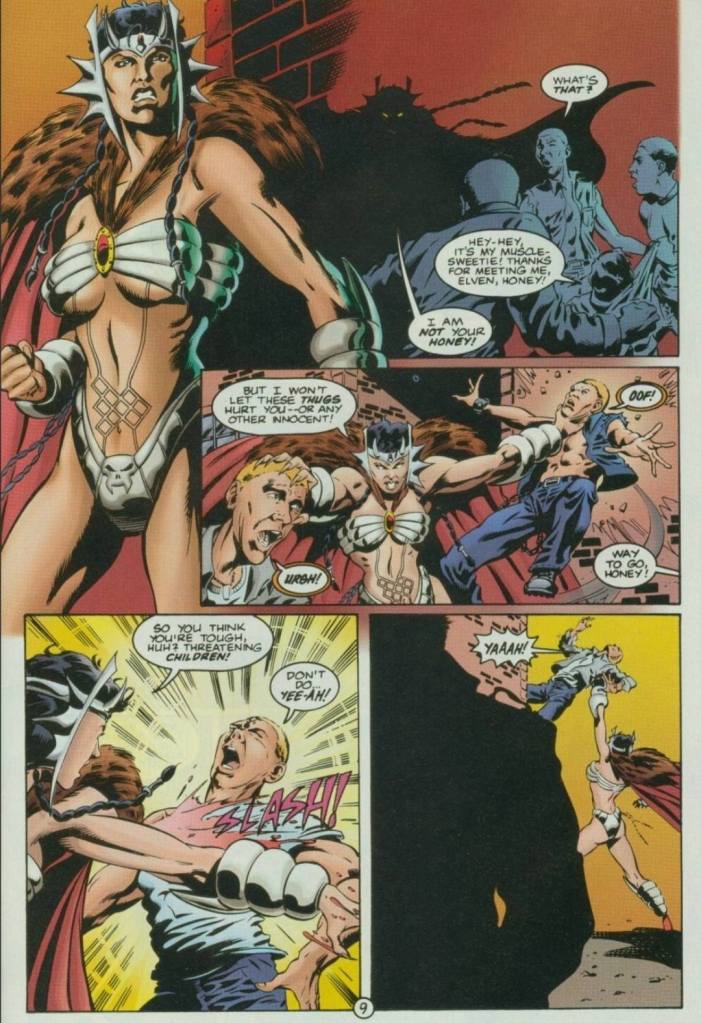
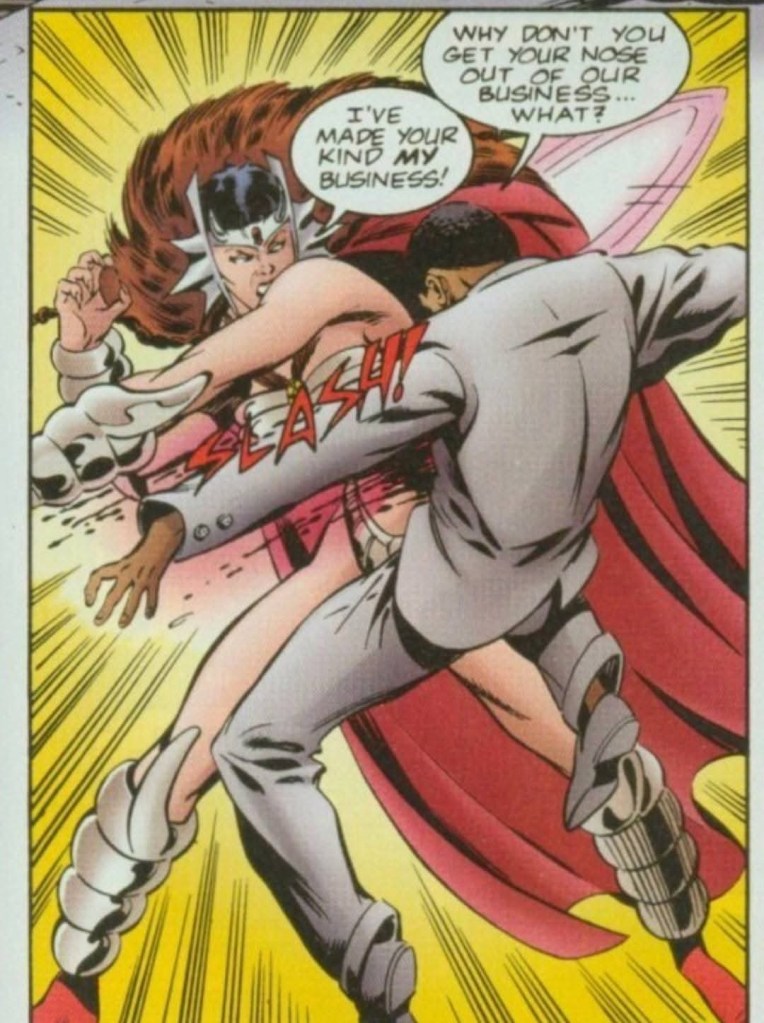
The story begins deep within a city when a beautiful blonde woman got hurt by a very angry man named Billy. With the lady down on the floor, the man raises his metallic weapon intending to strike her not realizing that someone is emerging from behind. He turns and sees a scantily clad caped woman who immediately hits him hard. The caped woman is Elven who believes she is helping the blonde woman.

To Elven’s surprise, the blonde woman tells her to stop and not hurt the man who was violent towards her. The man hits Elven on the face with his weapon but ended up getting hit hard again in retaliation. Elven then uses an optic blast at the wall as she tells the blonde woman to leave.

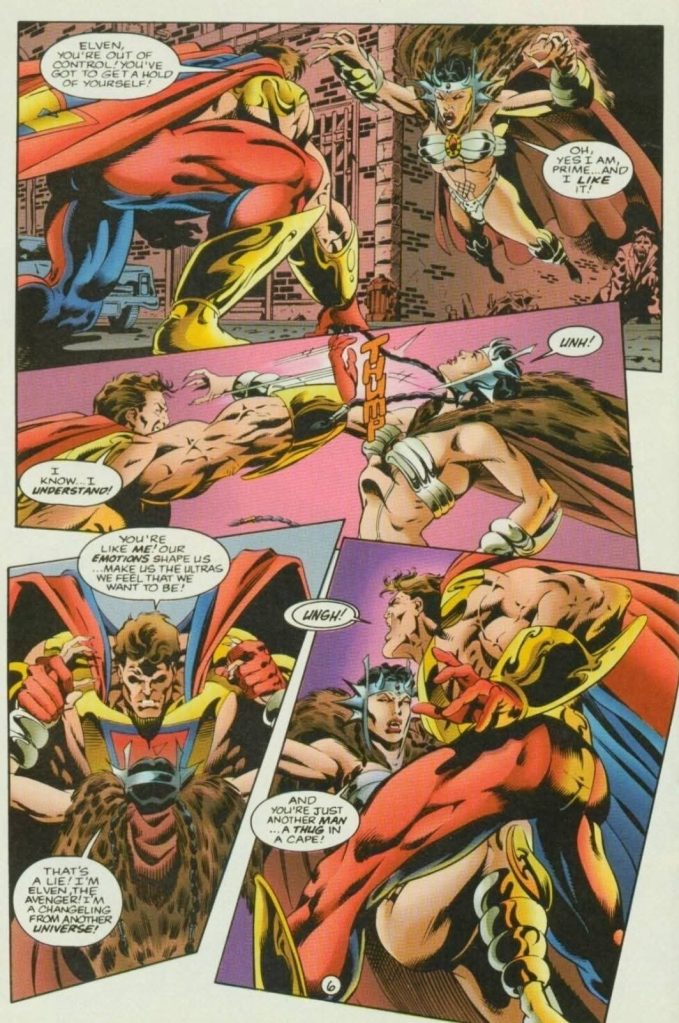
With the violent man down and hurt, Elven decides to kill him but is prevented by Prime from behind. After telling Prime that she told him not to interfere with her, she hits him with an energy blast…

Quality

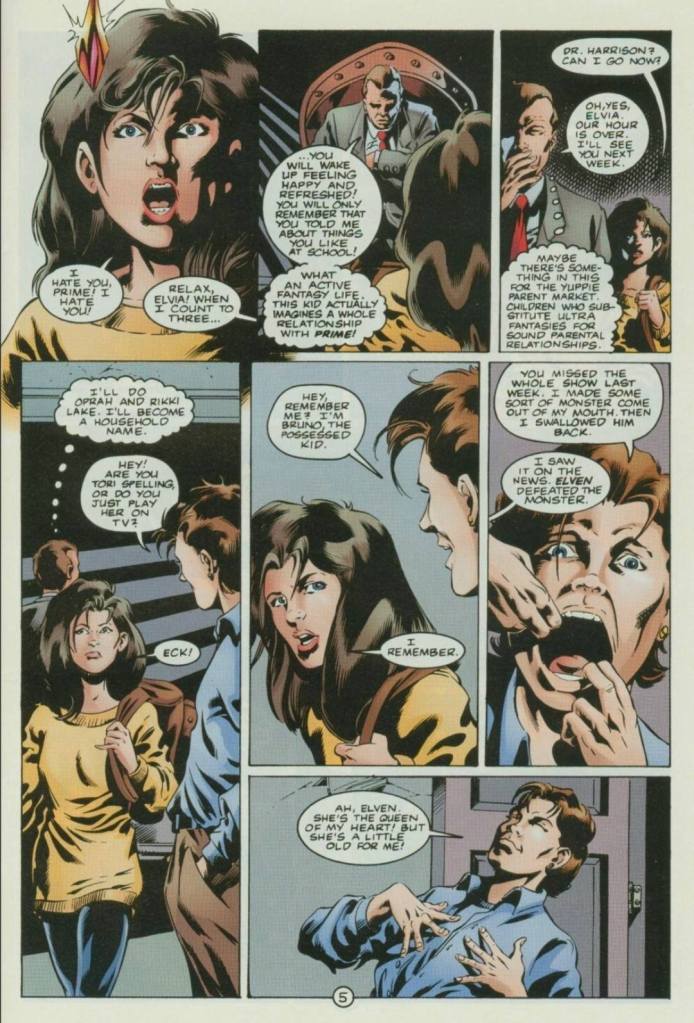
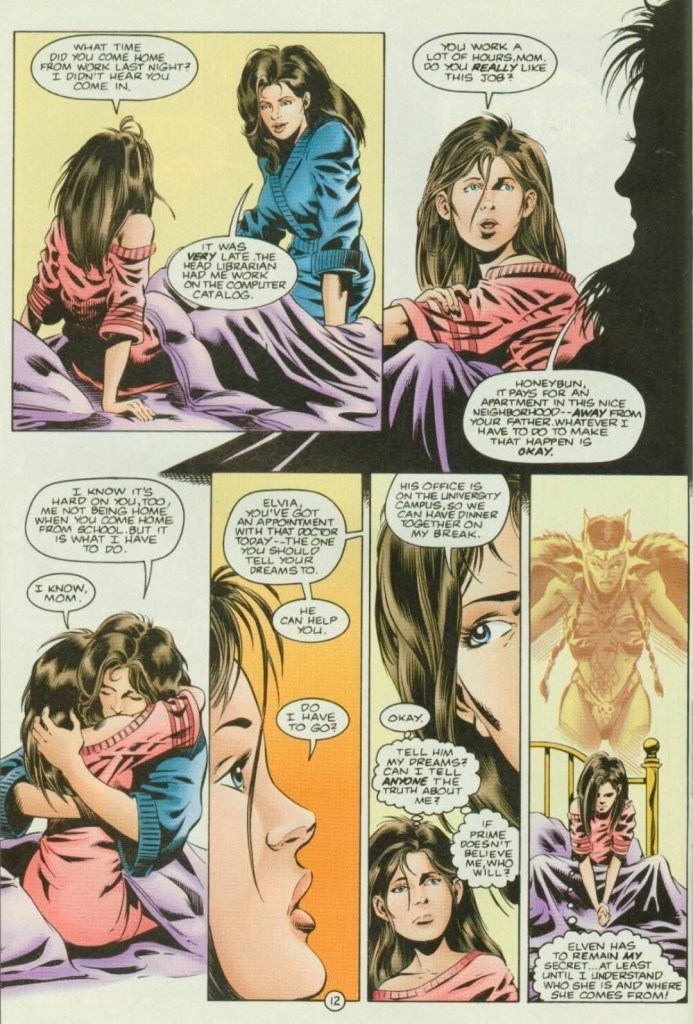
Elvia with her hard-working mother. The lack of a loving father affected Elvia deeply.

Being written by Prime co-creator and series co-author Len Strazewski, this Ultraverse tale about Elven is very good and there is a lot of depth in the plot. You will meet Elven and the true human behind her named Elvia Swenson, a teenage girl who has a painful past, has an obsession with fantasy tales, and was created through the very same secret government fertility research program as Kevin Green/Prime. Elven’s disturbing look (with elvish features) reflects Elvia’s fantasy obsession and personally belief of using violence against men. She and Prime are genetically related due to the top secret project.

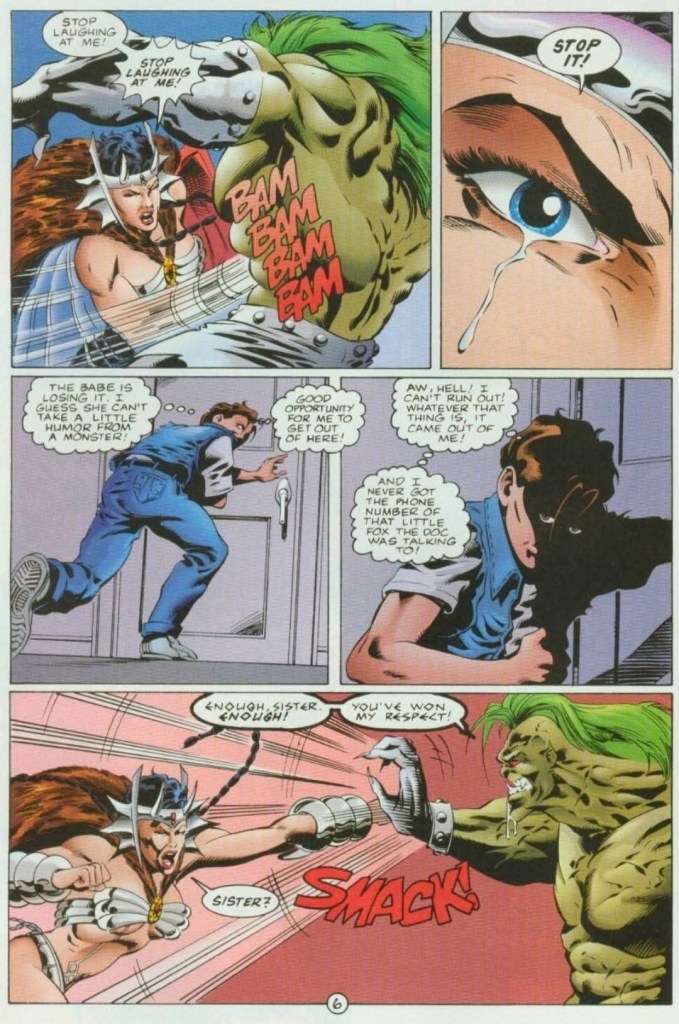
This comic book examines Elvia whose life lacks direction and her abusive father really impacted her negatively. With her mother’s love and guidance remaining in her life, Elvia is literally in a quest to find purpose, happiness and friendship. Unfortunately, the young guy Bruno is in the neighborhood and he is actually a demon. Bruno’s presence literally raised the stakes of the story which justifies Elvia’s transformation into Elven for the eventually good-versus-evil conflict. All throughout, there is tension and drama which got balanced with superhero spectacle. The way Elven is portrayed here makes her comparable with the arrogant, man-bashing, rabid feminists of modern society.

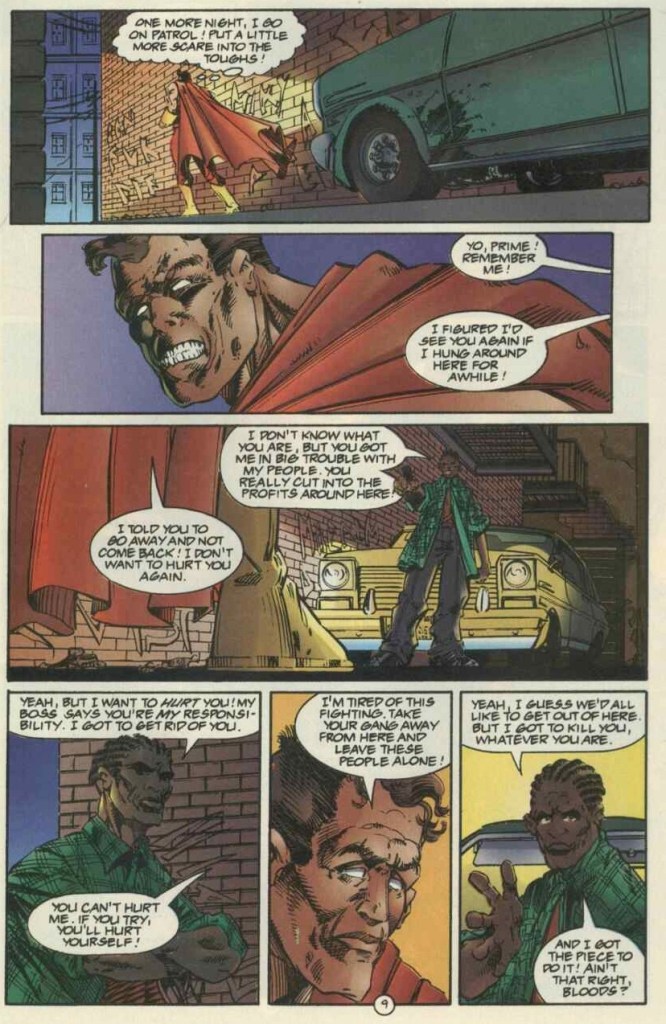
When it comes to Prime himself, this comic book features a really mature portrayal of him. I am talking about the early part of the story when Prime did his best to calm Elven down, restrain her and convince her to think first as a way to prevent her recklessness. Long-time Ultraverse readers should now that Prime is actually teenager Kevin Green inside all that muscle and he often has an awkward or a tense way of communicating with others (note: imagine the teenager pretending to think and act like an adult). That said, Prime here really interacts maturely and his attempt to put a lot of sense into the impulsive Elven is very believable. This is clever writing by Strazewski and it is one of the more notable portrayals of Prime.  

When it comes to the visual side, artist Aaron Lopresti’s style worked smoothly in this comic book. I have seen his works in the Sludge series and he really excels with facial expressions, spectacle and the monsters looking very creepy. Strangely enough, Lopresti’s take on Elven is noticeable smaller and less muscular when compared to how the character appeared in Elven and Ultraverse Premiere drawn by Greg Luzniak.

Conclusion

Prime struggles to calm the impulsive and reckless Elven down. Without Prime’s intervention, Elven definitely would have committed murder against a man who harmed a woman moments earlier.

Elven (1995) is clearly a very solid read and easily one of the best spin-off comic books of the Ultraverse. Strazewski and Lopresti crafted a tale that was intense and dramatic while successfully defining Elven and her true identity as the teenage Elvia. Considering her painful background and current situation, Elvia is sympathetic although things got twisted when she becomes Elven which brings out her violent side, her recklessness and distorted view about helping women by using violence. That being said, Elven at this stage in the Ultraverse is not really a likable lead character and that only makes her more unique when compared to Prime. Will Elven become as terrible as the evil ones? There is more to discover as this comic book is part of the limited series.

The specific portrayals of Elvia and Elven is very tricky to write down and Strazewski succeeded in making it work. Ultimately, this comic book added strong fantasy elements within the Ultraverse.

Overall, Elven (1995) is recommended.

+++++

Thank you for reading. If you find this article engaging, please click the like button below and also please consider sharing this article to others. If you are looking for a copywriter to create content for your special project or business, check out my services and my portfolio. If you want to support my website, please consider making a donation. Feel free to contact me with a private message. Also please feel free to visit my Facebook page Author Carlo Carrasco and follow me on Twitter at  @HavenorFantasy as well as on Tumblr at https://carlocarrasco.tumblr.com/ and on Instagram at https://www.instagram.com/authorcarlocarrasco/.
A Look Back at Prime #20 (1995)

Welcome back, superhero fans, 1990s arts and culture enthusiasts, Ultraverse fans and comic book collectors! Today we revisit the Ultraverse to take a look at one of the many tales of Prime from the monthly series that first launched in 1993.

In recent times, I’ve been reading and reviewing Prime comic books I missed out before. For my most recent Prime retro reviews, click here, here and here. For the newcomers reading this, Prime is one of the most definitive heroes of the entire Ultraverse and his true identity is the teenager Kevin Green. Prime is also one of three major Ultraverse figures in the team UltraForce.

With those details laid down, here is a look back at Prime , published by Malibu Comics in 1995 with a story written by Len Strazewski and Gerard Jones, and illustrated by Greg Luzniak.

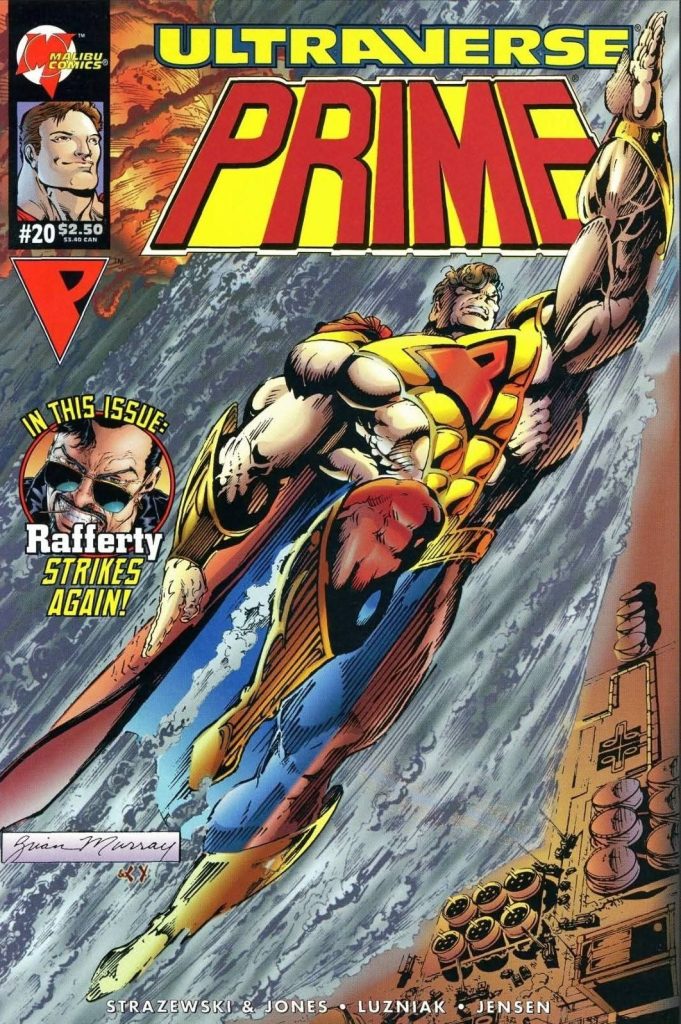
The cover.

Early story

The story begins with a man and a woman on bed. They just made love with each other. As the woman goes to the bathroom to fix herself, the man tells her she will be perfect in a new project and they will be together all the time even though he is already married. He tells her that will be a real ultra-heroine and already a lot of things are being prepared for her such. She will also have a new partner and already they found a way to get him to Washington.

Feeling terrible, the woman lowers herself on the bathroom floor, pulls a piece of hardware very hard, and an explosion suddenly happens.

In New York City, Kevin and his mother attend an opera. Kevin still has trouble adjusting to life in New York and misses his friends and the community of Canoga Park. He still has feelings for Kelly but remains confused as he still struggles with managing his personal life being himself and being Prime…

Quality

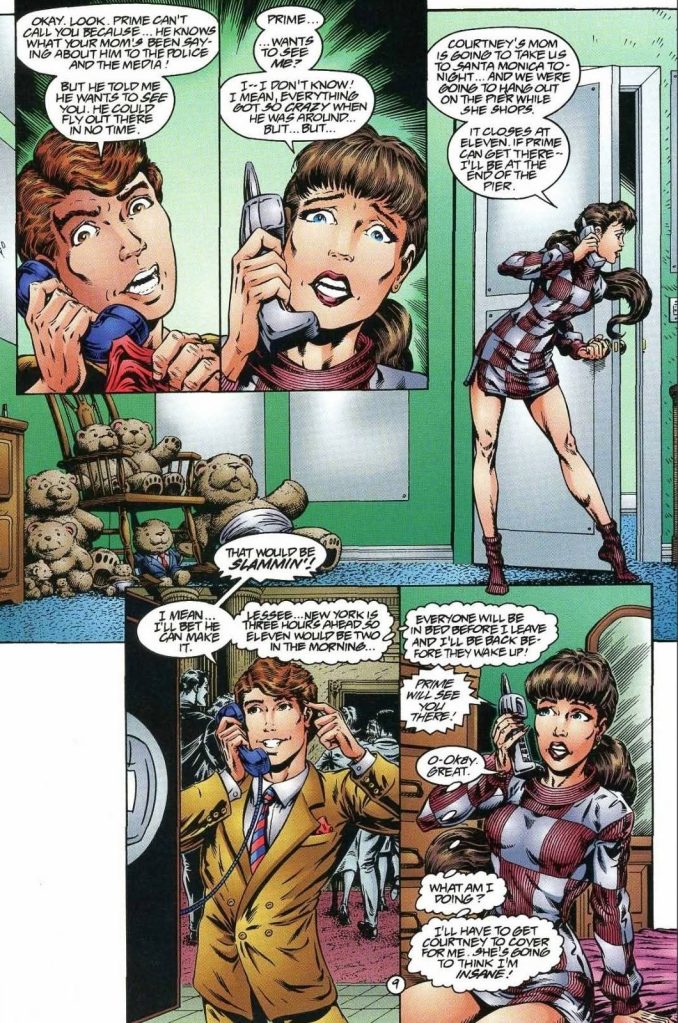
Kevin and Kelly talking to each other via a long distance call.

I really enjoyed this issue of Prime mainly because the writing done by Len Strazewski and Gerard Jones is really rich with depth. To make things clear, this is another Prime tale made to emphasize the title hero’s personality particularly with his personal life as Kevin Green who at this stage has turned into a really confused teenager. Not only is Kevin so far away from Kelly, he has not seen his father for a long time already, his mother has been working and is about to move to Washington for a new job, and public perception towards Prime has been tense.

As the cover already confirmed, the deadly villain Rafferty is indeed here although the traditional good-versus-evil conflict is not a major part of the story. Rafferty previously encountered Freex and The Strangers (click here, here and here) and it was only right to set him up for conflict with Prime.

When it comes to the art, I enjoyed Greg Luzniak’s style on Prime and the other characters. Luzniak is really good with the dynamic approach on visualizing superhero spectacle and acts. The way he shows facial expressions resulted in a wide range of looks and emotions.

Conclusion

Kevin in New York with his mother. His father has been away for a long time at this point in the series.

The character-driven approach done by the Strazewski-Jones duo made Prime (1995) a very solid read. The story has a firm structure designed to open opportunities to emphasize Kevin Green’s development which in turn reflects his struggle with the changes of his life. This comic book also explores Kelly’s speculation that Prime and Kevin are one and the same, and the creators pulled off the right moves to add weight to that. By the time I reached the ending, I am convinced to go on to the next issue.

Overall, Prime (1994) is highly recommended.

+++++

Thank you for reading. If you find this article engaging, please click the like button below and also please consider sharing this article to others. If you are looking for a copywriter to create content for your special project or business, check out my services and my portfolio. If you want to support my website, please consider making a donation. Feel free to contact me with a private message. Also please feel free to visit my Facebook page Author Carlo Carrasco and follow me on Twitter at  @HavenorFantasy as well as on Tumblr at https://carlocarrasco.tumblr.com/ and on Instagram at https://www.instagram.com/authorcarlocarrasco/

A Look Back at Prime #14 (1994)

Welcome back, superhero fans, 1990s arts and culture enthusiasts, Ultraverse fans and comic book collectors! Today we revisit the Ultraverse to take a look at one of the many tales of Prime from the monthly series that first launched in 1993.

In recent times, I’ve been reading and reviewing Prime comic books I missed out before. For my most recent Prime retro reviews, click here and here. For the newcomers reading this, Prime is one of the most definitive heroes of the entire Ultraverse and his true identity is the teenager Kevin Green.

With those details laid down, here is a look back at Prime , published by Malibu Comics in 1994 with a story written by Len Strazewski and Gerard Jones, and illustrated by the Darick Robertson with ink work done by Barbara Kaalberg.

The cover.

Early story

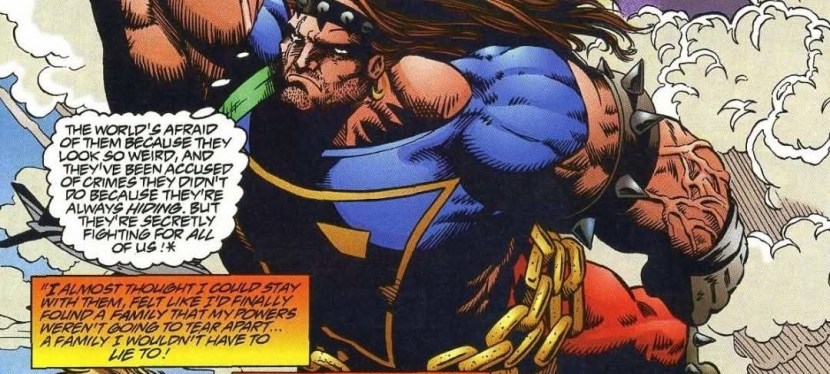
The story begins with Prime flying and deeply thinking about the group of powered social outcasts…Freex. Prime, who recently spent time with Freex and helped them fight monsters (click here and here). He wished to help them more but does not want to be like them. He wants to show the whole world that it cannot push him around only because of his youth.

Moments later, Prime arrives at Venice Beach in California to meet members and agents of the media…

Quality

This should remind you to always behave yourself in front of any family member of your friend. Prime ends up being disrespectful to Kelly’s mother due to Kevin’s lack of maturity.

As a long-time Ultraverse comic book reader, there is a lot to like in this tale of Prime. For one thing, it is a pure character-driven story with a strong emphasis on how Kevin Green’s personal views develop, why he keeps on struggling to understand society and why his way (in the form of Prime) of interacting with ordinary people remains awkward.

There is so much stuff here, it can be challenging to realize the main themes of the story written by Jones and Strazewski. To make things clear, at this point in the Ultraverse, worldly authorities are very aware of the Ultras who seem to want to help people with problems but they are compelled to use force to confront them as those super powered beings are capable of making their own rules, violate laws with impunity and cause trouble in societies.

Prime is already in the middle of a troubled American society and the government as well as secret societies have other Ultras to deal with. Being a teenager himself, Kevin Green is able to relate with members of Freex who have no families to return to and are always on the run being chased by the authorities and being hated by the world. Along the way, Prime is acting impulsively with the adults and members of the media since Kevin himself lacks maturity and has yet to fully understand society and its norms. Kevin also forgets how to behave properly as he fails to control his emotional impulse.  

When it comes to the art, Darick Robertson did a really fine job visualizing Prime and in most pages of the comic book, he uses dynamism to make the reading experience look very lively. He also did a good job with the facial expressions.

Conclusion

Prime recalls the time he spent with Freex.

It is very clear that the writing in Prime (1994) done by the Jones-Strazewski duo is rich and deeply layered. Being a self-declared fighter and supporter of young people in this issue puts Prime into deeper trouble as he does not realize yet the consequence of the moves he made. The creative team really excelled in dramatizing Kevin Green – in the physical form of Prime – being impulsive and immature to adults while acting as a helpful adult to teenagers he meets. This story also sheds light on broken families which will instantly remind readers about poverty, vices and long-lasting negativity in unchecked parts of American society. That being said, this Prime story is a great read and its social commentary remains very relevant. This is also a great development of Prime’s personality.

Overall, Prime (1994) is highly recommended.

+++++

Thank you for reading. If you find this article engaging, please click the like button below and also please consider sharing this article to others. If you are looking for a copywriter to create content for your special project or business, check out my services and my portfolio. If you want to support my website, please consider making a donation. Feel free to contact me with a private message. Also please feel free to visit my Facebook page Author Carlo Carrasco and follow me on Twitter at  @HavenorFantasy as well as on Tumblr at https://carlocarrasco.tumblr.com/ and on Instagram at https://www.instagram.com/authorcarlocarrasco/.
A Look Back at Prime #10 (1994)

Welcome back, superhero fans, 1990s arts and culture enthusiasts, Ultraverse fans and comic book collectors! Today we revisit the Ultraverse to take a look at one of the many tales of Prime from the monthly series that first launched in 1993.

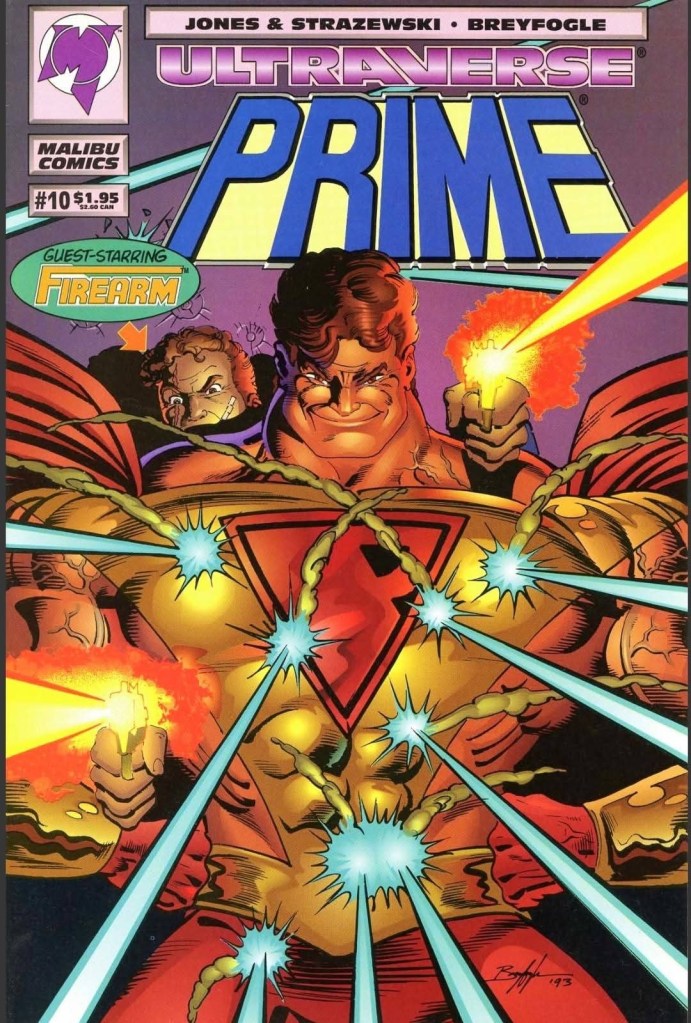
Within the Ultraverse is a hero that was notably absent in the many UV comic books I reviewed, and Malibu Comics even published a regular series of the character. That character is Firearm who goes by the civilian identity as Alec Swan. Swan, who has no super powers, is a British private investigator who was formerly a member of an elite cover bureau in his home country. He has been working as a PI in California and he has encountered several super-powered people in the Ultraverse. In this comic book review, he gets involved with Prime.

With those details laid down, here is a look back at Prime , published by Malibu Comics in 1994 with a story written by Len Strazewski and Gerard Jones, and illustrated by the late Norm Breyfogle.

The cover.

Early story

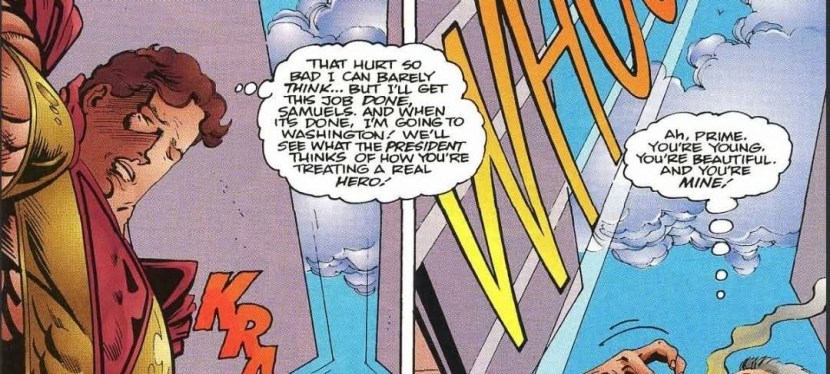
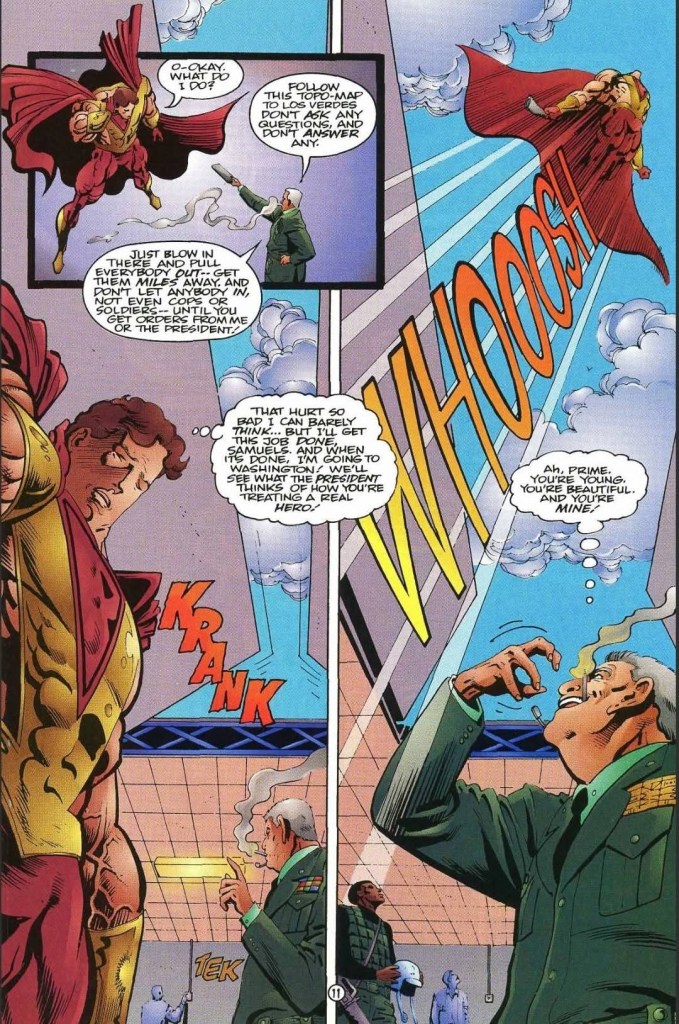
The story begins Prime crashing into a secret facility where Colonel Samuels and his crew have been working in. Prime angrily accuses the colonel for lying to him and pushing him close to killing the people in the nuclear plant and almost getting him killed in a nuclear blast.

Samuels immediately pulls a switch to electrocute Prime (note: through the collar Samuel placed on Kevin Green’s neck) with a massive amount of energy which knocks him out. A short time later, Prime finds himself restrained in front of the colonel, guards and scientists. Samuels reveals to him that the secret society Aladdin has been stepping up efforts to control ultras (super-powered beings) since the incident on the moon (Break-Thru) happened, and they want him out of business.

What Colonel Samuels and staff do not realize is that Firearm is discreetly watching them and listening in the shadows…

Quality

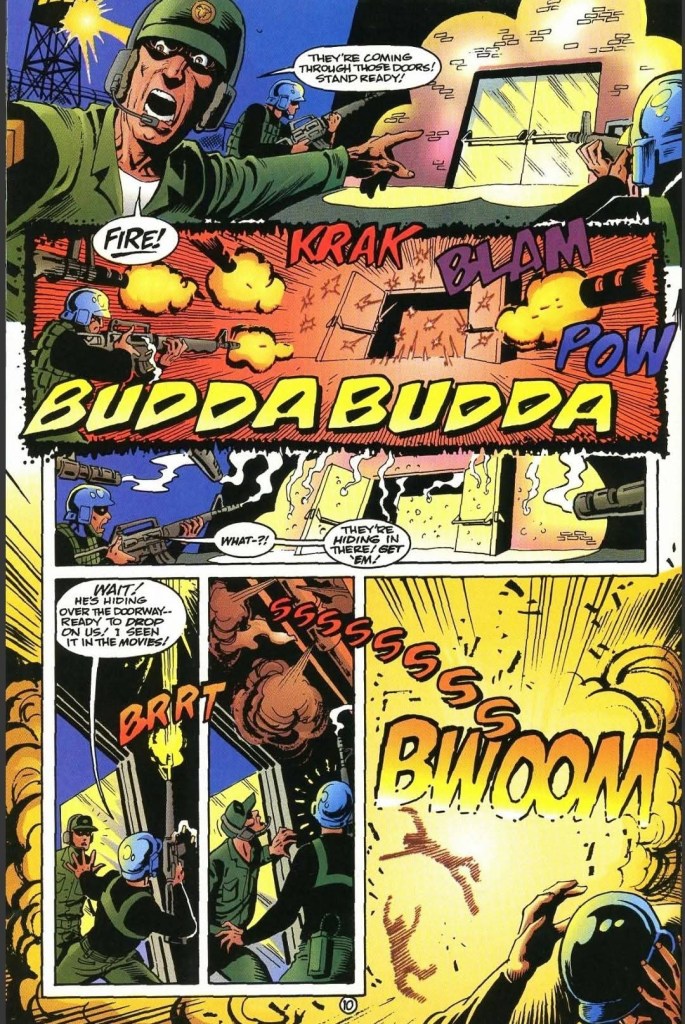
The guards got fooled.

To begin with, I can say that the Strazewski-Jones-Breyfogle team literally turned things upside-down to tell a Prime story while smoothly integrating Firearm into the narrative. This is the first-ever encounter between Prime and Firearm (who at this point of the story met Kevin Green’s father)

Without spoiling the plot, I can say that this tale is heavy with the action which is justified by the presence of Firearm. Prime himself is in a more vulnerable state as Colonel Samuels has clever advantages over him. The result is a story packed with action and has some suspense and intrigue mixed in. The reading experience flowed smoothly and there never was any boring moment in any scene.

Firearm’s presence here opened some opportunities for the creative team to develop Kevin Green’s personality and what they came up with was executed efficiently and with depth. As for Colonel Samuels, his wickedness reached a boiling point in this tale and the creative team came up with something that caught me off-guard. I promise you, what happened to Samuels here is worth discovering and it will compel you to examine or anticipate the consequences of the action he took.

Conclusion

Somehow, Colonel Samuels and his staff failed to notice Firearm’s presence.

While the previous issue was a return to form for the regular series, Prime (1994) was a pleasing crossover tale that successfully showcased action, suspense, intrigue and new dimensions of Kevin Green’s personal growth. This first-ever encounter between Prime and Firearm was executed solidly and the reading experience in general was engaging from start to finish. The way I see it, this old Ultraverse comic book will please fans of both Firearm and Prime.

Overall, Prime (1994) is highly recommended.

+++++

Thank you for reading. If you find this article engaging, please click the like button below and also please consider sharing this article to others. If you are looking for a copywriter to create content for your special project or business, check out my services and my portfolio. If you want to support my website, please consider making a donation. Feel free to contact me with a private message. Also please feel free to visit my Facebook page Author Carlo Carrasco and follow me on Twitter at  @HavenorFantasy as well as on Tumblr at https://carlocarrasco.tumblr.com/ and on Instagram at https://www.instagram.com/authorcarlocarrasco/.
A Look Back at Prime #9 (1994)

Welcome back, superhero fans, 1990s arts and culture enthusiasts, Ultraverse fans and comic book collectors! Today we revisit the Ultraverse to take a look at one of the many tales of Prime from the monthly series that first launched in 1993.

For the newcomers reading this, Prime is one of the definitive, major heroes of the entire Ultraverse along with Hardcase, Mantra and Prototype. Prime is also a major part of the team UltraForce. What makes the muscular and super strong Prime interesting is that his true identity is a teenager named Kevin Green who finds himself struggling between his superhero activities, his social life and his family. Having previously read and reviewed lots of Prime comic books, I can say that I had a lot of fun along the way. There are still some comic books about Prime that I have yet to review.

With those details laid down, here is a look back at Prime , published by Malibu Comics in 1994 with a story written by Len Strazewski and Gerard Jones, and illustrated by the late Norm Breyfogle.

The cover.

Early story

The story begins with Kevin’s mother helplessly tied to a chair with her mouth covered inside their home. By this time, Kevin (Prime) has been gone for more than a week already and her husband Russ won’t even call the police for help. For her, the people who informed her that Kevin has to be isolated because of some kind of a disease lied.

Suddenly a uniformed man armed with a rifle tells her that she will be in trouble if she makes so much noise. He tells her that Kevin is just outside the house and his team intends to collect him again.

Outside, Kevin just arrived following his unexpected adventure with Mantra (for crossover references, the comic books are Mantra #7 and Prime #8). Not knowing who Mantra really is, he remembers getting kissed by her and has an intention to see her whenever he wants. As soon as he opens the front door of their home, Kevin immediately gets dragged inside and restrained by two armed men. Colonel Samuels is inside…

Quality

Prime has no choice but to do the dirty work of the abusive Colonel Samuels (who has access to US President Bill Clinton).

Being set shortly after the events of Break-Thru (read my retro reviews by clicking here, here and here) and Prime’s encounters with Mantra, this tale is clearly a return to form for the Prime monthly series. Symbolically, Colonel Samuels returns as the chief antagonist and he clearly is not done yet with messing with Prime as well as with the Green family while abusing his power. Samuels is clearly evil and having served in the American military for decades, he has access to the government’s information regarding the ultras (which places the Green family in disadvantageous situations) and he has all resources needed to ruin Prime’s life.

Prime here gets involved in a mission being at a serious disadvantage as Colonel Samuels has the power and means to make him do dirty tasks. Samuels even has direct access to US President Bill Clinton (a real-life abuser of women, a leader who empowered Islamic terrorists and a profiteer with his family’s foundation) to do high-risk operations supposedly in service of America.

What is very clear in this story written by Strazewski and Jones is that intrigue (backed by twists) made the narrative powerful and engaging to follow. Even though there is a clear bias supporting the hippies, the political correctness minds, the anti-nuclear zealots and the solar power extremists, the tale is still entertaining to read. More notably, you will see how Prime develops as he tackles a very dangerous situation that involves annihilation in American land. I really like the way the writers showed Prime struggling to analyze what to do as the pressure mounts immensely on him.

Conclusion

Easily the most dynamic image of the comic book drawn by the late Norm Breyfogle.

Prime (1994) is another very solid Ultraverse tale made by the Strazewski-Jones-Breyfogle team. It is creative a return to form for the Prime monthly series (because Prime got busy with Break-Thru and spent time with Mantra) and seeing the evil Colonel Samuel raise the stakes added a lot of depth to the story. At this particular stage of the series, Kevin Green’s life is getting out of hand and his parents are already in the middle of a series of very unfortunate events. This old comic book is still fun to read.

Overall, Prime (1994) is recommended.

+++++

Thank you for reading. If you find this article engaging, please click the like button below and also please consider sharing this article to others. If you are looking for a copywriter to create content for your special project or business, check out my services and my portfolio. If you want to support my website, please consider making a donation. Feel free to contact me with a private message. Also please feel free to visit my Facebook page Author Carlo Carrasco and follow me on Twitter at  @HavenorFantasy as well as on Tumblr at https://carlocarrasco.tumblr.com/ and on Instagram at https://www.instagram.com/authorcarlocarrasco/

A Look Back at Ultraverse Year One (1994)

Disclaimer: This is my original work with details sourced from reading the comic book and doing personal research. Anyone who wants to use this article, in part or in whole, needs to secure first my permission and agree to cite me as the source and author. Let it be known that any unauthorized use of this article will constrain the author to pursue the remedies under R.A. No. 8293, the Revised Penal Code, and/or all applicable legal actions under the laws of the Philippines.

Welcome back superhero enthusiasts, 1990s culture enthusiasts and comic book collectors! Today we go back to the mid-1990s which was a pretty wild time for comic collectors. To be more specific, this newest retro review revisits the Ultraverse through a comic-like publication in the form of a guide meant for UV fans and comic collectors.

The subject at hand is Ultraverse Year One which, as written on the edge of the front cover, was designed to be the “complete guide to the Ultraverse’s first year.” It is a reference guide for those who seriously want to discover each and every Ultraverse comic book that was published during its first year. In my experience as a comic collector, the Ultraverse launch in 1993 was very memorable even though my financial limitations prevented me from acquiring each and every launch comic book and subsequent releases of the time. How useful is this complete UV guide? We can go on and find out.

With those details laid down, here is a look back at Ultraverse Year One, published in 1994 by Malibu Comics.

The cover.

Quality

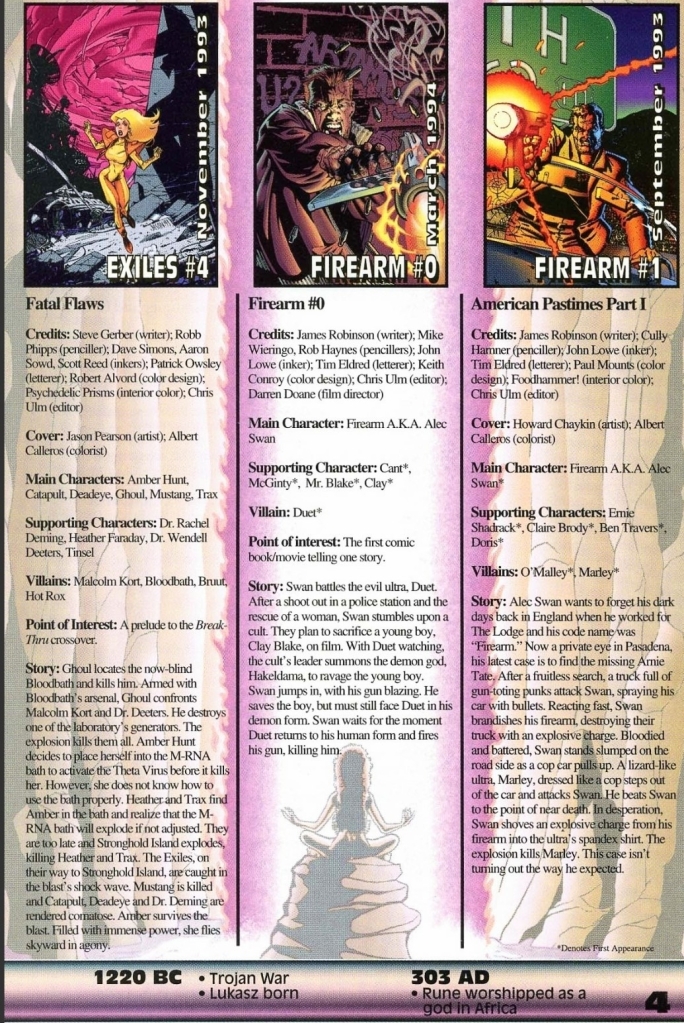
I can say without a doubt that this publication is indeed a complete guide to each and every Ultraverse comic book released during its first year from 1993 to 1994 specifically. You want to know exactly how many issues of Mantra, Prime, Hardcase, The Solution, Prototype, The Strangers and others were published in the first year? This one has it all listed! You want to know which UV comic book involved the talents of Steve Gerber, Norm Breyfogle, Rick Hoberg, Len Strazewski, Aaron Lopresti, George Perez, James Hudnall, Gerard Jones, Steve Englehart, Tom Mason, Terry Dodson, James Robinson, Howard Chaykin, Mike W. Barr and many others under the Malibu Comics banner? This guide has it all listed! What months were Exiles #1, Sludge #1, Firearm , Break-Thru #1 and Mantra #1 were published? The answers to each are included. The same can also be said when it comes to which characters appeared in each comic book.

This is what each page typically looks like with details of the Ultraverse timeline on the lower part.
The timeline reveals that the male warrior Lukasz, who would later end up in woman’s body as Mantra/Eden Blake, was born in 1220 BC.

Very clearly, the Malibu Comics people worked hard to collect the essential types of information, organized them and put them all into print media form for readers and collectors to use when it comes to searching just about everything about the Ultraverse’s first year. Things did not just stop there, however.

What I found amusing to look at in each page of this Ultraverse guide are details of the shared universe’s timeline posted on the lowest part. The said timeline – which is limited to text and numbers – reveal interesting details such as what year was Lukasz (AKA Mantra) born, when did Rune begin, when was the Choice corporation established, what year did the island of Yrial’s people move up to the clouds, what years were infants injected by Wetware Mary and more. These details are actually quite encouraging to make readers discover or re-read Ultraverse comic books to see how they are dramatized on paper.

Conclusion

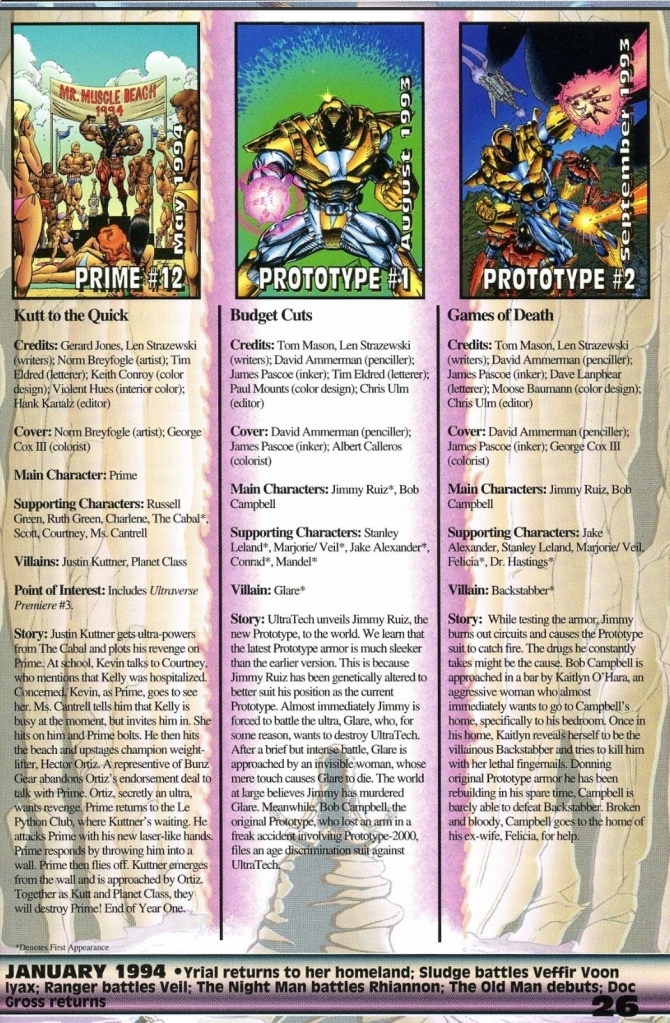
As you can see in the details above, Len Strazewski was involved in both the Prime and Prototype comic book series.

Ultraverse Year One (1994) is a pretty detailed guide that will not only help readers track down each and every UV comic book of the mentioned time period, but also help them spot the precise comic books that has characters included as well as the published works of varied comic book creators. If you are really determined to track down and buy all the Year One UV comic books, this guide is a must-have. If there are any weaknesses to mention, it would be the fact that each comic book’s entire plot got summarized in full which are actually spoilers.

Overall, Ultraverse Year One (1994) is recommended.

+++++

Thank you for reading. If you find this article engaging, please click the like button below and also please consider sharing this article to others. If you are looking for a copywriter to create content for your special project or business, check out my services and my portfolio. Feel free to contact me with a private message. Also please feel free to visit my Facebook page Author Carlo Carrasco and follow me on Twitter at  @HavenorFantasy as well as on Tumblr at https://carlocarrasco.tumblr.com/ and on Instagram at https://www.instagram.com/authorcarlocarrasco/

A Look Back at Break-Thru #2 (1994)

Disclaimer: This is my original work with details sourced from reading the comic book and doing personal research. Anyone who wants to use this article, in part or in whole, needs to secure first my permission and agree to cite me as the source and author. Let it be known that any unauthorized use of this article will constrain the author to pursue the remedies under R.A. No. 8293, the Revised Penal Code, and/or all applicable legal actions under the laws of the Philippines.

Welcome back superhero enthusiasts, 1990s culture enthusiasts and comic book collectors! Today we go back to the mid-1990s which was a really wild time for comic collectors. To be more specific, this newest retro comic book review revisits the conclusion of the epic Ultraverse storyline Break-Thru which was illustrated by the late George Perez (1954-2022). I encourage you readers – especially long-time fans of the iconic illustrator – to check out my commemorative article about George Perez by clicking here.

For the newcomers reading this, Break-Thru was a 2-part storyline that creatively involved almost all the main characters of the Ultraverse (The Strangers, Mantra, Prime, Prototype, Freex, The Solution, Hardcase, Sludge, Solitaire and others) who got impacted in varied ways by Amber (of the Exiles) who floated high in the air causing chaos on societies below. Specifically, that was the concept of Break-Thru (1993) and issue has the story continuing with a setting in outer space with the moon as the key destination.

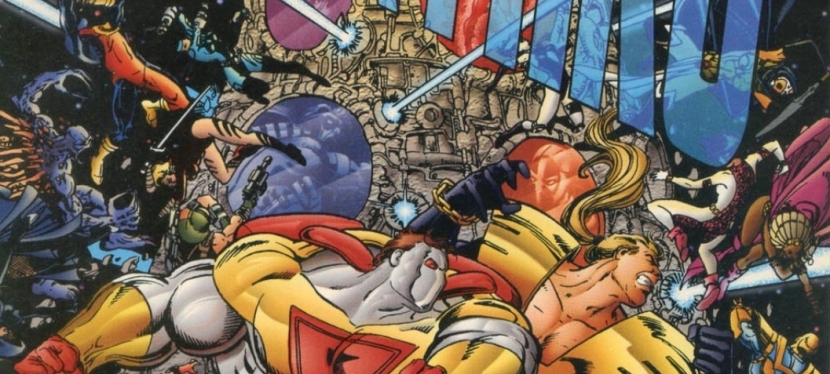
With those details laid down, here is a look back Break-Thru , published in 1994 by Malibu Comics with a story scripted by Gerard Jones (plotted by Mike W. Barr, Steve Englehart, Steve Gerber, James Hudnall, Tom Mason, George Perez, James Robinson and Len Strazewski) and illustrated by the late George Perez.

An epic cover by the late George Perez.

Early story

The story begins at the surface of the moon with Hardcase, Choice and the members of The Solution who just survived the explosion (connected with Hardcase #7 and The Solution #4) of the flying saucer they used on their journey. Nearby, the people responsible for the destruction are riding their own flying saucer, scanning the surface of the moon searching for an entity.

Behind the scenes, the very hidden yet powerful Rex Mundi watches and tells Gate that other ultras are seeking the entity. As the saucer floats to a cave detecting the presence of the entity, the occupants get shaken as Prime hits them hard. Prime tells himself that the entity in the cave feels danger from the searchers and he has to protect it as he has been connected with it (refer to Prime #7). After getting blasted in retaliation by the saucer, Prime finds himself hit even more as Rex Mundi’s enforcers suddenly come out of a portal very near him.  

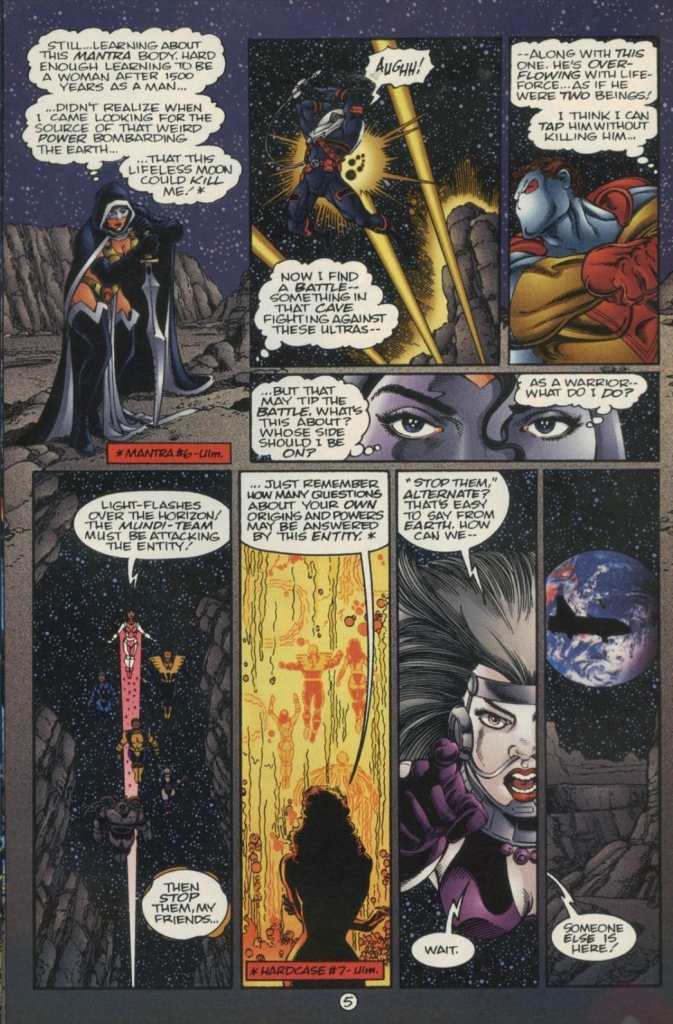
From a distance, Mantra (refer to Mantra #6) sees the fight happening and needs a life force to survive. Elsewhere, Hardcase, Choice and The Solution witness the arrival of a space shuttle. The Strangers and Prototype (refer to The Strangers #7 and Prototype #5) come out together…

Quality

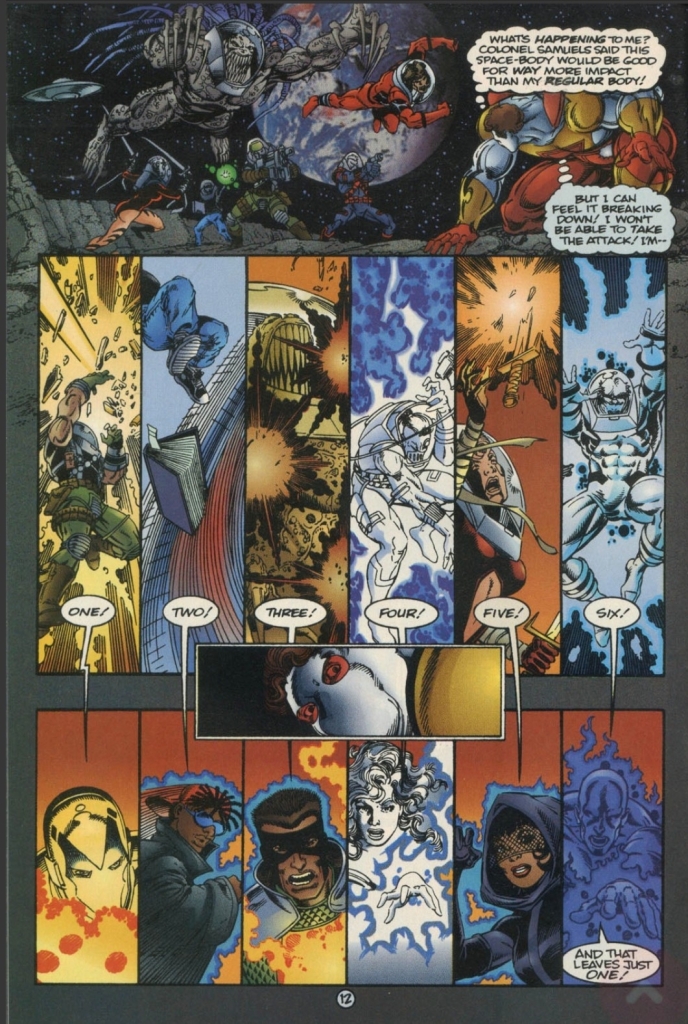
This is classic George Perez presentation of action and characters using multiple panels in a single page.

Starting with the writing, I should mention that all the writers who were involved in plotting this comic book as well as the previous issue should be commended for their combined efforts on making the Break-Thru storyline happen complete with in-universe ramifications, developments and connections to almost all the monthly comic books via the Break-Thru tie-in issue (also check out Sludge #3, Freex #6, Solitaire #2 and Night Man #3). Clearly Break-Thru was planned to be a major turning point of the Ultraverse by involving and mixing most of the major characters together and have them struggle with tremendous obstacles they simply cannot ignore as the stakes were indeed too high.

More on this comic book, the major conflict was set on the moon which proved to be a very unique setting not just for dynamic battles to happen but also to serve as the place where a mysterious and powerful entity is hidden. When it comes to the story, the entity (more science fictional in concept) is mysterious and cleverly not blatantly evil. It is its mysteriousness that makes the entity a worthy force to have the UV’s heroes come after.

The writers added depth to the plot by showing Yrial of The Strangers and Prototype each having their own vested interests to get to the entity and acquire whatever it has that is valuable. At the same time, Mantra and Prime each discovered valuable knowledge about the entity that impacted their perceptions about their purpose as beings with super powers.

Mantra, Prime, The Solution, Hardcase and Choice.

While the story here still has so many characters expressing themselves and releasing expository information, the narrative is a little bit easier to understand and follow compared to issue (which had a lot more information to release via exposition). That being said, the scenes of spectacle became more enjoyable to read and along the way there were some notable character moments to look at.

Visually, this is unsurprisingly a great looking comic book as it was illustrated by the late George Perez. What I love most about Perez’s art style and visual presentation are all here: high details on each character drawn as well as their surroundings, the dynamic approach on setting up the panels on each page, fantastic looking superhero action, and much more! As with Break-Thru and other Ultraverse comic books drawn by Perez, this one is absolutely great to look at and it easily lifts up the visual/artistic quality of the UV and its heroes. As George Perez was involved in the plot of this comic book, the narrative was never overwhelmed by his great art and the artist really exerted a lot of effort on visualizing each and every one of the established UV characters (including the supporting characters).

Speaking of the established characters, I should state that Perez made Mantra’s face (with mask) look a bit more realistic and feminine while Kevin Green has a more convincing teenage boy look, Sludge looks a bit more creepier and Yrial looks visually identical to the way Rick Hoberg draws her. When it comes to the varied physiques of each established UV hero, Perez captured them all perfectly. Clearly the late artist did his research on every character.

Conclusion

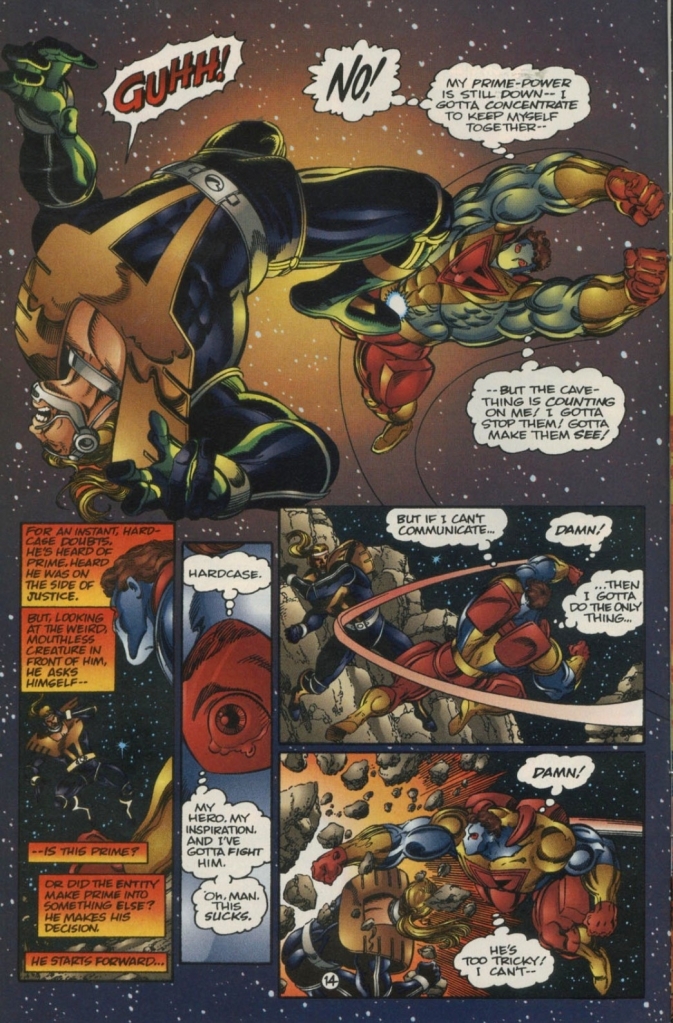
The first physical encounter between Prime and Hardcase. Remember this before reading the UltraForce comics.

Break-Thru (1994) is truly an epic Ultraverse story that also worked as a major turning point of the UV as a whole. Compared to other epic superhero stories that Marvel and DC Comics published, Break-Thru is not the usual large gathering of superheroes who have to work together to defeat an evil force that threatens everyone’s existence. It is more about the UV heroes getting together to solve major obstacles before reaching the main destination. By the time I reached the end of this comic book (and its storyline), I experienced great satisfaction not just from Break-Thru itself but also in relation to how the Ultraverse heroes realized what they are living for and what their respective purposes really are about. What also happened in this comic book explains why jumpstart events happened on Earth. Very clearly, this was an epic story that was planned early and even though this was published just months after the Ultraverse first debuted, the characters were developed enough to make Break-Thru’s concepts sensible and acceptable. There is a lot of fun and engagement in this comic book drawn by the late George Perez (who also worked on DC’s Crisis on Infinite Earths and Marvel’s The Infinity Gauntlet).

Overall, Break-Thru (1994) is highly recommended!

+++++

Thank you for reading. If you find this article engaging, please click the like button below and also please consider sharing this article to others. If you are looking for a copywriter to create content for your special project or business, check out my services and my portfolio. Feel free to contact me with a private message. Also please feel free to visit my Facebook page Author Carlo Carrasco and follow me on Twitter at  @HavenorFantasy as well as on Tumblr at https://carlocarrasco.tumblr.com/ and on Instagram at https://www.instagram.com/authorcarlocarrasco/

A Look Back at Ultraverse Premiere #4 (1994)

Disclaimer: This is my original work with details sourced from reading the comic book and doing personal research. Anyone who wants to use this article, in part or in whole, needs to secure first my permission and agree to cite me as the source and author. Let it be known that any unauthorized use of this article will constrain the author to pursue the remedies under R.A. No. 8293, the Revised Penal Code, and/or all applicable legal actions under the laws of the Philippines.

Welcome back, superhero fans, 1990s arts and culture enthusiasts and comic book collectors! Today we revisit the Ultraverse of Malibu Comics and examine one of its many stories told through an issue of the Ultraverse Premiere series.

For the newcomers reading this, Ultraverse Premiere was a series of comic books published by Malibu Comics that showcased several tales of the Ultraverse and its characters. These stories were made to expand the lore of the UV, emphasize key characters and give fans a lot of content to enjoy. Certain issues of Ultraverse Premiere served as flip comic books which are thick (a lot more than the normal 32 pages) and allow you to read Ultraverse Premiere tales on side and read another UV comic book on the other side. The Ultravere Premiere comic book I am about to review here had The Strangers #13 on its flip side.

With those details laid down, here is a look back at Ultraverse Premiere , published by Malibu Comics in 1994 with stories written by Len Strazewski and Kurt Busiek, and drawn by Frank Gomez and Kris Renkewitz.

The cover.

Early stories

Story 1 – the story begins with Prime making several appearances protecting innocent people from gangs, muggers, thieves and natural disasters. Specifically, his presence is making an impact on the lives of many neighborhoods and its people.

Sometime later, inside a private facility, the figure identified as Prime turns out to be fake and was designed as a human-shaped suit that was piloted inside by Sy Bernstein. He is personally determined to make an impact on crime in his local community with the fake Prime as his main tool.

Story 2 – the story begins with Lady Killer privately viewing a cartoon preview based on her team – The Strangers – with an executive of Imagine-Arts. Shortly after, Lady Killer meets with more executives of the said company and she is told that Imagine-Arts and Labrava Company (Lady Killer’s own enterprise) make a business deal match and they offer to buy her out. Lady Killer tells them that her company and herself are not for sale…

Quality

Lady Killer talking hard on business.

As far as storytelling goes, this comic book’s two tales succeeded in expanding the lore of the Ultraverse through Prime (as a figure to certain members of the public) and Lady Killer, the leader of The Strangers. The Prime-related story offers a nice take on one small part of the Ultraverse that deals with a local community tainted with crime and how Prime’s influence on the ordinary people impacts the said community in varied ways. Of course, these are all executed not with Prime/Kevin Green himself but rather with someone who happens to have the means to pose as Prime and pretend to be the ultrahero himself. Having read a lot of the adventures of the real Prime, this Prime tale is a really nice take although I should say that the art by Frank Gomez has that very rough look all throughout.

The second story meanwhile is an interesting side-story of The Strangers specifically limited to Lady Killer. She gets into business talk with one company which only leads to an intriguing turn of events which creatively emphasizes capitalism to be corrupt and twisted. In some ways, the anti-corporate theme of the story overshadows the plot itself and as the story progressed, Lady Killer slightly becomes less relevant. To be fair to the creative team, this side-story happens to be the first portion of a storyline that involves J.D. Hunt. To say the least, this tale is worth reading even though its protagonist lost some relevance due to a plot twist that started before reaching the end.

Conclusion

Something very odd here.

Ultraverse Premiere (1994) indeed carries enough entertainment and literary value on its two UV tales alone. Just consider The Strangers as a notable additive thanks to the flip side feature. Prime fans will most likely be intrigued and even entertained with the first story while The Strangers fans might end up dissatisfied with the story centered on Lady Killer not because it is the first chapter of a multi-part story but more on its storytelling quality. At least the art of the Lady Killer tale done by Kris Renkewitz is good to look at.

Overall, Ultraverse Premiere (1994) is recommended.

+++++

Thank you for reading. If you find this article engaging, please click the like button below and also please consider sharing this article to others. If you are looking for a copywriter to create content for your special project or business, check out my services and my portfolio. Feel free to contact me with a private message. Also please feel free to visit my Facebook page Author Carlo Carrasco and follow me on Twitter at  @HavenorFantasy as well as on Tumblr at https://carlocarrasco.tumblr.com/and on Instagram at https://www.instagram.com/authorcarlocarrasco/

A Look Back at Prototype #17 (1995)

Disclaimer: This is my original work with details sourced from reading the comic book and doing personal research. Anyone who wants to use this article, in part or in whole, needs to secure first my permission and agree to cite me as the source and author. Let it be known that any unauthorized use of this article will constrain the author to pursue the remedies under R.A. No. 8293, the Revised Penal Code, and/or all applicable legal actions under the laws of the Philippines.

Welcome back, superhero enthusiasts, comic book collectors, fans of 1990s culture and fans of Malibu Comics. Today we return to the Ultraverse and I should say that I am getting very close to closing my retro review run on the Prototype monthly series. So far, I found Prototype to be a really enjoyable and engaging series. It is too bad that the Ultraverse did not last too long because as far as armored superheroes go, Malibu Comics’ armored hero concept is very unique and fun to read. Had the Ultraverse lasted long, Prototype would have been explored a whole lot more and writers Tom Mason and Len Strazewski would have created more new stories of him.

Last time around, Jimmy Ruiz (who no longer has the high compensation and big-time perks of his original employer) got into trouble and had to use his armor as he was the target of another huge and powerful armored rival. The battle ended costly for Prototype.

What will happen next to him? We can all find out in this look back at Prototype , published by Malibu Comics in 1995 with a story written by Len Strazewski and drawn by George Dove.

The cover.

Early story

The story begins inside a top-secret facility. A man realizes that all the flesh below his waste are gone, completely replaced with metallic tentacles which make him look like a human octopus. The man in shock is none of other than Stanley Leland and his is welcomed to Terrordyne. Terrordyne makes clear they do not want to hurt him but have him as their new CEO  and they know he desires revenge against Prototype.

Elsewhere, the Prototype armor is being repaired by Bob Campbell (Ranger). Jimmy, who is desperate to get Angella back, is eager to get back into action but the repair of his armor is not moving as fast as he wanted. Fortunately, Bob’s wife arrives with a man who believes he can help them. She tells Jimmy that the Prototype armor’s power coupling will be improved by forty percent.

Soon enough, the armor gets enhanced and Jimmy could sense the differences already. Soon enough, he goes on a mission with Ranger accompanying him…

Quality

Prototype and Ranger inside a restaurant.

Starting with the story, I’m happy to say that the writing here is stronger, the dialogue has more depth and the plot is much more intriguing to read compared to the previous few issues. The concept of this comic book is about the effort to find and save Angella but with Ranger getting involved not only to add assist Prototype on the field but also provide him insight on dealing with a serious matter like the kidnapping done by very powerful opponents. In a way, having upgraded armor and weapons are not sufficient and even though he fought lots of enemies before, Jimmy Ruiz lacks the maturity, the self-control and strategy needed to do his mission. The scenes showing Ranger providing Prototype assistance in the form of strategies related to past experiences (that Bob Campbell went through) were done cleverly and never hampered the pace of the story.

As for the art, George Dove did a good job visualizing the armors of Prototype and Ranger. He also was good with drawing the action scenes.

Conclusion

Really nice art by George Dove.

To be clear, Prototype (1995) is a two-heroes-in-one type of story that is character-led. For one thing, Jimmy is desperate, impatient and does things recklessly while Bob Campbell does his best to keep him stable and to prevent him from screwing up everything due to recklessness. It shows that the protagonist is not only humanly fragile, but also getting close to his breaking point. The emotional element makes the story worth reading.

If you are seriously planning to buy an existing hard copy of Prototype #17 (1995), be aware that as of this writing, MileHighComics.com shows that the near-mint copy of the comic book costs $27.

Overall, Prototype (1995) is recommended.

+++++

Thank you for reading. If you find this article engaging, please click the like button below and also please consider sharing this article to others. If you are looking for a copywriter to create content for your special project or business, check out my services and my portfolio. Feel free to contact me as well. Also please feel free to visit my Facebook page Author Carlo Carrasco and follow me at HavenorFantasy@twitter.com

A Look Back at Prototype #16 (1994)

Disclaimer: This is my original work with details sourced from reading the comic book and doing personal research. Anyone who wants to use this article, in part or in whole, needs to secure first my permission and agree to cite me as the source and author. Let it be known that any unauthorized use of this article will constrain the author to pursue the remedies under R.A. No. 8293, the Revised Penal Code, and/or all applicable legal actions under the laws of the Philippines.

As many of you know by now, I’ve reviewed lots of Ultraverse comic books and that includes a whole lot of issues of Prototype. In recent times, I reviewed the Hostile Takeover storyline that involved not only Prototype but also The Solution, Night Man and even Solitaire. To put things in order, my previous review of Prototype was issue which took place after Hostile Takeover ended. What I enjoyed about it so much is that even though Jimmy Ruiz still has the powered suit of armor with him, his life has changed drastically and he no longer has the high salary and big-time perks that he had from his previous employer.

What will happen next to him? We can all find out in this look back at Prototype , published in 1994 by Malibu Comics with a story written by Len Strazewski and drawn by Roger Robinson.

The cover.

Early story

The story begins right in the middle of a battle on a city street between Prototype against a large armored enemy (that intends to kill him) piloted by a man named Donovan Jones. This was supposed to be the night of Jimmy Ruiz getting engaged with Angella.

As his intensity grows, Prototype fires a powerful blast against Jones causing his armored suit to fall back hard and get damaged heavily. Jones finds himself exposed and Angella only hopes that Prototype does not kill him. Jones surprises him by showing his armor magnetically reassembles itself and makes him even more powerful…

Quality

The is one nice shot!

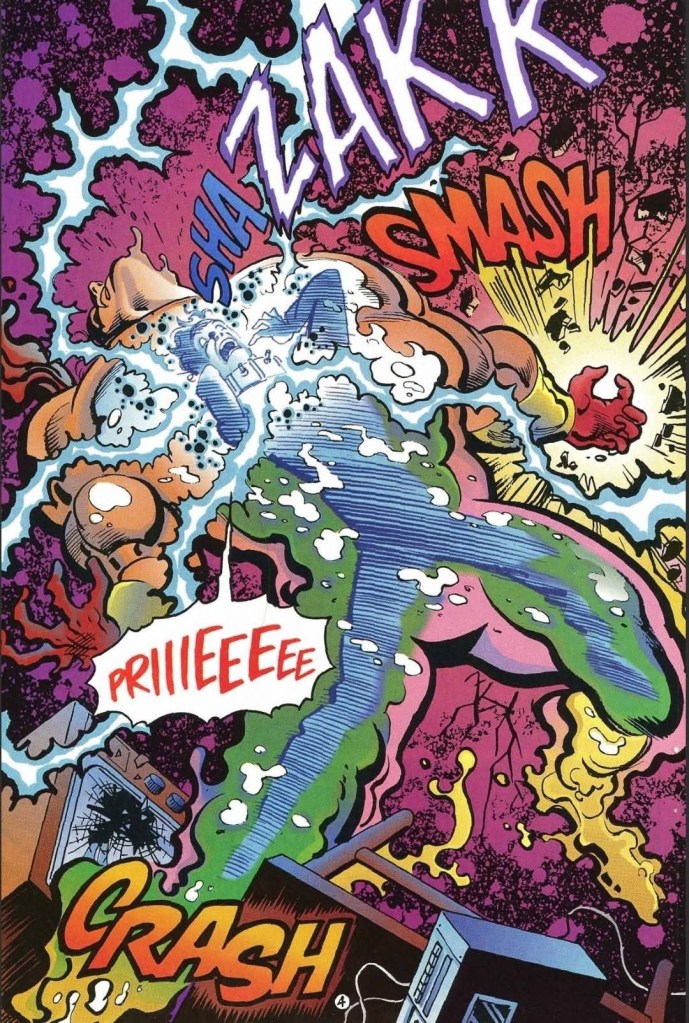
When it comes to plot, this comic book is more about the continuing battle between Jimmy and Donovan Jones. It really pushed aside the development of Jimmy’s new life which is not necessarily a problem as it paved the way for a lot more spectacle for readers to enjoy by means of two armored figures fighting each other hard while trying to outsmart each other. This one has a lot action scenes as well as energy blasts. What I find intriguing and creative here is how Donovan Jones was presented to be a walking, healing factor with improving his physical shell dramatically.

Although filled with spectacle, Len Strazewski still saved some space for character development and exposition. Without spoiling it, I can say that a certain flashback that got dramatized through Angella’s recall of the past adds a new layer into the life of Jimmy Ruiz. It was short but still worthy to read.

As far as Jimmy’s new life goes, the big battle of this comic book is itself a reflection of the impact that the Hostile Takeover storyline had on him. There is not too much corporate intrigue in this story, but the effects of the mentioned crossover storyline can still be felt.

Conclusion

This comic book has a lot of robot-inspired action.

I can say that Prototype (1994) is another good Ultraverse comic book to read. In fact, you will relate with its plot and spectacle a lot more if you managed to read the entire Hostile Takeover storyline. Otherwise, it should be able to satisfy you.

If you are seriously planning to buy an existing hard copy of Prototype (1994), be aware that as of this writing, MileHighComics.com shows that the near-mint copy of the comic book costs $27.

Overall, Prototype (1994) is recommended!

+++++

Thank you for reading. If you find this article engaging, please click the like button below and also please consider sharing this article to others. If you are looking for a copywriter to create content for your special project or business, check out my services and my portfolio. Feel free to contact me as well. Also please feel free to visit my Facebook page Author Carlo Carrasco and follow me at HavenorFantasy@twitter.com