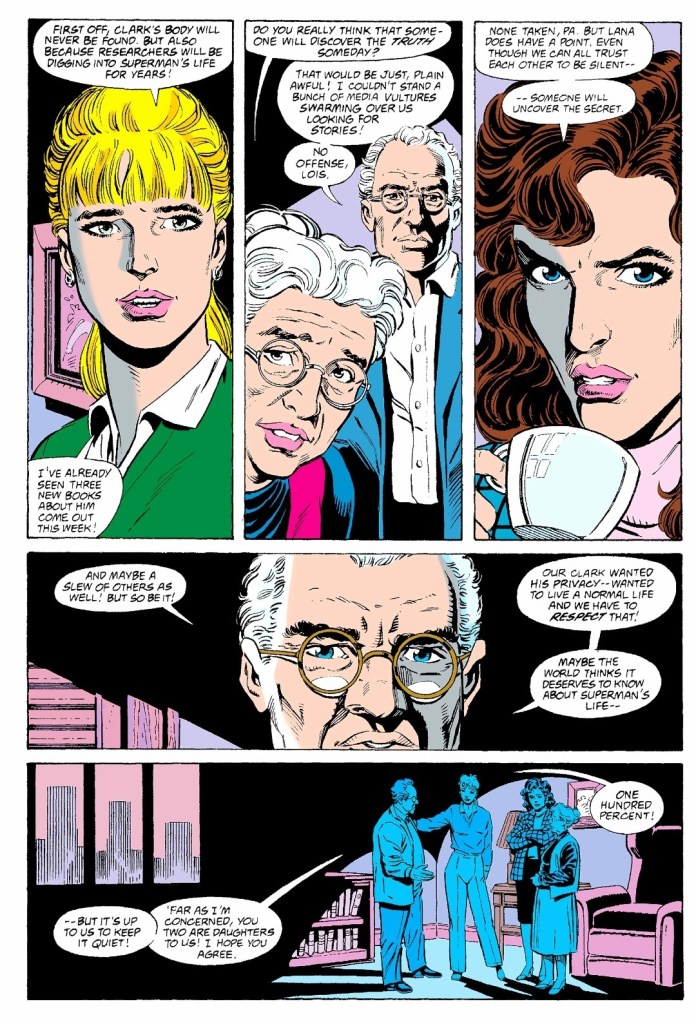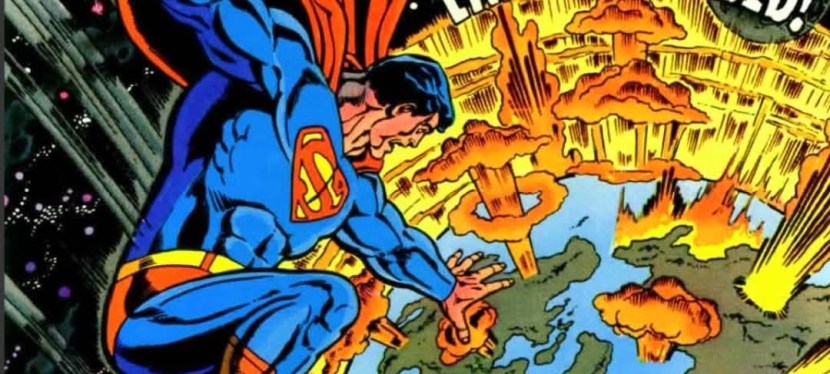
A Look Back at Action Comics #550 (1983)

Welcome back superhero enthusiasts, 1980s arts and culture enthusiasts, DC Comics fans and comic book collectors! Today we go back to the year 1983 to take a close look at a part of the DC Comics universe through a tale of the Action Comics monthly series.

If there is anything notable about the presentation of superhero elements in Superman stories, it is the occasional use of science fiction. From time to time, DC Comics published tales of Superman going deep into space, encounter alien species and visit far-away civilizations. Sometimes, sci-fi is used on major disasters that Superman has to solve.

With those details laid down, here is a look back at Action Comics , published in 1983 by DC Comics with a story written by E. Nelson Bridwell and Bob Rozakis, and drawn by George Tuska.
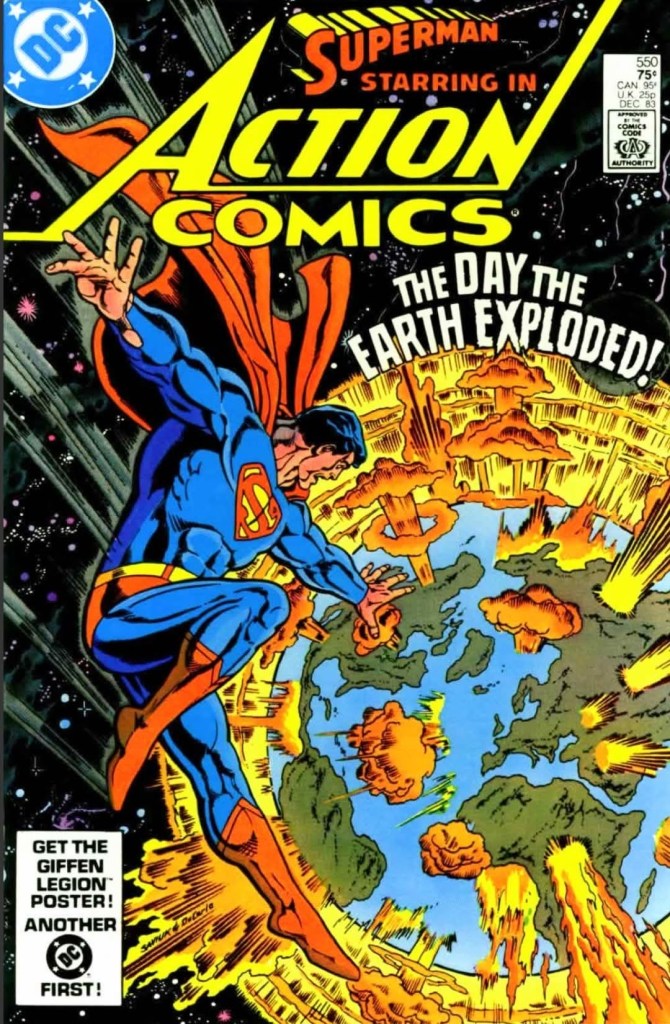
The cover.

Early story

The story begins with Clark Kent and Lana Lang presenting television news at the WGBS station telling viewers about The Exploder who attacked a large jumbo jet full of people. As the program continues, breaking news about an enormous underwater eruption north of New Guinea came in.

Shortly after, Clark quickly and discreetly left the station to fly overseas as Superman. By visiting the site of the reported underwater eruption, he notices the entire New Guinea drifting southward. Superman is compelled to go deep underwater to prevent the nation from drifting further and he also realized there is no volcano that caused the blast.

Quality
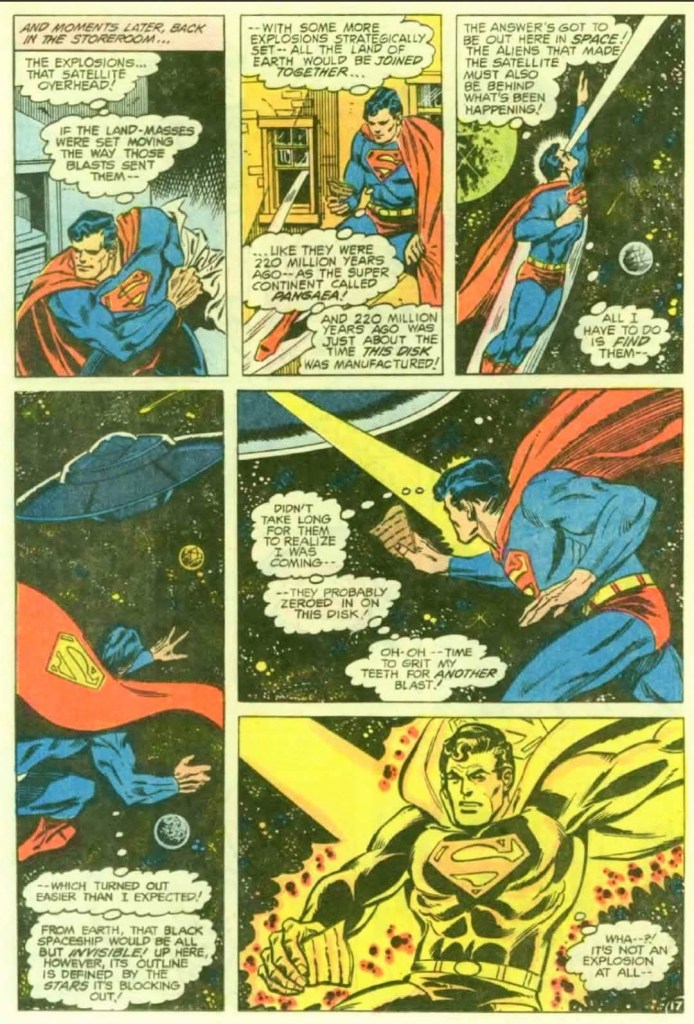
Superman goes to outer space to find answers behind the events that took place on Earth.

This is a Superman tale that does not have the traditional good-versus-evil element of conflict. Instead, it is a sci-fi story that started with solid mystery causing the Man of Steel to do research and detective work to find answers.

The comic book writers behind this were really good in pushing Superman hard on his search for answers to solve mysteries that were really out of this world. Lana Lang’s father appears here as a long-time archaeologist who successfully discovered an ancient artifact described as a so-called disk. The plot turned intense when The Exploder suddenly emerged to take the disk away which unsurprisingly pushed Superman to not only react but also get answers.

I like the fact that as Superman does detective work, Lana Lang and Jimmy Olsen contributed nicely to the plot. At the same time, the mystery and tension really built up as the story went along and the payoff the comic book creators came up with is surprising and also worth it.

Without spoiling the plot, I can say that this Superman tale has its own twists on the concept of UFOs and alien that happen to have special interest on Earth. At the same time, you will realize how dedicated Superman is to protecting the people of Earth and why he would not tolerate aliens who actions would jeopardize billions of lives.

Conclusion
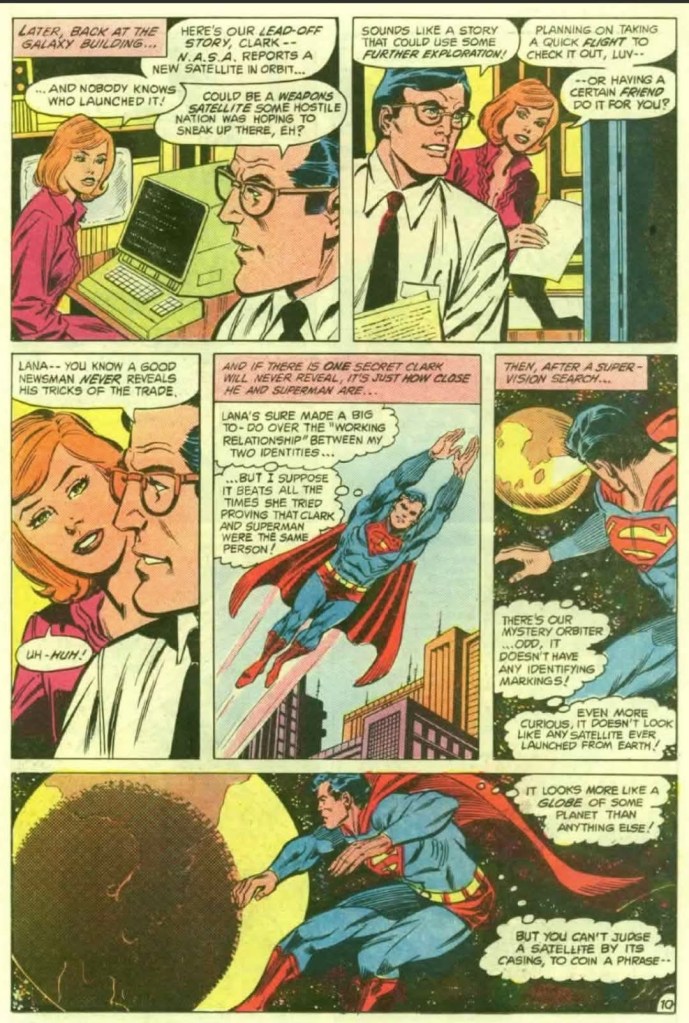
I liked the interactions Clark had with Lana Lang as he tries to solve mysteries.

While Action Comics (1983) does not have a super villain for Superman to battle, you will still see him doing good, solving mysteries and prioritizing Earth’s people. The sci-fi concept the creators came up with looked outlandish on face value but when you read the story and pay close attention to all the details, you will realize that the story is actually believable. I also like the mystery aspect which gave the plot a good amount of depth.

Overall, Action Comics (1983) is recommended.

+++++

Thank you for reading. If you find this article engaging, please click the like button below, share this article to others and also please consider making a donation to support my publishing. If you are looking for a copywriter to create content for your special project or business, check out my services and my portfolio. Feel free to contact me with a private message. Also please feel free to visit my Facebook page Author Carlo Carrasco and follow me on Twitter at  @HavenorFantasy as well as on Tumblr at https://carlocarrasco.tumblr.com/ and on Instagram at https://www.instagram.com/authorcarlocarrasco
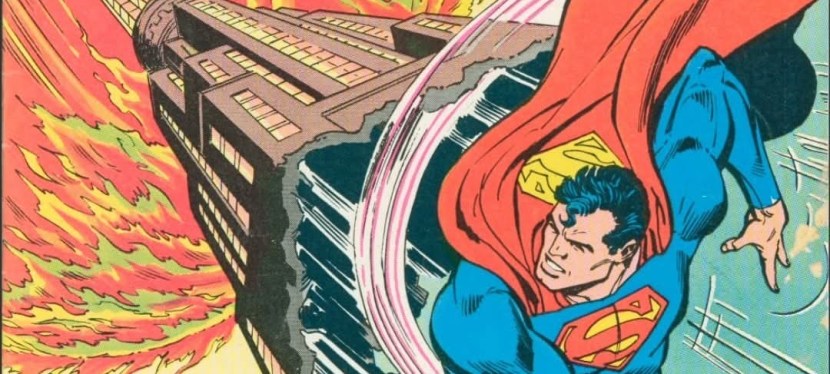
A Look Back at Action Comics #497 (1979)

Welcome back superhero enthusiasts, 1970s arts and culture enthusiasts, DC Comics fans and comic book collectors! Today we go back to the year 1979 to take a close look at a part of the DC Comics universe through a tale of the Action Comics monthly series.

Do you enjoy following stories with the “make-a-wish” concept as a key element? Or do you prefer seeing major events happen because someone else has the power to alter reality? I for one don’t enjoy those concepts very much and the element of wish-making really ruined the story of the glossy cinematic failure Wonder Woman 1984 (written and co-directed by Patty Jenkins). When it comes to Superman, the wish-making or the ability to seriously alter reality could be effect in storytelling when the right creators are involved.

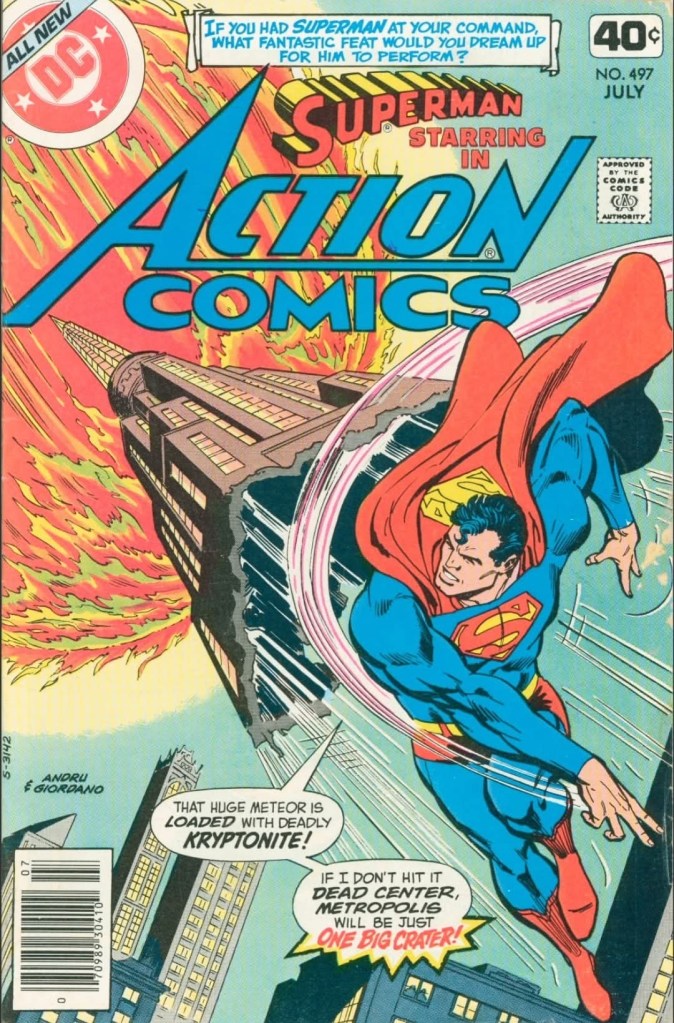
With those details laid down, here is a look back at Action Comics , published in 1979 by DC Comics with a story written by Cary Bates and drawn by Curt Swan.

The cover.

Early story

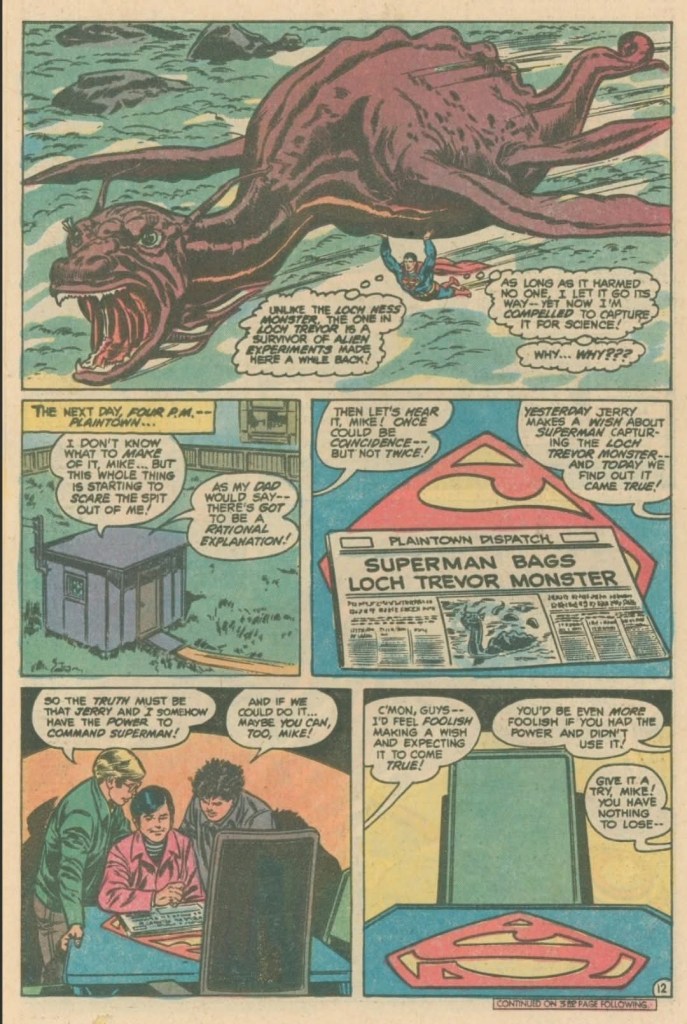
The story begins inside a shed on a lot with three boys who have their own Superman club and support the Man of Steel’s never-ending battle for truth, justice and the American way. Arthur, who is up for drawing something for the next club newsletter, shared his idea (inspired by what he saw in a movie) about a gigantic meteor from outer space heading towards Metropolis which would compel Superman to save the city. Near the three boys is an empty chair reserved for a particular someone.

Many miles away deep within Metropolis, Clark Kent attends a conference in which Lana Lang delivers remarks to an audience of GBS affiliates. As Lana tells the audience that their news team is determined to maintain high standards of broadcasting, a uniformed door man causes a disturbance by telling everyone that a blackout has plunged the entire city into darkness.

Suddenly, the audience exited the venue and Lana notices that Clark is gone. Elsewhere, Superman quickly flies high and sees a giant meteor (the size of a stadium) on a collision course with Metropolis…

Quality

Do you wish you have the power to make superheroes do something as you wish?

Starting with the concept of reality getting seriously altered by someone with tremendous power, the said concept really brought the fantasy aspect of this Superman tale to a very high level. The Man of Steel ends up getting into unbelievable situations and do things that are amazing or shocking. In order words, the concept of altered reality (related to wishful thinking and intense imagination) actually works well in this tale thanks to the Bates-Swan duo.  

Of course, this is not simply a Superman story about wild events that compelled him to react. There are character-driven scenes that emphasize how Superman analyzes what has been going on and why he seems to be controlled or guided to do things that he had no intent of doing. This particular element of the story raises questions about the ethics of having so much power at hand and being able to command a more powerful person to do something (as a wish is made by the one who wields a lot of power).

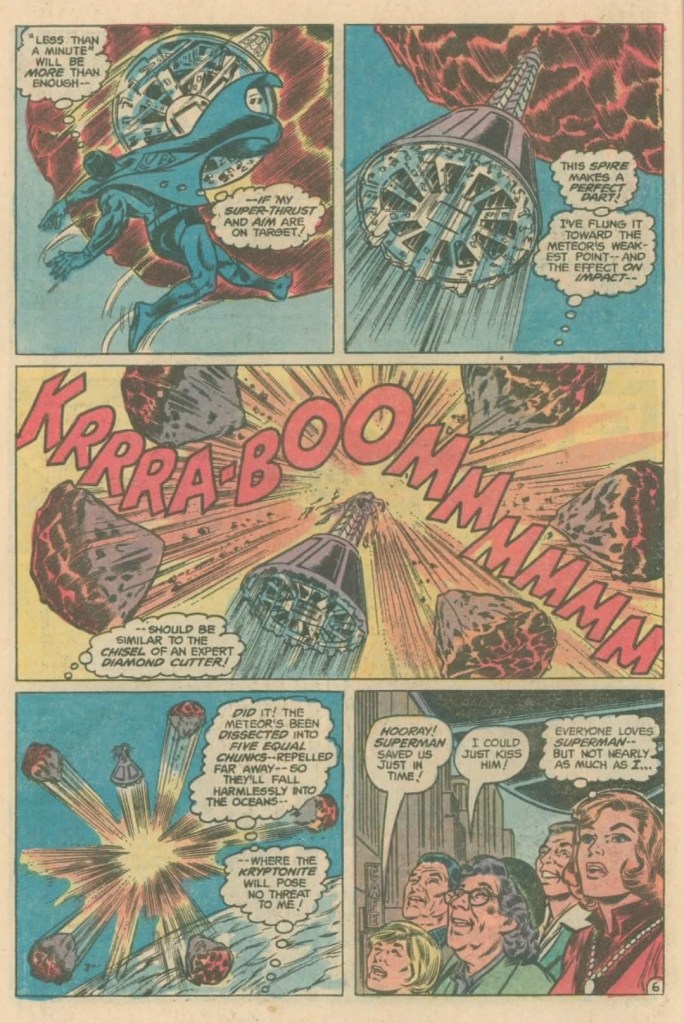
Considering the wild events that happened throughout the story, I can say that the Bates-Swan duo successfully pulled off a worthy pay-off at the conclusion.

Conclusion

Superman saves Metropolis and many people once again. Lana Lang is among the people on the street.

Action Comics (1979) is an old Superman tale that is worth reading. While you won’t see Superman encountering any super villain, the fantasy elements and wild events more than made up for it. More importantly, the Bates-Swan duo was really careful with using the make-a-wish and reality altering concepts to make the plot believable while preventing it from becoming too outlandish. The result is a Superman tale that is entertaining to read.

Overall, Action Comics (1979) is recommended.

+++++

Thank you for reading. If you find this article engaging, please click the like button below, share this article to others and also please consider making a donation to support my publishing. If you are looking for a copywriter to create content for your special project or business, check out my services and my portfolio. Feel free to contact me with a private message. Also please feel free to visit my Facebook page Author Carlo Carrasco and follow me on Twitter at  @HavenorFantasy as well as on Tumblr at https://carlocarrasco.tumblr.com/ and on Instagram at https://www.instagram.com/authorcarlocarrasco
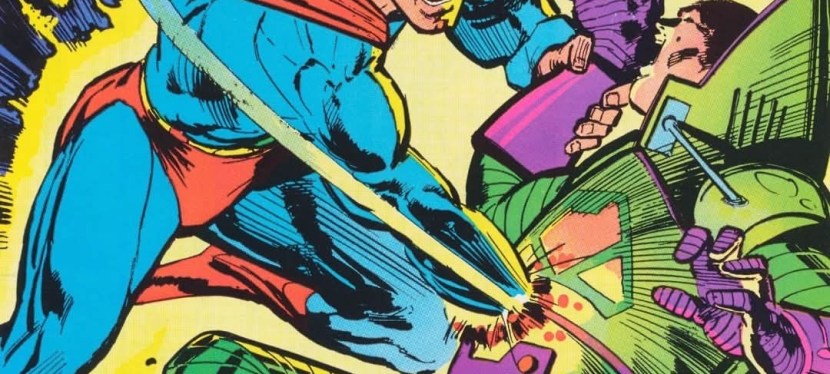
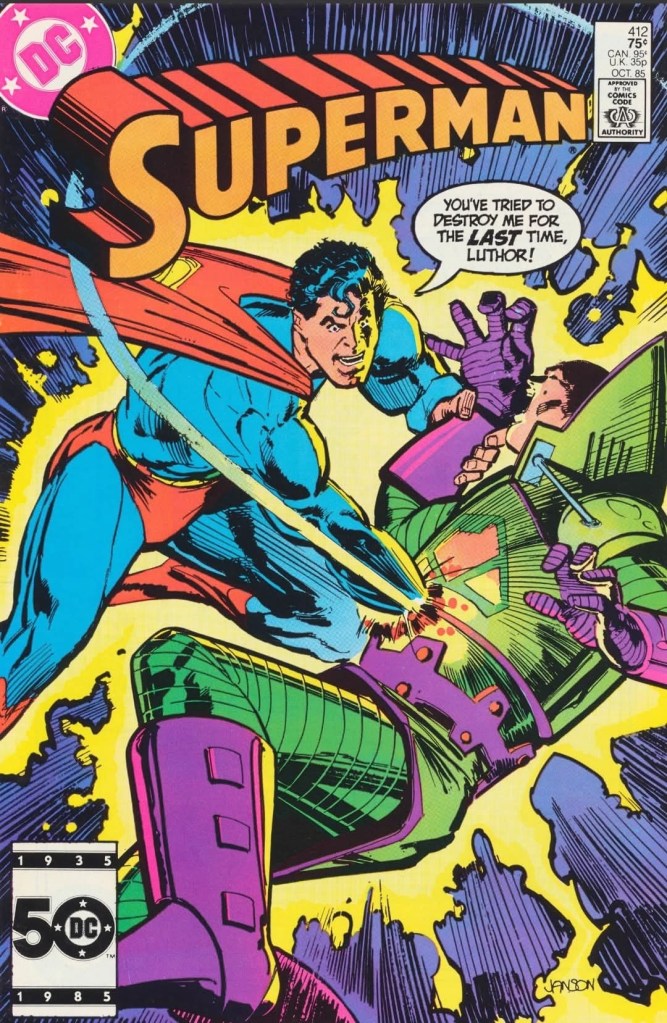
A Look Back at Superman #412 (1985)

Welcome back superhero enthusiasts, 20th century pop culture enthusiasts and comic book collectors! Today we go back to the mid-1980s to take a close look at one of the many tales published through the original Superman monthly series (first launched in 1939).

For the newcomers reading this, the original multiverse of DC Comics formally ended with Crisis on Infinite Earths (1985-1986). That being said, a lot of DC’s monthly comic book series had respective tales the reflect the closing period of the old multiverse (which lasted for decades) and the Superman monthly series of the era was part of the trend.

With those details laid down, here is a look back at Superman , published in 1985 by DC Comics with a story written by Cary Bates and drawn by Curt Swan.  

The cover.

Early story

The story begins at the unemployment bureau in Metropolis. Clark Kent, who recently lost his jobs with WGBS and the Daily Planet, stands in line and waits for his turn. Being unemployed, Clark feels troubled and other people nearby recognize him.

As his turn at the counter starts, Clark senses something and decides to get out quickly. He enters the emergency exit, changes into Superman and flies out of the building. It turns out a high-rise building accident has occurred and already several pieces of sharp glass have been falling down. To prevent further harm, Superman uses his heat vision to convert the falling glass and collectively turn them into a growing molten ball. He brings the giant molten ball to the top of the building (still in construction/expansion) and meets the hard-hat workers before flying away.

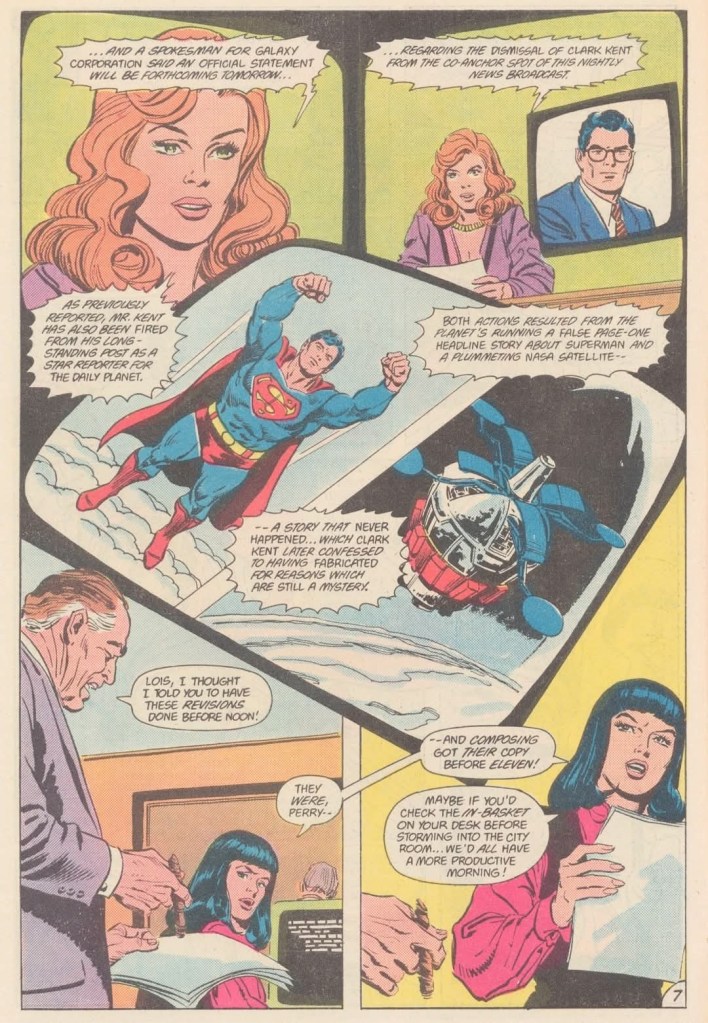
Elsewhere, Lana Lang announces news to TV viewers regarding the dismissal her of close friend Clark Kent which was the result of the fake headline news story about Superman and the NASA satellite. In another location, Lex Luthor is very pleased watching the same broadcast knowing his plan of ruining Superman succeeded and got Clark Kent as a fake news casualty. Luthor is not done with Superman yet…

Quality

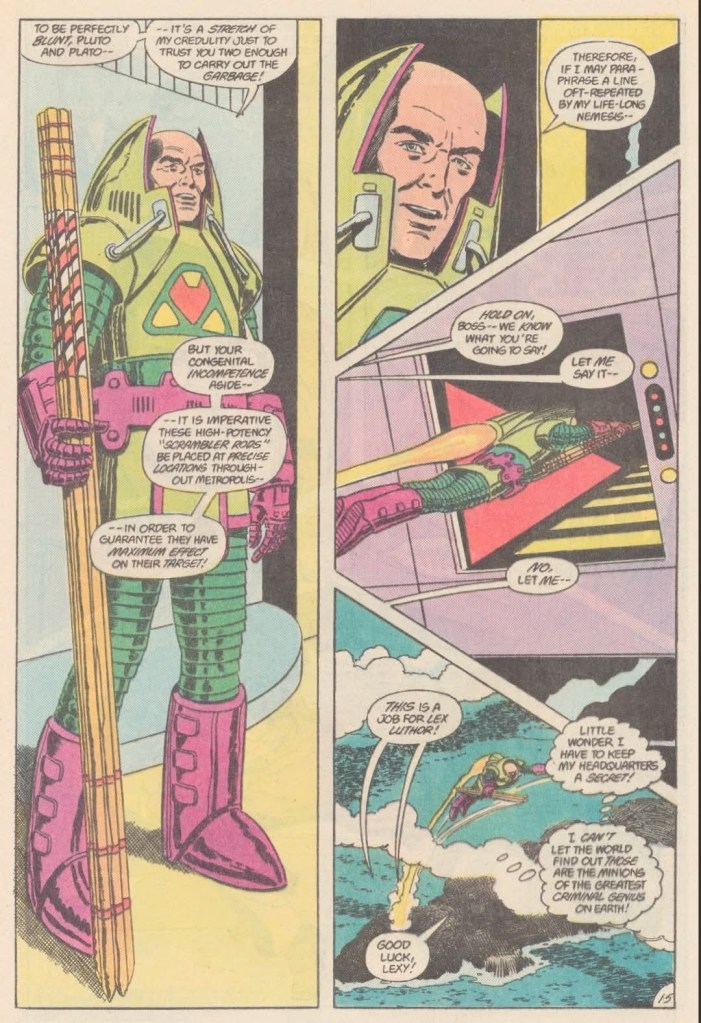
Lex Luthor here is ruthless, strategic and obsessed with defeating Superman.

I really like this Superman tale. This is a story about Superman who is still dedicated to doing acts of good by helping people with problems even though he is socially in deep trouble being unemployed as Clark Kent. Not only is the unemployment aspect relevant, the consequences of fake news and their negative effect on people made this tale more socially relevant with today’s world of fake news and unethical journalism.

Going back to Superman, it is clear that the embarrassment and unemployment of his civilian identity impacted him as a superhero. This is evident when Lana Lang accused him of betraying Clark Kent resulting in a fake news story that led to the firing by WGBS and the Daily Planet. Lana, who does not realize Superman and Clark are the same person, blamed the Man of Steel that the firing of Clark is so devastating to her as she cares for him so much (note: Clark and Lana were romantically involved during their teenage years at Smallville).  

The powerful writing by Cary Bates does not end there. In this comic book, you will see Lex Luthor execute his other plans to ruin Superman whom he personally accused over the loss of his family and his own world Lexor (click here and here for references). This is a Luthor who is not simply being evil but also someone who is well organized, strategic and even fearless. By this stage, the criminal mad scientist Luthor has accumulated a lot of resources to have his own headquarters, technologies and a dedicated staff. In some ways, Luthor in this comic book eerily resembled his financial tycoon version in the post-Crisis era (click here and here for relevance).

I should also state that the personal encounter between Superman and Luthor here is a great pay-off to the build-up that preceded it. You readers should see it for yourselves because to reveal more in this review will ruin it.

Conclusion

As Lana Lang delivers the news to TV viewers regarding Clark Kent and Superman, tension is brewing over at the Daily Planet.

Superman (1985) is undeniably a great Superman story published during the very late stage of the original multiverse (note: Superman #423 was one of the final tales of Superman of this particular era. Superman was part of the post-Crisis era). The portrayal of Superman being disturbed by the huge setback he suffered as a civilian is really compelling to see and his encounter with Lex Luthor really brought the tension and suspense to high levels. At the same time, the consequences of Superman’s actions (including those of his civilian form as Clark Kent) are very evident and nicely dramatized by the Bates-Swan team. You really feel that the creators were wrapping up their Superman stories and decided to move this series to a new direction knowing that the original multiverse will end. This is a must-read tale!

Overall, Superman (1985) is highly recommended.

+++++

Thank you for reading. If you find this article engaging, please click the like button below, share this article to others and also please consider making a donation to support my publishing. If you are looking for a copywriter to create content for your special project or business, check out my services and my portfolio. Feel free to contact me with a private message. Also please feel free to visit my Facebook page Author Carlo Carrasco and follow me on Twitter at  @HavenorFantasy as well as on Tumblr at https://carlocarrasco.tumblr.com/ and on Instagram at https://www.instagram.com/authorcarlocarrasco
A Look Back at Superman #350 (1980)

Welcome back superhero enthusiasts, 20th century pop culture enthusiasts and comic book collectors! Today we go back to the year 1980 to take a close look at one of the many tales published through the original Superman monthly series (first launched in 1939).

Before Crisis on Infinite Earths happened, the DC Comics multiverse had a lot of superhero stories that had outlandish fantasy elements. For example, Action Comics #454 showed Superman eating tons of food in order to survive. In Action Comics #456, the battles between Superman and The Shark had lots of outlandish looking forms of action. In short, the old multiverse and its tropes are looking fun to revisit.

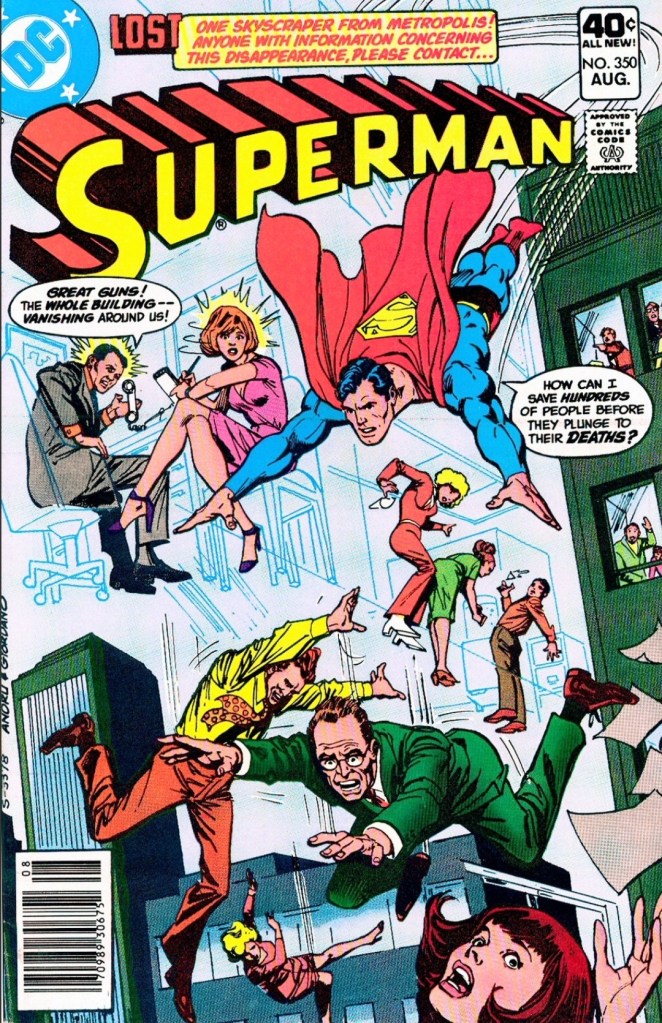
With those details laid down, here is a look back at Superman , published in 1980 by DC Comics with a story written by Gerry Conway and drawn by Curt Swan.  

The cover.

Early story

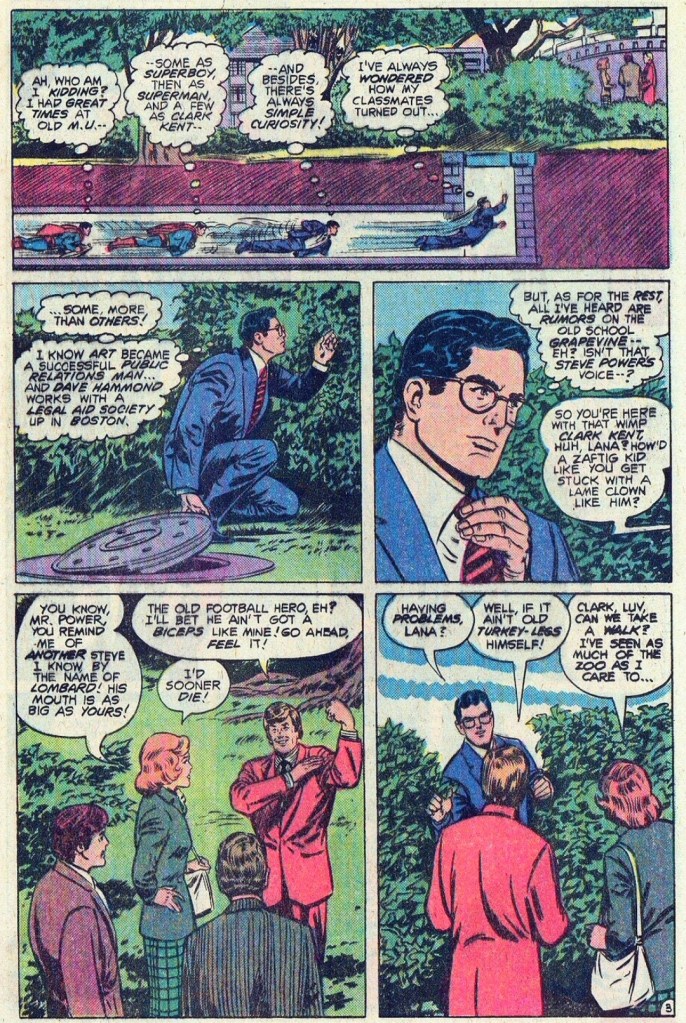
The story begins when Superman makes his move to prevent a punctured hot air balloon transport from crashing. It turns out the balloon was part of the promotion of a reunion event at Metropolis University and Superman really went there to attend it in his civilian identity as Clark Kent. Also attending the event is his long-time friend and colleague Lana Lang.

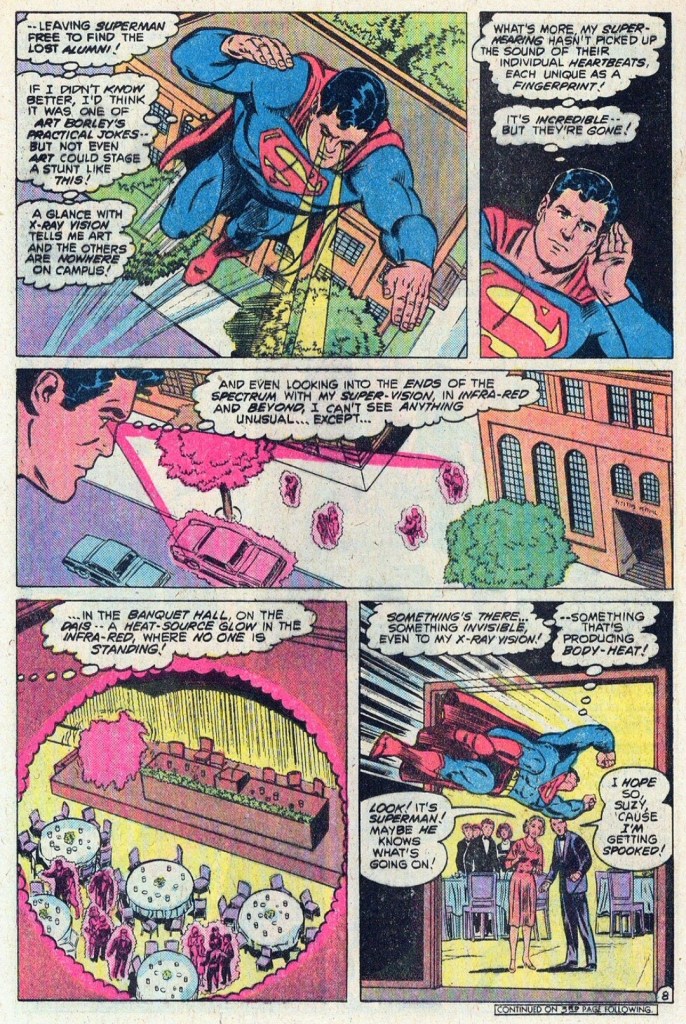
As the old professor Lemuel B. Tolkein – former superior of Clark and his classmates – speaks during the reunion, several attendees – including people Clark personally knew – begin to disappear into thin air. The remaining attendees and guests begin to panic…

Quality

Superman uses his special abilities to solve problems here.

I really like this story. Without spoiling the plot, I can say that this tale written by Conway is actually a mystery that happens to take place during Clark Kent’s reunion with many people from his past. As there is no good-versus-evil concept, the story is solidly focused on mysterious happenings that challenge Superman’s ability to solve problems. Even though he already has many super powers, the Man of Steel still got challenged a lot by the disappearances of people and things.

Apart from the story, I also enjoyed Conway’s approach on developing Clark Kent/Superman, Lana Lang and Lois Lane. Seeing Clark reconnecting with people from his past at Metropolis University was a refreshing portrayal and it also sheds light on how he handled himself during his collegiate years. As for Lois Lane, she was portrayed to be hostile towards Clark with regards to journalistic competition between them, and yet she still has tenderness towards Superman deep inside.

Conclusion

Superman quickly changes into his Clark Kent identity to attend the reunion.

Superman (1980) is enjoyable and the elements of the pre-Crisis multiverse of DC Comics added depth to it. The story is relaxing to follow and it managed to surprise me and keep me engaged until the very end. I am convinced to follow the next issue.

Overall, Superman (1980) is recommended.

+++++

Thank you for reading. If you find this article engaging, please click the like button below, share this article to others and also please consider making a donation to support my publishing. If you are looking for a copywriter to create content for your special project or business, check out my services and my portfolio. Feel free to contact me with a private message. Also please feel free to visit my Facebook page Author Carlo Carrasco and follow me on Twitter at  @HavenorFantasy as well as on Tumblr at https://carlocarrasco.tumblr.com/ and on Instagram at https://www.instagram.com/authorcarlocarrasco
A Look Back at Superman #2 (1987)

Disclaimer: This is my original work with details sourced from reading the comic book and doing personal research. Anyone who wants to use this article, in part or in whole, needs to secure first my permission and agree to cite me as the source and author. Let it be known that any unauthorized use of this article will constrain the author to pursue the remedies under R.A. No. 8293, the Revised Penal Code, and/or all applicable legal actions under the laws of the Philippines.

Welcome back superhero enthusiasts and comic book collectors! Today we explore a key chapter in the post-Crisis era of DC Comics through a Superman comic book. This time, however, we go back to the 1980s, specifically the time when the legendary John Byrne led the direction of developing and modernizing Superman.

After the critical and commercial success of the 1986 limited series The Man of Steel led by John Byrne, the stage was set on telling more stories of what was back then the modernized Superman. In 1987, the monthly series simply titled Superman launched and its first issue had the Man of Steel up against Metallo (also modernized by Byrne). Just before that particular story ended, Metallo was taken away.

With those details laid down, here is a look back at Superman , published in 1987 by DC Comics with a story written and illustrated by John Byrne.

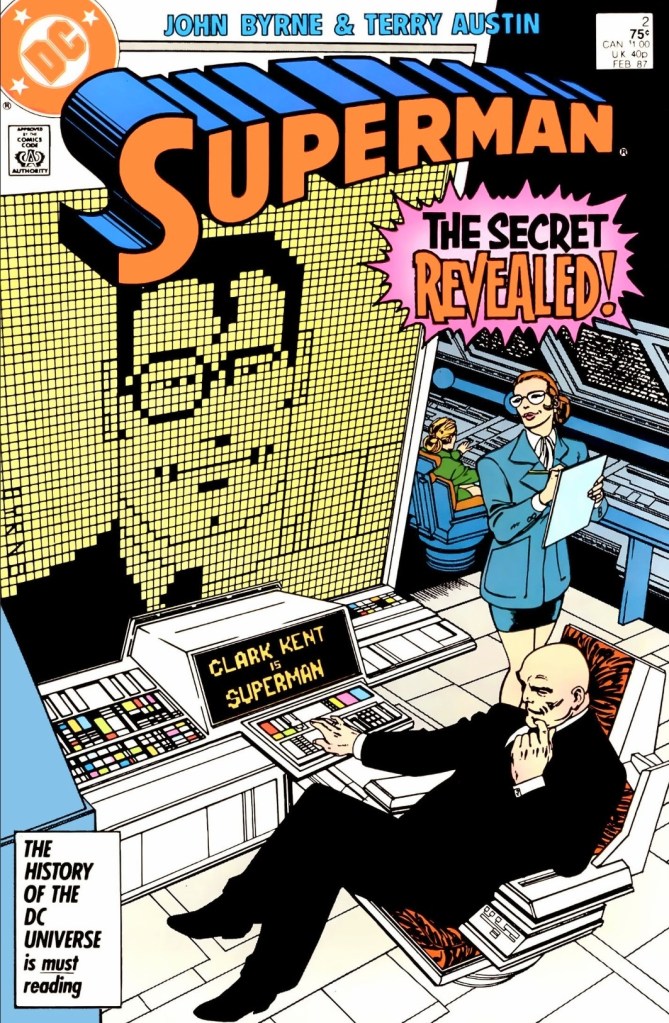
The cover.

Early story

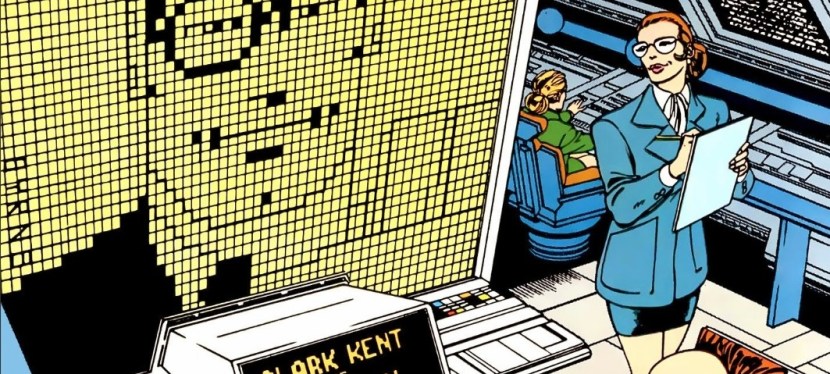
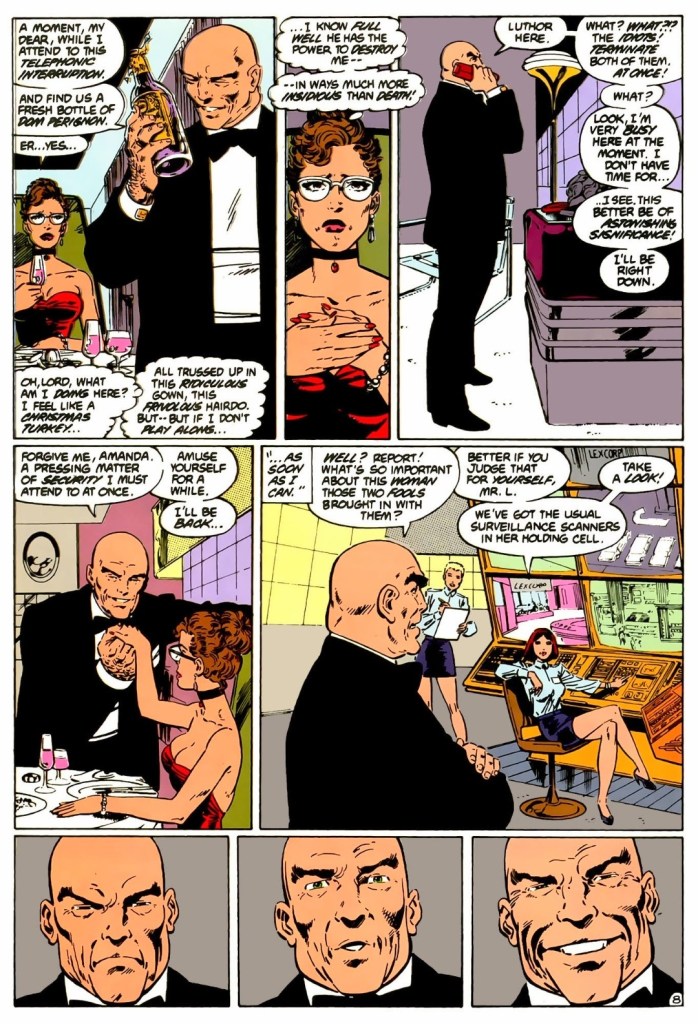
The story begins inside a high-tech facility of the powerful business tycoon Lex Luthor who has been obsessed with Superman since their first encounter. In the presence of many female employees (wearing suits, short skirts and high heels), he watches many huge monitors showing the image of a certain lady standing among bystanders.

His employee Amanda tells him that based on their computer-enhanced analysis of all available news footage of Superman in action, the lady in the monitor appeared in public and she first appeared with the crowds weeks after the Man of Steel prevented a space plane from crashing. Luthor begins to speculate the lady could be connected to Superman and tells two other employees to find her, and he would not tolerate any delays.

Luthor then faces Amanda, holds up her left hand with his two hands and tells her she may join him for dinner that evening. When Amanda expressed that she has a prior commitment (gently rejecting Luthor), Luthor discreetly hurts her hand forcing her to accept his invitation.

Luthor then enters a laboratory with his employees there wearing protective suits. Near them is the restrained body of Metallo whose metallic chest is open with a huge piece of Kryptonite (installed as his power source) fully exposed…  

Quality

Superman and the tycoon Luthor.

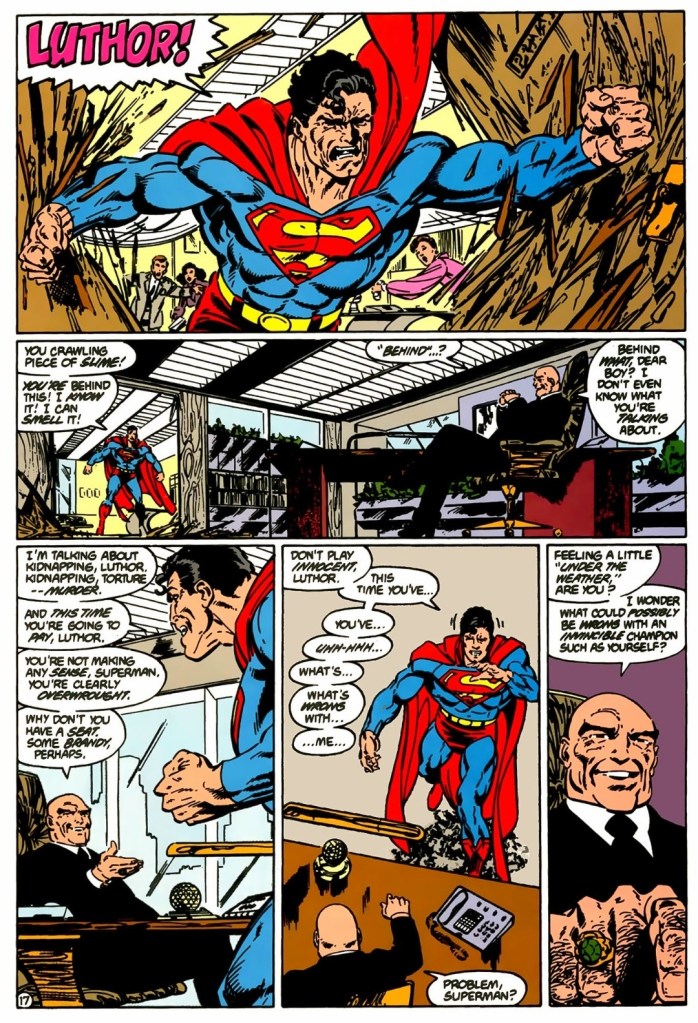
Let me get straight to the point about this Superman story…this one has Lex Luthor as the main character with Superman having the supporting role. That is NOT a bad thing at all because John Byrne cleverly crafted the story showing how Luthor – who is no longer the criminal mad scientist of the previous multiverse of DC Comics – remains the most brilliant and powerful opposition that Superman cannot simply defeat. Being a billionaire, Luthor has vast financial, scientific and technological resources that enable him to overwhelm Superman and even get to the individual people that the Man of Steel cares the most. Luthor also is aware of how laws work and he knows that Superman’s dedication of following the rule of law is a weakness.

About Superman, this comic book shows the more human and more vulnerable side of him. You will the Man of Steel with a wide emotional range moving from caring to getting outraged within a few pages. Along the way, the hero’s secret begins to break down which alone would make you wish to help him. This is a clever portrayal of DC’s icon.

More on the plot itself, this comic book highlights Clark/Superman’s personal connection with small town sweetheart Lana Lang who ends up getting abducted and tortured by Luthor’s forces. Along the way, the breaking down of Superman’s secret identity was very well dramatized and the pacing was excellent. I should state that the ending is a must-see and surely it will make you realize the dynamics of absolute power.

Conclusion

The post-Crisis Lex Luthor is not only a brilliant super villain, he also has his own approach on socializing and getting results.

Superman (1987) is undoubtedly very brilliant and great to read! From start to finish, John Byrne crafted a story that carefully balanced fantasy with realism while also emphasizing Luthor as the greatest enemy of Superman, as well as dramatizing the hero’s relationships with the Smallvile people of his past. Considering how powerful he really is, Superman here was portrayed to be at a major disadvantage against Lex Luthor in more ways than one. Luthor here is not just one very powerful tycoon, he is also one totally absolute danger towards others and he even has his own style of charisma. This is clearly a great way of modernizing the Superman-Luthor rivalry in the post-Crisis era and 1980s America in general. This is classic superhero literature that should be read!

Overall, Superman (1987) is highly recommended!

+++++

Thank you for reading. If you find this article engaging, please click the like button below, share this article to others and also please consider making a donation to support my publishing. If you are looking for a copywriter to create content for your special project or business, check out my services and my portfolio. Feel free to contact me with a private message. Also please feel free to visit my Facebook page Author Carlo Carrasco and follow me on Twitter at  @HavenorFantasy as well as on Tumblr at https://carlocarrasco.tumblr.com/ and on Instagram at https://www.instagram.com/authorcarlocarrasco
A Look Back at Superman #76 (1993)

Disclaimer: This is my original work with details sourced from reading the comic book and doing personal research. Anyone who wants to use this article, in part or in whole, needs to secure first my permission and agree to cite me as the source and author. Let it be known that any unauthorized use of this article will constrain the author to pursue the remedies under R.A. No. 8293, the Revised Penal Code, and/or all applicable legal actions under the laws of the Philippines.

Welcome back superhero enthusiasts, 1990s culture enthusiasts and comic book collectors! Today we go back to the early 1990s and explore a key chapter in the post-Crisis era of DC Comics through a Superman comic book.

Previously, I reviewed Adventures of Superman #498 (1993) and Superman: The Man of Steel #20 (1993) which were chapters of the Funeral for a Friend storyline. In Superman: MOS , a large funeral took place which involved several special guests as well as other DC superheroes who paid tribute to Superman. The entire city of Metropolis is struggling to move forward as the sudden of Superman really impacted all the people, especially on Lois Lane.

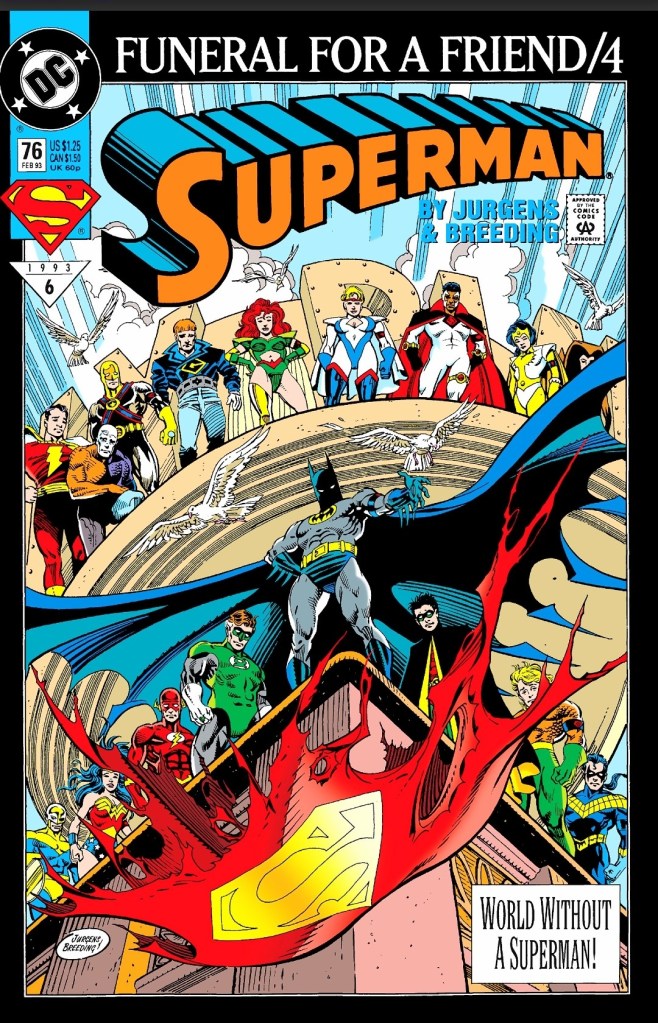
With those details laid down, here is a look back at Superman #76, published in 1993 by DC Comics with a story written and illustrated by Dan Jurgens. This comic book marked the fourth chapter of the Funeral for a Friend storyline.

The cover.

Early story

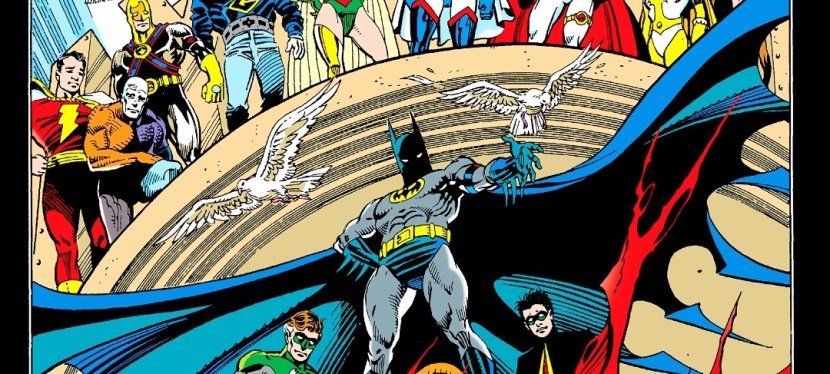
The story begins with Shazam (AKA Captain Marvel) arriving at the rooftop of the Daily Planet where the Flash, Batman, Wonder Woman, Green Lantern, Maxima and others are present. The whole city is experiencing a very somber Christmas season as the death and burial of Superman remains very strong on the people.

On the streets of Metropolis, a long-haired guy named Mitch walks down in the rain feeling troubled not only because Superman died but also due to the fact that their home got smashed during the encounter with the unstoppable Doomsday. Mitch then arrives at a gathering of people outside of a building’s front door. There are several reporters covering a lady speaking to them with a microphone. She tells them that she is Mrs. Superman…

Quality

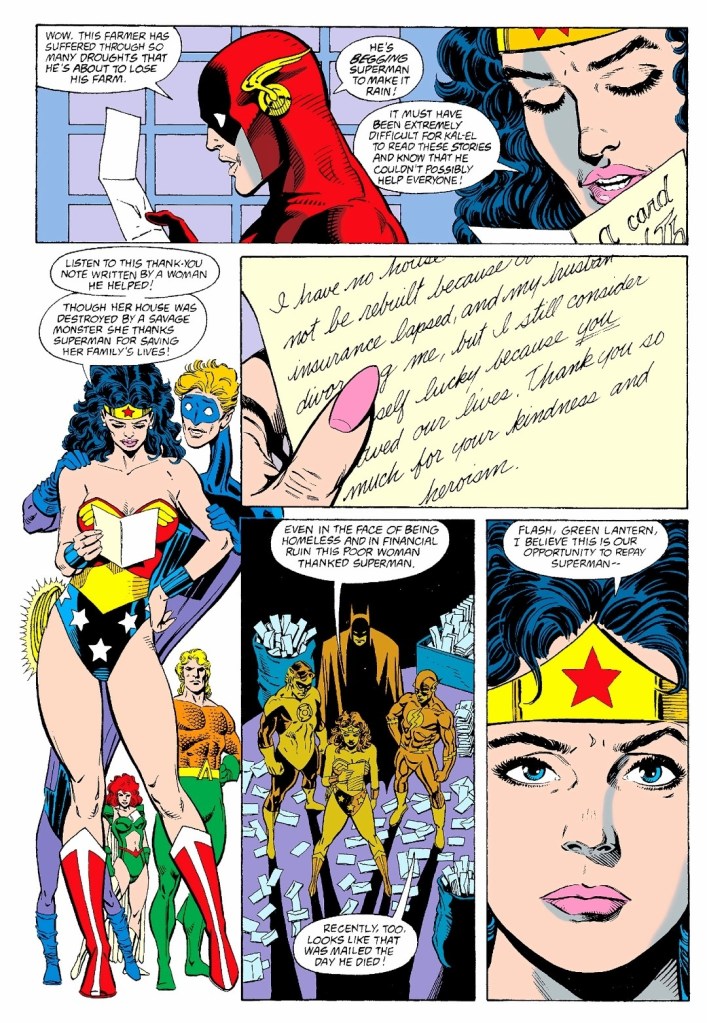
Wonder Woman reads a letter.

Being the 4th chapter of the Funeral for a Friend storyline, Dan Jurgens crafted a story that not only dramatized the post-disaster situation of Metropolis but also had notable twists and developments that proved to be worth reading.

For one thing, this comic book has Lois Lane reunited at last with Clark Kent’s earthly parents Jonathan and Martha which was not only really dramatic but also had very rich dialogue written. By this point in this particular storyline, Lois Lane has gone through waves of deep emotions and pain, while getting stressed with journalistic work. As such, there is this dramatic pay-off that happened during the reunion with the elderly Kent couple.

What is most notable here is the scene in which Superman’s super-powered allies visit a local post office that literally got flooded with lots of mail from around the world addressed to the Man of Steel. On face value, such a scenario looked silly but the way Dan Jurgens crafted the dialogue and the images, the post office scene became believable and sensible to read. This shows that superheroes like Aquaman, Wonder Woman, the Flash and others do have hearts to be caring and sensible to the people.

The scene of the ordinary guy Mitch is significant as well. Clearly the character symbolizes the poor and struggling American who remembers how a complete stranger like Superman came along, stood up to fight for Mitch’s family and died in the process (while Mitch’s father was absent).

This comic book is also a Christmas tale. How Christmas was dramatized here has to be seen and you readers should get a copy of this comic book to find out why. It should be noted that there are themes of reconciliation and the nuclear family that made the Christmas tale meaningful.

Conclusion

Lana Lang, Lois Lane and the elderly Kent couple.

Even without the presence of the Man of Steel and no good-versus-evil conflict, Superman #76 (1993) is a great read as it pushed forward the Funeral for a Friend storyline while successfully telling a meaningful Christmas tale of its own complete with a very unique portrayal of the Justice League and Superman’s allies. How people deal with emotions and stress over Superman’s death was portrayed as highly believable and Dan Jurgen’s writing here was done with really high quality.

Overall, Superman #76 (1993) is highly recommended.

+++++

Thank you for reading. If you find this article engaging, please click the like button below, share this article to others and also please consider making a donation to support my publishing. If you are looking for a copywriter to create content for your special project or business, check out my services and my portfolio. Feel free to contact me with a private message. Also please feel free to visit my Facebook page Author Carlo Carrasco and follow me on Twitter at  @HavenorFantasy as well as on Tumblr at https://carlocarrasco.tumblr.com/ and on Instagram at https://www.instagram.com/authorcarlocarrasco
A Look Back at Superman III comic book adaptation (1983)

Disclaimer: This is my original work with details sourced from reading the comic book and doing personal research. Anyone who wants to use this article, in part or in whole, needs to secure first my permission and agree to cite me as the source and author. Let it be known that any unauthorized use of this article will constrain the author to pursue the remedies under R.A. No. 8293, the Revised Penal Code, and/or all applicable legal actions under the laws of the Philippines.

Welcome back superhero enthusiasts, 1980s culture enthusiasts and comic book collectors! Today we go back to the year 1983 which saw the theatrical release of Superman III that featured the late Christopher Reeve as the cinematic Man of Steel.

The 1980s was a very different time with regards to Hollywood’s handling of superhero movies. The concept of a shared cinematic universe was decades away from realization. Warner Bros. back then relied on the Salkind family to produce Superman movies and the first flick in 1978 proved to be a major hit for both viewers and critics while also establishing Christopher Reeve as the definitive live-action Superman for countless people. Unsurprisingly, a sequel was released in the early 1980s which continued box office success for the stakeholders and only led to the approval of another sequel.

Along the way, the late Richard Pryor (a major comedian already) appeared on TV and talked about Superman II which eventually led to him getting hired for Superman III. The movie was released in 1983 making a little over $80 million worldwide while also getting a noticeably weaker reception from critics. More notably, Richard Pryor had a huge chunk of the film’s spotlight as Gus Gorman while the overshadowed Christopher Reeve managed to stretch his cinematic art on playing Clark Kent and Superman (note: there is also the memorable Clark versus Superman battle). Superman III very clearly had a lot more comedy in its presentation. As part of the movie’s marketing, an official comic book adaptation by DC Comics was published.

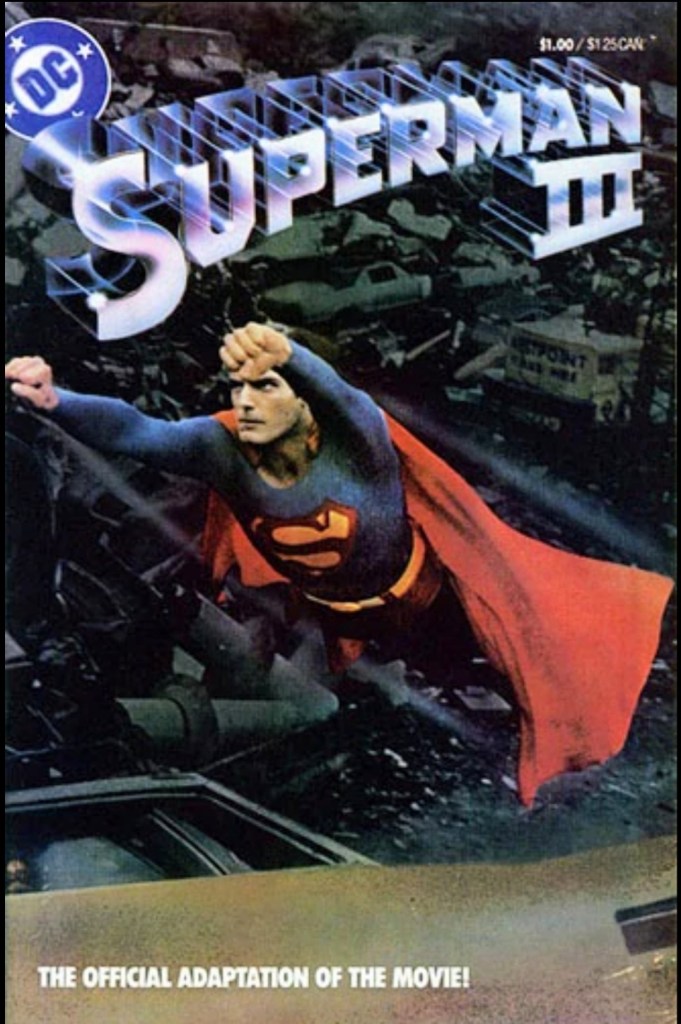
With those details laid down, here is a look back at the Superman III comic book adaptation,  published by DC Comics in 1983 with a story written by Cary Bates and art made by the late Curt Swan and Sal Amendola.

The cover.

Early story

The story begins inside the unemployment bureau of Metropolis. There, August “Gus” Gorman was told after 36 weeks of chronic unemployment, he is no longer eligible for financial assistance (read: welfare) from the city. As he was about to light his cigarette, he noticed computer job ad on the match. Gorman proceeds to the Archibald Data Processing School where he gets enrolled with several others. In front of others, Gorman does something on a computer which impressed the instructor a lot.

Over at the Daily Planet, Clark Kent/Superman, Lois Lane and Jimmy Olsen meet with Perry White at his office. Kent will be returning home to Smallville and make a news story out of it. White gives Kent his approval and then tells Lois she deserves a vacation.

Hours later, Kent and Jimmy Olsen ride the bus together going to Smallville but their ride stops as a result of a huge fire damaging a large chemical plant. A police officer reveals to Olsen that the scientists inside are worried about the plant and its stuff getting destroyed by the fire.

Kent carefully leaves the bus and discreetly changes into Superman to help solve the problem. Olsen, meanwhile, sneaks past the authorities to get to the burning chemical plant.

Over at Webcoe Industries, company head Ross Webster and his sister Vera learn that more than $85,000 worth of company funds was stolen by someone within. Just outside the office, Gus Gorman enters his fancy looking sports car which Webster, Vera and Lorelei notice. Webster asked how could one of their computer technicians afford such a vehicle worth $75,000…    

Quality

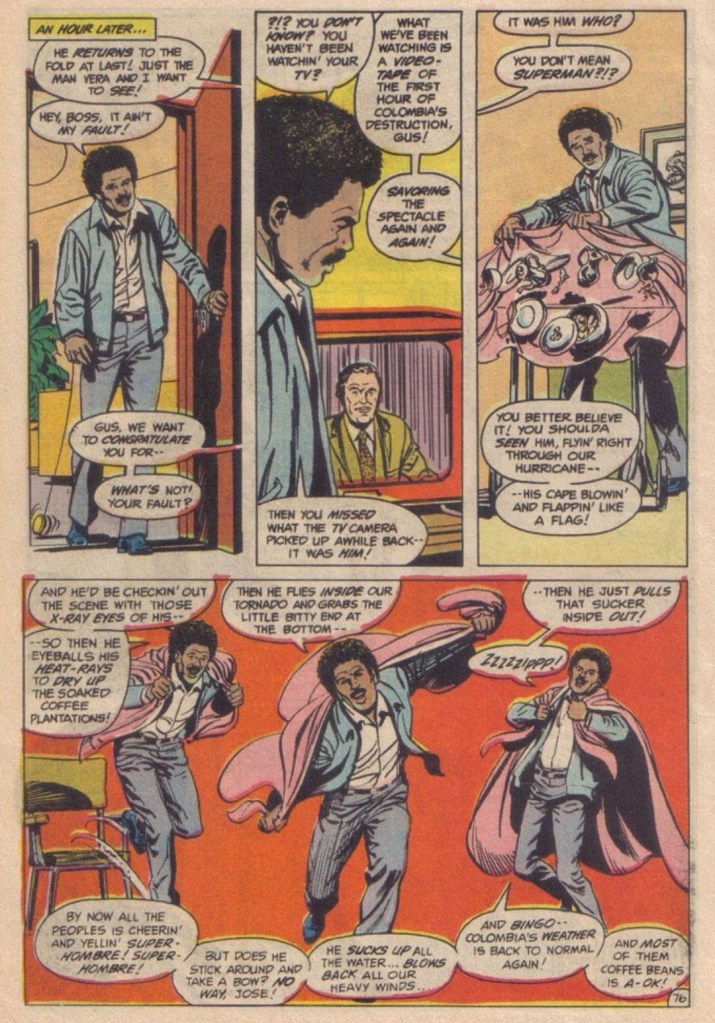
This is a creative way the comic book team used to dramatize Gus Gorman scene revealing and acting the bad news to his boss Ross Webster whose plans were thwarted by Superman.

While it is understandable that not all scenes and not all character moments from the movie  made it on print media, this comic book still managed to capture the film’s essence for the most part. The creative team pulled off their own interpretations of the events and made something entertaining and engaging even though they had to deal with the major challenge of summarizing the movie’s plot and establishing a workable comic book narrative.

I should state that the comic team creatively avoided making in-depth references about liquor and smoking which were obvious in the movie. You will not see Superman drinking liquor at a bar nor will you see Gus Gorman referring to tar listed on a cigarette pack. I suppose this was done to ensure the comic book would be released widely and be acceptable to very young readers and the parents watching them.

The battle between evil Superman and Clark Kent is best viewed in the movie. This one is a shorter and less detailed version of it.

When it comes to establishing the clear lead among all the characters featured, Superman fans should be delighted to know that the Man of Steel is indeed more prominent than Gus Gorman. Take note that in the movie, Richard Pryor’s Gus Gorman overshadowed Christopher Reeve’s Superman/Clark.

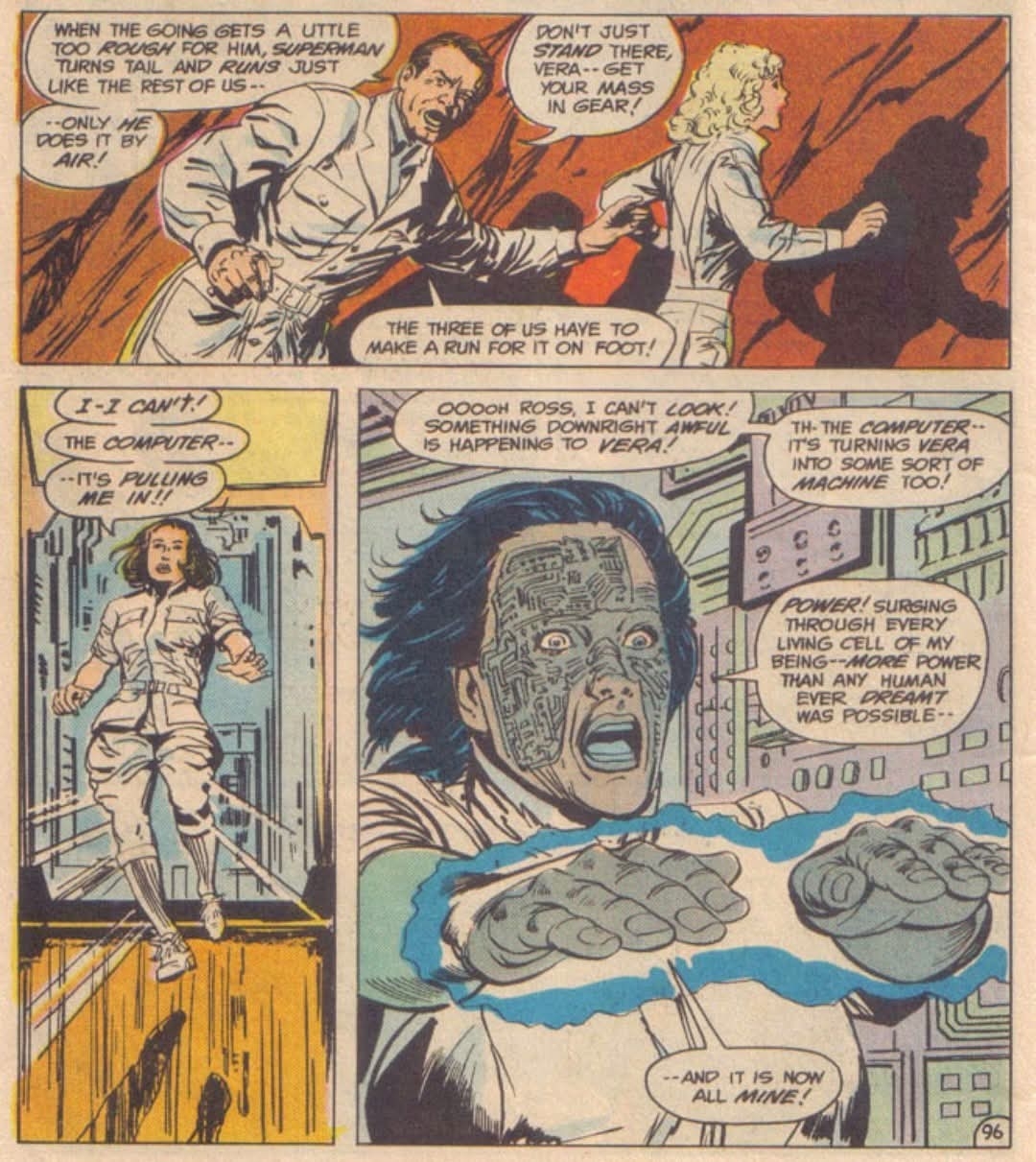
Remember the frightening sequence of Vera getting captured and turned into a cybernetic figure by the Super Computer? This is what it looks like in comic book format.

The art done by Curt Swan and Sal Amendola is decent and it seems to me that their time on visualizing Cary Bates’ script was indeed limited. That being said, it was not surprising to me that, with the exception of Ross Webster in one specific image, none of the characters resembled their cinematic counterparts. Clark Kent/Superman never resembled Christopher Reeve, and Gus Gorman looks nothing like Richard Pryor. Clearly, the artists’ focus was visualizing the narrative which they succeeded.  

Conclusion

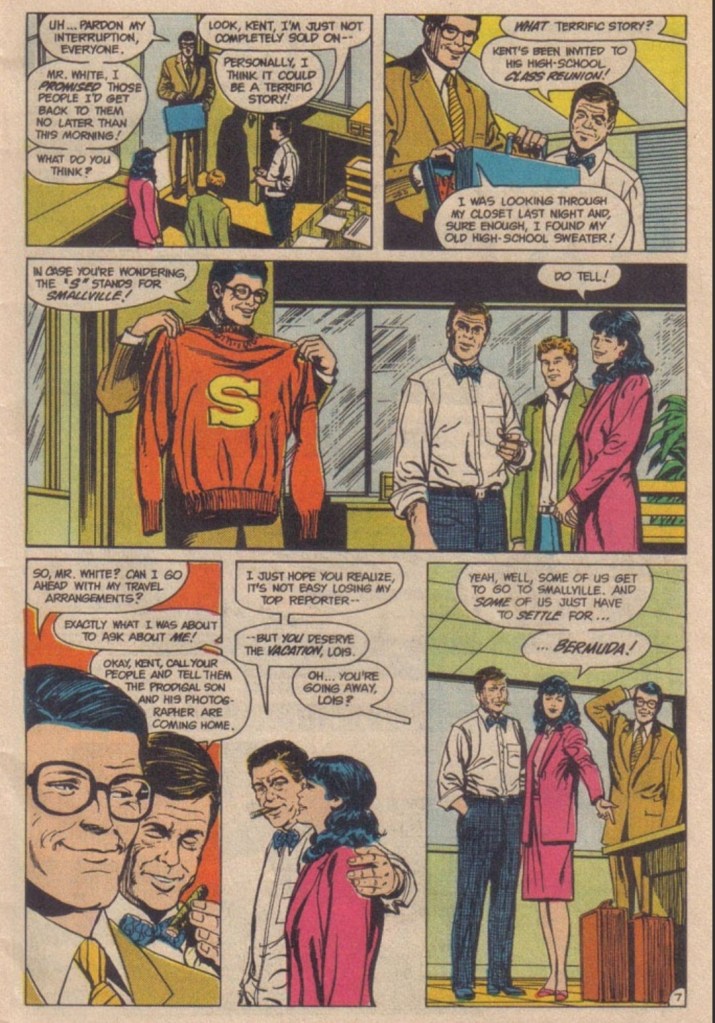
Clark Kent, Lois Lane, Jimmy Olsen and Perry White in the Daily Planet.
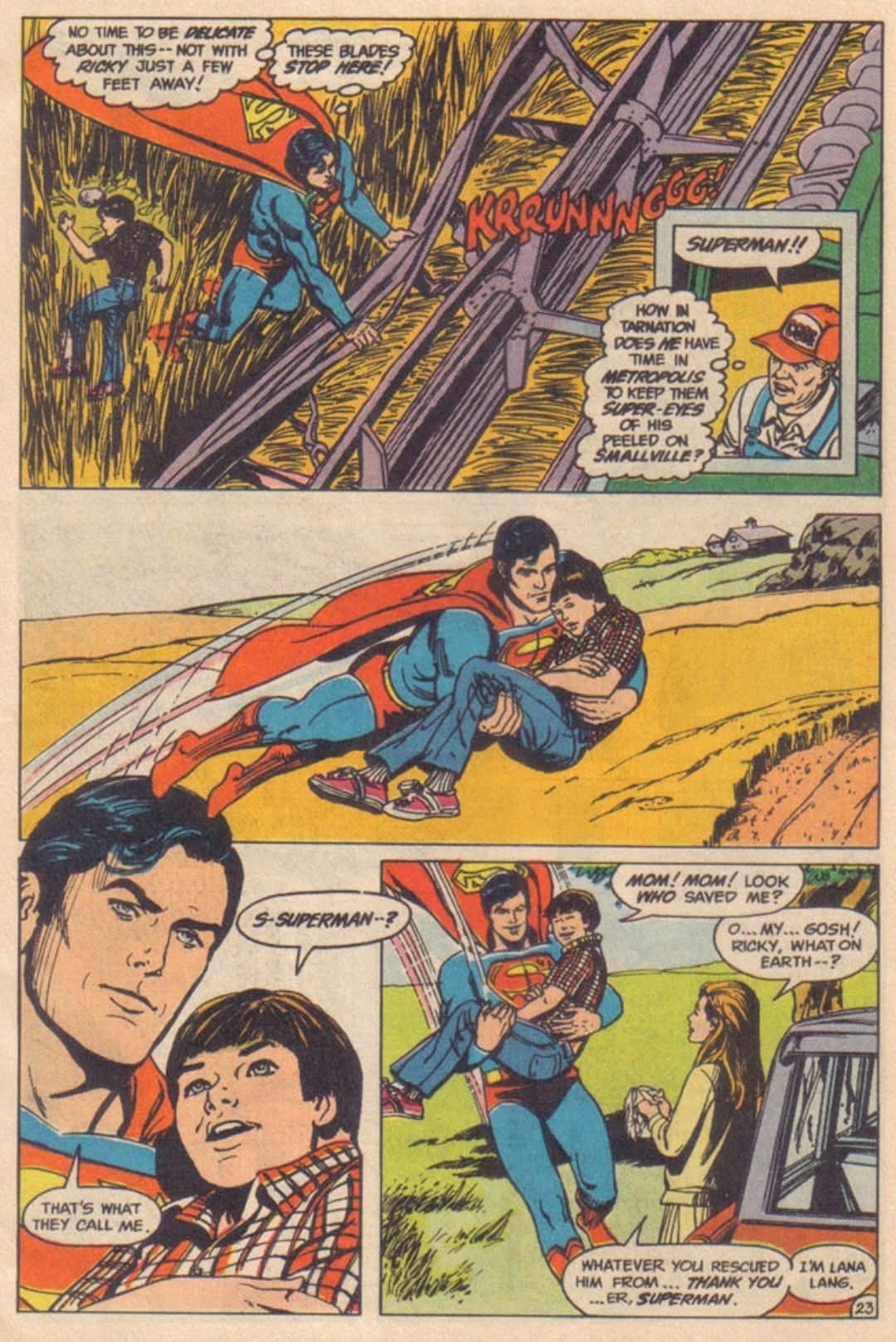
Superman saving Lana Lang’s son from certain death.

Having seen the Christopher Reeve/Richard Pryor movie in the cinema and on cable TV since 1983, I can say that Superman III (1983) is a decent adaptation. It’s not 100% faithful but it is still a worthy read as it will give you the movie’s concept and entertainment values in literary form. If you really want to full essence of film along with the cinematic moments (note: the Superman-Clark battle is the cinematic highlight) all intact, then your obvious choice is to watch the movie. If you are turned off by the movie’s wacky comedy, then the comic book adaptation will deliver to you the more serious approach on telling Superman III’s story. Let me repeat that Superman is more prominent than Gus Gorman in this comic book.

Overall, Superman III (1983) is satisfactory.

+++++

Thank you for reading. If you find this article engaging, please click the like button below and also please consider sharing this article to others. If you are looking for a copywriter to create content for your special project or business, check out my services and my portfolio. Feel free to contact me with a private message. Also please feel free to visit my Facebook page Author Carlo Carrasco and follow me on Twitter at  @HavenorFantasy as well as on Tumblr at https://carlocarrasco.tumblr.com/ and on Instagram at https://www.instagram.com/authorcarlocarrasco/
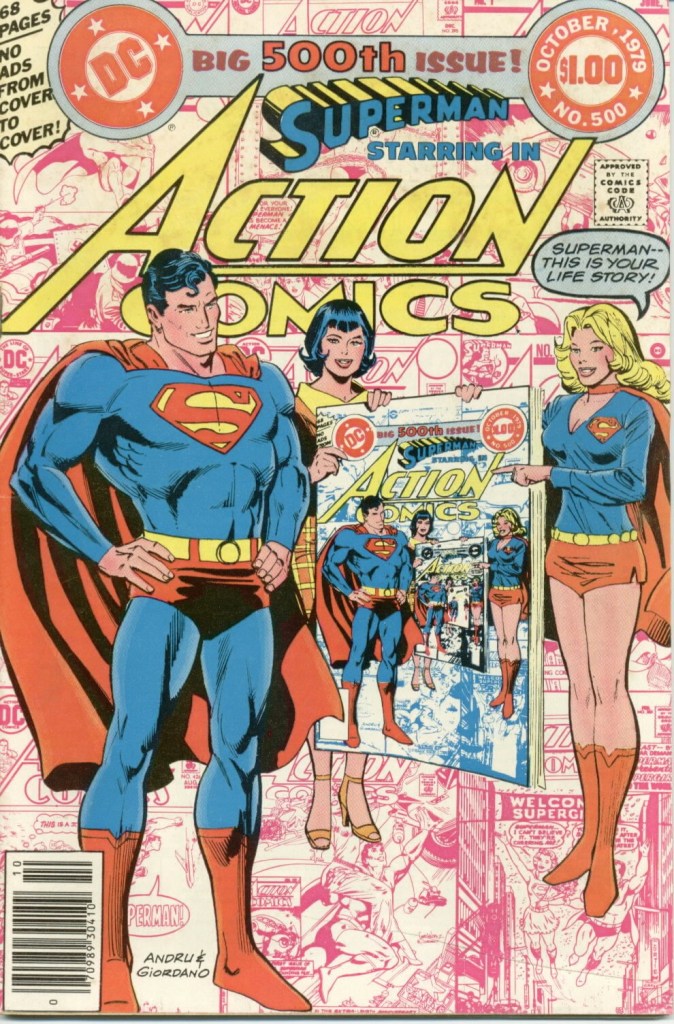
A Look Back at Action Comics #500 (1979)

Disclaimer: This is my original work with details sourced from reading the comic book and doing personal research. Anyone who wants to use this article, in part or in whole, needs to secure first my permission and agree to cite me as the source and author. Let it be known that any unauthorized use of this article will constrain the author to pursue the remedies under R.A. No. 8293, the Revised Penal Code, and/or all applicable legal actions under the laws of the Philippines.

To publish a five hundredth issue of an extensive monthly comic book series is clearly a major milestone for any publisher. To do the math, it takes a whole year to publish 12 issues on a monthly schedule. To reach five hundred issues on a monthly pace will require forty-one years and eight months’ time to publish.

Way back in the late 1970s, DC Comics achieved the said milestone with their extensive monthly series titled Action Comics which is often identified with the world’s most famous superhero – Superman! Take note that DC Comics started in 1935 while Action Comics (the first appearance of Superman) was published a few years later.

Going back to the 500th issue of Action Comics, it is easy to wonder what DC Comics’ talent came up with to celebrate the milestone. That being said, we can all find out more in this look back at Action Comics , published by DC Comics in 1979 with a story written by Martin Pasko and visualized by Curt Swan and Frank Chiaramonte.

The cover.

Early story

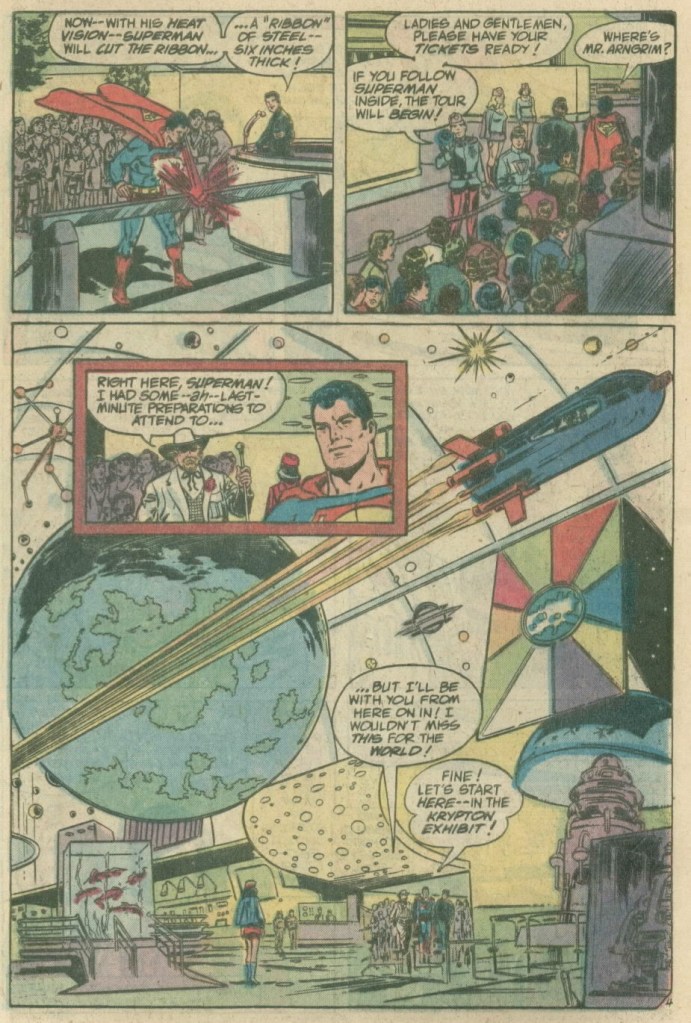
The story begins with Superman arriving at a pavilion named after him at the Metropolis World’s Fair. Countless people welcomed with lots of cheering as he lands near the mayor in the presence of the famous entrepreneur J. Robert Arngrim. Also present were Superman’s closest friends Lois Lane, Lana Lang, Jimmy Olsen and Perry White.

After the formal opening, Superman leads a large group of people as their tour guide. Together they arrived a wide hall containing the Krypton exhibit showcasing alien technology, architecture and life on Superman’s home planet. In response to a request by Arngrim, Superman reluctantly agrees to do a demonstration of the mind-prober ray, a machine Superman himself invented as a boy mainly to retrieve memories from his subconscious.

As the Man of Steel takes his seat on the machine in front of the tourists and Arngrim, an unidentified person located in a secret facility prepares to invade Superman’s mind…

Quality

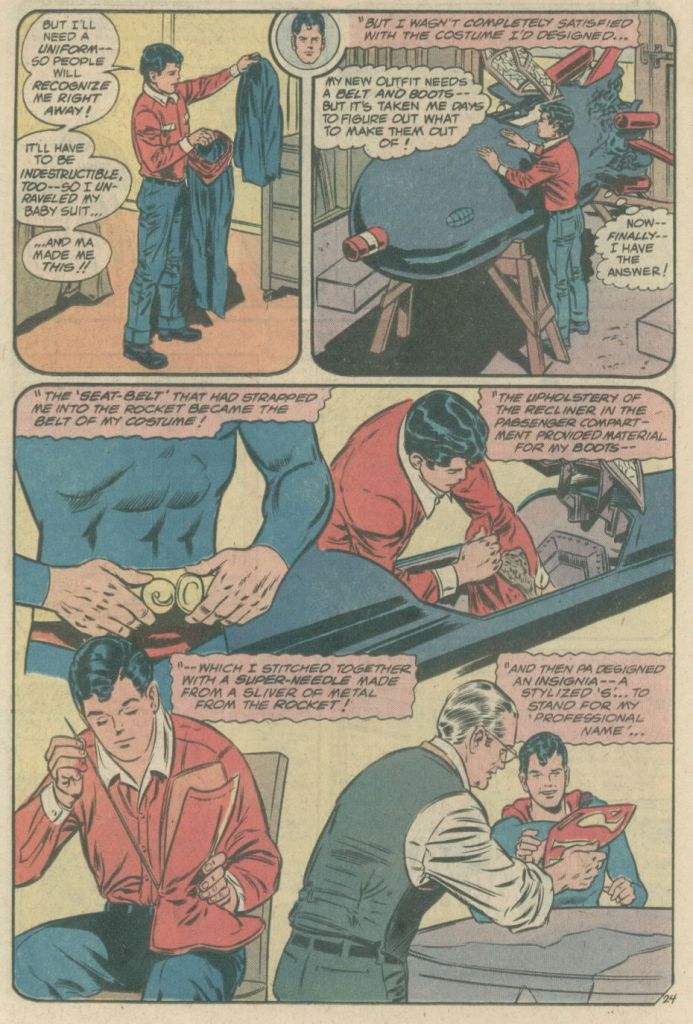
Teenage Clark Kent gradually becoming Superboy.

To make it clear, this 500th issue of the Action Comics monthly series is an extensive, no advertisements tribute to Superman and I can say that the comic book creators really went all out to present lots of stuff to please Superman fans.

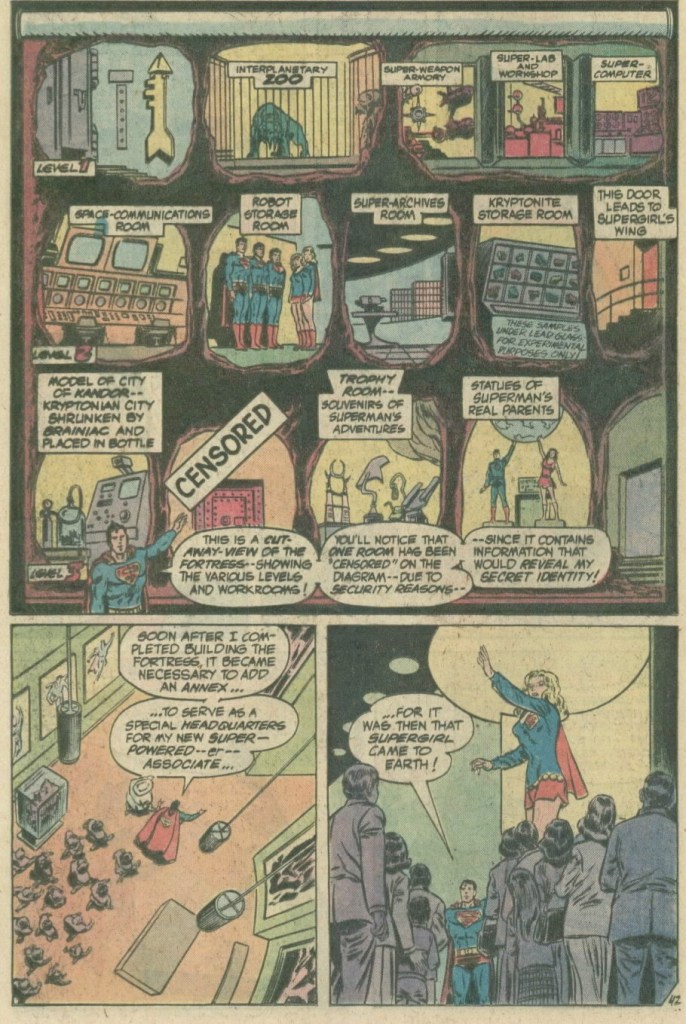
As such, the story was written to help the newer fans of the time to be more familiar of the legacy of Superman (note: this was years before Crisis on Infinite Earths happened) by revisiting and dramatizing established events of the Man of Steel’s legacy such as Jor-El (Superman’s father) failing to convince the Kryptonian science council members that their world was doomed, Superman sent to Earth as a child in a rocket before Krypton’s destruction, getting raised by an American couple after arriving on Earth, becoming Superboy (note: another pre-Crisis element), getting a job at the Daily Planet, welcoming Supergirl on Earth, and so on.

Superman leading the tour.

Of course, Superman does not reveal key details of his personal life to the people during the tour and such recollections were presented to delight us readers. Still, there is richness in the writing and the art. Even though I am already familiar with DC’s icon and the Superman-related mythos, I still had a lot of fun reading the events of Superman’s past, particularly his early years as the adopted son of the Kent couple who in turn did their best to adjust to his super abilities while raising him with good values and discipline.

While the recollections from Superman’s past are engaging, the present-day tour at the Superman pavilion is itself quite fascinating. There were displays of supervillains such as Lex Luthor, Braniac and Parasite. There was even a collection of the different types of Kryptonite. What really nailed the present-day story was a nice twist that allowed for some new superhero spectacle and intrigue to take place.

Conclusion

The first stop of the tour – Krypton exhibit!

While this portrayal of Superman is already outdated given the time of its release, Action Comics (1979) is still a lot of fun to read and it is indeed a great tribute to DC’s most famous superhero. If you are a Superman fan who has gotten sick and tired of the way DC Comics reshaped and modernized Superman since after the end of Crisis on Infinite Earths, this comic book could be refreshing for you. It is also a lively piece of DC Comics’ history.

If you are seriously planning to buy an existing hard copy of Action Comics (1979), be aware that as of this writing, MileHighComics.com shows that the near-mint copy of the comic book costs $210.

Overall, Action Comics (1979) is highly recommended!

+++++

Thank you for reading. If you find this article engaging, please click the like button below and also please consider sharing this article to others. If you are looking for a copywriter to create content for your special project or business, check out my services and my portfolio. Feel free to contact me as well. Also please feel free to visit my Facebook page Author Carlo Carrasco and follow me at HavenorFantasy@twitter.com
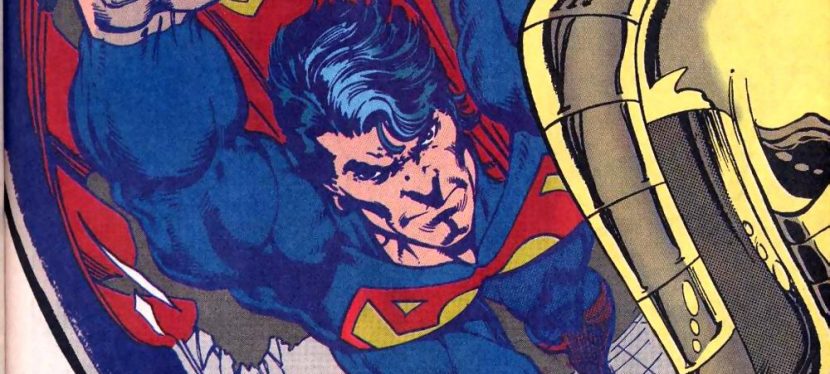
A Look Back at Superman #100 (1995)

While this old comic book may not be the best-selling Superman story of the 1990s, it is for me the most significant one as well as creator Dan Jurgens’ best work ever on the Man of Steel. I’m talking about Superman #100.

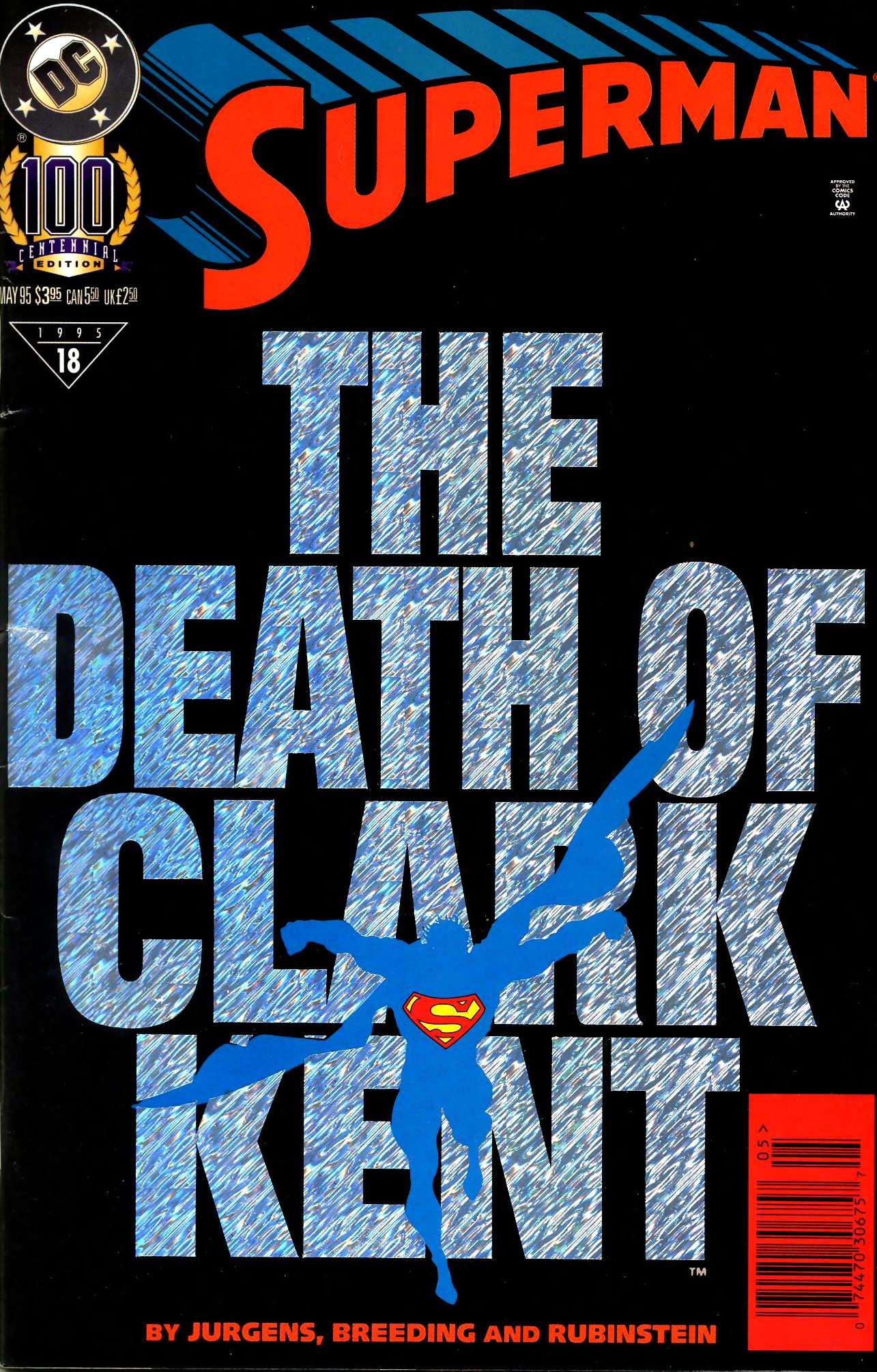
Cover
The cover.

Released in 1995 by DC Comics, Superman #100 came out with a special cover that highlighted the title “The Death of Clark Kent”. It was released with a hefty cover price of $3.95 for the United States and was pretty thick. It was written and illustrated by Dan Jurgens, the same man who worked on the best-selling Superman (The Death of Superman climax).

Early story

The story begins with Clark Kent carrying a deformed Superman object (with makeshift glasses and a knife “stabbing” the letter S) and just feet behind him was his officemate Jimmy Olsen. Hidden mostly from Olsen’s view, the object signifies that someone knows that Clark Kent and Superman are one and the same person. Carefully, Clark hides it away and starts chatting with Jimmy who is very concerned of him.

Clark recently has been struggling over the fact that someone knows his secret identity. After carefully dismissing Jimmy, he moves out as Superman to take of business before the madman (who knows his identity) makes his next move.

Superman visits his parents Jonathan and Martha Kent at their home in Smallville. He expresses to Jonathan that he believes that the madman is someone he knew from his past: Kenny Braverman (Conduit).

Quality

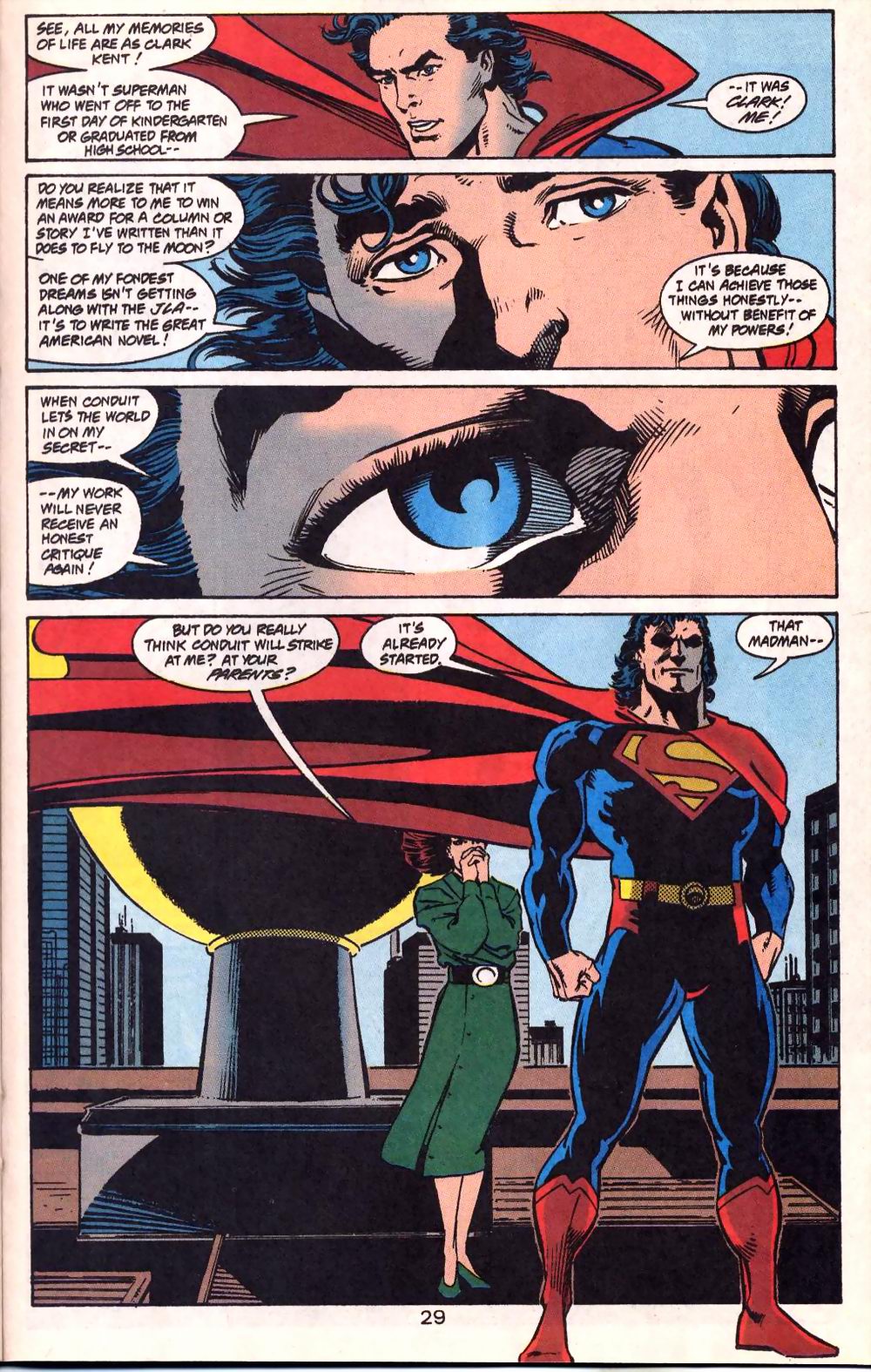
If there is anything that defines this comic book, it is the in-depth storytelling done by Dan Jurgens complete with intense character development as well as exploration of people from his past (all connected to Smallville).

The plot structure is quite simple. Conduit knows Superman/Clark Kent personally and is always at least a step ahead of the superhero complete with strategies mess with him personally. Superman, who came back from the dead and has been struggling to fit in with the times, finds himself at his most vulnerable state not as a super-powered guy but as a human being. To analyze things here, Superman is about to get suffer and lose a lot again but not with the temporary death he got from fighting Doomsday, but rather the demise of his personality as Clark Kent.

Art2
Truly one of the best Superman dialogue and characterizations ever thanks to Dan Jurgens.

Think about it. As Clark, Superman has a career, a social life, grew up the American way, intends to spend his life with Lois Lane and has ambitions of simple living that mean more to him than being with the Justice League America (note: writing the next great American novel).

The great thing here is that writer-artist Dan Jurgens humanized Superman a whole lot in this comic book and his work is excellent. Superman #100 opens up the discussion about what life would be like for the Man of Steel once his identity as Clark Kent gets ruined. The story also connects with Superman’s past (within the post-Crisis universe of DC Comics) and sheds light on his relationships with not only his parents but also with Pete Ross and Lana Lang (Clark’s ex-GF). When it comes to putting Superman in danger, Conduit’s approach is more convincing than Doomsday’s unstoppable power of destruction.

By the time I got immersed with Dan Jurgen’s storytelling and character development, the action scenes involving Superman felt justified. More importantly, this comic book shows the famous superhero being pushed to the limits in terms of personality tolerance and determination.

Conclusion

We live in an age in which established entertainment franchises get ruined by sequels or spin-offs or reboots which were mishandled by creators who tried to reinvent stuff only to fail and disappoint the fans.

Look at Star Wars Episode VIII: The Last Jedi. Director Rian Johnson had complete creative control on telling an engaging and fun Star Wars tale but ended up deforming it (disregarding Star Wars’ most defining elements), focused mainly on subverting people’s expectations and left many long-time fans disappointed and angry.

Art1
Superman going after Conduit.

Going back to Superman #100, Dan Jurgens succeeded in redefining the American icon while maintaining respect of the established past of the character and kept the elements that defined Superman. His story about the demise of Superman’s secret identity was a very fresh concept and, for a time, it paved the way for opportunities to take the Man of Steel into new creative directions without disappointing fans.

Personally, I would love to see Warner Bros. produce a new standalone Superman movie with Henry Cavill as the superhero and adapt the core elements of Jurgens’ work in Superman #100 into the screenplay. Cavill already proved he could portray Superman/Clark very humanly in Man of Steel.

Overall, Superman #100 is highly recommended.


Thank you for reading. If you find this article engaging, please click the like button below and also please consider sharing this article to others. Also my fantasy book The World of Havenor is still available in paperback and e-book format. If you are looking for a copywriter to create content for your special project or business, check out my services and my portfolio. Feel free to contact me as well. Also please feel free to visit my Facebook page Author Carlo Carrasco and follow me at HavenorFantasy@twitter.com
A Look Back At Superman and Spider-Man

Disclaimer: This is my original work with details sourced from reading the comic book and doing personal research. Anyone who wants to use this article, in part or in whole, needs to secure first my permission and agree to cite me as the source and author. Let it be known that any unauthorized use of this article will constrain the author to pursue the remedies under R.A. No. 8293, the Revised Penal Code, and/or all applicable legal actions under the laws of the Philippines.

I miss the old times when big rivals Marvel and DC Comics would set aside competition temporarily to team up and rely on their respective comic creators to make superhero crossover comic books that the fans can enjoy.

Back in the 1970s, key developments related to the comic book adaptation of The Wizard of Oz brought the two rivals together as partners. In 1976, Marvel and DC’s first superhero crossover Superman vs. The Amazing Spider-Man got published and to this day many comic book collectors and geeks I encountered still enjoy it. A few of them even called it a classic.

The collaboration between Marvel and DC continued in 1981 with Superman and Spider-Man which was published as issue number 28 of the Marvel Treasury Edition series.

1
The cover.

This is my look back at Superman and Spider-Man.

The comic book

Scripted by then Marvel Comic editor-in-chief Jim Shooter (with Marv Wolfman mentioned for plot suggestions) with art drawn by John Buscema and inkwork done by Terry Austin, Al Milgrom, Steva Leialoha, Walt Simonson, Bob Layton, Joe Rubinstein and Bob Wiacek, the comic book begins when Spider-Man swings into a construction site where he encounters several armed men and stops them singlehandedly.

Even though he stopped the bad guys, Spider-Man’s spider sense bothers him making him speculate that, because there’s no clear danger around him, the construction site seemed to be a threat.

After Spider-Man swings away from the police who just arrived, classic Marvel supervillain Doctor Doom watches via surveillance video and he was bother by the way things turned out.

“I did not like the way Spider-Man paused and look around after subduing the thieves – – as if he sensed something unusual about the excavation! Those accursed spider instincts of his,” Doom said before proceeding with his master plan.

A day later, the Hulk arrives in Metropolis causing lots of damage. Separately Superman and Spider-Man arrive to contain the green guy. However, things are not what they seem. This is where the story description ends.

Quality

What this comic book lacked compared to the 1976 Superman-Spider-Man crossover is visual impact. Clearly John Buscema had to follow closely the script which called for multiple panels per page and that left him little room to draw scenes dynamically. That’s not to see the art is weak. In fact, Buscema’s art is pretty good and he has deep knowledge about how the characters (including those many supporting characters and other minor characters from both Marvel and DC Comics) really looked from the size of Hulk’s body, the details on Wonder Woman’s costume, the distinctive look of J. Jonah Jameson, Perry White, etc. In short, I recognized the characters very easily.

15
This remains fun to read.

24
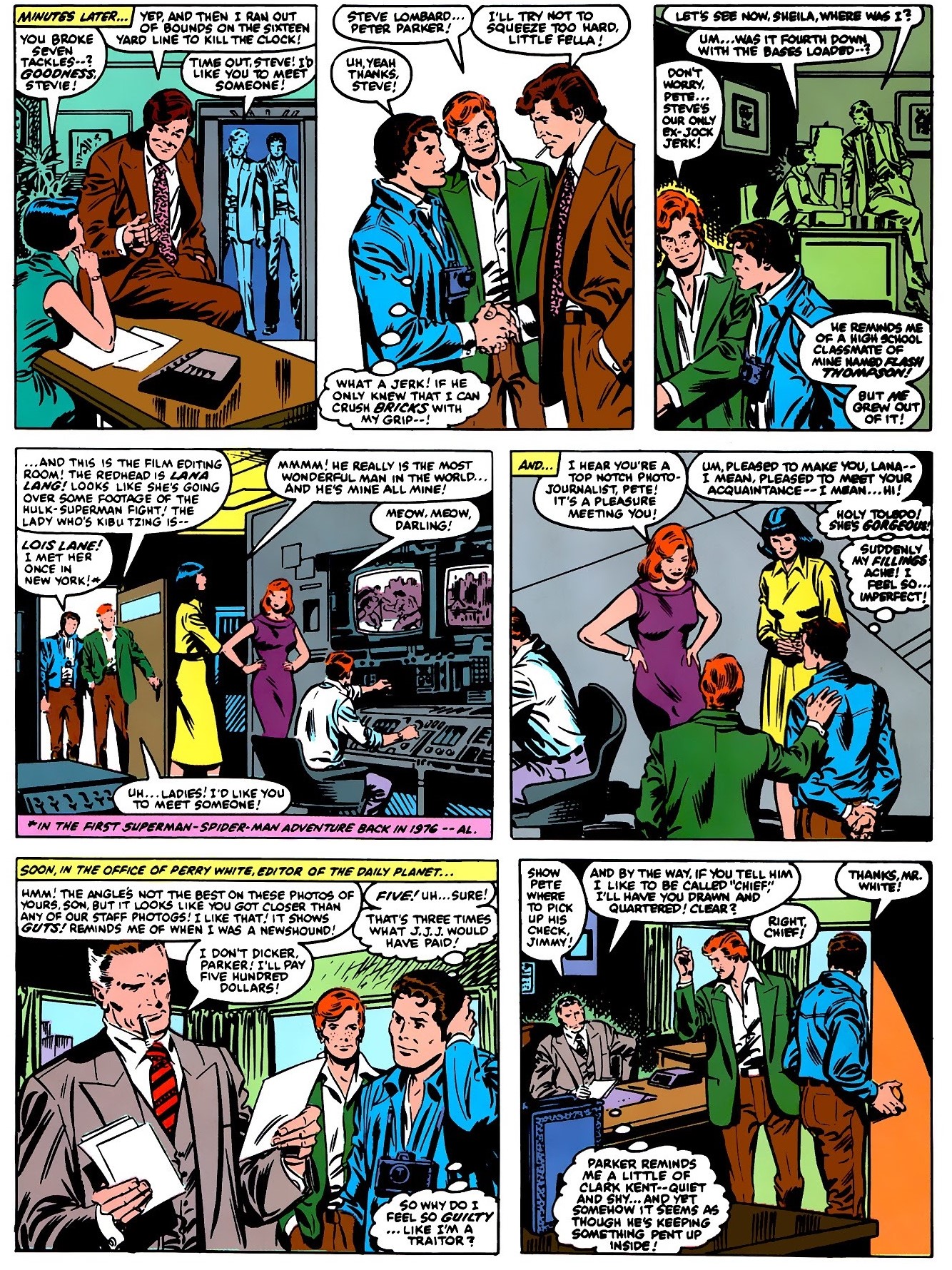
Peter Parker in Metropolis along with the Superman supporting characters. This is one great element that made this comic book worth reading.

While the high number of panels per page limited him, Buscema managed to come up with some action shots that packed some impact.

When it comes to writing and storytelling, this comic book exceeds that of the 1976 Superman-Spider-Man crossover big time! To start with, the plot is much more elaborate, more detailed and yet consistently remained easy to follow.

While the 1976 crossover had the most popular villains of Superman and Spider-Man as the representation of evil, this one instead had Dr. Doom and Parasite. The great news is that these two super villains complement each other nicely and that itself adds good depth into the plot. Dr. Doom is a major schemer and Parasite fitted nicely within his master plan for global chaos.

Regarding dialogue, the script had a lot of strength and was also specific in capturing the personalities of the superheroes, the super villains and the supporting cast. I can easily identify J. Jonah Jameson, Perry White, Lois Lane and others through the dialogue.

Not to be outdone is the deeper approach to the crossover aspect of the story. Right from the start, the comic book creators expected us readers to suspend disbelief and start believing that while the story is non-canon, the respective universes of Marvel and DC Comics co-existed. Because there were TV shows of Wonder Woman and the Hulk playing, the two characters were included in the comic book adding depth to the crossover.

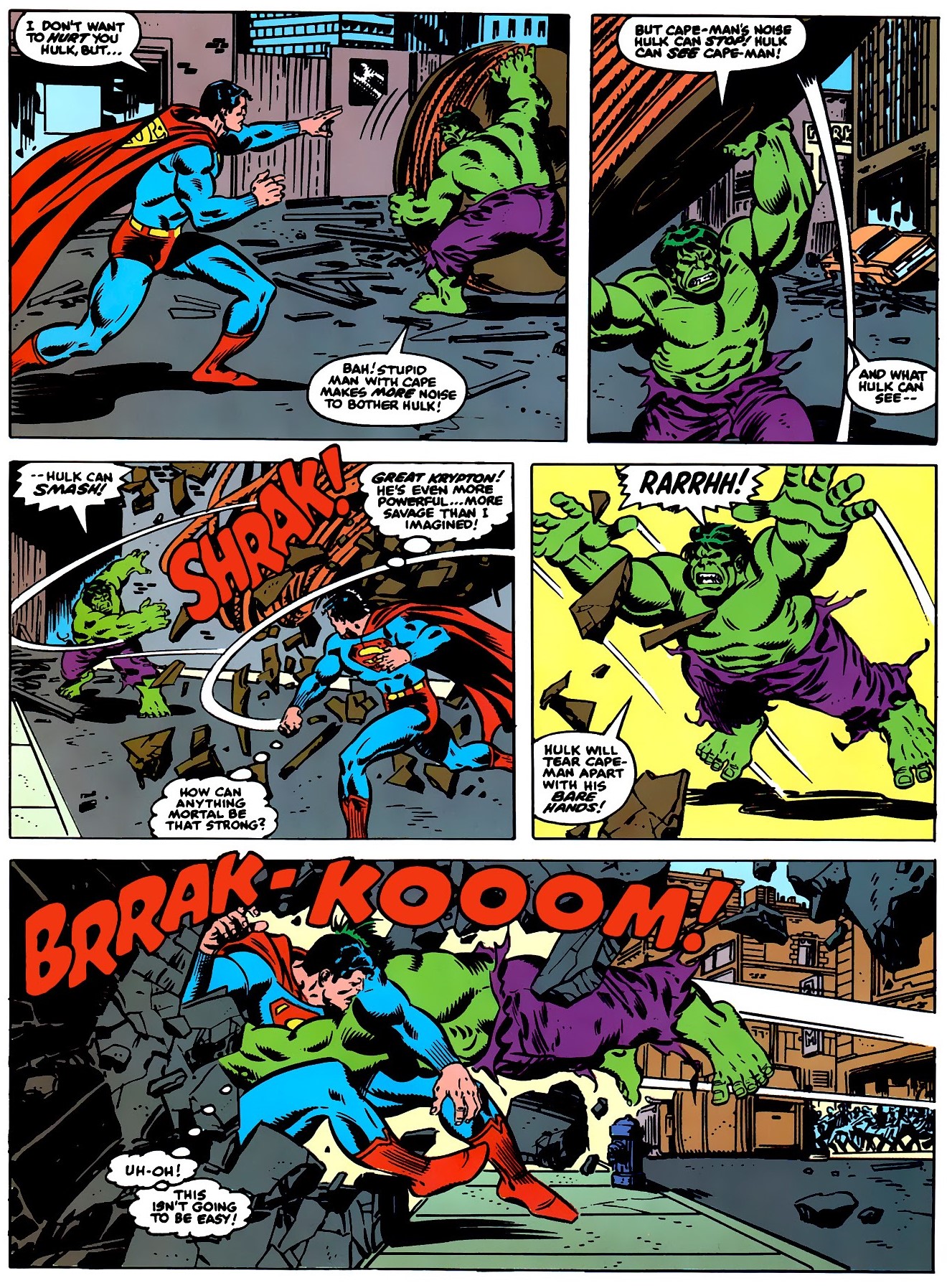
Speaking of crossovers, this comic book was not limited to Superman and Spider-Man. The encounter between the Hulk and Superman was a short but sweet spectacle to read. The encounter between Wonder Woman and Spider-Man meanwhile was short yet fun.

Adding more to the fun in this comic book was how Clark Kent interacted with the Spider-Man supporting characters while Peter Parker interacted with the Superman supporting characters. I enjoyed every moment of these scenes.

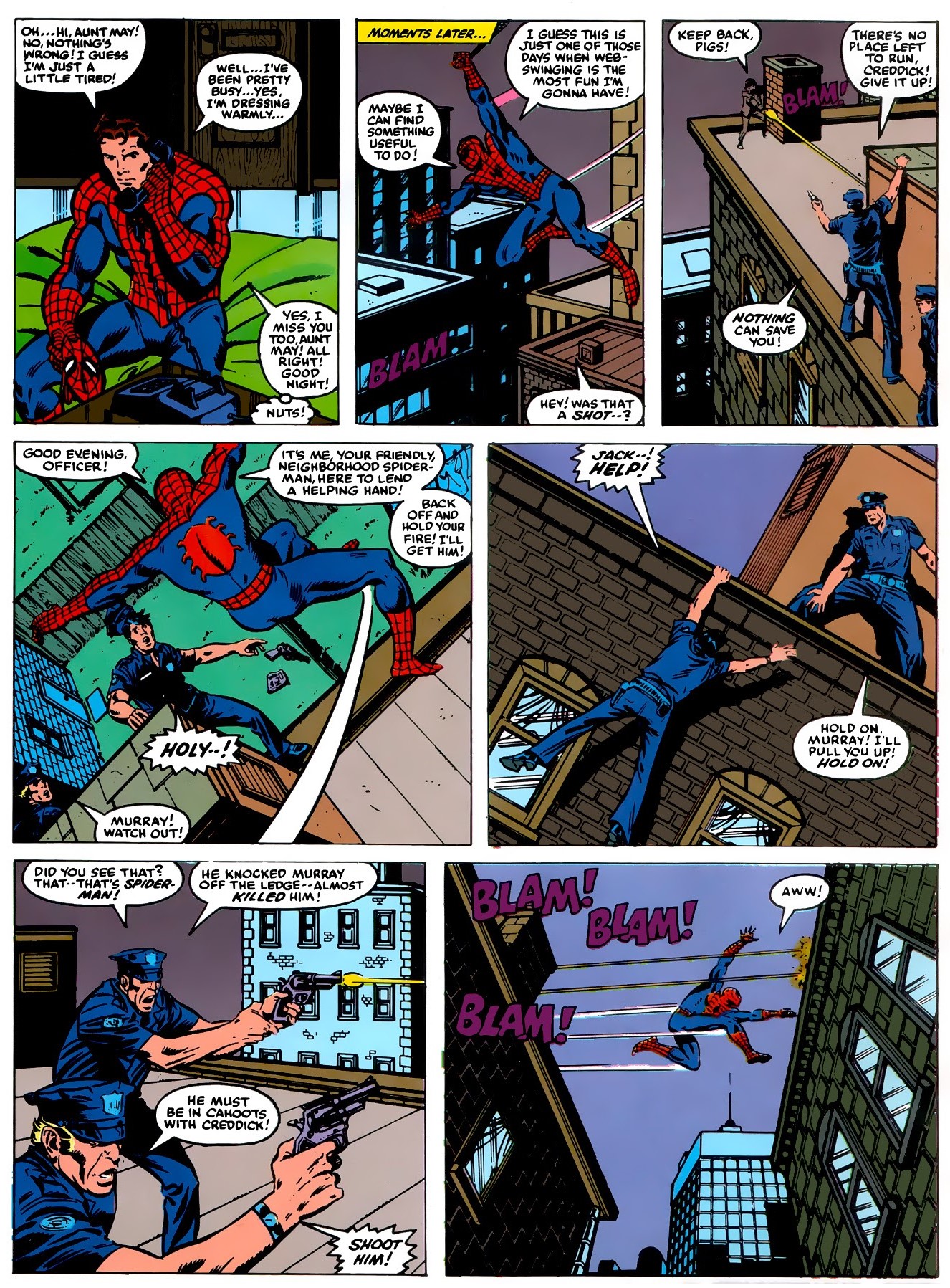
As far as narrative is concerned, this comic book is slightly slanted towards Superman. One factor behind this was the implementation of how local authorities interact with Superman and Spider-Man. Whenever he solves crime, Superman is highly respected by the public and the police. This is not the case with Spider-Man who is often perceived to be a social menace even though he helps solve crimes. Another factor was that Superman did more detective-type work (including a visit to Latveria) while Spidey hardly contributed anything to the plot’s development.

38
Nothing can be more frustrating than getting attacked by police officers when you try to help them solve their problems.

Regardless, the two icons got a fair share of the spotlight during the final stages of the story and there was enough spectacle to enjoy.

If there is any complaint I have, it would be the comic book creators’ reluctance on fully connecting itself to the 1976 crossover. In the scene wherein Peter Parker was guided into the film editing room by Jimmy Olsen, he recognized Lois Lane and remembered meeting her in the 1976 crossover (which ended with socializing). And yet when Spider-Man and Superman get together in this comic book, there was a noticeable lack of friendliness and personal cooperation between them even though they bonded nicely in the 1976 story.

Conclusion

Overall, Superman and Spider-Man is indeed a highly engaging, fun-filled superhero crossover comic book. For me, it is a true literary classic and definitely worth searching for out there. I read this crossover many times from start to finish and even though I knew the plot and the dialogue, I still had a lot of fun reading along the way. With the combined talents of Shooter, Buscema and many others, this superhero crossover was indeed one of the very best stories ever told by Marvel and DC Comics.

Given the current corporate climate Marvel and DC Comics are now in, it is very unlikely we will see another creatively fun superhero crossover collaboration between them happening soon. For the newcomers reading this, Marvel is owned by the Walt Disney Company while DC Comics is owned by Warner Bros.

Whether you search for the original comic book or its inclusion in a volume of The Marvel/DC Collection: Crossover Classics Volume 1, Superman and Spider-Man is highly recommended!


Thank you for reading. If you find this article engaging, please click the like button below and also please consider sharing this article to others. Also my fantasy book The World of Havenor is still available in paperback and e-book format. If you are looking for a copywriter to create content for your special project or business, check out my services and my portfolio. Feel free to contact me as well. Also please feel free to visit my Facebook page Author Carlo Carrasco and follow me at HavenorFantasy@twitter.com