Disclaimer: This is my original work with details sourced from reading the comic book and doing personal research. Anyone who wants to use this article, in part or in whole, needs to secure first my permission and agree to cite me as the source and author. Let it be known that any unauthorized use of this article will constrain the author to pursue the remedies under R.A. No. 8293, the Revised Penal Code, and/or all applicable legal actions under the laws of the Philippines.
Welcome back, X-Men fans, superhero enthusiasts, 1990s culture enthusiasts and comic book collectors! Today, we take a look at the topic of slavery and its connection with the mutants within the universe of Marvel. To be more specific, slavery was emphasized in one of the episodes of the popular X-Men animated series which itself had a monthly series of comic book adaptations – X-Men Adventures!
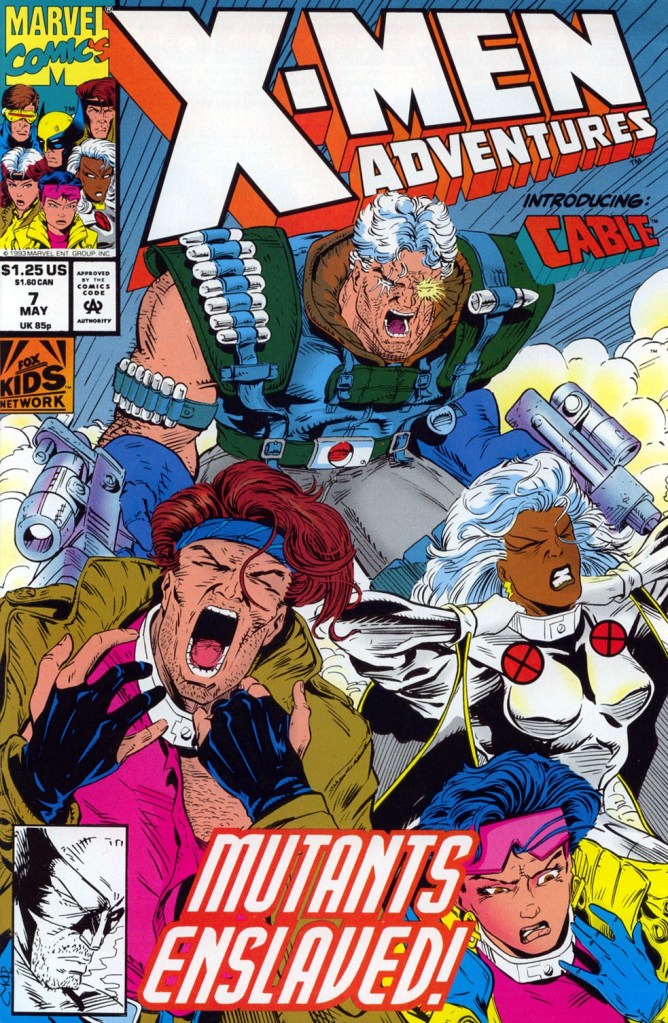
With those details laid down, here is a look back at X-Men Adventures #7, published by Marvel Comics in 1993 with a story written by Ralph Macchio and drawn by Chris Batista.
The cover.
Early story
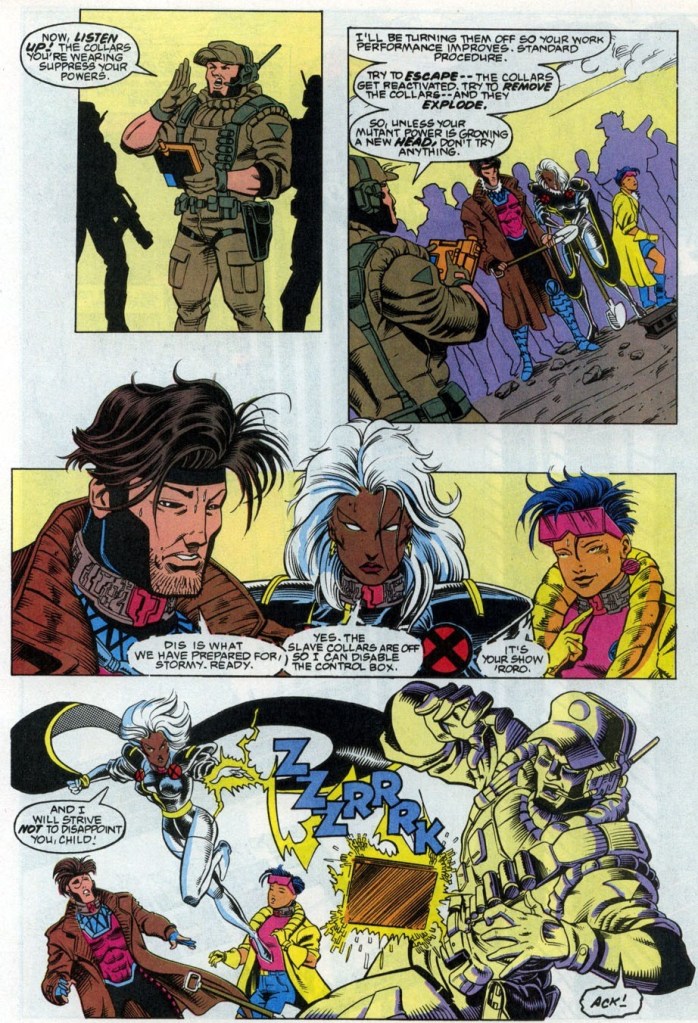
The story begins in Genosha, an island nation where mutants are designated as slaves constantly monitored by armed personnel of the state. X-Men team members Gambit, Storm and Jubilee are forced to do hard labor as they have been rendered powerless (with high-tech collars on their necks). Along with many other mutants, they are working on a key infrastructure project of the state.
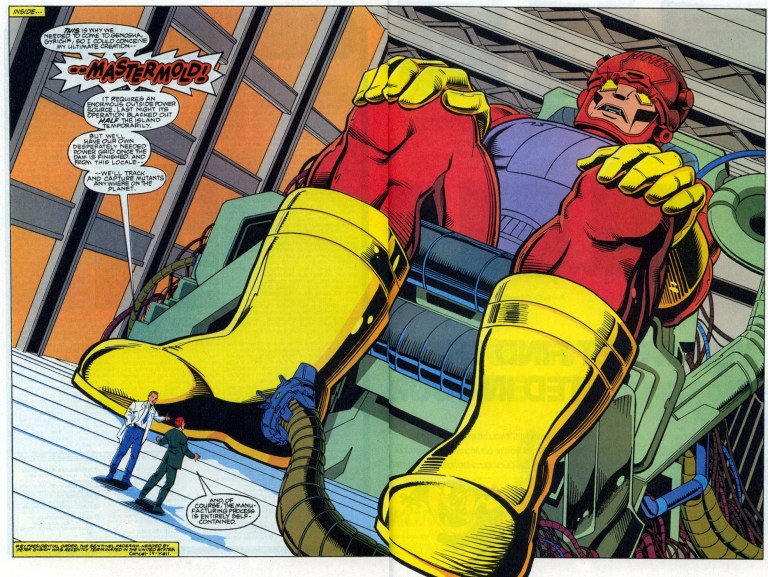
As soon as the local authorities deactivated the collars of the slaves, Storm immediately attempts to escape by flying. Immediately, the collar on her neck got reactivated which neutralized her powers and caused her to fall down to the water below. As soon as she climbs up on a rock to rest, a cable wraps itself on her right leg. Suddenly, a huge Sentinel rises above the water and pulls her…
Quality
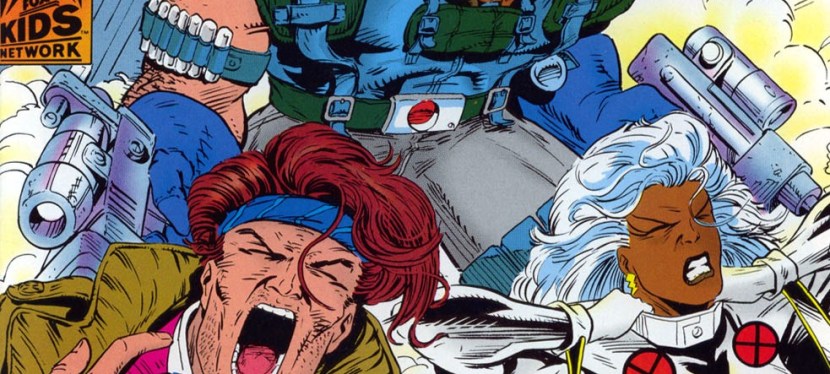
The money shot!
Like the TV episode it was based on, this comic book does a decent job of portraying slavery and oppression with mutants in mind while avoiding the very sensitive topic of racism. To see Gambit, Storm and Jubilee portrayed as much more vulnerable characters is a nice change from their usual portrayals. While the story has a strong slavery theme, it also sheds light on the ongoing, secretive development of the Sentinels program which clearly emphasizes the growing danger that await not only the X-Men (the prime target of Trask and his team) but mutants in general.
When it comes to the art, Chris Batista did a nice job drawing not only the characters (all recognizable) but also their surroundings, the Sentinels and the framing of action scenes.
Conclusion
Gambit, Storm and Jubilee as slaves on Genosha.
I personally find X-Men Adventures #7 (1993) somewhat fun and slightly engaging to read. As this is an adaptation of the X-Men animated series episode about Genosha and mutant slavery, it clearly has a strong wholesome approach to its presentation. That being said, its depth is actually limited as it presented its themes with younger readers and new X-Men readers in mind. Unsurprisingly, the action is limited and was portrayed to avoid violence. If you want a more serious and grittier portrayal of Genosha and mutant slavery, you should read Uncanny X-Men #235 to #238, and the X-tinction Agenda storyline.
If you are seriously planning to buy an existing hard copy of X-Men Adventures #7 (1993) be aware that as of this writing, MileHighComics.com shows that the near-mint copy of the regular edition costs $30, while the near-mint copies of the newsstand edition and the Greek edition cost $90 and $200 respectively.
Overall, X-Men Adventures #7 (1993) is satisfactory.
+++++
Thank you for reading. If you find this article engaging, please click the like button below and also please consider sharing this article to others. If you are looking for a copywriter to create content for your special project or business, check out my services and my portfolio. Feel free to contact me as well. Also please feel free to visit my Facebook page Author Carlo Carrasco and follow me at HavenorFantasy@twitter.com
Disclaimer: This is my original work with details sourced from reading the comic book and doing personal research. Anyone who wants to use this article, in part or in whole, needs to secure first my permission and agree to cite me as the source and author. Let it be known that any unauthorized use of this article will constrain the author to pursue the remedies under R.A. No. 8293, the Revised Penal Code, and/or all applicable legal actions under the laws of the Philippines.
Way back in the mid-1990s, something special happened for Star Wars fans. A brand-new story involving Star Wars icons Luke Skywalker, Darth Vader and others would be told set between The Empire Strikes Back and Return of the Jedi. That story was called Shadows of the Empire and it was released as a special event in the form of a novel (written by Steve Perry), a video game on Nintendo 64 and PC, comic books, a soundtrack, posters, model kits, toys and action figures. What was missing here was a live-action movie.
To put things in perspective, the Shadows of the Empire multi-media event was done by Lucasfilm (note: when creator George Lucas was still in control) with its many business partners to reinvigorate the Star Wars franchise ahead of the planned special editions of the original Star Wars movie trilogy. From a business point-of-view, it made sense to release something new for fans to enjoy and more notably it was the chance for Lucasfilm and its creators to explore what happened between The Empire Strikes Back and Return of the Jedi.
A limited comic book series was released in 1996 and it involved the novel’s author as a story consultant. Back in those days, my comic book interest faded temporarily and even though I was still into Star Wars, I did not bother to buy and read the Shadows of the Empire comic books. The video game caught my attention a lot more back then. Fortunately, I found copies of the comic books and had the time to read them recently.
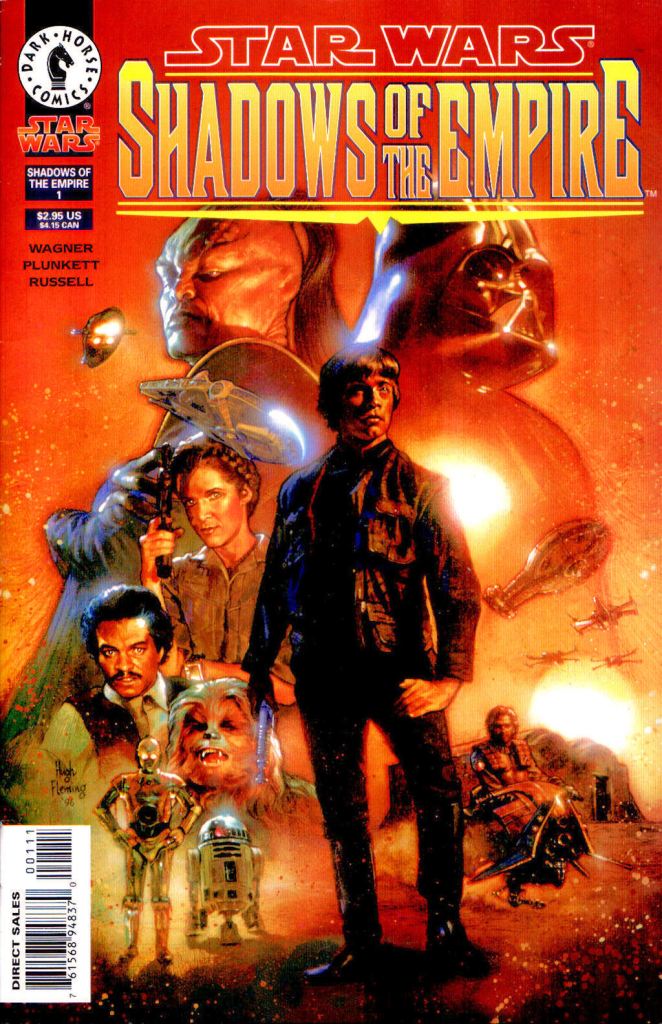
With those details laid down, here is a look back at Star Wars: Shadows of the Empire #1, published by Dark Horse Comics in 1996 with a story written by John Wagner and drawn by Kilian Plunkett.
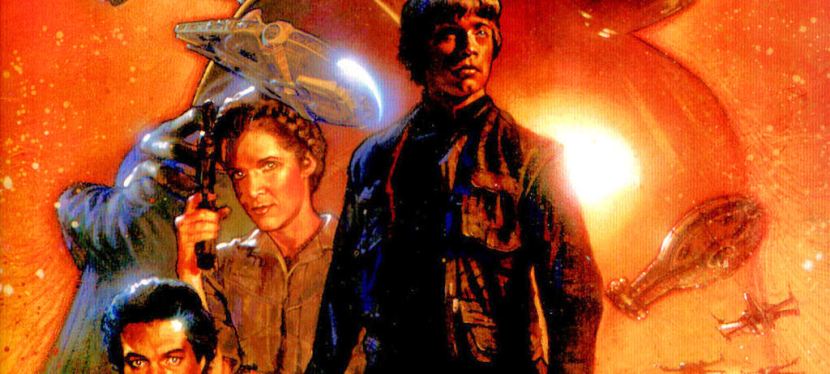
The cover.
Early story
The story begins with a group of Rebel spaceships traveling together in the depth of space. Luke, who now has a mechanical hand and has been recovering from the terrible ordeal he went through at Cloud City, is with Princess Leia, C3PO and R2D2 in the medical frigate. The Rebels detect the presence of an approaching ship which they suspect to be hostile.
Luke suddenly decides to take action but is halted when he realizes that his X-wing fighter is still being refitted. In space, Wedge and the Rogue Squadron fly towards the Imperial Strike Cruiser which then releases some Tie Fighters. The personnel inside the Strike Cruiser tried to inform Darth Vader the location of the Rebel fleet…
Quality
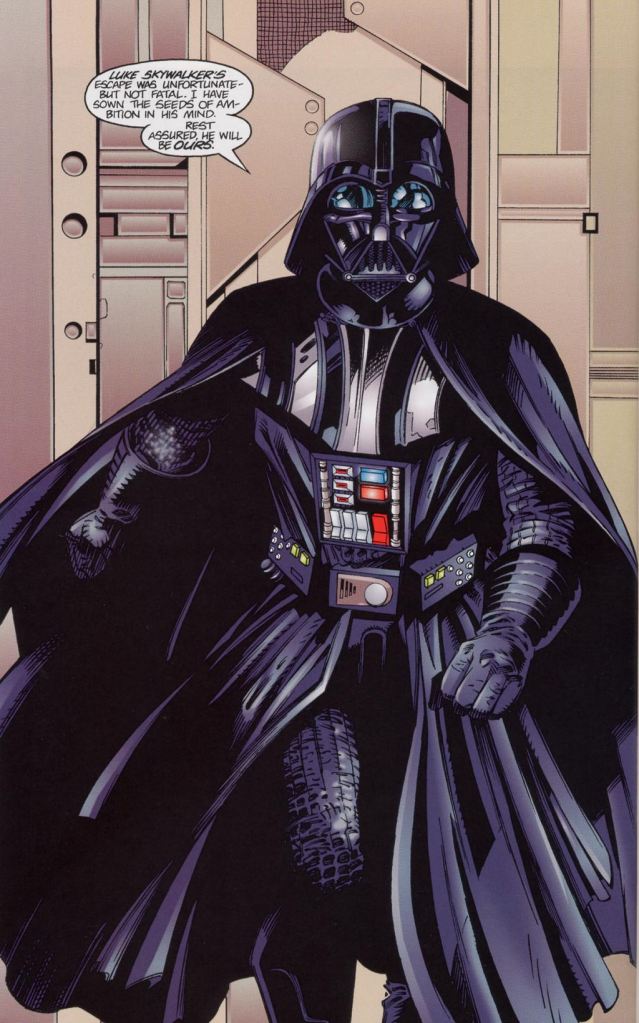
Darth Vader!
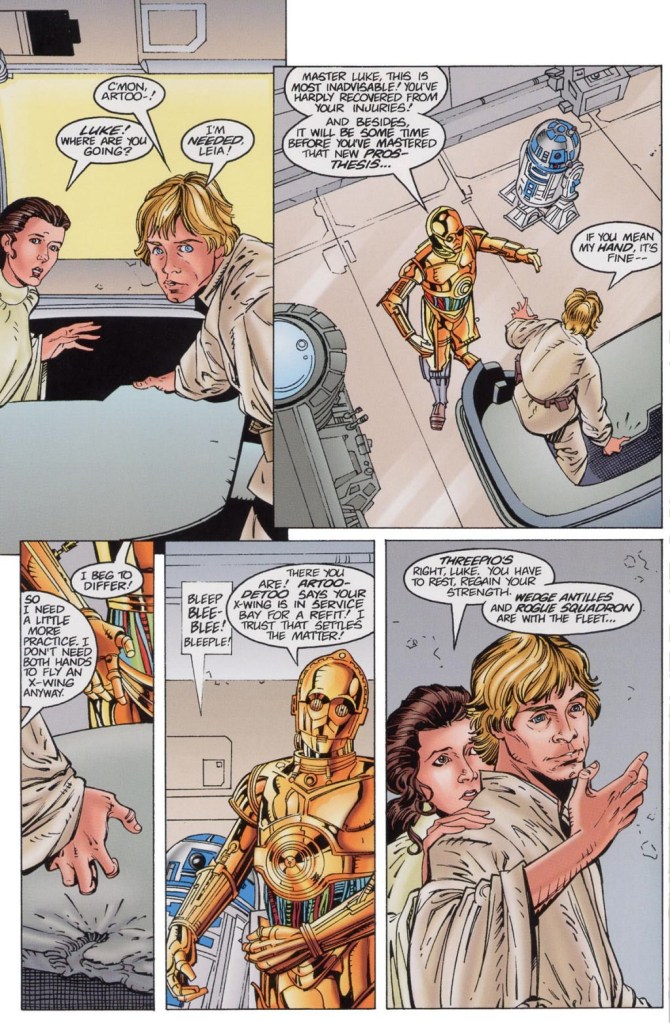
The first thing I want to mention is that the writing done by John Wagner is solid. That being said, the story itself felt like a natural continuation of The Empire Strikes Back especially when the comic book’s narrative is focused on Luke and the Rebels. The way the recovering Luke, Leia and the two droids were presented following the end of the 1980 movie was believable, and there was that nice touch of characterization when Luke has not yet adjusted with his mechanical hand.
The story then moves into new territory when the narrative shifts on the Imperial side, especially when Emperor Palpatine gives Darth Vader a new order that has nothing to do with pursuing Luke and the weakened Rebels, but more to do with the construction of the Empire’s new weapon. This is also where the new character Xizor comes in and his presence alone confirms something that the movies did not…the Empire is in business with crime syndicates with regards to major projects.
Space ship battles look great in this comic book.
When it comes to characterization, I like the way Darth Vader handled himself when communicating with Emperor Palpatine who viewed Luke’s escape from Bespin a failure on his part. Compared with his private communication with the Emperor in the 1980 movie, Vader bravely questions him about doing business with Xizor backed with his knowledge of the prince and the ties with Black Sun. Vader, who has been part of the Empire for a long time, knew well how risky it is for them to get involved with criminals especially when military cargo is involved.
As for the visuals, Kilian Plunkett does a decent job drawing the characters. While his take makes Luke recognizable and faltered a bit on capturing Leia’s look, his illustrations on Darth Vader, the Emperor and Xizor were really good. Where Plunkett exceled visually are the locations and surroundings, the machines and the space battles (some pages were drawn really dynamically).
Conclusion
This shows how Luke has not fully adjusted with his mechanical hand.
To put it clearly, Star Wars: Shadows of the Empire #1 (1996) has three narratives (the other is about Boba Fett carrying the frozen Han Solo) to build-up on and for a debut issue of a limited series, this one has strength in its execution complete with a good amount of creative stuff that will resonate with long-time Star Wars fans (and also those who love the original Star Wars movie trilogy). It succeeds in telling what happened shortly after the end of The Empire Strikes Back as well as establishing a new sub-plot with Xizor involved. By the time I finished this comic book, I was convinced to look forward to the next issue.
If you are seriously planning to buy an existing hard copy of Star Wars: Shadows of the Empire #1 (1996), be aware that as of this writing, MileHighComics.com shows that the near-mint copy of the regular edition costs $48 while the near-mint copy of the newsstand edition costs $144.
Overall, Star Wars: Shadows of the Empire #1 (1996) is recommended.
+++++
Thank you for reading. If you find this article engaging, please click the like button below and also please consider sharing this article to others. If you are looking for a copywriter to create content for your special project or business, check out my services and my portfolio. Feel free to contact me as well. Also please feel free to visit my Facebook page Author Carlo Carrasco and follow me at HavenorFantasy@twitter.com
Disclaimer: This is my original work with details sourced from reading the comic book and doing personal research. Anyone who wants to use this article, in part or in whole, needs to secure first my permission and agree to cite me as the source and author. Let it be known that any unauthorized use of this article will constrain the author to pursue the remedies under R.A. No. 8293, the Revised Penal Code, and/or all applicable legal actions under the laws of the Philippines.
Before DC Comics ended their original superhero multiverse with Crisis on Infinite Earths (1985-1986) to restart all over again, there were a whole lot of stories about Superman ranging from the dramatic stuff, the epic tales and right down to the most outlandish tales.
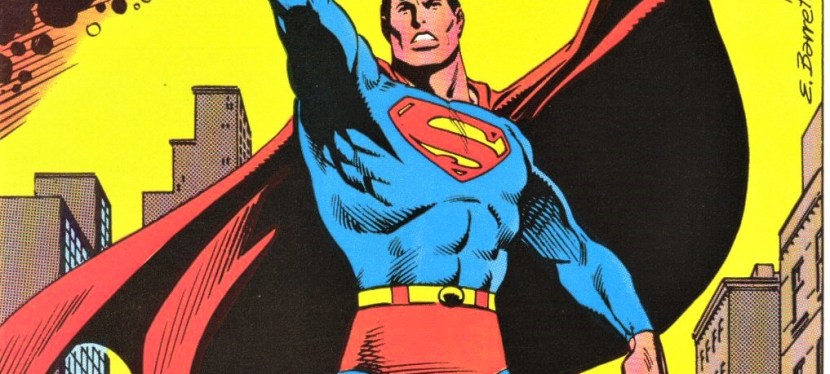
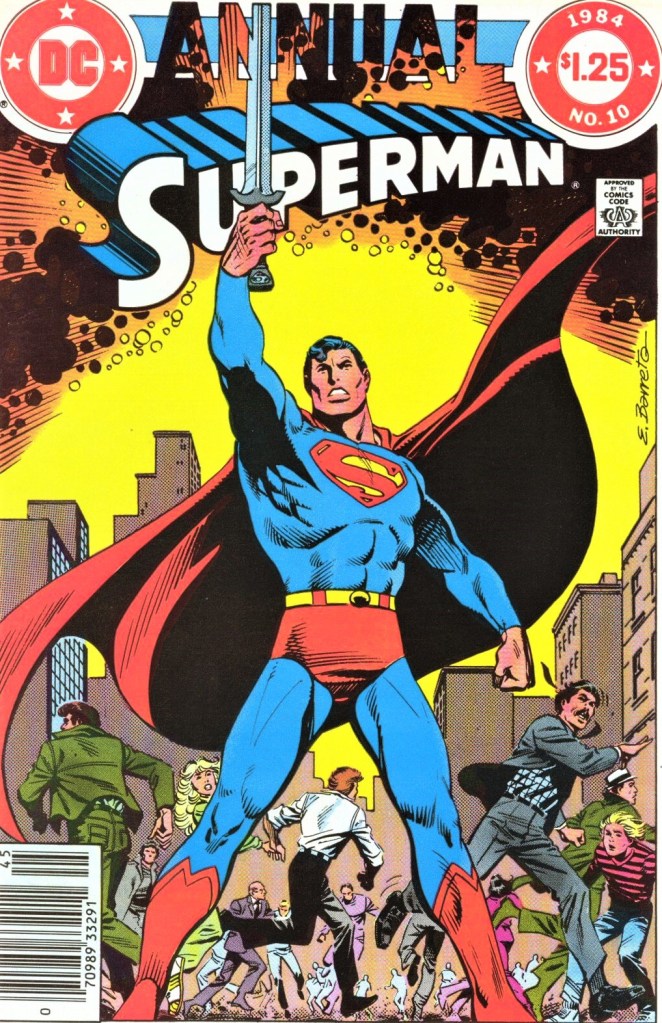
As a kid, I was fortunate enough to buy myself a copy of a 1984 Superman comic book, the cover of which really intrigued and caught my interest. It was a Superman annual comic book with a $1.25 cover price which was somewhat high at the time. Its cover showed the Man of Steel himself carrying a sword pointed up.
That image made me wonder: Why would Superman have to use a sword when he is so powerful and capable without weapons? Where did that sword come from? Who made it in the first place? Is the sword so special to Superman?
With those details laid down, here is a look back at Superman Annual #10, published by DC Comics in 1984 with a story written by Elliot Maggin and drawn by classic Superman artist Curt Swan.
The cover.
Early story
The story begins in a space where a group of diverse people composed of aliens and humans are gathered together watching a live video feed Superman on a large monitor above their heads. As it turns out, the Man of Steel is in space working to prevent meteoroids from entering the planet below him. He then speeds off into space heading back to Earth.
Along time ago deep in the galaxy, a big bang effect took place creating several new fragments in the vacuum of space and among them is a long, rough object that resembles a sword. As an unknown amount of time passed, the long object gradually turns into a smooth looking sword complete with a sharp blade and a letter “S” on one end that is the same as the one Superman carries. It is referred to as the sword of Superman!
In Metropolis, Clark Kent is passed by his officemate Jimmy Olsen who mentioned that he is rushing to interview the billionaire industrialist Oswald Mandias. Two days have passed and Jimmy Olsen remained missing. As his boss Perry White heads on to the office, Clark remains and changes into Superman when the coast got clear.
As the Man of Steel flies off into the city, a Galaxy Broadcasting live report on TV shows Lana Lang reporting from the Kennedy Space Center where the new space shuttle Magellan is about to make its first-ever commercial flight to launch a mysterious new communications satellite owned by Mandias Industries…
Quality
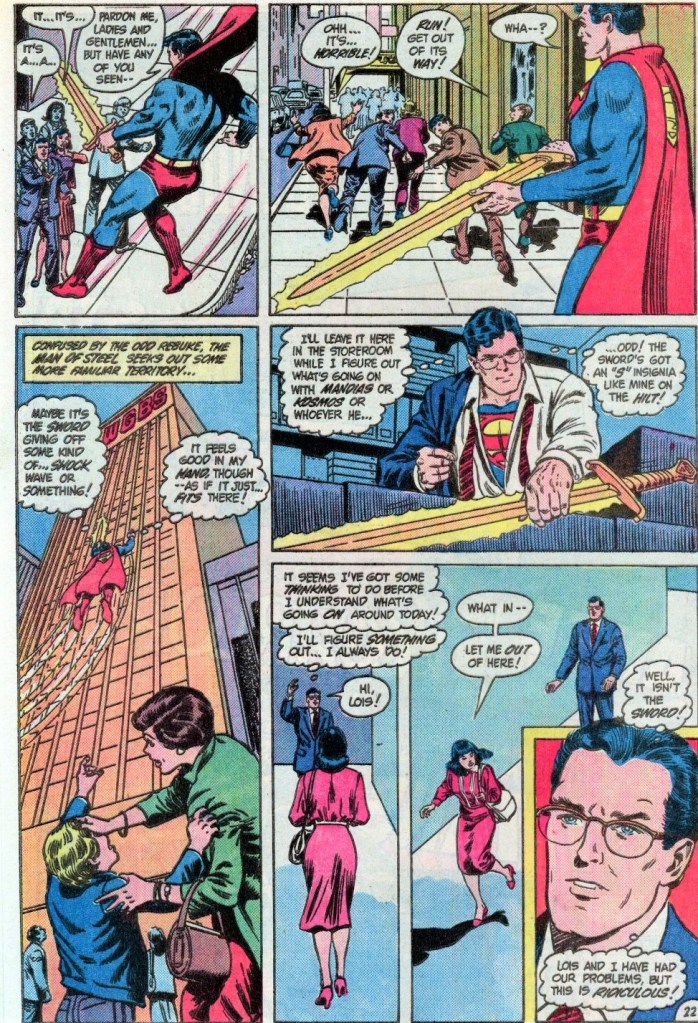
Clark Kent/Superman being a complete stranger to others added a lot to the story.
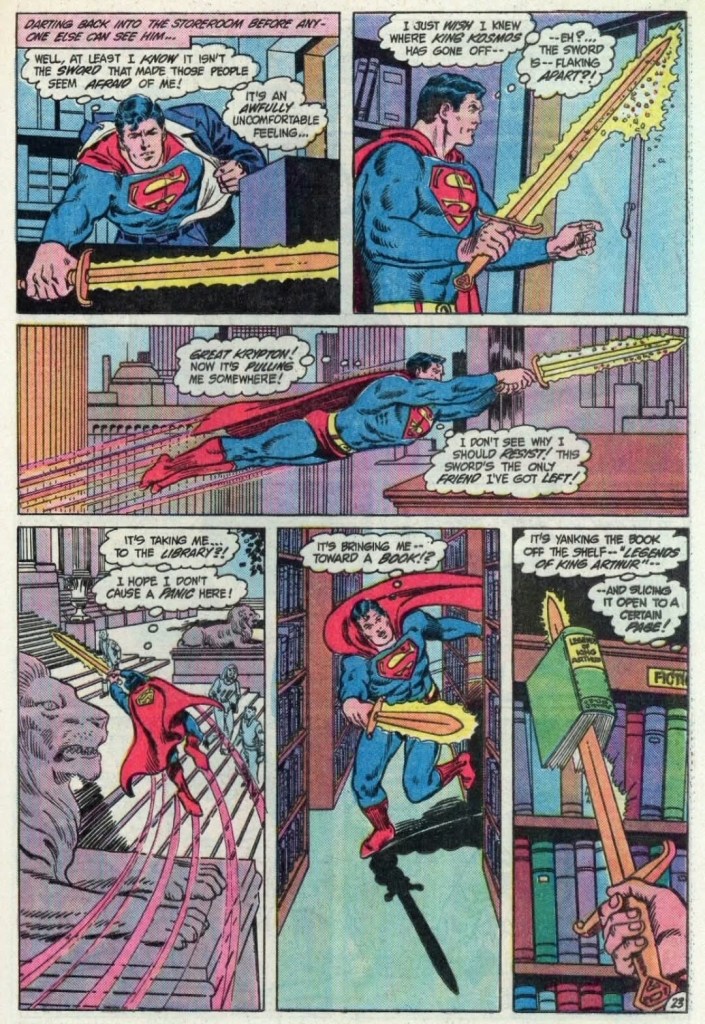
The sword led Superman to a book about the legend of King Arthur inside the city library.
Being an annual, I can say that the Sword of Superman story was well-written and nicely visualized by the creators which made it fun and engaging to read. It is a Superman story that further adds to his being an essential hero of the original DC Comics multiverse and a key factor here is the somewhat outlandish concept that the sword that he gained was an original material of the universe from the big bang and even had connections to the unseen omnipotent force.
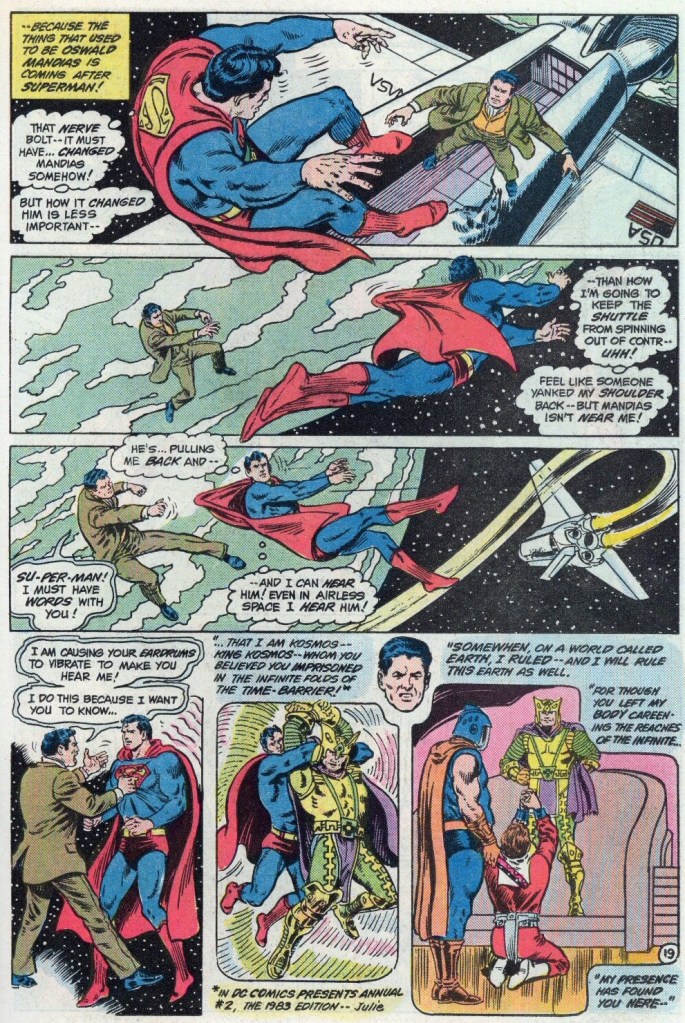
This story is not a simple, straightforward tale about Superman gaining a weapon required to defeat the supervillain King Kosmos. In fact, the sword opens up events that made the Man of Steel reevaluate himself, his situation and the people around him. King Kosmos, who is a time-travelling villain from the future (first appearance in DC Comics Presents Annual #2), served not just merely as the opposition but also adds a good amount of complexity within the reality of the story. For one thing, it is very intriguing and also refreshing to see people of Metropolis (even Clark’s friend Jimmy Olsen) failing to recognize Superman and perceive him with fear. This is a one-of-a-kind story of Superman that must be read, even though it is not really an epic tale.
All throughout, there is a fine balance between spectacle and intrigue. If you pay close attention to the dialogue and details, you will understand the story better and enjoy the comic book more eventually.
Conclusion
The return of King Kosmos!
I personally enjoyed reading Superman Annual #10 (1984) the first time back in 1984. The fact here is that after re-reading it recently, I do confirm that it is still an enjoyable comic book to read, and I am not even a Superman fan anymore. That is quite something! This is indeed a really good piece of Superman history from the pre-Crisis era. It also touches on themes about omnipotence, how ordinary people react to people who wield great power, and being whole with the entire universe.
If you are seriously planning to buy an existing hard copy of Superman Annual #10 (1984), be aware that as of this writing, MileHighComics.com shows that the near-mint copy of the regular edition costs $35 while the near-mint copy of the newsstand edition costs $70.
Overall, Superman Annual #10 (1984) is recommended.
+++++
Thank you for reading. If you find this article engaging, please click the like button below and also please consider sharing this article to others. If you are looking for a copywriter to create content for your special project or business, check out my services and my portfolio. Feel free to contact me as well. Also please feel free to visit my Facebook page Author Carlo Carrasco and follow me at HavenorFantasy@twitter.com
Disclaimer: This is my original work with details sourced from reading the comic book and doing personal research. Anyone who wants to use this article, in part or in whole, needs to secure first my permission and agree to cite me as the source and author. Let it be known that any unauthorized use of this article will constrain the author to pursue the remedies under R.A. No. 8293, the Revised Penal Code, and/or all applicable legal actions under the laws of the Philippines.
I love reading a crossover comic book that was made by very talented creators to be a whole lot of fun from start to finish. Back in the early 1980s, rivals Marvel Comics and DC Comics collaborated temporarily with inter-company crossover comic books that were made to be entertaining to fans of their respective properties.
What I’m going to review here is the 3rd superhero crossover comic book between Marvel and DC titled Batman vs. The Incredible Hulk.
The cover.
Background
Before I start, let me clarify that this particular comic book was specifically published as issue number 27 of the DC Special Series which was a series of one-shot comic books. By comparison, the 1981 crossover comic book Superman and Spider-Man (which I reviewed previously) was published under the Marvel Treasury Edition line of Marvel Comics as issue number 28.
Going back to Batman vs. The Incredible Hulk, the comic book was the final issue of the DC Special Series line and it carried a cover price of $2.50 which was quite high for its time.
The people at DC Comics made sure that the crossover was handled by the best talents they had back then. The late Len Wein (best know for creating Wolverine) was assigned to write the script (and ensure that elements from both the Hulk and Batman would mix nicely) while José Luis García-López was hired to illustrate. Dick Giordano was the embellisher and editor while Allen Milgrom and then Marvel editor-in-chief Jim Shooter were the consulting editors. In return for their assistance, Marv Wolfman and Mike DeCarlo were acknowledged with thanks.
Now we can begin with this retro review of Batman vs. The Incredible Hulk.
The early story
The story begins when a few persons in Gotham City witness their dreams turning real beyond logic. A man dreamed he was in the arctic hunting and wakes up to discover his room was filled with snow. In a cinema where a horror movie was shown, a couple kissing each other discover, to their shock, that monsters of different sizes surrounded them out of thin air.
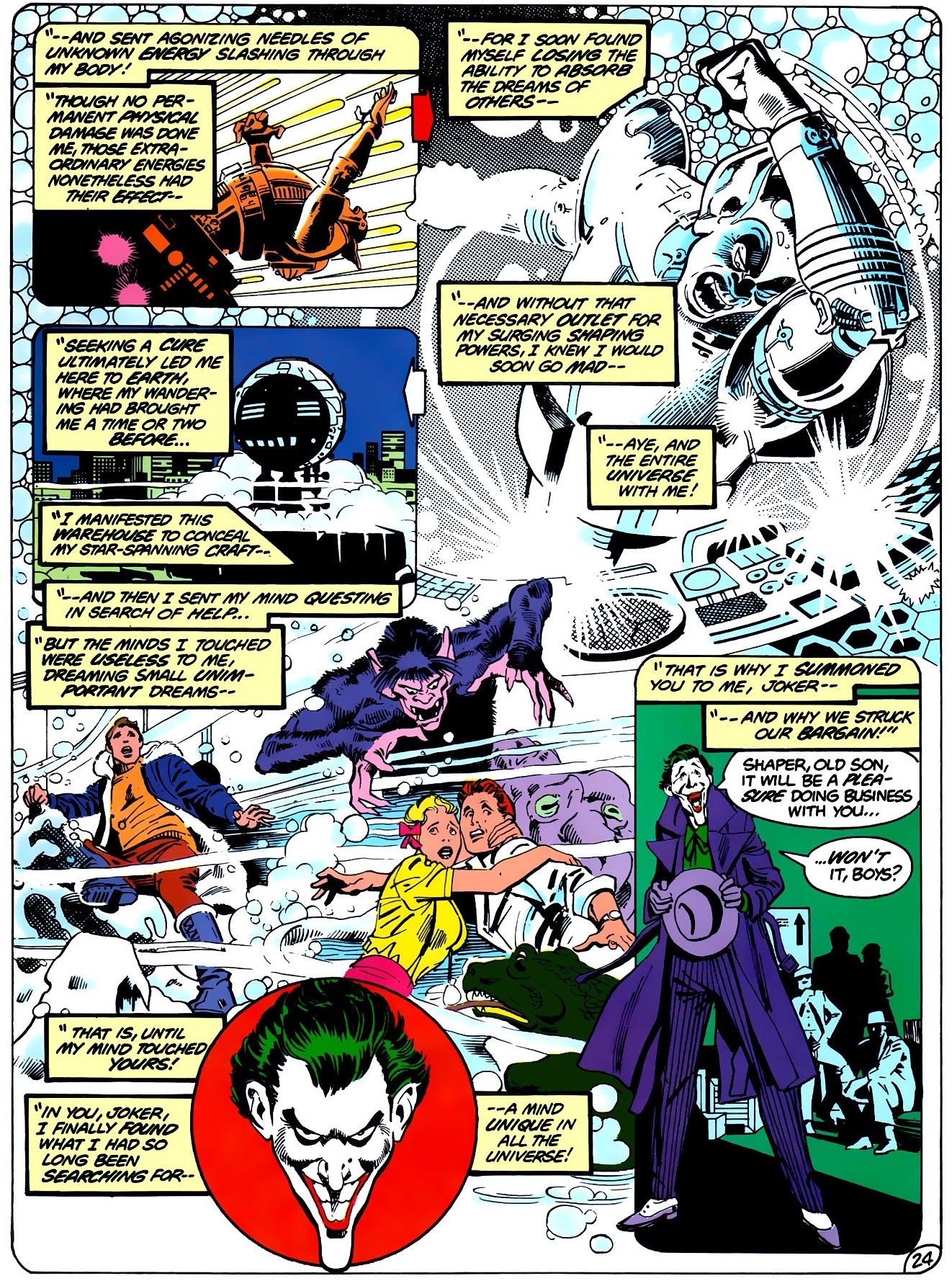
At the waterfront of the city, the Joker (accompanied by his gang members) talks to an unseen being (Shaper of Worlds). He gives his assurance to the being that he and his gang will acquire a specific item (needed by the being). For the Joker, what was discussed was a simple business arrangement.
A short time later inside a high-tech facility of Wayne Research, Bruce Banner (the Hulk) secretly works under the false identity as David Banks. He works along with the scientists but not on the scientific projects. Rather, he works odd tasks such as lifting hardware and putting them into places that need them. Of course, Banner did not get hired for a salary but for something much essential to him and his condition with Gamma Rays.
“I had to get a job here somehow so I could get close to the experimental Gamma-gun they’re working on,” he thought to himself.
Suddenly the facility gets filled with laughing gas incapacitating all the people inside. Banner fortunately manages to wear a radiation suit for protection. Moments later, the Joker and his gang enter searching for the Gamma-gun. From this point on, Banner decides to act.
Quality
When it comes to the selection of characters from Marvel and DC, having the mismatch of Batman and the Hulk was a very splendid idea. Not only was having the large green brute and the world’s greatest detective together as temporary rivals a fascinating concept, having them work together as a duo turned out to be a really great move. When it comes to the selected villains of the Joker and the Shaper of Worlds as the anti-hero figures of the story, the two looked like an odd pair but if you focus on the details of the story, you will realize that it made a lot of sense having them two together. The Shaper needs something which requires him to depend on the Joker who in turn brings his gang with him to cause chaos to acquire what the alien needs
All of the above details would not have worked had it not been for the excellent writing by Len Wein. Clearly Wein knew a whole lot about the defining elements of the Hulk and Batman (and the same with the Joker and Shaper), and he carefully blended those elements together to make a story that is thrilling, intriguing, engaging and at the same time still made sense. More on crossing over, there are other characters connected to Batman and the Hulk that made appearances and a few of them fit in nicely into the story.
As this was released in 1981, it was typical of the time for writers to use thought balloons to help readers understand what the characters were thinking. The use of thought balloons in this comic book truly defined Batman who not only had to fight the bad guys but also manage his way with the Hulk and do a lot of detective work.
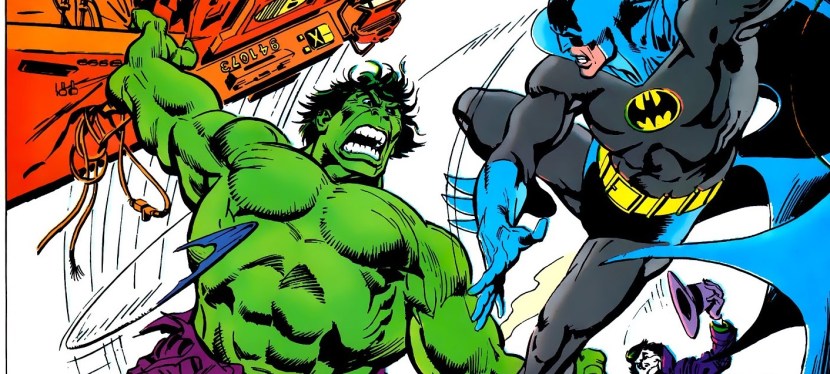
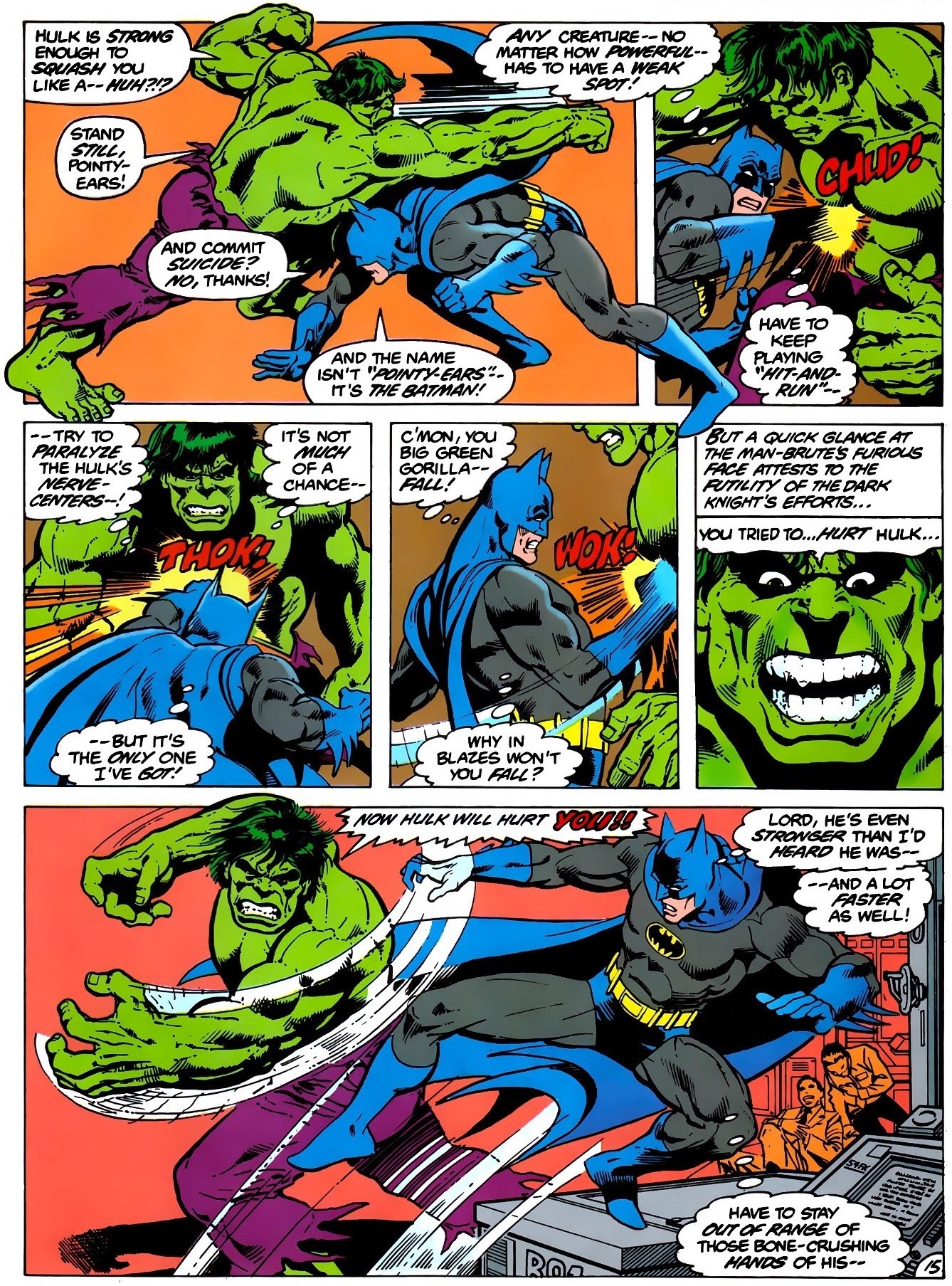
Going back to the Hulk and Batman, this comic book has a lot of fun stuff. More than once did the two superheroes engage in action-packed encounters and their exchange of words was very nicely done. Their match-up (or mismatch) really works.
A perfectly crafted action scene between the Hulk and Batman, complete with accurate depictions of each character!
When it comes to the common complaint by some readers out there that the comic book was more of a Batman story and made the Hulk less prominent, I should say that the slight imbalance is not a problem at all. In fact, for me it makes perfect sense that Batman has more spotlight than the Hulk. Why? Because Batman is a detective and he performed a lot of researching, information gathering and other moves to solve problems. His detective work in the story made perfect sense for the narrative. As for the Hulk, his character really has very limited options other than causing destruction and disturbing the public. Since early on, the Hulk was best known for attracting the attention of the American military (led by General Ross) and huge destruction defined the encounters. For this crossover, the creators did not show the Hulk engaging with the military (save for the phonies) but rather he struggled to figure things out whenever he encountered Batman or the Joker. There is no way the Hulk could do detective work like Batman and having him fight the military would have weakened this comic book’s presentation. Clearly, having the story slightly slanted towards Batman is still the right move.
Very highly imaginative and dynamic artwork by José Luis García-López.
The artwork done by José Luis García-López is excellent! He really captured the looks and details of each and every character Marvel and DC that appeared in this comic book. Back in the early 1980s, I got to read several comic books that showed Batman, the Hulk, the Joker and others and the way they appeared in this comic book was indeed accurate of the time. José Luis García-López also knew how to balance spectacle with character development and expository dialogue in terms of visual pacing and framing shots. Also his work becomes even more imaginative during the final conflict. Undoubtedly this is still a great looking comic book!
Conclusion
Overall, Batman vs. The Incredible Hulk is a great comic book and easily it is one of the greatest intercompany superhero crossover comic books ever published! From start to finish, this comic book proved to be highly engaging and there never was a single boring moment. The creators led by Len Wein (he is sorely missed) made the best possible story anyone can make involving Batman and the Hulk.
You can read a hard copy of this comic book by getting Volume 1 of Crossover Classics or, if you can afford to, hunt for a copy of this in its DC Special Series form which now sells for $280 for a very fine copy to as much as $400 for a near mint copy as of this writing according to MileHighComics.com
In ending this, I declare that Batman vs. The Incredible Hulk is highly recommended!
Thank you for reading. If you find this article engaging, please click the like button below and also please consider sharing this article to others. Also my fantasy book The World of Havenoris still available in paperback and e-book format. If you are looking for a copywriter to create content for your special project or business, check out my services and my portfolio. Feel free to contact me as well. Also please feel free to visit my Facebook page Author Carlo Carrasco and follow me at HavenorFantasy@twitter.com
Disclaimer: This is my original work with details sourced from reading the comic book and doing personal research. Anyone who wants to use this article, in part or in whole, needs to secure first my permission and agree to cite me as the source and author. Let it be known that any unauthorized use of this article will constrain the author to pursue the remedies under R.A. No. 8293, the Revised Penal Code, and/or all applicable legal actions under the laws of the Philippines.
I miss the old times when big rivals Marvel and DC Comics would set aside competition temporarily to team up and rely on their respective comic creators to make superhero crossover comic books that the fans can enjoy.
Back in the 1970s, key developments related to the comic book adaptation of The Wizard of Oz brought the two rivals together as partners. In 1976, Marvel and DC’s first superhero crossover Superman vs. The Amazing Spider-Man got published and to this day many comic book collectors and geeks I encountered still enjoy it. A few of them even called it a classic.
The collaboration between Marvel and DC continued in 1981 with Superman and Spider-Man which was published as issue number 28 of the Marvel Treasury Edition series.
The cover.
This is my look back at Superman and Spider-Man.
The comic book
Scripted by then Marvel Comic editor-in-chief Jim Shooter (with Marv Wolfman mentioned for plot suggestions) with art drawn by John Buscema and inkwork done by Terry Austin, Al Milgrom, Steva Leialoha, Walt Simonson, Bob Layton, Joe Rubinstein and Bob Wiacek, the comic book begins when Spider-Man swings into a construction site where he encounters several armed men and stops them singlehandedly.
Even though he stopped the bad guys, Spider-Man’s spider sense bothers him making him speculate that, because there’s no clear danger around him, the construction site seemed to be a threat.
After Spider-Man swings away from the police who just arrived, classic Marvel supervillain Doctor Doom watches via surveillance video and he was bother by the way things turned out.
“I did not like the way Spider-Man paused and look around after subduing the thieves – – as if he sensed something unusual about the excavation! Those accursed spider instincts of his,” Doom said before proceeding with his master plan.
A day later, the Hulk arrives in Metropolis causing lots of damage. Separately Superman and Spider-Man arrive to contain the green guy. However, things are not what they seem. This is where the story description ends.
Quality
What this comic book lacked compared to the 1976 Superman-Spider-Man crossover is visual impact. Clearly John Buscema had to follow closely the script which called for multiple panels per page and that left him little room to draw scenes dynamically. That’s not to see the art is weak. In fact, Buscema’s art is pretty good and he has deep knowledge about how the characters (including those many supporting characters and other minor characters from both Marvel and DC Comics) really looked from the size of Hulk’s body, the details on Wonder Woman’s costume, the distinctive look of J. Jonah Jameson, Perry White, etc. In short, I recognized the characters very easily.
This remains fun to read.
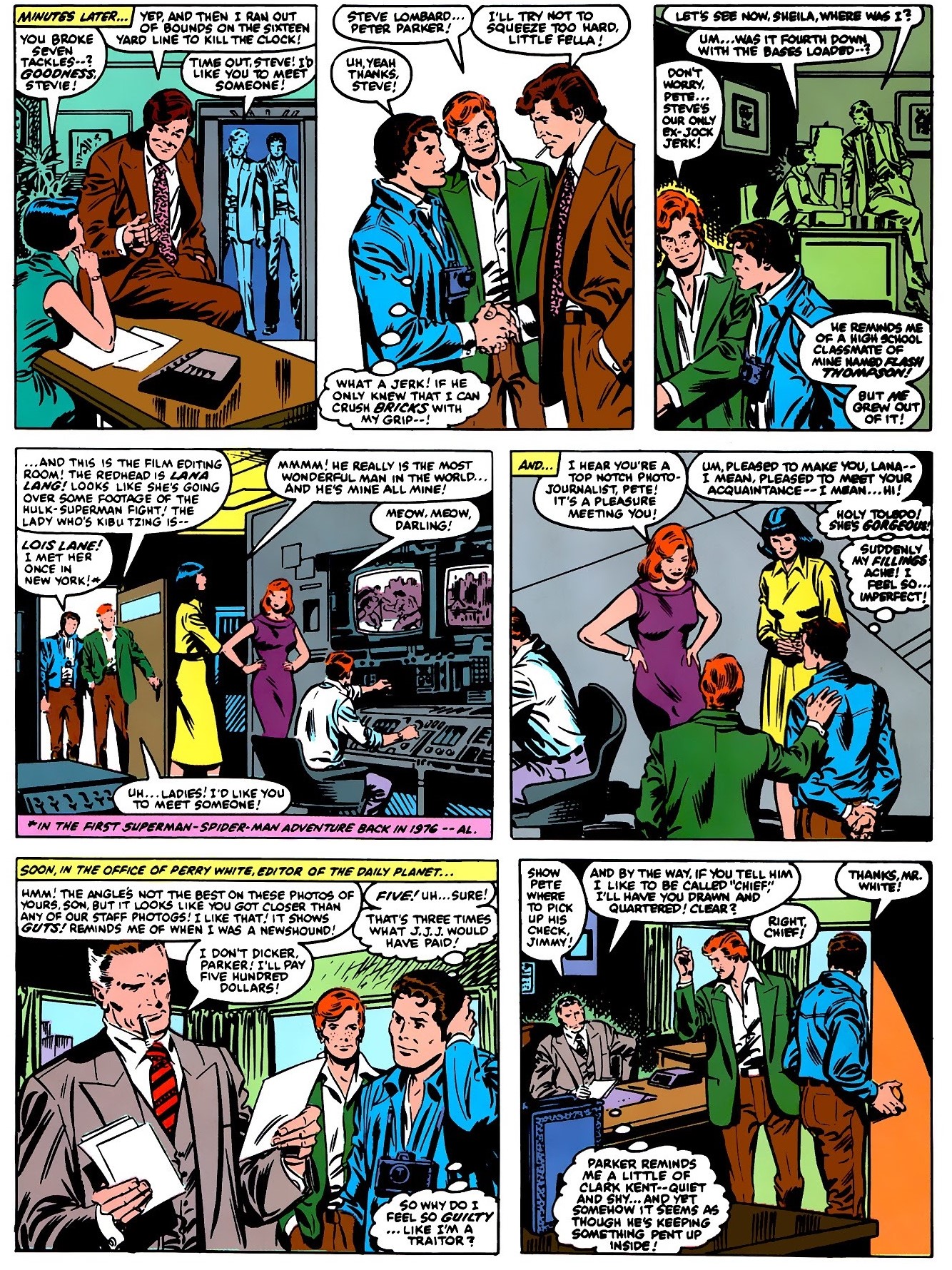
Peter Parker in Metropolis along with the Superman supporting characters. This is one great element that made this comic book worth reading.
While the high number of panels per page limited him, Buscema managed to come up with some action shots that packed some impact.
When it comes to writing and storytelling, this comic book exceeds that of the 1976 Superman-Spider-Man crossover big time! To start with, the plot is much more elaborate, more detailed and yet consistently remained easy to follow.
While the 1976 crossover had the most popular villains of Superman and Spider-Man as the representation of evil, this one instead had Dr. Doom and Parasite. The great news is that these two super villains complement each other nicely and that itself adds good depth into the plot. Dr. Doom is a major schemer and Parasite fitted nicely within his master plan for global chaos.
Regarding dialogue, the script had a lot of strength and was also specific in capturing the personalities of the superheroes, the super villains and the supporting cast. I can easily identify J. Jonah Jameson, Perry White, Lois Lane and others through the dialogue.
Not to be outdone is the deeper approach to the crossover aspect of the story. Right from the start, the comic book creators expected us readers to suspend disbelief and start believing that while the story is non-canon, the respective universes of Marvel and DC Comics co-existed. Because there were TV shows of Wonder Woman and the Hulk playing, the two characters were included in the comic book adding depth to the crossover.
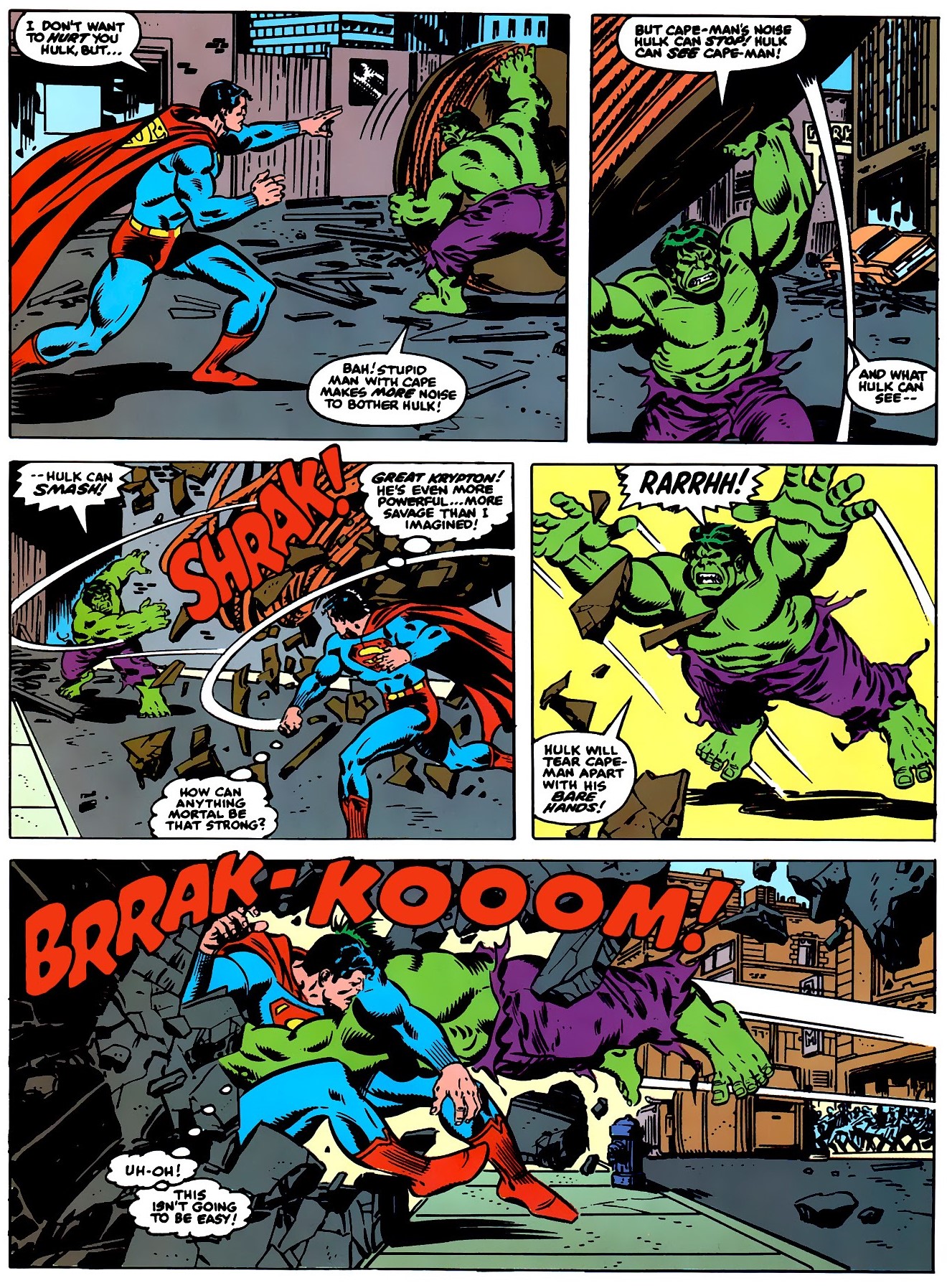
Speaking of crossovers, this comic book was not limited to Superman and Spider-Man. The encounter between the Hulk and Superman was a short but sweet spectacle to read. The encounter between Wonder Woman and Spider-Man meanwhile was short yet fun.
Adding more to the fun in this comic book was how Clark Kent interacted with the Spider-Man supporting characters while Peter Parker interacted with the Superman supporting characters. I enjoyed every moment of these scenes.
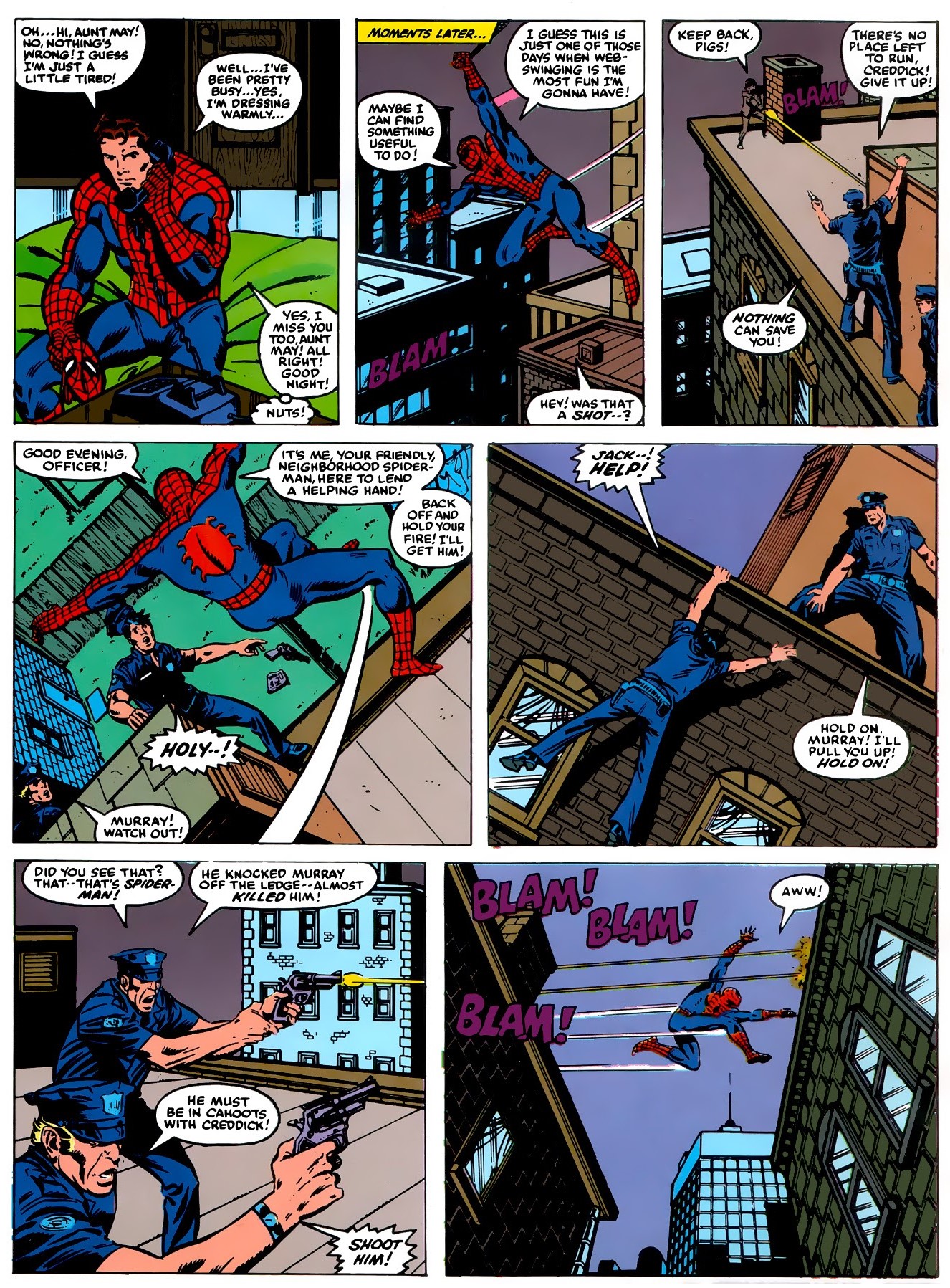
As far as narrative is concerned, this comic book is slightly slanted towards Superman. One factor behind this was the implementation of how local authorities interact with Superman and Spider-Man. Whenever he solves crime, Superman is highly respected by the public and the police. This is not the case with Spider-Man who is often perceived to be a social menace even though he helps solve crimes. Another factor was that Superman did more detective-type work (including a visit to Latveria) while Spidey hardly contributed anything to the plot’s development.
Nothing can be more frustrating than getting attacked by police officers when you try to help them solve their problems.
Regardless, the two icons got a fair share of the spotlight during the final stages of the story and there was enough spectacle to enjoy.
If there is any complaint I have, it would be the comic book creators’ reluctance on fully connecting itself to the 1976 crossover. In the scene wherein Peter Parker was guided into the film editing room by Jimmy Olsen, he recognized Lois Lane and remembered meeting her in the 1976 crossover (which ended with socializing). And yet when Spider-Man and Superman get together in this comic book, there was a noticeable lack of friendliness and personal cooperation between them even though they bonded nicely in the 1976 story.
Conclusion
Overall, Superman and Spider-Man is indeed a highly engaging, fun-filled superhero crossover comic book. For me, it is a true literary classic and definitely worth searching for out there. I read this crossover many times from start to finish and even though I knew the plot and the dialogue, I still had a lot of fun reading along the way. With the combined talents of Shooter, Buscema and many others, this superhero crossover was indeed one of the very best stories ever told by Marvel and DC Comics.
Given the current corporate climate Marvel and DC Comics are now in, it is very unlikely we will see another creatively fun superhero crossover collaboration between them happening soon. For the newcomers reading this, Marvel is owned by the Walt Disney Company while DC Comics is owned by Warner Bros.
Thank you for reading. If you find this article engaging, please click the like button below and also please consider sharing this article to others. Also my fantasy book The World of Havenoris still available in paperback and e-book format. If you are looking for a copywriter to create content for your special project or business, check out my services and my portfolio. Feel free to contact me as well. Also please feel free to visit my Facebook page Author Carlo Carrasco and follow me at HavenorFantasy@twitter.com






 Author Carlo Carrasco