A Look Back at Spider-Man #2 (1990)

Welcome back superhero enthusiasts, 1990s culture enthusiasts and comic book collectors! Today we go back to the early 1990s and explore a part of the Marvel Comics shared universe through a tale of the Spider-Man monthly series.

In my previous retro review, Todd McFarlane told a tale of the iconic web-slinger with intense build-up leading to another rematch with his old nemesis the Lizard (Dr. Connors). While the writing was pretty weak, McFarlane still managed to tell a tale with a strong element of horror and supernatural stuff. McFarlane’s approach with visual violence and graphic stuff was clearly adulterated. What was presented daringly tested the limits allowed under the Comics Code Authority (CCA).

With those details laid down, here is a look back at Spider-Man #2, published in 1990 by Marvel Comics with a story written and drawn by Todd McFarlane. This is also the 2nd chapter of the Torment storyline.
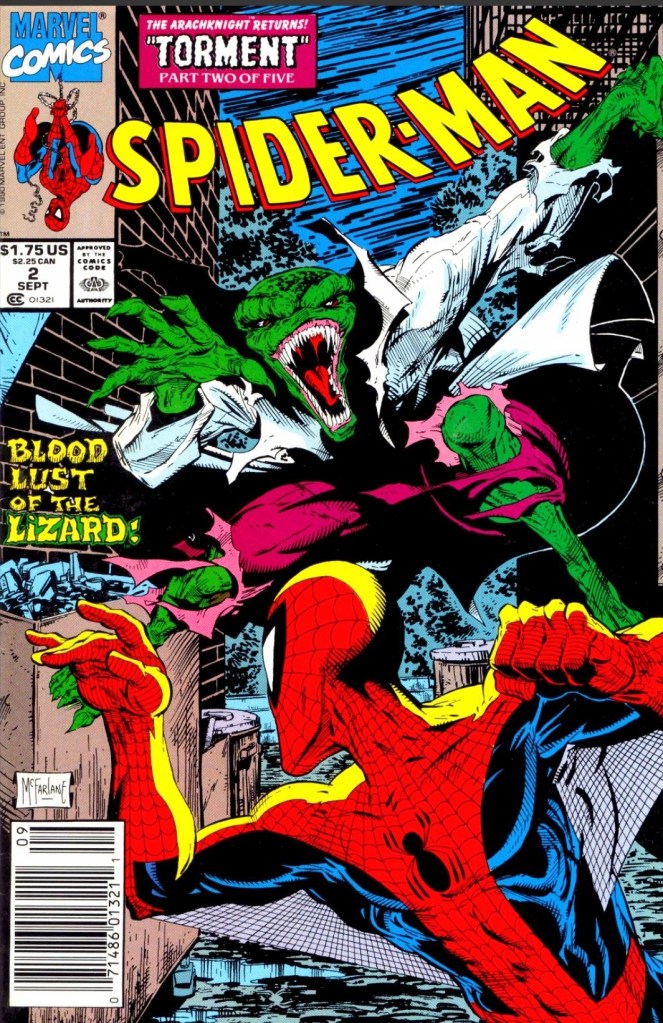
The cover.

Early story

The story begins in New York City where two men got suddenly murdered by the Lizard in an alley during the night. The next morning Peter Parker reads the newspaper (showing the photograph and the news story of the Lizard’s murder of the two men) while having a breakfast moment with his wife Mary Jane. As soon as his wife mentions the word “monster”, Peter takes a 2nd look at the newspaper’s photograph and finally notices the bloody writing “CNNR” on the alley wall which makes him realize that the Lizard is back again.

Feeling very troubled, Peter leaves Mary Jane quietly and dresses up as Spider-Man to go out once again.

Elsewhere in the city, a sorceress uses her evil method of crafting a potion which creates an unrelenting sound of disturbance which Spider-Man hears. As the sound goes on, his focus and Spider Sense get overwhelmed…

Quality
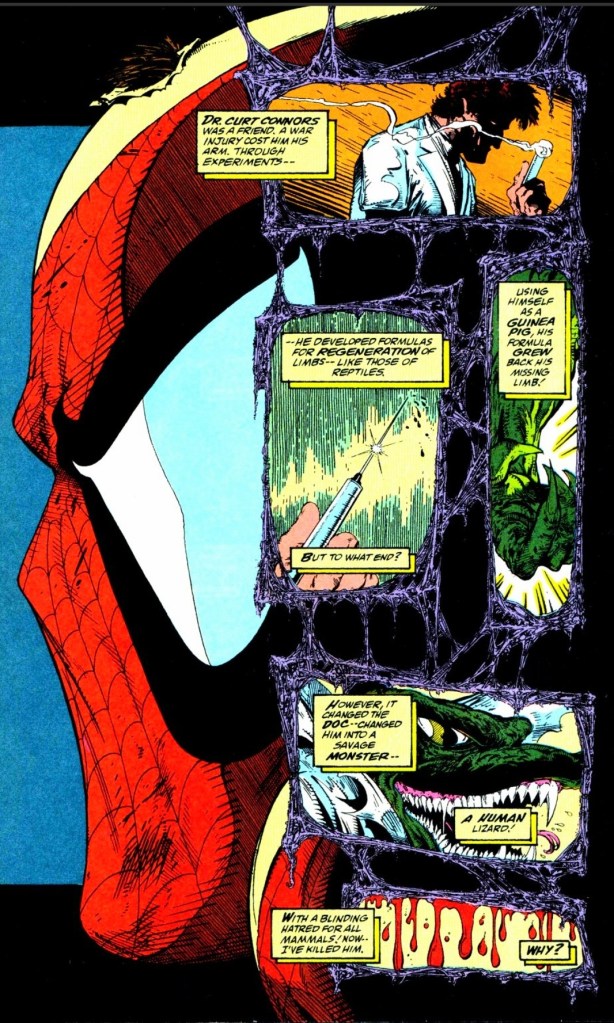
A quick look at the origin of the Lizard by McFarlane.

While the writing by McFarlane remains weak, he still succeeded in making this story a marginal improvement over the previous issue in terms of moving the plot forward, paying off a good chunk of the build-up in issue #1, and establishing his own visual corner (inspired by horror and adulterated stuff) within the Spider-Man franchise of comics of the time.

The biggest feature here is the physical conflict between Spider-Man and the Lizard. As expected, McFarlane drew the big fight with a lot of intense action, powerful violence (note: it was clear the editorial team recommended moves to tone down the graphic violence), suspense and a good amount of horror. Not only does the big fight move the story forward, it allowed McFarlane to dramatize Spider-Man as a vulnerable hero who not only has to cope with the disturbance from the sorceress far away, but also deal with the poison he got from the Lizard. That being said, Spidey also struggles with his sanity and the new fact that the Lizard has turned into a murder machine which disturbs him a lot as he personally knew Dr. Connors.

Considering what happened here and in the previous issue, there is still a greater force of evil that awaits Spider-Man and the Lizard happens to be an ultra-violent tool.

Conclusion
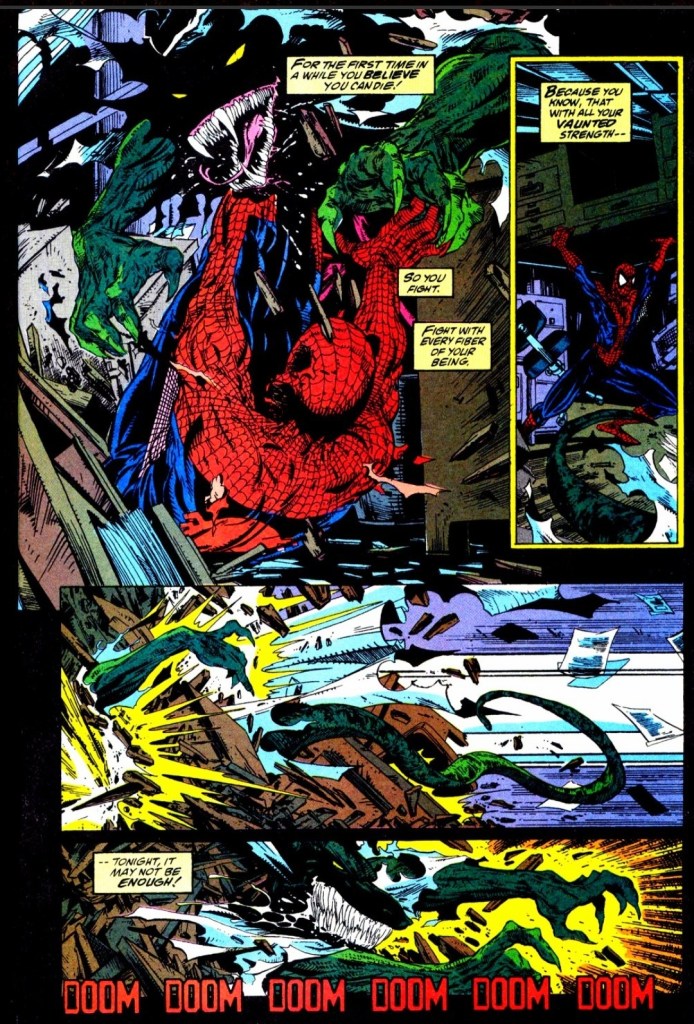
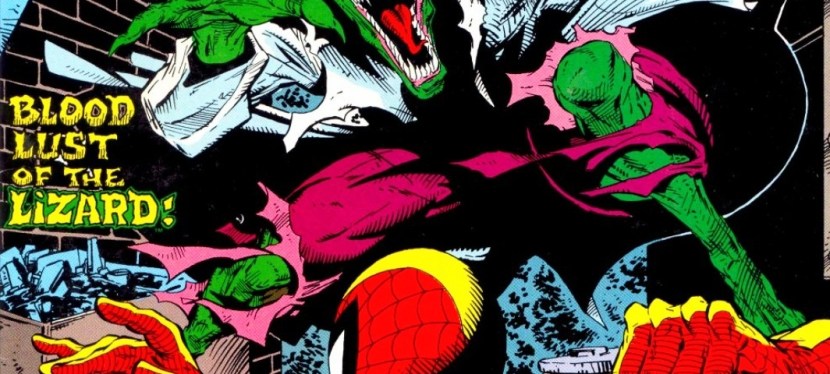
Many times Spider-Man finds himself in a disadvantage while fighting the Lizard.

Being the 2nd chapter of the Torment storyline, Spider-Man #2 (1990) is a slight improvement over the previous issue in terms of moving the story forward, spectacle and dramatization. While the big fight between Spider-Man and the murderous Lizard is clearly the big feature of the story, McFarlane does a good job portraying Spider-Man as vulnerable and on the edge towards defeat. McFarlane’s writing here is still weak but the other positive elements achieved outweighed the weakness.

Overall, Spider-Man #2 (1990) is satisfactory.

+++++

Thank you for reading. If you find this article engaging, please click the like button below, share this article to others and also please consider making a donation to support my publishing. If you are looking for a copywriter to create content for your special project or business, check out my services and my portfolio. Feel free to contact me with a private message. Also please feel free to visit my Facebook page Author Carlo Carrasco and follow me on Twitter at  @HavenorFantasy as well as on Tumblr at https://carlocarrasco.tumblr.com/ and on Instagram at https://www.instagram.com/authorcarlocarrasco

GMA Network’s fake Filipinos (AI sportscasters) should remind you that AI has no soul

A Look Back at What If #47 (1993)

Disclaimer: This is my original work with details sourced from reading the comic book and doing personal research. Anyone who wants to use this article, in part or in whole, needs to secure first my permission and agree to cite me as the source and author. Let it be known that any unauthorized use of this article will constrain the author to pursue the remedies under R.A. No. 8293, the Revised Penal Code, and/or all applicable legal actions under the laws of the Philippines.

Welcome back superhero enthusiasts, 1990s arts and culture enthusiasts, Marvel Comics fans and comic book collectors! Today we go back to the year 1993 and explore a part of Marvel Comics’ universe through the reimagined tales emphasized in the What If monthly series.

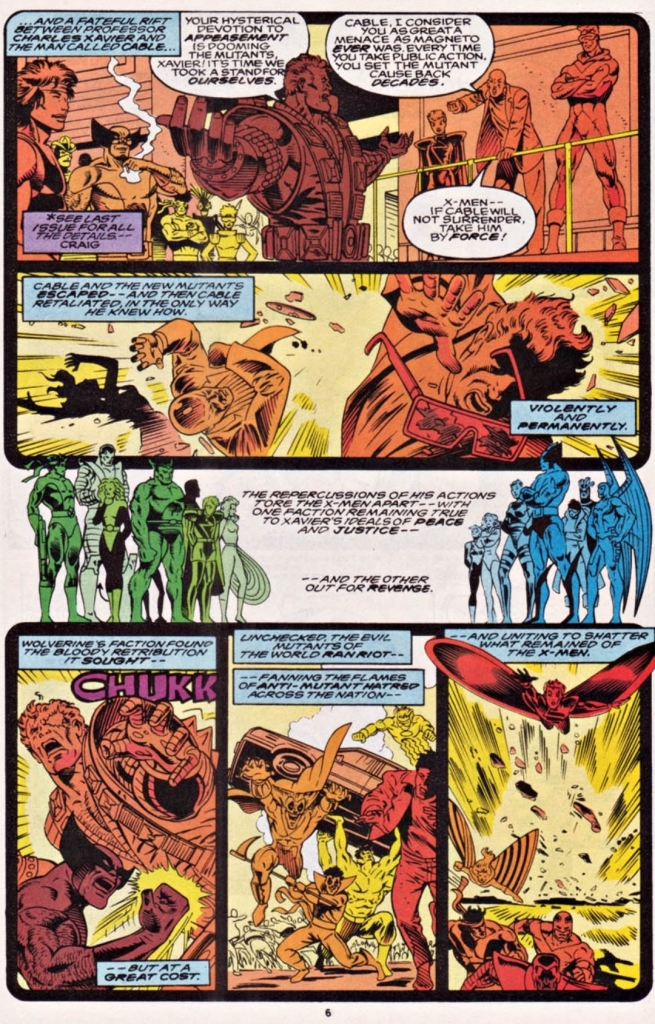
Back in 2021, I reviewed What If #46 (1993) which told a compelling story about division between the mutants, the clash of beliefs between Professor X and Cable, and how terrorism affects everyone. The comic book was also a mesmerizing portrayal of how the X-Men would have organized themselves without Charles Xavier, Jean Grey and Cyclops.

Considering all the chaos that happened in What If #46 (1993), the time was just right for Magneto – the X-Men’s most dangerous enemy of all time – to come in and make an impact not only on mutants but on the world.

With those details laid down, here is a look back at What If #47, published in 1993 by Marvel Comics with a story written by Kurt Busiek and drawn by Tod Smith.

The cover.

Early story

The story begins with Magneto leading a huge legion of mutants to take overwhelm the remaining resistance – including Spider-Man, the Fantastic Four, Captain America, the Avengers and the dedicated American soldiers – in Washington, D.C.

A fierce battle then took place with both sides hitting each other hard. After noticing Magneto’s lack of presence during the battle, Captain America then realizes that the long-time enemy of the X-Men took advantage of the fighting to penetrate the U.S. Capitol’s bomb shelters and got the nation’s leaders hostage. After easing some of his fellow heroes, Captain America decides not to escalate the fight against Magneto in consideration of the lives of America’s top officials…

Quality

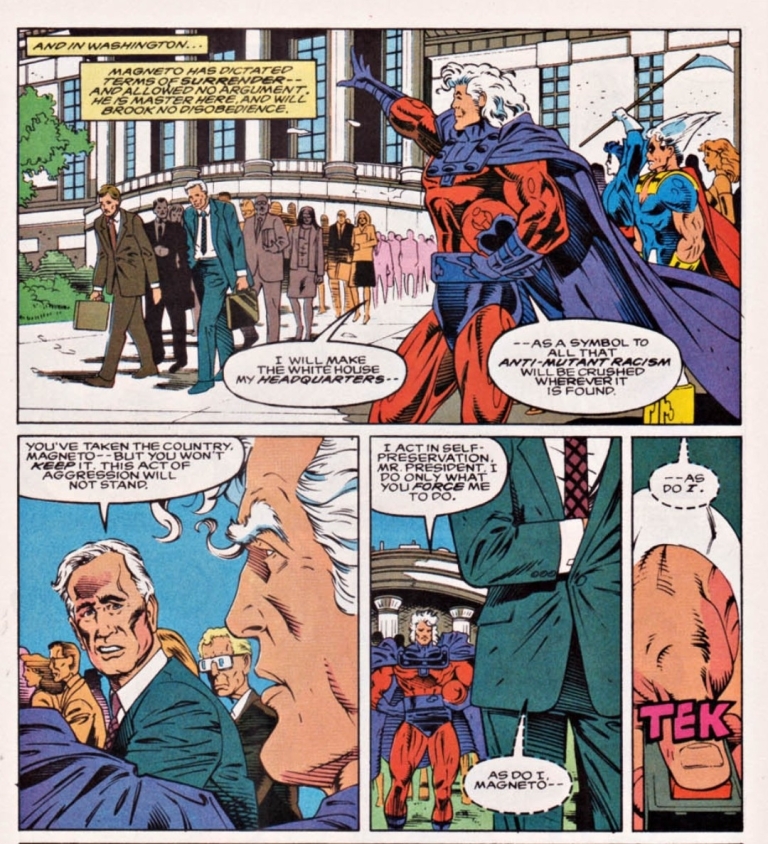
A recap of the events in issue #46.

To begin with, I can say that this story is a well-planned follow-up to the events of issue #46. While Magneto’s presence has been magnified a lot here, there are still strong story connections to the previous issue.

With regards to what was emphasized on the front cover of the comic book, this story explores what would happen if Magneto took power to control the entire United States while leading a group of mutants with a platform focused on crushing anti-mutant racism even though it includes pushing the non-mutant people (which is the great majority of America’s people) as well as the dissenting mutants out of the way.

For one thing, this superhero fantasy concept is actually socially relevant with today’s geopolitics and the way America has turned out under the fake leadership of Joe Biden (who is NOT leading as US President but only following the modern-day American Communists and reckless SJWs dictating him to do their evil bidding. Biden also arrogantly denies reality when it goes against the desires of his administration and his Satanic Democrats) It should be noted that the US President visualized in this comic book eerily looks like Joe Biden complete with that absent-minded facial expression.

Next, a clear theme in this What If story is absolute power and why groups who crave for it would sacrifice so much and hurt others just to acquire it. Magneto, who carries deep hatred towards people he perceives to be obstacles or opposition for his quest of uplifting mutants, takes advantage of mutants who have lost hope and are depending on someone to lead them. Indeed, the long-time X-Men nemesis gains power to control America but finds himself facing a new force of opposition which leads the nation into a drastic series of change that clearly do not alight with his vision of a better future for mutants.

Still on the theme of absolute power, the US government in this story was portrayed to have developed technologies designed to overwhelm its citizens, as well as the means to establish infrastructure and protocols to transform America into an automated dictatorial state that enslaves its citizens and violate their rights without restraint. Once again, this aspect of the story makes it socially relevant.  

Considering the epic concept and the dark turn of events the creative team prepared, this comic book does not have a clear good-versus-evil approach but rather it emphasizes chaos that comes with the pursuit and abuse of absolute power over the nation. You will see key elements from the classic X-Men storyline Days of Future Past here in relation to America’s deformation.

Conclusion

Wow! The US President in this comic book eerily looks so much like Joe Biden whose leadership led America into a lot of problems and hardship. Sky high inflation is just one of the problems that happened under Biden.

What If #47 (1993) is truly a very captivating read mainly because of its core concept which goes way beyond the scenario of Magneto taking control of America. Considering its portrayal of America and the exploration of dark themes about people getting overwhelmed by power abusers, the story is a warning about the fall of America told in superhero fantasy form. Considering the intense social degradation that rocked America the past few years (note: riots by the Black Lives Matter terrorists, SJWs disturbing the peace, Democrats allowing more illegal immigrants into the country, socialists in colleges continuing to brainwash students and more), this story is very socially relevant. It will keep you thinking and reflecting deeply, even if you strongly desire whatever superhero entertainment you seek in this comic book.

Overall, What If #47 (1993) is highly recommended!

+++++

Thank you for reading. If you find this article engaging, please click the like button below, share this article to others and also please consider making a donation to support my publishing. If you are looking for a copywriter to create content for your special project or business, check out my services and my portfolio. Feel free to contact me with a private message. Also please feel free to visit my Facebook page Author Carlo Carrasco and follow me on Twitter at  @HavenorFantasy as well as on Tumblr at https://carlocarrasco.tumblr.com/ and on Instagram at https://www.instagram.com/authorcarlocarrasco

A Look Back at X-Men 2099 #7 (1994)

Disclaimer: This is my original work with details sourced from reading the comic book and doing personal research. Anyone who wants to use this article, in part or in whole, needs to secure first my permission and agree to cite me as the source and author. Let it be known that any unauthorized use of this article will constrain the author to pursue the remedies under R.A. No. 8293, the Revised Penal Code, and/or all applicable legal actions under the laws of the Philippines.

Welcome back, superhero enthusiasts, fans of the 2099 universe of Marvel Comics, 1990s culture enthusiasts and comic book collectors! Today we revisit the X-Men 2099 comic book series by focusing on the seventh issue. If there is anything that makes the series of Marvel’s futuristic mutants distinct from other Marvel 2099 monthly series, it is the fact that it shows more of wasteland of America which easily reminds me of the Mad Max movies.

With those details laid down, here is a look back at X-Men 2099 #7, published by Marvel Comics in 1994 with a story written by John Francis Moore and drawn by Ron Lim.

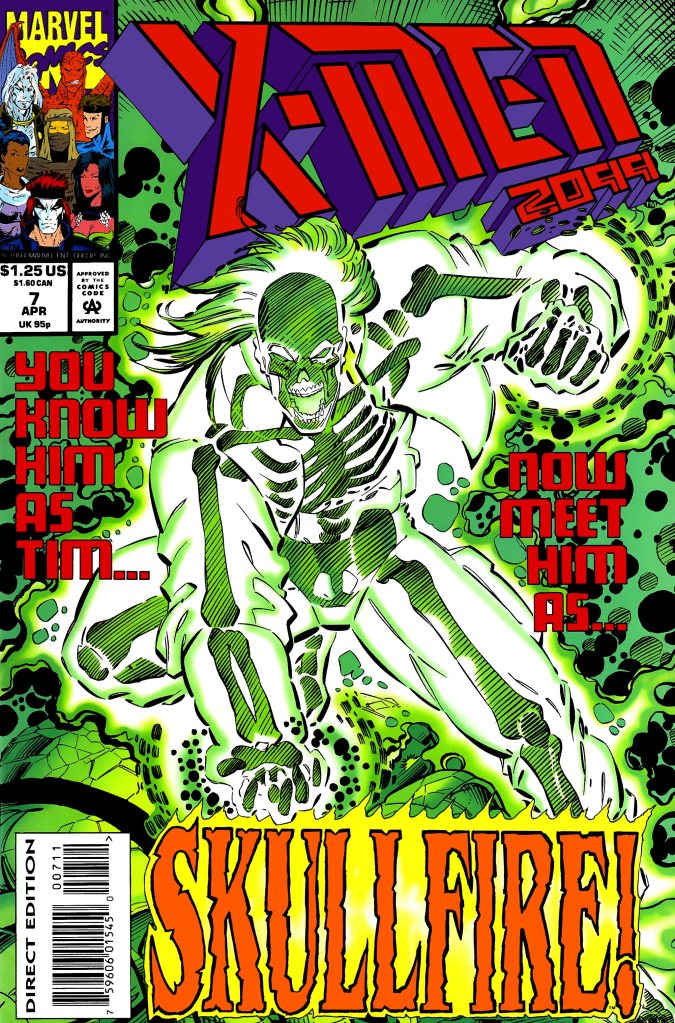
The cover.

Early story

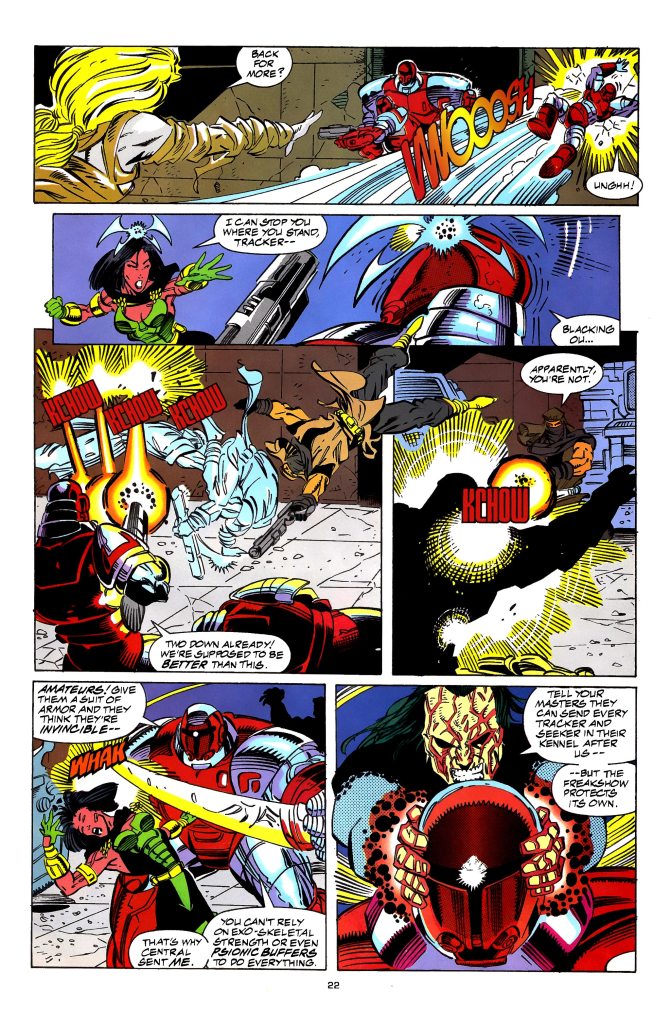
The story begins in the middle of an abandoned town with the X-Men in battle with the Freakshow. Xi’an fights their leader Breakdown while his teammates struggle with the other members of the Freakshow. Already infected by one of the Freakshow members, Eddie is suffering severe pain even in his metallic form.

The fight suddenly ends when an old lady fires a blast with her rifle. It turns out she is Breakdown’s superior and she is precisely whom the X-Men have been searching for…

Quality

In the heat of battle.

As one of the early stories showing the X-Men of 2099 exploring the American wasteland, this is a well-written piece of work by John Francis Moore which is expected. While it has the usual superhero elements of spectacle and special moves, discovery and exposition are easily the most obvious elements of the story. What I like most about this comic book is that it reveals more of the history about the mutants’ struggle to survive not only with the harshness of the wilderness but also with dealing with rejection from the people who are not mutants (which symbolizes prejudice). This also reveals that the mutants are still searching for a fabled place called Avalon which could be a better destination for all mutants to live in.

As the narrative about the past gets emphasized, the creative team added some elements of emotion and concern on the X-Men visually. This makes a lot of sense since the mutants are clearly searching for purpose and trying to make the most out of their current situation in the hope of having a brighter future. This is similar to the original X-Men and yet X-Men 2099 has its distinct style and concept about mutant survival.

Conclusion

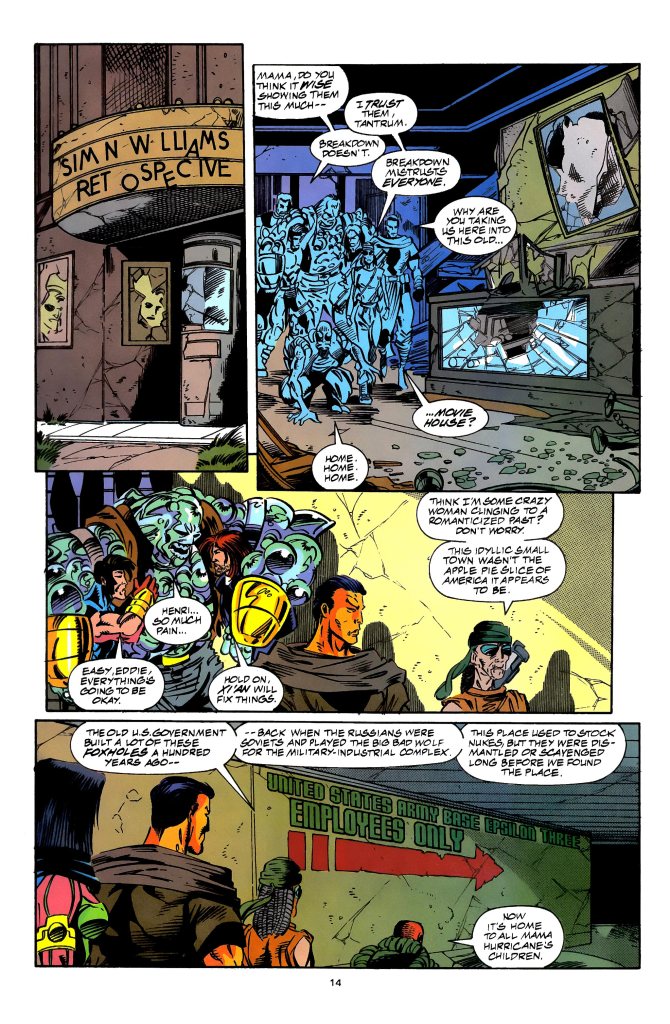
At an abandoned old town that has government secret facilities.

X-Men 2099 #7 (1994) is indeed a good comic book to read. As the X-Men of the far future encounter more people in the wasteland, the discoveries they get impacts them and their efforts to survive. As discovery and exposition are strong elements in the story, the comic book is definitely not your typical good-versus-evil superhero story. The strong writing by John Francis Moore and his approach on expanding the world of 2099 America to the readers really made this comic book a solid read.

If you are seriously planning to buy an existing hard copy of X-Men 2099 #7 (1994), be aware that as of this writing, MileHighComics.com shows that the near-mint copy of the regular edition costs $30 while the near-mint copy of the newsstand edition costs $90.

Overall, X-Men 2099 #7 (1994) is recommended!

+++++

Thank you for reading. If you find this article engaging, please click the like button below and also please consider sharing this article to others. If you are looking for a copywriter to create content for your special project or business, check out my services and my portfolio. Feel free to contact me as well. Also please feel free to visit my Facebook page Author Carlo Carrasco and follow me at HavenorFantasy@twitter.com

A Look Back at V #5 (1985)

Disclaimer: This is my original work with details sourced from reading the comic book, watching the V mini-series (Original Miniseries and The Final Battle) and the 1984 TV series, and doing personal research. Anyone who wants to use this article, in part or in whole, needs to secure first my permission and agree to cite me as the source and author. Let it be known that any unauthorized use of this article will constrain the author to pursue the remedies under R.A. No. 8293, the Revised Penal Code, and/or all applicable legal actions under the laws of the Philippines.

Welcome back, science fiction enthusiasts, comic book collectors and fans of the V entertainment franchise of the 1980s! Before I start this newest retro comic book review, I am happy to say that I recently published my retro review of V: The Original Miniseries which is one of the most in-depth retro reviews I wrote so far. I recommend you to read it now. If you are a fan and you are interested to buy yourself the original mini-series on Blu-ray disc format, head on to Amazon. Now we can return to the 1980s comic book series.

Last time around, Ham Tyler and Chris continued their operation which resulted getting reunited with the star child Elizabeth Maxwell (refer to V: The Final Battle mini-series of 1984). Meanwhile, Mike Donovan and Julie Parrish met with delusional astronomer Earl Meagan (patterned after Carl Sagan) who is obsessing with meeting Diana of the Visitors.

With those details laid down, here is a look back at V #5, published in 1985 by DC Comics with a story written by Cary Bates and drawn by Tod Smith.

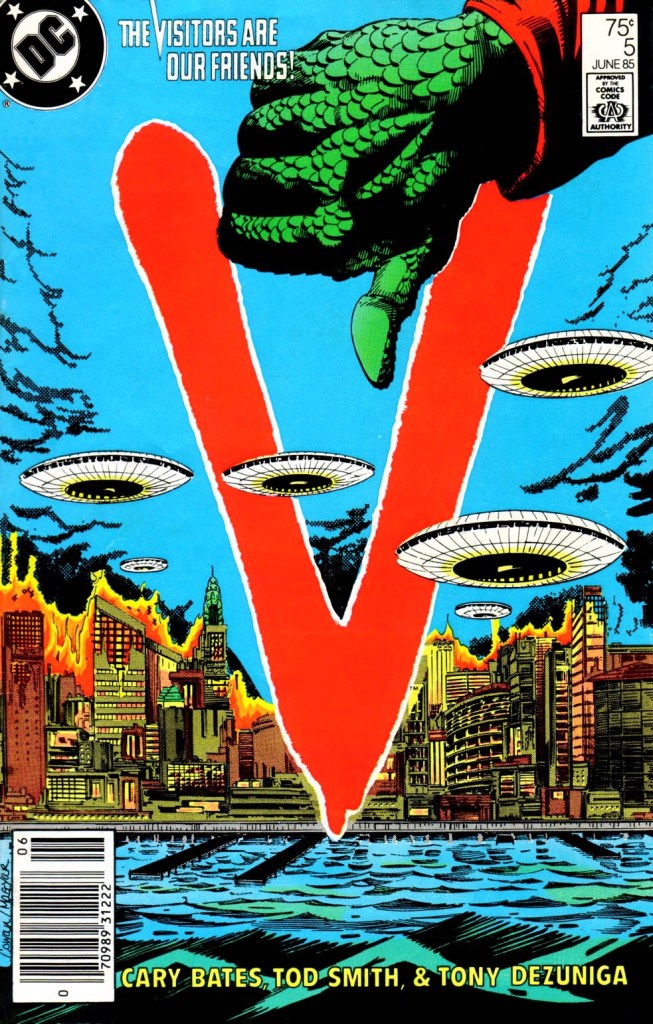
The cover.

Early story

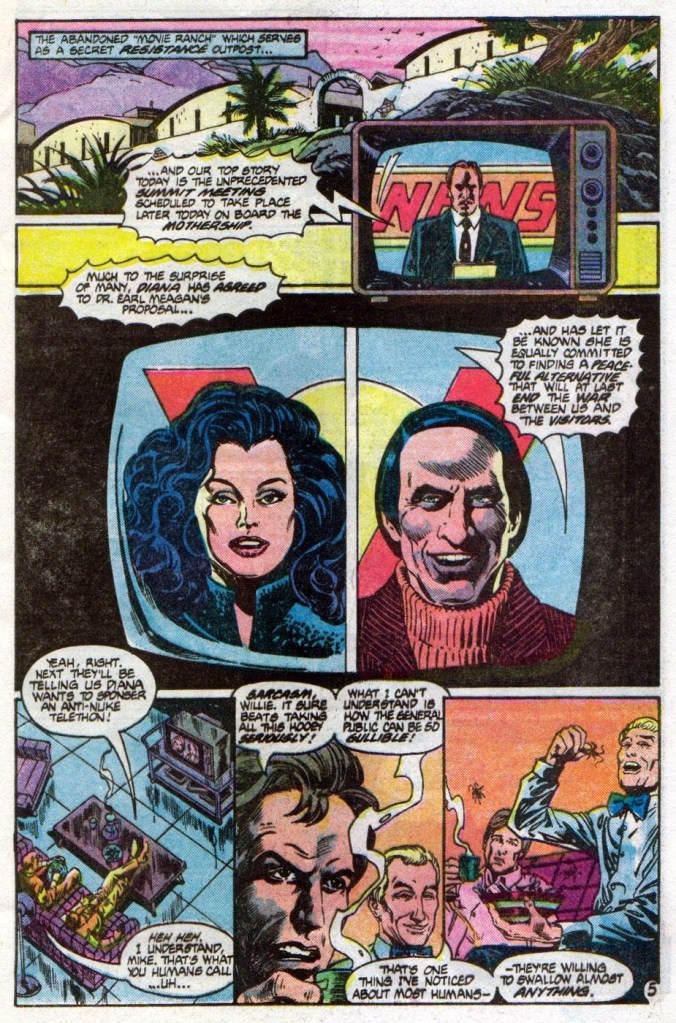
The story begins with Diana, Linda and Charles watching a video message from the delusional Earl Meagan expressing his thanks to her (Diana) for accepting his peace proposal for a summit of peace between the humans and the Visitors. He expressed more of his delusion stating that he is confident that both of their races will benefit from the meeting.

Diana explains to her powerful companions that they have a lot to gain by turning one of Earth’s most influential figure to their side. After Diana left, Linda expresses that their commander has gone too far. Charles tells her what she is thinking of.

On Earth, in the presence of Ham, Chris and Bates, a weakened Elizabeth recalls her time with Kyle when they went into hiding away from the Visitors’ search team. She then makes mental contact with Kyle.

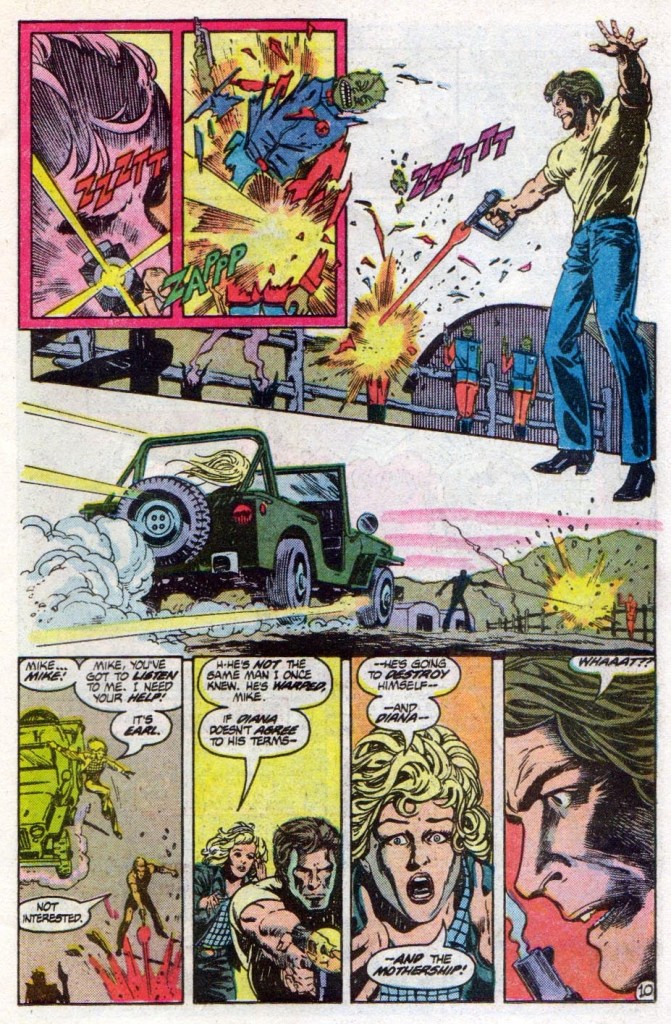
Elsewhere, as Mike Donovan and Willie watch the newscast about the peace summit between Diana and Earl Meagan set to happen soon, Julie Parrish personally tells the astronomer (by the helipad within a city) that he just can’t go as such a meeting is suicide. Still delusional, Meagan tells Julie that she is no different from her short-sighted friend Mike, leaves her and rides the helicopter to push through with the summit…

Quality

Realizing her mistake with the delusional astronomer Earl Meagan, Julie comes back to Mike.

First thing to mention is the good news that the quality of the writing and plotting by Cary Bates has the high quality maintained throughout. While the story about the peace summit between Earl Meagan and Diana is the highlight here, the other story (told through Ham and Chris) about the discovery of a secret camp where the Visitors conduct experiments on humans is itself very intriguing as it parallels what the Nazis did to prisoners during the dark days of World War II.

Going back to the highlighted plot of the comic book, Earl Meagan is not only delusional with his old belief that any extraterrestrial race capable of traveling through the depths of space is surely friendly and benevolent to humanity…he is completely wrong and a danger to his own people as clearly lost his touch with truth and reality. He is a perfect example of what happens when a scientist refuses to realize the limits of science and goes over the edge believing in the falsehood that another scientific breakthrough will prove him right and all others wrong. By today’s standards, Meagan can be compared with the radical socialists in America who foolishly believe that all foreigners (including criminals and terrorists) should be allowed free entry into their country without consequence and without responsibility, and at the expense of their fellow American citizens.

When it comes to characterization, I still recognize Ham and Chris as I remembered them from V: The Final Battle thanks to solid writing. Julie’s portrayal in this comic book, however, takes a drastic turn from powerful receiver of Earl Meagan in issue #4. More notably, it is refreshing to see the relationship between Mike and Julie getting strained as a result of Meagan.

Conclusion

The closest thing you can have about Carl Sagan betraying the entire human race in favor of aliens from outer space.

V #5 (1985) is another solid tale about the conflict between the Resistance and the Visitors, but with Earl Meagan as the mad scientist with charisma who puts his fellow humans into more danger. It’s a worthy read from start to finish.

If you are seriously planning to buy an existing hard copy of V #5 (1985), be aware that as of this writing, MileHighComics.com shows that the near-mint copy of the regular edition costs $28 while the near-mint copy of the newsstand edition costs $36.

Overall, V #5 (1985) is highly recommended.

+++++

Thank you for reading. If you find this article engaging, please click the like button below and also please consider sharing this article to others. If you are looking for a copywriter to create content for your special project or business, check out my services and my portfolio. Feel free to contact me as well. Also please feel free to visit my Facebook page Author Carlo Carrasco and follow me at HavenorFantasy@twitter.com