Disclaimer: This is my original work with details sourced from reading the comic book and doing personal research. Anyone who wants to use this article, in part or in whole, needs to secure first my permission and agree to cite me as the source and author. Let it be known that any unauthorized use of this article will constrain the author to pursue the remedies under R.A. No. 8293, the Revised Penal Code, and/or all applicable legal actions under the laws of the Philippines.
Welcome back, superhero enthusiasts, 1990s culture enthusiasts and comic book collectors! Today we revisit the X-Men monthly series of the said decade, specifically on the 28th issue which takes place after the events highlighted by the 30th anniversary the X-Men (read my retro reviews of Uncanny X-Men #304 and X-Men #25), and before the wedding of Scott/Cyclops and Jean Grey (X-Men #30).
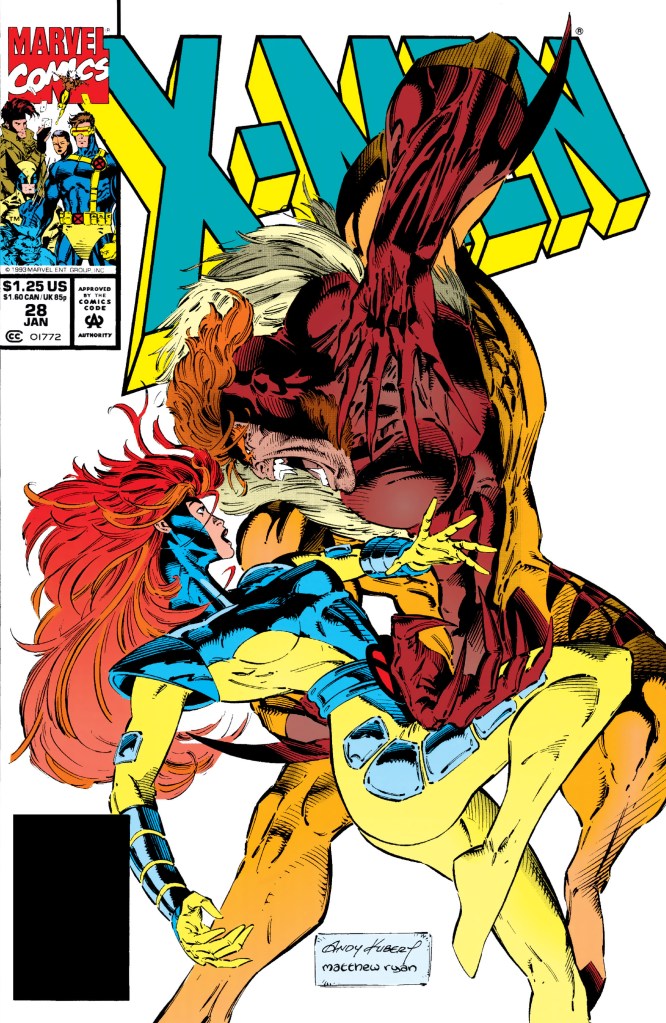
With those details laid down, here is a look back at X-Men #28, published by MarvelComics in 1994 with a story written by the Fabian Nicieza and drawn by Andy Kubert.
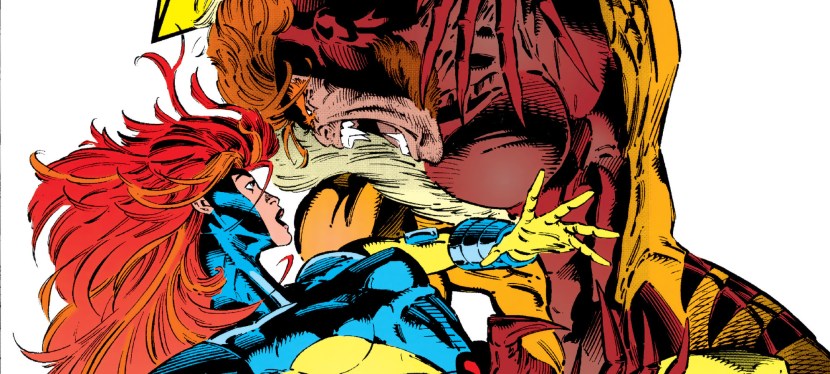
The cover.
Early story
The story begins with Jubilee running through the woods desperately. She suddenly finds Wolverine on the ground. As she turns, she sees Sabretooth moving directly at her for the kill.
Jubilee suddenly wakes up from her nightmare. Jean arrives to comfort her and gets told that within the nightmare, all the X-Men were killed. Jean telepathically reaches out to Scott, Ororo/Storm and Hank/Beast and calls for an immediate private meeting outside Charles Xavier’s mansion.
Shortly after, Jean, Cyclops, Storm and Beast meet at a local pub to discuss a very questionable move recently made by their leader Charles Xavier…accepting Sabretooth into the mansion as a patient…
Quality
I really liked this scene between Professor X and two of his original X-Men members.
Let me start by confirming that this is one of the best X-Men scripts I have read from Fabian Nicieza as X-Men #28 strongly tackled the issues it raised regarding the disturbing presence of Sabretooth on the established team of mutants. For one thing, it is dramatic to read how Jean Grey, Cyclops, Beast and Storm expressed their opinions about their boss Charles Xavier who decided to take an established animalistic killer like Sabretooth into their shared place of residence. Even though they have high-tech measures to ensure security and containment, Sabretooth is still a constant emotional problem to the X-Men.
The presence of Sabretooth brings to light Xavier’s legacy of bringing Wolverine and Rogue into the X-Men many years prior, as well as sensible questions about the X-Men founder himself. How much impact did Ilyana’s death and Colossus’ departure have on Xavier? Is Xavier losing his sanity since he erased Magneto’s mind? Is Professor X really in control with leading the team while working on several other things at the same time?
More on Sabretooth, apart from being a major disturbance, he was shown to have known Gambit from some time in the past and if you read his dialogue (while in the presence of Rogue and Gambit) closely, the French city of Paris is mentioned and it has something to do with Gambit and Sabretooth’s previous encounter. This was a build-up to a big revelation a few issues later.
Conclusion
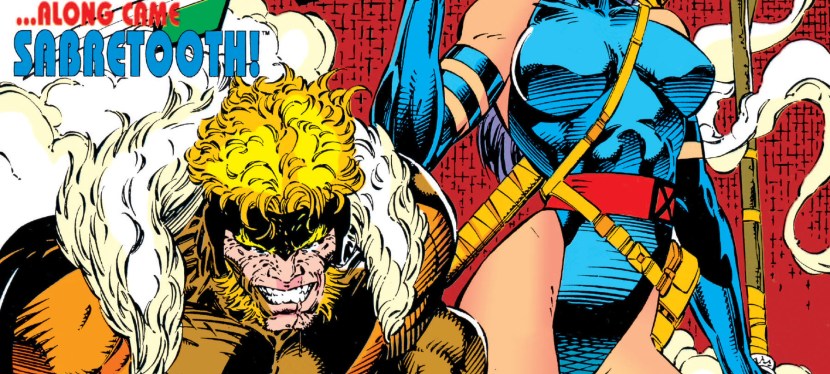
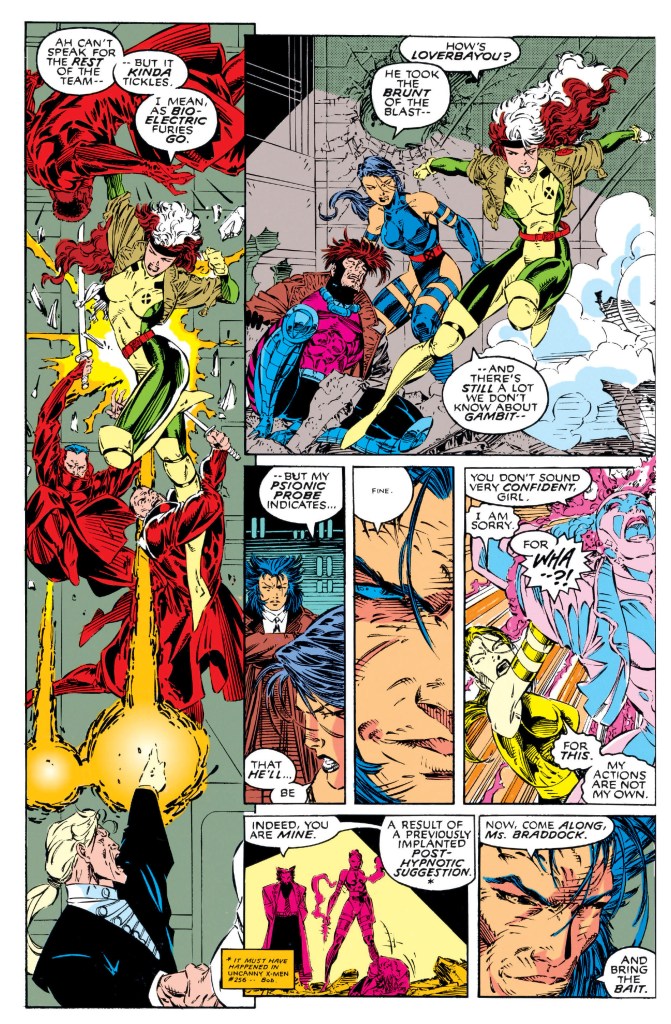
Psylocke was no match for Sabretooth.
X-Men #28 (1994) is not your typical good-versus-evil X-Men story but rather a dramatized look at the team feeling very uneasy mainly because of the presence of an animalistic killer within their household. In retrospect, the concept of having Sabretooth in the Xavier mansion is daring and also refreshing as it opened up opportunities for the creative team to explore new dimensions on many of the affected X-Men members. In relation to that, this comic book was published just months after Marvel published a Sabretooth comic book mini-series.
If you are seriously planning to buy an existing hard copy of X-Men #28 (1994) be aware that as of this writing, MileHighComics.com shows that the near-mint copy of the regular edition costs $30 while the near-mint copies of the signed-and-numbered edition and the newsstand edition cost $200 and $90 respectively.
Overall, X-Men #28 (1994) is highly recommended.
+++++
Thank you for reading. If you find this article engaging, please click the like button below and also please consider sharing this article to others. If you are looking for a copywriter to create content for your special project or business, check out my services and my portfolio. Feel free to contact me with a private message. Also please feel free to visit my Facebook page Author Carlo Carrasco and follow me on Twitter at @HavenorFantasy as well as on Tumblr at https://carlocarrasco.tumblr.com/
Disclaimer: This is my original work with details sourced from reading the comic book and doing personal research. Anyone who wants to use this article, in part or in whole, needs to secure first my permission and agree to cite me as the source and author. Let it be known that any unauthorized use of this article will constrain the author to pursue the remedies under R.A. No. 8293, the Revised Penal Code, and/or all applicable legal actions under the laws of the Philippines.
Welcome back, superhero enthusiasts, 1990s culture enthusiasts and comic book collectors! Today we revisit the Ultraverse and focus on the Night Man who is one of the most intriguing heroes of the UV ever created. Having read the first four issues, it is clear that the storytelling with Night Man was done with darkness and grit in mind plus the villains introduced were unconventional. The good news is that each of the first four issues were actually enjoyable to read.
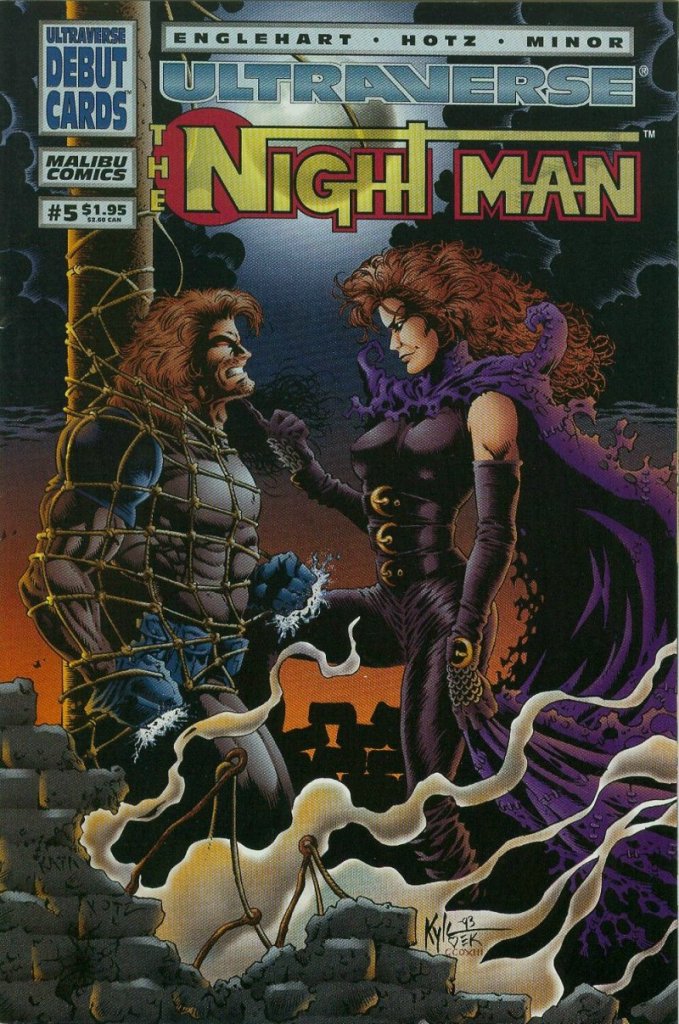
With those details laid down, here is a look back at The Night Man #5, published by Malibu Comics in 1994 with a story written by the Steve Englehart and drawn by Kyle Hotz.
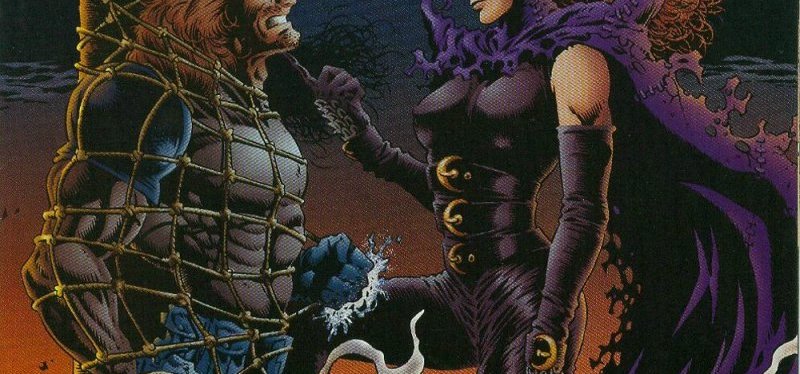
The cover.
Early story
The story begins with a private investigation being done by a detective and a police officer over a dead man whose chest was ripped open. While the two discuss who could be responsible for the victim’s death, Night Man appears and showed no fear when guns were pointed at him.
He tells the police officer and the detective that he is searching for a murderer responsible for the kidnap of two ladies and the extraction of their respective glands. Night Man explains that he rescued the two said ladies and victim right in front of them must be the first substitute victim…
Quality
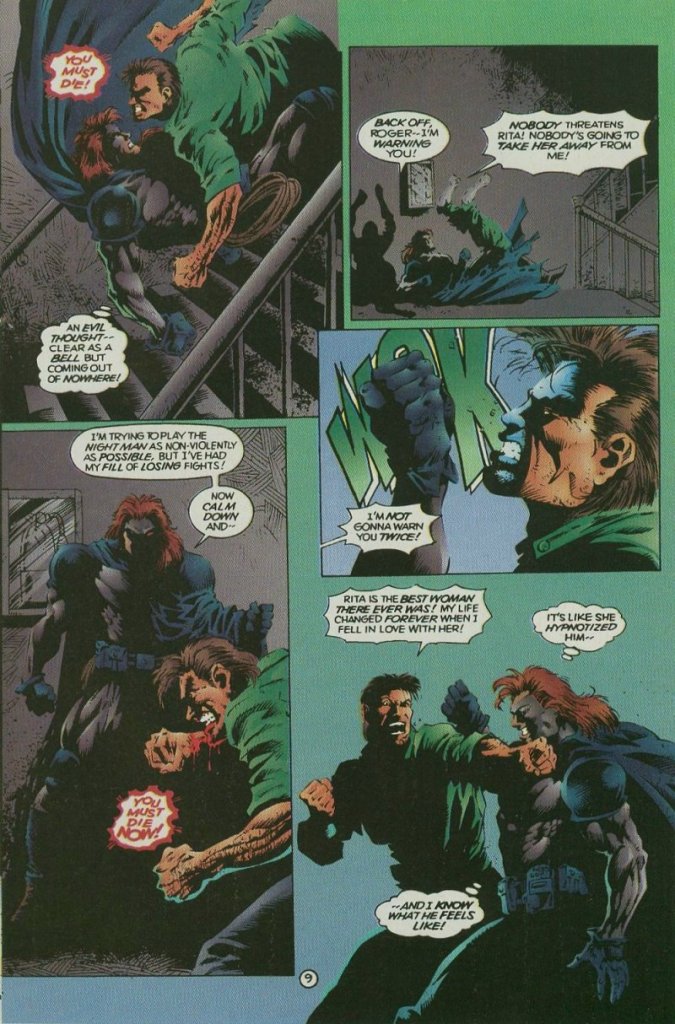
Getting answers is tough for the Night Man.
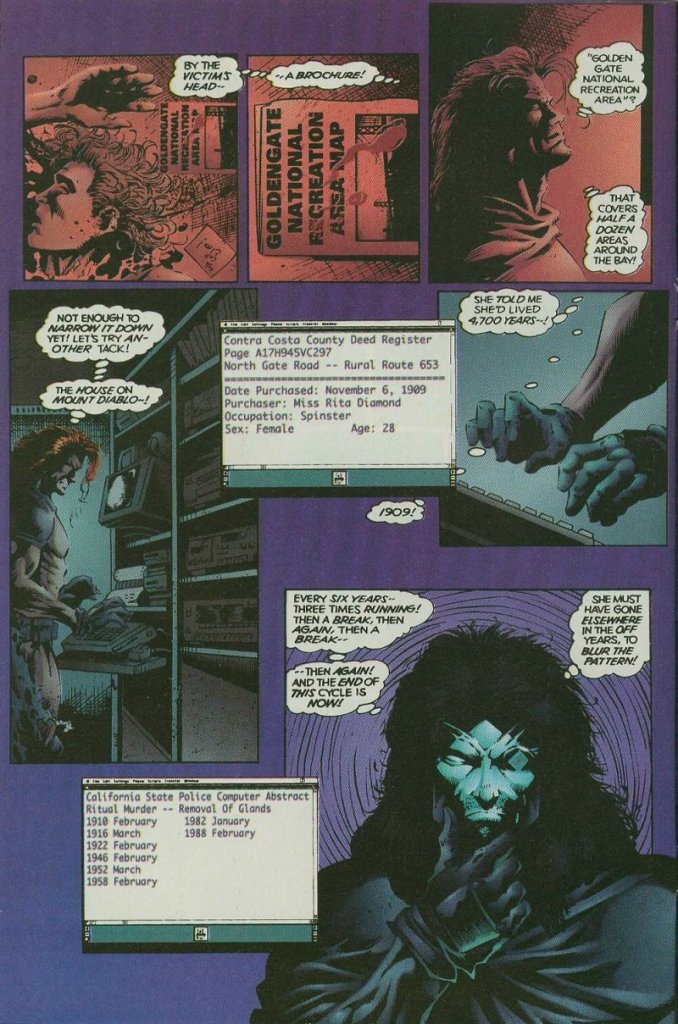
To cut through the chase, I can say that this comic book has a very strong detective story element in it told through Night Man. In fact, seeing Night Man doing detective work made him look and feel like DC Comics’ own Batman but with the Ultraverse touch still maintained.
While telling a detective story, Steve Englehart also took time to humanize Night Man and the scene in which the protagonist questions what being the Night Man has gotten him into was a really nice touch.
Serving as the highlight of this comic book was the rematch between Night Man and antagonist from issue #4. The rematch was not much about spectacle or hard-hitting action but rather more about intrigue and shock value expressed through dialogue (which the Night Man and the villainess engaged a lot with). The villainess is absolutely not the typical comic book antagonist but someone who has a legacy of not just taking people’s lives away but also living through the decades without aging nor anyone from local society opposing her. The villainess is pretty much an ideological opposite of the Night Man.
Conclusion
The Night Man doing detective work and research.
With its continued approach on darkness, grit and shock value on its storytelling, The Night Man#5 (1994) is another engaging read and it is best enjoyed when you focus on the dialogue and the details in text. As for the Night Man himself, he got developed as a person even more here even though key storytelling elements were used that made the comic book feel like a Batman comic book. Lastly, I should say that Night Man really has his own unique place within the Ultraverse.
If you are seriously planning to buy an existing hard copy of The Night Man #5 (1994), be aware that as of this writing, MileHighComics.com shows that the near-mint copy of the regular edition costs $16.
Overall, The Night Man #5 (1994) is recommended.
+++++
Thank you for reading. If you find this article engaging, please click the like button below and also please consider sharing this article to others. If you are looking for a copywriter to create content for your special project or business, check out my services and my portfolio. Feel free to contact me with a private message. Also please feel free to visit my Facebook page Author Carlo Carrasco and follow me on Twitter at @HavenorFantasy as well as on Tumblr at https://carlocarrasco.tumblr.com/
Disclaimer: This is my original work with details sourced from reading the comic book and doing personal research. Anyone who wants to use this article, in part or in whole, needs to secure first my permission and agree to cite me as the source and author. Let it be known that any unauthorized use of this article will constrain the author to pursue the remedies under R.A. No. 8293, the Revised Penal Code, and/or all applicable legal actions under the laws of the Philippines.
Welcome back, superhero enthusiasts, 1990s culture enthusiasts and comic book collectors! Today we revisit the Ultraverse and focus on The Solution, which remains as one of the most entertaining and intriguing team comic book series ever published by Malibu Comics! For the newcomers reading this, I previously published reviews of some The Solution comic books such as issue #6 (a great origin story of Lela Cho), issue #4 (a part of the Break-Thru crossover storyline), and issue #13 (part of a crossover storyline involving Night Man).
With those details laid down, here is a look back at The Solution #5, published by Malibu Comics in 1994 with a story written by the late James Hudnall and drawn by Alan Jacobsen.
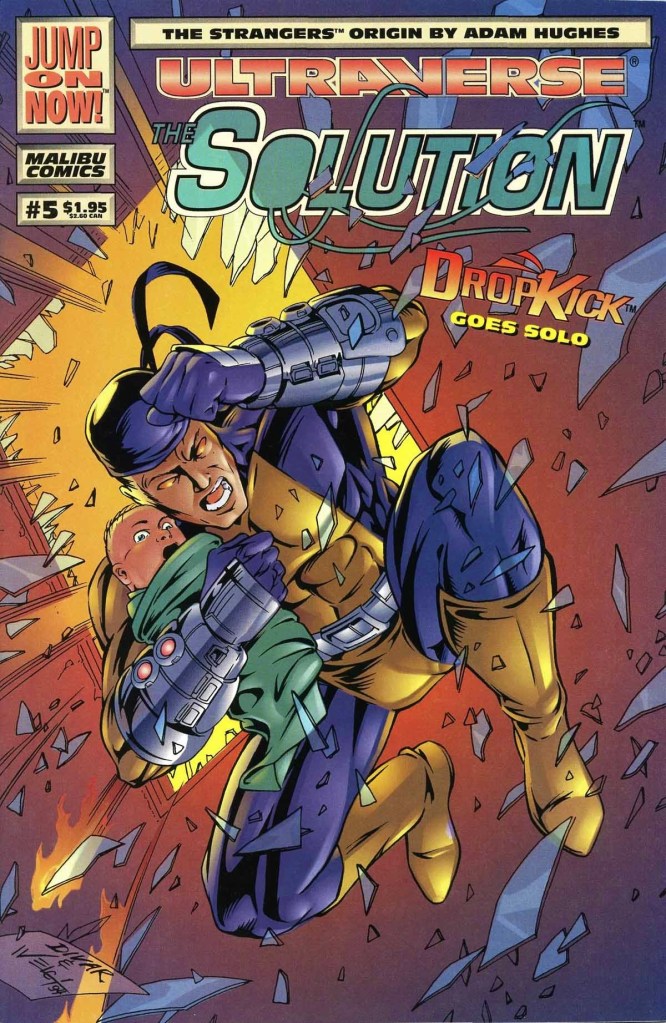
The cover.
Early story
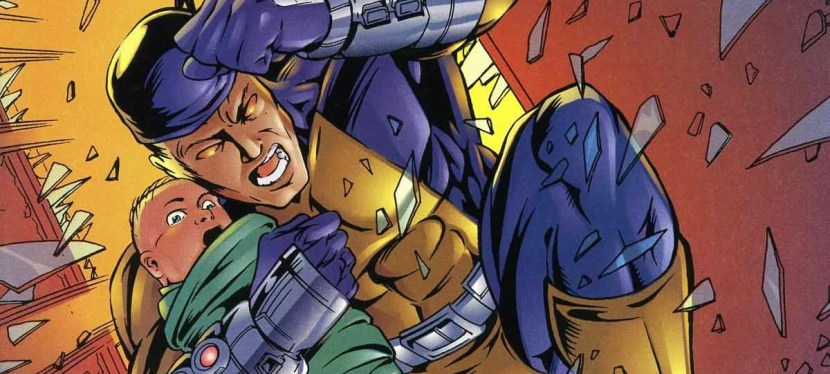
The story begins with The Solution’s member Dropkick trying to save an infant by carrying him strategically through the burning interior of a tall building. Dropkick jumps out through a window falling down with the infant still with him….
Quality
Before the mission starts, here is what happened.
To make things clear, this The Solution comic book is actually a solo story focused on Dropkick. You will get to see members of the team together but only for a few pages. More on Dropkick himself, this story was written to show not only the team member’s capabilities but also provide readers insight on his personality, specifically about how he thinks and reacts when he is under the heat of a dangerous mission. As there are no scenes showing his personal life as a civilian, James Hudnall wrote the script to emphasize Dropkick as the determined yet vulnerable action hero which somehow reminds me of John McClane in the action classic Die Hard.
Apart from the solid storytelling, you must be wondering if Dropkick himself is interesting enough as one of the many action-oriented characters within the Ultraverse. I can say yes.
Conclusion
Dropkick in action!
Being on the first solo stories of The Solution series, I can say that The Solution #5 (1994) is entertaining enough and the creative team succeeded in defining Dropkick as an essential member of the group he belongs to. Speaking of solo stories, in retrospect this comic book is almost like a warm-up to prepare readers for The Solution #6 which had a really great story focused on Lela Cho and her origin as well as the events that led to forming the team.
If you are seriously planning to buy an existing hard copy of The Solution #5 (1994), be aware that as of this writing, MileHighComics.com shows that the near-mint copy of the regular edition costs $16 while the near-mint copy of the newsstand edition costs $48.
Overall, The Solution #5 (1994) is recommended.
+++++
Thank you for reading. If you find this article engaging, please click the like button below and also please consider sharing this article to others. If you are looking for a copywriter to create content for your special project or business, check out my services and my portfolio. Feel free to contact me with a private message. Also please feel free to visit my Facebook page Author Carlo Carrasco and follow me on Twitter at @HavenorFantasy as well as on Tumblr at https://carlocarrasco.tumblr.com/
Disclaimer: This is my original work with details sourced from reading the comic book and doing personal research. Anyone who wants to use this article, in part or in whole, needs to secure first my permission and agree to cite me as the source and author. Let it be known that any unauthorized use of this article will constrain the author to pursue the remedies under R.A. No. 8293, the Revised Penal Code, and/or all applicable legal actions under the laws of the Philippines.
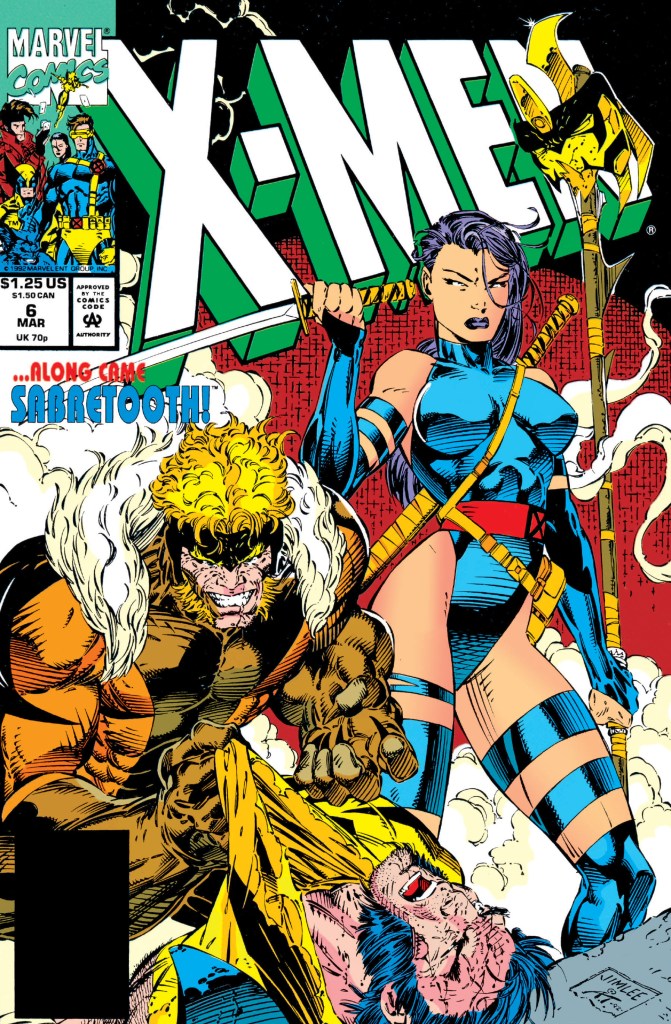
Welcome back, superhero enthusiasts, fans of the 2099 universe of Marvel Comics, 1990s culture enthusiasts and comic book collectors! Today we revisit the adjective-less X-Men comic book series that first launched in 1991 and it has been quite some time since my last retro review of one of the early issues drawn by Jim Lee got published. For the newcomers reading this, my retro review of X-Men #5 (1992) had Wolverine encountering Omega Red.
With those details laid down, here is a look back at X-Men #6, published by Marvel Comics in 1992 with a story plotted and drawn by Jim Lee, scripted by Scott Lobdell and inked by Art Thibert.
The cover.
Early story
The story begins inside a facility in Berlin. Cyclops and Beast easily knocked out the armed guards there with Jubilee following them. As they slowly walk and talk, Omega Red suddenly appears out of nowhere surprising them and hitting Beast directly on the head.
As Omega Red quickly subdues Cyclops with his coils, Jubilee tries to use her power to help her teammate. The Russian, however, unleashes his lethal pheromones into the air which weakens Jubilee. After Omega Red knocks her out, he communicates with Matsuo. It turns out Wolverine still could not be located since he escaped from them.
Elsewhere, Wolverine is being revived by someone…
Quality
Members of the Blue Team in action.
Being the 3rd issue published after the departure of Chris Claremont (last work was X-Men #3), this comic book daringly continues to expand the lore of X-Men with paramilitary concepts, the further exploration of the untold story from Wolverine’s past as a special operative, and the growing threat against the X-Men posed by Omega Red and the organization that revived him. This was clearly Jim Lee’s vision and his way of modernizing the X-Men into the 1990s. It is unsurprisingly grittier in presentation when compared to how the X-Men were presented during Claremont’s time and fortunately the story was told satisfyingly.
I say satisfyingly because this comic book even made room to bring back Dazzler, Longshot and the monstrous Mojo all modernized by Jim Lee. Their insertion into the story really came out of nowhere and felt really jarring after getting myself immersed into the current X-Men story. At this point in the series, the creative team led by Lee really wanted to shake the X-Men storytelling and keep things fresh, if not interesting, for the fans. Speaking of Dazzler, the character made her first appearance way back in 1980’s Uncanny X-Men #130, was featured in her own monthly series and became a regular in the X-Men in the mid-1980s. As such, her sudden return in this comic book was pretty much an opportunity by the creative team to link the present-day X-Men with the X-Men from the mid-1980s which resulted added variety.
Conclusion
When Wolverine and Sabretooth were CIA operatives.
While X-Men #6 (1992) indeed has a more bloated narrative as more characters were crammed in, more flashback scenes and attempts to add moments of twists and intrigue, I still had fun reading it. Unlike the previous two issues under the direction of Jim Lee, this comic book requires a more concentrated reading in order to fully grasp the narrative while also paying attention to the return of Longshot, Dazzler and the others. More on the X-Men themselves, you will get to see the Blue Team in action and really struggle against the group that has Omega Red. When it comes to intriguing character moments, you will see here the start of the build-up on the respective stories of the Psylocke-Kwannon storyline as well as Gambit’s connection with Sabretooth.
If you are seriously planning to buy an existing hard copy of X-Men #6 (1992), be aware that as of this writing, MileHighComics.com shows that the near-mint copy of the regular edition costs $40 while the near-mint copies of the newsstand and Toy Biz editions cost $120 and $100 respectively.
Overall, X-Men #6 (1992) is recommended.
+++++
Thank you for reading. If you find this article engaging, please click the like button below and also please consider sharing this article to others. If you are looking for a copywriter to create content for your special project or business, check out my services and my portfolio. Feel free to contact me as well. Also please feel free to visit my Facebook page Author Carlo Carrasco and follow me at HavenorFantasy@twitter.com
Disclaimer: This is my original work with details sourced from reading the comic book and doing personal research. Anyone who wants to use this article, in part or in whole, needs to secure first my permission and agree to cite me as the source and author. Let it be known that any unauthorized use of this article will constrain the author to pursue the remedies under R.A. No. 8293, the Revised Penal Code, and/or all applicable legal actions under the laws of the Philippines.
Welcome back, superhero enthusiasts, fans of the 2099 universe of Marvel Comics, 1990s culture enthusiasts and comic book collectors! Today we revisit the X-Men 2099 comic book series by focusing on the 14th issue of the series. As recalled in X-Men 2099 #10, team leader Xi’an reverted back to his more sadistic personality as demons from his past came back to overwhelm him. In the issues that followed, Xi’an went away from the X-Men followed by Tim/Skullfire who himself has gotten more wild and more aligned with their leader. They also encountered Luna, the former member of the Theatre of Pain. As the three went around more, something even more significant happened to Xi’an (note: this was part of the build-up leading to the big events in X-Men 2099 #25).
With those details laid down, here is a look back at X-Men 2099 #14, published by Marvel Comics in 1994 with a story written by John Francis Moore and drawn by Ron Lim.
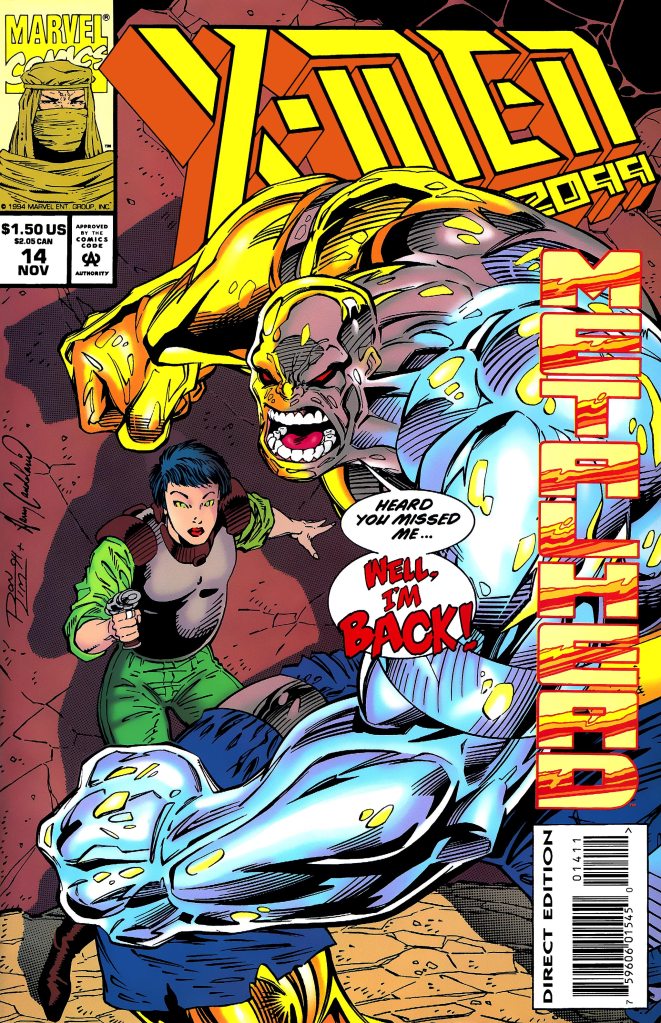
The cover.
Early story
The story begins on an island where the big-time personality Danielle has a mansion. She is about to start spending quality time with a man named Alexi. It turns out Danielle has wings with feathers that are colored to resemble a rainbow. She floats with Alexi as they enjoy the function of the zero-gravity chamber.
After grabbing her, Alexi surprises Danielle by suddenly flying up several feet high above using a gadget he equipped. In a very cold manner, he lets go of her causing her to land hard on the sea below. Alexi then flies away to an unknown destination.
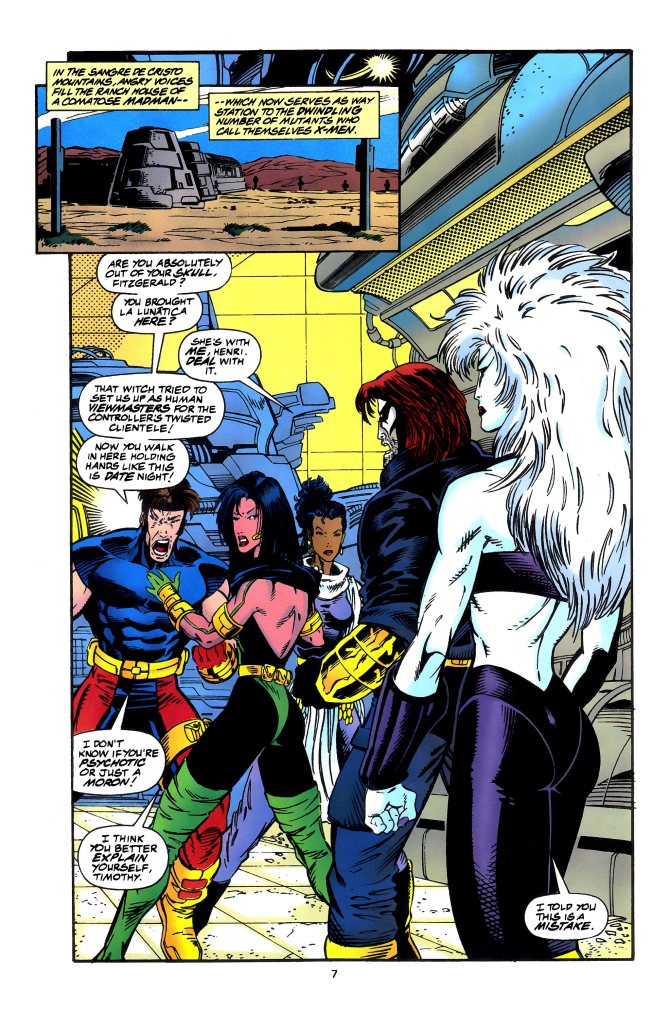
Meanwhile at the ranch house of Zhao which the X-Men have been staying at since Xi’an left them, Skullfire returns and this time Luna is with him. The sight of Luna enrages Henri/Meanstreak as he encountered her before when she was still a member of the Theatre of Pain. As the tension intensified, Henri tries to go after Luna but Skullfire stands in the way and reveals that Xi’an has joined the Theatre of Pain.
This shocks Henri and Krystalin. For Shakti, however, it was expected…
Quality
Luna’s presence causes a disturbance with the team.
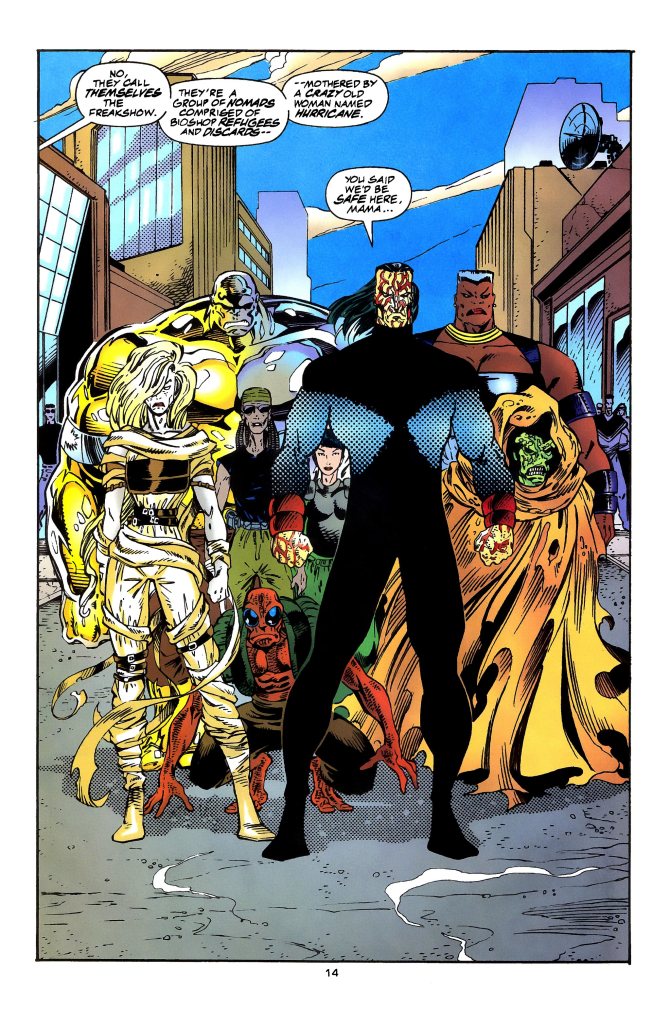
In this comic book, John Francis Moore really kept on focusing on developing the X-Men while keeping the narrative fresh with twists and the occasional moments of shock. While the cover of this comic book expressed the return of the other X-Men member Eddie/Metalhead (who stayed behind and separated from Xi’an’s mutants), the story here surprisingly had much less focus on the X-Men of 2099 and focused more on the Freakshow (which Metalhead is now part of).
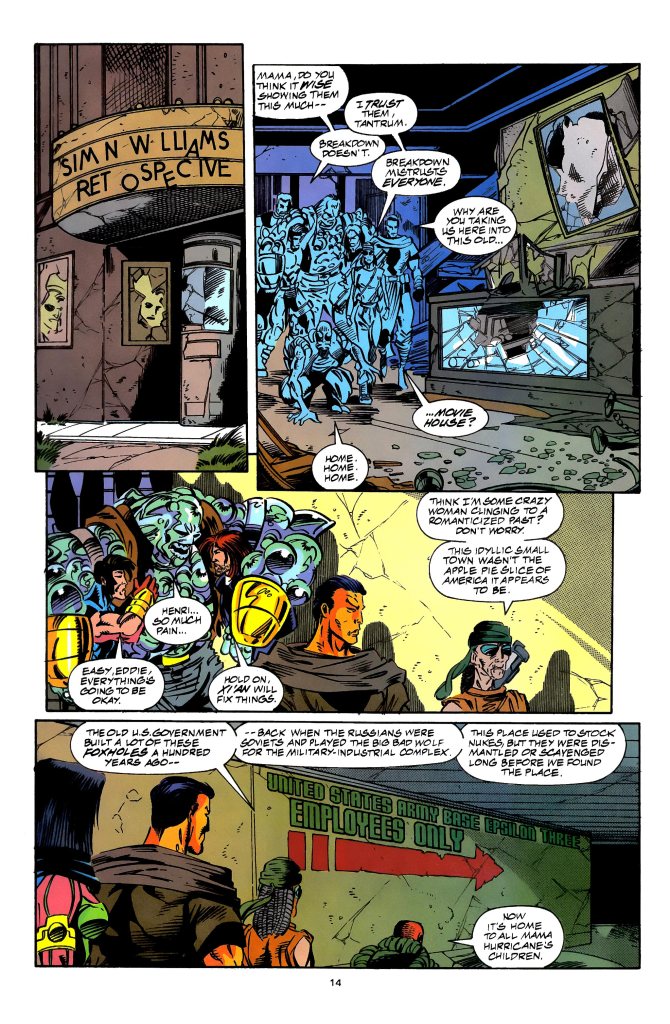
Adding more depth to the surprise change of focus, the Freakshow here developed quite a lot as the group visits a new place and meets with a new group of people led by someone Mama Hurricane (head of the Freakshow) knew. As the development of the Freakshow went on, so did the creative team’s continued emphasis of the lore of the 2099 universe in the western region of the United States.
Conclusion
The Freakshow is the major team of focus in this comic book.
X-Men 2099 #14 (1994) is one of the more unusual stories that John Francis Moore and Ron Lim came up with. The X-Men themselves ended up with a minority of the narrative although the revelation of Xi’an taking sides with a super villain literally left some vibrations for readers. This plus the stronger focus on the Freakshow and the addition of Alexi as a powerful newcomer to the saga added to the build-up leading to X-Men 2099 #25. The good news here is that the story was solidly told by Moore and did not have a single boring moment for me.
If you are seriously planning to buy an existing hard copy of X-Men 2099 #14 (1994), be aware that as of this writing, MileHighComics.com shows that the near-mint copy of the regular edition costs $30 while the near-mint copy of the newsstand edition costs $90.
Overall, X-Men 2099 #14 (1994) is recommended.
+++++
Thank you for reading. If you find this article engaging, please click the like button below and also please consider sharing this article to others. If you are looking for a copywriter to create content for your special project or business, check out my services and my portfolio. Feel free to contact me as well. Also please feel free to visit my Facebook page Author Carlo Carrasco and follow me at HavenorFantasy@twitter.com
Disclaimer: This is my original work with details sourced from reading the comic book and doing personal research. Anyone who wants to use this article, in part or in whole, needs to secure first my permission and agree to cite me as the source and author. Let it be known that any unauthorized use of this article will constrain the author to pursue the remedies under R.A. No. 8293, the Revised Penal Code, and/or all applicable legal actions under the laws of the Philippines.
Welcome back, superhero enthusiasts, fans of the 2099 universe of Marvel Comics, 1990s culture enthusiasts and comic book collectors! Today we revisit the X-Men 2099 comic book series by focusing on the tenth issue which, I assure you, continues more intrigue carried over from the previous issue as well as the further development of the futuristic team of mutants.
With those details laid down, here is a look back at X-Men 2099 #10, published by Marvel Comics in 1994 with a story written by John Francis Moore and drawn by Ron Lim.
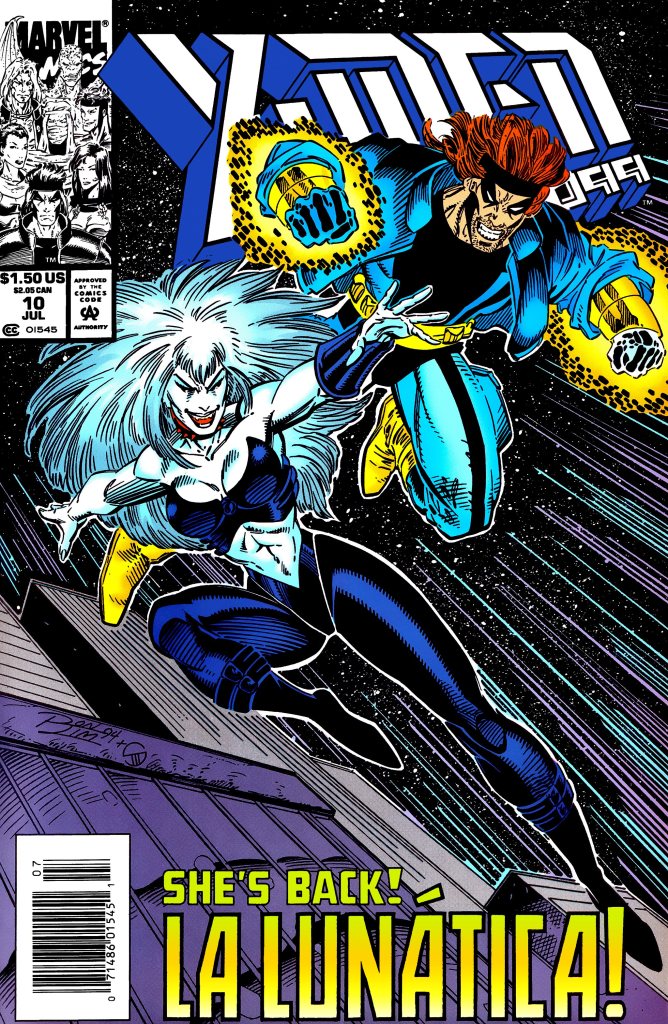
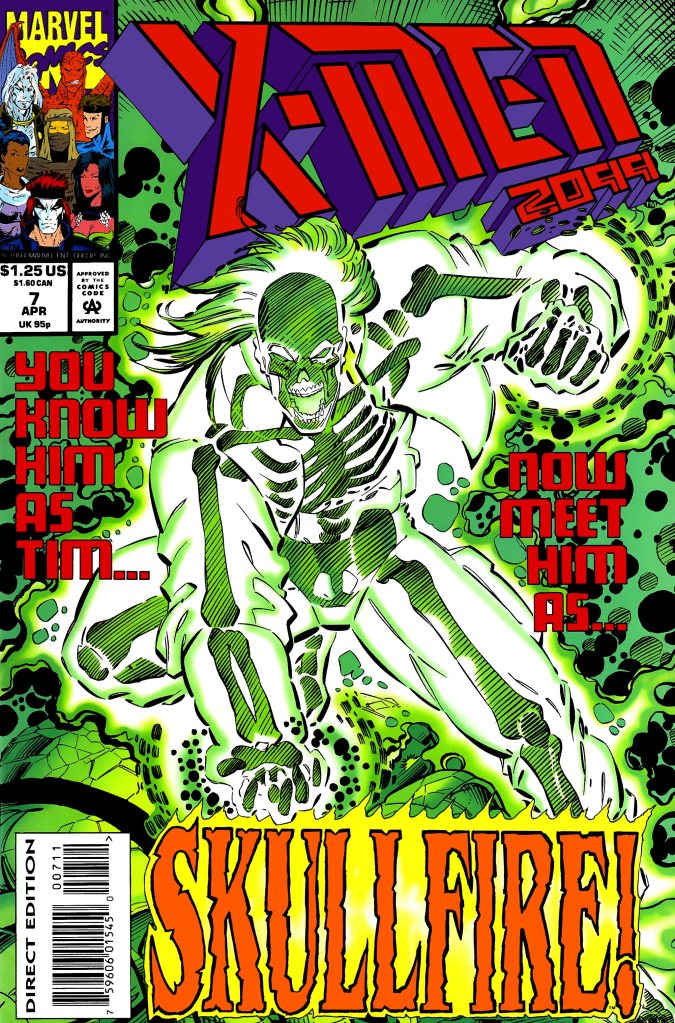
The cover.
Early story
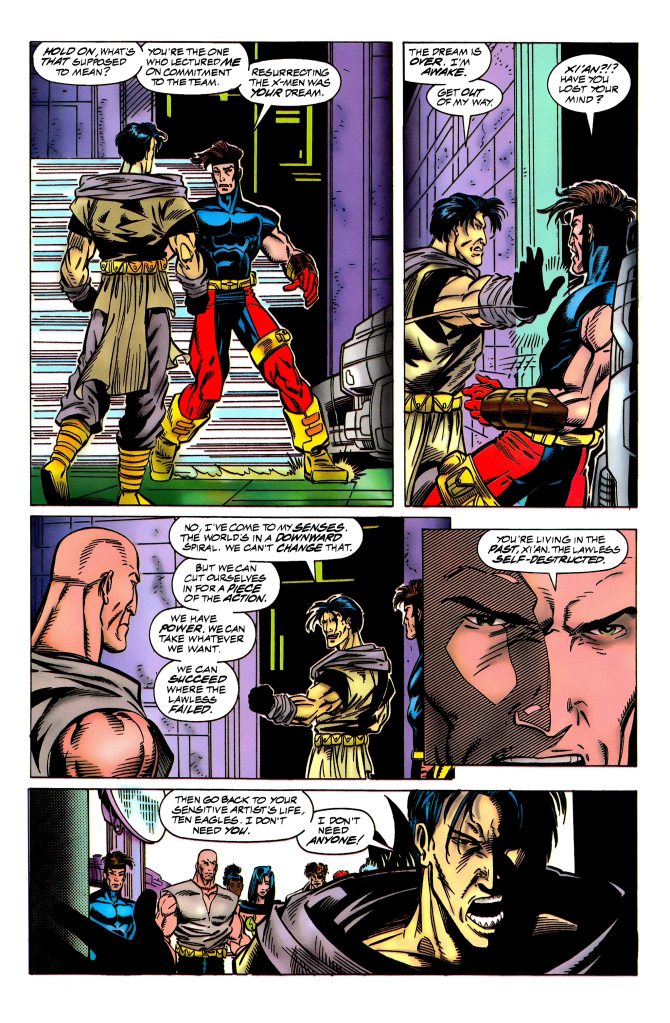
The story begins shortly after the fall of Zhao with Xi’an looking over his inactive body. Xi’an wants Zhao’s body left outdoors for coyotes to feed on but Shakti tells him that the defeated X-Men master is still conscious. The X-Men noticed something very different about Xi’an and to Krystalin, he has an edge to his voice that she never heard before. Victor tells them that their leader was once a ruthless man during their time together as members of the Lawless.
Zhao’s mutants arrived and one of them tells Xi’an that his victory of their master doomed them all…
Quality
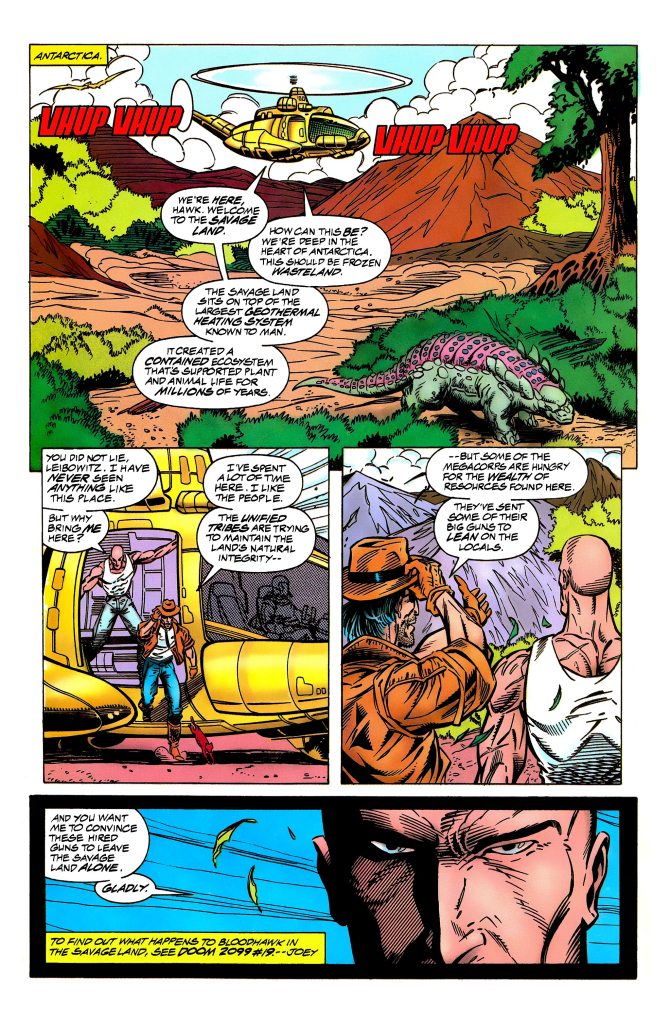
Long-time X-Men fans will recognize the Savage Land.
Like the previous issue, the storytelling by John Francis Moore is the strongest factor of this comic book. While issue #9 marked the significant turning point for Xi’an as well as exposing the history of the X-Men between the time of Charles Xavier and Zhao, this story further develops the 2099 mutants’ leader and set up new subplots. I still remember from the first time I read this comic book, I was boggled as to what direction the X-Men of 2099 were heading to.
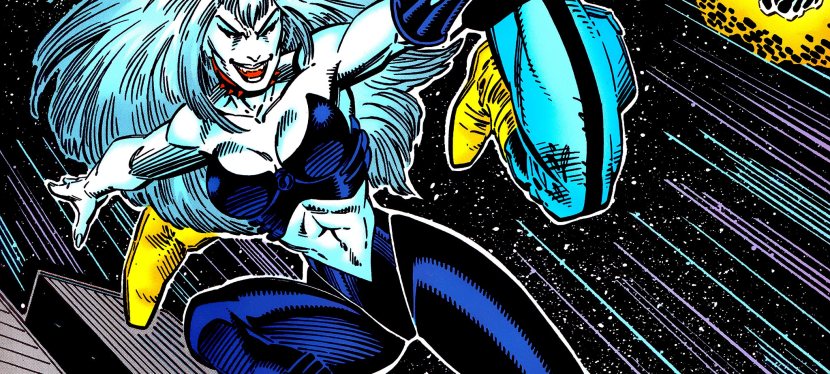
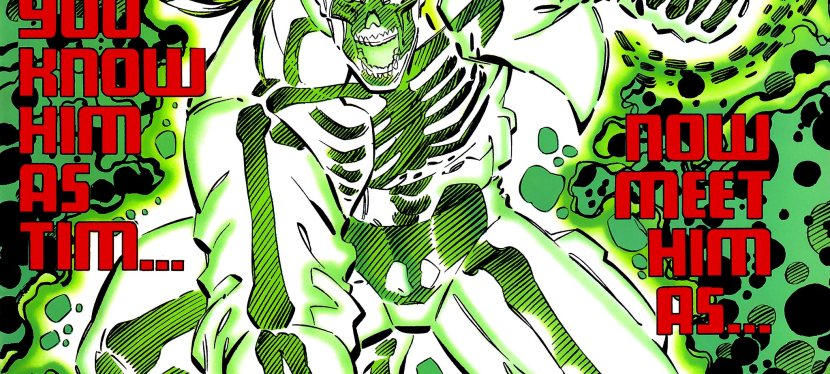
More on the story, it is very engaging to see Xi’an sliding back to his old violent ways and this creates a large cloud of darkness for the X-Men as he is their leader. Victory Ten Eagles is convincingly written to be believable and lively as Xi’an’s Lawless teammate, and he certainly is not a mere expository dialogue tool. On another aspect of the story, as the cover art showed, Luna makes a return and John Francis Moore excellently developed Skullfire’s personality going further to the point of recklessness and becoming impulsively lost. Skullfire in this comic book has drastically changed from his subdued personality in the early issues. More on the team of mutants, Shakti slowly begins to emerge into a leader figure among her teammates.
When it comes to the art, Ron Lim’s work here is good and he showed consistency when it comes to presenting the look of the future of 2099 far away from the East Coast (where Spider-Man 2099 and others are located at). Lim’s presentation of the power of Skullfire is a must-see!
Conclusion
Xi’an’s portrayal in this comic book is one of the strongest selling points of this comic book.
X-Men 2099 #10 (1994) is a very solid story to read. It successfully showed more of the new direction the X-Men were heading to as Xi’an and Skullfire develop further as solo figures. At the same time, this comic book showed more of Skullfire and Luna getting more involved with each other. The writing by John Francis Moore is so good, the lack of the good-versus-evil conflict does not hurt it at all. The conflict is within Xi’an and Skullfire.
If you are seriously planning to buy an existing hard copy of X-Men 2099 #10 (1994), be aware that as of this writing, MileHighComics.com shows that the near-mint copy of the regular edition costs $30 while the near-mint copies of the newsstand edition and the signed edition cost $90 and $60 respectively.
Overall, X-Men 2099 #10 (1994) is highly recommended!
+++++
Thank you for reading. If you find this article engaging, please click the like button below and also please consider sharing this article to others. If you are looking for a copywriter to create content for your special project or business, check out my services and my portfolio. Feel free to contact me as well. Also please feel free to visit my Facebook page Author Carlo Carrasco and follow me at HavenorFantasy@twitter.com
Disclaimer: This is my original work with details sourced from reading the comic book and doing personal research. Anyone who wants to use this article, in part or in whole, needs to secure first my permission and agree to cite me as the source and author. Let it be known that any unauthorized use of this article will constrain the author to pursue the remedies under R.A. No. 8293, the Revised Penal Code, and/or all applicable legal actions under the laws of the Philippines.
Welcome back, superhero enthusiasts, fans of the 2099 universe of Marvel Comics, 1990s culture enthusiasts and comic book collectors! Today we revisit the X-Men 2099 comic book series by focusing on its ninth issue. Since issue #1, the connection between the mutants of 2099 with the original team founded by Charles Xavier was vague. Sure, Xi’an made verbal references to Charles Xavier and Magneto but there was nothing concrete with regards to his team adapting the team name of the classic X-Men.
With those details laid down, here is a look back at X-Men 2099 #9 (1994), published by Marvel Comics in 1993 with a story written by John Francis Moore and drawn by Ron Lim.
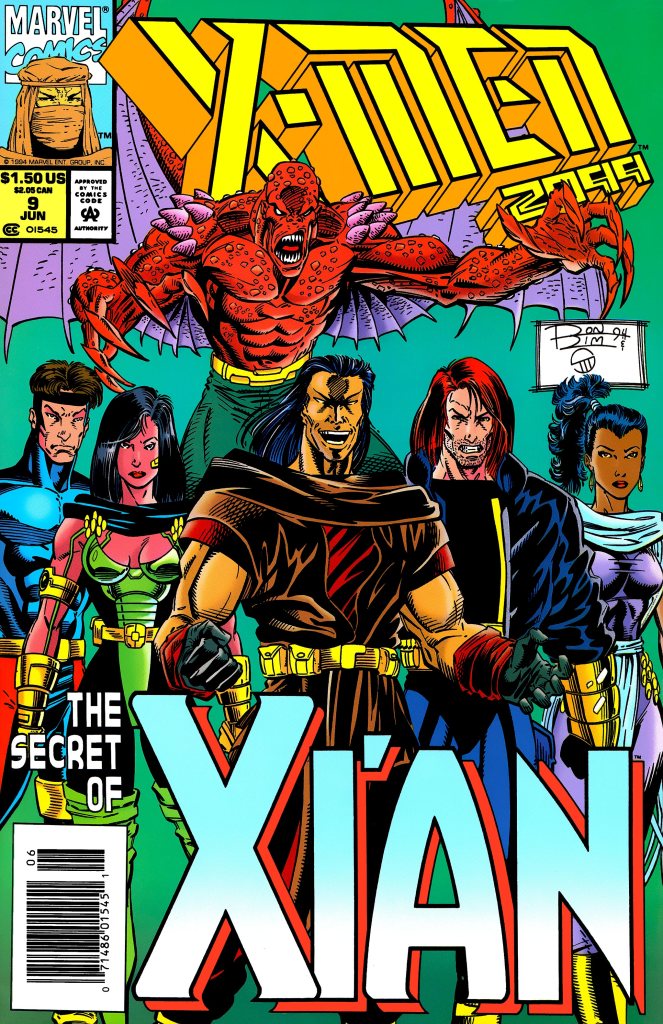
The cover.
Early story
The story begins shortly after the X-Men left the town. Without Eddie/Metalhead (who chose to be left behind), Xi’an and his team arrive at a facility in the middle of nowhere. It turns out, they have been following the coordinates in relation to Krystalin’s assignment to investigate and Xi’an determined there was something odd about her voice during their last communication.
Krystalin suddenly appears to her teammates with Victor Ten Eagles right behind her. Victor was a companion of Xi’an’s during their days together with the group referred to as the Lawless. While the two former Lawless members talk, Skullfire, Shakti and Meanstreak notice there is something very odd with Krystalin. Xi’an notices something is definitely wrong and he remembers that when the Lawless disbanded, he and Ten Eagle never parted on friendly terms.
Suddenly, a very old Asian man appears in front of them floating in the air. He reveals his name as Zhao and he refers to them as his X-Men…
Quality
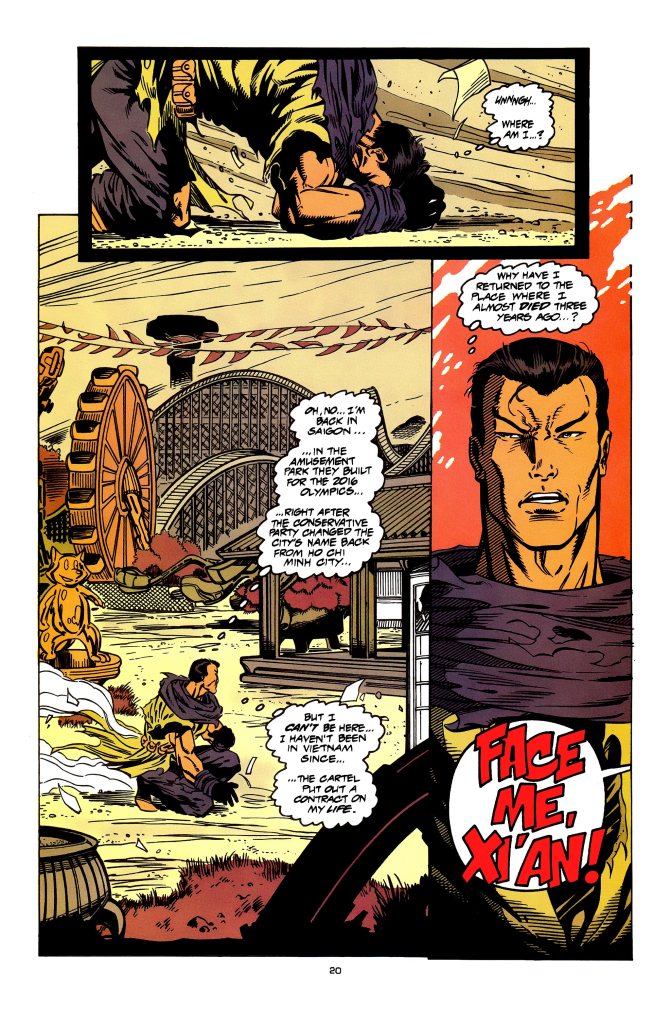
X-Men 2099’s leader Xi’an in trouble. This page reveals some threads from his past and the concept that Saigon in Vietnam hosted the 2016 Olympics.
Starting with the storytelling, the script was clearly written with a lot of confidence on the part of John Francis Moore as he expands further the lore of America of 2099 through the team of mutants. For one thing, it uses its own version of Marvel Comics universe history (note: one possible history since 2099 was one possible future of the Marvel universe) to establish the link between Charles Xavier’s original X-Men with the mutants of 2099 complete with what happened in between. While I won’t spoil what exactly happened, I can assure all of you reading this that something very intriguing happened and Zhao is not just a mere 2099 character. I also liked the concept about the sad state of mutants in the far future and why extremists emerge claiming to be their hope and tell them to join the movement without hesitation. The pacing of the story was smooth and there was sufficient build-up with the X-Men history that led to a nice payoff when the big revelation was made.
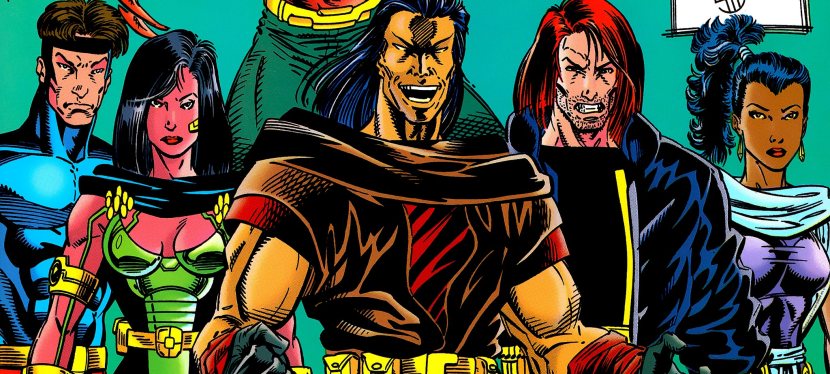
As the art on the cover symbolizes, there is something really wrong with the X-Men 2099 leader. In the previous issues, there were signs of Xi’an getting haunted by his past with the Lawless and this comic book marks a significant change in his portrayal. He also tried to be strong as team leader even though he kept some really undesirable secrets away from them. All of that build-up paid off well here. Clearly, this was one of John Francis Moore’s strongest scripts on the X-Men of 2099.
When it comes to spectacle, there is some superhero action here visualized in both the present-day story and the historical flashbacks. Artist Ron Lim paced the flow of the images properly and was creative with the way he framed what happened.
Conclusion
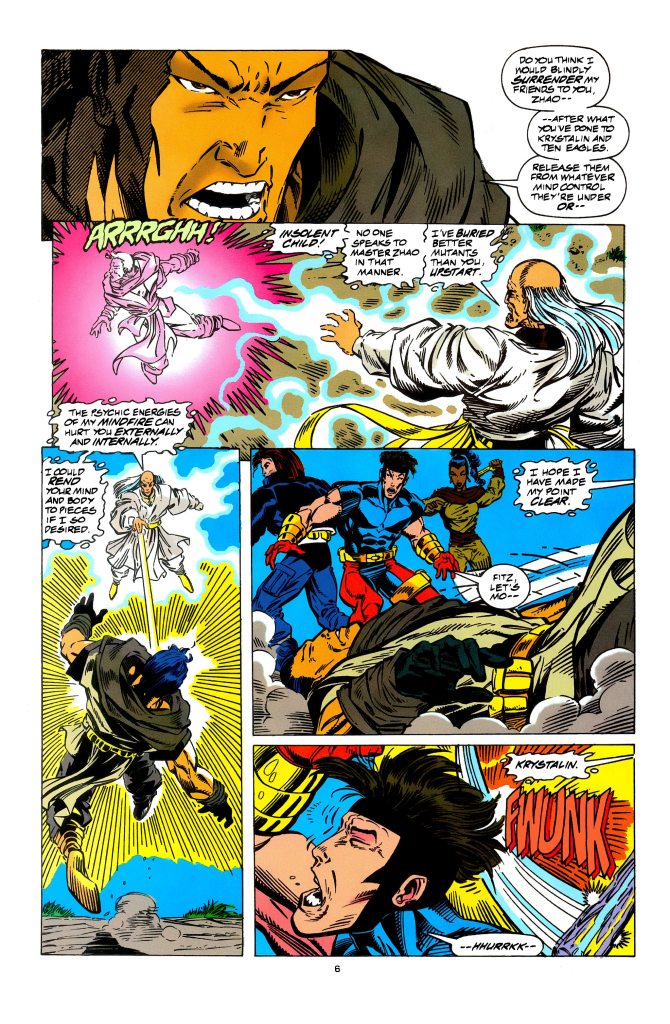
The X-Men and Zhao.
X-Men 2099 #9 (1994) has a great story concept which successfully and clearly establishes the connection between the original X-Men of Xavier with Xi’an’s X-Men. At the same time, this comic book starts a new chapter in the life of the 2099 mutants’ leader whose dark and painful past keeps disturbing him deeply. At the time of its release, the X-Men of far future were portrayed to be nomadic trying to survive and search for other mutants. This makes them distinct from the mainstream X-Men of the time and ironically they become similar with Freex of the Ultraverse.
If you are seriously planning to buy an existing hard copy of X-Men 2099 #9 (1994), be aware that as of this writing, MileHighComics.com shows that the near-mint copy of the regular edition costs $30 while the near-mint copy of the newsstand edition costs $90.
Overall, X-Men 2099 #9 (1994) is highly recommended!
+++++
Thank you for reading. If you find this article engaging, please click the like button below and also please consider sharing this article to others. If you are looking for a copywriter to create content for your special project or business, check out my services and my portfolio. Feel free to contact me as well. Also please feel free to visit my Facebook page Author Carlo Carrasco and follow me at HavenorFantasy@twitter.com
Disclaimer: This is my original work with details sourced from reading the comic book and doing personal research. Anyone who wants to use this article, in part or in whole, needs to secure first my permission and agree to cite me as the source and author. Let it be known that any unauthorized use of this article will constrain the author to pursue the remedies under R.A. No. 8293, the Revised Penal Code, and/or all applicable legal actions under the laws of the Philippines.
Welcome back, superhero enthusiasts, fans of the 2099 universe of Marvel Comics, 1990s culture enthusiasts and comic book collectors! Today we revisit the X-Men 2099 comic book series by focusing on the seventh issue. If there is anything that makes the series of Marvel’s futuristic mutants distinct from other Marvel 2099 monthly series, it is the fact that it shows more of wasteland of America which easily reminds me of the Mad Max movies.
With those details laid down, here is a look back at X-Men 2099 #7, published by Marvel Comics in 1994 with a story written by John Francis Moore and drawn by Ron Lim.
The cover.
Early story
The story begins in the middle of an abandoned town with the X-Men in battle with the Freakshow. Xi’an fights their leader Breakdown while his teammates struggle with the other members of the Freakshow. Already infected by one of the Freakshow members, Eddie is suffering severe pain even in his metallic form.
The fight suddenly ends when an old lady fires a blast with her rifle. It turns out she is Breakdown’s superior and she is precisely whom the X-Men have been searching for…
Quality
In the heat of battle.
As one of the early stories showing the X-Men of 2099 exploring the American wasteland, this is a well-written piece of work by John Francis Moore which is expected. While it has the usual superhero elements of spectacle and special moves, discovery and exposition are easily the most obvious elements of the story. What I like most about this comic book is that it reveals more of the history about the mutants’ struggle to survive not only with the harshness of the wilderness but also with dealing with rejection from the people who are not mutants (which symbolizes prejudice). This also reveals that the mutants are still searching for a fabled place called Avalon which could be a better destination for all mutants to live in.
As the narrative about the past gets emphasized, the creative team added some elements of emotion and concern on the X-Men visually. This makes a lot of sense since the mutants are clearly searching for purpose and trying to make the most out of their current situation in the hope of having a brighter future. This is similar to the original X-Men and yet X-Men 2099 has its distinct style and concept about mutant survival.
Conclusion
At an abandoned old town that has government secret facilities.
X-Men 2099 #7 (1994) is indeed a good comic book to read. As the X-Men of the far future encounter more people in the wasteland, the discoveries they get impacts them and their efforts to survive. As discovery and exposition are strong elements in the story, the comic book is definitely not your typical good-versus-evil superhero story. The strong writing by John Francis Moore and his approach on expanding the world of 2099 America to the readers really made this comic book a solid read.
If you are seriously planning to buy an existing hard copy of X-Men 2099 #7 (1994), be aware that as of this writing, MileHighComics.com shows that the near-mint copy of the regular edition costs $30 while the near-mint copy of the newsstand edition costs $90.
Overall, X-Men 2099 #7 (1994) is recommended!
+++++
Thank you for reading. If you find this article engaging, please click the like button below and also please consider sharing this article to others. If you are looking for a copywriter to create content for your special project or business, check out my services and my portfolio. Feel free to contact me as well. Also please feel free to visit my Facebook page Author Carlo Carrasco and follow me at HavenorFantasy@twitter.com
Disclaimer: This is my original work with details sourced from playing Flashback: The Quest for Identity and doing personal research. Anyone who wants to use this article, in part or in whole, needs to secure first my permission and agree to cite me as the source and author. Let it be known that any unauthorized use of this article will constrain the author to pursue the remedies under R.A. No. 8293, the Revised Penal Code, and/or all applicable legal actions under the laws of the Philippines.
We live in an age in which software exclusivity defines not only the relevance of game consoles but also nature of the entire video game industry right down to the many varied communities of very avid fans (and fanboys).
While the Super Nintendo Entertainment System (SNES or Super NES) and Sega Genesis each had their own exclusive games back in the 1990s, there was one particular game that was made for and released on not just one, not two but rather on more than fifteen different platforms – both consoles and computers – starting with Amiga way back in 1992. That game is none other than Flashback: The Quest for Identity which I first played on our Super NES back in 1994.
The cover of the game box.
For the newcomers reading this, Flashback was a 2D side-scrolling adventure game in the form of a cinematic platformer (note: similar to Prince of Persia and Out of This World) with a strong flavor of science fiction. It was cinematic in the sense that all the in-game animation were rotoscoped resulting unique smoothness combined with hand-drawn backgrounds and the computer-generated cutscenes were used in key parts of the game as the story progressed. Flashback on SNES in America even came with a Marvel Comics-published Flashback comic book and on the rear of the SNES game box were the words “The first CD-ROM game in a cartridge!”
A Flashback remake was released in 2013, followed by a port of the original game released on Sega Dreamcast in 2017, and a remastered version got released for varied platforms in 2018.
I got to play that game at a time when I have not even started playing Final Fantasy II (AKA Final Fantasy IV), Final Fantasy III (AKA Final Fantasy VI) and other great role-playing games (RPGs) of the Super NES. I also remember that Flashback was a nice change of pace for me after playing Super Star Wars: The Empire Strikes Back.
With those details laid down, here is a look back at Flashback: The Quest for Identity, released on Super NES in 1993 by U.S. Gold and developed by Delphine Software International.
The start and options screen.
Early story
The story begins with Conrad running away from two armed persons chasing him. He flies away riding a solo vehicle but those chasing him (riding a huge vehicle) managed to get close and blast his vehicle causing to crash into the forest.
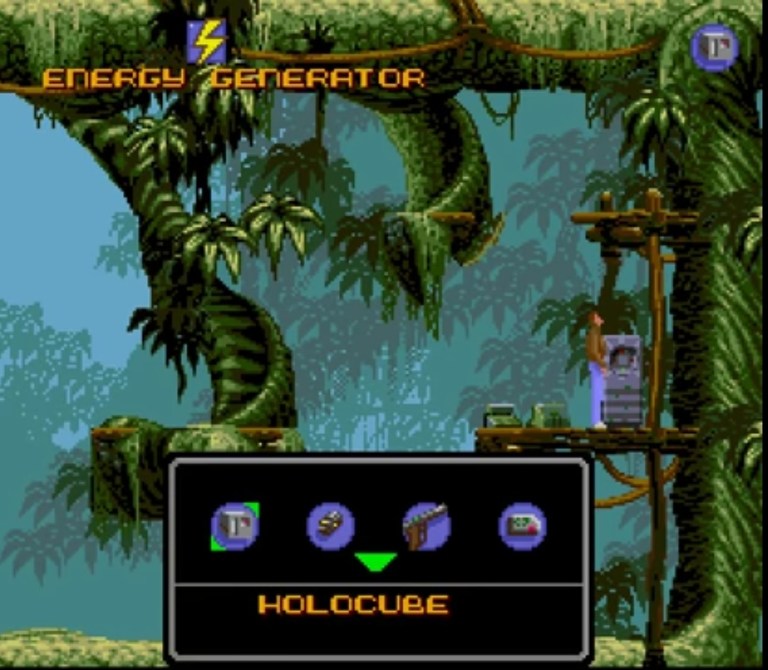
Sometime later, he wakes up and accidentally pushes a mechanical cube to fall down. He climbs down to reach it and activates it. The cube displays a holographic video of himself telling him that he recorded it without remembering it. As Conrad watches, he learns that he must contact a friend named Ian who can explain important things to him.
After viewing the message, Conrad sets off to find his way out of the jungle and somehow get to Ian in New Washington…
Game design and quality
You have to pay close attention to what’s going on, what items do you have and what the in-game prompts tell you.
This game is not your typical fast-paced, action-oriented 2D side-scrolling adventure in which you move from left to right to progress. As it is a cinematic platform game by design complete with very specific controls, players will have to be patient, adaptive and strategic in order to learn how exactly you can control your character, what moves will be executed (and when to execute). For one thing, the very fluid 24 frames-per-second animation on your character limits you in terms of control as timing is required.
To do things properly, you have to execute specific controls. To ascend on a lift, you press Up and the Y button. To do a small jump, have your character stand still and then press Up and Y button. To go down on level (on foot, no lift), stand by the edge of a level then press Down and Y button. To run and hang on to a higher floor automatically, have your character stand still, press Right and Y button, press Y button (once your character moves) and watch him pull it off. With controls like these, the usual 2D platforming approach is out of the question. In my experience, these controls are indeed challenging but never impossible to learn and eventually I got proficient with the controls as I played more.
The in-game animation for the characters are very good and there is also a sensation of weight with your character. Falling straight down from a very high place is a big no-no.
Apart from character controls, you don’t just move Conrad from one screen to the next…you also should do key objectives along the way apart from engaging in action scenes (read: shooting). That being said, you must watch out for icons that appear on screen when your character steps on a particular spot that requires interaction. For example, if you stop by a terminal, an icon will appear serving as a prompt to start the interaction. Another example is when your character steps on the same spot as an item located at which you can pick up once prompted.
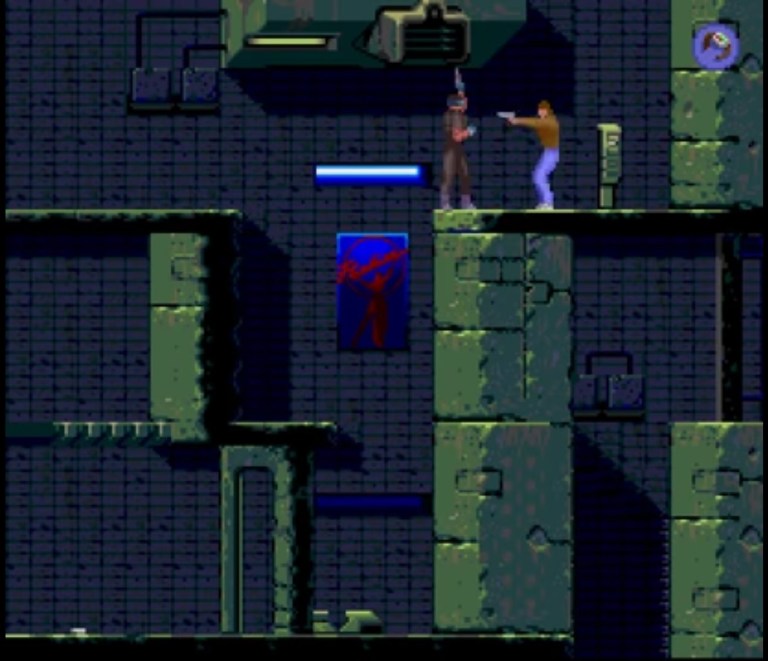
More on the action on the screen, you will encounter armed enemies as well as high-tech machines (including floating drones). To overcome them, doing straightforward shooting is not recommended as you have to be strategic before firing a shot. You have to learn how each enemy or machine moves, how much physical space is available right there and how you can maximize your limited time and space to overcome them. In fact, you will also be compelled to take advantage of whatever seconds you have while the enemies’ animation (between moves) take place. There will also be times when you need to have your character armed with the gun before jumping to a lower level where an armed enemy is located and on the lookout. Coming down armed gives you an advantage to shoot first at the enemy who
Considering the 24 frames-per-second animation, you will have to time your moves carefully, especially during moments when you face an armed enemy.
Apart from shooting, you can also use grenades which requires opening your inventory to select a grenade and then do your timing and calculation of the distance in order to pull of a successful throw and explosion. You can also throw stones to distract enemies or to apply weight on key platforms in order to open mechanical doors.
With regards to the quality of gameplay, Flashback is enjoyable but only if you get over its rather high learning curve with regards to the controls which themselves serve as the game’s advantage and even as a disadvantage. In addition to being patient and strategic, you will really have to pace yourself, think more and get used to the rather slow pace of the game in relation to its cinematic platformer design. I should state that as you keep progressing, there will be places, or new obstacles or new enemies that will compel you to change your tactics in order to overcome them. Anyone who is used to playing 2D side-scrolling games the fast and easy way might find the high learning curve and pacing of Flashback a turnoff but if they are willing to learn, adjust and pace themselves, only then can this game’s gameplay be really enjoyed.
Cut scenes like this move at a sluggish pace which shows the limitations of the SNES and cartridge technology.
As for the visuals, the obvious highlight here is the 24 FPS animation which is the result of rotoscoping and careful visualizing (note: observe those alien humanoids who morph into moving blobs). The rotoscoped animation, however, would not have been that effective had the quality of the art used for the backgrounds been made of lower quality. I can say that the background artworks here look pretty good even by today’s standards. The standout among them were the background artworks of Morph’s home planet which really looked very alien and creepy at the same time. What hurts this particular version of Flashback is the lackluster (read: choppy) frame rate whenever the computer-generated cinematic cutscenes (obviously they were meant for more powerful PCs) play which, in my experience, took me out of the story. There were also bouts of slowdown during the gameplay, especially when you encounter enough enemies that were animated sophistically.
With regards to narrative, Conrad is literally your avatar to learn, discover and interact with the many elements of the universe he is part of. There is obvious influence that the game makers took from the movie Total Recall as they crafted Conrad to be someone who lost his memory, moves on to regain it and do a lot of things as he realizes his true purpose and what is really at stake. Unlike Total Recall’s protagonist, Conrad himself is not too interesting mainly due to the way the in-game story was structured. Just play as Conrad and do what needs to be done to complete the game.
When it comes to understanding the narrative, you will have to do lots of reading. You will spot and read the short description of the prompts that appear. You’ll also have to read the on-screen text whenever your character talks with someone during the levels of the game. And there are the captions shown during the slow animated cutscenes.
Conclusion
The background artworks during the late stage of the game are great and truly creative with science fiction in mind.
I can clearly say that Flashback: The Quest for Identity on Super NESis fun and engaging mainly to those who are willing to adjust themselves to it. If you don’t have patience, if you are not willing to think while playing, if you cannot pace yourself and if you are not willing to learn all the specific controls of the game, then you should not be playing Flashback. It is a cinematic platformer and that should tell you that you will need to adjust to enjoy it.
Overall, Flashback: The Quest for Identity on SNES is recommended.
+++++
Thank you for reading. If you find this article engaging, please click the like button below and also please consider sharing this article to others. If you are looking for a copywriter to create content for your special project or business, check out my services and my portfolio. Feel free to contact me as well. Also please feel free to visit my Facebook page Author Carlo Carrasco and follow me at HavenorFantasy@twitter.com
Disclaimer: This is my original work with details sourced from reading the comic book and doing personal research. Anyone who wants to use this article, in part or in whole, needs to secure first my permission and agree to cite me as the source and author. Let it be known that any unauthorized use of this article will constrain the author to pursue the remedies under R.A. No. 8293, the Revised Penal Code, and/or all applicable legal actions under the laws of the Philippines.
Welcome back, superhero enthusiasts, comic collectors, 1990s culture enthusiasts and fans of the X-Men! We go back to the year 1993 when the 30th anniversary of the X-Men was celebrated with the 6-part Fatal Attractions storyline. Already I reviewed Uncanny X-Men #304 (Part 3) which was not worthy of the X-Men’s 30th anniversary celebration. X-Men #25 (Part 4) meanwhile was not only great but also shocking and had a years-long impact on X-Men comics.
So now the focus is on the 5th chapter of the Fatal Attractions storyline handled by the Larry Hama-Adam Kubert team on the Wolverine monthly series of the time. With those details laid down, here is a look back at Wolverine #75, published by Marvel Comics in 1993 with a story written by Larry Hama and drawn by Adam Kubert.
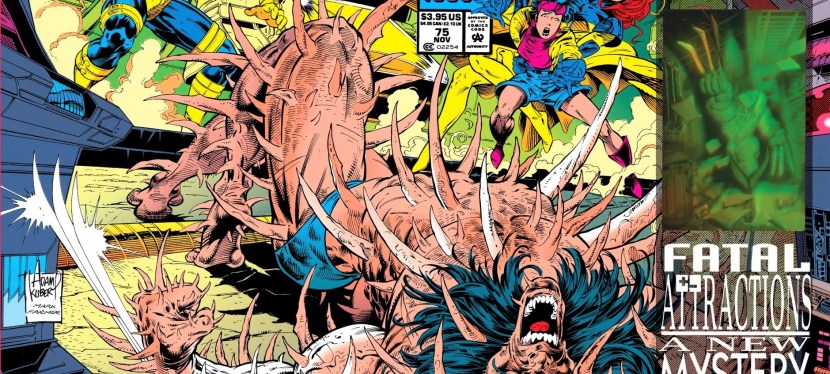
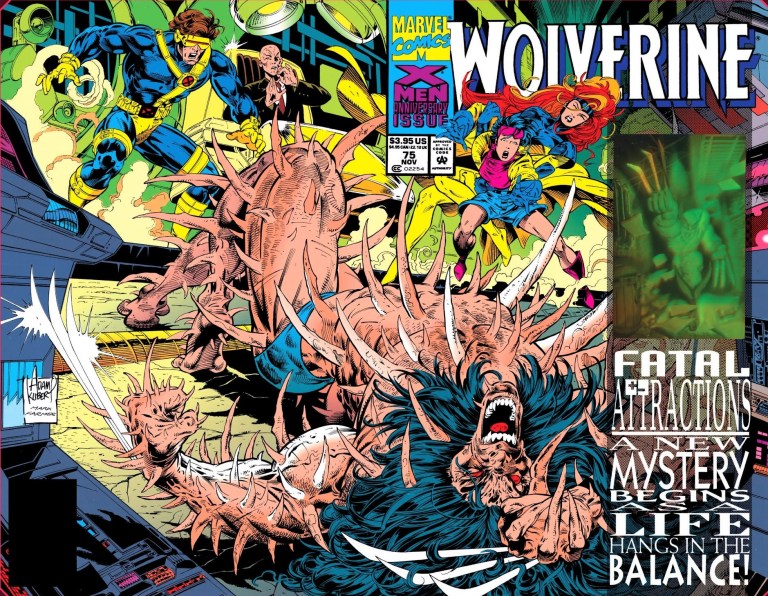
The cover.
Early story
The story begins in outer space. Carrying Charles Xavier, Wolverine, Gambit, Jean Grey, Rogue and Quicksilver (who participated in the dangerous mission in X-Men #25), the X-Men’s jet (piloted by Bishop) struggles mechanically as it was not designed for space travel. Worse, Wolverine is under very serious condition and the medical unit has been operating in full capacity dealing with his intense trauma.
In an attempt to alleviate Wolverine’s psychic trauma, Charles Xavier and Jean Grey enter his mind and discover that there is a world full of pain and horror. They see visions of a restrained Wolverine (from his Weapon X days) being attacked by Sabretooth and Lady Deathstrike. Xavier explains that they are at the epicenter of Logan’s most suppressed cataclysmic memories which were clearly triggered by the physical damage Magneto inflicted on him (see X-Men #25).
As the X-Men’s jet attempts to enter Earth’s atmosphere, its exteriors heat up dramatically shaking everyone inside. This complicates the situation on stabilizing Wolverine…
Quality
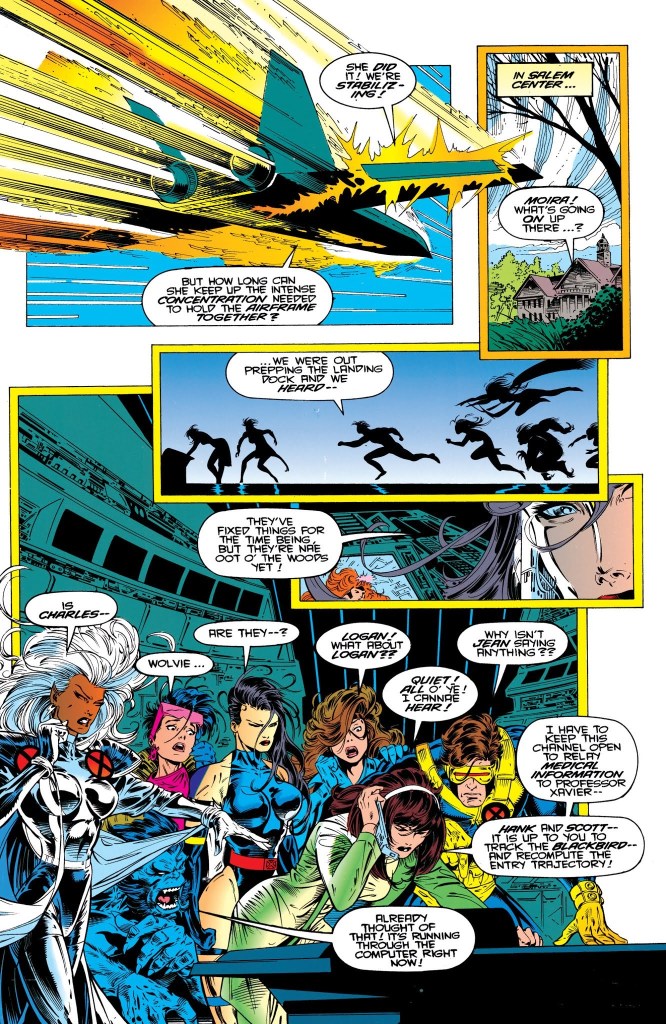
The other X-Men team members at their headquarters expressing worry and concern about the situation of their teammates struggling to come back home from space.
To be clear, this story continues the events of Fatal Attractions but with a bit more focus on Wolverine (compared to the earlier chapters of the storyline that is). There is no real battle between good and evil at all. It’s really all about Wolverine struggling to survive just as his teammates struggle to arrive home.
Before the stories of this comic book and X-Men #25 happened, Wolverine has often been portrayed to be very tough, brave and a walking machine of violence which has been reflected in other X-Men stories told in video games and movies. In this very comic book, Wolverine has been presented to coming close to death. This means Logan, at this particular stage of the history of the literary X-Men, was at his most vulnerable state. In my experience, this was both alienating and shocking to see.
With regards to the writing, Larry Hama did an excellent job with pacing the story from start to finish. Right from the beginning, the story pulls you into the X-Men’s tough situation and as each page gets turned, the tension as well as the suspense builds up until the execution of the climax. Along the way, the comic book not only portrays Wolverine struggling on the edge, it also works to make you care more or be more concerned towards him. Oh yes, the shocking moment near the end of this comic book remains very powerful and you who read this retro review should read Wolverine #75 and see it for yourselves.
Conclusion
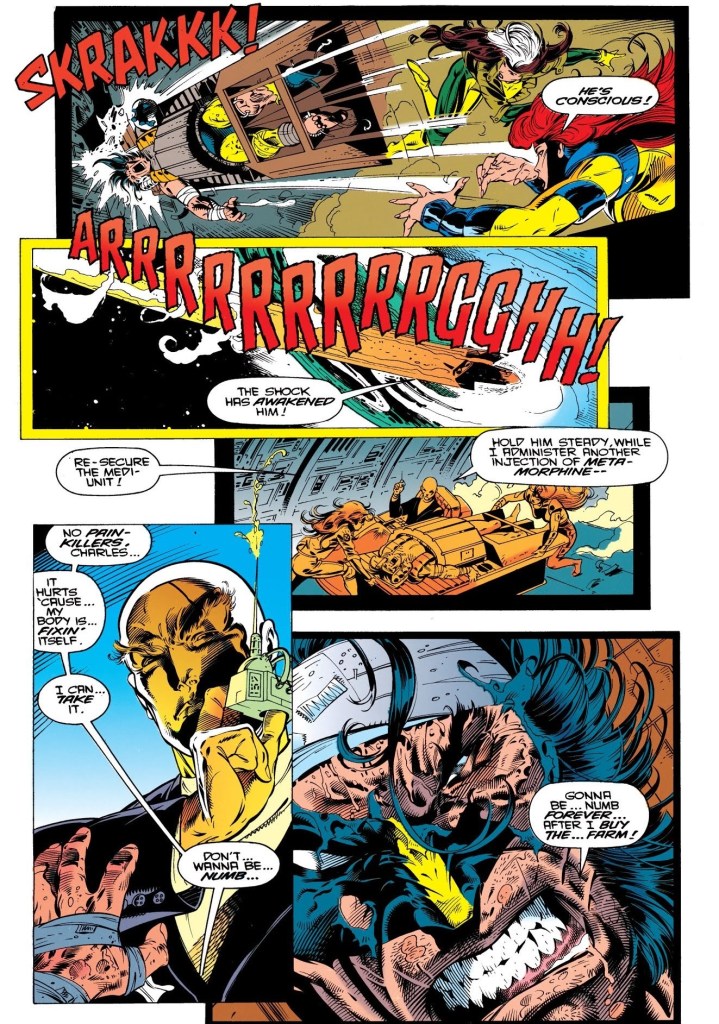
Wolverine at his most vulnerable state.
By today’s standards, Wolverine #75 (1993) is still a very great comic book to read. In fact, I can say it is not only one of most defining chapters of the Fatal Attractions storyline as well as one of the most significant X-Men comic books of the 1990s, it is indeed a true illustrated literature classic ever published by Marvel Comics. In retrospect, this comic book marks a major turning point in the life of Wolverine who is still one of the most iconic characters in all of superhero literature. All of these were achieved thanks to the creative team of Larry Hama and Adam Kubert (whose are here was great and stylized at the same time). Hama succeeded in writing the continuation of the Fatal Attractions storyline while balancing all of the exposition and still putting Wolverine in the center. That itself is a very great work of writing.
If you are seriously planning to buy an existing hard copy of Wolverine #75 (1993), be aware that as of this writing, MileHighComics.com shows that the near-mint copy of the regular edition costs $60 while the near-mint copies of the signed-and-numbered edition and the newsstand edition cost $300 and $180 respectively.
Overall, Wolverine #75 (1993) is highly recommended!
+++++
Thank you for reading. If you find this article engaging, please click the like button below and also please consider sharing this article to others. If you are looking for a copywriter to create content for your special project or business, check out my services and my portfolio. Feel free to contact me as well. Also please feel free to visit my Facebook page Author Carlo Carrasco and follow me at HavenorFantasy@twitter.com









 Author Carlo Carrasco