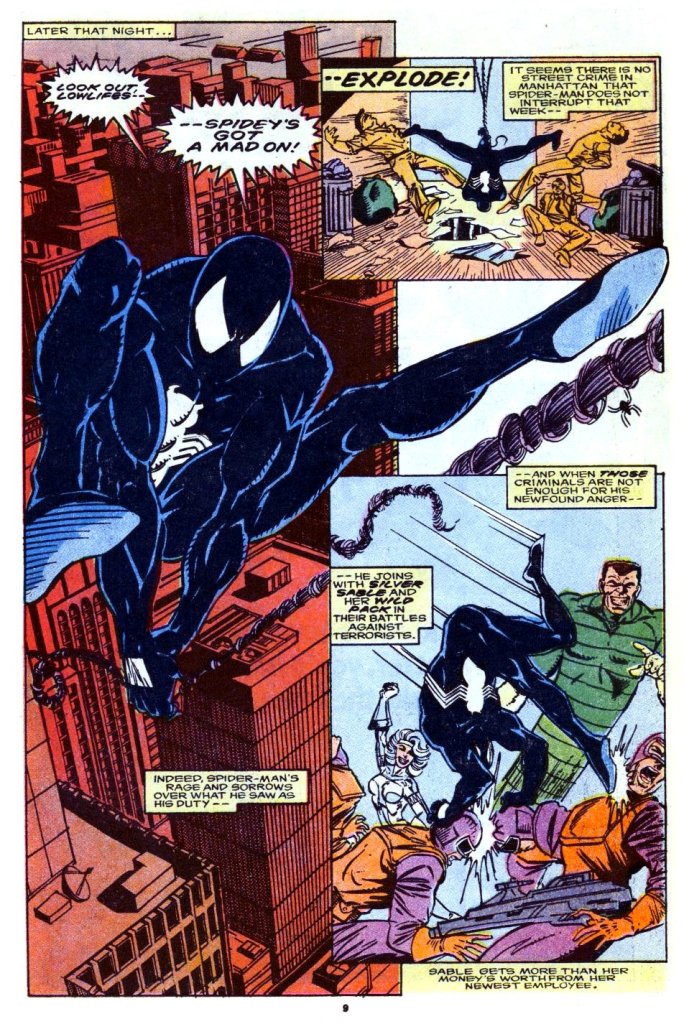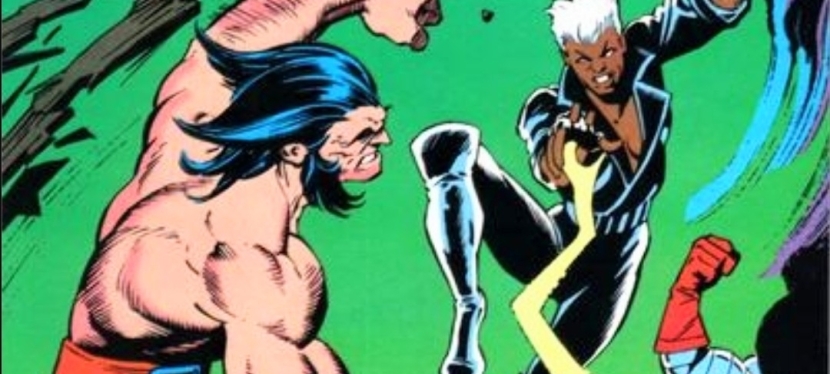
A Look Back at What If #40 (1992)

Disclaimer: This is my original work with details sourced from reading the comic book and doing personal research. Anyone who wants to use this article, in part or in whole, needs to secure first my permission and agree to cite me as the source and author. Let it be known that any unauthorized use of this article will constrain the author to pursue the remedies under R.A. No. 8293, the Revised Penal Code, and/or all applicable legal actions under the laws of the Philippines.

Welcome back superhero enthusiasts, 1990s arts and culture enthusiasts, Marvel Comics fans and comic book collectors! Today we go back to the year 1992 and explore a part of Marvel Comics’ universe through the reimagined tales emphasized in the What If monthly series.

For this particular retro comic book review, we look at a What If tale that is related with the X-Men, specifically through one of their major characters – Storm. For the newcomers reading, Storm is the black X-Men member whose mutation allows her to manipulate the weather. As seen in X-Men comic books decades ago, Storm was portrayed to be tough and brave, and she became a highly valuable learner under Professor X (Charles Xavier). In the 1990s, Storm rose in prominence among the X-Men, she became leader of their Gold Team. Storm was portrayed in the live-action movies by Halle Berry and Alexandra Shipp. It’s just too bad Storm’s role in X-Men: Days of Future Past (note: for me, it is the best X-Men live-action movie ever) was minimal.

With those details laid down, here is a look back at What If , published in 1992 by Marvel Comics with a story written by Ann Nocenti and drawn by Steve Carr and Deryl Skeleton.

The cover.

Early story

The story begins with the Watcher recalling scenes from the life of Ororo who was born to a mother (a tribal princess in Kenya) and a photojournalist father. After moving from America to Egypt, Ororo loses her mother and became an orphan. Along the way, she experienced severe claustrophobia as a result of being buried under tons of rock. Having survived, she became a thief in Cairo and eventually traveled into Africa by chance. There she discovered her true nature as a walking idol. She eventually meets Charles Xavier.

The Watcher then explores another thread of scenarios of Ororo’s life in which she never stepped on the eventual boat, never sailed for Africa and never met the tribe that worshipped her.

In Cairo, Ororo is a very young thief who made herself look like a male. She uses deceptive tactics on a foreigner who walked by. A short time later, Ororo goes to New York City identified as Jack serving an old man who teaches her to work hard, to gain respect from his friends and immerse herself in a world of grifters and hobos. Ororo lives and works as a thief in the city targeting people who have more than enough…

Quality

A look at Storm as the super-powered thief. It’s also a portrayal of her as a super villain on the rise.

Among the many What If tales related to the X-Men that I have read so far, this is one of the most well-written and most intriguing alternate universe stories I have read thanks to Ann Nocenti. This was also released at a time when Storm was already established as a brave X-Men team leader and a potential successor to Professor X. In this comic book, there is this strong twist to the established legacy of Storm as a youth and the exploration of what would happen had she remained a thief (a super-powered thief no less) and never followed Charles Xavier turned out to be very compelling in my experience. For one thing, Storm definitely would have given police officers – who clearly are inferior to the powered heroes and villains – a hard time and even help the crime wave overwhelm society’s defenders. It is also quite striking to see Storm to follow and serve a principled yet theft-oriented superior. In fact, this story shows the popular X-Men team leader as a super villain on the rise.

More on storm, Ann Nocenti’s script literally dissected notable traits of Storm’s personality that are connected to the established comic book legacy which creatively created something new that fits in well in this alternate universe story. Through Storm, the story also sheds light on how thieves view life believing that theft is a necessity and their so-called principles justify it. No matter what the thieves and criminals in general think, nothing justifies theft and crime at all and those who commit such acts must be punished accordingly Without spoiling the details, I can say that there are some grey areas within Storm that were nicely emphasized.

Conclusion

Storm as a male-looking teenager behind bars with the ladies who got apprehended. Scenes like this should remind you NOT to vote for political candidates who are soft and sympathetic towards crime.

What If (1990) is indeed a great alternate universe portrayal of one of the X-Men’s most prominent characters of the time. The story is very well structured and the characterization of Storm was clearly organized by Ann Nocenti to be powerful and intriguing to read. This comic book also has a twist that you must see for yourselves as well as an ending that will either surprise or satisfy you depending on what you anticipated. Ultimately, this comic book should remind you all to avoid committing crime and the truth is that poverty is a curse and it NEVER justifies theft. Always remember that the Lord is watching you. For enlightenment, read Exodus 22:1-4, Exodus 22:10-15, Leviticus 6:2-7 and 1 Corinthians 6:9-10 in the Holy Bible.

Overall, What If (1990) is highly recommended!

+++++

Thank you for reading. If you find this article engaging, please click the like button below, share this article to others and also please consider making a donation to support my publishing. If you are looking for a copywriter to create content for your special project or business, check out my services and my portfolio. Feel free to contact me with a private message. Also please feel free to visit my Facebook page Author Carlo Carrasco and follow me on Twitter at  @HavenorFantasy as well as on Tumblr at https://carlocarrasco.tumblr.com/ and on Instagram at https://www.instagram.com/authorcarlocarrasco
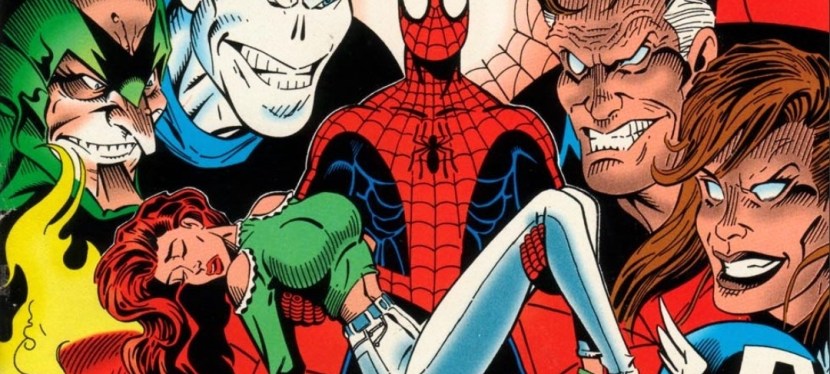
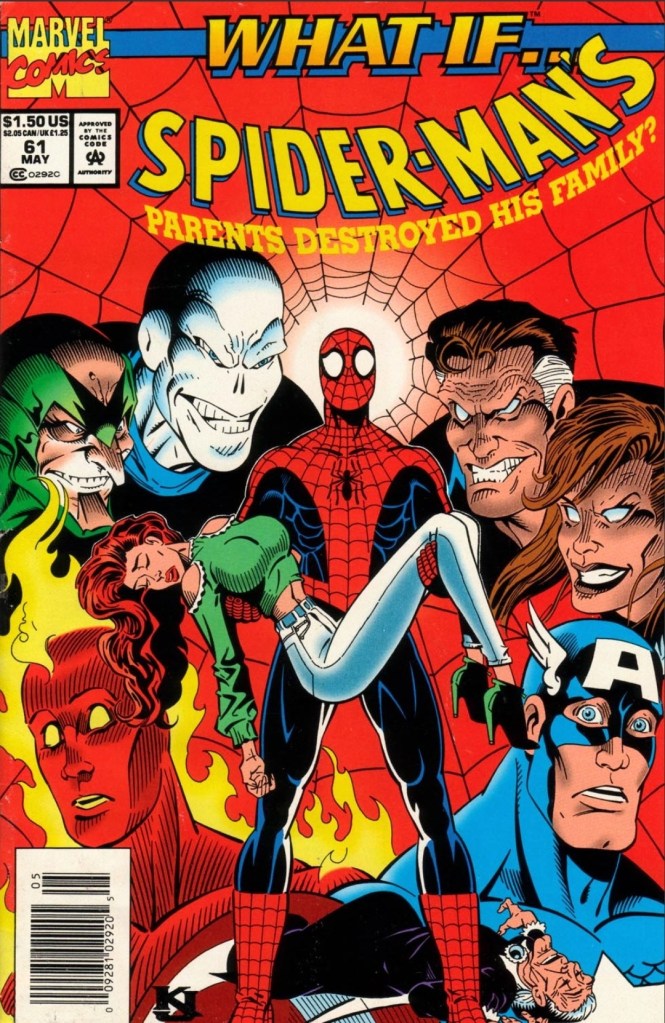
A Look Back at What If #61 (1994)

Disclaimer: This is my original work with details sourced from reading the comic book and doing personal research. Anyone who wants to use this article, in part or in whole, needs to secure first my permission and agree to cite me as the source and author. Let it be known that any unauthorized use of this article will constrain the author to pursue the remedies under R.A. No. 8293, the Revised Penal Code, and/or all applicable legal actions under the laws of the Philippines.

Welcome back superhero enthusiasts, 1990s arts and culture enthusiasts, Marvel Comics fans and comic book collectors! Today we go back to the wild 1990s and examine an alternate universe portrayal of one of Spider-Man’s many events told through the What If monthly series!

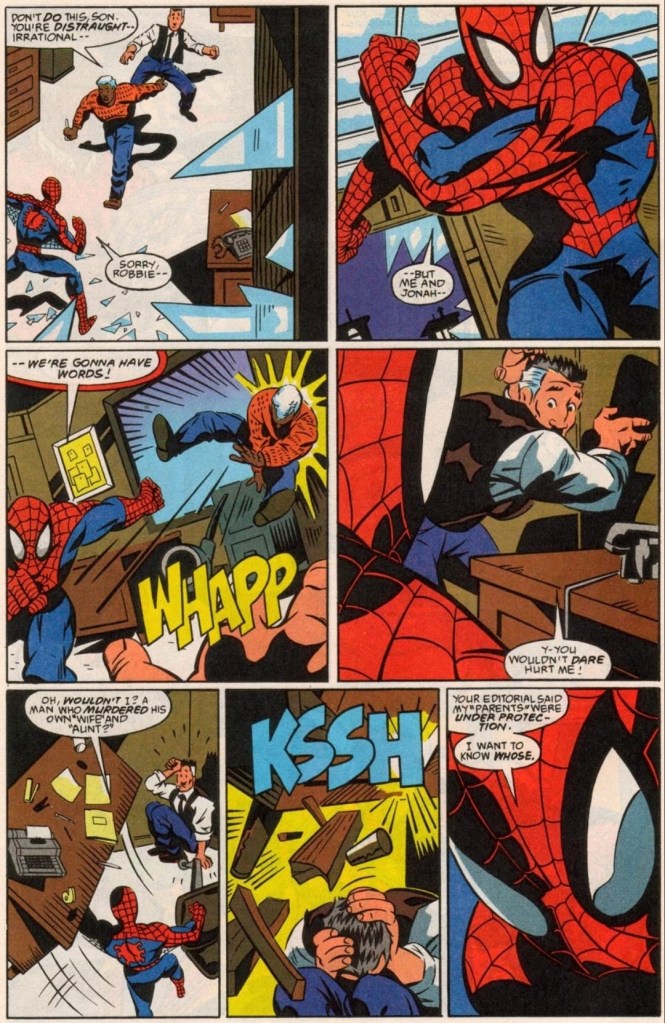
If you are looking for a portrayal of Spider-Man going over the edge and into the extremes emotionally, you are about to experience something in this retro review of mine. Some time ago, I reviewed a What If comic book about Spider-Man becoming a murderer which was compelling but ended on a whimper.

With those details laid down, here is a look back at What If published in 1994 by Marvel Comics with a story written by Kurt Busiek and drawn by Kirk Jarvinen, Andrew Wildman, Derek Yaniger and Jim Amash.

The cover.

Early story

The story begins with Richard and Mary Parker (Peter Parker’s parents) arriving in the presence of Aunt May who happens to be visited by their son Peter (Spider-Man). Having learned something from a while back, Aunt May tells Richard and Mary that they are not genuine persons. Suddenly, Peter Parker’s spider sense intensifies and in an attempt to defuse the situation, he leads his aunt to walk out of the house with him. Richard and Mary watch them walk away.

It turns out, Richard and Mary are impostors and they have been working all the time for a secretive boss. Richard calls his employer under an emergency and reports that they have completed phase one of their assignment, that Aunt May knows the truth about them and is about to inform Spider-Man. Richard is then told that under no circumstances is the plan to be jeopardized and anyone who suspects must die. He is also told to flush Mary’s programming and reset her as she showed signs of acting odd to the situation.

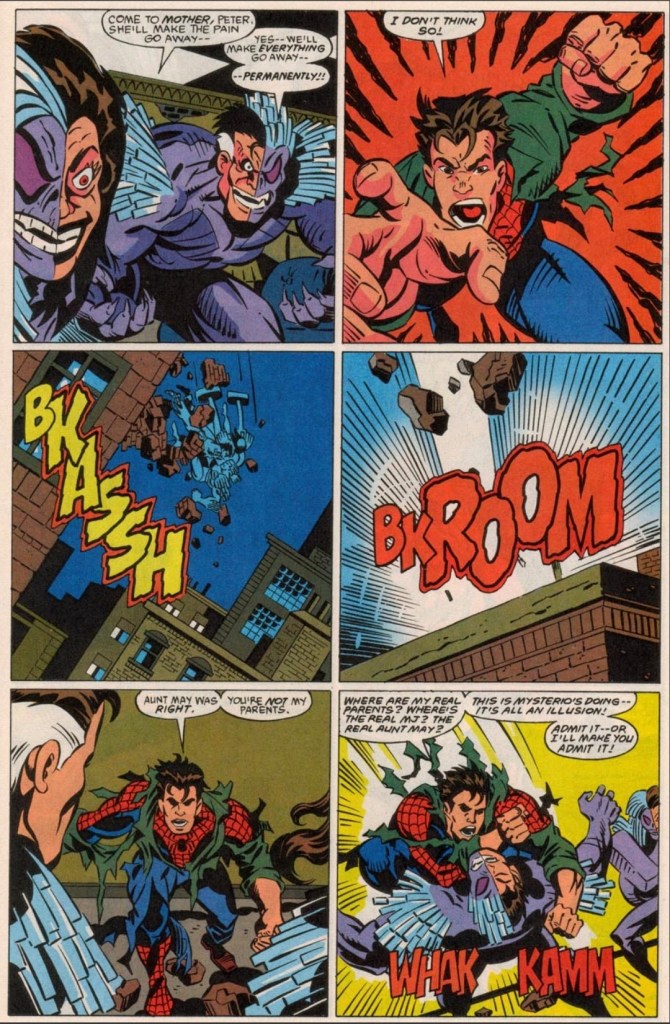
A short time later, Richard and Mary – now in morphed forms with vastly different bodies and half their heads resembling their human selves – suddenly break into an apartment surprising Peter, his wife Mary Jane and Aunt May. Violent action by one of them accidentally ripped open Peter’s shirt, revealing his Spider-Man suit to Aunt May. Just as Peter’s aunt figures out the secret, he tells Mary Jane to grab her and get out.

However, the sight of the morphed Mary Parker shocked Aunt May and Mary Jane so much, they failed to move. Mary Parker then morphs her two hands into large, makeshift hammers, and swiftly killed Aunt May and Mary Jane. Peter is instantly shocked by their sudden deaths but deep inside, rage begins to burn…

Quality

Spider-Man already over the edge and reacting violently to the abusive Daily Bugle.

I can start by confirming that Kurt Busiek’s writing is very strong and his alternate take on the events of Amazing Spider-Man (1994) is indeed very solid. In one way, I find the emotional stakes for Spider-Man has been raised a lot higher than what was portrayed in the canon story. The concept of losing his beloved family members to enemies who were impostors that looked like his long lost parents is indeed disturbing as well as emotionally charged. In relation to this, Busiek and the illustrators brought to life a Spider-Man who really went over the edge by taking matters into his own hands as the loss of beloved ones led to the blurring of the boundary between good and evil. Even the boundary between innocence and guilt gets blurred which adds more depth to the emotions of the story. As I read the story, there were moments when I felt that Spider-Man became as bad as the evil ones even though he is clearly the victim and his family was targeted.

Apart from showing Spider-Man getting outraged and pushed to the limits, Busiek inserted elements about how people perceive incidents without knowing all the facts and how easily they get manipulated by a news outlet – the Daily Bugle where Peter Parker worked as a freelance photographer – whose leader does not care about ethical journalism nor the pursuit of the truth. In this age of widespread fake news and liberal news media outlets in America doing propaganda for American Communists (read: Democrats, abortionists, LGBTQ, Black Lives Matter, Antifa, the terrorists, the climate change extremists and the socialist hordes), this particular aspect of the story makes this comic book strongly relevant to read today.

The story also sheds light on Spider-Man’s connections with other Marvel superheroes who happen to be in New York City. You will see Captain America and Johnny Storm express their concern about Spider-Man’s state of mind as they themselves still tried to figure out what really happened. In short, the superheroes here showed restraint even as Spider-Man goes to the extreme being a victim as well as a fugitive.

If there are any weak points in this comic book, it would be the art which has this cartoon-like aesthetic for much of the story. Considering the serious subject matter, the visuals are quite contradicting as they make this look like it was made for much younger readers. In fairness, the quality of the art improved during the 2nd half of the story.

Conclusion

Spider-Man takes on the impostors who looked like his parents.

As far as storytelling and characterization goes, What If (1994) succeeded a lot on portraying the iconic Spider-Man as the superhero who went over the limits of his emotions and his reasoning which is the result of the tragic deaths of two beloved family members caused by individuals who pretended to be his parents. This is a very solid story which also has a powerful ending. Where What If failed, this comic book succeeded and even exceeded it with Spider-Man truly becoming unheroic. I should state that this comic book should convince readers to go to the Amazing Spider-Man series and follow the Lifetheft storyline in issues to (which were released months before this comic book). Kurt Busiek’s script is indeed great and it is easily the driving force of the comic book.

Overall, What If (1994) is highly recommended.

+++++

Thank you for reading. If you find this article engaging, please click the like button below, share this article to others and also please consider making a donation to support my publishing. If you are looking for a copywriter to create content for your special project or business, check out my services and my portfolio. Feel free to contact me with a private message. Also please feel free to visit my Facebook page Author Carlo Carrasco and follow me on Twitter at  @HavenorFantasy as well as on Tumblr at https://carlocarrasco.tumblr.com/ and on Instagram at https://www.instagram.com/authorcarlocarrasco
A Look Back at What If #10 (1990)

Disclaimer: This is my original work with details sourced from reading the comic book and doing personal research. Anyone who wants to use this article, in part or in whole, needs to secure first my permission and agree to cite me as the source and author. Let it be known that any unauthorized use of this article will constrain the author to pursue the remedies under R.A. No. 8293, the Revised Penal Code, and/or all applicable legal actions under the laws of the Philippines.

Welcome back superhero enthusiasts, 1990s arts and culture enthusiasts, Marvel Comics fans and comic book collectors! Today we go back to the year 1993 and explore a part of Marvel Comics’ universe through the reimagined tales emphasized in the What If monthly series.

For those of you who have gotten very familiar with Marvel Comics’ vast lineup of superheroes, anti-heroes, super villains and supporting characters, the Punisher is one of the most notable characters as he is the most definitive vigilante the publisher ever has in its shared superhero universe. As a comic book protagonist, the Punisher does “good” in fighting crime but he sure is as bad as the bad guys as he commits torture, issued threats of violence, kidnapping, extortion, coercion and even murder towards them. A major factor in the Punisher’s origin (as Frank Castle) was the killing of his family (wife and two kids) committed by a mob as they witnessed acts of killing in Central Park in New York City. The tragic deaths led Castle to become the Punisher who not only relentlessly waged a personal war against criminals but also often wore dark clothes with a large white skull design on the front of his body. The skull symbolized punishment and death to his enemies.

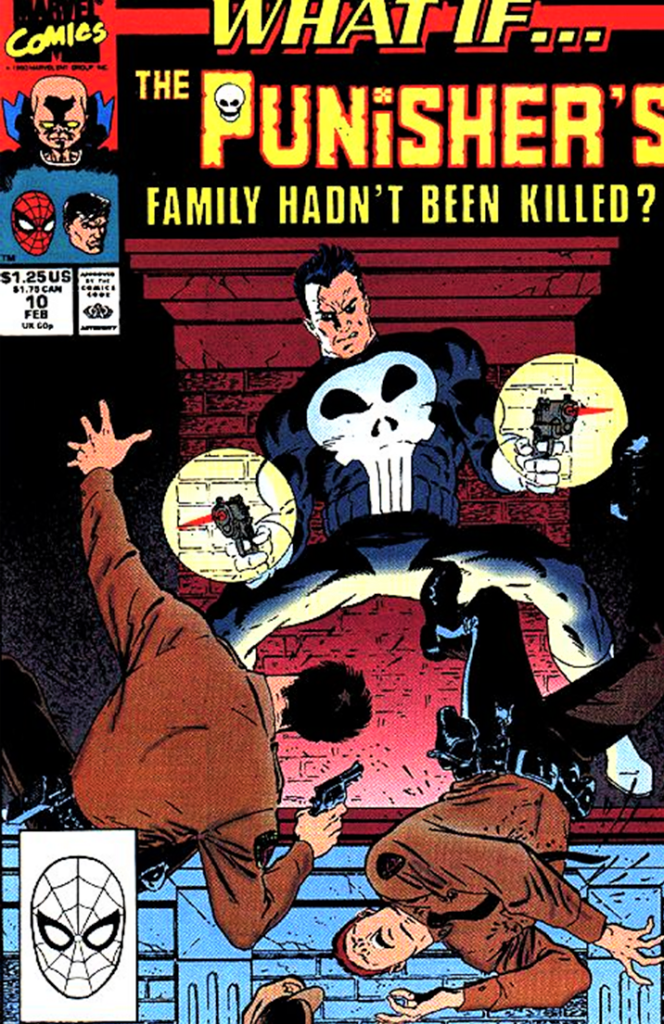
With those details laid down, here is a look back at What If , published in 1990 by Marvel Comics with a story written by Doug Murray and drawn by Rik Levins.

The cover.

Early story

The story begins with the Watcher recalling the time Frank Castle spent with his wife and the two kids at New York City’s Central Park. There, they have fun with their picnic. At this point in time, Frank Castle had previously served his country in the Vietnam War and he carries within him bravery, the experience of violence and vast skills to use weapons.

The weather suddenly worsens as rain starts to fall down causing some inconvenience on the Castle family. Frank’s son struggles as his kite got caught by the large plant nearby. On the other side of the said plant, four armed men and their captive (hanging upside down by the tree) are startled and prepare themselves to shoot anyone who appears.

Frank, who does not realize the mob on the other side of the plant, helps his son get the kite back. The Castle family then decide to go back home not realizing that they came close to discovering and witnessing the illegal activity of the armed men. As the family kept on moving, Frank hears gunfire from a distance…

Quality

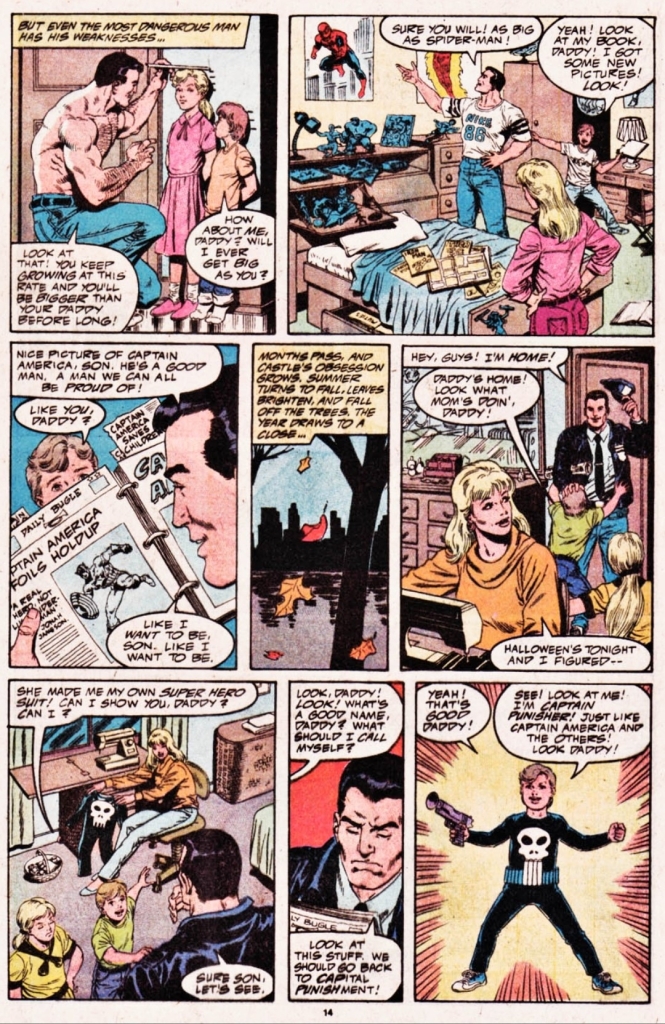
Frank Castle the family man.

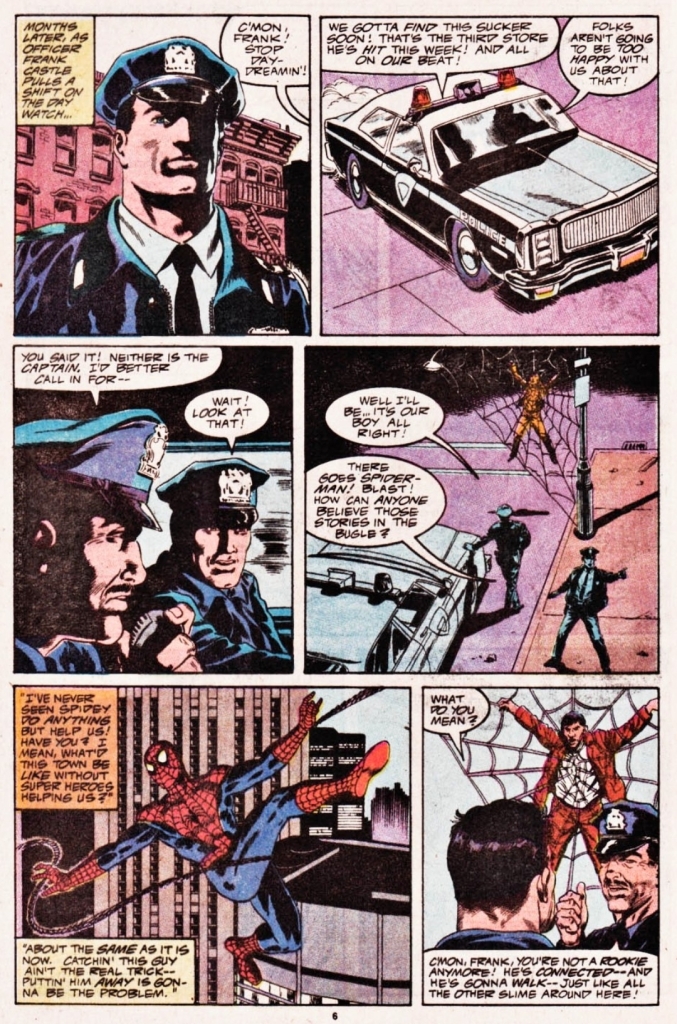
To get straight to the point about this comic book, it’s story is really engaging and it has noticeable amounts of darkness and grittiness without going overboard. While exploring what would happen had Frank Castle’s family not been killed, the comic book shows the Punisher getting involved in public safety as a New York patrolman which puts him in a unique position facing crime in radically different ways from what we comic book readers have been used to seeing. The story also explores corruption within the police and the justice system as well.

The way the events and action turned out showed the creative team focused on realism while also establishing the Punisher’s own place within the comic book’s alternate portrayal of the shared superhero universe. More on the subject matter of this comic book, there is a twist that surprised me a lot and it is something that you readers should see for yourselves.

Going back to Frank Castle, it is indeed very captivating to see him portrayed a lot more as a family man who really strives to support his wife and kids no matter how dangerous his occupation really is. The aspect of family in this comic book is very significant as it will make you realize that the definition of family in America in the 21st century has been distorted as a result of laws or court decisions that reflected wokeness, homosexuality and unrestrained feminism. In short, woke America’s believers reject the concept of the traditional family and the concept of a father leading the family is considered taboo because it goes against LGBT’s so-called values and principles.

Conclusion

Frank Castle as the police officer.

When you think about the legacy of the Punisher not only on comics but also in movies and other forms of entertainment media, you will often remember a one-man-army against criminals. What If (1990) has is a really unique take on the Punisher and I can say it has a very captivating script brought to life with really good artwork. Not only does this alternate version of the Punisher shows how he affects criminals, but also how he impacts other parts of the fictional New York society within the shared universe of Marvel Comics (note: characters connected to Spider-Man and Daredevil are here). From start to finish, this Punisher tale by the Murray-Levins team turned out to be very engaging to read.

Overall, What If (1990) is highly recommended!

+++++

Thank you for reading. If you find this article engaging, please click the like button below, share this article to others and also please consider making a donation to support my publishing. If you are looking for a copywriter to create content for your special project or business, check out my services and my portfolio. Feel free to contact me with a private message. Also please feel free to visit my Facebook page Author Carlo Carrasco and follow me on Twitter at  @HavenorFantasy as well as on Tumblr at https://carlocarrasco.tumblr.com/ and on Instagram at https://www.instagram.com/authorcarlocarrasco
A Look Back at What If #4 (1989)

Disclaimer: This is my original work with details sourced from reading the comic book and doing personal research. Anyone who wants to use this article, in part or in whole, needs to secure first my permission and agree to cite me as the source and author. Let it be known that any unauthorized use of this article will constrain the author to pursue the remedies under R.A. No. 8293, the Revised Penal Code, and/or all applicable legal actions under the laws of the Philippines.

Welcome back superhero fans, 20th century arts and culture enthusiasts, Marvel Comics fans and comic book collectors! Today we go back to the year 1989 and explore a part of Marvel Comics’ universe through the reimagined tales emphasized in the What If monthly series (Volume 2).

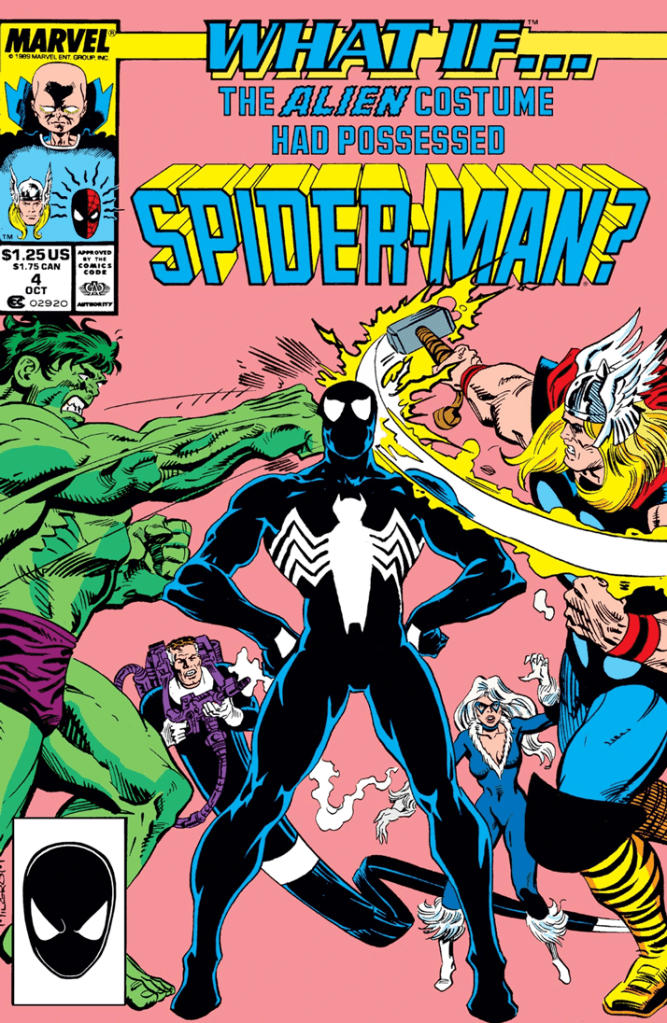
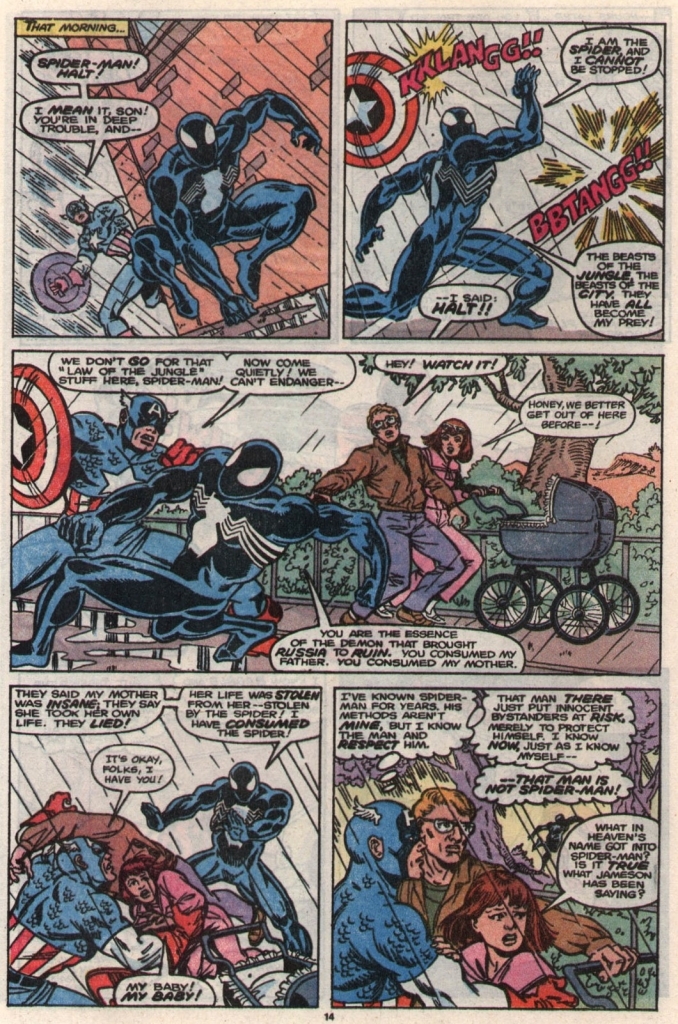
For the newcomers reading this, I previously reviewed a variety What If comic books which you can find by clicking here, here, here, here, here, here, here and here. The joy of reading a What If comic book was the exploration of alternate outcomes in relation to the stories that have been counted by Marvel Comics as canon or official fictional history within their shared comic book universe. In this retro review, we will explore a key event from Spider-Man’s time with the alien costume (symbiote) which is related with the events of Secret Wars and the eventual establishment of his deadliest nemesis Venom.

With those details laid down, here is a look back What If , published in 1989 by Marvel Comics with a story written by Danny Fingeroth and drawn by Mark Bagley.

The cover.

Early story

The story begins with the Watcher examining Spider-Man’s involvement with the Secret Wars that took place on a faraway planet created by the Beyonder. There, his costume got damaged beyond  repair and he acquired a new one made of what he perceived to be an advanced form of material. After successfully returning home, Spider-Man goes through some mysterious developments and he could not understand why he remains fatigued even as he spent more time sleeping.

With the help of Mr. Fantastic at the Fantastic Four headquarters, Spider-Man learns that his new costume is a living entity that has attached itself to him mentally and physically. As Mr. Fantastic uses a sonic blaster, Spider-Man and the alien costume got separated at last. Some time later, the alien costume re-attached itself to Spider-Man who eventually used church bells loud sounds to separate it. The alien costume would go on to the find Eddie Brock to form Venom.

The alternate reality begins with Spider-Man having a joyful reunion with Black Cat shortly after coming back from Secret Wars. Learning from her advise to have himself checked properly, he visits Dr. Connors (the Lizard) for examination and testing…

Quality

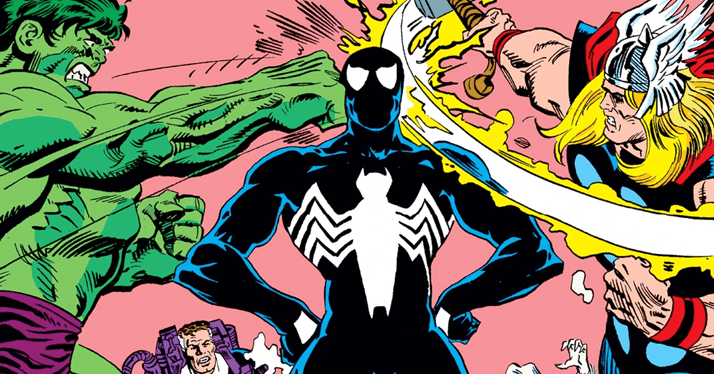
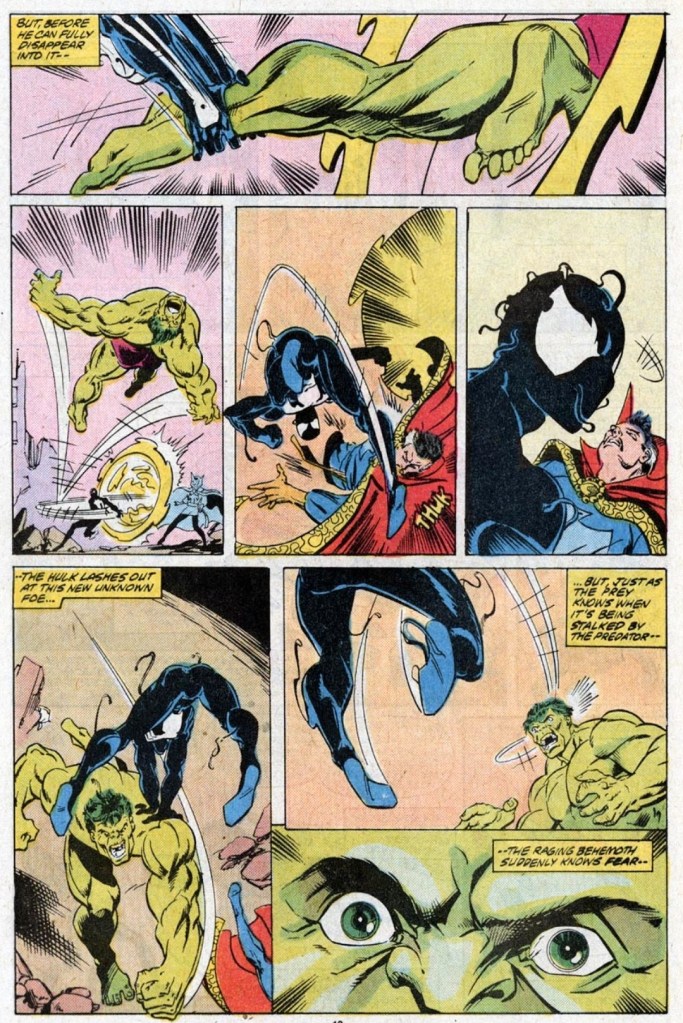
The possessed Spider-Man takes on Dr. Strange and the Hulk without hesitation.

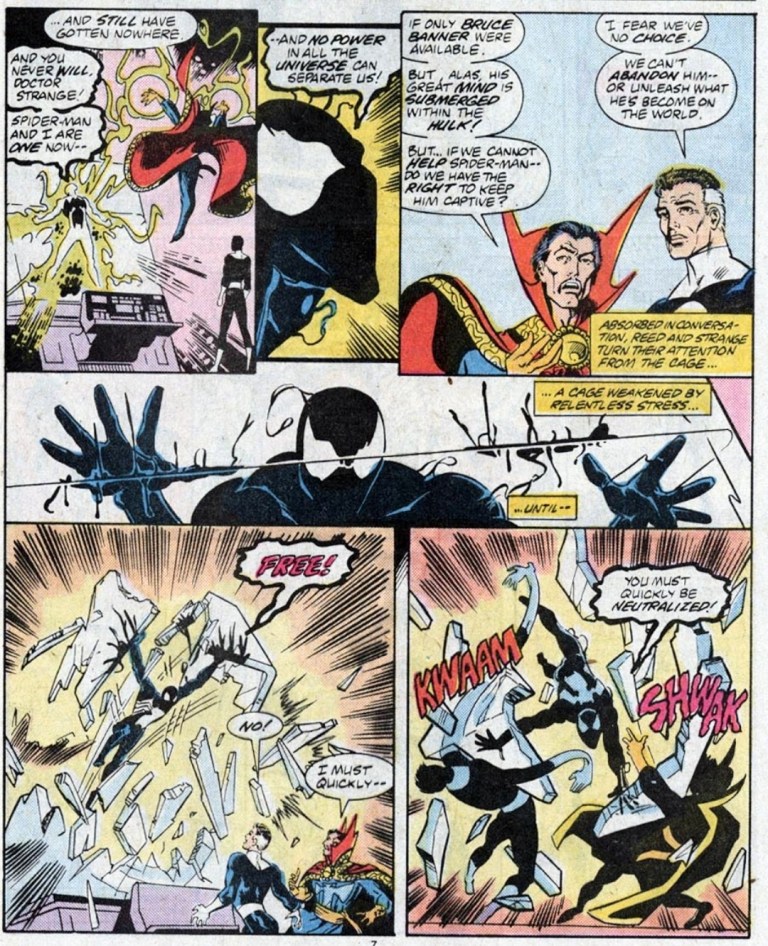
To say that Danny Fingeroth’s script is very deep is an understatement. Specifically, this story is a great exploration of alternative events that not only affects the iconic Spider-Man/Peter Parker but also other elements of the Marvel Comics universe of the time. The concept of the alien costume fully bonding with Peter Parker with Mr. Fantastic and even Dr. Strange failing to help is indeed suspenseful and intriguing to read thanks to Fingeroth’s very solid writing. In fact, the story even shows Spider-Man as being possessed by the symbiote (complete with dialogue) and when you witness Peter Parker struggling to control himself consciously (while wrestling with the alien costume), you will really feel his pain. I should also state that there is a lot more about Spider-Man told here that goes beyond the possession which really turned out to be very compelling to read in my experience. This is easily the most engaging alternate portrayal of Spider-Man as we know him and it should be read by as many people as possible.

Along the way, this comic book portrays the alien costume as an insatiable being and the implementation of dialogue for it (structured in a way as using the vocal ability of the powered being it bonded with) gave it a very unique personality of its own. This is something that was not portrayed in the early appearances of Venom in which Eddie Brock does the talking and reacting to unseen messages from the symbiote. That being said, the alien costume here symbolizes possession within the Marvel Comics shared universe and its unknown state really challenges not only the intelligence of the superheroes but also their ability to decide on what final action to take with regards to sentient life.

As staged by the writer, the story’s narrative occasionally shifts away from Spider-Man to follow other characters such as Black Cat (Peter Parker’s love at the time), Mr. Fantastic (in a great portrayal of his proficiency in science and as a responsible superhero), Thor and others which made the reading experience really immersive in relation to emphasizing how this alternate reality affects others. You will get to see the Captain America, the Hulk, Iron Man, the Wasp, Captain Marvel, the Fantastic Four and the Avengers here.

Those who are fond of superhero spectacle will have a lot to enjoy here. Mark Bagley carefully paces the action scenes and he uses visual dynamism during the right moments.  

Conclusion

Through dialogue, the alien costume is portrayed as a sinister force.

I can say it out loud…What If (1989) is one of the best Marvel Comics alternate reality stories I have ever read and the creative team of Fingeroth-Bagley crafted an epic tale that goes beyond the featured question of “What if the alien costumer had possessed Spider-Man?”. The comic book works excellently as both a Spider-Man story as well as a Marvel superheroes struggle. The story touches on relevant topics such as possession, killing and scientific exploitation. This is a must-have comic book!

Overall, What If (1989) is highly recommended!

+++++

Thank you for reading. If you find this article engaging, please click the like button below and also please consider sharing this article to others. If you are looking for a copywriter to create content for your special project or business, check out my services and my portfolio. Feel free to contact me with a private message. Also please feel free to visit my Facebook page Author Carlo Carrasco and follow me on Twitter at  @HavenorFantasy as well as on Tumblr at https://carlocarrasco.tumblr.com/ and on Instagram at https://www.instagram.com/authorcarlocarrasco/

A Look Back at What If #17 (1990)

Disclaimer: This is my original work with details sourced from reading the comic book and doing personal research. Anyone who wants to use this article, in part or in whole, needs to secure first my permission and agree to cite me as the source and author. Let it be known that any unauthorized use of this article will constrain the author to pursue the remedies under R.A. No. 8293, the Revised Penal Code, and/or all applicable legal actions under the laws of the Philippines.

Welcome back superhero enthusiasts, 1990s arts and culture enthusiasts, Marvel Comics fans and comic book collectors! Today we go back to the year 1993 and explore a part of Marvel Comics’ universe through the reimagined tales emphasized in the What If monthly series.

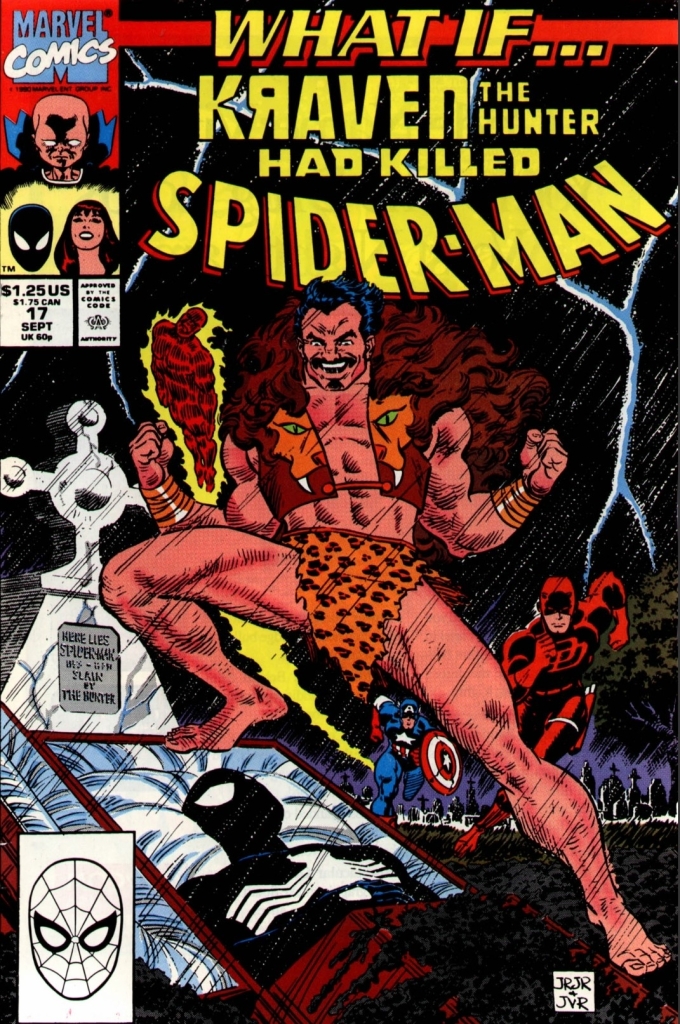
Several years ago, I bought myself a trade paperback collection of the 1987 Spider-Man storyline Kraven’s Last Hunt written by J. M. DeMatteis and drawn by Mike Zeck. That particular storyline was very notable not just for its dark approach to storytelling and visualization, but it also explores what would happen had Spider-Man been defeated and someone very obsessed took his place and go on a rampage disguised as Spider-Man. The storyline also explored how Kraven perceived Spider-Man without ever knowing the defining traits of the man behind the mask – Peter Parker. Eventually, Marvel Comic went on to revisit Kraven’s Last Hunt and explored what would happen had Kraven actually killed Spider-Man through their What If? monthly comic book series.

With those details laid down, here is a look back at What If , published in 1990 by Marvel Comics with a story written and drawn by Richard Howell.

The cover.

Early story

The story begins with the Watcher revisiting key moments from the Kraven’s Last Hunt storyline. History then takes a turn towards the unexplored when Kraven, armed with a gun, shoots and kills Spider-Man. As the dead webslinger lies in a coffin, Kraven celebrates his victory with a lot of passion believing that he struck back at what he perceives to be the meaninglessness of the world. Kraven is quite mad as he equates spiders with Spider-Man as well as the decline of civilization.

After fearlessly and grotesquely eating spiders, Kraven wears a black body tight costume that looks almost the same as that of Spider-Man’s. While he is victorious, Kraven is not satisfied and he becomes obsessed by becoming Spider-Man and prove himself superior to him. He then moves into the city whose people are familiar with Spider-Man and also are unprepared with who is coming to them.

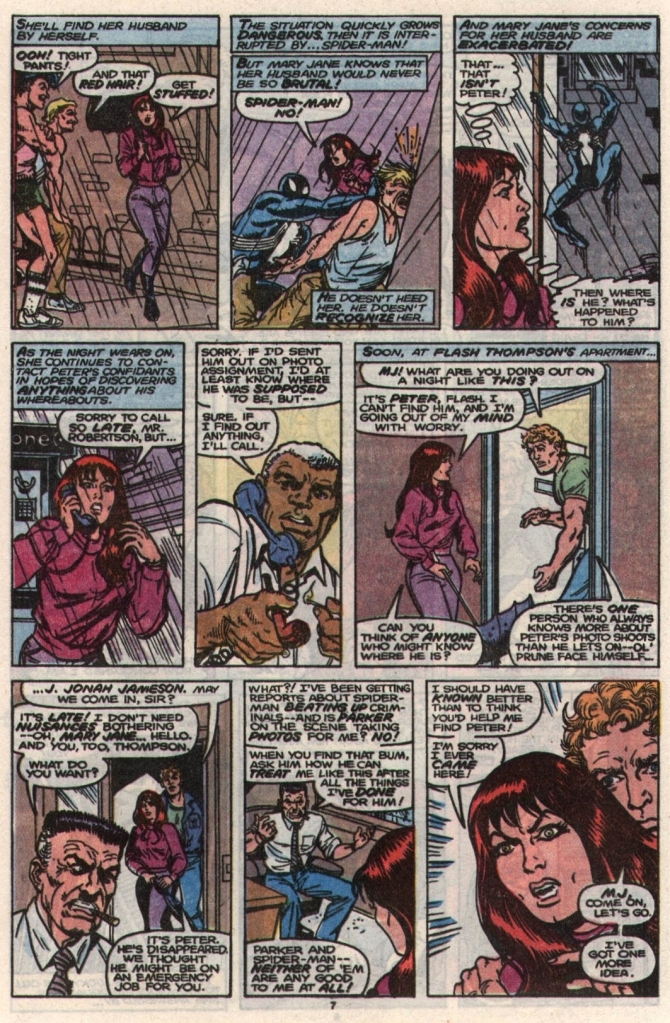
In an apartment, Spider-Man’s wife Mary Jane Parker is alone and worried. As she does not know that her beloved Peter Parker has been killed, she cannot help but agonize over the strain of his double-life as a civilian and as a superhero. Determined to find Peter, she walks out during the rainy night and is spotted by two men focused on her.

Suddenly the new Spider-Man (Kraven) appears and in an apparent effort to help Mary Jane, he grabs one of the men and brutally pushes the man’s head on to a nearby wall. As Kraven does not recognize Mary Jane, the wife realizes that the Spider-Man she just saw is definitely not her husband. This only makes her wonder again where he is and what happened to him. She then starts calling others for help…

Quality

In addition to being ruthless, Kraven disguised as Spider-Man resembles Venom.

I’ll start with the visuals. This comic book took a serious effort to come close to capturing the look and visual tone of the Kraven’s Last Hunt storyline which I enjoyed. Richard Howell visualized the characters, the situations and details properly and there was not a single moment when the visuals overwhelmed the narrative. Howell’s artistic take on the characters is simplistic but they remain recognizable which is a plus. The superhero spectacle was presented with a clear and clean approach, and there were a few key moments of action that got highlighted with some dynamism.

As for the story itself, what I found surprising and also pleasant here was the presentation of Mary Jane Parker as the main character instead of Kraven. This makes sense as Kraven himself was the major attraction of the Kraven’s Last Hunt storyline while Spider-Man was out of commission. In the context of this What If story, it only made sense to have Mary Jane as the central figure. Going back to Kraven, Howell captured the essence of the character well when compared to his version in Kraven’s Last Hunt.

In terms of plotting, telling the story through the viewpoint and actions of the superhero’s concerned wife really works well. Without spoiling the plot, you will see Mary Jane get involved with three notable superheroes – including the iconic Captain America – and even with other notable Spider-Man supporting characters such as Flash Thompson and the irresponsible print media figure J. Jonah Jameson. Interactions aside, the plot works sufficiently as a couple of series of events take place before the big confrontation with Kraven (as the new Spider-Man). By the end of it all, I can say that the story is entertaining, engaging and intriguing to read.

Conclusion

Mary Jane Parker goes out in pursuit of her husband Peter Parker/Spider-Man who happens to be dead already at this particular point of the story.

I can say that What If (1990) is pretty captivating read and it is a worthy literary companion to Kraven’s Last Hunt. Of course, to really enjoy this alternative tale cleverly told by Howell, you must read Kraven’s Last Hunt first. Otherwise, you would not feel the impact of this comic book very much. I also liked how the death of Spider-Man (note: Spider-Man got killed in another What If tale that itself is worth reading) impacts Mary Jane, how it impacts the superheroes who know him, and most notably how it impacts the fragile relationship between society and superheroes. Lastly, this comic book has one of the more significant portrayals of Spider-Man’s most beloved woman. This is indeed a great story.

Overall, What If (1990) is highly recommended!

+++++

Thank you for reading. If you find this article engaging, please click the like button below, share this article to others and also please consider making a donation to support my publishing. If you are looking for a copywriter to create content for your special project or business, check out my services and my portfolio. Feel free to contact me with a private message. Also please feel free to visit my Facebook page Author Carlo Carrasco and follow me on Twitter at  @HavenorFantasy as well as on Tumblr at https://carlocarrasco.tumblr.com/ and on Instagram at https://www.instagram.com/authorcarlocarrasco
A Look Back at What If #47 (1993)

Disclaimer: This is my original work with details sourced from reading the comic book and doing personal research. Anyone who wants to use this article, in part or in whole, needs to secure first my permission and agree to cite me as the source and author. Let it be known that any unauthorized use of this article will constrain the author to pursue the remedies under R.A. No. 8293, the Revised Penal Code, and/or all applicable legal actions under the laws of the Philippines.

Welcome back superhero enthusiasts, 1990s arts and culture enthusiasts, Marvel Comics fans and comic book collectors! Today we go back to the year 1993 and explore a part of Marvel Comics’ universe through the reimagined tales emphasized in the What If monthly series.

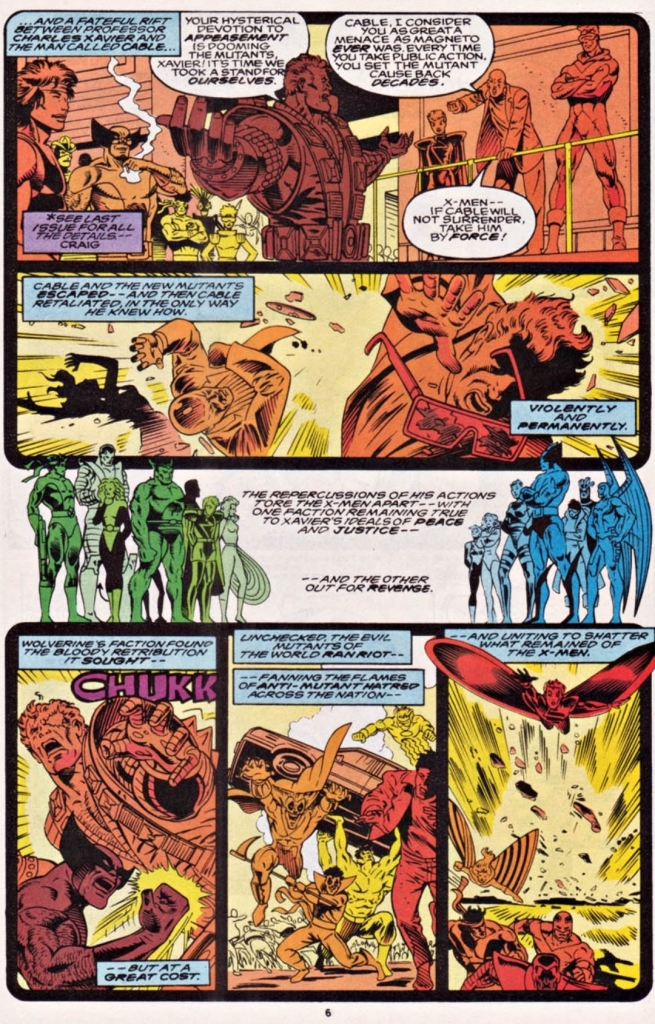
Back in 2021, I reviewed What If #46 (1993) which told a compelling story about division between the mutants, the clash of beliefs between Professor X and Cable, and how terrorism affects everyone. The comic book was also a mesmerizing portrayal of how the X-Men would have organized themselves without Charles Xavier, Jean Grey and Cyclops.

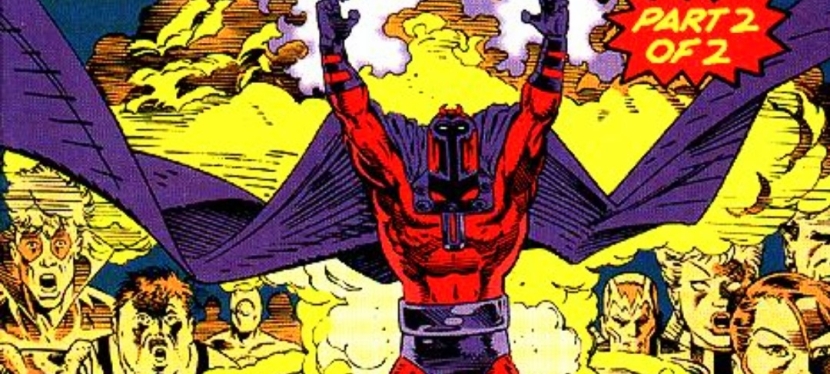
Considering all the chaos that happened in What If (1993), the time was just right for Magneto – the X-Men’s most dangerous enemy of all time – to come in and make an impact not only on mutants but on the world.

With those details laid down, here is a look back at What If , published in 1993 by Marvel Comics with a story written by Kurt Busiek and drawn by Tod Smith.

The cover.

Early story

The story begins with Magneto leading a huge legion of mutants to take overwhelm the remaining resistance – including Spider-Man, the Fantastic Four, Captain America, the Avengers and the dedicated American soldiers – in Washington, D.C.

A fierce battle then took place with both sides hitting each other hard. After noticing Magneto’s lack of presence during the battle, Captain America then realizes that the long-time enemy of the X-Men took advantage of the fighting to penetrate the U.S. Capitol’s bomb shelters and got the nation’s leaders hostage. After easing some of his fellow heroes, Captain America decides not to escalate the fight against Magneto in consideration of the lives of America’s top officials…

Quality

A recap of the events in issue .

To begin with, I can say that this story is a well-planned follow-up to the events of issue . While Magneto’s presence has been magnified a lot here, there are still strong story connections to the previous issue.

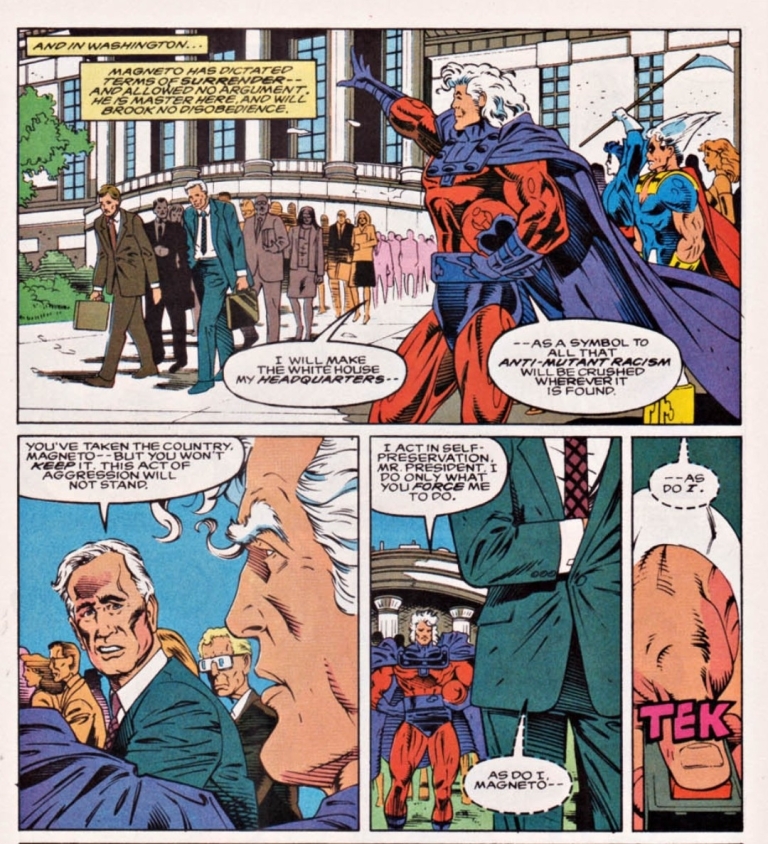
With regards to what was emphasized on the front cover of the comic book, this story explores what would happen if Magneto took power to control the entire United States while leading a group of mutants with a platform focused on crushing anti-mutant racism even though it includes pushing the non-mutant people (which is the great majority of America’s people) as well as the dissenting mutants out of the way.

For one thing, this superhero fantasy concept is actually socially relevant with today’s geopolitics and the way America has turned out under the fake leadership of Joe Biden (who is NOT leading as US President but only following the modern-day American Communists and reckless SJWs dictating him to do their evil bidding. Biden also arrogantly denies reality when it goes against the desires of his administration and his Satanic Democrats) It should be noted that the US President visualized in this comic book eerily looks like Joe Biden complete with that absent-minded facial expression.

Next, a clear theme in this What If story is absolute power and why groups who crave for it would sacrifice so much and hurt others just to acquire it. Magneto, who carries deep hatred towards people he perceives to be obstacles or opposition for his quest of uplifting mutants, takes advantage of mutants who have lost hope and are depending on someone to lead them. Indeed, the long-time X-Men nemesis gains power to control America but finds himself facing a new force of opposition which leads the nation into a drastic series of change that clearly do not alight with his vision of a better future for mutants.

Still on the theme of absolute power, the US government in this story was portrayed to have developed technologies designed to overwhelm its citizens, as well as the means to establish infrastructure and protocols to transform America into an automated dictatorial state that enslaves its citizens and violate their rights without restraint. Once again, this aspect of the story makes it socially relevant.  

Considering the epic concept and the dark turn of events the creative team prepared, this comic book does not have a clear good-versus-evil approach but rather it emphasizes chaos that comes with the pursuit and abuse of absolute power over the nation. You will see key elements from the classic X-Men storyline Days of Future Past here in relation to America’s deformation.

Conclusion

Wow! The US President in this comic book eerily looks so much like Joe Biden whose leadership led America into a lot of problems and hardship. Sky high inflation is just one of the problems that happened under Biden.

What If (1993) is truly a very captivating read mainly because of its core concept which goes way beyond the scenario of Magneto taking control of America. Considering its portrayal of America and the exploration of dark themes about people getting overwhelmed by power abusers, the story is a warning about the fall of America told in superhero fantasy form. Considering the intense social degradation that rocked America the past few years (note: riots by the Black Lives Matter terrorists, SJWs disturbing the peace, Democrats allowing more illegal immigrants into the country, socialists in colleges continuing to brainwash students and more), this story is very socially relevant. It will keep you thinking and reflecting deeply, even if you strongly desire whatever superhero entertainment you seek in this comic book.

Overall, What If (1993) is highly recommended!

+++++

Thank you for reading. If you find this article engaging, please click the like button below, share this article to others and also please consider making a donation to support my publishing. If you are looking for a copywriter to create content for your special project or business, check out my services and my portfolio. Feel free to contact me with a private message. Also please feel free to visit my Facebook page Author Carlo Carrasco and follow me on Twitter at  @HavenorFantasy as well as on Tumblr at https://carlocarrasco.tumblr.com/ and on Instagram at https://www.instagram.com/authorcarlocarrasco
A Look Back at What If #51 (1993)

Disclaimer: This is my original work with details sourced from reading the comic book and doing personal research. Anyone who wants to use this article, in part or in whole, needs to secure first my permission and agree to cite me as the source and author. Let it be known that any unauthorized use of this article will constrain the author to pursue the remedies under R.A. No. 8293, the Revised Penal Code, and/or all applicable legal actions under the laws of the Philippines.

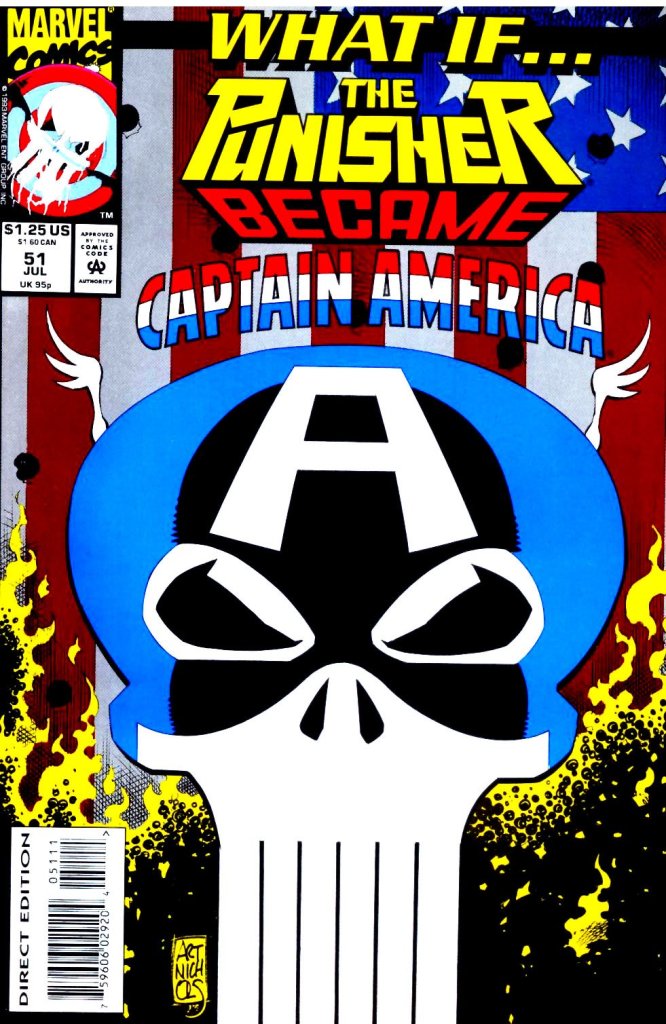
Welcome back, superhero enthusiasts, 1990s culture enthusiasts and comic book collectors! Today we revisit Marvel Comics’ What If monthly series through the 51st issue. Its subject matter was about the Punisher becoming Captain America.

For the newcomers reading this, the Punisher in comics started when Vietnam War veteran Frank Castle lost his family to a gang of criminals who attacked them. Being the only survivor, Castle became obsessed with punishing others by means of assassination and waging a personal war against criminals. Captain America, meanwhile, was serving his country along with his teammates in the Avengers. The story in this reviewed issue of What If diverges from the events told in Captain America #212.

With those details laid down, here is a look back at What If #51, published by Marvel Comics in 1993 with a story written by Simon Furman and drawn by Paris Cullins.

The cover.

Early story

The story begins inside a military hospital deep beneath the Pentagon. Steve Rogers/Captain America was still recovering from his previous mission (told in Captain America #212) when Nick Fury and Falcon arrive. Steve tells Fury that there must be a Captain America again with someone strong to wear the flag.

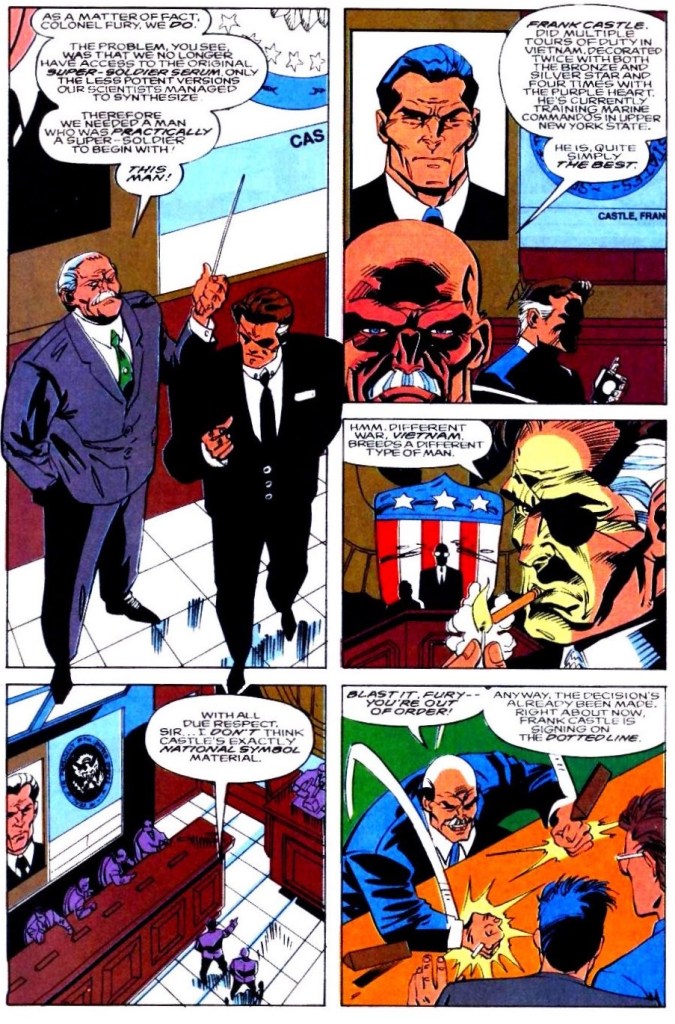
Shortly after, top secret discussions about replacing Steve Rogers commence with a select committee at work and some representatives present. Due to the lack of real access to the original super soldier serum that enhanced Steve Rogers into becoming Captain America, it was announced that decorated Vietnam War hero Frank Castle was their pick to replace Rogers. Nick Fury expresses his reservation.

At a military camp, Frank Castle refuses to become Captain America expressing that he has served his country already through military operations and he barely has any time left for his wife, son and daughter. As far as he is concerned, his war is over…

Quality

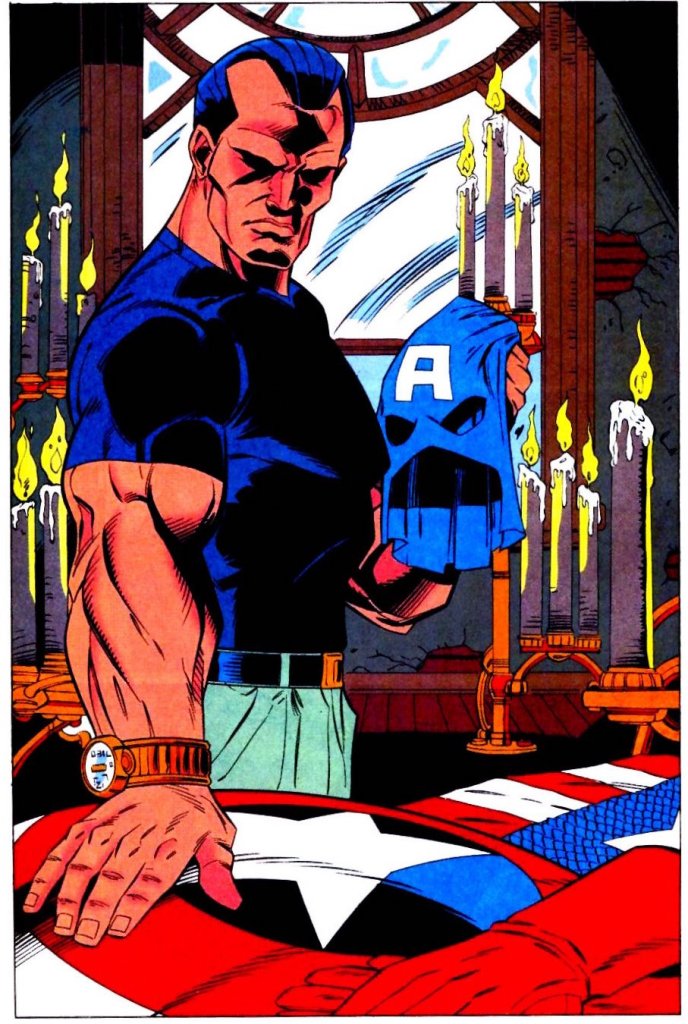
The Punisher as the new Captain America!

On face value, the concept about the Punisher becoming the new Captain America is intriguing and that alone could lead to different outcomes. The story written by Simon Furman clearly shows what kind of Captain America Frank Castle would be. While he does not have the super human abilities of Steve Rogers, Castle’s intense drive to punish others makes his Captain America an effective weapon against not only America’s enemies but also the opposition that the Avengers themselves face. Of course, Castle’s obsession on punishing the opposition is not limited to his role as America’s iconic instrument as he still has a personal desire on bringing down America’s criminals.

The story tackles some of the ethics behind the role and symbolism that comes with being Captain America, and it shows certain elements that Frank Castle lacks when it comes to living up to his higher role. This comic book also serves as a reminder about how valuable it is for Americans, whether fictional or factual, to serve their nation and love it. In today’s era of unrelenting socialism, Communism, Marxism, Critical Race Theory (CRT), unrestrained political correctness, widespread diversity delusions and Leftist activism damaging America which in turn has Joe Biden as a President prioritizing socialism and illegal immigrants over his fellow Americans, this comic book carries a lot of weight about what it means to be an American who is ready to serve and love America. Its meaning will easily offend the social justice warriors (SJWs) in America.

Without spoiling the plot, I can say that the final encounter and conclusion were powerful and sentimental in a good way.

Conclusion

Frank Castle the pick to replace Steve Rogers as Captain America.

What If #51 (1993) could have been another issue that ended disappointingly. It is actually an engaging read and provides readers deep insight about what a Frank Castle Captain America would be like within the Marvel Comics universe of the 1990s. It’s got a good amount of action, several moments of intrigue and it shows a different type of Punisher (note: check out my other retro reviews involving the Punisher by clicking here, here and here) while still retaining some of his classic character background elements. The visuals and art style in this comic book could have been better.

If you are seriously planning to buy an existing hard copy of What If #51 (1993) be aware that as of this writing, MileHighComics.com shows that the near-mint copy of the regular edition costs $60 while the near-mint copy of the newsstand edition costs $180.

Overall, What If #51 (1993) is recommended.

+++++

Thank you for reading. If you find this article engaging, please click the like button below and also please consider sharing this article to others. If you are looking for a copywriter to create content for your special project or business, check out my services and my portfolio. Feel free to contact me with a private message. Also please feel free to visit my Facebook page Author Carlo Carrasco and follow me on Twitter at  @HavenorFantasy as well as on Tumblr at https://carlocarrasco.tumblr.com/

A Look Back at What If #46 (1993)

Disclaimer: This is my original work with details sourced from reading the comic book and doing personal research. Anyone who wants to use this article, in part or in whole, needs to secure first my permission and agree to cite me as the source and author. Let it be known that any unauthorized use of this article will constrain the author to pursue the remedies under R.A. No. 8293, the Revised Penal Code, and/or all applicable legal actions under the laws of the Philippines.

Welcome back, X-Men fans, superhero enthusiasts, 1990s culture enthusiasts and comic book collectors! It’s time to revisit the What If monthly series of comic books of Marvel Comics that lasted from 1989 until 1998. The old comic book I’m about to review involves the X-Men, Cable and more.

Before starting with this newest retro comic book review, I should state that I was never a fan of Cable even though I read lots of X-Men-related comic books that included him. When I think of Cable, I immediately think of the New Mutants and X-Force comic book series.

You must be wondering what has Cable and the X-Men have to do with the old What If issue I’m focusing on. We can all find out in this look back at What If , published by Marvel Comics in 1993 with a story written by Kurt Busiek and drawn by Tod Smith.

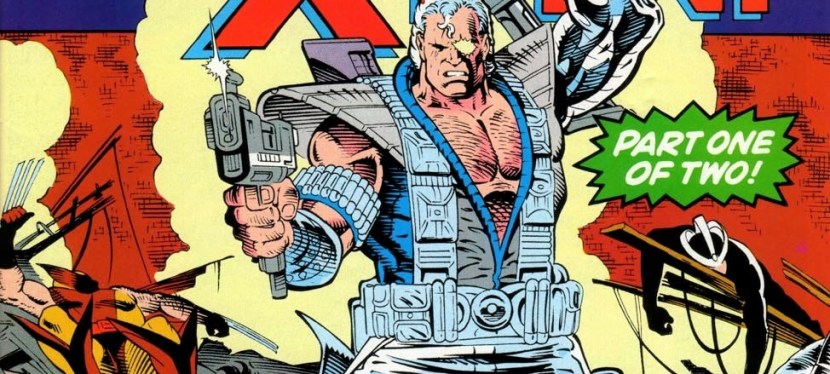
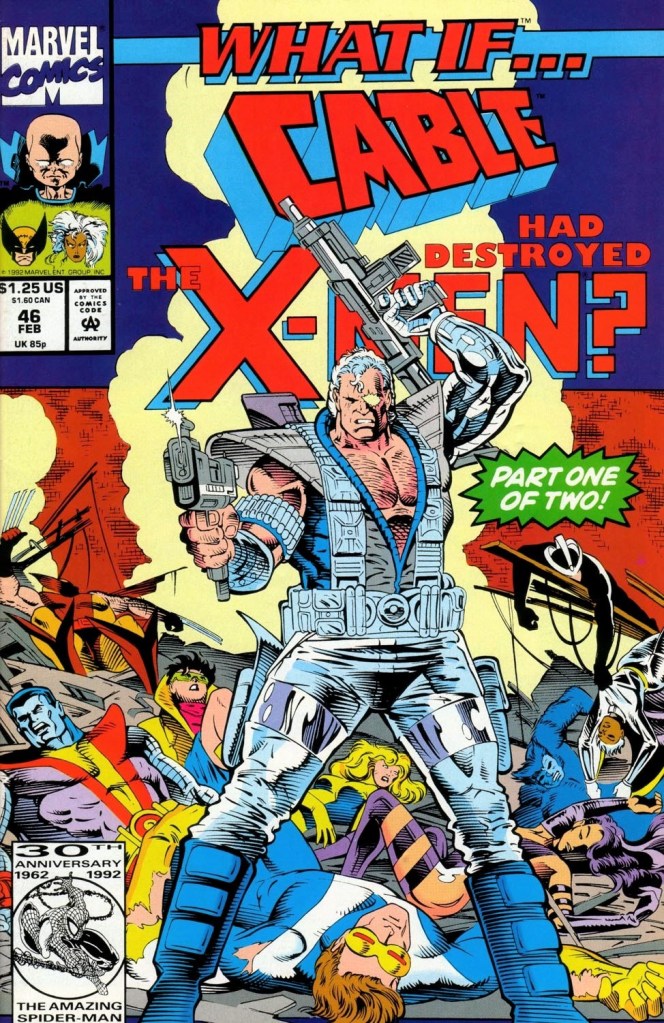
The cover.

Early story

The story begins inside a tavern in New York’s famous Central Park. Inside, Charles Xavier, Scott Summers (Cyclops) and Jean Grey have a discussion about mutant matters until a small saucer-shaped device flies inside and disrupts everything with its sonic frequency. Suddenly a second flying saucer comes in, touches Scott’s shoe and explodes powerfully killing him, Jean and Xavier. Others got injured by the explosion and the tavern ends up burning.

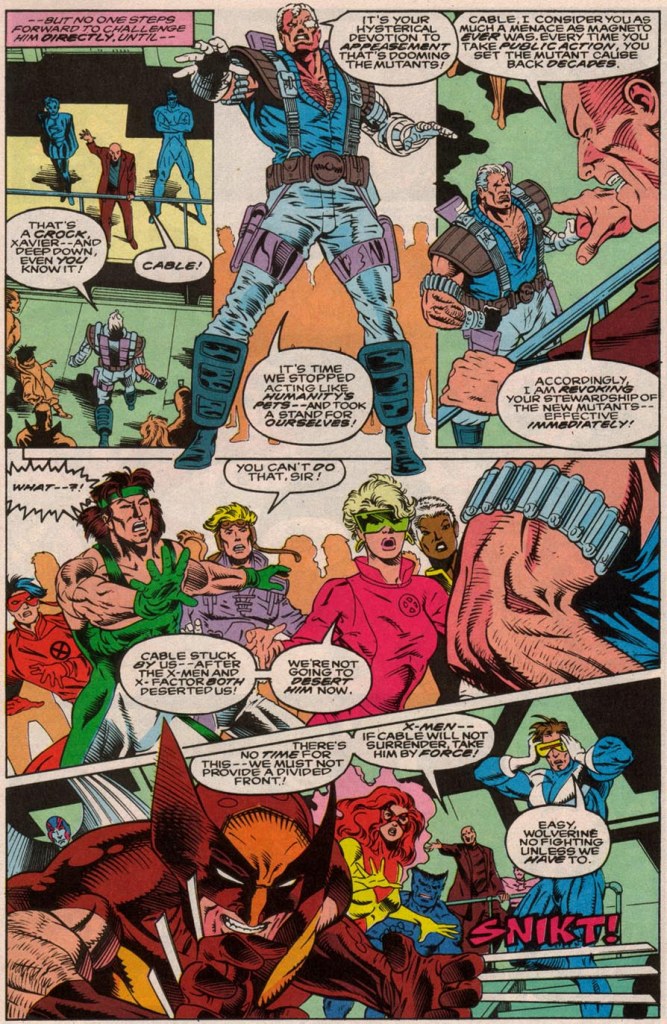
Outside the tavern, Cable is seen running away and someone points at him as someone who must be responsible for the bombing. As it turns out, the deliberate killing of Xavier, Cyclops and Jean Grey was the result of a division between Cable’s New Mutants and the X-Men in connection to the recent return of Xavier from deep space.

Quality

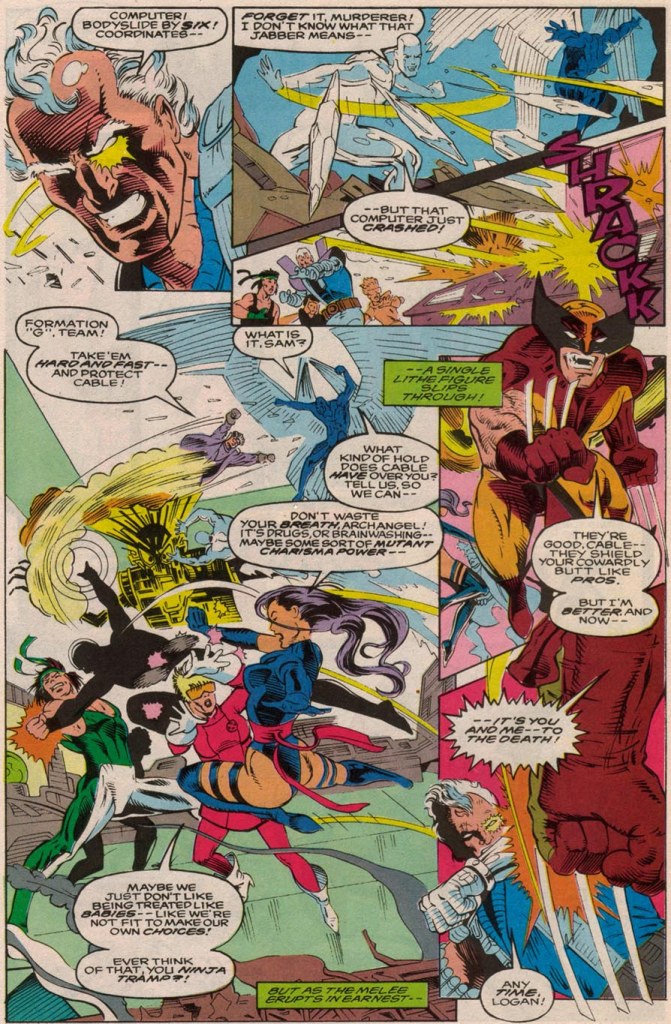
A brawl between the mutants.

I’ll start with the story Kurt Busiek came up with. This one explores an alternate time in which Charles Xavier returned to Earth (after escaping from the Skrulls in deep space) only to find the X-Men in disarray which compelled him to restore things the way they were. This is not to be confused with his return in the canon storyline of the Muir Island Saga.  

That being said, Busiek explored what would it be like had Xavier tried to resolve mutant matters not only with the team of mutants he founded but also with other teams such as the New Mutants (already led by Cable), X-Factor (Cyclops, Jean Grey, Iceman, Beast and Archangel) plus several other mutants. I really liked the way the mutants reacted to Xavier given his long absence from Earth, how his dream matters and turned out irrelevant to them as individual mutants, and if he still has what it takes to lead them. In some ways, Xavier looked like a politician trying to convince his constituents that his vision is still the best for them and their interests.

What really made the story running was the start of the division between the mutants when Cable rejects Xavier and points out that the X-Men founder’s devotion to appeasement is dooming mutants. All of these led to the shock opening scene and in terms of writing quality, it was all justified.

The scenes that happened AFTER the burial of Xavier, Cyclops and Jean Grey literally raised the stakes for the rest of the comic book. I don’t want to spoil further plot details but I can assure you all that Kurt Busiek’s script is very sold and there is so much to enjoy here especially if you are knowledgeable enough about the X-Men and the other parts of the Marvel Comics universe (note: the Avengers, Stryfe, Freedom Force and Fantastic Four also appeared).

Visually, the work of Tod Smith looks a bit rushed. His art here is not bad but I felt it could have been better had there been more time to polish his work. In fairness to Smith, his drawings on most of the characters still made them recognizable and he showed pacing with regards to the panels and angles used. I should say he does a decent job showing multiple characters fighting each other simultaneously.

Conclusion

If you were a mutant, would you follow Charles Xavier or Cable?

If you ask me, What If (1993) is pretty entertaining and engaging to read thanks to the strong writing as well as the daring exploration of how the comic’s main story impacts others within the Marvel Comics universe. It has drama, action, intrigue and most notably it explores a new concept about how the X-Men would turn out after the death of their founder. It also raises questions on whether or not the X-Men are doomed without Charles Xavier’s presence.

If you are seriously planning to buy an existing hard copy of What If (1993), be aware that as of this writing, MileHighComics.com shows that the near-mint copy of the regular edition costs $40 while the near-mint newsstand edition costs $120.

Overall, What If (1993) is recommended.

+++++

Thank you for reading. If you find this article engaging, please click the like button below and also please consider sharing this article to others. If you are looking for a copywriter to create content for your special project or business, check out my services and my portfolio. Feel free to contact me as well. Also please feel free to visit my Facebook page Author Carlo Carrasco and follow me at HavenorFantasy@twitter.com
A Look Back at What If #20 (1990)

Disclaimer: This is my original work with details sourced from reading the comic book and doing personal research. Anyone who wants to use this article, in part or in whole, needs to secure first my permission and agree to cite me as the source and author. Let it be known that any unauthorized use of this article will constrain the author to pursue the remedies under R.A. No. 8293, the Revised Penal Code, and/or all applicable legal actions under the laws of the Philippines.

Welcome back superhero enthusiasts, comic book collectors, 1990s culture enthusiasts and fans of Marvel Comics! Before starting this newest retro comic book review, I should state that I really like Marvel’s way of exploring the unexplored scenarios related to the stories they published. Back in the 1980s, Marvel made its decision to have their icon Spider-Man – in his civilian form as Peter Parker – get married with Mary Jane Watson. Unsurprisingly, such an event added a whole lot of new elements into the life of the literary Spider-Man with regards to his struggle on balancing his life between superhero acts, domestic living and being attentive to his wife. If you really want to read about the wedding, I suggest searching for a copy of The Amazing Spider-Man Annual #21 (1987).

Imagine what would have happened had Spider-Man not married Mary Jane? That very scenario was explored in an issue of the What If monthly series (Volume 2) back in the early 1990s. We can find out more together in this look back at What If , published by Marvel Comics in 1990 with a story written by Danny Fingeroth and drawn by Jim Valentino.

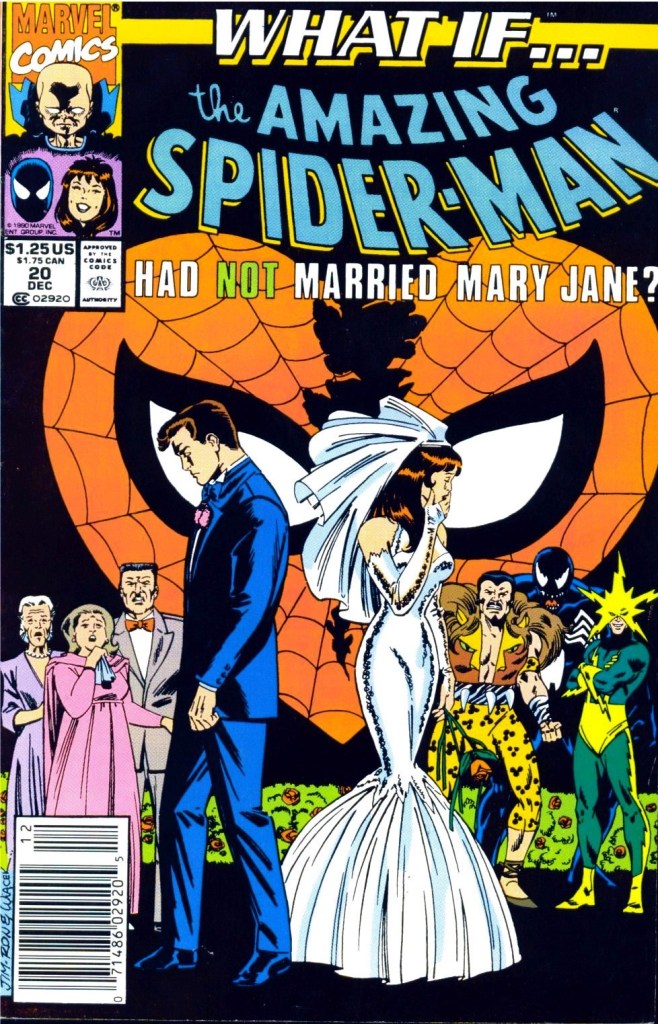
The cover.

Early story

The story begins with the Watcher narrating key events in the life of Spider-Man. It is recalled how much pain Spider-Man endured when his beloved Gwen Stacy died during his conflict with the Green Goblin. Subsequently Peter Parker resumed his relationship with Mary Jane. When Mary Jane became absent, he got involved with Felicia Hardy/Black Cat who turned out to be too wild and reckless for him. Eventually, Peter married Mary Jane.

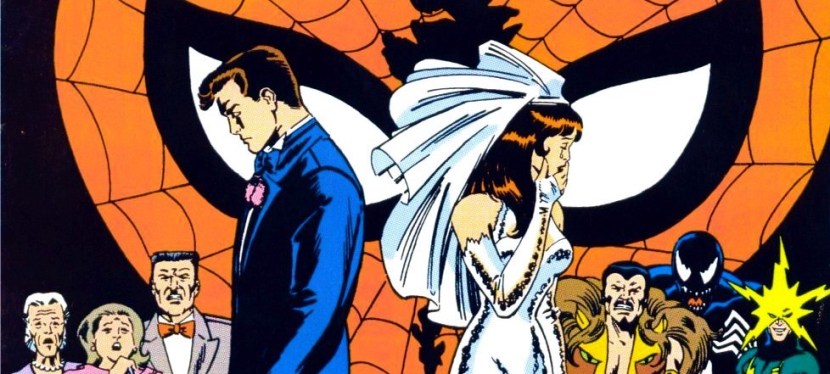
By pointing out that there are other realities, the Watcher then begins to explore another scenario in which Spider-Man realizes is far from being all right with him. During the wedding ceremony, Peter turns down Mary Jane which shocks the guests who were present. He tells her privately that even though he loves her, she will be in danger all the time as a wife. She walks away from him, still wearing her wedding dress.

Some hours later, Spider-Man swings around New York and strikes the criminals really hard…

Quality

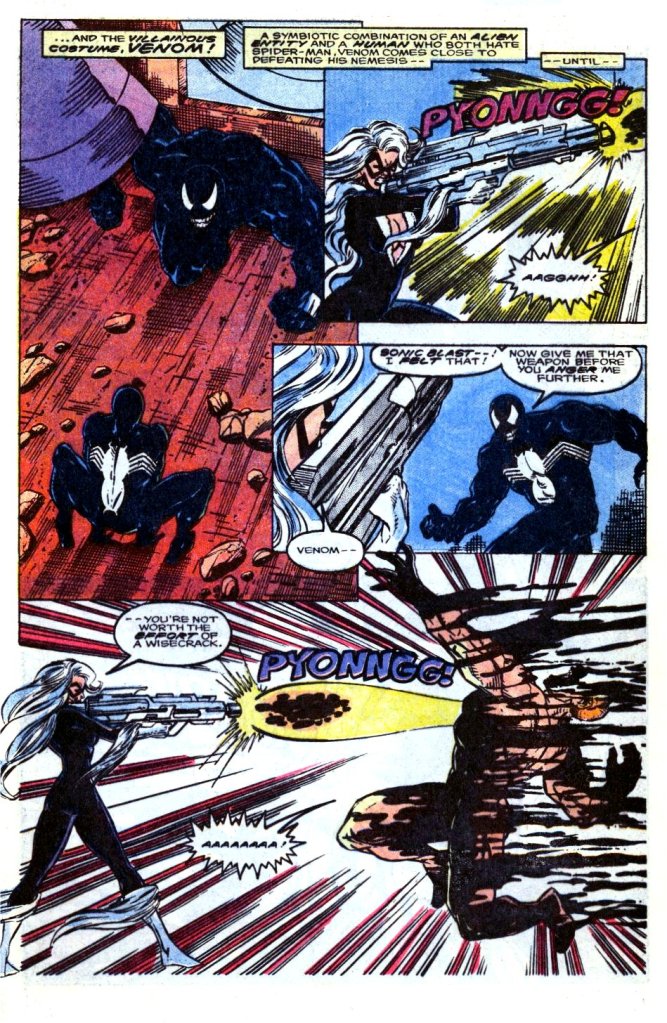
Spider-Man and Black Cat take on Venom!

To be clear, this comic book shows a Spider-Man who not only rejected marriage, but is also a tortured soul whose inner pain started even before the failed wedding ceremony. Silver Sable, who is often focused on missions, notices Spider-Man being too angry and careless with his performance with them taking on the bad guys. The old and frail Aunt May is deeply worried over Peter and hopes he would not harden his heart to the possibility of loving someone.

The thing about this story is that the writing done by Danny Fingeroth is pretty good as he captured Spider-Man’s essence while successfully steering him pretty close to the edge, almost blurring the boundary the separates the good and evil in him. The story moved with a nice pace and there is a good amount of suspense that will keep you wondering if Spider-Man can climb out of the deep hole of darkness he’s in.

More on the plot, I also enjoyed this comic book’s connection with Kraven’s Last Hunt and the early encounter with Venom. If there is any weak point with this story, it is the fact that it served as build-up of something set to happen in the next issue.

When it comes to the art, Jim Valentino did a good job bringing the script to life and that includes framing the character development scenes and the spectacle scenes in interesting ways. I personally enjoyed his take on Venom and Kraven.

Conclusion

Without Mary Jane as a wife, Spider-Man went on to fight the bad guys more intensely.

What If (1990) is indeed a solid, alternate story about Spider-Man. It was gripping right from the start but it lacked a solid conclusion as its last few pages started to build up anticipation for the following issue. In short, this is not a standalone story and to fully enjoy what it started, you have to read What If #21. Still, I love the way Spider-Man is portrayed here and there are some characters involved that long-time fans will enjoy.

If you are seriously planning to buy an existing hard copy of What If (1990), be aware that as of this writing, MileHighComics.com shows that the near-mint copy of the regular edition costs $53 while the respective near-mint copies of the newsstand edition and the signed edition both cost $105.

Overall, What If (1990) is recommended.

+++++

Thank you for reading. If you find this article engaging, please click the like button below and also please consider sharing this article to others. If you are looking for a copywriter to create content for your special project or business, check out my services and my portfolio. Feel free to contact me as well. Also please feel free to visit my Facebook page Author Carlo Carrasco and follow me at HavenorFantasy@twitter.com

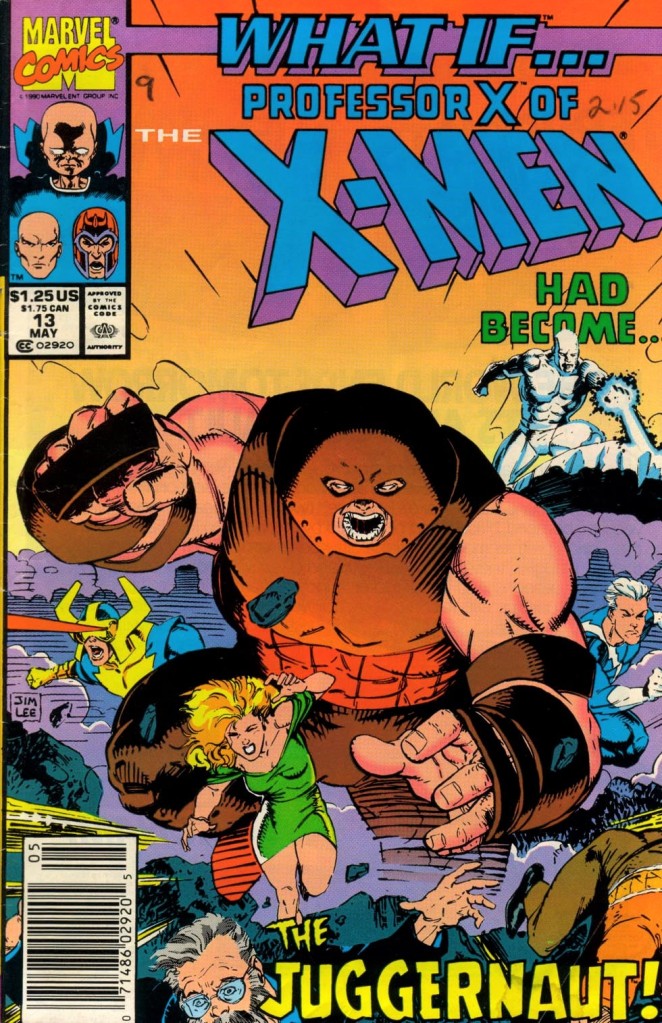
A Look Back at What If #13 (1990)

Disclaimer: This is my original work with details sourced from reading the comic book and doing personal research. Anyone who wants to use this article, in part or in whole, needs to secure first my permission and agree to cite me as the source and author. Let it be known that any unauthorized use of this article will constrain the author to pursue the remedies under R.A. No. 8293, the Revised Penal Code, and/or all applicable legal actions under the laws of the Philippines.

Welcome back superhero enthusiasts, comic book collectors and X-Men fans. I’m about to review an issue of Marvel Comics’ What If monthly series which was published 1990 and was related to the X-Men as the central figure of the comic book is Charles Xavier (AKA Professor X).

To put things in perspective, Charles Xavier is forever known as the founder and leader of the X-Men. Within the Marvel Comics universe, he is one of the most powerful telepaths as well as a genius in science and genetics. He is a paraplegic who can do quite a lot and make an impact on the delicate relationship between his fellow mutants and the humans. In the movies, Xavier was portrayed by Patrick Stewart (first performance as Xavier in X-Men) and James McAvoy (first performance as Xavier in X-Men: First Class). Given his legacy of helping mutants gain rights through peaceful means, Charles Xavier has been compared with Martin Luther King, Jr. Going back to the comics, Xavier has a step brother named Cain Marko who became the X-Men villain Juggernaut.

With the background lesson done, we can now take a look back at What If , published by Marvel Comics in 1990 with a story written by Kurt Busiek and drawn by Vince Mielcarek.

The cover drawn by Jim Lee.

Early story

The story begins in New York in the so-called near future. Graffiti artists attempt to run away from a team of mutants riding a floating vehicle. As Thunderbird is about to hit one of the humans, Cyclops stops him. Suddenly the mutants receive a telepathic message from their big boss who turns out to be Charles Xavier the Juggernaut.

Xavier is leading the effort against a group of humans who have been conspiring against them. Xavier declares, “They must be stopped—for the good of mutantkind!”

The X-Men in this particular story are fascist storm troopers policing a wretched, helpless humanity…

Quality

Xavier-Juggernaut with the X-Men and the invading Fantastic Four.

I can start by say that this comic book written by Kurt Busiek has one of the most compelling what-if scenarios that reflect not only its concept (of Charles Xavier becoming Juggernaut) but also the Marvel Comics universe as we know it. As dedicated X-Men fans know, Cain Marko was the one who touched the ruby in the cave which made him the mainstream Juggernaut. In here, the scenario was altered to make Charles Xavier become Juggernaut and the radical changes did not end there. Without spoiling the great stuff, I can say that this is one great exploration of an alternate version of events that affect not only the X-Men and their villains but also the many other superheroes of the Marvel universe as Xavier-Juggernaut went all-out with his dedication to mutantkind. I can say that in this story, symbolically speaking, Xavier easily outclasses the extreme Magneto on prioritizing mutants over humans.

Comic book concept aside, Kurt Busiek’s writing here is really excellent. Not only did he capture the traits of Xavier as he turned him into the alternate Juggernaut, Busiek also emphasized the many twisted events in the Marvel shared universe with sufficient details. The details implemented made the scenarios really believable. His script for this comic book was brought to life by Vince Mielcarek who did a good job making the characters recognizable (note: there were a lot of superheroes and villains here), showcasing the wide scope of changes made on people and places (in relation to Xavier-Juggernaut’s actions) and there was good pacing with the visuals.

Conclusion

Charles Xavier as you’ve never seen him before.

What If (1990) is great to read and it is a must-have with its story alone. Apart from showing the concept’s deep impact on the Marvel Comics universe, I also enjoyed the way Kurt Busiek blurred the boundaries that separated good and evil. If you are an X-Men and you want to see something different with the mutants – especially Professor X – then you you will find a lot to enjoy here. This is a great alternate superhero story and definitely more people should be aware of this.

If you are seriously planning to buy an existing hard copy of What If (1990), be aware that as of this writing, MileHighComics.com shows that the near-mint copy of the regular edition costs $30 while the near-mint copy of the newsstand edition costs $60.

Overall, What If (1990) is highly recommended!

+++++

Thank you for reading. If you find this article engaging, please click the like button below and also please consider sharing this article to others. If you are looking for a copywriter to create content for your special project or business, check out my services and my portfolio. Feel free to contact me as well. Also please feel free to visit my Facebook page Author Carlo Carrasco and follow me at HavenorFantasy@twitter.com