In its continuing fight against Leftist and terrorist forces, the National Task Force to End Local Communist Armed Conflict (NTF-ELCAC) reminded the public that the National Democratic Front (NDF) is still the top “terror-groomer” in the country, according to a Philippine News Agency (PNA) news article.
To put things in perspective, posted below is an excerpt from the PNA news report. Some parts in boldface…
The National Democratic Front (NDF) remains the “foremost terror-groomer” among the various terrorist groups still operating in the country, the National Task Force to End Local Communist Armed Conflict (NTF-ELCAC) has said.
“Even in the CPP’s (Communist Party of the Philippines) 2016 Constitution, under Article 10, it shows that the NDFP (National Democratic Front of the Philippines) is an integral and inseparable part of the CPP-NPA (New People’s Army). It is the core and most consolidated group that provides support to the armed and organizational expansion of the CPP,” NTF-ELCAC executive director Undersecretary Ernesto Torres Jr. said in a statement Tuesday night.
Torres said the pervasive threat posed by the NDF, established 51 years ago on April 24, 1973, undermines the very fabric of Filipino society.
The NDF’s orchestration of worker strikes, student boycotts, and protests aimed at destabilizing the government underscores the imperative to confront their malevolent agenda, he added.
“These duplicitous organizations thrive on the suffering of the Filipino people, deceiving innocent individuals to join their corrupted cause and needlessly perish for it,” Torres said.
He added that the CPP-NPA-NDF has methodically recruited innocent Filipinos into their armed components, perpetrating terrorist activities nationwide through its deceptive facade of front organizations.
Torres also said the insurgents’ exploitation of vulnerable sectors and their manipulation of social issues have sown seeds of violence and anarchy in marginalized communities.
He noted that the targeted recruitment of vulnerable sectors, such as students and youth for terrorist grooming, is part of the “intricate dynamics” of the Underground Mass Organizations (UGMOs) of the CPP-NPA-NDF and their front organizations.
He emphasized the overarching authority of the NDF across diverse sectors within the CPP-NPA-NDF network nationwide.
Let me end this piece by asking you readers: What is your reaction to this recent development? Are you concerned that there could be members of your local community who might be undergoing brainwashing under the NDF or any Communist-filled organization? Do you think there are a lot of secretive Communists among the teachers in schools around the country right now? Are you ready to report any Leftist or terrorist agents to the NTF-ELCAC?
Welcome back superhero enthusiasts, 1980s culture enthusiasts and comic book collectors! Today we go back to the early 1980s to explore Marvel Comics’ extensive publishing of a comic book series based on the wildly popular military-themed franchise of toys – G.I. Joe: A Real American Hero.
Last time around, G.I. Joe found itself getting attacked within their own base (The Pit) as a result of the robot they brought in from a stronghold of their terrorist rival Cobra. It was a Trojan plan that Cobra Commander and his team organized from far away and they almost succeeded.
With those details laid down, here is a look back at G.I. Joe: A Real American Hero #10 published in 1983 by Marvel Comics with the main story written by Larry Hama and drawn by Mike Vosburg.
The cover.
Early story
The story begins with G.I. Joe members Scarlett, Snake-Eyes and Zap reach the top of a tall New York City building that could be another stronghold of Cobra. On the street just outside of the same building, other Joe members located inside a van on the street and in the sewers carefully make their moves to ensure their operation will succeed.
Behind the scenes inside the building, the Baroness is informed of the Joes’ presence. This causes the top of building’s roof to open causing Snakey-Eyes, Scarlett and Zap to fall down into a room. In response, the Joe members inside the van make their move into the building save Scarlett and her two teammates…
Quality
A few of the Joes captured by Cobra, and Snake-Eyes got heavily restrained.
This is another clever story written by Larry Hama highlighting the rivalry between G.I. Joe and Cobra without emphasizing the usual action-packed battles between them. Instead, this tale emphasizes Cobra being more resourceful than meets the eye. What I mean is that the terrorists here are not limited to their military culture and weapons as they also have the means to conduct scientific experimentation, establishing spies among civilians (including minors) and even having American towns as their tactical fronts.
In many ways, this tale shows Cobra being a very diversified terrorist organization that also mastered the uses of disguise and imagery to hide themselves from American authorities right there in America. The town of Springfield symbolizes Cobra’s use of ground level fronts to hide their secret underground stronghold from being spotted which is eerily similar to how Palestinian terrorist group Hamas uses schools, hospitals and other establishments in the Gaza strip to hide their tunnels and operation places deep under. The portrayal of American minors being junior officers of Cobra is really disturbing as it reminds me of the fact that in reality, Palestinian terrorists (note: the Palestinian Authority is corrupted and practices apartheid) have brainwashed their minors to hate and to murder Jews. I should add that the Palestinian terrorists, Hamas, the United Nations (UN), Amnesty International and the many Leftist leaders of nations formed the global axis of evil we know today.
As for the characters, the new kid here is easily the most notable addition and you have to read the comic book to find out why. For the more established characters, you will see Snake-Eyes helpless and Scarlett being really vulnerable in the dream world. On the side of Cobra, Dr. Venom has really fascinating interpretations and observations about the readings of the scientific operations.
Conclusion
The other G.I. Joe members scramble to rescue their teammates.
G.I. Joe: A Real American Hero #10(1983) is very engaging and intriguing to read from start to finish. This comic book, which is clearly a piece of fantasy, also served as an intriguing reminder that terrorists in the real world (read: Iran, Palestinian terrorists, Hamas, Hezbollah, ISIS and others) are capable of securing or stealing large financial resources for themselves and expand their operations to infiltrate societies and take advantage of the ignorant and helpless members to be part of their wicked causes. There were indeed lots of parallels between Cobra and the Palestinian terrorists.
Overall, G.I. Joe: A Real American Hero #10(1983) is recommended.
Let’s be clear here – the Left is inherently evil. That being said, we should focus on the current state of conflict between the Armed Forces of the Philippines (AFP) and the Left as the military announced recently that the Communists have been greatly weakened during the first eight months of this year, according to a Philippine News Agency (PNA) news article.
To put things in perspective, posted below is an excerpt from the PNA news article. Some parts in boldface…
The New People’s Army (NPA) and its allies have been greatly weakened after suffering heavy losses from January to August this year, Armed Forces of the Philippines (AFP) chief Gen. Romeo Brawner Jr. said Thursday.
In a forum organized by the Foreign Correspondents Association of the Philippines (FOCAP), Brawner said the AFP has neutralized 2,658 NPA members and their supporters from Jan. 1 to Aug. 17 this year.
Of this number, 124 were killed during encounters with military forces, while 87 were arrested and 2,447 surrendered to the government, he said.
“As far as the communist terrorist group is concerned, we are again happy to report that we have already neutralized most of the guerrilla fronts operating in the country. We have weakened a lot of them and there are now just a few armed elements operating in the country,” Brawner said.
With these constant losses, he said, they are seeing a “downward trend of the number of communist coddlers” caused by the neutralization of many of their ranking leaders.
“We are very happy because since last year, with the neutralization of their top, their key leaders, we have seen a widespread surrender of fighters, and also with the death of (Communist Party of the Philippines founder Jose Maria) ‘Joma’ Sison, now we see that they (are) losing the ideology,” Brawner said.
“And with this decline, many of the surviving NPAs could be just classified as bandits as they are engaged in extortion rackets.”
He noted the possibility of the AFP “neutralizing” the NPA by the end of the year.
Let me end this piece by asking you readers: What is your reaction to this recent development? Do you think the Satanic Left here in the Philippines are still a threat to your family and your local community? Are there many Leftists living in your local community right now? Are you aware that mainstream news outlets like CNN, The New York Times and MSNBC all emphasize Leftist concepts in their so-called news reports? Are you aware that Democrats in America are inspiring young Filipinos to become socialists, Marxists, Communists, SJWs, homosexuals and terrorist supporters?
Disclaimer: This is my original work with details sourced from reading the comic book and doing personal research. Anyone who wants to use this article, in part or in whole, needs to secure first my permission and agree to cite me as the source and author. Let it be known that any unauthorized use of this article will constrain the author to pursue the remedies under R.A. No. 8293, the Revised Penal Code, and/or all applicable legal actions under the laws of the Philippines.
Welcome back superhero enthusiasts, 1990s culture enthusiasts and comic book collectors! Today we go back to the year 1996 and explore a part of the Marvel 2099 comics universe through a tale of the Spider-Man 2099 monthly series.
In my previous retro review, the futuristic webslinger encountered Goblin 2099 (note: the futuristic take on Green Goblin) who proved to be very dangerous not with weapons nor physical attacks but with influence members of the local society to rebel against him believing that he is a corporate asset. How much influence Goblin had on the people at the expense of Spider-Man is just waiting to be discovered.
With those details laid down, here is a look back at Spider-Man 2099 #41, published in 1996 by Marvel Comics with a story written by Peter David and drawn by Andrew Wildman
The cover.
Early story
The story begins with Miguel O’Hara visiting a ruined place with armed personnel escorting him. It turns out the site was the White House and Doom 2099 has already fallen as President of the United States. Miguel seeks closure as he spends time at the ruins and eventually finds the name plate from the office of Tyler Stone (Miguel’s biological father).
Meanwhile at Alchemax, corporate personnel got surprised to see Tyler Stone return confined to a hovechair due to his fragile and weakened state. This turned out to be his first time to be at work since he got shot.
Inside the laboratory, Tyler sees his deranged son Kron (Venom 2099) contained behind solid glass like a mere scientific specimen for study. After learning key details about the symbiote and how it affected his son, Tyler gives the order to have Kron executed…
Quality
Even though Goblin 2099 was not present, this scene shows how much the said villain poisoned the minds of people to harm Spider-Man.
Let me start with the writing by Peter David. It is clear to me that David confidently wrote this story to maintain the flow of intrigue, emphasize how local society’s changing, how the external events affect others and, most notably, managing to push Spider-Man 2099 to the edge complete with a brewing conflict with the very powerful Tyler Stone.
At this stage of the monthly series of the 1990s, Miguel O’Hara’s rise within the corporate structure of Alchemax got emphasized again and Peter David inserted growing tensions for the protagonist effectively blurring the boundary that separates personal life from the corporate career. That being said, the futuristic Spider-Man in his civilian identity literally entered a gray area which will compel readers to speculate if he was still in control of matters or if he was slowly becoming evil as he gains power (this makes him comparable with the tycoon Tyler).
Still on the character development aspect of this comic book, Miguel here still showed his fragile side as the death of Dana left him with a lot of pain deep inside (which was dramatically emphasized by Andrew Wildman through his art in one very particular page). This furthers adds to questions about the sanity and mental stability of the protagonist who already wields so much power as Spider-Man and as an Alchemax executive.
Speaking of Alchemax, Tyler Stone here appeared more sinister than before and being unable to stand did not hinder him at all. His cold-hearted move to have his own biological son Kron (the futuristic Venom and the same guy responsible for the deaths of Punisher 2099’s family) executed clearly shows not only his sadistic nature but also the fact that he is living with pure worldly beliefs. His believes are so worldly, he does not really care about his own offspring. Ironically, this suggests that Tyler could be as twisted and evil as his murderous son Kron. Lastly, the connections between the late Dana and Tyler and Miguel is indeed morally disturbing.
While the cover art showed Goblin 2099, the new antagonist is nowhere to be found in this comic book. However in a very symbolic fashion, Goblin’s influence remained lively through a number of people who condemned Spider-Man 2099 so much, they went as far as actually hurting an idolater of the webslinger. This part of the story is a strong reminder that idolatry is unholy and foolish, that religion is corrupted and will never lead believers to salvation, and that socialism attacking capitalism remained a social disease in the far future.
Conclusion
Tyler Stone and his son Kron (Venom 2099) are both very evil. They have different ways of being evil.
Spider-Man 2099 #41 (1996) is indeed a great comic book to read from start to finish. Not only will you get to see the futuristic Spidey struggle with the tension both personally and professionally, you will see the big impact of Dana’s death on him too. The portrayal of negative changes in the local society (at least the society Spider-Man is part of) is pretty dramatic and what Peter David imagined about Marvel 2099 still remains socially relevant to this day. Lastly, this comic book ended very powerfully and was enough to convince me to see what happens next.
Overall, Spider-Man 2099 #41 (1996) is highly recommended!
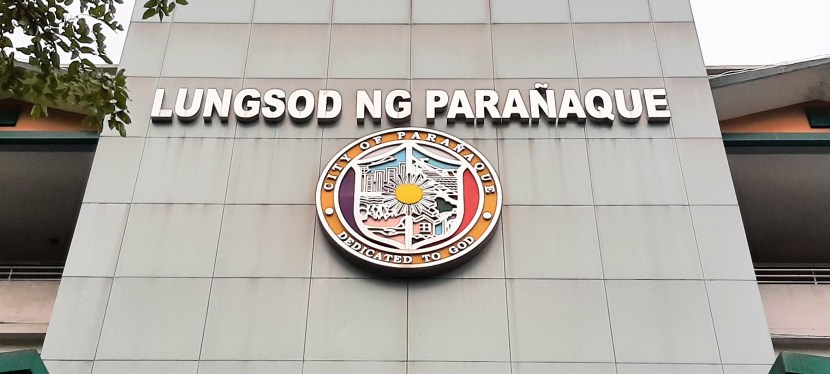
Recently in Parañaque City, police officers arrested an active member of the New People’s Army (NPA) who has been wanted for murder, according to a Philippine News Agency (PNA) news report. The arrest took place at Barangay San Dionisio.
To put things in perspective, posted below is an excerpt from the PNA news report. Some parts in boldface…
A member of the New People’s Army (NPA) facing murder charge was nabbed during a manhunt operation conducted by operatives of the Police Regional Office-Bicol (PRO5) in Parañaque City on Tuesday, a police report said.
In an interview on Wednesday, Lt. Col. Malu Calubaquib, PRO5 spokesperson, identified the suspect as Ferdinand Nolasco, 42, an active NPA member belonging to Platoon 3, Komite ng Probinsya 3 of the Albay Bicol Regional Party Committee (BRPC).
“He is being indicted with the crime of murder with no bail recommended issued by the court,” she said.
Calubaquib said Nolasco was tracked down after the conduct of surveillance and intelligence operations starting in April.
He was finally arrested around 5:20 p.m. in Barangay San Dionisio after the service of a warrant of arrest by joint personnel of the different units of the Philippine National Police (PNP) and the Philippine Army (PA).
Let me end this piece by asking you readers: What do you think about this recent development? If you are a Parañaque City resident, are you concerned that there could be more Communists/socialists/Marxists who previously committed murder and could be living within your local community? Did you notice if your family members seem to be under the influence of the Satanic Left?
For more South Metro Manila community news and developments, come back here soon. Also say NO to fake news, NO to irresponsible journalism, NO to misinformation, NO to plagiarists, NO to reckless publishers and NO to sinister propaganda when it comes to news and developments. For South Metro Manila community developments, member engagements, commerce and other relevant updates, join the growing South Metro Manila Facebook group at https://www.facebook.com/groups/342183059992673
Disclaimer: This is my original work with details sourced from reading the comic book and doing personal research. Anyone who wants to use this article, in part or in whole, needs to secure first my permission and agree to cite me as the source and author. Let it be known that any unauthorized use of this article will constrain the author to pursue the remedies under R.A. No. 8293, the Revised Penal Code, and/or all applicable legal actions under the laws of the Philippines.
Welcome back superhero enthusiasts, 1990s arts and culture enthusiasts, Marvel Comics fans and comic book collectors! Today we go back to the wild 1990s and explore the far future of 2099 within the Marvel Comics shared universe through one of the tales of Spider-Man 2099.
In my previous retro review, the futuristic Spider-Man got involved with his era’s version of Vulture (Vulture 2099 to us readers). It turns out, Vulture 2099 is not your typical evil supervillain but the leader of a group of violent radical people who are willing to dominate society with a destructive mindset even though there are other opposing groups around them. And then Spidey 2099 realized something very wrong about the Vulture which leads to a big battle between them.
With those details laid down, here is a look back at Spider-Man 2099 #8, published in 1993 by Marvel Comics with a story written by Peter David and drawn by Rick Leonardi.
The cover.
Early story
The story begins with Spider-Man 2099 and Vulture 2099 crashing into the interiors of the ancient St. Patrick’s Cathedral located in old New York City (underneath the modern city). Unsurprisingly, the people inside the cathedral got very surprised about the unexpected entry of the two fighters.
Elsewhere, Miguel O’Hara’s brother Gabriel helps Kasey with her head. She tells him that she saw Miguel but Gabriel does not believe her. Suddenly, members of a gang knock on the door and Kasey opens it.
Inside St. Patrick’s Cathedral, the fight between Spider-Man and Vulture continues. Spider-Man remembers that he has lapsed as a Catholic and he feels very uneasy about the trouble he and his enemy are causing inside the old church structure. Vulture suddenly throws a wooden bench at Spidey but breaks open a glass window and then goes outside. Upon looking outside, Spider-Man notices a group of Vulture’s gang…the Freakers.
Quality
The battle between Spider-Man 2099 and Vulture 2099 is intense and very compelling to read.
Here is the good news about this comic book…the story here is a fitting conclusion to what happened in issue #7. The conflict between Spider-Man and Vulture here was carefully crafted and there were several key moments or scenes the provided readers some breathing room to grasp and understand the society of 2099 New York as well as the conflict between the downtown social groups who are deprived of the higher standard of living many miles above them. In some ways, the social divisions portrayed in this comic book is a sad reminder about modern day America and the many radical groups or gangs of people who divide society on race, ethnicity, social class, gender and ideology.
As expected, there is a lot of action executed in the fight between Spider-Man and Vulture of 2099 but there were pauses in between. This is not surprising considering how Peter David crafted the action-packed battles Spidey 2099 had with other enemies in the comic books released before this one. Without spoiling what happened, I can say that the battle between the two was nicely built-up and the conclusion turned out very satisfying to see.
Still on the story, Peter David added some layers of complexity into the conflict that easily made things much more difficult for Spider-Man 2099 on a personal level. I’m talking about his brother Gabriel and Kasey getting involved in the gang war against the Freakers.
Vulture 2099 is once again a standout opposition figure here. Not only is his ability to fly and cause chaos above his obsessed Freakers below is symbolic, his distorted, hardcore beliefs are reflected with his unrelenting use of violence as he fights Spider-Man. Not only that, he turns out to be very philosophical thanks to the rich dialogue Peter David came up with. It is also here that the futuristic Vulture is opposed to God and being the socialist-indoctrinated person he is, he easily blames Alchemax for God’s absence. This should remind you that through Vulture 2099, evil comes with fatal attraction that people could not realize until it is too late. The futuristic Vulture has a lot of common with the evil leaders of Black Lives Matter, Antifa, the Democratic Socialists of America and the long-time regime of Iran. Lastly, I should state that radical socialists are always wrong about God and they often live with distorted perceptions about Him. Vulture 2099 qualifies as a woke figure of 2099 and ultimately wokeness is foolishness.
Speaking of sub-plots, this comic book emphasizes Tyler Stone on how he handles ambitious projects of Alchemax that he believes will benefit people. His interactions with Dana here also sheds light about his very own obsession about the future of humanity.
Conclusion
Spider-Man in trouble with the Vulture’s gang members.
With rich writing, notable in-story details and a very well designed conflict between the futuristic Spider-Man and Vulture, Spider-Man 2099 #8 (1993) is both very engaging and entertainting to read from start to finish. It is a great pay-off to what was built-up in issue #7. Very notably, the conflict between Vulture 2099 and the protagonist is great to see and it is clear that Vulture is not a disposable supervillain but one of the most definitive forces of opposition against Spider-Man 2099. Of course, as comic book history turned out, Vulture 2099 made it in the crossover comic book event between classic Spider-Man and Spidey of 2099. Along the way, the creative team succeeded with expanding the lore of 2099 and the social underclass of New York.
Disclaimer: This is my original work with details sourced from reading the comic book and doing personal research. Anyone who wants to use this article, in part or in whole, needs to secure first my permission and agree to cite me as the source and author. Let it be known that any unauthorized use of this article will constrain the author to pursue the remedies under R.A. No. 8293, the Revised Penal Code, and/or all applicable legal actions under the laws of the Philippines.
Welcome back superhero enthusiasts, 1990s arts and culture enthusiasts, Marvel Comics fans and comic book collectors! Today we go back to the year 1993 and explore a part of Marvel Comics’ universe through the first-ever limited comic book series featuring one of Marvel’s most iconic supervillains – Venom.
Previously, I wrote about Venom with his appearances in What If comic books (click here and here) as well as in issues of Venom: Lethal Protector (click here and here). Venom also appeared in the disappointing crossover comic book Spider-Man Meets Spider-Man 2099.
Moving back to the year 1993, the Venom: Lethal Protector limited series ended and Marvel went on to release a 2nd limited series composed of three issues complete with an all-new creative team. That series was Venom: Funeral Pyre and the most notable thing is that Venom gets to be with the Punisher (read my other retro reviews that include the character here, here, here and here).
With those details laid down, here is a look back at Venom: Funeral Pyre #1 published in 1993 by Marvel Comics with a story written by Carl Potts and drawn by the late Tom Lyle.
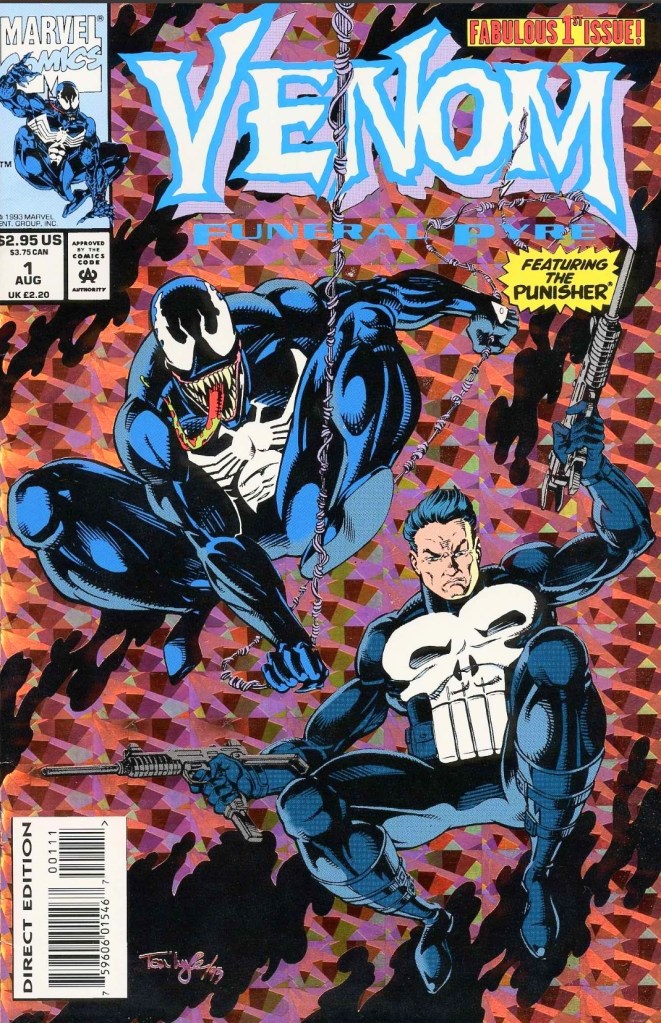
The cover.
Early story
The story begins on the streets of Oakland, California. There, a young guy named Gray Russell watches gang members severely beat up another guy which disturbs him deeply. He is part of the gang. A short time later, he rides with the gang in a car which hits a man (who managed to have his young nephew move out of harm’s way).
Somehow the man survived and moves to another direction deliberately to lure the gang away from his nephew. As the gangsters move towards a local building, Gray separates from his harsh companions to find a phone booth. Gray finds Calvin (the nephew of the man who got hit) nearby and decides to comfort him. From a distance, they heard the gangsters beat Calvin’s uncle to death.
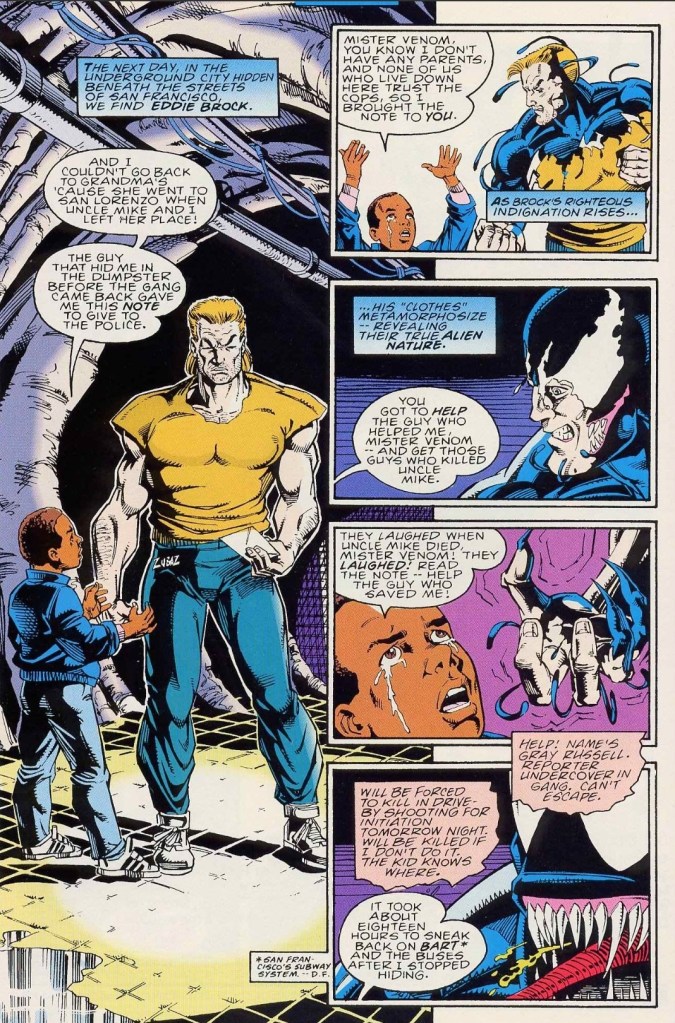
The next day in the underground city beneath San Francisco, Calvin meets Eddie Brock and hands him a note meant for the police. As Calvin reveals more details, Eddie gradually turns into Venom with his alien costume covering up his body. After learning of the death of Calvin’s uncle and hearing the young boy’s plea for help for Gray (an investigative reporter in secret within the gang), Venom agrees to help him as it is their mission to save the innocent and destroy the guilty…
Quality
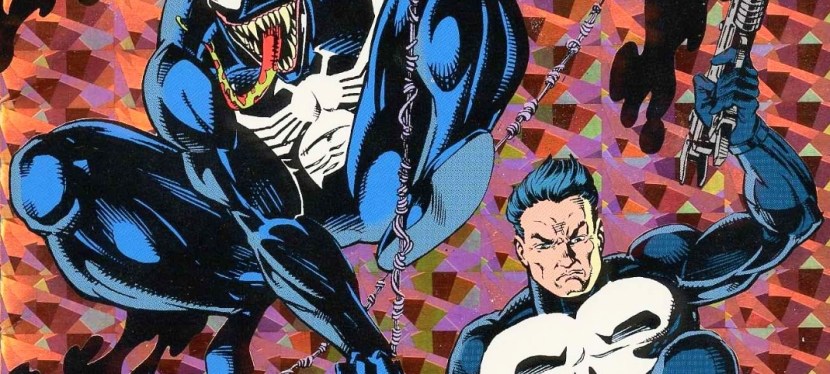
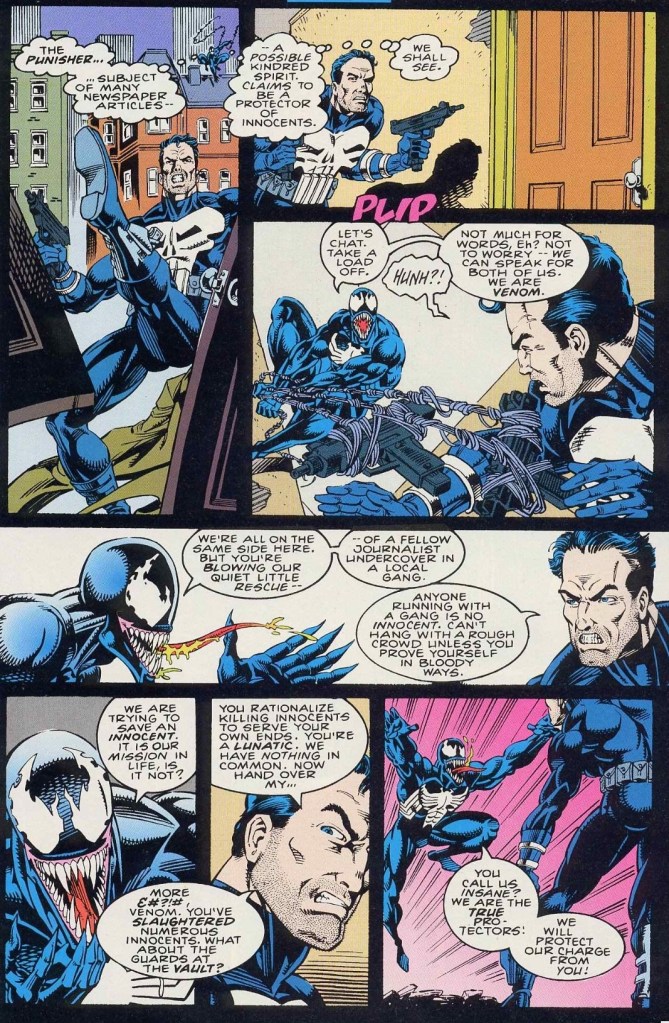
Punisher and Venom’s first-ever encounter with each other.
I want to start first the with the overall presentation crafted by the Potts-Lyle creative duo. In terms of story and setting, this comic book has a very strong urban crime vibe which is not a surprise given the fact that Carl Potts wrote lots of stories of the Punisher and his personal war against criminals. That being said, the tone is very different compared to what was shown in Venom: Lethal Protector and other Venom tales that got published before this comic book. Very clearly, this story is dark, gritty and even disturbing to read due to the subject matter of crime and senseless violence caused by people who are obsessed with violence. The fantasy elements of Venom: Lethal Protector are unsurprisingly absent here.
Carl Potts’ take on Venom’s personality is technically an extension of what was established previously. Venom, who is truly a murderer on the loose, continues to live with his very distorted code by helping the innocent by means of using violence and death on others he personally views as guilty. His getting involved in the turf of crime here is, however, a fresh approach on the super villain now acting “heroic” helping Calvin who lost his uncle. Being a former journalist himself, Eddie Brock “relates” with the investigative journalist involved with the gang.
The other major character – the Punisher – is his typical self in this story. He gets involved in the conflict in Oakland not purposely but accidentally as he was just passing by in his weapons-filled van as he heard the local police communication on local crime. The only thing notable about the way the Punisher is portrayed here is his first-ever interactions with Venom which is a crossover scene filled with a decent amount of hard action.
Gray, the investigative journalist, is presented here as technically the third major character of the story. In some ways, he even overshadows Venom and the Punisher in key parts of this comic book. He is not really an interesting character himself but there are some interesting Marvel universe details shown from his personal memories. What is clear about this uninteresting character is that the creative team planned something with him in a key role within the core concept of this mini-series.
As for the plot itself, it clearly has a dark and gritty concept of street crime in 1990s Oakland which itself plays a big part of the build-up of the story and the eventual crossover between Venom and the Punisher. The problem is that the build-up has an uninteresting character with Gray involved and there is a lot of exposition to go through before the Venom-Punisher encounter.
The encounter between Venom and the Punisher here came with the superhero comics crossover trope of the players misunderstanding the situation and each other, and getting into a conflict very early on. Both characters have their respective obsessions and so-called codes of purposes, which predictably leads them into conflict as they stayed hard-headed towards each other. While it is flawed, the Venom-Punisher crossover here is the highlight as well as the relief from having to read all the exposition and build-up.
Conclusion
A scene like this could inspire Black Lives Matter terrorists, SJWs, woke activists and North American socialists to become violent and cause havoc around America.
Venom: Funeral Pyre #1 (1993) is a flawed comic book that happens to highlight the Punisher and Spider-Man’s greatest nemesis of the time. It delivered on its promise of showcasing the two characters – a cold-hearted anti-crime vigilante and an alien costume-equipped murderer – in a crossover but the pay-off was barely enough when you take into account the build-up, the exposition and the involvement of the uninteresting third player named Gray. Compared to what was shown in Venom: Lethal Protector, this comic book clearly has an urban crime flavor which Carl Potts strongly implemented. As for the art, Tom Lyle showed he is really good in visualizing Venom, the Punisher and street gang wars.
Overall, Venom: Funeral Pyre #1 (1993) is serviceable. Definitely this is not the fabulous 1st issue described on the foil cover.
Disclaimer: This is my original work with details sourced from reading the comic book and doing personal research. Anyone who wants to use this article, in part or in whole, needs to secure first my permission and agree to cite me as the source and author. Let it be known that any unauthorized use of this article will constrain the author to pursue the remedies under R.A. No. 8293, the Revised Penal Code, and/or all applicable legal actions under the laws of the Philippines.
Welcome back superhero enthusiasts, 1990s arts and culture enthusiasts, Marvel Comics fans and comic book collectors! Today we go back to the wild 1990s and examine an alternate universe portrayal of one of Spider-Man’s many events told through the What If monthly series!
If you are looking for a portrayal of Spider-Man going over the edge and into the extremes emotionally, you are about to experience something in this retro review of mine. Some time ago, I reviewed a What If comic book about Spider-Man becoming a murderer which was compelling but ended on a whimper.
With those details laid down, here is a look back at What If #61 published in 1994 by Marvel Comics with a story written by Kurt Busiek and drawn by Kirk Jarvinen, Andrew Wildman, Derek Yaniger and Jim Amash.
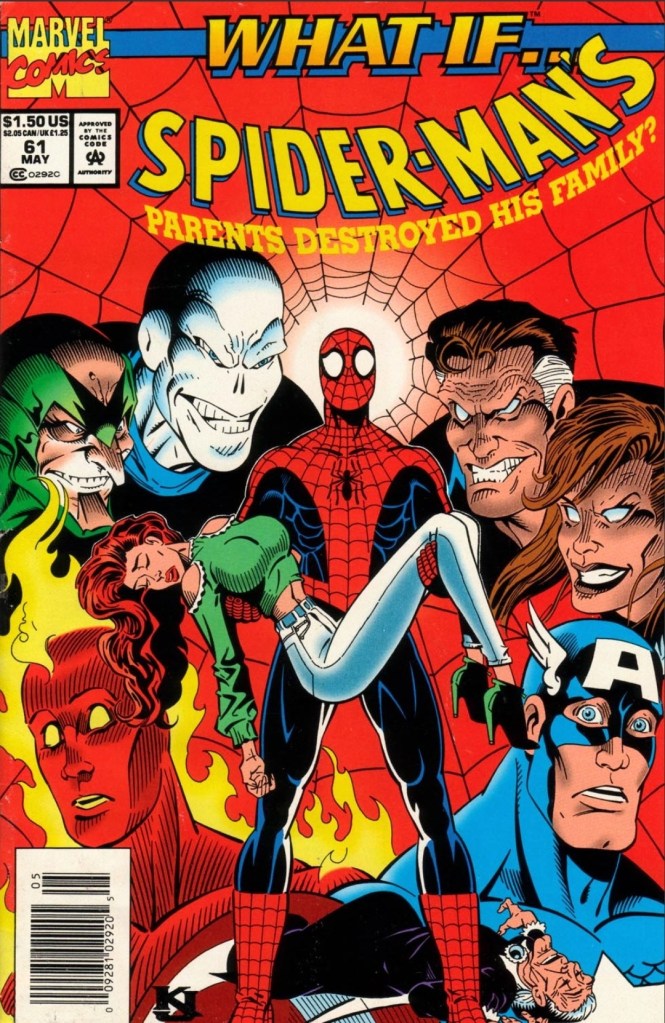
The cover.
Early story
The story begins with Richard and Mary Parker (Peter Parker’s parents) arriving in the presence of Aunt May who happens to be visited by their son Peter (Spider-Man). Having learned something from a while back, Aunt May tells Richard and Mary that they are not genuine persons. Suddenly, Peter Parker’s spider sense intensifies and in an attempt to defuse the situation, he leads his aunt to walk out of the house with him. Richard and Mary watch them walk away.
It turns out, Richard and Mary are impostors and they have been working all the time for a secretive boss. Richard calls his employer under an emergency and reports that they have completed phase one of their assignment, that Aunt May knows the truth about them and is about to inform Spider-Man. Richard is then told that under no circumstances is the plan to be jeopardized and anyone who suspects must die. He is also told to flush Mary’s programming and reset her as she showed signs of acting odd to the situation.
A short time later, Richard and Mary – now in morphed forms with vastly different bodies and half their heads resembling their human selves – suddenly break into an apartment surprising Peter, his wife Mary Jane and Aunt May. Violent action by one of them accidentally ripped open Peter’s shirt, revealing his Spider-Man suit to Aunt May. Just as Peter’s aunt figures out the secret, he tells Mary Jane to grab her and get out.
However, the sight of the morphed Mary Parker shocked Aunt May and Mary Jane so much, they failed to move. Mary Parker then morphs her two hands into large, makeshift hammers, and swiftly killed Aunt May and Mary Jane. Peter is instantly shocked by their sudden deaths but deep inside, rage begins to burn…
Quality
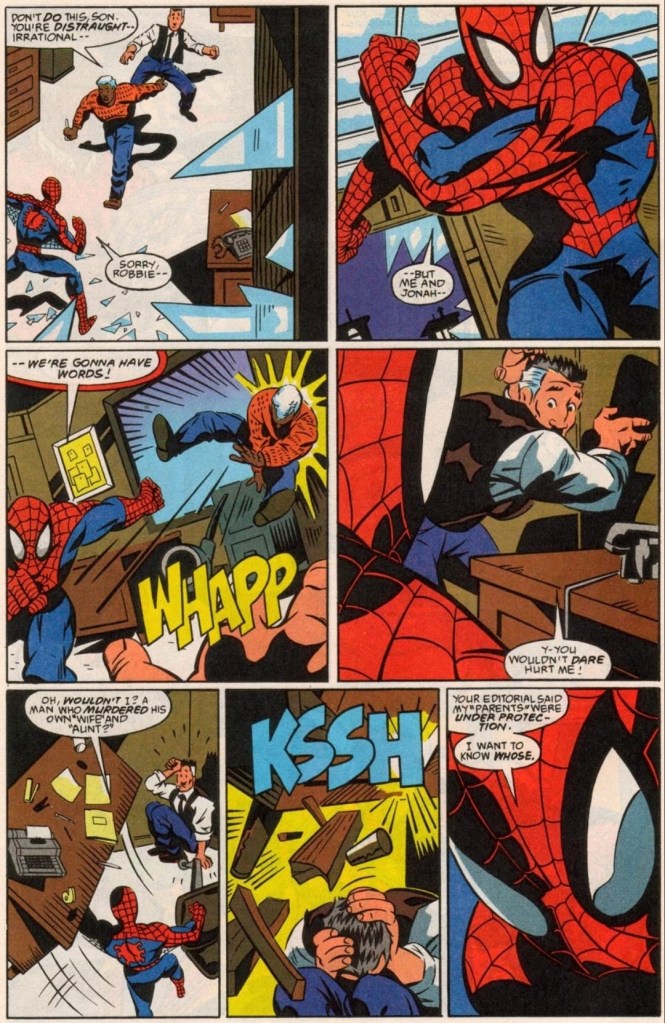
Spider-Man already over the edge and reacting violently to the abusive Daily Bugle.
I can start by confirming that Kurt Busiek’s writing is very strong and his alternate take on the events of Amazing Spider-Man #388 (1994) is indeed very solid. In one way, I find the emotional stakes for Spider-Man has been raised a lot higher than what was portrayed in the canon story. The concept of losing his beloved family members to enemies who were impostors that looked like his long lost parents is indeed disturbing as well as emotionally charged. In relation to this, Busiek and the illustrators brought to life a Spider-Man who really went over the edge by taking matters into his own hands as the loss of beloved ones led to the blurring of the boundary between good and evil. Even the boundary between innocence and guilt gets blurred which adds more depth to the emotions of the story. As I read the story, there were moments when I felt that Spider-Man became as bad as the evil ones even though he is clearly the victim and his family was targeted.
Apart from showing Spider-Man getting outraged and pushed to the limits, Busiek inserted elements about how people perceive incidents without knowing all the facts and how easily they get manipulated by a news outlet – the Daily Bugle where Peter Parker worked as a freelance photographer – whose leader does not care about ethical journalism nor the pursuit of the truth. In this age of widespread fake news and liberal news media outlets in America doing propaganda for American Communists (read: Democrats, abortionists, LGBTQ, Black Lives Matter, Antifa, the terrorists, the climate change extremists and the socialist hordes), this particular aspect of the story makes this comic book strongly relevant to read today.
The story also sheds light on Spider-Man’s connections with other Marvel superheroes who happen to be in New York City. You will see Captain America and Johnny Storm express their concern about Spider-Man’s state of mind as they themselves still tried to figure out what really happened. In short, the superheroes here showed restraint even as Spider-Man goes to the extreme being a victim as well as a fugitive.
If there are any weak points in this comic book, it would be the art which has this cartoon-like aesthetic for much of the story. Considering the serious subject matter, the visuals are quite contradicting as they make this look like it was made for much younger readers. In fairness, the quality of the art improved during the 2nd half of the story.
Conclusion
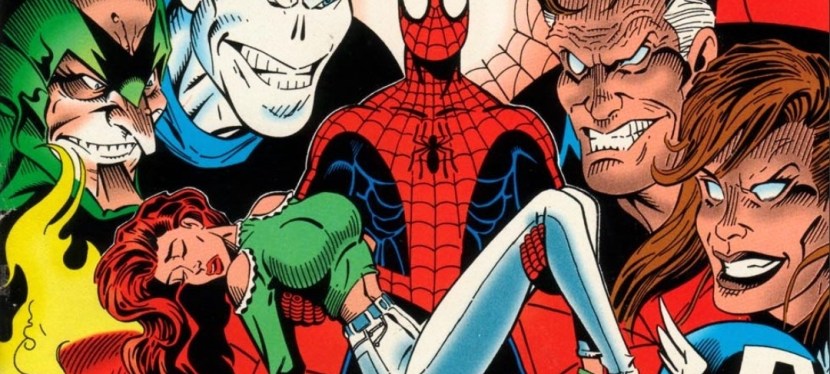
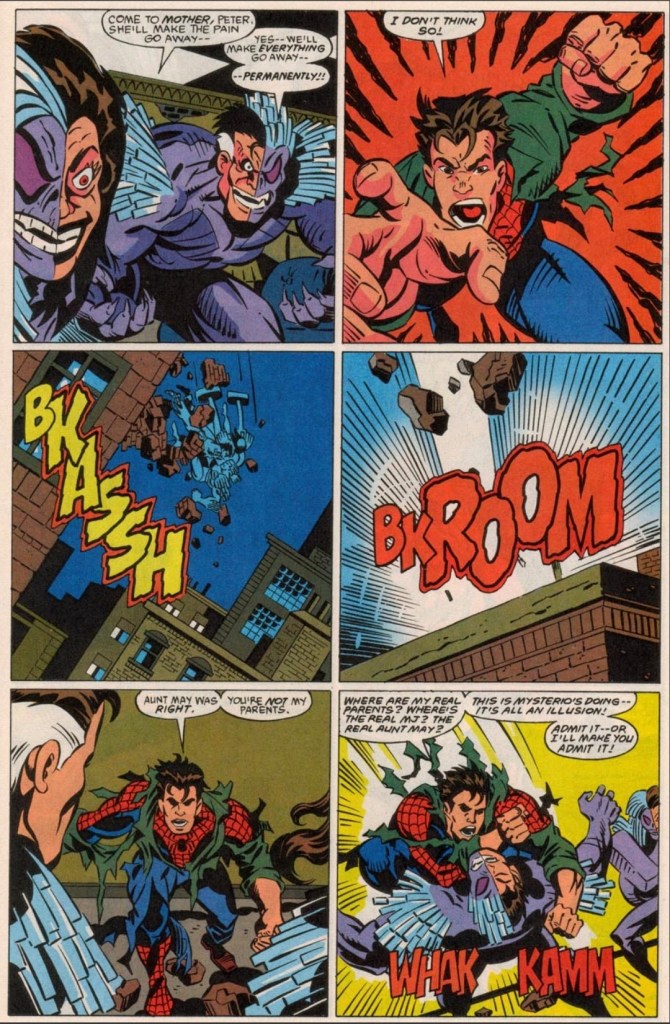
Spider-Man takes on the impostors who looked like his parents.
As far as storytelling and characterization goes, What If #61 (1994) succeeded a lot on portraying the iconic Spider-Man as the superhero who went over the limits of his emotions and his reasoning which is the result of the tragic deaths of two beloved family members caused by individuals who pretended to be his parents. This is a very solid story which also has a powerful ending. Where What If #72 failed, this comic book succeeded and even exceeded it with Spider-Man truly becoming unheroic. I should state that this comic book should convince readers to go to the Amazing Spider-Man series and follow the Lifetheft storyline in issues #386 to #388 (which were released months before this comic book). Kurt Busiek’s script is indeed great and it is easily the driving force of the comic book.
Overall, What If #61 (1994) is highly recommended.
Disclaimer: This is my original work with details sourced from reading the comic book and doing personal research. Anyone who wants to use this article, in part or in whole, needs to secure first my permission and agree to cite me as the source and author. Let it be known that any unauthorized use of this article will constrain the author to pursue the remedies under R.A. No. 8293, the Revised Penal Code, and/or all applicable legal actions under the laws of the Philippines.
Welcome back superhero enthusiasts, 1990s culture enthusiasts and comic book collectors! Today we go back to the early 1990s and explore a part of the Valiant Comics shared universe through the Harbinger monthly series.
In my previous retro review, the creative team of Fontenot-Simpson told another story that built up Harbinger’s concept some more while introducing yet another new character – Screen – who is not part of the team led by Sting. The story symbolically showed the further growth of the tremendous power of Toyo Harada not only through his control of the Harbinger foundation but also of his connection with the new United States President of the time.
With those details laid down, here is a look back at Harbinger #19, published in 1993 by Valiant Comics with a story written by Maurice Fontenot and illustrated by Howard Simpson.
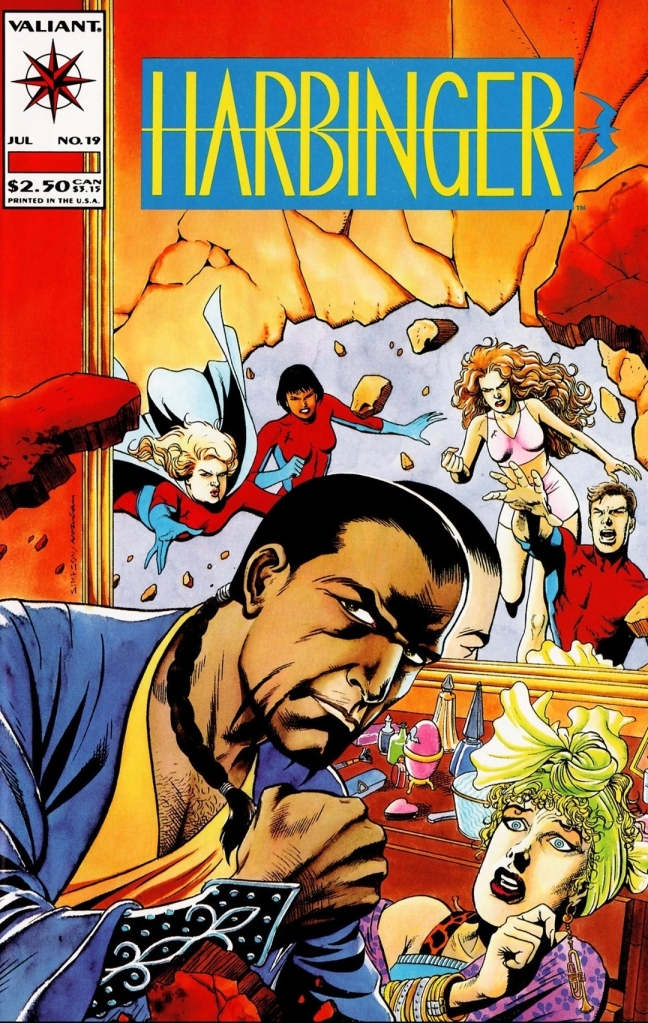
The cover.
Early story
The story begins on the afternoon of January 25, 1993. Inside the New York facility of the Harbinger foundation, a pretty blonde, young lady named Natalie Toynbee – codename: Stunner – gets scanned by the technicians handling the technologies. A technician’s request for Natalie to urinate into a cup reveals that the lady has a huge ego and pride of herself as she reacts negatively.
Suddenly, the wall near Natalie and the technician got damaged by force unleashed by Sting who is accompanied by Faith, Flamingo and Shatiqua. Their mission is to free Natalie from the clutches of the Harbinger foundation which is a small part of their long-term vision of freeing and recruiting more powered young adults.
After subduing the Harbinger foundation personnel, Sting begins to explain to Natalie the situation and tells her to just trust him. Sting tells her to come with them which only drew more of Natalie’s ego along with skepticism. This reaction makes Faith think Natalie is not worth saving…
Quality
Imagine Iran invading America and causing terror like in this scene. Imagine Joe Biden and the Democrats allowing this to happen to Americans.
While the story was not crafted to follow-up closely on the events of issue #18, this comic book puts Sting and his teammates into a collision course with a new force of evil – the Iranians (note: issue #20 confirms their national identity) who have interests on specific young adults with powers and special abilities. Along the way, the Fontenot-Simpson team introduced a new sinister force in the form of a very manipulative Iranian named Kaliph.
Kaliph’s introduction here is easily the biggest feature of the story and he unsurprisingly overwhelms the debut of Natalie. Kaliph here works in service of his unidentified superiors and as he does his job, he uses his special ability of manipulating people’s minds through sight and sound to gain information, find directions, make them do his orders and gain access into places that he could never have had he been an ordinary person. By the end of the story, I was convinced that Kaliph was created to be an enduring or recurring villain for Sting and his team.
More on the primary characters of this monthly series, Sting and his teammates were portrayed to get more harbingers (powered young adults) to join them and become part of their long-term opposition against Toyo Harada and the Harbinger foundation, even though their own team lacks the resources needed to support themselves. The lack of resources was cleverly highlighted through Natalie’s reactions (related to her big ego) to what Sting’s team has for her to live with. Looking at the bigger picture going back to issue #1, Sting’s vision of defeating Harada and winning the trust of powered young adults without any solid foundation (specifically resources, connections and security) emphasize his recklessness and false sense of maturity as a team leader.
Conclusion
Kaliph and his companion arrive in America with a sinister plan.
In my view, Harbinger #19 (1993) is a solid change of direction for the monthly series complete with the introduction of a new, strong villain who originated from Iran which by today’s standards is the major force of terrorism in this world. The new villain Kaliph has a creepy aesthetic that other villains in this series lacked. More notably, the story remained consistently very engaging and pulled off some notable surprises which were indeed entertaining.
Overall, Harbinger #19 (1993) is highly recommended!
Disclaimer: This is my original work with details sourced from reading the comic book and doing personal research. Anyone who wants to use this article, in part or in whole, needs to secure first my permission and agree to cite me as the source and author. Let it be known that any unauthorized use of this article will constrain the author to pursue the remedies under R.A. No. 8293, the Revised Penal Code, and/or all applicable legal actions under the laws of the Philippines.
Welcome back superhero enthusiasts, 1990s culture enthusiasts and comic book collectors! Today we go back to the early 1990s and explore a part of the Valiant Comics shared universe through the Harbinger monthly series.
In my previous retro review, Sting, Kris and Shatiqua got into trouble upon seeing the traitorous Ax and his powered companions. Their encounter turned into a radically different turn of events when the Harbinger foundation’s armed personnel and Eggbreakers members arrived targeting Ax.
With those details laid down, here is a look back at Harbinger #17, published in 1993 by Valiant Comics with a story written by Maurice Fontenot and illustrated by Howard Simpson.
The cover.
Early story
The story begins in the past – January 11, 1991 at the Woodville State Mental Institution in Pennsylvania. One of the local doctors leads two formal visitors into the secured room of one of their patients described as a “fascinating subject”. His name is Simon and the visitors turned out to be from the Harbinger foundation. They tell Simon, who is invisible, that the Harbinger foundation was established to help special people like him, help him understand and control his talents, and he will not be alone as the foundation has others like him.
In the present day of December 23, 1992, Faith is flying just above a truck which is slipping out of control along a major bridge in New Jersey. Sting is barely holding on the top of the truck. Being unable to utilize his power to control the situation, Sting instructs Faith to pull the driver out of the truck. Moments after Faith saves the truck driver, the truck itself stops but ended up hitting a vehicle.
As Flamingo uses her power to put out a fire, Kris finds Sting on the side of a car feeling terrible. Sting wonders what is wrong with him as he failed to stop the truck…
Quality
Even though he is already in a relationship with Kris, Sting focused on the blonde lady in the middle of a party.
I want to point out that this is yet another build-up type of story from Fontenot and Simpson, only this time it introduces Simon who is involved with the Harbinger foundation not as a trained Eggbreakers member but rather as a patient still relying on medical and psychological care. Through Simon, you will feel his loneliness, his trouble to fit in with society and his personal pain related to being unwanted. Through him, you will also realize that even though it has lots of resources and experts as employees, the Harbinger foundation is not the ideal replacement for Simon’s father (who rejected him in the first place). That should also remind you readers that government units also can never be your parent nor your guiding light no matter what socialists and Commies say in this age of Joe Biden and the fascist Democrats (read: the Satanic Left). Fontenot’s script here is, unsurprisingly, really strong and Simon’s introduction never felt like a throwaway piece.
Apart from Simon, Sting and his teammates got a lot more of the narrative’s spotlight this time around which is like a breath of fresh air since the previous two issues focused more on Harbinger and the Eggbreakers. Even though they are already dealing with their domestic problems, the primary characters still make efforts to solve problems and help others knowing that they would not be compensated by society.
More on character development, the team leader Sting continues to desire recruiting and helping powered young adults before the organization of Toyo Harada gets them first. This shows his arrogance and delusion as he rejects the reality that he and his team don’t really have the massive resources the Harbinger foundation has when it comes to recruitment and providing the constant needs of recruits. Furthermore, Sting does not even see his current problem (with his super power) as a hindrance at all when facing the Harbinger foundation.
Storywise, this comic book is more balanced with the spotlight on characters on the two sides of the spectrum with Simon being symbolically caught in the middle of the conflict. This is really solid storytelling.
Conclusion
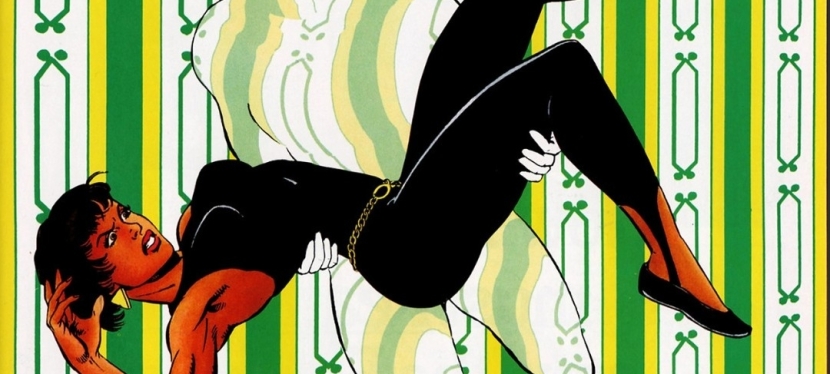
Something’s wrong with Sting.
I like Harbinger #17 (1993) very much. What it lacks in spectacle, it bounces back big time with character development, deep dramatics and introducing a new character who gets connected with both Sting’s team and the Harbinger foundation. This story obviously keep on building up something for a future conflict between the two forces and already I am eager to find out what will happen in the next issue.
Overall, Harbinger #17 (1993) is highly recommended!















 Author Carlo Carrasco