A Look Back at Spider-Man 2099 #16 (1994)

Disclaimer: This is my original work with details sourced from reading the comic book and doing personal research. Anyone who wants to use this article, in part or in whole, needs to secure first my permission and agree to cite me as the source and author. Let it be known that any unauthorized use of this article will constrain the author to pursue the remedies under R.A. No. 8293, the Revised Penal Code, and/or all applicable legal actions under the laws of the Philippines.

By the year 1993, Marvel Comics’ new comic book line of the 2099 universe kept filling the shelves of retailers and made it into the hands of collectors and fans with the monthly series composed of Spider-Man 2099, Ravage 2099, Doom 2099, Punisher 2099 and the new addition of the year X-Men 2099. Back then, the Marvel 2099 line expanded a lot and saw the establishment of new fans. Even the quarterly series 2099 Unlimited caught the attention of some readers as it told the early stories of Hulk 2099 (who debuted in 2099 Unlimited ).

Unsurprisingly, there were fans of the 2099 universe who wished for a crossover storyline that would bring together their respective favorite futuristic heroes. Remember the rivalry between classic Spider-Man (Peter Parker) and the Punisher (Frank Castle)? Some wanted Spider-Man 2099 and Punisher 2099 to encounter each other.

Eventually, the crossover dream of the fans came through in the form of The Fall of the Hammer storyline that took place in five parts. Specifically one issue each of Spider-Man 2099, Ravage 2099, Doom 2099, Punisher 2099 and X-Men 2099. It was also an opportunity for the 2099 creative teams (note: the legendary Stan Lee and Peter David were among the writers at the time) to get together and contribute to make something special under the watch of 2099 editor Joey Cavalieri.

With those details laid down, we can finally start examining the beginning of The Fall of the Hammer storyline in this look back at Spider-Man 2099 , published in 1993 (cover dated 1994) by Marvel Comics with a story written by Peter David and drawn by Rick Leonardi.

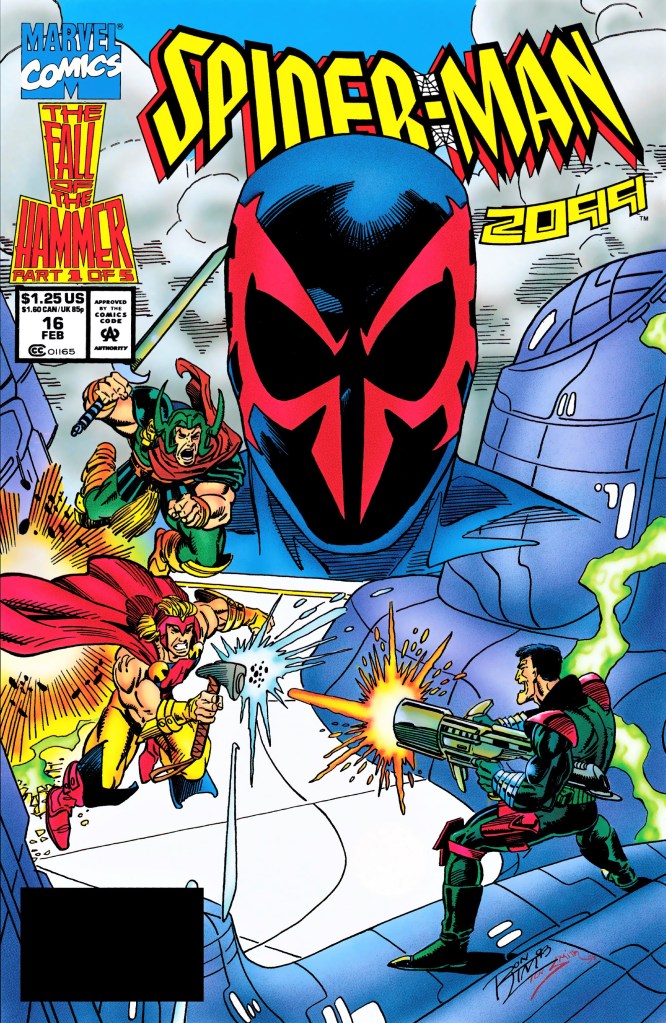
The cover drawn by Ron Lim.

Early story

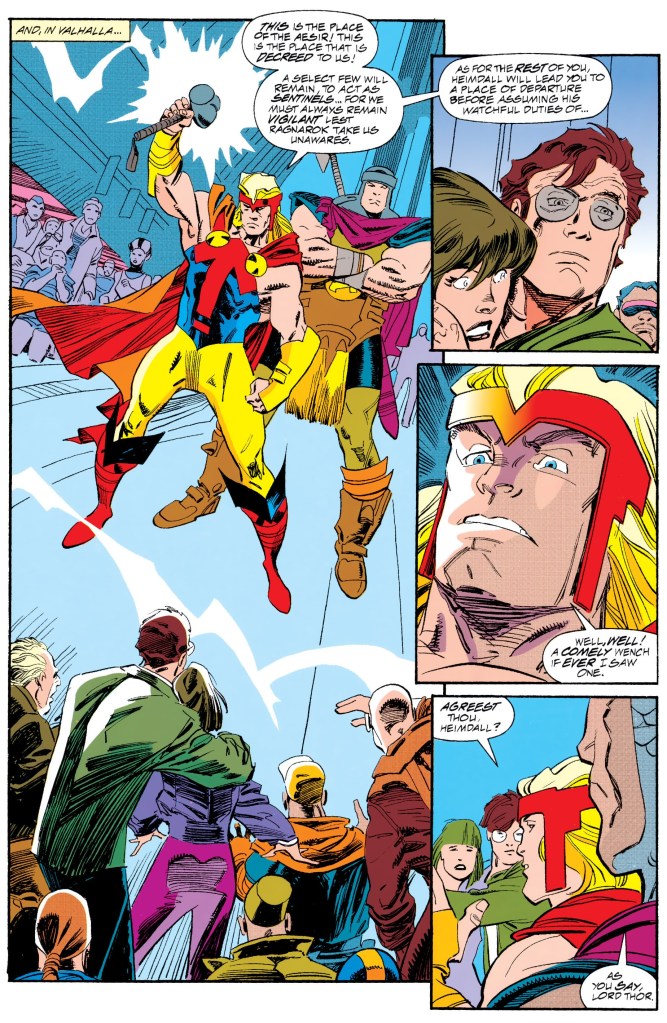
The story begins with the arrival of the floating city of Valhalla, disturbing the people of the town of Randall below. On the floating city itself, a crowd of people – with Miguel O’Hara and Dana among them – stare at a hammer-wielding, caped blonde man who claims to be Thor (their idol). Accompanied by Heimdall, Thor tells them that a select few among them will remain in the city to act as sentinels while the rest will come with Heimdall to a place of departure.

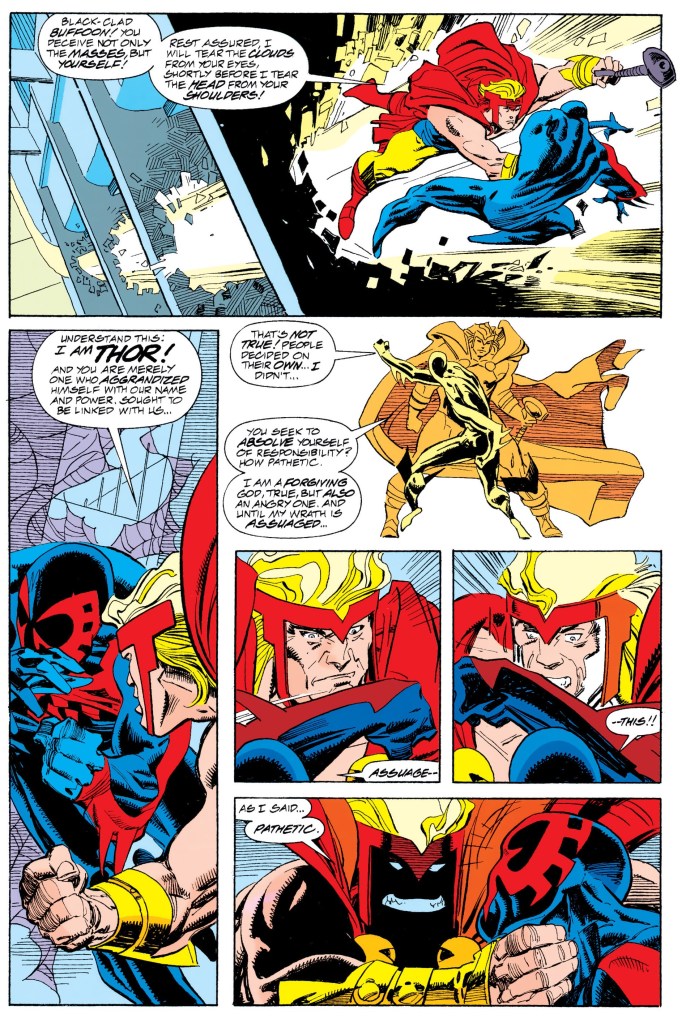
Thor turns his attention on Dana causing Miguel to intervene and challenge his so-called authority. As Thor reacts to Miguel’s defiance, he throws a punch which got deflected. This causes the so-called god of thunder to be surprised given Miguel looking ordinary to him. In reaction, Thor grabs him and throws his body several feet over many people’s heads. This leaves Dana helpless.

Miguel crashes through a glass window, falling outside until he shoots a web to control his movement. He takes off his civilian clothes, revealing his costume as Spider-Man of 2099. He sets off to get back at Thor…  

Quality

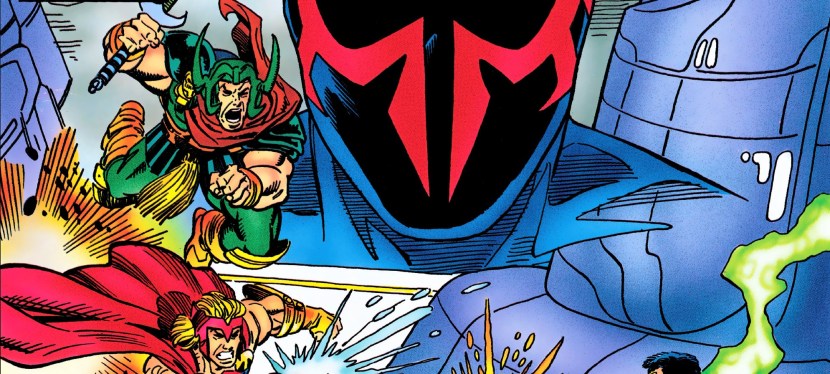
The highlight of the comic book is Spider-Man 2099’s conflict with Thor.

To make clear the obvious, the writing by Peter David is indeed solid although the sketch-like aesthetic of the art of Rick Leonardi badly needed more visual details.

As for the story itself, it is succeeded in creating tension with regards to the caped figure who believes himself to be Thor who is the central figure of religion in 2099 America and has the means to wield power by even involving technology (with Valhalla as the center piece). That being said, Spider-Man 2099’s encounter with him was inevitable, and so was the result (a bit predictable). The story also sheds light on the perceived omnipotence of Thor and how Spider-Man 2099 (who was previously referred to by some people as Thor’s harbinger) got associated with his legend.

To make things clear, this one is purely a Spider-Man 2099 story that justifies the concept of needing other 2099 heroes as the threat was simply too great for any one hero to handle. I should also state that the crossover between any heroes does not begin until the final page of this comic book.

Conclusion

Nothing like being in a crowd of people watching helplessly in front of two so-called omnipotent figures.

Spider-Man 2099 (1994) is still a good read and as the first chapter of The Fall of the Hammer storyline, it served its purpose well. This is mainly due to the strong writing by Peter David who also succeeded in establishing 2099’s Thor not only as the villain but also as a figure who truly is a threat to the people. This comic book also shows that people in 2099 failed to realize who their true Creator is as they embraced religion (instead of faith) and committed idolatry (which is truly unholy) by believing in a false god like Thor.

If you are seriously planning to buy an existing hard copy of Spider-Man 2099 (1994), be aware that as of this writing, MileHighComics.com shows that the near-mint copy of the regular edition costs $40 while the near-mint copies of the newsstand and the signed-and-numbered editions cost $120 and $300 respectively.

Overall, Spider-Man 2099 (1994) is recommended.

+++++

Thank you for reading. If you find this article engaging, please click the like button below and also please consider sharing this article to others. If you are looking for a copywriter to create content for your special project or business, check out my services and my portfolio. Feel free to contact me as well. Also please feel free to visit my Facebook page Author Carlo Carrasco and follow me at HavenorFantasy@twitter.com

A Look Back at V #3 (1985)

Disclaimer: This is my original work with details sourced from reading the comic book, watching the V mini-series (Original Miniseries and The Final Battle) and the 1984 TV series, and doing personal research. Anyone who wants to use this article, in part or in whole, needs to secure first my permission and agree to cite me as the source and author. Let it be known that any unauthorized use of this article will constrain the author to pursue the remedies under R.A. No. 8293, the Revised Penal Code, and/or all applicable legal actions under the laws of the Philippines.

Welcome back, science fiction enthusiasts, comic book collectors and fans of the V entertainment franchise of the 1980s! Before I start this newest retro comic book review, let me ask you…if you were a resident of a small, rural town in America, would you be willing to accept offers from visitors who claim to come in peace?

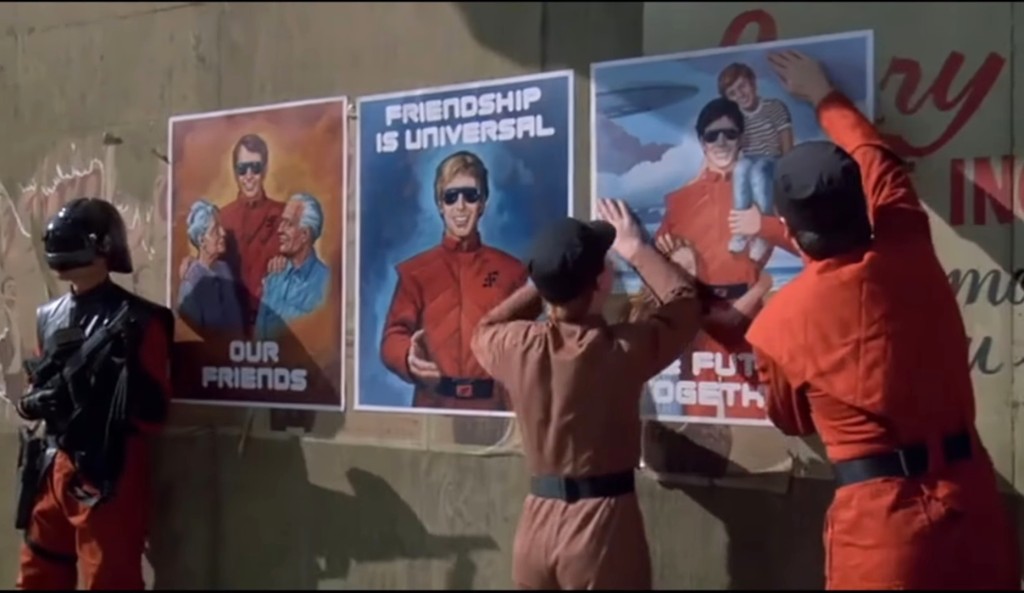
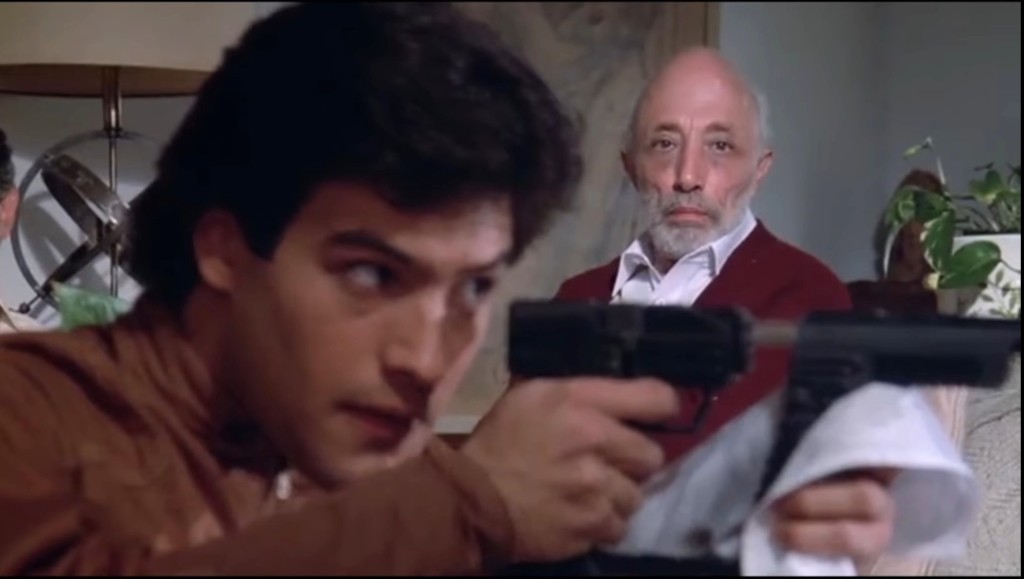
The above question hits on theme that defined the first arrival of the Visitors (Reptiloids covered with fake flesh to look human on the outside) in the first episode of V: The Original Miniseries in 1983. I remember the scene in which the Visitors’ so-called leader John first appeared and he acted gentle and friendly. The events that followed was pop culture history.

Last time around, Mike Donovan, Julie Parrish and their companion got jailed in a small, rural town whose people (a lot of which were senior citizens) trusted the Visitors a whole lot. The three could find themselves in deeper trouble as a group of Visitors arrive in town for an activity. To find out what happens next, here is a look back at V , published by DC Comics in 1985 with a story written by Cary Bates and drawn by Carmine Infantino.

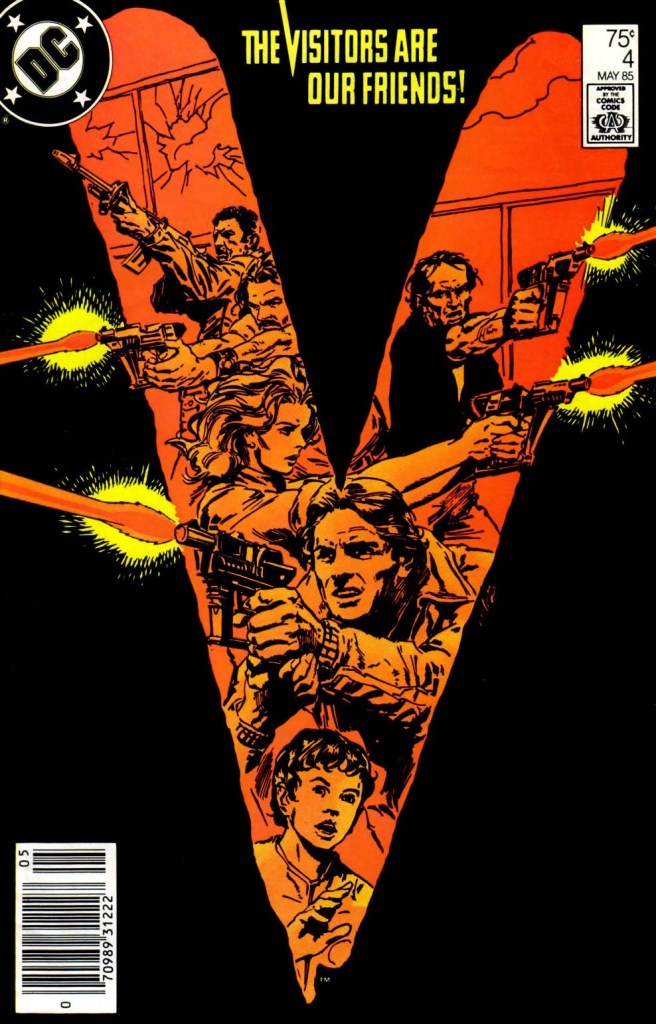
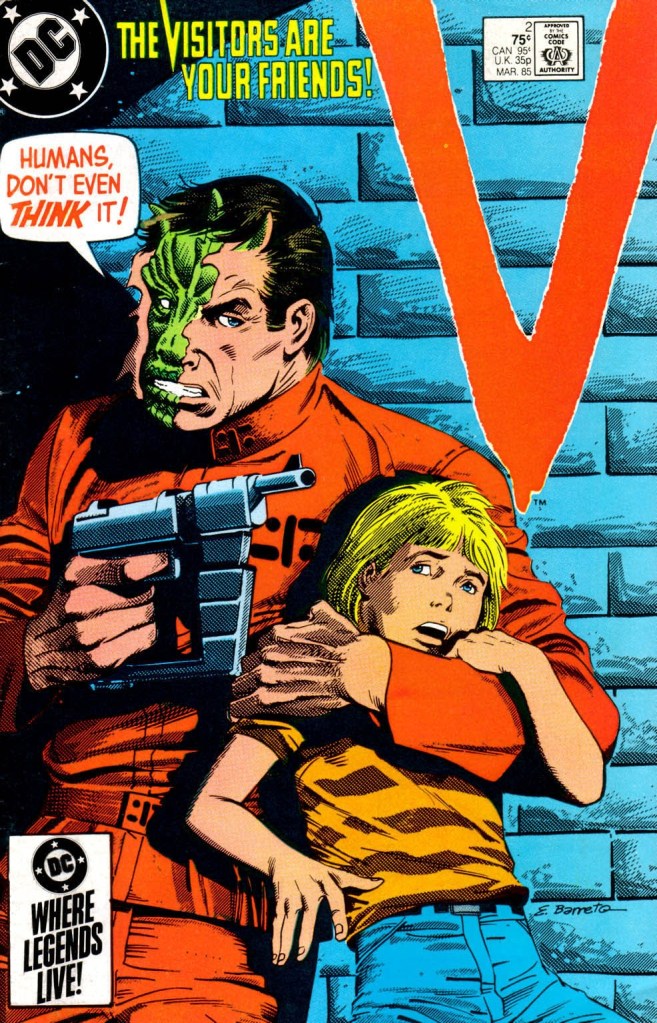
The cover.

Early story

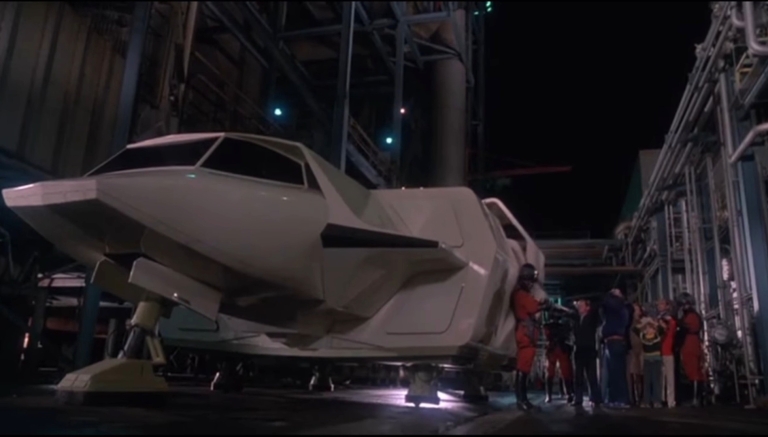
The story begins with the arrival of a large transport ship at the town of Sparkling Springs. The group of Visitors, led by Captain Devon (who replaced his predecessor), is warmly welcomed by the residents. In the town jail, Mike, Julie and Hart noticed from a distance that the arrival of the Visitors was six hours earlier than anticipated.

At another part of town, the young Billy (who promised to help Mike, Julie and Hart) is hiding behind plants with Willie (a good-natured Visitor who sided with the Resistance) and Boyce carefully observing the large transport ship. Being a Reptiloid himself, Willie found it logical that his fellow aliens want the rich abundance of minerals in natural spring water as it is beneficial for their physiology.

Willie then asks Billy to take them to the jail where their friends are locked up…

Quality

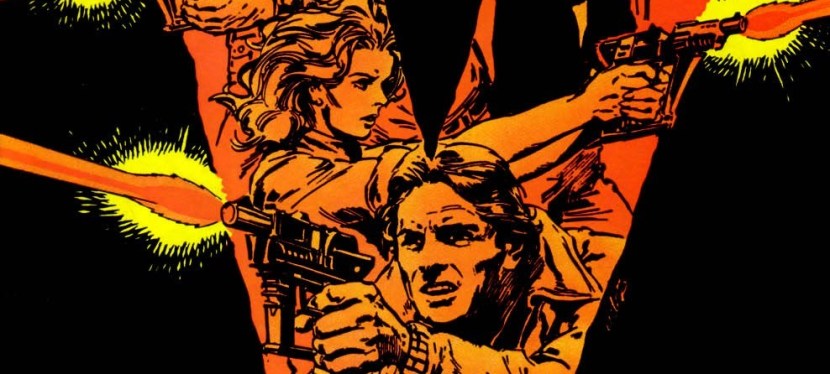
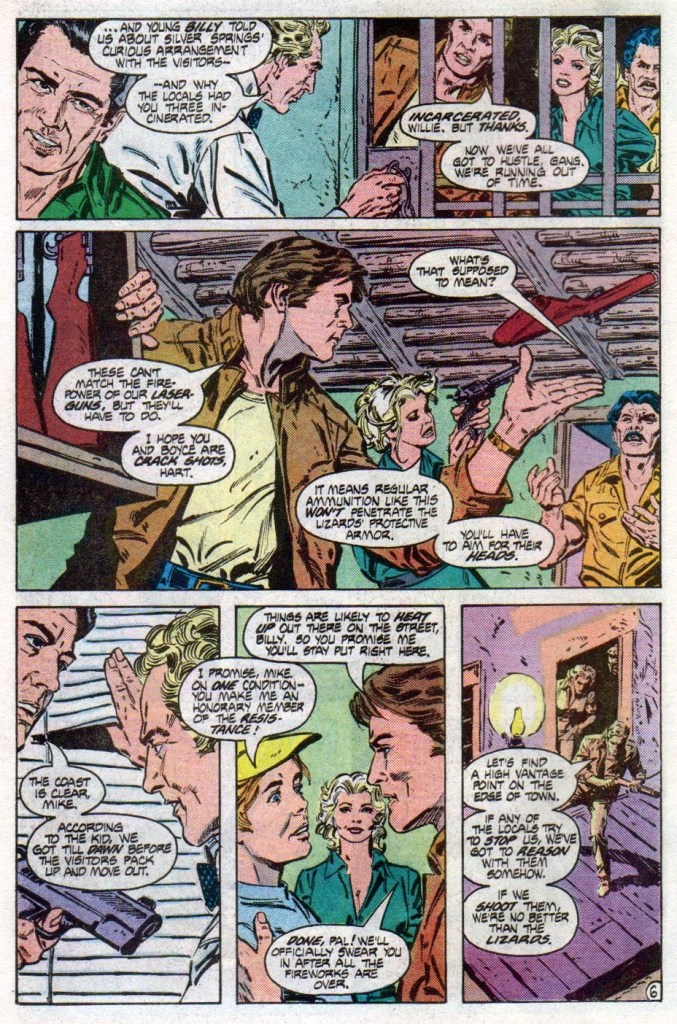
Mike and Willie take action!

As expected, the high-quality writing of Cary Bates really brought the continuing story to life and the engagement also remains strong.

While the previous showed how the town people became trusting of the Visitors, this one further emphasized that through the latest visit of the aliens. What I liked most about this comic book was the way Cary Bates portrayed the way the Visitors perceived their relationship with the town people and how they perceived a threat made by one of the locals could rattle the mutual give-and-take relationship of the two sides. There is even this chilling writing about how the life of one wasted youth compares the benefits that the two sides enjoy.

More on the writing, there is this very impassioned speech by Mike Donovan that makes clear the true intentions of the Visitors as the town people accepted the aliens so warmly while turning their backs on the human race. So far, this is the most socially relevant expression in this old comic book series and if you take into context the fact that certain people in the world today would give up on their established values (examples: patriotism, the nuclear family) in favor of destructive, radical values and concepts (examples: Marxism, Socialism, Communism, Fascism, critical race theory) and then deform society with them, Mike Donovan’s speech remains strongly relevant. In fact, I easily imagined the voice of Marc Singer speaking as I read the said speech.

When it comes to spectacle, there is a good amount of action to enjoy here.

Conclusion

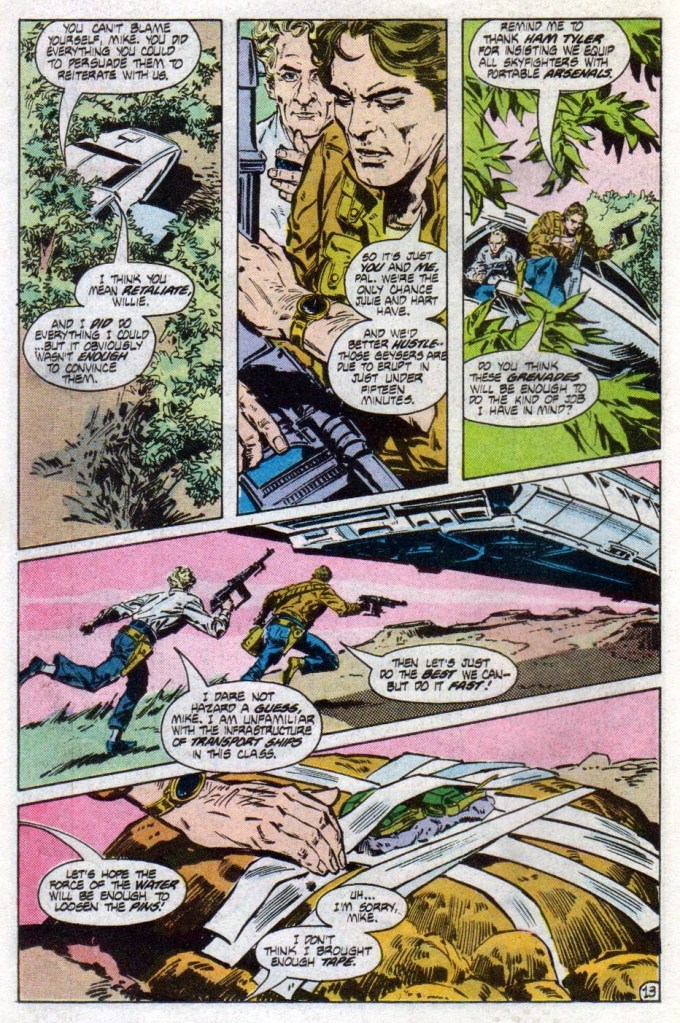
With the help of local boy Billy, the Resistance make their moves against the Visitors.

I can say that V (1985) succeeded in telling an engaging story (which concluded in a very satisfying way) and pushed the narrative forward. Having seen the original miniseries as well as V: The Final Battle a long time ago, I could easily relate with the portrayals of Mike Donovan, Julie Parrish and Willie in this story. I also love the fact that this story emphasized that peace and freedom are achieved not by mere reforms but with sacrifices (which was visualized with a very notable death scene that also showed the comic book creators took a huge risk as it is really sensitive in nature). Its social relevance will remind you not to give in to sinister forces.

If you are seriously planning to buy an existing hard copy of V (1985), be aware that as of this writing, MileHighComics.com shows that the near-mint copy of the regular edition costs $28 while the near-mint copy of the newsstand edition costs $38.

Overall, V (1985) is highly recommended!

+++++

Thank you for reading. If you find this article engaging, please click the like button below and also please consider sharing this article to others. If you are looking for a copywriter to create content for your special project or business, check out my services and my portfolio. Feel free to contact me as well. Also please feel free to visit my Facebook page Author Carlo Carrasco and follow me at HavenorFantasy@twitter.com

A Look Back at Star Wars: Shadows of the Empire #1 (1996)

Disclaimer: This is my original work with details sourced from reading the comic book and doing personal research. Anyone who wants to use this article, in part or in whole, needs to secure first my permission and agree to cite me as the source and author. Let it be known that any unauthorized use of this article will constrain the author to pursue the remedies under R.A. No. 8293, the Revised Penal Code, and/or all applicable legal actions under the laws of the Philippines.

Way back in the mid-1990s, something special happened for Star Wars fans. A brand-new story involving Star Wars icons Luke Skywalker, Darth Vader and others would be told set between The Empire Strikes Back and Return of the Jedi. That story was called Shadows of the Empire and it was released as a special event in the form of a novel (written by Steve Perry), a video game on Nintendo 64 and PC, comic books, a soundtrack, posters, model kits, toys and action figures. What was missing here was a live-action movie.   

To put things in perspective, the Shadows of the Empire multi-media event was done by Lucasfilm (note: when creator George Lucas was still in control) with its many business partners to reinvigorate the Star Wars franchise ahead of the planned special editions of the original Star Wars movie trilogy. From a business point-of-view, it made sense to release something new for fans to enjoy and more notably it was the chance for Lucasfilm and its creators to explore what happened between The Empire Strikes Back and Return of the Jedi.

A limited comic book series was released in 1996 and it involved the novel’s author as a story consultant. Back in those days, my comic book interest faded temporarily and even though I was still into Star Wars, I did not bother to buy and read the Shadows of the Empire comic books. The video game caught my attention a lot more back then. Fortunately, I found copies of the comic books and had the time to read them recently.

With those details laid down, here is a look back at Star Wars: Shadows of the Empire , published by Dark Horse Comics in 1996 with a story written by John Wagner and drawn by Kilian Plunkett.

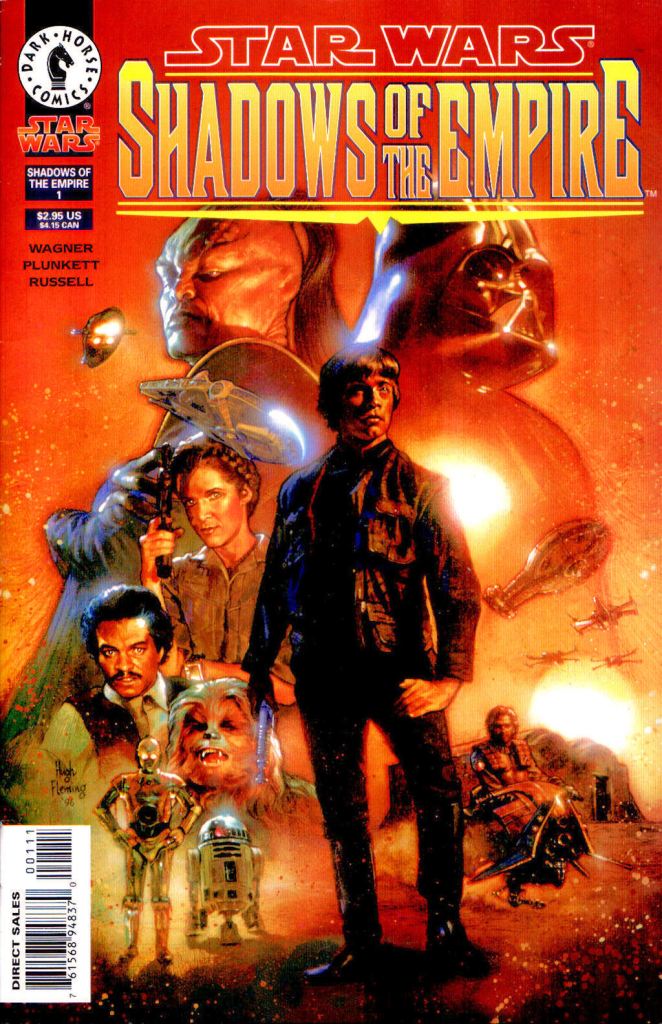
The cover.

Early story

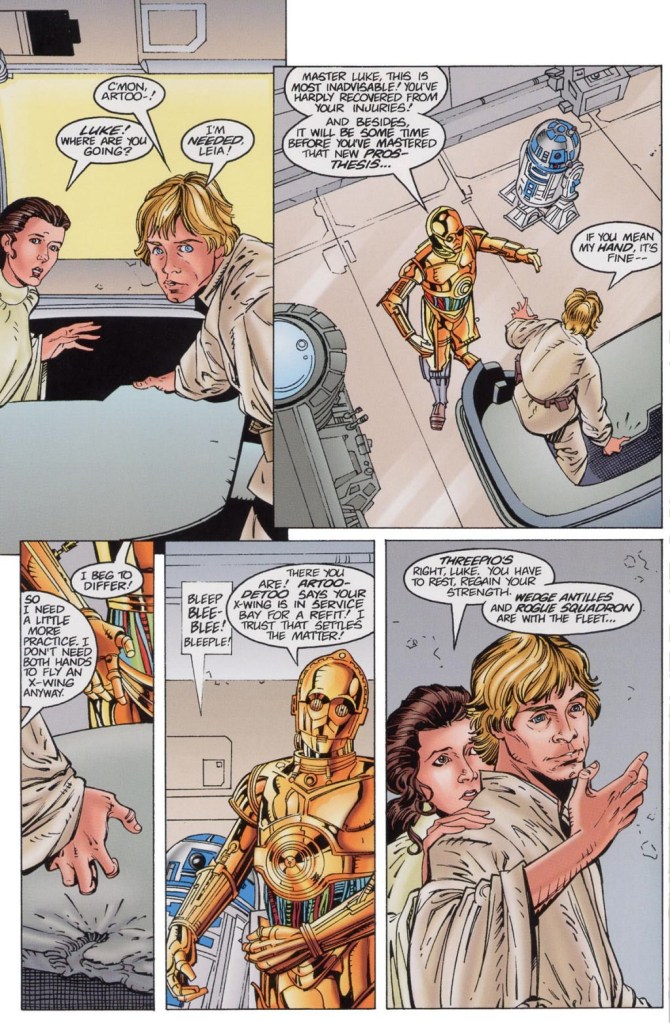
The story begins with a group of Rebel spaceships traveling together in the depth of space. Luke, who now has a mechanical hand and has been recovering from the terrible ordeal he went through at Cloud City, is with Princess Leia, C3PO and R2D2 in the medical frigate. The Rebels detect the presence of an approaching ship which they suspect to be hostile.

Luke suddenly decides to take action but is halted when he realizes that his X-wing fighter is still being refitted. In space, Wedge and the Rogue Squadron fly towards the Imperial Strike Cruiser which then releases some Tie Fighters. The personnel inside the Strike Cruiser tried to inform Darth Vader the location of the Rebel fleet…

Quality

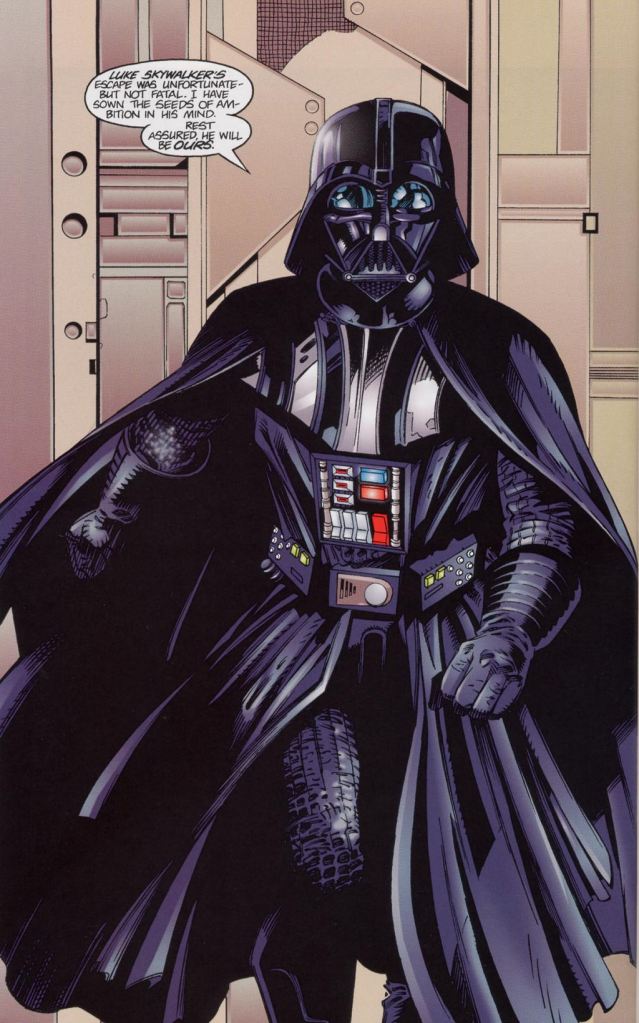
Darth Vader!

The first thing I want to mention is that the writing done by John Wagner is solid. That being said, the story itself felt like a natural continuation of The Empire Strikes Back especially when the comic book’s narrative is focused on Luke and the Rebels. The way the recovering Luke, Leia and the two droids were presented following the end of the 1980 movie was believable, and there was that nice touch of characterization when Luke has not yet adjusted with his mechanical hand.

The story then moves into new territory when the narrative shifts on the Imperial side, especially when Emperor Palpatine gives Darth Vader a new order that has nothing to do with pursuing Luke and the weakened Rebels, but more to do with the construction of the Empire’s new weapon. This is also where the new character Xizor comes in and his presence alone confirms something that the movies did not…the Empire is in business with crime syndicates with regards to major projects.

Space ship battles look great in this comic book.

When it comes to characterization, I like the way Darth Vader handled himself when communicating with Emperor Palpatine who viewed Luke’s escape from Bespin a failure on his part. Compared with his private communication with the Emperor in the 1980 movie, Vader bravely questions him about doing business with Xizor backed with his knowledge of the prince and the ties with Black Sun. Vader, who has been part of the Empire for a long time, knew well how risky it is for them to get involved with criminals especially when military cargo is involved.

As for the visuals, Kilian Plunkett does a decent job drawing the characters. While his take makes Luke recognizable and faltered a bit on capturing Leia’s look, his illustrations on Darth Vader, the Emperor and Xizor were really good. Where Plunkett exceled visually are the locations and surroundings, the machines and the space battles (some pages were drawn really dynamically).

Conclusion

This shows how Luke has not fully adjusted with his mechanical hand.

To put it clearly, Star Wars: Shadows of the Empire (1996) has three narratives (the other is about Boba Fett carrying the frozen Han Solo) to build-up on and for a debut issue of a limited series, this one has strength in its execution complete with a good amount of creative stuff that will resonate with long-time Star Wars fans (and also those who love the original Star Wars movie trilogy). It succeeds in telling what happened shortly after the end of The Empire Strikes Back as well as establishing a new sub-plot with Xizor involved. By the time I finished this comic book, I was convinced to look forward to the next issue.

If you are seriously planning to buy an existing hard copy of Star Wars: Shadows of the Empire (1996), be aware that as of this writing, MileHighComics.com shows that the near-mint copy of the regular edition costs $48 while the near-mint copy of the newsstand edition costs $144.

Overall, Star Wars: Shadows of the Empire (1996) is recommended.

+++++

Thank you for reading. If you find this article engaging, please click the like button below and also please consider sharing this article to others. If you are looking for a copywriter to create content for your special project or business, check out my services and my portfolio. Feel free to contact me as well. Also please feel free to visit my Facebook page Author Carlo Carrasco and follow me at HavenorFantasy@twitter.com

A Look Back at V #2 (1985)

Disclaimer: This is my original work with details sourced from reading the comic book, watching the V mini-series (Original Miniseries and The Final Battle) and the 1984 TV series, and doing personal research. Anyone who wants to use this article, in part or in whole, needs to secure first my permission and agree to cite me as the source and author. Let it be known that any unauthorized use of this article will constrain the author to pursue the remedies under R.A. No. 8293, the Revised Penal Code, and/or all applicable legal actions under the laws of the Philippines.

Welcome back, science fiction fans, comic book collectors and fans of the V entertainment series of the 1980s! Before I proceed with the newest retro review of the V comic book series, I must share to you – both V fans as well as those who plan to discover the 1980s mini-series and TV series – that V: The Original Miniseries, and V: The Final Battle are all available on Blu-ray disc format on Amazon while the V TV Series is available on DVD format. If you are eager to collect them for your home entertainment collection and with your passion for V of the 1980s still burning, I suggest checking them out now by clicking here, here and here.

Wow. It’s been several months since my review of V issue #1. Almost all the retro comic book reviews I published since then were about superheroes. After going through all the superhero stuff, going back to the V comic book series is refreshing on my part.

With those details laid down, here is a look back at V , published by DC Comics in 1985 with a story written by Cary Bates and drawn by Carmine Infantino.

The cover.

Early story

The story begins in a desolate part of California where members of the Resistance get out of their downed skyfighter. They are actually a short walk away from a small town. Moments earlier, the local residents approached them with smiles and small crates containing something living. After Mike Donovan introduced himself to them, the locals were mystified and ran back to the town leaving the crates behind. It turns out, the town folks thought they were the Visitors and the way they reacted suggests that the race of Reptiloids from space were accepted by them.

Mike, Julie, Willie and Hart discover that the crates contained white mice (which are food for the Visitors) which they let go.

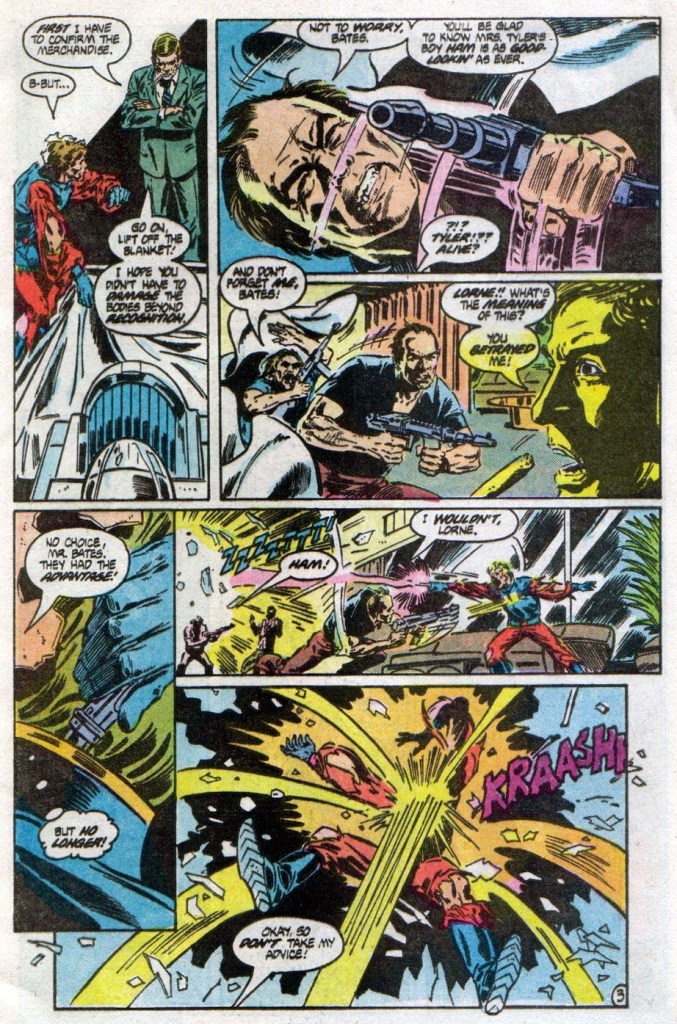
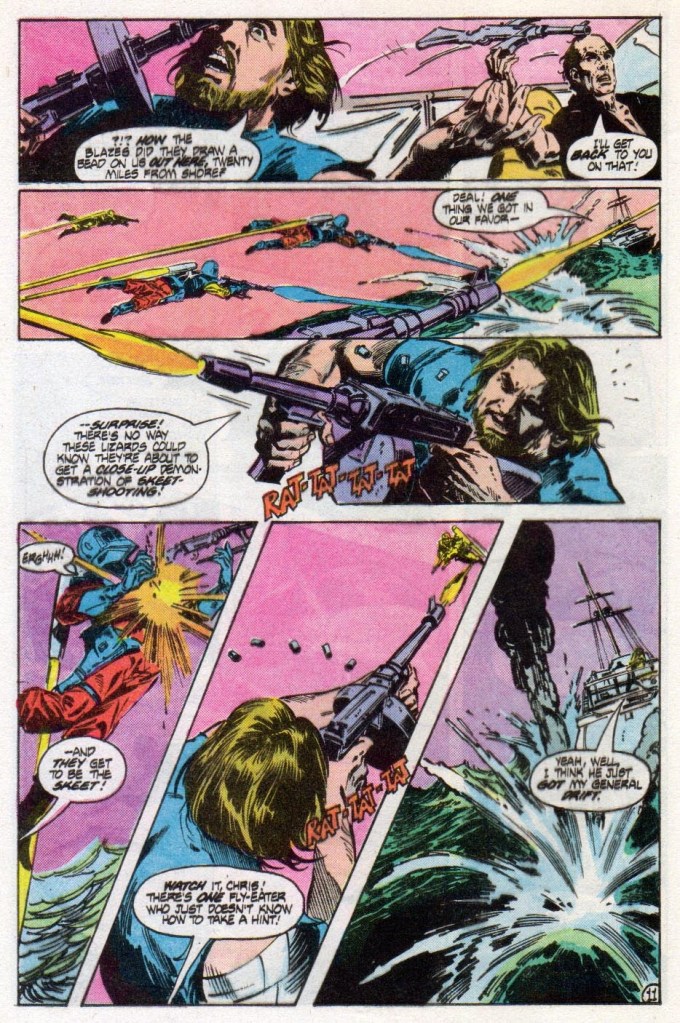
Elsewhere at the marina north of Redondo Beach, Ham Tyler and Chris Farber (still injured) are held at gun-point on boat which turned out to be a drug-runner model. The two Resistance members successfully fight back against the two armed men and quickly took the boat to head out to sea.

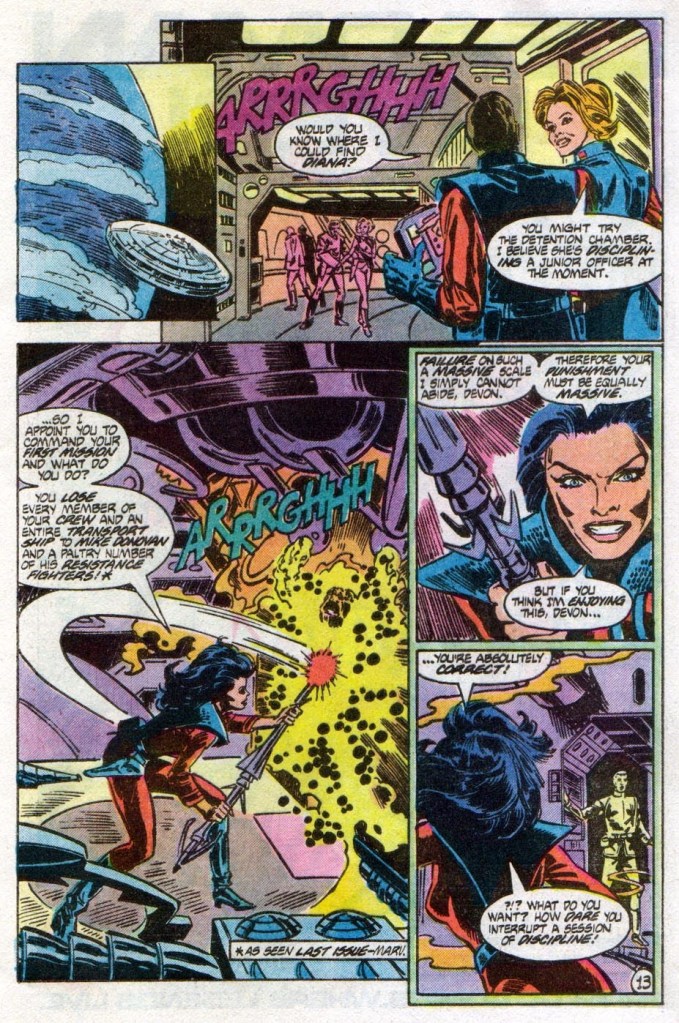
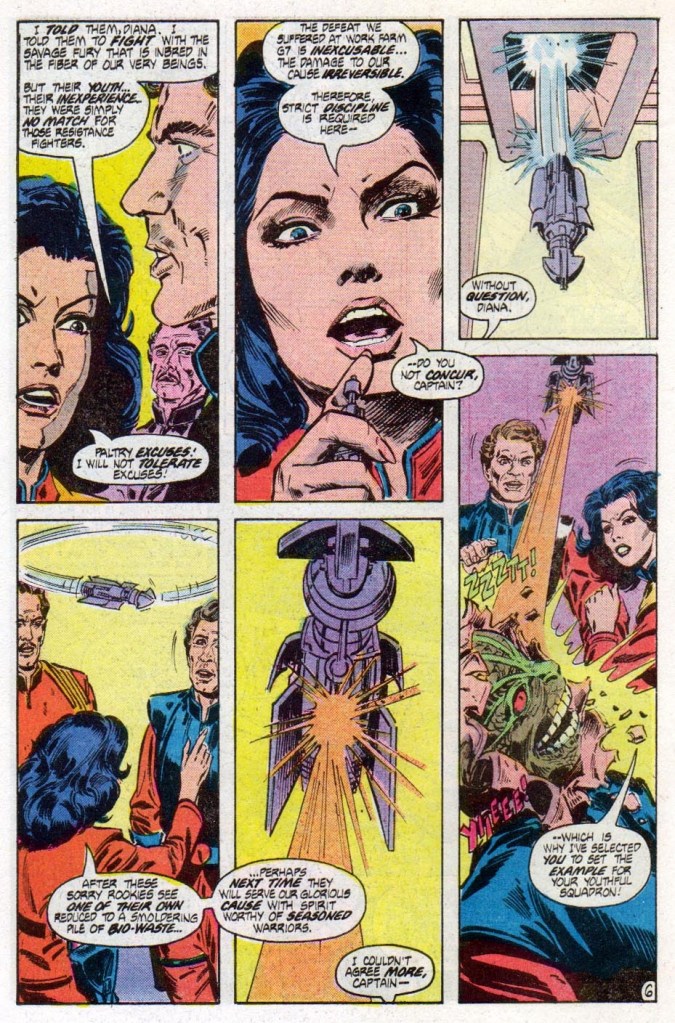
Inside the mothers ship orbiting Earth, the sadistic leader Diana rejects the claims of one of her soldiers over the failure related to work farm G7. Diana believes that because the soldiers have been among the humans for a long time, they learned to grovel like them. Finding the failure inexcusable, she releases a flying device that blasts one of them…

Quality

Ham and Chris take on the flying Visitors who approached them.

In terms of writing, this is indeed a solid follow-up to issue and I can say that the creators succeeded in not only continuing to capture the essence of the established V characters, balancing exposition, spectacle and suspense carefully but also raised the tension in key moments of the story which added to the engagement.

What I liked most about this comic book is its concept about a small town whose people (average age is above 60-years-old) bonded with the Visitors, engaged with them with an incredible deal (this alone will make you revisit the first episode of V: The Original Miniseries) and trusted them a lot. This story will also encourage you to reflect upon the whole concept of V and even consider other factors such as how many humans died for their freedom, how Diana’s command impacted Earth, and more.

Conclusion

This scene display’s Diana’s ruthlessness and her own way of improving her squad by making examples that involve death.

To be very clear, V (1985) is a very compelling comic book and it will surely resonate with fans who saw the Original Miniseries, The Final Battle and the TV series. The cerebral approach of this comic book made it a fun read.

If you are seriously planning to buy an existing hard copy of V# 2 (1985), be aware that as of this writing, MileHighComics.com shows that the near-mint copy of the regular edition costs $28 while the near-mint copy of the newsstand edition costs $35.

Overall, V (1985) is highly recommended!

+++++

Thank you for reading. If you find this article engaging, please click the like button below and also please consider sharing this article to others. If you are looking for a copywriter to create content for your special project or business, check out my services and my portfolio. Feel free to contact me as well. Also please feel free to visit my Facebook page Author Carlo Carrasco and follow me at HavenorFantasy@twitter.com

A Look Back at Shogun Warriors #3 (1979)

Disclaimer: This is my original work with details sourced from reading the comic book and doing personal research. Anyone who wants to use this article, in part or in whole, needs to secure first my permission and agree to cite me as the source and author. Let it be known that any unauthorized use of this article will constrain the author to pursue the remedies under R.A. No. 8293, the Revised Penal Code, and/or all applicable legal actions under the laws of the Philippines.

When it comes to showcasing giant robots fighting other robots or monsters, there is no denying that Japan is the leader. In my lifetime, I have seen lots of episodes of varied anime TV series, some anime feature films as well as OVAs (original video animation) of such a genre of entertainment made by lots of Japanese creators. While I never saw any episodes of Brave Raideen nor any episodes of Chōdenji Robo Combattler V, I saw episodes of Dangard Ace on home video.

As seen already in issues #1 and #2 of the Shogun Warriors comic book series, the giant robots were adapted but not their respective original concepts and characters the Japanese established. As such, an all-new concept with Westerners in mind was implemented for the said series.

With those details laid down, here is a look back at Shogun Warriors , published by Marvel Comics in 1979 with a story written by Doug Moench and drawn by Herb Trimpe.

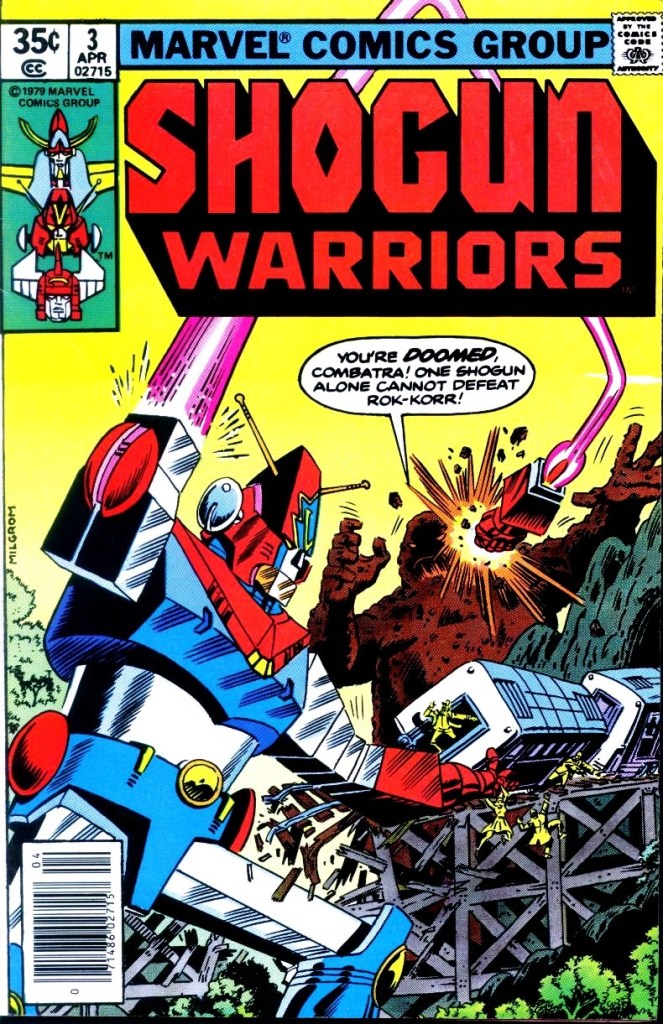
The cover.

Early story

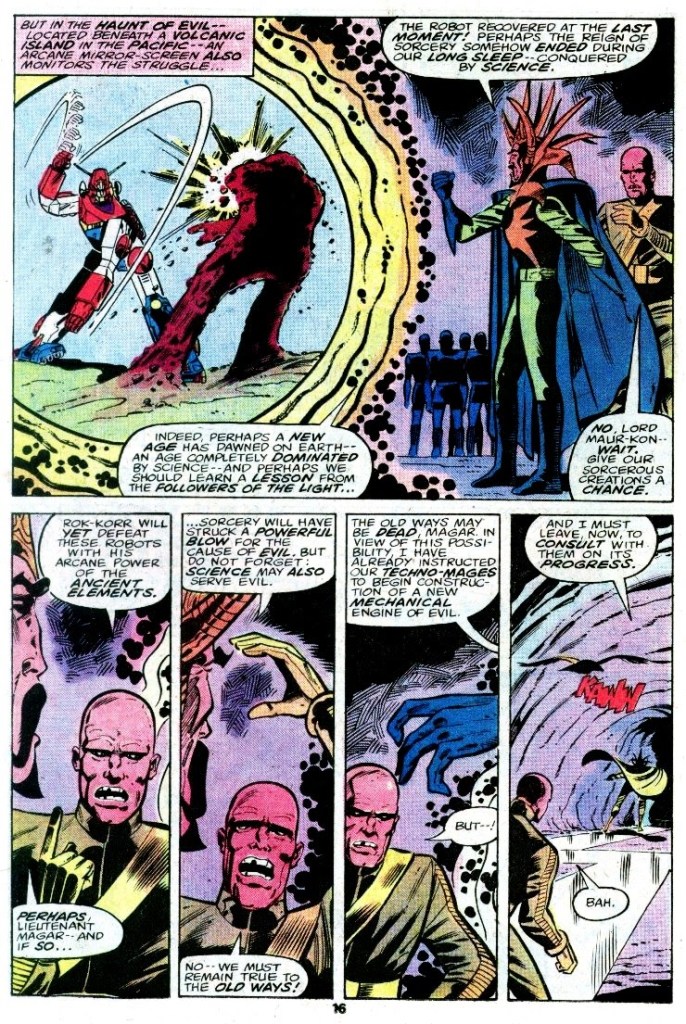
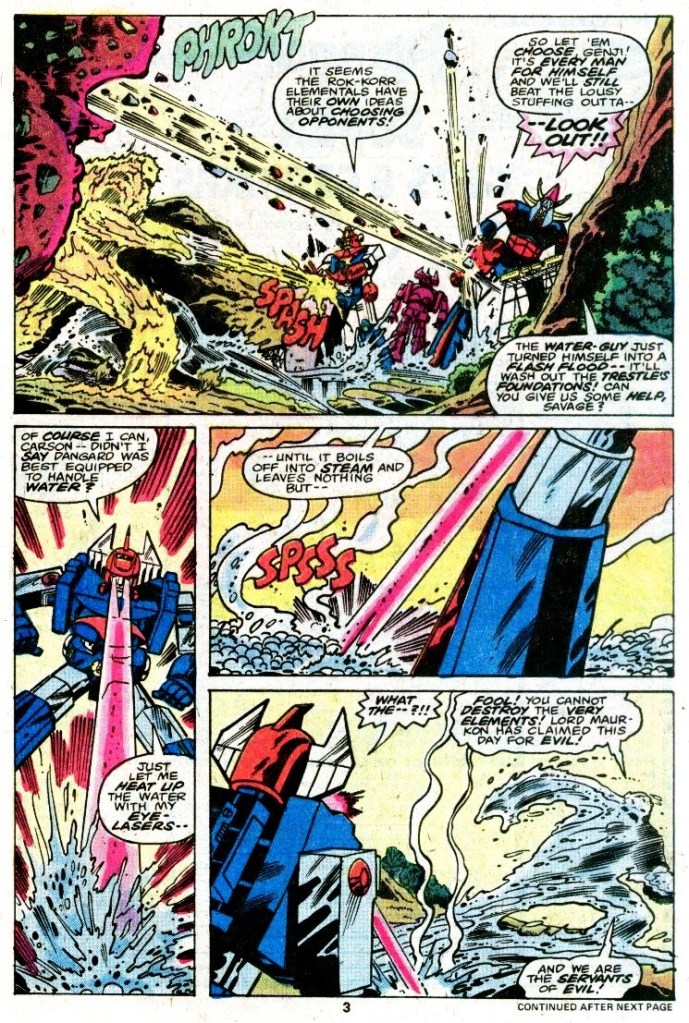
The story begins with Raydeen, Combatra and Dangard Ace on the field facing three giant enemies (each one representing a different element – fire, earth and water). Right near them is the train (on an elevated track) that they just saved which Combatra (piloted by Genji Odashu) notices.

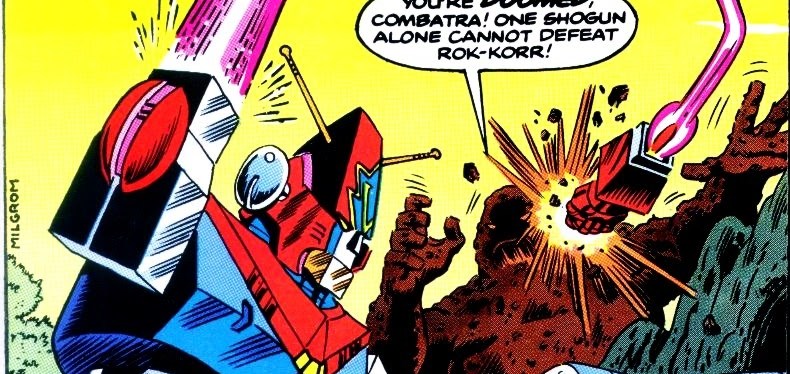
The battle begins with Dangard Ace taking on the water monster while Raydeen and Combatra take on the fire monster and earth monster respectively. During the heat of battle, the stalled train begins to fall as the elevated track gets damaged…

Quality

The bad guys watch behind the scenes during the battle.

To be clear and specific, this comic book creatively rebounded when it comes to spectacle. Compared to issue , this one has a lot of action scenes mixed with suspense and some talk scenes that were supposed to be intriguing. When it comes to exposition, this one is a refreshing change from what happened in issue . The exposition was clearly lessened but the creators still managed to insert some scenes to dramatize and explain to readers what the villains are up to and why sorcery is a core element of their power (which kinda explains how they were able to make giant monsters that are capable of talking). Interestingly, this comic book shows that there is division between members of the forces of evil.

Fans who love the three giant robots will have something fun to read. Take note, however, that the action scenes per robot are short and even predictable with the way the spectacle turned out. If you are looking for character development on their respective pilots, you won’t see any here.

Conclusion

Dangard Ace, Raydeen and Combatra fighting their respective counterparts.

Shogun Warriors (1979) does not have much depth but still managed to deliver the goods when it comes to showcasing giant robot spectacle. On the aspect of fun, this one is an improvement over the exposition-heavy issue but that is not saying much. It should be noted that, like the first two issues, this comic book has less than twenty pages of art and story. More notably, there is not much new here other than the very lame and corny attempt by the creators for the big reveal they came up with at the end.

If you are seriously planning to buy an existing hard copy of Shogun Warriors (1979), be aware that as of this writing, MileHighComics.com shows that the near-mint copy of the comic book costs $35.

Overall, Shogun Warriors (1979) is satisfactory.

+++++

Thank you for reading. If you find this article engaging, please click the like button below and also please consider sharing this article to others. If you are looking for a copywriter to create content for your special project or business, check out my services and my portfolio. Feel free to contact me as well. Also please feel free to visit my Facebook page Author Carlo Carrasco and follow me at HavenorFantasy@twitter.com

A Look Back at Prototype #15 (1994)

Disclaimer: This is my original work with details sourced from reading the comic book and doing personal research. Anyone who wants to use this article, in part or in whole, needs to secure first my permission and agree to cite me as the source and author. Let it be known that any unauthorized use of this article will constrain the author to pursue the remedies under R.A. No. 8293, the Revised Penal Code, and/or all applicable legal actions under the laws of the Philippines.

Welcome back superhero enthusiasts, comic book collectors and fans of Malibu Comics! Today, I’ve decided to take a break from the Hostile Takeover storyline of the Ultraverse and focus more on the Prototype monthly series. Last time around, a new chapter in the life of Prototype pilot Jimmy Ruiz started and in the corporate world, he took a job that paid so much less than before.

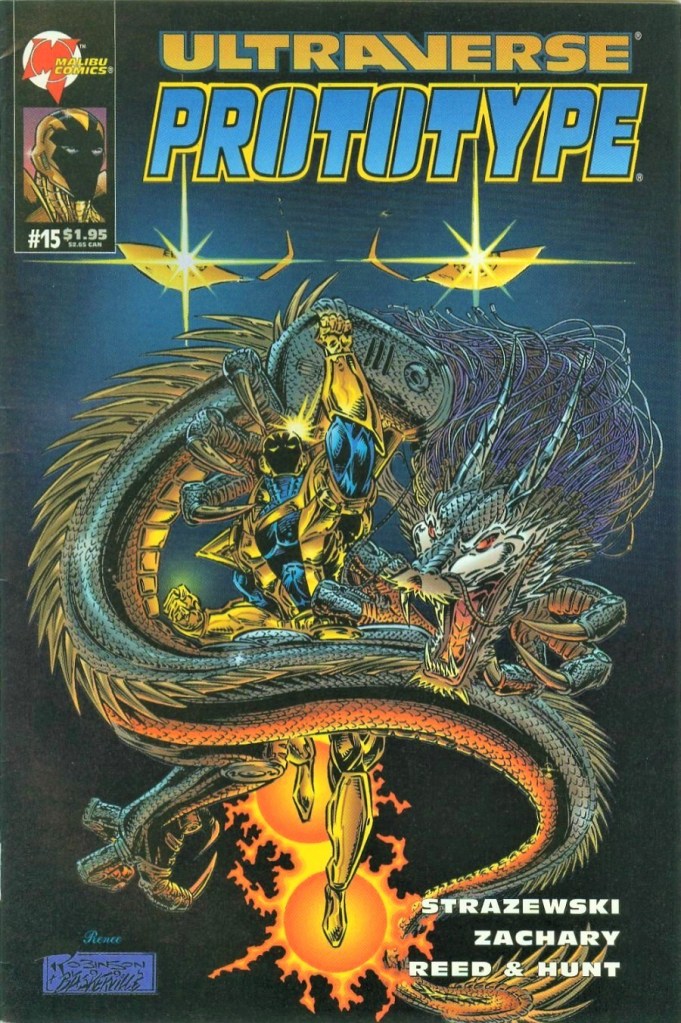
What exactly will happen to Jimmy? We can all find out in this look back at Prototype , published in 1994 by Malibu Comics with a story written by Len Strazewski and drawn by Dean Zachary.

The cover.

Early story

The story begins inside a top-secret facility somewhere in the city of New York. A black man is going through the painful processes of cybernetic enhancements. His name is Donovan Jones and he is told by a shadowy figure that he is a failure and only their organization can turn him into something else…more than a human loser.

“You always were an ultra, Jones…and UltraTech knew this! But they never revealed this toyou,” said the shadowy figure.

Donovan Jones expresses his hatred for UltraTech. He also expresses his intention to destroy Prototype.

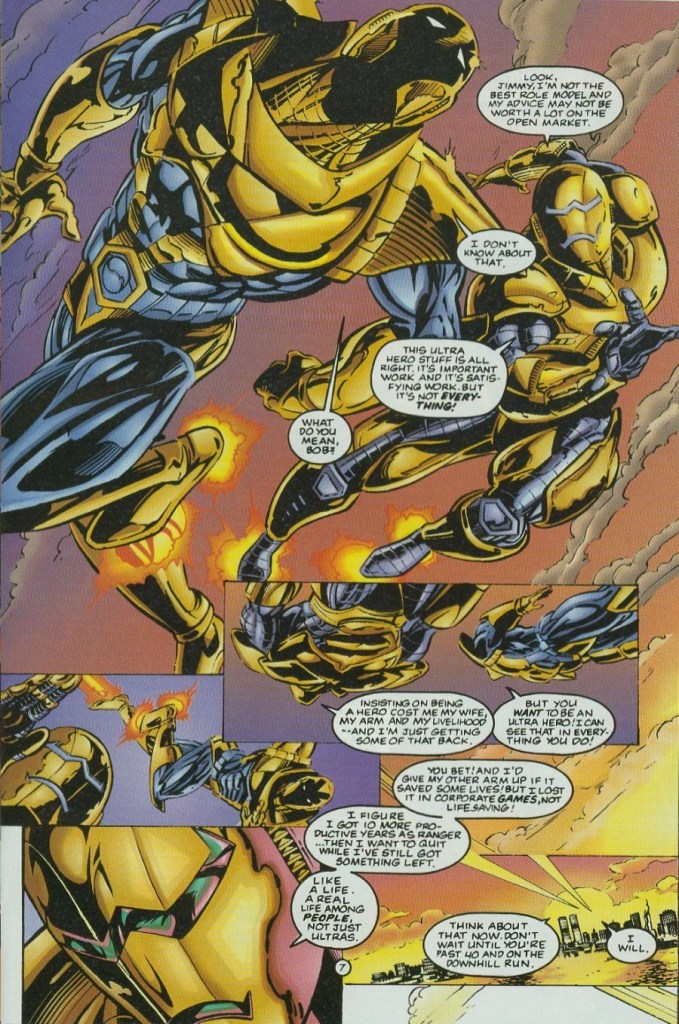
Elsewhere, a long vehicular bridge has been damaged. Helping the victims were Ranger (Bob Campbell) and Prototype (Jimmy Ruiz) trying to ensure that they could balance the bridge to prevent cars from falling over the edge. They managed to solve the problem paving the way for things to go back to normal. The affected people express their thanks and admiration to them.

As they fly away together, Bob and Jimmy talk about matters related to being ultra heroes. A short time later, Jimmy takes the train going to New Jersey as a civilian. He arrives at the facility of Direct Contact which is a division of NuWare. It turns out this is his first day of work with them and he is still struggling with the drastic changes now that his huge perks and privileges with UltraTech are no more…  

Quality

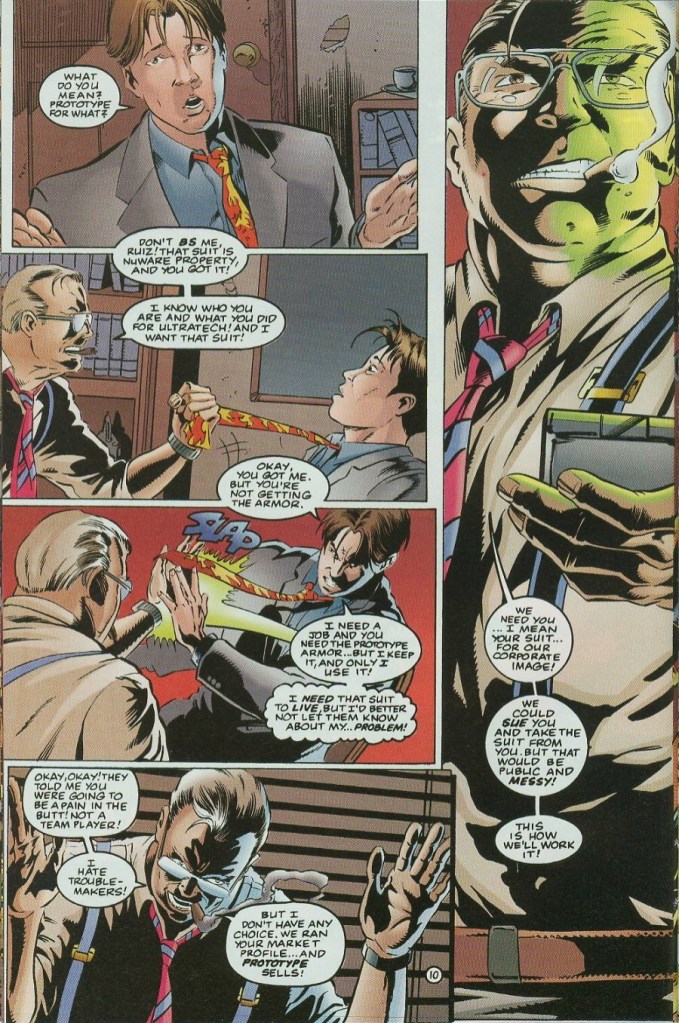
Jimmy Ruiz in a tough situation in front with his new boss on his first day at work.

I really like the story and the way Jimmy Ruiz was portrayed. This is really fine writing by Len Strazewski and it seems he organized a plan to not only redefine the protagonist but also change the status quo around him. I liked the way Strazewski set up the first-day-on-the-job struggles of Jimmy which really showed how fragile he is as a person without the armored suit to help him. His boss really was hard on him and made things a bit complicated for him as far as the use of Prototype is concerned under the control of NuWare. I also like the way Jimmy was portrayed in trying to be very responsible about his domestic life and the future ahead of him and his pregnant darling Angella.

Apart from the in-depth characterization, there is a good amount of superhero action to keep fans satisfied. The action was nicely drawn by Dean Zachary.

Conclusion

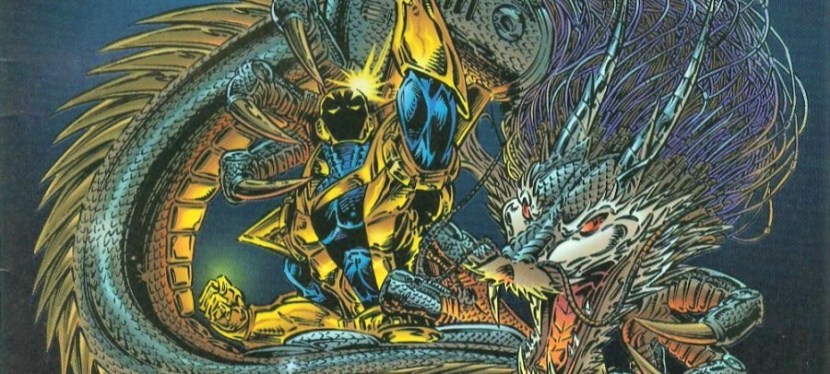
Prototype and Ranger.

Prototype (1994) is a lot of fun and pretty engaging. In fact, this comic book is a nice pay-off following the build-up that was done in issue . To see Jimmy Ruiz redefined as a person without the armor is compelling and the story was nicely structured by Len Strazewski. For serious Prototype fans, this is one comic book that is worth reading again and again. Lastly, this one has a very intriguing ending that you have to read and find out.

If you are seriously planning to buy an existing hard copy of Prototype (1994), be aware that as of this writing, MileHighComics.com shows that the near-mint copy of the comic book costs $14.

Overall, Prototype (1994) is highly recommended!

+++++

Thank you for reading. If you find this article engaging, please click the like button below and also please consider sharing this article to others. If you are looking for a copywriter to create content for your special project or business, check out my services and my portfolio. Feel free to contact me as well. Also please feel free to visit my Facebook page Author Carlo Carrasco and follow me at HavenorFantasy@twitter.com

A Look Back at Shogun Warriors #2 (1979)

Disclaimer: This is my original work with details sourced from reading the comic book and doing personal research. Anyone who wants to use this article, in part or in whole, needs to secure first my permission and agree to cite me as the source and author. Let it be known that any unauthorized use of this article will constrain the author to pursue the remedies under R.A. No. 8293, the Revised Penal Code, and/or all applicable legal actions under the laws of the Philippines.

Long before Pacific Rim (2013) presented giant robots and monsters slug it out on the big screen with a strong emphasis on action and scale, there were varied animated series of such giants shown in television sets in Japan way back in the 1970s. Then by the end of the decade, Marvel Comics published the Shogun Warriors comic book series in relation to a business deal with Mattel.

Last time, only one giant robot was heavily featured as a defender for human civilization as it became a target by a force of evil that unleashed a giant monster. That robot was Raydeen and as a result of what happened, something led to the unveiling of Combatra and Dangard Ace.

To find out more, here is a look back at Shogun Warriors , published by Marvel Comics in 1979 with a story written by Doug Moench and drawn by Herb Trimpe.

The cover.

Early story

The story begins at the secret facility of Shogun. There the three pilots – Genji Odashu, Ilongo Savage and Richard Carson – are being briefed by Dr. Tambura explains to them that their first mission piloting Raydeen was not a failure at all. While acknowledging that the giant monster Rok-Korr is still a threat, he states to them that giant robots Combatra and Dangard Ace will be deployed and controlled by them.

After giving them a quick tour of their subterranean chamber (where the robots receive maintenance and get tested), Dr. Tambura bring the three pilots into another place filled with high-tech controls. From there, they watch Dangard Ace, Raydeen and Combatra perform in field tests via remote control.

Meanwhile on a different island, the evil leader Maur-Kon rallies his so-called dark agents to rise and work together in seeking vengeance for their defeat in the great war chaos as they have found the forces of eternal good anticipating them. After much talk, Maur-Kon and his minions bow and kneel over bubbling magma murmuring evil phrases…

Quality

The three pilots get assigned with each robot.

Like the previous issue, this comic book has less than twenty pages of story and art. This results another heavy load of exposition or information dump on readers, and the narrative had a rushed pace. With regards to the battle between Raydeen and the giant monster, there is indeed a continuation of it. The giant monster was given some personality.

Again, there is no real character development here. The three pilots were not written to display any personality nor did the writer exert any effort to make readers relate with them. Instead, you will see them in training in speed beyond belief.

The highlight here is that Dangard Ace and Combatra finally got revealed and emphasized. Be warned, however, that there is lesser spectacle in this comic book and the story predictably served as a setup for what could be a more promising battle.

Conclusion

The pilots and the Shogun Warriors (the robots) go deep down.

Shogun Warriors (1979) suffered from pretty much the same problems as issue . The noticeable difference here is that there is lesser action and lesser giant-sized spectacle shown here. That is not exactly surprising as the creators had to sacrifice something to make way for further explanation of the comic series’ grand concept.

If you are seriously planning to buy an existing hard copy of Shogun Warriors (1979), be aware that as of this writing, MileHighComics.com shows that the near-mint copy of the regular edition costs $35 while the near-mint copies of the price-less and the Whitman editions cost $350 and $35 respectively.

Overall, Shogun Warriors (1979) is less than satisfactory.

+++++

Thank you for reading. If you find this article engaging, please click the like button below and also please consider sharing this article to others. If you are looking for a copywriter to create content for your special project or business, check out my services and my portfolio. Feel free to contact me as well. Also please feel free to visit my Facebook page Author Carlo Carrasco and follow me at HavenorFantasy@twitter.com

A Look Back at Shogun Warriors #1 (1979)

Disclaimer: This is my original work with details sourced from reading the comic book and doing personal research. Anyone who wants to use this article, in part or in whole, needs to secure first my permission and agree to cite me as the source and author. Let it be known that any unauthorized use of this article will constrain the author to pursue the remedies under R.A. No. 8293, the Revised Penal Code, and/or all applicable legal actions under the laws of the Philippines.

If you are fond of giant robots from Japanese pop culture as well as giant monsters and scenes of city structures getting destroyed, then you might want to take a look at the Shogun Warriors comic book series that was published by Marvel Comics from 1979 to 1980. To put things in perspective, Shogun Warriors was made possible through licensing deals and back in the 1970s, Marvel Comics had the rights to publish comic book about Japan’s famous icon Godzilla.

Specifically, Shogun Warriors involved Marvel Comics and Mattel which in turn organized a line of imported toys from Japan based on varied Japanese shows about giant robots. Among the many giant robots of the toy line, the robots Raideen, Combattler V and Dangard Ace became the featured fighting-for-good robots of the Shogun Warriors comic book series. For the literary works, Raideen was renamed as Raydeen while Combattler V was renamed as Combatra. Dangard Ace’s name was left unchanged.

With those details laid down, here is a look back at Shogun Warriors , published in 1979 by Marvel Comics with a story written by Doug Moench and drawn by Herb Trimpe.

The cover.

Early story

The story begins in the outskirts of Tokyo in Japan where giant robot Raydeen fights a large, tentacled creature enhanced with cybernetics. As the people on the street below them run away from the ongoing destruction, the monster fires a shot at Raydeen who blocks it but subsequently gets tied with one of the tentacles. The giant robot, which is operated by three pilots inside, breaks free and continues to fight the monster.

As the battle rages on, the city continues to get damaged heavily affecting the people…

Quality

Technically the organization kidnapped three people to be the pilots of their robots for Earth’s defense.

Having seen a lot of anime TV series episodes about giant robots, I’m familiar already with the storytelling formula that often focuses first on the human characters and their struggles before shifting the narrative on the giant robots that often fight large monsters or opposition robots. This particular comic book has some of that but the way the story is structured, it is different and can be a bit jarring.

Doug Moench structured the story to have Raydeen and the monster fighting in the present time followed shortly by a flashback that took place just hours prior. The flashback, which occupies 9 of the comic book’s 18 pages, is heavily filled with exposition meant to introduce readers to the three pilots Genji Odashu/Ilongo Savage/Richard Carson, what Earth defense force The Followers of the Light is, and why there are giant monsters ravaging the world. The exposition’s writing felt crammed and rushed for reading although it still succeeds in establishing the comic book’s grand concept.

When it comes to spectacle, this comic book is loaded with giant robot action and it is quite varied in style and execution. The funny thing is that you will only get to see Raydeen in action as this is an introductory story with only 18 pages of story.

The dialogue is a bit of a mess here, particularly with the early Raydeen scenes. As the battle with the monster goes on, there are these lines of dialogue reflecting the conversations between the pilots inside Raydeen who are not shown talking until late in the comic book.

Conclusion

Raydeen and the giant monster in battle.

Shogun Warriors (1979) has a nice concept and its Westernized take on portraying giant robots and human characters is clearly different from the way things were done in the varied giant robot anime TV series of Japan. There is clearly no Japanese style melodrama as this one has its characters portrayed straight with a touch of American science fiction. That being said, do not expect to see the Japan-made characters of Raideen, Combattler V and Dangard Ace appear here as new characters were made in their place. The comic book’s story structure is a bit jarring to follow and the heavy exposition dump makes reading a bit of a chore. It is fun to read but not great. Those of who are fans of Combatra and Dangard Ace will be disappointed about the near-total absence of those robots.

If you are seriously planning to buy an existing hard copy of Shogun Warriors (1979), be aware that as of this writing, MileHighComics.com shows that the near-mint copy of the regular edition costs $63 while the near-mint copy of the Whitman edition costs $35.

Overall, Shogun Warriors (1979) is satisfactory.

+++++

Thank you for reading. If you find this article engaging, please click the like button below and also please consider sharing this article to others. If you are looking for a copywriter to create content for your special project or business, check out my services and my portfolio. Feel free to contact me as well. Also please feel free to visit my Facebook page Author Carlo Carrasco and follow me at HavenorFantasy@twitter.com

A Look Back at Godzilla #1 (1995)

Disclaimer: This is my original work with details sourced from reading the comic book and doing personal research. Anyone who wants to use this article, in part or in whole, needs to secure first my permission and agree to cite me as the source and author. Let it be known that any unauthorized use of this article will constrain the author to pursue the remedies under R.A. No. 8293, the Revised Penal Code, and/or all applicable legal actions under the laws of the Philippines.

Welcome back, comic book collectors, sci-fi enthusiasts and fellow geeks! You must have heard by now that pop culture icons Godzilla and King Kong will clash together on the big screen in Godzilla vs. Kong (2021). Check out the official trailer below.

Take note that this is NOT the first time the two giant monsters encountered each other on the big screen. In fact, there was a Japanese-produced movie that featured the two released in 1963 and it involved Ishirô Honda who himself directed the 1954 original Godzilla movie. As the decades passed by, Godzilla movies were viewed by lots of people around the world and by the time efforts were taken to realize a Hollywood-produced film showcasing Japan’s icon, its place in global pop culture was already sealed.

And here is the thing that should interest you all – before the 1998 Hollywood Godzilla film (directed by Roland Emmerich) was even released, Dark Horse Comics published a series of Godzilla comic books. Of course, this was not the first time Godzilla made its presence felt in illustrated literature but the mid-1990s series was an effort to modernize Japan’s icon with readers (and comic collectors) of the time.

With those details laid down, here is a look back at Godzilla , published by Dark Horse Comics in 1995 with a story written by Kevin Maguire and drawn by Brandon McKinney.  

The cover.

Early story

The story begins with a network television talk show focused on Godzilla and the possibility of it attacking North America. On the air, TV show host Kate Koshiro talks with research team G-Force member Take’ who states that Godzilla has been injected with poison and swam to the bottom of the ocean. Even so, they never found a corpse.

As the show goes on, it is revealed by Take’ that his team uses low-frequency signals which they hope will attract Godzilla and even pacify it. Take’ eventually begins to get nervous as Kate Koshiro presses him for details. Behind the scenes, personnel of G-Force watch the show on their giant monitor.

The G-Force personnel turn their attention away from the TV show as they have been alerted to the sudden emergence of Godzilla, 77 miles northwest of Vancouver…

Quality

The destructive power of Godzilla!

If you are looking for a good, original story of Godzilla to read, this comic book has it! To start with, it has a nice world concept of its own surrounding the monster. G-Force serves as the primary organization the world goes to not only for protection from Godzilla’s attacks but also extensive research-and-development (R&D) that can make breakthroughs the world can benefit from, and intelligence that the respective defense forces of nations can use.

The characters are an interesting mix with elements from G-Force and the American armed services doing most of the interaction, talking and exposition. The closest thing this comic book has to a human protagonist is Take’ who turned out to be more capable than being a researcher of G-Force.

As for Godzilla, there is nothing new with the monster’s portrayal even though it is confirmed to be sick with poison. Wherever Godzilla goes, a lot of destruction happens making it look like the antagonist to the reader. In other words, a typical Godzilla portrayal. Fortunately, the comic book creators succeeded in maintaining the giant’s presence strongly even though the narrative was primarily focused on the human characters.

Conclusion

Nothing like carrying the tremendous pressure that comes with the unexpected emergence of a gigantic monster.

Godzilla (1995) is surprisingly entertaining to read. When I first read this comic book, I had modest expectations and just let myself discover what it has to offer. The good news here is that the comic creators crafted a story that is interesting and fun enough to read. Apart from focusing on Godzilla, the G-Force organization has an interesting cast of characters.

If you are seriously planning to buy an existing hard copy of Godzilla (1995), be aware that as of this writing, MileHighComics.com shows that the near-mint copy of the comic book costs $70.

Overall, Godzilla (1995) is recommended.

+++++

Thank you for reading. If you find this article engaging, please click the like button below and also please consider sharing this article to others. If you are looking for a copywriter to create content for your special project or business, check out my services and my portfolio. Feel free to contact me as well. Also please feel free to visit my Facebook page Author Carlo Carrasco and follow me at HavenorFantasy@twitter.com

A Look Back at Terminator 2: Cybernetic Dawn #1 (1995)

Disclaimer: This is my original work with details sourced from reading the comic book and doing personal research. Anyone who wants to use this article, in part or in whole, needs to secure first my permission and agree to cite me as the source and author. Let it be known that any unauthorized use of this article will constrain the author to pursue the remedies under R.A. No. 8293, the Revised Penal Code, and/or all applicable legal actions under the laws of the Philippines.

Like any geek, I still love watching Terminator 2: Judgment Day, specifically its extended version which was James Cameron’s true vision. I’m not exactly a fan of Arnold Schwarzenegger, but I really love his work in T2 as well as in Total Recall. When it comes to James Cameron’s works, I personally prefer T2 over Avatar, Titanic and True Lies.

As for the Terminator franchise itself, it spawned cinematic sequels that only turned up as disappointments. Terminator 2 was indeed the high point of the film franchise and everything really went downhill afterwards. I should state that Terminator: Dark Fate should be avoided as it is not worth your time and money.

Recently, I searched for some comic books that served as sequels to Terminator 2 and I found one from the mid-1990s and it is a direct follow-up! We can find out more in this look back at Terminator 2: Cybernetic Dawn , published in 1995 by Malibu Comics with a story written by Dan Abnett and Rod Whigham.

The cover.

Early story

The story begins immediately after the end of Terminator 2 with the injured Sarah Connor (with a very exhausted John Connor sleeping) still managing to drive the car in the middle of the night. As she drives, Sarah recalled that she never asked for the responsibility of preserving mankind as it was forced on her way back in 1984. She also recalled the time in Tech Noir when the Terminator almost killed her as she got saved by Kyle Reese.

By morning, Sarah and John reached the desert and returned to the lonely home of her old ally Enrique. Suddenly a man with a shotgun comes out and aims his weapon directly at Sarah. Carrying a gun, John comes out to help his mother…

Quality

John and Sarah Connor.

Let me start with the story and make clear to you readers that this comic book easily defies the conclusion that was set in the movie Terminator 2. If you have seen the film, you should be aware that the way it was concluded made sure there is no more future war and no more Terminators. Like the 2003 movie Terminator 3: Rise of the Machines, this comic book just kept on pushing the concept that Judgement Day and the war with the machines are still inevitable and that Terminators from the future would only continue to arrive to hunt and kill John. As such, the hard struggle for Sarah and her son continues.

That being said, this comic book really pushed hard with its sequel approach. Remember what happened in the steel mill in Terminator 2? Several personnel investigated the facility and one particular detective arrived searching for Sarah Connor who has been labeled as an escapee from the state hospital. Inside the steel mill is the severed left arm of the Terminator (which got stuck to crushing mechanical wheels as seen in the 1991 movie) which is the storytelling key the comic book creators used to justify this sequel.  

To the comic creators’ credit, they did their research about T2 and even made references to other characters of that movie. As a result, this comic book appears loaded with fan service.

Even though it has many references and connections to the 1991 movie, this comic book also has some completely new stuff to expand on T2’s concept. The destruction of Cyberdyne’s facility in the movie resulted an emergency meeting of a corporation’s board of directors (and a certain senator) which creatively sets up further conflicts as well as struggles for Sarah and her son.

In terms of writing, this comic book’s story is cohesive enough. As for the art, the quality is fine and most notably, the illustrator managed to somewhat capture the likeness of Linda Hamilton on Sarah Connor.

Conclusion

The severed Terminator arm as the single factor that justified this sequel somewhat.

I can say that Terminator 2: Cybernetic Dawn (1995) is a surprisingly satisfying read mainly due to its writing and artistic quality. While its push to justify a sequel barely succeeds, there is more good stuff than negative ones overall. As far as making sequels to Terminator 2 is concerned, this one is somewhat more believable than the 2003 movie.

If you are seriously planning to buy an existing hard copy of Terminator 2: Cybernetic Dawn (1995), be aware that as of this writing, MileHighComics.com shows that the near-mint copy of the comic book costs $19.

Overall, Terminator 2: Cybernetic Dawn (1995) is satisfactory.

+++++

Thank you for reading. If you find this article engaging, please click the like button below and also please consider sharing this article to others. If you are looking for a copywriter to create content for your special project or business, check out my services and my portfolio. Feel free to contact me as well. Also please feel free to visit my Facebook page Author Carlo Carrasco and follow me at HavenorFantasy@twitter.com