A Look Back at Wolverine #87 (1994)

Welcome back superhero enthusiasts, 1980s arts and culture enthusiasts, Marvel Comics fans and comic book collectors! Today we go back to the year 1984 to examine a small part of the Marvel Comics universe through a tale of the Wolverine monthly series.

This particular tale shows were Wolverine went and what he has been doing since he decided to leave the X-Men in Wolverine #75 (1993). Since Magneto removed the Adamantium out of him in X-Men #25 (1993) and Wolverine discovered that his claws were made of pure bones (part of him all along), he has been very determine to search for answers and the truth about himself.

With those details laid down, here is a look back at Wolverine , published in 1994 by Marvel Comics with a story written by Larry Hama and drawn by Adam Kubert.

The cover.

Early story

The story begins in the Southeast Asian city of Madripoor (fictional) where Wolverine and his former teammate Gambit are reunited. As they walk, Gambit tells him that Sabretooth (Wolverine’s long-time rival) is staying in Charles Xavier’s mansion (refer to X-Men #28 and #29). As they talk, Wolverine notices something odd at the Princess Bar which he previously visited and there seems to be something wrong. The two decided to break in, causing damage and expecting the worst. It turns out, a lot of people are inside (including those who became friends of Logan) who prepared a surprise celebration for Wolverine.

As the celebration goes on, ninjas at the top of the building watch Wolverine carefully as they prepare to go down and kill him…

Quality

Amazingly, Wolverine managed to slash the two falling guys with his bone claws and impressed Gambit.

If you are familiar with Team X (revealed in flashbacks in X-Men #5 and X-Men #6) composed of Wolverine, Sabretooth and Maverick as black ops operatives, then the story of this comic book will really become relevant with you. In fact, reading the mentioned comic books is a must.

Without spoiling the plot, I can say that creative duo of Hama and Kubert came up with their own contribution to the Team X mythos (with flashbacks visualized in similar style to those in the above-mentioned X-Men comic books of 1992) while emphasizing how the past affects Wolverine, Sabretooth and Maverick in the present day.

What Hama-Kubert came up with was not the typical good-versus-evil superhero tale but rather a believable expansion of the Team X legacy, what the three former members have in common, and what uncertainties are they dealing with as surviving mutants. In the case of Wolverine, this tale adds depth to his solo exploits since leaving his team behind in search for answers.

Conclusion

Wolverine dancing with a pretty lady while two guys above watch them.

Wolverine (1994) is a fine character exploration and also a nice revelation about Team X. Considering how good the contributions from Hama and Kubert are, they would not be so relevant if you have never read Team X’s flashbacks in the two specific X-Men comic books published in 1992 and that alone makes this one a tricky read.

Overall, Wolverine (1994) is recommended.

+++++

Thank you for reading. If you find this article engaging, please click the like button below, share this article to others and also please consider making a donation to support my publishing. If you are looking for a copywriter to create content for your special project or business, check out my services and my portfolio. Feel free to contact me with a private message. Also please feel free to visit my Facebook page Author Carlo Carrasco and follow me on Twitter at  @HavenorFantasy as well as on Tumblr at https://carlocarrasco.tumblr.com/ and on Instagram at https://www.instagram.com/authorcarlocarrasco

A Look Back at G.I. Joe: A Real American Hero #23 (1984)

Welcome back superhero enthusiasts, 1980s culture enthusiasts and comic book collectors! Today we go back to the mid-1980s to explore Marvel Comics’ extensive publishing of a comic book series based on the wildly popular military-themed franchise of toys – G.I. Joe: A Real American Hero.

Whenever a war between good and evil happens, it is only desirable for people siding with the good guys to score a major breakthrough against the evil ones. Breakthroughs include annihilating the enemy entirely or compelling them to surrender unconditionally, or capturing one of their most powerful leaders alive.

With those details laid down, here is a look back at G.I. Joe: A Real American Hero published in 1984 by Marvel Comics with the main story written by Larry Hama and drawn by Mike Vosburg.

The cover.

Early story

The story begins near the Italian border of Switzerland. GI Joe member Snow Job sits high up on a cliff and monitors an institute from long distance. He carefully sees the Baroness (wearing a white garment) and reports to Duke about it. Duke, who is seated close to Roadblock in public, tells him to maintain passive surveillance as their team is anticipating that the Baroness will lead them to Cobra Commander.

Moments later, Roadblock notices a man across the street coming out from one of the buildings. The man turns out to be Major Bludd, a mercenary working for Cobra. Duke then sends a message to Cover Girl and Clutch (both of them riding a car elsewhere) to follow Major Bludd…

Quality

Cover Girl and Clutch chase the vehicle that has Major Bludd and Baroness.

I really like this story. While this is clearly not the bombastic, gun-blazing conflict between G.I. Joe and Cobra, this tale has stronger elements of espionage, suspense and intrigue nicely mixed together. The story moved at a medium pace and there were suitable pay-offs to the build-up that occurred throughout.

While the cover of this comic book is indeed a spoiler, it is within the details of the script and its story structure that justified the capture of one of Cobra’s most notorious figures. How G.I. Joe pulled it off and what obstacles they went through were nicely portrayed by the Hama-Vosburg team.

Not only that, the comic book also shed light on the character moments and story developments told through the side of Cobra which are quite intriguing to read.

Conclusion

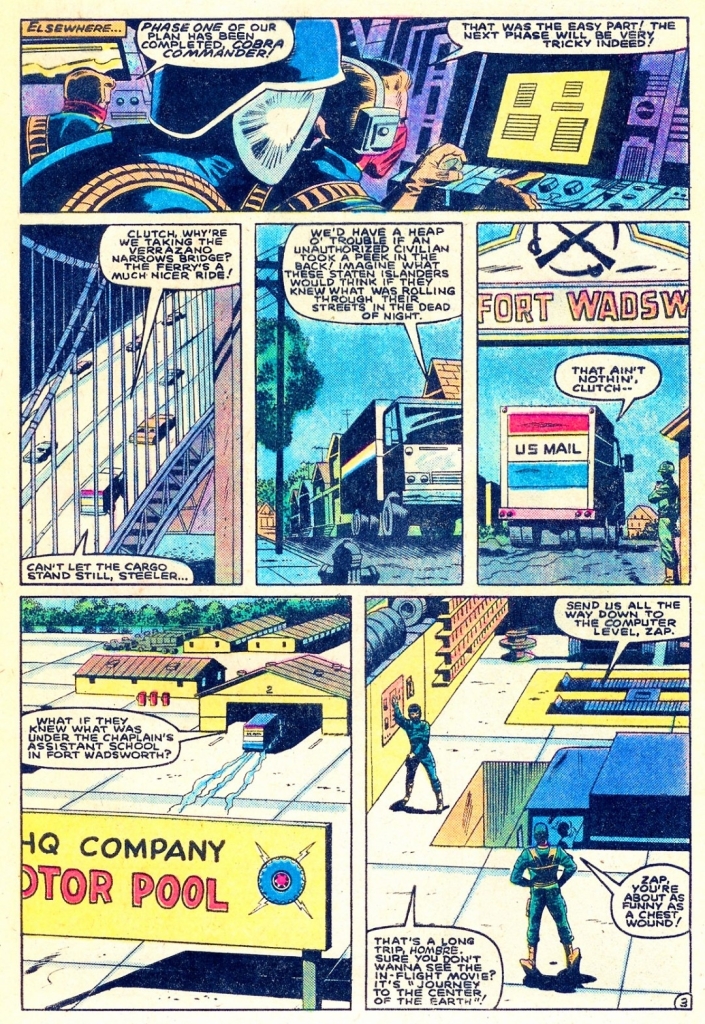
Cobra Commander making his way through in the American town of Springfield which is their front.

G.I. Joe: A Real American Hero (1984) is another fun and engaging tale Larry Hama crafted. The creative team succeeded in justifying the capture of Cobra Commander (as seen in the cover) while giving readers some new insights about the characters and how they do their duties. By the time I reached the end of this comic book, I was satisfied and convinced to look forward to what would happen next.

Overall, G.I. Joe: A Real American Hero (1984) is recommended.

+++++

Thank you for reading. If you find this article engaging, please click the like button below, share this article to others and also please consider making a donation to support my publishing. If you are looking for a copywriter to create content for your special project or business, check out my services and my portfolio. Feel free to contact me with a private message. Also please feel free to visit my Facebook page Author Carlo Carrasco and follow me on Twitter at  @HavenorFantasy as well as on Tumblr at https://carlocarrasco.tumblr.com/ and on Instagram at https://www.instagram.com/authorcarlocarrasco

A Look Back at G.I. Joe: A Real American Hero #10 (1983)

Welcome back superhero enthusiasts, 1980s culture enthusiasts and comic book collectors! Today we go back to the early 1980s to explore Marvel Comics’ extensive publishing of a comic book series based on the wildly popular military-themed franchise of toys – G.I. Joe: A Real American Hero.

Last time around, G.I. Joe found itself getting attacked within their own base (The Pit) as a result of the robot they brought in from a stronghold of their terrorist rival Cobra. It was a Trojan plan that Cobra Commander and his team organized from far away and they almost succeeded.

With those details laid down, here is a look back at G.I. Joe: A Real American Hero published in 1983 by Marvel Comics with the main story written by Larry Hama and drawn by Mike Vosburg.

The cover.

Early story

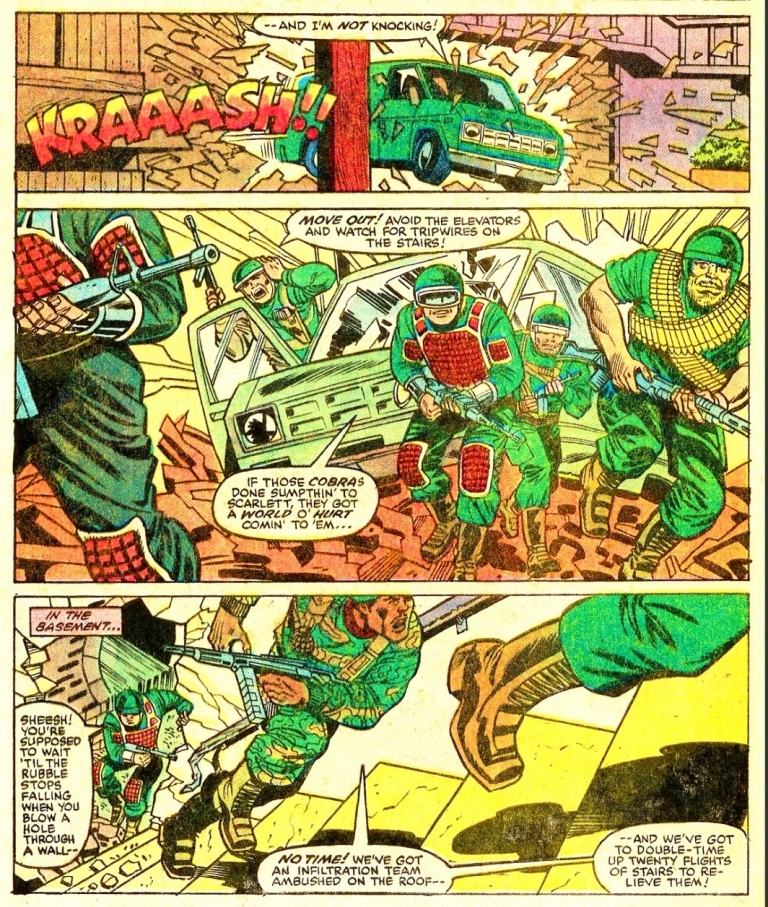
The story begins with G.I. Joe members Scarlett, Snake-Eyes and Zap reach the top of a tall New York City building that could be another stronghold of Cobra. On the street just outside of the same building, other Joe members located inside a van on the street and in the sewers carefully make their moves to ensure their operation will succeed.

Behind the scenes inside the building, the Baroness is informed of the Joes’ presence. This causes the top of building’s roof to open causing Snakey-Eyes, Scarlett and Zap to fall down into a room. In response, the Joe members inside the van make their move into the building save Scarlett and her two teammates…

Quality

A few of the Joes captured by Cobra, and Snake-Eyes got heavily restrained.

This is another clever story written by Larry Hama highlighting the rivalry between G.I. Joe and Cobra without emphasizing the usual action-packed battles between them. Instead, this tale emphasizes Cobra being more resourceful than meets the eye. What I mean is that the terrorists here are not limited to their military culture and weapons as they also have the means to conduct scientific experimentation, establishing spies among civilians (including minors) and even having American towns as their tactical fronts.  

In many ways, this tale shows Cobra being a very diversified terrorist organization that also mastered the uses of disguise and imagery to hide themselves from American authorities right there in America. The town of Springfield symbolizes Cobra’s use of ground level fronts to hide their secret underground stronghold from being spotted which is eerily similar to how Palestinian terrorist group Hamas uses schools, hospitals and other establishments in the Gaza strip to hide their tunnels and operation places deep under. The portrayal of American minors being junior officers of Cobra is really disturbing as it reminds me of the fact that in reality, Palestinian terrorists (note: the Palestinian Authority is corrupted and practices apartheid) have brainwashed their minors to hate and to murder Jews. I should add that the Palestinian terrorists, Hamas, the United Nations (UN), Amnesty International and the many Leftist leaders of nations formed the global axis of evil we know today.

As for the characters, the new kid here is easily the most notable addition and you have to read the comic book to find out why. For the more established characters, you will see Snake-Eyes helpless and Scarlett being really vulnerable in the dream world. On the side of Cobra, Dr. Venom has really fascinating interpretations and observations about the readings of the scientific operations.

Conclusion

The other G.I. Joe members scramble to rescue their teammates.

G.I. Joe: A Real American Hero (1983) is very engaging and intriguing to read from start to finish. This comic book, which is clearly a piece of fantasy, also served as an intriguing reminder that terrorists in the real world (read: Iran, Palestinian terrorists, Hamas, Hezbollah, ISIS and others) are capable of securing or stealing large financial resources for themselves and expand their operations to infiltrate societies and take advantage of the ignorant and helpless members to be part of their wicked causes.  There were indeed lots of parallels between Cobra and the Palestinian terrorists.

Overall, G.I. Joe: A Real American Hero (1983) is recommended.

+++++

Thank you for reading. If you find this article engaging, please click the like button below, share this article to others and also please consider making a donation to support my publishing. If you are looking for a copywriter to create content for your special project or business, check out my services and my portfolio. Feel free to contact me with a private message. Also please feel free to visit my Facebook page Author Carlo Carrasco and follow me on Twitter at  @HavenorFantasy as well as on Tumblr at https://carlocarrasco.tumblr.com/ and on Instagram at https://www.instagram.com/authorcarlocarrasco

A Look Back at G.I. Joe: A Real American Hero #3 (1982)

Welcome back superhero enthusiasts, 1980s culture enthusiasts and comic book collectors! Today we go back to the early 1980s to explore Marvel Comics’ handling of a series based on the wildly popular military-themed franchise of toys – G.I. Joe: A Real American Hero.

Last time around, a small number of G.I. Joe members went to the North Pole on a mission to find answers and anyone responsible for the destruction of the American research base. The mission did not involve Cobra at all but a certain specialist who was working as a freelancer.  

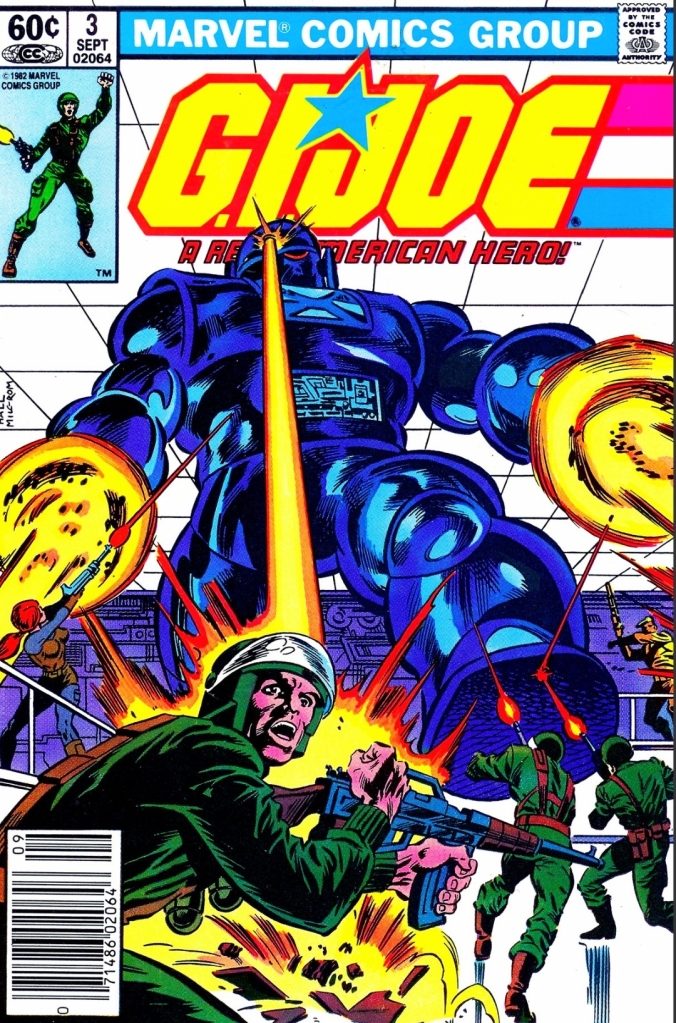
With those details laid down, here is a look back at G.I. Joe: A Real American Hero published in 1982 by Marvel Comics with the main story written by Larry Hama and drawn by Herb Trimpe.

The cover.

Early story

The story begins shortly after G.I. Joe’s successful raid on a secret stronghold that belonged to their arch-rival Cobra. A huge, bulky robot was found at the site and the Joe team received orders to get the machine back to their command center – The Pit – to run preliminary scans on it.

Due to the very sensitive nature of the robot and the Cobra stronghold, the military uses three trucks disguised as American mail trucks for the trips to The Pit.

Elsewhere, Cobra Commander and his team are aware that G.I. Joe is bringing the robot with them. He has a Trojan plan prepared…

Quality

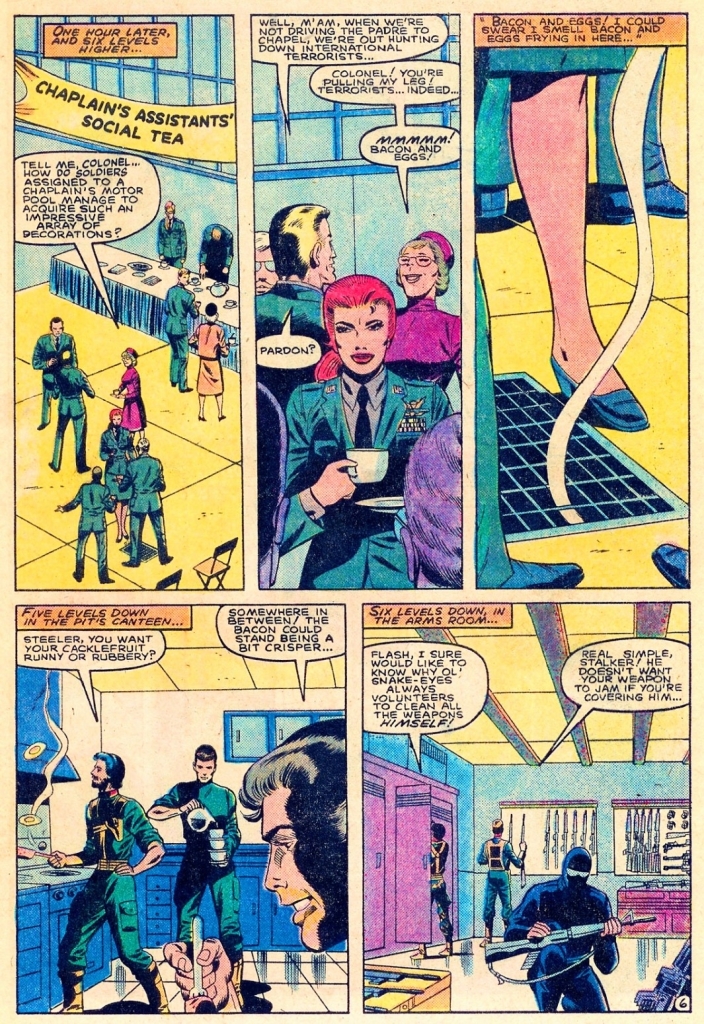
The scent of bacon and eggs reached the higher levels.

To make things clear, this is story still does not put G.I. Joe head-to-head with Cobra in combat. Instead, this is a tale about Cobra’s attempt to cause chaos on their rivals deep within a top secret stronghold of the Americans. That being said, the main character here is the huge robot of Cobra’s which really pushed the Joe team into real challenges. The robot does not even speak and its actions really drove up the tension of both the Joe team’s predicament as well as the narrative itself.

Along the way, you will get to see members of G.I. Joe becoming more tactical with their struggle to survive and solve problems. In fact, the Joe members are more versatile which reflect what they learned from extensive training.

Conclusion

Cobra Commander monitors the developments from a distance as G.I. Joe members brought with them the robot from what was once a stronghold of Cobra.

While the lack of a direct conflict between the Joe team and Cobra is evident, G.I. Joe: A Real American Hero (1982) still had an unrelenting enemy in the form of Cobra’s robot that proved to be a major force of opposition. In terms of presentation, this story has a slight touch of science fiction (due to the robot) but managed to be military in nature the rest of the way. Apart from their resourcefulness, the G.I. Joe members here displayed a strong element of team work. The narrative is packed with action as well as a good amount of details that made the reading experience consistently good.

Overall, G.I. Joe: A Real American Hero (1982) is recommended.

+++++

Thank you for reading. If you find this article engaging, please click the like button below, share this article to others and also please consider making a donation to support my publishing. If you are looking for a copywriter to create content for your special project or business, check out my services and my portfolio. Feel free to contact me with a private message. Also please feel free to visit my Facebook page Author Carlo Carrasco and follow me on Twitter at  @HavenorFantasy as well as on Tumblr at https://carlocarrasco.tumblr.com/ and on Instagram at https://www.instagram.com/authorcarlocarrasco

A Look Back at G.I. Joe: A Real American Hero #2 (1982)

Welcome back superhero enthusiasts, 1980s culture enthusiasts and comic book collectors! Today we go back to the early 1980s to explore Marvel Comics’ handling of a series based on the wildly popular military-themed franchise of toys – G.I. Joe: A Real American Hero.

Last time around, G.I. Joe members were sent to an island to rescue a very important woman who was kidnapped by Cobra. Along the way, the Joes faced stiff opposition and the duo of Snake-Eyes and Scarlett infiltrated the headquarters facing off with Cobra Commander and the Baroness. The comic book itself was indeed engaging and fun to read.

With those details laid down, here is a look back at G.I. Joe: A Real American Hero published in 1982 by Marvel Comics with the main story written by Larry Hama and drawn by Don Perlin.

The cover.

Early story

The story begins when the United States discovers its research station in the North Pole has been attacked and left in ruin. The damage found indicates that it has been wiped out in a commando-style raid, all station personnel were found dead and all the records were missing.

After carefully assessing the available information about the ruined American base, General Austin decides to send the G.I. Joe team to the North Pole. This resulted in cutting short the respective leaves of Stalker, Breaker, Scarlett and Snake-Eyes.

After being dropped at the North Pole, the selected G.I. Joe members carefully make their way to the Russian base and decide to watch from a distance…

Quality

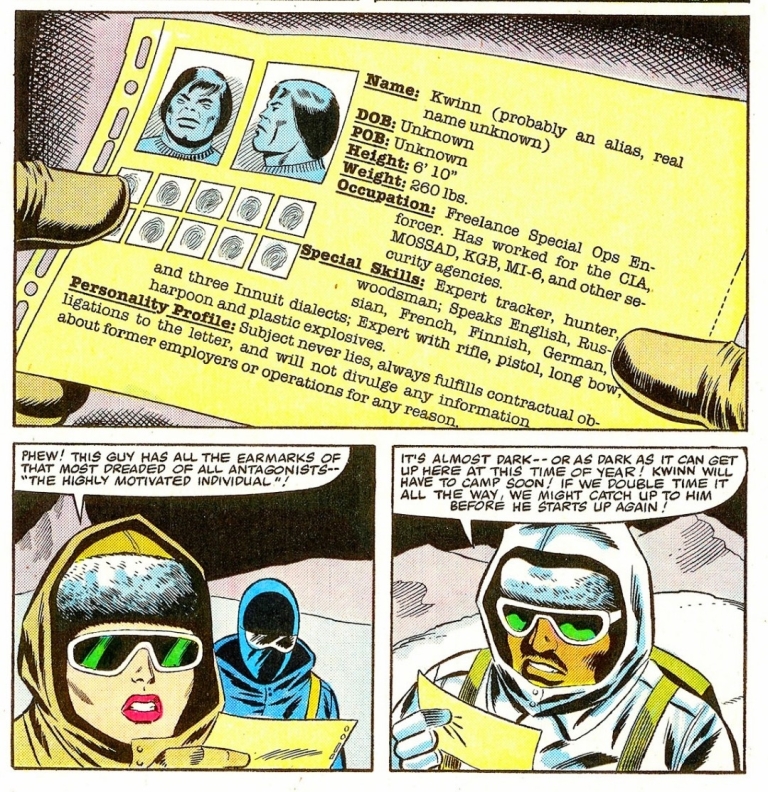
The character Kwinn is the most interesting character in this story.

When compared to what happened in issue , this comic book’s concept is smaller in scale but allows room for readers to get to know the Joes closely and follow the simplified plot which itself has details that are worth looking into.

When it comes to entertainment value, don’t expect a repeat of the bombastic action of the previous comic book. Expect to see lesser action but with more suspense and a stronger emphasis on the complexities that come with the world of espionage which itself is never simple.

That being said, the force of opposition here is not Cobra at all but something different. The new character Kwinn is a freelance operative who is quite formidable and he sure has extensive experience that enables him to outsmart the Joes. On top of that, Kwinn’s strong adherence to his principles and code of honor made him quite a pretty deep character which are nicely reflected into the story itself. For this reason alone, this is a must-read G.I. Joe tale.

Conclusion

Have you ever experienced your leave getting canceled suddenly?

With G.I. Joe: A Real American Hero (1982), the creative team of Larry Hama and Don Perlin took a very different approach that shifted away from the classic G.I. Joe/Cobra rivalry and deep into the world of espionage with a really engaging and refreshing tale. As the story features much lesser characters, you will get to know Stalker, Breaker, Scarlett and Snake-Eyes better. Kwinn is easily the most interesting and most compelling character of this comic book. While the story is fun and engaging, it may not delight fans who love to see the Joes fight the Cobra terrorists.

Overall, G.I. Joe: A Real American Hero (1982) is recommended.

+++++

Thank you for reading. If you find this article engaging, please click the like button below, share this article to others and also please consider making a donation to support my publishing. If you are looking for a copywriter to create content for your special project or business, check out my services and my portfolio. Feel free to contact me with a private message. Also please feel free to visit my Facebook page Author Carlo Carrasco and follow me on Twitter at  @HavenorFantasy as well as on Tumblr at https://carlocarrasco.tumblr.com/ and on Instagram at https://www.instagram.com/authorcarlocarrasco

A Look Back at G.I. Joe: A Real American Hero #1 (1982)

Welcome back superhero enthusiasts, 1980s culture enthusiasts and comic book collectors! Today we go back to the early 1980s to explore Marvel Comics’ launch of a comic book series based on the wildly popular military-themed franchise of toys – G.I. Joe: A Real American Hero.

For the newcomers reading this, Hasbro launched the G.I. Joe: A Real American Hero toyline in 1982 which was actually a revival of the original G.I. Joe series of toys (sized 12 inches) in the 1960s and 1970s. G.I. Joe: A Real American Hero toys had a new format for its action figures influenced by the success of the Micronauts and Star Wars toys. Veteran writer Larry Hama (the same guy behind the memorable Wolverine #75 of 1993) was already working for Marvel and was developing the concept of a new comic book about elite commandos fighting terrorists. Such development happened before the 1982 relaunch of G.I. Joe, and eventually Marvel’s editor-in-chief Jim Shooter approached Hama for a new comic book project based on Hasbro’s military toyline. Eventually a series of developments followed that saw the creation of the evil organization Cobra, the core villain Cobra Commander and more.

The impact of G.I. Joe as a licensed comic book series turned out positively as it helped attract new readers at the newsstands and it developed a strong following with young readers who were not highly interested with superheroes.  

With those details laid down, here is a look back at G.I. Joe: A Real American Hero published in 1982 by Marvel Comics with the main story written by Larry Hama and drawn by Herb Trimpe.

The cover.

Early story

The story begins with an Amtrak train traveling between New York City and Washington, D.C. Inside the nuclear physicist Dr. Adele Burkhart who previously served as one of the brains behind the Doomsday Project. It turns out, Burkhart was declared a traitor for denouncing the military claiming that she was misled by them to work on the said project. Inside the train, she has several security personnel guarding her as she is on her way to testify in front of a certain congressional committee.

As she speaks during a press conference inside one of the train’s cars, several flying soldiers of Cobra attacked the exterior of the train. In front of Burkhart, a few of the journalists turned out to be elements of Cobra led by the Baroness. The Baroness and her companions succeed in defeating the bodyguards and kidnapped Burkhart by means of flight.

At the Pentagon, the kidnapping of Burkhart compels the military to call in their special counter-terrorist group called G.I. Joe for a rescue operation. The stakes are high as they know that they cannot let Cobra keep Burkhart long enough to use her and they cannot let her die as the whole world is aware that they considered her an embarrassment. They ordered Colonel Clayton Abernathy (code name: Hawk) to assemble the Joe Team composed of Clutch, Flash, Breaker, Rock ‘n Roll, Scarlett, Stalker, Short-Fuse and Snake-Eyes…

Quality

Dr. Burkhart held hostage by Cobra and in the presence of Cobra Commander, the Baroness and many terrorists.

To get straight to the point, the main story (Operation: Lady Doomsday) was carefully structured by Hama to tell a story engagingly while also functioning to introduce readers to the characters and immersing them into the illustrated literary universe of G.I. Joe that is noticeably separated from the popular cartoon series. It is a classic portrayal of good versus evil laced with militarism and espionage.

The story moved at a medium pace and the approach on build-up and pay-off was executed carefully. There were scenes that had a sufficient amount of details regarding the plot or character moments (as opposed to development) that made the reading experience immersive. In short, there was no rush in the narrative while the pace never slowed down to a halt (no boring moments).

That being said, you will get to see lots of scenes that focus on the side of G.I. Joe as well as on the side of Cobra which is led by Cobra Commander (who is obsessed and scheming) followed by the Baroness (who is more focused on achieving goals but cannot do so without authority). You will see a certain gap between Cobra Commander and the Baroness which shows something seems off within their terrorist organization. This served as a creative contrast with G.I. Joe being more straightforward with the way they organize themselves.

The only weakness this comic book has is the fact that with so many characters from both the good and the bad sides, identifying them was pretty challenging especially when their military uniforms obscured their looks. Characters like Cobra Commander, Snake-Eyes, Scarlett, Rock ‘n Roll, Stalker and the Baroness are instantly recognizable.

As the main story remains a really good read, the 2nd story (Hot Potato) also written by Hama but drawn by Perlin served as a nice additive to this comic book.

Conclusion

G.I. Joe starts getting ready for the high-stakes rescue mission.

G.I. Joe: A Real American Hero (1982) is indeed a very solid reading experience. This is a strong introduction of the literary version of G.I. Joe and its portrayal of good versus evil remains believable and compelling. I also enjoyed the way the creators balanced the build-up of tension, plot and character moments with spectacle or twists utilized as pay-off. Lastly, I should say that this comic book has lots of action for you to enjoy and the execution of the action scenes made sense within the context of the stories. Remember that this marked the beginning of a memorable long run of G.I. Joe comics that reached into the 1990s. This one is a true classic and it should remind you that there was a time when political correctness and wokeness did not get in America’s way of fighting terrorists.

Overall, G.I. Joe: A Real American Hero (1982) is highly recommended!

+++++

Thank you for reading. If you find this article engaging, please click the like button below, share this article to others and also please consider making a donation to support my publishing. If you are looking for a copywriter to create content for your special project or business, check out my services and my portfolio. Feel free to contact me with a private message. Also please feel free to visit my Facebook page Author Carlo Carrasco and follow me on Twitter at  @HavenorFantasy as well as on Tumblr at https://carlocarrasco.tumblr.com/ and on Instagram at https://www.instagram.com/authorcarlocarrasco

A Look Back at Wolverine #75 (1993)

Disclaimer: This is my original work with details sourced from reading the comic book and doing personal research. Anyone who wants to use this article, in part or in whole, needs to secure first my permission and agree to cite me as the source and author. Let it be known that any unauthorized use of this article will constrain the author to pursue the remedies under R.A. No. 8293, the Revised Penal Code, and/or all applicable legal actions under the laws of the Philippines.

Welcome back, superhero enthusiasts, comic collectors, 1990s culture enthusiasts and fans of the X-Men! We go back to the year 1993 when the 30th anniversary of the X-Men was celebrated with the 6-part Fatal Attractions storyline. Already I reviewed Uncanny X-Men #304 (Part 3) which was not worthy of the X-Men’s 30th anniversary celebration. X-Men #25 (Part 4) meanwhile was not only great but also shocking and had a years-long impact on X-Men comics.

So now the focus is on the 5th chapter of the Fatal Attractions storyline handled by the Larry Hama-Adam Kubert team on the Wolverine monthly series of the time. With those details laid down, here is a look back at Wolverine , published by Marvel Comics in 1993 with a story written by Larry Hama and drawn by Adam Kubert.

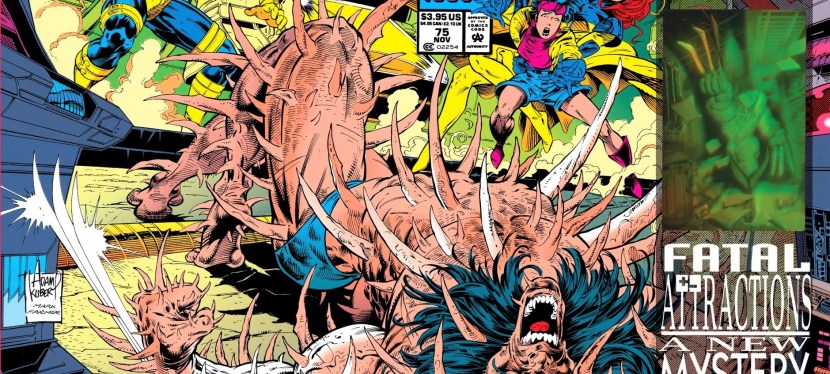
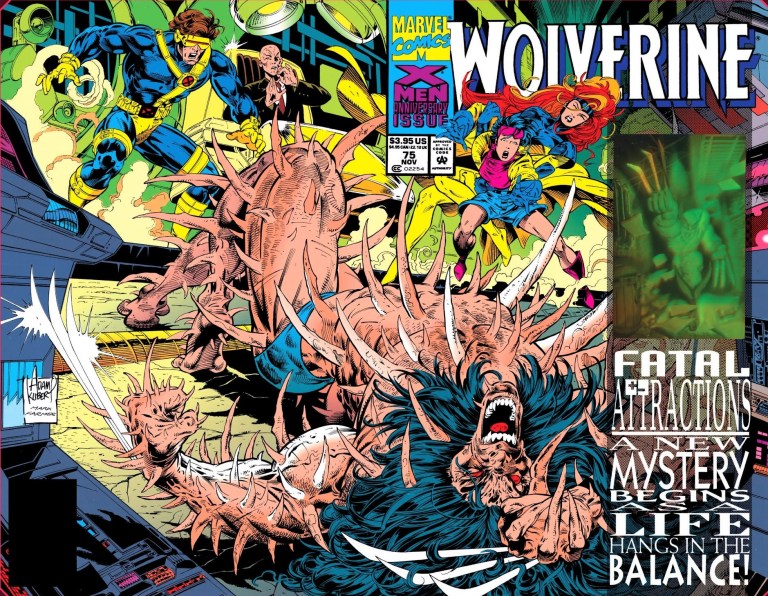
The cover.

Early story

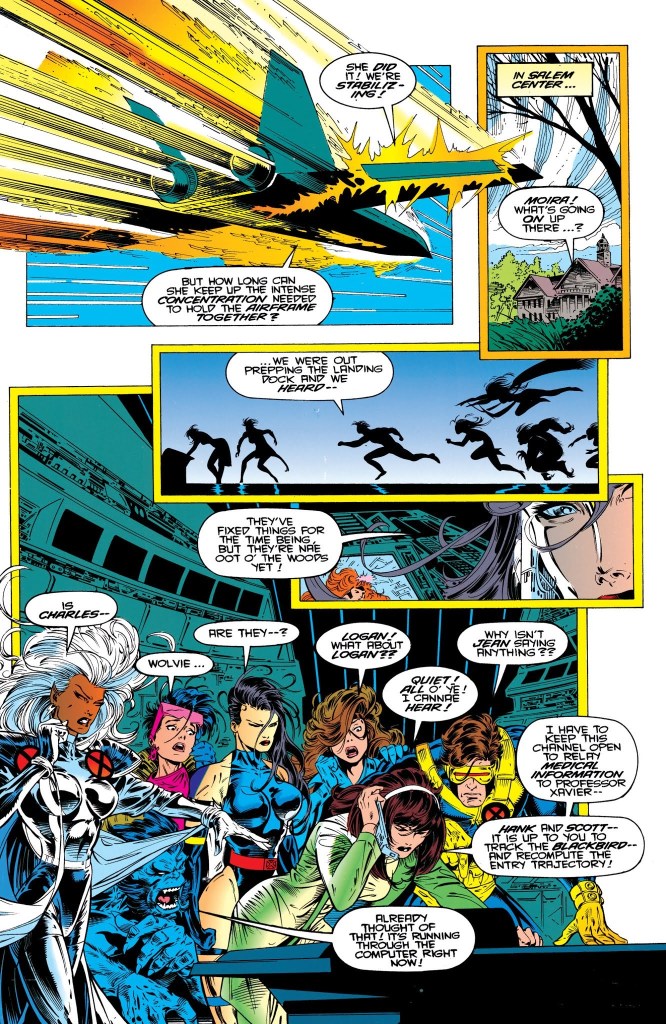
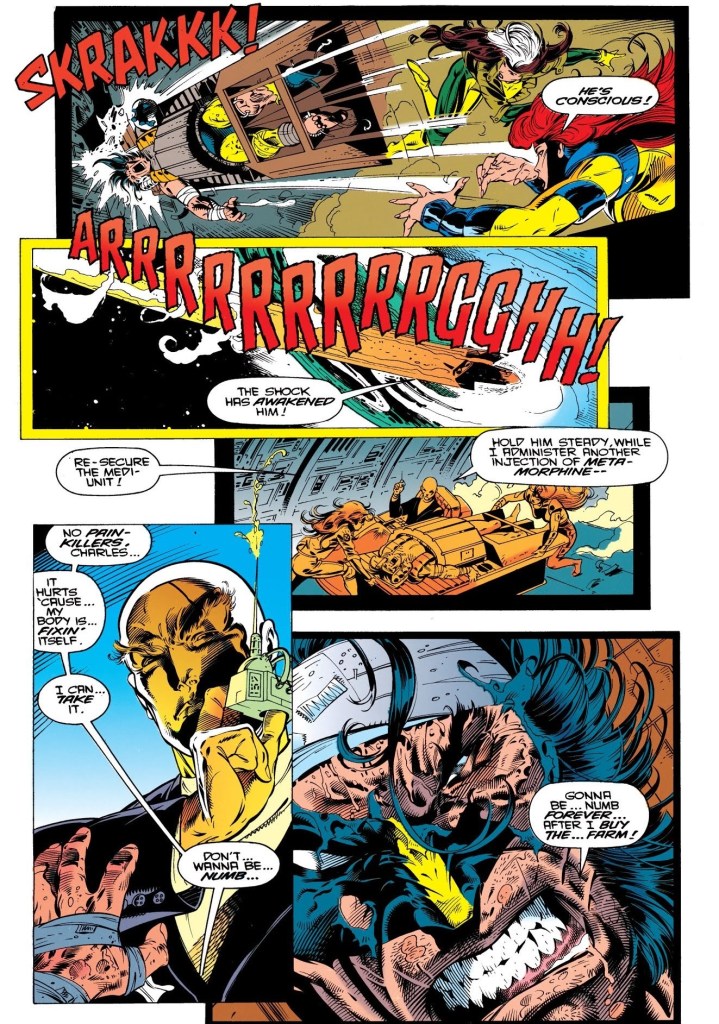
The story begins in outer space. Carrying Charles Xavier, Wolverine, Gambit, Jean Grey, Rogue and Quicksilver (who participated in the dangerous mission in X-Men ), the X-Men’s jet (piloted by Bishop) struggles mechanically as it was not designed for space travel. Worse, Wolverine is under very serious condition and the medical unit has been operating in full capacity dealing with his intense trauma.

In an attempt to alleviate Wolverine’s psychic trauma, Charles Xavier and Jean Grey enter his mind and discover that there is a world full of pain and horror. They see visions of a restrained Wolverine (from his Weapon X days) being attacked by Sabretooth and Lady Deathstrike. Xavier explains that they are at the epicenter of Logan’s most suppressed cataclysmic memories which were clearly triggered by the physical damage Magneto inflicted on him (see X-Men ).

As the X-Men’s jet attempts to enter Earth’s atmosphere, its exteriors heat up dramatically shaking everyone inside. This complicates the situation on stabilizing Wolverine…

Quality

The other X-Men team members at their headquarters expressing worry and concern about the situation of their teammates struggling to come back home from space.

To be clear, this story continues the events of Fatal Attractions but with a bit more focus on Wolverine (compared to the earlier chapters of the storyline that is). There is no real battle between good and evil at all. It’s really all about Wolverine struggling to survive just as his teammates struggle to arrive home.

Before the stories of this comic book and X-Men happened, Wolverine has often been portrayed to be very tough, brave and a walking machine of violence which has been reflected in other X-Men stories told in video games and movies. In this very comic book, Wolverine has been presented to coming close to death. This means Logan, at this particular stage of the history of the literary X-Men, was at his most vulnerable state. In my experience, this was both alienating and shocking to see.

With regards to the writing, Larry Hama did an excellent job with pacing the story from start to finish. Right from the beginning, the story pulls you into the X-Men’s tough situation and as each page gets turned, the tension as well as the suspense builds up until the execution of the climax. Along the way, the comic book not only portrays Wolverine struggling on the edge, it also works to make you care more or be more concerned towards him. Oh yes, the shocking moment near the end of this comic book remains very powerful and you who read this retro review should read Wolverine and see it for yourselves.

Conclusion

Wolverine at his most vulnerable state.

By today’s standards, Wolverine (1993) is still a very great comic book to read. In fact, I can say it is not only one of most defining chapters of the Fatal Attractions storyline as well as one of the most significant X-Men comic books of the 1990s, it is indeed a true illustrated literature classic ever published by Marvel Comics. In retrospect, this comic book marks a major turning point in the life of Wolverine who is still one of the most iconic characters in all of superhero literature. All of these were achieved thanks to the creative team of Larry Hama and Adam Kubert (whose are here was great and stylized at the same time). Hama succeeded in writing the continuation of the Fatal Attractions storyline while balancing all of the exposition and still putting Wolverine in the center. That itself is a very great work of writing.

If you are seriously planning to buy an existing hard copy of Wolverine (1993), be aware that as of this writing, MileHighComics.com shows that the near-mint copy of the regular edition costs $60 while the near-mint copies of the signed-and-numbered edition and the newsstand edition cost $300 and $180 respectively.

Overall, Wolverine (1993) is highly recommended!

+++++

Thank you for reading. If you find this article engaging, please click the like button below and also please consider sharing this article to others. If you are looking for a copywriter to create content for your special project or business, check out my services and my portfolio. Feel free to contact me as well. Also please feel free to visit my Facebook page Author Carlo Carrasco and follow me at HavenorFantasy@twitter.com