A Look Back at RoboCop 2 #3 (1990)

Welcome back superhero enthusiasts, 1990s arts and culture enthusiasts, Marvel Comics fans and comic book collectors! Today we go back to the year 1990 to take a close look at the concluding chapter of the comic book adaptation of the movie RoboCop 2 (1990).

In my previous retro review, I found the 2nd issue of the 3-part comic book adaptation mini-series that it lacked the impact of issue . It was understood that the comic book team was limited by the source material they had and the movie’s comedic scenes showing RoboCop not being his normal self were adapted. Those scenes did not translate into humorous comic book moments. At the very least, the build-up achieved by the comic book creators in issue (which includes several internal developments at Omni Consumer Products) sets the stage for the final issue.

With those details laid down, here is a look back at RoboCop 2 , published in 1990 by Marvel with a story written by Alan Grant and drawn by Mark Bagley based on the movie screenplay by Frank Miller and Walon Green.
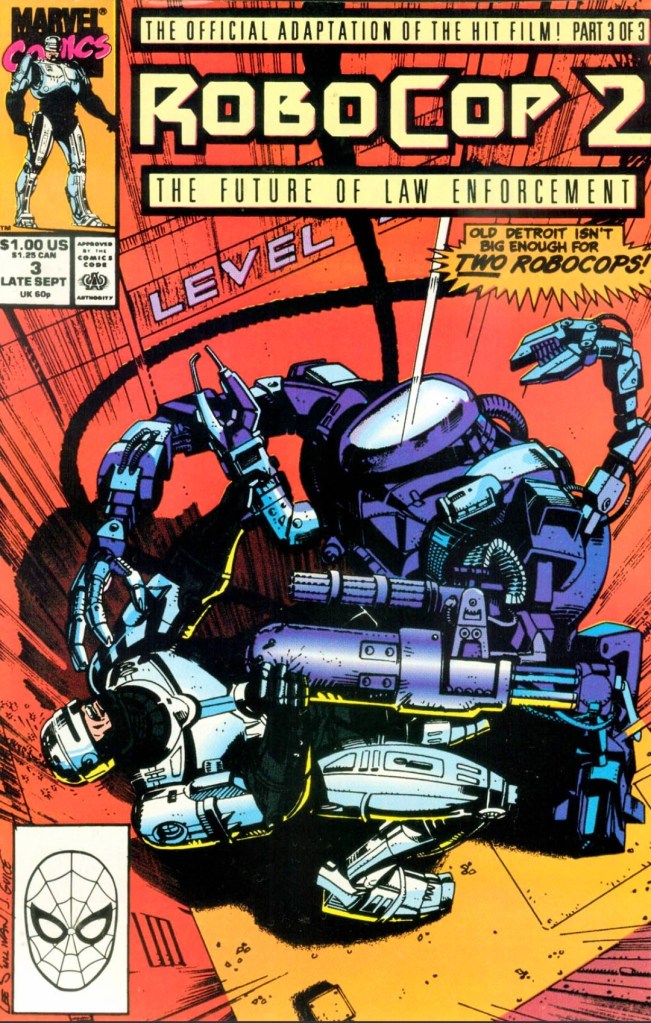
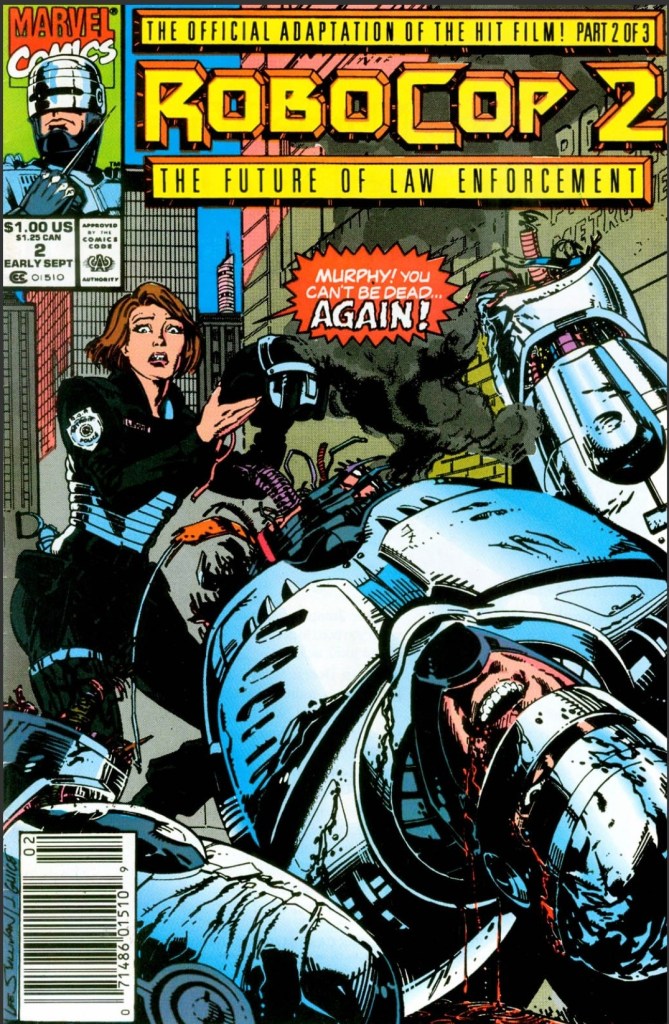
The cover.

Early story

The story begins in Detroit where OCP executives press RoboCop (Officer Murphy) for answers about the spying he recently did on his ex-wife. It turns out that his wife was so traumatized over his death, there were therapists, hypnotists and other treatments involved to help her recover. As a result of the spying, his ex-wife now believes her husband is still alive. In response to questions, RoboCop gave answers that the OCP guys wanted – he is no longer a husband, no longer human, no longer Alex Murphy and he is simply a machine. The private meeting between him and his ex-wife did not go well.

Meanwhile, the City Government of Detroit organizes a telethon in an attempt to raise funds needed to pay off the $37,985,300 they owe OCP. The mayor receives a very important call from former associates of Cain (RoboCop 2).   

Shortly after, OCP realizes that the City Government could pay soon and if they fail to foreclose Detroit, their stock will plummet. With the approval from the corporation’s chief, Dr. Juliette Faxx proceeds to launch RoboCop 2 with the mind of Cain inside it…

Quality
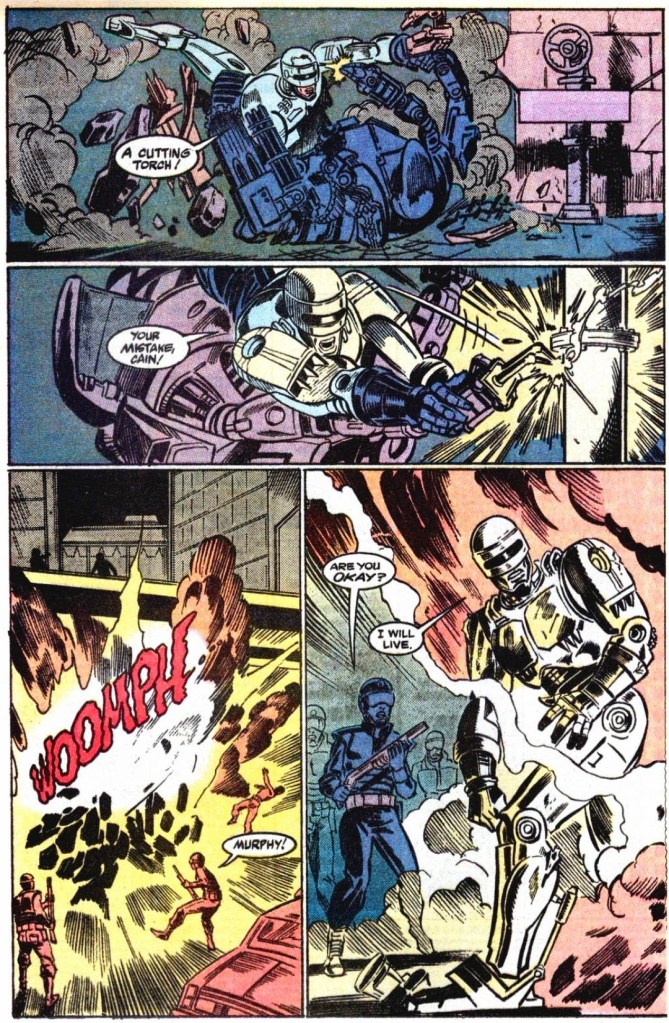
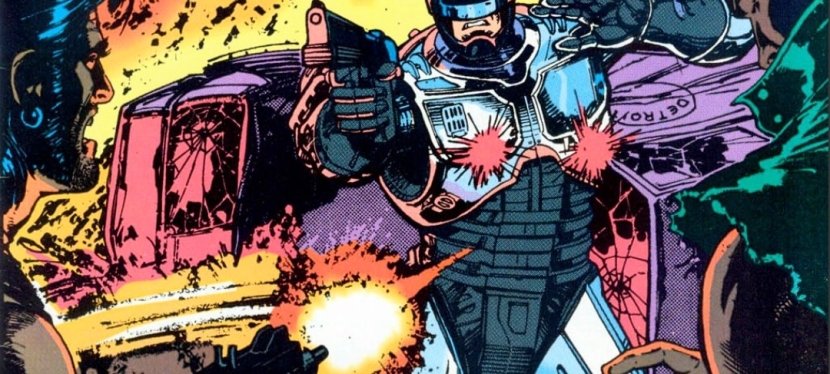
The battle between RoboCop and his bigger rival (Cain) is action-packed and fun to read.

As it is clear that the imagery and plot developments of the movie screenplay were adapted by the comic book creators with their very own distinctive ways throughout the mini-series, this comic book succeeded in concluding its 3-part story. In fact, this is a huge pay-off to most of the build-up that took place in issues and . The much-awaited big battle between RoboCop and the Cain-controlled RoboCop 2 lasted eight pages and it was indeed action-packed and satisfying. Before the said battle took place, RoboCop 2’s debut is short, stylishly obscured visually and yet vicious to see.

Considering the huge amount of details the movie screenplay had, the Grant-Bagley duo managed to adapt the most relevant content efficiently while also telling a literary tale that is cohesive enough.
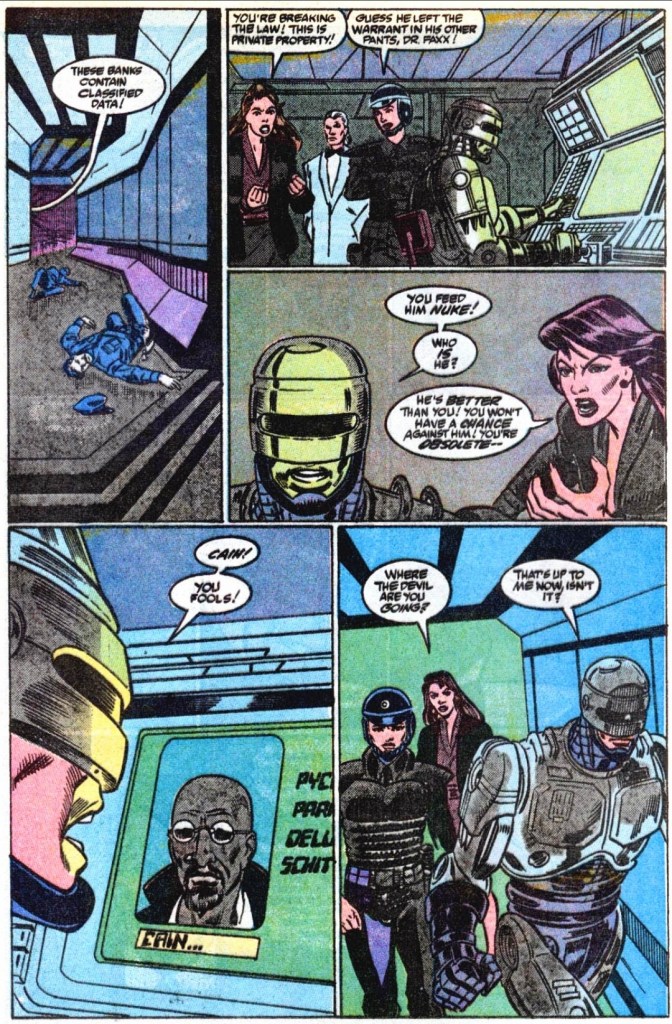
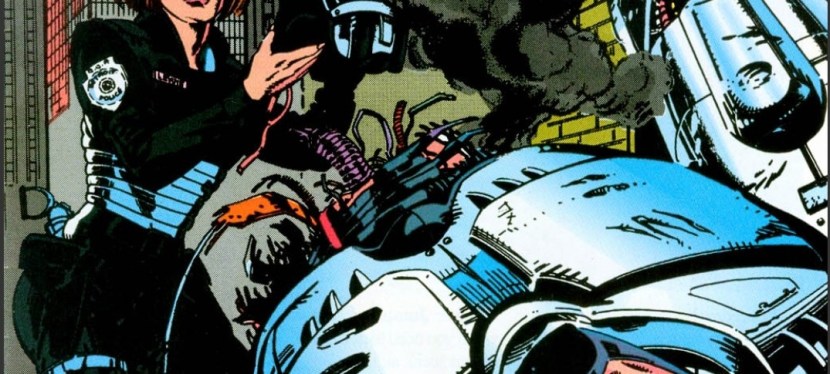
This scene did not appear in the movie.

What I found very notable is the fact that this comic book opened with RoboCop getting berated by OCP executives for his spying on his ex-wife. The said scene actually happened very early in the movie itself and to have it as an opener of this comic book added depth to RoboCop’s character development in this adaptation.

When it comes to weaknesses, there were times when Mark Bagley’s drawing of RoboCop 2 were off. RoboCop 2 was visually huge and intimidating in the movie but in this comic book, the size and scale were clearly lacking particularly in the shot where he is standing near OCP’s chief. The lack of visual details on RoboCop 2’s body showed signs of rush by the artist.

Conclusion
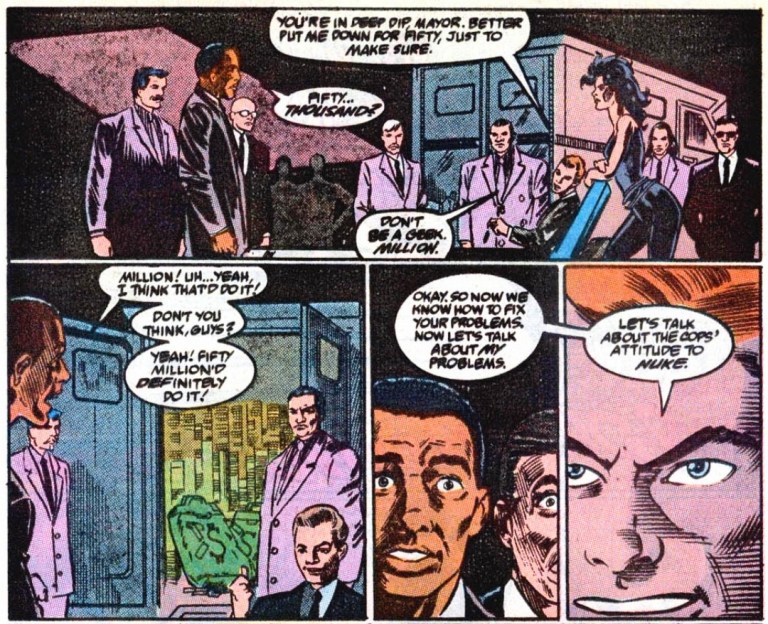
Is your local government leader making secret deals with criminals in real life?

RoboCop 2 (1990) is a nice pay-off to the build-up that preceded it and, more importantly, it was a satisfying mini-series conclusion. As a standalone comic book, it has a good amount of plot details, dialogue and action scenes that can delight RoboCop fans. As the conclusion of the 3-part adaptation of the 1990 movie, it has a stronger focus on RoboCop and the plot moved at a better pace than in issue . The storytelling is good and the spectacle was much improved.

Overall, RoboCop 2 (1990) is recommended.

+++++

Thank you for reading. If you find this article engaging, please click the like button below, share this article to others and also please consider making a donation to support my publishing. If you are looking for a copywriter to create content for your special project or business, check out my services and my portfolio. Feel free to contact me with a private message. Also please feel free to visit my Facebook page Author Carlo Carrasco and follow me on Twitter at  @HavenorFantasy as well as on Tumblr at https://carlocarrasco.tumblr.com/ and on Instagram at https://www.instagram.com/authorcarlocarrasco
A Look Back at RoboCop 2 #2 (1990)

Welcome back superhero enthusiasts, 1990s arts and culture enthusiasts, Marvel Comics fans and comic book collectors! Today we go back to the year 1990 to take a close look at the 2nd part of the comic book adaptation of the movie RoboCop 2 (1990).

In my previous retro review of Robocop 2 #1, I pointed out that the comic book was not a faithful adaptation of the movie but more of the creators’ creative interpretation of the movie script they had which resulted in a stylized presentation. It was a surprisingly enjoyable reading experience for me.

With those details laid down, here is a look back at RoboCop 2 , published in 1990 by Marvel with a story written by Alan Grant and drawn by Mark Bagley based on the movie screenplay by Frank Miller and Walon Green.

The cover.

Early story

The story begins in Detroit with RoboCop reduced into a very bad condition with most of his parts missing. The cops are still on strike and the ultra-addicting drug Nuke continues to spread through the city causing social problems. Cain and his gang are still on the loose, and his video statement (which emphasizes his gang’s defeat of RoboCop) spreads through the news cycles.

Inside a hideout, Cain and his loyal companions terrify and killed traitorous police officer Duffy for betraying them. Meanwhile at police headquarters, the support crew bumps heads with the Omni Consumer Products (OCP) executive who does not see RoboCop’s poor state as a problem. As far as OCP is concerned, getting replacement parts for RoboCop is very expensive.

Over at OCP, the psychologist executive Dr. Juliette Faxx begins researching criminals for the new RoboCop project…

Quality

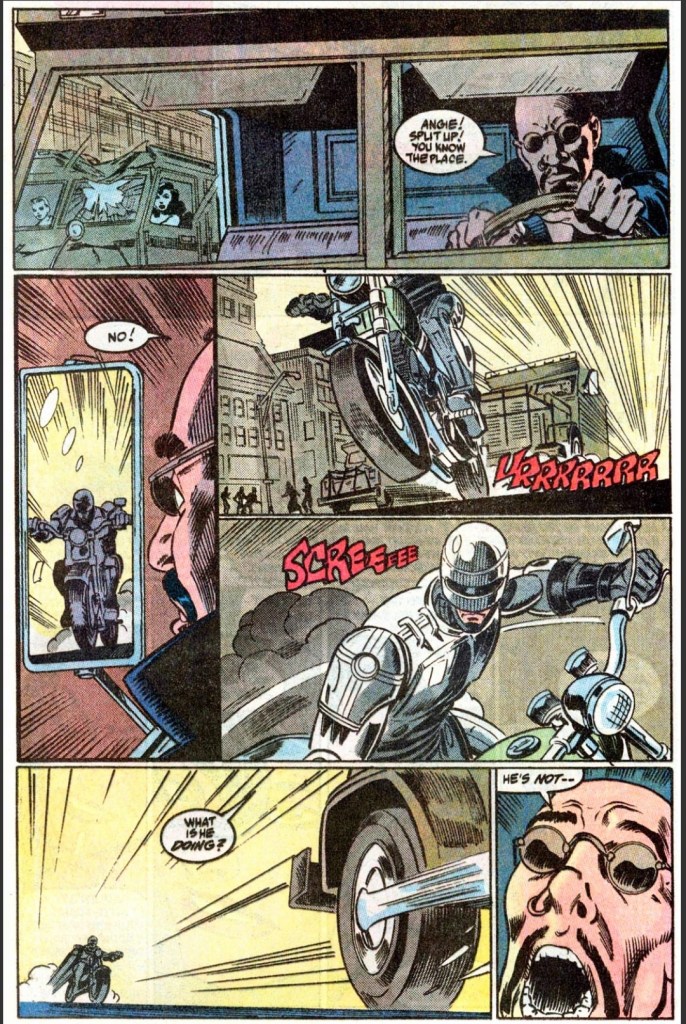
The motorized encounter between RoboCop and Cain here is shorter and much inferior compared to what the movie showed.

As with issue , this comic book followed the events and scenes of the film but left enough room for the creative team to make their stylized version suitable with the literary format. Mark Bagley, who is best known for drawing Spider-Man and Venom in the 1990s, came up with nice artwork that brought Grant’s script to life. There were a few shots here that were pretty graphic or brutal to see at the time of publication which makes me wonder why did the Comics Code Authority (CCA) give its approval to this comic book.

Without spoiling the plot, I can say that the creative team and editor Gregory Wright did a good job adapting scenes of the movie script to (fill up the pages) while also succeeding in setting up readers for the final conflict in the 3rd and final issue.

As a standalone reading material, this comic book will lead readers deep into the crisis of the police force as well as into the developments behind the closed doors of OCP. Due to the selected scenes of the film’s script, RoboCop has sufficient presence but lacked his normal personality. That being said, the movie’s comedic look of RoboCop acting very out-of-touched (hint: OCP tampered with his mind digitally) did not translate well into literary format. If you’re hoping to see solid storytelling with a consistent tone, you won’t find it here.

When it comes to action, there is just enough of it to keep the reading experience entertaining. Again, this comic book does not have the final conflict and the selected action scenes are rather limiting in terms of impact. If you want to see the police raid of the Nuke facility as well as RoboCop’s motorized chase with Cane, you are better off replaying the movie.  

Conclusion

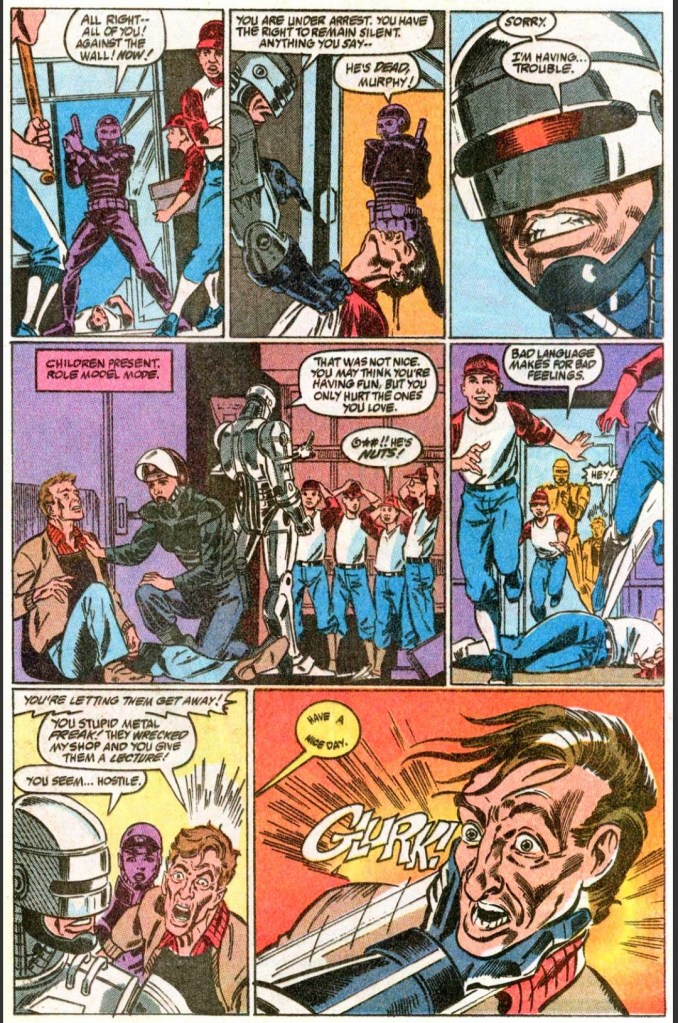
There definitely is something wrong with RoboCop here.

Considering the selected movie script scenes for adaptation, RoboCop 2 (1990) lacks impact compared to the first issue. In fairness, this comic book was clearly meant to set-up readers for the next issue. If there is anything worth looking at within the 2nd issue’s pages, it would be the details that were highlighted during the internal developments at OCP and the police. As mentioned earlier, RoboCop is not his usual self for a significant portion of this comic book. While the engagement and fun factor are lower this time around, I’m still interested to read the next issue.

Overall, RoboCop 2 (1990) is serviceable.

+++++

Thank you for reading. If you find this article engaging, please click the like button below, share this article to others and also please consider making a donation to support my publishing. If you are looking for a copywriter to create content for your special project or business, check out my services and my portfolio. Feel free to contact me with a private message. Also please feel free to visit my Facebook page Author Carlo Carrasco and follow me on Twitter at  @HavenorFantasy as well as on Tumblr at https://carlocarrasco.tumblr.com/ and on Instagram at https://www.instagram.com/authorcarlocarrasco
A Look Back at RoboCop 2 #1 (1990)

Welcome back superhero enthusiasts, 1990s arts and culture enthusiasts, Marvel Comics fans and comic book collectors! Today we go back to the year 1990 to take a close look at the comic book adaptation of the movie RoboCop 2 (1990).

Before getting to the new retro comic book review, I should state that my friends and I had a fun time watching RoboCop 2 in the cinema shortly after it opened here in the Philippines. Back then, I was not yet a comic book collector and I rarely visited comic book specialty stores. That being said, I was unaware that Marvel Comics actually published an adaptation in the form of a 3-issue mini-series.

With those details laid down, here is a look back at RoboCop 2 , published in 1990 by Marvel with a story written by Alan Grant and drawn by Mark Bagley based on the movie screenplay by Frank Miller and Walon Green.

The cover.

Early story

The story begins in Detroit where the cops are run by corporations and the streets have turned into red-alert war zones. Crime is overwhelming the city and the highly addictive narcotic poses the greatest threat facing societies. The surgeon general who made the public warning about nuke was killed and the crime boss Cain (leader of a cult of nuke addicts and pushers) claims responsibility. Through the news media, Cain tells the public that nuke will make people’s problems go away and people want its paradise.

Under the management of Omni Consumer Products (OCP), several of Detroit’s police officers go on strike demanding better terms from their employer. The City Government of Detroit under Mayor Kuzak missed a payment (in relation to them owing $37 million) and OCP begins to move to foreclose the city and its assets in accordance to the terms of the contract. Mayor Kuzak accuses OCP of engineering the police strike which made crime rampant.

Elsewhere in the evening, the cruel activities of the thugs got disrupted by the arrival of a police car. Even though the police car got destroyed by the thugs, RoboCop emerges and begins to fight back…

Quality

There is simply no holding back for RoboCop when it comes to doing police work at a time when many police officers are on strike while crime has turned more rampant in Detroit.

This opening issue of the mini-series sticks close the basic plot of the movie (right until after Cain’s gang dismantled RoboCop) although there were a few notable differences with the sequence of events and there were scenes that showed the creative team took liberties to make the story suitable with the literary format in mind. That being said, don’t expect to see the key moments of the movie look exactly the same in this comic book and don’t expect to see the characters here looking like the actors who played them on the big screen. In terms of visual and literary presentation, this adaptation has a lot in common with the Total Recall comic book adaptation which coincidentally was released the same year.  

For me, this is indeed a really readable comic book that has its stylized approach on telling the movie’s concept. OCP is the most powerful entity in the story while Cain and his gang are clearly the force of evil that strongly pose danger not only to Detroit’s people but even to the very divided police force. Nuke as the dangerous object of the plot clearly was inspired from elements of the real life war against drugs in 1980s America which made this story socially relevant.

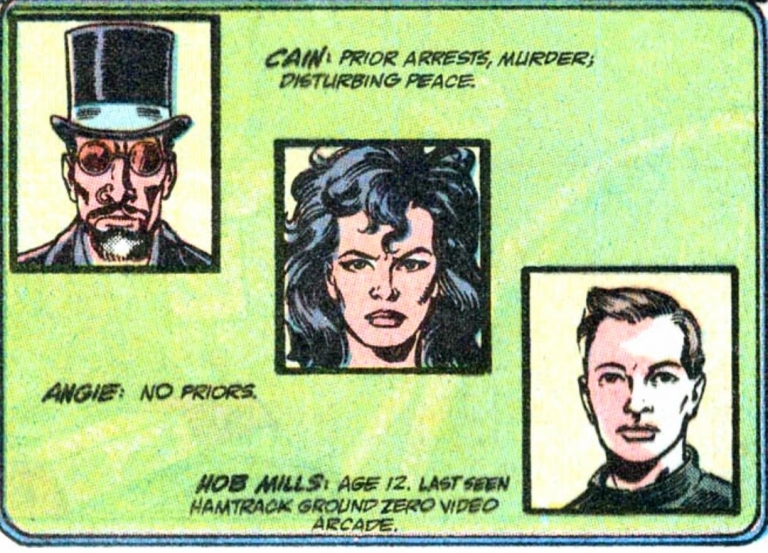
Very clearly these villains look nothing like actors Tom Noonan, Galyn Görg and Gabriel Damon.

Like in the movie, RoboCop here performs his law enforcement duty in an uncompromising manner even though memories of his past life as officer Murphy re-emerged deep inside. That being said, there are a few moments in which you might sympathize with the titular hero as this comic book pays close attention to the conflict between humanity and technology.

The action scenes here are sufficient but clearly don’t come anywhere close to the intensity of the film in terms of violence. Still, there is enough action for readers to enjoy.

When it comes to the visuals, the artwork done by Mark Bagley eerily looks comparable with Tom Lyle’s art in the Total Recall comic book of 1990. For the newcomers read this, Bagley became a popular artist through the Amazing Spider-Man monthly series and the Venom: Lethal Protector comic books that were released after years after this one. Having seen many of Bagley’s works published in 1992 to 1995, I can hardly recognize his art style in this comic book adaptation. The way he drew people’s faces in this comic book looks very different from those seen in Amazing Spider-Man issues. At the same time, Bagley’s own take on RoboCop has that balanced approach on depicting humanity with machinery while also making the hero look less bulky compared to the movie’s version.

Conclusion

Julie Faxx of OCP sure talks like a woke nut and rabid feminist in this scene.

RoboCop 2 (1990) is clearly not a faithful adaptation of selected parts of the movie but that’s not necessarily a bad thing. This is more about the Grant-Bagley team doing their own visual presentation of the movie script copy they had and ultimately they succeeded in making this comic book a stylized and worthy reading experience. This is indeed a surprisingly entertaining read and I can say that I am looking forward to reading the next issue.

Overall, RoboCop 2 (1990) is recommended.

+++++

Thank you for reading. If you find this article engaging, please click the like button below, share this article to others and also please consider making a donation to support my publishing. If you are looking for a copywriter to create content for your special project or business, check out my services and my portfolio. Feel free to contact me with a private message. Also please feel free to visit my Facebook page Author Carlo Carrasco and follow me on Twitter at  @HavenorFantasy as well as on Tumblr at https://carlocarrasco.tumblr.com/ and on Instagram at https://www.instagram.com/authorcarlocarrasco
A Look Back at Detective Comics #575 (1987)

Welcome back superhero enthusiasts, 1980s culture enthusiasts and comic book collectors! Today we go back to the late 1980s to explore a part of the DC Comics shared universe through a tale of the iconic Batman.

After DC Comics published the maxi-series Crisis on Infinite Earths, the publisher rebooted their entire comic book universe and that meant reintroducing their superheroes, villains and supporting characters with a touch of 1980s modernization. Frank Miller led the reintroduction of Batman as a new crime fighter in the Batman: Year One storyline in 1987. Also that same year, DC Comics went on to publish a sequel storyline through four issues of the Detective Comics series. That sequel was titled Batman: Year Two.

With those details laid down, here is a look back at Detective Comics , published in 1987 by DC Comics with a story written by Mike W. Barr (the same guy who did Mantra for Malibu Comics) and drawn by Alan Davis. This is the first chapter of the Batman: Year Two storyline.

The cover.

Early story

The story begins in Gotham City where the newly appointed police commissioner Gordon participates in a TV talk show. The talk show host is aggressive towards Gordon cutting him off verbally and pointing out that Batman – who is working with the police fighting crime – is no better than the Reaper, a costumed vigilante who caused trouble and killed many people on Gotham’s streets twenty years prior. Gordon emphasizes that Batman works with the city police and he operates strictly on his own.

As the TV talk show goes on, a group of armed thugs carrying varied items enter an apartment that is dark. Outside the Bat Signal (coming from the machine Gordon recently got) flashes, and soon Batman himself appears inside the apartment and cleverly took the gang down. He leaves the place going to do other things.

The next day, Rachel Caspian is pleasantly surprised to see her father arrive earlier than expected…

Quality

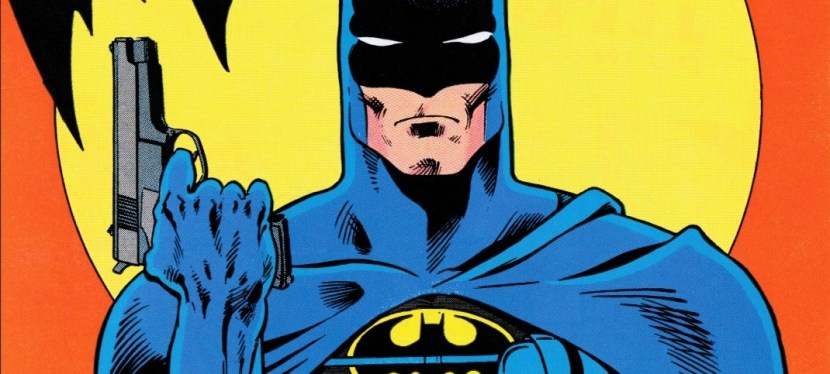
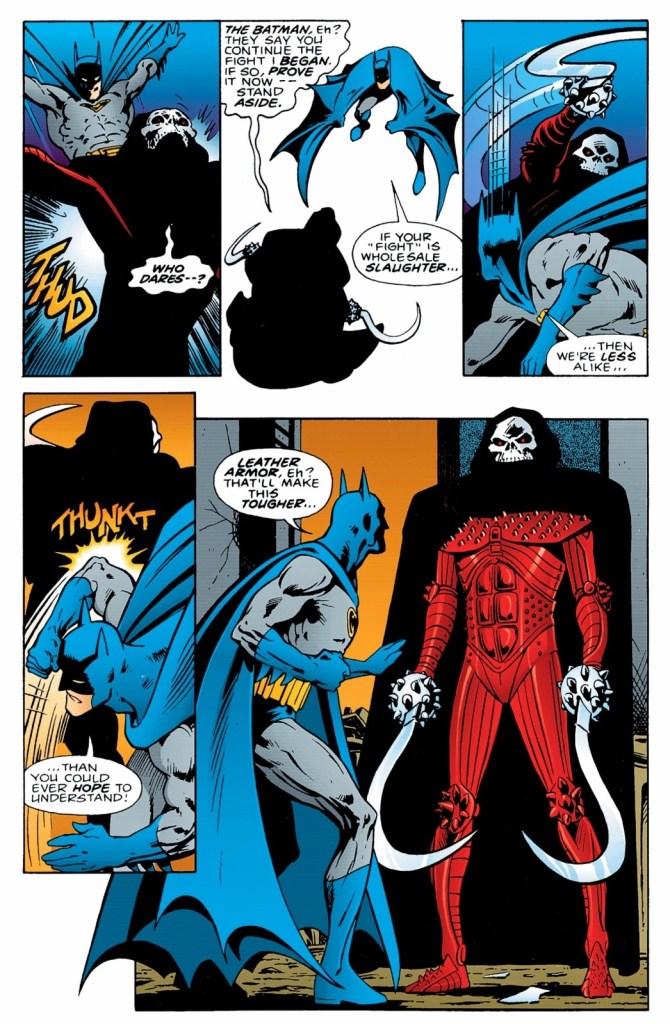
Batman strikes first in his encounter with the Reaper.

Set during the 2nd year of Batman engaging in crime-fighting in coordination with the Gotham City police force, this comic book dramatically portrays the city having a long-running disease and legacy of crime. The references to Gotham’s embarrassing past of being filled with thugs and wicked activities literally paved the way for the return of a masked vigilante who fights criminals with uncompromising violence (including killings). That vigilante’s legacy affects the way the public perceives Batman and why they have trouble seeing the differences between them. The writing and build-up here are very solid.

When it comes to portrayals, you will get to see a younger Bruce Wayne who is clearly pushing himself hard between engaging in business matters and secretly fighting crooks. This is a Batman who is only gaining more experience in the war against crime and he clearly is not the very tactical and very resourceful hero he would become. In his fight against the Reaper, you will really see Batman struggle hard and make really flawed moves that cost him a lot.

The introduction of the Reaper, who became the definitive vigilante of Gotham City long before Batman even started, is very engaging. This vigilante is also very intimidating to see and he clearly overshadows the Caped Crusader both visually and in action.

Conclusion

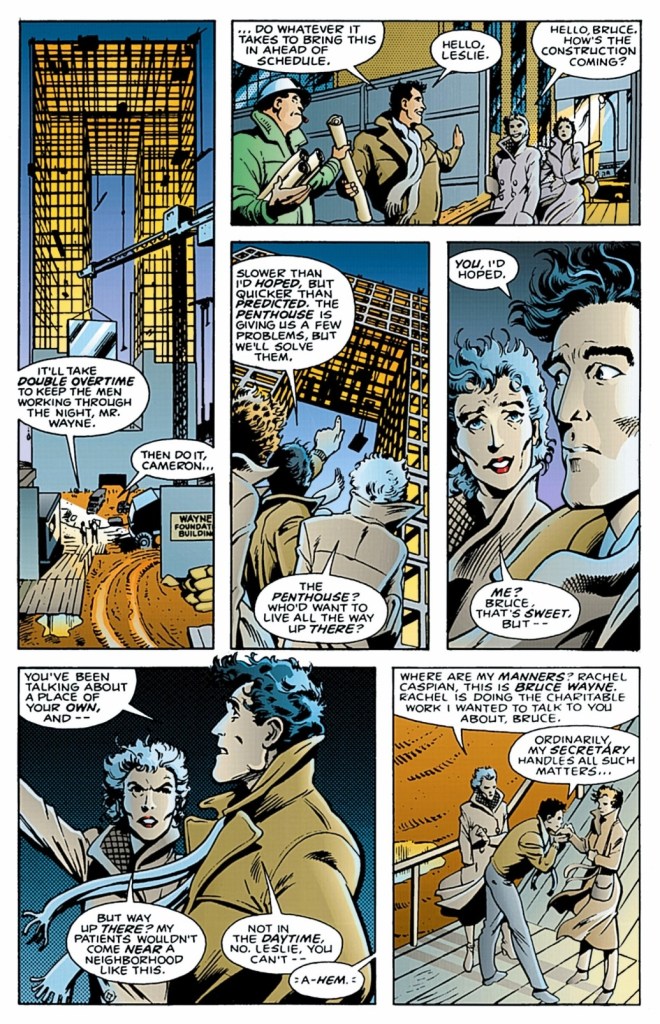
Bruce Wayne attending to business on-site.

As the first chapter of the Batman: Year Two storyline, Detective Comics (1987) is a very solid tale to read. The narrative moved at a medium pace and there were these balanced pay-offs to the build-up (that took place in the first half). The Reaper’s reputation as Gotham’s past blood-thirsty vigilante literally dwarfed that of Batman (the modern vigilante). I should also state that Mike W. Barr symbolized the common traits and differences between Batman and the Reaper which alone are worth reading.

Overall, Detective Comics (1987) is recommended.

+++++

Thank you for reading. If you find this article engaging, please click the like button below, share this article to others and also please consider making a donation to support my publishing. If you are looking for a copywriter to create content for your special project or business, check out my services and my portfolio. Feel free to contact me with a private message. Also please feel free to visit my Facebook page Author Carlo Carrasco and follow me on Twitter at  @HavenorFantasy as well as on Tumblr at https://carlocarrasco.tumblr.com/ and on Instagram at https://www.instagram.com/authorcarlocarrasco
A Look Back at RoboCop versus The Terminator #4 (1992)

Disclaimer: This is my original work with details sourced from reading the comic book and doing personal research. Anyone who wants to use this article, in part or in whole, needs to secure first my permission and agree to cite me as the source and author. Let it be known that any unauthorized use of this article will constrain the author to pursue the remedies under R.A. No. 8293, the Revised Penal Code, and/or all applicable legal actions under the laws of the Philippines.

Hey fellow geeks and comic book collectors plus the fans of RoboCop and Terminator! This is it! I have finally reached the end of the 4-issue RoboCop versus The Terminator mini-series of comic books spearheaded by Frank Miller.

To give a recap without spoiling plot details, issue #1 was mainly a build-up issue which did not entertain on its own. In issue #2, there was a huge pay-off to the build-up and seeing RoboCop battle the Terminator was a grand spectacle! Issue #3 meanwhile saw some very daring creative twists taken that further mixed elements of the respective Terminator and RoboCop universes together which ultimately served as a build-up for what could be a potential epic in the comic book featured in this review.

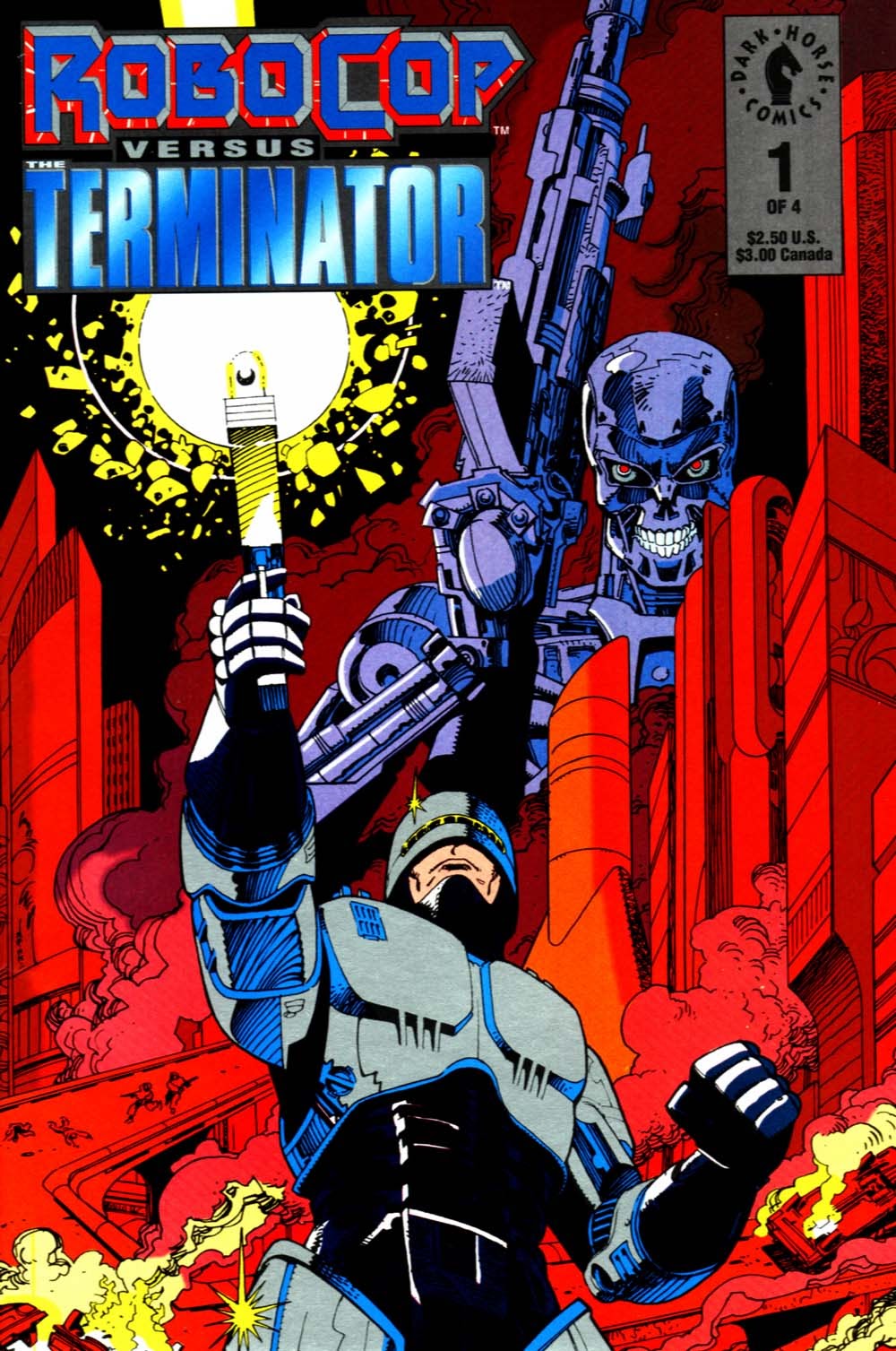
Is the build-up worth it? Did the issue twists pave the way for something memorable? We will all find out in this look back at RoboCop versus The Terminator 4, published in 1992 by Dark Horse Comics with a story written by Frank Miller and drawn by Walt Simonson.

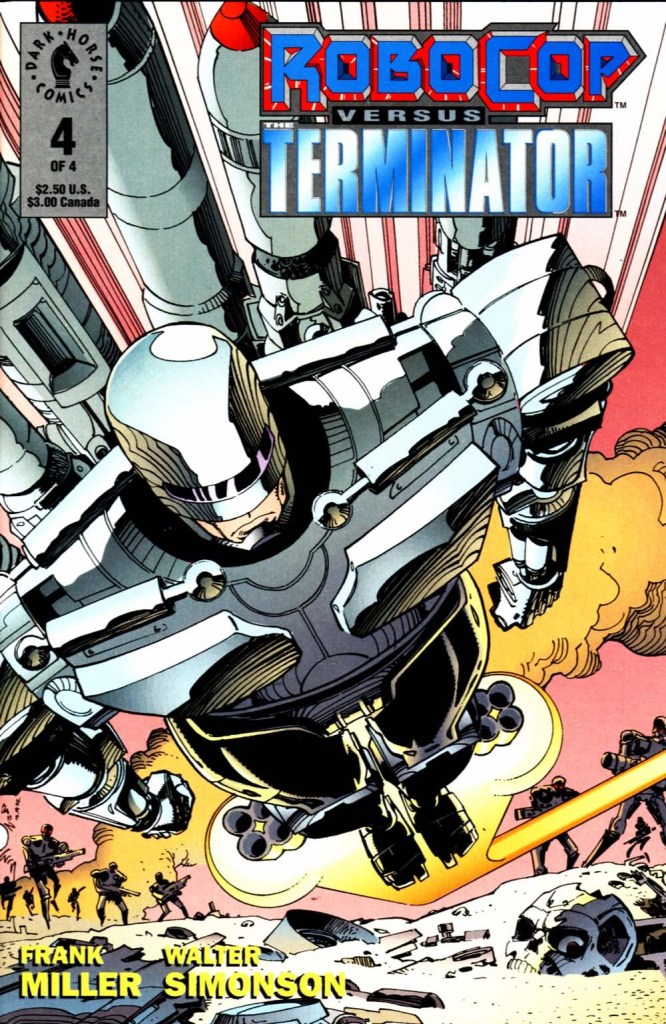
The cover.

Early story

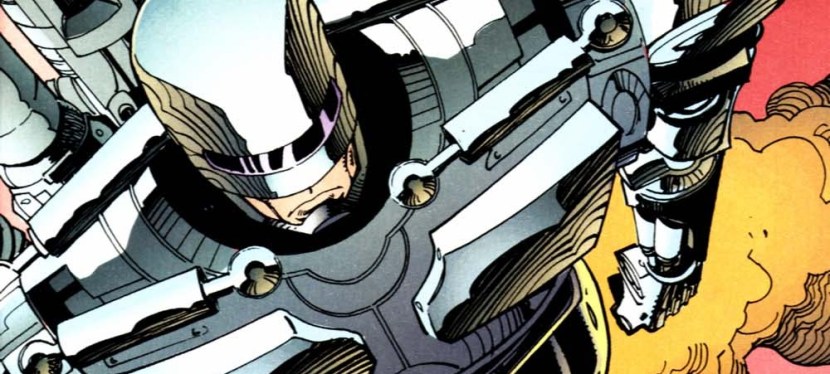
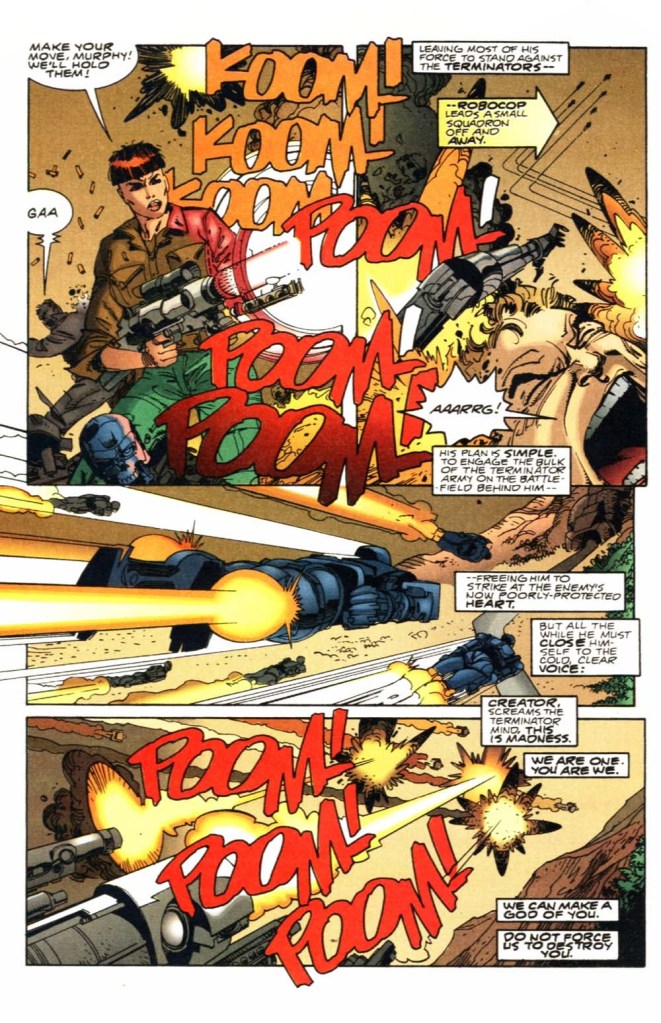
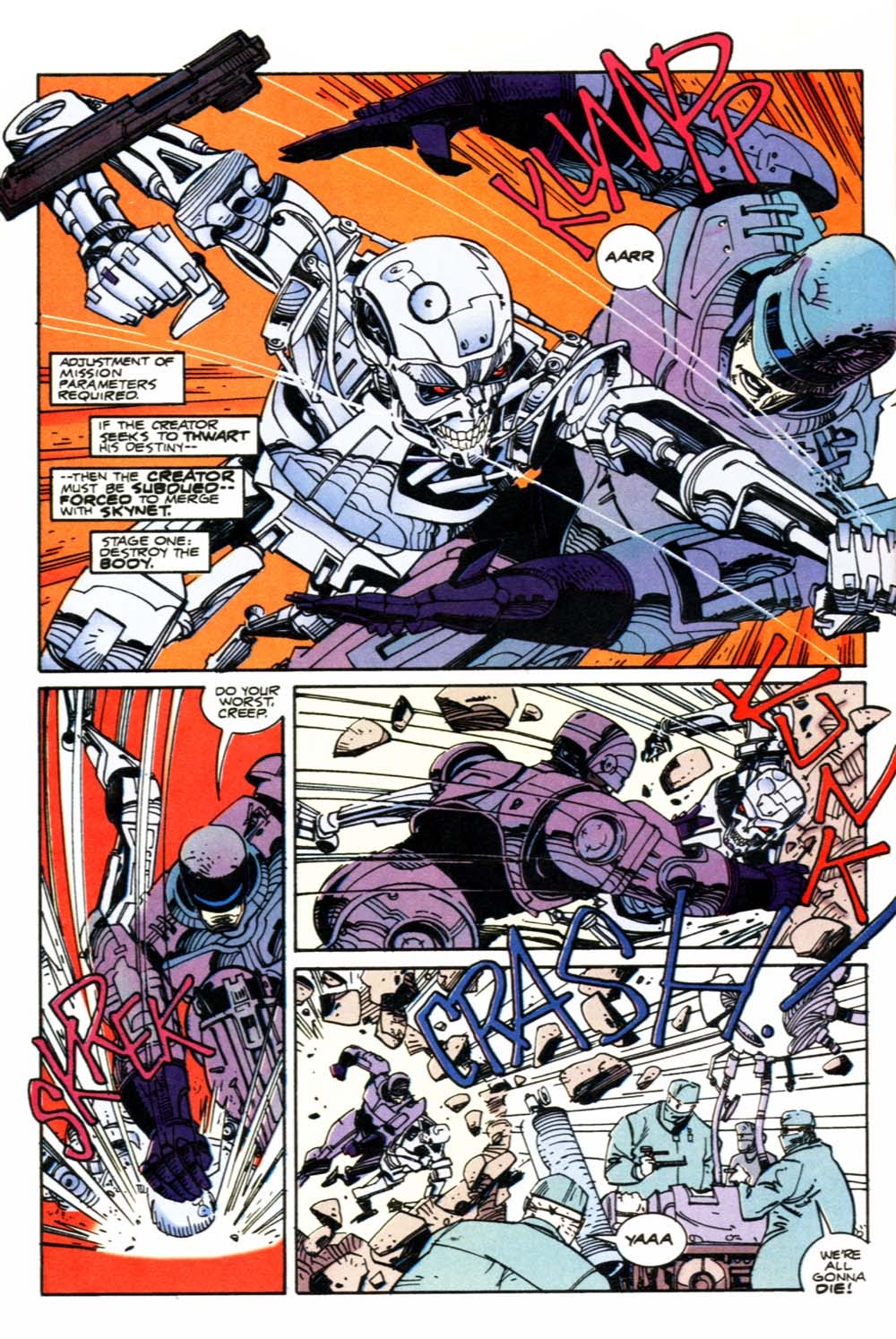
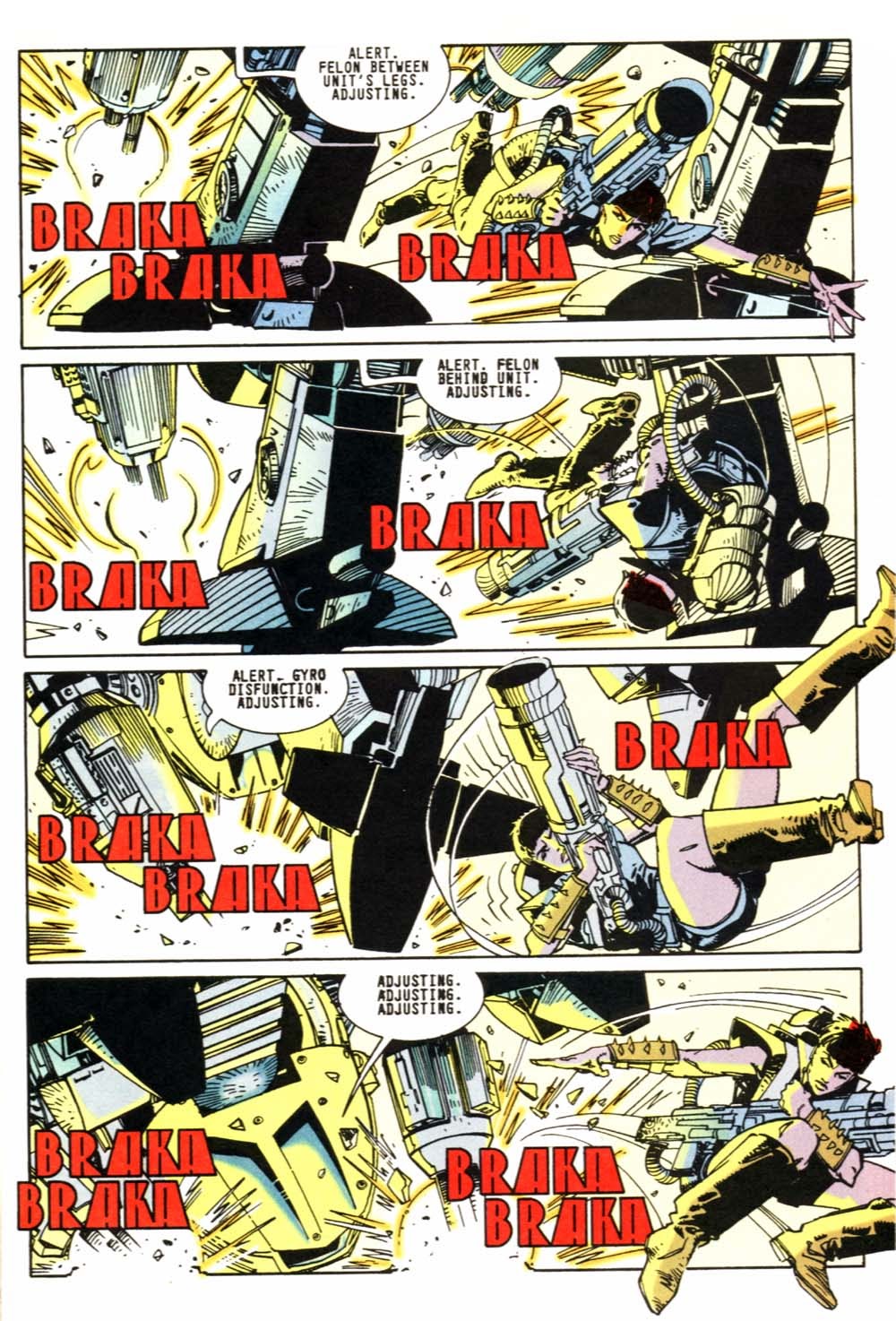
The story begins again in the dark future when the world is ravage by the war between man and machines. As the human resistance falters, the machines of Skynet march further toward their prey. Suddenly, RoboCop flies in and hits them with a very powerful rocket.

Inside a cybernetic hideout, a familiar short-haired lady gets shaken by the blast. As a result, she will not go back in time and will no longer try to kill RoboCop. On the monitors, she watches the armed cyborg cop destroy Skynet’s troops and saved the human resistance from certain death.

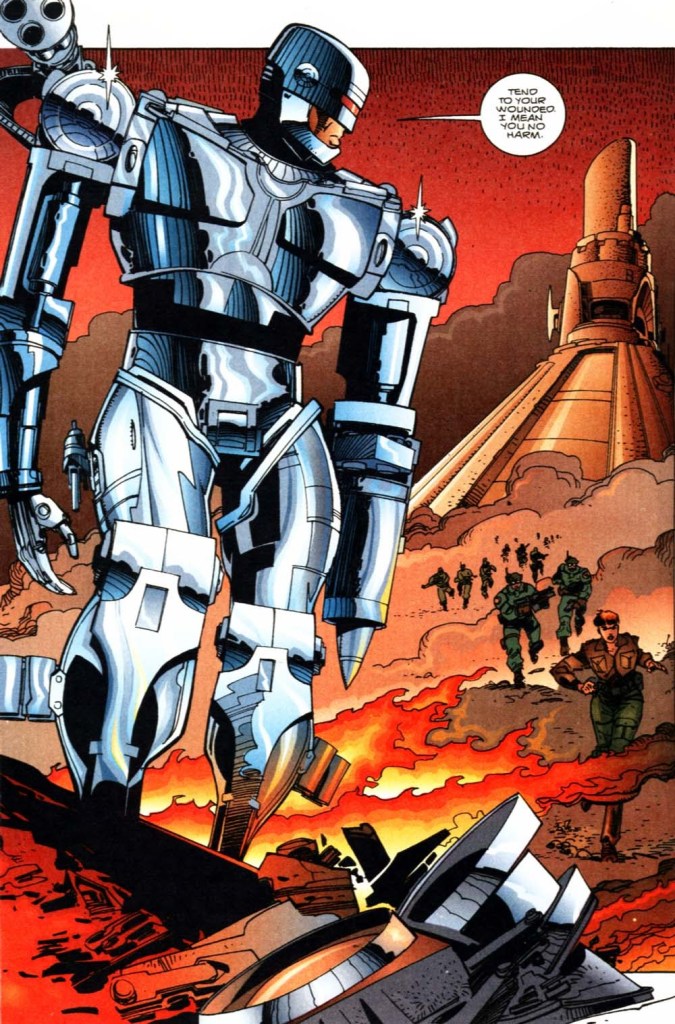
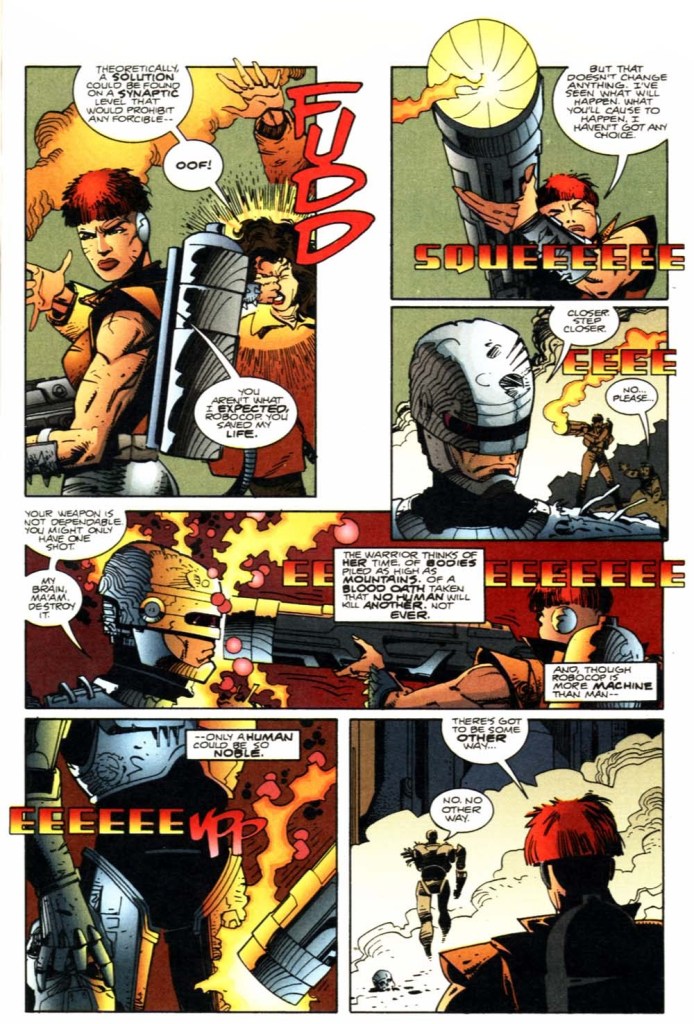
Shortly after, the human warriors take a much-needed rest. Feeling restless, the lady warrior approaches RoboCop privately and states that she figured he is not a Terminator. RoboCop, whose helmet was taken off showing his human face as officer Murphy, pets a dog as the lady approaches them.

It turns out the lady’s name is Flo (short for Florence) and she starts conversing with him peacefully. She then starts trusting RoboCop, even resting by his side. RoboCop, however, knows what has been going on that the humans don’t and he knows that Skynet and its army of Terminators acknowledge him as their creator. How his decision to help the human resistance in the war against the machines will turn out remains to be seen.

Quality

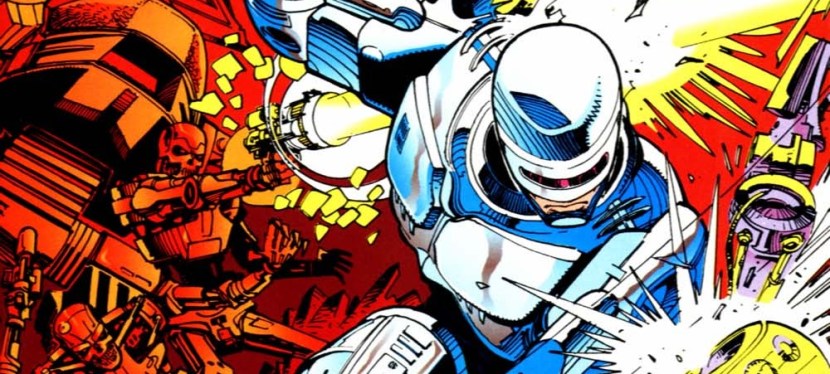
Another twist, another scenario for the war between man and machines.

When it comes to its story, Frank Miller really exerted efforts to give this comic book’s final conflict an epic presentation which is no surprise since the stakes were already raised as a result of the big twists in issue . Epic concept aside, the concept of RoboCop helping the humans fight Skynet is indeed awesome and daring to see. There is one additional idea Miller came up with which raise the stakes even further in the war, and what that idea was about is something you readers should find out on your own by getting a copy of this comic book.

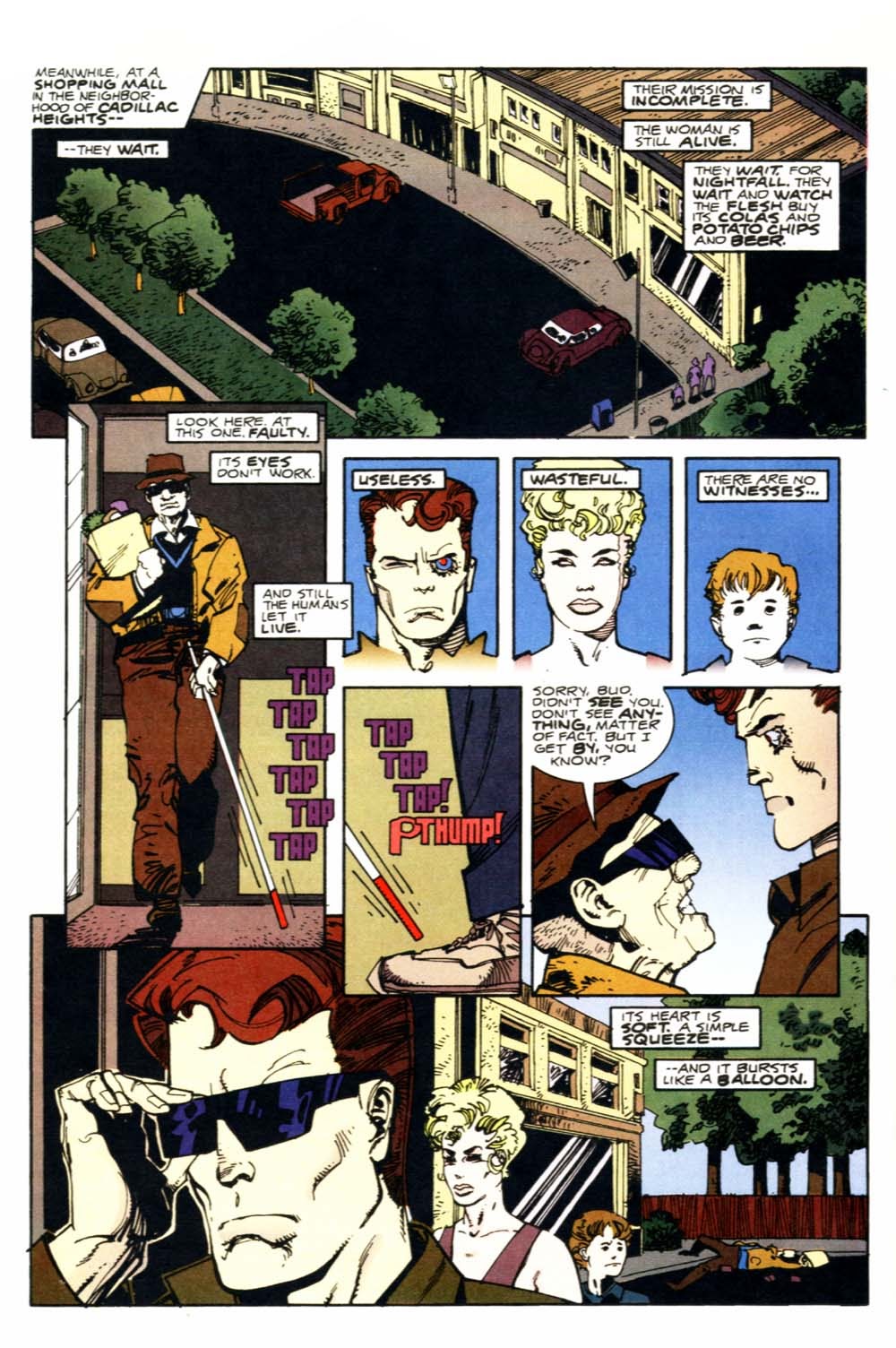
If there are any weaknesses here, it’s the presentation of the concept of time travel and time distortion which, even in this concluding part of the mini-series, remains used to justify scenario twists. As a result, the ending of this comic book made the whole conflict look and feel like a twisted, wild dream. Another thing to point out was that Skynet, even in its cybernetic form, was portrayed with human-like patterns and even tried to reason with RoboCop. This one weakened the Terminator concept a bit. Still, the series ended with enough satisfaction for me.

Conclusion

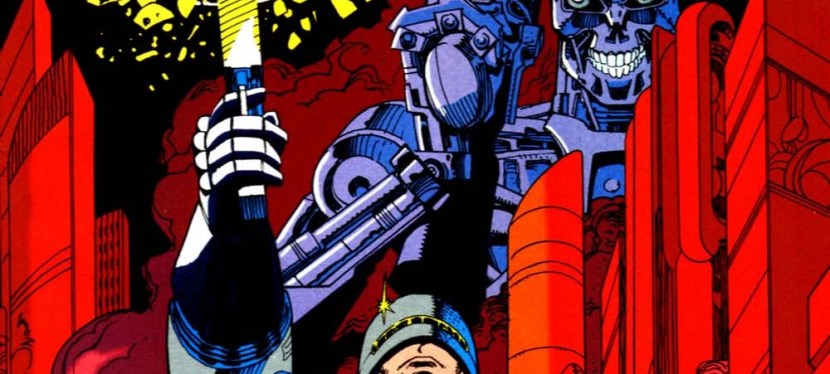
RoboCop and the human resistance.

RoboCop versus The Terminator is worthy conclusion to its mini-series. On its own, it had an epic concept and the creators really did what they could to raise the stakes of the conflict as well as raising the quality of their presentation. When it comes to combining the creative elements of the Terminator and RoboCop franchises, Miller did a solid job. It’s just that time travel and time distortion were used to create new scenarios once again in this particular comic book which I found unnecessary. On the bright side, this comic book is loaded with lots of action scenes and the quality of the dialogue was improved.

If you are seriously planning to buy an existing hard copy of RoboCop versus The Terminator (1992), be aware that as of this writing, MileHighComics.com shows that the near-mint copy of this comic book costs $10.

Overall, RoboCop versus The Terminator (1992) is recommended.

+++++

Thank you for reading. If you find this article engaging, please click the like button below and also please consider sharing this article to others. If you are looking for a copywriter to create content for your special project or business, check out my services and my portfolio. Feel free to contact me as well. Also please feel free to visit my Facebook page Author Carlo Carrasco and follow me at HavenorFantasy@twitter.com

A Look Back at RoboCop versus The Terminator #3 (1992)

Disclaimer: This is my original work with details sourced from reading the comic book and doing personal research. Anyone who wants to use this article, in part or in whole, needs to secure first my permission and agree to cite me as the source and author. Let it be known that any unauthorized use of this article will constrain the author to pursue the remedies under R.A. No. 8293, the Revised Penal Code, and/or all applicable legal actions under the laws of the Philippines.

Hey everyone! It’s time to go back to the comic book crossover featuring two metallic titans, The Terminator and RoboCop! I have already reviewed two issues of the 4-issue mini-series published by Dark Horse Comics and so far, it’s been a mixed ride. Issue #1 was pretty much a huge build-up that led to a nice pay-off in issue #2. Considering what happened at the end of the last issue, I got hooked with wanting to see what follows next.

As such, here is my look back at RoboCop versus The Terminator , published in 1992 by Dark Horse Comics with a story written by Frank Miller and drawn by Walt Simonson.

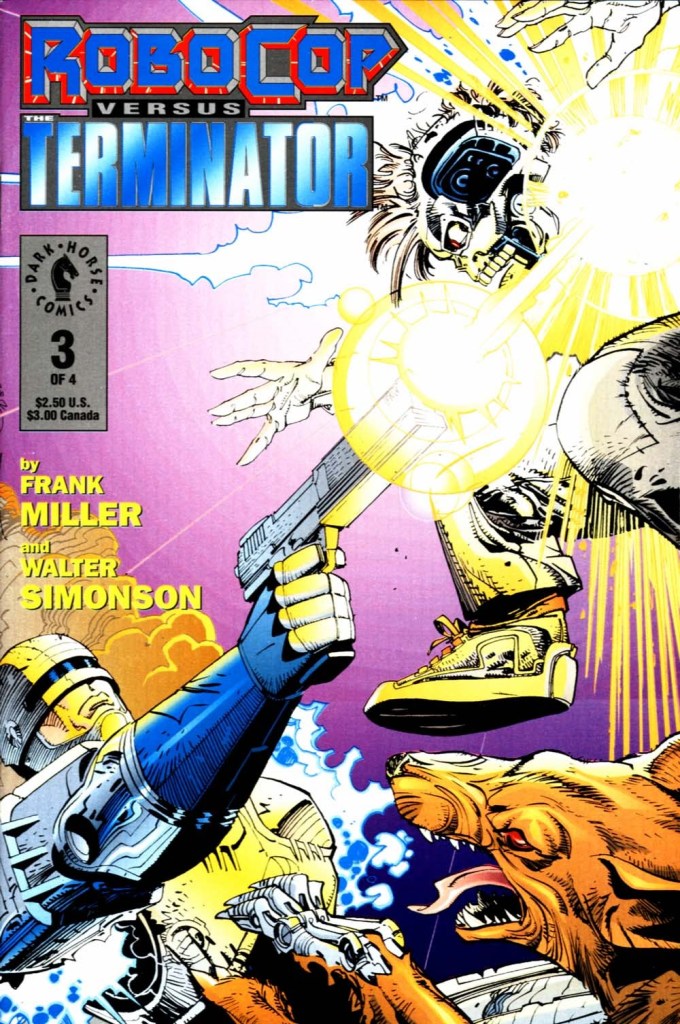
The cover.

Early story

The story begins in the far future in with planet Earth already saved but at the expense of humanity. The human race not only got crushed but also flattened, processed and converted into energy to fuel the Terminators. While things look certain and final for machines and man in the far future, a universe is about to organize.

Back in the present day, RoboCop just defeated the Terminator in a high-octane battle that caused a whole lot of damage. The lady from the far future asked RoboCop if he understood what has happened and if he finally believes she told the truth. Realizing the truth, RoboCop allows her to come close and try to blast him with her huge weapon. The attempt failed and RoboCop walks away.

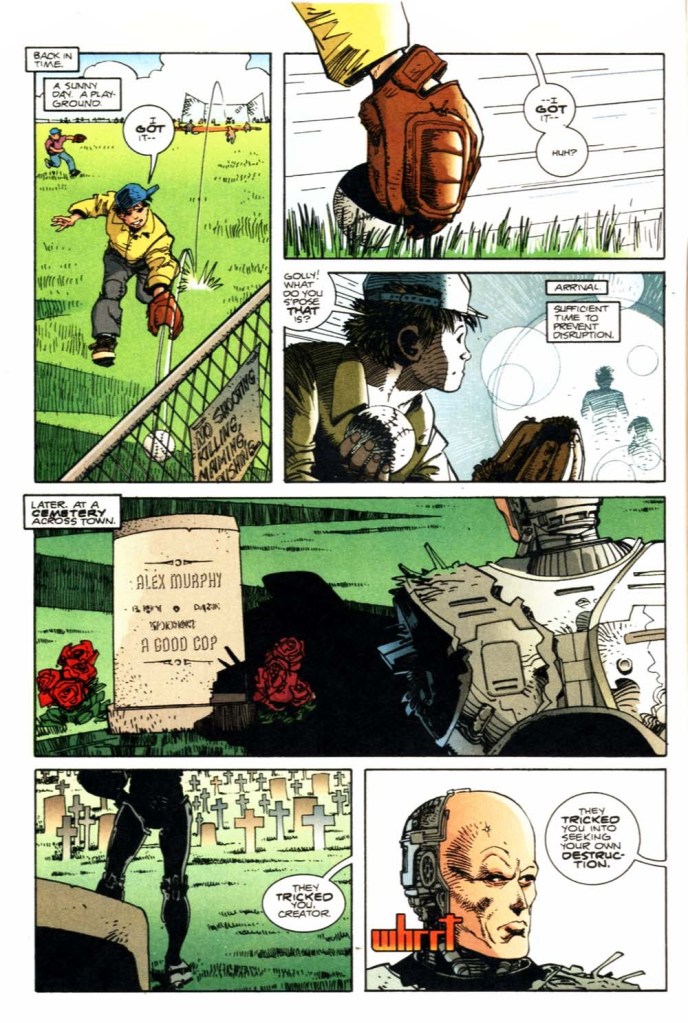
RoboCop visits the cemetery and spends time at his grave that states his name: Alex Murphy. After some deep reflection, RoboCop recalls his vision of the far future. This prompts him to take the most drastic action he could think of…

Quality

Something suspenseful…

Considering how the story turned out in the first two issues, it was no surprise that some drastic twists had to be taken to not only continue the combined universes of RoboCop and the Terminator, but also keep things fresh. The good news here is that Frank Miller’s writing is pretty good and he successfully kept the story cohesive even though drastic twists were made.

At the very core of the story is the theme about RoboCop being acknowledged as the creator of Skynet and the Terminators. As a police officer, RoboCop’s duty is to protect the innocent and uphold the law for the good of his local society, and yet for as long as he exists, so will Skynet and the Terminators of the far future. How Frank Miller fused key elements of RoboCop’s mythos with those of the Terminator franchise was pretty clever and believable from a fantasy viewpoint.

When it comes to weak points, I should say that Walt Simonson’s are here is not great although he does a descent job with drawing RoboCop. Simonson’s visual take on the Terminators has that cartoony look which is alienating.

Conclusion

It sure is hard to make the moves to drastically alter the future for the good of humanity.

RoboCop versus The Terminator is a successfully told chapter in its 4-issue mini-series. It falls short of the greatness of issue but it still proved to be fun and compelling to read. By the time the comic book ended, the stakes were raised for the next issue which I look forward to read.

If you are seriously planning to buy an existing hard copy of RoboCop versus The Terminator (1992), be aware that as of this writing, MileHighComics.com shows that the near-mint copy costs $15.

Overall, RoboCop versus The Terminator (1992) is recommended.

+++++

Thank you for reading. If you find this article engaging, please click the like button below and also please consider sharing this article to others. If you are looking for a copywriter to create content for your special project or business, check out my services and my portfolio. Feel free to contact me as well. Also please feel free to visit my Facebook page Author Carlo Carrasco and follow me at HavenorFantasy@twitter.com

A Look Back at RoboCop versus The Terminator #2 (1992)

Disclaimer: This is my original work with details sourced from reading the comic book and doing personal research. Anyone who wants to use this article, in part or in whole, needs to secure first my permission and agree to cite me as the source and author. Let it be known that any unauthorized use of this article will constrain the author to pursue the remedies under R.A. No. 8293, the Revised Penal Code, and/or all applicable legal actions under the laws of the Philippines.

Previously, I found RoboCop versus The Terminator #1 an underwhelming crossover comic book. This was due to the way the story was structured and it had a protagonist who was not interesting to follow. It does not help that RoboCop himself did not appear much in the story while the Terminators were nothing more than window dressing.

Now that the exposition and build-up has been done in the first comic book, we can find out if RoboCop and the Terminator will finally become more prominent in this look back at RoboCop versus The Terminator , published in 1992 by Dark Horse Comics with a story written by Frank Miller and drawn by Walt Simonson.

Cover
The cover.

Early story

The story begins in the dark future. A young boy finds himself in the middle of a war zone surrounded by explosions and blasts. With a broken leg, he crawls up the steps of a ruined place only to find himself facing a T-800 Terminator which kills him. The Terminator, acting like a human, raises the boy’s dead body to other Terminators which raised and clenched their firsts to acknowledge victory.

The story then moves back to 20th century Detroit, Michigan. An ED-209 operating for the city hospital fires at a dog until it got stopped by police officers. RoboCop arrives and enters the hospital with his gun catching everyone’s attention. He enters the room where the young lady from the far future is resting. Knowing that RoboCop is responsible for Skynet and the eventual war between man and machines, she remains hostile towards him.

In response to RoboCop’s inquiry about the weapon used during the shooting incident (that happened at the end of issue ), the lady responds saying, “You really don’t get it. Do you, monster? Well, you will get it when they plug you into Skynet in a copy of years—when your mind makes the Terminators possible—when you mind starts a war that wipes us out, maybe then you’ll get it!”

Even though he is mostly machine and has been computerized RoboCop (Alex Murphy) was compelled to deeply analyze what the lady from the future said. He decides to investigate…

Quality

24
Hard-hitting action between the two pop culture icons is plentiful and satisfying!

With regards to presentation, I should say that the creative team bounced back big time here delivering lots of fun stuff about RoboCop and the Terminator. The plot, for the most part, is well written and there was a lot of room to have Detroit’s cyborg cop go into conflict with more than one Terminator finally paying-off the build-up that dominated the first issue. There were even a few scenes of dark humor spotted here and there. When it comes to fusing the respective creative elements of the RoboCop and Terminator intellectual properties, this was nicely pulled off. Even ED-209, a rival of RoboCop’s in the movies, got involved in battling a T-800. When it comes to the art, Walt Simonson’s work here is satisfactory at best. He does a decent job visualizing the hard action between RoboCop and the T-800 but there is that cartoony aesthetic of Simon’s that I found to be out of place within this crossover.

Conclusion

14
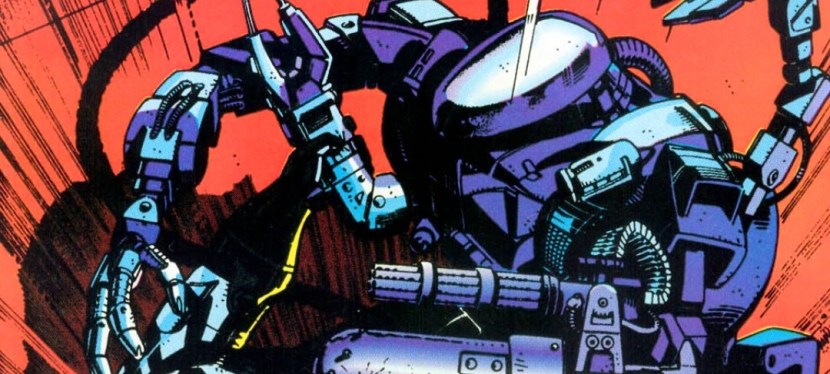
Three Terminator units in different sizes.

I’m happy to say that fans of both RoboCop and the Terminator will have a lot of good stuff to enjoy in RoboCop versus The Terminator . The build-up and heavy exposition in the first issue paid off nicely in this comic book. Those who got annoyed with the lady from the future will be relieved that her spotlight in this issue was heavily reduced. As expected, the fight between RoboCop and the T-800 is brutal and plentiful although the impact could have been stronger had someone else illustrated this comic book. By the end of the story, I was very satisfied and ended up looking forward to the next issue.

If you are seriously planning to buy an existing hard copy of RoboCop versus The Terminator (1992), be aware that as of this writing, MileHighComics.com shows that the near-mint copy costs $6.

Overall, RoboCop versus The Terminator is highly recommended!


Thank you for reading. If you find this article engaging, please click the like button below and also please consider sharing this article to others. If you are looking for a copywriter to create content for your special project or business, check out my services and my portfolio. Feel free to contact me as well. Also please feel free to visit my Facebook page Author Carlo Carrasco and follow me at HavenorFantasy@twitter.com

A Look Back at RoboCop versus The Terminator #1 (1992)

Disclaimer: This is my original work with details sourced from reading the comic book and doing personal research. Anyone who wants to use this article, in part or in whole, needs to secure first my permission and agree to cite me as the source and author. Let it be known that any unauthorized use of this article will constrain the author to pursue the remedies under R.A. No. 8293, the Revised Penal Code, and/or all applicable legal actions under the laws of the Philippines.

Back in the early 1990s, I was already a fan of the Terminator and RoboCop mainly due to their respective first movies released in the 1980s which became cinematic classics. While RoboCop 2 never came close to the quality of the 1987 original movie, Terminator 2: Judgment Day literally rocked the cinemas and went on to become one of the greatest film sequels ever made. Back then, there was a lot to be excited for over the two entertainment franchises.  One day during my high school days (note: there was no social media and Internet access in the Philippines was not yet established), I learned from reading a comic book industry magazine that a crossover comic book mini-series matching the Terminator and RoboCop together. That news excited me a lot and before the end of 1992, I bought myself a copy of the comic book RoboCop versus The Terminator (note: this one has gone out of print).

With the history explained, let’s all take a look back at RoboCop versus The Terminator , published in 1992 by Dark Horse Comics with a story by Frank Miller (note: the same successful comic book creator who actually worked on RoboCop movies in Hollywood) and art by Walt Simonson.

Cover
The cover.

Early story

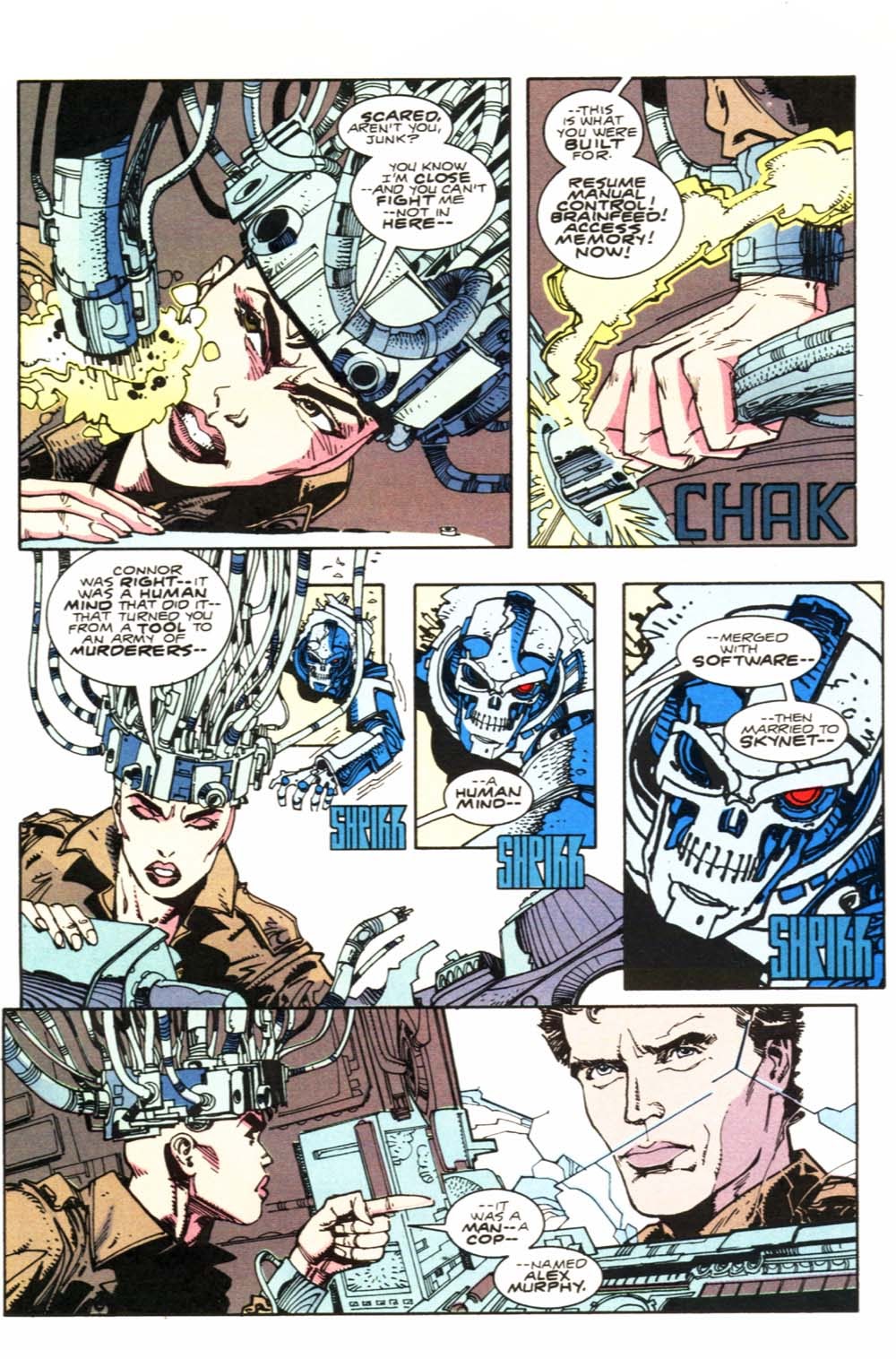
The story begins in the far future wherein human society has been ruined and the world became a constant battleground of a war between powerful machines and desperate humans. Inside a facility being invaded by the machines, a lady working for the rebels has been using computers (via brainfeed) in the battle with Skynet. As far as she knows, leader John Connor has been right in telling her that it was a human mind that merged with software and got linked with Skynet. She points to the 20th century historical figure Alex Murphy/RoboCop as the one responsible for the war.

Before Skynet’s machines reach her, she strips naked and made a desperate trip back through time. She successfully makes a hard landing into the middle of a city in a time before the war. After struggling with the sudden change, she arms herself and sets off to kill Alex Murphy…

Quality

16
Something is off with the pacing of the action here.

Let me start that this particular mini-series has a very intriguing concept that made it stand on its own (as opposed to simply referencing core concepts of the movies). This is about RoboCop’s technology being used to establish Skynet and this launch comic book emphasized that nicely.

When it comes to storytelling done with this particular comic book, things felt very uneven. For a comic book that strongly focused on the Terminator and RoboCop, this was mainly the story of the rebel lady from the future whose mission was to eliminate officer Alex Murphy in a bid to change the future. While she is portrayed to be highly determined and works by action, the character is never interesting and not worth investing your attention to.

For his part, RoboCop was literally placed on the backseat in this story and he makes his first appearance in the 2nd half starting with crime-busting. Considering the lack of spotlight, the sci-fi icon himself is not even interesting to follow which is disappointing.

The clear representation of evil here is Skynet and its army of Terminators. To say the least, the machines here make a worthy menace to read and somewhat made up for RoboCop and the lady rebel being uncompelling characters.

When it comes to the art, I should say that Walt Simonson’s visuals are not great to look at. There were crooks that had a cartoony aesthetic on the faces, Terminators that don’t even come close to their cinematic designs and some images looked rushed. At least Simonson’s RoboCop looks recognizable and was satisfactory with the action.

Conclusion

6
The target: Alex Murphy/RoboCop.

I still remember how underwhelmed I got after completing RoboCop versus The Terminator the first time way back in 1992. It’s even more underwhelming by today’s standards. Of course, the comic book was essentially a build-up issue with the pay-off supposed to happen in the remaining issues. Its best selling point is the fusion of RoboCop and Terminator concepts that helped establish its own universe.

If you are seriously planning to buy an existing hard copy of RoboCop versus The Terminator (1992), be aware that as of this writing, MileHighComics.com shows that the near-mint copy of the regular edition costs $17 while the near-mint copy of the platinum edition costs $170.

Overall, RoboCop versus The Terminator (1992) is satisfactory. That being said, I would not recommend paying a lot of money for this comic book. Find a near-mint copy priced below $10.


Thank you for reading. If you find this article engaging, please click the like button below and also please consider sharing this article to others. If you are looking for a copywriter to create content for your special project or business, check out my services and my portfolio. Feel free to contact me as well. Also please feel free to visit my Facebook page Author Carlo Carrasco and follow me at HavenorFantasy@twitter.com