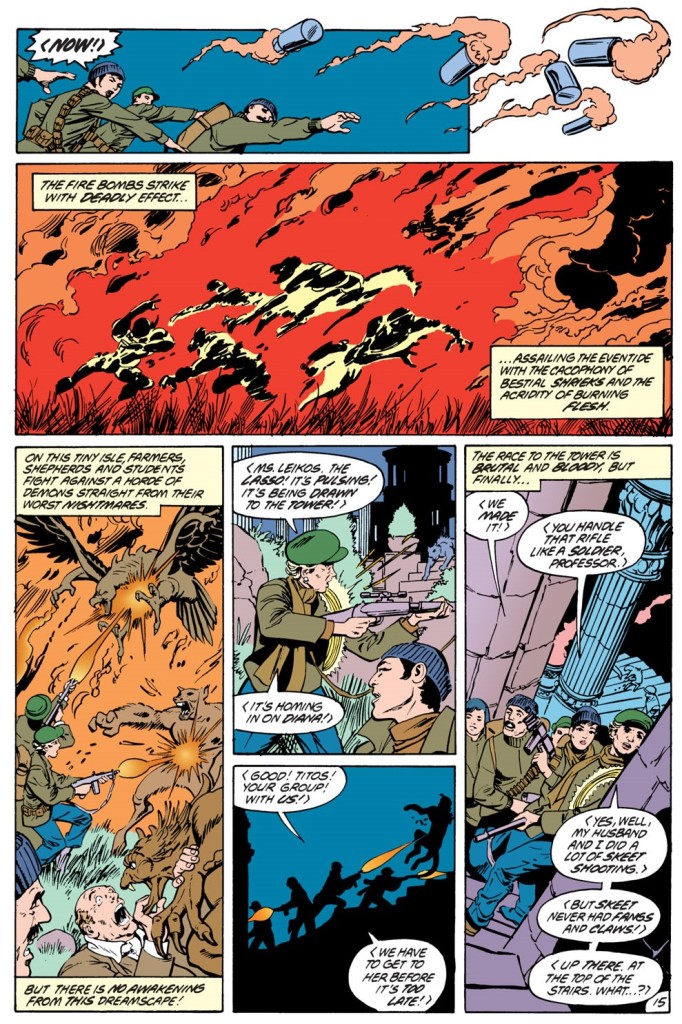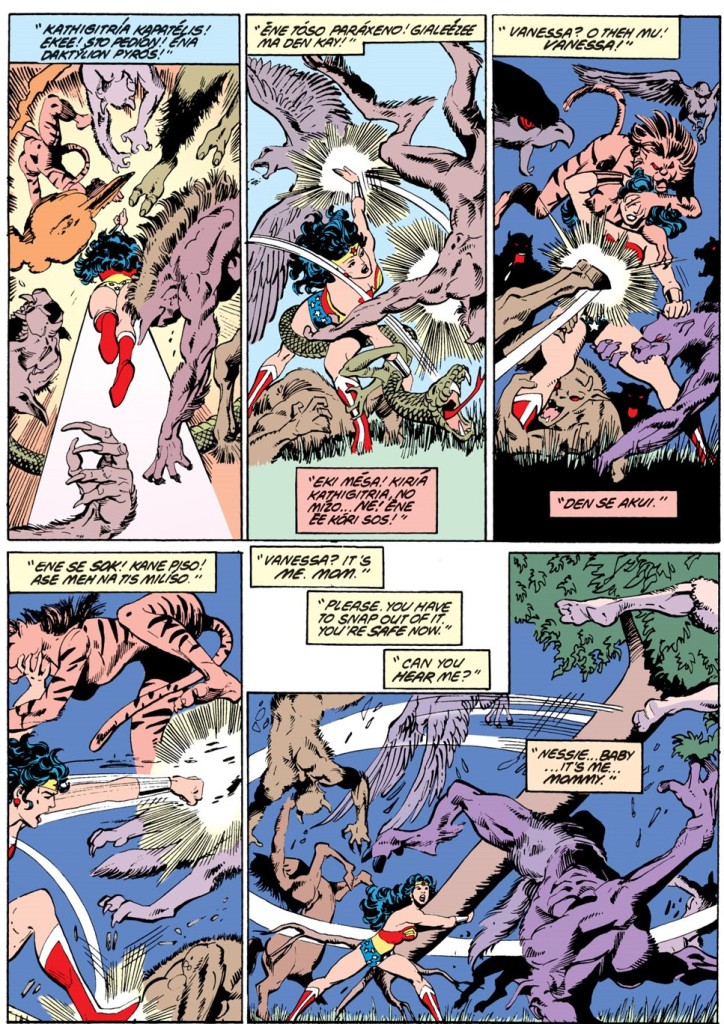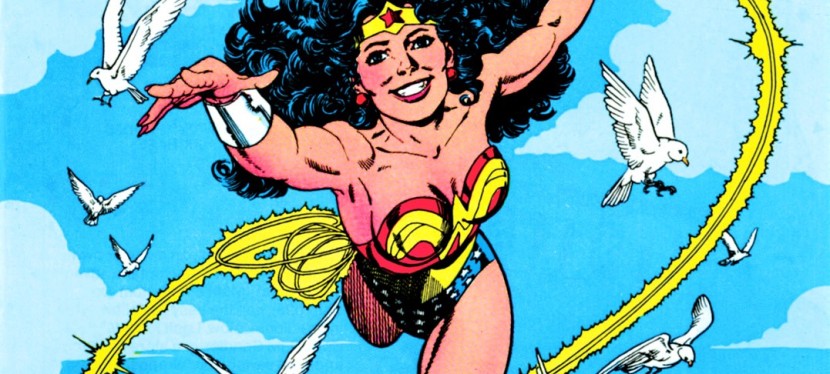
A Look Back at Wonder Woman #22 (1988)

Disclaimer: This is my original work with details sourced from reading the comic book and doing personal research. Anyone who wants to use this article, in part or in whole, needs to secure first my permission and agree to cite me as the source and author. Let it be known that any unauthorized use of this article will constrain the author to pursue the remedies under R.A. No. 8293, the Revised Penal Code, and/or all applicable legal actions under the laws of the Philippines.

Welcome back, superhero enthusiasts, comic book collectors and fans of DC Comics! I wonder how many among you readers got to watch Zack Snyder’s Justice League? That was the so-called definitive version of the Justice League live-action movie that Zack Snyder originally envisioned and reportedly it was the big dream come true for fans of the director and his own vision of the current cinematic universe of DC Comics superheroes.

While the so-called Snyder Cut of Justice League has Gal Gadot as Wonder Woman, I personally am not too excited for it but I will watch it much later on Blu-ray or perhaps 4K Blu-ray someday. What I am anticipating right now is the 4K Blu-ray release of Wonder Woman 1984 scheduled for March 30, 2021.

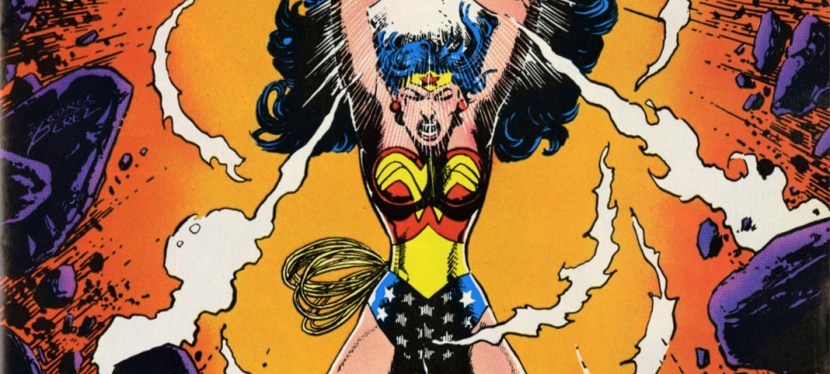
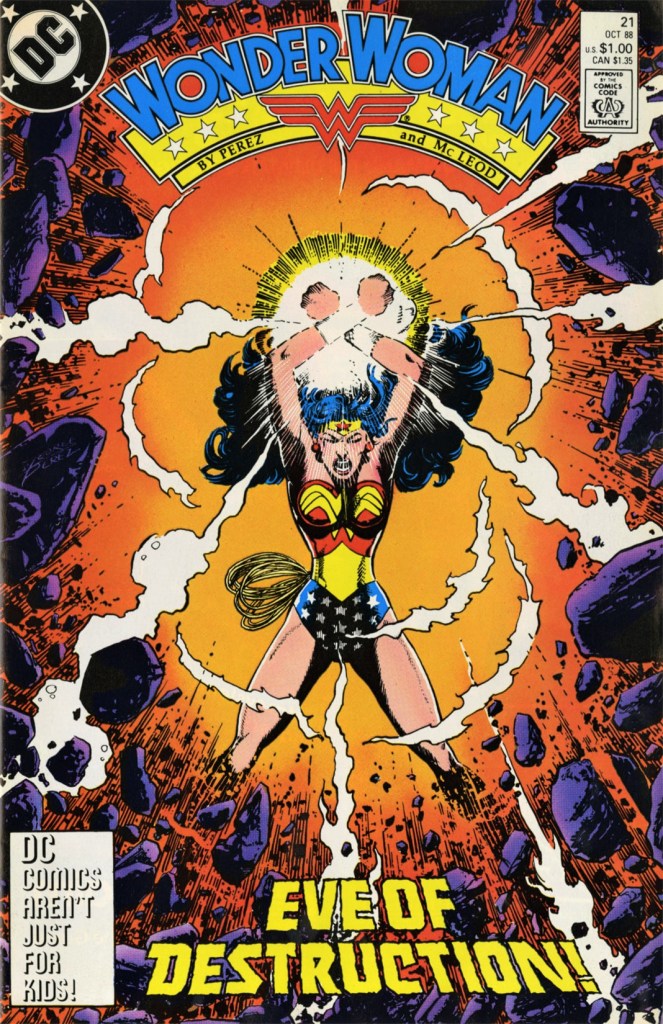
With regards to the literary Wonder Woman (post-Crisis DC Comics universe) as I’ve been reviewing a lot for some time now, things went crazy with what happened in issue #21. I’m talking about something that involved Wonder Woman with the deities of Olympus.

With those details laid down, here is a look back at Wonder Woman #22, published by DC Comics in 1988 with a story written and drawn by George Perez with Bob McLeod credited with the finished art.
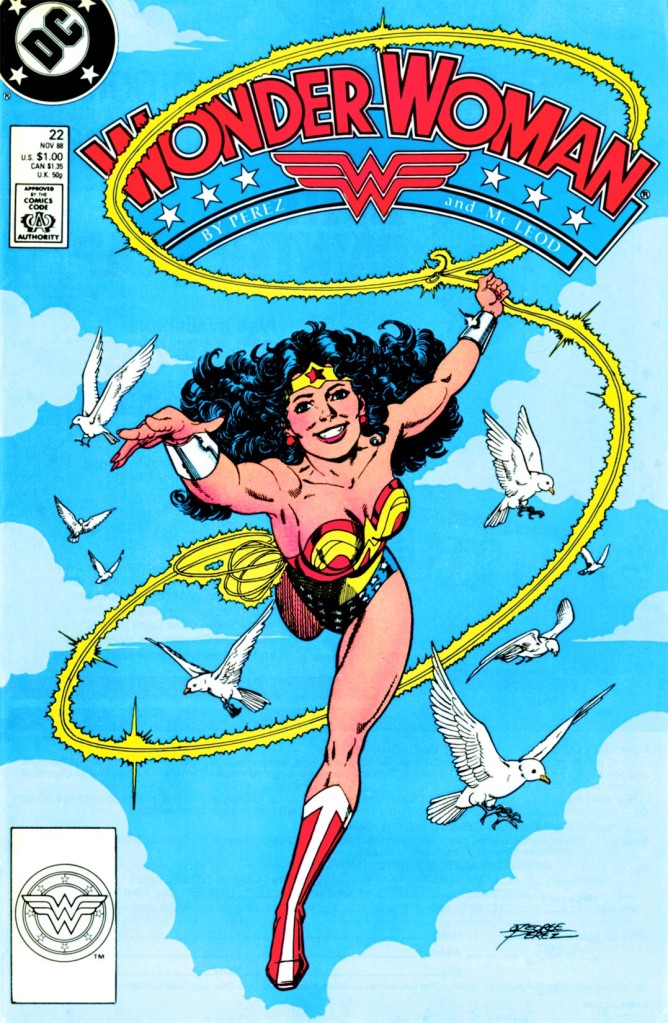
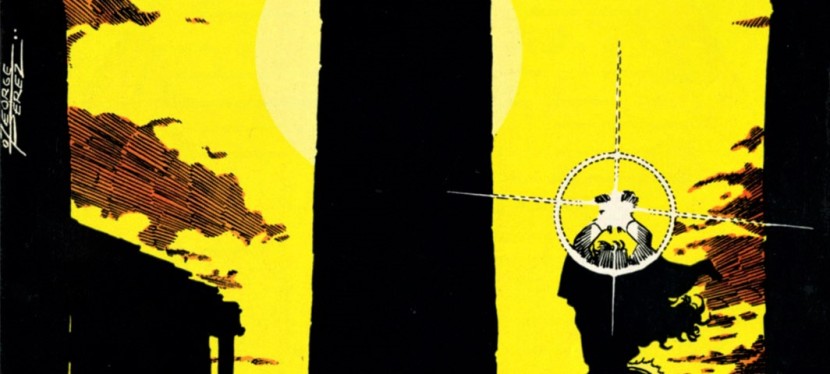
The cover.

Early story

The story begins in Themyscira. All the Amazons are called by Diana to a special audience in relation to an pending proclamation of a new decision that shall chart forevermore the path of the Amazon destiny.

In front of a large audience composed of her many Amazon sisters as well as her mother (Queen Hippolyte), the oracle Menalippe and headmistress Mnemosyne, Diana announces that a majority voted yes on the question of Themyscira opening her gates to the world outside and allowing man to set food on the shores of paradise island.

There was no fanfare, no cheers and no applause from the audience as the announcement marked the beginning of the new stage in the history of Amazons.

Meanwhile in outer space, a silvery orb flies around in very fast speed heading towards Earth…

Quality
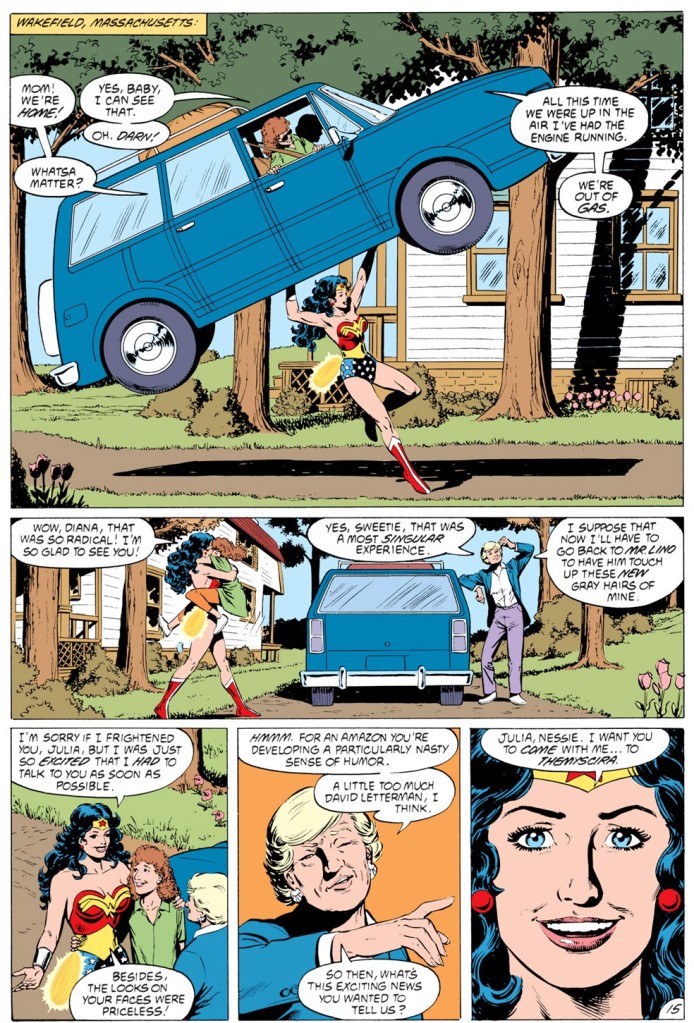
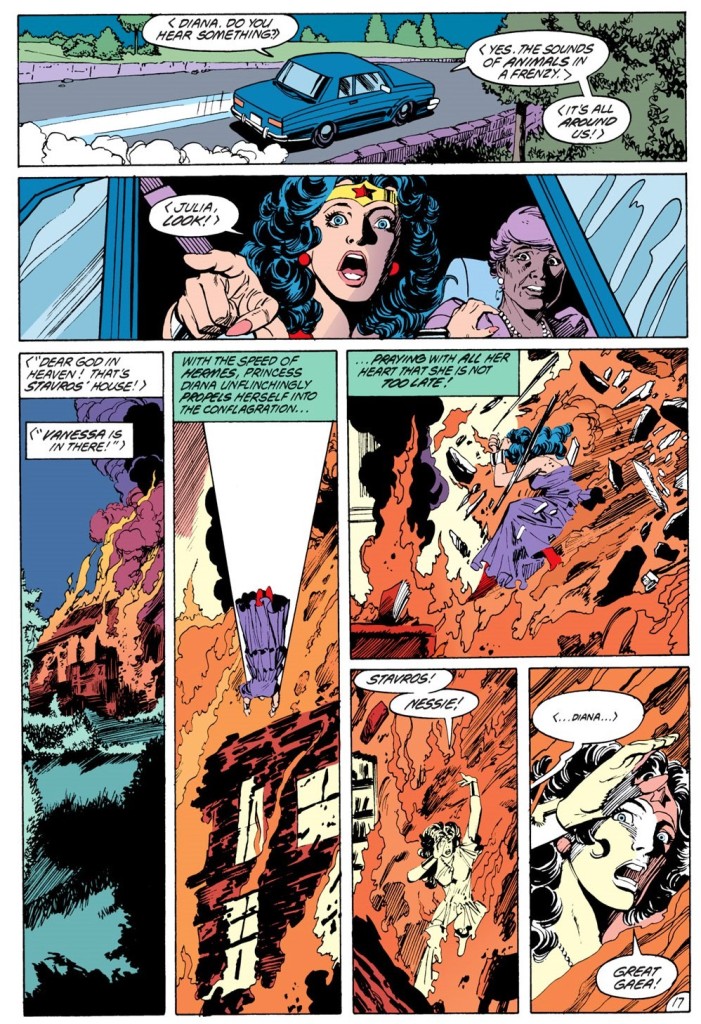
Wonder Woman’s lifting of the car looked inspired by the famous cover of Action Comics #1 from 1938.

To make things clear, the story of this comic book is mainly a build-up for something significant that will happen later. There is no real battle of good-versus-evil here, nor would you see Wonder Woman encounter someone sinister.

In terms of build-up, the approval by the Amazons of cultural exchange and sharing of access with man’s world is itself a set-up for a significant event for Wonder Woman and her two closest friends on Earth. On other matters, the arrival of the space orb on Earth was presented very nicely and it surely is intriguing to see how it builds up for an upcoming new anti-hero element.

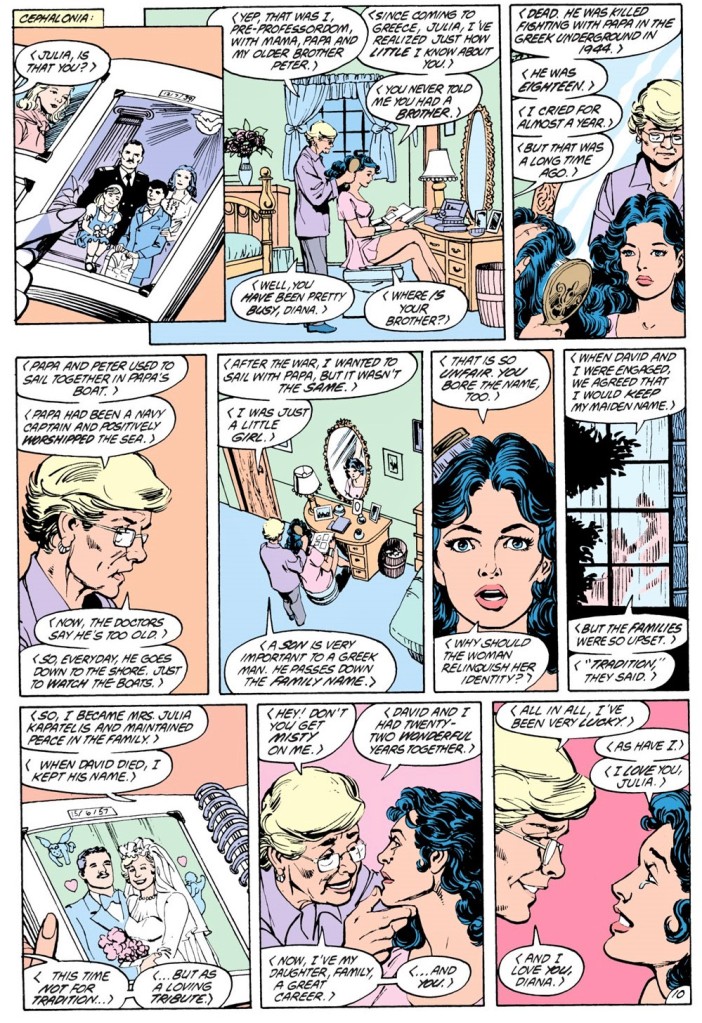
If you are a Wonder Woman fan expecting to see more of Diana getting dramatized and developed, you might be disappointed that this comic book has lesser content about her than usual. In fact, there is a good amount of pages here that pay close attention to Vanessa Kapatelis having a bad day in school, plus her mother Julia attracting the attention of a certain school teacher. This particular comic book really tried hard dramatizing the mother-and-daughter relationship of the two supporting characters but ultimately (and not surprising) it’s nowhere as engaging as that of Queen Hippolyte and Diana.

Conclusion
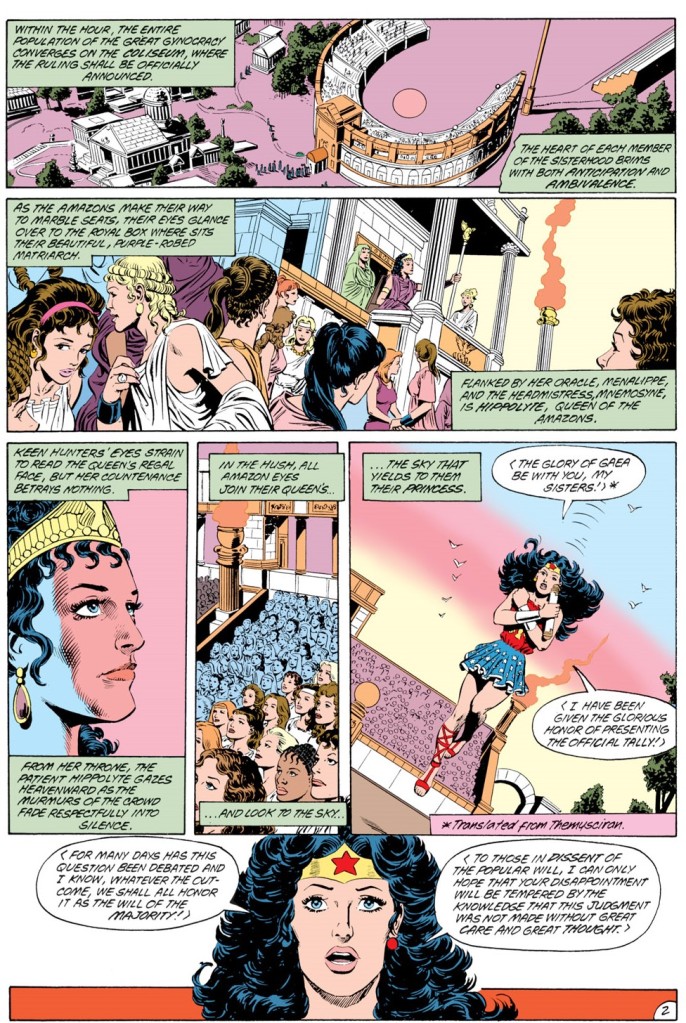
Diana doing her duty in front of a tremendous audience of her Amazon sisters plus her mother Queen Hippolyte.

Behind its beautiful cover, Wonder Woman #22 (1988) is not only an underwhelming follow-up to the epic development in issue #21, it is also the least engaging issue I’ve read about the post-Crisis version of Wonder Woman under the creative direction of George Perez. It’s really more about setting the stages for a future conflict and a special visit to Themyscira (you can guess who would visit to see Wonder Woman’s Amazon sisters). George Perez’s writing is still of pretty good quality and he really knows how to define each character’s personality but it’s the overall concept of the comic book that is underwhelming.

If you are seriously planning to buy an existing hard copy of Wonder Woman #22 (1988), be aware that as of this writing, MileHighComics.com shows that the near-mint copy of the regular edition costs $35 while the near-mint copy of the 2nd printing costs $350.

Overall, Wonder Woman #22 (1988) is satisfactory.

+++++

Thank you for reading. If you find this article engaging, please click the like button below and also please consider sharing this article to others. If you are looking for a copywriter to create content for your special project or business, check out my services and my portfolio. Feel free to contact me as well. Also please feel free to visit my Facebook page Author Carlo Carrasco and follow me at HavenorFantasy@twitter.com
A Look Back at The Strangers #14 (1994)

Disclaimer: This is my original work with details sourced from reading the comic book and doing personal research. Anyone who wants to use this article, in part or in whole, needs to secure first my permission and agree to cite me as the source and author. Let it be known that any unauthorized use of this article will constrain the author to pursue the remedies under R.A. No. 8293, the Revised Penal Code, and/or all applicable legal actions under the laws of the Philippines.

Welcome back, superhero enthusiasts, comic book collectors and fans of Malibu Comics! Previously, I reviewed an issue of The Strangers which happened to be the 2nd-to-the-last issue of its monthly series (which itself was mostly spearheaded by the dynamic duo of Steve Englehart and Rick Hoberg).

I was about to do a retro review of The Strangers #24 but realized that there are still some other comic books of the series that I have not reviewed yet. As such, I decided to read those other issues before reviewing the final issue.

With those details laid down, here is a look back at The Strangers #14, published by Malibu Comics in 1994 with a story written by Englehart and illustrated by Hoberg.

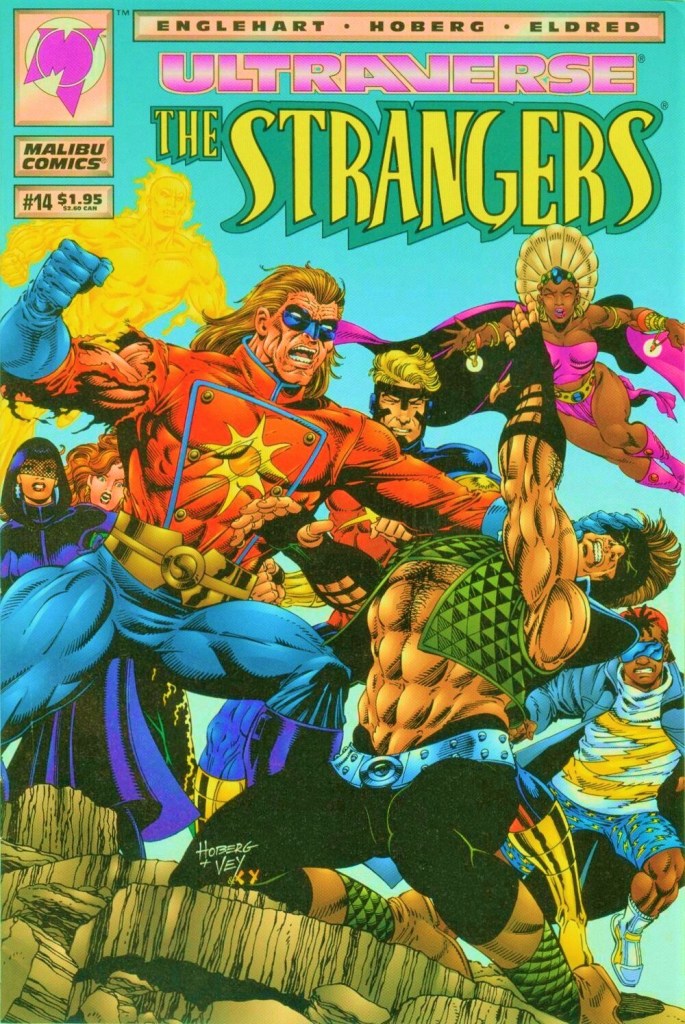
The cover.

Early story

The story begins when a strong, muscular man with long blonde hair strikes a huge rock formation high in the hills to the east of San Francisco Bay in California. While talking to himself (most likely a way to deal with his isolation), he continues to lift very large piece of rock, smashes more rocks and throws a tractor as if it was just a ball.

“I am…Powerhouse! I am Powerhouse! I…am Powerhouse,” he said to himself.

Still talking to himself, Powerhouse realizes that the world must never know about him as it has done its best to destroy him. He quietly changes into civilian clothes and drives away into the distance in his car.

On the streets of East Bay Hills in Berkeley, Hugh/Grenade and Bob/Atom Bob walk down the fancy commercial zone as they enjoy the time-off Elena/Lady Killer gave them. Soon enough, people started recognizing the two as members of The Strangers even though they are not in costume. This community buzz catches the attention of an executive at a local radio station who then picks Powerhouse (in civilian form) to go to East Bay Hills to report about Hugh and Bob…

Quality

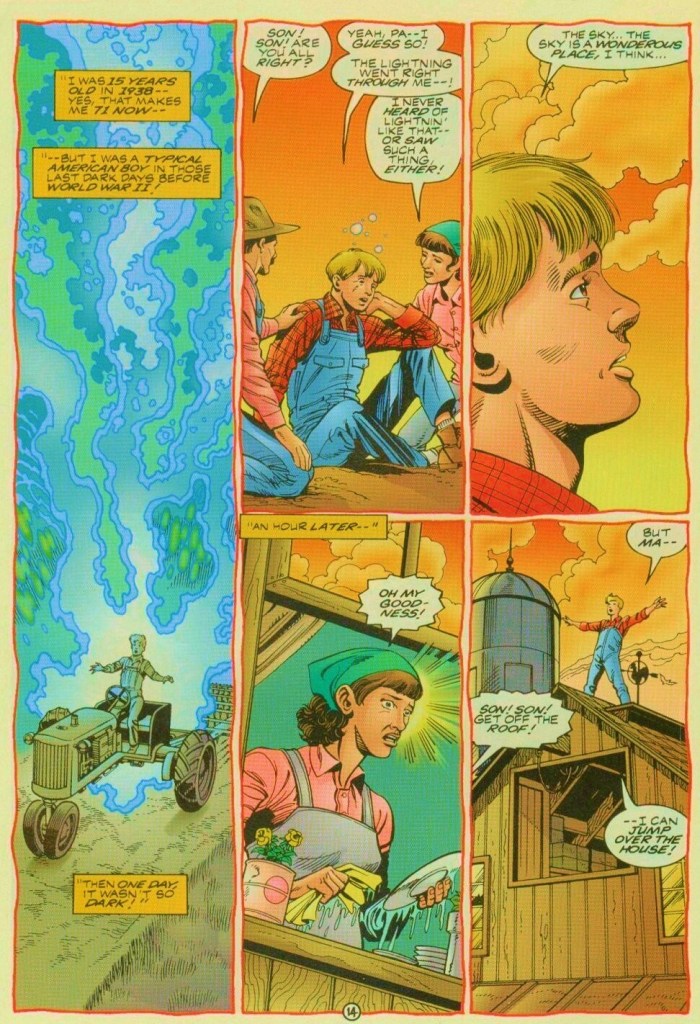
When Powerhouse first gained super abilities.

I’ll got straight to the point about what this comic book is all about. This is the story of an ultra who gained powers very long before The Strangers, Mantra, Prime, Hardcase, The Solution and all the other Ultraverse heroes even started. That being said, Powerhouse is an old man (who really does not look like in his sixties or seventies) whose life turned upside-down as a result of gaining super powers as a teenager in the year 1938 (note: this was the year Superman debuted in comics in real life). Having lost DECADES of his time in the world, Powerhouse became a man who found himself lonely and having trouble adjusting into the modern world (1993 in the Ultraverse specifically). What bothers him even more is the fact that super beings like The Strangers members Atom Bob and Grenade are gladly accepted and celebrated by the public which is the complete opposite of how he was perceived when he became a super being.

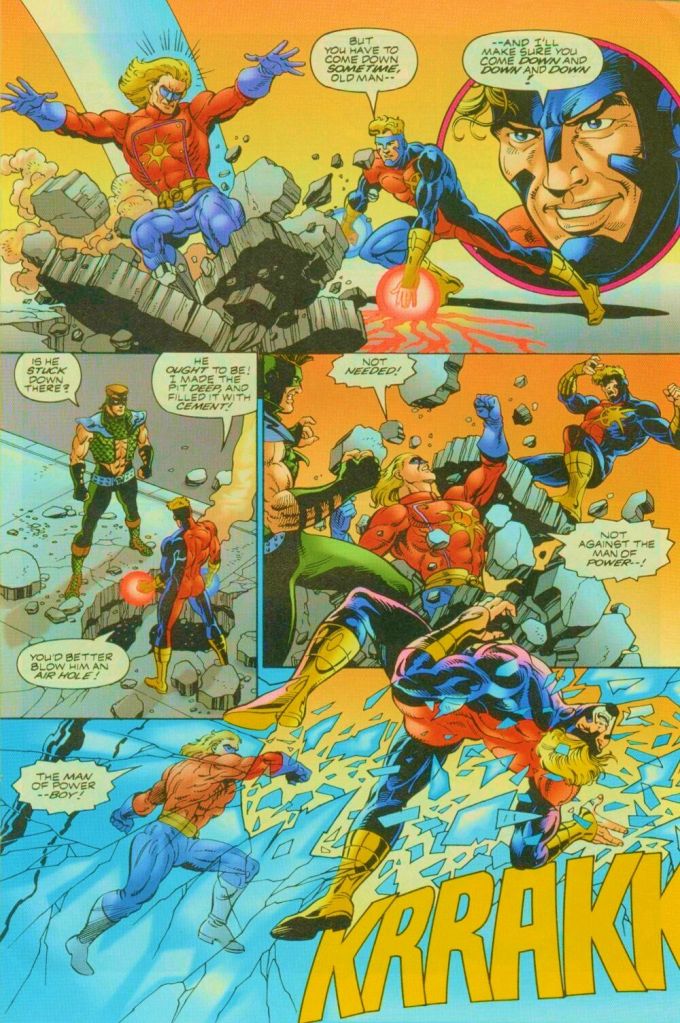
The writing done by Steve Englehart is very rich to read and through it all, you will feel the pain, frustration and anguish of Powerhouse. As usual, Rick Hoberg’s art is always great to look at and you can see in this comic book how he adjusts his style when the narrative shifts from the talk scenes into the action scenes and the like.

Conclusion

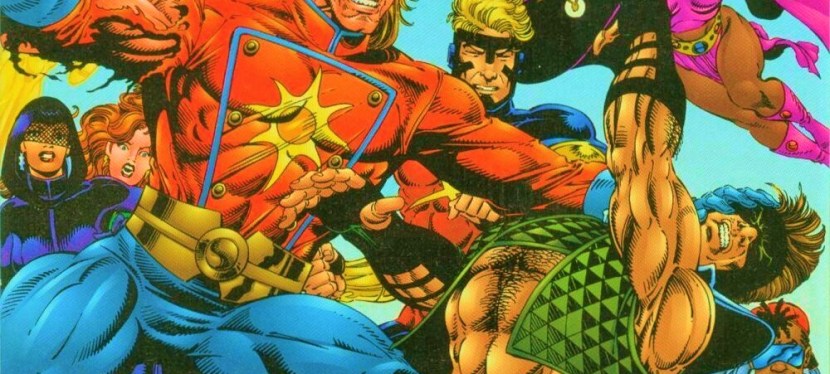
Really, you only see two of The Strangers in this comic book which contradicts what was shown on the cover art.

Fundamentally, The Strangers #14 (1994) highlights Powerhouse (both his present-day self and his origin) with Atom Bob and Grenade literally pushed out of the spotlight. Powerhouse is clearly inspired by the old ages of superhero comics and the creative team cleverly presented him as a super-powered man who finds himself struggling to fit in the 1990s. While this super being debut story is fun and engaging, its only weakness is that The Strangers have little real presence in the story (note: the cover art looks great but is really misleading).

If you are seriously planning to buy an existing hard copy of The Strangers #14 (1994), be aware that as of this writing, MileHighComics.com shows that the near-mint copy of the comic book costs $14.

Overall, The Strangers #14 (1994) is recommended!

+++++

Thank you for reading. If you find this article engaging, please click the like button below and also please consider sharing this article to others. If you are looking for a copywriter to create content for your special project or business, check out my services and my portfolio. Feel free to contact me as well. Also please feel free to visit my Facebook page Author Carlo Carrasco and follow me at HavenorFantasy@twitter.com
A Look Back at Wonder Woman #21 (1988)

Disclaimer: This is my original work with details sourced from reading the comic book and doing personal research. Anyone who wants to use this article, in part or in whole, needs to secure first my permission and agree to cite me as the source and author. Let it be known that any unauthorized use of this article will constrain the author to pursue the remedies under R.A. No. 8293, the Revised Penal Code, and/or all applicable legal actions under the laws of the Philippines.

Welcome back, superhero enthusiasts, comic book collectors and fans of superhero universe of DC Comics! I don’t know with you, my readers, but I love the way George Perez and his fellow writers characterized Wonder Woman during the very early stage of the post-Crisis era of DC Comics. The character development was not only a great way to achieve balance with spectacle and plotting for each story of Wonder Woman, but also a solid way to redefine the Queen of Superheroes to new fans as well as other comic book readers of the late 1980s. Such characterization efforts include redefining other key elements of the Wonder Woman concept such as the development of Themyscira and its all-women society, the struggle that the deities of Olympus had while the Amazons struggled, and most notably the way Wonder Woman and the people of man’s world adjusted to each other.

With those details laid down, we can find out more about Wonder Woman’s development in this look back at Wonder Woman #21, published by DC Comics in 1988 with a story written and drawn by George Perez with Bob McLeod credited with the finished art.

The cover.

Early story

The story begins in Themyscira. In the middle of the night, Menalippe, the oracle of the Amzons wakes up looking terrified. She makes a reference to the deities of Olympus. In Wakefield, Massachusetts, Diana/Wonder Woman, Julia Kapatelis and teenager Vanessa arrive home from the memorial service of the late Myndi Mayer. As Vanessa goes to her bedroom feeling depressed, Diana admits to Julia that she is deeply troubled over what happened in recent times. She also expressed that she can’t help feeling partially responsible for Mayer’s death.

As Julia tries to comfort Diana, several knocks were made at the house door. Upon opening it, a bird carrying a note suddenly flies into the house and heads straight to Diana who recognizes it and reads a new message written by her mother, the queen Hippolyte.

After reading it, Diana leaves for Themyscira with a promise to Julia and her daughter that she will return. Shortly after arriving in her nation, she, her mother and all their Amazon sisters assembled at the altar of Apollo and performed a ritual led by Menalippe. Menalippe claims to have made contact with the deities and states that she, Diana and Queen Hippolyte have been called to appear at the court in Mount Olympus…

Quality

The deities of Olympus were never holy and were in fact very flawed beings who happen to hold tremendous power over Wonder Woman and the Amazons.

I can say that this is a story about the foundation of Wonder Woman’s place in the DC Comic universe as it involves the link between Olympus and Themyscira. The good news here is that this story is very well written and the plot structure was nicely organized by George Perez.

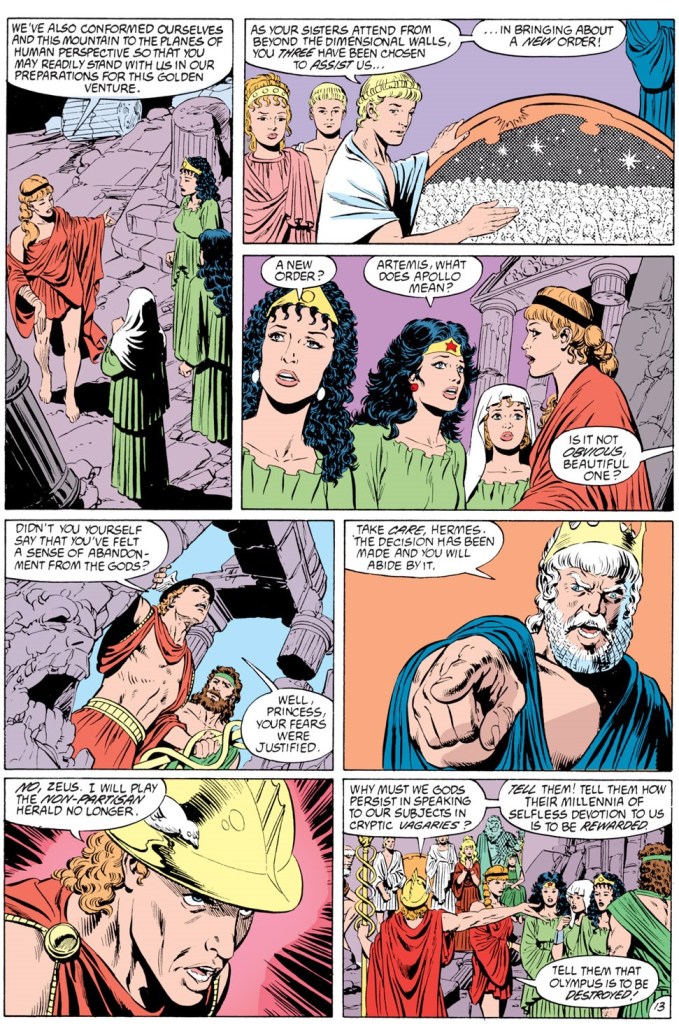
In many ways, this story is a continuation to Wonder Woman’s personal interaction with the deities of Olympus. The difference here is that her mother Queen Hippolyte and their oracle are much more involved and the deities – which include Zeus, Hera, Heracles and the rest – themselves have gotten into tremendous trouble as a result of what Darkseid did to them. This leads to the call of a new order which got the three Amazons chosen. This alone marks the new chapter in the lives of Amazons and Wonder Woman, who proved her worth in the Challenge of the Gods storyline, is unsurprisingly part of it.

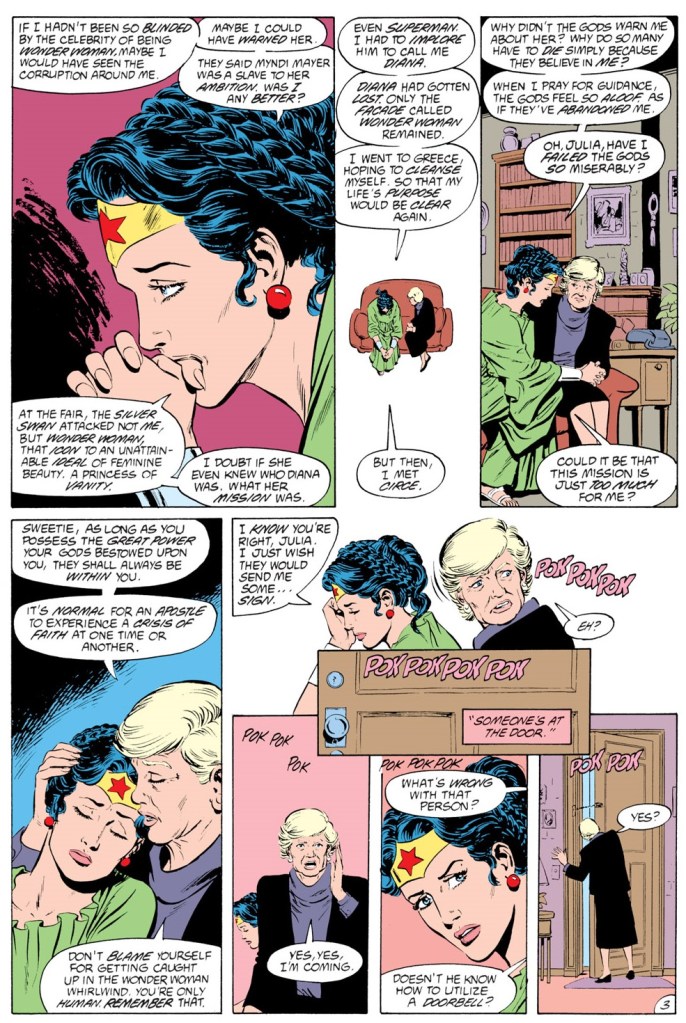
When it comes to the character development of Wonder Woman, the golden part happened early in this comic book. I love the way that George Perez portrayed Diana to be fragile as a person who realizes that her being a very powerful icon in man’s world causes both blessings and problems around her. Diana admits getting blinded by the celebrity of being Wonder Woman to the many people around her. The dialogue Perez wrote for Diana in the early scene (in the presence of Julia) is very rich and so touching, you will feel sympathy for the Queen of all Superheroes.

Conclusion

A very touching scene about Diana/Wonder Woman dealing with the responsibility of what went wrong recently.

Apart from being a new chapter for Wonder Woman and her Amazons, Wonder Woman #21 (1988) is a richly layered story to read. It does not have the usual good-versus-evil spectacle common with most superhero comic books, but the story succeeds in moving the narrative of the Amazons and Olympus deities forward while developing Diana as an even more human character (as opposed to being a superhero). This is another great work spearheaded by George Perez.

If you are seriously planning to buy an existing hard copy of Wonder Woman #21 (1988), be aware that as of this writing, MileHighComics.com shows that the near-mint copy of the regular edition costs $33 while the near-mint copy of the newsstand edition and the 2nd print edition cost $70 each.

Overall, Wonder Woman #21 (1988) is highly recommended!

+++++

Thank you for reading. If you find this article engaging, please click the like button below and also please consider sharing this article to others. If you are looking for a copywriter to create content for your special project or business, check out my services and my portfolio. Feel free to contact me as well. Also please feel free to visit my Facebook page Author Carlo Carrasco and follow me at HavenorFantasy@twitter.com
A Look Back at The Night Man #12 (1994)

Disclaimer: This is my original work with details sourced from reading the comic book and doing personal research. Anyone who wants to use this article, in part or in whole, needs to secure first my permission and agree to cite me as the source and author. Let it be known that any unauthorized use of this article will constrain the author to pursue the remedies under R.A. No. 8293, the Revised Penal Code, and/or all applicable legal actions under the laws of the Philippines.

Welcome back superhero enthusiasts, comic book collectors and fans of Malibu Comics!

I don’t know with you but I personally enjoyed reading the crossover stories of the Ultraverse. The Strangers had nice crossovers with Hardcase and Prototype in different times. The crossover encounter between Prime and Prototype was very memorable. There also was the first grand crossover of the Ultraverse in Break-Thru #1.

While the Ultraverse no longer exists, for me it was the one superhero comic book franchise or imprint that truly defined superhero comics of the 1990s. Malibu Comics really had great talents and other comic book creators who produced lots of fun comic books to read. Their creators also knew what it took to make Ultraverse crossovers stand out.

Today, we will start a close look at another particular crossover storyline within the Ultraverse titled Hostile Takeover which involves The Night Man, Prototype, Solitaire, Sludge and The Solution! With those details laid down, here is a look back at The Night Man #12, published in 1994 by Malibu Comics with a story written by Steve Englehart with Len Strazewski and James Hudnall as co-plotters. The art was drawn by John Dennis.

The cover.

Early story

The story begins in the fancy office of J.D. Hunt as he receives a call from the secretive and sinister Rex Mundi. Mundi expressed disappointment in Hunt’s handling of the so-called Ultra Problem but went on to give him a chance to redeem himself. Mundi tells Hunt to take over Ultratech which has gotten into trouble caused by Gordon Bell. Hunt noted that Ultratech is to blame for the Strangers’ hijacking of his space shuttle as the security was handled by the said company.

 After talking with Mundi, J.D. Hunt observes his employees finishing work on a high-tech armor (Teknight) and then communicates privately with The Solution. During the meeting, Hunt reveals to them that he is a major stockholder of Ultratech and he needs them to find out if they got Gordon Bell running things. The Solution takes the job.

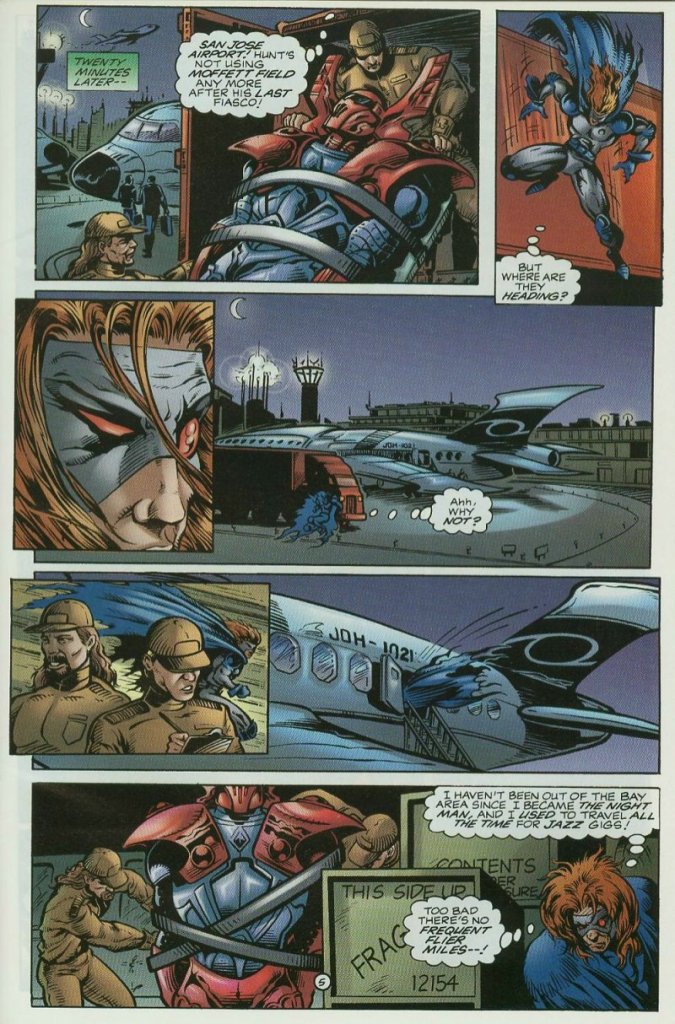
Elsewhere, the Night Man secretly jumps on the top of a moving truck which he knows carries NuWare’s secret project Teknight. Upon arrival at the airport of San Jose, California, Night Man carefully sneaks into an airplane which is where Teknight is loaded at…

Quality

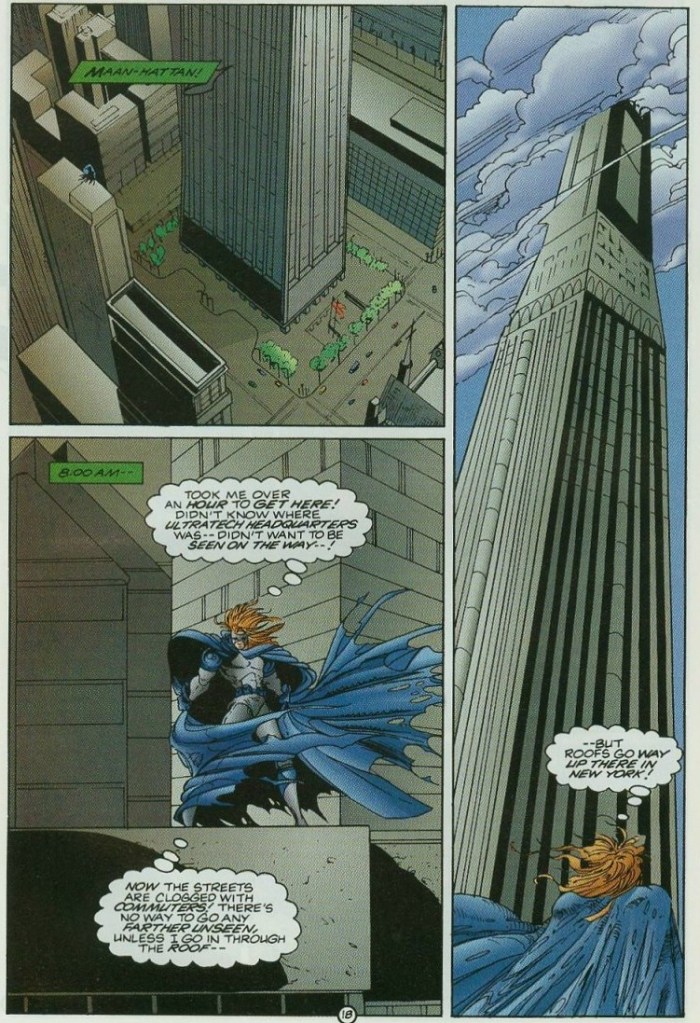
Imagine yourself being Night Man in New York and you do not have the technology nor the means to be able to rise up a skyscraper.

I’ll say it straight right now…the story of this comic book is nicely crafted. With Steve Englehart and the contributions of Len Strazewski and the late James Hudnall, this one score nice points when it came to building-up the concept behind Hostile Takeover which involves a strong sense of corporate intrigue (which was often present in comic books of Prototype). The presence of The Solution is pretty small (this is a Night Man comic book after all) but they contributed nicely to the build-up.

The story of Hostile Takeover was told mainly through the eyes of the Night Man. For the newcomers reading this, Night Man is a vigilante who also does a lot of problem solving similar to Batman. Unlike the mentioned comic book icon, Night Man does not have insufficient resources to back him up and pushes himself to travel around and complete his mission. In this comic book, you will see him really go as far as he could with tracking down the powered suit of armor of Teknight. You will also see him struggle and you might as well relate with his limitations.

There is not too much superhero spectacle to enjoy here but that’s okay because there is a nice amount of very interesting details presented in the build-up of Hostile Takeover’s concept.

Conclusion

Night Man on the pursuit as Teknight gets loaded into the jet.

Even though it lacked spectacle, The Night Man #12 (1994) is still an engaging read and it should score well with readers or Ultraverse fans who enjoy detailed storytelling. This comic book succeeds in building up the concept of Hostile Takeover while setting up the crossover elements between key Ultraverse characters. The story also emphasizes more of Night Man’s struggle to get his mission done.

If you are seriously planning to buy an existing hard copy of The Night Man #12 (1994), be aware that as of this writing, MileHighComics.com shows that the near-mint copy of the comic book costs $14.

Overall, The Night Man #12 (1994) is recommended.

+++++

Thank you for reading. If you find this article engaging, please click the like button below and also please consider sharing this article to others. If you are looking for a copywriter to create content for your special project or business, check out my services and my portfolio. Feel free to contact me as well. Also please feel free to visit my Facebook page Author Carlo Carrasco and follow me at HavenorFantasy@twitter.com
A Look Back at Wonder Woman #20 (1988)

Disclaimer: This is my original work with details sourced from reading the comic book and doing personal research. Anyone who wants to use this article, in part or in whole, needs to secure first my permission and agree to cite me as the source and author. Let it be known that any unauthorized use of this article will constrain the author to pursue the remedies under R.A. No. 8293, the Revised Penal Code, and/or all applicable legal actions under the laws of the Philippines.

It’s the second week of March already. That means we are slowly but surely inching closer to the March 30, 2021 scheduled releases of Wonder Woman 1984 on 4K Blu-ray, Blu-ray and DVD! If you have not yet ordered a copy of the sequel starring Gal Gadot as the Queen of Superheroes, you can do so now if you want to. I already ordered my copy. You can also read my retro review of the 2017 Wonder Woman movie.

On to literature! Last time, the George Perez-led story not only saw the end of Diana’s visit of Greece, it also fully presented to readers what was back then the modern portrayal of Circe (DC Comics’ own take on the false Greek goddess) who proved to be at the time the most sinister and most powerful supervillain Wonder Woman faced. Wonder Woman #19 also showed the Queen of Superheroes in her most vulnerable state.

Now that Diana and her friends have returned to America, we can find out what happens next in this look back at Wonder Woman #20, published by DC Comics in 1988 with a story written and illustrated by George Perez based on an idea by Carol Flynn. Bob McLeod was in charge of the finishes.

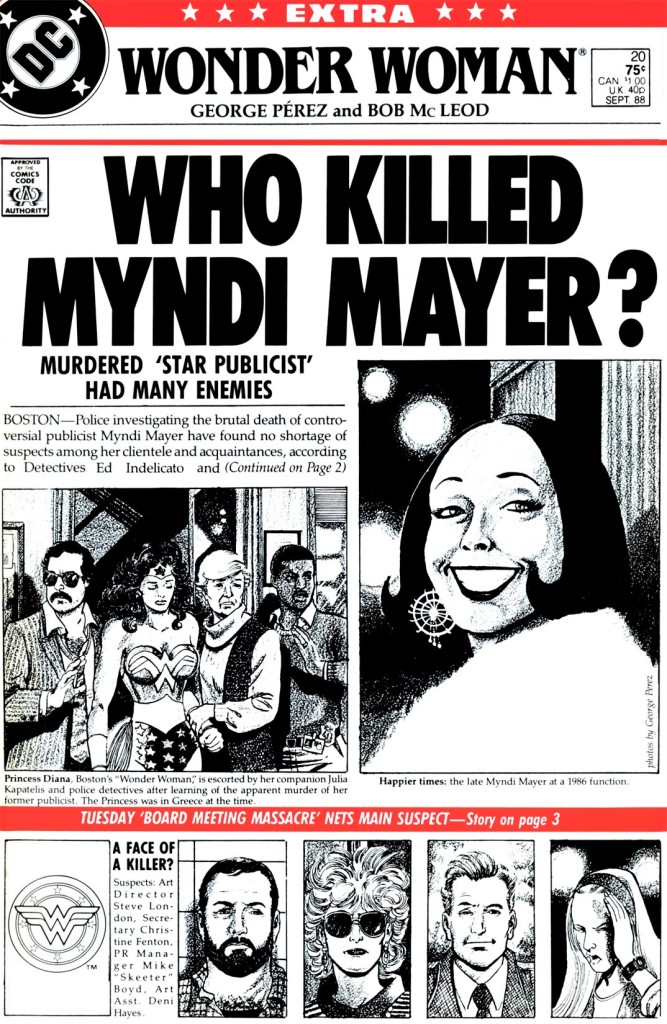
The cover.

Early story

The story begins in the City of Boston at night. Three Chinese men are running away from something until Wonder Woman confronts them. One of the men fires several bullets at her but each bullet got blocked by her using her tremendous reflexes and braces. After Wonder Woman disarms the gunman, another Chinese man tries attacking her with sharp weapons only to be defeated easily. The other Chinese man tries to run away but gets caught by Wonder Woman who uses her lasso. In reaction to his question, Wonder Woman demands answers.

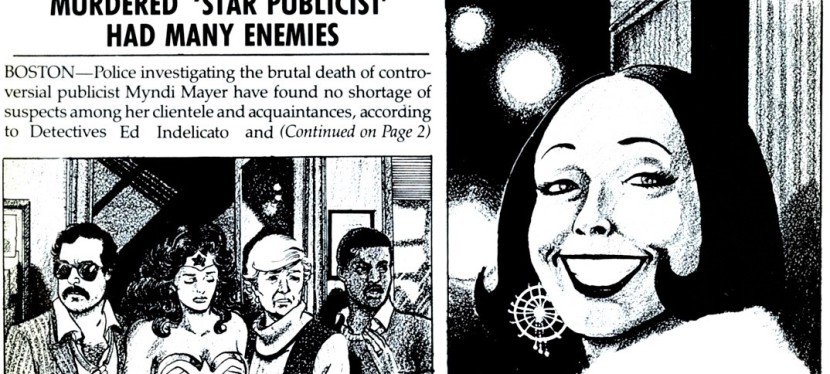
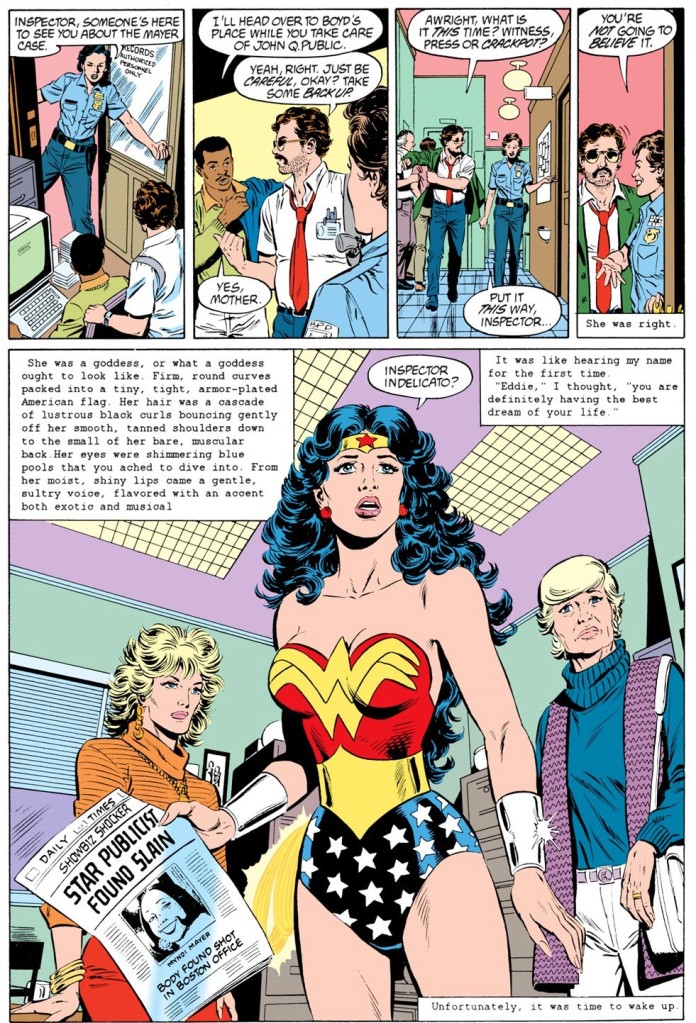
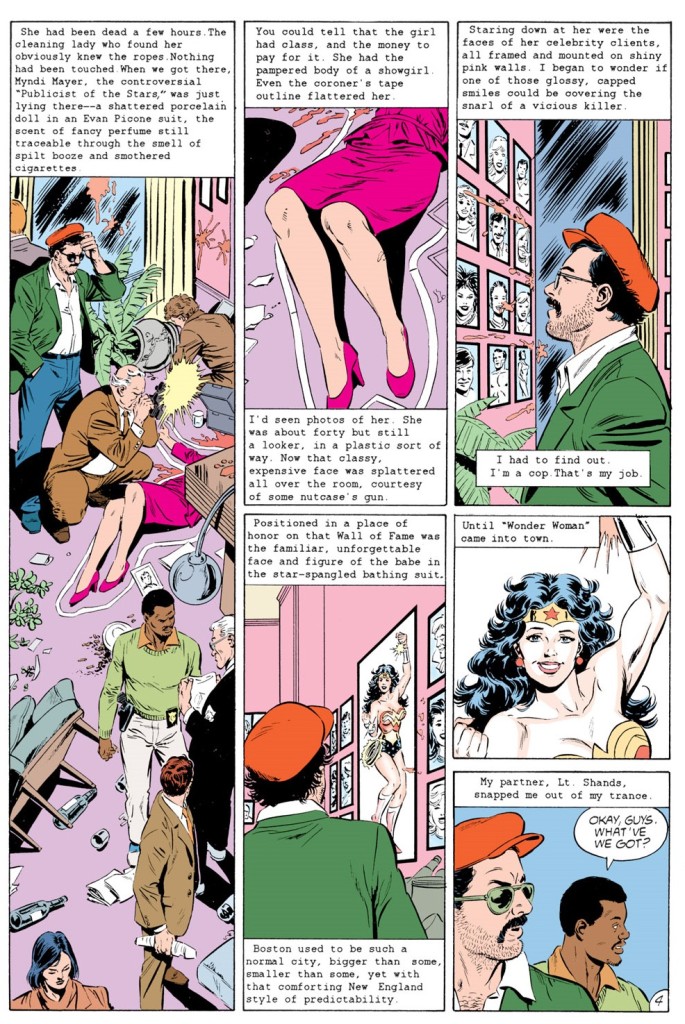
Elsewhere, investigators are searching for clues and details inside a lady’s modern looking office. Lying on the floor is the dead body of a victim and according to the investigator’s report, she had been dead for a few hours. The victim is none other than Myndi Mayer, a highly successful publicist who made a career out of the media and celebrities. Wonder Woman happened to be her most recent, high-profile client. Mayer was involved in the Wonder Woman fair.

Based on their findings, Myndi Mayer looked like she didn’t go without a fight. A bloody letter opener was found in her hand and her purse was found next to her body emptied. Traces of white powder were found on her desk. Mayer’s secretary Christine Fenton was visited by the investigators who told her about the death of her boss. She did not express any surprise and told them that it was only a matter of time before Mayer’s end came. Christine added that she warned Mayer about a certain man.

The investigators then show Christine the sketch of man based on the description of an eyewitness. She expressed surprise as she recognizes him…

Quality

Wonder Woman takes part in the search for truth.

Wow! This is one dark Wonder Woman story to read and I can say that it is a very inspired work written by George Perez based on an idea by Carol Flynn. This is not your typical story of showing the Queen of Superheroes fighting someone evil or saving people from disaster. This is a murder mystery that is laced with corporate intrigue, crime, legal wrangling and the everlasting struggle to determine the truth.

Myndi Mayer’s death really set of a series of events and revelations that are no less striking. Considering the many details about law, crime, investigations and corporate intrigue, the in-depth writing here indicates that George Perez did a lot of researching and found ways to tell a very cohesive story with Wonder Woman playing a role. I should state that as of this writing, this particular story comes close to becoming realistic and reflective of 1980s life. This is top-notch writing by Perez!

When it comes to characterization, Myndi Mayer was deeply portrayed to be in deep trouble both personally and professionally. Of all the Wonder Woman comics of the post-Crisis era of DC Comics I’ve read so far, this one clearly defines Mayer and goes beyond her usual appearance as a prolific publicist.

On Wonder Woman, as mentioned earlier, she does not get to fight a super villain. Rather she takes part in the search for truth and tries her best to solve the mystery even though she is not even fully familiar with the way law and order works in the world of man. In some ways, her approach to literally putting pieces of the puzzle into place and approaching people in different places reminds me somewhat of Batman’s detective work but without the vigilante approach.

Conclusion

This page about the murder investigation at the scene of the crime has some Watchmen vibes to it.

I can say that Wonder Woman #20 (1988) is not only a great comic book to read but also one of the most unique stories about the Queen of Superheroes ever published. By this time, George Perez has proven himself to be very prolific in storytelling on top of his great ability to draw art. I should state I love the way the story was structured and the way it ended delivered both impact and intrigue.

If you are seriously planning to buy an existing hard copy of Wonder Woman #20 (1988), be aware that as of this writing, MileHighComics.com shows that the near-mint copy of the comic book costs $41.

Overall, Wonder Woman #20 (1988) is highly recommended!

+++++

Thank you for reading. If you find this article engaging, please click the like button below and also please consider sharing this article to others. If you are looking for a copywriter to create content for your special project or business, check out my services and my portfolio. Feel free to contact me as well. Also please feel free to visit my Facebook page Author Carlo Carrasco and follow me at HavenorFantasy@twitter.com
A Look Back at Wonder Woman #19 (1988)

Disclaimer: This is my original work with details sourced from reading the comic book and doing personal research. Anyone who wants to use this article, in part or in whole, needs to secure first my permission and agree to cite me as the source and author. Let it be known that any unauthorized use of this article will constrain the author to pursue the remedies under R.A. No. 8293, the Revised Penal Code, and/or all applicable legal actions under the laws of the Philippines.

Welcome back, superhero enthusiasts, comic book collectors and fans of DC Comics! Today is the first day of March of 2021. Do you know what that means? It means that Wonder Woman 1984’s scheduled release on DVD, Blu-ray and 4K Blu-ray is just 29 days away! Even though I still have not seen the movie (which as of this writing has not been released in movie theaters here in the Philippines) and even though social media showed that WW fans are divided over it, I still went ahead ordering the 4K Blu-ray combo online. Just today, the online retailer gave me an important update as to when the 4K Blu-ray combo will arrive.

Personally, I’m excited to watch Gal Gadot play the Queen of Superheroes again and her performance in the 2017 Wonder Woman movie is phenomenal and captures the essence of the icon! I am also interested to see how director Patty Jenkins handled the storytelling as she herself co-wrote the screenplay.

More on Wonder Woman, I should say that I really love the way she was redefined by George Perez and Len Wein in the post-Crisis era of DC Comics. Today, we will find out what happens next to her during her time in Greece in this look back at Wonder Woman #19, published in 1988 by DC Comics with a story written and drawn by George Perez (with Frank McLaughlin on the finishes).

The cover.

Early story

The story begins with a short look back at the end of issue #18 which saw Wonder Woman fighting several monsters that surrounded her. Suddenly a powerful blast hits her and knocks her out.

Vanessa, who survived thanks to Wonder Woman’s help, is found by her mom Julie who was accompanied by several armed Greeks. Vanessa states that the scroll she got from her uncle Stavros seemed to attract the monsters which drew a response from local rebel Katina Leikos who belongs to a group that oppose the fabled witch on the nearby island. She states that if they don’t stop the witch, she will destroy princess Diana/Wonder Woman.

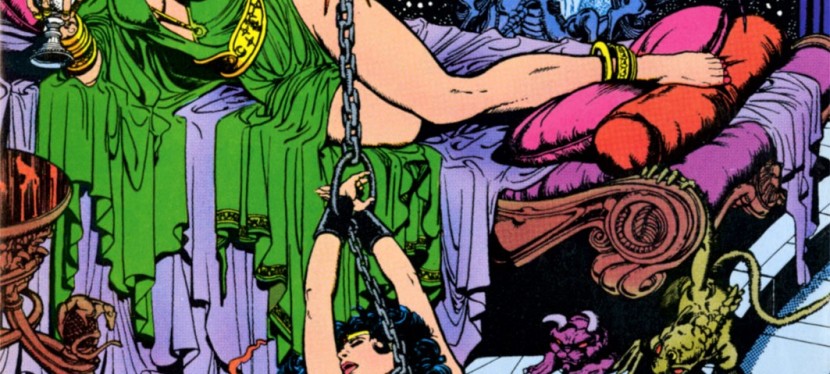
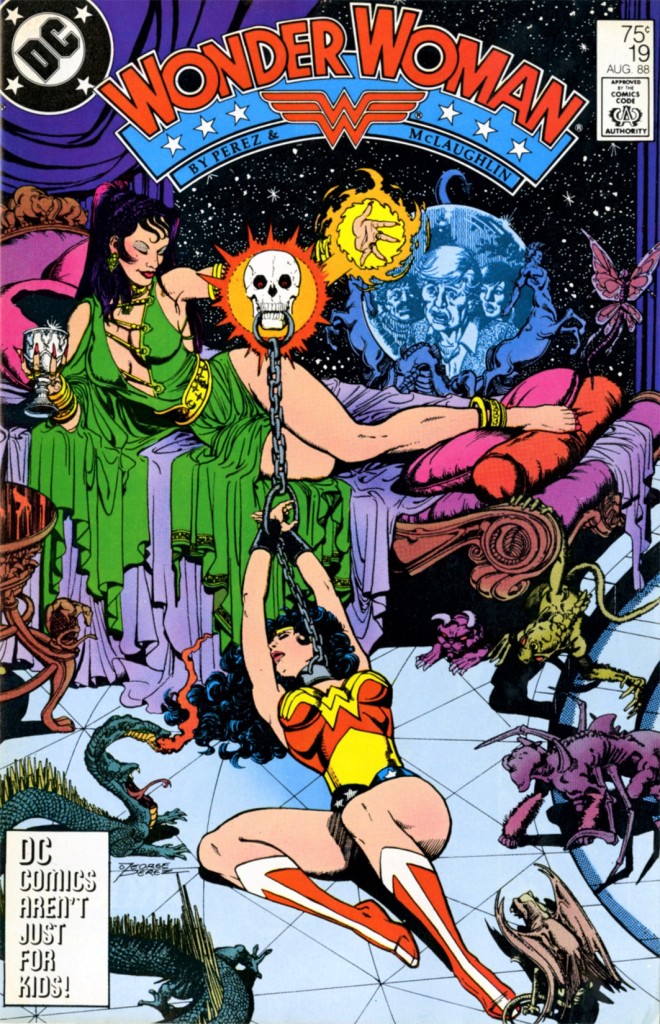
Inside the old structure on the said island, Wonder Woman wakes up finding herself on the floor chained by the neck and wrists. Located very near her is Circe, the enchantress who is the daughter of Hyperion and Perseis. The enchantress tells Wonder Woman that it is her destiny to execute her…

Quality

Julia Kapatelis is more involved with the action and mission.

Of all the comic books that I’ve reviewed so far on this particular monthly series in the post-Crisis era, this one is easily the darkest and most grim Wonder Woman story. It also has the heaviest emphasis on monsters and sorcery, complete with sinister rituals and connections to Greek mythology.

As expected, the story here further develops Wonder Woman and her place in man’s world but with emphasis on destiny and legacies. In this case, destiny related to the shared history between Wonder Woman’s fellow Amazons and Circe (who is DC Comics’ own take on the false Greek goddess) which puts the superhero icon in a rather complex situation. For Circe, Wonder Woman’s innocence means nothing because destiny and hatred matter a lot more. The way George Perez wrote, Circe in this particular issue proved to be more menacing than Ares and is also the most sinister villain of Wonder Woman’s.

More on this comic book, I can declare that it is right here where you will get to see the Queen of Superheroes in her most vulnerable and most helpless state yet. For several pages, you will see Wonder Woman struggle not only against Circe and her monsters, but also with the revelations of history. You will also get to see Wonder Woman’s emotional limits pushed.

Regarding the supporting cast, I really enjoyed seeing Julie Kapatelis really putting her academic skills and expertise to great use as well as getting involved in the action. With her Greek heritage and connections with the locals clearly defined, Julie got a good amount of the spotlight among the characters and nicely contributed to the story. I also love the part when Julie said that Diana (Wonder Woman) is like a daughter to her which really emphasize the bond of love and trust between them.

Conclusion

Wonder Woman bravely fights the monsters of Circe.

As far as the visit in Greece goes, Wonder Woman #19 (1988) really ramped up the stakes with Circe’s evil presence emphasized a lot while having Wonder Woman in a vulnerable state which added to her character development in this particular monthly series. It is indeed a very well written tale by Perez who proved to be capable of pushing the boundaries while redefining Wonder Woman in the post-Crisis era. Apart from being the most sinister villain in this monthly series so far, Circe is the complete opposite of Wonder Woman.

If you are seriously planning to buy an existing hard copy of Wonder Woman #19 (1988), be aware that as of this writing, MileHighComics.com shows that the near-mint copy of the regular edition costs $42 while the near-mint copy of the newsstand edition costs $44.

Overall, Wonder Woman #19 (1988) is highly recommended!

+++++

Thank you for reading. If you find this article engaging, please click the like button below and also please consider sharing this article to others. If you are looking for a copywriter to create content for your special project or business, check out my services and my portfolio. Feel free to contact me as well. Also please feel free to visit my Facebook page Author Carlo Carrasco and follow me at HavenorFantasy@twitter.com
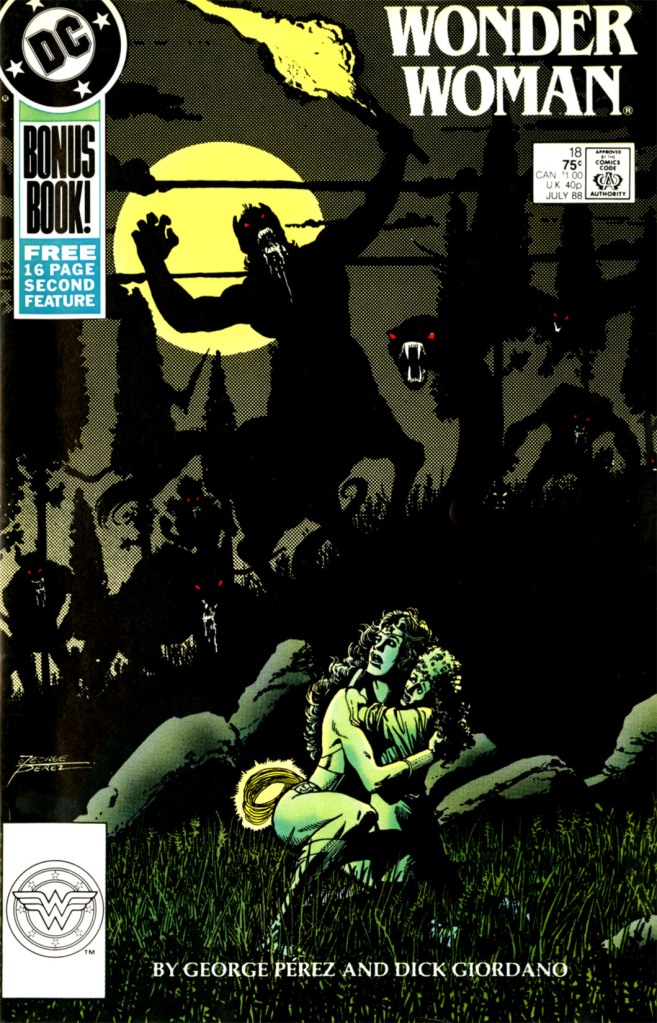
A Look Back at Wonder Woman #18 (1988)

Disclaimer: This is my original work with details sourced from reading the comic book and doing personal research. Anyone who wants to use this article, in part or in whole, needs to secure first my permission and agree to cite me as the source and author. Let it be known that any unauthorized use of this article will constrain the author to pursue the remedies under R.A. No. 8293, the Revised Penal Code, and/or all applicable legal actions under the laws of the Philippines.

Welcome back, superhero enthusiasts, comic book collectors, fellow geeks and fans of Wonder Woman! Last time, I found George Perez’s standalone writing of the story about Wonder Woman discovering Greece and its connections to her people’s heritage a really good story. For much of the post-crisis Wonder Woman monthly series’ early stage, the stories were done by Perez and the late Len Wein. In issue #17, Perez not only succeeded in developing Diana/Wonder Woman further, he also captured nicely the wonder of discovery of new places and astonishing aspects of life while traveling overseas.

Of course, issue #17 was not purely a tourism story through the eyes of the Queen of Superheroes. There was an obvious build-up of a new villain who is aware of Wonder Woman’s presence in Greece.

What will happen next? Who could the new force of evil be? We can find out in this look back at Wonder Woman #18, published by DC Comics in 1988 with a story written and drawn by George Perez with ink work done by Dick Giordano.

The cover.

Early story

The story begins deep in the darkness of limbo. Light sparks suddenly as Zeus, Hades and Poseidon arrive in the search of their father called Cronus. Zeus retrieves the Olympian pact. After further talking, they join forces in lighting a flame to burn the pact to make way for something new.

Meanwhile in a hospital in the Greek isle of Cephalonia, Diana wakes up surrounded by Julia Kapatelis, Vanessa, a doctor and other Greeks. Diana states that some kind of aura seemed to clutch her in a chilling grip which Julia dismisses and believes that her Amazon friend was simply tired from all the months-long pushing herself since returning from Themyscira.

Julia introduces Diana to Theophilus Ventouras and his nephew Demetrios. The older Ventouras is the owner of the wealthiest estate on the islands. He tells Diana that the governor asked him to meet her at the dock and reveals to her that a local boy was killed by a wolf which some car calling it as a “magia”.

As they continue talking, a nurse listens to them carefully just outside the door of the room they are in. She learns about Ventouras’ offer of assistance to Diana and quietly leaves. Some time later just outside the hospital, the nurse (named Angela) reveals to a man named Mikos that Diana and her group will be going to Ventourata the next day…

Quality

Without hesitation, Wonder Woman moves to save lives.

I can start by saying that this is another well-written tale by George Perez. Apart from the continuing focus on Wonder Woman’s discovery of Greece, the elements of fantasy, intrigue, suspense and even horror have been used more in this comic book compared to the previous issue.

When it comes to characterization, Diana’s close relationship with the Kapatelises is deepened further as the story explored the already established Greek background of Julia. I also found engaging Wonder Woman’s unflinching moves to search for Vanessa and get her out of trouble any way she could.

For those of you who are aware about the lack of superhero spectacle in issue #17, I can share to you that there definitely is more action in this comic book and it is all nicely presented by George Perez.

Continuing what began in the previous issue, Perez ramped up further the build-up of the new force evil awaiting Wonder Woman. I won’t reveal who it is but rest assured, this comic book’s ending is pretty strong and easily justifies the build-up.

Conclusion

Diana and Julia treat each other like family.

Wonder Woman #18 (1988) successfully continued the redefining of the Queen of Superheroes in the post-Crisis era and George Perez really delivered great stuff as well as a very solid story here. From start to finish, there is a lot to enjoy and examine in the story.

If you are seriously planning to buy an existing hard copy of Wonder Woman #18 (1988), be aware that as of this writing, MileHighComics.com shows that the near-mint copy of the regular edition costs $41 while the near-mint copy of the newsstand edition costs $84.

Overall, Wonder Woman #18 (1988) is highly recommended!

+++++

Thank you for reading. If you find this article engaging, please click the like button below and also please consider sharing this article to others. If you are looking for a copywriter to create content for your special project or business, check out my services and my portfolio. Feel free to contact me as well. Also please feel free to visit my Facebook page Author Carlo Carrasco and follow me at HavenorFantasy@twitter.com
For Wonder Woman fans, be aware that the movie Wonder Woman 1984 will be released in a 4K Blu-ray disc combo on March 30, 2021. Read my article for the details and, if you have decided to order, do it now at Amazon.

A Look Back at Action Comics #500 (1979)

Disclaimer: This is my original work with details sourced from reading the comic book and doing personal research. Anyone who wants to use this article, in part or in whole, needs to secure first my permission and agree to cite me as the source and author. Let it be known that any unauthorized use of this article will constrain the author to pursue the remedies under R.A. No. 8293, the Revised Penal Code, and/or all applicable legal actions under the laws of the Philippines.

To publish a five hundredth issue of an extensive monthly comic book series is clearly a major milestone for any publisher. To do the math, it takes a whole year to publish 12 issues on a monthly schedule. To reach five hundred issues on a monthly pace will require forty-one years and eight months’ time to publish.

Way back in the late 1970s, DC Comics achieved the said milestone with their extensive monthly series titled Action Comics which is often identified with the world’s most famous superhero – Superman! Take note that DC Comics started in 1935 while Action Comics #1 (the first appearance of Superman) was published a few years later.

Going back to the 500th issue of Action Comics, it is easy to wonder what DC Comics’ talent came up with to celebrate the milestone. That being said, we can all find out more in this look back at Action Comics #500, published by DC Comics in 1979 with a story written by Martin Pasko and visualized by Curt Swan and Frank Chiaramonte.

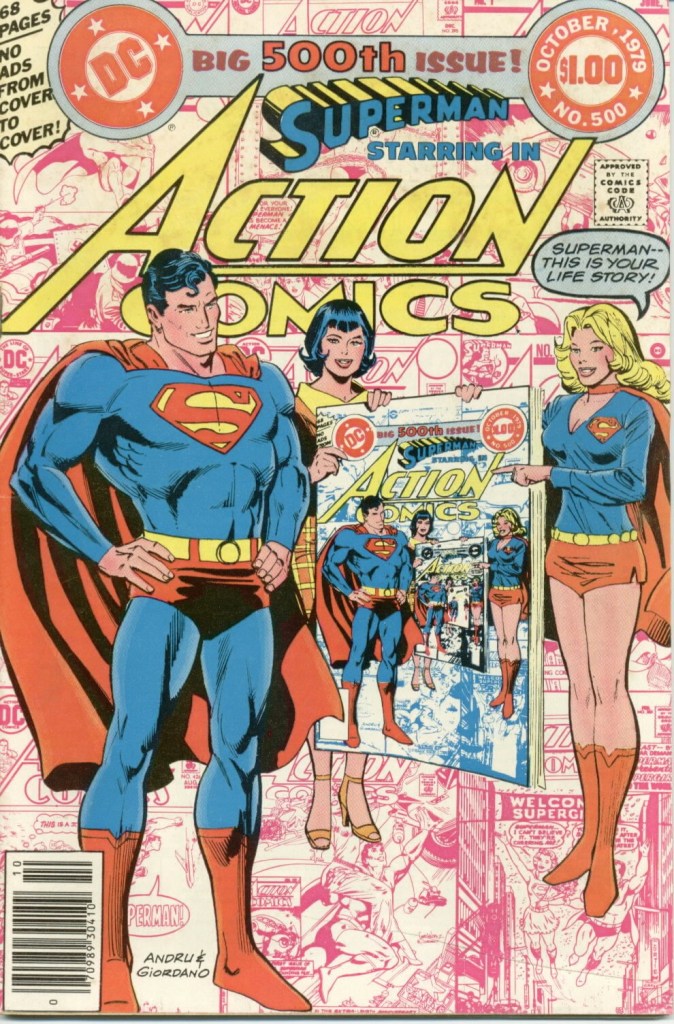
The cover.

Early story

The story begins with Superman arriving at a pavilion named after him at the Metropolis World’s Fair. Countless people welcomed with lots of cheering as he lands near the mayor in the presence of the famous entrepreneur J. Robert Arngrim. Also present were Superman’s closest friends Lois Lane, Lana Lang, Jimmy Olsen and Perry White.

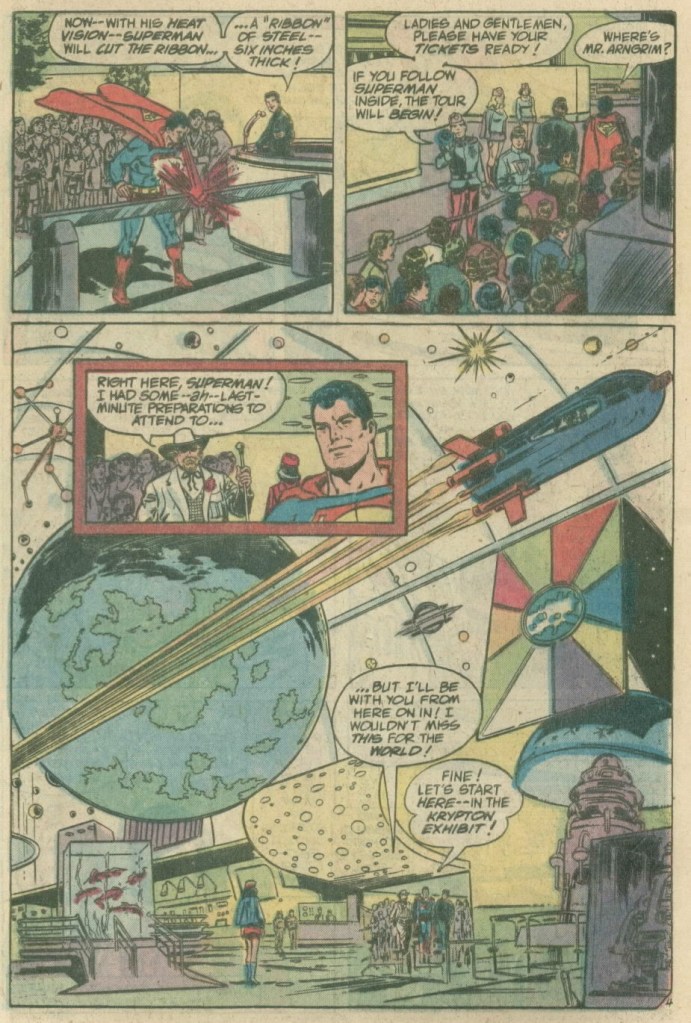
After the formal opening, Superman leads a large group of people as their tour guide. Together they arrived a wide hall containing the Krypton exhibit showcasing alien technology, architecture and life on Superman’s home planet. In response to a request by Arngrim, Superman reluctantly agrees to do a demonstration of the mind-prober ray, a machine Superman himself invented as a boy mainly to retrieve memories from his subconscious.

As the Man of Steel takes his seat on the machine in front of the tourists and Arngrim, an unidentified person located in a secret facility prepares to invade Superman’s mind…

Quality

Teenage Clark Kent gradually becoming Superboy.

To make it clear, this 500th issue of the Action Comics monthly series is an extensive, no advertisements tribute to Superman and I can say that the comic book creators really went all out to present lots of stuff to please Superman fans.

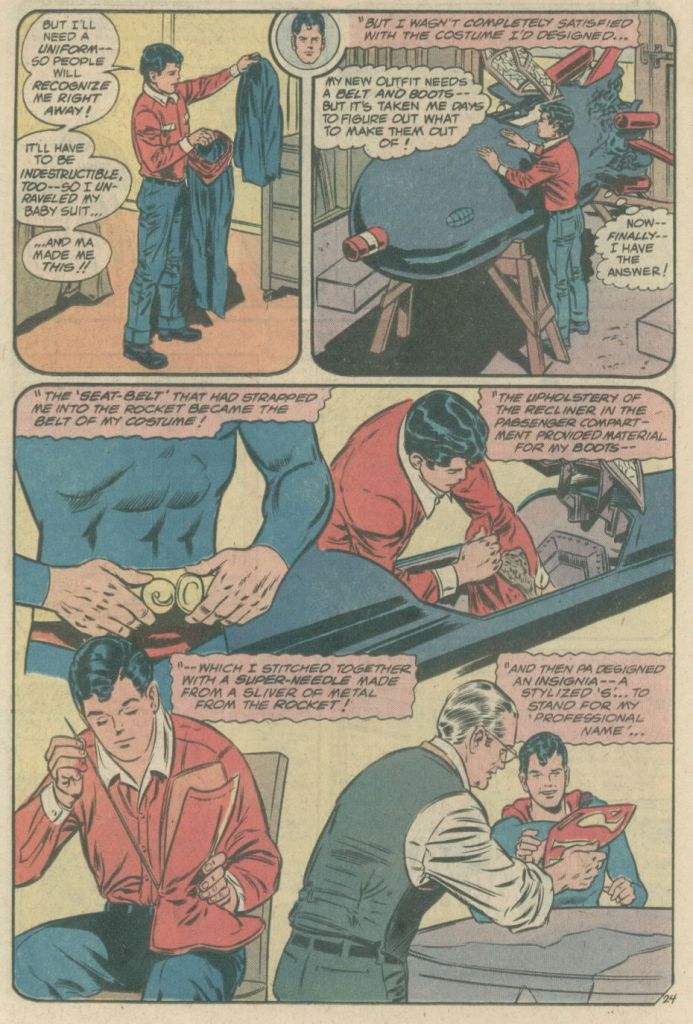
As such, the story was written to help the newer fans of the time to be more familiar of the legacy of Superman (note: this was years before Crisis on Infinite Earths happened) by revisiting and dramatizing established events of the Man of Steel’s legacy such as Jor-El (Superman’s father) failing to convince the Kryptonian science council members that their world was doomed, Superman sent to Earth as a child in a rocket before Krypton’s destruction, getting raised by an American couple after arriving on Earth, becoming Superboy (note: another pre-Crisis element), getting a job at the Daily Planet, welcoming Supergirl on Earth, and so on.

Superman leading the tour.

Of course, Superman does not reveal key details of his personal life to the people during the tour and such recollections were presented to delight us readers. Still, there is richness in the writing and the art. Even though I am already familiar with DC’s icon and the Superman-related mythos, I still had a lot of fun reading the events of Superman’s past, particularly his early years as the adopted son of the Kent couple who in turn did their best to adjust to his super abilities while raising him with good values and discipline.

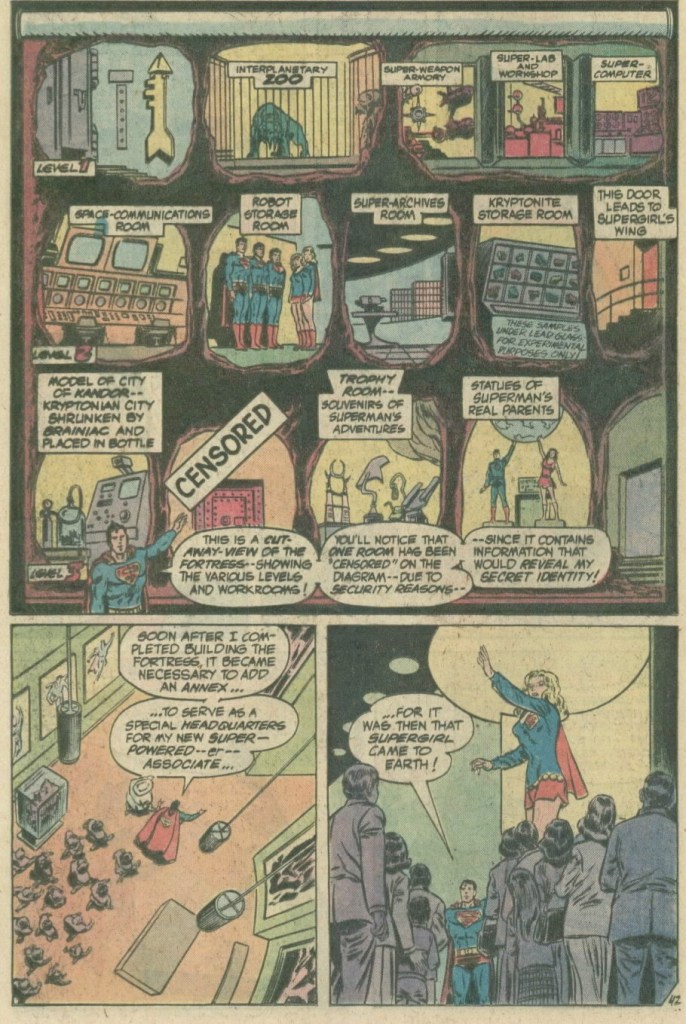
While the recollections from Superman’s past are engaging, the present-day tour at the Superman pavilion is itself quite fascinating. There were displays of supervillains such as Lex Luthor, Braniac and Parasite. There was even a collection of the different types of Kryptonite. What really nailed the present-day story was a nice twist that allowed for some new superhero spectacle and intrigue to take place.

Conclusion

The first stop of the tour – Krypton exhibit!

While this portrayal of Superman is already outdated given the time of its release, Action Comics #500 (1979) is still a lot of fun to read and it is indeed a great tribute to DC’s most famous superhero. If you are a Superman fan who has gotten sick and tired of the way DC Comics reshaped and modernized Superman since after the end of Crisis on Infinite Earths, this comic book could be refreshing for you. It is also a lively piece of DC Comics’ history.

If you are seriously planning to buy an existing hard copy of Action Comics #500 (1979), be aware that as of this writing, MileHighComics.com shows that the near-mint copy of the comic book costs $210.

Overall, Action Comics #500 (1979) is highly recommended!

+++++

Thank you for reading. If you find this article engaging, please click the like button below and also please consider sharing this article to others. If you are looking for a copywriter to create content for your special project or business, check out my services and my portfolio. Feel free to contact me as well. Also please feel free to visit my Facebook page Author Carlo Carrasco and follow me at HavenorFantasy@twitter.com
A Look Back at Wonder Woman #17 (1988)

Disclaimer: This is my original work with details sourced from reading the comic book and doing personal research. Anyone who wants to use this article, in part or in whole, needs to secure first my permission and agree to cite me as the source and author. Let it be known that any unauthorized use of this article will constrain the author to pursue the remedies under R.A. No. 8293, the Revised Penal Code, and/or all applicable legal actions under the laws of the Philippines.

When was the last time you traveled overseas not to have fun the usual way (partying, spending time in bars, watching movies or stage plays, and the like) but rather to immerse yourself into history by visiting several historical sites? When you plan to travel overseas, have you thought about pursuing the wonder of discovery?

Welcome back, Wonder Woman fans and comic collectors! It has been almost a year since I started publishing retro reviews of Wonder Woman comic books from the post-Crisis age of DC Comics drawn by the famous George Perez. I can say that I really enjoyed the modernizing of the Queen of Superheroes done by Perez along with the late Len Wein. In fact, my enjoyment on the post-Crisis Wonder Woman is greater than what I had for the New 52 Wonder Woman. For those who love Wonder Woman movies, check out my retro review of the 2017 Wonder Woman movie and my feature about the No Man’s Land scene. If you are into the latest movie Wonder Woman 1984 starring Gal GadotChris Pine and Kristen Wiig, be aware that the 4K Blu-ray combo of it will be released on March 30, 2021. I already ordered a copy of it.

Going back to what I mentioned earlier, discovering new places can be tremendous experiences for those who travel abroad. With those details laid down, we can finally start this look back at Wonder Woman #17, published in 1988 by DC Comics with a story written and drawn by George Perez with ink work done by Dick Giordano.

The cover.

Early story

The story begins as a white bird flies high in the sky in the middle of dark clouds and bolts of lightning. The bird is carrying a message and as it continues to move forward, the darkness fades away as light and calm clouds set in.

In Wakefield, Massachusetts, Diana Prince/Wonder Woman receives her special United Nations (UN) passport from Etta Candy. It turns out that Julie Kapatelis is in Athens, Greece, making arrangements for Diana’s first overseas trip in man’s world. As they talk, Etta reveals that Steve Trevor is aware of the connection between Wonder Woman’s costume with his mother.

As Vanessa (Julie’s daughter) comes down from the second floor, Steve Trevor enters the house carrying a bird carrying a message. Even as she recognizes the bird, she is amazed to discover that it arrived there all the way from Themyscira. The message carried by the bird is from Diana’s mother, Queen Hippolyte. She begins to read the message in the car with Vanessa on the way to the airport…

Quality

Diana visits and discovers Greece.

I’ll start by pointing out that this is the first issue of this particular monthly series to be written entirely by George Perez (note: Len Wein was involved with the script for issue #16) and, as I read this comic book, he wrote well and succeeded in further developing Wonder Woman’s personality just as she discovers more of man’s world and its connections with her fellow Amazons.

In this comic book, Wonder Woman (with Vanessa) travels to Greece for an arranged visit with her mentor Julie anticipating her arrival. Upon arriving in Greece, a lot of people warmly welcomed Wonder Woman who in turn got reunited with Julie in the presence of her Greek friend Stavros. In relation to the opening paragraph of this review, this is the story of Diana’s discovery of Greece, its people, its culture and legacy. The way Perez wrote and visualized her discovering and learning of the Greek sites really emphasized her thoughts as her perception of man’s world and its connections to her people and her culture builds up.

Unlike the previous two issues, this story is much heavier with character development and Perez’s writing is indeed engaging. As you read Diana’s words and thoughts, you will experience intrigue and even relate to her experiencing a great wonder of discovery. Also worth reading are her thoughts about Superman.

Apart from the focus on Wonder Woman, this comic book also paid attention to the intrigue that happened among the deities of Olympus – including Heracles – who are still recovering from the great disturbance caused by Darkseid. Oh yes, the story also marked the start of the build-up of another supervillain for Diana to face.

Conclusion

In the airplane on the way to Greece.

While it clearly lacked a strong conflict between good and evil, the wonder of discovery as well as the in-depth characterization made Wonder Woman #17 (1988) a must-read. George Perez, who is best known for his artworks, proved to be a very solid writer and it should be noted that he went on to write a whole lot more stories about the Queen of Superheroes.

If you are seriously planning to buy an existing hard copy of Wonder Woman #17 (1988), be aware that as of this writing, MileHighComics.com shows that the near-mint copy of the regular edition costs $42 while the near-mint copy of the newsstand edition costs $42.

Overall, Wonder Woman #17 (1988) is highly recommended!

+++++

Thank you for reading. If you find this article engaging, please click the like button below and also please consider sharing this article to others. If you are looking for a copywriter to create content for your special project or business, check out my services and my portfolio. Feel free to contact me as well. Also please feel free to visit my Facebook page Author Carlo Carrasco and follow me at HavenorFantasy@twitter.com
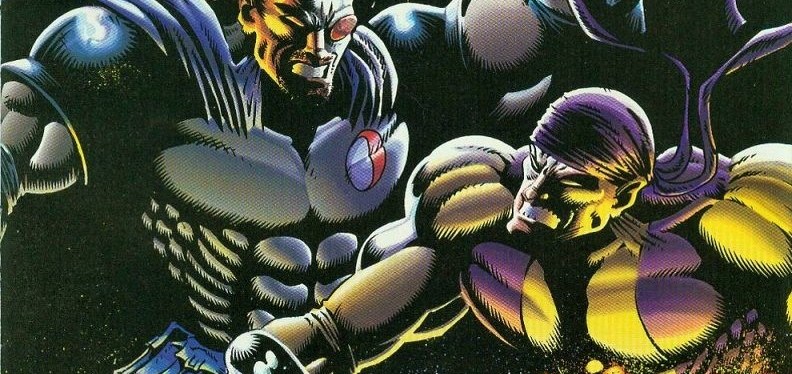
A Look Back at Superman Annual #10 (1984)

Disclaimer: This is my original work with details sourced from reading the comic book and doing personal research. Anyone who wants to use this article, in part or in whole, needs to secure first my permission and agree to cite me as the source and author. Let it be known that any unauthorized use of this article will constrain the author to pursue the remedies under R.A. No. 8293, the Revised Penal Code, and/or all applicable legal actions under the laws of the Philippines.

Before DC Comics ended their original superhero multiverse with Crisis on Infinite Earths (1985-1986) to restart all over again, there were a whole lot of stories about Superman ranging from the dramatic stuff, the epic tales and right down to the most outlandish tales.

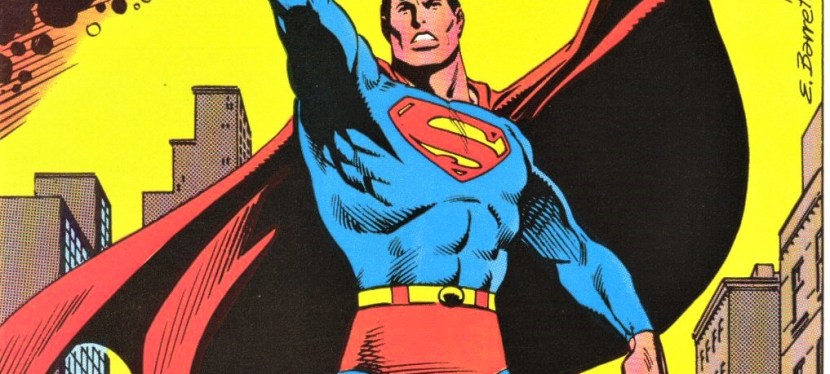
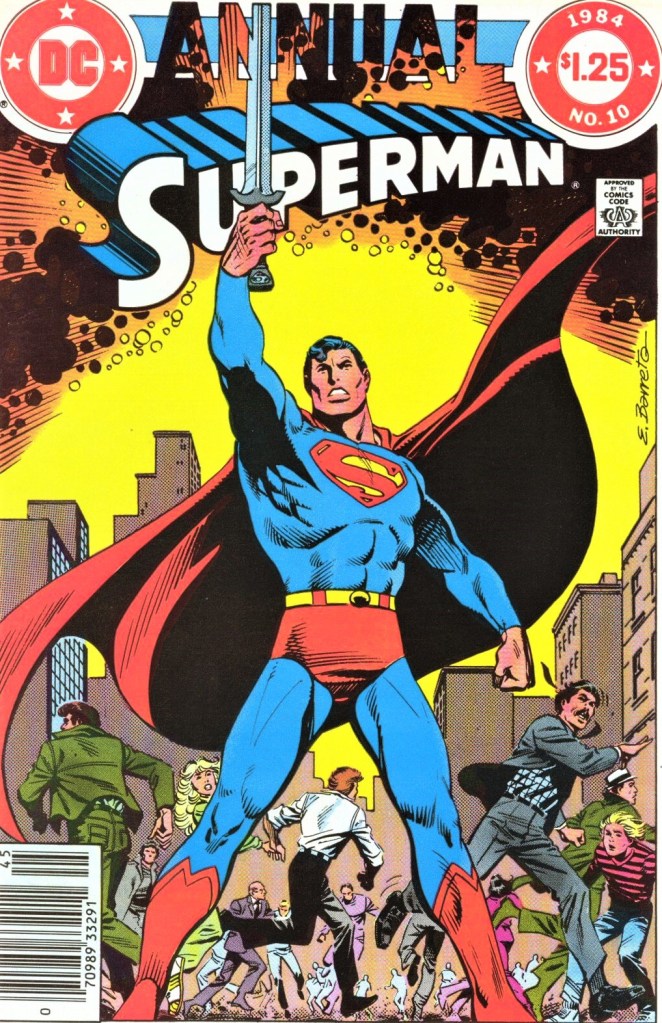
As a kid, I was fortunate enough to buy myself a copy of a 1984 Superman comic book, the cover of which really intrigued and caught my interest. It was a Superman annual comic book with a $1.25 cover price which was somewhat high at the time. Its cover showed the Man of Steel himself carrying a sword pointed up.

That image made me wonder: Why would Superman have to use a sword when he is so powerful and capable without weapons? Where did that sword come from? Who made it in the first place? Is the sword so special to Superman?

With those details laid down, here is a look back at Superman Annual #10, published by DC Comics in 1984 with a story written by Elliot Maggin and drawn by classic Superman artist Curt Swan.

The cover.

Early story

The story begins in a space where a group of diverse people composed of aliens and humans are gathered together watching a live video feed Superman on a large monitor above their heads. As it turns out, the Man of Steel is in space working to prevent meteoroids from entering the planet below him. He then speeds off into space heading back to Earth.

Along time ago deep in the galaxy, a big bang effect took place creating several new fragments in the vacuum of space and among them is a long, rough object that resembles a sword. As an unknown amount of time passed, the long object gradually turns into a smooth looking sword complete with a sharp blade and a letter “S” on one end that is the same as the one Superman carries. It is referred to as the sword of Superman!

In Metropolis, Clark Kent is passed by his officemate Jimmy Olsen who mentioned that he is rushing to interview the billionaire industrialist Oswald Mandias. Two days have passed and Jimmy Olsen remained missing. As his boss Perry White heads on to the office, Clark remains and changes into Superman when the coast got clear.

As the Man of Steel flies off into the city, a Galaxy Broadcasting live report on TV shows Lana Lang reporting from the Kennedy Space Center where the new space shuttle Magellan is about to make its first-ever commercial flight to launch a mysterious new communications satellite owned by Mandias Industries…

Quality

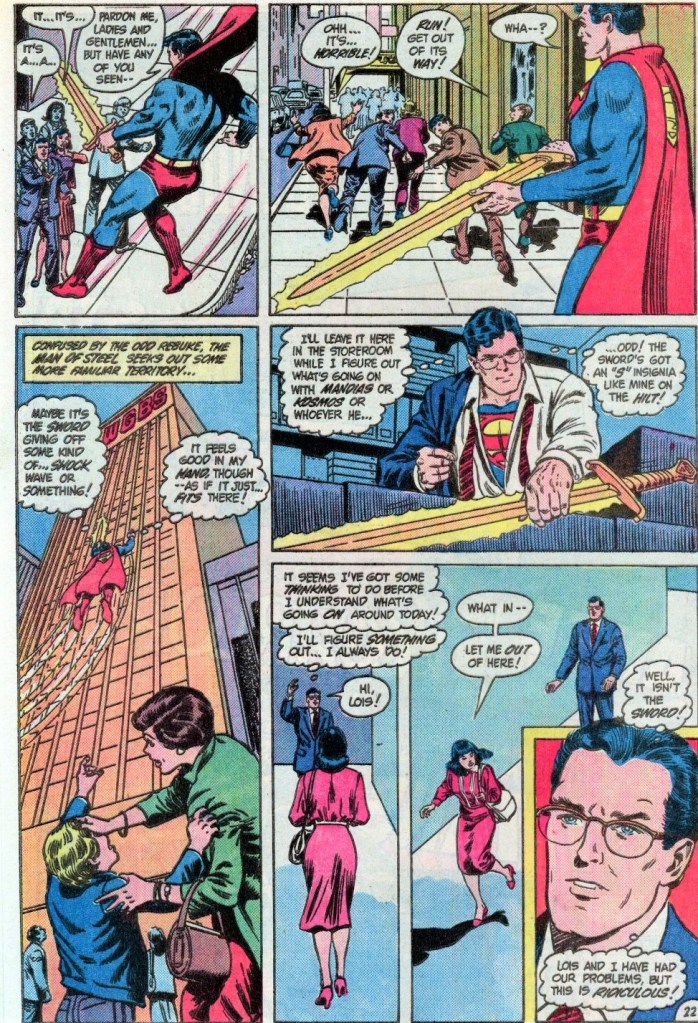
Clark Kent/Superman being a complete stranger to others added a lot to the story.
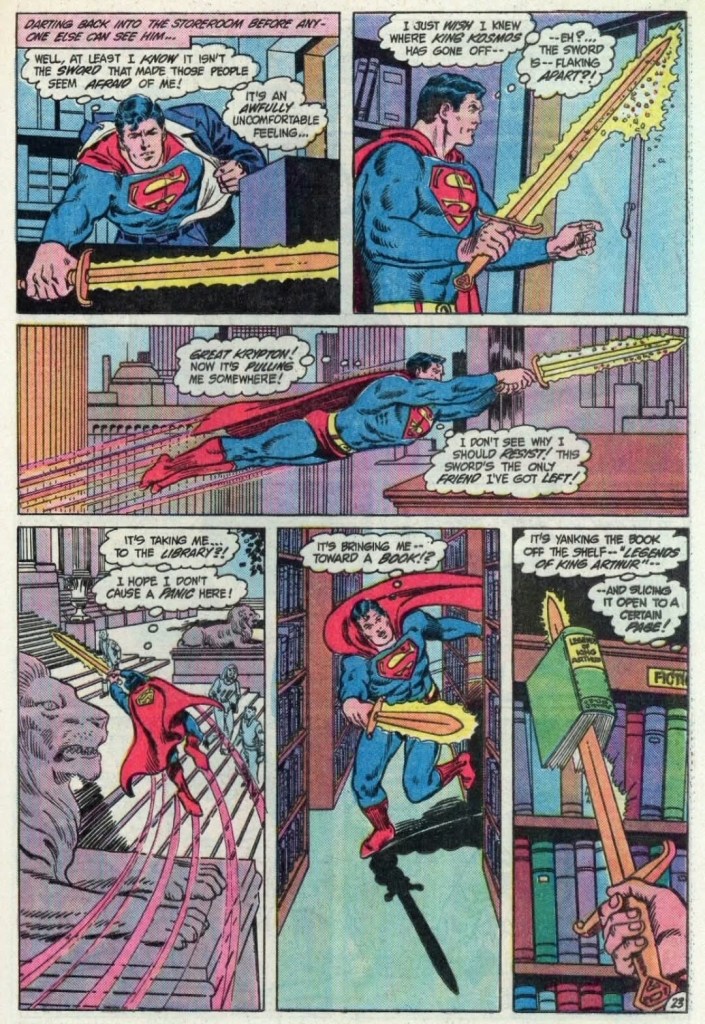
The sword led Superman to a book about the legend of King Arthur inside the city library.

Being an annual, I can say that the Sword of Superman story was well-written and nicely visualized by the creators which made it fun and engaging to read. It is a Superman story that further adds to his being an essential hero of the original DC Comics multiverse and a key factor here is the somewhat outlandish concept that the sword that he gained was an original material of the universe from the big bang and even had connections to the unseen omnipotent force.

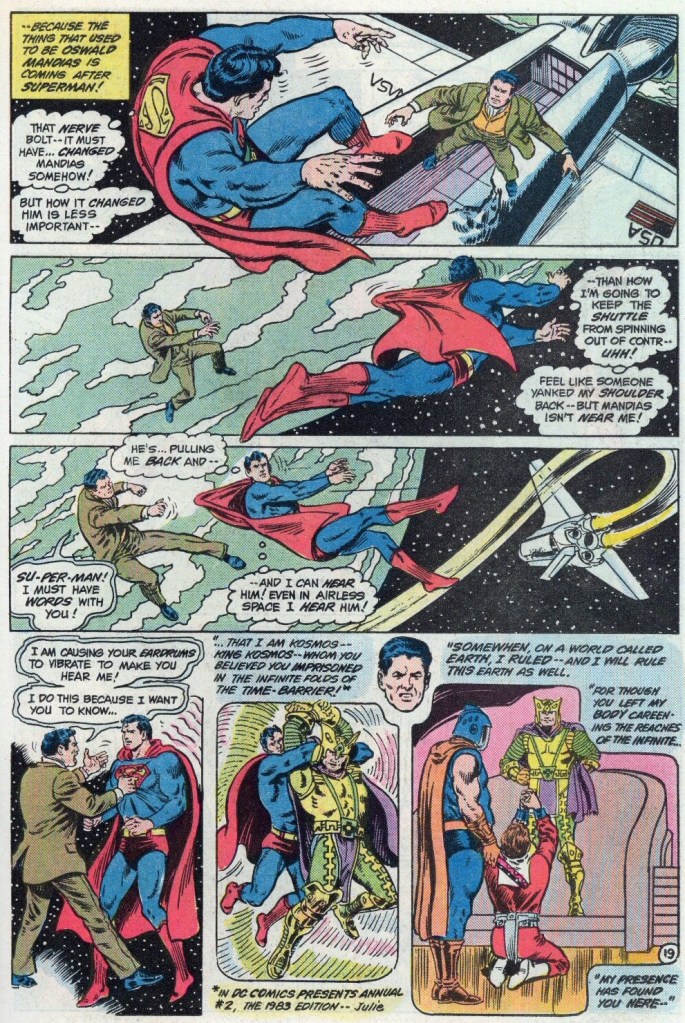
This story is not a simple, straightforward tale about Superman gaining a weapon required to defeat the supervillain King Kosmos. In fact, the sword opens up events that made the Man of Steel reevaluate himself, his situation and the people around him. King Kosmos, who is a time-travelling villain from the future (first appearance in DC Comics Presents Annual #2), served not just merely as the opposition but also adds a good amount of complexity within the reality of the story. For one thing, it is very intriguing and also refreshing to see people of Metropolis (even Clark’s friend Jimmy Olsen) failing to recognize Superman and perceive him with fear. This is a one-of-a-kind story of Superman that must be read, even though it is not really an epic tale.

All throughout, there is a fine balance between spectacle and intrigue. If you pay close attention to the dialogue and details, you will understand the story better and enjoy the comic book more eventually.

Conclusion

The return of King Kosmos!

I personally enjoyed reading Superman Annual #10 (1984) the first time back in 1984. The fact here is that after re-reading it recently, I do confirm that it is still an enjoyable comic book to read, and I am not even a Superman fan anymore. That is quite something! This is indeed a really good piece of Superman history from the pre-Crisis era. It also touches on themes about omnipotence, how ordinary people react to people who wield great power, and being whole with the entire universe.

If you are seriously planning to buy an existing hard copy of Superman Annual #10 (1984), be aware that as of this writing, MileHighComics.com shows that the near-mint copy of the regular edition costs $35 while the near-mint copy of the newsstand edition costs $70.
Overall, Superman Annual #10 (1984) is recommended.

+++++

Thank you for reading. If you find this article engaging, please click the like button below and also please consider sharing this article to others. If you are looking for a copywriter to create content for your special project or business, check out my services and my portfolio. Feel free to contact me as well. Also please feel free to visit my Facebook page Author Carlo Carrasco and follow me at HavenorFantasy@twitter.com