A Look Back at Star Trek: Generations comic book adaptation (1994)

Welcome back superhero enthusiasts, 1990s culture enthusiasts and comic book collectors! Today we go back to the year 1994 to explore the official comic book adaptation of the movie Star Trek: Generations.

Star Trek: Generations was a cinematic production that symbolically served as the passing-of-the-torch from the original Star Trek crew (led by Captain Kirk) to the Star Trek: The Next Generation crew (led by Captain Picard). The most highlighted feature of the movie was the crossover between Kirk and Picard followed by working together to stop the villain. It was a crossover that fans wanted for some time prior to the film’s release.

In my experience, Star Trek: Generations was a disappointing movie as there were lots of flaws here and there. Most notably, the Kirk-Picard crossover (with William Shatner and Patrick Stewart in their most iconic roles) was nothing special as its payoff to all the build-up that preceded it was so small.

Unsurprisingly, there was comic book adaptation of Star Trek: Generations that appeared in the local comic book stores which I intentionally avoided reading back in 1994 as I anticipated the movie. Recently, I finally got to read it.

With those details laid down, here is a look back at the Star Trek: Generations comic book adaptation, published in 1994 by DC Comics with a story written by Michael Jan Friedman and drawn by Gordon Purcell based on the cinematic story by Rick Berman, Ronald D. Moore and Brannon Braga.

The cover.

Early story

The story begins with a retired James T. Kirk landing from his orbital skydiving activity in the presence of his long-time crew members and friends Pavel Chekov and Montgomery “Scotty” Scott. In response to Chekov’s reminder that they are to attend the launch ceremony of the USS Enterprise B (NCC-1701-B), Kirk as he is enjoying retirement and prefers to do other things like tri-elliptical jumping. Kirk also states that he swore he would never set foot on a starship again.

The next day, Kirk, Scotty and Chekov attend the ceremony at the Enterprise B greeted by journalists. Captain John Harriman personally tells Kirk that he read about his missions when he was in grade school.

Not so long after the Enterprise B launched into space, a distress call was received from a transport ship helplessly caught in some kind of energy distortion (with one other ship near it)…    

Quality

The crossover encounter between Star Trek’s two most iconic captains – Kirk and Picard.

As an adaptation, this comic book is surprisingly faithful to the source material for the most part. While this adaptation does not contain 100% of all the details and scenes of the movie and there were some scenes that were shortened for brevity but it certainly has quite a lot of content for readers to absorb. In fact, it will take two full readings to truly grasp the story, get to know the characters and understand the sci-fi details that Michael Jan Friedman brought from the movie script into literary format.

Like the movie, this adaptation tackles the themes of destiny, time and loss which were emphasized through Picard and Soran. While Picard would not dare to make alterations to cope with the deaths of two relatives he loved, Soran (who previously lost family members in a tragedy and temporarily made it to the a very desired realm) willingly makes tremendous acts to fulfill his goal even it means costing tremendous death and destruction along the way.

Worf, Riker, Troi and Data on the bridge of the Enterprise during their encounter with the Klingons’ Bird of Prey.

When it comes to storytelling, this one is more about the Star Trek: The Next Generation crew facing a crisis. The scenes of Kirk and his original crew members served as a glorified prologue designed to give moviegoers (as opposed to readers) one final act of heroism by the iconic captain. Kirk doing the heroic stuff early in the story was pretty much a tribute to his past while conveniently serving as a subtle build-up for the Picard-Soran conflict and the Nexus (Star Trek’s distorted version of Heaven) leaving not much left for the Kirk-Picard crossover.   

Anyone who loves Star Trek: TNG will be delighted to see their favorite characters like Picard, Data, Riker, Deanna Troi, Dr. Beverly Crusher,  Geordi La Forge and Worf here as they each had good chunks of the spotlight. If you saw the movie before reading this comic book adaptation, you will be able to spot the notable lines of dialogue they said on the big screen. As details from the movie had to be compressed for this adaptation, those who got turned off by the excessive screen comedy by Brent Spiner as Data (note: this reflects the emotion chip activated in the character) will be delighted to see the funny acts were heavily toned down in favor of maintaining the narrative. 

More on the quality, this adaptation also exposes many of the weakness and flaws of the movie itself. I am talking about the film’s lack of consistency when it comes to emphasizing the most important concepts of the story. Throughout the story, Kirk’s early heroic act had no real impact when the narrative focused on Star Trek: TNG nor was it a solid build-up for the crossover with Picard. The script emphasized the Nexus quite a lot but in different points as the narrative switched between focusing on Picard and Soran. That being said, the way the story was told made it easy to forget about Kirk and Picard coming together. Like in the movie, the Kirk-Picard crossover failed here too.

While the movie is indeed a very flawed source for this comic book, the adaptation spared readers from the monotony of the many pointless moments and sequences that moviegoers went through. This is understandable because brevity was needed to capture the cinematic story into literary format with the limited number of pages allocated.

If there is anything consistently good here, it is the art of Gordon Purcell who proved to be capable of capturing enough of the actors’ likenesses to make the characters recognizable. To be clear, the replication of the actors’ unique looks happened from time to time only.  

Purcell did a great job making Scotty (close-up at right) look so much like actor James Doohan.

You will see certain parts of the comic book showing Captain James T. Kirk looking like William Shatner and Captain Picard looking like Patrick Stewart. There were certain pages in which Soran had Malcolm McDowell’s face, Scotty looked so much like James Doohan and more. Ironically, Purcell fell short of capturing likenesses of Marina Sirtis as Troi and Gates McFadden as Dr. Crusher.

Apart from drawing the characters, Purcell nicely visualized the look of the film and his own take of the memorable saucer crash of the TNG crew’s Enterprise had a of power and impact worth seeing. Lastly, he the artist did a good job drawing the starships.

At the very end of this adaptation were a few pages that emphasized the challenges of adapting the movie into literary format which was worth reading. 

Conclusion

The scene of Picard revealing to Deanna Troi the deaths of his two relatives (obviously without Patrick Stewart’s emotional moment).

The Star Trek: Generations (1994) comic book adaptation is clearly flawed like the movie it was based on. Many of the movie’s weaknesses (including the ever disappointing Kirk-Picard crossover) made it in this comic book but the ironic thing is that the story in literary format flowed with a better pace and Gordon Purcell’s art was really attractive to look at. In fact, I can clearly say that Star Trek: Generations works better as a comic book than as a film.

Overall, the Star Trek: Generations (1994) comic book adaptation is satisfactory.

+++++

Thank you for reading. If you find this article engaging, please click the like button below, share this article to others and also please consider making a donation to support my publishing. If you are looking for a copywriter to create content for your special project or business, check out my services and my portfolio. Feel free to contact me with a private message. Also please feel free to visit my Facebook page Author Carlo Carrasco and follow me on Twitter at  @HavenorFantasy as well as on Tumblr at https://carlocarrasco.tumblr.com/ and on Instagram at https://www.instagram.com/authorcarlocarrasco
A Look Back at Spider-Man 2099 #34 (1995)

Welcome back superhero enthusiasts, 1990s culture enthusiasts and comic book collectors! Today we go back to the year 1995 and explore a part of the Marvel 2099 comics universe through a tale of the Spider-Man 2099 franchise.

In my previous retro review, Spider-Man worked together with Strange 2099 on an abrupt mission dealing with a grave digger who is obsessed with his long dead sibling just as the undead in Mexico start walking again.

With those details laid down, here is a look back at Spider-Man 2099 , published in 1995 by Marvel Comics with a story written by Peter David and drawn by Andrew Wildman.

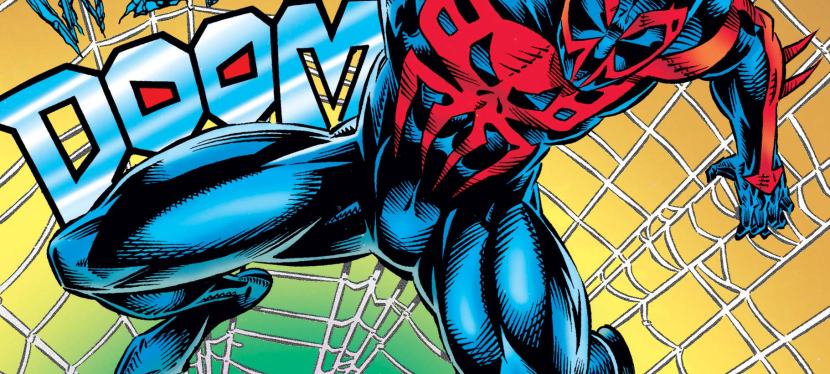
The cover.

Early story

The story begins with Miguel O’Hara and Xina returning from Mexico speeding on a lonely road by car. O’Hara suddenly got scanned from a distance. Just as Xina shares to Miguel her newest observations and opinion about Spider-Man, the man suddenly got snatched from the car by uniformed authorities riding a floating vehicle. Miguel tells his abductors to let him go and one of them replies stating that he is being taken to the White House at the request of his Alchemax superior Tyler Stone.

Meanwhile inside an apartment located near the White House in Washington, DC, Dana converses with Tyler Stone by holographic call complaining that without him, the city is getting lonely for her. As soon as her communication ends, someone knocks her out cold…

Quality

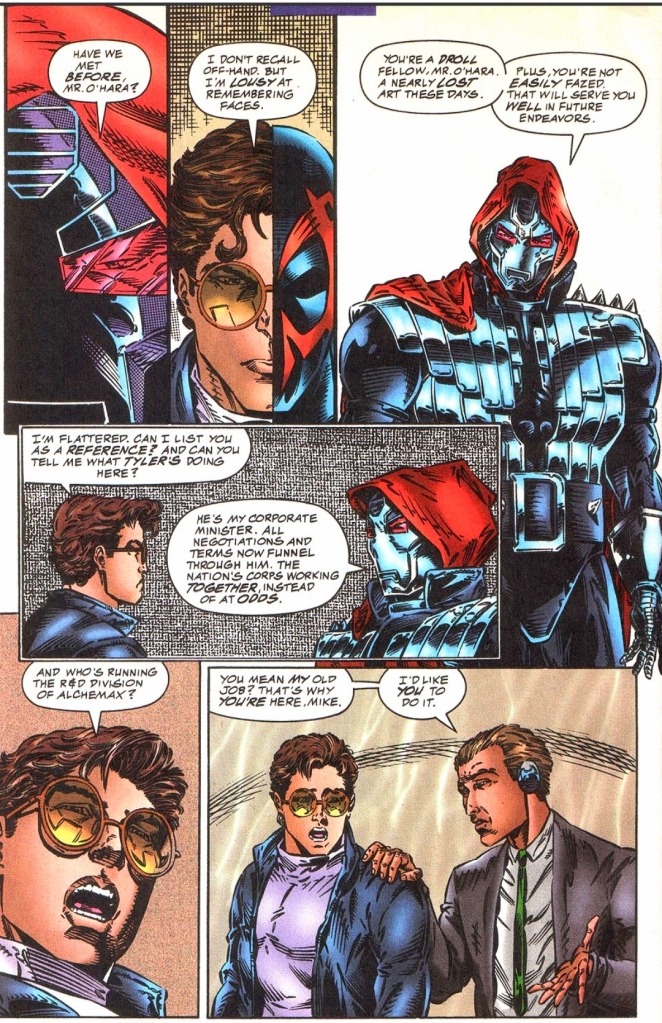
For the newcomers reading this, this page shows the first time ever that Doom 2099 sees Miguel O’Hara in person (Spider-Man 2099 without the mask and costume). Spidey and Doom encountered each other previously in The Fall of the Hammer storyline.

I will start what is very obvious about this comic book…its story is totally intriguing as it reflects a very dramatic turn of events within the 2099 realm at the time of publication. I’m talking about the rise of Doom 2099 as the new President of the United States and this comic book dramatizes in detail how the new leader impacts Miguel O’Hara’s career which adds tension to his already hectic 2nd life as the webslinger. This is all about the storyline of One Nation Under Doom and for context, you must read Doom 2099 to .

As I just mentioned, life for Miguel became more complicated as he has to deal with the federal government under the control Doom who himself is connected with the powerful tycoon Tyler Stone (Miguel’s own boss at Alchemax). For the newcomers reading this, this is not the first time Doom and Spider-Man of 2099 encountered each other as they were together in the Fall of the Hammer storyline (read my past reviews by clicking here, here, here, here and here).

In relation to the dramatic turn of events that changed the direction of the 2099 comics franchise, I can confirm that the writing by Peter David in this comic book is indeed very strong and highly engaging to follow. You will not see a good-versus-evil superhero tale here but the impact of Doom as US President on Spider-Man and local society. Along the way, this tale has a theme about gaining absolute power, how it affects the one who gains it and how the more powerful person affects many others. You will see the mentioned theme reflected on Spider-Man who himself already has super powers and even a following of idolaters.

Compared to the previous two issues, the dialogue by Peter David here is very rich and I also enjoyed the way how he presented the exposition of details to help Spider-Man 2099 readers understand how Doom’s rise as US President impacts the titular hero and many others. Speaking of Doom, I enjoyed the way how David portrayed him here.  

Conclusion

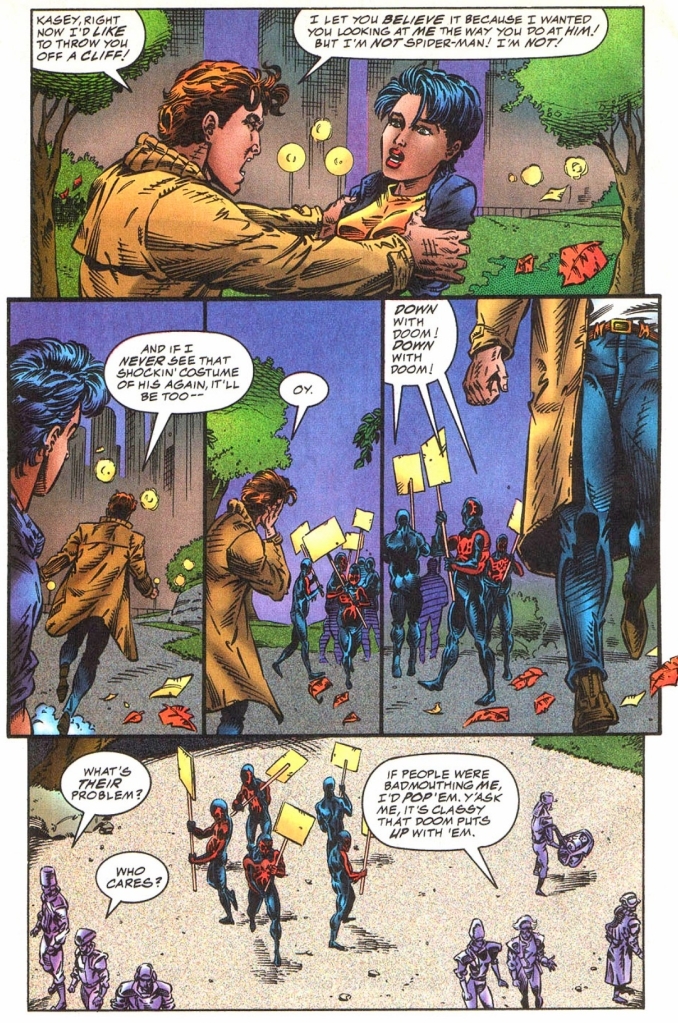
Gabriel O’Hara, Kasey and the Spider-Man 2099 idolaters doing the old fashioned way of protesting against US President Doom.

Spider-Man 2099 (1995) is indeed a great comic book and one of the best tales of the original Spider-Man 2099 monthly series. As Doom’s takeover of the US Presidency really changed the direction of the entire 2099 franchise of comics in the 1990s, it was inevitable that the repercussions would be reflected in a Spider-Man 2099 tale. The result here is a fascinating tale of the futuristic webslinger that does not even have the usual good-versus-evil conflict. What you will see here is how the stakes got raised for Miguel O’Hara not only as a superhero but also as a civilian who has a strong record within Alchemax. Not only that, this is the tale that took place just before the very memorable first encounters between Spider-Man and Venom 2099 (click here, here, here and here).

Overall, Spider-Man 2099 (1995) is highly recommended!

+++++

Thank you for reading. If you find this article engaging, please click the like button below, share this article to others and also please consider making a donation to support my publishing. If you are looking for a copywriter to create content for your special project or business, check out my services and my portfolio. Feel free to contact me with a private message. Also please feel free to visit my Facebook page Author Carlo Carrasco and follow me on Twitter at  @HavenorFantasy as well as on Tumblr at https://carlocarrasco.tumblr.com/ and on Instagram at https://www.instagram.com/authorcarlocarrasco
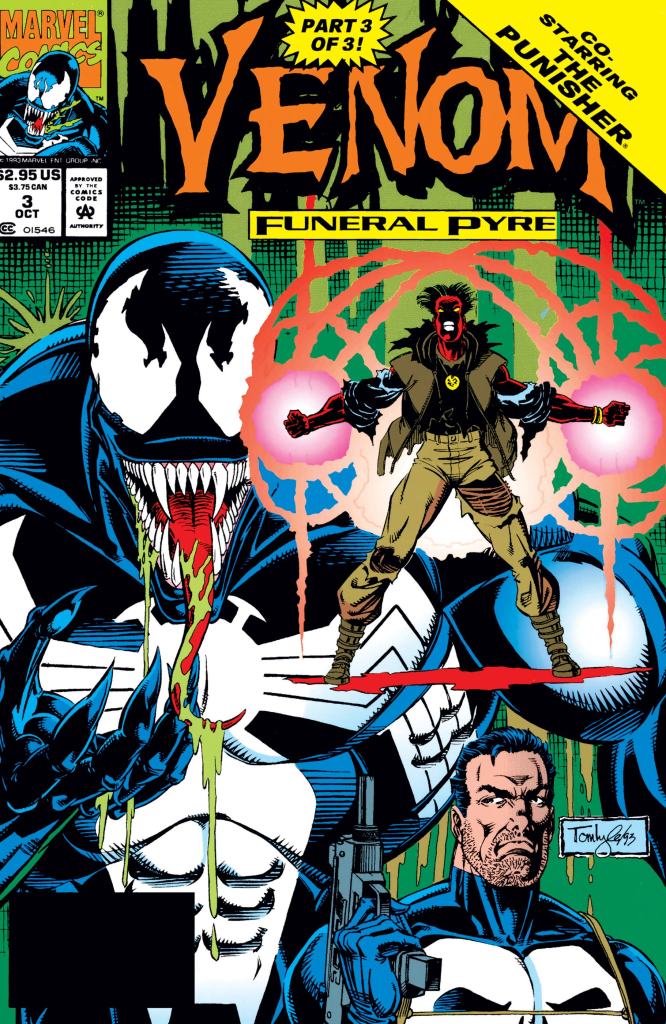
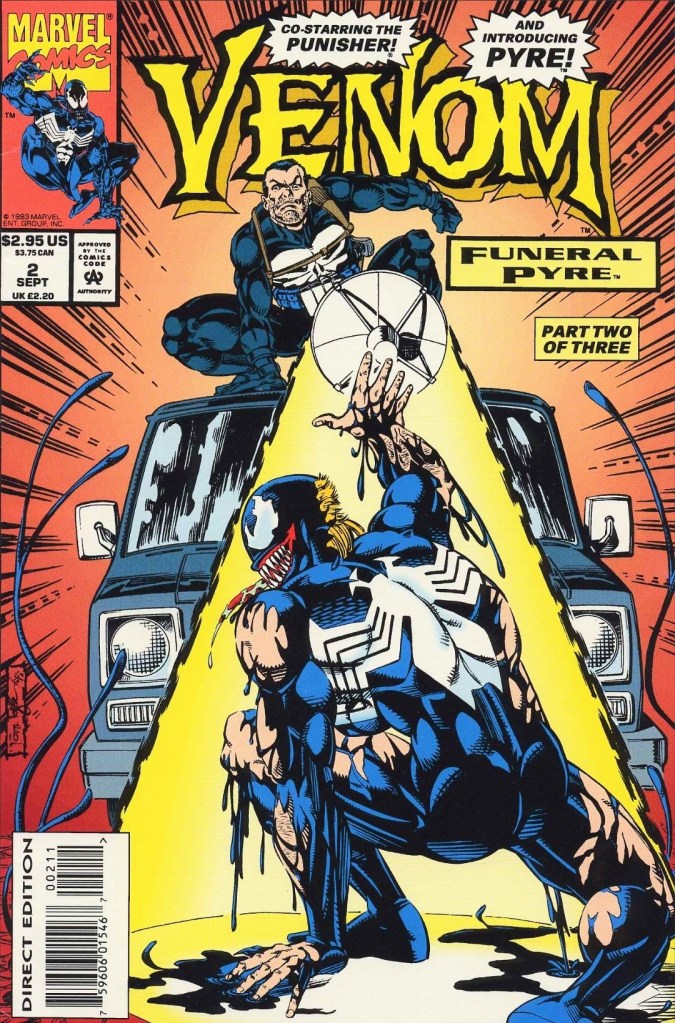
A Look Back at Venom: Funeral Pyre #3 (1993)

Welcome back superhero enthusiasts, 1990s culture enthusiasts and comic book collectors! Today we go back to the year 1993 to take a close look at the second issue of the second Venom comic book mini-series Venom: Funeral Pyre.

In my previous review, the gang-driven violence intensifies as the Punisher makes his move armed with lots of resources (including a van loaded with weapons and computerized functions). Venom struggles to free himself from the temporary prison the Punisher placed him in. As the violence escalated, Gray Russell finds himself in much deeper trouble as the anticipated rescue does not happen.

With those details laid down, here is a look back at Venom: Funeral Pyre , published in 1993 by Marvel Comics with a story written by Carl Potts and drawn by the late Tom Lyle. This if the final issue of the mini-series.

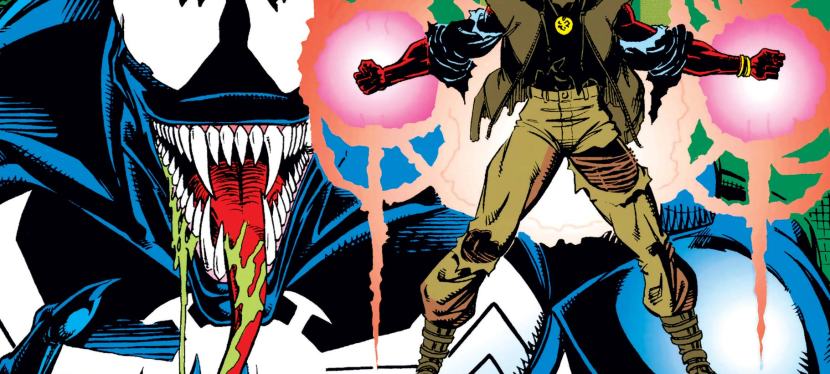
The cover.

Early story

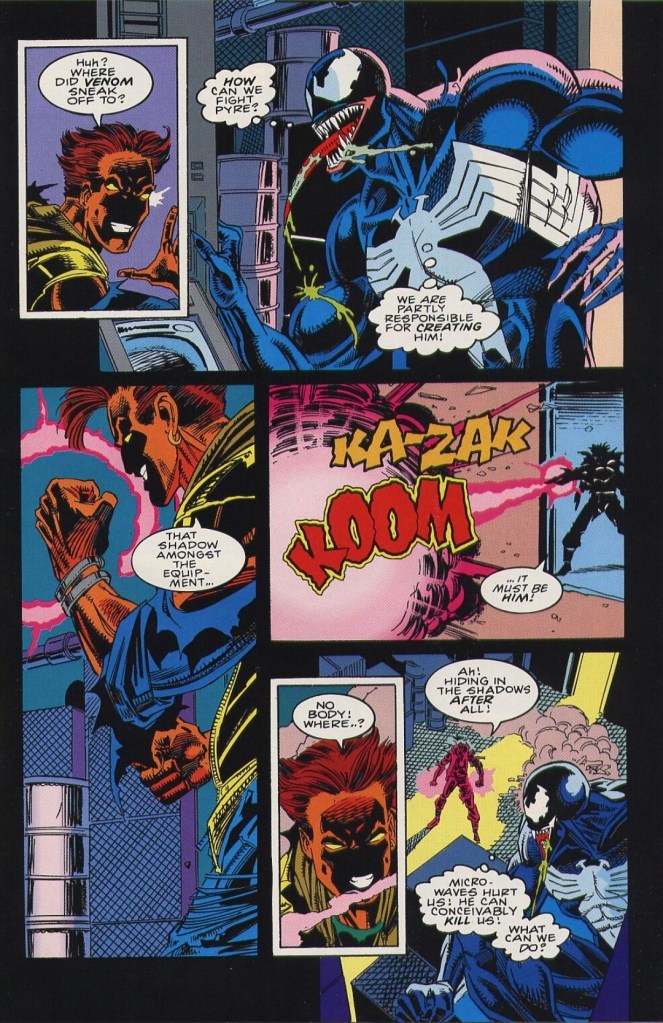
The story begins inside a building with high-tech equipment from HYDRA. Gray Russel is no longer himself but as the red-skinned, highly radiated figure Pyre. He fires a microwave blast at Venom which hurts him so much. In response to Venom’s claim that he came to rescue him, Pyre reacts with rage telling the murderous man with the symbiote that he arrived too late which resulted in the forced killing of people during the gang violence on the streets of Oakland.

Being filled with pure rage, Pyre intends to burn Venom alive. Thinking that Pyre is distracted, the Punisher leaps to get a gun on the floor which causes the radiated person to fire a microwave blast at him. The Punisher takes cover behind a machine but notices the microwaves sparking off the metal.

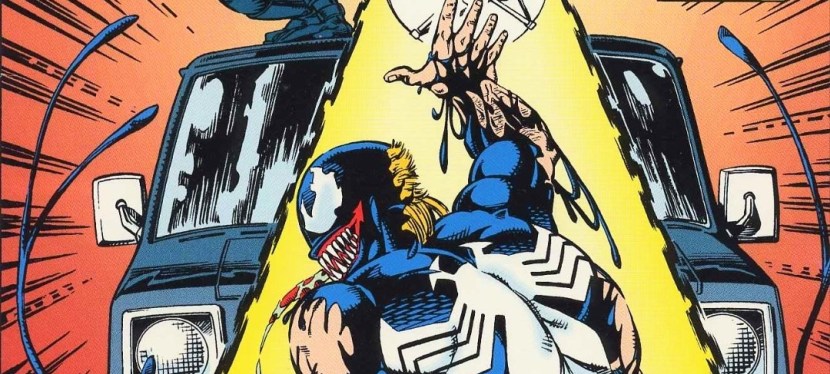
Venom then takes advantage of situation…

Quality

This page shows Venom at a disadvantageous state with Pyre whose microwave blasts are more than enough to kill him.

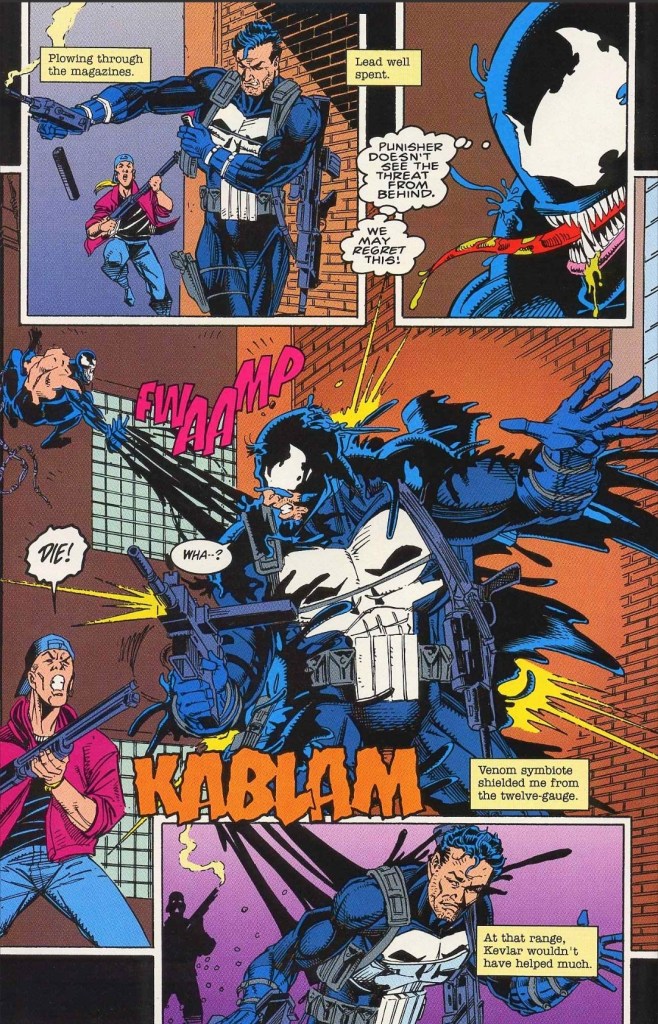
As the conclusion of the mini-series, this comic book went all-out portraying what turned out to be the final conflict involving the murderous Venom, the vigilante Punisher and the energy-filled Pyre. As a result, the narrative strongly focused on the final conflict (note: stretched out to last several pages) and never bothered to look back at the people and activities on the city street.

That being said, you will get to see more of the two established Marvel figures struggling hard against an unexpected force of opposition who was previously an undercover news reporter who infiltrated a certain gang and sent a message (delivered by a young boy) that caught Eddie Brock’s attention. At this point, it is clear that Venom’s effort to rescue Gray (who became Pyre after using a super soldier chamber left behind by HYDRA) ended in total failure and finds himself facing someone who could kill him and his alien costume together.  

If there is anything notable about this issue, it is the portrayal of Venom being highly disadvantaged and even vulnerable. There are no armed men with sonic weapons and high-tech equipment to bring Venom down but Pyre whose microwave blasts are deadlier than flame and sonic. In connection to the situation, Venom is not his aggressive self but a struggling figure who strives to survive and somehow find solutions during the heat of danger.

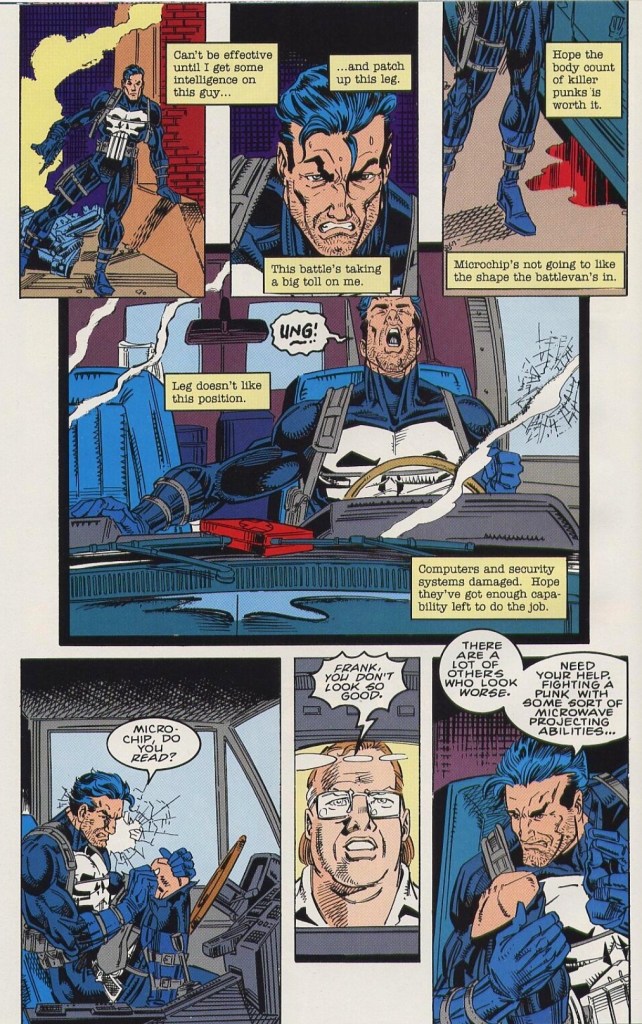
The Punisher, meanwhile, also struggled to survive but would simply not run away even though his chances of escape are much better. Instead, he focuses on actually eliminating Pyre without hesitation and Venom’s attempt to rescue Gray meant absolutely nothing to him.

More on Pyre, he is not really interesting nor was he ever engaging as the one powerful force of opposition that Venom and the Punisher must face. His being consumed by unrestrained rage and wielding so much power did not really raise the tension of the story. Had he eliminated the two Marvel figures who got in his way, what would Pyre do afterwards? Devastate the entire city of Oakland because he lost his identity as Gray and could not get over his involvement of taking other people’s lives while in the middle of gang activities? Would he proceed to San Francisco’s underground community and eliminate the people only because he blames Venom (note: Eddie Brock got involved with the underground people of San Francisco as seen in the Lethal Protector mini-series) for his failure of rescuing him? Pyre is nothing more than a throwaway comic book force of opposition.

From a visual standpoint, Tom Lyle once again pushed his creativity hard and showed some dynamic shots of spectacle here and there. At this stage, he proved to be very capable of visualizing Venom and the Punisher.

Conclusion

The Punisher refuses to give up and gets Microchip to assist him.

While issue was a notable improvement over the first issue, Venom: Funeral Pyre (1993) does not have much to offer in terms of engagement and entertainment. This is because it was crafted as a strict Venom-Punisher-Pyre conflict that provided spectacle and intrigue but ultimately ended up hollow. To see Venom at a huge disadvantage is interesting but did not add much weight to the plot. The Punisher was his usual self and in some ways overshadowed Venom for a while. Too bad there was not much space left for Venom and Punisher to fight each other again.

As the final issue of this mini-series, the story concluded with a whimper. Ultimately the Funeral Pyre storyline ended up as a diversion within the Marvel Comics shared universe that happened to attract Punisher, Venom and the gangsters of Oakland.  

Overall, Venom: Funeral Pyre (1993) is satisfactory.

+++++

Thank you for reading. If you find this article engaging, please click the like button below, share this article to others and also please consider making a donation to support my publishing. If you are looking for a copywriter to create content for your special project or business, check out my services and my portfolio. Feel free to contact me with a private message. Also please feel free to visit my Facebook page Author Carlo Carrasco and follow me on Twitter at  @HavenorFantasy as well as on Tumblr at https://carlocarrasco.tumblr.com/ and on Instagram at https://www.instagram.com/authorcarlocarrasco
A Look Back at Venom: Funeral Pyre #2 (1993)

Disclaimer: This is my original work with details sourced from reading the comic book and doing personal research. Anyone who wants to use this article, in part or in whole, needs to secure first my permission and agree to cite me as the source and author. Let it be known that any unauthorized use of this article will constrain the author to pursue the remedies under R.A. No. 8293, the Revised Penal Code, and/or all applicable legal actions under the laws of the Philippines.

Welcome back superhero enthusiasts, 1990s culture enthusiasts and comic book collectors! Today we go back to the year 1993 to take a close look at the second issue of the second Venom comic book mini-series Venom: Funeral Pyre.

In my previous review, the Punisher and Venom encountered each other for the first time ever and along the way Gray – who is secretly a journalist with a mission – struggles to maintain his composure and his sanity as he finds himself in the middle of a very violent gang war in Oakland, California. The more time Gray spends time with the crime gang he joined, the tougher the situation becomes for him.

With those details laid down, here is a look back at Venom: Funeral Pyre , published in 1993 by Marvel Comics with a story written by Carl Potts and drawn by the late Tom Lyle.  

The cover.

Early story

The story begins with Gray and his gang companions riding a car approaching a group of people on the street. The gang leader pressures Gray to use his weapon to kill them. Gray is deeply worried not only because he has to prove his worth to the gang by killing other, but also because the rescue attempt he was waiting for had not yet happened.

Meanwhile, Venom finds himself trapped on the doorway of a building with the metal gate locked and with rays of microwave from the Punisher’s van radiating him painfully. As the Punisher leaves them behind, Venom manages to use the symbiote to reach into the van and smash the control panel inside which disabled the microwave rays.

Immediately, he recovers and breaks out to continue his mission: to rescue Gray…

Quality

The murderous Venom actually helped the Punisher.

When it comes to the storytelling, there are some improvements that made this comic book more readable than issue . For one thing, the exposition has been reduced which allowed the pace of the story to move faster. Most of the exposition here has been limited to Gray who at this stage of the mini-series was clearly bound to become the central object of the Funeral Pyre concept. Another thing is that the story’s structure here is simpler and easier to follow as Venom and Punisher moved on their own struggles separately before predictably getting together again.

While the mini-series has clearly been a tale of a city gang war – with a pretentious and unwilling gang member who expected to be rescued before things become too chaotic – that happened to pull the Punisher and Venom in for different reasons, Carl Potts added some elements that would resonate with Marvel Comics fans who are familiar with HYDRA and the Super Soldier aspects of the Marvel Comics universe history. Not only that, there is a science fiction-inspired setting near the end of the story that added variety to the in-story environment.

Like the first issue, this one is packed with a good amount of action scenes and that means Punisher and Venom fans have a lot of stuff to enjoy. Tom Lyle really is good with showcasing the respective spectacle of the vigilante and the symbiote-wearing murderer, and when he has the two together, his visual creativity intensifies.

Conclusion

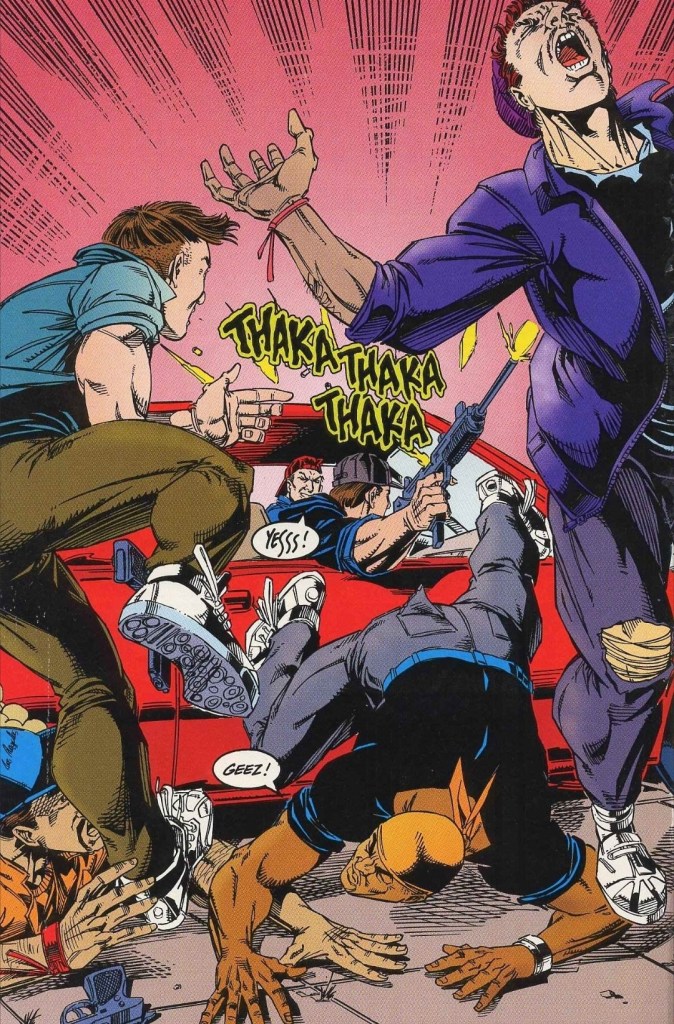
Grey shooting blindly at the targets while riding the car of the gangsters he joined.

Venom: Funeral Pyre (1993) is clearly an improved reading experience over issue mainly because of the reduced information dump, the simpler plot structure and the creative showcase of Venom and the Punisher. While Gray remains uninteresting, his late-stage transformation turned out to be somewhat surprising and it was only near the end of this comic book that the Funeral Pyre concept became clear.

Overall, Venom: Funeral Pyre (1993) is satisfactory.

+++++

Thank you for reading. If you find this article engaging, please click the like button below, share this article to others and also please consider making a donation to support my publishing. If you are looking for a copywriter to create content for your special project or business, check out my services and my portfolio. Feel free to contact me with a private message. Also please feel free to visit my Facebook page Author Carlo Carrasco and follow me on Twitter at  @HavenorFantasy as well as on Tumblr at https://carlocarrasco.tumblr.com/ and on Instagram at https://www.instagram.com/authorcarlocarrasco
A Look Back at Aliens vs. Predator #4 (1990)

Disclaimer: This is my original work with details sourced from reading the comic book and doing personal research. Anyone who wants to use this article, in part or in whole, needs to secure first my permission and agree to cite me as the source and author. Let it be known that any unauthorized use of this article will constrain the author to pursue the remedies under R.A. No. 8293, the Revised Penal Code, and/or all applicable legal actions under the laws of the Philippines.

Welcome back superhero enthusiasts, 1990s culture enthusiasts and comic book collectors! Today we go back to the year 1990 to take a close look at one of the more significant non-superhero crossover comic book events ever published – Aliens vs. Predator!

In my previous review, things changed for the worse for the humans as their colonial community gets overwhelmed by the presence of Aliens and Predators. Risking her own life, Machiko Noguchi does what she could to protect her constituents. Along the way, one certain Predator that was restrained and examined in the laboratory eerily decides to help the humans.  

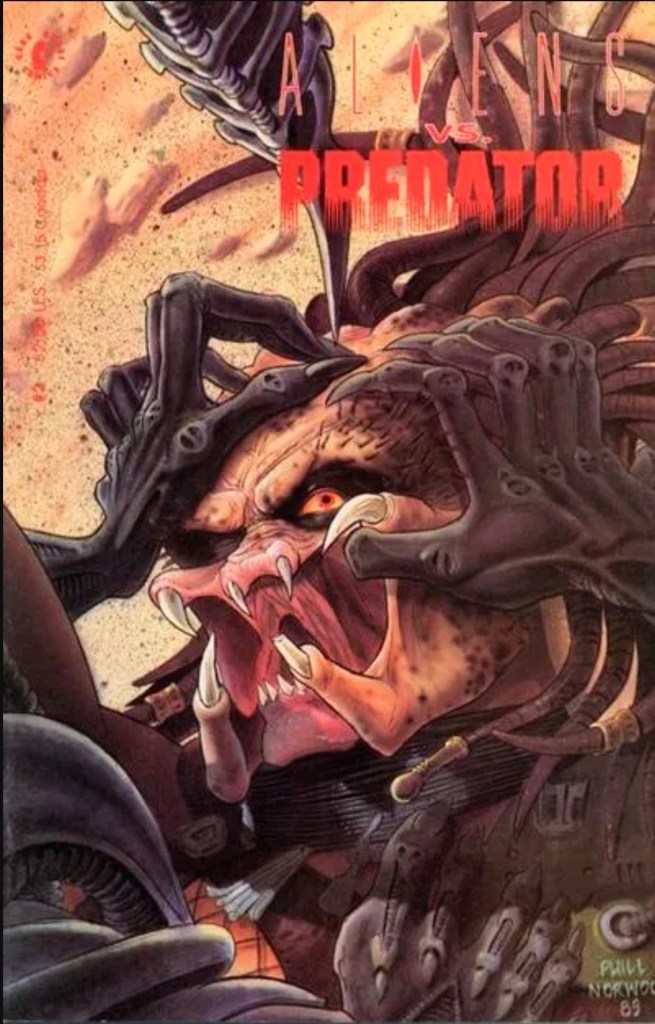
With those details laid down, here is a look back at Aliens vs. Predator , published in 1990 by Dark Horse Comics with a story written by Randy Stradley and drawn by Phill Norwood. This is the final issue of the mini-series.

The cover.

Early story

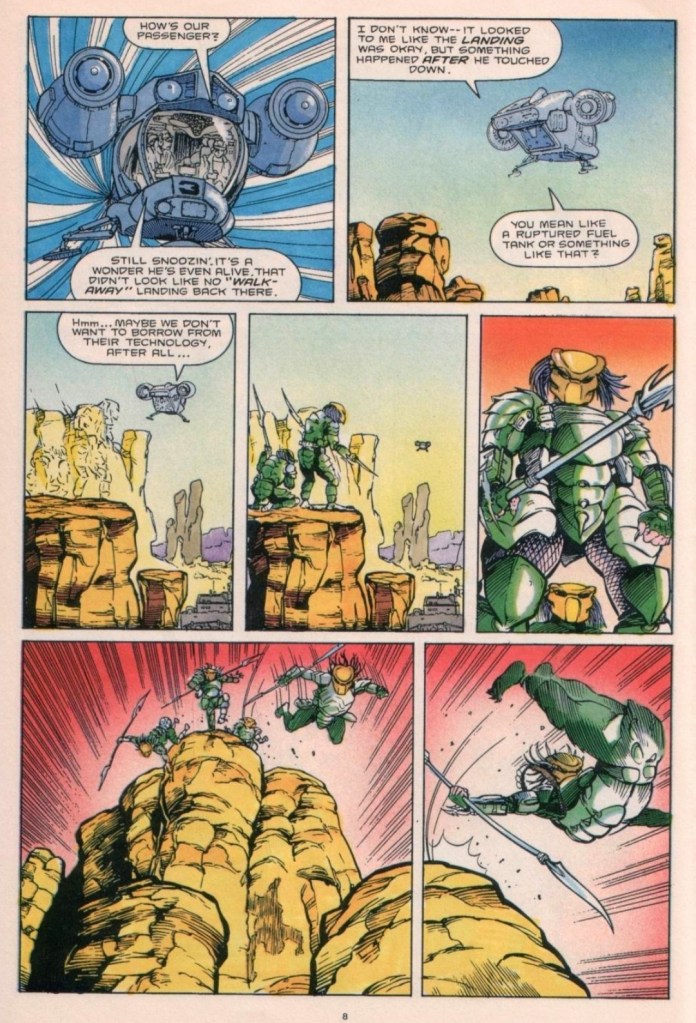
The story begins with Noguchi and Miriam flying in a Copter and right below them is the chaos composed of a cattle stampede and the ongoing conflict between Alien Xenomorphs and the armed Predators. While flying, Noguchi and Miriam spot a lone Predator climbing up a tower while fighting off several Xenomorphs chasing him unrelentingly. It turns out the said Predator was Miriam’s own patient at the laboratory and she urges Noguchi to help him.

As part of the tower separates itself, the Predator is about to fall down and the Copter piloted by Noguchi comes closer to help him. Miriam uses a communicator to help the Predator realize they are helping him. As the Predator hangs on to one part of the Copter, an Alien jumps towards the vehicle causing Noguchi to react instinctively by jerking the controls. The Copter then spins on its axis as the nearby tower collapses.

The Copter begins to fall down on the street below…  

Quality

Even as this comic book is packed with lots of action scenes, thrills, and Aliens-Predator fights, the creative team succeeded in emphasizing the narrative all throughout.

I am delighted to say that the Stradley-Norwood duo succeeded with maintaining the high quality works of this mini-series and concluded it with impact. At the heart of the story is the theme of survival with the humans being symbolized as casualties of a raging conflict between the fully determined and instinctive Aliens and the strategic and technological Predators.  

Through the protagonist Machiko Noguchi, readers will realize that as a species, humans can survive not only by having a powerful will to progress backed with focus, but also by communicating and cooperating with an intelligent non-human species that shares their traits. In this case, the non-human species I’m referring to are the Predators. That being said, the Aliens are the non-human species with limited intelligence, fully determined to hunt anyone or anything, and absolutely do not care about morals nor the existence of any species they find different from themselves. All the symbolism about the three species got portrayed powerfully and creatively throughout the story here.

As before, the plot moved at a medium pace and details are emphasized through dialogue, visuals and narrations without ever dragging the pace down. This shows how the creative team proved to be efficient with explaining the details as they focused on telling the story in ways to keep readers engaged.

I should mention that the protagonist Machiko Noguchi became even more significant in this comic book. Without spoiling the details, I can say she blossomed into a heroic figure who risks her life to help many even as she faces tremendous odds. In case you are wondering, Noguchi is NOT a rip-off of Ellen Ripley as she is the colonial overseer dedicated to the corporation. It just so happens that Noguchi shares common traits with the cinematic icon such as bravery, the refusal to give up and having the will to help others even while risking her own life. I can only imagine Ripley and Noguchi conflicting with each other if they were together under normal circumstances.

Noguchis’s short but intense union with the cooperative Predator was told very believably which added depth to the story as well as impact on the conclusion.

As this is the final issue of the mini-series, the creative team really ramped up the big-payoff to what was built up before. In fact, the final conflict here seems to show that Stradley and Norwood were aware about what made the cinematic final conflicts of Aliens (1986) and Predator (1987) entertaining and memorable to moviegoers. That being said, I can say that certain action and sci-fi elements from those movies were implemented in this comic book’s final conflict which I found really engaging, inspired and fun to read.

Conclusion

The union between Machiko Noguchi and this particular Predator is a must-read!

Aliens vs. Predator (1990) is truly a great comic book as well as a powerful conclusion to this very significant comic book mini-series. The creative team not only told the whole storyline with great quality, a steady pace and strong engagement all throughout. It is also here where you will get to see Machiko Noguchi become very significant not only within the Aliens-Predator comic book universe of Dark Horse Comics but in sci-fi comics in general. The ending of this comic book is very powerful and served also as a big pay-off to what preceded it. This is a genuine sci-fi comic book classic!

Overall, Aliens vs. Predator (1990) is highly recommended!

+++++

Thank you for reading. If you find this article engaging, please click the like button below, share this article to others and also please consider making a donation to support my publishing. If you are looking for a copywriter to create content for your special project or business, check out my services and my portfolio. Feel free to contact me with a private message. Also please feel free to visit my Facebook page Author Carlo Carrasco and follow me on Twitter at  @HavenorFantasy as well as on Tumblr at https://carlocarrasco.tumblr.com/ and on Instagram at https://www.instagram.com/authorcarlocarrasco
A Look Back at Superman vs. Aliens #2 (1995)

Disclaimer: This is my original work with details sourced from reading the comic book and doing personal research. Anyone who wants to use this article, in part or in whole, needs to secure first my permission and agree to cite me as the source and author. Let it be known that any unauthorized use of this article will constrain the author to pursue the remedies under R.A. No. 8293, the Revised Penal Code, and/or all applicable legal actions under the laws of the Philippines.

Welcome back superhero enthusiasts, 1990s culture enthusiasts and comic book collectors! Today we go back to the year 1995 to examine another chapter of the Superman vs. Aliens mini-series.

In my previous retro review, an object from space on Earth and Superman (who previously as Clark Kent learned of the Kryptonian language from the signals transmitted by the object) intervened the discovery of it in the presence of Lexcorp. After much talk and an agreement, Superman went into space with one of Lexcorp’s space ships (under the watch of Dr. Kimble who leads the corporation’s space division) leaving behind Lois Lane at the space station with Kimble. Deep in space, Superman arrives and discovers a ruined city with physical signs of struggle. What he does not realize is the presence of eggs and the Xenomorphs lurking within the new environment.

With those details laid down, here is a look back at Superman vs. Aliens , published in 1995 by Dark Horse Comics and DC Comics with a story written and drawn by Dan Jurgens with ink work done by Kevin Nowlan.

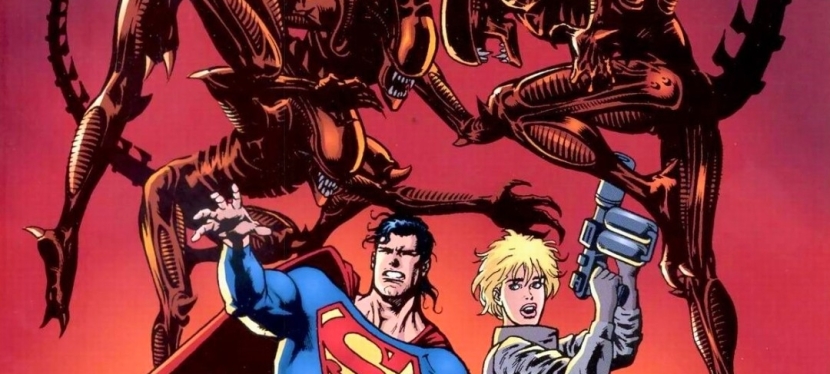
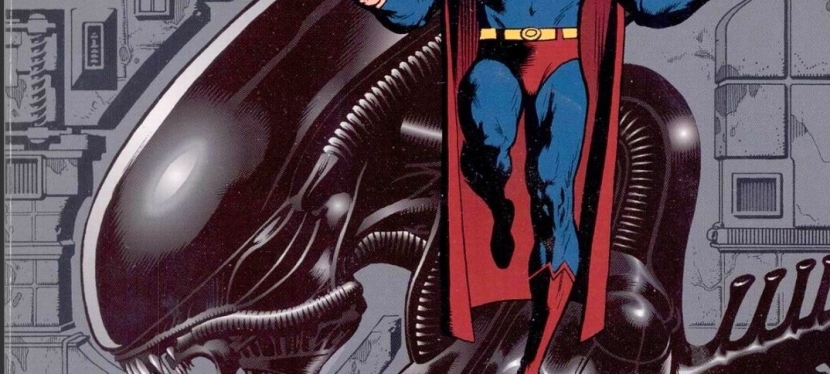
The cover.

Early story

The story begins in space when a space ship sent home by Superman is about to collide with the space station near Earth. As one of the crew members failed to take remote control of the incoming ship, a very determined Dr. Kimble takes over the controls and eventually took command of the said ship. Lois Lane, who showed signs of self-restraint and deterioration of her professionalism as a journalist, watches. As Kimble, Lane and the crew members approach the ship at the station’s docking bay, one passenger was found dead (a Chestburster alien came out of him) while three others were still alive.

As Dr. Kimble and personnel brought the surviving passengers in the infirmary, Lois Lane takes advantage of the situation by climbing up the ship to examine it closely. She knows that without the ship, her beloved Clark Kent/Superman is stranded in space. She is completely unaware of the presence of a fully grown Xenomorph alien watching her from a dark corner.

Meanwhile at the ruined city on the other side of the galaxy, a blindfolded Superman is carefully guided by the armed Kara going to a place that has medical equipment and supplies…

Quality

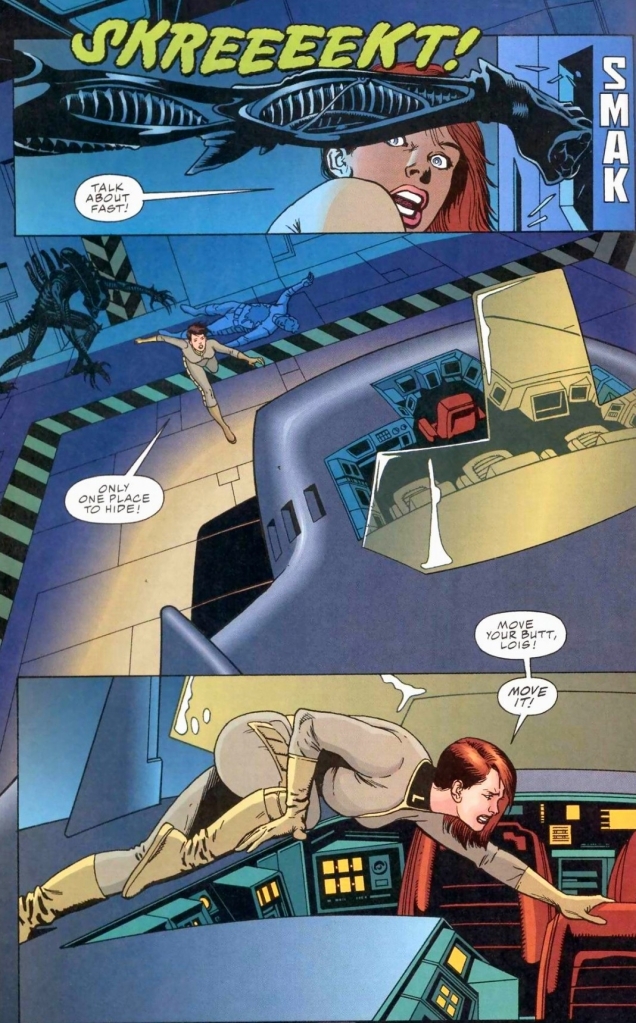
Lois Lane during her encounter with the Xenomorph inside the space station.

This is a solid follow-up to what was established in issue . In this comic book, the creative team gradually raised the stakes as two sides of the story were told extensively in alternating fashion – the side of Superman and Kara in deep space, and the other side of Lois Lane and Dr. Kimble (clearly the 3rd most important character in this mini-series) inside the space station.

As the story went on, Superman became even more vulnerable not only because he grew weaker as he has been cut off from the sun (a primary source of energy for him), but also because struggling with the aliens wore him down a lot and he still insists on avoiding any acts of killing due to what happened to him previously. As the Man of Steel became more vulnerable, Kara (who is experienced already in fighting the Xenomorphs which she referred to as the uglies) became an even more significant character (next to Dr. Kimble) and she became a highly essential partner for the icon.

Even for us readers, Kara creatively became even more engaging as she shared memories of events (note: exposition) that happened sometime prior which explains why her city got ruined and how the Aliens arrived and made her people’s problems even worse. The visualization of the said events were efficiently done for a good immersion into the past.  

While the Superman-Kara thread emphasized survival facing tremendous odds, the Lois-Kimble thread became a more significant part of this mini-series as the space station became the new place for Xenomorph attacks. While Dr. Kimble remained obsessed with achieving results with scientific discoveries and corporate interests in mind, Lois Lane became the hunted similar in the style of Ellen Ripley in 1979’s Alien.

If you are looking for action, you will find a lot of them in both threads of the story. While just one Xenomorph on the space station led to some incidental action moments, a lot more action happened on Superman-Kara’s side of the story as they (along with a few human survivors on the ruined city) faced a huge horde of aliens that kept on attacking them from all sides. If you are looking for superhero spectacle, you won’t find it here as the action is more grounded with sci-fi’s interpretation of reality and Superman here is weaker and a lot more worn down physically. Then again, this is not surprising given the tone and concept the creators aimed for.

Conclusion

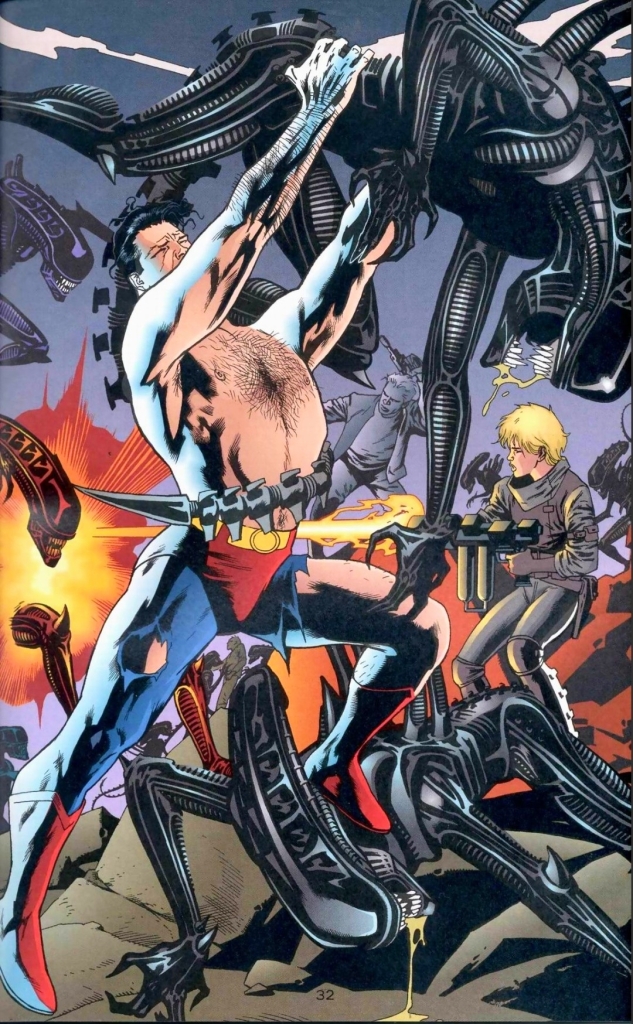
Superman and Kara struggling hard as they are surrounded by lots of Aliens. One of Kara’s fellow people is present in this shot.

Superman vs. Aliens (1995) is really engaging to read and there were lots of fun moments along the way. Even as the creators were building up something for the third and final issue, they managed to pull off big pay-offs to what was built up in issue . While the lack of superhero-style spectacle is clear, it is not a problem at all as there is a lot of action involving the many Xenomorphs in the ruined city plus the bouts of suspense and incidental action executed during Lois Lane’s encounter with a single but deadly Alien. Considering how much fun and engagement this comic book has, it remains to be seen how the next issue will live up to it.

Overall, Superman vs. Aliens (1995) is highly recommended!

+++++

Thank you for reading. If you find this article engaging, please click the like button below, share this article to others and also please consider making a donation to support my publishing. If you are looking for a copywriter to create content for your special project or business, check out my services and my portfolio. Feel free to contact me with a private message. Also please feel free to visit my Facebook page Author Carlo Carrasco and follow me on Twitter at  @HavenorFantasy as well as on Tumblr at https://carlocarrasco.tumblr.com/ and on Instagram at https://www.instagram.com/authorcarlocarrasco
A Look Back at Superman vs. Aliens #1 (1995)

Disclaimer: This is my original work with details sourced from reading the comic book and doing personal research. Anyone who wants to use this article, in part or in whole, needs to secure first my permission and agree to cite me as the source and author. Let it be known that any unauthorized use of this article will constrain the author to pursue the remedies under R.A. No. 8293, the Revised Penal Code, and/or all applicable legal actions under the laws of the Philippines.

Welcome back superhero enthusiasts, 1990s culture enthusiasts and comic book collectors! Today we go back to the year 1995 to examine what was back then one of the most unthinkable comic book crossovers to ever happen – Superman vs. Aliens (also referred to as Superman/Aliens).

I remember sometime back in 1994, I bought a new superhero comic book from the local comic book retailer and what caught my attention was the print ad on the back – an Alien chestburster crashing through the iconic Superman S logo. A few of my friends who saw the same print ad chuckled at the concept of having the Man of Steel together with the monsters from the movie franchise that first started in 1979 with Ridley Scott’s Alien. Then came 1995 and eventually the first issue of the Superman vs. Aliens mini-series made it on the shelves of local comic book stores. Its cover easily attracted the attention of many and I saw the image of Superman being smaller to the Xenomorph alien in the background, the concept of the crossover started to intrigue me.

With those details laid down, here is a look back at Superman vs. Aliens , published in 1995 by Dark Horse Comics and DC Comics with a story written and drawn by Dan Jurgens with ink work done by Kevin Nowlan.

The cover.

Early story

The story begins in space when a fast moving object from nowhere heads towards Earth which was detected by a satellite of Lex Luthor’s corporation. Behind the scenes, personnel initiated an alert for a certain Dr. Kimble.

Clark Kent (Superman) and Lois Lane arrive at the headquarters of Lexcorp. It turns out they were suddenly called for by the corporation due to what happened in space. As they ride the elevator heading towards the rooftop, Clark and Lois talk about Lexcorp’s space program and Dr. Kimble who happens to lead the said program.

At the roof, they meet Dr. Cheryl Kimble and immediately ride with her in the helicopter going to a certain destination in anticipation of the probe’s estimated arrival. During the trip, Kimble reveals that they received radio signals from the incoming probe which were garbled almost unintelligible. She then plays an excerpt of the radio signals for Clark and Lois to listen to.

For Clark, he cannot help but feel shocked as he finds the audio sounding like Kryptonian…

Quality

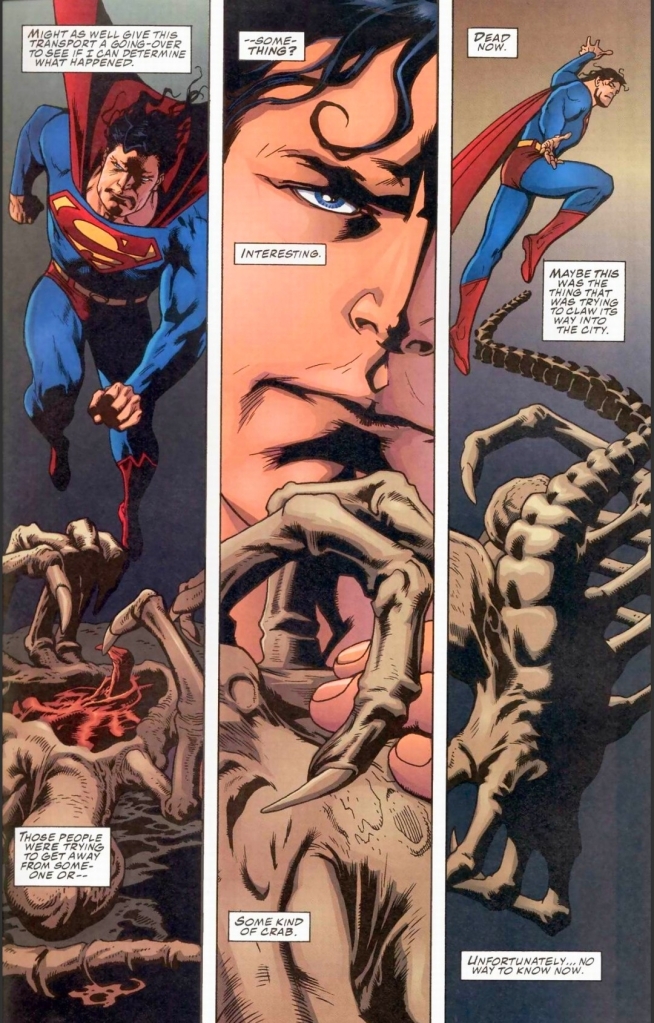
Superman finds a dead Facehugger alien.

Firstly, I can say without any hesitation that the creative team succeeded in making the crossover between Superman and the Aliens believable within this very comic book. For one thing, Dan Jurgens came up with a script and visual design that radically different from what was shown in Superman comic books of the time. The script had this somewhat adulterated tone that made the comic book move away from superhero fantasy and move into the realm of cinematic science fiction. For setting the tone and the look, the creative team scored a home run.

Secondly, the script was properly structured to immerse readers with the tale initially following Superman, Lois Lane and Dr. Kimble which ultimately served as a build-up. The good news here is that readers don’t have to wait too long for the pay-off to be executed. In fact, the pay-off itself (which happens when the Man of Steel finally encounters the Xenomorph for the first time) is huge and immediately the tension and depth of the plot really shifted into high-gear which I enjoyed. Along the way, the expository dialogue or the presentation of details (to help readers understand) was nicely balanced.

Thirdly, I love the way how Dan Jurgens presented Superman as being more troubled and more vulnerable than usual. To see the American icon go into personal obsession over the Kryptonian details was a really unique way to presenting his human side. Also having Superman deep in space far away from any sun or star (the essential source for his powers) really made him truly vulnerable as he actually got weaker even before facing off with a Xenomorph. Being in a vulnerable state, you will see the Man of Steel in real danger which truly goes against type (note: being super strong and invulnerable all the time). As such, the danger of the Aliens against him is believable and intense. What I do find weird, however, is how awkward it is for me to see Superman actually trying to reason with the first Xenomorph he encounters. Of course, he has no previous knowledge about the violent nature of the Aliens but we readers – and millions of people who saw any of the movies – know better than him.

As part of the build-up, Dan Jurgens inserted details and flashbacks that recalled previous tales that were published during the early stage of the post-Crisis era of DC Comics. This not only includes Superman’s arrival on Earth but also his strategic killing of General Zod, Zaora and  Quex-Ul using green Kryptonite (as published in Superman #22 of 1988). As such, Superman’s deep regret of taking life away from others serves as a build-up for his avoidance of killing in this crossover. This actually races the stakes for his upcoming encounters with the Aliens.

Even though the story is told through Superman, Dan Jurgens still had enough room to develop Lois Lane and Dr. Kimble. Kimble symbolizes the driven corporate executive who is in-charge of operations that could help her make claims on scientific discoveries and new technologies. Lois Lane here served as the intellectual opposite of Kimble without ever going into the extremes of gaining something for her journalistic career.

Conclusion

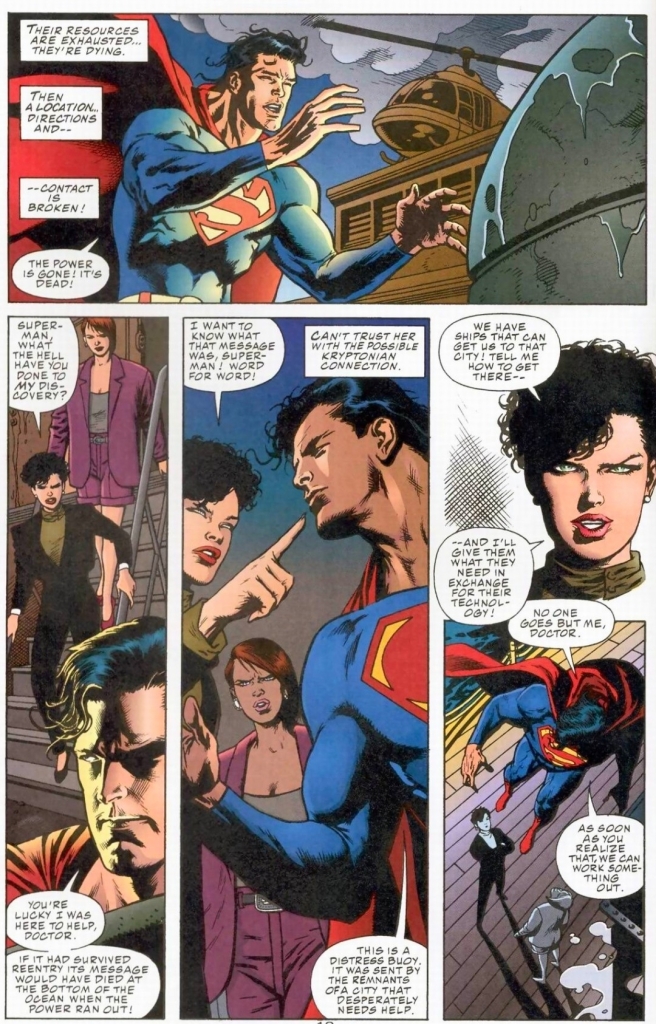
Superman with Lois Lane and Dr. Kimble.

Very clearly, Superman vs. Aliens (1995) is indeed a great comic book as well as great opener for its mini-series. Dan Jurgens established a tale that had sufficient build-up and when the pay-off started, the crossover aspect really made the story more compelling to read. Ultimately, this one made the crossover between Superman and the Xenomorphs believable, engaging and intriguing. This comic book is a great start and I am eager to find out what happens next.

Overall, Superman vs. Aliens (1995) is highly recommended!

+++++

Thank you for reading. If you find this article engaging, please click the like button below, share this article to others and also please consider making a donation to support my publishing. If you are looking for a copywriter to create content for your special project or business, check out my services and my portfolio. Feel free to contact me with a private message. Also please feel free to visit my Facebook page Author Carlo Carrasco and follow me on Twitter at  @HavenorFantasy as well as on Tumblr at https://carlocarrasco.tumblr.com/ and on Instagram at https://www.instagram.com/authorcarlocarrasco
A Look Back at Aliens vs. Predator #3 (1990)

Disclaimer: This is my original work with details sourced from reading the comic book and doing personal research. Anyone who wants to use this article, in part or in whole, needs to secure first my permission and agree to cite me as the source and author. Let it be known that any unauthorized use of this article will constrain the author to pursue the remedies under R.A. No. 8293, the Revised Penal Code, and/or all applicable legal actions under the laws of the Philippines.

Welcome back superhero enthusiasts, 1990s culture enthusiasts and comic book collectors! Today we go back to the year 1990 to take a close look at one of the more significant non-superhero crossover comic book events ever published – Aliens vs. Predator!

In my previous review, the humans of Prosperity Wells begin to get impacted by the presence of the Predators and the Aliens. A family got killed by Predator hunters at their home in the wilderness and only a young boy was able to get away and catch people’s attention in the outpost. Machiko Noguchi and her team initiate defensive measures in response to what has been happening. Two people even brought back a living Predator with them from the ruins of a Predator ship they inspected in the wilderness.

With those details laid down, here is a look back at Aliens vs. Predator , published in 1990 by Dark Horse Comics with a story written by Randy Stradley and drawn by Phill Norwood.  

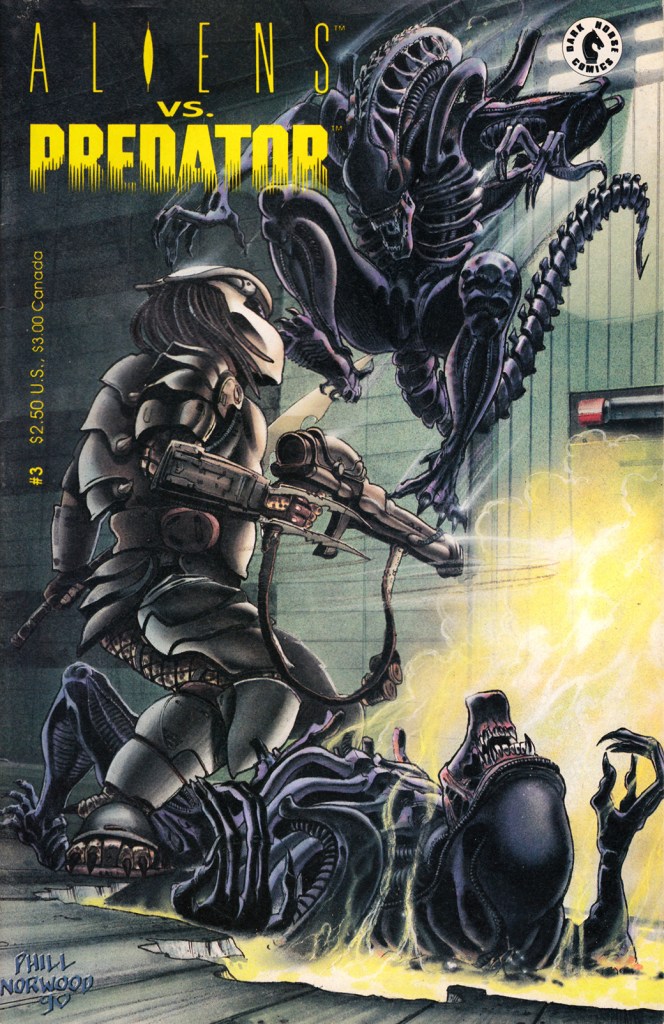
The cover.

Early story

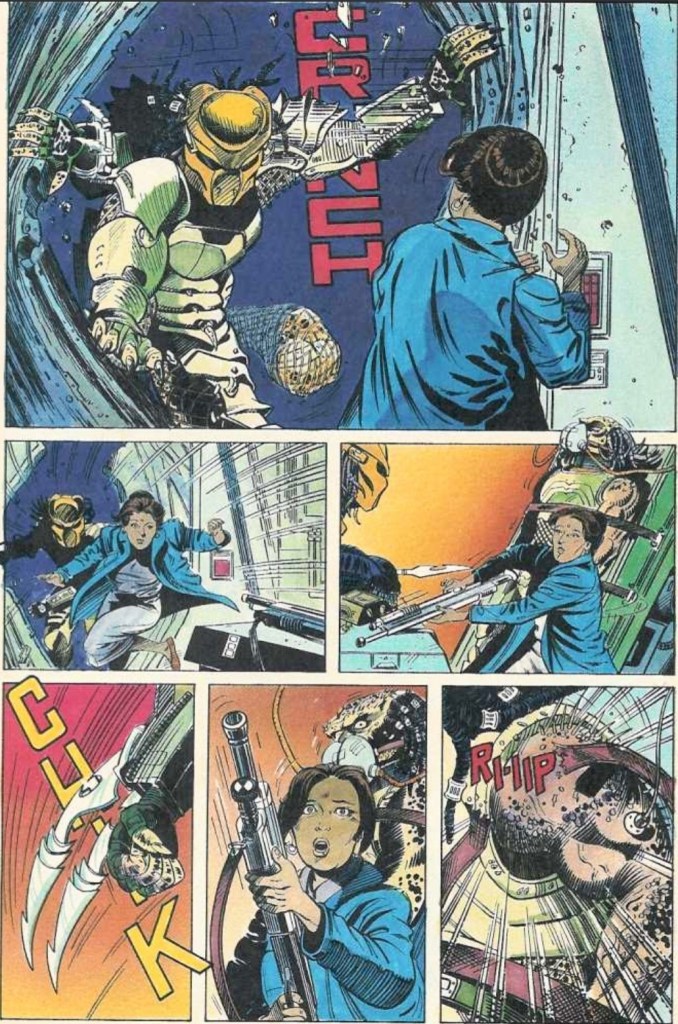
The story begins with Noguchi who finds herself in a dangerous position. In front of her is a horde of Xenomorphs and behind her is one Predator warrior who even assisted her a few moments prior. Armed with futuristic weapons, the armored warrior suddenly jumps above her and right into the Xenomorphs. The Predator efficiently slashed off the parts of a few Aliens using a bladed weapon and blew up one of them using another weapon.

The warrior eventually gets overwhelmed by more Aliens that came into the action. As the Xenomorphs focused strongly on the downed Predator, Noguchi takes advantage of the situation to run away and somehow get back to protecting the people as the outpost has been clearly invaded by two deadly non-human species.

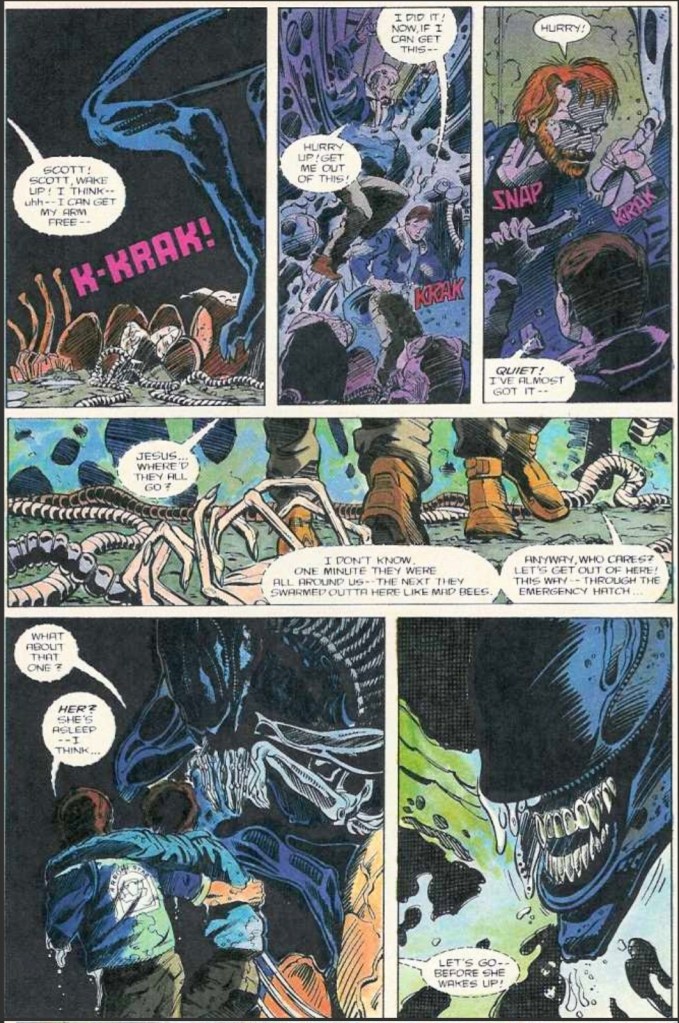
Meanwhile inside the huge cargo ship that did not launch, two crew members freed themselves from the Xenomorphs’ restraints and try to sneak by the Alien Queen which they perceived to be sleeping…

Quality

This is a fine example by the creative team on telling a sequence of intense moments without a single word of dialogue.

From a storytelling point-of-view, this one is a huge pay-off to the build-up established in the first two issues and I can say I enjoyed this one. At this stage of the 4-issue mini-series, the human colony has turned into a battle zone between the Predators and the Xenomorphs and this obviously results in a lot of action scenes and other wild turns of events. It is also in this story where you will get to see Machiko Noguchi at her bravest yet, as well as her uncompromising way of protecting her people and solving the crisis at hand. As she and her fellow humans are in the middle of a crisis, nothing straightforward could happen nor could they make solid plans with any real chance of succeeding. The decisions Noguchi made here came with risks and through her struggles, you will be able to relate with her and you will also witness how the series of unfortunate events turn out with unpredictable ways which added some suspense and surprise to the narrative.

The spectacle here, unsurprisingly, are the battles between the Aliens and Predators. Such conflicts happened mostly in the background which is effective enough to establish the chaos that the humans have to endure. One of the Predators – which does not have a name – became a notable additional supporting player to the cast and his presence and actions added some intensity to storytelling even as the narrative consistently focused on Noguchi.   

The way the story is told, this one maintains the natural progression of details from issue and even though the action has been ramped up, there were still plenty of opportunities for readers to understand the details and grasp the plot. There is also rising tension as the narrative moves forward.

Conclusion

There is nothing like trying to sneak past an Alien Queen in an area surrounded by multiple eggs laid by her.

Being a big pay-off to the huge build-up of issues and , Aliens vs. Predator (1990) is highly entertaining and compelling to read! The action scenes and chain of incidents were ramped up a lot and yet this comic book never turned into a brainless fest of violence. The creative team managed to add some breathing space to not only let readers absorb the story details but also to immerse themselves with the situations. By the time I reached the end, I experienced this great satisfaction as well as further motivation to discover how the story will conclude in the next issue.

Overall, Aliens vs. Predator (1990) is highly recommended!

+++++

Thank you for reading. If you find this article engaging, please click the like button below, share this article to others and also please consider making a donation to support my publishing. If you are looking for a copywriter to create content for your special project or business, check out my services and my portfolio. Feel free to contact me with a private message. Also please feel free to visit my Facebook page Author Carlo Carrasco and follow me on Twitter at  @HavenorFantasy as well as on Tumblr at https://carlocarrasco.tumblr.com/ and on Instagram at https://www.instagram.com/authorcarlocarrasco
A Look Back at Aliens vs. Predator #2 (1990)

Disclaimer: This is my original work with details sourced from reading the comic book and doing personal research. Anyone who wants to use this article, in part or in whole, needs to secure first my permission and agree to cite me as the source and author. Let it be known that any unauthorized use of this article will constrain the author to pursue the remedies under R.A. No. 8293, the Revised Penal Code, and/or all applicable legal actions under the laws of the Philippines.

Welcome back superhero enthusiasts, 1990s culture enthusiasts and comic book collectors! Today we go back to the year 1990 to take a close look at one of the more significant non-superhero crossover comic book events ever published – Aliens vs. Predator!

In my previous review, most of the humans living and working in Prosperity Wells are unaware about the creeping danger coming at them. Alien eggs were laid in the wilderness while a ship carrying multiple Predator hunters has landed. At the human outpost, the leader Machiko Noguchi remains disrespected as the staffers and ranchers still trust her predecessor Hiroki Shimura.

With those details laid down, here is a look back at Aliens vs. Predator , published in 1990 by Dark Horse Comics with a story written by Randy Stradley and drawn by Phill Norwood.  

The cover.

Early story

The story begins with the huge spaceship still at the launch platform of Prosperity Wells. The ship should have launched already with a huge cargo of indigenous animals – the Rynth – for export. It turns out that the two human pilots were captured by the Xenomorphs and in the presence of the Alien queen inside the ship, they witness one rynth (part of the herd from the ranching) die as a Chestburster alien comes out of its body.

Meanwhile, Machiko wakes up as her respected predecessor Shimura arrives and tells her that Dr. Revna still has not returned. During her talk with the wife (also a doctor), Machiko learns that the missing doctor was on his way to Iwa Gorge to find more aliens (note: the Facehugger alien) and that a lady worker (who made the first discovery of a Facehugger) informed him of the place.

As Machiko and Shimura analyze what they know, two outpost personnel discover the remains of a destroyed Predator space ship and, more notably, one unconscious Predator hunter…

Quality

The Predators looks really odd with the colors implemented on them by the creative team of this comic book.

If you were deeply engaged in issue , then you will have a lot to be engaged with in this issue. The script by Stradley is very solid and with a medium pace, details were consistently laid out for readers’ understanding while the build-up for the inevitable chaos – between Xenomorphs and Predators with humans in the middle literally – is strongly felt.

Machiko Noguchi’s management and ability to analyze situations really get tested in this story and along the way, you will see how much the outpost changes reflecting the moves made by her administration which is ultimately a response to a brewing crisis. At this stage of the comic book mini-series, the danger of the two galactic species begin to make impact on innocent humans in violent ways. The scene showing the home of people (located some distance away from the main complex of the outpost) getting invaded by the Predators has uncompromising violence which makes the incidental action look really disturbing.

More on the human characters, this comic book has very rich dialogue backed with special attention to details implemented by Stradley. This is very evident in the scene in which Machiko, Roth, Ackland and Shimura talk intensely about what happened and what factors caused those things to happen. Through the verbal exchange, you will witness Machiko’s bravery and leadership come to life as she confronts a rebellious rancher (who insulted her in a very personal way) over the truth about what happened. Not only that, you will also feel the stress she experiences as she manages the outpost at a time of crisis.

For the fans of Predators and Aliens reading this, you will see a lot more of them in this issue and I can assure you that Norwood is really great in visualizing them and showing them with violent action that will remind you of the movies. As with the previous issue, the colors implemented on the Predators remains very odd to look at.

Conclusion

Live humans helplessly watching an animal die as a Chestburster alien comes out of it in the presence of the Alien queen.

Aliens vs. Predator (1990) is a great follow-up to issue . As expected, the stakes were raised higher and the tension really intensified as the narrative went on. The creative team really should be admired for not only crafting this high-quality chapter of the mini-series, but also for their believable and engaging build-up of the plot, the characters and conflict altogether. This comic book is a lively reminder of how great a non-superhero comic book crossover could be.

Overall, Aliens vs. Predator (1990) is highly recommended!

+++++

Thank you for reading. If you find this article engaging, please click the like button below, share this article to others and also please consider making a donation to support my publishing. If you are looking for a copywriter to create content for your special project or business, check out my services and my portfolio. Feel free to contact me with a private message. Also please feel free to visit my Facebook page Author Carlo Carrasco and follow me on Twitter at  @HavenorFantasy as well as on Tumblr at https://carlocarrasco.tumblr.com/ and on Instagram at https://www.instagram.com/authorcarlocarrasco
A Look Back at Aliens vs. Predator #1 (1990)

Disclaimer: This is my original work with details sourced from reading the comic book and doing personal research. Anyone who wants to use this article, in part or in whole, needs to secure first my permission and agree to cite me as the source and author. Let it be known that any unauthorized use of this article will constrain the author to pursue the remedies under R.A. No. 8293, the Revised Penal Code, and/or all applicable legal actions under the laws of the Philippines.

Welcome back superhero enthusiasts, 1990s culture enthusiasts and comic book collectors! Today we go back to the year 1990 to take a close look at one of the more significant non-superhero crossover comic book events ever published – Aliens vs. Predator!

For the newcomers reading this, the respective movie franchises of Aliens and Predator started many years before the comic book crossover event happened. By the year 1990, moviegoers had enjoyed Alien (1979), Aliens (1986), Predator (1987) and Predator 2 (late 1990). Cinematic between Arnold Schwarzenegger and the Predator in the jungle and that of Sigourney Weaver and the Queen Alien became unforgettable sequences for many millions of people. It should be noted that an Alien head was shown near the end of Predator 2 emphasizing a crossover.

With those details laid down, here is a look back at Aliens vs. Predator , published in 1990 by Dark Horse Comics with a story written by Randy Stradley and drawn by Phill Norwood.  

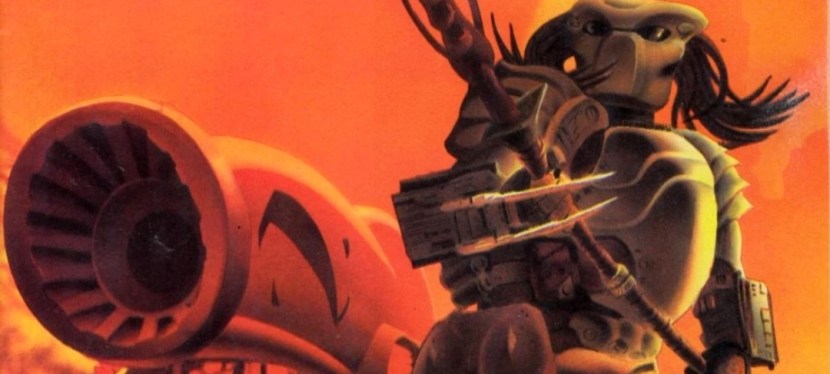
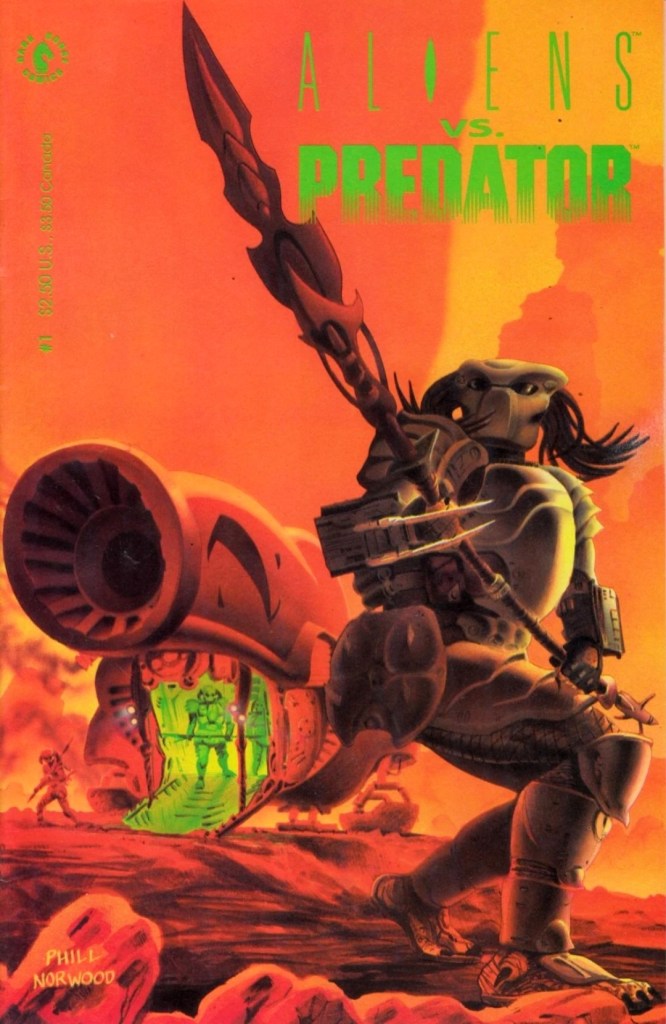
The cover.

Early story

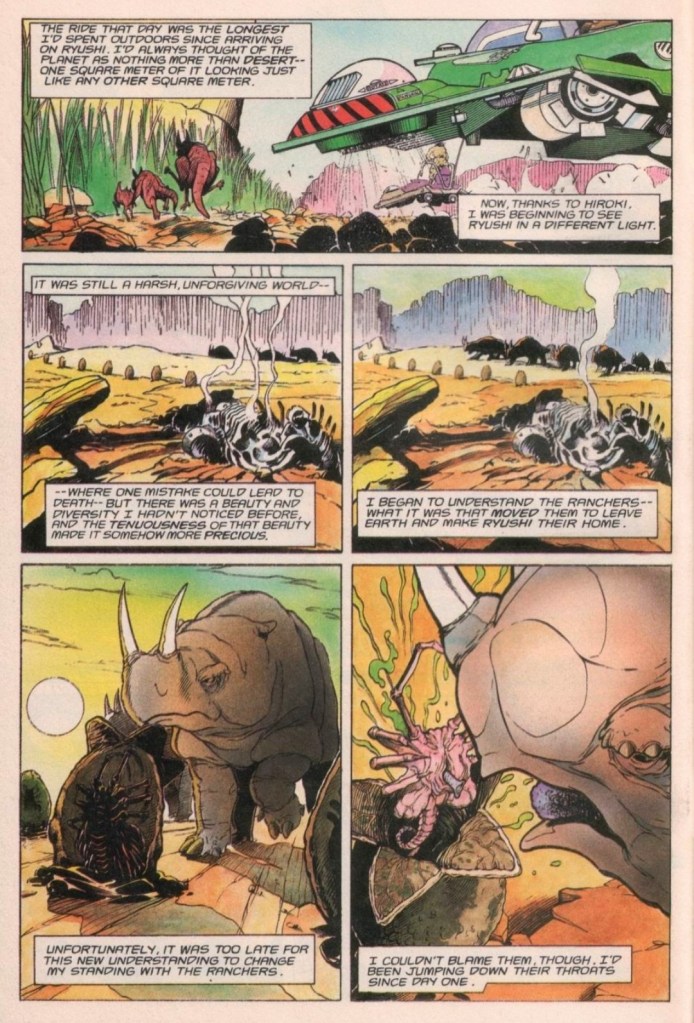
The story begins in space when a fast-moving ship enters the atmosphere of Ryushi, a planet at the edge of the Chigusa Corporation’s holdings in the Beta Cygni System. On the planet is Prosperity Wells, a human outpost with a population of one hundred fifteen composed of freelance ranchers, their families and a staff of corporate overseers.

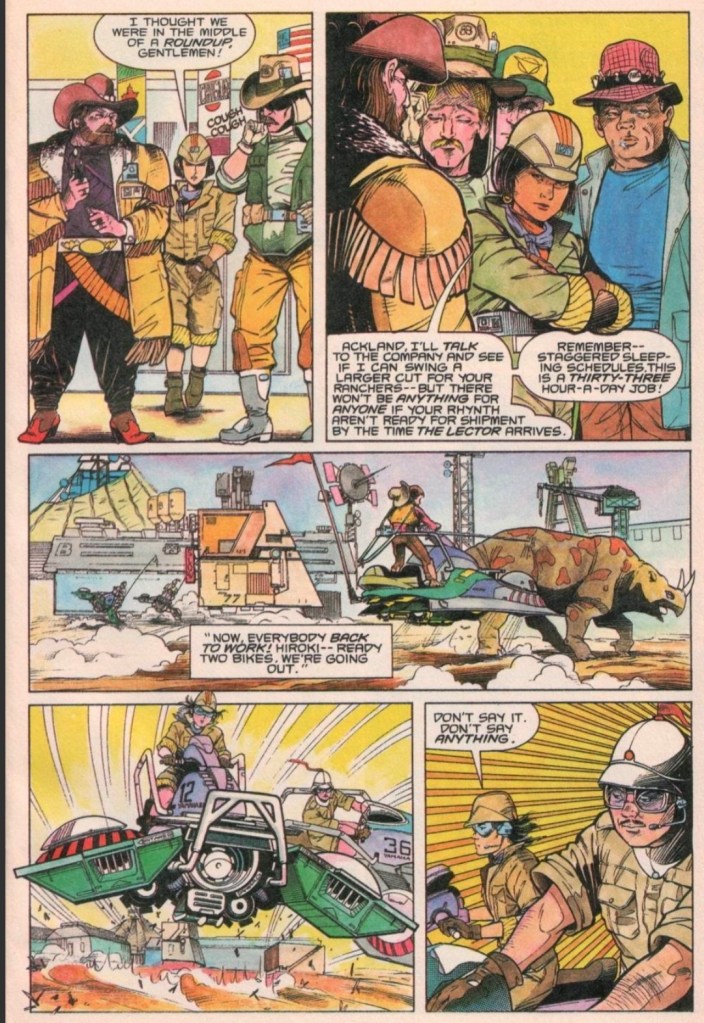
The ship’s presence gets detected by operators at Prosperity Wells and one of them speculated it to be a meteor that shows no signs of breaking up. Seeking Hiroki Shimura (no longer the head of the outpost), the operator instead contacts his replacement Machiko Noguchi and informs her about the perceived meteor. After talking with the operator, Noguchi tells her predecessor near her that even though she has been leading the outpost for nearly six months, people are still reporting to him as they treat her like a stranger. Shimura tells her that she’s been trying to adapt the job to her rather than adapting herself to it, and that she cannot just run an operation while hiding from it.

Meanwhile in the wilderness, a machine starts to climb out of the pit and starts releasing Alien eggs… 

Quality

Whenever there are Alien eggs, trouble is inevitable.

I can say that this comic book is essentially one long build-up that intends to execute the conflict between the Aliens (also referred to as the Xenomorphs) and Predators later. While the two galactic species are indeed here, the narrative is told mainly through the humans whose operations – ranching, business administration, outpost activities – are emphasized with heavy and precise details. The result here is that by the end of the comic book, you will be fully immersed with the sci-fi concept, the characters and the related developments which ultimately will prepare you for the inevitable Aliens-Predator conflict. To put it clearly, Stradley crafted a script that efficiently introduces the characters (note: Noguchi is the clear protagonist), emphasize what has been going on while also moving the story forward in a well-paced manner without compromising the details.

That being said, don’t expect the Aliens and Predators to fight each other immediately here. This is one big build-up as a whole and very notably, there is nothing boring and there were no useless scenes portrayed. Everything told and shown in this comic book made sense, and if you are the kind of person who likes paying close attention to details of the story as well as the gradual development of the key characters, you will find this one an engaging read. The narrative moved at a medium pace and cleverly the suspense happens whenever the creative team gradually build-ups the tension for the inevitable Aliens-Predators fight.

As with many other entertainment tales across varied media forms, this story has a critical portrayal of the corporation slightly emphasizing greed while making the contractors (technically the laborers) look disadvantaged. It is not a one-sided portrayal against corporatism, however, as there were moments showing the contractors relying on deception (note: disregarding quality and the safety of consumers who will soon consume the products from the ranching operation) just to achieve their goals.

More on the protagonist Machiko Noguchi, she is not the typical corporate figure for readers to hate. In fact, she is somewhat sympathetic as she is has yet to earn the respect of others even though she had been working as the head of the outpost for months. The grudge against her is subtle yet clear. The comic book also made clear that she is destined for something significant in the upcoming fight between the two galactic species.

The art by Phill Norwood is very good. While the characters have that comic book aesthetic, the Aliens and Predators are easily recognizable and were drawn with sufficient visual details. What I find weird is the creative team’s approach on applying color on the Predators. Norwood also has a really nice approach on illustrating futuristic stuff (examples: the technologies, office equipment, clothes of the characters) while also emphasizing the wilderness of Ryuchi.

Conclusion

Machiko Noguchi takes charge even though she is despised by many.

Aliens vs. Predator (1990) is one very detailed build-up type of comic book that happens to be pretty engaging to read and the set-up for the expected conflict between the two species worked nicely. By the time I reached the end of this tale, I got immersed into its concept, the situations and characters. The build-up also came out with really interesting parts here and there which made the reading experience a very good one. Right now, I am eager to read the next issue.

Overall, Aliens vs. Predator (1990) is highly recommended!

+++++

Thank you for reading. If you find this article engaging, please click the like button below, share this article to others and also please consider making a donation to support my publishing. If you are looking for a copywriter to create content for your special project or business, check out my services and my portfolio. Feel free to contact me with a private message. Also please feel free to visit my Facebook page Author Carlo Carrasco and follow me on Twitter at  @HavenorFantasy as well as on Tumblr at https://carlocarrasco.tumblr.com/ and on Instagram at https://www.instagram.com/authorcarlocarrasco