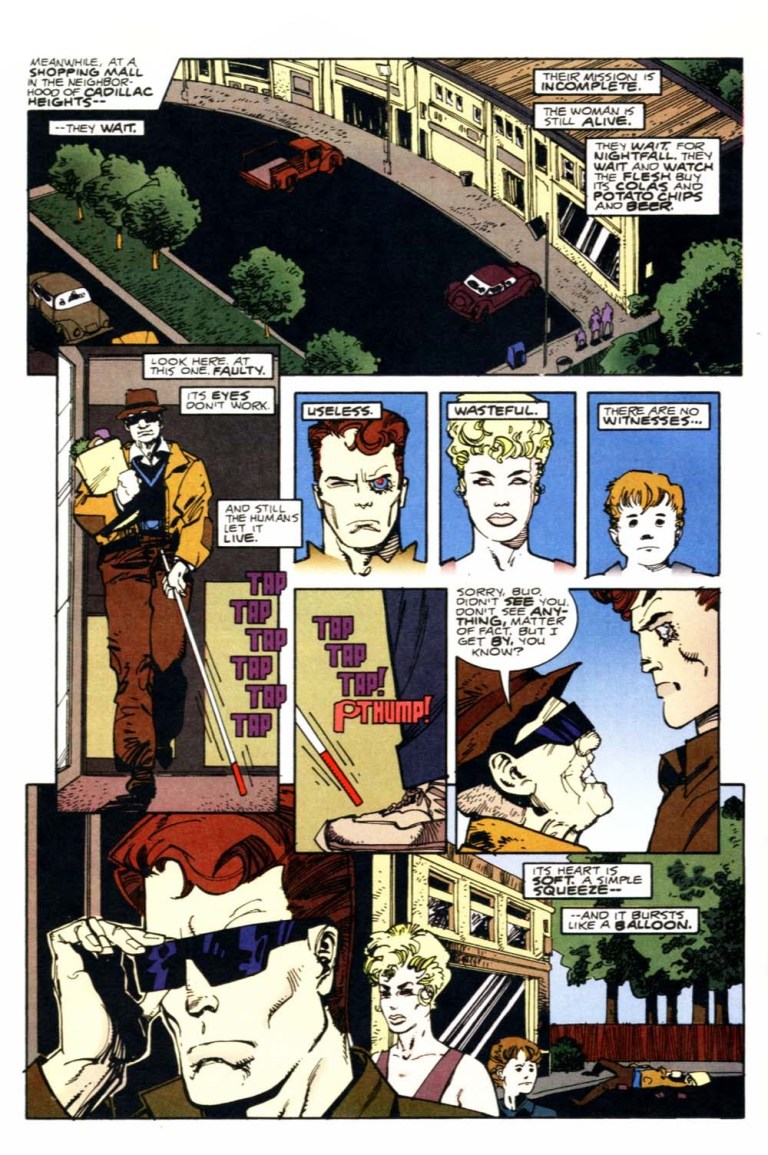
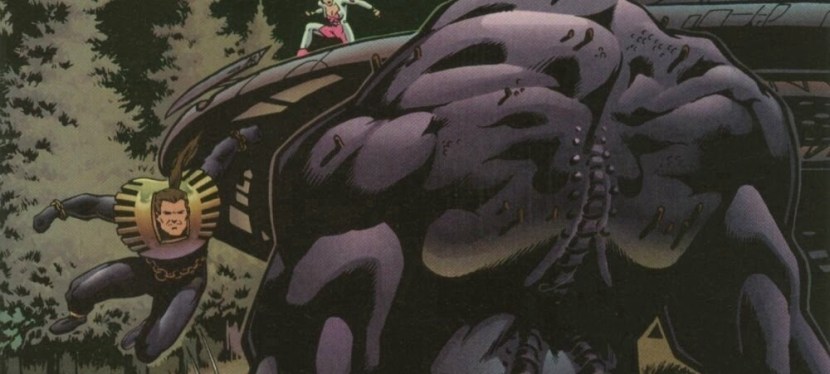
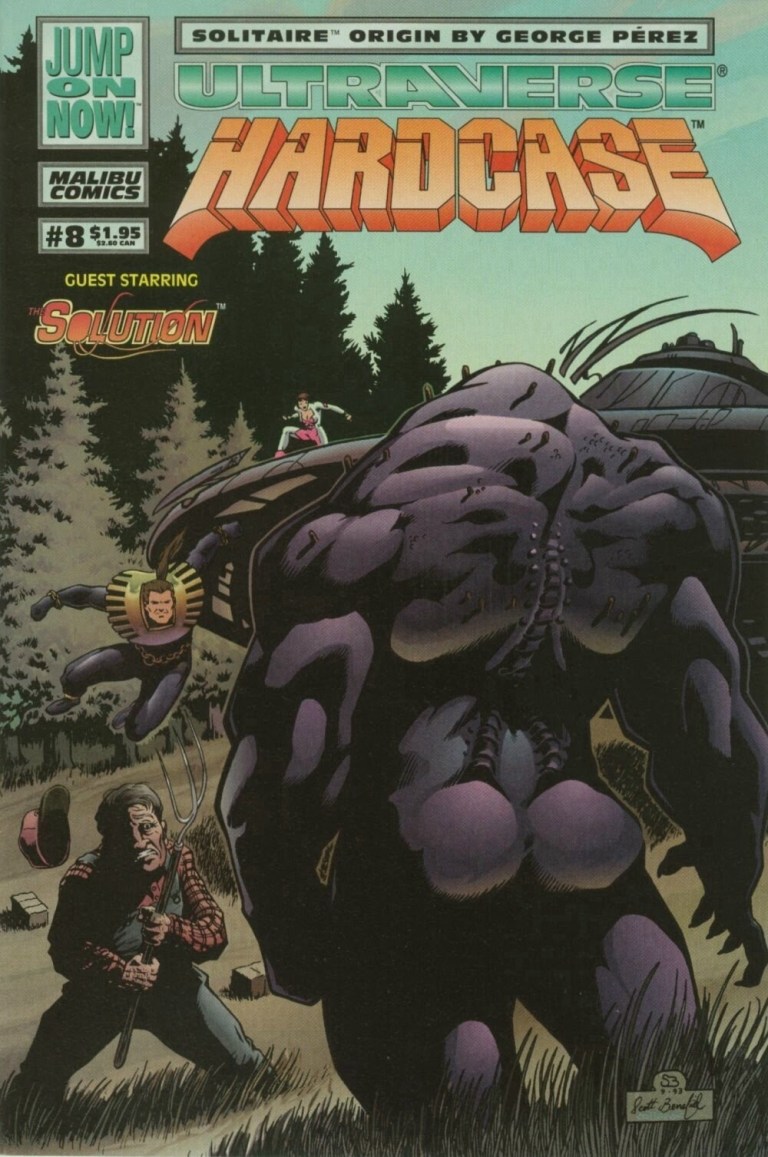
A Look Back at X-Men Adventures #14 (1993)

Disclaimer: This is my original work with details sourced from reading the comic book and doing personal research. Anyone who wants to use this article, in part or in whole, needs to secure first my permission and agree to cite me as the source and author. Let it be known that any unauthorized use of this article will constrain the author to pursue the remedies under R.A. No. 8293, the Revised Penal Code, and/or all applicable legal actions under the laws of the Philippines.

Last time I reviewed an issue of X-Men Adventures, it was the 13th issue which served as the first half of a two-part adaptation of the animated series’ adaptation of the literary X-Men classic storyline Days of Future Past. It was a compelling and fun comic book to read.

Then I saw the cover of X-Men Adventures which had a nicely drawn cover but instantly spoiled key elements of the 2nd part of the Days of Future Past adaptation. What does the comic book have left to show?

We can all find out in this look back at X-Men Adventures , published in 1993 by Marvel Comics with a story written by Ralph Macchio and drawn by Nick Napalitano.

Cover
The spoileriffic cover.

Early story

The story begins with Bishop (who came from the dark future on a mission to change events and prevent the darkness from taking over by aligning himself with the X-Men) attacks Gambit whom he identifies as the traitor responsible for the downfall of the X-Men and society. In response, Rogue, Jean Grey and Jubilee intervene to disrupt the conflict paving the way for Wolverine and Cyclops to restrain Bishop.

Bishop insists that everything will change for the worse if Gambit lives to fulfill his destiny: to kill a prominent politician who opposed mutants.

After some squabbling between the X-Men, the situation cools down and Professor X/Charles Xavier announces that he and some members will travel to Washington, D.C. where he will address the senate committee on mutant affairs…

Quality

2
Chaos in the headquarters of the X-Men!

In terms of writing, this comic book carries a lot of punch on its own. It’s a compelling read and like the animated series episode that served as its source, it took its time to build up tension before a twist or a scene of spectacle happens. As expected, it is not a scene-per-scene recreation compared with the animated episode and that’s just fine for me. I only wished the comic book creators retained the animated episode scene in which Bishop tells Wolverine that Gambit’s destined act was the Canadian’s fault, which led to Wolverine memorably saying: “I still can’t believe it.”

More importantly, the story offers readers a nice exploration about how the public and the Federal Government of the United States would react with mutants. To see US Senator Robert Kelly harshly question Professor X if his school functioned for pro-mutant propaganda is quite striking.

When it comes to the art, Napalitano’s work here is a drop in quality and style when compared to Andrew Wildman’s art. His art is not terrible and he exerted effort on translating the script into images but the work looks rushed. There were some weirdly drawn faces of Rogue, Xavier and Wolverine to name some. The action scenes meanwhile lacked punch.

Conclusion

3
The dark future of the X-Men and their society.

While X-Men Adventures served its purpose on completing the adaptation of Days of Future Past, it failed to deliver the great stuff even though the script was strong. The sub-par art of Napalitano really dragged the presentation down making the comic book end with a whimper.

If you are seriously planning to buy an existing hard copy of X-Men Adventures , be aware that as of this writing, MileHighComics.com shows that the near-mint copy of the regular edition costs $6 while the near-mint copy of the newsstand edition costs $21.

Overall, X-Men Adventures (1993) is satisfactory.


Thank you for reading. If you find this article engaging, please click the like button below and also please consider sharing this article to others. If you are looking for a copywriter to create content for your special project or business, check out my services and my portfolio. Feel free to contact me as well. Also please feel free to visit my Facebook page Author Carlo Carrasco and follow me at HavenorFantasy@twitter.com

A Look Back at Prototype #2 (1993)

Disclaimer: This is my original work with details sourced from reading the comic book and doing personal research. Anyone who wants to use this article, in part or in whole, needs to secure first my permission and agree to cite me as the source and author. Let it be known that any unauthorized use of this article will constrain the author to pursue the remedies under R.A. No. 8293, the Revised Penal Code, and/or all applicable legal actions under the laws of the Philippines.

Over a year ago, I reviewed Prototype #1 and published other Ultraverse comic book reviews that had the armored superhero involved. In recent times, I reviewed Prototype #5 since that comic book was the first of a 2-part crossover between Prototype and The Strangers. Since I already reviewed Prototype #0 to get a good look at the origin of the armored superhero (composed of two different pilots or users working for a corporation), it’s time to go back to one of the early issues of Prototype to discover more of the ultra-hero.

This is my look back at Prototype , published in 1993 by Malibu Comics with a story co-written by Len Strazewski and Tom Mason, and drawn by David Ammerman.

Cover
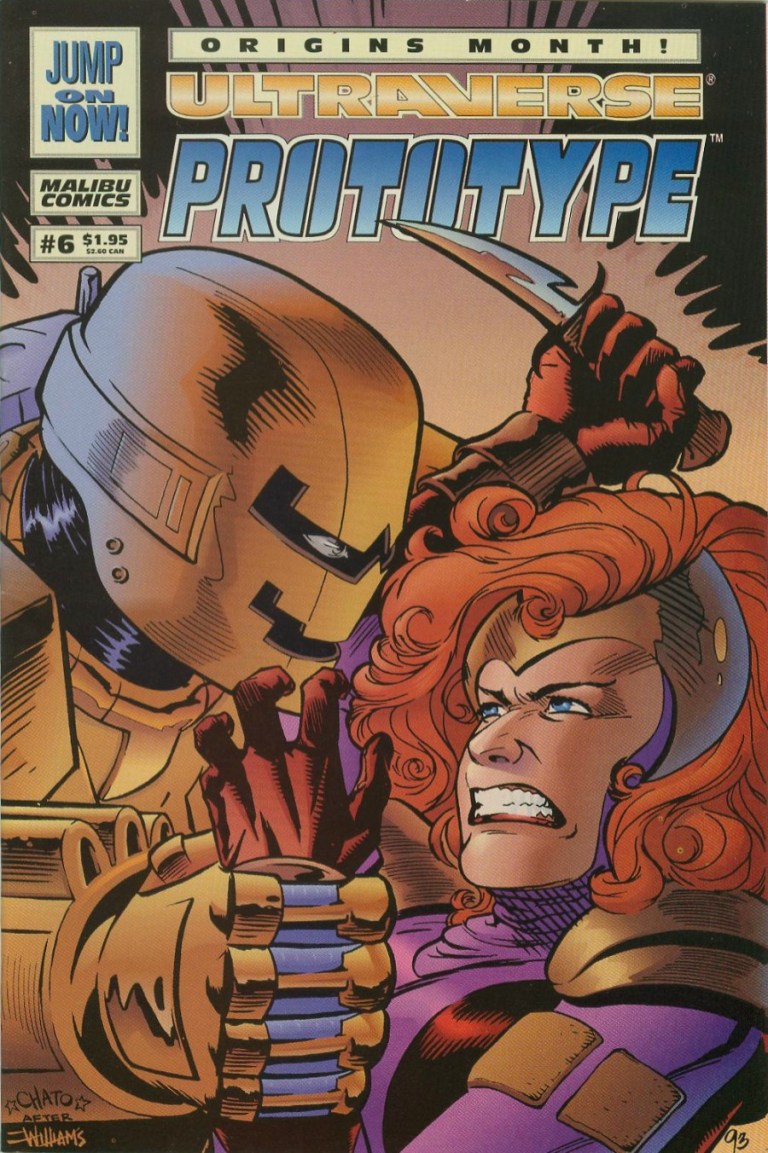
The cover.

Early story


The story begins with Prototype (piloted by Jim Ruiz) battling with mechanized opponents as he tries to achieve something. It turns out, the entire encounter was a virtual reality training mission which ended after Jim overloaded his armor’s circuits during the heat of training.

While taking off his armor, Jim discusses some matters with his assistant. He recalls his hard battle with an over-sized, muscular opponent whom he noticed to be communicating with someone. The opponent died which gave the public the false impression that Prototype killed him.

Meanwhile over the headquarters of Ultratech, Marjorie listens to Stanley ranting about the negative press their company got recently. As soon as Stanley calms down, Marjorie noticed that Jim was in trouble according to tech read-outs. They analyzed the risk they are taking with Jim being the Prototype pilot as they make sure nobody would learn that there is more than one active Prototype in their company. Marjorie states that she has taken the initiative and assigned someone to take care of Bob Campbell (the other Prototype pilot)…

Quality

5
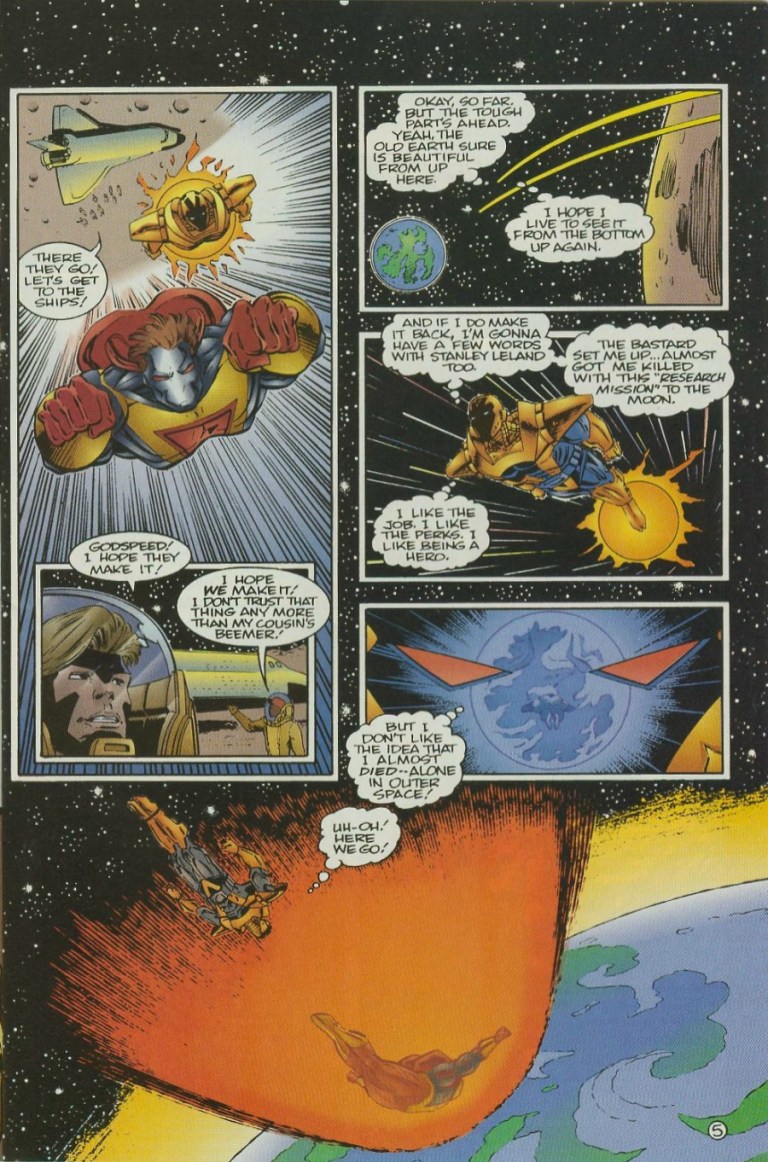
Jim Ruiz is already struggling with the stress of piloting Prototype.

In terms of storytelling, this comic book is quite gripping as it deals with elements of corporate politics, heroism and even horror. Without spoiling too much, I should say that the battle near the end of the story brought back memories of the 1984 movie The Terminator which itself combined elements of horror, film noir and sci-fi. There was not much room for character development but that was no problem considering the strong storytelling. For his part, David Ammerman’s drawings were nice and detailed to look at, especially when the story focused more on Bob Campbell.

Conclusion

2
The money shot of the comic book!

No doubt about it. Prototype is a very good and entertaining comic book to read. It successfully told two tales (one on Jim and the other on Bob) and cleverly mixed genre elements to deliver solid storytelling. Not only that, this comic book marks one of the early connections between Prototype and Prime as the story took place after the events told in Prime .

If you are seriously planning to buy an existing hard copy of Prototype , be aware that as of this writing, MileHighComics.com shows that the near-mint copy costs $4.

Overall, Prototype (1993) is recommended.


Thank you for reading. If you find this article engaging, please click the like button below and also please consider sharing this article to others. If you are looking for a copywriter to create content for your special project or business, check out my services and my portfolio. Feel free to contact me as well. Also please feel free to visit my Facebook page Author Carlo Carrasco and follow me at HavenorFantasy@twitter.com

A Look Back at Prime #4 (1993)

Disclaimer: This is my original work with details sourced from reading the comic book and doing personal research. Anyone who wants to use this article, in part or in whole, needs to secure first my permission and agree to cite me as the source and author. Let it be known that any unauthorized use of this article will constrain the author to pursue the remedies under R.A. No. 8293, the Revised Penal Code, and/or all applicable legal actions under the laws of the Philippines.

When it comes to notable rivalries between superheroes within the Ultraverse, the Prime-Prototype conflict comes to mind. Granted, the two became teammates in the UltraForce monthly series that launched in 1994 but before that happened, their conflict was intriguing and intense to see.

Let’s examine the beginning of the rivalry between Prototype and Prime in Prime , published in 1993 by Malibu Comics with a story co-written by Len Strazewski and Gerard Jones, and drawn by the late Norm Breyfogle.

Cover
The cover.

Early story

The story begins with Prototype blasting Prime right on his head saying: “I’m telling you again—Hardcase ain’t here! This is Prototype turf and you are making me look bad!”

Out of impulse, Prime (who is teenager Kevin Greene inside the body) strikes back at Prototype pushing him back into the air. Prime describes himself as a real hero and called Prototype a phony of Hollywood.

As the tension increases between them, Prototype fires back at Prime who subsequently responds by punching him hard. The battle goes on.

Meanwhile at another location, Boneyard emerges from a portal carrying an unconscious Mantra with him…

Quality

19
This is compelling character development.

Strong writing and very impressive works of art in this comic book! There is no doubt about that. The writers really poured a lot of energy into the very action-packed conflict between Prime and his armored rival. The conflict is not limited to superhero violence between the two as the writers cleverly crafted a big battle of personalities between an impulsive and clueless teenager (Prime) and a corporate performer (Prototype). In order to grasp that concept, one must read at least the launch issues of the Prototype and Prime series.

Along the way, the writers still managed to conserve a good amount of creative energy to further develop Kevin Greene in his civilian life. I really enjoyed how the creators portrayed him to be a very troubled youth whose struggle with social life has gotten worse as he also struggled with keeping a superhero identity and doing what he believes are good deeds (helping people in trouble) even though he got reckless or clumsy. This is reflected nicely with the ways he tries to socialize with Kelly. Apart from that, the scenes showing Kevin with his father are very intriguing to follow.

The artwork here by Breyfogle is unsurprisingly great. As seen in the previous issues of Prime, the superhero action is dynamic to look at, Kevin and the supporting characters have very well defined looks and by this time, I find them instantly recognizable. As for his visual take on Prototype, I really like Breyfogle’s illustration in this issue.

Conclusion

2
A very dynamic shot of Prime striking Prototype away.

Prime is a great Ultraverse comic book highlighted by the first conflict between Prime and Prototype which is very compelling and at the same time memorable. It’s like seeing two titans of the Ultraverse collide complete with dramatizing how other people got affected by them. As far as the Ultraverse is concerned, the rivalry between the armored ultra and the kid-in-a-man’s-body is solid gold.

If you are seriously planning to buy an existing hard copy of Prime (1993), be aware that as of this writing, MileHighComics.com shows that the near-mint copy of the unbagged regular edition, the bagged regular edition, the unbagged newsstand edition and the bagged newsstand edition costs $4, $5, $6 and $7 respectively.

Overall, Prime (1993) is highly recommended!


Thank you for reading. If you find this article engaging, please click the like button below and also please consider sharing this article to others. If you are looking for a copywriter to create content for your special project or business, check out my services and my portfolio. Feel free to contact me as well. Also please feel free to visit my Facebook page Author Carlo Carrasco and follow me at HavenorFantasy@twitter.com

A Look Back at Hardcase #7

Disclaimer: This is my original work with details sourced from reading the comic book and doing personal research. Anyone who wants to use this article, in part or in whole, needs to secure first my permission and agree to cite me as the source and author. Let it be known that any unauthorized use of this article will constrain the author to pursue the remedies under R.A. No. 8293, the Revised Penal Code, and/or all applicable legal actions under the laws of the Philippines.

Hey Ultraverse fans! Are you ready for another bout of new discoveries in the Ultraverse through Hardcase, the superhero of Hollywood trying to do good.

Let’s all take a look back at Hardcase , published in 1993 by Malibu Comics with a story written by James Hudnall and drawn by Scott Benefiel. The comic book was part of the Break-Thru crossover.

Cover
The cover.

Early story

The story begins on a city street when two guys tried to force two people out of the car they were riding. Suddenly Hardcase and Choice arrive surprising them and making short work out of the bad guys. The two victims who got saved could only be impressed by Hardcase and Choice as they watch them fly away.

At his office, Hardcase formally introduces Choice to his secretary Celia Brady, his agent Sol Gernstein and his lawyer John Riley. Together they meet to discuss how to free Choice from the clutches of the Choice Corporation.

Elsewhere, a mechanized menace slowly makes its move and kills a racoon in cold blood. It pulls the dead animal to itself and assimilates with it…

Quality

5
Choice meets Hardcase’s trusted people.

Hardcase is another compelling story about Hardcase’s search for answers and the connection with the Break-Thru crossover is a factor that works nicely. With in-depth writing by James Hudnall, this comic book not only expands the realm of the Ultraverse but also links nicely with the events of The Strangers #1 and Hardcase’s past. As the story builds up for Break-Thru, it also introduces readers to a key sinister figure of the Ultraverse. Lastly, I should say that James Hudnall pulled off a lot intriguing moments and how the story ended surprised me pleasantly.

When it comes to the art quality, Scott Benefiel’s work is solid. I also like his visual take on a certain superhero team that suddenly appeared in this comic book. Which team is that? You’ll have to find out.

Conclusion

3
Superhero action nicely drawn.

This is yet another very engaging story of Hardcase. Thanks to the works of the creative team, Hardcase literally did not pull back its punches when it comes to surprising me as I followed Hardcase on his efforts to solve mysteries. This is definitely not your typical superhero-saves-the-day story.

If you are seriously planning to buy an existing hard copy of Hardcase , be aware that as of this writing, MileHighComics.com shows that the near-mint copy of the regular edition costs $4 while the near-mint copy of the newsstand edition costs $11.

Overall, Hardcase is highly recommended!


Thank you for reading. If you find this article engaging, please click the like button below and also please consider sharing this article to others. If you are looking for a copywriter to create content for your special project or business, check out my services and my portfolio. Feel free to contact me as well. Also please feel free to visit my Facebook page Author Carlo Carrasco and follow me at HavenorFantasy@twitter.com

A Look Back at Robin III #3

Disclaimer: This is my original work with details sourced from reading the comic book and doing personal research. Anyone who wants to use this article, in part or in whole, needs to secure first my permission and agree to cite me as the source and author. Let it be known that any unauthorized use of this article will constrain the author to pursue the remedies under R.A. No. 8293, the Revised Penal Code, and/or all applicable legal actions under the laws of the Philippines.

Before I start this retro comic book review of Robin III , let me explain that the illustrator of the comic book, Tom Lyle, passed away last November over health-related reasons. Before dying, he had a surgery in October 2019 to remove a blood clot in his brain and subsequently fell into a coma. Apart from drawing comics, Tom Lyle was a professor of art at Georgia’s Savannah College of Art and Design (SCAD). For a look at Lyle’s expertise, watch the video from 2017 below.

When it comes to the comic book industry, Lyle started his career with AC Comics and Eclipse Comics back in the 1980s. In 1988, he worked on the art of Starman for DC Comics and went on to work on the company’s other properties and played a major role with the publishing of the three mini-series featuring Batman’s sidekick Robin (Tim Drake specifically).

After leaving DC Comics, he joined Marvel Comics as one of their illustrators on the Spider-Man monthly series. He quickly got involved in the Maximum Carnage crossover and made bigger waves with Spider-Man readers with the Clone Saga. Lyle is widely credited for designing the Scarlet Spider. With regards to his death, Marvel Comics published online a tribute for him.

Now that the short history lesson is over, let’s take a look back at Robin III published by DC Comics in 1993 with a story by Chuck Dixon and art by Tom Lyle.

Cover
The cover.

Early story

The story begins in school where Tim Drake/Robin gets confronted by his superior who noticed the bruises he got. As Tim tries to keep his secrets, the superior Ms. Hollingsworth knows that he was cared for by Bruce Wayne (Batman) while his father was in a coma. She also knows that he lives on a property bordering the estate of Wayne. She makes clear that he can speak openly to her and Tim simply denies that Bruce would never hit him. He states: “An upperclassman…a senior…I think…big kid.”

Eventually the meeting ended and Tim leaves struggling over thinking about the complications he is experiencing with his double life as a student and as a crime fighter. Since he cannot get involved with Batman and Alfred, he spends some time with Harold (who was so busy working on a machine) and eventually goes home. His father notices Tim’s bruises and states that he spends too much time at Wayne’s. This leaves Tim more conflicted within.

Elsewhere, a muscular man called Sir Edmund easily beats up his loyal followers in a bout of combat. His assistant Lynx arrives and informs him that their turf is in danger with the arrival of Russians with KGBeast involved.

In the evening, Robin meets the Huntress and start their next mission…

Quality

13
Hard action with a smooth flow of sequence by Tom Lyle.

For a story set within the realm of Batman and, at the same time, does not have Batman at all, this Robin-centered comic book is well written and engaging. To say the least, showing Tim Drake struggling with his civilian life and crime-fighting life made Robin a literary symbol about the false maturity that youth in real life often experience. That false maturity is nicely portrayed with the superhero aesthetics and fantasy elements.

Quite predictably, Robin performs detective work and analyzes crime situations like Batman only this time, he gets involved with the Huntress (note: this mini-series carries the storyline title of “Cry of the Huntress”) to find out more answers and solve the crime problem. Being a product of the early 1990s, it is no surprise that the story has fictional portrayals about the Russians (with KGBeast leading the so-called invasion of the city) and even mentioning Afghans.

14
Hurting Robin on the head led to hard reactions.

Apart from the storytelling, the art by Tom Lyle here remains good to look at. Each scene, whether is it a talking scene or an action scene, looks good and Lyle has a nice touch on drawing facial expressions. When it comes to the spectacle, Lyle really shows how good he is with drawing hard-hitting physical action. I should also state how smooth the sequencing of action is drawn by him.

Conclusion

16
Robin and the Huntress make an odd crime-fighting duo.

To make things clear, Robin III is the first-ever Tom Lyle-drawn comic book I ever bought and read. By today’s standards, the comic book is still fun to read and it is compelling enough to make readers interested to read more of the mini-series. However, if seeing more of Robin fighting crime by himself is your type of Robin story, then this may not be compelling for you.

If you are seriously planning to buy an existing hard copy of Robin III , be aware that as of this writing, MileHighComics.com shows that the near-mint copy of the regular edition and the newsstand edition of the direct version costs $4 and $6 respectively. Meanwhile, the near-mint copy of the bagged edition and the unbagged edition of the deluxe version costs $4. To be clear, the deluxe version of Robin III in bagged form comes with a moving cover, a second reversible cover and additional artwork.

Overall, Robin III is recommended.


Thank you for reading. If you find this article engaging, please click the like button below and also please consider sharing this article to others. If you are looking for a copywriter to create content for your special project or business, check out my services and my portfolio. Feel free to contact me as well. Also please feel free to visit my Facebook page Author Carlo Carrasco and follow me at HavenorFantasy@twitter.com

A Look Back at The Strangers #7 (1993)

Disclaimer: This is my original work with details sourced from reading the comic book and doing personal research. Anyone who wants to use this article, in part or in whole, needs to secure first my permission and agree to cite me as the source and author. Let it be known that any unauthorized use of this article will constrain the author to pursue the remedies under R.A. No. 8293, the Revised Penal Code, and/or all applicable legal actions under the laws of the Philippines.

In a previous review, Prototype #5 served mainly as a build-up leading to the crossover between the armored superhero and The Strangers. While that comic book had a cover that looked suggestive, Prototype and the group did not appear together until the final page.

The payoff for the crossover happens to be in The Strangers .

Will the crossover be worth it? Find in this look back at The Strangers , published in 1993 by Malibu Comics with a story written by Steve Englehart (shared plot credit with Tom Mason and Len Strazewski) and drawn by Rick Hoberg. This comic book is part of the Break-Thru crossover.

Cover
The cover.

Early story

Picking up where Prototype ended, the story begins inside the space station wherein The Strangers encounter large, ugly monsters just as Prototype and his two companions – Empire 7 from Vietnam and Supra from the Baltic States – arrive. Equipped with high technology, Prototype proceeds to help the Strangers surprising them as a result.

After some struggle, Prototype, the Strangers plus Empire 7 and Supra start talking about what has been going on. As far as the Strangers are concerned, they need to know why they got their powers which explains why the needed J.D. Hunt’s rocket to reach space. Supra explains that she, Empire 7 and Prototype were sent to reclaim Hunt’s rocket.

After Prototype insists on reclaiming the rocket, Grenade strikes him which leads to Yrial to using her magic on him. The armored hero reacts by bodily attacking Yrial and damaging the wall behind her leading to outer space…

Quality

22
A nice scene between Prototype and two of the Strangers.

As this comic book was wonderfully written, I do confirm that the payoff for the build-up leading to the crossover between Prototype and The Strangers was undeniably worth it! There is a lot of richness in the script and I really enjoyed the interactions between the Strangers and the armored ultra.

I should state that the plot was structured to have the heroes together for initial interaction, have a few of them separated temporarily, bring them back together for unity and separate them into small groups as they search for answers.

In between, there is a lot of character interaction and development. These are the elements that defined this comic book and by the time I reached the end, I managed to grasp how the connection (as well as the level of trust) between Prototype and the Strangers turned out. Along the way, there were a few sub-plots and even some exposition on the in-universe history of ultras (emphasized by Empire 7). There were also some action scenes to balance things out with the characterization.

With no surprise, the art by Rick Hoberg here is great. I should state that his art on Prototype made the character look recognizable. More importantly, Hoberg drew the characters, the monsters and the environments with a good amount of detail. This is hard work that nicely paid off!

Conclusion

2
The first interaction between Prototype and the Strangers.

I really enjoyed The Strangers and it definitely paid off nicely after the build-up to the crossover established in Prototype . If I were to make comparisons, the crossover here is just as good as the Hardcase-Strangers crossover. I should also state there is a good amount of fun here.

If you are seriously planning to buy an existing hard copy of The Strangers (1993), be aware that as of this writing, MileHighComics.com shows that the near-mint copy of the regular edition costs $4 while the near-mint copy of the newsstand edition is priced at $8.

Overall, The Strangers (1993) is highly recommended!


Thank you for reading. If you find this article engaging, please click the like button below and also please consider sharing this article to others. If you are looking for a copywriter to create content for your special project or business, check out my services and my portfolio. Feel free to contact me as well. Also please feel free to visit my Facebook page Author Carlo Carrasco and follow me at HavenorFantasy@twitter.com

A Look Back at Hardcase #6

Disclaimer: This is my original work with details sourced from reading the comic book and doing personal research. Anyone who wants to use this article, in part or in whole, needs to secure first my permission and agree to cite me as the source and author. Let it be known that any unauthorized use of this article will constrain the author to pursue the remedies under R.A. No. 8293, the Revised Penal Code, and/or all applicable legal actions under the laws of the Philippines.

Previously, I admired Hardcase #5 for its nice mix of suspense, intrigue and mystery as the series emphasized its lead character who in turn had to accompany Choice (who herself was under the control of a certain corporation).

Will the high engagement continue? Find out as we take a look back at the Ultraverse comic book Hardcase , published in 1993 by Malibu Comics with a story written by James Hudnall and drawn by Scott Benefiel.

Cover
The cover.

Early story

The story begins immediately after the end of issue with Tom Hawke/Hardcase down on the ground. As Choice comes to him, Hardwire (the guy who attacked Hardcase) moves in from behind. As he is about strike her, Hardcase’s soul warns Choice to activate her shield. Hardwire strikes her but got hurt as a result of the protective shield. Even as Hardwire tells her he has not orders to kill her, Choice fires her force beams to hit a structure just behind him then grabs Hardcase to fly away to safety.

As they fly away towards the nearest hospital, Hardcase finds himself in the spiritual realm and encounters Linda.

Meanwhile, Hardwire contacts Sandra Trent by phone. Considering the current situation, Sandra tells him that they will have to get Hardcase later and she has another hit job for him…

Quality

7
Sandra Trent and Hardwire.

With regards to storytelling, this comic book is loaded with twists mixed with some intrigue and action. The dialogue is also well crafted. Speaking of intrigue, there are key details and characters revealed here that serve as a solid build-up for the Break-Thru crossover of the Ultraverse of late-1993. If there is anything lacking here, it’s character development which is understandable since there was emphasis on building up not only Break-Thru but also other mysterious aspects of the Ultraverse as a whole.

Scott Benefiel did a fine job with the art. I really like the way he draws facial expressions (especially on Hardcase and Choice) while maintaining pace with the script and making the few action scenes here look pretty dynamic.

Conclusion

2
Hardwire, Choice and Hardcase.

Hardcase is another solid comic book to read. What it lacks in character development, it bounced back a lot with build-up, mystery and intrigue. That being said, before reading the Break-Thru crossover comic books, it is important to read this comic book first.

If you are seriously planning to buy an existing hard copy of Hardcase , be aware that as of this writing, MileHighComics.com shows that the near-mint copy of the regular edition costs $4 while the near-mint copy of the newsstand edition costs $7.

Overall, Hardcase is recommended.


Thank you for reading. If you find this article engaging, please click the like button below and also please consider sharing this article to others. If you are looking for a copywriter to create content for your special project or business, check out my services and my portfolio. Feel free to contact me as well. Also please feel free to visit my Facebook page Author Carlo Carrasco and follow me at HavenorFantasy@twitter.com


A Look Back at Wonder Woman #1 (1987)

Disclaimer: This is my original work with details sourced from reading the comic book and doing personal research. Anyone who wants to use this article, in part or in whole, needs to secure first my permission and agree to cite me as the source and author. Let it be known that any unauthorized use of this article will constrain the author to pursue the remedies under R.A. No. 8293, the Revised Penal Code, and/or all applicable legal actions under the laws of the Philippines.

Hey Wonder Woman and superhero fans! By now, many of you are aware that I wrote and published several retro comic book reviews about the Post-Crisis Wonder Woman specifically the comic books that involved the legendary George Perez, Greg Potter and the late Len Wein. For today, I’ll be reviewing Wonder Woman (1987), the landmark comic book that marked the start of what was back then the new age of greatness of Wonder Woman, the Queen of all Superheroes!

Before starting my review, let’s take a short look back at the publishing history with the online research I did.

In the mid-1980s, DC Comics published the maxi-series Crisis on Infinite Earths to not only celebrate their 50th anniversary but also to conclude what was the original multi-verse (multiple universes) of the publisher. Written by Marv Wolfman and drawn by George Perez, Crisis on Infinte Earths became critically acclaimed and a major seller as the saga saw the deaths of hundreds of characters, destruction of worlds and ultimately paved the way for DC Comics to reboot their superhero universe entirely.

And then the post-Crisis era of DC Comics happened. After Superman and Batman were successfully reintroduced, the Queen of all Superheroes herself – Wonder Woman – was up for a relaunch.

While detailed descriptions about what happened behind the scenes at DC Comics regarding the Wonder Woman reboot have been published, writer Greg Potter himself made some clarifications to set the record straight. For all of you readers and Wonder Woman fans, posted below is Potter’s clarification published with his permission.


The ideas for the rebooted Wonder Woman did not start with brainstorming between Janice Race and me. Having recently finished my Jemm Son of Saturn series, I was approached at a comic con in Chicago by Dick Giordano. He asked if I would like to submit a proposal for a rebooted Wonder Woman series. I sent him my ideas and he approved them. Dick then assigned Janice to the book (she had been my editor on Jemm) and I began writing the script for issue number one. It was after that that George walked into Janice’s office and offered his services as illustrator with a proviso that he also had a hand in plotting the stories.

Janice accepted and George and I subsequently met in her office to discuss our working relationship going forward. George and I agreed that the focus of the character would be her identity as an Amazon who’d lived in the Ancient Greek tradition and knew little about the outside world. I knew a great deal about Greek mythology but George knew even more. He supplied me with a book on the Greek gods that was extremely helpful in writing the first book. I in turn supplied him with many photos of Boston (I once had lived there) which he used in his artwork to make the backgrounds authentic.

It was a wonderful collaboration and made for a great introduction to the new Diana.


Eventually George Perez got involved in the creative process at DC. The famed illustrator and Potter worked closely on reintroducing Wonder Woman with an established identity and a rich cultural background. Indeed, something special transpired before the first issue got published.

“That was the background of the Wonder Woman character, which I felt was also the thing that made her unique as a character, and I thought that it had been downplayed in order to make her more of a standard superhero,” Perez stated.

Perez and Potter were co-writers. Perez himself conducted research on mythology which served as the foundation of the fantasy element of the planed post-Crisis Wonder Woman monthly series. This involved portrayals of deities of Olympus whose acts affect the Amazons living in the flesh. Apart from the fantasy and mythology, Perez implemented some key elements (specifically involving feminism and humanism) thanks to his discussion with Wonder Woman editor Karen Berger.

“A lot of research went into this first issue, and my bookshelves are full of reference material on mythology, Greek hairstyles, armor, clothing and even attitudes of the time. Some compromises were made where different references contradicted each other, but no decision was made without thought. We all have fallen in love with this project and want everyone to share in our excitement,” Perez wrote in the introduction in Wonder Woman (1987).

Now that the history lesson is over, we can now all take a look back at Wonder Woman , published in 1987 by DC Comics with a story co-written by Greg Potter and George Perez. The art was done by Perez supported by the ink work of Bruce Patterson.

Cover
A very magnificent looking cover by George Perez.

Early story

The story begins in the distant past of 30,000 B.C. Inside a cave, a man hits a pregnant woman’s head with his club instantly killing her and the unborn child.

In 1,200 B.C. at Mount Olympus, the god of war Ares tells his father Zeus (with the presence of other deities watching) that if Olympus truly desires to own the hearts of men and gain power, they should let him descend upon mortals. Ares views the mortals as weak and stressed that he could crush them all into eternal submission.

But Artemis (Ares’ half-sister), whose plan to create a new race of mortals on Earth was vehemently opposed by the god of war, responded by stressing that violence will make men fear them and not follow them. She stressed that the intention behind the plan was to set an example by showing man and woman’s true place with each other. The new race of mortals was planned to be female. Zeus, who is aware of the plan, leaves and tells the others to settle the plan among themselves. For his part, Ares leaves Olympus laughing.

With the many souls stuck in limbo for generations available to them, the deities Aphrodite, Artemis, Athena, Hestia and Demeter create the Amazons who appeared with adult bodies. The first to come out among them all was Hippolyte, the mother of Diana/Wonder Woman. In the presence of the many Amazons, Hippolyte was declared queen by the deities…

Quality

27
Diana was the only child to grow up with the Amazons.

When it comes to quality of storytelling, art, characterization and spectacle, Wonder Woman is unquestionably an excellent comic book even by today’s standards! For the story, Greg Potter and George Perez crafted an epic fantasy tale retelling the origin of not only Wonder Woman but also of the Amazons complete with a very inspired portrayal of the deities of Olympus who actions and decisions affect the mortals. I should mention here that the portrayal of the mother-and-daughter relationship between Queen Hippolyte and Princess Diana really was compelling to see. Not only that, there were also elements of gender conflict, intrigue and worship portrayed.

It is clear that Perez really studied mythology and Greek culture to create a story that is still believable when it comes to emphasizing Wonder Woman for what was back then the modern readers of 1987 from the superhero geeks to long-time Wonder Woman fans and to girls and women in general. More than that, this story is timeless and clearly it is an illustrated literature classic on its own right.

24
This is how the Amazons built their society in Themyscira.

The comic book has over thirty pages of story and art, with the pace ranging from medium to fast. As such, it managed to completely tell the stories of the Amazons and Princess Diana in just one comic book. By the time I finished this comic book, I got enlightened about the background of the Amazons and Wonder Woman herself.

When it comes to the art, each and every page of Wonder Woman is very beautifully drawn by George Perez. His research on Greek culture and mythology is nicely reflected in his drawings. Just look at how he visualizes Olympus, the armor worn by soldiers, the clothes, the hairstyles, the coliseum, the architecture and more complete with a good amount of details visualized. The final page Perez drew remains very stunning, inspiring and heroic!

Conclusion

5
The deities of Olympus.

There is no doubt in my mind that Wonder Woman of 1987 is truly one of the greatest superhero comic books ever published. The creative team succeeded in not only reintroducing Wonder Woman, her people and their part in the post-Crisis DC Comics universe, they also succeeded in modernizing them as well as dramatizing their origins altogether within the 32 pages of this comic book.

While it is a fact that a lot of people nowadays are highly familiar with the cinematic Wonder Woman (memorably played by Gal Gadot), for me the post-Crisis version of the Queen of Superheroes remains the definitive version and I can only wish that director Patty Jenkins would adapt more elements from this. It should be noted that this particular rebooted Wonder Woman is believable and can be taken more seriously among all superheroes.

If you are seriously planning to buy an existing hard copy of Wonder Woman (1987), be aware that as of this writing, MileHighComics.com shows that the near-mint copy of the regular edition costs $51. The near-mint copies of the newsstand edition and the edition without a month printed cost$102 and $153 respectively.

Overall, Wonder Woman (1987) is highly recommended! 


Thank you for reading. If you find this article engaging, please click the like button below and also please consider sharing this article to others. If you are looking for a copywriter to create content for your special project or business, check out my services and my portfolio. Feel free to contact me as well. Also please feel free to visit my Facebook page Author Carlo Carrasco and follow me at HavenorFantasy@twitter.com
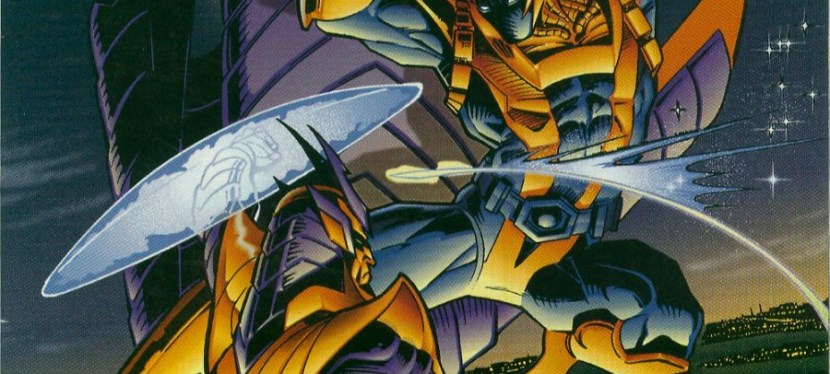
A Look Back at Spider-Man 2099 #37 (1995)

Disclaimer: This is my original work with details sourced from reading the comic book and doing personal research. Anyone who wants to use this article, in part or in whole, needs to secure first my permission and agree to cite me as the source and author. Let it be known that any unauthorized use of this article will constrain the author to pursue the remedies under R.A. No. 8293, the Revised Penal Code, and/or all applicable legal actions under the laws of the Philippines.

If you’re looking for a powerful, dramatic tale of Spider-Man 2099 from the 1990s, you will find it right here in this retro review.

Before getting to the review, it is important to remember that Spider-Man 2099 was mainly driven by Peter David, who is one of the best-ever writers in the history of superhero comics in America. Many geeks I know admired his work on other Marvel titles, most notably The Incredible Hulk.

So how did he get involved in Marvel’s 2099 universe that was first launch in 1992? Check out Peter David’s words from an online interview in Doom2099.com:

The Marvel editors approached me, as they did a number of free lancers, and said we’re going to be doing a 2099 line. And we would like you [meaning me and other writers] to submit a proposal on how you would do Spider-Man 2099. We knew he was Spider-Man 2099. We knew he worked for a company called Alchemax. Beyond that there was nothing about him established. So I sat down and I thought, the last thing I want to do is have him be a relative of Peter Parker. Because that’s the obvious thing. So I created someone completely from scratch. I made him of mixed ethnicity, because I felt that by the end of the 21st century mixed ethnicity is going to be more common than it is now. So I made him half-Irish and half-Mexican because I thought that was the most combustible combination I could come up with. And I decided I would zig wherever Stan and Steve zagged when they created Spider-Man. Peter Parker was a white bred WASP. So Miguel O’Hara was a combined ethnicity. Peter was an orphan. Miguel would have a living mother. Peter was alone. I gave Miguel a brother. Peter had no idea how to handle girls and was a teenager. Miguel was in his 20s and had a fiancée. I just made the contrary move all the way. And I submitted my proposal. A week later I get a call from the Marvel editors and they said ‘we love your take on Spider-Man 2099. For starters, it’s the only one that doesn’t start with a relative of Peter Parker.’ And I went ok, that’s interesting. They asked me if I would be interested in writing. I said, sure. And that’s how I became involved in it.

Right from the start of the Spider-Man 2099 series, Peter David and illustrator Rick Leonardi established 2099’s New York City society and went on to develop Miguel O’Hara/Spider-Man 2099 deeply as well as his relationships with his family and companions, complete with his struggle working for a sinister boss at Alchemax. Things escalated further personally for the futuristic Spider-Man during my last review and we will find out what happens next.

Here is my retro comic book review of Spider-Man 2099 #37, published in 1995 by Marvel Comics with a story by Peter David and art by Andrew Wildman.

Cover
The cover of the regular edition.

Early story

The comic book opens with a quick flashback in the past when Miguel O’Hara, his then girlfriend Xina and his brother Gabe spend time at a club talking about relationships. Eventually Gabe’s date Dana arrives late. Miguel could not help but react with his mouth open.

In the present day, Miguel faces Venom 2099 who has Xina and Dana wrapped with his symbiote. In reaction to Venom’s ploy, Miguel frees Dana which broke of Venom’s right arm. Miguel and Dana moved quickly to the next room and the door shut provided them temporary refuge from Venom. Before the two separated (Miguel to fight and Dana to leave for safety), they kissed.

Even without his costume, Miguel decides to go after Venom to free Xina…

Quality

14
Venom 2099 is truly dangerous.

Another well-crafted comic book carrying the same strong creative energy since Venom 2099’s debut in issue #35. While it is no surprise that Peter David’s writing remains top-notch and highly compelling in showing the continued conflicts between Spider-Man and Venom of the future, he inserted some flashbacks into the past showing how Miguel O’Hara got romantically involved with Dana and how it complicated matters in his family given the fact that Dana was the GF of his brother Gabe. Those flashbacks, which some might think served as padding, are actually helpful to not only inform readers about the Miguel-Xina-Dana triangle but also give readers a new look at Miguel’s personality. All of that added in the build-up leading to the very powerful ending. After being absent in issue #36, Andrew Wildman returned strongly in visualizing this comic book. His art on the ending is something I will keep remembering for a very long time.

Conclusion

11
A flashback…

The first time I read Spider-Man 2099 #37 when it was initially released, its story and ending proved to be powerful. In this review, I do confirm it still maintains that powerful impact by today’s standards. This comic book is not only great on its own, it also showed how much Venom 2099 made life for Spider-Man 2099 go upside-down. By the time this comic book got published, Miguel O’Hara transformed a whole lot since the first issue reaching the corporate leadership of Alchemax. Clearly, this means that Spider-Man 2099 carried tremendous power with him to go against his era’s Venom (who in turn really proved to be a very dangerous menace not only to the superhero but the public as well).

If you are seriously planning to buy an existing hard copy of Spider-Man 2099 #37, be aware that as of this writing, MileHighComics.com shows that the near-mint copy of the regular edition costs $34. The near-mint copies of the “Venom 2099” regular edition and the “Venom 2099” newsstand edition cost $85 and $255 respectively.

Overall, Spider-Man 2099 #37 (1995) is highly recommended!


Thank you for reading. If you find this article engaging, please click the like button below and also please consider sharing this article to others. If you are looking for a copywriter to create content for your special project or business, check out my services and my portfolio. Feel free to contact me as well. Also please feel free to visit my Facebook page Author Carlo Carrasco and follow me at HavenorFantasy@twitter.com

A Look Back at X-Men 2099: Oasis

Disclaimer: This is my original work with details sourced from reading the comic book and doing personal research. Anyone who wants to use this article, in part or in whole, needs to secure first my permission and agree to cite me as the source and author. Let it be known that any unauthorized use of this article will constrain the author to pursue the remedies under R.A. No. 8293, the Revised Penal Code, and/or all applicable legal actions under the laws of the Philippines.

According to the online edition of Merriam-Webster Dictionary, an oasis is something that provides refuge, relief, or pleasant contrast. In the case of X-Men 2099, the open areas of the southwestern region of the United States is a dangerous place to be in even though they are free from oppressive systems of control that dominate cities. As such, it is the southwestern region in 2099 can be compared to the Old West in history where there are lots of desolate places as well as lots outcasts and outlaws. Unlike their mainstream counterparts, the X-Men of the far future are nomads and they don’t have a long-term place of residence they could call home. Considering how dangerous the region is for the mutants, a haven of peace, security and prosperity is always ideal to them but only if it is indeed real.

That is what we will explore in the one-shot comic book X-Men 2099: Oasis here.

But before proceeding with the review, it has to be emphasized first that the one-shot comic book which was made special with the painted art of the Hilderbrandt brothers Greg and Tim. For long-time X-Men 2099 scribe John Francis Moore, Oasis was like a big dream come true. When asked during an online interview about his recollections on making X-Men 2099: Oasis and working with the Hildebrandt Brothers, Moore stated:

I was a fan of the Hildebrandt’s fantasy illustration, and I was blown away when Joey told me that they wanted to do an X-men 2099 project. I met with them in Joey’s office and they were both really great guys. I think they said they really liked Bloodhawk, so I knew he’d be a major player in whatever story we developed. They didn’t enter the project with a lot of conditions. They seemed genuinely happy to get to play in this corner of the Marvel universe.

I can’t remember ever writing a full script for any of my Marvel work. I gave them a plot and sometime later received Xeroxes of pencil art (Hildebrant art!) to dialogue. Then it went back for them to paint, and they did a phenomenal job. I only wish that it could’ve been published before the 2099 line was axed. It was a beautiful book that I think was sadly under promoted.

To find out if it is any good, here is a look back at X-Men 2099: Oasis published in 1996 by Marvel Comics with a story written by John Francis Moore and painted art done by Greg and Tim Hildebrandt.

Cover
The cover.

Early story

The comic book begins with a flashback set in Hong Kong in the year 2090. A much younger Shakti/Cerebra is on the loose trying to reach a ferry to Kowloon with a plan to hide in the back alleys of Tsimshatsui. Suddenly Lokjaw intercepts her and grabs her. They had a short history together and Lokjaw insists that Shakti should be grateful to her father who raised her to run his bio-shops. After a brief chase, something hits Lokjaw who fell into the water. It turns out Ryu Kobolt helped Shakti, and he has been instructed by his boss to offer her asylum.

11
Luna and Skullfire explore a place.

In the present day of 2099 in New Mexico, Bloodhawk flies to his desert home not knowing he is being monitored. Two people, an old man with white hair and a lady, work together to stun the X-Men member and take him with them. A short time later, inside a high-tech facility, Bloodhawk wakes up finding himself restrained and being watched over by the lady and the old man. They tell him he is in the Promised Land, a place where the sins of the old world will be washed away. Using her powers, she touches Bloodhawk’s head and slowly turns him into his normal human form.

Meanwhile outside a deserted town near the border between Colorado and Kansas, Shakti, Tim/Skullfire and Luna arrive riding motorcycles. They are checking the potential presence of a mutant nearby…

Quality

15
Really great visuals by the Hildebrandt brothers!

It is very safe to say that this is one very ambitious X-Men 2099 story ever told by John Francis Moore. It sure has an epic concept showing that Oasis in the open region not only exists, but also serves as the closest thing humanity in America has to imitating Heaven built on top of the land. Oasis is the indoor paradise where mutants and humans gather together, live in peace and work together in tremendous ways that the X-Men could only hope to achieve in Halo City (note: this story is set some time after X-Men 2099 #25).

The titular place is clearly the centerpiece of the story backed with characters and threads from the past that explain how it got established. Part of the creation of Oasis is connected with Ryu Kobolt whom Shakti got close with many years back. Of course, someone else got involved with Ryu which directly connects with the creation of Oasis.

While it is also clear that the story took some inspiration from Christianity, I should say that the approach was done by rehashing old storytelling concepts like emphasizing a charismatic person who looks godly or messianic, people getting converted with ways that are not holy, false prophets misleading those seeking salvation, etc. With the ages-old concept of the mad scientists added, then there is conflict here for the X-Men to engage with. The story touches on themes like destiny, conversion, having the power to judge people and committing genocide.

As for the characters, John Francis Moore made the right move to utilize Shakti, Bloodhawk, Skullfire and Luna of the X-Men, however the other new characters such as Memphis, Pandora and Ryu pale in comparison with regards to importance (even though Memphis and Ryu each had a good amount of the spotlight and even some character development).

When it comes to the artwork, this is one great looking superhero, sci-fi story in painted form thanks to the Hildebrandt brothers! Not only is their painted art beautiful to look at, there are also eye-catching shots of scenery, very detailed facial expressions and a very lively presentation of the action scenes and explosions! Each and every character painted – specifically Shakti, Skullfire, Bloodhawk, Luna, Memphis, Pandora and Ryu – has that touch of visual realism (note: not photo realism) that make them look more human to the eyes (especially the X-Men members when compared to how they were drawn by Ron Lim and Jan Duursema in the monthly series). This is one great looking comic book and easily one of the very best of the X-Men of 2099!

Conclusion

16
The Oasis!

X-Men 2099: Oasis is a one-shot comic book that did not match its high ambition. While it has some of the best painted superhero art of the 1990s ever, the storytelling just did not engage me that much. For one thing, its approach on taking inspiration from Christianity is very flawed not only due to rehashing storytelling concepts but also due to the fact that everything – including the titular Oasis – had to be concluded already. Even though there was a build-up leading to a final conflict, the payoff was not that great and ultimately there was a sense of rush in the 2nd half of the story.

What is also disappointing is the fact that the events told here did not really impact Shakti, Skullfire, Luna and Bloodhawk at all, nor was there anything added to the narrative of the X-Men 2099 monthly series. This is too bad because the existence of a haven where people can live in and be protected from the prejudice and violence in the region fits nicely with the concept of X-Men 2099 in the first place. Even though there was a reference to issue during the first half, this comic book ended up looking like a dream story or a parallel universe tale with a $5.95 cover price! It seems to me like this was more like a cash-grab attempt to exploit comic collectors and the fans of X-Men 2099.

If you are seriously planning to buy an existing hard copy of X-Men 2099: Oasis, be aware that as of this writing, MileHighComics.com shows that the near-mint copy costs $14.
Overall, X-Men 2099: Oasis is a serviceable one-shot comic book. That being said, if you really intend to buy it, you should not pay more than $5 for it.


Thank you for reading. If you find this article engaging, please click the like button below and also please consider sharing this article to others. If you are looking for a copywriter to create content for your special project or business, check out my services and my portfolio. Feel free to contact me as well. Also please feel free to visit my Facebook page Author Carlo Carrasco and follow me at HavenorFantasy@twitter.com