A Look Back at X-Men 2099 #25

Disclaimer: This is my original work with details sourced from reading the comic book and doing personal research. Anyone who wants to use this article, in part or in whole, needs to secure first my permission and agree to cite me as the source and author. Let it be known that any unauthorized use of this article will constrain the author to pursue the remedies under R.A. No. 8293, the Revised Penal Code, and/or all applicable legal actions under the laws of the Philippines.

Back in the 1990s, comic books with gimmick covers and higher cover prices were abundant and also were easy targets for collectors. In the case of Marvel Comics, the concept of the “anniversary issue” was important because it gave them a chance to sell comics at a higher price.

To put things in perspective, many times back then Marvel would produce comic books with slightly more pages and a gimmick cover in celebration of a so-called anniversary such as the comic book series reaching its 25th or 50th or 75th or 100th issue and so on. Other anniversary celebrations include a character specific anniversary such as Spider-Man’s 30th anniversary celebrated with the comic book Amazing Spider-Man #365 which had a lot of pages and a hologram cover.

Of course, such anniversary celebrations were implemented on the Marvel 2099 line of comic books. Check out my review of Spider-Man 2099 #25.

Right here we will take a look at the first-ever anniversary celebration issue of the X-Men of the far future with X-Men 2099 #25 written by John Francis Moore and drawn by Ron Lim. This comic book was released in 1995 and Marvel already published multiple series of other franchises of their 2099 line. Prior to X-Men 2099 #25, the team saw its members separated from each other and went through lots of misadventures and unfortunate events before finally getting back together.

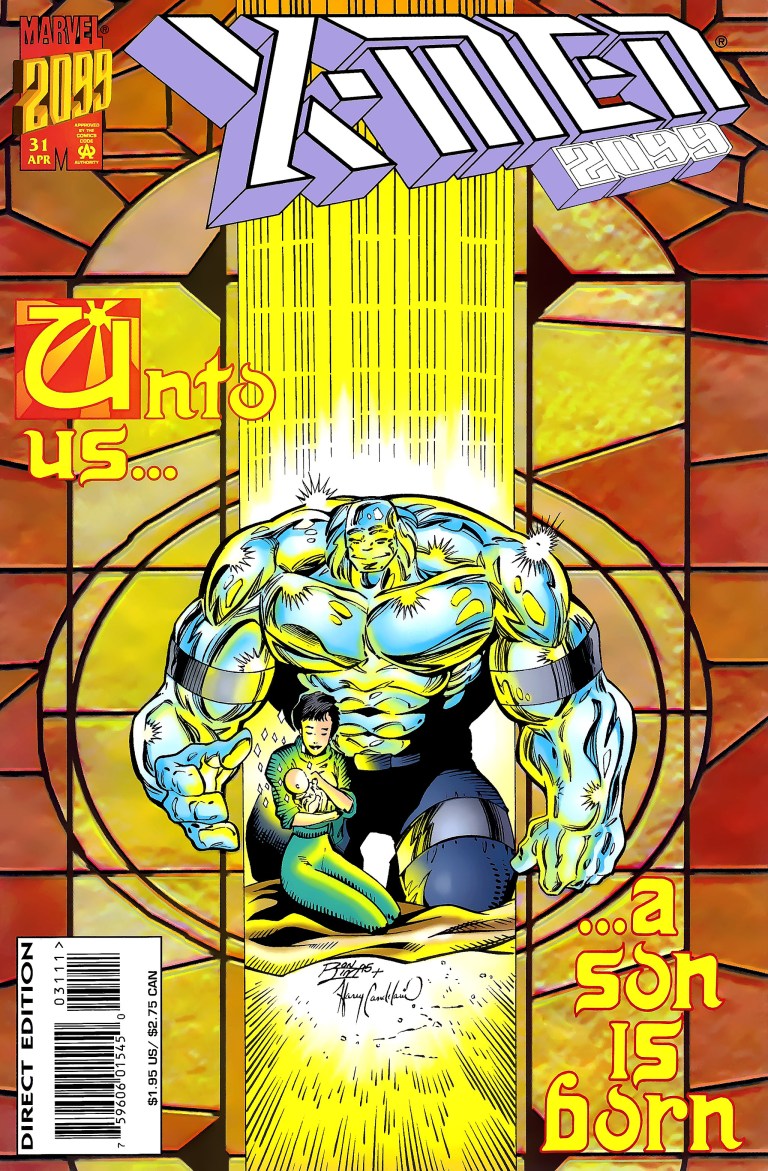
Cover
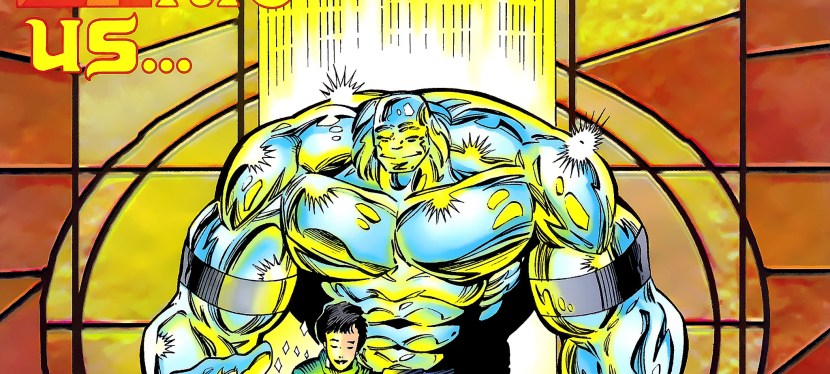
The full cover drawn by Ron Lim.

Early story

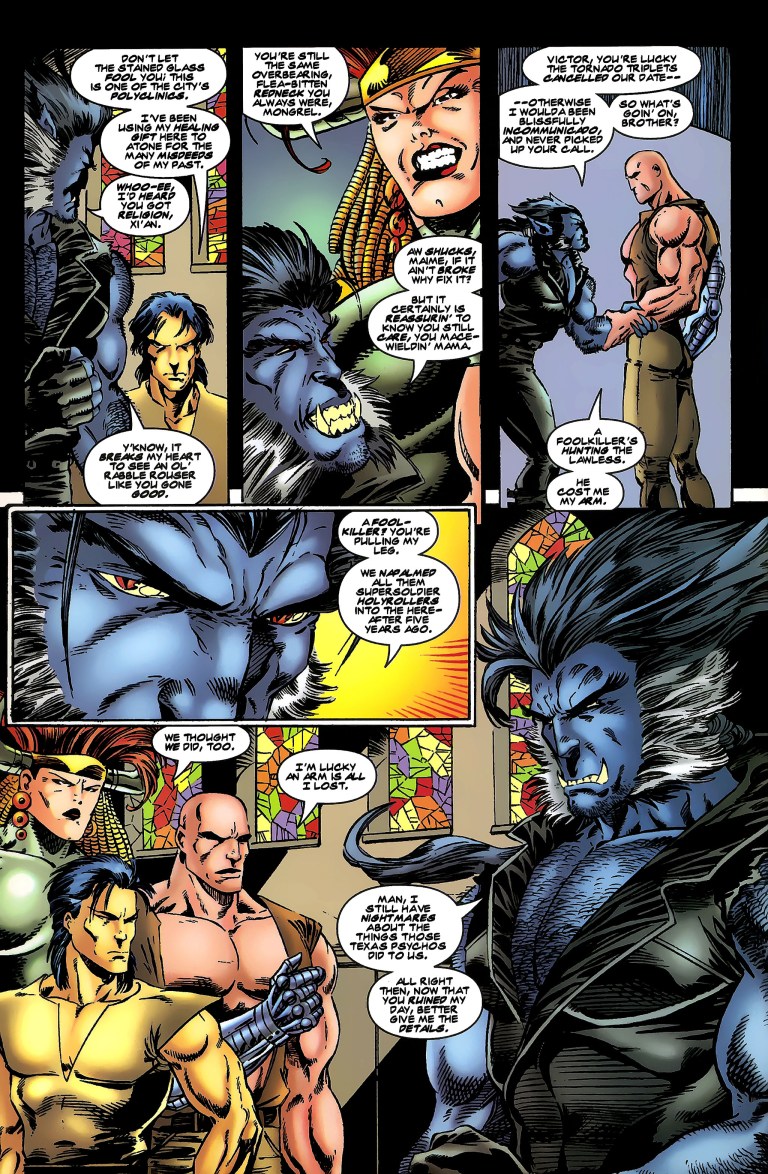
X-Men 2099 #25 begins with a research of Xi’an and his band of mutants being presented by the Minister of Humanity (Morphine Somers) to the President in their airship flying above California.

“I see in this current generation of X-Men an untapped potential,” said the President. “Now, tell me you have finally relocated them.”

The story then shifts to the slaughterhouse of the Theater of Pain wherein a restrained Shakti/Cerebra is standing helpless next to Brimstone Love and a masked Xi’an who are about to execute a sinister plan. Shakti speaks out against them and tells Brimstone that they are parasites preying on the pain and vulnerability of innocent people. Brimstone insists that the weak and helpless provide sport for the rich and powerful, and that his group was founded for the select powerful few who crave for and pay a lot for performances. Xi’an, who had a sinister past before getting reformed to revive the X-Men (before reverting back to evil due to Zhao’s invasion of his mind), only emphasized the theater’s importance.

Defiant, Shakti tries to reach deep into Xi’an and turn him around.

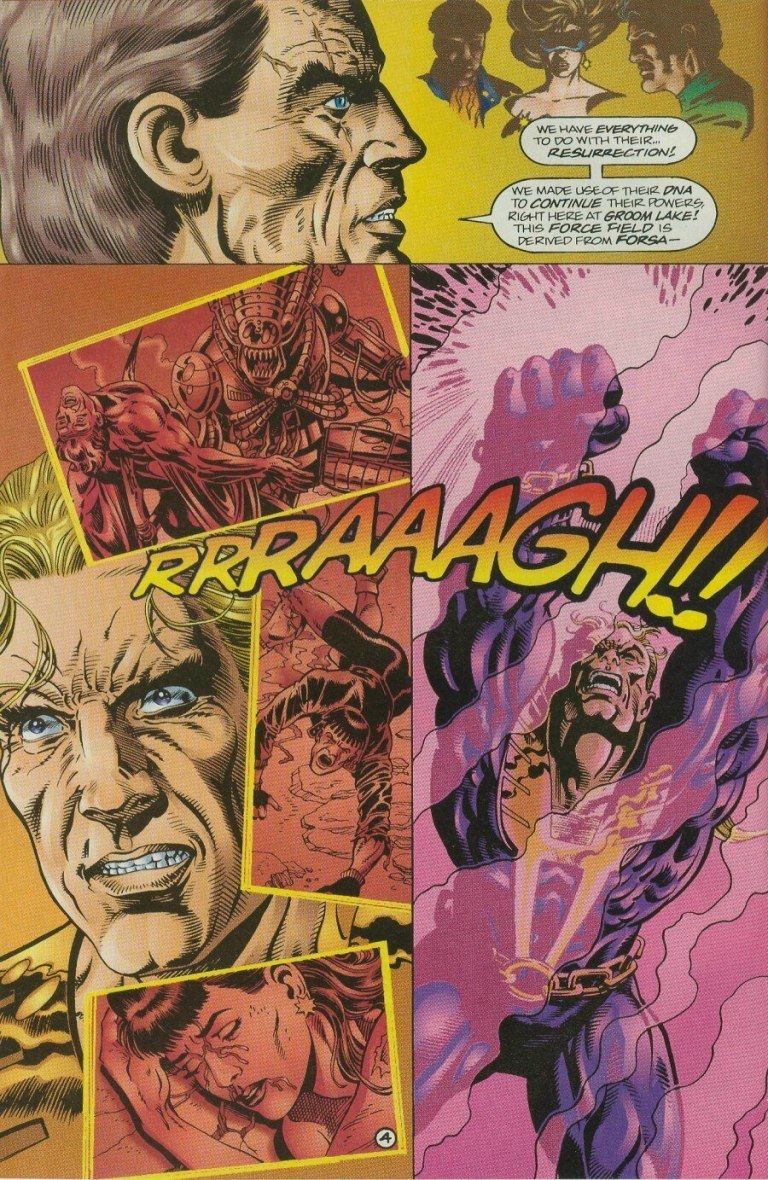
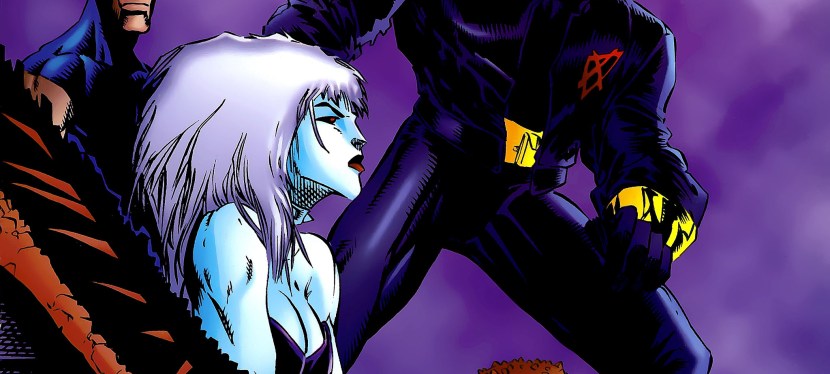
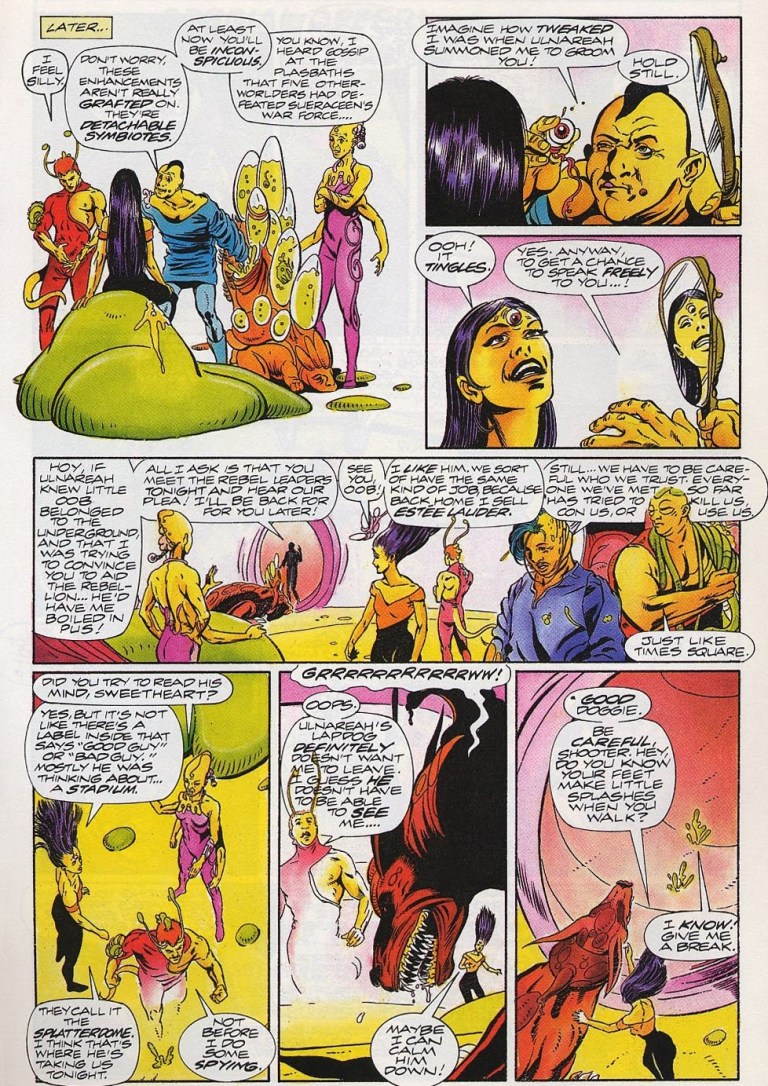
Elsewhere, the former Theater of Pain member Luna (who by this time got close with Tim/Skullfire) is chained and is confronted by her sisters in the theater. Skullfire meanwhile is in the waste disposal center where he meets someone who betrayed their team. They both thought about setting aside their differences to do something before time runs out…

Quality

19
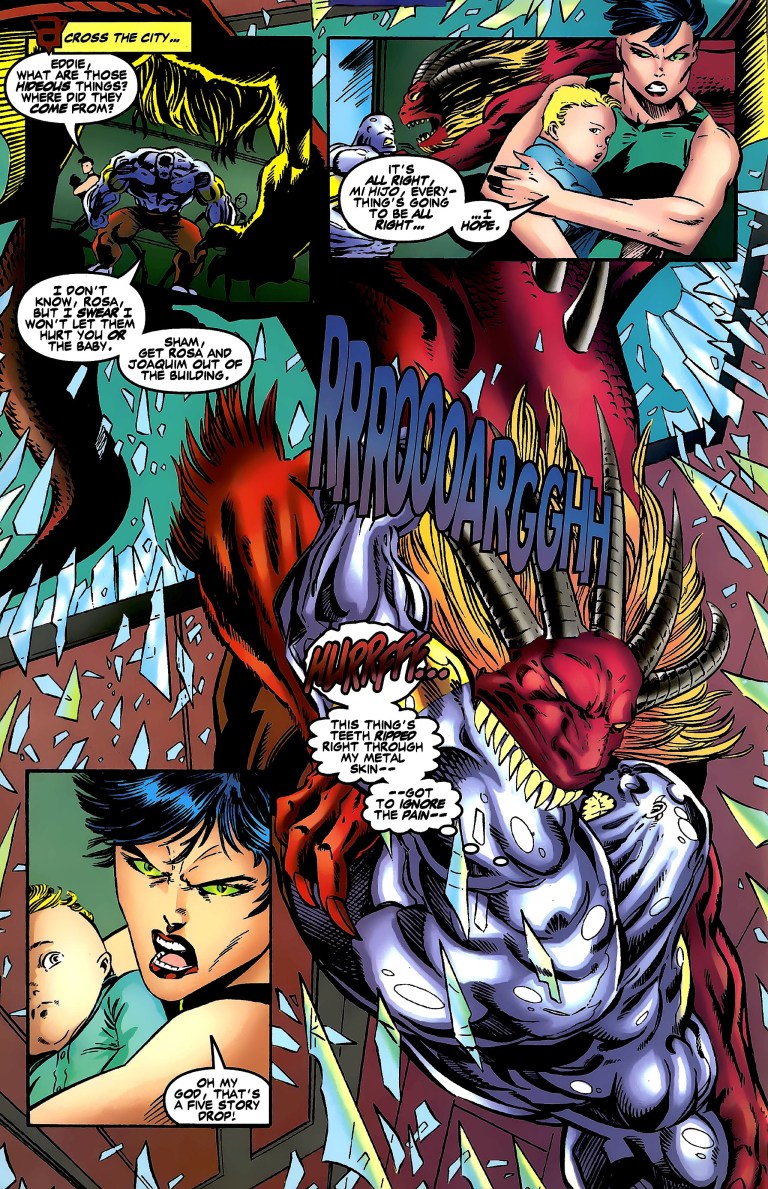
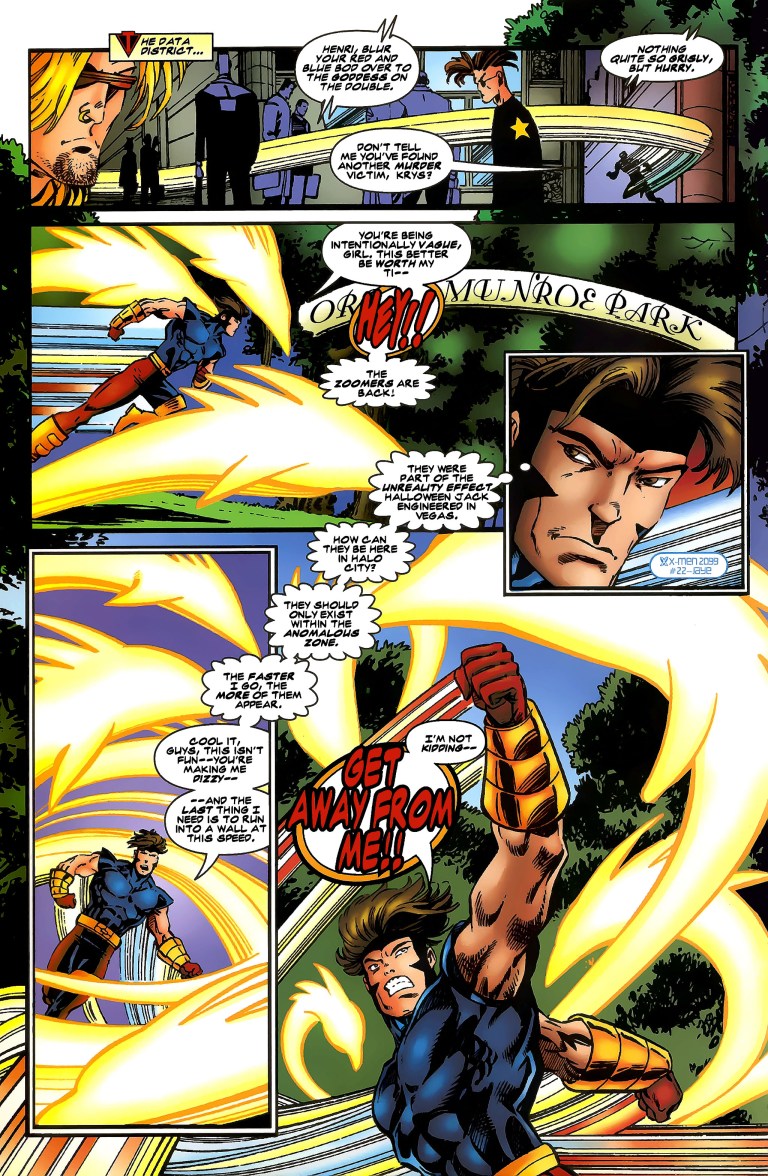
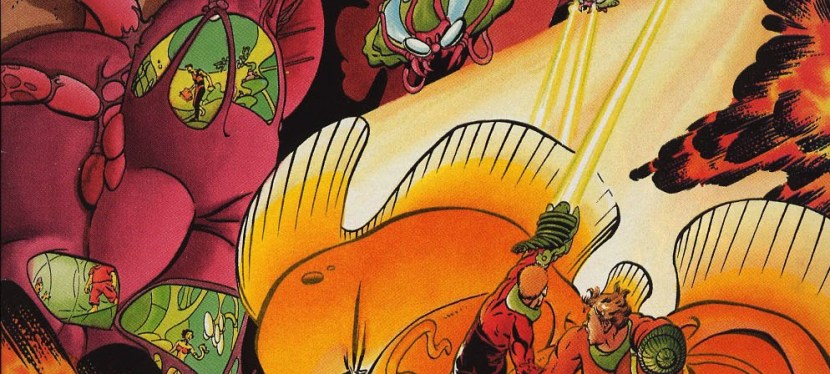
X-Men 2099’s Krystalin, Meanstreak and Bloodhawk get into the action.

In terms of visuals, I can say that Ron Lim’s art is pretty good and, most likely in tandem with the writer, took careful steps to control the pace enough to keep readers entertained without ever making things look disorienting. When there is action, the pace moves fast and the impact of the action done is always visible. As seen throughout the X-Men 2099 series, the look of the southwestern region of America is always striking and I like the fact that the wilderness setting comes with lesser presence of futuristic technology (compare this to what was seen in 2099’s New York) which gives this comic book a more laid-back concept.

When it comes to the storytelling, character development is nicely emphasized in this comic book. If you read enough of the early comic books (let’s say the first ten issues) and paid close attention to the futuristic X-Men, you will be able to relate with their struggles which add a lot of depth to the usual good-versus-evil storytelling here. Without spoiling the story, I should say that this comic book concluded with a believable new direction emphasized which in turn made me want to look to the next issue. It’s that strong of an ending!

16
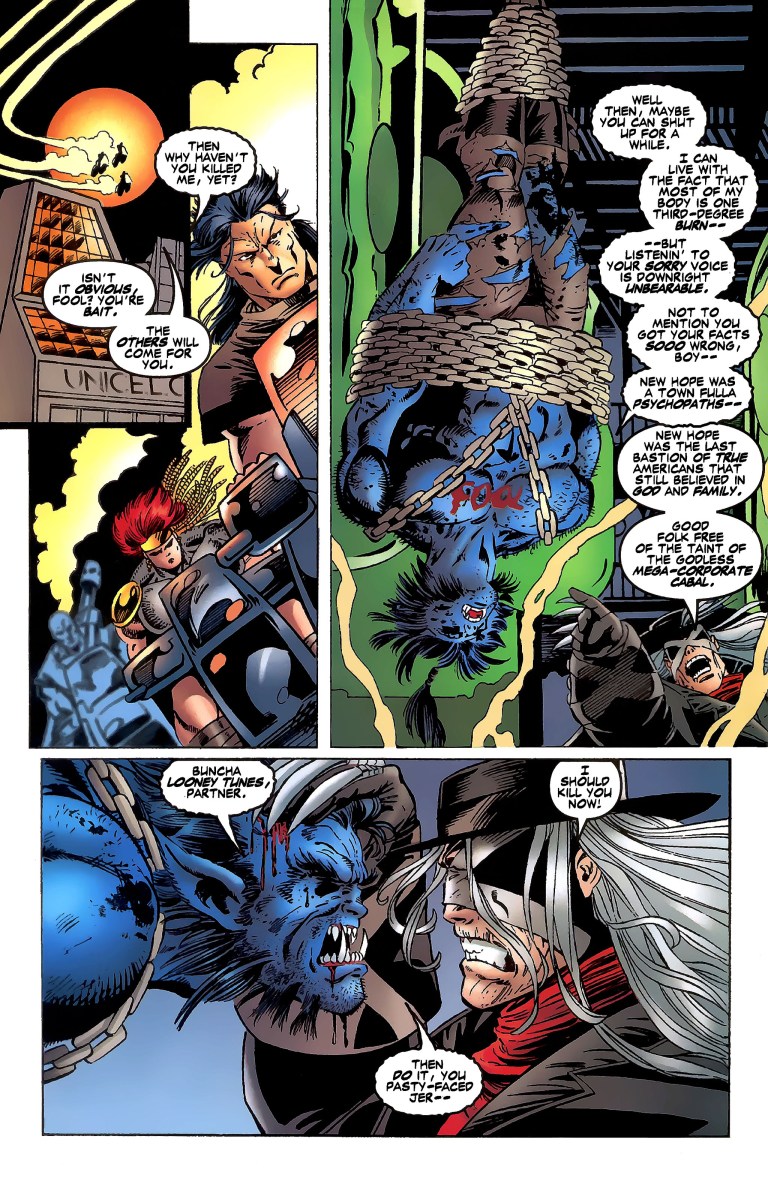
It sure is intriguing to see Shakti, one of the most prominent X-Men 2099 members, really suffer along with others.

I also liked the way this comic book emphasized the connections between the Theater of Pain with the Chosen (another group of villains) and most notably with Zhao (a previous leader of the X-Men before Xi’an’s time).

As for in-universe crossing-over, this comic book nicely ties up with Doom 2099 which, at the time of publishing, was under the creative direction of Warren Ellis who is now one of the best comic book writers.

If there is anything I have an issue with, it’s the cover art. It has a few characters who appeared on the cover, most notably Desdemona, and yet were absent in this comic book’s story. They ended up looking like cover art filler. Not a problem but distracting and meaningless.

Conclusion

Let me make it clear here…I really like this comic book. It definitely has the best and most engaging story of the X-Men of 2099 ever and that’s because this particular monthly series had an extensive build-up on all the characters since issue #1 and issue #25 executed a great payoff.

In retrospect, the X-Men drastically changed since the start of issue #4 and this includes members who went far away or decided to exclude themselves. X-Men 2099 #25 tied up most the loose threads not only by having the team members back together but also emphasized how much they developed over the past few years (in real life, that is). This is also the kind of comic book that will make you want to revisit the very start of its series and rediscover the characters.

5
Luna in chains.

If you are seriously collecting comic books, be aware that based on the listings of MileHighComics.com as of this writing, as a near-mint copy of the comic book’s regular edition is $4 while a near-mint-copy of the deluxe edition (with gimmick cover) is at $6. X-Men 2099 #25’s newsstand edition is worth $8 for a near-mint copy.

Overall, X-Men 2099 #25 is highly recommended. The creators outdid themselves and made the best story of titled characters. Truly, this comic book is where the mutants of 2099 really got defined in their respectful place within the Marvel Comics universe of the 1990s.


Thank you for reading. If you find this article engaging, please click the like button below and also please consider sharing this article to others. If you are looking for a copywriter to create content for your special project or business, check out my services and my portfolio. Feel free to contact me as well. Also please feel free to visit my Facebook page Author Carlo Carrasco and follow me at HavenorFantasy@twitter.com


A Look Back at Action Comics #544

Disclaimer: This is my original work with details sourced from reading the comic book and doing personal research. Anyone who wants to use this article, in part or in whole, needs to secure first my permission and agree to cite me as the source and author. Let it be known that any unauthorized use of this article will constrain the author to pursue the remedies under R.A. No. 8293, the Revised Penal Code, and/or all applicable legal actions under the laws of the Philippines.

I just love it when comic book creators really pushed their creativity and bold concepts to make an anniversary celebration comic book fun, engaging and memorable. As seen in the history of American superhero comics, such great comic books become essential when their concept sets a new standard of quality or when it sets its series (and its featured superhero) to a new and well accepted direction (which then opens up many opportunities to keep the series and the superhero fresh creatively).

Such greatness was achieved by DC Comics and its creators with Action Comics #544 published in 1983.

AC544cover
The cover.

As seen in the cover above done by artists Gil Kane and Dick Giordano, Superman in the background could do nothing but be surprised to see his two foes Lex Luthor and Braniac presented in doubles reflecting a change of design – Luthor getting his now iconic powered suit of armor and Brainiac having a more robotic design.

So you must be wondering…how is the quality of the story and art of this particular comic book that celebration Superman’s 45th anniversary?

We can now start with my retro comic book review of Action Comics #544.

Early Stories

This special-sized comic book features not one but two separate Superman stories titled “Luthor Unleashed!” (written by Cary Bates and drawn by Curt Swan) and “Rebirth” (by Marv Wolfman and Gil Kane).

“Luthor Unleashed!” begins with Luthor already down on the ground hurting from the crash of his aircraft and with Superman present. Even though Luthor’s already helpless, Superman flies away to an unknow destination confident that the super villain will still be there once he returns. However, Luthor got assisted by a robot of his who took him to a secret lair and rode a spacecraft going into deep space. Luthor arrives on the planet called Lexor.

“Rebirth” begins with Superman saving a lady and dog from getting hit by a car on the city street. Afterwards, he flies into space and arrives at a computerized planet that Brainiac created. Just nearby, the star of Epsilon 4 is about to go supernova which prompts him to do something so that many lives will be saved.

Quality

Visually, the art of both stories, respectively done by Curt Swan (arguably the most memorable artist to draw Superman during the pre-Crisis age) and Gil Kane is still good to look at. Both artists knew how to frame the action in interesting ways, put enough details on the people and environment surrounding Superman or Luthor or Brainiac.

When it comes to the storytelling and characterization, not only were both stories really well written, they succeeded in humanizing Luthor and Brainiac. In “Luthor Unleashed!”, the portrayal of Lex Luthor as a family man (he has a wife and a child) as well as a highly revered leader among the citizens of Lexor was excellently done. By just reading that story, it really looked like Luthor could have been a great contributor for the good of the DC Multiverse had he not been a super villain. What writer Cary Bates made clear was that Luthor’s hatred for Supermen was deeply embedded within him.

AC5441
Lex Luthor the husband and father.

The story of Brainiac meanwhile was very engaging. Marv Wolfman really went all-out on portraying the death and rebirth of Brainiac who got reshaped in the form of a futuristic robot armed with his own octopus-like spaceship. What is great about this cybernetic form of Brainiac was that he not only looked more sinister but also proved to be a more dangerous super villain than before. Also, Superman’s first encounter with Brainiac in his new form is very memorable.

AC5442
A great debut for Brainiac in his new form.

Conclusion

While Action Comics #544 is a celebration of Superman’s 45th anniversary, it is truly a showcase of the two classic super villains who not only got new looks but also went on to become more challenging to Superman on a new and higher level. Before he got his iconic powered suit of armor (designed by the great George Perez), Luthor was not much of a physical challenge to Superman. Before he got his robotic body, Brainiac was not as deadly and had much less resources to be cause chaos to Superman and others. To say the least, this comic book is a true classic of superhero literature!

If you are a collector, be aware that as of this writing, a near-mint copy of the newsstand edition of Action Comics #544 is now worth $77 while its other edition’s near-mint copy is worth $39 at MileHighComics.com.

Overall, Action Comics #544 is highly recommended. This great comic book also has another thing of value: great inspiration and references that Warner Bros. should use when making a new Superman movie with Luthor and Brainiac as the super villains.


Thank you for reading. If you find this article engaging, please click the like button below and also please consider sharing this article to others. If you are looking for a copywriter to create content for your special project or business, check out my services and my portfolio. Feel free to contact me as well. Also please feel free to visit my Facebook page Author Carlo Carrasco and follow me at HavenorFantasy@twitter.com
A Look Back At Freex #7

If there is any particular superhero comic book title I could compare Freex of the Ultraverse with, it’s Marvel’s famous X-Men. Similar to the mutants of the big M, Freex is a team of teenagers who each have different super powers or special abilities while struggling with being social outcasts. What makes them different is that the Ultraverse teenagers have no mature adult to look forward to for guidance. They don’t have a mansion to live in, and they have no choice but to move around constantly and survive the best way they could.

I took a look at the other existing back issues of Freex in my collection and what caught my attention was Freex #7.

CoverFreex7
The cover.

Let’s now take a look back at Freex #7 and see what makes it unique (if not special).

Early story

The story begins with the Freex hastily stealing clothes from a store in city. While the others are desperately grabbing what they could (note: the store’s glass window was shown smashed already), Angela/Sweetface looks scared. One of her male companions tell her to be tough like Valerie/Pressure.

Just as they start leaving the store behind, the alarm system goes off. The sudden rush only adds pressure to them, causing Lewis/Anything to confront Michael/Plug only because the latter said something about team leadership. As Angela separates Michael and Lewis using her fleshy tentacles, Valerie loses her cool when Ray/Boomboy calls her by her codename. Valerie hits Boomboy with a blast of plasma. With their momentum disrupted by division and tension, Lewis tries to calm his teammates down but Plug won’t have any of it as he desires to find out about the source of all of their powers referred to as Wetware Mary. Plug finds a telephone booth and instantly transfers himself into it in the form of energy.

Freex7a
Division between members of Freex is common.

As the Freex remain divided, a local resident living nearby watches them from a distance.

Quality

The story written by Gerard Jones is pretty engaging mainly due to characterization (as opposed to storytelling and structuring). Through the dialogue, you can really sense the thoughts and emotions of each member of Freex, especially Valerie since this particular comic book focused on her origin. Without spoiling Valerie’s background, her origin was efficiently emphasized and never, ever felt dragging. By the time her origin story concluded, I got to understand Valerie better and why is she so mean. After the conclusion of the Freex’ story, there is also an Aladdin Datafile on Valerie who turned out to be 16-years-old, 5 feet and 9 inches tall, and even has a low threat assessment by Aladdin.

Adding further value to this comic book is a 2-page quick feature of Hardcase which shows a nice look back at his past before the establishment of The Squad.

Conclusion

Freex7b

From the past of Pressure.

Freex #7 is a good read. The story about the teenage social outcasts of the Ultraverse is well balanced in terms of characterization and action. Anyone who is a fan of Valerie/Pressure or female superheroes who are mean, angry and rebellious will find a lot to enjoy in this comic book. A near-mint copy of Freex #7 is worth $4 at MileHighComics.com as of this writing.

Overall, Freex is recommended.

Meanwhile, check out my retro review of Freex #1 right here.


Thank you for reading. If you find this article engaging, please click the like button below and also please consider sharing this article to others. Also my fantasy book The World of Havenor is still available in paperback and e-book format. If you are looking for a copywriter to create content for your special project or business, check out my services and my portfolio. Feel free to contact me as well. Also please feel free to visit my Facebook page Author Carlo Carrasco and follow me at HavenorFantasy@twitter.com
A Look Back at Spider-Man 2099 #35 (1995)

Disclaimer: This is my original work with details sourced from reading the comic book and doing personal research. Anyone who wants to use this article, in part or in whole, needs to secure first my permission and agree to cite me as the source and author. Let it be known that any unauthorized use of this article will constrain the author to pursue the remedies under R.A. No. 8293, the Revised Penal Code, and/or all applicable legal actions under the laws of the Philippines.

When Marvel Comics first launched the 2099 imprint of comic books showcasing many futuristic versions of their present-day characters – like Spider-Man, Ravage and Dr. Doom – it was inevitable that the same treatment will be applied to their popular supervillains.

In 1993, the 2099 version of Vulture was introduced and he sure proved to be one tough opponent for Spider-Man 2099. Even back then, there already was clamor for a futuristic version of Venom which at the time was riding high with readers being the featured anti-hero in several limited series (starting with Lethal Protector) of comic books.

Then in 1995, after doing a creative teaser in issue #34, Marvel formally introduced Venom 2099 by releasing Spider-Man 2099 #35. This is my review of the comic book written by Peter David and drawn by Andrew Wildman (X-Men Adventures).

Cover
The cover drawn by Rick Leonardi.

Early story

Picking up from the events of issue #34, the story begins in Washington, DC with Dana freeing herself only to find out that Alchemax’s CEO Tyler Stone was down suffering from a gun shot and losing blood. Minutes later, emergency personnel take Stone’s body for immediate treatment.

Meanwhile, Spider-Man 2099 (Miguel O’Hara) encounters the SHIELD flyboys in New York. After almost getting into trouble together, Spidey gets informed that US President Doom 2099 ordered them to leave him alone for a period of seventy-two hours while he considers a cabinet offer. Back in Washington, Dana gets interrogated by one of the authorities. President Doom enters the scene telling Dana that she will join Tyler Stone immediately in the medical center.

3
Andrew Wildman’s take on Spider-Man 2099 and the future was really nice to look at.

In New York, two guys sitting on the sidewalk witness a moving black liquid coming out of the sewer. The thing turns out to be a living symbiote (or alien costume) forming into a human-like shape – Venom 2099!

Quality

As with other comic books of this particular series, the writing by Peter David is pretty deep and engaging. The usual balance between dramatization, character development, plotting and spectacle is here once again but with a slight touch of horror in relation to the introduction of Venom of 2099. Speaking of dramatization, the portrayal of Venom 2099 as a vicious villain is similar to the 20th century Venom (Eddie Brock) but with a very powerful obsession to kill Miguel O’Hara and Tyler Stone.

Here’s an excerpt from the dialogue of Venom of 2099: Miguel O’Hara…and Tyler Stone…together again. We…I get to kill you…at the same time…how awfully…awfully…considerate. To show my appreciation…I’ll kill you slowly.

What makes this comic book unique is the artwork by Andrew Wildman who temporarily replaced regular illustrator Rick Leonardi. For comparison, I find Wildman’s art style a welcome thing in this comic book mainly because he draws with a lot more detail per panel and per page than Leonardi ever could. Instead of seeing the usual sketch-like art style of Leonardi, Wildman’s style is livelier and more expressive to look at. I also enjoyed Wildman’s visual take on Spider-Man 2099/Miguel O’Hara, Lyla, Tyle Stone, and the other established characters. Their facial expressions are also livelier to see.

9
Venom 2099 appears! Take note of the “liquid” at the edges of the page.

More on visuals, Wildman’s take on Venom 2099 is unforgettable. Like 20th century Venom, he has a dark suit, elongated jaw with rows of sharp teeth and an elongated tongue but with green acid dripping all the time. There are also those tentacles-like things that stretch from his body until the arms. Also his white-colored mask with large eyes make him look horrific.

Conclusion

Despite being shorter than the usual 22-pages, Spider-Man 2099 #35 is still a very engaging and fun old comic book to read. Its purpose was to build-up anticipation leading to the introduction of Venom 2099 was achieved nicely and the respective qualities of the writing and visuals are very good even by today’s standards. More on the presentation of Venom of 2099, it seems like Peter David took inspiration from movie director James Cameron on building-up tension and suspense before showing the villain. That’s a move I enjoyed in this comic book.

Overall, Spider-Man 2099 #35 is highly recommended. If you plan to acquire an existing and legitimate hard copy, be aware that the near-mint copy of it is over $100 for the newsstand version while the Rich Leonardi-drawn “Venom 2099 AD” cover version is priced at over $80 at MileHighComics.com as of this writing.


Thank you for reading. If you find this article engaging, please click the like button below and also please consider sharing this article to others. Also my fantasy book The World of Havenor is still available in paperback and e-book format. If you are looking for a copywriter to create content for your special project or business, check out my services and my portfolio. Feel free to contact me as well. Also please feel free to visit my Facebook page Author Carlo Carrasco and follow me at HavenorFantasy@twitter.com
Carlo Carrasco’s Comic Book Review: 2099 Alpha #1

Hey comic book fans! It is finally official! The 2099 universe of Marvel Comics has been revived with the release of 2099 Alpha #1 which I bought at the local comic book store here in Alabang, Muntinlupa, Philippines. The comic book that was available had a Spider-Man 2099 variant cover and it carried a hefty $4.99 price!

So you must be wondering…is the comic book any good? Does it capture the look and feel of the 2099 universe that first appeared in comic books back in the 1990s? Any significant changes in terms of storytelling and visuals?

Here is my review of 2099 Alpha #1.

2019-11-21_100919~2.jpg
The variant cover showing Spider-Man 2099 with Spidey and related characters from the past.

Written by Nick Spencer with art by Viktor Bogdanovic (colors provided by Marte Garcia), the comic begins in The Ravage (note: this is NOT the failed 2099 hero of Stan Lee and Paul Ryan) where a little boy finds Thor’s hammer but abandons it as he saw some monsters coming. The story then shifts to Brooklyn where Jake Gallows (Punisher 2099) gets into a violent encounter with a man before finally meeting the backup he called for. Then they see a sign that their god, Thor, is now in a merciful mood.

In Nueva York, Miguel O’Hara (Spider-Man 2099) talks with Tyler Stone inside an Alchemax tower. Tyler examines what Miguel brought to them and he mentions an incoming threat. Elsewhere, Conan appears struggling in battle with some people. From a distance, Doom 2099 watches and he has the Watcher captive.

Quality

To put it short, 2099 Alpha #1 is really a set-up type of comic book designed to immerse readers into the 2099 universe which now looks darker, grittier and more twisted than the way it was first presented back in the 1990s. Because the spotlight shifts from one place to the next, showing multiple characters, there really is not much meat in the storytelling. Really, thirty pages of art and story were made but ultimately ended up being not so engaging.

The art of Viktor Bogdanovic shows the 2099 universe to be a depressing setting and his art on classic characters like Spider-Man 2099, Punisher 2099 and Doom 2099 make them look unrecognizable. I remember Jake Gallows being huge and buff but in this comic book, he looks like he lost a lot of muscle and ended up looking ordinary.

Conclusion

Overall, 2099 Alpha #1 is an expensive disappointment and it is easily the weakest new comic book I bought all year long. There is a lot of suspense, expository details and even some horrific imagery, but ultimately there is no real fun to experience here. At $4.99, this is too expensive and it is a waste as it failed to engage and entertain me. Let me add that I lowered my expectation for this revival of the 2099 universe since the teaser announcement was made months ago. Back then, I anticipated that the new guys handling the 2099 universe of comics will take it to a new direction (move far away from what made the 2099 universe in the 1990s memorable and distinct) and this overpriced comic book is an early confirmation of it.

2019-11-21_101114~2.jpg
Recognize any of these characters?

Of course, there are still several other 2099 comics from Marvel that will be launched next month, including Spider-Man 2099 #1, Venom 2099 #1, Ghost Rider 2099 #1 and more. We will find out soon enough if those comic books will share the same dark and gritty style of 2099 Alpha #1 or not.

Ultimately, 2099 Alpha #1 is not recommended. As long as it is sold at cover price, avoid it.

+++++

If you are nostalgic of the 1990s 2099 universe, check out my reviews of Spider-Man 2099 #1 and #25, Ravage 2099 #1 and X-Men 2099 #1.


Thank you for reading. If you find this article engaging, please click the like button below and also please consider sharing this article to others. Also my fantasy book The World of Havenor is still available in paperback and e-book format. If you are looking for a copywriter to create content for your special project or business, check out my services and my portfolio. Feel free to contact me as well. Also please feel free to visit my Facebook page Author Carlo Carrasco and follow me at HavenorFantasy@twitter.com


A Look Back At The H.A.R.D. Corps #1

The 1990s was a decade of excess when it comes to superhero comic books. Apart from the persistent hoarding of comic books and the quest for profit, there were also these wide superhero franchises (or superhero universes) that popped up and even challenged Marvel Comics and DC Comics. Malibu Comics launched the Ultraverse while Valiant Comics came up with its own universe.

Valiant established itself nicely with popular characters like Bloodshot, X-O Manowar, Turok and Ninjak, and each one had its own regular series of comic books published. When it comes to teams, there was H.A.R.D. Corps (H.A.R.D. stood for Harbinger Active Resistance Division).

During the recent Hobby Con held at Las Piñas City, I luckily found myself a copy of The H.A.R.D. Corps #1 and read it for the first time ever. This is my review of the comic book which has a cover drawn by the great Jim Lee.

RCO002_1472443923.jpg
Cover with art by Jim Lee.

Early story

The story begins with the 5-member team in the middle of a mission inside the secured facility of the Harbinger Foundation. Under fire from the facility’s armed personnel, the team (riding a floating vehicle) struggle to find their way and evacuate. Along the way, an oversized man called Big Boy grabbed one of their members and separated him from the others. With the situation getting worse, the captured member got “brain popped” (a remote form of self-destruction via the neural flash implanted inside the person’s brain). The remaining four manage to get away by means of aerial transport provided by their company.

Then a section of the facility exploded causing financial damage to Mr. Harada who decided to visit and inspect the site.

RCO017_1472443923~2.jpg
Expository information done cleverly.

Some time later, the H.A.R.D. Corps enjoy the privacy and security at their headquarters in the Nevada desert. Team members Shakespeare, Major Palmer, Softcore, Hammerhead and Superstar wait for instructions at the debriefing room.

Quality

The H.A.R.D. Corps #1 is very well written by David Michelinie. Within twenty-two pages, Michelinie loaded enough details to explain the comic book’s core concept efficiently while at the same time he managed to tell an engaging story with a light touch on character development (note: there were many characters and there was not enough space for further personality emphasis). By the time the story ended, I really felt enlightened, entertained and wanting to find out what would happen next.

Michelinie’s handling of expository dialogue was done very efficiently. I’m talking about the private briefing done by an executive of the Cartel explaining to a recovering man named Kim (who was almost killed during the Los Angeles Riot) what H.A.R.D. Corps is, why the Cartel is in a race against Harada who has been manipulating Harbingers (persons with unique abilities). The Cartel opposes Harada with neural implants.

More on the team, H.A.R.D. Corps members are people who have gone through training programs and each of them had neural implants in their heads which enable them to mimic Harbinger powers (one at a time) through signals broadcast from a base station. Each of them was comatose and the use of the implants reversed the coma.

RCO007_1472443923~2.jpg
Some action for you.

When it comes to visuals, the art by David Lapham (inked by Bob Layton) was pretty good. I like the high amount of detail placed on the surroundings in most of the panels. Action shots had a good amount of impact.

Conclusion

This comic book from late 1992 is a good and engaging read. I really enjoyed it and I like its core concept about a team of enhanced individuals who are technically living properties of very business-minded people opposed to Harada. Even by today’s standards, H.A.R.D. Corps concept really stands out among all superhero team comic books.

The H.A.R.D. Corps #1 is recommended and you can acquire a near-mint copy of it for only $4 at MileHighComics.com (as of this writing).

A Look Back At The Terminator #1 (1990)

Way back in 1984, a low-budget movie titled The Terminator became a hit with moviegoers which greatly helped the careers of Arnold Schwarzenegger, Linda Hamilton and writer-director James Cameron. Terminator 2: Judgment Day became a massive hit worldwide in 1991 establishing the Terminator franchise as an important one leading to more movies (released in 2003, 2009 and 2015), video games and even a TV series. Oh yes, the upcoming film Terminator: Dark Fate will be released very soon and it now involves James Cameron.

Way back in 1990, a follow-up to the 1984 classic was released that did NOT involve Schwarzenegger, Cameron and Hamilton at all. The follow-up was a 4-issue mini-series titled The Terminator and was published by Dark Horse Comics which back then was licensed to do comic books of the Terminator franchise.

This is my review of The Terminator #1, written by John Arcudi and drawn by Chris Warner with ink work by Paul Guinan.

2019-09-30_082047~2.jpg

Early story

The comic book opens in the year 2029. In the ruins of Los Angeles, a band armed humans struggle against the machines of Skynet during the night. They infiltrate a facility to find one of Skynet’s time displacement chambers which they learned previously from their leader John Connor. Thanks to Connor’s intervention, Skynet’s attempt to change history failed but the big catch is that only a prototype of the time displacement chamber was discovered. The final model of the chamber remains.

2019-09-30_082201~2.jpg

As the armed guys make their way through, a Terminator watches them secretly….

Quality

When it comes to the writing, I can clearly see that John Arcudi (best known for The Mask) exerted effort to make this comic book relevant to the 1984 movie using key details such as the humans operating on the field only at night time (because Skynet will easily detect them during the day). Arcudi, however, expanded a bit on the franchise’s cinematic elements by emphasizing the use specific machines (steel-and-chrome wombs or tissue-generating chambers) to cover Terminator units with flesh and blood, and most notably, the use electronic communication between Terminator units which resemble telepathy among humans.

Cyberdyne, the fictional corporation heavily emphasized in Terminator 2, made an appearance in this comic book. With regards to Skynet, Arcudi emphasized that the living network was a lot more resourceful than what the movies suggested. The comic book has a nice build-up and along the way, the use of expository dialogue was pretty efficient and they are quite helpful for readers to grasp the story and key details.

With regards to the art work, Warner’s art style has that somewhat cartoony aesthetic on not just the humans but even on the machines. There were several Terminator units displayed without the flesh and from the way they were drawn, I could not even tell if those units were the T-800 type. Warner’s drawings on the physical environments carry a good amount of detail.

2019-09-30_082306~2.jpg
Terminator stealthy approach captured nicely.

While Warner’s drawing has a cartoony aesthetic, the illustrated action is pretty violent and has quite an impact in some shots. There are some bloody images and implied nude shots as well.

Conclusion

What can I say? I bought The Terminator #1 at the Hobby Con this past weekend out of pure curiosity. After reading it thrice, I should say that I found this comic book proving to be better than what I expected. It is a surprisingly good read and the fact that this was published roughly a year BEFORE the release of Terminator 2: Judgment Day, I found this to be a worthy follow-up to the 1984 movie. In fact, it’s so good a follow-up I’d rather read it than waste my time watching Terminator 3: Rise of the Machines, Terminator Salvation and the very awful Terminator: Genisys.

As such, I declare that The Terminator #1 is recommended.


Thank you for reading. If you find this article engaging, please click the like button below and also please consider sharing this article to others. Also my fantasy book The World of Havenor is still available in paperback and e-book format. If you are looking for a copywriter to create content for your special project or business, check out my services and my portfolio. Feel free to contact me as well. Also please feel free to visit my Facebook page Author Carlo Carrasco and follow me at HavenorFantasy@twitter.com
A Look Back At Batman vs. The Incredible Hulk

Disclaimer: This is my original work with details sourced from reading the comic book and doing personal research. Anyone who wants to use this article, in part or in whole, needs to secure first my permission and agree to cite me as the source and author. Let it be known that any unauthorized use of this article will constrain the author to pursue the remedies under R.A. No. 8293, the Revised Penal Code, and/or all applicable legal actions under the laws of the Philippines.

I love reading a crossover comic book that was made by very talented creators to be a whole lot of fun from start to finish. Back in the early 1980s, rivals Marvel Comics and DC Comics collaborated temporarily with inter-company crossover comic books that were made to be entertaining to fans of their respective properties.

What I’m going to review here is the 3rd superhero crossover comic book between Marvel and DC titled Batman vs. The Incredible Hulk.

Cover
The cover.

Background

Before I start, let me clarify that this particular comic book was specifically published as issue number 27 of the DC Special Series which was a series of one-shot comic books. By comparison, the 1981 crossover comic book Superman and Spider-Man (which I reviewed previously) was published under the Marvel Treasury Edition line of Marvel Comics as issue number 28.

Going back to Batman vs. The Incredible Hulk, the comic book was the final issue of the DC Special Series line and it carried a cover price of $2.50 which was quite high for its time.

The people at DC Comics made sure that the crossover was handled by the best talents they had back then. The late Len Wein (best know for creating Wolverine) was assigned to write the script (and ensure that elements from both the Hulk and Batman would mix nicely) while José Luis García-López was hired to illustrate. Dick Giordano was the embellisher and editor while Allen Milgrom and then Marvel editor-in-chief Jim Shooter were the consulting editors. In return for their assistance, Marv Wolfman and Mike DeCarlo were acknowledged with thanks.

Now we can begin with this retro review of Batman vs. The Incredible Hulk.

The early story

The story begins when a few persons in Gotham City witness their dreams turning real beyond logic. A man dreamed he was in the arctic hunting and wakes up to discover his room was filled with snow. In a cinema where a horror movie was shown, a couple kissing each other discover, to their shock, that monsters of different sizes surrounded them out of thin air.

At the waterfront of the city, the Joker (accompanied by his gang members) talks to an unseen being (Shaper of Worlds). He gives his assurance to the being that he and his gang will acquire a specific item (needed by the being). For the Joker, what was discussed was a simple business arrangement.

A short time later inside a high-tech facility of Wayne Research, Bruce Banner (the Hulk) secretly works under the false identity as David Banks. He works along with the scientists but not on the scientific projects. Rather, he works odd tasks such as lifting hardware and putting them into places that need them. Of course, Banner did not get hired for a salary but for something much essential to him and his condition with Gamma Rays.

“I had to get a job here somehow so I could get close to the experimental Gamma-gun they’re working on,” he thought to himself.

Suddenly the facility gets filled with laughing gas incapacitating all the people inside. Banner fortunately manages to wear a radiation suit for protection. Moments later, the Joker and his gang enter searching for the Gamma-gun. From this point on, Banner decides to act.

Quality

When it comes to the selection of characters from Marvel and DC, having the mismatch of Batman and the Hulk was a very splendid idea. Not only was having the large green brute and the world’s greatest detective together as temporary rivals a fascinating concept, having them work together as a duo turned out to be a really great move. When it comes to the selected villains of the Joker and the Shaper of Worlds as the anti-hero figures of the story, the two looked like an odd pair but if you focus on the details of the story, you will realize that it made a lot of sense having them two together. The Shaper needs something which requires him to depend on the Joker who in turn brings his gang with him to cause chaos to acquire what the alien needs

All of the above details would not have worked had it not been for the excellent writing by Len Wein. Clearly Wein knew a whole lot about the defining elements of the Hulk and Batman (and the same with the Joker and Shaper), and he carefully blended those elements together to make a story that is thrilling, intriguing, engaging and at the same time still made sense. More on crossing over, there are other characters connected to Batman and the Hulk that made appearances and a few of them fit in nicely into the story.

As this was released in 1981, it was typical of the time for writers to use thought balloons to help readers understand what the characters were thinking. The use of thought balloons in this comic book truly defined Batman who not only had to fight the bad guys but also manage his way with the Hulk and do a lot of detective work.

Going back to the Hulk and Batman, this comic book has a lot of fun stuff. More than once did the two superheroes engage in action-packed encounters and their exchange of words was very nicely done. Their match-up (or mismatch) really works.

Prev1
A perfectly crafted action scene between the Hulk and Batman, complete with accurate depictions of each character! 

When it comes to the common complaint by some readers out there that the comic book was more of a Batman story and made the Hulk less prominent, I should say that the slight imbalance is not a problem at all. In fact, for me it makes perfect sense that Batman has more spotlight than the Hulk. Why? Because Batman is a detective and he performed a lot of researching, information gathering and other moves to solve problems. His detective work in the story made perfect sense for the narrative. As for the Hulk, his character really has very limited options other than causing destruction and disturbing the public. Since early on, the Hulk was best known for attracting the attention of the American military (led by General Ross) and huge destruction defined the encounters. For this crossover, the creators did not show the Hulk engaging with the military (save for the phonies) but rather he struggled to figure things out whenever he encountered Batman or the Joker. There is no way the Hulk could do detective work like Batman and having him fight the military would have weakened this comic book’s presentation. Clearly, having the story slightly slanted towards Batman is still the right move.

Prev2
Very highly imaginative and dynamic artwork by José Luis García-López.

The artwork done by José Luis García-López is excellent! He really captured the looks and details of each and every character Marvel and DC that appeared in this comic book. Back in the early 1980s, I got to read several comic books that showed Batman, the Hulk, the Joker and others and the way they appeared in this comic book was indeed accurate of the time. José Luis García-López also knew how to balance spectacle with character development and expository dialogue in terms of visual pacing and framing shots. Also his work becomes even more imaginative during the final conflict. Undoubtedly this is still a great looking comic book!

Conclusion

Overall, Batman vs. The Incredible Hulk is a great comic book and easily it is one of the greatest intercompany superhero crossover comic books ever published! From start to finish, this comic book proved to be highly engaging and there never was a single boring moment. The creators led by Len Wein (he is sorely missed) made the best possible story anyone can make involving Batman and the Hulk.

You can read a hard copy of this comic book by getting Volume 1 of Crossover Classics or, if you can afford to, hunt for a copy of this in its DC Special Series form which now sells for $280 for a very fine copy to as much as $400 for a near mint copy as of this writing according to MileHighComics.com

In ending this, I declare that Batman vs. The Incredible Hulk is highly recommended!


Thank you for reading. If you find this article engaging, please click the like button below and also please consider sharing this article to others. Also my fantasy book The World of Havenor is still available in paperback and e-book format. If you are looking for a copywriter to create content for your special project or business, check out my services and my portfolio. Feel free to contact me as well. Also please feel free to visit my Facebook page Author Carlo Carrasco and follow me at HavenorFantasy@twitter.com
 

A Look Back At Superman and Spider-Man

Disclaimer: This is my original work with details sourced from reading the comic book and doing personal research. Anyone who wants to use this article, in part or in whole, needs to secure first my permission and agree to cite me as the source and author. Let it be known that any unauthorized use of this article will constrain the author to pursue the remedies under R.A. No. 8293, the Revised Penal Code, and/or all applicable legal actions under the laws of the Philippines.

I miss the old times when big rivals Marvel and DC Comics would set aside competition temporarily to team up and rely on their respective comic creators to make superhero crossover comic books that the fans can enjoy.

Back in the 1970s, key developments related to the comic book adaptation of The Wizard of Oz brought the two rivals together as partners. In 1976, Marvel and DC’s first superhero crossover Superman vs. The Amazing Spider-Man got published and to this day many comic book collectors and geeks I encountered still enjoy it. A few of them even called it a classic.

The collaboration between Marvel and DC continued in 1981 with Superman and Spider-Man which was published as issue number 28 of the Marvel Treasury Edition series.

1
The cover.

This is my look back at Superman and Spider-Man.

The comic book

Scripted by then Marvel Comic editor-in-chief Jim Shooter (with Marv Wolfman mentioned for plot suggestions) with art drawn by John Buscema and inkwork done by Terry Austin, Al Milgrom, Steva Leialoha, Walt Simonson, Bob Layton, Joe Rubinstein and Bob Wiacek, the comic book begins when Spider-Man swings into a construction site where he encounters several armed men and stops them singlehandedly.

Even though he stopped the bad guys, Spider-Man’s spider sense bothers him making him speculate that, because there’s no clear danger around him, the construction site seemed to be a threat.

After Spider-Man swings away from the police who just arrived, classic Marvel supervillain Doctor Doom watches via surveillance video and he was bother by the way things turned out.

“I did not like the way Spider-Man paused and look around after subduing the thieves – – as if he sensed something unusual about the excavation! Those accursed spider instincts of his,” Doom said before proceeding with his master plan.

A day later, the Hulk arrives in Metropolis causing lots of damage. Separately Superman and Spider-Man arrive to contain the green guy. However, things are not what they seem. This is where the story description ends.

Quality

What this comic book lacked compared to the 1976 Superman-Spider-Man crossover is visual impact. Clearly John Buscema had to follow closely the script which called for multiple panels per page and that left him little room to draw scenes dynamically. That’s not to see the art is weak. In fact, Buscema’s art is pretty good and he has deep knowledge about how the characters (including those many supporting characters and other minor characters from both Marvel and DC Comics) really looked from the size of Hulk’s body, the details on Wonder Woman’s costume, the distinctive look of J. Jonah Jameson, Perry White, etc. In short, I recognized the characters very easily.

15
This remains fun to read.
24
Peter Parker in Metropolis along with the Superman supporting characters. This is one great element that made this comic book worth reading.

While the high number of panels per page limited him, Buscema managed to come up with some action shots that packed some impact.

When it comes to writing and storytelling, this comic book exceeds that of the 1976 Superman-Spider-Man crossover big time! To start with, the plot is much more elaborate, more detailed and yet consistently remained easy to follow.

While the 1976 crossover had the most popular villains of Superman and Spider-Man as the representation of evil, this one instead had Dr. Doom and Parasite. The great news is that these two super villains complement each other nicely and that itself adds good depth into the plot. Dr. Doom is a major schemer and Parasite fitted nicely within his master plan for global chaos.

Regarding dialogue, the script had a lot of strength and was also specific in capturing the personalities of the superheroes, the super villains and the supporting cast. I can easily identify J. Jonah Jameson, Perry White, Lois Lane and others through the dialogue.

Not to be outdone is the deeper approach to the crossover aspect of the story. Right from the start, the comic book creators expected us readers to suspend disbelief and start believing that while the story is non-canon, the respective universes of Marvel and DC Comics co-existed. Because there were TV shows of Wonder Woman and the Hulk playing, the two characters were included in the comic book adding depth to the crossover.

Speaking of crossovers, this comic book was not limited to Superman and Spider-Man. The encounter between the Hulk and Superman was a short but sweet spectacle to read. The encounter between Wonder Woman and Spider-Man meanwhile was short yet fun.

Adding more to the fun in this comic book was how Clark Kent interacted with the Spider-Man supporting characters while Peter Parker interacted with the Superman supporting characters. I enjoyed every moment of these scenes.

As far as narrative is concerned, this comic book is slightly slanted towards Superman. One factor behind this was the implementation of how local authorities interact with Superman and Spider-Man. Whenever he solves crime, Superman is highly respected by the public and the police. This is not the case with Spider-Man who is often perceived to be a social menace even though he helps solve crimes. Another factor was that Superman did more detective-type work (including a visit to Latveria) while Spidey hardly contributed anything to the plot’s development.

38
Nothing can be more frustrating than getting attacked by police officers when you try to help them solve their problems.

Regardless, the two icons got a fair share of the spotlight during the final stages of the story and there was enough spectacle to enjoy.

If there is any complaint I have, it would be the comic book creators’ reluctance on fully connecting itself to the 1976 crossover. In the scene wherein Peter Parker was guided into the film editing room by Jimmy Olsen, he recognized Lois Lane and remembered meeting her in the 1976 crossover (which ended with socializing). And yet when Spider-Man and Superman get together in this comic book, there was a noticeable lack of friendliness and personal cooperation between them even though they bonded nicely in the 1976 story.

Conclusion

Overall, Superman and Spider-Man is indeed a highly engaging, fun-filled superhero crossover comic book. For me, it is a true literary classic and definitely worth searching for out there. I read this crossover many times from start to finish and even though I knew the plot and the dialogue, I still had a lot of fun reading along the way. With the combined talents of Shooter, Buscema and many others, this superhero crossover was indeed one of the very best stories ever told by Marvel and DC Comics.

Given the current corporate climate Marvel and DC Comics are now in, it is very unlikely we will see another creatively fun superhero crossover collaboration between them happening soon. For the newcomers reading this, Marvel is owned by the Walt Disney Company while DC Comics is owned by Warner Bros.

Whether you search for the original comic book or its inclusion in a volume of The Marvel/DC Collection: Crossover Classics Volume 1, Superman and Spider-Man is highly recommended!


Thank you for reading. If you find this article engaging, please click the like button below and also please consider sharing this article to others. Also my fantasy book The World of Havenor is still available in paperback and e-book format. If you are looking for a copywriter to create content for your special project or business, check out my services and my portfolio. Feel free to contact me as well. Also please feel free to visit my Facebook page Author Carlo Carrasco and follow me at HavenorFantasy@twitter.com
 

A Look Back At Uncanny X-Men #289

Released in 1992 by Marvel Comics, Uncanny X-Men #289 was written by Scott Lobdell and drawn by Whilce Portacio (with ink work by Scott Williams). Its concept focused on the Gold Team of the X-Men (composed of Jean Grey, Storm, Colossus, Ice Man and Archangel) dealing with Bishop who at the time was still a newcomer.

2019-07-11_095911~2.jpg
Cover of the comic book.

It begins when Bishop looks at a framed picture of the original X-Men followed by Storm telling him every student who graduated to the role of an X-Man remains dedicated to the ideal of peaceful coexistence between mutants and humans.

As the Gold Team X-Men enjoy their peaceful time at the mansion of Xavier, elsewhere someone spies on William and Maddy Drake who talk about Bobby (Iceman). Back at the mansion, Archangel encounters a spitting image of his younger self (as Angel and with normal skin color) which raises tension attracting the attention of Storm, Bishop and Forge.

2019-07-11_100038~2.jpg
A touching scene between Jean Grey and Charles Xavier.

To describe Uncanny X-Men #289 clearly, the comic book is more focused on character development as it lacks a strong conflict between good and evil. Anyone craving for superhero action will most likely feel unsatisfied here. However, if you want to know the X-Men more passionately and watch the romance between Storm and Forge develop, then this comic book will be engaging.

Scott Lobdell did a good job developing the characters through drama and Whilce Portacio’s art really brought the script to life. I enjoyed reading the interaction between Jean Grey and Charles Xavier who realizes that as he led the X-Men, he took a bit of something from their respective lives.

2019-07-11_100213~2.jpg
Nice layout and style by Whilce Portacio on the team.

Take note of the following exchange of dialogue.

Charles Xavier: Jean, did you ever hate me for having taken away your childhood?

Jean Grey: Professor, please. What child is given the opportunity to fly to the stars? How many children battle alongside Asgardian thunder gods or super soldiers? You gave me…all of us…more than you took away.

That was really nice writing there by Lobdell. There was drama and harmony between the two characters.

Overall, Uncanny X-Men #289 is recommended. Think of it as a comic book that will help you – the reader – get to know the characters more closely.


Thank you for reading. If you find this article engaging, please click the like button below and also please consider sharing this article to others. Also my fantasy book The World of Havenor is still available in paperback and e-book format. If you are looking for a copywriter to create content for your special project or business, check out my services and my portfolio. Feel free to contact me as well. Also please feel free to visit my Facebook page Author Carlo Carrasco and follow me at HavenorFantasy@twitter.com