Disclaimer: This is my original work with details sourced from reading the comic book and doing personal research. Anyone who wants to use this article, in part or in whole, needs to secure first my permission and agree to cite me as the source and author. Let it be known that any unauthorized use of this article will constrain the author to pursue the remedies under R.A. No. 8293, the Revised Penal Code, and/or all applicable legal actions under the laws of the Philippines.
Welcome back superhero enthusiasts, 1980s culture enthusiasts and comic book collectors! Today we go back to the year 1982 to examine the Marvel Comics universe through the exploits of Dazzler!
While my most recent retro review of Dazzler was the 4th issue of its monthly series, I have decided to jump straight to issue #21 for this new retro review. By the time Dazzler #21 got published, the unusual superhero went through a lot and illustrator Frank Springer became fully established as the monthly series’ definitive artist.
With those details laid down, here is a look back Dazzler #21, published by Marvel Comics in 1982 with a story written by Danny Fingeroth and drawn by the late Frank Springer.
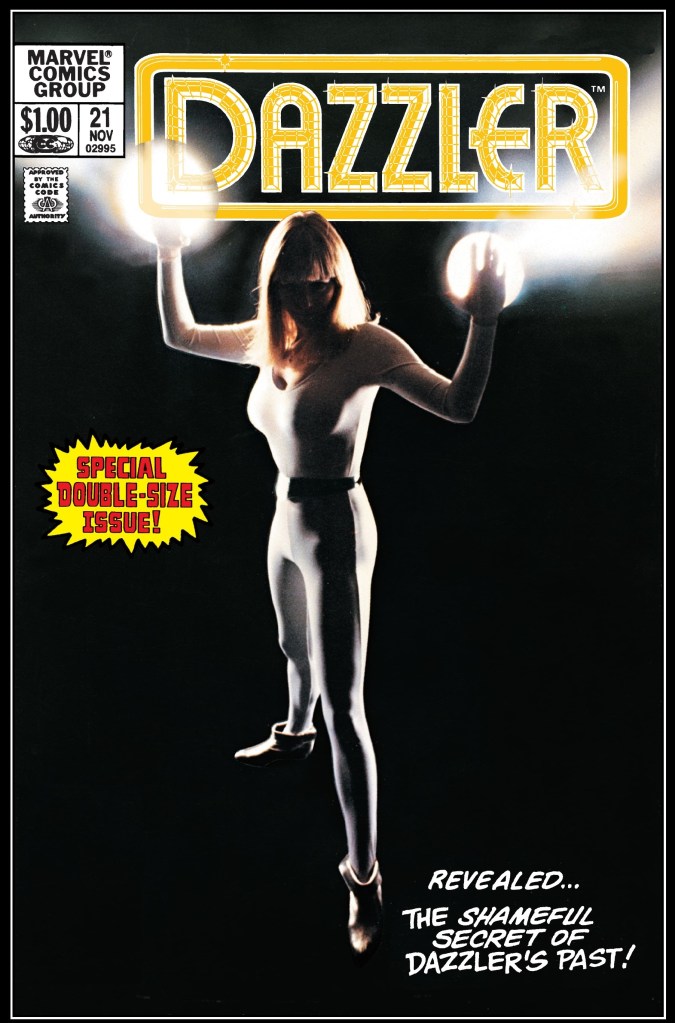
The cover.
Early story
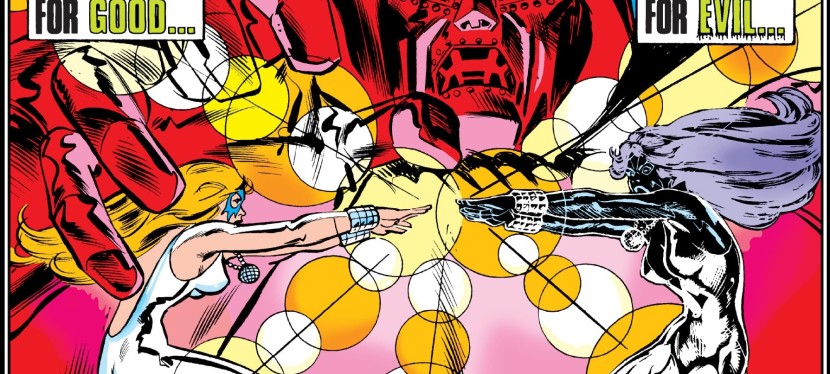
The story begins with Alison Blaire/Dazzler being carried above the buildings of New York City by Angel (Warren Worthington) of the X-Men. At this point in time, Alison’s father judge Carter Blaire snapped under the weight of turmoil related to the death of his wife and his daughter’s rebelliousness. As Dazzler, Alison had gone through intense encounters with the likes of the Incredible Hulk, She-Hulk, a top-secret syndicate that made her a test subject and even Galactus.
Recently, Bella – Alison’s grandmother – could not cope with her son’s breakdown and reached out to Warren Worthington to help her reach Alison. Since after being found, Alison had been traveling with Angel by air.
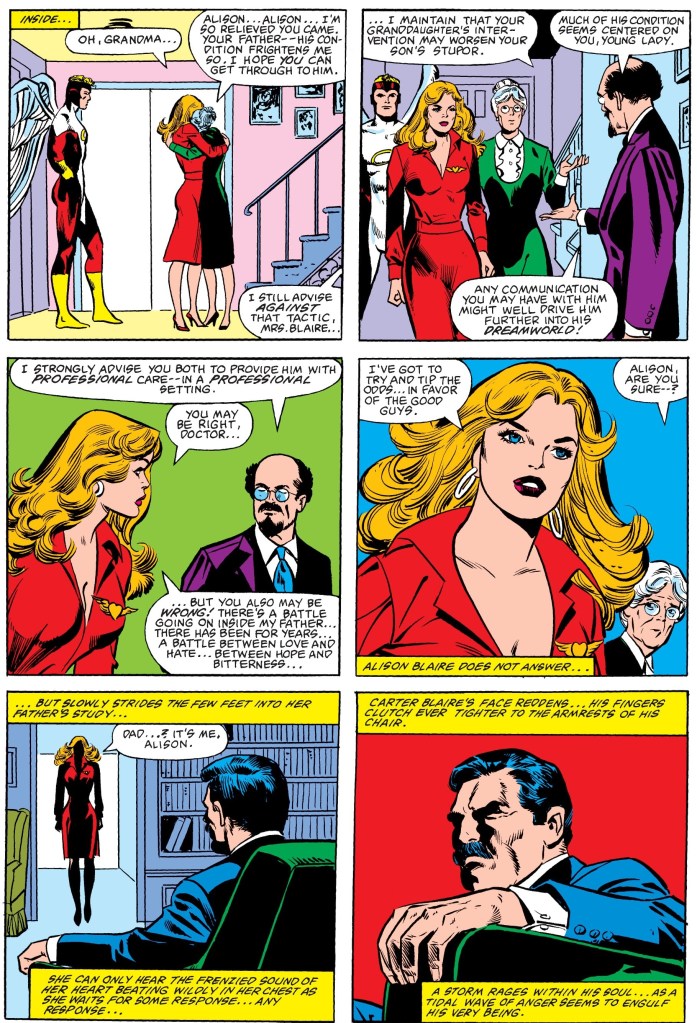
Along the way, Spider-Man sees them and recognizes Alison as Dazzler. He swings to try to get their attention but was ignored as they were so focused on their objective. A short time later, Angel and Alison arrive at judge Blaire’s home. Her grandmother greets them and tells her she hopes that she can get through to judge Blaire.
The doctor, however, advised against that tactic and states that Alison’s intervention may worsen her father’s condition as much of it was centered on her…
Quality
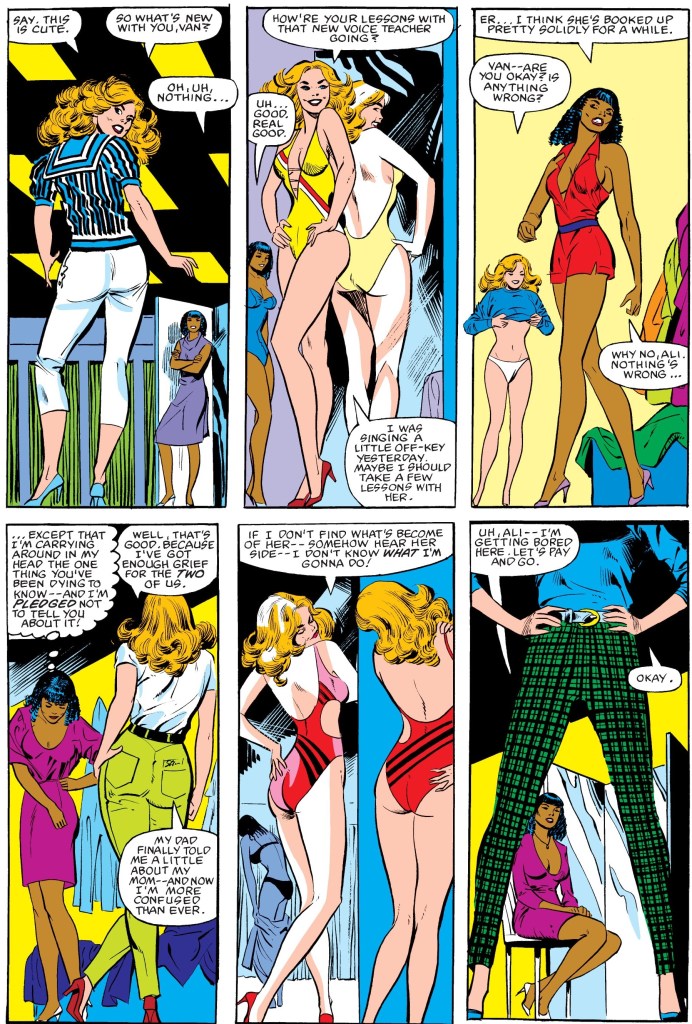
Alison Blaire and her friend Vanessa try out new clothes.
I’ll go straight to the point about what the story of this double-sized comic book is about without spoiling it. It is a pretty dramatic look at the protagonist in her civilian form as Alison Blaire. You will get to see her as Dazzler in this comic book but if you are looking for a lot of superhero moments of her or if you are looking for Dazzler in a conflict with evil elements, you won’t find it here.
More on the plot, this comic book explores deeply the emotional and personal dimensions of Alison and along the way, stories about her own past as well as the respect past events of both her father and mother got dramatized. The story tackles themes like independence, maturity, marriage, personal development, family ties and personal conflicts of interest. The good thing here is that the script by Danny Fingeroth is very well-written and it seems he did his research on constructing a personal story about Alison Blaire that is very grounded in reality. That being said, the superhero elements have been pushed aside most of the time and the ironic thing is the fact that the other Marvel superheroes – Spider-Man, Fantastic Four, The Avengers and more – appeared here as if to remind readers this is still a superhero tale.
Very clearly, this story was written for the very dedicated or even the die-hard Dazzler fans in mind. When it comes to the fun factor, the results could be mixed depending on what readers want to see in this comic book. For me personally, it is a pretty engaging story to read and at the same time it is fun enough as well.
Conclusion
Alison tries to help her troubled father.
Dazzler #21 (1982) could be barely received or strongly received or even rejected even though it has a very rich and dramatic script. The clear lack of the superhero presentation of Dazzler in favor of heavy drama and in-depth characterization may not win the approval of readers/collectors who love superhero stuff but it will resonate with the readers who really love the character and had immersed themselves into her life. As far as characterization goes, this comic book marks a significant turning point of Dazzler herself and in its story, she really developed a lot since making her first-ever appearance in Uncanny X-Men #130. If you are a Dazzler purist who does not mind the lack of superhero spectacle, this one could engage you.
If you are seriously planning to buy an existing hard copy of Dazzler #21 (1982), be aware that as of this writing, MileHighComics.com shows that the near-mint copy of the regular edition costs $28 while the near-mint copy of the newsstand edition costs $60.
Overall, Dazzler #21 (1982) is recommended.
+++++
Thank you for reading. If you find this article engaging, please click the like button below and also please consider sharing this article to others. If you are looking for a copywriter to create content for your special project or business, check out my services and my portfolio. Feel free to contact me with a private message. Also please feel free to visit my Facebook page Author Carlo Carrasco and follow me on Twitter at @HavenorFantasy as well as on Tumblr at https://carlocarrasco.tumblr.com/
Welcome back, my readers and fellow Christians! In this newest edition of my Christian Music Appreciation (CMA) series, we will focus on the worship song titled Touch From Heaven which is from New Life Music. To follow New Life Music on social media and on their YouTube channel, I encourage you to click here (Facebook page) and here (YouTube). New Life Music is part of New Life Philippines whose main church is located in Muntinlupa City, Philippines. To know more about New Life Philippines, visit https://newlife.ph/
The featured worship song Touch From Heaven is part of New Life Music’s album titled To The Other Side. The official video of Touch From Heaven was recorded live at New Life’s main church in 2021 and you will see it before this piece ends.
Before analyzing the Biblical relevance of Touch From Heaven, posted below for your reference are the lyrics composed by Nash Soliven, Addi Cena, Jazmine Rivera, Jat Bondoc, Daryl Pinon and Kyle Ruelo.
VERSE 1
He is here
Here to lift your burdens
Here to mend what’s broken
Here to ease your fears
–
Here to heal
Heal all your afflictions
Heal you from depression
Heal all your disease
–
PRE-CHORUS
So be still
And know that He is God
He is here
To rescue every heart
–
CHORUS
Jesus, let Your healing come
And let Your will be done
And mark us with a touch from heaven
–
Jesus, let Your kingdom come
And let Your will be done
And heal us with a touch from heaven
–
VERSE 2
He is here
With power, might and glory
Strengthening the weary
His hand upholding me
–
And as I praise
He’s clothing me with gladness
Joy for all my sadness
Hope for better days
–
PRE-CHORUS 2
So it is well
I know that He is God
He is here
There’s freedom in His love
–
BRIDGE 1
There’s nothing too hard for You
No mountain You cannot move
There’s nothing too hard for You
No limit to what You can do
–
BRIDGE 2
We will rise
We will walk
In the strength of the Lord
We will stand
We will see
His salvation drawing near
–
VERSE 3
He is here
He is our protection
He is our provision
He’s the Prince of peace
–
He is here
Here to heal our nation
He hears all our petitions
And wipes away our tears
To begin with, let’s take a close look at the lyrics of Verse 1 of the song: He is here, Here to lift your burdens, Here to mend what’s broken, Here to ease your fears, Here to heal, Heal all your afflictions, Heal you from depression, Heal all your disease.
The Verse 1 lyrics are truthful as there many references to the healing and restoration that the Lord has done and continues to do for those who suffered and had fallen. To experience healing, recovery and restoration, people only need to come to God wholeheartedly and in faith. Refer to the holy scriptures below…
Fear not, for I am with you;
Be not dismayed, for I am your God.
I will strengthen you,
Yes, I will help you,
I will uphold you with My righteous right hand.
Isaiah 41:10 (NKJV)
You open the eyes of the blind, and you fully restore those bent over with shame. You love those who love and honor you.
Psalm 146:8 (TPT)
“Return and say to Hezekiah the leader of My people, ‘This is what the Lord, the God of your father David says: “I have heard your prayer, I have seen your tears; behold, I am going to heal you. On the third day you shall go up to the house of the Lord.”
2 Kings 20:5 (NASB)
I am convinced that my God will fully satisfy every need you have, for I have seen the abundant riches of glory revealed to me through Jesus Christ!
Philippians 4:19 (TPT)
Heal me, O Lord, and I shall be healed;
save me, and I shall be saved,
for you are my praise.
Jeremiah 17:14 (ESV)
Next are the following lines from the Pre-Chorus part of the song: So be still, And know that He is God, He is here, To rescue every heart. Those lyrics are truthful and are related to the following bible scriptures below…
Be still, and know that I am God;
I will be exalted among the nations,
I will be exalted in the earth!
Psalm 46:10 (NKJV)
Blessed are those who are persecuted for righteousness’ sake,
For theirs is the kingdom of heaven.
Blessed are you when they revile and persecute you, and say all kinds of evil against you falsely for My sake. Rejoice and be exceedingly glad, for great is your reward in heaven, for so they persecuted the prophets who were before you.
Matthew 5:10-12 (NKJV)
Commit everything you do to the Lord.
Trust him, and he will help you.
Psalm 37:5 (NLT)
The Pre-Chorus lyrics as well as the above verses emphasize the truth that God our Heavenly Father and true Creator will always love us – His faithful children – and anyone who has fallen, or suffered or got persecuted need to come to Him in faith. We should never let the elements of this divided world we live in prevent us from coming to Him and that being said, our established relationship with Him is never to be compromised. God is faithful and only He can lift up the sufferers and restore them fully.
Next we look at the lyrics in the Chorus which are as follows: Jesus, let Your healing come, And let Your will be done, And mark us with a touch from heaven, Jesus, let Your kingdom come, And let Your will be done, And heal us with a touch from heaven.
Healing by the Lord is once again emphasized. The sufferers who come to the Lord in faith truly get healed. The healing power of God goes way beyond anything that science, technology and medicine can ever explain and ever achieve. The Lord’s healing is truly supernatural and it is way beyond anything worldly healing can produce. Learn from the holy scripture below…
Now, in the crowd that day was a woman who had suffered horribly from continual bleeding for twelve years. She had endured a great deal under the care of various doctors, yet in spite of spending all she had on their treatments, she was getting worse instead of better. When she heard about Jesus’ healing power, she pushed through the crowd and came up from behind him and touched his prayer shawl. For she kept saying to herself, “If I could touch even his clothes, I know I will be healed.” As soon as her hand touched him, her bleeding immediately stopped! She knew it, for she could feel her body instantly being healed of her disease!
Jesus knew at once that someone had touched him, for he felt the power that always surged around him had passed through him for someone to be healed. He turned and spoke to the crowd, saying,“Who touched my clothes?”
His disciples answered, “What do you mean, who touched you? Look at this huge crowd—they’re all pressing up against you.” But Jesus’ eyes swept across the crowd, looking for the one who had touched him for healing.
When the woman who experienced this miracle realized what had happened to her, she came before him, trembling with fear, and threw herself down at his feet, saying, “I was the one who touched you.” And she told him her story of what had just happened.
Then Jesus said to her, “Daughter, because you dared to believe, your faith has healed you. Go with peace in your heart, and be free from your suffering!”
Mark 5:25-34 (TPT)
Still on the Chorus, the lyrics about the touch from heaven – which is also the title of this worship song – I believe are connected to this particular holy scripture below…
Step down from heaven, Lord, and come down!
Make the mountains melt at your touch.
Loose your fiery lightning flashes and scatter your enemies.
Overthrow them with your terrifying judgments.
Reach down from your heavens
and rescue me from this hell
and deliver me from these dark powers.
They speak nothing but lies; their words are pure deceit.
Nothing they say can ever be trusted.
My God, I will sing you a brand-new song!
The harp inside my heart will make music to you!
I will sing of you, the one who gives victory to kings—
the one who rescues David, your loving servant,
from the fatal sword.
Deliver me and save me from these dark powers
who speak nothing but lies.
Their words are pure deceit,
and you can’t trust anything they say.
Deliver us! Then our homes will be happy.
Our sons will grow up as strong, sturdy men
and our daughters with graceful beauty,
royally fashioned as for a palace.
Our barns will be filled to the brim,
overflowing with the fruits of our harvest.
Our fields will be full of sheep and cattle,
too many to count,
and our livestock will not miscarry their young.
Our enemies will not invade our land,
and there’ll be no breach in our walls.
What bliss we experience when these blessings fall!
The people who love and serve our God will be happy indeed!
Psalm 144:5-15 (TPT)
Psalm 144:5-15 emphasizes God’s tremendous and unchallenged power, and He is truly able to come to the faithful on this chaotic world for healing, protection, restoration, prosperity, love and salvation. His Son Lord Jesus, who sacrificed Himself to save us all, overcame death and went to Heaven with the promise of returning to us. Rest assured, Lord Jesus never abandoned the faithful and He will always be with the faithful. Going back to the song, I believe that the respective lyrics of Bridge 1 (There’s nothing too hard for You, No mountain You cannot move, There’s nothing too hard for You, No limit to what You can do), Bridge 2 (We will rise, We will walk, In the strength of the Lord, We will stand, We will see, His salvation drawing near) and Verse 3 (He is here, He is our protection, He is our provision, He’s the Prince of peace, He is here , Here to heal our nation, He hears all our petitions, And wipes away our tears) connect well with Psalm 144:5-15 plus other holy scriptures below…
Jesus explained, “I am the Way, I am the Truth, and I am the Life. No one comes next to the Father except through union with me. To know me is to know my Father too. And from now on you will realize that you have seen him and experienced him.”
John 14:6-7 (TPT)
“I tell you this timeless truth: The person who follows me in faith, believing in me, will do the same mighty miracles that I do—even greater miracles than these because I go to be with my Father! For I will do whatever you ask me to do when you ask me in my name. And that is how the Son will show what the Father is really like and bring glory to him. Ask me anything in my name, and I will do it for you!”
John 14:12-14 (TPT)
Soon I will leave this world and they will see me no longer, but you will see me, because I will live again, and you will come alive too. So when that day comes, you will know that I am living in the Father and that you are one with me, for I will be living in you. Those who truly love me are those who obey my commands. Whoever passionately loves me will be passionately loved by my Father. And I will passionately love him in return and will reveal myself to him.”
John 14:19-21 (TPT)
Let them shout for joy and be glad,
Who favor my righteous cause;
And let them say continually,
“Let the Lord be magnified,
Who has pleasure in the prosperity of His servant.”
Psalm 35:27 (NKJV)
For I know the plans I have for you,” says the LORD. “They are plans for good and not for disaster, to give you a future and a hope.
Jeremiah 29:11 (NLT)
“It is the Lord who goes before you. He will be with you; he will not leave you or forsake you. Do not fear or be dismayed.”
Deuteronomy 31:8 (ESV)
Indeed, the lyrics of Touch From Heaven are holy and anointed! I can say without hesitation that the essence of this particular worship song from New Life Music is truly based on God’s Word as well as His love for the faithful. Musically speaking, Touch From Heaven is beautiful and solemn at the same time. That being said, the song clearly has a place for musical use and worship of the Lord during Sunday worship services or during church special events. Lastly, I declare Touch From Heaven is immersive and will help church attendees on strengthening their faith to God. Once more, I encourage you readers to visit New Life Music on Facebook and YouTube plus visit New Life Philippines at https://newlife.ph/ and also their official YouTube channel.
Thank you for reading. If you find this article engaging, please click the like button below and also please consider sharing this article to others. Sharing this Christian piece means spreading the good news of the Lord to others. It can help you save the unsaved and the lost souls out there.
Disclaimer: This is my original work with details sourced from reading the comic book and doing personal research. Anyone who wants to use this article, in part or in whole, needs to secure first my permission and agree to cite me as the source and author. Let it be known that any unauthorized use of this article will constrain the author to pursue the remedies under R.A. No. 8293, the Revised Penal Code, and/or all applicable legal actions under the laws of the Philippines.
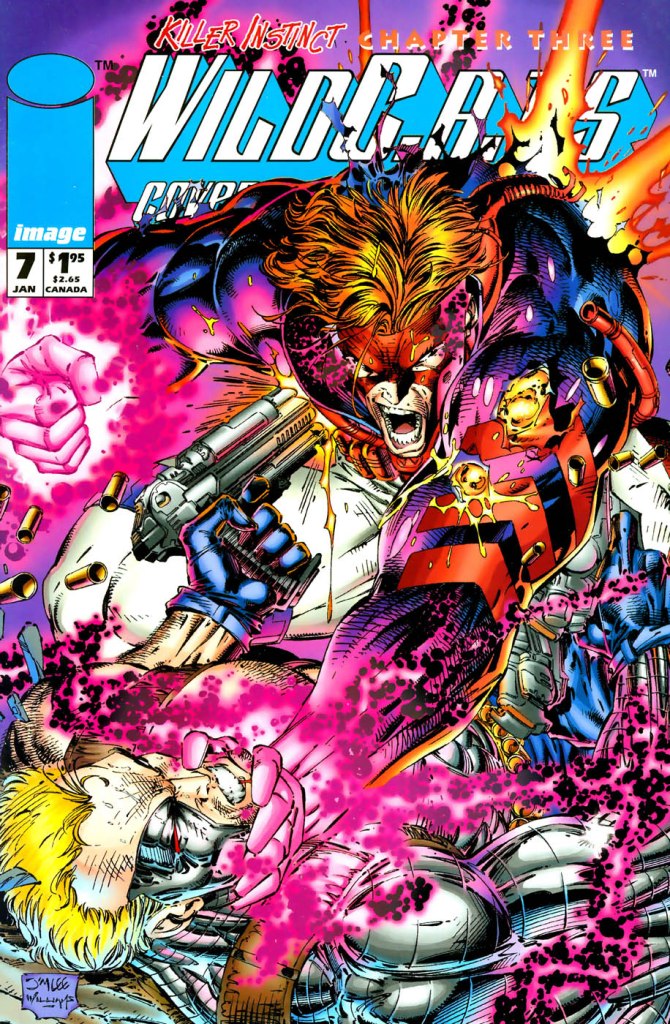
Welcome back superhero enthusiasts, 1990s culture enthusiasts and comic book collectors! Today we continue revisiting Jim Lee’s flagship title under the Image Comics label – WildC.A.T.S: Covert Action Teams!
While the 3rd and 4th issues of the WildC.A.T.S: Covert Action Teams mini-series had Lee’s superhero team crossing over with Rob Liefeld’s Youngblood, a bigger crossover was agreed upon with Image Comics co-founder Marc Silvestri – Killer Instict! This marked a creative collaboration between Lee and Silvestri resulting a multiple issue crossover between WildC.A.T.S and Cyber Force. For clarification, I already mentioned in my retro review of WildC.A.T.S: Covert Action Teams #6 (1993) that its story was the first chapter of the 4-part Killer Instinct crossover. For your reference, Killer Instinct’s 2nd and 4 chapters were published as Cyber Force issues #2 and #3 of its regular series under Marc Silverstri. This WildC.A.T.S retro review is about the 3rd chapter of Killer Instinct.
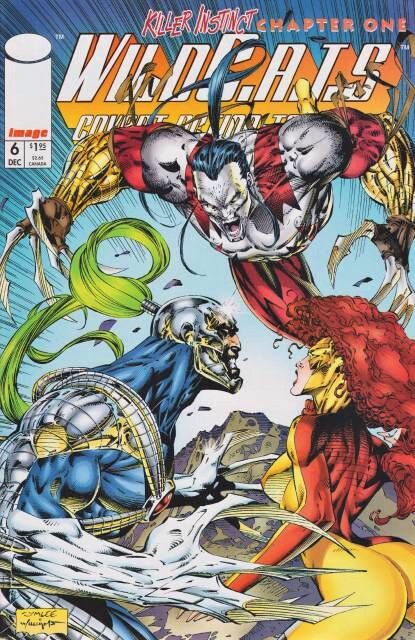
With those details laid down, here is a look back WildC.A.T.S: Covert Action Teams #7, published by Image Comics in 1994 with a story written by Brandon Choi and Jim Lee. Lee did the art.
The cover.
Early story
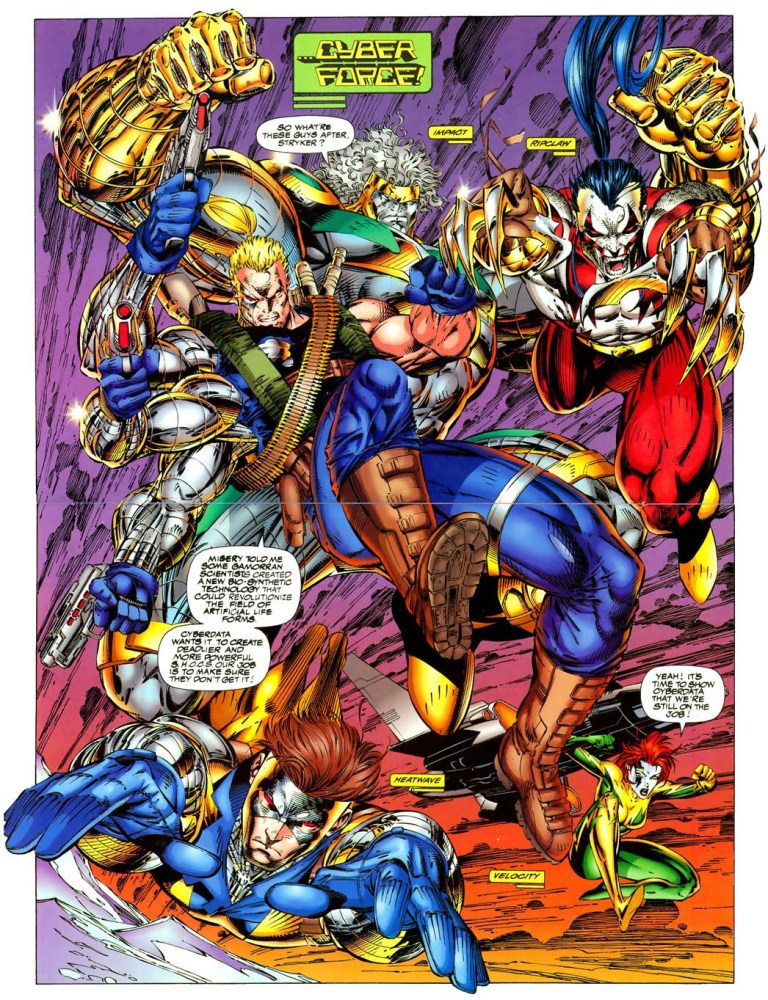
The story begins somewhere in the skies above Gamorra, off the coast of the Philippines! Stryker, the Cyber Force member with three cybernetic right arms, communicates with his teammates and tells them that if half of what Misery said is true about the new Cyberdata S.H.O.C.S., they’re in for a nasty fight and they have to hit the ground.
Stryker, Impact, Heatwave, Velocity and Ripclaw jump off their high-tech jet (which has Cyblade and Misery inside) and land safely. Using his enhanced ability of smell, Ripclaw begins detecting tracks of what they are look for.
Meanwhile at the back of the Isle of the Dead, a high-tech craft arrives with three passengers who are prepared to do a drug deal. Slowly, someone bleeding and with blades on his hands climbs into the craft surprising the passengers. He takes control of the craft, throws the passengers off and leaves.
As Cyber Force starts its ground search with Misery advising them while carefully using her telepathy on them. As Stryker enters a ravaged high-tech place, his sensors detect nothing and yet his instincts tell him something is present nearby. Standing near him is Spartan of WildC.A.T.S…
Quality
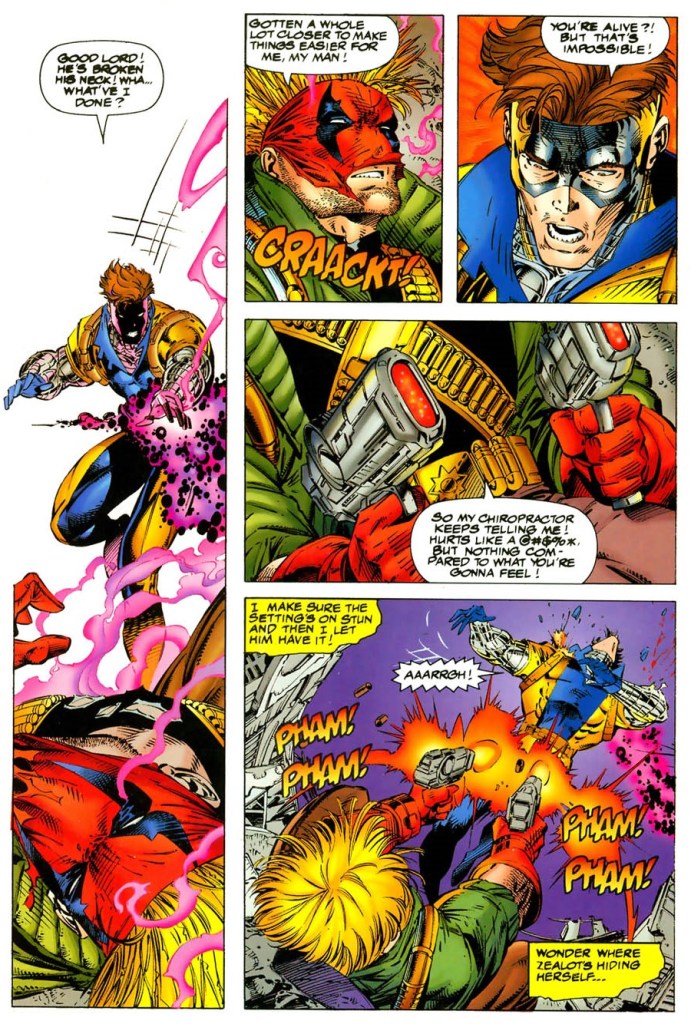
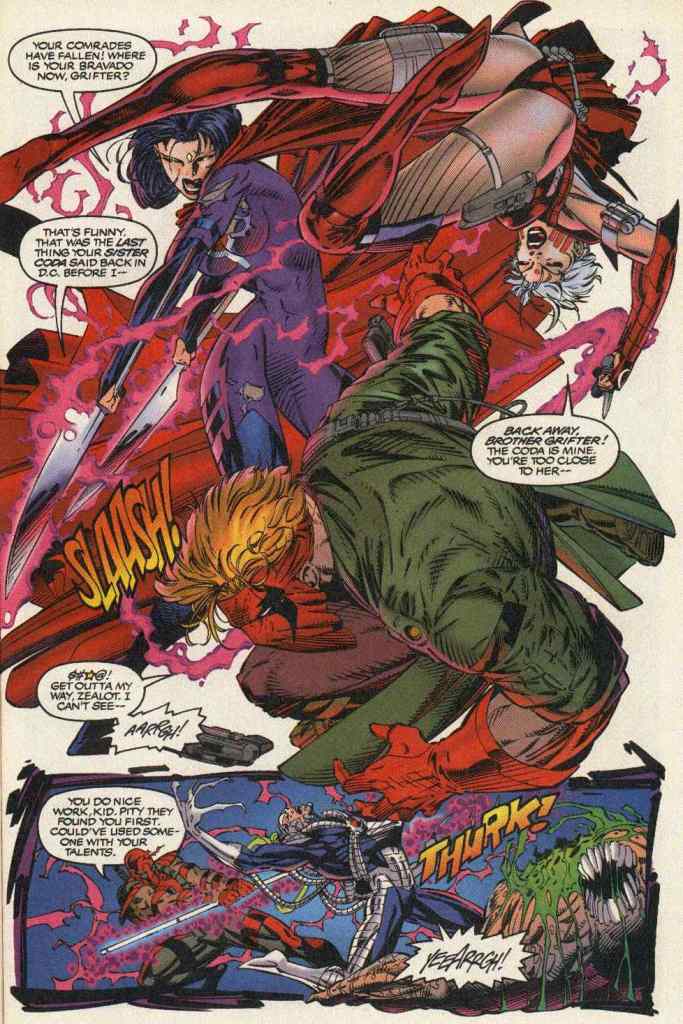
In this encounter between Grifter and Heatwave, do you notice something lacking visually?
I’ll start with the very obvious purpose of this comic book. After the build-up done in the first two chapters of the Killer Instinct storyline, this story serves as the start of what turned out to be the big pay-off as WildC.A.T.S and Cyber Force members finally got together with an action-packed battle to kick things off. From a storytelling view point, this one is mainly a WildC.A.T.S versus Cyber Force tale with really nice match-ups between their members such as Spartan-Stryker, Cyblade-Zealot and Maul-Impact to name a few. These match-ups and fights are excellently drawn by Jim Lee and I really enjoyed his own artistic visuals of Marc Silvestri’s Cyber Force.
More on the plot, it is pretty simple in concept and structure. The members of the two teams get to fight each other which gets the attention of Skywatch which itself has vested interest with the operations of Stormwatch (note: this is within the WildStorm lore) and the secret facility on that blew up (as seen in WildC.A.T.S #5). Misery remains the key factor in the story and in this tale, she gets to guide and manipulate Cyber Force to find something valuable while Warblade remains mostly absent. Apart from the battles, the absent Voodoo, Void and Jacob Marlowe have their respective spotlights mainly for the character developments as well as reminding readers about the continuing Kherubim-Daemonite conflict.
The quality of the writing is serviceable and the way I look at this comic book, it is mainly driven by spectacle and match-ups. The amount of crossover action is of top-notch quality (note: Jim Lee apparently missed out on key details while drawing Heatwave in a scene with Grifter) and clearly Jim Lee planned the visuals carefully. While there is little character development here, the ironic thing is that Misery (note: visually she is a wicked version of Jean Grey of the X-Men) is the one who gets a good chunk of the said development. Not only does she become a force in the minds of Cyber Force members, she also has her intimate moments with Ripclaw which is a reminder to readers that they have a shared past together (note: this will resonate more with those who read Cyber Force #2 of the regular series).
Conclusion
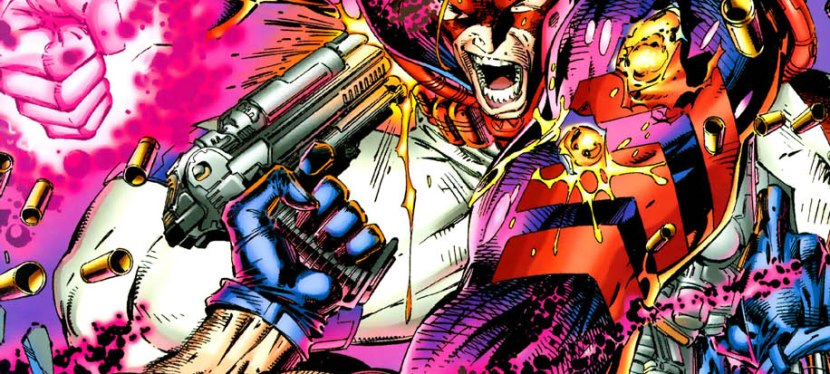
This is how Cyber Force looks like as drawn by Jim Lee.
To make things clear, WildC.A.T.S: Covert Action Teams #7 (1994) will strongly appeal to the respective fans of WildC.A.T.S and Cyber Force, to the readers who love high-quality superhero action, and to those who simply enjoy superhero crossover stories. While it is not a surprise that this comic book has great visuals, the writing this time clearly lacks depth and I really felt that the dialogue and text descriptions were done mainly to fit the obvious spectacle-led concept. If you are the kind of reader who wants storytelling and characterization prioritized in an action-packed crossover comic book, this one might not satisfy you. Ultimately, this one is a fun read even though the quality of the writing does not even come close to the quality of the visuals.
If you are seriously planning to buy an existing hard copy of WildC.A.T.S: Covert Action Teams #7 (1994), be aware that as of this writing, MileHighComics.com shows that the near-mint copy of the regular edition costs $30 while the near-mint copy of the newsstand edition costs $90. The near-mint copy of the silver cover edition costs $300.
Overall, WildC.A.T.S: Covert Action Teams #7 (1994) is recommended.
+++++
Thank you for reading. If you find this article engaging, please click the like button below and also please consider sharing this article to others. If you are looking for a copywriter to create content for your special project or business, check out my services and my portfolio. Feel free to contact me with a private message. Also please feel free to visit my Facebook page Author Carlo Carrasco and follow me on Twitter at @HavenorFantasy as well as on Tumblr at https://carlocarrasco.tumblr.com/
Disclaimer: This is my original work with details sourced from reading the comic book and doing personal research. Anyone who wants to use this article, in part or in whole, needs to secure first my permission and agree to cite me as the source and author. Let it be known that any unauthorized use of this article will constrain the author to pursue the remedies under R.A. No. 8293, the Revised Penal Code, and/or all applicable legal actions under the laws of the Philippines.
Welcome back superhero enthusiasts, 1980s culture enthusiasts and comic book collectors! Today we go back to the year 1981 to examine the Marvel Comics universe through the exploits of Dazzler!
Last time around, Alison Blaire was preparing herself for a big event as Dazzler. The event was something needed to help her boost her career as an entertainer and the stakes were high as there were many important guests. The weird thing was that she instead got involved with one of the most fearsome super villains of Marvel – Dr. Doom!
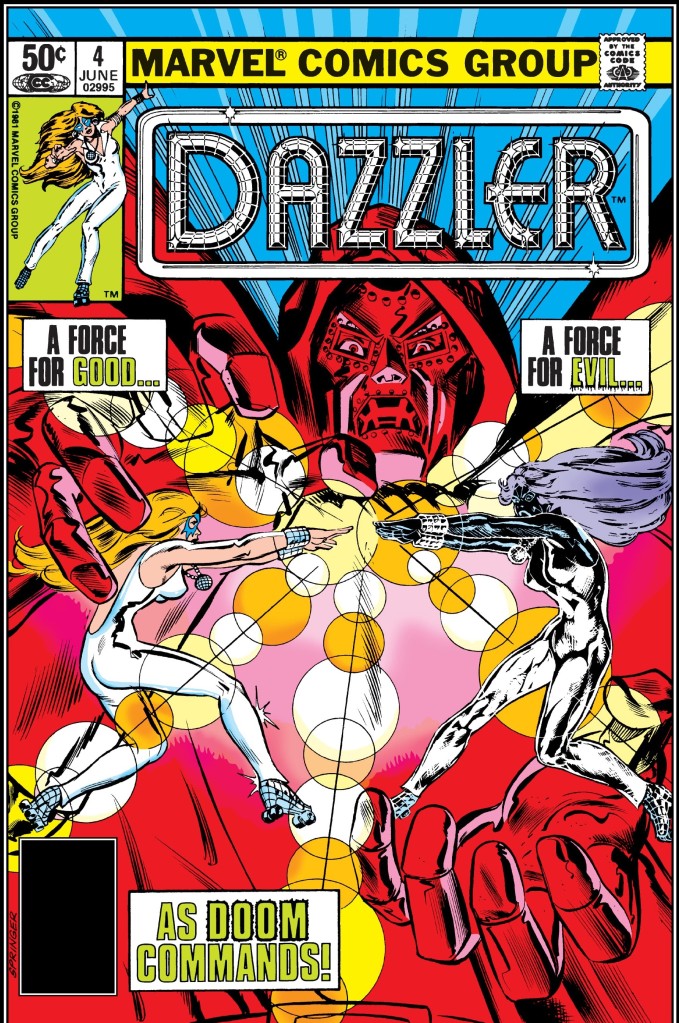
With those details laid down, here is a look back Dazzler #4, published by Marvel Comics in 1981 with a story written by Tom DeFalco and drawn by the late Frank Springer. This was Springer’s Dazzler debut.
The cover.
Early story
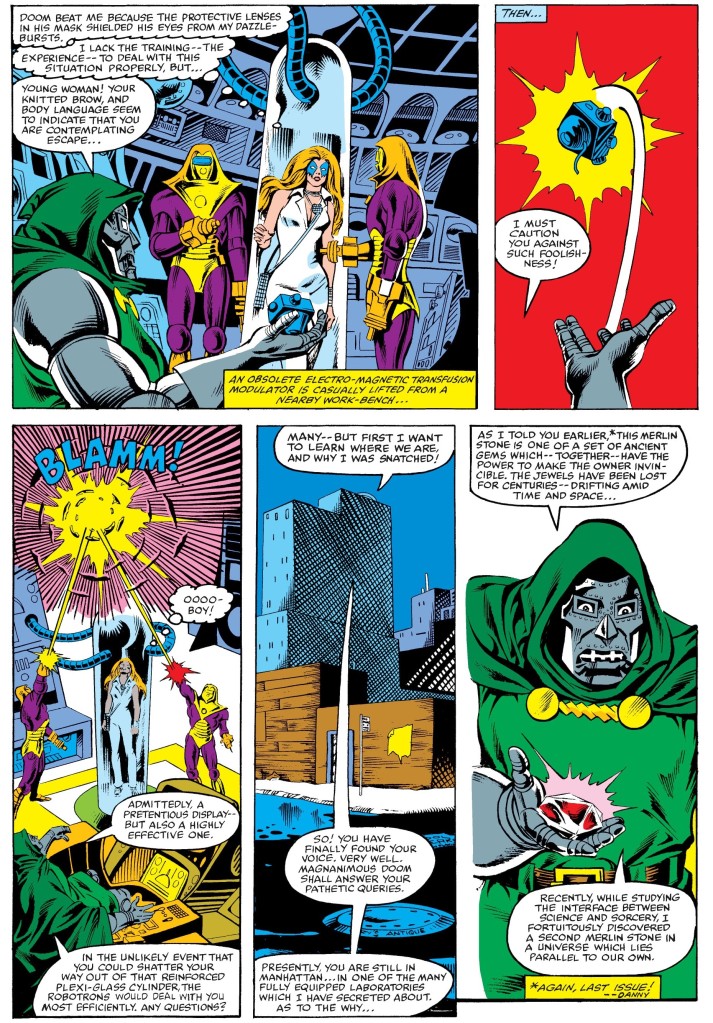
The story begins inside a secret facility. Dr. Doom tells Dazzler that the Merlin Stone he just acquired mirrors her reflections as well as his own. The said stone has unique, mystical properties that Doom believes will help him achieve his dream of domination over mankind.
Dazzler, who is trapped inside a tube and is guarded by two of Dr. Doom’s guards, tries to recover after losing consciousness a short time back. Dr. Doom expresses his observation of her special ability to convert sound into light.
Dr. Doom turns his computer on energizing the tube that contains Dazzler. She suddenly turns into energy and disappears…
Quality
Dazzler in a new dimension.
The best way to describe this comic’s story…it is one wild ride that emphasizes a different kind of fantasy for readers. This is, of course, related to Dr. Doom’s immediate quest of finding another Merlin Stone within a different dimension which directly involved Dazzler against her will.
Dazzler here was in a very wild misadventure that goes way beyond the limits of New York City. Being in a completely new dimension, she finds herself literally lost in the sea of space and encounters creatures here and there. This misadventure, however, was not written to be mindless at all. In fact, as the tale in the new dimension goes on, Dazzler was presented to be more tactical, more analytical and do things to solve problems she encountered. She also gets to use her superpower in more creative ways.
The misadventure also has key moments that test Dazzler’s resolve on a personal level. As such, these moments added to her development which also raises the stakes as to what she could potentially do once she returns back to her life. Clearly, this is a story that carefully mixes spectacle and character development without losing track of the story.
On the art of the comic book, Frank Springer’s Dazzler debut is pretty solid. Not only does he capture the look of Dazzler herself, his creative visuals really brought the dimension into life filled with images of out space, fantasy monsters and more. Apart from drawing Dazzler and Dr. Doom, Springer’s art of the Fantastic Four is pretty good to look at.
Conclusion
A helpless Dazzler in the presence of Dr. Doom.
Dazzler #4 (1981) is a fun comic book to read and as a Dazzler story, it is a worthy continuation of the events that took place in issue #3. The concept about having Dazzler under the power of Dr. Doom was nicely executed which is a very hard feat to achieve since the said super villain was known to be a major force of opposition not only against the Fantastic Four but also against Spider-Man, the X-Men and more. Dazzler’s misadventure into the other dimension was wild and yet nicely structured which led to some nice character development of hers. This comic book had a strong series start for Frank Springer who went on to draw a great majority of the issues of the Dazzler monthly series.
If you are seriously planning to buy an existing hard copy of Dazzler #4 (1981), be aware that as of this writing, MileHighComics.com shows that the near-mint copy of the regular edition costs $28 while the near-mint copy of the newsstand edition costs $60.
Overall, Dazzler #4 (1981) is recommended.
+++++
Thank you for reading. If you find this article engaging, please click the like button below and also please consider sharing this article to others. If you are looking for a copywriter to create content for your special project or business, check out my services and my portfolio. Feel free to contact me with a private message. Also please feel free to visit my Facebook page Author Carlo Carrasco and follow me on Twitter at @HavenorFantasy as well as on Tumblr at https://carlocarrasco.tumblr.com/
Disclaimer: This is my original work with details sourced from reading the comic book and doing personal research. Anyone who wants to use this article, in part or in whole, needs to secure first my permission and agree to cite me as the source and author. Let it be known that any unauthorized use of this article will constrain the author to pursue the remedies under R.A. No. 8293, the Revised Penal Code, and/or all applicable legal actions under the laws of the Philippines.
Welcome back superhero enthusiasts, 1990s culture enthusiasts and comic book collectors! Today we continue revisiting Jim Lee’s flagship title under Image Comics – WildC.A.T.S: Covert Action Teams!
For the newcomers reading this, I recently completed reviewing the 4-issue mini-series (read my retro reviews here, here, here and here), the first issue of which was one of the launch titles published under Image Comics’ banner through Malibu Comics. Back in 2020, I reviewed issue #5 which itself was highly unusual as it marked the beginning of what was back then the regular series of WildC.A.T.S (note: starting a brand new comic book series is often done with a new issue #1). WildC.A.T.S: Covert Action Teams #5 was conveniently part of the build-up for the Killer Instinct storyline that had featured Jim Lee’s creations crossing over with Marc Silvestri’s Cyber Force.
With those details laid down, here is a look back WildC.A.T.S: Covert Action Teams #6, published by Image Comics in 1993 with a story written by Brandon Choi and Jim Lee. Lee did the art.
The cover.
Early story
The story begins with the WildC.A.T.S flying in their high-tech aircraft and observing the large explosion which marked the destruction of a top-secret research facility. Their teammate Warblade was left behind which concerns Grifter and Voodoo. Spartan says it is too risky for them to move close to the site of destruction for Warblade as their electronic counter measure and identification systems have been lost due to the explosion. Spartan also told them team that they need to fly away before the Gamorran security forces arrive.
They are too late, however, as three high-tech aircrafts of Gamorra have arrived to take them down. One of them launched several missiles at the WildC.A.T.S aircraft causing Spartan to tell Grifter to redirect all power to their shields.
As hard as he tried, Spartan could only fly their shielded jet to dodge the first four missiles and absorbing the impact of two missiles before getting hit by the other missiles launched by the other two enemy aircrafts.
While their jet got destroyed into pieces, the WildC.A.T.S managed to survive the explosion only to see themselves falling helplessly in the air. As Spartan catches Voodoo, Grifter warns him abou the incoming Gamorran aircraft…
Quality
The team but without Jacob Marlowe, Warblade, Voodoo and Void at this point of the story.
To begin with, this comic book is very much like its predecessors – a very action-packed tale laced with the occasional character moments for fun while having little room left for character development. If there is any notable change in the way this comic book’s story was told, it is the detective work done collectively by key members of WildC.A.T.S followed by exposition dumps here and there. The detective work and exposition were done primarily to add to the build-up of the crossover with Cyber Force with the revelation of a love triangle from the past involving Misery (who gave Grifter a lot of trouble in issue #5), Warblade and Ripclaw (from the other team).
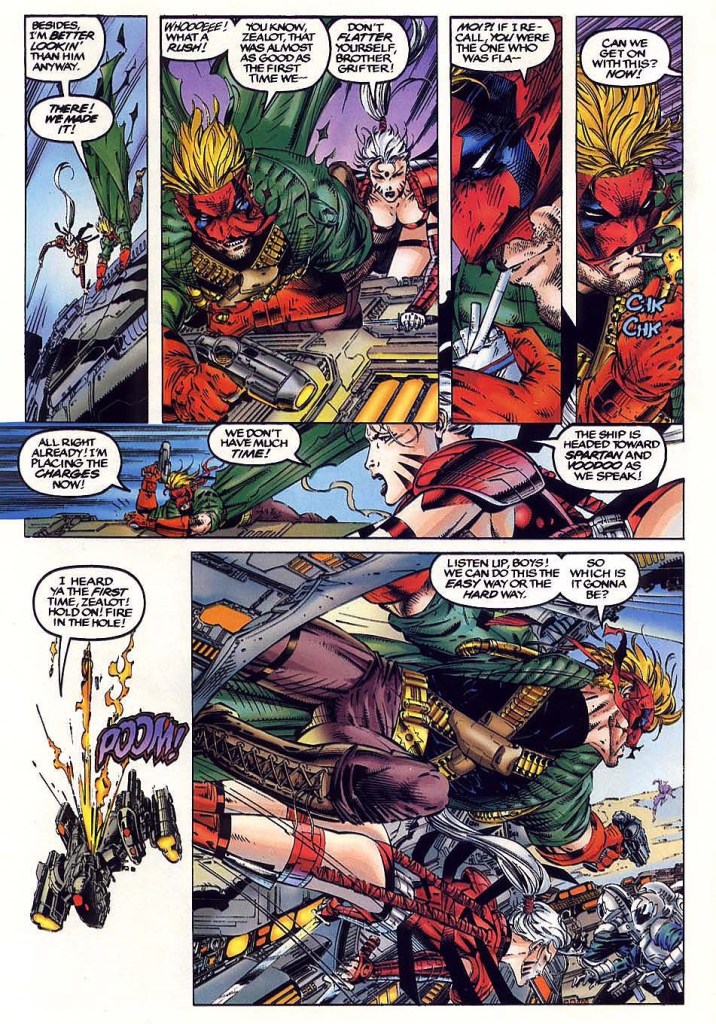
As with Jim Lee’s past works, the action here is highly charged and there is a lot of spectacle to enjoy most of the way. By the time this comic book got published, the respective capabilities of the WildC.A.T.S team members have already been established and the creators pushed the creative limits further on showing what else could the main characters do as envisioned by Jim Lee. There is even this 4-page sequence showing Grifter and Zealot infiltrating one of the Gamorran aircrafts and having lots of banter along the way which was fun to read. Considering the lack of space for character development, the creators made up for it somewhat with the dialogue.
As this is the first chapter of the Killer Instinct crossover storyline, the build-up for it is not really that engaging to me personally. While Ripclaw was already established as a major Cyber Force character and Warblade was a visible yet not so dominating as a member of WildC.A.T.S, the establishment of the personal connection between them through Misery (the woman right in the middle) is just not so strong. Not even a huge exposition dump about the past could have strengthened the background. It would have been more helpful had Jim Lee and Marc Silvestri agreed to publish a prequel comic book (or pages inserted into a few comic books of WildC.A.T.S and Cyber Force) about Warblade-Misery-Ripclaw in the past as a prelude to Killer Instinct. More on Misery herself, I could not help but think of her as a distorted and more wicked version of the X-Men’s Jean Grey complete with long red hair.
Conclusion
Grifter and Zealot infiltrate a Gamorran aircraft.
WildC.A.T.S: Covert Action Teams #6 (1993) is another fun comic book to read filled with a lot of stuff that Jim Lee fans love to see again and again. As the opening chapter of Killer Instinct, the creators did the best they could to establish Misery as an important antagonist who happens to have been personally involved with Warblade and Ripclaw some years back. Sadly, the Warblade-Misery-Ripclaw triangle establishment is not so engaging and looked more like an afterthought. Still, this comic book’s story is not brainless and expanded the lore of the WildStorm universe a bit more. There is more good stuff than bad ones which make this worth reading.
If you are seriously planning to buy an existing hard copy of WildC.A.T.S: Covert Action Teams #6 (1993), be aware that as of this writing, MileHighComics.com shows that the near-mint copy of the regular edition costs $20 while the near-mint copies of gold cover edition and newsstand edition cost $300 and $60 respectively.
Overall, WildC.A.T.S: Covert Action Teams #6 (1993) is recommended.
+++++
Thank you for reading. If you find this article engaging, please click the like button below and also please consider sharing this article to others. If you are looking for a copywriter to create content for your special project or business, check out my services and my portfolio. Feel free to contact me with a private message. Also please feel free to visit my Facebook page Author Carlo Carrasco and follow me on Twitter at @HavenorFantasy as well as on Tumblr at https://carlocarrasco.tumblr.com/
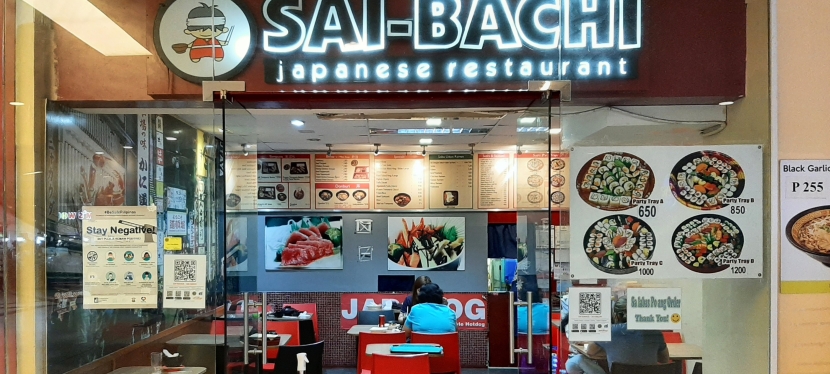
Have you been at Festival Mall in Alabang, Muntinlupa City lately? If you are craving for delicious food at one of the many Japanese restaurants inside Festival Mall, then you should take a look at SaibachiJapanese restaurant (stylized as SAI-BACHI) at the ground floor level just steps away from SM Savemore Supermaket.
In my experience, I’ve been dining at Saibachi in the mall from time to time over the past several years. Their restaurant has limited space (note: they have a counter for orders and payments, and a selection of food at a space by the wall just outside their restaurant), some chairs and their tables are small compared to those in other restaurants there. The current COVID-19 pandemic saw the imposition of limitations on how many customers could be allowed to eat inside restaurants (I’m looking at you – MMDA, Metro Manila Council and IATF). Even so, Saibachi still succeeded in staying in business and keeps on feeding customers with delicious food. Not even the pandemic and government overreach could stop them.
At this point, you must be wondering what food of Saibachi’s do I enjoy eating. Let’s move on!
Miso Soup
The single serving of Miso Soup in a small-sized cup.
For starters, I like their Miso soup which as of this writing costs P55 per single serving (small sized). In terms of taste and ingredients, it is good and satisfying to have. It is also one of the earliest items to be served to me in most of my dine-in visits at Saibachi Alabang through the years.
Futo Maki (Foto Maki according to Saibachi)
The 5-role Futo Maki set.
Saibachi’s Futo Maki is served with five pieces along with soy sauce and wasabi. Each roll is not as thick compared to what is served in other Japanese restaurants but to Saibachi’s credit, each roll is tasty and their specific selections of ingredients per roll shows precision. The 5-roll set is good enough in terms of taste and content for me personally. Those who crave for greater satisfaction with Futo Maki should consider a second set to order. The Futo Maki set nowadays costs P125 per order.
Fried Rice
A solo serving of Fried Rice.
Fried rice at Saibachi (P150 per order as of this writing) is pretty tasty on its own. The taste is strong enough, I did not need to add any condiments anymore. Their fried rice has bits of meat, carrots, egg and a few other vegetables. For a single serving, the content is satisfying enough for me dining in. For anyone who craves for greater satisfaction of fried rice, you should consider ordering Saibachi’s fried rice offerings through their delivery and catering services.
Beef Sukiyaki
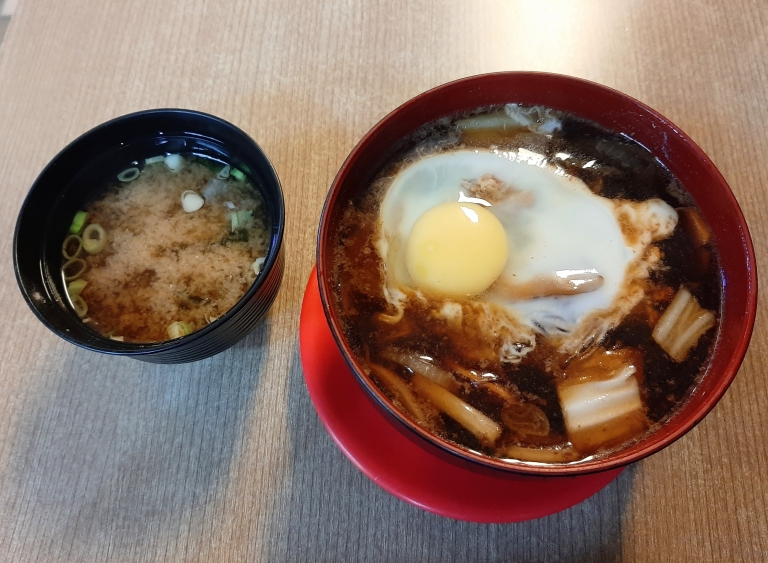
A bowl of soup-style Beef Sukiyaki on the right, Miso Soup cup on the left.
A close look on the ingredients prepared in Saibachi’s Beef Sukiyaki.
This one is easily my favorite in Saibachi when dining in. At P220 per order, the Beef Sukiyaki is served by the bowl and it is what others would refer to as the “soupy type Sukiyaki” for it is prepared in soup-style. On face value, the bowl looks small but in reality, it contains a good amount of hot soup, Sotanghon-style noodles, pieces of beef, vegetables and one egg on top. Beef Sukiyaki served in other Japanese restaurants are often large (note: with lots of vegetables and ingredients served fresh apart from the soup) and prepared to feed at least three people. If you want a tasty Beef Sukiyaki for your solo enjoyment with lots of soup, enough ingredients and a strong taste, you will get it at Saibachi! Personally, I consider this as Saibachi’s dine-in special and I highly recommend it.
Chapchae
The very tasty Chapchae on display.
While they are referred to as a Japanese restaurant, Saibachi also serves non-Japanese food. Anyone who loves Korean-style noodles should order the Chapchae whenever dining in. To begin with, Saibachi’s Chapchae are really prepared to be very tasty and anyone who loves strong flavors will enjoy it. When it comes to content, I find the Chapchae solo-serving (P150 per order as of this writing) to be rather lacking. Any customer who wants more of the very delicious Chapchae should consider ordering another serving or go for the bilao-sized servings (for multiple people to enjoy).
The above-mentioned foods are the ones that I enjoyed collectively when dining inside Saibachi at Festival Mall over the past several years. That being said, I recommend their Miso Soup, Futo Maki, Fried Rice, Chapchae and Beef Sukiyaki to you readers. Apart from serving food for diners, they also serve meals of Japanese, Chinese, Korean, Filipino and Thai cuisine through delivery and catering. Going back to my previous dine-in experiences with them, they need to improve on their Beef Ramen which I must say is flawed and not exactly a satisfying ramen experience (note: the beef served had that burned taste and feel, and the noodles served did not look and feel made in store but most likely were sourced from the wholesale market).
Saibachi’s Beef Ramen needs improving.
Also, in my opinion, the interior of their restaurant inside Festival Mall needs some improving to be more comfortable for families or groups of friends (five people and more) to enjoy. I understand their restaurant space is limited and they need enough space for the kitchen personnel to work in, but I can see that some improvements could be made on the dining area. When I say improvements, I don’t mean a full renovation which can be very costly.
Ultimately, if you love Japanese food and you want it with the best possible value for your limited budget while visiting Festival Mall, I encourage you to try the food at Saibachi’s restaurant. Go there! They have lots of other food offered and their menu has lots of items for you to select.
The wide menu at the space by the wall just outside their restaurant. Look at all the choices and prices.
Let me end this piece by asking you readers: Have you dined in at Saibachi inside Festival Mall lately? What meals do you enjoy there the most? Also, have you tried ordering Saibachi’s food through delivery service or through their catering packages? How often do you eat inside their restaurant whenever you visit Festival Mall?
Thank you for reading. If you find this article engaging, please click the like button below and also please consider sharing this article to others. If you are looking for a copywriter to create content for your special project or business, check out my services and my portfolio. Feel free to contact me with a private message. Also please feel free to visit my Facebook page Author Carlo Carrasco and follow me on Twitter at @HavenorFantasy as well as on Tumblr at https://carlocarrasco.tumblr.com/
For more South Metro Manila community news and developments, come back here soon. Also say NO to fake news, NO to irresponsible journalism, NO to misinformation, NO to plagiarists, NO to reckless publishers and NO to sinister propaganda when it comes to news and developments. For South Metro Manila community developments, member engagements, commerce and other relevant updates, join the growing South Metro Manila Facebook group at https://www.facebook.com/groups/342183059992673
Disclaimer: This is my original work with details sourced from reading the comic book and doing personal research. Anyone who wants to use this article, in part or in whole, needs to secure first my permission and agree to cite me as the source and author. Let it be known that any unauthorized use of this article will constrain the author to pursue the remedies under R.A. No. 8293, the Revised Penal Code, and/or all applicable legal actions under the laws of the Philippines.
Welcome back superhero enthusiasts, 1990s culture enthusiasts and comic book collectors! Today we revisit the early days of Image Comics through Jim Lee’s WildC.A.T.S: Covert Action Teams comic book franchise which was one of the launch titles of the said company.
Last time around, I reviewed the third issue of the WildC.A.T.S mini-series and its quality was good enough for me. Other than the visual candies delivered by Jim Lee, WildC.A.T.S: Covert Action Teams #3 featured a crossover with Rob Liefeld’s very own Youngblood which was really surprising and intriguing back in those times.
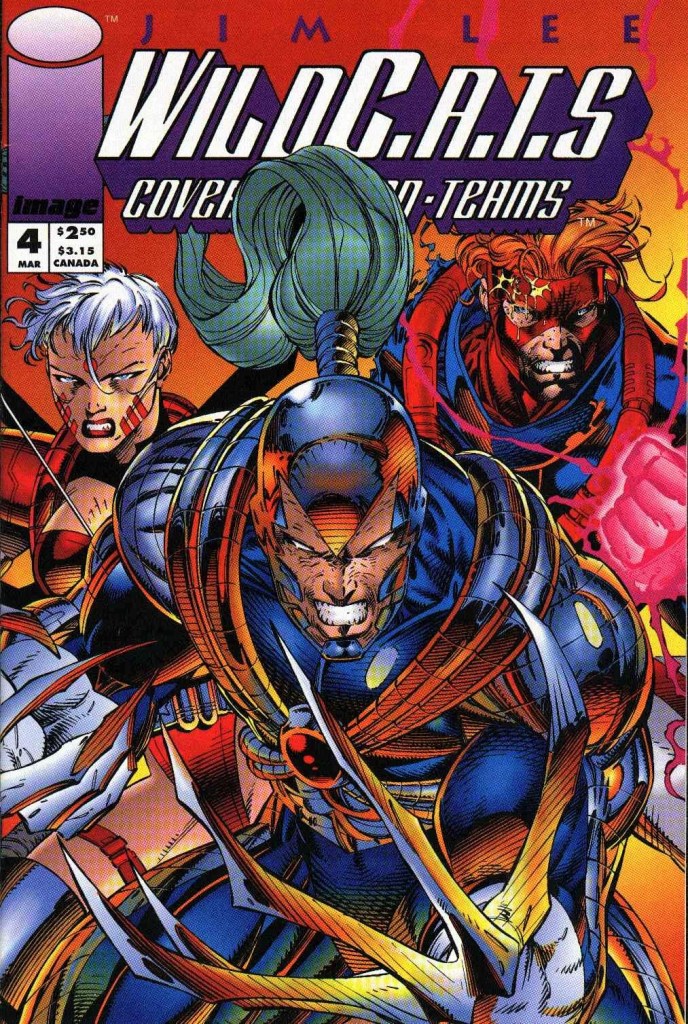
With those details laid down, here is a look back at the final issue of the mini-series…WildC.A.T.S: Covert Action Teams #4, published by Image Comics through Malibu Comics in 1993 with a story written by Brandon Choi and Jim Lee. Lee did the art.
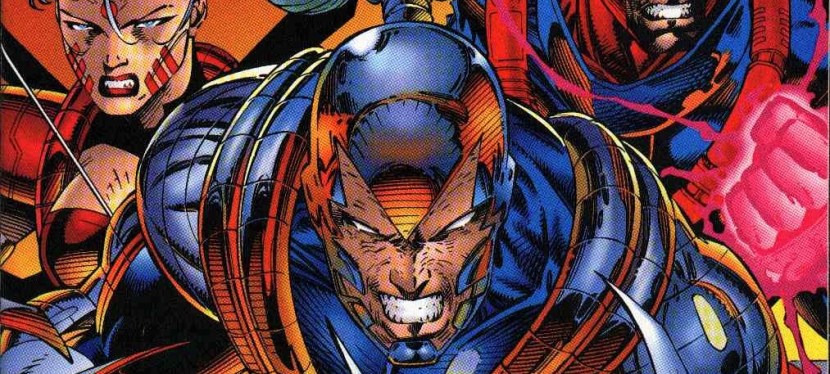
Jim Lee drew this cover very similarly to his cover art work on X-Men #4 (1992).
Early story
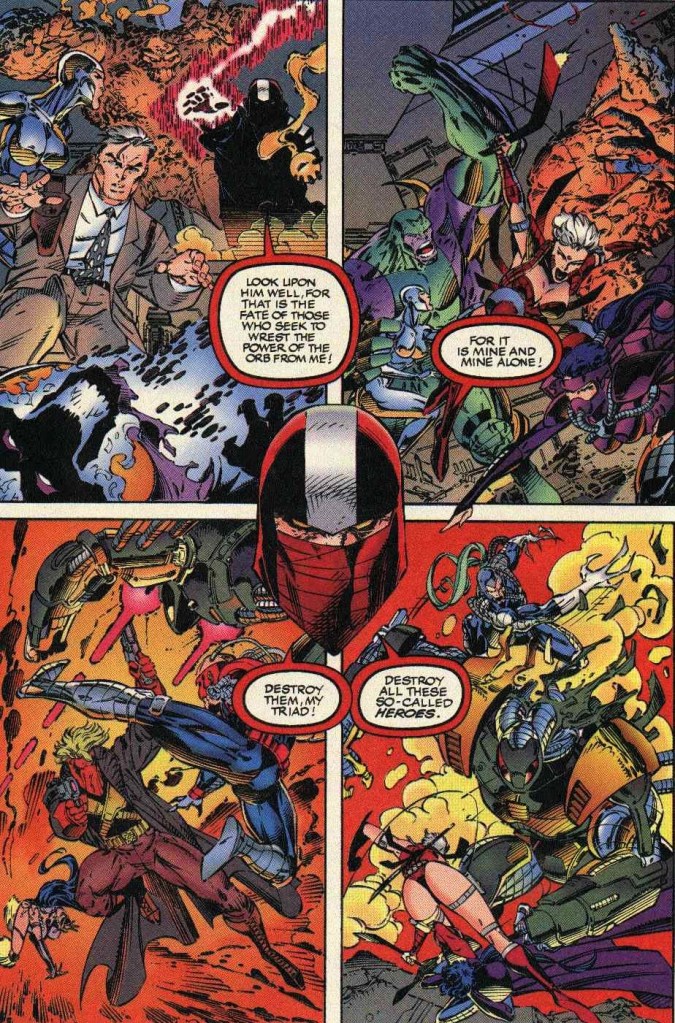
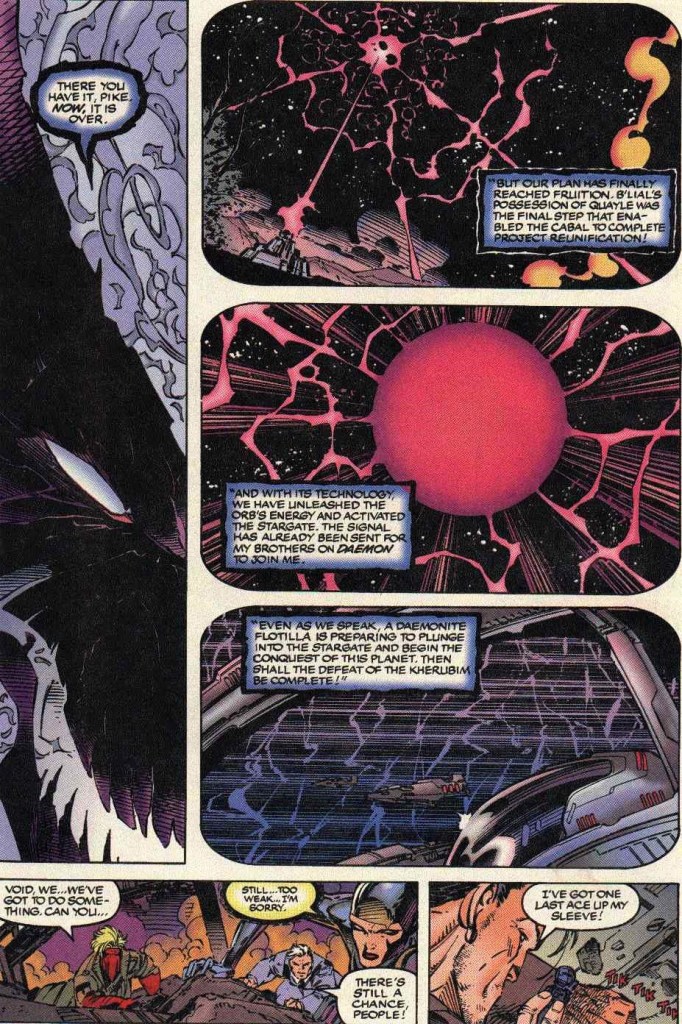
The story begins with Helspont already declaring victory as well as the beginning of his operation called Reunification which involves the use of the orb to activate a stargate which would allow his brethren of Daemonites to come to Earth to not only overwhelm the Kherubim but also to conquer the whole world. In his presence are two of his deadly companies standing with him and certain members of WildC.A.T.S – including their leader Jacob Marlowe – who are down on the rough surface having been hit hard moments earlier.
Suddenly a group composed of the six Youngblood members, Vice President Dan Quayle and WildC.A.T.S’ members Voodoo and Maul approach Helspont and his companions in an attempt to make them surrender.
As Voodoo realizes her power does not affect Helspont, the vicious Daemonite strikes the group with an energy blast aided by the orb and the high technology of the place. As this happens, Grift, Void and Jacob slowly make their moves. Jacob uses his communicator to send a signal to the heavily damaged Spartan…
Quality
WildC.A.T.S face strong opposition from the Gnome and his dangerous companions.
As the final tale of the mini-series, I can say that the script made for this comic book is a pretty satisfying read from start to finish. Like in issue #3, the pace here moves fast and there is a lot of spectacle that got executed while never overwhelming its narrative. More on the narrative, the conflict between the Kherubim and Daemonites is strongly symbolized by the WildC.A.T.S and Helspont’s forces going head to head. There are some pretty notable character moments that added to the fun factor such as Jacob sarcastically telling Helspont he could not access the back-up systems for his dreaded operation to bring the Daemonites to Earth.
Of course, this is not simply a WildC.A.T.S versus Helspont story in the good-versus-evil type of way. Apart from the inclusion of Rob Liefeld’s Youngblood, there is also the other dangerous party led by the Gnome who also have a strong interest in the orb. While their participation in the story happens pretty late, they do provide serious opposition against Jacob Marlowe and his team.
As mentioned earlier, there is a lot of action that expresses the intensity of the conflicts. While there is almost no room left for any real character development, the creators managed to craft a story that never felt brainless or unintelligent. As such, there is a lot of entertaining stuff to enjoy here and I personally find the establishment of WildC.A.T.S’ core concept to be solid and worth following.
Conclusion
As Helspont emphasizes his evil plan, Jacob Marlowe makes his move.
WildC.A.T.S: Covert Action Teams #4 (1993) is a not just a fun comic book to read. It is also a worthy conclusion to its mini-series and also it succeeded in establishing the WildC.A.T.S as both Jim Lee’s passion project and as one of the most worthy early titles of Image Comics. By the time I reached the end of this comic book, it became clear to me back in 1993 that Jim Lee was moving forward to a new territory on superhero comic book creations leaving behind his legacy with Marvel and their X-Men franchise. While this comic book ended the 4-issue mini-series, the funny thing was that Jim Lee and his team went on to start a regular comic book series of WildC.A.T.S: Covert Action Teams by actually publishing issue #5 (in late 1993) instead of starting with a brand new issue #1.
If you are seriously planning to buy an existing hard copy of WildC.A.T.S: Covert Action Teams #4 (1993), be aware that as of this writing, MileHighComics.com shows that the near-mint copy of the regular edition costs $20 while the near-mint copies of newsstand edition (without card) and the numbered-and-signed edition cost $48 and $160 respectively.
Overall, WildC.A.T.S: Covert Action Teams #4 (1993) is recommended.
+++++
Thank you for reading. If you find this article engaging, please click the like button below and also please consider sharing this article to others. If you are looking for a copywriter to create content for your special project or business, check out my services and my portfolio. Feel free to contact me with a private message. Also please feel free to visit my Facebook page Author Carlo Carrasco and follow me on Twitter at @HavenorFantasy as well as on Tumblr at https://carlocarrasco.tumblr.com/
Disclaimer: This is my original work with details sourced from reading the comic book and doing personal research. Anyone who wants to use this article, in part or in whole, needs to secure first my permission and agree to cite me as the source and author. Let it be known that any unauthorized use of this article will constrain the author to pursue the remedies under R.A. No. 8293, the Revised Penal Code, and/or all applicable legal actions under the laws of the Philippines.
Welcome back superhero enthusiasts, 1990s culture enthusiasts and comic book collectors! Today we revisit the early days of Image Comics through Jim Lee’s WildC.A.T.S: Covert Action Teams comic book franchise which was one of the launch titles of the said company.
Last time around, I reviewed the 2nd issue of WildC.A.T.S. which literally had more meat in its storytelling as the required introductions of the core characters were over. Issue #2 had some really nice revelations as it helped expand the WildStorm universe a bit more and it was intriguing to see International Operations (I/O) emphasized more as the mini-series established the Kherubim-Daemonite conflict.
With those details laid down, here is a look back at WildC.A.T.S: Covert Action Teams #3, published by Image Comics through Malibu Comics in 1993 with a story written by Brandon Choi and Jim Lee. Lee did the art.
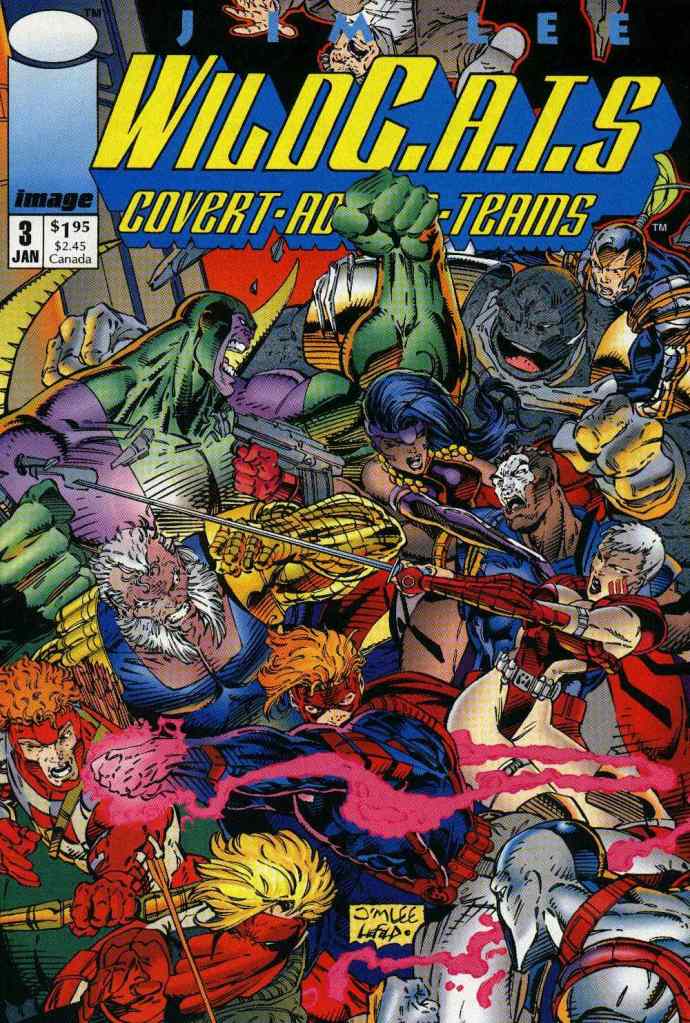
The cover.
Early story
The story begins inside the top-secret research facility of SDI with Maul holding a Daemonite disguised as US Vice President Dan Quayle off the ground with Spartan and Voodoo near him. The problem they have, however, is that the Youngblood team is facing them ready to fight. Shaft of Youngblood demands the release of the Vice President.
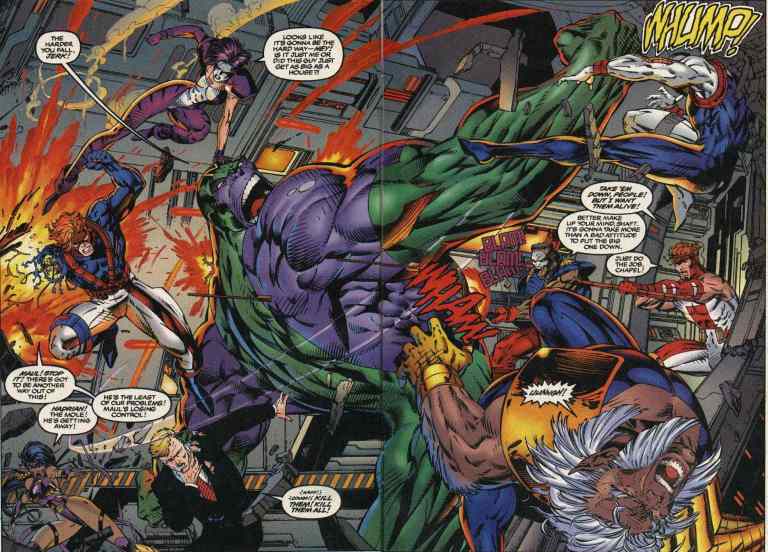
With his massive build, Maul lets go of the Vice President and hits Diehard sparking a battle between his team and Youngblood. Shaft tells his teammates that as they fight the three WildC.A.T.S, he wants them alive. The impostor Vice President Quayle tells Youngblood to kill them all.
After Diehard and Badrock knock off Maul, Chapel fires several blasts at Spartan to separate him from the impostor. Shaft then fires an arrow that generates disruptive sound which prevents Voodoo from executing her power.
Elsewhere within the facility, Grifter, Jacob Marlowe, Warblade, Void and Zealot quietly make their way to the control center where the Daemonite leader Helspont is overseeing secret operations…
Quality
You love Jim Lee-style action, you will find a lot to enjoy in this comic book.
Starting with the storytelling, this one is expectedly a natural progression from issue #2 but the key difference is that the pace moved much faster as there was more emphasis on action and visual splendor. Along the way another sub-plot was dramatized complete with the showing of additional characters Attica, Slag, HARM and their superior who are after a key object that happens to be a crucial part of Helspont’s operation. The way the script was written, the narrative was told in a disciplined manner even though the pace was faster and the creators had to integrate Rob Liefeld’s Youngblood which resulted one of the earliest Image Comics crossovers that unfortunately did not justify the fancy cover art. Given the addition of Youngblood, the mentioned sub-plot and the way the script was made, there was clearly no room left for character development. In my experience, re-reading this comic book’s story was fun and engaging enough.
As this story was action-packed, fans of Jim Lee will surely enjoy what he presented here. Even by today’s standards, the art and presentation of the spectacle is great to see! Personally, I like Jim Lee’s visual take on Youngblood (except that I still find Rob Liefeld’s drawing of Chapel more detailed) and the short-but-sweet battle between the two superhero teams is quite a spectacle. In terms of visual details, Lee drew the characters and environment with a lot of detail all throughout. There were no signs of rushed art here.
Conclusion
The battle between three WildC.A.T.S members and Youngblood begins!
As mentioned earlier, WildC.A.T.S: Covert Action Teams #3 (1993) is pretty entertaining and engaging. Compared to issue #2, this one has a lot more action and the narrative moved at a faster pace without becoming brainless. At the same time, there is a clear feeling that the stakes were raised as the WildC.A.T.S made their moves in what is clearly their final objective as a team. Also a factor here is the continued emphasis on the Kherubim-Daemonite war which was executed well. More on Rob Liefeld’s Youngblood being involved in the story, this results the illusion that Image Comics back then had a shared universe (note: read the legal stuff on the bottom of the credits). The crossover done here was more of an experiment done to emphasize the cooperation between Jim Lee and Liefeld as they were co-founders of Image.
If you are seriously planning to buy an existing hard copy of WildC.A.T.S: Covert Action Teams #3 (1993), be aware that as of this writing, MileHighComics.com shows that the near-mint copy of the gimmick cover edition costs $20 while the near-mint copies of newsstand edition and the signed editions cost $60 each.
Overall, WildC.A.T.S: Covert Action Teams #3 (1993) is recommended.
+++++
Thank you for reading. If you find this article engaging, please click the like button below and also please consider sharing this article to others. If you are looking for a copywriter to create content for your special project or business, check out my services and my portfolio. Feel free to contact me with a private message. Also please feel free to visit my Facebook page Author Carlo Carrasco and follow me on Twitter at @HavenorFantasy as well as on Tumblr at https://carlocarrasco.tumblr.com/
Disclaimer: This is my original work with details sourced from reading the comic book and doing personal research. Anyone who wants to use this article, in part or in whole, needs to secure first my permission and agree to cite me as the source and author. Let it be known that any unauthorized use of this article will constrain the author to pursue the remedies under R.A. No. 8293, the Revised Penal Code, and/or all applicable legal actions under the laws of the Philippines.
Welcome back superhero enthusiasts, 1990s culture enthusiasts and comic book collectors! Today we revisit the early days of Image Comics through Jim Lee’s WildC.A.T.S: Covert Action Teams comic book franchise which was one of the launch titles of the said company.
For the newcomers reading this, Jim Lee is one of the co-founders of Image Comics and during his previous stint with Marvel Comics, he was instrumental in modernizing the X-Men both visually and creatively (note: look at all the paramilitary elements implemented during his X-Men days). WildC.A.T.S was his independent superhero team project which went on to not only grow as a comic book franchise in the 1990s, but also became an animated TV series. WildC.A.T.S dealt with conspiracy as well as aliens from outer space.
With those details laid down, here is a look back at WildC.A.T.S: Covert Action Teams #2, published by Image Comics in 1992 with a story written by Brandon Choi and Jim Lee. Lee did the art.
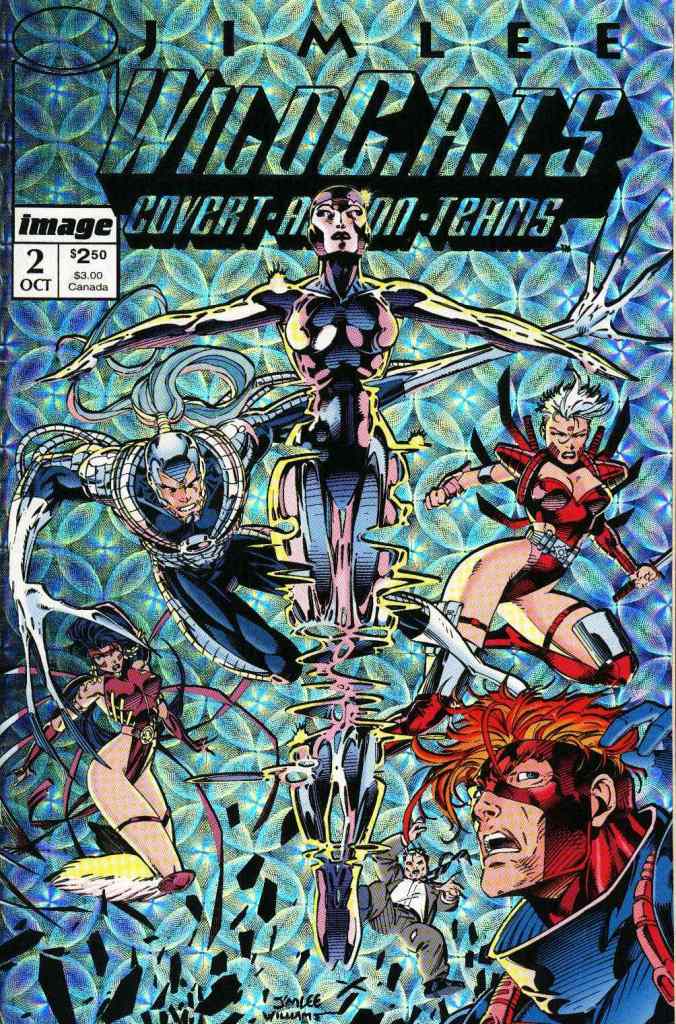
The cover.
Early story
The story begins in the headquarters of International Operations (I/O) whose officials have been monitoring a situation far away. Suddenly a portal appeared inside I/O which surprised director Lynch and his fellow officials. Seen through the portal – which appeared for only seconds in front I/O’s people – were Jacob Marlowe, Spartan, Grifter, Maul, Zealot, Voodoo, Void and Warblade who just escaped from certain death which is connected to the explosion monitored by I/O.
The WildC.A.T.S instantly arrived inside their highly advanced aircraft safe and sound. After some talk, they begin to move to a safehouse of Grifter’s near Quantico…
Quality
An efficient exposition about the science fiction concept of WildC.A.T.S.
As far as storytelling goes, this comic book has more depth to its plot. While the first issue was filled with introductions of characters and story concepts as well starting its narrative in cryptic fashion, there was more freedom in this issue for the writers to properly structure their story, gradually build-up tension, execute payoffs satisfactorily while still managing to insert spectacle to complete the work. The story moved with a moderate pace and things moved fast when it was needed. I find re-reading this WildC.A.T.S tale a more satisfying experience than before and it is also an improvement over the first issue.
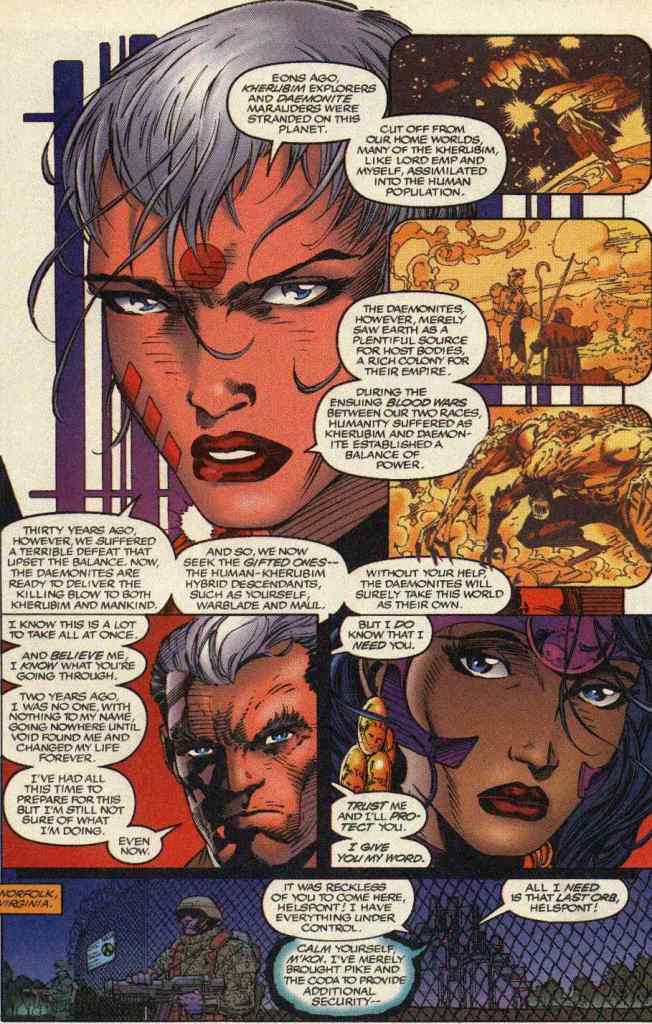
More on the core concept about Daemonites infiltrating human societies on Earth with the involvement of the Cabal to enhance their efforts, there literally more meat to chew here as Jim Lee and Brandon Choi came up with clever and efficient ways on executing exposition. The I/O meanwhile literally jumped from being background decoration into the main story as a connection was made between one of the top officials of the organization and WildC.A.T.S leader Marlowe.
More on the WildC.A.T.S themselves, you will get to know more about each member and how their respective personalities differ from each other as they all struggle to keep up with the changes around them. Voodoo here is still the witness of a conflict she never anticipated would involve her and many times she is clueless and really struggling to figure out what has been happening. While Marlowe has the strong tycoon mentality all throughout, Spartan is the dedicated and focused operator while Grifter is the cocky gunslinger and Zealot is the battle-hardened warrior whose perception about life and survival could make readers wonder if she is truly brave or truly reckless. With the introductions of each character already done, in issue #1 it was no surprise that there was a bit more space for the creators to define each team member with limited space (pages) they had during comic book production.
Conclusion
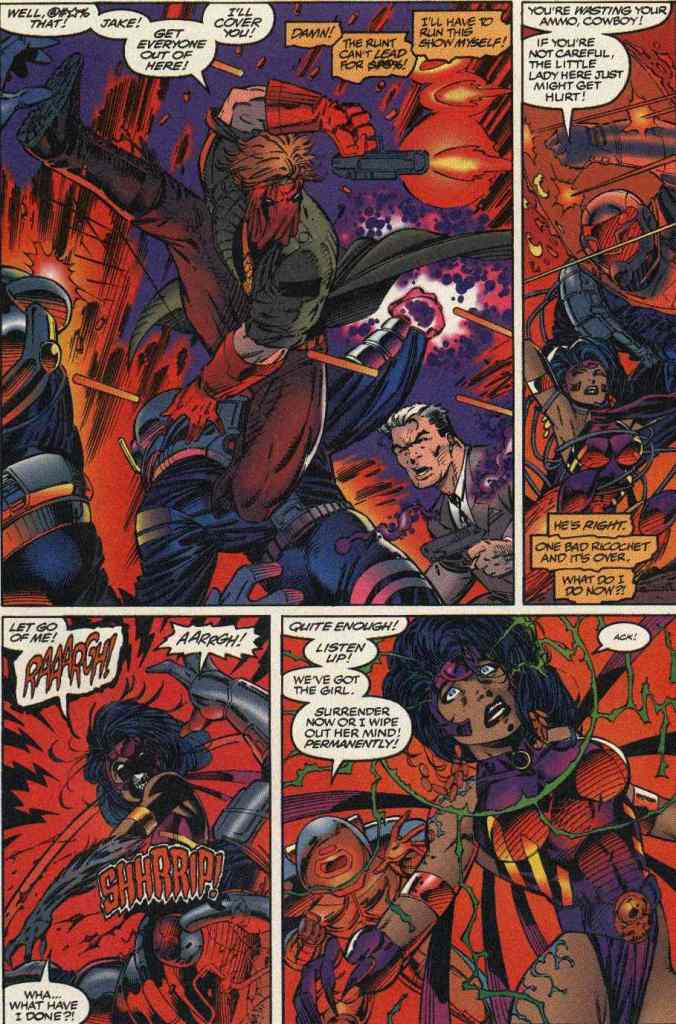
In the heat of the action, something visceral happened with Voodoo who is not even a fighter.
The best way to describe WildC.A.T.S: Covert Action Teams #2 (1992) is that its core concept as well as its mini-series plot really started to take shape as Brandon Choi and Jim Lee got over all the creative hurdles in issue #1. The result was not only more focus on plotting but executing payoff for story build-up, characterization and putting enough action in a rather disciplined way. There was no sign of creative rush by Choi and Lee here. I should also state that it is in this same comic book where you will see more interesting traits of the WildC.A.T.S members which, in my experience, made me anticipate the next issue.
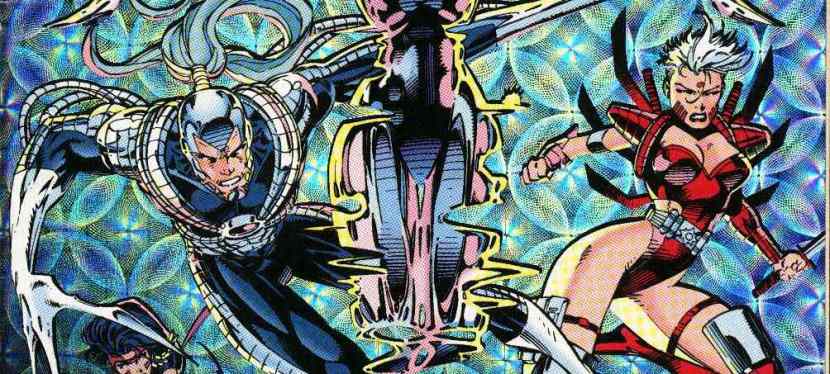
As one of the very early comic books of Image Comics, this one had one of the first, if not the first, gimmick covers of the said publisher and I can say that its content was good enough to justify the flashy cover and its rather high cover price of $2.50 (note: back in 1992 many of Marvel’s and DC’s comic books had cover prices of $1.25 while WildC.A.T.S: Covert Action Teams #1 had a $1.95 cover price). I could not forget the day in 1992 when I visited a local comic book specialty store in Makati that had WildC.A.T.S: Covert Action Teams #2 (1992) displayed with its cover really shining under a strong light source. I also remember there were others in the store staring at it.
If you are seriously planning to buy an existing hard copy of WildC.A.T.S: Covert Action Teams #2 (1992), be aware that as of this writing, MileHighComics.com shows that the near-mint copy of the gimmick cover edition costs $20 while the near-mint copies of the signed gimmick cover edition and the newsstand edition cost $60 each.
Overall, WildC.A.T.S: Covert Action Teams #2 (1992) is recommended.
+++++
Thank you for reading. If you find this article engaging, please click the like button below and also please consider sharing this article to others. If you are looking for a copywriter to create content for your special project or business, check out my services and my portfolio. Feel free to contact me with a private message. Also please feel free to visit my Facebook page Author Carlo Carrasco and follow me on Twitter at @HavenorFantasy as well as on Tumblr at https://carlocarrasco.tumblr.com/
Disclaimer: This is my original work with details sourced from reading the comic book and doing personal research. Anyone who wants to use this article, in part or in whole, needs to secure first my permission and agree to cite me as the source and author. Let it be known that any unauthorized use of this article will constrain the author to pursue the remedies under R.A. No. 8293, the Revised Penal Code, and/or all applicable legal actions under the laws of the Philippines.
Welcome back, superhero enthusiasts, 1990s culture enthusiasts, and comic book collectors! Today we revisit the world of 2099 within the universe of Marvel Comics back in the 1990s, specifically through the Spider-Man 2099 monthly series.
Today we will look back at the sixth issue of Spider-Man 2099. Previously, Spider-Man struggled long and hard with the Japanese agent called the Specialist not knowing that they are being monitored by powerful forces behind the scenes. As Alchemax’s Tyler Stone wanted Spider-Man, something unexpected happened before issue #5 ended.
With those details laid down, here is a look back at Spider-Man 2099 #6, published in 1993 by Marvel Comics with a story written by Peter David and drawn by Ricky Leonardi.
The cover.
Early story
The story begins in downtown New York which is the historic and original section of the city located far below the modern-day society and its skyscrapers (referred to as Uptown). Lots of people are living in poverty in downtown New York and even so they are not spared by people who claim to have authority over them as public service personnel. A woman and her child got approached by two men who believe that the mother is two months behind her security payments.
As the physical struggle between them went on, they all found themselves close to a dead end with a pile of trash located on it. Suddenly, a human arm comes out pushing the trash out of the way which stuns them all. Spider-Man then emerges and asks for help…
Quality
Spider-Man of 2099 is so weak and vulnerable, he could not even swing his way around and has to take a ride in downtown New York City.
If there is anything clear about this comic book, it is the fact that Peter David portrayed the futuristic Spider-Man as not only struggling for survival but also as a fugitive complete with a brand-new physical environment which is a dark, far futuristic vision of 20th century New York City. The good news is that David succeeded with what he executed and to say the least, this story has a completely different feel compared to issues #2, #3, #4 and #5.
On Spider-Man, the protagonist was shown to be very vulnerable. His fall from uptown to downtown really wrecked his health and due to the genetic modifications that happened to Miguel O’Hara in issue #1, his above-normal (albeit slow) recovery and strength to even move out the medical facility while being injured are justified creatively. Spider-Man being hunted together by Private Eye and their downtown counterparts (note: there is a clash of cultures and attitudes between them which was nicely dramatized) adds a new layer of suspense mixed with tension which easily reminds me of the fact that the futuristic web-slinger is just a worm within the futuristic and oppressive society of New York in 2099 under Alchemax (note: clearly anti-corporatism is a key element of Marvel 2099 which can be deceiving and misleading to readers, especially those who are vulnerable to the lies and deception of socialists, Marxists, Communists, liberals and other elements of the Satanic Left).
As expected, Peter David further dramatized relationships or connections between the supporting characters. He further spiced up the script with the gradual first appearance of a key 2099 villain for Spider-Man to face off with. I won’t reveal which villain is that and I encourage you to find out by reading this comic book.
Conclusion
Early in the comic book.
Spider-Man 2099 #6 (1993) is fun and compelling to read. What makes it compelling is the creative way the author changed the mood of the story as it shifted into downtown New York of 2099 filled with poverty, darkness and hopeless living. Spider-Man as a fugitive here is similar yet different enough compared to how local authorities perceive the classic Spider-Man/Peter Parker. At this point of the monthly series, Spider-Man of 2099 is shown to be very vulnerable and Miguel O’Hara finally becomes desperate not just to survive but also get back home somehow.
If you are seriously planning to buy an existing hard copy of Spider-Man 2099 #6 (1993) be aware that as of this writing, MileHighComics.com shows that the near-mint copy of the regular edition costs $30 while the near-mint copy of the newsstand edition costs $90.
Overall, Spider-Man 2099 #6 (1993) is recommended.
+++++
Thank you for reading. If you find this article engaging, please click the like button below and also please consider sharing this article to others. If you are looking for a copywriter to create content for your special project or business, check out my services and my portfolio. Feel free to contact me with a private message. Also please feel free to visit my Facebook page Author Carlo Carrasco and follow me on Twitter at @HavenorFantasy as well as on Tumblr at https://carlocarrasco.tumblr.com/











 Author Carlo Carrasco