A Look Back at Venom: Lethal Protector #2 (1993)

Disclaimer: This is my original work with details sourced from reading the comic book and doing personal research. Anyone who wants to use this article, in part or in whole, needs to secure first my permission and agree to cite me as the source and author. Let it be known that any unauthorized use of this article will constrain the author to pursue the remedies under R.A. No. 8293, the Revised Penal Code, and/or all applicable legal actions under the laws of the Philippines.

Welcome back superhero enthusiasts, 1990s arts and culture enthusiasts, Marvel Comics fans and comic book collectors! Today we go back to the year 1993 and explore a part of Marvel Comics’ universe through the first-ever limited comic book series featuring one of Marvel’s most iconic villains – Venom.

In my previous retro review, Eddie Brock returned to his hometown of San Francisco following the events of Amazing Spider-Man (1993). Living with his very distorted belief of protecting the innocent by doing unrelenting acts of violence on others, he begins to get involved with helpless people who happened to be hounded by agents of a certain private organization that wields power. Along the way, Spider-Man arrives in the city find Venom.

With those details laid down, here is a look back at Venom: Lethal Protector , published in 1993 by Marvel Comics with a story written by David Michelinie and drawn by Mark Bagley.

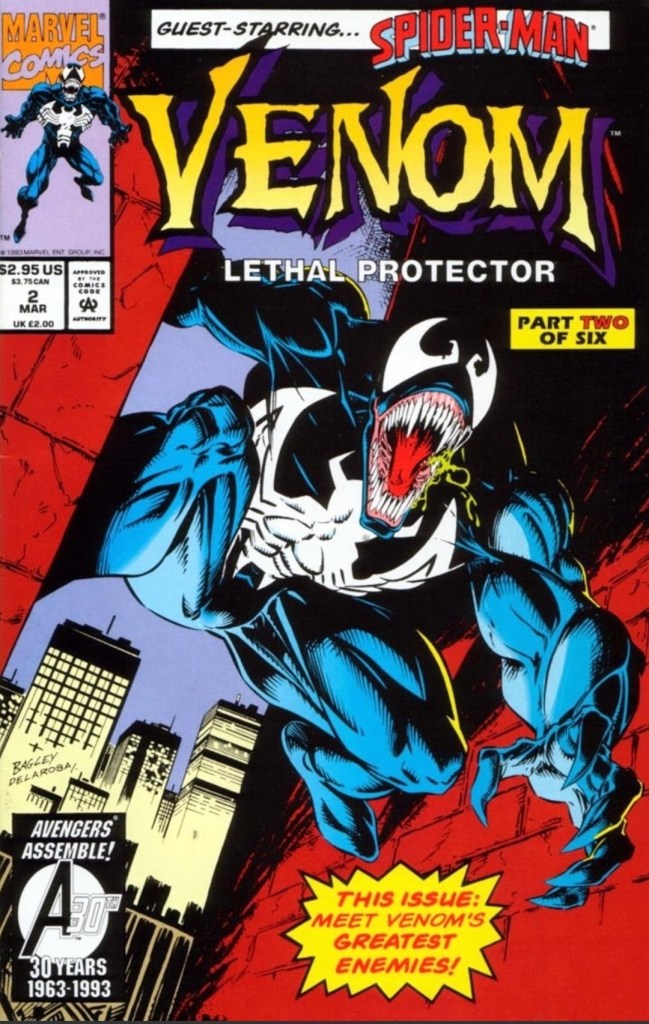
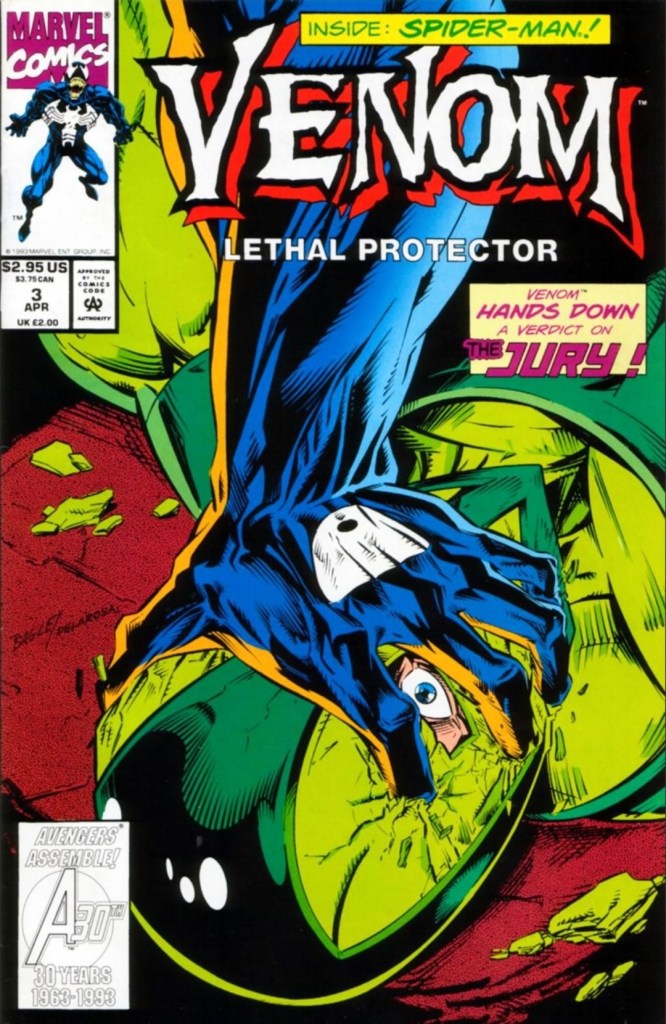
The cover.

Early story

The story begins deep underneath the city of San Francisco. Venom, who is caught by the large mechanical fist of a walking mech (piloted by a man working for Roland Treece’s organization), finds himself on the deeply buried section of the city and around them are vagrant people who settled and became residents of a local society that the rest of America does not even know exists.

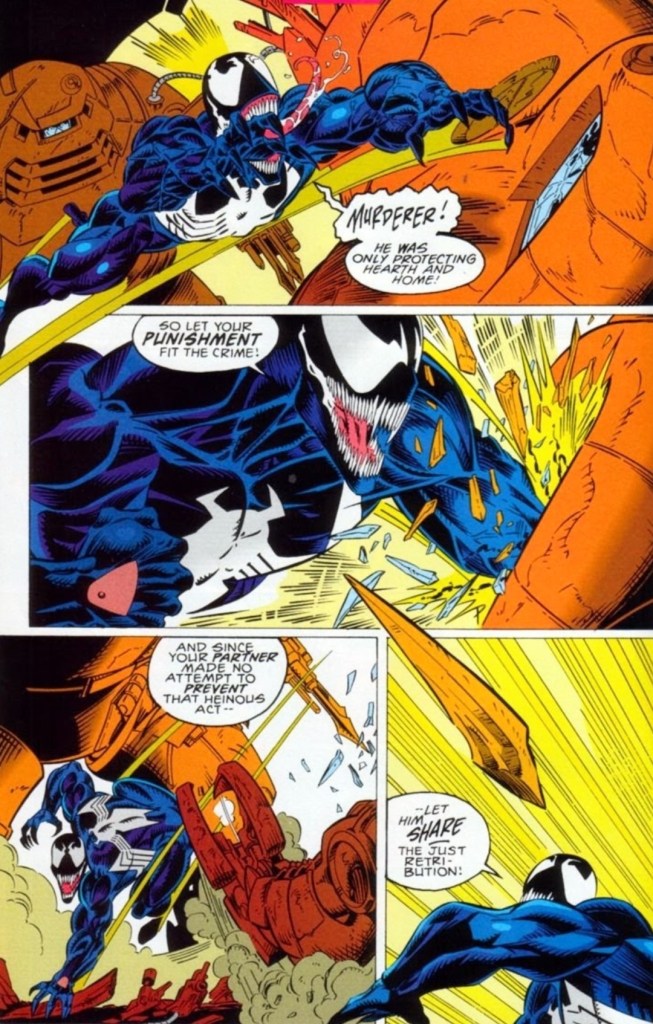
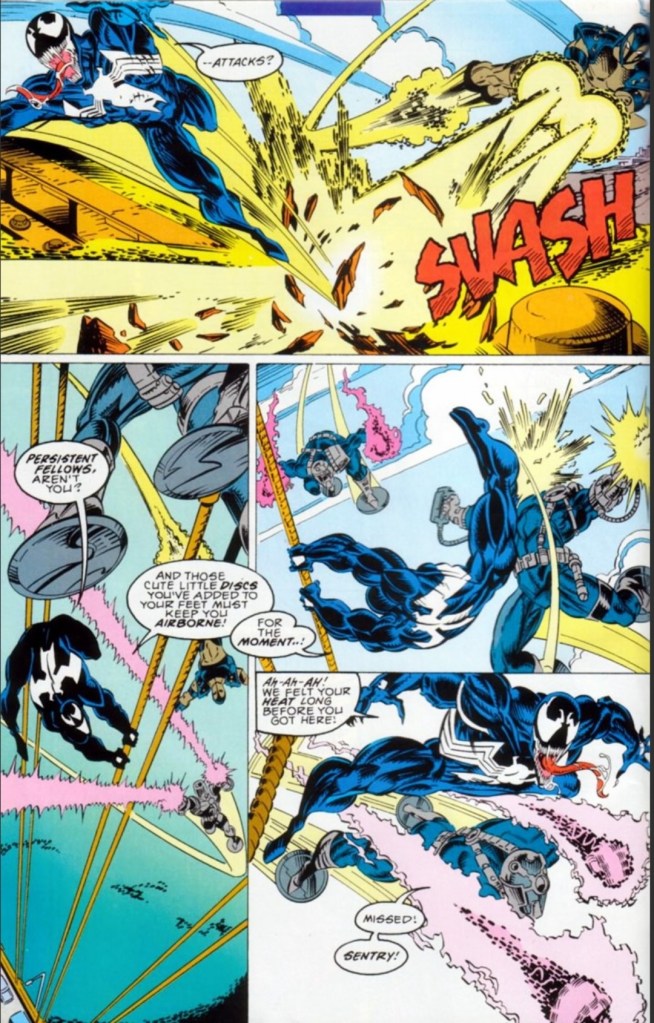
As the local residents caught the attention of the pilot, Venom breaks free by smashing the mechanical fist into pieces. Another mech suddenly jumps into place near the first one. In response to the first mech’s sudden killing of a local resident (who was armed with a shotgun), Venom jumps to it and kills the pilot inside by punching into the cockpit. Venom then grabs a long sharp object and kills the pilot of the other mech with it.

While the locals were hostile and afraid of Venom, the other people (who were assisted on the surface by Venom) come to support him and tell their fellow underground residents that he is not their enemy. One of the local council members stated that a meeting at the council hall will be held and Venom will attend it…

Quality

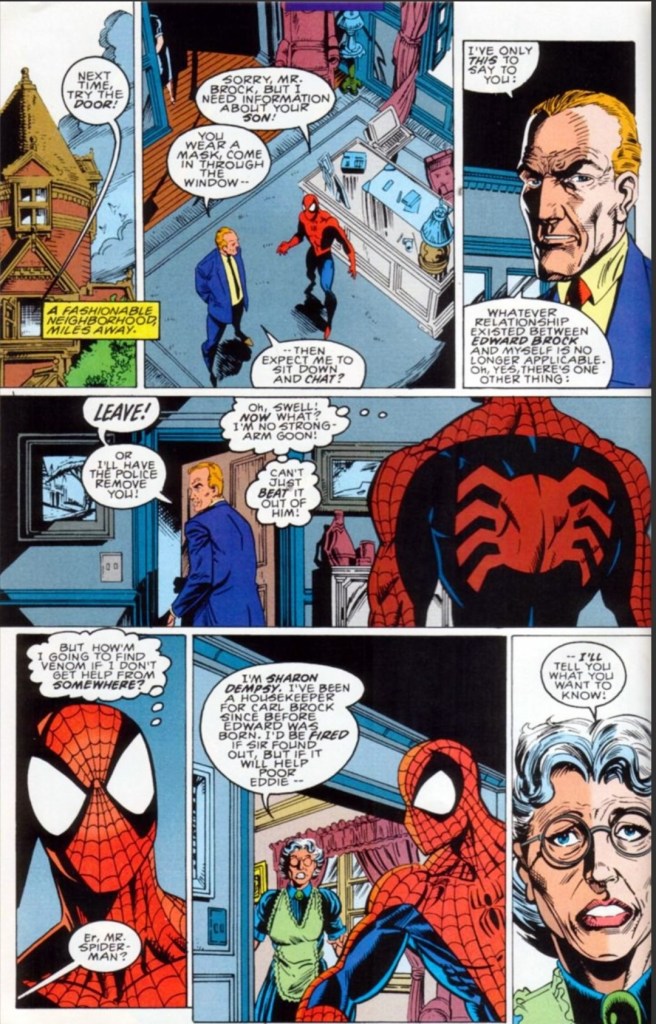
With exposition in mind, Spider-Man here does most of the detective work. Understandably, he is not involved with the superhero spectacle.

Compared to issue , this story has a more interesting setting which is the buried and forgotten section of San Francisco which was the result of the 1906 earthquake. Showing that the lost section has a local population composed of homeless people and those who reject the modern society above was a bright idea nicely executed by the Michelinie-Bagley team as it added some depth into Marvel Comics’ own version of San Francisco.

It was also in the underground city and with the residents where we get to see Venom do his own distorted acts of heroism backed by killing, and see how he fared when trying to win the trust of the locals whose members include those who read about him in the news and those who completely know nothing about him.

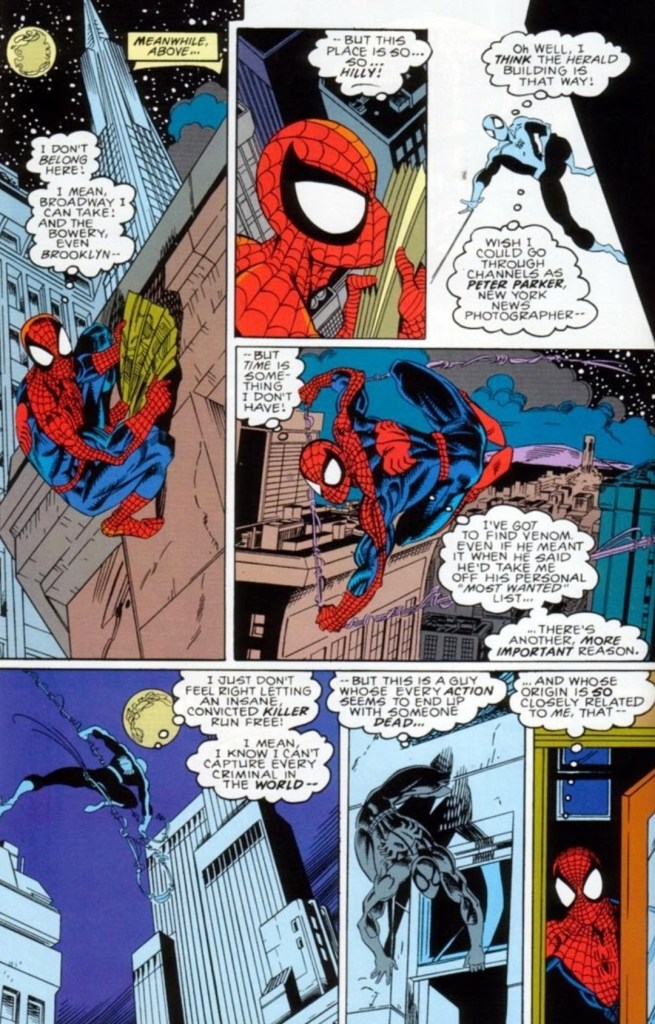
Through his interactions with the underground people, Eddie Brock is portrayed to be a bit more human compared to what happened in issue . For a man who has gotten very used to using extreme forms of violence and committing multiple acts of murder, it is surprising to see Brock looking and acting more civil in the presence of Americans (and perhaps illegal immigrants) who settled deep underground and established their own rules (note: Eddie Brock does not care about rules while having the alien costume). Still, you will see Venom engage in violent superhero action and even do a bit of detective work.

As with the previous issue, the iconic Spider-Man got a good share of the spotlight in the story as he searches for details about Venom which leads him to finding his rival’s estranged father. Spider-Man’s presence here is noticeably lessened compared to issue and his own search for answers creatively served as exposition. Don’t expect to see any superhero spectacle from Spider-Man.

Without spoiling details and names, I should state that this comic book marks the debut of a ream of armed mercenaries led by a powerful man who lost a son because of what Venom did in Amazing Spider-Man #315 (1989).

Conclusion

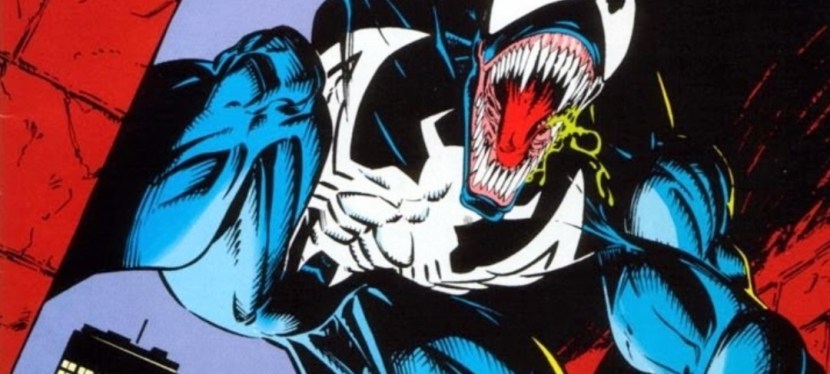
The violent nature of Venom displayed.

Venom: Lethal Protector (1993) is a marginal improvement over the first issue in terms of storytelling and setting. Part of the big build-up that happened in issue started to get paid-off in this comic book which allowed for the plot to move forward at a more satisfying pace. Venom and Spider-Man share the spotlight again, but this time the edge goes to the black-wearing murderer who also has the benefit of being part of the superhero spectacle here. At this point of the mini-series, Venom is not only facing elements of the Treece organization (which has been organizing something that could impact San Francisco and its people) but also a new force of opposition that is related to something he did a few years prior. That being said, Venom is first and foremost a murderer that Marvel wanted to make big money out of.

Overall, Venom: Lethal Protector (1993) is satisfactory.

+++++

Thank you for reading. If you find this article engaging, please click the like button below, share this article to others and also please consider making a donation to support my publishing. If you are looking for a copywriter to create content for your special project or business, check out my services and my portfolio. Feel free to contact me with a private message. Also please feel free to visit my Facebook page Author Carlo Carrasco and follow me on Twitter at  @HavenorFantasy as well as on Tumblr at https://carlocarrasco.tumblr.com/ and on Instagram at https://www.instagram.com/authorcarlocarrasco

A Look Back at Spider-Man 2099 #7 (1993)

Disclaimer: This is my original work with details sourced from reading the comic book and doing personal research. Anyone who wants to use this article, in part or in whole, needs to secure first my permission and agree to cite me as the source and author. Let it be known that any unauthorized use of this article will constrain the author to pursue the remedies under R.A. No. 8293, the Revised Penal Code, and/or all applicable legal actions under the laws of the Philippines.

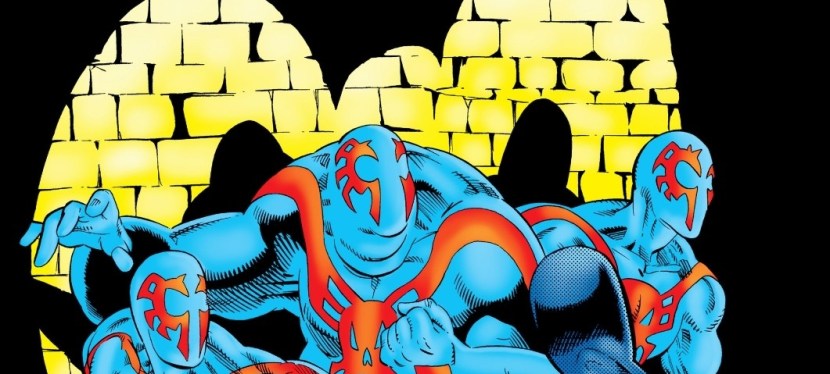
Welcome back, superheo enthusiasts, 1990s culture enthusiasts and comic book collectors! Today we revisit the Marvel 2099 franchise within Marvel Comics’ shared universe during the 1990s. Specifically speaking, we take a look back at one of the early tales of Spider-Man 2099.

In this retro comic book review, the Spider-Man 2099 comic has an eye-catching cover that shows the protagonist in conflict with the 2099 version of the classic Spider-Man the Vulture. At the end of the sixth issue of Spider-Man 2099, Vulture 2099 appeared for the first time ever. This particular issue, which I bought and read in the summer of 1993, marked the conflict between Spidey and Vulture of the future.

With those details laid down, here is a look back at Spider-Man 2099 , published by Marvel Comics in 1993 with a story written by Peter David and drawn by Rick Leonardi.

The cover.

Early story

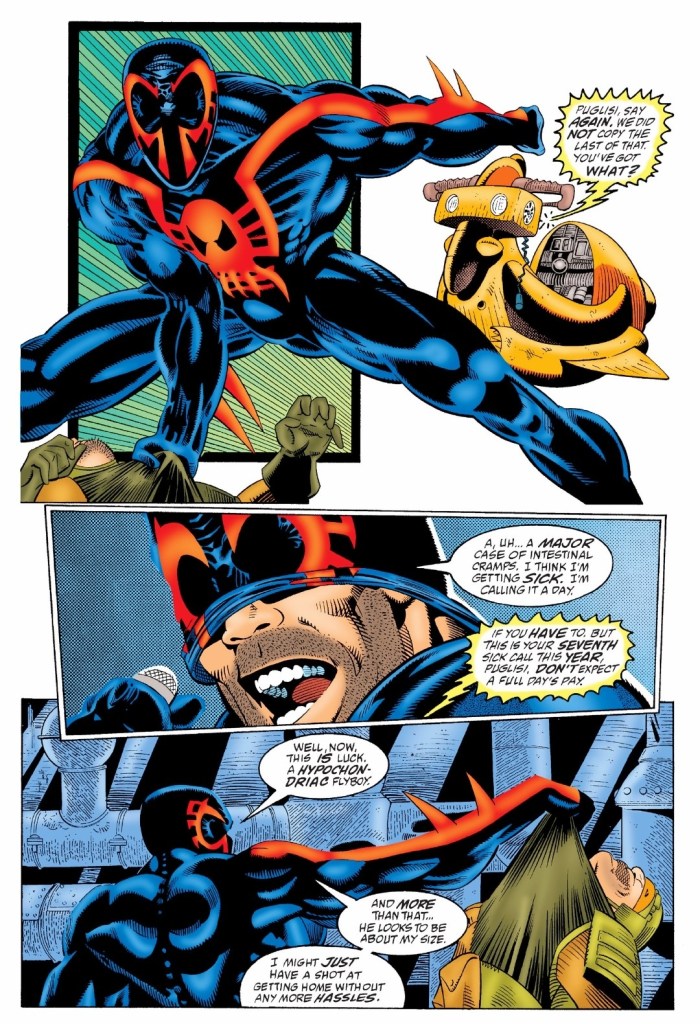
The story begins with Spider-Man 2099 feeling very disoriented, wondering if he is falling as he feels the wind. It turns out, Vulture 2099 is flying while holding him. Close behind them is Spider-Man’s friend flying a hover vehicle. As the flying lady gets close to them, the Vulture quickly makes a move be behind her and starts using his 3-blade mechanical claw on her. As Vulture is about to strike her, Spider-Man disrupts him in defense of her but her vehicle still got damaged.

As the lady’s vehicle releases smoke as a result of the damage, Vulture berates Spider-Man and knocks him out cold. Spidey’s friend crashes down but miraculously survived.

Elsewhere, Miguel O’Hara’s mother visits his apartment and starts talking with the artificial intelligence Lyla…

Quality

Spider-Man 2099’s first strike against Vulture 2099.

I’ll start first with Vulture 2099 here. I can say this futuristic version of the classic Spider-Man supervillain was made by the creative team of be really intriguing as he is not only an intimidating flying force, but he is also the leader of a gang called the Freakers. Vulture 2099 also operates while strongly hanging on to his socialist-inspired views truly believing that his Freakers are meant to rise not only against New York’s corporate forces but also against the Thorites and other factions of New York’s underclass. Vulture 2099 also is intelligent and he is clearly aware about what has been going on around them, and no matter how large and powerful Alchemax really is, he is very obsessed about bring them down. Believing he is living with principles, Vulture 2099 goes as far as informing Spidey about their existence and tries to get him as a partner.

On the aspect of evil, Vulture of 2099 was defined by Peter David to be a human monster in the true sense of the words. To find out about that, you must read this comic book.

For his part, Spider-Man’s struggle to survive and get out of danger continues here and the lower-city environment turned out to be a rather intriguing setting for readers to follow him in. His encounters with Vulture 2099 are entertaining to see complete with really inspired dialogue.

Compared to the previous issues, this particular story highlights the lower parts of New York City which was prime real estate back in the 20th century but got left behind neglected as city development physically went upward. This shows the poor and neglected people living below the modern city in darkness and with lots of crime and negativity around them. The Vulture and his gang stand out in the local lower population due to their violence and so-called principles.

Conclusion

Early in the story.

Spider-Man 2099 (1993) has a very engaging story and showcased what was back then the most captivating supervillain of the futuristic Spider-Man. Through David’s writing, it was clear that Vulture 2099 was meant to be a recurring supervillain in this series and he represents the violence and obsessions of the lower-city underclass who will stop at nothing to bring down the corporate giants as well as their rival factions among the impoverished. The portrayal of New York City’s criminal environment and poverty here was cleverly done by David. The new rivalry between the protagonist and 2099’s own Vulture must be seen! Lastly, I should say that Vulture 2099 would mix well with real-life violent forces like Black Lives Matter (BLM), Antifa and terror-oriented groups had he been real. Make no mistake, Vulture 2099 is evil and let this retro review remind you to never embrace evil and never let the said supervillain be your role model. The real world today has way too many radical forces who use violence and anarchy to change societies in accordance to their foolish, unholy worldly beliefs.

Overall, Spider-Man 2099 (1993) is highly recommended!

+++++

Thank you for reading. If you find this article engaging, please click the like button below and also please consider sharing this article to others. If you are looking for a copywriter to create content for your special project or business, check out my services and my portfolio. If you want to support my website, please consider making a donation. Feel free to contact me with a private message. Also please feel free to visit my Facebook page Author Carlo Carrasco and follow me on Twitter at  @HavenorFantasy as well as on Tumblr at https://carlocarrasco.tumblr.com/ and on Instagram at https://www.instagram.com/authorcarlocarrasco/.

A Look Back at What If #10 (1990)

Disclaimer: This is my original work with details sourced from reading the comic book and doing personal research. Anyone who wants to use this article, in part or in whole, needs to secure first my permission and agree to cite me as the source and author. Let it be known that any unauthorized use of this article will constrain the author to pursue the remedies under R.A. No. 8293, the Revised Penal Code, and/or all applicable legal actions under the laws of the Philippines.

Welcome back superhero enthusiasts, 1990s arts and culture enthusiasts, Marvel Comics fans and comic book collectors! Today we go back to the year 1993 and explore a part of Marvel Comics’ universe through the reimagined tales emphasized in the What If monthly series.

For those of you who have gotten very familiar with Marvel Comics’ vast lineup of superheroes, anti-heroes, super villains and supporting characters, the Punisher is one of the most notable characters as he is the most definitive vigilante the publisher ever has in its shared superhero universe. As a comic book protagonist, the Punisher does “good” in fighting crime but he sure is as bad as the bad guys as he commits torture, issued threats of violence, kidnapping, extortion, coercion and even murder towards them. A major factor in the Punisher’s origin (as Frank Castle) was the killing of his family (wife and two kids) committed by a mob as they witnessed acts of killing in Central Park in New York City. The tragic deaths led Castle to become the Punisher who not only relentlessly waged a personal war against criminals but also often wore dark clothes with a large white skull design on the front of his body. The skull symbolized punishment and death to his enemies.

With those details laid down, here is a look back at What If , published in 1990 by Marvel Comics with a story written by Doug Murray and drawn by Rik Levins.

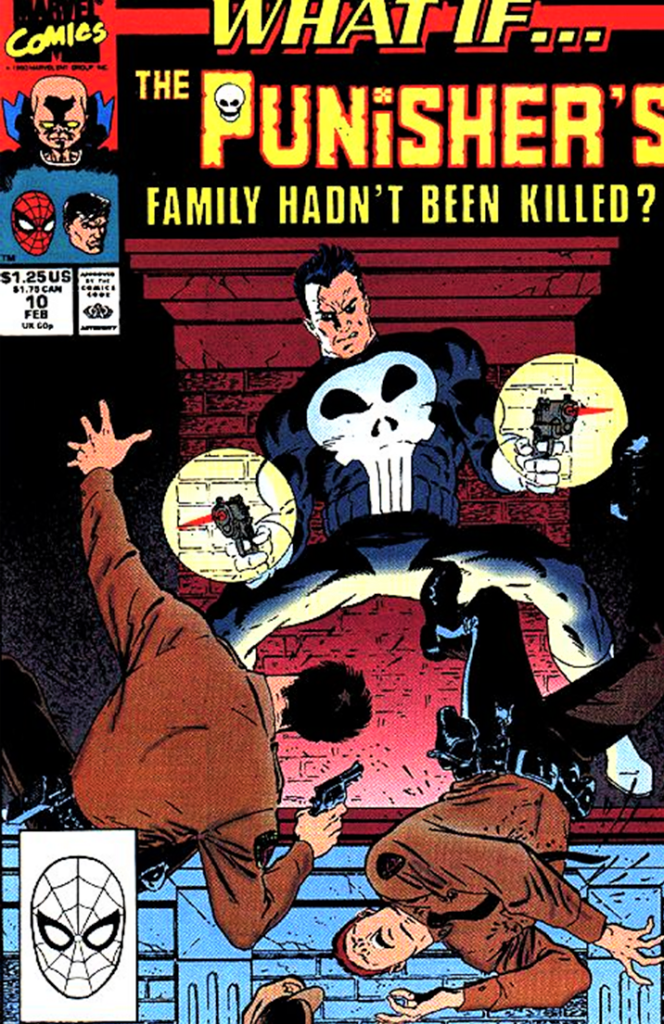
The cover.

Early story

The story begins with the Watcher recalling the time Frank Castle spent with his wife and the two kids at New York City’s Central Park. There, they have fun with their picnic. At this point in time, Frank Castle had previously served his country in the Vietnam War and he carries within him bravery, the experience of violence and vast skills to use weapons.

The weather suddenly worsens as rain starts to fall down causing some inconvenience on the Castle family. Frank’s son struggles as his kite got caught by the large plant nearby. On the other side of the said plant, four armed men and their captive (hanging upside down by the tree) are startled and prepare themselves to shoot anyone who appears.

Frank, who does not realize the mob on the other side of the plant, helps his son get the kite back. The Castle family then decide to go back home not realizing that they came close to discovering and witnessing the illegal activity of the armed men. As the family kept on moving, Frank hears gunfire from a distance…

Quality

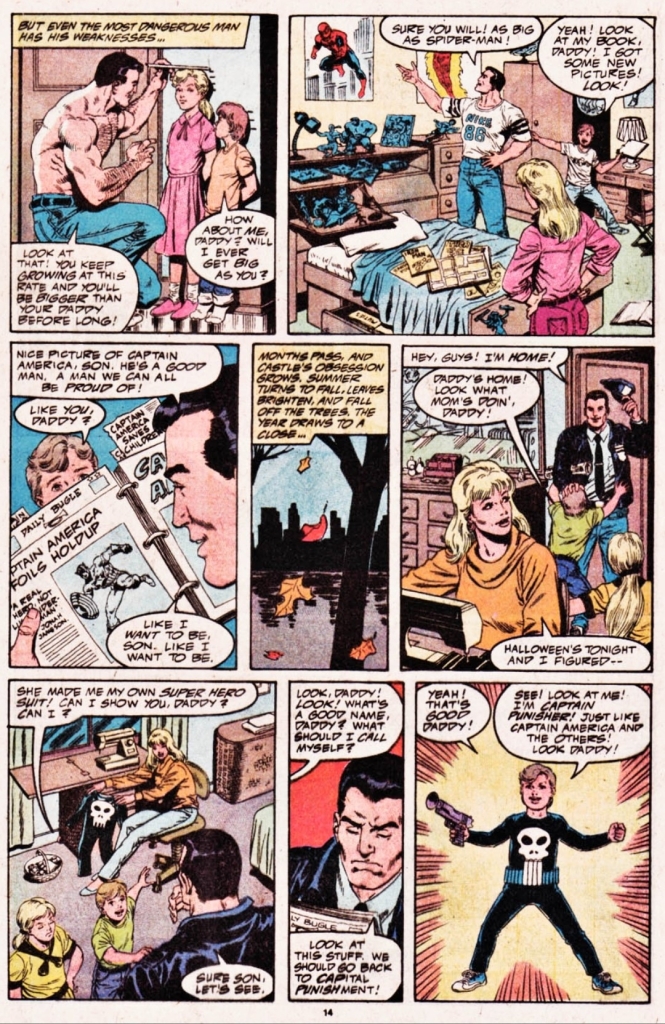
Frank Castle the family man.

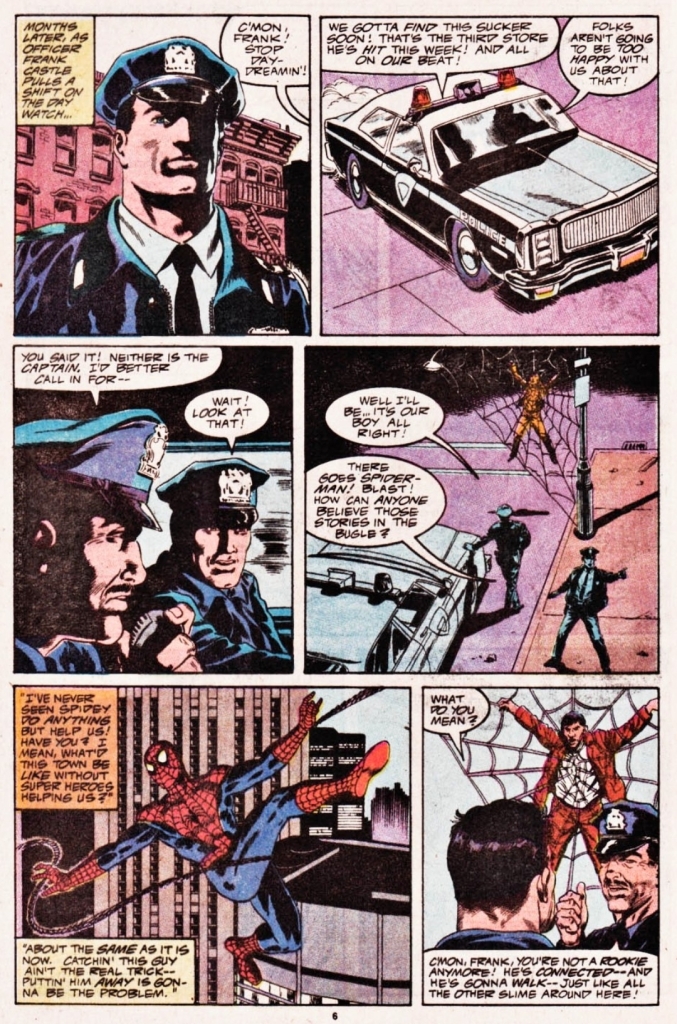
To get straight to the point about this comic book, it’s story is really engaging and it has noticeable amounts of darkness and grittiness without going overboard. While exploring what would happen had Frank Castle’s family not been killed, the comic book shows the Punisher getting involved in public safety as a New York patrolman which puts him in a unique position facing crime in radically different ways from what we comic book readers have been used to seeing. The story also explores corruption within the police and the justice system as well.

The way the events and action turned out showed the creative team focused on realism while also establishing the Punisher’s own place within the comic book’s alternate portrayal of the shared superhero universe. More on the subject matter of this comic book, there is a twist that surprised me a lot and it is something that you readers should see for yourselves.

Going back to Frank Castle, it is indeed very captivating to see him portrayed a lot more as a family man who really strives to support his wife and kids no matter how dangerous his occupation really is. The aspect of family in this comic book is very significant as it will make you realize that the definition of family in America in the 21st century has been distorted as a result of laws or court decisions that reflected wokeness, homosexuality and unrestrained feminism. In short, woke America’s believers reject the concept of the traditional family and the concept of a father leading the family is considered taboo because it goes against LGBT’s so-called values and principles.

Conclusion

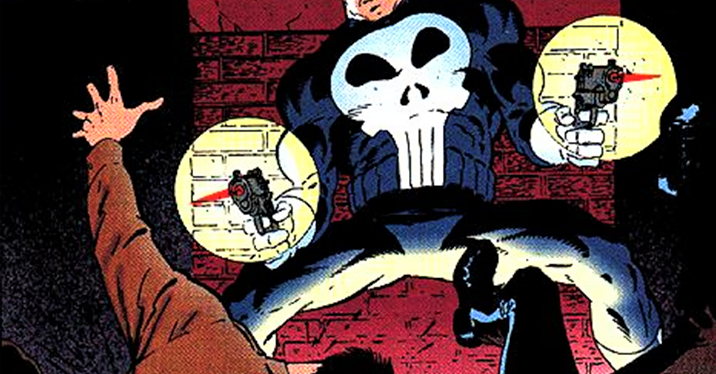
Frank Castle as the police officer.

When you think about the legacy of the Punisher not only on comics but also in movies and other forms of entertainment media, you will often remember a one-man-army against criminals. What If (1990) has is a really unique take on the Punisher and I can say it has a very captivating script brought to life with really good artwork. Not only does this alternate version of the Punisher shows how he affects criminals, but also how he impacts other parts of the fictional New York society within the shared universe of Marvel Comics (note: characters connected to Spider-Man and Daredevil are here). From start to finish, this Punisher tale by the Murray-Levins team turned out to be very engaging to read.

Overall, What If (1990) is highly recommended!

+++++

Thank you for reading. If you find this article engaging, please click the like button below, share this article to others and also please consider making a donation to support my publishing. If you are looking for a copywriter to create content for your special project or business, check out my services and my portfolio. Feel free to contact me with a private message. Also please feel free to visit my Facebook page Author Carlo Carrasco and follow me on Twitter at  @HavenorFantasy as well as on Tumblr at https://carlocarrasco.tumblr.com/ and on Instagram at https://www.instagram.com/authorcarlocarrasco
A Look Back at X-Men Adventures #9 (1993)

Disclaimer: This is my original work with details sourced from reading the comic book and doing personal research. Anyone who wants to use this article, in part or in whole, needs to secure first my permission and agree to cite me as the source and author. Let it be known that any unauthorized use of this article will constrain the author to pursue the remedies under R.A. No. 8293, the Revised Penal Code, and/or all applicable legal actions under the laws of the Philippines.

Welcome back, superheo enthusiasts, 1990s culture enthusiasts, X-Men fans and comic book collectors! Today we revisit the X-Men Adventures monthly series which was the literary adaptation of the popular X-Men animated series of the 1990s.  

Within the lore of the X-Men, Juggernaut is a significant supervillain who not only gave the X-Men a lot of trouble but also did the same with other heroes within the Marvel Comics shared universe. In the 2006 movie X-Men: The Last Stand, Juggernaut made his first-ever cinematic appearance. In 2018’s Deadpool 2, a new cinematic version of Juggernaut appeared. In my retro comic book review of What If #13 (1990), a different version of Juggernaut was featured by the creators.

With those details laid down, here is a look back at X-Men Adventures , published by Marvel Comics in 1993 with a story written by Ralph Macchio and drawn by Andrew Wildman.

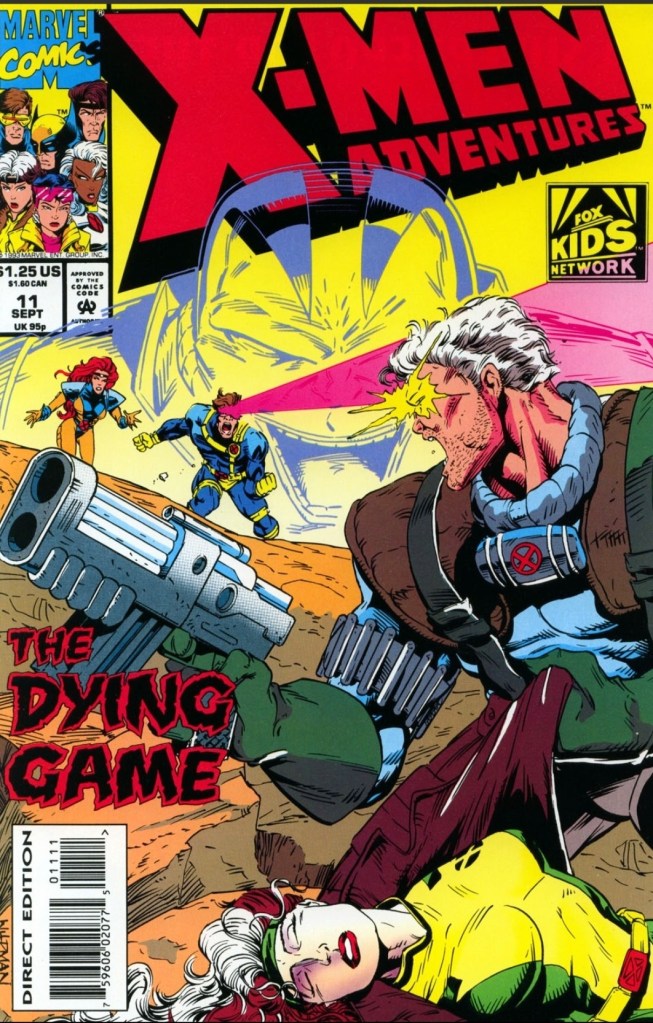
The cover.

Early story

The story begins with the X-Men (riding their jet) arriving from Genosha only to see a part of Professor X’s mansion destroyed. After landing, Cyclops, Wolverine and Jean Grey immediately searched through the rubble and found a path into the War Room. Using Cerebro, they uncovered a prepared video message of Professor X who tells them that he is taking a journey whose results may change their lives forever. After apologizing for the cryptic nature of the message, Xavier tells them that he trusts they will continue with their training and look after the School of Gifted Children in his absence.

The X-Men could not determine if their mentor left the mansion before the destruction took place. In response to Gambit’s question related to detection, Wolverine senses big foot prints and there was a familiar smell left behind. Wolverine decides to go out to keep following the scent which causes Cyclops to insist that the situation at hand is not the time for the team members to separate from each other.

After telling Cyclops he has places to go to, Wolverine then leaves his teammates with a motorcycle. Cyclops tells Storm to take Rogue and Jubilee with her to track Wolverine and stay close to him…

Quality

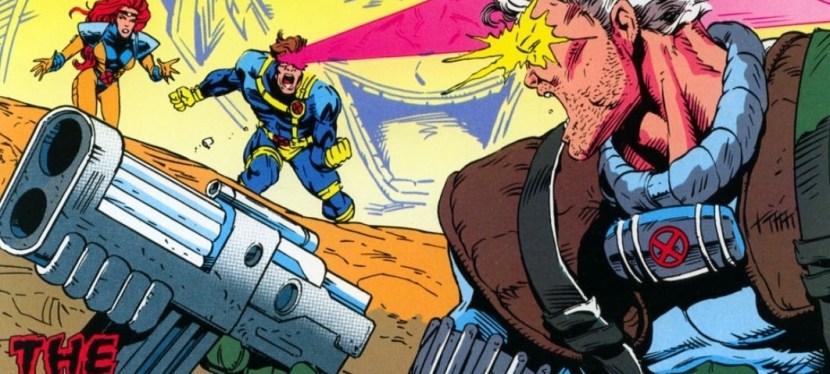
The sheer power of Juggernaut.

To describe this comic book’s story, I can say it was a fine mix of suspense, mystery and superhero spectacle. As the X-Men struggled to figure out how the damage on the mansion happened and where exactly did Charles Xavier go to, I felt this sense of dread backed with strong mystery. As the plot continued, there were these short-yet-notable character moments among the X-Men such as Gambit getting closer with Jean Grey who believes that she should be helping others on the field as her beloved Cyclops made a decision that kept her with him at the mansion.

The search for who is responsible for the mansion’s big damage creatively took notable paths in the story. One strong figure appeared and became a target of some X-Men members while another one became Wolverine’s target.

As expected, the highlight of this tale is Juggernaut himself and to say that he his huge and powerful is a big understatement. At this point of the X-Men Adventures monthly series, this is the one notable conflict that has multiple X-Men members struggling really hard fighting one single powerful enemy. In some ways, Juggernaut here looks like a much more dangerous foe than Magneto within this series. How the conflict in the story ended in a really intriguing yet sensible way which should resonate with X-Men fans. 

Conclusion

Only Cyclops, Gambit and Jean Grey (who wanted to do more) remained at the mansion.

X-Men Adventures (1993) is fun and intriguing to read. At the stage of this monthly series, the X-Men are not only more developed but are also challenged deeply as their mentor is no longer around to lead them. This makes the path ahead look more enticing to anticipate.

Overall, X-Men Adventures (1993) is recommended.

+++++

Thank you for reading. If you find this article engaging, please click the like button below and also please consider sharing this article to others. If you are looking for a copywriter to create content for your special project or business, check out my services and my portfolio. If you want to support my website, please consider making a donation. Feel free to contact me with a private message. Also please feel free to visit my Facebook page Author Carlo Carrasco and follow me on Twitter at  @HavenorFantasy as well as on Tumblr at https://carlocarrasco.tumblr.com/ and on Instagram at https://www.instagram.com/authorcarlocarrasco/.

A Look Back at What If #4 (1989)

Disclaimer: This is my original work with details sourced from reading the comic book and doing personal research. Anyone who wants to use this article, in part or in whole, needs to secure first my permission and agree to cite me as the source and author. Let it be known that any unauthorized use of this article will constrain the author to pursue the remedies under R.A. No. 8293, the Revised Penal Code, and/or all applicable legal actions under the laws of the Philippines.

Welcome back superhero fans, 20th century arts and culture enthusiasts, Marvel Comics fans and comic book collectors! Today we go back to the year 1989 and explore a part of Marvel Comics’ universe through the reimagined tales emphasized in the What If monthly series (Volume 2).

For the newcomers reading this, I previously reviewed a variety What If comic books which you can find by clicking here, here, here, here, here, here, here and here. The joy of reading a What If comic book was the exploration of alternate outcomes in relation to the stories that have been counted by Marvel Comics as canon or official fictional history within their shared comic book universe. In this retro review, we will explore a key event from Spider-Man’s time with the alien costume (symbiote) which is related with the events of Secret Wars and the eventual establishment of his deadliest nemesis Venom.

With those details laid down, here is a look back What If , published in 1989 by Marvel Comics with a story written by Danny Fingeroth and drawn by Mark Bagley.

The cover.

Early story

The story begins with the Watcher examining Spider-Man’s involvement with the Secret Wars that took place on a faraway planet created by the Beyonder. There, his costume got damaged beyond  repair and he acquired a new one made of what he perceived to be an advanced form of material. After successfully returning home, Spider-Man goes through some mysterious developments and he could not understand why he remains fatigued even as he spent more time sleeping.

With the help of Mr. Fantastic at the Fantastic Four headquarters, Spider-Man learns that his new costume is a living entity that has attached itself to him mentally and physically. As Mr. Fantastic uses a sonic blaster, Spider-Man and the alien costume got separated at last. Some time later, the alien costume re-attached itself to Spider-Man who eventually used church bells loud sounds to separate it. The alien costume would go on to the find Eddie Brock to form Venom.

The alternate reality begins with Spider-Man having a joyful reunion with Black Cat shortly after coming back from Secret Wars. Learning from her advise to have himself checked properly, he visits Dr. Connors (the Lizard) for examination and testing…

Quality

The possessed Spider-Man takes on Dr. Strange and the Hulk without hesitation.

To say that Danny Fingeroth’s script is very deep is an understatement. Specifically, this story is a great exploration of alternative events that not only affects the iconic Spider-Man/Peter Parker but also other elements of the Marvel Comics universe of the time. The concept of the alien costume fully bonding with Peter Parker with Mr. Fantastic and even Dr. Strange failing to help is indeed suspenseful and intriguing to read thanks to Fingeroth’s very solid writing. In fact, the story even shows Spider-Man as being possessed by the symbiote (complete with dialogue) and when you witness Peter Parker struggling to control himself consciously (while wrestling with the alien costume), you will really feel his pain. I should also state that there is a lot more about Spider-Man told here that goes beyond the possession which really turned out to be very compelling to read in my experience. This is easily the most engaging alternate portrayal of Spider-Man as we know him and it should be read by as many people as possible.

Along the way, this comic book portrays the alien costume as an insatiable being and the implementation of dialogue for it (structured in a way as using the vocal ability of the powered being it bonded with) gave it a very unique personality of its own. This is something that was not portrayed in the early appearances of Venom in which Eddie Brock does the talking and reacting to unseen messages from the symbiote. That being said, the alien costume here symbolizes possession within the Marvel Comics shared universe and its unknown state really challenges not only the intelligence of the superheroes but also their ability to decide on what final action to take with regards to sentient life.

As staged by the writer, the story’s narrative occasionally shifts away from Spider-Man to follow other characters such as Black Cat (Peter Parker’s love at the time), Mr. Fantastic (in a great portrayal of his proficiency in science and as a responsible superhero), Thor and others which made the reading experience really immersive in relation to emphasizing how this alternate reality affects others. You will get to see the Captain America, the Hulk, Iron Man, the Wasp, Captain Marvel, the Fantastic Four and the Avengers here.

Those who are fond of superhero spectacle will have a lot to enjoy here. Mark Bagley carefully paces the action scenes and he uses visual dynamism during the right moments.  

Conclusion

Through dialogue, the alien costume is portrayed as a sinister force.

I can say it out loud…What If (1989) is one of the best Marvel Comics alternate reality stories I have ever read and the creative team of Fingeroth-Bagley crafted an epic tale that goes beyond the featured question of “What if the alien costumer had possessed Spider-Man?”. The comic book works excellently as both a Spider-Man story as well as a Marvel superheroes struggle. The story touches on relevant topics such as possession, killing and scientific exploitation. This is a must-have comic book!

Overall, What If (1989) is highly recommended!

+++++

Thank you for reading. If you find this article engaging, please click the like button below and also please consider sharing this article to others. If you are looking for a copywriter to create content for your special project or business, check out my services and my portfolio. Feel free to contact me with a private message. Also please feel free to visit my Facebook page Author Carlo Carrasco and follow me on Twitter at  @HavenorFantasy as well as on Tumblr at https://carlocarrasco.tumblr.com/ and on Instagram at https://www.instagram.com/authorcarlocarrasco/

A Look Back at Venom: Lethal Protector #1 (1993)

Disclaimer: This is my original work with details sourced from reading the comic book and doing personal research. Anyone who wants to use this article, in part or in whole, needs to secure first my permission and agree to cite me as the source and author. Let it be known that any unauthorized use of this article will constrain the author to pursue the remedies under R.A. No. 8293, the Revised Penal Code, and/or all applicable legal actions under the laws of the Philippines.

Welcome back superhero enthusiasts, 1990s arts and culture enthusiasts, Marvel Comics fans and comic book collectors! Today we go back to the year 1993 and explore a part of Marvel Comics’ universe through the first-ever limited comic book series featuring one of Marvel’s most iconic villains – Venom.

To put things in perspective, the origin of Venom started within the events of the 1980s series Secret Wars which took place in a far-away planet. As a result of that series, Spider-Man returned home wearing the alien symbiote as a costume which turns out to have a mind of its own. After Spider-Man successful separate himself from the symbiote (again) using the loud bells of a church, the living costume eventually found a desperate Eddie Brock and bonded with him to form Venom. In the late 1980s comics of Amazing Spider-Man, Venom became the deadliest enemy Spider-Man ever faced.

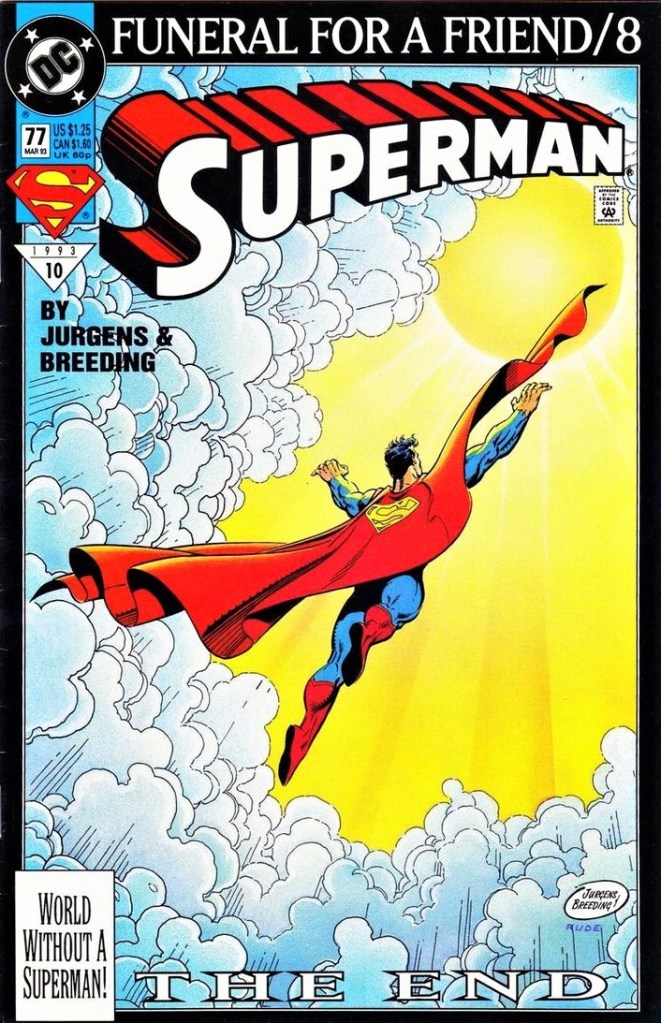
Going into the early 1990s, Venom’s popularity continued to grow tremendously. He became one of Marvel’s most popular non-hero type of characters and helped sell a lot of comics for the publisher. Knowing they had something to sell, Marvel approved a 6-issue limited series showcasing Venom. It was also the most anticipated comic book among collectors right after DC Comics killed Superman with Superman (1993).

With those details laid down, here is a look back at Venom: Lethal Protector , published in 1993 by Marvel Comics with a story written by David Michelinie and drawn by Mark Bagley.

The cover.

Early story

The story begins in San Francisco, California. Deep within the city, a man cornered a lady at the dead end of an alley. Just as he was about do something bad to her, Venom leaps in at them. Totally surprised, the man was easily grabbed by Venom who lifted him and hit the wall bodily. Using his costume, Venom then chokes the man to death through the mouth and nose. Venom then picks up the lady’s purse and gives it to her. As soon as Venom leaves, the shocked lady runs away screaming.

Venom swings and leaps as he travels through the city. While traveling, Eddie Brock tells his living costume that while their hatred towards Spider-Man got reconciled a bit, the said superhero also helps the innocent. Eddie then reveals that he was born in San Francisco and they can start a new life together in it. Secretly, Venom turns into Eddie Brock in his civilian form. As Brock walks down the sidewalk, police officers nearby recognize him. It turns out. Eddie Brock was listed by police as a wanted person…

Quality

Spider-Man and Venom face each other unexpectedly.

Focusing on the plot, this story took place after the events in Amazing Spider-Man (1993) which was released AFTER this particular comic book. As a standalone Venom story, this one clearly portrays him more of a vigilante in the sense that he goes up against a new force of evil that happens to be pouncing on people that Venom believes to be innocent and powerless. Unsurprisingly, Venom does not seek the help of law enforcers to help the innocent but rather he takes violent action to help the victims, going as far as to kill the so-called bad guys. The bad guys in this story work under a powerful man whose son was killed by Venom a few years prior. Within the context of this comic book, the new force of evil was introduced in subtle ways.

With extensive experience writing tales about Spider-Man and Venom, David Michelinie clearly redefined Venom’s beliefs here. Venom believes in protecting the innocent but he is much more violent and is relentless with cruelty which makes him a clear opposite of Spider-Man. Yet in a way, Venom sure talks and acts in a rather psychotic way and this alone makes him a very unlikable comic book protagonist.

Along the way, the iconic Spider-Man got a rather huge chunk of the spotlight in this comic book making him the 2nd lead next to Venom. I remember back in 1993 when there were Venom fans who complained about Spider-Man literally stealing the thunder away from his greatest enemy while there were a few Spider-Man fans who defended the icon’s guest participation in the story as he has always been linked with Venom’s origin. Considering the lack of depth in the plot, I can say Spider-Man appearance her served as a somewhat helpful filler.  

Conclusion

Helping victims does NOT justify killing. This makes Venom a major turn-off as a comic book protagonist.

Venom: Lethal Protector (1993) is a comic book that can be alienating, especially when you are not a Venom fan. I find Venom too evil and too unbelievable to be a heroic figure even though he strong believes in protecting and helping the innocent. In my view, he is more of vigilante living with the delusion of achieving something worthwhile as he interacts with people who happen to be not assisted by the many, many Marvel Comics superheroes. It is not surprising that Venom definitely will never be a good role model. He is a murderer and the act of helping victims never justifies murder. The comic book’s plot lacks weight and Mark Bagley’s art looked a little rushed. What made this comic book interesting are Venom and Spider-Man themselves. Yes, there is a lot of superhero spectacle here but don’t expect anything new when you see Spider-Man and Venom resume their violent rivalry. This comic book is unsurprisingly a warm-up of things to come within its series. It is not a terrible literary work. It’s just not really good and it did not deserve the hype and sales of its time.

Overall, Venom: Lethal Protector (1993) is serviceable.

+++++

Thank you for reading. If you find this article engaging, please click the like button below, share this article to others and also please consider making a donation to support my publishing. If you are looking for a copywriter to create content for your special project or business, check out my services and my portfolio. Feel free to contact me with a private message. Also please feel free to visit my Facebook page Author Carlo Carrasco and follow me on Twitter at  @HavenorFantasy as well as on Tumblr at https://carlocarrasco.tumblr.com/ and on Instagram at https://www.instagram.com/authorcarlocarrasco
A Look Back at X-Men Adventures #6 (1993)

Disclaimer: This is my original work with details sourced from reading the comic book and doing personal research. Anyone who wants to use this article, in part or in whole, needs to secure first my permission and agree to cite me as the source and author. Let it be known that any unauthorized use of this article will constrain the author to pursue the remedies under R.A. No. 8293, the Revised Penal Code, and/or all applicable legal actions under the laws of the Philippines.

Welcome back, superheo enthusiasts, 1990s culture enthusiasts, X-Men fans and comic book collectors! Today we revisit the X-Men Adventures monthly series which was the literary adaptation of the popular X-Men animated series of the 1990s.  

In my previous review, the X-Men encountered the Morlocks for the first time ever. Along the way, Storm’s ability to lead and handle her deepest fear got tested. Wolverine, meanwhile, struggled as he recovered from his hard battle with Sabretooth.

With those details laid down, here is a look back at X-Men Adventures , published by Marvel Comics in 1993 with a story written by Ralph Macchio and drawn by Andrew Wildman.

The cover.

Early story

The story begins in the Arctic region. Wolverine travels by himself having left his team as he could not handle being near his teammates Scott/Cyclops and Jean Grey knowing they have feelings for each other. He also feelings for her.

Wolverine keeps on traveling completely unaware that he is being watched from a distance by his fierce rival Sabretooth. As the clawed X-Men member moves over a bridge made of ice with explosives hidden underneath, Sabretooth detonates by remote control causing a huge explosion…

Quality

A different kind of Wolverine awaits readers here.

Let me start with the cover art. I can say clearly that those who wanted to see Wolverine and Sabretooth fight each other even more will get exactly what they want in this comic book. The conflict between the two is the highlight superhero spectacle and it works excellently as a pay-off to all the build-up that led to it.

More on the story itself, the script was crafted to heavily emphasize Wolverine’s personality when he is not on duty with his team. You will see a more human side of him when he starts interacting with a group of people (non-mutants) who have been living in the Arctic zone where they catch fish and ride boats for a living. I can say that the dialogue here is pretty rich especially when intense character development on Wolverine happens.

With regards to the Wolverine-Sabretooth rivalry, you definitely will get a lot more interactions and new action actions between them compared to what happened in issue . Spectacle aside, the stakes are even higher as the Arctic people got involved which creatively adds more depth on the development of both mutants.

Along the way, X-Men members Gambit, Storm and Jubilee head off to the island state of Genosha. As far as Gambit is concerned, Genosha welcomes mutants with open arms. For Charles Xavier, he sees a perfect opportunity for their team to visit and investigate it. This, of course, leads to the events of issue #7.

Conclusion

The X-Men talk about Wolverine’s absence and Genosha.

X-Men Adventures (1993) will surely delight fans of Wolverine as well as his rivalry with Sabretooth. Be aware that the Wolverine tale is the main story while the X-Men tale serves mainly as a build-up for the debut of Genosha in the X-Men animated series and in this adaptive comic book series. I had fun reading this and there definitely is a lot of depth in both story and the way the characters were dramatized.

Overall, X-Men Adventures (1993) is recommended.

+++++

Thank you for reading. If you find this article engaging, please click the like button below and also please consider sharing this article to others. If you are looking for a copywriter to create content for your special project or business, check out my services and my portfolio. If you want to support my website, please consider making a donation. Feel free to contact me with a private message. Also please feel free to visit my Facebook page Author Carlo Carrasco and follow me on Twitter at  @HavenorFantasy as well as on Tumblr at https://carlocarrasco.tumblr.com/ and on Instagram athttps://www.instagram.com/authorcarlocarrasco/.

A Look Back at X-Men Adventures #5 (1993)

Disclaimer: This is my original work with details sourced from reading the comic book and doing personal research. Anyone who wants to use this article, in part or in whole, needs to secure first my permission and agree to cite me as the source and author. Let it be known that any unauthorized use of this article will constrain the author to pursue the remedies under R.A. No. 8293, the Revised Penal Code, and/or all applicable legal actions under the laws of the Philippines.

Welcome back, superheo enthusiasts, 1990s culture enthusiasts, X-Men fans and comic book collectors! Today we revisit the X-Men Adventures monthly series which was the literary adaptation of the popular X-Men animated series of the 1990s.  

In my previous retro review, the encounter with Magneto ended without any resolution. Back at X-Men headquarters, Sabretooth freed himself and got into a fight with Wolverine which symbolically highlighted tensions from their past encounters.

With those details laid down, here is a look back at X-Men Adventures , published by Marvel Comics in 1993 with a story written by Ralph Macchio and drawn by Andrew Wildman.

The cover.

Early story

The story begins inside the Danger Room where X-Men members Storm, Rogue, Gambit and Jubilee are tested for combat and skills development under the tight watch of Professor X. While Xavier is aware that while a real-life threat would cause his team to perfect their reflexes and counterattack strategies, it is the leadership of Storm that concerns him the most.

Just as the amount of danger rises, Xavier decides to raise the stakes of the exercise by drawing upon the deepest fears within Storm. Suddenly the ceiling moves down and the walls start closing in on the X-Men. This causes Storm to lose focus as painful memories from her childhood pertaining to claustrophobia suddenly entered her head. The exercise ended on a negative note and Storm tells Professor X that she cannot lead the X-Men as she believes that her claustrophobia will only put others at risk.

Within Xavier’s mansion, the still recovering Wolverine practices martial arts moves. Standing nearby is Jean Grey who starts talking sense into him. Wolverine then notices something in the way Jean looks at him…  

Quality

Cyclops and Jean Grey cornered by the Morlocks led by Callisto.

As the cover of this comic book shows, the main feature of the story is the X-Men’s encounter with the Morlocks (first appearance in Uncanny X-Men #169 published in 1983), a group of mutants living underneath the city of New York. Other than being a force of opposition, the Morlocks – led by Callisto – is itself a society composed of outcast mutants who could not really live among humans in normal society not only because of their mutations but also because of their collective look of deformity.

Picking up from the previous issue, the plot moved smoothly starting with a clear focus on Storm and her potential to lead the X-Men followed by the short but intriguing scene between Jean Grey and Wolverine. When the narrative shifted on New York City and the start of the conflict with the Morlocks, the story noticeably turned dark with its tone as the underground mutants become more prominent.

Other than the expected good-versus-evil emphasis of the plot, this comic book sheds light on the social ladder of America with the X-Men symbolizing the normal people and the Morlocks as the misfits. Symbolically speaking, the X-Men are bound to their code of no killing and their search for mutants that their leader Professor X could help, while the Morlocks prefer to be independent believing that isolation best serves their interests. Both the X-Men and the Morlocks have their respective approach on honor which is symbolized further when Storm and Callisto engage in close combat (note: this was the X-Men animated series’ adaptation of their fight as told in 1983’s Uncanny X-Men #170). I should also state that the portrayal of Cyclops and Jean Grey a very vulnerable figures in this story is pretty engaging.

To put things in perspective, the script of this comic book showed that the superhero spectacle is finely balanced with the strong dialogue and dramatization of the X-Men-Morlocks conflict.

Conclusion

The X-Men during the Danger Room session.

X-Men Adventures (1993) is not only a very engaging read on its own, it is also one fine adaptation of the X-Men animated series episode “Captive Hearts” which I first saw on local TV way back in 1993.

Overall, X-Men Adventures (1993) is recommended.

+++++

Thank you for reading. If you find this article engaging, please click the like button below and also please consider sharing this article to others. If you are looking for a copywriter to create content for your special project or business, check out my services and my portfolio. If you want to support my website, please consider making a donation. Feel free to contact me with a private message. Also please feel free to visit my Facebook page Author Carlo Carrasco and follow me on Twitter at  @HavenorFantasy as well as on Tumblr at https://carlocarrasco.tumblr.com/ and on Instagram athttps://www.instagram.com/authorcarlocarrasco/.

A Look Back at What If #17 (1990)

Disclaimer: This is my original work with details sourced from reading the comic book and doing personal research. Anyone who wants to use this article, in part or in whole, needs to secure first my permission and agree to cite me as the source and author. Let it be known that any unauthorized use of this article will constrain the author to pursue the remedies under R.A. No. 8293, the Revised Penal Code, and/or all applicable legal actions under the laws of the Philippines.

Welcome back superhero enthusiasts, 1990s arts and culture enthusiasts, Marvel Comics fans and comic book collectors! Today we go back to the year 1993 and explore a part of Marvel Comics’ universe through the reimagined tales emphasized in the What If monthly series.

Several years ago, I bought myself a trade paperback collection of the 1987 Spider-Man storyline Kraven’s Last Hunt written by J. M. DeMatteis and drawn by Mike Zeck. That particular storyline was very notable not just for its dark approach to storytelling and visualization, but it also explores what would happen had Spider-Man been defeated and someone very obsessed took his place and go on a rampage disguised as Spider-Man. The storyline also explored how Kraven perceived Spider-Man without ever knowing the defining traits of the man behind the mask – Peter Parker. Eventually, Marvel Comic went on to revisit Kraven’s Last Hunt and explored what would happen had Kraven actually killed Spider-Man through their What If? monthly comic book series.

With those details laid down, here is a look back at What If , published in 1990 by Marvel Comics with a story written and drawn by Richard Howell.

The cover.

Early story

The story begins with the Watcher revisiting key moments from the Kraven’s Last Hunt storyline. History then takes a turn towards the unexplored when Kraven, armed with a gun, shoots and kills Spider-Man. As the dead webslinger lies in a coffin, Kraven celebrates his victory with a lot of passion believing that he struck back at what he perceives to be the meaninglessness of the world. Kraven is quite mad as he equates spiders with Spider-Man as well as the decline of civilization.

After fearlessly and grotesquely eating spiders, Kraven wears a black body tight costume that looks almost the same as that of Spider-Man’s. While he is victorious, Kraven is not satisfied and he becomes obsessed by becoming Spider-Man and prove himself superior to him. He then moves into the city whose people are familiar with Spider-Man and also are unprepared with who is coming to them.

In an apartment, Spider-Man’s wife Mary Jane Parker is alone and worried. As she does not know that her beloved Peter Parker has been killed, she cannot help but agonize over the strain of his double-life as a civilian and as a superhero. Determined to find Peter, she walks out during the rainy night and is spotted by two men focused on her.

Suddenly the new Spider-Man (Kraven) appears and in an apparent effort to help Mary Jane, he grabs one of the men and brutally pushes the man’s head on to a nearby wall. As Kraven does not recognize Mary Jane, the wife realizes that the Spider-Man she just saw is definitely not her husband. This only makes her wonder again where he is and what happened to him. She then starts calling others for help…

Quality

In addition to being ruthless, Kraven disguised as Spider-Man resembles Venom.

I’ll start with the visuals. This comic book took a serious effort to come close to capturing the look and visual tone of the Kraven’s Last Hunt storyline which I enjoyed. Richard Howell visualized the characters, the situations and details properly and there was not a single moment when the visuals overwhelmed the narrative. Howell’s artistic take on the characters is simplistic but they remain recognizable which is a plus. The superhero spectacle was presented with a clear and clean approach, and there were a few key moments of action that got highlighted with some dynamism.

As for the story itself, what I found surprising and also pleasant here was the presentation of Mary Jane Parker as the main character instead of Kraven. This makes sense as Kraven himself was the major attraction of the Kraven’s Last Hunt storyline while Spider-Man was out of commission. In the context of this What If story, it only made sense to have Mary Jane as the central figure. Going back to Kraven, Howell captured the essence of the character well when compared to his version in Kraven’s Last Hunt.

In terms of plotting, telling the story through the viewpoint and actions of the superhero’s concerned wife really works well. Without spoiling the plot, you will see Mary Jane get involved with three notable superheroes – including the iconic Captain America – and even with other notable Spider-Man supporting characters such as Flash Thompson and the irresponsible print media figure J. Jonah Jameson. Interactions aside, the plot works sufficiently as a couple of series of events take place before the big confrontation with Kraven (as the new Spider-Man). By the end of it all, I can say that the story is entertaining, engaging and intriguing to read.

Conclusion

Mary Jane Parker goes out in pursuit of her husband Peter Parker/Spider-Man who happens to be dead already at this particular point of the story.

I can say that What If (1990) is pretty captivating read and it is a worthy literary companion to Kraven’s Last Hunt. Of course, to really enjoy this alternative tale cleverly told by Howell, you must read Kraven’s Last Hunt first. Otherwise, you would not feel the impact of this comic book very much. I also liked how the death of Spider-Man (note: Spider-Man got killed in another What If tale that itself is worth reading) impacts Mary Jane, how it impacts the superheroes who know him, and most notably how it impacts the fragile relationship between society and superheroes. Lastly, this comic book has one of the more significant portrayals of Spider-Man’s most beloved woman. This is indeed a great story.

Overall, What If (1990) is highly recommended!

+++++

Thank you for reading. If you find this article engaging, please click the like button below, share this article to others and also please consider making a donation to support my publishing. If you are looking for a copywriter to create content for your special project or business, check out my services and my portfolio. Feel free to contact me with a private message. Also please feel free to visit my Facebook page Author Carlo Carrasco and follow me on Twitter at  @HavenorFantasy as well as on Tumblr at https://carlocarrasco.tumblr.com/ and on Instagram at https://www.instagram.com/authorcarlocarrasco
A Look Back at Adventures of Superman #500 (1993)

Disclaimer: This is my original work with details sourced from reading the comic book and doing personal research. Anyone who wants to use this article, in part or in whole, needs to secure first my permission and agree to cite me as the source and author. Let it be known that any unauthorized use of this article will constrain the author to pursue the remedies under R.A. No. 8293, the Revised Penal Code, and/or all applicable legal actions under the laws of the Philippines.

Welcome back superhero enthusiasts and comic book collectors! Today we explore a key chapter in the post-Crisis era of DC Comics through a Superman comic book. This time, however, we go revisit a comic book that literally served as a bridge between the Funeral for a Friend storyline and the eventual Reign of the Superman storyline. I am talking about the 500th issue of the Adventures of Superman monthly series.

To put things in perspective, the Funeral for a Friend storyline dramatized the immediate aftermath of Superman’s sudden death which paved the way for comic book creators to develop not only DC superheroes (affiliated with Superman specifically) but also the supporting characters linked with the Man of Steel in new and creative ways. Not only that, there was even a months-long hiatus on all Superman-related comics before Adventures of Superman was released. Back in the old days when Internet connection and online news were not yet common, I heard lots of buzz about DC resurrecting Superman from the dead which added to the anticipation of the 500th issue of Adventures of Superman.

With those details laid down, here is a look back at Adventures of Superman , published in 1993 by DC Comics with a story written by Jerry Ordway and drawn by Tom Grummett.

The cover of the premium version of this comic book.

Early story

The story begins inside a Kansas hospital where medical professionals are trying to revive Jonathan Kent who lost consciousness. Martha Kent is present witnessing the efforts happen. As his physical body is being worked on, Jonathan Kent finds himself in a dream-like realm and to his shock, he meets his dead son Clark who finds himself being pulled into the bright light in the distance. Refusing to let go, Jonathan Kent accidentally tears off Clark’s clothes which reveal him as Superman in his iconic outfit. Superman tells his adoptive father to rejoin the living.

Suddenly two wraiths appeared and escorted Superman into the light. Still defiant, Jonathan then flies himself into the light to follow his son.

Back in the real world, Martha carefully monitors her husband’s health reading. After being assured by the medical staff that they won’t give up on her husband, Martha is surprised to see Lois Lane who arrived all the way from Metropolis…

Quality

Lois Lane with Martha Kent and the recovering Jonathan Kent.

Let me get straight to the point about this Superman story…this is a very dramatized approach on bringing back Superman from the dead without necessarily going all-out. As we comic book geeks know by now, the Reign of the Superman events launched with this comic book serving as a launch pad and that meant that people had to go through many comic books before finally getting to see Superman himself in resurrected form.

More on the story itself, the main feature here is Jonathan Kent’s struggle to follow Superman in the dream-like realm (note: DC’s version of the afterlife which is clearly not spiritual) as he was motivated by his love for him as well as his belief that the world still needs the Man of Steel as their beacon of hope. To be very clear, Jerry Ordway and Tom Grummet nicely executed their presentation of Jonathan Kent and his uncompromising effort to get his son back. The creative team’s imagination really was set into high gear which resulted in Jonathan revisiting a familiar place from his old days as a soldier, getting himself into a lair of demons, flying deep into space and visiting the realm’s own version of Krypton. Very truly, this comic book’s protagonist is Jonathan Kent and the iconic Superman was more of a supporting figure.    

While the Jonathan Kent tale is good to read, Superman’s return from the dead here ended up more as a teaser of things to come (note: the Reign of the Supermen). Considering the big promise that came with this comic book, it is indeed a disappointing pay-off towards all the build-up. Not only that, the side stories are a mixed back. The respective scenes of Lois Lane and Jimmy Olsen added weight to the narrative while the scenes of Gangbuster were pointless and looked more like hollow script filler. As for Cat Grant’s scene, it was designed to make readers feel sorry for her.

As for the scenes – each done by different creative teams – showing the new Superboy, the Eradicator, the black Man of Steel and the Cyborg Superman, these revelations really did not work to recover from the disappointing conclusion of the main story. They were more like creative distractions designed to promote what was coming in the other Superman monthly series of the time.

Conclusion

In the dreamy realm, Jonathan Kent pursues his adopted son Superman who gets treated like a living idol. The father-and-son dynamic is the most entertaining part of this tale.

Even back in the old days, Adventures of Superman (1993) was a disappointing read and it was a highly dramatized effort by DC Comics cautiously expressing that Superman’s death was nothing more than a highly deceptive publicity stunt with Dollar signs in mind.

Within the context of this comic book, the resurrection of Superman was essentially a half-step and his eventual full return in comics did not happen until months later (note: after many Reign of the Supermen stories were published). More on the resurrection aspect of this comic book, I can clearly say that Superman – no matter how iconic he is and no matter what comic book creators tried – will never ever become a beacon of hope nor a true savior for people in real life. It really does not matter that many people bought copies of Superman (the death) believing truly that they would witness the end of the American icon and witness a Superman-less future. What mattered here were the deception and the irresponsible use of a pop culture icon committed by DC Comics. Superman (1993) was the gigantic deception that sold millions while Adventures of Superman (1993) was the big follow-up deception.

The resurrection of Superman in this story does NOT make him a more significant DC Comics icon at all. I know that there are die-hard fans out there who love to compare the Man of Steel with Jesus Christ but such comparisons and forced attempts to link them together are pathetic and worthless. Superman is not real and even if he was, he could never overcome death nor could he save people. The resurrection of Lord Jesus can never be matched and only He saved people and led them to salvation in the presence of His Father, the Lord God.

By today’s standard, this comic book is much more disappointing and even worth less as a piece of American comic book history. While the work done by the Ordway-Grummett team here was not really terrible, it was the dishonesty and deception of DC Comics that led to this. In fairness to the creators, bringing back Superman after all the hype and belief invested related to his death was indeed a major obstacle for them. You could feel sorry for Ordway-Grummett.

Overall, Adventures of Superman (1993) should be avoided. If you really want to read it, try borrowing a copy. Just don’t spend anything on it.

+++++

Thank you for reading. If you find this article engaging, please click the like button below, share this article to others and also please consider making a donation to support my publishing. If you are looking for a copywriter to create content for your special project or business, check out my services and my portfolio. Feel free to contact me with a private message. Also please feel free to visit my Facebook page Author Carlo Carrasco and follow me on Twitter at  @HavenorFantasy as well as on Tumblr at https://carlocarrasco.tumblr.com/ and on Instagram at https://www.instagram.com/authorcarlocarrasco