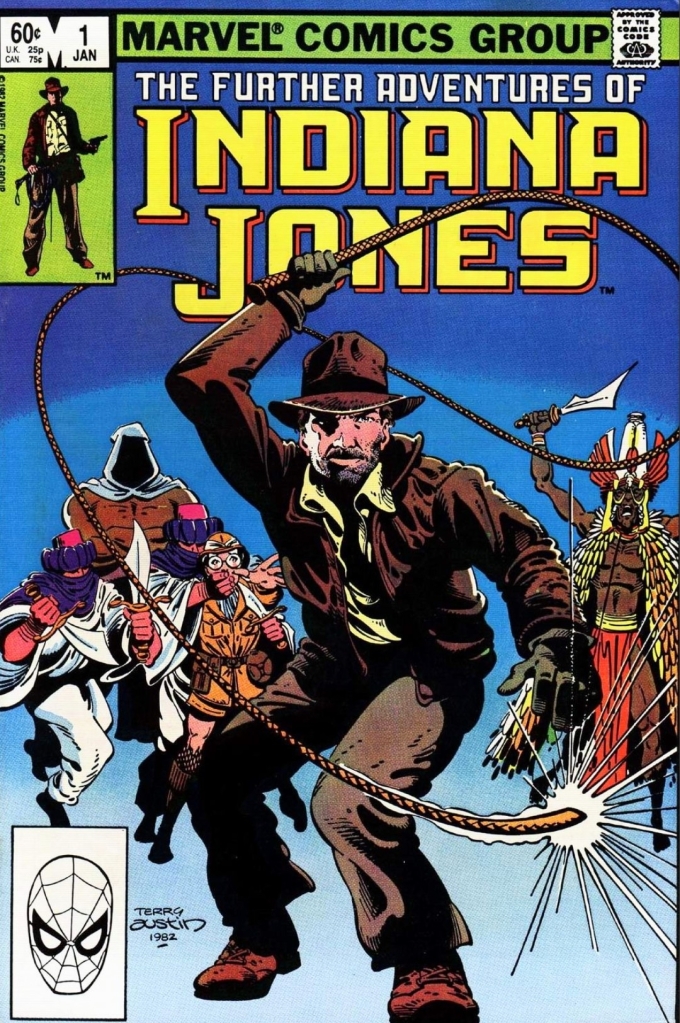
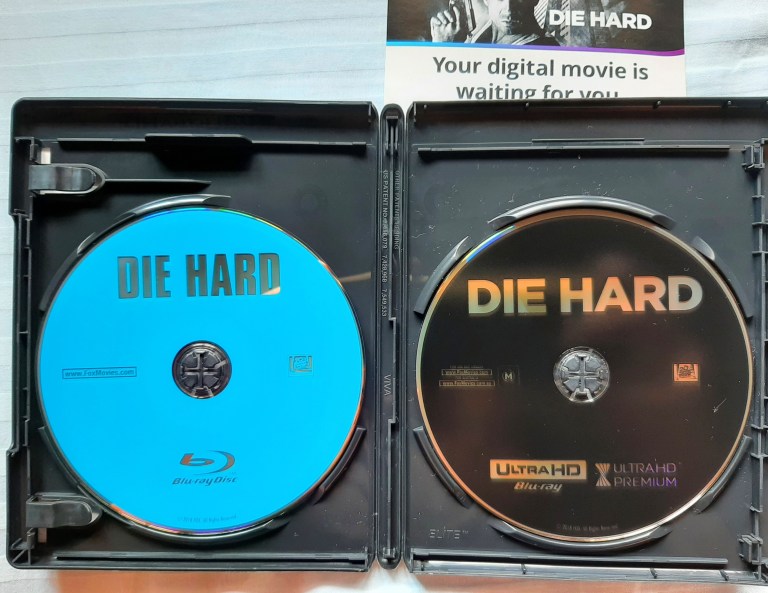
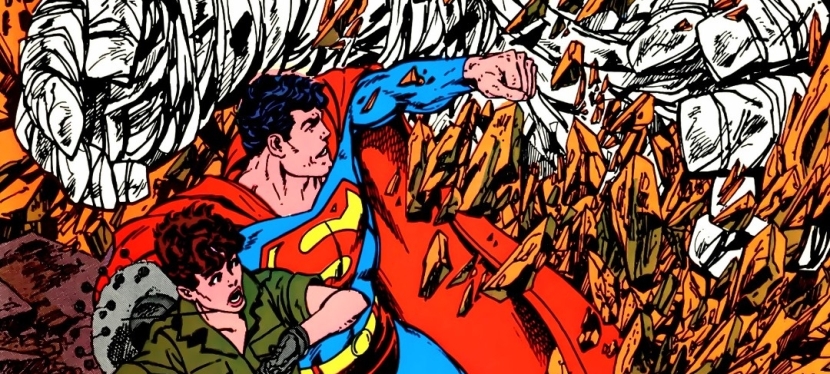
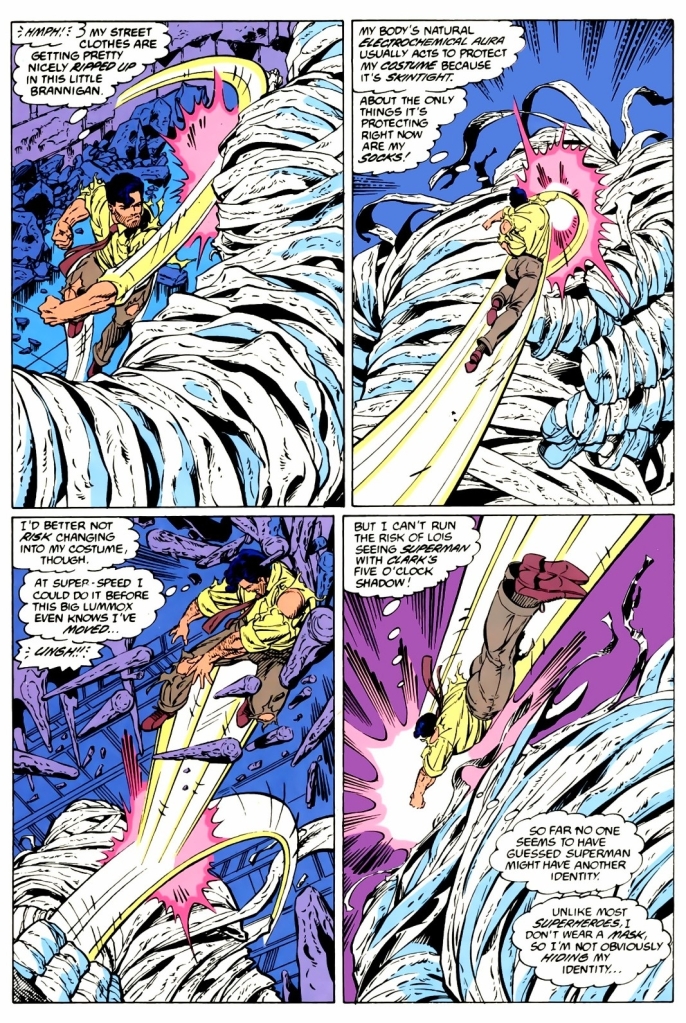
A Look Back at V: The Final Battle (1984)

Disclaimer: This is my original work with details sourced from watching V: The Final Battle and doing personal research. Anyone who wants to use this article, in part or in whole, needs to secure first my permission and agree to cite me as the source and author. Let it be known that any unauthorized use of this article will constrain the author to pursue the remedies under R.A. No. 8293, the Revised Penal Code, and/or all applicable legal actions under the laws of the Philippines.

With a very engaging story, memorable characters, intriguing concepts and innovative marketing, the $13 million production V: The Original Miniseries (simply called V back then) became a major TV hit in America over two nights in May, 1983. I personally loved watching the said mini-series back in the 1980s and I still love replaying it in this age of high-definition and Blu-ray discs. For me, at least, it is a timeless classic and it carries several lessons about the fragility of society, the rise of fascism, the spread of evil in many forms and the human desire for freedom from oppression.

Given its success and the way creator Kenneth Johnson ended the 1983 sci-fi mini-series, a sequel was inevitable. In fact, two sequels to V: The Original Miniseries were approved in the form of another mini-series (note: I acquired the Blu-ray release in 2021) and a regular TV series. Beyond the small screen, the V franchise entered literature as DC Comics published a V comic book series (read my retro review of V #1 by clicking here) related to the TV series.

With those details laid down, here is a look back at V: The Final Battle, starring Faye Grant, Marc Singer, Jane Badler and Michael Ironside under the direction of Richard T. Heffron. This 3-episode mini-series, which involved a lot of screenwriters, was broadcast on TV in America in May 1984.

The cover and the title that did not live up to its purpose.

Early story

The story begins with Mike Donovan (Marc Singer) having a nightmare of him and his son Sean (who was abducted during the events of V: The Original Miniseries) in a desperate escape attempt while inside one of the motherships of the Visitors. He wakes up in the presence of Julie Parrish (Faye Grant) and realizes they have a dangerous mission to execute at a local facility used by the red-uniformed Visitors. It turns out, the Resistance movement led by Julie has been losing ground to the alien humanoids and Mike has been helping them out while prioritizing the state of his son who has been in captivity in one of the mother ships.

During the night, a truck carrying many local civilians inside its trailer arrives at a local factory controlled by the Visitors with officer Steven (Andrew Pine) watching over. After the civilians got directed to enter the factory, it turns out they got processed and came out in the form of food cocoons. The sight shocks Julie watching from a distance with her armed teammates waiting on stand-by.

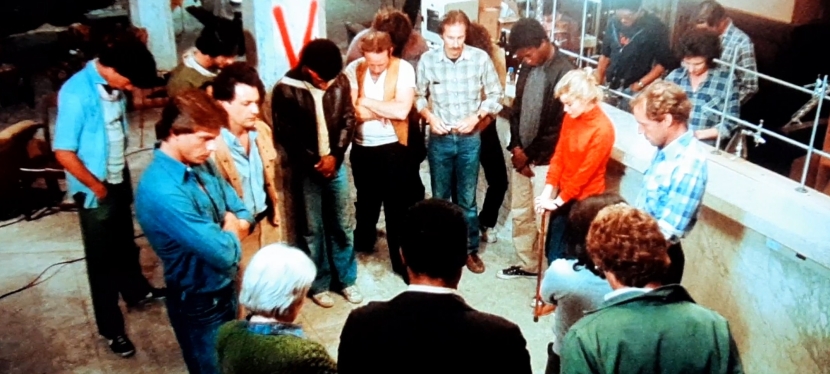
Easily the most engaging shot in this sequel. A clear reminder about the fascist takeover by the aliens from outer space.

After causing damage on the nearest fence, the Resistance begins their attempt to raid the facility and free their fellow cocooned people but the tide turned against them. It turns out, the Visitors’ troops are wearing stronger armor and bright lights were installed on the top of the facility to forcing Julie, Marc and the rest of their team to retreat. They lost some members along the way. During a closed-door meeting with the Resistance stakeholders, Mike Donovan says a key event is needed to make a significant gain against the Visitors.

Over at the mothership hovering over Los Angeles and in the presence of Diana (Jane Badler), the leader John (Richard Herd) tells Kristine Walsh (Jenny Sullivan) that a major medical announcement will be held in the form of an organized special event very soon and that she will be part of the presentation for the global TV audience…

Quality

Marc Singer as Mike Donovan with Michael Durrel and Michael Wright as Robert Maxwell and Elias Taylor near him.

I’ll star first with the presentation here. This sequel mini-series was composed of three episodes totaling over 270 minutes. In what looks like to be attempts to ensure more spectacles for the viewers’ enjoyment, each episode of V: The Final Battle has a battle near the end and the creative team succeeded in not only providing on-screen action but also scored well in making the spectacle more varied while still making sense within the main narrative. For the most part, this sequel is indeed a natural progression of what was established in V: The Original Miniseries and that is something to admire given the fact that V creator Kenneth Johnson left this production early.

On the storytelling, V: The Final Battle expands a bit on the Visitors’ dictatorship of Los Angeles and its surrounding areas while the Resistance led by Julie Parrish and supported by close companions Robert Maxwell (Michael Durrell), Elias Taylor (Michael Wright) and Caleb Taylor (Jason Bernard) are shown to be struggling on taking down the alien humanoids even though they secured noticeably more weapons and equipment. The storytelling and the dramatization about the Resistance changes dramatically with the addition of Ham Tyler (Michael Ironside) and partner Chris Farber (Mickey Jones) in the 2nd episode and from that point on, you get to see a human opposition that becomes more flexible with their operations.

Michael Ironside as Ham Tyler is the most significant new addition to the cast.

As mentioned earlier, Kenneth Johnson’s involvement in this sequel was minimal and it is seen on the presentation. The symbolism Johnson implemented in the original mini-series that established parallels between 1980s America to the Nazi occupation of Europe did not continue here which results a more straightforward presentation of details, character moments and story progression. There was also a noticeable lack of suspense when it comes to executing big scenes with big reveals. The pacing, like in the 1983 mini-series, moves smoothly at a moderate pace throughout and there were no boring moments at all.

The quality of script is still good. For the most part, the writers managed to capture the essence of the established characters from the original mini-series as they told the further developments of this sequel. For example, Caleb and Elias’ father-and-son moments quickly remind me of what I saw in V: The Original Miniseries. Robert Maxwell’s struggle to help his troubled daughter Robin (Blair Tefkin) while assisting Julie and the Resistance is a very natural progression of what was shown in 1983. The friendship between good natured alien Willie (Robert Englund) and Harmony (Diane Cary) got developed a lot more than expected eventually adding to one particular side of the conflict. The local collaborators Daniel Bernstein (David Packer) and Eleanor Dupres (Neva Patterson) developed further with their treason towards their fellow humans as they enjoyed further the power they gained from the Visitors. These two characters will surely get on the nerves of viewers rooting for the Resistance.

Denise Galik as Maggie is a fine new addition to the cast.
David Packer returns as Daniel Bernstein.
Sarah Douglas as Pamela, a superior of Diana’s.

When it comes to new additions to the cast, Ham Tyler and Chris Farber are not the only new players to add depth to this sequel. There is also Maggie (Denise Galik) who is an attractive, brave and strategic Resistance member whose contribution makes an impact. On the downside, there is also Andrew Doyle (Thomas Hill) who is bad choice the creative team came up with as the on-screen representative of faith when he in fact represents religion, idolatry, rituals and distortion. On the side of the Visitors is Pamela (Sarah Douglas) who is a higher-ranking officer than Diana and even John. Pamela is the more militaristic type of leader who is more focused on achieving goals while keeping things in order.

If there is anything flawed about the characterization, it is the romantic relationship of Julie Parrish and Mike Donovan which starts in the first episode. Considering how dramatic the performances of Faye Grant and Marc Singer were in this sequel, Julie and Mike still don’t make a believable pair of lovers in my view. While this romantic relationship opens up new dimensions within Julie and Mike and offer viewers something new to focus, it brings down the former’s value as Resistance leader somewhat while also setting aside the hinted personal connection between her and Elias in the 2nd episode of the 1983 mini-series.

Faye Grant as Julie Parrish in the conversion process scene watched closely by Jane Badler’s Diana.

More on Faye Grant, her performance here is more varied. Not only does she play the brave and struggling leader who is talented in fighting, science and medical practice, she also portrayed Julie as an even more vulnerable character this time around. Her act as the traumatized Julie during the conversion process (read: mental and psychological torture using a more detailed form of virtual reality or nightmare generation) scenes under the watch of Diana is very dramatic and compelling to watch. Just seeing Julie in the conversion process will make grip you with despair and you will eventually feel sorry for her. I should state that the nightmare scenes of Julie were presented with a clear touch of horror.

Marc Singer as Mike Donovan is no longer the reluctant action hero but rather a driven man with a mission to get his missing son back while maintaining a secret connection with Martin (Frank Ashmore) of the Fifth Column (secret dissenters among the Visitors) hoping to achieve breakthroughs for the Resistance and their friends among the dissenting aliens. Singer did the best he could with the script provided to him and he remain likable all throughout. Other than the unbelievable romance with Julie as well as his past encounters with Ham Tyler, there is not much new to expect from the way Mike Donovan was written here. What I should point out, however, is that Mike Donovan’s support for the unholy act of abortion (along with the so-called right to abort) is very wrongful, highly immoral and makes the hero having a sinister presence within him even though he is a father searching for his son.

Jane Badler’s performance as Diana deserves admiration here. Not only did she successfully recapture the charismatic and sinister nature of her character in the 1983 mini-series, Badler was very convincing in showing the more desperate side of Diana, especially when it comes to power struggle within the ranks of the Visitors. You can clearly see the desperation and struggle as soon as Pamela appeared. This sequel also showed a lot more of Diana when it comes to personally supervising her conversion process which is much more elaborate here (note: the conversion process in the 1983 mini-series was limited to the showing of a chair with torture devices). Being the very symbol of charisma and evil in the V franchise, Diana’s place in pop culture is solid and her real-world comparative counterparts would be none other than Hillary Clinton and Kamala Harris.

Jane Badler as the ever charismatic yet very wicked Diana.

As mentioned earlier, Michael Ironside’s Ham Tyler is the most significant addition to the cast and the script. Ironside had that excellent mix of toughness, cruelty and sarcasm portrayed in here and at the same time Ham Tyler brought out very interesting and intriguing interactions with the more established Julie and Mike. As seen in entertainment history, Ironside went on to climb up the ranks in Hollywood with Total Recall (1990), Starship Troopers (1997) and in the Splinter Cell video game franchise. Ironside’s Ham is easily the fourth major character of the V franchise of the 1980s.

Going into the spectacle part of this sequel, the action is more varied as mentioned earlier and the 3-episode structure was a factor. You will see lots of shooting with the use of guns and laser blasters here and there, and with the in-story locations and props as key factors, there are action sequences that are uniquely done. There is a lot to enjoy for any V fan and casual viewers watching this sequel.

As for the special effects part of the spectacle, this one is a mixed bag similar to what was presented in the 1983 mini-series. To put things in perspective, the use of in-camera effects, practical effects and optical effects for TV back in the 1980s was ambitious. That being said, certain effect shots here did not age well such as the miniature shots looking fake (because the camera used did not have a special lens to capture visuals that would have made the miniatures look believable). I should also state that there were certain effects shots that were recycled and reused in key sequences in this sequel which remains embarrassing to see. What is even more embarrassing to see here is the very poor-quality monster effects used during the nightmare scenes (conversion process) of Julie and, more notably, the presentation of Robin’s other child. The monster effects are so fake, they are laughable to watch.  

On the bright side of the special effects, the quality of the laser blasts remains good to watch right down to the precise timing with the explosions that were simulated on-set and in-camera.

Conclusion

The Visitors and Resistance key characters in the sequel.

While it has its strengths and weaknesses, V: The Final Battle is still engaging and enjoyable to watch, and at the same time it is a worthy addition for your Blu-ray collection when it comes to HD viewing (note: this is the sequel with the best visuals yet albeit with black borders on the sides). Even though creator Kenneth Johnson was not too involved on the production side, the creative team managed to deliver a long story that proved to be a natural progression of the original mini-series while providing more spectacle (especially action), developing the established characters and resolving key plot threads that started in 1983.

The lack of Kenneth Johnson’s personal touch on the presentation was noticeable and somewhat brought this sequel down a bit in terms of style. What brought V: The Final Battle’s quality down were the overall cheaper looking visual effects, the Julie-Mike love relationship and the climax of the final episode which seemed executed with desperation on the part of the creative team (note: giving a little new character instant purpose). In fairness, this sequel still succeeded in showing what fascism in America (or California specifically which is now dominated by Commies) would look like and it built up on its predecessor’s themes such as the deception of power and the collaboration with foreign enemies. This mini-series even added themes of teenage pregnancy and abortion (note: someone from the creative team wanted to promote the wrongful Roe v. Wade Supreme Court decision of 1973) to its narrative.

Does V: The Final Battle live up to its title? Absolutely not because a regular TV series that deteriorated in quality followed. In retrospect, it’s clear that this sequel marked the beginning of the decline of the V franchise in pop culture. What more, V: The Final Battle was never counted as canon in Kenneth Johnson’s 2008 novel (and sequel to the 1983 mini-series) V: The Second Generation. On its own, V: The Final Battle still has more positive stuff than negative ones and in my experience, it remains enjoyable and compelling to watch from start to finish. Compared to V: The Original Miniseries, I can say this sequel falls short. It is good, not great.

Overall, V: The Final Battle (1984) is recommended. That being said, let this 1984 mini-series remind you that there is so much evil in the real world in the forms of Iran, the terrorists of Palestine, the social justice warriors (SJWs), the Black Lives Matter (BLM) movement and liberal media to name some. Always keep in mind to avoid becoming evil no matter how tempting power in this divided world becomes to you. You also do not want to let the evil ones take over your government and have authority over you, your family members and your community. Push back against evil and stand up strong by faithfully taking sides with the one true Savior whose name is Jesus!

+++++

Thank you for reading. If you find this article engaging, please click the like button below and also please consider sharing this article to others. If you are looking for a copywriter to create content for your special project or business, check out my services and my portfolio. Feel free to contact me with a private message. Also please feel free to visit my Facebook page Author Carlo Carrasco and follow me on Twitter at  @HavenorFantasy as well as on Tumblr at https://carlocarrasco.tumblr.com/

Better than Streaming: Dune (2021) 4K Blu-ray coming out on January 11, 2022

Welcome back, fellow geeks, Blu-ray collectors and movie buffs! The 2021 movie Dune (directed by staunch cinema defender Denis Villeneuve)can be viewed in the comfort of home in a much better version than HBO Max/HBO Go on January 11, 2022 as its 4K Blu-ray combo (4K Blu-ray disc, Blu-ray and digital code) will be released on that very day! There will also be a Best Buy-exclusive steel book version released as well.

The good news this early is that Dune (2021) 4K Blu-ray will come with native 4K visuals! While its price and the official start of pre-ordering the product have yet to be announced as of this writing, you can find its Amazon listing by clicking here. If you really are interested in the movie’s 4K Blu-ray combo, I encourage you to keep revisiting the Amazon listing for updates.

To put things in perspective, posted below are key details from the Blu-ray.com article about Dune (2021) 4K Blu-ray combo. Some parts in boldface…

The front cover.

Special Features and Technical Specs:

  • DOLBY VISION/HDR PRESENTATION OF THE FILM
  • DOLBY ATMOS AUDIO TRACK
  • Featurettes:
    • The Royal Houses
    • Filmbooks: House Atreides
    • Filmbooks: House Harkonnen
    • Filmbooks: The Spice Melangelnside Dune – The Training Room
    • Inside Dune: The Space Harvester
    • Inside Dune: The Sardaukar Battle
    • Building the Ancient Future
    • My Desert, My Dune
    • Constructing the Orniyhropters
    • Designing the Sandworm
    • Beware the Baron
    • Wardrobe From Another World
    • A New Soundscape
  • 4K Blu-ray subtitles: English SDH, Latin Spanish, Canadian French, Parisian French, German, German SDH, Norwegian, Swedish, Finnish, Danish, Greek, Korean, and Hindi
  • Blu-ray subtitles: English SDH, Latin Spanish, Canadian French, Portuguese-Brazilian, Bulgarian, Czech Republic, Hungarian, Japanese, Polish, Romanian, and Hindi
The rear cover.

Posted below are the other details from Dune’s (2021) own page at Blu-ray.com…

Video

Codec: HEVC / H.265

Resolution: Native 4K (2160p)

HDR: Dolby Vision, HDR10

Aspect ratio: 2.39:1, 1.78:1

Original aspect ratio: 2.39:1, 1.43:1

Audio

English: Dolby Atmos

English: Dolby TrueHD 7.1 (48kHz, 24-bit)

Note: All Dolby Atmos tracks have a Dolby TrueHD 7.1 (48kHz, 24-bit) core

SubtitlesEnglish SDH, French, Spanish

Discs4K Ultra HD, Blu-ray Disc, Two-disc set (1 BD-100, 1 BD-50)

Digital – Digital 4K, Movies Anywhere

Packaging – Slipcover in original pressing

Playback4K Blu-ray: Region free, 2K Blu-ray: Region A

While Dune (2021) has been playing in the local cinemas here in my native Philippines for weeks now, I’m still waiting for the film to be screened on an IMAX cinema operated by SM Cinema (which itself started to gradually reopen). I am aware that the film is being shown on another cinema with IMAX with Laser technology but that cinema’s price is simply too expensive for me. Dune (2021) was filmed with Arri Alexa LF IMAX and Arri Alexa Mini LF IMAX cameras and that alone convinces me to watch it on an IMAX screen. In relation to SM Cinema’s reopening, the nearest IMAX cinema should reopen on November 30.

While I am not a fan of the Dune literary series as well as the failed 1984 movie, this year’s cinematic version looks grand under the passionate direction of Villeneuve and it has an ambitious cast that includes Aquaman Jason Momoa, Josh Brolin, and Rebecca Ferguson to name a few. Given the fact that the movie was released on HBO Max, it looks highly unlikely it will achieve a tremendous ticket sales success just as more cinemas are reopening worldwide as more people got vaccinated for COVID-19. When I say tremendous ticket sales, I’m talking about grossing $750 million worldwide. As of this writing, Dune (2021) grossed $365.5 million worldwide while theater-exclusive movies No Time to Die and F9: The Fast Saga have grossed over $700 million worldwide each. Very clearly, the HBO Max-theaters hybrid release of Warner Bros. is a big mistake. Remember, what people pay for on streaming goes to the service, not the movie.

Now that Dune (2021) 4K Blu-ray combo is set for a January 11, 2022 release, does this latest development spark your interest? I myself am eager to see how the IMAX-recorded footage will turn out in 4K Blu-ray visuals.

In closing this Better than Streaming piece, posted below are some Dune-related videos for your viewing pleasure. Also included are a few videos about the 1984 Dune movie.

+++++

Thank you for reading. If you find this article engaging, please click the like button below and also please consider sharing this article to others. If you are looking for a copywriter to create content for your special project or business, check out my services and my portfolio. Feel free to contact me with a private message. Also please feel free to visit my Facebook page Author Carlo Carrasco and follow me on Twitter at  @HavenorFantasy as well as on Tumblr at https://carlocarrasco.tumblr.com/

If you wish to join a group of movie enthusiasts and talk about cinema, visit the Movie Fans Worldwide Facebook group at https://www.facebook.com/groups/322857711779576

Better than Streaming: The Karate Kid Collection 4K Blu-ray coming out on December 7, 2021

Welcome back, fellow geeks, movie buffs and fellow Blu-ray/4K Blu-ray collectors!

For those of you who love The Karate Kid trilogy of movies (1984-1989) as well as the acclaimed sequel Cobra Kai, mark your calendars for December 7, 2021 as The Karate Kid Collection 4K Blu-rayset will be released on that very day! You can order it online right now!

[Blu-ray cover]

The Karate Kid Collection 4K Blu-ray set comes with six discs as each movie has a 4K Blu-ray disc and a Blu-ray disc (for 1080p viewing). As seen above, the box really has nicely made artwork showing the trilogy characters and the 1980s vibe. Unsurprisingly, Ralph Macchio and the late Pat Morita are featured on the front as the iconic duo of Daniel and Mr. Miyagi.

Posted below are key details of The Karate Kid Collection 4K Blu-ray from its Blu-ray.com page.

Video

Codec: HEVC / H.265

Resolution: 4K (2160p)

HDR: HDR10

Aspect ratio: 1.85:1

Original aspect ratio: 1.85:1

Audio

English: Dolby Atmos

French: Dolby Digital 5.1

Spanish: Dolby Digital 5.1

Subtitles

English, English SDH, French, German, Italian, Japanese, Portuguese, Spanish, Arabic, Croatian, Czech, Danish, Dutch, Finnish, Greek, Hindi, Korean, Mandarin (Simplified), Mandarin (Traditional), Norwegian, Polish, Slovak, Slovenian, Swedish, Thai, Turkish

Discs

4K Ultra HD

Blu-ray Disc

Six-disc set (6 BD)

Digital

Digital copy included

Playback

4K Blu-ray: Region free

2K Blu-ray: Region A

As stated in the Blu-ray.com announcement, the first two Karate Kid movies were previously restored in 4K from the original camera negative while the third movie comes with a new 4K restoration from the original camera negative. As of this writing, however, there is no clear indication if each movie will have native 4K visuals.

The first movie is a true classic in my honest view. As it was directed by the same man responsible for the first Rocky movie, The Karate Kid shares certain elements with it but still it went on to establish its own legacy adding variety to the teen culture movies released by Hollywood in the 1980s and helped made martial arts become a cultural phenomenon again in that same decade. As the 1984 movie proved to be successfully critically, commercially and culturally, it went on to spawn sequels in 1986 (story set mostly in Japan) and 1989 (set again in California and an attempt to make the trilogy go full circle creatiely). Beyond the film format, an animated series was made as well as a computer game and a video game. Come December 7, The Karate Kid Collection 4K Blu-ray will resonate with Blu-ray collectors who grew up with The Karate Kid movies.

In ending this piece, posted below are Karate Kid-related videos for your enjoyment.

For more entries of my Better than Streaming series of articles, check out my pieces on The Beastmaster 4K Blu-rayThe Transformers: The Movie 4K Blu-rayMortal Kombat 2021 4K Blu-raySpace Jam 4K Blu-rayV: The Original Miniseries Blu-ray (read my retro review), V: The Final Battle Blu-rayHighlander 4K Blu-rayThe Suicide Squad, Super Dimension Century Orguss Blu-ray, Unbreakable 4K Blu-ray, Injustice 4K Blu-ray, The Suicide Squad 4K Blu-ray, Terminator 2: Judgment Day 30th Anniversary 4K Blu-ray, Final Fantasy: The Spirits Within 4K Blu-ray,  Mad Max Anthology 4K Blu-ray and Night Shift Blu-ray.

+++++

Thank you for reading. If you find this article engaging, please click the like button below and also please consider sharing this article to others. If you are looking for a copywriter to create content for your special project or business, check out my services and my portfolio. Feel free to contact me as well. Also please feel free to visit my Facebook page Author Carlo Carrasco and follow me at HavenorFantasy@twitter.com

If you wish to join a group of movie enthusiasts and talk about cinema, visit the Movie Fans Worldwide Facebook group at https://www.facebook.com/groups/322857711779576

Better than Streaming: Night Shift Blu-ray coming out on October 5, 2021

Welcome back, fellow geeks, movie buffs and fellow Blu-ray/4K Blu-ray collectors!

If you are nostalgic about 1980s Hollywood or you if you are discovering more of the said era for your Blu-ray collection, then you might be interested in the 1982 comedy Night Shift which is coming out on October 5, 2021 on Blu-ray format via the Warner Archive line of Warner Bros. Night Shift Blu-ray can be ordered right now online.

The cover.

What exactly is Night Shift? For one thing, it was one of the older films directed by Ron Howard (the same guy behind Solo: A Star Wars Story) and starred the famous Henry Winkler (Happy Days) and a very young Michael Keaton (Batman in 1989). Posted below is its synopsis according to Blu-ray.com…

Chuck (Henry Winkler) has given up life as a stockbroker because it was too stressful. Now, he works an easy gig as a night shift attendant at a New York City morgue. His co-worker, Bill Blazejowski (Michael Keaton), on the other hand, is always looking to make a quick buck. When Bill finds out that Chuck’s prostitute neighbor, Belinda (Shelley Long), needs a place to do her work, he convinces Chuck to turn the morgue into a brothel where they can work as her pimps.

Posted below are key details of Night Shift Blu-ray from its Blu-ray.com page.

Video

Codec: MPEG-4 AVC

Resolution: 1080p

Original aspect ratio: 1.85:1

Audio

TBA

Subtitles

None

Discs

Blu-ray Disc

Single disc (1 BD)

Playback

2K Blu-ray: Region A

I personally never saw Night Shift, not even on cable TV. The movie received an overall positive reception from movie critics and Keaton won the Kansas City Film Critics Circle Award for Best Supporting Actor. Henry Winkler meanwhile was nominated for Best Actor in a Motion Picture – Comedy or Musical at the Golden Globe Awards. To say the least, I find this upcoming Blu-ray release interesting and for those of you who have gotten sick and tired of modern-day Hollywood being dominated by socialists, social justice warriors (SJWs), Marxists, naked Communists and liberals, Night Shift could provide you much needed relief.

The movie poster.

In ending this piece, posted below is classic trailer of Night Shift. Anyone who loves the film or is nostalgic about the 1980s should watch it.

For more entries of my Better than Streaming series of articles, check out my pieces on The Beastmaster 4K Blu-rayThe Transformers: The Movie 4K Blu-rayMortal Kombat 2021 4K Blu-raySpace Jam 4K Blu-rayV: The Original Miniseries Blu-ray (read my retro review), V: The Final Battle Blu-rayHighlander 4K Blu-rayThe Suicide Squad, Super Dimension Century Orguss Blu-ray, Unbreakable 4K Blu-ray, Injustice 4K Blu-ray, The Suicide Squad 4K Blu-ray, Terminator 2: Judgment Day 30th Anniversary 4K Blu-ray, Final Fantasy: The Spirits Within 4K Blu-ray and Mad Max Anthology 4K Blu-ray.

+++++

Thank you for reading. If you find this article engaging, please click the like button below and also please consider sharing this article to others. If you are looking for a copywriter to create content for your special project or business, check out my services and my portfolio. Feel free to contact me as well. Also please feel free to visit my Facebook page Author Carlo Carrasco and follow me at HavenorFantasy@twitter.com

If you wish to join a group of movie enthusiasts and talk about cinema, visit the Movie Fans Worldwide Facebook group at https://www.facebook.com/groups/322857711779576

A Look Back at Dazzler #3 (1981)

Disclaimer: This is my original work with details sourced from reading the comic book and doing personal research. Anyone who wants to use this article, in part or in whole, needs to secure first my permission and agree to cite me as the source and author. Let it be known that any unauthorized use of this article will constrain the author to pursue the remedies under R.A. No. 8293, the Revised Penal Code, and/or all applicable legal actions under the laws of the Philippines.

Welcome back, superhero enthusiasts, comic collectors, 1990s culture enthusiasts and fans of Marvel Comics! After a very fine start, things really went downhill with the story and presentation in Dazzler #2. That comic book had Dazzler (then a hot new property for Marvel Comics) completely overshadowed by the big mix of established Marvel superheroes fighting opposition elements. To say the least, Dazzler #2 was a major letdown, a very big disappointment and anyone who loves Dazzler should avoided it.

Will we see Dazzler presented much better in the next issue? We can find out in this look back at Dazzler #3, released in 1981 by Marvel Comics with a story written by Tom DeFalco and drawn by John Romita, Jr., and A. Kupperberg.

The cover.

Early story

The story begins with Dazzler (not wearing her face paint) participating scientific test conducted by Fantastic Four leader Reed Richards/Mr. Fantastic at his team’s headquarters in New York. Dazzler has been converting every nearby sound into radiance and she’s beginning to sense her limitations. The test was done to determine Alison Blaire’s mutant capabilities. Also present were Johnny Storm, Ben Grimm and Sue Richards. Johnny reads a newspaper report about the United Nations’ plan to display the crown jewels that once belonged to their deadliest enemy Dr. Doom.

Afterwards, Dazzler meets her boss at his office and learns that she will be one of the openers at the benefit concert of UNICEF which is supposed to help her with her music career. The next morning, she decides to visit her old home where her father lives in. Over at the Bavarian Alps, Dr. Doom gets informed that among the jewels set to be displayed at the Unite Nations is the Merline stone. This compels him to make a move…

Quality

Dazzler versus Dr. Doom!

When compared to the disaster of issue #2, this comic book’s story is indeed an improvement as it has the expected superhero storytelling formula intact. The good news here is that the character development on Dazzler has returned and there is once again the strong emphasis on her relevance with the people of New York with regards to her being both a superhero and a musician.

The story moved at a moderate pace and it is clear that the creative team took the necessary steps to gradually build up the plot leading to the inevitable encounter between Dazzler and the Fantastic Four’s most definitive enemy (and Marvel Comics’ iconic villain). Take note, however, that the Dazzler-Dr. Doom conflict here is only the beginning.

As this story is more focused on Dazzler, you will get to see an early look at her tainted relationship with her father who desired her to become a lawyer like him, plus there is some focus on the behind-the-scenes development in one of the big events involving her. When it comes to spectacle, there is a right amount of it here which makes this comic book more fun to read than the previous issue.

Conclusion

A look at the business side of the music industry that Alison Blaire/Dazzler is involved with.

Dazzler #3 (1981) is indeed fun to read and the creators succeeded in developing Alison Blaire more while delivering the good stuff. While the match-up between her and Dr. Doom looks awkward from the surface, the strong writing justified it and all along Dazzler never looked like she was out of place being with Marvel’s iconic supervillain.

If you are seriously planning to buy an existing hard copy of Dazzler #3 (1981), be aware that as of this writing, MileHighComics.com shows that the near-mint copy of the regular edition costs $28 while the near-mint copy of the newsstand edition costs $60.

Overall, Dazzler #3 (1981) is recommended.

+++++

Thank you for reading. If you find this article engaging, please click the like button below and also please consider sharing this article to others. If you are looking for a copywriter to create content for your special project or business, check out my services and my portfolio. Feel free to contact me as well. Also please feel free to visit my Facebook page Author Carlo Carrasco and follow me at HavenorFantasy@twitter.com

A Look Back at Dazzler #1 (1981)

Disclaimer: This is my original work with details sourced from reading the comic book and doing personal research. Anyone who wants to use this article, in part or in whole, needs to secure first my permission and agree to cite me as the source and author. Let it be known that any unauthorized use of this article will constrain the author to pursue the remedies under R.A. No. 8293, the Revised Penal Code, and/or all applicable legal actions under the laws of the Philippines.

Welcome back, superhero enthusiasts, comic collectors, 1990s culture enthusiasts and fans of Marvel Comics! Previously, I reviewed Uncanny X-Men #130 which was the first appearance of Dazzler who went on to become one of the most notable new characters of Marvel Comics in the 1980s. After appearing in Uncanny X-Men #131 and Amazing Spider-Man #203, Dazzler became more prominent among all of Marvel’s superheroes as the publisher launched an all-new monthly series featuring her. There is more to that than meets the eye, however.

In his article titled “Dazzler and Me”, Danny Fingeroth wrote: Marvel decided to tray an experiment with the relatively new “direct market” – comic book shops. It was decided that Dazzler #1 would only be available in comic book shops, not at traditional newsstands.

Dazzler #1 sold over 400,000 copies.

Even the top-selling comics of the era sold perhaps 250,000 copies. So, the first issue, anyway, was a major hit.

Apart from the confirmed commercial success of the comic book, it is a wonder if it is still good to read by today’s standards. To find out, here is a look back at Dazzler #1, published in 1981 by Marvel Comics with a story written by Tom DeFalco and drawn by John Romita, Jr.

The cover.

Early story

The story begins with Dazzler running away from four armed men who had been following her since she left the disco. She finds herself corned at the dead end of an alley as the men approach her. While pretending to be reaching for her make-up in the bag, Dazzler grabs and activates her portable radio which plays music. With the music turned on, she uses her power to convert it all into a dazzling display of light and color which makes the men disoriented.

While swinging nearby, Spider-Man notices the display of light but before he begins his approach, Dazzler makes her move to knock two men out. Another man fires his gun and his bullet ricochets until it hits the portable radio stops the music and Dazzler’s lights altogether leaving her vulnerable once again…

Quality

This page alone establishes Dazzler as a person struggling to make ends meet.

As far as telling a Dazzler story goes, this comic book is the complete package and it’s got very solid writing! Apart from showing what happened to her after her appearances in the Uncanny X-Men and Amazing Spider-Man series, this comic book formally introduces Dazzler in her civilian identity as Alison Blaire and thanks to efficient writing, it also reveals threads of her past and how her mutant powers manifested. Not only that, readers will get to see the title character as a typical person who is struggling to make ends meet even though she does her best with entertainment as a career.

Strangely, the focus on Dazzler is relatively light in content and the result is several pages of Marvel universe-related filler which shows several other characters like Captain America, Iron Man, Storm, Wolverine and others present with little to no connection with the title character. The X-Men scene is a nice touch as it will remind readers about Dazzler’s first interaction with them.

As a teenager, Alison Blaire’s power begins to manifest during this particular event in her life.

To build-up the first challenge for Dazzler, this comic book has the Enchantress as the villainess and ironically it also had some room of character development for her. Clearly this was done not only to build up anticipation for the next issue but to make readers root for Dazzler some more. In retrospect, the Enchantress would later emerge as an important figure in 1984’s crossover storyline Secret Wars.

Conclusion

The scene involving the X-Men is a nice touch as it connects with Dazzler’s previous interaction with them.

While it is indeed a product of the early 1980s carrying influences from the 1970s New York club scene, Dazzler #1 (1981) is still fun and engaging to read. Clearly this comic book is a must-have for anyone who loves Dazzler and it should be entertaining enough for geeks who love the 1980s and the Marvel-related crossovers of the time. Very clearly, this comic book succeeded in introducing and developing Dazzler as a person (as opposed to being a super hero) and the background story established fits in nicely with the character’s first appearance in Uncanny X-Men #130. Very clearly, there is a lot more to Dazzler than her unique super power and her disco look.

If you are seriously planning to buy an existing hard copy of Dazzler #1 (1981), be aware that as of this writing, MileHighComics.com shows that the near-mint copy of the comic book costs $70.

Overall, Dazzler #1 (1981) is highly recommended!

+++++

Thank you for reading. If you find this article engaging, please click the like button below and also please consider sharing this article to others. If you are looking for a copywriter to create content for your special project or business, check out my services and my portfolio. Feel free to contact me as well. Also please feel free to visit my Facebook page Author Carlo Carrasco and follow me at HavenorFantasy@twitter.com

A Look Back at V #5 (1985)

Disclaimer: This is my original work with details sourced from reading the comic book, watching the V mini-series (Original Miniseries and The Final Battle) and the 1984 TV series, and doing personal research. Anyone who wants to use this article, in part or in whole, needs to secure first my permission and agree to cite me as the source and author. Let it be known that any unauthorized use of this article will constrain the author to pursue the remedies under R.A. No. 8293, the Revised Penal Code, and/or all applicable legal actions under the laws of the Philippines.

Welcome back, science fiction enthusiasts, comic book collectors and fans of the V entertainment franchise of the 1980s! Before I start this newest retro comic book review, I am happy to say that I recently published my retro review of V: The Original Miniseries which is one of the most in-depth retro reviews I wrote so far. I recommend you to read it now. If you are a fan and you are interested to buy yourself the original mini-series on Blu-ray disc format, head on to Amazon. Now we can return to the 1980s comic book series.

Last time around, Ham Tyler and Chris continued their operation which resulted getting reunited with the star child Elizabeth Maxwell (refer to V: The Final Battle mini-series of 1984). Meanwhile, Mike Donovan and Julie Parrish met with delusional astronomer Earl Meagan (patterned after Carl Sagan) who is obsessing with meeting Diana of the Visitors.

With those details laid down, here is a look back at V #5, published in 1985 by DC Comics with a story written by Cary Bates and drawn by Tod Smith.

The cover.

Early story

The story begins with Diana, Linda and Charles watching a video message from the delusional Earl Meagan expressing his thanks to her (Diana) for accepting his peace proposal for a summit of peace between the humans and the Visitors. He expressed more of his delusion stating that he is confident that both of their races will benefit from the meeting.

Diana explains to her powerful companions that they have a lot to gain by turning one of Earth’s most influential figure to their side. After Diana left, Linda expresses that their commander has gone too far. Charles tells her what she is thinking of.

On Earth, in the presence of Ham, Chris and Bates, a weakened Elizabeth recalls her time with Kyle when they went into hiding away from the Visitors’ search team. She then makes mental contact with Kyle.

Elsewhere, as Mike Donovan and Willie watch the newscast about the peace summit between Diana and Earl Meagan set to happen soon, Julie Parrish personally tells the astronomer (by the helipad within a city) that he just can’t go as such a meeting is suicide. Still delusional, Meagan tells Julie that she is no different from her short-sighted friend Mike, leaves her and rides the helicopter to push through with the summit…

Quality

Realizing her mistake with the delusional astronomer Earl Meagan, Julie comes back to Mike.

First thing to mention is the good news that the quality of the writing and plotting by Cary Bates has the high quality maintained throughout. While the story about the peace summit between Earl Meagan and Diana is the highlight here, the other story (told through Ham and Chris) about the discovery of a secret camp where the Visitors conduct experiments on humans is itself very intriguing as it parallels what the Nazis did to prisoners during the dark days of World War II.

Going back to the highlighted plot of the comic book, Earl Meagan is not only delusional with his old belief that any extraterrestrial race capable of traveling through the depths of space is surely friendly and benevolent to humanity…he is completely wrong and a danger to his own people as clearly lost his touch with truth and reality. He is a perfect example of what happens when a scientist refuses to realize the limits of science and goes over the edge believing in the falsehood that another scientific breakthrough will prove him right and all others wrong. By today’s standards, Meagan can be compared with the radical socialists in America who foolishly believe that all foreigners (including criminals and terrorists) should be allowed free entry into their country without consequence and without responsibility, and at the expense of their fellow American citizens.

When it comes to characterization, I still recognize Ham and Chris as I remembered them from V: The Final Battle thanks to solid writing. Julie’s portrayal in this comic book, however, takes a drastic turn from powerful receiver of Earl Meagan in issue #4. More notably, it is refreshing to see the relationship between Mike and Julie getting strained as a result of Meagan.

Conclusion

The closest thing you can have about Carl Sagan betraying the entire human race in favor of aliens from outer space.

V #5 (1985) is another solid tale about the conflict between the Resistance and the Visitors, but with Earl Meagan as the mad scientist with charisma who puts his fellow humans into more danger. It’s a worthy read from start to finish.

If you are seriously planning to buy an existing hard copy of V #5 (1985), be aware that as of this writing, MileHighComics.com shows that the near-mint copy of the regular edition costs $28 while the near-mint copy of the newsstand edition costs $36.

Overall, V #5 (1985) is highly recommended.

+++++

Thank you for reading. If you find this article engaging, please click the like button below and also please consider sharing this article to others. If you are looking for a copywriter to create content for your special project or business, check out my services and my portfolio. Feel free to contact me as well. Also please feel free to visit my Facebook page Author Carlo Carrasco and follow me at HavenorFantasy@twitter.com

A Look Back at Superman Annual #10 (1984)

Disclaimer: This is my original work with details sourced from reading the comic book and doing personal research. Anyone who wants to use this article, in part or in whole, needs to secure first my permission and agree to cite me as the source and author. Let it be known that any unauthorized use of this article will constrain the author to pursue the remedies under R.A. No. 8293, the Revised Penal Code, and/or all applicable legal actions under the laws of the Philippines.

Before DC Comics ended their original superhero multiverse with Crisis on Infinite Earths (1985-1986) to restart all over again, there were a whole lot of stories about Superman ranging from the dramatic stuff, the epic tales and right down to the most outlandish tales.

As a kid, I was fortunate enough to buy myself a copy of a 1984 Superman comic book, the cover of which really intrigued and caught my interest. It was a Superman annual comic book with a $1.25 cover price which was somewhat high at the time. Its cover showed the Man of Steel himself carrying a sword pointed up.

That image made me wonder: Why would Superman have to use a sword when he is so powerful and capable without weapons? Where did that sword come from? Who made it in the first place? Is the sword so special to Superman?

With those details laid down, here is a look back at Superman Annual #10, published by DC Comics in 1984 with a story written by Elliot Maggin and drawn by classic Superman artist Curt Swan.

The cover.

Early story

The story begins in a space where a group of diverse people composed of aliens and humans are gathered together watching a live video feed Superman on a large monitor above their heads. As it turns out, the Man of Steel is in space working to prevent meteoroids from entering the planet below him. He then speeds off into space heading back to Earth.

Along time ago deep in the galaxy, a big bang effect took place creating several new fragments in the vacuum of space and among them is a long, rough object that resembles a sword. As an unknown amount of time passed, the long object gradually turns into a smooth looking sword complete with a sharp blade and a letter “S” on one end that is the same as the one Superman carries. It is referred to as the sword of Superman!

In Metropolis, Clark Kent is passed by his officemate Jimmy Olsen who mentioned that he is rushing to interview the billionaire industrialist Oswald Mandias. Two days have passed and Jimmy Olsen remained missing. As his boss Perry White heads on to the office, Clark remains and changes into Superman when the coast got clear.

As the Man of Steel flies off into the city, a Galaxy Broadcasting live report on TV shows Lana Lang reporting from the Kennedy Space Center where the new space shuttle Magellan is about to make its first-ever commercial flight to launch a mysterious new communications satellite owned by Mandias Industries…

Quality

Clark Kent/Superman being a complete stranger to others added a lot to the story.
The sword led Superman to a book about the legend of King Arthur inside the city library.

Being an annual, I can say that the Sword of Superman story was well-written and nicely visualized by the creators which made it fun and engaging to read. It is a Superman story that further adds to his being an essential hero of the original DC Comics multiverse and a key factor here is the somewhat outlandish concept that the sword that he gained was an original material of the universe from the big bang and even had connections to the unseen omnipotent force.

This story is not a simple, straightforward tale about Superman gaining a weapon required to defeat the supervillain King Kosmos. In fact, the sword opens up events that made the Man of Steel reevaluate himself, his situation and the people around him. King Kosmos, who is a time-travelling villain from the future (first appearance in DC Comics Presents Annual #2), served not just merely as the opposition but also adds a good amount of complexity within the reality of the story. For one thing, it is very intriguing and also refreshing to see people of Metropolis (even Clark’s friend Jimmy Olsen) failing to recognize Superman and perceive him with fear. This is a one-of-a-kind story of Superman that must be read, even though it is not really an epic tale.

All throughout, there is a fine balance between spectacle and intrigue. If you pay close attention to the dialogue and details, you will understand the story better and enjoy the comic book more eventually.

Conclusion

The return of King Kosmos!

I personally enjoyed reading Superman Annual #10 (1984) the first time back in 1984. The fact here is that after re-reading it recently, I do confirm that it is still an enjoyable comic book to read, and I am not even a Superman fan anymore. That is quite something! This is indeed a really good piece of Superman history from the pre-Crisis era. It also touches on themes about omnipotence, how ordinary people react to people who wield great power, and being whole with the entire universe.

If you are seriously planning to buy an existing hard copy of Superman Annual #10 (1984), be aware that as of this writing, MileHighComics.com shows that the near-mint copy of the regular edition costs $35 while the near-mint copy of the newsstand edition costs $70.

Overall, Superman Annual #10 (1984) is recommended.

+++++

Thank you for reading. If you find this article engaging, please click the like button below and also please consider sharing this article to others. If you are looking for a copywriter to create content for your special project or business, check out my services and my portfolio. Feel free to contact me as well. Also please feel free to visit my Facebook page Author Carlo Carrasco and follow me at HavenorFantasy@twitter.com